1. Executive Summary
The roller-delayed blowback operating system, initially fielded in the mid-20th century, represents a highly refined mechanical architecture renowned for its reliability, exceptionally low recoil impulse, and closed-bolt accuracy. The MP5 platform and its modern civilian semi-automatic variants—including those manufactured by Heckler & Koch, MKE (such as the AP5), Zenith, POF, MAC5, and PTR—rely on a precise equilibrium of spring tension, bolt mass, locking piece geometry, and ammunition chamber pressure to function reliably within strict operational tolerances.
Despite the platform’s historical pedigree and widespread adoption across military and law enforcement sectors globally, the contemporary proliferation of civilian clones has revealed distinct patterns of mechanical stoppages within the civilian user base.1 An extensive diagnostic analysis of armorer documentation, field manuals, and user-generated telemetry indicates that these malfunctions are rarely attributable to fundamental design flaws within the roller-delayed architecture itself. Rather, these issues consistently manifest as the product of stacked manufacturing tolerances, inappropriate ancillary equipment integration (specifically aftermarket stabilizing braces), inadequate component metallurgy in certain clone derivatives, and a pervasive lack of user understanding regarding the system’s break-in requirements and maintenance protocols.3
This report provides an in-depth mechanical evaluation of the top ten causes for semi-automatic MP5 variant malfunctions. By dissecting the kinetic interactions within the stamped steel receiver—from the gas dynamics in the chamber flutes to the mechanical disadvantage imposed by the locking rollers—this analysis delivers a structured, engineered approach to diagnosing and correcting failures to feed (FTF), failures to eject (FTE), and system binding. The subsequent sections outline the precise physical mechanisms behind these failures and establish standardized corrective actions designed to restore the platform to optimal operational specifications.
2. Mechanical Architecture of the Roller-Delayed Blowback System
To accurately diagnose a malfunction within the MP5 architecture, it is fundamentally necessary to understand the kinetic chain of events that governs its operation. The system is not a locked breech mechanism in the traditional sense, nor is it a simple direct blowback system; it is a delayed blowback mechanism utilizing mechanical disadvantage.
When a cartridge is fired, the expanding gases exert an equal and opposite rearward force against the base of the cartridge case. This case acts as a piston, pushing directly against the bolt head. In a straight blowback system, this force would immediately drive the bolt rearward, relying solely on the mass of the bolt and the tension of the recoil spring to keep the breech closed until chamber pressures drop to safe levels. However, in the MP5, the bolt head is mechanically impeded by two hardened steel rollers that protrude laterally into recesses milled into the heavy steel barrel trunnion.5
These rollers are pushed outward into the trunnion recesses by the angled nose of the internal “locking piece,” which sits inside the bolt head and is pinned directly to the heavier, massive bolt carrier. When the fired cartridge pushes rearward against the bolt head, the rollers act as a mechanical disadvantage. To allow the bolt head to move backward, the rollers must be squeezed inward toward the center axis of the bolt. Because they are wedged against the angled nose of the locking piece, squeezing them inward forces the locking piece—and the massive bolt carrier attached to it—rearward at a highly accelerated rate compared to the initial movement of the bolt head.
This mechanical delay absorbs significant kinetic energy and keeps the breech closed long enough for the bullet to travel down and exit the barrel, and for chamber pressures to drop to safe, manageable levels.5 Once the rollers clear the trunnion recesses and move onto the flat portion of the locking piece, the entire bolt group travels rearward together as a unified assembly, compressing the recoil spring, extracting the spent casing from the fluted chamber, and impacting the fixed ejector.
Any variable that disrupts this precise mechanical timing—whether it is excessive friction along the receiver rails, altered spring tension, inadequate gas pressure from underpowered ammunition, or dimensional anomalies in aftermarket parts—will immediately manifest as a malfunction.4 The top ten causes identified in the subsequent sections represent specific disruptions to this delicate mechanical equilibrium.
3. The Phenomenon of the Civilian Clone and Tolerance Stacking
The transition of the MP5 design from military-contracted production facilities to the civilian commercial market has introduced significant variables in manufacturing processes. While genuine Heckler & Koch SP5 models are produced in Germany with rigorous quality control and proprietary metallurgical treatments, clone variants such as the MKE AP5 (manufactured in Turkey on licensed HK tooling) and PTR models (manufactured in the United States) often exhibit variations in material hardness, dimensional consistency, and assembly techniques.7
The roller-delayed system is exceptionally sensitive to tolerance stacking. A slight variation in the thickness of the stamped steel receiver, combined with a slightly weak extractor spring and a microscopically out-of-spec locking roller, can compound to create severe reliability issues. While these clones provide accessibility to the platform, they often require a diagnostic “tuning” process to achieve the legendary reliability associated with the original design. The diagnostic framework utilized by armorers involves isolating specific variables, beginning with the ammunition and magazine, before progressing to internal component replacement. The following ten causes represent the highest probability failure modes encountered in this tuning process.
4. Top 10 Root Causes of Semi-Automatic MP5 Malfunctions
4.1. Extractor Spring Deformation (The Yield Point Failure)
The most ubiquitous point of failure in the MP5 kinetic chain is the extractor spring. Unlike modern AR-15 style extractors that utilize a coiled compression spring inserted beneath the tail of an extractor claw, the MP5 utilizes a specialized, semi-circular wire spring that wraps around the exterior of the bolt head to apply inward tension to the extractor claw.7 This design is elegant but highly susceptible to structural deformation under specific malfunction conditions.
During standard operation, the wire spring undergoes minor elastic deformation as the extractor claw snaps over the rim of the cartridge during chambering. However, the primary cause of premature, catastrophic spring failure is a severe Failure to Eject (FTE).1 If the bolt carrier velocity is insufficient to eject the brass cleanly, or if the ejector fails to kick the brass clear of the ejection port, the returning bolt head will violently ram the empty brass casing against the rear face of the barrel trunnion or the edge of the ejection port.9
This “stovepipe” or crushed-case scenario exerts immense, unintended outward leverage on the extractor claw. This outward leverage forces the wire extractor spring to bend outward, past its metallurgical elastic limit—known in materials science as its yield point.9 Once this specific threshold is crossed, the spring suffers permanent plastic deformation. While the spring will often look perfectly intact to the naked eye of the operator, it has completely lost the critical inward tension required to hold a spent casing firmly against the bolt face during the violent rearward extraction stroke.6
Once an extractor spring is bent via a severe malfunction, it cannot be manually bent back into operational specification; the metal has work-hardened in its new shape and is permanently compromised.9 The standard armorer protocol, heavily validated by user telemetry across clone platforms, is to replace factory clone springs with original German Heckler & Koch manufactured springs. These OEM parts are often identifiable by a distinct copper-colored finish, denoting a superior heat treatment process that possesses vastly better metallurgical memory and resistance to yield point failure.7
For operators seeking to permanently bypass this specific architectural vulnerability, the installation of an aftermarket M.A.D. (Maximum Alternatives Design) bolt head is a documented remediation. This component is a premium upgrade that completely replaces the wire spring architecture with a robust, coil-spring-driven HK21-style extractor claw, virtually eliminating tension-related extraction failures. However, operators must verify that the installation of this proprietary bolt head does not inadvertently shift the system’s bolt gap out of specification upon installation, a common side effect that frequently requires the purchase of new rollers to correct.
4.2. Ejector Lever Geometry and Material Deficiencies
The MP5 ejector is a static, non-reciprocating lever housed within the trigger pack assembly (the lower receiver). As the bolt carrier moves rearward during the extraction stroke, a deep groove milled into the underside of the bolt head passes directly over the protruding ejector lever. The spent casing, held firmly against the bolt face by the extractor, is slammed backward into the rigid tip of the ejector lever. This impact pivots the brass outward, breaking its hold on the bolt face and launching it through the ejection port.4
In civilian clones such as the MKE AP5, inconsistencies in the stamping, hardening, or geometric profile of this critical ejector lever are common failure points.7 If the ejector tip is machined too low or is structurally bent, it will fail to strike the rear face of the cartridge casing near its center axis. This results in a weak, glancing ejection impulse where the brass merely trickles out of the port or falls back into the receiver, instantly creating a stovepipe malfunction.7 Furthermore, if the ejector lever spring (the small compression spring located inside the trigger pack that keeps the lever positioned upward) lacks sufficient upward tension, the ejector may be pushed downward by the passing bolt head, entirely missing the cartridge base.10
Diagnosis involves a careful evaluation of the ejection pattern; erratic ejection trajectories, weak ejection, or consistent stovepiping point directly to this assembly.8 The established remediation is entirely component-based: the operator must drift out the ejector retaining pin and replace both the factory ejector lever and its underlying compression spring with factory German HK components. This removes the dimensional variable introduced by third-party manufacturing and ensures the ejector sits at the exact mathematical height required to strike the casing robustly.
4.3. Receiver Deformation and Hammer Strut Interference via Aftermarket Accessories
A critical, yet frequently misunderstood, failure mechanism stems directly from the physical interaction between the MP5’s stamped steel receiver and aftermarket stabilizing braces or stocks.11
The MP5 receiver is formed from 1mm sheet steel and features distinct stamped rails that act as internal tracks to guide the bolt carrier assembly. Many aftermarket components, prominently the popular SB Tactical folding braces, utilize polymer or aluminum endcaps designed to slide over the rear of the receiver. In many instances, the internal dimensions of these aftermarket endcaps are machined slightly undersized.15 When the user forcefully installs the endcap, it acts as a physical vice, compressing the rear walls of the stamped receiver slightly inward.15
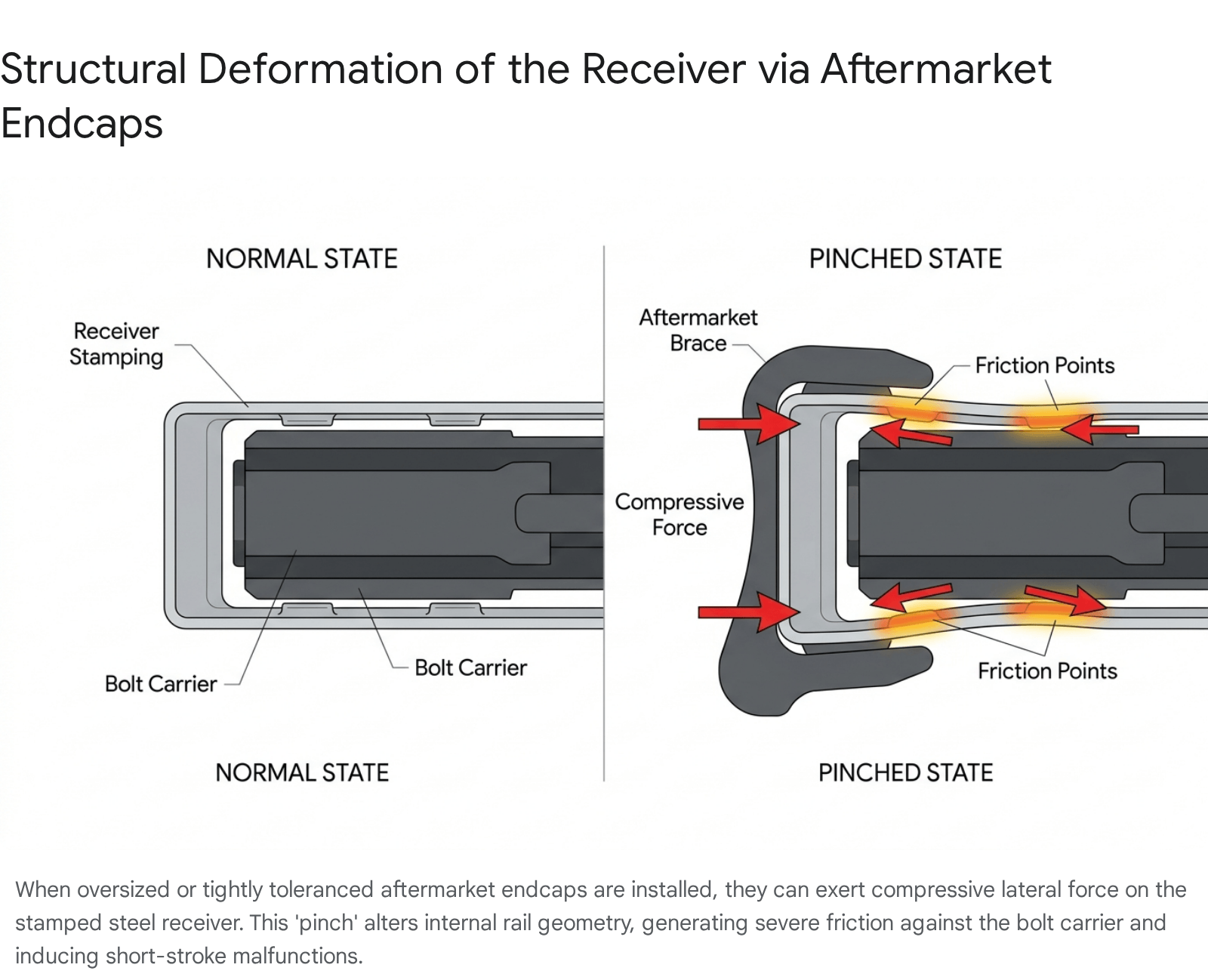
This inward “pinch” alters the precise internal geometry of the bolt carrier guide rails. When the weapon is fired, the bolt carrier travels rearward into this constricted zone, encountering massive, unintended friction. This friction bleeds off the kinetic energy required to fully cycle the action.4
Furthermore, beyond lateral receiver pinching, a secondary mechanical interference frequently occurs with polymer braces and even some B&T folding stocks: the hammer strut pin on certain variants can make direct physical contact with the lower, central plastic piece of the brace endcap that the push-pin traverses.11 This contact acts as an unintended mechanical buffer, robbing the carrier of momentum and causing failures to feed and eject.
To isolate this variable, the operator must remove the aftermarket brace, reinstall the simple factory-supplied metal endcap, and test-fire the weapon.18 If the stoppages cease entirely, the root cause is confirmed. The brace endcap must then be carefully modified—typically by utilizing a file or a Dremel tool to relieve the internal contact points on the side walls, and milling a specific notch at the bottom to allow unimpeded hammer strut travel.
4.4. Kinetic Deficits During Mechanical Break-In (Underpowered Ammunition)
Firearms manufactured with extremely tight tolerances, particularly newly machined clones, require a mechanical break-in period. During this phase, microscopic surface irregularities on the mating metal parts are physically smoothed through cyclic friction.1 Additionally, brand new recoil springs possess their absolute maximum tension coefficients right out of the box.
During the first 500 rounds of a clone’s lifecycle, the weapon requires significant kinetic energy to overcome these compounded frictional forces.1 Standard commercial 115-grain 9x19mm target ammunition is typically loaded to moderate pressures and frequently fails to generate a sufficient pressure curve to drive the bolt carrier fully to the rear during this high-friction break-in phase.8 This kinetic energy deficit results in the bolt returning forward prematurely before extraction and ejection are complete, inducing severe stoppages.9
Manufacturers and armorers mandate a strict break-in protocol utilizing exclusively 124-grain NATO specification ammunition.3 124-grain NATO rounds are loaded to slightly higher chamber pressures than commercial 115-grain target loads, providing a heavier, sharper recoil impulse.9 This elevated pressure ensures robust bolt carrier velocity while the mechanical surfaces mate and polish themselves.15 Once the 500-round threshold is surpassed, the system typically loosens to its final operational tolerances and will cycle standard, lower-pressure 115-grain loads reliably.3
4.5. Suppressor-Induced Over-Function and Locking Piece Geometry
The locking piece dictates exactly how much rearward force is required to squeeze the locking rollers inward and unlock the breech.4 This angle is a direct mathematical regulator of bolt velocity. Historically, standard full-size MP5s and short-barreled “K” variants both commonly utilized a 100-degree locking piece from the factory.
When a sound suppressor is attached to the muzzle, the operational dynamics change due to increased system backpressure and dwell time.4 While full-size MP5 variants typically retain their stock 100-degree locking piece without issue when suppressed, the short-barreled K-variants (e.g., MP5K, AP5-P) are highly sensitive to this increased pressure. In a K-variant, heightened backpressure can overwhelm the mechanical disadvantage of the standard 100-degree or 110-degree locking piece, causing the bolt to unlock prematurely while the chamber pressure is still dangerously high.
This premature unlocking causes the bolt carrier to violently accelerate rearward at velocities far exceeding original design parameters.4 This over-function manifests in violent extraction (often ripping the rims off casings), rapid accelerated wear of the extractor spring, the breaking of internal trigger pack components, and ultimately, the locking rollers being driven outward into the receiver rails so hard that they cause visible “roller dents,” permanently destroying the receiver.4
When running a K-variant suppressed—particularly with high-pressure heavy subsonic loads (e.g., 147-grain or 150-grain)—the armorer protocol mandates swapping the locking piece to an 80-degree variant. This shallower angle significantly increases the mechanical resistance required to unlock the rollers, purposefully delaying the opening of the breech until the suppressor has safely vented the excess pressure, preserving the receiver.
4.6. Dimensional Inconsistencies and Spring Fatigue in Feed Devices
The presentation of the cartridge from the magazine to the chamber is dictated solely by the magazine’s feed lip geometry, follower angle, and internal spring tension.6 The MP5 operates without a traditional, heavily sloped pistol feed ramp, relying entirely on the magazine to present the cartridge at the exact angle required to slip directly into the chamber.
While clone manufacturers produce functional stamped steel magazines, dimensional variations are prevalent compared to original German specifications.10 Feed lips that are stamped or spread too far apart will release the cartridge prematurely; lips that are too tight will introduce friction that retards the bolt’s forward momentum. Furthermore, weak magazine springs in clones (or fatigued springs in older surplus magazines) fail to push the heavy column of ammunition upward fast enough to meet the rapidly returning bolt face.6
The first diagnostic step for any failure to feed is to isolate the magazine.4 Armorers universally recommend establishing a functional baseline by testing the weapon with brand-new, genuine Heckler & Koch manufactured magazines.3
4.7. Fluted Chamber Obturation and Manufacturing Defects
To prevent a cartridge casing from seizing instantly in the chamber under residual pressure, the MP5 utilizes a specialized fluted chamber—a series of distinct longitudinal grooves milled directly into the chamber walls.6 When fired, high-pressure gas is directed backward through these flutes, effectively floating the brass on a micro-layer of gas to prevent the casing from sealing (obturating) against the walls.6
If these flutes become obstructed via heavy carbon buildup (common during suppressed firing) or baked-on liquid lubrication, the expanding brass obturates violently against the steel chamber walls, causing immediate failures to extract.6 Preventative maintenance dictates that the chamber flutes must be aggressively cleaned utilizing a specialized, oversized stiff-bristled MP5 chamber brush and carbon solvent, ensuring the brush is not pushed deeply past the chamber face.
However, it is critical to note that certain production runs of domestic clones, specifically early PTR variants (frequently noted with “AW” serial number prefixes), were manufactured with improperly machined, shallow chamber flutes. No amount of cleaning will rectify this physical manufacturing defect; if a specific firearm consistently fails to extract despite a verified correct bolt gap and genuine HK extractor components, the flutes may be dimensionally defective, requiring the armorer to send the firearm back to the manufacturer for barrel replacement.
4.8. Extractor Claw Geometric Wear and Hardness Deficits
Distinct from the inward tension provided by the wire extractor spring, the physical geometry and material hardness of the extractor claw itself represent a critical failure point.8 The claw must possess a sharp, precisely angled inner lip to bite deeply into the extractor groove of the casing.
Due to substandard metallurgical hardening in some clone variants, the sharp, biting edge of the extractor claw can become rounded, burred, or chipped prematurely.4 When the bolt carrier accelerates backward, a rounded extractor claw will slip over the brass rim, leaving the spent casing lodged firmly in the chamber.4 Sourcing a genuine German HK extractor ensures proper, sharp geometry and superior edge retention due to correct heat treatment, resolving slip-off extraction failures.8
4.9. Ammunition Profile Incompatibility (Feed Geometry)
The internal feed geometry of the MP5 receiver and barrel trunnion was strictly optimized for standard military 9x19mm full metal jacket (FMJ) ammunition, which features a uniform, rounded ogive (bullet profile).6
When operators attempt to run modern defensive ammunition featuring wide-cavity jacketed hollow points (JHP) or modern flat-nosed subsonic projectiles, the platform often struggles. The truncated or flat geometry of the bullet crashes directly into the flat lower face of the barrel or the steel trunnion below the chamber entrance.6 Because the MP5 lacks a traditional, wide, sloped feed ramp, these flat-nosed profiles act as a physical wedge, instantly halting the forward momentum of the bolt carrier.6 If a specific type of defensive or subsonic ammunition consistently produces failures to feed, the operator must revert to 124-grain or 147-grain round-nose FMJ ammunition to ensure reliable feeding geometry.6
4.10. Bolt Gap Deviation and Timing Disruption
The timing of the entire roller-delayed system is mathematically linked to the “bolt gap.” This is the physical clearance between the rear face of the bolt head and the front face of the bolt carrier when the weapon is fully assembled and in battery.
The acceptable factory operational specification for bolt gap is defined strictly between 0.25mm and 0.50mm (0.010″ to 0.020″), with the ideal measurement for a perfectly timed system sitting between 0.010″ and 0.018″. As the weapon fires thousands of rounds, the locking rollers, the angled nose of the locking piece, and the trunnion recesses undergo microscopic wear. This wear allows the bolt head to sit deeper into the trunnion recesses, shrinking the bolt gap.8 If the bolt gap drops below 0.010″, the altered mechanical unlocking geometry causes the weapon to unlock earlier than designed. This perfectly mimics the symptoms of severe over-gassing: excessive rearward bolt velocity, harsh recoil, accelerated wear on the extractor spring, and potential receiver damage.8
To measure bolt gap accurately, the armorer must ensure the weapon is empty, let the bolt snap forward fully into battery, place the selector on semi-automatic, and drop the hammer. The weapon is then inverted, and an automotive feeler gauge—ideally a 20-piece metric/standard set identical to those utilized in HK armorer courses (such as the Holex brand)—is inserted upward through the magazine well into the gap between the bolt head and carrier. A correct measurement is achieved when the gauge pulls out with a firm, sliding drag.
If the gap is found to be outside of tolerance, the standard procedure is to replace the locking rollers. Standard rollers measure 8.00mm. To increase a shrinking bolt gap, armorers install slightly oversized rollers measuring 8.02mm (marked with a ‘-‘) or 8.04mm (marked with a ‘=’). Conversely, to decrease an excessively large gap, undersized rollers measuring 7.98mm (marked ‘-2’) or 7.96mm (marked ‘-4’) must be installed. This restores the mechanical timing to factory specifications without requiring the replacement of the expensive barrel or trunnion.
5. Standardized Troubleshooting and Remediation Matrix
To assist operators and armorers in quickly navigating the complexities of the MP5 platform, the following matrix categorizes the primary symptoms with their mechanical root causes and the mandated corrective actions.
| Primary Symptom | Observed Physical Behavior | Primary Suspect / Root Cause | Mandated Corrective Action Protocol |
| Failure to Eject (FTE) | Spent casing crushed between bolt and ejection port. Weak brass ejection trajectory. | 1. Extractor Spring Yield Failure 2. Ejector Lever/Spring Defect 3. Underpowered Ammo (Break-in) | 1. Replace with HK copper Extractor Spring or install MAD bolt head. 2. Replace with OEM HK Ejector Lever and Spring.8 3. Run mandatory 500rds of 124gr NATO.9 |
| Failure to Feed (FTF) | Bolt overrides round, or round nose-dives and wedges into the flat trunnion face. | 1. Magazine Geometry/Fatigue 2. Receiver Pinch / Strut impact 3. Ammo Profile Incompatibility | 1. Switch to genuine HK manufactured magazines.4 2. Mill/file polymer brace endcap to relieve lateral pressure and strut path. 3. Switch to round-nose FMJ.6 |
| Short Stroking / Binding | Bolt feels sluggish; fails to strip next round; fails to lock back on empty. | 1. Receiver Deformation via brace 2. Heavy Flute Fouling 3. Shallow Flute Defect (PTR) | 1. Relieve brace endcap or revert to factory metal cap.11 2. Clean chamber with dedicated bristle brush. 3. Send to manufacturer for warranty. |
| Violent Extraction / Recoil | Ripped rims; roller dents appearing on receiver sides; broken trigger pack components. | 1. Suppressed K-Model Over-function 2. Bolt Gap Out of Spec (Too small) | 1. Install 80-degree locking piece (mandatory for suppressed K-models). 2. Measure bolt gap; install larger rollers (8.02mm or 8.04mm). |
| Double Feed | Spent case remains firmly in chamber while live round is pushed against it from behind. | 1. Extractor Claw Worn or Chipped 2. Flutes Obstructed (Obturation) | 1. Replace Extractor Claw with properly hardened HK part.10 2. Scrub chamber flutes with carbon solvent. |
6. Ammunition Selection and Ballistic Variables
The roller-delayed system is dependent on the ballistic characteristics of the ammunition to govern its mechanical timing. The following table delineates performance profiles within the MP5 architecture.
| Ammunition Type | Pressure / Recoil Impulse | MP5 Platform Compatibility and Typical Application |
| 115-grain FMJ (Target) | Low to Moderate | Often unreliable during the 500-round break-in period due to insufficient kinetic energy. Cycles reliably post break-in.3 |
| 124-grain FMJ (NATO / +P) | High | The absolute standard for the MP5 platform. Mandated for the first 500 rounds to overcome stiff factory springs. Provides robust ejection.9 |
| 147-grain FMJ (Subsonic) | Moderate (Heavy projectile) | Excellent for suppressed use, remaining subsonic. In K-models, when paired with a suppressor, requires an 80-degree locking piece. |
| 147-grain / 150-grain (Flat/JHP) | Moderate | High probability of Failure to Feed (FTF). The flat nose geometry crashes into the trunnion due to lack of a sloped feed ramp.6 |
7. Lifecycle Maintenance and Armorer Protocols
To maintain operational integrity and prevent malfunctions, operators must adhere to strict maintenance schedules. At the operator level, cleaning the fluted chamber is paramount. The MP5 traps massive amounts of carbon directly in the chamber flutes. The operator must utilize a stiff, oversized chamber brush specifically designed for the MP5 with carbon-cutting solvent every 500 to 1,000 rounds, ensuring they do not jam the brush past the chamber face. Furthermore, lubrication must be applied judiciously; oil in the chamber will burn under heat, creating a hard carbon lacquer inside the flutes that guarantees extraction failures.6
At the armorer level, an annual inspection is required to intercept wear. The armorer must measure the bolt gap with feeler gauges to ensure timing remains within the 0.010″ to 0.020″ specification. The extractor spring should be proactively replaced at intervals of roughly 3,500 rounds, as its tension slowly degrades even without a catastrophic stovepipe event. Finally, the locking rollers must be visually inspected for flat spots, and the receiver rails inspected for any signs of lateral compression or roller denting.5
8. Conclusion
The civilian MP5 ecosystem represents a complex collision between mid-20th-century precision engineering and highly variable modern clone manufacturing tolerances. The platform’s roller-delayed blowback system is inherently robust, yet remains critically sensitive to geometrical deviations, friction, and spring tension degradation.
The vast majority of stoppages are not indicative of a fundamentally broken weapon, but rather a disruption of mechanical timing. The data clearly demonstrates that these issues can be systematically resolved by adhering to an engineered methodology: ensuring proper ammunition pressure during break-in, measuring and maintaining bolt gap using specialized rollers, modifying aftermarket braces to prevent structural binding, and systematically replacing critical small parts with verified OEM Heckler & Koch components. By addressing these root causes precisely, armorers and operators can restore the platform to its intended standard of unyielding reliability.
Appendix: Methodology and Data Sources
The technical findings, diagnostic frameworks, and remediation protocols detailed in this report were synthesized by analyzing a curated dataset consisting of technical armorer manuals, official troubleshooting guides, and extensive empirical telemetry gathered from specialized user communities discussing the operation, maintenance, and failure modes of semi-automatic MP5 variants (specifically addressing the AP5, MAC5, and PTR platforms).
The analysis employed a strict root-cause diagnostic framework to correlate anecdotal failure reports with the known mechanical principles of the roller-delayed blowback system. Recent additions to this dataset provided critical clarity on specific manufacturing defects (such as the shallow flute defect in early PTR models), the precise nomenclature and procedures for bolt gap measurement via automotive feeler gauges, the mechanical interference of hammer struts with polymer brace endcaps, and the integration of aftermarket components like the M.A.D. bolt head as long-term fixes. This methodology ensures the recommended corrective actions are field-tested solutions engineered to restore proper mechanical timing.
Please share the link on Facebook, Forums, with colleagues, etc. Your support is much appreciated and if you have any feedback, please email us in**@*********ps.com. If you’d like to request a report or order a reprint, please click here for the corresponding page to open in new tab.
Sources Used
- Ap5 questions : r/MP5 – Reddit, accessed July 6, 2026, https://www.reddit.com/r/MP5/comments/18wqyuj/ap5_questions/
- Your MP 5 will not extract/eject. Things to look for. – YouTube, accessed July 6, 2026, https://www.youtube.com/watch?v=vvu3xhhE8_s
- What is this malfunction called? : r/MP5 – Reddit, accessed July 6, 2026, https://www.reddit.com/r/MP5/comments/1780tks/what_is_this_malfunction_called/
- MP5 Assembled – Live Fire Troubleshooting : AS Designs – Freshdesk, accessed July 6, 2026, https://activesafetydesigns.freshdesk.com/support/solutions/articles/158000420537-mp5-assembled-live-fire-troubleshooting
- Hk Mp5 ARmorers Manual.pdf – Tiropratico.com, accessed July 6, 2026, https://www.tiropratico.com/manuali-pdf/2015-H/Hk%20Mp5%20ARmorers%20Manual.pdf
- r/MP5 Wiki: Troubleshooting Guide – Reddit, accessed July 6, 2026, https://www.reddit.com/r/MP5/wiki/troubleshooting/
- What part should I change out of my ap5-p I have heard Extractor spring? : r/MP5 – Reddit, accessed July 6, 2026, https://www.reddit.com/r/MP5/comments/11a2nt4/what_part_should_i_change_out_of_my_ap5p_i_have/
- Did tons of reading and just wanted clarification, jams like this consistently. More in comments : r/MP5 – Reddit, accessed July 6, 2026, https://www.reddit.com/r/MP5/comments/13324de/did_tons_of_reading_and_just_wanted_clarification/
- My AP5 was feeding and running perfect for first 300 ish rounds. took it home cleaned it and re lubed it and now i cant get through 5 rounds with out a failure to eject and failure to feed. : r/MP5 – Reddit, accessed July 6, 2026, https://www.reddit.com/r/MP5/comments/tppjy3/my_ap5_was_feeding_and_running_perfect_for_first/
- Still have FTE with ap5 after replacing extruder and extractor spring with HK been using 115gn ammo should I try replacing extractor or get rid of it? : r/MP5 – Reddit, accessed July 6, 2026, https://www.reddit.com/r/MP5/comments/10i4dsg/still_have_fte_with_ap5_after_replacing_extruder/
- Ap5 fail after fail : r/MP5 – Reddit, accessed July 6, 2026, https://www.reddit.com/r/MP5/comments/1hxya4b/ap5_fail_after_fail/
- Difference between HK ejector lever and Century arms. : r/MP5 – Reddit, accessed July 6, 2026, https://www.reddit.com/r/MP5/comments/10ayh9k/difference_between_hk_ejector_lever_and_century/
- MP5 keeps jamming like this. Any idea why? – Reddit, accessed July 6, 2026, https://www.reddit.com/r/MP5/comments/12wng5c/mp5_keeps_jamming_like_this_any_idea_why/
- SB tactical brace doesn’t sit right with push pin : r/MP5 – Reddit, accessed July 6, 2026, https://www.reddit.com/r/MP5/comments/1m5qyzm/sb_tactical_brace_doesnt_sit_right_with_push_pin/
- MAC5 bolt won’t stop locking back : r/MP5 – Reddit, accessed July 6, 2026, https://www.reddit.com/r/MP5/comments/1jamxp5/mac5_bolt_wont_stop_locking_back/
- Finally got an MP5 due to panic buying : r/MP5 – Reddit, accessed July 6, 2026, https://www.reddit.com/r/MP5/comments/1srfoc0/finally_got_an_mp5_due_to_panic_buying/
- Having major issues with the Mac 5 , jamming every 2 rounds : r/MP5 – Reddit, accessed July 6, 2026, https://www.reddit.com/r/MP5/comments/1mvo3ac/having_major_issues_with_the_mac_5_jamming_every/
- Normal for PDW stock to chip paint this bad? : r/MP5 – Reddit, accessed July 6, 2026, https://www.reddit.com/r/MP5/comments/1j5fgtc/normal_for_pdw_stock_to_chip_paint_this_bad/
- AP5 – Constant failures to feed after over 1000 rounds : r/MP5 – Reddit, accessed July 6, 2026, https://www.reddit.com/r/MP5/comments/14v8532/ap5_constant_failures_to_feed_after_over_1000/