1. Executive Summary
The Islamic Republic of Iran operates a bifurcated military architecture, maintaining two parallel and distinct armed forces: the Islamic Republic of Iran Army (Artesh) and the Islamic Revolutionary Guard Corps (IRGC). This structural duality is a deliberate, foundational mechanism designed to ensure regime survival and project strategic power. The Artesh serves as the traditional guarantor of Iran’s territorial integrity, operating under military doctrines designed for symmetric, conventional warfare. In contrast, the IRGC functions as the ideological vanguard of the clerical regime, prioritizing asymmetric warfare, proxy network cultivation, and the active export of the Islamic Revolution.
This analysis examines the divergences in how these two organizations train, socialize, and prepare their personnel for combat. From the experiences of mandatory conscription to the highest echelons of command and staff education, the Artesh and the IRGC cultivate entirely different institutional cultures and operational capabilities. The Artesh emphasizes strict military discipline, technical proficiency, joint multi-domain operations, and defensive territorial depth. The IRGC, conversely, prioritizes rigorous ideological-political indoctrination, asymmetric tactical flexibility, proxy warfare integration, and a forward-leaning posture.
Recent geopolitical escalations, particularly the conflicts of 2025 and 2026, tested these training models. The IRGC adapted its methodologies by utilizing software-based wargaming simulations, deploying academic instructors to active proxy battlefields across the Middle East, and mobilizing child soldiers into its auxiliary Basij units to address manpower shortages. Meanwhile, the Artesh has focused on domestic technological self-sufficiency, maximizing the utility of aging platforms through engineering curricula, reverse-engineering, and artificial intelligence-assisted operational planning. Through an examination of conscript diaries, officer academy syllabi, ideological textbooks, and operational exercises, this report delineates how Iran’s dual military system trains to execute its strategic mandate, functioning as the shield and the sword of the Iranian state.
2. Strategic Posture and Doctrinal Foundations
The training regimens of the Artesh and the IRGC can be understood through their distinct doctrinal mandates, which have evolved over decades of internal insecurity and external conflict. The Iranian military establishment struggled to modernize in the two centuries prior to the 1979 Revolution, operating under the weakened, Western-dominated Qajar and Pahlavi dynasties.1 Following the 1979 Revolution, the newly established clerical regime harbored suspicions regarding the loyalty of the regular Imperial Army, fearing a potential counter-revolutionary coup led by Western-trained officers.2 To insulate the regime and protect the nascent theocracy, the IRGC was established as an ideologically pure counterweight.1
The protracted Iran-Iraq War (1980–1988) fundamentally cemented this division and shaped the doctrines of both forces. During the conflict, the Artesh relied on classical military training, a doctrine that struggled against the superior conventional firepower and mechanized mobility of the Iraqi military.1 Concurrently, the IRGC developed a doctrine of revolutionary warfare, utilizing human-wave tactics, deep ideological motivation, and highly decentralized command structures to counter Iraqi offensives.3 Major General Yahya Safavi, a senior military advisor, noted in a 2017 address to the Imam Ali Officer’s College that the adoption of this “revolutionary war strategy” to counter Iraq’s “classic war strategy” was the determining factor in Iran’s wartime survival.3 The war cemented Iran’s doctrinal focus around proxy warfare, asymmetric naval defense, and ballistic missiles.1
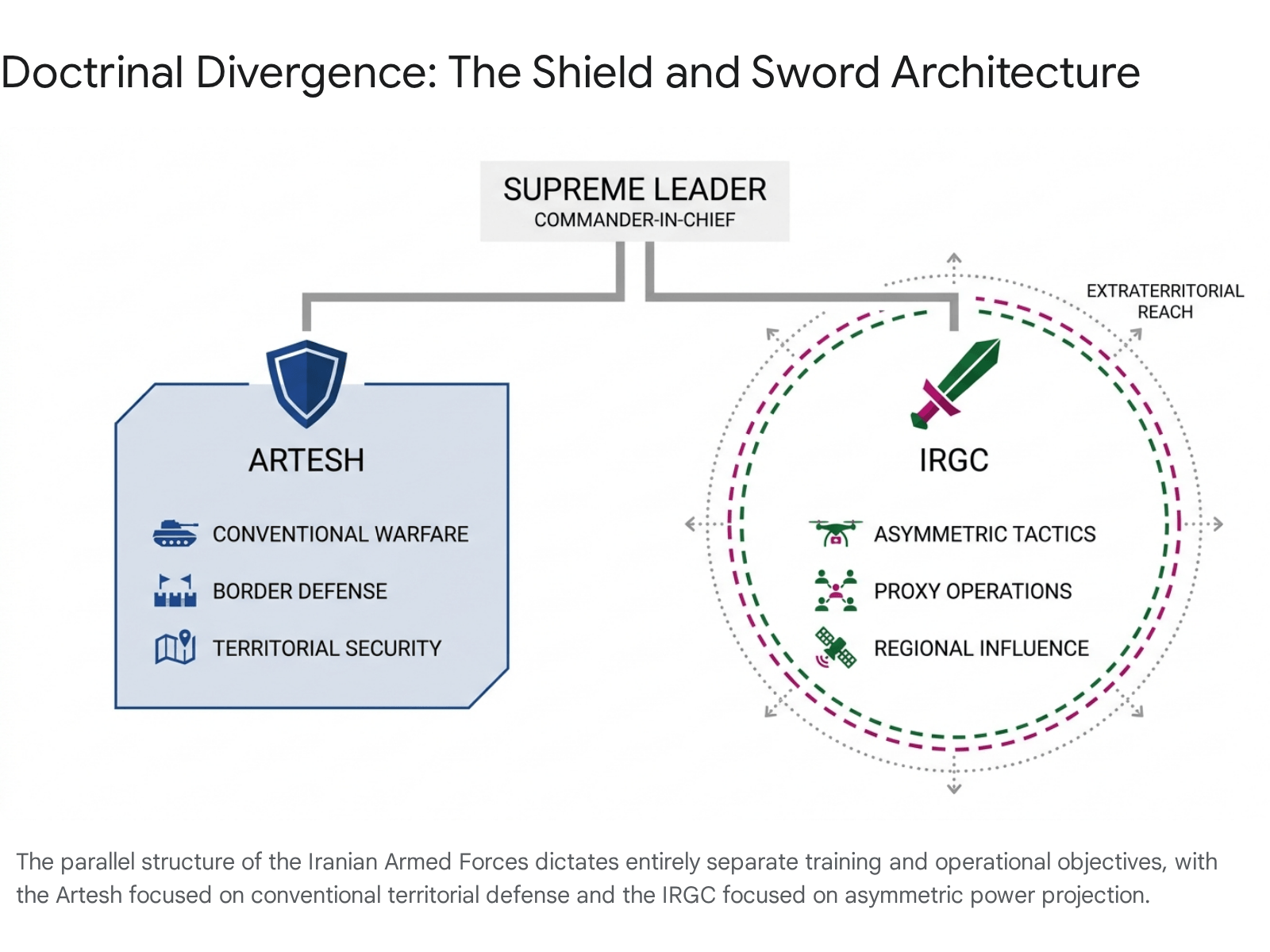
Today, Iranian military doctrine operationalizes this history into a functional, geographic, and strategic division of labor. The Artesh is designed to act as the “shield.” It positions its ground bases along the international borders of Iran to deter and blunt foreign land invasions, while its naval and air forces are tasked with protecting sovereign waters and airspace.2 Its training is oriented entirely around defensive conventional warfare, prioritizing the survival of the state apparatus against technologically superior adversaries.1
Conversely, the IRGC operates as the “sword”.4 It is an offensive, asymmetric force designed to project power beyond Iran’s borders. Its ground forces establish bases in peripheral regions and urban centers to manage internal dissent and direct extraterritorial proxy operations.2 Its doctrine relies on convincing volunteers that fighting and martyrdom are supreme spiritual experiences, drawing on historical metaphors central to Shia Islam, particularly the legacy of Imam Hussein.4 The IRGC expects and plans to absorb operational losses in the pursuit of its strategic objectives, viewing ideological resilience as a primary force multiplier capable of nullifying the technological advantages of adversaries like the United States and Israel.6
3. High Command, Strategic Coordination, and Structural Volatility
Managing the doctrinal and cultural divide between a classical army and an ideological paramilitary force requires a mechanism for deconfliction and strategic coordination at the highest levels of the Iranian state. The Supreme Leader, Ali Khamenei, acts as the ultimate commander-in-chief, wielding absolute authority over the armed forces.7 Khamenei sets Iranian grand strategy, deliberately maintaining parallel structures to prevent any single military entity from consolidating enough power to threaten the regime.7 The Iranian President and the Defense Ministry exist outside the direct military chain of command, with the Defense Ministry largely relegated to managing logistics, the defense industrial base, and arms procurement rather than warfighting.7
Beneath the Supreme Leader, coordination is facilitated by the Armed Forces General Staff (AFGS) and the Khatam al-Anbiya Central Headquarters (KCHQ). The KCHQ functions as the supreme operational headquarters, tasked exclusively with planning and coordinating joint military operations to ensure that the defensive postures of the Artesh and the offensive capabilities of the IRGC complement rather than conflict with one another.8 The KCHQ was separated from the AFGS in 2016 to streamline operational decision-making, direct responses to regional threats, and manage research and procurement across conventional and revolutionary forces.9
The leadership of these coordinating bodies has historically been dominated by IRGC officers, reflecting the regime’s institutional favoritism. However, the military conflicts of 2025 and 2026 introduced significant volatility into the high command. High-ranking officers responsible for national strategic coordination were actively targeted, forcing rapid succession and organizational restructuring.
| Command Component | Historical Leader (Tenure) | Conflict Period Succession |
| Armed Forces General Staff (AFGS) | Hassan Firouzabadi (1989–2016) | Mohammad Bagheri (2016–2025, eliminated in conflict). Replaced by Abdolrahim Mousavi (Artesh).10 |
| Khatam al-Anbiya Central Headquarters (KCHQ) | Gholam Ali Rashid (2016–June 2025, eliminated in conflict).8 | Ali Shadmani (June 2025, eliminated in conflict). Replaced by Ali Abdollahi (June 2025–Present).8 |
This high-level coordination is not purely internal; the KCHQ acts as the unified voice for Iran’s military red lines. For example, during heightened tensions regarding maritime navigation, the KCHQ issued explicit directives mandating that all commercial and oil tankers passing through the Strait of Hormuz strictly follow routes approved by Tehran.11 The headquarters warned that the presence of U.S. manned and unmanned combat aircraft in the region constituted a threat to national sovereignty, and declared that any deviation by international vessels from Iranian protocols would be met with an immediate, decisive response from the combined Iranian Armed Forces.11
4. The Conscription Pipeline: Selection and Basic Training Divergence
The divergence in organizational culture between the Artesh and the IRGC begins at the lowest echelons of recruitment. Iran mandates compulsory military service (sarbazi) for males over the age of 18, requiring 18 to 24 months of service.16 The recruitment and sorting process is arbitrary, shaping the formative military experience of Iranian men through randomized selection rather than aptitude matching.
4.1 The Arbitrary Draft and Institutional Allocation
Conscripts report to regional processing centers, such as the Law Enforcement Department of the Draft in downtown Tehran.18 At these centers, officers representing the Artesh Ground Forces, the Air Force (IRIAF), the IRGC Navy (IRGC-N), and the Law Enforcement Forces select individuals from the gathered crowds to fill their respective operational quotas.19 While the draft is compulsory, the institutional environment into which a conscript is thrust varies significantly depending on this initial selection.
Serving in the Artesh is generally viewed by the Iranian public as physically rigorous and highly disciplined, but administratively straightforward and apolitical.17 Conversely, serving in the IRGC is frequently sought after by certain segments of the population because the physical service is perceived as vastly easier; however, securing an assignment to the IRGC often requires personal connections, ideological vetting, or prior membership in the Basij paramilitary organization.17 An arbitrary assignment to the IRGC carries severe long-term international consequences. Following the 2019 designation of the IRGC as a Foreign Terrorist Organization (FTO) by the U.S. State Department, any Iranian who served in the IRGC—even as an involuntary conscript—is effectively barred from entering the United States, a legal reality that impacts the civilian lives of drafted youth.19
4.2 Basic Training Methodologies: Artesh Discipline vs. IRGC Ideology
The basic training environments of the two branches present a distinct contrast that reflects their broader doctrinal goals. The Artesh operates on a classical, professional military model. Conscript training is strict, physical discipline is rigorously enforced, and military codes (boniane marsus) are applied with professional standardization across training camps.17 Conscripts selected by the Artesh undergo standard physical conditioning, marksmanship fundamentals, and practical combat readiness drills.19 Notably, the Artesh is the least strict of the military branches regarding Islamic grooming codes, allowing conscripts to maintain a degree of personal autonomy, such as the ability to shave their faces.17 Despite this discipline, experts note that since the conclusion of the Iran-Iraq War in 1988, the majority of Artesh conscripts see no actual combat, and their standard military service is often characterized by routine garrison duties devoid of advanced combat training.18
In contrast, IRGC conscript training is characterized by rigorous ideological indoctrination at the deliberate expense of practical military instruction. While physical military training in the IRGC is widely considered the easiest among all branches, the atmosphere is intensely regulated by uncompromising Islamic codes.17
The psychological conditioning begins immediately. Upon arrival, IRGC conscripts are systematically stripped of their individual identities; their heads are shaved, they are issued poorly fitting camouflage uniforms, and they are assigned numerical identifiers by which they are exclusively addressed by the cadre.17 Days commence at 4:30 AM with compulsory prayers and meticulous barracks inspections.17 Actual physical exercise is minimal, frequently limited to thirty minutes, followed by a low-quality breakfast.17 The morning ceremony involves reading the Qur’an and listening to political speeches by the base commander, after which conscripts spend hours on the parade square practicing strenuous drills under harsh weather conditions.17
Weapons training within the IRGC basic pipeline is largely superficial. Conscripts are frequently issued aging, decommissioned AK-47 Kalashnikovs from the 1980s that have had their firing pins removed.17 Conscripts must carry these non-functional weapons everywhere, learning to disassemble and clean them constantly. The weapon serves less as a functional tool of modern war and more as a symbolic representation of ideological honor.17 The vast majority of the training schedule is devoted to political and religious indoctrination rather than tactical instruction. Classes focus heavily on state-sponsored propaganda, denouncing perceived internal enemies of the state—such as the “Fetne 88” (the 2009 Green Movement) and religious minorities like the Baha’is—and reinforcing religious narratives.17 Graduation and fitness for active duty are evaluated not on tactical proficiency or physical endurance, but strictly on three ideological metrics: adherence to religious beliefs, competency in reciting prayers in Arabic, and a rudimentary performance on the shooting range.17
4.3 Post-Training Base Dynamics and Institutional Corruption
Following the completion of basic training, the operational environment for conscripts further highlights the cultural divide between the institutions. Within the IRGC, base life fractures into two distinct realities: a formal period (typically 7:00 AM to 4:00 PM) where strict codes are enforced, and an informal period where regulations collapse entirely once the official officer cadre departs the facility.17
During informal hours, strict bans on items like cellphones, MP3 players, and outside literature are widely ignored through active smuggling networks managed by the conscripts.17 The IRGC conscript system exhibits a susceptibility to transactional relationships and favoritism; stringent military regulations are frequently bypassed for conscripts who utilize personal connections or offer financial favors to their commanders—such as purchasing civilian car insurance for an officer to secure a favorable transfer.17 This environment fosters an institutional culture where ideological devotion is performed outwardly to satisfy official metrics during working hours, while informal, transactional networks govern actual unit cohesion, resource distribution, and survival on the base.17 Unlike the official cadre whose livelihood depends on continuous religious observance, IRGC conscripts in their regular units are generally not forced to participate in daily prayers once basic training concludes.17
5. Officer Academies and Institutional Frameworks
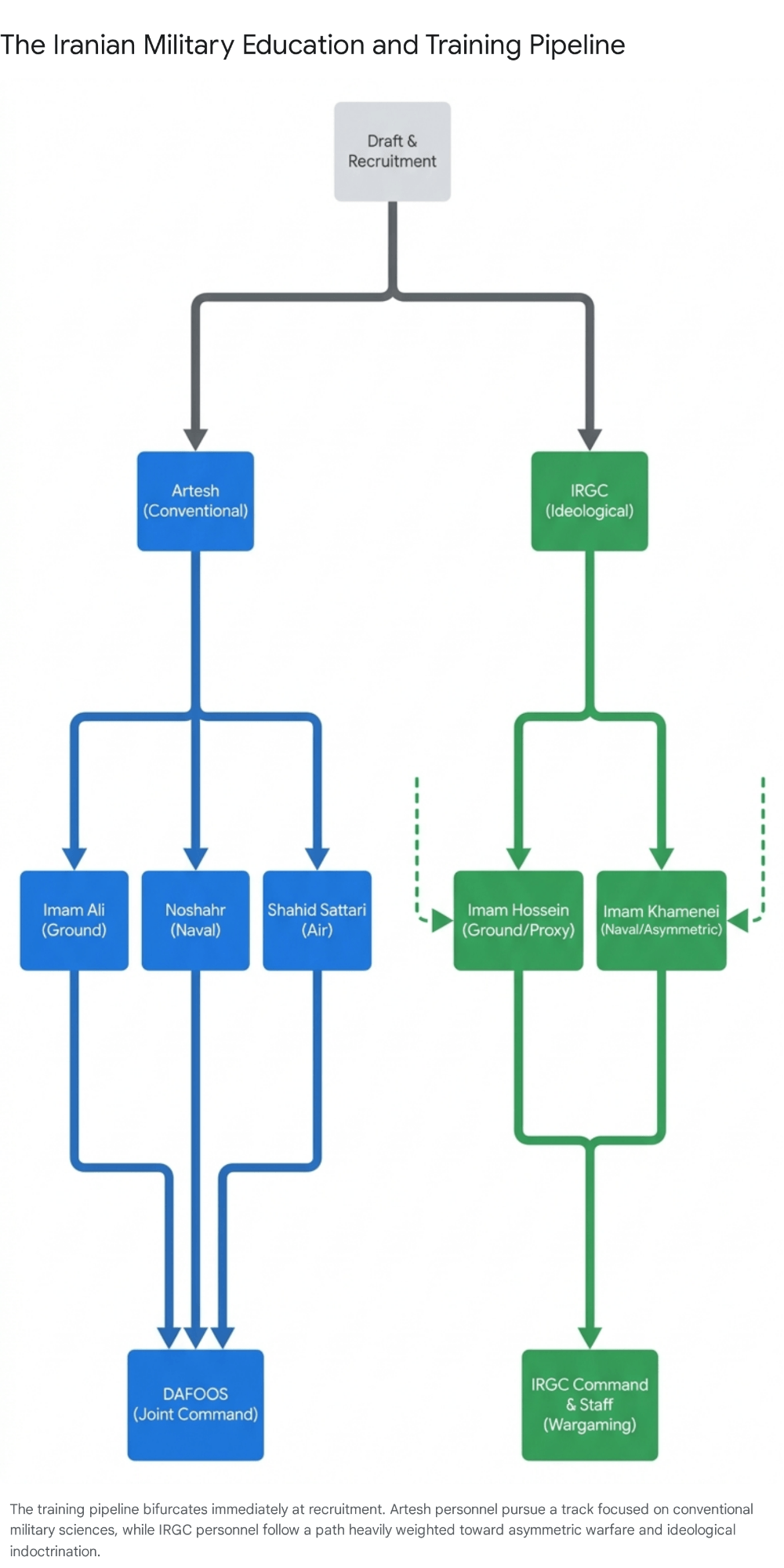
While the conscript draft provides the raw manpower for both organizations, the professional officer corps dictates the actual capabilities, strategies, and operational effectiveness of the forces. To ensure doctrinal purity, the Artesh and the IRGC maintain entirely separate military academies for their ground, naval, and aerospace branches, hardwiring their respective doctrines into leadership from the inception of their careers.
5.1 Ground Forces: Tactical Proficiency vs. Proxy Integration
The Artesh trains its conventional ground force officers primarily at the Imam Ali Officers’ Academy in Tehran.20 The academy’s institutional legacy can be traced indirectly to the pre-revolutionary Madrasa Nezam, which trained the Pahlavi elite; though shuttered and purged following the 1979 Revolution, the need for structured military education forced the new regime to adopt adapted versions of its disciplinary models to rebuild the conventional forces.21
Today, the Imam Ali Academy emphasizes classical infantry, armored, and mechanized warfare, alongside specialized commando (Takavar) training, specifically preparing elite units like the 65th Airborne Special Forces Brigade (NOHED), frequently referred to as Iran’s “Green Berets”. The curriculum meticulously blends conventional combat doctrine with localized defensive attrition tactics and human-wave countermeasures learned during the Iran-Iraq War.22 The academy is noted for its adherence to physical discipline and operational readiness; senior trainees are held to exacting Army Physical Fitness Test (APFT) standards, utilizing functional training methods that consistently produce high scores in cardiovascular endurance, anaerobic power, and muscular strength.22 Graduates filter into a highly structured order of battle designed to secure Iran’s borders, staffing units such as the 21st Division in Azerbaijan, the 28th in Kurdistan, the 88th in Zahedan, the 292nd Armored Brigade in Dezful, and the 71st Mechanized Infantry Brigade in Sarpol-e Zahab.24
The IRGC trains its ground leadership at Imam Hossein University (IHU). Established in 1986 by Mohsen Rezaei (who served as the chief commander of the IRGC from 1981 to 1997), IHU serves as the central academic and training hub for IRGC officer development.26 The institution is sanctioned by the United States Department of the Treasury for its role in supporting IRGC military operations and facilitating secret nuclear activities.27
The curriculum at IHU fundamentally differs from the Imam Ali Academy by explicitly orienting around asymmetric tactics and proxy war.27 Furthermore, the IRGC cultivates its own elite units—such as the Saberin special forces—which prioritize ideological warfare, counterinsurgency, and unconventional operations beyond Iran’s borders in support of the Quds Force. IHU educates its commanders across multiple dimensions of conflict, focusing on “hard, semi-hard, and soft wars,” and emphasizing the concept of “strategic depth” to counter modern external threats and internal subversion.27 The university houses specialized colleges covering defense science, cyber science, passive defense engineering, and electronic warfare.27
IHU employs a continuous, hands-on training model that directly integrates academic instruction with active combat operations. Instructors and senior university commanders—such as Brigadier General Hamid Abazari, who heads the university’s “jihadi training” branch—are routinely deployed to active proxy battlefields and resistance fronts in Iraq, Syria, Lebanon, and Yemen.27 These advisory and combat command missions provide faculty with practical, real-time experience in asymmetric warfare, which is immediately fed back into the university’s curriculum.27 To maintain absolute ideological and doctrinal isolation, no students from the regular Artesh or national police forces are permitted to enroll at IHU.27
5.2 Naval Forces: Blue-Water Professionalism vs. Asymmetric Swarming
The maritime domain offers an operationally distinct contrast in Iranian military training and procurement. The Imam Khomeini Naval University of Noshahr serves as the primary academy for the Artesh Navy (IRIN).23 IRIN officers undergo extensive four-year bachelor’s degree programs in technical fields, categorized into five core branches: Naval Operations and Ship Command, Marine Engineering, Naval Infantry, Naval Electronics and Telecommunications, and Naval Management.23
As a conventional, blue-water navy, IRIN practical training relies heavily on annual cadet cruises.23 Young officers embark on naval vessels to distant shores—including the Gulf of Aden, the Mediterranean Sea, and the South China Sea—to gain empirical, hands-on experience in complex ship handling, deep-water navigation, and damage control.23 Artesh naval training prioritizes apolitical professionalism, technical proficiency, and international maritime integration, occasionally hosting international events like the Indian Ocean Naval Symposium (IONS).30 During a 2009 graduation ceremony at Nowshahr, the Supreme Leader declared the IRIN a “strategic force,” elevating its mandate beyond mere coastal defense to international power projection.31
In direct contrast, the IRGC Navy (IRGCN) trains its officers at the(https://www.oni.navy.mil/Portals/12/Intel%20agencies/iran/Iran%20022217SP.pdf) in Ziba Kenar, located on the Caspian coast.23 Established formally in 2013 to centralize operations, the academy reflects the IRGCN’s structure as a guerrilla navy.23 The academy unifies training across five specialized colleges focused on fast-attack vessels, naval commandos (the Sepah Navy Special Force, or SNSF), coastal missiles, naval aviation, and maritime UAVs.26 Rather than long-distance blue-water navigation, training at Ziba Kenar focuses intensely on asymmetric hit-and-run tactics, naval mine deployment, and highly coordinated speedboat swarming designed to overwhelm larger conventional warships.23
Furthermore, the academy acts as an active training hub for the regional Resistance Front. The facility features a dedicated section that provides six-month naval science and technology courses to foreign proxy forces, including Houthi militants.32 These proxy fighters are housed separately from regular Iranian students to prevent intelligence leaks while they are trained in asymmetric maritime interdiction by the IRGC’s Quds Force.32 The IRGCN also utilizes strategic outposts, such as the uninhabited Farur Island in the Persian Gulf, to conduct live-fire training for its mercenaries in contested waters.32
| Naval Fleet Characteristics | Artesh Navy (IRIN) | IRGC Navy (IRGCN) |
| Primary Doctrinal Focus | Blue-water patrols, international presence, conventional sea control. | Coastal defense, A2/AD in chokepoints (Strait of Hormuz), guerrilla swarming. |
| Academy Location | Nowshahr (Caspian Sea).23 | Ziba Kenar (Caspian Sea) & Farur Island.23 |
| Representative Vessels | Logistic Landing Ships (Hengam), Fleet Supply (Bandar Abbas), Replenishment (Kharg), Submarines (Fateh).23 | Small fast-attack craft (Tondar, C14, FB40), heavily armed speedboats.23 |
| Tactical Training | Long-distance navigation, fleet logistics, joint amphibious maneuvers.23 | High-speed swarm attacks, mine-laying, anti-ship missile deployment.33 |
5.3 Air and Aerospace Forces: Fleet Sustainment vs. Missile Proliferation
The Artesh Air Force (IRIAF) relies on the(https://www.unirank.org/ir/uni/shahid-sattari-university-of-aeronautical-engineering/), established in 1988 by General Mansour Sattari.37 Constrained heavily by decades of international sanctions and the necessity of operating an aging fleet of Western-origin aircraft (including pre-1979 F-14 Tomcats and F-4 Phantoms), the curriculum at Shahid Sattari is tailored toward maintenance, reverse engineering, and domestic self-sufficiency.38 Additionally, the Artesh operates the(https://en.wikipedia.org/wiki/Khatam_al-Anbia_Air_Defense_Academy), which trains officers in radar, missile operations, and cyber warfare to secure Iran’s integrated air defense system.
Students engage in rigorous applied engineering across specialized faculties, utilizing wind tunnels for aerodynamic testing, radar control labs, and multimedia virtual reality (VR) flight simulators.38 The university also develops its own training equipment, such as an electronic warfare simulator for the MiG-29 fighter jet deployed in 2023.38 Graduates are trained not only as combat pilots but as specialized engineers capable of executing complete aircraft overhauls and developing domestic upgrades—such as the design and modification of the Saeqeh (Lightning) fighter jet, a domestic variant of the Northrop F-5.38 Furthermore, the university serves as Iran’s primary hub for end-to-end UAV education, training cadets in conceptual drone design, assembly, and civilian-military applications like high-speed topographic mapping.38
In contrast, the IRGC Aerospace Force—which controls Iran’s strategic ballistic missile and attack drone arsenal—conducts its specialized training through classified IRGC channels rather than a traditional aviation academy.41 Its training emphasizes the procurement, indigenous production, and rapid deployment of medium-to-long-range missiles and kamikaze drones, prioritizing strategic deterrence and precision strikes over conventional manned aerial combat.2 This includes training on systems like the solid-fuel Quds-1 cruise missile (utilized heavily by regional proxies) and the Shahab-3 ballistic missiles housed at subterranean facilities like the Imam Ali Missile Base.25 The IRGC actively proliferates this technology, training proxy groups not only to operate Iranian-supplied strike drones but to manufacture their own variants locally.42
6. Command and Staff Education: DAFOOS vs. IRGC Wargaming
The divergence between the Artesh and the IRGC continues into advanced professional military education, where mid-to-senior level officers are groomed for high-level command and general staff operations. The approaches taken at this echelon reflect their ultimate strategic uses: managing complex, large-scale conventional defense versus agile, asymmetric regional disruption.
6.1 AJA University of Command and Staff (DAFOOS)
The Artesh operates the(https://en.wikipedia.org/wiki/AJA_University_of_Command_and_Staff), offering highly competitive Master’s and PhD programs in Specialized Defense Management.22 DAFOOS focuses strictly on symmetric, state-on-state conflicts.22 The core curriculum trains field-grade officers in operational planning, joint-service coordination, and the management of complex logistics under heavy enemy pressure.22
Training at DAFOOS emphasizes a pragmatic, empirical approach to decision-making. Officers conduct extensive map-based drills and study historical conflicts—particularly the logistical constraints and defensive maneuvers of the Iran-Iraq War and recent engagements like the 2025 “12-day war”—to anticipate real-world combat dynamics.22 Due to strict international arms embargoes that restrict access to foreign military software, DAFOOS has cultivated deep domestic technological self-sufficiency, utilizing internally developed AI-assisted pathfinding software and computerized simulations for land warfare wargaming.22 Enrollment is cross-branch, bringing together officers from the Ground Forces, Air Force, Navy, and Air Defense to foster a unified operational doctrine and interoperability across the conventional military.22 The academic rigor is significant; comparative studies actively benchmark DAFOOS educational models against foreign equivalents, such as the command colleges of the Chinese People’s Liberation Army, to adapt to new global threats.44 Despite this rigor, internal assessments, such as a study of the 33rd DAFOOS term, indicate ongoing challenges in evaluating student competencies and ensuring training translates to battlefield efficacy.45
6.2 IRGC University of Command and Staff and Simulation Centers
The IRGC’s equivalent command and staff education places a far heavier emphasis on modeling asymmetric scenarios that reflect its broader regional ambitions and reliance on proxy forces. Recognizing the need to modernize its operational planning, the IRGC inaugurated a wargaming and military simulation center at its University of Command and Staff in Tehran.46
Unveiled by IRGC Commander-in-Chief Major General Hossein Salami, the center utilizes high-tech, indigenously developed software to model diverse combat scenarios, specifically blending conventional tactics with asymmetric, irregular operations.46 These advanced simulations are tailored directly to the IRGC’s immediate geopolitical realities. The wargaming centers are designed to boost strategic planning and critical thinking regarding operations involving proxy networks, allowing commanders to assess real-time scenarios related to Resistance movements in Gaza, Lebanon, and the broader Middle East without the immediate risks of live combat.46
Furthermore, recognizing the demographic shift within its officer corps, the military has begun incorporating software-based online war games into the curriculum. As Hossein Valivand-Zamani, commander of the Army Command and Staff College, noted, leveraging the younger generation’s familiarity with gaming environments—such as the domestically produced “Battle in the Gulf of Aden 2″—encourages strategic autonomy and tactical flexibility at the mid-command (O-4 to O-6) level.49
7. Ideological-Political Training (Agyedati-Siyasi)
To fully comprehend the operational mindset, absolute loyalty, and posture of the IRGC, one must examine its formal Ideological-Political Training (Agyedati-Siyasi) program. Unlike the Artesh, which is primarily a nationalist military force with relatively limited internal ideological policing 2, the IRGC operates fundamentally as an armed theological movement. Its military training is inextricably linked to, and often superseded by, its religious indoctrination.
7.1 The 24 Modules of Indoctrination
All IRGC recruits and officers are subjected to a mandatory, top-down indoctrination program consisting of 24 “vertical education” course modules.51 This curriculum is actively managed and signed off directly by the office of Supreme Leader Ayatollah Ali Khamenei. In the preamble to the official textbooks, Khamenei explicitly states that without strong ideological-political training, the IRGC cannot function as the powerful arm of the Islamic Revolution.51 To manage this vast indoctrination apparatus, the IRGC established its own theological seminaries, such as Martyr Mahallati University, which specifically trains the ideological and political commissars tasked with controlling the IRGC internally.2 Published by the Imam Sadeqh Institute in Qom, these manuals are routinely updated and disseminated via e-learning portals to both IRGC personnel and Basij paramilitary members.51
| Key Agyedati-Siyasi Textbooks Evaluated |
| Jihad and Defence in the Quran |
| The Contemporary Political History of Iran |
| Jihad and Defence in Islam |
| The Islamic Defence System |
| Velayat-e faqih (Volumes 1 & 2) |
| Family Guidance |
| Enjoin What is Right and Forbid What is Wrong |
| The Ways and Customs of Youth |
The content of these textbooks reveals a hardline ideological worldview designed to socialize members and their families into the Guard’s specific theocratic mission.51 The curriculum is structured around four core conceptual pillars:
- The Grand Vision (Expansion of Velayat-e Faqih): The primary objective instilled in recruits is not the defense of the Iranian nation-state, but the global survival and expansion of velayat-e faqih (clerical rule).51 Recruits are taught that the Supreme Leader holds absolute divine authority equal to the Prophet Muhammad and the Twelve Shia Imams, granting him the sole religious right to utilize state assets, public funds, and military force to export Islam globally.51
- Transnational Group Identity: The textbooks notably omit all references to “Iran” or “Iranians”.51 By actively rejecting nationalism, the IRGC frames its mission in pan-Islamic terms, defining its members as “Guardians of Islam” and soldiers of the “Imam Mahdi”.51 This intentional erasure of national borders makes the ideology easily transferable to the non-Iranian Shia proxy militias the IRGC trains across the region.
- The Glorification of Armed Jihad: The training materials interpret Islamic scripture to glorify armed conflict and prioritize armed jihad. Recruits are conditioned to view martyrdom not as an unfortunate consequence of war, but as the highest virtue and a necessary sacrifice in correcting global injustices.51
- Targeting Internal and External Enemies: The manuals identify a vast global conspiracy against Shiism led by an “Arab-Zionist-Western axis,” claiming that groups like ISIS and al-Qaeda were fabricated by Western and Israeli intelligence to destroy Islam from within.51 The textbooks explicitly justify violence against “People of the Book” (Jews, Christians), commanding recruits to force them to abandon their beliefs.51 Crucially, internal political dissidents are classified not as civil opponents, but as enemies of Islam. Those who protest or revolt against the Supreme Leader are branded as Baaghi (internal conspirers) or Moharabeh (those who wage war against God), providing absolute ideological justification for the IRGC’s frequent suppression of domestic unrest.51
8. The Basij and the Mobilization of Youth
The ideological training apparatus of the IRGC extends deeply into civil society through its auxiliary paramilitary branch, the Basij Resistance Force. Established by Ayatollah Khomeini as a “twenty million man army,” the Basij is heavily involved in internal security, law enforcement, morals policing, and suppressing domestic protests.53 Operating branches in virtually every Iranian city, the Basij is organized into 17 different suborganizations categorizing students, workers, engineers, and government employees.53
Members fall into a hierarchy of regular, active, and special personnel. Active members must pass a rigorous 45-day program of military and intelligence training encompassing asymmetric warfare, anti-riot tactics, and psychological operations.54 This is supplemented by ideological courses such as the Salehin plan, which focuses on Quranic fluency and the concept of Velayat-e Faqih, and the Basirat (Insight) plan, designed to reinforce the religious beliefs of higher-ranking commanders.55
The scale of this ideological mobilization and training pipeline became apparent during the intense military conflicts of 2026. Facing severe pressure and manpower shortages following extensive strikes against IRGC facilities, the IRGC launched the “Homeland-Defending Combatants for Iran” campaign.56 Driven by an operational need for auxiliary security forces, the IRGC, led by figures like Rahim Nadali of the 27th Mohammad Rasulullah Division, initiated the “For Iran” campaign to actively recruit child soldiers as young as 12 years old into the Basij.54
These untrained youths were armed with Uzi sub-machine guns and Kalashnikov rifles and deployed to staff checkpoints, man operational patrols, and conduct intelligence gathering across Tehran.54 Iranian authorities justified the mobilization by claiming the youths were eager to volunteer to defend the revolution, demonstrating the totalizing nature of the IRGC’s ideological training. This approach explicitly prioritizes regime survival and martyrdom over international humanitarian law, utilizing youth as a security buffer.56
9. Operational Exercises and Wargames
The theoretical differences taught in the academies and ideological centers manifest practically in the large-scale military exercises conducted by both branches. The design, execution, and messaging of these drills encapsulate their divergent operational mentalities.
9.1 Artesh: The Zolfaghar Joint Exercises
The Artesh conducts large-scale conventional military drills, most notably the Zolfaghar series (e.g., Zolfaghar 99 and Zolfaghar 1403). These exercises emphasize joint, multi-domain operations, seamlessly integrating the Ground Forces, Navy, Air Force, and Air Defense Forces over vast geographic areas.34 Spanning approximately two million square kilometers across the Gulf of Oman, the eastern Strait of Hormuz, and the northern Indian Ocean, Zolfaghar drills are designed to project conventional territorial defense capabilities and deter foreign invasion.34
Training during Zolfaghar involves highly synchronized logistical and tactical movements. For instance, the 1403 iteration featured complex amphibious “beaching” operations involving the transfer of heavy assets like Karrar tanks and BMP-2 infantry carriers via naval vessels (such as the Tonb) to secure hostile beachheads.36 The drills act as a proving ground for indigenous conventional hardware, showcasing the operational deployment of the Fateh-class submarine and the test-firing of Ghader land-to-sea cruise missiles capable of striking targets over 200 kilometers away.34 Unmanned systems are also heavily integrated into conventional tactics; drones like the Ababil, Karrar, Kaman-12, and Simorgh are utilized for long-range reconnaissance and combat missions, utilizing munitions like the Sadid-345 precision-guided bombs.34 The primary objective of Zolfaghar is to prove the Artesh’s ability to maintain integrated command and control across vast distances in a conventional war scenario.35
9.2 IRGC: The Great Prophet (Payambar-e Azam) Drills
In contrast to the methodical conventionalism of the Artesh, the IRGC conducts the Payambar-e Azam (Great Prophet) exercises. These drills are designed specifically to rehearse and showcase asymmetric, anti-access/area-denial (A2/AD) capabilities, rapid response operations, and psychological warfare.59
Operating in strategic chokepoints like the Strait of Hormuz and western provinces like Kermanshah (utilizing special forces like the Mirza Kuchak Khan brigade), these drills utilize swarm tactics, fast-attack speedboats, and rapid-response commando deployments.60 A defining hallmark of the Great Prophet exercises is the execution of highly publicized maneuvers designed to deter adversaries. A prominent example is the deployment of a full-scale replica of a U.S. aircraft carrier in the Persian Gulf; IRGC forces train by encircling the mock carrier with speedboats, rappelling commandos onto its deck, and launching missiles from helicopters and coastal trucks to simulate its total destruction.59
| Exercise Comparison | Zolfaghar Series (Artesh) | Great Prophet Series (IRGC) |
| Primary Objective | Joint-force conventional deterrence, territorial defense.35 | Asymmetric disruption, A2/AD, psychological signaling.61 |
| Operational Scope | Broad multi-domain integration (Air, Sea, Land, Defense).34 | Swarm tactics, rapid commando deployment, targeted strikes.60 |
| Key Assets Showcased | Submarines (Fateh), Heavy Armor (Karrar tanks), UCAVs (Simorgh).34 | Fast-attack boats, Fath semi-ballistic missiles, Dehlaviyeh anti-tank missiles.63 |
| Strategic Messaging | “We can defend our borders and sea lanes against invasion.” | “We can disrupt global trade and destroy superior technological assets.” |
The IRGC drills focus heavily on interdicting maritime corridors. They utilize suppressive artillery fire, the newly introduced Fath semi-ballistic missiles, and armor-piercing anti-tank weapons (such as the Dehlaviyeh) aimed at close-range maritime targets to deny enemy access to sea lanes.63 Ultimately, the Great Prophet exercises are designed less as demonstrations of sustainable, long-term joint operations, and more as signaling mechanisms intended to reassure the IRGC’s domestic base and proxy networks of its disruptive, lethal power.59
10. Conclusion: The Enduring Utility of the Dual System
The dual military architecture of Iran is a deliberate feature of its grand strategy, not an administrative flaw. The differences in how the Artesh and the IRGC recruit, educate, and train their personnel—one rooted in pragmatic, defensive conventionalism, the other in expansionist, asymmetric ideology—allow the Islamic Republic to operate effectively across the entire spectrum of modern conflict.
By structurally isolating its conventional defense forces from its asymmetric power projection capabilities, the regime ensures that it maintains a credible, professional deterrent against territorial invasion (via the Artesh) while simultaneously possessing the freedom to wage unrestricted proxy warfare across the Middle East (via the IRGC). However, this bifurcation breeds deep institutional rivalry, vastly unequal resource allocation, and deeply contrasting military cultures. The IRGC’s significant political and economic influence ensures it remains the favored son of the regime, receiving priority access to advanced technology, political power, and operational funding.2 The Artesh, meanwhile, is forced to rely on high professional standards, engineering ingenuity, and strict discipline to maintain its relevance with limited resources and aging platforms.31
As the geopolitical landscape grows increasingly volatile, the ability of the Khatam al-Anbiya Central Headquarters to synthesize these two disparate forces into a cohesive national strategy will remain the defining challenge of the Iranian security establishment. The recent reliance on youth in the Basij and the continuous, direct integration of foreign proxies into IRGC naval and ground academies strongly indicate that Iran will continue to double down on its asymmetric, ideological capabilities. Moving forward, the Iranian state will continue to utilize the professional Artesh as a fortified shield, behind which the ideological sword of the IRGC can freely maneuver.
Appendix: Analytical Framework and Data Sources
The analysis provided in this report is synthesized from a review of open-source intelligence, Iranian state media reports, opposition documentation, and specialized military assessments. To reconstruct the internal training doctrines, ideological frameworks, and operational structures of the Artesh and the IRGC, data was collated from the following categories of primary and secondary sources:
- Firsthand Accounts and Conscript Testimonies: Detailed experiential data regarding the arbitrary draft lottery, basic training protocols, discipline enforcement, and internal base culture were extracted from verified diaries and testimonies of former conscripts who navigated the sarbazi system (e.g.17).
- Ideological-Political Training Textbooks: Insights into the IRGC’s Agyedati-Siyasi (Ideological-Political Training) were derived from analyses of official internal manuals published by the Imam Sadeqh Institute and authorized directly by the Supreme Leader’s office. These documents define the IRGC’s worldview, concept of armed jihad, rejection of nationalism, and threat perceptions regarding internal dissidents (e.g.51).
- Academic and Institutional Syllabi: The distinct curricula, degree offerings, research capabilities, and training methodologies of higher military education institutions—including the AJA University of Command and Staff (DAFOOS), Imam Hossein University, Shahid Sattari Aeronautical University, the Khatam al-Anbia Air Defense Academy, and the naval academies at Noshahr and Ziba Kenar—were mapped using university records, state media announcements, and international defense analyst reports (e.g.22).
- Operational Exercise Reports: Tactical and doctrinal differences were evaluated by comparing the stated objectives, utilized assets (such as specific drone and missile models), and scale of publicized military drills. This included the Artesh’s Zolfaghar exercises and the IRGC’s Payambar-e Azam wargames, as documented by both domestic Iranian press and international observers (e.g.34).
- Command Structure and Human Rights Documentation: Data regarding the evolution of the AFGS and KCHQ, leadership successions, and the mobilization of the Basij—specifically the controversial recruitment and deployment of child soldiers during the 2026 escalations—was sourced from reports by international human rights organizations, historical military tracking, and verified audiovisual evidence (e.g.54).
Please share the link on Facebook, Forums, with colleagues, etc. Your support is much appreciated and if you have any feedback, please email us in**@*********ps.com. If you’d like to request a report or order a reprint, please click here for the corresponding page to open in new tab.
Sources Used
- The Strategic Foundations of Iran’s Military Doctrine, accessed July 6, 2026, https://www.iiss.org/globalassets/media-library—content–migration/images/comment/analysis/2017/december/2-mcinnis2125.pdf
- Eternal Rivals? The Artesh and the IRGC – Middle East Institute, accessed July 6, 2026, https://mei.edu/publication/eternal-rivals-artesh-and-irgc/
- Guarding History – Joint Chiefs of Staff, accessed July 6, 2026, https://www.jcs.mil/Portals/36/Documents/History/Monographs/Iran_study_complete.pdf
- What is Iran’s Military Doctrine and how does it differ between their own forces and that of their proxies? – Reddit, accessed July 6, 2026, https://www.reddit.com/r/WarCollege/comments/rrp6hm/what_is_irans_military_doctrine_and_how_does_it/
- What is the difference between IRGC and Regular Iran military? – Reddit, accessed July 6, 2026, https://www.reddit.com/r/Military/comments/1c8nld1/what_is_the_difference_between_irgc_and_regular/
- Iranian Military Doctrine – The Washington Institute, accessed July 6, 2026, https://www.washingtoninstitute.org/policy-analysis/iranian-military-doctrine
- Explainer: the Iranian Armed Forces | ISW, accessed July 6, 2026, https://understandingwar.org/research/middle-east/explainer-the-iranian-armed-forces/
- Khatam al-Anbiya Central Headquarters – Wikipedia, accessed July 6, 2026, https://en.wikipedia.org/wiki/Khatam_al-Anbiya_Central_Headquarters
- Khatam-al Anbiya Central Headquarters – Grokipedia, accessed July 6, 2026, https://grokipedia.com/page/khatam_al_anbiya_central_headquarters
- Armed Forces General Staff and Khatam Al-Anbiya Central Headquarters – United Against Nuclear Iran | UANI, accessed July 6, 2026, https://www.unitedagainstnucleariran.com/government-institution/armed-forces-general-staff-and-khatam-al-anbiya-central-headquarters
- Khatam al-Anbiya Headquarters: Any US Intervention in Strait of Hormuz Will Be Met with Decisive Response, accessed July 6, 2026, https://www.saba.ye/en/news3735411.htm
- Iran threatens ‘decisive response’ to ships violating Hormuz navigation rules – AzerNews, accessed July 6, 2026, https://www.azernews.az/region/260555.html
- Iran’s Khatam HQ Warns US Against Interference in Strait of Hormuz – ISNA News Agency, accessed July 6, 2026, https://en.isna.ir/news/1405041106629/Iran-s-Khatam-HQ-Warns-US-Against-Interference-in-Strait-of-Hormuz
- Iran’s Khatam al-Anbiya Headquarters Warns U.S. Interference in Strait of Hormuz With Decisive Response: 23 Sources (West Asian – NewsCord, accessed July 6, 2026, https://newscord.org/article/irans-khatam-al-anbiya-headquarters-warns-us-interference-in-strait-of-hormuz-wi–Story_20260627_Iranwillgiveswiftcrufb0907a1
- Iran’s new IRGC Navy chief emerges without formal decree: who is Ali Azmaei?, accessed July 6, 2026, https://www.iranintl.com/en/202607040522
- accessed July 6, 2026, https://violencepreventionwales.co.uk/violencepreventionwales-news/irans-army-a-deep-dive-into-its-personnel-1764797579#:~:text=The%20recruitment%20and%20training%20processes,indoctrination%2C%20and%20specialized%20skills%20training.
- Drafted: Diary of a Revolutionary Guard Conscript – Tehran Bureau …, accessed July 6, 2026, https://www.pbs.org/wgbh/pages/frontline/tehranbureau/2011/08/eight-months-inside-sepah.html
- Country policy and information note: military service, Iran, November 2022 (accessible), accessed July 6, 2026, https://www.gov.uk/government/publications/iran-country-policy-and-information-notes/country-policy-and-information-note-military-service-iran-november-2022-accessible
- I was once conscripted into the Iranian armed forces. Here’s why the IRGC designation is punishing conscripts. – Atlantic Council, accessed July 6, 2026, https://www.atlanticcouncil.org/blogs/iransource/i-was-once-conscripted-into-the-iranian-armed-forces-heres-why-the-irgc-designation-is-punishing-conscripts/
- Imam Ali Officers’ Academy – Wikipedia, accessed July 6, 2026, https://en.wikipedia.org/wiki/Imam_Ali_Officers%27_Academy
- Madrasa Nezam – Grokipedia, accessed July 6, 2026, https://grokipedia.com/page/madrasa_nezam
- AJA University of Command and Staff — Grokipedia, accessed July 6, 2026, https://grokipedia.com/page/aja_university_of_command_and_staff
- Iran’s Naval Forces – ONI – Navy, accessed July 6, 2026, https://www.oni.navy.mil/Portals/12/Intel%20agencies/iran/Iran%20022217SP.pdf
- Imam Ali Officers’ Academy | Military Wiki | Fandom, accessed July 6, 2026, https://military-history.fandom.com/wiki/Imam_Ali_Officers%27_Academy
- Order of Battle of the Iranian Artesh Ground Forces – ISW, accessed July 6, 2026, https://understandingwar.org/research/middle-east/order-of-battle-of-the-iranian-artesh-ground-forces/
- Islamic Revolutionary Guard Corps – Wikipedia, accessed July 6, 2026, https://en.wikipedia.org/wiki/Islamic_Revolutionary_Guard_Corps
- I.R.G.C. University Deploys Trainers to “Resistance Front” for …, accessed July 6, 2026, https://mei.edu/publication/irgc-university-deploys-trainers-resistance-front-asymmetrical-warfare-experience/
- Development of Nomogram to Predict the Best Military Category Using Physical Fitness Variables: A Model Development in Navy Trainees – Brieflands, accessed July 6, 2026, https://brieflands.com/journals/jamm/articles/82324
- Naval University of Imam Khomeini – Iran Watch, accessed July 6, 2026, https://www.iranwatch.org/iranian-entities/naval-university-imam-khomeini
- Imam Khomeini Naval University of Noshahr – Grokipedia, accessed July 6, 2026, https://grokipedia.com/page/imam_khomeini_naval_university_of_noshahr
- The Artesh Navy: Iran’s Strategic Force – Middle East Institute, accessed July 6, 2026, https://mei.edu/publication/artesh-navy-irans-strategic-force/
- Report: IRGC Held Naval Exercises for Houthis in North Iran, accessed July 6, 2026, https://english.aawsat.com/arab-world/4784376-report-irgc-held-naval-exercises-houthis-north-iran
- Islamic Revolutionary Guard Corps Navy – Wikipedia, accessed July 6, 2026, https://en.wikipedia.org/wiki/Islamic_Revolutionary_Guard_Corps_Navy
- Joint Exercise Zolfaghar 99 – Wikipedia, accessed July 6, 2026, https://en.wikipedia.org/wiki/Joint_Exercise_Zolfaghar_99
- Joint Exercise Zolfaghar 99 – Grokipedia, accessed July 6, 2026, https://grokipedia.com/page/joint_exercise_zolfaghar_99
- Iran’s Zulfiqar 1403 Drill Showcases Advanced Amphibious Tactics, accessed July 6, 2026, https://iranpress.com/content/301134/iran-zulfiqar-1403-drill-showcases-advanced-amphibious-tactics
- Shahid Sattari Aeronautical University – Wikipedia, accessed July 6, 2026, https://en.wikipedia.org/wiki/Shahid_Sattari_Aeronautical_University
- Shahid Sattari Aeronautical University — Grokipedia, accessed July 6, 2026, https://grokipedia.com/page/shahid_sattari_aeronautical_university
- accessed July 6, 2026, https://grokipedia.com/page/shahid_sattari_aeronautical_university#:~:text=Students%20undertake%20discipline%2Dspecific%20courses,%2C%20tactics%2C%20and%20defense%20applications.
- Shahid Sattari Air Force University | Iran Watch, accessed July 6, 2026, https://www.iranwatch.org/iranian-entities/shahid-sattari-air-force-university
- How Iran’s parallel armies and intelligence services protect the regime – YouTube, accessed July 6, 2026, https://www.youtube.com/watch?v=7lFjBEp4fpE
- Leveling the Field: Iran’s Asymmetric Use of Conventional Military Capabilities | Iran Watch, accessed July 6, 2026, https://www.iranwatch.org/our-publications/articles-reports/leveling-field-irans-asymmetric-use-conventional-military-capabilities
- AJA University of Command and Staff – Wikipedia, accessed July 6, 2026, https://en.wikipedia.org/wiki/AJA_University_of_Command_and_Staff
- A Comparative Study of Educational Courses of DAFOS of AJA and People’s Army of China Regarding Future Threats, accessed July 6, 2026, https://www.qjmst.ir/article_697434.html?lang=en
- Evaluations in the Command and Staff Course of DAFOOS AJA Abstract – علوم و فنون نظامی, accessed July 6, 2026, http://www.qjmst.ir/article_735656_9c6f51a32aad5624fe1fa561434c03ec.pdf
- IRGC opens cutting-edge military simulation center – Tehran Times, accessed July 6, 2026, https://www.tehrantimes.com/news/506384/IRGC-opens-cutting-edge-military-simulation-center
- IRGC opens war game simulation center – Mehr News Agency, accessed July 6, 2026, https://en.mehrnews.com/news/224547/IRGC-opens-war-game-simulation-center
- IRGC Opens War Game Simulation Facility at Military Academy – – WANA, accessed July 6, 2026, https://wanaen.com/irgc-opens-war-game-simulation-facility-at-military-academy/
- Iran Uses Online War Games To Teach Younger Generation Of Officers – T2COM G2, accessed July 6, 2026, https://oe.t2com.army.mil/product/iran-uses-online-war-games-to-teach-younger-generation-of-officers/
- Islamic Republic of Iran Army – Wikipedia, accessed July 6, 2026, https://en.wikipedia.org/wiki/Islamic_Republic_of_Iran_Army
- Beyond Borders: the Expansionist Ideology of Iran’s Islamic …, accessed July 6, 2026, https://institute.global/insights/geopolitics-and-security/beyond-borders-expansionist-ideology-irans-islamic-revolutionary-guard-corps
- Iran’s Revolutionary Guard and the Rising Cult of Mahdism: Missiles and Militias for the Apocalypse – Middle East Institute, accessed July 6, 2026, https://mei.edu/publication/irans-revolutionary-guard-and-rising-cult-mahdism-missiles-and-militias-apocalypse/
- The Basij Resistance Force | The Iran Primer, accessed July 6, 2026, https://iranprimer.usip.org/resource/basij-resistance-force
- Basij – Wikipedia, accessed July 6, 2026, https://en.wikipedia.org/wiki/Basij
- The Ideological-Political Training of Iran’s Basij – Brandeis University, accessed July 6, 2026, https://www.brandeis.edu/crown/publications/middle-east-briefs/pdfs/1-100/meb44.pdf
- Iran: Recruitment of child soldiers as young as 12 amounts to a war crime, accessed July 6, 2026, https://www.amnesty.org/en/latest/news/2026/04/iran-recruitment-of-child-soldiers-as-young-as-12-amounts-to-a-war-crime/
- Iran: Military Stepping Up Child Recruitment – Human Rights Watch, accessed July 6, 2026, https://www.hrw.org/news/2026/03/30/iran-military-stepping-up-child-recruitment
- Iran army uses new tactics, ammunition in Zolfaqar 2025 drill – Mehr News Agency, accessed July 6, 2026, https://en.mehrnews.com/news/228743/Iran-army-uses-new-tactics-ammunition-in-Zolfaqar-2025-drill
- Great Prophet IX – Wikipedia, accessed July 6, 2026, https://en.wikipedia.org/wiki/Great_Prophet_IX
- Inside Islamic Revolutionary Guard Corps’ Massive Military Exercises – YouTube, accessed July 6, 2026, https://www.youtube.com/watch?v=mCAT92wFVb0
- Iran Conducts Military Exercise With Mock U.S. Aircraft Carrier In Persian Gulf, accessed July 6, 2026, https://www.rferl.org/a/iran-launches-exercises-near-key-waterway-for-oil-transport/30753081.html
- IRGC Stages War Game In Iran’s West – Eurasia Review, accessed July 6, 2026, https://www.eurasiareview.com/05012025-irgc-stages-war-game-in-irans-west/
- IRGC Conducts “Hybrid” Military Drills as Nuclear Talks Teeter | The Washington Institute, accessed July 6, 2026, https://www.washingtoninstitute.org/policy-analysis/irgc-conducts-hybrid-military-drills-nuclear-talks-teeter