1. Executive Summary and Strategic Context
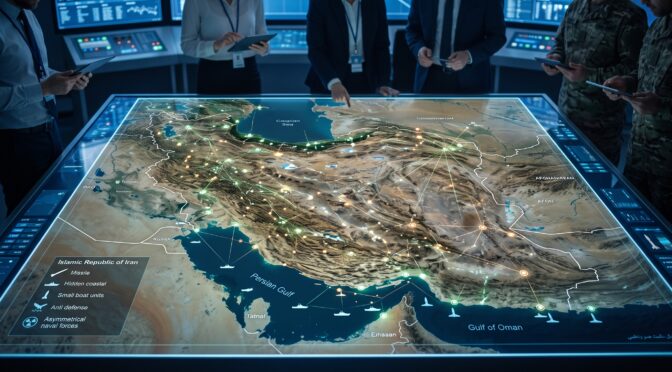
The operational environment of the Middle East underwent a seismic and irreversible transformation following the outbreak of the 2026 conflict between the Islamic Republic of Iran and a coalition led by the United States and Israel. Precipitated by the initiation of Operation Epic Fury on February 28, 2026, this large-scale military engagement constituted the most severe and existential test of Iran’s foundational military doctrine: the Decentralized Mosaic Defense (DMD), known in Persian military discourse strictly as a defensive concept termed defā’-e mozā’iki.1 Engineered to guarantee the survival of the theocratic regime against a technologically, economically, and conventionally superior adversary, the mosaic strategy fundamentally alters the traditional Clausewitzian concept of a centralized center of gravity.4 Instead of relying on a rigid, top-down command and control (C2) architecture, the strategy deliberately distributes military authority, logistical autonomy, and lethal operational capability across a highly complex, geographically dispersed network of provincial commands and irregular proxy forces.1
This intelligence assessment provides an exhaustive, multi-domain evaluation of Iran’s Decentralized Mosaic Defense doctrine. By analyzing its historical genesis out of the traumas of the Iran-Iraq War and the 2003 invasion of Iraq, its complex structural mechanics, and its operational deployment during both the 2025 “12-Day War” and the broader, devastating 2026 conflict, this report maps the doctrine’s theoretical framework against its practical, frequently chaotic battlefield realities.4 The analysis explores the deep, often competitive integration of the Islamic Revolutionary Guard Corps (IRGC), the regular armed forces (Artesh), and the Basij paramilitary network into a comprehensive, asymmetric, attrition-based defensive apparatus.4
Furthermore, the assessment measures the doctrine’s proven strengths—most notably its successful resilience against highly sophisticated decapitation strikes that eliminated the nation’s supreme leadership—against its severe, structural vulnerabilities.1These vulnerabilities include a catastrophic loss of strategic coherence, an inherent inability to de-escalate hostilities once triggered, and profound, exploitable weaknesses in domains requiring centralized coordination, such as integrated air defense and naval logistics.1The definitive conclusion drawn from this analysis is that while the mosaic defense is highly effective at achieving its primary, baseline objective of preventing sudden institutional and regime collapse, it comprehensively fails as a mechanism for coherent warfighting. It transforms state-on-state conflict into highly volatile, uncontrollable, and attritional environments that carry unprecedented risks of unintended regional escalation, ultimately preserving the regime at the cost of devastating national attrition and the loss of sovereign control.
2. The Strategic and Doctrinal Genesis of the Mosaic Defense
To accurately comprehend the architecture and rationale of Iran’s mosaic defense, one must first examine the strategic traumas and historical observations that have shaped Iranian military thought over the past four decades. The foundational doctrine of the Iranian armed forces was forged during the brutal, protracted Iran-Iraq War (1980–1988).8 During this grueling eight-year conflict, Iranian military planners internalized critical, defining lessons regarding attrition warfare, the utilization of the nation’s vast strategic geographic depth, and the absolute necessity of high casualty tolerance.8 Most crucially, the concept of the “War of the Cities”—a period wherein Iraqi missile strikes inflicted heavy Iranian civilian casualties largely due to Iran’s lack of an equivalent deterrent missile force—permanently embedded the requirement for robust, highly dispersed deterrent capabilities into the strategic psyche of the IRGC.9 Most senior officers within the current Iranian military apparatus are veterans of this “imposed war,” and their concepts of self-reliance, “holy defense,” and ideological endurance were codified into doctrine in the early 1990s, distinguishing Iranian military thought from the Soviet-inspired doctrines prevalent in the broader Arab world.8
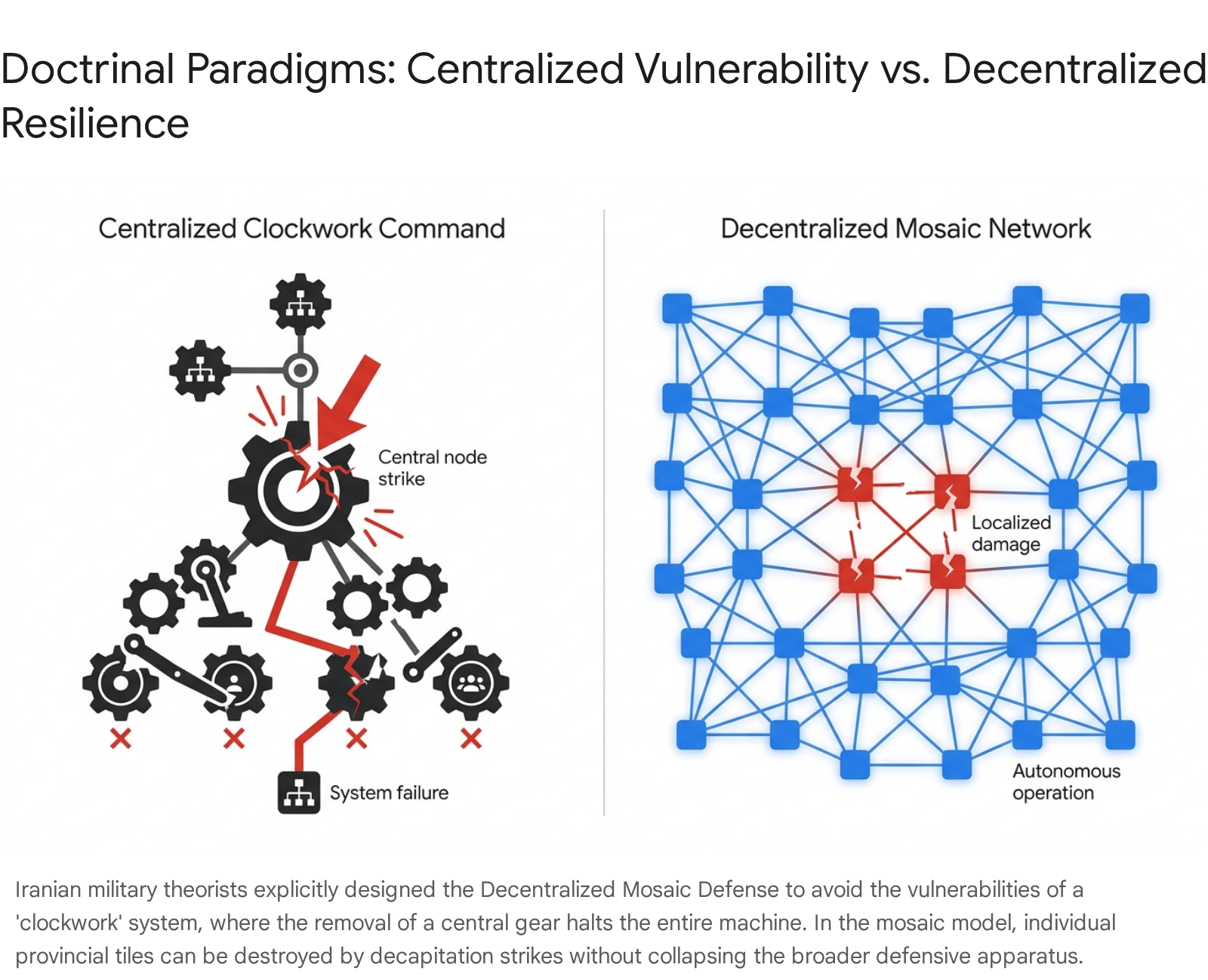
However, while the Iran-Iraq War provided the ideological foundation, the specific, structural catalyst for the Decentralized Mosaic Defense was the 2003 United States-led invasion of Iraq. Iranian intelligence and military strategists observed the rapid, catastrophic collapse of Saddam Hussein’s military apparatus with acute alarm.1 The Iraqi military operated under a highly centralized, rigid, and autocratic command structure. When United States and coalition forces executed precision decapitation strikes that severed communication nodes between Baghdad and frontline generals, the Iraqi command architecture entirely disintegrated.1 Iraqi divisions, deprived of direct orders from the central leadership and lacking a culture of tactical initiative, simply ceased fighting.5 They lacked both the authority and the operational framework to conduct independent maneuvers, leading to the rapid dissolution of the state’s defensive capacity.5
The leadership of the IRGC identified this rigid centralization as a fatal “single point of failure.” Recognizing that the United States and its regional allies possessed insurmountable advantages in high-end airpower, precision strike capabilities, and comprehensive Intelligence, Surveillance, and Reconnaissance (ISR), Iranian planners concluded that fighting a conventional, symmetrical war would guarantee swift and total defeat.8 The Iranian regime calculated that it needed a completely distinct organizational framework—one that could withstand the immediate shock of overwhelming aerial bombardment and targeted assassination campaigns.10
In response to this existential vulnerability, Supreme Leader Ayatollah Ali Khamenei mandated the IRGC’s Center for Strategic Studies in 2005 to engineer a comprehensive solution. This vital initiative was spearheaded by Major General Mohammad Ali Jafari, the center’s director at the time, who served as the primary organizational and structural architect of the new doctrine.1 Jafari was aided by Hassan Abbasi, a prominent strategist who provided the core ideological and theoretical framework for asymmetric, prolonged warfare.1 Jafari, a veteran of the Iran-Iraq War who was reportedly wounded during Iran’s last major offensive, Operation Karbala 5, possessed a deep, practical understanding of the severe limitations of rigid command structures in highly chaotic, degraded combat environments.11
Jafari sought to implement a structure that loosely embodied the Western military principle of Auftragstaktik, or mission-type tactics, but heavily adapted for Iran’s unique theocratic, geographical, and ideological context.4 In Western military frameworks, this approach can also be understood as a localized reinterpretation of the Defense Advanced Research Projects Agency’s (DARPA) mosaic warfare concept, guided fundamentally by the principles of mission command.4 The overarching goal was to completely distribute firepower, logistics, and command authority across the entirety of the Iranian landmass. By ensuring there was no single headquarters, major city, or central leader whose physical destruction would collapse the nation’s broader resistance, the doctrine sought to deny the United States and Israel the very possibility of a clean, rapid victory.10
The theoretical framework devised by Jafari and Abbasi transitioned into concrete military reality in September 2008. In a massive and unprecedented structural shake-up, the IRGC systematically abandoned its centralized national command model in favor of a geographically distributed architecture.13 The IRGC established 31 autonomous provincial corps (known as the Sepah-e Ostani)—one for each of Iran’s 30 provinces, with Tehran Province receiving two separate corps due to its immense strategic importance, political volatility, and demographic density.1 This sweeping reorganization formally and permanently decentralized the force, reshaping the very nature of Iranian military power projection and territorial defense.
3. Structural Mechanics and Command Decentralization
The operational viability of the mosaic defense relies entirely on the complex, highly specific structural mechanics implemented across the Iranian provinces. The cornerstone of the entire doctrine is the profound operational autonomy granted to the 31 Sepah-e Ostani. In conventional, Western military structures, the release of strategic weapons—particularly medium-range ballistic missiles and coordinated drone swarms—requires direct, real-time authorization from the highest levels of the national command authority. The mosaic doctrine intentionally and systematically subverts this established global norm.
3.1. The Sepah-e Ostani and Pre-Delegated Authority
Under the 2008 reorganization, each provincial corps was meticulously designed to function as an independent, self-sustaining military entity.1 Every Sepah-e Ostani was equipped with its own dedicated intelligence apparatus, independent weapons stockpiles safely hidden in subterranean facilities, autonomous logistics chains, and an integrated chain of command that is fully capable of operating in total isolation from Tehran.1
A prime operational example of this structure is the Imam Hassan Mojtaba Alborz Provincial Corps, which covers Alborz Province.15 Separated from Tehran Province by legislative decree in 2010 to manage rapid urbanization, this corps assumed full IRGC security duties in a territory previously managed by Tehran’s provincial corps and the overarching Thar-Allah Headquarters.15 Commanders of such provincial corps wield extensive, almost localized sovereign authority.13
In the event of a massive foreign invasion, or a catastrophic disruption of central communications via cyberattack or electronic warfare, local provincial commanders are granted extraordinary pre-delegated authority to act independently.1 According to public statements from senior Iranian officials, including Foreign Minister Abbas Araghchi during the chaotic days of the 2026 conflict, these isolated units function based on “general instructions” that were provided to them well in advance of hostilities.7 This unique operational framework ensures that semi-autonomous regional units can immediately execute retaliatory strikes, launch ballistic missiles from dispersed underground “missile cities,” and initiate complex asymmetric guerrilla operations without waiting for, or requiring, central contact with the Supreme National Security Council.4
3.2. The “Fourth Successor” Protocol
Decentralization of command alone does not guarantee resilience if local leadership remains easily targeted and eliminated. To directly counter the threat of precision assassination campaigns utilizing loitering munitions and stealth aircraft, the architects of the mosaic defense instituted a highly rigid leadership redundancy system known as the “Fourth Successor” protocol.1
Within this framework, every single critical leadership position within the 31 provincial commands operates with a built-in, pre-designated redundancy of three to seven replacements, cascading at least three ranks down the chain of command.5 This protocol acts as a mathematical and logistical deterrent to decapitation strikes. From an intelligence and targeting perspective, neutralizing a command node no longer requires simply eliminating a single, high-profile general; it requires the simultaneous identification, tracking, and kinetic elimination of the primary commander alongside several obscured layers of deputies across 31 separate, geographically diverse zones.5 This requirement exponentially increases the ISR burden on adversarial forces, strains loiter times for combat aircraft, and ensures that leadership vacuums are filled almost instantaneously in the heat of battle, maintaining unit cohesion.5
3.3. Comparative Doctrinal Structures
To fully understand the shift Iran undertook, it is necessary to contrast their current posture with the conventional posture that failed so catastrophically in Iraq.
| 1. Doctrinal Element | 2. Centralized Conventional Defense Strategy | 3. Decentralized Mosaic Defense Doctrine |
| Command Structure | Top-down, strict hierarchical authorization required for maneuver. | 31 autonomous provincial commands (Sepah-e Ostani). |
| Leadership Continuity | High vulnerability; loss of central leader collapses force cohesion. | “Fourth Successor” protocol; 3-7 pre-selected local replacements per role. |
| Lethal Authority | Retained exclusively by national command (Strategic arms). | Pre-delegated to regional commanders based on prior, general instructions. |
| Operational Geography | Linear defense of territorial borders and the capital city. | In-depth defense, deliberately drawing forces into urban centers and mountains. |
| Post-Invasion Posture | Surrender or dissolution upon capital capture and C2 loss. | Proliferation of 1,800-3,000 independent “stay-behind” guerrilla cells. |
4. Civil-Military Integration and the Basij Mobilization
The Decentralized Mosaic Defense is fundamentally a doctrine of “people’s war,” relying heavily on the total mobilization of the domestic population to engage in unremitting attritional warfare.16 The execution of this strategy requires complex, often fraught coordination between Iran’s parallel military institutions. The regular Iranian military, the Artesh, a conventional combined-arms force of armored, infantry, and mechanized units, is technically designated as the first line of territorial defense against an invading force.4 However, acknowledging the high probability that the conventionally postured Artesh would be rapidly degraded by United States or Israeli air superiority, the doctrine shifts the primary burden of sustained, long-term resistance to the IRGC and its massive volunteer paramilitary wing, the Basij.4
4.1. The Mo’in Plan and Basij Integration
The integration of these disparate forces is strictly codified in a wartime mobilization framework known internally as the “Mo’in Plan”.4 Under this highly structured blueprint, the Basij does not operate as a distinct, independent entity during a foreign invasion scenario; rather, Basij battalions are directly integrated into regular IRGC formations to massively augment their manpower and provide a deep reservoir of replacement personnel.18
The Basij maintains an estimated active and reserve strength of 300,000 personnel, with a theoretical, maximum mobilization capacity approaching one million individuals.7 The organization is deeply compartmentalized geographically and demographically, organized into up to 740 regionally commanded battalions, each consisting of 300 to 350 personnel.18 This infrastructure extends down to the neighborhood and school levels, incorporating specialized units such as the female Basij districts (hozehahe basij-e khaharan) which manage resistance bases embedded deep within civilian infrastructure.20
The IRGC heavily leverages the Basij to enhance its asymmetric capabilities across all domains. For example, under the IRGC Navy’s “Shahid Fahmideh” plan, active Basiji students living in coastal provinces are organized, ideologically trained, and encouraged to prepare themselves for suicide attacks utilizing explosive-laden speedboats in potential naval warfare scenarios against superior adversary fleets.20 Furthermore, for domestic contingencies, the IRGC and Basij jointly form the Ashura Brigades, a specialized force of roughly 17,000 personnel dedicated primarily to the rapid, brutal suppression of civil unrest and anti-government riots.18
4.2. Urban Attrition and “Stay-Behind” Operations
A critical, defining operational directive of the mosaic defense is the deliberate exploitation of Iran’s vast territorial size, highly mountainous terrain, and incredibly dense urban centers.4 Joint IRGC-Basij training heavily emphasizes complex urban ambushes and rigorous passive defense measures, such as extreme camouflage, concealment, and deception (CC&D).4 The strategic intent is not to stop an invasion at the border, but rather to draw hostile forces deep into sprawling interior cities where adversarial advantages in rapid mobility, long-range fires, and close air support are severely constrained by the physical environment.4
If central command fails entirely and major cities are compromised by an occupying force, the doctrine dictates the immediate deployment of prepared “stay-behind” guerrilla cells.5 The IRGC has meticulously organized between 1,800 and 3,000 highly autonomous teams, typically consisting of three to four specialized, ideologically committed personnel.18 Operating entirely independently without any expectation of resupply or central coordination, these micro-cells are tasked with infiltrating the enemy’s rear areas, severing extended supply chains, ambushing logistics convoys, and bleeding occupying forces through a perpetual, grinding war of attrition.18 The doctrine calculates that an invading force would not simply have to defeat the national government in Tehran, but rather fight a grueling, independent, and endless war against 31 separate, fully equipped provincial insurgencies.5
4.3. Inter-Service Dynamics and Coup-Proofing
The implementation of the mosaic defense cannot be fully analyzed without examining the highly complex, inherently suspicious civil-military relations within the Islamic Republic. Following the 1979 Islamic Revolution, the new clerical regime possessed a deep-seated, paranoid distrust of the conventional military, the Artesh, viewing it as a dangerous legacy of the nation’s monarchist past and a potential source of a counter-revolution.6 To nullify the threat of a military coup from above, the regime established the IRGC as a parallel, ideologically pure military structure and solidified control through intense religious indoctrination and pervasive internal surveillance.6
The mosaic defense inherently serves a vital dual purpose for the regime: repelling foreign invasion while simultaneously maintaining ironclad internal regime security.23 By decentralizing the IRGC into 31 provincial commands, the regime ensured that local IRGC commanders could swiftly and unilaterally suppress domestic uprisings in their respective provinces without waiting for central deployment orders from Tehran, heavily insulating the regime against mass, synchronized popular revolts.15
While the Khatam al-Anbiya Central Headquarters was established at the national level to coordinate joint operations between the IRGC and the Artesh, profound structural tensions and resentments remain.24 Today, the Artesh remains the marginalized junior partner, significantly underfunded, under-equipped, and viewed with lingering skepticism compared to the elite, heavily compensated IRGC sardars (officers).6 While this deep inter-service rivalry undeniably complicates wartime coordination and degrades overall national combat efficiency, intelligence assessments conclude that this friction is a deliberate feature, not a bug.26 It is a carefully managed coup-proofing mechanism engineered by the Supreme Leader to ensure that no single military entity—neither the Artesh nor a unified IRGC command—gains enough consolidated power to successfully challenge the theocracy.25
5. The “Forward Defense” Extraterritorial Layer
By the early 2010s, Iranian strategic planners recognized that relying solely on defensive resilience inside Iran’s sovereign borders was insufficient to project regional power or deter preemptive strikes effectively. Consequently, beginning around 2012, Iranian strategists systematically appended an offensive “forward defense” layer to the traditionally defensive mosaic concept.1 The core premise of the forward defense doctrine is to proactively engage adversaries far outside Iran’s borders, ideally preventing kinetic conflict from ever reaching Iranian territory.17
This offensive doctrine was operationalized through the massive expansion and arming of the “Axis of Resistance”—a vast, transnational network of highly autonomous proxy militias. This network includes Hezbollah in Lebanon, the Ansar Allah (Houthi) movement in Yemen, Hamas and other militant groups in the Palestinian territories, and a wide array of Shiite Popular Mobilization Forces (PMF) in Iraq and Syria, as well as allied Afghan and Pakistani brigades.29 Within the context of the mosaic doctrine, this proxy network functions as the external, extraterritorial manifestation of decentralized defense.1
The 2006 Israel-Hezbollah War served as a highly successful, foundational proof of concept for this external layer. During that conflict, Hezbollah’s decentralized, cell-based structure managed to absorb severe Israeli aerial bombardment, maintain a continuous, unyielding barrage of rocket fire, and fight conventional Israeli Defense Forces to a standstill, validating the resilience of the mosaic concept on a smaller, regional scale.1 By dispersing its proxy capabilities across the Middle East, Iran drastically complicated the targeting calculus for the United States and Israel. This structure allowed Tehran to maintain a stance of plausible deniability while conducting a geographically dispersed war of attrition, utilizing drone and naval guerrilla warfare to influence regional dynamics without crossing the threshold into direct, state-on-state conventional war.17
6. The 2025 Prelude – The 12-Day War and Internal Fracture
The theoretical underpinnings of the Decentralized Mosaic Defense, and its newly appended forward defense layer, faced a severe preliminary test during the “12-Day War” in June 2025. Initiated by Israel’s Operation Rising Lion and accompanied by parallel U.S. strikes under Operation Midnight Hammer, this brief but intense conflict exposed critical structural, military, and societal weaknesses within the Islamic Republic, setting the stage for the wider war that would follow a year later.3
During the 12-Day War, unexpected and highly precise Israeli decapitation strikes severely damaged the Iranian command structure.4 The physical elimination of over 30 senior IRGC commanders, alongside tens of critical defense scientists, created localized chaos and severely degraded the IRGC’s command and control (C2) capabilities.4 Consequently, subsequent retaliatory Iranian missile and drone salvos became progressively less coordinated, less saturated, and ultimately far less effective at penetrating allied missile defense screens.4 The IRGC’s conventional deterrence capabilities were publicly and humiliatingly undermined, as their predictable asymmetrical doctrines were neutralized by superior technological defenses.23
The intelligence assessment regarding this failure points to a deeper institutional rot. The humiliating performance of the IRGC during the 12-Day War was largely attributed to the highly ideological nature of the Islamic Republic, which had led to a systemic “dumbification” of the state and widespread corruption among military elites.23 Within the IRGC, education, recruitment, and promotions have historically been heavily based on ideological commitment and blind loyalty to the Supreme Leader rather than actual military skill, technical competence, and strategic acumen, severely eroding its overall combat effectiveness against a modern adversary.23
6.1. Political and Societal Fallout
The elimination of key IRGC commanders and the force’s diminished regional credibility emboldened reformist and pragmatist political factions within Iran to publicly demand a “major paradigm shift” toward domestic reform and urgent diplomatic negotiations with the West.23 To counter this loss of revolutionary legitimacy and suppress the growing threat to internal security, the regime launched a severe domestic crackdown to project strength and maintain its grip on power.23 Over 20,000 Iranian citizens—including political dissidents, civil rights activists, and ethnic or religious minorities—were aggressively arrested and scapegoated as spies for Israel under the sweeping guise of national security.23
Concurrently, to address the profound C2 failures exposed during the fighting, the regime reconstituted the National Defense Council under the Supreme National Security Council (SNSC). This move was intended to artificially centralize high-level military planning, improve fractured inter-agency coordination, and enable rapid crisis response to preserve regime unity.23 Furthermore, recognizing the deep fracture between the state and the populace, the IRGC’s cultural branch initiated desperate propaganda campaigns attempting to link the theocratic regime to pre-Islamic historic nationalist myths. For instance, state media symbolically presented IRGC missile launches as modern manifestations of the legend of Arash Kamangir, an ancient Persian hero, in an attempt to rally nationalist sentiment.23 A leaked letter from the Ministry of Culture and Islamic Guidance even revealed plans to coordinate street concerts and public art shows as explicit instruments of national security and social control to soothe public anger, though this initiative eventually faced backlash and cancellation due to hardline conservative opposition.23
7. The Crucible of 2026 – Operation Epic Fury
Recognizing the operational gaps exposed in 2025, the IRGC further accelerated the delegation of tactical authority to the provincial level in anticipation of a larger confrontation.4 This anticipation proved correct. On February 28, 2026, following the collapse of a temporary ceasefire and failed diplomatic negotiations, the United States and Israel launched their joint campaign, designated Operation Epic Fury by the U.S. and Operation Roaring Lion by Israel.
7.1. The Legal and Strategic Rationale
The legal rationale for Operation Epic Fury, as presented by the United States Office of the Legal Adviser, was anchored not as a new war of aggression, but as a continuation of an ongoing international armed conflict.3 The United States argued that it was acting well within the recognized boundaries of international law regarding the use of force and self-defense, citing both collective self-defense of its ally, Israel, and its own inherent right of self-defense.3 Crucially, the U.S. asserted that Epic Fury was a direct continuation of hostilities from the June 2025 U.S. strikes (Operation Midnight Hammer).3 Because the intervening ceasefire lacked the legal stability required to terminate the armed conflict, the U.S. argued it did not need to reassess whether an armed attack was “imminent” prior to recommencing military action.3 Furthermore, the U.S. legal stance emphasized that when dealing with a state actor secretly developing nuclear capabilities alongside advanced ballistic delivery systems, traditional interpretations of “imminence” must adapt to allow for pre-emptive self-defense before such devastating weapons can be deployed.3
The military scope of Operation Epic Fury was massive and uncompromising. The stated objectives were to systematically destroy Iranian offensive missiles, decimate Iranian missile production capabilities, eliminate Iran’s navy and security infrastructure, and decisively ensure that the Iranian regime would never obtain nuclear weapons.3
7.2. The Execution and Decapitation
In the opening 12 hours of February 28, allied forces executed nearly 900 precision strikes.2 The bombardment successfully achieved what the mosaic defense was built to fear: the decapitation of the supreme national leadership. Supreme Leader Ayatollah Ali Khamenei, IRGC Chief Mohammad Pakpour, and dozens of high-ranking general staff members were killed in the initial salvos.1 The strikes were devastatingly widespread, though not without severe collateral damage; one errant missile tragically struck a girls’ school adjacent to a naval base in Minab, near Bandar Abbas, killing approximately 170 people.2
The operation specifically targeted Iran’s heavily fortified nuclear infrastructure, achieving significant, albeit varying, levels of success. According to nuclear experts assessing the battle damage, the subterranean facility at Fordow was effectively neutralized. U.S. bunker-buster munitions successfully penetrated deep into the complex through ventilation shafts.35 The ensuing blast waves crushed the uranium cylinders, fundamentally entombing the facility and reducing it to a highly radioactive “nuclear waste site”.35 However, the results at other sites were less conclusive; at Isfahan, while damage was done deep into the tunnel complex, it remained uncertain if the canisters holding enriched uranium were breached, and the extent of destruction at Natanz remained ambiguous.35
8. Operational Assessment – Strengths, Weaknesses, and Asymmetries
Despite the catastrophic loss of the nation’s supreme political and military leadership, and the devastating strikes on its nuclear and military infrastructure, the Iranian state and its armed forces did not collapse. In its most basic, existential function, the Decentralized Mosaic Defense functioned exactly as engineered.1
On March 1, 2026, as the conflict was actively underway, Iranian Foreign Minister Seyed Abbas Araghchi explicitly validated this structural resilience on social media. He noted that Iran had spent two decades studying U.S. military operations, asserting that the Decentralized Mosaic Defense was implemented precisely so that bombings in the capital would not impact their ability to wage war, further stating that the doctrine allows Iran to decide when and how the war ends.32
The death of the Supreme Leader and the severing of central communications networks immediately triggered the pre-delegated authority protocols.1 Within hours of the decapitation strikes, the 31 provincial commands began operating autonomously.1 The Fourth Successor protocol immediately elevated pre-selected regional commanders to fill local vacuums, preventing the paralysis that destroyed the Iraqi army.1 At the national level, however, the succession exposed the regime’s heavy-handed internal dynamics; bypassing formal electoral processes, IRGC commanders exerted immense psychological and political pressure on the Assembly of Experts, orchestrating an online meeting on March 3, 2026, to rapidly install Mojtaba Khamenei as the new Supreme Leader. Guided by general, pre-established strategic directions, local tactical cells maintained their maneuver and logistical autonomy.4 Leveraging extensive underground “missile cities,” these independent cells continued to launch ballistic missiles and kamikaze drones across multiple fronts, stunning many Western analysts with their resilience fourteen days into the conflict.4
However, an exhaustive assessment of the conflict reveals that while the doctrine ensured survival, it generated catastrophic negative effects regarding strategic coherence, operational control, and combat efficiency.
8.1. “War Without a Center” and the Loss of Coherence
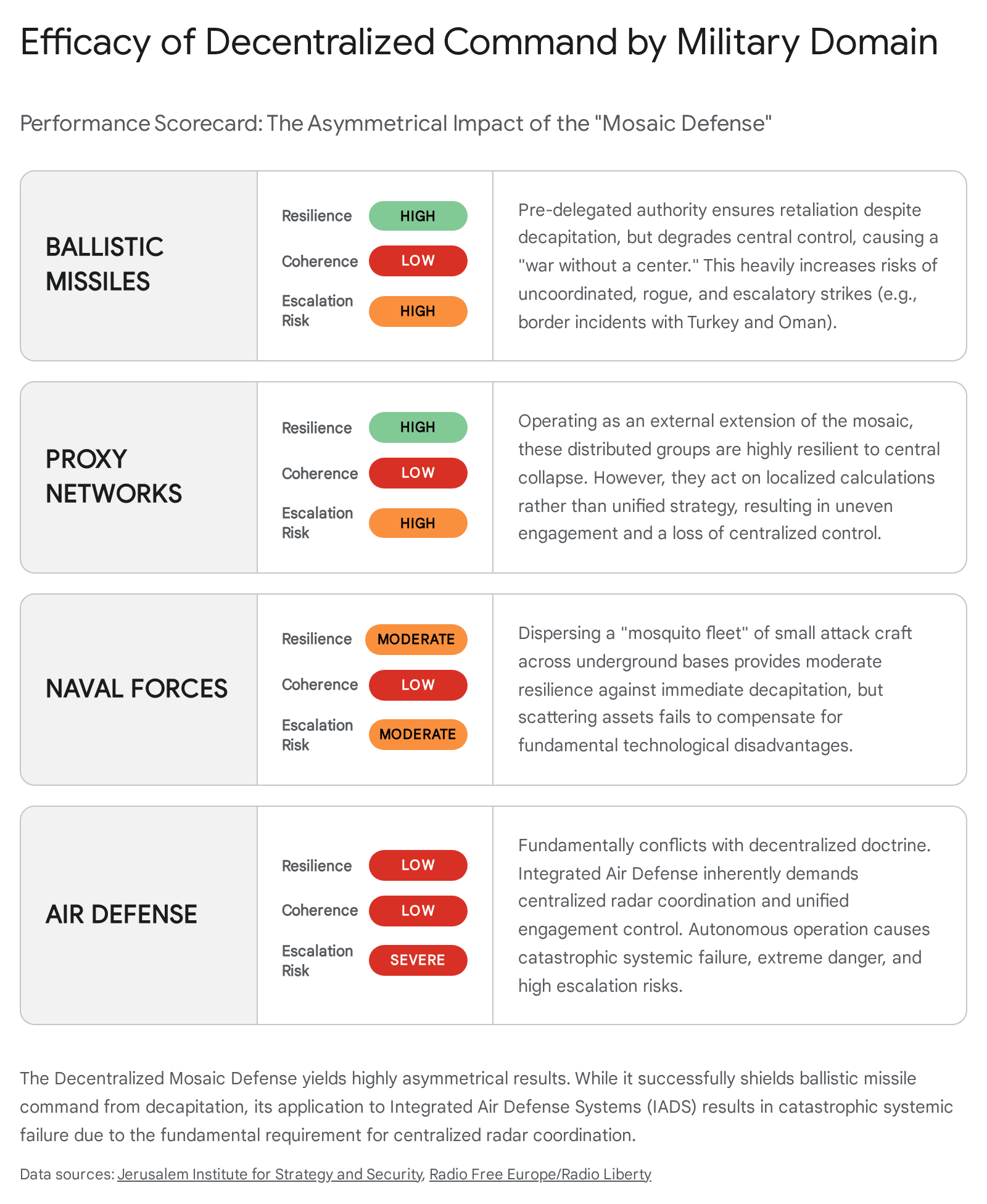
The primary casualty of extreme decentralization is strategic coherence.1 Operating without a unified central authority, the Iranian war effort rapidly devolved into a fragmented “war without a center”.1 In modern warfare, achieving decisive effects requires the massing of forces and the highly synchronized execution of multi-domain operations. By fragmenting its command into 31 isolated islands, the IRGC lost the ability to coordinate massive, saturated missile salvos capable of overwhelming advanced allied missile defense systems.4 Instead, military action deteriorated into sporadic, localized, and uncoordinated launches that lacked a unified strategic objective, rendering them vastly less impactful.1
8.2. The Escalation Trap and Errant Strikes
Pre-delegating lethal authority to junior, isolated provincial commanders introduces severe, almost unmanageable risks of unchecked escalation.1 In the chaos of war, cut off from strategic intelligence, higher-level context, and broader situational awareness, local commanders are highly susceptible to miscalculation, panic, and navigation errors.7
This flaw manifested dangerously during Operation Epic Fury. Autonomous Iranian units, operating without central oversight, launched unauthorized and errant strikes that crossed international borders, threatening to widen the conflict. On March 4, 2026, an Iranian ballistic missile was intercepted over the border region of NATO-member Turkey.7 The following day, drones were fired at an airport in Azerbaijan’s Nakhchivan region, and errant munitions struck civilian targets, including hotels and shopping malls, in Oman and the broader Persian Gulf.1 The head of Iran’s armed forces issued direct denials of these attacks, highlighting the total confusion and lack of central awareness regarding local unit actions.7 Iranian Foreign Minister Abbas Araghchi was later forced to publicly excuse these incidents as “mistakes” committed by autonomous units that central authorities could neither physically reach nor control.1 The inability to control decentralized forces drastically increases the probability of triggering an unintended, uncontrollable regional conflagration involving neutral or allied neighboring states.5
Furthermore, this extreme decentralization creates a war machine that is nearly impossible to turn off.1 Because the doctrine is designed to allow local units and international proxy networks to fight autonomously, enforcing a ceasefire becomes a logistical and command nightmare. Even if the surviving political leadership in Tehran negotiates an end to hostilities, they lack the direct communication lines and command authority necessary to compel dozens of isolated provincial corps and scattered proxies to lay down their arms, structurally trapping the state in perpetual conflict.1
8.3. Domain-Specific Failures and Asymmetries
The effectiveness of decentralization is highly dependent on the operational domain. While it provides resilience to hidden ballistic missile forces, it proves disastrous in domains that demand strict, centralized coordination.
Integrated Air Defense Systems (IADS): Air defense is unequivocally the weakest domain of the mosaic doctrine.1 Effective air defense inherently requires centralized radar coordination, real-time friend-or-foe identification, and unified engagement control to prevent fratricide. Operating air defense nodes autonomously is exceptionally dangerous; this exact structural flaw led to the tragic shootdown of Ukraine International Airlines Flight 752 in 2020 by a panicked, autonomous IRGC operator.1 During Operation Epic Fury, the limits of decentralized air defense were completely exposed. Allied forces successfully targeted and destroyed over 7,800 air defense aimpoints with virtually no manned aircraft losses to surface-to-air fire, proving that scattered, autonomous radar nodes cannot survive against a centralized, technologically superior air campaign.1
Naval Operations and Logistics: The IRGC Navy attempted to apply the mosaic concept by deploying a “mosquito fleet” of over 1,500 small, autonomous attack crafts scattered across various bodies of water, including the Caspian Sea.1 However, devastating Israeli airstrikes on the Caspian Sea Enzeli port demonstrated that geographical scattering cannot compensate for fundamental technological disparities and the exposure of physical infrastructure.1 Furthermore, the decentralization strategy remains heavily reliant on finite stockpiles. While local units can fire what they have in storage, they lack the capability to replenish stocks once centralized above-ground production facilities and logistical nodes are systematically destroyed.7
8.4. Attrition and Imposition of Costs on Adversaries
Despite these catastrophic tactical failures, the doctrine did succeed in its secondary goal: shifting the nature of the conflict from a rapid, surgical operation into a bloody, exhausting war of attrition that imposed significant material costs on the attacking coalition.10 By decentralizing the center of gravity, Iran forced adversarial intelligence and air assets to hunt hundreds of dispersed, lower-level targets, severely straining allied maintenance and repair infrastructure.
The U.S. Air Force, for instance, reported at least 42 aircraft lost or damaged during Operation Epic Fury.37 This included the loss of four F-15E fighter aircraft (three of which were tragically lost to friendly fire accidentally shot down by Kuwait, and one shot down by Iran), one A-10 Thunderbolt II, an E-3 Sentry airborne early warning aircraft, and approximately two dozen MQ-9 Reaper drones.37 Additionally, one F-35A Lightning II and seven KC-135 Stratotanker aerial refueling aircraft sustained damage.37 Furthermore, an Army Apache helicopter was downed by an Iranian drone, requiring a desperate search and rescue operation, compounding the immense logistical burden on an already strained U.S. maintenance infrastructure struggling with spare parts and personnel shortages.37 (Note: An unrelated incident involving a B-52 Stratofortress crash at Edwards Air Force Base in California killing eight crew members also occurred during this timeframe, further straining overall fleet readiness).37
| Aircraft Type | Status during Operation Epic Fury | Details |
| F-15E Strike Eagle | 4 Lost | 3 accidentally shot down by Kuwait; 1 shot down by Iran (prompting SAR). |
| A-10 Thunderbolt II | 1 Lost | Destroyed during operations. |
| F-35A Lightning II | 1 Damaged | Sustained damage, requiring extensive repair. |
| E-3 Sentry (AWACS) | 1 Lost | Destroyed (some aircraft targeted while on the ground). |
| MQ-9 Reaper Drone | ~24 Lost | Shot down over Iranian or adjacent airspace. |
| KC-135 Stratotanker | 7 Damaged/Destroyed | Vital aerial refueling assets compromised. |
| Army Apache Helicopter | 1 Downed | Downed by Iranian drone; pilots rescued. |
9. Strategic Outcomes and Political Settlement
To accurately assess the ultimate effectiveness of the Decentralized Mosaic Defense, one must define the parameters of victory as understood by the various belligerents. If the metric of success is the classic, Western military definition of victory—defeating the enemy’s armed forces in the field, protecting critical national infrastructure, and maintaining sovereign, unified control over the battlespace—the Iranian doctrine is a resounding and historical failure.26
The 2026 conflict resulted in staggering, lopsided losses that rank among the most disproportionate in modern military history. If counting only those killed by direct fire from the main belligerents, the United States lost exactly seven soldiers to Iranian fire, and Israel lost nine.38 By stark comparison, Iran suffered an estimated 6,000 military and security personnel killed by mid-March alone, according to Israeli intelligence estimates.38 The Norway-based Hengaw Organization for Human Rights later calculated that at least 6,620 Iranian military personnel were killed, though this is considered a significant undercount due to severe internet blackouts and regime restrictions on reporting losses.38
| Belligerent | Estimated Military Personnel Killed (Direct Fire) |
| United States | 7 |
| Israel | 9 |
| Iran (IRGC/Artesh/Security) | 6,620+ (Hengaw Organization estimate, likely undercounted) |
However, the Iranian regime does not measure victory by the preservation of infrastructure, the minimization of military casualties, or the efficiency of its C2 architecture; it measures victory exclusively by the metric of regime survival. As noted by defense analysts, for the Islamic Republic, “endurance is victory”.26 The primary, existential objective of the mosaic defense was to prevent the sudden, top-down institutional collapse of the government in the face of overwhelming technological superiority and precision decapitation strikes.1
By that specific, survival-oriented metric, the doctrine achieved its objective. The state did not implode. The strategy raised the price of invasion and prolonged the conflict to a level that adversaries, and particularly regional neighbors, ultimately deemed geopolitically unacceptable.12 Beyond the geopolitical pressure, the financial toll of the conflict was massive. The estimated cost of the war for the United States ranged between $34 billion and $42 billion, a staggering financial burden that exacerbated domestic political debates regarding the conflict.
This dynamic was heavily influenced by immense geopolitical pressure exerted by the Gulf States. Throughout the conflict, states including Pakistan, Iraq, Turkey, Kuwait, Saudi Arabia, Bahrain, Qatar, the United Arab Emirates, and Oman constantly intervened diplomatically to stop the United States from initiating military actions that might fully destroy the Iranian regime.39 These Islam-oriented, autocratic governments shared a starkly unified position: they wanted to severely tame the Iranian regime, but absolutely did not want to break it.39 Their strategic calculus was driven by the fear that if the theocracy fell, it might be replaced by a large, powerful, Western-style secular democracy sharing maritime and land borders with virtually all of them—a scenario they believed would inevitably cause massive domestic unrest within their own borders.39
Capitulating to this immense regional pressure, and facing a grinding war of attrition against decentralized cells, President Donald Trump ultimately agreed to terms. Following a temporary April ceasefire, a dual naval blockade, and complex mediation by Qatar and Pakistan, the Islamabad Memorandum of Understanding was formally signed. Signed on June 17, 2026, by President Trump at Versailles and Iranian President Masoud Pezeshkian in Tehran, and endorsed by Pakistani Prime Minister Shehbaz Sharif as a mediator the following day, the agreement mandated the reopening of the Strait of Hormuz and an end to military operations. Critics argued that this MOU rescued the regime from the brink of total economic and military collapse, rewarding Iran despite the U.S. holding maximum leverage following the brilliant execution of the first stage of Epic Fury.39 Following the signing, the Iranian leadership genuinely, and loudly, pitched the outcome of the 2026 war to its domestic audience as a triumphant victory, based purely on their successful survival against the combined might of the U.S. and Israel.38
10. Strategic Conclusions
The Decentralized Mosaic Defense represents a highly specialized, desperate adaptation to a massive, insurmountable asymmetry in conventional military power. It is a profound acknowledgment of systemic weakness, weaponized into a brutal strategy of endurance and attrition. Based on the extensive doctrinal architecture and the concrete operational outcomes of the 2026 conflict, the following strategic intelligence conclusions must inform future allied posture, targeting calculus, and regional engagement:
First, traditional theories of warfare relying on rapid “shock and awe” decapitation strikes are strategically insufficient against the Iranian military structure. Eliminating the supreme political and military leadership causes immense disruption but does not yield systemic, war-ending paralysis. Adversarial intelligence and operational planners must recognize that sovereign power does not reside solely in Tehran; it is distributed across 31 heavily fortified, autonomous, and ideologically committed provincial nodes. Any future military campaign must be prepared for a protracted, grueling counter-logistics and counter-node operation, rather than relying on a single, decapitating blow to end hostilities.
Second, the pre-delegation of lethal authority to junior, isolated provincial commanders creates a highly volatile and dangerous “dead hand” scenario. Because local units act on general instructions without real-time strategic oversight, the risk of errant strikes triggering massive, unintended regional escalation is unacceptably high. Future operations must prioritize cyber and electronic warfare aimed at severing the communication links not just from Tehran down to the provinces, but laterally between the provincial nodes themselves, to maximize isolation. Concurrently, allied forces must employ intense psychological operations (PSYOPS) targeted specifically at isolated provincial commanders—capitalizing on their lack of situational awareness to encourage localized surrender and fracture unit cohesion.7
Finally, allied forces must relentlessly exploit the operational domains where the mosaic doctrine structurally and catastrophically fails. Integrated Air Defense Systems, advanced naval coordination, and complex logistical resupply chains cannot function in a decentralized, autonomous vacuum. By focusing overwhelming precision strikes on these inherently centralized bottlenecks—such as surface-to-air radar networks and above-ground munitions production facilities—adversaries can systematically blind the Iranian defense apparatus and permanently deplete the finite missile and drone stockpiles that the autonomous provincial units desperately rely upon to maintain their attritional war.
Ultimately, Iran’s mosaic defense ensures that the state will bleed heavily, erratically, and dangerously before it collapses. It is a doctrine that successfully purchases basic regime survival, but it does so at the catastrophic, long-term cost of strategic coherence, territorial integrity, and national stability, rendering it an effective deterrent for the regime, but a devastating failure for the nation.
Please share the link on Facebook, Forums, with colleagues, etc. Your support is much appreciated and if you have any feedback, please email us in**@*********ps.com. If you’d like to request a report or order a reprint, please click here for the corresponding page to open in new tab.
Sources Used
- Iran’s Mosaic Defense Faces Its Real Test, accessed June 26, 2026, https://jiss.org.il/en/grinberg-irans-mosaic-defense-faces-its-real-test/
- 2026 Iran war | Deal, Explained, United States, Israel, Strait of …, accessed June 26, 2026, https://www.britannica.com/event/2026-Iran-war
- Operation Epic Fury and International Law – United States …, accessed June 26, 2026, https://www.state.gov/releases/office-of-the-legal-adviser/2026/04/operation-epic-fury-and-international-law
- Mosaic Defense and Dispersed Command: Iran Strikes Back – Small Wars Journal, accessed June 26, 2026, https://smallwarsjournal.com/2026/05/21/mosaic-defense-dispersed-command/
- Mosaic defence strategy – Wikipedia, accessed June 26, 2026, https://en.wikipedia.org/wiki/Mosaic_defence_strategy
- Will the War Change Iran’s Way of War? | Lawfare, accessed June 26, 2026, https://www.lawfaremedia.org/article/will-the-war-change-iran-s-way-of-war
- With Top Brass Dead, Iran Deploys Decentralized ‘Mosaic’ Strategy …, accessed June 26, 2026, https://www.rferl.org/a/iran-irgc-israel-us-war/33697690.html
- Iran’s Military Doctrine – The Iran Primer, accessed June 26, 2026, https://iranprimer.usip.org/resource/irans-military-doctrine
- Upgrading Iran’s Military Doctrine: An Offensive “Forward Defense” – Middle East Institute, accessed June 26, 2026, https://mei.edu/publication/upgrading-irans-military-doctrine-offensive-forward-defense/
- EXPLAINER: What Is Iran’s ‘Mosaic Defense’ Strategy? – Palestine Chronicle, accessed June 26, 2026, https://www.palestinechronicle.com/explainer-what-is-irans-mosaic-defense-strategy/
- Mohammad Ali Jafari | Counter Extremism Project, accessed June 26, 2026, https://www.counterextremism.com/extremists/mohammad-ali-jafari
- What Is ‘Mosaic Defense’ Strategy, Iran’s ‘Suicide Proof’ Plan? | Xplained By NewsX, accessed June 26, 2026, https://www.youtube.com/watch?v=nQiqGh0O6M4
- Islamic Revolutionary Guard Corps – Wikipedia, accessed June 26, 2026, https://en.wikipedia.org/wiki/Islamic_Revolutionary_Guard_Corps
- Politics and Culture in Contemporary Iran: Challenging the Status Quo 9781685850777, accessed June 26, 2026, https://dokumen.pub/politics-and-culture-in-contemporary-iran-challenging-the-status-quo-9781685850777.html
- Alborz Corps – Grokipedia, accessed June 26, 2026, https://grokipedia.com/page/alborz_corps
- Iran Framing the Threat – Army University Press, accessed June 26, 2026, https://www.armyupress.army.mil/Journals/NCO-Journal/Archives/2020/February/Iran-Framing-the-Threat/
- Iran’s ‘Forward Defense’ Doctrine Missile and Space Programs | International Institute for Iranian Studies, accessed June 26, 2026, https://rasanah-iiis.org/english/centre-for-researches-and-studies/irans-forward-defense-doctrine-missile-and-space-programs/
- Iran’s Revolutionary Guards, the Al Quds Force, and Other …, accessed June 26, 2026, https://csis-website-prod.s3.amazonaws.com/s3fs-public/legacy_files/files/media/csis/pubs/070816_cordesman_report.pdf
- Iran Primer: Iran’s Military Doctrine – Tehran Bureau | FRONTLINE | PBS, accessed June 26, 2026, https://www.pbs.org/wgbh/pages/frontline/tehranbureau/2010/10/iran-primer-irans-military-doctrine.html
- Captive Society: The Basij Militia and Social Control in Iran 9780231801355 – dokumen.pub, accessed June 26, 2026, https://dokumen.pub/captive-society-the-basij-militia-and-social-control-in-iran-9780231801355.html
- Relationships Matter – Army University Press, accessed June 26, 2026, https://www.armyupress.army.mil/Portals/7/military-review/Archives/English/MilitaryReview_20100630_art015.pdf
- THE ISLAMIC REPUBLIC’S ART of SURVIVAL: – The Washington Institute, accessed June 26, 2026, https://www.washingtoninstitute.org/media/3027
- Humiliation and Transformation: The Islamic Republic After the 12 …, accessed June 26, 2026, https://www.fpri.org/article/2025/10/humiliation-and-transformation-the-islamic-republic-after-the-12-day-war/
- The Strategic Foundations of Iran’s Military Doctrine, accessed June 26, 2026, https://www.iiss.org/globalassets/media-library—content–migration/images/comment/analysis/2017/december/2-mcinnis2125.pdf
- The Islamic Revolutionary Guard Corps: Military and Political Influence in Today’s Iran, accessed June 26, 2026, https://www.brookings.edu/events/the-islamic-revolutionary-guard-corps-military-and-political-influence-in-todays-iran/
- The Artesh After Epic Fury/Roaring Lion – JISS, accessed June 26, 2026, https://jiss.org.il/en/grinberg-the-artesh-after-epic-fury-roaring-lion/
- Upgrading Iran’s Military Doctrine: An Offensive “Forward Defense” – ResearchGate, accessed June 26, 2026, https://www.researchgate.net/publication/341042549_Upgrading_Iran’s_Military_Doctrine_An_Offensive_Forward_Defense
- Full article: Exploring the Driving Forces Behind Iran’s Nuclear Deterrence Strategy: A Novel Methodological Approach – Taylor & Francis, accessed June 26, 2026, https://www.tandfonline.com/doi/full/10.1080/25751654.2024.2319381
- “Islam” in EIMW New Edn. p. 61 on PDF (=p. 537).pdf – Academia.edu, accessed June 26, 2026, https://www.academia.edu/33824552/_Islam_in_EIMW_New_Edn_p_61_on_PDF_p_537_pdf
- (PDF) TAKING BACK THE NEIGHBORHOOD The IRGC Provincial Guard’s Mission to Re-Islamize Iran – ResearchGate, accessed June 26, 2026, https://www.researchgate.net/publication/341941328_TAKING_BACK_THE_NEIGHBORHOOD_The_IRGC_Provincial_Guard’s_Mission_to_Re-Islamize_Iran
- Iran’s Mosaic Defence: A New Doctrine in Evolving Warfare – ResearchGate, accessed June 26, 2026, https://www.researchgate.net/publication/402975270_Iran’s_Mosaic_Defence_A_New_Doctrine_in_Evolving_Warfare
- Iran’s ‘Mosaic Defense’ Strategy: Decentralization as Resilience Factor – The Soufan Center, accessed June 26, 2026, https://thesoufancenter.org/intelbrief-2026-march-9a/
- Iran’s Forward-Defense Doctrine: A Swan Song? | International Institute for Iranian Studies, accessed June 26, 2026, https://rasanah-iiis.org/english/monitoring-and-translation/articles/irans-forward-defense-doctrine-a-swan-song/
- In the Wake of “Roaring Lion”: Preliminary Insights, Hypotheses, and Dilemmas for Israel, accessed June 26, 2026, https://www.inss.org.il/publication/lions-roar-conclusions/
- A top nuclear expert on what the Iran war accomplished, accessed June 26, 2026, https://www.washingtonpost.com/opinions/2026/06/25/is-iran-stronger-now-nuclear-expert-what-war-accomplished/
- Iran War: How This Man’s ‘Mosaic Defence’ Is Helping IRGC Stay In The Fight Against US, IDF Blitz – YouTube, accessed June 26, 2026, https://www.youtube.com/watch?v=OXqZY6U8BgM
- Air Force’s ‘NASCAR pit crews’ forced into overdrive by Iran war, accessed June 26, 2026, https://www.washingtonexaminer.com/policy/defense/4619101/air-force-maintenance-efforts-overdrive-iran-war/
- Iran’s leadership emerges from war battered and transformed, accessed June 26, 2026, https://www.washingtonexaminer.com/news/world/4617280/iran-leadership-war-battered-transformed/
- What went wrong in Iran?, accessed June 26, 2026, https://www.washingtonexaminer.com/op-eds/4622911/what-went-wrong-trump-iran-deal-mou/