Executive Summary
The initiation of Operation Epic Fury by the United States and Operation Roaring Lion by Israel on February 28, 2026, fundamentally altered the deterrence equilibrium in the Middle East, transforming a long-standing shadow war into a direct, high-intensity conflict.1 Initially conceived as a massive, multi-domain air and naval campaign aimed at the rapid decapitation of the Islamic Republic’s leadership and the obliteration of its nuclear and ballistic missile infrastructure, the conflict has rapidly evolved into a protracted war of attrition.1 While the campaign succeeded in eliminating Supreme Leader Ayatollah Ali Khamenei and degrading centralized command and control nodes, the foundational assumption that structural decapitation would precipitate systemic military collapse has proven catastrophically flawed.4
Instead, the Islamic Republic of Iran has activated its “Decentralized Mosaic Defense” doctrine, absorbing massive infrastructural damage while maintaining operational resilience through semi-autonomous proxy networks, localized ground forces, and highly distributed asymmetric naval assets.6 The strategic fallout—evidenced by the effective closure of the Strait of Hormuz, the targeting of multiple Gulf nations, and an unabated nuclear proliferation threat at subterranean facilities—has vividly demonstrated the intrinsic limitations of standoff munitions and aerial bombardment.9
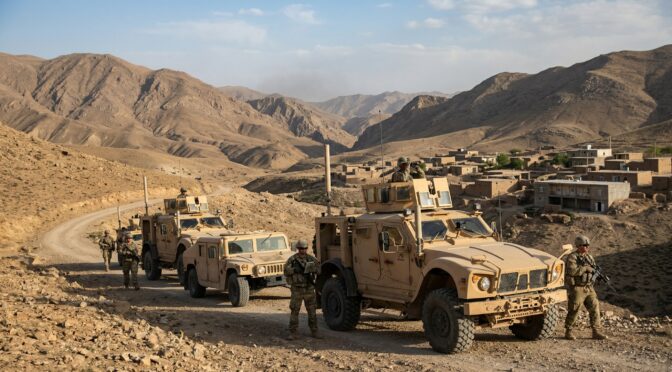
Consequently, the United States Department of Defense, under the Trump administration, is actively staging assets for potential ground interventions to achieve strategic objectives that airpower alone cannot secure.11 The deployment of the 31st Marine Expeditionary Unit (MEU) aboard the USS Tripoli, alongside the mobilization of paratroopers from the 82nd Airborne Division, indicates a definitive transition from punitive air strikes to the contemplation of targeted territorial control and specialized ground operations.13 This report exhaustively analyzes the five most probable scenarios for United States ground force engagement in Iran, ranked from most to least likely. It assesses the tactical objectives, deployment vectors, force compositions, Iranian counter-maneuvers, likelihood of success, and projected human costs associated with each strategic option, grounding the analysis strictly in the operational realities of the 2026 theater.
The Strategic Operating Environment: Aerial Limitations and The Cost of Attrition
To accurately contextualize the necessity of ground operations, it is imperative to analyze the operational limitations and logistical exhaustion of the preceding aerial phases of the conflict. The current war represents the culmination of escalating hostilities that previously peaked during the Twelve-Day War in June 2025. During that precursor conflict, the United States executed Operation Midnight Hammer, deploying B-2 Spirit stealth bombers to drop 30,000-pound GBU-57A/B Massive Ordnance Penetrators (MOPs) on the Fordow and Natanz enrichment facilities, while concurrently launching cruise missiles at the Isfahan nuclear research complex.15 While these strikes severely damaged physical infrastructure, they failed to neutralize the underlying nuclear material, leaving an estimated 440.9 kg of 60 percent highly enriched uranium (HEU) largely intact and providing Tehran with the material foundation for continued proliferation.12
Operation Epic Fury, launched eight months later on February 28, 2026, attempted a more comprehensive dismantling of the Iranian state apparatus. The operation involved the largest regional concentration of American military firepower in a generation, prioritizing the destruction of Islamic Revolutionary Guard Corps (IRGC) command and control facilities, air defense networks, and drone launch sites.5 The tactical successes of the campaign were initially significant. The strikes resulted in the deaths of Supreme Leader Ayatollah Ali Khamenei, Defense Minister Aziz Nasirzadeh, IRGC Ground Forces Commander Mohammad Pakpour, and Supreme National Security Council member Ali Larijani, effectively decimating the upper echelons of the Iranian command hierarchy.2 The combined United States and Israeli air campaign severely degraded Iran’s ballistic missile and drone manufacturing capabilities, with reports indicating that missile launch volumes dropped by up to 95 percent by the second week of the war.19
However, the financial and logistical costs of sustaining this level of aerial dominance have been staggering, exposing vulnerabilities in United States magazine depth. The Center for Strategic and International Studies (CSIS) estimates that the first 100 hours of Operation Epic Fury cost the United States approximately billion dollars, driven primarily by
billion dollars in unbudgeted munitions expenditures.1 The intense early phases of the war rapidly depleted stockpiles of expensive standoff weapons and interceptors. Estimated expenditures in the first six days alone reduced the United States Tomahawk Land Attack Missile (TLAM) inventory to approximately 2,700 units, a critical concern given that only 190 Tomahawks are slated for delivery in Fiscal Year 2026.23 Similarly, the heavy utilization of Standard Missiles (SM-3s for ballistic threats and SM-6s for cruise missiles and drones) has outpaced resupply rates, forcing a tactical shift.23 As the coalition achieved air superiority, the military was compelled to transition to less expensive, shorter-range “stand-in” munitions, such as the Joint Direct Attack Munition (JDAM) and the newly introduced Low-cost Unmanned Combat Attack System (LUCAS) drones, which mimic the design of Iranian Shahed drones.18
The limitations of airpower are most evident in the failure to secure the maritime domain and fully eradicate the nuclear threat. The geography of the Persian Gulf and the Strait of Hormuz heavily favors defensive anti-access/area denial (A2/AD) networks. Iran has spent decades embedding mobile missile systems, drone launch infrastructure, and naval fast-attack craft staging areas within the rugged, mountainous topography of its southern coast and the Zagros Mountains.24 This geological shielding severely restricts the efficacy of aerial reconnaissance and standoff strikes, creating a scenario where high-value United States naval platforms remain under constant threat from sudden, short-range barrages.24 The effective closure of the Strait of Hormuz by Iranian mining operations and anti-ship cruise missiles has caused global Brent crude oil prices to surge past dollars per barrel, highlighting the global economic vulnerability tied to the conflict.1
The Geopolitical and Domestic Dimensions
The operational trajectory of the war is intrinsically linked to complex geopolitical negotiations and the shifting internal dynamics of the Iranian state. Following the assassination of Ali Khamenei, the Assembly of Experts selected his son, Mojtaba Khamenei, as the new Supreme Leader.4 While this selection contradicted the founding principles of the Islamic Republic regarding hereditary succession, it signaled a consolidation of power by the IRGC, which views Mojtaba as a figurehead it can largely control.4 The regime’s survival instinct has resulted in a brutal internal crackdown, with reports indicating a high tolerance for bloodshed against domestic protesters who view the war as an opportunity for revolution.4
Simultaneously, the Iranian diaspora has mobilized to present a viable democratic alternative. The Iran Freedom Congress convened in London in late March 2026, bringing together hundreds of ideologically diverse civil society activists, political figures, and academics.26 Organized by figures such as Majid Zamani and supported by a broad spectrum of the opposition, the Congress seeks to establish a pluralistic framework for a transitional government, distinct from the historical monarchist factions led by Reza Pahlavi or the controversial Mojahedin-e Khalq (MEK).28 The emergence of a unified opposition is a critical variable for United States strategists, as the Trump administration’s stated metric for ultimate success involves the Iranian people overthrowing the regime.31
On the diplomatic front, the United States has attempted to leverage its military successes to force a negotiated settlement. A 15-point peace plan, transmitted to Tehran via Pakistani and Egyptian intermediaries, outlines terms for a 30-day ceasefire.14 The proposal demands the total dismantling of Iran’s nuclear facilities at Natanz, Isfahan, and Fordow; the handover of all enriched uranium to the IAEA; the reopening of the Strait of Hormuz; and the cessation of support for regional proxy groups such as Hezbollah, Hamas, and the Houthis.33 In exchange, the United States offered comprehensive sanctions relief and assistance in developing a civilian nuclear energy project at Bushehr.33 Iran, however, rejected the proposal as “excessive,” interpreting the diplomatic overture as a sign of American operational exhaustion and countered with demands for official control over the Strait of Hormuz and reparations for war damages.13 This diplomatic deadlock directly necessitates the preparation of ground force options to compel compliance or physically achieve the stated objectives.
Iranian Defensive Architecture: The Mosaic Defense Doctrine
Understanding the likely outcomes of any United States ground intervention requires a deep analysis of Iranian military doctrine, which was specifically engineered to counter the technological overmatch of Western conventional forces. At the core of Iran’s military strategy is the concept of “Decentralized Mosaic Defense” (DMD), a doctrine heavily refined under former IRGC commander Mohammad Ali Jafari.7
The Mosaic Defense doctrine operates on the foundational assumption that in any conflict with the United States or Israel, Iran will inevitably suffer the loss of senior commanders, centralized communications networks, and major infrastructure.7 The doctrine is born from the strategic traumas of the Iran-Iraq War, which demonstrated the acute vulnerability of rigid, centralized command structures when confronted with superior firepower.35 Consequently, Iranian strategists have organized the state’s defensive apparatus into multiple, semi-independent regional layers. The IRGC, the regular army (Artesh), the Basij paramilitary forces, and naval assets are integrated into a distributed system that lacks a single, paralyzing center of gravity.7
Under this framework, command authority is highly decentralized. In the event of a decapitation strike—such as the one that killed Ali Khamenei and top defense officials during the opening hours of Operation Epic Fury—pre-delegated authority protocols are instantly activated.7 Lower-level regional commanders are empowered to conduct autonomous, asymmetric operations without requiring authorization from Tehran.8 This ensures that the destruction of the capital’s command hubs has a minimal impact on the operational continuity of forces in the field, a reality explicitly articulated by Iranian Foreign Minister Abbas Araghchi, who noted that two decades of studying United States military operations informed this resilient architecture.7
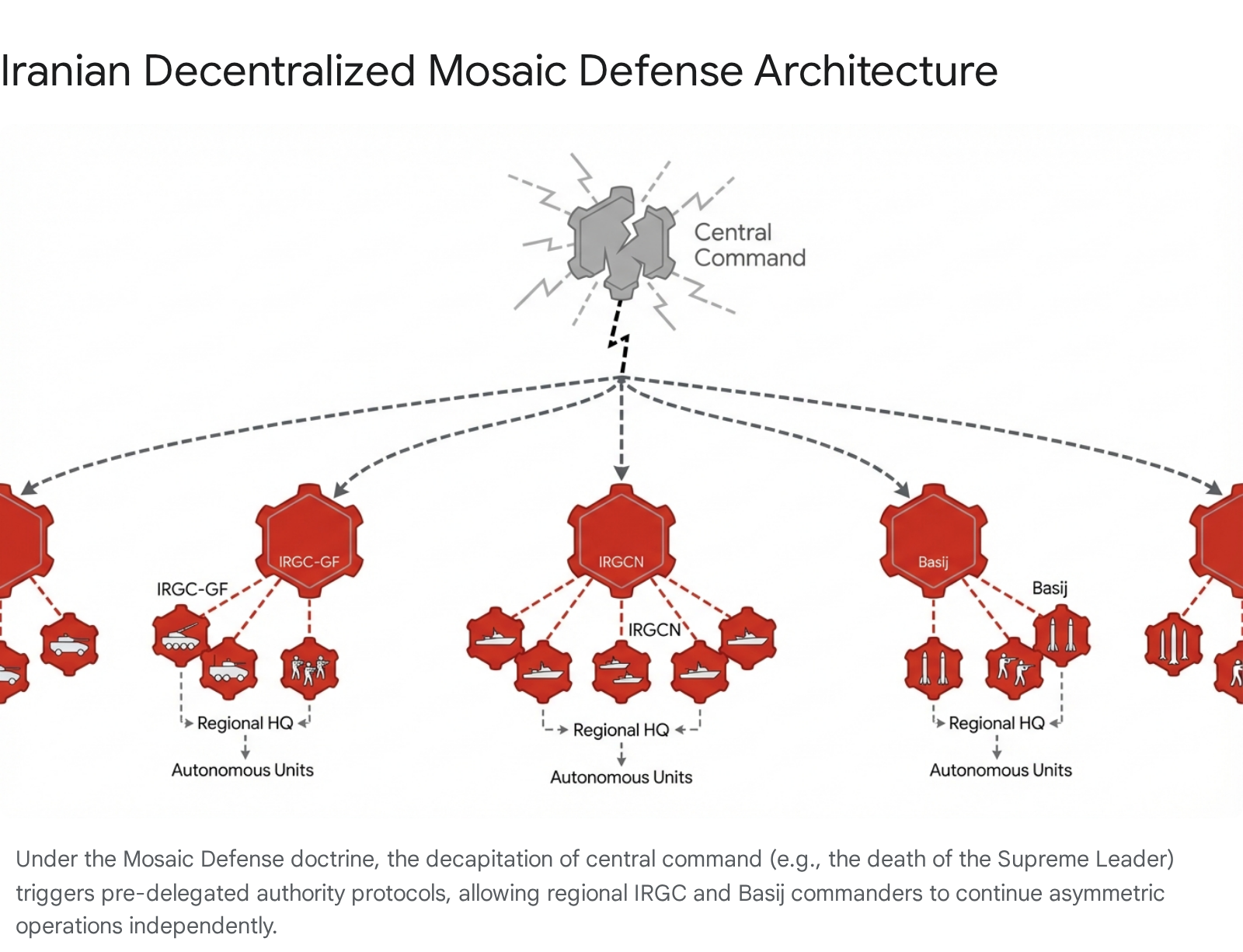
The conventional warfare application of this doctrine relies heavily on the IRGC Ground Forces (IRGC-GF), which consist of approximately 100,000 active personnel supplemented by a massive reserve force of roughly 350,000 fighters.8 Operating in tandem with the Basij—a volunteer paramilitary group capable of mobilizing hundreds of thousands of combatants—the IRGC-GF is designed to execute a strategy of “popular resistance,” where the invader is fought everywhere by highly mobile, lightly equipped units rather than engaged in conventional, set-piece battles.8 The strategic objective of Mosaic Defense is not to achieve a decisive military victory against American forces, but rather to subject the occupying force to a relentless war of attrition, thereby deciding the timeline and terms of the conflict’s conclusion through cost asymmetry.7 Any United States ground intervention must calculate its operational parameters against this heavily entrenched, ideologically motivated, and structurally diffuse adversary.
Scenario 1: Specialized Operations for Nuclear Material Retrieval (Most Likely)
The most acute and globally destabilizing threat facing the United States administration is the risk of unregulated nuclear proliferation resulting from the potential fragmentation of the Iranian state. While aerial bombardments during Operations Midnight Hammer and Epic Fury decimated the physical infrastructure of Iran’s nuclear program, they did not eliminate the core fissile material.12 Intelligence assessments confirm that Iran possesses a stockpile of 440.9 kg of 60 percent highly enriched uranium, capable of being converted to weapons-grade material within days or weeks.4 This material is stored primarily in the form of uranium hexafluoride (UF6) gas in heavily fortified subterranean facilities, rendering it immune to standoff destruction without risking catastrophic radiological dispersion across the region.12 Consequently, physical retrieval via highly specialized ground forces represents the most statistically and strategically probable scenario for United States intervention.
The Tactical Goal
The primary objective is to covertly breach the subterranean nuclear complexes—principally the underground facility near Isfahan—neutralize local security elements, secure the UF6 cylinders, and physically extract the material for international custody and down-blending under the supervision of the International Atomic Energy Agency (IAEA).12 This action is deemed essential to prevent a “loose nuke” scenario, whereby rogue factions of the IRGC or external terrorist organizations might acquire the material amid a regime collapse.12
Conflict Starting Point and Movement
Due to the extreme sensitivity of the operation and the political constraints of utilizing regional Gulf host nations for direct offensive ground action, the operation would likely not originate from local Middle Eastern bases.38 Instead, the insertion would be staged from the strategic perimeter, utilizing European bases or facilities in the United Kingdom.12 The Department of Defense has already prepositioned vital assets for this contingency, including six MC-130J Commando II cargo aircraft, which are heavily modified for covert special operations transport.12 These aircraft would execute low-altitude, terrain-following ingress routes into Iranian airspace, relying on total United States air superiority, extensive electronic warfare (EW) suppression, and an armada of KC-135 Stratotankers acting as “flying gas stations” to manage the immense logistical distances.38
United States Forces and Capabilities Employed
This scenario relies exclusively on elite Special Operations Forces (SOF), specifically Tier 1 units with deep-penetration and subterranean warfare capabilities. The operation would require a sizable footprint, involving several hundred to potentially over a thousand specialized personnel, depending on the depth of the excavation and the number of interconnected tunnel networks.12 The force composition must include advanced breaching teams to penetrate the heavy blast doors of the Isfahan complex, alongside specialized Chemical, Biological, Radiological, and Nuclear (CBRN) units.12 The environment presents unprecedented operational hazards; UF6 is highly volatile, reacting violently with atmospheric moisture to produce highly toxic, corrosive hydrogen fluoride gas and uranyl fluoride.12 Consequently, operators would be required to conduct high-intensity close-quarters combat while wearing cumbersome self-contained breathing apparatuses (SCBA) and heavy chemical protective suits, severely degrading mobility and endurance.12
Iranian Tactical and Strategic Responses
The Isfahan facility, representing the crown jewel of Iran’s strategic deterrence, is guarded by elite, fanatically loyal units of the IRGC. Adhering to the Decentralized Mosaic Defense doctrine, these localized units would not require authorization from a central command to initiate a total defense.7 Upon detecting the breach, Iranian forces would likely engage in brutal subterranean warfare, utilizing choke points within the tunnel architecture. In a worst-case scenario, defending forces might intentionally rupture the propane-sized UF6 cylinders, weaponizing the facility’s atmosphere to lethally stall the United States advance and deny the extraction of the material.12 Simultaneously, regional IRGC-GF quick reaction forces on the surface would attempt to encircle the extraction zone, employing mortar fire, mobile artillery, and localized drone swarms to target the highly vulnerable MC-130J aircraft waiting on the tarmac or makeshift runways.8
Likelihood of Accomplishing the Goal
Moderate to High. The United States military possesses unparalleled proficiency in localized, high-intensity special operations raids. However, the success of this mission is entirely contingent upon the absolute fidelity of intelligence regarding the exact location of the UF6 cylinders within the vast, recently excavated tunnel networks at Isfahan.12 This would necessitate deep integration with Israeli intelligence services, which reportedly possess granular understanding of the facility’s internal architecture.12 Furthermore, success requires the United States Air Force to maintain an impenetrable defensive perimeter against Iranian ground reinforcements during the hours-long breaching and extraction phase.
Projected Casualties
- United States: Moderate numerically, but politically highly sensitive (Dozens of elite SOF operators). The primary vectors of lethality would be subterranean ambushes and severe toxic chemical exposure resulting from compromised CBRN suits during firefights. The loss of any MC-130J aircraft during the extraction phase would dramatically escalate the casualty count.
- Iran: High within the localized operational theater (Hundreds). The entire IRGC garrison defending the subterranean complex, as well as the initial waves of surface quick reaction forces, would likely be eradicated by United States operators and the overwhelming application of loitering close air support.
Scenario 2: Amphibious Seizure of the Strait Chokepoints (Highly Likely)
While the nuclear threat poses an existential global security risk, the effective closure of the Strait of Hormuz presents an immediate, crippling macroeconomic crisis. Iran’s systematic anti-shipping campaign, leveraging proxy attacks and naval mines, has paralyzed the critical waterway, causing global energy markets to panic and threatening to drag allied economies into severe recession.1 As diplomatic avenues stagnate, military planners are forced to confront the structural reality that securing navigation in a highly militarized, narrow waterway cannot be achieved solely from the air.24 The “Hormuz Islands Strategy” necessitates a shift from sea to land-based control, involving the physical occupation of the strategic islands that act as unsinkable aircraft carriers for the Iranian regime.11
The Tactical Goal
The objective is to conduct massive, synchronized amphibious and airborne assaults to seize and occupy Larak Island, Abu Musa, and the Greater and Lesser Tunbs.11 Securing these specific geographic nodes would neutralize the Iranian coastal radar arrays, anti-ship cruise missile (ASCM) bunkers, and fast-attack craft staging areas that currently enforce the blockade, thereby forcibly reopening the Strait of Hormuz to commercial shipping and international energy flows.11
Conflict Starting Point and Movement
The assault would launch from the Arabian Sea and the Gulf of Oman, utilizing the United States Navy’s Amphibious Readiness Groups (ARGs). The USS Tripoli, acting as the primary staging vessel and command center, has already been repositioned to the eastern periphery of the strait, signaling intent.13 The operation would commence with a massive Suppression of Enemy Air Defenses (SEAD) barrage utilizing submarine-launched cruise missiles and stealth aviation, before heavily armed landing craft and tilt-rotor aircraft initiate the physical island invasions from over-the-horizon staging points.
United States Forces and Capabilities Employed
This operation represents a major conventional commitment, relying fundamentally on the 31st Marine Expeditionary Unit (MEU), which comprises roughly 3,500 Marines and sailors, supported by robust organic aviation and logistics assets.13 To expedite the seizure of deeply entrenched facilities and prevent organized resistance, elements of the 82nd Airborne Division—numbering up to 2,000 paratroopers recently mobilized for regional deployment—would be utilized for rapid vertical envelopment behind coastal defense lines.14 A critical, novel capability deployed in this scenario is Task Force Scorpion Strike.5 Operating under CENTCOM, this task force would deploy massive swarms of Low-cost Unmanned Combat Attack System (LUCAS) drones ahead of the Marine landing force.5 These drones, operating with autonomous coordination features, are specifically designed to hunt and destroy the radar systems protecting hardened bunkers and the fuel depots sustaining the Iranian defense, blinding the garrison before the Marines hit the beaches.42
Iranian Tactical and Strategic Responses
The strategic difficulty of the Hormuz intervention is entirely geographic. Larak, Abu Musa, and the Tunbs are situated in close proximity to the Iranian mainland, placing any occupying United States amphibious forces within the immediate 100 to 200-kilometer operational range of Iran’s mobile coastal artillery and fast-attack craft swarms.24 The geography of the Strait shrinks engagement windows to mere minutes, heavily favoring the defender.24 The islands themselves are heavily fortified with subterranean tunnel networks and hidden missile batteries.11 The Islamic Revolutionary Guard Corps Navy (IRGCN) operates an estimated 45 to 50 fast-attack craft equipped with potent ASCMs.44 Utilizing shoot-and-scoot tactics, these craft would swarm the United States amphibious flotilla from concealed mainland inlets, attempting to overwhelm Aegis missile defense systems.44 Furthermore, Iran would immediately deploy extensive naval mines across the approaches, a tactic that historically halted maritime traffic and complicates amphibious landings.24 Strategically, because Abu Musa and the Tunbs are claimed by the United Arab Emirates, Iran has explicitly threatened to launch massive, relentless ballistic missile barrages at vital UAE infrastructure should those islands be occupied, attempting to fracture the United States-Gulf geopolitical alliance through economic terror.11
Likelihood of Accomplishing the Goal
High militarily, but strategically precarious. The United States Marine Corps is uniquely structured and highly capable of executing complex amphibious assaults to seize island territory. However, the long-term viability of this strategy is highly questionable. Occupying these islands places United States forces in a static, defensive posture within the immediate range of Iran’s vast mainland artillery, ballistic missile forces, and drone swarms.24 It effectively transforms the highly mobile MEU into a stationary, high-value target, requiring constant, expensive aerial and naval defense umbrellas to prevent the garrisons from being annihilated.
Projected Casualties
- United States: High (Hundreds). Amphibious assaults against prepared, heavily fortified, and geographically isolated positions are historically costly endeavors. The severe risk lies in the potential for an Iranian ASCM to penetrate the fleet’s terminal defense systems and strike a densely packed troop transport or amphibious assault ship, which would result in a catastrophic mass casualty event.24
- Iran: Very High (Over a thousand). The United States would employ overwhelming naval gunfire, relentless close air support, and concentrated drone swarms to systematically annihilate the island garrisons and any approaching IRGCN vessels. The defending forces would face near-total attrition.
Scenario 3: Strategic Economic Interdiction via Kharg Island (Moderately Likely)
If diplomatic negotiations completely disintegrate and the 15-point peace plan is permanently shelved, the Trump administration may pivot to a strategy of total economic strangulation to force capitulation.14 Kharg Island represents the absolute vital artery of the Iranian state; it is the primary export terminal for the vast majority of the nation’s crude oil, which funds the entire governmental apparatus.
The Tactical Goal
The objective is to execute a surgical invasion to seize, hold, or systematically blockade Kharg Island, capturing its oil infrastructure largely intact.11 By severing the Islamic Republic’s primary economic avenue, the United States aims to definitively deprive the regime of the capital required to sustain its sprawling proxy networks across the Middle East, fund its military-industrial complex, and pay the internal security forces currently suppressing domestic unrest.11
Conflict Starting Point and Movement
Kharg Island is a narrow, 8-kilometer-long rocky outcrop situated approximately 50 kilometers off the southern Iranian coast, deep within the hostile waters of the Persian Gulf.11 A United States naval task force would be required to push aggressively past the contested chokepoint of the Strait of Hormuz, navigating heavily mined waters and constant harassment by IRGCN elements, to position a robust amphibious assault force directly off the island’s vulnerable coast.
United States Forces and Capabilities Employed
Similar to the broader Hormuz operation, this maneuver relies heavily on Marine Expeditionary Units for the initial beachhead assault. However, due to the extreme density of mainland threats, it would necessitate an exceptionally heavy integration of naval surface combatants—specifically Aegis-equipped cruisers and destroyers—to provide a localized, high-capacity ballistic missile defense umbrella over the occupying force. Because the strategic goal is economic control rather than mere destruction, United States planners would deploy specialized combat engineering battalions to secure the delicate pipelines, storage tanks, and terminal facilities.11 These units must rapidly disable potential booby traps and prevent environmental self-destruct protocols from being triggered by retreating Iranian forces.
Iranian Tactical and Strategic Responses
The defense of Kharg Island is viewed as an existential imperative by Tehran. Because the island is a mere 50 kilometers from the mainland, it rests comfortably within the effective range of conventional Iranian tube artillery, short-range ballistic missiles (SRBMs), and relentless waves of suicide drones.11 Operating under the Mosaic Defense mandate of decentralized resistance, mainland IRGC artillery units would subject the occupying United States forces to a continuous, low-cost bombardment.7 Furthermore, if Iranian commanders assess that the island cannot be held or recaptured, they are highly likely to implement a “scorched earth” policy. Sabotaging their own oil facilities to deny their utility to United States forces would not only thwart the strategic objective but would simultaneously trigger an unprecedented, catastrophic ecological disaster within the enclosed waters of the Persian Gulf, forcing a complex international crisis.11
Likelihood of Accomplishing the Goal
Moderate. The United States possesses the overwhelming tactical combat power necessary to successfully invade and clear the island of its initial defenders. However, maintaining a continuous, functional presence on a small, exposed landmass under persistent, unrelenting bombardment from the mainland renders the tactical victory strategically pyrrhic. The cost of defending the garrison would likely exceed the economic leverage gained.
Projected Casualties
- United States: Moderate to High. Military analysts explicitly warn that United States troop casualties would be “all but certain” in this scenario.11 A static garrison confined to an 8-kilometer-long island offers minimal defensive depth or concealment against constant, coordinated indirect fire from the mainland.
- Iran: High. The defending garrison on Kharg Island would be rapidly eliminated. However, the mainland artillery crews and drone operators executing the counter-bombardment would likely suffer continuous, heavy attrition from United States counter-battery fire and punitive air strikes directed at the mainland coast.
Scenario 4: Coastal Penetration and A2/AD Degradation Raids (Less Likely)
The failure of the massive aerial campaigns to completely neutralize Iran’s missile forces is deeply rooted in the country’s vast, rugged geography. The Zagros Mountains, stretching along the western and southern borders, offer natural, virtually impregnable subterranean bunkers for mobile ballistic missile launchers and early warning radar arrays.24 When total air dominance proves insufficient to autonomously hunt and destroy these dispersed assets, the necessity for ground-based intelligence, laser target designation, and direct sabotage becomes paramount.
The Tactical Goal
The objective is to covertly insert small, highly specialized, and lethal ground reconnaissance units into the hostile southern Iranian mainland.11 These teams are tasked with conducting deep reconnaissance, laser-designating hidden targets for precision aerial bombardment, and physically destroying critical command and control nodes, fiber-optic communication hubs, and missile storage facilities that are immune to standoff munitions or hidden from satellite surveillance.11
Conflict Starting Point and Movement
This scenario avoids large-scale, overt troop movements, relying instead on covert, over-the-horizon insertions to achieve tactical surprise. Special Operations teams would infiltrate the mountainous terrain bordering the Strait of Hormuz and the Persian Gulf via stealth fast-boats, specialized submarine deployment systems, or high-altitude, low-opening (HALO) parachute jumps originating from high-flying transport aircraft operating at the edges of Iranian airspace.
United States Forces and Capabilities Employed
The operational footprint is exceptionally small, relying entirely on elite detachments of Tier 1 and Tier 2 Special Operations Forces, such as Navy SEALs, Delta Force, or Marine Raiders, operating deep behind enemy lines.11 These highly autonomous units would carry advanced, encrypted satellite communications gear to establish secure datalinks directly with loitering B-2 stealth bombers and high-altitude unmanned aerial vehicles (UAVs). In this capacity, the ground forces act as the forward eyes and trigger mechanism for the entire United States aerial strike complex, guiding munitions with pinpoint accuracy into mountain cave entrances.
Iranian Tactical and Strategic Responses
This scenario directly engages the core strength of Iran’s IRGC Ground Forces (IRGC-GF), which commands 100,000 active personnel and an expansive reserve force of 350,000 fighters.8 Operating under the established doctrine where “everyone fights the invader everywhere,” these units are explicitly trained for rugged mountain combat and asymmetric guerrilla warfare within their home terrain.8 Rather than engaging United States airpower, the IRGC-GF would mobilize vast, localized networks of informants and highly motivated Basij militias to physically hunt down the isolated United States teams.8 During Mosaic Defense exercises, Iranian forces extensively tested systems such as the Arash 20mm anti-helicopter shoulder-fired rifles and automated heavy machine guns designed to counter specialized insertions.40 The environment is a densely populated, hostile matrix where operational secrecy is exceptionally difficult to maintain.
Likelihood of Accomplishing the Goal
Low. Iran is a massive country with incredibly difficult topography that inherently favors defensive, guerrilla warfare operations.11 The operational impact of neutralizing a few hidden bunkers or missile launchers must be carefully weighed against the extreme strategic risk. The capture or public execution of an elite Tier 1 SOF team would provide Tehran with immense, morale-boosting propaganda leverage and severely humiliate the United States administration on the global stage.
Projected Casualties
- United States: Low numerically, but strategically devastating (Dozens). The loss, capture, or public parading of elite operators carries profound domestic and international political consequences that far outweigh the tactical numbers.
- Iran: Moderate. Local IRGC units and Basij militias would undoubtedly suffer casualties in localized skirmishes and from the subsequent, devastating close air support strikes called in by compromised SOF teams attempting to extract under fire.
Scenario 5: Large-Scale Conventional Invasion and Occupation (Least Likely)
The most extreme and consequential scenario involves abandoning limited, punitive military objectives in favor of total regime change achieved through a massive, conventional military occupation. While President Trump has publicly defined a successful campaign as one where the current Iranian regime is entirely dismantled and replaced, the geopolitical and military realities of achieving this end state via ground forces are staggering in their complexity and cost.10
The Tactical Goal
The objective is to launch a massive, multi-axis conventional invasion of the Iranian mainland to systematically dismantle the Islamic Republic’s military forces, internal security apparatus, and political leadership. Following the destruction of the state, the United States would aim to install a transitional, democratic government, potentially brokered in conjunction with diaspora groups such as the Iran Freedom Congress, fundamentally reshaping the geopolitical architecture of the Middle East.26
Conflict Starting Point and Movement
An operation of this magnitude requires a colossal logistical buildup spanning months. It would necessitate massive staging areas in neighboring, compliant Gulf states, or the execution of a monumental amphibious landing on the southern coast, reminiscent of historical global conflicts. United States armored columns, mechanized infantry divisions, and vast logistical supply trains would attempt to secure major arterial highways and push relentlessly toward Tehran, navigating treacherous mountain passes and deeply hostile, densely populated urban centers.
United States Forces and Capabilities Employed
This operation requires a theater-level deployment of hundreds of thousands of conventional troops, encompassing multiple divisions of the United States Army and Marine Corps.11 It would completely eclipse the scale, cost, and complexity of the 2003 invasion of Iraq, requiring a massive mobilization of the military-industrial base and the prolonged commitment of a significant percentage of global United States military assets, thereby leaving other strategic theaters, such as the Indo-Pacific, severely vulnerable.26
Iranian Tactical and Strategic Responses
Iran has spent over four decades specifically preparing for this exact existential scenario. The Decentralized Mosaic Defense was expressly designed to absorb and ultimately defeat a massive conventional invasion through attrition.7 The regular army (Artesh) would fight a calculated delaying action, sacrificing conventional units to exact a toll on advancing columns. Simultaneously, the IRGC-GF and the vast Basij paramilitary network would melt into the civilian population and the impenetrable mountain ranges to launch a protracted, brutal, and sophisticated insurgency.8 The decentralized nature of their command architecture means that capturing Tehran or toppling the formal government would not end the war; it would merely signal the beginning of an endless, horrific asymmetric conflict spanning decades.7
Likelihood of Accomplishing the Goal
Extremely Low. The Trump administration is acutely aware of the historical failures of the Iraq War in 2003 and the intervention in Libya in 2011.10 National security analysts explicitly note that the administration views the deployment of massive conventional ground forces and the disbanding of established government structures as strategic traps that inevitably lead to costly, unwinnable insurgencies.11 Wargaming simulations by institutions like RAND and CSIS indicate a 65 percent probability of a protracted, bloody insurgency resulting from any ground invasion.48 Consequently, the administration’s overwhelming preference remains maximum economic strangulation and relentless aerial pressure to induce internal regime collapse, heavily avoiding external conventional occupation.49
Projected Casualties
- United States: Devastating (Thousands to Tens of Thousands). A full-scale occupation of a vast, mountainous nation of nearly 90 million people, facing a highly motivated, well-armed, and decentralized insurgency, would result in catastrophic troop losses that would quickly erode domestic political support.
- Iran: Catastrophic (Tens of thousands to hundreds of thousands). The ensuing civil war, combined with the application of unrestrained United States conventional military firepower in urban centers, would decimate both the formal military apparatus and the civilian population, creating a humanitarian crisis of unprecedented proportions.
Conclusion and Strategic Calculus
The operational transition from long-range aerial bombardment to direct ground intervention in the 2026 Iran theater represents a profound escalation of geopolitical and military risk. The data indicates that United States military operations currently face a severe strategic paradox: unparalleled air superiority has proven insufficient to decisively neutralize the existential global threats of nuclear proliferation and economic strangulation via the closure of the Strait of Hormuz, yet the application of ground forces exposes United States personnel to the exact asymmetric, attritional advantages that Iran has meticulously cultivated for decades through its Mosaic Defense doctrine.
The strategic calculus overwhelmingly favors limited, highly specialized, and brief ground interventions. Operations aimed at physically removing nuclear material (Scenario 1) or breaking the crippling blockade of the Strait (Scenario 2) are driven by immediate, non-negotiable global security and macroeconomic imperatives that cannot be ignored or resolved through diplomacy alone. Conversely, operations involving prolonged territorial holding, such as the occupation of Kharg Island or a conventional invasion of the mainland (Scenarios 3 and 5), face virtually insurmountable geographic and doctrinal resistance. These extended scenarios run counter to the United States military’s tolerance for casualties and the current administration’s established aversion to protracted nation-building exercises.
President Trump’s overarching objective—fostering an internal collapse of the Islamic Republic—relies heavily on the premise that sustained military and economic pressure will eventually catalyze massive civil uprisings or critical elite defections within the security apparatus.31 However, until a unified internal opposition, such as the factions coalescing around the Iran Freedom Congress, demonstrates the tangible capability to topple the heavily armed IRGC, the United States will be forced to manage the conflict externally.28 Given the administration’s stated aversion to “forever wars,” United States ground forces will almost certainly be restricted to surgical, high-stakes tactical missions designed to degrade specific capabilities, rather than sweeping strategic occupations designed to hold territory.11
Summary of Historical and Projected Operational Impacts
The human and material cost of the conflict to date underscores the scale of the ongoing war, providing context for the severe casualty projections inherent in any future ground engagement.
| Conflict Phase | Scope & Key Events | Reported Casualties & Losses |
| Twelve-Day War (June 2025) | Operations Midnight Hammer (US) & Rising Lion (Israel). Targeted nuclear sites and air defenses. | Iran: ~1,190 killed; 200+ missile launchers, 5 F-14s destroyed.51 Israel: 32 civilians killed.51 |
| Operation Epic Fury (Feb-Mar 2026) | Massive US/Israeli decapitation and infrastructure strikes. Iran retaliates across the Gulf. | Iran: 6,000+ military killed; Khamenei dead; 140+ naval vessels destroyed.53 US/Allies: 13 US service members dead, KC-135 loss, 3 F-15 incidents.25 Overall: 13,260+ total casualties reported.25 |
Summary of Ground Force Scenarios
| Rank | Operational Scenario | Primary Strategic Goal | Likelihood | Projected U.S. Casualties | Projected Iranian Casualties |
| 1 | Nuclear Material Retrieval (Isfahan) | Secure 440.9 kg of 60% enriched UF6 gas to prevent “loose nuke” proliferation. | Most Likely | Moderate (Dozens of elite SOF operators) | High (Hundreds of local IRGC guards) |
| 2 | Hormuz Chokepoint Amphibious Seizure | Reopen Strait by occupying Larak, Abu Musa, and Tunbs via MEU assault. | Highly Likely | High (Hundreds of Marines/Sailors) | Very High (1,000+ naval/island forces) |
| 3 | Kharg Island Blockade/Seizure | Neutralize primary oil export hub to achieve total economic decapitation. | Moderately Likely | Moderate to High (Vulnerable to mainland artillery) | High (Garrison and artillery units) |
| 4 | Coastal A2/AD Degradation Raids | Deep SOF insertion to designate and destroy hidden mountain bunkers/radars. | Less Likely | Low numerically, but high strategic/political risk | Moderate (Localized skirmishes) |
| 5 | Full-Scale Conventional Invasion | Topple the regime, dismantle the IRGC, and occupy the mainland. | Least Likely | Devastating (Thousands) | Catastrophic (Tens to hundreds of thousands) |
Appendix A: Analytical Framework and Source Synthesis
The findings within this comprehensive report are synthesized utilizing a rigorous Open-Source Intelligence (OSINT) methodology, aggregating quantitative data and qualitative assessments from leading defense, geopolitical, and intelligence think tanks. The analytical framework is predicated on systematically analyzing the divergence between stated United States military objectives, logistical constraints, and the proven reality of Iranian operational resilience.
- Chronological and Data Triangulation: The operational baseline relies on tracing the progression of the conflict from the precursor Twelve-Day War in June 2025 through the initiation of Operation Epic Fury on February 28, 2026.4 Tactical specifics regarding United States capabilities—such as the deployment of the 31st MEU, the mobilization of the 82nd Airborne, and the combat debut of LUCAS drones by Task Force Scorpion Strike—are strictly cross-referenced against official CENTCOM releases and authoritative defense journalism to ensure accuracy and prevent hallucination.5
- Nuclear Proliferation Calculus: The precise intelligence metric of 440.9 kg of 60 percent enriched uranium, its highly volatile chemical state as UF6 gas, and its subterranean location at Isfahan heavily dictate the necessity, complexity, and structure of Scenario 1. This specific data forms the crux of the assessment that specialized, CBRN-equipped SOF raids are the most pressing operational requirement to avert global destabilization.12
- Adversary Doctrine Analysis: The assessment of Iranian tactical responses relies heavily on the study of their “Decentralized Mosaic Defense” (DMD) doctrine.6 Recognizing that the IRGC-GF operates as an autonomous, decentralized entity designed for “popular resistance,” rather than a traditional top-down military hierarchy, is vital for projecting the nature of the horrific insurgency United States ground forces would face.8 This doctrinal understanding refutes the efficacy of simple decapitation strikes and severely diminishes the viability of Scenario 5.
- Geopolitical and Domestic Constraints: Finally, the ranking of scenarios incorporates the domestic political posture of the United States administration and the economic realities of the conflict, such as the 3.7 billion dollar cost of the first 100 hours of combat and the rapid depletion of Tomahawk inventories.22 The administration’s stated aversion to prolonged insurgencies (“forever wars”), the historical context of the Iraq War, and the diplomatic maneuvers surrounding the 15-point peace plan serve as negative weighting factors against large-scale conventional deployments, ensuring that limited, goal-oriented raids rank highest in probability.11
Appendix B: Glossary of Abbreviations
- A2/AD: Anti-Access/Area Denial
- ARG: Amphibious Readiness Group
- ASCM: Anti-Ship Cruise Missile
- CBRN: Chemical, Biological, Radiological, and Nuclear
- CENTCOM: United States Central Command
- CSIS: Center for Strategic and International Studies
- DMD: Decentralized Mosaic Defense
- EW: Electronic Warfare
- HALO: High-Altitude, Low-Opening
- HEU: Highly Enriched Uranium
- IAEA: International Atomic Energy Agency
- IRGC: Islamic Revolutionary Guard Corps
- IRGC-GF: Islamic Revolutionary Guard Corps Ground Forces
- IRGCN: Islamic Revolutionary Guard Corps Navy
- JDAM: Joint Direct Attack Munition
- LUCAS: Low-cost Unmanned Combat Attack System
- MEK: Mojahedin-e Khalq
- MEU: Marine Expeditionary Unit
- MOP: Massive Ordnance Penetrator
- OSINT: Open-Source Intelligence
- SCBA: Self-Contained Breathing Apparatus
- SEAD: Suppression of Enemy Air Defenses
- SM: Standard Missile
- SOF: Special Operations Forces
- SRBM: Short-Range Ballistic Missile
- TLAM: Tomahawk Land Attack Missile
- UAE: United Arab Emirates
- UAV: Unmanned Aerial Vehicle
- UF6: Uranium Hexafluoride
Appendix C: Glossary of Foreign Terms
- Artesh: The conventional military forces of the Islamic Republic of Iran, distinct from the Islamic Revolutionary Guard Corps (IRGC).
- Basij: A volunteer paramilitary militia established in Iran, operating under the command of the IRGC, heavily utilized for internal security, regime preservation, and asymmetric warfare.
- Shahed: A Persian/Arabic word meaning “witness” or “martyr,” used by the Iranian military to designate its series of loitering munitions and unmanned combat aerial vehicles (drones).
Please share the link on Facebook, Forums, with colleagues, etc. Your support is much appreciated and if you have any feedback, please email us in**@*********ps.com. If you’d like to request a report or order a reprint, please click here for the corresponding page to open in new tab.
Sources Used
- When Deterrence Dies: A Game-Theoretic Reckoning with the Iran-Israel-U.S. War and What It Means for the Global South – Guyana Business Journal & Magazine, accessed March 30, 2026, https://guyanabusinessjournal.com/2026/03/when-deterrence-dies-a-game-theoretic-reckoning-with-the-iran-israel-u-s-war-and-what-it-means-for-the-global-south/
- U.S. and Israel Strikes on Iran: Day One – SETA, accessed March 30, 2026, https://www.setav.org/en/u-s-and-israel-strikes-on-iran-day-one
- Epic Fury: The Campaign Against Iran’s Missile & Nuclear Infrastructure – CSIS, accessed March 30, 2026, https://www.csis.org/analysis/epic-fury-campaign-against-irans-missile-nuclear-infrastructure
- War in Iran: Q&A with RAND Experts | RAND, accessed March 30, 2026, https://www.rand.org/pubs/commentary/2026/03/war-in-iran-qa-with-rand-experts.html
- U.S. Forces Launch Operation Epic Fury > U.S. Central Command …, accessed March 30, 2026, https://www.centcom.mil/MEDIA/PRESS-RELEASES/Press-Release-View/Article/4418396/us-forces-launch-operation-epic-fury/
- Iran’s Mosaic Defence: A New Doctrine in Evolving Warfare – ResearchGate, accessed March 30, 2026, https://www.researchgate.net/publication/402975270_Iran’s_Mosaic_Defence_A_New_Doctrine_in_Evolving_Warfare
- The ‘Fourth Successor’: Iran’s plan for a long war with the US and Israel – Al Jazeera, accessed March 30, 2026, https://www.aljazeera.com/features/2026/3/10/the-fourth-successor-how-iran-planned-to-fight-a-long-war-with-the-us-and-israel
- Iran Quick Reference Guide, accessed March 30, 2026, https://g2webcontent.z2.web.core.usgovcloudapi.net/OEE/Iran%20LZ/Iran%20Quick%20Reference%20Guide.pdf
- A Sprawling Middle East War Explodes | International Crisis Group, accessed March 30, 2026, https://www.crisisgroup.org/cmt/middle-east-north-africa/iran-israelpalestine-united-states/sprawling-middle-east-war-explodes
- Twice Bombed, Still Nuclear: The Limits of Force Against Iran’s Atomic Program, accessed March 30, 2026, https://warontherocks.com/2026/02/twice-bombed-still-nuclear-the-limits-of-force-against-irans-atomic-program/
- Iran War Explained: 4 US Military Options, Risks, Public Opinion, accessed March 30, 2026, https://indianexpress.com/article/explained/explained-global/us-options-against-iran-explained-hormuz-islands-strategy-10608061/
- Trump May Seize Iran’s Nuclear Stockpile: Why Airstrikes Alone …, accessed March 30, 2026, https://www.csis.org/analysis/trump-may-seize-irans-nuclear-stockpile-why-airstrikes-alone-arent-enough
- Iran warns U.S. against ground invasion, as Pakistan holds diplomatic talks | KGOU – Oklahoma’s NPR Source, accessed March 30, 2026, https://www.kgou.org/politics-and-government/2026-03-29/iran-warns-u-s-against-ground-invasion-as-pakistan-holds-diplomatic-talks
- U.S. plan to end war seeks removal of Iran’s enriched uranium, officials say, accessed March 30, 2026, https://www.washingtonpost.com/world/2026/03/25/us-iran-war-trump-talks-pakistan/
- The Most Significant Long-Term Consequence of the U.S. Strikes on Iran, accessed March 30, 2026, https://carnegieendowment.org/emissary/2025/06/iran-strikes-us-impacts-iaea-nuclear-weapons-monitoring
- 2025 United States strikes on Iranian nuclear sites – Wikipedia, accessed March 30, 2026, https://en.wikipedia.org/wiki/2025_United_States_strikes_on_Iranian_nuclear_sites
- Iran Update Special Report, March 17, 2026 – Institute for the Study of War, accessed March 30, 2026, https://understandingwar.org/research/middle-east/iran-update-special-report-march-17-2026/
- PERSPECTIVE: Operation Epic Fury Ends Negotiating Deadlock, Targets Iran’s 47-Year “Death to America” Campaign – HSToday, accessed March 30, 2026, https://www.hstoday.us/perspective/perspective-operation-epic-fury-ends-negotiating-deadlock-targets-irans-47-year-death-to-america-campaign/
- Twenty questions (and expert answers) about the Iran war, accessed March 30, 2026, https://www.atlanticcouncil.org/dispatches/twenty-questions-and-expert-answers-about-the-iran-war/
- Assessing the Air Campaign After Three Weeks: Iran War By the Numbers – CSIS, accessed March 30, 2026, https://www.csis.org/analysis/assessing-air-campaign-after-three-weeks-iran-war-numbers
- How realistic is a US ground operation in Iran? – The New Arab, accessed March 30, 2026, https://www.newarab.com/analysis/how-realistic-us-ground-operation-iran
- ThinkTankWeekly — 智庫週報, accessed March 30, 2026, https://thinktankweekly.pages.dev/
- Iran War Cost Estimate Update: $11.3 Billion at Day 6, $16.5 Billion at Day 12 – CSIS, accessed March 30, 2026, https://www.csis.org/analysis/iran-war-cost-estimate-update-113-billion-day-6-165-billion-day-12
- The Hormuz Knot: Why Forcing the Strait Open Has Become Impossible for Trump, accessed March 30, 2026, https://www.palestinechronicle.com/the-hormuz-knot-why-forcing-the-strait-open-has-become-impossible-for-trump/
- Was the Iran War Caused by AI Psychosis? | House of Saud, accessed March 30, 2026, https://houseofsaud.com/iran-war-ai-psychosis-sycophancy-rlhf/
- Ten lessons from the first month of the Iran war – Atlantic Council, accessed March 30, 2026, https://www.atlanticcouncil.org/dispatches/ten-lessons-from-the-first-month-of-the-iran-war/
- live Iran Confirms IRGC Naval Commander Killed – Radio Free Europe, accessed March 30, 2026, https://www.rferl.org/a/iran-protests-live-blog-trump-khamenei/33640284/lbl0lbi447303.html
- The Regime’s Worst Nightmare: Iran’s Opposition Unites – Middle East Forum, accessed March 30, 2026, https://www.meforum.org/press-releases/the-regimes-worst-nightmare-irans-opposition-unites
- Iran’s Democratic Hopes Amid the Smoke of War | Journal of Democracy, accessed March 30, 2026, https://www.journalofdemocracy.org/online-exclusive/irans-democratic-hopes-amid-the-smoke-of-war/
- Iranian investor brings together opposition groups at London summit – The National News, accessed March 30, 2026, https://www.thenationalnews.com/news/uk/2026/03/26/iranian-investor-bringing-together-opposition-groups-at-london-summit/
- Experts react: The US and Israel just unleashed a major attack on Iran. What’s next?, accessed March 30, 2026, https://www.atlanticcouncil.org/dispatches/experts-react-the-us-and-israel-just-unleashed-a-major-attack-on-iran-whats-next/
- What They’re Saying About Operation Epic Fury—March 2, 2026 | UANI, accessed March 30, 2026, https://www.unitedagainstnucleariran.com/press-releases/what-theyre-saying-about-operation-epic-fury-march-2-2026
- What to know about U.S. 15-point ceasefire plan with Iran?, accessed March 30, 2026, https://english.news.cn/20260326/88b003f2d03d4a22a564c7718c3b5ae7/c.html
- What’s inside Trump’s 15-point plan to end war with Iran?, accessed March 30, 2026, https://timesofindia.indiatimes.com/world/us/whats-inside-trumps-15-point-plan-to-end-war-with-iran/articleshow/129802951.cms
- War Without a Center: Iran’s Mosaic Defense – Modern Diplomacy, accessed March 30, 2026, https://moderndiplomacy.eu/2026/03/11/war-without-a-center-irans-mosaic-defense/
- 2 Mar The Wall Street Journal | PDF | Iran | Ali Khamenei, accessed March 30, 2026, https://www.scribd.com/document/1007396071/2-Mar-The-Wall-Street-Journal
- Iran’s ‘Mosaic Defense’ Strategy: Decentralization as Resilience Factor – The Soufan Center, accessed March 30, 2026, https://thesoufancenter.org/intelbrief-2026-march-9a/
- America’s New Attack Strategy for Iran Explained – YouTube, accessed March 30, 2026, https://www.youtube.com/watch?v=RNOizrZtsPI
- Tell Me How This Ends: Six Questions That Will Shape the Outcome of the US-Israeli Operations Against Iran – Modern War Institute, accessed March 30, 2026, https://mwi.westpoint.edu/tell-me-how-this-ends-six-questions-that-will-shape-the-outcome-of-the-us-israeli-operations-against-iran/
- FARZIN NADIMI – The Washington Institute, accessed March 30, 2026, https://www.washingtoninstitute.org/sites/default/files/pdf/PolicyFocus164-Nadimi-v2.pdf
- If US plans Iran ground war, where does it launch it from?, accessed March 30, 2026, https://thefederal.com/category/international/us-plans-iran-ground-invasion-west-asia-crisis-donald0trump-middle-east-west-asia-strait-of-hormuz-persian-gulf-236718
- Use of LUCAS drones in Iran puts focus on affordable, fast-moving acquisition, accessed March 30, 2026, https://aerospaceamerica.aiaa.org/use-of-lucas-drones-in-iran-puts-focus-on-affordable-fast-moving-acquisition/
- US confirms first combat use of LUCAS one-way attack drone in Iran strikes – Military Times, accessed March 30, 2026, https://www.militarytimes.com/news/your-military/2026/02/28/us-confirms-first-combat-use-of-lucas-one-way-attack-drone-in-iran-strikes/
- Why Military Force Alone Cannot Reopen Strait of Hormuz, accessed March 30, 2026, https://discoveryalert.com.au/modern-energy-chokepoints-maritime-security-2026/
- Iran’s Gray Zone Strategy: Cornerstone of its Asymmetric Way of War – The Washington Institute, accessed March 30, 2026, https://www.washingtoninstitute.org/media/4505
- Putin’s next move? Five Russian attack scenarios Europe must prepare for – Atlantic Council, accessed March 30, 2026, https://www.atlanticcouncil.org/in-depth-research-reports/report/putins-next-move-five-russian-attack-scenarios-europe-must-prepare-for/
- Iran Strike Exposes U.S. Capacity Vulnerabilities, Experts Say – National Defense Magazine, accessed March 30, 2026, https://www.nationaldefensemagazine.org/articles/2026/3/3/iran-strike-exposes-us-capacity-vulnerabilities-experts-say
- US Military Posture in the Caribbean: Counter-Narcotics Pretext and Escalatory Risks in Venezuela (2025) – https://debuglies.com, accessed March 30, 2026, https://debuglies.com/2025/11/23/us-military-posture-in-the-caribbean-counter-narcotics-pretext-and-escalatory-risks-in-venezuela-2025/
- Why America is at War with Iran and Where the Conflict Might Go From Here, accessed March 30, 2026, https://centerformaritimestrategy.org/publications/why-america-is-at-war-with-iran-and-where-the-conflict-might-go-from-here/
- Why There’s No Organized Opposition Inside Iran Waiting to Take Over – TIME, accessed March 30, 2026, https://time.com/article/2026/03/16/why-no-opposition-inside-iran-to-take-over/
- Twelve-Day War – Wikipedia, accessed March 30, 2026, https://en.wikipedia.org/wiki/Twelve-Day_War
- The Iran Strikes, Explained: How We Got Here and What It Means | AJC, accessed March 30, 2026, https://www.ajc.org/news/the-iran-strikes-explained-how-we-got-here-and-what-it-means
- 2026 Iran war – Wikipedia, accessed March 30, 2026, https://en.wikipedia.org/wiki/2026_Iran_war
- U.S. Central Command Media | Official Photos and Videos – Tag Task Force Scorpion Strike, accessed March 30, 2026, https://www.centcom.mil/MEDIA/?igtag=Task%20Force%20Scorpion%20Strike
- The Iran War and the Global Terrorism Threat – Vision of Humanity, accessed March 30, 2026, https://www.visionofhumanity.org/wp-content/uploads/2026/03/The-Iran-War-and-The-Global-Terrorism-Threat.pdf