1. Executive Summary
The protracted nature of the Russo-Ukrainian War has exposed a profound paradox at the heart of the Russian Federation’s strategic architecture: the very mechanisms designed by the Kremlin to protect the regime from internal threats are systematically degrading its operational effectiveness against external adversaries. President Vladimir Putin operates a neopatrimonial, personalist autocracy where the primary existential threat is perceived to emanate not from NATO or Kyiv, but from the siloviki—the armed elite within Moscow. Consequently, the Kremlin has subordinated military optimization, professional meritocracy, and combined-arms synergy to a comprehensive strategy of “coup-proofing.”
This intelligence assessment evaluates how the intentional fragmentation of Russia’s security apparatus has hobbled its combat performance in the Ukrainian theater. Utilizing open-source intelligence (OSINT), battlefield telemetry, and academic analyses of authoritarian civil-military relations, this report demonstrates that Russian command-and-control (C2) chaos, logistical paralysis, and tactical friction are not merely the byproducts of incompetence. Rather, they are the deliberate, predictable outputs of a system designed to prioritize loyalty, inter-agency rivalry, and vertical siloing over horizontal coordination and combat lethality. The resulting systemic dysfunction presents highly exploitable seams for adversarial forces and offers profound lessons for the future of conventional warfare.
2. The Theoretical Architecture of Authoritarian Paranoia
To comprehend the root causes of Russian military underperformance, analysts must first deconstruct the institutional logic governing the Kremlin. In democratic states, civil-military relations are optimized for external defense, governed by transparent civilian oversight, and built upon institutional trust. In personalist autocracies, however, the political and military leadership are conceptualized as distinct actors whose relationship is defined by profound, mutual suspicion.1 The autocrat faces a perpetual “dictator’s dilemma”: they must build a military strong enough to project power, but divided enough to prevent the officer corps from coalescing into a junta capable of seizing the state.
The Russian manifestation of authoritarian coup-proofing relies on four foundational pillars:
- Counterbalancing and Institutional Fragmentation: The regime deliberately creates parallel security structures with overlapping jurisdictions.3 By forcing the Ministry of Defense (MoD), the Federal Security Service (FSB), the National Guard (Rosgvardia), the Federal Protection Service (FSO), and Private Military Companies (PMCs) into perpetual competition for state resources, the Kremlin ensures no single entity can consolidate enough kinetic power to threaten the regime.4
- Politicization of the Officer Corps: Promotions and appointments are predicated primarily on perceived loyalty to the regime rather than professional competence.1 This coup-proofing strategy inherently damages military effectiveness, as the regime accelerates the promotion of inept loyalists while marginalizing visionary but politically independent commanders.8
- “Rotation Through Repression”: The Kremlin regularly purges popular or highly competent battlefield commanders. In an autocracy, a popular general is viewed as a direct and immediate threat to the centralized power vertical.7 Similar to Saddam Hussein’s purges of the Iraqi military or the ongoing purges within the Chinese People’s Liberation Army (PLA)—such as the 2026 removals of experienced commanders like Gen. Liu Zhenli—prioritizing political loyalty destroys institutional memory and prevents operational adaptation.7
- Strategic Tolerance of Corruption: Allowing senior military leaders to enrich themselves serves a dual purpose. It incentivizes loyalty through financial reward, while simultaneously generating kompromat (compromising material) that the state intelligence apparatus can weaponize to arrest those leaders if they display independent political ambitions.8
Cumulatively, these mechanisms alter the structural DNA of the Russian armed forces. They drastically curtail military autonomy, prevent interbranch cooperation, and create a rigid, highly centralized decision-making structure where tactical initiative is actively punished.8
3. The Sovereignization of Force: Russia’s Parallel Armies
The most operationally damaging consequence of Kremlin coup-proofing is the uncontrolled proliferation of parallel military structures. Russia does not field a single, unified military in Ukraine; it fields a loosely affiliated, often antagonistic coalition of armed fiefdoms.5 This “sovereignization” means that various security factions act primarily for their own organizational ends rather than the cohesive strategic objectives of the Russian state.6
3.1 Rosgvardia: The Praetorian Guard and Internal Deterrence
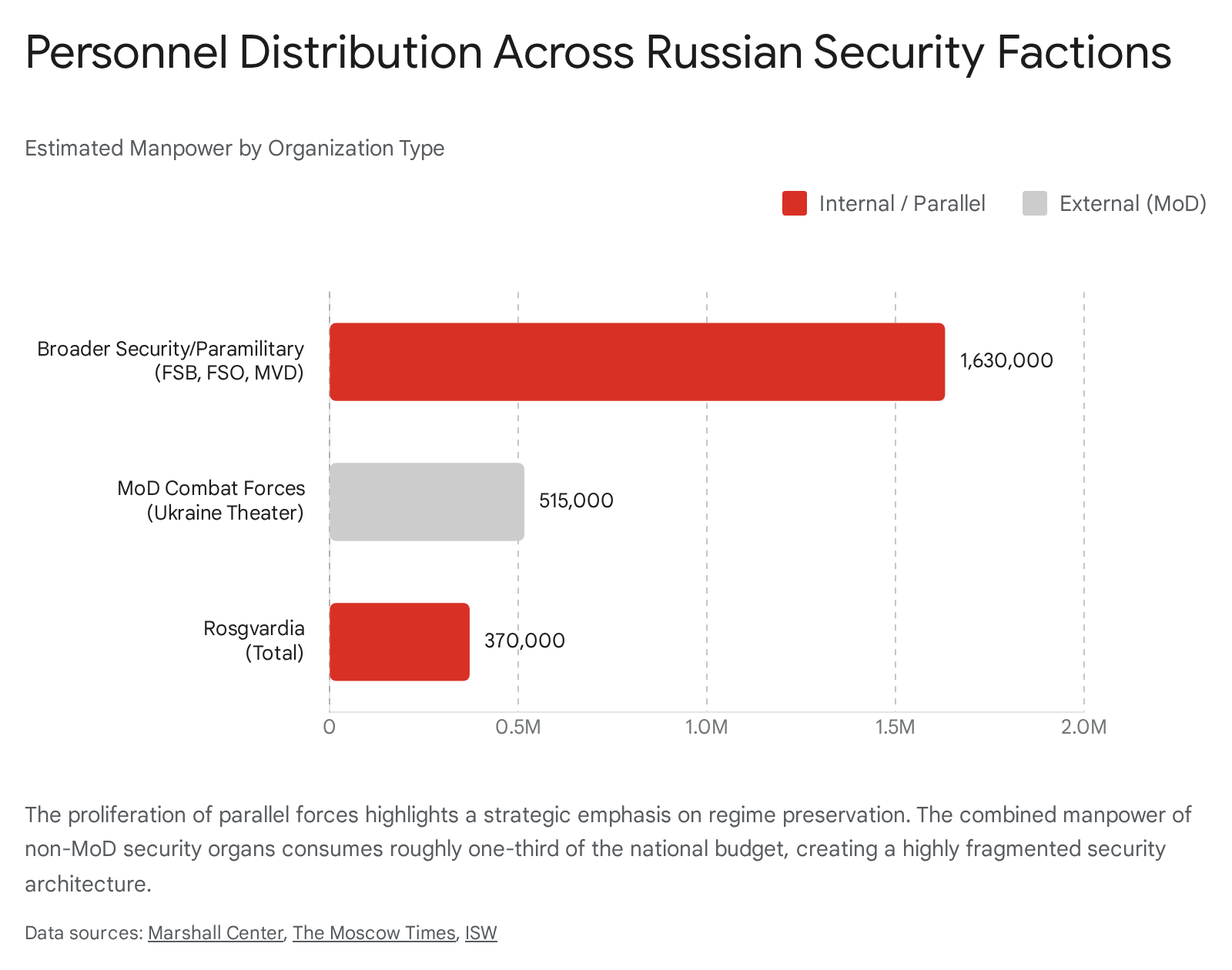
Created in 2016 through the consolidation of internal ministry troops, Rosgvardia (the National Guard) was designed as a bespoke praetorian force reporting directly to President Putin, intended to crush domestic political dissent and prevent coup attempts.14 Under the command of General Viktor Zolotov, a former long-serving bodyguard, Rosgvardia functions as the ultimate regime-preservation tool.14
However, the prolonged Ukraine war and the profound institutional shock of the June 2023 Wagner Group mutiny fundamentally altered Rosgvardia’s capabilities. Following the Wagner rebellion—during which regular military forces offered shockingly little resistance to mercenary armored columns advancing on Moscow—Zolotov successfully lobbied the Kremlin for heavy conventional weaponry. Consequently, Rosgvardia incorporated main battle tanks, self-propelled artillery, and multiple-launch rocket systems into its structure.14 By January 2024, Rosgvardia had expanded to approximately 370,000 personnel.14
While Rosgvardia deployments to Ukraine (estimated at 32,000 to 35,000 personnel) were initially intended for rear-area pacification, MoD troop shortages quickly forced these internal security units into frontline combat.15 During Ukraine’s Fall 2022 Kharkiv offensive, forward positions manned by Rosgvardia were quickly overwhelmed by mechanized Ukrainian brigades, highlighting the tactical vulnerability of utilizing police forces for conventional territorial defense.18 The decision to equip a domestic security force with main battle tanks while frontline combined-arms armies suffer chronic armor shortages is the ultimate crystallization of coup-proofing logic: regime survival takes absolute precedence over battlefield lethality.
3.2 Private Military Companies and the Wagner Paradox
Prior to the 2022 full-scale invasion, Private Military Companies (PMCs) like the Wagner Group served as the Kremlin’s ultimate deniable foreign policy tool in sub-Saharan Africa, Syria, and Libya.19 When conventional MoD forces faltered in the opening months of the Ukraine war, the Kremlin authorized the deployment of Wagner as a highly autonomous, shock-infantry parallel force. Financed by Yevgeny Prigozhin, Wagner achieved localized tactical successes, most notably in Bakhmut, by executing decentralized, highly attritional human-wave assaults.22
However, Wagner’s rapid rise exposed the fatal flaw of empowering paramilitaries. Prigozhin leveraged his battlefield success to amass political capital, launching virulent public attacks against Defense Minister Sergei Shoigu and Chief of the General Staff Valery Gerasimov.9 When the MoD attempted to subsume Wagner’s autonomy in June 2023, it triggered a full-scale armed mutiny.25 The subsequent assassination of Prigozhin and the MoD’s aggressive absorption of Wagner remnants into tightly controlled state structures demonstrated the Kremlin’s desperate need to violently recentralize control.25 Yet, the underlying institutional distrust that necessitated Wagner’s rise remains fully intact.
3.3 The Federal Security Service (FSB): Intelligence as a Kinetic Actor
The FSB is the true institutional inheritor of the Soviet KGB’s domestic dominance, acting as a heavily armed, legally autonomous power center. Prior to the 2022 invasion, the FSB was tasked with preparing the operational environment in Ukraine, operating under the deeply flawed assumption that it could ensure a rapid, bloodless capitulation of the government in Kyiv.26
Despite this monumental intelligence failure, the FSB remains structurally superior to the MoD. As part of its coup-proofing mandate, the FSB maintains extensive, deeply embedded counter-intelligence networks within the armed forces.6 This pervasive surveillance fosters an atmosphere of intense paranoia, strongly discouraging field commanders from showing tactical initiative, coordinating laterally, or reporting accurate battlefield realities.29
4. Force Structure Deficits and the Reconstitution of Amateurs
Successive military reforms since the fall of the Soviet Union sought to abandon the old conscript-heavy mobilization army in favor of a leaner, professionalized force.30 However, this transition left the Russian military structurally deficient for an industrial-scale conflict.
The Russian military entered Ukraine relying on Battalion Tactical Groups (BTGs)—theoretically flexible, mechanized formations designed for rapid maneuver. However, deploying over a hundred BTGs without mobilizing full-strength brigades effectively locked the Russian military into a highly brittle force structure.31 The BTGs were critically short of dismounted infantry, making them highly vulnerable in urban environments and restrictive terrain.30 The army was optimized for a short, sharp war and lacked the capacity to sustain a major conventional conflict.30
When the BTG model collapsed, the Russian military abandoned the structure and optimized for slow, grinding positional warfare.31 To replace massive manpower losses, the Kremlin relied on partial mobilization in September 2022. While Russia has proven capable of reconstituting lost personnel and materiel through massive financial incentives and defense-industrial retooling, this reconstitution model has ultimately created a “force of amateurs.”32 Because of high centralization, the lack of a professional Non-Commissioned Officer (NCO) corps, and the rapid attrition of experienced junior officers, the Russian military is increasingly dependent on the rote training of conscripts to conduct simple battle drills.13 This forces a reliance on mass artillery, glide bombs, and highly attritional human-wave infantry assaults over complex combined-arms maneuver warfare.9
5. Command and Control Paralysis: From Kyiv to Kursk
The deliberate fragmentation of the security apparatus and the enforcement of rigid vertical loyalty translate directly into command and control (C2) paralysis on the battlefield. The Russian system ensures that different military districts and agency factions cannot communicate horizontally; all vital information must flow vertically. This deeply flawed architecture destroys the Observe-Orient-Decide-Act (OODA) loop, rendering the Russian force inherently reactive and slow.13
5.1 The 2022 Initial Invasion: A Masterclass in Fragmentation
To preserve absolute operational security and prevent military leaders from potentially coordinating a power grab, the February 2022 invasion plans were withheld from the mid-level and frontline officers until hours before H-Hour.13
Crucially, in a textbook display of coup-proofing, Putin initially refused to appoint a single, unified theater commander.25 Instead, each Combined Arms Army (CAA) deployed with its own headquarters structure, operating entirely independently across four divergent axes of advance.34 This fractured structure produced disastrous tactical outcomes:
- Logistical Fratricide: Columns ordered to drive in administrative formations resulted in catastrophic traffic jams. Because units could not coordinate horizontally, competing logistics trains clogged the road networks, creating target-rich environments for Ukrainian ambushes.35
- Lack of Air-Ground Integration: The siloing of military districts prevented rapid intelligence sharing between the Russian Aerospace Forces (VKS) and ground units.36 This led to agonizingly slow response times and disproportionate losses of close air support platforms directed blindly by ground commanders.36
5.2 The Theater Commander Carousel
Realizing the failure of a fractured command, the Kremlin eventually cycled through a series of theater commanders, revealing a deep conflict between the operational need for military competence and the autocratic demand for unthreatening loyalty.
- Army General Aleksandr Dvornikov (April 2022): Appointed as the first overall theater commander, his tenure was remarkably brief as he failed to rapidly deliver decisive victories.25
- General Sergei Surovikin (Late 2022): A highly competent commander who successfully orchestrated the complex withdrawal from Kherson and designed the formidable “Surovikin Line” of defenses. However, his operational competence and perceived ties to Yevgeny Prigozhin made him a political threat. Following the Wagner mutiny, he was quietly removed, demonstrating that survival prioritizes subservience over battlefield success.9
- Army General Valery Gerasimov (January 2023 – Present): To restore absolute MoD control, Putin appointed the Chief of the General Staff as theater commander.25 Gerasimov is the epitome of the coup-proofed general: deeply loyal, thoroughly unthreatening to Putin’s political supremacy, and structurally wedded to pleasing the boss regardless of strategic reality.9
5.3 The Kursk Crisis (2024-2025): The Ultimate C2 Failure
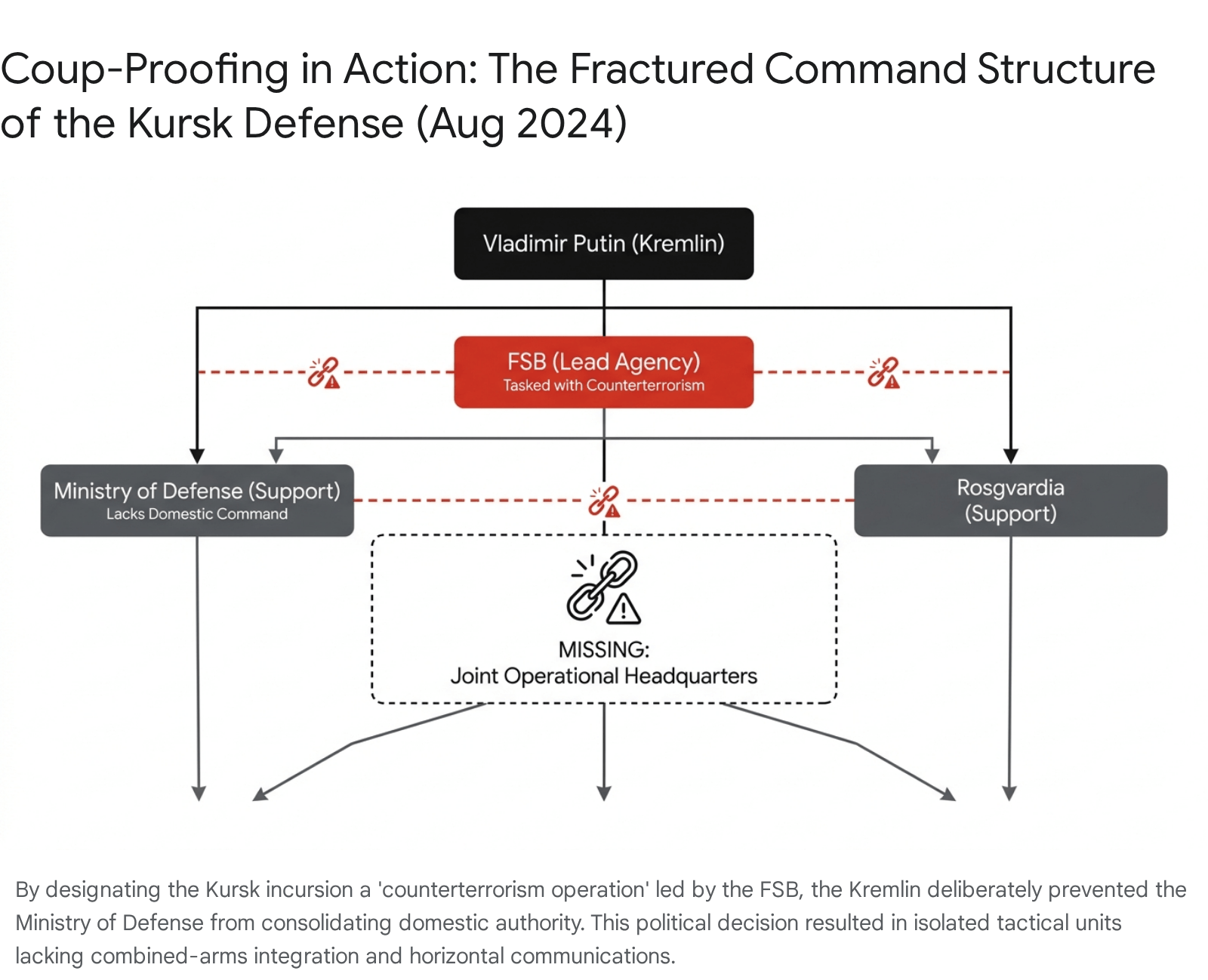
The August 2024 Ukrainian military incursion into Russia’s Kursk Oblast serves as the most glaring recent case study of how coup-proofing induces operational paralysis. When up to 15,000 Ukrainian troops breached the Russian border and rapidly captured over 1,000 square kilometers, standard military doctrine dictated the declaration of martial law and the rapid establishment of an MoD-led joint operational headquarters.39
Instead, President Putin declared a “counterterrorism operation” and placed Alexander Bortnikov, the Director of the FSB, in overarching command.39
The logic was entirely political. Granting the MoD sweeping martial law powers within Russian borders would give the military unchecked legal and operational control over domestic territory—an absolute red line for a coup-conscious autocrat.4 By tasking the FSB, Putin ensured his most trusted internal security organ maintained primacy.
However, the FSB is institutionally designed for surveillance and small-unit anti-terror raids; it is entirely unsuited for combined-arms maneuver warfare against mechanized brigades.41 The result was immediate command chaos. The FSB’s Special Operations Center had no joint communications networks with Russian military units, resulting in a total absence of a coherent C2 structure.41 This inability to mount a coordinated response allowed Ukrainian forces to hold the tactical initiative, forcing Putin to repeatedly delay deadlines for expelling the forces until Russian forces finally regained control of most of the territory in March 2025.39
6. Tactical Friction: Logistics, Communications, and Fratricide
The strategic directives born of coup-proofing inevitably manifest as catastrophic friction at the unit level.
6.1 The Logistics of Corruption and Overextension
Authoritarian regimes frequently utilize corruption as a deliberate tool of elite management to ensure loyalty.8 However, in a protracted war of industrial attrition, state-sanctioned corruption deeply hollows out logistics. The initial invasion suffered massively because limited Russian material-technical support (MTO) units lacked the overall capacity to meet high-intensity conflict demands.35 The consequences of pre-war corruption became glaringly apparent: missing encrypted radios, substandard combat rations, and poorly maintained vehicles reliant on cheap tires.8
6.2 Communications Breakdowns and the Specter of Fratricide
A fragmented command structure requires highly robust horizontal communication networks to function. Yet, the intentional siloing of Russian units actively prevents rapid intelligence sharing.36 The severe degradation of Russian communications infrastructure by precise Ukrainian targeting has radically exacerbated this vulnerability.
Ukrainian Defense Forces have systematically targeted Russian communication nodes, destroying hundreds of antennas, Wi-Fi bridges, and central switching nodes like the Vladimir Space Communications Center.43 The absence of a centralized, secure military communications network forced Russian units to rely on vulnerable commercial technologies like Starlink and unsecured mobile phones. When these networks are jammed, geofenced, or destroyed—such as the February 2026 restriction of Russian Starlink use on long-range UAVs—the Russian C2 network collapses.42
Detailed OSINT reports from the Ukrainian partisan movement ATESH confirm that these communication breakdowns have led to profound disorganization and severe instances of friendly fire.45 In the Zaporizhzhia region, isolated Russian units, utterly unaware of each other’s positions, opened fire on their own forces, annihilating a friendly assault group of 12 soldiers.47 When vertical command is severed and horizontal communication is institutionally prohibited, battlefield fratricide and chaos become a mathematical certainty.
7. The 2024-2025 Ministry of Defense Purges: Rotation Through Repression
By mid-2024 and continuing into 2025, the cumulative pressures of battlefield stagnation, a defense budget ballooning to roughly 6.5 percent of GDP, and horrific personnel losses (with extrapolated data suggesting up to 180,000 missing and dead) necessitated a systemic correction.29
Facing these immense pressures, Putin initiated the most sweeping purge of the Ministry of Defense in modern Russian history.12 The goal was twofold: forcefully improve the management of military spending, and dismantle a specific elite clan to reset the balance of power within the siloviki.12
The primary target was the expansive patronage network built by Defense Minister Sergei Shoigu. In May 2024, Shoigu was removed from the MoD and transitioned to head the Security Council—a “golden cage” where he retains high nominal status but is completely stripped of his patronage network and access to budgets.49 To replace him, Putin appointed Andrei Belousov, a technocrat with no military background or independent power base, ensuring the MoD cannot emerge as a cohesive political threat.50
Following Shoigu’s demotion, the state security apparatus began systematically arresting his deputies and key associates on fraud and embezzlement charges.12
| Target of MoD Purge | Former Position | Mechanism of Removal | Strategic & Political Impact |
| Sergei Shoigu | Minister of Defense | Reassigned to Security Council | Dismantled a massive patronage network; neutralized a potential rival power center.50 |
| Timur Ivanov | Deputy Defense Minister | Arrested (Major Bribery Charges) | Initiated the systemic purge of the MoD’s procurement and logistics leadership.12 |
| Pavel Popov | Deputy Defense Minister | Arrested (Fraud/Misappropriation) | Punished for embezzling funds meant for Patriot Park to renovate personal properties; served as a high-profile scapegoat.49 |
| Vladimir Shesterov | Major General, Innovations Dept. | Arrested (Embezzlement) | Further dismantled the MoD financial management structure.49 |
| Ivan Popov | Commander, 58th CAA | Dismissed / Arrested | Punished explicitly for speaking truth to power regarding heavy combat casualties and severe lack of artillery support.8 |
This continuous purge cycle redirects rent flows to newer loyalists, provides highly visible scapegoats for battlefield failures, and instills absolute fear to maintain compliance.12 However, by continually prioritizing loyalty and political balancing over military competence, the Russian system actively culls its most experienced leadership, ensuring the army remains fundamentally incapable of executing agile, combined-arms operations.
8. Strategic Implications and Lessons Learned
The Russo-Ukrainian War provides an unprecedented real-world laboratory for analyzing the structural vulnerabilities of neopatrimonial military systems. The long-standing myth of the monolithic, ruthlessly efficient authoritarian military has been definitively shattered. The evidence confirms that when forced to choose between regime security and military efficiency, the autocrat will invariably choose the former, actively accepting catastrophic friction and mass casualties as the necessary price of personal survival.52
Critical lessons for intelligence professionals, military strategists, and allied policymakers include:
8.1 The Clausewitzian Disconnect
The Kremlin has demonstrated a profound disregard for fundamental Clausewitzian principles of war, specifically the necessary alignment between political objectives and military means.52 Putin has consistently prioritized his regime’s survival through coup-proofing rather than risking his power to achieve a decisive battlefield outcome.52 By failing to link political and military aims, the Kremlin has dysfunctionally targeted Ukraine’s civilian population, while Kyiv correctly attrites the actual Russian center of gravity: the casualty sensitivity of its cohorts and the economic capacity to finance the war.52
8.2 Exploit the Seams of Fragmentation
Adversaries of authoritarian regimes must meticulously map the political fault lines between competing security agencies. These bureaucratic seams are highly exploitable vulnerabilities. Ukraine’s strategy of systematically exhausting Russia’s internal stability—such as the cross-border incursion into Kursk—forces the Kremlin to make impossible, paralyzing choices between external defense (empowering the MoD) and internal security (empowering the FSB).39 Information operations and kinetic strikes should actively exploit these rivalries to amplify institutional paranoia.
8.3 Redefining Security Force Assistance Metrics
The systemic decay of the Russian military offers a profound warning for Western Security Force Assistance (SFA) programs globally. Western metrics often focus heavily on tactical outputs and equipment transfers.54 However, as witnessed in the Sahel (e.g., Mali and Chad) and mirrored in the Russian experience, building “competent enclaves” within militaries hollowed out by corruption and coup-proofing is a strategic failure.54 Future SFA initiatives must measure institutional resilience, civil-military transparency, non-corrupt logistics, and the absence of parallel praetorian forces as the primary indicators of a partner’s viability.54
8.4 Innovation vs. Centralization in the Drone Age
The conflict highlights the stark contrast between Ukraine’s distributed, bottom-up innovation model and Russia’s rigid, centralized approach to technology.46 Ukraine’s integration of frontline combat units with volunteer tech firms allows for the rapid evolution of first-person-view (FPV) drones and new unmanned weapons.46 Conversely, Russia’s reliance on the state to centrally steer new systems ensures a significantly slower adaptation cycle, deeply constrained by inter-agency infighting and an underperforming defense-industrial base.29
8.5 Authoritarian Fragility Beyond Russia
The failures of authoritarian coup-proofing are not unique to the Russian theater. For instance, the recent capture of Nicolas Maduro during Operation Absolute Resolve highlighted that years of corruption and coup-proofing in Venezuela left its military profoundly unprepared for combat, with its Russian-supplied S-300 air defense networks severely compromised. Regimes prioritizing internal loyalty over professional competence inherently cripple their external defense capabilities.
9. Conclusion
The deliberate policy of fragmenting Russia’s military and security apparatus to mitigate the risk of domestic coups has deeply, and likely irreversibly, hobbled its combat performance in Ukraine. President Vladimir Putin has meticulously constructed a security architecture perfectly tuned to suppress domestic uprisings and violently manage elite competition. However, this same architecture is utterly unsuited for the fluid, high-velocity, horizontally integrated demands of modern conventional warfare.
The elevation of the FSB to command kinetic defense operations in Kursk, the absurd arming of Rosgvardia police forces with main battle tanks, the catastrophic rise and mutiny of the Wagner Group, and the ongoing purges of the Ministry of Defense are not isolated bureaucratic events. They are the systemic symptoms of a regime prioritizing its own political survival over the lives of its soldiers, the efficiency of its logistics, and the achievement of its strategic objectives.
Until the fundamental architecture of Russian civil-military relations changes, the Russian armed forces will remain a massive, blunt instrument. They are capable of executing brutally attritional warfare relying on mass fires and demographic scale, but they remain chronically paralyzed by their own internal paranoia. Intelligence analysts must not mistake Russia’s capacity for raw attrition for institutional military competence; the latter is fatally compromised by design.
Please share the link on Facebook, Forums, with colleagues, etc. Your support is much appreciated and if you have any feedback, please email us in**@*********ps.com. If you’d like to request a report or order a reprint, please click here for the corresponding page to open in new tab.
Sources Used
- Russia’s war against Ukraine – Ifri, accessed June 26, 2026, https://www.ifri.org/sites/default/files/2024-09/forsstrom_et_al._russia_seminar_24_web.pdf
- Coup-proofing in Russia Explorative Study of Institutional Deficiencies as Constraint on Russian Coup-Proofing Policies – Diva-Portal.org, accessed June 26, 2026, https://www.diva-portal.org/smash/get/diva2:1958466/FULLTEXT01.pdf
- Explorative Study of Institutional Deficiencies as Constraint on Russian Coup-Proofing Policies – DiVA, accessed June 26, 2026, http://fhs.diva-portal.org/smash/record.jsf?pid=diva2:1958466
- Pathways to Disaster Russia’s War against Ukraine and the Risks of Inadvertent Nuclear Escalation – The Hague Centre for Strategic Studies, accessed June 26, 2026, https://hcss.nl/wp-content/uploads/2023/05/05-Pathways-to-Disaster-Russias-War-against-Ukraine-and-the-Risks.pdf
- How Putin’s Coup-Proofing Measures Have Undermined Russia’s …, accessed June 26, 2026, https://moderndiplomacy.eu/2023/09/29/how-putins-coup-proofing-measures-have-undermined-russias-war-effort-in-ukraine/
- Russian Civil-Military Relations (CMR) and the Long Open-Ended War, accessed June 26, 2026, https://www.marshallcenter.org/en/publications/security-insights/russian-civil-military-relations-cmr-and-long-open-ended-war-0
- Double-Edged Swords: How Military Purges Shape Authoritarian Appetite for War, accessed June 26, 2026, https://warontherocks.com/double-edged-swords-how-military-purges-shape-authoritarian-appetite-for-war/
- (PDF) Roger That: Russia’s Coup-Proofed Army and Its Combat …, accessed June 26, 2026, https://www.researchgate.net/publication/378697861_Roger_That_Russia’s_Coup-Proofed_Army_and_Its_Combat_Effectiveness_2022-2023
- Western Narratives and Russian Disinformation, Three Years into Great-Power Conflict, accessed June 26, 2026, https://www.tandfonline.com/doi/full/10.1080/13518046.2023.2312652
- Ivan GOMZA | Professor | Doctor of Philosophy | Kyiv School of Economics, Kyiv | Research profile – ResearchGate, accessed June 26, 2026, https://www.researchgate.net/profile/Ivan-Gomza
- CHARLES UNIVERSITY Bachelor’s Thesis 2024 Adam Kříž, accessed June 26, 2026, https://dspace.cuni.cz/bitstream/handle/20.500.11956/193665/130387093.pdf?sequence=1&isAllowed=y
- Unprecedented Defense Ministry Purge Sparks Concern in Russian Elite, accessed June 26, 2026, https://carnegieendowment.org/russia-eurasia/politika/2025/01/shoigu-clan-repressions
- The Roots of Russian Military Dysfunction – Foreign Policy Research Institute, accessed June 26, 2026, https://www.fpri.org/article/2023/03/the-roots-of-russian-military-dysfunction/
- Russia’s National Guard Revives Tank Units, Chief Says – The Moscow Times, accessed June 26, 2026, https://www.themoscowtimes.com/2025/09/11/russias-national-guard-revives-tank-units-chief-says-a90506/pdf
- Russia building ‘parallel force’ to protect Putin, analyst warns – TVP World, accessed June 26, 2026, https://tvpworld.com/91679651/rosgvardia-becoming-rival-military-force-expert-says
- Russia’s National Guard Revives Tank Units, Chief Says – The Moscow Times, accessed June 26, 2026, https://www.themoscowtimes.com/2025/09/11/russias-national-guard-revives-tank-units-chief-says-a90506
- Russian Offensive Campaign Assessment, June 5, 2024 | ISW, accessed June 26, 2026, https://understandingwar.org/research/russia-ukraine/russian-offensive-campaign-assessment_5-6/
- Assessing Russian Military Adaptation in 2023, accessed June 26, 2026, https://carnegieendowment.org/research/2024/10/assessing-russian-military-adaptation-in-2023
- Putin’s Proxies: Examining Russia’s Use of Private Military Companies – CSIS, accessed June 26, 2026, https://www.csis.org/analysis/putins-proxies-examining-russias-use-private-military-companies
- Invisible Russian Armies: Wagner Group in Ukraine, Syria and the Central African Republic – USF Scholarship Repository, accessed June 26, 2026, https://repository.usfca.edu/cgi/viewcontent.cgi?article=2501&context=thes
- Rivalry Flares between the Russian Army and the Wagner Group – PISM, accessed June 26, 2026, https://pism.pl/publications/rivalry-flares-between-the-russian-army-and-the-wagner-group
- The Wagner Group and its relationship with the Russian state | DIIS, accessed June 26, 2026, https://www.diis.dk/en/research/the-wagner-group-and-its-relationship-with-the-russian-state
- The Role of the Wagner Group in the Russo-Ukrainian War – Scholarship @ Claremont, accessed June 26, 2026, https://scholarship.claremont.edu/cgi/viewcontent.cgi?article=4400&context=cmc_theses
- (U) Russian Military Mobilization During the Ukraine War: Evolution, Methods and Net Impact – CNA.org., accessed June 26, 2026, https://www.cna.org/reports/2024/10/Russian-Military-Mobilization-During-the-Ukraine-War.pdf
- THE RUSSIAN MILITARY: FORECASTING THE THREAT – Institute for the Study of War, accessed June 26, 2026, https://understandingwar.org/wp-content/uploads/2025/10/The-Russian-Military-Forecasting-the-Threat.pdf
- How Russia Fights: A Compendium of Troika Observations on Russia’s Special Military Operations, accessed June 26, 2026, https://api.army.mil/e2/c/downloads/2025/07/11/f2b1e75e/how-russia-fights-a-compendium-of-troika-observations-on-russia-s-special-military-operations.pdf
- Preliminary Lessons from Russia’s Unconventional Operations During the Russo-Ukrainian War, February 2022-February 2023 – RUSI, accessed June 26, 2026, https://static.rusi.org/202303-SR-Unconventional-Operations-Russo-Ukrainian-War-web-final.pdf.pdf
- What Turkey Can Learn from Russia About Coup-Proofing the Military – War on the Rocks, accessed June 26, 2026, https://warontherocks.com/what-turkey-can-learn-from-russia-about-coup-proofing-the-military/
- Military lessons identified by Russia, priorities for reform, and challenges to implementation, accessed June 26, 2026, https://nestcentre.org/military-lessons/
- Not Built for Purpose: The Russian Military’s Ill-Fated Force Design – War on the Rocks, accessed June 26, 2026, https://warontherocks.com/not-built-for-purpose-the-russian-militarys-ill-fated-force-design/
- The Russian Military: Forecasting the Threat | ISW, accessed June 26, 2026, https://understandingwar.org/research/defense-of-europe/the-russian-military-forecasting-the-threat/
- Lessons in Reconstitution from the Russia-Ukraine War – Army University Press, accessed June 26, 2026, https://www.armyupress.army.mil/Journals/Military-Review/English-Edition-Archives/January-February-2025/Lessons-in-Reconstitution/
- Russia’s War in Ukraine: Military and Intelligence Aspects – EveryCRSReport.com, accessed June 26, 2026, https://www.everycrsreport.com/reports/R47068.html
- Russia’s Ill-Fated Invasion of Ukraine: Lessons in Modern Warfare – CSIS, accessed June 26, 2026, https://www.csis.org/analysis/russias-ill-fated-invasion-ukraine-lessons-modern-warfare
- (U) Russian Military Logistics in the Ukraine War: Recent Reforms and Wartime Operations – CNA.org., accessed June 26, 2026, https://www.cna.org/reports/2023/10/Russian-Military-Logistics-in-the-Ukraine-War.pdf
- Meeting Expectations: Failure in Ukraine Will Not Change the Russian Aerospace Defense Force, accessed June 26, 2026, https://www.armyupress.army.mil/Journals/Military-Review/English-Edition-Archives/January-February-2025/Meeting-Expectations/
- INTERIM SECURITY INSIGHTS AND IMPLICATIONS FROM THE FIRST TWO MONTHS OF THE RUSSIA-UKRAINE WAR | Brookings, accessed June 26, 2026, https://www.brookings.edu/wp-content/uploads/2022/05/FP_20220512_ukraine_war_gilliam_van_wie.pdf
- Russian Offensive Campaign Assessment, January 11, 2023 | ISW, accessed June 26, 2026, https://understandingwar.org/research/russia-ukraine/russian-offensive-campaign-assessment_11-23/
- Kursk campaign – Wikipedia, accessed June 26, 2026, https://en.wikipedia.org/wiki/Kursk_campaign
- Ukraine’s Kursk Incursion: Six Month Assessment | ISW, accessed June 26, 2026, https://understandingwar.org/research/russia-ukraine/ukraines-kursk-incursion-six-month-assessment-2/
- Russian FSB fights in Kursk Oblast – ISW | Ukrainska Pravda, accessed June 26, 2026, https://www.pravda.com.ua/eng/news/2024/09/27/7477023/
- Russian Comms in Ukraine: A World of Hertz | Royal United Services Institute – RUSI, accessed June 26, 2026, https://www.rusi.org/explore-our-research/publications/commentary/russian-comms-ukraine-world-hertz
- Ukraine cripples Russian drone operations and logistics in Pokrovsk sector – video, accessed June 26, 2026, https://english.nv.ua/russian-war/russian-comms-destroyed-in-pokrovsk-50619258.html
- General Staff confirms damage to Russia’s Space Communications facility – Odessa Journal, accessed June 26, 2026, https://odessa-journal.com/general-staff-confirms-damage-to-russias-space-communications-facility
- Russian troops reportedly oppose forced use of state-run messenger – RBC-Ukraine, accessed June 26, 2026, https://newsukraine.rbc.ua/news/russian-troops-reportedly-oppose-forced-use-1771223586.html
- The New Revolution in Military Affairs | Carnegie Endowment for International Peace, accessed June 26, 2026, https://carnegieendowment.org/research/2026/04/ukraine-russia-war-changing-warfare-practice-military-strategy
- Ukrainian Partisans Knock Out Military Communications Deep Inside Russia – Kyiv Post, accessed June 26, 2026, https://www.kyivpost.com/post/70372
- Russia’s MoD says it has “found every second” soldier missing in Ukraine … – Mediazona, accessed June 26, 2026, https://en.zona.media/article/2025/12/17/mod
- Purges in the Russian Ministry of Defense in 2024 – Wikipedia, accessed June 26, 2026, https://en.wikipedia.org/wiki/Purges_in_the_Russian_Ministry_of_Defense_in_2024
- Knives Out 2.0. What’s Going On At Russia’s Defense Ministry? – Radio Free Europe, accessed June 26, 2026, https://www.rferl.org/a/russia-defense-ministry-corruption-investigations-shoigu-putin/33732103.html
- Putin’s purging of defence ministry suggests he is preparing for a long war | Chatham House, accessed June 26, 2026, https://www.chathamhouse.org/2024/09/putins-purging-defence-ministry-suggests-he-preparing-long-war
- Causes and Consequences of Putin’s Disregard of the Clausewitzian Principles of War | Future Forge, accessed June 26, 2026, https://theforge.defence.gov.au/article/causes-and-consequences-putins-disregard-clausewitzian-principles-war
- Silent Elite Fragmentation: Trajectory of Putin’s Regime in Russia, accessed June 26, 2026, https://www.habtoorresearch.com/programmes/elite-fragmentation-putin-regime/
- Schrödinger’s Security Partner: The Paradox of Measuring Security Force Assistance, accessed June 26, 2026, https://www.irregularwarfare.org/schrodingers-security-partner-the-paradox-of-measuring-security-force-assistance/