1. Executive Summary
As of mid-2026, the global defense industrial base is constrained by a severe, systemic bottleneck in the upstream supply chain for energetic materials. The resurgence of high-intensity, protracted conventional warfare has exposed the fragility of the munitions architecture across the United States and the European Union. Despite ambitious downstream capacity expansions and pledges to produce millions of artillery shells annually, actual munitions output remains sharply limited by access to nitrocellulose and smokeless propellants.
This vulnerability is rooted in decades of post-Cold War consolidation, persistent underfunding of organic industrial bases, and an over-reliance on imported precursor chemicals. The supply chain relies heavily on cotton linters, an agricultural byproduct overwhelmingly controlled by the People’s Republic of China. As geopolitical tensions escalate, China’s dominance in raw material exports poses a critical risk to Western defense manufacturing. Concurrently, the European propellant industry suffers from extreme monopolization and quasi-linear scaling limits, rendering it unable to meet even half of the continent’s projected nitrocellulose demand.
In the United States, structural deficits are starkly evident. A single government-owned facility, the Radford Army Ammunition Plant, represents the sole domestic source of military-grade nitrocellulose. This fragility has cascaded into the commercial sector, stripping the civilian ammunition market of smokeless powder and initiating aggressive price volatility through 2026. However, innovative disruptions are emerging. Independent commercial entities are investing in closed-loop, single-base propellant facilities to bypass legacy contractors. Meanwhile, the Department of Defense is advancing the qualification of alternative feedstocks, such as wood cellulose, and investing heavily via the Defense Production Act and the newly established Joint Energetics Transition Office. This report maps the mid-2026 energetics supply chain, analyzing the intersections of chemistry, geopolitics, and industrial policy to detail the pathways for domesticating critical propellant manufacturing.
2. The Chemical Foundations of Energetic Materials and the Nitrocellulose Baseline
To fully analyze the structural bottlenecks paralyzing the global munitions industry, it is essential to first detail the fundamental chemical and industrial mechanics of energetic materials. Energetics are chemical compounds synthesized to release stored chemical energy in a rapid, controlled manner.1 They are broadly classified into three categories: explosives, propellants, and pyrotechnics.1 Explosives are engineered to detonate and produce a violent shockwave for terminal lethality; pyrotechnics produce heat, light, and smoke for flares or decoys; and propellants combust to release hot gases in a sustained manner to provide propulsion for artillery, mortars, and small arms.1
The undisputed backbone of modern smokeless propellants is nitrocellulose.2 First produced in 1838, with practical manufacturing difficulties overcome by 1865, nitrocellulose is a nonvolatile, fibrous, white solid polymer.4 It consists of chains of glucoside units in which the hydroxyl groups have reacted to form nitrate esters.4 The molecular weight, and thus the energetic potential, depends heavily on the chain length and the degree of polymerization, which in turn depend entirely on the source of the raw cellulose.4
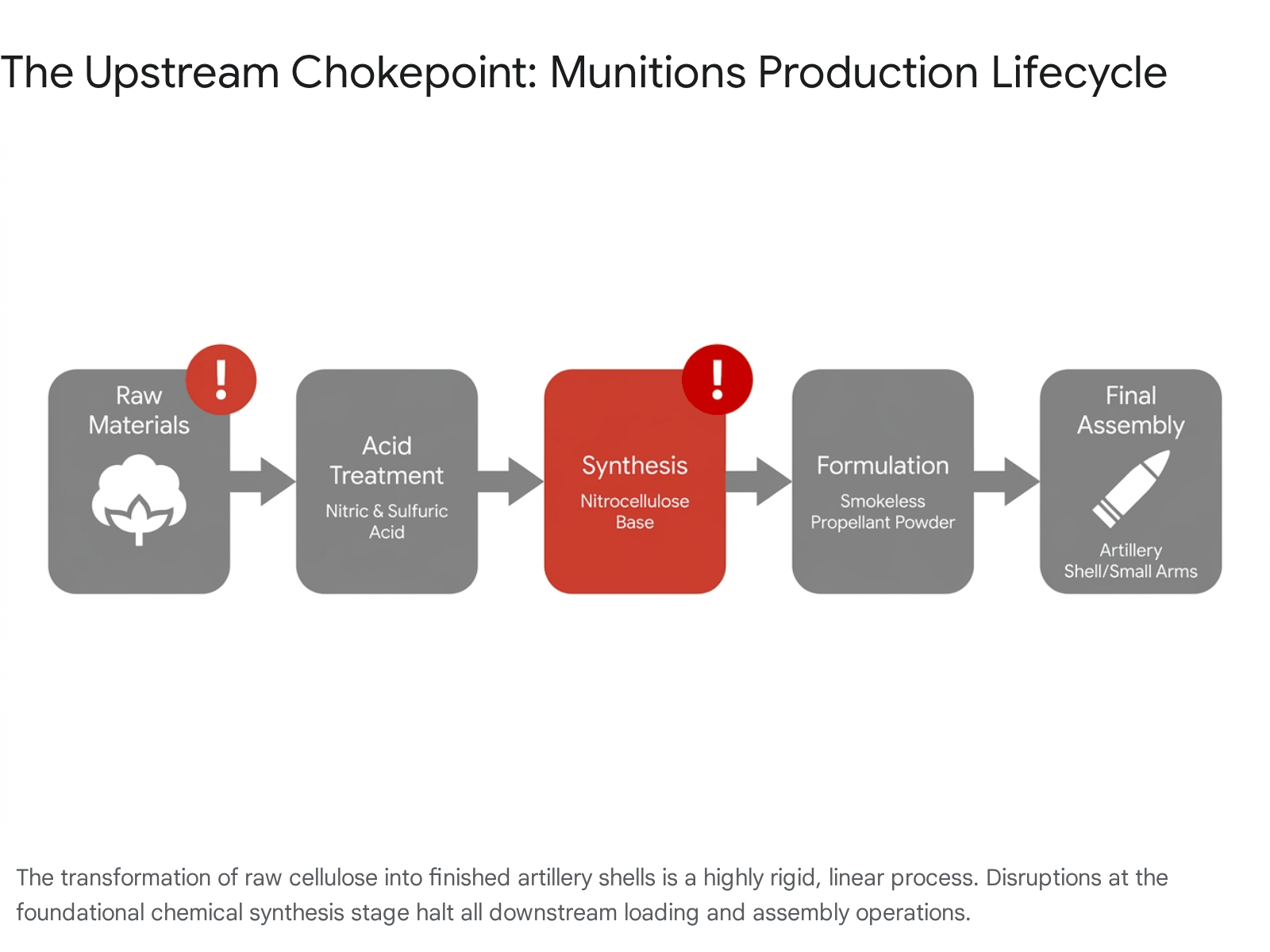
The synthesis process involves treating natural cellulose with a volatile mixture of nitric and sulfuric acids.5 The sulfuric acid acts as a crucial scavenger for excess water, allowing the maximum number of nitrate radicals to attach to the cellulose molecules, thereby adding the necessary oxygen and energy to the chemical structure.5 Following nitration, the highly unstable raw material must be meticulously washed, boiled, and purified to remove residual acids that could cause spontaneous ignition.3
Manufacturing nitrocellulose and formulating it into smokeless powder is not simply a matter of scaling up standard chemical machining; it is a highly delicate, safety-critical operation requiring specialist equipment and stringent environmental controls.3 Once the nitrocellulose is stabilized, it is treated with a solvent (such as an ether-ethanol mixture) to form a gelatinous paste.3 This paste is then phlegmatized, mixed with stabilizing chemicals, and extruded into specific geometries—such as granules, strips, or tubes.3 The specific geometry and chemical formulation dictate the burning rate, pressure curve, and temperature development required for bespoke weapon systems.3
While nitrocellulose forms the base, the energetics family includes other critical compounds such as nitroglycerin, pentaerythritol tetranitrate (PETN), and various nitramines like RDX and HMX.4 PETN, for example, is highly sensitive to impact and friction, though significantly less toxic and more stable than nitroglycerin, requiring similar medical surveillance for exposure due to its acute effects like hypotension and increased respiratory rate.4 Because modern propellants must balance lethality with stability, the reliance on a highly purified, specific grade of nitrocellulose establishes a rigid dependency at the very base of the supply chain.3
3. Geopolitical Fault Lines: Chinese Hegemony in Raw Feedstocks
The global textiles trade, intersecting with chemical regulations and export controls, has resulted in an alarming centralization of raw material origins. Historically, the defense sector has mandated the use of cotton linters as the primary cellulose feedstock for high-grade military nitrocellulose.6 Linters are the fine, short fibers left on the cottonseed after the longer staple cotton is removed during ginning.10 They possess an exceptionally high cellulose content—up to 92%—making them uniquely suited for the highly stable, high-nitrogen nitrocellulose required by stringent military specifications.11
As of 2026, the People’s Republic of China exercises profound dominance over the export of cotton linters. In 2023, China alone produced over 500,000 metric tons of cotton linters, driving the Asia-Pacific region to consume more than 67% of global production.11 Data from the International Trade Centre indicates that China controls nearly half of all cotton linter pulp traded globally.13
For the European and American defense industries, this concentration is a critical strategic liability. Industry executives, including Armin Papperger, chief executive of Rheinmetall, have explicitly warned that Europe relies on China for more than 70 percent of its cotton linter supply.6 Historically, this reliance was treated merely as an economic optimization; over time, parts of the European chemical value chain were reduced, restructured, or shifted abroad to capitalize on lower-cost agricultural inputs and fewer environmental regulations.6 However, the transition from economic globalization to great-power competition has weaponized this dependency.
As Beijing deepens its strategic alignment with the Russian Federation and geopolitical tensions remain high concerning Taiwan and Ukraine, China is viewed as highly unlikely to facilitate Western rearmament efforts.2 Defense analysts note that the dynamic has unequivocally shifted from a cooperative partnership to one of systemic rivalry.14 This is no longer a hypothetical threat; China has actively utilized its regulatory apparatus to restrict critical exports. While China recently suspended some broader export controls on items like gallium, germanium, and antimony for commercial use, it maintained a strict prohibition on exporting dual-use items to U.S. military users and for U.S. military end uses. If China applies this same targeted military embargo to cotton linters, the immediate cessation of raw material flow would abruptly halt downstream Western propellant production.15
While alternative, non-Chinese sources of cellulose exist, a rapid pivot is fraught with technical and temporal challenges. Cotton-based feedstocks are not interchangeable on short notice.6 Furthermore, a significant portion of the remaining global cellulose market is optimized for civilian applications. Approximately 35% of cotton linters are directed toward the paper and pulp industry, while 25% are used in textiles.11 Up to 85% of pharmaceutical-grade cellulose is derived from linters, and many alternative facilities are designed solely to produce cellulose for inks and lacquers.2 These civilian-grade inputs often fail to meet the rigorous purity, nitrogen content, and stability requirements essential for high-explosive pyrotechnic charges.2 Consequently, Western manufacturers are caught in an upstream trap: they cannot readily switch suppliers without compromising strict NATO propellant quality standards, and they cannot maintain their current supply chains without relying on a geopolitical adversary.2
4. The European Defense Industrial Base: Consolidation and Capacity Limits
The European continent serves as a primary case study illustrating the consequences of defense-industrial deregulation and subsequent monopolization. In the decades following the end of the Cold War, virtually every Western European nation possessed at least one state-owned powder factory capable of covering its domestic artillery needs.3 However, the perceived obsolescence of conventional, large-scale kinetic warfare led to extreme market consolidation.3 Governments divested from nationalized production, resulting in the closure of older, smaller national factories and the absorption of remaining capabilities by a handful of multinational corporations—principally Rheinmetall (Germany), Eurenco (France), KNDS, and Nammo (Norway).3
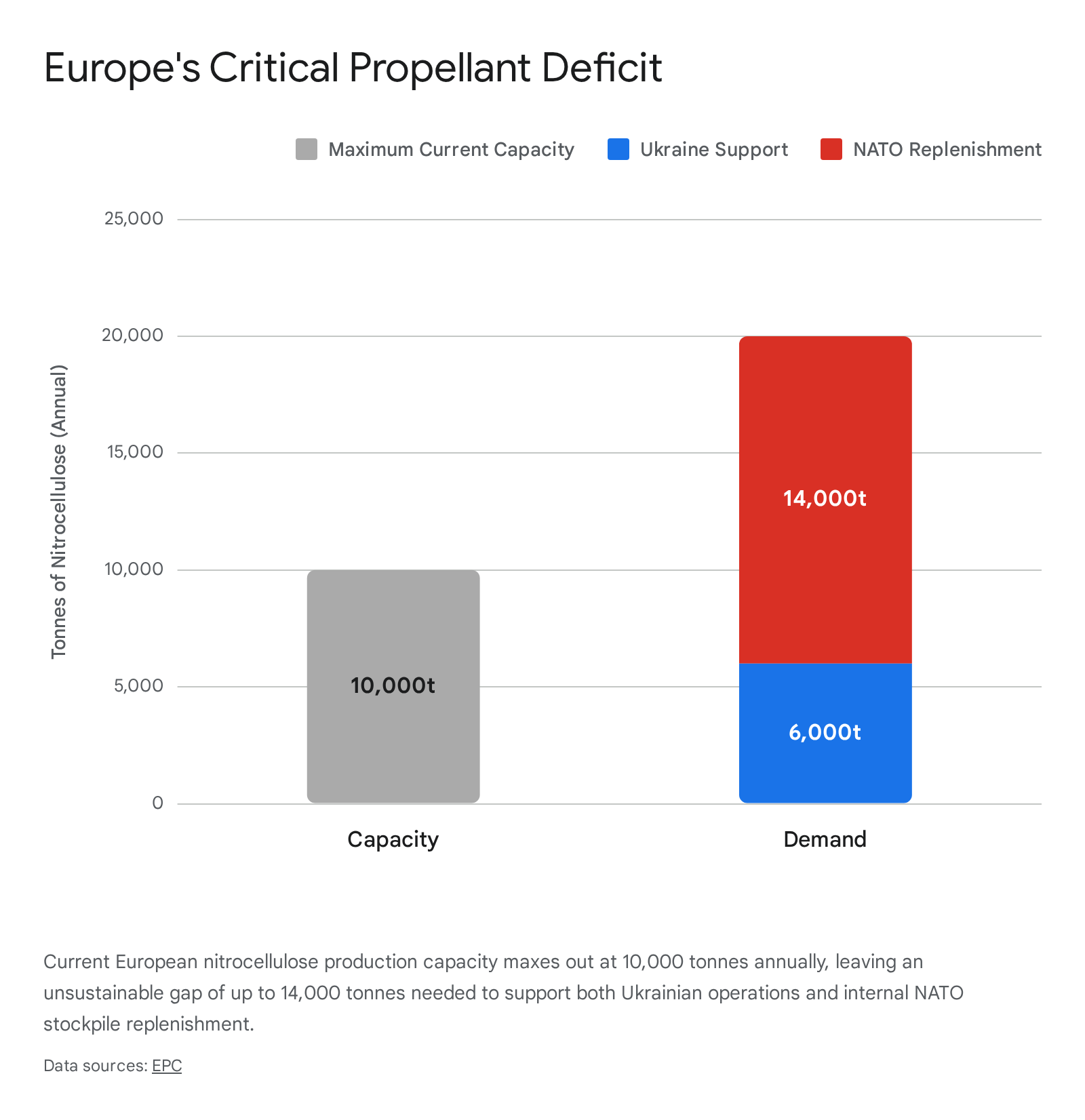
This centralization established a highly fragile oligopoly. As of 2026, Europe’s nitrocellulose supply chain is highly fragmented and critically undersized.2 Collective production capacity across manufacturers in Germany, France, Poland, and Czechia maxes out at approximately 4,500 to 10,000 tonnes annually.2 Against this limited output, the demand generated by the conflict in Ukraine and the urgent necessity of replenishing depleted NATO stockpiles is staggering.
| European Demand Source | Estimated Annual Nitrocellulose Requirement (Tonnes) |
| Supplying Ukrainian Armed Forces | > 6,000 |
| Internal European / NATO Stockpile Replenishment | > 13,000 |
| Total Estimated European Demand | ~ 20,000 |
| Maximum Current European Capacity | ~ 10,000 |
| Projected Annual Shortfall | 10,000 to 14,000 |
Table 1: Estimated European Nitrocellulose Supply versus Demand Deficit (mid-2026). 2
This massive shortfall is crippling the European Union’s pledge to produce over one million 155mm artillery shells per year.2 The realization that “no nitrocellulose means no shells” has catalyzed frantic capital investments, supported heavily by the European Commission’s Act in Support of Ammunition Production (ASAP), which allocated €500 million to expand the EU’s production capabilities.14 France’s Eurenco has successfully restarted production lines at its historic Bergerac site.14 In Germany, Rheinmetall is converting the Hagedorn civilian plant in Lingen to produce military-grade nitrocellulose, while the Czechoslovak Group (CSG) significantly expanded its capabilities by completing the acquisition of the Walsrode nitrocellulose plant and industrial park from International Flavors & Fragrances (IFF) in May 2025. Furthermore, Nitrochemie Aschau, a subsidiary of Rheinmetall, has increased production capacity by 60% since 2022, hiring 300 new employees from struggling automotive sectors to run operations 24/7, with plans to add another 40% capacity by mid-2025.17
Despite these massive capital and labor injections, resolving the bottleneck is hindered by what chemical engineers term “quasi-linear scaling limits”.3 The chemical synthesis of highly volatile propellants does not benefit from standard economies of scale; doubling output requires a near-linear doubling of raw materials, energy, labor, and massive physical space.3 Establishing a new powder plant demands a spatial footprint ranging from 50 to 300 hectares to satisfy safety setbacks, capital investments in the hundreds of millions of euros, and a lead time stretching several years.3 Even as Poland builds new manufacturing hubs in partnership with Grupa Azoty, much of this new regional capacity will not achieve full operational maturity until late 2026 or beyond.2
Consequently, sovereign nations lacking organic capacity remain highly vulnerable. Italy and the United Kingdom rely almost entirely on imports, with the UK having no domestic nitrocellulose production whatsoever.2 Major shell producers like Norway’s Nammo remain entirely dependent on foreign suppliers.2 While Switzerland contributes to the European supply through Nitrochemie’s Wimmis facility, the broader European defense posture remains reliant on a severely constrained, slow-to-scale chemical foundation.2
5. The United States Military Munitions Architecture and Single-Point Failures
While the European Union battles fragmentation across national borders, the United States domestic supply chain suffers from an equally perilous consolidation—namely, chronic single-point failure dynamics. Decades of prioritizing irregular warfare and counterinsurgency led the Department of Defense (DoD) to under-invest in the heavy, kinetic aspects of the industrial base.1 Prior to recent DoD investments, the United States possessed only six Government-Owned Contractor-Operated (GOCO) energetics and munitions plants, with each facility tied to highly specific and isolated missions.1
The most critical bottleneck in the U.S. arsenal is the Radford Army Ammunition Plant (RFAAP). Located across 6,901 acres in Montgomery and Pulaski Counties in southwestern Virginia, Radford operates as a GOCO facility managed by BAE Systems Ordnance Systems Inc..1 Radford is the sole domestic producer of military-grade nitrocellulose in the United States.1 Nitrocellulose produced here acts as the irreplaceable energetic base for tank, mortar, and field artillery ammunition.1 The facility also operates under a tenant model, hosting entities like Northrop Grumman’s New River Energetics, which manufactures commercial propellants on-site.65 If upstream nitrocellulose production at RFAAP experiences disruptions, the entirety of the U.S. military-industrial base and its dependent commercial tenants are compromised, as there are no alternative domestic suppliers capable of generating mass quantities of solvent and solventless propellants.1
This single-source dependency is severely exacerbated by aging infrastructure. Authorized under the National Defense program in 1940 and opened in 1941, the facility relied for decades on mid-century chemical processing lines and coal-fired package boilers.1 The inherent dangers of legacy batch nitration were starkly illustrated between 1970 and 1985, when nine major explosions at RFAAP caused multiple fatalities and millions in damage, including a 1974 explosion equivalent to 8,600 pounds of TNT that injured 100 workers.21
To rectify this aging footprint, BAE Systems and the DoD are executing a massive modernization effort, working with contractors like Parsons Corporation and Fluor to update power, infrastructure, and manufacturing capabilities.22 The centerpiece of this effort is the construction and commissioning of a fully automated, environmentally self-contained nitrocellulose manufacturing facility.24 While this facility promises unprecedented capacity and removes the human element from the most dangerous processes, the transition is fraught with the delays inherent in commissioning and rigorous military product qualification.24 Concurrently, other GOCOs face their own modernization hurdles, such as the Holston Army Ammunition Plant expanding its acid and nitration facilities for explosives, and the Lake City plant constructing a Next Generation Squad Weapon 6.8mm production facility.19 Until these modernized facilities are fully validated, the U.S. remains reliant on an aging infrastructure network vulnerable to unexpected downtime.
Downstream of Radford, the conversion of nitrocellulose into finished smokeless propellant is similarly concentrated. St. Marks Powder in Crawfordville, Florida, a subsidiary of General Dynamics Ordnance and Tactical Systems (GDOTS), is the world’s largest producer of spherical ball propellant.26 Founded as a powder plant in 1969, the facility produces approximately 6,000 tons of propellant per year and supplies over 99 percent of the ball powder used in U.S. military small arms ammunition (including 5.56mm, 7.62mm, 9mm, and.50 BMG).26 Recognizing the geopolitical vulnerability and escalating global demand, GDOTS announced a strategic investment in January 2026 to increase output at St. Marks by 20 percent, modernizing key production capabilities and building redundancy into critical processes.27 However, while this mitigates some downstream pressure, it does not alleviate the upstream threat. General Dynamics remains fundamentally reliant on precursor chemicals; if the nitrocellulose tap at Radford runs dry, or if Chinese cotton linters are restricted, expanding ball powder capacity at St. Marks becomes operationally moot.
6. The Contagion Effect: Strangulation of the Civilian Ammunition Market
The extreme fragility of the military energetics supply chain has unleashed severe, cascading effects upon the United States civilian ammunition market. The contemporary ammunition shortage of 2026 is fundamentally different from the panic-buying paradigms observed during the COVID-19 pandemic or previous political election cycles.30 Today’s scarcity is not driven by acute spikes in downstream consumer demand, but by structural, upstream constrictions in chemical availability.30
Because military contracts take absolute priority under global wartime conditions, the limited domestic supply of highly nitrated nitrocellulose and smokeless propellant is diverted away from commercial reloaders and civilian ammunition manufacturers.31 The math of military consumption dictates this reality: a single 155mm artillery shell requires slightly more than 20 pounds of smokeless powder to propel its warhead.35 With the Pentagon aiming to increase 155mm production from 36,000 rounds per month to 100,000 rounds per month by FY2026, the strain on domestic powder facilities is absolute.35
The impact on the civilian market has been profound. Renowned commercial propellant brands, such as Alliant Powder, have seen their products severely allocated or rendered entirely unavailable for the commercial sector.32 Alliant, which traces its history back to the Laflin & Rand powder company of 1872 and operates out of Lewiston, Idaho, relies heavily on upstream nitrocellulose.37 With highly nitrated nitrocellulose diverted to military use, Vista Outdoor (Alliant’s parent company at the time) officially suspended the supply of all Alliant Powder canister products for the commercial reloading market in May 2024 for an unknown period, effectively starving the civilian supply chain. As of early 2026, ammunition types that require vast quantities of propellant have seen commercial availability shrink drastically; early warnings indicated that 5.56 NATO FMJ availability was down to 16%–20% of normal SKU listings, and 300 Blackout FMJ dropped to between 4% and 13%.39
In response to the exorbitant costs of raw materials—specifically copper, lead, zinc, and increasingly scarce propellants—major civilian ammunition manufacturers instituted aggressive, compounded price hikes throughout 2025 and 2026.31 The Kinetic Group (formerly Vista Outdoor Sporting Products), which controls dominant brands such as Federal, CCI, Remington, Speer, and HEVI-Shot, enacted a series of successive price increases to offset these upstream pressures.38 The fragility and consolidation of this market were further underscored in 2024 when The Kinetic Group was acquired by the European defense conglomerate Czechoslovak Group (CSG) for approximately $2.2 billion. This acquisition effectively places a massive share of the American civilian ammunition market under the control of a European entity currently focused heavily on NATO and Ukrainian defense fulfillment.
| Effective Date | Manufacturer / Brand Group | Product Category | Announced Price Increase |
| October 2025 | The Kinetic Group (Federal, CCI, etc.) | Handgun Ammunition | 3% – 12% |
| Rifle Ammunition | 5% – 7% | ||
| Shotshell Ammunition | 7% – 10% | ||
| April 2026 | Industry Wide (Federal, Remington, Blazer) | Broad Portfolio (Rifle, Handgun, Rimfire) | 2% – 10% |
| June 2026 | Federal, CCI, Remington, Blazer, Fiocchi | Rifle & Handgun Promo Ammo (Bulk/Range) | 3% |
Table 2: Successive Civilian Ammunition Price Increases Driven by Raw Material Constraints (2025-2026). 40
These increases reflect a “new normal” characterized by expensive availability.31 The psychological element of the “shortage loop”—where fear of rising prices induces panic buying, further emptying shelves and justifying subsequent price hikes—has exacerbated the situation, but the root cause remains the structural deficit of nitrocellulose.31 Retailers and consumers alike are forced to absorb the inflationary costs of an upstream chemical supply chain that is fundamentally unable to support both a wartime military and a robust civilian sector simultaneously.34
7. Disrupting the Oligopoly: The D&M / White River Energetics Paradigm
The systemic failures of legacy defense contractors to buffer the commercial and military markets against supply shocks have opened the door for aggressive commercial disruption. Historically, the immense capital requirements, environmental regulations, and technical hurdles associated with energetic materials prevented new market entrants. However, D&M Holding Company and its subsidiary, White River Energetics (WRE), have successfully pioneered a paradigm shift in domestic production capability.46
Leveraging technical expertise gained from designing and building “turnkey” ammunition factories internationally, D&M utilized the generated global cash flow to finance a massive domestic expansion.46 Initially, White River Energetics targeted the domestic “primer crisis” of 2020–2022 by establishing a state-of-the-art primer manufacturing facility from the ground up in Des Arc, Arkansas.46 By supplying primers directly to the market, WRE unlocked production lines for other manufacturers that were stalled by a lack of parts.46
However, in late 2024, the company announced a monumental $70 million capital investment to establish a single-base smokeless propellant factory on the same Arkansas campus, creating 100 new jobs and targeting full operational status by 2026.47 This strategic pivot is revolutionary within the stagnant energetics sector. By producing both the “spark” (primers) and the “fuel” (propellant), D&M transitioned into a fully integrated platform company.46 This dual capability effectively eliminates their reliance on the legacy “Old Guard”—such as General Dynamics at St. Marks and BAE Systems at Radford.46
Furthermore, D&M de-risked this massive capital expenditure through a vertical partnership with Palmetto State Armory (PSA) to establish the American Ammunition Company (AAC).46 This ecosystem represents a fully closed-loop, self-sustaining supply chain: White River Energetics manufactures the energetic components (primers and propellant), AAC handles the loading and assembly of the ammunition, and PSA sells the finished product directly to the consumer.46 This model entirely bypasses traditional military-industrial distribution networks and renders the alliance immune to the raw material allocation games played by the larger prime contractors.46 By demonstrating that greenfield capacity can be achieved commercially without relying on World War II-era GOCO plants, the White River Energetics model provides a vital blueprint for securing America’s secondary munitions industrial base and insulating the commercial market from military supply shocks.46
8. Engineering Innovations: Alternative Cellulose and Continuous Flow Nitration
To structurally decouple Western defense manufacturing from Chinese agricultural dominance and to improve the safety and throughput of legacy facilities, two primary engineering vectors are currently being pursued: the qualification of alternative cellulose feedstocks and the adoption of continuous flow nitration technologies.
Transitioning to Wood Cellulose
Given the acute geopolitical risks associated with cotton linters, the U.S. Army and European developers are aggressively pursuing the qualification of wood pulp as a primary feedstock for military-grade nitrocellulose.51 Wood cellulose is domestically abundant in North America and Scandinavia, heavily utilized in the paper industry, and entirely insulated from Asian export controls.11
However, substituting wood pulp for cotton linters is a complex chemical and mechanical endeavor. The defense sector has historically favored linters due to their specific long fiber structure and lack of lignin.3 Early attempts by the U.S. Army to utilize domestically pressed stock wood pulp resulted in manufacturing failures. The existing shredding and cutting equipment, designed for loose cotton fibers, caused the wood fibers to weld together into dense agglomerates.52 These tight clumps inhibited the homogenous absorption of the acid slurry during nitration, leading to inconsistent nitrogen content and erratic propellant combustion.52
To overcome this, modern qualification programs—governed by stringent standards like NATO AOP-48, NATO STANAG 4170, and the U.S. MIL-DTL-244C—are analyzing the physical crystal structure of wood pulp to modify physical refinement methods.16 At the Radford Army Ammunition Plant, BAE Systems is utilizing new conical and disc refiners to better process sheeted sulfite and kraft wood pulps, comparing fiberization quality, viscosity, and acetone insolubles against legacy cotton linters.12 Furthermore, the U.S. Army Engineer Research and Development Center has investigated the use of nitrocellulose production waste (fines) for energy generation, maximizing the efficiency of the raw material.55 A successful transition to wood pulp would allow the U.S. to source its baseline energetic precursors from vast, secure timber reserves, neutralizing the Chinese raw material monopoly.
Continuous Flow Nitration
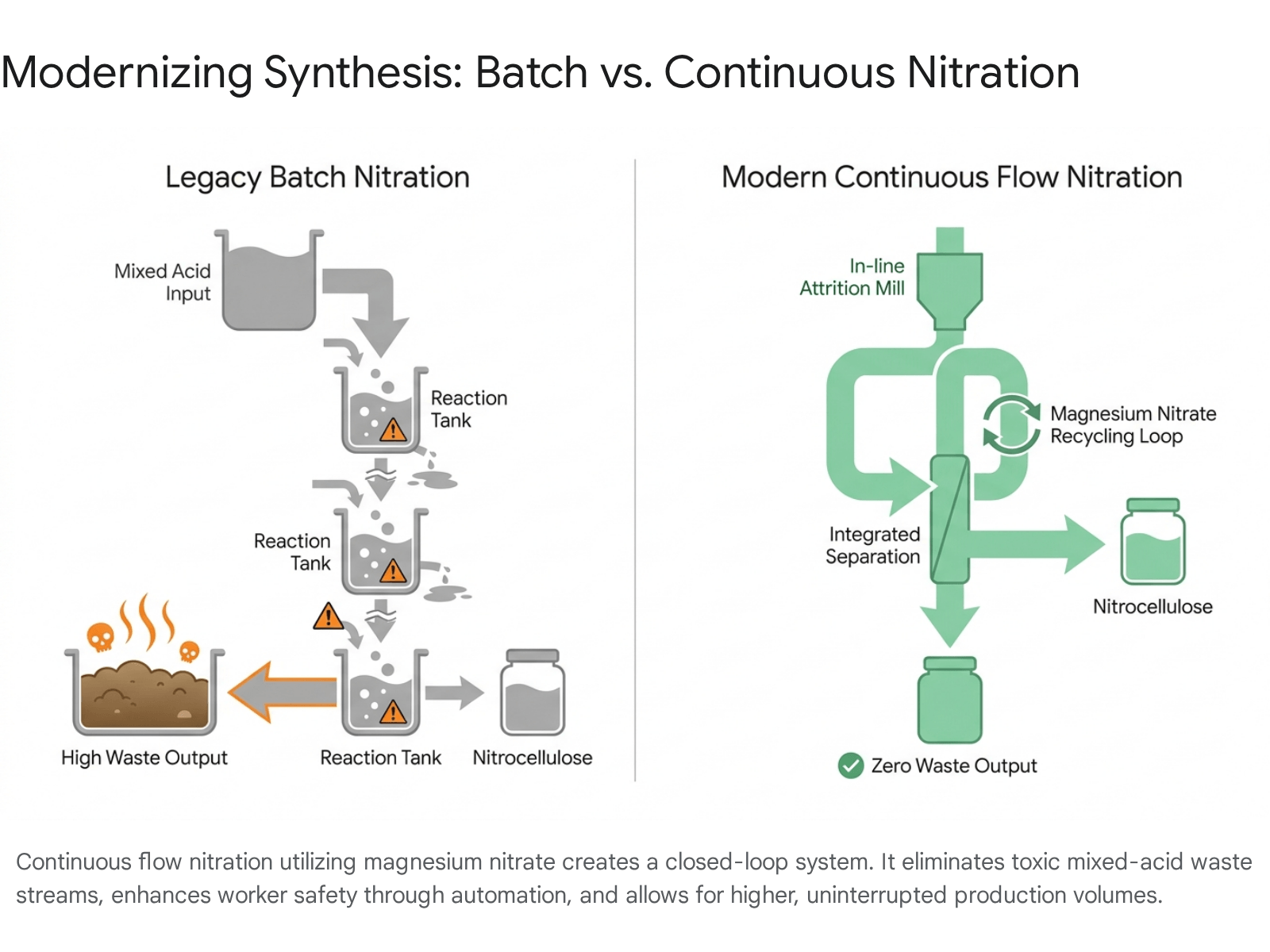
The second major engineering shift is the transition from legacy batch processing to continuous flow nitration. Historically, nitrocellulose has been produced in massive, discrete batches using highly volatile mixed-acid solutions (nitric and sulfuric acid).3 Batch processing is inherently hazardous, requires massive physical footprints, and generates copious amounts of toxic, acidic waste.3
Next-generation facilities are implementing continuous flow reactor systems. Utilizing a closed-loop system, often with a nitric acid-magnesium nitrate agent, the cellulose and acid are passed continuously through an attrition mill.56 This allows for precise, real-time analytical monitoring of temperature and the implementation of back-pressure regulation to prevent solvent vaporization in superheated conditions.57 Crucially, the magnesium nitrate process allows the spent nitrating agent to be separated immediately from the nitrocellulose.56 The product is purified via countercurrent water washes and aqueous ammonia, and the wash liquors are treated with an ion-exchange system to recover the magnesium and nitrate values, recycling them back into the production loop.56
This continuous methodology offers profound advantages: it eliminates the conventional mixed-acid waste stream, drastically shrinking the environmental footprint; it generates no waste products to pollute the environment; it requires significantly less physical space; and it increases throughput efficiency.56 The new highly-automated facility commissioned at Radford leverages self-contained waste reprocessing technologies born from these continuous flow principles, yielding an environmentally sustainable and exponentially safer manufacturing environment.24
9. Federal Policy Interventions: The Defense Production Act and the Joint Energetics Transition Office
Engineering solutions cannot be implemented at scale without aggressive, centralized industrial policy. Recognizing that standard market economics fail to incentivize the capitalization of redundant, surge-ready defense infrastructure, the U.S. Government has deployed broad federal authorities to secure the energetic materials supply chain.3
In a pivotal move, the Department of Defense heavily leveraged Title III of the Defense Production Act (DPA) of 1950.60 Originally enacted during the Korean War, the DPA grants the president broad emergency authority over domestic industries, with Title III specifically authorizing financial incentives—such as loans, direct purchases, and cost-sharing arrangements—to expand productive capacity for materials essential to national defense.60
By 2026, the DoD announced $192.5 million in DPA Investments specifically targeting the establishment of domestic manufacturing capabilities for critical chemicals.62 These investments incentivize companies to produce 22 critical chemicals used in defense systems, covering both energetic and non-energetic precursors.62
| Defense Production Act (Title III) Awardee | Award Amount | Strategic Purpose |
| CoorsTek Inc. | $49.6 Million | Establish production of critical materials for ammunition packaging and protection (Golden, CO). |
| Goex / Estes Energetics | $13.0 Million | Establish domestic production of seven energetic oxidizers (including barium nitrate, potassium chlorate, and potassium perchlorate). |
| Other Selected Companies | ~$129.9 Million | Establish, expand, and modernize capacity for remaining critical defense chemicals. |
Table 3: Selected U.S. Department of Defense DPA Title III Chemical Investments (2026). 62
Complementing this financial push is a profound organizational restructuring guided by the National Energetics Plan, released in May 2023 by the Office of the Under Secretary of Defense for Research and Engineering.1 The plan, originally mandated by Section 253 of the FY 2020 National Defense Authorization Act (NDAA), identified a fractured enterprise plagued by misaligned timelines, antiquated test and evaluation infrastructure, fragile supply chains, and unbudgeted qualification costs.1
To rectify this, the Secretary of Defense was mandated to establish the Joint Energetics Transition Office (JETO).1 Reporting directly to the Under Secretary of Defense for Acquisition and Sustainment, JETO serves as a centralized Strategic Energetics Responsible Authority (SERA).1 JETO coordinates research, development, test, and evaluation (RDT&E) across all branches, actively identifying shortfalls in the raw material supply chain and aggressively expediting the qualification process for novel energetics.1 It leads the creation of an Energetic Systems Common Operating Picture (ES-COP) to align science and technology roadmaps with actual acquisition timelines.1
Crucially, the plan recommended amending Section 1.2 of DoD Directive 5000.1 to mandate that all new munitions incorporate advanced energetics at relevant lifecycle milestones.1 Furthermore, starting in the budget justification materials submitted to Congress for fiscal year 2027, the Secretary of Defense is required to include a dedicated budget line item specifically for JETO and its energetic testing programs.1 This guarantees that energetics modernization will no longer fall victim to the cyclic, reactive funding patterns that allowed the infrastructure to decay over the past three decades.
10. Strategic Outlook and Vulnerability Mitigation
The mid-2026 snapshot of the global nitrocellulose and smokeless powder supply chain reveals an ecosystem pushed to the brink of failure by systemic geopolitical, industrial, and economic constraints. The centralization of raw material production in China, combined with the monopolistic consolidation of manufacturing in Europe and the single-point fragility of the United States infrastructure, has created an unsustainable paradigm. The consequences of this fragility are apparent not only in the inability to meet wartime artillery demands but also in the severe shortages and compounding inflation paralyzing the civilian ammunition market.
Compounding these challenges are broader systemic pressures on the U.S. energy grid and supply chain logistics. Research indicates that limited access to critical minerals, combined with surging electricity demand driven by artificial intelligence data centers, threatens to stall heavy manufacturing expansions, raising concerns about the industrial capacity to support new, energy-intensive chemical facilities.63 Without stable energy and secure mineral inputs, the physical expansion of the energetics sector will remain constrained regardless of financial investment.64
However, the trajectory is shifting. A convergence of commercial agility, engineering advancements, and federal intervention presents a viable roadmap for domesticating energetic material production. To ensure long-term stability, stakeholders must prioritize the accelerated qualification of alternative feedstocks like wood cellulose, systematically support the decentralization of domestic production by backing agile commercial entities like White River Energetics, and mandate the adoption of continuous flow nitration technologies in future grants. By fundamentally restructuring how the foundational chemicals of modern warfare are sourced, synthesized, and funded, the United States and its allies can rebuild an energetics supply chain capable of underwriting the demands of modern strategic deterrence.
Please share the link on Facebook, Forums, with colleagues, etc. Your support is much appreciated and if you have any feedback, please email us in**@*********ps.com. If you’d like to request a report or order a reprint, please click here for the corresponding page to open in new tab.
Sources Used
- The Energetics Bottleneck Threatening U.S. Munitions Production – Defense Security Monitor, accessed June 28, 2026, https://dsm.forecastinternational.com/2026/06/24/the-energetics-bottleneck-threatening-u-s-munitions-production/
- Running on empty: the chemical shortage undermining European defence, accessed June 28, 2026, https://www.epc.eu/publication/running-on-empty-the-chemical-shortage-undermining-european-defence/
- Defense-Industrial Bottlenecks: Gunpowder – CSS ETH Zürich, accessed June 28, 2026, https://css.ethz.ch/content/dam/ethz/special-interest/gess/cis/center-for-securities-studies/pdfs/CSSAnalyse344-EN.pdf
- Occupational Health: The Soldier and the Industrial Base Chapter 9 Military Energetic Materials: Explosives and Propellants – U.S. Army Medical Center of Excellence, accessed June 28, 2026, https://medcoe.army.mil/pfw-images/borden/occ-health/OHch9.pdf
- Firearms Examiner Training | Propellants – National Institute of Justice, accessed June 28, 2026, https://nij.ojp.gov/nij-hosted-online-training-courses/firearms-examiner-training/module-05/propellants
- Europe’s gunpowder bottleneck: how cotton supply chains became a defence issue, accessed June 28, 2026, https://defencematters.eu/europes-gunpowder-bottleneck/
- Nitrocellulose or Smokeless Powder, accessed June 28, 2026, https://www.aeragon.com/1865-1914/nitrocellulose-smokeless-powder.html
- Handbook of Energetic Materials for Weapons Systems Including Ballistic and Cruise Missiles – DTIC, accessed June 28, 2026, https://apps.dtic.mil/sti/tr/pdf/ADA387318.pdf
- north atlantic treaty organization manual of data requirements and tests for the qualification of explosive materials for military use, accessed June 28, 2026, https://www.difesa.it/assets/allegati/1675/c7c7e469-8f1f-4de2-b074-3d0449fcbb6f.pdf
- Cotton Linters for Ammunition | The Art & Science of Bullet Casting, accessed June 28, 2026, https://www.artfulbullet.com/index.php?threads/cotton-linters-for-ammunition.13124/
- Cotton Linters Market Size & Growth [2033] – Market Reports World, accessed June 28, 2026, https://www.marketreportsworld.com/market-reports/cotton-linters-market-14720501
- Nitrocellulose fiber comparative characterization – IMEMG, accessed June 28, 2026, https://imemg.org/wp-content/uploads/2019/11/22224-Presentation-Lee-Goetz-Nitrocellulose-Fiber-comparison-FINAL-to-IM-EM.pdf
- r/UkrainianConflict – European ammunition production depends on Chinese materials, accessed June 28, 2026, https://www.reddit.com/r/UkrainianConflict/comments/1bzrt42/european_ammunition_production_depends_on_chinese/
- EU’s defence chemicals shortage ‘exposes further dependency on China’ – Brussels Signal, accessed June 28, 2026, https://brusselssignal.eu/2025/06/eus-defence-chemicals-shortage-exposes-further-dependency-on-china/
- These Materials Could Cripple America’s Defense Industrial Base – War on the Rocks, accessed June 28, 2026, https://warontherocks.com/cogs-of-war/these-materials-could-cripple-americas-defense-industrial-base/
- NATO – AOP-48 – EXPLOSIVES, NITROCELLULOSE BASED PROPELLANTS, STABILITY TEST PROCEDURES AND REQUIREMENTS USING STABILIZER DEPLETION – Standards | GlobalSpec, accessed June 28, 2026, https://standards.globalspec.com/std/1182861/aop-48
- Europe faces shortage of gunpowder and explosives – Bloomberg – УНН, accessed June 28, 2026, https://unn.ua/en/news/europe-faces-powder-and-explosives-shortage-bloomberg
- Europe is short of gunpowder and TNT when it needs them most – The Japan Times, accessed June 28, 2026, https://www.japantimes.co.jp/business/2025/03/22/eu-ukraine-low-munitions-stockpile/
- Ordnance Systems Inc., accessed June 28, 2026, https://www.baesystems.com/en-us/product/ordnance-systems-inc
- History | Radford Army Ammunition Plant, accessed June 28, 2026, https://www.jmc.army.mil/Radford/History.aspx
- Radford Army Ammunition Plant – Wikipedia, accessed June 28, 2026, https://en.wikipedia.org/wiki/Radford_Army_Ammunition_Plant
- BAE Radford Army Ammunition Plant – Fluor, accessed June 28, 2026, https://www.fluor.com/projects/bae-radford-army-ammunition-plant
- BAE Systems selects Parsons Corporation for modernization project at Radford Army Ammunition Plant, accessed June 28, 2026, https://www.baesystems.com/en-us/article/bae-systems-selects-parsons-corporation-for-modernization-project-at-radford-army-ammunition-plant
- Radford moves to commissioning phase of a new nitrocellulose facility, accessed June 28, 2026, https://www.baesystems.com/en/story/radford-moves-to-commissioning-phase-of-a-new-nitrocellulose-facility
- ARMY AMMUNITION PLANT MODERNIZATION PLAN – USAASC, accessed June 28, 2026, https://asc.army.mil/web/news-army-ammunition-plant-modernization-plan/
- St. Marks Powder – Wikipedia, accessed June 28, 2026, https://en.wikipedia.org/wiki/St._Marks_Powder
- GDOTS Expands Ball Powder Propellant Production – General …, accessed June 28, 2026, https://www.gdots.com/general-dynamics-expands-ball-powder-propellant-production-capacity/
- Ball Powder® Propellants – General Dynamics Ordnance and Tactical Systems, accessed June 28, 2026, https://www.gdots.com/propellants/ball-powder-propellants/
- Ball Powder Propellant: You Are Probably Shooting St. Marks Powder – Guns and Ammo, accessed June 28, 2026, https://www.gunsandammo.com/editorial/ball-powder-st-marks-powder/462658
- Ammunition in 2026: Supply Conditions, Price Pressures, and Market Signals, accessed June 28, 2026, https://blog.targetsportsusa.com/2026-ammunition-outlook-supply-pricing-availability/
- The Powder Keg Boom: Why Are Ammo Prices Rising Again? – Inside Safariland, accessed June 28, 2026, https://inside.safariland.com/blog/the-powder-keg-boom-why-are-ammo-prices-rising-again/
- Where is all the Alliant Powder? | Page 2 – Shooters’ Forum, accessed June 28, 2026, https://forum.accurateshooter.com/threads/where-is-all-the-alliant-powder.4174321/page-2
- Alliant Powder Availability : r/reloading – Reddit, accessed June 28, 2026, https://www.reddit.com/r/reloading/comments/1i30hs7/alliant_powder_availability/
- Shooting Industry Magazine The Ammunition Squeeze – Shooting …, accessed June 28, 2026, https://shootingindustry.com/discover/the-ammunition-squeeze/
- Primer Misinformation and Powder Shortages – Shooting Sportsman, accessed June 28, 2026, https://shootingsportsman.com/primer-misinformation-and-powder-shortages/
- 2400 powder discontinued??? | The Art & Science of Bullet Casting, accessed June 28, 2026, https://www.artfulbullet.com/index.php?threads/2400-powder-discontinued.12021/
- Alliant Powder | Smokeless Powder Manufacturer in Lewiston, Idaho – Boise Gun Club, accessed June 28, 2026, https://boisegunclub.com/idaho/directory/alliant-powder
- About Us – Alliant Powder, accessed June 28, 2026, https://www.alliantpowder.com/general/about_us.aspx
- 2026 Ammunition Supply Report – Firehole, accessed June 28, 2026, https://firehole.com/arms/2026-supply/
- Ammo Prices going Up Confirmed April 1st #ammoshortage #ammoshortage2026 #ammoPrices – YouTube, accessed June 28, 2026, https://www.youtube.com/watch?v=MPXzCpsbfRY
- ANOTHER Ammo Price Increase Coming June 1st (2026) – YouTube, accessed June 28, 2026, https://www.youtube.com/watch?v=5k4tPXehXqw
- Vista Outdoor Announces Ammo, Powder, Primers Price Hikes – Accurate Shooter Bulletin, accessed June 28, 2026, https://bulletin.accurateshooter.com/2023/12/vista-outdoor-announces-ammo-powder-primers-price-hikes/
- accessed June 28, 2026, https://boisegunclub.com/idaho/directory/alliant-powder#:~:text=division%20in%201912.-,Today%2C%20Alliant%20operates%20from%20their%20facility%20at%202299%20Snake%20River,Speer%2C%20and%20HEVI%2DShot.
- Kinetic Group Announces Ammo Price Increase – Effective October 1, 2025, accessed June 28, 2026, https://blog.targetsportsusa.com/kinetic-group-inc-price-increase/
- Trump’s Tariffs Are Driving Up Ammo Prices – The Trace, accessed June 28, 2026, https://www.thetrace.org/2026/03/trump-tariffs-ammunition-prices/
- D&M Holdings: The Disruptor’s Playbook | Supply Energetics, accessed June 28, 2026, https://www.supplyenergetics.com/insights/case-study-d-and-m
- White River Energetics Expands in Des Arc, Creates 100 New Jobs, accessed June 28, 2026, https://www.arkansasedc.com/news-events/newsroom/detail/2024/09/06/white-river-energetics-expands-in-des-arc-creates-100-new-jobs
- Where is all the Alliant Powder? | Shooters’ Forum, accessed June 28, 2026, https://forum.accurateshooter.com/threads/where-is-all-the-alliant-powder.4174321/
- New Primer and Smokeless Propellant Factory To Open In Arkansas | An Official Journal Of The NRA – American Rifleman, accessed June 28, 2026, https://www.americanrifleman.org/content/new-primer-and-smokeless-propellant-factory-to-open-in-arkansas/
- Adding a powder plant to the primer plant in Arkansas… – Shooters’ Forum, accessed June 28, 2026, https://forum.accurateshooter.com/threads/adding-a-powder-plant-to-the-primer-plant-in-arkansas.4133359/
- Europe’s gunpowder bottleneck: how cotton supply chains became a defence issue – https://eutoday.net, accessed June 28, 2026, https://eutoday.net/europes-gunpowder-bottleneck/
- Army program secures critical component for artillery, mortar ammunition | Article, accessed June 28, 2026, https://www.army.mil/article/118465/army_program_secures_critical_component_for_artillery_mortar_ammunition
- DEPARTMENT OF DEFENSE TEST METHOD STANDARD SAFETY AND PERFORMANCE TESTS FOR THE QUALIFICATION OF EXPLOSIVES (HIGH EXPLOSIVES, PR, accessed June 28, 2026, https://quicksearch.dla.mil/WMX/Default.aspx?token=306430
- Woodpulp Crystal Structure and Its Effect on Nitrocellulose Physical Properties – DTIC, accessed June 28, 2026, https://apps.dtic.mil/sti/tr/pdf/ADA088412.pdf
- The Use of Nitrocellulose Production Waste for Energy Generation – Engineer Research and Development Center, accessed June 28, 2026, https://www.erdc.usace.army.mil/Media/Publication-Notices/Article/4420351/the-use-of-nitrocellulose-production-waste-for-energy-generation/
- US3714143A – Continuous process for manufacture of nitrocellulose – Google Patents, accessed June 28, 2026, https://patents.google.com/patent/US3714143A/en
- Continuous-flow-enabled intensification in nitration processes: a review of technological developments and practical applications over the past decade – PMC, accessed June 28, 2026, https://pmc.ncbi.nlm.nih.gov/articles/PMC12415922/
- Continuous Manufacturing of Nitrocellulose by Magnesium Nitrate Method. Volume 1 – DTIC, accessed June 28, 2026, https://apps.dtic.mil/sti/tr/pdf/ADA073349.pdf
- Continuous Manufacturing of Nitrocellulose by Magnesium Nitrate Method. Volume I., accessed June 28, 2026, https://ntrl.ntis.gov/NTRL/dashboard/searchResults/titleDetail/ADA073349.xhtml
- The Defense Production Act’s Expanding Role in Energy – Baker Institute, accessed June 28, 2026, https://www.bakerinstitute.org/research/defense-production-acts-expanding-role-energy
- New Defense Production Act Presidential Determinations Authorize Department of Energy Action on Energy Infrastructure – Akin Gump, accessed June 28, 2026, https://www.akingump.com/en/insights/alerts/new-defense-production-act-presidential-determinations-authorize-department-of-energy-action-on-energy-infrastructure
- DOD Awards $192.5 Million to Establish Domestic Manufacturing Capabilities for Critical Defense Chemicals – War.gov, accessed June 28, 2026, https://www.war.gov/News/Releases/Release/Article/3663086/dod-awards-1925-million-to-establish-domestic-manufacturing-capabilities-for-cr/
- U.S. energy supply chains are unlikely to meet anticipated demand – Department of Civil & Systems Engineering, accessed June 28, 2026, https://engineering.jhu.edu/case/news/u-s-energy-supply-chains-are-unlikely-to-meet-anticipated-demand/
- Landscape of U.S. Domestic Advanced Nuclear Energy Supply Chain, accessed June 28, 2026, https://www.nuclearscaling.org/wp-content/uploads/2026/03/2026-Landscape-of-U.S.-Domestic-Advanced-Nuclear-Energy-Supply-Chain.pdf
- About | Radford Army Ammunition Plant, accessed June 28, 2026, https://www.jmc.army.mil/Radford/About.aspx