1. Executive Summary and Strategic Context
As of mid-2026, the United States Department of Defense (DoD) is actively executing the most comprehensive and technologically disruptive small-arms modernization effort since the widespread adoption of the 5.56×45mm NATO cartridge in the 1960s. The Next Generation Squad Weapon (NGSW) program represents a fundamental paradigm shift in infantry lethality, driven primarily by the strategic requirement to overmatch modern, peer-adversary body armor at extended engagement ranges.1 Featuring the M7 Rifle (replacing the M4 Carbine) and the M250 Automatic Rifle (replacing the M249 Squad Automatic Weapon), this program relies on a revolutionary technological linchpin: the 6.8×51mm (.277 FURY) hybrid ammunition.3 This novel cartridge is an unprecedented metallurgical and engineering achievement, designed to withstand internal chamber pressures approaching 80,000 pounds per square inch (psi) to propel heavier projectiles at elevated velocities.2
However, an exhaustive analysis of the global defense industrial base reveals that the mass production and scalable fielding of this 6.8mm ammunition are currently besieged by compounding macroeconomic, geopolitical, and structural vulnerabilities. The transition from low-rate initial production to large-scale, automated manufacturing relies heavily on highly fragile, single-point-of-failure nodes within the U.S. organic industrial base, most notably the Lake City Army Ammunition Plant (LCAAP) in Independence, Missouri, and the Radford Army Ammunition Plant (RFAAP) in Virginia.7
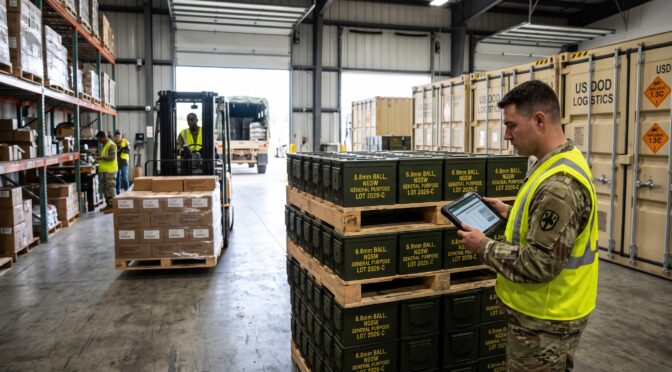
This report provides a comprehensive risk assessment by cross-referencing the recent groundbreaking of the new 450,000-square-foot 6.8mm facility at LCAAP 3 with severe operational disruptions, notably the paralyzing May 2026 labor strike by the International Association of Machinists and Aerospace Workers (IAM) Local 778.10 Furthermore, it contextualizes these industrial base friction points within a deteriorating macroeconomic environment characterized by severe raw material inflation affecting copper, zinc, and antimony, which has precipitated catastrophic margin compression for the facility’s operating contractor, Olin Corporation (Winchester).12
Simultaneously, the global energetics supply chain is experiencing a protracted and critical shortage. A 70% global reliance on Chinese cotton linters for the production of military-grade nitrocellulose—exacerbated by Beijing’s overt weaponization of critical material export controls—threatens the foundational chemical propellants required for all U.S. munitions.14 The convergence of corporate financial contagion, human capital exhaustion, complex hybrid-casing metallurgical constraints, and geopolitical supply chain weaponization presents a severe, multi-domain risk to the Project Manager Maneuver Ammunition Systems (PM MAS) fielding schedules. This analysis details these intersecting vulnerabilities and evaluates their ultimate impact on the Department of Defense’s capacity to field the NGSW ecosystem at true strategic scale.
2. The Ballistic Imperative and the Metallurgical Complexity of the Hybrid Casing
2.1 The 80,000 PSI Threshold and Ballistic Requirements
The genesis of the 6.8mm NGSW cartridge lies directly in the shifting dynamics of great power competition and the realities of modern ground combat. Decades of counter-insurgency operations highlighted, and subsequent near-peer conflict simulations confirmed, that legacy 5.56mm (SS109/M855A1) and 7.62mm platforms exhibit significant ballistic deficiencies against advanced, widespread body armor, particularly at engagement distances exceeding 500 meters.1 To achieve decisive tactical overmatch, the U.S. Army established unyielding physical requirements for the NGSW ammunition: it must deliver substantially higher kinetic energy on target, exhibit a flatter trajectory with significantly less bullet drop, and reduce overall combat weight compared to equivalent legacy cartridges.2
To fulfill these requirements, the 6.8×51mm cartridge was engineered to propel a 113-grain to 150-grain projectile at muzzle velocities exceeding 3,000 feet per second from highly compact weapon platforms featuring 13-inch or 16-inch barrels.2 To achieve this performance from a short barrel without a proportionally massive propellant casing, the internal chamber pressure of the 6.8mm cartridge must peak at approximately 80,000 psi.2 This represents a radical departure from the operational parameters of legacy small arms; by comparison, the maximum average pressure of the 5.56×45mm NATO is roughly 62,000 psi, and the 7.62×51mm NATO operates at approximately 60,200 psi.3 This extreme pressure threshold generates a 350-feet-per-second velocity boost, translating 16-inch-barrel-level velocities to an 8-inch barrel, but it fundamentally breaks the material limits of traditional ammunition manufacturing.3
2.2 Bi-Metallic Engineering: Overcoming the Limitations of Brass
Traditional small-arms ammunition universally utilizes a homogenous brass casing (typically an alloy of 70% copper and 30% zinc).19 Brass is metallurgically ideal for firearms because it expands rapidly upon the ignition of the propellant to seal the firing chamber—a process known as rearward obturation—which prevents expanding, super-heated gases from venting backward into the weapon.20 Immediately following peak pressure, the brass slightly contracts, breaking the friction seal with the chamber walls and allowing the weapon’s extractor to pull the spent casing out smoothly.20 However, at 80,000 psi, a traditional brass case head lacks the tensile strength required to contain the explosive force. Under such pressures, a homogenous brass case would experience catastrophic failure, either rupturing completely or extruding backward into the bolt face, instantly disabling the firearm.3
Conversely, manufacturing the entire casing from steel—a technique pioneered by Germany in World War II to alleviate copper shortages and still used in some low-cost ammunition—presents an inverse set of problems.20 While steel is strong enough to contain 80,000 psi, it is significantly heavier than brass and possesses poor elasticity. It does not obturate well, allowing gas blowback, and it does not contract sufficiently after firing, causing immense friction during extraction that rapidly accelerates the wear and catastrophic breakage of weapon extractor claws.20
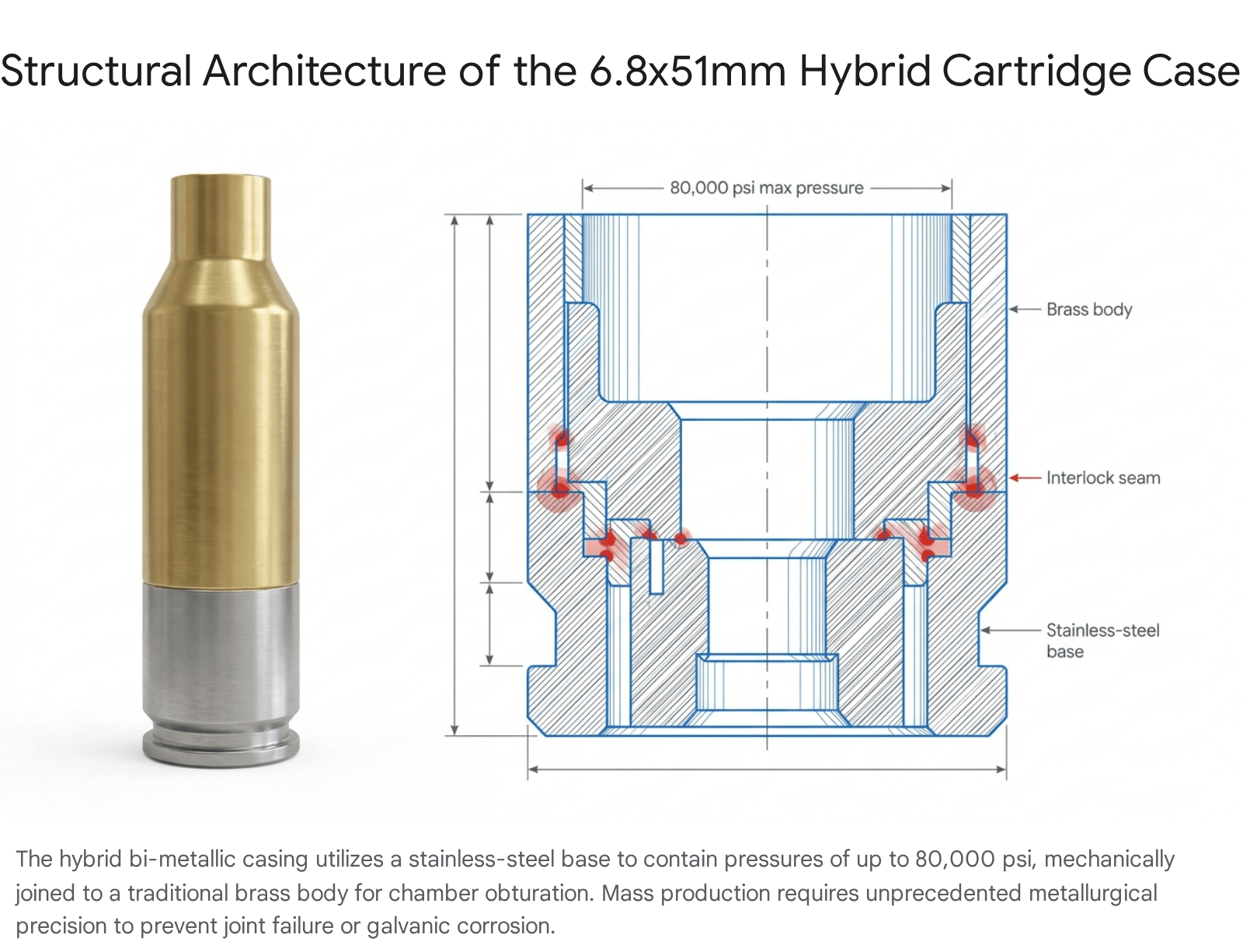
To circumvent these competing material limitations, SIG Sauer, the prime contractor for the NGSW program, developed a revolutionary hybrid bi-metallic case for the.277 FURY cartridge.16 The design elegantly splits the casing’s functions: it features a lightweight brass body to maintain reliable chamber obturation and smooth feeding dynamics, which is mechanically mated to a hardened stainless-steel base (case head) capable of withstanding the immense operational pressures without yielding.22 Initially, the physical design utilized a complex three-piece construction that involved an internal aluminum locking washer to bind the brass body and steel head; however, over the course of the testing program, subsequent refinements allowed for a transition to a two-piece design utilizing a highly specific structural joint to mechanically interlock the two metals directly.17 This hybrid design successfully achieves the pressure requirements while managing to be 23.5% lighter than an equivalent conventional cartridge of similar energy.17
2.3 Mass Production Vulnerabilities and Galvanic Corrosion Risks
While the hybrid casing is a proven ballistic triumph in low-rate initial production and controlled military testing environments, it introduces unprecedented and highly disruptive complexities for mass manufacturing across the industrial base. Producing traditional brass ammunition is a highly optimized, continuous process involving the rapid extrusion and drawing of a single metal cup.19 The hybrid case, by contrast, requires entirely separate global supply chains for specialized stainless-steel alloys, alongside complex, high-torque mechanical assembly machinery required to permanently mate the two halves without inducing stress fractures.21
Furthermore, the physical integration of dissimilar metals inherently introduces the chemical risk of galvanic corrosion. When stainless steel and brass remain in sustained physical contact over extended periods—particularly when exposed to electrolytes in the high-humidity, salt-rich environments typical of littoral combat or jungle deployments—an electrochemical reaction can degrade the metals at the structural joint.25 While alternative solutions, such as the recyclable polymer-cased ammunition offered by True Velocity during the initial NGSW trials, presented superior corrosion resistance, substantial weight reduction, and thermal insulation properties, the DoD ultimately selected the SIG Sauer hybrid brass-steel configuration.17 By accepting the hybrid model, the Army simultaneously accepted the inherent supply chain segmentation and potential storage shelf-life risks associated with bi-metallic joints.21 Consequently, the immense burden of overcoming these bespoke manufacturing bottlenecks and ensuring absolute joint integrity falls directly on the DoD’s organic industrial base, specifically the legacy infrastructure at Lake City.
3. Industrial Base Modernization: The Lake City Expansion and Capacity Constraints
3.1 The Strategic Role of the Lake City Army Ammunition Plant (LCAAP)
The Lake City Army Ammunition Plant (LCAAP), situated on a 3,935-acre footprint in Independence, Missouri, is the undeniable epicenter of the United States’ small-arms defense industrial base.10 Constructed in 1941 to support the mobilization for World War II, it operates as a Government-Owned, Contractor-Operated (GOCO) facility.7 Employing nearly 3,000 workers during peak operations, LCAAP serves as the single largest producer of small-caliber ammunition for the U.S. military—boasting a theoretical maximum capacity of approximately 1.6 billion rounds per year 33—while concurrently supplying allied nations through Foreign Military Sales (FMS) and provisioning domestic federal and state law enforcement agencies.10 Olin Corporation, operating under its Winchester ammunition division, currently manages the massive facility under a multi-year, $8 billion contract awarded in 2020.36
For decades, capital expenditures and modernization efforts at Lake City were largely confined to sustaining and marginally improving legacy manufacturing lines to maintain readiness.32 The introduction of the 6.8mm hybrid cartridge represents the first requirement to implement fundamentally new mass-production shell-case technology at LCAAP in over 75 years.32 Transitioning a vintage industrial footprint to produce a highly complex bi-metallic cartridge—while strictly mandated to maintain uninterrupted, high-volume deliveries of legacy 5.56mm and 7.62mm ammunition—is a logistical undertaking of immense proportions.32
3.2 The Interim 6.8mm Production Line and Immediate Bridging Strategy
Recognizing the imminent need to support the initial fielding schedules of key units—such as the 101st Airborne Division and the Minnesota Army National Guard’s 34th Infantry Division, which began receiving the M250 automatic rifles in late 2025—Project Manager Maneuver Ammunition Systems (PM MAS) and Project Lead Joint Services (PL JS) rapidly established an interim 6.8mm manufacturing capability at LCAAP.4
This interim line utilizes a hybrid configuration of newly acquired precision machinery integrated with repurposed legacy equipment.4 As of March 2026, Olin Winchester is successfully utilizing this interim capability to produce and deliver low-rate batches of 6.8mm ammunition.4 A critical component of this bridging strategy involves LCAAP manufacturing 6.8mm projectiles and supplying them directly to SIG Sauer’s commercial facility in Jacksonville, Arkansas, to support concurrent cartridge assembly, ensuring early fielding starvation is averted.4
To substantially bolster this interim capability, SIG Sauer recently reached a major milestone at its Jacksonville, Arkansas ammunition campus. Operating within a newly expanded 210,000-square-foot facility equipped with high-capacity production lines, SIG Sauer has achieved an annual production capacity of 100 million rounds of 6.8mm ammunition. The company plans to continually increase this capacity, paving the way to double output over the next few years, which provides a critical strategic buffer while the massive DoD Lake City expansion is completed. While these interim capabilities are highly functional, relying entirely on commercial facilities and unscaled GOCO lines limits the overarching strategic scale necessary to support the broader, force-wide transition of the entire Close Combat Force (CCB) away from the 5.56mm standard.27
3.3 The 450,000-Square-Foot Facility Groundbreaking and Timeline Vulnerabilities
To achieve true strategic scale and alleviate the pressure on the interim line, the Joint Program Executive Office for Armaments and Ammunition (JPEO A&A) and the Joint Munitions Command officially broke ground on a massive, state-of-the-art 6.8mm ammunition production facility at LCAAP on February 5, 2025.3 This 450,000-square-foot complex is specifically designed to house entirely new, automated manufacturing systems dedicated exclusively to every individual component of the 6.8mm family, mitigating the disruptions to legacy lines.3
Once fully operational, the Army projects the new facility will possess a staggering annual production capacity of 385 million cases, 490 million projectiles, and 385 million load-assemble-pack (LAP) operations specifically for 6.8mm ammunition.3 However, the development timeline introduces a significant period of strategic risk. While the physical construction of the facility is reportedly on schedule to be completed in 2026, the installation of the highly specialized production equipment is not slated to begin until 2028.3 This protracted timeline leaves the DoD highly dependent on the fragile interim line at Lake City and SIG Sauer’s supplemental commercial capacity for at least the next 24 to 36 months of the critical weapon fielding window, creating a pronounced vulnerability to any operational shocks.4
| Manufacturing Node | Current Operational Status | Primary Production Scope | Strategic Function within NGSW Ecosystem |
| SIG Sauer (Arkansas) | Active (High Capacity) | Complete Cartridge Assembly | Current capacity of 100 million rounds/year; supplements DoD output using projectiles supplied by LCAAP. |
| LCAAP Interim Line | Active (Limited Scale/Repurposed) | Complete Cartridges & Projectiles | Bridges the critical supply gap for early active-duty and Guard fielding; supplies raw projectiles to SIG Sauer. |
| LCAAP Modernization | Under Construction (Equipment in 2028) | 385M Cases / 490M Projectiles Annually | The future core of DoD small-arms supply; complete automation of hybrid bi-metallic case manufacturing at massive scale. |
4. Human Capital Fragility: The May 2026 Lake City Strike
The heavy reliance on a single GOCO facility for nearly all domestic military small-arms ammunition exposes the defense supply chain to profound, and often under-modeled, human capital risks. This vulnerability materialized dramatically in the second quarter of 2026, creating a severe bottleneck in both legacy ammunition output and the nascent NGSW interim production lines.
4.1 The IAM Local 778 Labor Dispute and Workforce Exhaustion
On April 4, 2026, nearly 1,300 employees represented by the International Association of Machinists and Aerospace Workers (IAM) Local 778 initiated a total work stoppage at the Lake City Army Ammunition Plant.10 The strike commenced after the union overwhelmingly rejected successive contract offers from Olin Winchester, citing unlivable working conditions, mandatory shift extensions, and stagnant compensation that failed to track with inflation.10
The core grievances articulated by the union centered on the grueling realities of sustaining the modern defense industrial base. Workers reported enduring “countless hours of forced overtime” to meet the simultaneously surging demands of U.S. military modernization, global allied stockpiling in response to geopolitical instability, and wartime consumption rates.10 The union argued forcefully that the immense physical and mental toll of operating a vintage industrial facility at maximum output was not reflected in the corporate wage structure.11
The public optics of the dispute highlighted a stark economic asymmetry that galvanized the workforce and generated significant public pressure. Union leadership, spearheaded by Directing Business Representative Scott Brown, publicly condemned Olin Corporation for prioritizing aggressive shareholder returns while enforcing austere labor policies on the factory floor.10 The IAM explicitly highlighted that Olin Winchester had recently engaged in $1.35 billion in corporate stock buybacks, while the CEO’s compensation package approached $10 million.10 This dynamic bred deep resentment, with union members pointing out that their “shared mission” to support the warfighter was yielding wildly disproportionate financial benefits for corporate executives compared to the machinists producing the ammunition.11
4.2 Supply Chain Paralysis and Structural Resolution
The strike lasted for over a month, effectively grinding the massive Independence, Missouri facility to a complete halt.10 For defense logistics planners, a month-long shutdown of the nation’s primary ammunition node is a cascading, catastrophic event.34 Not only did the stoppage stall the production of the 5.56mm and 7.62mm cartridges vital to ongoing global operations and FMS deliveries, but it critically interrupted the delicate, highly choreographed output of the 6.8mm interim line precisely as the Army was accelerating NGSW fielding to National Guard units across the country.35
The strike ultimately concluded on May 7, 2026, after the nearly 1,300 union members ratified a new four-year collective bargaining agreement.10 The new contract provided front-loaded wage increases and established crucial regulatory relief from excessive forced overtime.10 While the resolution of the strike restored immediate operational stability, it fundamentally altered the long-term cost structure of producing ammunition at Lake City. By guaranteeing higher wages and limiting the flexibility of forced overtime to meet production spikes, Olin Winchester’s labor overhead increased significantly.10 Crucially, this structural cost increase was enforced during a period of unprecedented and compounding financial distress for the parent corporation.
5. Corporate Financial Contagion: The Collapse of Olin’s Margins
While the resolution of the Lake City strike ensured the physical continuation of the DoD’s ammunition supply, it compounded a severe financial crisis unfolding within Olin Corporation. A detailed analysis of corporate earnings reports from late 2025 through the first half of 2026 reveals a rapid and alarming deterioration of profitability, driven by macroeconomic factors that threaten the long-term viability of the commercial ammunition sector upon which defense contractors rely to subsidize operations.
5.1 The Q4 2025 Profit Implosion and Commercial Glut
The explicit warning signs of severe margin compression emerged starkly at the close of 2025. In the fourth quarter, the Winchester segment’s earnings essentially evaporated, plummeting from a robust $42.0 million in Q4 2024 to a mere $600,000.12 This represented a staggering $41.4 million collapse in segment profitability in a single quarter.12 Concurrently, the parent company, Olin Corporation, posted a comprehensive net loss of $85.7 million for the same three-month period, dragging full-year 2025 net income down to a reported loss of $42.8 million (or an EPS loss of 37 cents per diluted share), compared to a net income of $108.6 million the prior year.12
This financial collapse was not precipitated by a loss of military contracts. Military business remained highly lucrative and served as Winchester’s sole bright spot, buoyed by strong government demand and a massive $1.43 billion contractual backlog.11 Instead, the crisis was driven by a toxic combination of civilian commercial market dynamics and spiraling raw material costs. Following the massive post-COVID ammunition buying surge, a glut of inventory flooded the civilian distribution channels.12 To keep product moving and prevent warehousing backups, Winchester and competing manufacturers engaged in aggressive promotional pricing.12 However, as the global spot prices of copper, zinc, and chemical propellants began to skyrocket simultaneously, these artificially suppressed retail prices gutted operating margins.12 For the full year of 2025, despite an overall increase in Winchester sales to $1.72 billion, the segment’s operating income fell by a devastating 71.5%, dropping from $237.9 million down to $67.7 million.11
5.2 Q1 2026: Negative Cash Flows, Rising Leverage, and Analyst Downgrades
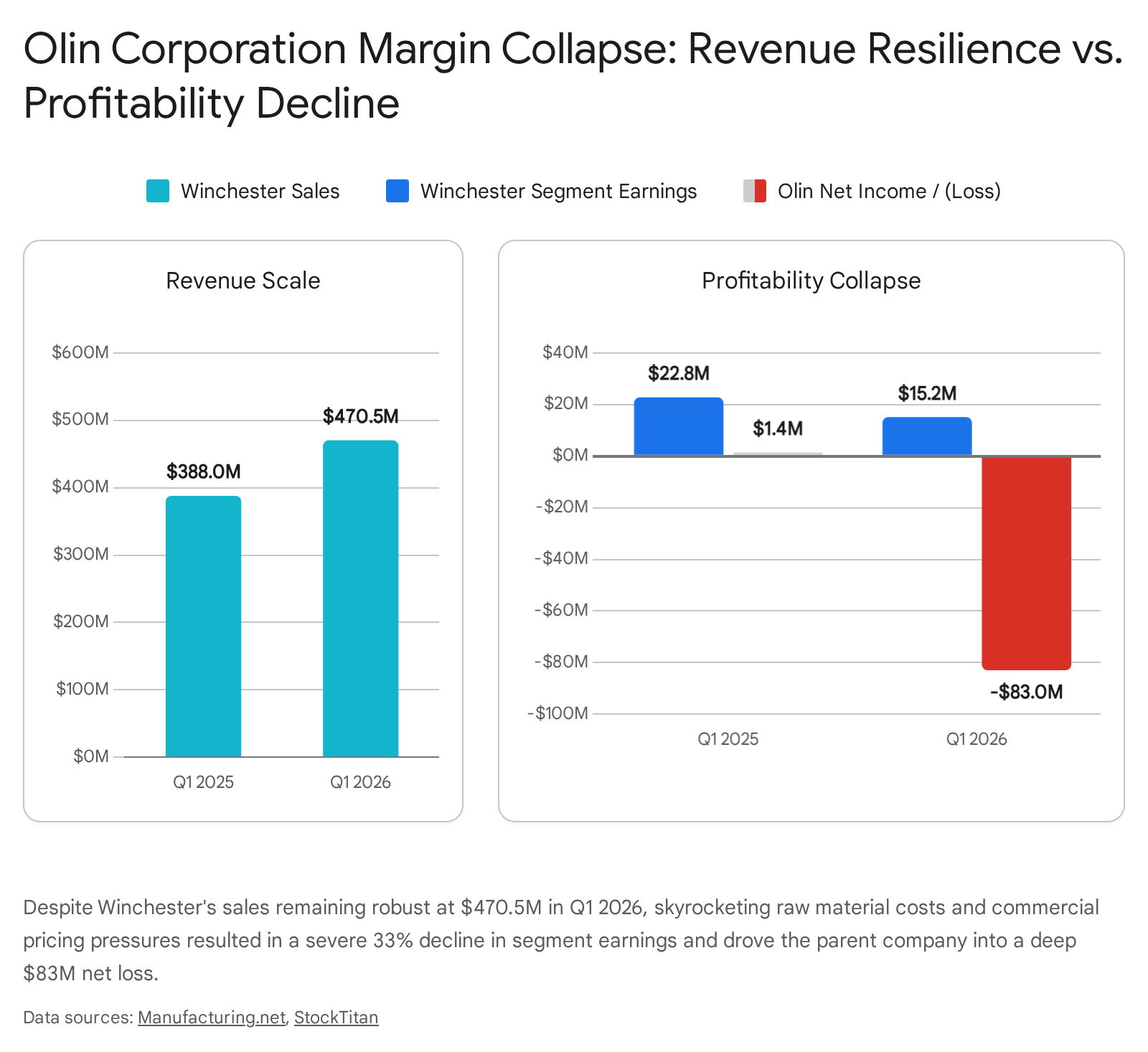
The financial hemorrhage accelerated sharply into the first quarter of 2026. Olin Corporation reported a massive Q1 2026 net loss of $83.0 million (translating to an EPS loss of $0.73 per diluted share), representing a sharp reversal from the $1.4 million net income reported in Q1 2025.13 Adjusted EBITDA fell precipitously from $185.6 million to $86.2 million.13 Concurrently, corporate leverage increased materially, with net debt reaching $2.8 billion and the critical net debt to adjusted EBITDA ratio swelling to an alarming 5.1 times as trailing twelve-month earnings continued to decline.13
The Winchester segment showed slight sequential recovery from the Q4 disaster but remained severely depressed, posting only $15.2 million in segment earnings on $470.5 million in sales (down from $22.8 million in earnings on lower sales the prior year).10 Olin’s CEO, Kenneth Lane, explicitly attributed these losses to the company’s inability to absorb macroeconomic shocks, specifically citing the geopolitical conflict in Iran impacting global trade flows, elevated crude oil prices, rising freight costs, and relentless raw material inflation—particularly for the copper and brass essential to ammunition manufacturing.12
5.3 The Asymmetry of Commercial vs. Military Production and Capital Starvation
This intense corporate distress presents a latent, long-term vulnerability to the DoD. While the military NGSW contracts provide a stable, guaranteed revenue floor, Winchester is fundamentally a dual-market entity. The massive capital expenditures and continuous maintenance required to operate vintage facilities like Lake City are historically offset by highly profitable commercial and law enforcement sales.7 When the commercial market enforces promotional pricing precisely as raw material costs spike, the corporate parent bleeds operating capital.
Consequently, Olin was forced to implement sweeping, industry-wide commercial price increases of 2% to 10% beginning April 1, 2026, effectively abandoning promotional pricing entirely.12 While this aggressive pricing strategy may eventually stabilize the balance sheet over subsequent quarters, the immediate reality during the Lake City strike was a corporation under siege from Wall Street, facing active downgrades from major institutional analysts (including Truist, KeyCorp, and Weiss Ratings), and navigating a workforce demanding higher pay out of a rapidly shrinking profit pool.34 This financial fragility threatens Olin’s ability to aggressively co-invest in the rapid, technologically intensive modernization required for the smooth 6.8mm transition.
6. Macroeconomic Pressures: Commodity Inflation and Supply Shocks
The margin compression suffocating the ammunition industrial base is directly correlated to the rampant inflation of non-substitutable raw materials. The mass production of the 6.8mm cartridge—even in its advanced hybrid form—requires vast, uninterrupted quantities of copper, zinc, lead, and antimony.
6.1 The Copper and Zinc Squeeze
The brass body of the 6.8mm casing, like all standard ammunition, relies on a highly specific metallurgical blend of approximately 70% copper and 30% zinc.19 Throughout 2025 and 2026, global base metal markets experienced significant and sustained tightening. The World Bank’s metals and minerals price index demonstrated consistent upward momentum, supported by resilient global activity and emerging supply concerns.49 The voracious appetite for copper driven by green energy initiatives, global electrification programs, and the rapid expansion of data centers has created a structural supply deficit.19
Commercial ammunition manufacturers are inherently disadvantaged in this inflationary environment. They must compete for limited supply allocations against massive international technology, construction, and automotive sectors.19 Furthermore, as copper prices surge on global exchanges, ammunition producers possess almost zero elasticity. In June 2026, copper prices reached an all-time high of $6.67 per pound, with the London Metal Exchange 3-month copper price rebounding sharply after dipping below $12,000 per metric ton in March 2026. Ammunition manufacturers cannot simply alter the metallurgical ratio of their cartridge brass to use cheaper metals without severely compromising the structural integrity, extraction reliability, and safety tolerances of the ammunition.19
6.2 Antimony, Lead, and Geopolitical Trade Friction
Beyond the casing, the projectile itself faces immense inflationary pressure. The 6.8mm ammunition utilizes advanced projectiles—including armor-penetrating variants developed by Picatinny Arsenal—that rely heavily on lead cores hardened with antimony to prevent high-velocity deformation upon impact with modern body armor.19
The global supply of these critical materials has been heavily manipulated by geopolitical rivalries and trade policies. Tariffs imposed on imported raw metals during previous administrations have significantly elevated domestic production costs for defense manufacturers.46 Furthermore, global logistics have been heavily disrupted by geopolitical tensions, notably the ongoing conflict involving Iran, which has inflated oil prices, spiked oceanic freight costs, and constrained vital shipping routes.9 Most alarmingly, China enacted severe export limits on antimony on August 15, 2024, causing Chinese antimony exports to fall by a staggering 97%.51 The culmination of these factors ensures that the input costs for the 6.8mm program will remain structurally elevated, complicating the DoD’s long-term procurement budgeting and squeezing contractor margins.
| Raw Material | Primary Cartridge Application | 2025-2026 Market Dynamics | Supply Chain Bottlenecks |
| Copper | Brass Casing (70%) | Severe price inflation; structural deficits. | Global competition from green energy, EV, and data center electrification.19 |
| Zinc | Brass Casing (30%) | Upward price pressure. | Stable but closely tracking copper market dynamics.19 |
| Antimony | Projectile Core Hardener | Massive supply contraction. | Chinese export controls (Aug 2024) reduced Chinese exports by 97%.19 |
| Lead | Standard Projectile Core | Cost escalation. | Increased domestic processing and shipping costs; strict environmental regulations.19 |
| Stainless Steel | Hybrid Base (Case Head) | Specialized procurement. | Requires specialized alloy supply chains separate from traditional brass flow.19 |
7. Geopolitical Weaponization: The Energetics and Nitrocellulose Crisis
While base metal inflation compresses corporate margins and strains budgets, the most critical existential threat to the 6.8mm program is fundamentally chemical. The advanced propellants required to generate the 80,000 psi chamber pressures for the Next Generation Squad Weapon are entirely dependent on nitrocellulose (NC). As of mid-2026, the global supply chain for this energetic precursor is in a state of acute crisis, exposing a massive vulnerability in NATO and U.S. defense manufacturing capabilities.
7.1 The Chemistry and the Chinese Chokepoint
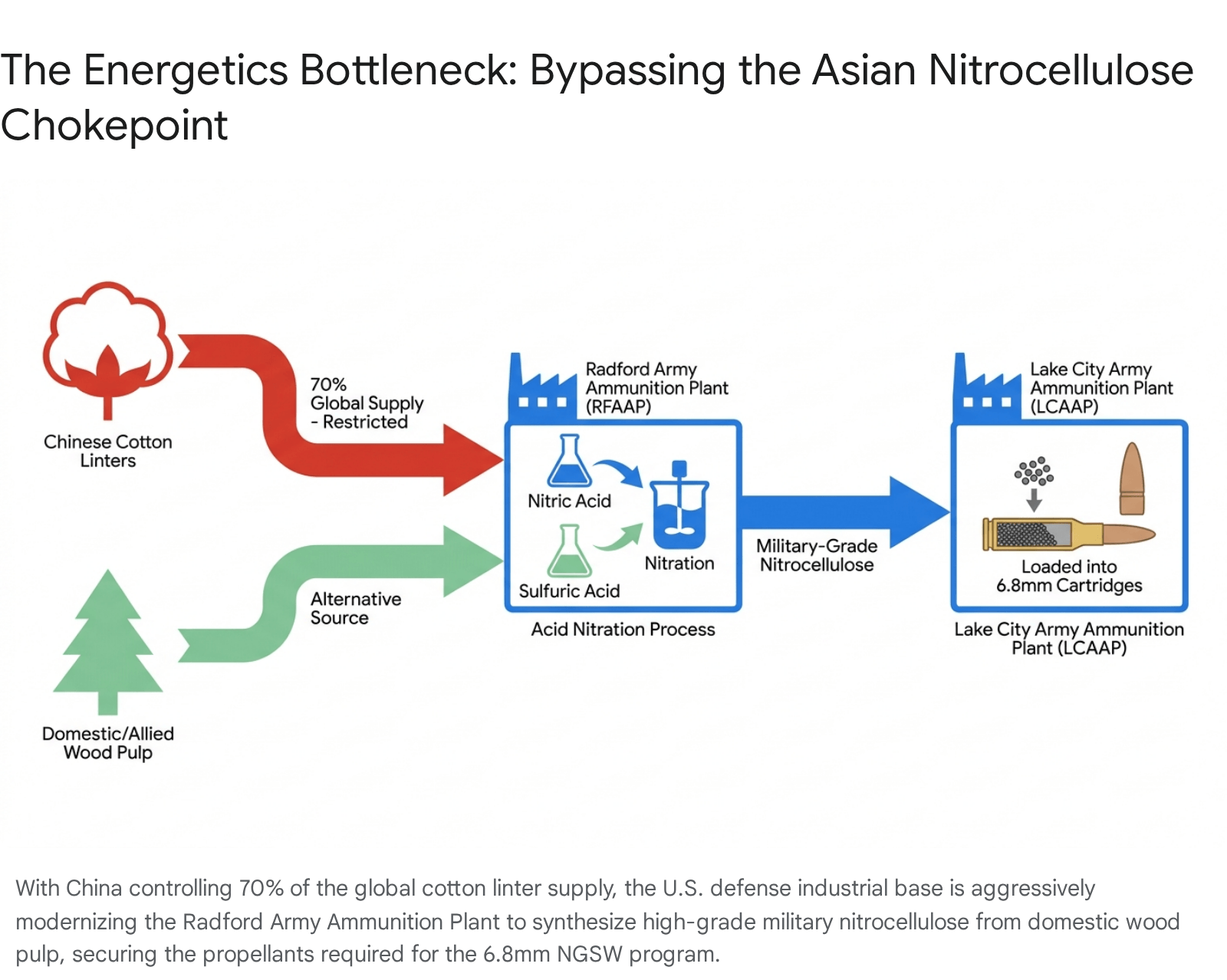
Nitrocellulose is the highly flammable chemical backbone of all modern smokeless propellants, combustible cartridges, and artillery charges.52 It is synthesized by treating purified cellulose with a highly controlled mixture of nitric and sulfuric acids—a process known as nitration.53 Historically, the highest quality nitrocellulose—required to meet the stringent military specifications for uniform combustion, chemical stability, and high nitrogen content (typically between 12.0% and 13.6%)—is derived from cotton linters, which are the short, fine fibers left on the cotton seed after the ginning process.14
The profound strategic vulnerability lies in the extreme geographical concentration of this specific raw material. China controls approximately 70% of the global gun cotton (cotton linter) industry.14 Recognizing the strategic value of this monopoly amid rising global tensions, Beijing has systematically restricted the export of raw cotton linters, strategically pivoting to ensure the Chinese domestic market absorbs its highly subsidized Xinjiang output while simultaneously strangling the upstream precursors available to Western nitrocellulose industries.58
The effects of this embargo have been devastating across the alliance. Europe, despite pledges to drastically increase munitions production, faces an estimated annual shortfall of up to 14,000 tonnes of nitrocellulose due to this dependency on Asian imports, severely limiting the output of major producers like Rheinmetall and Eurenco.52 This manipulation of the cotton supply is part of a broader, deliberate Chinese export control architecture designed to systematically apply pressure to Western defense capabilities, functioning in tandem with the aforementioned rare-earth and antimony restrictions.51
7.2 The Radford Modernization and the Wood Pulp Pivot
To mitigate this existential threat and decouple from Chinese precursors, the U.S. military is aggressively attempting to reshore and redefine its energetics supply chain. The focal point of this massive effort is the Radford Army Ammunition Plant (RFAAP) in southwestern Virginia.8 Operated by BAE Systems Ordnance Systems Inc., RFAAP is the sole active military propellant and nitrocellulose manufacturing center in the United States.9 Like Lake City, Radford is a legacy WWII-era facility that has historically suffered from a chronic lack of modernization funding, resulting in systemic vulnerabilities, outdated power generation, and environmental constraints.8
In direct response to the cotton linter shortage, the DoD and BAE Systems have engineered a complex chemical pivot toward utilizing wood-pulp-based precursors.14 Historically, this transition was highly challenging because wood pulp celluloses tend to produce unpredictable physical characteristics, often resulting in tightly clumped fibers during the shredding and nitration process that inhibit a homogeneous slurry.62 However, recent chemical advancements in acid-to-cellulose ratios and continuous nitration technology have proven that an optimized 70:30 wood pulp-to-cotton linter blend can successfully produce military-grade nitrocellulose. Crucially, Fourier-transform infrared spectroscopy (FT-IR) and gel permeation chromatography (GPC) tests have shown that wood-pulp-derived nitrocellulose achieves an average molecular weight of 55,303 Daltons, closely mirroring the 59,402 Dalton standard of pure cotton linters, confirming structural similarity and decomposition temperatures (~202 °C).56
To operationalize this breakthrough at scale, a massive, multi-phased new Nitrocellulose Production facility was constructed at Radford.8 While this modernized facility began its commissioning phase in 2021 to replace decades-old boiling tubs with a safer, continuous nitration capability, the operation remains fraught with friction.64 Recent environmental incidents, such as a nitric acid spill in April 2026 and a mixed acid leak in June 2026, alongside the lingering cleanup from Hurricane Helene in late 2024—which swept 13 chemical totes into the New River—forcefully demonstrate the persistent fragility of relying on a single geographic node.65 If RFAAP experiences a sustained disruption, the U.S. industrial base has absolutely no redundant capability to produce the propellants required to load the 6.8mm cases manufactured at LCAAP.9
7.3 Advancements in Primer Technology and Ignition Reliability
Simultaneous to the propellant crisis, the energetics supply chain is undergoing a fundamental shift in primer chemistry. The DoD is aggressively phasing out highly toxic lead styphnate percussion primers in favor of environmentally safe, lead-free alternatives to eliminate vaporized and downrange lead.14 Specifically, the transition involves adopting KDNP (4,6-dinitro-7-hydroxybenzofuroxan, potassium salt) and other metastable interstitial composites.14
While Winchester has successfully integrated lead-free primers (such as zinc-core/heavy-metal-free systems) into high-volume commercial and law enforcement training ammunition 66, the military qualification of these compounds for the 80,000 psi 6.8mm cartridge demands rigorous scrutiny. Historically, non-lead primers have exhibited higher velocity variations, unacceptable misfire rates in hot and humid environmental conditions, and questionable long-term shelf-life reliability compared to traditional lead styphnate.67 Maintaining instantaneous, perfectly consistent ignition reliability under the extreme pressures of the.277 FURY chamber is critical for weapon cycling and accuracy. Integrating these new KDNP primers at massive scale at Lake City represents yet another concurrent engineering hurdle that adds friction to the NGSW fielding timeline.
8. Strategic Risk Assessment: Implications for DoD Fielding and Alliance Interoperability
The United States Army has established highly ambitious procurement targets for the Next Generation Squad Weapon program. Over the lifecycle of the program, the DoD intends to procure 111,428 M7 Rifles, 13,334 M250 Machine Guns, and 124,749 advanced XM157 Fire Control systems.5 The ultimate tactical success of this massive logistical transition hinges entirely on the uninterrupted, highly scaled output of the 6.8mm ammunition.42 As Army leadership has explicitly noted, fielding a next-generation weapon without a guaranteed, overflowing supply of training and tactical ammunition is a strategic liability; the pace of ammunition production definitively dictates the pace of weapon deployment.42
8.1 Compounding Single Points of Failure
The current architecture of the 6.8mm supply chain relies on a highly precarious, sequential chain of single-point-of-failure manufacturing nodes.
- The Precursor Node: The U.S. is entirely dependent on the single facility at Radford (RFAAP) to overcome its environmental hurdles and synthesize the requisite nitrocellulose without Chinese interference.8
- The Assembly Node: That nitrocellulose must be transported to the single facility at Lake City (LCAAP), which is currently relying on an unscaled, repurposed interim line to manufacture the highly complex, bi-metallic hybrid casing and assemble the final cartridge.4
- The Human Capital Node: Both massive facilities are subject to the volatile labor dynamics of an exhausted defense workforce, as evidenced by the IAM Local 778 strike that paralyzed Lake City.10
- The Financial Node: The entire LCAAP operation is managed by a corporate entity (Olin Winchester) currently experiencing severe margin compression and massive quarterly losses due to uncontrollable global metal inflation.12
If any single link in this chain breaks—if Chinese antimony export bans halt armor-penetrating projectile production, if a chemical spill halts the nitration lines at Radford, or if another labor dispute strikes Lake City—the entire NGSW deployment schedule faces immediate, unmitigable paralysis.
8.2 Immediate Impacts on the Force
Despite these profound vulnerabilities, initial fielding is proceeding. As of mid-2026, the Army has delivered over 2,000 M7 rifles and 900 M250 automatic rifles to tip-of-the-spear units, including the 101st Airborne Division and the Minnesota Army National Guard’s 34th Infantry Division.2 The M250, weighing significantly less than the legacy M249 despite firing a larger round, and the M7 are receiving highly positive tactical feedback regarding their extended engagement ranges, lethality, and the advanced capabilities of the XM157 fire control optics.37
However, sustaining this momentum requires exponential increases in ammunition delivery. The promised 385 million-round capacity of the new Lake City facility will not be available until equipment installation begins in 2028.3 Until then, the Army must rely perilously on the fragile interim line at LCAAP and the commercial capacity of SIG Sauer in Arkansas, which recently reached a 100-million-round annual milestone to help stave off immediate shortfalls.
8.3 Long-Term Interoperability Challenges for NATO
Furthermore, the U.S. transition to the 6.8mm hybrid cartridge introduces profound, generational logistical complexities for the broader NATO alliance. The 5.56mm SS109 round has served as the unquestioned bedrock of NATO interoperability since 1980.1 The U.S. Army’s unilateral shift to a proprietary, high-pressure, bi-metallic cartridge creates significant allied standardization barriers.27 Key NATO members—including France, Germany, the Netherlands, and the UK—have recently procured entirely new 5.56mm assault rifle fleets, signaling a stark reluctance or fiscal inability to immediately adopt the expensive, unproven, and logistically heavy 6.8mm ecosystem.1 Consequently, the U.S. defense industrial base will be forced to maintain dual-track supply chains for decades. Facilities like Lake City will have to perpetually manage the massive legacy production of 5.56mm and 7.62mm to support NATO and FMS obligations, alongside scaling the bespoke 6.8mm requirements for domestic forces, further straining the already taxed industrial infrastructure.
9. Conclusion
The Next Generation Squad Weapon program represents a necessary and highly lethal evolution in infantry warfare, explicitly designed to counter the proliferation of advanced body armor among near-peer adversaries. The 6.8×51mm cartridge achieves this required ballistic overmatch through brilliant, albeit highly complex, hybrid-casing engineering capable of safely containing 80,000 psi.
However, as of mid-2026, the Department of Defense’s ability to field this revolutionary capability at strategic scale is deeply compromised by a perfect storm of industrial fragility. The U.S. organic industrial base is attempting to rapidly modernize 1940s-era facilities (Lake City and Radford) to produce 21st-century technology, all while navigating a hostile macroeconomic environment. Olin Winchester’s catastrophic margin compression, driven by uncontrollable copper, zinc, and antimony inflation, drastically reduces the corporate capital available to seamlessly weather operational shocks. Concurrently, the May 2026 IAM Local 778 strike at Lake City exposed the extreme vulnerability of relying on an exhausted, centralized workforce to manage dual-track legacy and next-generation production.
Above all, the geopolitical weaponization of the nitrocellulose and energetics supply chain by China underscores a profound national security threat that transcends small-arms ammunition, threatening the entire spectrum of U.S. munitions readiness. To secure the NGSW rollout, defense planners must aggressively fund the completion of the 2028 Lake City expansion, maximize operational consistency at Radford to break the Chinese cotton monopoly, and actively seek secondary sourcing and alternative manufacturing technologies (such as the novel nitrocellulose-free propellant technologies currently being piloted by BAE Systems in the UK, expected to mature by late 2026 52) to alleviate the reliance on specialized supply chains. Failure to harden these single points of failure will inevitably result in prolonged fielding delays, rendering the Army’s most ambitious modernization effort hostage to entirely predictable industrial and geopolitical bottlenecks.
Please share the link on Facebook, Forums, with colleagues, etc. Your support is much appreciated and if you have any feedback, please email us in**@*********ps.com. If you’d like to request a report or order a reprint, please click here for the corresponding page to open in new tab.
Sources Used
- NATO and the Next Generation Squad Weapon- NGSW – Wavell Room, accessed June 26, 2026, https://wavellroom.com/2024/09/17/nato-and-the-next-generation-squad-weapon-ngsw/
- .277 Fury — Grokipedia, accessed June 26, 2026, https://grokipedia.com/page/.277_Fury
- Army Breaks Ground on Huge New 6.8mm Next Gen Ammo Plant – Guns.com, accessed June 26, 2026, https://www.guns.com/news/2025/02/12/army-breaks-ground-on-huge-new-68mm-next-gen-ammo-plant
- Delivering tomorrow’s small caliber ammunition lethality today | Article – Army.mil, accessed June 26, 2026, https://www.army.mil/article/291858/delivering_tomorrows_small_caliber_ammunition_lethality_today
- Next Generation Squad Weapon – Wikipedia, accessed June 26, 2026, https://en.wikipedia.org/wiki/Next_Generation_Squad_Weapon
- 277 Sig Fury (6.8×51): Ballistics, Vs. 5.56 and .308, and The Future – Bear Creek Arsenal, accessed June 26, 2026, https://www.bearcreekarsenal.com/blog/277-sig-fury-6-8-51-guide.html
- Groundbreaking Ceremony for State-of-the-Art 6.8mm Ammunition Facility at Lake City Army Ammunition Plant, accessed June 26, 2026, https://winchester.com/Support/Media/In-The-News/2025/02/12/Groundbreaking-Ceremony-for-State-of-the-Art-Ammunition-Facility-at-Lake-City-Plant
- BAE Radford Army Ammunition Plant (RFAAP) – Fluor, accessed June 26, 2026, https://www.fluor.com/projects/bae-radford-army-ammunition-plant
- The Energetics Bottleneck Threatening U.S. Munitions Production – Defense Security Monitor, accessed June 26, 2026, https://dsm.forecastinternational.com/2026/06/24/the-energetics-bottleneck-threatening-u-s-munitions-production/
- Ammunition Plant Workers Ratify New Deal That Addresses ‘Countless Hours of Overtime’, accessed June 26, 2026, https://www.manufacturing.net/operations/news/22966449/ammunition-plant-workers-ratify-new-deal-that-addresses-countless-hours-of-overtime
- Hundreds of IAM Local 778 Members Rally at Olin Winchester’s Lake City Army Ammunition Plant Strike Line, accessed June 26, 2026, https://www.goiam.org/news/hundreds-of-iam-local-778-members-rally-at-olin-winchesters-lake-city-army-ammunition-plant-strike-line/
- Ammo Prices Rising as Costs Squeeze Manufacturers | The Boise Gun Club Handbook, accessed June 26, 2026, https://boisegunclub.com/handbook/ammo-prices-rising-as-costs-squeeze-manufacturers
- Olin (NYSE: OLN) swings to Q1 2026 loss with EBITDA down, leverage up – Stock Titan, accessed June 26, 2026, https://www.stocktitan.net/sec-filings/OLN/8-k-olin-corp-reports-material-event-b3a622e83c69.html
- Guide to the 2026 Global Ammunition Supply Chain and Energetics Crisis – Ronin’s Grips, accessed June 26, 2026, https://blog.roninsgrips.com/guide-to-the-2026-global-ammunition-supply-chain-and-energetics-crisis/
- Ammo Shortage Likely : r/guns – Reddit, accessed June 26, 2026, https://www.reddit.com/r/guns/comments/1rqqqgs/ammo_shortage_likely/
- Defense Ammo – SIG Sauer, accessed June 26, 2026, https://www.sigsauer.com/defense-ammo
- SIG Ammunition Produced & Delivered Over 825000 Rounds of 6.8x51mm Composite Case Ammo for US Army Next Generation Squad Weapons Program Prototype Test #2 | Soldier Systems Daily, accessed June 26, 2026, https://soldiersystems.net/2021/01/27/sig-ammunition-produced-rounds-of-6-8x51mm/
- MCX-SPEAR 6.8X51 – SIG Sauer, accessed June 26, 2026, https://www.sigsauer.com/mcx-spear-6-8-x-51.html
- Understanding Ammunition Price Hikes in 2026 – Ronin’s Grips, accessed June 26, 2026, https://blog.roninsgrips.com/understanding-ammunition-price-hikes-in-2026/
- Chambering the Next Round: Emergent Small-calibre Cartridge Technologies, accessed June 26, 2026, https://www.smallarmssurvey.org/sites/default/files/resources/SAS-WP23-cartridge-technologies.pdf
- Next Gen Assault Rifles Analysis | PDF | Cartridge (Firearms) | Gun Barrel – Scribd, accessed June 26, 2026, https://www.scribd.com/document/877045282/Analysis-on-the-Next-Generation-Ass
- (PDF) Projectile for a New Intermediate Cartridge – ResearchGate, accessed June 26, 2026, https://www.researchgate.net/publication/366986459_Projectile_for_a_New_Intermediate_Cartridge
- 277 SIG FURY, 155GR HYBRID MATCH – Sig Sauer, accessed June 26, 2026, https://www.sigsauer.com/277-sig-fury-hybrid-match.html
- SIG Sauer NGSW-R MCX Spear .277 Fury: First Look – Guns and Ammo, accessed June 26, 2026, https://www.gunsandammo.com/editorial/sig-sauer-ngsw-mcx-spear-277-fury-rifle/457200
- .277 SIG Fury Demystified – GunsAmerica, accessed June 26, 2026, https://gunsamerica.com/digest/277-sig-fury-demystified/
- MISSILE, BALLISTICS AND SOLDIER SYSTEMS UPDATE, accessed June 26, 2026, https://battle-updates.com/update/missile-ballistics-and-soldier-systems-update-99/
- Next-Generation Squad Weapon (NGSW) Ammunition (6.8mm) Market Insights – syg.ma, accessed June 26, 2026, https://syg.ma/@sharvari-kumbhare/next-generation-squad-weapon-ngsw-ammunition-68mm-market-insights
- 277 SIG Fury | Shooters’ Forum, accessed June 26, 2026, https://forum.accurateshooter.com/threads/277-sig-fury.3994472/
- Analysis on the Next Generation Assault Rifles and Ammunition Designed for the US Army – Biblioteka Nauki, accessed June 26, 2026, https://bibliotekanauki.pl/articles/1837980.pdf
- Army breaks ground on state-of-the-art 6.8 mm ammunition production facility | Article, accessed June 26, 2026, https://www.army.mil/article/282896/army_breaks_ground_on_state_of_the_art_6_8_mm_ammunition_production_facility
- Environmental Assessment and Draft Finding of No Significant Impact Next Generation Squad Weapon – Ammunition Manufacturing Facility – USACE Digital Library, accessed June 26, 2026, https://usace.contentdm.oclc.org/digital/api/collection/p16021coll7/id/12277/download
- EXTREME MAKEOVER – USAASC – Army.mil, accessed June 26, 2026, https://asc.army.mil/web/news-extreme-makeover/
- Strategic Implications of the Lake City Army Ammunition Plant Strike Resolution and Supply Chain Realignment – Ronin’s Grips, accessed June 26, 2026, https://blog.roninsgrips.com/strategic-implications-of-the-lake-city-army-ammunition-plant-strike-resolution-and-supply-chain-realignment/
- Impact Analysis of the April 2026 IAM Local 778 Strike at the Lake City Army Ammunition Plant – Ronin’s Grips, accessed June 26, 2026, https://blog.roninsgrips.com/impact-analysis-of-the-april-2026-iam-local-778-strike-at-the-lake-city-army-ammunition-plant/
- What the Winchester Strike Means for American Ammunition Manufacturing – Detroit Ammo Co., accessed June 26, 2026, https://detroitammoco.com/blog/what-the-winchester-strike-means-for-american-ammunition-manufacturing
- U.S. Army Awards Winchester $20 Million Series of Next Generation Squad Weapons Contracts | thefirearmblog.com, accessed June 26, 2026, https://www.thefirearmblog.com/blog/2022/01/07/u-s-army-awards-winchester-20-million-series-of-next-generation-squad-weapons-contracts/
- Next Generation Squad Weapon continues fielding, seeing upgrades – Army Times, accessed June 26, 2026, https://www.armytimes.com/newsletters/daily-news-roundup/2025/10/14/next-generation-squad-weapon-continues-fielding-seeing-upgrades/
- National Guard units get the new M250 machine gun – Task & Purpose, accessed June 26, 2026, https://taskandpurpose.com/news/national-guard-m250/
- Archive for the ‘Acquisition’ Category – Soldier Systems, accessed June 26, 2026, https://soldiersystems.net/category/acquisition/
- Your FREE weekly paper – Navy Dispatch, accessed June 26, 2026, https://www.navynews.com/archive_papers/2026Papers/ndpaper042326.pdf
- Project Manager Soldier Lethality Announces Type Classification Approval for Next Generation Squad Weapons (NGSW) | Article | The United States Army, accessed June 26, 2026, https://www.army.mil/article/285678/project_manager_soldier_lethality_announces_type_classification_approval_for_next_generation_squad_weapons_ngsw
- 6.8x51mm (.277 Fury): Why did the U.S. Army Choose It? – Pew Pew Tactical, accessed June 26, 2026, https://www.pewpewtactical.com/6-8x51mm-277-fury/
- 1350 Olin workers ratify contract, end strike at Missouri Winchester factory, accessed June 26, 2026, https://www.manufacturingdive.com/news/olin-winchester-iam-local-778-ratify-contract-lake-city-army-missouri/819503/
- Winchester Ammo Q4 Profits Tumble on Pricing Pressures | SGB Media Online, accessed June 26, 2026, https://sgbonline.com/winchesters-q3-profits-tumble-on-ammo-pricing-pressures/
- Document – SEC.gov, accessed June 26, 2026, https://www.sec.gov/Archives/edgar/data/74303/000007430326000060/exhibit991q12026earningspr.htm
- Trump’s Tariffs Are Driving Up Ammo Prices – The Trace, accessed June 26, 2026, https://www.thetrace.org/2026/03/trump-tariffs-ammunition-prices/
- Olin Corporation Q1 2026 Earnings Recap – AllInvestView, accessed June 26, 2026, https://www.allinvestview.com/earnings/OLN/q1-2026/
- Federal, CCI, Remington and Other Major Ammo Brands Announce April 2026 Price Increases – Target Sports USA, accessed June 26, 2026, https://blog.targetsportsusa.com/federal-cci-remington-ammo-price-increase-april-2026/
- Metal prices outlook: supply constraints, clean energy demand, and market risks, accessed June 26, 2026, https://blogs.worldbank.org/en/opendata/metal-prices-poised-to-strengthen-further
- Trump’s Tariffs Are Driving up Ammunition Prices, accessed June 26, 2026, https://smokinggun.org/trumps-tariffs-are-driving-up-ammunition-prices/
- China’s Export Controls: Critical Minerals and Strategic Pressure Points. – Andersen Institute, accessed June 26, 2026, https://anderseninstitute.org/chinas-export-control-architecture-and-its-use-of-critical-minerals-as-strategic-pressure-points/
- Running on empty: the chemical shortage undermining European defence, accessed June 26, 2026, https://www.epc.eu/publication/running-on-empty-the-chemical-shortage-undermining-european-defence/
- Nitrocellulose, propellant paste and premix – Rheinmetall, accessed June 26, 2026, https://www.rheinmetall.com/en/products/weapons-and-ammunition/propulsion/nc-rm-pvk
- Nitrocellulose – Wikipedia, accessed June 26, 2026, https://en.wikipedia.org/wiki/Nitrocellulose
- Selecting appropriate cellulose morphology to enhance the nitrogen content of nitrocellulose – RSC Publishing, accessed June 26, 2026, https://pubs.rsc.org/en/content/articlehtml/2024/ra/d4ra04172k
- Invention of novel continuous nitropulper technology for producing commercial nitrocellulose of wood pulp sheet – PMC, accessed June 26, 2026, https://pmc.ncbi.nlm.nih.gov/articles/PMC12311026/
- The Correlation of Nitrocellulose Properties and Cellulose Feedstock Crystal Structure. – DTIC, accessed June 26, 2026, https://apps.dtic.mil/sti/tr/pdf/ADA118677.pdf
- Nitrocellulose Crisis: Geopolitical Chokepoints and Market …, accessed June 26, 2026, https://blog.roninsgrips.com/nitrocellulose-crisis-geopolitical-chokepoints-and-market-vulnerabilities/
- EU’s defence chemicals shortage ‘exposes further dependency on China’ – Brussels Signal, accessed June 26, 2026, https://brusselssignal.eu/2025/06/eus-defence-chemicals-shortage-exposes-further-dependency-on-china/
- Maximizing Value Through Innovation & Collaboration: The Radford Army Ammunition Plant and the New River Valley, accessed June 26, 2026, https://cece.vt.edu/content/dam/cece_vt_edu/projects/Maximizing%20Value%20Through%20Innovation%20and%20Collaboration%20The%20Radford%20Army%20Ammunition%20Plant%20and%20the%20NRV.pdf
- Radford Army Ammunition Plant | Virginia DEQ, accessed June 26, 2026, https://www.deq.virginia.gov/news-info/shortcuts/topics-of-interest/radford-army-ammunition-plant
- Woodpulp Crystal Structure and Its Effect on Nitrocellulose Physical Properties – DTIC, accessed June 26, 2026, https://apps.dtic.mil/sti/tr/pdf/ADA088412.pdf
- Army program secures critical component for artillery, mortar ammunition | Article, accessed June 26, 2026, https://www.army.mil/article/118465/army_program_secures_critical_component_for_artillery_mortar_ammunition
- Radford moves to commissioning phase of a new nitrocellulose facility – BAE Systems, accessed June 26, 2026, https://www.baesystems.com/en/story/radford-moves-to-commissioning-phase-of-a-new-nitrocellulose-facility
- Radford Army Ammunition Plant highlights environmental progress, accessed June 26, 2026, https://www.army.mil/article/288704/radford_army_ammunition_plant_highlights_environmental_progress
- Super Clean – Winchester Ammunition, accessed June 26, 2026, https://winchester.com/Products/Ammunition/Handgun/Super-Clean
- US20120152140A1 – Lead-free primers – Google Patents, accessed June 26, 2026, https://patents.google.com/patent/US20120152140A1/en
- Medium Caliber Lead-Free Electric Primer. Version 2 – DTIC, accessed June 26, 2026, https://apps.dtic.mil/sti/tr/pdf/ADA582349.pdf
- Super Clean Handgun Ammunition – Winchester Law Enforcement, accessed June 26, 2026, https://winchesterle.com/Ammunition/Products/Handgun/Super-Clean
- Lead-free primer residues: a qualitative characterization of Winchester WinClean, Remington/UMC LeadLess, Federal BallistiClean, and Speer Lawman CleanFire handgun ammunition – PubMed, accessed June 26, 2026, https://pubmed.ncbi.nlm.nih.gov/16696698/
- Performance testing of lead free primers: blast waves, velocity variations, and environmental testing – arXiv, accessed June 26, 2026, https://arxiv.org/pdf/1410.6390
- Does Ammunition Expire? Understanding Shelf Life and Storage Best Practices, accessed June 26, 2026, https://www.safesidetactical.com/blog/does-ammunition-expire-understanding-shelf-life-and-storage-best-practices
- Winchester Awarded NGSW Ammunition Production Contract from the U.S. Army, accessed June 26, 2026, https://fragoutmag.com/winchester-awarded-ngsw-ammunition-production-contract-us-army/