Executive Summary
The landscape of modern urban law enforcement has undergone a structural paradigm shift, transitioning from intelligence-led, proactive interdiction to a framework defined by perpetual, reactive crisis management. An exhaustive analysis of 2026 operational data, deployment statistics, and urban crime metrics indicates that patrol officers have been systematically stripped of the temporal, operational, and cognitive bandwidth required to engage in proactive policing. Driven by severe staffing attrition, the exponential stacking of dispatch calls, and compounding administrative reporting demands, law enforcement agencies are currently operating in a continuous state of triage. This assessment, designed for the Ronin’s Grips Analytics audience of law enforcement procurement officers, military analysts, and defense professionals 1, quantifies these tactical failures and forecasts the subsequent impact on urban violent crime rates and evidence gathering.
The death of proactive policing—defined as self-initiated officer activity designed to prevent crime, disrupt illicit networks, and build community intelligence—carries profound tactical and societal implications. Data demonstrates that the disbandment of specialized tactical units to backfill patrol shortages, coupled with the functional reality that patrol units are bound exclusively to 911 dispatch cycles, has resulted in severely degraded response times. This degradation directly correlates with compromised crime scene integrity, a steep decline in the collection of actionable forensic evidence, and historically low homicide clearance rates. Consequently, the reduction in officer-initiated deterrence catalyzed a demonstrable surge in urban violent crime during the early 2020s, specifically firearm-related homicides and aggravated assaults.
By analyzing comprehensive datasets, including the 2026 “What Cops Want” survey of 1,777 active law enforcement officers, studies from the National Academy of Sciences (NAS), agent-based modeling on response deployment, and empirical data on the “Minneapolis Effect,” this report provides a deeply quantitative look at the future of urban security. The findings definitively prove that reacting to crime after it has occurred is insufficient for maintaining public safety, establishing that until law enforcement agencies are resourced and structured to prioritize intelligence-led crime prevention, urban environments will remain trapped in a reactive cycle that fundamentally fails to protect communities.
The Tactical Architecture: Proactive Versus Reactive Policing
To understand the operational collapse currently affecting urban law enforcement, it is necessary to rigorously define the two primary modalities of police deployment: reactive and proactive policing. Decades of criminological evolution have shaped these approaches, and understanding their distinct mechanisms is critical for evaluating the current data.
The Standard Reactive Model
Reactive policing is epitomized by officers responding to calls for service generated by the public, predominantly through the 911 dispatch system.2 Historically, this model dominated the 20th century, reaching its peak before the advent of sophisticated crime data analysis capabilities.3 Law enforcement agencies utilized the limited resources and technology available to them—primarily radios and patrol vehicles—to execute what is commonly known as the “Three Rs”: Randomized patrols, Rapid response, and Reactive investigations.3
The underlying theory of the reactive model is that a rapid response to an emergency call will interrupt ongoing crimes, lead to the immediate apprehension of the offender, and deter future offenses through the visible presence of random patrol.3 However, extensive empirical research, beginning with the landmark 1970s Kansas City Response Time Analysis, demonstrated that this primarily reactive approach had severe shortcomings.4 Randomly patrolling large areas based primarily on instinct or delayed dispatch data proved ineffective at reducing aggregate crime rates and, in many instances, alienated the communities being policed.3 The reactive model is fundamentally a system of post-incident damage control; it addresses the symptoms of urban violence only after the primary harm has been inflicted upon the victim.
The Evolution of Proactive Policing
In response to rising crime rates and growing skepticism regarding the effectiveness of standard reactive approaches in the 1980s and 1990s, innovative police practices were developed.5 Proactive policing is defined as policing strategies that have as one of their primary goals the prevention or reduction of crime and disorder, and that are not reactive in terms of focusing primarily on uncovering ongoing crime or responding to crimes once they have occurred.6
The National Academies of Sciences, Engineering, and Medicine (NAS) recently published a comprehensive survey of proactive policing strategies, confirming that proactive approaches hold great promise for preventing and reducing crime.2 The NAS report categorizes these strategies into four primary vectors:
| Proactive Strategy Category | Tactical Definition | Examples of Implementation | Crime Reduction Efficacy |
| Place-Based Approaches | Concentrating police resources and tactical presence in geographically defined micro-locations (hot spots) where crime is highly concentrated. | Hot Spots Policing, Predictive Policing mapping, Closed Circuit Television (CCTV) monitoring.8 | High. Generates statistically significant areawide crime-reduction impacts.5 Capitalizes on the “law of crime concentration”.10 |
| Problem-Solving Approaches | Identifying underlying systemic issues that generate repeated calls for service and developing tailored, multi-agency solutions to address root causes. | Problem-Oriented Policing (POP), Third-Party Policing, utilizing the SARA (Scanning, Analysis, Response, Assessment) model.8 | Moderate to High. Highly effective for disorder-related calls and chronic community nuisance issues.12 |
| Person-Focused Approaches | Directing enforcement, deterrence, and social services toward specific individuals or groups known to drive a disproportionate amount of violent crime. | Focused Deterrence (e.g., Ceasefire programs), gang interdiction, Stop, Question, and Frisk (SQF).8 | High. Generates large effect sizes in reducing gang violence and street crime driven by illicit drug markets.5 |
| Community-Based Approaches | Fostering mutual cooperation between the police and the community to identify crime drivers, improve legitimacy, and facilitate intelligence gathering. | Community-Oriented Policing, Procedural Justice initiatives.2 | Moderate. Produces modest short-term improvements in citizen perceptions of police performance and legitimacy.5 |
Table 1: Categorization and efficacy of proactive policing strategies based on the National Academies of Sciences (NAS) framework.2
The central mechanism of proactive policing is deterrence. In terms of aggregate criminal behavior, deterrence occurs when potential offenders perceive their risk of apprehension to be high, and the perceived benefits of the crime do not outweigh those risks.14 Proactive units artificially inflate this perceived risk by projecting a sustained, highly visible presence in high-crime nodes, directly disrupting the logistical networks of illicit drug markets and illegal firearm carriers.14
However, the intake of New Public Management (NPM) principles into modern government administration has created a strategic duality that works against proactive policing. NPM strategies generate a demand for institutional accountability based strictly on easily measurable performance indicators, such as the volume of 911 calls answered, response times, and the number of reports filed.16 Because the primary metric of successful proactive policing is a non-event—the absence of a crime that was deterred—it resists simple quantification. Consequently, law enforcement agencies face immense pressure to prioritize measurable reactive tasks over the less easily documented, yet vastly more effective, proactive strategies.16
Quantifying the 2026 Patrol Reality: Attrition, Dispatch, and Friction
To accurately forecast the trajectory of urban crime, one must examine the daily operational reality of the personnel tasked with intercepting it. The 2026 “What Cops Want” survey, launched by Police1, gathered comprehensive data from 1,777 active sworn personnel working in patrol or field operations across the United States.17 This dataset, spanning officers assigned to standard patrol, traffic, K-9, and line supervision, provides a stark, data-driven portrait of a profession buckling under the weight of reactive demands.17
The data confirms that the fundamental architecture of a modern patrol shift has been entirely stripped of the temporal bandwidth necessary for proactive intervention. According to the 2026 metrics, one in four patrol officers (25%) reported spending absolutely zero time engaging in proactive policing during their most recent shift.18 Instead, officers are locked in a continuous, fragmented loop of moving from one emergency call to the next.
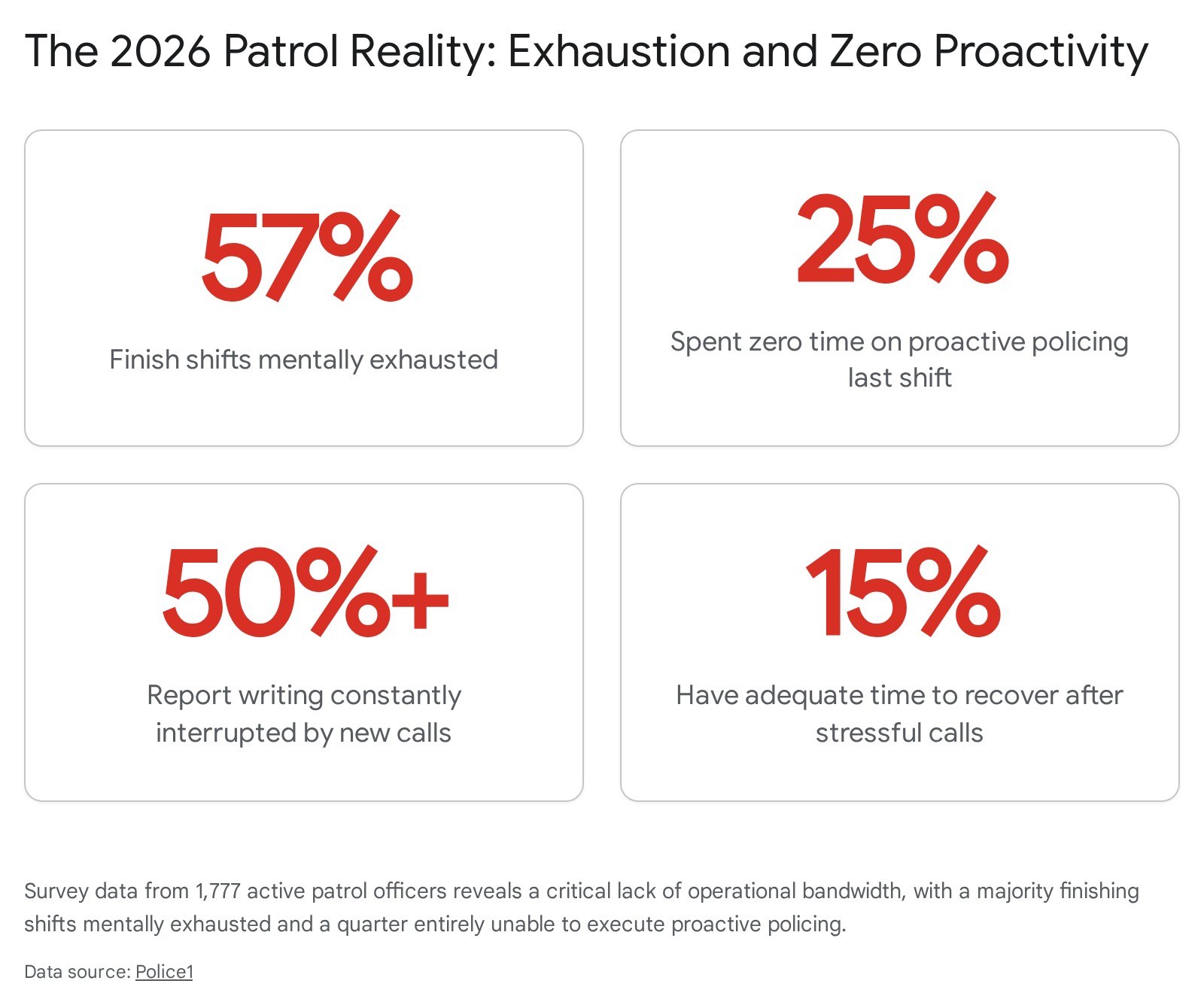
The cognitive and physical toll of this operational tempo is severe, directly degrading tactical readiness. The survey indicates that only 15% of officers have adequate time to recover after stressful or physically demanding calls.18 Consequently, 57% of officers finish their shifts mentally exhausted.18 Fatigue of this magnitude in a high-consequence environment is a critical tactical vulnerability. Exhaustion fundamentally degrades situational awareness, slows the Observe-Orient-Decide-Act (OODA) loop essential for tactical decision-making, and significantly increases the likelihood of critical errors during dynamic, high-risk encounters.
Furthermore, this operational stress is compounded by a profound disconnect between field operators and executive leadership. Only 30% of surveyed officers believe agency leadership understands the realities of modern patrol, while 84% state that leaders should periodically be required to work a patrol shift to comprehend the current environment.18 This disconnect breeds internal friction, leading to severe retention issues that further exacerbate staffing shortages.20
The Paralysis of Administrative Friction
Beyond the physical demands of call response, patrol officers are subjected to paralyzing administrative burdens. The 2026 data reveals that more than half of all patrol officers report that their administrative report writing is “often or always” interrupted by new dispatch calls.18 This fragmentation of workflow forces units into a perpetual state of “catch-up”.21
When officers are consistently behind on documentation, the quality of intelligence gathered at the scene inherently suffers. Hastily written, interrupted reports omit crucial environmental details, suspect descriptions, and nuanced witness statements. This creates a cascading failure across the criminal justice continuum; investigators receive degraded intelligence, crime analysts lack accurate data to map emerging hot spots, and prosecutors are provided with inherently weaker case files.13
The Burden of Social Triage
The lack of proactive time is not solely driven by criminal incidents; it is overwhelmingly fueled by the expansion of the police mandate into complex social service domains. Law enforcement is increasingly tasked with handling mental health crises, substance abuse issues, and homelessness interventions—matters that fall far outside the traditional parameters of crime control and tactical intervention.
A 2026 survey conducted by the Alliance for Safety and Justice highlights the scale of this misalignment. According to the data, a staggering 92% of surveyed law enforcement officers agree that police departments are currently overburdened with a wide range of social problems that extend beyond crime.22 Between 80% and 92% of these officers agree that offloading these non-criminal social issues to dedicated, specialized neighborhood programs would drastically reduce the burden on patrol units, making their jobs safer and inherently improving community safety.23 Because officers are tied up acting as social workers of last resort on low-level disorder calls, the temporal void left behind in high-risk sectors is rapidly filled by unmitigated, violent criminal activity.
The Cannibalization of Specialized Units and Staffing Deficits
The systemic inability to engage in proactive policing is fundamentally rooted in a historic workforce crisis that has hollowed out the institutional knowledge of law enforcement agencies. Over the past decade, the profession has faced an unprecedented contraction in available personnel. This attrition is driven by a convergence of factors: baby boomers entering retirement, a shrinking recruitment pool, widespread negative public perception stemming from 2020 social unrest, and generational shifts where younger demographics reject the rigid structures and emotional trauma associated with a 25-year policing career.25
Faced with a shrinking pool of sworn personnel, agency executives are forced to make draconian tactical compromises just to maintain the minimum patrol staffing levels required to answer 911 calls. The primary mechanism for achieving this baseline has been the systematic cannibalization of specialized, proactive investigative units. Agencies have routinely disbanded gang enforcement teams, narcotics task forces, auto theft details, and proactive traffic units, reassigning these highly trained personnel back to basic reactive patrol operations.27
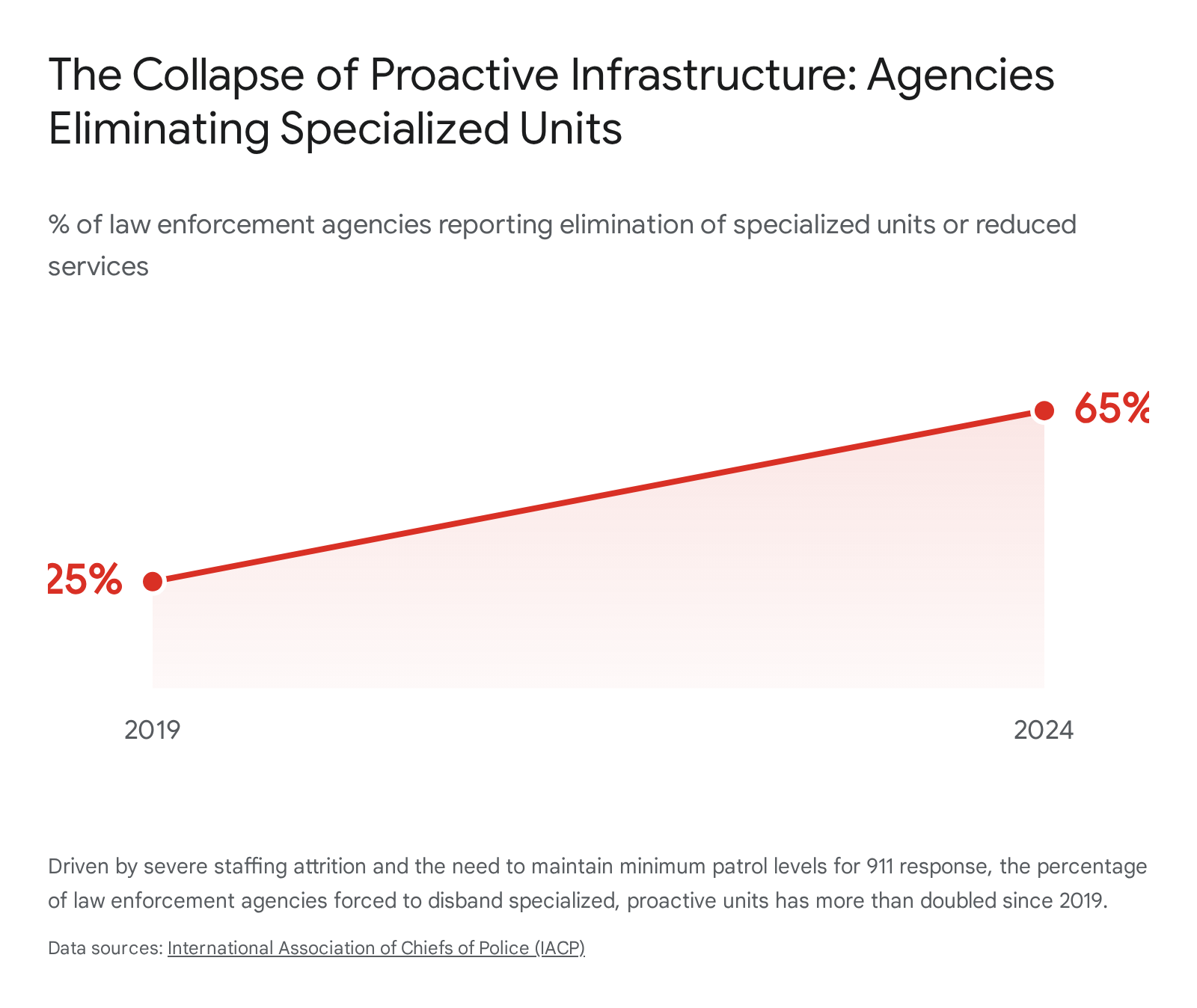
The statistical acceleration of this tactical regression is alarming. A comprehensive nationwide survey of 1,158 agencies conducted by the International Association of Chiefs of Police (IACP) quantified this collapse. In the 2024 results, 65% of responding agencies reported having to reduce services or eliminate specialized units entirely because of severe staffing shortages.29 To contextualize the speed of this operational degradation, that figure stood at only 25% as recently as 2019.29
The magnitude of these shortages affects jurisdictions of all sizes. Major municipalities are operating with deficits measured in the hundreds or thousands of officers. For example, recent data indicated Baltimore was operating with only 1,981 officers against a critical need of 2,600, despite ongoing hiring efforts that were completely negated by resignations.25 Indianapolis reported operating with nearly 300 fewer officers than its 2019 baseline, prompting requests for state trooper assistance to manage urban call volumes.25 In smaller jurisdictions, the crisis is existential; towns like Goodhue, Minnesota, and Washburn, Illinois, have seen their entire police departments disband over staffing and compensation disputes, shifting the tactical burden to county sheriffs who are already covering vast geographic areas.25
The tactical impact of disbanding specialized units is profound. These units are the primary vectors for advanced proactive policing.30 They do not rely on 911 calls; instead, they utilize human intelligence sources, continuous surveillance, deep data analysis of criminal networks, and complex undercover sting operations to dismantle organizations before violence erupts.30 When a gang unit is disbanded, the agency loses the ability to map rivalries, identify trigger-pullers, and conduct focused deterrence.13 By stripping away the precise, surgical capabilities of specialized units, agencies are left with a blunt, reactive instrument that can only record crime statistics, not suppress them.
Mathematical Failure: Call Stacking and Dispatch Triage
When proactive units are eliminated and all remaining human assets are funneled into general patrol, the entire agency’s operational tempo becomes dictated by the Computer-Aided Dispatch (CAD) system. Because agencies are operating with skeletal staffing against an undiminished volume of public requests, incoming calls for service inevitably outpace the availability of deployable units. This imbalance creates a phenomenon known as “call stacking,” where pending emergency and non-emergency incidents pile up in the dispatch queue, awaiting an available officer.
The resulting degradation in police response times is severe, geographically widespread, and mathematically unavoidable. Recent spatial data mapping high-priority response times illustrates this systemic failure. High-priority calls are strictly defined as incidents involving an immediate danger to life, serious injury, or urgent situations where swift tactical intervention is mandatory (e.g., active shooters, armed robberies in progress, major casualty crashes).32
In Portland, Oregon, a detailed analysis of 50,000 high-priority calls from 2025 revealed catastrophic delays. The data showed that the citywide average response time for life-safety emergencies was approximately 21 minutes, drastically exceeding the police bureau’s own strategic target of responding to 75% of such calls in under 10 minutes.32 In certain outer sectors of the city—specifically tracts in the extreme western and eastern edges, as well as the Beaumont-Wilshire, Mount Tabor, Eastmoreland, and Lents neighborhoods—average response times for critical emergencies stretched between 27 and 35 minutes.32
This delay is not due to officer apathy; it is a function of resource allocation and triage. High-priority incidents require massive resource commitments. A single serious incident—such as a homicide investigation, an armed barricaded subject, or a large civil disturbance—can strip an entire precinct of all available officers for an extended period to establish perimeters, secure scenes, and neutralize ongoing threats.33 When a precinct’s resources are locked down on a single major incident, all other incoming calls—even subsequent high-priority events—are immediately stacked.33 911 systems operate on a triage basis, prioritizing the most immediate threats to life, meaning lower-priority property crimes, disturbances, or delayed reports can languish in the queue for hours or days.33
Furthermore, minor operational friction points compound these systemic delays. For instance, an audit of the Oakland Police Department’s dispatch data revealed that utilizing outside language interpreters for over 17,000 calls (predominantly Mandarin, Cantonese, and Spanish) added an average of five minutes to the duration of each interpreted call.34 In a system operating at maximum capacity, these five-minute increments rapidly accumulate, severely degrading the dispatch center’s bandwidth and delaying the dispatch of critical field units.
Recent academic investigations into deployment strategies via agent-based modeling (ABM) highlight that while increasing police capacity has limitations, the strategy of deployment heavily influences response times. Strategic, stationary positioning of officers outperforms random patrol in achieving fast response times, particularly in understaffed conditions.4 However, when officers are constantly moving from one stacked call to the next, stationary, strategic deployment becomes impossible, ensuring that response times remain chronically high.
| Operational Metric | Traditional Benchmark Target | Observed 2025/2026 Reality | Tactical Impact of Variance |
| High-Priority Response Time | < 10 Minutes | 19.5 – 21 Minutes (Citywide Avg) 32 | Suspects flee the immediate area; threat to victims persists longer; perimeter establishment fails. |
| Outlying Sector Response Time | < 15 Minutes | 28 – 35 Minutes 32 | Total loss of the “Golden Hour” of investigation; complete erosion of community trust in emergency services. |
| Major Incident Resource Drain | Localized to Sector | Entire City/Precinct Depleted 33 | Cascading call stacking; secondary crimes occur unhindered due to known police absence. |
| Administrative / Report Friction | Dedicated End-of-Shift Time | Interrupted in >50% of instances 18 | Reduced documentation quality; cognitive fatigue; delayed transfer of intelligence to investigative units. |
Table 2: The variance between strategic law enforcement benchmarks and the observed operational reality in major municipalities, highlighting the downstream tactical impacts of resource starvation and call stacking.
The Erosion of Evidence Gathering and Case Solvability
The mechanical failure of rapid response times directly paralyzes the criminal justice system’s ability to hold violent offenders accountable. In a reactive policing model, the probability of clearing a case (identifying, arresting, and charging the perpetrator) is inversely proportional to the time it takes for an initial officer to arrive on the scene.36
A landmark econometric study by Jordi Blanes i Vidal and Tom Kirchmaier, which analyzed over 300,000 crimes utilizing internal data from the Greater Manchester Police Department, demonstrated a profound, causal statistical relationship between response times and clearance rates.36 The research empirically established that a 10% increase in police response time leads to a 4.7 percentage point decrease in the likelihood of clearing the crime. The study found that these effects are large for every type of crime, though slightly stronger for thefts than for violent offenses.37
When police arrive rapidly, they maximize two critical investigative vectors: culprit-presence detection (the likelihood of apprehending the suspect fleeing the immediate vicinity) and the acquisition of high-quality witness testimony.36 When response times stretch to 20 or 30 minutes, these tactical advantages evaporate. The consequences for proactive evidence gathering are multifaceted and devastating to investigations:
Witness Dispersal and Memory Degradation
Witnesses to violent crimes are highly transient. When police are delayed, witnesses frequently leave the scene due to fear of retaliation from the suspects, apathy, or the psychological bystander effect. Furthermore, human memory is exceptionally fragile. The longer the delay before a formal interview is conducted, the more witness recollections degrade or become contaminated by discussing the event with other bystanders.41 Studies on eyewitness identification emphasize that procedures like photo arrays and showups rely heavily on the witness’s initial encoding of the event; delays fundamentally corrupt this encoding.42 A faster response also provides a strong psychological signal to the victim and witnesses that the police are competent and take the offense seriously, which directly improves their willingness to cooperate in the subsequent investigation.41 In major U.S. cities, witness intimidation and a lack of community cooperation have been cited as primary drivers of plummeting clearance rates; delayed response times only exacerbate this alienation.7
Physical Evidence Contamination and Forensic Bottlenecks
Physical and forensic evidence—such as ballistic shell casings, blood spatter, trace DNA, and tire impressions—is highly susceptible to environmental degradation and human tampering.41 In outdoor crime scenes, delays mean that crucial evidence can be washed away by weather, destroyed by vehicular traffic, or intentionally removed by accomplices before a perimeter can be established.41
Even when evidence is successfully collected, extreme forensic bottlenecks at the state and federal levels further compromise investigative momentum. Digital forensics, DNA testing, and ballistics analysis suffer from massive institutional backlogs. For example, recent data from the Houston Forensic Science Center indicated case-stalling delays of 9 to 12 months for DNA tests and 12 to 14 months for ballistics analysis, while the Tennessee Bureau of Investigation reported a firearms evidence backlog stretching to 71 weeks.64 These cascading delays severely reduce an investigator’s ability to act on forensic leads while suspects are still active.
Loss of Real-Time Investigative Momentum
Modern policing relies heavily on the “Proactive Crime Scene Response” model. This technique utilizes targeted forensic analytical results to guide criminal investigations in real-time.43 It involves the immediate recognition, documentation, collection, and rapid processing of evidence (such as Rapid DNA analysis or the immediate entry of ballistic shell casings into the NIBIN network) to generate primary investigative leads.43 This process identifies suspects, links them to other crimes, and determines their whereabouts while they are still mobile.43 This seamless analytical process flow is completely shattered when the initial response is delayed by 30 minutes and forensic testing takes over a year. The dynamic, real-time manhunt is transformed into a cold, historical investigation relying on degraded data.43
The culmination of these factors is a catastrophic drop in homicide and violent crime clearance rates nationwide. In 2020, the national homicide clearance rate declined by 9%, continuing a downward trend that began in the 1960s.45 By 2024, the clearance rate for violent crimes hovered at an abysmal 44%, meaning that more than half of all people who reported a violent offense never received closure.46 When perpetrators realize that a slow police response combined with degraded investigative capacity practically guarantees they will not be caught, the deterrent effect of the justice system is nullified. This emboldens offenders, facilitating cycles of retaliatory street violence.
Forecasting Violent Crime: De-Policing and the “Minneapolis Effect”
To forecast the precise impact of reducing law enforcement to a purely reactive, slow-responding entity, one must examine immediate historical precedents where proactive policing was suddenly and sharply withdrawn. The data overwhelmingly points to a phenomenon formally studied as “de-policing”—a measurable reduction in officer-initiated, proactive enforcement resulting from external scrutiny, morale collapse, or resource diversion.47
The most pronounced and statistically significant example of this occurred in the summer of 2020, following the death of George Floyd, in what criminologist and former federal judge Paul Cassell termed the “Minneapolis Effect”.50 During this period, intense anti-police protests, severe negative public scrutiny, and the massive diversion of patrol resources to manage daily civil demonstrations led to a sudden, precipitous decline in proactive policing metrics, specifically officer-initiated pedestrian and vehicle stops.49
The correlation between the cessation of these proactive stops and the subsequent explosion of violent crime was immediate and devastating. From January 2019 to January 2020, the U.S. homicide rate increased by 35%—the largest single-year spike in modern recorded history.57 To contextualize this magnitude, the previous largest single-year increases were 10.2% in 2016 (following the Ferguson unrest) and 12.7% in 1968.51 By 2021, nearly 26,000 lives were lost to homicide, with over 80% of these violent deaths caused by firearms.57
Cassell’s empirical analysis of this timeline is highly revealing. The data pinpoints the timing of the homicide and shooting spikes precisely to late May 2020, corresponding exactly with the onset of the protests and the subsequent withdrawal of proactive policing.50 Cassell estimated that the specific de-policing effect during just the two months of June and July 2020 resulted in approximately 710 additional homicides and more than 2,800 additional non-fatal shootings nationwide.52 Furthermore, this violence was geographically concentrated in urban areas that witnessed the most severe depolicing, whereas rural areas with stable policing patterns did not experience the same proportional surge in shootings.53
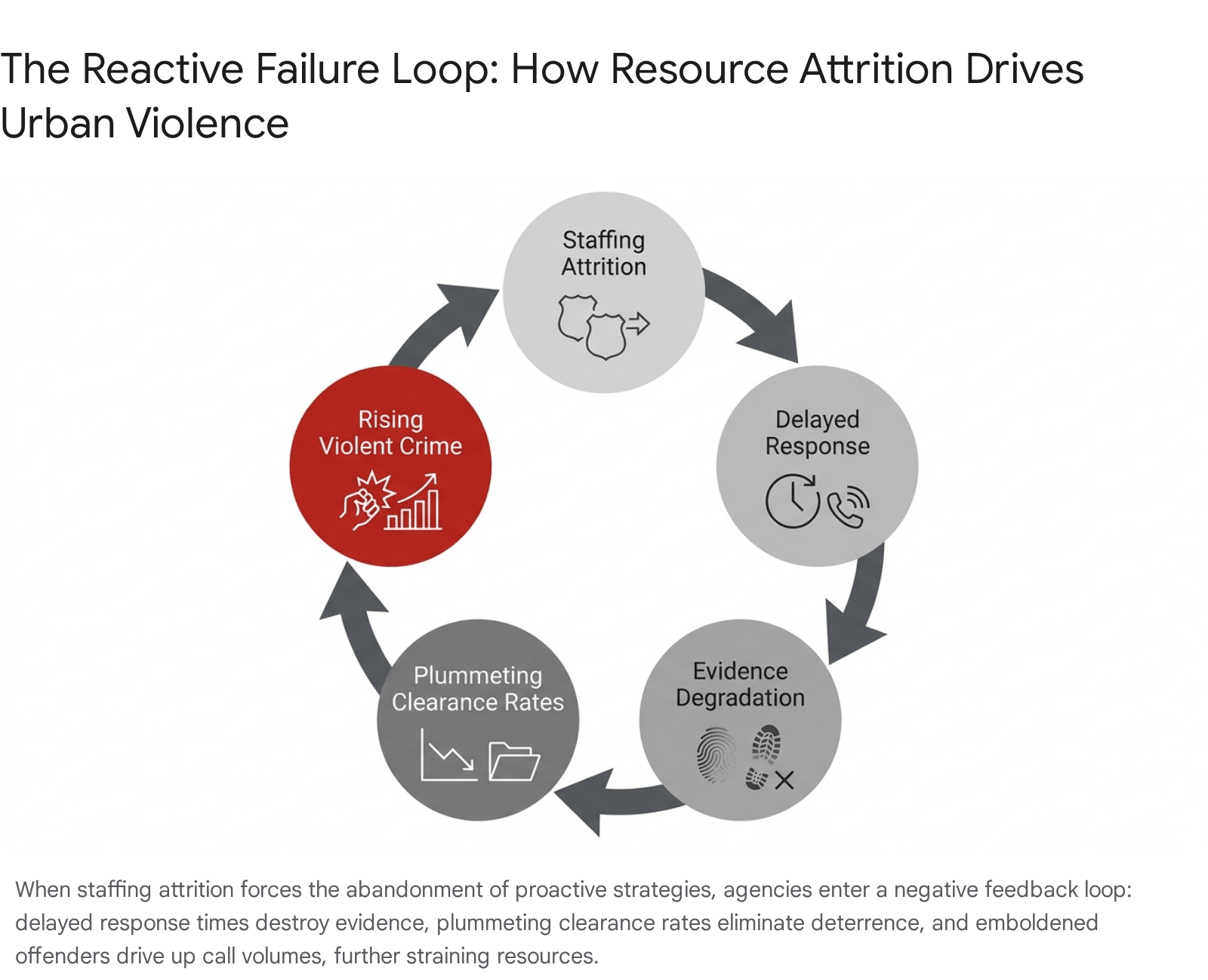
The mechanics of this violent surge are rooted deeply in the collapse of deterrence theory. Proactive policing—particularly place-based “hot spots policing” and person-focused deterrence—works by fundamentally altering the risk calculus of violent offenders.2 When police actively patrol micro-locations known for violence and initiate lawful investigative stops, they project an environment of high apprehension risk. This presence suppresses the carrying of illegal firearms and disrupts the open-air illicit drug markets that serve as the primary engines of urban homicide.15
Conversely, when this proactive pressure is removed, the perceived risk of apprehension plummets to near zero. Illicit networks rapidly reclaim the geographic space. Minor interpersonal disputes, gang rivalries, or drug territory infractions that would have previously been suppressed by a visible police presence rapidly escalate into fatal firearm violence.45 It is crucial to note a defining statistical anomaly during the 2020 de-policing period: while violent crime (homicides and aggravated assaults) surged, property crimes actually fell or remained stable.45 This divergence strongly indicates that the removal of proactive police pressure specifically uncapped the most severe, localized interpersonal violence, rather than indicating a general societal breakdown.45
The “Ferguson Effect” literature, reinforced by data from the Stanford Open Policing Project, indicates that intense negative public scrutiny creates an environment where officers second-guess their decision-making in real-time.48 Fearful of professional ruin, legal liability, or public retribution for lawful but visually aggressive proactive tactics, officers retreat to the safety of strictly answering dispatched calls.55 This psychological withdrawal guarantees that the agency will only ever respond to violence, never preempt it.
The 2024-2026 Data Reality: Reinstating Proactivity Drops Crime
While the de-policing era of 2020-2022 demonstrated the catastrophic results of abandoning proactive enforcement, recent empirical data from 2024 through 2026 proves the inverse: when agencies successfully reinstate targeted proactivity, violent crime plummets.
According to the FBI’s First Look 2025 Crime Data, the strategic re-implementation of targeted task forces has driven an estimated 9.3% decrease in overall violent crime and an 18.1% decrease in homicides nationwide.60 This trend has continued, with 2025 data from 35 major cities showing a 21% reduction in homicides compared to 2024.61 In Washington D.C., a 35% drop in total violent crime and a 32% drop in homicides in 2024 was explicitly attributed to proactive investigations specifically targeting armed crews and drug networks.62 This confirms that specialized, proactive interdiction remains an incredibly effective tool for violence suppression.
However, while specialized units have managed to drive down aggregate crime rates, the underlying foundation of reactive patrol remains broken. The national solve rate for violent crimes remained abysmal at just 44% in 2024.46 This indicates that while proactive operations can deter future offenses, the systemic delays and exhaustion paralyzing standard patrol units continue to severely degrade post-incident evidence gathering and case solvability.
Strategic Outlook and Tactical Mitigations
The data definitively proves that the current operational trajectory is unsustainable. Reacting to crime after it has occurred, especially with severely delayed response times and degraded investigative capacity, is wholly insufficient for maintaining public safety in urban environments. Rebuilding tactical proactivity requires a structural overhaul of how patrol time is managed, leveraging technological force multipliers, and addressing the root causes of administrative and social friction.
For the Ronin’s Grips Analytics audience focusing on law enforcement procurement, tactical gear analytics, and operational technology 1, the mitigation of these tactical failures presents specific capability requirements and investment vectors:
First, agencies must aggressively deploy force multiplier technology to optimize the limited human resources they possess. If specialized units cannot be fully staffed, intelligence gathering must be automated to bridge the gap. The integration of Strategic Decision Support Centers (SDSCs), Real-Time Crime Centers (RTCCs), predictive analytics, and automated sensor networks—such as acoustic gunshot detection and automated license plate readers (ALPR)—can provide patrol officers with immediate, actionable intelligence.3 Furthermore, procurement of field-deployable forensic technology, such as Rapid DNA devices, is critical to circumventing the massive state lab backlogs and enabling the Proactive Crime Scene Response model.43 While technology cannot replace the physical, deterrent presence of an officer on the street, it can direct an understaffed patrol force to the exact micro-locations where their limited presence will yield the highest deterrent value.
Second, the administrative burden crushing patrol officers must be mitigated immediately. The fact that over 50% of officers have their report writing interrupted by new dispatch calls is an unacceptable operational failure that degrades both officer welfare and prosecutorial success.18 Agencies must explore procurement of AI-driven dictation and automated reporting software to streamline documentation.21 Improving the speed of reporting directly enhances downstream investigative success and frees up marginal blocks of time for officers to observe their sectors.
Finally, the criminal justice system and municipal governments must heed the consensus of the 92% of officers who recognize that policing has become the default, ill-equipped response to complex social crises.22 The 911 dispatch system must be fundamentally triaged at the intake level. By actively diverting calls related to mental health crises, chronic homelessness, and non-violent substance abuse to specialized, civilian-led public health response networks, agencies can reclaim massive amounts of dispatch bandwidth.23 This diversion is a critical tactical necessity. Only by offloading these non-criminal burdens can law enforcement agencies free up the personnel required to reinstate specialized units, reduce high-priority response times, and restore the proactive policing strategies that data proves are essential for preventing urban violence.
Please share the link on Facebook, Forums, with colleagues, etc. Your support is much appreciated and if you have any feedback, please email us in**@*********ps.com. If you’d like to request a report or order a reprint, please click here for the corresponding page to open in new tab.
Works cited
- Ronin’s Grips | Firearms Analytics & Intelligence Reports | Connecticut – Boise Gun Club, accessed June 25, 2026, https://boisegunclub.com/connecticut/directory/blog-20
- Director’s Message: Proactive Policing — What We Know and What We Don’t Know, Yet, accessed June 25, 2026, https://nij.ojp.gov/speech/directors-message-proactive-policing-what-we-know-and-what-we-dont-know-yet
- The Importance of Evidence-Based Policing – SoundThinking, accessed June 25, 2026, https://www.soundthinking.com/blog/the-importance-of-evidence-based-policing/
- Re-evaluating Reactive Policing: A Minority Report – Vrije Universiteit Amsterdam, accessed June 25, 2026, https://research.vu.nl/en/publications/re-evaluating-reactive-policing-a-minority-report/
- Proactive Policing: Effects on Crime and Communities (2018), accessed June 25, 2026, https://www.nationalacademies.org/read/24928/chapter/2
- Police stops to reduce crime: A systematic review and meta‐analysis – PMC, accessed June 25, 2026, https://pmc.ncbi.nlm.nih.gov/articles/PMC9831287/
- Research Will Shape the Future of Proactive Policing | National Institute of Justice, accessed June 25, 2026, https://nij.ojp.gov/topics/articles/research-will-shape-future-proactive-policing
- Read “Proactive Policing: Effects on Crime and Communities” at NAP.edu, accessed June 25, 2026, https://www.nationalacademies.org/read/24928
- Proactive Policing: Effects on Crime and Communities – CUNY, accessed June 25, 2026, https://files.commons.gc.cuny.edu/wp-content/blogs.dir/3597/files/2018/03/book_nas_proactive_policing.pdf?ref=liberalcurrents.com
- Proactive Policing: Effects on Crime and Communities – ResearchGate, accessed June 25, 2026, https://www.researchgate.net/publication/325296078_Proactive_policing_Effects_on_crime_and_communities
- Problem‐oriented policing for reducing crime and disorder: An updated systematic review and meta‐analysis – PMC, accessed June 25, 2026, https://pmc.ncbi.nlm.nih.gov/articles/PMC8356283/
- A QUALITATIVE STUDY OF DE-POLICING AND THE 2020 ANTI-POLICE MOVEMENT by Corey Lee Piser Liberty University A Dissertation Presen, accessed June 25, 2026, https://digitalcommons.liberty.edu/cgi/viewcontent.cgi?article=9543&context=doctoral
- Unsolved Shootings: Why and How to Boost Clearance Rates – Harry Frank Guggenheim Foundation, accessed June 25, 2026, https://www.hfg.org/wp-content/uploads/2026/04/unsolved-shootings-why-and-how-to-boost-clearance-rates.pdf
- Chapter: 4 Impacts of Proactive Policing on Crime and Disorder, accessed June 25, 2026, https://www.nationalacademies.org/read/24928/chapter/6
- Improving Public Safety Through Better Accountability and Prevention, accessed June 25, 2026, https://www.americanprogress.org/article/improving-public-safety-through-better-accountability-and-prevention/
- Productive policing: Lessons from preventative police strategies in times of New Public Management – Oxford Academic, accessed June 25, 2026, https://academic.oup.com/policing/article/doi/10.1093/police/paae108/7900939
- Police1 launches ‘What Cops Want in 2026: Life on Shift’ survey, accessed June 25, 2026, https://www.police1.com/what-cops-want/police1-launches-what-cops-want-in-2026-life-on-shift-survey
- What Cops Want in 2026: The reality of patrol – Police1, accessed June 25, 2026, https://www.police1.com/what-cops-want/what-cops-want-in-2026-the-reality-of-patrol
- accessed June 25, 2026, https://www.police1.com/what-cops-want/what-cops-want-in-2026-the-reality-of-patrol#:~:text=Only%2015%25%20say%20they%20have,finish%20their%20shifts%20mentally%20exhausted
- What 84% of police officers want from their leaders – Police1, accessed June 25, 2026, https://www.police1.com/what-cops-want/what-84-of-police-officers-want-from-their-leaders
- On-demand: The hidden cost of the modern patrol shift – Police1, accessed June 25, 2026, https://www.police1.com/what-cops-want/webinar-the-hidden-cost-of-the-modern-patrol-shift
- New survey finds law enforcement officers are overburdened, former Dallas police chief weighs in | KERA News, accessed June 25, 2026, https://www.keranews.org/news/2026-06-22/law-enforcement-officers-overburdened-survey
- Law Enforcement Officials Favor Community-Led Crime Reduction Strategies – Davis Vanguard, accessed June 25, 2026, https://davisvanguard.org/2026/05/law-enforcement-community-strategies/
- Our criminal justice system is missing the ball – Consider This by JD, accessed June 25, 2026, https://considerthisbyjd.com/our-criminal-justice-system-is-missing-the-ball/
- Insufficient police staffing continues throughout the U.S. – American Police Beat Magazine, accessed June 25, 2026, https://apbweb.com/2025/05/insufficient-police-staffing-continues-throughout-the-u-s/
- Responding to the Staffing Crisis: Innovations in Recruitment and Retention – Police Executive Research Forum (PERF), accessed June 25, 2026, https://www.policeforum.org/assets/RecruitmentRetention.pdf
- Beyond the badge: Expanding investigative capacity in a shrinking workforce – Police1, accessed June 25, 2026, https://www.police1.com/police-recruitment/beyond-the-badge-expanding-investigative-capacity-in-a-shrinking-workforce
- How to Navigate Police Staffing Challenges – SoundThinking, accessed June 25, 2026, https://www.soundthinking.com/blog/how-to-navigate-police-staffing-shortages/
- The State of Police Recruitment and Retention: A Continuing Concern – Lexipol, accessed June 25, 2026, https://www.lexipol.com/resources/blog/the-state-of-police-recruitment-and-retention-a-continuing-concern/
- Proactive, reactive and crime in action – BlackRainbow, accessed June 25, 2026, https://blackrainbow.com/wp-content/uploads/2024/06/SJUK-July-2024-Black-Rainbow.pdf
- Focused deterrence strategies effects on crime: A systematic review – PMC, accessed June 25, 2026, https://pmc.ncbi.nlm.nih.gov/articles/PMC8356499/
- New Research Shows How Police Response Times Vary Across the City, accessed June 25, 2026, https://www.wweek.com/news/city/2026/06/25/new-research-shows-how-police-response-times-vary-across-the-city/
- Understanding Police Response Times and Staffing | Portland.gov, accessed June 25, 2026, https://www.portland.gov/police/typical-day-ppb
- 20251008_9-1-1-Emergency-Response-Times-Audit.pdf – Oakland Auditor, accessed June 25, 2026, https://www.oaklandauditor.com/wp-content/uploads/2025/10/20251008_9-1-1-Emergency-Response-Times-Audit.pdf
- The Effect of Police Deployment Strategy on Emergency Response Times: An Agent-based Modelling Investigation – White Rose Research Online, accessed June 25, 2026, https://eprints.whiterose.ac.uk/id/eprint/234620/1/The%20Effect%20of%20Police%20Deployment%20Strategy%20on%20Emergency%20Response%20Times-%20An%20Agent-based%20Modelling%20Investigation.pdf
- Response Time and Crime Clearance | Pinkerton, accessed June 25, 2026, https://pinkerton.com/our-insights/blog/response-time
- The Effect of Police Response Time on Crime Clearance Rates – ResearchGate, accessed June 25, 2026, https://www.researchgate.net/publication/335641893_The_Effect_of_Police_Response_Time_on_Crime_Clearance_Rates
- The Effect of Police Response Time on Crime Clearance Rates – Research@CBS, accessed June 25, 2026, https://research-api.cbs.dk/ws/portalfiles/portal/55360390/tom_kirchmaier_the_effect_of_police_response_time_acceptedversion.pdf
- Delays reduce culprit-presence detection but do not affect guessing-based selection in response to lineups – PMC, accessed June 25, 2026, https://pmc.ncbi.nlm.nih.gov/articles/PMC12322189/
- Do Real-Time Crime Centers Improve Case Clearance? An Examination of Chicago’s Strategic Decision Support Centers – CrimRxiv, accessed June 25, 2026, https://www.crimrxiv.com/pub/8nqrj7ue
- The Effect of Police Response Time on Crime Detection – LSE, accessed June 25, 2026, https://personal.lse.ac.uk/blanesiv/DetectedResponse.pdf
- Eyewitness Identification in Law Enforcement: Bridging the Gap Between Science, Policy, and Practice, accessed June 25, 2026, https://www.policinginstitute.org/onpolicing/eyewitness-identification-in-law-enforcement-bridging-the-gap-between-science-policy-and-practice/
- Proactive crime scene response optimizes crime investigation – PMC – NIH, accessed June 25, 2026, https://pmc.ncbi.nlm.nih.gov/articles/PMC10068110/
- From Police Academy Training to Criminal Investigation: Strengthening Forensic Science in Policing – SCIEPublish, accessed June 25, 2026, https://www.sciepublish.com/article/pii/642
- Trends in Homicide: What You Need to Know – Council on Criminal Justice, accessed June 25, 2026, https://counciloncj.org/homicide-trends-report/
- A State Policy Guide for Solving More Violent Crime – Tools for …, accessed June 25, 2026, https://projects.csgjusticecenter.org/tools-for-states-to-address-crime/a-state-policy-guide-for-solving-more-violent-crime/
- The impact of police violence on communities – RTI International, accessed June 25, 2026, https://www.rti.org/rti-press-publication/impact-police-violence-communities-unpacking-fatal-use-force-influences-resident-calls-911-police-ac
- De-policing, police stops, and crime – Oxford Academic, accessed June 25, 2026, https://academic.oup.com/policing/article-pdf/doi/10.1093/police/paac070/50515087/paac070.pdf
- De-policing, police stops, and crime. | Social Sciences and Humanities | Policing: A Journal of Policy & Practice | EBSCO Research, accessed June 25, 2026, https://www.ebsco.com/articles/social-sciences-and-humanities/014070d0-2806-5efc-8da4-dd0d5f9caaf0/de-policing-police-stops-and-crime
- The Minneapolis Effect – Manhattan Institute, accessed June 25, 2026, https://manhattan.institute/article/the-minneapolis-effect
- Pandemic, Social Unrest, and Crime in U.S. Cities – Council on Criminal Justice, accessed June 25, 2026, https://counciloncj.org/wp-content/uploads/2024/05/Year-End-Crime-Update_Designed.pdf
- Explaining the Recent Homicide Spikes in U.S. Cities: The ‘Minneapolis Effect’ and the Decline in Proactive Policing – Utah Law Digital Commons, accessed June 25, 2026, https://dc.law.utah.edu/scholarship/217/
- What Caused Last Year’s Spike in Violent Crime? – The Federalist Society, accessed June 25, 2026, https://fedsoc.org/commentary/fedsoc-blog/what-caused-last-year-s-spike-in-violent-crime
- De-policing, police stops, and crime | Policing: A Journal of Policy and Practice | Oxford Academic, accessed June 25, 2026, https://academic.oup.com/policing/article-abstract/doi/10.1093/police/paac070/6833407
- De-policing, police stops, and crime | Policing: A Journal of Policy and Practice | Oxford Academic, accessed June 25, 2026, https://academic.oup.com/policing/article/doi/10.1093/police/paac070/6833407
- (PDF) De-policing, police stops, and crime – ResearchGate, accessed June 25, 2026, https://www.researchgate.net/publication/365593172_De-policing_police_stops_and_crime
- The recent rise in homicide: An analysis of weekly mortality data, United States, 2018–2022, accessed June 25, 2026, https://pmc.ncbi.nlm.nih.gov/articles/PMC12333599/
- Myths and Realities: Understanding Recent Trends in Violent Crime, accessed June 25, 2026, https://www.brennancenter.org/our-work/research-reports/myths-and-realities-understanding-recent-trends-violent-crime
- Assessing and Responding to the Recent Homicide Rise in the United States – Office of Justice Programs, accessed June 25, 2026, https://www.ojp.gov/pdffiles1/nij/251067.pdf
- FBI Releases Historic Early Look at Annual Crime Data, accessed June 25, 2026, https://www.fbi.gov/news/press-releases/fbi-releases-historic-early-look-at-annual-crime-data
- Crime Trends in U.S. Cities: Year-End 2025 Update – Council on Criminal Justice, accessed June 25, 2026, https://counciloncj.org/crime-trends-in-u-s-cities-year-end-2025-update/
- District of Columbia | Violent Crime in D.C. Hits 30 Year Low – Department of Justice, accessed June 25, 2026, https://www.justice.gov/usao-dc/pr/violent-crime-dc-hits-30-year-low
- Five major developments in law enforcement in North America to watch in 2026, accessed June 25, 2026, https://www.3sisecurity.com/five-major-developments-in-law-enforcement-in-us-and-north-america/
- Solving Crime, Protecting Communities: A Blueprint for Safer Streets …, accessed June 25, 2026, https://www.rstreet.org/research/solving-crime-protecting-communities-a-blueprint-for-safer-streets/