1. Executive Summary
The transatlantic security architecture is undergoing structural adjustments driven by a changing threat environment in Europe and pressure from the United States to address burden-sharing imbalances. European nations are currently executing an expansion of defense expenditures. By 2025, the total military expenditure of the 32 NATO member states amounted to $1.58 trillion, with European NATO members and Canada contributing $559 billion, representing a 14% year-over-year increase in regional defense outlays.1 This upward trajectory in Europe occurs alongside a 7.5% contraction in United States military spending in 2025, signaling a transition away from absolute European reliance on American security guarantees.3
This recalibration redefines collective defense expectations. Member states have committed to a target of allocating 5% of their Gross Domestic Product (GDP) to defense and resilience by 2035—a material increase from the 2% target established at the 2014 Wales Summit.4 The 5% objective is bifurcated: 3.5% is allocated for core military capabilities, and 1.5% is designated for civil resilience, cybersecurity, and critical infrastructure.4
The mobilization of capital required to meet these targets introduces macroeconomic frictions. Transitioning defense budgets to 3.5% necessitates adjustments to national fiscal policies.4 European economies are currently navigating an environment characterized by moderating growth, inflationary pressures, and high public debt-to-GDP ratios resulting from the pandemic and energy crises.8 Assessments from the International Monetary Fund (IMF) and the European Central Bank (ECB) indicate that while short-term defense spending yields a localized fiscal multiplier effect, it is highly import-intensive and presents a risk of crowding out social welfare spending, increasing sovereign debt, and widening current account deficits over the medium term.9
Consequently, a fragmented approach has emerged regarding how European allies manage this mandate. Nations on the Eastern Flank—such as Poland, the Baltic states, and Finland—are executing debt-financed hardware procurements and societal integration to achieve operational deterrence.9 Southern European states, including Italy and Spain, rely on the reclassification of existing security and pension expenditures to meet baseline NATO metrics while managing domestic welfare budgets.14 Concurrently, Western European powers—France, Germany, and the United Kingdom—are attempting to revitalize domestic industrial bases, though political polarization and constitutional fiscal rules frequently constrain these efforts.17
This report analyzes the strategic, economic, and political dynamics of traditional US allies in Europe as they transition toward an active defense posture. It evaluates the macroeconomic consequences of rearmament, reviews institutional European Union responses, and provides summarized profiles of defense trajectories for all 23 EU countries in NATO, as well as the United Kingdom.
2. Strategic and Macroeconomic Context
The evolution of defense spending within the North Atlantic Treaty Organization is characterized by distinct historical phases, reflecting the shifting threat perceptions and macroeconomic priorities of the member states.
2.1 The Evolution of Burden Sharing
During the Cold War era of the 1950s, NATO’s European members maintained defense expenditures averaging 4.8% of their gross domestic product, serving as the first line of defense against the Warsaw Pact, while the United States subsidized 60-76% of the alliance’s total defense costs.20 Following the dissolution of the Soviet Union in 1991, European allies capitalized on a “peace dividend.” Between 1991 and 2013, average European defense spending contracted significantly to approximately 1.4% of GDP, as governments reallocated capital toward public infrastructure and social programs.5
The 2014 annexation of the Crimean Peninsula served as an initial catalyst for reversing these cuts, culminating in the Wales Summit “Defense Investment Pledge,” which established a 2.0% of GDP baseline target for 2024.4 However, the 2022 escalation of conflict in Eastern Europe, combined with persistent US administrative pressure emphasizing burden-sharing, accelerated European defense commitments.4 The 2025 US National Security Strategy conditioned ongoing US commitments on European allies assuming primary regional responsibility.21 This environment precipitated the 2025 Hague Summit agreement, which introduced the 5.0% target (3.5% core military, 1.5% resilience) to be achieved by 2035.6
2.2 Fiscal Multipliers and Import Leakages
The mandate to scale defense budgets generates macroeconomic consequences. Unlike infrastructure or education investments, which typically yield long-term productivity dividends, defense spending functions primarily as a sector-specific demand shock.11
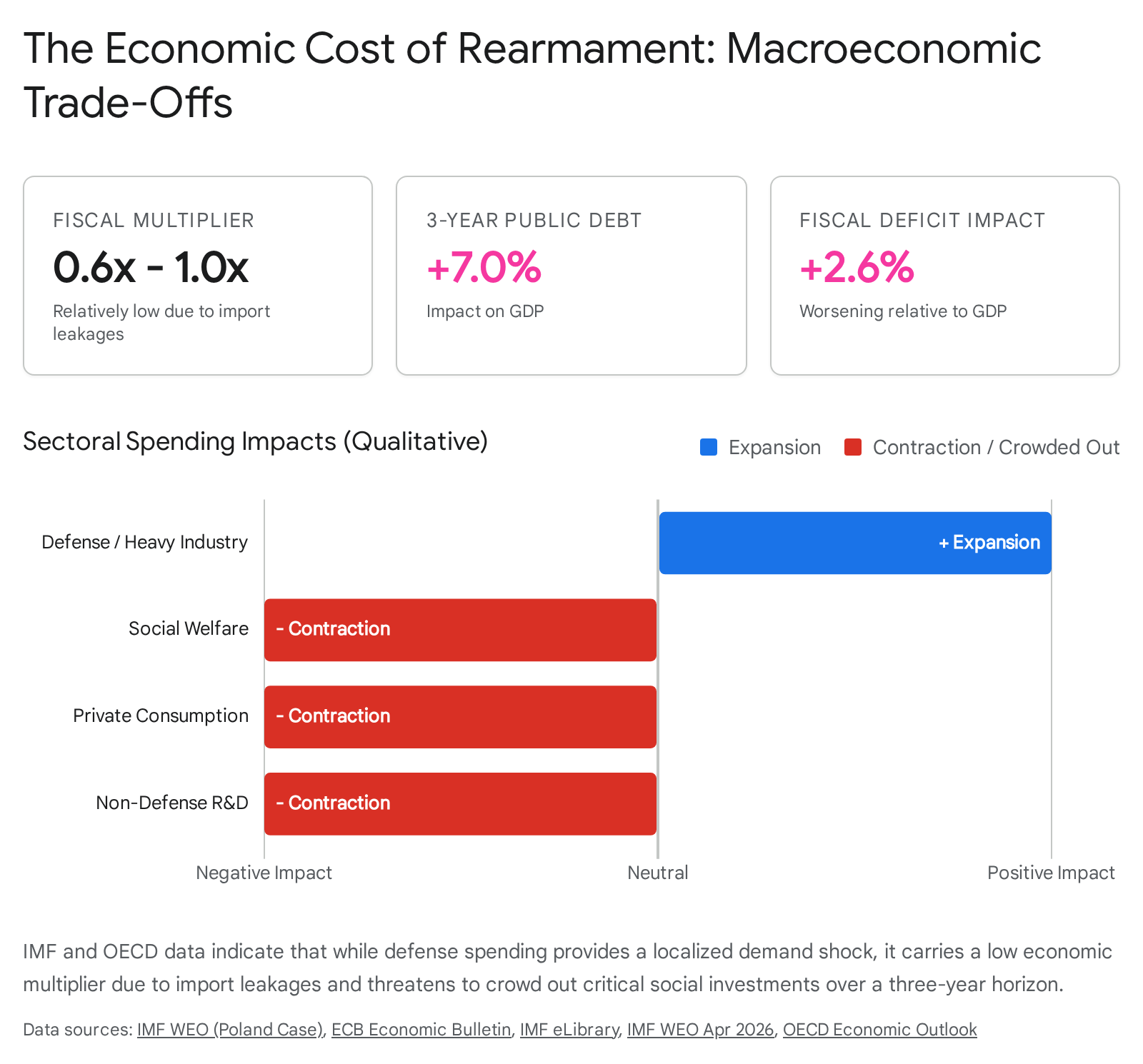
The economic growth multiplier for defense spending is estimated by the OECD and the IMF to range between 0.6 and 1.0, indicating that capital injected into defense generates a less-than-proportionate increase in broader economic activity.12 This constrained multiplier is driven by “import leakage.” The European Defense Technological and Industrial Base (EDTIB) lacks the scale and integration necessary to meet the sudden surge in demand.9 As a result, European nations are fulfilling urgent hardware requirements by importing equipment from external suppliers, predominantly the United States and South Korea.9 Capital allocated to national defense budgets frequently flows out of the European economy, which exacerbates external account balances without stimulating domestic employment or industrial capacity to a commensurate degree.11
2.3 Debt Dynamics, Inflation, and the Welfare Trade-Off
Sustaining defense budgets at the levels mandated by the Hague Summit poses challenges to fiscal sustainability. IMF simulations demonstrate that defense booms are historically debt-financed. Under baseline models, ramping up military capabilities worsens fiscal deficits by an average of 2.6 percentage points of GDP and drives up public debt by approximately 7 percentage points within a three-year horizon.22
European governments face a resource allocation challenge. To finance rearmament without triggering sovereign debt crises, national budgets require restructuring. Analyses indicate that maintaining these elevated budgets will require countries to reduce social spending, limit healthcare provisions, or delay non-defense public investments.4 The ECB notes that defense spending booms in the current environment risk fueling inflation. Household surveys conducted by the ECB indicate that 67% of respondents anticipate that increased defense expenditure will lead to higher inflation, while 41% expect a resultant decline in general economic activity.10 Furthermore, the fiscal expansion required to fund these budgets may necessitate a tighter monetary policy path, suppressing private sector consumption.9
Despite these structural risks, financial markets have exhibited stability. Sovereign bond spreads within the eurozone have narrowed amidst defense announcements, suggesting market confidence that spending remains framed within revised European fiscal rules and that EU integration mitigates default risks.24
3. Institutional Frameworks: The European Union’s Role
Acknowledging that individual member states face constraints in independently financing the scale of required industrial mobilization, the European Union has assumed a central role in the defense domain. The establishment of the first EU Commissioner for Defense and Space, held by Andrius Kubilius, signifies an institutional centralization of defense industrial strategy.25
3.1 The Defense Readiness Roadmap 2030
The primary vulnerability of the European defense sector is industrial fragmentation. Collaborative defense procurement among EU member states accounts for less than 20% of total spending, falling short of the established 35% benchmark and the 40% ambition set for 2027.27 Member states traditionally maintain national defense champions in isolated markets, preventing the economies of scale necessary for efficient production.23 Reaching the 35% joint procurement benchmark could yield up to €10.9 billion in annual savings.27
To address this, the European Commission introduced the Defense Readiness Roadmap 2030 and the Defense Readiness Omnibus.23 On July 3, 2026, the Commission proposed five European Defense Projects of Common Interest (EDPCIs) designed to facilitate the joint development and procurement of high-end military systems, specifically prioritizing air and missile defense and strategic enablers.28
3.2 Fiscal Engineering: SAFE and the Escape Clause
To alleviate the sovereign debt burden associated with large-scale procurement, the EU utilizes two primary fiscal instruments:
- Security Action for Europe (SAFE): The European Commission established the SAFE facility, which provides up to €150 billion in loans between 2025 and 2030 to support joint defense procurement.30 SAFE incentivizes collaborative acquisition by offering VAT exemptions and leveraging the EU’s collective borrowing power to secure favorable interest rates.26 The facility requires that the majority of components be sourced within the EU to incubate the domestic industrial base, though it allows up to 35% non-EU content to accommodate immediate capability gaps.32
- The National Escape Clause: Recognizing that strict adherence to the revised Stability and Growth Pact would inhibit member states from reaching the NATO targets, the Commission instituted a “National Escape Clause.” This mechanism permits member states to temporarily exempt up to 1.5% of GDP in additional defense spending from structural deficit calculations.26 Fourteen member states—including Belgium, Bulgaria, Germany, Estonia, Greece, Spain, Croatia, Latvia, Lithuania, Austria, Portugal, Slovenia, Slovakia, and Finland—have formally activated this clause to accommodate defense surges.47 While it prevents immediate EU regulatory penalties, it does not alleviate the underlying accumulation of sovereign debt.
4. Country Summaries: Western Europe
The traditional anchors of Western European security are navigating domestic political environments as they attempt to revive industrial capacities that experienced decades of underinvestment.
4.1 France
France maintains a capable military underpinned by a largely independent domestic defense industry. President Emmanuel Macron has directed a transition toward a “war economy,” prioritizing European strategic autonomy.19 The Military Programming Law (LPM) 2024–2030 allocated €413 billion to defense.35 Macron accelerated this timeline, securing a spending increase of €3.5 billion in 2026, with the defense budget reaching €68.5 billion, or 2.25% of GDP.14
Operationally, the French Army is pivoting toward high-intensity combat readiness through Programme SCORPION, which digitizes the battlefield and introduces new armored vehicles.37 The budget prioritizes nuclear deterrence, dedicating 13% of the LPM to platforms such as the SNLE 3G ballistic missile submarines.35 Economically, the defense industry is experiencing revenue growth, yet France’s overall budgetary trajectory remains constrained by national debt reduction measures.19
4.2 Germany
Germany is the economic linchpin of European defense, though its rearmament process has been uneven. Following the establishment of a €100 billion Sondervermögen (Special Fund), Germany surpassed the 2.0% NATO benchmark in 2024.39 For 2026, the defense budget was set at €82.6 billion. Combined with the Special Fund, total spending is approximately €108 billion, equivalent to 2.14% of GDP.14
Structural deficiencies persist. The regular defense budget (Einzelplan 14) remained largely frozen through 2026, relying on the off-budget Special Fund to meet targets.18 The German constitution’s strict debt brake (Schuldenbremse) limits deficit spending, forcing reliance on the EU National Escape Clause.33 Land forces are impacted by a maintenance backlog and personnel shortfalls, which complicates commitments such as standing up a combat-ready brigade in Lithuania.40
4.3 United Kingdom
Although outside the EU, the United Kingdom is a major NATO ally. The UK spent 2.4% of its GDP on defense in 2025 and committed to reaching 2.5% by 2027, ultimately adopting the 3.5% by 2035 Hague target.17 The UK’s trajectory illustrates the friction between strategic ambition and fiscal reality. Following the 2025 Strategic Defense Review, the subsequent spending review projected spending to plateau around 2.6% in the near term due to Treasury constraints.17 This discrepancy between military requirements and financial allocations led to the resignation of Defense Secretary John Healey in June 2026, underscoring the vulnerability of defense planning to domestic fiscal pressures.17
4.4 The Netherlands
The Netherlands has increased its defense allocations, with the budget reaching €25.8 billion in 2025, representing 2.49% of GDP.67 This represents a significant scaling of the budget since 2021. The Dutch military is prioritizing modernization, including the procurement of F-35 fighter aircraft and investments in maritime and land domain capabilities.14
4.5 Belgium
Belgium reached the 2.00% NATO spending target in 2025.46 This achievement was facilitated by the activation of the EU National Escape Clause, allowing the government to increase defense outlays alongside other expansionary measures while balancing pension reforms and lower social spending.47 Despite meeting the baseline threshold, Belgium remains among Europe’s lowest defense spenders relative to the size of its economy.
4.6 Luxembourg
Luxembourg successfully met the 2.0% NATO spending target in 2025, allocating approximately €1.18 billion to defense. Due to its small population and limited domestic industrial base, Luxembourg’s contributions focus on investments in collective NATO capabilities, strategic airlift sharing, and cybersecurity infrastructure rather than the maintenance of large conventional standing forces.
| Country | 2024 % GDP | 2025e % GDP | Key Capability Focus |
| France | 2.06% | 2.25% | Nuclear Deterrence, SCORPION Network, Aerospace |
| Germany | 2.12% | >2.14% | Air Defense, Heavy Armor, Force Expansion |
| United Kingdom | 2.33% | 2.40% | Naval Assets, Long-Range Precision, Next-Gen Air |
| Netherlands | 1.95% | 2.49% | F-35 Integration, Maritime Capabilities |
| Belgium | 1.29% | 2.00% | Logistics, Cyber, Multilateral Procurement |
| Luxembourg | 1.30% | 2.00% | Strategic Airlift, Cyber, Collective Investment |
Data compiled from NATO Defense Expenditure Reports and National Budget Declarations.
5. Country Summaries: Southern Europe
Southern European nations face fiscal challenges in meeting NATO mandates. Characterized by high public debt burdens and strong domestic requirements for social welfare, these nations utilize reclassification of expenditures to demonstrate alliance solidarity.
5.1 Italy
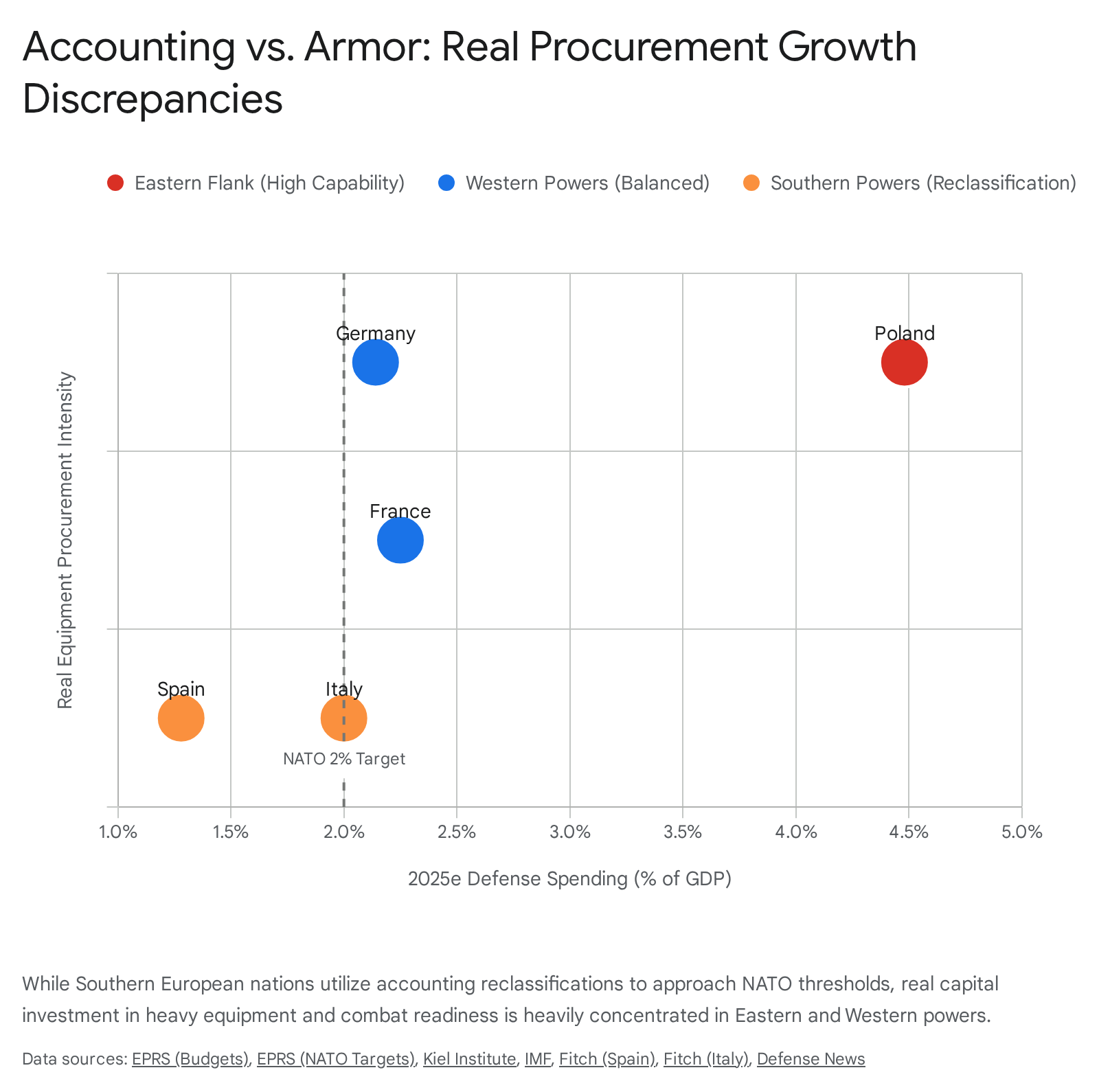
Under Prime Minister Giorgia Meloni, Italy has utilized defense policy to solidify Rome’s transatlantic standing.49 Italy reached the 2.01% NATO spending target in 2025, allocating roughly $48.8 billion.51 However, this increase was achieved predominantly by reclassifying existing state expenditures—including military pensions and security forces with dual civil-military roles (such as the Carabinieri)—under the NATO defense definition.14
Fitch Ratings forecasts limited actual additional defense expenditure through 2027 due to Italy’s public debt constraints.16 While the government secured the EU’s 1.5% National Escape Clause, Italian defense officials have acknowledged that recovering the capability deficit accumulated over past decades will require sustained long-term effort.31
5.2 Spain
Spain allocated 1.28% of its GDP to defense in 2024.54 While Madrid has committed to reaching the 2.0% threshold, progress has been slow due to a polarized domestic political landscape.15 The ruling coalition faces internal opposition to defense budget hikes, prioritizing social spending.55 Similar to Italy, Spain’s planned trajectory relies on the reclassification of existing security spending and the activation of the EU National Escape Clause rather than significant net-new capital injections.14
5.3 Greece
Greece allocates 2.85% of its GDP to defense in 2025.51 This figure is driven by high personnel costs. The Hellenic Armed Forces maintain a disproportionate officer corps, diverting capital from modernization.56 Despite a spending increase, readiness is hampered by recruitment crises.56 Nevertheless, Greece has engaged in capital acquisitions, completing deliveries of 24 Dassault Rafale aircraft and investing in FDI Belharra frigates.38
5.4 Portugal
Portugal reached the 2.0% NATO spending target in 2025, supported by an additional €1 billion government investment in equipment and personnel. Portugal utilizes the EU National Escape Clause to manage the fiscal impact.57 Portugal’s defense strategy focuses on maritime security, prioritizing the protection of the Azores and Madeira, securing Atlantic communication lines, and contributing to counterpiracy operations in the Gulf of Guinea.
| Country | 2024 % GDP | 2025e % GDP | Strategic Posture & Constraints |
| Greece | 2.85% | 2.85% | High Personnel Costs, Aerospace Procurement |
| Italy | 1.48% | 2.01% | Pension Reclassification, Diplomatic Alignment |
| Portugal | 1.40% | 2.00% | Maritime Security, Naval Protection, Fiscal Consolidation |
| Spain | 1.28% | <2.00% | High Political Polarization, Gradual Increases |
Data compiled from NATO Defense Expenditure Reports.
6. Country Summaries: Northern Europe and Scandinavia
Northern European and Scandinavian member states demonstrate sustained, capability-focused investment trajectories, integrating societal resilience with military preparedness.
6.1 Denmark
Denmark has accelerated its defense posture, raising its spending to 3.22% of GDP in 2025, aided by a DKK 50 billion Acceleration Fund for 2025 and 2026.67 Danish strategy focuses on enhancing naval capabilities, air defense, and contributing to NATO’s forward presence in the Baltic Sea region. The utilization of the Acceleration Fund allows Denmark to bypass traditional bureaucratic procurement delays for urgent capabilities.
6.2 Sweden
As a recent entrant to NATO, Sweden enacted major uplifts under its Total Defence 2025-2030 framework, reaching 2.51% of GDP in 2025.67 Sweden prioritizes air defense, long-range precision weapons, naval assets (specifically submarines), and research and development.14 Sweden’s robust domestic defense industry allows for a high degree of sovereign procurement.
6.3 Finland
Finland maintained defense spending levels at 2.77% of GDP in 2025.14 Finland’s readiness relies on a “Total Defense” concept featuring universal conscription, deep reserves, and strong public-private cooperation for cyber resilience.13 Finland benefits from pre-delegated crisis authorities, allowing the government to authorize military mobilization within hours.13 Procurement is focused on maintaining a credible deterrent, highlighted by F-35 integration.
| Country | 2025e % GDP | Readiness Model | Key Capability Focus |
| Denmark | 3.22% | Professional/Expeditionary | Acceleration Fund Procurements, Baltic Sea Security |
| Sweden | 2.51% | Total Defense | Air Defense, Submarines, Long-Range Fires |
| Finland | 2.77% | Total Defense / Universal Conscription | Deep Reserves, F-35 Integration, Artillery |
Data sourced from.
7. Country Summaries: The Eastern Flank and Baltics
The strategic center of gravity for European defense is heavily focused on the Eastern Flank. Bordering Russia, these states view defense spending as a core security requirement, executing a transition toward operational deterrence.
7.1 Poland
Poland has undertaken a large-scale military expansion. In 2025, Poland topped the alliance in relative spending at 4.48% of its GDP, amounting to over $44 billion.14 More than half of Poland’s total defense outlays are directed toward capital equipment.9 To bypass European industrial bottlenecks, Poland engages in large-scale off-the-shelf procurement from the United States and South Korea.9
The spending surge has been financed largely by increases in the deficit.9 Domestic political gridlock threatens procurement momentum; a confrontational relationship between the Polish President and the government resulted in a veto of legislation that would have facilitated Poland’s access to €43.7 billion in EU SAFE loans, complicating the financing of future defense contracts.30
7.2 Estonia
Estonia allocated 3.38% of its GDP to defense in 2025.14 Estonia performs strongly in research intensity, serving as a hub for NATO cyber defense and innovation initiatives.13 Estonia’s readiness model relies on universal conscription and integrated civil-military cyber ecosystems.13
7.3 Latvia
Latvia’s defense expenditure reached 3.73% of GDP in 2025.14 The nation is investing in coastal defense, air defense, and long-range rocket artillery. Latvia is deepening its reserve integration to ensure it can deter high-intensity conflict scenarios.13
7.4 Lithuania
Lithuania allocated 4.00% of its GDP to defense in 2025.14 Lithuania utilizes a hybrid conscription model to rapidly generate forces.13 The nation is prioritizing the development of infrastructure to host a permanent German armored brigade, alongside the procurement of advanced artillery and air defense systems.
8. Country Summaries: Central and Southeastern Europe
The nations of Central and Southeastern Europe display varying trajectories, with some states embarking on rapid modernization programs while others navigate slower procurement cycles.
8.1 Romania
Romania serves as an anchor for NATO operations in the Black Sea region. With its defense budget reaching 2.25% of GDP, Bucharest is systematically replacing Cold War-era inventory.54 In late 2025 and 2026, Romania advanced a nearly $10 billion defense package.59 This includes a $6.5 billion acquisition of 32 F-35 fighter jets, Patriot and Skynex air defense systems, and the local assembly of Piranha 5 armored personnel carriers.59 Romania utilizes a dual-track approach: accessing EU SAFE funds while seeking loans under the US Foreign Military Sales (FMS) program.32
8.2 Czechia
Czechia increased its defense budget to 2.0% in 2025.14 Czechia has exerted strategic influence through the “Czech Ammunition Initiative,” sourcing and delivering over 3 million rounds of large-caliber artillery to Ukraine.62 The Defense Financing Act has stabilized long-term procurement, facilitating major capital expenditures.61
8.3 Hungary
Hungary maintained an allocation of 2.1% of GDP through 2025 (roughly €4.6 billion).64 Nearly 47.8% of Hungary’s defense budget is directed toward equipment procurement and research.64 Through the Zrínyi 2026 modernization program, Hungary has heavily favored the German defense industry, acquiring Leopard 2A7+ tanks and PzH 2000 howitzers.65
8.4 Slovakia
Slovakia allocated 2.00% of its GDP to defense in 2025. To manage the fiscal impact of its defense requirements, Slovakia utilizes the EU National Escape Clause, which effectively loosens its domestic fiscal rules by approximately 0.6% of GDP. Slovakia displays a more uneven procurement trajectory compared to the Baltics, influenced by political cycles.13
8.5 Bulgaria
Bulgaria allocated 2.10% of its GDP to defense in 2025. The defense posture has been influenced by domestic political considerations; the government suspended direct state arms deliveries to Ukraine in 2025, although commercial transactions by the defense industry were allowed to continue.32 The focus remains on the modernization of legacy equipment.
8.6 Croatia
Croatia allocated 2.08% of its GDP to defense in 2025. Nearly 29% of this expenditure is allocated to military modernization. Croatia is focusing on modernizing its air force and mechanized infantry and has provided 15 packages of military aid to Ukraine.
8.7 Slovenia
Slovenia’s defense expenditure reached 2.02% of GDP in 2025, with plans to gradually increase this metric through the end of the decade.51 However, this trajectory faces domestic political scrutiny, with debates regarding the prioritization of strategic autonomy and defense spending against broader social investments.
| Country | 2025e % GDP | Strategic Posture & Key Procurements |
| Romania | 2.25% | Black Sea Anchor; F-35, Patriot, Piranha 5 |
| Czechia | 2.00% | Ammunition Initiative Leadership; F-35 |
| Hungary | 2.10% | Zrínyi 2026; Leopard 2A7+, PzH 2000 |
| Bulgaria | 2.10% | Legacy Equipment Replacement |
| Croatia | 2.08% | Air Force/Infantry Modernization; Ukrainian Aid |
| Slovakia | 2.00% | Gradual Modernization; Fiscal Clause Utilization |
| Slovenia | 2.02% | Baseline Interoperability Improvements |
Data compiled from NATO Defense Expenditure Reports and National Estimates.
9. Industrial Base Capacity and Procurement Bottlenecks
The challenge for EU nations is that financial capital cannot be instantaneously converted into military capability. The European Defense Technological and Industrial Base is presently constrained by labor shortages, raw material dependencies, and supply chains that are antithetical to wartime surge capacity.13
While nominal defense budgets have increased, readiness across the continent remains uneven. The influx of capital has led to intense competition for finite manufacturing slots. Lead times for complex systems have stretched into the late 2020s and early 2030s.60
Consequently, a portion of current European defense expenditure functions as an indirect stimulus to the United States defense sector. Because the European base cannot produce sufficient mass at the required speed, nations requiring immediate operational deterrence acquire American systems or turn to alternative markets in Asia.9
This creates a strategic dilemma. While mechanisms like the SAFE loan facility and the EDPCI aim to build sovereign European capacity, they act primarily as medium-to-long-term incubators.28 NATO military planners continually identify bottlenecks in enabling systems—specifically logistics, medical support, integrated air and missile defense (IAMD), and electronic warfare—where procurement has not kept pace with the expansion of conventional forces.13
10. Conclusion
The era of European reliance on the United States as the primary guarantor of continental security has transitioned into a new paradigm. Driven by shifting US strategic priorities and threats on their eastern borders, traditional EU allies are undertaking a military recalibration.
This transition presents macroeconomic challenges. Meeting the Hague Summit’s 5% objective necessitates structural reforms to European welfare models and risks elevating sovereign debt levels. The response across the alliance demonstrates a multi-tiered reality: states on the Eastern Flank have assumed fiscal risks to procure hardware; Western Powers are investing in reviving dormant industrial capacity but face strict fiscal rules; and Southern Powers are utilizing bureaucratic reclassification to project compliance while managing indebted welfare structures.
Combat readiness will require more than top-line budget growth. It demands a rationalization of the fragmented European defense industry, the absorption of macroeconomic friction, and the political resolve to prioritize sustainment and logistics over symbolic platform acquisitions.
Appendix: Methodology
This analysis integrates quantitative financial data and qualitative strategic assessments derived from open-source intelligence (OSINT) spanning 2024 to mid-2026. Macroeconomic impact models and fiscal multiplier analyses were sourced from the International Monetary Fund (IMF) World Economic Outlook and European Central Bank (ECB) Economic Bulletins. Baseline defense expenditure data, historical spending levels, 2025 estimates, and trajectories toward the 2035 Hague targets were derived from the official NATO Secretary General’s Annual Report (2025), the Stockholm International Peace Research Institute (SIPRI) 2026 Military Expenditure Database, and direct national defense ministry publications. Evaluations of regional battle readiness, procurement velocity, and political constraints were synthesized from strategic institutions, including GLOBSEC, the Royal United Services Institute (RUSI), and the Foundation of Applied Economic Studies (Funcas). All data points reflect the strategic landscape as of July 2026.
Please share the link on Facebook, Forums, with colleagues, etc. Your support is much appreciated and if you have any feedback, please email us in**@*********ps.com. If you’d like to request a report or order a reprint, please click here for the corresponding page to open in new tab.
Sources Used
- Trends in World Military Expenditure, 2025 – SIPRI, accessed July 5, 2026, https://www.sipri.org/sites/default/files/2026-04/2604_milex_2025.pdf
- Defence Expenditure of NATO Countries (2014-2025), accessed July 5, 2026, https://www.nato.int/content/dam/nato/webready/documents/finance/def-exp-2025-en.pdf
- Global military spending rise continues as European and Asian expenditures surge | SIPRI, accessed July 5, 2026, https://www.sipri.org/media/press-release/2026/global-military-spending-rise-continues-european-and-asian-expenditures-surge
- From burden sharing to strategic delivery: NATO and Turkey’s …, accessed July 5, 2026, https://www.atlanticcouncil.org/in-depth-research-reports/issue-brief/from-burden-sharing-to-strategic-delivery-nato-and-turkeys-priorities-ahead-of-the-ankara-summit/
- Defence investment and NATO’s 5% commitment, accessed July 5, 2026, https://www.nato.int/en/what-we-do/introduction-to-nato/defence-expenditures-and-natos-5-commitment
- NATO Agrees to New Defense Spending Target | Council on Foreign Relations, accessed July 5, 2026, https://www.cfr.org/articles/nato-agrees-new-defense-spending-target
- Building a better NATO | NATO Transcript, accessed July 5, 2026, https://www.nato.int/en/news-and-events/events/transcripts/2025/06/10/building-a-better-nato
- The fiscal and economic impacts of higher defence spending: OECD Economic Outlook, Volume 2026 Issue 1, accessed July 5, 2026, https://www.oecd.org/en/publications/oecd-economic-outlook-volume-2026-issue-1_2d1956f0-en/full-report/the-fiscal-and-economic-impacts-of-higher-defence-spending_838a4081.html
- World Economic Outlook, April 2026; Chapter 2: Defense Spending: Macroeconomic Consequences and Trade-Offs – International Monetary Fund, accessed July 5, 2026, https://www.imf.org/-/media/files/publications/weo/2026/april/english/ch2.pdf
- Higher defence spending and its impact on household expectations, accessed July 5, 2026, https://www.ecb.europa.eu/press/economic-bulletin/focus/2025/html/ecb.ebbox202505_06~161ade64a1.en.html
- Chapter 2: Defense Spending: Macroeconomic Consequences and Trade-Offs in, accessed July 5, 2026, https://www.elibrary.imf.org/display/book/9798229042758/CH002.xml
- The fiscal and economic impacts of higher defence spending – OECD, accessed July 5, 2026, https://www.oecd.org/en/topics/sub-issues/economic-outlook/higher-defence-spending-fiscal-pressures-and-uncertain-economic-payoffs.html
- Annual Battle Readiness on the Eastern Flank – GLOBSEC, accessed July 5, 2026, https://www.globsec.org/sites/default/files/2026-04/Annual%20Battle%20Readiness%20on%20the%20Eastern%20Flank%202026.pdf
- EU Member States’ defence budgets | Epthinktank | European …, accessed July 5, 2026, https://epthinktank.eu/2026/03/09/eu-member-states-defence-budgets-2/
- Sustaining growth and achieving fiscal sustainability: OECD Economic Surveys: Spain 2025, accessed July 5, 2026, https://www.oecd.org/en/publications/oecd-economic-surveys-spain-2025_abc5c435-en/full-report/sustaining-growth-and-achieving-fiscal-sustainability_ab211a46.html
- Fitch Upgrades Italy to ‘BBB+’; Outlook Stable, accessed July 5, 2026, https://www.fitchratings.com/research/sovereigns/fitch-upgrades-italy-to-bbb-outlook-stable-19-09-2025
- UK defence spending | Institute for Government, accessed July 5, 2026, https://www.instituteforgovernment.org.uk/explainer/uk-defence-spending
- Assessing the Zeitenwende > US Army War College – Strategic Studies Institute > Recent Publications, accessed July 5, 2026, https://ssi.armywarcollege.edu/SSI-Media/Recent-Publications/Article/4080125/assessing-the-zeitenwende/
- French defense spending: War economy “à la française”, accessed July 5, 2026, https://www.epsjournal.org.uk/index.php/EPSJ/article/view/508
- The question for NATO: How much, and how, to spend on collective defence, accessed July 5, 2026, https://indianexpress.com/article/opinion/columns/nato-summit-russia-trump-gdp-spending-collective-defence-10772531/
- Can Europe Deliver NATO’s Five Percent? – Intereconomics, accessed July 5, 2026, https://www.intereconomics.eu/contents/year/2026/number/2/article/can-europe-deliver-nato-s-five-percent.html
- World Economic Outlook, April 2026: Global Economy in the Shadow of War, accessed July 5, 2026, https://www.imf.org/en/publications/weo/issues/2026/04/14/world-economic-outlook-april-2026
- White paper for European defence – Readiness 2030, accessed July 5, 2026, https://defence-industry-space.ec.europa.eu/eu-defence-industry/white-paper-european-defence-readiness-2030_en
- Why Markets Do Not React to Europe’s Defense Spending Surge | IEP@BU, accessed July 5, 2026, https://iep.unibocconi.eu/why-markets-do-not-react-europes-defense-spending-surge
- “To Prevent War, NATO Must Spend More” | NATO Transcript, accessed July 5, 2026, https://www.nato.int/en/news-and-events/events/transcripts/2024/12/12/to-prevent-war-nato-must-spend-more
- White Paper: Basic Principles And Implementation – Andrius Kubilius -, accessed July 5, 2026, https://andriuskubilius.lt/en/wp-basic-principles-and-implementation/
- EU joint defence procurement – European Parliament, accessed July 5, 2026, https://www.europarl.europa.eu/RegData/etudes/BRIE/2026/785665/EPRS_BRI(2026)785665_EN.pdf
- The EU’s Defense Readiness Roadmap and Omnibus: What are the Implications for Defense Procurement? | Government Contracts Legal Forum, accessed July 5, 2026, https://www.governmentcontractslegalforum.com/2025/10/articles/government-contracts/the-eus-defense-readiness-roadmap-and-omnibus-what-are-the-implications-for-defense-procurement/
- Commission proposes five joint defence projects to strengthen Europe’s industrial capabilities, accessed July 5, 2026, https://defence-industry-space.ec.europa.eu/commission-proposes-five-joint-defence-projects-strengthen-europes-industrial-capabilities-2026-07-03_en
- Poland’s EU Defence Loan Standoff Reflects Political Gridlock, Fiscal Pressures, accessed July 5, 2026, https://www.fitchratings.com/research/sovereigns/polands-eu-defence-loan-standoff-reflects-political-gridlock-fiscal-pressures-17-03-2026
- Europe’s difficult trade-off between military and welfare spending: the Italian case, accessed July 5, 2026, https://www.brookings.edu/articles/europes-difficult-trade-off-between-military-and-welfare-spending-the-italian-case/
- Eastern Flank Review, 10.06-16.06.2026, accessed July 5, 2026, https://easternflank.org/eastern-flank-review-10-06-16-06-2026/
- The limitations of European rearmament – Funcas, accessed July 5, 2026, https://www.funcas.es/wp-content/uploads/2026/03/01-Gros-15-2.pdf
- French Ministry Stand – Ministère des Armées, accessed July 5, 2026, https://www.defense.gouv.fr/sites/default/files/ministere-armees/Welcome%20Guide%20French%20Ministry%20Stand%20Eurosatory.pdf
- France Unveils Four New Military Priorities, Accelerates Defense Budget Doubling, accessed July 5, 2026, https://www.defensemagazine.com/article/the-french-army-aims-at-four-new-priorities-france-to-double-its-defence-budget-faster
- What to Make of Macron’s Recent Defence Spending Commitments? – RUSI, accessed July 5, 2026, https://www.rusi.org/explore-our-research/publications/commentary/what-make-macrons-recent-defence-spending-commitments
- Lessons from the French Army’s Transformation Towards a Modern ‘Fighting Army’ – RUSI, accessed July 5, 2026, https://www.rusi.org/explore-our-research/publications/commentary/lessons-french-armys-transformation-towards-modern-fighting-army
- NOTEBOOK, accessed July 5, 2026, https://www.defense.gouv.fr/sites/default/files/dga/Calepin%20des%20entreprises%20international%202026%20VA.pdf
- Germany’s Path to Kriegstüchtigkeit: The 2026 Defence Budget, accessed July 5, 2026, https://atlasinstitute.org/germanys-path-to-kriegstuchtigkeit-the-2026-defence-budget/
- Germany wants to double its defense spending. Where should the money go?, accessed July 5, 2026, https://www.atlanticcouncil.org/blogs/new-atlanticist/germany-wants-to-double-its-defense-spending-where-should-the-money-go/
- Economic Bulletin Issue 2, 2026 – European Central Bank, accessed July 5, 2026, https://www.ecb.europa.eu/pub/pdf/ecbu/eb202602.en.pdf
- UK defence spending – House of Commons Library, accessed July 5, 2026, https://commonslibrary.parliament.uk/research-briefings/cbp-8175/
- Chart of the week: UK defence spending – ICAEW.com, accessed July 5, 2026, https://www.icaew.com/insights/viewpoints-on-the-news/2026/may-2026/chart-of-the-week-defence-spending
- UK defence spending: composition, commitments and challenges – IFS, accessed July 5, 2026, https://ifs.org.uk/sites/default/files/2025-09/UK_Defence_Spending_IFS_Green-Budget_2025_Chapter_0.pdf
- Improving Public Procurement Outcomes – Government Transparency Institute, accessed July 5, 2026, https://www.govtransparency.eu/wp-content/uploads/2026/01/Adam-et-al_PP-review_GTI-WP-version_251218_update.pdf
- Secretary General Annual Report 2025 – NATO, accessed July 5, 2026, https://www.nato.int/content/dam/nato/webready/documents/publications-and-reports/annual-reports/sgar25-en.pdf
- Economic Bulletin, Issue 4 / 2026 – European Central Bank, accessed July 5, 2026, https://www.ecb.europa.eu/pub/pdf/ecbu/eb202604.en.pdf
- Economic Bulletin Issue 5 / 2025 – Banca d’Italia, accessed July 5, 2026, https://www.bancaditalia.it/pubblicazioni/bollettino-eco-bce/2025/bol-eco-5-2025/en-bolleco-BCE-5-2025.pdf?language_id=1
- Italy’s transatlantic bargain: defence policy, burden sharing and relations with Washington – IRIS, accessed July 5, 2026, https://iris.uniroma1.it/retrieve/c1c21e02-d229-4376-a177-485fbccffadc/Termine_Italy-s-transatlantic_2026.pdf
- Italy’s transatlantic bargain: defence policy, burden sharing and relations with Washington – Taylor & Francis, accessed July 5, 2026, https://www.tandfonline.com/doi/pdf/10.1080/23248823.2026.2681384
- NATO Spending by Country 2026 – World Population Review, accessed July 5, 2026, https://worldpopulationreview.com/country-rankings/nato-spending-by-country
- Charted: The U.S. Dominates NATO Defense Spending – Visual Capitalist, accessed July 5, 2026, https://www.visualcapitalist.com/charted-the-u-s-dominates-nato-defense-spending/
- Italy’s sudden defense-spending uptick lacks details, economist finds, accessed July 5, 2026, https://www.defensenews.com/global/europe/2025/12/09/italys-sudden-defense-spending-uptick-lacks-details-economist-finds/
- EU Member States’ defence budgets – European Parliament, accessed July 5, 2026, https://www.europarl.europa.eu/RegData/etudes/ATAG/2025/772846/EPRS_ATA(2025)772846_EN.pdf
- Fitch Affirms Spain at ‘A-‘; Outlook Positive, accessed July 5, 2026, https://www.fitchratings.com/research/sovereigns/fitch-affirms-spain-at-a-outlook-positive-11-04-2025
- Hellenic Armed Forces – Grokipedia, accessed July 5, 2026, https://grokipedia.com/page/Hellenic_Armed_Forces
- IMMC.COM%282026%29302%20final.ENG.xhtml.1_EN_ACT_part1_v4.docx – European Union, accessed July 5, 2026, https://eur-lex.europa.eu/legal-content/EN/TXT/HTML/?uri=CELEX:52026DC0302
- Poland: The region’s powerhouse, accessed July 5, 2026, https://economic-research.bnpparibas.com/html/en-US/Poland-region-powerhouse-3/6/2026,53279
- Romania approves $9.74 billion defense package to modernize its armed forces | IRIA News, accessed July 5, 2026, https://www.ir-ia.com/news/romania-approves-9-74-billion-defense-package-to-modernize-its-armed-forces/
- Lockheed Martin F-35 Lightning II procurement – Wikipedia, accessed July 5, 2026, https://en.wikipedia.org/wiki/Lockheed_Martin_F-35_Lightning_II_procurement
- Europe defence awakening: Czechia and the EU adapt to changing security landscape, accessed July 5, 2026, https://www.czdefence.com/article/europe-arms-itself-czechia-and-the-eu-respond-to-the-new-security-reality
- with NATO Secretary General Mark Rutte and the President of Czechia, Petr Pavel – Joint press conference | NATO Transcript, accessed July 5, 2026, https://www.nato.int/en/news-and-events/events/transcripts/2025/05/21/joint-press-conference
- 1.8 Million Shells for Ukraine: Czech-Led Ammo Surge Marks War Turning Point, accessed July 5, 2026, https://united24media.com/latest-news/18-million-shells-for-ukraine-czech-led-ammo-surge-marks-war-turning-point-9219
- CENTRAL EUROPEAN AND US DEFENCE INDUSTRY AFTER THE WAR IN UKRAINE – Oeconomus, accessed July 5, 2026, https://www.oeconomus.hu/wp-content/uploads/2025/10/Defence_Industry_online.pdf
- Defense Spending Surpasses 2% NATO Requirement – Hungary Today, accessed July 5, 2026, https://hungarytoday.hu/defense-spending-surpasses-2-nato-requirement/
- Hungarian Defence Forces – Wikipedia, accessed July 5, 2026, https://en.wikipedia.org/wiki/Hungarian_Defence_Forces
- Defense Spending Debates within NATO: The Transformation of Transatlantic Security and Burden Sharing | SETA, accessed July 5, 2026, https://media.setav.org/en/file/2026/07/defense-spending-debates-within-nato-the-transformation-of-transatlantic-security-and-burden-sharing.pdf