1. Executive Summary
As the armed conflict in Ukraine progresses through its fifth year in the summer of 2026, the strategic landscape is defined by a profound paradox that continues to confound traditional diplomatic and intelligence frameworks. Over the past several weeks, particularly throughout June and early July 2026, there has been a highly unusual and marked increase in public dialogue across Russian state television and domestic social media networks regarding the necessity of a ceasefire and negotiated peace. Concurrently, the Russian state is experiencing unprecedented kinetic pressure, highlighted by an aggressive and highly effective Ukrainian deep-strike drone campaign that has systematically targeted and degraded critical Russian energy infrastructure. This has resulted in a publicly acknowledged domestic fuel deficit, surging economic strain, and a measurable erosion of the unwritten social contract that has long sustained the current administration in Moscow.
Despite these compounding domestic and military pressures, Russian President Vladimir Putin has stubbornly and systematically rejected a series of viable diplomatic off-ramps. Recent proposals, including a direct invitation for neutral-ground negotiations from the Ukrainian leadership and mutual agreements to halt long-range strikes, have been dismissed outright by the Kremlin.
This intelligence assessment addresses the core driver behind this negotiation deadlock. The analysis indicates that Western diplomatic, military, and intelligence analysts consistently miscalculate Putin’s behavior because they project standard rational-actor models onto the Russian decision-making apparatus. These Western models assume that a state actor, when faced with unsustainable economic attrition, elite disillusionment, and diminishing returns on the battlefield, will naturally seek to minimize further losses through diplomatic compromise.
However, evaluating Putin’s actions through the lens of political psychology and behavioral analysis reveals an entirely different operational calculus. This assessment utilizes Open-Source Intelligence (OSINT) and established psychological frameworks—including Operational Code Analysis, Prospect Theory, and Hubris Syndrome—to decode the behavioral drivers dictating the Kremlin’s actions. The analysis demonstrates that Putin’s refusal to end the conflict is not rooted in a realistic assessment of military advantage, but rather in a psychological architecture defined by extreme loss aversion, cognitive rigidity, and a deeply entrenched informational isolation trap.
By deconstructing the psychological barriers preventing a negotiated settlement—namely, the impossibility of political “reverse gear” for an autocratic regime built on imperial revanchism—this report evaluates the current strategic environment and models future trajectories. The assessment concludes that a mutual diplomatic resolution remains highly improbable. The most likely scenario is the institutionalization of a lower-intensity “forever war,” as the psychological cost to the Russian leadership of admitting defeat severely outweighs the material costs imposed on the Russian state and its populace.
2. The Structural Fallacy of Western Analytical Frameworks
To accurately forecast the trajectory of the Ukraine conflict, it is necessary to first identify why Western diplomatic and intelligence models have consistently failed to predict Vladimir Putin’s strategic maneuvers, from the initial full-scale invasion in 2022 to his rigid intractability in 2026. The recurring analytic failure stems from a fundamental structural deficiency in how Western analysts assess autocratic behavior.
2.1 The Misapplication of the Rational-Actor Model
Western geopolitical analysis relies heavily on expected utility theory and the rational-actor model. This paradigm assumes that all political actors operate based on objective cost-benefit analyses, seeking to maximize national security, economic prosperity, and geopolitical stability.1 Under this framework, Western policymakers continuously attempt to construct diplomatic “off-ramps” that offer the Russian leadership a way to save face, assuming that the escalating costs of sanctions, diplomatic isolation, and military attrition will eventually force Moscow to alter its cost-benefit calculation.1
This approach fundamentally misinterprets the current operational reality in Moscow. Standard cost-benefit analysis fails when applied to a highly centralized, personalized autocracy where the survival of the individual leader is entirely conflated with the survival of the state.2 For a democratic leader, sacrificing economic stability and the lives of tens of thousands of citizens for an unachievable military objective would trigger an immediate electoral or institutional correction. For Putin, the state is an extension of his own psychological imperatives, and the internal mechanisms that would typically enforce rationality have been systematically dismantled.2
2.2 The Incompatibility of Democratic and Autocratic Risk Calculus
Western analysts often assume that the Russian public’s growing fatigue with the war, coupled with the profound disillusionment among the Russian business elite, will exert upward pressure on the Kremlin to seek peace.2 This analysis projects a democratic responsiveness onto a 21st-century surveillance autocracy. In Putin’s Russia, the elite have no institutional mechanism to influence executive decision-making, and the public is actively managed through state coercion and informational control.4
Therefore, intelligence assessments must pivot away from evaluating what is rational for the Russian Federation as a nation-state, and focus exclusively on what is rational within the isolated, behaviorally distorted cognitive map of its president. Observers must stop projecting Western diplomatic logic onto the Russian regime, as the regime operates on an entirely different psychological and operational frequency.1
3. The Psychological Architecture of Vladimir Putin
Understanding the current strategic deadlock requires an in-depth profiling of the primary decision-maker. Over a quarter-century in power, a highly crystallized behavioral pattern has emerged, governing how the Russian President navigates domestic crises, interprets international relations, and prosecutes armed conflict.
3.1 Operational Code Analysis and Cognitive Rigidity
Psychological assessments utilizing Operational Code Analysis provide a quantitative and qualitative mapping of a leader’s philosophical and instrumental beliefs. Content analysis of tens of thousands of coding operations spanning over a million words of Putin’s speeches reveals a highly specific behavioral profile.6
Putin is categorized behaviorally as a deliberative, high-dominance introvert.7 His core personality-based strengths in a political and executive role include a commanding demeanor, confident assertiveness, and an exceptional capacity for organizational administration.7 However, these administrative strengths are entirely counterbalanced by profound psychological shortcomings: uncompromising intransigence, a near-total lack of empathy, and severe cognitive inflexibility.7
Furthermore, comparative studies evaluating Putin against other autocratic leaders indicate that he scores exceptionally high in the trait of emotional stability.9 In a clinical political context, this high emotional stability manifests as extreme detachment, callousness, and a distinct lack of standard emotional distress or anxiety in the face of massive casualties or societal suffering.9 This emotional detachment functions as a psychological shield, allowing him to absorb staggering human and economic costs without experiencing the inherent deterrence that would influence a differently profiled leader.
His operational code has also undergone a radical transformation over his tenure. While early intelligence assessments from 2000 to 2016 viewed him as a pragmatic opportunist who occasionally utilized cooperative tactics, subsequent analyses of his rhetoric—particularly the speeches immediately preceding the 2022 invasion—indicate a dramatic paradigm shift.10 Putin’s worldview has crystallized into one that perceives the international system as inherently and actively hostile toward Russia.10 This cognitive shift has cemented his philosophical belief that the only effective response to perceived external threats is preemptive, unyielding hostility, completely removing cooperative diplomacy from his instrumental toolkit.10
3.2 Hubris Syndrome, Paranoia, and the Messianic Complex
Decades of unchecked autocratic rule and a monopoly on state power have fostered what psychological researchers and political scientists identify as Hubris Syndrome.12 This is an acquired personality change characterized by disproportionate confidence, an obsession with personal image, and a contempt for the advice or criticism of others.
In Putin’s case, this syndrome is compounded by paranoid ideation and a worldview heavily influenced by historical grievances.13 Analysts trace some of these deep-seated psychological vulnerabilities back to childhood trauma and maltreatment, which statistically correlate with the development of paranoid or delusional thinking in adulthood.13 This manifests in a belief system that elevating Russian greatness requires the subjugation of sovereign neighboring states and the dismantling of Western hegemony.2
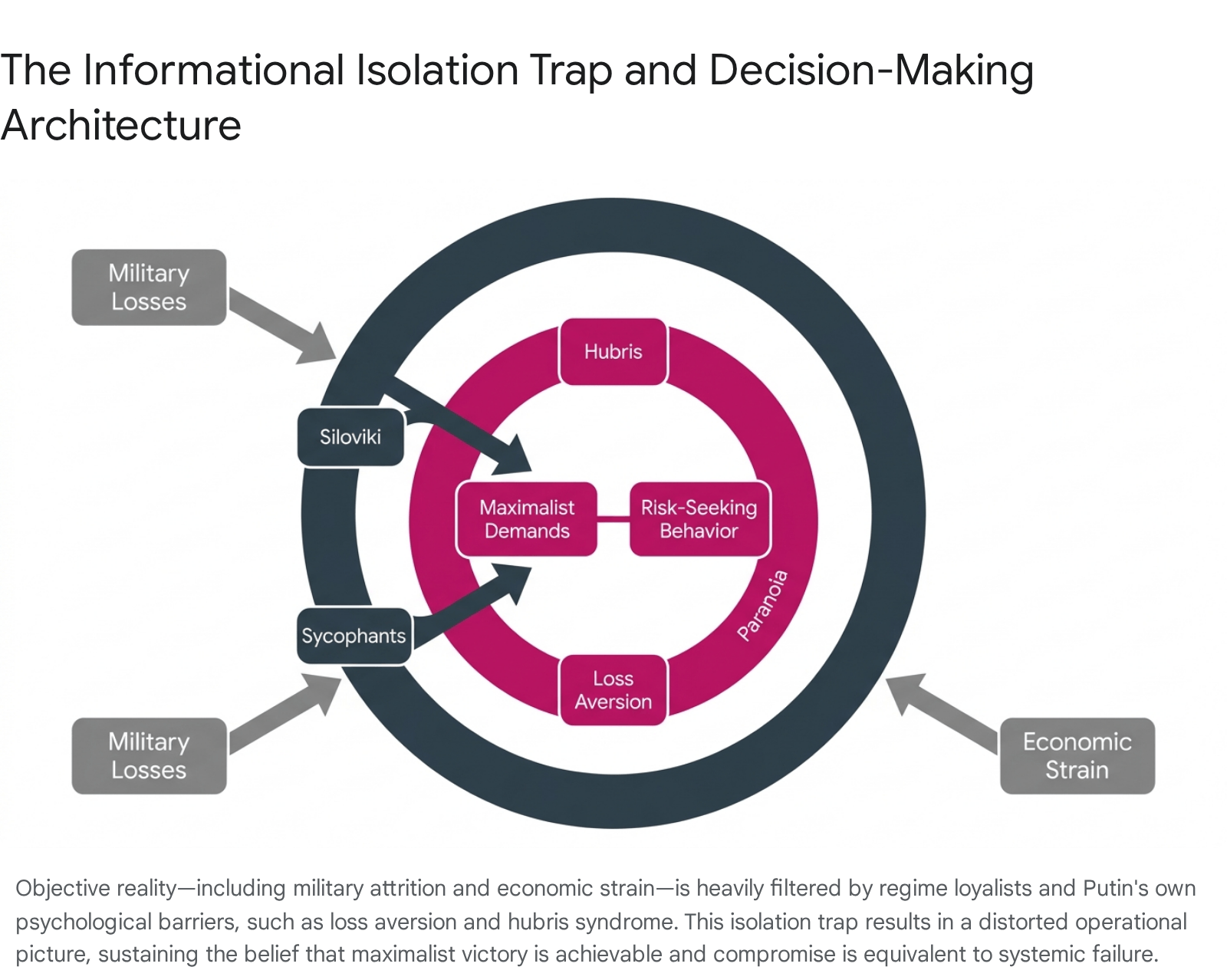
Crucially, this psychological profile is defined by a “schizoid state” or a “scourge” morality.15 Under this framework, the leader develops a messianic complex, feeling a profound, historical duty to cleanse society of perceived pollutants.15 In the context of the Ukraine conflict, these pollutants are explicitly identified by the Kremlin as “neo-Nazis” and the decadent values of the West.15 By framing the conflict as a moral and existential crusade for the survival of the Russkiy Mir (Russian World), Putin has effectively immunized himself against rational economic or geopolitical counter-arguments. When a war is perceived as a divine or historical duty, traditional cost-benefit metrics become entirely irrelevant.2
3.3 Prospect Theory and the Calculus of Loss Aversion
Perhaps the most critical behavioral framework for understanding Putin’s continued prosecution of the war in 2026 is Prospect Theory. Developed by cognitive psychologists, Prospect Theory provides a model for understanding decision-making under conditions of risk.16
The central tenet of Prospect Theory is loss aversion: the psychological phenomenon wherein the pain of losing is significantly more intense than the satisfaction derived from an equivalent gain.1 When evaluating options, individuals judge potential outcomes against a “reference point,” a mental benchmark representing their current status or expected reality.17
Prior to the 2022 invasion, Vladimir Putin operated as a pragmatic risk-taker. His calibrated use of hybrid warfare and hard power in Georgia (2008), Crimea (2014), and Syria (2015) successfully shifted the geopolitical status quo and stymied NATO expansion while avoiding extreme, unmanageable risk.17 These operations were conducted from a baseline where he perceived Russia to have the upper hand; he was operating in a “domain of gains,” where actors generally avoid undue risk to protect what they have achieved.
However, the prospect of Ukraine permanently integrating into Western security and economic architectures represented a catastrophic, apocalyptic loss in Putin’s zero-sum worldview, drastically shifting his reference point.14 When the initial 2022 invasion failed to achieve a rapid decapitation of the Ukrainian government, and as Western support galvanized, Putin found himself violently thrust into a “domain of losses”.18
According to Prospect Theory, human subjects operating in a domain of losses do not act rationally to cut their losses; instead, they exhibit extreme risk-seeking behavior.1 They will gamble ever-greater resources—including political capital, economic stability, and human life—to prevent the anticipated defeat and restore their original reference point.19 To withdraw from occupied territories in 2026, or to compromise on his maximalist goals, would force Putin to crystallize a massive sunk cost into a definitive, humiliating political defeat. Therefore, expending a thousand Russian casualties a day and sacrificing the domestic economy are not perceived by Putin as irrational costs.1 They are viewed as necessary wagers to forestall absolute defeat, fully explaining his high tolerance for risk and his stubborn resistance to peace.17
3.4 The Martial Arts Paradigm and “Madman” Probing
Putin’s strategic doctrine and crisis management style are also heavily influenced by his lifelong practice of martial arts. Beginning with Judo and the rougher Russian variant, Sambo, at an early age, Putin developed a methodology that moved him from unregulated street fighting into disciplined, formalized combat.21
Judo provided Putin with techniques to overcome inherent weaknesses in size and strength by utilizing leverage, balance, and the opponent’s own momentum.21 This framework maps directly onto his principles for domestic and foreign politics. His core tenet is to establish credibility, refuse to back down, and relentlessly probe the opponent for physical and psychological weaknesses until the advantage is secured.21 In his view, one only patches things up and negotiates after the opponent has capitulated and the terms are fully dictated.21
In the diplomatic arena, this manifests as an adaptation of Richard Nixon’s “Madman Theory”.21 Putin intentionally projects an image of danger, irrationality, and unpredictability to unbalance Western adversaries and test their resolve. He utilizes this to gauge reactions: do Western leaders mean what they say, or are they issuing empty threats? If he senses hesitation, an eagerness for de-escalation, or a fear of conflict from the West or Ukraine, he views it not as a mutual desire for peace, but as a critical weakness to be ruthlessly exploited to intimidate and defeat them.21 His psychological makeup dictates that offers of negotiation from a perceived position of weakness are opportunities for exploitation, not compromise.
4. The Mid-2026 Strategic and Domestic Environment
To fully contextualize the unusual surge in public communications regarding a ceasefire in June and July 2026, it is imperative to analyze the kinetic, economic, and societal realities within the Russian Federation during this period. The OSINT landscape reveals a state apparatus under unprecedented internal pressure, directly contradicting the Kremlin’s curated narrative of unaffected domestic stability.
4.1 Kinetic Realities: The Aerial Campaign and Economic Degradation
The first half of 2026 has witnessed a massive, exponential intensification of Ukraine’s asymmetric aerial campaign against targets deep within Russian territory. Official figures published by the Russian Ministry of Defense indicate the interception of at least 63,933 Ukrainian drones over Russia and occupied Ukrainian territories in the first six months of the year.22 The acceleration of this campaign is severe: while combined monthly totals for January and February did not exceed 6,000 interceptions, May saw 14,195, and June peaked at a staggering 17,832.22
This sustained “middle strike” campaign is putting Russia’s air defense networks under unprecedented strain, but more critically, it is systematically dismantling Russia’s economic lifeline: its oil and energy infrastructure.22 Deep strikes have successfully hit major refineries in the south, production facilities in the Voronezh region, and critical infrastructure near Moscow and St. Petersburg.2
By July 2026, energy analysts estimate that approximately one-third of Russia’s total oil refining capacity has been knocked offline by these targeted strikes.26 The resulting disruption has triggered a publicly acknowledged domestic crisis. During a state television interview, Putin acknowledged for the first time that the country is facing a “certain deficit” of fuel.24 The cascading effects across the vast nation include severe fuel shortages, widespread rationing, long lines at gas stations, and the halting of civilian gasoline sales in occupied Crimea, forcing authorities to cancel summer camp bookings for security reasons.23 The strikes have also severely disrupted military logistics, placing key supply routes for the occupying forces into a state characterized by Ukrainian defense officials as a “logistics lockdown”.2
4.2 The Erosion of the Social Contract and Public Sentiment
Putin’s management of the Russian populace has long relied on a specific, unwritten social contract: the public trades political freedom and genuine democratic participation for economic stability, predictability, and the ability to ignore state-sponsored conflicts abroad.4 The 2026 drone campaign has violently shattered this arrangement, bringing the physical and economic consequences of the war directly into the daily lives of millions of ordinary Russians.26
In a desperate attempt to mitigate the drone threat, the Kremlin has implemented severe security measures that are highly disruptive to civilian life. Intermittent, and sometimes total, mobile internet shutdowns have been executed across central Moscow and other regions to disrupt drone navigation signals.4 Furthermore, the government has banned or heavily restricted most foreign messaging applications, forcing citizens onto state-backed alternatives, with well-connected insiders indicating that a total blockade of all Western social media platforms is imminent.4 These digital blackouts have caused billions of rubles in immediate losses for Russian businesses and generated a “huge wave of outrage” across Russian society, with citizens equating the measures to moving closer to a North Korean model.4
Simultaneously, the economic burden of the prolonged war is heavily impacting the working class. Everyday Russians are facing significant tax hikes, surging inflation that has driven up the cost of groceries and utility bills, and a sputtering local economy forcing small businesses to close.4 Frustration is spilling over onto remaining social media networks, evidenced by viral videos of business owners protesting tax policies and Siberian farmers expressing fury over government-ordered mass livestock culls.4
This confluence of physical insecurity, digital isolation, and economic hardship has driven Russia’s general happiness index to a 15-year low as of April 2026.4 A Gallup poll conducted between March and May 2026 revealed that 60% of Russians say economic conditions are worsening—a 20-year record high—while trust in the military plummeted from 79% to 66%. Reflecting this severe fatigue, a May 2026 survey by the Institute of Conflictology and Analysis of Russia (IKAR) found that a record 81% of Russians would support ending the war in Ukraine “as early as tomorrow,” with support for fighting “until complete victory” collapsing to just 9%. Consequently, public polling data indicates a measurable correlation between the intensification of the war on Russian soil and a sharp decline in executive approval.
| Time Period (2026) | Ukrainian Drone Interceptions (Monthly Total) | Reported Putin Approval Rating | Contextual Strategic Event |
| January – February | < 6,000 (Average) | Stable / Baseline | Standard attritional warfare. |
| May | 14,195 | Decline Beginning | Escalation of deep strikes on refineries. |
| June 12 | – | 74% | Pre-SPIEF baseline polling. |
| June 1-7 (Spillover impact) | Sustained high volume | – | Ukrainian forces strike St. Petersburg during Putin’s flagship International Economic Forum (SPIEF). |
| June 21 | Peak trajectory (Total: 17,832) | 69% (FOM) | A distinct 5-point drop following the highly visible SPIEF strikes and escalating fuel deficits. |
| Late June / Early July | Sustained high volume | 66.9% (VTsIOM) / 74% (Levada) | Sharpest single-week drop in trust and approval since the 2022 invasion began, reaching a wartime low. Disapproval rises to 21%. |
| Data derived from Russian Defense Ministry figures and polling from FOM, VTsIOM, and the Levada Center. |
4.3 Elite Disillusionment and the “Acknowledgment Phase”
The pressure is acutely felt among the Russian political and business elite, a demographic that has historically provided the structural scaffolding for Putin’s regime. According to European intelligence officials, the Russian upper echelon has entered the “acknowledgment phase”.4 There is a profound, pervasive sense of disappointment in Putin among the oligarchs and business leaders, who acutely recognize the downward trajectory of both the military campaign and the national economy.4
While initial optimism in Moscow that Donald Trump’s 2024 US election victory would immediately deliver the Donbas to Russia was tempered by Europe’s dramatic escalation of financial and military backing for Kyiv (including a €90 billion EU loan) 4, US-led mediation efforts remain highly active. In early July 2026, ahead of the NATO summit in Ankara, President Trump and President Putin held a one-hour and 25-minute phone call where Trump reaffirmed his readiness to facilitate a swift end to hostilities. US envoys Jared Kushner and Steve Witkoff are actively continuing mediation efforts and preparing for potential Moscow visits.
Despite these high-level diplomatic avenues, members of the Russian elite increasingly view the Kremlin’s decision-making as “utterly senseless” and “self-destructive,” with former staunch defenders of the President ceasing their public advocacy.4 Oligarchs are described as playing “Russian roulette,” privately horrified by the war but remaining silent out of an existential fear of the state.4 High-profile arrests and purges, such as the state seizure of private businesses and the detention of billionaire agricultural founder Vadim Moshkovich, serve as stark, visible warnings to any potential dissenters within the elite class.4
Furthermore, Putin remains rigidly fixated on capturing the entirety of the Donbas, continually shifting internal deadlines—most recently moving the target date for the occupation of the Donetsk region to December 31, 2026. This shifting of goalposts only deepens elite anxieties, as there is a growing realization that the maximalist objectives are increasingly divorced from operational reality.
5. Regime Stability, Coup-Proofing, and the Siloviki
Given the severe degradation of public sentiment, the destruction of critical infrastructure, and the pervasive disillusionment among the elite, Western analysts often question why a palace coup or popular uprising has not materialized. The answer lies in the highly sophisticated, deeply entrenched mechanisms of authoritarian survival that Putin has cultivated over two decades.
5.1 The Architecture of Elite Entrapment
The Russian state under Putin is an ossified structure; it is designed to resist internal reform or flexibility.2 Approximately 60% of contemporary Putin-era elites possess direct professional or family ties to the old Soviet nomenklatura—a highly exclusive bureaucratic class that historically comprised only 1-3% of the Soviet population.27 This demonstrates the existence of an entrenched network of loyalists whose wealth, status, and physical survival are inextricably linked to the continuation of the current regime.
Furthermore, Putin utilizes a strategy defined by political scientists as “institutional entrapment.” In this authoritarian model, a dictator ensures that the costs of exit for the elite—whether through defection, resignation, or rebellion—vastly exceed the costs of remaining loyal, regardless of how detrimental the state’s policies become.28 The elites lack independent power bases, and their assets are intentionally kept vulnerable to state seizure, ensuring absolute compliance through mutually assured destruction.
5.2 The Ascendancy of the Security State
Putin’s primary mechanism for ensuring regime survival in the face of domestic and military crises is aggressive “coup-proofing”.29 This strategy involves deliberately curtailing military autonomy, provoking interbranch rivalries to prevent unified action by the armed forces against the executive, and disproportionately funding internal security forces.28
The Russian state budget for 2026 illustrates this priority starkly and provides empirical evidence of the Kremlin’s domestic fears. While the state reduced social-sector spending from 38% pre-war to just 25% in 2026, allocations for “National Security and Law Enforcement” have surged.28 Funding directed specifically toward internal security rose by more than 11% year-on-year.28
This massive capital injection is directed toward the Federal Security Service (FSB)—particularly the second service, which oversees domestic shutdowns and dissent management—and Rosgvardia, the National Guard.4 Rosgvardia functions as the regime’s praetorian guard, providing the physical muscle required to crush any potential domestic dissent or elite mutiny. By prioritizing coup-proofing over operational military unity, Putin ensures that regardless of failures on the Ukrainian frontline, he maintains a heavily armed, lavishly funded domestic force that takes orders exclusively from the presidency.28
5.3 The Improbability of Conventional Uprisings
Consequently, intelligence reports that occasionally surface regarding potential challengers to Putin are largely assessed as improbable. For example, rumors surrounding former Defense Minister Sergei Shoigu emerging as a challenger have been dismissed by deep-state analysts as far-fetched.4 Shoigu, by design, lacks any independent support base within the army, and his closest associates have been systematically isolated, purged, or arrested by the security services.4
Even prominent political elites who possess significant administrative power—such as Kremlin spokesperson Dmitry Peskov and First Deputy Chief of Staff Sergei Kiriyenko—have been entirely marginalized when they attempted to moderate Putin’s harsh domestic crackdowns, such as the internet restrictions.4 As long as the conflict continues, Putin relies exclusively on the security services, rendering a conventional uprising or moderate political pivot highly improbable.
6. The Peace Overture Deadlock of June/July 2026
The unusual surge in public dialogue regarding peace negotiations in June and July 2026 is a direct manifestation of the compounding domestic pressures outlined above. However, analyzing these recent proposals through Putin’s psychological framework explains why the diplomatic reality remains completely paralyzed.
6.1 The Zelenskyy Open Letter and the UN Security Council
In early June 2026, seeking to capitalize on Russia’s mounting domestic strain, Ukrainian President Volodymyr Zelenskyy published an open letter proposing a concrete diplomatic path forward.20 The letter specifically suggested a face-to-face meeting between himself and President Putin on neutral territory to negotiate an end to the hostilities.20
This initiative was met with broad support from the international community. During a highly contentious UN Security Council meeting on June 8, 2026, global delegates heavily criticized Russia’s ongoing aggression and urged Moscow to accept the ceasefire.20 The representative of Germany directly questioned the Kremlin’s logic, asking, “How can one defend choosing aggression over diplomacy?”.20 The Minister for Foreign Affairs of Finland delivered a direct plea, stating, “President Putin, the path to peace is clear: End this war now”.20 The EU delegation head highlighted the sheer human cost, demanding to know where the Kremlin’s empathy was for the estimated 1,000 Russian soldiers sent to injury and death every single day.20
Putin’s response to this concerted international pressure was an immediate and flat rejection—a repetitive “nyet,” as reported by the Ukrainian UN delegate.20 The Russian Federation’s representative dismissed the open letter entirely, labeling it a “clumsy provocation” and stating that “Imitations of negotiations and performances played out in public are alien to us”.20 Psychologically, accepting a meeting on neutral ground with Zelenskyy—whom Putin views not as a peer, but as an illegitimate subordinate—violates his high-dominance, non-conciliatory operational code.7
6.2 The Long-Range Strike and Localized Ceasefire Proposals
Later in the month, further diplomatic overtures were made, likely through back-channels. During an interview on Russian state television on June 29, 2026, Putin himself revealed that Ukraine had proposed two specific de-escalation measures.30
The first was a proposal for a mutual cessation of long-range strikes.30 This would have effectively halted the devastating Ukrainian attacks on Russian oil refineries in exchange for Russia ceasing its missile barrages against Ukrainian civilian and energy infrastructure. The second proposal was a localized ceasefire, essentially stopping hostilities in areas outside of the Luhansk, Donetsk, Zaporizhzhia, and Kherson oblasts.31
Putin dismissed both proposals entirely. Employing his psychological defense mechanisms and Judo framework, he claimed the proposals were not genuine attempts at peace, but rather tactical ploys initiated because Kyiv’s forces were under immense pressure along the front line.30 He asserted that Ukrainian forces simply wanted to make up for manpower shortages by withdrawing from some areas to redeploy to the critical annexed oblasts.31
Despite acknowledging the severe fuel deficits caused by the strikes, Putin stated that Moscow had no intention of being distracted by these proposals, claiming the strikes “aimed at diverting our attention and forces from achieving the main objectives”.32 He firmly stated that Russia was not interested in granting Ukraine such “salvation,” insisting that the strikes have “absolutely no effect” on the frontline.24 Putin’s Judo mindset dictates that any request for mutual relief from an opponent is a signal of weakness; therefore, he prefers to absorb the massive economic damage to his own state rather than relieve the pressure on his adversary.21
6.3 The Konstantinovka Tactical Pause
Conversely, when Russia proposes a pause, it is strictly for tactical or informational gain. On July 5, 2026, the Russian Defense Ministry proposed a brief, temporary ceasefire in the front-line city of Konstantinovka in the Donetsk region, ostensibly to facilitate the transfer of fallen Ukrainian soldiers.33 This occurred precisely as the Kremlin, including spokesperson Dmitry Peskov and Putin himself, prematurely declared that the city had been completely captured and heralded its strategic significance.33
Ukrainian officials rapidly rejected the proposal and the claims of capture, stating that Ukraine still controlled the city.33 Under the “Madman” and Information Isolation paradigms, such proposals are utilized to project a false narrative of humanitarianism and total military victory to feed the domestic propaganda machine, rather than serving as genuine steps toward conflict resolution.21
6.4 The Illusion of a Negotiated Settlement and the Absence of “Reverse Gear”
These events underscore the central thesis: Vladimir Putin is actively resisting a negotiated settlement because he operates within a political system that fundamentally lacks a “reverse gear” or systemic room for compromise.2 On June 28, 2026, Putin used his speech to the ruling United Russia Party Congress to project strength, emphatically reject diplomatic solutions, and reinforce his resolve to achieve his objectives militarily, while the party formally claimed to be “Putin’s party” for the first time since 2007, further cementing his absolute structural control.
Compromising by withdrawing from occupied Ukrainian lands, or accepting a sovereign, European-integrated Ukraine, would be an explicit admission of failure.2 For an autocrat whose state identity is entirely rooted in imperialist expansion and military invincibility, such an admission is an existential threat.2
Consequently, Putin’s demands for peace have remained rigidly static and maximalist since June 2024. As reiterated by the Kremlin on multiple occasions in late June 2026, Russia demands that Ukrainian forces completely withdraw from the entirety of the Luhansk, Donetsk, Zaporizhzhia, and Kherson regions—including vast areas that Russia does not currently occupy—and permanently abandon its goal of joining NATO prior to entering any negotiations.31
These demands do not constitute a starting point for negotiation; they amount to a demand for complete and unconditional capitulation.31 As Putin reportedly stated regarding meeting Zelenskyy to sign a peace treaty, he expects to simply say, “Thank God it is all over,” signaling his absolute belief that the war can only end on his maximalist terms.2 The Information Isolation Trap ensures he continues to believe this outcome is attainable, despite mounting evidence of strategic failure.2
7. Future Scenarios and Trajectories (2026-2027)
Given Putin’s psychological rigidity, the systemic paralysis of the Russian elite, the extreme loss aversion dictating the Kremlin’s decisions, and the escalating kinetic realities on the ground, the trajectory of the conflict over the next 12 to 18 months can be mapped across three distinct probability scenarios.
7.1 Scenario A: Institutionalized Attrition and the “Forever War” (Most Likely)
Probability: High
If the Russian military remains incapable of achieving a strategic breakthrough to topple the Ukrainian government—a highly probable constraint given sustained European military support, deep Ukrainian resilience, and Ukraine’s expanding domestic drone production capabilities—Moscow will still refuse to sue for peace.2 The most likely outcome is the institutionalization of a long, lower-intensity “forever war”.36
Military analysts characterize Putin as a “master procrastinator” who habitually delays definitive, high-stakes decisions until his options degrade from bad to worse.37 Rather than making a definitive choice between escalating to full mobilization (which risks domestic upheaval) or withdrawing (which risks his political survival), he will likely sustain the current attritional warfare into 2027.36 He will continue to bet on the assumption that Western patience and financial support will eventually fracture, or that the rate of Ukrainian manpower attrition will lead to a collapse.36
Domestically, the Russian state identity, economy, and society have already been fully re-engineered around the necessity of waging war.2 While sociological data indicates deep fatigue—and a significant 52% of Ukrainians categorically reject land concessions, with 65% ready to endure the war as long as necessary 38—Russian polling reveals a dangerous normalization of the conflict. A clear plurality of Russians (59%) advocate for the greater use of force and escalation if peace talks fail, compared to only 21% who advocate for concessions.39 However, even as fatigue grows, without a charismatic opposition leader (as most have been exiled, imprisoned, or killed) and under the absolute control of a 21st-century surveillance state, public discontent will not translate into systemic political change.2 The conflict will persist as a bleeding ulcer, with Putin accepting the severe degradation of the Russian economy and demographics as an acceptable cost for regime preservation.
7.2 Scenario B: Unconventional Escalation and Maximalist Expansion (Plausible)
Probability: Medium
This scenario is driven directly by Putin’s Hubris Syndrome, his operational code of high-dominance, and the application of the “Madman Theory.” While the current frontlines in eastern Ukraine are relatively static and characterized by grinding positional warfare, intelligence insiders warn that Putin is fundamentally not a long-term strategist; rather, his ambitions are opportunistic, and “his appetite grows as he eats”.4
If the Russian military achieves a localized tactical breakthrough in the Donbas, or if Putin perceives a sudden, critical vulnerability in Ukrainian defense lines due to delayed Western ammunition deliveries, his territorial ambitions will rapidly expand beyond his current stated objectives. Handlers of his psychological profile anticipate that, sensing weakness, he could launch a major offensive attempting to cross the Dnipro River to seize the entirety of the four annexed regions, pushing far beyond the current lines of contact.4
Furthermore, his established belief that the international system is inherently hostile 10, combined with his reliance on risk-seeking behavior while operating in a perceived domain of losses 17, makes asymmetric or unconventional escalation a viable tactical option. Recent intelligence warnings regarding Russian “Phase Zero” operations—including drone incursions and electronic warfare interference directed at Poland and the Baltic states—indicate a willingness to set informational and psychological conditions for potential future provocations against NATO. If he feels the war of attrition is failing, he may resort to intensified sabotage operations within NATO borders, cyber warfare targeting European infrastructure, or renewed tactical nuclear posturing. The psychological goal would be to shock Western populations and governments into forcing Kyiv to capitulate, adhering to his Judo principle of unbalancing the opponent.
7.3 Scenario C: Systemic Regime Fracture (Low Probability, High Impact)
Probability: Low but Escalating
While a traditional, organized palace coup orchestrated by a specific faction is highly unlikely due to effective coup-proofing and the fragmentation of the elite, a sudden systemic fracture of the Russian state apparatus remains a growing, high-impact possibility. Putin’s Russia is an ossified, rigid structure; it cannot bend, adapt, or reform from within—it can only break.2
As Ukraine continues to heavily target and degrade Russia’s energy infrastructure—effectively bypassing the static frontline to attack the state’s primary economic engine directly—the financial capacity of the Kremlin to maintain its sprawling, expensive internal security apparatus may eventually falter.2 The regime relies entirely on its ability to pay the siloviki (Rosgvardia, FSB) and subsidize the oligarchs to ensure loyalty and enforce the “institutional entrapment”.28
If the revenues from the energy sector drop below the threshold required to sustain this patronage and security network, the elite’s “fear of exit” will rapidly be eclipsed by the existential cost of remaining tied to a failing state. This scenario does not result in a managed, negotiated peace treaty signed in Geneva or Istanbul. Rather, it results in the sudden, chaotic collapse of the regime’s administrative capacity to function and wage war, brought on by the unbearable combination of economic despair and military exhaustion.2
8. Conclusion
The persistent failure of Western analysis to accurately predict Vladimir Putin’s strategic maneuvers stems from a reliance on democratic, cost-benefit rationality projected onto an autocratic leader operating under severe psychological distortions. Diplomatic overtures, neutral peace proposals, and targeted sanctions intended to act as rational deterrents will continue to fail because they do not align with Putin’s internal behavioral matrix.
Putin’s psychological survival, his historical legacy, and his physical security are inextricably linked to achieving a maximalist victory in Ukraine. He is trapped in a domain of losses, shielded by an information isolation trap, and driven by a messianic complex that precludes the possibility of political compromise. Therefore, the intelligence community assesses that the war will not conclude through bilateral diplomacy or mutual concessions at a negotiating table. It will only conclude when the physical and economic capacity of the Russian state to project force is categorically dismantled, or when the internal, structural contradictions of the regime trigger a systemic, unmanageable collapse.
Appendix: Methodology and Data Sources
This intelligence assessment utilizes a multidisciplinary methodology, synthesizing established political psychology frameworks with Open-Source Intelligence (OSINT). The behavioral analysis applies Operational Code Analysis (to determine philosophical/instrumental beliefs via big-data speech coding), Prospect Theory (evaluating risk-seeking behavior in a domain of losses), and clinical assessments of Hubris Syndrome and paranoid ideation. This psychological profiling is cross-referenced against OSINT data gathered from public state media broadcasts, economic budget indicators, verified military interception data, and independent sociological polling conducted up to July 2026.
Data sources utilized in this assessment include:
- (https://digitalcommons.csbsju.edu/psychology_pubs/104/)
- (https://www.psychologytoday.com/us/blog/tough-choices/202203/what-can-personality-profiles-president-putin-tell-us)
- Psychological Profile of Vladimir Putin (Personality-Politics.org)
- (https://theloop.ecpr.eu/the-psychology-of-war-analysing-putins-motivations/)
- (https://www.theguardian.com/theobserver/commentisfree/2023/jun/18/understanting-the-scourge-that-is-vladimir-putin-letters)
- (https://sites.tufts.edu/fletcherrussia/how-vladimir-putin-is-thinking-about-the-war/)
- (https://www.brookings.edu/articles/what-makes-putin-tick-and-what-the-west-should-do/)
- (https://www.kcl.ac.uk/whats-the-psychology-behind-putins-decision-to-invade)
- (https://www.russiamatters.org/blog/most-russians-favor-escalation-ukraine-over-concessions-if-no-peace-deal)
- (https://www.kiis.com.ua/?lang=eng&cat=reports&id=1583&page=1)
- (https://www.csis.org/analysis/russias-war-ukraine-next-chapter)
- (https://www.brookings.edu/articles/what-price-for-peace-in-ukraine/)
- (https://www.researchgate.net/publication/316056472_The_operational_code_approach_to_profiling_political_leaders_understanding_Vladimir_Putin)
- (https://www.dohainstitute.org/en/PoliticalStudies/Pages/the-centrality-of-putin-operational-code-in-the-decision-to-intervene-directly-in-syria.aspx)
- (https://www.aljazeera.com/news/2026/6/29/russia-ukraine-war-why-has-putin-rejected-limits-on-long-range-strikes)
- (https://www.pbs.org/newshour/world/ukraines-drone-set-another-russian-oil-refinery-ablaze-as-putin-admits-fuel-shortages)
- Kremlin says Ukraine will be involved in peace talks (Asharq Al Awsat)
- (https://www.cbsnews.com/news/kremlin-premature-to-say-peace-deal-ukraine-close/)
- (https://understandingwar.org/research/russia-ukraine/russian-offensive-campaign-assessment-june-29-2026/)
- (https://understandingwar.org/research/russia-ukraine/russian-offensive-campaign-assessment-june-30-2026/)
- (https://www.atlanticcouncil.org/blogs/ukrainealert/with-putin-visibly-weakened-now-is-the-time-to-back-ukraine/)
- (https://www.ft.com/content/13687b48-9e54-44a1-bd4d-600bbc052baf?syn-25a6b1a6=1)
- Peace instead of war: how sentiments are changing (Caliber.Az)
- (https://www.cfr.org/global-conflict-tracker/conflict/conflict-ukraine)
- (https://www.policymagazine.ca/putins-delusion-and-the-myth-of-a-negotiated-peace/)
- (https://www.straitstimes.com/world/europe/kremlin-says-russias-stance-on-conditions-for-a-ukraine-peace-deal-has-not-changed-since-2024)
- (https://www.theguardian.com/world/ng-interactive/2026/may/24/there-is-profound-disappointment-in-him-mood-in-russia-turns-against-putin)
- (https://harpers.org/archive/2023/06/why-are-we-in-ukraine/)
- (https://csis-website-prod.s3.amazonaws.com/s3fs-public/publication/180227_Cancian_CopingWithSurprise_wAppen_Web.pdf)
- (https://www.marshallcenter.org/en/publications/security-insights/russian-strategic-culture-baltic-crisis-0)
- (https://www.diva-portal.org/smash/get/diva2:1794532/FULLTEXT01.pdf)
- (https://www.siwps.org/blog/anthony-costanzo-on-putins-gamble-in-ukraine/)
- (https://css.ethz.ch/content/dam/ethz/special-interest/gess/cis/center-for-securities-studies/pdfs/russiananalyticaldigest-337.pdf)
- (https://www.researchgate.net/publication/359883499_Long_Soviet_shadows_the_nomenklatura_ties_of_Putin_elites)
- (https://ridl.io/rumours-of-a-coup-in-russia-what-does-this-really-say-about-the-putin-regime/)
- (https://www.researchgate.net/publication/401220182_Pro-War_Reactions_to_PMC_Wagner_Before_and_After_Its_Mutiny)
- (https://www.brookings.edu/articles/putin-personality-disorder/)
- (https://esthinktank.com/2025/06/11/the-human-factor-how-personality-and-psychology-drive-crises/)
- Mental disorder in Vladimir Putin: Hypothesis (PubMed)
- (https://www.hks.harvard.edu/faculty-research/policy-topics/international-relations-security/how-russian-history-and-human)
- (https://www.pbs.org/newshour/world/russia-unleashes-massive-barrage-on-ukraine-killing-at-least-30-people-as-putin-shrugs-off-energy-concerns)
- (https://www.ukrinform.net/rubric-polytics/4138725-putin-says-russia-will-continue-its-offensive-despite-ukraines-ceasefire-proposals.html)
- (https://news.cgtn.com/news/2026-07-05/Russia-proposes-temporary-ceasefire-in-Konstantinovka-1OwI3Q2YxGg/p.html)
- (https://press.un.org/en/2026/sc16380.doc.htm)
- (https://www.theguardian.com/world/2026/jun/23/ukraine-war-briefing-our-patience-is-not-endless-kyiv-signals-peace-offer-may-expire)
Please share the link on Facebook, Forums, with colleagues, etc. Your support is much appreciated and if you have any feedback, please email us in**@*********ps.com. If you’d like to request a report or order a reprint, please click here for the corresponding page to open in new tab.
Sources Used
- The psychology behind the Kremlin’s war in Ukraine | Feature from King’s College London, accessed July 5, 2026, https://www.kcl.ac.uk/whats-the-psychology-behind-putins-decision-to-invade
- Putin’s Delusion and the Myth of a Negotiated Peace – Policy …, accessed July 5, 2026, https://www.policymagazine.ca/putins-delusion-and-the-myth-of-a-negotiated-peace/
- The Human Factor: How Personality and Psychology Drive Crises – EST, accessed July 5, 2026, https://esthinktank.com/2025/06/11/the-human-factor-how-personality-and-psychology-drive-crises/
- ‘There is profound disappointment in him’: mood in Russia turns …, accessed July 5, 2026, https://www.theguardian.com/world/ng-interactive/2026/may/24/there-is-profound-disappointment-in-him-mood-in-russia-turns-against-putin
- Rumours of a coup in Russia: What does this really say about the Putin regime?, accessed July 5, 2026, https://ridl.io/rumours-of-a-coup-in-russia-what-does-this-really-say-about-the-putin-regime/
- The operational code approach to profiling political leaders: understanding Vladimir Putin – Open eClass, accessed July 5, 2026, https://openeclass.uom.gr/modules/document/file.php/UNI390/READING%20MATERIAL/The%20operational%20code%20approach%20to%20profiling%20political%20leaders%20understanding%20Vladimir%20Putin.pdf
- The Political Personality of Russian Federation President Vladimir Putin, accessed July 5, 2026, https://digitalcommons.csbsju.edu/psychology_pubs/104/
- Russia Threat Assessment: Psychological Profile of Vladimir Putin, accessed July 5, 2026, http://personality-politics.org/russia-threat-assessment-psychological-profile-of-vladimir-putin
- What Can Personality Profiles of President Putin Tell Us? – Psychology Today, accessed July 5, 2026, https://www.psychologytoday.com/us/blog/tough-choices/202203/what-can-personality-profiles-president-putin-tell-us
- The psychology of war: analysing Putin’s motivations – The Loop (ECPR), accessed July 5, 2026, https://theloop.ecpr.eu/the-psychology-of-war-analysing-putins-motivations/
- The operational code approach to profiling political leaders: understanding Vladimir Putin, accessed July 5, 2026, https://www.researchgate.net/publication/316056472_The_operational_code_approach_to_profiling_political_leaders_understanding_Vladimir_Putin
- Psychological profiling of world leaders | ORMS Today – PubsOnLine, accessed July 5, 2026, https://pubsonline.informs.org/do/10.1287/orms.2014.06.10/full/
- Mental disorder in Vladimir Putin: Hypothesis – PubMed, accessed July 5, 2026, https://pubmed.ncbi.nlm.nih.gov/41564202/
- Why Are We in Ukraine?, by Benjamin Schwarz, Christopher Layne – Harper’s Magazine, accessed July 5, 2026, https://harpers.org/archive/2023/06/why-are-we-in-ukraine/
- Understanding the scourge that is Vladimir Putin – The Guardian, accessed July 5, 2026, https://www.theguardian.com/theobserver/commentisfree/2023/jun/18/understanting-the-scourge-that-is-vladimir-putin-letters
- Courting Risk: A Prospect Theory Analysis of Putin’s Decision to Invade Ukraine – Diva-Portal.org, accessed July 5, 2026, https://www.diva-portal.org/smash/get/diva2:1794532/FULLTEXT01.pdf
- Anthony Costanzo on Putin’s Gamble in Ukraine – SIWPS, accessed July 5, 2026, https://www.siwps.org/blog/anthony-costanzo-on-putins-gamble-in-ukraine/
- Courting Risk: A Prospect Theory Analysis of Putin’s Decision to Invade Ukraine – https ://uu.diva-portal.org, accessed July 5, 2026, http://uu.diva-portal.org/smash/record.jsf?pid=diva2:1794532
- Russian Strategic Culture in a Baltic Crisis | George C. Marshall European Center For Security Studies, accessed July 5, 2026, https://www.marshallcenter.org/en/publications/security-insights/russian-strategic-culture-baltic-crisis-0
- War in Ukraine at Deadliest Point in Four Years, UN Officials Warn …, accessed July 5, 2026, https://press.un.org/en/2026/sc16380.doc.htm
- What makes Putin tick, and what the West should do – Brookings Institution, accessed July 5, 2026, https://www.brookings.edu/articles/what-makes-putin-tick-and-what-the-west-should-do/
- Ukraine striking Russian energy infrastructure at unprecedented rate, accessed July 5, 2026, https://www.ft.com/content/13687b48-9e54-44a1-bd4d-600bbc052baf?syn-25a6b1a6=1
- Ukraine war briefing: ‘Our patience is not endless’ – Kyiv signals peace offer may expire, accessed July 5, 2026, https://www.theguardian.com/world/2026/jun/23/ukraine-war-briefing-our-patience-is-not-endless-kyiv-signals-peace-offer-may-expire
- Ukraine’s drone set another Russian oil refinery ablaze, as Putin admits fuel shortages, accessed July 5, 2026, https://www.pbs.org/newshour/world/ukraines-drone-set-another-russian-oil-refinery-ablaze-as-putin-admits-fuel-shortages
- Kremlin says it’s “premature” to say peace deal with Ukraine is close – CBS News, accessed July 5, 2026, https://www.cbsnews.com/news/kremlin-premature-to-say-peace-deal-ukraine-close/
- Russia unleashes massive barrage on Ukraine, killing at least 30 people, as Putin shrugs off energy concerns, accessed July 5, 2026, https://www.pbs.org/newshour/world/russia-unleashes-massive-barrage-on-ukraine-killing-at-least-30-people-as-putin-shrugs-off-energy-concerns
- Long Soviet shadows: the nomenklatura ties of Putin elites | Request PDF – ResearchGate, accessed July 5, 2026, https://www.researchgate.net/publication/359883499_Long_Soviet_shadows_the_nomenklatura_ties_of_Putin_elites
- analytical digest russian – CSS ETH Zürich, accessed July 5, 2026, https://css.ethz.ch/content/dam/ethz/special-interest/gess/cis/center-for-securities-studies/pdfs/russiananalyticaldigest-337.pdf
- Pro-War Reactions to PMC Wagner Before and After Its Mutiny – ResearchGate, accessed July 5, 2026, https://www.researchgate.net/publication/401220182_Pro-War_Reactions_to_PMC_Wagner_Before_and_After_Its_Mutiny
- Russia-Ukraine war: Why has Putin rejected limits on long-range strikes? – Al Jazeera, accessed July 5, 2026, https://www.aljazeera.com/news/2026/6/29/russia-ukraine-war-why-has-putin-rejected-limits-on-long-range-strikes
- Russian Offensive Campaign Assessment, June 29, 2026, accessed July 5, 2026, https://understandingwar.org/research/russia-ukraine/russian-offensive-campaign-assessment-june-29-2026/
- Putin says Russia will continue its offensive despite Ukraine’s ceasefire proposals, accessed July 5, 2026, https://www.ukrinform.net/rubric-polytics/4138725-putin-says-russia-will-continue-its-offensive-despite-ukraines-ceasefire-proposals.html
- Russia proposes temporary ceasefire in Konstantinovka to transfer Ukrainian soldiers’ bodies, accessed July 5, 2026, https://news.cgtn.com/news/2026-07-05/Russia-proposes-temporary-ceasefire-in-Konstantinovka-1OwI3Q2YxGg/p.html
- Kremlin says Russia’s stance on conditions for a Ukraine peace deal has not changed since 2024 | The Straits Times, accessed July 5, 2026, https://www.straitstimes.com/world/europe/kremlin-says-russias-stance-on-conditions-for-a-ukraine-peace-deal-has-not-changed-since-2024
- Kremlin says Russia’s stance on conditions for a Ukraine peace de – Global Banking & Finance Review, accessed July 5, 2026, https://www.globalbankingandfinance.com/kremlin-russias-stance-conditions-ukraine-peace-deal-changed/
- Russia’s War in Ukraine: The Next Chapter – CSIS, accessed July 5, 2026, https://www.csis.org/analysis/russias-war-ukraine-next-chapter
- How Vladimir Putin is thinking about the war – Fletcher Russia and Eurasia Program, accessed July 5, 2026, https://sites.tufts.edu/fletcherrussia/how-vladimir-putin-is-thinking-about-the-war/
- Press releases and reports – Public opinion in the context of Russia’s attempts to plunge Ukraine into darkness and cold: results of a survey conducted on January 23-29, 2026, accessed July 5, 2026, https://www.kiis.com.ua/?lang=eng&cat=reports&id=1583&page=1
- Most Russians Favor Escalation in Ukraine Over Concessions If No Peace Deal, accessed July 5, 2026, https://www.russiamatters.org/blog/most-russians-favor-escalation-ukraine-over-concessions-if-no-peace-deal