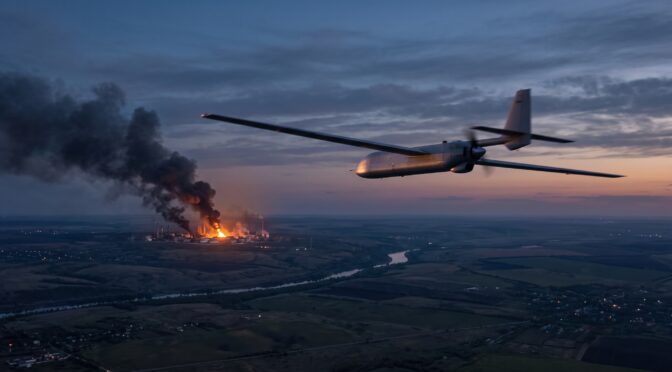
1. Executive Summary
The proliferation, maturation, and operational deployment of Ukrainian long-range unmanned aerial systems (UAS) have fundamentally altered the strategic depth and character of the ongoing conflict with the Russian Federation. Over an extended period stretching from the initial phases of the war through mid-2026, Ukrainian forces have successfully conceptualized, tested, and executed an escalating campaign of deep strikes into sovereign Russian territory. These operations have systematically targeted military-industrial complexes, strategic aviation bases, early warning radar networks, and critical hydrocarbon infrastructure.1 This capability has not emerged from a singular technological breakthrough or a sudden influx of foreign material, but rather from a deliberate synthesis of domestic doctrinal innovation, asynchronous force structuring, and the rapid integration of advanced algorithmic navigation to counter heavily contested electromagnetic environments and layered air defense networks.1
An analysis of the operational environment indicates that Ukraine’s ability to persistently penetrate Russian airspace relies on a highly integrated, multi-tiered operational architecture. The establishment of the Unmanned Systems Forces (USF) as an independent military branch centralized the procurement, doctrine, and deployment of a highly diversified drone fleet.1 Ranging from cost-effective propeller-driven platforms designed for mass and endurance, to advanced jet-powered munitions engineered for speed and survivability, this fleet provides scalable, asymmetric strike options across varying ranges and payload requirements.6
However, hardware represents only the kinetic delivery mechanism. The core of Ukraine’s deep-strike viability lies in its navigation and targeting software architecture. Operating in what is arguably the most densely contested electronic warfare (EW) environment in modern military history, Ukrainian engineers have integrated autonomous waypoint navigation, optical terrain matching algorithms, and terminal-phase automatic target recognition (ATR).3 By deliberately severing the platform’s reliance on external satellite navigation (GPS) and live command-and-control telecommunications, these systems render traditional active jamming techniques ineffective.3
The tactical application of these technologies is supported by rigorous intelligence preparation of the battlefield (IPB). Operations such as “Polyphemus” demonstrate a sequenced, combined-arms approach to unmanned warfare, where mid-range strikes are utilized to systematically degrade forward radar arrays, thereby opening safe transit corridors for deeper strikes against strategic targets.10 Simultaneously, highly asymmetric operations orchestrated by domestic intelligence services have utilized civilian infrastructure and covert logistics to bypass border air defenses entirely, launching strikes from within Russian borders.12
The cumulative effect of these operations has shifted the conflict from a strictly localized war of territorial attrition to a theater-wide campaign of economic and logistical degradation. By mid-2026, systematic strikes on oil refineries had degraded a significant portion of Russia’s primary refining capacity, forcing unprecedented domestic fuel rationing, localized market instability, and triggering observable, macro-level reallocations in the adversary’s defense spending.1 This report examines the doctrinal, technological, and strategic components of this campaign, detailing how a state with a relatively nascent aerospace industrial base has successfully projected unmanned power across thousands of kilometers of hostile airspace.
2. Evolution of the Operational Environment and the Asymmetric Imperative
To accurately assess the mechanisms of Ukrainian deep strikes, one must first define the operational environment and the strategic imperatives that drove their development. In traditional force design, deep strike capabilities are the domain of heavy strategic bombers, advanced stealth aircraft, and mass-produced ballistic and cruise missiles. Following the initial phases of the war, Ukraine possessed highly limited capacities in these traditional domains. Furthermore, geopolitical constraints placed upon Western-supplied munitions strictly prohibited their use against targets within the internationally recognized borders of the Russian Federation.
Faced with a heavily asymmetric disadvantage in traditional standoff fires, and facing an adversary capable of launching hundreds of long-range munitions per week from safe rear areas, Ukraine required a domestic solution to project power and disrupt the adversary’s operational depth.8 The solution was found in the rapid militarization and scaling of One-Way Attack Unmanned Aerial Vehicles (OWA-UAVs).
The operational environment over western Russia is characterized by a mature, layered Integrated Air Defense System (IADS). This system integrates long-range area denial platforms (such as the S-400), medium-range systems (such as the Buk-M3), and short-range point defense systems (such as the Pantsir-S1), all networked through dense arrays of early warning and tracking radars.14 Additionally, the border regions are blanketed by a dense electromagnetic shield—a continuous zone of electronic warfare designed to blind sensors, spoof navigation coordinates, and sever communication links.3 Penetrating this airspace required not just a physical airframe, but a comprehensive doctrinal and technological ecosystem capable of finding, navigating, and exploiting the microscopic seams in this defense network.
3. Doctrinal Command and Force Architecture
The integration of long-range autonomous drones into a cohesive strategic campaign necessitated a radical departure from traditional, decentralized deployment models. Early in the conflict, drone operations were highly localized, managed at the brigade or battalion level for immediate tactical reconnaissance and localized strike. The shift toward strategic application culminated in the formal establishment of the Unmanned Systems Forces (USF) as a fully independent branch of the Armed Forces of Ukraine via presidential decree on June 25, 2024.1
3.1 The Unmanned Systems Forces (USF)
Commanded by Major Robert Brovdi, who was appointed on June 3, 2025, the USF represents a unique structural evolution in modern military organization.1 It consolidates eleven specialized combat units under a unified command structure known as the UAS Forces Grouping.1 This horizontal integration is vital. The USF does not solely consist of pilots and operators; its institutional structure intrinsically encompasses software engineers, aerodynamic designers, programmers, and intelligence analysts.1
This organizational architecture compresses the traditional defense procurement cycle. In conventional militaries, identifying a tactical deficiency, conceptualizing a technological solution, testing, procuring, and fielding that solution can take years. Within the USF, the feedback loop between a combat deployment failure and a technological iteration is compressed to days or weeks. Software patches to bypass new Russian EW frequencies, or hardware modifications to reduce radar cross-sections, are tested and fielded at a pace that bypasses traditional bureaucratic friction.1
3.2 The Three-Tier Strike Architecture
The doctrinal foundation of the USF is built upon a highly deliberate three-tier strike architecture designed to project power sequentially across the entirety of the operational environment.1
The first tier involves front-line tactical strikes. USF crews execute real-time missions against localized troop concentrations, forward logistics, and armored vehicles. They operate under strict efficiency mandates, such as the “Standard-10” formula, which dictates specific monthly operational outputs for confirmed enemy casualties per crew.1 This tier ensures constant tactical attrition at the line of contact.
The second tier focuses on mid-range, operational depth strikes. This tier operates up to several hundred kilometers behind the front line and is primarily tasked with the Suppression of Enemy Air Defenses (SEAD) and the destruction of operational logistics. By orchestrating nightly raids against early warning radars, electronic warfare nodes, and regional command posts, the mid-range tier systematically dismantles the overlapping coverage of Russian air defense networks.1 This tier is the critical enabler for deeper operations.
The third tier is the strategic depth strike capability. Managed by the dedicated Deep Strike Centre established on December 25, 2025, this tier leverages the physical corridors cleared by the second tier to deploy long-range platforms.1 The effectiveness of this tier has expanded rapidly; by June 2026, the USF reported a 1,150 percent increase in deep strikes compared to the beginning of the year, executing 2,359 long-range combat missions in that month alone. Highlighting the immense scale of these operations, in June 2026 the USF reported striking a total of 50,147 military targets across operational and strategic depths, averaging 1,671 targets engaged per day. These assets target military-industrial facilities, aviation repair plants, and hydrocarbon infrastructure located between 1,500 and 3,000 kilometers from the Ukrainian border.1 The Deep Strike Centre streamlines the complex intelligence, route planning, and terminal execution required for these missions, ensuring that long-range assets are preserved for strikes that exert macroeconomic or strategic-level pressure on the adversary.1
4. Force Design: The One-Way Attack UAV Fleet
The execution of the USF’s strategic mandate requires a diverse, highly adaptable inventory of munitions. Rather than relying on a single, expensive platform, Ukraine has cultivated a robust domestic manufacturing ecosystem, expanding from a handful of drone manufacturers in 2022 to over 500 established entities by 2026, with an annual production capacity projecting into the millions across all drone classes.13 For deep strike operations, this industrial base produces a spectrum of platforms, each optimized for specific target profiles, ranges, and threat environments.
4.1 Propeller-Driven Platforms: Mass and Endurance
The backbone of Ukraine’s long-range campaign consists of propeller-driven aircraft. These platforms are prized for their high fuel efficiency, extended loiter times, relatively low production costs, and their ability to be manufactured at scale using a blend of commercial and bespoke components.
The Antonov An-196 Liutyi stands as one of the most prominent platforms in this category. Designed by the Antonov ASTC, the Liutyi utilizes a conventional twin-boom empennage and is powered by a reliable four-valve air-cooled box engine.6 With a mass of 250 to 300 kilograms and a wingspan of 6.7 meters, it is a substantial airframe capable of delivering a 50 to 75-kilogram high-explosive warhead over an operational range of 1,000 to 2,000 kilometers.6 Priced at an estimated $200,000 per unit, the Liutyi offers a highly favorable cost-to-effect ratio.6 Analysts attribute a significant percentage—up to 80 percent in certain operational windows—of successful strikes on Russian oil refineries to the Liutyi’s extended reach and payload capacity.3
The UJ-26 Beaver (Bober), introduced into mass production in 2023, utilizes a highly distinctive canard aerodynamic layout featuring a sleek fuselage and an inverted tail configuration.7 This specific aerodynamic design enhances lift and maneuverability, particularly at lower altitudes, which is critical for evading radar detection by flying below the radar horizon. The Beaver possesses a range of approximately 1,000 kilometers and carries a 20-kilogram payload.7 It was instrumental in the early psychological and disruptive operations targeting the Moscow region.7
Other notable propeller-driven models include the UJ-22 Airborne, a light aircraft layout featuring a tractor propeller, capable of an 800-kilometer range and a 20-kilogram payload.7 The Sichen (Behemoth) represents a flying wing design with swept endplates, evolving iteratively from initial models carrying 30-kilogram warheads to later, darker-airframe variants equipped with Starlink communications, larger 40-kilogram payloads, and extended ranges of 1,400 kilometers.7 More recent additions, such as the Zozulia, promise operational ranges extending up to 2,100 kilometers, further pushing the boundaries of the threatened airspace.7
4.2 High-Velocity Jet Munitions: Speed and Survivability
While propeller drones offer operational efficiency and mass, their relatively low flight speeds—typically between 100 and 200 km/h—present a tactical vulnerability.8 These speeds provide the adversary with substantial early warning time, allowing defenders to scramble interceptor aircraft, reposition mobile air defense assets, or flush high-value targets (such as strategic bombers) from targeted airfields.8 To address these tactical limitations and compress the adversary’s response window, Ukraine has invested heavily in the development of jet-powered strike platforms.
The Palianytsia, formally unveiled in mid-2024, represents a significant evolution in Ukrainian aerospace capability. Officially designated in media as a “rocket drone,” it is technically a jet-powered UAV utilizing a solid-fuel booster for a zero-length ground launch before transitioning to a single-circuit turbojet engine for sustained flight.8 The Palianytsia measures 3.5 meters in length with a wingspan of 1.7 meters and boasts a maximum takeoff weight of 320 kilograms, which includes a highly destructive 100-kilogram warhead.18
The primary tactical advantage of the Palianytsia is its velocity. Capable of reaching sustained speeds of 900 km/h, its flight profile and kinetic energy are highly comparable to traditional cruise missiles such as the Russian Kh-101.19 This speed drastically alters the engagement calculus. A propeller drone detected 300 kilometers from its target allows defenders up to three hours to react; the Palianytsia covers the same distance in approximately 20 minutes.8 This makes it exceptionally effective against time-sensitive, highly defended targets.
However, the integration of jet propulsion introduces distinct engineering and economic realities. Jet engines possess a superior weight-to-thrust ratio, allowing for smaller physical dimensions relative to payload, but they are significantly more expensive to manufacture than standard internal combustion engines.8 Furthermore, the aerodynamic stresses experienced at high subsonic speeds require highly engineered, rigid airframes, precluding the use of cheap, commercial-off-the-shelf materials.8 Consequently, platforms like the Palianytsia—and the newer, longer-range Flamingo, which boasts a reported 3,000-kilometer range—are reserved for strategic targets where the probability of interception must be minimized at all costs.8
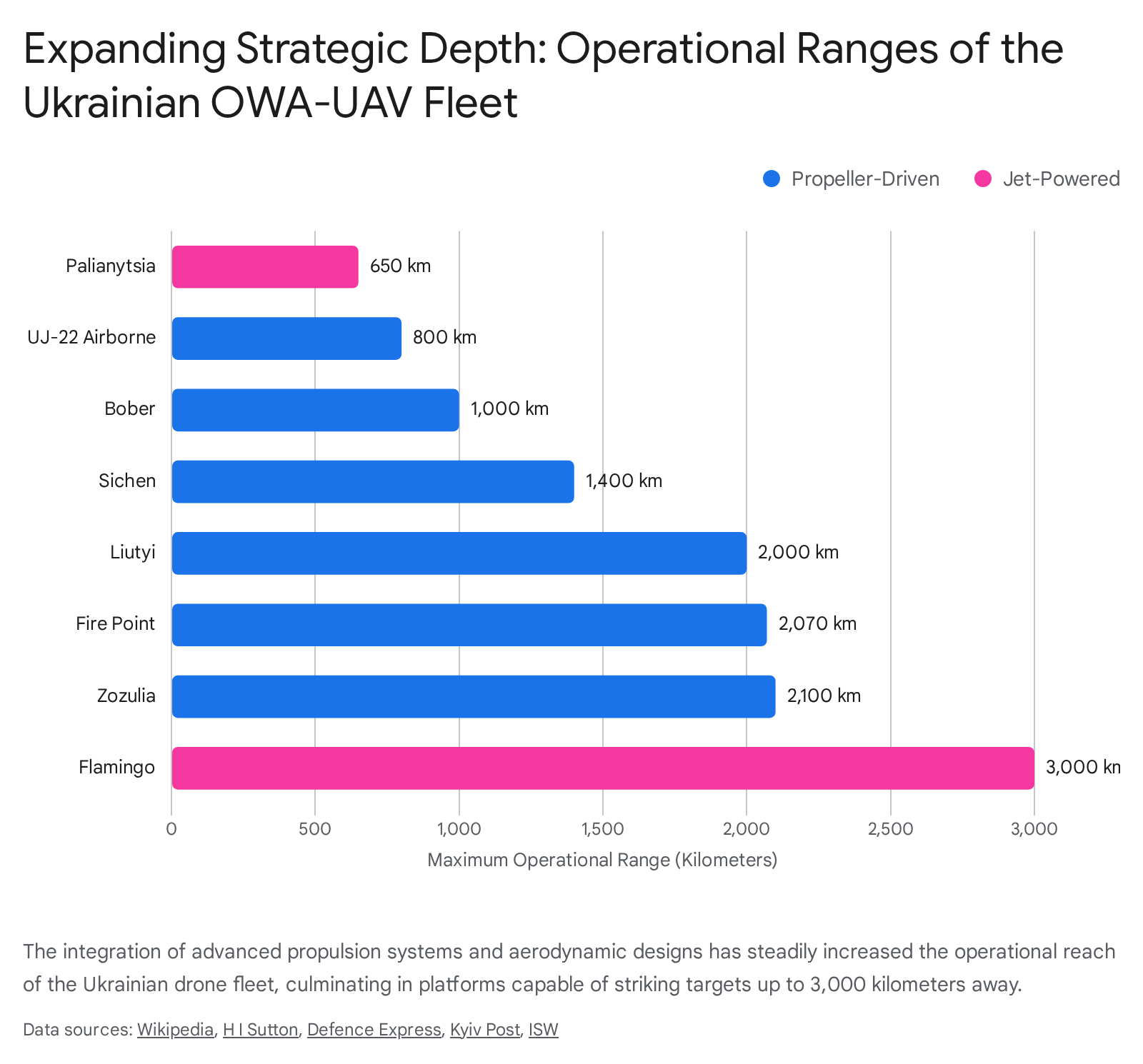
| Platform Designation | Primary Propulsion Type | Estimated Max Range (km) | Payload Capacity (kg) | Notable Features / Guidance Systems |
| Liutyi (An-196) | Propeller (Box engine) | 1,000 – 2,000 | 50 – 75 | High range, INS/SatNav/AI integration, est. $200k unit cost 6 |
| Beaver (Bober) | Propeller (Pusher) | ~1,000 | 20 | Canard layout, optimized for low radar horizon evasion 7 |
| Sichen / Behemoth | Propeller | ~1,400 | 30 – 40 | Swept endplates, Starlink communications equipped 7 |
| UJ-22 Airborne | Propeller (Tractor) | 800 | 20 | Internal warhead or dropped munitions capability 7 |
| Zozulia | Propeller | 1,000 – 2,100 | ~50 | Advanced long-range capability, likely Starlink connected 7 |
| Palianytsia | Turbojet (+ solid booster) | 650 | 100 | 900 km/h velocity, GPS/INS guided, ground-launched 8 |
| Flamingo | Jet (Assumed) | 3,000 | Undisclosed | Extreme range capability, utilized in Crimean strikes 18 |
| Fire Point | Undisclosed | 2,070 | Undisclosed | Recently deployed for deep-depth strikes 16 |
5. Penetration Tactics: Bypassing the Layered Defense Network
The primary challenge of unmanned deep strike is not achievable range, but survivability. The airspace over the Russian Federation is defended by a formidable, multi-layered Integrated Air Defense System (IADS). Striking targets located hundreds of kilometers within this environment requires comprehensive suppression and evasion strategies orchestrated well before the munition leaves the launch rail.
5.1 Route Optimization and Intelligence Integration
The survival of a long-range drone relies heavily on its ability to avoid detection for as long as possible. Ukrainian operational planners utilize highly advanced route planning software that is heavily augmented by artificial intelligence and multi-domain intelligence gathering.4
Prior to a launch, planning systems ingest massive quantities of signals intelligence (SIGINT), satellite imagery, and electronic intelligence (ELINT). This data is supplied both by domestic intelligence services and shared by allied partners.3 The intelligence is used to map the real-time active emission footprints of Russian early warning radars and electronic warfare jamming stations.
AI algorithms process this vast dataset to identify seams, blind spots, and overlaps in the radar coverage. The system calculates complex flight paths that maximize terrain masking—utilizing river valleys, forests, and topographical depressions to keep the drones below the radar horizon.4 These routes are rarely direct. A single mission profile may contain over 1,000 highly specific geographical waypoints, instructing the drone to zig-zag across regions, drastically alter altitudes, and exploit localized gaps in sensor coverage.3 By the time the platforms approach their terminal phase, they often approach from unexpected azimuths, heavily complicating the engagement calculus for localized point defense operators.
5.2 Swarm Tactics and Target Saturation
When total evasion is impossible and radar corridors cannot be entirely bypassed, Ukrainian forces employ massed swarm tactics designed to mathematically overwhelm the intercept capacities of terminal air defense systems.
Air defense systems like the Pantsir-S1 or Tor-M2 possess a finite number of interceptor missiles and can only track and engage a specific number of targets simultaneously. During major operations against high-value targets, Ukrainian forces orchestrate the simultaneous arrival of dozens—sometimes hundreds—of drones and low-budget cruise missiles at the target area.14 Even if the defense systems achieve a highly elevated interception rate (with Russian sources occasionally claiming 90 percent effectiveness during specific engagements), the sheer volume of the swarm ensures that a critical percentage of the munitions will exhaust the defenders’ magazines and penetrate the grid.14
6. Active Suppression and Intelligence Preparation: Operation Polyphemus
While evasion and saturation are effective, the USF also conducts active operations to systematically degrade the adversary’s sensor networks, effectively clearing airspace corridors for deep strikes. This represents a mature, sequenced approach to warfare, proving that intermediate-range SEAD is a prerequisite for sustained strategic interdiction.
A prime example of this methodology is “Operation Polyphemus,” executed by specialized operators from the “Roni” group of the 1st Separate Center (14th Regiment) under the USF.10 Recognizing that long-range strikes against the capital region and northern logistical hubs were being heavily attrited by dense sensor arrays along the border, Ukrainian forces launched a concentrated, systematic campaign targeting Russian radar complexes.10
The primary targets were SKPP systems (specialized radar units) located in the Bryansk region, which continuously monitored the airspace corridors leading toward Moscow.10 By successfully destroying these early warning “eyes,” the USF degraded the cohesion of Russia’s layered network.10 Without overlapping, forward-deployed radar coverage, long-range tracking was severed, forcing individual point-defense systems closer to Moscow to operate in isolation with heavily reduced reaction times.
Ukrainian military officials confirmed that the tactical successes of Operation Polyphemus directly enabled subsequent large-scale, deep drone strikes on strategic facilities in Moscow, Saint Petersburg, and Ust-Luga.10 The destruction of these radar sectors created a significant breach in the air defense network that is technically and economically difficult for Russian forces to rapidly repair and restore.10
7. Navigating Contested Airspace: The AI and Electronic Warfare Imperative
The most significant technological hurdle in modern deep-strike operations is not aerodynamics, but the pervasive threat of electronic warfare. The operational environment, particularly the 60-kilometer-wide strip of territory along the Russian-Ukrainian border, is characterized by intense electromagnetic contested zones.3 In these zones, GPS signals are routinely spoofed, and control telemetry is subjected to overwhelming broad-spectrum jamming.3
A drone reliant on a continuous satellite link for location data, or a radio link for operator control, possesses an engagement success rate of merely 10 to 20 percent in this environment.3 To achieve operational viability, Ukrainian engineering has fundamentally shifted toward total flight autonomy, stripping the platforms of their reliance on external signals.
7.1 Standalone Autopilot Integration
The foundational layer of this autonomy is the integration of advanced, open-source autopilot software, most notably systems like ArduPilot.3 By utilizing and heavily modifying this software, Ukrainian defense technology companies have engineered strike drones that operate entirely without communication loops.3
The mission profile, including the thousands of waypoints calculated during the intelligence phase, is pre-programmed and hard-coded into the drone’s onboard flight computer prior to launch. Once airborne, the platform does not emit or receive standard radio control telemetry. This renders it immune to traditional active RF jamming designed to sever the operator-drone link, as there is no link to sever.3
7.2 Optical Navigation and the DSMAC Evolution
However, maintaining radio silence does not solve the vulnerability of GPS spoofing, where EW systems broadcast false satellite signals to force drones off course. To circumvent GPS dependency entirely, Ukraine has adopted and refined Digital Scene Matching Area Correlation (DSMAC) technology—a navigational concept previously reserved for advanced Western cruise missiles like the Tomahawk.9
In mid-2026, extensive field testing was completed on the “Osiris” navigation module, developed by the Greek defense contractor Delian Alliance Industries, and integrated into Ukrainian systems.22 The Osiris module fundamentally changes the navigational paradigm by operating strictly on visual data and onboard processing, making it entirely immune to radio frequency manipulation. The module is designed to seamlessly integrate with standard open-source flight controllers like ArduPilot and Pixhawk, allowing for scalable deployment across the fleet without requiring expensive per-unit hardware mitigations.23
Before a mission, high-resolution digital satellite or aerial maps of the intended flight route are preloaded into the drone’s solid-state memory.9 As the drone traverses the contested airspace, an onboard camera continuously captures high-definition optical imagery of the physical terrain passing below.9 The Osiris processor then utilizes advanced computer vision algorithms to compare the live optical feed against the preloaded reference maps in real time.9
By identifying and matching specific topological features—such as river bends, highway intersections, specific building footprints, or distinct forest boundaries—the drone can calculate its exact spatial coordinates entirely offline.4
Combat testing of the Osiris module integrated into Ukrainian mid-strike drones demonstrated profound success. Across flight profiles exceeding 3,000 cumulative kilometers in frontline areas, the system proved fully operational at altitudes ranging from 70 meters (optimal for evading radar) up to 2,000 meters.9 Most critically, even in environments where all satellite signals were completely blocked or spoofed, the DSMAC integration maintained a Circular Error Probable (CEP) of less than 15 to 20 meters, effectively delivering military-grade GPS accuracy without any RF dependency.9
8. The Terminal Phase: Target Recognition and Precision Engagement
Navigating to the target area represents only the first phase of a successful strike. As the drone transitions from transit to the terminal approach, it must precisely identify and engage the objective, a process further complicated by Russian camouflage, concealment, and decoy deployments.
Because the drones operate in strict communication silence to avoid EW detection, human operators cannot manually steer the munition into the target via a live video feed. To solve this critical vulnerability, the USF has deeply integrated onboard Automatic Target Recognition (ATR) systems, heavily leveraging advanced machine learning.3
8.1 Automatic Target Recognition (ATR) and Decoy Discrimination
During the terminal phase, specialized onboard computer-and-camera hardware modules—such as the domestically developed “ZIR” (eyesight) system—activate.3 These modules, compact enough to avoid hindering the drone’s payload capacity, are pre-loaded with highly trained AI computer vision models.3
As the drone enters the terminal grid, the AI begins analyzing live video feeds, searching for specific visual patterns corresponding to military equipment or critical infrastructure.4 The software is trained to identify and categorize a wide array of entities, including infantry, civilian vehicles, and heavy military assets such as air defense systems, artillery, and armored vehicles.3
Crucially, these models are sophisticated enough to discriminate between genuine targets and decoys. Russian defensive tactics frequently involve painting high-contrast geometric stripes on vehicles to disrupt standard computer vision, or deploying inflatable mock-ups. The Ukrainian AI counteracts this by evaluating targets across multiple vectors simultaneously, analyzing not just the two-dimensional silhouette, but surface texture, geometry, and thermal signatures where applicable.4
Once a valid target is mathematically confirmed, the AI automatically assigns a tracking marker and locks onto the asset.4 It can initiate a lock from up to 1 kilometer away and seamlessly guide the drone’s final dive trajectory.3 This closed-loop system is highly dynamic, capable of adjusting flight controls in real time to strike moving targets traveling at speeds up to 64 km/h, achieving a terminal strike precision of approximately 90 centimeters.3 The implementation of autonomous navigation and terminal ATR has raised target engagement success rates in contested environments from a baseline of 10-20 percent up to approximately 70-80 percent.3
8.2 The Combined Arms Paradigm: Real-Time Missile Guidance
The capabilities of these autonomous systems have also evolved beyond independent strikes into sophisticated combined arms applications. The USF has documented instances where organic, relatively low-cost drone assets were utilized to provide real-time terminal guidance for highly expensive, NATO-supplied weaponry.1
In early 2026, Ukrainian forces successfully executed an operation wherein UAS aircraft penetrated deep into contested airspace to provide live, terminal-phase targeting data and correction for a Storm Shadow cruise missile.1 By marrying the expendable sensor platforms of the drone fleet with the high-yield kinetic potential of Western cruise missiles, Ukraine demonstrated an unprecedented doctrinal evolution in precision strike against hardened strategic facilities.1 This live-correction capability ensures that high-value munitions are not wasted on targets that have relocated or been obscured by electronic countermeasures.
9. Asymmetric Infiltration: Operation Spider Web
While the majority of Ukraine’s long-range campaign relies on launching assets from within sovereign Ukrainian territory and penetrating Russian airspace via technological evasion, specific high-value operations have leveraged asymmetric methodologies to bypass border defenses entirely. The most prominent example of this doctrine is “Operation Spider Web.”
Executed on June 1, 2025, under the direct authority of the Ukrainian presidency, Operation Spider Web was orchestrated by the SBU (Ukraine’s domestic security and intelligence agency).12 The objective was to strike five highly guarded Russian air bases—Amur, Belaya, Dyagilevo, Olenya, and Ivanovo—hosting strategic, nuclear-capable bomber fleets located thousands of miles from the Ukrainian border.
Recognizing that flying traditional OWA-UAVs across thousands of miles of layered air defenses presented an unacceptably high risk of interception and failure, the SBU opted for internal infiltration. Utilizing highly secure, covert logistical networks, operatives smuggled approximately 150 Osa first-person view (FPV) drones, produced by a company called First Contact, along with modular launch systems and 300 explosive payloads across the border, assembling the weapon systems at undisclosed locations deep within the Russian Federation.
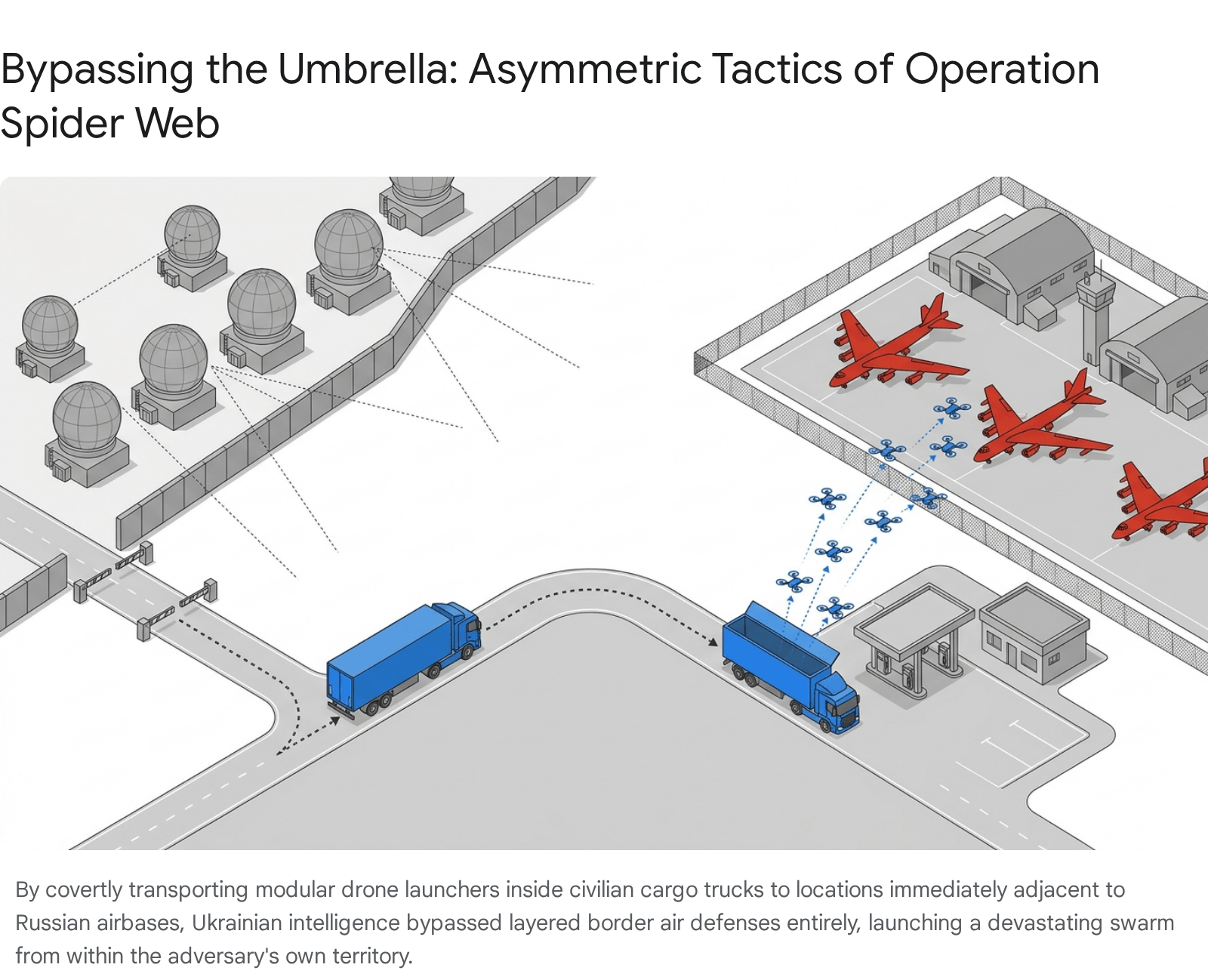
The ingenuity of the operation lay in the instrumentalization of civilian objects and spaces. The SBU contracted standard 18-wheel civilian cargo trucks, driven by unwitting Russian civilian drivers, to transport the assembled weapon systems.12 The drones were concealed within custom-built wooden modular cabins designed to mimic everyday commercial cargo, masking the military nature of the payload.12
The trucks were directed to park in completely unremarkable civilian areas—such as gas stations, roadside laybys, and rest stops—situated in close proximity to the targeted air bases.12 By launching from directly outside the perimeter of the bases, the drones effectively materialized inside the overarching radar umbrella. This rendered the sophisticated S-400 area denial networks and Pantsir point-defense systems functionally irrelevant, as they were oriented outward to protect against external threats, not internal sabotage.12
When the operation commenced, the wooden cabins were opened remotely. Operators, utilizing existing Russian commercial mobile telecommunications networks to maintain cover and communicate with the systems, launched a swarm of 117 drones nearly simultaneously.12 While initial guidance was manual, artificial intelligence systems automatically took over piloting when operators lost communication signals or when the drones entered the immediate vicinity of the targets, enabling precise strikes on vulnerable components along preplanned routes.12
To preserve operational secrecy and eliminate forensic evidence, the cargo trucks were equipped with self-destruct mechanisms that detonated shortly after the swarm took flight, and all operatives were successfully exfiltrated prior to the launch.12
The asymmetric efficiency of this methodology is stark. Utilizing standard off-the-shelf quadcopters costing approximately $2,000 each, the operation damaged or destroyed between 22 and 41 Russian military aircraft, depending on the intelligence estimate. The estimated financial damage inflicted upon the Russian aerospace forces was $7 billion, marking one of the most cost-effective intelligence operations in the history of unmanned warfare.12
10. Strategic Targeting Strategy: The Hydrocarbon Campaign
While tactical strikes erode frontline capability and SEAD operations clear the airspace, the overarching objective of Ukraine’s long-range drone program is strategic attrition—the systematic degradation of the economic and logistical foundations that sustain the Russian war effort. Over the course of 2024 through mid-2026, this strategy has been most visibly manifested in a relentless, calculated campaign against Russian hydrocarbon infrastructure.
10.1 Systemic Targeting of the Refining Sector
Oil refining is the absolute lifeblood of the Russian economy and its military logistics. Acknowledging this vulnerability, the USF, in close coordination with state intelligence agencies, mapped and targeted the most critical nodes of this sector. Since January 2024, Ukraine has launched over 61 documented drone strikes targeting 24 distinct Russian oil refineries, as well as countless associated storage depots and pumping stations.2
The scale and depth of these strikes are unprecedented in modern warfare. Drones have successfully struck nearly every major refinery in western and central Russia.24 Targets have included the Tuapse Refinery on the Black Sea coast, the Kuibyshev and Novokuybyshevsk refineries in the Samara region (located over 1,000 kilometers from the border), the Ryazan and Yaroslavl refineries, and massive, critical complexes like Kirishinefteorgsintez (KINEF) in the Leningrad region.1
The operational tempo of these strikes often involves repeated, sequenced attacks on the same facilities to hinder repair efforts and ensure permanent capacity reduction. For example, the Moscow Oil Refinery (Kapotnya), which accounts for approximately 53 percent of the capital’s fuel supply, was struck three times in less than a month.2
A particularly severe attack occurred on the night of June 17 to 18, 2026, when Ukrainian drones struck the Kapotnya facility for the second time in two days.21 Despite the Russian Ministry of Defense claiming to have downed 555 drones overnight (and later updating the claim to 992 drones and four missiles over a 24-hour period), several munitions penetrated the grid.21 The strikes sparked major fires at five separate locations within the complex, including an oil tank farm, secondary processing units, and the combined oil refining unit.21 The subsequent conflagration was so severe it resulted in “oil rain” falling over surrounding civilian areas and forced the grounding of flights at all four major Moscow airports (Vnukovo, Domodedovo, Zhukovsky, and Sheremetyevo).21
| Targeted Refinery | Location / Region | Date of Notable Strike(s) | Impact / Notes |
| Moscow Oil Refinery (Kapotnya) | Moscow | June 15-16 & 17-18, 2026 | Struck 3 times in a month. Fires at 5 locations. Forced airport groundings 21 |
| Tuapse Refinery | Tuapse | April/June 2026 | Generated over $300M in losses in a single month 1 |
| Kuibyshev Refinery | Samara Region | Mid-2026 | Located over 1,000 km from the Ukrainian border 1 |
| Kirishinefteorgsintez (KINEF) | Leningrad Region | 2025/2026 | Major facility damage in the Kirishky district 24 |
| Ryazan Refinery | Ryazan | 2025/2026 | Sustained damage in coordinated strike packages 1 |
| Slavneft-YANOS | Yaroslavl | 2025/2026 | Major strategic facility 1 |
10.2 Precision Targeting of Critical Subsystems
The efficacy of the hydrocarbon campaign is rooted in precision targeting, enabled by the terminal ATR systems discussed previously. Ukrainian drones are not programmed to simply crash into the largest structures or bulk storage tanks at a refinery; they specifically target the most critical, complex, and difficult-to-replace bottlenecks in the refining process, such as crude distillation units and, notably, catalytic cracking units.2
The strategic calculus here is intimately tied to international sanctions. While a damaged bulk storage tank can be welded and replaced with domestic steel in a matter of weeks, repairing a highly complex catalytic cracking unit requires specialized, high-tolerance industrial equipment.2 Historically, Russia imported these specialized components from Western engineering firms. Because current sanctions severely restrict the import of such technology, the destruction of these specific nodes creates a cascading failure that takes immense amounts of time, specialized labor, and capital to bypass, effectively paralyzing the facility’s output of high-grade fuels.2
10.3 Macroeconomic Consequences and Strategic Attrition
The localized tactical successes of these drone strikes have compounded into severe, verifiable macroeconomic consequences for the Russian Federation. By May 2026, the systematic campaign had degraded approximately 40 percent of Russia’s primary oil refining capacity.1
The reduction in processing volume—dropping to a 12-year low—and a nearly 10 percent reduction in seaborne oil exports directly constrained the revenue streams funding the Russian military-industrial complex.1 In an effort to stabilize the domestic market, prevent widespread shortages, and ensure military supply lines remained viable, the Russian government was forced to impose an unprecedented export ban on aviation fuel.1 Furthermore, authorities mandated strict fuel rationing across multiple regions and occupied territories, leading to visible civilian frustration, growing lines at gas stations, and secondary inflationary pressures.1
Most critically, the loss of reliable, high-volume hydrocarbon revenue forced a structural realignment in state financing. Economic analyses and official budgetary shifts indicate that the sustained damage from the USF’s strategic deep strikes contributed directly to the Russian government budgeting an 11 percent reduction in defense spending for the fiscal year 2026.1 This represents the ultimate vindication of the strategic attrition doctrine: converting low-cost drone strikes into billions of dollars of lost revenue, directly limiting the adversary’s ability to finance the continuation of the war.
11. Conclusion: Implications for Modern Warfare
The ability of Ukrainian forces to routinely and effectively conduct deep drone strikes into the heavily defended airspace of the Russian Federation represents a watershed moment in modern military history. It proves that strategic power projection is no longer the exclusive domain of superpowers possessing vast fleets of stealth bombers or advanced cruise missiles.
This capability is not the result of a single technological vulnerability on the part of the defender, but rather the culmination of a highly integrated, adaptive offensive ecosystem. Through the institutional foresight of establishing the Unmanned Systems Forces, Ukraine created an operational framework capable of rapidly iterating technology to match battlefield realities. The transition from remote-controlled munitions to fully autonomous, AI-driven platforms—utilizing offline waypoint navigation and DSMAC optical terrain matching—has effectively neutralized the primary defensive weapon of the modern era: electronic warfare.
By coupling this technological autonomy with meticulous intelligence preparation, sequenced air defense suppression, and the asymmetric exploitation of civilian infrastructure, Ukraine has built a deep-strike architecture capable of inflicting strategic, macroeconomic attrition. The resulting degradation of Russia’s critical energy infrastructure demonstrates that the character of deep interdiction has fundamentally shifted, proving that sustained, high-impact strategic bombing can now be executed efficiently and consistently by asymmetric, unmanned fleets. The lessons derived from this campaign will undoubtedly force global militaries to fundamentally reassess both their integrated air defense doctrines and their investments in autonomous, long-range unmanned strike capabilities.
Appendix: Methodology and Data Sources
This report synthesizes qualitative and quantitative data drawn from a localized database of Open Source Intelligence (OSINT) material, defense analysis reports, think-tank publications, and official military communications dated through mid-2026.
Data Collation and Analysis:
The research methodology prioritized the triangulation of technical specifications, operational timelines, and strategic impacts from multiple sources to ensure accuracy and objectivity. Technical capabilities of the drone fleet (e.g., Liutyi, Palianytsia, Zozulia) were aggregated from defense think-tank publications, aerospace industry monitors, and official state media releases to form a consensus on range, propulsion, and payload profiles.
Analyses of software and guidance systems, specifically ArduPilot integration and the Osiris DSMAC module, were drawn from industry interviews, contractor disclosures, and frontline combat testing reports. Macroeconomic impacts, such as the percentage degradation of Russian refining capacity and subsequent policy reactions, were sourced from aggregate economic analyses, verified regional reporting, and energy sector monitors.
Source Categorization:
- Technical & Engineering Data: Specifications on UAS platforms, AI integration, propulsion systems, and EW resilience.23
- Doctrinal & Operational Data: Information regarding the organizational structure of the Unmanned Systems Forces, Operation Polyphemus, Operation Spider Web, and tactical swarm deployments.
- Strategic & Economic Impact: Data concerning the timeline, specific locations, targeted subsystems (catalytic cracking units), and macroeconomic fallout of strikes on Russian hydrocarbon infrastructure.2
The synthesis process involved systematically stripping away hyperbole from primary sources, corroborating kinetic claims against geolocated visual evidence where available in the dataset, and framing the tactical actions within the broader, objective context of military strategy and economic attrition.
Please share the link on Facebook, Forums, with colleagues, etc. Your support is much appreciated and if you have any feedback, please email us in**@*********ps.com. If you’d like to request a report or order a reprint, please click here for the corresponding page to open in new tab.
Sources Used
- Ukraine’s Unmanned Systems Forces: one year of a branch the …, accessed July 4, 2026, https://armyinform.com.ua/en/2026/06/11/ukraines-unmanned-systems-forces-one-year-of-a-branch-the-world-had-never-seen/
- LIVE MAP of Russian Refineries Hit: Ukrainian Drone Strikes Boost Caspian Energy, accessed July 4, 2026, https://www.caspianpolicy.org/research/security/live-map-of-russian-refineries-hit-ukrainian-drone-strikes-boost-caspian-energy
- Ukraine’s Future Vision and Current Capabilities for Waging AI-Enabled Autonomous Warfare – CSIS, accessed July 4, 2026, https://www.csis.org/analysis/ukraines-future-vision-and-current-capabilities-waging-ai-enabled-autonomous-warfare
- How Ukraine uses AI to guide long-range drone strikes through electronic warfare and deep into Russian-controlled rear areas – Euromaidan Press, accessed July 4, 2026, https://euromaidanpress.com/2026/06/12/how-ukraine-is-integrating-ai-into-its-long-range-drone-strike-system/
- Unmanned Systems Forces of Ukraine – Wikipedia, accessed July 4, 2026, https://en.wikipedia.org/wiki/Unmanned_Systems_Forces_of_Ukraine
- Liutyi – Wikipedia, accessed July 4, 2026, https://en.wikipedia.org/wiki/Liutyi
- Guide To Ukraine’s Long Range Attack Drones | Covert Shores, accessed July 4, 2026, https://www.hisutton.com/Ukraine-OWA-UAVs.html
- Specifications of Ukrainian Palianytsia Rocket Drone Revealed …, accessed July 4, 2026, https://en.defence-ua.com/weapon_and_tech/specifications_of_ukrainian_palianytsia_rocket_drone_revealed-15685.html
- Ukrainian drones have been equipped with navigation capabilities similar to those of the Tomahawk system | UA.NEWS, accessed July 4, 2026, https://ua.news/en/war-vs-rf/ukrayinski-droni-otrimali-navigatsiiu-podibnu-do-sistemi-tomahawk
- How Deep Ukrainian Strike Drones Bypassed Russian Radars to Clear the Path for Capital Strikes – UNITED24 Media, accessed July 4, 2026, https://united24media.com/war-in-ukraine/how-deep-ukrainian-strike-drones-bypassed-russian-radars-to-clear-the-path-for-capital-strikes-20326
- Unmanned Systems Forces show how they cleared drone corridor toward Moscow, accessed July 4, 2026, https://www.ukrinform.net/rubric-ato/4139259-unmanned-systems-forces-show-how-they-cleared-drone-corridor-toward-moscow.html
- Operation Spider Web and Instrumentalizing Civilian Objects …, accessed July 4, 2026, https://lieber.westpoint.edu/operation-spider-web-instrumentalizing-civilian-objects/
- Six Key Lessons from Ukraine’s Drone War – Irregular Warfare Center, accessed July 4, 2026, https://irregularwarfarecenter.org/publications/insights/six-key-lessons-from-ukraines-drone-war/
- The Genius Strategy Behind Ukraine’s Largest Strike on Russia – YouTube, accessed July 4, 2026, https://www.youtube.com/watch?v=zOA4pOa1i9Y
- Lessons from Ukraine: Battlefield Drone Innovation Redefines Modern Defense, accessed July 4, 2026, https://defenseopinion.com/lessons-from-ukraine-battlefield-drone-innovation-redefines-modern-defense/1137/
- Russian Offensive Campaign Assessment, June 22, 2026 | ISW, accessed July 4, 2026, https://understandingwar.org/research/russia-ukraine/russian-offensive-campaign-assessment-june-22-2026/
- AN-196 Liutyi Ukrainian Unmanned Aerial Vehicle (UAV) – ODIN, accessed July 4, 2026, https://odin.t2com.army.mil/WEG/Asset/38a26b6d18b9cc4ed1960672864a3541
- Ukraine Upgrades ‘Palianytsia’ Drone Missile – Now With 650 km Range – Kyiv Post, accessed July 4, 2026, https://www.kyivpost.com/post/59380
- Palianytsia missile specs made public – The New Voice of Ukraine – NV, accessed July 4, 2026, https://english.nv.ua/nation/palianytsia-missile-specs-made-public-50541879.html
- Ukraine Reveals Specs of “Palianytsia”—Its Secret Long-Range Rocket Drone, accessed July 4, 2026, https://united24media.com/latest-news/ukraine-reveals-specs-of-palianytsia-its-secret-long-range-rocket-drone-11319
- Russian Offensive Campaign Assessment, June 18, 2026 | ISW, accessed July 4, 2026, https://understandingwar.org/research/russia-ukraine/russian-offensive-campaign-assessment-june-18-2026
- Ukrainian drones tested a Western navigation system that operates like those in cruise missiles | УНН, accessed July 4, 2026, https://unn.ua/en/news/ukrainian-drones-tested-a-western-navigation-system-that-operates-like-those-in-cruise-missiles
- Osiris | GNSS-Denied Navigation — Delian Alliance Industries, accessed July 4, 2026, https://www.delian.ai/osiris
- Ukrainian drones have struck nearly every major Russian refinery …, accessed July 4, 2026, https://meduza.io/en/feature/2026/06/29/ukrainian-drones-have-struck-nearly-every-major-russian-refinery-which-facilities-have-yet-to-be-hit
- Leningrad Region Port, Oil Terminal Hit in Major Ukrainian Drone Attack, accessed July 4, 2026, https://www.themoscowtimes.com/2026/07/04/leningrad-region-port-oil-terminal-hit-in-major-ukrainian-drone-attack-a93164
- Ukrainian drones knock out eight of Russia’s 10 largest oil refineries – RBC-Ukraine, accessed July 4, 2026, https://newsukraine.rbc.ua/news/ukrainian-drones-knock-out-eight-of-russia-1782752669.html
- Russian Offensive Campaign Assessment, June 18, 2026 | ISW, accessed July 4, 2026, https://understandingwar.org/research/russia-ukraine/russian-offensive-campaign-assessment-june-18-2026/
- OSINT analysts report hits on several key units at Moscow Oil Refinery in largest Ukrainian attack since 2022 – The Insider, accessed July 4, 2026, https://theins.press/en/news/293867
- Ukraine’s drone attacks on oil refineries plunge Russia into a fuel crisis – YouTube, accessed July 4, 2026, https://www.youtube.com/watch?v=jI6mGhNP0ww