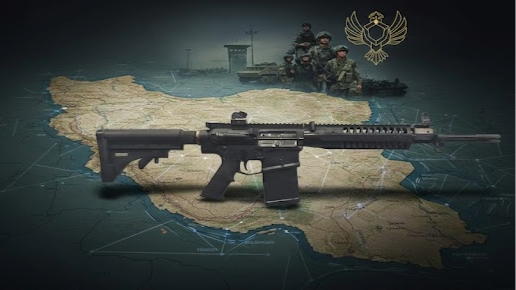
Executive Summary
The small arms architecture of the Islamic Republic of Iran represents a complex, bifurcated system designed to serve two distinct military philosophies: the conventional territorial defense of the Islamic Republic of Iran Army (Artesh) and the ideological, asymmetric power projection of the Islamic Revolutionary Guard Corps (IRGC). Managed under the strategic oversight of the Ministry of Defense and Armed Forces Logistics (MODAFL) and its primary industrial arm, the Defense Industries Organization (DIO), Iran has achieved a high degree of “defensive autarky.” This self-sufficiency is a direct response to decades of international sanctions and the traumatic experience of the Iran-Iraq War, which acted as the foundational catalyst for the country’s domestic military-industrial complex.1
This assessment identifies three primary trends in the Iranian small arms landscape for the 2024-2026 period. First, there is a clear shift toward caliber modernization and modularity, exemplified by the “Masaf” project, which seeks to transition elite units from the aging 7.62x51mm G3 and 7.62x39mm AKM platforms to modern, short-stroke piston-driven systems.3 Second, the “Axis of Resistance” strategy has transformed Iranian small arms production into a regional logistical backbone, with weapons like the AM-50 Sayyad and KL-series rifles serving as standardized equipment for proxy forces in Yemen, Iraq, and the Palestinian territories.5 Third, the elevation of the Law Enforcement Command (Faraja) to a status equal to the Artesh and IRGC has led to a significant professionalization of its tactical inventory, focusing on urban counter-terrorism and high-intensity internal suppression.8
The report provides a branch-by-branch analysis of standard-issue and specialized small arms, detailing technical specifications, manufacturing origins, and the doctrinal implications of their deployment. It concludes that while the Artesh maintains a traditional posture with battle rifles, the IRGC’s rapid adoption of modernized AK-variants and specialized sniper systems reflects a military that is increasingly optimized for decentralized, expeditionary warfare and regime survival in an era of heightened regional instability.11
The Industrial Foundation: Defense Industries Organization (DIO) and the Mandate of Self-Sufficiency
The central nervous system of Iranian small arms is the Defense Industries Organization (DIO), a massive state-owned conglomerate subordinate to MODAFL. Founded in its modern form in 1981, the DIO was born out of the necessity to reorganize the disorganized remnants of the Shah’s Military Industries Organization (MIO) during the Western arms embargo.2 Today, the DIO employs between 35,000 and 45,000 personnel, many of whom are university graduates specializing in metallurgy, chemical engineering, and precision manufacturing.2
The DIO operates through specialized clusters, most notably the Individual Combat Industries Group (ICIG), which is directly responsible for small caliber weapons and light support systems.16 A critical component of Iran’s ability to sustain this industry is its “chemical autarky.” As a major oil producer with a robust petrochemical sector, Iran produces the essential chemical inputs—such as ammonium nitrate, sulfuric acid, nitrocellulose, and toluene—required for the manufacture of powders, primers, and explosives.1 This allows the DIO to bypass international restrictions on the “Dual-Use” technology and precursors necessary for ammunition production, ensuring that the Iranian armed forces have a continuous supply of ball, armor-piercing, and tracer rounds in calibers ranging from 9mm to 12.7mm.16
Table 1: DIO Small Arms Production Capabilities and Calibration
| Production Group | Primary Focus | Standard Calibers Produced | Notable Platform |
| ICIG (Individual Combat) | Pistols, Rifles, SMGs | 9x19mm, 7.62x39mm, 7.62x51mm, 5.56x45mm | Masaf, KL-7.62, G3 |
| AMIG (Ammunition & Metallurgy) | Ammo, Fuzes, Heavy Support | 12.7x108mm, 14.5x114mm, 20x102mm, 23mm | AM-50 Sayyad, Shaher |
| Sasadja Department | Specialized Combat Gear | N/A | Night Vision, Thermal Optics |
| Shahid Sayyad Shirazi | High-Precision Components | Precision Barrel Forging | Sniper Systems |
The DIO has transitioned from simple reverse-engineering to “adaptive innovation.” This process begins with the procurement or capture of Western and Eastern platforms, followed by the integration of modern features—such as Picatinny rails and polymer components—to suit the Iranian tactical environment.1 This capability has allowed Iran to become a significant regional exporter, reportedly supplying weapons to 57 countries, many of which are in conflict zones where Iranian small arms provide a low-cost, reliable alternative to major power exports.2
Small Arms Inventory of the Islamic Republic of Iran Army (Artesh)
The Artesh is the conventional bedrock of the Iranian defense posture, maintaining a manpower-heavy structure centered on the Ground Forces (NEZAJA). Its small arms philosophy is historically rooted in the West German influence of the 1970s, emphasizing the “Battle Rifle” concept—weapons chambered in full-power calibers like 7.62x51mm NATO that provide superior range and terminal ballistics in the vast, open topographies of the Iranian plateau.4
Artesh Ground Forces (NEZAJA)
The standard-issue service rifle for the Artesh Ground Forces remains the Heckler & Koch G3, produced under license as the G3A6.4 The Iranian G3A6 is distinguished from the original German A3 by its dark-green slimline handguard and a modified trigger pack.4 While the G3 is often criticized for its weight and heavy recoil, the Artesh continues to favor it because of the high lethality of the 7.62x51mm round against light cover and vehicles, which is a doctrinal requirement for repelling a conventional foreign invasion.11
However, by 2025, the Artesh has begun a phased transition to the “Masaf-2.” This is a domestically designed 7.62x51battle rifle based on a short-stroke piston-driven platform.4 The Masaf-2 was first issued to elite units like the 35th Rapid Reactionary Brigade, signaling an intent to modernize the entire force with a rifle that combines the stopping power of the G3 with modern modularity and reduced recoil.4
For squad-level support, the Artesh relies on the MG3-A3, another licensed German design. The MG3 remains one of the fastest-firing general-purpose machine guns in the world, and its 7.62x51mm chambering ensures logistical commonality with the G3 rifles.16 Sniper and marksman roles are typically filled by the “Nakhjir,” an Iranian version of the Soviet SVD Dragunov chambered in 7.62x54mmR.18
Artesh Navy (NEDAJA) and Takavaran
The Artesh Navy’s special forces, known as the Takavaran-e Daryayi (Marines), maintain an inventory more suited for maritime interdiction and amphibious assault. While the G3 is still used, there is a higher prevalence of AK-variants, particularly the KL-7.62, which is more resistant to the corrosive effects of saltwater.21 The Takavaran are also significant users of the AM-50 Sayyad anti-materiel rifle, using it to disable the engine blocks of small vessels or to penetrate light armor from coastal positions.4
Artesh Air Force (IRIAF)
The Islamic Republic of Iran Air Force (IRIAF) utilizes small arms primarily for base security and pilot survival. Security personnel are frequently seen with the Tondar (MPT9) submachine gun, a licensed copy of the MP5.4 For pilots, survival weapons have historically included compact 9mm pistols such as the PC-9 “Zoaf,” an Iranian version of the SIG P226 platform.4
Table 2: Artesh Small Arms Summary
| Category | Platform | Caliber | Role | Status |
| Battle Rifle | G3A6 | 7.62x39mm | General Infantry | Standard Issue |
| Battle Rifle | Masaf-2 | 7.62x39mm | Elite Infantry | Entering Service |
| GPMG | MG3-A3 | 5.56x45mm | Squad Support | Standard Issue |
| Sniper Rifle | Nakhjir (SVD) | 5.56x45mm | Marksman | Standard Issue |
| Pistol | PC-9 Zoaf | 9x19mm | Sidearm | Standard Issue |
| Anti-Materiel | Sayyad (AM-50) | 12.7x99mm | Anti-Armor | Specialized |
Small Arms Inventory of the Islamic Revolutionary Guard Corps (IRGC)
The IRGC is a parallel military institution with a distinct mission: the preservation of the Islamic Revolution and the execution of asymmetric warfare.11 This mission requires a more nimble, lightweight, and adaptable small arms suite than the Artesh. The IRGC’s reliance on the AK-platform is not merely a matter of preference but a strategic choice that aligns with its decentralized command structure and its role in coordinating with regional proxies who almost exclusively use the Kalashnikov system.11
IRGC Ground Forces (NEZSA)
The backbone of the IRGC-GF is the KL-7.62, an unlicensed copy of the Chinese Type 56.20 The DIO produces the KL in three primary variants: the KLS (fixed stock), the KLF (under-folding stock), and the KLT (side-folding stock).20 These weapons are characterized by their ruggedness and ability to function in extreme environmental conditions with minimal maintenance.
The most significant recent development in the IRGC arsenal is the large-scale introduction of the KL-103 (AK-133), a licensed version of the Russian AK-103.4 Iran purchased a significant quantity of AK-103s directly from Russia in 2016 for its special forces and subsequently established domestic production lines.4 The KL-103 uses high-strength polymer furniture and modern side-rails for optics, representing a substantial leap in ergonomics over the older KL-7.62 series while retaining the 7.62x39mm caliber.18
The Quds Force (IRGC-QF) and Saberin
The Quds Force and the elite Saberin commandos utilize the most advanced small arms in the Iranian inventory. This includes the S-5.56 (Sayyad-5.56), which is a copy of the Chinese Norinco CQ (itself a clone of the American M16A1).4 The move to 5.56x45mm NATO for these units reflects a desire for high-velocity, low-recoil weapons suited for high-stakes hostage rescue and “black ops” where precision is paramount.4
Furthermore, the Quds Force is the primary conduit for the proliferation of “designer” Iranian small arms to proxies. For example, the AM-50 Sayyad anti-materiel rifle has been smuggled in large numbers to the West Bank and Yemen, where it allows proxy forces to challenge Israeli or Saudi armor without the need for complex anti-tank guided missiles (ATGMs).5
IRGC Navy (NEDSA) and SBS
The IRGC Navy specializes in “swarming” tactics using fast attack craft. Their small arms focus on compactness. The Star Model Z84, an amphibious 9mm submachine gun from Spain, is used by IRGCN frogmen because of its ability to be fired immediately after surfacing.18 They also utilize the “Fajr 224,” an Iranian version of the M4 carbine, which provides a compact 5.56mm platform for boarding parties.4
Table 3: IRGC Small Arms Summary
| Category | Platform | Caliber | Role | Status |
| Assault Rifle | KL-7.62 | 7.62x39mm | General Guardsman | Standard Issue |
| Assault Rifle | KL-103 (AK-133) | 7.62x39mm | Modernized Units | Standard Issue |
| Assault Rifle | Sayyad 5.56 | 5.56x45mm | Special Forces | Specialized |
| Carbine | Fajr 224 | 5.56x45mm | Naval Operations | Specialized |
| Pistol | Kaveh 17 | 9x19mm | Sidearm (Glock Clone) | Elite Units |
| Anti-Materiel | Sayyad (AM-50) | 12.7x99mm | Asymmetric Anti-Armor | Standard Issue |
Small Arms Inventory of the Law Enforcement Command (Faraja)
The Law Enforcement Command (Faraja), formerly NAJA, has undergone a massive transformation since 2021. Elevated to a General Command status under the direct control of the Supreme Leader, Faraja is now considered the “third pillar” of Iranian security alongside the Artesh and IRGC.8 This elevation has coincided with a modernization of their small arms to facilitate intense urban suppression and counter-terrorism.
Special Units and NOPO
The “Special Units Command” of Faraja is responsible for riot control and high-risk tactical operations.24 Within this command is NOPO (Counter-Terror Special Force), arguably the most highly trained unit in the Iranian security apparatus.10 NOPO’s primary weapon is the T9 (Tondar) submachine gun, which is an Iranian-produced MP5.4 The T9 is often seen in the “K” (Kurz) variant for close-quarters battle (CQB) or with fixed stocks for urban precision.20
Sidearms in Faraja are dominated by the PC-9 “Zoaf” and the “Raad” pistol.18 During the 2022-2023 protests, Faraja units were documented using these automatic and semi-automatic weapons with lethal effect.10 However, their inventory also includes a massive array of “less-lethal” but dangerous weapons, such as the Maher shotgun and various pellet rifles designed to blind or maim protesters.26
Border Guard Command
The Border Guard Command operates as a light infantry force in the volatile border regions with Afghanistan and Pakistan. Their inventory is largely identical to the IRGC-GF, relying on the KL-7.62 and PKM machine guns (locally produced as the T-80) to combat drug smugglers and Baluchi insurgents.16 They also deploy the DShK 12.7mm heavy machine gun on technicals (pickup trucks) for mobile fire support in desert terrain.18
Table 4: Faraja Small Arms Summary
| Category | Platform | Caliber | Role | Status |
| SMG | Tondar / T9 | 9x19mm | NOPO / Tactical | Standard Issue |
| Assault Rifle | KL-7.62 | 7.62x39mm | Border Guard | Standard Issue |
| Pistol | Raad / Zoaf | 9x19mm | General Police | Standard Issue |
| Shotgun | Maher | 12-Gauge | Riot Control | Standard Issue |
| Sniper Rifle | Taher | 7.62x51mm | Counter-Sniper | Specialized |
| HMG | DShK | 12.7x108mm | Border Support | Mobile Units |
Technical Assessment: The “Masaf” and the Shift toward Western Design Philosophy
The emergence of the Masaf individual assault rifle represents a pivotal moment in Iranian small arms doctrine. Historically, Iran was forced to choose between the ergonomic but sensitive Western M16/G3 platforms and the rugged but unrefined Eastern AK systems. The Masaf, first unveiled in 2016 and expanded into a family of weapons by 2021, attempts to synthesize these two worlds.3
Mechanical Evolution of the Masaf
The Masaf is a short-stroke piston-driven rifle chambered in 5.56x45mm.3 Unlike the direct-impingement system of the M16, which vents hot gas and carbon directly into the bolt carrier, the Masaf’s piston system keeps the action clean and cool, significantly increasing reliability in the dusty, high-heat environments common in Iran.3
The rifle features a fully modular structure with four Picatinny rails (MIL-STD-1913), allowing for the rapid attachment of optical sights, thermal cameras, and grenade launchers.3 Its telescopic stock and ambidextrous controls reflect a modern understanding of soldier ergonomics that was absent in older Iranian platforms like the Khaybar KH-2002.3
Tactical Specifications of the Masaf Platform
The DIO’s 2023-2024 export literature highlights the following technical performance metrics for the Masaf, which position it as a peer-competitor to modern Western carbines like the HK416 or the FN SCAR.3
- Weight: 3,070 grams (without magazine), making it significantly lighter than the G3 (4.4 kg) and comparable to the M4 Carbine.3
- Barrel Life: 6,000 rounds, achieved through modern chrome-lining and heat-treatment processes at the Shahid Sayyad Shirazi plants.3
- Muzzle Velocity: 900 meters per second, providing a flat trajectory and high accuracy at its 500-meter effective range.3
- Feed System: Compatible with standard 20, 30, and 40-round STANAG magazines.3
The deployment of the Masaf-2 (the 7.62x51mm version) to the Artesh suggests that Iran intends to move away from the G3’s roller-delayed blowback mechanism in favor of the more reliable and easier-to-manufacture short-stroke piston system.4
The Sniper Doctrine: “Shoulder-Fired Artillery” and Area Denial
A unique feature of the Iranian small arms ecosystem is its obsession with ultra-heavy sniper and anti-materiel rifles. This is a direct consequence of Iran’s asymmetric defense doctrine: if the military cannot match the armored strength of the United States or Israel, it must empower individual soldiers to disable or destroy expensive enemy assets from a distance.11
The AM-50 Sayyad: A Regional Proliferation Phenomenon
The AM-50 Sayyad is an Iranian copy of the Austrian Steyr HS.50.4 It is a single-shot, bolt-action rifle chambered in 12.7x99mm (.50 BMG).20 Its simplicity is its greatest strength; with no complex feeding mechanism, it rarely jams and can be maintained by semi-skilled insurgent forces.4 The Sayyad has an effective range of 1,500 meters and is capable of penetrating light armored vehicles, helicopters, and reinforced concrete walls.18
The Sayyad’s presence across the “Axis of Resistance” is so widespread that it has become a “signature” weapon of Iranian influence.6 Intelligence reports from 2024-2025 show that the IRGC-QF has prioritized the smuggling of these rifles to proxy groups in the West Bank to enable them to engage Israeli IDF armored bulldozers and transport vehicles from urban cover.5
The Shaher and the 14.5mm Capability
For even greater range and penetration, the DIO produces the “Shaher,” a 14.5x114mm anti-materiel rifle.18 The 14.5mm round, originally designed for Soviet heavy machine guns, possesses significantly more kinetic energy than the .50 BMG. The Shaher has an effective range of over 3,000 meters, allowing Iranian marksmen to threaten enemy logistics and command-and-control hubs from outside the range of most conventional infantry weapons.18
Table 5: Sniper and Anti-Materiel Systems Comparison
| Model | Caliber | Origin | Effective Range | Weight |
| Nakhjir | 7.62x54mmR | USSR/Iran | 800 m | 4.3 kg |
| Siyavash | 7.62x51mm | Iran | 1,000 m | 6.5 kg |
| Taher | 7.62x51mm | Iran | 1,200 m | 4.4 kg |
| Sayyad AM-50 | 12.7x99mm | Austria/Iran | 1,500 m | 12.0 kg |
| Shaher | 14.5x114mm | Iran | 3,000 m | 22.0 kg |
| Arash | 20x102mm | Iran | 2,000 m | 18.5 kg |
Logistics, Maintenance, and the Proxy Smuggling Pipeline
The efficacy of Iran’s small arms program is deeply tied to its clandestine logistical networks. The IRGC Quds Force utilizes “Unit 700,” a secret logistical department responsible for the transfer of military equipment to proxies in Syria and Lebanon.30 These transfers are often disguised through front companies or “Sports Federations” that facilitate the import and export of “hunting” equipment that is actually military-grade hardware.26
Ammunition Standardization and Metallurgy
A major challenge for the Iranian military is the simultaneous use of five different rifle calibers: 7.62x39mm, 7.62x51mm, 7.62xr4mmR, 5.56x45mm, and 5.45x39mm (found in limited amounts of captured or imported AK-74s).4 The DIO’s Ammunition & Metallurgy Industries Group (AMIG) has streamlined production by creating modular assembly lines that can switch between these calibers by changing only the dies and headers for the brass cases.31
Furthermore, the DIO’s metallurgy plants in Yazd and Khorasan produce high-quality steel for rifle barrels and tungsten-copper alloys for armor-piercing projectile cores.32 This ensures that Iranian-made ammunition—such as the 7.62mm AP round—can reliably penetrate NIJ Level III and IV body armor at standard combat distances, a fact that has significant implications for Western forces operating in the region.16
Impact of the 2024-2025 Israel-Iran War on Small Arms Stocks
During the war in June 2025, Israeli airstrikes targeted several planetary mixers and production buildings at the Parchin and Shahroud facilities.33 While these mixers were primarily intended for solid-fuel missile production, the strikes also impacted the broader military-industrial infrastructure, including workshops involved in precision barrel-making for high-end sniper rifles.32
By December 2025, however, reports indicated that Iran was rapidly rebuilding these facilities.34 The “organizational inertia” of the Iranian defense apparatus ensures that even after a major kinetic event, the priority remains the restoration of small arms and missile production to “restore deterrence”.34 The IRGC Aerospace Force, despite losing key commanders in the war, has maintained oversight of the “Smart” missile tunnels, which serve as secure, underground storage depots for vast caches of small arms intended for the defense of the Strait of Hormuz.36
Small Arms Doctrine: Internal Security vs. External Projection
The distribution of small arms in Iran reveals a regime that is as concerned with internal survival as it is with external defense. The small arms utilized by Faraja and the IRGC Ground Forces are optimized for “protest suppression” and “urban defense,” which are the most likely threats to the clerical establishment.10
The “Less-Lethal” Facade
During the 2022 protests, the security forces transitioned from the sporadic use of live ammunition to the widespread deployment of shotguns and paintball guns.26 However, forensic investigations revealed that these were not “less-lethal” in practice. Security forces deliberately targeted the heads and eyes of protesters with 12-gauge birdshot and metal pellets, causing permanent blindness in hundreds of cases.26 The use of the DIO-manufactured “Maher” shotgun allowed the regime to maintain a degree of “plausible deniability” regarding its intent to kill, while still effectively neutralizing the protest movement through terror and mass-injury.9
Asymmetric Interoperability
For external projection, the IRGC’s “Axis of Resistance” doctrine relies on “Asymmetric Interoperability.” This means that an IRGC advisor from the Quds Force can travel to Yemen, pick up a Houthi “Toofan” rifle (which is actually an Iranian KL-7.62 or AK-103), and find that it is functionally identical to the weapon he used in training at the Imam Ali Academy.6 This standardization reduces the training time required for proxies and allows Iran to act as a “force multiplier” across the region.17
Future Outlook: Projections for 2026-2030
The Iranian small arms ecosystem is entering a period of refinement. With the basic requirements of “defensive autarky” met, the DIO is now focusing on the “high-end” segment of the market: precision optics, silenced weapons, and lightweight materials.3
Proliferation of Optical Sights and Night Vision
The most significant force multiplier for Iranian infantry in the next five years will be the widespread issue of the Sasadja-made thermal and night-vision optics.2 Historically, Iranian infantry were outmatched at night by Western forces. However, the integration of Picatinny-compatible thermal scopes onto the Masaf and KL-103 rifles will bridge this gap, allowing IRGC and Artesh units to conduct high-intensity night operations.3
Transition to 5.56mm for Elite Units
While the 7.62x39mm and 7.62x51mm rounds will remain the mainstay for general infantry, the transition to 5.56x45mm NATO for elite units (Saberin, NOPO, and the 65th Airborne) will continue.3 This shift allows these units to benefit from the reduced weight and higher ammunition capacity of the 5.56mm platform, which is critical for the “nimble” and “rapid response” roles the regime has prioritized after the 2024-2025 war.11
Continued Export Orientation
The DIO will likely increase its efforts to export the Masaf and Sayyad platforms to “non-traditional” partners in South America and Africa, as seen in the drone trade with Venezuela.2 By exporting these weapons, Iran not only generates hard currency to bypass sanctions but also builds “security dependencies” with foreign governments, further insulating the regime from diplomatic isolation.1
Strategic Conclusion
For the foreign intelligence analyst, the Iranian small arms inventory is a primary indicator of the regime’s strategic health. Far from being a “museum” of outdated Cold War technology, the Iranian military is now equipped with domestically produced, modernized platforms that reflect a sophisticated understanding of contemporary warfare.1
The bifurcation between the Artesh and IRGC small arms suites is narrowing as both branches adopt the “Masaf” design philosophy, yet their doctrinal differences remain. The Artesh remains a “holding” force, using battle rifles to defend the mountains and deserts.11 The IRGC remains an “active” force, using light, modular assault rifles and heavy anti-materiel systems to project power across the “Ring of Fire” surrounding its regional adversaries.5
The resilience of the DIO, demonstrated by its rapid recovery from the 2025 airstrikes, ensures that Iran will remain a “small arms superpower” in the Middle East.1 Any future conflict involving Iran or its proxies will not be fought against an “obsolete” force, but against a highly standardized, well-equipped infantry equipped with domestic platforms designed specifically to exploit the weaknesses of modern conventional armies. Understanding the technical specifications and doctrinal employment of these weapons—from the T9 submachine gun in the hands of a NOPO operator to the AM-50 Sayyad in the hands of a Houthi militant—is essential for any realistic assessment of regional security in the 21st century.6
Please share the link on Facebook, Forums, with colleagues, etc. Your support is much appreciated and if you have any feedback, please email us in**@*********ps.com. If you’d like to request a report or order a reprint, please click here for the corresponding page to open in new tab.
Sources Used:
- Iran’s military-industrial complex: weaponizing constraints, accessed January 31, 2026, https://rsdi.ae/en/publications/irans-military-industrial-complex-weaponizing-constraints
- Defense Industries Organization – Wikipedia, accessed January 31, 2026, https://en.wikipedia.org/wiki/Defense_Industries_Organization
- Individual Assault Rifle (MASAF) – Mindex, accessed January 31, 2026, https://mindex-center.ir/en/products/individual-assault-rifle-masaf
- List of equipment of the Iranian Army – Wikipedia, accessed January 31, 2026, https://en.wikipedia.org/wiki/List_of_equipment_of_the_Iranian_Army
- Iran Smuggling Advanced Weaponry to Growing Terrorist Proxy Network in West Bank, accessed January 31, 2026, https://freebeacon.com/israel/iran-smuggling-advanced-weaponry-to-growing-terrorist-proxy-network-in-west-bank/
- Iran’s military supply line to Houthi terrorists exposed by dissident group – NCRI-US, accessed January 31, 2026, https://www.ncrius.org/irans-military-supply-line-to-houthi-terrorists-exposed-by-dissident-group.html
- The Iranian Regime’s Transfer of Arms to Proxy Groups and Ongoing Missile Development, accessed January 31, 2026, https://2017-2021.state.gov/the-iranian-regimes-transfer-of-arms-to-proxy-groups-and-ongoing-missile-development-2/
- Police Command of the Islamic Republic of Iran – Wikipedia, accessed January 31, 2026, https://en.wikipedia.org/wiki/Police_Command_of_the_Islamic_Republic_of_Iran
- Institution: The Police (FARAJA) – Faces of Crime, accessed January 31, 2026, https://facesofcrime.org/institution/210/the-police-naja/
- Iran’s Counter-Terror Special Forces (NOPO) | UANI, accessed January 31, 2026, https://www.unitedagainstnucleariran.com/sanctioned-person/irans-counter-terror-special-forces-nopo
- Explainer: the Iranian Armed Forces | ISW, accessed January 31, 2026, https://understandingwar.org/research/middle-east/explainer-the-iranian-armed-forces/
- Order Of Battle Of The Iranian Artesh Ground Forces | Critical Threats, accessed January 31, 2026, https://www.criticalthreats.org/analysis/order-of-battle-of-the-iranian-artesh-ground-forces
- Islamic Revolutionary Guard Corps – Wikipedia, accessed January 31, 2026, https://en.wikipedia.org/wiki/Islamic_Revolutionary_Guard_Corps
- DIO | Gun Wiki | Fandom, accessed January 31, 2026, https://guns.fandom.com/wiki/DIO
- Iran’s Defence Industry, accessed January 31, 2026, https://icds.ee/wp-content/uploads/dlm_uploads/2023/01/ICDS_Brief_Iran%C2%B4s_Defence_Industry_Tato_Kvamladze_January_2023.pdf
- defense industries – organization – Military, accessed January 31, 2026, http://military.ddns.net/Iran_weapon_industry/Section1.pdf
- How Iran’s Revived Weapons Exports Could Boost Its Proxies | The Washington Institute, accessed January 31, 2026, https://www.washingtoninstitute.org/policy-analysis/how-irans-revived-weapons-exports-could-boost-its-proxies
- List of equipment of the Iranian Army – Military Wiki – Fandom, accessed January 31, 2026, https://military-history.fandom.com/wiki/List_of_equipment_of_the_Iranian_Army
- Get to Know Iran’s Police Special Units who killed 1,500 people? – Iran Freedom, accessed January 31, 2026, https://iranfreedom.org/en/articles/2020/01/get-to-know-irans-police-special-units-who-killed-1500-people/14689/
- KL-7.62 mm Assault Rifle – Mindex, accessed January 31, 2026, https://mindex-center.ir/en/products/kl-762-mm-assault-rifle
- Special forces of Iran – Wikipedia, accessed January 31, 2026, https://en.wikipedia.org/wiki/Special_forces_of_Iran
- KL-7.62 – Gun Wiki | Fandom, accessed January 31, 2026, https://guns.fandom.com/wiki/KL-7.62
- AK-103 – Wikipedia, accessed January 31, 2026, https://en.wikipedia.org/wiki/AK-103
- Iranian Police Special Units – Wikipedia, accessed January 31, 2026, https://en.wikipedia.org/wiki/Iranian_Police_Special_Units
- Inside Iran’s MP5 Submachine Gun Copy: The Tondar TK9 with firearms expert Jonathan Ferguson – YouTube, accessed January 31, 2026, https://www.youtube.com/watch?v=kdPWZC2ZyHQ
- Weapons Without Borders: How Imported Weapons Fuel State Violence in Iran, accessed January 31, 2026, https://iranhrdc.org/weapons-without-borders-how-imported-weapons-fuel-state-violence-in-iran/
- Iran Update, December 17, 2025 | ISW, accessed January 31, 2026, https://understandingwar.org/research/middle-east/iran-update-december-17-2025/
- Iranian Land Forces – Warpower: Iran, accessed January 31, 2026, https://www.warpoweriran.com/landpower.php
- MASAF Small Arms Iran Army Defense Industries Organization Brochure Gun | eBay, accessed January 31, 2026, https://www.ebay.com/itm/387911375291
- UK sanctions secret IRGC Quds Force unit arming Iran’s proxies, accessed January 31, 2026, https://www.iranintl.com/en/202409023772
- DIO (Defence Industries Organisation) Ammunition Catalogue Iran | PDF – Scribd, accessed January 31, 2026, https://www.scribd.com/doc/237403547/DIO-Defence-Industries-Organisation-ammunition-Catalogue-Iran
- Defense Industries Organization (DIO) | Iran Watch, accessed January 31, 2026, https://www.iranwatch.org/iranian-entities/defense-industries-organization-dio
- Iran’s Ballistic Missile Programs: Background and Context | Congress.gov, accessed January 31, 2026, https://www.congress.gov/crs-product/IF13035
- Iran Update, December 22, 2025 | Critical Threats, accessed January 31, 2026, https://www.criticalthreats.org/analysis/iran-update-december-22-2025
- Iran Update, December 1, 2025 | Critical Threats, accessed January 31, 2026, https://www.criticalthreats.org/analysis/iran-update-december-1-2025-692e23c7eb501
- US, Iran flaunt military capabilities ahead of possible attacks – The New Arab, accessed January 31, 2026, https://www.newarab.com/news/us-iran-flaunt-military-capabilities-ahead-possible-attacks
- Iran Update, June 26, 2025 | Critical Threats, accessed January 31, 2026, https://www.criticalthreats.org/analysis/iran-update-june-26-2025
- The Collapse of Iran’s Proxy Strategy and Asymmetric Warfare – SOF Support Foundation, accessed January 31, 2026, https://sofsupport.org/the-collapse-of-irans-proxy-strategy-exposes-the-limits-of-asymmetric-warfare/
- Iran’s proxy war paradox: strategic gains, control issues, and operational constraints, accessed January 31, 2026, https://www.tandfonline.com/doi/full/10.1080/09592318.2025.2512807
- Treasury Targets Iran-Venezuela Weapons Trade, accessed January 31, 2026, https://home.treasury.gov/news/press-releases/sb0347