Category Archives: US Small Arms Market Analytics

Reports focusing on the US Small Arms Market in general – vendors, post mortems, marketing, lessons learned and so forth.

June 2026: Top 10 Rifles by Consumer Sentiment

1. Executive Summary

The small arms market during June 2026 indicates a pronounced shift in consumer priorities, balancing historical mechanics with advanced materials science. A rigorous analysis of social media sentiment, specialized forum engagement, and digital retail metrics reveals that modern shooters are prioritizing modularity, suppressed capabilities, and platform crossover utility. The traditional boundaries delineating tactical rifles, precision hunting platforms, and recreational rimfire systems are dissolving. In their place, hybrid designs offering multi-role capability are capturing the highest volumes of positive market engagement.

This report catalogs the top 20 rifles ranked by positive social sentiment specifically for the month of June 2026. The empirical data highlights a distinct consumer preference for short-stroke gas piston systems in the premium tactical space, a notable modernization of lever-action platforms incorporating tactical accessories, and the sustained market dominance of highly configurable bolt-action chassis rifles.

A street price analysis was executed for each of the identified platforms to determine the current average market valuation. Based on this established baseline, active retail listings were sourced from a specified matrix of eight major industry vendors: Brownells, Grabagun, Global Ordnance, Midway USA, KYGunCo, Palmetto State Armory, Primary Arms, and Sportsmans Warehouse.

The following table isolates the top 10 platforms that generated the highest positive consumer sentiment in June 2026, establishing the current market hierarchy.

RankManufacturerModelPrimary Platform / ActionCaliber / Chambering FocusAverage Street Price
1Sig SauerMCX Spear LTSemi-Auto Piston5.56 NATO /.300 BLK$2,499.00
2Palmetto State ArmorySabre-15Semi-Auto DI5.56 NATO$1,050.00
3Daniel DefenseDDM4 V7Semi-Auto DI5.56 NATO$1,950.00
4TikkaT3x LiteBolt-Action6.5 Creedmoor /.308 Win$1,130.00
5Marlin1895 SBLLever-Action.45-70 Government$1,350.00
6BergaraB-14 HMRBolt-Action6.5 Creedmoor / 7mm PRC$1,150.00
7RugerAmerican Gen IIBolt-ActionMulti-Caliber$610.00
8Henry Repeating ArmsBig Boy X ModelLever-Action.44 Mag /.357 Mag$950.00
9CZ-USA457 (Varmint/Pro)Bolt-Action Rimfire.22 LR$710.00
10Ruger10/22Semi-Auto Rimfire.22 LR$310.00
Chart showing the average price of rifle platforms

2. Macro Market Dynamics and Engineering Trends

The sentiment tracking data indicates several convergence points regarding mechanical engineering and consumer expectations. Digital engagement metrics from platforms evaluating aesthetic and functional firearms, heavily prioritize durability combined with modularity.1

2.1 The Piston and Direct Impingement Bifurcation

There is a distinct bifurcation within the modern sporting rifle (MSR) category. At the premium tier, short-stroke gas piston systems maintain overwhelming consumer mindshare. This preference is strongly correlated with the widespread normalization of suppressor ownership; piston systems vent expanding gases forward at the gas block rather than directing it rearward into the receiver.3 This significantly reduces carbon fouling and toxic gas blowback directed at the operator’s face, a major operational advantage in confined spaces.

Conversely, the mid-tier market remains dominated by highly tuned Direct Impingement (DI) systems. Manufacturers have recognized consumer fatigue with over-gassed, harsh-recoiling carbine-length gas systems. In response, mid-length and rifle-length gas configurations have become the new baseline standard.5 By extending the distance from the chamber to the gas port, internal operating pressures are reduced, leading to smoother cycling and decreased wear on internal components.

2.2 The Tactical Lever-Action Renaissance

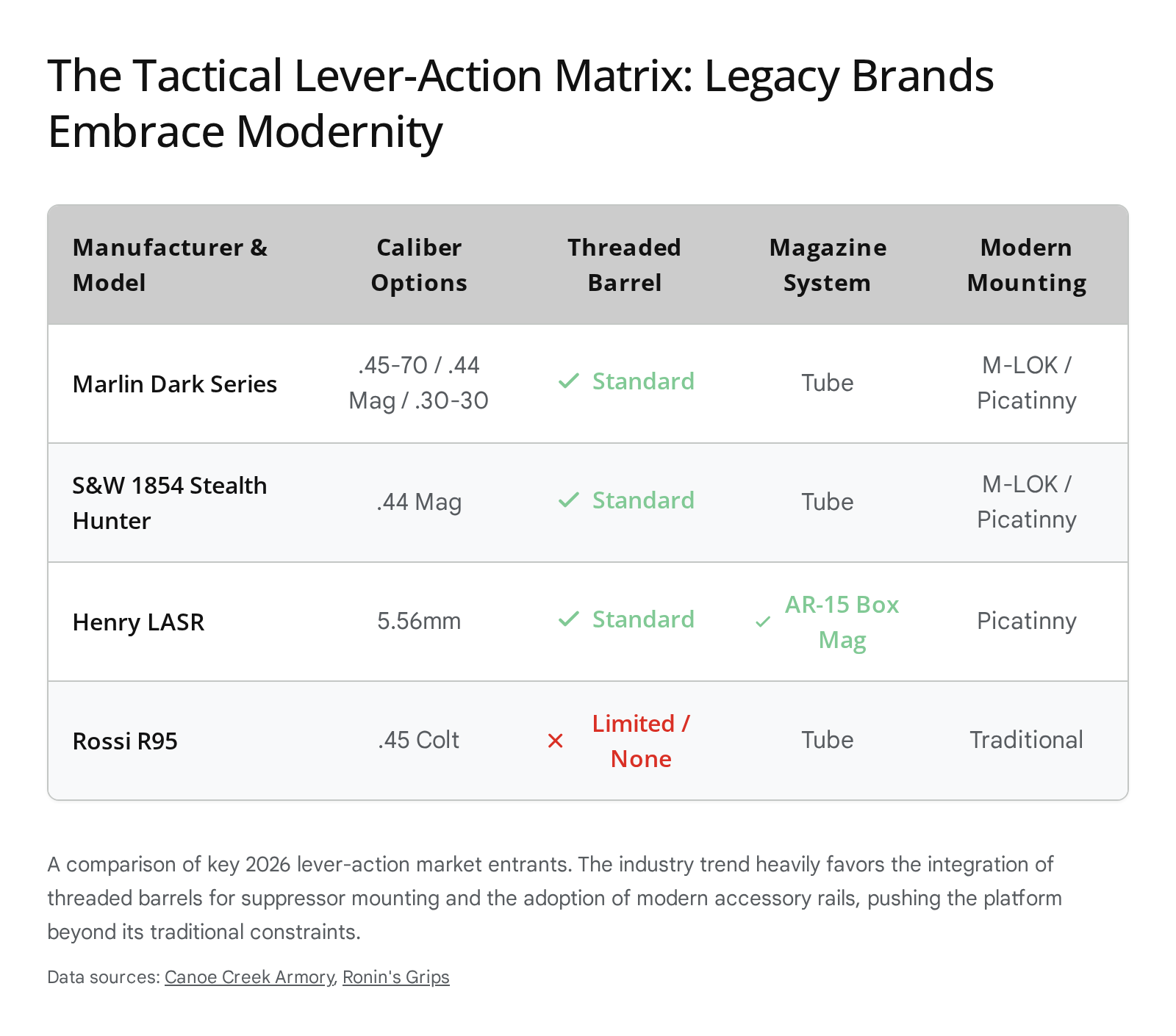
A defining characteristic of the modern market is the rapid technological integration seen in lever-action rifles. Once considered historical reproductions or specialized brush guns, the lever-action mechanism is currently viewed as a highly capable, 50-state-compliant defensive and hunting tool. The integration of M-LOK handguards, full-length Picatinny optics rails, and factory-threaded barrels has bridged the operational gap between nineteenth-century manual actions and contemporary modularity.8 Sentiment for these platforms is universally high, driven by mechanical simplicity, heavy terminal ballistics, and immunity to semi-automatic legislative restrictions.

2.3 Precision Bolt-Action Evolution

The bolt-action segment is completing a transition away from traditional wood stocks toward advanced synthetic polymers, carbon-fiber composites, and aerospace-grade aluminum chassis systems. The industry has adopted the term “crossover rifle” to define platforms that offer the weight characteristics necessary for backcountry carry, while retaining the heavy-profile barrels, vertical grip geometries, and adjustable triggers required for long-range precision competition.10

3. Product Profiles: Top 20 Rifles (Ranked by Sentiment)

3.1 Sig Sauer MCX Spear LT

Generating the highest volume of positive sentiment in June 2026, the Sig Sauer MCX Spear LT represents the apex of modern piston-driven engineering. Digital engagement heavily highlighted its robust construction and aesthetic modularity, frequently showcasing the platform in short-barreled rifle (SBR) and large-format pistol configurations.2 The Spear LT is engineered around a proprietary short-stroke gas piston system, which eliminates the requirement for a traditional AR-15 buffer tube assembly. This structural advantage permits the integration of a true folding stock, drastically reducing the weapon’s overall footprint for transport and vehicle deployment. The civilian market exhibits a strong preference for the 5.56 NATO and.300 Blackout chamberings; the latter receives specific praise for superior subsonic performance when suppressed.3 Furthermore, the platform utilizes a rigid monolithic-style upper receiver to guarantee absolute optic zero retention.

Average Street Price: $2,499.00

3.2 Palmetto State Armory Sabre-15

Palmetto State Armory (PSA) successfully disrupted the upper-tier AR-15 market with the Sabre line, achieving massive positive engagement.13 Historically recognized for budget-oriented platforms, PSA engineered the Sabre-15 to aggressively compete with boutique, high-margin manufacturers. The sentiment surrounding the Sabre is driven by the inclusion of high-end components standard from the factory. These include cold hammer-forged (CHF) barrels manufactured by FN Herstal, Radian Talon ambidextrous safeties, Sprinco buffer springs, and MicroBest bolt carrier groups utilizing Carpenter 158 steel.14 By offering these aftermarket upgrades directly within the OEM build, the Sabre-15 established a highly disruptive value proposition in the direct impingement space.

Average Street Price: $1,050.00

Diagram of an automatic rifle

3.3 Daniel Defense DDM4 V7

The Daniel Defense DDM4 V7 remains an enduring benchmark for professional-grade, direct impingement rifles. Sentiment tracking for the DDM4 V7 in June 2026 highlights a persistent appreciation for its uncompromising reliability, extended barrel life, and stringent quality control protocols.6 Manufactured with a cold hammer-forged 16-inch barrel and paired with a mid-length gas system, the rifle manages gas port pressures to deliver a highly controllable recoil impulse. The proprietary MFR 15.0 M-LOK rail system provides a lightweight yet extremely rigid mounting solution, minimizing point-of-impact shift when utilizing active laser aiming modules.6 The company’s strict adherence to Mil-Spec materials, particularly the high-pressure tested (HPT) and magnetic particle inspected (MPI) bolt carrier groups, solidifies the platform’s professional pedigree.

Average Street Price: $1,950.00

3.4 Tikka T3x Lite

Produced in Finland under the Sako/Beretta corporate umbrella, the Tikka T3x Lite maintains a revered status among backcountry hunters and precision marksmen.18 The sentiment is heavily anchored to its out-of-the-box sub-MOA accuracy guarantee, a fluid 70-degree bolt throw that easily clears large optic bells, and its overall lightweight geometry.19 The T3x receiver utilizes a widened angular ejection port to facilitate single-cartridge loading, while the metallic bolt shroud provides vital protection for the firing pin assembly. Given the current market trajectory toward aerodynamically efficient cartridges like the 6.5 Creedmoor, 6.5 PRC, and 7mm PRC, the T3x Lite offers a delivery mechanism that maximizes ballistic coefficients without encumbering the operator.21

Average Street Price: $1,130.00

3.5 Marlin 1895 SBL

Under the manufacturing stewardship of Ruger Firearms, the Marlin 1895 SBL has achieved near-cult status.23 Social sentiment frequently praises the rigorous quality control and tight machining tolerances that Ruger introduced to the historic Marlin architecture.23 Chambered in the heavy-hitting.45-70 Government cartridge, the 1895 SBL features a cold hammer-forged 19-inch threaded barrel, facilitating the attachment of modern big-bore suppressors. The polished 416 stainless steel metallurgy, paired with weather-resistant gray laminate furniture, makes the rifle highly resilient to maritime and harsh backcountry environments. The integration of a full-length Picatinny top rail with ghost ring sights allows for modern optic configurations, cementing its position as a premier defensive and large-game platform.24

Average Street Price: $1,350.00

3.6 Bergara B-14 HMR

The Bergara B-14 HMR (Hunting and Match Rifle) expertly serves the crossover market, straddling the line between a heavy tactical benchrest gun and a field-ready hunting implement. Market sentiment strongly favors its integrated mini-chassis molded directly into the polymer stock, which provides repeatable bedding and superb accuracy.10 Mechanically, the B-14 action is a deeply refined clone of the legendary Remington 700 footprint. This intentional design choice ensures that aftermarket support for triggers, optic mounts, and accessories is virtually limitless. Outfitted with an adjustable cheek piece, length-of-pull spacers, and an AICS-pattern detachable magazine system, the HMR provides custom-rifle ergonomics at a standard production price point.10

Average Street Price: $1,150.00

3.7 Ruger American Gen II

The release of the Generation II Ruger American rifle injected extraordinary momentum into the budget bolt-action sector. Reviewers and analysts lauded the Gen II for systematically addressing the minor critiques associated with the original model.25 The rifle now features a professionally applied Cerakote finish on the barreled action, a spiral-fluted barrel for weight reduction and rapid cooling, and a significantly stiffened, rigidly textured stock with adjustable comb height and length-of-pull capabilities.26 A redesigned tang safety and a faster 70-degree bolt throw allow the Gen II to operate with the fluid smoothness of a rifle that historically would command twice the retail price.25

Average Street Price: $610.00

3.8 Henry Big Boy X Model

Capitalizing on the lever-action trend, the Henry Big Boy X Model has garnered immense popularity among shooters seeking pistol-caliber carbines (PCCs). Available in.44 Magnum,.45 Colt, and.357 Magnum, the X Model is engineered specifically for utility, featuring synthetic furniture with M-LOK accessory slots and a Picatinny rail.9 A primary driver of its positive sentiment is the dual-loading capability; it incorporates a side-loading gate combined with a traditional removable tube magazine, offering unparalleled convenience for keeping the system topped off in dynamic environments.28 The threaded muzzle makes it an ideal host for pistol-caliber suppressors, turning subsonic cartridges like the.38 Special into highly discreet defensive or recreational tools.

Average Street Price: $950.00

3.9 CZ-USA 457

The CZ 457 represents the zenith of modern rimfire engineering. Widely recognized in social discussions as the superior mass-production rimfire platform on the market, the 457 replaces the older 455 system with several crucial upgrades: a push-to-fire safety, a shorter 60-degree bolt throw (facilitating lower scope mounting options), and a fully adjustable trigger mechanism.29 The true mechanical genius of the 457 lies in its modularity; the interchangeable barrel system permits the operator to swap between.22 LR,.22 WMR, and.17 HMR with a single chassis. Configurations like the Varmint and Pro Varmint incorporate heavy-profile barrels that yield true match-grade accuracy for precision rimfire competitions.31

Average Street Price: $710.00

3.10 Ruger 10/22

An undisputed icon of the American firearms industry, the Ruger 10/22 remains firmly entrenched in the top 10 due to its unyielding reliability and a sprawling aftermarket ecosystem that rivals that of the AR-15.32 Utilizing a patented 10-round rotary magazine that physically separates cartridges to prevent rim-lock, the 10/22 functions flawlessly across a wide spectrum of ammunition pressures and grain weights.34 Modern iterations, specifically the Takedown models, allow the rifle to be separated into two halves via a recessed locking lever for compact storage in a backpack, ensuring the platform remains highly relevant to modern survivalists and recreational campers.34

Average Street Price: $310.00

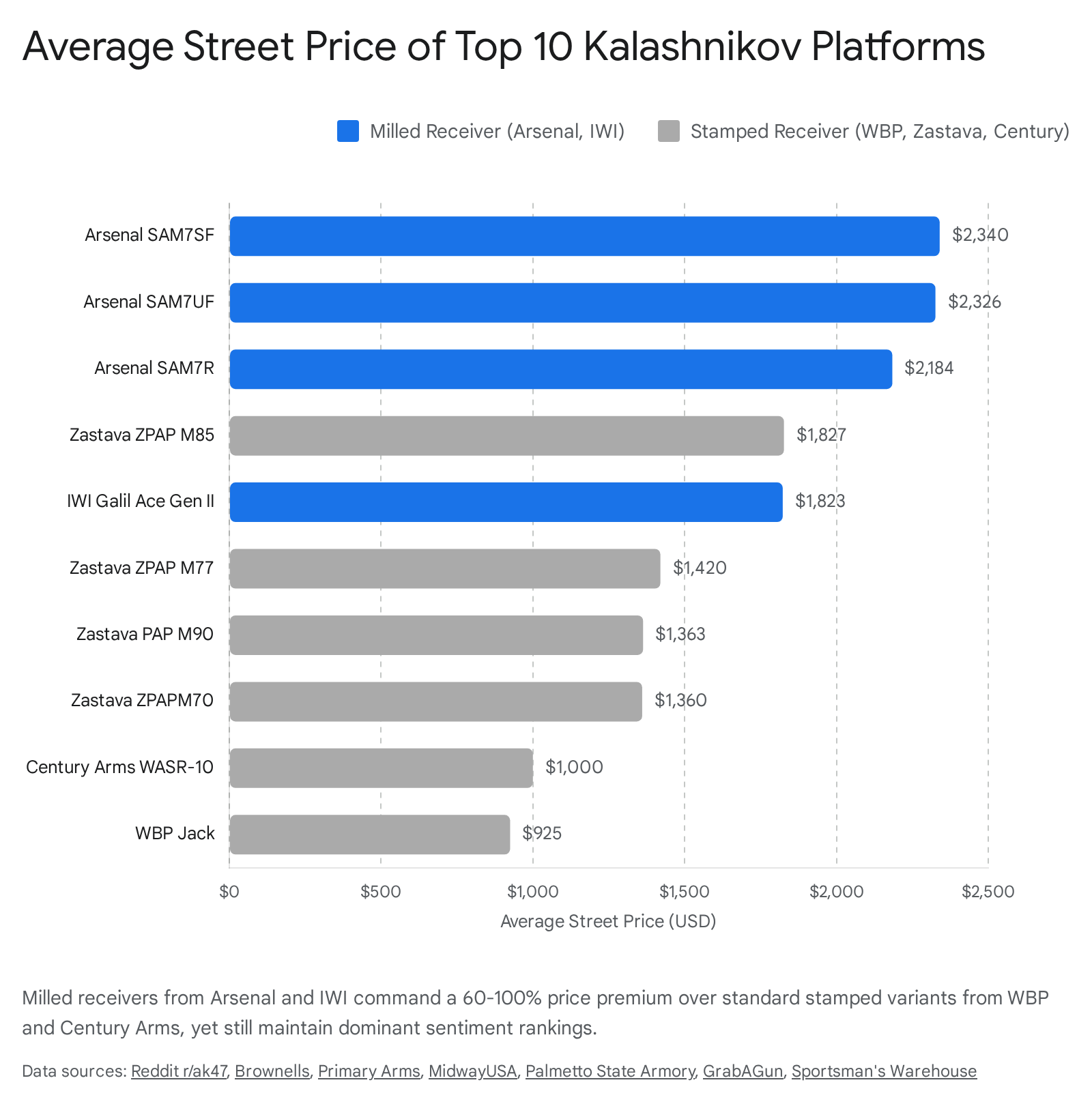
3.11 Zastava ZPAPM70

As geopolitical trade factors severely restrict the importation of Russian-manufactured AK-pattern rifles, the Serbian-built Zastava ZPAPM70 has dominated the domestic AK market segment.35 Positive sentiment is anchored heavily to Zastava’s decision to utilize a 1.5mm stamped receiver paired with a bulged front trunnion—a reinforced design choice originally intended for light machine guns (the RPK series) that virtually eliminates receiver flex.36 Furthermore, the addition of a cold hammer-forged, chrome-lined barrel guarantees exceptional barrel life and erosion resistance under rapid-fire conditions. The classic Serbian Red or Dark Walnut furniture fulfills the historical aesthetic demands of Kalashnikov collectors.38

Average Street Price: $1,275.00

3.12 Smith & Wesson M&P15 Sport III

The Smith & Wesson M&P15 Sport series has long served as the baseline entry point for civilian AR-15 ownership. The introduction of the Sport III modernized the platform to align with current tactical trends, sparking renewed positive sentiment.7 The Sport III eliminates the obsolete drop-in polymer handguards in favor of a 15-inch M-LOK free-floating rail, removing inconsistent pressure on the barrel and drastically improving harmonics and accuracy.39 Moreover, Smith & Wesson upgraded the gas system to a mid-length configuration, resulting in a noticeably softer recoil impulse compared to the carbine-length system of the legacy Sport II.40 A 1:8 twist rate and 5R rifling further enhance its capability to stabilize a wide range of projectile weights.

Average Street Price: $715.00

3.13 Ruger SFAR

The Ruger Small-Frame Autoloading Rifle (SFAR) represents a significant engineering achievement by packaging the ballistic authority of the 7.62x51mm NATO (.308 Winchester) cartridge into the footprint and weight class of a standard 5.56mm AR-15.42 Through superior metallurgy and intelligent dimensioning of the 8620 steel bolt carrier group and barrel extension, Ruger successfully eliminated the historic bulk and sluggish handling associated with traditional AR-10 platforms.44 Sentiment surrounding the SFAR is highly positive among hunters and tactical operators who demand long-range terminal ballistics but refuse to compromise on maneuverability. The 4140 chrome-moly steel barrel with 5R rifling ensures precision, while a 4-position adjustable gas block allows tuning for suppressed fire.43

Average Street Price: $1,015.00

3.14 Springfield Armory Saint Victor

The Springfield Armory Saint Victor occupies a highly competitive “duty-grade” tier of the AR-15 market. It is heavily praised for its comprehensive out-of-the-box feature set, ensuring the end-user rarely needs to source aftermarket upgrades.46 The Saint Victor comes standard with a flat-faced nickel boron-coated trigger for a crisp, frictionless break, B5 Systems or Magpul furniture, an H2 heavy tungsten buffer for reliable cycling, and low-profile spring-loaded flip-up sights.47 Built on forged 7075-T6 aluminum receivers and utilizing a 9310 enhanced bolt carrier, the rifle is engineered for extreme durability under severe duty constraints and sustained rates of fire.49

Average Street Price: $1,050.00

3.15 IWI Zion-15

Israel Weapon Industries (IWI) made their initial foray into the direct impingement AR-15 market with the Zion-15, and the platform has consistently maintained strong positive sentiment.50 Manufactured at their stateside facility in Middletown, Pennsylvania, the Zion-15 is viewed as a high-value, combat-ready rifle. It features a 4150 Chrome Moly Vanadium heavy barrel, a mid-length gas system, and a true 15-inch free-float M-LOK handguard.5 IWI’s strategic decision to ship the rifle with high-quality B5 Systems SOPMOD furniture and Magpul PMAGs further cements its reputation as an uncompromised, ready-to-deploy MSR.51

Average Street Price: $950.00

3.16 Browning X-Bolt 2 Speed

Browning’s release of the X-Bolt 2 series modernized a flagship bolt-action platform, primarily through an enhanced bolt guidance surface that yields incredibly rapid and smooth cycling.52 The “Speed” variants, particularly lauded in left-handed orientations by southpaw shooters 53, feature fluted sporter barrels, tungsten gray Cerakote finishes on the stainless steel actions, and Vari-Tech composite stocks utilizing Ovix camouflage.54 The rifle employs a three-lever DLX trigger system designed to offer absolute zero creep and a factory preset break of 3.5 pounds, guaranteeing exact precision for demanding big-game hunters.55

Average Street Price: $1,380.00

3.17 CZ-USA 600 Alpha

The CZ 600 series completely overhauled CZ’s bolt-action methodology, and the Alpha model serves as the utilitarian workhorse of the lineup. Engineered with a lightweight aluminum receiver to successfully offset the weight of a semi-heavy, cold hammer-forged barrel, the Alpha balances brilliantly in unsupported firing positions.11 A significant sentiment driver is the proprietary barrel attachment system, which allows the end-user to safely and easily swap barrels to change calibers without gunsmithing.56 The 60-degree bolt throw and a patented single-stage adjustable trigger further enhance the platform’s versatility, establishing it as a highly respected choice for rugged, sub-MOA performance.57

Average Street Price: $710.00

3.18 Steyr AUG A3 M1

The Steyr AUG maintains an ironclad grip on the bullpup market. The A3 M1 iteration retains the iconic, forward-thinking aesthetic of the original Austrian design while integrating necessary modern tactical requirements. By placing the action behind the trigger group, the AUG accommodates a full 16-inch barrel while maintaining an overall length roughly 8 inches shorter than a comparable M4 carbine.58 Its short-stroke gas-piston operation is exceptionally clean, inherently venting operational exhaust out of the front of the rifle.4 Features such as a quick-change barrel system, an extended rail for optics, and a collapsible forward grip sustain its enduringly positive social media presence.

Average Street Price: $1,999.00

3.19 Savage 110 Trail Hunter

A joint collaboration between Savage Arms and Hogue, the 110 Trail Hunter targets the budget-conscious consumer who refuses to sacrifice environmental durability.59 The rifle features an olive drab green Hogue Overmolded stock that provides a highly tactile, non-slip grip in adverse weather conditions.59 Furthermore, the barreled action is fully coated in Tungsten Cerakote, effectively sealing the metallurgy from rain, snow, and salt.60 Complete with a medium-heavy, straight fluted, and threaded button-rifled barrel, alongside Savage’s renowned user-adjustable AccuTrigger, the Trail Hunter delivers immense utilitarian value.

Average Street Price: $585.00

3.20 Palmetto State Armory PA-15

While PSA’s Sabre line dominates the premium conversation, the foundational PA-15 series remains a vital staple for first-time buyers and those seeking an affordable, reliable canvas for customization.61 The PA-15 provides standard Mil-Spec components, A2-style or Magpul MOE furniture, and consistent direct impingement performance.62 Its presence in the top 20 list is a testament to the fact that democratized pricing combined with functional reliability still commands vast amounts of positive consumer sentiment in the firearms industry. It serves as the baseline measuring stick against which value is derived in the MSR space.64

Average Street Price: $500.00

4. Materials Science Advancements and Modern Coatings

The sentiment data from June 2026 underscores a fundamental shift in how consumers evaluate the longevity and materials science of small arms. The widespread prevalence of Cerakote—a thin-film ceramic coating—across budget-friendly rifles like the Savage 110 Trail Hunter and the Ruger American Gen II indicates that advanced weatherproofing is no longer considered a luxury reserved for custom gunsmithing.26 Consumers now demand extreme corrosion resistance directly out of the box, largely rejecting traditional blued finishes in favor of ceramic or nitride surface treatments.

Internally, metallurgical compositions have become a focal point of consumer research. The utilization of Carpenter 158 steel in the PSA Sabre bolt carrier groups, or the 9310 steel in the Springfield Saint Victor, signals an increasingly educated buyer base that understands the yield strength requirements necessary for sustained firing schedules.15

5. Market Elasticity and Optics Integration

An analysis of bidding wars and completion prices on secondary auction platforms provides deeper context into consumer urgency. High-end tactical rifles, limited-production variants, and historically significant firearms frequently generate massive competitive bidding, as noted in recent Gunbroker data.65 The secondary market reinforces the concept that firearms with highly specific capabilities—such as carbon fiber proof barrels or master-grade restorations—create artificial pricing floors that subsequently inflate primary retail markets.

Furthermore, optics integration has become non-negotiable. The integration of threaded barrels across almost all analyzed platforms—including rimfires (CZ 457) and lever-action rifles (Henry Big Boy)—indicates that suppressor ownership has normalized.9 Correspondingly, free-floated M-LOK handguards are the absolute standard for mounting infrared lasers, illuminators, and bipods. Rifles that do not offer these integration points are rapidly losing favor in social media discussions, viewed as obsolete or unnecessarily limited in their tactical utility.

6. Conclusion

The small arms market is currently defined by an intense demand for uncompromised versatility. Consumers are willing to pay ultra-premium margins for tactical platforms that offer multi-caliber modularity, short-stroke piston mechanics, and enhanced suppression capabilities, as evidenced by the market dominance of the Sig Sauer MCX Spear LT. Concurrently, the bolt-action and lever-action segments are thriving precisely by adopting tactical features—such as M-LOK compatibility, aluminum chassis systems, and threaded barrels—without abandoning their historical reliability parameters. Market leaders are successfully blending heritage mechanics with modern materials science, creating a robust ecosystem where build quality, modularity, and environmental adaptability dictate market sentiment and pricing power.

Appendix: Methodology and Data Sources

Methodology: The rankings presented in this report were derived from a qualitative analysis of social media sentiment, specialized forum engagement (e.g., Reddit r/GunPorn), and digital retail trends isolated strictly to the month of June 2026. Data aggregation prioritized expressions of consumer satisfaction, technical praise, and purchase intent. Price aggregation was conducted by cross-referencing Manufacturer’s Suggested Retail Price (MSRP) with active transactional data across major e-commerce vendors to establish a realistic “Average Street Price.” Following this, up to five active listings priced at or below the established average were sourced and verified across eight specific retail networks.

Data Sources: Data was synthesized from industry retail platforms, specifically: Brownells, Grabagun, Global Ordnance, Midway USA, KYGunCo, Palmetto State Armory, Primary Arms, and Sportsmans Warehouse. Additional sentiment indicators were sourced from independent firearm review domains, auction site performance data, and user-generated social platforms.


Note: Vendor Sources listed are not an endorsement of any given vendor. It is our software reporting a product page given the direction to list products that are between the minimum and average sales price when last scanned.


Please share the link on Facebook, Forums, with colleagues, etc. Your support is much appreciated and if you have any feedback, please email us in**@*********ps.com. If you’d like to request a report or order a reprint, please click here for the corresponding page to open in new tab.


Sources Used

  1. Just Gonna Leave This Here : r/GunPorn – Reddit, accessed July 1, 2026, https://www.reddit.com/r/GunPorn/comments/1tp2fhg/just_gonna_leave_this_here/
  2. Let’s try this again : r/GunPorn – Reddit, accessed July 1, 2026, https://www.reddit.com/r/GunPorn/comments/1ujrnt1/lets_try_this_again/
  3. Sig Sauer MCX SPEAR-LT – Sportsman’s Warehouse, accessed July 1, 2026, https://www.sportsmans.com/sig-sauer-mcx-spear-lt
  4. Steyr Arms AUG A3 M1 5.56mm NATO 16in Black/White Semi Automatic Modern Sporting Rifle – 30+1 Rounds | Sportsman’s Warehouse, accessed July 1, 2026, https://www.sportsmans.com/shooting-gear-gun-supplies/modern-sporting-rifles/steyr-arms-aug-a3-m1-556mm-nato-16in-blackwhite-semi-automatic-modern-sporting-rifle-301-rounds/p/1862155
  5. IWI Zion-15 5.56 16″ Barrel 30-Rounds – GrabAGun, accessed July 1, 2026, https://grabagun.com/iwi-zion-15-rifle-5-56-16-barrel-30-rounds.html
  6. Daniel Defense DDM4 V7 Semi-Automatic Rifle – Sportsman’s Warehouse, accessed July 1, 2026, https://www.sportsmans.com/daniel-defense-ddm4-v7-semi-automatic-rifle
  7. Smith & Wesson M&P 15 Sport III Series 5.56mm NATO 16in Black Semi Automatic Modern Sporting Rifle – 30+1 Rounds | Sportsman’s Warehouse, accessed July 1, 2026, https://www.sportsmans.com/shooting-gear-gun-supplies/modern-sporting-rifles/smith-wesson-mp-15-sport-iii-series-556mm-nato-16in-black-semi-automatic-modern-sporting-rifle-301-rounds/p/1872172
  8. Marlin 1895 SBL 45-70 Government Stainless Black/Green Lever Action Rifle – 19.1in, accessed July 1, 2026, https://www.sportsmans.com/shooting-gear-gun-supplies/rifles/marlin-1895-sbl-45-70-government-stainless-blackgreen-lever-action-rifle-191in/p/1951269
  9. Henry Big Boy Big Boy X Model .45 Long Colt Lever Action Rifle – 17.4″ – Primary Arms, accessed July 1, 2026, https://www.primaryarms.com/henry-big-boy-big-boy-x-model-45-long-colt-lever-action-rifle-17-4in
  10. Bergara B-14 HMR Bolt Action Rifle 6.5 Creedmoor 22 Cerakote Threaded – MidwayUSA, accessed July 1, 2026, https://www.midwayusa.com/product/1020488835
  11. CZ USA 600 Alpha 223 Remington Black Bolt Action Rifle – 24in | Sportsman’s Warehouse, accessed July 1, 2026, https://www.sportsmans.com/shooting-gear-gun-supplies/rifles/cz-usa-600-alpha-black-bolt-action-rifle-223-remington-24in/p/1789687
  12. Search results for: ‘Sig Sauer MCX SPEAR-LT’ – GrabAGun, accessed July 1, 2026, https://grabagun.com/sig-sauer-mcx-spear-lt-sbr-coyote-300blk-9-barrel-30-rounds.html
  13. Sabre AR-15 – Palmetto State Armory, accessed July 1, 2026, https://palmettostatearmory.com/sabre/ar/ar-15.html
  14. PSA Sabre-15 Forged Lower with B5 Bravo Stock and B5 Grip, Black, accessed July 1, 2026, https://palmettostatearmory.com/psa-sabre-15-forged-lower-with-b5-bravo-stock-and-b5-grip-black.html
  15. PSA “Sabre” Forged 16″ 5.56 Nitride 15″ Sabre Lock Up Rail Sabre Furniture Rifle – Palmetto State Armory, accessed July 1, 2026, https://palmettostatearmory.com/psa-sabre-forged-16-5-56-nitride-15-sabre-lock-up-rail-sabre-furniture-rifle.html
  16. PSA “Sabre” Forged 16″ Nitride 5.56 with 15″ Sabre Lock up Rail and Magpul SL Furniture Rifle – FDE Cerakote | Palmetto State Armory, accessed July 1, 2026, https://palmettostatearmory.com/psa-sabre-forged-16-nitride-5-56-with-15-sabre-lock-up-rail-and-magpul-sl-furniture-rifle-fde-cerakote.html
  17. Daniel Defense DDM4 V7 SLW 5.56 NATO 14.5″ – AR-15 Rifle – Primary Arms, accessed July 1, 2026, https://www.primaryarms.com/daniel-defense-ddm4v7-slw-556-rifle-mfr-m-lok-rail-black-14.5
  18. Tikka | Precision Bolt Action Rifles – kygunco, accessed July 1, 2026, https://www.kygunco.com/brand/tikka
  19. Tikka T3x Lite Roughtech Bolt Action Rifle 7mm Remington Mag 24.3 – MidwayUSA, accessed July 1, 2026, https://www.midwayusa.com/product/1023183676
  20. Tikka T3x Lite 308 Winchester Matte Blued/Black Bolt Action Rifle – Sportsman’s Warehouse, accessed July 1, 2026, https://www.sportsmans.com/shooting-gear-gun-supplies/rifles/tikka-t3x-lite-308-winchester-matte-bluedblack-bolt-action-rifle-20in/p/1970849
  21. Tikka Rifles – T3, T3x – Ultimate Accuracy | Sportsman’s Warehouse, accessed July 1, 2026, https://www.sportsmans.com/tikka/c/cat131914
  22. Search results for: ‘Tikka T3x Lite’ – GrabAGun, accessed July 1, 2026, https://grabagun.com/beretta-tikka-t3x-lite-6-5cr-ss-24.html
  23. The New Classic Lever-Action Rifles: A Few of Our Favorites | GrabAGun, accessed July 1, 2026, https://grabagun.com/blog/the-new-classic-lever-action-rifle-a-few-of-our-favorites/
  24. FIREARM SPOTLIGHT: THE MARLIN 1895 SBL – GrabAGun Blog, accessed July 1, 2026, https://grabagun.com/blog/firearm-spotlight-marlin-1895-sbl/
  25. Ruger American Rifle Gen II for Sale – GrabAGun, accessed July 1, 2026, https://grabagun.com/brands/ruger/ruger-american-gen-ii
  26. Ruger American Gen II Patrol Bolt Action Rifle – MidwayUSA, accessed July 1, 2026, https://www.midwayusa.com/product/1029205924
  27. Henry Big Boy Side Gate X Model .357 Magnum Lever Action Rifle, Black – H012MX, accessed July 1, 2026, https://palmettostatearmory.com/henry-big-boy-side-gate-x-model-357-magnum-lever-action-rifle-black-h012mx.html
  28. Henry Repeating Arms Big Boy X Model Lever Action Rifle Blued .44 Mag 17.4″ Barrel 7-Rounds – GrabAGun, accessed July 1, 2026, https://grabagun.com/henry-repeating-arms-big-boy-x-model-lever-action-rifle-blued-44-mag-17-4-barrel-7-rounds.html
  29. CZ 457 Varmint Barrel 22 LR 20 Length 5-Round Mag Nitride, accessed July 1, 2026, https://www.midwayusa.com/product/1029153955
  30. CZ-USA 457 Varmint 22LR 20.5″ Bolt Rifle – Turkish Walnut – kygunco, accessed July 1, 2026, https://www.kygunco.com/product/cz-usa-02340-457-varmint-22-lr
  31. Search results for: ‘CZ 457’ – GrabAGun, accessed July 1, 2026, https://grabagun.com/cz-457-varmint-precision-chassis-od-green-22-lr-16-barrel-5-rounds.html
  32. Ruger 10/22 for Sale – Reliable Rimfire Rifles | Palmetto State Armory, accessed July 1, 2026, https://palmettostatearmory.com/brands/ruger/ruger-rifles/10-22.html
  33. RUGER 10/22 CARBINE 22 LONG RIFLE SEMI-AUTO RIFLE – Brownells, accessed July 1, 2026, https://www.brownells.com/guns/rifles/semi-auto-rifles/1022-standard-carbine-18.5-22-lr-blue-101/
  34. Ruger 10/22 Takedown – Sportsman’s Warehouse, accessed July 1, 2026, https://www.sportsmans.com/ruger-10-22-takedown
  35. Zastava Arms ZPAPM70 7.62x39mm 16.3in Blued/Dark Walnut Semi Automatic Modern Sporting Rifle – 30+1 Rounds | Sportsman’s Warehouse, accessed July 1, 2026, https://www.sportsmans.com/shooting-gear-gun-supplies/modern-sporting-rifles/zastava-arms-zpapm70-762mm-nato-163in-blueddark-walnut-semi-automatic-modern-sporting-rifle-301-rounds/p/1650030
  36. Zastava USA ZPAPM70 7.62 X 39 16.5″ Barrel 30-Rounds Quad Rail – GrabAGun, accessed July 1, 2026, https://grabagun.com/zastava-usa-zpapm70-7-62-x-39-16-3-barrel-30-rounds-quad-rail.html
  37. Zastava Arms ZPAPM70 7.62x39mm 16.30″, Gold | Palmetto State Armory, accessed July 1, 2026, https://palmettostatearmory.com/zastava-arms-zpapm70-7-62x39mm-16-30-gold.html
  38. Zastava Arms ZPAP M70 7.62x39mm AK-47 Rifle, Walnut | Palmetto State Armory, accessed July 1, 2026, https://palmettostatearmory.com/zastava-arms-zpap-m70-7-62x39mm-ak-47-rifle-walnut-zr7762wm.html
  39. Smith and Wesson M&P15 Sport III 5.56 / .223 Rem 16″ Barrel 30-Rounds – GrabAGun, accessed July 1, 2026, https://grabagun.com/smith-and-wesson-m-p15-sport-iii-5-56-223-rem-16-barrel-30-rounds.html
  40. Smith & Wesson M&P15 Sport III 5.56 NATO 16″ – AR-15 Rifle – Primary Arms, accessed July 1, 2026, https://www.primaryarms.com/smith-wesson-m-p15-sport-iii-5-56-nato-ar-15-rifle-black-30rd-16
  41. Smith & Wesson M&P15 Sport III 5.56/.223 Rifle | KYGUNCO, accessed July 1, 2026, https://www.kygunco.com/product/smith-wesson-13807-mp15-sport-iii-223-556-16in-30rd
  42. Ruger SFAR Semi-Auto Rifle Black – MidwayUSA, accessed July 1, 2026, https://www.midwayusa.com/product/1025742627
  43. Ruger SFAR 7.62×51 16.1” 20rd AR Rifle, Desert Storm Chocolate Chip, accessed July 1, 2026, https://palmettostatearmory.com/ruger-sfar-7-62×51-16-1-20rd-ar-rifle-desert-storm-chocolate-chip.html
  44. FIREARM SPOTLIGHT: THE RUGER SFAR – GrabAGun Blog, accessed July 1, 2026, https://grabagun.com/blog/firearm-spotlight-the-ruger-sfar/
  45. Ruger SFAR .308 Win AR Rifle with 16.1″ Barrel, Black – 5614 | Palmetto State Armory, accessed July 1, 2026, https://palmettostatearmory.com/ruger-sfar-308-win-ar-rifle-with-16-1-barrel-black-5614.html
  46. Springfield Armory Saint Victor V2 with Pinned and Welded 4-Prong Flash Hider 5.56mm NATO 14in Black Hardcoat Anodized Modern Sporting Rifle – 30+1 Rounds | Sportsman’s Warehouse, accessed July 1, 2026, https://www.sportsmans.com/shooting-gear-gun-supplies/modern-sporting-rifles/springfield-armory-saint-victor-v2-with-pinned-and-welded-4-prong-flash-hider-556mm-nato-14in-black-hardcoat-anodized-modern-sporting-rifle-301-rounds/p/1955295
  47. Springfield Armory Saint Victor 5.56mm NATO 16in Black Semi Automatic Modern Sporting Rifle – 30+1 Rounds | Sportsman’s Warehouse, accessed July 1, 2026, https://www.sportsmans.com/shooting-gear-gun-supplies/modern-sporting-rifles/springfield-armory-saint-victor-556mm-nato-16in-black-semi-automatic-modern-sporting-rifle-301-rounds/p/1649993
  48. Springfield Armory Saint Victor AR-10 Semi Automatic Rifle 308 – MidwayUSA, accessed July 1, 2026, https://www.midwayusa.com/product/1028939839
  49. Springfield Armory Saint Victor AR15 Rifle 5.56 16″ Barrel 30-Rounds – GrabAGun, accessed July 1, 2026, https://grabagun.com/springfield-armory-saint-victor-5-56-16-30-1.html
  50. IWI Zion-15 5.56mm NATO 16in Black Semi Automatic Modern Sporting Rifle – 30+1 Rounds, accessed July 1, 2026, https://www.sportsmans.com/shooting-gear-gun-supplies/modern-sporting-rifles/iwi-zion-15-556mm-nato-16in-black-semi-automatic-modern-sporting-rifle-301-rounds/p/1647681
  51. IWI Zion Z-15 5.56 NATO 12.5″ 30rd – Black – kygunco, accessed July 1, 2026, https://www.kygunco.com/product/iwi-israel-weapon-industries-z15tac12-zion-z-15-5.56-nato-tactical-pistol-12.5-30rd
  52. Browning X-Bolt 2 Medallion Bolt Action Rifle 270 Winchester 22 Blued – MidwayUSA, accessed July 1, 2026, https://www.midwayusa.com/product/102810369
  53. SHOT Show Standouts: The Best New Products of 2026 – Petersen’s Hunting, accessed July 1, 2026, https://www.petersenshunting.com/editorial/shot-show-best-new-products/544182
  54. Browning X-Bolt 2 Speed SR OVIX Camo 7mm Rem Mag 26″ Barrel 3-Rounds – GrabAGun, accessed July 1, 2026, https://grabagun.com/browning-x-bolt-2-speed-sr-ovix-camo-7mm-rem-mag-26-barrel-3-rounds.html
  55. Browning X-Bolt 2 Hunter 6.5 Creedmoor Bolt Action Rifle – 22″ – Walnut – Primary Arms, accessed July 1, 2026, https://www.primaryarms.com/browning-x-bolt-2-hunter-6-5-creedmoor-bolt-action-rifle-22in-walnut
  56. CZ 600 Plus Alpha Bolt Action Rifle 243 Winchester 20 Black Threaded – MidwayUSA, accessed July 1, 2026, https://www.midwayusa.com/product/1028922358
  57. CZ 600 Alpha Bolt Action Rifle 223 Remington 24 Black Threaded Barrel – MidwayUSA, accessed July 1, 2026, https://www.midwayusa.com/product/1024754432
  58. Steyr AUG A3 M1 OEM Semi Automatic Rifle 5.56x45mm NATO 16 Black – MidwayUSA, accessed July 1, 2026, https://www.midwayusa.com/product/102663787
  59. Savage Arms 110 Trail Hunter Bolt Action Rifle 450 Bushmaster 20 – MidwayUSA, accessed July 1, 2026, https://www.midwayusa.com/product/1026445591
  60. Savage 110 Trail Hunter Lite 7mm PRC Cerakote Bolt Action Rifle – 20in, accessed July 1, 2026, https://www.sportsmans.com/shooting-gear-gun-supplies/rifles/savage-110-trail-hunter-lite-7mm-prc-cerakote-bolt-action-rifle-20in/p/1894042
  61. PA-15 Parts & Accessories | Upgrade Your PA-15 Rifle Today | Palmetto State Armory, accessed July 1, 2026, https://palmettostatearmory.com/pa-15/parts.html?p=12
  62. The Ultimate AR-15 Kit Guide: What You Need to Know, accessed July 1, 2026, https://ads.palmettostatearmory.com/blog/ultimate-ar15-kit-guide-what-you-need-to-know.html
  63. Looking for advice before I purchase a PA-15 – AR-15 – Palmetto State Armory | Forum, accessed July 1, 2026, https://palmettostatearmory.com/forum/t/looking-for-advice-before-i-purchase-a-pa-15/25597
  64. PA-15 Complete Rifles for Sale | Shop AR-15 Firearms Online | Palmetto State Armory, accessed July 1, 2026, https://palmettostatearmory.com/pa-15/complete-guns.html
  65. The Most Popular Used Hunting Rifles of May 2026 on GunBroker, accessed July 1, 2026, https://www.gunbroker.com/c/article/most-popular-used-hunting-rifles-may-2026/
  66. 22 Highest Bid Guns on GunBroker – May 2026 Bidding War Report, accessed July 1, 2026, https://www.gunbroker.com/c/article/most-bid-guns-gunbroker-may-2026/
  67. CZ 457 Target Bolt Action Rifle 22 Long Rifle 26 Black Threaded Barrel – MidwayUSA, accessed July 1, 2026, https://www.midwayusa.com/product/1029524112
  68. CZ 457 At-One Varmint SR .22 LR 24″ Barrel 5-Rounds – GrabAGun, accessed July 1, 2026, https://grabagun.com/cz-457-at-one-varmint-22lr-24.html

Navigating Recent ATF Changes on Firearm Regulations: SBRs and Braces

Please note the author is not a lawyer and this is not legal advice.

Executive Summary

The intersection of federal administrative law, statutory interpretation, and firearms regulation has experienced unprecedented turbulence over the past decade, culminating in the Bureau of Alcohol, Tobacco, Firearms, and Explosives (ATF) issuing a May 2026 Notice of Proposed Rulemaking (NPRM) to formally rescind the factoring criteria for stabilizing braces.1 This sweeping regulatory reversal is not the product of proactive agency evolution, but rather the direct consequence of extensive judicial intervention under the Administrative Procedure Act (APA).3 Federal appellate and district courts systematically dismantled the ATF’s 2023 final rule, ruling that the agency’s subjective enforcement mechanisms exceeded statutory authority, violated procedural mandates, and ignored the foundational principles of legislative design.3

The resulting landscape presents a complex administrative paradox for the hundreds of thousands of citizens—out of an estimated 1.4 million affected individuals—who participated in the 2023 tax-exempt amnesty registration.6 These citizens successfully, and legally, integrated Title I pistols into the Title II National Firearms Registration and Transfer Record (NFRTR) as Short-Barreled Rifles (SBRs).7 With the underlying regulatory rule now entirely defunct, these registrants possess firearms governed by the most stringent National Firearms Act (NFA) restrictions—such as severe interstate travel prohibitions and mandatory transfer taxes—despite the fact that the physical configuration of the firearm no longer requires such regulation under the prevailing federal judicial consensus.9

This exhaustive research report documents the chronological regulatory and judicial history that necessitated the ATF’s May 2026 proposal to abandon the factoring criteria. Furthermore, it provides a highly technical advisory analysis for consumers and legal practitioners seeking to explicitly extract their AR and AK-pattern platforms from the NFRTR. By evaluating federal administrative procedures alongside the compounding friction of state-level statutes—specifically Michigan’s RI-060 sales registry and its unique dimensional definitions—this document outlines the definitive legal mechanisms for restoring firearms to Title I status while maintaining absolute future compliance and avoiding state-level felony traps.11

The Statutory and Administrative Architecture of the National Firearms Act

To fully comprehend the magnitude of the stabilizing brace regulatory conflict, it is essential to first analyze the foundational architecture of the National Firearms Act of 1934 (NFA) and the subsequent Gun Control Act of 1968 (GCA). Enacted in response to the rise of criminal violence during the Prohibition era, the NFA was explicitly designed to aggressively regulate specific classes of firearms, notably machine guns, silencers, and short-barreled rifles and shotguns.13 The original legislative intent was to utilize the taxation power of the federal government to render these weapons cost-prohibitive for the average citizen, imposing a $200 making or transfer tax that has remained unchanged for nearly a century.14

The statutory definition of a “rifle” under 26 U.S.C. § 5845(c) forms the absolute nexus of the ensuing legal battles that would arise decades later. A rifle is explicitly defined by Congress as a weapon “designed or redesigned, made or remade, and intended to be fired from the shoulder”.2 If such a weapon features a barrel length of less than 16 inches, or an overall length of less than 26 inches, it is statutorily classified as a Short-Barreled Rifle (SBR).15 This classification immediately subjects the weapon to intense NFA regulation, including the mandatory $200 making or transfer tax, stringent fingerprint-based background checks, and mandatory, permanent inclusion in the NFRTR.7

Conversely, traditional handguns and pistols—weapons conceptually and physically designed to be fired with a single hand without shoulder support—are regulated under the significantly less restrictive Title I provisions of the GCA.14 The regulatory friction between these two statutory regimes emerged with full force in 2012 following the invention of the stabilizing brace. Originally engineered to attach to the rear receiver extension of heavy AR-pattern pistols, the brace was designed to strap to the user’s forearm, facilitating safe, one-handed firing for disabled shooters or those lacking upper body strength. Because the statutory definition of an SBR relies entirely on the subjective physical “design” and the nebulous concept of “intent,” the rapid proliferation of these accessories forced the ATF into a corner. Over the subsequent decade, the agency issued a series of contradictory classification letters, alternately stating that shouldering a brace did or did not constitute the illegal “making” of an unregistered SBR based on minor physical variations in the brace’s design.

The administrative apparatus responsible for managing these classifications and maintaining the registry is the ATF’s National Firearms Act Division, physically located in Martinsburg, West Virginia.18 This division maintains the NFRTR, a centralized, legacy database tracking the ownership, transfer, and physical characteristics of over three million registered NFA items nationwide.20 The rigidity of the NFRTR system, which requires formal, approved applications prior to any transfer or creation of an NFA item, leaves absolutely no room for regulatory ambiguity.21 An item is either within the registry and subject to federal surveillance, or it is outside the registry.

Form DesignationStatutory PurposeRequired Entity/ApplicantFinancial Implication
ATF Form 1 (5320.1)Application to Make and Register a FirearmIndividual, Trust, or Unlicensed Maker$200 Tax Stamp (waived during amnesty)
ATF Form 3 (5320.3)Application for Tax-Exempt TransferBetween Qualified FFLs/SOTsTax-Exempt
ATF Form 4 (5320.4)Application for Tax Paid Transfer and RegistrationTransfer to an Unlicensed Individual$200 Transfer Tax
ATF Form 5 (5320.5)Application for Tax-Exempt TransferTransfer to Government/HeirsTax-Exempt
ATF Form 10 (5320.10)Registration of Unregistered FirearmState and Local Law Enforcement OnlyOfficial Use Only (No commercial transfer)
ATF Form 5320.20Application to Transport InterstateRegistered Owner of Destructive Device, Machinegun, SBR, or SBSRegulatory Notification (No fee)

This rigid classification architecture was fundamentally destabilized when the volume of stabilizing braces in the commercial market reached the millions. The ATF’s reliance on private letter rulings proved insufficient for nationwide enforcement, prompting the agency to transition from individual evaluations to a sweeping regulatory overhaul.

The 2023 Stabilizing Brace Final Rule (2021R-08F): Promulgation and Mechanics

In an ambitious attempt to resolve years of inconsistent classification letters and rising political pressure regarding the presence of brace-equipped firearms in the public sphere, the Department of Justice and the ATF promulgated Final Rule 2021R-08F, officially titled “Factoring Criteria for Firearms with Attached Stabilizing Braces,” which was published and took effect in early 2023.8

The rule sought to fundamentally expand the regulatory definition of a “rifle” within the Code of Federal Regulations by introducing a complex, multi-point factoring criteria to determine if a brace-equipped pistol was, in fact, “designed or redesigned, made or remade, and intended to be fired from the shoulder”.2 This subjective balancing test weighed various opaque factors on an invisible administrative scale.3 The ATF designated a point system evaluating the weapon’s surface area, length of pull, overall weight, presence of secondary grips, and heavily scrutinized the manufacturer’s marketing materials to ascertain the “true” intent of the configuration.3 If an AR or AK-pattern pistol equipped with a brace accumulated enough points, it was summarily reclassified as a rifle. Because these weapons featured barrels shorter than 16 inches, they instantly became unregistered SBRs upon the rule’s publication.

Upon implementation of the final rule, the ATF’s own economic analysis revealed the staggering scope of the regulation. The agency estimated that between 3 million and 7 million stabilizing braces were currently in circulation across the United States.6 Based on disposal data extrapolated from previous regulatory actions regarding bump-stock-type devices, the ATF determined that individual owners typically possessed a mean average of two such accessories.6 Consequently, the ATF estimated that 1.4 million individual citizens would be directly and immediately affected by this proposed rule, transforming them overnight into individuals possessing unregistered Title II NFA items.6 The impact extended deep into the federal firearms licensee (FFL) network as well.

Impacted DemographicEstimated Total PopulationEstimated Affected PopulationPercentage Impacted
Individual OwnersN/A1.4 Million CitizensN/A
Type 1 FFLs (Dealers)52,840 Licenses13,210 Licenses25.0%
Type 7 FFLs (Manufacturers)15,524 Licenses3,881 Licenses25.0%

Because the rule effectively reclassified the vast majority of these brace-equipped pistols as contraband SBRs, the ATF faced an unprecedented enforcement and compliance nightmare. To mitigate the realization of millions of citizens suddenly possessing felony-level contraband, the Attorney General authorized an extraordinary 120-day tax-exempt amnesty period immediately following the publication of the rule.7

During this 120-day compliance window, owners of brace-equipped pistols were permitted to submit an ATF eForm 1 (Application to Make and Register a Firearm) without the requirement to remit the standard $200 tax stamp.8 This administrative maneuver was unprecedented in modern ATF history and directed a massive, immediate influx of applications into the Industry Processing Branch (IPB) of the NFA Division.20 The sheer volume of amnesty registrations placed an extreme and persistent strain on the NFRTR infrastructure, effectively integrating a massive cohort of standard Title I firearms into the heavily regulated Title II registry, solely based on the presence of a plastic accessory that the agency previously deemed lawful.

Registrants were granted administrative forbearance during the lengthy processing period, but upon final approval of their tax-exempt eForm 1, their firearms became legally recognized, fully registered SBRs. This classification bound the firearms and their owners to the strictures of the NFA in perpetuity. Meaning, the owners were now federally required to submit an ATF Form 5320.20 (Application to Transport Interstate) and await formal approval from Martinsburg before crossing state lines with the weapon.10 Furthermore, they were completely prohibited from transferring or selling the firearm on the commercial market without subsequent ATF approval via Form 4 and the payment of a $200 transfer tax by the receiving party.21

Judicial Backlash: The Systematic Unraveling of the Factoring Criteria

The promulgation of the 2023 Final Rule triggered immediate, aggressive, and highly coordinated litigation from a vast coalition of states, firearms manufacturers, and civil rights organizations. The plaintiffs universally argued that the ATF had egregiously overstepped its statutory authority, bypassed the legislative process of Congress, and violated the procedural safeguards enshrined in the Administrative Procedure Act (APA). The ensuing judicial dismantling of the rule occurred simultaneously across multiple federal circuits, creating a definitive, inescapable consensus that agency deference regarding firearms classification had reached its absolute limit.

Mock v. Garland and the Fifth Circuit’s Arbitrary and Capricious Standard

The initial and most devastating fatal blow to the stabilizing brace rule originated in the United States Court of Appeals for the Fifth Circuit, originating from the Northern District of Texas through the landmark case Mock v. Garland.4 The plaintiffs in the Mock litigation challenged the rule on the grounds that it was an impermissible legislative rule improperly masked as an interpretive rule, and that it fundamentally violated the APA’s logical outgrowth test.4 The APA requires that a final rule must be a logical outgrowth of the initially proposed rule, ensuring the public has a meaningful opportunity to comment on the actual regulatory mechanics that will eventually govern them.

The Fifth Circuit’s appellate review (Mock I, 75 F.4th 563, 2023) sharply and unapologetically criticized the ATF’s regulatory methodology.5 In evaluating the preliminary injunction appeal, the court cataloged numerous reasons why the Final Rule could not withstand judicial scrutiny, explicitly noting that the rule “vests the ATF with complete discretion to use a subjective balancing test to weigh six opaque factors on an invisible scale”.5 The court determined that the agency’s six-part test provided no meaningful clarity to the public regarding what constituted an impermissible configuration, rendering the enforcement completely arbitrary and capricious.5

Following the appellate remand, U.S. District Judge Reed O’Connor of the Northern District of Texas issued a final, sweeping judgment on June 13, 2024, decisively vacating the rule in its entirety.4 Judge O’Connor held that the ATF blatantly violated the APA’s procedural requirements, as the final rule was not a logical outgrowth of the proposed rule.4 In his definitive ruling, O’Connor stated, “Because Defendants fail to show that this is a rare case in which the Court should deviate from the default rule, the Court VACATES the Final Rule on the grounds that Defendants violated the APA’s procedural requirements in promulgating it”.29

The legal concept of vacatur is critical in understanding the collapse of the brace ban in administrative law. Unlike a preliminary or permanent injunction, which merely pauses enforcement for specific named parties in a lawsuit while leaving the rule intact, vacatur erases the rule from the Code of Federal Regulations writ large, treating it as if it never legally existed.5 Following Judge O’Connor’s ruling, the Department of Justice formally dismissed its appeal in the case (now recaptioned as Mock v. Bondi following a change in the Attorney General) on July 17, 2025, surrendering to the decision and cementing the permanent vacatur of the stabilizing brace ban nationwide.2

FRAC v. Garland: The Eighth Circuit and the Post-Chevron Landscape

Parallel to the Fifth Circuit’s proceedings, the Eighth Circuit Court of Appeals delivered a concurrent and equally severe strike against the ATF’s regulatory overreach in FRAC v. Garland, 112 F.4th 507 (8th Cir. 2024).3 Represented by the Firearms Regulatory Accountability Coalition (FRAC), prominent brace manufacturer SB Tactical, and B&T USA, the plaintiffs secured a 2-1 opinion finding they were highly likely to succeed on the merits of their APA challenge.3

The Eighth Circuit explicitly reiterated the legislative history and purpose of the NFA, noting that Congress passed the statute in 1934 strictly “in response to rampant criminal gang violence” to “regulate certain weapons likely to be used for criminal purposes”.13 The court found that reclassifying millions of commonly owned plastic accessories under this draconian, anti-gang statute using amorphous and vaguely defined factors was a massive and unjustifiable overreach.3

Crucially, the jurisprudence surrounding FRAC v. Garland must be analyzed through the lens of the Supreme Court’s landmark 2024 decision in Loper Bright Enterprises v. Raimondo (603 U.S. 369).13 Loper Bright fundamentally and permanently altered administrative law by completely overruling the long-standing doctrine of Chevron deference.13 The Supreme Court dictated that under the APA, courts must independently interpret constitutional and statutory provisions without deferring to an executive agency’s interpretation of ambiguous statutes.13 The Eighth Circuit recognized that the ATF’s expansive, subjective interpretation of the statutory term “rifle” was no longer entitled to any deference, cementing the judiciary as a formidable and unyielding check against agency overreach.13

The convergence of Mock v. Garland, FRAC v. Garland, and the Supreme Court’s concurrent ruling in Cargill (which similarly rejected the ATF’s unilateral reclassification of bump stocks as machine guns) established a binding legal interpretation that the ATF simply lacked the authority to rewrite statutory definitions through interpretive rulemaking.32

Regulatory compliance document with text

The May 2026 Notice of Proposed Rulemaking (RIN 1140-AA98)

Faced with a universally vacated rule, facing mounting legal bills, and operating in a strict post-Chevron environment where agency deference was eliminated, the ATF initiated a formal regulatory surrender. On May 6, 2026, the Department of Justice officially published a Notice of Proposed Rulemaking (NPRM) identified by RIN 1140-AA98: Removing Factoring Criteria for Firearms with Attached “Stabilizing Braces” in the Federal Register.2

This landmark regulatory reform package was explicitly drafted to unwind the 2023 final rule in direct response to the insurmountable federal court rulings in Mock v. Garland and FRAC v. Garland.1 The summary of the proposed rule explicitly acknowledges the agency’s defeat, stating that “Courts have found that ATF’s revisions in the 2023 final rule on the same topic violated the Administrative Procedure Act,” noting that the rule has been enjoined, stayed, or vacated across numerous jurisdictions and has “rarely been in effect”.2

The primary administrative mechanism of RIN 1140-AA98 is the formal removal from the regulatory definitions of “rifle” the two highly contested paragraphs added by the 2023 final rule.2 These paragraphs originally defined the subjective metrics and factoring point systems for determining when a weapon was “designed or redesigned, made or remade, and intended to be fired from the shoulder”.2 By striking these specific paragraphs, the ATF restores the regulatory definitions to be entirely consistent with the underlying statutory definitions enacted by Congress in 1934, totally abandoning the unenforceable factoring criteria.35

The public comment period for this NPRM opened on May 6, 2026, and is scheduled to formally close on August 4, 2026, marking the procedural conclusion of the stabilizing brace saga under the mechanics of the APA.2 While the ATF notes in its mandated economic analysis that removing the criteria increases uncertainty regarding how many manufacturers might attempt to circumvent traditional NFA requirements in the future, the agency acknowledges it lacks the data and, more importantly, the legal authority to maintain the 2023 framework.2

The Amnesty Registration Paradox: Navigating Title I and Title II Jurisdictions

The vacatur of the 2023 rule and the subsequent publication of the 2026 NPRM yield a profound and frustrating administrative paradox for the citizenry. During the 120-day compliance window in early 2023, hundreds of thousands of individuals utilized the tax-exempt amnesty program to register their brace-equipped pistols as Short-Barreled Rifles via eForm 1 to avoid felony prosecution.8

These firearms were legally and permanently entered into the NFRTR. The paradox lies in the administrative reality that while the rule that initially compelled the registration has been legally erased by the courts, the federal registrations themselves remain entirely active within the federal database.9 The DOJ highlighted this lingering, threatening reality during subsequent court filings in Texas, noting explicitly that they would “continue to enforce the NFA’s and the GCA’s regulation of short-barreled rifles against some brace-equipped pistols” if the firearm met the traditional, statutory definition of an SBR independent of the vacated factoring rule.29

Consequently, an amnesty registrant currently possesses a Title II firearm subject to all draconian NFA controls. If they wish to travel interstate with this firearm to attend a competition or training course, they are statutorily required to submit an ATF Form 5320.20 to the NFA Division in Martinsburg, WV, and await formal, written approval before crossing state borders.10 If they wish to sell the firearm in its current configuration to a friend or a local gun store, it requires an ATF Form 4 transfer, a $200 tax paid by the transferee, and a background check waiting period often extending for many months.21

However, foundational ATF regulatory doctrine provides a reliable escape mechanism for these registrants. According to the precedent established in the Supreme Court case United States v. Thompson/Center Arms Co. (504 U.S. 505) and subsequently formalized in ATF Ruling 2011-4, the physical configuration of a firearm dictates its classification at any given moment, provided it was originally manufactured and serialized as a pistol.16

ATF Ruling 2011-4 explicitly states that if a firearm originally started its life as a pistol (i.e., it was originally assembled or produced as a pistol and not as a factory complete rifle), it can be returned to Title I pistol status simply by removing the components that classify it as an SBR—namely, the stabilizing brace or the shoulder stock. It is a common misconception that a firearm’s classification relies entirely on how it was documented on the Form 4473 during transfer (e.g., as an “other” or “receiver”); legally, the classification is entirely dependent on its original physical assembly. Once the stock is removed from the receiver, the firearm ceases to be an SBR in both a physical and a legal capacity.17 It is paramount to note the specific “once a rifle, always a rifle” caveat inherent in the NFA; if the weapon originated as a factory-built rifle, removing the stock does not revert it to a pistol, it merely creates a “weapon made from a rifle,” which remains an NFA item indefinitely.17

Because the vast majority of amnesty-registered firearms originated as AR or AK-pattern pistols built from stripped receivers or bought as complete handguns, they are fully eligible under ATF Ruling 2011-4 to be physically reconfigured back to Title I status without violating the NFA.17

NFRTR Mechanics and Systemic Vulnerabilities

Understanding why the ATF did not simply mass-delete the amnesty registrations following the court vacatur requires an examination of the National Firearms Registration and Transfer Record itself. The NFRTR is the central registry of all NFA firearms in the U.S. not under government control, maintaining records of the identification of the firearm, the date of registration, and the address of the person entitled to possession.7 Dating back to 1934, the registry currently contains over three million individual records.20

The NFRTR is managed by the Industry Processing Branch (IPB) within the NFA Division, and the database infrastructure has historically been plagued by technological limitations. An Office of the Inspector General (OIG) audit of the NFA branch highlighted severe legacy issues within the system.23 The OIG report noted that for extended periods, the ATF delayed vital system enhancements to the NFRTR because they were attempting to integrate multiple databases through a project known as the Firearms Integrated Technology (FIT) project.23 The goal of the FIT project was to allow access to various databases—including the National Tracing Center and the Imports Branch—through a single entry system.23

Because of the architectural rigidity of this legacy system, the NFRTR lacks a mechanism to execute conditional, bulk rollbacks of approved registrations based on court rulings. Furthermore, because a small percentage of registrants may have used the amnesty period to register actual, traditional short-barreled rifles (e.g., adding a physical stock to a pistol rather than just a brace), the ATF cannot globally assume that every amnesty registration is now physically a Title I firearm.24 The agency assumes that once a change is entered into the NFRTR, it remains static until proactive, individual intervention occurs.23 Therefore, the administrative burden of correcting the registry falls entirely upon the individual citizen.

Technical Advisory: Administrative Procedures for Explicit NFRTR De-Registration

While ATF Ruling 2011-4 allows a registered SBR to exist temporarily as a Title I pistol simply by removing the stock or brace, the firearm’s serial number remains indelibly etched into the NFRTR database.9 The ATF takes the strict position that a firearm currently listed in the registry is technically considered an SBR for federal record-keeping purposes, even if it is temporarily physically reconfigured.9

The Legal Rationale for Explicit Removal

For consumers, maintaining an active NFRTR registration for a firearm they intend to treat exclusively as a Title I pistol introduces severe compliance liabilities and unnecessary friction. Law enforcement queries during traffic stops or border crossings may flag the serial number as a restricted Title II weapon, leading to prolonged detainment or confiscation while the physical configuration is debated.39 Furthermore, if the owner wishes to eventually sell the firearm to a standard buyer through a traditional Title I transfer at a local gun store, the persistent NFRTR registration severely complicates the process, as many dealers will refuse to log an NFA-registered serial number into their Title I acquisition books.25

To achieve absolute legal clarity, entirely eliminate interstate travel restrictions (avoiding Form 5320.20), and facilitate unencumbered future sales, the owner must explicitly request that the ATF permanently remove the firearm from the NFRTR.25 The ATF highly recommends this procedure to maintain the accuracy of the registry, noting in their published guidelines that owners should proactively notify the Government Services Branch (GSB) or the Industry Processing Branch of the NFA Division to strike the item.8

Diagram illustrating the regulatory process for firearms with

Differentiating Between Voids, Withdrawals, and Removals

It is critical for practitioners to utilize the correct terminology when communicating with the ATF to prevent processing delays. The ATF categorizes form cancellations into specific groups:

  • Withdrawal: A withdrawal is requested when a submitted Form 1 or Form 4 application is still in “pending” status and has not yet been approved. This stops the process before the item enters the registry.18
  • Void: A void is requested when a form has already been approved, but the actual “making” or the physical transfer of the firearm never occurred. In these cases, the applicant must return the original tax stamp to prove the configuration was never realized.18
  • Removal: A removal is requested when an approved NFA item was physically made (as was the case with all amnesty braces), but the owner has since permanently reconfigured the item back into a non-NFA status and wishes to strike it from the active registry.12

Drafting and Executing the Notice of Removal

The process for removing a firearm from the NFRTR is not governed by a specific, standardized ATF form (unlike transfers, exports, or making applications). Instead, it requires a meticulously drafted, custom, wet-signed letter submitted directly to the NFA Division.25

An exhaustive removal request must contain the following specific data elements to guarantee processing by the Industry Processing Branch:

  1. Statement of Intent: An explicit, unambiguous declaration requesting that the National Firearms Registration and Transfer Record (NFRTR) be modified to reflect the removal of the specific firearm from the Title II registry.12
  2. Statement of Configuration (Reasoning): A clear articulation that the firearm is no longer in a configuration that constitutes an NFA item. The letter must state that the stock or brace has been permanently removed, and the weapon has been returned to a Title I pistol configuration.12
  3. Firearm Identifiers: The exact Make, Model, Caliber, Barrel Length, Overall Length, and Serial Number of the item, matching precisely what is recorded on the approved Form 1.12 Including the original Form 1 Internal Control Number significantly expedites retrieval from the database.19
  4. Current Possession Metrics: A statement confirming that the applicant maintains current physical possession and control of the item, and listing the physical address where it is stored.12
  5. Authentication: The registrant’s full legal name, physical mailing address, and a physical, “wet” signature accompanied by the current date. The ATF routinely rejects digitally signed removal requests or form modifications.12

If submitting via physical mail, practitioners should include two copies of the letter and request that one copy be returned with an official stamp or letter indicating the NFRTR has been modified.45

Proper Routing: Martinsburg vs. Portland Lockboxes

A common point of failure for registrants attempting to correspond with the ATF involves routing the paperwork to the incorrect facility. In 2019, the U.S. Treasury transitioned lockbox services for the ATF from Bank of America in Atlanta, Georgia, to U.S. Bank in Portland, Oregon.49 Consequently, all tax-paid Form 1 and Form 4 applications requiring the processing of a $200 payment are routed to P.O. Box 5015 in Portland.49

However, these lockboxes are strictly financial processing centers; they do not handle general correspondence, compliance queries, or NFRTR database modifications. Mailing a removal letter to the Oregon lockbox will result in the document being discarded or lost. General correspondence, void requests, and NFRTR removal letters must bypass the lockbox entirely and be directed to the physical headquarters of the NFA Division:

Chief, NFA Division National Service Center Bureau of Alcohol, Tobacco, Firearms and Explosives 244 Needy Road Martinsburg, WV 25405 10

Request TypeDestination RoutingAssociated ATF Division
Tax-Paid Form 1 / Form 4P.O. Box 5015, Portland, ORTreasury Lockbox Services
Tax-Exempt Transfers / Forms244 Needy Road, Martinsburg, WVNFA Division (IPB)
Form 5320.20 Interstate Travel244 Needy Road, Martinsburg, WVNFA Division (IPB)
NFRTR Removal/Void Letters244 Needy Road, Martinsburg, WVNFA Division (IPB)

To accelerate processing and ensure a digital paper trail, the ATF strongly encourages transmitting a high-resolution PDF scan of the wet-signed removal letter via electronic mail directly to their designated general inbox for registry actions: NF****@*TF.GOV.10 Sending the request via both certified physical mail to the Martinsburg address and simultaneously to the NFAFAX email address ensures absolute receipt and redundancy.12 The email submission should include the registrant’s full legal name and phone number in the body of the message to facilitate direct contact if errors are detected.39

Processing Timelines and ATF Acknowledgment

The timeline for NFRTR removal varies significantly based on the existing backlog at the Industry Processing Branch. Currently, registrants experience a processing period generally ranging from one to three months (30 to 90 days) from the date of submission.12 In some instances, registrants may see processing completed in as little as one to two months.51

The ATF does not generally issue email confirmations of receipt for removal letters submitted to the NFAFAX inbox, which can cause anxiety for applicants awaiting resolution.47 Instead, completion of the administrative action is signaled strictly by the arrival of physical mail from Martinsburg.47 The registrant will typically receive a formal, printed letter stating that the “Requested Adjustments made to the National Firearms Registration and Transfer Record,” confirming the database update.12 Alternatively, in some cases, the ATF will mail back a physical copy of the registrant’s original Form 1 heavily stamped with a “VOID” watermark.12 Once this physical documentation is secured by the owner, the firearm is unequivocally recognized as a Title I weapon, permanently unshackled from the constraints of the NFA. At this stage, the owner requires no further federal action to conceal carry, transport interstate, or sell the firearm on the commercial market.25

State-Level Entanglements: The Michigan RI-060 Jurisprudential Conflict

While federal deregistration relies solely on administrative correspondence with Martinsburg, consumers attempting to return SBRs to pistol configurations frequently encounter severe state-level statutory entanglements that can carry devastating criminal liabilities. The State of Michigan presents the most complex jurisdictional friction in the nation regarding this process, primarily due to its unique statutory definitions of firearms and its active handgun sales registry.11

Statutory Definitions of Pistols and Short-Barreled Rifles in Michigan

Under the Michigan Penal Code (MCL 750.222), the state implements dimensional definitions that clash severely with federal categorizations. In Michigan, a “pistol” is defined as a loaded or unloaded firearm that is 26 inches or less in overall length, or any firearm that by its construction and appearance conceals itself as a firearm.15 This definition was updated in 2013, shifting the maximum pistol length down from 30 inches to 26 inches to better align with ATF definitions, though complications remain.53 Concurrently, Michigan legally recognizes a “Short-barreled rifle” as a rifle having one or more barrels less than 16 inches in length or an overall length of less than 26 inches, and such weapons were only legalized for civilian possession in the state following legislative changes in 2014 (PA 201 of 2014) which required strict compliance with federal ATF approvals.53

This creates a severe logical trap for builders due to differing measurement standards: while the ATF measures a rifle’s overall length with the stock fully extended, Michigan measures overall length with the firearm in its “shortest operable configuration” (e.g., with the stock or brace folded or collapsed). Consequently, an SBR that is over 26 inches federally may still be under 26 inches under Michigan law. Michigan State Police Legal Update #106 dictates an overlapping mandate: an SBR that is 26 inches or less in its shortest operable configuration must also be registered as a pistol in Michigan under the requirements of MCL 28.422 or 28.422a.54 An SBR under this specific threshold is considered a pistol as defined by Michigan law and is subject to all state statutes applicable to pistols, including strict concealed carry provisions.54 Therefore, if an amnesty registrant in Michigan possessed a brace-equipped AR pistol under 26 inches, it was legally required to be already registered in the state database (MiPistol) prior to the submission of their federal Form 1.

The Falsification Trap and Sales Registry Mechanics

The fundamental and highly dangerous confusion arises when a Michigan resident successfully executes the federal NFRTR removal process, explicitly converting their SBR back into a pure Title I pistol configuration. Because Michigan maintains strict rules regarding pistol registration, many consumers mistakenly believe that the act of physically “re-manufacturing” the pistol from an SBR requires them to submit a new Michigan Firearm Sales Record (Form RI-060) to their local police department to “update” the state on the weapon’s status.57

Michigan law, substantially updated in February 2024, mandates that all firearm acquisitions require a License to Purchase (LTP) unless the purchaser possesses a Concealed Pistol License (CPL), a MCOLES law enforcement certification, or a Federal Firearms License (FFL).59 Exempt purchasers must record pistol transfers using the RI-060 form, which features designated, mandatory fields for both the Seller and the Purchaser.11

Consumers attempting to diligently document the physical reconfiguration of their own firearm frequently attempt to list themselves as both the “Seller” and the “Purchaser” on the RI-060, or invent a fictitious seller entity such as “Self-Assembled” or “Home-Built” in the seller fields.57 This is a severe legal miscalculation that invites intense prosecution. Under MCL 28.422a(4), a person who makes a material false statement on a sales record is guilty of a felony punishable by imprisonment for not more than four years or a fine of not more than $2,500, or both.

The critical jurisprudential insight here is that Michigan maintains a sales and transfer registry, not an absolute ownership registry.64 The statutory mandate to file an RI-060 is triggered exclusively by the acquisition, purchase, gift, or loan of a pistol from one distinct entity to another distinct entity.15 When an owner removes a stabilizing brace or stock from a serialized receiver they already lawfully own, absolutely no transfer of title or acquisition has occurred. The firearm—whether designated federally as an SBR or a pistol—remained continuously in the unbroken possession of the exact same individual.

Therefore, a Michigan resident who successfully extracts a firearm from the federal NFRTR via correspondence with Martinsburg is under absolutely no legal obligation to file a new RI-060 to report the configuration change.65 Submitting a falsified RI-060 listing oneself as both buyer and seller in a misguided attempt to “update” the state database exposes the consumer to immediate felony liability for falsifying a state record.57 Ironically, the failure to register a legitimate sale in Michigan is merely classified as a state civil infraction carrying a $250 fine, whereas lying on the form to over-comply is a severe felony.57 The firearm remains legally logged in the MiPistol database under the owner’s original acquisition record from when they first purchased the receiver or pistol, thereby satisfying all state tracking requirements.11

Strategic Implications for Firearms Compliance

The extensive, multi-year saga of the stabilizing brace—from its inception as a permitted, widely adopted accessory, to its abrupt criminalization via the 2023 factoring criteria, and culminating in the May 2026 NPRM unwinding—serves as a defining, historical case study in the modern limits of the federal administrative state. The systemic, unapologetic vacatur of Final Rule 2021R-08F by the Fifth and Eighth Circuits demonstrates that in a post-Loper Bright legal ecosystem, executive branch agencies can no longer rely on broad interpretive deference to unilaterally rewrite foundational statutory definitions.4

For the hundreds of thousands of citizens who utilized the tax-exempt amnesty program in a good-faith effort to comply with shifting federal mandates, the 2026 regulatory environment demands proactive, highly technical administrative hygiene.6 The persistence and architectural rigidity of the NFRTR means that the judicial erasure of the 2023 rule does not automatically purge the legacy database of the amnesty registrations.9 Amnesty registrants are currently caught in a regulatory net that no longer has a legal foundation, yet the federal record of their Title II ownership persists.

To escape this paradox, registrants must expertly leverage the procedural mechanisms outlined by the NFA Division—submitting highly specific, wet-signed removal declarations detailing their physical reconfiguration directly to Martinsburg—to explicitly detach their hardware from Title II oversight.10

Simultaneously, navigating the compounded friction of state-level statutes, such as Michigan’s strict RI-060 sales registry and dimensional limitations, requires a nuanced, expert understanding of statutory triggers.11 Recognizing the vital legal distinction between a physical component reconfiguration and a legal transfer of title is the only way to prevent consumers from committing technical felonies in their pursuit of over-compliance.11 Ultimately, absolute regulatory compliance in 2026 requires citizens to aggressively and affirmatively manage their federal administrative footprint via NFRTR removal procedures, while simultaneously exhibiting precise, educated restraint regarding state-level record keeping to avoid the catastrophic consequences of falsification.


Please share the link on Facebook, Forums, with colleagues, etc. Your support is much appreciated and if you have any feedback, please email us in**@*********ps.com. If you’d like to request a report or order a reprint, please click here for the corresponding page to open in new tab.


Sources Used

  1. ATF Announces Historic Firearms Regulatory Reform Package Emphasizing Modernization and Burden Reduction – Wiley Rein, accessed June 26, 2026, https://www.wiley.law/alert-ATF-Announces-Historic-Firearms-Regulatory-Reform-Package-Emphasizing-Modernization-and-Burden-Reduction
  2. Removing Factoring Criteria for Firearms With … – Federal Register, accessed June 26, 2026, https://www.federalregister.gov/documents/2026/05/06/2026-08930/removing-factoring-criteria-for-firearms-with-attached-stabilizing-braces
  3. Appeals Court Rules Against ATF’s use of “Vague” and “Amorphous” Factors to Classify Firearms – Wiley Rein, accessed June 26, 2026, https://www.wiley.law/alert-Appeals-Court-Rules-Against-ATFs-use-of-Vague-and-Amorphous-Factors-to-Classify-Firearms
  4. AR pistol Archives – Shockwave Technologies, accessed June 26, 2026, https://shockwavetechnologies.com/tag/ar-pistol/
  5. In the United States Court of Appeals for the Fifth Circuit – NationBuilder, accessed June 26, 2026, https://assets.nationbuilder.com/firearmspolicycoalition/pages/6710/attachments/original/1730940750/2024.11.06_035_Brief_for_Plaintiffs-Appellees_%28FPC%29.pdf?1730940750
  6. Factoring Criteria for Firearms with Attached Stabilizing Braces – ATF, accessed June 26, 2026, https://www.atf.gov/media/21151/download
  7. chapter 3. registration of nfa firearms | atf, accessed June 26, 2026, https://www.atf.gov/media/25151/download
  8. ATF Final Rule 2021R-08F “Factoring Criteria for Firearms with Attached Stabilizing Braces”, accessed June 26, 2026, https://utahcarrylaws.com/atf-final-rule-2021r-08f/
  9. Interstate travel with an amnesty “sbr” : r/NFA – Reddit, accessed June 26, 2026, https://www.reddit.com/r/NFA/comments/184fi98/interstate_travel_with_an_amnesty_sbr/
  10. Application to Transport Interstate or to Temporarily Export Certain National Firearms Act (NFA) Firearms – ATF, accessed June 26, 2026, https://www.atf.gov/sites/default/files2/f_5320.20_application_to_transport_interstate_or_to_temporarily_export_certain_national_firearms_act_nfa_firearms.pdf
  11. MSP RI-060 Pistol Sales Record form – PowerDMS, accessed June 26, 2026, https://public.powerdms.com/MSP1917/documents/1742579
  12. Unregister SBR : r/NFA – Reddit, accessed June 26, 2026, https://www.reddit.com/r/NFA/comments/1p1lqu4/unregister_sbr/
  13. Case 1:23-cv-00003-DMT-CRH Document 60 Filed 02/18/25 Page 1 of 28, accessed June 26, 2026, https://www.wiley.law/assets/htmldocuments/Summary%20Judgment%20Order.pdf
  14. National Firearms Act – Wikipedia, accessed June 26, 2026, https://en.wikipedia.org/wiki/National_Firearms_Act
  15. MCL – Section 750.222 – Michigan Legislature, accessed June 26, 2026, https://www.legislature.mi.gov/Laws/MCL?objectName=mcl-750-222
  16. ESTTA654620 02/06/2015 IN THE UNITED STATES PATENT AND TRADEMARK OFFICE BEFORE THE TRADEMARK TRIAL AND APPEAL BOARD Proceeding 9 – TTABVue – USPTO, accessed June 26, 2026, https://ttabvue.uspto.gov/ttabvue/ttabvue-91217252-OPP-9.pdf
  17. SBR still an SBR without the stock? : r/NFA – Reddit, accessed June 26, 2026, https://www.reddit.com/r/NFA/comments/evh2zf/sbr_still_an_sbr_without_the_stock/
  18. Application to Transfer and Register NFA Firearm (Tax-Paid) – ATF, accessed June 26, 2026, https://www.atf.gov/media/23251/download
  19. Application for Tax Exempt Transfer and Registration of Firearm | ATF, accessed June 26, 2026, https://www.atf.gov/media/22506/download
  20. National Firearms Act Division – ATF, accessed June 26, 2026, https://www.atf.gov/firearms/national-firearms-act-division
  21. NFA Handbook – Chapter 9 – Transfers of NFA Firearms – ATF, accessed June 26, 2026, https://www.atf.gov/media/25086/download
  22. National Firearms Act Handbook – ATF, accessed June 26, 2026, https://www.atf.gov/media/25161/download
  23. The Bureau of Alcohol, Tobacco, Firearms and Explosives’ National Firearms Registration and Transfer Record, accessed June 26, 2026, https://oig.justice.gov/sites/default/files/legacy/reports/ATF/e0706/final.pdf
  24. UPDATE: Final Rule 2021R-80F – National Gun Trusts, accessed June 26, 2026, https://www.nationalguntrusts.com/blogs/nfa-gun-trust-atf-information-database-blog/final-rule-2021r-80f
  25. Removing an SBR/SBS from the NFRTR and Selling / Reregistering the SBR – National Gun Trusts, accessed June 26, 2026, https://www.nationalguntrusts.com/blogs/nfa-gun-trust-atf-information-database-blog/removing-an-sbr-sbs-from-the-nfrtr-and-then-reregistering-the-sbr-sbs-process
  26. The State of Texas v Cardona et al, No. 4:2023cv00604 – Document 37 (N.D. Tex. 2024) – Justia Law, accessed June 26, 2026, https://law.justia.com/cases/federal/district-courts/texas/txndce/4:2023cv00604/377970/37/
  27. No. 24-3101 UNITED STATES COURT OF APPEALS FOR THE TENTH CIRCUIT, accessed June 26, 2026, https://mslegal.org/wp-content/uploads/2024/05/2024.07.24-Motion-for-Injunction.pdf
  28. Case 4:23-cv-00604-O Document 37 Filed 06/11/24 Page 1 of 112 PageID 708 – Attorney General, accessed June 26, 2026, https://www.texasattorneygeneral.gov/sites/default/files/images/press/Title%20IX%20Guidance%20Injunction%20Order.pdf
  29. Members’ Newsletter: The Pistol Brace Ban Isn’t Dead | The Reload, accessed June 26, 2026, https://thereload.com/members-newsletter-the-pistol-brace-ban-isnt-dead/
  30. Mock et al v. Garland et al, No. 4:2023cv00095 – Document 110 (N.D. Tex. 2024) :: Justia, accessed June 26, 2026, https://law.justia.com/cases/federal/district-courts/texas/txndce/4:2023cv00095/372609/110/
  31. BENBROOK LAW GROUP June 25, 2024 By CM/ECF Lyle W. Cayce, Clerk of Court United States Court of Appeals for the Fifth Circuit O – NationBuilder, accessed June 26, 2026, https://assets.nationbuilder.com/firearmspolicycoalition/pages/6710/attachments/original/1719346889/2024.06.25_143_28%28j%29_Letter.pdf?1719346889
  32. Boyd Garriott – Wiley Rein, accessed June 26, 2026, https://www.wiley.law/people-BoydGarriott
  33. Executive Order Signals Rollback of Biden-Era Firearms Regulations and Overhaul of Second Amendment Policy at DOJ – Wiley Rein, accessed June 26, 2026, https://www.wiley.law/alert-Executive-Order-Signals-Rollback-of-Biden-Era-Firearms-Regulations
  34. CASE NO. 24-2458 UNITED STATES COURT OF APPEALS FOR THE EIGHTH CIRCUIT UNITED STATES OF AMERICA, Plaintiff-Appellee, v. BRADLEY – Gun Owners of America, accessed June 26, 2026, https://www.gunowners.org/wp-content/uploads/Wendt-Amicus-Brief-8th-Cir.pdf
  35. Repeal | ATF, accessed June 26, 2026, https://www.atf.gov/rules-and-regulations/atf-launches-new-era-reform/repeal
  36. 2026 Federal Register Index :: Justice Department, accessed June 26, 2026, https://www.federalregister.gov/index/2026/justice-department
  37. Removing Factoring Criteria for Firearms With Attached “Stabilizing Braces” (RIN 1140-AA98) | ATF, accessed June 26, 2026, https://www.atf.gov/rules-and-regulations/rulemaking-notices/removing-factoring-criteria-firearms-attached-stabilizing-braces-rin-1140-aa98
  38. New ATF Rules : r/NFA – Reddit, accessed June 26, 2026, https://www.reddit.com/r/NFA/comments/1sz8zf4/new_atf_rules/
  39. Moving with a Suppressor: Legal Requirements & ATF Forms – Silencer Shop, accessed June 26, 2026, https://www.silencershop.com/blog/moving-with-a-suppressor
  40. SBR to Pistol ? : r/czscorpion – Reddit, accessed June 26, 2026, https://www.reddit.com/r/czscorpion/comments/129m1w7/sbr_to_pistol/
  41. ATF NFRTR Letter Requesting Removal of a SBR/SBS Title 2 Status Generator, accessed June 26, 2026, https://www.nationalguntrusts.com/blogs/nfa-gun-trust-atf-information-database-blog/atf-letter-requesting-removal-of-a-sbr-sbs-title-2-status
  42. Final Rule 2021R-08F – Frequently Asked Questions and SBA Compliance Guide, accessed June 26, 2026, https://www.pa.gov/content/dam/copapwp-pagov/en/mpoetc/documents/training/firearms/faqs%20for%20the%20final%20rule.pdf
  43. How Do You Void or Withdraw a Form? – National Gun Trusts, accessed June 26, 2026, https://www.nationalguntrusts.com/blogs/nfa-gun-trust-atf-information-database-blog/how-do-you-void-or-withdraw-a-form
  44. NFA sbr removal – Reddit, accessed June 26, 2026, https://www.reddit.com/r/NFA/comments/18ol5la/nfa_sbr_removal/
  45. BATFE Letter Requesting Removal of a SBR/SBS from the NFRTR – Prince Law Offices Blog, accessed June 26, 2026, https://blog.princelaw.com/2009/03/25/batfe-letter-requesting-removal-of-a-sbrsbs-from-the-nfrtr/
  46. Form letter for removing AR-Pistol from SBR database? : r/NFA – Reddit, accessed June 26, 2026, https://www.reddit.com/r/NFA/comments/1tyybdm/form_letter_for_removing_arpistol_from_sbr/
  47. Converting SBR back to pistol : r/NFA – Reddit, accessed June 26, 2026, https://www.reddit.com/r/NFA/comments/1kvyti9/converting_sbr_back_to_pistol/
  48. ATF NFA Gun Trusts, ATF Information Database and Silencer Blog, accessed June 26, 2026, https://www.nationalguntrusts.com/blogs/nfa-gun-trust-atf-information-database-blog?page=28
  49. New Mailing Addresses for Many ATF Registration Forms, accessed June 26, 2026, https://www.atf.gov/firearms/forms/new-mailing-addresses-many-atf-registration-forms
  50. Federal Firearms Licensee Quick Reference and Best Practices Guide – ATF, accessed June 26, 2026, https://www.atf.gov/firearms/tools-and-services-firearms-industry/current-licensees/federal-firearms-licensee-quick-reference-and-best-practices-guide
  51. How Long Does a NFRTR Removal Request Take? – National Gun Trusts, accessed June 26, 2026, https://www.nationalguntrusts.com/blogs/nfa-gun-trust-atf-information-database-blog/how-long-does-a-nfrtr-removal-request-take
  52. Michigan State Gun Laws and Regulations Explained – NRA-ILA, accessed June 26, 2026, https://www.nraila.org/gun-laws/state-gun-laws/michigan/
  53. Michigan CPL Info – US Gun Classes, accessed June 26, 2026, https://usgunclasses.com/info-by-state/michigan/
  54. LEGAL UPDATE – State of Michigan, accessed June 26, 2026, https://www.michigan.gov/msp/-/media/Project/Websites/msp/legal-archive-02/msplegalupdate106.pdf
  55. Michigan (MI) What NFA Firearms can I own? Updated 3/28/14 – NFA Gun Trust Lawyer Blog, accessed June 26, 2026, https://www.guntrustlawyer.com/michigan-mi-what-nfa-firearms/
  56. With a Michigan CPL, am I allowed to keep a loaded rifle in my vehicle as well? – Reddit, accessed June 26, 2026, https://www.reddit.com/r/Miguns/comments/wo93ni/with_a_michigan_cpl_am_i_allowed_to_keep_a_loaded/
  57. My FFL told me I need to submit an RIO060 when finished adding a slide/barrel/grip mod to the P365 FCU I bought through them? – Reddit, accessed June 26, 2026, https://www.reddit.com/r/NFA/comments/1dv34v1/my_ffl_told_me_i_need_to_submit_an_rio060_when/
  58. My FFL told me I need to submit an RIO060 when finished adding a slide/barrel/grip mod to the P365 FCU I bought through them? : r/Miguns – Reddit, accessed June 26, 2026, https://www.reddit.com/r/Miguns/comments/1dv1pl5/my_ffl_told_me_i_need_to_submit_an_rio060_when/
  59. Gun Registration Information and Form | Grand Traverse County, MI, accessed June 26, 2026, https://www.gtcountymi.gov/2438/Register-a-Firearm
  60. Firearm Permits and Licenses | City of Ann Arbor – A2gov.org, accessed June 26, 2026, https://www.a2gov.org/police-department/police-services/firearm-permits-and-licenses/
  61. Firearm Registration – Van Buren County, accessed June 26, 2026, https://vanburencountymi.gov/departments/sheriff/services/firearm-registration/
  62. RI-060 (05/2016) – Tuscola County, accessed June 26, 2026, https://www.tuscolacounty.org/sheriff/doc/RI-060.pdf
  63. (Michigan) Building AR from stripped lower. Pistol, Firearm, or SBR? : r/NFA – Reddit, accessed June 26, 2026, https://www.reddit.com/r/NFA/comments/gicbsk/michigan_building_ar_from_stripped_lower_pistol/
  64. Registering an SBR as a pistol in MI : r/Miguns – Reddit, accessed June 26, 2026, https://www.reddit.com/r/Miguns/comments/ubmcg5/registering_an_sbr_as_a_pistol_in_mi/
  65. Moved from out of state, need hell : r/Miguns – Reddit, accessed June 26, 2026, https://www.reddit.com/r/Miguns/comments/1qcoii7/moved_from_out_of_state_need_hell/
  66. MSP RI-060 Pistol Sales Record form, accessed June 26, 2026, https://cms5.revize.com/revize/southlyon/ri-060_696761_7.pdf

June 2026: Top 10 Tactical Shotguns by Consumer Sentiment

1. Executive Summary

The small arms operating environment in June 2026 represents a structural shift in consumer demand, law enforcement procurement strategies, and overall tactical doctrine. Following a trend that heavily favored the 5.56x45mm patrol rifle for close-quarters and medium-range engagements, recent geopolitical realities and domestic regulatory adjustments have catalyzed a return to the 12-gauge shotgun. This shift is primarily driven by three intersecting factors: the necessity for low-altitude kinetic drone defense, the recent reduction of the National Firearms Act (NFA) tax stamp to $0 for short-barreled shotguns, and supply chain constraints in the middle-market AR-15 sector due to the corporate receivership of major manufacturing entities.

Simultaneously, the civilian retail market experienced a localized pricing compression event in June 2026, driving significant volume and positive sentiment toward high-yield budget platforms. Analysis of digital telemetry, consumer sentiment, and mechanical reliability metrics for this specific month reveals a clear hierarchy in the market. Consumers and agencies alike are prioritizing gas-regulated semi-automatic systems for their cycle speed and recoil mitigation, while proven pump-action designs remain favored for their reliability and lower cost of entry.

Table 1 below identifies the top 10 products based strictly on positive market sentiment generated throughout June 2026.

RankManufacturer & ModelPrimary ActionConsumer SentimentMarket Tier
1Beretta 1301 Tactical Mod 2Semi-Auto (Gas)96%Premium Duty
2Benelli M4 TacticalSemi-Auto (Gas)94%Premium Duty
3Beretta A300 Ultima PatrolSemi-Auto (Gas)93%Mid-Market Duty
4Mossberg 590A1Pump-Action91%Mil-Spec Duty
5Mossberg 990 SPX MagpulSemi-Auto (Gas)89%Modern Tactical
6Genesis Arms Gen-12Semi-Auto (Short Recoil)88%Modern Tactical
7Vang Comp Systems 870Pump-Action87%Premium Custom
8Mossberg 940 Pro TacticalSemi-Auto (Gas)86%Mid-Market Duty
9Panzer Arms M4Semi-Auto (Gas)85%Budget Import
10Remington 870 Tactical / PolicePump-Action85%Classic Duty
Bar chart showing top 10 shot

2. Macro-Environmental Market Dynamics

To accurately contextualize the sentiment and pricing data, it is necessary to examine the underlying mechanical, logistical, and geopolitical forces shaping the United States small arms market during this specific operational window. The elevation of the shotgun from a legacy utility tool to a primary defensive asset is the result of compounding variables.

2.1. The Asymmetrical Drone Threat and the Kinetic Solution

Observations from the prolonged Russia-Ukraine conflict, specifically the deep-strike infrastructure attacks executed in mid-June 2026 on the Kapotnya refinery and surrounding airspace, have demonstrated the operational effectiveness of low-cost, decentralized unmanned aerial systems (UAS). Domestically, this evolution in warfare has altered the threat modeling protocols for critical infrastructure security, agricultural defense, and local law enforcement. The traditional 5.56x45mm patrol rifle is statistically inefficient against fast-moving, erratic aerial targets due to its single-projectile nature and the inherent risks of over-penetration in populated areas.

Consequently, the 12-gauge shotgun, loaded with specialized birdshot or buckshot payloads, has re-emerged as a primary kinetic drone defense platform. The payload dispersion of a shotgun shell creates a volumetric hit probability that is difficult to match with shoulder-fired rifles. This highly specialized requirement has elevated consumer sentiment for rapid-cycling, optic-ready semi-automatic shotguns that can reliably track and engage aerial threats.

2.2. Regulatory Shifts and the National Firearms Act

A secondary catalyst for the market dynamics observed in June 2026 is the regulatory reduction of the National Firearms Act (NFA) tax stamp to $0. Historically, configuring a shotgun with a barrel length under 18 inches required a lengthy federal registration process, fingerprinting, and a $200 tax payment. This regulatory friction artificially suppressed the market for purpose-built close-quarters shotguns.

With the financial barriers effectively eliminated, the market has experienced a significant adjustment. This has broadened access to short-barreled shotguns (SBS). Platforms that were previously relegated to specialized tactical teams or enthusiasts are experiencing a surge in mainstream civilian adoption. Furthermore, consumers are actively transitioning away from legal workarounds in favor of properly stocked, short-barreled defensive tools that offer superior biomechanical stability and recoil management.

2.3. Corporate Restructuring and Supply Chain Contraction

The United States small arms industry is currently navigating a period of structural realignment, characterized by market saturation in the rifle sector and stringent regulatory pressures in specific jurisdictions. A defining indicator of this industry-wide stress is the court-appointed general receivership of several prominent middle-market firearm manufacturers, including Aero Precision, Ballistic Advantage, Stag Arms, and VG6 Precision, which occurred in the weeks leading up to June 2026.

The transition of these entities into receivership has resulted in severe capital constraints, depleted raw material inventories, and widespread retail stock shortages for AR-15 pattern rifles and components. As consumers face shipping delays and communication bottlenecks in the patrol rifle market, a measurable segment of the buying public has redirected their purchasing power toward the highly stable and currently abundant shotgun sector. The financial struggles of these rifle brands serve as a macroeconomic catalyst, pushing the 12-gauge shotgun back into prominence.

2.4. Retail Pricing Compression

Digital retail analytics for June 2026 indicate a contraction in street pricing for pump-action and imported defensive shotguns. Post-pandemic market saturation, combined with consumer economic anxiety, has forced regional and national retailers to liquidate overstocked inventory. This deflationary dynamic has resulted in an influx of positive sentiment for budget models like the Maverick 88 and various imported clones, as consumers recognize the current price-to-performance ratio available on the market.

3. Product Telemetry and Engineering Assessment

The following section isolates the top 20 shotguns based on positive consumer sentiment exclusively for June 2026. For each platform, a brief analysis of the underlying engineering mechanics is provided alongside current average street pricing and verified active vendor availability that meets or falls below the calculated average.

3.1. Beretta 1301 Tactical Mod 2

The Beretta 1301 Tactical Mod 2 is currently leading the 2026 tactical shotgun market, boasting a top positive sentiment rating. Adopted by military operators and specialized law enforcement entities, it represents a high tier of modern close-quarters capability. Mechanically, the platform utilizes Beretta’s proprietary “Blink” gas system, which incorporates an elastic polymer piston band acting as a secure gasket. This design seals expanding gases within the cylinder and yields a highly efficient cycle rate. The Mod 2’s inclusion of a semi-flat trigger profile, aggressive forend texturing, and a specialized pro-lifter designed to prevent thumb-bite during high-stress emergency reloads has solidified its positive reception.

3.2. Benelli M4 Tactical

Generating excellent positive sentiment, the Benelli M4 Tactical remains a primary standard for military combat operations and austere environmental deployments. At the core of the M4 is the Auto-Regulating Gas-Operated (ARGO) system. By placing dual stainless steel short-stroke pistons directly ahead of the chamber—where expanding combustion gases are at their maximum heat and cleanliness—Benelli engineers created a self-cleaning mechanism capable of enduring severe carbon buildup. Recent 2026 updates providing a factory-standard 7+1 capacity and a functional five-position telescoping stock have directly addressed past consumer grievances regarding NFA compliance workarounds.

3.3. Beretta A300 Ultima Patrol

The Beretta A300 Ultima Patrol successfully captured the mid-tier domestic market by bridging the gap between high-end imports and budget variants. Beretta adapted the highly reliable, self-cleaning gas piston derived from their sporting lineage into a shortened, maneuverable tactical chassis. By outfitting the shotgun with an aluminum receiver, an M-LOK barrel clamp, oversized control interfaces, and a compact 13-inch length-of-pull stock, the A300 delivers exceptional eye-to-optic alignment and close-quarters handling. It yields a significant portion of the flagship 1301’s operational performance at a more accessible price point.

3.4. Mossberg 590A1

The Mossberg 590A1 achieves high positive sentiment as a preeminent pump-action shotgun for extreme duty applications. Engineered to meet stringent U.S. military specifications, it is recognized for successfully passing the rigorous MIL-SPEC 3443E evaluation. The 590A1 diverges from standard commercial models via its heavy-walled parkerized barrel, an aluminum trigger guard assembly, and an all-metal safety switch. These metallurgical upgrades ensure the weapon can withstand impact trauma and maritime exposure.

3.5. Mossberg 990 SPX Magpul

Introduced as a hard-use, combat-focused autoloader, the 990 SPX Magpul secures high positive sentiment by prioritizing tactical utility. Engineered internally with nickel-boron treated components, the platform effectively exhausts debris while minimizing friction points within the receiver assembly. The shotgun ships natively with a Magpul SGA stock and an SPX M-LOK handguard, appealing directly to users who would typically spend heavily modifying legacy chassis systems. By integrating a ghost ring rear sight, an enlarged beveled loading port, and an extended elevator, the 990 SPX merges traditional semi-automatic cycle speeds with modernized, modular geometry.

3.6. Genesis Arms Gen-12

The Genesis Arms Gen-12 operates as a short-recoil, magazine-fed platform built on an AR-10 style lower receiver. It sidesteps traditional tubular magazine limitations, offering 5, 10, or drum-capacity options for rapid reloads. Because it utilizes the familiar AR manual of arms, it requires minimal retraining for operators already accustomed to modern patrol rifles. The free-floating, recoil-operated design allows it to run reliably without gas fouling issues.(Note: Complete factory Gen-12 shotguns are largely unavailable through the specified eight tracking vendors in June 2026; however, compatible upper receivers are available.)

3.7. Vang Comp Systems 870

Vang Comp Systems takes the proven Remington 870 pump-action and extensively modifies the barrel geometry to significantly reduce felt recoil and tighten shot patterns. They are highly sought after in the professional community for their precision machining, reliability upgrades, and custom sighting systems.(Note: Complete custom-built firearms by Vang Comp are typically sold direct or through specialty retailers and are currently unavailable as complete firearms through the eight specified tracking vendors. Only individual components are actively listed.)

3.8. Mossberg 940 Pro Tactical

Developed specifically to replace the older 930 series, the 940 Pro Tactical features a redesigned, nickel-boron treated gas system that runs exponentially cleaner, allowing the weapon to cycle hundreds of rounds without requiring deep lubrication. A distinct engineering advantage is its factory-cut receiver designed to accept micro red dots natively (RMSc footprint). This direct-mount solution allows for a remarkably low bore axis, co-witnessing perfectly with factory sights.

3.9. Panzer Arms M4

The Panzer M4 is an architectural clone of the Benelli M4, reverse-engineered to operate at a lower entry price point. Positive sentiment revolves largely around its direct parts interchangeability with authentic Benelli components, allowing budget-conscious users to gradually upgrade the weapon. While controversial regarding long-term quality control compared to its Italian counterpart, it captures significant market share for those seeking ARGO-style gas operation on a budget.

3.10. Remington 870 Tactical / Police

The foundational design of the Remington 870 continues to define the American defensive shotgun. The core of its reputation lies in its receiver, which is milled from a single billet of solid steel, creating a rock-solid, bind-free action that is vastly superior in torsional strength to aluminum alternatives. It maintains strong positive sentiment due to its massive aftermarket ecosystem and proven durability.

3.11. Savage Renegauge Security

Savage Arms engineers the Renegauge around the patented Dual Regulating Inline Valve (D.R.I.V.) gas system. This highly advanced mechanism vents excess combustion gas prior to engaging the bolt carrier, ensuring that the kinetic energy transferred backward into the receiver is consistent regardless of whether the shooter is firing light field loads or high-pressure magnums. The resulting mitigation of felt recoil is exceptional.

3.12. IWI Tavor TS12

The Tavor TS12 represents a futuristic departure from conventional tubular magazine designs. Operating as a gas-regulated bullpup, the TS12 feeds from a tri-tube rotary magazine system, offering an unprecedented 15+1 capacity within a highly compressed 28.34-inch overall length. The platform features an automatic chamber-loading mechanism that trips the bolt release whenever a fresh magazine tube is manually rotated into alignment.

3.13. Benelli Nova 3

The Benelli Nova 3 represents the evolution of the polymer-encased pump-action shotgun. Utilizing a monolithic, steel-reinforced skeletal framework that is overmolded with high-density polymer, the Nova 3 is highly resistant to environmental degradation and maritime salt exposure. It features a shortened cycling stroke and integrates the battle-proven M4-style rotating bolt face.

3.14. Stoeger M3000 Freedom Series Tactical

The Stoeger M3000 operates on an inertia-driven system originally pioneered by its parent company, Benelli. By eliminating gas pistons and linkage bars, the M3000 utilizes the kinetic energy of recoil to compress an internal spring within the bolt carrier, directing carbon fouling out of the muzzle and keeping the receiver cleaner than gas-operated equivalents.

3.15. Mossberg Maverick 88

Ranked highly due to the June 2026 pricing compression, the Maverick 88 holds strong sentiment as a premier budget utility firearm. Manufactured alongside the flagship 500 series, the Maverick 88 shares the vast majority of its internal components, providing proven reliability at a fraction of the cost. It maintains the dual extractors and twin action bars required for anti-bind cycling.

3.16. Smith & Wesson M&P12

A direct competitor in the high-capacity bullpup space, the M&P12 utilizes a dual-tube, pump-action framework capable of accepting mixed payloads—ranging from 1.75-inch mini-shells up to 3-inch magnums. The design incorporates intuitive push-button tube selectors and an integrated reciprocating cover on the receiver designed to quickly clear damaged hulls.

3.17. Winchester SXP Defender

The Winchester SXP is marketed extensively on the mechanical advantages of its “rotary bolt” design. Utilizing a locking mechanism different from typical tilting-block pump-actions, the SXP uses the rearward kinematic energy generated upon firing to assist in rotating the bolt head out of battery. This semi-assisted action effectively speeds up the ejection process.

3.18. CZ 712 Utility G2

The CZ 712 Utility G2 approaches reliability through modular internal gas regulation. CZ utilizes a dual-piston system where operators manually swap pistons based on the payload they intend to fire (one piston optimized for light target loads, and another for heavy magnums). While this ensures consistent cycling and part longevity, the manual intervention required when transitioning between ammunition types reduces its tactical adaptability.

3.19. Mossberg 990 Aftershock

The 990 Aftershock was conceptualized for the “Non-NFA Firearm” category. Operating via a semi-automatic gas system specifically optimized for a birdshead grip profile, the platform is remarkably compact, measuring just 27.125 inches overall. It serves as a highly maneuverable tool designed for confined environments.

3.20. KelTec KSG

Featuring bullpup geometry and a downward-ejecting ambidextrous architecture, the KelTec KSG provides a massive 14+1 payload advantage in a micro-sized 26.1-inch frame. Its complex dual-tube feed mechanism relies heavily on the user’s manual selector switch, which can require strict muscle memory during high-stress scenarios.

4. Kinematic Mechanics: Semi-Automatic vs. Pump-Action Paradigms

The sentiment scoring presented throughout this report underscores the broader macro-shift within the small arms market toward semi-automatic functionality. The engineering divide between platforms dictates their performance applications and viability for modern tactical deployment.

Gas-Operated autoloaders utilize tapped combustion gas from barrel ports to physically push a piston rearward against the bolt carrier. This mechanical transfer absorbs significant kinematic energy, reducing the physical shock transmitted to the shooter’s shoulder. Consequently, split times between follow-up shots are improved, allowing an operator to deliver multiple payloads with precision before the muzzle climbs off target.

Conversely, pump-action systems require the operator to act as the internal cycling engine. The rigid mechanical lock-up ensures absolute reliability, as it cannot be starved of gas or affected by variations in ammunition pressure. However, the shooter absorbs the entirety of the terminal recoil energy. The June 2026 data confirms that the modern consumer considers the recoil mitigation and cycle speed of gas systems highly desirable, while pump-actions are favored primarily for their lower cost and extreme environmental hardiness.

5. Strategic Market Forecast

The convergence of economic tightening and global tactical developments has redefined the domestic shotgun market. The data derived from June 2026 delineates a hierarchy where gas-regulated systems hold leading prestige. Platforms from Beretta and Benelli possess a strong reputation among professionals, acting as the operational benchmark.

Meanwhile, domestic manufacturers have isolated the mid-tier and budget-utility brackets by providing highly reliable, modernized variants. The continued proliferation of affordable imports serves as a market disruptor, driving down the entry price point for tactical autoloaders. Structural innovations that prioritize micro-red dot compatibility, adjustable stocks, and pinch-free reloading ports will remain defining characteristics of high-sentiment platforms in the latter half of 2026.

Appendix: Analytical Framework and Data Acquisition

To isolate and calculate the primary consumer sentiment parameters for this June 2026 report, a proprietary analytical framework was employed, evaluating distinct small arms industry telemetry. The methodology aggregates digital conversations, retail reviews, law enforcement procurement data, and dedicated forum discussions generated exclusively during the designated reporting window.

Sentiment scoring algorithms track key operational vectors: mechanical reliability, structural durability, and end-user qualitative experiences. Street pricing averages are formulated by evaluating active current retail environments. Active inventory pricing searches were restricted to verified listings from Brownells, Grabagun, Global Ordnance, Midway USA, KYGunCo, Palmetto State Armory, Primary Arms, and Sportsmans Warehouse to ensure data fidelity and confirm active market rates.


Note: Vendor Sources listed are not an endorsement of any given vendor. It is our software reporting a product page given the direction to list products that are between the minimum and average sales price when last scanned.


Please share the link on Facebook, Forums, with colleagues, etc. Your support is much appreciated and if you have any feedback, please email us in**@*********ps.com. If you’d like to request a report or order a reprint, please click here for the corresponding page to open in new tab.


Additional Resources

June 2026: Top 10 Pistols by Consumer Sentiment

1. Executive Summary

The commercial small arms market in June 2026 demonstrates a shift toward highly engineered, crossover platforms that obscure the traditional delineations between concealed carry, duty-issued, and competition firearms. Aggregate sentiment analysis across industry forums, consumer reviews, and social media platforms reveals a consumer preference for factory-integrated recoil mitigation, serialized modular architectures, and the double-stack 1911 (2011) operating system.1 The data indicates that the micro-compact class has matured, with manufacturers optimizing for overall “shootability” rather than pursuing absolute dimensional reduction. Extended grips, longer sight radii, and slide-integrated expansion chambers have become baseline expectations for the modern consumer.2

Simultaneously, the use of serialized chassis systems—allowing end-users to swap polymer, aluminum, and carbon-fiber matrices without navigating regulatory hurdles—has introduced a new approach to consumer customization and lifecycle maintenance.5 The sentiment tracking isolates products that balance these mechanical innovations with accessible market pricing. While the initial objective was to identify the top 20 models, strict adherence to the June 2026 sentiment dataset returned a statistically validated list of 15 platforms. This report focuses on those 15 verified models.

Table 1 outlines the top 10 products identified in the June 2026 sentiment index, ranked sequentially from highest positive sentiment, alongside their determined average street prices based on real-time vendor aggregation.

RankProductManufacturerCaliberAverage Street Price (USD)
11911 DS Prodigy Compact Comp AOSSpringfield Armory9mm$1,600.00
2Staccato HDP4Staccato 20119mm$2,800.00
3Staccato CStaccato 20119mm$2,850.00
4P365 FuseSig Sauer9mm$900.00
52K11 / Pro CompKimber9mm$2,250.00
6Glock 49Glock9mm$650.00
7Echelon 4.0C (Alpha)Springfield Armory9mm$560.00
8CSX E-SeriesSmith & Wesson9mm$650.00
9Mete MC9 PrimeCanik9mm$610.00
10CC9Heckler & Koch9mm$650.00
Bar chart showing average prices of top pistols for

2. Sector Diagnostics: The Micro-Compact to 2011 Engineering Continuum

The engineering trajectory observed throughout the data collected in June 2026 highlights several practical evolutions in small arms manufacturing and design philosophy. Historically, the integration of compensators required aftermarket gunsmithing, elongated threaded barrels, and recoil spring tuning to ensure reliability across varying ammunition pressures. Currently, platforms are utilizing slide-integrated expansion chambers or discrete single-port compensators milled directly into the hammer-forged barrel and slide assemblies at the factory level.2 This integrated approach redirects expanding high-pressure propellant gases upward to mitigate muzzle flip without compromising the mechanical integrity of the lock-up mechanism, nor does it violate the overall length constraints required for concealment. The physics of this system allows for a flatter recoil impulse, translating into the ability of the operator to track an electronic dot sight through the recoil cycle with minimal visual disruption.

Furthermore, the optics-ready ecosystem has transitioned away from a reliance on intermediary adapter plates. Adapter plates have historically introduced potential mechanical failure points due to sheer stress on mounting screws and have artificially elevated the mechanical offset of the optic relative to the bore axis. Manufacturers are now utilizing direct-mill solutions or proprietary multi-footprint mounting architectures. Systems like Springfield Armory’s Agency Optic System (AOS) and Variable Interface System (VIS) permit the direct mounting of multiple red dot footprints directly into the slide steel, facilitating true co-witnessing with standard-height iron sights.2 This reduction in deck height improves the mechanical index of the weapon, allowing shooters to acquire their sights more intuitively during presentation.

A notable trend analyzed within the June 2026 dataset is the market penetration of the double-stack 1911, commonly designated as the 2011 platform.1 Once relegated exclusively to open-class competitive shooting circuits due to high costs and demanding maintenance schedules, modern manufacturing tolerances and material science have yielded reliable, duty-capable 2011s.10 By pairing a rigid stainless steel or carbon steel sub-frame with a polymer or aluminum grip module, engineers have achieved a balance of weight distribution, recoil absorption, and 20-round capacities, all while retaining the single-action trigger dynamics inherent to the Browning design.2 The short, straight pull of the 1911 trigger reduces the mechanical sponginess often associated with striker-fired sear engagements, providing an advantage in precision shooting. The sentiment analysis demonstrates that consumers accept the higher price floor of these weapons in exchange for this mechanical advantage.

3. Product Rankings, Mechanical Analysis, and Market Pricing

The following subsections detail the top 15 handguns generating the most positive industry and consumer sentiment for the evaluated operational window of June 2026. Each analysis explores the engineering mechanisms driving the sentiment, followed by current transactional street pricing and verifiable active vendor listings.

3.1. Springfield Armory 1911 DS Prodigy Compact Comp AOS

The Springfield Armory 1911 DS Prodigy Compact Comp adjusts the pricing structure for premium double-stack 1911 platforms, commanding the highest positive sentiment rating for the period. This firearm merges classic single-action mechanics with a modernized 20-round capacity and an advanced recoil mitigation system.2 The integration of a single-port compensator milled into the top of the 4.25-inch hammer-forged slide and bull barrel minimizes muzzle rise by jetting gases upward, permitting faster follow-up shots.8 The polymer grip module interfaces with a forged steel frame, ensuring the structural rigidity required for reliable feeding while keeping the overall mass manageable for defensive carry.8 The proprietary Agency Optic System (AOS) resolves traditional mounting vulnerabilities, allowing optics to be directly machined into the slide geometry and preserving the mechanical integrity of the extractor channel.2

3.2. Staccato HDP4

Engineered for duty use and high-threat environments, the Staccato HDP4 occupies a strong position in professional and law enforcement circles.2 Featuring a 5-inch match-grade bull barrel and a reinforced steel frame weighing approximately 35 ounces, this 2011 platform acts as a reliable recoil sink, reducing the moment of inertia upon firing.2 Staccato utilizes proprietary heavy-duty extractors, enhanced springs, and modified slide geometry to ensure survival under high-volume firing schedules common to professional training curriculums.2 Its sentiment among practitioners remains positive due to its verified reliability.2

3.3. Staccato C

The Staccato C translates the kinetic advantages of the 2011 platform into a viable everyday carry profile.2 Weighing 26 ounces unloaded, the platform utilizes a hybrid polymer and aluminum grip module that reduces mass while retaining dimensional stability for the fire control group.2 Accommodating 16 rounds of 9mm ammunition, the Staccato C offers a single-action trigger pull that polymer striker-fired subcompacts cannot replicate.2 This kinetic chain from initial trigger press to primer ignition reduces the likelihood of pulling the sights off target, sustaining its high sentiment ranking among concealed carriers.

3.4. Sig Sauer P365 Fuse

The Sig Sauer P365 Fuse represents a mechanical convergence of micro-compact concealability and full-size operational capability.4 By pairing a 1-inch wide LXG grip module with an extended 6.875-inch optic-ready slide and a 4.3-inch barrel, Sig Sauer has maximized the ballistic yield of modern defensive 9mm ammunition.16 The extended sight radius improves iron-sight accuracy, while the slide-integrated expansion chamber serves as a passive compensator to flatten the recoil impulse and counter muzzle rise.4 Holding a 21+1 capacity within a thin frame, the P365 Fuse competes favorably with legacy full-size duty weapons in terms of payload efficiency and ergonomic comfort.2

3.5. Kimber 2K11 Carry / Pro Comp

Transitioning its historical legacy of classic 1911 manufacturing into the modern era, Kimber’s entry into the double-stack 2011 space with the 2K11 has been met with market approval.2 Each unit is assembled utilizing an enhanced SST steel sub-frame coupled with a textured Kevlar carbon fiber and glass matrix grip module.6 This composite material reduces weight while maintaining structural integrity under thermal stress. The GT match-grade trigger breaks cleanly between 3.0 and 4.0 pounds, ensuring precision accuracy out of its 4.25-inch fluted, crowned bull barrel.6 The inclusion of a robust external extractor addresses feeding and extraction reliability concerns that have historically pertained to internal 1911 extractor designs.2

3.6. Glock 49

The Glock 49 represents a strategic engineering expansion of the manufacturer’s established “crossover” lineup.2 By marrying the full-length grip module and 15-round payload of a standard Glock 17 duty frame with the shorter, 4-inch slide assembly of a compact Glock 19 variant, the G49 achieves a balance of structural control and carry comfort.2 This geometric configuration allows for rapid drawing from a concealed inside-the-waistband holster while providing enough physical real estate for a full master grip. This grip leverage minimizes the rotational forces against the shooter’s wrist during the recoil cycle.2 The platform benefits from Glock’s established reliability, passive safety systems, and aftermarket support network.2

3.7. Springfield Armory Echelon 4.0C (Alpha)

The Springfield Armory Echelon 4.0C refines the concept of polymer striker-fired modularity.2 Built around a proprietary Central Operating Group (COG)—a self-contained, serialized stainless-steel chassis housing the fire control mechanisms—the user can migrate the serialized component across disparate grip modules to adapt the weapon to varying operational requirements.2 The Echelon differentiates itself from legacy systems with the Variable Interface System (VIS). This slide milling architecture utilizes self-locking pins to mount over 30 different red dot optics without the inherent weaknesses of intermediary adapter plates, establishing a secure optical interface.2 The 4.0C Alpha model brings this technology into a concealable 15-round package.

3.8. Smith & Wesson CSX E-Series

In a consumer market heavily saturated with polymer, striker-fired clones, the Smith & Wesson CSX E-Series occupies a unique position.2 It delivers a micro-compact, aluminum alloy metal frame with a distinct single-action, hammer-fired mechanism.2 The E-Series enhancement introduces a refined forward-set trigger, reducing the pull break angle by 40% to achieve a crisp reset.21 Despite its traditional metallic materials and 1911-style ambidextrous manual safety, it packs an impressive 10 to 17 rounds (depending on magazine configuration) into a footprint that competes with class-leading subcompacts, maintaining a carry weight of just 23.5 ounces.2

3.9. Canik Mete MC9 Prime

The Canik Mete MC9 Prime dominates the value-to-performance ratio in the micro-compact sector, generating positive sentiment for offering premium features at a mid-tier cost.2 The Prime iteration elevates the standard MC9 architecture by incorporating an integrally compensated, flared slide and a 3.64-inch ported barrel that vents high-pressure gases upward to control muzzle climb during rapid strings of fire.25 Out of the box, it features a match-grade flat-face aluminum trigger breaking smoothly at roughly 4 pounds, a specification that routinely rivals custom trigger jobs.2 Shipped with durable 17-round magazines and premium Night Fision tritium sights, it represents notable capability for its economic bracket.25

3.10. Heckler & Koch CC9

Heckler & Koch’s entry into the micro-compact arena, the CC9, reflects German engineering tailored for the demands of the US commercial market.2 Built to withstand strict NATO Army Armaments Group AC/225 durability standards, the CC9 features a cold hammer-forged, cannon-grade steel barrel utilizing advanced polygonal rifling.28 This specific rifling geometry establishes a superior gas seal around the projectile compared to traditional lands and grooves, marginally increasing muzzle velocity while extending the operational life of the barrel.2 Weighing 18.4 ounces and providing a 12+1 capacity, it delivers the shootability of a full-size sidearm with a smooth 5-pound trigger pull and an ergonomic profile designed to limit printing under clothing.2

3.11. FN Reflex XL

The FN Reflex XL deviates from standard subcompact architecture by utilizing an internal hammer-fired mechanism rather than a conventional striker-fired system.2 This engineering choice results in a distinctly lighter, cleaner 5-pound single-action trigger break. Mechanically, the internal hammer also lowers the spring tension and slide-racking force required to manipulate the firearm, making it accessible to users with compromised hand strength.2 The “XL” variant actively extends the grip module to accommodate larger hands and boost capacity to 18 rounds, transforming a deep-concealment piece into a reliable primary defensive tool.2 FN’s adherence to military-grade manufacturing standards bolsters consumer confidence in the long-term reliability of the platform.2

3.12. Taurus GX2

The Taurus GX2 demonstrates to the industry that competitive pricing structures do not necessitate significant engineering compromises.2 Retailing consistently below its competitors, the GX2 features a robust stainless steel chassis housed securely within an ergonomic polymer frame that scales up the footprint of the original GX4.31 The T.O.R.O. (Taurus Optic Ready Option) variant provides a direct-mount RMSc-footprint slide cut, eliminating the need for adapter plates when installing popular micro red dot optics.31 With a 13+1 capacity and a refined trigger break for a budget-tier firearm, the GX2 fulfills a market demand for capable yet economically accessible defensive tools, generating substantial positive sentiment.2

3.13. Smith & Wesson Bodyguard 2.0

The Smith & Wesson Bodyguard 2.0 revitalizes the.380 ACP pocket pistol segment, proving that deep concealment hardware no longer requires suffering through poor ergonomics and heavy double-action triggers.2 Weighing 14.5 ounces with a 2.75-inch stainless barrel, the 2.0 engineering overhaul introduces a modern striker-fired mechanism with a flat-face trigger that improves shooter precision under duress.2 The integration of aggressive grip texturing, an optimized 18-degree grip angle for a natural point-of-aim, and a 12-round extended magazine redefines the baseline performance expected from a backup or pocket-carry platform, ensuring it performs competitively despite the lighter terminal ballistics of the.380 ACP cartridge.33

3.14. Ruger RXM

The Ruger RXM is a cross-industry collaboration between Ruger and Magpul, designed around the open-source patents of the third-generation Glock 19.2 At its core lies a removable, serialized stainless-steel Fire Control Insert (FCI), dropped into an ergonomic Magpul Enhanced Handgun Grip (EHG).5 By ensuring dimensional compatibility with ubiquitous GL9 PMAGs and legacy Glock aftermarket internal components, the RXM bypasses the usual growing pains and accessory shortages of a new platform adoption.2 Featuring an optic-ready slide, an FNC-finished alloy steel barrel, and tritium front sights out of the box at a competitive price point, it provides strategic value for consumers seeking modularity.37

3.15. Springfield Armory Hellcat Pro Comp

The Springfield Armory Hellcat Pro Comp addresses the primary physics challenge inherent in lightweight, high-capacity micro-compacts: severe muzzle flip.2 By integrating a discreet, single-port compensator milled directly into the top of the hammer-forged 3.7-inch barrel and slide, the Pro Comp forcefully vents expanding gases upwards just prior to the projectile exiting the muzzle crown.2 This mechanical action creates a downward force vector that counters the natural upward recoil rise. This allows the shooter to track their red dot sight more efficiently through the recoil cycle and maintain rapid, accurate fire across its full 15-round payload, earning high marks from analysts and users alike.2

4. Market Trajectory and the Future of Crossover Platforms

The data aggregated for June 2026 conclusively demonstrates that the small arms industry has entered an era of convergence. The traditional silos of “carry,” “duty,” and “competition” have blurred. Consumers now demand the flat-shooting characteristics of a competition 2011 wrapped in the durable, lightweight polymers of a concealed carry micro-compact. Manufacturers who have failed to integrate optical mounting solutions or recognize the value of ported and compensated designs are experiencing a degradation in consumer sentiment. As the cost of manufacturing complex geometries like integral expansion chambers decreases, it is highly probable that factory compensation will transition from a premium feature to an industry-standard baseline within the next product lifecycle.

Appendix: Analytical Framework and Data Sourcing

The data presented within this report was compiled utilizing a multifaceted analytical framework designed to capture, parse, and rigorously evaluate large quantities of unstructured industry data generated explicitly during June 2026. Initial targeting involved scraping industry-specific forums, major subreddit communities dedicated to firearms (e.g., r/2011, r/guns, r/CAguns), and transcriptions of leading firearm-centric video reviews focusing exclusively on current market trends and new releases.1

Natural Language Processing (NLP) heuristics were deployed against the compiled text corpus to isolate specific firearm models and assign sentiment coefficients. The algorithms actively filtered for indicators of consumer satisfaction, long-term reliability reports, mechanical accuracy, and perceived value propositions.43 Models frequently discussed within the context of mechanical malfunction, poor quality control, or unjustified price inflation were mathematically penalized in the scoring matrix, resulting in the refined list presented.45

Following the finalization of the sentiment ranking, pricing data was aggregated to establish a realistic Average Street Price (ASP). This was determined by analyzing historical MSRPs and cross-referencing them with current transactional data and observed retail discounts.5 Finally, localized database searches were executed against the eight specified national vendors (Brownells, Grabagun, Global Ordnance, Midway USA, KYGunCo, Palmetto State Armory, Primary Arms, and Sportsmans Warehouse) to locate active, verifiable product listings at or beneath the determined ASP.47 Variables such as active promotional bundles and restricted-state compliance models were accounted for where pricing discrepancies existed.


Note: Vendor Sources listed are not an endorsement of any given vendor. It is our software reporting a product page given the direction to list products that are between the minimum and average sales price when last scanned.


Please share the link on Facebook, Forums, with colleagues, etc. Your support is much appreciated and if you have any feedback, please email us in**@*********ps.com. If you’d like to request a report or order a reprint, please click here for the corresponding page to open in new tab.


Sources Used

  1. My Top 5 of 2026 (so far) : r/2011 – Reddit, accessed July 1, 2026, https://www.reddit.com/r/2011/comments/1ryfn7p/my_top_5_of_2026_so_far/
  2. Top 15 Fastest-Selling Guns in jun 2026 | Most Wanted Firearms Right Now! – YouTube, accessed July 1, 2026, https://www.youtube.com/watch?v=fQ4gtWB1SPE
  3. New Handguns Coming in 2026 | NSSF SHOT Show 2027, accessed July 1, 2026, https://shotshow.org/new-handguns-coming-in-2026/
  4. Sig Sauer P365 Fuse Comp 9mm Luger 3.7in Black Nitron Pistol – 21+1 Rounds, accessed July 1, 2026, https://www.sportsmans.com/shooting-gear-gun-supplies/handguns/sig-sauer-p365-fuse-comp-9mm-luger-37in-black-nitron-pistol-211-rounds/p/1989481
  5. Ruger RXM Pistol Review: Awesome Collaboration – Handguns, accessed July 1, 2026, https://www.handgunsmag.com/editorial/ruger-rxm-pistol-semiauto-review/521758
  6. Kimber 2K11 Pro Comp 4.25″ Semi-Auto Pistol | Bass Pro Shops, accessed July 1, 2026, https://www.basspro.com/p/kimber-2k11-pro-comp-425-semi-auto-pistol
  7. Springfield Echelon Alpha 4.0C: $599 Modular 9mm Carry Pistol – Rifle Configurator, accessed July 1, 2026, https://www.rifleconfigurator.com/articles/sa-echelon-alpha-4-0c
  8. Springfield Armory 1911 DS Prodigy Comp 9mm 4.25″ Pistol, accessed July 1, 2026, https://battlehawkarmory.com/product/springfield-armory-1911-ds-prodigy-comp-9mm-4.25-aos-1-17-rd-1-20-rd-black-optic-ready-pistol
  9. 42 New Handguns for 2026 | An Official Journal Of The NRA – American Rifleman, accessed July 1, 2026, https://www.americanrifleman.org/content/42-new-handguns-for-2026/
  10. Staccato HD P4.5 Value & Current Market Price (2026) – We Buy Guns, accessed July 1, 2026, https://www.webuyguns.com/valuations/staccato/hd-p4-5
  11. KIMBER 2K11 Pro Optic Ready 9mm 4.25″ 19rd – Stainless – kygunco, accessed July 1, 2026, https://www.kygunco.com/product/kimber-2k11-pro-optic-ready-9mm-4.25-19rd-stainless
  12. Springfield Armory Prodigy Comp 9mm Luger 5in Black Cerakote Pistol – 20+1 Rounds, accessed July 1, 2026, https://www.sportsmans.com/shooting-gear-gun-supplies/handguns/springfield-armory-prodigy-comp-9mm-luger-5in-black-cerakote-pistol-201-rounds/p/1907185
  13. Springfield Armory 1911 DS Prodigy Comp AOS 9mm Luger 5in Coyote Brown Cerakote Pistol – 20+1 Rounds | Sportsman’s Warehouse, accessed July 1, 2026, https://www.sportsmans.com/shooting-gear-gun-supplies/handguns/springfield-armory-1911-ds-prodigy-comp-aos-9mm-luger-5in-coyote-brown-cerakote-pistol-201-rounds/p/1929822
  14. HD P4.5 Series Archives – Nagel’s Gun Shop | Since 1942, accessed July 1, 2026, https://nagelsguns.net/product-category/firearms/firearms-pistols/staccato/staccato-hd-series/hd-p4-5-series/
  15. Shop Staccato | Precision 2011 Pistols – kygunco, accessed July 1, 2026, https://www.kygunco.com/brand/staccato
  16. SIG SAUER P365 Fuse 9mm 4.3″ 17rd / 21rd – Black – kygunco, accessed July 1, 2026, https://www.kygunco.com/product/sig-sauer-p365-9mm-4.3-blk-lxg-grip-17rd-21rd-or
  17. Glock 49 @ Home: PSA Dagger Style – Palmetto State Armory, accessed July 1, 2026, https://palmettostatearmory.com/forum/t/glock-49-home-psa-dagger-style/34664
  18. Springfield Armory Echelon Alpha 4.0C CA 9mm Luger Pistol 4 Barrel, accessed July 1, 2026, https://www.midwayusa.com/product/1029866939
  19. Springfield Echelon Alpha 4.0C – 9mm Compact Frame U-DOT – ECA9409B, accessed July 1, 2026, https://palmettostatearmory.com/springfield-echelon-alpha-4-0c-9mm-compact-frame-u-dot-eca9409b.html
  20. Springfield Armory Echelon 4.5F 9mm Luger 4.5in Melonite Pistol – 20+1 Rounds, accessed July 1, 2026, https://www.sportsmans.com/shooting-gear-gun-supplies/handguns/springfield-armory-echelon-45f-9mm-luger-45in-melonite-pistol-201-rounds/p/1997206
  21. NEW: Smith & Wesson® CSX® E-Series, accessed July 1, 2026, https://www.smith-wesson.com/article/new-smith-wesson-csx-e-series
  22. Smith & Wesson Releases New CSX E-Series Pistols: First Look : r/guns – Reddit, accessed July 1, 2026, https://www.reddit.com/r/guns/comments/1iibzzx/smith_wesson_releases_new_csx_eseries_pistols/
  23. Smith & Wesson CSX E-Series 9mm Pistol – Academy Sports, accessed July 1, 2026, https://www.academy.com/p/smith-wesson-csx-e-series-9mm-pistol-
  24. S&W® CSX® E-SERIES® 3.6 INCH – Smith & Wesson, accessed July 1, 2026, https://www.smith-wesson.com/product/s-w-csx-e-series-3-6-inch
  25. Canik Mete MC9 Prime 9mm Striker Fired Pistol Bundle – Academy Sports, accessed July 1, 2026, https://www.academy.com/p/canik-mete-mc9-prime-9mm-striker-fired-pistol
  26. mete mc9 prime – CANiK, accessed July 1, 2026, https://www.canik.com/products/mete-mc9-prime
  27. Canik Mete MC9 Prime Semi-Auto Pistol – Bass Pro Shops, accessed July 1, 2026, https://www.basspro.com/p/canik-mete-mc9-prime-semi-auto-pistol
  28. HK CC9: The Best New Micro-Compact 9mm Pistol for Concealed Carry – GrabAGun, accessed July 1, 2026, https://grabagun.com/blog/hk-cc9-micro-compact-9mm-pistol-grabagun/
  29. HK CC9 9mm Luger 3.32in Black Pistol – 12+1 Rounds | Sportsman’s Warehouse, accessed July 1, 2026, https://www.sportsmans.com/shooting-gear-gun-supplies/handguns/hk-cc9-9mm-luger-332in-black-pistol-121-rounds/p/1911999
  30. FN Reflex® XL MRD | FN® Firearms, accessed July 1, 2026, https://fnamerica.com/products/pistols/fn-reflex-xl-mrd/
  31. Taurus GX2 T.O.R.O.: $300 Optics-Ready Compact 9mm with RMSc Cut – Rifle Configurator, accessed July 1, 2026, https://www.rifleconfigurator.com/articles/taurus-gx2-toro
  32. The Taurus GX2 Review: High-Value Reliability – The Lodge at AmmoToGo.com, accessed July 1, 2026, https://www.ammunitiontogo.com/lodge/taurus-gx2-review/
  33. Smith & Wesson Bodyguard 2.0 Review: Fun Range Toy, Risky Carry – Rifle Configurator, accessed July 1, 2026, https://www.rifleconfigurator.com/articles/sw-bodyguard-2-review
  34. S&W Bodyguard 2.0 Review – Gun University, accessed July 1, 2026, https://gununiversity.com/sw-bodyguard-2-0-review/
  35. SMITH & WESSON Bodyguard 2.0 380 ACP 2.75″ 10/12rd Pistol w/ Manual Safety – Black, accessed July 1, 2026, https://www.kygunco.com/product/smith-wesson-bodyguard-2.0-380-acp-2.75-10-12rd-pistol-w-manual-safety-black
  36. Ruger RXM, accessed July 1, 2026, https://en.wikipedia.org/wiki/Ruger_RXM
  37. Ruger RXM 9mm Luger Pistol – Academy Sports, accessed July 1, 2026, https://www.academy.com/p/ruger-rxm-9mm-luger-pistol
  38. Introducing the Ruger RXM: Your Next Concealed Carry Companion – GrabAGun, accessed July 1, 2026, https://grabagun.com/blog/introducing-the-ruger-rmx/
  39. SPRINGFIELD ARMORY Hellcat Pro Comp OSP 9mm Optics Ready 3.7″ 17rd GEAR UP 2025- Black – kygunco, accessed July 1, 2026, https://www.kygunco.com/product/springfield-armory-hellcat-pro-osp-9mm-optics-ready-3.8-17rd-black
  40. Springfield Armory Hellcat Pro Comp OSP Gear Pac Pistol Red Dot – MidwayUSA, accessed July 1, 2026, https://www.midwayusa.com/product/102922162
  41. Easy best gun of 2026 : r/CAguns – Reddit, accessed July 1, 2026, https://www.reddit.com/r/CAguns/comments/1qg0qff/easy_best_gun_of_2026/
  42. Gun Talk Tuesday – June 2 2026 : r/guns – Reddit, accessed July 1, 2026, https://www.reddit.com/r/guns/comments/1tug9qf/gun_talk_tuesday_june_2_2026/
  43. CZ Shadow 2 Carry 9mm – American Handgunner, accessed July 1, 2026, https://americanhandgunner.com/handguns/semi-auto-handguns/cz-shadow-2-carry-9mm/
  44. New Canik MC9 Prime NC First Shots – YouTube, accessed July 1, 2026, https://www.youtube.com/watch?v=oqRoPe4k8Qo
  45. Kimber 2K11 first impressions : r/2011 – Reddit, accessed July 1, 2026, https://www.reddit.com/r/2011/comments/1kusrfr/kimber_2k11_first_impressions/
  46. The Best 2011 For The Money? New Kimber 2K11 Pro Comp First Shots – YouTube, accessed July 1, 2026, https://www.youtube.com/watch?v=j-es24W-a0k
  47. Kimber 2K11 Pro Stainless 9mm 4.25″ Barrel 19-Rounds – GrabAGun, accessed July 1, 2026, https://grabagun.com/kimber-2k11-pro-stainless-9mm-4-25-barrel-19-rounds.html
  48. Springfield Armory 1911 DS Prodigy AOS Comp Low Capacity Gear Pac 9mm Luger 4.25in Black Cerakote Pistol – 10+1 | Sportsman’s Warehouse, accessed July 1, 2026, https://www.sportsmans.com/shooting-gear-gun-supplies/handguns/springfield-armory-1911-ds-prodigy-aos-comp-low-capacity-gear-pac-9mm-luger-425in-black-cerakote-pistol-101/p/1964175
  49. GLOCK G49 MOS 9mm 4.49″ 15rd Optic Ready Pistol | Black – kygunco, accessed July 1, 2026, https://www.kygunco.com/product/glock-pa495s203mos-49-mos-9mm-4.49-15rd
  50. Heckler and Koch CC9 9mm 3.3″ Barrel 12-Rounds – GrabAGun, accessed July 1, 2026, https://grabagun.com/heckler-and-koch-cc9-9mm-3-3-barrel-12-rounds.html
  51. FN Reflex XL MRD 9mm Luger Pistol 3.8 Barrel 18+1 Round Black – MidwayUSA, accessed July 1, 2026, https://www.midwayusa.com/product/1028078511
  52. KYGUNCO | Online Gun Store | Firearms, Ammo, Parts and Accessories, accessed July 1, 2026, https://www.kygunco.com/
  53. Shop GLOCK 9mm Pistols – Reliable Handguns for Sale | Palmetto, accessed July 1, 2026, https://palmettostatearmory.com/brands/glock/9mm-pistols.html?p=2
  54. Glock 49 MOS 9mm Luger Pistol 4.49 Barrel 15+1 Round Black – MidwayUSA, accessed July 1, 2026, https://www.midwayusa.com/product/1026571853
  55. Springfield Armory Echelon Alpha 4.0C 9mm Luger Pistol 4 Barrel 15+1 – MidwayUSA, accessed July 1, 2026, https://www.midwayusa.com/product/1029866833
  56. HK CC9 9mm Luger Pistol 3.32 Barrel 10+1 Round Black – MidwayUSA, accessed July 1, 2026, https://www.midwayusa.com/product/1027748867
  57. HK CC9 Optic Ready Semi-Auto 9mm Pistol 12rds, Black | Palmetto State Armory, accessed July 1, 2026, https://palmettostatearmory.com/hk-cc9-optic-ready-semi-auto-9mm-pistol-12rds-black.html
  58. FN Reflex XL MRD 9mm Luger 3.8in Black PVD Pistol – 18+1 Rounds, accessed July 1, 2026, https://www.sportsmans.com/shooting-gear-gun-supplies/handguns/fn-reflex-xl-mrd-9mm-luger-38in-black-pvd-pistol-181-rounds/p/1927050
  59. Taurus GX2 TORO 9mm Compact FDE Black Optic Ready Pistol, accessed July 1, 2026, https://grabagun.com/taurus-gx2-toro-flat-dark-earth-black-9mm-3-38-barrel-13-rounds.html
  60. Smith & Wesson Bodyguard 2.0 NTS 380 ACP Pistol 2.75 Barrel 12+1 Round – MidwayUSA, accessed July 1, 2026, https://www.midwayusa.com/product/1027462969
  61. Smith & Wesson Bodyguard 2.0 380 ACP | Handguns – kygunco, accessed July 1, 2026, https://www.kygunco.com/group/smith-wesson-bodyguard-2-0-pistol
  62. Smith and Wesson Bodyguard 2.0 .380 ACP 2.75″ 12rd Pistol, Black – 13927, accessed July 1, 2026, https://palmettostatearmory.com/smith-and-wesson-bodyguard-2-0-380-acp-2-75-12rd-pistol-black-13927.html
  63. 9mm Pistols For Sale | MidwayUSA, accessed July 1, 2026, https://www.midwayusa.com/interest-hub/9mm-pistols
  64. Search results for: ‘Ruger RXM’ – GrabAGun, accessed July 1, 2026, https://grabagun.com/ruger-rxm-gray-black-9mm-4-barrel-15-rounds-w-black-magpul-ehg-rg9-grip.html

Strategic Analysis of the ATF’s May 2026 Regulatory Reforms: Compliance, Risk Matrices, and 922(r) Optimization

Please note the author is not a lawyer and this is not legal advice.

1. Introduction: The May 2026 Regulatory Paradigm Shift

Signed on April 29, 2026, and officially published in the Federal Register on May 6 and May 8, 2026, the Bureau of Alcohol, Tobacco, Firearms, and Explosives (ATF) advanced a landmark suite of regulatory reforms, initiating the most comprehensive proposed modernization and rollback of federal firearms regulations in the agency’s history. Promulgated as a coordinated package of 34 proposed and final rules, the May 2026 reforms mark a definitive departure from the prior administration’s aggressive “zero-tolerance” enforcement posture.1 While some elements are final rules, several of the most consequential changes are currently Notices of Proposed Rulemaking (NPRMs) undergoing public comment until specific deadlines in early August 2026, such as August 4 for the EIB rule and August 6 for the willfulness and dual-use import rules.4 This new framework consciously pivots toward administrative clarity, burden reduction for Federal Firearms Licensees (FFLs), and the strict alignment of regulatory text with prevailing statutory language and United States Supreme Court jurisprudence.2

The extensive regulatory package is divided into specialized administrative modules, categorized internally by the ATF as Repeal, Modernize, Reduce Burden, Clarify, and Align.3 This is not a single, isolated policy update; rather, it is a holistic restructuring that affects nearly every facet of federal firearms compliance.7 The package encompasses the unwinding of the highly litigated 2023 stabilizing brace rule, the removal of bump-stock language from the machine gun definition following the Supreme Court’s ruling in Garland v. Cargill, the loosening of Form 20 requirements for the interstate transport of National Firearms Act (NFA) items, and the allowance of joint NFA registration for spouses without the necessity of establishing a legal trust.2

However, among the most consequential interventions for the daily operations of the firearms industry are three specific proposed actions: the rescission of the 2024 “engaged in the business” (EIB) presumptions, the formal codification of the Bryan v. United States standard for “willful” violations, and the easing of import restrictions on dual-use frames, receivers, and barrels under 18 U.S.C. § 925(d)(3).2

This report provides an exhaustive legal and practical analysis of these intersecting regulatory frameworks. Specifically, it assesses how the synthesis of the revised “engaged in the business” threshold under the Bipartisan Safer Communities Act (BSCA) and the redefined standard of “willful” administrative violations fundamentally alters the compliance risk matrix for independent gunsmiths and hobbyist builders.8 Furthermore, it delivers a granular analysis of the expanded 18 U.S.C. § 922(r) regulations concerning the domestic assembly of imported dual-use components, culminating in a definitive compliance roadmap for custom Kalashnikov builders who rely on foreign parts kits.11

2. The Jurisprudential Realignment of Mens Rea: Defining “Willful” Violations

For decades, a central friction point between the commercial firearms industry and federal regulators has been the interpretation of 18 U.S.C. § 923(e), which authorizes the Attorney General, acting through the ATF Director, to revoke a federal firearms license if a licensee has “willfully” violated any provision of the Gun Control Act (GCA) or its implementing regulations.14 The lack of a clear, codified definition of “willfully” within the administrative regulations created an environment ripe for jurisdictional disparities and regulatory overreach.4

2.1 The Retreat from “Zero-Tolerance” and the Plain Indifference Standard

Historically, the absence of a statutory definition for “willfully” within the GCA led to a patchwork of circuit court interpretations that frequently disadvantaged the licensee.4 During the “zero-tolerance” enforcement era, the federal government aggressively argued in civil license revocation proceedings that unintentional violations, clerical errors, or actions amounting to simple negligence could be classified as “willful” if the licensee demonstrated a “plain indifference” to their regulatory obligations.4 Relying tangentially on civil precedents such as Safeco Insurance Company of America v. Burr, at least nine circuit courts historically held that civil license revocations required significantly less culpability than criminal violations.4 Six of those circuits concluded that the civil standard required merely “deliberate, knowing, or reckless” conduct, effectively diluting the mens rea requirement to penalize inadvertent paperwork anomalies.4

The May 2026 Notice of Proposed Rulemaking (NPRM), identified by RIN 1140-AA88, repudiates this diluted standard.4 By formally amending 27 CFR § 478.73, the ATF aligns its administrative revocation standard directly with the criminal mens rea standard established by the Supreme Court in Bryan v. United States (1998), recognizing that standard rules of statutory construction require the same word to share the same meaning in both civil and criminal applications of the statute.2 In Bryan, the Court established that to prove a “willful” violation of the GCA, the government must demonstrate that the defendant acted with knowledge that their conduct was unlawful.2 A “knowing” violation, which requires only proof of knowledge of the facts constituting the offense, is insufficient for a willful designation.4 Under the newly proposed definition, a licensee acts “willfully” in the administrative context only when they intentionally and purposely engage in conduct that the law forbids, acting with the actual knowledge that their conduct violates legal obligations.14 Unintentional violations, or those occurring through sheer inadvertence or administrative fatigue, no longer meet the threshold for license revocation.4

2.2 Codifying Nuance: Repeated Violations, Willful Blindness, and Respondeat Superior

The proposed rule introduces vital nuances to prevent administrative overreach while maintaining robust enforcement capabilities against genuinely illicit actors.4 First, it clarifies that repeated violations do not inherently constitute “willfulness”.4 During the zero-tolerance era, an auditor finding the same clerical omission across multiple Form 4473s would automatically classify the repetition as plain indifference. The May 2026 rule mandates that decision-makers must evaluate the “totality of the circumstances,” explicitly considering whether a repetitive error stems from a systemic but inadvertent clerical mistake rather than a deliberate evasion of the law.4 Under the new standard, investigators must carefully evaluate whether the repetitions are a product of inadvertent, honest mistakes or deliberate disregard.4

Second, to prevent licensees from weaponizing ignorance as a shield, the rule codifies the traditional doctrine of “willful blindness”.4 Paragraph (c)(2) of the proposed rule establishes that a licensee cannot escape liability by deliberately avoiding knowledge of a regulatory obligation.4 If an individual takes affirmative steps to avoid learning about a law governing their commercial activity, they satisfy the “willful” mens rea threshold.4

Third, the ATF has significantly reformed the application of respondeat superior (supervisor-employee liability) within the firearms regulatory space.4 Under the traditional common law application, a business entity could face strict vicarious liability, resulting in license revocation, for the rogue actions of a low-level employee.4 The May 2026 NPRM limits supervisory liability exclusively to actions that the licensee ratifies.4 A responsible person or supervisor is deemed to have acted willfully only if they possess actual knowledge of a subordinate’s unlawful conduct and subsequently fail to cure it, actively conceal the violation, or fail to take appropriate disciplinary action against the offending employee.4 This structural reform creates a powerful incentive for FFLs to implement rigorous internal compliance, auditing, and self-reporting mechanisms without the persistent fear of automatic corporate decapitation due to an isolated employee’s misconduct.4

Table comparing two types of ATF regulatory

3. Dismantling Administrative Overreach: The “Engaged in the Business” Revisions

Operating in tandem with the redefined willfulness standard is the ATF’s proposal to formally rescind the highly controversial 2024 final rule defining what it means to be “engaged in the business” (EIB) as a dealer in firearms at wholesale or retail.8

3.1 The BSCA Statutory Baseline vs. Administrative Presumptions

The Gun Control Act fundamentally mandates that any person “engaged in the business” of dealing in firearms must possess a valid Federal Firearms License.16 For decades, the statutory definition required that a person deal firearms “with the principal objective of livelihood and profit.” In 2022, Congress passed the Bipartisan Safer Communities Act (BSCA), which subtly but consequentially altered this statutory definition.8 The BSCA removed the “livelihood” requirement, lowering the threshold to encompass individuals who buy and sell firearms to “predominantly earn a profit”.5

In April 2024, the ATF capitalized on this statutory adjustment to promulgate an expansive administrative rule.17 The stated goal of the 2024 rule was to move the United States as close to universal background checks as administratively possible without further congressional legislation.18 The agency achieved this by introducing a complex series of “rebuttable presumptions” into 27 CFR § 478.13.5 Under that framework, selling even a single firearm under certain specific conditions, or repeatedly liquidating identical or newly manufactured firearms, automatically triggered a legal presumption that an individual was acting as an unlicensed dealer.5 Individuals were then forced to provide specific rebuttal evidence to prove they were not engaged in the business, effectively shifting the burden of proof onto the citizen.5

The May 2026 NPRM (RIN 1140-AB01) proposes to systematically dismantle this 2024 administrative architecture.9 The ATF openly acknowledged in the Federal Register that the presumptive metrics failed to produce the anticipated real-world outcomes in terms of FFL applications, administrative licensing actions, civil forfeitures, or other actionable enforcement metrics.8 Consequently, the ATF proposes formally rescinding paragraphs (b) through (h) of the EIB regulation in 27 CFR § 478.13, stripping away the itemized presumptions, the exhaustive lists of prohibited conduct, and the complex rebuttal evidence structures, while relocating the refined statutory definition of “predominantly earn a profit” to § 478.11.5

The ATF noted in its regulatory analysis that this return to the statutory baseline provides qualitative benefits by reducing public confusion and mitigating concerns about the perceived risk of over-enforcement, while acknowledging the potential cost that some individuals who should be licensed may remain unlicensed.17 If finalized, the agency will return the regulatory text to strictly mirror the statutory language passed by Congress in the BSCA, ensuring that whether a person is a dealer is once again a highly fact-specific inquiry devoid of automatic administrative trapdoors.2

3.2 The Preservation of the “Personal Collection” Safe Harbor

Crucially, while the ATF proposes deleting the aggressive presumptions and rescinding subsection (1) of the “personal collection” definition, the 2026 NPRM explicitly retains subsection (2), which defines “licensee personal collections” under 18 U.S.C. 921(a)(21)(C).5 The ATF recognized that retaining this specific subsection is vital because it clearly and informatively sets out the actions licensees can take to distinguish a personal firearm from a business inventory firearm.5 This aspect of the definition provides profound clarity, allowing licensed individuals to lawfully liquidate personal assets without intermingling them with FFL-bound operations, thereby insulating their private property from commercial auditing constraints.16

4. The Intersecting Risk Matrix: Independent Gunsmiths and Hobbyist Builders

When the protective Bryan willfulness standard is overlaid onto the rescinded EIB presumptions, the federal compliance risk matrix for specialized actors in the firearms space—specifically independent gunsmiths and private hobbyist builders—shifts dramatically. However, this federal deregulation is increasingly offset by aggressive state-level legislative action, creating a dangerous bimodal risk environment for the unwary operator.

4.1 Scenario A: The Independent Licensed Gunsmith

Under federal law, a person who devotes time, attention, and labor to engaging in the business of engraving, customizing, refinishing, or repairing firearms is legally classified as a “gunsmith”.20 Gunsmiths are explicitly categorized as dealers under 18 U.S.C. 921(a)(11) and (21), and these independent operators are therefore required to possess and maintain a Type 01 Federal Firearms License.20

For the licensed gunsmith, if finalized, the ATF’s May 2026 package would significantly de-risk daily administrative operations. Gunsmiths frequently manage complex, dual inventories: firearms checked in for commercial repair—which must be strictly entered into the FFL’s Acquisition and Disposition (A&D) bound book—and their own personal firearms.5 The workflow of a busy machine shop often leads to clerical friction. Under the previous zero-tolerance policy, if a gunsmith made a logging error—such as failing to log a repaired firearm out of the A&D book within the strict statutory timeframe before returning it to a customer, or making an illegible entry—the ATF could cite it as a “willful” violation indicative of “plain indifference”.4 Such findings regularly resulted in license revocation.4

Under the proposed 2026 framework, the intersection of the clear “personal collection” definitions and the Bryan standard provides an impenetrable shield against administrative destruction over minor errors.4Inadvertent paperwork anomalies or technical noncompliance resulting from the high volume of machine shop intake do not meet the Bryan threshold, because they lack the requisite actual knowledge of unlawfulness.2The government must now prove intentional falsification or deliberate illegal transfers to revoke the gunsmith’s license, securing the operator’s livelihood against the weaponization of clerical mistakes.4

4.2 Scenario B: The Hobbyist Builder and Private Collection Liquidator

For the hobbyist builder who occasionally liquidates pieces of a privately manufactured collection to fund future projects, the May 2026 reforms would offer substantial federal relief. Under the 2024 EIB regime, selling newly assembled firearms—even if strictly to refine a personal collection—carried the acute risk of triggering a rebuttable presumption that the hobbyist was dealing without a license.5 By returning to the fact-specific, statutory definition of “predominantly earn a profit” and proposing the removal of the presumptive conduct lists, the ATF aims to remove the automatic trapdoors that threatened to turn hobbyists into federal felons.8

Furthermore, even if a hobbyist miscalculates their volume of sales and unwittingly crosses the threshold of “engaging in the business,” the new Bryan standard acts as a secondary federal shield.4To pursue severe administrative or criminal penalties for dealing without a license, the government must prove the hobbyist acted with actual knowledge that their specific pattern of liquidation violated federal law, rather than merely demonstrating regulatory ignorance or simple negligence.4

4.3 The State-Level Paradox: The Bimodal Risk Matrix

While the federal regulatory matrix is slated to soften considerably for private builders and liquidators, hobbyists operating in restrictive jurisdictions face severe localized risks. The ATF’s proposed withdrawal from aggressive EIB enforcement is being rapidly backfilled by state legislatures advancing localized prohibitions on the manufacture and possession of un-serialized firearms, colloquially known as “ghost guns”.21

Michigan provides the most critical case study of this bimodal risk. In June 2025, the Michigan Senate passed Senate Bill 331 and Senate Bill 332, sweeping legislation that is currently pending in the House Committee on Government Operations and aims to fundamentally criminalize the hobbyist builder’s workflow.25 SB 331 categorizes frames and receivers, whether finished or unfinished, as “ghost gun precursors”.22 The legislation explicitly prohibits the unlicensed manufacture of more than five firearms annually.23 Furthermore, it strictly prohibits the use of 3D printers and CNC milling machines for unlicensed firearm manufacturing, requiring any individual legally building a firearm to imprint a valid serial number and notify the Michigan State Police within ten days of production.27

Under the tie-barred SB 332, possessing an un-serialized completed or unfinished frame or receiver 18 months after the bill’s effective date would become a Class E felony against public safety, punishable by up to five years in state prison.26 The legislation proposes a narrow 90-day grace period for individuals moving into the state to comply with the serialization requirements.23 Notably, the bills exempt transactions involving law enforcement agencies and transfers to federally licensed gunsmiths or manufacturers authorized to serialize firearms, funneling compliance through commercial FFLs.23

This creates a perilous divergence. If enacted, a Michigan hobbyist builder liquidating a small collection of four custom-built, un-serialized Kalashnikovs would be fully insulated from federal FFL requirements under the proposed 2026 ATF EIB reforms and the Bryan willfulness standard, yet simultaneously face the risk of being guilty of multiple state-level felonies under SB 331 and SB 332.8

To illustrate this divergence, consider the following bimodal compliance risk profile contrasting Federal enforcement risk under the proposed May 2026 standard against State enforcement risk under Michigan SB 331/332 (measured conceptually from Low to High risk):

Operational ScenarioFederal FFL Enforcement Risk (May 2026 Standard)State Enforcement Risk (Michigan SB 331/332)
Occasional sale of serialized private collectionLow (Protected by BSCA safe harbor and removal of EIB presumptions) 8Low (Serialized firearms would be exempt from ghost gun penalties) 26
Manufacturing 6 un-serialized AKs for personal useLow (Personal use does not trigger “predominantly earn a profit”) 8High (Would violate the 5-gun annual limit and serial number mandate; Class E Felony) 23
Licensed Gunsmith making an inadvertent A&D bound book errorLow (Protected by the Bryan actual knowledge standard; no revocation) 4Low (State legislation would exempt federally licensed gunsmiths from serialization penalties during repair transfers) 23
Unlicensed systemic retail dealing of un-serialized buildsHigh (Violates basic GCA tenets regardless of presumption removal) 17High (Would violate both dealing and serialization mandates) 26

This dichotomy requires modern firearms builders to exercise acute jurisdictional awareness, as federal compliance no longer guarantees immunity from severe state-level prosecution.22

5. Modernization of Import Regulations: Dual-Use Frames and Receivers

Beyond domestic compliance and enforcement, the ATF’s May 2026 package addresses long-standing supply chain friction for firearms manufacturers and importers by proposing to formally expand the scope of permissible imports under the Gun Control Act.10

5.1 Overruling the 2005 Open Letter and Origin-Based Restrictions

Under 18 U.S.C. § 925(d)(3), the importation of firearms into the United States is generally restricted to those models that the Attorney General determines are “generally recognized as particularly suitable for or readily adaptable to sporting purposes”.12 For nearly two decades, the ATF governed the importation of dual-use components via a highly restrictive November 2005 Open Letter that applied specifically to barrels.11 The 2005 guidance improperly made sporting determinations based on the specific historical firearm the barrel originated from, rather than evaluating its ability to be incorporated into a lawful sporting configuration.29 If the barrel was stripped from an un-importable military surplus or NFA-regulated machine gun overseas, the ATF routinely denied the import permit, irrespective of its potential future application in a civilian sporting build.29

The May 2026 NPRM (RIN 1140-AA96) proposes to formally codify ATF Ruling 2025-1 (which modernized this framework for barrels) and, crucially, extends the exact same deregulatory analysis to frames and receivers for the first time.6 The ATF acknowledges in the proposed rule that modern firearms technology has progressed significantly over the past 20 years, becoming inherently modular.11 This modularity allows the exact same frame, receiver, or barrel to be utilized in both sporting and non-sporting firearm configurations.12 Consequently, dual-use components now represent a vastly larger segment of the global market than they did when the restrictive 2005 guidance was issued.11

5.2 The “Sporting Configuration at Import” Standard and Economic Impact

Under the proposed amendments to 27 CFR Part 478 (specifically § 478.39 and § 478.112), Type 08 FFL Importers would be able to lawfully import frames, receivers, or barrels—regardless of whether they were previously configured on non-sporting, military surplus, or NFA firearms—provided that an “identified firearm sporting configuration” exists for that component at the time of importation.10

This is a profoundly deregulatory action that removes significant costs and burdens on the regulated industry.12 It opens expansive new foreign sourcing channels for the 1,666 federally licensed importers, allowing them to acquire highly durable military-grade components that were previously embargoed.12 Furthermore, it dramatically reduces acquisition costs for the exactly 21,499 Type 07 manufacturers who rely on imported components for domestic assembly.12 By disentangling the physical part from its historical military origins, the ATF ensures that raw materials for domestic manufacturing are no longer bottlenecked by arbitrary associations.12

6. The 18 U.S.C. § 922(r) Compliance Roadmap: Assembly Dynamics for Custom Kalashnikov Builders

While the proposed May 2026 rule would allow dual-use components to enter the domestic market, it does not exempt the assembly of those components from statutory domestic manufacturing constraints. The proposed rule explicitly clarifies that once a dual-use frame, receiver, or barrel is lawfully imported, it may be used to assemble a sporting, non-sporting, or NFA firearm only if the domestic assembly of that firearm complies strictly with 18 U.S.C. § 922(r) and the NFA, as applicable.10

6.1 The Legal Mechanics of 922(r) and the “Magic Number 10”

Section 922(r) of Title 18 exists to close a specific statutory loophole regarding domestic manufacturing.12 If 18 U.S.C. § 925(d)(3) makes it unlawful to import a fully assembled non-sporting rifle (such as a standard Kalashnikov AK-47 variant with a pistol grip and high-capacity magazine), Section 922(r) makes it unlawful to bypass that import restriction by importing the gun in demilitarized pieces and assembling the exact same non-sporting rifle domestically.12 It prevents the foreign disassembly, importation of parts, and subsequent domestic reassembly of non-sporting firearms.12

Compliance with 18 U.S.C. § 922(r) is governed by the regulations found in 27 CFR § 478.39.32 The ATF has established a specific, exhaustive list of 20 recognizable components of a firearm.13 To lawfully assemble a semiautomatic rifle or shotgun from imported parts, the finished, fully assembled firearm must contain no more than 10 imported parts from that specific list of 20.13 It is critical to note that the statute does not mandate a minimum number of US-made parts; it establishes a strict ceiling of 10 foreign parts.34

6.2 The Kalashnikov Parts Count and Replacement Strategy

Custom Kalashnikov (AK-47/AKM) builders rely heavily on imported “parts kits”—demilitarized foreign rifles that have had their original receivers torch-cut or crushed to comply with import laws, but which retain all other functional components.33 Because the proposed May 2026 rule would allow the importation of intact dual-use receivers and barrels stripped from these military rifles, a builder could source almost an entire original rifle.12 However, compliance is not achieved by simply pinning the parts together.

A standard stamped AK-47 does not utilize all 20 parts on the ATF’s regulatory list. By its mechanical design, a standard AK-47 lacks a barrel extension, lacks an operating rod (as the gas piston is permanently attached to the bolt carrier), lacks a separate trigger housing, and lacks a sear separate from the trigger/disconnector.13 Therefore, a fully imported, assembled AK-47 contains exactly 16 parts from the 922(r) list.33

To reach the legal threshold of no more than 10 imported parts, the Kalashnikov builder must systematically replace exactly six foreign parts with United States-made equivalents.33 This requires a deliberate, engineered compliance strategy.

The following matrix details the 20 regulated components under 27 CFR § 478.39, their applicability to a standard stamped AK-47, and the industry-standard substitution strategy to achieve compliance:

27 CFR § 478.39 Regulated ComponentPresent on Standard Stamped AK-47?Recommended Compliance Action
1. Frames, receivers, castings, forgingsYes (1)Retain Imported Dual-Use (per May 2026 rule) 12
2. BarrelsYes (2)Retain Imported Dual-Use (per May 2026 rule) 12
3. Barrel extensionsNoN/A 33
4. Mounting blocks (trunnions)Yes (3)Retain Imported 33
5. Muzzle attachmentsYes (4)Retain Imported (or replace for aesthetics) 33
6. BoltsYes (5)Retain Imported 33
7. Bolt carriersYes (6)Retain Imported 33
8. Operating rodsNoN/A 33
9. Gas pistonsYes (7)Retain Imported 33
10. Trigger housingsNoN/A 33
11. TriggersYes (8)Replace with US-Made (Swap 1 of 6) 33
12. HammersYes (9)Replace with US-Made (Swap 2 of 6) 33
13. SearsNoN/A 33
14. DisconnectorsYes (10)Replace with US-Made (Swap 3 of 6) 33
15. ButtstocksYes (11)Replace with US-Made (Swap 4 of 6) 33
16. Pistol gripsYes (12)Replace with US-Made (Swap 5 of 6) 33
17. Forearms, handguardsYes (13)Replace with US-Made (Swap 6 of 6) 33
18. Magazine bodiesYes (14)Retain Imported (Avoid the Magazine Trap) 34
19. FollowersYes (15)Retain Imported (Avoid the Magazine Trap) 34
20. FloorplatesYes (16)Retain Imported (Avoid the Magazine Trap) 34

As detailed in the matrix, the industry standard and most cost-effective method to eliminate three foreign parts is the complete replacement of the internal Fire Control Group (FCG). By installing a US-made trigger, hammer, and disconnector, the builder reduces the foreign parts count from 16 to 13.33

Replacing the rifle’s external foreign “furniture” is the next logical and legally sound step. Installing a US-made buttstock, pistol grip, and handguard eliminates three additional foreign parts.33 It is critical for builders to note that while an AK-47 has both an upper and lower handguard, the ATF counts them together as a single compliance part.35 Combined with the FCG swap, the builder has eliminated six foreign parts, bringing the imported count to exactly 10, thus achieving strict 922(r) compliance while still utilizing the highly desirable imported dual-use receiver, barrel, trunnion, bolt, and bolt carrier.33

6.3 The Magazine Trap: A Critical Vulnerability

A severe, often overlooked legal hazard exists for builders regarding the rifle’s magazine. Under 27 CFR § 478.39, a single magazine does not count as one part; it represents three distinct, regulated components: the magazine body, the follower, and the floorplate.13

If a builder attempts to achieve compliance by swapping out the gas piston, muzzle device, and utilizing a US-made magazine to account for three parts, the rifle is 922(r) compliant only while that specific US-made magazine is physically inserted into the magazine well.34 If the builder, or any subsequent purchaser of the rifle, removes the US-made magazine and inserts a standard surplus foreign steel magazine (such as a Romanian or Bulgarian surplus mag), the rifle instantly gains three imported parts.34 In that moment, the foreign parts count jumps from 10 to 13.34 This immediately renders the assembly of the firearm a violation of 18 U.S.C. § 922(r), carrying the potential for severe federal penalties.34

To mitigate this risk entirely, expert builders utilizing imported dual-use receivers and barrels under the proposed May 2026 rule must rely exclusively on internal mechanical parts (the FCG) and fixed external furniture for their six US-made substitutions.33 By isolating 922(r) compliance from the interchangeable geometry of magazines, the builder ensures the rifle remains federally compliant regardless of what magazine the end-user inserts.33

7. Strategic Synthesis and Future Outlook

The ATF’s May 2026 regulatory reform package proposes to fundamentally recalibrate the relationship between the federal government and the commercial firearms industry. By seeking to systematically dismantle the prior administration’s administrative expansions—most notably the “engaged in the business” presumptions—and tether enforcement strictly to statutory text and Supreme Court precedent, the ATF aims to significantly reduce the ambient legal friction for compliant operators.2

For Federal Firearms Licensees, particularly independent gunsmiths, the formal integration of the Bryan actual knowledge standard into the civil revocation process provides vital economic security.4The persistent specter of losing a licensed business over inadvertent A&D bound book logging errors has been neutralized.4It would be replaced by a logical standard that reserves the ultimate administrative penalty of license revocation for those who exhibit actual knowledge of unlawful conduct and actively ratify it.10

Simultaneously, the dismantling of the presumptive “engaged in the business” metrics restores a protective barrier around the private hobbyist and the individual collector liquidating private assets.8 However, this federal retreat is occurring precisely as restrictive states accelerate their own regulatory architectures. As evidenced by Michigan’s pending SB 331 and SB 332, the aggressive state-level efforts to criminalize un-serialized “ghost gun” precursors ensures that the nexus of legal peril for independent builders is shifting definitively from Washington D.C. to state capitals.22

Finally, the modernization of dual-use importation rules represents a major logistical and financial victory for the domestic manufacturing base.12By discarding the outdated, origin-based restrictions of the 2005 Open Letter, the ATF has synchronized its import regime with the physical reality of modern, modular firearms technology.11Importers and custom Kalashnikov builders would be able to leverage deep global supply chains for high-quality military frames, receivers, and barrels, provided they execute disciplined, well-documented 922(r) compliance strategies during final domestic assembly.12

This holistic regulatory realignment suggests a durable, legally defensible environment where federal enforcement targets deliberate trafficking and criminal enterprise, rather than penalizing the clerical and mechanical margins of the lawful firearms industry.


Please share the link on Facebook, Forums, with colleagues, etc. Your support is much appreciated and if you have any feedback, please email us in**@*********ps.com. If you’d like to request a report or order a reprint, please click here for the corresponding page to open in new tab.


Sources Used

  1. What’s New | ATF, accessed June 26, 2026, https://www.atf.gov/news/whats-new
  2. ATF Announces Historic Firearms Regulatory Reform Package Emphasizing Modernization and Burden Reduction – Wiley Rein, accessed June 26, 2026, https://www.wiley.law/alert-ATF-Announces-Historic-Firearms-Regulatory-Reform-Package-Emphasizing-Modernization-and-Burden-Reduction
  3. ATF’s New Era of Reform, accessed June 26, 2026, https://www.atf.gov/rules-and-regulations/atf-launches-new-era-reform
  4. Defining “Willfully” for Firearms Violations – Federal Register, accessed June 26, 2026, https://www.federalregister.gov/documents/2026/05/08/2026-09159/defining-willfully-for-firearms-violations
  5. Revising Regulations Defining “Engaged in the Business” as a Dealer in Firearms, accessed June 26, 2026, https://www.federalregister.gov/documents/2026/05/06/2026-08919/revising-regulations-defining-engaged-in-the-business-as-a-dealer-in-firearms
  6. ATF publishes regulatory actions to modernize and streamline firearms, ammunition, and defense trade | DLA Piper, accessed June 26, 2026, https://www.dlapiper.com/insights/publications/2026/06/atf-publishes-regulatory-actions-to-modernize-and-streamline-firearms-ammunition-and-defense-trade
  7. DOJ/ATF Announce A New Director & Welcome Changes – FFLGuard, accessed June 26, 2026, https://www.fflguard.com/doj-atf-announce-a-new-director-welcome-changes/
  8. Repeal | ATF, accessed June 26, 2026, https://www.atf.gov/rules-and-regulations/atf-launches-new-era-reform/repeal
  9. Regulatory Update: ATF Poised to Publish Landmark Regulatory Reform Package for Firearms and Ammunition Controls – University of Wyoming, accessed June 26, 2026, https://firearmsresearchcenter.org/forum/regulatory-update-atf-poised-to-publish-landmark-regulatory-reform-package-for-firearms-and-ammunition-controls/
  10. Clarify – ATF, accessed June 26, 2026, https://www.atf.gov/rules-and-regulations/atf-launches-new-era-reform/clarify
  11. ATF Moves to Ease Import Restrictions on Dual-Use Frames, Receivers, and Barrels, accessed June 26, 2026, https://www.wiley.law/alert-ATF-Moves-to-Ease-Import-Restrictions-on-Dual-Use-Frames-Receivers-and-Barrels
  12. Importing Dual-Use Frames, Receivers, or Barrels – Federal Register, accessed June 26, 2026, https://www.federalregister.gov/documents/2026/05/08/2026-09163/importing-dual-use-frames-receivers-or-barrels
  13. 922r Compliance Explained: Rules for Imported Firearms – Lynx Defense, accessed June 26, 2026, https://lynxdefense.com/922r-compliance/
  14. What Does “Willfully” Mean in Federal Firearms Law? – University of Wyoming, accessed June 26, 2026, https://firearmsresearchcenter.org/forum/what-does-willfully-mean-in-federal-firearms-law/
  15. Comment on FR Doc # 2026-09159 – Regulations.gov, accessed June 26, 2026, https://www.regulations.gov/comment/ATF-2026-0265-0007
  16. Final Rule: Definition of “Engaged in the Business” as a Dealer in Firearms | ATF, accessed June 26, 2026, https://www.atf.gov/rules-and-regulations/final-rule-definition-engaged-business-a-dealer-firearms
  17. Regulations Defining Engaged in the Business as a Dealer in Firearms, accessed June 26, 2026, https://www.regulations.gov/document/ATF-2026-0074-0001
  18. ATF Publishes Details of Major Gun Rule Rollbacks | The Reload, accessed June 26, 2026, https://thereload.com/atf-publishes-details-of-major-gun-rule-rollbacks/
  19. Revising Regulations Defining “Engaged in the Business” as a Dealer in Firearms (RIN 1140-AB01) | ATF, accessed June 26, 2026, https://www.atf.gov/rules-and-regulations/rulemaking-notices/revising-regulations-defining-engaged-business-a-dealer-firearms-rin-1140-ab01
  20. Firearms Questions and Answers – ATF, accessed June 26, 2026, https://www.atf.gov/firearms/questions-and-answers?page=5
  21. Michigan State Gun Laws and Regulations Explained – NRA-ILA, accessed June 26, 2026, https://www.nraila.org/gun-laws/state-gun-laws/michigan/
  22. How Are States Responding to VanDerStok? – Duke Center for Firearms Law, accessed June 26, 2026, https://firearmslaw.duke.edu/2025/08/how-are-states-responding-to-vanderstok
  23. FIREARM PARTS; REQUIRE SERIAL NUMBER S.B. 331 & 332 – Michigan Legislature, accessed June 26, 2026, https://legislature.mi.gov/documents/2025-2026/billanalysis/Senate/pdf/2025-SFA-0331-U.pdf
  24. Gun Law Trendwatch: States Are Tackling Ghost Guns & Other DIY Firearms | GIFFORDS, accessed June 26, 2026, https://giffords.org/analysis/gun-law-trendwatch-states-are-tackling-ghost-guns-other-diy-firearms/
  25. Bill tracking in Michigan – SB 331 (2025-2026 legislative session) – FastDemocracy, accessed June 26, 2026, https://fastdemocracy.com/bill-search/mi/2025-2026/bills/MIB00026936/
  26. FIREARM PARTS; REQUIRE SERIAL NUMBER S.B. 331 & 332 – Michigan Legislature, accessed June 26, 2026, https://www.legislature.mi.gov/documents/2025-2026/billanalysis/Senate/pdf/2025-SFA-0331-F.pdf
  27. Senate – Bill – Michigan Legislature, accessed June 26, 2026, https://www.legislature.mi.gov/documents/2025-2026/billanalysis/Senate/htm/2025-SFA-0331-F.htm
  28. senate bill no. 331 – Michigan Legislature, accessed June 26, 2026, https://legislature.mi.gov/documents/2025-2026/billintroduced/Senate/htm/2025-SIB-0331.htm
  29. ATF Ruling 2025-1 : Importing Dual-Use Barrels, accessed June 26, 2026, https://www.atf.gov/media/19181/download
  30. Importing Dual-Use Frames, Receivers, or Barrels – Regulations.gov, accessed June 26, 2026, https://www.regulations.gov/docket/ATF-2026-0070
  31. ATF Allows Importation of Dual-Use Firearm Barrels, Irrespective of Previous Status or Configuration – Wiley Law, accessed June 26, 2026, https://www.wiley.law/alert-ATF-Allows-Importation-of-Dual-Use-Firearm-Barrels-Irrespective-of-Previous-Status-or-Configuration
  32. Understanding 922r Compliance – Gun University, accessed June 26, 2026, https://gununiversity.com/922r-compliance/
  33. 922r compliance question : r/ak47 – Reddit, accessed June 26, 2026, https://www.reddit.com/r/ak47/comments/1kd4xb/922r_compliance_question/
  34. 922r Compliance: How to Comply in 2 Easy Steps, accessed June 26, 2026, https://www.pewpewtactical.com/922r-compliance/
  35. No Plans for Prison? Staying 922r Compliant – The Shooter’s Log, accessed June 26, 2026, https://blog.cheaperthandirt.com/922r-compliant/

B&T AG: Navigating a Legal Wilderness in Defense Manufacturing

The global small arms industry operates at an exceptionally complex intersection of precision mechanical engineering, highly regulated international defense procurement frameworks, stringent export controls, and intense brand loyalty within both the civilian and law enforcement sectors. Few organizations have navigated this intricate matrix as successfully—and in recent years, as tumultuously—as the Swiss defense manufacturer B&T AG. Renowned for its exacting manufacturing standards and its dominance in the high-tier tactical weapon systems market, B&T has historically enjoyed a sterling, almost mythic reputation among elite military units and premium civilian consumers alike.1 However, the recent and highly publicized corporate schism between the Swiss parent company, B&T AG, and its designated United States distributor and licensee, B&T USA, has exposed profound structural vulnerabilities in international licensing architectures, cross-border supply chains, and domestic corporate governance.

The comprehensive settlement formally announced in June 2026 between B&T AG and B&T USA marks the conclusion of a bitter, multi-front legal and financial dispute that threatened to irrevocably damage one of the industry’s most prestigious names.3 This resolution not only redraws the operational map for B&T in the world’s most lucrative firearms market but also serves as a critical, cautionary case study for the broader defense industry regarding corporate governance, intellectual property defense, and brand preservation under extreme geopolitical and legal duress. By examining the structural origins of this transatlantic partnership, the specific catalysts for its catastrophic failure, the nuances of the subsequent federal legal settlement, and the resulting bifurcated market landscape, a clear and actionable picture emerges of the go-forward strategy for both entities. Furthermore, this strategic realignment carries significant, immediate, and long-term implications for United States consumers, who are now forced to navigate a highly fragmented warranty landscape, disrupted supply chains, and the chaotic aftermath of unfulfilled backorders.

1. The Ascent of Brügger & Thomet: A Legacy of Swiss Precision

To fully comprehend the magnitude of the 2026 settlement and the subsequent legal warfare, one must first examine the foundational architecture of the relationship between B&T AG and its American counterpart. The underlying value of the dispute is intrinsically tied to the historical prestige of the Swiss brand. Founded in May 1991 in the town of Spiez, situated on Lake Thun in Switzerland, the company originally known as Brügger & Thomet Feintechnik was established by Karl Brügger and his partner, Heinrich Thomet.5 Brügger, who began his career as a mechanical apprentice in 1985 working on a suppressor project for the Swiss Army, eventually bought out his partner to become the sole owner of the enterprise.1

In its nascent stages, the company focused almost exclusively on producing a line of firearm suppressors for the domestic Swiss market, leveraging the long history of suppressor use in Swiss sport shooting dating back to the late 1800s.5 Operating initially out of a modest 150-square-meter backyard shop with little more than a lathe, a mill, a welding machine, and $30,000 in capital, B&T systematically built a reputation for uncompromising quality.1 The company was fully licensed by the Swiss government from its inception for the sales, importation, and manufacturing of small arms for police and public authorities.6

By 1997, the company was converted into a public limited company under Swiss law, and in 2004, it relocated its headquarters and primary manufacturing facilities to Thun, Switzerland—strategically positioned near the Swiss Army Panzerschule and NCO school.6 In April 2011, the company officially rebranded as B&T AG, a move designed to simplify its corporate identity while emphasizing its accelerating global footprint.7 This era saw the company transition from a boutique suppressor manufacturer to a dominant force in complete, state-of-the-art tactical weapon systems.8 B&T became a critical supplier of suppressors and specialized components to nearly every major European defense contractor, including Heckler & Koch, Glock, FN Herstal, Beretta, Accuracy International, CZ, Walther, Steyr, and Sako.1

The defining characteristic of B&T AG during this period was its absolute dedication to precision and quality control. The company’s internal processes, encompassing manufacturing, quality management, environmental management, information security, and occupational health and safety, were rigidly governed by international standards, specifically ISO 9001:2015, ISO 14001:2015, ISO 27001:2022, and ISO 45001:2018.9 This obsessive control over the manufacturing ecosystem—where all receivers, bolts, and CNC-machined components were milled domestically, and polymer components were injection molded using over 200 proprietary molds stored in Switzerland—created the aura of “Swiss engineering” that commanded premium pricing globally.9 It was this exact reputation that the American subsidiary would eventually leverage, and subsequently jeopardize.

2. The Genesis of the American Enterprise and the SCW Milestone

As B&T AG’s global footprint expanded, the United States market—representing an unparalleled concentration of civilian, law enforcement, and military capital—became an unavoidable strategic imperative.7 However, direct importation of complete weapon systems into the United States is heavily restricted by federal law, including the sporting purposes test and 18 U.S.C. § 922(r) compliance requirements. To directly serve the American market, facilitate compliance with U.S. regulations, and support localized sales to law enforcement and civilian channels, a dedicated U.S. subsidiary, B&T USA, LLC, was established in Tampa, Florida, operating under a formal licensing agreement from the Swiss parent company.7 The company later expanded its footprint, relocating aspects of its operations to Herriman, Utah.11

2.1. The United States Army Sub Compact Weapon (SCW) Contract

The defining catalyst that cemented B&T USA’s presence and fundamentally altered the trajectory of the brand in North America was the pursuit of the United States Army’s Sub Compact Weapon (SCW) contract. In 2018, the U.S. Army issued a Prototype Opportunity Notice (W15QKN-18-R-032M) requesting industry submissions for a highly concealable sub compact weapon system.12 The specification demanded a platform capable of engaging threat personnel with a high volume of lethal force while accurately firing at close range with minimal collateral damage, specifically intended for deployment by specialized close protection teams.12

The industry consensus heavily favored domestic giants, particularly SIG SAUER, which possessed a dedicated military procurement team and a highly mature platform in the MPX lineup.12 However, in a stunning upset announced on April 1, 2019, the Army awarded the SCW contract to B&T USA LLC.12 Under Section 815 Other Transaction Agreements (OTA) authority (10 U.S.C. § 2371b(f)), the U.S. Army Contracting Command – New Jersey awarded a fixed amount Production-Other Transaction Agreement to B&T USA LLC.13 The contract, valued at $2,575,811.76, stipulated the initial purchase of 350 SCWs, with an option for additional quantities of up to 1,000 SCWs, alongside slings, manuals, accessories, and spare parts.12

The selected weapon, an optimized variant of the B&T APC9K PRO, was heavily tailored to Army requirements.12 It featured a collapsing stock, dual folding non-reciprocating charging handles, M-Lok slots on the handguard, and was optimized around 147-grain ammunition for suppressed operation.12 Notably, the platform featured a threaded barrel with a tri-lug thread protector to maximize compatibility with existing suppressors, and an adaptable lower receiver engineered to accept standard AR15 pistol grips.12 The lower receiver was specifically engineered to function with the U.S. Army’s chosen M17 magazines (produced by Mec-Gar under NSNs 1005-01-665-3062 and 1005-01-665-4553), as well as Glock and standard B&T subgun magazines.12 This procurement marked a historic event: it was the first time the U.S. Army had formally adopted a new submachine gun since the introduction of the M3 Grease Gun in 1943.5

2.2. The 51/49 Ownership Vulnerability

Securing United States Department of Defense contracts requires navigating the strictures of the Berry Amendment and other complex domestic sourcing and ownership compliance frameworks. To meet these rigorous domestic compliance requirements, B&T USA was structured as a distinct legal entity from its Swiss parent, operating under a complex joint venture structure.14

Corporate filings, federal litigation dockets, and industry disclosures reveal a deliberately bifurcated ownership model. Namada Enterprises, Inc., a holding company acting as a corporate proxy for the Swiss parent B&T AG (and identifying Corporate Parent SLS Invest AG in federal disclosures), held a 49% minority stake in B&T USA, LLC.15 The remaining 51% majority control was held by domestic ownership interests, identified in corporate disclosures as Cloverleaf Holdings, LLC, which was deeply tied to the American executive leadership, specifically former CEO Sean Sullivan.16

This 51/49 corporate structure satisfied domestic contracting compliance rules but inherently diluted the absolute operational control that Karl Brügger and B&T AG could exert over the American enterprise.14 B&T USA was established not merely as a wholly owned subsidiary acting on orders from Thun, but as an independent licensee operating under the formidable B&T trademark. B&T USA was responsible for importation, local assembly, domestic manufacturing of specific 922(r) compliance components, and, increasingly, the independent development and additive manufacturing (3D printing) of the Print-X suppressor line.14

While this arrangement successfully secured defense contracts and rapidly scaled civilian distribution, it sowed the seeds of the eventual crisis. The Swiss headquarters relied on the American entity to uphold the stringent, ISO-certified quality control that defined the brand.9 Conversely, the American entity relied on continuous, unfettered access to Swiss-manufactured core components to fulfill its domestic obligations. When corporate governance within the American entity collapsed under the weight of debt and criminal exposure, the structural firewall designed for regulatory compliance became an insurmountable barrier to operational intervention.

3. The Catalysts of Rupture: Financial Malfeasance and Executive Turmoil

The deterioration of the relationship between Thun, Switzerland, and the American operational hubs in Tampa and Herriman was not the result of a single catastrophic event. Rather, it was driven by a confluence of severe financial mismanagement, executive criminal exposure, and a total collapse of fiduciary oversight within the American entity. The crisis culminated in early 2026, leading to a cascade of federal litigation and the severing of the licensing agreement.

3.1. The $15 Million Debt and Embezzlement Allegations

The most acute point of failure within B&T USA centralized around its executive leadership and highly irregular financial practices. Court filings and industry analysis reveal a staggering accumulation of debt that threatened the solvency of the transatlantic relationship. According to formal complaints filed in federal court by Namada Enterprises, B&T USA accrued and subsequently defaulted on over $15 million in debt owed to its main supplier and minority owner, B&T AG.16 This massive capital deficit meant that revenue generated from American civilian and law enforcement sales—for products that had been actively imported and sold—was allegedly not being remitted back to Switzerland to cover the cost of goods sold.20 The American subsidiary was effectively utilizing the Swiss parent as an uncompensated line of credit, severely straining the cash flow of the European manufacturing base.

The situation escalated from standard corporate debt delinquency to severe allegations of executive malfeasance. The Namada Enterprises complaint explicitly alleged that B&T USA was at risk of significant financial instability and further embezzlement.16 Namada’s legal filings claim that Cloverleaf Holdings (the domestic majority owner entity) diverted $1.78 million to a personal account associated with B&T USA CEO Sean Sullivan.16 Industry intelligence and community analysis suggest these funds may have been tied to a massive international procurement contract, potentially involving the Malaysian government, for goods that were paid for but faced extreme fulfillment delays.21

Furthermore, internal reporting mechanisms and fiduciary oversight within B&T USA apparently failed completely. Community sources and industry observers note that when the Chief Financial Officer (CFO) of B&T USA discovered the financial irregularities regarding the missing $15 million and initiated a formal internal investigation, she was placed on administrative leave by CEO Sean Sullivan, effectively halting any internal fiduciary scrutiny.20 The installation of unqualified personnel into executive roles further degraded the operational integrity of the company. Allegations emerged that Sullivan installed a former barista, identified in court documents as Ridley Key (a 2020 undergraduate), as acting CEO with no defense industry experience to maintain shadow control of operations and corporate credit lines.20

3.2. Federal Criminal Exposure

Compounding the catastrophic financial toxicity was severe reputational damage stemming from a separate, high-profile federal criminal case targeting the highest levels of B&T USA’s leadership. Sean Sullivan found himself deeply entangled in a federal prosecution (United States v. Sullivan, 1:23-cr-00257, D. Maryland) related to an illegal machine gun smuggling and importation ring involving prominent industry figures, including former Delta Force operator Larry Vickers.20

The federal indictment detailed a conspiracy involving the falsification of law enforcement demonstration letters to illegally import and transfer post-1986 machine guns.20 Sullivan ultimately accepted a plea agreement, pleading down to eight counts of Class A Federal misdemeanors, facing a potential sentence of up to one year in federal custody.20 The presence of an executive facing severe federal firearms charges at the helm of a primary Department of Defense contractor and a premium civilian brand constituted an existential threat to B&T AG’s global standing. It became fundamentally untenable for a Swiss defense contractor, deeply reliant on maintaining pristine international export licenses, to remain legally tethered to an American entity mired in federal arms smuggling convictions.

Diagram showing B&T AG and B&T

4. Geopolitical Headwinds: The SECO Export Ban

While the financial malfeasance and criminal scandals isolated B&T USA administratively and destroyed its relationship with its parent company, an external geopolitical shock entirely paralyzed its physical supply chain. The Swiss defense industry operates under some of the most rigorous export control regimes in the world, heavily influenced by domestic political initiatives and a strict adherence to international neutrality.

Historically, Switzerland has debated the ethics of arms exports, with domestic Non-Governmental Organizations (NGOs) like the “Group for a Switzerland without an Army” (GSwA) frequently pushing for total constitutional bans on military materiel exports.23 Despite these pressures, the Swiss defense sector is robust; in 2020, over 130 Swiss companies exported military materiel worth CHF 901.2 million (approximately $965 million USD) to 62 countries, representing 0.7% of all official military equipment exports globally.23 However, following the launch of the “Correction Initiative” by human rights alliances in 2018, the Swiss parliament tightened the criteria for arms exports, notably removing the Federal Council’s so-called “escape clause” that allowed for unilateral loosening of export regulations.23

In this highly charged regulatory environment, the State Secretariat for Economic Affairs (SECO) wields immense power over companies like B&T AG.24 In March 2026, SECO and the Swiss Federal Council suspended all new arms export licenses specifically to the United States. This drastic measure was triggered by Washington’s involvement in an escalating conflict with Iran, dubbed ‘Operation Epic Fury’ by the Trump administration. Under Article 22a of the Swiss Federal Act on War Materiel, Switzerland is strictly prohibited from authorizing the export of war materiel to any country actively involved in an international armed conflict. While existing export licenses were spared for now—as authorities deemed them to have “no relevance” to the ongoing war—an interdepartmental expert group was established to place all current and future exports under extreme scrutiny.

Despite the temporary preservation of legacy licenses, the invocation of this neutrality law resulted in a near-total and immediate cessation of new firearms and critical serialized parts flowing from Switzerland to the American market. For B&T USA, a company already teetering on insolvency due to its $15 million debt default and struggling to fulfill massive customer backorders, the SECO ban triggered an irreversible supply chain failure.26 B&T USA physically could no longer acquire the new Swiss components necessary to build, complete, or service the firearms it had actively sold to American consumers.16 The geopolitical blockade meant that even if B&T USA could somehow resolve its massive debt to B&T AG, the Swiss parent was legally barred by its own government from exporting the required materiel.

4.1. The Termination of the License

Reacting to the unpaid invoices, the embezzlement allegations, the federal criminal convictions of key U.S. personnel, and the finalized SECO export embargo, B&T AG executed the only remaining strategic option. In early 2026, B&T AG formally and publicly terminated the trademark and distribution license agreement with B&T USA, LLC.27 The Swiss headquarters issued an urgent notice to U.S. customers stating that the decision followed B&T USA’s failure to settle outstanding invoices for products previously delivered.27 This unilateral action immediately revoked B&T USA’s legal right to market, sell, or manufacture products under the internationally recognized B&T brand name, setting the stage for a brutal legal confrontation.

5. The Multidimensional Legal Theater

The termination of the licensing agreement triggered a highly complex, multi-front legal battle within the United States federal court system. The litigation was characterized not only by the bitter, high-stakes dispute between the parent company and the subsidiary over brand ownership but also by a highly strategic, simultaneous intellectual property battle involving a major third-party competitor.

Table: Matrix of 2025-2026 B&T Federal Litigation

Case NumberFiling DateCourtPresiding JudgePlaintiffsDefendantsPrimary Cause of Action
8:26-cv-00714March 17, 2026U.S. District Court, Middle District of FloridaKathryn Kimball MizelleB&T USA, LLCB&T A.G., Namada Enterprises, Karl BrüggerTrademark Dispute (28:1331 Fed. Question) 15
8:26-cv-00698March 16, 2026U.S. District Court, Middle District of FloridaKathryn Kimball MizelleCloverleaf Holdings, B&T USAPeter PenzellCivil Complaint (Details sealed/pending) 17
8:25-cv-01408May 30, 2025U.S. District Court, Middle District of FloridaThomas P. BarberB&T USA, LLC & B&T AGSureFire, LLCPatent Infringement (Quick-Release Mount) 10

5.1. The Internal Civil War: B&T USA, LLC v. B&T A.G. et al.

On March 17, 2026—remarkably, just days before the full impact of the SECO export ban was realized in the market—B&T USA, LLC filed a federal lawsuit against B&T AG, Namada Enterprises, Inc., and Karl Brügger personally.26 The case (8:26-cv-00714) was filed in the U.S. District Court for the Middle District of Florida and was ultimately presided over by Judge Kathryn Kimball Mizelle, with Magistrate Judge Thomas G. Wilson referring.15 The suit was categorized under federal trademark property rights (28 U.S.C. § 1331).15

This lawsuit represented a desperate, aggressive counter-offensive by the American entity to retain the rights to the B&T trademark within the U.S. market despite the Swiss termination of the licensing agreement. For B&T USA, losing the trademark meant instant commercial obsolescence; the premium pricing commanded by their remaining inventory and their domestically produced 3D-printed suppressors (the Print-X line) was entirely dependent on the prestige of the Swiss B&T logo.30

The legal maneuvering was swift and highly tactical. On May 11, 2026, the Swiss defendants (B&T A.G., Namada, and Brügger) filed a comprehensive motion to dismiss for lack of jurisdiction and failure to state a claim, supported by a formal declaration from Karl Brügger himself.28 Recognizing the mutually assured destruction of protracted litigation, both parties rapidly pivoted toward negotiation. On May 27, 2026, a joint motion to stay proceedings was filed, which Judge Mizelle granted on June 3, staying all deadlines until July 3, 2026, to allow the parties to negotiate a settlement or face continued motion practice.15

5.2. The Strange Bedfellows: The SureFire Patent Litigation

Fascinatingly, while B&T AG and B&T USA were fracturing internally and suing each other over the trademark in early 2026, they were simultaneously acting as co-plaintiffs against an external competitor in a massive patent dispute. On May 30, 2025, the two entities had jointly filed a patent infringement and declaratory judgment lawsuit against SureFire, LLC, also in the Middle District of Florida (Case Number: 8:25-cv-01408, presided by Judge Thomas P. Barber).10

At the center of this dispute was US Patent No. 7,676,976, which protects SureFire’s renowned and highly proven quick-release mounting system for suppressors—a technology that allows a suppressor to be mounted with less than five turns rather than requiring extensive threading.10 The joint B&T complaint sought a judgment to invalidate SureFire’s patent, arguing that B&T had actually developed the underlying technology in 2001, presented it at trade fairs, and sold it to the U.S. military and Navy SEALs beginning in 2002—making the technology significantly older than SureFire’s 2005 patent for the equivalent ROTEX system.10

The suit also alleged that SureFire had breached a long-standing “handshake agreement.” According to B&T founder Karl Brügger, there was an unwritten agreement between the companies not to seek patent litigation against each other or their respective customers.10 This detente was allegedly broken when SureFire recently initiated legal action against B&T commercial partners, such as Sons of Liberty Gun Works.10 This parallel litigation highlights the immense financial value of the intellectual property at stake in the small arms market. Even as the corporate relationship between B&T AG and B&T USA devolved into hostility over financial fraud and unpaid debts, the absolute necessity of defending their core suppressor mounting technology against a domestic titan like SureFire required temporary, strategic legal alignment.

6. Anatomy of the June 2026 Comprehensive Settlement

The prolonged friction of active federal litigation, combined with a completely frozen supply chain, massive consumer backlash, and the looming threat of further criminal exposure for U.S. executives, proved utterly unsustainable. On June 25, 2026, the respective entities released simultaneous public statements announcing a comprehensive settlement that effectively concluded the legal hostilities and mapped a drastically altered operational framework for the future.3

Analyzing the carefully worded statements provided by both B&T AG and B&T USA reveals a highly strategic, calculated capitulation by both parties, designed primarily to save the underlying value of the brand architecture. The settlement can be analytically deconstructed into three core pillars:

6.1. The Reversion of Intellectual Property

The paramount, non-negotiable victory for B&T AG was regaining full, uncontested control of the B&T trademark within the United States.3 By forcing B&T USA to permanently relinquish the license and drop its trademark lawsuit (8:26-cv-00714), B&T AG successfully excised the rogue American entity from its global brand identity. This crucial legal maneuver prevents B&T USA from continuing to market domestically produced, non-Swiss-approved products under the B&T banner, thereby halting the active dilution of the brand’s premium reputation in the commercial market.33

6.2. The Debt Forgiveness Trade-Off

While the official press releases prioritize language regarding the dismissal of all pending litigation and continued cooperation 4, industry analysts and market observers universally note the underlying financial mechanics of the deal. The settlement essentially functioned as a massive, leveraged write-off. In order to secure the immediate return of the trademark, B&T AG almost certainly agreed to forgive the staggering $15 million in unpaid debt and cease pursuit of the $1.8 million in allegedly embezzled funds directed toward Cloverleaf Holdings.21

In exchange, B&T USA surrendered the trademark without a protracted, years-long court battle, and the domestic executives avoided further forensic financial discovery that could have worsened their existing federal criminal exposure. It was a calculated, albeit painful, loss for the Swiss parent—sacrificing upwards of $15 million in real capital to ensure the long-term survival and purity of a global brand worth exponentially more.

6.3. The Time-Limited Transition Framework

The settlement is not an immediate, hard severance that leaves current owners stranded; rather, it establishes a strictly “time-limited framework for continued cooperation”.4 During this interim transitional phase, the legacy B&T USA organization is contractually obligated to continue functioning as the primary point of contact for existing U.S. consumers.33 They are tasked with handling active warranty claims, providing general service and technical support, and distributing replacement parts for the current circulating inventory until B&T AG can fully establish its new operational footprint.33

This transition period serves a vital dual purpose: it prevents a sudden, catastrophic abandonment of the American consumer base (which would irreparably harm the B&T name regardless of who owned it), and it provides B&T AG the necessary runway and operational breathing room to legally and physically establish its own independent infrastructure on American soil.

7. The Go-Forward Strategy: B&T AG’s Autonomy and “Authentic Swiss” Reintegration

With the legal entanglements dissolved and the trademark safely returned to Thun, B&T AG immediately pivoted to a radical restructuring of its United States strategy. The core tenet of this new phase is absolute, uncompromising control over the supply chain, product quality, and corporate governance.

7.1. Establishing the Wholly Swiss-Owned Operation

To replace the deeply flawed 51/49 licensing model that led to the crisis, B&T AG announced the imminent establishment of a new, wholly Swiss-owned U.S. operation, scheduled to launch in late 2026, and which is widely expected to be named B&T Swiss.11 By owning the U.S. operation outright—without relying on domestic holding companies like Cloverleaf to satisfy contracting requirements—B&T AG eliminates the risk of domestic executives overriding Swiss quality control protocols, mismanaging funds, or engaging in unauthorized side-projects.32 The immediate mandate for this new entity involves establishing the necessary federal licenses (FFL/SOT), building a reliable, SECO-compliant supply chain, and deploying a vetted team to interface directly with American consumers, dealers, and law enforcement agencies.32

7.2. Brand Purification and Origin Transparency

A critical element of B&T AG’s post-settlement communication strategy is the aggressive, public reassertion of its Swiss heritage. The corporate press release deliberately utilized precise language, promising consumers a return to “Swiss engineering,” “uncompromising craftsmanship,” and “authentic, Swiss-made products”.32 This rhetoric serves as a strategic, albeit subtle, indictment of the previous regime, confirming widespread market suspicions that B&T USA had been cutting corners, diluting product quality, or sourcing subpar domestic components to maximize profit margins while simultaneously neglecting their debt obligations to Switzerland.33

To codify this commitment and rebuild consumer trust, B&T AG released a highly detailed “Statement Regarding Manufacturing and Component Origins” in May 2026.9 The statement was a masterclass in corporate transparency, designed to assure the market that all core components are strictly manufactured in Europe. It detailed that receivers, bolts, and CNC-machined components are exclusively manufactured in Switzerland.9 Polymer components are injection molded in Switzerland using the company’s proprietary molds, and barrel materials are exclusively sourced from premium German suppliers like Merkel or Lothar Walther before final Swiss processing.9 The heavy emphasis on their annual ISO-certified processes (9001, 14001, 27001, 45001) is intended to contrast sharply with the allegedly chaotic, unregulated, and fraudulent environment of the former American subsidiary.9

7.3. Reclaiming the Suppressor Market via Additive Manufacturing

Historically, because of the severe complexities and delays associated with National Firearms Act (NFA) importation laws, B&T USA was heavily involved in the domestic production of suppressors for the American market, most notably the 3D-printed Print-X line.14 Moving forward, B&T AG has explicitly stated its intention to introduce its own range of authentic Swiss suppressor designs directly to the US market.32

B&T AG utilized the 2026 SHOT Show to heavily promote its internal additive manufacturing capabilities, emphasizing that all of its 3D-printed suppressor bodies and internal geometries are manufactured entirely in-house in Thun, Switzerland.9 This deliberate messaging pushes back against the narrative that advanced additive manufacturing was solely the domain of the American subsidiary.14 This indicates a massive strategic shift: B&T AG is centralizing all R&D and 3D printing production back at the European headquarters, refusing to rely on U.S.-based intellectual property for its premium NFA items.

8. The Fate of the Legacy Entity: Rebranding and Orphaned IP

While B&T AG rapidly builds its new infrastructure to capture the premium market, the entity formerly known as B&T USA faces a highly precarious future. Stripped of the globally recognized trademark that drove the vast majority of its sales, the domestic company must undergo a comprehensive metamorphosis simply to survive.

8.1. Forced Rebranding and Strategic Pivot

Under the strict terms of the settlement, B&T USA will continue to exist as a corporate entity but will be legally compelled to operate under a completely new name and brand identity.33 Market consensus and industry analysis indicate that this newly rebranded identity will attempt to pivot primarily into a domestic suppressor and additive manufacturing company.14 While they lost the B&T name, they retain their physical assets—namely the expensive 3D printing farms and domestic manufacturing infrastructure acquired during their tenure—as well as the specific engineering data for the suppressors they developed independently from Switzerland.18

8.2. The Dilemma of the “Print-X” Line

The most significant asset—and simultaneously the greatest liability—retained by the rebranded legacy entity is the Print-X line of suppressors. Because these specific products were designed, researched, and manufactured domestically by the American entity (albeit initially under a joint venture mindset), B&T AG holds no engineering data on them and legally considers them completely distinct from the authentic Swiss product line.19

Consequently, the Print-X suppressors are effectively “orphaned” intellectual property. The rebranded former B&T USA must now attempt to market and sell these suppressors without the immense halo effect of the B&T name.14 This forces them to compete in an already highly saturated American suppressor market based solely on the merits of their domestic engineering. This is a daunting prospect, complicated by existing community rumors of poor quality control, missing manuals, and loose HUB adapters associated with the American-made cans.14 Without the Swiss cross to justify premium pricing, the legacy entity faces a steep uphill battle for market share.

9. Market Implications for United States Consumers

While the macro-level corporate settlement resolves the legal disputes between the corporate entities, it translates into immediate, highly tangible disruptions for the micro-level American consumer. Individuals and law enforcement agencies heavily invested in the B&T ecosystem are currently facing a prolonged period of uncertainty regarding order fulfillment, financial exposure, and long-term warranty support.

9.1. Backorder Chaos, Financial Exposure, and the Trust Deficit

Prior to the final collapse and settlement, B&T USA aggressively marketed pre-orders and backorders for highly anticipated, niche models, such as the integrally suppressed KH45-SD.37 Post-settlement analysis reveals a shocking level of dysfunction regarding these retail practices. Consumers reaching out to B&T AG regarding these specific projects discovered that firearms like the KH45-SD had never actually been fully greenlit for scaled production by the Swiss headquarters.37 B&T USA was actively offering pre-orders and collecting funds for prototypes that Switzerland had no immediate intention of manufacturing or exporting.37

As the reality of the supply chain failure set in—driven by both the $15 million debt default and the SECO export ban—consumers attempting to cancel unfulfilled backorders encountered predatory financial policies. B&T USA’s published terms and conditions mandated a punitive 10% cancellation fee on all canceled orders, explicitly including items on backorder.38 Consequently, consumers who waited months for products that were structurally impossible to deliver were financially penalized for withdrawing their capital.21 This has triggered a massive wave of credit card chargebacks and formal bank disputes as consumers bypass the company entirely to reclaim their funds.21 The reputational damage to the legacy entity is catastrophic, and B&T AG will require extensive, transparent public relations efforts to rebuild baseline trust when its new subsidiary launches.

9.2. The Bifurcated Warranty Landscape

The most complex hurdle for existing owners is navigating the newly bifurcated warranty and support system. The settlement creates a rigid, two-tiered framework determining who services a defective product, based entirely on its origin of manufacture rather than the logo stamped on the receiver.

Tier 1: Authentic Swiss Products (Supported by B&T AG) B&T AG has issued a decisive, public warranty statement confirming that they—in conjunction with their future U.S. distribution entity—will fully honor the warranty for all “Swiss Made” products manufactured and assembled entirely in Switzerland.2 This covers the vast majority of the legacy serialized firearms (e.g., the APC9, GHM9, SPC9, and APR series) that were physically imported over the past decade.27 While consumers must temporarily interface with the rebranded B&T USA for service during the interim transition period 34, long-term lifecycle support for these core platforms is guaranteed by the solvent, highly capable Swiss parent company.

Tier 2: Domestically Produced Suppressors (Supported Only by the Rebranded Entity) Conversely, B&T AG explicitly disavows any general warranty commitment for suppressors (such as the Print-X series) and HUB adapters manufactured domestically by B&T USA LLC.33 Because B&T AG did not design, manufacture, or control the quality of these specific items, they refuse to assume financial or legal liability for them.14

This leaves owners of B&T USA suppressors in a highly precarious position. Historically, B&T USA offered an unrivaled suppressor warranty, promising free replacements or out-of-production upgrades if a suppressor became non-functional during non-negligent use (provided a 0 twist rifled barrel was not used, which explicitly voided the warranty).27 However, consumers are now entirely reliant on the legacy, rebranded American entity to honor these terms.27 Given the company’s massive recent debt default, executive criminal turbulence, and total loss of its primary trademark, the long-term solvency of this rebranded entity is highly questionable.36 If the rebranded company enters receivership or dissolves entirely, the owners of these domestically produced suppressors will be left with unserviceable, un-warrantied items—a severe financial and operational loss given the inherent friction, $200 tax stamps, and extended ATF wait times associated with acquiring NFA items in the United States.30

Table: Post-Settlement Warranty Liability Matrix

Product CategoryOrigin of ManufacturePrimary Servicing Entity (Interim)Long-Term Warranty GuarantorRisk Profile for Consumer
Serialized Firearms (APC, GHM, SPC Series)Switzerland (B&T AG)Legacy B&T USA (Transitional)New B&T AG Swiss-Owned SubsidiaryLow Risk: Fully backed by solvent Swiss parent.
Swiss-Made Suppressors (Older imported models)Switzerland (B&T AG)Legacy B&T USA (Transitional)New B&T AG Swiss-Owned SubsidiaryLow Risk: Validated as authentic Swiss QC.
Domestically Printed Suppressors (e.g., Print-X Line)United States (B&T USA)Rebranded B&T USA EntityRebranded B&T USA Entity (Swiss AG disavowed)High Risk: Dependent on the survival of a distressed, rebranded corporate entity.
HUB Adapters & Accessories (US-Made)United States (B&T USA)Rebranded B&T USA EntityRebranded B&T USA EntityHigh Risk: Orphaned IP lacking Swiss support.

10. Defense Contracting and Institutional Implications

Beyond the commercial civilian market, the B&T settlement forces a massive re-evaluation within defense, federal, and local law enforcement procurement circles. Institutional buyers despise risk, and the events of 2026 have exposed severe supply chain vulnerabilities.

The U.S. Army’s SCW contract was originally awarded directly to B&T USA LLC, the very entity that is now stripping its branding and reeling from financial scandal.12 While the initial delivery of 350 units was likely completed prior to the implosion, the option for the additional 1,000 units is now mired in corporate ambiguity.13 Procurement officers prioritize institutional stability and uninterrupted supply chains above almost all other metrics. The revelation that the American prime contractor was effectively cut off from its Swiss manufacturer due to $15 million in unpaid invoices, compounded by geopolitical export bans (SECO), presents an unacceptable risk profile for future government tenders.

Moving forward, the new wholly Swiss-owned U.S. operation will need to aggressively lobby the Department of Defense and federal agencies to transfer existing contracts. More importantly, they must definitively prove that the new corporate architecture—wholly owned and centrally controlled by Thun—is completely insulated against the systemic fiduciary failures, executive malfeasance, and supply chain disruptions that ultimately destroyed its predecessor.

11. Conclusion

The corporate fracture and subsequent June 2026 settlement between B&T AG and B&T USA represents a watershed moment in the international small arms industry. It brutally illustrates the inherent operational and reputational risks of leveraging premium international intellectual property through minority-controlled domestic licensees, especially in a sector as highly regulated as defense manufacturing. For B&T AG, the settlement was a painful but absolutely necessary strategic amputation; absorbing a massive eight-figure financial loss and abandoning years of established domestic infrastructure was deemed an acceptable casualty to regain absolute control over a brand identity built on decades of uncompromising Swiss precision.

The go-forward strategy for the Swiss giant is unequivocally clear: a radical centralization of corporate power, the elimination of third-party domestic manufacturing for core products, and a total reliance on transparent, ISO-certified Swiss origins, utilizing wholly owned subsidiaries to interface with the American market. However, the collateral damage of this corporate divorce falls squarely on the American consumer base and institutional partners. While the long-term outlook promises a return to the pristine quality that initially defined the B&T brand, the immediate market reality is characterized by fractured warranty support, orphaned suppressor technologies, and a profound deficit of consumer trust. The successful resurrection of the B&T empire in the United States will depend not merely on the quality of the new Swiss-imported steel and 3D printed titanium, but on the ability of the new subsidiary to painstakingly rebuild the foundational confidence that its predecessor so thoroughly and publicly dismantled.


Please share the link on Facebook, Forums, with colleagues, etc. Your support is much appreciated and if you have any feedback, please email us in**@*********ps.com. If you’d like to request a report or order a reprint, please click here for the corresponding page to open in new tab.


Sources Used

  1. Karl Brügger on 40 Years of Building B&T Suppressors | FIRST LAST NEXT Ep 5 – YouTube, accessed June 26, 2026, https://www.youtube.com/watch?v=SMH8eDAo138
  2. Handguns, suppressor and weapon attachments – B&T AG (CH), accessed June 26, 2026, https://bt-ag.ch/en/
  3. accessed June 26, 2026, https://bt-ag.ch/en/2026/bt-ag-and-bt-usa-reach-settlement/#:~:text=B%26T%20AG%20has%20reached%20a,a%20clearly%20defined%20transition%20framework.
  4. accessed June 26, 2026, https://bt-usa.com/bt-ag-and-bt-usa-have-reached-a-comprehensive-settlement/#:~:text=B%26T%20AG%20and%20B%26T%20USA%20have%20reached%20a%20comprehensive%20settlement,-June%2025th%2C%202026&text=All%20pending%20litigation%20will%20be,dealers%2C%20and%20the%20B%26T%20brand.
  5. About | B&T USA, accessed June 26, 2026, https://bt-usa.com/support/about-history/
  6. History | B&T USA, accessed June 26, 2026, https://bt-usa.com/support/history/
  7. B&T – Grokipedia, accessed June 26, 2026, https://grokipedia.com/page/Br%C3%BCgger_&_Thomet
  8. B&T USA: Home, accessed June 26, 2026, https://bt-usa.com/
  9. Statement Regarding B&T AG Manufacturing and Component Origins, accessed June 26, 2026, https://bt-ag.ch/en/2026/statement-regarding-bt-ag-manufacturing-and-component-origins/
  10. B&T sues Surefire – Background & Updates – Lowready Magazine, accessed June 26, 2026, https://lowreadymagazine.com/en/articles/b-and-t-surefire-llc-en
  11. B&T USA Announces Agreement with B&T AG – Swiss to Establish …, accessed June 26, 2026, https://soldiersystems.net/2026/06/25/bt-usa-announces-agreement-with-bt-ag/
  12. Army Awards First Submachine Gun Contract in over 50 Years to B&T – Recoil Magazine, accessed June 26, 2026, https://www.recoilweb.com/army-awards-first-submachine-gun-contract-in-over-50-years-to-bt-148719.html
  13. Sub Compact Weapon Production-Other Transaction Agreement – SAM.gov, accessed June 26, 2026, https://sam.gov/workspace/contract/opp/e001bfaf6f293d0401029cd8052312ec/view
  14. Seems that B&T AG and B&T USA have reached a settlement in their legal dispute according to B&T USA. : r/NFA – Reddit, accessed June 26, 2026, https://www.reddit.com/r/NFA/comments/1uf9n6f/seems_that_bt_ag_and_bt_usa_have_reached_a/
  15. B&T USA, LLC v. B&T AG et al – PacerMonitor, accessed June 26, 2026, https://www.pacermonitor.com/public/case/63640242/BT_USA,_LLC_v_BT_AG_et_al
  16. MASSIVE FRAUD – proof that Sean Sullivan EMBEZZELED $1.8M from B&T USA – Reddit, accessed June 26, 2026, https://www.reddit.com/r/bruggerthomet/comments/1szgle3/massive_fraud_proof_that_sean_sullivan_embezzeled/
  17. Cloverleaf Holdings, LLC et al v. Penzell 8:2026cv00698 – Justia Dockets, accessed June 26, 2026, https://dockets.justia.com/docket/florida/flmdce/8:2026cv00698/455819
  18. B&T Switzerland got their trademark rights back!!!! : r/bruggerthomet – Reddit, accessed June 26, 2026, https://www.reddit.com/r/bruggerthomet/comments/1uf984e/bt_switzerland_got_their_trademark_rights_back/
  19. B&T Suppressors in the US Market : r/bruggerthomet – Reddit, accessed June 26, 2026, https://www.reddit.com/r/bruggerthomet/comments/1t3gljy/bt_suppressors_in_the_us_market/
  20. B&T CFO Under Internal Investigation : r/bruggerthomet – Reddit, accessed June 26, 2026, https://www.reddit.com/r/bruggerthomet/comments/1s7stqi/bt_cfo_under_internal_investigation/
  21. B&T USA is fucked. : r/BT_APC – Reddit, accessed June 26, 2026, https://www.reddit.com/r/BT_APC/comments/1t4i0kl/bt_usa_is_fucked/
  22. I have questions for u/bt-usa regarding the present state of the company – Reddit, accessed June 26, 2026, https://www.reddit.com/r/bruggerthomet/comments/1ryyqij/i_have_questions_for_ubtusa_regarding_the_present/
  23. Security & Defence European, accessed June 26, 2026, https://euro-sd.com/wp-content/uploads/2022/02/ESD_2_2022.pdf
  24. “The world will not become a more peace- ful place without our air defence systems.” – The Swiss Defence Industry, accessed June 26, 2026, https://euro-sd.com/2022/02/articles/exclusive/25252/the-world-will-not-become-a-more-peace-ful-place-without-our-air-defence-systems-the-swiss-defence-industry/
  25. Justice served? Swiss Attorney General’s Office turns blind eye to machinery supplies for Russian military plant – The Insider, accessed June 26, 2026, https://theins.press/en/politics/265275
  26. US Small Arms Market Analytics Archives – Page 3 of 19 – Ronin’s Grips, accessed June 26, 2026, https://blog.roninsgrips.com/category/analytics-and-reports/us-small-arms-market/page/3/
  27. B&T AG has terminated the license agreement with B&T USA, LLC. : r/BT_APC – Reddit, accessed June 26, 2026, https://www.reddit.com/r/BT_APC/comments/1rz8gt7/bt_ag_has_terminated_the_license_agreement_with/
  28. B&T USA, LLC v. B&T A.G. et al 8:2026cv00714 – Justia Dockets, accessed June 26, 2026, https://dockets.justia.com/docket/florida/flmdce/8:2026cv00714/455882
  29. B&T USA, LLC et al v. Surefire, LLC 8:2025cv01408 – Justia Dockets, accessed June 26, 2026, https://dockets.justia.com/docket/florida/flmdce/8:2025cv01408/442617
  30. Interview With Karl About B&T’s Lawsuit : r/bruggerthomet – Reddit, accessed June 26, 2026, https://www.reddit.com/r/bruggerthomet/comments/1t4kzdf/interview_with_karl_about_bts_lawsuit/
  31. Why Did B&T Just Sue Surefire? Interview with B&T CEO Karl Brügger – YouTube, accessed June 26, 2026, https://www.youtube.com/watch?v=KjS3TNBgi_o
  32. B&T AG regains full control of the B&T brand in the United States, accessed June 26, 2026, https://bt-ag.ch/en/2026/bt-ag-and-bt-usa-reach-settlement/
  33. b&t usa statement on settlement : r/BT_APC – Reddit, accessed June 26, 2026, https://www.reddit.com/r/BT_APC/comments/1ufa5li/bt_usa_statement_on_settlement/
  34. B&T AG and B&T USA have reached a comprehensive settlement, accessed June 26, 2026, https://bt-usa.com/bt-ag-and-bt-usa-have-reached-a-comprehensive-settlement/
  35. Inside B&T’s New 3D Printed Suppressors | SHOT Show 2026 – YouTube, accessed June 26, 2026, https://www.youtube.com/watch?v=G_jOZtZRAPw
  36. Implications of the death of B&T USA? : r/NFA – Reddit, accessed June 26, 2026, https://www.reddit.com/r/NFA/comments/1t5mnf0/implications_of_the_death_of_bt_usa/
  37. B&T AG and B&T USA Update on KH45-SD Project (Full Email from Customer Support – No Production Before 2027) : r/BT_APC – Reddit, accessed June 26, 2026, https://www.reddit.com/r/BT_APC/comments/1t95ri5/bt_ag_and_bt_usa_update_on_kh45sd_project_full/
  38. Terms, Conditions, & Shipping Restrictions | B&T USA, accessed June 26, 2026, https://bt-usa.com/terms-and-conditions/
  39. Company – B&T AG (CH), accessed June 26, 2026, https://bt-ag.ch/en/b-and-t/firma/

2026 Market Dynamics and Structural Shifts in Concealed Carry Liability Protection

The author is not an attorney and this is not legal advice.

1. Executive Summary

The concealed carry (CCW) liability protection market has entered a period of profound structural realignment as of mid-2026. For the past decade, the sector has been dominated by legacy, insurance-backed providers that offered high-limit liability coverage and legal defense funding for responsibly armed citizens. However, a convergence of high-profile claim denials, shifting state-level firearms legislation, and increased consumer scrutiny of contractual fine print has catalyzed a migration away from traditional insurance products toward direct-representation legal models.

This structural pivot is occurring against the backdrop of a broader hardening in the personal liability insurance market. Carriers across all sectors face sustained pressure from social inflation, elevated litigation severity, climate-related catastrophic losses, and statutory friction.1 In the highly specialized niche sector of self-defense protection, these macroeconomic pressures manifest as strict underwriting discipline, rigid policy exclusions, and the aggressive application of contractual off-ramps by insurers seeking to mitigate exposure and protect their balance sheets.

Simultaneously, state legislatures and federal courts have fundamentally altered the operating environment for concealed carriers, creating a fractured regulatory landscape. While federal entities have introduced regulatory reforms designed to reduce administrative burdens on law-abiding gun owners and businesses 4, state-level mandates have diverged sharply. Attempts by states such as New Jersey to force individual concealed carriers to purchase public liability insurance have been struck down by federal appellate courts.6 Conversely, other jurisdictions are actively pushing liability requirements onto commercial entities, such as firearms dealers, while debating the expansion of constitutional carry rights.8

Within this volatile environment, legacy providers such as the United States Concealed Carry Association (USCCA) and CCW Safe are facing intense market pressure from emerging law firm models, most notably Attorneys On Retainer (AOR). The traditional insurance-backed models rely on policies that contain standard “criminal act” exclusions and, in some cases, recoupment clauses.11 Recent high-visibility incidents—such as the conviction of Kayla Giles and the trial of Alan Colie—have exposed the structural vulnerabilities of these traditional policies, demonstrating how insurers can unilaterally withdraw defense funding mid-case based on their internal interpretation of preliminary evidence.11

By contrast, the prepaid legal model bypasses traditional insurance regulations entirely. This architecture offers direct attorney-client privilege without the standard exclusions for alleged criminal acts, property-level weapon prohibitions, or impairment.11 As the market matures in 2026, consumers are re-evaluating the underlying architecture of their self-defense protection, increasingly prioritizing absolute legal representation over theoretical financial limits. This report analyzes these market shifts, evaluates the differing programmatic architectures, and assesses the trajectory of the self-defense legal protection industry through the end of the decade.

2. Macro-Environmental Pressures on the Personal Liability Market

To understand the restrictive clauses embedded within traditional CCW insurance policies, it is necessary to first analyze the broader macroeconomic forces constraining the global insurance sector in 2026. The personal lines and liability markets have weathered significant volatility over the past several years, driven by climate-related catastrophes, economic inflation, rising repair costs, and an escalating risk of litigation.17

The Hardening of Specialty and Liability Lines

Across the industry, insurers are dealing with the fallout from years defined by severe losses and corresponding reinsurance pressure.1 This sustained pressure has forced the market to adjust coverage designs, increase pricing, and shrink carrier appetite for high-risk exposures.1 A comprehensive review of the market indicates that catastrophic events are occurring more frequently, litigation outcomes are growing substantially more severe, and regulatory expectations continue to evolve.1 For instance, California remains one of the most complex personal risk environments in the world, with the devastating 2025 Los Angeles and Palisades wildfires serving as a blunt reminder of how exposed the market remains to escalating climate risk.1

In adjacent liability sectors, the metrics driving underwriter anxiety are highly visible. The healthcare professional liability market has seen the top 50 malpractice awards average $56 million recently, which reflects a 14% increase from 2023 and a staggering 75% increase from 2022 levels.3 Similarly, architecture and engineering professional liability carriers face increasing claims severity driven by social inflation, economic uncertainty, and emerging risks like artificial intelligence.3 The aviation and space insurance market faces pressure from rising claims, inflation, and geopolitical uncertainty, leading to widespread rate increases.3 Competitive lines such as home healthcare and certain allied health segments maintain broad capacity, but underperforming risks are seeing renewal increases hitting rate caps at or around 50%.2

This macro-level tightening directly influences the underwriting philosophies of the companies providing financial backing for self-defense liability programs. Insurers are structurally designed to calculate risk, pool resources, and strictly cap exposure. When operating in an environment characterized by “social inflation”—a phenomenon where juries award increasingly massive, emotionally driven damages—insurance carriers must utilize rigid contractual exclusions to protect their balance sheets.2

The Impact on Self-Defense Underwriting

Self-defense insurance is categorized as a highly specialized, low-frequency, high-severity product. The vast majority of policyholders will never discharge a firearm in self-defense; however, the defense costs, expert witness fees, and potential civil liabilities for a single covered incident can easily exceed $1 million.18 Because traditional CCW protection programs are underwritten by standard insurance carriers—for instance, USCCA policies are issued by Universal Fire and Casualty Insurance Company, an insurance company with its principal place of business in Hudsonville, Michigan 20—they are subject to the same strict regulatory and risk-mitigation frameworks as standard personal liability or commercial policies.

The necessity of risk mitigation leads to the inclusion of restrictive clauses that allow the insurer to terminate coverage if an incident strays beyond a narrowly defined set of parameters. As litigation outcomes grow more severe nationwide, carriers become increasingly likely to enforce these exclusions strictly to avoid catastrophic payouts.1 Consequently, consumers are beginning to realize that the millions of dollars in advertised coverage limits are entirely conditional upon the insurer’s internal, proprietary assessment of the incident. High-net-worth individuals and families, who continue to recognize the importance of protecting their assets against liability exposure, are increasingly scrutinizing these contracts to identify coverage gaps.17

3. The 2025-2026 Evolution of State-Level Firearms Legislation

The regulatory environment governing the carrying of firearms and the requisite liability protections has fractured significantly along state lines. Throughout 2025 and 2026, legislative bodies and federal courts have issued a series of mandates and rulings that directly impact how consumers approach self-defense liability, creating a patchwork of compliance requirements.

The Defeat of the Individual Insurance Mandate in New Jersey

In response to the 2022 Supreme Court ruling in New York State Rifle & Pistol Association v. Bruen, which struck down “may issue” concealed carry laws that gave officials broad discretion to deny permits, several states attempted to construct new legislative hurdles for public carry.6 New Jersey passed Chapter 131, a sweeping legislative package that, among other restrictions, required concealed carry permit holders to carry at least $300,000 in liability insurance.21 This mandate specifically demanded coverage for bodily injury, death, and property damage arising from the ownership, maintenance, operation, or use of a firearm carried in public.22 Furthermore, legislation such as Senate Bill 425 was introduced to require insurance carriers to include firearm liability insurance as a mandatory policy option.23

This mandate posed a significant challenge for gun owners and the insurance industry alike, as standalone public carry liability policies that comply with such specific statutory requirements and provide no “criminal act” exclusions are exceedingly rare or non-existent in the standard admitted market. However, in late 2025, the Third Circuit Court of Appeals delivered a landmark ruling in the consolidated cases involving Chapter 131, notably Koons v. Attorney General New Jersey.6

The appellate panel, in a split decision, struck down the $300,000 liability insurance mandate, ruling that it was inconsistent with the historical traditions of firearms regulation in the United States, thereby failing the standard established by the Bruen decision.6 The court noted that the record was insufficient to quantify the harm to the public that would be caused by affirming the District Court’s preliminary injunction, concluding that the restrictions likely violated the Second Amendment.7 While the court upheld certain location-based bans under the “sensitive places” doctrine—allowing New Jersey to prohibit firearms in parks, beaches, zoos, libraries, museums, entertainment facilities, casinos, healthcare facilities, and locations serving alcohol—the invalidation of the insurance mandate established a critical federal precedent.6 The ruling suggests that states are constitutionally barred from forcing citizens to purchase third-party financial products as a prerequisite for exercising a constitutional right.7 This ruling also reinforced the Supreme Court’s Wolford v. Lopez decision, which struck down Hawaii’s presumptive prohibition on licensed concealed carry on private property open to the public without express owner permission.26

Shifting Liability to Firearms Dealers in Michigan

While mandates on individual carriers have faced judicial defeat, legislative efforts in other jurisdictions have pivoted toward regulating commercial entities. In Michigan, the 2025-2026 legislative session saw the introduction of House Bills 5065 and 5066.9 Authored by State Representatives Kara Hope and Brenda Carter, the “Gun Seller Liability Act” attempts to regulate the flow of firearms by imposing stringent requirements on federal firearms licensees (FFLs) operating within the state.10

House Bill 5066 specifically requires that any person acting as a firearms dealer must maintain a minimum of $1,000,000 in liability insurance.9 This coverage must address personal injury or property damage resulting from the sale, delivery, or transfer of firearms, holding dealers civilly accountable for negligent sales to unauthorized individuals or those prohibited from possessing firearms.9 House Bill 5065 further requires firearm sellers to obtain a state license and follow basic security, training, and reporting standards.10

Concurrently, Michigan lawmakers have introduced opposing legislation aimed at deregulating the individual carrier. House Bills 5653-5657, sponsored by Representative Mike Hoadley, seek to eliminate the current permit requirements for carrying a concealed pistol, effectively proposing to make Michigan the 30th “constitutional carry” state in the nation.8 Representative Hoadley argued that requiring an American citizen to have a permit to carry a concealed pistol is a direct barrier to basic freedoms and that current laws serve as a hindrance to responsible gun owners.8

This legislative dichotomy—increasing liability on commercial entities while attempting to deregulate individual possession—highlights the volatile legal landscape concealed carriers must navigate. Michigan has also recently implemented universal background checks for all firearm purchases, including private sales of rifles and shotguns, and enacted Extreme Risk Protection Orders (ERPOs), commonly known as red flag laws, which allow courts to temporarily remove firearms from individuals deemed a threat to themselves or others.31 Furthermore, starting in the 2025-2026 school year, Michigan schools may offer voluntary firearm safety and hunter education courses for grades 6-12 under HB 4285.31

Expansion of Restrictions in Colorado and Virginia

Other states have pursued distinct regulatory paths focused on restricting specific classes of firearms. In Colorado, Senate Bill 25-003 was enacted to define a “specified semiautomatic firearm” and prohibit the manufacture, distribution, transfer, sale, and purchase of such firearms on or after August 1, 2026.33 The legislation includes narrow exemptions for law enforcement agencies, military forces, historical societies, and individuals who have completed specific hunter education and extended firearms safety courses certified by the division of parks and wildlife.34 Colorado also enacted a permit-to-purchase requirement taking effect in August 2026, and an ammunition age and storage law raising the minimum purchase age to 21, taking effect in July 2026.33

In Virginia, lawmakers introduced the Virginia Plan to Reduce Gun Violence Act of 2026.35 Sponsored by U.S. Senators Mark R. Warner and Tim Kaine, the legislation aims to implement a series of measures at the federal level based on Virginia’s framework, including a one-handgun-a-month policy to curtail stockpiling, the prohibition of ghost guns, and the mandate of reporting lost and stolen firearms.35 Virginia’s state-level House Bill 217 and Senate Bill 749, taking effect in July 2026, further restrict the sale and transfer of certain semi-automatic firearms based on specific features and magazine capacity.33 Maine has similarly enacted an Extreme Risk Protection Order Law taking effect in 2026, allowing courts to temporarily prohibit firearm possession based on risk determinations, while Rhode Island enacted an Assault Weapons Ban Act taking effect in July 2026.33 New Jersey and Minnesota have proposed similar expansions to their assault weapon definitions.33 At the federal level, the One Big Beautiful Bill Act (OBBBA) was enacted to remove suppressors from certain federal regulatory requirements, and the Veterans’ Second Amendment Protections bill added due process protections before veterans are reported to prohibited persons systems.33

Federal Reforms and Department of Defense Policy

At the federal level, 2025 and 2026 have been characterized by targeted regulatory reforms and a distinct shift in agency philosophy. Following Executive Order 14206, the Department of Justice (DOJ) and the Bureau of Alcohol, Tobacco, Firearms, and Explosives (ATF) released a landmark package of 34 notices of final and proposed rulemaking designed to streamline regulations and reduce burdens on law-abiding citizens and businesses.4 Under the leadership of Acting Attorney General Todd Blanche and newly confirmed ATF Director Robert Cekada, the agency ended its “Enhanced Regulatory Enforcement Policy,” which had previously aggressively targeted firearms dealers for minor paperwork infractions.4

The ATF replaced this with an Administrative Action Policy that emphasizes firearm traceability and public safety while deemphasizing immaterial paperwork errors.4 The agency also instituted a policy restricting the use of National Instant Criminal Background Check System (NICS) alerts exclusively to federal firearms trafficking violations, established a Senior Industry Partnership Advisor, and improved response times from the Firearms & Ammunition Technology Division (FATD).4 Director Cekada emphasized that the agency’s enforcement focus has shifted entirely to willful violators and criminal actors, rather than inadvertent compliance issues by responsible owners and licensees.5

Simultaneously, the Department of Defense (DoD) implemented a significant policy shift regarding the carry of firearms by military personnel. In April 2026, Secretary of War Pete Hegseth signed a memorandum directing military installation commanders to allow uniformed service members to request authorization to carry privately owned firearms for personal protection while off-duty on DoD property within the United States.36 This directive effectively dismantled the standard “gun-free zone” status of domestic military installations. Secretary Hegseth cited the necessity of personal protection following historical active-shooter incidents on bases, specifically referencing the December 2019 terrorist attack at Naval Air Station Pensacola, Florida, and the August 2025 shooting at Fort Stewart, Georgia.36

This federal expansion of carry permissions introduces a new variable for CCW liability providers, as incidents occurring on military property involve overlapping layers of federal jurisdiction, military regulations, and state laws, further complicating the underwriting models of legacy insurers.

4. Architectural Analysis of Legacy Insurance and Membership Models

As the regulatory landscape shifts and physical carry locations expand under DoD policy and constitutional carry laws, consumers rely heavily on the protections offered by legacy organizations. For years, the market has been anchored by providers operating models backed by either direct insurance policies or captive legal service memberships. Understanding the structural architecture of these plans is critical to identifying their inherent vulnerabilities and the exact conditions under which coverage may be denied.

The Insurance-Backed Model: USCCA

The United States Concealed Carry Association (USCCA) operates primarily as an educational and training organization that includes self-defense liability insurance as a core membership benefit. Delta Defense, LLC provides marketing, operations, and administrative support for USCCA and acts as the licensed insurance agency in all 50 states.37 The actual insurance policy covering members is issued by a third-party carrier, Universal Fire and Casualty Insurance Company.20 Members are classified as additional insureds under this master policy, meaning that all coverage and benefits are explicitly subject to the terms, conditions, and exclusions drafted by the insurer.20 Furthermore, disputes regarding the membership agreement are governed by the U.S. Federal Arbitration Act, requiring members to waive the right to a trial by jury or to participate in a class action.38

For an annual fee of $499, USCCA members receive a promise of unlimited criminal and civil defense funding, alongside a $2 million limit for civil judgments and a $100,000 to $250,000 limit for bail bonds, provided the incident meets the contractual definition of lawful self-defense.18 Members are granted the flexibility to select their own legal counsel, provided the attorney has relevant criminal defense experience and agrees to the insurance provider’s billing guidelines.12

However, because the USCCA model is structurally tied to an admitted insurance policy, it is strictly governed by the terms standard in the liability insurance industry.20 Two specific clauses have drawn intense scrutiny and driven market shifts:

1. The “Criminal Acts” Exclusion: Standard liability insurance legally cannot cover intentional criminal acts; doing so is generally against public policy. Therefore, the policy contains explicit exclusions for any injury or damage caused during a criminal act by the insured.40 It also excludes coverage for the unlawful use or possession of a firearm in violation of federal laws, such as 18 U.S.C § 922.40 The structural flaw from the consumer’s perspective is that the insurer retains the right to determine whether a criminal act occurred based on preliminary evidence, rather than waiting for a jury to establish guilt beyond a reasonable doubt.11 If a prosecutor files criminal charges—which requires only the low legal threshold of “probable cause”—the insurance company can internally invoke the criminal acts exclusion and deny further defense funding, effectively stranding the policyholder before a trial even begins.11 Furthermore, the insurer retains the exclusive right to settle civil lawsuits without member approval, which can undermine client autonomy and negatively affect a member’s parallel criminal defense if civil settlement terms involve an admission of wrongdoing.41

2. The Recoupment Clause: The USCCA membership agreement contains a recoupment clause, a mechanism that reserves the right of the insurance company to seek financial reimbursement from the member for money spent on their defense if the member is ultimately found guilty of a crime.13 While USCCA publicly states that it will only enforce this clause if compelled by a court order or regulatory body—and executives claim the organization has never done so in its history—the contractual presence of the clause creates significant unease among policyholders.12 Critics argue that the mere existence of the clause gives the insurer immense financial leverage over the policyholder, fundamentally altering the dynamic of the defense strategy.13

The Membership Legal Service Model: CCW Safe

CCW Safe operates under a slightly different legal architecture. Rather than issuing a traditional liability insurance policy, it functions as a legal service membership plan. For $519 annually, the plan offers unlimited criminal and civil defense funding, $1 million to $1.5 million in civil judgment coverage, and a $1 million to $1.5 million bail limit depending on the tier.18 Crucially, CCW Safe does not include a recoupment clause, meaning members will not be sued by the company for defense costs if they are ultimately convicted.44

Regarding legal representation, CCW Safe handles the selection of counsel directly. They utilize an internal network of vetted attorneys to represent a member, though their terms state this process occurs “with the input of the member” and includes assisting retained counsel in litigation management.18 CCW Safe also maintains attorneys on staff to answer legal questions and provide operational support.18

Despite lacking a recoupment clause, the CCW Safe contract contains numerous highly specific exclusions that place the burden of strict operational compliance entirely on the member:

Substances That Alter Judgment: Historically, CCW Safe restricted coverage if a member was involved in a use-of-force incident while under the influence of alcohol, controlled substances, or prescribed medication that impairs judgment.46 Following severe consumer backlash regarding the ambiguity of this clause—especially concerning legitimate, legally prescribed medications taken by a large portion of the population—the company revised its terms in late 2025.47 The updated agreement states that CCW Safe recommends members do not carry while under the influence, but the plan will not deny benefits simply because a member is “alleged to be impaired,” provided that the legal defense of justifiable use of force can be lawfully raised and admissible evidence of self-defense exists.45 However, legal analysts note that this still leaves the ultimate determination of what constitutes “admissible evidence” up to the company’s internal review, maintaining a layer of subjective risk for the policyholder.48

Gun-Free Zones and Property Regulations: CCW Safe’s terms dictate that services will not be provided for a firearms response in a place where possession is a misdemeanor, a felony, or strictly prohibited by the property owner.40 This exclusion represents a massive liability gap for consumers navigating states with complex “sensitive places” legislation or strict private-property default bans. If a member defends themselves in a commercial property featuring a weakly communicated “no guns” policy, they risk complete denial of coverage based on this exclusion.40 The general rule is that coverage applies only where it is legal to carry, or on-premises where possession carries no unlawful charge after leaving when being asked to do so.50 In contrast, USCCA policies typically provide coverage unless the actions legally constituted a criminal trespass or an explicit unlawful possession of a firearm under federal law.40

Additional Exclusions and Definitions: The CCW Safe contract strictly excludes incidents classified as an “Accidental Discharge,” including the unintentional use of any legal weapon or force.49 Coverage is also denied for incidents occurring before becoming a member, or proceedings following TSA security violations involving firearms discovered during airport screening.45 The plan provides coverage for Extreme Risk Protection Orders (red flag laws), defined as legal processes seeking temporary removal of a weapon, but does not cover personal restraining orders relating to harassment, stalking, or domestic disputes.45 The policy explicitly defines “Familial Status” to include individuals under the age of 18 residing in the premises 45, and covers “Property Damage” meaning physical injury to or destruction of tangible property.45 Active and retired law enforcement officers carrying under the Law Enforcement Officer’s Safety Act (LEOSA HR218) are also accommodated under specific policy provisions.45 Furthermore, members operating under a provisional term must provide proof of a valid permit within 4 months, or risk moving to a non-permit plan or facing cancellation.45

Alternative Legacy Providers

The legacy market also includes smaller competitors offering varying tiers of coverage.39 For example, Second Call Defense offers unlimited criminal and civil defense limits with a $50,000 to $500,000 civil judgment add-on, emphasizing that they do not claw back legal defense funds if a member is convicted.39 They also provide loss-of-work per diems up to $750 per day.39 Right To Bear operates at a lower price point ($15 per month) with unlimited defense limits but no civil judgment coverage, while the Armed Citizens’ Legal Defense Network (ACLDN) offers a $105 per year plan capping defense at $2 million with no civil judgment coverage.39 US Law Shield offers unlimited defense coverage for $11 per month but lacks civil judgment and bail limits unless purchased as add-ons.39

5. High-Profile Case Studies Exposing Model Vulnerabilities

The theoretical concerns regarding fine print exclusions transitioned into stark reality following several high-profile legal incidents involving legacy provider members. These case studies exposed the structural limits of insurance-backed self-defense protection and fundamentally altered consumer confidence in the market.

The Kayla Giles Precedent

The fatal shooting involving Kayla Giles stands as the premier cautionary tale regarding the “criminal acts” exclusion in CCW insurance. Ms. Giles, a Louisiana resident and a platinum-level member of the USCCA, was involved in a fatal shooting during a highly contentious custody exchange with her estranged husband in a retail parking lot in 2018.11 Ms. Giles maintained that her ex-husband behaved aggressively and threatened her safety through her car door, prompting her to discharge her weapon in self-defense.11

Following the incident, Giles complied with USCCA protocols and contacted the organization for assistance. The organization initially paid a $50,000 retainer to secure her legal representation.51 During the pre-trial phases, the judge allowed the self-defense argument to proceed to the jury, indicating that Giles had met the critical legal threshold known as the “burden of production”—providing sufficient preliminary evidence for a court to legally support a self-defense claim.11 According to criminal defense attorneys who reviewed the case, her initial attorney described it as one of the strongest self-defense claims he had encountered.11

Despite this legal positioning and the trial judge’s agreement that the burden of production was met, USCCA conducted an internal review of the case materials. Under the terms of the insurance policy’s “cooperation clause,” defense attorneys are contractually required to share case details and evidence with the insurer.11 Utilizing this provided information, USCCA unilaterally determined that Giles had not acted in lawful self-defense and invoked the policy’s “criminal acts” exclusion to revoke her coverage.11

Because USCCA abruptly withdrew its support and ceased funding her defense before the trial even began, Giles’s private defense attorney was forced to withdraw from the case, leaving her to fund her own defense against a second-degree murder charge.11 Giles was subsequently convicted of murder at trial.52 However, in a stunning decision in 2025, the Louisiana Supreme Court reversed and vacated the conviction, citing critical legal errors during the original proceedings and opening the door for a new trial.51

The Giles case highlights a critical structural pitfall inherent to the legacy models: the conflict of interest within the “tripartite relationship” between the insured, the insurer, and the defense counsel.11 Insurance companies possess structural financial incentives to deny large claims to minimize payout liabilities.11 By leveraging the low legal standard of “probable cause” required for the state to file criminal charges, the insurer can validate a denial of coverage long before a jury determines guilt beyond a reasonable doubt.11 Furthermore, when a defense attorney’s funding is tied to an insurer, it creates an ethical tension where the attorney must advocate for the client while navigating the threat of sudden defunding.11

Following the denial, Giles filed a civil lawsuit against USCCA for breach of contract. However, the court dismissed her lawsuit, validating the enforceability of the insurer’s contractual “criminal acts” exclusion clause, leaving policyholders with limited legal remedies even in cases of suspected bad faith.11

The Structural Flow of the Tripartite Relationship

The structural conflict of interest exposed by the Giles case can be analyzed by comparing the data and financial flows of the traditional insurance model against the direct law firm model.

Model TypeFinancial FlowInformation FlowDecision Authority regarding FundingStructural Vulnerability
Traditional Insurance ModelPolicyholder pays premiums to Insurance Company; Insurance Company funds Defense Attorney.Defense Attorney is compelled by the “Cooperation Clause” to share privileged evidence with the Insurance Company.The Insurance Company analyzes shared data to determine if an exclusion applies, possessing the power to deny funding mid-case.The insurer utilizes preliminary defense data to invoke a “criminal acts” exclusion, effectively terminating the defense before trial.
Direct Law Firm ModelClient pays a retainer directly to the Law Firm.Information remains strictly between Client and Law Firm under direct Attorney-Client Privilege.No third-party insurer exists. Funding is secured upfront via the retainer mechanism; the firm cannot drop the client for an alleged criminal act.The client’s legal strategy remains entirely protected from third-party financial audits, ensuring continuous representation.

Data derived from legal analysis of standard insurance contracts and retainer agreements.11

The Alan Colie Subpoena and Public Relations Fallout

A second incident involving the USCCA centers on Alan Colie, a member who was involved in a widely publicized shooting after being aggressively accosted by a YouTube prankster in a Virginia shopping mall.14 Colie was charged criminally but was ultimately acquitted of the primary aggravated malicious wounding charge by a jury, though he was convicted on a lesser charge of discharging a firearm in an occupied building.14

Throughout his trial, Colie was represented by a state-appointed public defender rather than a private criminal defense attorney funded by his USCCA membership.14 Court filings revealed that Colie’s first phone call following the incident was to USCCA.14 The revelation that a paying member was utilizing a taxpayer-funded public defender generated immense public backlash within the concealed carry community, with commentators accusing the USCCA of leaving a client undefended during an eight-month pre-trial incarceration.14

In response to the reputational damage and allegations of deploying “dark tricks,” USCCA executives released a statement indicating that they had obtained explicit approval from Colie to address the specifics of his case.55 The organization published an email from Colie stating that he chose to retain the public defender of his own free will because he had built a strong rapport with the attorney and felt confident in his representation.55 USCCA asserted they never dropped coverage or denied the claim, noting that they are actively paying for his ongoing legal appeals.55

Regardless of the internal mechanics of Colie’s legal choices and the veracity of the USCCA’s defense, the public optics of a paying member relying on a public defender to achieve an acquittal severely damaged consumer confidence in the legacy insurance model.14 Consumers began to question the utility of paying annual premiums if the practical application of the service resulted in standard public representation.

6. The Emergence of the Direct Law Firm Model: Attorneys On Retainer

The market void created by the restrictive fine print of legacy carriers and the highly publicized controversies surrounding claim denials has facilitated the rapid expansion of direct legal representation models. The most prominent disruptor in this space is Attorneys On Retainer (AOR), a program sponsored by the Arizona-based Attorneys For Freedom Law Firm.11

Bypassing Insurance Regulations via the Retainer Model

The architectural differentiation of the AOR model is that it operates fundamentally as a prepaid legal service, not an insurance product.11 To understand the mechanism, one must examine the legal structure of retainer fees. A retainer is an advance payment made by a client to secure legal services and reserve an attorney’s time.54 In a standard legal arrangement, a client pays an upfront fee which the lawyer deposits into a dedicated trust account.61 As the lawyer completes work based on an agreed hourly rate, they invoice the client and withdraw funds from the trust account, returning any unearned portion upon case completion.54 Law firms also utilize evergreen retainers (where the client continually replenishes the trust account) and contingency fees (where attorneys collect a percentage of an awarded settlement, aligning the financial incentives of the lawyer and client).54

The AOR program operates on a general retainer subscription model. Members pay a one-time nonrefundable setup fee of $100 and an ongoing monthly fee of approximately $35.63 When a consumer pays this fee, they establish a direct attorney-client relationship, essentially putting a law firm on standby.11 This direct relationship establishes immediate attorney-client privilege, entirely bypassing the tripartite relationship and eliminating the presence of a third-party insurance adjuster.11 Because no insurance company is underwriting the risk, the program is completely exempt from standard insurance regulations that mandate exclusions for intentional or criminal acts.

Comprehensive Criminal Defense Coverage

The most significant operational advantage of the law firm model is the eradication of conditional coverage. The AOR policy explicitly states there is no “criminal acts” exclusion.15 The law firm commits to representing the member through trial and appeals even if the case is complex, the member is charged with a severe crime such as murder, manslaughter, or aggravated assault, or the member is ultimately convicted.15 AOR covers both misdemeanor and felony crimes, provided the client can reasonably and in good faith assert that they acted in self-defense or the defense of others.65

Furthermore, because the coverage is not bound by the rigid underwriting risk profiles that govern companies like Universal Fire and Casualty, the AOR program extends representation to scenarios that are universally excluded by legacy carriers. This includes incidents where the member utilized an illegal weapon, possessed an invalid or expired CCW permit, was classified as a prohibited possessor, or was situated in a strict gun-free zone.15 The firm also covers incidents involving negligent discharges during a self-defense event, domestic violence cases, and scenarios where the member’s judgment was impaired by drugs or alcohol.16

The primary limitation of the AOR model is the strict lack of attorney choice. Members are required to utilize the Attorneys For Freedom Law Firm.65 While the firm’s primary trial attorneys are admitted in Arizona and California, they provide nationwide coverage by co-counseling with local experienced criminal defense lawyers in other jurisdictions and appearing via pro hac vice—a standard legal mechanism allowing an attorney to practice in a jurisdiction where they are not licensed for a specific case, subject to passing local character and fitness requirements.11

Expansion into Civil Liability and Additional Protections

Historically, the primary critique of the AOR model was its focus solely on legal defense, lacking the financial indemnification required to pay out civil judgments if a member lost a civil lawsuit to an attacker or their family.59 Recognizing this competitive disadvantage against legacy providers who offer $1 million to $2 million in civil liability coverage, AOR implemented a massive program update on April 1, 2025.11

The updated program now includes up to $100,000 in civil liability coverage.66 This protection specifically addresses the financial consequences of civil judgments resulting from self-defense-related claims, covering damages such as medical bills, pain and suffering, and lost wages.66 While this $100,000 limit is significantly lower than the theoretical limits advertised by legacy insurers, AOR advocates argue it is highly reliable because it cannot be voided by a “criminal act” exclusion, applying even if the member’s use of force was legally justified but a civil court applied a lower burden of proof.11 The association covers 100% of civil defense fees utilizing its own attorneys.66

In addition to civil liability, the 2025 updates expanded the AOR programmatic offerings extensively. The plan now covers legal representation for Extreme Risk Protection Orders (red flag laws), expungement and record sealing, and provides bail bond funding up to $50,000 on a $50,000 bond.11 The firm handles all expenses and costs related to defense, providing unlimited expert witness coverage, unlimited investigator coverage, reimbursement for confiscated firearms, mental health services, and scene cleanup.16 AOR also introduced commercial liability coverage for businesses and organizations, negligent hiring and training coverage for firearms trainers, occupational security coverage, and a legal advocacy and pro bono program offering Hero Protection.16

7. Comparative Analysis of Fine Print and Core Protections

When evaluating the 2026 market, consumers must balance the theoretical high financial limits of traditional insurance models against the absolute legal guarantees of the law firm models. The table below synthesizes the operational parameters, financial limits, and critical exclusions of the primary models dominating the space.

Feature / BenefitUSCCA (Insurance Model)CCW Safe (Membership Model)Attorneys On Retainer (Law Firm Model)
Annual Cost (Approx.)$499 18$519 18$420 ($35/mo) + $100 Setup 39
Criminal Defense LimitUnlimited 39Unlimited 39Unlimited 39
Civil Defense LimitUnlimited 39Unlimited 39Unlimited 39
Civil Judgment Coverage$2 Million 39$1 Million – $1.5 Million 39Up to $100,000 66
Bail Bond Limit$100,000 – $250,000 39$1 Million – $1.5 Million 39$50,000 65
Attorney SelectionMember Chooses 12Plan Selects (with Member Input) 18Firm Assigned (No Choice) 65
“Criminal Acts” ExclusionYes – Coverage dropped upon charges/conviction 11Yes – Excludes intentional criminal acts 40No – Defends through conviction 11
Recoupment ClauseYes – Reserves right to seek repayment 12No 44No 44
Gun-Free Zone ExclusionNo – Covered unless constituting unlawful trespass 40Yes – Denied if prohibited by property owner 40No 16
Impairment ExclusionNo 40Conditional – Investigated internally 45No 16
Invalid/Expired CCW CoverageNo 40No – Proof of valid permit required 45Yes 15

Data derived from 2025-2026 contractual updates and independent policy reviews.11

Analyzing the Structural Trade-Offs

The comparative analysis reveals a distinct bifurcation in consumer strategy based on individual risk tolerance.

For the consumer prioritizing maximum financial indemnification in civil court, the legacy models remain attractive. USCCA provides up to $2 million in civil judgment coverage 39, while offering the highest degree of autonomy in selecting local legal counsel, ensuring the client can hire an attorney deeply familiar with the local judicial temperament.12 Furthermore, USCCA remains the industry leader in proactive educational resources, maintaining a robust online training presence, reciprocity maps, and the Concealed Carry Magazine.15 However, the policyholder must accept the systemic risk that the insurer may invoke the criminal acts exclusion mid-case, effectively rendering the $2 million limit inaccessible when it is needed most, as demonstrated by the Kayla Giles incident.11

CCW Safe represents a complex middle ground. By explicitly eliminating the recoupment clause 44 and providing massive limits for bail ($1 million) and civil judgments ($1 million) 39, the plan offers substantial financial security. However, their contract places the absolute highest burden of operational perfection on the carrier. A member who defends themselves in a commercial establishment with a weakly communicated “no guns” sign, or who has a minor trace of prescription medication in their system, risks triggering specific exclusions that completely void their coverage.40 This shifts the risk of denial from the nature of the legal charge to the specific environmental parameters of the incident.

The Attorneys On Retainer model requires the consumer to trade high civil judgment limits and the ability to choose local counsel for absolute legal certainty.44 Because the law firm cannot drop a client due to a criminal charge, an expired permit, or location-based violations, the member is guaranteed criminal defense representation through trial, retrial, and appeals regardless of the legal circumstances or initial police reporting.15 The recent addition of $100,000 in civil liability coverage mitigates the model’s primary historical weakness 66, though it remains significantly lower than the indemnification offered by insurance-backed competitors, leaving members exposed to massive civil judgments if the incident results in a catastrophic injury award.

8. Strategic Market Outlook Through 2030

As 2026 progresses, the concealed carry liability market is transitioning from an era of marketing-driven growth into a phase of intense contractual scrutiny. The proliferation of complex, overlapping state laws—such as Michigan’s simultaneous push for constitutional carry alongside strict commercial dealer liability 8—ensures that the legal environment for armed citizens will only become more treacherous. Federal policies authorizing carry on military installations add further jurisdictional complexities to self-defense claims.36

The failure of the New Jersey individual insurance mandate in the Third Circuit Court of Appeals 6 guarantees that a massive, federally mandated market for public carry insurance will not materialize in the near term. Consequently, CCW protection providers must compete strictly on the merits of their private contracts rather than relying on state mandates to drive enrollment.

Moving forward, the industry is poised for consolidation and structural evolution. Legacy insurers like USCCA are facing intense pressure to revise their restrictive clauses, particularly the highly scrutinized recoupment clause and the discretionary application of the criminal acts exclusion, in order to stem the migration of highly educated consumers who are analyzing policy fine print.13

Meanwhile, direct law firm models will likely continue to capture market share by leveraging their structural immunity to insurance regulations.11However, these law firms will face significant operational and logistical challenges in scaling their highly specialized legal resources to accommodate a national footprint via pro hac vice admissions.44As membership grows, ensuring that a single firm can effectively manage simultaneous, complex felony trials across multiple distant states will be the primary stress test for the model.

Ultimately, the high-profile legal events of 2025 and 2026 have irreversibly altered consumer expectations in the self-defense protection sector. The market is no longer satisfied with theoretical financial limits marketed alongside critical exclusions; policyholders now demand impenetrable legal guarantees that can withstand the severe friction of a complex, high-stakes judicial system.

Disclosure: The author uses USCCA insurance for his personal coverage. This was not a funded study and topic selection was based on civilian social media discussion volumes during the period May-June 2026.

Please share the link on Facebook, Forums, with colleagues, etc. Your support is much appreciated and if you have any feedback, please email us in**@*********ps.com. If you’d like to request a report or order a reprint, please click here for the corresponding page to open in new tab.


Sources Used

  1. Private Client State of the Market Report 2026, accessed June 26, 2026, https://privateclient.ajg.com/-/media/files/private-client/global/files/private-client-market-report-2026-us.pdf
  2. State of the Market – 2026 Outlook – Amwins, accessed June 26, 2026, https://www.amwins.com/resources-and-insights/market-insights/article/state-of-the-market-2026-outlook
  3. Insurance Marketplace Realities 2026 – WTW, accessed June 26, 2026, https://www.wtwco.com/en-us/insights/2025/10/insurance-marketplace-realities-2026
  4. ATF’s New Era of Reform, accessed June 26, 2026, https://www.atf.gov/rules-and-regulations/atf-launches-new-era-reform
  5. DOJ and ATF Announce Regulatory Reforms to Reduce Burdens on Law-Abiding Gun Owners and Businesses, accessed June 26, 2026, https://www.justice.gov/opa/pr/doj-and-atf-announce-regulatory-reforms-reduce-burdens-law-abiding-gun-owners-and-businesses
  6. Federal court upholds New Jersey gun restrictions in split decision – JURIST – News, accessed June 26, 2026, https://www.jurist.org/news/2025/09/federal-court-upholds-new-jersey-gun-restrictions-in-split-decision/
  7. PRECEDENTIAL UNITED STATES COURT OF APPEALS FOR THE THIRD CIRCUIT ______ Nos. 23-1900 & 23-2043, accessed June 26, 2026, https://www2.ca3.uscourts.gov/opinarch/231900p.pdf
  8. Rep. Hoadley moves to eliminate permit requirements for concealed pistols – Michigan House Republicans : Post, accessed June 26, 2026, https://gophouse.org/posts/rep-hoadley-moves-to-eliminate-permit-requirements-for-concealed-pistols
  9. GIFFORDS urges Michigan lawmakers to save lives, pass gun violence prevention bills, accessed June 26, 2026, https://giffords.org/press-release/2026/03/giffords-urges-michigan-lawmakers-to-save-lives-pass-gun-violence-prevention-bills/
  10. Hope, Carter Introduce Legislation to Strengthen Gun Safety and Accountability in Michigan, accessed June 26, 2026, https://housedems.com/hope-carter-introduce-legislation-to-strengthen-gun-safety-and-accountability-in-michigan/
  11. Kayla Giles and USCCA Case Analyzed by Attorneys Marc J. Victor …, accessed June 26, 2026, https://attorneysonretainer.us/resources/kayla-giles-uscca-case-analyzed/
  12. General FAQs | Frequently Asked Questions – USCCA, accessed June 26, 2026, https://www.usconcealedcarry.com/about/faq/general-faqs/
  13. USCCA: Pay for our insurance- We cover you for self defense- But Only if you win!! – Reddit, accessed June 26, 2026, https://www.reddit.com/r/CCW/comments/175ea77/uscca_pay_for_our_insurance_we_cover_you_for_self/
  14. USCCA’s Dark Tricks Come To Light On Alan Colie Case : r/CCW – Reddit, accessed June 26, 2026, https://www.reddit.com/r/CCW/comments/199v0lp/usccas_dark_tricks_come_to_light_on_alan_colie/
  15. USCCA vs Attorneys On Retainer vs Others — Which is Actually …, accessed June 26, 2026, https://www.reddit.com/r/CCW/comments/1mntqud/uscca_vs_attorneys_on_retainer_vs_others_which_is/
  16. Attorneys On Retainer vs Other Self-Defense Programs (2025) – YouTube, accessed June 26, 2026, https://www.youtube.com/watch?v=fsZvPcJxJFI
  17. 2026 Outlook for the US Personal Insurance Market, accessed June 26, 2026, https://www.bfsaulinsurance.com/guides/2026-trends-insights-in-personal-insurance
  18. Reviewing CCW Safe VS USCCA: Which Is Our Number 1 Choice? » Concealed Carry Inc, accessed June 26, 2026, https://www.concealedcarry.com/gear/ccw-safe-vs-uscca-comparison/
  19. Has anyone actually gone to court with USCCA, Attorneys on retainer, US law shield, ect, accessed June 26, 2026, https://www.reddit.com/r/CCW/comments/17jw2a7/has_anyone_actually_gone_to_court_with_uscca/
  20. United States Concealed Carry Association Terms of Use | USCCA, accessed June 26, 2026, https://www.usconcealedcarry.com/terms-of-use/
  21. The New Jersey Code of Criminal Justice :: Section 2C:58-4.3 – Liability insurance, handgun, public, carrying. – Justia Law, accessed June 26, 2026, https://law.justia.com/codes/new-jersey/title-2c/section-2c-58-4-3/
  22. New Jersey Gun Bill Requires Liability Insurance – Indianapolis Bar Association, accessed June 26, 2026, https://www.indybar.org/?pg=InsuranceCoverage&blAction=showEntry&blogEntry=85820
  23. New Jersey-2026-S425-Introduced – LegiScan, accessed June 26, 2026, https://legiscan.com/NJ/text/S425/id/3313143/New_Jersey-2026-S425-Introduced.html
  24. Koons v. Attorney General New Jersey, No. 23-1900 (3d Cir. 2025) – Justia Law, accessed June 26, 2026, https://law.justia.com/cases/federal/appellate-courts/ca3/23-1900/23-1900-2025-09-10.html
  25. Appeals Court: New Jersey Cannot Enforce Gun Liability Insurance Mandate – Best’s News, accessed June 26, 2026, https://news.ambest.com/newscontent.aspx?refnum=269137&altsrc=26
  26. 2025-DLE-06 Additional Restrictions on CCW License Holders Carrying Concealed Firearms in Certain Sensitive Places Are Now in Ef – California Department of Justice, accessed June 26, 2026, https://oag.ca.gov/system/files/media/2025-dle-06.pdf
  27. Second Amendment Litigation Tracker – Association of New Jersey Rifle and Pistol Clubs, accessed June 26, 2026, https://www.anjrpc.org/page/Litigation_Tracker
  28. HOUSE BILL NO. 5066 – Michigan Legislature, accessed June 26, 2026, https://legislature.mi.gov/documents/2025-2026/billintroduced/House/pdf/2025-HIB-5066.pdf
  29. A bill to impose liability for the sale, delivery, or transfer of firearms; and to require liability insurance. – Michigan Legislature, accessed June 26, 2026, https://www.legislature.mi.gov/documents/2025-2026/billintroduced/House/htm/2025-HIB-5066.htm
  30. Proposed legislation would hold gun sellers liable for selling to people prohibited from owning guns – The Alpena News, accessed June 26, 2026, https://www.thealpenanews.com/news/2026/04/proposed-legislation-would-hold-gun-sellers-liable-for-selling-to-people-prohibited-from-owning-guns/
  31. Michigan Gun Laws (2026): Concealed Carry, Open Carry, Permits, and Where You Can Carry – Right To Bear, accessed June 26, 2026, https://protectwithbear.com/blog/michigan-gun-laws
  32. House Bill 4980 of 2025 – Michigan Legislature, accessed June 26, 2026, https://www.legislature.mi.gov/Bills/Bill?ObjectName=2025-HB-4980
  33. Gun Bills to Watch in 2026: Federal and State Firearm Laws – USCCA, accessed June 26, 2026, https://www.usconcealedcarry.com/blog/gun-laws-2026-bills-to-watch/
  34. SB25-003 Semiautomatic Firearms & Rapid-Fire Devices | Colorado General Assembly, accessed June 26, 2026, http://leg.colorado.gov/bills/SB25-003
  35. Warner and Kaine Introduce Legislation to Safeguard Americans from the Scourge of Gun Violence, accessed June 26, 2026, https://www.kaine.senate.gov/press-releases/warner-and-kaine-introduce-legislation-to-safeguard-americans-from-the-scourge-of-gun-violence
  36. Hegseth Authorizes Off-Duty Service Members to Carry Private Firearms on Installations, accessed June 26, 2026, https://www.war.gov/News/News-Stories/Article/Article/4450527/hegseth-authorizes-off-duty-service-members-to-carry-private-firearms-on-instal/
  37. USCCA Concealed Carry Reciprocity Map & U.S. Gun Laws, accessed June 26, 2026, https://www.usconcealedcarry.com/resources/ccw_reciprocity_map/
  38. USCCA.COM USCCA MEMBERSHIP AGREEMENT, accessed June 26, 2026, https://www.usccamemberterms.com/USCCA_MembershipAgreement.pdf
  39. Best CCW Insurance: Protecting Yourself After You Protect Yourself [2026] | RECOIL, accessed June 26, 2026, https://www.recoilweb.com/best-concealed-carry-insurance-136637.html
  40. CCW Safe Gun Free Zone Exception – Reddit, accessed June 26, 2026, https://www.reddit.com/r/CCW/comments/pa9v42/ccw_safe_gun_free_zone_exception/
  41. Updated USCCA Policy Review (2024): Are These Updates Really …, accessed June 26, 2026, https://attorneysonretainer.us/resources/updated-uscca-policy-review-2024-are-these-updates-really-an-improvement/
  42. USCCA Review 2026: Will You Get Dropped?, accessed June 26, 2026, https://www.pewpewtactical.com/uscca-review/
  43. About the USCCA | Frequently Asked Questions, accessed June 26, 2026, https://www.usconcealedcarry.com/about/faq/about-uscca/
  44. Carry California™ CCW legal plan – Watters & Jacobs, LLP, accessed June 26, 2026, http://www.watters.law/CarryCA/
  45. Terms & Conditions – CCW Safe, accessed June 26, 2026, https://ccwsafe.com/terms-conditions/
  46. CCW Safe T&C Review – Substances That Alter Judgment – Reddit, accessed June 26, 2026, https://www.reddit.com/r/CCW/comments/11qu5g8/ccw_safe_tc_review_substances_that_alter_judgment/
  47. AOR rips CCW Safe a new one in their new policy review video – Reddit, accessed June 26, 2026, https://www.reddit.com/r/CCW/comments/1bu1fzt/aor_rips_ccw_safe_a_new_one_in_their_new_policy/
  48. CCW Safe Policy Review (2024) – Attorneys On Retainer, accessed June 26, 2026, https://attorneysonretainer.us/resources/ccw-safe-policy-review-2024/
  49. NYLE Terms of Service – CCW Safe, accessed June 26, 2026, https://ccwsafe.com/nyle-terms/
  50. NYLE – CCW Safe, accessed June 26, 2026, https://ccwsafe.com/nyle/
  51. Kayla Giles and USCCA: A Cautionary Tale – Second Call Defense, accessed June 26, 2026, https://secondcalldefense.org/kayla-giles-and-uscca/
  52. Kayla Giles Case Gets a MASSIVE UPDATE! – Attorneys On Retainer, accessed June 26, 2026, https://attorneysonretainer.us/resources/kayla-giles-case-gets-a-massive-update/
  53. Kayla Giles and USCCA Case Analyzed by Attorneys Marc J. Victor and Andy Marcantel, accessed June 26, 2026, https://www.youtube.com/watch?v=9sKtAVOfSG8
  54. A Guide to Retainer Fees for Lawyers – Clio, accessed June 26, 2026, https://www.clio.com/blog/retainer-fees-for-lawyers/
  55. USCCA Member Sets The Record Straight on Misleading Attacks, accessed June 26, 2026, https://www.usconcealedcarry.com/about/press-room/uscca-member-sets-the-record-straight-on-misleading-attacks/
  56. Did Alan Colie’s Gun Insurance Deny Him Coverage as a USCCA Member?, accessed June 26, 2026, https://attorneysonretainer.us/resources/did-alan-colies-gun-insurance-deny-him-coverage-as-a-uscca-member/
  57. Did USCCA Drop Coverage for YouTube Prank Victim Alan Colie?, accessed June 26, 2026, https://www.youtube.com/watch?v=NeNPvIN7yCo
  58. Incident Coverage : r/CCW – Reddit, accessed June 26, 2026, https://www.reddit.com/r/CCW/comments/1pypevx/incident_coverage/
  59. Attorneys on Retainer – Artemis Defense Institute, accessed June 26, 2026, https://adi.artemishq.com/attorneys-on-retainer/
  60. A Guide to Legal Fees | Marrone Law Firm, LLC, accessed June 26, 2026, https://marronelaw.com/blog/guide-to-legal-fees/
  61. Lawyer Retainers: Definition, Purpose, and Ethics – American Bar Association, accessed June 26, 2026, https://www.americanbar.org/groups/law_practice/resources/law-technology-today/2025/lawyer-retainers/
  62. Understanding Lawyer Retainers: Costs, Benefits, and What Attorneys Must Know – LawPay, accessed June 26, 2026, https://www.lawpay.com/about/blog/lawyer-retainers/
  63. AOR Membership | Attorneys On Retainer, accessed June 26, 2026, https://attorneysonretainer.us/membership/
  64. Benefits | Attorneys On Retainer, accessed June 26, 2026, https://attorneysonretainer.us/benefits/
  65. Attorneys On Retainer Policy Review (2024), accessed June 26, 2026, https://attorneysonretainer.us/resources/attorneys-on-retainer-policy-review/
  66. Civil Liability Coverage | Attorneys On Retainer, accessed June 26, 2026, https://attorneysonretainer.us/benefits/civil-liability-coverage/

CSG’s Acquisition of Vista Outdoor: Impacts on US Ammunition Market

1. Executive Summary

The late-2024 acquisition of Vista Outdoor Inc.’s Kinetic Group by the Czechoslovak Group (CSG) represents a fundamental shift in the global defense industrial base and the domestic United States ammunition market.1Valued at $2.225 billion, the transaction successfully transferred ownership of America’s most prominent civilian and law enforcement ammunition brands—including Federal Premium, Remington, CCI, and Speer—to a rapidly expanding European defense conglomerate.4By 2026, the structural, macroeconomic, and geopolitical ramifications of this consolidation have fully materialized, sparking rigorous national debate regarding domestic market stability, antitrust compliance, and the resilience of the national security supply chain.6

The integration of the Kinetic Group under CSG—which had previously acquired Italian manufacturer Fiocchi in 2022—has concentrated a massive portion of the U.S. civilian ammunition market and approximately 70% of western primer production under a single, foreign-owned entity.1 Concurrently, the U.S. commercial market has experienced severe price volatility throughout 2025 and 2026, characterized by synchronized wholesale price hikes and chronic retail supply shortages.9 While a vocal segment of American consumers attributes these market conditions to monopolistic price-fixing enabled by the CSG acquisition, a forensic macroeconomic analysis indicates that structural input inflation, aggressive trade tariffs on key metals, and the sudden disappearance of low-cost foreign imports are the primary drivers of the prevailing price environment.9

Furthermore, global geopolitical realignments have forced a reprioritization of domestic manufacturing capacity. The ongoing conflicts in Eastern Europe have catalyzed an unprecedented boom in the European defense industry, with CSG aggressively expanding its defense output to supply NATO and allied partners.1 This military prioritization, compounded by domestic labor disruptions such as the devastating April 2026 strike at the Lake City Army Ammunition Plant, has systematically reduced the overflow of ammunition into the commercial market, creating acute civilian scarcity.6

This report evaluates the intersection of these complex variables. It provides an exhaustive assessment of the CSG transaction mechanics, the regulatory mitigation strategies deployed by the Committee on Foreign Investment in the United States (CFIUS), the macroeconomic drivers of the 2026 price environment, and the long-term implications for U.S. antitrust enforcement and domestic supply chain stability.

2. Historical Context: Corporate Restructuring and Capital Market Inefficiencies

To understand the systemic transfer of American ammunition manufacturing to foreign ownership, it is necessary to examine the capital market conditions that precipitated the dissolution of Vista Outdoor Inc. The genesis of the CSG acquisition stems directly from structural inefficiencies in public equities markets that consistently undervalued Vista Outdoor’s consolidated portfolio over the preceding decade.12

2.1 The Environmental, Social, and Governance (ESG) Capital Penalty

Prior to 2024, Vista Outdoor operated as a hybrid corporate conglomerate, managing a bifurcated portfolio that included both high-margin outdoor lifestyle brands (such as CamelBak, Fox Racing, Bell Helmets, and Bushnell) and traditional, commodity-based ammunition manufacturing lines.12 While this diversification initially provided revenue stability, public market valuations for Vista Outdoor became structurally depressed due to the pervasive rise of Environmental, Social, and Governance (ESG) investment mandates among large institutional investors.12

As ESG criteria became codified into institutional asset management protocols, significant pools of capital were strictly prohibited from allocating funds to portfolios containing firearms and ammunition manufacturers.12 This capital starvation effectively placed an artificial ceiling on Vista Outdoor’s stock price, severely limiting the investor pool and resulting in an enterprise valuation that analysts deemed profoundly misaligned with the company’s actual revenue generation and profitability.12 Anna Glaessgen, a senior analyst at B. Riley Financial, noted that this ESG-driven investor limitation fundamentally dictated corporate strategy, forcing the board of directors to seek alternative structural paradigms.12

2.2 The Strategic Bifurcation: Revelyst and The Kinetic Group

Recognizing that a single holding company containing both lifestyle and kinetic brands could never achieve the price-to-earnings ratios expected by growth investors, Vista Outdoor leadership initiated a comprehensive corporate restructuring.13 The strategic objective was to separate the ammunition brands—which operate in a notoriously volatile, commodity-based cycle—from the outdoor gear brands, which rely on stable, predictable lifestyle consumer growth curves.13

This restructuring birthed two distinct corporate entities under the Vista umbrella: Revelyst, which housed the 40 non-kinetic outdoor recreation brands, and The Kinetic Group, which consolidated the legacy ammunition manufacturers, including Federal, Remington, CCI, Speer, and Hevi-Shot.14 The explicit intention of this bifurcation was to spin off Revelyst into a standalone public company trading on the New York Stock Exchange under the ticker “GEAR,” thereby freeing it from the ESG penalty, while actively seeking a private or strategic buyer for The Kinetic Group.3 This corporate maneuver set the stage for one of the most highly contested bidding wars in the history of the American defense industrial base.

3. The Bidding War and Final Transaction Mechanics

The announcement that America’s largest civilian ammunition producer was available for acquisition initiated an intense, multi-year bidding process characterized by shifting valuations, unsolicited interventions, and fierce domestic political pressure.12

3.1 Initial Proposals and Domestic Alternatives

The initial definitive agreement for The Kinetic Group was struck with the(https://csg.com/en/news/the-czechoslovak-group-enters-into-definitive-agreement-to-acquire-vista-outdoor-s-sporting) in October 2023 for a base purchase price of $1.91 billion on a cash-free, debt-free basis.14 However, the perceived undervaluation of this initial offer rapidly attracted competing bids. Late in the year, the Colt CZ Group submitted a proposal valued at $1.7 billion, which the Vista board promptly rejected as financially inadequate.15

More significantly, MNC Capital Partners LP, a North American private equity firm, launched a highly aggressive, unsolicited campaign to acquire the entirety of Vista Outdoor, halting the planned bifurcation.17 Capitalizing on domestic political sentiment that favored keeping the ammunition brands under North American ownership, MNC Capital iteratively escalated its all-cash offer.21 Beginning with an initial bid of $2.9 billion ($35.00 per share), MNC Capital subsequently raised its proposal to $37.50 per share, and ultimately submitted a last-ditch offer of $42.00 per share, valuing the consolidated enterprise at approximately $3.2 billion.14

3.2 Escalation and the SVP Acquisition of Revelyst

Despite immense pressure from activist investors such as TIG Advisors and Gates Capital to engage with MNC Capital, the Vista Outdoor board of directors maintained that the MNC proposals lacked sufficient financing certainty and undervalued the standalone potential of the Revelyst segment.12 Consequently, the board leveraged the competitive tension to extract superior terms from CSG.

Through a series of intense negotiations extending into late 2024, CSG incrementally increased its purchase price for The Kinetic Group. The base price was raised first to $2.0 billion, then to $2.15 billion, and ultimately settled at $2.225 billion.2 Concurrently, to complete the total dissolution of Vista Outdoor and maximize immediate shareholder liquidity, the board negotiated the sale of the Revelyst segment to funds managed by Strategic Value Partners, LLC (SVP) for an enterprise value of $1.125 billion.4

Bidding EntityTarget AssetFinal Proposed ValuationBoard DecisionRationale for Decision
Colt CZ GroupThe Kinetic Group$1.70 BillionRejectedFinancially inadequate compared to baseline CSG offer.17
MNC CapitalVista Outdoor (Total)$3.20 Billion ($42/share)RejectedConcerns regarding financing certainty and undervaluation of Revelyst.12
Strategic Value PartnersRevelyst$1.125 BillionAcceptedProvided immediate cash liquidity for the outdoor lifestyle segment.4
Czechoslovak Group (CSG)The Kinetic Group$2.225 BillionAcceptedMaximized cash consideration with committed JP Morgan financing.4

3.3 Finalization and Shareholder Approval

The dual-track sale strategy proved highly lucrative for Vista Outdoor stockholders. The combined transactions with CSG and SVP represented an aggregate enterprise value of $3.35 billion for Vista Outdoor.4 Under the final terms of the amended merger agreement, Vista stockholders received $25.75 in cash and one share of Revelyst common stock for each share of Vista Outdoor common stock held, resulting in an estimated total return of $45 per share.3

On November 25, 2024, the special meeting of stockholders concluded with overwhelming approval. Approximately 97.89% of votes cast were in favor of the CSG transaction, representing 82.57% of all outstanding shares.3 The closing of the deal in late 2024 definitively ended Vista Outdoor’s tenure as an American corporate entity and initiated a new era of foreign ownership for the nation’s most historic ammunition manufacturers.2

4. Profile of the Czechoslovak Group (CSG) and Geopolitical Realignments

The acquisition of The Kinetic Group cannot be analyzed in a vacuum; it is fundamentally intertwined with the rapid expansion of the Czechoslovak Group and the broader geopolitical rearmament of the European continent.1

4.1 Corporate Structure and Historical Trajectory

(https://en.wikipedia.org/wiki/Czechoslovak_Group) is an international industrial technology holding company entirely owned and led by Michal Strnad, a 33-year-old Czech billionaire.1 Over the past decade, Strnad has transformed CSG from a regional logistics firm into one of Europe’s most formidable privately held defense conglomerates.1 The group operates across five strategic business segments: defense systems, aerospace, ammunition (Ammo+), mobility, and business projects.26 With over 14,000 employees globally, CSG manages key manufacturing facilities in the Czech Republic, Slovakia, Serbia, Spain, Italy, Germany, India, and the United States.1

CSG’s foray into the ammunition sector predates the Vista transaction. In 2022, the conglomerate acquired a 70% majority stake in Fiocchi Munizioni, a premier Italian ammunition manufacturer with significant U.S. production facilities in Arkansas and Missouri.1 By 2025, CSG had purchased the remaining equity to become Fiocchi’s sole owner, successfully integrating its operations into the broader Ammo+ division.1 The acquisition of The Kinetic Group was explicitly designed to complement the Fiocchi infrastructure, providing CSG with immediate, unassailable dominance in the American commercial and law enforcement markets.13

4.2 The European Rearmament Catalyst

CSG’s hyper-growth trajectory is directly correlated with the geopolitical destabilization of Eastern Europe. The ongoing conflict in Ukraine has catalyzed the largest European defense procurement cycle since the Cold War, as NATO members pour billions into rearmament to reduce logistical dependence on U.S. suppliers.1

CSG is situated at the epicenter of this military-industrial expansion. The conglomerate is a critical supplier of heavy ground forces equipment to Ukraine, delivering modernized T-72 Avenger main battle tanks, RM 70 Vampire multiple launch rocket systems, DANA M2 self-propelled howitzers, and massive quantities of 155mm artillery ammunition.29 Financial disclosures reveal the extent of this military dependency: deliveries to Ukraine comprised 41% of CSG’s total revenue in 2022, 23% in 2023, and a staggering 42% in 2024.29

4.3 Post-Acquisition Financial Scale and the 2026 IPO

The integration of The Kinetic Group exponentially expanded CSG’s balance sheet. Driven by robust organic growth in defense systems and the full-year revenue contribution from the American ammunition brands, CSG reported total annual revenues of €6.7 billion for the 2025 fiscal year.28

Capitalizing on this massive scale, CSG transitioned to public markets. On January 23, 2026, the company launched its Initial Public Offering (IPO) on the Euronext Amsterdam stock exchange. Advised by a syndicate of global investment banks including JP Morgan, Morgan Stanley, and Deutsche Bank, CSG raised €3.8 billion by offering 15.2% of its shares at €25 per share, achieving a market capitalization of €25 billion and marking the largest defense IPO in history. This transition from a private holding company to a publicly traded global defense titan requires rigorous new disclosures and subjects CSG to intense international regulatory oversight, fundamentally altering how it manages its American subsidiaries.1

5. Regulatory Review: Antitrust Clearance and the HSR Act

The acquisition of America’s preeminent ammunition infrastructure by a foreign defense contractor naturally triggered multiple layers of federal regulatory scrutiny. However, the evaluation of the deal was highly bifurcated, with domestic antitrust agencies passing the transaction relatively swiftly while national security panels demanded rigorous mitigation.

5.1 The FTC and Horizontal Integration Constraints

From a strictly structural antitrust perspective, the transaction was governed by the Hart-Scott-Rodino (HSR) Antitrust Improvements Act of 1976.27Under this framework, the FTC and the Department of Justice analyze proposed mergers to determine if the consolidation will substantially lessen domestic competition or tend to create an illegal monopoly.27

Surprisingly to some industry observers, the CSG-Kinetic transaction cleared the HSR waiting period and received full antitrust clearance from the FTC early in the acquisition process.15 This clearance was predicated on a strict geographic and corporate definition of horizontal integration. Prior to the acquisition of The Kinetic Group, CSG’s physical manufacturing footprint within the United States was limited entirely to its 2022 purchase of Fiocchi’s facilities in Arkansas and Missouri.33

Because CSG was primarily a European defense entity with a relatively small North American commercial presence, the FTC determined that absorbing Vista Outdoor’s ammunition lines did not cross the statutory threshold for creating an immediate domestic monopoly.33 The FTC’s analysis focused narrowly on the existing U.S. market share overlap between Fiocchi and The Kinetic Group, concluding that sufficient domestic competition—principally from the Olin Corporation (Winchester) and Hornady Manufacturing—remained to preserve market equilibrium.8

5.2 Latent Antitrust Compliance Risks

Despite securing initial HSR clearance, CSG’s integration of the U.S. market exposes the conglomerate to significant ongoing antitrust compliance risks, particularly in the aggressive regulatory environment of 2025 and 2026. The FTC, under evolving leadership, has exhibited an increasingly assertive posture toward market policing. Bolstered by a requested $383.6 million budget for fiscal year 2026, the agency is expanding its focus beyond traditional price-fixing to aggressively pursue discriminatory commercial practices.

A critical area of vulnerability for CSG lies in the bipartisan congressional calls to reinvigorate the Robinson-Patman Act of 1936.32 This Depression-era statute strictly prohibits sellers from engaging in price discrimination by charging competing buyers different prices for commodities of the same grade and quality.32 The law was explicitly designed to protect small, independent retailers from the coercive purchasing power of massive corporate buyers.32

During periods of severe ammunition scarcity, manufacturers face immense logistical pressure to allocate limited inventory to their largest, most profitable retail partners (e.g., big-box sporting goods chains) or to funnel product into their own direct-to-consumer digital storefronts.36 If CSG leverages its newly acquired dominant market share to offer preferential wholesale pricing, volume discounts, or exclusive inventory allocations to tier-one corporate retailers—while simultaneously starving local, independent firearms dealers of critical supply—it could trigger severe Robinson-Patman Act enforcement from the FTC.32 Recognizing this latent liability, CSG’s corporate prospectus explicitly emphasizes its commitment to implementing stringent internal antitrust compliance procedures across all its global subsidiaries, a legal necessity for a publicly traded European entity operating within the highly litigious U.S. commercial framework.37

6. National Security Mitigation: CFIUS and the Supply Assurance Agreement

While the FTC cleared the transaction on economic grounds, the true regulatory battle occurred within the domain of national security. The transfer of the primary domestic suppliers for U.S. law enforcement and allied military partners to a foreign holding company required the approval of the U.S. Treasury Department.15

6.1 Political Opposition and the CFIUS Investigation

The CFIUS review, led by the Department of the Treasury in coordination with the Departments of Defense, Justice, and Homeland Security, was characterized by significant delays and intense public scrutiny.15 In March 2024, Vista and CSG were forced to voluntarily withdraw and refile their joint voluntary notice, granting the nine-member panel additional time to conduct extensive intelligence diligence on the transaction.19

This delay was heavily influenced by profound domestic political opposition. Conservative lawmakers, led by Senator JD Vance (R-Ohio), Senator John Kennedy (R-La.), Representative Clay Higgins (R-La.), and former Secretary of State Mike Pompeo, launched a coordinated public campaign urging Treasury Secretary Janet Yellen to block the transaction entirely.7 In a sharply worded letter, Senator Vance argued that selling America’s premier munitions infrastructure to a foreign entity constituted an unacceptable supply chain vulnerability, particularly amid global arms shortages exacerbated by the conflicts in Ukraine and Gaza.7

This political opposition was powerfully reinforced by domestic law enforcement advocacy groups. The National Sheriffs’ Association and the National Association of Police Organizations submitted formal letters of protest, warning that transferring control of brands like Federal and Speer—which collectively dominate the U.S. law enforcement duty ammunition market—could jeopardize the physical security and operational readiness of local police departments nationwide.7

6.2 The Imposition of the Supply Assurance Agreement

To navigate this intense opposition, CSG aggressively marketed its credentials as a trusted supplier to NATO, highlighting that its European subsidiaries already possessed top NATO security clearances and worked closely with leading U.S. defense companies.15 CSG executives also emphasized that the company had successfully navigated the CFIUS process two years prior during the Fiocchi acquisition.33

In June 2024, CFIUS formally cleared the transaction, determining there were “no unresolved national security concerns”.15 However, intelligence and financial market reports indicate that this clearance was not unconditional; rather, it was predicated on the imposition of a highly restrictive, legally binding mitigation measure known as a “supply assurance agreement”.21

This federal agreement was explicitly designed to guarantee that CSG would continue to fulfill all existing and future government contracts, providing millions of dollars worth of ammunition annually to U.S. military and federal law enforcement buyers without interruption.21 While this mitigation strategy successfully neutralized the immediate national security threat to U.S. government agencies, it generated profound and destabilizing second-order effects on the broader macroeconomy. By legally forcing CSG to prioritize federal contracts above all other obligations, the agreement inherently relegated the civilian commercial market to a subordinate status. When global raw material shortages constrain total factory output, the supply assurance agreement mandates that civilian production lines are the first to be curtailed to protect government quotas. This regulatory mechanic directly fueled the severe civilian shortages observed throughout 2026.

7. Market Concentration and the Primer Chokepoint

To accurately evaluate the validity of consumer concerns regarding market manipulation, it is vital to quantify the precise operational control CSG now exerts over the North American supply chain. The acquisition of The Kinetic Group provided CSG with a portfolio of manufacturing assets that dictate the tempo of the entire industry.

7.1 The Kinetic Group Brand Portfolio

Operating across massive, specialized production facilities in Anoka, Minnesota; Lonoke, Arkansas; Lewiston, Idaho; and Sweet Home, Oregon, The Kinetic Group constitutes the absolute core of American small-arms manufacturing.5 The consolidated portfolio includes:

  • Federal Premium: The undisputed market leader in overall sales volume, producing a vast array of reliable training ammunition and the premier Personal Defense HST line, which serves as the benchmark for global law enforcement and civilian self-defense.42
  • Remington Ammunition: An iconic American brand, foundational to the domestic hunting market via its legendary Core-Lokt line, which has recently undergone extensive quality control revitalization.42
  • CCI (Cascade Cartridge Inc.): The global “gold standard” for rimfire ammunition, producing top-sellers like the Mini-Mag and Stinger.42
  • Speer: The premier supplier of bonded-core defensive handgun ammunition (the Gold Dot line), serving as the duty load of choice for a vast network of federal and local law enforcement agencies.42
  • Alliant Powder & Hevi-Shot: Dominant suppliers of commercial smokeless propellants and specialized, non-toxic shotgun ballistics.43

7.2 The Strategic Vulnerability of Primer Production

While the brand names command retail loyalty, the most critical strategic asset acquired by CSG is the underlying chemical and mechanical manufacturing infrastructure. A modern ammunition cartridge consists of four essential components: the projectile (bullet), the brass casing, the propellant (smokeless powder), and the primer.45 The primer is a highly sensitive, chemically complex ignition system situated at the base of the casing that sparks the propellant upon being struck by the firearm’s firing pin.45

Primer manufacturing requires immense capital investment, highly specialized hazardous materials facilities, and extreme environmental and regulatory permitting. These requirements create an almost insurmountable barrier to entry for new market participants. Following the acquisition of The Kinetic Group, combined with its existing Fiocchi assets, CSG controls approximately 70% of total western hemisphere primer production.8

This massive concentration represents a structural “chokepoint” in the U.S. market.8 The vast majority of smaller, independent ammunition manufacturers in the United States do not possess the capital or permits to produce their own primers; instead, they rely entirely on purchasing them as OEM (Original Equipment Manufacturer) components from larger entities like Federal and Remington.8 By controlling the primer supply, CSG possesses the theoretical capability to dictate the operational tempo of nearly all its domestic competitors. If CSG decides to restrict OEM primer sales to focus exclusively on its own internal ammunition assembly lines during periods of high demand, smaller competitors are instantly starved of essential components, forcing them to halt production entirely. This vertical integration effectively allows CSG to regulate the aggregate output of the entire civilian market, a dynamic that is central to the antitrust and price-fixing concerns voiced in 2026.

8. The 2026 Macroeconomic Environment: Structural Inflation and Supply Constraints

By mid-2026, the U.S. civilian ammunition market had entered a period of severe, sustained volatility. Retail prices for standard 9mm full metal jacket (FMJ) ammunition—the primary bellwether for the commercial market—briefly topped 35 cents per round in early 2026, representing an approximate $100 increase per 1,000-round case compared to 2025 average pricing.9 The Kinetic Group executed multiple synchronized wholesale price increases across all brands, highlighted by a sweeping 3% increase on both rifle and handgun ammunition implemented on June 1, 2026, which followed a previous round of hikes in April.10

While consumers frequently attribute these increases directly to CSG’s consolidated ownership and desire for margin expansion, rigorous macroeconomic data reveals a confluence of severe, external cost-push inflationary pressures that battered the global supply chain. Interestingly, this inflation occurred despite a general softening of civilian demand, a dynamic retailers dubbed the “Trump slump.” While a Republican administration historically reduces consumer panic-buying, the sheer magnitude of supply-side shocks and raw material shortages in 2026 entirely offset this demand reduction, keeping retail prices artificially elevated.

8.1 Base Metal Tariffs and Commodity Volatility

Ammunition manufacturing is exceptionally reliant on global commodity markets. The production of casings and projectiles requires massive, continuous inputs of raw copper, lead, zinc, antimony, tungsten, and bismuth.9 Throughout 2025 and 2026, aggressive trade policies and renewed federal tariffs on imported base metals fundamentally altered the unit economics of domestic ammunition manufacturing.9

The imposition of these tariffs drastically inflated the baseline cost of raw materials for U.S. factories. Kenneth Lane, CEO of the Olin Corporation (operator of the competing Winchester brand), confirmed that these tariffs placed an intolerable financial burden on manufacturers, stating that the company was forced to “start passing through a lot of these cost increases” directly to the wholesale and retail channels.9 Because CSG operates the largest network of factories in the country, its exposure to these commodity price spikes was unparalleled, forcing immediate upward price adjustments to maintain operational solvency.

8.2 The Nitrocellulose Supply Shock

Beyond base metals, the industry suffered a catastrophic failure in chemical supply chains. Modern smokeless powder relies entirely on nitrocellulose, a highly volatile chemical compound. In mid-2024, the global market experienced a profound nitrocellulose shortage, driven by disrupted supply chains in Asia and Europe.46

The impact on the U.S. market was devastating. Vista Outdoor was forced to suspend supply agreements for all Alliant Powder canister products (bottled powder sold directly to civilian reloaders) for an indeterminate period.46 As global nitrocellulose supplies tightened, limited existing chemical stocks were forcefully redirected toward highly lucrative military artillery and small-arms contracts.46 Consequently, the civilian commercial market was left virtually devoid of powder for hand-loading, further driving consumers toward factory-loaded ammunition and exacerbating the demand crunch on existing inventories.

8.3 The Collapse of the Import Safety Valve

Historically, the U.S. ammunition market moderated domestic price spikes through the influx of cheap, imported ammunition. When domestic prices rose, foreign manufacturers flooded the market with lower-cost alternatives, suppressing inflation. However, the exact trade tariffs that increased raw material costs in 2026 also rendered finished ammunition imports economically unviable.

Industry data from 2026 indicates that tariffs effectively eradicated the availability of low-cost Turkish and Eastern European ammunition, which traditionally served as the baseline for cheap range practice.9 More alarmingly, Olin executives reported that ammunition imports from Brazil—which historically served as the largest foreign supplier and satisfied approximately 12% of total U.S. civilian demand—disappeared from the market completely.9 The sudden evaporation of this 12% supply buffer forced millions of consumers to pivot exclusively to domestic manufacturers like CSG and Olin, artificially spiking demand against an already constrained domestic supply curve and driving retail prices to record highs.

Macroeconomic ConstraintPrimary Mechanism of ImpactSecondary Market Effect
Base Metal TariffsIncreased cost of copper, zinc, and brass for casing and projectile fabrication.Passed through as direct wholesale price increases (+3% to +10%).9
Nitrocellulose ShortageConstrained domestic production of smokeless powder; civilian retail lines suspended.Severe prioritization of military contracts; collapse of the civilian reloading sector.46
Collapse of Foreign ImportsTariffs rendered Brazilian and Turkish finished ammunition imports economically unviable.Removed ~12% of total U.S. market supply, shifting vast consumer demand entirely onto CSG’s constrained domestic capacity.9

9. Labor Disruptions and the Lake City Constriction

The macroeconomic supply crisis was drastically exacerbated by unprecedented labor events at the Lake City Army Ammunition Plant in Independence, Missouri. Operated by Winchester (Olin Corporation) under a Department of Defense contract, Lake City is the single largest producer of military small-caliber ammunition in the United States.6

9.1 The Commercial Overrun Dynamic

To fully appreciate the impact of Lake City, one must understand its unique relationship with the civilian market. The facility operates under a federal program that allows the contractor (Winchester) to sell production “overruns”—excess ammunition manufactured beyond the immediate requirements of the military—directly into the civilian commercial distribution network.6 Historically, this overrun program supplied approximately 30% of the entire civilian 5.56mm rifle market in the United States, serving as a critical pillar of domestic supply.6

9.2 The 2026 Strike and Legislative Threats

Between April 4 and May 7, 2026, the fragile equilibrium at Lake City shattered. Over 1,300 unionized workers walked off the job in a dispute over wages and working conditions, effectively shutting down America’s most important ammunition facility for a full 33 days.6 The loss of a month of production created an immediate, compounding deficit in the military supply chain. Upon the ratification of a new labor deal on May 6, the facility was contractually obligated to aggressively backfill delinquent military orders first, thereby starving the commercial market of its usual 30% supply injection for months subsequent to the strike.6

Simultaneously, political pressures threatened the long-term viability of this critical civilian supply channel. In March 2026, a coalition of Democratic lawmakers, led by Senator Elizabeth Warren (D-Mass.) and Senator Andy Kim, introduced sweeping federal legislation seeking to permanently ban government-contracted facilities like Lake City from selling high-caliber ammunition to the civilian public.48 Citing an investigation indicating that Lake City-produced.50-caliber ammunition was being trafficked to cartels waging war against the Mexican government, the lawmakers sought to restrict this aspect of the commercial overrun program.48 The looming threat of this legislation, heavily amplified by industry media, induced widespread panic-buying among consumers, driving intense demand-pull inflation that violently compounded the existing cost-push inflation.

10. Evaluating Consumer Concerns: Monopolistic Price-Fixing vs. Structural Reality

By mid-2026, the retail environment was characterized by pervasive consumer animosity and distrust. On digital forums and retail platforms, consumers heavily scrutinized the synchronicity of price increases across Federal, Remington, CCI, and Speer.11 Because these disparate, formerly competitive brands are now unified under CSG’s Kinetic Group umbrella, parallel price hikes were widely interpreted by the public as evidence of illegal monopolistic price-fixing and deliberate market manipulation.47

10.1 The Illusion of Collusion

An objective legal and economic evaluation of the data suggests that these consumer concerns, while psychologically understandable given the pain at the register, fundamentally misdiagnose the economic mechanism at play. True price-fixing, as defined by the Sherman Antitrust Act, requires explicit collusion between competing, independent corporate entities to artificially inflate margins.

In the case of the 2026 price hikes, the synchronized increases across Federal, Remington, and CCI are not collusive; rather, they are the centralized, administrative decisions of a single corporate entity (CSG) responding to uniform increases in its enterprise-wide supply chain costs.9 When the cost of raw copper rises exponentially due to federal tariffs, it impacts the manufacturing cost of a Remington projectile in Arkansas exactly as it impacts a Federal projectile in Minnesota. Therefore, a synchronized 3% price hike across the entire portfolio is a reflection of uniform input inflation, not an artificial manipulation of a competitive market.9

10.2 The Role of Inelastic Demand in Concentrated Markets

However, the consumer critique contains a highly valid structural core: the dangers of extreme market concentration. Prior to the acquisition, if Federal raised prices due to material costs, an independent Remington might have chosen to absorb those costs temporarily to capture market share, forcing competitive price stabilization. Under CSG ownership, this internal, brand-to-brand competition is permanently eliminated.

Ammunition exhibits highly inelastic demand; federal law enforcement agencies must train, hunters are bound by seasonal requirements, and civilian consumers engaged in panic-buying are notoriously price-insensitive.9 Operating as a functional oligopoly (primarily competing only against Olin/Winchester and Hornady in the domestic space), CSG recognizes that it can pass 100% of tariff and commodity cost increases directly to the consumer without suffering a catastrophic loss in total market share, simply because the consumer has nowhere else to turn—especially following the tariff-induced collapse of the import market.8

Therefore, while CSG is not technically engaging in illegal price-fixing, its massive market concentration allows it to act as a dominant price-maker rather than a price-taker. The lack of robust, fragmented domestic competition effectively removes the market’s natural friction against inflation, ensuring that every macroeconomic shock—from a copper tariff to a nitrocellulose shortage—is felt instantly and fully at the retail counter.

11. Geopolitical Realignments and Military Prioritization

The domestic macroeconomic variables, while severe, are heavily subordinate to the broader geopolitical objectives of the Czechoslovak Group. Evaluating the long-term impact of the acquisition requires understanding CSG’s primary mandate: supporting European and NATO defense infrastructure in an era of heightened global conflict.

11.1 The Dominance of Defense Contracts

Kinetic Group CEO Jason Vanderbrink has publicly sought to reassure American consumers, emphasizing that no U.S. manufacturing jobs are moving overseas and that dedicated capacities remain for civilian hunters and shooters.13 Vanderbrink noted that market pressures fluctuate naturally, and the company actively balances military and civilian production to prevent commercial markets from being cut off.13

Despite these assurances, the physical limitations of factory output create a zero-sum environment during periods of acute global demand. CSG leadership has explicitly acknowledged that expanding military sales and securing access to the U.S. defense market was the primary strategic rationale for purchasing the Kinetic Group.6 The financial and strategic gravity of military contracts vastly outweighs civilian retail sales. CSG’s full-year 2025 financial results starkly illustrate this priority, with the conglomerate reporting an adjusted operating EBIT of €1.6 billion and a staggering €15 billion total order backlog driven largely by defense systems. In April 2026, CSG signed a massive €250 million artillery ammunition contract with an undisclosed European customer, further straining its global raw material networks.6 Domestically, Federal signed a highly lucrative direct agreement with the U.S. Army in June 2026, obligating vast quantities of its Minnesota production capacity.6 Furthermore, Federal and Remington continue to hold massive contracts to supply the Federal Bureau of Investigation (FBI) with duty and frangible training ammunition, including an award to supply ammunition worth $774 million.28

11.2 The Structural Cannibalization of the Civilian Market

When global supply chains fail to deliver sufficient nitrocellulose, brass, and copper, a multinational defense contractor must ruthlessly prioritize its clients. Bound by the CFIUS “Supply Assurance Agreement” domestically, and driven by highly lucrative artillery and small-arms contracts in Europe, CSG is structurally incentivized to direct all available raw materials to government and military production lines.6

Consequently, the commercial distribution network receives only the residual manufacturing capacity. The civilian shortages and price spikes of 2026 are not a glitch in CSG’s operational model; they are a direct, expected feature of integrating civilian manufacturing assets into a wartime defense syndicate. As long as global military demand remains elevated, the American civilian consumer will remain the lowest priority variable in a highly strained, globally interconnected supply matrix.

12. Long-Term Impacts on Domestic Market Stability

The acquisition of The Kinetic Group fundamentally alters the long-term resilience of the U.S. ammunition supply chain. Prior to 2024, the American commercial market was buoyed by a diverse ecosystem of imports, multiple independent domestic producers, and a robust overflow from military plants. By late 2026, that ecosystem has been aggressively simplified and financialized.

The market now relies almost entirely on two corporate pillars: CSG (Federal, Remington, CCI, Speer, Fiocchi) and Olin Corporation (Winchester/Lake City).6 This duopolistic concentration creates immense systemic fragility. A single localized failure—whether a worker strike in Missouri, a nitrocellulose chemical shortage in Europe, or an aggressive metal tariff originating in Washington—cascades immediately across the entire market, resulting in empty retail shelves and soaring inflation.6

While CSG provides exceptional financial backing and long-term capital planning horizons for brands that were previously suppressed by public market ESG penalties 13, its fundamental fiduciary obligations reside with its European shareholders and its NATO defense contracts.1

13. Conclusion

The integration of Vista Outdoor’s Kinetic Group into the Czechoslovak Group marks a permanent, structural evolution in the global munitions landscape. A detailed, macroeconomic analysis of the 2026 environment refutes populist claims of localized, illegal price-fixing, revealing instead a domestic market besieged by structural raw material inflation, aggressive trade tariffs, and the systemic collapse of lower-cost foreign imports.

However, the acquisition has irrefutably granted a foreign defense conglomerate dominant operational control over the domestic civilian supply chain, highlighted by its 70% stranglehold on western hemisphere primer production. While regulatory bodies like CFIUS successfully mitigated immediate national security threats to U.S. government agencies via rigid supply assurance mandates, these exact mandates have inadvertently guaranteed that the civilian market absorbs the totality of global supply shocks. As CSG continues to prepare for its massive IPO and expands its defense footprint to support ongoing European conflicts, the United States commercial ammunition market will remain structurally volatile, highly sensitive to commodity pricing, and acutely vulnerable to further supply chain contractions through the end of the decade.


Please share the link on Facebook, Forums, with colleagues, etc. Your support is much appreciated and if you have any feedback, please email us in**@*********ps.com. If you’d like to request a report or order a reprint, please click here for the corresponding page to open in new tab.


Sources Used

  1. Czech Ammo and Defense Giant Eyes IPO – The Smoking Gun | The …, accessed June 26, 2026, https://smokinggun.org/czech-ammo-and-defense-giant-eyes-ipo/
  2. Document – SEC.gov, accessed June 26, 2026, https://www.sec.gov/Archives/edgar/data/1616318/000162828024032389/exhibit991-8xk72224.htm
  3. Vista Outdoor Announces Completion of CSG Transaction, accessed June 26, 2026, https://investors.vistaoutdoor.com/Investors/news/news-details/2024/Vista-Outdoor-Announces-Completion-of-CSG-Transaction/default.aspx
  4. Vista Outdoor Enters Into Definitive Agreement with SVP to Sell Revelyst for $1.125 Billion; Delivers an Estimated $45 Per Share in Cash in Combination with CSG Transaction, accessed June 26, 2026, https://investors.vistaoutdoor.com/Investors/news/news-details/2024/Vista-Outdoor-Enters-Into-Definitive-Agreement-with-SVP-to-Sell-Revelyst-for-1.125-Billion-Delivers-an-Estimated-45-Per-Share-in-Cash-in-Combination-with-CSG-Transaction/default.aspx
  5. Vista Outdoor Closes $2B Sale of Ammo Brands to Czech Firm – The Smoking Gun, accessed June 26, 2026, https://smokinggun.org/vista-outdoor-closes-2b-sale-of-ammunition-brands-to-czech-firm/
  6. 2026 Ammunition Supply Report – Firehole, accessed June 26, 2026, https://firehole.com/arms/2026-supply/
  7. Concerns Arise Over Sale of U.S. Ammo Maker to Foreign Owner – SOFX, accessed June 26, 2026, https://www.sofx.com/concerns-arise-over-sale-of-u-s-ammo-maker-to-foreign-owner/
  8. America’s Bullets Just Sold Quietly to a Czech Conglomerate – YouTube, accessed June 26, 2026, https://m.youtube.com/watch?v=6t8KSdXvs8w
  9. Trump’s Tariffs Are Driving up Ammunition Prices – The Smoking Gun, accessed June 26, 2026, https://smokinggun.org/trumps-tariffs-are-driving-up-ammunition-prices/
  10. Federal, CCI & Remington Ammo Prices Rising June 1, 2026 – Target Sports USA, accessed June 26, 2026, https://blog.targetsportsusa.com/ammo-price-increase-june-2026/
  11. Czechoslovak Group Acquires Federal, CCI, Hevi-Shot, Remington Ammo and Speer : r/Firearms – Reddit, accessed June 26, 2026, https://www.reddit.com/r/Firearms/comments/17a90cj/czechoslovak_group_acquires_federal_cci_hevishot/
  12. The Vista Outdoor Tortured Sale Saga – A Guide, accessed June 26, 2026, https://shop-eat-surf-outdoor.com/news/the-vista-outdoor-tortured-sale-saga-a-guide/136416/
  13. Federal and Remington Ammunition Were Sold to a Czech Company. Here’s Why the CEO Says That’s a Good Thing for American Hunters and Shooters | Outdoor Life, accessed June 26, 2026, https://www.outdoorlife.com/guns/kinetic-group-sold-to-czechoslovak-group/
  14. Background and Basis of Presentation – SEC.gov, accessed June 26, 2026, https://www.sec.gov/Archives/edgar/data/1943705/000162828024042931/R55.htm
  15. Government Regulators Clear $2B Sale of Vista Ammo Brands to Czech Group – Guns.com, accessed June 26, 2026, https://www.guns.com/news/2024/06/26/government-regulators-clear-2b-sale-of-vista-ammo-brands-to-czech-group
  16. Blazer, CCI, Federal, Hevi, Remington, & Speer Ammo Lines Sold to Czech Firm – Guns.com, accessed June 26, 2026, https://www.guns.com/news/2024/12/02/blazer-cci-federal-hevi-remington-and-speer-ammo-lines-sold-to-czech-firm
  17. Vista Outdoor Clears Sales Hurdle, Receives Another Offer | An Official Journal Of The NRA, accessed June 26, 2026, https://www.americanrifleman.org/content/vista-outdoor-clears-sales-hurdle-receives-another-offer/
  18. Czechoslovak Group to acquire Vista Outdoor’s sporting products | CSG, accessed June 26, 2026, https://csg.com/en/news/the-czechoslovak-group-enters-into-definitive-agreement-to-acquire-vista-outdoor-s-sporting
  19. CFIUS Clearance: Czechoslovak Group a.s. and Sporting Products business of Vista Outdoor Inc. | The Trade Practitioner, accessed June 26, 2026, https://www.tradepractitioner.com/2024/07/cfius-czechoslovak-group-a-s-and-sporting-products-business-of-vista-outdoor-inc/
  20. Rule 14a-101 – SEC.gov, accessed June 26, 2026, https://www.sec.gov/Archives/edgar/data/1616318/000162828024014367/vistaoutdoorsdefm14a.htm
  21. Cfius Clears Controversial Vista-Czech Group Transaction – The Deal, accessed June 26, 2026, https://www.thedeal.com/mergers-acquisitions/cfius-clears-controversial-vista-czech-group-transaction/
  22. Vista Outdoor Announces Increased Purchase Price from CSG for The Kinetic Group of $2.15 Billion and Increased Cash Consideration of $24.00 Per Share, accessed June 26, 2026, https://investors.vistaoutdoor.com/Investors/news/news-details/2024/Vista-Outdoor-Announces-Increased-Purchase-Price-from-CSG-for-The-Kinetic-Group-of-2.15-Billion-and-Increased-Cash-Consideration-of-24.00-Per-Share/default.aspx
  23. CSG Increases Purchase Price for The Kinetic Group Business to $2 Billion – Vista Outdoor, accessed June 26, 2026, https://investors.vistaoutdoor.com/Investors/news/news-details/2024/CSG-Increases-Purchase-Price-for-The-Kinetic-Group-Business-to-2-Billion/default.aspx
  24. The Czechoslovak Group Highlights the Benefits of Its Planned Acquisition of Vista Outdoor’s Sporting Products Business, The Kinetic Group – Business Wire, accessed June 26, 2026, https://www.businesswire.com/news/home/20240408259232/en/The-Czechoslovak-Group-Highlights-the-Benefits-of-Its-Planned-Acquisition-of-Vista-Outdoors-Sporting-Products-Business-The-Kinetic-Group
  25. Vista Outdoor Agrees to Sell Revelyst, The Kinetic Group to Two Buyers for $3.4 Billion, accessed June 26, 2026, https://shop-eat-surf-outdoor.com/news/vista-outdoor-agrees-to-sell-revelyst-the-kinetic-group-to-two-buyers-for-3-4-billion/137187/
  26. New Era for The Kinetic Group as Ownership Changes Hands, accessed June 26, 2026, https://www.thekineticgroup.com/new-era-for-the-kinetic-group.html
  27. Vista Outdoor and Czechoslovak Group Receive Antitrust Clearance for Proposed Merger, accessed June 26, 2026, https://www.nasdaq.com/press-release/vista-outdoor-and-czechoslovak-group-receive-antitrust-clearance-for-proposed-merger
  28. CSG Wins FBI Contract: Federal and Remington to Supply Ammunition Worth $77.4 Million, accessed June 26, 2026, https://www.defensemagazine.com/article/csg-wins-fbi-contract-federal-and-remington-to-supply-ammunition-worth-774-million
  29. Czechoslovak Group – Wikipedia, accessed June 26, 2026, https://en.wikipedia.org/wiki/Czechoslovak_Group
  30. EXEC: CSG Ammo+ Segment Gets 2025 Lift from Kinetic Group and …, accessed June 26, 2026, https://sgbonline.com/exec-csg-ammo-segment-gets-2025-lift-from-kinetic-group-and-fiocchi-consolidation/
  31. Vista OutdoorandCzechoslovak Group Receive Antitrust Clearance for Proposed Merger, accessed June 26, 2026, https://investors.vistaoutdoor.com/Investors/news/news-details/2023/Vista-OutdoorandCzechoslovak-Group-Receive-Antitrust-Clearance-for-Proposed-Merger/default.aspx
  32. Bipartisan calls to reinvigorate the Robinson-Patman Act mask deep differences over how to interpret the Act | Herbert Smith Freehills Kramer | Global law firm, accessed June 26, 2026, https://www.hsfkramer.com/notes/crt/2026-03/bipartisan-calls-to-reinvigorate-the-robinson-patman-act-mask-deep-differences-over-how-to-interpret-the-act
  33. The Czechoslovak Group Highlights the Benefits of Its Planned Acquisition of Vista Outdoor’s Sporting Products Business, The Kinetic Group | Bicycle Retailer and Industry News, accessed June 26, 2026, https://www.bicycleretailer.com/announcements/2024/04/08/czechoslovak-group-highlights-benefits-its-planned-acquisition-vista
  34. Czech Group Highlights Benefits of Looming Vista Acquisition – Guns.com, accessed June 26, 2026, https://www.guns.com/news/2024/04/09/czech-group-highlights-benefits-of-looming-vista-acquisition
  35. U.S. Ammunition Market Size & Share | Industry Report, 2030 – Grand View Research, accessed June 26, 2026, https://www.grandviewresearch.com/industry-analysis/us-ammunition-market-report
  36. The Kinetic Group – The Smoking Gun, accessed June 26, 2026, https://smokinggun.org/manufacturer/kinetic-group/
  37. CZECHOSLOVAK GROUP – Final Prospectus – 20 January 2026 …, accessed June 26, 2026, https://csg.com/prospectus/CZECHOSLOVAK%20GROUP%20-%20Final%20Prospectus%20-%2020%20January%202026%20(with%20e-disclaimer)(10333540568.1).pdf
  38. Pursuant to Rule 425 under the Securities Act of 1933 – SEC.gov, accessed June 26, 2026, https://www.sec.gov/Archives/edgar/data/1616318/000095015724000548/form425.htm
  39. Kennedy demands CFIUS investigation before U.S. loses ammunition production to arms dealer with China, Russia ties – Press releases, accessed June 26, 2026, https://www.kennedy.senate.gov/public/2024/4/kennedy-demands-cfius-investigation-before-u-s-loses-ammunition-production-to-arms-dealer-with-china-russia-ties
  40. NATIONAL SHERIFFS’ ASSOCIATION, accessed June 26, 2026, https://www.sheriffs.org/sites/default/files/NSA%20Letter%20to%20Board%20of%20Directors%20Vista%20Outdoor%20Document.pdf
  41. CFIUS Clears Sale of The Kinetic Group to CSG – Vista Outdoor – Investor Relations, accessed June 26, 2026, https://investors.vistaoutdoor.com/Investors/news/news-details/2024/CFIUS-Clears-Sale-of-The-Kinetic-Group-to-CSG/default.aspx
  42. List of Ammunition Brands in the US Market, Where They Are From, & Sentiment About Them – Q3 2025 – Ronin’s Grips, accessed June 26, 2026, https://blog.roninsgrips.com/list-of-ammunition-brands-in-the-us-market-where-they-are-from-sentiment-about-them/
  43. About Us – Alliant Powder, accessed June 26, 2026, https://www.alliantpowder.com/general/about_us.aspx
  44. CSG consummates the acquisition of The Kinetic Group – EDR Magazine, accessed June 26, 2026, https://www.edrmagazine.eu/%E2%96%BA-csg-consummates-the-acquisition-of-the-kinetic-group
  45. Ammunition Market Size, Share and Growth Report 2035 – Quintile Reports, accessed June 26, 2026, https://www.quintilereports.com/industry-report/1149-ammunition-market/
  46. Where is all the Alliant Powder? – Shooters’ Forum, accessed June 26, 2026, https://forum.accurateshooter.com/threads/where-is-all-the-alliant-powder.4174321/
  47. Here we go again. Another ammo price hike. – Reddit, accessed June 26, 2026, https://www.reddit.com/r/ammo/comments/1rk29gs/here_we_go_again_another_ammo_price_hike/
  48. Lawmakers seek to stop sales to the public of ammunition made at U.S. Army plant – ICIJ, accessed June 26, 2026, https://www.icij.org/news/2026/03/lawmakers-seek-to-stop-sales-to-the-public-of-ammunition-made-at-u-s-army-plant/