If you’ve had trouble finding our articles or shop products through search engines recently, you aren’t alone. We want to be clear about what’s been happening at Ronin’s Grips, how we’re fixing it, and where we plan to go from here.
What Happened: The July 2026 Shift
In mid-July 2026, major search engines, notably Google, updated their core ranking systems. These updates prioritized AI-generated summaries while applying stricter automated filters to assess content quality across entire sites. As a result, our traffic volumes from search engines to the blog and online store dropped by about 93%.
Rather than evaluating pages individually, these algorithms calculate a site-wide quality rating. If an automated system flags a specific section, it lowers the overall score for the entire domain. Ironically, the very thing we wanted to accomplish, providing social media analytics in a more template-driven manner so you get data to make decisions instead of just our opinion, ended up being our undoing!
Unfortunately, this filter caught our extensive archive of product reviews and comparison guides. Because the search engines evaluate interconnected sections together, reduced visibility on our AI and template-driven blog posts ended up dragging down search rankings for our main store as well.
The Steps We Have Taken So Far
We won’t let automated algorithms compromise our store or the quality of our content. To restore our search visibility and help new customers find us, we’ve taken immediate technical steps.
To safeguard our domain’s overall rating, we added noindex tags to our legacy comparison reports and reviews. The pages are still fully accessible to you directly, but search crawlers are instructed to skip indexing them. This prevents older content from weighing down the main Ronin’s Grips storefront in search rankings.
Where We Go From Here: A Proposal for the Community
While adding noindex tags addresses the immediate search penalties, it prompts us to rethink how we publish in-depth technical guides moving forward. Publicly hosting detailed product comparisons without risking algorithmic downgrades has become increasingly challenging. We remain committed to delivering thorough reviews, but we need a format free from shifting search engine criteria.
That brings us to a new concept we’re exploring: A Private, Members-Only Community.
We’re considering a dedicated, non-indexed community space for Ronin’s Grips members. This private hub would host our data-driven social media analyses of small arms-related matters removed from public search crawlers.
Maintaining this platform independently of public search traffic requires dedicated effort, so we’re considering a small subscription model to support it. Before making any decisions, we want to hear your thoughts.
We would love your input on the following:
What are your thoughts on moving our deep-dive reviews and comparisons into a private, members-only section?
Would you be willing to pay a monthly fee to support this content?
If so, is a price point of $5/month acceptable to you for this level of detail and access?
Please share your thoughts in the comments below or contact us directly. Your support has built Ronin’s Grips from day one, and your feedback will help guide our next steps.
Benelli Armi S.p.A., based in Urbino, Italy, operates as a manufacturer of small arms, specializing primarily in semi-automatic shotguns for military, law enforcement, and civilian applications. Established in 1967, the company represents a diversification of the Benelli family’s industrial enterprise, which originally focused on motorcycle manufacturing1. A key factor in the brand’s growth was the commercialization of the inertia-driven operating system, a mechanism refined by designer Bruno Civolani that reduced the moving parts and maintenance requirements of semi-automatic shotguns1.
Presently functioning as a subsidiary of the Luxembourg-based Beretta Holding, Benelli navigates a global market characterized by premium pricing strategies, proprietary metallurgical treatments, and specific engineering tolerances2. The company’s product portfolio has expanded from the foundational 121 series to include the tactical Super 90 series, the waterfowl-oriented Super Black Eagle lineage, and centerfire rifles such as the Lupo2. While Benelli maintains a reputation for durability and operational speed, it faces distinct market challenges. These include the expiration of its core inertia patents, the subsequent availability of affordable Turkish-manufactured clones, mechanical nuances inherent to the inertia system, and United States importation regulations governing tactical firearms7. This report analyzes the historical evolution, core mechanical architectures, market perception, and strategic future of Benelli Armi S.p.A.
2. Historical Evolution
The history of Benelli Armi is tied to the industrialization of early 20th-century Italy, shifting from internal combustion engines to precision firearms manufacturing through a series of partnerships.
2.1 Origins in Precision Mechanics and Motorcycles
The lineage of Benelli Armi traces back to 1911 in the city of Pesaro, Italy. Teresa Boni Benelli, a widow raising six sons, invested the family’s capital into metalworking machinery to establish a vehicle service garage and machine workshop3. This enterprise, Fratelli Benelli S.p.A., quickly transitioned into manufacturing motorcycles, eventually becoming one of Europe’s oldest motorcycle factories1. The company gained international exposure, distributing its motorcycles through Montgomery Ward stores in the United States2.
The Benelli brothers possessed an interest in precision mechanics and were also hunters. As early as 1940, they hypothesized that the future of hunting firearms lay in repeating, semi-automatic shotguns capable of cycling faster than existing pump-action or long-recoil designs1. However, their primary commercial focus remained on internal combustion engines and competitive motorcycle racing for several decades, delaying their entry into the firearms sector3.
2.2 Bruno Civolani and the Inertia Principle
The transition from theoretical concept to physical production was catalyzed by Bruno Civolani, a designer from San Giorgio di Piano near Bologna. Civolani had a background in metallurgy and mechanics, having apprenticed at Orlando Grandi’s weapons workshop and later working as a toolmaker for the Bolognese metalworking firm, Minganti1. Following World War II, Civolani established his own sheet metal stamping workshop, producing components such as gas caps and throttle grips for the Benelli motorcycle factory3.
Civolani was intrigued by the concept of utilizing recoil energy to cycle a firearm, studying the early 20th-century designs of Carl Sjögren, a Swedish engineer who developed a rudimentary inertia-operated shotgun10. Recognizing the flaws in Sjögren’s implementation, Civolani began modifying an existing semi-automatic shotgun, machining his own inertial bolts and heat-treating the necessary springs in his home kitchen to find the parameters required for reliable cycling1.
Upon perfecting a working prototype, Civolani attempted to license his design. He presented the concept to several Italian firearms manufacturers but faced rejection1. Ultimately, he presented the mechanism to the Benelli brothers. Recognizing the mechanics of a system that operated without the fouling associated with gas systems, the Benellis partnered with Civolani. This collaboration culminated in the founding of Benelli Armi S.p.A. in Urbino in 19671.
2.3 Early Production and the Breda Partnership
The first production firearm featuring the Civolani inertia system was the 121 series, introduced to the market in 196812. To facilitate the initial manufacturing scale, the established Italian arms maker Breda acquired a 25% stake in Benelli Armi, taking on primary manufacturing responsibilities for the Benelli line1. This relationship aided in establishing quality control and production volume. The 121 series led to the SL80 series in 1974, which entrenched the company in the European and international hunting markets3. Breda maintained this manufacturing relationship until 1999, when it divested from Benelli to focus on Italian military contracts1.
2.4 Acquisition by Beretta Holding
In 1983, Fabbrica d’Armi Pietro Beretta S.p.A. acquired a stake in Benelli Armi1. Over the subsequent years, Beretta increased its ownership, and by the year 2000, Benelli Armi became a wholly-owned subsidiary of Pietro Beretta S.p.A.2.
Today, Benelli operates under the umbrella of Beretta Holding, a Luxembourg-based corporate entity that generates approximately €1.5 billion in annual revenue5. This holding company oversees an ecosystem of firearms, optics, and ammunition brands, including Sako, Tikka, Burris, Steiner, Stoeger, A. Uberti, and Franchi5. Beretta Holding functions primarily as an industrial steward rather than a centralized marketing entity. This structural approach allows Benelli to preserve its brand identity and independent manufacturing facilities in Urbino, ensuring that a Benelli firearm remains mechanically distinct from a Beretta product15.
3. Core Technological Architectures
Benelli’s market differentiation is anchored in its proprietary operating mechanisms and metallurgical surface treatments. The company generally avoids traditional gas-operated systems in its civilian lines, favoring mechanical architectures that reduce maintenance, lower overall weight, and improve cyclic reliability.
3.1 The In-Line Inertia Driven System
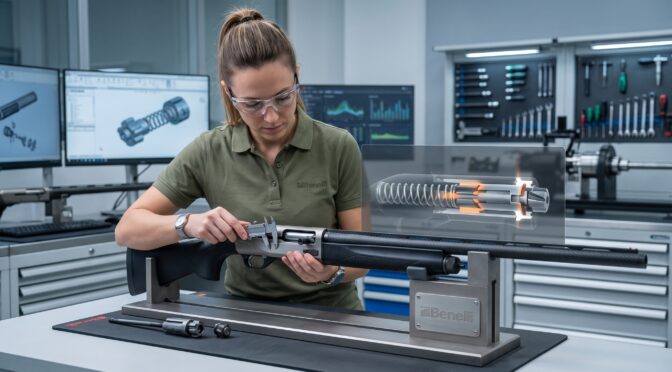
The mechanical foundation of Benelli’s civilian and law enforcement shotgun line is the In-Line Inertia Driven System16. Conventional gas-operated firearms bleed combustion gases from the barrel through small ports to push a piston rearward, thereby cycling the action. Alternatively, long-recoil operated firearms require the entire barrel to reciprocate backward. The inertia system harnesses the kinetic energy generated by the firearm’s rearward recoil against a floating, relatively stationary bolt body1.
The mechanism consists of three primary components: a heavy bolt body, a short and stiff inertia spring, and a rotating bolt head. Upon firing, the recoil force accelerates the firearm rearward. Because of its mass, the floating bolt body attempts to remain stationary in space. This relative forward movement of the bolt body against the rearward-moving firearm compresses the inertia spring situated between the bolt body and the bolt head1. Once the projectile exits the muzzle and the primary recoil forces peak, the compressed inertia spring expands, thrusting the bolt body rearward. As the bolt body moves back, a cam pin rotates the bolt head, unlocking it from the barrel extension. The remaining rearward momentum extracts the spent casing, ejects it, and compresses the main recoil spring located in the stock, which then drives the bolt forward to chamber a new round8.
Because the design eliminates gas ports, pistons, action tubes, and O-rings, combustion gases and unburned powder remain confined to the barrel and do not enter the receiver. This limits fouling and reduces lubrication needs1. The system is capable of fast cyclic rates, allowing an operator to fire five rounds in under one second1. Furthermore, concentrating the operating mechanism within the bolt assembly and the stock allows for a slimmer forend, altering the firearm’s balance and handling characteristics1.
3.2 Auto-Regulating Gas-Operated (A.R.G.O.) System
If an inertia-driven shotgun is weighed down with tactical accessories (such as flashlights, optics, and side-saddles) or if the shooter fails to provide a rigid backing, the system may lack the necessary relative motion to fully compress the inertia spring, leading to a failure to cycle4.
To meet the specifications of the United States Marine Corps Joint Service Combat Shotgun contract in 1999, Benelli engineered the A.R.G.O. (Auto-Regulating Gas-Operated) system16. Incorporated into the Benelli M4 (subsequently adopted by the military as the M1014), A.R.G.O. represents a contrast to the inertia system by relying on tapped combustion gases rather than recoil mass16.
The A.R.G.O. design features a dual-piston, short-stroke assembly located immediately forward of the chamber20. By tapping the gases directly ahead of the chamber, the system operates across a spectrum of load pressures. The expanding gases accelerate the dual pistons, which strike the bolt carrier to initiate the unlocking sequence. The system incorporates a self-adjusting valve that automatically expels excess gas during firing. This regulates internal pressure, maintaining consistent cyclic rates across different ammunition types and reducing component wear21. The A.R.G.O. system provides reliability in tactical environments, allowing the M4 to function consistently regardless of added weapon weight20.
3.3 Benelli Surface Treatment (BE.S.T.)
Firearms utilized in harsh environments, particularly those exposed to coastal saltwater during waterfowl hunting, are susceptible to oxidation and corrosion23. Benelli developed BE.S.T. (Benelli Surface Treatment), a proprietary metallurgical finish designed to combat rust and abrasion25.
BE.S.T. utilizes a hybrid of Physical Vapor Deposition (PVD) and Plasma Enhanced Chemical Vapor Deposition (PECVD)24. Standard PVD and PECVD processes generally require high operational temperatures which would alter a shotgun barrel’s temper, compromising the heat-treated strength of the barrel extension24. Benelli engineered a custom vacuum plasma machine capable of applying the coating at low temperatures. The process utilizes radio frequencies and plasma in a high-vacuum environment to chemically bond diamond-like carbon particles to the steel substrate23.
The resulting surface exhibits a high hardness profile, making it resistant to scratching and abrasion16. The graphitic components of the coating layer provide anti-adhesion properties, reducing friction coefficients between moving parts and limiting the need for liquid lubricants25. During ASTM B117 salt fog testing, traditional blued barrels began to oxidize within thirty minutes; conversely, BE.S.T.-treated barrels showed no signs of corrosion after 200 hours24. Field tests further demonstrated high resistance to saltwater immersion for over three consecutive months25. The process produces no hazardous chemical by-products, and Benelli backs BE.S.T.-treated parts with a 25-year warranty against rust and corrosion16.
4. Major Product Portfolios
Benelli’s product lines address the requirements of tactical operators, waterfowl hunters, upland game shooters, and precision marksmen.
4.1 The Tactical and Military Line (Super 90 Series)
The Super 90 series encompasses Benelli’s offerings for combat, law enforcement, and home defense2.
Model Designation
Operating System
Primary Application
Key Features
M1 / M2 Super 90
Inertia-Driven
Civilian Tactical, 3-Gun Competition, Police
Lightweight profile, rapid cyclic rate, extensive aftermarket support. The M2 utilizes the Comfortech recoil reduction system.18
M3 Super 90
Hybrid (Inertia / Pump-Action)
Law Enforcement, Riot Control
Features a selector allowing the user to switch between semi-automatic and pump-action. Allows for firing low-recoil, less-lethal munitions that lack the kinetic energy to cycle the inertia system.19
M4 Super 90 (M1014)
A.R.G.O. (Gas-Operated)
Military Combat, Urban Warfare
Adopted by the USMC. Features a drilled and tapped receiver, ghost-ring sights, standard Picatinny rails, and handles the added weight of tactical accessories.19
4.2 The Waterfowl and Field Shotgun Line
Super Black Eagle (SBE): Developed for North American waterfowl hunters, the SBE was one of the first semi-automatic shotguns engineered to cycle 3.5-inch magnum shotgun shells alongside 2.75-inch loads2. Currently in its third generation (SBE 3), the platform incorporates the “Comfortech” stock design and a “Combtech” cheek pad to dampen facial impact and shoulder recoil31. The SBE 3 is frequently finished in camouflage patterns or the BE.S.T. treatment26.
Raffaello, Ethos, and Montefeltro: These models target the upland hunting and sporting clays demographics2. They balance oil-finished walnut stocks and engraved receivers with modern mechanics10. The Ethos integrates the Progressive Comfort recoil system into a wooden stock16.
4.3 Pump-Action Platforms
Nova and Supernova: Introduced as alternatives to the semi-automatics, these pump-action shotguns feature a “Poly-Mod” construction2. The receiver is constructed from a skeletal steel framework over-molded with a polymer, creating a single-piece stock and receiver unit35. Chambered to accept up to 3.5-inch shells, the Nova series is utilized in waterfowl hunting and tactical configurations35.
4.4 Centerfire Rifles
Benelli diversified into the centerfire rifle market in 200218.
Lupo: The Lupo is a bolt-action rifle featuring a modular chassis system that allows the user to adjust the length-of-pull, cast, and comb height2. The rifle utilizes a free-floating barrel subjected to cryogenic freezing (Crio System)6. It features a double-stack box magazine equipped with an internal divider. This divider keeps the cartridges aligned and prevents bullet tips from striking the front of the magazine during recoil6.
R1 and MR1: These semi-automatic rifles adapt the A.R.G.O. gas system from the M4 shotgun to handle centerfire rifle cartridges. The R1 is geared toward big game hunting, while the MR1 (chambered in 5.56×45mm NATO) serves the civilian tactical and law enforcement markets2.
5. Market Perception, Mechanical Nuances, and Consumer Feedback
5.1 Reputation and The “Benelli Click”
Within the firearms industry, Benelli commands a premium perception; its products are frequently likened to luxury sports cars regarding their speed and cost10. The inertia system’s ability to fire without accumulating carbon in the action has secured the brand’s reputation for reliability.
However, the inertia operating system possesses a mechanical idiosyncrasy known among users as the “Benelli Click”17. This occurs when the bolt assembly is resting slightly out of battery (not fully locked forward). Because the bolt head relies on a degree of rotational camming to lock its lugs into the barrel extension, easing the bolt forward quietly by hand or bumping the buttstock heavily can cause the rotary head to rotate slightly and unlock32. If the trigger is pulled while the bolt is in this unlocked state, a safety mechanism prevents the firing pin from protruding. The hammer drops and strikes the rear of the bolt carrier, resulting in a metallic click instead of a detonation8.
For years, Benelli’s corporate stance maintained that this was a matter of user error, advising users to let the bolt slam forward under spring tension37. Competitors capitalized on this. Retay, a Turkish manufacturer, patented the “Inertia Plus” torsion spring system in 2018, which forces the floating bolt head forward into battery even if the firearm is bumped or eased closed4. In response, Benelli redesigned the bolt assembly for the Super Black Eagle 3 and subsequent models, incorporating a spring-loaded ball detent system to hold the bolt head securely forward, mitigating the “Benelli Click”32.
5.2 Aftermarket Support and Consumer Utilization
Market feedback indicates satisfaction with Benelli’s durability. Consumers note that inertia-driven models can be sensitive when firing very light target loads, as these rounds sometimes fail to generate the necessary recoil energy to compress the inertia spring40.
Due to the adoption of the M2 and M4 platforms, a robust aftermarket industry has developed. Companies such as Nordic Components, Freedom Fighter Tactical, and GG&G produce oversized charging handles, enhanced bolt release buttons, and low-drag magazine followers29. Reviewers state these upgrades enhance operational efficiency, though note the financial cost associated with upgrading the firearms29.
6. The Competitive Landscape: The Rise of Turkish Clones
Bruno Civolani’s original patent on the inertia-driven system expired in 2006, opening the market to competitors8. Turkish manufacturing firms have since entered the international market with affordable inertia and gas-operated clones.
In the inertia segment, Beretta Holding utilized its Turkish subsidiary, Stoeger, to produce the M30005. The Stoeger M3000 is a direct clone of the Benelli M2, offering a budget-friendly inertia shotgun43.
In the tactical market, independent Turkish manufacturers such as Panzer Arms (producing the EG-240 and M4 Tactical) and Military Armament Corp (MAC 1014) are importing A.R.G.O. system clones into the United States7. This trend is heavily discussed in recent analyses of Benelli M4 clones46. These clones undercut Benelli, retailing between $400 and $600 compared to the Benelli M4’s $2,000 average price point20, which has led to a rapid proliferation of M4-style semiautomatic shotguns in the current market47.
While consumer reviews indicate that the long-term durability of these clones may not equal the original, they pose a market challenge. Some users report compatibility issues when attempting to install aftermarket Benelli parts onto Turkish clones due to variations in thread pitches and tolerances44. Nevertheless, the clones perform adequately for many civilian applications, placing downward pressure on Benelli’s pricing power44.
7. United States Importation and Regulatory Compliance
7.1 Corporate Infrastructure in North America
The importation, distribution, and warranty servicing of Benelli products in the United States are managed by Benelli USA Corporation. Operating as a licensed Federal Firearms License (FFL) importer, Benelli USA is headquartered in Accokeek, Maryland, sharing a corporate campus with Beretta USA, and utilizes logistical warehousing located in Pocomoke City, Maryland5.
7.2 The Impact of 18 U.S.C. § 922(r)
The importation of semi-automatic shotguns into the United States is regulated by federal law, specifically 18 U.S.C. § 922(r), enforced by the Bureau of Alcohol, Tobacco, Firearms and Explosives (ATF)9. This statute prohibits the assembly of semi-automatic rifles and shotguns from imported parts if the resulting firearm is identical to a firearm prohibited from importation under the federal “sporting purposes” test9.
Consequently, tactical shotguns like the Benelli M4 must be imported into the United States in a restricted configuration. Specifically, the M4 is imported with a restricted five-round magazine tube and a fixed, non-collapsible stock38. For civilian consumers to legally upgrade the shotgun to a seven-round capacity tube and a telescoping stock, they must ensure the firearm complies with 922(r). Compliance requires that the shotgun contains no more than 10 imported parts from an ATF-designated list9.
This regulatory hurdle has spawned a domestic aftermarket industry. Companies such as Freedom Fighter Tactical, Mesa Tactical, and GG&G produce American-made compliance parts, including magazine tubes, followers, handguards, and trigger components52. By replacing factory Italian parts with these U.S.-manufactured components, owners achieve 922(r) compliance52. Benelli occasionally releases limited editions, such as the M4 EXT, which incorporate domestic parts directly from the factory, allowing them to ship legally in an un-neutered configuration54. This represents a significant factory-direct approach to legal compliance and tactical performance for the civilian market21.
8. Future Outlook
The strategic future of Benelli Armi involves maintaining its position as a technological developer to justify its pricing against overseas cloning6. The company is expanding its BE.S.T. surface treatment across wider product lines, capitalizing on the 25-year anti-corrosion warranty26. Furthermore, Benelli’s push into the centerfire rifle market with the Lupo series demonstrates an effort to diversify revenue beyond the shotgun sector6. Supported by the financial capital and distribution network of Beretta Holding, Benelli is insulated from immediate financial shocks. However, it must continually advance its proprietary technologies—such as the newly announced Advanced Impact (A.I.) barrel profiles seen in pre-show tactical shotgun announcements—to defend its status as a prominent manufacturer of sporting and tactical firearms5.
Benelli Armi S.p.A. has executed a decades-long evolution from a mechanical subsidiary of a motorcycle manufacturer to an established brand in the global firearms industry. By adopting Bruno Civolani’s inertia-driven system, Benelli established a standard of reliability and speed in civilian shotgun design. When military requirements necessitated a departure from inertia, the company engineered the A.R.G.O. system, securing a strong presence in the tactical space with the M4 platform. Although the expiration of its foundational patents has allowed budget manufacturers to clone its designs, Benelli defends its market share through metallurgical treatments such as BE.S.T., continuous refinement, and the corporate backing of Beretta Holding.
Master Summary Table
Category
Key Findings & Strategic Details
Founding & Origins
Formed in 1967 in Urbino, Italy, by the Benelli brothers utilizing an innovative inertia design by Bruno Civolani.
Corporate Structure
Initially partnered with Breda for manufacturing scale; acquired by Beretta Holding (fully by 2000). Operates independently alongside brands like Sako, Tikka, and Stoeger.
Core Technologies
Inertia-Driven System: Clean, rapid, recoil-dependent operation. A.R.G.O.: Dual-piston gas system built for military reliability regardless of added weight. BE.S.T.: PVD/PECVD diamond-like carbon coating resisting rust and abrasion (25-year warranty).
Major Product Lines
Super 90: M1, M2, M3, M4 tactical shotguns. Super Black Eagle: Heavy waterfowl platforms. Nova/Supernova: Poly-Mod pump-action shotguns. Lupo/R1: Precision centerfire rifles.
Market Challenges
The “Benelli Click” out-of-battery issue (now remedied by a ball detent), the proliferation of inexpensive Turkish clones, and strict 18 U.S.C. § 922(r) import limits requiring U.S. aftermarket parts compliance.
Note: Vendor Sources listed are not an endorsement of any given vendor. It is our software reporting a product page given the direction to list products that are between the minimum and average sales price when last scanned.
Amadeo Rossi S.A., operating globally under the brand name Rossi, represents one of the oldest and most historically significant small arms manufacturers in South America. Founded in 1889 in São Leopoldo, Brazil, the company has navigated over a century of profound geopolitical, macroeconomic, and industrial shifts to maintain a distinct position in the modern global firearms market.1 Today, Rossi is recognized primarily for producing budget-friendly, historically inspired firearms, most notably lever-action rifles and single-shot platforms, alongside a recently revived line of stainless and carbon steel revolvers, and a newly introduced line of centerfire bolt-action rifles.17
The trajectory of Rossi cannot be understood in isolation. The brand is deeply intertwined with the broader consolidation of the Brazilian defense and sporting arms manufacturing sector. Over the past three decades, Rossi transitioned from an independent, family-run enterprise into a subsidiary brand managed by a massive corporate conglomerate. Through a series of acquisitions beginning in 1997 and culminating in corporate restructuring between 2008 and 2015, the Rossi brand was effectively absorbed by Forjas Taurus S.A. (now Taurus Armas S.A.), which was subsequently acquired by Companhia Brasileira de Cartuchos, globally recognized as CBC Global Ammunition.3 This complex corporate architecture dictates that the “Rossi” of today operates as a brand identity rather than a standalone manufacturing entity. Production is bifurcated based on firearm type: Rossi-branded revolvers are manufactured by Taurus at their facility in São Leopoldo, while Rossi-branded long guns are predominantly manufactured by CBC at their facility in Montenegro, Brazil.3
In the North American market, which constitutes the critical driver of revenue for these Brazilian exports, Rossi products are imported and serviced by BrazTech International L.C., a subsidiary of Taurus Holdings based in Bainbridge, Georgia.6 The current product portfolio emphasizes the modernization of classic designs alongside aggressive expansion into new hunting markets. The flagship lever-action lines, the R92 (a Winchester Model 1892 pattern) and the rapidly expanding R95 (a Marlin 336 pattern), are offered with modern enhancements such as threaded barrels, Picatinny rails, and Cerakote finishes. Simultaneously, the brand has entered the precision hunting market with the bolt-action Expedition and RB lines, and expanded its utilitarian offerings with the Lightweight Carbine (LWC) and the Brawler single-shot pistol.17
Despite competitive pricing and successful product line expansions, market sentiment analysis reveals persistent vulnerabilities in quality control and post-sale customer support, further exacerbated by recent financial downturns at the parent company level. The brand previously suffered significant reputational and financial damage stemming from a major drop-fire safety recall and subsequent thirty-eight million dollar class-action settlement affecting millions of revolvers produced between 2005 and 2017.8 Furthermore, current consumer reports frequently highlight mechanical friction in lever-action platforms, specifically regarding loading gate geometry and tension, and characterize BrazTech’s warranty fulfillment infrastructure as slow and opaque, recently hindered by corporate software transitions and inventory shortages.10 This report provides a detailed examination of Rossi’s corporate evolution, manufacturing infrastructure, current product segmentation, mechanical design nuances, and the ongoing dichotomy between its high-value product positioning and persistent customer service challenges.
2. Historical Evolution and Corporate Restructuring
The history of Rossi serves as an analytical model for the evolution of regional industrial manufacturing and the eventual necessity of global market consolidation. The brand has transitioned through three distinct operational eras over the last one hundred and thirty years: the independent founding era, the Taurus acquisition period, and the modern CBC Global conglomerate era.
2.1 The Founding Era and South American Industrialization
The foundation of the company dates to 1889, when Amadeo Rossi established a small machining and metallurgical operation in São Leopoldo, located in the Brazilian state of Rio Grande do Sul.1 Initially operating as a metallurgical forge and tool manufacturer, the company steadily integrated precision engineering capabilities, allowing it to transition into firearms manufacturing. By the mid-twentieth century, Amadeo Rossi S.A. had established itself as one of the largest privately held weapons manufacturers in Brazil, producing a wide array of pistols, revolvers, and shotguns for both the civilian market and domestic security forces.12
For over a century, the company remained under the operational control of the Rossi family. The brand built its reputation on a core manufacturing philosophy: delivering affordable firearms to the domestic and export markets without sacrificing basic mechanical reliability.1 Throughout the late twentieth century, Rossi achieved substantial market penetration in the United States. Initially, the company relied on third-party import entities such as Interarms, based in Alexandria, Virginia, to distribute its products to American consumers.13 During this period, Rossi became particularly well-known for its “Puma” branded Winchester 1892 clones and a series of highly affordable.38 Special and.357 Magnum revolvers. These firearms filled a distinct market void for buyers seeking the aesthetics and function of classic American firearms at a fraction of the domestic manufacturing cost.
2.2 The Taurus Partnership and Subsequent Acquisition
The late 1990s marked a pivotal shift in the Brazilian small arms industry, driven by the need for consolidated export power. Forjas Taurus S.A., another massive manufacturer operating in the same Brazilian state, recognized the strategic value of Rossi’s established market share, particularly in the competitive revolver segment. In 1997, Forjas Taurus executed a strategic agreement to purchase the exclusive rights and tooling equipment necessary to manufacture Rossi-branded revolvers.14
Concurrently, in December 1997, a new logistical entity named BrazTech International L.C. was established in Miami, Florida. BrazTech was created to serve as the exclusive North American importer for Rossi firearms, effectively cutting ties with previous distributors like Interarms.6 This reorganization created a hybrid operational model that lasted for a decade. Under this arrangement, Taurus manufactured Rossi revolvers in its São Leopoldo facility, while the Rossi family continued to independently manufacture classic rifles and single-shot shotguns in a separate plant, with BrazTech handling U.S. distribution for both product lines.6
This decade-long manufacturing partnership culminated in a complete corporate takeover. On September 9, 2008, Forjas Taurus S.A. formally announced the acquisition of the manufacturing and distribution rights for all remaining Rossi products, including the highly successful Model 92 lever-action rifles, single-shot rifles, and muzzleloaders.4 This acquisition allowed Taurus to instantly capture a ready-made, long-gun manufacturing brand, significantly diversifying its portfolio beyond handguns and mitigating the costs associated with developing a proprietary long-gun manufacturing division from the ground up.15
2.3 Integration into the CBC Global Ammunition Conglomerate
The consolidation of the Brazilian arms industry reached its apex in 2015. Companhia Brasileira de Cartuchos, a globally dominant ammunition manufacturer founded in 1926 and known internationally under its Magtech brand, took controlling interest in Taurus Armas S.A. Because Taurus outright owned the Rossi brand and its associated intellectual property, CBC effectively became the ultimate parent company of the Rossi imprint.
By 2017, the operational architecture of the brand was fundamentally reorganized to maximize industrial efficiency. CBC assumed direct physical control over the design, production, and export of all Rossi long guns, including rifles and shotguns.1 This restructuring created the current manufacturing paradigm where the Rossi brand name is utilized by separate manufacturing entities operating under the same corporate umbrella. As market analysts point out, CBC manufactures the majority of Rossi rifles at its dedicated facility in Montenegro, Rio Grande do Sul, while Taurus continues to manufacture Rossi revolvers at its original facility in São Leopoldo.5 Despite sharing the brand name and historical lineage, the administration, technological integration, and physical production lines of the rifles and revolvers are functionally distinct operations.
3. Global Manufacturing and Supply Chain Architecture
Understanding the physical origins of Rossi firearms is vital for assessing product consistency, technological integration, and quality control. The manufacturing infrastructure is divided across primary geographic and corporate nodes, each serving a distinct logistical purpose.
3.1 São Leopoldo and Porto Alegre, Brazil: Taurus Production Nodes
São Leopoldo remains the historical homeland of the Rossi brand and continues to serve as the manufacturing hub for its wheelguns.2 Operating under the direct supervision of Taurus Armas, this facility leverages decades of revolver manufacturing expertise. Today, the São Leopoldo plant is responsible for producing the newly revived RP and RM lines of stainless and carbon steel.357 Magnum revolvers. The integration with Taurus ensures that these revolvers share quality assurance protocols and material sourcing networks with Taurus’s own branded handguns. Interestingly, not all Rossi long guns originate in Montenegro; the Rossi Circuit Judge is uniquely assembled at a Taurus facility in Porto Alegre alongside the Taurus Judge revolver.
3.2 Montenegro, Brazil: Precision Rifle and Shotgun Production
In 2017, the production of all other Rossi rifles and shotguns was fully transferred to CBC’s state-of-the-art manufacturing plant in Montenegro, Rio Grande do Sul.3 Originally established in 1998 to expand CBC’s global ammunition output, the Montenegro facility was heavily updated and retooled to accommodate modern firearms manufacturing.3
This shift to CBC management marked a distinct change in the manufacturing ethos of Rossi long guns. CBC is heavily invested in mass-production efficiency, advanced metallurgical finishing, and polymer molding technologies. Consequently, modern Rossi long guns, such as the R95 lever-action and the LWC single-shot platforms, exhibit manufacturing characteristics typical of a high-volume, modern industrial plant. This includes the widespread utilization of cold-hammer-forged barrels and precise CNC machining, contrasting sharply with the more traditional, hand-fitted aesthetic of earlier generation Rossi rifles produced under independent family ownership.17
3.3 Bainbridge, Georgia, U.S.: Importation and Logistical Hub
The North American market accounts for an overwhelming majority of Brazilian firearms exports; financial disclosures indicate that the U.S. traditionally accounts for nearly eighty percent of Taurus’s total global sales.2 To manage this massive logistical requirement, Taurus Holdings Inc. utilizes BrazTech International, L.C., as the specialized importer and warranty servicer for all Rossi-branded firearms.7
For nearly four decades, Taurus USA and BrazTech were headquartered in Miami, Florida.18 However, constrained by urban sprawl and lacking the physical space necessary for industrial expansion, the company initiated a highly publicized relocation effort in 2019. Taurus Holdings officially moved its headquarters, importation operations, and domestic manufacturing capabilities to a new, purpose-built facility in Bainbridge, Georgia.
The Bainbridge facility sits on seventy-three acres in Decatur County and represents a twenty-two and a half million dollar initial infrastructure investment. Spanning over two hundred thousand square feet, the plant was designed from the ground up to optimize the efficiency of receiving, inspecting, repairing, and distributing firearms, boasting a production and processing capacity of between 6,000 and 8,000 guns per week. The relocation brought over three hundred manufacturing and administrative jobs to the rural Georgia community and positioned BrazTech in a more politically favorable and economically viable operational environment compared to metropolitan Miami.19
4. Modern Product Portfolio and Market Segmentation
Rossi’s modern product strategy relies heavily on the juxtaposition of traditional aesthetics with modern tactical and utilitarian features. The brand avoids competing in the saturated striker-fired, polymer-frame semi-automatic pistol market, leaving that specific demographic to its sister company, Taurus. Instead, Rossi dominates specific, high-demand niche categories where historical aesthetics meet modern manufacturing efficiency.
4.1 The R92 Platform: Modernizing the Winchester 1892 Action
The cornerstone of the Rossi brand is its lever-action rifle portfolio, primarily consisting of the legacy R92 platform. The Rossi R92 is a mechanical clone of the revered Winchester Model 1892, a locking-block lever action originally designed by John Moses Browning. Built specifically to handle pistol-caliber cartridges, the R92 is currently offered in a wide array of chamberings including.357 Magnum,.38 Special,.44 Magnum,.45 Colt, and the high-pressure.454 Casull.20
Rossi offers an extensive variety of configurations within the R92 line, including 16-inch, 20-inch, and 24-inch octagonal barrels, utilizing traditional hardwood stocks, grey laminates, polished stainless steel, and standard black oxide finishes.20 A notable modern addition to the R92 line is the “Triple Black” model, which features black Cerakote finishing, black wood furniture, and threaded barrels, appealing directly to the modern tactical lever-action market. Despite its enduring popularity, the R92 platform relies on a traditional top-ejecting action. This mechanical reality makes mounting modern optical sights directly over the bore exceedingly difficult.
4.2 The R95 Platform: Capturing the Marlin 336 Market Void
Introduced recently to capitalize on the soaring consumer demand for rifle-caliber lever-actions, the R95 represents a significant evolution in Rossi’s engineering strategy. Moving away from the top-ejecting Winchester designs, the R95 is functionally a clone of the Marlin Model 336. The strategic brilliance of this design choice lies in its solid-top receiver and side-ejecting bolt mechanism, which allows for the easy, secure, and flush mounting of optics directly on the receiver roof.
The R95 was engineered to be highly cross-compatible with aftermarket parts originally designed for Marlin rifles, including specialized handguards, scope rails, and upgraded sights.21 Originally chambered in.30-30 Winchester and.45-70 Government, the R95 line saw significant expansion for the 2025 market year, adding new chamberings in.44 Magnum,.357 Magnum,.444 Marlin, and the straight-walled.360 Buckhammer cartridge. The platform includes several variants, such as standard 20-inch models and the highly popular 16.5-inch Trapper model, which features a weather-resistant black oxide finish and a threaded muzzle designed for direct suppressor integration.21
A significant mechanical upgrade present in the R95 platform is the redesign of the extraction system. Unlike traditional flat-top lever actions that rely on stamped spring-steel extractors, Rossi engineered the R95 with a robust, coil-spring-actuated M16-style extractor pinned directly into the bolt body. This engineering change significantly enhances primary extraction reliability, especially when cycling modern, high-pressure hunting ammunition.
Feature Comparison
Rossi R95 Trapper (.30-30 Win)
Rossi R95 Trapper (.45-70 Govt)
Action Type
Lever-Action (Side-Eject)
Lever-Action (Side-Eject)
Barrel Length
16.5 inches (Cold-Hammer-Forged)
16.5 inches (Alloy Steel)
Rifling Twist Rate
1:12″ Right-Hand Twist
1:20″ Right-Hand Twist
Magazine Capacity
5+1 Rounds
5+1 Rounds
Overall Length
35.5 inches
35.5 inches
Weight (Unloaded)
6.7 to 6.11 lbs
7.40 lbs
Metal Finish
Black Oxide
Black Oxide
Muzzle Threading
Unthreaded
Threaded (5/8”x24 UNF)
Extractor System
M16-Style (Pinned/Coil Spring)
M16-Style (Pinned/Coil Spring)
(Data organized from manufacturer technical specifications)
4.3 Single-Shot Utility: The Brawler and Lightweight Carbine (LWC)
In an era dominated by high-capacity semiautomatics, Rossi has carved out a successful niche by leaning into minimalist, break-action, single-shot designs. The Brawler is an unconventional break-action, single-shot pistol chambered to safely fire both.45 Colt metallic cartridges and.410 bore (3-inch) shotshells.22 Featuring a 9-inch alloy steel barrel mated to a heavily overmolded polymer receiver and grip, the weapon weighs a substantial 36.8 ounces, mitigating the recoil generated by defensive buckshot loads. Priced at a highly accessible MSRP of around two hundred and forty dollars, the Brawler is marketed primarily as a rugged utility or backpacking gun. Rossi also adapted this platform into a dedicated.300 Blackout pistol variant.23
Utilizing the same polymer-overmolded receiver architecture, the Lightweight Carbine (LWC) is a single-shot, break-action rifle designed for the minimalist hunter.24 It is offered in chamberings suited for short-range brush hunting and suppressor use, including.300 Blackout,.350 Legend, 5.56x45mm, 6.5 Creedmoor, and 8.6 Blackout.25 Weighing just over five pounds with a 16.5-inch threaded barrel, the LWC breaks down completely to fit inside a standard rucksack.25 Field testing indicates that the cold-hammer-forged barrels are capable of sub-2 MOA accuracy, making it competitive against entry-level bolt-action rifles.25
4.4 Centerfire Bolt-Action Expansion: The Expedition and RB Lines
Historically absent from the centerfire bolt-action rifle market, Rossi marked a major strategic expansion in the 2024 and 2025 market years by introducing the Expedition and RB (Rifle Bolt) platforms. This move targets the lucrative mid-tier hunting and precision shooting demographics.
The flagship Expedition model is built around the footprint of the prolific Remington 700 action, utilizing a hammer-forged barrel and a Diamond-Like Carbon (DLC) finish. It is highly modernized, feeding from AICS pattern magazines and featuring a scalloped synthetic stock with an integrated M-LOK rail and Spartan Precision attachment points for bipods and tripods. The Expedition is offered in prominent medium-game and precision calibers, including.308 Winchester, 6.5 Creedmoor,.223 Remington, and.243 Winchester, and comes standard with a threaded muzzle for suppressor use.
Complementing the Expedition is the RB line, which serves as a more traditional, entry-level bolt-action offering. Chambered in the same four calibers, the RB utilizes a carbon steel receiver and barrel treated with a weather-resistant Cerakote finish. It offers consumers the choice between a modern synthetic stock and a classic German Beech wood stock, adhering to Rossi’s philosophy of blending traditional aesthetics with modern manufacturing techniques. (Note: In the United States, the Expedition is frequently marketed and imported under the Taurus brand name, further illustrating the fluid corporate synergy between the two entities).
4.5 The Revival of the Revolver Line: RP and RM Series
Following a multi-year hiatus in revolver production, Rossi officially re-entered the double-action revolver market in 2023 with a completely redesigned lineup.27 These new revolvers abandon the troubled lockwork of the early 2000s models, representing a clean-slate engineering approach.
The new series is built entirely from satin-finished stainless steel or carbon steel and features a firing pin mounted directly to the hammer face, ensuring reliable primer detonation and eliminating the complex transfer bar block issues that plagued earlier models. The lineup consists of three primary.357 Magnum /.38 Special models: The RP63 is a 3-inch, round-butt stainless steel revolver designed for everyday concealed carry; the RM64 is a 4-inch, carbon steel model with a satin black finish marketed as a trail gun; and the RM66 is a 6-inch stainless steel model tailored for range use and hunting.28 Independent analysts note the smooth triggers, ergonomic rubber grips, and strong price-to-performance ratio.
4.6 The Circuit Judge and Specialty Shotguns
While briefly thought by some in the industry to be facing discontinuation, the Rossi Circuit Judge continues to be an active and updated part of the catalog, with a revised 2026 model recently entering the market. Originally introduced alongside the Taurus Judge revolver, it is a revolving carbine chambered in.45 Colt and.410 bore. Featuring a five-shot cylinder, a full wooden rifle stock, and a specialized gas shield mechanism to protect the shooter’s forearm from cylinder blast, it remains a unique hybrid platform. Notably, it is assembled at the Taurus factory in Porto Alegre rather than the CBC long-gun plant in Montenegro.
In the shotgun and rimfire categories, Rossi produces the Tuffy line of minimalist, single-shot.410 bore shotguns featuring skeletonized polymer stocks designed to hold extra ammunition, including extended 26-inch barrel Turkey models.29 They also maintain the Rio Bravo lever-action rimfire line and the RS22 semi-automatic platforms.30
4.7 Legacy Platforms: The Ranch Hand
The Ranch Hand, categorized legally as a handgun under United States federal law, was a “Mare’s Leg” version of the 1892 lever action.31 It featured a significantly shortened 12-inch barrel and a chopped, abbreviated stock that could not be shouldered.31 While Rossi discontinued marketing the Ranch Hand under its own imprint, the firearm is still produced on the same Brazilian assembly lines and sold under the Taurus-owned “Heritage Manufacturing” brand name, demonstrating the fluidity of product placement within the corporate conglomerate.
5. Quality Assurance, Engineering Nuances, and Mechanical Friction
A comprehensive analysis of consumer sentiment and professional gunsmith evaluations reveals a stark dichotomy within the Rossi ecosystem. Customers widely praise the conceptual design, aesthetic appeal, and raw value-proposition of the firearms. However, they uniformly criticize the execution of specific mechanical components, assembly tolerances, and systemic issues within BrazTech’s post-sale customer service infrastructure.
5.1 Raw Manufacturing Capability vs. Assembly Tolerances
These are budget-tier, mass-produced tools designed to hit aggressive retail price points. Given this economic constraint, the raw manufacturing quality, particularly on the modern CBC-produced lines like the R95 and LWC, is often considered excellent for the price. The cold-hammer-forged barrels yield impressive, repeatable accuracy, and the wood-to-metal fit on the newer R95 platforms is generally tight and well-finished.
However, cost-cutting measures during final assembly are evident. Customers frequently report minor aesthetic defects, such as noticeable daylight gaps between the wood stock and the metal receiver tang on rimfire rifles, which customer service representatives often dismiss as being within acceptable factory tolerances.5 Furthermore, the internal machining of the receivers on legacy designs often exhibits heavy tool marks and rough edges that induce operational friction. Purchasing a Rossi lever-action occasionally requires the consumer to possess basic gunsmithing knowledge to polish internals or tighten loose hardware straight out of the box.
5.2 The Lever-Action Loading Gate Failure Paradigm
The most pervasive and consistently documented mechanical flaw across Rossi’s lever-action rifles, specifically the R92 and some early production runs of the R95, involves the loading gate and cartridge feeding geometry.
Consumers routinely describe the R92 as incredibly difficult to load due to immense resistance against the loading gate after only three or four rounds are inserted.32 A critical mechanical failure point involves the internal loading gate screw. Due to inadequate torque application or a lack of thread locker applied during factory assembly, this exceptionally small screw can back out of its threads by as little as three-quarters of a turn during normal operation.10 When this occurs, the loading gate loses its rigid alignment and floats inward, directly interfering with the vertical rise of the internal cartridge carrier.10 This physical interference jams the action wide open, rendering the firearm temporarily inoperable.10
Additionally, some users have reported that the lifters on certain early R95 models were machined too long or bent at the incorrect angle, allowing live cartridges to slip past the cartridge stop and cause severe internal binding.34 These persistent issues have spawned a robust aftermarket industry offering reduced-power ejector springs, replacement followers, and instructional media for modifying factory parts.32
6. Customer Support Infrastructure and Warranty Fulfillment
While minor mechanical flaws in budget firearms are somewhat expected by the consumer base, a manufacturer’s long-term reputation relies heavily on the efficiency and transparency of its warranty support. In this specific metric, the operations handled by BrazTech and Rossi USA consistently struggle.
Rossi officially offers a one-year warranty to the original retail purchaser, promising to repair defects in material or workmanship, or replace the firearm entirely if a repair is not feasible.35 However, the real-world application of this warranty policy is fraught with extreme logistical friction. Market sentiment aggregated from specialized forums, consumer protection sites like the Better Business Bureau (where Rossi USA is currently not accredited), and editorial reviews paints a picture of a customer service apparatus in Bainbridge that is often overwhelmed, structurally opaque, and chronically short of replacement parts.
6.1 Communication Breakdowns and Repair Timelines
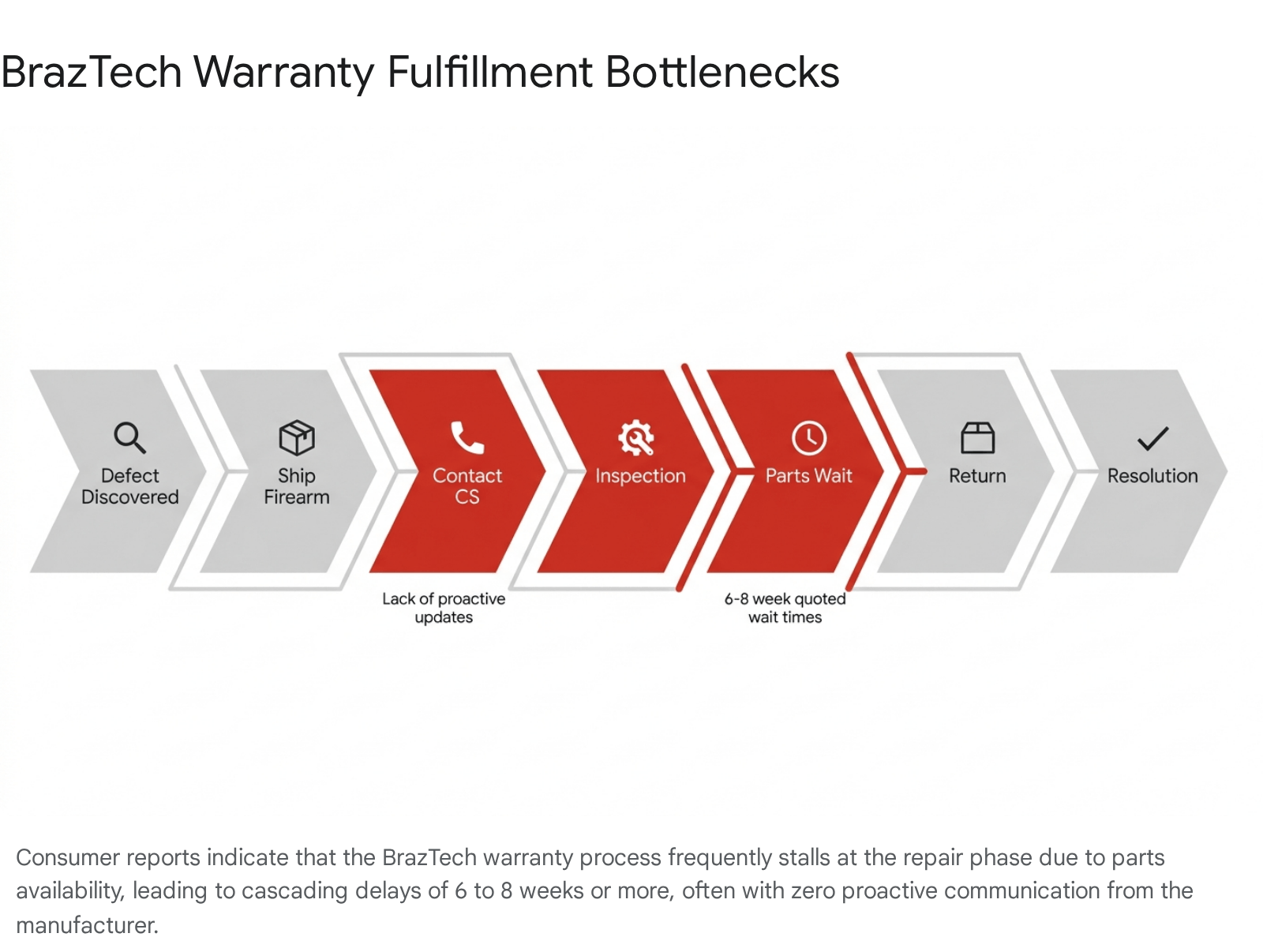
Consumers attempting to utilize the warranty service are routinely quoted four to eight weeks for highly minor repairs, such as replacing a single cross-threaded screw in the receiver body.11 In many documented cases, defective firearms sit at the Bainbridge facility for months awaiting major components, such as replacement barrels or levers, with no definitive timeline for completion provided to the owner.11
Exacerbating these delays are systemic internal disruptions. Recent records from 2025 consumer complaints indicate that BrazTech experienced significant delays stemming from an internal transition to a new Enterprise Resource Planning (ERP) software system, severely disrupting inventory fulfillment and leading to canceled replacement orders due to a lack of available stock. Furthermore, customers report that BrazTech rarely initiates proactive communication regarding repair status updates via email or phone, forcing consumers to continuously call the support line for information.38
6.2 International Parts Embargoes and the Secondary Market
The customer service issues are further magnified in international markets, such as Canada. Authorized importers and distributors often refuse to sell Original Equipment Manufacturer (OEM) replacement parts directly to consumers or independent gunsmiths, restricting parts allocation strictly to in-house factory warranty work.39 This corporate policy effectively renders out-of-warranty firearms entirely useless if a proprietary component fractures during normal use.
7. The 2019 Drop-Fire Safety Recall and Class Action Settlement
No operational analysis of the Rossi brand is complete without examining the catastrophic safety recall that fundamentally halted their revolver production for several years and resulted in a massive class-action settlement.
7.1 Identification of the Transfer Bar Defect
In September 2018, Forjas Taurus and BrazTech were forced to issue a critical, mandatory safety warning regarding multiple lines of Rossi brand.38 Special and.357 Magnum double-action revolvers. The underlying mechanical issue was a severe safety defect regarding the ignition system. Investigations revealed that the internal hammer block, utilizing a transfer bar safety mechanism, could fail under physical stress, allowing the revolver to unintentionally discharge a chambered round if the firearm was dropped or subjected to a sharp, sudden impact.8
This drop-fire defect affected an enormous swath of historical production. The recall encompassed the R35102, R35202, R85104, R97206, R97104, R46202, and R46102 model lines.40 Specifically, the safety warning included all revolvers within these model parameters manufactured between January 1, 2005, and December 31, 2017.8
7.2 Settlement Terms, Financial Impact, and the Enhanced Warranty Program
The revelation of the drop-fire defect precipitated a massive class-action lawsuit, formally styled as Burrow v. Forjas Taurus, S.A., filed in the United States District Court for the Southern District of Florida. While Taurus and BrazTech officially denied all allegations of strict liability and wrongdoing throughout the legal proceedings, the companies ultimately agreed to a comprehensive thirty-eight million dollar settlement to resolve the claims and avoid protracted litigation.9
Finalized and approved by the federal court, the settlement established robust remedies for the class members. The central pillar of the settlement mandated that BrazTech establish an “Enhanced Warranty” program managed by the legal services firm Epiq.8 Owners were instructed to ship their affected revolvers for free inspection, mechanism cleaning, and repair of the drop-fire defect by replacing the faulty transfer bar system.9 To highly incentivize consumer participation, the settlement offered a fifty-dollar cash “Inconvenience Payment” to any class member who submitted a valid claim.8 The lasting legacy of the recall forced Rossi to completely scrap its existing revolver internal architecture, culminating in the 2023 release of the RP and RM lines, which utilize a direct hammer-mounted firing pin to entirely bypass the mechanisms responsible for the 2018 failure.
8. Strategic Direction and Market Outlook
Analyzing the current trajectory of Rossi Arms, it is evident that CBC Global and Taurus Holdings are executing a highly calculated, niche-oriented market strategy. Rossi is not positioned to compete in the premium sporting rifle or duty-grade tactical handgun markets. Instead, the brand’s strategic direction relies on maintaining aggressive pricing structures, the modernization of legacy mechanical platforms, and the exploitation of utilitarian, entry-level markets.
8.1 Capitalizing on Modern Lever-Action Trends and Bolt-Action Expansion
The most vital indicator of Rossi’s future direction is the engineering philosophy behind the R95 lever-action and the LWC single-shot platforms. By equipping these traditional action types with modern accoutrements such as threaded barrels, Picatinny optics rails, and weather-resistant finishes, Rossi is aggressively targeting the modern, suppressor-owning demographic and the tactical-lever-action subculture. The introduction of new straight-walled and heavy-hitting chamberings for the 2025 R95 lineup further proves their commitment to capturing the modern hunting demographic. Additionally, the recent introduction of the Expedition and RB bolt-action platforms demonstrates a calculated effort to capture market share in the traditional North American and European hunting sectors, moving beyond their historical reliance on lever-action designs.
8.2 Supply Chain Optimization and Future Viability
The physical and corporate bifurcation of the brand, with revolvers built by Taurus and long guns built by CBC, allows for highly optimized manufacturing based on facility expertise. However, recent economic headwinds have presented challenges. According to 2025 financial disclosures, parent company Taurus Armas S.A. reported a 13% decline in full-year revenue down to R17.7 million. These financial constraints place immense pressure on Rossi’s high-volume, low-margin business model.The physical and corporate bifurcation of the brand, with revolvers built by Taurus and long guns built by CBC, allows for highly optimized manufacturing based on facility expertise. However, recent economic headwinds have presented challenges. According to 2025 financial disclosures, parent company Taurus Armas S.A. reported a 13% decline in full-year revenue down to R17.7 million. These financial constraints place immense pressure on Rossi’s high-volume, low-margin business model.
Looking forward, maximizing the output and efficiency of the Bainbridge, Georgia facility will be the ultimate determinant of Rossi’s U.S. market health. The physical infrastructure now exists to resolve the debilitating customer service bottlenecks and manage massive production capabilities (up to 8,000 units weekly across the Taurus/Rossi/Heritage brands). If BrazTech can streamline its domestic parts availability, successfully navigate its internal software and inventory transitions, and radically improve warranty turnaround times, the value proposition of Rossi’s inherently clever and affordable designs will remain highly competitive. However, if the customer support apparatus remains opaque and inefficient amidst tightening corporate margins, the brand risks alienating its core consumer base regardless of how innovative its newest product lines may be.
9. Appendix: Methodology and Data Sources
This research report was synthesized utilizing a highly structured analytical methodology, processing a corpus of over one hundred distinct data snippets detailing the historical, operational, and market performance of Amadeo Rossi S.A., Companhia Brasileira de Cartuchos (CBC), and Taurus Armas S.A.
The core methodological approach relied on corporate genealogy mapping, where data regarding the acquisition timelines, facility locations, and corporate hierarchies were cross-referenced between official corporate histories and financial press releases to establish an accurate timeline of the brand’s transition from an independent entity to a CBC subsidiary. Product specification analysis was conducted by extracting technical metrics for current production models (including their recent entry into the bolt-action centerfire rifle market) directly from the manufacturer’s digital catalogs, product manuals, and verified third-party editorial reviews published in recognized industry periodicals.
Furthermore, qualitative consumer sentiment regarding quality control and customer service was aggregated from direct consumer reports on consumer protection platforms, specialized firearm user forums, and independent video analyses by professional gunsmiths. Anomalies or individual complaints were discarded unless corroborated by multiple independent sources, establishing a verifiable pattern of mechanical defects, warranty fulfillment delays, and internal software transitions affecting logistics. Legal documentation concerning the 2019 drop-fire safety recall and 2025 financial disclosures for Taurus Armas were sourced directly from the official settlement notices, class-action administrative documentation, and publicly traded market reports to ensure precise reporting of corporate health and liabilities.
The year 2026 represents a transformative inflection point in the evolution of dismounted infantry combat, small arms engineering, and tactical doctrine. Driven by the uncompromising realities of protracted, high-intensity conflicts in Eastern Europe and the Middle East, as well as the accelerating requirement for deterrence in the Indo-Pacific theater, global military organizations are fundamentally restructuring their approach to close combat. The insights gathered year-to-date reveal a strategic landscape defined by rapid technological integration, the uncompromising pursuit of terminal ballistic overmatch against modern body armor, and the desperate, iterative race to counter the asymmetric and ubiquitous threat of small unmanned aerial systems (sUAS).
This comprehensive report identifies the top ten global military small arms insights and tactical lessons learned for 2026. Chief among these developments is the operational fielding of the United States Army’s Next Generation Squad Weapon (NGSW) system. Introducing the 6.8×51mm cartridge, this program represents the most significant infantry caliber transition within the NATO alliance since the widespread adoption of the 5.56×45mm cartridge in the 1960s. However, this monumental technological leap is heavily counterbalanced by severe, systemic vulnerabilities within the global munitions defense industrial base, where compounding chokepoints in chemical energetics and metallurgy threaten to undermine sustained combat readiness.
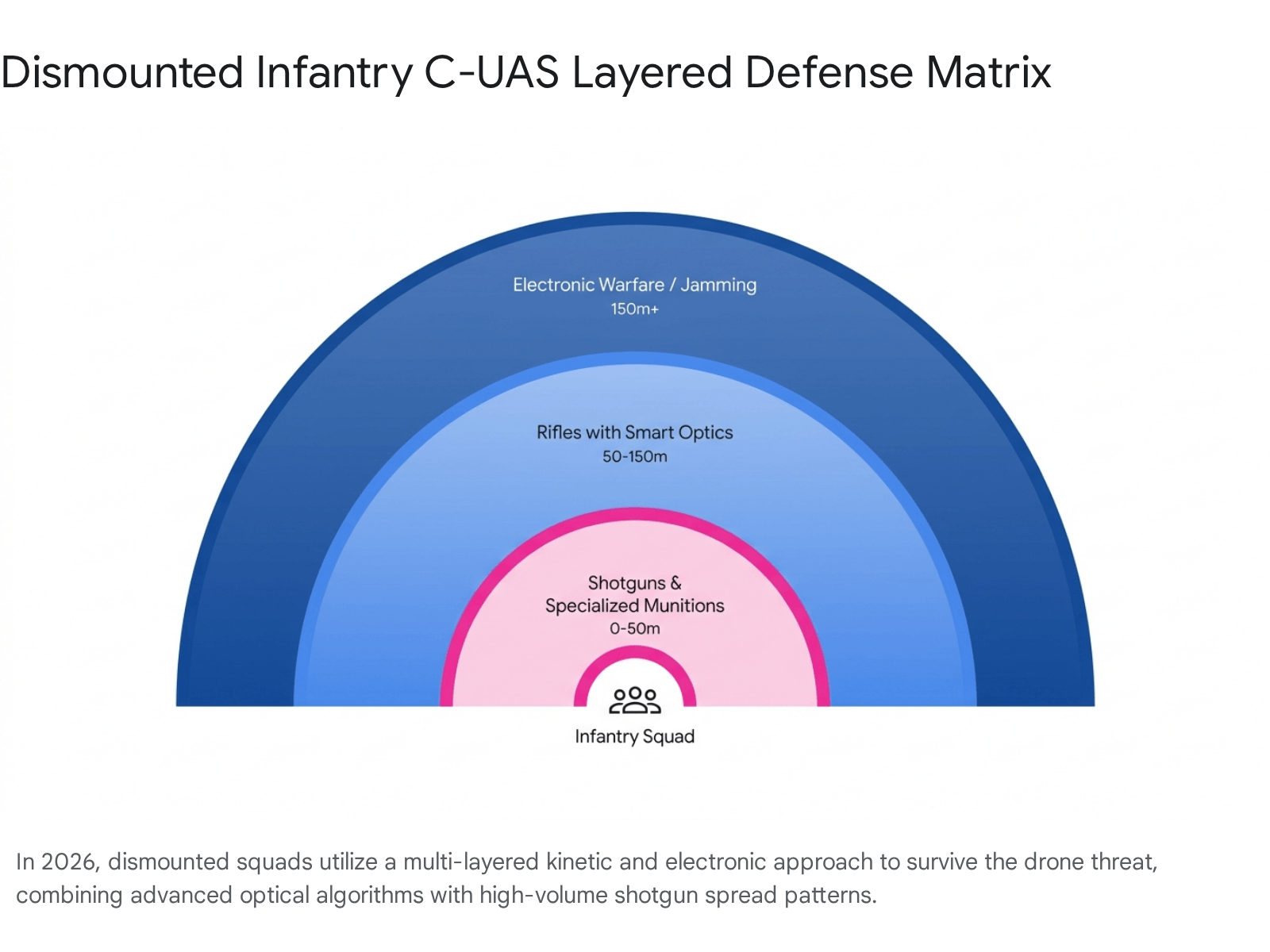
Concurrently, the modern battlefield has become heavily autonomous, digitally transparent, and multi-dimensional. Unmanned Ground Vehicles (UGVs) have rapidly matured from experimental logistical support mules into highly lethal, direct-fire combatants equipped with heavy machine guns to lead autonomous, casualty-free assaults. In the skies above the squad, the proliferation of first-person view (FPV) kamikaze drones has forced a total reevaluation of the infantry’s defensive posture. This aerial threat has catalyzed two divergent but complementary trends: the rapid procurement of advanced, algorithmic fire-control optics designed to automatically calculate intercept vectors for standard assault rifles, and the doctrinal resurrection of the combat shotgun utilizing specialized kinetic payloads to create localized, low-cost anti-air defensive bubbles.
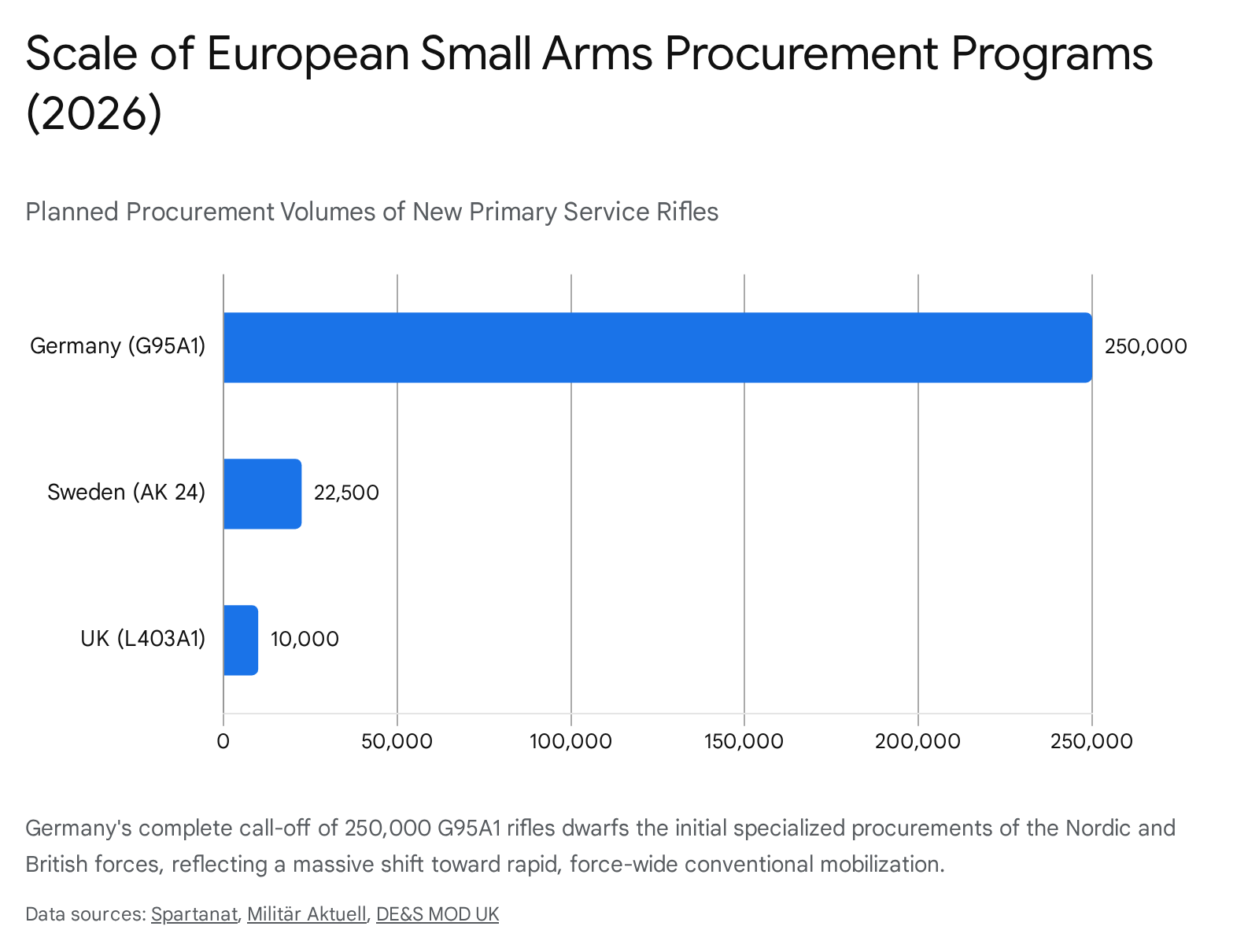
Furthermore, European allied forces are currently executing a massive, continent-wide standardization effort. The United Kingdom, Germany, Sweden, and Finland are aggressively abandoning legacy bullpup designs and proprietary architectures in favor of highly modular, AR-15/ArmaLite-derived platforms natively optimized for continuous acoustic suppression and low-visibility operations. Adversarial forces, notably the Russian Federation and the People’s Republic of China, are demonstrating parallel modernization efforts, rapidly integrating frontline combat feedback to optimize their standard-issue assault rifles for increased modularity and ergonomic efficiency.
In totality, the 2026 small arms landscape illustrates a definitive shift away from the stagnant, low-intensity counter-insurgency optimization of the past two decades. The contemporary infantryman is now a heavily burdened, digitally connected node in a decentralized, multi-domain network, requiring unprecedented lethality, advanced optical integration, and highly adaptable kinetic tools to survive an increasingly lethal and transparent battlefield.
Analytical Framework and Selection Criteria
To distill the vast, global array of military developments into the ten most critical small arms insights of the year to date, a rigorous analytical framework was established and systematically applied. This framework is explicitly designed to filter out localized anomalies, conceptual prototypes, and minor incremental upgrades, focusing exclusively on developments that exhibit strategic permanence and force-wide operational implications.
The evaluation process utilized a comprehensive spectrum of open-source intelligence (OSINT), defense procurement databases, government testing reports, and real-time combat assessments from active theaters. Specific attention was given to analyses provided by the Center for Army Lessons Learned (CALL), including their Quick-Fire observations detailing real-time tactical adjustments derived from the conflict in Ukraine and subterranean operations in Gaza.1 Candidate technologies, geopolitical events, and tactical shifts were assessed against four primary strategic criteria:
Doctrinal Disruption: Does the development force a fundamental change in how infantry squads maneuver, engage the enemy, or sustain themselves in combat? Innovations that require immediate updates to tactical field manuals or alter the calculus of squad-level combined arms were heavily weighted.
Scale of Procurement and Fielding: Prototype technologies were excluded unless they had formally transitioned to funded, large-scale deployment. The financial and logistical commitment of a nation-state serves as a definitive indicator of a technology’s maturity, viability, and perceived operational necessity.
Industrial Base Impact: A weapon system is only as viable as the supply chain required to sustain its ammunition and replacement parts. Events or technologies that exposed structural vulnerabilities in the defense industrial base, or required massive infrastructural overhauls to support (such as the introduction of novel ammunition calibers or hybrid casings), were prioritized for their strategic impact.
Combat Validation: Hardware and tactical methodologies actively employed, tested, and validated in high-intensity combat zones (specifically the Russo-Ukrainian War and the Middle East) superseded theoretical capabilities tested exclusively in highly controlled domestic proving grounds.
Through this multi-layered filtering mechanism, the myriad of global small arms data points was synthesized into the following ten indispensable insights. These represent the critical knowledge base required for military leaders, acquisition professionals, and students of military affairs to fully comprehend the trajectory of dismounted close combat in 2026 and beyond.
Details: Top 10 Global Military Small Arms Insights for 2026
1. The U.S. Next Generation Squad Weapon (NGSW) Reaches Operational Capability Amidst Physiological and Engineering Friction
The United States Army’s Next Generation Squad Weapon (NGSW) program has decisively transitioned from developmental testing to operational reality in 2026, fundamentally altering the trajectory of American infantry lethality and doctrine. Conceived in 2019 to replace the ubiquitous 5.56×45mm NATO M4 carbine and the M249 Squad Automatic Weapon, the NGSW program introduces the 6.8×51mm (.277 Fury) caliber.2 This hybrid bi-metallic cartridge was explicitly engineered to defeat modern peer-adversary ceramic body armor at extended engagement ranges, an imperative driven by the proliferation of advanced protective equipment globally.2
In 2026, the deployment of the NGSW ecosystem accelerated significantly. Following initial deliveries to the 1st Brigade, 506th Infantry Regiment of the 101st Airborne Division in early 2024, the M7 rifle and M250 automatic rifle have proliferated to additional close combat forces, including elements of the 75th Ranger Regiment, National Guard armored brigades, and the 25th Infantry Division in the Pacific theater.2 A critical evolution in the program this year is the formal designation and operational fielding of the XM8 Carbine variant.6 As a direct response to consistent soldier feedback regarding the immense physical burden and front-heavy nature of the 13.5-inch barreled M7, the XM8 features a shorter 10-inch tapered barrel, a fixed telescoping stock akin to the legacy M4, and a heavily modified upper receiver.7 Weighing 7.3 lbs unloaded without optics or suppressors—a full pound lighter than the M7—the XM8 represents the Army’s ongoing attempt to balance the absolute necessity of 6.8mm ballistic overmatch with the physiological limitations of the dismounted soldier operating in complex, urban, or densely vegetated terrain.2
Despite this aggressive fielding schedule, the unclassified details of the 2025/2026 Director, Operational Test and Evaluation (DOT&E) report highlight severe technological and human-factors friction points inherent in fielding a weapon system that operates at the absolute mechanical limits of modern engineering. While live-fire test and evaluation (LFT&E) of the 6.8mm Special Purpose (SP) ammunition demonstrated unquestionable lethality increases over the legacy 5.56mm M855A1 round, the weapon systems themselves face persistent integration challenges.7 Soldiers participating in rigorous operational assessments reported negative physiological effects resulting from noxious off-gassing expelled from the high-pressure gas system directly into the shooter’s breathing space.7 Furthermore, the native signature reduction systems (suppressors) generate extreme heat profiles that pose immediate safety and handling concerns during sustained engagements.7
Most critically, the M250 automatic rifle, when paired with the advanced XM157 Fire Control optic, consistently failed to retain its mechanical zero during airborne static line testing and sustained automatic fire.7 Additionally, rumors persist within the testing community that to maintain terminal velocity out of the shorter 10-inch XM8 barrel, chamber pressures have been optimized to a degree that vastly accelerates barrel wear, potentially requiring complete barrel replacement every 5,000 rounds.7 These failures indicate that while the ballistic science of the 6.8mm NGSW is fundamentally sound and devastatingly effective, the physical hardware is experiencing expected but severe growing pains as it attempts to harness internal chamber pressures approaching 80,000 PSI—nearly 20,000 PSI higher than legacy 5.56mm systems.7
Platform Designation
Legacy Predecessor
Caliber
Operating Pressure
Barrel Length
Base Weight (Unloaded)
Primary Optic
M7 Rifle
M4A1 Carbine
6.8×51mm Common
~80,000 PSI
13.5 inches
8.38 lbs
XM157 Fire Control
XM8 Carbine
M4A1 Carbine
6.8×51mm Common
~80,000 PSI
10.0 inches
7.30 lbs
XM157 Fire Control
M250 Automatic Rifle
M249 SAW
6.8×51mm Common
~80,000 PSI
16.0 inches
13.0 lbs
XM157 Fire Control
2. The Energetics Bottleneck and the Strategic Fragility of the Ammunition Supply Chain
The most profound strategic vulnerability in the modernization of global military small arms is not the mechanical design of the weapons themselves, but the extreme fragility of the organic industrial base required to sustain them. In 2026, the transition from low-rate initial production to strategic, force-wide scale for the U.S. 6.8×51mm ammunition has been functionally paralyzed by compounding macroeconomic constraints, geopolitical material monopolies, and decades of domestic infrastructure decay.8 The NGSW program has brutally exposed the reality that billion-dollar acquisition programs can be ground to a halt by seemingly minor upstream chemical and metallurgical shortages.
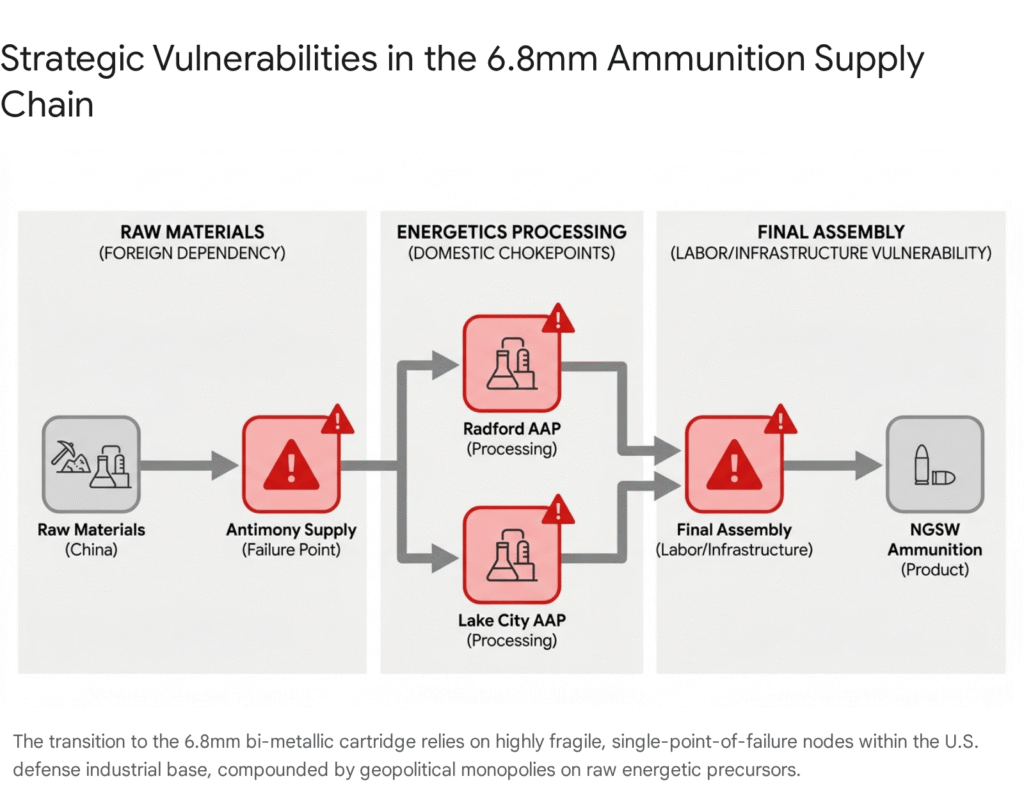
The United States defense industrial base relies heavily on a few highly fragile, single-point-of-failure nodes to produce small-arms ammunition. Chief among these is the Lake City Army Ammunition Plant (LCAAP) in Independence, Missouri. To support the monumental shift to the NGSW, a massive 450,000-square-foot facility is currently under construction at the historic Lake City campus, intended to eventually produce 385 million cartridge cases and 490 million projectiles annually.8 However, this facility is not slated for full operational capability until 2028, leaving the military heavily reliant on interim production lines at SIG Sauer’s commercial campus in Arkansas and aging legacy infrastructure.5 This vulnerability was starkly demonstrated in April 2026, when the existing Lake City operations were severely disrupted by a paralyzing labor strike initiated by the International Association of Machinists and Aerospace Workers (IAM) Local 778.8 Protesting forced overtime, demanding meaningful wage increases, and citing human capital exhaustion, the strike highlighted the fact that the workforce tasked with fulfilling a $1.43 billion ammunition backlog is operating under immense, unsustainable strain.8
Beyond labor disputes, the physical design of the.277 FURY cartridge presents unprecedented macroeconomic manufacturing challenges. The bi-metallic casing permanently mates a lightweight brass body to a hardened stainless-steel base to prevent catastrophic rupture under the extreme 80,000 PSI chamber pressures.8 The 70% copper and 30% zinc brass alloy currently faces unprecedented margin compression due to global copper shortages, driven relentlessly by the commercial electric vehicle and data center markets, with copper reaching an all-time high of $6.67 per pound in June 2026.8 Because altering the metallurgical ratio compromises the ammunition’s structural integrity, manufacturers have zero elasticity to adjust to these market shocks.8 Concurrently, the hardened armor-piercing projectile cores rely on antimony. In late 2024, China enacted severe export limits on antimony, causing Chinese exports of the critical mineral to plummet by 97%, restricting global supply and drastically inflating production costs.8
The most severe chokepoint, however, exists in the realm of chemical energetics. The advanced propellants required to generate the extreme internal pressures for the 6.8mm cartridge are entirely dependent on high-nitrogen, military-grade nitrocellulose.8 The primary precursor for this chemical—cotton linters—is heavily monopolized by China, which controls approximately 70% of the global market.8 Beijing has systematically restricted the export of these raw materials, intentionally choking the upstream propellant precursors needed by NATO and U.S. defense manufacturing.8 Domestically, the Radford Army Ammunition Plant (RFAAP) in Virginia stands as the sole domestic producer of nitrocellulose for the U.S. military, relying on infrastructure originally built in 1941.8 To help mitigate some of these overarching bottlenecks, the Army opened a new Load, Assemble, Pack (LAP) plant in Camden, Arkansas, in April 2025, handling the final phase of ammunition production cycles, though this facility is primarily focused on relieving broader system stress for artillery.8 Regardless, this combination of foreign raw material monopolies and antiquated, single-source domestic processing facilities proves that adversaries do not need to defeat modern small arms on the battlefield if they can systematically starve the industrial base required to feed them.8
3. The Integration of Direct-Fire Small Arms on Unmanned Ground Vehicles (UGVs)
The tactical environment of 2026 has witnessed the definitive maturation of Unmanned Ground Vehicles (UGVs) from unarmed logistical mules into highly lethal, direct-fire infantry platforms. The Armed Forces of Ukraine (AFU) are actively leading this robotic tactical revolution, having established the Unmanned Systems Forces as the world’s first independent military branch dedicated entirely to aerial, maritime, and ground-based drone operations.10 Ukraine’s Ministry of Defense has utilized its DOT-Chain Defense marketplace to aggressively contract over 25,000 UGVs for the first half of 2026 alone, with a projected 50,000 units by year-end.11 The strategic mandate is clear: transition 100% of frontline logistics and extreme high-risk infantry suppression missions to robotic platforms.11 Within days of this strategic mandate, Kyiv codified the Bizon-L—a 300-kilogram-payload logistics robot—under NATO cataloging standards, clearing it for immediate operational use across Ukraine’s armed forces and allied units.11
The combat integration of small arms on these UGVs relies on a flawlessly executed, multi-domain “kill chain” that links aerial reconnaissance with ground-based kinetic firepower. In standard operations, UAV pilots conducting persistent aerial surveillance identify enemy trench lines and troop concentrations. This intelligence is instantly relayed to specialized ground control operators—such as those in the AFU’s dedicated “NC13” Strike UGV Company, a unit within the 3rd Army Corps founded specifically for direct combat robotic roles.10 These operators then deploy armed ground robots directly into the contested zone.10
These platforms are robustly armed. Military developers have designed modular direct-fire weapon stations capable of fielding mortars, remotely operated turrets, and heavy small arms.10 The favored configuration currently utilizes the M2 Browning.50 caliber heavy machine gun mounted on platforms like the Droid TW 12.7 UGV.10 In a paradigm-shifting engagement, a single Droid TW 12.7 UGV equipped with a heavy machine gun successfully defended a vital Ukrainian position from relentless Russian infantry assaults for 45 consecutive days, resulting in zero Ukrainian human casualties.10 Beyond defense, these armed UGVs are utilized for extreme forward infantry suppression. Equipped with heavy small arms, platforms such as the Ratel, Termit, Ardal, Rys, Zmii, Protector, and Volya are deployed ahead of human assault elements to breach heavily fortified zones.12 By absorbing the initial volume of enemy defensive fire and laying down highly accurate, stabilized suppressive fire, UGVs allow human infantry to maneuver and exploit the flanks.10
This offensive robotic capability culminated in a historic milestone in April 2026, when President Volodymyr Zelenskyy confirmed the first recorded instance in military history where a coordinated fleet of UGVs and UAVs successfully assaulted and captured a Russian combat position entirely on their own, without any accompanying human infantry support.10 The psychological impact on adversarial infantry is profound; facing stabilized, armor-plated weapon stations that do not experience fear, fatigue, or suppression effects has led to numerous documented instances of enemy troops surrendering directly to the armed robots, guided into captivity entirely by drones.10
UGV Platform
Primary Role
Associated AFU Unit / Combat Example
Notable Armament / Payload
Droid TW 12.7
Heavy Direct Fire / Defense
NC13 Strike UGV Company (Defended position for 45 days)
M2 Browning.50 Caliber HMG
Bizon-L
Frontline Logistics / Sustainment
Cleared for NATO operational use
300kg payload, 50km range
Unspecified UGV
Medical Evacuation
1st Separate Medical Battalion / 425th SAB
Armored patient transport litter
Ratel / Termit / Rys
Multi-role / Assault Support
3rd Separate Assault Brigade
Modular direct-fire stations
4. Algorithmic Fire Control and the C-UAS Targeting Revolution
The omnipresent threat of small, highly maneuverable kamikaze and surveillance drones has forced a rapid, technological evolution in how individual riflemen acquire and engage aerial targets. Hitting a multi-axis maneuvering drone at 150 meters with standard iron sights or unmagnified red dots is statistically improbable for a standard infantryman under combat stress. To bridge this critical capability gap, 2026 has seen a massive proliferation of algorithmic, computer-assisted fire control optics mounted directly onto standard-issue assault rifles, effectively turning every rifleman into a localized point-defense anti-air system.13
The most prominent example of this deployment is the SMASH 2000LE system manufactured by the Israeli firm Smart Shooter. In 2026, demand across the U.S. military has surged exponentially, resulting in multi-million dollar procurement contracts from the U.S. Marine Corps ($3.4 million), the Army ($10.7 million), and the Navy ($1.8 million).14 The SMASH system utilizes advanced electro-optical sensors and targeting algorithms to track drones, including those resistant to traditional electronic warfare jamming, such as tethered drones controlled by fiber optic cables.14 When the soldier acquires the target and pulls the trigger, the system computationally overrides the firing mechanism, only releasing the sear and firing the round when the algorithm determines the highest mathematical probability of a hit against the moving target.14 The U.S. Army’s aggressive acquisition of these smart scopes indicates a formal doctrinal shift toward a “layered defense” strategy.15 While Patriot, NASAMS, or IRIS-T batteries engage high-altitude threats, individual dismounted soldiers are now explicitly expected to serve as the terminal kinetic layer against small quadcopters that penetrate the outer defense rings.15
This digital aiming solution is simultaneously being scaled to mobile platforms and integrated directly into next-generation weapons. The U.S. Army Combat Capabilities Development Command is successfully testing the Simultaneous Weapon Autonomy Technology for Fire Control (SWAT-FC) software.13 Demonstrated at the Aberdeen Proving Ground, SWAT-FC is integrated into Common Remotely Operated Weapon Stations (CROWS), allowing a vehicle mounted with a standard machine gun to track, calculate lead, and destroy small unmanned aerial systems while both the target and the host vehicle are in rapid motion.13 Concurrently, the NGSW program is establishing algorithmic capability as a baseline requirement via the XM157 Fire Control system.17 Built by Vortex Optics, the XM157 features a built-in laser rangefinder, atmospheric sensors, and a digital augmented reality display overlay designed to streamline ranged contact engagements and maintain situational awareness.17 Through initiatives like the xTechSoldier Fire Control competition (offering a $100,000 prize and a $5 million follow-on contract), the Army is actively soliciting third-party software add-ons for the XM157 to specifically enhance target identification, ranging, and tracking in obscured battlefield conditions, proving that digital algorithmic aiming is the new standard for combat optics.18
5. The Renaissance of the Combat Shotgun and Specialized Counter-Drone Munitions
While digital fire control optics represent a sophisticated high-tech solution to the UAS threat, the urgent, unyielding realities of trench warfare have spurred the resurrection of a remarkably low-tech, highly effective alternative: the combat shotgun. The widespread deployment of FPV drones in Ukraine has decisively proven that the expanding pattern of multiple projectiles is inherently superior to single rifle rounds for intercepting and destroying fragile quadcopter rotors at close range.20 Damaging a single propeller on a fast-moving drone immediately unbalances the aerodynamic profile, rendering it incapable of flight.20
In 2026, the shotgun is no longer viewed merely as a specialized tool for ballistic door breaching or less-than-lethal riot control; it is an indispensable, dedicated air-defense platform organically integrated into the infantry squad. Ukrainian forces have rapidly procured thousands of semi-automatic and pump-action platforms, including 4,000 Turkish Hatsan Escort BTS-12 bullpup shotguns, Vepr-12s, Remington Model 870s, and high-capacity platforms like the Keltec KSG-25, specifically for localized drone defense, taking advantage of the KSG-25’s ability to change ammunition types from two separate tubes “on the fly”.2120 This tactical reality is altering established NATO procedures as well, with forces like the Belgian Air Base security units officially adopting the Benelli M4 Super 90 (marketed explicitly by the manufacturer as the A.I. Drone Guardian, available in 18.5 and 26-inch barrel lengths) to counter unauthorized UAS incursions around critical infrastructure.20 Adapters like the Ingra “Rosyanka” have even been developed to convert standard GP-25 underbarrel grenade launchers into single-shot 12-gauge drone interceptors.20
Recognizing the limitations and potential collateral damage of standard lead birdshot, the global defense industry has rapidly pivoted to produce specialized anti-drone kinetic payloads. At SOF Week 2026 and Eurosatory in Paris, Beretta Defense Technologies unveiled the SHATTER4K ammunition line, designed in partnership with Swiss P Defense.22 Engineered for 12-gauge, 5.56mm, and 7.62mm platforms, these rounds replace traditional lead or tungsten with a proprietary dense polymer.22 This composite material achieves the kinetic energy transfer necessary to shatter drone chassis out to 150 meters, but rapidly degrades upon impact or terminal range, drastically minimizing the risk of collateral damage in densely populated urban environments or around sensitive infrastructure.22 Other innovations include the Skynet shotgun shell, which deploys a physical net to entangle rotors, and Norma’s AD-LER (Anti-Drone Long Effective Range) tungsten shot, integrated into automated ground turrets like the Beretta LIVET system.20 The LIVET turret essentially mounts multiple 12-gauge shotgun barrels on an auto-tracking, remote-controlled station for rapid-reaction fixed-site defense.24
Adversarial forces are attempting to replicate this logic without fielding entirely new weapon systems. Russia’s Rostec recently initiated serial production of the “Mnogotochie” (ellipsis) munition for standard 5.45mm and 7.62mm assault rifles.25 This round features a bullet designed to aggressively split into three distinct elements immediately upon exiting the muzzle, creating a miniature shrapnel cloud intended to act as a shotgun blast from a standard AK-12.25 While aviation experts question the efficacy of a three-part split compared to a true 12-gauge spread, its deployment underscores the universal desperation to find kinetic solutions to the FPV drone crisis.25
6. The Mainstreaming and Proliferation of Thermal Optic Architectures
The ability to detect heat signatures on the battlefield is no longer a luxury reserved for tier-one special operators or armored vehicle gunners. In 2026, thermal weapon sights have proliferated down to the lowest echelons of the infantry squad, fundamentally altering nighttime maneuver and rendering traditional visual camouflage virtually obsolete. The sheer volume and variety of thermal devices observed in active combat zones demonstrate a rapid democratization of advanced sensor technology.
Combat imagery from Ukraine reveals an unprecedented saturation of high-end thermal optics across a wide array of units. Elements of the Special Operations Forces (SSO), SBU Alpha, the Kraken Regiment, and the 3rd Separate Assault Brigade have been routinely documented utilizing compact, multifunctional thermal devices mounted directly to their primary assault rifles.27 Commonly fielded models include the iRay RICO Micro RH25, the Thales Xtraim, the Hikmicro Thunder 2.0 TH35, and the Pixels on Target VooDoo-S.27 For designated marksmen utilizing platforms like the Barrett MRAD or UAR-10, heavier systems such as the Archer TSA-9 and TSA-7 thermal imaging systems are standard issue.27 The fusion of thermal technology with traditional night vision (creating multispectral imaging) is also highly prevalent, evidenced by the widespread use of the Holosun DRS thermal/night vision sight by units such as the Ukrainian National Guard’s Omega Group.27
This mass proliferation on the battlefield is directly supported by advancements in the commercial sector, where manufacturers are rapidly shrinking sensor sizes and increasing refresh rates to meet explosive demand. At the 2026 SHOT Show, InfiRay showcased the FML19 Fast Mini Series, a highly compact thermal sight integrating a 384×288 sensor with a 60 Hz refresh rate and InstaWake instant-on technology, small enough to be practically mounted on handguns and short-barreled rifles.28 As these commercial-off-the-shelf (COTS) systems become cheaper, more ruggedized, and more energy-efficient, military procurement officers are increasingly bypassing decades-long development cycles to rapidly field these highly capable civilian-market optics to frontline troops.
7. Universal Adoption of Signature Reduction and Suppressor Innovations
Historically relegated to Special Operations Forces or highly specialized sniper teams, the small arms sound suppressor has firmly transitioned into standard-issue equipment for conventional infantry forces globally in 2026. The tactical justification for this shift is absolute: suppressing the visual muzzle flash and acoustic signature of a rifle drastically increases a dismounted soldier’s survivability by severely complicating the enemy’s ability to locate and return accurate fire.
This standardization is evident across all major allied modernizations. The U.S. Army’s NGSW program mandates the use of suppressors on every single M7 and XM8 rifle deployed to the close combat force.2 The United Kingdom’s Project Hunter explicitly chose the KAC KS-1 (L403A1) due to its advanced muzzle signature reduction system designed to mask the weapon from both visual and auditory detection.29 Similarly, Germany’s massive procurement of the G95A1 assault rifle incorporates grooved muzzle devices designed from the ground up for instantaneous NATO suppressor integration.31 Even specialized platforms, such as the.50 AE Desert Eagle produced by Magnum Research, are now being manufactured with threaded barrels and modified gas pistons to accept heavy-caliber suppressors like the Bowers Vers 50.32
This mass adoption is supported by paradigm shifts in suppressor engineering and manufacturing. To combat the severe thermal management issues and the excessive backpressure inherent in traditional designs (which forces toxic gas and carbon debris back into the shooter’s face and accelerates internal weapon wear), manufacturers are abandoning traditional stacked baffle designs.7 The 2026 industry standard relies heavily on Computational Fluid Dynamics (CFD) to design passive flow-control architectures.33 By utilizing advanced additive manufacturing (3D printing) of high-temperature superalloys like Inconel, manufacturers can create complex, monolithic internal geometries that vent gas forward out of the muzzle, drastically reducing backpressure without sacrificing acoustic suppression.33
In the United States, military innovation has been heavily subsidized and accelerated by rapid changes in the civilian regulatory market. In mid-2025, Congress passed the “One, Big, Beautiful Bill” (OBBB), which eliminated the archaic $200 National Firearms Act (NFA) tax stamp for suppressors, resulting in a zero-dollar transfer tax that took effect on January 1, 2026. The ATF subsequently streamlined the approval process, resulting in an unprecedented surge in commercial demand—with over 150,000 e-Forms submitted on the first day of the rule change alone, compared to a previous daily average of 2,500.35 This massive influx of commercial capital has allowed domestic manufacturers to scale production facilities, fund advanced metallurgical research, and lower per-unit costs. To further modernize this environment, on April 29, 2026, the ATF announced 34 proposed rule changes designed to strip out remaining paperwork friction, making buying, owning, and traveling with suppressors significantly easier.5455
8. NATO Standardization I: Nordic and UK Transitions to the AR-15 Architecture
A major structural shift in the European small arms ecosystem in 2026 is the wholesale abandonment of indigenous, proprietary rifle designs—particularly the bullpup configuration—in favor of standardizing on the American-designed ArmaLite (AR-15 / AR-18) architecture. This trend is driven by the urgent, unifying need for absolute NATO interoperability, shared logistical supply chains, and universal cross-training standards in the face of conventional land war threats.
The British Armed Forces aggressively executed this shift via Project Hunter, procuring the American-made Knight’s Armament Company (KAC) KS-1, designated locally as the L403A1 Alternative Individual Weapon (AIW).29 Securing an initial £15 million order for 1,620 systems through contractor Edgar Brothers for the Army Special Operations Brigade and Royal Marine strike companies, with options for 10,000 more totaling £90 million, the UK is beginning the long-anticipated phase-out of the deeply flawed, bullpup-configured SA80 (L85A2/A3) series and the L119A1/A2.29 The KAC KS-1 represents the apex of the direct-impingement Stoner system, featuring fully ambidextrous controls, an advanced E3.2 bolt for enhanced durability, and a free-floating URX6 rail system designed to retain zero for heavy laser aiming modules and night vision devices.29 The operational utility of the new platform was immediately validated during intense, extreme cold-weather deployments in Norway by the UK Commando Force.36
In Northern Europe, Sweden and Finland have entered into a historic ten-year framework agreement to jointly procure a unified family of small arms, ensuring absolute interoperability and supply security across the Nordic front.38 The cornerstone of this initiative is the adoption of the Sako ARG (Arctic Rifle Generation), designated in the Swedish Armed Forces as the Automatkarbin 24 (Ak 24).40 The Ak 24, chambered in 5.56mm, replaces the aging Swedish Ak 5 and Ak 4.40 Built firmly on the AR-15 platform, the Sako ARG was heavily modified for extreme cold weather (Arctic) warfare, meeting stringent NATO D14 standards.41 It offers both direct impingement and short-stroke gas piston variants, fully ambidextrous controls, and a cold-hammer forged barrel.41 A 7.62x51mm semi-automatic sniper variant, the Sako ARG 50 GP, is also included in the family.41 The rifle was first adopted by conscripts at the Norrland Dragoon Regiment in January 2025, where it was immediately praised for its overall balance and lightness compared to the legacy Ak 5.40 While the rollout experienced a temporary, localized firing ban to rectify a delayed ignition issue discovered during extreme environmental testing, the verification phase runs through May 2026, with the ambition to resume deliveries of the remaining AK 24 units in Q2 2026.42 This joint procurement effectively erases the logistical and training borders between Swedish and Finnish infantry forces.
9. NATO Standardization II: Germany’s Total Transition to the G95A1 Ecosystem
Running parallel to the UK and Nordic acquisitions, Germany has definitively committed to standardizing its military around the HK416 architecture, solidifying the AR-pattern piston gun as the dominant European combat platform. In a monumental procurement decision in mid-2026, the Federal Office of Bundeswehr Equipment, Information Technology and In-Service Support (BAAINBw) formally executed the entirety of its framework agreement (often referred to in European procurement as a “call-off”) with Heckler & Koch for the manufacture and delivery of 250,000 assault rifles.4343
The new rifles, designated the G95A1 (featuring a standard 16.5-inch barrel) and the G95KA1 (featuring a shorter 14-inch barrel for mechanized troops and special units), are based on the globally proven HK416A8 short-stroke gas-piston system.44 These weapons entirely replace the legacy G36, which suffered from widely documented point-of-impact shifts during extreme sustained heating. Initial operational deliveries officially commenced with the 122nd Armored Infantry Battalion (Panzergrenadierbataillon 122) at the Grafenwöhr training area, marking the operational start of serial delivery.31
The G95A1 represents a highly refined, mature iteration of the HK416 lineage. Based directly on rigorous combat and training feedback, the Bundeswehr mandated several modernizations over older HK416 models. These include a slimmer buttstock, modern ergonomic grips, an M-LOK handguard for substantial weight reduction and direct accessory mounting, and a grooved muzzle device optimized for the rapid attachment of NATO standard suppressors.31 The decision to fully execute the option for the additional 160,000 rifles—bringing the total contract volume to well over half a billion euros—is a stark indicator of Germany’s clear intent to rapidly mobilize and prepare for conventional, large-scale combat operations.43 By adopting the HK416 variant, Germany aligns its core infantry armament with the French Armed Forces (who utilize the HK416F) and the U.S. Marine Corps (M27 IAR), creating a massive, highly interoperable bloc of AR-pattern, short-stroke gas piston rifles across the heart of NATO forces.
10. Near-Peer Modernization: Russian AK-12 Innovations and Chinese QBZ-191 Fielding
While Western forces transition to heavier calibers and smart optics, near-peer adversaries—specifically the Russian Federation and the People’s Republic of China—are aggressively modernizing their standard infantry rifles to match Western ergonomic and modularity standards. A key strategic insight of 2026 is that adversarial forces are rapidly abandoning experimental or deeply flawed historical designs in favor of highly functional, adaptable platforms that integrate seamlessly with modern night vision and laser aiming devices.
The Russian Armed Forces have engaged in rapid, iterative development of their standard issue 5.45×39mm AK-12, driven directly by intense, unforgiving combat feedback from the war in Ukraine.47 In April 2026, the Kalashnikov Concern delivered large batches of the heavily modified AK-12 Model 2023 to the Ministry of Defence, highlighting that the rifle is in exceptionally high demand on the Russo-Ukrainian front.47 This specific iteration abandons several over-engineered and fragile features of the original 2018 model. Based directly on soldier complaints regarding reliability and utility, the complex two-round burst firing mechanism has been entirely removed.47 The rifle now features a new diopter rear sight for improved aiming in dynamic environments, a double-acting ambidextrous safety selector, a more ergonomic stock and handguard, and a simplified assembly process.47 Notably, it features a non-removable muzzle device designed to allow sound moderators to attach directly over it without requiring the removal of the flash hider, mimicking Western quick-detach systems.48 The Model 2023, along with its 7.62x39mm variant (AK-15) and 5.56x45mm NATO variant (AK-19), proves that the Russian defense industry, despite heavy international sanctions, maintains a rapid feedback loop capable of institutionalizing tactical lessons learned directly on the battlefield.48
Simultaneously, the Chinese People’s Liberation Army (PLA) continues its massive, force-wide transition away from the iconic QBZ-95 bullpup rifle to the conventional QBZ-191 family.50 The abandonment of the bullpup configuration represents a broader philosophical shift within the PLA toward a modernized, highly accessorizable infantry doctrine.52 Chambered in the proprietary 5.8×42mm cartridge (utilizing the redesigned DBP-191 ammunition for better medium-to-long range ballistic performance), the QBZ-191 utilizes a highly reliable short-stroke gas piston system.50 Most importantly, it features full-length Picatinny rails, allowing the PLA to issue standard variable-magnification optics, thermal sights, and night vision devices en masse for the first time.50 While Western analysts note that the design remains somewhat conservative—lacking fully ambidextrous magazine releases and utilizing a traditional left-side bolt release—its potential is high, though the expected service life of the weapon and its barrel remains unknown.5152 The active presentation of the weapon to allied nations, such as Laos during the “Friendship Shield-2024” exercises, and reported export interest from the Royal Thai Army in 2025, indicates that China intends to leverage the QBZ-191 not just as a domestic infantry overhaul, but as a strategic export tool to project influence and establish logistical dependencies in the Indo-Pacific theater.50
Conclusion
The 2026 global small arms landscape is defined by a violent, uncompromising collision between advanced, theoretical engineering and harsh, physical tactical realities. The pursuit of decisive lethality and body-armor overmatch has yielded absolute marvels of ballistic science, evidenced by the U.S. Army’s 80,000 PSI 6.8mm NGSW and the widespread deployment of algorithmic Smart Optics designed to automatically compute intercept vectors against maneuvering drones. However, these advancements simultaneously expose dangerous strategic vulnerabilities; the extreme complexity of manufacturing high-pressure ammunition and advanced propellants has severely choked domestic industrial supply chains, definitively proving that geopolitical material monopolies—such as China’s grip on antimony and nitrocellulose—are just as threatening to combat readiness as enemy infantry battalions.
Simultaneously, the democratization of precision strike capabilities—specifically the mass deployment of FPV kamikaze drones—has stripped the modern battlefield of traditional cover and concealment. The infantry squad’s survival now relies on radical tactical decentralization, integrating low-tech kinetic solutions like multi-projectile combat shotguns with specialized polymer payloads to establish localized, cost-effective air defense bubbles. Furthermore, as unmanned ground vehicles transition from logistical support roles into direct-fire combatants capable of leading autonomous, casualty-free assaults against fortified trenches, the very definition of a “small arm” expands far beyond a weapon held in the hands of a human operator. Ultimately, the military forces that survive and dominate the conflicts of the late 2020s will not necessarily be those possessing the most exquisite or expensive technology, but those capable of rapidly scaling industrial production, standardizing rifle platforms for maximum allied interoperability, and seamlessly blending autonomous robotic assets with highly adaptive, heavily armed, and decentralized infantry squads.
The Ultimate 2026 Suppressor Guide What Actually Wins RN, Q1 is over and here are the new winners – YouTube, accessed July 12, 2026, https://www.youtube.com/watch?v=_cvBPOaTUSo
Over the past six decades, the small arms industry has witnessed the evolution of Bersa FIrearms from a regional South American components manufacturer into a globally recognized firearms brand. Founded in 1958 in Ramos Mejía, Argentina, Bersa initially established its reputation by producing affordable, reliable, blowback-operated defensive pistols, most notably the Walther PPK-inspired Thunder 380 series. For decades, the company occupied a distinct market niche, providing budget-conscious consumers with functional, metal-framed concealed carry options that significantly undercut European and American competitors on retail pricing while maintaining acceptable baseline quality standards.1
However, an assessment of Bersa’s current trajectory reveals an ongoing strategic shift. Beginning in 2021 with a transition in its United States import partnership, and culminating in the 2022 opening of a 45,500-square-foot manufacturing facility in Kennesaw and Cartersville, Georgia, Bersa has transitioned from a pure importer of Argentine designs to a localized American manufacturer of modern sporting rifles, double-stack 2011-style competition handguns, and advanced flow-through suppressors.3 This strategic localization allows the company to circumvent complex federal import restrictions, accelerate domestic research and development cycles, and compete directly in higher-margin segments of the U.S. commercial market.4
Today, the Bersa product portfolio is highly diversified. It encompasses the legacy Thunder line, the alloy-framed TPR duty pistols, the polymer striker-fired BP series, the B1911 and M2XI competition platforms, the BAR series of AR-pattern rifles and pistol-caliber carbines, and the newly patented WhisperTech suppressor line.7 Consumer sentiment is generally positive, with contemporary buyers noting the favorable value-to-performance ratio of the newer American-made models. Nevertheless, legacy budget models still occasionally exhibit the variable quality control typical of high-volume, lower-margin imported firearms.10 Furthermore, while Bersa provides a one-year limited warranty that transitions into a lifetime service contract for original owners 14, a reliance on third-party warranty centers for imported models has generated isolated friction regarding customer service policies, particularly concerning consumer modifications to OEM specifications.15
This report provides a detailed examination of Bersa’s corporate history, mechanical engineering shifts, current product catalogs, consumer reception, and strategic direction within the broader geopolitical and macroeconomic context of the global small arms market.
2. Historical Origins and Corporate Maturation (1950s–1990s)
2.1 The Engineering Foundations in Ramos Mejía
To accurately map Bersa’s modern corporate identity, an examination of its mechanical and geographic roots is required. The company was founded in the mid-1950s and officially incorporated in 1958 in Ramos Mejía, a city situated within the Greater Buenos Aires metropolitan area of Argentina.2 The founders were three Italian mechanical engineers who had immigrated to Argentina: Benso Bonadimani (also referred to as Banco Bonadiman in some historical texts 2, who remains the Chief Executive Officer and President), Savino Caselli, and Ercole Montini (sometimes anglicized to Hercules Montini 1).2 The corporate name “Bersa” is a portmanteau derived directly from the first letters of the founders’ given names: Benso, Ercole, and Savino.2 Today, Bersa S.A. remains privately held, with its corporate ownership divided equally among four individual investors.
These founders brought a European-centric understanding of firearms design to South America, particularly influenced by the engineering philosophies of Italian manufacturers such as Beretta.2 During its nascent years, Bersa did not produce complete, serialized firearms. Instead, the company operated as a high-precision machine shop manufacturing component parts for Ballester-Molina (operated by Hispano Argentino Fábrica de Automóviles SA).2 Ballester-Molina was a prominent private Argentine arms manufacturer recognized for producing a licensed clone of the “Sistema Colt Modelo 1927,” which was the Argentine military’s designated copy of the American Colt M1911.2 This early contracting work provided Bersa with working capital, advanced industrial tooling, and practical experience in mass-producing durable, military-grade metallurgical components for the Argentine armed forces and federal police.2
2.2 Proprietary Rimfire Designs
By 1959, Bersa had accrued sufficient capital, machinery, and engineering confidence to release its first proprietary firearm, designated the Modelo 60.2 The Modelo 60 was a semi-automatic pistol chambered in.22 Long Rifle (.22 LR). The architecture of the firearm was heavily inspired by modified Beretta designs, serving as a clear mechanical homage to the founders’ Italian heritage.2 The Modelo 60 was characterized by its simple blowback operation, fixed barrel design, and robust steel construction, which provided dependable durability for a rimfire caliber.
The commercial success of the Modelo 60 allowed the company to establish a permanent footprint in the South American civilian market. Bersa followed up with incremental design improvements in the form of the Modelo 62 and Modelo 64.2 These early models primarily differed in their barrel length configurations—measuring 9 cm, 10.5 cm, and 15 cm respectively—and solidified Bersa’s regional reputation as a reliable manufacturer of small-caliber, short-barreled defensive and recreational weapons.16
2.3 The Transition to Service Calibers and Government Contracts
A notable shift in Bersa’s transition from a civilian rimfire manufacturer to a defense contractor occurred in 1989 with the introduction of the Model 90.2 Chambered in the NATO standard 9x19mm Parabellum, the Model 90 was a full-sized, standard-capacity duty pistol designed for service environments.2 The engineering progression from simple blowback.22 LR pistols to a locked-breech, short-recoil 9mm platform demonstrated a maturation in Bersa’s metallurgical and mechanical design capabilities.
The Model 90, and its subsequent refined iteration, the Thunder 9, achieved widespread institutional adoption in South America. By the late 1990s, Bersa secured major government contracts, officially replacing the aging Ballester-Molina and Sistema Colt Modelo 1927 pistols as the standard-issue sidearm for both the Argentine Armed Forces and the Argentine Federal Police.2 These military and law enforcement contracts guaranteed steady revenue streams and provided the capital necessary for Bersa to look beyond South America and strategically target the United States civilian market.
3. The Thunder Series and the Global Import Market (1995–2020)
3.1 Mechanical Architecture of the Thunder 380
In 1995, Bersa introduced what would become its most globally recognized product line: the Thunder Series.2 While the series eventually included larger locked-breech models, the blowback-operated Thunder 380 largely defined Bersa’s market presence and brand identity for the next two decades.2
The Thunder 380 is heavily influenced by the Walther PPK design architecture.2 It utilizes a direct blowback action where the barrel is fixed securely to the frame. This mechanical configuration theoretically enhances inherent mechanical accuracy, as the barrel does not articulate or tilt during the firing cycle, unlike standard Browning-style short-recoil systems.20 The slide is constructed from carbon or 416 stainless steel, while the frame is milled from an aluminum alloy.2 This material combination yields a firearm that weighs approximately 20 ounces unloaded. This mass is sufficient to absorb the recoil impulse of the.380 ACP (Automatic Colt Pistol) cartridge while remaining light enough for daily concealed carry.19
The firing mechanism is a traditional Double-Action/Single-Action (DA/SA) utilizing an external hammer, paired with a slide-mounted combination decocker and manual safety lever.20 This mechanism allows the user to safely carry the firearm with a live round in the chamber and the hammer dropped. The initial trigger pull is long and heavy (double-action), designed to prevent negligent discharges, while the cycling of the slide cocks the hammer, rendering subsequent shots short and light (single-action).20
3.2 Geopolitical Market Positioning
The international adoption of the Thunder 380 was driven by two distinct geographical market dynamics occurring simultaneously.
First, in many South American nations, including Brazil and historically Argentina, civilian ownership of standard “military calibers” (such as 9x19mm Parabellum,.45 ACP, and 5.56 NATO) was heavily restricted or outright banned by federal legislation. Consequently, the.380 ACP (also known as 9x17mm Browning Short) became the most powerful legally obtainable defensive handgun caliber for ordinary citizens.2 Bersa capitalized on this captive market, making the Thunder 380 a common defensive tool across the continent.2
Second, in the United States, Bersa partnered with Eagle Imports (operating from 1988 until 2020) to exclusively distribute the Thunder series.3 During the late 1990s and early 2000s, the U.S. market experienced a surge in concealed carry licensing. Consumers sought reliable, compact firearms, but many were priced out of European models like the authentic Walther PPK or the SIG Sauer P232. Bersa filled this economic void by offering a functionally similar firearm at a lower cost, with retail prices often dipping below the $300 threshold.4
While the Thunder 380 achieved high commercial volume, it received some engineering criticisms from domestic consumers. Traditionalist American tactical shooters noted ergonomic quirks, such as a thin manual safety lever that could be difficult to actuate under stress.2 Furthermore, the inclusion of a magazine disconnect safety—a mechanism that mechanically prevents the firearm from discharging a chambered round if the magazine is removed—was viewed by many defensive instructors as a liability in a tactical scenario, despite being marketed as an administrative safety benefit.2
4. Strategic Pivot: United States Domestic Manufacturing (2020–Present)
4.1 Transition of Importers and Distribution Networks
For over three decades, Eagle Imports served as the exclusive conduit for channeling Bersa firearms into the United States market.24 However, in 2020, amidst global supply chain disruptions precipitated by the COVID-19 pandemic, Eagle Imports ceased operations.24 This closure left Bersa temporarily without a domestic distribution network, causing their firearms, magazines, and critical spare parts to become scarce on American retail shelves.26
In 2021, Bersa executed a strategic shift to stabilize its supply chain by partnering with Talon Distributing.3 Based in Kennesaw, Georgia, Talon Distributing not only resumed the importation of Bersa’s Argentine-made pistols but also offered corporate synergies with its sibling company, Talon Armament, which was already established in manufacturing AR-15 rifle components.26 This partnership laid the groundwork for Bersa’s subsequent corporate evolution. Furthermore, Bersa S.A. actively diversifies its operations by acting as a distributor in Argentina for other defense brands, such as the less-lethal manufacturer Byrna Technologies.
4.2 The Georgia Manufacturing Facility and Regulatory Advantages
Rather than continuing to rely solely on overseas importation—a model vulnerable to international shipping crises and fluctuating tariffs—Bersa made a capital investment in American manufacturing. In October 2022,(https://bersausa.com/) officially announced the opening of a 45,500-square-foot manufacturing facility spanning Kennesaw and Cartersville, Georgia.4
Rafael Del Valle, Bersa’s National Director of Sales and Marketing, characterized this operational shift as the “next logical step” for the brand’s evolution.4 The localization of manufacturing yields several strategic and regulatory advantages:
Circumventing the Gun Control Act of 1968 (GCA): The GCA, enforced by the Bureau of Alcohol, Tobacco, Firearms and Explosives (ATF), imposes a points-based system on all imported handguns. This system evaluates a firearm based on size, weight, caliber, and features, often prohibiting the import of sub-compact firearms or models lacking perceived “sporting purposes”.4 By manufacturing in Georgia under an ATF Type 07 Federal Firearms License (Manufacturer of Firearms Other Than Destructive Devices), Bersa can legally produce and sell configurations—such as micro-compact pistols, firearms with threaded barrels, and AR-style pistols—that are legally barred from foreign importation.4
Supply Chain Velocity and R&D: Domestic manufacturing reduces the time-to-market for research and development. Bersa can prototype, test, and release a new firearm within the U.S. market without waiting for international shipping logistics or foreign export approvals.4
Export Hub Optimization: Operating out of the United States allows Bersa to navigate International Traffic in Arms Regulations (ITAR) more effectively. By leveraging established U.S. trade agreements, Bersa can export firearms globally with greater ease than shipping directly from Argentina.4
5. Current Handgun Portfolio: Legacy and Service Lines
Bersa’s current handgun catalog is segmented, targeting distinct consumer demographics ranging from budget-conscious concealed carriers to law enforcement agencies. The company continues to produce its legacy models while expanding into modern service architectures.7
5.1 The Legacy Concealed Carry Lines
Bersa continues to market the blowback models that built its North American reputation, though manufacturing processes have been updated over the years with modern CNC machinery for improved machining tolerances.25
Thunder 380 Family: The standard Thunder 380 features a 3.5-inch micro-polished barrel with deep rifling, an 8+1 magazine capacity, and a total length of 6.6 inches.19 The Concealed Carry (CC) variant is a streamlined, dehorned version designed specifically to prevent snagging on clothing during the draw stroke, featuring a shorter 3.2-inch barrel and an 18.4-ounce unloaded weight.19 The Thunder 380 Plus utilizes a slightly wider grip frame to accommodate a 15-round double-stack magazine, addressing consumer demands for higher capacity without drastically increasing the firearm’s footprint.19
Firestorm 380: This is a variant engineered specifically to comply with the restrictive California Department of Justice handgun roster.32 While mechanically identical to the Thunder 380 regarding its DA/SA action and 3.5-inch barrel, the Firestorm features ergonomic differences.33 These include a rounded combat trigger guard (lacking the scalloped serrations of the Thunder), Glock-style U-outline rear sights instead of the traditional 3-dot system, and the addition of oversized rubber wrap-around grips with molded finger grooves.32
Table 1: Comparison of Bersa.380 ACP Legacy Platforms
Feature
Thunder 380
Firestorm 380
Thunder 380 CC
Action Type
DA/SA Blowback
DA/SA Blowback
DA/SA Blowback
Capacity
8+1 Rounds
7+1 Rounds (CA Compliant)
8+1 Rounds
Barrel Length
3.5 inches 31
3.5 inches 36
3.2 inches 22
Weight
20.0 oz 31
20.0 oz 36
18.4 oz 22
Grip Style
Checkered Polymer
Rubber Wrapped w/ Grooves
Textured Polymer
Sights
3-Dot Dovetail
U-Outline Rear / Dot Front
Integral Low-Profile
5.2 The TPR Series: Alloy-Framed Service Pistols
The TPR (Thunder Pro) series represents Bersa’s entry into the modern alloy-framed duty pistol market. Comparable in size, weight, and mechanical operation to the Beretta 92 or SIG Sauer P226, the TPR9 is a locked-breech, DA/SA 9mm pistol designed for service and training environments.37
The TPR series is defined by a steel slide, durable Cerakote or Anodized finishes, and completely ambidextrous controls, including the slide stop, magazine release, and safety/decocker levers.37 The standard TPR9 features a 4.25-inch barrel and a 17+1 capacity, weighing approximately 30.7 ounces.37 Accuracy testing of the TPR9 fired from a bench rest at 25 yards has yielded 1.9-inch groups with Federal 147-grain HST ammunition and 2.0-inch groups with Hornady 124-grain XTP.37
While the platform is generally considered durable, independent field testing and consumer reports occasionally note extraction failures. In isolated reports, customer service representatives have advised users to utilize NATO-spec ammunition in the TPR9 series to ensure optimal cycling and reliability.18
The line diversifies with the TPR9C (Compact), which truncates the barrel to 3.25 inches and the capacity to 13 rounds.39 Conversely, the TPR9XT serves as a specialized competition model boasting a 4.96-inch barrel, a hand-tuned trigger, and dovetailed fiber-optic front sights.40
5.3 The BP Series: Modern Striker-Fired Modularity
To compete in the polymer-framed, striker-fired segment, Bersa introduced the BP (Bersa Polymer) series.41
Launched as a single-stack, sub-compact 9mm, the BP9CC measures 0.94 inches in width, prioritizing concealability.41 It holds 8+1 rounds and operates via a short-reset Double-Action-Only (DAO) striker mechanism.41 The BP9CC features a relatively light trigger pull for a striker-fired gun, recorded in independent testing at 3.7 pounds.42 To leverage existing aftermarket support, Bersa designed the BP9CC slide to accept a SIG Sauer #8 front sight and a Glock-style rear sight.43
The BP series has recently expanded with the BP9FS (Full Size). The BP9FS is a duty-oriented 17+1 capacity firearm featuring a 4.25-inch barrel, a hex grip texture, a 4140 steel slide with a QPQ finish, and native RMSc footprint optics mounting for red dot sights.44 Slated to retail at a Manufacturer’s Suggested Retail Price (MSRP) of $450 44, the BP9FS demonstrates Bersa’s focus on the budget-friendly defensive market.44 Furthermore, Bersa has released the BP13, a micro-compact double-stack variant designed to compete with high-capacity micro-nines.47
6. Current Handgun Portfolio: The Premium 1911 and 2011 Platforms
A notable evolution in Bersa’s corporate portfolio is its entry into the 1911 and 2011 markets, manufactured within the Kennesaw, Georgia facility.26 This positions Bersa as a manufacturer producing hand-fitted, higher-tier firearms.
6.1 The B1911 Platform
The B1911 is a traditional, single-stack 1911 platform chambered in the.45 ACP cartridge, utilizing a 70-series firing system devoid of firing pin blocks.49 Bersa constructs its 1911 utilizing 416R brushed stainless steel for both the slide and the frame.49
The B1911 features a 5-inch match-grade stainless barrel, low-profile Novak-style rear sights, a Tritium front night sight, an ambidextrous thumb safety, and textured VZ G10 grips.49 Available in six distinct finishes at launch 48, including Blue Stainless, Onyx, and Flat Dark Earth (FDE), the platform weighs 39.7 ounces.49 Retailing between $1,050 and $1,199, the B1911 competes directly with domestic mid-tier 1911s.50
6.2 The M2XI 2011 Race Gun
The M2XI is Bersa’s flagship competition platform and a notable market offering. It is a competition-ready, double-stack 9mm built on the 2011 architecture (which utilizes a modular frame featuring a steel upper chassis mated to a polymer grip module) originally patented by Virgil Tripp and Sandy Strayer in 1994.4
Shipping with 18-round Mec-Gar treated carbon steel magazines, the M2XI features a 5-inch bushingless bull barrel with an inverted target crown.4 The slide is optics-ready, featuring a milled cutout designed to accept optics with the Holosun K footprint directly.4 A frequently highlighted feature of the M2XI is its flat-faced aluminum trigger, which breaks at approximately 1.7 lbs, providing a measurable advantage in speed-shooting competitions.4
Priced at an MSRP of $1,479, the M2XI competes directly within a 2011 market where domestic models frequently retail for well over $2,000 to $3,000.4
7. Rifle and Pistol-Caliber Carbine Expansion: The BAR Series
Prior to the opening of the Georgia facility, Bersa possessed virtually no commercial footprint in the tactical rifle space. The strategic decision to manufacture AR-pattern rifles—designated the BAR (Bersa AR) series—represents a calculated integration of Talon Armament’s pre-existing AR-15 parts supply chain and Bersa’s domestic manufacturing capacity.3
7.1 The BAR15 (Direct Gas Impingement)
The BAR15 is a mil-spec, direct gas impingement AR-15 available in both 5.56 NATO and.300 Blackout chamberings.4 Bersa focused its engineering efforts on utilizing standard metallurgical components.
The upper and lower receivers are forged from 7075 aluminum alloy and treated with a Type III hard coat anodized finish.3 The barrels are constructed from 4150 Chrome Moly Vanadium (CMV) steel featuring a 1:7 twist rate.3 This alloy and twist rate configuration is standard for ensuring barrel longevity under sustained firing schedules. Bersa also partnered with aftermarket manufacturers, outfitting the rifles with free-floating M-Lok handguards and either Magpul MOE or Mission First Tactical (MFT) polymer grips and stocks.3 Retailing at an MSRP of $880 for the 16-inch rifle variant and $795 for the 7.5-inch pistol variant, the BAR15 positions itself within the mid-tier AR market.4
7.2 The BAR9 (Blowback Pistol Caliber Carbine)
Responding to market demand for Pistol Caliber Carbines (PCCs), Bersa released the BAR9.8 Operating via a straight blowback mechanism, the BAR9 is chambered in 9mm Luger.4
Bersa offers the BAR9 in multiple receiver and magazine configurations. While one model features a billet lower receiver designed to feed from Bersa’s proprietary 17-round TPR9 metal magazines, a second variant features a lower receiver designed to accept Glock double-stack magazines (shipping with a 27-round Magpul Glock magazine).3 Available in pistol configurations with 4-inch or 8-inch barrels and equipped with KAW Valley linear compensators, the MSRP ranges from $850 to $880 depending on the barrel and magazine configuration.4
8. Advanced Technologies: WhisperTech Suppressors
A technologically distinct segment of Bersa USA’s portfolio is the WhisperTech suppressor line.4 Entering the heavily regulated NFA (National Firearms Act) silencer market, Bersa utilized a patented, flow-through internal geometry to differentiate its product.
8.1 The Couvillion Method vs. Traditional Baffles
Most suppressors rely on the traditional Hiram Percy Maxim design, where expanding propellant gases are forced through a sequential stack of tight, cone-shaped baffles.9 Bersa’s WhisperTech line abandons the traditional baffle stack in favor of the patented “Couvillion” method.9
The Couvillion design (detailed in US Patent 10,222,163) utilizes a large initial expansion chamber.55 Instead of emergent gases immediately striking a primary blast baffle, they are vented into this open cylindrical space. At the distal end of the tube, a stainless steel plug containing a small monocore baffle is threaded into the muzzle end.55
This architectural shift yields specific operational advantages:
Reduced Backpressure: By allowing gases to expand freely before encountering a baffle restriction, the suppressor directs less gas and carbon particulate fouling back down the barrel and into the weapon’s action.9
Minimal Point of Impact (POI) Shift: The symmetrical internal pressure dynamics help ensure that attaching the suppressor does not significantly alter the bullet’s trajectory compared to unsuppressed firing.9
Table 2: Bersa WhisperTech Suppressor Lineup and Specifications 4
Model
Caliber Rating
Primary Material
Length
Weight
Thread Pitch
MSRP
B-22
.22 LR
Aluminum/Stainless
N/A
N/A
1/2 x 28
$459
B-9X
9mm (Full Auto Rated)
17-4 HH1150 SS
6.37 in.
11.7 oz.
1/2 x 28
$649
B-556X
5.56 NATO (Full Auto Rated)
17-4 HH1150 SS
5.97 in.
13.0 oz.
1/2 x 28
$619
B-65P
6.5mm / 6.5 Creedmoor
Aluminum/Stainless
N/A
N/A
5/8 x 24
$659
B-762P
7.62 NATO (.30 Caliber)
Aluminum/Stainless
8.20 in.
12.0 oz.
5/8 x 24
$659
Despite the internal gas dynamics, analysts have noted a mechanical limitation regarding the mounting interface. While the suppressors utilize the industry-standard 1.375-inch HUB outer diameter, the internal thread pitch of the adapter interface is proprietary (not the standard 24 TPI pitch).55 This prevents users from adapting the WhisperTech suppressors to popular aftermarket Quick-Detach (QD) mounting systems (such as SilencerCo ASR or Dead Air KeyMo), requiring reliance on direct-thread mounting solutions.55
9. Quality Control, Reliability, and Consumer Sentiment
Consumer sentiment regarding Bersa firearms generally depends on the specific product tier in question, split primarily between the high-volume imported budget tier and the newer, domestic premium tier.
9.1 The Budget Tier: Thunder and TPR Feedback
The legacy Thunder 380 models are frequently cited as reliable introductory defensive handguns that offer functionality similar to the Walther PPK at a lower retail price.23 The heavy DA/SA trigger pull acts as a safety measure, and the metal frame absorbs recoil effectively.10
However, customer reviews on firearms forums occasionally highlight inconsistent quality control across different production runs.10 Common consumer feedback notes:
Ammunition Sensitivity: The Thunder 380 is a straight blowback firearm, meaning the cycling of the action relies entirely on the rearward pressure of the cartridge case. Users report that underpowered or steel-cased ammunition occasionally fails to provide enough force to cycle the slide, resulting in ejection malfunctions.10
The Magazine Disconnect Mechanism: The internal safety mechanism that disables the trigger when the magazine is removed is cited as a point of mechanical friction. Users report it sometimes requires a break-in period to smooth out the linkage.21
Magazine Scarcity: Sourcing factory OEM magazines for the Thunder series has historically been difficult in the United States, driving consumers to purchase aftermarket magazines that can affect reliability.23
The TPR9 series generally receives positive feedback for mechanical reliability, effectively feeding modern Jacketed Hollow Point (JHP) and overpressure (+P) ammunition.37 The primary subjective critique of the TPR9 is its dimensions; the slide geometry is considered thick compared to slimline polymer competitors.18
9.2 The Premium Tier: B1911 and M2XI Feedback
The reception of the newly American-made B1911 and M2XI 2011 platforms has been generally positive among reviewers and early adopters.12
Professional reviewers consistently note the smooth action and bench-rest accuracy of the M2XI.12 Endurance testing has demonstrated reliable feeding across hundreds of rounds, functioning with multiple magazine brands (including OEM Mec-Gar, Staccato, and Checkmate).53 The 1.7-pound trigger pull is highlighted as providing a competitive advantage out of the box.12 Minor critiques have involved a slightly gritty slide feel prior to a break-in period and a slightly low point-of-impact with the factory-installed iron sights.13
10. Customer Service, Warranty Infrastructure, and Legal Friction
A critical component determining the reputation of a firearms manufacturer is its after-sales support network. Bersa provides a one-year limited warranty on material and workmanship defects, which transitions into a Lifetime Service Warranty for the original purchaser for as long as they own the firearm.14 This contract covers defects in material and workmanship but explicitly voids coverage in cases of neglect, abuse, unauthorized adjustments, cosmetic modifications, or the use of improper/overpressure ammunition that does not conform to SAAMI specifications.14
10.1 Warranty Operations Structure
Following the dissolution of Eagle Imports, Bersa reorganized its warranty fulfillment structure in the United States. Bersa USA currently manages warranty claims for its domestically produced BAR, B1911, and M2XI lines directly in-house.14 However, warranty operations for the imported pistol lines (such as the Thunder and TPR series) remain reliant on authorized third-party gunsmiths, primarily American Arsenal and Armory located in Indiana.14
When warranty claims involve recognized manufacturing defects, customers generally report acceptable turnaround times, with the warranty center sometimes issuing complete firearm replacements at minimal cost to the consumer.60
10.2 Consumer Friction and Modification Policies
The reliance on third-party warranty centers enforcing strict OEM compliance for imported lines has generated friction within the consumer base. Detailed consumer reports indicate disputes regarding the interpretation of the “unauthorized modification” clause.15
In a documented consumer dispute, a customer sent a Bersa pistol to the warranty center for repair. The firearm had been modified by the user (aftermarket Cerakote finish, non-OEM grips, and the internal magazine disconnect safety had been removed).15 The warranty center gunsmith deemed the warranty void due to the modifications and allegedly refused to return the firearm as-is, demanding the customer pay for the initial repair and to restore the firearm to exact OEM specifications, citing liability regarding the missing safety mechanism.15 The consumer expressed concerns regarding the potential destruction of serialized components and the resulting legal implications under state registration laws.15
While a manufacturer is legally justified in voiding a warranty on a firearm with a defeated safety mechanism, disputes resulting in a third-party contractor refusing to return personal property can create negative brand sentiment.15 As Bersa expands its domestic footprint, evaluating the consistency of dispute resolution across its outsourced and in-house warranty networks may be necessary to maintain customer satisfaction.61
11. Market Trajectory and Strategic Conclusion
As of 2026, Bersa’s strategic direction involves the localization of core manufacturing capabilities and expansion into the mid-tier and premium performance markets.
The global small arms market includes a high volume of affordable imports from manufacturers based in Turkey and the Philippines.6 Historically, Bersa competed directly in this segment on price. By leveraging the Kennesaw, Georgia facility, Bersa aims to differentiate its products by offering the machining tolerances and logistical reliability associated with domestic manufacturing, while keeping pricing architectures lean enough to undercut legacy domestic brands.13
The introduction of the BP9FS and the BP13 striker-fired pistols demonstrates an intent to capture defensive shooters who demand optics-ready, high-capacity polymer platforms.44 Concurrently, the release of the M2XI and B1911 indicates that Bersa is targeting the higher-tier competition and enthusiast markets.4
If Bersa can maintain quality control across its Georgia-produced lines, market the technological advantages of the WhisperTech suppressors, and manage customer service expectations across its warranty network, the company is positioned to expand its market share and evolve beyond its legacy reputation as a budget importer.
Appendix: Methodology and Data Sources
This intelligence report was synthesized utilizing a qualitative and quantitative analysis of open-source industry data, manufacturer technical documentation, and consumer sentiment aggregates available as of 2026. The methodology involved triangulating historical corporate records (e.g., founding dates, early models, and Argentine government contracts) with contemporary market data regarding product specifications, pricing (MSRP), and domestic manufacturing logistics.1 Technical specifications, including capacities, barrel lengths, material compositions, and ballistic data for the Thunder, TPR, BP, B1911, and BAR series, were extracted directly from the manufacturer’s latest catalog releases and cross-referenced with independent technical reviews for objective validation.4 Assessment of advanced technologies, particularly the WhisperTech suppressors and the Couvillion flow-through patent, was conducted by reviewing patent documentation (US10222163B2) and field test performance reports.9 Finally, qualitative consumer sentiment, mechanical reliability metrics, and customer service efficacy were evaluated by aggregating user reviews from major firearms forums and independent journalistic evaluations to ensure a balanced, objective representation of the brand’s operational performance.6
The global small arms industry operates at an exceptionally complex intersection of precision mechanical engineering, highly regulated international defense procurement frameworks, stringent export controls, and intense brand loyalty within both the civilian and law enforcement sectors. Few organizations have navigated this intricate matrix as successfully—and in recent years, as tumultuously—as the Swiss defense manufacturer B&T AG. Renowned for its exacting manufacturing standards and its dominance in the high-tier tactical weapon systems market, B&T has historically enjoyed a sterling, almost mythic reputation among elite military units and premium civilian consumers alike.1 However, the recent and highly publicized corporate schism between the Swiss parent company, B&T AG, and its designated United States distributor and licensee, B&T USA, has exposed profound structural vulnerabilities in international licensing architectures, cross-border supply chains, and domestic corporate governance.
The comprehensive settlement formally announced in June 2026 between B&T AG and B&T USA marks the conclusion of a bitter, multi-front legal and financial dispute that threatened to irrevocably damage one of the industry’s most prestigious names.3 This resolution not only redraws the operational map for B&T in the world’s most lucrative firearms market but also serves as a critical, cautionary case study for the broader defense industry regarding corporate governance, intellectual property defense, and brand preservation under extreme geopolitical and legal duress. By examining the structural origins of this transatlantic partnership, the specific catalysts for its catastrophic failure, the nuances of the subsequent federal legal settlement, and the resulting bifurcated market landscape, a clear and actionable picture emerges of the go-forward strategy for both entities. Furthermore, this strategic realignment carries significant, immediate, and long-term implications for United States consumers, who are now forced to navigate a highly fragmented warranty landscape, disrupted supply chains, and the chaotic aftermath of unfulfilled backorders.
1. The Ascent of Brügger & Thomet: A Legacy of Swiss Precision
To fully comprehend the magnitude of the 2026 settlement and the subsequent legal warfare, one must first examine the foundational architecture of the relationship between B&T AG and its American counterpart. The underlying value of the dispute is intrinsically tied to the historical prestige of the Swiss brand. Founded in May 1991 in the town of Spiez, situated on Lake Thun in Switzerland, the company originally known as Brügger & Thomet Feintechnik was established by Karl Brügger and his partner, Heinrich Thomet.5 Brügger, who began his career as a mechanical apprentice in 1985 working on a suppressor project for the Swiss Army, eventually bought out his partner to become the sole owner of the enterprise.1
In its nascent stages, the company focused almost exclusively on producing a line of firearm suppressors for the domestic Swiss market, leveraging the long history of suppressor use in Swiss sport shooting dating back to the late 1800s.5 Operating initially out of a modest 150-square-meter backyard shop with little more than a lathe, a mill, a welding machine, and $30,000 in capital, B&T systematically built a reputation for uncompromising quality.1 The company was fully licensed by the Swiss government from its inception for the sales, importation, and manufacturing of small arms for police and public authorities.6
By 1997, the company was converted into a public limited company under Swiss law, and in 2004, it relocated its headquarters and primary manufacturing facilities to Thun, Switzerland—strategically positioned near the Swiss Army Panzerschule and NCO school.6 In April 2011, the company officially rebranded as B&T AG, a move designed to simplify its corporate identity while emphasizing its accelerating global footprint.7 This era saw the company transition from a boutique suppressor manufacturer to a dominant force in complete, state-of-the-art tactical weapon systems.8 B&T became a critical supplier of suppressors and specialized components to nearly every major European defense contractor, including Heckler & Koch, Glock, FN Herstal, Beretta, Accuracy International, CZ, Walther, Steyr, and Sako.1
The defining characteristic of B&T AG during this period was its absolute dedication to precision and quality control. The company’s internal processes, encompassing manufacturing, quality management, environmental management, information security, and occupational health and safety, were rigidly governed by international standards, specifically ISO 9001:2015, ISO 14001:2015, ISO 27001:2022, and ISO 45001:2018.9 This obsessive control over the manufacturing ecosystem—where all receivers, bolts, and CNC-machined components were milled domestically, and polymer components were injection molded using over 200 proprietary molds stored in Switzerland—created the aura of “Swiss engineering” that commanded premium pricing globally.9 It was this exact reputation that the American subsidiary would eventually leverage, and subsequently jeopardize.
2. The Genesis of the American Enterprise and the SCW Milestone
As B&T AG’s global footprint expanded, the United States market—representing an unparalleled concentration of civilian, law enforcement, and military capital—became an unavoidable strategic imperative.7 However, direct importation of complete weapon systems into the United States is heavily restricted by federal law, including the sporting purposes test and 18 U.S.C. § 922(r) compliance requirements. To directly serve the American market, facilitate compliance with U.S. regulations, and support localized sales to law enforcement and civilian channels, a dedicated U.S. subsidiary, B&T USA, LLC, was established in Tampa, Florida, operating under a formal licensing agreement from the Swiss parent company.7 The company later expanded its footprint, relocating aspects of its operations to Herriman, Utah.11
2.1. The United States Army Sub Compact Weapon (SCW) Contract
The defining catalyst that cemented B&T USA’s presence and fundamentally altered the trajectory of the brand in North America was the pursuit of the United States Army’s Sub Compact Weapon (SCW) contract. In 2018, the U.S. Army issued a Prototype Opportunity Notice (W15QKN-18-R-032M) requesting industry submissions for a highly concealable sub compact weapon system.12 The specification demanded a platform capable of engaging threat personnel with a high volume of lethal force while accurately firing at close range with minimal collateral damage, specifically intended for deployment by specialized close protection teams.12
The industry consensus heavily favored domestic giants, particularly SIG SAUER, which possessed a dedicated military procurement team and a highly mature platform in the MPX lineup.12 However, in a stunning upset announced on April 1, 2019, the Army awarded the SCW contract to B&T USA LLC.12 Under Section 815 Other Transaction Agreements (OTA) authority (10 U.S.C. § 2371b(f)), the U.S. Army Contracting Command – New Jersey awarded a fixed amount Production-Other Transaction Agreement to B&T USA LLC.13 The contract, valued at $2,575,811.76, stipulated the initial purchase of 350 SCWs, with an option for additional quantities of up to 1,000 SCWs, alongside slings, manuals, accessories, and spare parts.12
The selected weapon, an optimized variant of the B&T APC9K PRO, was heavily tailored to Army requirements.12 It featured a collapsing stock, dual folding non-reciprocating charging handles, M-Lok slots on the handguard, and was optimized around 147-grain ammunition for suppressed operation.12 Notably, the platform featured a threaded barrel with a tri-lug thread protector to maximize compatibility with existing suppressors, and an adaptable lower receiver engineered to accept standard AR15 pistol grips.12 The lower receiver was specifically engineered to function with the U.S. Army’s chosen M17 magazines (produced by Mec-Gar under NSNs 1005-01-665-3062 and 1005-01-665-4553), as well as Glock and standard B&T subgun magazines.12 This procurement marked a historic event: it was the first time the U.S. Army had formally adopted a new submachine gun since the introduction of the M3 Grease Gun in 1943.5
2.2. The 51/49 Ownership Vulnerability
Securing United States Department of Defense contracts requires navigating the strictures of the Berry Amendment and other complex domestic sourcing and ownership compliance frameworks. To meet these rigorous domestic compliance requirements, B&T USA was structured as a distinct legal entity from its Swiss parent, operating under a complex joint venture structure.14
Corporate filings, federal litigation dockets, and industry disclosures reveal a deliberately bifurcated ownership model. Namada Enterprises, Inc., a holding company acting as a corporate proxy for the Swiss parent B&T AG (and identifying Corporate Parent SLS Invest AG in federal disclosures), held a 49% minority stake in B&T USA, LLC.15 The remaining 51% majority control was held by domestic ownership interests, identified in corporate disclosures as Cloverleaf Holdings, LLC, which was deeply tied to the American executive leadership, specifically former CEO Sean Sullivan.16
This 51/49 corporate structure satisfied domestic contracting compliance rules but inherently diluted the absolute operational control that Karl Brügger and B&T AG could exert over the American enterprise.14 B&T USA was established not merely as a wholly owned subsidiary acting on orders from Thun, but as an independent licensee operating under the formidable B&T trademark. B&T USA was responsible for importation, local assembly, domestic manufacturing of specific 922(r) compliance components, and, increasingly, the independent development and additive manufacturing (3D printing) of the Print-X suppressor line.14
While this arrangement successfully secured defense contracts and rapidly scaled civilian distribution, it sowed the seeds of the eventual crisis. The Swiss headquarters relied on the American entity to uphold the stringent, ISO-certified quality control that defined the brand.9 Conversely, the American entity relied on continuous, unfettered access to Swiss-manufactured core components to fulfill its domestic obligations. When corporate governance within the American entity collapsed under the weight of debt and criminal exposure, the structural firewall designed for regulatory compliance became an insurmountable barrier to operational intervention.
3. The Catalysts of Rupture: Financial Malfeasance and Executive Turmoil
The deterioration of the relationship between Thun, Switzerland, and the American operational hubs in Tampa and Herriman was not the result of a single catastrophic event. Rather, it was driven by a confluence of severe financial mismanagement, executive criminal exposure, and a total collapse of fiduciary oversight within the American entity. The crisis culminated in early 2026, leading to a cascade of federal litigation and the severing of the licensing agreement.
3.1. The $15 Million Debt and Embezzlement Allegations
The most acute point of failure within B&T USA centralized around its executive leadership and highly irregular financial practices. Court filings and industry analysis reveal a staggering accumulation of debt that threatened the solvency of the transatlantic relationship. According to formal complaints filed in federal court by Namada Enterprises, B&T USA accrued and subsequently defaulted on over $15 million in debt owed to its main supplier and minority owner, B&T AG.16 This massive capital deficit meant that revenue generated from American civilian and law enforcement sales—for products that had been actively imported and sold—was allegedly not being remitted back to Switzerland to cover the cost of goods sold.20 The American subsidiary was effectively utilizing the Swiss parent as an uncompensated line of credit, severely straining the cash flow of the European manufacturing base.
The situation escalated from standard corporate debt delinquency to severe allegations of executive malfeasance. The Namada Enterprises complaint explicitly alleged that B&T USA was at risk of significant financial instability and further embezzlement.16 Namada’s legal filings claim that Cloverleaf Holdings (the domestic majority owner entity) diverted $1.78 million to a personal account associated with B&T USA CEO Sean Sullivan.16 Industry intelligence and community analysis suggest these funds may have been tied to a massive international procurement contract, potentially involving the Malaysian government, for goods that were paid for but faced extreme fulfillment delays.21
Furthermore, internal reporting mechanisms and fiduciary oversight within B&T USA apparently failed completely. Community sources and industry observers note that when the Chief Financial Officer (CFO) of B&T USA discovered the financial irregularities regarding the missing $15 million and initiated a formal internal investigation, she was placed on administrative leave by CEO Sean Sullivan, effectively halting any internal fiduciary scrutiny.20 The installation of unqualified personnel into executive roles further degraded the operational integrity of the company. Allegations emerged that Sullivan installed a former barista, identified in court documents as Ridley Key (a 2020 undergraduate), as acting CEO with no defense industry experience to maintain shadow control of operations and corporate credit lines.20
3.2. Federal Criminal Exposure
Compounding the catastrophic financial toxicity was severe reputational damage stemming from a separate, high-profile federal criminal case targeting the highest levels of B&T USA’s leadership. Sean Sullivan found himself deeply entangled in a federal prosecution (United States v. Sullivan, 1:23-cr-00257, D. Maryland) related to an illegal machine gun smuggling and importation ring involving prominent industry figures, including former Delta Force operator Larry Vickers.20
The federal indictment detailed a conspiracy involving the falsification of law enforcement demonstration letters to illegally import and transfer post-1986 machine guns.20 Sullivan ultimately accepted a plea agreement, pleading down to eight counts of Class A Federal misdemeanors, facing a potential sentence of up to one year in federal custody.20 The presence of an executive facing severe federal firearms charges at the helm of a primary Department of Defense contractor and a premium civilian brand constituted an existential threat to B&T AG’s global standing. It became fundamentally untenable for a Swiss defense contractor, deeply reliant on maintaining pristine international export licenses, to remain legally tethered to an American entity mired in federal arms smuggling convictions.
4. Geopolitical Headwinds: The SECO Export Ban
While the financial malfeasance and criminal scandals isolated B&T USA administratively and destroyed its relationship with its parent company, an external geopolitical shock entirely paralyzed its physical supply chain. The Swiss defense industry operates under some of the most rigorous export control regimes in the world, heavily influenced by domestic political initiatives and a strict adherence to international neutrality.
Historically, Switzerland has debated the ethics of arms exports, with domestic Non-Governmental Organizations (NGOs) like the “Group for a Switzerland without an Army” (GSwA) frequently pushing for total constitutional bans on military materiel exports.23 Despite these pressures, the Swiss defense sector is robust; in 2020, over 130 Swiss companies exported military materiel worth CHF 901.2 million (approximately $965 million USD) to 62 countries, representing 0.7% of all official military equipment exports globally.23 However, following the launch of the “Correction Initiative” by human rights alliances in 2018, the Swiss parliament tightened the criteria for arms exports, notably removing the Federal Council’s so-called “escape clause” that allowed for unilateral loosening of export regulations.23
In this highly charged regulatory environment, the State Secretariat for Economic Affairs (SECO) wields immense power over companies like B&T AG.24 In March 2026, SECO and the Swiss Federal Council suspended all new arms export licenses specifically to the United States. This drastic measure was triggered by Washington’s involvement in an escalating conflict with Iran, dubbed ‘Operation Epic Fury’ by the Trump administration. Under Article 22a of the Swiss Federal Act on War Materiel, Switzerland is strictly prohibited from authorizing the export of war materiel to any country actively involved in an international armed conflict. While existing export licenses were spared for now—as authorities deemed them to have “no relevance” to the ongoing war—an interdepartmental expert group was established to place all current and future exports under extreme scrutiny.
Despite the temporary preservation of legacy licenses, the invocation of this neutrality law resulted in a near-total and immediate cessation of new firearms and critical serialized parts flowing from Switzerland to the American market. For B&T USA, a company already teetering on insolvency due to its $15 million debt default and struggling to fulfill massive customer backorders, the SECO ban triggered an irreversible supply chain failure.26 B&T USA physically could no longer acquire the new Swiss components necessary to build, complete, or service the firearms it had actively sold to American consumers.16 The geopolitical blockade meant that even if B&T USA could somehow resolve its massive debt to B&T AG, the Swiss parent was legally barred by its own government from exporting the required materiel.
4.1. The Termination of the License
Reacting to the unpaid invoices, the embezzlement allegations, the federal criminal convictions of key U.S. personnel, and the finalized SECO export embargo, B&T AG executed the only remaining strategic option. In early 2026, B&T AG formally and publicly terminated the trademark and distribution license agreement with B&T USA, LLC.27 The Swiss headquarters issued an urgent notice to U.S. customers stating that the decision followed B&T USA’s failure to settle outstanding invoices for products previously delivered.27 This unilateral action immediately revoked B&T USA’s legal right to market, sell, or manufacture products under the internationally recognized B&T brand name, setting the stage for a brutal legal confrontation.
5. The Multidimensional Legal Theater
The termination of the licensing agreement triggered a highly complex, multi-front legal battle within the United States federal court system. The litigation was characterized not only by the bitter, high-stakes dispute between the parent company and the subsidiary over brand ownership but also by a highly strategic, simultaneous intellectual property battle involving a major third-party competitor.
Table: Matrix of 2025-2026 B&T Federal Litigation
Case Number
Filing Date
Court
Presiding Judge
Plaintiffs
Defendants
Primary Cause of Action
8:26-cv-00714
March 17, 2026
U.S. District Court, Middle District of Florida
Kathryn Kimball Mizelle
B&T USA, LLC
B&T A.G., Namada Enterprises, Karl Brügger
Trademark Dispute (28:1331 Fed. Question) 15
8:26-cv-00698
March 16, 2026
U.S. District Court, Middle District of Florida
Kathryn Kimball Mizelle
Cloverleaf Holdings, B&T USA
Peter Penzell
Civil Complaint (Details sealed/pending) 17
8:25-cv-01408
May 30, 2025
U.S. District Court, Middle District of Florida
Thomas P. Barber
B&T USA, LLC & B&T AG
SureFire, LLC
Patent Infringement (Quick-Release Mount) 10
5.1. The Internal Civil War: B&T USA, LLC v. B&T A.G. et al.
On March 17, 2026—remarkably, just days before the full impact of the SECO export ban was realized in the market—B&T USA, LLC filed a federal lawsuit against B&T AG, Namada Enterprises, Inc., and Karl Brügger personally.26 The case (8:26-cv-00714) was filed in the U.S. District Court for the Middle District of Florida and was ultimately presided over by Judge Kathryn Kimball Mizelle, with Magistrate Judge Thomas G. Wilson referring.15 The suit was categorized under federal trademark property rights (28 U.S.C. § 1331).15
This lawsuit represented a desperate, aggressive counter-offensive by the American entity to retain the rights to the B&T trademark within the U.S. market despite the Swiss termination of the licensing agreement. For B&T USA, losing the trademark meant instant commercial obsolescence; the premium pricing commanded by their remaining inventory and their domestically produced 3D-printed suppressors (the Print-X line) was entirely dependent on the prestige of the Swiss B&T logo.30
The legal maneuvering was swift and highly tactical. On May 11, 2026, the Swiss defendants (B&T A.G., Namada, and Brügger) filed a comprehensive motion to dismiss for lack of jurisdiction and failure to state a claim, supported by a formal declaration from Karl Brügger himself.28 Recognizing the mutually assured destruction of protracted litigation, both parties rapidly pivoted toward negotiation. On May 27, 2026, a joint motion to stay proceedings was filed, which Judge Mizelle granted on June 3, staying all deadlines until July 3, 2026, to allow the parties to negotiate a settlement or face continued motion practice.15
5.2. The Strange Bedfellows: The SureFire Patent Litigation
Fascinatingly, while B&T AG and B&T USA were fracturing internally and suing each other over the trademark in early 2026, they were simultaneously acting as co-plaintiffs against an external competitor in a massive patent dispute. On May 30, 2025, the two entities had jointly filed a patent infringement and declaratory judgment lawsuit against SureFire, LLC, also in the Middle District of Florida (Case Number: 8:25-cv-01408, presided by Judge Thomas P. Barber).10
At the center of this dispute was US Patent No. 7,676,976, which protects SureFire’s renowned and highly proven quick-release mounting system for suppressors—a technology that allows a suppressor to be mounted with less than five turns rather than requiring extensive threading.10 The joint B&T complaint sought a judgment to invalidate SureFire’s patent, arguing that B&T had actually developed the underlying technology in 2001, presented it at trade fairs, and sold it to the U.S. military and Navy SEALs beginning in 2002—making the technology significantly older than SureFire’s 2005 patent for the equivalent ROTEX system.10
The suit also alleged that SureFire had breached a long-standing “handshake agreement.” According to B&T founder Karl Brügger, there was an unwritten agreement between the companies not to seek patent litigation against each other or their respective customers.10 This detente was allegedly broken when SureFire recently initiated legal action against B&T commercial partners, such as Sons of Liberty Gun Works.10 This parallel litigation highlights the immense financial value of the intellectual property at stake in the small arms market. Even as the corporate relationship between B&T AG and B&T USA devolved into hostility over financial fraud and unpaid debts, the absolute necessity of defending their core suppressor mounting technology against a domestic titan like SureFire required temporary, strategic legal alignment.
6. Anatomy of the June 2026 Comprehensive Settlement
The prolonged friction of active federal litigation, combined with a completely frozen supply chain, massive consumer backlash, and the looming threat of further criminal exposure for U.S. executives, proved utterly unsustainable. On June 25, 2026, the respective entities released simultaneous public statements announcing a comprehensive settlement that effectively concluded the legal hostilities and mapped a drastically altered operational framework for the future.3
Analyzing the carefully worded statements provided by both B&T AG and B&T USA reveals a highly strategic, calculated capitulation by both parties, designed primarily to save the underlying value of the brand architecture. The settlement can be analytically deconstructed into three core pillars:
6.1. The Reversion of Intellectual Property
The paramount, non-negotiable victory for B&T AG was regaining full, uncontested control of the B&T trademark within the United States.3 By forcing B&T USA to permanently relinquish the license and drop its trademark lawsuit (8:26-cv-00714), B&T AG successfully excised the rogue American entity from its global brand identity. This crucial legal maneuver prevents B&T USA from continuing to market domestically produced, non-Swiss-approved products under the B&T banner, thereby halting the active dilution of the brand’s premium reputation in the commercial market.33
6.2. The Debt Forgiveness Trade-Off
While the official press releases prioritize language regarding the dismissal of all pending litigation and continued cooperation 4, industry analysts and market observers universally note the underlying financial mechanics of the deal. The settlement essentially functioned as a massive, leveraged write-off. In order to secure the immediate return of the trademark, B&T AG almost certainly agreed to forgive the staggering $15 million in unpaid debt and cease pursuit of the $1.8 million in allegedly embezzled funds directed toward Cloverleaf Holdings.21
In exchange, B&T USA surrendered the trademark without a protracted, years-long court battle, and the domestic executives avoided further forensic financial discovery that could have worsened their existing federal criminal exposure. It was a calculated, albeit painful, loss for the Swiss parent—sacrificing upwards of $15 million in real capital to ensure the long-term survival and purity of a global brand worth exponentially more.
6.3. The Time-Limited Transition Framework
The settlement is not an immediate, hard severance that leaves current owners stranded; rather, it establishes a strictly “time-limited framework for continued cooperation”.4 During this interim transitional phase, the legacy B&T USA organization is contractually obligated to continue functioning as the primary point of contact for existing U.S. consumers.33 They are tasked with handling active warranty claims, providing general service and technical support, and distributing replacement parts for the current circulating inventory until B&T AG can fully establish its new operational footprint.33
This transition period serves a vital dual purpose: it prevents a sudden, catastrophic abandonment of the American consumer base (which would irreparably harm the B&T name regardless of who owned it), and it provides B&T AG the necessary runway and operational breathing room to legally and physically establish its own independent infrastructure on American soil.
7. The Go-Forward Strategy: B&T AG’s Autonomy and “Authentic Swiss” Reintegration
With the legal entanglements dissolved and the trademark safely returned to Thun, B&T AG immediately pivoted to a radical restructuring of its United States strategy. The core tenet of this new phase is absolute, uncompromising control over the supply chain, product quality, and corporate governance.
7.1. Establishing the Wholly Swiss-Owned Operation
To replace the deeply flawed 51/49 licensing model that led to the crisis, B&T AG announced the imminent establishment of a new, wholly Swiss-owned U.S. operation, scheduled to launch in late 2026, and which is widely expected to be named B&T Swiss.11 By owning the U.S. operation outright—without relying on domestic holding companies like Cloverleaf to satisfy contracting requirements—B&T AG eliminates the risk of domestic executives overriding Swiss quality control protocols, mismanaging funds, or engaging in unauthorized side-projects.32 The immediate mandate for this new entity involves establishing the necessary federal licenses (FFL/SOT), building a reliable, SECO-compliant supply chain, and deploying a vetted team to interface directly with American consumers, dealers, and law enforcement agencies.32
7.2. Brand Purification and Origin Transparency
A critical element of B&T AG’s post-settlement communication strategy is the aggressive, public reassertion of its Swiss heritage. The corporate press release deliberately utilized precise language, promising consumers a return to “Swiss engineering,” “uncompromising craftsmanship,” and “authentic, Swiss-made products”.32 This rhetoric serves as a strategic, albeit subtle, indictment of the previous regime, confirming widespread market suspicions that B&T USA had been cutting corners, diluting product quality, or sourcing subpar domestic components to maximize profit margins while simultaneously neglecting their debt obligations to Switzerland.33
To codify this commitment and rebuild consumer trust, B&T AG released a highly detailed “Statement Regarding Manufacturing and Component Origins” in May 2026.9 The statement was a masterclass in corporate transparency, designed to assure the market that all core components are strictly manufactured in Europe. It detailed that receivers, bolts, and CNC-machined components are exclusively manufactured in Switzerland.9 Polymer components are injection molded in Switzerland using the company’s proprietary molds, and barrel materials are exclusively sourced from premium German suppliers like Merkel or Lothar Walther before final Swiss processing.9 The heavy emphasis on their annual ISO-certified processes (9001, 14001, 27001, 45001) is intended to contrast sharply with the allegedly chaotic, unregulated, and fraudulent environment of the former American subsidiary.9
7.3. Reclaiming the Suppressor Market via Additive Manufacturing
Historically, because of the severe complexities and delays associated with National Firearms Act (NFA) importation laws, B&T USA was heavily involved in the domestic production of suppressors for the American market, most notably the 3D-printed Print-X line.14 Moving forward, B&T AG has explicitly stated its intention to introduce its own range of authentic Swiss suppressor designs directly to the US market.32
B&T AG utilized the 2026 SHOT Show to heavily promote its internal additive manufacturing capabilities, emphasizing that all of its 3D-printed suppressor bodies and internal geometries are manufactured entirely in-house in Thun, Switzerland.9 This deliberate messaging pushes back against the narrative that advanced additive manufacturing was solely the domain of the American subsidiary.14 This indicates a massive strategic shift: B&T AG is centralizing all R&D and 3D printing production back at the European headquarters, refusing to rely on U.S.-based intellectual property for its premium NFA items.
8. The Fate of the Legacy Entity: Rebranding and Orphaned IP
While B&T AG rapidly builds its new infrastructure to capture the premium market, the entity formerly known as B&T USA faces a highly precarious future. Stripped of the globally recognized trademark that drove the vast majority of its sales, the domestic company must undergo a comprehensive metamorphosis simply to survive.
8.1. Forced Rebranding and Strategic Pivot
Under the strict terms of the settlement, B&T USA will continue to exist as a corporate entity but will be legally compelled to operate under a completely new name and brand identity.33 Market consensus and industry analysis indicate that this newly rebranded identity will attempt to pivot primarily into a domestic suppressor and additive manufacturing company.14 While they lost the B&T name, they retain their physical assets—namely the expensive 3D printing farms and domestic manufacturing infrastructure acquired during their tenure—as well as the specific engineering data for the suppressors they developed independently from Switzerland.18
8.2. The Dilemma of the “Print-X” Line
The most significant asset—and simultaneously the greatest liability—retained by the rebranded legacy entity is the Print-X line of suppressors. Because these specific products were designed, researched, and manufactured domestically by the American entity (albeit initially under a joint venture mindset), B&T AG holds no engineering data on them and legally considers them completely distinct from the authentic Swiss product line.19
Consequently, the Print-X suppressors are effectively “orphaned” intellectual property. The rebranded former B&T USA must now attempt to market and sell these suppressors without the immense halo effect of the B&T name.14 This forces them to compete in an already highly saturated American suppressor market based solely on the merits of their domestic engineering. This is a daunting prospect, complicated by existing community rumors of poor quality control, missing manuals, and loose HUB adapters associated with the American-made cans.14 Without the Swiss cross to justify premium pricing, the legacy entity faces a steep uphill battle for market share.
9. Market Implications for United States Consumers
While the macro-level corporate settlement resolves the legal disputes between the corporate entities, it translates into immediate, highly tangible disruptions for the micro-level American consumer. Individuals and law enforcement agencies heavily invested in the B&T ecosystem are currently facing a prolonged period of uncertainty regarding order fulfillment, financial exposure, and long-term warranty support.
9.1. Backorder Chaos, Financial Exposure, and the Trust Deficit
Prior to the final collapse and settlement, B&T USA aggressively marketed pre-orders and backorders for highly anticipated, niche models, such as the integrally suppressed KH45-SD.37 Post-settlement analysis reveals a shocking level of dysfunction regarding these retail practices. Consumers reaching out to B&T AG regarding these specific projects discovered that firearms like the KH45-SD had never actually been fully greenlit for scaled production by the Swiss headquarters.37 B&T USA was actively offering pre-orders and collecting funds for prototypes that Switzerland had no immediate intention of manufacturing or exporting.37
As the reality of the supply chain failure set in—driven by both the $15 million debt default and the SECO export ban—consumers attempting to cancel unfulfilled backorders encountered predatory financial policies. B&T USA’s published terms and conditions mandated a punitive 10% cancellation fee on all canceled orders, explicitly including items on backorder.38 Consequently, consumers who waited months for products that were structurally impossible to deliver were financially penalized for withdrawing their capital.21 This has triggered a massive wave of credit card chargebacks and formal bank disputes as consumers bypass the company entirely to reclaim their funds.21 The reputational damage to the legacy entity is catastrophic, and B&T AG will require extensive, transparent public relations efforts to rebuild baseline trust when its new subsidiary launches.
9.2. The Bifurcated Warranty Landscape
The most complex hurdle for existing owners is navigating the newly bifurcated warranty and support system. The settlement creates a rigid, two-tiered framework determining who services a defective product, based entirely on its origin of manufacture rather than the logo stamped on the receiver.
Tier 1: Authentic Swiss Products (Supported by B&T AG) B&T AG has issued a decisive, public warranty statement confirming that they—in conjunction with their future U.S. distribution entity—will fully honor the warranty for all “Swiss Made” products manufactured and assembled entirely in Switzerland.2 This covers the vast majority of the legacy serialized firearms (e.g., the APC9, GHM9, SPC9, and APR series) that were physically imported over the past decade.27 While consumers must temporarily interface with the rebranded B&T USA for service during the interim transition period 34, long-term lifecycle support for these core platforms is guaranteed by the solvent, highly capable Swiss parent company.
Tier 2: Domestically Produced Suppressors (Supported Only by the Rebranded Entity) Conversely, B&T AG explicitly disavows any general warranty commitment for suppressors (such as the Print-X series) and HUB adapters manufactured domestically by B&T USA LLC.33 Because B&T AG did not design, manufacture, or control the quality of these specific items, they refuse to assume financial or legal liability for them.14
This leaves owners of B&T USA suppressors in a highly precarious position. Historically, B&T USA offered an unrivaled suppressor warranty, promising free replacements or out-of-production upgrades if a suppressor became non-functional during non-negligent use (provided a 0 twist rifled barrel was not used, which explicitly voided the warranty).27 However, consumers are now entirely reliant on the legacy, rebranded American entity to honor these terms.27 Given the company’s massive recent debt default, executive criminal turbulence, and total loss of its primary trademark, the long-term solvency of this rebranded entity is highly questionable.36 If the rebranded company enters receivership or dissolves entirely, the owners of these domestically produced suppressors will be left with unserviceable, un-warrantied items—a severe financial and operational loss given the inherent friction, $200 tax stamps, and extended ATF wait times associated with acquiring NFA items in the United States.30
High Risk: Dependent on the survival of a distressed, rebranded corporate entity.
HUB Adapters & Accessories (US-Made)
United States (B&T USA)
Rebranded B&T USA Entity
Rebranded B&T USA Entity
High Risk: Orphaned IP lacking Swiss support.
10. Defense Contracting and Institutional Implications
Beyond the commercial civilian market, the B&T settlement forces a massive re-evaluation within defense, federal, and local law enforcement procurement circles. Institutional buyers despise risk, and the events of 2026 have exposed severe supply chain vulnerabilities.
The U.S. Army’s SCW contract was originally awarded directly to B&T USA LLC, the very entity that is now stripping its branding and reeling from financial scandal.12 While the initial delivery of 350 units was likely completed prior to the implosion, the option for the additional 1,000 units is now mired in corporate ambiguity.13 Procurement officers prioritize institutional stability and uninterrupted supply chains above almost all other metrics. The revelation that the American prime contractor was effectively cut off from its Swiss manufacturer due to $15 million in unpaid invoices, compounded by geopolitical export bans (SECO), presents an unacceptable risk profile for future government tenders.
Moving forward, the new wholly Swiss-owned U.S. operation will need to aggressively lobby the Department of Defense and federal agencies to transfer existing contracts. More importantly, they must definitively prove that the new corporate architecture—wholly owned and centrally controlled by Thun—is completely insulated against the systemic fiduciary failures, executive malfeasance, and supply chain disruptions that ultimately destroyed its predecessor.
11. Conclusion
The corporate fracture and subsequent June 2026 settlement between B&T AG and B&T USA represents a watershed moment in the international small arms industry. It brutally illustrates the inherent operational and reputational risks of leveraging premium international intellectual property through minority-controlled domestic licensees, especially in a sector as highly regulated as defense manufacturing. For B&T AG, the settlement was a painful but absolutely necessary strategic amputation; absorbing a massive eight-figure financial loss and abandoning years of established domestic infrastructure was deemed an acceptable casualty to regain absolute control over a brand identity built on decades of uncompromising Swiss precision.
The go-forward strategy for the Swiss giant is unequivocally clear: a radical centralization of corporate power, the elimination of third-party domestic manufacturing for core products, and a total reliance on transparent, ISO-certified Swiss origins, utilizing wholly owned subsidiaries to interface with the American market. However, the collateral damage of this corporate divorce falls squarely on the American consumer base and institutional partners. While the long-term outlook promises a return to the pristine quality that initially defined the B&T brand, the immediate market reality is characterized by fractured warranty support, orphaned suppressor technologies, and a profound deficit of consumer trust. The successful resurrection of the B&T empire in the United States will depend not merely on the quality of the new Swiss-imported steel and 3D printed titanium, but on the ability of the new subsidiary to painstakingly rebuild the foundational confidence that its predecessor so thoroughly and publicly dismantled.
Justice served? Swiss Attorney General’s Office turns blind eye to machinery supplies for Russian military plant – The Insider, accessed June 26, 2026, https://theins.press/en/politics/265275
The International Aerospace Exhibition (ILA) Berlin 2026 serves as an indicator for measuring shifting operational priorities and procurement strategies within European defense architectures. While historically focused on commercial aviation and large-scale military aerospace platforms, the 2026 iteration reflects a systemic expansion into ground combat lethality, dismounted infantry systems, and cross-domain operational integration.1 Driven by Germany’s Zeitenwende—a major policy shift initiated in 2022 to increase national defense spending and modernize the Bundeswehr—the exhibition highlights an overhaul of the German military’s small arms arsenal and associated infantry support systems.1
This report provides a technical, mechanical, and strategic analysis of the small arms, infantry equipment, and specialized tactical networks displayed and discussed at ILA Berlin 2026. The analysis identifies three primary trajectories currently defining modern small arms development and procurement. First, the generational replacement of Germany’s standard and specialized infantry weapons is underway, transitioning the armed forces from aging legacy platforms to the Heckler & Koch G95 series assault rifles, the G210 precision marksman rifles, and the CZ P13 and Walther P14 secondary sidearms. Second, there is an industry-wide push for the integration of kinetic Counter-Unmanned Aerial Systems (C-UAS) at the tactical echelons, manifesting in computerized fire control sights, programmable fragmentation ammunition, and automated multi-barrel shotgun turrets.3 Third, the continued digitization of the dismounted soldier remains a priority, realized through programs such as the Infantry Soldier of the Future – Enhanced System (IdZ-ES) and the fielding of advanced laser-light modules.6
The responses from European and international defense manufacturers demonstrate a shift away from isolated firearm development. Instead, the industry is moving toward networked infantry systems designed to operate and survive in drone-heavy and electronically degraded environments.
2. Strategic Context: The Zeitenwende and the Evolution of Infantry Systems at ILA Berlin
The operational and strategic backdrop of ILA Berlin 2026 is defined by the ongoing war in Ukraine, tensions in the Middle East, and the Federal Republic of Germany’s ambition to establish itself as the conventional military backbone of European defense.1 The event hosted more than 750 exhibitors from 37 countries, featuring significant participation from international defense sectors, including a prominent Israeli national pavilion following a year of record-breaking total Israeli defense exports surpassing $19 billion.1
2.1 The Expansion into Ground and Cross-Domain Defense Networks
While historically focused on civilian aviation, space exploration, and large-scale military aerospace, ILA Berlin has evolved to reflect multi-domain warfare. The establishment of the Military Support Center (MSC) and the institutional presence of the German Federal Office of Bundeswehr Equipment, Information Technology and In-Service Support (BAAINBw) underscore the integration of ground forces into the broader aerospace narrative.2
Modern threat scenarios have blurred the traditional demarcations between the ground and air domains. Dismounted infantry squads, mechanized units, and logistics convoys are routinely targeted by airborne loitering munitions, micro-drones, and First-Person View (FPV) kamikaze systems, necessitating the deployment of organic, squad-level air defense capabilities.10 Consequently, the small arms displayed at the exhibition are assessed heavily on their capacity to interface with digital battlefield networks, host advanced electro-optics, and effectively defeat low-altitude aerial threats.3
2.2 Industrial Revitalization and Defense Spending
The influx of capital resulting from the Zeitenwende and the €100 billion special defense fund has accelerated procurement timelines and stimulated the domestic defense industrial base. Heckler & Koch, headquartered in Oberndorf am Neckar, spent a decade operating with struggling profitability.12
However, recent financial reports indicate that incoming orders in the first half of the year rose by 42.8 percent, reaching a volume of €282.5 million, while overall turnover increased to €179.5 million.12 This recovery is linked to the supply of the new HK416 A8 assault rifle to the Bundeswehr, as well as supplementary orders for submachine guns and machine guns from domestic and international entities.12 This financial stability ensures that the primary provider of German infantry weapons maintains the capital necessary for continued research and manufacturing.
3. System Sturmgewehr Bundeswehr: The Heckler & Koch G95 Series
The most significant small arms procurement program for the German Armed Forces is the System Sturmgewehr Bundeswehr (Bundeswehr Assault Rifle System). This program is tasked with the significant logistical challenge of replacing the legacy Heckler & Koch G36 assault rifle. Following a protracted procurement process that initially saw the C.G. Haenel MK556 selected before being disqualified over patent infringement disputes, Heckler & Koch secured the contract with their HK416 A8 platform.13
At ILA Berlin 2026, the finalized configurations of these rifles—officially designated by the military as the G95A1 and G95KA1—were central to discussions regarding future infantry lethality. The total contract encompasses the procurement of 118,718 rifles at an initial cost of approximately €209 million.14
3.1 Technical Architecture and Mechanical Specifications
The core architecture of the G95 series relies on a short-stroke gas piston operating system, which serves as its primary mechanical differentiator from the direct impingement (DI) system found in traditional U.S. AR-15 variants.15 The HK416 A8’s gas piston design utilizes expanding gases to drive a solid operating rod rearward, cycling the weapon. This mechanism keeps hot gas and fouling particulate matter away from the internal action, providing advantages in ease of maintenance and overall reliability during high-volume firing schedules or suppressed operations.15
The Bundeswehr is procuring the rifle system in two primary barrel lengths to satisfy differing operational requirements:
G95A1: The standard-issue infantry rifle, featuring a 16.5-inch barrel designed to maximize the ballistic coefficient and terminal velocity of the 5.56x45mm NATO cartridge for line infantry units.15
G95KA1: A compact carbine variant featuring a shorter 14-inch barrel, tailored specifically for mechanized infantry, airborne units, and specialized rear-echelon personnel who require a more maneuverable platform.15
An ergonomic evolution specific to the A8 variant is the inclusion of an ambidextrous fire selector lever configuration with an angle that mimics legacy Heckler & Koch platforms like the G36 and the MP5.14 This minimizes the retraining burden for personnel transitioning from the G36.14
Specification
Heckler & Koch G95A1
Heckler & Koch G95KA1
Platform Base
Heckler & Koch HK416 A8
Heckler & Koch HK416 A8
Caliber
5.56x45mm NATO
5.56x45mm NATO
Operating System
Short-stroke gas piston, rotating bolt
Short-stroke gas piston, rotating bolt
Barrel Length
16.5 inches (419 mm)
14.0 inches (355 mm)
Primary Combat Optic
ELCAN SpecterDR 1-4x
ELCAN SpecterDR 1-4x
Total Procurement Volume
Part of 118,718 total rifles
Part of 118,718 total rifles
Data compiled from Bundeswehr procurement records, testing documentation, and manufacturer specifications.15
3.2 Testing Protocols, Climate Validation, and Overcoming the G36 Legacy
The legacy G36 rifle reportedly suffered from point-of-impact shifts when subjected to extreme environmental heat, largely attributed to its polymer trunnion design. Consequently, defense authorities demanded high reliability from the successor platform.
In late 2022, defense authorities faced scrutiny after reportedly modifying the testing requirements to accelerate the fielding process, initially allowing testing in controlled laboratory environments using commercial-grade ammunition.15 A leaked classified report in early 2024 revealed that under these laboratory conditions, the weapon failed to provide sufficient accuracy parameters when loaded with combat ammunition.15
To validate the platform for global deployment, the Bundeswehr executed environmental stress tests facilitated by the United States Army.15 Test configurations of both variants were subjected to extreme arid conditions and abrasive dust at the Yuma Proving Ground (YPG) in Arizona, followed by evaluation at a Panamanian testing facility utilized by the U.S. Army Tropic Regions Test Center (TRTC) to assess performance in hot and humid jungle environments.15 Feedback from German personnel overseeing the trials indicated that the weapon systems functioned reliably in both environments, validating the HK416 A8’s thermal stability.15
3.3 Optic Integration, Handguards, and Modularity
The standard combat optic selected for the G95 series is the ELCAN SpecterDR 1-4x, allowing soldiers to switch between a 1x magnification red dot for close-quarters battle and a 4x magnified reticle for positive target identification.15 German Special Operations Command (KSK) utilizes a slightly different setup for their older G95 (HK416 A7) variants, preferring a non-magnifying EOTech EXPS3 holographic sight paired with a flip-to-side G33 1-3x magnifier.15
During testing in Panama, G95 rifles were observed configured with handguards utilizing the M-LOK accessory attachment system developed by Magpul, diverging from the proprietary HKey attachment system depicted in earlier promotional imagery.15 The presence of M-LOK indicates a shift toward a more universal, NATO-compatible accessory ecosystem for rapid integration of tactical lights and laser modules.15
4. Precision and Specialized Firepower: Snipers and Subcompacts
While the G95 addresses baseline requirements, specialized units require platforms tailored to specific tactical envelopes, including precision marksman roles, long-range interdiction, and acoustically mitigated operations.
4.1 The G210 Semi-Automatic Sniper Rifle (MR308A6)
To replace aging precision rifles in the short-to-medium range engagement envelope, the Bundeswehr selected the Heckler & Koch MR308A6, officially designated as the G210.17 Chambered in 7.62x51mm NATO, the G210 provides a ballistic advantage over 5.56mm platforms in kinetic energy transfer and effective range.17
The G210 features a 16.75-inch barrel and weighs approximately 4.4 kg without a loaded magazine.17 A key ergonomic upgrade specific to the A6 variant is the relocation of the charging handle to the side of the weapon, allowing operators to manipulate the action without breaking their cheek weld or encountering obstruction from sniper optics.17 The Bundeswehr contract dictates the delivery of up to 500 G210 systems dedicated to special forces, with fielding scheduled to begin in 2025.17
4.2 The G39 SD Suppressed Assault Rifle (HK437)
For direct action operations requiring a minimal acoustic and visual signature, the Bundeswehr contracted the Heckler & Koch HK437, officially designated as the G39 SD.17 This platform represents a notable doctrinal shift for German special operations, moving away from legacy 9x19mm submachine guns like the MP5SD toward the specialized.300 Blackout (7.62x35mm) cartridge.21
The G39 SD features a compact 9-inch barrel and utilizes an indirect gas-operated rotating bolt system.20 The.300 Blackout chambering offers dual-role capability. With 220-grain subsonic ammunition, the projectile avoids the supersonic ballistic crack, yielding acoustic mitigation similar to an MP5SD but with roughly double the muzzle energy (approximately 742 Joules versus 380 Joules).21 Operators can transition to high-velocity supersonic ammunition by changing the magazine, converting the weapon into a combat rifle capable of defeating body armor at intermediate ranges.21
4.3 Long-Range Interdiction: G22A2 and G29 Bolt-Action Systems
Long-range precision is maintained by specialized bolt-action platforms. The German military tested the Accuracy International G22A2 and C.G. Haenel G29 sniper rifles alongside the G95 at the Panamanian facility.15
The G22A2, chambered in.300 Winchester Magnum, is a modernized variant of the standard Bundeswehr sniper rifle. The G29, chambered in.338 Lapua Magnum, serves as a medium-to-long-range anti-personnel and light anti-materiel platform.15 Subjecting these precision instruments to high humidity ensures that their tight tolerances and optical clarity remain functional in harsh environments.
5. Squad-Level Suppression: Machine Guns and Tactical Enhancements
A critical component of infantry maneuver warfare is the ability to establish suppressive fire. The Bundeswehr’s modernization extends to squad automatic weapons and general-purpose machine guns (GPMGs).
5.1 The MG4 and MG5 Systems
To replace the aging MG3, the Bundeswehr has invested in the Heckler & Koch MG4 and MG5 belt-fed machine guns. Both platforms were subjected to rigorous climate testing in Panama and Arizona.15
The MG4 is a light machine gun (LMG) chambered in 5.56x45mm NATO, designed for a single soldier to provide suppressive fire while sharing ammunition commonality with the G95.15 The MG5, chambered in 7.62x51mm NATO, operates as a medium machine gun fired from a bipod, tripod, or vehicle mount, delivering sustained heavy fire.15
5.2 FN Herstal Innovations: MAG Tactical Kits and the Minimi Mk3
FN Herstal unveiled a Tactical Modernization Kit for the legacy FN MAG 7.62mm GPMG, focusing on modernized accessory rails, improved bipod mechanisms, and adjustable buttstocks.24 The company also highlighted the Minimi Mk3 light machine gun, incorporating an adjustable stock with a hydraulic buffer to mitigate felt recoil and a feed tray designed for easier reloading.24
6. The New Sidearm Paradigm: System Pistole Querschnittlich and Spezialkräfte
A comprehensive modernization strategy requires addressing secondary weapon systems. The German military has initiated a complete replacement of its handgun inventory across both general-issue and specialized echelons, phasing out older hammer-fired platforms for modern, striker-fired, optics-ready systems.
6.1 The Standard Service Pistol: CZ P13 (P-10C OR)
The Bundeswehr has officially selected the 9mm CZ P-10C OR (Optics Ready) from Czech manufacturer Česká zbrojovka to serve as the new standard-issue secondary weapon, designated as the P13. This decision marks a historic shift, representing the first time in decades the German military has selected a standard-issue firearm not manufactured domestically.26 The striker-fired P13 will replace the legacy Heckler & Koch P8 and P8A1 models across the general forces. The framework contract accommodates the procurement of up to 200,000 pistols, which feature a Flat Dark Earth (FDE) finish and a slide cut to directly host a red-dot optic, reflecting the broader military trend toward pistol-mounted optics.
6.2 System Pistole Spezialkräfte: The Walther P14 and P14K
For the elite echelons of the German military, Carl Walther GmbH secured the System Pistole Spezialkräfte framework contract.26 The procurement targets the Special Forces Command (KSK), Naval Special Forces Command (KSM), and specialized military police units.29
The selected sidearms, designated as the P14 and P14K, are military variants of Walther’s Performance Duty Pistol (PDP).29 The Bundeswehr intends to procure 3,200 units of the full-size P14 and 3,300 units of the compact P14K.29 A mechanical characteristic of both models is the integration of Walther’s Performance Duty Trigger (PDT), engineered for a consistent 2,200-gram pull weight with a short reset, minimizing sight movement during the trigger press.29
6.3 Standardized Optics Integration and Suppressor Capabilities
The P13 and P14 programs represent a doctrinal shift by mandating slide-mounted red dot optics. The Walther P14 pistols are factory-milled to accept the Aimpoint ACRO P-2, an enclosed-emitter reflex sight resistant to environmental debris.27 To ensure redundancy, the pistols are fitted with suppressor-height iron sights for a lower one-third co-witness through the optic window.31 The threaded barrels (1/2″-28 UNEF) accommodate B&T Impuls-XM suppressors without requiring armorer modification.27
7. Target Acquisition and Digital Integration: The Rifle as a Sensor Node
A modern assault rifle is treated as a modular platform and a sensor node that relies on peripheral electronic enablers.
7.1 The Rheinmetall LLM-VarioRay
In conjunction with the G95 rifle rollout, BAAINBw finalized a follow-on order for Rheinmetall’s LLM-VarioRay Laser-Light-Modules, securing advanced tactical targeting systems for frontline soldiers through 2032.6
The LLM-VarioRay weighs approximately 250 grams and mounts to the G95A1’s STANAG 4694 rails.6 The module houses four selectable illumination and targeting capabilities:
White Light LED: For close-quarters illumination.6
Red-Light Laser Marker: Provides a visible aiming point.6
Infrared (IR) Laser Marker: An aiming laser visible only through night vision devices (NVDs).6
Focusable IR Illuminator: Acts as an invisible spotlight for NVD operations.6
The module features a factory-aligned internal laser block, allowing armorers to zero the primary optic and all laser systems simultaneously, reducing maintenance downtime.6
7.2 Network-Centric Infantry: IdZ-ES and Gladius
Rheinmetall’s presence at ILA 2026 underscored its focus on soldier systems through the Infanterist der Zukunft – Erweitertes System (IdZ-ES) program.6 BAAINBw awarded Rheinmetall a €1.04 billion order to deliver 237 additional IdZ-ES platoon systems between November 2027 and December 2029.7 This equips an additional 8,600 soldiers, bringing the Bundeswehr total to 353 fully digitized platoon systems.7
The IdZ-ES is a battle management system that networks the infantryman into the larger tactical picture.7 It digitally integrates the weapon’s LLM-VarioRay, thermal optics, and helmet-mounted displays, allowing leaders to share target data, designate threat sectors, and coordinate fires in real-time.
8. The Counter-UAS (C-UAS) Revolution in Infantry Arms
The threat posed by Class 1 Unmanned Aerial Systems (UAS) has prompted the defense industry to adapt standard infantry small arms to serve as localized C-UAS effectors.3
8.1 Smart Shooter SMASH Fire Control Systems
The SMASH family of computerized fire control systems by Smart Shooter utilizes integrated electro-optical sensors and image processing to detect, track, and lock onto small, fast-moving drones.3 Once the operator pulls the trigger, the system interrupts the firing sequence until its algorithms determine a guaranteed ballistic intercept, factoring in target speed, distance, and windage.36
The Bundeswehr has procured SMASH X4 and SMASH 3000SA systems to mount on rifles such as the G95K and G27P, transforming standard riflemen into mobile anti-aircraft assets.37
8.2 Programmable Fragmentation: Swiss P SHATTER4K Ammunition
Ammunition manufacturer Swiss P introduced the SHATTER4K cartridge to address the terminal ballistics of drone defense.5 Available in 5.56x45mm and 7.62x51mm, it requires no weapon modifications.5 The primary mechanical advantage of the SHATTER4K is a specialized polymer shell that separates after exiting the muzzle, releasing four lead effectors that travel in an expanding conical spread.5 When fired from a 5.56mm platform, the effectors exit at approximately 960 meters per second, delivering 267 Joules of energy per ball at close range to shatter drone components.40
8.3 High-Volume Kinetic Walls: The Beretta LIVET RCWS
For base defense against drone swarms, Beretta Defense Technologies showcased the LIVET Remote Controlled Weapon Station.4 The automated turret mounts eight Benelli M4 Drone Guardian semi-automatic shotguns onto a sensorized chassis, utilizing radar or electro-optical sensors to automatically track and engage targets.4 Firing 12-gauge Norma AD-LER tungsten shot at 405 meters per second, the system creates a dense pattern of heavy fragmentation, sustaining high rates of fire against coordinated swarm attacks without requiring immediate reloading.4
8.4 Hybrid Counter-UAS Systems: MBDA DEWS-L and DEFENDAIR
At ILA Berlin 2026, MBDA presented a hybrid air defense system that bridges the gap between infantry small arms and heavy surface-to-air missiles.35 The system integrates a high-energy laser weapon (DEWS-L) with the DEFENDAIR guided missile on a single anti-drone platform.35 This provides overlapping engagement envelopes: the laser offers a highly cost-effective, deep-magazine capability to neutralize close-range micro-drones and swarms, while the interceptor missile addresses larger, faster threats at greater distances.35
9. Heavy Infantry Firepower: Shoulder-Launched Systems and Smart Optics
The requirement for infantry to organically defeat fortified structures and armor remains critical.
9.1 The Dynamit Nobel Defence RGW110 HH-T
Developed by Dynamit Nobel Defence (DND), the RGW110 HH-T (High Explosive Anti-Tank / High Explosive Squash Head – Tandem) is the successor to the Panzerfaust 3.25 Operating as a recoilless grenade weapon, the RGW110 scales the existing RGW series up to a 110mm caliber.44
Weighing approximately 10 kg, the system is roughly 4 kg lighter than the Panzerfaust 3, reducing the physical burden while firing a tandem warhead capable of defeating up to 1,000 mm of rolled homogeneous armor (RHA).25 The system boasts an effective combat range of up to 800 meters and is designed to be fired from within enclosures (FFE).25 Hungary has secured a contract for the RGW110 to equip its modernizing forces.25
9.2 Precision Guided Infantry Weapons: MBDA Enforcer and HENSOLDT Dynahawk
The Bundeswehr utilizes the MBDA Enforcer (designated leichte Wirkmittel 1800+) as a lightweight, precision-guided, shoulder-launched missile system designed for engaging lightly armored targets at extended ranges. To maximize the first-round hit probability of both the Enforcer and the Dynamit Nobel RGW90 (Wirkmittel 90), the Bundeswehr recently finalized follow-on orders for the HENSOLDT Dynahawk fire control sight. The Dynahawk features a 5.5x optical magnification, an integrated laser rangefinder, and an environmental sensor suite (measuring temperature, air pressure, and angular rate). The sight’s ballistics computer automatically recognizes the loaded ammunition type and calculates the required ballistic offset, allowing for accuracy against both static and moving targets, as well as the programming of airburst munitions.
10. Airborne Small Arms Integration: Airbus H145M and the HForce System
The integration of small arms and medium-caliber automatic weapons onto light aviation assets bridges the gap between infantry maneuver tactics and close air support.
10.1 The H145M Light Combat Helicopter
The exhibition featured the Airbus H145M Light Combat Helicopter (LKH). The German armed forces ordered 82 units, with 72 destined for Army Aviation and 10 allocated to Luftwaffe special operations.49 The combat efficacy relies on traditional infantry-support calibers integrated via the Airbus HForce weapons management system.51
The modular HForce system allows the helicopter to attach specialized forward-firing gun pods:50
FN Herstal HMP400 Pod: Houses an FN M3P 12.7x99mm (.50 BMG) heavy machine gun, providing a rate of fire of 1,100 rounds per minute for anti-personnel suppression.52
Nexter NC621 Pod: Houses a 20x102mm cannon, firing at 800 rounds per minute to defeat light armored vehicles.52
Migrating heavy machine guns onto rotary-wing platforms delivers concentrated suppression from the vertical axis, supporting dismounted infantry elements on the ground.
11. Lessons Learned and Future Trajectories
The hardware, digital systems, and combat platforms displayed at ILA Berlin 2026 illustrate several actionable lessons absorbed by Western militaries.
First, military procurement processes must mandate rigorous environmental testing prior to fielding. The desert trials at Yuma Proving Ground and the tropical trials in Panama for the G95 series highlight a strict requirement that platforms must function flawlessly in deployment environments, rather than relying solely on laboratory parameters.
Second, infantry elements are adapting to serve as their own organic air defense. The proliferation of systems like the Smart Shooter SMASH sight, the Swiss P SHATTER4K fragmenting ammunition, and the Beretta LIVET shotgun turret demonstrate that kinetic small arms augmented with smart sensors are currently a viable defense against low-cost drone swarms.
Finally, hardware modularity and comprehensive digital integration are foundational requirements. Whether integrating M-LOK accessory rails or investing in the IdZ-ES soldier network, the modern firearm is increasingly viewed as the kinetic end-effector of a broader digital combat matrix, retooling small arms to meet complex multi-domain requirements.
World is Shocked! Beretta Unveils 8-Barrel Drone-Killing Turret | Future of Anti-Drone Warfare – YouTube, accessed June 16, 2026, https://www.youtube.com/watch?v=ohRH54N7HkY
Key Takeaways: The ammunition supply chain is currently in a state of structural realignment due to a “powder gap” in energetics production. Global nitrocellulose (NC) supply remains restricted by a 70% reliance on Chinese cotton linters, forcing a pivot to wood-pulp-based precursors. Domestic primer manufacturing is undergoing an environmental shift from lead styphnate to lead-free KDNP, while major industrial disruptions at Lake City and AES have further constrained immediate civilian availability. Expect price floors to remain elevated through 2027 as new manufacturing capacity slowly comes online.
1. Executive Summary: The State of the Powder Keg
Entering the second quarter of 2026, the global ammunition supply chain is defined by a paradox of unprecedented expansion and critical fragility. While billions of dollars in capital are flowing into new manufacturing lines, the upstream supply of “energetics”—the chemical precursors required to make things go bang—is currently undergoing a period of structural realignment.1 For the firearms engineer and OSINT analyst, the data points to a reality where domestic manufacturing capacity is no longer the primary limiter; rather, it is the access to molecular precursors: nitrocellulose (NC), nitroglycerin (NG), and lead styphnate.3
The current crisis is not a transient artifact of “panic buying” by civilian consumers. Instead, it is the result of three converging forces: the sustained high-intensity artillery war in Eastern Europe, which consumes millions of shells annually; the strategic decoupling from Chinese chemical supply chains; and a series of catastrophic industrial failures at key domestic nodes.5 As we analyze the 18-month forecast, the evidence suggests that the “floor” for ammunition pricing has permanently shifted upward, and availability will continue to arrive in waves as manufacturers navigate these upstream constraints.1
2. The Nitrocellulose Nexus: Geopolitics of Cotton Linters
Nitrocellulose (NC), or “guncotton,” remains the indispensable foundation of modern smokeless powder. Its production requires high-purity cellulose, typically sourced from cotton linters—the short fibers remaining on cottonseeds after the ginning process.4 In a strategic oversight that has become apparent in 2026, the Western defense industrial base permitted a massive consolidation of this supply chain in Asia, specifically China.4
The China Dependency
China currently controls approximately 46% of global chemical sales and, more critically, provides more than 70% of the cotton linters used by European ammunition producers.4 This creates a “strategic liability” where the very countries supporting Ukraine’s artillery requirements are dependent on a geopolitical rival for the chemical precursors of that support.4
The global shortage of nitrocellulose has triggered a bidding war. When major defense players like Rheinmetall or BAE Systems compete for the same limited tonnage of NC, the civilian market is effectively priced out.3 This has led to the “powder gap” witnessed at companies like Palmetto State Armory (PSA) and its brand, America’s Ammunition Company (AAC), which had to pause some production because their powder vendors prioritized military contracts over commercial fulfillment.3
The Wood Pulp Pivot
To mitigate the linter shortage, industry leaders are aggressively qualifying wood-pulp-based nitrocellulose.9 Wood pulp is more abundant and generally cheaper than cotton linters, but it introduces technical variables that complicate military-grade production.12
Molecular Weight and Purity: Cotton cellulose has longer polymer chains (degree of polymerization between 9,000 and 15,000) and higher crystallinity (~73%) compared to wood cellulose (600–1,500 units; ~35% crystallinity).13
Nitration Consistency: Wood pulp must undergo extensive purification to reach the alpha-cellulose levels required for stable energetics. High-quality NC produced from wood pulp can match cotton-based NC in chemical signature but often shows higher “polydispersity,” which can affect the burn rate uniformity.14
Wicking Efficiency: The fibrous network of cotton linters provides superior wicking for the acids used in nitration, leading to more complete and rapid chemical conversion.13
3. The ‘Powder Gap’: Industrial Resilience vs. Single Points of Failure
The term “powder gap” refers to the current industrial state where manufacturing facilities have ample brass cases and lead projectiles but lack the propellant necessary to complete the cartridge.3 This gap is exacerbated by the fact that smokeless powder production cannot be quickly scaled; it requires specialized chemical facilities with stringent regulatory and environmental permits.1
Capacity Expansion Efforts
Despite these hurdles, 2026 is seeing significant investment in new propellant capacity:
Eurenco (France/Sweden): Under the EU’s ASAP plan, Eurenco is multiplying its powder production by a factor of ten, with new lines in Bergerac, France, set to reach full capacity by 2027.15
St. Marks Powder (Florida): General Dynamics Ordnance and Tactical Systems (GDOTS) is expanding its proprietary Ball Powder production by 20% to meet global demand for spherical propellants.17
Nitrochemie (Germany/Switzerland): A third nitration line has been added at the Aschau site to increase output for 155mm artillery charges and small-arms propellants.18
The Impact of Supply Rotation
In the civilian market, availability does not decline across the board; rather, it “rotates”.1 One caliber—such as 9mm—may see improved stock levels as a manufacturer completes a specific run, while another—such as.300 Blackout—suddenly disappears as raw materials are diverted to higher-priority calibers like 5.56NATO.1 This rotation is a strong signal that manufacturers are operating within fixed upstream limits rather than responding to demand spikes.1
4. The Primer Crisis: Transitioning from Lead Styphnate
For the veteran gunsmith, the primer is often the most frustrating component of the 2026 supply chain. Primer manufacturing is highly concentrated, with the United States market dominated by a few key players: CCI (25% share) and Federal (20% share).20
Technical Specifications: The Lead Styphnate Standard
Traditional primer chemistry relies on lead styphnate (C6H(NO2)3O2Pb). It is favored for its mechanical sensitivity, reliability across temperature extremes, and long-term storage stability.21 However, the EPA’s 2026 milestones under the Federal Lead Action Plan have finalized stricter emission standards for lead smelters, increasing the cost and regulatory burden of using lead-based compounds.23
The Rise of Lead-Free Primers
Driven by environmental regulations and the desire to reduce lead exposure at indoor ranges, the industry is transitioning toward non-toxic alternatives.24
DDNP (Diazodinitrophenol): A common lead-free alternative used in “clean-fire” ammunition. However, OSINT data suggests DDNP-based primers are less reliable for service use. In hot and humid conditions (50 degrees C at 100% relative humidity), DDNP primers exhibited misfire rates of 90-100% after 150 days of conditioning.21
KDNP (Potassium 5,7-dinitro-2-benzoxadiazol-4-olate 3-oxide): A newer, more stable lead-free replacement that has been qualified for military use. KDNP is considered a “drop-in” replacement for lead styphnate with equivalent performance and thermal stability.26
Capacity Forecast: Fiocchi and Little Rock
A major relief valve for the primer market is the new Fiocchi facility in Little Rock, Arkansas.25 Representing a $41.5 million investment, this plant is set to be the only dedicated lead-free primer facility in the world.25 First-stage operations began in early 2025, and by mid-2026, it is expected to provide substantial second-sourcing opportunities for both internal Fiocchi production and external industry contracts.25
5. Case Study: The Lake City Strike and AES Explosion
The resilience of the US ammunition supply chain was tested by two significant “black swan” events in late 2025 and early 2026.
The October 2025 AES Explosion
On October 10, 2025, a series of catastrophic explosions leveled Building 602 at the Accurate Energetic Systems (AES) facility in McEwen, Tennessee.6
The Loss: Building 602 was the only structure at AES capable of manufacturing “cast boosters”—high-explosive charges used for military, aerospace, and mining applications.30
The Magnitude: The blast registered as a 1.6-magnitude seismic event, consuming approximately 23,000 pounds of explosives (including TNT and RDX).6
Current Status: As of March 2026, the facility remains shuttered for cast booster production as the CSB investigates the lack of deluge systems and the handling of “demilitarized” material that reportedly contained debris like metal screws and rocks.30
The April 2026 Lake City Strike
The Lake City Army Ammunition Plant (LCAAP) is the only federally-owned, contractor-operated (GOCO) small-caliber plant in the US.32 Operated by Olin Winchester, it is the primary source of 5.56 NATO and 7.62 NATO rounds for the US military.
The Disruption: On April 4, 2026, approximately 1,350 workers (IAM Local 778) went on strike over wages and “excessive mandatory overtime”.7
Impact on Production: Reports indicate that “very little production” is currently taking place.7 Because Lake City is the only facility capable of rapidly scaling to national defense demands, this disruption has immediate implications for both military readiness and the availability of Lake City-headstamped surplus for the civilian market.7
6. Technical Deep Dive: Single, Double, and Triple Base Propellants
For the DIY hobbyist and gunsmith, understanding the chemistry of modern propellants is essential for safe reloading and ballistic performance.35
Single-Base Powder
Composition: Primarily Nitrocellulose.5
Characteristics: Known for clean burning and temperature stability. It is the preferred choice for precision rifle cartridges (e.g., Hodgdon H4350).35
Hygroscopy: Single-base powders are more hygroscopic (moisture-absorbing) than double-base, requiring strict climate-controlled storage.38
Characteristics: The addition of NG increases energy density and gas volume. NG also acts as a plasticizer, making the granules less porous and more resistant to moisture.35
Application: Most modern military propellants (specifically Ball Powder) are double-base for their high energy and shelf stability.38
Triple-Base Powder
Composition: NC + NG + Nitroguanidine.5
Characteristics: Nitroguanidine reduces the flame temperature while maintaining high gas volume, which significantly reduces barrel erosion in large-caliber applications like tank guns and artillery.5
Granule Geometry and Burn Rates
The shape of the powder granule determines its surface area and, consequently, its burn rate.39
Shape
Type
Characteristics
Ball/Spherical
Double-base
Meters exceptionally well in automated presses; common in 5.56 NATO
Stick/Extruded
Single/Double
Offers superior temperature stability; preferred for long-range precision
Flake
Single-base
Fast-burning; ideal for shotgun and handgun cartridges
Flattened Ball
Double-base
Modified for specific burn rates in magnum handgun loads
Source: 38
7. Global Players: Eurenco, Rheinmetall, and European Rearmament
The “Artillery Ceiling” in Europe is projected to hit 2.4 million shells per year by 2026—an eightfold increase since 2022.18 This surge is driven by a handful of defense giants who are vertically integrating their energetics production.
Rheinmetall (Germany)
Rheinmetall has transformed into a continental force, aiming for 1.1 million 155mm shells annually by 2027.40 In April 2025, they acquired Hagedorn-NC, a German industrial nitrocellulose producer, to convert its output to military-grade propellant.4
Eurenco (France)
Eurenco is currently the “Design Authority” for much of the European propellant supply chain.41 Their partnership with the Polish group PGZ in Pionki aims to “duplicate” the successful Bergerac industrial model to ensure Polish sovereignty in modular charges.41
Nammo (Nordic)
Nammo has reopened a shuttered plant in Denmark to produce both small- and large-caliber rounds.18 They are leading research into wood-pulp-based nitrocellulose to reduce the 70% reliance on Asian cotton linters.10
8. Regulatory Landscape: EPA, PHMSA, and Lead Bans
A significant chokepoint often overlooked is the regulatory environment surrounding the transport and use of hazardous materials.
PHMSA Modernization (HM-215R)
On April 13, 2026, the public comment period closed for the PHMSA Notice of Proposed Rulemaking (HM-215R). This rule proposes comprehensive updates to the Hazardous Materials Regulations (49 C.F.R.).43 While intended to facilitate trade, the transition period often involves “intensifying enforcement activity” and heightened scrutiny of documentation, which can delay the cross-border shipment of primers and powder.43
The Lead Ammunition Debate: H.R. 556
In March 2026, the US House of Representatives passed H.R. 556, the “Protecting Access for Hunters and Anglers Act”.45
The Legislation: It prohibits the Secretaries of the Interior and Agriculture from banning lead ammunition or tackle on federal lands unless such a ban is backed by site-specific, population-level data.45
The Conflict: Animal welfare groups and Democratic lawmakers argue that lead ammunition fragments into thousands of pieces, poisoning over 130 species.46 Approximately 95% of hunters still use lead ammunition, and a federal ban would drastically shift demand toward lead-free alternatives (copper, bismuth, tungsten), for which the supply chain is even more constrained than lead.47
9. Civilian Market Forecast: The Next 18 Months
Predicting availability for the next 18 months requires balancing the expansion of new facilities against the exhaustion of current stockpiles.
Pricing Outlook
Expect incremental supply improvements by late 2026, but pricing will remain 15-25% above 2021 levels. Major brands implemented a price hike on April 1, 2026, ranging from 3% to 12%.8
Forecast by Caliber:
9mm Luger: High availability but elevated prices. Demand remains driven by over 70 million handgun owners in North America.8
5.56 NATO /.223 Rem: High volatility. Subject to military contracts at Lake City and international aid packages.8
.300 Blackout: Expected to see price increases as manufacturers prioritize 5.56 production. Stack accordingly.19
Reloading Components: Powder and primers will remain the hardest items to find. Primers, once 3 cents each, are now trending toward 7-10 cents in bulk when available.19
The “Powder Mill” Timeline
For users of AAC/PSA ammunition, the dedicated powder mill is the “Holy Grail.” While construction began in early 2026, it is unlikely to reach full production until the first or second quarter of 2027.48 Until then, AAC ammunition will continue to be sold out frequently or sold in limited “drops”.49
10. Strategic Recommendations for Gunsmiths and Reloaders
As an OSINT analyst and firearms engineer, the following recommendations are tailored for those maintaining a high volume of fire in this constrained environment.
Standardize on Common Calibers: Calibers like 9mm and 5.56 will always receive priority in raw material allocation. Obscure or “boutique” calibers will face the longest lead times during supply rotations.1
Invest in Automated Reloading: The ammunition reloading equipment market is growing at a CAGR of 7.2% as shooters realize cost savings of 30-50% when reloading their own ammunition compared to purchasing factory-loaded rounds.50 High-efficiency automated presses (e.g., Alpha Loading Systems, Camdex) reduce manual labor and ensure consistency.50
Stock “Pre-Chokepoint” Components: Focus on primers and powder. Brass and projectiles can be salvaged or manufactured with fewer regulatory hurdles, but energetics require a specialized chemical industrial base that is currently under siege.1
Monitor the Lake City Headstamps: The presence of “LC” headstamps on the market is a barometer for US military stockpile health. When Lake City surplus becomes scarce or is legislatively restricted, it indicates that the commercial market has lost its primary “pressure valve”.34
Adopt Lead-Free Early: With the EPA’s increasing pressure on lead smelting and the rise of non-toxic range requirements, qualifying your firearms with lead-free loads (and lead-free primers like those from Fiocchi) is a proactive measure against future regulatory disruptions.23
In conclusion, the 2026 energetics crisis is a structural shift that demands a strategic response. The ammunition supply chain is no longer a “just-in-time” model but a “just-in-case” model, where security of supply is as important as the ballistics of the round itself.
Performance testing of lead free primers: blast waves, velocity variations, and environmental testing – arXiv, accessed April 17, 2026, https://arxiv.org/pdf/1410.6390