Introduction: The Geopolitical Catalyst and the Invocation of Swiss Neutrality
On March 20, 2026, the Swiss Federal Council formally enacted a sweeping suspension of new arms export licenses to the United States.1 This profound disruption to the global defense supply chain was not born of arbitrary trade hostility, but rather triggered by the strict, inflexible statutory mechanisms governing Switzerland’s historic posture of armed neutrality. Following the sudden escalation of the international armed conflict in the Middle East—specifically the military engagements and airstrikes involving the United States, Israel, and Iran that commenced on February 28, 2026—the Swiss government was legally compelled to act.1 The resulting export ban represents a critical geopolitical shockwave, carrying immediate and severe ramifications for the global small arms market, federal procurement strategies, and the operational viability of defense manufacturers operating bifurcated models between Swiss parent companies and United States-based subsidiaries.
The suspension strictly halts all new authorizations for the export of war materiel to the United States for the duration of the conflict.1 The policy enforcement arrives at a highly precarious and volatile moment for the Swiss defense industrial base, a sector already reeling from catastrophic market contractions caused by identical neutrality-driven embargoes related to the war in Ukraine.5 Furthermore, this action exposes deep, systemic vulnerabilities and divergent supply chain strategies among major small arms manufacturers. Firms that have successfully localized and vertically integrated their manufacturing capabilities within the United States, such as SIG Sauer Inc., remain thoroughly insulated from the geopolitical fallout.8 Conversely, entities reliant on continuous cross-border supply chains for precision components and intellectual property licensing—most notably B&T USA—face catastrophic operational disruptions that are being rapidly exacerbated by internal corporate fracturing and cascading federal litigation.10
This comprehensive analysis deconstructs the Swiss export ban, examining its rigid legal framework, its macroeconomic drivers, and its granular impacts on key industry players such as SIG Sauer, Brügger & Thomet (B&T), Sphinx Systems, and RUAG. The analysis further explores the near-term and long-term expectations for United States defense procurement, federal law enforcement contracts, and the strategic mitigations required for multinational defense firms to survive in an increasingly fragmented, protectionist global defense market.
The Legal and Bureaucratic Framework of the Swiss Export Embargo
To accurately assess the impact of the current export crisis, it is essential to analyze the legal and ideological architecture governing Swiss defense exports. Switzerland’s positioning in the global arms trade is uniquely constrained by its constitutional commitment to neutrality, which is enforced through a complex web of domestic legislation strictly overseen by the State Secretariat for Economic Affairs (SECO).13
Article 22a and the War Materiel Act
The Swiss export control regime is primarily governed by two foundational pieces of legislation: the Federal Act on War Materiel (WMA) and the Federal Act on the Control of Dual-Use Goods, Specific Military Goods and Strategic Goods (Goods Control Act, GCA).14 The critical trigger for the March 2026 embargo resides within Article 22a, paragraph 2, letter a of the War Materiel Act. This statute legally prohibits the Swiss government from authorizing the export of war materiel to any country actively involved in an international armed conflict.2
When the United States directly engaged in kinetic military operations and airstrikes against Iranian targets on February 28, 2026, it unequivocally crossed the legal threshold defining an “international armed conflict” under Swiss federal law.1 Consequently, the Federal Council possessed virtually zero legal or political maneuverability. The legislative mandate is binary and automatic: if a recipient nation enters a qualifying conflict, new export licenses must be frozen immediately.2 Addressing the diplomatic implications of this legal rigidity, Swiss Defense Minister Martin Pfister noted that the application of the law should come as no surprise to foreign allies. Pfister bluntly stated that the United States administration knows the “maxims of Swiss foreign policy” and that the Swiss government does not fear diplomatic retaliation or economic backlash from the U.S. executive branch.17
Operational Scope and Enforcement Mechanisms of the March 2026 Suspension
The March 20, 2026 ruling explicitly targets new orders for arms, ammunition, and specialized defense platforms.3 However, to avoid an immediate diplomatic rupture and total economic collapse of active contracts, the Federal Council implemented a nuanced, tiered enforcement strategy managed by SECO. First and foremost, the issuance of new licenses is absolutely prohibited. Swiss authorities confirmed that since the February 28 escalation, zero new licenses have been issued for the export of war materiel to the United States.2 The Federal Council also reiterated that no definitive licenses for the export of war materiel to Israel or Iran have been granted for several years, maintaining a strict embargo on all primary belligerents.2
Despite the freeze on new authorizations, existing licenses have been temporarily exempted from the immediate embargo. Swiss authorities determined that previously granted, active licenses have “no relevance to the war at present” and can therefore continue to be utilized for ongoing fulfillments.1 However, this exemption is not a blanket guarantee of supply chain security. To enforce ongoing compliance, the Federal Council activated a highly specialized interdepartmental expert group comprising representatives from the Federal Department of Economic Affairs, Education and Research (EAER), the Federal Department of Foreign Affairs (FDFA), and the Federal Department of Defence, Civil Protection and Sport (DDPS).2 This body is tasked with continuously reviewing the flow of goods under existing licenses.
Furthermore, the expert group will rigorously monitor the export of dual-use goods—industrial items possessing both civilian and military applications—and specific military goods subject to the Goods Control Act, ensuring they are not diverted to support the Iranian theater of operations.2 Switzerland’s strict adherence to neutrality has also manifested in the physical domain, resulting in the closure of its airspace to U.S. military flights directly linked to the conflict, with Bern actively denying American overflight requests that exceed normal, verifiable peacetime operational numbers.1 While existing licenses currently provide a temporary lifeline to U.S. importers, international law experts, including Evelyne Schmid of the University of Lausanne, emphasize that the Swiss government retains the unilateral statutory authority to revisit, suspend, or completely revoke these existing licenses if battlefield dynamics shift or domestic political pressure intensifies.19
Escalation of the Swiss Defense Export Crisis (2022-2026)
| Date | Event | Description | Impact | Quote |
| 2022 – 2023 | Ukraine Re-export Ban & Initial Shock | Switzerland imposes a strict ban on the re-export of its weapons to Ukraine. Allied nations seek alternatives; Germany excludes Swiss companies from procurement deals, while Denmark and the Netherlands suspend orders. | Arms exports plunge 27% in 2023, down from 955 million francs in 2022. | “This is a disaster not only for the industry but also for the country’s defense capability.” — Matthias Zoller, Swissmem |
| 2024 | Continued Market Contraction | The downward trend persists as Switzerland is excluded from the broader European defense spending surge due to its rigid neutrality stance. | Exports fall an additional 5% to 665 million Swiss francs. | “There is a big surge in defense spending in Europe, and Switzerland will miss out.” — Matthias Zoller, Swissmem |
| December 2025 | Legislative Softening Proposed | Fearing permanent exclusion from supply chains, lawmakers soften the underlying law to allow exports to 25 mostly Western countries (including the US) even during conflicts. | Attempted market stabilization. However, implementation is delayed pending a potential mid-April 2026 referendum. | “Fearing exclusion from European supply chains, some Swiss companies shifted production elsewhere to circumvent the rules.” — Bloomberg |
| February 28, 2026 | Middle East Escalation | The international armed conflict involving Iran and the US escalates dramatically in the Middle East. | Triggers an immediate de facto freeze on new licenses for war materiel exports to the US. | “Since the escalation of the conflict on Feb. 28, no new licences have been issued for exports of war materiel to the US.” — Swiss Government |
| March 20, 2026 | Formal US Export Ban | Switzerland formally announces a temporary halt on exports linked to any new US arms and ammunition orders, strictly applying neutrality laws while the December 2025 reforms remain in legislative limbo. | Jeopardizes the 2nd largest export market (US accounted for ~10% of shipments / 94.2M francs previously). | “Exports of war materiel to the US cannot currently be authorized.” — Swiss Government |
Macroeconomic Pressures and the Swissmem Warning
The impact of this policy on the Swiss defense industrial base cannot be analyzed in a vacuum; it must be understood as an accelerating factor in a pre-existing macroeconomic crisis. Prior to the 2026 Iran conflict, the Swiss defense industry was already experiencing a state of precipitous structural decline. Switzerland’s steadfast refusal to allow allied European nations to re-export Swiss-made ammunition, air defense systems, and armored vehicles to Ukraine severely alienated its primary customer base.1 Europe traditionally accounts for over 80 percent of all Swiss weapons sales abroad.7 In direct retaliation for the re-export block, major sovereign buyers, such as the defense ministries of Germany and the Netherlands, actively excluded Swiss manufacturers from bidding on multi-billion-euro procurement deals, effectively blacklisting Swiss components from modern NATO supply chains.5
The economic data provided by SECO illustrates the severity of this isolation. The Swiss defense sector suffered a catastrophic 27 percent plunge in total arms exports in 2023, followed by an additional 5 percent contraction in 2024, bringing total export value down to 665 million Swiss francs.5 Against this backdrop of European market collapse, the United States had emerged as a critical secondary lifeline. In 2025, the U.S. was the second-largest global importer of Swiss arms, absorbing roughly 10 percent of all shipments.1 These trans-Atlantic sales, valued at 94.2 million Swiss francs (approximately $119 million), consisted heavily of specialized small arms, precision ammunition, and aerial vehicle components.1 Severing this vital export artery through the March 2026 embargo pushes the domestic industry dangerously close to the brink of insolvency.
The primary industry association, Swissmem, has been highly critical of the Federal Council’s rigid, dogmatic application of neutrality law. Following the March 20 announcement, Swissmem representatives decried the embargo as a “premature statement of neutrality,” warning that the government’s actions represent a “disaster not only for the industry but also for the country’s defense capability”.5 The association’s core argument highlights a strategic paradox: if Swiss defense companies cannot export their products globally, they cannot sustain the production lines, economies of scale, or intensive research and development budgets necessary to supply the Swiss Armed Forces.5 Consequently, an overly strict interpretation of neutrality fundamentally undermines the physical capacity for armed self-defense, forcing the Swiss military to rely on foreign suppliers in times of crisis.22
Furthermore, the defense sector’s export competitiveness is currently being suffocated by adverse macroeconomic currency dynamics. Financial analysts note that the Swiss Franc is currently overvalued by an estimated 4 to 5 percent against the Euro.23 This currency strength acts as an inherent premium on all Swiss exports, severely compromising the price competitiveness of Swiss small arms against European and American alternatives.23 The confluence of a highly overvalued currency, systematic exclusion from the European rearmament boom, and the total cessation of new export licenses to the United States threatens to permanently hollow out the Swiss defense manufacturing sector.
| Macroeconomic Indicator / Event | Impact on Swiss Defense Industrial Base | Data Source |
| 2023 Export Volume Contraction | 27% decline in total arms exports due to Ukraine re-export embargoes and European blacklisting. | SECO 5 |
| 2024 Export Volume Contraction | Additional 5% decline, dropping total export value to 665 million Swiss francs. | SECO 5 |
| U.S. Market Dependency (2025) | U.S. accounted for 10% of exports (94.2M CHF), the second-largest market after Germany. | Federal Council 1 |
| Currency Valuation | Swiss Franc overvalued by 4-5% against the Euro, destroying export price competitiveness. | Financial Analysis 23 |
The SIG Sauer Paradigm: Corporate Bifurcation and Ultimate Insulation
To accurately analyze the impact of the SECO export ban on SIG Sauer, one must deeply understand the company’s complex corporate history, its modern structural bifurcation, and its highly optimized supply chain strategy. The data indicates that SIG Sauer Inc. (the U.S. entity) is almost entirely insulated from the Swiss export ban, representing a triumph of supply chain localization and strategic onshoring within the defense industry.
Corporate Structure: The Illusion of a Single Global Entity
The brand name “SIG Sauer” commands global recognition, but it does not represent a monolithic corporate entity operating out of Switzerland. The brand’s origins are deeply rooted in the Schweizerische Industrie Gesellschaft (SIG), a Swiss wagon factory founded in 1853 that eventually pivoted to firearms manufacturing following a contract with the Swiss Federal Ministry of Defense.9 However, because Swiss federal law has historically placed strict limits on the export of firearms, SIG sought a strategic partnership to access international markets. In the 1970s, the Swiss firm partnered with the renowned German manufacturer J.P. Sauer & Sohn, birthing the combined “SIG Sauer” brand.9
Today, the SIG Sauer brand is utilized by two distinctly separate sister companies. Both entities are wholly owned by the German investment conglomerate L&O Holding (Lüke & Ortmeier Holding Gruppe), but they operate in fundamentally different spheres with entirely independent supply chains.8 The first entity, SIG Sauer AG, is headquartered in the original facility in Neuhausen am Rheinfall, Switzerland. This branch is a boutique operation, employing approximately 200 personnel.9 Its production focus is highly specialized, primarily catering to the domestic Swiss market by manufacturing the SG 550 series of assault rifles for the Swiss Army, as well as producing ultra-high-end precision components for the European civilian market.8 The second entity, SIG Sauer Inc., is headquartered in Newington, New Hampshire. Originally established in Virginia in 1985 as “SIGARMS” merely to import European guns into the American market, it was organizationally severed from its European counterparts in 2000.9 Today, SIG Sauer Inc. is a massive industrial juggernaut, employing over 2,500 people and operating vast manufacturing facilities across New Hampshire and Arkansas.9
Vertical Integration and U.S. Manufacturing Dominance
Under the aggressive leadership of CEO Ron Cohen, SIG Sauer Inc. has executed a relentless, multi-decade strategy of vertical integration and total domestic manufacturing within the United States. Rather than relying on imported frames, slides, or proprietary technical parts shipped from Neuhausen or the now-defunct German Eckernförde plant, SIG Sauer Inc. manufacturers its core, high-volume product lines—including the globally dominant P320 platform, the P365 micro-compact, and the MCX series of rifles—entirely domestically.8
This comprehensive onshoring strategy was driven by two factors: the pursuit of superior economic efficiency regarding raw materials, and the strict, non-negotiable domestic sourcing requirements embedded within United States military procurement contracts. When the U.S. Army selected the SIG Sauer P320 to become the M17/M18 Modular Handgun System (MHS), replacing the legacy Beretta M9, total domestic production capability was a foundational prerequisite for the contract award.26
Insulated by Design: The Next Generation Squad Weapon (NGSW) Contract
The ultimate test of SIG Sauer’s supply chain independence, and the primary reason the company remains entirely unbothered by the 2026 Swiss export ban, is the U.S. Army’s Next Generation Squad Weapon (NGSW) program. In April 2022, following a rigorous 27-month prototype testing and evaluation phase, the Army awarded SIG Sauer the historic contract to replace the M4 carbine and the M249 Squad Automatic Weapon.28 The selected platforms, the XM7 rifle (now officially designated the M7) and the XM250 automatic rifle, represent a generational leap in infantry lethality.29
The NGSW systems are built around the proprietary 6.8x51mm Common Cartridge (.277 FURY). This revolutionary ammunition utilizes a patented hybrid metallic case designed to handle exceptionally high chamber pressures, delivering vastly superior range and on-target kinetic energy compared to the legacy 5.56mm NATO round.29 A critical, defining aspect of the NGSW contract is its total reliance on American industrial capacity. The U.S. Department of Defense’s “America First Arms Transfer Strategy” and stringent provisions within the National Defense Authorization Act (NDAA) heavily penalize, or outright prohibit, reliance on foreign supply chains for critical front-line defense assets.33
Consequently, the M7, the M250, and their associated standard-issue SLX suppressors—which feature a patented quick-detach design to reduce harmful gas backflow—are manufactured entirely within the United States.28 The supply chain is further secured by domestic partnerships; for example, the advanced XM157 fire control optic is supplied by Vortex, leveraging American aerospace machine shops and lens manufacturers.28 Furthermore, the massive scale of ammunition production required for the NGSW program is being rapidly developed within the U.S. border. The U.S. Army awarded a major contract to Olin Winchester to design and construct a state-of-the-art manufacturing facility at the government-owned Lake City Army Ammunition Plant in Missouri, specifically dedicated to the large-scale production of the 6.8mm ammunition.35
At SHOT Show 2026, SIG Sauer demonstrated the continuous domestic evolution of the platform, introducing a new “CQB” (Close Quarters Battle) variant of the M7 featuring a shorter 11-inch barrel and reduced weight, developed through the Army’s Product Improvement Effort based on direct soldier feedback.36 Because SIG Sauer Inc. sources its raw materials, precision optics components, and complex metallurgy domestically, the Swiss export ban has absolute zero operational or financial impact on the delivery of the M7, M250, and P320 platforms to the United States military and federal law enforcement agencies.28
Minor Vulnerabilities in the Boutique Civilian Market
While SIG Sauer’s massive military, federal law enforcement, and primary commercial revenue streams are thoroughly insulated, there remains a highly marginal vulnerability within the boutique civilian collector market. SIG Sauer AG in Switzerland continues to produce the SG 55x series of firearms, including the SG 550, SG 551, and the highly sought-after SG 553 assault rifles and pistols.9 Historically, American firearm enthusiasts and collectors have imported these Swiss-made SG 553 models, which command premium pricing due to their legendary Swiss quality control, often viewed favorably by traditionalists compared to early iterations of the U.S.-made MCX platforms.37
If the Swiss export ban persists indefinitely and SECO aggressively extends the definition of war materiel to encompass civilian semi-automatic sporting rifles based on military patterns, these specific, low-volume imports to the United States will completely cease. However, this demographic represents an infinitesimally small fraction of SIG Sauer Inc.’s multi-billion-dollar global revenue stream. The loss of SG 553 import capability is a minor inconvenience for specialized collectors, not a structural threat to corporate stability.
The Brügger & Thomet (B&T) Crisis: Supply Chain Rupture and Corporate Warfare
In stark contrast to the fortified position of SIG Sauer, the March 2026 Swiss export ban represents an existential, potentially terminal threat to the United States operations of Brügger & Thomet (B&T). A granular analysis indicates that B&T USA is currently suffering from a catastrophic convergence of highly vulnerable supply chain architecture, criminal legal crises, and internal corporate civil war, all of which are violently exacerbated by the SECO export freeze.
Corporate Structure and Acute Supply Chain Dependency
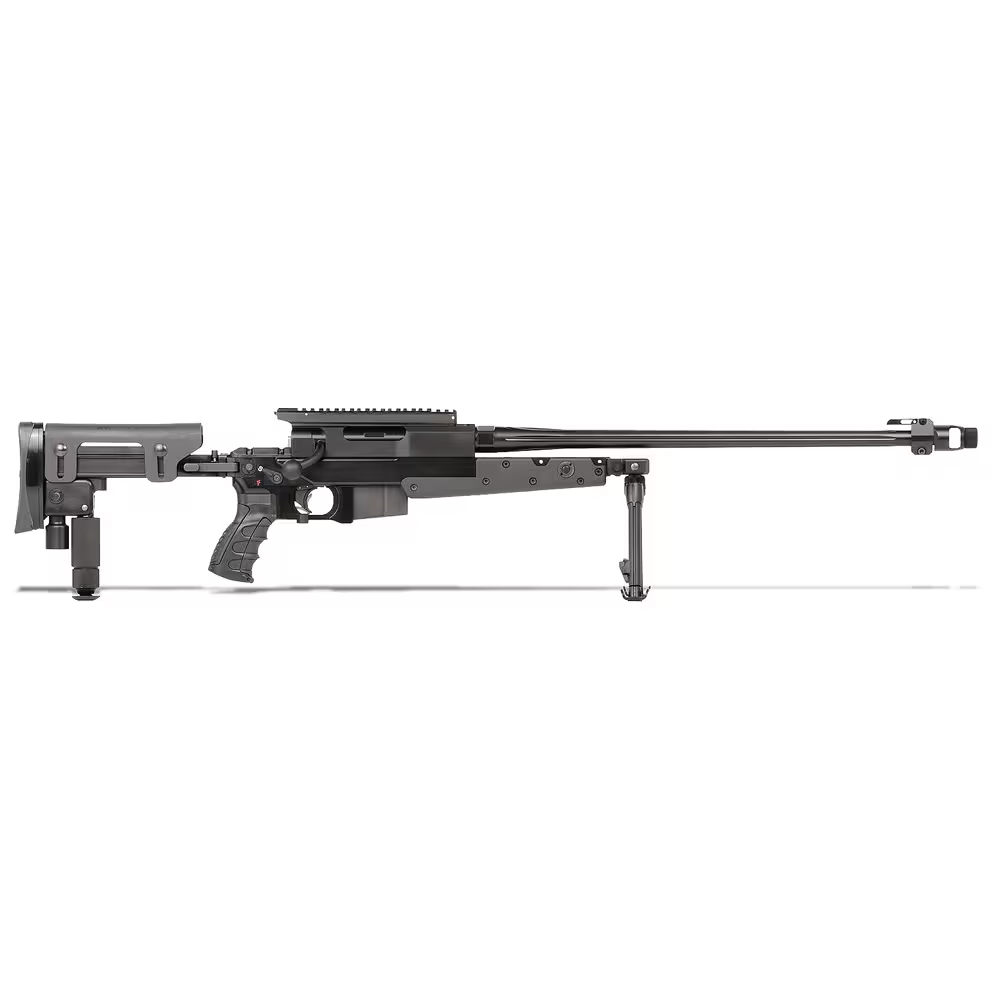
B&T AG, headquartered in Thun, Switzerland, is a premier global defense supplier specializing in the design and manufacturing of submachine guns (most notably the APC9 series), precision tactical rifles, and advanced sound suppressors.38 Founded in 1991 by Karl Brügger and Heinrich Thomet to produce suppressors for the domestic Swiss market, the company eventually transitioned to producing complete weapon systems, with Karl Brügger retaining sole ownership.38
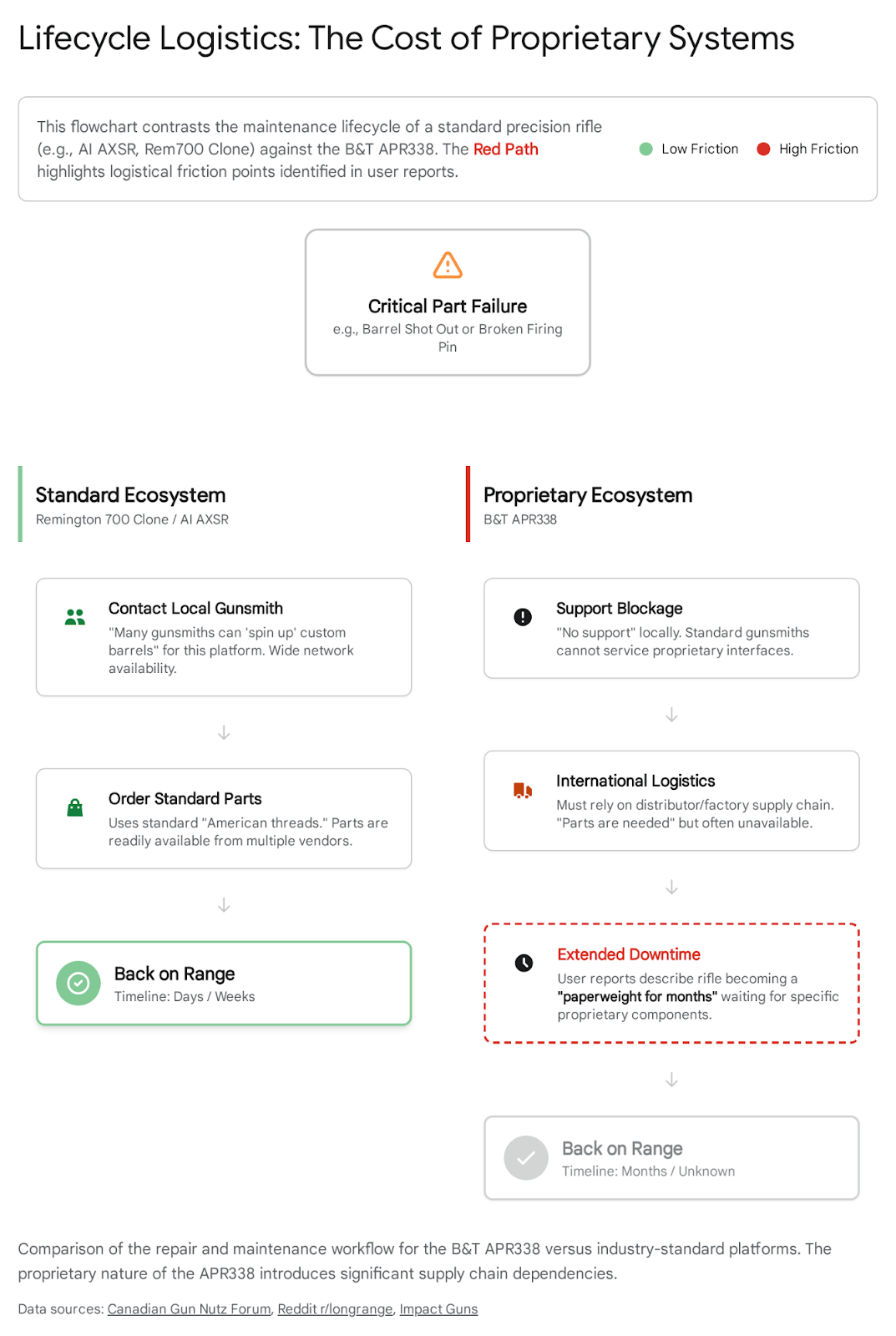
B&T USA, LLC operates as the North American extension and primary distributor for the brand. Unlike SIG Sauer Inc., which achieved total manufacturing independence over two decades, B&T USA relies heavily on a continuous, transatlantic supply chain. B&T USA operates primarily as an importer, final assembler, and distributor of parts that are meticulously machined and produced at the headquarters in Thun, Switzerland.10 Critical components, including serialized firearm receivers, proprietary suppressor baffles, and complex technical sub-assemblies, are exported from Switzerland to Florida. This profound dependency means that B&T USA cannot easily pivot to domestic U.S. manufacturing. Replicating the Swiss manufacturing capability would require massive capital investment, comprehensive re-tooling, and the transfer of highly proprietary technical data packages—a logistical process that takes years, not months, to execute.
The Larry Vickers Case and Criminal Contagion
The fragility of B&T USA’s import-dependent supply chain was critically exposed well before the formal Swiss export ban was announced. According to public court documents and industry disclosures, Sean Sullivan, a co-owner and high-ranking executive at B&T USA, entered into a formal plea agreement with the United States Department of Justice.10 Sullivan pled guilty to a series of federal illegal import violations directly connected to the high-profile Larry Vickers federal firearms case.10
This criminal exposure at the executive level fundamentally destabilized B&T USA’s operational capacity. Federal Firearms Licenses (FFLs) and Special Occupational Taxpayer (SOT) statuses, which are strict legal requirements for any entity seeking to import, manufacture, or deal in machine guns and suppressors under the National Firearms Act (NFA), are highly sensitive to the criminal convictions of corporate officers. The DOJ plea deal introduced severe regulatory friction, jeopardizing B&T USA’s ability to operate legally and maintain its critical import streams through U.S. Customs and Border Protection.
License Termination and Internal Corporate Warfare
The legal contagion resulting from the Sullivan plea deal quickly destroyed the foundational relationship between the Swiss parent company and the U.S. subsidiary. In early 2026, B&T AG abruptly and publicly severed ties with its American counterpart. In a highly unusual public notice directed at U.S. customers, B&T AG announced that it had officially “terminated the license agreement with B&T USA, LLC”.11 The stated reason for the termination was B&T USA’s repeated failure to settle outstanding invoices for products that had previously been delivered from Switzerland.42
This termination effectively stripped B&T USA of the legal right to manufacture, assemble, or distribute any B&T branded products. The operational fallout was immediate. Customers rapidly flooded forums and customer service channels reporting severe supply issues, with NFA backorders unfulfilled and communication collapsing as B&T USA completely lost access to the Swiss parts supply.10 The disruption left critical U.S. contracts in limbo and severely damaged the brand’s reputation for reliability.
The March 17 Lawsuit: B&T USA v. B&T AG
The breakdown in the corporate relationship rapidly escalated into aggressive formal litigation. On March 17, 2026—remarkably, just three days before the Swiss government enacted the national export ban—B&T USA, LLC filed a federal lawsuit against its parent company, B&T AG, along with B&T founder Karl Brügger and Namada Enterprises, Inc..12
Filed in the U.S. District Court for the Middle District of Florida (Case #: 8:26-cv-00714) and presided over by Judge Mary S. Scriven and Magistrate Judge Thomas G. Wilson, the suit is categorized under federal trademark law (28 U.S.C. § 1331).12 B&T USA is represented by Amanda Romfh Jesteadt and lead counsel Krystal B. Swendsboe of the prominent firm Wiley Rein LLP. The 19-page complaint demands a jury trial and centers on complex property rights and trademark disputes resulting from the license termination.12 Complicating the corporate web, B&T USA’s disclosure statements identify Cloverleaf Holdings, LLC and Namada Enterprises, Inc. as its corporate parents, placing Namada in the highly unusual position of being both a corporate parent to the plaintiff and a named defendant in the suit.12
Adding further strain to B&T USA’s legal bandwidth, the company is simultaneously embroiled in a patent infringement dispute initiated by SureFire, LLC. B&T USA and B&T AG filed for declaratory judgment against SureFire, alleging tortious interference and claiming that SureFire deliberately withheld critical evidence from the U.S. Patent and Trademark Office regarding prior art related to B&T’s proprietary Rotex quick-detach suppressor system.46 The sheer volume of concurrent federal litigation highlights a company operating in a state of terminal crisis.
Supply Chain Vulnerability Matrix: SIG Sauer vs. B&T
| Feature | SIG Sauer Inc. | B&T USA |
| Manufacturing Independence | 100% Domestic Production | Heavily reliant on Swiss imports |
| Supply Chain Status | Robust; expanding US plants | Disrupted by internal dispute |
| Corporate Alignment | Independent US entity | Fractured; license terminated |
| Exposure to Swiss Ban | Immune via aggressive onshoring | Highly vulnerable |
The Terminal Impact of the SECO Embargo on B&T
The March 20 SECO export ban represents the final, insurmountable hurdle for B&T USA. Even under an impossible scenario where B&T USA miraculously resolved its outstanding invoices, settled the trademark lawsuit, cleared its executive team of federal criminal exposure, and legally reconciled with Karl Brügger, B&T AG is now legally prohibited by the Swiss federal government from exporting new arms and ammunition to the United States.1
Because B&T USA’s entire business model relies on a continuous pipeline of precision parts from Thun, the SECO ban mathematically guarantees a total exhaustion of inventory. While existing licenses might allow a temporary trickle of previously authorized goods to leave Switzerland, the required interdepartmental review of dual-use and war materiel will undoubtedly slow this process to a crawl, and B&T AG has zero incentive to fulfill these orders given the license termination.2 For B&T USA, the export ban turns a severe corporate crisis into a terminal operational failure.
| Legal / Corporate Event | Implication for B&T USA | Source Documentation |
| DOJ Plea Deal (Sean Sullivan) | Executive criminal exposure severely risks FFL/SOT status required for NFA imports. | Court Records 10 |
| License Termination by B&T AG | Loss of legal right to assemble/distribute B&T products due to unpaid invoices. | B&T AG Statement 11 |
| Florida Trademark Lawsuit | Massive legal expenditure; B&T USA suing parent company and founder Karl Brügger. | Federal Docket 8:26-cv-00714 12 |
| SECO Export Ban (March 2026) | Total cessation of new parts from Switzerland, causing irreversible supply chain failure. | SECO / Federal Council 1 |
Contagion Across the Broader Swiss Industrial Base
The ramifications of the export ban extend far beyond the high-profile cases of SIG Sauer and B&T, deeply affecting the broader Swiss defense ecosystem and prompting a strategic exodus of manufacturing capability. Companies lacking SIG’s U.S. footprint are being forced into radical restructuring.
The Sphinx Systems Precedent and KRISS USA
Sphinx Systems, a brand historically revered for peerless precision Swiss craftsmanship in handguns, provides a stark historical template for how Swiss firms navigate financial and export-driven collapse. Plagued by a previous Federal Council ban on the supply of weapon parts to the Arab region, Sphinx Systems AG suffered severe financial distress, declared bankruptcy, and officially went out of business in Switzerland in 2016.47
However, the brand survived total extinction through complete American localization. KRISS USA, an independently operated subsidiary based in Virginia Beach, Virginia, took over the production and remaining business activities of the defunct Sphinx brand.47 Today, SPHINX pistols are manufactured entirely at the KRISS USA facility in Chesapeake, Virginia. The company maintains that the U.S.-made pistols are machined from billet materials to the exact same tolerances and standards as the original Swiss models.48 Because the physical manufacturing infrastructure and intellectual property were entirely severed from Swiss jurisdiction nearly a decade ago, Sphinx (via KRISS USA) is utterly immune to the 2026 Iran conflict export ban, demonstrating the absolute necessity of supply chain autonomy.
RUAG, Systems Assembling, and Capital Flight
RUAG, the massive Swiss state-owned aerospace and defense technology conglomerate, faces a highly complex reality. While the company is heavily insulated by vast, guaranteed domestic contracts with the Swiss Armed Forces, its lucrative export divisions—particularly those dealing with specialized ammunition, simulation tech, and aerospace components—will face the full brunt of the SECO reviews and freezes.1 The mandated restriction and enhanced scrutiny on “dual-use” goods and specific military items, such as training aircraft simulators, will inevitably slow RUAG’s ability to service critical U.S. defense and aerospace contracts.15
The underlying hostility and unreliability of the Swiss regulatory environment has forced defense executives to make radical decisions regarding the physical location of their capital. Systems Assembling, a major producer of highly specialized cables and wiring harnesses for armored vehicles and military aircraft, exemplifies this alarming trend. CEO Peter Huber explicitly outlined the dire situation: “Defense customers only placed new orders with us if we could guarantee that our products were not manufactured in Switzerland”.50
Faced with systematic blacklisting, Systems Assembling slashed half of its workforce at its historic Boudry headquarters in the canton of Neuchatel and rapidly expanded operations near Porto, Portugal.50 By physically manufacturing the components in Portugal—a NATO member state that does not operate under the rigid neutrality constraints of the Swiss War Materiel Act—the company bypassed SECO entirely. Other major Swiss firms, including armored vehicle manufacturer GDELS-Mowag, have reported being placed on explicit “blacklists” by European customers due to persistent fears over Swiss re-export vetoes.52 The March 2026 ban on U.S. exports will undoubtedly act as a massive accelerant for this capital flight, permanently moving high-tech manufacturing jobs and defense infrastructure out of Switzerland and into more reliable, NATO-aligned jurisdictions.
Strategic Mitigations for Small Arms Manufacturers
Given the severe volatility, political unpredictability, and rigid statutory enforcement of the Swiss export regime, multinational defense firms operating within or relying upon Switzerland must execute aggressive strategic mitigations to ensure operational continuity in the U.S. market.
- Total Physical Onshoring (The SIG Sauer Model): The most definitive mitigation against Swiss neutrality laws is total physical relocation of the supply chain. Firms must rapidly transition from operating as U.S. “importers and assemblers” to becoming vertically integrated domestic manufacturers. The United States Department of Defense is heavily incentivizing this transition through explicit policies, such as the “America First Arms Transfer Strategy,” which demand localized, secure supply chains for defense procurement.33 Companies relying on Swiss parts must aggressively invest in U.S.-based CNC machining, raw metallurgy sourcing, and localized quality control infrastructure. If a component is machined in New Hampshire or Virginia, SECO and the War Materiel Act possess zero jurisdiction over its sale, transfer, or deployment.
- Intellectual Property and Licensing Restructuring: Defense firms must meticulously untangle their intellectual property from Swiss corporate entities. The ongoing disaster at B&T USA clearly highlights the terminal danger of a U.S. subsidiary operating purely on a revocable license granted by a Swiss parent.11 If the Swiss entity terminates the license—or is legally forced by SECO to halt technology transfers under the broad “intangible goods” framework—the U.S. firm immediately collapses.13 Forward-looking companies must restructure their corporate frameworks so that the U.S. entity outright owns the patents, trademarks, and technical data packages (TDPs) for the products it sells domestically, shielding the core IP from foreign legal disputes, parent-company leverage, or sudden SECO export bans.
- Supply Chain Diversification and Near-Shoring (The Portuguese Bypass): For smaller firms entirely unable to afford the massive capital expenditure required to build advanced manufacturing facilities in the United States, “near-shoring” to NATO-aligned European countries represents a highly viable alternative strategy. Shifting critical component manufacturing to allied nations like Portugal, Germany, or Poland allows companies to maintain access to skilled European labor forces and established supply lines while entirely circumventing the jurisdiction of the Swiss War Materiel Act.50 This ensures that when the United States or other NATO allies engage in kinetic conflict, the supply of critical defense components remains uninterrupted.
Near-Term and Long-Term Market Expectations
The future trajectory of the Swiss small arms industry and its integration with the United States market will be shaped by immediate bureaucratic reviews, corporate liquidations, and a looming constitutional showdown over the principles of direct democracy.
Near-Term Expectations (Q2 – Q4 2026)
In the immediate near term, the U.S. market will experience highly localized supply chain disruptions rather than broad, industry-wide shortages.
The Federal Council’s pragmatic decision to allow “existing licenses” to proceed will act as a temporary shock absorber for the market.1 Swiss defense companies will undoubtedly scramble to fulfill massive backlogs under these older licenses to generate vital cash flow before the political climate shifts. However, this is not a guaranteed pipeline; the newly established interdepartmental expert group will heavily scrutinize these shipments.2 Any component deemed highly relevant to the Iran conflict, or any dual-use item exhibiting diversion risk, could have its existing license immediately suspended or revoked by SECO authorities.
Regarding corporate survival, B&T USA is highly unlikely to survive the current fiscal year in its current iteration. The devastating combination of the DOJ executive plea deal, the formal license termination, the massive federal trademark lawsuit, and the total ban on new Swiss imports creates a catastrophic liquidity and supply crisis. B&T AG will likely attempt to bypass the legally tainted LLC and eventually establish a new, wholly-owned corporate entity in the U.S. However, standing up a new import network, securing fresh FFL/SOT approvals, and routing around the current SECO ban will be nearly impossible in 2026. Consequently, SIG Sauer Inc. will aggressively capitalize on the resulting market vacuum. With absolute domestic production capability, SIG will continue fulfilling the multi-billion dollar NGSW contract unabated and will likely absorb lucrative federal, state, and local law enforcement submachine gun contracts that might have otherwise been awarded to B&T’s APC9 platforms.30
Long-Term Expectations (2027 and Beyond)
The long-term outlook for the Swiss defense industry hinges entirely on a fierce political battle currently raging within Switzerland regarding the fundamental legal definition of neutrality in the 21st century.
Recognizing the structural, potentially terminal decline of the defense sector following the Ukraine embargoes, Swiss lawmakers successfully passed a major legislative amendment in December 2025 designed to significantly soften the constraints of the War Materiel Act.1 This critical legislative change aimed to automatically grant arms exports and remove the restrictive “non-re-export declaration” requirement for a defined group of 25 mostly Western, allied nations—crucially including the United States, Germany, and the United Kingdom.7 The strategic intent behind the amendment was to tightly align Swiss defense procurement with European armaments cooperation, effectively recognizing that rigid, 19th-century interpretations of neutrality are entirely incompatible with maintaining a viable defense industrial base in the modern era.7
However, under the uniquely Swiss system of direct democracy, this legislative softening has not yet taken legal effect.1 Broad political alliances—comprising human rights organizations, left-wing political groups, and traditionalist factions—view the export of advanced weapons to warring nations as a fundamental violation of Swiss national identity and the spirit of neutrality.54 These groups have aggressively pushed for a national referendum to challenge and overturn the December 2025 law, with signature collection running through mid-April 2026.1
If the referendum successfully gathers the required signatures and the Swiss electorate votes to block the December 2025 amendments, the March 2026 export ban to the U.S. will calcify into a permanent state of affairs whenever the U.S. is engaged in kinetic military operations. If this restrictive path holds, the Swiss defense industry, acting as a major global exporter, will effectively cease to exist over the next decade. Swiss defense companies will be forced to follow the model pioneered by Systems Assembling and Sphinx—liquidating domestic factories, firing Swiss workers, and shifting all intellectual property and manufacturing infrastructure to the United States, Germany, or Portugal to survive.50
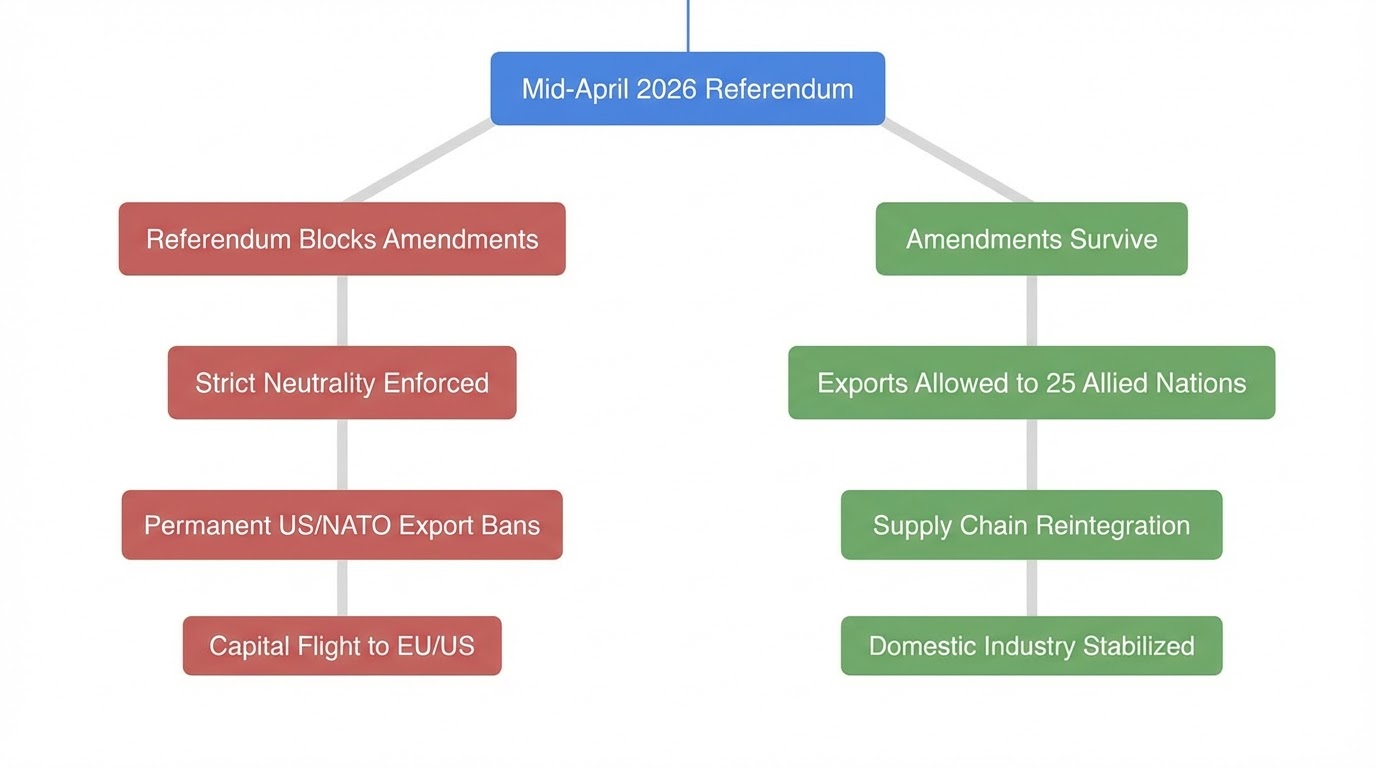
The upcoming referendum challenging the December 2025 legislative amendments will determine whether the Swiss defense sector integrates with NATO supply chains or faces terminal decline through permanent capital flight.
Conclusion
The March 2026 Swiss arms export ban stands as a definitive watershed moment for the global small arms industry. Driven by an inflexible, statutory commitment to historic neutrality amid the escalating conflict with Iran, Switzerland has effectively severed its highly specialized defense industrial base from its second-largest global market. This sweeping action does not merely delay individual shipments; it fundamentally alters the strategic calculus of international defense procurement.
This crisis starkly illuminates the absolute supremacy of vertical integration and supply chain autonomy. SIG Sauer Inc.’s foresight to completely domesticate its United States manufacturing base—a strategy culminating in the massive U.S. Army NGSW contract—renders the firm entirely impervious to the geopolitical maneuvering and legal strictures of the Swiss Federal Council. Conversely, the export ban acts as a fatal accelerant for companies like B&T USA, whose inherent reliance on vulnerable trans-Atlantic supply chains, compounded by severe internal legal disputes and executive criminal exposure, has resulted in total operational paralysis.
As the United States Department of Defense increasingly prioritizes highly secure, domestic supply chains through its “America First” transfer strategies, the era of relying on neutral, third-party nations for critical defense components is rapidly coming to a close. Unless the looming April 2026 national referendum successfully forces a permanent liberalization of the War Materiel Act, the Swiss defense industry faces a grim, unavoidable reality: to survive in the modern era of great power competition, it must abandon Switzerland.
Please share the link on Facebook, Forums, with colleagues, etc. Your support is much appreciated and if you have any feedback, please email us in**@*********ps.com. If you’d like to request a report or order a reprint, please click here for the corresponding page to open in new tab.
Sources Used
- Swiss Ban Arms Exports to US During Iran War Over Neutrality – SWI swissinfo.ch, accessed March 22, 2026, https://www.swissinfo.ch/eng/swiss-ban-arms-exports-to-us-during-iran-war-over-neutrality/91132763
- Iran conflict: impact on war-relevant exports, accessed March 22, 2026, https://www.eda.admin.ch/en/newnsb/eLmLXeiHSswJO0UIAyqb8
- Switzerland halts arms exports to US over Iran war, citing neutrality | Middle East Eye, accessed March 22, 2026, https://www.middleeasteye.net/news/switzerland-halts-arms-exports-us-over-iran-war-citing-neutrality
- Switzerland suspends new arms export licences to United States, accessed March 22, 2026, https://defence-industry.eu/switzerland-suspends-new-arms-export-licences-to-united-states/
- Swiss gunmakers lose one-third of exports due to national neutrality, accessed March 22, 2026, https://militarnyi.com/en/news/swiss-gunmakers-lose-one-third-of-exports-due-to-national-neutrality/
- Swiss arms exports fall as government mulls looser curbs after Ukraine war | Stacks 92.1, accessed March 22, 2026, https://stacks921.com/2025/03/11/swiss-arms-exports-fall-as-government-mulls-looser-curbs-after-ukraine-war/
- Switzerland eases arms export rules as its industry is shunned by …, accessed March 22, 2026, https://www.swissinfo.ch/eng/neutrality/switzerland-eases-arms-export-rules-as-its-industry-shunned-by-europe/90836288
- Firearm Fact: Sig Sauer Is Actually Split Between Two Companies – The National Interest, accessed March 22, 2026, https://nationalinterest.org/blog/buzz/firearm-fact-sig-sauer-actually-split-between-two-companies-119346
- SIG Sauer – Wikipedia, accessed March 22, 2026, https://en.wikipedia.org/wiki/SIG_Sauer
- *PDF Warning* B&T USA Co-Owner enters into plea agreement with …, accessed March 22, 2026, https://www.reddit.com/r/bruggerthomet/comments/1ryen86/pdf_warning_bt_usa_coowner_enters_into_plea/
- Oof piggybacking off of the last post about customer service : r/BT_APC – Reddit, accessed March 22, 2026, https://www.reddit.com/r/BT_APC/comments/1rydg83/oof_piggybacking_off_of_the_last_post_about/
- B&T USA, LLC v. B&T A.G. et al – PacerMonitor, accessed March 22, 2026, https://www.pacermonitor.com/public/case/63640242/BT_USA,_LLC_v_BT_AG_et_al
- Export controls, accessed March 22, 2026, https://www.eda.admin.ch/en/export-controls
- Sanctions Laws and Regulations Report 2026 Switzerland – ICLG.com, accessed March 22, 2026, https://iclg.com/practice-areas/sanctions/switzerland
- Export control and trade compliance – SWISSto12, accessed March 22, 2026, https://swissto12.com/export-control-and-trade-compliance/
- World’s most neutral country finally gets involved in Iran war with ‘weapons ban’ – Daily Star, accessed March 22, 2026, https://www.dailystar.co.uk/news/latest-news/worlds-most-neutral-country-finally-36901099
- Swiss government suspends arms exports to US – SWI swissinfo.ch, accessed March 22, 2026, https://www.swissinfo.ch/eng/various/federal-council-restricts-arms-exports-to-the-usa-due-to-iran-war/91133406
- Switzerland Bans Arms Exports to US Over Iran War, accessed March 22, 2026, https://novaramedia.com/2026/03/20/switzerland-bans-arms-exports-to-us-over-iran-war/
- Switzerland bans exports of ‘war materiel’ to US citing neutrality – The Cradle, accessed March 22, 2026, https://thecradle.co/articles-id/36647
- Switzerland halts new arms exports to America – Le News, accessed March 22, 2026, https://lenews.ch/2026/03/20/switzerland-halts-new-arms-exports-to-america/
- Switzerland bans weapons exports to US during Iran war – NBC News, accessed March 22, 2026, https://www.iranintl.com/en/202603217913
- It is high time to change our restrictions on arms exports : r/Switzerland – Reddit, accessed March 22, 2026, https://www.reddit.com/r/Switzerland/comments/1j4r555/it_is_high_time_to_change_our_restrictions_on/
- The Swiss franc is brimming with strength, but how serious is the problem? – Swissinfo, accessed March 22, 2026, https://www.swissinfo.ch/eng/workplace/the-swiss-franc-is-brimming-with-strength-but-how-serious-is-the-problem/91034932
- p320 review by lawyer and guy who helped design FGC-9 : r/SigSauer – Reddit, accessed March 22, 2026, https://www.reddit.com/r/SigSauer/comments/15jip4i/p320_review_by_lawyer_and_guy_who_helped_design/
- Welcome to Cordelia Gun Exchange – California Firearms, accessed March 22, 2026, https://www.cordeliagunexchange.com/
- “The world will not become a more peace- ful place without our air defence systems.” – The Swiss Defence Industry – Euro-sd, accessed March 22, 2026, https://euro-sd.com/2022/02/articles/exclusive/25252/the-world-will-not-become-a-more-peace-ful-place-without-our-air-defence-systems-the-swiss-defence-industry/
- Switzerland procures service pistols: SIG Sauer P320 triggers debate – Militär Aktuell, accessed March 22, 2026, https://militaeraktuell.at/en/switzerland-procures-service-pistols-sig-sauer-p320-triggers-debate/
- NGSW – FOG HORN, accessed March 22, 2026, https://twobirdsflyingpub.com/tag/ngsw/
- M7 rifle – Wikipedia, accessed March 22, 2026, https://en.wikipedia.org/wiki/M7_rifle
- Here’s Everything We Now Know About The Army’s New Squad Rifles – The War Zone, accessed March 22, 2026, https://www.twz.com/heres-everything-we-now-know-about-the-armys-new-squad-rifles
- SIG SAUER Announces U.S. Army Designates Type Classification Milestone for the NGSW Lethality Program – PR Newswire, accessed March 22, 2026, https://www.prnewswire.com/news-releases/sig-sauer-announces-us-army-designates-type-classification-milestone-for-the-ngsw-lethality-program-302461107.html
- U.S. Army Selects SIG SAUER Next Generation Squad Weapons System, accessed March 22, 2026, https://www.sigsauer.com/blog/us-army-selects-sig-sauer-next-generation-squad-weapons-system
- Establishing an America First Arms Transfer Strategy – The White House, accessed March 22, 2026, https://www.whitehouse.gov/presidential-actions/2026/02/establishing-an-america-first-arms-transfer-strategy/
- US President Signs Defense Policy Bill with Implications for Export Controls, Sanctions, and Supply Chain Restrictions, accessed March 22, 2026, https://sanctionsnews.bakermckenzie.com/us-president-signs-defense-policy-bill-with-implications-for-export-controls-sanctions-and-supply-chain-restrictions/
- US Army opens ammunition plant for Next-Gen Squad Weapon, accessed March 22, 2026, https://www.army-technology.com/news/us-army-opens-ammunition-plant-for-next-gen-squad-weapon/
- New CQB SIG M7 | Lighter, Shorter, Still 6.8 | SHOT Show 2026 …, accessed March 22, 2026, https://www.youtube.com/watch?v=MJx44TzPnV0
- Swiss SIG > SIG USA : r/NFA – Reddit, accessed March 22, 2026, https://www.reddit.com/r/NFA/comments/1mn5hi6/swiss_sig_sig_usa/?tl=en
- B&T – Wikipedia, accessed March 22, 2026, https://en.wikipedia.org/wiki/B%26T
- History | B&T USA, accessed March 22, 2026, https://bt-usa.com/support/history/
- I have questions for u/bt-usa regarding the present state of the …, accessed March 22, 2026, https://www.reddit.com/r/bruggerthomet/comments/1ryyqij/i_have_questions_for_ubtusa_regarding_the_present/
- Swiss Export Restrictions : r/Sig55X – Reddit, accessed March 22, 2026, https://www.reddit.com/r/Sig55X/comments/1ryjw3a/swiss_export_restrictions/
- B&T AG has terminated the license agreement with B&T USA, LLC …, accessed March 22, 2026, https://www.reddit.com/r/BT_APC/comments/1rz8gt7/bt_ag_has_terminated_the_license_agreement_with/
- Handguns, suppressor and weapon attachments – B&T AG (CH), accessed March 22, 2026, https://bt-ag.ch/en/
- Anyone else having troubles with B&T USA Customer service? : r/BT_APC – Reddit, accessed March 22, 2026, https://www.reddit.com/r/BT_APC/comments/1ry4kro/anyone_else_having_troubles_with_bt_usa_customer/
- B&T USA, LLC v. B&T A.G. et al 8:2026cv00714 – Justia Dockets, accessed March 22, 2026, https://dockets.justia.com/docket/florida/flmdce/8:2026cv00714/455882
- B&T USA Files Federal Lawsuit Against SureFire, LLC Alleging Patent Abuse and Interference | The Outdoor Wire, accessed March 22, 2026, https://theoutdoorwire.com/releases/e3a17f37-02ac-44f9-888b-ba7e329e2394
- Sphinx Systems – Wikipedia, accessed March 22, 2026, https://en.wikipedia.org/wiki/Sphinx_Systems
- Company – KRISS USA, accessed March 22, 2026, http://store.kriss-usa.com/company/
- Where are SPHINX pistols manufactured? – Help Center, accessed March 22, 2026, https://support.kriss-usa.com/hc/en-us/articles/9240558657179-Where-are-SPHINX-pistols-manufactured
- Switzerland’s Neutrality Is Holding Back Its Defense Industry – SWI swissinfo.ch, accessed March 22, 2026, https://www.swissinfo.ch/eng/switzerlands-neutrality-is-holding-back-its-defense-industry/89238160
- Swiss defence industry moving abroad to escape neutrality – SWI swissinfo.ch, accessed March 22, 2026, https://www.swissinfo.ch/eng/foreign-affairs/swiss-defence-industry-moving-abroad-to-escape-neutrality/89239840
- Switzerlands military industry is under threat – ФАКТИ.БГ, accessed March 22, 2026, https://fakti.bg/en/biznes/967933-switzerland-s-military-industry-is-under-threat
- Why Switzerland changed its arms export rules and is reassessing its neutrality, accessed March 22, 2026, https://www.eurointegration.com.ua/eng/news/2026/01/30/7230158/
- CP (Switzerland), Exporting Swiss weapons to countries at war is against neutrality and a gift to the EU and NATO! – Solidnet, accessed March 22, 2026, https://www.solidnet.org/article/CP-Switzerland-Exporting-Swiss-weapons-to-countries-at-war-is-against-neutrality-and-a-gift-to-the-EU-and-NATO/
- Swiss arms industry on the defensive, accessed March 22, 2026, https://www.swisscommunity.org/en/news-media/swiss-revue/article/swiss-arms-industry-on-the-defensive