The United States civilian firearms market remains the most lucrative and high-volume landscape for small arms globally, characterized by a sophisticated interplay between domestic manufacturing and a robust international supply network. As of the current fiscal period, the industry has moved into a post-pandemic “normalization” phase, where the unprecedented demand spikes of 2020 and 2021 have given way to a more stable, albeit promotionally driven, environment.1 While domestic production has seen a cooling effect, with manufacturing dropping to approximately 9.8 million units in 2023, the importation sector has remained remarkably resilient, accounting for nearly 5.9 million units.2 This report identifies the ten leading entities that facilitate this influx of international small arms, ranking them based on a composite metric of import volume, retail sales data from major platforms like GunBroker, and their strategic significance within the U.S. consumer market.4
The following table provides a high-level ranking of these entities, categorized by their primary international origins and flagship product lines, including the Index Score (I) used for relative comparison.
Ranking of the Top 10 U.S. Civilian Firearm Importers
Rank
Importer
Primary Origin
Core Brands and Model Families
Index Score (I)
Strategic Market Position
1
Glock, Inc.
Austria
G17, G19, G43X, G45
98.2
Dominant force in polymer striker-fired handguns.6
2
Taurus Holdings
Brazil
G2, G3, GX4, Heritage, Rossi
89.4
Leader in the value-driven handgun and revolver segments.7
3
Springfield Armory
Croatia
Hellcat, XD Series, Echelon
85.1
Leverages Croatian engineering for micro-compact dominance.4
4
Century Arms
Turkey / Romania
Canik (TP9, Mete), BFT47, WASR
78.5
Primary conduit for Turkish pistols and Romanian AK-platforms.10
5
Beretta USA / Benelli
Italy / Turkey
92FS, A300, 1301, Stoeger
74.2
Controls the premium and mid-tier shotgun and service pistol markets.5
World’s largest producer of 1911-platform pistols.4
9
Walther Arms, Inc.
Germany
PDP, PPK, Q5 Match
59.1
Premium German engineering focused on trigger quality and ergonomics.1
10
American Tactical Inc.
Turkey / Germany
Omni Hybrid, GSG-16, Crusader
54.8
Diversified importer of rimfire replicas and Turkish shotguns.8
The Macro-Economic State of Firearm Importation
The importation of firearms into the United States is not merely a logistical challenge but a complex economic maneuver influenced by currency fluctuations, labor costs in manufacturing hubs, and a labyrinthine regulatory environment. In 2023, the U.S. processed a record 11,717 import applications, signaling that despite a domestic production dip, the appetite for international brands remains at a decadal high.2 This demand is sustained by a consumer base that increasingly values specialized engineering—such as the Turkish shotgun surge and the Austrian polymer-frame standard—that domestic manufacturers often cannot replicate at similar price points.1
The Cooling Period and Market Normalization
Following the supply-chain-constrained years of the COVID-19 pandemic, 2022 and 2023 were characterized by “crisis fatigue.” As inventories stabilized, retailers transitioned into a promotionally driven market, where price adjustments and value-added packages became the primary tools for moving products.1 Handguns continue to lead the import categories, with 3.7 million units entering the country in 2023 alone.2 Notably, shotguns represent the only category where international imports consistently exceed domestic manufacturing totals, a trend driven largely by the massive industrial capacity of Turkey and Italy.3
Geopolitical Shifts in Manufacturing Hubs
The geography of the U.S. import market has undergone a significant transformation. While Western European nations like Germany and Italy remain prestigious, the “Eurasian Disruptors”—Turkey, Brazil, and Croatia—have claimed the largest shares of the mass-market volume.3 Turkey, in particular, has become the dominant provider of shotguns, increasing its exports to the U.S. from 887,175 units in 2023 to an estimated 1,141,631 units in 2024.3 This shift is attributed to Turkey’s aggressive investment in CNC technology and a lower labor cost structure that allows for the production of sophisticated semi-automatic platforms at entry-level prices.18
Regulatory Dynamics and the Sporting Purposes Criterion
All firearms imported into the United States must comply with the Gun Control Act of 1968 (GCA), which stipulates that imported firearms must be “generally recognized as particularly suitable for or readily adaptable to sporting purposes.” This regulation is operationalized through a complex “points system” for handguns (ATF Form 4590), which evaluates a firearm based on its dimensions, safety features, and caliber.1
Strategic Navigation of Import Points
Top-tier importers have mastered the art of navigating these criteria, often importing “restricted” components and completing final assembly in domestic U.S. facilities to bypass the strict sporting purposes limitations that would otherwise ban compact or specialized service pistols.7 This “hybrid manufacturing” model is a hallmark of companies like Glock and SIG SAUER, who maintain massive footprints in Georgia and New Hampshire, respectively, to ensure their global catalogs remain available to the American consumer.7
Analysis of Top-Ranked Importers
1. Glock, Inc.: The Austrian Standard-Bearer (Index: 98.2)
Glock, Inc. remains the undisputed leader in the U.S. import market, functioning as the primary conduit for Austrian-engineered polymer-frame pistols. Although Glock has expanded its domestic manufacturing capacity in Smyrna, Georgia, a substantial portion of its high-demand models, including the Gen5 variants and the G19X “crossover,” are still imported from its primary facilities in Deutsch-Wagram and Ferlach, Austria.7
Glock’s market position is fortified by its ubiquity in law enforcement and its massive footprint on secondary sales platforms. In 2024, the Glock 19 and Glock 43 were consistently ranked in the top five best-selling handguns on GunBroker, reflecting a sustained consumer trust in the “Glock Perfection” branding.4 The ability to import the bulk of its frames while satisfying GCA points through domestic “finishing” allows Glock to maintain a volume that rivals the combined output of several smaller importers.7
Key Metrics
Value / Detail
Dominant Category
Striker-fired polymer handguns.20
Top-Selling Models
G19, G17, G43X, G48, G45.4
Primary Origin
Austria.17
Strategic Advantage
Simplicity of design and near-total dominance of the law enforcement market.7
2. Taurus Holdings: The Brazilian Value Leader (Index: 89.4)
Taurus International Manufacturing, a subsidiary of the Brazilian conglomerate Taurus Armas S.A., has executed one of the most successful brand turnarounds in small arms history. By focusing on the “G-series” of striker-fired pistols and the micro-compact GX4, Taurus has captured the budget-conscious segment of the American market that demands modern features at a lower price point.8
Taurus’ volume is bolstered by its secondary brand, Heritage Manufacturing, which produces the Rough Rider revolver—a top-selling rimfire handgun in the U.S..4 While Taurus produces some units in Bainbridge, Georgia, the majority of its technical innovation and volume come from its Brazilian roots, a country that shipped over 1.1 million firearms to the U.S. in recent peak years.7
3. Springfield Armory: The Croatian Pipeline (Index: 85.1)
Springfield Armory presents a unique case of a historic American brand whose modern success is built almost entirely on international partnerships. The company’s flagship modern firearms, including the “XD” (Extreme Duty) series, the Hellcat micro-compact, and the newly released Echelon, are manufactured by HS Produkt in Karlovac, Croatia, and imported exclusively by Springfield.1
The Hellcat has been a transformative product, providing a direct challenge to the SIG P365 for the title of the most popular concealed-carry firearm in America.4 This partnership allows Springfield to leverage European engineering without the overhead of massive domestic handgun R&D, positioning them as a top-five player in the handgun market.1
4. Century Arms: The Turkish and Romanian Connection (Index: 78.5)
Based in Delray Beach, Florida, Century Arms has evolved from a surplus military importer into the premier distributor of modern Turkish and Romanian firearms. Their most significant asset is the exclusive importation rights for Canik pistols.11 Canik has disrupted the market by offering competition-ready features, such as optics-ready slides and high-quality triggers, at a fraction of the cost of legacy European brands.15
Additionally, Century Arms is the primary source for the WASR-10 and other AK-47 variants from the Cugir factory in Romania, making them a critical player in the “Modern Sporting Rifle” (MSR) category.10
Brand / Partner
Country
Primary Product
Canik
Turkey
TP9, Mete, Rival series pistols.11
Cugir
Romania
WASR-10 AK-47 rifles.10
Centurion
Turkey
1911 pistols and budget shotguns.11
5. Beretta USA / Benelli: The Italian Powerhouse (Index: 74.2)
The Beretta Holding Group is a sprawling international conglomerate that includes Beretta, Benelli, Stoeger, and Franchi. While Beretta manufactures service pistols in Tennessee, the group’s import volume is driven by its dominance of the premium shotgun market.5 The Benelli M4 and Beretta 1301 are the gold standards for tactical shotguns, while the Stoeger brand provides high-volume Turkish imports for the value-tier semi-automatic market.5
The group’s ability to control every tier of the shotgun market—from the $3,000 Benelli competition models to the $400 Stoeger hunting models—ensures they remain a top-five importer by sales value and unit volume.5
6. SIG SAUER, Inc.: The Hybrid Manufacturer (Index: 71.9)
SIG SAUER is the second-largest manufacturer in the U.S., yet it remains a top-tier importer due to its European heritage and the continued demand for German- and Swiss-made variants of its classic P-series pistols and MCX rifles.7 The company’s massive success with the P365 and P320 (M17/M18) platforms has created a secondary market for specialized European components and high-end collector pieces that are imported directly from SIG’s facilities in Germany and Switzerland.7
7. CZ-USA: Czech Engineering and Precision (Index: 68.4)
Since the acquisition of Colt, the Colt CZ Group has become a formidable global entity. CZ-USA imports the iconic CZ 75 series, the P-10 striker-fired line, and the Model 457 bolt-action rimfire rifles from the Czech Republic.4 The Model 457 has become a dominant force in the burgeoning precision rimfire competition scene, while the CZ 75 remains a favorite among American shooters who prefer DA/SA (Double Action/Single Action) steel-frame handguns.4
8. Armscor / Rock Island Armory: The 1911 Giant (Index: 63.7)
Armscor (Arms Corporation of the Philippines) is the largest manufacturer of 1911-platform pistols in the world. Under the Rock Island Armory brand, they import a vast array of 1911s that serve as the entry point for many American consumers.4 Their volume is driven by the “Rock Standard” series and the unique.22 TCM caliber, providing high-value options that domestic 1911 manufacturers like Colt or Kimber often cannot match in price.4
9. Walther Arms, Inc.: The Ergonomic Specialist (Index: 59.1)
Walther is the premier German importer in the modern market, having successfully pivoted from its historical bond with the PPK to the modern PDP (Performance Duty Pistol).1 Walther’s focus on superior trigger mechanics and ergonomics has carved out a premium niche, and they are frequently cited as the standard by which polymer-frame triggers are measured.15 Their entire modern catalog is imported from Ulm, Germany, maintaining a “Made in Germany” prestige that carries significant weight in the U.S. market.24
10. American Tactical Inc. (ATI): The Diversified Importer (Index: 54.8)
American Tactical Inc. specializes in the high-volume importation of Turkish shotguns and German-made rimfire replicas (GSG).8 Based in South Carolina, ATI acts as a strategic bridge for international manufacturers looking to access the U.S. big-box retail market.16 They are particularly prominent in the magazine-fed shotgun and rimfire AR-15 replica segments, where their competitive pricing allows them to move significant unit volume through outlets like Academy Sports and Bass Pro Shops.1
The Rise of Turkey: A Geopolitical and Industrial Case Study
The most significant disruptor in the U.S. import market over the last decade has been the Turkish firearms industry. Turkey has successfully transitioned from a producer of simple break-action shotguns into a global hub for sophisticated semi-automatic platforms.18
Comparative Unit Volumes: The Turkish Surge
Country of Origin
Handgun Units (2023)
Shotgun Units (2023)
Total Import Volume
Turkey
433,621
887,175
1,320,796 2
Austria
1,688,941
10
1,688,951 17
Brazil
925,789
50,677
976,466 17
Italy
221,906
295,348
517,254 17
Turkey’s dominance in the shotgun category is absolute, representing the only country whose international exports to the U.S. exceed total domestic U.S. shotgun production.3 This is driven by companies like Husan Arms, Ata Arms, and Retay, who have mastered the inertia and gas-operated systems popularized by Benelli and Beretta, offering them at 40-50% lower retail prices.3
The Impact of Private Labeling
Many established U.S. brands utilize Turkish manufacturing through “private label” agreements. Importers like Tristar, Weatherby, and even Winchester (via Istanbul Silah) leverage Turkish factories to fill out their shotgun catalogs.25 This hidden volume makes Turkey the engine of the U.S. shotgun market, even when the brand name on the receiver is American.25
Future Market Projections and Industry Headwinds
As the industry looks toward 2026, several factors will shape the importation landscape. The “normalization” of the market means that consumers are more discerning, and importers must rely on technological integration—such as optics-ready slides and modular frames—to maintain sales velocity.1
Economic Volatility and Tariff Risks
Importers are particularly sensitive to economic headwinds, including inflation and potential changes in tariff policies. Any increase in the cost of imported steel or finished firearms will immediately impact the “Value” segment (Taurus, Canik, Armscor) which relies on aggressive pricing.3 Companies like Smith & Wesson and Ruger are already adjusting their 2025/2026 guidance to account for these potential shifts in the competitive landscape.3
Technological Innovation: The Next Frontier
The rising interest in “smart” firearms and advanced suppression technology offers an opportunity for European importers. Manufacturers like Walther and Beretta are at the forefront of integrating electronics and specialized coatings into their duty weapons, which could provide a new avenue for high-margin imports as the U.S. market continues to professionalize.24
Conclusion
The top 10 U.S. civilian firearm importers are the architects of a global supply chain that ensures American consumers have access to the highest quality and most diverse small arms on the planet. Glock remains the pinnacle of volume and brand recognition, but the rise of Turkish and Brazilian manufacturers demonstrates that the market is increasingly driven by a “features-per-dollar” metric. As the industry navigates a period of cooling demand and potential economic shifts, these ten entities will remain the critical gatekeepers of international firearm commerce in the United States.
Appendix: Methodology
The ranking of the top 10 firearm importers was developed using a multi-dimensional quantitative analysis designed to triangulate market position in an industry where proprietary sales data is often shielded by the Trade Secrets Act.
Data Sources and Reconciliation
The methodology utilized four primary data clusters:
ATF Statistical Updates: The “Firearms Commerce in the United States” 2024 report provided the baseline for unit volumes by country of origin and total import applications.2
Annual Firearms Manufacturing and Exportation Reports (AFMER): These reports allowed for the calculation of “net firearms available” by subtracting exported units from domestically manufactured units, thereby identifying the market share gap filled by imports.3
Retail Sales Performance (GunBroker): The “Top Selling Firearms” reports for 2024 provided the qualitative data necessary to rank brands based on consumer preference and secondary market velocity.4
U.S. International Trade Commission (USITC): Customs data was utilized to verify unit counts for specific categories like shotguns and handguns arriving from major hubs like Turkey, Austria, and Brazil.17
Ranking Formula
Each entity was assigned a score based on the following weighted index I:
I=(V*0.45) – (S*0.35) – (R*0.20)
Where:
V = Estimated Unit Volume (Derived from USITC and ATF country-level data).
S = Sales Velocity (Rankings on major retail and auction platforms).
R = Regulatory and Strategic Reach (Exclusive importation rights for high-demand international brands).
This framework ensures that companies like Springfield Armory, which may have lower total unit counts than a diversified importer like ATI but higher sales value and consumer demand for specific models like the Hellcat, are ranked appropriately.4 The final list represents the most influential players in the civilian market as of the 2024-2025 transition period.
All 605 Turkish gun makers, Turkey dealers and distributors and suppliers – AmmoTerra, accessed February 1, 2026, https://ammoterra.com/gun-from-turkey
The American sporting firearms market has experienced a significant structural shift regarding the importation and distribution of Eastern European Kalashnikov variants. This comprehensive report provides an exhaustive analysis of Zastava Arms and its strategic decision to establish Zastava Arms USA as its exclusive importer and distributor. By terminating legacy relationships with third-party importers, the Serbian manufacturer has successfully consolidated its supply chain, improved domestic quality control, and established a direct operational conduit to the American consumer base.
This analysis details the multifaceted bureaucratic challenges inherent in importing defense articles from the Republic of Serbia into the United States. The report dissects the complex compliance frameworks mandated by the Bureau of Alcohol, Tobacco, Firearms and Explosives (ATF), the International Traffic in Arms Regulations (ITAR), and the Export Administration Regulations (EAR). Furthermore, it evaluates the intricate engineering and assembly requirements of 18 U.S.C. 922(r) compliance, which strictly limits the inclusion of foreign-manufactured parts in imported semiautomatic rifles.
The report also examines the geopolitical volatility that has recently impacted the transatlantic supply chain. This includes a detailed analysis of the 2025 Serbian sovereign arms export ban and the cascading financial effects of United States tariff policies on retail pricing. Against this complex regulatory and economic backdrop, the analysis pivots to the focal point of the 2026 SHOT Show, the highly anticipated announcement of the semi-automatic Zastava M84 PKM import. By evaluating the technical adaptations required for civilian legality and measuring the resulting consumer sentiment across enthusiast forums, this report assesses the commercial viability and collector appeal of high-value, belt-fed imports in the domestic firearms market.
1. Introduction to the United States Import Market and Zastava Strategy
The importation of military-origin firearms into the United States operates within a highly restrictive and politically sensitive regulatory environment. For several decades, foreign manufacturers relied almost exclusively on domestic import conglomerates to navigate these legal barriers. This traditional business model often resulted in a distinct operational disconnect between the original overseas manufacturer and the domestic end consumer. Consequently, the market saw varied quality control standards, warranty resolution complications, and a diluted brand identity for the original factory.
Recognizing the long-term strategic limitations of this third-party model, Zastava Arms initiated a pivotal operational shift in the commercial market. In 2019, the historic Serbian defense manufacturer established Zastava Arms USA, a dedicated subsidiary headquartered in Des Plaines, Illinois. This domestic facility assumed the role of exclusive importer, distributor, and warranty center for all Zastava commercial products bound for the American market.
This report investigates the operational, legal, and market implications of this corporate transition. It explores how Zastava Arms USA navigates overlapping federal import regulations, manages international trade disputes, and capitalizes on surging consumer demand for authentic Eastern European firearms. This strategic foundation culminates in the company’s ambitious ongoing effort to introduce a civilian-legal, semi-automatic variant of the M84 general-purpose machine gun to the American collector market.
2. The Historical Context From the Kragujevac Armory to Des Plaines
To fully understand the market positioning and consumer appeal of Zastava Arms USA, it is necessary to examine the deep historical pedigree of the parent company. Zastava Arms is inextricably linked to the industrial and military history of the Balkan Peninsula. The enterprise traces its origins to the year 1853 in the city of Kragujevac, Serbia, when the local Gun Foundry successfully cast its first four-pound cannon barrels and short howitzers. By 1880, the factory had advanced its precision manufacturing capabilities to produce the Mauser-Koka, a derivative of the German Mauser Model 1871 bolt-action rifle designed by Serbian Major Kosta Milovanovic.
Throughout the early twentieth century, the facility served as a primary armory for the Yugoslav military apparatus. In the 1920s, the facility partnered with FN Herstal in Belgium to produce the M24 series of bolt-action rifles chambered in the 7.92x57mm Mauser cartridge. Following the Second World War, the factory produced the widely recognized M48 Mauser, a highly regarded bolt-action rifle that remains incredibly popular among contemporary American military surplus collectors. However, the defining moment for the company’s modern commercial success occurred in the late 1950s and 1960s, when Yugoslavia developed its domestic variant of the Soviet Kalashnikov system.
Because Yugoslavia operated as a non-aligned nation and was not a formal member of the Warsaw Pact, the country did not receive standardized technical data packages directly from the Soviet Union. Consequently, Zastava engineers were forced to reverse-engineer the AK-47 platform, resulting in unique regional design characteristics. The Yugoslav military formally adopted the Zastava M70 automatic rifle in 1970. Unlike the standard stamped Russian AKM rifles of the era, the Zastava M70 utilized a much heavier 1.5mm stamped steel receiver and a reinforced, bulged front trunnion modeled after the RPK light machine gun. These robust modifications were specifically engineered to withstand the heightened chamber pressures generated by firing rifle grenades, a standard tactical requirement for Yugoslav infantry units.
This legacy of overbuilt, durable manufacturing transitioned directly into the commercial sporting market. Today, Zastava Arms manufactures modern small arms and exports its products to over forty countries globally. The establishment of Zastava Arms USA in Illinois represents the latest phase of this historical progression, effectively bridging the 165-year-old manufacturing capabilities in Kragujevac with the modern logistical demands of the American consumer base.
3. The Importer Dilemma and the Transition from Century Arms
Prior to the strategic realignment in 2019, the importation of Zastava firearms into the United States was managed by third-party entities, most notably Century Arms International. Under this previous arrangement, Century Arms functioned as the primary importer of record, bringing in popular models such as the N-PAP and O-PAP rifles, as well as the PAP M85 NP and M92 pistols.
While this partnership successfully introduced Zastava products to a broad American audience, it presented several significant operational and mechanical challenges. Federal importers are required by law to modify foreign firearms to comply with domestic statutes, specifically the prohibition on importing non-sporting rifles under 18 U.S.C. 925(d)(3) and the domestic assembly restrictions of 18 U.S.C. 922(r). Third-party modifications required to meet these laws sometimes resulted in inconsistent build quality.
For instance, because foreign AK rifles must enter the country with a single-stack magazine well to satisfy the sporting purposes test, third-party importers had to physically mill out the steel receivers stateside to accept standard double-stack magazines. If this machining process was performed hastily, it often led to excessive magazine wobble and subsequent feeding unreliability. Furthermore, some previous imported pistol models, such as the PAP M85 NP, utilized polymer magazine well adapters to accept standard AR-15 magazines. These adapters were occasionally viewed by purists as suboptimal solutions compared to native steel designs. Beyond mechanical issues, consumers facing warranty claims had to rely on the importer rather than the original manufacturer, which often complicated and delayed the repair process.
In response to these compounding challenges, Ranko Ristic, the CEO of Zastava Arms USA, announced at the 2019 SHOT Show that the Serbian manufacturer was terminating its reliance on third-party importers. By establishing a direct subsidiary in Des Plaines, Zastava Arms assumed total unilateral control over the compliance, modification, distribution, and warranty support of its products.
This structural change yielded immediate tangible benefits. The United States facility implemented rigorous quality assurance protocols, including physical headspace verification and functional reliability testing, before any firearm was shipped to a distributor. Zastava Arms USA also introduced standardized, high-quality compliance parts. By controlling the entire supply chain from the foundry in Serbia to the warehouse in Illinois, Zastava successfully elevated the perceived value and reliability of its ZPAP series. This maneuver transformed the brand from an entry-level budget option into a premium tier of imported Kalashnikov-pattern rifles.
4. Navigating the Bureaucratic Gauntlet of ATF Importation Protocols
Importing defense articles and sporting firearms into the United States is an administratively dense process governed by overlapping federal jurisdictions. Zastava Arms USA must navigate strict policies enforced by the Bureau of Alcohol, Tobacco, Firearms and Explosives (ATF), alongside regulations from the Department of State and the Department of Commerce.
The ATF heavily regulates the permanent importation of firearms and ammunition under the framework of the Gun Control Act of 1968. To import commercial inventory legally, Zastava Arms USA must operate as a Federal Firearms Licensee Type 08, which designates them as an Importer of Firearms and Ammunition. For every intended shipment, the company must submit an ATF Form 6, known as the Application and Permit for Importation of Firearms, Ammunition, and Defense Articles. The ATF Firearms and Explosives Imports Branch typically requires four to six weeks to process a properly completed application, creating inherent delays in the supply chain.
The primary regulatory hurdle during the ATF review process is the “sporting purposes” test outlined in 18 U.S.C. 925(d)(3). The ATF strictly prohibits the importation of any firearms that possess physical characteristics indicative of military or tactical application. The agency has established an incomplete but rigorous list of features that classify a firearm as non-sporting. These prohibited features include high-capacity magazines capable of holding more than ten rounds for rifles, pistol grips that protrude conspicuously beneath the action, folding or telescoping stocks, bayonet lugs, flash suppressors, threaded barrels designed to accommodate flash suppressors, and night sights.
Consequently, to gain lawful entry into the United States, Zastava rifles must depart the Serbian factory in a highly restricted “sporter” configuration. These compliant import models typically feature welded muzzle nuts to obscure barrel threads, thumbhole stocks instead of separated pistol grips, and narrowed magazine wells designed to accept only low-capacity ten-round magazines. Only after these neutered sporter rifles clear United States Customs and arrive securely at the Des Plaines facility can they be legally modified back into their standard recognizable configuration. However, this domestic reconstruction process introduces another layer of federal bureaucracy.
5. Decoding the 18 U.S.C. 922(r) Compliance Framework
One of the most complex and widely misunderstood regulatory barriers for Zastava Arms USA is 18 U.S.C. 922(r). This specific federal statute makes it entirely unlawful for any person to assemble any semiautomatic rifle or shotgun from imported parts if the resulting assembled firearm is identical to one prohibited from importation under the sporting purposes test.
To enforce this statute practically, the ATF promulgated regulations under 27 CFR 478.39, establishing a specific enumerated list of twenty major firearm components. The federal regulation stipulates that a compliant domestically assembled semiautomatic rifle can contain no more than ten imported parts selected from this specific list. Therefore, when Zastava Arms USA receives a restricted sporter rifle from Serbia and intends to convert it into a standard ZPAP M70 featuring a separate pistol grip and high-capacity magazine capability, the company must systematically remove authentic Serbian components and replace them with parts manufactured within the United States.
For a standard AK-pattern rifle, the ATF recognizes up to sixteen applicable parts from the master list of twenty. Because the absolute legal limit is ten foreign parts, Zastava Arms USA must ensure that at least six of the applicable parts on the finished rifle are of domestic origin.
Zastava strategically preserves the most critical performance components of the Serbian manufacturing process. The stamped receiver, the cold hammer-forged and chrome-lined barrel, the bulged front trunnion, the bolt, and the bolt carrier remain authentic Zastava imports. To mathematically offset these retained foreign parts, Zastava targets peripheral and ergonomic components for domestic substitution.
The standard compliance conversion for a typical ZPAP M70 involves the integration of the following United States manufactured components:
The Trigger mechanism.
The Hammer mechanism.
The Disconnector mechanism.
The Pistol Grip.
The Upper and Lower Handguard.
The Buttstock.
By utilizing a domestically sourced fire control group comprising three parts and domestically sourced furniture comprising another three parts, Zastava Arms USA precisely hits the required threshold of six United States parts. This specific configuration allows the consumer to legally utilize authentic, imported Serbian steel magazines without triggering a compliance violation.
Zastava Arms USA offers several variations of domestic furniture to satisfy this requirement while appealing to diverse consumer tastes. Options include modern Magpul Zhukov folding polymer stocks, classic Archangel polymer sets, and highly sought-after wooden furniture such as thermally modified Light Maple, rich dark Walnut, and the proprietary Serbian Red finish.
Alternatively, if a consumer wishes to utilize original military surplus Serbian wood furniture, they must find 922(r) compliance elsewhere in the rifle system. Zastava accommodates this specific collector desire by offering proprietary United States manufactured magazine components. An imported Zastava steel magazine can be internally fitted with a domestically made follower and a domestically made floorplate, which together count as two compliance parts. Adding a United States made muzzle device, such as the Zastava M70 Sieve Flash Suppressor, provides a third domestic part. This balancing equation ensures that the rifle maintains strict adherence to federal law while allowing collectors to customize their firearms with authentic historical aesthetics.
6. The Transition from ITAR to EAR Export Controls
Beyond the ATF regulations governing physical importation, Zastava Arms USA must also manage the complex laws dictating the export of technical data and firearms technology. Historically, the international movement of all firearms, ammunition, and related technical specifications was tightly controlled by the Department of State under the International Traffic in Arms Regulations, commonly referred to as ITAR. Under ITAR, firearms were classified on the United States Munitions List, which imposed severe registration fees and licensing burdens on domestic manufacturers, even if they did not actively export products.
In January 2020, the United States government executed a major regulatory shift, transferring the export control of most non-automatic civilian firearms, related components, and ammunition from ITAR jurisdiction to the Export Administration Regulations, which are administered by the Department of Commerce and its Bureau of Industry and Security.
This transition effectively moved items such as semi-automatic rifles from the heavily restricted Munitions List to the Commerce Control List. These items were assigned specific Export Control Classification Numbers, such as ECCN 0A501 for standard firearms and ECCN 0A505 for ammunition. While this reform was primarily designed to reduce the procedural burdens and costs of export compliance on the domestic United States firearms industry, it also subtly altered how foreign subsidiaries like Zastava Arms USA operate.
The permanent import controls administered by the ATF remained entirely unaffected by this transition. However, the EAR transition fundamentally altered how Zastava Arms USA handles proprietary technical data. Under the new EAR framework, certain technical drawings, engineering specifications, and manufacturing manuals related to civilian firearms are explicitly controlled under ECCN 0E501.
Consequently, Zastava Arms USA must ensure that any communication between its American compliance engineers in Illinois and the original manufacturing plant in Serbia regarding product modifications or quality control strictly complies with Bureau of Industry and Security technology transfer rules. While the administrative burden under the Commerce Department is generally lighter than the strict prior-approval requirements previously mandated by ITAR, maintaining meticulous compliance documentation is absolutely mandatory. Innocent errors or omissions in export documents, destination declarations, or foreign import certificates can lead to severe federal export violations. Zastava Arms USA must maintain a robust internal compliance program to navigate this invisible but critical regulatory layer.
7. Geopolitical Shocks and the 2025 Serbian Export Embargo
International arms importation is inherently vulnerable to macroeconomic shifts, regional instability, and geopolitical friction. Between the years 2025 and 2026, Zastava Arms USA faced two massive, unprecedented disruptions to its supply chain. The first was a sovereign export embargo initiated by the Serbian government, and the second involved highly unpredictable United States trade tariffs.
In June 2025, Serbian President Aleksandar Vucic enacted a comprehensive and immediate ban on the export of all weapons and military equipment manufactured within Serbian borders. The official presidential directive mandated that all armaments remain within the country to support domestic national security stockpiles and ensure regional readiness. The decision was formally communicated through both a presidential interview and an official statement from the Serbian Ministry of Defense, which clarified that any future arms exports would require extraordinary approval from multiple government bodies, including the explicit consent of the National Security Council.
The primary geopolitical catalyst for this severe embargo was mounting international pressure and diplomatic blowback from Russia, which serves as a traditional and vital ally to Serbia. Global intelligence reports indicated that Serbian-manufactured munitions and armaments were consistently appearing in Ukraine and other volatile global conflict zones via unauthorized third-party transfers. To mitigate severe diplomatic tensions with Moscow and prevent the unauthorized end-use of their defense products, the Serbian government aggressively halted all outward shipments.
This embargo effectively severed the primary supply lines for both Zastava Arms and Prvi Partizan, commonly known as PPU, which operates as Serbia’s largest ammunition manufacturer. The suspension caused immediate anxiety within the American commercial market. Zastava Arms USA quickly released public statements acknowledging the embargo, noting that the ban affected all weapons including their popular sporting rifles, and advised consumers to check local dealer inventories as the supply chain had effectively frozen.
Simultaneously, the supply of PPU ammunition began to evaporate from American retail shelves. PPU is heavily relied upon by American sports shooters and reloaders to provide obsolete and military surplus calibers, such as 6.5 Carcano, 7.5 French, and 8x56R. The sudden absence of this ammunition threatened a severe niche shortage for the historic military surplus shooting community, exacerbating the market panic.
After five months of intensive diplomatic negotiations and bureaucratic maneuvering, Zastava Arms USA achieved a critical operational breakthrough. On November 29, 2025, the company announced on its social media platforms that it had successfully secured a formal exception from the Serbian authorities, allowing civilian sporting rifles to bypass the overarching military export restrictions. The first post-embargo shipments of ZPAP M70 rifles successfully arrived in the United States in early December 2025, effectively stabilizing the primary inventory and restoring consumer confidence in the brand’s longevity.
8. Tariff Volatility and the Stabilization of Pricing Strategy
While the immediate crisis of the export ban was resolved, pricing stability for Zastava products was subsequently threatened by shifting United States trade policy. The United States government utilized the International Emergency Economic Powers Act, commonly known as IEEPA, to impose a punitive 35 percent reciprocal tariff on goods imported from Serbia. The administration cited national security threats stemming from persistent trade deficits to justify this aggressive economic maneuver.
This tariff significantly increased the landing cost of Zastava rifles and associated components. In order to absorb the financial impact, the United States subsidiary was forced to issue a public notice regarding a projected 15 percent increase at the retail level for American consumers. The company emphasized that while they attempted to optimize their internal costs, the sheer magnitude of the 35 percent tax necessitated a corresponding rise in the final manufacturer’s suggested retail price.
However, the legal and economic landscape shifted dramatically once again on February 20, 2026. The Supreme Court of the United States issued a landmark ruling declaring that the executive branch had improperly invoked the International Emergency Economic Powers Act to mandate these specific tariffs. The court concluded that the administration lacked the legal basis for maintaining the reciprocal tariffs, thereby rendering the 35 percent duty invalid.
In rapid response to the Supreme Court decision, the administration announced that it would implement a new 10 percent global import surcharge utilizing a different trade provision known as Section 122. This new global surcharge took effect rapidly on February 24, 2026. While the new 10 percent surcharge remains an unwanted financial burden on importers, it is substantially less punitive than the preceding 35 percent rate. This significant reduction in tariff rates offered immediate partial relief to Zastava Arms USA. It provided the necessary financial breathing room to stabilize retail pricing in the American market, ensuring that their flagship rifles remained economically competitive against both domestic manufacturers and other international imports.
9. Current Zastava Product Line and Vendor Pricing Analysis
While upcoming specialty imports represent the aspirational future of Zastava Arms USA, the financial foundation and daily operational volume of the company remain firmly anchored by its core sporting Kalashnikov variants. The ZPAP series, which encompasses the full-size M70 chambered in 7.62x39mm, the M90 chambered in 5.56x45mm NATO, and the compact M92 and M85 pistol variants, dominates their import logistics.
To accurately assess the current accessibility and market stability of these firearms, an analysis of retail pricing across major United States distribution channels is required. The ZPAP M70 serves as the baseline metric for this market analysis. Despite the severe supply chain shocks caused by the 2025 Serbian export ban and the fluctuating federal tariffs, the retail pricing for the standard wood-furnished ZPAP M70 has remained remarkably stable. The pricing generally fluctuates within a narrow band between the minimum advertised price and standard average retail margins, reflecting disciplined inventory management by the importer.
The following data illustrates the current retail pricing for the Zastava ZPAP M70 across five prominent firearms vendors, highlighting the robust health of the distribution network.
Market Pricing for the Zastava ZPAP M70 (Spring 2026)
Note: Pricing reflects current market listings during the evaluation period and is subject to local availability and ongoing microscopic tariff adjustments. For direct manufacturer catalog information, consumers and dealers can visit the official(https://zastavaarmsusa.com/).
This pricing data clearly indicates a highly functional and healthy retail ecosystem. By successfully keeping the flagship ZPAP M70 comfortably within the $1,150 to $1,300 retail bracket, Zastava Arms USA successfully straddles the critical line between entry-level budget rifles and ultra-premium custom builds. This calculated pricing strategy, combined with the industry-wide perception of superior cold hammer-forged durability, ensures sustained velocity in their inventory turnover and maintains their competitive edge against rival domestic manufacturers.
10. The SHOT Show 2026 Revelation Introducing the Zastava M84 PKM
Amidst the stabilization of their core AK product lines, Zastava Arms USA generated massive industry anticipation at the 2026 SHOT Show with the announcement of an upcoming specialty import project. The company formally revealed its intention to import a civilian-legal version of the Zastava M84.
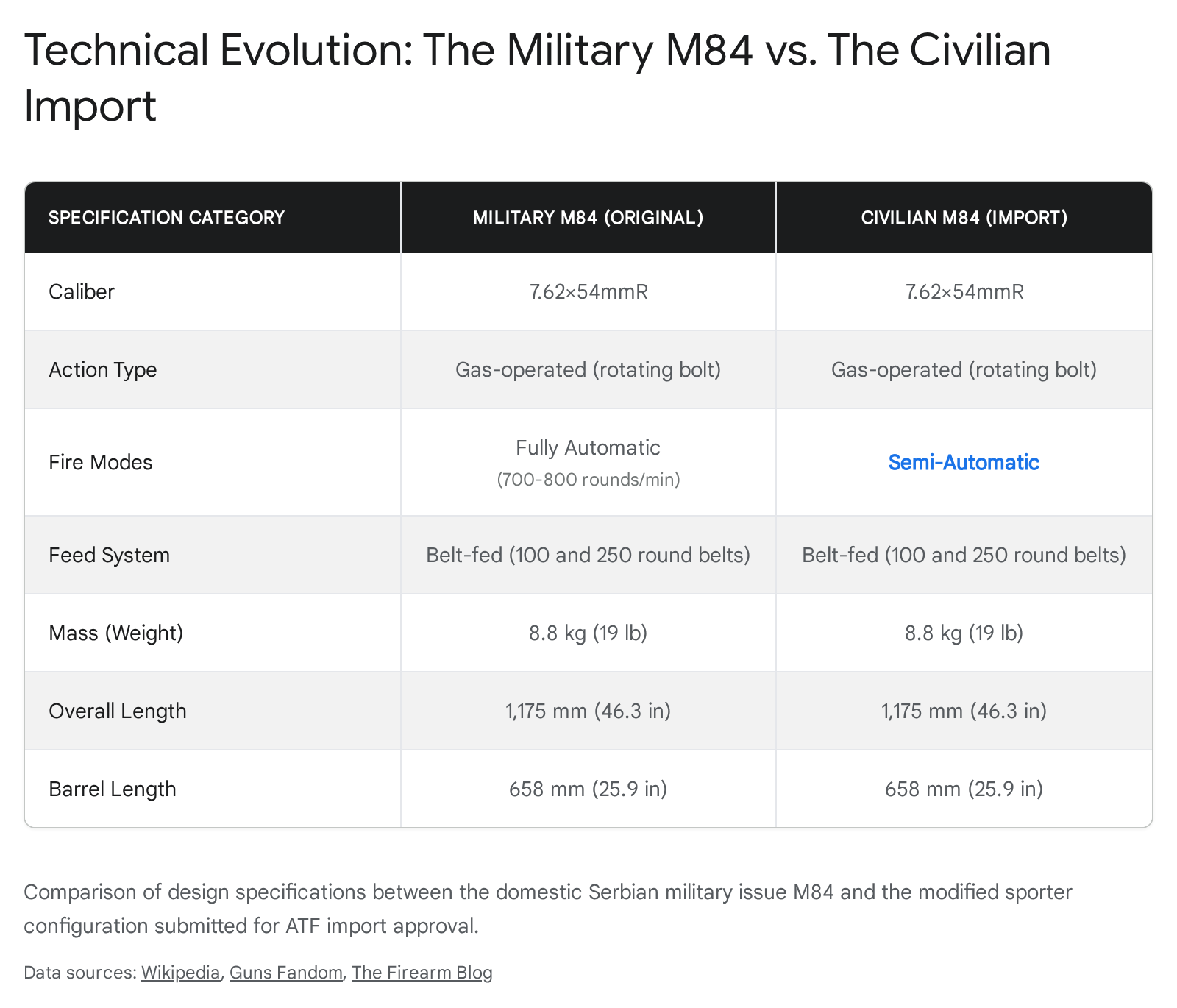
The M84 is a belt-fed general-purpose machine gun that serves as the official Yugoslavian derivative of the legendary Soviet PKM platform. Chambered in the powerful 7.62x54R rimmed cartridge, the original military M84 is a fully automatic, gas-operated, open-bolt shoulder-fired weapon. It earned a formidable battlefield reputation during the Yugoslav wars of the 1990s, where it was heavily utilized by various factions. In regional military culture, the weapon was colloquially named “Ceca” in reference to a famous Serbian pop singer. Soldiers reportedly bestowed this moniker because the distinct, rhythmic, and heavy sound of the weapon’s cyclic rate resembled the driving beat of her music.
While the M84 shares the foundational mechanical architecture of the original Russian PKM designed by Mikhail Kalashnikov, Zastava engineers implemented several distinct regional modifications to suit their tactical doctrine. The Serbian variant utilizes a heavier, easily replaceable 25.9-inch barrel that is entirely non-fluted. This specific design choice prioritizes sustained fire durability and heat mitigation over the lightweight mobility favored by the Russian model. Additionally, the M84 features a solid wood stock, explicitly eschewing the hollowed-out, skeletonized stock characteristic of the Soviet PKM. The resulting firearm is a massive piece of ordnance, weighing approximately 19 pounds empty and measuring over 46 inches in overall length.
During an extensive interview at the SHOT Show 2026 exhibition booth, Zastava USA CEO Ranko Ristic confirmed the company’s intent to bring a sporter version of this historic battlefield implement to the United States. He noted his own personal experience carrying the weapon during the conflicts in the Balkans, adding a layer of authentic historical weight to the presentation. This announcement represents a highly ambitious logistical and engineering undertaking, explicitly targeting the upper echelon of the American firearms collector market who crave unique, mechanically complex systems.
11. Engineering the Civilian M84 Technical Adaptations for Import
Importing a Cold War-era general-purpose machine gun for civilian ownership requires severe and permanent technical alterations to satisfy the aforementioned ATF regulations. The most critical and mechanically complex hurdle is the required conversion from a fully automatic, open-bolt machine gun into a semi-automatic only, closed-bolt sporting rifle.
The ATF strictly prohibits the importation or domestic manufacture of open-bolt semi-automatic firearms. The agency ruled definitively in the early 1980s that open-bolt designs are far too easily converted to illegal automatic fire by simple mechanical manipulation. Therefore, to achieve legal import status, Zastava engineers must completely redesign the internal mechanics of the M84 platform from the ground up.
They are required to develop an entirely new semi-automatic fire control group, fabricate a new closed-bolt carrier system, and engineer a novel mechanism for stripping the heavy 7.62x54R cartridge from the non-disintegrating metal link belt while operating from a closed battery position. This internal redesign is monumental and must be exhaustively evaluated and formally approved by the ATF Firearms and Ammunition Technology Division prior to mass importation. This specific technical evaluation process is notoriously slow and can easily consume several months or even years of regulatory scrutiny.
Beyond the massive internal mechanical overhaul, the exterior profile of the M84 must also be sterilized to pass the 18 U.S.C. 925(d)(3) sporting purposes test. Representatives at the Zastava booth candidly noted that the imported civilian configuration will require the permanent removal of the original factory bipod. Furthermore, the distinctive original flash hider must be removed to eliminate non-sporting muzzle characteristics. Modifying the iconic solid wood stock may also be necessary to ensure absolute compliance with federal anti-assault weapon importation frameworks.
While these federally mandated changes dilute the precise historical authenticity of the firearm, they represent the necessary legal compromises required to transfer a heavy belt-fed weapon from a Serbian armory into the hands of an American civilian.
12. Collector Market Psychology and Consumer Hype
The announcement of the semi-automatic M84 PKM triggered a massive wave of intense discussion across online firearms communities, consumer forums, and industry publications like The Firearm Blog. Analyzing this specific consumer sentiment provides highly valuable insight into the underlying economic dynamics of the high-end collector market.
The primary driver of consumer excitement is the inherent rarity of PK-pattern firearms in the United States. Historically, American civilian access to the PKM platform has been strictly limited to expensive, domestic re-welds of demilitarized parts kits. These kits were often painstakingly assembled by boutique custom manufacturing shops like Wiselite. A factory-produced, newly manufactured PKM variant backed by a major international manufacturer’s warranty represents an entirely unprecedented offering in the domestic market. Enthusiasts on platforms like Reddit have expressed extremely high anticipation, utilizing phrases like “Let Ceca Sing” to signify their eagerness for the official release.
However, this palpable excitement is heavily counterbalanced by apprehension regarding the projected retail cost. Early estimates provided by Zastava representatives during the SHOT Show exhibit place the MSRP of the semi-automatic M84 in the $6,000 range. While this figure is substantially lower than the secondary market prices for custom-built Wiselite PKMs, which frequently exceed $10,000 at auction, it remains prohibitively expensive for the average recreational shooter.
Furthermore, historical purists have voiced deep skepticism regarding the mechanical redesign. Critics argue that forcing a belt-fed weapon designed for open-bolt automatic fire to operate from a closed bolt fundamentally alters the recoil impulse, mechanical cadence, and historical accuracy of the platform. Some observers on social media questioned whether the immense engineering effort to redesign the bolt and fire control group would result in a firearm that is prone to jamming or mechanical failure.
There are also severe practical concerns regarding the logistical cost of ownership. The 7.62x54R cartridge, while historically incredibly cheap during the era of ubiquitous surplus spam cans, has become increasingly expensive and scarce due to recent Russian ammunition import sanctions. Feeding a belt-fed firearm in the current economic climate represents a massive, ongoing financial commitment that only the most dedicated collectors can sustain.
Despite these valid critiques regarding authenticity and operational expense, the market forecast for the Zastava M84 remains highly optimistic. The American firearms community possesses a deep, well-funded collector subset that places an absolute premium on rarity, mechanical novelty, and historical lineage. Similar high-priced, niche imports, such as the semi-automatic DSA RPDs or Zastava’s own M91 sniper rifle, have consistently maintained their high value and consumer demand over time. Firearms in this specific elite category are often viewed not merely as recreational tools, but as tangible financial investments that appreciate against inflation. The unique combination of Zastava’s manufacturing prestige and the sheer mechanical novelty of a belt-fed import ensures that the M84 will likely sell out its initial importation batches immediately upon release.
13. Forward Outlook for Zastava Arms USA
The American civilian firearms market is currently experiencing a period of distinct transition. Following years of exponential, record-breaking sales growth driven primarily by the AR-15 platform and concealed carry handguns, market analysts are noting clear signs of domestic market saturation. In this cooling environment, consumer interest is increasingly pivoting toward alternative platforms that offer historical provenance, unique mechanical operation, and rugged military aesthetics. Eastern European Kalashnikov variants perfectly satisfy this emerging consumer demand.
Zastava Arms USA is uniquely positioned to capitalize on this specific macroeconomic trend. By successfully isolating themselves from the quality control issues historically associated with third-party importers, they have cemented their reputation as a premier, reliable supplier of authentic Serbian firearms. The company’s demonstrated ability to navigate the complex, labyrinthine bureaucratic frameworks of the ATF and the Department of Commerce demonstrates a mature organizational infrastructure highly capable of sustaining long-term growth.
Furthermore, Zastava’s diplomatic and logistical resilience has been thoroughly proven. Navigating a sudden sovereign export ban and unpredictable United States tariff structures requires sophisticated supply chain management and deep political acumen. By surviving these severe disruptions and maintaining stable retail pricing, Zastava Arms USA has fostered immense brand loyalty among American consumers, who view the company as a steadfast provider in a volatile market.
The introduction of high-end collector items like the semi-automatic M84 PKM, coupled with the continued supply of historical surplus items like the M57 Tokarev pistols, indicates a highly strategic expansion beyond the standard sporting rifle market. If Zastava Arms USA can successfully navigate the arduous ATF technology approval process for the M84, it will firmly establish the company not merely as a high-volume importer of standard rifles, but as an elite provider of highly coveted military heritage firearms.
14. Conclusion
The rapid evolution and market dominance of Zastava Arms in the American sector represents a masterclass in vertical corporate integration and regulatory navigation. Transitioning from a risky reliance on third-party entities like Century Arms to the establishment of the exclusive Zastava Arms USA subsidiary in Des Plaines allowed the Serbian manufacturer to reclaim its brand identity. It enabled the company to enforce stringent, uncompromising quality control over complex 922(r) compliance assembly processes.
Operating within the United States necessitates continuous, vigilant adaptation to immense bureaucratic pressures. These range from subjective ATF sporting purpose restrictions to shifting ITAR and EAR technology export jurisdictions. These domestic hurdles are frequently compounded by unpredictable international volatility, perfectly evidenced by the 2025 Serbian export embargo and fluctuating reciprocal tariff rates. Despite these immense logistical challenges, Zastava Arms USA has sustained a highly stable supply of its core ZPAP models, maintaining reasonable retail prices and robust consumer demand.
The highly anticipated announcement of the civilian-legal, semi-automatic M84 PKM perfectly illustrates the company’s aggressive forward momentum. While the required internal mechanical alterations and the high projected retail costs present distinct market challenges, the overwhelming enthusiasm from the collector community highlights the immense commercial value of Eastern European military heritage. Ultimately, Zastava Arms USA has successfully transformed imported logistical complexity into a compelling consumer narrative, permanently securing its position as a dominant, highly respected force in the American sporting and collector firearms industry.
Appendix Methodology
The analysis presented in this report was compiled through a comprehensive review of available open-source intelligence, regulatory frameworks, and market data generated up to April 2026.
Data regarding the corporate history and transition of Zastava Arms USA was sourced directly from manufacturer press releases, company background profiles, and recognized industry publications. Regulatory analysis was conducted by thoroughly reviewing statutes from the United States Code, specifically Title 18 covering firearms, and regulations from the Code of Federal Regulations, specifically Title 27. This was synthesized alongside open letters and official rulings published by the Bureau of Alcohol, Tobacco, Firearms and Explosives. Information concerning the transition of export controls was gathered from guidance provided by the Directorate of Defense Trade Controls and the Bureau of Industry and Security.
Geopolitical context, including the intricate details of the Serbian export embargo and reciprocal United States tariffs, was synthesized from news reports, international trade monitors, and public statements issued directly by Zastava Arms USA via their social media platforms. Information regarding the M84 PKM import announcement, including mechanical specifications, pricing estimates, and required ATF modifications, was derived from interviews conducted at the 2026 SHOT Show, notably interactions between Zastava executives and industry media personnel. Consumer sentiment was evaluated by analyzing qualitative data from public firearm enthusiast forums, specifically examining commentary on mechanical authenticity and price tolerance. Current retail pricing data for the ZPAP series was collected by sampling active listings from major authorized online firearms distributors to ensure an accurate reflection of the current market value.
For the better part of two decades, the entry-level 1911 market in the United States was unequivocally dominated by the Republic of the Philippines. Brands such as Armscor, operating prominently under its highly successful Rock Island Armory (RIA) moniker, established a firm and seemingly unshakeable foothold by offering budget-conscious American consumers reliable, no-frills, Mil-Spec 1911 pistols. These firearms, characterized by their investment-cast frames, extruded small parts, and standard parkerized finishes, successfully democratized the John Moses Browning platform. They allowed millions of shooters to enter the 1911 ecosystem without the prohibitive financial barrier to entry demanded by premium domestic manufacturers. However, market intelligence, consumer sentiment tracking, and aggregate import data spanning the 2024 to 2026 fiscal windows indicate a profound, rapid, and structural paradigm shift within this specific small arms sector. Turkish suppliers—most notably Tisas (Trabzon Silah Sanayi A.Ş.) and Girsan (imported via European American Armory Corp, or EAA)—are actively supplanting Philippine manufacturers as the default providers for entry-level 1911 and 2011-style firearms.1
This transition is not merely a cyclical fluctuation in consumer preference driven by temporary marketing campaigns; it is the direct result of a fundamental realignment in global small arms manufacturing capabilities. The Turkish defense industrial base has leveraged massive state-subsidized advancements to achieve unprecedented economies of scale in precision machining and metallurgy.3 Consequently, Turkish commercial manufacturers are currently delivering forged steel components, modern ceramic-based Cerakote finishes, optic-ready slide capabilities, and fully machined tool-steel internals at retail price points that were historically reserved for cast-metal, bare-bones imports.4 As of early 2026, the American buyer’s perception of Turkish firearms has evolved dramatically from initial skepticism to enthusiastic, widespread endorsement.2 Concurrently, Philippine offerings, though still deeply respected for their functional reliability and historical market presence, are increasingly viewed by the contemporary consumer base as technologically stagnant and comparatively unrefined for the price.5
This comprehensive industry report explores the macroeconomic import data detailing this shift, the geopolitical and infrastructural underpinnings of Turkish manufacturing, the shifting psychology of the American consumer, and an exhaustive technical comparison of the specific products and supply chain dynamics driving this market inversion.
Macroeconomic Trade Analysis and Small Arms Import Data
To accurately measure the magnitude of the Turkish ascendancy within the United States commercial firearms market, one must examine the aggregate import data provided by the Bureau of Alcohol, Tobacco, Firearms and Explosives (ATF) alongside longitudinal tracking from the U.S. Census Bureau and the Stockholm International Peace Research Institute (SIPRI). Historically, the Philippines maintained a comfortable lead in the sub-$500 handgun import sector, relying on steady volume and legacy distribution networks. However, the macro-level trajectory began to diverge sharply in the post-pandemic era, accelerating rapidly into 2024 and 2025.
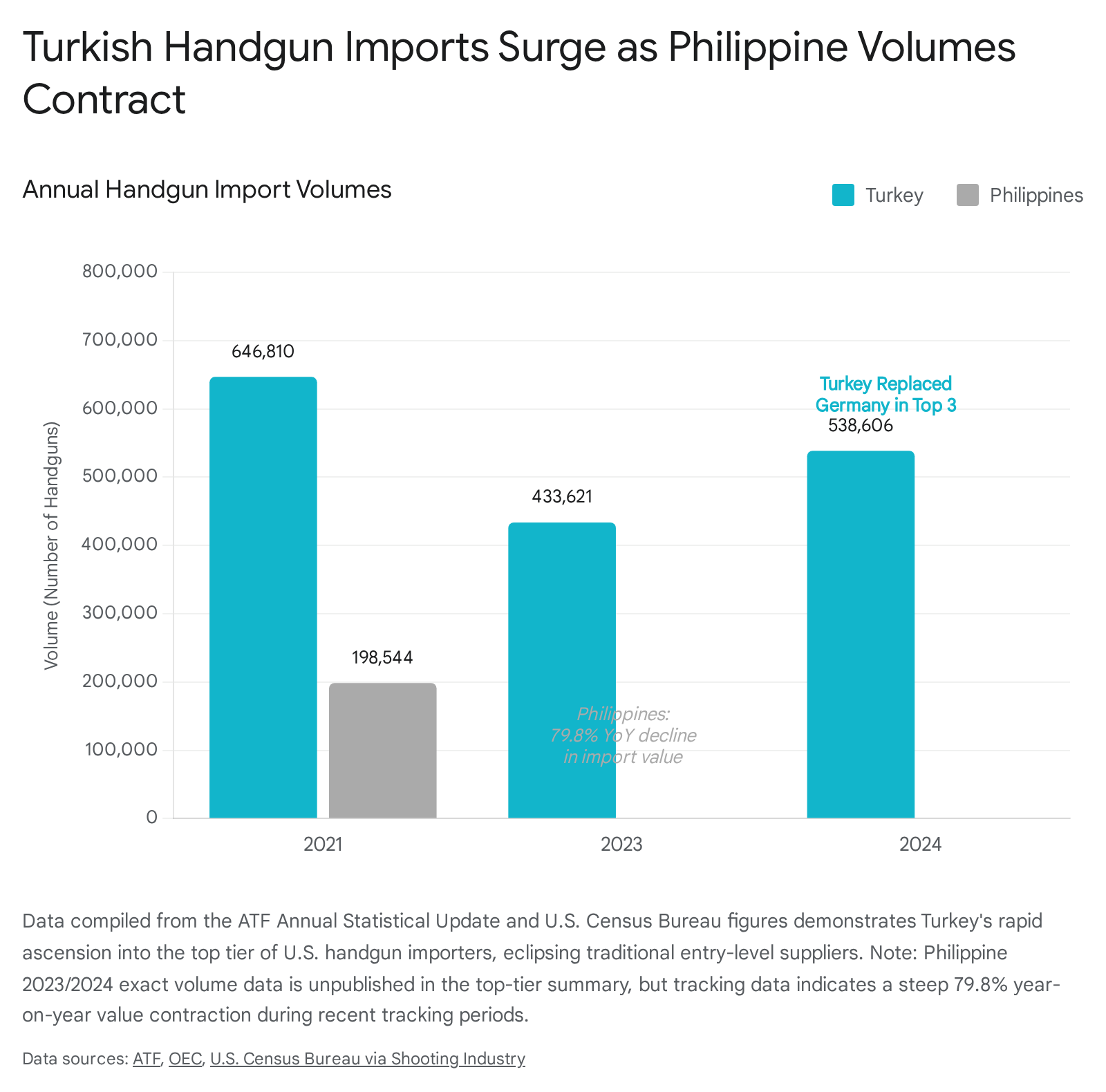
According to the ATF’s Firearms Commerce in the United States Annual Statistical Update, establishing a historical baseline, Turkey had already begun demonstrating massive manufacturing scale by 2021.7 In that fiscal year, Turkey imported 646,810 handguns and a staggering total of 2,734,588 overall firearms to the United States.7 In direct comparison, the Philippines imported 198,544 handguns during the same period, with negligible rifle and shotgun volumes.7 This baseline indicated that Turkish manufacturing was capable of producing at a scale nearly three times that of the Philippines in the handgun sector alone.
By the 2023–2024 reporting period, this volume gap widened exponentially, reshaping the hierarchy of foreign suppliers. Data supplied by the U.S. Census Bureau’s Economic Indicators Division revealed that while total U.S. firearms imports fell slightly in 2024—dropping 7.4% to an aggregate 5,412,509 units—Turkey’s specific handgun imports experienced significant year-over-year counter-cyclical growth.8 Turkish handgun imports surged from 433,621 units in 2023 to 538,606 units in 2024.8 This specific growth vector propelled Turkey past Germany, cementing it firmly as a top-three handgun importer to the United States alongside Austria and Brazil.8 When aggregating all firearms categories across the entirety of 2023 and 2024, Turkey was the absolute dominant force in international arms shipments to the U.S. commercial market, importing an unmatched 2,751,368 total firearms.8
Conversely, Philippine import metrics have exhibited severe signs of contraction in recent quarters. Recent bilateral trade data tracking the fastest-growing and shrinking origins for handgun imports between the 2024 and 2025 tracking periods highlights a precipitous drop in Philippine volume. During a monitored monthly period within this timeframe, year-on-year imports of handguns to the United States from the Philippines decreased by $1.57 million, representing a devastating 79.8% volumetric decline.9 While Austrian and Brazilian imports also saw temporary contractions (-41.3% and -89.8% respectively in specific monthly tracking), the Philippine decline is particularly notable because their core export is directly challenged by the rising Turkish alternatives in the exact same price bracket.9
The global macro-context further supports this localized U.S. market behavior. The Stockholm International Peace Research Institute (SIPRI) reported that global arms flows have shifted significantly, with the United States retaining its position as the world’s premier arms exporter, responsible for 42% of all international arms transfers in the 2021-2025 period.10 However, the U.S. domestic civilian commercial market remains the most lucrative destination for foreign small arms producers. Because the United States produces such a vast quantity of high-end military and civilian firearms domestically, foreign producers must identify specific niches to exploit.8 Turkey’s strategic pivot to target the specific U.S. demographic seeking high-capacity pistol platforms and classic 1911 variants has perfectly captured the market vacuum left by inflating domestic American manufacturing costs and stagnating legacy imports.1
The Philippine Small Arms Paradigm: Legacy, Infrastructure, and Constraints
To understand why the Philippine market share is eroding, it is essential to analyze the historical manufacturing paradigm that built their dominance. For decades, the Philippine firearms industry, spearheaded by Armscor, relied on a highly effective, highly specific economic and industrial model. This model leveraged highly skilled but comparatively low-cost manual labor, utilized older but proven investment casting techniques for core components, and focused on producing reliable, albeit heavy and unrefined, utility firearms.6
When Rock Island Armory introduced its GI Standard 1911s to the American market, the value proposition was undeniable. They provided a functioning, steel-framed 1911 that faithfully replicated the experience of a World War II sidearm for a fraction of the cost of a Colt or Springfield Armory equivalent.6 This model was brilliant for producing a $400 firearm throughout the early 2000s and 2010s. However, the foundational technology relied upon—investment casting—presents distinct engineering ceilings when compared to modern consumer demands. Investment casting involves pouring molten steel into a mold. While entirely safe and reliable when executed correctly with 4140 ordnance steel, cast components inherently require thicker dimensional tolerances to achieve the same metallurgical strength as forged components.13 Furthermore, cast metal can occasionally contain micro-porosities, preventing the ultra-smooth, glass-like slide-to-frame fitment that modern consumers expect even from budget firearms.
In addition to casting, legacy budget 1911s typically rely heavily on Metal Injection Molding (MIM) for their internal fire control components, such as the sear, disconnector, and hammer.5 MIM is a cost-effective manufacturing process where finely-powdered metal is mixed with binder material to create complex shapes, which are then sintered in a furnace. While functional, MIM parts are widely considered by 1911 purists to be inferior to fully machined tool-steel parts, as they are viewed as potential points of failure under extreme use.5
Finally, the finishing processes historically utilized by Philippine manufacturers reflect older military standards. The standard Rock Island Armory finish is parkerizing (manganese phosphate), which is applied over a relatively rough surface preparation.14 Parkerizing is durable and holds oil well, but it provides a matte, gritty texture that is highly susceptible to superficial wear and offers less raw corrosion resistance than modern ceramic-based coatings.6 The Philippine manufacturing model, therefore, optimized for basic reliability and lowest possible cost, leaving substantial room for a competitor willing to invest in modernizing the production line.
The Turkish Defense Industrial Base: Geopolitics and Commercial Spillovers
Turkey’s path to dominating the entry-level 1911 market was radically different and deeply intertwined with international geopolitics. The modern Turkish firearms industry is a direct commercial spillover of a massive, state-backed modernization of its defense industrial base. To comprehend why a Turkish 1911 currently outpaces a Philippine 1911 in both perceived and actual quality at identical retail price points, one must look at the history of Turkish military procurement.
Following the United States arms embargo on Turkey in 1974—resulting from the Turkish military intervention in Cyprus—Ankara recognized the existential vulnerability of relying on foreign nations for defense material.3 This served as a geopolitical wake-up call, prompting the Turkish government to make a strategic, multi-generational decision to achieve self-sufficiency in defense manufacturing.3 State-sponsored defense conglomerates like ASELSAN, ROKETSAN, and Turkish Aerospace Industries (TAI) were formed specifically to eliminate reliance on Western defense imports.3
When Turkey eventually reintegrated into Western defense supply chains, it did so not just as a buyer, but as a heavily subsidized manufacturing partner. By the late 1980s, Turkish aerospace had developed the industrial capacity to co-produce F-16 Fighting Falcon fighter jets alongside General Dynamics and Lockheed Martin at plants in Ankara.3 This allowed Turkish engineers and machinists to master advanced manufacturing tolerances, metallurgy, and quality control systems. Prior to Ankara’s expulsion from the F-35 Joint Strike Fighter program in 2019—a consequence of the controversial purchase of the Russian S-400 air defense system—Turkish aerospace and manufacturing firms were producing over 900 highly complex, tight-tolerance components for the fifth-generation stealth fighter.3
This geopolitical history provides the critical variable explaining current market dynamics. The sudden expulsion from the F-35 program, combined with decades of massive state investments in multi-axis Computer Numerical Control (CNC) machining, advanced metallurgy, and heavy forging capabilities, left Turkish manufacturing conglomerates with a massive surplus of cutting-edge industrial capacity.3 To keep assembly lines running, recoup capital expenditures on CNC machinery, and keep skilled engineers employed, these manufacturing capabilities were pivoted aggressively toward the global commercial export market.2
Therefore, when a United States consumer purchases a $400 Tisas 1911 today, they are not acquiring a firearm assembled in a rudimentary workshop using mid-20th-century casting techniques. They are purchasing a firearm machined on state-of-the-art CNC centers using aerospace-grade forging processes—utilizing capital equipment heavily subsidized by the legacy of the Turkish military-industrial complex.2 This unique macroeconomic advantage allows Turkish brands to offer forged carbon steel frames and slides (which are vastly stronger and can be machined to tighter tolerances than cast frames) at retail prices that Philippine manufacturers, reliant on older casting infrastructure, simply cannot match without totally eroding their profit margins.16
Consumer Psychology and the Evolution of the “Value Paradigm”
The American firearms consumer is highly educated, spec-driven, and relentlessly active on digital forums, social media, and video review platforms. Market perception is shaped rapidly by consensus derived from high-volume testing by independent reviewers.4 In the past, the term “Turkish gun” was frequently treated as a pejorative within the U.S. market, largely associated with cheap, highly unreliable pump-action and semi-automatic shotguns that flooded the market during periodic supply shortages.2 Conversely, Rock Island Armory enjoyed a sterling reputation as the undisputed king of the budget 1911—a reliable “beater” gun backed by stellar U.S.-based customer service and an unquestioned warranty.6
By 2024, and continuing definitively into 2026, this psychological landscape underwent a seismic shift, culminating in what industry analysts and prominent retailers now explicitly term the “Turkish Revolution” in the American firearms scene.2
This psychological shift is driven by a metric best described as the “Value Paradigm.” When an American consumer has $400 to $600 to allocate toward a 1911 acquisition, they now face a stark, side-by-side feature comparison that heavily favors the new imports. The traditional Rock Island Armory offering provides a cast frame, cast slide, basic GI iron sights, a heavy 4-to-6 pound trigger pull, and a gritty parkerized finish.5 Furthermore, these legacy 1911s in the budget bracket utilize the aforementioned Metal Injection Molding (MIM) for internal parts.5
Enter the Turkish alternatives from Tisas and Girsan. Consumers rapidly began realizing that for the exact same monetary outlay—and sometimes less during aggressive promotional cycles—Tisas was providing hammer-forged frames, forged slides, and modern Cerakote finishes.21 Cerakote, a polymer-ceramic composite coating, is highly resistant to wear, abrasion, and corrosion, offering a massive aesthetic and functional upgrade over traditional parkerizing.22 Most devastatingly to competitors, Tisas made a highly publicized, strategic marketing move to eliminate almost all MIM parts from their internal fire control groups, replacing them with fully machined tool-steel parts.5
User testimonials from dedicated 1911 forums from 2024 to 2026 reflect this shift perfectly. Long-term 1911 aficionados report struggling to find any mechanical negatives with Tisas pistols, noting that straight out of the box, the slides cycle smoothly without the grit or rattle that was traditionally accepted as the standard compromise for a budget 1911.19 This smoothness is the direct hallmark of tight CNC machining tolerances. Reviews routinely state that picking up a $750 Turkish 1911 or 2011 feels mechanically and aesthetically indistinguishable from an American-made firearm costing upwards of $1,500.21 While Rock Island Armory is still viewed favorably for its ultimate reliability, the brand is increasingly perceived by the market as heavy, archaic, and unrefined when placed adjacent to the sleek, feature-rich Turkish imports.5
Feature Matrix Comparison: Standard Entry-Level Implementations
Clean lines, subtle roll marks, modernized slide serrations
Turkish Advantage (Appeals to modern tactical aesthetics)
Product Deep Dive: The Single-Stack 1911 Market Inversion
To empirically illustrate this market dynamic, a granular analysis of the specific products driving retail sales is required. The single-stack 1911 chambered in .45 ACP remains a foundational staple of the American firearms market, revered for its rich military history and proven stopping power. The battle for entry-level dominance is perfectly encapsulated by the clash between the primary Philippine incumbent and the rising Turkish challenger.
The Incumbent: Rock Island Armory GI Standard FS .45 ACP
The Rock Island Armory (RIA) GI Standard FS is the quintessential entry-level 1911.6 Manufactured by Armscor in the Philippines, it is purposefully designed to mimic the original U.S. military sidearms of the first and second World Wars.6 It features a 5-inch button-rifled barrel, fixed low-profile iron sights, a heavy 4-to-6 pound single-action trigger pull, smooth wood grips, and a matte black parkerized finish.14 Weighing in at roughly 2.5 pounds unloaded, it is a robust, heavy piece of ordnance steel.15
While it is undeniably reliable—often cited in long-term reviews as a firearm that can run thousands of rounds without catastrophic mechanical failure—it represents the older paradigm of budget manufacturing.6 The generous tolerances that guarantee its reliability also ensure it lacks the refined feel of a premium firearm.6
The direct Turkish competitor challenging this dominance is the Tisas 1911 A1 Service model. At an identical or frequently lower retail price point, the Tisas completely redefines the entry-level value proposition. Like the RIA, it is a faithful reproduction of the WWII-era U.S. service pistol, featuring the classic straight mainspring housing, short trigger, and standard sights.28 However, the underlying construction is vastly different.
The Tisas utilizes a forged carbon steel frame and slide, a hammer-forged barrel, and typically features a modern black Cerakote finish rather than rudimentary parkerizing.29 Furthermore, the lack of MIM parts in the critical fire-control group yields a significantly smoother trigger pull straight out of the box, addressing one of the primary complaints levied against legacy budget imports.5 For the consumer, purchasing the Tisas means acquiring modern metallurgical strength and CNC precision disguised within a vintage aesthetic, completely undermining the RIA GI’s core market position.31
Product Deep Dive: The 2011 Double-Stack Market Disruption
While the single-stack market demonstrates a clear Turkish advantage in metallurgy and finishing, the true strategic battleground defining the 2024–2026 fiscal window is the “2011” or double-stack 1911 market. Traditionally, this sector was the exclusive domain of ultra-premium domestic brands like Staccato, Atlas, and Phoenix Trinity, where entry-level duty models rapidly approach the $2,500 to $3,000 threshold.2 However, the U.S. market exhibited massive pent-up demand for a reliable double-stack 9mm 1911-style pistol priced under $1,000.37 Both Philippine and Turkish manufacturers recognized this vacuum, but their engineering approaches to filling it were diametrically opposed.
The Philippine Approach: Rock Island TAC Ultra FS HC 9mm
Armscor’s response to the high-capacity demand was the Rock Island TAC Ultra FS HC.14 Retailing between $749 and $899, this pistol offers a 17-round capacity in 9mm, a full under-barrel tactical picatinny rail, an adjustable rear sight, fiber optic front sights, and battle-ready G10 tactical grips.38
However, from an engineering and nomenclature standpoint, the TAC Ultra is a “double-stack 1911,” not a true “2011”.23 A true 2011 platform utilizes a modular design pioneered by STI, featuring a machined steel or aluminum upper frame structure mated to a lightweight polymer lower grip module.23 This modularity significantly reduces weight and improves grip ergonomics. The Rock Island TAC Ultra, conversely, relies on a monolithic, entirely forged/cast steel frame.38 This traditional construction makes the firearm incredibly heavy, weighing over 43 ounces (2.5+ pounds) unloaded.38 Furthermore, it relies on older Para-Ordnance P14/P16 style double-stack magazines, which are proprietary and critically lack the massive aftermarket support, basepad expansion options, and tuning infrastructure of the true 2011 STI/Staccato magazine ecosystem.5
While the Rock Island TAC Ultra is beginning to adopt modern Authorized Optics System (AOS) slide cuts to mount red dot sights 40, its sheer weight and older magazine geometry relegate it to specific niches rather than mainstream duty or concealed carry acceptance.
While the Philippine Rock Island TAC Ultra relies on a heavy, monolithic steel frame, modern Turkish competitors utilize the STI-pioneered modular design, mating a steel sub-chassis to a lightweight polymer grip module. This structural distinction significantly alters the weapon’s overall balance, reduces carry weight, slims the grip profile for better ergonomics, and ensures compatibility with the robust 2011 aftermarket ecosystem.23
The Turkish Response: EAA Girsan Witness 2311 & Tisas DS9 Night Stalker
Sensing the vulnerability of the heavy RIA monolithic platform, the Turkish defense sector immediately reverse-engineered the true modular 2011 design, optimized it for mass CNC production, and flooded the U.S. market with highly competitive variants.
EAA Girsan Witness 2311 (9mm): Imported aggressively by European American Armory (EAA), the Girsan Witness 2311 explicitly targets the budget 2011 space.45 Featuring a true polymer grip module mated to a steel receiver, it is significantly lighter and more ergonomic than the RIA.23 Crucially, the Witness 2311 accepts standard double-stack 2011 magazines, allowing users to tap into a massive aftermarket of highly reliable magazines from companies like Staccato, Atlas, and Duramag.46 The platform comes optic-ready from the factory (utilizing the popular RMSc footprint), features an extended beavertail, a skeletonized trigger, and commands a highly disruptive retail price frequently hovering around $800 to $850.47 EAA has further expanded this line in 2026 to include the “Match X” variants, which include integral barrel compensators and tuned 4.5 lb triggers for roughly $1,100, directly threatening the mid-tier domestic 2011 market.49
Tisas Duty DS9 Night Stalker (9mm): If the Girsan Witness provides utility, the Tisas DS9 Night Stalker represents the apex of Turkish entry-level aesthetics and engineering. With an MSRP of $960 (and a highly aggressive street price frequently seen between $599 and $813), it provides a feature set previously unimaginable at the sub-$1000 price point.52 It utilizes forged carbon steel for the slide and frame, a polymer grip module with 25LPI checkering, an aluminum removable magazine well, tritium front night sights, and aggressive slide lightening cuts to reduce reciprocating mass.17 The Platinum Grey Cerakote finish, combined with blacked-out small parts, gives it the aesthetic presence and mechanical feel of a bespoke $3,000 race gun.52 Because it mimics the standard 2011 modularity perfectly, it completely eclipses the Rock Island offering for modern tactical shooters seeking a duty-capable high-capacity platform.54
Supply Chain Reorganization and U.S. Domestic Footprints
The final metric confirming the permanent nature of the Turkish ascendancy is the aggressive maturation and reorganization of their United States distribution networks and supply chains. For years, Turkish manufacturing brands relied heavily on third-party U.S. importers to navigate ATF regulations, handle marketing, and manage warranty services. Tisas, for instance, relied extensively on SDS Imports, a company based in Knoxville, Tennessee, to handle their North American operations.58 SDS Imports performed the heavy lifting required to establish the brand’s credibility in America, overcoming the initial stigma associated with Turkish firearms and establishing a robust dealer network.16
However, in a massive strategic maneuver executed in early 2026, Tisas (Trabzon Silah Sanayi A.Ş.) officially terminated its exclusive importation and distribution agreement with SDS Imports.58 Seeking to maximize wholesale profit margins and exercise total, unilateral control over their North American market presence, Tisas launched a new corporate entity, “Tisas Arms Corp,” establishing a dedicated U.S. headquarters and direct importation facility in Buford, Georgia.32
This corporate decoupling is a textbook indicator of an industry supplier transitioning from an emerging, reliant threat to an entrenched, self-sustaining market leader. By cutting out the third-party middleman (SDS Imports), Tisas can theoretically lower wholesale prices to massive U.S. distributors even further while simultaneously retaining higher profit margins per unit sold.16 To assuage consumer fears regarding the transition, the newly formed Tisas Arms Corp has publicly pledged to honor all lifetime warranties on previously sold models and maintain service support directly from their Georgia facility.32
EAA Corp has maintained a similarly aggressive grip on the Girsan brand, heavily marketing the Witness 2311 line with the explicit, combative slogan “Why Pay More”.47 This marketing strategy directly attacks both high-end domestic boutique makers and legacy budget imports, signaling ultimate confidence in their supply chain and manufacturing volume.
Strategic Outlook and Long-Term Market Implications
Armscor and Rock Island Armory are not entirely defenseless in the face of this Turkish market saturation. They maintain an immense legacy footprint, massive brand recognition, and an incredibly loyal customer base that values their historically excellent customer service. Furthermore, Armscor has smartly recognized the shifting tides and has invested heavily in U.S.-based manufacturing. By establishing RIA-USA in Cedar City, Utah, they have begun producing the highly innovative, non-1911 RIA 5.0 platform—a firearm featuring a patented recoil system that aims to compete in the high-end competition market rather than the budget sector.61
However, in the specific, highly competitive realm of the traditional entry-level 1911 and the rapidly expanding budget 2011 market, their offshore Philippine manufacturing wing is finding it structurally and economically impossible to match the CNC-forged output of the Turkish defense sector at a $400 to $800 price point. The technological debt inherent in relying on investment casting and MIM parts cannot be overcome by brand loyalty alone when consumers are offered objectively superior metallurgy for the same price.
The observation that Turkish suppliers are supplanting the Philippines as the preferred source for entry-level 1911 and 2011 firearms is empirically, technically, and strategically accurate. The evidence is overwhelming across macro-economic import data, metallurgical feature sets, online consumer sentiment, and corporate supply chain investments.
The core drivers of this shift are immutable in the short to medium term. First, Turkey’s geopolitical military ambitions inadvertently created a commercial small arms powerhouse capable of producing aerospace-grade forgings at investment-cast prices.2 Second, rather than competing solely on the classic, saturated single-stack 1911 market, Turkish firms aggressively leapfrogged legacy competitors by pivoting to the high-margin, high-demand “2011” double-stack market. They offered true optic-ready, polymer-grip modularity that the legacy Philippine steel plants were simply not tooled to replicate quickly or cheaply.23 Finally, the 2026 establishment of Tisas Arms Corp in Georgia signals a permanent, deeply capitalized Turkish presence on U.S. soil, stripping away the final stigma of the “fly-by-night” foreign importer.32
For the American buyer, the entry-level 1911 market has never offered more intrinsic value or out-of-the-box performance. The Turkish product lines currently provide features—such as integrated compensators, optic cuts, and machined internals—that required costly, specialized gunsmithing just a decade ago.22 For Philippine manufacturers, survival and relevancy in this specific sub-sector will require a fundamental, highly capital-intensive re-tooling away from cast legacy designs, or a complete, permanent pivot toward their newer, domestically produced American innovations. Until such an infrastructural pivot occurs, Turkey will unequivocally remain the undisputed sovereign of the entry-level 1911 and 2011 marketplace.
Note: Vendor Sources listed are not an endorsement of any given vendor. It is our software reporting a product page given the direction to list products that are between the minimum and average sales price when last scanned.
1. Geopolitical Context and the Implementation of the Swiss Arms Embargo
The international defense logistics framework is currently adapting to a significant structural disruption caused by recent policy enforcement actions taken by the Swiss Federal Council. On March 20, 2026, the Swiss government formally announced an indefinite suspension of all new authorizations for the export of war materiel to the United States of America.1 This monumental policy shift represents a direct and strict application of Switzerland’s historic neutrality laws, which were specifically triggered by the rapid escalation of the international armed conflict involving the United States, Israel, and Iran.2 The geopolitical catalyst for this embargo was Operation Epic Fury, an extensive military engagement initiated on February 28, 2026, which fundamentally altered the Swiss government’s legal classification of the United States’ status as a belligerent nation.4
Under the stringent regulations of the Swiss War Materiel Act, specifically Article 22a, Paragraph 2, Letter a, the Swiss government is legally prohibited from authorizing the export of military equipment to any sovereign nation that is actively engaged in an international armed conflict.2 Because the Swiss Federal Council officially recognized the ongoing Middle Eastern operations as an active international conflict, the implementation of the export ban to the United States became a legal inevitability rather than a discretionary diplomatic posture.6 This statutory trigger immediately paralyzed the approval process for all pending and future arms contracts, severing a critical supply line that numerous American defense and law enforcement agencies have relied upon for decades.
The immediate economic and logistical implications for the United States defense market are profound and multi-faceted. In the calendar year preceding the embargo, the United States stood as the second-largest global importer of Swiss defense products, absorbing approximately ten percent of all Swiss arms shipments.1 These high-value exports, totaling 94.2 million Swiss francs, predominantly consisted of specialized aerial systems, advanced defense electronics, high-precision small arms, and premium match-grade ammunition.1 The sudden and total cessation of new export licenses effectively terminates the direct supply of highly coveted Swiss-manufactured munitions to American law enforcement tactical teams, military special operations units, and elite competitive civilian shooters.3
While the Swiss Federal Council initially stated that existing export licenses deemed totally irrelevant to the current Middle Eastern conflict might temporarily continue to be utilized, the regulatory environment remains highly precarious.2 To ensure absolute compliance with neutrality statutes, the Swiss government convened a specialized interdepartmental expert group comprising senior officials from the Federal Department of Economic Affairs, the Federal Department of Foreign Affairs, and the Federal Department of Defence, Civil Protection and Sport.2 This regulatory body is tasked with continuously monitoring the geopolitical landscape and holds the unilateral authority to revisit, arbitrarily suspend, or entirely revoke any existing licenses if circumstances dictate stricter adherence to the neutrality protocols.7
Furthermore, this intensive regulatory scrutiny extends far beyond conventional war materiel. The interdepartmental expert group is actively reviewing exports of dual-use technologies and specific specialized military items regulated under the Swiss Goods Control Act, including training simulators and aviation components.2 The application of these restrictive measures in 2026 is consistent with historical precedents set by the Swiss government. The nation previously enforced similar arms export embargoes against countries participating in the 2003 invasion of Iraq and recently prevented allied European nations from re-exporting Swiss-made armored vehicles and anti-aircraft munitions to Ukraine.1 However, the restriction on direct exports to the United States represents an unprecedented bottleneck for niche precision ammunition markets, particularly concerning the availability of the highly regarded Swiss P line of match-grade cartridges originally manufactured by the state-owned entity RUAG Ammotec.4
2. The Engineering and Ballistic Profile of At-Risk Swiss P Munitions
To accurately quantify the market gap created by the embargoed Swiss P ammunition, it is necessary to thoroughly analyze the exacting engineering standards and uncompromising manufacturing tolerances that define the brand. Swiss P, currently manufactured by SwissP Defence AG at their primary facility in Thun, Switzerland, is universally revered across global law enforcement and military sniper communities for its unparalleled reliability and terminal ballistic performance.10 The manufacturing process at the Thun facility is characterized by a level of rigorous quality assurance rarely seen in commercial ammunition production. Metallurgical engineers continuously monitor every sequential micro-step of the production line, beginning with the initial stamping and extrusion of the raw brass cups, proceeding through proprietary pickling and annealing processes, and culminating in the final seating of the projectile.11
The most significant operational hallmark of the Swiss P line is its concept of matched ballistic performance across diverse projectile types. The ballisticians at SwissP Defence AG have painstakingly designed completely different cartridge variants within a given caliber to share identical points of impact at a distance of one hundred meters.12 This specialized engineering allows a tactical police sniper or military operator to transition seamlessly from a standard full metal jacket training round to an armor-piercing projectile or a glass-penetrating tactical round without ever needing to adjust the optic’s elevation or windage dials.12 This capability is absolutely critical in dynamic, high-stress law enforcement scenarios where target conditions and barrier environments can alter instantaneously.
The product catalog is meticulously divided into several highly specialized categories tailored for specific tactical applications. The Swiss P Target line utilizes a highly uniform hollow point boat tail projectile featuring a proprietary tombac jacket, designed specifically for maximum aerodynamic efficiency and sub-minute-of-angle precision at extended distances.13 For engagements requiring immediate energy transfer, the Styx Action line incorporates a fast-expanding hollow point designed to transfer maximum kinetic energy into soft targets, effectively mitigating the severe risk of over-penetration in crowded urban environments.10 Furthermore, the Armour Piercing and Tactical variants are engineered with specialized tungsten or hardened steel core compositions to defeat hardened barriers and intermittent obstacles, such as automotive windshield glass, without suffering catastrophic bullet deflection or premature jacket separation.10
Because these premium cartridges employ J4 precision jackets with near-perfect concentricity, highly temperature-stable extruded propellants, and benchrest-quality non-corrosive primers, they exhibit incredibly low standard deviations in muzzle velocity.15 Independent chronological testing of the Swiss P Target .308 Winchester 168-grain load routinely demonstrates extreme spreads of less than forty feet per second, yielding accuracy averages that hover near one-quarter of an angular minute when fired through heavy-barreled precision rifles.16 The recent introduction of cutting-edge counter-unmanned aerial systems munitions, such as the Shatter4K anti-drone loads designed to disable hostile quadcopters, further highlights the brand’s innovative trajectory.17 Replacing this exceptional level of consistency and specialized functionality requires American procurement officers to source alternatives from the absolute highest tier of domestic and international match-grade manufacturers.
3. Corporate Restructuring and the Mitigation of Supply Chain Vulnerabilities
A comprehensive understanding of the supply chain dynamics and the potential pathways to circumvent the Swiss export restrictions requires a detailed analysis of the recent corporate restructuring of RUAG Ammotec. Historically, RUAG Holding operated as a massive, state-owned Swiss aerospace and defense conglomerate.18 Its highly profitable small-caliber ammunition division, RUAG Ammotec, was universally recognized as the undisputed European market leader in the production of precision ammunition for military, law enforcement, and civilian applications.19 The division operated an extensive network of manufacturing facilities located in Switzerland, Germany, Sweden, Hungary, and the United States, producing highly respected heritage brands such as Swiss P, RWS, Norma, Geco, and Rottweil.18
In a strategic divestment initiative mandated by the Swiss Federal Council, RUAG International sought to transition entirely away from terrestrial defense manufacturing to focus its resources exclusively on advanced aerospace technologies under the newly formed Beyond Gravity brand.19 Consequently, in the summer of 2022, the prominent Italian family-owned firearms conglomerate Beretta Holding S.A. successfully completed the acquisition of one hundred percent of the shares of the RUAG Ammotec Group.22 This monumental acquisition integrated over 2,700 employees, sixteen distinct companies, and five primary heavy manufacturing sites across twelve different countries into the broader Beretta Holding portfolio.22
Following the finalization of the acquisition, Beretta Holding initiated a comprehensive corporate rebranding and structural reorganization designed to optimize global distribution logistics and align with localized regional defense requirements. The entire ammunition business was consolidated under a newly formed sub-holding company named Ammolux, strategically headquartered in Luxembourg to facilitate international trade.24 The original Swiss manufacturing arm located in Thun, which is responsible for the production of the premium tactical and sniper ammunition, was rebranded as SwissP Defence AG.24 The massive German operations, which account for more than half of the total ammunition workforce, continue to operate under the prestigious RWS name, while the Swedish and American facilities operate under the Norma and Norma Precision brands respectively.24
This highly decentralized manufacturing footprint is the critical mechanism that allows Beretta Holding to mitigate the severe impacts of the 2026 Swiss arms embargo. The Ammolux sub-holding operates specialized manufacturing nodes across Europe and North America, insulating the broader supply chain from localized geopolitical export bans. Because the Swiss neutrality laws and the War Materiel Act apply strictly to goods manufactured within and physically exported from the sovereign territory of Switzerland, Beretta Holding’s offshore facilities remain entirely unaffected by the Federal Council’s restrictive export ban.1 The central corporate node in Luxembourg branches out to manufacturing nodes globally, highlighting how the isolation of the Swiss node in Thun due to the current embargo does not cripple the entire enterprise. The operational nodes in Germany, Sweden, Hungary, and the United States remain fully capable of sustaining production. The acquisition effectively transformed Beretta Holding into a truly global player capable of supplying firearms, advanced optics, and precision ammunition as a cohesive, integrated package, resulting in consolidated net sales revenues exceeding 1.4 billion Euros shortly after the final integration.27 By leveraging this expansive international footprint, the corporate entity possesses the strategic agility to shift production loads across borders and bypass the restrictive export bottlenecks that currently plague Swiss-based manufacturing facilities.
4. The Expansion of Domestic United States Manufacturing Infrastructure
The United States represents the single largest commercial and defense firearms market globally, making the maintenance of a robust, uninterrupted supply chain to this region an absolute paramount concern for Beretta Holding and its Ammolux subsidiaries.24 Recognizing the inherent vulnerabilities associated with trans-Atlantic shipping lanes, fluctuating international tariffs, and the increasingly stringent European export control regimes, the corporate leadership has aggressively invested in establishing vast domestic United States manufacturing capabilities. This strategic foresight is perfectly exemplified by the rapid and massive expansion of Norma Precision Inc., the American subsidiary of the former Ammotec group.
For over a decade, Norma Precision operated a relatively modest manufacturing, assembly, and importation hub located in Tampa, Florida.29 However, the severe logistical challenges and unprecedented consumer demand surges witnessed during recent global disruptions prompted a massive scaling of domestic operations. In April 2022, Georgia Governor Brian P. Kemp officially announced that Norma Precision would relocate its United States headquarters, primary manufacturing operations, and advanced distribution centers to Chatham County, Georgia.30 This initial strategic relocation was subsequently followed by an even larger corporate commitment in November 2022, when Beretta Holding announced a massive sixty-million-dollar capital investment to construct a state-of-the-art, 300,000-square-foot manufacturing facility in Bryan County, Georgia.32
This sprawling new facility is specifically designed and equipped to produce high-end precision ammunition for the commercial hunting, competitive shooting, military, and law enforcement sectors across North America.32 By establishing this massive domestic footprint in the Georgia Lowcountry, Norma Precision drastically reduces its reliance on imported shipping containers from the various European factories. Prior to this massive expansion, the company imported over four hundred shipping containers of finished ammunition annually from RUAG Ammotec facilities in Europe, while only producing roughly thirty million cartridges domestically.31 The operationalization of the new Savannah-area facility fundamentally flips this dynamic, ensuring that a highly significant portion of the premium ammunition required by the United States market is machined, loaded, tested, and distributed entirely within domestic borders.
For the specific Swiss P product lines that are currently blocked by the 2026 embargo, this extensive offshore manufacturing infrastructure provides multiple highly viable alternative supply vectors. Ammunition that was traditionally manufactured at the isolated Thun facility in Switzerland can theoretically be re-allocated to the expansive RWS plant in Germany or the historic Norma plant in Amotfors, Sweden.24 The Swedish Norma facility boasts a rich history spanning over one hundred and twenty years of precision engineering, expertly managing the entire vertical production cycle from the initial brass extrusion to the final seating of the projectile.35 Similarly, the Hungarian Hexagon facility, formerly known as MFS, possesses the advanced tooling and capabilities required to produce high-volume, NATO-standard military and law enforcement ammunition at scale.24 By dynamically utilizing these alternate European facilities, or by rapidly ramping up match-grade production at the newly minted Georgia plant, Beretta Holding can effectively bypass the authority of the Swiss State Secretariat for Economic Affairs and maintain a continuous flow of precision cartridges to American consumers and government agencies.
5. Market Displacement and Top Alternatives for At-Risk Cartridges
With the importation of authentic Swiss P products completely halted by the Federal Council, procurement officers, elite competitive shooters, and tactical law enforcement teams must immediately identify highly viable, drop-in replacements. The following comprehensive subsections detail the top five match-grade alternatives for the primary calibers severely affected by the embargo. The carefully selected alternatives prioritize identical or highly similar projectile weights, advanced boat tail hollow point designs, and strict match-grade manufacturing tolerances to ensure comparable ballistic coefficients, trajectory arcs, and terminal performance.
5.1 .308 Winchester (7.62x51mm NATO) Match Cartridges
The .308 Winchester remains the quintessential law enforcement sniper and medium-game hunting cartridge across the North American continent. It offers an exceptional balance of extended barrel life, manageable recoil impulses, and devastating terminal energy out to distances of eight hundred yards.38 The Swiss P 168-grain and 175-grain Target loads have long served as the ultimate benchmark for this caliber, particularly in urban policing environments.16 The alternatives listed below utilize industry-leading projectiles, such as the legendary Sierra MatchKing and the technologically advanced Hornady ELD Match, to perfectly replicate the aerodynamic stability and precise jacket concentricity required by discerning marksmen.
Federal’s Gold Medal Match, specifically the load utilizing the 175-grain Sierra MatchKing, is widely considered the absolute gold standard for factory-loaded precision ammunition in the United States, and it is routinely used by custom rifle manufacturers to accuracy-test their barrels before shipment.39 Black Hills Ammunition, a highly respected firm that supplies specialized match ammunition to all branches of the United States military, offers a heavily scrutinized open tip match load that guarantees phenomenal lot-to-lot consistency and minimal extreme spreads.41
The .338 Lapua Magnum was explicitly engineered in the early 1980s through a highly successful collaboration between Research Armament Industries, Lapua, and Accuracy International, designed specifically to bridge the vast ballistic gap between the .300 Winchester Magnum and the massive .60 BMG.43 Utilizing a heavily modified and necked-down.416 Rigby parent case, the cartridge was designed from its inception to propel a heavy, aerodynamically efficient projectile capable of reliably defeating military-grade body armor at distances exceeding one thousand meters.43 The Swiss P 250-grain and 300-grain Target rounds are deeply integrated into military sniper programs globally, necessitating highly capable and carefully vetted replacements.
The Lapua Scenar open tip match projectile remains the absolute foundational benchmark for this specific caliber, currently holding numerous long-range competitive world records.46 Hornady’s ELD Match projectile incorporates a highly specialized Heat Shield polymer tip that fundamentally prevents aerodynamic deformation caused by extreme frictional heating during supersonic flight, ensuring that the ballistic coefficient remains perfectly constant across the entire trajectory.48
Introduced to the commercial market in 1963, the .300 Winchester Magnum utilizes a highly robust, belted magnum case derived directly from the classic.375 H&H Magnum to deliver massive internal powder capacities and exceptionally high muzzle velocities .60 It remains a primary chambering for military sniper systems seeking to push heavy, aerodynamically efficient thirty-caliber projectiles well beyond the transonic boundaries that inherently limit the smaller .308 Winchester.45 The Swiss P Target line in this caliber typically employs heavy 190-grain or 200-grain projectiles specifically designed to maximize wind resistance over vast, open terrain.53
Berger’s acclaimed Classic Hunter and Match projectiles utilize a highly innovative hybrid ogive design, brilliantly blending the high ballistic coefficients of a long secant ogive with the seating depth tolerance and reliable feeding geometry of a traditional tangent ogive.54 This complex geometric engineering makes them exceptionally reliable in both precision bolt-action rifles and high-capacity, magazine-fed semi-automatic weapon systems utilized by modern tactical units.15
5.4 .223 Remington (5.56x45mm NATO) Match Cartridges
While commonly associated with lightweight 55-grain full metal jacket rounds designed primarily for basic infantry engagements and high-volume training use, the 5.56x45mm NATO cartridge is incredibly capable in dedicated precision roles when loaded with significantly heavier projectiles.57 The historical military transition to much faster barrel twist rates, specifically one-in-seven or one-in-eight inches, allowed for the proper gyroscopic stabilization of long, high-drag projectiles weighing 69 grains and 77 grains.57 The Swiss P Styx Action and Target lines in this specific caliber provided urban tactical police units with a premium round capable of pinpoint accuracy without the severe over-penetration liabilities inherent to larger thirty-caliber systems.13
Black Hills Ammunition is particularly notable and highly dominant in this specific category, having meticulously developed the famous MK262 Mod 1-C load utilized extensively by United States Special Operations Command.41 This exceptional cartridge employs a 77-grain Sierra MatchKing projectile and is universally renowned for extracting the absolute maximum effective range and terminal lethality from the standard AR-15 weapon platform.58
5.5 .60 Browning Machine Gun (BMG) Match and Target Cartridges
Conceived originally by the legendary John Browning in 1918 primarily as an anti-aircraft and heavy water-cooled machine gun round, the immense .60 BMG has slowly evolved into an extreme long-range anti-materiel and precision target cartridge.62 Generating over twelve thousand foot-pounds of kinetic energy at the muzzle, the resultant recoil forces and atmospheric displacement are massive, demanding absolute structural integrity from both the heavy projectile and the massive brass casing.63 Swiss P manufactures highly specialized armor-piercing and match variants of this caliber, providing extreme consistency for heavy, tripod-mounted rifle platforms deployed by military snipers.
When absolute match-grade performance is strictly required to hit targets beyond a mile, Hornady’s 750-grain A-MAX load currently dominates the high-end commercial space.65 For high-volume tactical training and practical field application, the solid brass monolithic projectiles expertly manufactured by PMC, along with the standardized M33 ball configurations from Federal and Barrett, offer highly reliable feeding and predictably stable ballistic arcs without incurring the extreme premium cost associated with specialized match components.67
6. Economic and Logistical Implications for the United States Market
The abrupt cessation of Swiss ammunition imports coincides with a much broader period of severe economic volatility and escalating regulatory complexity within the United States defense manufacturing sector. The domestic ammunition market is inherently highly sensitive to sudden geopolitical shocks, unexpected raw material shortages, and constantly shifting global trade policies.70 As the stringent Swiss embargo artificially constricts the overall supply of premium European cartridges, domestic manufacturers and wholesale distributors face intense pressure to rapidly fill the void, inevitably impacting both retail and wholesale pricing matrices across the entire industry.70
Pricing dynamics for match-grade ammunition are heavily influenced by the raw cost of specialized components, particularly the highly refined copper and lead alloys strictly required for drawing precisely concentric bullet jackets.11 Furthermore, the shifting political landscape in the United States, including anticipated tariff adjustments on imported raw metals and energetic chemicals, continuously threatens to elevate baseline production costs.70 When a massive premium provider like Swiss P is suddenly removed from the commercial ecosystem, competitive shooters and municipal procurement officers are forced to compete aggressively for the remaining finite supply of domestic match loads like Federal Gold Medal and Black Hills MK262.38 This sudden surge in localized demand generally compresses vendor profit margins on bulk orders and simultaneously drives up the per-round cost for the final end consumer, straining department training budgets.28
However, the highly aggressive onshoring strategies enacted by massive corporate entities like Beretta Holding serve as a critical economic counterweight to these inflationary pressures. By intentionally shifting the manufacturing of high-demand Norma and RUAG heritage products to their new sixty-million-dollar Savannah facility, the company effectively removes trans-Atlantic shipping costs and unpredictable European regulatory hurdles from the pricing equation.30 This localized production model, combined with rigorous supplier diversification strategies that limit exposure to any single geographic region, greatly enhances overall supply chain resilience and ensures that critical law enforcement and civilian markets maintain constant access to premium ballistics without suffering from severe price gouging.73 The broader defense industry must actively adopt similar infrastructural agility to successfully weather future international embargoes and geopolitical disruptions.
7. Conclusion and Strategic Recommendations
The sweeping March 2026 application of the War Materiel Act by the Swiss Federal Council prominently highlights the inherent fragility of relying on single-nation imports within the modern defense and tactical supply chain. The strict, unyielding enforcement of Swiss neutrality laws has effectively sidelined one of the world’s premier manufacturers of precision small arms ammunition, abruptly removing the highly esteemed Swiss P product line from the United States market. However, the tremendous foresight demonstrated by Beretta Holding in acquiring RUAG Ammotec and rapidly expanding its manufacturing footprint into North America and other allied European states provides a highly robust, proven blueprint for navigating unpredictable geopolitical embargoes.
Procurement officers, tactical team commanders, and elite competitive marksmen must immediately audit their current ammunition inventories and begin rigorously testing the domestic market alternatives detailed in this comprehensive report. By proactively transitioning to domestically produced match loads or sourcing from entirely unaffected European facilities located in Sweden and Germany, operators can safely maintain the exacting ballistic standards required for their respective operational missions. The defense industry at large must recognize that structural agility, deep supplier diversification, and highly localized manufacturing are no longer mere economic advantages; they are absolute, uncompromised necessities for surviving the unpredictable and rapid shifts of global trade and international conflict.
Introduction: The Geopolitical Catalyst and the Invocation of Swiss Neutrality
On March 20, 2026, the Swiss Federal Council formally enacted a sweeping suspension of new arms export licenses to the United States.1 This profound disruption to the global defense supply chain was not born of arbitrary trade hostility, but rather triggered by the strict, inflexible statutory mechanisms governing Switzerland’s historic posture of armed neutrality. Following the sudden escalation of the international armed conflict in the Middle East—specifically the military engagements and airstrikes involving the United States, Israel, and Iran that commenced on February 28, 2026—the Swiss government was legally compelled to act.1 The resulting export ban represents a critical geopolitical shockwave, carrying immediate and severe ramifications for the global small arms market, federal procurement strategies, and the operational viability of defense manufacturers operating bifurcated models between Swiss parent companies and United States-based subsidiaries.
The suspension strictly halts all new authorizations for the export of war materiel to the United States for the duration of the conflict.1 The policy enforcement arrives at a highly precarious and volatile moment for the Swiss defense industrial base, a sector already reeling from catastrophic market contractions caused by identical neutrality-driven embargoes related to the war in Ukraine.5 Furthermore, this action exposes deep, systemic vulnerabilities and divergent supply chain strategies among major small arms manufacturers. Firms that have successfully localized and vertically integrated their manufacturing capabilities within the United States, such as SIG Sauer Inc., remain thoroughly insulated from the geopolitical fallout.8 Conversely, entities reliant on continuous cross-border supply chains for precision components and intellectual property licensing—most notably B&T USA—face catastrophic operational disruptions that are being rapidly exacerbated by internal corporate fracturing and cascading federal litigation.10
This comprehensive analysis deconstructs the Swiss export ban, examining its rigid legal framework, its macroeconomic drivers, and its granular impacts on key industry players such as SIG Sauer, Brügger & Thomet (B&T), Sphinx Systems, and RUAG. The analysis further explores the near-term and long-term expectations for United States defense procurement, federal law enforcement contracts, and the strategic mitigations required for multinational defense firms to survive in an increasingly fragmented, protectionist global defense market.
The Legal and Bureaucratic Framework of the Swiss Export Embargo
To accurately assess the impact of the current export crisis, it is essential to analyze the legal and ideological architecture governing Swiss defense exports. Switzerland’s positioning in the global arms trade is uniquely constrained by its constitutional commitment to neutrality, which is enforced through a complex web of domestic legislation strictly overseen by the State Secretariat for Economic Affairs (SECO).13
Article 22a and the War Materiel Act
The Swiss export control regime is primarily governed by two foundational pieces of legislation: the Federal Act on War Materiel (WMA) and the Federal Act on the Control of Dual-Use Goods, Specific Military Goods and Strategic Goods (Goods Control Act, GCA).14 The critical trigger for the March 2026 embargo resides within Article 22a, paragraph 2, letter a of the War Materiel Act. This statute legally prohibits the Swiss government from authorizing the export of war materiel to any country actively involved in an international armed conflict.2
When the United States directly engaged in kinetic military operations and airstrikes against Iranian targets on February 28, 2026, it unequivocally crossed the legal threshold defining an “international armed conflict” under Swiss federal law.1 Consequently, the Federal Council possessed virtually zero legal or political maneuverability. The legislative mandate is binary and automatic: if a recipient nation enters a qualifying conflict, new export licenses must be frozen immediately.2 Addressing the diplomatic implications of this legal rigidity, Swiss Defense Minister Martin Pfister noted that the application of the law should come as no surprise to foreign allies. Pfister bluntly stated that the United States administration knows the “maxims of Swiss foreign policy” and that the Swiss government does not fear diplomatic retaliation or economic backlash from the U.S. executive branch.17
Operational Scope and Enforcement Mechanisms of the March 2026 Suspension
The March 20, 2026 ruling explicitly targets new orders for arms, ammunition, and specialized defense platforms.3 However, to avoid an immediate diplomatic rupture and total economic collapse of active contracts, the Federal Council implemented a nuanced, tiered enforcement strategy managed by SECO. First and foremost, the issuance of new licenses is absolutely prohibited. Swiss authorities confirmed that since the February 28 escalation, zero new licenses have been issued for the export of war materiel to the United States.2 The Federal Council also reiterated that no definitive licenses for the export of war materiel to Israel or Iran have been granted for several years, maintaining a strict embargo on all primary belligerents.2
Despite the freeze on new authorizations, existing licenses have been temporarily exempted from the immediate embargo. Swiss authorities determined that previously granted, active licenses have “no relevance to the war at present” and can therefore continue to be utilized for ongoing fulfillments.1 However, this exemption is not a blanket guarantee of supply chain security. To enforce ongoing compliance, the Federal Council activated a highly specialized interdepartmental expert group comprising representatives from the Federal Department of Economic Affairs, Education and Research (EAER), the Federal Department of Foreign Affairs (FDFA), and the Federal Department of Defence, Civil Protection and Sport (DDPS).2 This body is tasked with continuously reviewing the flow of goods under existing licenses.
Furthermore, the expert group will rigorously monitor the export of dual-use goods—industrial items possessing both civilian and military applications—and specific military goods subject to the Goods Control Act, ensuring they are not diverted to support the Iranian theater of operations.2 Switzerland’s strict adherence to neutrality has also manifested in the physical domain, resulting in the closure of its airspace to U.S. military flights directly linked to the conflict, with Bern actively denying American overflight requests that exceed normal, verifiable peacetime operational numbers.1 While existing licenses currently provide a temporary lifeline to U.S. importers, international law experts, including Evelyne Schmid of the University of Lausanne, emphasize that the Swiss government retains the unilateral statutory authority to revisit, suspend, or completely revoke these existing licenses if battlefield dynamics shift or domestic political pressure intensifies.19
Escalation of the Swiss Defense Export Crisis (2022-2026)
Date
Event
Description
Impact
Quote
2022 – 2023
Ukraine Re-export Ban & Initial Shock
Switzerland imposes a strict ban on the re-export of its weapons to Ukraine. Allied nations seek alternatives; Germany excludes Swiss companies from procurement deals, while Denmark and the Netherlands suspend orders.
Arms exports plunge 27% in 2023, down from 955 million francs in 2022.
“This is a disaster not only for the industry but also for the country’s defense capability.” — Matthias Zoller, Swissmem
2024
Continued Market Contraction
The downward trend persists as Switzerland is excluded from the broader European defense spending surge due to its rigid neutrality stance.
Exports fall an additional 5% to 665 million Swiss francs.
“There is a big surge in defense spending in Europe, and Switzerland will miss out.” — Matthias Zoller, Swissmem
December 2025
Legislative Softening Proposed
Fearing permanent exclusion from supply chains, lawmakers soften the underlying law to allow exports to 25 mostly Western countries (including the US) even during conflicts.
Attempted market stabilization. However, implementation is delayed pending a potential mid-April 2026 referendum.
“Fearing exclusion from European supply chains, some Swiss companies shifted production elsewhere to circumvent the rules.” — Bloomberg
February 28, 2026
Middle East Escalation
The international armed conflict involving Iran and the US escalates dramatically in the Middle East.
Triggers an immediate de facto freeze on new licenses for war materiel exports to the US.
“Since the escalation of the conflict on Feb. 28, no new licences have been issued for exports of war materiel to the US.” — Swiss Government
March 20, 2026
Formal US Export Ban
Switzerland formally announces a temporary halt on exports linked to any new US arms and ammunition orders, strictly applying neutrality laws while the December 2025 reforms remain in legislative limbo.
Jeopardizes the 2nd largest export market (US accounted for ~10% of shipments / 94.2M francs previously).
“Exports of war materiel to the US cannot currently be authorized.” — Swiss Government
Macroeconomic Pressures and the Swissmem Warning
The impact of this policy on the Swiss defense industrial base cannot be analyzed in a vacuum; it must be understood as an accelerating factor in a pre-existing macroeconomic crisis. Prior to the 2026 Iran conflict, the Swiss defense industry was already experiencing a state of precipitous structural decline. Switzerland’s steadfast refusal to allow allied European nations to re-export Swiss-made ammunition, air defense systems, and armored vehicles to Ukraine severely alienated its primary customer base.1 Europe traditionally accounts for over 80 percent of all Swiss weapons sales abroad.7 In direct retaliation for the re-export block, major sovereign buyers, such as the defense ministries of Germany and the Netherlands, actively excluded Swiss manufacturers from bidding on multi-billion-euro procurement deals, effectively blacklisting Swiss components from modern NATO supply chains.5
The economic data provided by SECO illustrates the severity of this isolation. The Swiss defense sector suffered a catastrophic 27 percent plunge in total arms exports in 2023, followed by an additional 5 percent contraction in 2024, bringing total export value down to 665 million Swiss francs.5 Against this backdrop of European market collapse, the United States had emerged as a critical secondary lifeline. In 2025, the U.S. was the second-largest global importer of Swiss arms, absorbing roughly 10 percent of all shipments.1 These trans-Atlantic sales, valued at 94.2 million Swiss francs (approximately $119 million), consisted heavily of specialized small arms, precision ammunition, and aerial vehicle components.1 Severing this vital export artery through the March 2026 embargo pushes the domestic industry dangerously close to the brink of insolvency.
The primary industry association, Swissmem, has been highly critical of the Federal Council’s rigid, dogmatic application of neutrality law. Following the March 20 announcement, Swissmem representatives decried the embargo as a “premature statement of neutrality,” warning that the government’s actions represent a “disaster not only for the industry but also for the country’s defense capability”.5 The association’s core argument highlights a strategic paradox: if Swiss defense companies cannot export their products globally, they cannot sustain the production lines, economies of scale, or intensive research and development budgets necessary to supply the Swiss Armed Forces.5 Consequently, an overly strict interpretation of neutrality fundamentally undermines the physical capacity for armed self-defense, forcing the Swiss military to rely on foreign suppliers in times of crisis.22
Furthermore, the defense sector’s export competitiveness is currently being suffocated by adverse macroeconomic currency dynamics. Financial analysts note that the Swiss Franc is currently overvalued by an estimated 4 to 5 percent against the Euro.23 This currency strength acts as an inherent premium on all Swiss exports, severely compromising the price competitiveness of Swiss small arms against European and American alternatives.23 The confluence of a highly overvalued currency, systematic exclusion from the European rearmament boom, and the total cessation of new export licenses to the United States threatens to permanently hollow out the Swiss defense manufacturing sector.
Macroeconomic Indicator / Event
Impact on Swiss Defense Industrial Base
Data Source
2023 Export Volume Contraction
27% decline in total arms exports due to Ukraine re-export embargoes and European blacklisting.
SECO 5
2024 Export Volume Contraction
Additional 5% decline, dropping total export value to 665 million Swiss francs.
SECO 5
U.S. Market Dependency (2025)
U.S. accounted for 10% of exports (94.2M CHF), the second-largest market after Germany.
Federal Council 1
Currency Valuation
Swiss Franc overvalued by 4-5% against the Euro, destroying export price competitiveness.
Financial Analysis 23
The SIG Sauer Paradigm: Corporate Bifurcation and Ultimate Insulation
To accurately analyze the impact of the SECO export ban on SIG Sauer, one must deeply understand the company’s complex corporate history, its modern structural bifurcation, and its highly optimized supply chain strategy. The data indicates that SIG Sauer Inc. (the U.S. entity) is almost entirely insulated from the Swiss export ban, representing a triumph of supply chain localization and strategic onshoring within the defense industry.
Corporate Structure: The Illusion of a Single Global Entity
The brand name “SIG Sauer” commands global recognition, but it does not represent a monolithic corporate entity operating out of Switzerland. The brand’s origins are deeply rooted in the Schweizerische Industrie Gesellschaft (SIG), a Swiss wagon factory founded in 1853 that eventually pivoted to firearms manufacturing following a contract with the Swiss Federal Ministry of Defense.9 However, because Swiss federal law has historically placed strict limits on the export of firearms, SIG sought a strategic partnership to access international markets. In the 1970s, the Swiss firm partnered with the renowned German manufacturer J.P. Sauer & Sohn, birthing the combined “SIG Sauer” brand.9
Today, the SIG Sauer brand is utilized by two distinctly separate sister companies. Both entities are wholly owned by the German investment conglomerate L&O Holding (Lüke & Ortmeier Holding Gruppe), but they operate in fundamentally different spheres with entirely independent supply chains.8 The first entity, SIG Sauer AG, is headquartered in the original facility in Neuhausen am Rheinfall, Switzerland. This branch is a boutique operation, employing approximately 200 personnel.9 Its production focus is highly specialized, primarily catering to the domestic Swiss market by manufacturing the SG 550 series of assault rifles for the Swiss Army, as well as producing ultra-high-end precision components for the European civilian market.8 The second entity, SIG Sauer Inc., is headquartered in Newington, New Hampshire. Originally established in Virginia in 1985 as “SIGARMS” merely to import European guns into the American market, it was organizationally severed from its European counterparts in 2000.9 Today, SIG Sauer Inc. is a massive industrial juggernaut, employing over 2,500 people and operating vast manufacturing facilities across New Hampshire and Arkansas.9
Vertical Integration and U.S. Manufacturing Dominance
Under the aggressive leadership of CEO Ron Cohen, SIG Sauer Inc. has executed a relentless, multi-decade strategy of vertical integration and total domestic manufacturing within the United States. Rather than relying on imported frames, slides, or proprietary technical parts shipped from Neuhausen or the now-defunct German Eckernförde plant, SIG Sauer Inc. manufacturers its core, high-volume product lines—including the globally dominant P320 platform, the P365 micro-compact, and the MCX series of rifles—entirely domestically.8
This comprehensive onshoring strategy was driven by two factors: the pursuit of superior economic efficiency regarding raw materials, and the strict, non-negotiable domestic sourcing requirements embedded within United States military procurement contracts. When the U.S. Army selected the SIG Sauer P320 to become the M17/M18 Modular Handgun System (MHS), replacing the legacy Beretta M9, total domestic production capability was a foundational prerequisite for the contract award.26
Insulated by Design: The Next Generation Squad Weapon (NGSW) Contract
The ultimate test of SIG Sauer’s supply chain independence, and the primary reason the company remains entirely unbothered by the 2026 Swiss export ban, is the U.S. Army’s Next Generation Squad Weapon (NGSW) program. In April 2022, following a rigorous 27-month prototype testing and evaluation phase, the Army awarded SIG Sauer the historic contract to replace the M4 carbine and the M249 Squad Automatic Weapon.28 The selected platforms, the XM7 rifle (now officially designated the M7) and the XM250 automatic rifle, represent a generational leap in infantry lethality.29
The NGSW systems are built around the proprietary 6.8x51mm Common Cartridge (.277 FURY). This revolutionary ammunition utilizes a patented hybrid metallic case designed to handle exceptionally high chamber pressures, delivering vastly superior range and on-target kinetic energy compared to the legacy 5.56mm NATO round.29 A critical, defining aspect of the NGSW contract is its total reliance on American industrial capacity. The U.S. Department of Defense’s “America First Arms Transfer Strategy” and stringent provisions within the National Defense Authorization Act (NDAA) heavily penalize, or outright prohibit, reliance on foreign supply chains for critical front-line defense assets.33
Consequently, the M7, the M250, and their associated standard-issue SLX suppressors—which feature a patented quick-detach design to reduce harmful gas backflow—are manufactured entirely within the United States.28 The supply chain is further secured by domestic partnerships; for example, the advanced XM157 fire control optic is supplied by Vortex, leveraging American aerospace machine shops and lens manufacturers.28 Furthermore, the massive scale of ammunition production required for the NGSW program is being rapidly developed within the U.S. border. The U.S. Army awarded a major contract to Olin Winchester to design and construct a state-of-the-art manufacturing facility at the government-owned Lake City Army Ammunition Plant in Missouri, specifically dedicated to the large-scale production of the 6.8mm ammunition.35
At SHOT Show 2026, SIG Sauer demonstrated the continuous domestic evolution of the platform, introducing a new “CQB” (Close Quarters Battle) variant of the M7 featuring a shorter 11-inch barrel and reduced weight, developed through the Army’s Product Improvement Effort based on direct soldier feedback.36Because SIG Sauer Inc. sources its raw materials, precision optics components, and complex metallurgy domestically, the Swiss export ban has absolute zero operational or financial impact on the delivery of the M7, M250, and P320 platforms to the United States military and federal law enforcement agencies.28
Minor Vulnerabilities in the Boutique Civilian Market
While SIG Sauer’s massive military, federal law enforcement, and primary commercial revenue streams are thoroughly insulated, there remains a highly marginal vulnerability within the boutique civilian collector market. SIG Sauer AG in Switzerland continues to produce the SG 55x series of firearms, including the SG 550, SG 551, and the highly sought-after SG 553 assault rifles and pistols.9 Historically, American firearm enthusiasts and collectors have imported these Swiss-made SG 553 models, which command premium pricing due to their legendary Swiss quality control, often viewed favorably by traditionalists compared to early iterations of the U.S.-made MCX platforms.37
If the Swiss export ban persists indefinitely and SECO aggressively extends the definition of war materiel to encompass civilian semi-automatic sporting rifles based on military patterns, these specific, low-volume imports to the United States will completely cease. However, this demographic represents an infinitesimally small fraction of SIG Sauer Inc.’s multi-billion-dollar global revenue stream. The loss of SG 553 import capability is a minor inconvenience for specialized collectors, not a structural threat to corporate stability.
The Brügger & Thomet (B&T) Crisis: Supply Chain Rupture and Corporate Warfare
In stark contrast to the fortified position of SIG Sauer, the March 2026 Swiss export ban represents an existential, potentially terminal threat to the United States operations of Brügger & Thomet (B&T). A granular analysis indicates that B&T USA is currently suffering from a catastrophic convergence of highly vulnerable supply chain architecture, criminal legal crises, and internal corporate civil war, all of which are violently exacerbated by the SECO export freeze.
Corporate Structure and Acute Supply Chain Dependency
B&T AG, headquartered in Thun, Switzerland, is a premier global defense supplier specializing in the design and manufacturing of submachine guns (most notably the APC9 series), precision tactical rifles, and advanced sound suppressors.38 Founded in 1991 by Karl Brügger and Heinrich Thomet to produce suppressors for the domestic Swiss market, the company eventually transitioned to producing complete weapon systems, with Karl Brügger retaining sole ownership.38
B&T USA, LLC operates as the North American extension and primary distributor for the brand. Unlike SIG Sauer Inc., which achieved total manufacturing independence over two decades, B&T USA relies heavily on a continuous, transatlantic supply chain. B&T USA operates primarily as an importer, final assembler, and distributor of parts that are meticulously machined and produced at the headquarters in Thun, Switzerland.10 Critical components, including serialized firearm receivers, proprietary suppressor baffles, and complex technical sub-assemblies, are exported from Switzerland to Florida. This profound dependency means that B&T USA cannot easily pivot to domestic U.S. manufacturing. Replicating the Swiss manufacturing capability would require massive capital investment, comprehensive re-tooling, and the transfer of highly proprietary technical data packages—a logistical process that takes years, not months, to execute.
The Larry Vickers Case and Criminal Contagion
The fragility of B&T USA’s import-dependent supply chain was critically exposed well before the formal Swiss export ban was announced. According to public court documents and industry disclosures, Sean Sullivan, a co-owner and high-ranking executive at B&T USA, entered into a formal plea agreement with the United States Department of Justice.10 Sullivan pled guilty to a series of federal illegal import violations directly connected to the high-profile Larry Vickers federal firearms case.10
This criminal exposure at the executive level fundamentally destabilized B&T USA’s operational capacity. Federal Firearms Licenses (FFLs) and Special Occupational Taxpayer (SOT) statuses, which are strict legal requirements for any entity seeking to import, manufacture, or deal in machine guns and suppressors under the National Firearms Act (NFA), are highly sensitive to the criminal convictions of corporate officers. The DOJ plea deal introduced severe regulatory friction, jeopardizing B&T USA’s ability to operate legally and maintain its critical import streams through U.S. Customs and Border Protection.
License Termination and Internal Corporate Warfare
The legal contagion resulting from the Sullivan plea deal quickly destroyed the foundational relationship between the Swiss parent company and the U.S. subsidiary. In early 2026, B&T AG abruptly and publicly severed ties with its American counterpart. In a highly unusual public notice directed at U.S. customers, B&T AG announced that it had officially “terminated the license agreement with B&T USA, LLC”.11 The stated reason for the termination was B&T USA’s repeated failure to settle outstanding invoices for products that had previously been delivered from Switzerland.42
This termination effectively stripped B&T USA of the legal right to manufacture, assemble, or distribute any B&T branded products. The operational fallout was immediate. Customers rapidly flooded forums and customer service channels reporting severe supply issues, with NFA backorders unfulfilled and communication collapsing as B&T USA completely lost access to the Swiss parts supply.10 The disruption left critical U.S. contracts in limbo and severely damaged the brand’s reputation for reliability.
The March 17 Lawsuit: B&T USA v. B&T AG
The breakdown in the corporate relationship rapidly escalated into aggressive formal litigation. On March 17, 2026—remarkably, just three days before the Swiss government enacted the national export ban—B&T USA, LLC filed a federal lawsuit against its parent company, B&T AG, along with B&T founder Karl Brügger and Namada Enterprises, Inc..12
Filed in the U.S. District Court for the Middle District of Florida (Case #: 8:26-cv-00714) and presided over by Judge Mary S. Scriven and Magistrate Judge Thomas G. Wilson, the suit is categorized under federal trademark law (28 U.S.C. § 1331).12 B&T USA is represented by Amanda Romfh Jesteadt and lead counsel Krystal B. Swendsboe of the prominent firm Wiley Rein LLP. The 19-page complaint demands a jury trial and centers on complex property rights and trademark disputes resulting from the license termination.12 Complicating the corporate web, B&T USA’s disclosure statements identify Cloverleaf Holdings, LLC and Namada Enterprises, Inc. as its corporate parents, placing Namada in the highly unusual position of being both a corporate parent to the plaintiff and a named defendant in the suit.12
Adding further strain to B&T USA’s legal bandwidth, the company is simultaneously embroiled in a patent infringement dispute initiated by SureFire, LLC. B&T USA and B&T AG filed for declaratory judgment against SureFire, alleging tortious interference and claiming that SureFire deliberately withheld critical evidence from the U.S. Patent and Trademark Office regarding prior art related to B&T’s proprietary Rotex quick-detach suppressor system.46 The sheer volume of concurrent federal litigation highlights a company operating in a state of terminal crisis.
Supply Chain Vulnerability Matrix: SIG Sauer vs. B&T
Feature
SIG Sauer Inc.
B&T USA
Manufacturing Independence
100% Domestic Production
Heavily reliant on Swiss imports
Supply Chain Status
Robust; expanding US plants
Disrupted by internal dispute
Corporate Alignment
Independent US entity
Fractured; license terminated
Exposure to Swiss Ban
Immune via aggressive onshoring
Highly vulnerable
The Terminal Impact of the SECO Embargo on B&T
The March 20 SECO export ban represents the final, insurmountable hurdle for B&T USA. Even under an impossible scenario where B&T USA miraculously resolved its outstanding invoices, settled the trademark lawsuit, cleared its executive team of federal criminal exposure, and legally reconciled with Karl Brügger, B&T AG is now legally prohibited by the Swiss federal government from exporting new arms and ammunition to the United States.1
Because B&T USA’s entire business model relies on a continuous pipeline of precision parts from Thun, the SECO ban mathematically guarantees a total exhaustion of inventory. While existing licenses might allow a temporary trickle of previously authorized goods to leave Switzerland, the required interdepartmental review of dual-use and war materiel will undoubtedly slow this process to a crawl, and B&T AG has zero incentive to fulfill these orders given the license termination.2For B&T USA, the export ban turns a severe corporate crisis into a terminal operational failure.
Legal / Corporate Event
Implication for B&T USA
Source Documentation
DOJ Plea Deal (Sean Sullivan)
Executive criminal exposure severely risks FFL/SOT status required for NFA imports.
Court Records 10
License Termination by B&T AG
Loss of legal right to assemble/distribute B&T products due to unpaid invoices.
B&T AG Statement 11
Florida Trademark Lawsuit
Massive legal expenditure; B&T USA suing parent company and founder Karl Brügger.
Federal Docket 8:26-cv-00714 12
SECO Export Ban (March 2026)
Total cessation of new parts from Switzerland, causing irreversible supply chain failure.
SECO / Federal Council 1
Contagion Across the Broader Swiss Industrial Base
The ramifications of the export ban extend far beyond the high-profile cases of SIG Sauer and B&T, deeply affecting the broader Swiss defense ecosystem and prompting a strategic exodus of manufacturing capability. Companies lacking SIG’s U.S. footprint are being forced into radical restructuring.
The Sphinx Systems Precedent and KRISS USA
Sphinx Systems, a brand historically revered for peerless precision Swiss craftsmanship in handguns, provides a stark historical template for how Swiss firms navigate financial and export-driven collapse. Plagued by a previous Federal Council ban on the supply of weapon parts to the Arab region, Sphinx Systems AG suffered severe financial distress, declared bankruptcy, and officially went out of business in Switzerland in 2016.47
However, the brand survived total extinction through complete American localization. KRISS USA, an independently operated subsidiary based in Virginia Beach, Virginia, took over the production and remaining business activities of the defunct Sphinx brand.47Today, SPHINX pistols are manufactured entirely at the KRISS USA facility in Chesapeake, Virginia. The company maintains that the U.S.-made pistols are machined from billet materials to the exact same tolerances and standards as the original Swiss models.48 Because the physical manufacturing infrastructure and intellectual property were entirely severed from Swiss jurisdiction nearly a decade ago, Sphinx (via KRISS USA) is utterly immune to the 2026 Iran conflict export ban, demonstrating the absolute necessity of supply chain autonomy.
RUAG, Systems Assembling, and Capital Flight
RUAG, the massive Swiss state-owned aerospace and defense technology conglomerate, faces a highly complex reality. While the company is heavily insulated by vast, guaranteed domestic contracts with the Swiss Armed Forces, its lucrative export divisions—particularly those dealing with specialized ammunition, simulation tech, and aerospace components—will face the full brunt of the SECO reviews and freezes.1 The mandated restriction and enhanced scrutiny on “dual-use” goods and specific military items, such as training aircraft simulators, will inevitably slow RUAG’s ability to service critical U.S. defense and aerospace contracts.15
The underlying hostility and unreliability of the Swiss regulatory environment has forced defense executives to make radical decisions regarding the physical location of their capital. Systems Assembling, a major producer of highly specialized cables and wiring harnesses for armored vehicles and military aircraft, exemplifies this alarming trend. CEO Peter Huber explicitly outlined the dire situation: “Defense customers only placed new orders with us if we could guarantee that our products were not manufactured in Switzerland”.50
Faced with systematic blacklisting, Systems Assembling slashed half of its workforce at its historic Boudry headquarters in the canton of Neuchatel and rapidly expanded operations near Porto, Portugal.50 By physically manufacturing the components in Portugal—a NATO member state that does not operate under the rigid neutrality constraints of the Swiss War Materiel Act—the company bypassed SECO entirely. Other major Swiss firms, including armored vehicle manufacturer GDELS-Mowag, have reported being placed on explicit “blacklists” by European customers due to persistent fears over Swiss re-export vetoes.52 The March 2026 ban on U.S. exports will undoubtedly act as a massive accelerant for this capital flight, permanently moving high-tech manufacturing jobs and defense infrastructure out of Switzerland and into more reliable, NATO-aligned jurisdictions.
Strategic Mitigations for Small Arms Manufacturers
Given the severe volatility, political unpredictability, and rigid statutory enforcement of the Swiss export regime, multinational defense firms operating within or relying upon Switzerland must execute aggressive strategic mitigations to ensure operational continuity in the U.S. market.
Total Physical Onshoring (The SIG Sauer Model): The most definitive mitigation against Swiss neutrality laws is total physical relocation of the supply chain. Firms must rapidly transition from operating as U.S. “importers and assemblers” to becoming vertically integrated domestic manufacturers. The United States Department of Defense is heavily incentivizing this transition through explicit policies, such as the “America First Arms Transfer Strategy,” which demand localized, secure supply chains for defense procurement.33 Companies relying on Swiss parts must aggressively invest in U.S.-based CNC machining, raw metallurgy sourcing, and localized quality control infrastructure. If a component is machined in New Hampshire or Virginia, SECO and the War Materiel Act possess zero jurisdiction over its sale, transfer, or deployment.
Intellectual Property and Licensing Restructuring: Defense firms must meticulously untangle their intellectual property from Swiss corporate entities. The ongoing disaster at B&T USA clearly highlights the terminal danger of a U.S. subsidiary operating purely on a revocable license granted by a Swiss parent.11 If the Swiss entity terminates the license—or is legally forced by SECO to halt technology transfers under the broad “intangible goods” framework—the U.S. firm immediately collapses.13 Forward-looking companies must restructure their corporate frameworks so that the U.S. entity outright owns the patents, trademarks, and technical data packages (TDPs) for the products it sells domestically, shielding the core IP from foreign legal disputes, parent-company leverage, or sudden SECO export bans.
Supply Chain Diversification and Near-Shoring (The Portuguese Bypass): For smaller firms entirely unable to afford the massive capital expenditure required to build advanced manufacturing facilities in the United States, “near-shoring” to NATO-aligned European countries represents a highly viable alternative strategy. Shifting critical component manufacturing to allied nations like Portugal, Germany, or Poland allows companies to maintain access to skilled European labor forces and established supply lines while entirely circumventing the jurisdiction of the Swiss War Materiel Act.50 This ensures that when the United States or other NATO allies engage in kinetic conflict, the supply of critical defense components remains uninterrupted.
Near-Term and Long-Term Market Expectations
The future trajectory of the Swiss small arms industry and its integration with the United States market will be shaped by immediate bureaucratic reviews, corporate liquidations, and a looming constitutional showdown over the principles of direct democracy.
Near-Term Expectations (Q2 – Q4 2026)
In the immediate near term, the U.S. market will experience highly localized supply chain disruptions rather than broad, industry-wide shortages.
The Federal Council’s pragmatic decision to allow “existing licenses” to proceed will act as a temporary shock absorber for the market.1 Swiss defense companies will undoubtedly scramble to fulfill massive backlogs under these older licenses to generate vital cash flow before the political climate shifts. However, this is not a guaranteed pipeline; the newly established interdepartmental expert group will heavily scrutinize these shipments.2 Any component deemed highly relevant to the Iran conflict, or any dual-use item exhibiting diversion risk, could have its existing license immediately suspended or revoked by SECO authorities.
Regarding corporate survival, B&T USA is highly unlikely to survive the current fiscal year in its current iteration. The devastating combination of the DOJ executive plea deal, the formal license termination, the massive federal trademark lawsuit, and the total ban on new Swiss imports creates a catastrophic liquidity and supply crisis. B&T AG will likely attempt to bypass the legally tainted LLC and eventually establish a new, wholly-owned corporate entity in the U.S. However, standing up a new import network, securing fresh FFL/SOT approvals, and routing around the current SECO ban will be nearly impossible in 2026. Consequently, SIG Sauer Inc. will aggressively capitalize on the resulting market vacuum. With absolute domestic production capability, SIG will continue fulfilling the multi-billion dollar NGSW contract unabated and will likely absorb lucrative federal, state, and local law enforcement submachine gun contracts that might have otherwise been awarded to B&T’s APC9 platforms.30
Long-Term Expectations (2027 and Beyond)
The long-term outlook for the Swiss defense industry hinges entirely on a fierce political battle currently raging within Switzerland regarding the fundamental legal definition of neutrality in the 21st century.
Recognizing the structural, potentially terminal decline of the defense sector following the Ukraine embargoes, Swiss lawmakers successfully passed a major legislative amendment in December 2025 designed to significantly soften the constraints of the War Materiel Act.1 This critical legislative change aimed to automatically grant arms exports and remove the restrictive “non-re-export declaration” requirement for a defined group of 25 mostly Western, allied nations—crucially including the United States, Germany, and the United Kingdom.7 The strategic intent behind the amendment was to tightly align Swiss defense procurement with European armaments cooperation, effectively recognizing that rigid, 19th-century interpretations of neutrality are entirely incompatible with maintaining a viable defense industrial base in the modern era.7
However, under the uniquely Swiss system of direct democracy, this legislative softening has not yet taken legal effect.1 Broad political alliances—comprising human rights organizations, left-wing political groups, and traditionalist factions—view the export of advanced weapons to warring nations as a fundamental violation of Swiss national identity and the spirit of neutrality.54 These groups have aggressively pushed for a national referendum to challenge and overturn the December 2025 law, with signature collection running through mid-April 2026.1
If the referendum successfully gathers the required signatures and the Swiss electorate votes to block the December 2025 amendments, the March 2026 export ban to the U.S. will calcify into a permanent state of affairs whenever the U.S. is engaged in kinetic military operations. If this restrictive path holds, the Swiss defense industry, acting as a major global exporter, will effectively cease to exist over the next decade. Swiss defense companies will be forced to follow the model pioneered by Systems Assembling and Sphinx—liquidating domestic factories, firing Swiss workers, and shifting all intellectual property and manufacturing infrastructure to the United States, Germany, or Portugal to survive.50
The upcoming referendum challenging the December 2025 legislative amendments will determine whether the Swiss defense sector integrates with NATO supply chains or faces terminal decline through permanent capital flight.
Conclusion
The March 2026 Swiss arms export ban stands as a definitive watershed moment for the global small arms industry. Driven by an inflexible, statutory commitment to historic neutrality amid the escalating conflict with Iran, Switzerland has effectively severed its highly specialized defense industrial base from its second-largest global market. This sweeping action does not merely delay individual shipments; it fundamentally alters the strategic calculus of international defense procurement.
This crisis starkly illuminates the absolute supremacy of vertical integration and supply chain autonomy. SIG Sauer Inc.’s foresight to completely domesticate its United States manufacturing base—a strategy culminating in the massive U.S. Army NGSW contract—renders the firm entirely impervious to the geopolitical maneuvering and legal strictures of the Swiss Federal Council. Conversely, the export ban acts as a fatal accelerant for companies like B&T USA, whose inherent reliance on vulnerable trans-Atlantic supply chains, compounded by severe internal legal disputes and executive criminal exposure, has resulted in total operational paralysis.
As the United States Department of Defense increasingly prioritizes highly secure, domestic supply chains through its “America First” transfer strategies, the era of relying on neutral, third-party nations for critical defense components is rapidly coming to a close. Unless the looming April 2026 national referendum successfully forces a permanent liberalization of the War Materiel Act, the Swiss defense industry faces a grim, unavoidable reality: to survive in the modern era of great power competition, it must abandon Switzerland.
The IWA OutdoorClassics 2026 exhibition in Nuremberg, Germany, served as a definitive barometer for the trajectory of the global small arms, electro-optics, and tactical equipment industries. The event underscored a period of rapid technological maturation characterized by the integration of additive manufacturing in acoustic suppression, the fusion of multispectral digital architectures in combat optics, and a pronounced strategic pivot toward civilian crisis preparedness. As geopolitical uncertainties and shifting European regulatory frameworks reshape consumer demands, manufacturers have responded with highly specialized, modular, and technologically dense platforms.
The proliferation of the 5.7x28mm cartridge continues to bridge the gap between military personal defense weapons and civilian sporting markets, most notably evidenced by entirely new platforms engineered around high-capacity feeding systems. Simultaneously, the acoustic suppressor market has entered a new epoch. The reliance on traditional baffle architectures is being aggressively phased out in favor of 3D-printed, flow-through designs that prioritize reduced backpressure and system longevity over mere decibel reduction. In the electro-optics sector, the benchmark for thermal sensitivity has been shattered, with uncooled microbolometers now achieving sub-15 millikelvin sensitivities, supported by artificial intelligence algorithms that actively manage signal-to-noise ratios in degraded environments.
Perhaps the most significant macro-trend observed at IWA 2026 is the industry’s deliberate expansion beyond traditional hunting and sport shooting into the domain of civilian crisis preparedness. This shift, heavily featured in the IWA Vision Area and industry keynotes, indicates a broad commercial acknowledgment of the civilian market’s desire for grid-down reliability, tactical utility, and sustained survival capabilities. For defense analysts, mechanical engineers, and industry professionals unable to attend the exhibition—which proceeded with robust international attendance despite local transit strikes—this exhaustive report synthesizes the technical specifications, engineering philosophies, and strategic market shifts unveiled at the show, providing a comprehensive understanding of the hardware and trends defining the future of small arms.
1. The Strategic Reorientation: Crisis Preparedness and the Civilian Market
The 52nd iteration of the IWA OutdoorClassics exhibition drew nearly 30,000 trade visitors, with approximately 88 percent originating from outside Germany.1 Despite a severe local public transportation strike in Nuremberg that shuttered underground and tram services, the event executed flawlessly via dedicated shuttle networks, proving the resilience and determination of the global firearms trade.1 While the sheer volume of attendees remained consistent with previous years, the psychological and commercial focus of the demographic has shifted drastically. The most heavily trafficked sectors of the exhibition floor were not those displaying traditional walnut-stocked hunting rifles, but those demonstrating equipment optimized for survival and infrastructure collapse.
This conceptual realignment was anchored in the IWA Vision Area, which was thematically branded around the concept of transitioning “From Survival to Crisis Preparedness”.4 This reflects a fundamental shift in European and global consumer psychology.5 Driven by ongoing geopolitical conflicts, complex supply chain vulnerabilities, climate events, and the inherent fragility of modern electrical infrastructures, the civilian consumer base is increasingly demanding self-reliance solutions.5 The hunting and shooting sports industry is uniquely positioned to fulfill this demand, as the tools required for austere backcountry navigation frequently overlap with the tools required for urban disaster survival.5
The urgency of this market pivot was underscored by a keynote address delivered by international blackout and crisis preparedness expert Herbert Saurugg.6 His presentation provided a granular analysis of the systemic vulnerabilities inherent in the European power grid, detailing the cascading societal impacts of a prolonged, large-scale blackout.4 Following the keynote, a panel discussion featuring Saurugg alongside specialized retailers like Florian Würtenberger, survival expert Martin Linke, Thomas Gessler of ÜberlebensHeld, and Johannes Kouba of Critical Knowledge outlined the immediate commercial opportunities for traditional firearms dealers.4 The panel explicitly urged retailers to expand their inventories beyond firearms and optics to include grid-independent energy management systems, emergency power generation, tactical medical trauma equipment, and decentralized communication tools.6
Exhibitors operating within this space witnessed unprecedented engagement. Companies such as Sandberg, which designs ruggedized emergency power banks and solar arrays, and Wash Innovation, which develops off-grid water management and hygiene purification systems, were positioned directly alongside traditional rifle manufacturers.6 The overarching lesson for the industry is clear: the modern consumer views a firearm as merely one component within a broader crisis preparedness ecosystem. Manufacturers and distributors who fail to integrate their products into this holistic survival narrative risk alienating the fastest-growing demographic in the European and North American markets.
2. Advanced Small Arms Engineering and the 5.7x28mm Renaissance
The 5.7x28mm cartridge, originally conceptualized and manufactured by FN Herstal in the late 1980s and early 1990s as a high-velocity, armor-piercing round for NATO personal defense weapons, has completed its transition from a specialized military asset to a highly sought-after civilian and law enforcement commodity.8 Its rebated, bottleneck case geometry allows it to achieve extreme velocities with a flat trajectory, while generating a recoil impulse marginally higher than a.22 Magnum.9 At IWA 2026, the maturity of this caliber was evident in the proliferation of entirely new platforms designed to maximize its unique ballistic properties.
The Mechanical Architecture of the KelTec KP50 and MP50
The most heavily scrutinized engineering debut in the personal defense weapon category was KelTec’s introduction of the KP50, alongside its select-fire law enforcement counterpart, the MP50.10 Building upon the foundational concept of their earlier P50 model, KelTec engineers have completely redesigned the receiver geometry and feeding mechanism to address previous ergonomic and reload-speed limitations.11 The earlier P50 design utilized a top-loading, clamshell-hinged receiver that required the operator to break open the action to insert the magazine, a process deemed too slow for dynamic tactical environments.11
The newly engineered KP50 resolves this by integrating a meticulously machined lower receiver that accepts the ubiquitous 50-round translucent polymer FN P90 magazine from the bottom.11 This fundamental design change requires the magazine to sit inverted relative to its original P90 orientation.12 The P90 magazine is inherently complex; it houses cartridges in a double-stack configuration perpendicular to the bore axis, utilizing a specialized spiral feed ramp to rotate the cartridge 90 degrees prior to presentation at the feed lips.12
The engineering challenge of the KP50 centers on ensuring this 90-degree spiral rotation functions flawlessly when the magazine is inverted and inserted upwards into the magazine well, relying on spring tension working against gravity. The newly machined lower receiver must perfectly align the feed lips with the path of the bolt, ensuring the rebated rim of the 5.7x28mm cartridge is stripped smoothly without inducing a nose-up feed jam. The re-engineered lower receiver accepts these magazines via a traditional bottom-insertion method, making them drop-free and vastly improving manual-of-arms efficiency.11 The platform features an overall length of 18.6 inches when the brace is folded, extending to 28.3 inches when deployed, all built around a 9.6-inch barrel optimized for 5.7x28mm powder burn rates.10
The platform operates on a straight blowback action, which relies purely on the mass of the bolt and the tension of the recoil spring to keep the breech closed until chamber pressure drops to safe levels.12 Because the 5.7x28mm cartridge generates relatively low peak chamber pressures compared to traditional rifle rounds, a heavy, complex delayed-blowback mechanism is unnecessary.12 The barrel features a 1:7 twist rate to stabilize a wide range of projectile weights and terminates in standard 1/2×28 TPI threads capped with an A2-style birdcage flash hider.12 To improve trigger characteristics over the previous generation, the KP50 utilizes the proven KelTec SU16 trigger group, delivering a 6.5-pound pull weight.11 Unloaded, the pistol configuration weighs a mere 3.2 pounds, while the braced variant weighs 4.0 pounds.12
A highly debated but tactically intriguing accessory showcased at the event was the “Jungle Clip,” an attachment device that clamps two 50-round magazines together.10 In the braced pistol configuration, this downward-protruding secondary magazine functions ergonomically as an improvised vertical foregrip while providing an unprecedented on-board capacity of 100 rounds.10 While this significantly shifts the balance of the lightweight 4-pound weapon forward, the sheer volume of highly penetrative suppressive fire available without requiring the user to access chest rigs or load-bearing equipment makes the select-fire MP50 variant a compelling study for VIP protection details.10 KelTec also offers the KP50 in a Defender Package, complete with a factory-installed Vortex Crossfire red dot optic and Magpul MBUS backup sights, shipping in a custom hard case for $1,349.10
Comparative Market Alternatives
The KelTec platforms do not exist in a vacuum. Competitors like Ruger continue to iterate on the 5.7x28mm cartridge with the LC Carbine and the LC Charger pistol.13 The LC Charger features a 10-inch barrel and is highly regarded for its lightweight design and reliability, utilizing the same grip-inserted magazine architecture as the Ruger-5.7 handgun.13 However, the LC series relies on standard pistol-capacity magazines, whereas the KP50 leverages the massive 50-round capacity of the P90 magazine, catering to entirely different tactical requirements.13 Furthermore, legacy platforms like the Smith & Wesson 5.7 handgun continue to dominate the traditional sidearm market for this caliber, utilizing gas-operated, locked-breech rotating barrel mechanisms that provide incredibly soft recoil impulses.14
3. Circumventing Legislative Constraints: Innovations in Pistol Caliber Carbines
While the United States market is currently saturated with semi-automatic, direct-blowback AR-platform Pistol Caliber Carbines, the European market remains heavily shaped by stringent, fragmented, and often contradictory regional regulations regarding semi-automatic centerfire rifles.15 This challenging regulatory landscape has driven European manufacturers, particularly in Germany and Austria, to innovate within manual-action and delayed-action paradigms to ensure their products remain legally accessible to sport shooters and hunters.
The Schmeisser PSR-9 and DRS-9 Platforms
Schmeisser GmbH, manufacturing out of Krefeld, Germany, highlighted this regulatory dichotomy with the introduction of two highly distinct 9x19mm platforms.16 As one of only four licensed small arms suppliers to NATO and the Bundeswehr, Schmeisser’s engineering tolerances are exceptionally strict, with all development and assembly conducted domestically to maintain absolute quality control.16
To cater to jurisdictions where semi-automatic centerfire carbines are heavily restricted or outright banned for civilian ownership, Schmeisser developed the PSR-9.2 The PSR-9 is a pump-action PCC featuring a 12-inch barrel and utilizes universally available Glock-pattern magazines.2 By engineering a manual pump-action mechanism, the PSR-9 completely bypasses European semi-automatic legislative restrictions, allowing sport shooters to participate in dynamic, multi-gun disciplines. The mechanical engineering challenge inherent in pump-action 9x19mm platforms is significant. The 9mm cartridge is relatively short, and extracting, ejecting, and feeding it reliably without the kinetic momentum of a reciprocating semi-automatic bolt requires extreme precision. Schmeisser addresses this by utilizing a finely polished dual-action bar linkage that prevents asymmetrical binding during the pumping motion, ensuring the bolt carrier travels smoothly even under the stress of rapid manipulation.2
Conversely, for European markets that do permit semi-automatic platforms, Schmeisser introduced the DRS-9, a delayed-blowback PCC featuring a 10.5-inch barrel and a reversible charging handle.2 The move away from traditional direct-blowback operating systems is a critical engineering evolution in the 9mm PCC space. In a direct-blowback system, the breech is kept closed purely by the massive weight of the bolt and the heavy tension of the recoil spring. This immense reciprocating mass violently slams rearward and forward during the firing cycle, generating a sharp, disruptive recoil impulse that often feels harsher than firing a standard 5.56x45mm intermediate rifle cartridge.
The delayed-blowback mechanism in the DRS-9 utilizes mechanical disadvantage—often through a radial delay, roller delay, or lever delay—to momentarily slow the opening of the bolt while chamber pressures reach a safe equilibrium. This architecture allows engineers to significantly reduce the physical mass of the bolt and buffer system. The result is a dramatically reduced felt recoil impulse, significantly faster sight recovery between split shots, and vastly improved operation when shooting with a sound suppressor, as the delayed unlocking prevents high-pressure toxic gases from escaping rearward into the shooter’s face via the ejection port.2
Voere KKC and Extreme Rimfire Capacity
In the rimfire category, Austrian manufacturer Voere unveiled the KKC, a highly specialized semi-automatic rifle chambered in.22 Long Rifle.2 The engineering architecture of the KKC is heavily inspired by the historic American 180 submachine gun, a platform legendary for its lack of recoil and extreme cyclic rate. The standout feature of the KKC is its top-mounted 28-round horizontal drum magazine, which feeds cartridges downward into the action.2 Voere also announced that ultra-high-capacity drum variants will be available for specific markets where regulations permit.2
Weighing just 2.1 kilograms empty, the KKC integrates modern precision mounting solutions directly into its chassis. The forend features a built-in Arca-Swiss rail, allowing the rifle to be clamped directly into professional camera-style shooting tripods without the need for secondary Picatinny adapters.2 This integration signals that the KKC is explicitly designed for stabilized pest control and specialized rimfire competition, where rapid, high-capacity engagement from static positions is required.2
4. Bolt-Action Architectures and Micro-Tolerance Manufacturing
The 2026 exhibition coincided with the milestone 90th anniversary of Ceska zbrojovka, universally recognized as CZ, a company that continues to exert massive influence over both the precision rifle and competitive handgun sectors globally.3 The centerpieces of their exhibition were their next-generation modular rifles and modern iterations of their legendary steel-framed handguns.
The CZ 600+ Series: Redefining Modularity
For decades, CZ dominated the dangerous game and hunting markets with their CZ 550 series, a rifle built around a modernized Mauser 98 action. The eventual retirement of the Mauser-derived system was met with intense skepticism by traditionalists.17 However, the unveiling of the new CZ 600+ series at IWA 2026 demonstrates the comprehensive engineering advantages and manufacturing efficiencies of modern modular architectures.17
The CZ 600+ action is a radical departure from traditional two-lug bolt systems. It utilizes a highly complex six-lug bolt head, configured in two stacked rows of three lugs.17 This geometric arrangement increases the locking surface area to withstand magnum chamber pressures while simultaneously reducing the required bolt rotation to unlock the action to a mere 60 degrees.17 A 60-degree bolt throw provides two distinct operational advantages. First, it decreases the biomechanical time required for the shooter’s hand to cycle the action, enabling faster follow-up shots. Second, it ensures that the bolt handle easily clears the massive ocular bells of modern, large-diameter tactical riflescopes without requiring awkwardly high scope rings.17
Furthermore, CZ engineers have developed a modern, hybrid interpretation of controlled-round feed. In traditional push-feed actions, the cartridge is pushed loosely into the chamber before the extractor snaps over the rim. In the CZ 600+, one of the lower bolt lugs is positioned specifically to strip the cartridge from the polymer detachable box magazine.17 The moment the cartridge clears the feed lips, the case rim immediately slips under a heavy, spring-loaded extractor hook.17 This maintains positive, mechanical control of the cartridge throughout the entire chambering and extraction cycle, guaranteeing reliability even if the rifle is cycled sideways or upside down—a critical performance metric for dangerous game hunters.17
The receiver architecture is highly modular, allowing for user-friendly changes of the cold-hammer-forged barrel and caliber via a patented clamping system.18 This system relies on extreme machining tolerances to ensure the headspace remains perfectly calibrated when the user swaps barrels.18 CZ backs this modularity with stringent, factory-tested accuracy guarantees. The ALPHA, AMERICAN, ERGO, and LUX models guarantee sub-MOA precision (three-shot groups at 100 meters), while the precision-focused RANGE and MDT chassis models guarantee sub-0.75 MOA precision (five-shot groups at 100 meters) using match-grade factory ammunition.18 The trigger mechanism is equally advanced, featuring a patented single-stage or double-stage configuration with four distinct levels of trigger pull weight that can be adjusted externally without removing the action from the stock.18 To ensure absolute silence in hunting environments, the rifle utilizes a patented vertical safety mechanism located on the tang; the operator simply presses down to disengage the safety with zero audible click.18
Additional Rifle Developments: TANDEMKROSS and Retay
Beyond CZ, other manufacturers utilized the 2026 show season to debut novel rifle platforms. TANDEMKROSS, historically known for manufacturing high-performance aftermarket parts for rimfire pistols, announced their first complete in-house firearm, the TKX22 Light Rifle.21 Built around a proprietary receiver that is compatible with the Ruger 10/22 ecosystem, the TKX22 represents an exercise in extreme weight reduction. Utilizing a lightweight chassis and carbon-fiber tensioned barrel, the entire rifle weighs an astonishingly low 3 pounds 6 ounces unloaded, coming factory-equipped with fiber optic sights and a threaded muzzle.21
In the shotgun and tactical market, Turkish manufacturer Retay USA expanded their footprint significantly.21 Moving beyond their traditional inertia-driven waterfowl shotguns, Retay showcased four specialized variants of their ACE line, including a dedicated 12-gauge tactical inertia shotgun designed for law enforcement and home defense, alongside two newly developed.22 LR rimfire rifles aimed at the entry-level plinking market.21
Electrochemical Machining (ECM) by EMAG
The sub-MOA precision demonstrated by rifles like the CZ 600+ is only possible through advancements in industrial manufacturing. EMAG, a global leader in metalworking machinery, demonstrated their latest solutions for automated turning and Electrochemical Machining specifically tailored for high-volume gun barrel production.22
ECM represents a quantum leap over traditional button rifling or rotary hammer forging. Traditional methods rely on extreme mechanical force to displace steel and form the rifling grooves, a violent process that induces massive internal metallurgical stress into the barrel blank. This stress must subsequently be relieved through careful cryogenic or heat treatment, failing which the barrel will warp as it heats up during rapid fire. ECM eliminates this issue entirely. By using an electrically charged tool (the cathode) shaped like the desired rifling profile, and flushing a highly conductive electrolyte fluid through the bore, the ECM process dissolves metal from the barrel blank (the anode) on a molecular level without ever making direct physical contact with the steel.22 This results in perfectly uniform rifling dimensions, a mirror-like bore finish, and a completely stress-free barrel, ensuring absolute thermal stability and precision.22
5. Match-Grade Handguns and Production Innovations
The handgun sector at IWA 2026 was dominated by heavy, steel-framed pistols explicitly engineered for competitive shooting, alongside highly refined polymer-framed service weapons.
CZ Handgun Dominance
Commanding the competitive pistol segment, CZ introduced the TS 3 Orange, the newest iteration of their legendary Tactical Sports line designed specifically to dominate the IPSC and USPSA standard divisions.3 Machined entirely from a solid billet of high-grade steel, the sheer mass of the frame is engineered to absorb and mitigate the sharp recoil impulse generated by 9x19mm major power factor loads, allowing the sights to track flat during rapid strings of fire.25
The frame features a deeply undercut trigger guard and an extended beavertail, allowing the shooter’s gripping hand to sit extraordinarily high on the bore axis.25 This reduces the mechanical leverage the reciprocating slide has over the shooter’s wrists, practically eliminating muzzle flip.25 A heavy bull barrel provides additional forward weight to combat recoil, while a factory optics-ready slide cut ensures the pistol is competitive straight out of the box without requiring expensive custom milling.3
Complementing their raceguns, CZ released the CZ 75 LEGEND, a highly refined modern homage to the original 1970s service pistol that emphasizes classic aesthetics paired with contemporary metallurgical advancements.3 For the concealed carry market, they debuted the CZ SHADOW 2 CARRY, an optimized, compact variant of their flagship sport pistol that retains the platform’s renowned double-action/single-action trigger geometry while reducing weight and dimensions for everyday carry.3 Furthermore, their polymer striker-fired line saw the addition of the CZ P-10 C PORTED OR, which features an integrated barrel and slide compensator to vent combustion gases upward, driving the muzzle down for exceptionally fast, controlled shooting performance.3
Sarsilmaz, Stoeger, and Pardini
Turkish manufacturer Sarsilmaz utilized IWA to highlight their massive vertical integration and pivot toward the European civilian market following their presence at the law-enforcement-focused Enforce Tac exhibition.26 With manufacturing roots dating back to 1880, Sarsilmaz operates one of the most advanced production facilities in Europe, handling everything from raw forging and precision CNC machining to advanced metallurgical processing and final assembly entirely in-house.26 They showcased their SAR9 GEN3 and SAR 7/24 pistol families, emphasizing the durability and quality control achieved through their vertically integrated manufacturing process.26
Stoeger continued to refine their striker-fired polymer lineup with the introduction of the STR9 Thinline+ and the STR-45 Combat.21 The Thinline+ takes their slim concealment profile and increases capacity to an impressive 19+1 rounds, incorporating a factory-ported barrel to tame the recoil of the lightweight frame.21 The STR-45 Combat brings the heavy-hitting.45 ACP cartridge to their tactical platform, featuring a 5.18-inch threaded barrel for suppressor use and elevated 16-round capacity magazines.21
Italian manufacturer Pardini Armi, globally recognized for their Olympic gold-medal-winning target pistols, celebrated their 50th anniversary with the release of the SP Sport Pistol 50th Anniversary edition, blending their legendary trigger mechanics with highly refined aesthetic engraving.25 In the sporting shotgun sector, Italian maker F.A.I.R. displayed the Pathos and Pathos XLight over-under shotguns, pushing the boundaries of engineered lightweight receivers designed for upland bird hunters who walk significant distances over rough terrain.25
6. The Additive Manufacturing Revolution in Acoustic Suppression
The regulatory easing regarding the civilian ownership of sound suppressors across several European jurisdictions and the United States has ignited an unprecedented wave of acoustic engineering and market growth.27 At IWA 2026, it was definitively evident that the industry is abandoning traditional subtractive manufacturing—such as turning individual metal baffles on a lathe and welding them into a tube—in favor of additive manufacturing via 3D printing. This shift solves the primary flaw of traditional silencers: extreme gas backpressure.
B&T X762 and Reduced Backpressure Systems
Swiss manufacturer B&T, renowned for their duty-grade firearms, unveiled the X762 (officially designated the PRINT-X RBS 762), a 7.62mm rifle suppressor that epitomizes this manufacturing shift.28 Traditional suppressors act as physical dead-ends, utilizing solid baffles to trap rapidly expanding combustion gases and cool them before they exit the muzzle. However, this trapped pressure has nowhere to go but backward, forcing high-pressure gas down the barrel and into the receiver.28 This “blowback” significantly accelerates the rearward velocity of the bolt carrier group, leading to premature parts wear, increased recoil, and the ejection of toxic carbon directly into the shooter’s face.28
Using Direct Metal Laser Sintering, B&T engineers construct the X762 entirely from 3D-printed titanium.28 Additive manufacturing allows for the creation of incredibly complex internal geometries—such as forward-venting helical expansion chambers and porous gas diode structures—that would be physically impossible to machine using traditional subtractive tooling.29 These complex internal pathways redirect the expanding gases forward and outward, creating a Reduced Backpressure System.28 While an RBS design may result in a negligible decibel increase at the muzzle compared to a strictly sealed traditional can, it dramatically reduces the sound pressure level measured at the shooter’s ear.28 More importantly, it keeps the host weapon’s cyclic rate at factory norms and radically improves sustained-fire reliability for military and law enforcement professionals.28
Silent Steel Boltlok Quick-Attach System
Addressing the mechanical interface between the suppressor and the muzzle device, Silent Steel debuted their patent-pending Boltlok Quick-Attach System alongside their FLOW-IQ gas rotation technology.31 A chronic, operational issue with quick-detach suppressors is that extreme thermal expansion during sustained, fully automatic fire can cause the mounting interface to either seize permanently to the muzzle device (carbon lock) or vibrate loose, which degrades accuracy by causing point-of-impact shifts or catastrophic baffle strikes.33
The Boltlok system solves this through a novel mechanical design that allows the user to set the locking tension during the initial installation via a six-position micro-adjustment mechanism.33 Once the tension is perfectly calibrated to the specific muzzle device, the shooter mounts the suppressor and simply slides a locking latch rearward. This creates a positive, repeatable engagement that ensures the tapered sealing surfaces remain fully seated under thousands of pounds of pressure.33 By eliminating all mechanical clearance and play in the mount, the Boltlok system prevents carbon fouling from intruding into the locking threads, guaranteeing the suppressor can be removed effortlessly even when the titanium body is glowing red hot.33 Internally, Silent Steel’s FLOW-IQ tech replaces traditional baffles with a gas rotation system that further reduces backpressure and thermal buildup.32
Innovations from Ase Utra, Dead Air, and Hausken
Finnish manufacturer Ase Utra, renowned for their extremely rugged military suppressors, expanded both their hunting and tactical lines.34 The Radien Titan is a highly innovative hybrid over-barrel design that merges a 3D-printed titanium muzzle brake section—the specific area of the suppressor subjected to the highest temperatures and erosive blast baffle wear—with hard-anodized aluminum forward baffles.35 This hybrid material approach yields a suppressor weighing a mere 200 to 210 grams while still delivering an impressive 27 to 29 decibels of sound reduction on a 6.5 Creedmoor host.35 For professional end-users engaged in close-quarters battle, Ase Utra unveiled the Mini Suppressor, explicitly engineered to handle the rigorous, high-temperature duty cycles of short-barreled PDWs.36
From the United States, Dead Air Silencers showcased the CT5P, a duty-rated 5.56x45mm and 6mm ARC suppressor weighing just 13 ounces in its direct-thread configuration.38 Utilizing their proprietary Triskelion baffle configuration, the CT5P bleeds high-pressure gas forward through the main channel, actively mitigating muzzle flash to the size of a spark on barrels as short as 10.5 inches—a vital requirement for operators utilizing night vision goggles where bright muzzle flashes will autogate or burn out image intensifier tubes.38 Dead Air also introduced the Nomad Ti OTB, a lightweight, over-the-barrel design rated up to.300 Remington Ultra Magnum for extreme backcountry hunting.38 Finally, Norwegian manufacturer Hausken (part of the RUAG Ammotec Group) presented the Whisper WD 406 XTRM MKII, Jakt JD 151, and Jakt SK 156, offering varying degrees of maximum acoustic attenuation versus compact dimensions for the discerning European hunting market.39
7. Next-Generation Electro-Optics: The Era of Multispectral Fusion
The technological leap in electro-optics observed at IWA 2026 was profound, representing a paradigm shift in how operators and hunters perceive the battlefield and the wilderness. The integration of high-definition digital sensors with hyper-sensitive uncooled thermal microbolometers has effectively eliminated the traditional drawbacks of using dedicated night vision or thermal imaging independently, offering the end-user true “multispectral” situational awareness.
Guide Sensmart: The ApexVision Architecture
Guide Sensmart debuted its ApexVision technology, a holistic hardware and software architecture that pushes commercial thermal imaging into what the company terms the “Ultra-Clarity Era”.41 The operational core of this system is the newly developed ApexCore S1 detector.42
In thermal imaging physics, the sensitivity of a sensor to detect minute temperature differences is measured by Noise Equivalent Temperature Difference (NETD). A lower NETD value indicates a more sensitive, superior sensor. Until very recently, a sub-40mK sensor was considered premium, military-grade hardware. The ApexCore S1 shatters this benchmark by achieving a staggering sub-15mK thermal sensitivity.44 In practical terms, this means the sensor can distinguish temperature variations of less than 0.015 degrees Celsius. In the field, this translates to the unprecedented ability to see highly detailed environmental features—such as individual tree branches, rocks, and terrain gradients—even in conditions with extremely low thermal contrast, such as heavy fog, high humidity, or immediately after a torrential rainfall, where older thermal units would merely display a useless, washed-out gray screen.44
This immense hardware capability is governed by the Nexus 1.0 image processing platform and the Hyper-Light 2.0 AI-powered scenario-optimized algorithm.42 The onboard artificial intelligence actively assesses the scenario to dynamically suppress background noise, enhance the edges of heat signatures, and eliminate the motion blur that has traditionally plagued fast-moving targets viewed through uncooled thermal displays.44 This technology was physically showcased in the Orion C series, a remarkably lightweight (285g) 640×512 resolution clip-on attachment that instantly converts standard daytime glass riflescopes into high-end thermal platforms without requiring the user to re-zero their optic.2
Pulsar Symbion LRF: The Apex of Multispectral Fusion
Pulsar redefined the observation optic category entirely with the introduction of the Symbion LRF, a multispectral binocular available in two highly advanced variants: the DXR50 (utilizing a 640×480 thermal core) and the DXT50 (utilizing a massive 1280×1024 thermal core).25
The engineering philosophy behind the Symbion LRF addresses the fundamental flaws of existing optical technologies. Traditional thermal imaging, while incredible for detecting heat, cannot see through glass and cannot discern color or specific physical details like antler tines or facial features, making positive target identification difficult. Conversely, digital night vision sees detail and color brilliantly but struggles to detect camouflaged or obscured heat signatures hidden in thick brush. The Symbion LRF solves this paradox by running a 4K CMOS (3840×2160) digital color and night vision sensor parallel to a massive 50mm F1.0 thermal objective lens.46
Through advanced internal algorithmic processing, the user can instantly switch between full-color daytime optical views, twilight-enhanced digital views, or pure thermal.45 More importantly, the software features dynamic Picture-in-Picture and overlay modes.45 A hunter or tactical operator can use the thermal channel to instantly detect a bedded heat signature hidden deep in brush at an extreme range of 2,300 meters, and then instantly use the 4K digital channel—assisted by the built-in 850nm IR illuminator—to positively identify the target’s physical characteristics before taking action.45 The system includes a built-in 905nm laser rangefinder capable of measuring distances up to 1,500 meters (1,640 yards) with 1-meter precision.46 This rangefinder actively communicates via Bluetooth with the Stream Vision Ballistics app, instantly calculating bullet drop across varied terrain.45 All this fused visual data is projected onto dual high-definition 1920×1080 AMOLED displays, housed in a rugged magnesium alloy chassis that maintains a classic binocular aesthetic.47
HIKmicro Alpex Pro and Meprolight MCO PRO
HIKmicro specifically targeted the digital day/night riflescope market with the release of the Alpex Pro series (models A50P and A50PL).25 In a significant technological departure, HIKmicro bypassed standard 4K sensors entirely in favor of a massive 12-Megapixel (4512×2512) CMOS detector.50 This architecture boasts roughly 45 percent more pixels than standard 4K digital scopes, resulting in noticeably finer edge clarity and superior target separation.50 This extreme pixel density is paired with an F1.8 50mm objective lens engineered to maximize ambient light intake.50
The critical software innovation in the Alpex Pro is the proprietary “Light Pro” image-enhancement algorithm.50 Through intelligent exposure control and real-time noise suppression, the Light Pro algorithm mathematically simulates an equivalent F0.9 optical brightness, delivering up to a 3x signal-to-noise ratio improvement in low-light environments.52 This dynamically extends the usability of the optic during dusk and dawn, capturing vibrant color imagery without requiring the shooter to activate an infrared illuminator that might spook game or reveal their position.52 When digital zoom is engaged, the precise resolution match between the 12MP sensor and the 1920×1080 0.6-inch AMOLED display allows for up to 2.3x lossless digital magnification without the pixelation associated with older digital scopes.49 The A50PL variant also integrates a high-accuracy 1200m laser rangefinder with an onboard ballistic calculator that now mathematically accounts for wind speed and direction to predict the point-of-aim automatically.50
In the reflex sight market, Meprolight commanded attention with the MCO PRO, an optic purpose-built to withstand the rigors of combat on carbines and shotguns.53 The closed-emitter architecture completely seals the internal laser diode from water, dust, and mud, earning an IP67 durability rating.53 The optic features an incredibly efficient power management system incorporating a Shake Awake sensor; on setting 5, a single CR2032 battery provides upwards of 25,000 hours of continuous operational life, ensuring the optic is always ready when deployed from a vehicle rack or safe.53
8. Terminal Ballistics, Propellants, and Environmental Compliance
Ammunition manufacturers at IWA 2026 focused their engineering efforts on three distinct pillars: maximizing terminal performance at extreme subsonic velocities, pushing the boundaries of long-range precision, and ensuring total compliance with impending, highly restrictive European environmental regulations regarding lead projectiles.
Engineering Subsonic Expansion: Federal Ammunition
The legislative easing of suppressor ownership has created a massive demand for factory-loaded subsonic ammunition.27 However, traditional hunting ammunition relies on supersonic velocity to create hydrostatic shock and initiate the mechanical expansion of the bullet. When projectiles are downloaded to subsonic velocities (typically below 1,050 feet per second) to eliminate the loud supersonic ballistic crack, traditional bullets fail to expand entirely. They act effectively as full metal jackets, punching a clean, narrow hole through tissue and resulting in poor terminal performance and lost game.
Federal Ammunition solved this physical limitation with the launch of the Federal Subsonic line.54 Available in heavy-hitting calibers like 30-30 Win. (170-grain), 45-70 Govt. (300-grain),.308 Win. (190-grain), and 300 Blackout (190-grain), the engineering team completely redesigned the projectile architecture.54 By utilizing heavily skived copper jackets that are pre-weakened along geometric fault lines, paired with proprietary lead core bonding techniques, these new Fusion and Fusion Tipped bullets are guaranteed to expand reliably and transfer massive kinetic energy at critically low subsonic velocities, providing hunters with true sound suppression without sacrificing lethality.54
For extreme long-range engagements where velocity sheds rapidly, Federal expanded their highly regarded Terminal Ascent line, adding loads in 6.5mm PRC (140-grain) and 300 Rem. Ultra Mag. (175-grain).54 These projectiles utilize a high ballistic coefficient bonded design featuring a patented Slipstream polymer tip.54 Unlike solid polymer tips which can compress and fail to initiate expansion at low velocities, the hollow Slipstream tip acts as a wedge, forcing the jacket open across an incredibly wide velocity envelope, ensuring lethal performance at extended distances.54 Federal also expanded their offerings for the AR-15 platform with new 6mm ARC (Advanced Rifle Cartridge) loads, including a highly accurate Gold Medal Berger BT Target 108-grain option.54 In a nod to American heritage, they partnered with Henry Repeating Arms to release a commemorative 250th anniversary U.S.A. edition 45-70 Govt. 300-gr Jacketed Soft Point load.54
High-Velocity Precision and Lead-Free Mandates
Hornady matched this focus on precision with the introduction of the 22 Creedmoor 69 gr ELD-VT.56 This specialized cartridge is engineered specifically for varmint and predator hunters seeking explosive terminal performance and match-grade precision. By necking down the 6.5 Creedmoor case to accept a highly aerodynamic 69-grain.22 caliber projectile, Hornady is driving the bullet at a blistering muzzle velocity of 3,560 feet per second, resulting in a laser-flat trajectory that virtually eliminates the need for holdovers at typical hunting distances.56 Hornady also expanded their monolithic copper alloy lineup with the SUPERFORMANCE 65 gr CX load (3,660 fps) and introduced a wide array of new DGH bullets spanning 9mm to.50 caliber.56 Remington augmented the revolver and lever-action market with new Core-Lokt Handgun offerings, including a 237-grain.45 Colt load featuring a heavy mid-section jacket locked to a lead core, alongside new waxed-groove Hard Cast loads for extreme penetration on dangerous game.57
In Europe, manufacturers are locked in a race to engineer premium lead-free ammunition to comply with strict, impending EU environmental mandates regarding lead toxicity.15 RWS and Brenneke showcased extensive portfolios of lead-free solutions.58 Brenneke highlighted their Orange Lightning nature line—a premium lead-free projectile engineered to offer high weight retention and an aggressive cutting edge that punches a clean hole through hide and bone, ensuring a predictable exit wound and an easy-to-follow blood trail for hunters.58
In the propellant sector, Vihtavuori, the renowned Finnish manufacturer of smokeless reloading powders, unveiled a comprehensive and highly polished corporate rebranding initiative.61 Recognizing that the precision handloading market is attracting a younger, highly technical demographic, Vihtavuori updated their century-old visual identity. While guaranteeing that their legacy chemical formulas and legendary batch-to-batch consistency remain utterly unchanged across their 20+ powder varieties, the new brand aesthetic is centered around striking, modern colors like “Combustion Blue,” “Muzzle Flash Orange,” “Sandstorm Beige,” “Spindrift Gray,” and “Recoil Gray”.61 This signals a modernized corporate posture aimed at dominating the precision rifle series (PRS) and benchrest competitive shooting markets.61
9. The Evolution of Edged Weapons and The Blade Demo Area
While firearms dominate the floor space, the tactical and outdoor knife market remains a vital pillar of the IWA exhibition. The IWA Knife Award has rapidly become an essential reference point for global cutlery manufacturers.4 Following a record number of entries in 2025, which saw 77 participating products from 13 countries evaluated by an independent international jury of experts, the 2026 awards ceremony in the BLADE Demo Area was highly anticipated.63
Italian manufacturer Fox Knives commanded the spotlight, with their Fox Metamorphosis FX-556 receiving dual honors: winning the prestigious IWA Knife Award and concurrently securing the European Product Design Award, a testament to the elegant integration of Mediterranean aesthetic design with brutal utilitarian functionality.65
Finnish company Peltonen Knives, established in 1995 by military observer J.P. Peltonen, showcased their brutally rugged M95 and M07 Ranger Knives.66 Engineered specifically to withstand the freezing, austere conditions of the Nordic wilderness, these fixed blades are forged from resilient 80CrV2 high-carbon steel, heavily favored for its ability to take a razor edge and withstand heavy batoning and chopping impacts without chipping.66 The blades are mated to aggressively textured TPE handles that ensure a locked-in grip even when the operator’s hands are covered in snow, blood, or mud.66 In the folding knife sector, WE Knife, known globally for their exceptional CNC machining tolerances and premium blade steels, utilized their new booth space to debut a wide array of highly innovative modern everyday carry (EDC), tactical, and outdoor hunting folders, cementing their position as a top-tier production brand.67
10. Industry Newcomers and the Digital Incubation Space
A key metric of industry health is the influx of new capital and fresh engineering ideas. At IWA 2026, the dedicated Newcomer Area was entirely sold out, hosting 19 companies making their debut exhibition.4 The diversity of these startups proves that the small arms industry is rapidly expanding into software integration and advanced material sciences.
To maximize exposure for these startups, IWA hosted the “Newcomer Pitches” on the Shooting Experts Stage, an incubator-style format where founders were given exactly three minutes to deliver rapid-fire elevator pitches to industry executives and investors, complete with live audience voting.4 The startups ranged from heavy industrial manufacturing to specialized digital applications:
Advanced Materials and Manufacturing: Austrian firm Plastmateria debuted highly customized, eco-friendly polymer coating solutions designed specifically to replace toxic chemicals currently used in firearms manufacturing and finishing processes.68 From Poland, Schupter presented premium, European-built automated lead casting machines tailored for hobbyist reloaders and small-scale commercial ammunition businesses.68
Hunting Logistics and Electronics: Swedish company Tendy introduced a suite of integrated electronic products engineered to modernize the handling of harvested game meat. Their ecosystem includes digital aging timers, the Fluctus digital hanging scale, and the Scriptor label printer, allowing hunting lodges and butchers to digitally track and streamline the meat aging and storage process with absolute precision.68German brand Zweibrüder challenged legacy flashlight manufacturers with new tactical and outdoor lighting systems driven by advanced opto and microelectronics.68
Software and Digital Integration: Reflecting the digitization of the shooting sports, several startups focused purely on software architectures. Companies like Aimlink.ai, ARCHNES, Cleverware, and Battle Gnome Solutions pitched complex 3D modeling systems for firearm websites, smart shooting applications, and advanced inventory management systems capable of integrating seamlessly with heavily regulated ERP, PIM, and CRM backend systems.68
Furthermore, the exhibition was framed by high-level political and historical milestones. The Plenary Session of the World Forum on Shooting Activities (WFSA) convened to discuss critical legislative battles, including the labyrinthine European rules regarding pocket knives and pneumatic rifles, as well as the integration of Olympic shooting sports into the upcoming LA 2028 Olympic Games.15 The session also served as a historic celebration, awarding the 2026 Vito Genco Shooting Ambassador Award to Franco Gussalli Beretta and Pietro Gussalli Beretta, commemorating the astonishing 500th continuous anniversary of Fabbrica d’Armi Pietro Beretta—a stark reminder of the enduring, multi-century legacy of the global firearms trade.15
11. Conclusion and Strategic Engineering Takeaways
The profound innovations unveiled across the sprawling halls of IWA OutdoorClassics 2026 confirm that the small arms industry has definitively exited its traditional mechanical boundaries and entered an era of deep, interdisciplinary technological integration. For defense analysts, mechanical engineers, and corporate strategists analyzing these developments, several key takeaways dictate the future commercial and tactical trajectory of the market:
The Complete Normalization of the PDW: The 5.7x28mm cartridge has achieved critical mass in the commercial market. Platforms like the KelTec KP50 demonstrate that high-capacity, low-recoil systems are increasingly viewed by the market as optimal for both civilian personal defense and high-threat law enforcement applications. This paradigm shift forces legacy 9mm submachine gun designs to either adapt via complex delayed-blowback mechanisms or face rapid obsolescence in the face of superior armor-defeating ballistics.
The Extinction of Traditional Baffle Suppressors: The application of additive manufacturing has irrevocably altered the physics and economics of acoustic suppression. Modern suppressors are no longer evaluated solely by the sheer decibel reduction measured at the muzzle; they are evaluated on their total fluid dynamic efficiency. Systems that induce heavy backpressure, accelerate bolt carrier velocity, and increase toxic gas blowback will rapidly lose market share to 3D-printed titanium Flow-Through and Reduced Backpressure Systems that prioritize the operational lifespan of the host weapon.
The Era of Multispectral Fusion is the New Baseline: The era of the standalone optical glass scope and the standalone thermal monocular operating in isolation is ending. Observation systems that utilize onboard artificial intelligence and algorithmic processing to physically fuse high-resolution digital CMOS video with sub-15mK thermal gradient data represent the new, mandatory baseline for elite night-fighting, VIP protection, and advanced hunting applications.
The “Prepper” Market dictates the Civilian Future: The aggressive marketing pivot of tactical and outdoor gear toward “Crisis Preparedness” is not a temporary fad; it is a structural realignment of the market. Firearms, optics, and tactical equipment are increasingly being marketed and purchased not as recreational sporting goods, but as foundational, life-saving elements of a comprehensive crisis preparedness ecosystem. Manufacturers and retailers who fail to incorporate off-grid reliability, tactical trauma medicine, and decentralized power survivalism into their marketing strategies will miss out on the most rapidly expanding, highly motivated demographic in the modern industry.
The global small arms and light weapons (SALW) industry experienced a week of historic volatility, strategic realignment, and rapid technological deployment for the period ending February 28, 2026. This period was fundamentally defined by the initiation of “Operation Epic Fury,” a major coordinated military campaign by the United States and Israel targeting Iranian military and nuclear infrastructure. This geopolitical flashpoint has immediately catalyzed emergency procurement protocols across the Middle East and accelerated the deployment of advanced, localized air-defense systems, most notably Iran’s emergency acquisition of Russian 9K333 Verba Man-Portable Air Defense Systems (MANPADS). The regional instability is driving an unprecedented surge in demand for highly mobile, decentralized kinetic platforms.
Concurrently, the European defense industrial base is undergoing a structural paradigm shift. With United States military aid to Ukraine experiencing a near-complete halt, European nations—led by Germany, the United Kingdom, and the Nordic states—have transitioned from providing ad-hoc emergency assistance to implementing long-term defense integration and indigenous production strategies. This includes the massive expansion of the Ukrainian domestic defense industrial base, which is now looking to establish export hubs across Europe, and the aggressive utilization of European Union funding mechanisms to secure localized supply chains.
Corporate consolidation and vertical integration dominated the financial landscape. Colt CZ Group’s $1.05 billion acquisition of Czech nitrocellulose producer Synthesia Nitrocellulose highlights a critical industry pivot toward securing raw energetic materials amidst a global propellant shortage. Simultaneously, Europe’s Beretta Holding has launched a forceful proxy campaign to restructure the board of Sturm, Ruger & Company, signaling a push by European conglomerates to optimize margins and governance within the North American commercial market by leveraging their immense private capital.
Technologically, the industry showcased significant advancements at the Enforce Tac and IWA OutdoorClassics 2026 exhibitions in Nuremberg, Germany. The convergence of kinetic firearms with digital and non-kinetic systems is accelerating, evidenced by the integration of artificial intelligence into fire control systems, the proliferation of sub-15mK thermal optics, and new strategic partnerships exploring the mounting of directed-energy systems on traditional infantry rifles. Furthermore, while the United States pursues the 6.8mm cartridge, European militaries are overwhelmingly committing to mature 5.56mm and 9mm platforms, prioritizing NATO interoperability, metallurgical enhancements, and lead-free ammunition development over immediate and costly caliber transitions.
1. Global Geopolitical Dynamics and Macro-Economic Shifts
1.1 The Middle East Crucible: Operation Epic Fury and Emergency Procurement
The geopolitical landscape was radically altered on February 28, 2026, with the commencement of “Operation Epic Fury.” Coordinated airstrikes by the United States and Israel targeted Iranian military installations, naval assets, and missile production facilities.1 This operation follows months of escalating tensions and the mobilization of massive naval armadas to the region, triggering retaliatory missile strikes from Iran targeting coalition bases across the Persian Gulf, including installations in Bahrain, Kuwait, and Qatar.2
The immediate consequence for the small arms and light weapons sector is a surge in emergency procurement and the deployment of highly decentralized weapon systems. Prior to the strikes, intelligence revealed that Iran, recognizing the vulnerabilities of its indigenous Bavar-373 air defense network following previous skirmishes, executed a clandestine €495 million agreement with Russia to procure 500 9K333 Verba MANPADS launch units and 2,500 9M336 missiles.6 Arranged by sanctioned officials via Rosoboronexport, this deal represents a calculated shift toward mobile, highly dispersed air denial strategies designed to survive precision strikes against fixed radar installations.8
The 9K333 Verba (NATO reporting name SA-29 Gizmo) is currently Russia’s most sophisticated shoulder-fired anti-aircraft system in mass production.9 It utilizes a highly advanced tri-spectral optical seeker—operating simultaneously across ultraviolet, near-infrared, and mid-infrared bands—making it highly resistant to modern electronic warfare and directed infrared countermeasures (DIRCM).7 Capable of engaging targets maneuvering at up to 8G at altitudes of 15,000 feet and at ranges up to six kilometers, the Verba provides Iranian proxy forces and regular infantry with a formidable deterrent against low-flying rotary-wing aircraft and unmanned aerial vehicles (UAVs).7 The distribution of these highly portable systems significantly elevates the threat matrix for coalition forces operating in the theater, demonstrating a shift from large-scale anti-access/area denial (A2/AD) to infantry-level asymmetric lethality. Furthermore, China has reportedly transferred advanced loitering munitions and air defense batteries to Tehran, escalating the technological capabilities of forces in the region.11
1.2 European Strategic Autonomy and the Ukrainian Industrial Boom
A profound structural and financial shift is occurring in European defense funding. Data released by the Kiel Institute for the World Economy in February 2026 confirms that the burden of supporting Ukraine has decisively shifted to Europe following a near-complete halt in United States military aid. While the US averaged EUR 17.3 billion annually between 2022 and 2024, its 2025 allocations plummeted to a single EUR 0.4 billion package.12
In response to this geostrategic vacuum, European donors increased their military aid by 67 percent in real terms compared to their historical averages. Germany led this initiative with an allocation of EUR 9 billion, followed by the United Kingdom at EUR 5.4 billion. The Nordic states demonstrated outsized commitments relative to their GDP, with Sweden allocating EUR 3.7 billion, Norway EUR 3.6 billion, and Denmark EUR 2.6 billion.12
Crucially, this European capital is no longer solely directed at transferring legacy stockpiles; it is actively funding the massive expansion of Ukraine’s domestic defense industrial base (DIB). Ukraine has transformed its wartime defense sector into a rapidly scaling hub for unmanned systems, electronic warfare, and precision small arms. Recognizing that domestic Ukrainian production is highly cost-effective and resilient, European nations are increasingly engaging in direct co-production models. Denmark and Germany are now directly financing Ukrainian-designed weapons manufactured both within Ukraine and at secure facilities across Europe.13
Leveraging this immense industrial momentum, Kyiv officially authorized its first wartime foreign weapons sales in early 2026. A state commission approved the majority of 40 applications from defense sector producers for the export of materiel and services, projecting potential revenues of several billion dollars for the year.14 Furthermore, Ukrainian President Volodymyr Zelensky announced a major policy shift, stating that Ukraine will open ten weapon export centers across Baltic and Northern European countries in 2026.15 This marks Ukraine’s rapid evolution from an emergency recipient of international arms to a highly competitive exporter of battle-tested military technology, fundamentally altering the competitive landscape for European small arms manufacturers.
1.3 Indo-Pacific Posturing and Regional Localization Mandates
In the Asia-Pacific region, escalating tensions regarding sovereignty, territorial integrity, and maritime access continue to drive extensive small arms modernization and defense localization. Taiwan’s Executive Yuan detailed 130 specific research and development projects for 2026, prioritizing asymmetric capabilities, uncrewed maritime and aerial systems, and the procurement of advanced air defense sensors to populate its multi-layered “T-dome” integrated air and missile defense network.16
Simultaneously, South Korea is aggressively leveraging its highly mature manufacturing base to expand its global export footprint, pivoting from domestic reliance to international market dominance. SNT Motiv, South Korea’s largest small-caliber firearms manufacturer, is specifically targeting the Middle Eastern and North American commercial and defense markets.18 To comply with the stringent mandates of the Saudi Arabian General Authority for Military Industries (GAMI)—which requires 50 percent localization of military equipment spending by 2030—SNT Group is utilizing its Dammam-based subsidiary to facilitate direct technology transfers and localized production of its K16D 7.62mm machine guns and K13A1 5.56mm assault rifles.20 This strategic maneuvering bypasses traditional export hurdles, ensures compliance with regional economic policies, and embeds South Korean intellectual property directly into Gulf state military architectures.
2. Corporate Actions, Mergers, and Strategic Investments
2.1 Colt CZ Group’s Vertical Integration of Energetic Materials
The most strategically significant corporate action of the reporting period was Colt CZ Group SE’s definitive agreement to acquire a majority 51 percent stake—with a contracted pathway to 100 percent ownership in the medium term—in the Czech nitrocellulose producer Synthesia Nitrocellulose. The transaction values the target at 22 billion Czech crowns (approximately $1.05 billion USD), representing an 8.2x multiple of expected 2025 EBITDA.21 The purchase will be executed via a combination of cash and newly issued Colt CZ common stock.21
This acquisition represents a masterstroke in deep vertical integration. Energetic nitrocellulose is the foundational, non-substitutable raw material required for the production of single and multi-component gunpowders and propellants.21 The global ammunition market has recently faced severe supply chain bottlenecks and inflationary pressures due to acute shortages of nitrocellulose, exacerbated by high demand from artillery ammunition consumption in Eastern Europe and geopolitical friction regarding the export of cotton linters (a primary precursor material).
Synthesia is recognized as one of the top three energetic nitrocellulose producers in Europe and North America, boasting an annual capacity of 6,000 metric tons, with an expansion to 7,000 tons currently underway.22 By bringing this critical upstream node of the supply chain entirely in-house, Colt CZ Group insulates itself against the raw material shortages that could paralyze its newly acquired Sellier & Bellot ammunition division. This ensures uninterrupted, high-volume production capabilities for its military and law enforcement contracts, positioning Colt CZ as a vital, highly resilient strategic asset for NATO forces seeking sovereign European supply chains devoid of reliance on adversarial states.22
2.2 The Beretta-Ruger Proxy Conflict and Corporate Governance
European conglomerate Beretta Holding S.A. has initiated aggressive corporate governance maneuvers within the North American market. Holding a 9.95 percent stake in Sturm, Ruger & Company, Inc. (acquired via working capital for roughly $60.3 million), Beretta formally nominated four highly qualified independent candidates to Ruger’s Board of Directors ahead of the 2026 Annual Meeting.24
This proxy conflict stems from Beretta’s detailed assertion that Ruger’s incumbent board has overseen sustained shareholder value destruction, marked by severe margin compression, lagging innovation, and strategic missteps. Beretta noted that Ruger’s net income had declined by over 90 percent from its peak, falling to decade-low levels, and significantly underperforming close public competitors like Smith & Wesson Brands.25 Beretta also criticized the profound misalignment of financial interests, pointing out that incumbent directors collectively hold merely 1.0 percent of the company’s stock despite over 65 years of combined service.25 The four nominees—Michael Christodolou, William F. Detwiler, Mark W. DeYoung, and Fredrick DiSanto—were selected specifically for their expertise in capital allocation, corporate turnarounds, and institutional asset management.25
In defense against this activist approach, Ruger’s board adopted a “poison pill” shareholder rights plan late last year to deter hostile takeovers and recently replaced three retiring board members in an attempt to demonstrate proactive governance.26 Beretta’s aggressive posture highlights a broader industry trend: highly profitable, privately held European defense groups—buoyed by surging domestic revenues, such as Beretta’s €1.4 billion performance following its RUAG Ammotec acquisition—are actively utilizing their massive working capital to enforce operational discipline, dictate strategy, and extract value from publicly traded competitors across the Atlantic.27
2.3 NUBURU and Heckler & Koch: The Kinetic-Energy Convergence
Signaling a radical, generational shift in infantry weapon technology, NUBURU, Inc., a developer of advanced directed-energy technologies, established a strategic equity position in the German small arms manufacturer Heckler & Koch AG (H&K). Executed via a privately negotiated securities purchase agreement involving a subordinated convertible note, this partnership aims to definitively align non-kinetic optical technologies with globally deployed NATO kinetic platforms.28
This collaboration seeks to integrate high-power blue-laser systems and advanced optical countermeasures directly onto infantry assault rifles and vehicle-mounted remote weapon stations. The objective is to engineer true “dual-use” multi-domain defense platforms capable of traditional kinetic engagement while simultaneously offering immediate non-kinetic solutions. These non-kinetic capabilities include temporarily blinding enemy optics, permanently neutralizing delicate drone sensors (counter-UAS), or disabling light commercial electronics, all without expending finite physical ammunition.28 This convergence fundamentally alters the definition of an infantry small arm, transforming it into a multi-spectrum effector.
3. Major Defense Procurement and State Contracts
3.1 The German Bundeswehr Modernization Program
The German parliamentary budget committee has significantly accelerated the comprehensive rearmament of its ground forces, approving a massive €2.9 billion military procurement package largely directed at domestic defense manufacturers.30 A cornerstone of this financial authorization is the final execution of a €765 million contract with Heckler & Koch to supply up to 250,000 G95 assault rifles to the Bundeswehr.30
The G95, based heavily on the HK416A8 architecture, officially replaces the aging G36 standard service rifle. This transition formally resolves long-standing controversies surrounding the G36’s polymer receiver, which exhibited critical point-of-impact shifts during sustained automatic fire in extreme high-temperature environments. The new G95 features a rigid metal receiver to ensure absolute thermal stability and sustained accuracy under duress. While the G95 is fundamentally heavier than its predecessor and demands more rigorous armorer maintenance, the German military has definitively prioritized mechanical reliability and modularity over weight savings.32 The rifles deliberately retain the 5.56x45mm NATO caliber to ensure uninterrupted logistical compatibility and will be paired with Canadian-manufactured Raytheon Elcan optics and 250,000 Rheinmetall laser-light targeting modules.30
Simultaneously, the German Army has selected the CZ P13 as its new standard-issue service pistol, replacing the Heckler & Koch USP-based P8 A1, which had been in service since 1994.33 The P13 is a heavily modified, military-specification variant of the commercially successful CZ P-10 C OR (Optics-Ready). This contract represents a philosophical shift in German sidearm doctrine, transitioning from a traditional hammer-fired, double-action/single-action platform to a modern, consistent-pull striker-fired system. This modernization reduces the weapon’s unloaded weight to approximately 760 grams, reducing fatigue.33 The P13 features a 4-inch (102mm) cold hammer-forged barrel, ambidextrous controls, tritium night sights, and a factory-milled slide for the direct integration of mini red dot sights, delivered in a tactical Flat Dark Earth (FDE) finish to match modern camouflage patterns.33 All units will be manufactured at CZ’s primary facility in Uherský Brod, Czech Republic.33
Platform Specification
Outgoing System (HK P8 A1)
Incoming System (CZ P13 / P-10 C OR)
Manufacturer
Heckler & Koch
Česká zbrojovka (Colt CZ Group)
Caliber
9x19mm NATO
9x19mm NATO
Action Type
Hammer-Fired (DA/SA)
Striker-Fired
Frame Material
Polymer
Polymer
Optics Ready
No
Yes (Factory Milled Slide)
Standard Capacity
15 Rounds
15 Rounds
Standard Finish
Black
Flat Dark Earth (FDE)
Weight (Unloaded)
~780g
~760g
3.2 Denmark’s Local Manufacturing Experiment vs. Canadian Reality
In Northern Europe, profound supply chain anxiety has driven Denmark to explore the resurrection of domestic assault rifle production for the first time in over 60 years. The Danish Advanced Manufacturing Research Center (DAMRC) proposed a highly distributed manufacturing model involving up to twenty regional civilian companies to produce and assemble AR-15 pattern rifles.35 The engineering concept involves decentralizing the production of over 140 individual rifle components—for example, tasking Small Arms Industries with final assembly and Lambæks Fjederfabrik with producing springs—to ensure systemic resilience against targeted industrial sabotage or single-point component failure.35
However, this localized concept faces immediate friction from established international defense contracts. The Danish Defense Acquisition and Logistics Organization (DALO) recently exercised active contract options with Colt Canada (a subsidiary of the Colt CZ Group) to drastically expand its existing order from 26,000 to over 50,000 C8 Modular Rail Rifle (MRR) carbines.35 While the Danish government fundamentally supports the long-term strategic viability of rebuilding domestic manufacturing competencies, the immediate operational requirement for reliable, battle-proven weapon systems is being definitively fulfilled by the established Canadian platforms.36
3.3 Middle Eastern Alliances: EDGE Group, SAMI, and ICOMM
The Middle East defense sector continues its rapid maturation from a capital-rich importer of finished foreign goods to a robust exporter of localized technology and intellectual property. During the World Defense Show (WDS) 2026 in Riyadh, the Saudi Arabian Military Industries (SAMI) finalized its organizational transformation into a “strategic group,” officially launching SAMI Land Company. This new entity immediately showcased indigenous engineering capabilities with the unveiling of the HEET 8×8 and 4×4 armored functional vehicles.37
Concurrently, the UAE’s advanced technology conglomerate EDGE Group, operating through its small arms division CARACAL, has successfully executed a massive technology transfer to the Indian subcontinent. In partnership with ICOMM Tele Ltd, CARACAL inaugurated a state-of-the-art manufacturing facility in Hyderabad.38 This facility is engineered to produce a comprehensive suite of firearms meticulously tailored to the operational requirements of the Indian Armed Forces and local police units. The production line includes the CAR 816 (5.56 NATO) and CAR 817 (7.62 NATO) assault rifles, the modern CMP9 submachine gun, and the highly accurate CSR series of bolt-action sniper rifles chambered up to.338 Lapua Magnum and 12.7x99mm.38 This landmark agreement satisfies India’s strict ‘Make in India’ domestic production mandates while simultaneously generating vast licensing revenue and cementing geopolitical ties for the UAE entity. In Israel, IWI secured an $18.1 million contract to supply the IDF with the latest Negev 7 and Negev UX 7.62mm light machine guns, ensuring domestic logistics remain robust amid ongoing conflicts.39
4. Trade Show Intelligence: Enforce Tac 2026 (Nuremberg)
The operational nexus of the European military and law enforcement firearms industry convened in Nuremberg, Germany, for Enforce Tac 2026. Featuring 1,450 exhibitors, the trade fair demonstrated a profound doctrinal pivot toward “Networked Security,” effectively abandoning the strict historical separation between internal police duties and external military combat operations.40 The technology on display confirmed that asymmetric warfare tactics observed in Eastern Europe are now dictating global hardware requirements.
4.1 Advanced Kinetics: Light Machine Guns and ELR Snipers
Manufacturers are drastically rethinking the weight and complexity of squad-level support weapons. Slovenian manufacturer Arex showcased the AMG556, a 5.56 NATO belt-fed light machine gun conceptually derived from the FN Minimi.40 In a highly specific engineering choice designed to reduce mechanical complexity, eliminate failure points, and decrease overall weight, Arex entirely omitted the secondary STANAG box-magazine feed mechanism traditionally found on legacy systems.40 The streamlined platform operates via a reliable long-stroke gas piston, featuring a cold-hammer-forged, chrome-lined barrel and a robust, corrosion-resistant chrome-plated feeding tray.40
Steyr unveiled the next generational leap of its legendary sniper lineage with the SSG M1. Built on a highly adjustable light-alloy chassis featuring a side-folding stock, the rifle introduces true field-expedient multi-caliber modularity, allowing armorers to rapidly swap barrels to chamber 6.5 Creedmoor,.308 Winchester, and.338 Lapua Magnum.40 A critical engineering feature is the mechanized protective dust cover over the ejection port, which automatically springs open upon bolt manipulation, ensuring the action remains completely pristine in austere environments.40 For extreme engagements, Dutch manufacturer Solid Solution Designs exhibited a high-end sniper rifle chambered for the massive 375 EnABELR cartridge, specifically engineered for extreme long-range (ELR) accuracy up to 2,500 meters.40
4.2 Support Weapons and High-Performance Optics
Rheinmetall drew intense operational interest with the SSW40 (Squad Support Weapon), marketed as the world’s first fully automatic, magazine-fed, shoulder-fired 40mm grenade launcher. Designed to mirror the ergonomics, weight distribution, and dimensions of a standard assault rifle, it offers infantry squads devastating, sustained explosive fire capabilities without the encumbrance of legacy, heavy crew-served weapon systems.41 Similarly, Penn Arms displayed the PG640-LR, a military-grade, break-action rotary launcher for 40x46mm grenades utilizing a robust pump-lock mechanism.40
In the optics domain, Primary Arms introduced the 1.5-12×36 FFP RDB riflescope. This highly versatile Low Power Variable Optic (LPVO) utilizes advanced Red Dot Bright (RDB) diffractive reticle technology, achieving illumination intensity previously restricted to dedicated electronic red dot sights. The optic integrates premium Japanese ED glass and an AutoLive motion-sensing system to maximize battery longevity during prolonged deployments.40
5. Trade Show Intelligence: IWA OutdoorClassics 2026 (Nuremberg)
Transitioning to the commercial, civilian, and sporting sectors, IWA OutdoorClassics 2026 operated under the strategic theme “Made for Trade,” prioritizing high-level business execution and supply chain networking over consumer spectacle.42
The commercial optics sector saw massive leaps in microbolometer sensitivity, directly rivaling military-grade hardware. Guide definitively set a new industry standard, showcasing the Orion C series thermal clip-on featuring their proprietary “ApexVision” technology.44 Built around the state-of-the-art ApexCore S1 detector, the optic achieves an ultra-high thermal sensitivity of less than 15mK (millikelvin).44 In practical application, this allows the sensor to detect infinitesimal temperature variances, drastically improving target identification through dense fog, smoke, or heavy precipitation where older sensors would “wash out.” The unit houses a high-resolution 640×512 sensor and a 35mm objective lens in a remarkably light 285-gram casing, mitigating the front-heavy imbalance that traditionally degrades the handling of rifles equipped with thermal clip-ons.44 HIKMICRO also dominated the electronic optics space, revealing a fully integrated AI Intelligent Ecosystem that syncs thermal products and services through a dedicated application.46
5.2 Precision Firearms and Competition Platforms
Manufacturers displayed a deep commitment to highly specialized competition and precision platforms. CZ (Česká zbrojovka) celebrated its 90th anniversary by launching the CZ TS 3 Orange.42 This all-steel, 9mm match pistol is engineered specifically for dominance in the IPSC Optics and USPSA Limited Optics divisions. It features a heavy bull barrel for recoil mitigation, aggressive G10 grip panels, and a meticulously hand-fitted slide with a 1.3 kg pull-weight single-action trigger.42 Furthermore, CZ introduced the CZ 75 Legend, a refined homage to the original 1970s design, and the CZ 457 Target, a precision-focused rimfire rifle.47
In the premium hunting and long-range sector, Bergara unveiled the Cima Pro Rifle. Utilizing advanced material science, the rifle is built entirely with carbon technology—employing an advanced autoclave curing process that extends from the structural stock to the barrel.48 This ensures an exceptional balance between minimal weight and maximum rigidity.
The Pistol Caliber Carbine (PCC) market continues its robust expansion, with German manufacturer Schmeisser introducing two highly refined 9x19mm variants. The PSR-9 is a pump-action carbine featuring a 12-inch barrel and an AR-15 style layout, designed to navigate strict European semi-auto restrictions.45 Conversely, the DRS-9 is a semi-automatic platform utilizing a sophisticated delayed blowback mechanism specifically engineered to reduce the sharp felt recoil and muzzle rise typical of direct-blowback 9mm systems.45
6. Small Arms Engineering and Technological Frontiers
6.1 Ammunition Evolution: The SAAT Project and Caliber Debates
While the United States Army proceeds aggressively with its Next Generation Squad Weapon (NGSW) program—adopting the high-pressure 6.8x51mm cartridge designed to defeat advanced peer-level body armor—European militaries have largely declined to initiate this costly and logistically complex caliber transition.49 Instead, European defense ministries are prioritizing the modernization of mature 5.56mm platforms and standardizing existing supply chains.49
To consolidate this strategy, the European Defence Agency (EDA) formally launched the Small Arms Ammunition Technologies (SAAT) project. Backed by an €8.3 million budget and coordinated by Belgium’s FN Herstal, this intensive four-year initiative unites 18 industry partners and research institutions from nine countries.51 The objective is to establish unified performance criteria and develop optimized projectile and propellant prototypes to drastically enhance the lethality of existing small arms without abandoning the massive 5.56mm NATO logistical infrastructure.51
Simultaneously, stringent environmental regulations regarding toxic exposure are forcing mechanical redesigns in ammunition. The European Union’s mandates on lead-free environments have led manufacturers like RWS and MEN to innovate heavily. RWS introduced the 9×19 ACTION PI SXF, utilizing a soft iron core with a tombac jacket, and the 5.56×45 LF TRAINING SX, featuring a tin core. Both utilize SINTOX heavy-metal-free primers, allowing for rigorous indoor closed-range training without toxic exposure.40 MEN debuted a new.300 AAC Blackout subsonic load featuring a highly engineered lead-free deformation bullet optimized for suppressed operations.53
6.2 Algorithmic Fire Control and Biometric Analytics
Human mechanical limitations in high-stress combat environments are increasingly being subsidized by artificial intelligence. At Enforce Tac, Israel Weapon Industries (IWI) presented the ARBEL system, a revolutionary computerized fire-control solution designed for AR-15 platforms and light machine guns.54 The system interfaces directly with the weapon’s trigger mechanism and optics to analyze target movement, weapon sway, and operator stability. It calculates the optimal micro-second to release the sear, drastically increasing the first-round hit probability against erratic, fast-moving targets such as commercial FPV drones, while simultaneously reducing operator fatigue and ammunition waste.54
Similarly, FN Herstal advanced its E-NOVATION portfolio by signing a strategic Memorandum of Understanding with Cervus Defence & Security. The partnership pairs FN’s weapon-mounted sensors with Cervus’s Xcalibr data analysis platform to capture real-time telemetry on shooter biomechanics. This provides data-driven, objective feedback to optimize marksmanship training lifecycles, turning the rifle into a diagnostic tool.55
6.3 Innovations in Less-Lethal Platforms
As urban law enforcement agencies seek to manage public order with reduced liability, engineering focus has shifted to highly reliable less-lethal kinetics. South Korea’s SNT Motiv secured a major supply contract with the National Police Agency for a newly developed 9mm Less-Lethal Revolver.18 The critical innovation lies within the proprietary ammunition; the cartridge uses a specially engineered plastic projectile and precisely regulated propellant to strictly optimize muzzle velocity. The result delivers exactly one-tenth the kinetic energy of a standard 9mm Parabellum round.18 This ensures sufficient physical impact to subdue a hostile target while dramatically mitigating the risk of fatal penetration or over-penetration in crowded civilian environments.19
7. Strategic Outlook and Analyst Conclusions
The week ending February 28, 2026, highlights a global small arms industry operating under acute geopolitical pressure and rapid technological evolution. The outbreak of Operation Epic Fury ensures that Middle Eastern defense budgets will remain highly elevated, accelerating the procurement of advanced localized systems and man-portable air defenses as asymmetric threats outpace legacy fixed platforms.
In Europe, the era of relying implicitly on North American industrial capacity is actively closing. Colt CZ Group’s bold acquisition of vital chemical supply chains and the EDA’s SAAT project demonstrate a continent securing its sovereign manufacturing capabilities from raw material to finished cartridge. The expansion of the Ukrainian DIB into Northern Europe further diversifies this manufacturing base. Additionally, the financial aggression shown by European conglomerates like Beretta toward entrenched US entities like Ruger suggests a broader rebalancing of market power, driven by robust European capital.
Technologically, the industry is entering a period of extreme refinement rather than base-level reinvention. Outside of the United States, there is profound resistance to adopting entirely new calibers. Instead, the focus has shifted entirely toward maximizing the lethality of existing platforms through the integration of AI-driven fire control, ultra-sensitive thermal imaging, and advanced, environmentally compliant metallurgy. The infantry small arms of the next decade will be defined less by their kinetic mechanisms and entirely by their digital connectivity and sensor integration.
Germany Clears New Assault Rifles, F-35 Missiles, Drones, Heavy Transport Procurement, accessed February 28, 2026, https://defensemirror.com/news/40660
Enforce Tac 2026 Special Coverage: IWI Showcases ARBEL Counter-Drone Fire Control System | Israel Defense, accessed February 28, 2026, https://www.israeldefense.co.il/en/node/67931
The transition of the Israel Defense Forces (IDF) from traditional small arms architectures to the Tavor platform represents a significant shift in twenty-first-century military engineering. Developed by Israel Weapon Industries (IWI), the Tavor series—encompassing the SAR, X95, and Tavor 7—was engineered to address the shortcomings of the M16 and Galil families in urban combat and mechanized infantry roles.1 By relocating the action behind the fire control group, IWI successfully produced a weapon system that provides full-length rifle ballistics within the physical footprint of a submachine gun.2
This analysis indicates that the Tavor series is defined by a design philosophy that prioritizes mechanical reliability and combat durability over match-grade precision. The use of a long-stroke gas piston in the 5.56 NATO variants creates a robust, self-cleaning action capable of functioning in extreme environmental conditions, albeit at the cost of increased reciprocating mass and complex barrel harmonics.3 Customer sentiment remains positive regarding ergonomics and balance, particularly with the X95 iteration, which corrected the ergonomic idiosyncrasies of the original SAR model.4
However, the platform faces ongoing scrutiny regarding mechanical accuracy, which typically hovers in the 2.5 to 4 minute-of-angle (MOA) range, and the challenges of suppressed fire due to gas leakage from the polymer chassis. Despite these critiques, the Tavor series remains the market leader in the bullpup segment. The Tavor 7 further expands the platform’s utility by introducing a short-stroke piston and tool-less ambidextrous conversion for the 7.62x51mm NATO cartridge.6 Ultimately, the Tavor is a specialized tool offering distinct advantages for close-quarters engagement and vehicle-borne operations, provided the user accepts the trade-off in long-range precision.
1. Historical Foundations and Strategic Necessity
The development of the Tavor was a direct response to the operational failures of traditional rifle designs in Middle Eastern combat theaters. Following the 1967 Six-Day War and the 1973 Yom Kippur War, the IDF identified critical deficiencies in the FN FAL and the early Galil.1 The FN FAL was excessively long for rapid vehicular deployment and suffered from reliability issues in desert silt.1 The Galil, while reliable, proved too heavy and lacked the modularity for emerging technologies.1
In 1995, Israel Military Industries tasked designers Zalmen Shebs and Tamir Porat with creating an infantry weapon offering 16-inch barrel ballistics within a carbine-length package. The resulting Tavor-21 (TAR-21) utilized a bullpup configuration to reduce overall length by approximately 10 inches compared to an M4 carbine. By 2001, the Tavor entered mass production, and it was adopted as the IDF’s standard-issue rifle in 2006.
Table 1: Historical Comparison of IDF Service Rifles
Metric
FN FAL (Paratrooper)
IMI Galil SAR
IWI Tavor X95
Barrel Length
17.0 inches
13.0 inches
16.5 inches
Overall Length
39.0 inches
33.1 inches
26.1 inches
Weight (Empty)
8.8 lbs
8.2 lbs
7.9 lbs
Action Type
Short-stroke Piston
Long-stroke Piston
Long-stroke Piston
Primary Complaint
Sand Sensitivity
Excessive Weight
Gassy (Suppressed)
2. Engineering Evolution: From SAR to X95
The Tavor SAR’s introduction to the U.S. civilian market in 2013 provided a reliable bullpup alternative, but iterative design based on military feedback led to the X95, which corrected several SAR-era issues.2
2.1 Ergonomic Modernization
The transition to the X95 was driven by human factors engineering. The original SAR featured a magazine release paddle in front of the magazine well, requiring a non-standard manual of arms.4 The X95 replaced this with an ambidextrous, button-style release located in the traditional AR-15 position above the trigger.4 Additionally, the charging handle was moved rearward to a mid-mounted location, preventing hand contact with optics and bringing the mass closer to the center of gravity.2
2.2 Mechanical Refinements and Trigger Evolution
The X95’s trigger mechanism addressed the SAR’s 10-11.5 pound pull.4 The X95 factory trigger breaks at approximately 5 to 6 pounds.2 While still described as “mushy” compared to AR-15 triggers, it represents a significant improvement for a combat-oriented bullpup. Later X95 models also adopted a dual-ejector bolt to ensure more vigorous ejection during high-fouling or suppressed operation.9
3. The Long-Stroke Piston System
The engineering core of the Tavor SAR and X95 is a long-stroke gas piston system, where the piston is physically attached to the bolt carrier and moves as a single unit.2
3.1 Reliability Benefits of the Long-Stroke Action
The long-stroke system eliminates the need for gas to be piped into the receiver, keeping the bolt carrier group cleaner than direct-impingement systems.3 The substantial mass of the combined piston and bolt carrier creates significant inertia, allowing the rifle to overcome debris or lack of lubrication.3
3.2 Trade-offs: Reciprocating Mass and Accuracy
The reciprocating mass of the heavy piston rod and bolt carrier creates a unique recoil impulse and shifts the rifle’s center of gravity during the firing cycle.1 This movement, combined with the barrel mounting system, complicates mechanical accuracy.
4. Performance Analysis: Accuracy and Ballistics
The Tavor is frequently at the center of accuracy debates, with reports ranging from 1.5 MOA to 5 MOA.14
4.1 The Barrel Band and Harmonic Interference
The Tavor is not a free-floated system. To maintain chassis rigidity, the barrel is connected via a “barrel band” or “barrel ring”. This connection introduces stress as the barrel heats, potentially leading to point-of-impact shifts. Furthermore, the top Picatinny rail is attached to the barrel and gas block; heavy pressure on the rail from bipods or slings can lead to zero-shift issues.17
4.2 Ammunition Sensitivity
The 1:7 twist rate is optimized for heavy 5.56mm projectiles like 62-grain M855 or 77-grain Mk262.5 Using 55-grain ammunition in a 1:7 twist barrel can result in over-stabilization, widening group sizes.
Table 2: Accuracy Testing Matrix (X95 with 16.5″ Barrel)
Ammunition Type
Projectile Weight
Average 5-Shot Group (100yd)
PMC Bronze (FMJ)
55 grain
3.5 – 4.5 inches
Federal M855 (Green Tip)
62 grain
3.0 – 4.0 inches
Hornady Frontier (BTHP)
69 grain
1.8 – 2.5 inches
IWI Razorcore (OTM)
77 grain
1.2 – 1.8 inches
5. The Tavor 7: A Battle Rifle Re-Engineered
The Tavor 7 is chambered in 7.62x51mm NATO and represents a departure from the 5.56mm architecture.6
5.1 The Shift to a Short-Stroke Piston
The Tavor 7 utilizes a short-stroke gas piston to manage the increased pressures and reciprocating mass of the.308 cartridge.6 It features a four-position gas regulator (Regular, Adverse, Suppressed, Off) for varying conditions.19
5.2 Tool-less Ambidexterity
The Tavor 7 allows users to swap the ejection side in the field by rotating the bolt 180 degrees, a significant upgrade over the X95, which typically requires a separate left-hand bolt and armorer installation.19
5.3 Performance of the Tavor 7
The Tavor 7 typically delivers 2 to 3 MOA with match ammunition.19 While not a precision sniper rifle, it is a robust battle rifle capable of engaging targets out to 600 yards.19
6. The Tavor TS12: A Unique Approach to the Shotgun
The TS12 applies the bullpup concept to a semi-automatic 12-gauge platform. It features a rotating triple-tube magazine system with a 15+1 capacity.2 While high-capacity and ergonomic, it is primarily viewed as a specialized home-defense or range tool due to its weight and unique manual of arms.23
7. Competitive Market Analysis
As of 2025-2026, the Tavor competes with the Steyr AUG and Springfield Hellion.23
7.1 Tavor X95 vs. Steyr AUG
The Steyr AUG is praised for its balance and classic design. However, the X95 offers modern ergonomics and uses standard AR-15 magazines, giving it an edge for many U.S. shooters.2
7.2 Tavor X95 vs. Springfield Hellion
The Springfield Hellion (VHS-2) includes an adjustable gas system, making it a better host for traditional suppressors than the X95.27 It is also generally reported to be slightly more accurate.27 However, its longer length of pull can be uncomfortable for some users.28
Table 3: Bullpup Competitive Specs Matrix
Feature
IWI Tavor X95
Steyr AUG A3 M1
Springfield Hellion
Caliber
5.56 NATO
5.56 NATO
5.56 NATO
Mag Type
STANAG (AR-15)
Proprietary / NATO
STANAG (AR-15)
Adjustable Gas
No (Factory)
Yes (2-Pos)
Yes (2-Pos)
Trigger Weight
~6.0 lbs
~9.0 lbs
~7.0 lbs
Length of Pull
14.75 inches
15.0 inches
16.0 – 18.0 inches
8. Customer Sentiment and Ownership Experience
8.1 Reliability as the Primary Selling Point
The overwhelming majority of Tavor owners identify reliability as the reason they keep the rifle, often reporting thousands of rounds fired with minimal maintenance.2
8.2 The “Tavor Face” and Suppression Issues
Suppressed fire often results in “Tavor Face,” where excess gas is forced into the shooter’s face via the ejection port. This is mitigated by using flow-through suppressors or aftermarket port covers.
8.3 Spare Parts Availability Concerns
Intermittent availability of spare parts (e.g., firing pins, springs) from IWI US is a recurring theme in customer dissatisfaction.
9. Industrial Maintenance and Longevity
The Tavor is designed for a long service life. Its chrome-lined, cold-hammer-forged barrels are resistant to heat and erosion.
9.1 Maintenance Schedule
1,000 Rounds: Basic field strip and cleaning of the bolt face and piston head.
5,000 Rounds: Deep cleaning of the gas tube and inspection of springs.30
10,000+ Rounds: Inspection of recoil springs and firing pins.
9.2 Potential Points of Failure
Common issues are often user-related, such as crimping the gas tube by failing to remove the charging handle before unlocking the barrel.
10. Economic Analysis and Value Proposition
With an MSRP around 1,999 USD, the Tavor is a premium purchase.
10.1 The “SBR without the Stamp” Value
The Tavor provides short-barreled rifle maneuverability without the 200 USD tax stamp or NFA wait times, as it retains a 16.5-inch barrel.2
10.2 Aftermarket Investment
Many owners invest an additional 300 to 500 USD in upgrades, such as the Geissele Super Sabra trigger, to improve the platform’s performance.
11. Conclusion: Is the Tavor Worth Buying?
The IWI Tavor series is an engineering solution for personal defense and urban maneuverability that remains virtually unsurpassed in reliability.
It is worth buying if:
Compactness is the Priority: It provides a full-power rifle in a footprint manageable in confined spaces.1
Reliability is Non-Negotiable: The long-stroke piston is proven to function in harsh conditions with minimal maintenance.2
NFA Avoidance: For those wanting SBR maneuverability without federal registration.2
It is NOT worth buying if:
Sub-MOA Accuracy is Required: Marksmen targeting small game at 300+ yards may find the 3 MOA average limiting.14
Suppressed Fire is the Primary Use: Shooters using traditional baffled suppressors may prefer the Springfield Hellion or an adjustable-gas AR-15.27
Appendix: Methodology for Small Arms Industry Analysis
This report was produced using a structured analytical process to filter raw engineering data through real-world performance and market sentiment.
1. Engineering Documentation Review Technical specifications were sourced from primary manufacturer data provided by IWI US and IWI Israel.3 This included analysis of gas block configurations and bolt assembly architecture.9
2. Empirical Performance Synthesis Analysis of accuracy (MOA) and reliability was derived from cross-sections of professional testing data and study-grade comparisons.14 Variables such as ammunition grain weight and barrel temperature were considered.
3. Qualitative Market and Sentiment Analysis
Customer sentiment was measured by aggregating recurring themes from enthusiast forums and long-term ownership reviews. This identified key issues such as gas blowback and spare parts availability.
4. Competitive Matrix Construction The Tavor’s market position was determined by comparing it against the Steyr AUG and Springfield Hellion across metrics including ergonomics, modularity, and suppression.23