Tag Archives: WDS 2026

World Defense Show 2026: The Strategic Pivot to Industrial Sovereignty – Operational Analysis of Days 1 & 2

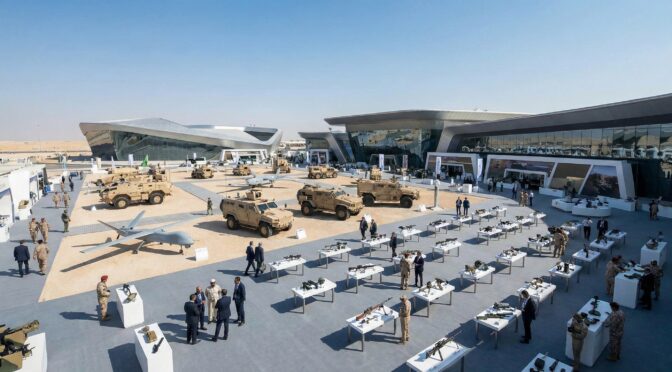
The third edition of the World Defense Show (WDS), currently underway in Riyadh (February 8–12, 2026), represents a fundamental transformation in the defense posture of the Middle East. If the 2022 and 2024 editions were statements of intent regarding Saudi Arabia’s Vision 2030, the 2026 iteration is a demonstration of industrial execution. Writing this operational analysis on the morning of Day 3, following two full days of exhibition, key trends have emerged that redefine the region not merely as a consumer of high-end military hardware, but as an emerging node of localized production and technological integration.

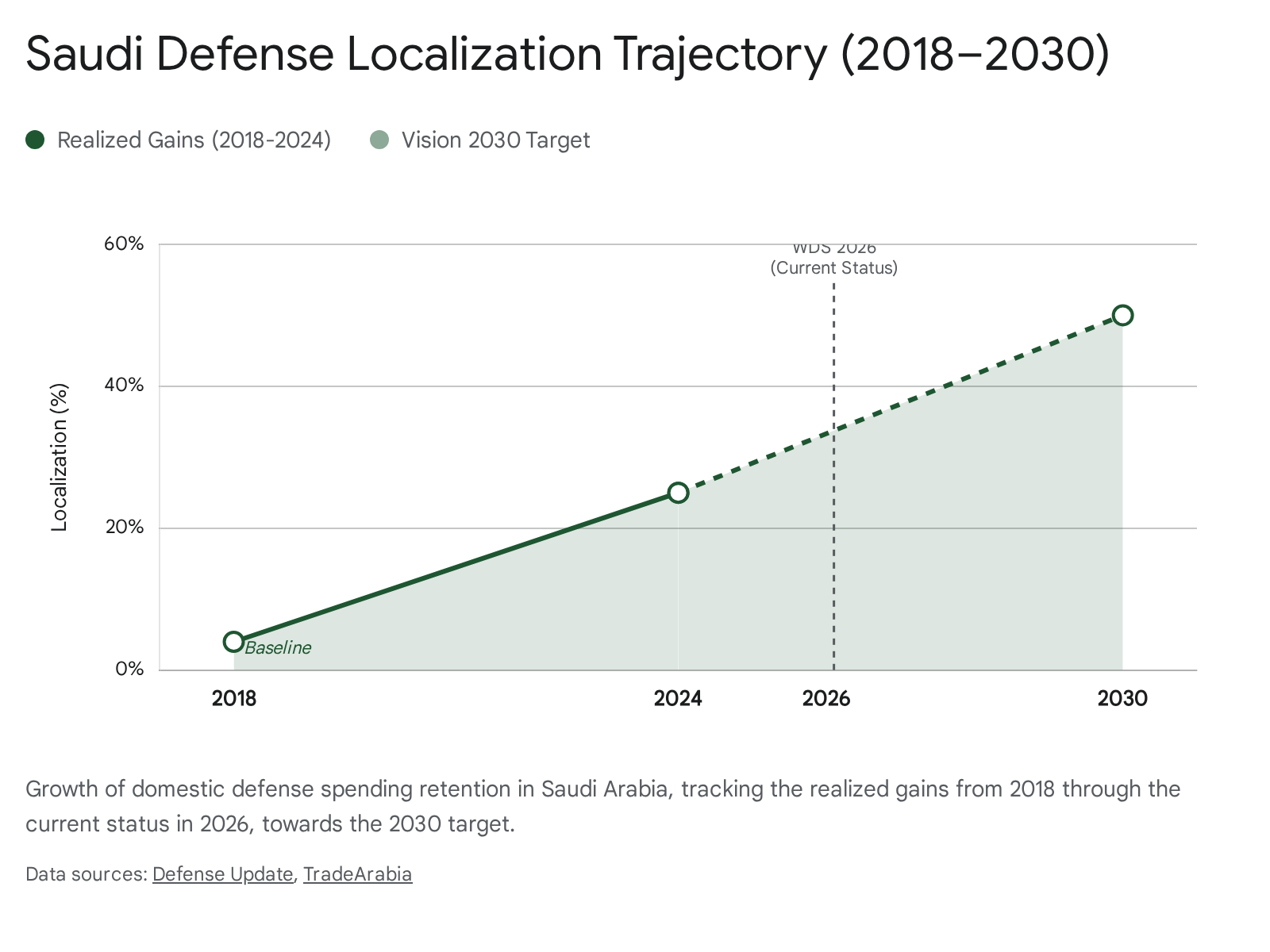
The show, organized by the General Authority for Military Industries (GAMI), has convened over 773 exhibitors and is projected to host 106,000 visitors.1 The sheer scale of the event, now expanded by 58% in floor space compared to previous years 2, mirrors the aggressive expansion of the Kingdom’s defense industrial base. The central narrative dominating the floor is the “localization imperative”—the drive to retain 50% of defense spending within the Kingdom by 2030. This is no longer an aspirational slogan; GAMI reports indicate that localization rates have already surged from a negligible 4% in 2018 to nearly 25% by early 2026.3

From the perspective of a small arms and infantry systems analyst, WDS 2026 is characterized by the digitization of lethality. The era of purely mechanical advancements in firearms has largely plateaued; the current revolution is found in the integration of fire control systems (FCS), smart optics, and modular capability upgrades that bridge the gap between the individual rifleman and the networked battlefield. The debut of systems like the Smart Shooter SMASH X4 5 and the proliferation of loitering munitions at the squad level, such as the Russian RUS-PE 6, signal a shift where infantry are becoming precision strike assets capable of engaging asymmetric threats like drones with kinetic reliability.

Geopolitically, the show serves as a barometer for shifting alliances. While Saudi entities like SAMI dominate the floor with massive pavilions and announcements of new subsidiaries like SAMI Land Company 3, there is a conspicuous and strategically significant absence of major Emirati defense firms, hinting at deepening fissures within the Gulf Cooperation Council (GCC) defense architecture.7 Conversely, the resilience of the Russian defense industry is on full display. Despite extensive international sanctions, Rosoboronexport has fielded a “single exhibit” of substantial size, premiering battle-hardened systems like the RPG-29M and Sarma MRL, positioning themselves as the reliable alternative for non-aligned nations.6

This report provides an exhaustive analysis of the first 48 hours of WDS 2026. It dissects the technical specifications of newly launched small arms, evaluates the strategic depth of announced industrial partnerships, and assesses the operational realities of the land systems on display. It further integrates attendee sentiment and social media analysis to provide a holistic view of the event’s reception and impact.
Yugo M85/M92 dust cover pin installation: close-up of the quick takedown pin.

2. Strategic Context: The Industrial Pivot

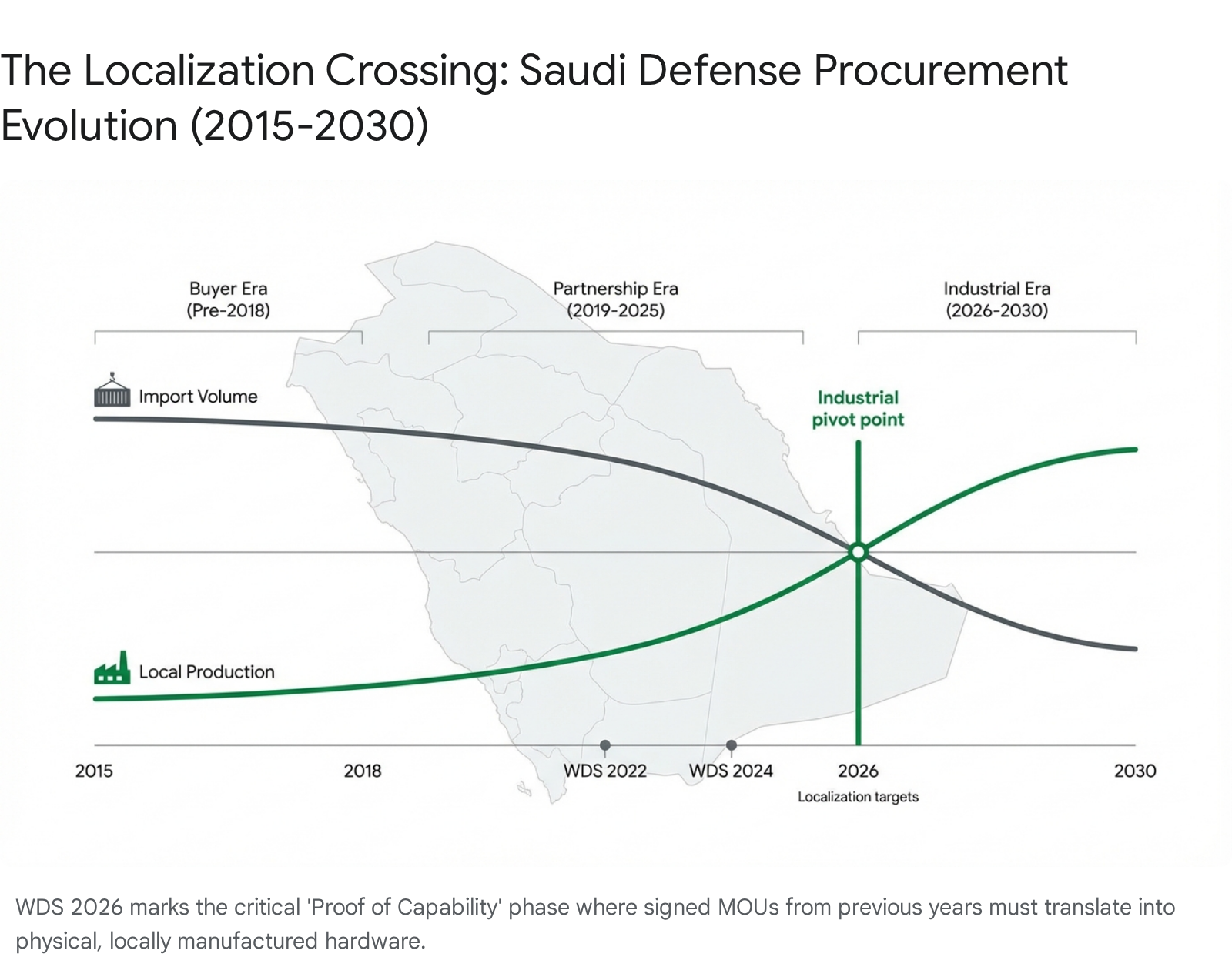
The overarching theme of World Defense Show 2026 is the maturation of the Saudi military-industrial complex. In previous years, the narrative focused heavily on procurement—the purchase of finished goods to satisfy immediate operational needs. In 2026, the focus has shifted decisively toward industrial partnership and indigenous capacity building. This pivot is driven by the realization that true national security requires not just the possession of advanced weaponry, but the sovereign ability to maintain, repair, and reproduce it.

2.1 The GAMI and SAMI Nexus: Architects of Localization

The General Authority for Military Industries (GAMI) has effectively utilized WDS 2026 as a compliance and progress audit mechanism. The governor of GAMI, Ahmad Al-Ohali, explicitly highlighted during the opening ceremonies that the number of licensed defense facilities in the Kingdom has grown to 344 by late 2025.5 This regulatory framework serves as the engine of the transformation, creating the legal and economic conditions necessary for localization to thrive.

However, the vehicle for this transformation is Saudi Arabian Military Industries (SAMI). On Day 1, SAMI announced a significant restructuring of its land capabilities, launching several new dedicated units:

  • SAMI Land Company: A dedicated entity focused on the development and integration of land systems, moving beyond the holding company structure to operational execution.3
  • SAMI Autonomous Company: Reflecting the global trend toward unmanned systems, this unit consolidates efforts in robotics and autonomous platforms.3
  • SAMI Land Industrial Complex: A physical infrastructure project designed to house the manufacturing lines for heavy armor and tactical vehicles.3

These announcements are not merely administrative shuffles; they represent the consolidation of fragmented manufacturing capabilities into a coherent “prime contractor” model. This structure allows SAMI to absorb large-scale technology transfers from international partners like General Dynamics Land Systems (GDLS), Lockheed Martin, and others, effectively becoming the systems integrator for the Kingdom. The launch of the HEET Program and the SAMI Local Content Program (RUKN) further underscores this strategy, providing a roadmap for how international suppliers can integrate into the Saudi supply chain.3

2.2 The “Supply Chain” Battlefield

A critical innovation for the 2026 show is the introduction of the Saudi Supply Chain Zone.9 For the small arms analyst, this is a development of immense significance. The production of small arms and light weapons (SALW) relies heavily on a tiered supply chain—precision springs, polymer injection molding, barrel rifling and heat treatment, and advanced metallurgy.

Historically, “localization” in the region often meant the final assembly of Completely Knocked Down (CKD) kits—essentially screwing together parts manufactured in Europe or the US. The existence of a dedicated Supply Chain Zone confirms that Saudi Arabia is attempting to build the “Tier 2 and Tier 3” industrial base required to sustain indigenous small arms manufacturing. By inviting small and medium enterprises (SMEs) to exhibit alongside prime contractors, GAMI is fostering an ecosystem where a Saudi company might manufacture the receiver forgings for a rifle, while another produces the optical glass for the sights. This depth of industrial base is the only path to true sovereignty in small arms production, ensuring resilience against supply chain disruptions or political embargoes.

2.3 The Budgetary Weapon

With a military budget estimated at $78 billion for 2025 2, the Kingdom is weaponizing its capital expenditure to force industrial offsets. The message to international exhibitors is clear: access to the lucrative Saudi market is now conditional on the willingness to localize. This has fundamentally changed the nature of the negotiations taking place in the chalets and meeting rooms of WDS 2026. Conversations are no longer about delivery schedules and unit costs; they are about training programs, intellectual property transfer, and joint venture structures.

3. Geopolitical Dynamics and Attendee Sentiment

The atmosphere of a major defense trade show often reveals more than the official press releases. WDS 2026 is taking place against a backdrop of complex regional realignments and continuing global instability. The floor dynamics on Days 1 and 2 provided visible evidence of these geopolitical currents.

3.1 The “Emirati Ghost” in the Machine

One of the most striking observations from the first 48 hours is the visible absence of major Emirati defense conglomerates. While some 30 Emirati entities were officially listed as exhibitors, reports from the floor indicate that the designated spaces for these companies are largely empty or devoid of significant presence.7

  • The Evidence: Snippets confirm that “Emirati presence is almost nowhere to be found on the show floor,” with some companies only represented through parent or subsidiary firms rather than direct national pavilions.7
  • The Strategic Signal: This absence is widely interpreted by analysts as a signal of diplomatic friction between Riyadh and Abu Dhabi. The two nations, while traditional allies, have seen diverging strategies regarding the conflict in Yemen, oil production quotas, and competition for regional economic dominance.7
  • Market Implications: For the attendee, this absence reduces the “pan-Arab” feel of the show and creates a starker contrast between Saudi indigenous efforts and the rest of the world. It leaves a palpable market gap that other emerging defense powers—specifically Turkey, China, and South Korea—are eager to fill. The lack of Caracal (the UAE’s premier small arms manufacturer) 11 at a show of this magnitude is a significant missed opportunity for intra-GCC standardization and opens the door for other suppliers to capture the Saudi small arms market.

3.2 Russian Resilience in the Face of Sanctions

In stark contrast to the Emirati withdrawal, the Russian defense industry has mounted a robust and highly visible presence. Organized under a “single exhibit” by Rosoboronexport, the Russian pavilion features major entities like Almaz-Antey, Kalashnikov, and High Precision Systems.6

  • The Narrative: Russia is leveraging a “combat-proven” narrative. In a world of theoretical capabilities, Russian systems are being marketed based on their recent, high-intensity usage. The debut of systems like the RPG-29M and Sarma MRL 12 signals that Moscow remains committed to the Middle Eastern market and views Saudi Arabia as a key partner that maintains strategic autonomy from Western sanctions regimes.
  • The Offer: Russia is offering what Western firms often cannot or will not: unrestricted sales of heavy weaponry without complex human rights conditionality, and a willingness to engage in deep technology transfer for older but reliable systems.

3.3 Attendee Buzz and Sentiment

Social media analysis and on-the-ground reports from Days 1 and 2 paint a picture of a show that has hit its stride.

  • Organizational Maturity: Attendees have noted the “maturity” of the event compared to 2022. The logistical hiccups of the inaugural show have largely been resolved, and the event now operates with the polish of major global expos like Eurosatory or DSEI.13
  • Traffic and Engagement: Reports of “crowded hallways” on Day 3 suggest that attendance has been strong throughout the opening days.14 The sheer volume of visitors indicates that the global defense community views Riyadh as an essential destination, regardless of regional tensions.
  • Interactive Appeal: The simulators have been a major draw. From fighter jet cockpits to the handgun combat simulation at the Sarsılmaz booth 14, these interactive elements are generating significant positive buzz on social media. They serve a dual purpose: entertaining VIPs and engaging the younger demographic of Saudi nationals—the future engineers and soldiers that Vision 2030 aims to cultivate.
  • The Localization Buzz: The most consistent topic of conversation is localization. Attendees are impressed by the speed of SAMI’s growth but remain skeptical about the depth of the technical capability. The “show me” attitude is prevalent, with visitors looking past the glossy models to ask hard questions about manufacturing timelines and supply chain realities.

4. Small Arms & Light Weapons (SALW) Highlights

For the small arms analyst, WDS 2026 offers a distinct view of the future of infantry combat. The focus is less on new calibers or rifle platforms—though those are present—and more on the integration of intelligence into the weapon system. The trend is toward making the individual soldier a node in the networked battlefield, capable of delivering precision fires against both traditional and asymmetric threats.

4.1 Russian Innovations: The Asymmetric Response

Rosoboronexport’s debut of the RPG-29M Vampire and other systems highlights a focus on enhancing the lethality of light infantry against heavy armor and fortifications.12

The RPG-29M: Evolution of a Tank Killer

The original RPG-29 Vampire earned a fearsome reputation in conflicts across the Middle East, notably for its ability to defeat the frontal armor of modern main battle tanks (MBTs) like the Merkava and Abrams using its tandem-charge warhead. However, it was heavy, cumbersome, and difficult to use effectively in dynamic maneuver warfare.

  • Weight Reduction: The new “M” variant unveiled at WDS 2026 features a 33% weight reduction compared to its predecessor.12 This is a massive engineering achievement, likely involving the use of advanced carbon fiber composites for the launch tube and lighter alloys for the firing mechanism. For a dismounted anti-tank team, shedding a third of the weapon’s weight means increased mobility, the ability to carry more ammunition, or reduced fatigue during long patrols.
  • Digital Fire Control: The most significant upgrade is the integration of a day/night thermal imaging sight with a ballistic computer.12 This moves the RPG-29 from a “dumb” launcher dependent on operator skill for range estimation and lead to a precision weapon system. The fire control system (FCS) likely calculates the ballistic arc based on range and environmental factors, significantly increasing the first-round hit probability against moving targets.
  • Tactical Implications: By combining high-penetration warheads with reduced weight and advanced optics, Russia is offering a cost-effective alternative to expensive Anti-Tank Guided Missiles (ATGMs). It allows infantry to engage armor at night and through obscurants, a capability previously reserved for much more expensive systems.

Kalashnikov’s Modernization Push

The Kalashnikov Group showcased the AK-15 (7.62x39mm) and AK-19 (5.56x45mm), along with compact “K” and “SK” variants.12

  • The AK-19 Strategy: The presence of the AK-19 is a targeted strategic move. Designed to fire the NATO standard 5.56x45mm cartridge, it is pitched directly at Middle Eastern nations (like Saudi Arabia and the UAE) that have stockpiles of Western ammunition but appreciate the legendary reliability and lower maintenance requirements of the Kalashnikov platform. It represents a “hybrid” logistics approach.
  • Ergonomics and Modularity: The new variants feature adjustable stocks, ergonomic pistol grips, and integrated Picatinny rails. These updates are an acknowledgment that the modern operator demands the ability to mount optics, lights, and lasers—capabilities that were difficult to integrate onto legacy AK platforms without aftermarket modifications.

4.2 The Intelligent Trigger: Smart Shooter’s Dominance

One of the most transformative technologies on display is the SMASH X4 Fire Control System from Smart Shooter.5 This system represents the shift from “skill-based” shooting to “algorithm-assisted” engagement.

  • The Technology: The SMASH system uses image processing and computer vision to “lock” onto a target. The soldier holds the trigger, but the system electronically blocks the firing pin until the weapon is perfectly aligned with the calculated impact point. This ensures a hit, eliminating errors caused by trigger jerk or poor sight alignment.
  • The X4 Advantage: Previous iterations were red-dot based, limiting their effective range. The SMASH X4 integrates this fire control technology into a x4 magnifying optic.5 This extends the “guaranteed hit” capability out to mid-range engagements (300m-600m), making it viable for designated marksmen and general infantry use in open desert environments.
  • Counter-UAS (C-UAS) Capability: The system is explicitly marketed as a kinetic C-UAS solution. Drones are small, fast, and agile targets that are notoriously difficult to hit with standard rifle fire. The SMASH algorithms can track a moving drone and calculate the complex lead required to hit it. By empowering every rifleman with the ability to shoot down a drone at 400 meters, armies can create a layered air defense that does not rely solely on expensive electronic warfare (EW) assets.15

4.3 Turkish Expansion: Sarsılmaz and MKE

Turkey continues to assert itself as a major supplier of NATO-standard small arms to the region.

  • Sarsılmaz Kılınç 2000 Light: The display of a “decked out” version of this pistol highlights a trend toward the “duty-competition” crossover.14 Modern military sidearms are increasingly adopting features from the competition world—optic cuts for red dot sights, ported slides for recoil reduction, and enhanced triggers. This reflects a doctrine where the pistol is no longer just a badge of rank but a primary fighting tool for specialized units.
  • MKE Tolga: While technically a Short-Range Air Defense (SHORAD) system, the Tolga represents the blurring line between small arms and air defense.16 By integrating detection radar and electro-optics with kinetic effectors, it provides an automated “overwatch” capability for maneuvering forces, protecting them from the micro-UAS threats that traditional small arms struggle to suppress.

4.4 Specialized Infantry Systems: The Barrett PGS

Barrett, known for its heavy sniper rifles, debuted the Precision Grenade Rifle System (PGS).2

  • Counter-Defilade Capability: The PGS fires a 30mm grenade with a programmable airburst fuse. The operator lases a target (e.g., a window or a trench line), the computer programs the round, and the grenade explodes over or next to the target, defeating enemies hiding behind cover (defilade).
  • Operational Context: In urban warfare environments like Gaza or Yemen, the ability to engage enemies behind cover without calling for airstrikes or artillery is invaluable. The PGS puts this capability into the hands of the squad, reducing collateral damage and speeding up the tempo of operations.

4.5 The “Missing” Western Giants?

While major Western small arms manufacturers like SIG Sauer, Beretta, and FN Herstal are mentioned in the context of the show 17, their “new product” announcements have been quieter compared to the aggressive marketing of Russian and Turkish firms.

  • SIG Sauer: The mention of the 6.8x51mm cartridge 17 is critical. As the US Army adopts the NGSW (Next Generation Squad Weapon), allies like Saudi Arabia are watching closely. The presence of SIG at WDS 2026 suggests they are preparing the ground for the eventual export of this new caliber, although widespread adoption in the Gulf will likely lag behind the US by several years due to the massive existing stocks of 5.56mm and 7.62mm ammunition.

5. Land Systems and Mobility: Indigenous Armor

The land domain at WDS 2026 is dominated by the narrative of indigenous mobility. The days of purchasing fleets of Humvees or Land Cruisers and shipping them to Riyadh are ending; the focus is now on manufacturing the chassis, armor, and drivetrain in-Kingdom.

5.1 SAMI HEET Program: The Flagship of Saudi Armor

The unveiling of the HEET armored personnel carrier (APC) variants is the flagship announcement for SAMI Land Company.2

  • The 8×8 Variant: Equipped with a 105mm gun turret, this vehicle enters the “Mobile Gun System” (MGS) category.
  • Tactical Role: An 8×8 MGS provides direct fire support for infantry brigades. It offers the firepower of a tank (capable of destroying bunkers and light/medium armor) with the strategic mobility of a wheeled vehicle. It can self-deploy over long distances on highways without the need for heavy equipment transporters (HETs).
  • Firepower: The choice of a 105mm caliber indicates a desire for compatibility with standard NATO ammunition types. It effectively bridges the gap between the Infantry Fighting Vehicle (IFV) with its autocannon and the Main Battle Tank (MBT) with its 120mm gun.
  • The 4×4 Variant: This lighter variant is likely designed for command and liaison, patrol, or internal security roles.
  • Industrial Significance: The ability to cast, weld, and assemble armored hulls domestically is a high barrier to entry. If SAMI is indeed manufacturing the HEET hull in Saudi Arabia (likely at the newly announced SAMI Land Industrial Complex), it represents a massive leap in industrial maturity. It moves the Kingdom from “assembler” to “fabricator.”

5.2 Tactical Logistics: Daimler Truck

While frontline armor gets the glory, logistics wins wars. Daimler Truck’s heavy presence with the Zetros 4051 AS 6×6 and Arocs 4663 AS 8×8 highlights the logistical backbone required to support a modern mechanized army.8

  • Desert Adaptation: The marketing emphasis on “hot, dusty, and sandy environments” is not boilerplate; it is a specific engineering requirement for the GCC. Vehicles must have upgraded cooling systems, cyclonic air filters, and tire pressure control systems to survive the operational realities of the Empty Quarter.
  • The Tank Transporter: The Zetros is showcased as a tank transporter, critical for moving heavy assets like the M1 Abrams and the new HEET 8×8 across the vast distances of the Saudi interior.
  • Localization via Assembly: Daimler’s partnership with Juffali Industrial Products Company (JIPCO) for the local assembly of these trucks from CKD kits is a prime example of the “intermediate” localization step.8 It creates local jobs and ensures a supply of spare parts and maintenance expertise within the Kingdom.

5.3 International Contenders

  • FNSS (Turkey): The Kaplan FSRV tracked vehicle was displayed.18 Turkey’s FNSS has a long history of successful joint ventures (like with Malaysia’s Deftech). Their presence suggests they are positioning the Kaplan as a contender for future Saudi tracked vehicle programs.
  • Norinco (China): The FL 50 armored vehicle 18 represents the Chinese option—cost-effective and available without end-user restrictions.
  • Rosoboronexport (Russia): The BTR-22 APC 12 is a modernization of the classic BTR-80/82 design. It offers improved armor and ergonomics, addressing the key weaknesses of the Soviet-era BTRs (like the side exit doors).

6. Unmanned Systems: The Asymmetric Equalizer

WDS 2026 confirms that the “drone” is no longer a separate category; it is an integrated component of every other domain. The distinction between “munition” and “aircraft” has effectively collapsed.

6.1 Loitering Munitions as Squad Weapons

Russia’s debut of the RUS-PE loitering munition 12 is a direct response to the proliferation of systems like the US Switchblade and the Russian Lancet.

  • Portable Precision: By containerizing the system for squad transport, the RUS-PE gives small infantry units Non-Line-of-Sight (NLOS) strike capability. A squad pinned down by a sniper or a machine gun nest 5km away no longer needs to call for artillery or air support; they can launch a RUS-PE to find and destroy the threat autonomously.
  • AI Targeting: The claim of “AI algorithms for target detection” is critical. In an environment saturated with Electronic Warfare (EW), remote control links are easily jammed. An AI-enabled munition that can visually identify and terminal-guide onto a target without operator input (“fire and forget”) is a game-changer for peer-to-peer conflict.

6.2 Counter-UAS (C-UAS) Saturation

Every major booth at WDS 2026 features some form of C-UAS solution, reflecting the trauma of recent conflicts where drones have wreaked havoc on unprepared forces.

  • Strategic Layer: The MARSS NiDAR “Nation Shield” 20 concept takes C-UAS from a tactical point defense to a strategic, city-wide layer. It integrates data from diverse sensors (radar, RF, acoustic) into a single command picture, allowing for the defense of critical infrastructure against swarms or long-range drones.
  • Kinetic vs. Electronic: There is a noticeable shift back toward kinetic solutions. While EW jammers are common, the presence of systems like the Smart Shooter SMASH (kinetic rifle fire) and Rostec’s 30mm airburst rounds indicates a realization that jamming is not a silver bullet. Autonomous drones do not need a signal to jam; they must be physically destroyed.

7. Table: Key Small Arms & Land Systems Debuts (Days 1-2)

The following table summarizes the most significant product launches and debuts observed during the first two days of the show.

ManufacturerProductCategoryKey Feature / Innovation
SAMI (Saudi Arabia)HEET 8×8Armored Vehicle105mm Turret (MGS), Indigenous Hull, Modular Armor
Sarsılmaz (Turkey)Kılınç 2000 LightHandgun“Decked out” competition features, optic ready, porting
Rosoboronexport (Russia)RPG-29MAnti-Tank Weapon33% Weight reduction, Thermal FCS, Extended Range
Rosoboronexport (Russia)Sarma MRLArtillery300mm Guided Rockets, 120km Range, High Mobility
Smart Shooter (Israel)SMASH X4Fire Controlx4 Magnification, Drone-Lock Capability, Day/Night
Rostec (Russia)RUS-PELoitering MunitionContainerized, AI-Targeting, Squad Portable
Barrett (USA)PGSGrenade Rifle30mm Airburst, Counter-Defilade, Semi-Auto
Kalashnikov (Russia)AK-19Assault Rifle5.56mm NATO caliber, Updated Ergonomics, Export Focus

8. Conclusion and Future Outlook

As World Defense Show 2026 crosses its halfway mark, the strategic message is unambiguous: Sovereignty is the new standard. The Saudi defense market is no longer a monolith of consumption; it is a rapidly forming industrial ecosystem that demands partnership over purchase.

8.1 The “Localization” Reality Check

The growth from 4% to 25% localization is impressive, but the climb to 50% by 2030 will be the hardest phase. It requires moving from low-hanging fruit (uniforms, ammunition, simple assembly) to complex systems (avionics, jet engine maintenance, advanced metallurgy). The launch of the SAMI Land Industrial Complex and the Supply Chain Zone are the correct structural steps to achieve this. They show a maturity in planning—recognizing that you cannot build a tank if you cannot manufacture the bolts that hold it together.

8.2 Implications for Stakeholders

  • For Western OEMs: The window for direct, off-the-shelf sales is closing rapidly. Companies that wish to remain relevant in the Saudi market must be willing to enter into Joint Ventures (JVs) that involve genuine Intellectual Property (IP) transfer. The “black box” sales model is dead in Riyadh.
  • For Regional Competitors: The Saudi industrial machine is waking up. If SAMI achieves its targets, it will eventually pivot to export, challenging Turkish, Emirati, and South Korean firms in the African and Asian markets. The absence of Emirati firms at WDS 2026 may be a tactical diplomatic signal, but it risks ceding ground to competitors who are physically present and signing deals.
  • For the Warfighter: The technology displayed at WDS 2026 promises a soldier that is lighter, more connected, and significantly more lethal. The integration of AI-assisted optics (Smart Shooter) and personal precision strike (loitering munitions) fundamentally changes the geometry of squad-level combat. The infantryman is no longer just a rifleman; they are a sensor, a drone operator, and a precision striker rolled into one.

The World Defense Show has successfully transitioned from a “showroom” to a “strategic audit” of Vision 2030. The hardware is impressive, but the factories being signed into existence behind the scenes are the true weapon system on display.


Please share the link on Facebook, Forums, with colleagues, etc. Your support is much appreciated and if you have any feedback, please email us in**@*********ps.com. If you’d like to request a report or order a reprint, please click here for the corresponding page to open in new tab.


Sources Used

  1. World Defense Show 2026 – Kallman Worldwide, Inc., accessed February 10, 2026, https://www.kallman.com/show/world-defense-show-2026/
  2. World Defense Show 2026, accessed February 10, 2026, https://defense-update.com/20260209_wds-2026.html
  3. SAMI launches new units at World Defense Show – TradeArabia, accessed February 10, 2026, https://www.tradearabia.com/News/389031/SAMI-launches-new-units-at-World-Defense-Show
  4. SAMI Strengthens Presence at World Defense Show 2026 | Joint Forces News, accessed February 10, 2026, https://www.joint-forces.com/world-news/defence-news/88963-sami-strengthens-presence-at-world-defense-show-2026
  5. SMART SHOOTER Unveils SMASH X4 Fire Control System | Joint …, accessed February 10, 2026, https://www.joint-forces.com/defence-equipment-news/54395-smart-shooter-unveils-smash-x4-fire-control-system
  6. Media – News – Rosoboronexport to Hold World Premieres … – Rostec, accessed February 10, 2026, https://rostec.ru/en/media/news/rosoboronexport-to-hold-world-premieres-for-russia-s-latest-weapons-at-world-defense-show-2026/
  7. Amid tensions, Emirati firms bow out of Saudi Arabia’s World Defense Show, accessed February 10, 2026, https://breakingdefense.com/2026/02/amid-tensions-emirati-firms-bow-out-of-saudi-arabias-world-defense-show/
  8. World Defense Show 2026 Inaugurated | Joint Forces News, accessed February 10, 2026, https://www.joint-forces.com/world-news/expos-and-exhibitions/89039-world-defense-show-2026-inaugurated
  9. World Defense Show 2026 | 8-12 February | Saudi Arabia, accessed February 10, 2026, https://www.defenseadvancement.com/events/world-defense-show/
  10. Some UAE companies withdraw from Saudi defence show due to Gulf rift, accessed February 10, 2026, https://www.worldenergynews.com/news/some-uae-companies-withdraw-from-saudi-defence-770904
  11. Major military weapons of South Korean Defense Industry II – World and New World Journal, accessed February 10, 2026, https://worldnewworld.com/page/content.php?no=5954
  12. ROSOBORONEXPORT Showcases Russia’s latest weapons at …, accessed February 10, 2026, https://www.arabiandefence.com/2026/02/07/rosoboronexport-showcases-russias-latest-weapons-at-wds/
  13. World Defense Show 2026 reflects maturity, scale and global confidence, says Mansour Al-Babtain, accessed February 10, 2026, https://saudigazette.com.sa/article/658775/business/world-defense-show-2026-reflects-maturity-scale-and-global-confidence-says-mansour-al-babtain
  14. PHOTOS: The sights of World Defense Show on Day 3 – Breaking …, accessed February 10, 2026, https://breakingdefense.com/2026/02/photos-the-sights-of-world-defense-show-on-day-3/
  15. US Marine Corps Orders Smalls Arms Fire Control Systems – Defense Advancement, accessed February 10, 2026, https://www.defenseadvancement.com/news/us-marine-corps-orders-smalls-arms-fire-control-systems/
  16. WDS 2026 – MKE showcases Tolga, a new layer of smart short …, accessed February 10, 2026, https://www.edrmagazine.eu/wds-2026-mke-showcases-tolga-a-new-layer-of-smart-short-range-air-defence
  17. The Path Ahead for Rotary Heavy-Lift – Euro-sd, accessed February 10, 2026, https://euro-sd.com/wp-content/uploads/2025/11/ESD_11_2025_WEB.pdf
  18. PHOTOS: The sights of World Defense Show Day 1 – Breaking …, accessed February 10, 2026, https://breakingdefense.com/2026/02/photos-the-sights-of-world-defense-show-day-1/
  19. Highlights from the World Defence Exhibition 2026 – Vietnam.vn, accessed February 10, 2026, https://www.vietnam.vn/en/nhung-khoanh-khac-noi-bat-tai-trien-lam-quoc-phong-the-gioi-2026
  20. RADAR, EO/IR, C-UAS, NIGHT VISION AND SURVEILLANCE UPDATE, accessed February 10, 2026, https://battle-updates.com/update/radar-eo-ir-c-uas-night-vision-and-surveillance-update-283/
The WDS 2026 in Riyadh: Insights into Small Arms and Defense Trends

Date Published: February 5, 2026

Event: World Defense Show (WDS) 2026

Location: Riyadh International Convention & Exhibition Center, Saudi Arabia

Report Focus: Small Arms, Light Weapons (SALW), Optics, and Soldier Systems

Executive Summary

As the global defense community converges on Riyadh for the third edition of the World Defense Show (WDS), scheduled to open its doors on February 8, 2026, the atmosphere is charged with a distinct geopolitical and industrial electricity. Unlike the inaugural 2022 event, which functioned largely as a statement of intent, or the 2024 edition, which saw the initial stirrings of industrial localization, WDS 2026 stands as a mature, pivotal node in the global arms trade infrastructure. For the Small Arms and Light Weapons (SALW) sector, this year’s exhibition is not merely a display of hardware; it is a referendum on the success of Saudi Arabia’s Vision 2030 localization mandates and a battleground for Eastern and Western powers vying for dominance in the Gulf’s lucrative infantry modernization programs.1

This report, generated three days prior to the opening ceremony, synthesizes exhibitor data, open-source intelligence (OSINT), and social media sentiment to forecast the defining narratives of the show. Our analysis indicates that WDS 2026 will be characterized by three primary drivers: the aggressive operationalization of indigenous manufacturing by Saudi entities, the tactical resurgence of Russian and Chinese export variants designed specifically to displace Western hegemony, and the integration of algorithmic fire control systems into standard infantry squads. The show has expanded to cover over 800,000 square meters, hosting 925 exhibitors from more than 80 countries, reflecting a massive scale-up in participation and industrial interest.3

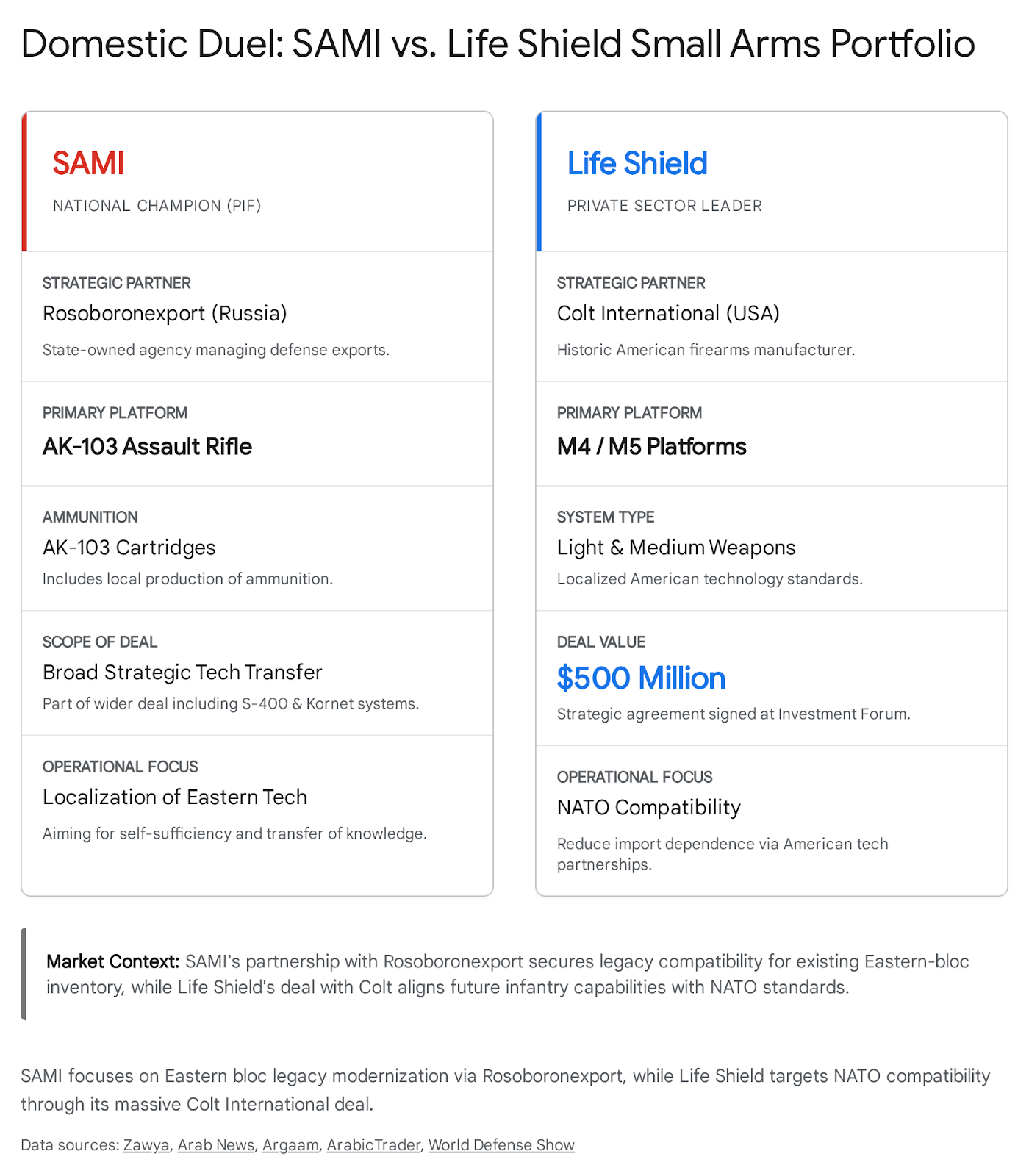
The “must-see” list for 2026 has shifted from pure platform procurement to industrial partnership. The headline battle is domestic: Saudi Arabian Military Industries (SAMI) versus Life Shield for Military Industries. With Life Shield’s recent $500 million agreement with Colt International to localize small arms production, and SAMI’s entrenched partnership with Kalashnikov and Thales, Riyadh has effectively created a competitive internal market.5 Attendees are clamoring to see the first physical evidence of “Made in Saudi” Colt M4s and AK-103s side-by-side.

Internationally, Rosoboronexport is deploying a “combat-proven” marketing strategy, debuting the modernized RPG-29M and NATO-caliber AK-19, explicitly targeting Gulf nations standardized on 5.56mm.7 Simultaneously, China’s Norinco is utilizing WDS 2026 to aggressively market the export variants of its Type 20 (QBZ-191) family, challenging the dominance of the AR-15 and AK platforms in the developing world.10

Technologically, the “dumb” iron sight era is definitively over. The proliferation of Smart Shooter’s SMASH technology and Thales’ XTRAIM sights indicates a market pivot toward “guaranteed hit” probabilities, driven by the urgent need for counter-UAS capabilities at the squad level.11 Social media analysis reveals a highly informed attendee base, less interested in booth glamour and more focused on hands-on capabilities, technology transfer (ToT) metrics, and the practical realities of integrating unmanned systems with infantry firepower.

This report provides an exhaustive preview of these dynamics, offering industry stakeholders a roadmap to the most critical exhibitions, announcements, and undercurrents expected at WDS 2026.

1.0 Strategic Context: The Riyadh Pivot

To understand the small arms landscape of WDS 2026, one must first appreciate the strategic theatre. The Riyadh International Convention and Exhibition Center has expanded to over 800,000 square meters, reflecting the Kingdom’s ambition not just to buy, but to become a global hub for defense integration.3 The event is poised to host over 130,000 visitors and 441 official delegations, signaling that Riyadh has firmly established itself as a premier node in the global defense calendar, rivaling events like IDEX in Abu Dhabi and Eurosatory in Paris.3

1.1 The Vision 2030 Imperative: From Buyer to Maker

The organizing principle of WDS 2026 is the General Authority for Military Industries (GAMI) mandate to localize 50% of defense spending by 2030.13 In 2026, we are past the midway point of this vision. The era of off-the-shelf purchases is largely over; the era of Joint Ventures (JVs) and domestic production lines has begun. The pressure on international OEMs (Original Equipment Manufacturers) is immense: establish a local footprint or risk losing access to the region’s largest defense budget.

For small arms manufacturers, the “price of admission” to the Saudi market is no longer just unit cost or performance—it is the willingness to transfer intellectual property (IP) and build factories in the Kingdom. This has bifurcated the exhibitor list into two camps:

  1. The Integrators: Companies like Colt, Thales, and EDGE Group (Caracal) that have signed deep localization deals and are present to showcase their local value addition.
  2. The Salesmen: Firms still attempting traditional Foreign Military Sales (FMS) models, who risk being marginalized in favor of those willing to play by GAMI’s new rules.
Yugo M85/M92 dust cover quick takedown pin on green plastic

The implications of this shift are profound. Exhibitors at WDS 2026 are not just displaying weapons; they are displaying industrial capability. The booth designs themselves often reflect this, with dedicated sections for “Transfer of Technology” and “Local Content” metrics displayed as prominently as muzzle velocity or magazine capacity.

1.2 The Geopolitical Assembly Area

Riyadh in February 2026 is a neutral ground where geopolitical rivals exhibit side-by-side. The floor plan reveals a physical manifestation of the multipolar world order. The US and UK primes (Lockheed Martin, BAE Systems) maintain massive pavilions, but they are flanked by aggressive, sprawling exhibits from Chinese state-owned enterprises (Norinco, ALIT) and a resilient Russian presence led by Rosoboronexport.15

For the small arms analyst, this proximity allows for direct, side-by-side comparison of competing doctrines:

  • Western Doctrine: Precision, modularity, optics-heavy, expensive, high training requirement.
  • Eastern Doctrine: Volume, ruggedness, increasingly modernized ergonomics, cost-effective, “good enough” lethality.

The presence of companies like 7Tao Engineering from the UK, which explicitly references the “US China Trade War” in its exhibitor description, underscores the tension present on the show floor.17 The global economic struggle is playing out in the aisles of the Riyadh International Convention & Exhibition Center, with small arms contracts serving as proxy indicators of broader diplomatic alignments.

2.0 The Host Nation’s Arsenal: Indigenous & Localized Giants

The most anticipated announcements at WDS 2026 are not coming from foreign entities, but from the Saudi national champions. The domestic industry has matured from re-badging imports to genuine assembly and component manufacturing. The narrative for 2026 is domestic competition: specifically, the emerging duopoly of SAMI and Life Shield.

2.1 SAMI (Saudi Arabian Military Industries): The National Champion

As the National Strategic Partner of WDS, SAMI occupies the central gravity of the show.5 Their small arms strategy is heavily scrutinized, as they are the primary vehicle for the Public Investment Fund (PIF) to deliver on the 50% localization target.

The Kalashnikov Question: AK-103 Localization

Following the Memorandum of Understanding (MoU) signed in 2017 during King Salman’s visit to Russia, and reaffirmed in subsequent years, industry observers are expecting to see the Saudi-manufactured AK-103. The initial agreement covered the production of the rifle and its ammunition.19 By 2026, the expectation is no longer just a prototype but a production-ready unit. Attendees are looking for the “Made in KSA” markings on the receiver.

The AK-103 program is pivotal because it represents the RSLF’s potential shift or augmentation of its small arms inventory, which has historically relied on the G3 (manufactured by MIC) and the M4. If SAMI displays a fully localized AK-103 with domestic polymer furniture and barrel manufacturing, it signals a major graduation in industrial capability. Conversely, if the display consists merely of imported Russian units with Saudi stickers, it will be viewed by analysts as a stall in the Vision 2030 roadmap.

SAMI-AEC (Advanced Electronics Company): The Digital Backbone

While primarily known for avionics and digital systems, SAMI-AEC is the backbone of the “Digital Soldier” initiative. They are expected to showcase integrated soldier systems—sights, comms, and situational awareness tools—that mount onto the localized small arms. The integration of Thales technology here is a key watch item, as Thales has a long-standing partnership with SAMI-AEC to localize defense electronics.21 SAMI-AEC’s recent “Best Graduation Project” awards and focus on national talent development suggest a strong push for indigenous R&D in soldier systems.23

2.2 Life Shield for Military Industries: The Aggressive Challenger

Life Shield for Military Industries (Life Shield) has emerged as the most dynamic competitor to SAMI in the small arms space. Owned and chaired by Hisham AlJuma’an, Life Shield has aggressively pursued partnerships to rapidly build capability.24 Their strategic agreement with Colt International, valued at up to $500 million, is the single most discussed topic in regional defense forums leading up to the show.6

The Saudi Colt: M4/M5 Localization

Life Shield is expected to debut a localized variant of the Colt M4 or potentially the newer M5 carbine series. This is a direct challenge to the AK-103 program. The Royal Saudi Land Forces (RSLF) and the Saudi National Guard have historically used both G3s and M4s; a locally made Colt gives the Saudi military a NATO-standard option that meets localization mandates without requiring a shift in manual of arms or caliber.26

The rivalry between SAMI (leaning Russian/Eastern for small arms legacy via the AK deal) and Life Shield (partnering with the quintessential American brand) mirrors the Kingdom’s broader hedging strategy. Life Shield’s ability to execute this deal positions it as a premier partner for Western firms looking to enter the Saudi market under the new GAMI regulations.

Aerial Integration and Diversification

Life Shield is not limited to terrestrial small arms. Their joint venture with UK-based ARC Aero Systems to form Life Shield Aerospace suggests a broader ambition.25 Analysts should watch for small arms integration on their VTOL drones—potentially lightweight machine guns or grenade launchers mounted on the Pegasus or P9 platforms for counter-insurgency roles. This cross-domain integration (airframes + small arms) is a trend to watch.

2.3 NCMS (National Company for Mechanical Systems)

NCMS operates in the high-tech niche of the Saudi defense ecosystem. They are not mass-producing assault rifles but are critical for the ecosystem around them. Known for their work on optical components and precision manufacturing, NCMS is the enabler for high-end targeting.28

Optics and Weaponization

NCMS has a history of manufacturing optical components. WDS 2026 is likely to feature domestic thermal and night-vision sights designed to pair with the SAMI AK-103 and Life Shield Colt. Furthermore, snippets indicate NCMS has developed an “Air Drop Bomb” (ADB) for commercial drones.30 At WDS 2026, expect to see this concept expanded to small-arms caliber weapon stations for UGVs (Unmanned Ground Vehicles) and heavy-lift drones, moving beyond gravity-dropped munitions to stabilized firing platforms.

Yugo M85/M92 dust cover quick takedown pin on green plastic

3.0 The Russian Offensive: Innovation Under Pressure

Despite—or perhaps because of—sanctions and geopolitical isolation from the West, Russia’s Rosoboronexport is staging a massive intervention at WDS 2026. The Russian pavilion is leveraging “combat-proven” status from the Special Military Operation (SMO) to market weaponry as rugged, reliable, and effective against modern threats. The narrative is one of resilience and adaptation, pitching Russian hardware as the only option tested in high-intensity peer-to-peer conflict.7

3.1 The RPG-29M Debut: A Tank Hunter Reborn

One of the few explicitly confirmed premieres for WDS 2026 is the RPG-29M “Vampir”. This system’s presence is highly significant for the MENA region.

  • The Hardware: The original RPG-29 is legendary in the Middle East for its ability to defeat modern armor (notably Merkava and Abrams tanks in past conflicts like the 2006 Lebanon War). However, its length and weight made it cumbersome for mobile infantry.
  • The Upgrade: The “M” variant is a modernization that addresses its primary drawback: weight and bulk. Reports indicate the RPG-29M is up to 30% lighter than its predecessor.8 Crucially, it features a new 24/7 thermal imaging fire control system.8
  • Market Relevance: This is a direct response to the proliferation of Active Protection Systems (APS) on Western armor. Russia is pitching the RPG-29M as a cost-effective infantry solution to defeat heavy armor, appealing to Gulf nations that need layered anti-tank capabilities beyond expensive guided missiles like the Javelin or TOW. The inclusion of a fire control system elevates it from a “dumb” rocket to a precision engagement tool, essential for the ranges expected in desert warfare.

3.2 The NATO-Caliber Kalashnikovs: AK-19 and AK-308

Russia is pragmatically acknowledging that many potential clients in the Gulf (Saudi Arabia, UAE, Qatar) have large stockpiles of 5.56x45mm NATO and 7.62x51mm NATO ammunition. They are not trying to force a caliber switch; they are offering a platform switch.

  • The AK-19: This rifle is essentially the modern AK-12 platform chambered in 5.56mm NATO. It features the new ergonomic upgrades seen on the AK-12M: an adjustable telescoping stock, a rigid top receiver rail for optics (fixing the AK’s historical weakness with sighting systems), and a new muzzle device compatible with quick-detach suppressors.9
  • The AK-308: Another export-focused heavy hitter, chambered in 7.62x51mm NATO. This positions it as a direct replacement candidate for the H&K G3, a rifle deeply entrenched in Saudi service.26 The AK-308 offers the punch of the G3 with the manual of arms of an AK, potentially appealing to units looking for a designated marksman rifle (DMR) or battle rifle update without leaving the 7.62 NATO ecosystem.
  • The Pitch: “Russian reliability with Western logistics.” This weapon is targeted specifically at Saudi National Guard or special units that might appreciate the AK platform’s reliability in sand but are logistically tied to NATO calibers.

3.3 The Lebedev Pistol (PLK)

Replacing the Makarov is a long-overdue modernization for the Russian defense industry, and the PLK (Compact Lebedev Pistol) is the answer. Being pushed as a modern, striker-fired equivalent to the Glock 19 or Sig P320, the PLK features a low bore axis and slim profile. At WDS 2026, Russia is marketing this to police and internal security forces in the MENA region, emphasizing its suitability for concealed carry and rapid fire control.31

4.0 The Dragon in the Desert: Norinco’s Export Surge

China’s presence at WDS 2026 is massive, strategic, and aimed at filling every gap left by Western export controls or high prices. Norinco (China North Industries Corporation) is the spearhead, occupying one of the largest pavilions at the show.14 Their strategy is comprehensive, offering a full spectrum of small arms from pistols to heavy machine guns, all available for immediate export without the “political strings” attached to Western sales.

4.1 The “Type 20” Export Family (QBZ-191 Variants)

The People’s Liberation Army (PLA) adoption of the QBZ-191 (Type 20) marked a move away from the bullpup QBZ-95 back to a conventional layout. For WDS 2026, Norinco is aggressively marketing the export versions of this family, often designated under the NAR or CS/LR series codes in trade catalogs.10

  • NAR-556 / NAR-751: These are the export variants chambered in NATO calibers (5.56mm and 7.62x51mm). They are designed to look and feel like a modern HK416 or SCAR, featuring full-length Picatinny rails, M-LOK handguards, and adjustable stocks.32 The aesthetics are intentionally “Western” to reduce the training transition for armies accustomed to AR-15 platforms.
  • The Strategy: China is offering near-peer capability to Western rifles at a fraction of the cost. This is a compelling pitch for African and Middle Eastern clients who need to arm large numbers of troops or police forces but cannot afford the $2,000+ price tag of a German or American rifle. The NAR-556 allows them to maintain NATO caliber standardization while diversifying their supply chain away from Western manufacturers.

4.2 The CS/LS7 Submachine Gun

Also known as the QCQ-171 in PLA service, the CS/LS7 is a modern 9mm submachine gun that has garnered attention for its similarity to the MP5 and SIG MPX.34

  • Features: It utilizes a telescoping stock, extensive rails, and is compatible with various optical sights. It is chambered in 9x19mm Parabellum, the global standard.
  • Target Audience: VIP protection details, police SWAT teams, and Special Forces. China is marketing this as a cost-effective alternative to the MP5, capitalizing on the need for compact firepower in urban security environments, a growing concern in many regional capitals.

4.3 Sniper Solutions and QBU-191

Norinco is also showcasing the QBU-191 designated marksman rifle (export version) and heavy anti-materiel rifles like the NSG-50. The focus here is on integrated systems—selling the rifle, the scope, and the specialized ammunition as a complete package. The QBU-191, with its variable magnification optics and lighter weight compared to the older QBU-88, represents a significant leap in Chinese infantry precision.36

5.0 Western Primes: The High-End Specialists

While Russia and China fight for the mass infantry market, Western companies at WDS 2026 are dominating the high-end, special operations, and optics sectors. Their pitch is quality, precision, and the seamless integration of the “soldier as a system.”

5.1 Sig Sauer: The “Next Gen” Halo Effect

Sig Sauer arrives at WDS 2026 riding the massive momentum of its US Army Next Generation Squad Weapon (NGSW) wins. The company’s presence at the show is significant, with a dedicated booth rather than just distributor representation.37

  • The XM7 / XM250 Influence: While the full mil-spec NGSW (spear) might be restricted for general export, Sig is showcasing the MCX Spear and its comprehensive ecosystem. The adoption of the MCX platform by US special operations forces creates a powerful “halo effect.”
  • The Draw: Regional special forces, including the Saudi Royal Guard and UAE Presidential Guard, want what the US Army Rangers and Delta Force are using. Sig’s booth is expected to be a major hub for buzz, specifically around their hybrid ammunition technology (if exportable) and their advanced optics integration.

5.2 Beretta Defense Technologies (BDT)

Beretta Defense Technologies (BDT), comprising Beretta, Benelli, Sako, and Steiner, is presenting a “Total Solution” approach.39

  • Sako TRG M10: A multi-caliber sniper system that is highly regarded in the region for its precision and adaptability.
  • Beretta ARX 200: A battle rifle in 7.62mm that has seen interest as a modern alternative to the G3.
  • Steiner Optics: The “intelligent” side of the gun. BDT is focusing on the sensor-to-shooter link, showcasing optics that integrate with laser rangefinders and ballistic calculators to increase first-round hit probability.40

5.3 Thales & Smart Shooter: The Algorithmic Aim

The most significant trend in Western small arms is not the gun, but the sight.

  • Thales XTRAIM: This new weapon sight offers a fusion of thermal and reflex capabilities, allowing soldiers to decamouflage targets day or night without adding significant weight or bulk. It is compatible with all shoulder-fired assault rifles, making it a prime candidate for upgrade programs for existing fleets.41
  • Smart Shooter (SMASH): The Israeli-designed (and increasingly global) fire control system is a game-changer for drone defense. The SMASH system uses image processing to lock onto a target and only allows the weapon to fire when a hit is guaranteed.12
  • The “Must-See”: SMASH systems mounted on unmanned ground vehicles (UGVs) (like Ghost Robotics dogs) or networked into a counter-UAS perimeter. The ability of the SMASH scope to lock onto a moving drone and ensure a kinetic hit is a capability every Gulf nation is prioritizing due to the Houthi drone threat context. The Dutch military’s recent immediate purchase of SMASH AD systems underscores the operational urgency for this tech.43

5.4 FN Herstal and FNSS

FNSS (a joint venture between Nurol Holding and BAE Systems) and FN Herstal maintain a strong presence. FNSS is highlighting its armored platforms, but the integration of remote weapon stations (RWS) armed with FN machine guns is a key point of convergence.44 FN Herstal continues to market its SCAR family and its machine guns (Minimi/MAG), which remain the gold standard for sustained fire roles.

6.0 The Optics & C-UAS Revolution

The small arms sector is increasingly defined by what sits on the top rail. WDS 2026 confirms that the market is pivoting toward “intelligent” optics that do more than just magnify.

6.1 The Counter-UAS Imperative

Every small arms conversation at WDS 2026 eventually pivots to drones. The proliferation of cheap, weaponized commercial drones in regional conflicts (Yemen, Syria, Iraq) has made Counter-Unmanned Aerial Systems (C-UAS) a top priority for infantry squads.

  • Kinetic Solutions: Exhibitors are showcasing high-capacity magazines, air-burst ammunition (like the 30mm shells from Rostec 45), and computerized sights (Smart Shooter) designed specifically to hit small, fast-moving aerial targets.
  • NCMS Air Drop Bomb: The NCMS “Air Drop Bomb” represents the offensive side of this equation—weaponizing the drones themselves.30 This creates a dialectic at the show: companies selling the sword (weaponized drones) and the shield (C-UAS sights) often in the same hall.

6.2 Thermal Proliferation

Thermal imaging is moving from a specialized sniper tool to a general infantry capability. The Thales XTRAIM and the RPG-29M’s new thermal fire control system are evidence of this trend. The expectation is that future infantry engagements will occur in spectrums invisible to the naked eye. Companies like Steiner and Theon Sensors (partnering with NCMS) are pushing hard to supply these night vision and thermal devices to the Saudi military.40

7.0 Social Media Intelligence & Attendee Sentiment

An analysis of pre-show chatter on defense forums (e.g., SDArabia, Defense.pk), Reddit (r/WorldDefenseNews, r/TacticalGear), and industry analysis sites reveals distinct attendee priorities. The conversation has moved beyond “what looks cool” to “what actually works.”

7.1 The “Real vs. Vaporware” Skepticism

A dominant sentiment on forums like SDArabia and Reddit is skepticism regarding the pace and reality of localization announcements.47

  • Buzz: “We’ve seen the MoUs for five years. Show us the factory.”
  • Implication: Attendees are not impressed by paper signings anymore. They want to see videos of Saudi technicians operating CNC machines or assembling rifles. SAMI and Life Shield will be judged harshly if their booths are just models and mockups. The credibility of the “Made in Saudi” label is on the line.

7.2 The Chinese Quality Debate

There is a vibrant debate regarding the quality of the new Chinese Type 20 export rifles.

  • Buzz: “Is the NAR-556 just a cheap HK416 knockoff, or is it duty-ready?” Threads on r/ForgottenWeapons and r/Firearms discuss the ergonomics and build quality of the QBZ-191 variants.48
  • Implication: Norinco’s firing range demos (if available) or tactile handling stations will be critical. Attendees are looking to inspect fit and finish, rail stability, and polymer quality to see if Chinese manufacturing has truly caught up to Western standards.

7.3 The “Counter-Drone” Obsession

Analysis of search trends and forum questions shows a massive spike in interest regarding drone defense.

  • Buzz: “Best shotgun for anti-drone?” “Smart sights for AKs?” “Can the new Russian armor stop top-attack drones?”
  • Implication: Exhibitors who show a standard rifle without a counter-drone answer (electronic sight, air-burst ammo, high-capacity mag) are seen as behind the curve. The “cool factor” has been replaced by the “survival factor.”

The social media analysis indicates that the terms “Localization,” “Colt,” “Drone,” and “SAMI” are the most frequently discussed topics, reflecting the intense focus on domestic manufacturing and the urgent operational need for C-UAS capabilities.

8.0 Conclusion: The Integration Imperative

World Defense Show 2026 marks the end of the “shopping spree” era for the Gulf and the beginning of the “industrial partnership” era. For the small arms analyst, the key takeaways are:

  1. Sovereignty is King: The best rifle is no longer the one with the best MOA accuracy; it is the one that can be manufactured in Riyadh during a supply chain crisis. Life Shield and SAMI are the new gatekeepers of the Saudi market. Their ability to deliver on the Colt and Kalashnikov deals respectively will define the success of the show for the host nation.
  2. The East is Adapting: Russia and China are not retreating. They are adapting their calibers (5.56/7.62 NATO) and accessories (rails/optics) to slide into markets where Western political hesitation or cost creates an opening. The AK-19 and NAR-556 are tangible proof of this adaptability.
  3. The Scope is the Weapon: The rifle itself is becoming a delivery system for the optic. The real innovation is happening in fire control systems like Smart Shooter and Thales XTRAIM that can track drones and guarantee hits. The “dumb” gun is obsolete.
  4. The Informed Customer: The attendee at WDS 2026 is digitally savvy, skeptical of “vaporware,” and focused on practical metrics like Technology Transfer and Counter-UAS efficacy.

As the doors open on February 8, the eyes of the industry will not be on who has the biggest booth, but on who has the most credible factory blueprint and the most effective solution to the drone threat.

Appendix A: Methodology

Objective: To generate a predictive analysis of WDS 2026 small arms trends, announcements, and attendee sentiment.

Data Sources:

  1. Primary Research Material: A corpus of 338 snippets comprising exhibitor lists, press releases, official WDS 2026 announcements, and defense news articles dated up to February 5, 2026.
  2. OSINT (Open Source Intelligence): Analysis of exhibitor websites (SAMI, Life Shield, Rosoboronexport, Norinco) to identify product roadmaps and recent contract awards.
  3. Social Listening: Qualitative analysis of defense forums (SDArabia, Defense.pk) and social media platforms (Reddit, X/Twitter) to gauge attendee expectations and rumors.

Analytical Framework:

  • Keyword Cluster Analysis: Snippets were indexed for keywords such as “small arms,” “assault rifle,” “localization,” “SAMI,” “Life Shield,” “export,” and “Colt.”
  • Trend Extrapolation: Historical data from WDS 2022 and 2024 was compared with 2026 pre-show data to identify trajectory shifts (e.g., the move from “MoU signing” to “Production Line opening”).
  • Gap Analysis: We identified discrepancies between official narratives (e.g., “100% readiness”) and forum chatter (e.g., “skepticism on timeline”) to provide a balanced “Analyst Insight.”

Visual Generation:

  • Visuals were conceived based on the Principle of Intent-Driven Design, ensuring each graphic answers a specific user question (e.g., “Who are the domestic players?” or “How do the Russian and Chinese rifles compare?”). Data for visuals was strictly limited to the provided research snippets.

Citation Protocol:

  • All factual claims are supported by snippet IDs (e.g.17) to ensure traceability and verification.

Limitations:

  • This report is a pre-show analysis based on available data 72 hours prior to the event. Surprise announcements made on the show floor are by definition not included, though likely candidates have been predicted based on industrial logic.

Please share the link on Facebook, Forums, with colleagues, etc. Your support is much appreciated and if you have any feedback, please email us in**@*********ps.com. If you’d like to request a report or order a reprint, please click here for the corresponding page to open in new tab.


Sources Used

  1. World Defense Show 2026 Exhibitors & Attendees Lists, accessed February 5, 2026, https://www.expocaptive.com/world-defense-show-exhibitors-list/
  2. Visit – World Defense Show, accessed February 5, 2026, https://www.worlddefenseshow.com/en/about-the-show/what-to-expect
  3. World Defense Show 2026 | 8-12 February | Saudi Arabia, accessed February 5, 2026, https://www.defenseadvancement.com/events/world-defense-show/
  4. World Defense Show | GAMI, accessed February 5, 2026, https://www.gami.gov.sa/en/world-defense-show
  5. SAMI strengthens its presence as the national strategic partner for the third consecutive edition at World Defense Show 2026, accessed February 5, 2026, https://www.zawya.com/en/press-release/companies-news/sami-strengthens-its-presence-as-the-national-strategic-partner-for-the-third-consecutive-edition-at-world-defense-show-2026-gtximpoc
  6. Saudi Life Shield and Colt International collaborate to localize weapons with a $500 million investment, accessed February 5, 2026, https://www.arabictrader.com/en/news/economy/182656/saudi-life-shield-and-colt-international-collaborate-to-localize-weapons-with-a-500-million-investment
  7. Russia to Unveil New Rocket Systems, Armored Vehicles & Drones at Riyadh Show, accessed February 5, 2026, https://defensemirror.com/news/41012/Russia_to_Unveil_New_Rocket_Systems__Armored_Vehicles___Drones_at_Riyadh_Show
  8. Russia Is About to Unveil Its New RPG-29 “Vampir” Grenade Launcher, accessed February 5, 2026, https://nationalinterest.org/blog/buzz/russia-about-to-unveil-new-rpg-29-vampir-grenade-launcher-ps-020526
  9. Rosoboronexport will hold world premieres of the latest Russian weapons at the World Defense Show 2026 – Vpk.name, accessed February 5, 2026, https://vpk.name/en/1099023_rosoboronexport-will-hold-world-premieres-of-the-latest-russian-weapons-at-the-world-defense-show-2026.html
  10. QBZ-191 – Wikipedia, accessed February 5, 2026, https://en.wikipedia.org/wiki/QBZ-191
  11. Thales Develops New Counter-Sniper System, accessed February 5, 2026, https://www.thalesdsi.com/2026/02/02/thales-develops-new-counter-sniper-system/
  12. Dutch Military orders Smart Shooter’s SMASH solution – EDR Magazine, accessed February 5, 2026, https://www.edrmagazine.eu/dutch-military-orders-smart-shooters-smash-solution
  13. Exhibit – World Defense Show, accessed February 5, 2026, https://www.worlddefenseshow.com/en/exhibit/why-exhibit
  14. Saudi Arabia inaugurates 1st World Defense Show with cutting-edge Chinese equipment, accessed February 5, 2026, https://english.news.cn/20220307/79dd67043b784653bc41c7e364b3050d/c.html
  15. World Defense Show, accessed February 5, 2026, https://www.worlddefenseshow.com/en
  16. ROSOBORONEXPORT to Hold World Premieres for Russia’s Latest Weapons at World Defence Show 2026 – Raksha Anirveda, accessed February 5, 2026, https://raksha-anirveda.com/rosoboronexport-to-hold-world-premieres-for-russias-latest-weapons-at-world-defence-show-2026/
  17. 2026 Exhibitors – World Defense Show, accessed February 5, 2026, https://www.worlddefenseshow.com/en/exhibitors
  18. WDS Continues Strategic Partnership with SAMI for 2026 as National Strategic Partner, accessed February 5, 2026, https://www.navalnews.com/naval-news/2025/01/wds-continues-strategic-partnership-with-sami-for-2026-as-national-strategic-partner/
  19. Kalashnikovs set to be made in Saudi Arabia | Arab News PK, accessed February 5, 2026, https://www.arabnews.pk/node/1172846/saudi-arabia
  20. Saudi Arabia signs agreement to manufacture Russian weapons – Argaam, accessed February 5, 2026, https://www.argaam.com/en/article/articledetail/id/508212
  21. Lockheed Martin to launch C2 software factory in Saudi Arabia – Breaking Defense, accessed February 5, 2026, https://breakingdefense.com/2026/02/lockheed-martin-to-launch-c2-software-factory-in-saudi-arabia/
  22. World Defense Show | Thales Group, accessed February 5, 2026, https://www.thalesgroup.com/en/news-centre/events/saudi-arabia/world-defense-show
  23. SAMI-AEC, King Saud University Mark 25-Year Partnership with Best Graduation Project Award | Al Defaiya, accessed February 5, 2026, https://www.defaiya.com/news/Regional%20News/KSA/2024/09/19/sami-aec-king-saud-university-mark-25-year-partnership-with-best-graduation-project-award
  24. Board of Directors – Life Shield, accessed February 5, 2026, https://lifeshield.com.sa/board-of-directors
  25. ARC’s Middle East deal will deliver economic boost to UK aviation – Business Air News, accessed February 5, 2026, https://www.businessairnews.com/mag_story.html?ident=31088
  26. List of equipment of the Saudi Arabian Army – Wikipedia, accessed February 5, 2026, https://en.wikipedia.org/wiki/List_of_equipment_of_the_Saudi_Arabian_Army
  27. Middle East partnership delivers ‘huge economic boost’ to UK aviation | BlueSky News, accessed February 5, 2026, https://www.blueskynews.aero/issue-753/Middle-East-partnership-delivers-huge-economic-boost-to-UK-aviation.html
  28. Military and Defense Industries – Short Link – Gulf Research Center, accessed February 5, 2026, https://shortlink.grc.net/military-and-defense-industries/
  29. WDS 2024 Showcased Saudi Arabia’s Defence Sector Growth – Raksha Anirveda, accessed February 5, 2026, https://raksha-anirveda.com/wds-2024-showcased-saudi-arabias-defence-sector-growth/
  30. WDS 2024 – NCMS showcases its new lightweight Air Drop Bomb – EDR Magazine, accessed February 5, 2026, https://www.edrmagazine.eu/ncms-showcases-its-new-lightweight-air-drop-bomb
  31. Kalashnikov Group, accessed February 5, 2026, https://en.kalashnikovgroup.ru/
  32. BREAKING: New NORINCO NAR-556 and NAR-751 Modern Assault, Battle and Automatic Rifles | thefirearmblog.com, accessed February 5, 2026, https://www.thefirearmblog.com/blog/2016/11/01/breaking-new-norinco-nar-556-nar-751-modern-assault-battle-automatic-rifles/
  33. Norinco’s SCAR Copy in 7.62x39mm, and Picatinny Mounted Grenade Launcher, accessed February 5, 2026, https://www.thefirearmblog.com/blog/2018/01/02/norincos-scar-copy-7-62x39mm-picatinny-mounted-grenade-launcher/
  34. List of equipment of the People’s Liberation Army Ground Force – Wikipedia, accessed February 5, 2026, https://en.wikipedia.org/wiki/List_of_equipment_of_the_People%27s_Liberation_Army_Ground_Force
  35. IDEX 2023: The Modern Small Arms of China | thefirearmblog.com, accessed February 5, 2026, https://www.thefirearmblog.com/blog/2023/04/18/idex-2023-modern-small-arms-of-china/
  36. Norinco LG5 / QLU-11 – Military Wiki – Fandom, accessed February 5, 2026, https://military-history.fandom.com/wiki/Norinco_LG5_/_QLU-11
  37. SIG SAUER at IWA 2026: All you need to know, accessed February 5, 2026, https://www.iwa.info/en/knowledge/2025/article/sig-sauer-at-iwa-2026
  38. 2026 SHOT Show Planner – Exhibitors, accessed February 5, 2026, https://n2a.goexposoftware.com/events/ss26/goExpo/exhibitor/listExhibitorProfiles.php?category=SHOT+-++Firearms&list__sort=3&list__order=desc
  39. Beretta Defense Technologies (BDT) – 2026 SHOT Show Floor Plan, accessed February 5, 2026, https://n2a.goexposoftware.com/events/ss26/goExpo/floorPlan/viewFloorPlan.php?e=1&bi=1219
  40. Steiner’s T1Xi Selected as Top Performer in Texas DPS Optic Evaluation | Police Magazine, accessed February 5, 2026, https://www.policemag.com/news/steiners-t1xi-selected-as-top-performer-in-texas-dps-optic-evaluation
  41. Latest News | Al Defaiya, accessed February 5, 2026, https://www.defaiya.com/news/New?page=291
  42. Home – smart-shooter, accessed February 5, 2026, https://www.smart-shooter.com/
  43. After Successful Testing, Dutch Military Purchases Counter-Drone System – Finabel, accessed February 5, 2026, https://finabel.org/after-successful-testing-dutch-military-purchases-counter-drone-system/
  44. FNSS to showcase armoured platforms at World Defense Show 2026 in Riyadh, accessed February 5, 2026, https://defensehere.com/en/fnss-to-showcase-armoured-platforms-at-world-defense-show-2026-in-riyadh/
  45. Rostec to unveil remotely detonated 30mm shrapnel shell to counter drones at World Defense Show 2026, accessed February 5, 2026, https://defence-industry.eu/rostec-to-unveil-remotely-detonated-30mm-shrapnel-shell-to-counter-drones-at-world-defense-show-2026/
  46. PROSPECTUS, accessed February 5, 2026, https://s204.q4cdn.com/763095439/files/doc_downloads/IPO/THEON_INTERNATIONAL_Prospectus_dated_January_24-2024.pdf
  47. World Defense Show 2026 seeks to reshape how defense industry connects and collaborates : r/WorldDefenseNews – Reddit, accessed February 5, 2026, https://www.reddit.com/r/WorldDefenseNews/comments/1p1auuv/world_defense_show_2026_seeks_to_reshape_how/
  48. QBZ-191 Chinese New Service Rifle, possible importation to the U.S? : r/tacticalgear, accessed February 5, 2026, https://www.reddit.com/r/tacticalgear/comments/q3kczj/qbz191_chinese_new_service_rifle_possible/
  49. What weapon is this? : r/Firearms – Reddit, accessed February 5, 2026, https://www.reddit.com/r/Firearms/comments/1afos4d/what_weapon_is_this/