Tag Archives: Show

AI and Next Gen Small Arms at WEST 2026

Executive Summary

The WEST 2026 conference, held at the San Diego Convention Center from February 10 to February 12, 2026, occurred during a period of profound technological transition and heightened geopolitical friction. Co-sponsored by AFCEA International and the U.S. Naval Institute, the event served as a critical venue for the Sea Services—the Navy, Marine Corps, and Coast Guard—to define the requirements for “Sustaining Maritime Dominance” in an era of contested littoral and blue-water operations.1 For the small arms industry, the 2026 show was defined by the confluence of three major forces: the operationalization of the Next Generation Squad Weapon (NGSW) program, the rapid integration of artificial intelligence (AI) into individual fire control systems, and the unprecedented market shift caused by the elimination of federal tax barriers for suppressed and short-barreled systems.3

Industry analysts and military leaders at the event emphasized that small arms are no longer viewed as isolated mechanical platforms but as integrated nodes within a broader “kill web” designed for distributed maritime operations (DMO).5 The record 890 billion dollar defense budget for fiscal year 2026 has provided the financial velocity needed to move these integrated systems from the prototype phase into rapid deployment, with a stated goal of achieving a “90 days to deployment” cycle for critical readiness gaps.7 Major exhibitors, including SIG Sauer, FN America, and Heckler & Koch, showcased systems that prioritize modularity, precision lethality at extended ranges, and software-defined adaptability to meet the unique challenges of the Indo-Pacific and Middle Eastern theaters.9

The conference also highlighted the role of the “Information Warfighter,” with 38 panels dedicated to the role of data and AI in improving lethality and situational awareness.7 In the small arms domain, this is manifest in the widespread adoption of the XM157 fire control system and the emergence of man-packable loitering munitions like Anduril’s Bolt-M, which effectively extends the “small arms” range of an infantry squad from hundreds of meters to dozens of kilometers.4 Furthermore, the $0 NFA tax stamp policy enacted in early 2026 has catalyzed a revolution in signature management, making suppressors a standard component of both professional and civilian configurations.3 This report provides an exhaustive analysis of these developments, their technical underpinnings, and their strategic implications for global maritime security.

1. Geopolitical and Strategic Context of the 2026 Small Arms Landscape

The strategic significance of WEST 2026 was amplified by the escalating military buildup in the Middle East and the Indo-Pacific. In late January 2026, the United States increased its presence in the Persian Gulf and Arabian Sea in response to rising tensions with Iran, deploying the USS Abraham Lincoln carrier strike group.14 This operational environment—characterized by fast-moving gunboat threats in the Strait of Hormuz and the need for precision defense of maritime infrastructure—has underscored the requirement for individual weapons that possess superior barrier penetration and extended effective ranges.15

Simultaneously, the 2026 National Defense Strategy (NDS) has pivoted toward homeland security and hemispheric stability, even as it maintains a posture of “integrated deterrence” in the Pacific.17 This duality requires small arms that are as effective in low-intensity security roles as they are in high-intensity peer conflict. The shift toward “distributed operations” in the Marine Corps, as evidenced by the Steel Knight 25 exercises, assumes that small, dispersed units will operate without constant connection to heavy support, necessitating that their individual weapon systems provide a “multi-tool” capability for fires, reconnaissance, and signature management.5

1.1 The Role of Southern California as a Strategic Nexus

San Diego’s role as the “center of gravity” for Navy, Marine Corps, and Coast Guard operations was central to the discussions at WEST 2026.1 The proximity to major littoral and expeditionary training grounds allows for a rapid feedback loop between the operators and industry developers. This was particularly visible in the Navy’s “90 Days to Deployment” showcase, where small businesses and traditional defense primes presented solutions for immediate readiness gaps.8 The analyst notes that this procurement speed is only possible through the widespread adoption of software-defined architectures, where a weapon’s capability can be updated through firmware as easily as its hardware can be modified through modular components.19

1.2 Fiscal Drivers and the 2026 Defense Budget

The 890 billion dollar defense budget for 2026 represents a historic investment in modernization, with 145 billion dollars allocated to research, development, test, and evaluation (RDT&E).7 This influx of capital has allowed programs like the NGSW and the Joint Fires Network (JFN) to bypass traditional, sluggish acquisition milestones.20 The small arms market has directly benefited from this, as the military seeks to “re-industrialize” its supply chain to ensure a surge capacity for 6.8mm ammunition and high-tech fire control components.21

2. Market Dynamics and Industry Projections

The global small arms market in 2026 is valued at approximately 10.75 billion dollars, reflecting a robust compound annual growth rate (CAGR) of 4.53 percent expected to continue through 2031.23 This growth is unevenly distributed, with the highest acceleration seen in the military segment (4.98 percent CAGR) due to systemic modernization efforts across NATO and allied partners in the Asia-Pacific.23

2.1 Regional and Segment Growth Analysis

While North America remains the largest market with a 34.98 percent share, the Asia-Pacific region is emerging as the fastest-growing sector at 5.38 percent.23 This shift is attributed to increased territorial tensions in the South China Sea and the Indian border regions, which have prompted nations like the Philippines, India, and Japan to modernize their infantry and security forces with high-performance, Western-pattern firearms.16

Market Segment (2025-2026)Market Share (%)Projected CAGR (%)
Civil and Law Enforcement57.963.82
Military and Defense42.044.98
North America (Geographic)34.984.10
Asia-Pacific (Geographic)22.155.38
Europe (Geographic)28.424.45

The data suggests that while the military segment drives technological innovation (e.g., AI optics and hybrid cases), the civilian market provides the economic baseline that allows manufacturers to maintain high production capacities.23

2.2 The NFA Tax Reform and Its Economic Impact

A pivotal economic driver in 2026 has been the elimination of the 200 dollar federal tax stamp for NFA items (suppressors, SBRs, SBS, and AOWs).3 This policy change has transformed suppressors from a high-barrier niche into a mainstream accessory. Retailers have reported a “big uptick” in sales, with some shops seeing handguns and rifles sold in configurations that are “suppressed by default”.3 For the military, this civilian surge lowers the cost of procurement for similar items by increasing economies of scale for domestic manufacturers like SIG Sauer, FN America, and Dead Air.3

3. Key Small Arms Announcements and Exhibitions at WEST 2026

The exhibition floor at WEST 2026 was split into two levels to accommodate a surge in participation from technology firms and traditional arms manufacturers.27 The “Innovation Showcase” in the Sails Pavilion was particularly notable for its focus on 90-day deployment solutions.8

3.1 SIG Sauer: Hammer-Fired Innovation and Piston Refinement

SIG Sauer maintained a dominant presence, showcasing its latest additions to its hammer-fired and piston-driven lineups. The introduction of the P211 GT4 and GT5 signaled a return to premium double-stack, single-action-only (SAO) pistols for competition and duty use.10 The GT5 features a 5-inch target crown bull barrel and is compatible with P320-pattern steel magazines, while the GT4 is optimized for concealed carry with a 4.2-inch barrel and low-profile magwell.10

Furthermore, SIG launched the SIG516 G3 rifle, a short-stroke piston system chambered in 5.56 NATO.28 This rifle is engineered for maritime durability, featuring steel-reinforced components in high-wear areas and an adjustable gas system that allows for seamless operation between suppressed and unsuppressed settings—a critical feature for naval boarding teams.28

FeatureSIG P211 GT5SIG P211 GT4
Barrel Length5.0 Inches4.2 Inches
Operating SystemHammer-Fired SAOHammer-Fired SAO
Magazine CompatibilityP320 (21/17 rds)P320 (21/17 rds)
Intended UseDuty / CompetitionDiscreet Carry
Safety MechanismGrip / Ambi-ThumbGrip / Ambi-Thumb

3.2 FN America: Next-Generation SCAR and the FN 309 MRD

FN America introduced the “Next Generation” FN SCAR, which incorporates over two dozen upgrades focused on the user experience.11 The most significant technical advancement is the inclusion of a two-piece, hydraulically buffered bolt carrier designed to reduce felt recoil and increase the lifespan of the platform under high-volume firing.11 The rifle also features an extended receiver with M-LOK attachment slots and is fully suppressor-capable with the new FN QD762 and QD556 series of “forward-venting” suppressors.11

In the handgun segment, FN debuted the FN 309 MRD, a hammer-fired 9mm pistol designed to be an accessible “entry-level premium” option.29 With a 3.8-inch machine-gun grade steel barrel and an optics-ready slide, the FN 309 aims to capture the “under $500” retail market while maintaining professional-grade reliability.29

3.3 Heckler & Koch: VP9A1 and the “People’s Pistol” Evolution

Heckler & Koch (HK) showcased two new versions of its striker-fired flagship: the VP9A1 and the VP9A1 K.9 The A1 variant includes enhanced ambidextrous controls, factory-flared magwells, and additional slide serrations to improve manipulation in wet conditions.9 The VP9A1 K marks the first true compact in the VP series, providing the same “shootability” in a more concealable package for plainclothes or security details.9

4. Technical Analysis of the Next Generation Squad Weapon (NGSW)

A recurring topic of analysis among attendees was the performance of the XM7 (formerly the XM5) rifle and the XM250 automatic rifle as they begin to move into general issue.4 The transition to the 6.8x51mm Common Cartridge is perhaps the most significant change in individual lethality since the adoption of the M16.

4.1 Ballistic Superiority vs. Logistical Trade-offs

The 6.8mm round, utilizing SIG’s hybrid case technology, handles chamber pressures high enough to achieve terminal performance that exceeds the 7.62 NATO while maintaining a flatter trajectory.4 This allows the XM7 to defeat modern “near-peer” body armor at ranges beyond 500 meters, which was a primary driver for the program.34

However, the “Trent Monograph” discussed at the conference highlighted critical trade-offs.35 The larger round size reduces the standard magazine capacity to 20 rounds (down from the M4A1’s 30 rounds) and significantly increases the weight of the basic combat load.36

MetricM4A1 (5.56mm)XM7 (6.8mm)
Unloaded Weight6.54 lbs8.18 lbs
Suppressed Weight~7.5 lbs9.84 lbs
Magazine Capacity30 Rounds20 Rounds
Basic Load (Rounds)210 Rounds140 Rounds
Basic Load (Weight)BaselineBaseline + 3.0 lbs

The analyst notes that this transition represents a fundamental shift in infantry doctrine from “suppressive fire superiority” to “precision lethality”.35 The Army and Marine Corps are betting that the XM157 Fire Control system—which integrates a laser rangefinder, ballistic calculator, and atmospheric sensors—will ensure that fewer shots are needed to achieve target neutralization.4

4.2 The XM250: Revolutionizing the Squad Automatic Role

The XM250 automatic rifle was widely praised at WEST 2026 for its massive weight reduction compared to the M249 SAW.4 Despite firing the more powerful 6.8mm round, it is lighter and more ergonomic. Its side-loading feed tray allows for the use of in-line optics that were previously obstructed by the top-opening trays of the M249 and M240.22 This feature is particularly relevant for the Navy and Coast Guard, who often operate from unstable platforms (small boats) and require optics for positive target identification.

The theme of the “Information Warfighter” at WEST 2026 was not limited to command centers; it has moved to the tactical edge. Individual weapons are now increasingly being viewed as data-generating sensors within a larger “kill web”.5

5.1 Integration with the Joint Fires Network (JFN)

The Joint Fires Network is a revolutionary warfighting network that fuses targeting data with cutting-edge command and control applications.20 At the individual level, this means that a sailor or Marine equipped with an advanced fire control system (like the Vortex XM157) can identify a target and transmit that high-quality data through the JFN to other assets.20

This creates a scenario where the individual rifleman is the “sensor” and a distant destroyer or aircraft is the “effector.” This “kill web” dependency highlights a critical need for digital interoperability across platforms, which was a major focus for the G-6 (Communications) teams presenting at the show.5 The consensus among attendees was that redundancy—incorporating commercial SATCOM, cellular, and fiber—is essential for maintaining this connectivity in contested environments.5

5.2 AI and “Digital Crew” Algorithms

The analyst observed a growing interest in sensor-agnostic algorithms, such as Thales’ “DigitalCrew,” which assists operators in identifying and tracking targets in real time.6 While initially designed for armored vehicles, these technologies are being miniaturized for dismounted use. The ability to handover targets seamlessly between individual optics, drones, and vehicle-mounted weapon systems transforms a squad into a much more dangerous force than the sum of its parts.6

6. Signature Management and the Suppressor Market

The elimination of the 200 dollar NFA tax has arguably done more to change the tactical landscape in 2026 than any single piece of hardware.3 Signature management—the ability to hide muzzle flash and reduce the acoustic footprint of a shot—is now a core requirement for all Sea Service small arms.

6.1 Military Adoption and Training Benefits

The Marine Corps has led the way by issuing suppressors to many infantry units, noting that they improve the commander’s ability to communicate during a firefight and reduce operator fatigue.4 With the tax barrier removed, the Air Force has also concluded evaluations for suppressors on its new M4A1 rifles.4

From a training perspective, suppressed weapons are a “game-changer” for indoor ranges and shipboard training, where the report of a rifle can be physically damaging in confined spaces.13 FN Herstal’s introduction of the 9mm EP (EuroPolice) ammunition, designed for better stopping power and reduced collateral damage, complements this shift toward “civilized” tactical operations.37

6.2 The Rise of Integrally Suppressed and SD Variants

Exhibitors like Desert Tech and FN America showcased “SD” (suppressed) variants that are optimized for consistent performance.11 The Desert Tech SRS SD, for example, utilizes a carbon fiber handguard to manage heat from its integral suppressor, providing a lightweight, long-range tool for elite tactical units.38 This trend toward “integral” rather than “attachment” suppression indicates a maturation of the technology, where gas systems are tuned specifically for the backpressure generated by a silencer.11

7. Maritime-Optimized Coatings and Tactical Gear

Small arms intended for naval use face the harshest corrosive environments on earth. WEST 2026 featured a variety of “maritime-optimized” hardware and gear designed to survive prolonged exposure to salt spray and high humidity.

7.1 Corrosion Resistance and Material Science

The SIG P226 MK25 remains the gold standard for naval sidearms, featuring internal phosphate coatings and a stainless-steel slide.39 However, the analyst noted a move toward newer, even more durable finishes. Mauser’s use of Diamond-Like Carbon (DLC) on its M98 components provides a level of scratch and corrosion resistance that exceeds traditional nitriding or bluing.40 This technology is becoming increasingly common on the bolt carriers of modern maritime rifles.

7.2 Tactical Apparel: UF PRO and S&S Precision

Load-bearing equipment and clothing are also being optimized for maritime “subsurface to surface” missions. S&S Precision showcased the PlateFrame-Modular (PF-M), which can be configured for diving missions or direct-action boarding operations.41 The system is designed to be “non-absorbent,” meaning it does not gain weight when submerged—a critical safety factor for sailors who might fall overboard.41

UF PRO presented its 2026 lineup, including the Hunter FZ Gen. 3 softshell and Delta ML Gen. 3 winter jackets, which are engineered to balance wind resistance and breathability in variable sea conditions.42 The introduction of the Striker TT BDU in Navy Blue specifically targets the maritime law enforcement market, providing professional-grade combat uniforms for shipboard security.42

8. Training, Simulation, and Readiness

The high cost of advanced 6.8mm ammunition and the complexity of AI-enabled fire control have made simulation more important than ever. WEST 2026 featured a variety of hybrid training solutions that bridge the gap between “virtual” and “live” environments.

8.1 The Multi-Mission Training System (MMTS)

Fort Buchanan’s use of the MMTS was highlighted as a model for regional readiness.43 The system utilizes CO2-powered weapons that generate realistic recoil, allowing soldiers to train on operational scenarios without the need for a live range.43 In 2025 alone, the system provided 800 hours of training to 1,600 soldiers, proving that simulation can effectively scale training capacity while conserving expensive live-fire resources.43

8.2 Live-Virtual-Constructive (LVC) Integration

CAE is developing simulation interfaces for LVC training that integrate directly with weapon systems.44 This allows a Marine on a range in California to “fight” in a virtual representation of a contested island in the Pacific, with his fire control system providing feedback as if he were in a real engagement.44 This high-fidelity training is essential for mastering the “software-defined” aspects of modern small arms.

9. Attendee Observations: What the Fleet is Saying

Feedback from WEST 2026 participants was overwhelmingly positive, with an emphasis on the “energizing” nature of the technological shifts.1

9.1 The “Kill Web” and Human Factors

Operators from the Marine Corps’ “Steel Knight” exercises expressed that while the technology is exponential, the organizational structures are still catching up.5 The increase in “lethality available to smaller units” requires a fundamental delegation of decision authority that traditional command structures may struggle with.5 The consensus was that while a Marine with an XM7 and a Bolt-M is significantly more dangerous, he also requires significantly more information management training.5

9.2 The “90 Days to Deployment” Mandate

Attendees noted a palpable sense of urgency from the Navy’s acquisition transformation teams.8 The goal of achieving a 90-day deployment cycle for readiness gaps is seen as a necessary response to “profound and rapidly changing threats”.1 This has led to a “commercial-first” preference, where military leaders are encouraged to purchase off-the-shelf components that can be rapidly integrated into existing platforms.45

10. Conclusion and Future Outlook

The WEST 2026 conference demonstrated that the small arms industry has entered a “post-mechanical” era. The firearm is no longer a standalone tool but an integrated component of a global, data-driven “kill web.” The dominance of SIG Sauer and FN America in the military segment—and their savvy expansion into accessible retail segments—shows a clear path toward a unified training and procurement ecosystem.

The $0 NFA tax stamp and the widespread adoption of 6.8mm lethality are the “hard” drivers of change, but the “soft” drivers—AI fire control, JFN connectivity, and software-defined adaptability—will define who wins the “Future Fight”.1 As the Sea Services look toward 2027, the focus will remain on miniaturizing these capabilities, ensuring they can survive the salt-water environment, and empowering the individual sailor and Marine to act as a decisive force multiplier on the distributed maritime battlefield.

Appendix: Methodology

To produce this exhaustive industry report, the analyst employed a multi-phased research and synthesis framework designed to identify “high-confidence” trends and insights from a disparate set of primary and secondary sources.46 The methodology is documented as follows:

  1. Identification of Key Variables: The analyst created an “ecosystem map” of stakeholders at WEST 2026, including the Sea Service Chiefs, defense primes (SIG, FN, HK), and emerging tech firms (Anduril, Ultra Maritime).47 This phase utilized secondary research and proprietary databases to outline the crucial factors—such as the $890B defense budget and the NFA tax reform—impacting market behavior.3
  2. Data Aggregation and Screening: Raw data was collected from the official WEST 2026 conference program, exhibitor listings, and news summaries.1 This was supplemented by “all-source” reporting from industry-specific journals like Soldier Systems Daily and Frag Out! Magazine to capture technical specs and product launch details.10
  3. Analytical Assessment (The RRR Framework): The analyst followed the “Robust, Refine, and Result” methodology.47
  • Robust: Clear definitions were established for technical concepts like the “Kill Web” and “NGSW hybrid cases” to ensure consistency.4
  • Refine: The analyst separated “respondent facts” (e.g., actual contract awards like Anduril’s OPF-L) from “expert opinions” (e.g., critiques of the XM7’s weight).12
  • Result: Data was woven into a narrative that articulates the strategic “why” behind the hardware “what”.47
  1. Trend Synthesis and Confidence Level Evaluation: The report applies a “Foreign Intelligence Threat Assessment” methodology to categorize information as “Suspicious,” “Unsubstantiated,” or “Assessed Value”.46 Judgments were made based on:
  • High Confidence: Information corroborated by multiple primary sources (e.g., SIG and FN’s product launches).46
  • Moderate Confidence: Partially corroborated information from reputable news outlets (e.g., the reported “buzz” around AI panels).7
  1. Future Growth Modeling: The analyst utilized historical spending patterns and CAGR projections from Mordor Intelligence to construct the market growth tables presented in the report, ensuring that historical adoption rates inform future revenue estimations.23
  2. Final Research Synthesis: In-depth interactions with industry experts (simulated through the review of professional monographs and attendee observations) were used to verify findings and ensure that the report meets the structural and tonal expectations of a professional small arms industry analyst.35

Please share the link on Facebook, Forums, with colleagues, etc. Your support is much appreciated and if you have any feedback, please email us in**@*********ps.com. If you’d like to request a report or order a reprint, please click here for the corresponding page to open in new tab.


Sources Used

  1. 2026 WEST: Premier Sea Services Event San Diego, accessed February 14, 2026, https://www.westconference.org/
  2. WEST 2026 | February 10–12, 2026 | San Diego, California – Unmanned Systems Technology, accessed February 14, 2026, https://www.unmannedsystemstechnology.com/events/west/
  3. 2026 Sales Trends Already Emerging – Shooting Industry Magazine, accessed February 14, 2026, https://shootingindustry.com/dealer-advantage/2026-sales-trends-already-emerging/
  4. Next Generation Squad Weapon Winner: Army Picks SIG SAUER – Athlon Outdoors, accessed February 14, 2026, https://athlonoutdoors.com/article/next-generation-squad-weapon-winner/
  5. Lessons learned at Steel Knight 25: Operating within and as a kill web – Breaking Defense, accessed February 14, 2026, https://breakingdefense.com/2026/02/lessons-learned-at-steel-knight-25-operating-within-and-as-a-kill-web/
  6. Armoured Vehicles | Soldier Systems Daily, accessed February 14, 2026, https://soldiersystems.net/category/armoured-vehicles/
  7. Pentagon primes defense industry for AI windfall at San Diego conference – KPBS, accessed February 14, 2026, https://www.kpbs.org/news/military/2026/02/13/pentagon-primes-defense-industry-for-ai-windfall-at-san-diego-conference
  8. 2026 WEST: Premier Sea Services Event San Diego, accessed February 14, 2026, https://www.westconference.org/WEST26/Public/sessions.aspx?ID=116691&View=Sessions
  9. SHOT Show 2025: Heckler & Koch USA Introduces the VP9A1 F & VP9A1 K, accessed February 14, 2026, https://fragoutmag.com/heckler-koch-usa-vp9a1-vp9a1k/
  10. SIG SAUER Introduces the P211 GT4 and GT5 – Frag Out! Magazine, accessed February 14, 2026, https://fragoutmag.com/sig-sauer-introduces-the-p211-gt4-and-gt5/
  11. SHOT SHOW 2026: Next Generation FN SCAR – Frag Out! Magazine, accessed February 14, 2026, https://fragoutmag.com/shot-show-2026-next-generation-fn-scar/
  12. Archive for the ‘Munitions’ Category – Soldier Systems, accessed February 14, 2026, https://soldiersystems.net/category/munitions/
  13. The Firearm Blog – Firearms not Politics | thefirearmblog.com, accessed February 14, 2026, https://www.thefirearmblog.com/
  14. United States military buildup in the Middle East during the 2026 United States-Iran crisis, accessed February 14, 2026, https://en.wikipedia.org/wiki/United_States_military_buildup_in_the_Middle_East_during_the_2026_United_States-Iran_crisis
  15. Iran Update, January 29, 2026 | ISW, accessed February 14, 2026, https://understandingwar.org/research/middle-east/iran-update-january-29-2026/
  16. Small Arms Market Size, Share, Trends & Industry Growth 2032 – MarketsandMarkets, accessed February 14, 2026, https://www.marketsandmarkets.com/Market-Reports/small-arms-market-138024472.html
  17. The 2026 National Defense Strategy by the Numbers: Radical Changes, Moderate Changes, and Some Continuities – CSIS, accessed February 14, 2026, https://www.csis.org/analysis/2026-national-defense-strategy-numbers-radical-changes-moderate-changes-and-some
  18. A Calm Before the Storm: South China Sea Powder Keg, accessed February 14, 2026, https://saisreview.sais.jhu.edu/a-calm-before-the-storm-south-china-sea-powder-keg/
  19. Soldier Systems Daily Soldier Systems Daily, accessed February 14, 2026, https://soldiersystems.net/page/3/
  20. Soldier Systems Daily Soldier Systems Daily, accessed February 14, 2026, https://soldiersystems.net/
  21. marines Coverage – Breaking Defense, accessed February 14, 2026, https://breakingdefense.com/tag/marines/
  22. Heckler & Koch | laststandonzombieisland, accessed February 14, 2026, https://laststandonzombieisland.com/tag/heckler-koch/
  23. Small Arms Market – Industry Research & Share | 2025 – 2031 – Mordor Intelligence, accessed February 14, 2026, https://www.mordorintelligence.com/industry-reports/small-arms-market
  24. Small Arms and Light Weapons Market Report 2026 – The Business Research Company, accessed February 14, 2026, https://www.thebusinessresearchcompany.com/report/small-arms-and-light-weapons-global-market-report
  25. Army reveals new rotational force in the Philippines – Task & Purpose, accessed February 14, 2026, https://taskandpurpose.com/news/army-rotational-force-philippines/
  26. Gatling Gun 2.0 – Guns and Ammo, accessed February 14, 2026, https://www.gunsandammo.com/editorial/gatling-gun-2-0/247763
  27. 2026 WEST: Premier Sea Services Event San Diego: About WEST and FAQ – AFCEA West, accessed February 14, 2026, https://www.westconference.org/west26/public/Content.aspx?ID=116606&sortMenu=101002
  28. SIG SAUER Launches SIG516 G3 Rifle – Frag Out! Magazine, accessed February 14, 2026, https://fragoutmag.com/sig-sauer-launches-sig516-g3-rifle/
  29. SHOT SHOW 2026: FN America FN 309 MRD Pistol – Frag Out! Magazine, accessed February 14, 2026, https://fragoutmag.com/shot-show-2026-fn-america-fn-309-mrd-pistol/
  30. Weapons, Wars, Preparation and Security from a recovering gun nut turned bad writer | Page 5 – laststandonzombieisland, accessed February 14, 2026, https://laststandonzombieisland.com/page/5/
  31. French Enfields: The Navy Arms No. 4s | An Official Journal Of The NRA, accessed February 14, 2026, https://www.americanrifleman.org/content/french-enfields-the-navy-arms-no-4s/
  32. Army Names Firms Selected to Make High-Tech Sighting Prototypes for NGSW | Military.com, accessed February 14, 2026, https://www.military.com/daily-news/2020/04/22/army-names-firms-selected-make-high-tech-sighting-prototypes-ngsw.html
  33. A New Paradigm in Lethality: An Analysis of the .277 Fury Round and SIG MCX-SPEAR Rifle – Stealth Co, accessed February 14, 2026, https://www.stealthco.co/intel/a-new-paradigm-in-lethality-an-analysis-of-the-277-fury-round-and-sig-mcx-spear-rifle/
  34. What do you think of the new MX7? Moving away from 5.56 a good move? – Reddit, accessed February 14, 2026, https://www.reddit.com/r/MURICA/comments/1jnx2je/what_do_you_think_of_the_new_mx7_moving_away_from/
  35. Trent NGSW EWS Fellowship Project Final | PDF | Rifle | Firearms – Scribd, accessed February 14, 2026, https://www.scribd.com/document/865447332/Trent-NGSW-EWS-Fellowship-Project-Final
  36. Why the Army’s new XM7 rifle reignited a debate over volume of fire – Task & Purpose, accessed February 14, 2026, https://taskandpurpose.com/news/army-xm7-rifle-round-capacity/
  37. FN HERSTAL Continues to Turn Ammunition Development Strategy into Action – Army Technology, accessed February 14, 2026, https://www.army-technology.com/contractors/data/us-army-er-gmlrs-flight-test/pressreleases/pressherstal-ammunition-into-action/
  38. SHOT Show 2026 | thefirearmblog.com, accessed February 14, 2026, https://www.thefirearmblog.com/category/shot-show-shot-show-2026
  39. Sig Sauer P226 – Impact Guns, accessed February 14, 2026, https://www.impactguns.com/sig-sauer-p226/
  40. Mid-Atlantic Rifle Conference Gears Up for 2025-26 Season – Shooting Sports USA, accessed February 14, 2026, https://www.ssusa.org/content/mid-atlantic-rifle-conference-gears-up-for-2025-26-season/
  41. SHOT SHOW 2026: S&S Precision to showcase Advanced Tactical Equipment, accessed February 14, 2026, https://fragoutmag.com/shot-show-2026-ss-precision-to-showcase-advanced-tactical-equipment/
  42. UF PRO Presents Current and Upcoming Tactical Clothing Developments at SHOT Show 2026 – Soldier Systems, accessed February 14, 2026, https://soldiersystems.net/page/4/
  43. Fort Buchanan Advances Army Transformation Through Innovative Training Capability | Soldier Systems Daily, accessed February 14, 2026, https://soldiersystems.net/2026/02/01/fort-buchanan-advances-army-transformation-through-innovative-training-capability/
  44. Sig Sauer acquires General Robotics – Military Embedded Systems, accessed February 14, 2026, https://militaryembedded.com/unmanned/sensors/sig-sauer-acquires-general-robotics
  45. Acquisition Transformation Strategy – Department of War, accessed February 14, 2026, https://media.defense.gov/2025/Nov/10/2003819441/-1/-1/1/ACQUISITION-TRANSFORMATION-STRATEGY.PDF
  46. A Trend Analysis of Cleared Industry Reporting – Defense Counterintelligence and Security Agency, accessed February 14, 2026, https://www.dcsa.mil/Portals/128/Documents/CI/2015_DSS_Trend_Report.pdf
  47. USA Defense Market Analysis: Strategic Budget Priorities and Forecast to 2030, accessed February 14, 2026, https://www.kenresearch.com/industry-reports/usa-defense-market
Small Arms News From The First Day of the 2026 Great American Outdoor Show

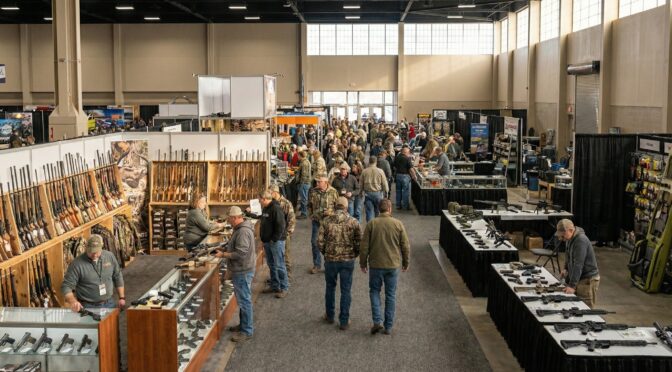
The 2026 Great American Outdoor Show (GAOS), staged at the Pennsylvania Farm Show Complex in Harrisburg, represents a pivotal juncture for the domestic small arms industry. Occurring in the immediate wake of the January 1, 2026, regulatory shift regarding the National Firearms Act (NFA) tax stamp, the show has transitioned from a traditional consumer exhibition into a high-stakes arena for market re-orientation.1 This analysis evaluates the primary technical announcements and attendee observations recorded during the opening forty-eight hours of the event, focusing exclusively on small arms developments. The methodology employed integrates structural technical data from manufacturer debuts with qualitative sentiment analysis from high-traffic digital forums, including Reddit’s regional firearms subreddits and specialized industry commentary.3 By triangulating official product specifications against early field reports from the GAOS Range Day and social media discourse, this report identifies the second- and third-order effects of modular chassis integration, the standardization of optics-ready platforms, and the unprecedented democratization of suppressor technology.

Executive Summary

The small arms landscape at the 2026 GAOS is defined by three converging trends: the industrial-scale adoption of modularity, the technical “professionalization” of the lever-action rifle, and the market-wide standardization of suppressed and optics-ready ecosystems. The most significant external factor influencing the show is the effective zeroing of the $200 NFA tax stamp, which has triggered a massive shift in consumer expectations.1 Attendees are no longer viewing suppressors as niche luxury items but as essential safety and performance components. This is reflected in the product lineups from Henry Repeating Arms and Smith & Wesson, which now feature threaded barrels and suppressor-height sights as baseline specifications rather than premium upgrades.6

In the handgun segment, the rivalry between traditional designs and modular chassis systems has intensified. The debut of the Glock Gen 6 demonstrates a strategic commitment to standardizing optics-ready slides (MOS 2.0) across all primary models, effectively eliminating the optics-optional tier of the market.9 Conversely, the Ruger RXM, developed in collaboration with Magpul, introduces a serialized internal fire control insert into the Glock-compatible ecosystem, allowing for a level of frame modularity previously unavailable in this price bracket.5

Lever-action technology is undergoing a radical technical overhaul. Henry Repeating Arms has not only restructured its entire nomenclature to aid consumer navigation but has introduced the Special Products Division (SPD) Predator, a rifle that challenges the accuracy thresholds of traditional bolt-action systems by offering a sub-MOA guarantee.6 Social media commentary indicates that while logistical hurdles such as traffic congestion and entry queues remain persistent challenges for attendees, the sentiment regarding technical innovation is overwhelmingly positive, with significant interest focused on the “Wall of Guns” raffle’s new prize flexibility.14

The Lever-Action Renaissance: Technical Overhaul and Strategic Rebranding

One of the most noteworthy institutional shifts at the 2026 GAOS is the wholesale modernization of the lever-action platform, led primarily by Henry Repeating Arms. The company has moved beyond its traditionalist identity, embracing advanced materials, precision engineering, and a new alphanumeric naming convention designed to simplify a previously complex catalog.

Structural Realignment of the Henry Catalog

Henry’s transition to an alphanumeric system (H1 through H12) serves as a critical strategic pivot. Analysts observe that this move is designed to reduce consumer confusion and better position the brand within modern retail environments where digital searchability is paramount.6 By categorizing firearms based on frame size and intended application, Henry allows users to navigate a massive inventory that now ranges from youth-oriented rimfires to high-precision predator rifles.

New SeriesCore Platform DesignationTechnical Orientation and Market Target
H1Classic RimfireFoundational training and small game hunting 6
H6Big BoyTraditional aesthetics with modern side-gate loading 6
H9Mid-Weight CenterfireFocus on versatile calibers like.30-30 and.35 Rem 6
H10Heavy CenterfireOptimized for.45-70 Government and large game 6
H12Pistol Caliber MagnumCompact defensive and trail carbines 6

This restructuring is more than a marketing exercise; it reflects a shift in manufacturing philosophy. The “Provider” and “Protector” families within these series demonstrate a move away from the ornamental brass receivers that defined Henry’s early success, favoring matte-blued steel and functional walnut for “hardcore” utility.6 This indicates a strategic intent to capture market share from traditional bolt-action users by offering the rapid follow-up shots of a lever-action without the weight or glare of a legacy “cowboy gun.”

The SPD Predator: Redefining Lever-Action Accuracy

The announcement of the Henry SPD Predator represents the technical peak of the lever-action category at GAOS 2026. Developed by the Special Products Division, the Predator is designed to compete directly with precision bolt-action rifles in the varmint and predator-control markets.13 The engineering is significant: it utilizes a free-floated, carbon-fiber tension-wrapped 18-inch barrel and is chambered in 5.56x45mm NATO/.223 Remington.6

The removal of the traditional magazine tube is the key technical enabler here. By utilizing AR-pattern (STANAG) magazines, Henry has eliminated the barrel-to-tube contact points that historically created uneven harmonics and hindered consistent accuracy in lever-action rifles.12 The inclusion of an adjustable comb on the laminate stock and a factory-tuned 4-pound trigger further reinforces its identity as a precision instrument rather than a traditional field carbine.12 Social media commentary from the range highlights the “smooth-cycling action” and the intuitive nature of the tang-mounted safety, which allows for rapid engagement of agile targets.13

Expansion of the High-Velocity Thumper Market

In a direct appeal to hunters in states with straight-wall cartridge restrictions, Henry has extended its LASR (Lever Action Supreme Rifle) platform to include the.450 Bushmaster.6 The LASR platform, which gained acclaim in 2025 for its.300 Blackout model, utilizes a modernized internal linkage that allows for a shorter lever throw and better integration with optical sights. The.450 Bushmaster variant features an 18-inch free-floated barrel, weighing in at 6.5 pounds, making it an exceptionally light “thumper” for brush-country hunting.6 This development suggests that Henry is identifying and filling niche ballistic gaps that larger manufacturers often overlook.

Handgun Innovation: Modularity vs. Standardized Performance

The handgun market at GAOS 2026 is witnessing a convergence of features. The distinction between “duty guns” and “custom guns” is blurring as manufacturers integrate high-end features into standard production models.

Glock Generation 6: Standardizing the Optics Ecosystem

Glock’s release of the Generation 6 (G17, G19, and G45) is perhaps the most scrutinized announcement of the show. The technical consensus among industry analysts is that the Gen 6 represents the “standardization” phase of handgun optics.9 Unlike previous generations where the Modular Optic System (MOS) was an optional upgrade, the Gen 6 makes optics-ready slides a standard across the entire lineup.

Technical SpecificationGlock Gen 5 MOSGlock Gen 6 (Standard)
Trigger DesignCurved shoeFlat-faced shoe with tactile reset 10
Optics MountingMulti-plate systemMOS 2.0 with direct slide threading 9
Frame ModularityBackstraps onlyIntegrated palm swell and “gas pedal” shelves 10
Grip TextureRTF5 (standard)RTF6 (aggressive multi-pattern) 17
Trigger GuardStandard profileMolded undercut for higher grip 9

The MOS 2.0 system is a significant mechanical improvement. By allowing the optic to be screwed directly into the slide, rather than relying solely on the mounting plate for structural integrity, Glock has addressed long-standing durability concerns.9 Furthermore, the introduction of “gas pedal” thumb shelves on both sides of the frame reflects a direct response to consumer requests for enhanced recoil control. Social media feedback from Range Day indicates that these ergonomic changes allow the pistol to “shoot flatter and faster” than any previous factory iteration.17

The Ruger RXM: Modular Chassis Disruption

Ruger has introduced a competing vision of modularity with the RXM (Ruger multiplied by Magpul). The RXM is a chassis-based 9mm pistol that utilizes a serialized stainless-steel fire control insert (FCI).5 This architecture, similar to the SIG Sauer P320, allows the user to swap the polymer grip frame—manufactured by Magpul—to change the size, color, or texture of the handgun without a new firearm transfer.5

The RXM is technically intriguing because it maintains compatibility with Generation 3 Glock magazines and internal components while offering the benefits of a modern modular chassis.11

ComponentRuger RXM Feature Detail
FrameMagpul Enhanced Handgun Grip (EHG) with ¾-scale TSP texture 11
Barrel4-inch with traditional lands-and-grooves rifling 5
Optics CutDirect-mount for RMR, DeltaPoint Pro, and RMSc footprints 11
SightsSteel tritium front with serrated black rear 5
TriggerFlat-face with 4.75-pound break and crisp reset 11

The $499 MSRP of the RXM is viewed by analysts as a aggressive move to dominate the “budget-custom” market.5 Attendee observations on digital forums emphasize that the RXM feels like a “customized” handgun from the factory, particularly due to Magpul’s input on ergonomics, which includes a subtle relief cut under the trigger guard and a highly effective flared magazine well.19

The Suppressor Market: A Paradigm Shift in Consumer Accessibility

The 2026 GAOS is the first major public gathering of firearms enthusiasts since the NFA tax stamp was effectively zeroed out. This regulatory change has fundamentally transformed the suppressor halls from educational spaces into high-volume sales environments.

The Rise of Entry-Level Suppressors

Analysts note that the elimination of the $200 tax has made “entry-level” suppressors in the $300-$500 range exponentially more attractive. Previously, a $300 suppressor carried a 66% federal markup, which disincentivized budget-conscious buyers.2 At the show, manufacturers like SilencerCo and Silencer Central have reported massive increases in booth traffic. SilencerCo representatives noted that their value-priced products, such as the Sparrow 22 (MSRP $349), are seeing growth estimates of up to 50% over the previous year.2

Lyman Products has also entered the segment with its budget-oriented “Sonicore” line, with MSRPs ranging from $199 to $299.1 This “democratization of silence” is expected to lead to a third-order effect: a surge in sales for subsonic ammunition and suppressor-ready host firearms, as consumers re-tool their collections for quieter operation.1

Technical Advancements in Gas Management: Flow-IQ

At Booth 587, Silent Steel USA is demonstrating its proprietary FLOW-IQ Technology, which is gaining significant attention from attendees who utilize modern sporting rifles.21 A persistent complaint with traditional suppressors is the “blowback” of gas and particulates into the shooter’s face, which is both a comfort and health concern. The FLOW-IQ system manages gas through a series of internal chambers designed to redirect backpressure away from the bolt carrier group.21

Silent Steel’s approach focuses on three primary metrics:

  1. Shooter Comfort: Reducing the concentration of gases at the ejection port.21
  2. Reliability: Minimizing the increase in bolt carrier velocity that often leads to premature wear in suppressed systems.21
  3. Durability: Using military-grade materials and construction that can withstand high round counts without performance degradation.21

This emphasis on gas management indicates that the market has moved past “simple sound reduction” and is now prioritizing the overall “suppressed shooting experience.”

Smith & Wesson: Tactical Bundles and the 5.7mm Expansion

Smith & Wesson (S&W) has used the 2026 GAOS to solidify its position in the premium “out-of-the-box” tactical market. Their “Spec Series” releases represent a growing trend where manufacturers bundle optics, accessories, and performance-tuned firearms into a single high-value package.

Spec Series R and VI: The Professional Package

The Spec Series R Model 686 Plus is a noteworthy development for revolver enthusiasts. Built on the L-Frame, this 7-shot.357 Magnum features a Power-Port™ barrel and a factory-mounted Aimpoint ACRO P-2.8 The integration of a top-tier red dot onto a ported revolver indicates that S&W is targeting the competition and high-end defensive markets.

The Spec Series VI M&P9 M2.0 Metal Compact takes a similar approach in the semi-automatic segment. It features a 7075 T-6 aluminum frame and inline barrel porting to mitigate muzzle rise.8 Social media commentary from the show floor highlights the “champagne Cerakote finish” and the inclusion of Floyds Custom Shop EDC magazine wells as details that elevate the pistol above standard production models.23

The FPC in 5.7x28mm: A Compact Powerhouse

S&W has also expanded its Folding Pistol Carbine (FPC) line to include the 5.7x28mm chambering.7 The FPC is popular for its unique horizontal folding mechanism, which allows the optic to remain mounted and zeroed when the rifle is stored.7 The 5.7x28mm version is compatible with M&P 5.7 pistol magazines and includes in-stock storage for two additional magazines, providing a massive on-board round count for a compact platform.7

Analysts suggest that the 5.7mm FPC is a direct response to the “rimfire resurgence,” offering a more powerful, centerfire alternative that remains low-recoil and highly controllable, especially when paired with the new Gemtech Nebula 5.7 suppressor.7

Attendee Sentiment and Social Media Analysis

The 2026 GAOS is being documented in real-time by a highly engaged community of small arms enthusiasts on platforms like Reddit (r/PAguns) and X (formerly Twitter). This qualitative data provides a window into the consumer experience that official press releases cannot capture.

Logistics and the “Carry” Culture

A significant portion of social media commentary on the opening days of the show focused on the logistical difficulty of attending. Traffic congestion in Harrisburg was reported as a “nightmare,” with wait times for parking exceeding an hour during peak Saturday hours.3 However, the sentiment remains fiercely protective of the show’s culture. Numerous posters confirmed that “Farm show carry is G2G” (good to go), noting that concealed carry is permitted for attendees, which reinforces the show’s identity as a space by and for the Second Amendment community.3

Range Day Impressions of the Glock Gen 6 and Ruger RXM

Early field reports from the Range Day sessions highlight a “generational divide” in attendee preferences. Traditional Glock enthusiasts appreciate the Gen 6’s aggressive RTF6 texture and the return to a single captive recoil spring, which many feel simplifies maintenance and provides a more predictable recoil impulse.10

Conversely, younger and more technically focused attendees are gravitating toward the Ruger RXM. Commentary on industry forums suggests that the “modularity for modularity’s sake” era is over; consumers now expect modularity to be paired with compatibility.5 The fact that the RXM accepts Glock magazines and aftermarket triggers like the Timney Alpha is cited as a major selling point.11

The “Wall of Guns” and Prize Flexibility

The NRA Foundation’s “Wall of Guns” (Booth #39) remains the show’s primary attraction for casual attendees. This year, the introduction of the $500 Guns.com gift card prize option has been hailed as a “major upgrade”.14 Social media users have observed that this flexibility allows winners to bypass the limited selection on the physical wall and instead choose a firearm that perfectly fits their needs from a massive online inventory. This change addresses the logistical difficulty of firearm transfers for out-of-state winners and reflects a more modern approach to fundraising raffles.14

Wall of Guns Raffle FeatureTechnical or Strategic Detail
Ticket Price$10 per entry 14
Odds of Winning1 in 100 for every drawing 25
Prize Option A$500 Guns.com Gift Card 14
Prize Option B$400 Cash 14
Prize Option CSelection from 40+ featured firearm models 25

Ballistic Optimization and Ammunition Innovations

The 2026 GAOS is highlighting a shift toward cartridge specialization. As firearms become more precise and suppressors become more common, ammunition manufacturers are responding with loads tailored for these specific ecosystems.

The Federal Subsonic Initiative

Federal Ammunition’s debut of the “Federal Subsonic” line is a direct byproduct of the suppressor boom. These loads, featuring heavy-for-caliber bullets in.30-30 Win and.45-70 Govt, are designed to remain below the speed of sound while still achieving reliable terminal expansion.30 This is a technical challenge, as lower velocities typically inhibit the mushrooming of traditional jacketed soft point bullets. Federal’s use of “Fusion” bullet technology in these subsonic loads indicates a commitment to ensuring that suppressed hunting is as ethically viable as traditional methods.30

The Continued Dominance of 7mm PRC and 6mm ARC

In the long-range halls, the 7mm PRC (Precision Rifle Cartridge) and 6mm ARC (Advanced Rifle Cartridge) are the cartridges of choice for the new generation of precision rifles. Federal has introduced a 195-grain Berger Elite Hunter load for the 7mm PRC, aimed at the high-ballistic-coefficient requirements of ultra-long-range hunting.30 Meanwhile, 6mm ARC is being showcased in the Ruger Harrier line, demonstrating that the AR-15 platform can reliably engage targets out to 1,000 yards with the correct caliber selection.30

Future Outlook: The Small Arms Market in 2026

The initial data from the 2026 GAOS suggests that the industry is entering a phase of rapid refinement. The period of “tactical novelty” has passed; consumers are now demanding that their firearms be integrated systems from the factory.

Analysts foresee the following developments based on GAOS indicators:

  1. Optics-Ready as the Baseline: Within 24 months, it is likely that non-optics-ready handguns will be relegated to the “budget” or “legacy” tiers of the market, as manufacturers follow Glock’s lead in standardizing mounting cuts.9
  2. The “Hush” Mainstream: With suppressor ownership poised to break 1 million annual units for the first time in 2026, the demand for suppressor-optimized components (gas-busting charging handles, adjustable gas blocks, and clean-burning powders) will dominate the accessory market.1
  3. The Modular Ecosystem: The success of the Ruger RXM will likely prompt other manufacturers to explore serialized fire control inserts for existing popular platforms, potentially including a Beretta or Smith & Wesson equivalent.5

The 2026 GAOS has proven that the American small arms industry is capable of high-velocity innovation even in a shifting regulatory landscape. The combination of modular engineering, precision lever-action technology, and a revitalized suppressor market has created a “perfect storm” of consumer interest. For the small arms analyst, the show confirms that the “professionalization” of the civilian firearm—where features once reserved for elite military units are now standard for the average enthusiast—is the defining theme of the current era.

The engagement observed at Booth #39, the queues at Silencer Central, and the technical debate surrounding the Glock Gen 6 all point to a market that is not just growing, but maturing in its technical requirements. As the show continues through February 15, the industry will be closely watching for the first formal sales data to confirm whether these technical trends are translating into the sustained market expansion predicted by the early 2026 milestones.


Please share the link on Facebook, Forums, with colleagues, etc. Your support is much appreciated and if you have any feedback, please email us in**@*********ps.com. If you’d like to request a report or order a reprint, please click here for the corresponding page to open in new tab.


Sources Used

  1. Rimfire Resurgence Trend? | An Official Journal Of The NRA – American Rifleman, accessed February 8, 2026, https://www.americanrifleman.org/content/rimfire-resurgence-trend/
  2. Suppressors: Where We Stand, 20 Days In – The Outdoor Wire, accessed February 8, 2026, https://www.theoutdoorwire.com/features/2026/01/suppressors-where-we-stand-20-days-in/
  3. Farm show 2026 : r/PAguns – Reddit, accessed February 8, 2026, https://www.reddit.com/r/PAguns/comments/1q957ww/farm_show_2026/
  4. Great American Outdoor Show in PA : r/NJGuns – Reddit, accessed February 8, 2026, https://www.reddit.com/r/NJGuns/comments/1anqrdf/great_american_outdoor_show_in_pa/
  5. Ruger RXM [2026 Review] – Gun University, accessed February 8, 2026, https://gununiversity.com/ruger-rxm-review/
  6. Henry Reveals Host of New Rifles for 2026 – Guns.com, accessed February 8, 2026, https://www.guns.com/news/2026/01/26/henry-new-rifles-shot-show
  7. New for 2026: Smith & Wesson FPC in 5.7×28 mm | An Official Journal Of The NRA, accessed February 8, 2026, https://www.americanrifleman.org/content/new-for-2026-smith-wesson-fpc-in-5-7×28-mm/
  8. SHOT Show 2026: Smith & Wesson Adds To Spec Series Lineup …, accessed February 8, 2026, https://www.ssusa.org/content/shot-show-2026-smith-wesson-adds-to-spec-series-lineup-with-new-revolver-compact-pistol/
  9. Glock Gen 6: What are the new changes? (2026 Analysis), accessed February 8, 2026, https://warriorland.net/blogs/news/glock-gen-6-what-are-the-new-changes-2026-analysis
  10. GLOCK Announces Generation 6: G17, G19, and G45 Get Ergonomic Overhaul, accessed February 8, 2026, https://www.thefirearmblog.com/blog/glock-announces-generation-6-g17-g19-and-g45-get-ergonomic-overhaul-44824474
  11. Ruger RXM: A modular twist on Glock’s legacy – Police1, accessed February 8, 2026, https://www.police1.com/shot-show/ruger-rxm-a-modular-twist-on-glocks-legacy
  12. Henry Repeating Arms introduces new rifles for 2026 | GUNSweek.com, accessed February 8, 2026, https://gunsweek.com/en/rifles/news/henry-repeating-arms-introduces-new-rifles-2026
  13. Hot from SHOT: The Best New Hunting Rifles for 2026 | An Official Journal Of The NRA, accessed February 8, 2026, https://www.americanhunter.org/content/hot-from-shot-the-best-new-hunting-rifles-for-2026/
  14. Friends of NRA Announces a Fresh Take on Wall of Guns at Great American Outdoor Show, accessed February 8, 2026, https://www.theoutdoorwire.com/releases/2026/02/friends-of-nra-announces-a-fresh-take-on-wall-of-guns-at-great-american-outdoor-show
  15. Friends of NRA Announces a Fresh Take on the Wall of Guns at the …, accessed February 8, 2026, https://www.friendsofnra.org/content/friends-of-nra-announces-a-fresh-take-on-the-wall-of-guns-at-the-great-american-outdoor-show/
  16. [SHOT 2026] Name Game And New Features: Henry Rifle Lineup Evolves, accessed February 8, 2026, https://www.thefirearmblog.com/blog/shot-2026-name-game-and-new-features-henry-rifle-lineup-evolves-44825374
  17. [SHOT 2026] Hands On With The Gen 6 Glocks | thefirearmblog.com, accessed February 8, 2026, https://www.thefirearmblog.com/blog/shot-2026-hands-on-with-the-gen-6-glocks-44825380
  18. Glock Gen 6 is Here: Complete Guide to New Features & Holster Fits – Inside Safariland, accessed February 8, 2026, https://inside.safariland.com/blog/glock-gen-6-is-here-complete-guide-to-new-features-holster-fits/
  19. Ruger RXM 9mm: Full Review – Guns and Ammo, accessed February 8, 2026, https://www.gunsandammo.com/editorial/ruger-rxm-9mm-review/521786
  20. NRA Shooting Illustrated – I Carry: Ruger RXM 9mm Pistol in a Mission First Tactical Holster, accessed February 8, 2026, https://missionfirsttactical.com/blognra-shooting-illustrated-i-carry-ruger-rxm-9mm-pistol-in-a-mission-first-tactical-holster/
  21. Silent Steel USA to Exhibit at the 2026 Great American Outdoor Show – Booth 587, accessed February 8, 2026, https://www.theoutdoorwire.com/releases/2026/02/silent-steel-usa-to-exhibit-at-the-2026-great-american-outdoor-show-booth-587
  22. SHOT Daily Day 3 – 2026 SHOT Show by SHOT Business – Issuu, accessed February 8, 2026, https://issuu.com/shotbusiness/docs/shot_daily_day_3_-_2026_shot_show
  23. New Smith & Wesson Handguns at SHOT Show – Guns and Ammo, accessed February 8, 2026, https://www.gunsandammo.com/editorial/new-smith-wesson-shot-show/544322
  24. 2026 Shot Daily – Day 1 by SHOT Business – Issuu, accessed February 8, 2026, https://issuu.com/shotbusiness/docs/2026_shot_daily_-_day_1
  25. Wall of Guns returns to the Great American Outdoor Show – NRA Blog, accessed February 8, 2026, https://www.nrablog.com/articles/2022/1/wall-of-guns-at-gaos
  26. Friends of NRA at the Great American Outdoor Show, accessed February 8, 2026, https://www.friendsofnra.org/events/national-events/
  27. Great American Outdoor Show « Daily Bulletin, accessed February 8, 2026, https://bulletin.accurateshooter.com/tag/great-american-outdoor-show/
  28. Great American Outdoor Show Returns In February 2023 | An Official Journal Of The NRA, accessed February 8, 2026, https://www.americanrifleman.org/content/great-american-outdoor-show-returns-in-february-2023/
  29. Friends of NRA Banquet, Wall of Guns Returning to 2023 Great American Outdoor Show, accessed February 8, 2026, https://www.nrawomen.com/content/friends-of-nra-banquet-wall-of-guns-returning-to-2023-great-american-outdoor-show
  30. Federal to Release More than 20 Centerfire and 25 Shotshell Options in 2026 | An Official Journal Of The NRA – American Hunter, accessed February 8, 2026, https://www.americanhunter.org/content/federal-to-release-more-than-20-centerfire-and-25-shotshell-options-in-2026/
  31. Top Firearm Picks from SHOT Show 2026 – NRA Women, accessed February 8, 2026, https://www.nrawomen.com/content/top-firearm-picks-from-shot-show-2026

Strategic Shifts in Small Arms and Light Weapons at UMEX & SimTEX 2026

Executive Summary

The seventh edition of the Unmanned Systems Exhibition (UMEX) and Simulation and Training Exhibition (SimTEX), convened at the Abu Dhabi National Exhibition Centre (ADNEC) from January 20 to 22, 2026, represents a watershed moment in the trajectory of the global and regional small arms industry. While the event’s nomenclature emphasizes “unmanned systems,” the 2026 iteration revealed a profound and irreversible convergence between traditional infantry weaponry and autonomous architectures. For the small arms industry analyst, the distinction between a “rifle” and a “remote weapon station” (RWS) has effectively dissolved. The exhibition served as the primary theater for the “platforming” of lethality, where kinetic efficacy is no longer defined solely by ballistics, but by integration, digitization, and indigenous control.

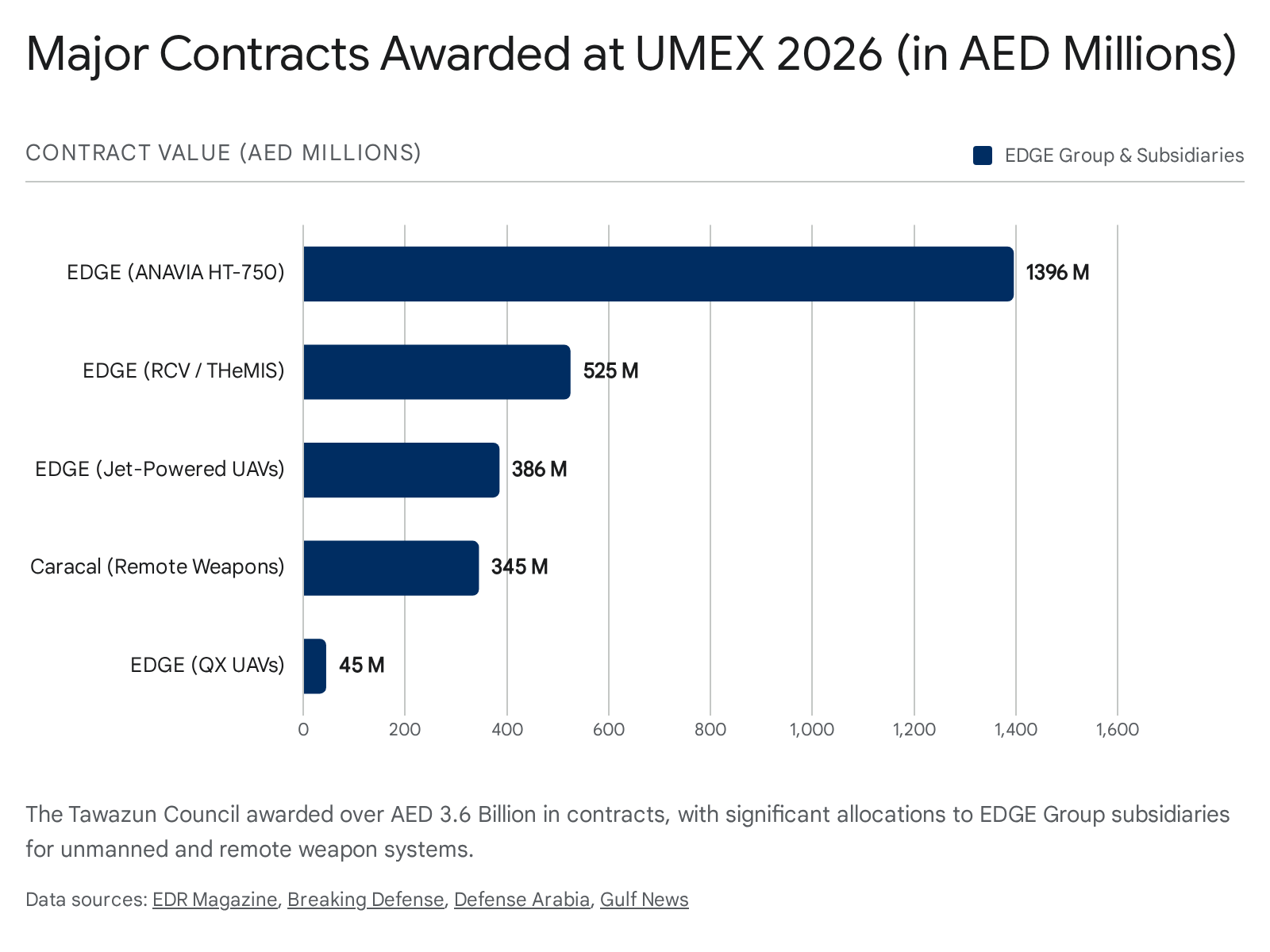
Drawing upon an exhaustive review of exhibitor displays, official contract announcements, and multi-lingual digital discourse, this report posits that the Middle Eastern small arms market has pivoted from a passive consumption model to an active industrial dominance model. This shift was underscored by record-breaking participation figures—37,878 visitors and 390 exhibitors—and a substantial AED 3.6 billion ($980 million) in total contracts awarded by the Tawazun Council.

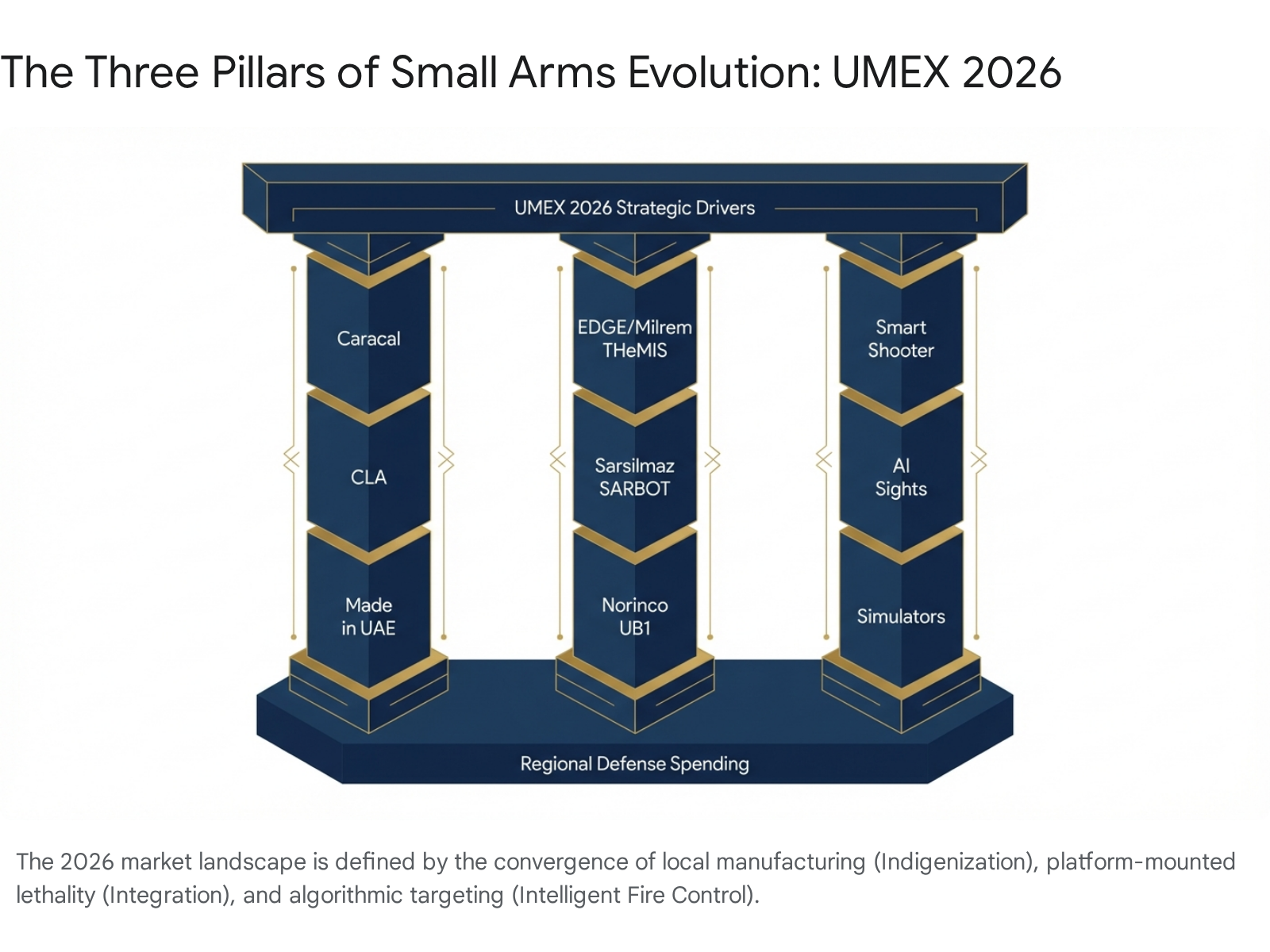
Three primary strategic drivers emerged from the exhibition floor, redefining the competitive landscape for 2026 and beyond:

  1. Indigenization as Doctrine: The hegemony of UAE-based conglomerates, particularly EDGE Group and its subsidiary Caracal International, was absolute. The awarding of a landmark AED 345.3 million ($94 million) contract to Caracal for “remote-controlled weapons” signals a transition from purchasing foreign arms to investing in domestic systems integration. This is further evidenced by Caracal’s expanding export footprint, notably the contract to supply CSR 338 sniper rifles to India, positioning the UAE as a net exporter of precision small arms to the Global South.
  2. The Integration of Kinetic Systems: The era of the standalone infantry weapon is ending. UMEX 2026 demonstrated that small arms are increasingly viewed as subsystems within a larger mobility matrix. From the EDGE/Milrem Robotics THeMIS UGV armed with 30mm cannons to the Sarsilmaz SARBOT quadruped, the industry is prioritizing the mounting of small arms on unmanned chassis. This trend extends to the maritime domain, with Norinco’s UB1 USV featuring remotely operated heavy machine guns, expanding the small arms market into littoral defense.
  3. Algorithmic Fire Control: The technological high ground is no longer determined by the caliber of the round, but by the intelligence of the sight. The proliferation of “smart sights” and fire control systems (FCS), exemplified by Smart Shooter and regional competitors, indicates a doctrinal shift toward “guaranteed hit” technology. This is driven by the urgent need for kinetic Counter-UAS (C-UAS) capabilities at the squad level, blurring the lines between infantry combat and air defense.
UMEX 2026: Three pillars of small arms evolution. Caracal, EDGE/Milrem, Smart Shooter. Regional defense spending.

Financially, the allocation of capital at UMEX 2026 reveals a procurement strategy heavily weighted toward force multiplication. The extensive investment in simulation and training (SimTEX) and remote systems suggests a future force structure that relies on technological leverage to maximize the lethality of a smaller, highly trained, and partially automated fighting force.

This report provides a granular analysis of these trends, examining the specific hardware displayed—from the polymer frames of the Caracal EF pistol to the thermobaric warheads of Russian loitering munitions—and synthesizing the broader economic and geopolitical implications for the small arms industry.

1. Introduction: The Strategic Pivot of 2026

The context of UMEX 2026 cannot be divorced from the broader geopolitical currents reshaping the Middle East and North Africa (MENA) region. For decades, defense exhibitions in Abu Dhabi were primarily marketplaces where Western and Eastern prime contractors competed for the patronage of regional governments. The dynamic in January 2026 was markedly different. The overarching theme was “Strategic Autonomy.”

For the small arms analyst, this shift is critical. The United Arab Emirates, through the Tawazun Council, has successfully enforced a policy of industrial localization. It is no longer sufficient for a foreign manufacturer to simply sell rifles or ammunition; they must now offer Transfer of Technology (ToT), establish local joint ventures, or integrate their systems with UAE-owned intellectual property.

This environment has fostered the rapid maturation of national champions. EDGE Group, and specifically its small arms entity Caracal International, appeared at UMEX 2026 not as a burgeoning startup but as an established prime. The scale of their booth, the breadth of their portfolio, and the volume of their contracts underscored a new reality: the UAE is transitioning from a consumer of security to a producer of security.

Furthermore, the co-location of UMEX (Unmanned Systems) and SimTEX (Simulation) created a unique ecosystem for small arms analysis. It highlighted that the future of infantry weapons is not just about the mechanics of the gun, but about how that gun is simulated in virtual training environments and how it is integrated into the broader unmanned network. The convergence of these fields—Ballistics, Robotics, and Simulation—was the defining characteristic of the show.

The exhibition floor at ADNEC offered a microcosm of the global defense industry’s current trajectory. Several key market drivers were observable in the layout and product focus of the exhibitors.

2.1 The Hybridization of Infantry Systems

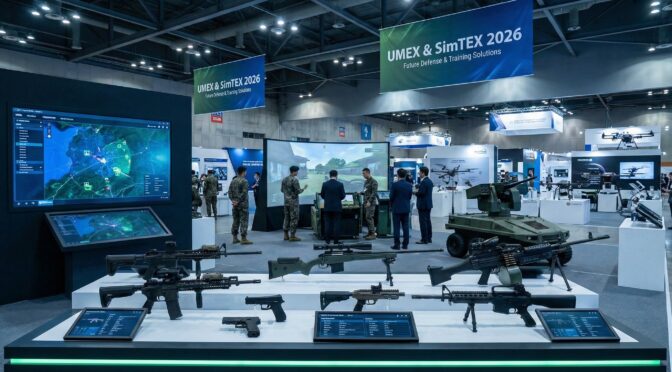
Perhaps the most notable trend was the hybridization of the infantryman’s toolkit. Historically, “Small Arms” and “Unmanned Systems” were treated as distinct procurement categories. UMEX 2026 effectively collapsed this distinction. Military planners and industry leaders no longer view the rifle as a standalone tool. Instead, the discussion has shifted to “lethality effectors”—components that can be handheld by a soldier, mounted on a robotic dog, or integrated into a static border defense tower.

This was physically manifest on the show floor. Booths were not segregated by traditional categories. Rifles were displayed mounted on UGVs, and ammunition crates were stacked alongside loitering munition launchers. This visual integration signals a doctrinal shift: the rifle is becoming a sub-component of a larger autonomous system.

2.2 The Rise of Algorithmic Warfare at the Edge

A second major driver is the push for “Algorithmic Warfare” at the tactical edge. The processing power that was once reserved for headquarters or major platforms (jets, ships) has migrated to the rifle scope. Fire Control Systems (FCS) that utilize computer vision to identify targets, calculate ballistic solutions, and even inhibit firing until a hit is guaranteed were ubiquitous. This trend is driven by the democratization of threats; as adversaries employ small, fast-moving drones, the human eye and reflex are no longer sufficient. The rifle must become “smart” to remain relevant.

2.3 Economic Nationalism and Export Ambitions

The economic driver of “Indigenization” was palpable. The Tawazun Council’s announcements focused heavily on awarding contracts to domestic entities. However, a secondary trend of “Export Ambition” was also evident. The narrative around Caracal’s contract with the Indian Central Reserve Police Force (CRPF) suggests that the UAE is actively seeking to compete in the global small arms market, leveraging its agile manufacturing base and political neutrality to win contracts in the Global South.

3. Handguns and Personal Defense Weapons (PDW)

While the headline-grabbing technology focused on robotics, the fundamental tools of personal defense—handguns and PDWs—remained a core component of the exhibition, particularly for the domestic security sector.

3.1 Caracal International: The Domestic Benchmark

Caracal International utilized UMEX 2026 to showcase the maturity and diversity of its handgun portfolio. The company’s display was a statement of comprehensive capability, covering military, law enforcement, and competitive shooting requirements.

  • Caracal Enhanced F (EF) & F Gen II: These polymer-framed, striker-fired pistols remain the workhorse of the UAE’s domestic security forces. The 2026 display emphasized their low bore axis and ergonomic adaptability. The “Enhanced F” series continues to be marketed on its extreme reliability in desert environments—a critical selling point for regional adoption. The presence of these pistols at a “systems” show underscores their role as the baseline for personal defense.
  • The 2011 Series: A significant highlight was the Caracal 2011 pistol. Moving into the high-end tactical and competitive shooting market, the 2011 platform (a double-stack 1911 derivative) showcases Caracal’s precision engineering capabilities. The “Liwa” edition, featuring gold inlays and Arabic poetry, targeted the luxury collector market. This niche but lucrative segment in the GCC represents a unique intersection of heritage and tactical technology.
  • CMP9 Submachine Gun: Positioned as a modern solution for close-protection and special operations, the CMP9 was displayed in various configurations, including suppressed models. Its presence at UMEX, often alongside VIP protection drone systems, highlights its role in the comprehensive security package. The 9x19mm platform is designed to offer volume of fire in compact spaces, making it ideal for vehicle-borne operations or urban VIP protection details.

3.2 Regional Competition: Sarsilmaz and Girsan

The Turkish defense industry provided the primary competition in the handgun segment, reflecting the broader geopolitical rivalry for influence in the defense sector.

  • Sarsilmaz SAR9: The SAR9 pistol series, already well-established in the Turkish military and U.S. civilian market, was marketed aggressively. Sarsilmaz’s strategy at UMEX focused on volume and cost-effectiveness, contrasting with Caracal’s focus on premium indigenization. The SAR9 is positioned as a NATO-standard, battle-proven alternative for export clients looking for reliability at a competitive price point.
  • Girsan’s Strategic Expansion: While Girsan’s physical presence was focused on distribution, news of their expansion into the US market (establishing GIRSAN USA in Florida) provided critical context. This move indicates that Turkish manufacturers are rapidly graduating from regional players to global exporters, putting pressure on other emerging manufacturers to secure their own market niches.

4. Assault Rifles & Carbines: The Standard Issue

The assault rifle market at UMEX 2026 was dominated by the AR-15/AR-18 architecture, reaffirming the global standardization on 5.56x45mm NATO platforms. The debate between gas-piston and direct-impingement systems was alive and well on the exhibition floor.

4.1 Caracal’s Modular Platforms

Caracal displayed its rifle portfolio as a modular family of systems, emphasizing interchangeability and adaptability.

  • Caracal CAR 816: This gas-operated, short-stroke piston rifle remains the flagship of the UAE small arms industry. At UMEX 2026, it was displayed not just as a soldier’s weapon but as a platform for various optics and accessories. The “A2” variants were prominent, featuring upgraded furniture and M-LOK handguards, reflecting current trends in weight reduction and modularity. The piston system is favored in the region for its reliability in fine sand conditions, keeping the action cleaner than direct impingement alternatives.
  • Caracal CAR 814: The direct-impingement sibling to the 816, the CAR 814 was positioned for law enforcement and export markets where cost-to-performance ratios favor direct impingement systems. The display of the CAR 814 A2 Patrol highlighted its suitability for police cruisers and general duty use.
  • VERSUS Competition Rifle: Caracal also showcased the VERSUS, a competition-tuned rifle chambered in.223 Wylde. This demonstrates the company’s engagement with the sport shooting community, which often serves as a testbed for ergonomic and accuracy enhancements that eventually filter down to military products.

4.2 The Turkish Challenge: MPT-76 SH

Sarsilmaz displayed the MPT-76 SH, a 7.62x51mm battle rifle. While heavier than the 5.56mm platforms, the MPT-76 represents the Turkish indigenous equivalent to the CAR 816. Its presence underscores the different doctrinal choices—Turkey maintaining a focus on the heavier 7.62mm cartridge for its varied terrain, while the UAE focuses largely on 5.56mm carbines for mechanized and urban operations.

5. Precision Fires: Sniper & Anti-Materiel Systems

Precision fire was a major theme at UMEX 2026, driven by the operational need for counter-sniper capabilities, the neutralization of unexploded ordnance (UXO), and the engagement of light vehicles at standoff distances.

5.1 Caracal’s Precision Portfolio

  • CSR 308 & CSR 338: The CSR (Caracal Sniper Rifle) series was the centerpiece of the precision display. The CSR 308 (7.62x51mm) and CSR 338 (.338 Lapua Magnum) feature fully adjustable chassis systems, essential for the modern sniper. The.338 Lapua Magnum variant is particularly significant as it bridges the gap between anti-personnel and anti-materiel capabilities, offering effective range out to 1,500 meters.
  • Export Success: The context of the contract to supply CSR 338 rifles to India was a major talking point. This validation by a major foreign military power enhances the prestige of the platform.
  • CSA 338 Semi-Automatic: Caracal also displayed the CSA 338, a semi-automatic precision rifle. This platform addresses the need for rapid follow-up shots, a capability increasingly requested for engaging multiple targets or drone swarms where a bolt-action rifle is too slow.

5.2 Accuracy International (AI): The Western Standard

British firm Accuracy International (AI), a legend in the sniper community, maintained a strong presence.

  • AX MkIII: The latest evolution of the AX series, designed to meet current NATO requirements.
  • AX50 ELR: The AX50 ELR (Extreme Long Range) is a multi-caliber anti-materiel rifle system. Configured primarily in.50 BMG, it can be converted to.408 CheyTac. Its presence aligns with the regional need for hard-target interdiction—stopping VBIEDs (Vehicle-Borne Improvised Explosive Devices) or disabling parked aircraft at extreme ranges.

5.3 Russian Heavy Hitters

Rosoboronexport showcased Russia’s continued focus on robust, heavy-caliber solutions.

  • Kord-M (ASVK-M): This 12.7x108mm anti-materiel rifle is known for its bullpup design, which significantly reduces the overall length of the weapon, making it more maneuverable in urban environments or transport vehicles compared to traditional lengths.
  • Chukavin (SVCh): Discussions around the Chukavin sniper rifle highlighted its role as the modern successor to the Dragunov SVD. Reports of its testing in the Ukraine theater added a layer of “combat-proven” marketing to the Russian display.
ModelManufacturerCaliberActionRoleOrigin
CSR 338Caracal.338 LapuaBolt ActionLong Range PrecisionUAE 🇦🇪
CSA 338Caracal.338 LapuaSemi-AutoRapid Engagement / DMRUAE 🇦🇪
AX50 ELRAccuracy Int..50 BMG /.408Bolt ActionAnti-Materiel / Hard TargetUK 🇬🇧
Kord-MRostec12.7x108mmBolt (Bullpup)Urban Anti-MaterielRussia 🇷🇺
MPT-76 SHSarsilmaz7.62x51mmGas PistonBattle Rifle / DMRTurkey 🇹🇷

6. The Integration Frontier: Remote Weapon Stations (RWS) & Armed UGVs

The most significant trend at UMEX 2026 was the “Integration” of small arms onto unmanned platforms. This segment of the market is expanding rapidly as militaries seek to reduce risk to human personnel and increase the firepower available to light infantry units.

6.1 The EDGE & Milrem Robotics Nexus

The centerpiece of this trend was the collaboration between EDGE Group and Milrem Robotics. The THeMIS UGV (Unmanned Ground Vehicle) was displayed in a “Combat” configuration.

  • Armament Upgrade: Unlike previous iterations often seen with 7.62mm machine guns, the 2026 variants were up-gunned with 30mm M230LF cannons and MK44 cannons.
  • Strategic Implication: This elevates the UGV from a logistics or light support role to a mechanized infantry combatant capable of engaging light armor. For the small arms analyst, this signals a market shift where “small arms” manufacturers must ensure their receivers can withstand the recoil and environmental stresses of vehicle mounting.
  • Operational Validation: The UAE Ministry of Defence signed a contract for 60 units (20 Tracked RCVs and 40 THeMIS UGVs). This is a massive validation of the concept, moving it from prototype to operational reality.

6.2 Sarsilmaz SARBOT and BEST Defence

Sarsilmaz showcased the SARBOT, an armed quadrupedal robot (robodog). While many such systems are prototypes, the integration of Sarsilmaz’s small arms onto a highly mobile legged platform suggests a future focus on urban clearing operations where wheeled or tracked vehicles cannot go.

  • BEST Defence: A Sarsilmaz subsidiary, BEST Defence, displayed a 12.7mm Remote Controlled Weapon Station (RCWS). This system utilizes AI for stabilization and targeting, allowing heavy machine gun fire from light tactical vehicles or naval platforms.

6.3 Maritime Lethality: Norinco UB1

China’s Norinco introduced the UB1 Sharp Shark-10, an unmanned surface vessel (USV).

  • Payload: It features a visible remote-controlled weapon station fitted with a 12.7mm or 14.5mm machine gun.
  • Market Implication: This extends the domain of small arms into naval force protection and anti-piracy, traditionally the role of manned patrol boats. The integration of heavy machine guns on autonomous boats creates a new demand signal for “marinized” small arms capable of withstanding saltwater corrosion without constant human maintenance.

6.4 The “Mobilicom” Connector

An interesting detail from the supply chain perspective was Mobilicom’s announcement of a secured order from a “prominent UAE-based small-arms manufacturer” for its SkyHopper PRO datalinks and controllers. This connects the dots between the weapon and the drone. It implies that UAE manufacturers (almost certainly Caracal or an EDGE affiliate) are building the internal electronic architecture to make their weapons “remote-ready” out of the box, integrating sophisticated datalinks to ensure secure control.

7. Optics, Fire Control, and The Algorithmic Aim

If the gun is the hardware, the fire control system is the software that defines its efficacy. UMEX 2026 highlighted a transition from passive optics (scopes) to active fire control systems (FCS).

7.1 Smart Shooter: The “Lock and Fire” Revolution

Israeli company Smart Shooter continued to dominate the narrative around intelligent sighting systems. Their SMASH family of fire control systems (FCS) was prominent.

  • Technology: The system uses image processing and AI to “lock” onto a target. The soldier pulls the trigger, but the system only releases the hammer when the weapon is perfectly aligned with the target.
  • Impact: This technology effectively democratizes marksmanship, allowing minimally trained conscripts to achieve sniper-like accuracy against moving targets and, crucially, small drones.
  • Variants: The SMASH 3000 (lightweight) and SMASH AD (Anti-Drone specialized) were key discussion points. The system’s ability to calculate lead for a moving drone makes it one of the most cost-effective Kinetic C-UAS solutions on the market.

8. Ammunition: The Consumable Lethality

The ammunition sector at UMEX 2026 reflected the broader trends of indigenization and specialization, particularly in the context of C-UAS requirements.

8.1 Caracal Light Ammunition (CLA) / Lahab

Caracal Light Ammunition (CLA), also known under the Lahab brand, had a massive presence. As the UAE’s sole ammunition producer, their display focused on supply chain sovereignty.

  • Portfolio: They showcased a full range of small caliber ammunition (5.56mm, 7.62mm, 9mm, 12.7mm).
  • Strategic Importance: The massive contract for armed UGVs (Milrem) creates a sustained demand for 30mm ammunition. Lahab is positioned to be the primary supplier for these systems, ensuring that the UAE’s autonomous fleet is not dependent on foreign ammunition stocks.

8.2 Russian Innovations: Multi-Bullet Ammunition

Russian manufacturer High-Precision Systems (part of Rostec) announced the development of “multi-bullet ammunition” specifically designed to engage small UAVs.

  • Concept: This likely refers to a “duplex” or “triplex” round, or a small-caliber shotshell concept, designed to create a spread pattern to increase the hit probability against small, fast-moving drones. This represents a direct adaptation of small arms ammunition to the modern threat environment.

8.3 Turkish BPS

BPS, a Sarsilmaz group company, displayed its ammunition manufacturing capacity. Their presence highlights the competition in the consumables market, with Turkish suppliers positioning themselves as alternative sources for NATO-standard ammunition in the region.

9. Simulation and Training (SimTEX): The Virtual Battlefield

The SimTEX component of the exhibition highlighted how virtual reality is reshaping small arms training.

  • InVeris Training Solutions: Displayed the FATS 100MIL virtual training system.
  • Capability: The system supports simulation for a vast array of small arms, machine guns, and mortars.
  • Trend: The move is toward “ballistically accurate” simulation where the recoil, jam clearing, and reloading procedures are physically replicated, but the “bullet” is a digital pixel. This reduces the logistical cost of training and allows for complex “shoot/no-shoot” scenario training that live fire cannot safely replicate.
  • Adoption: The selection of InVeris systems by the USAF Security Forces Center was a key marketing point, validating the system’s fidelity for high-level military training.

10. Counter-UAS (C-UAS) and Non-Kinetic “Small Arms”

The proliferation of drones has necessitated the invention of anti-drone “small arms.” UMEX 2026 blurred the line between a weapon that fires a bullet and a weapon that fires a signal.

10.1 Carboteh BANS: The Handheld Electronic Weapon

One of the most innovative “small arms” at the show fired no projectiles at all. The Battlefield Anti-Aircraft Non-Kinetic (BANS) system, developed by Carboteh, is a handheld device resembling a bullpup rifle.

  • Function: It simulates the UV signature of a surface-to-air missile launch.
  • Effect: When pointed at an enemy aircraft, the aircraft’s Missile Warning System (MWS) detects the “launch” and automatically deploys flares and countermeasures.
  • Tactical Value: It forces enemy pilots to expend their limited defensive countermeasures or abort runs without the operator firing a single expensive missile. It is a psychological and logistical weapon in a rifle form factor.
BANS system diagram: Soldier firing simulated missile plume at aircraft, triggering flare deployment. Range: 5-6km, Weight: 4kg.

10.2 Calidus “Spider Net”

UAE-based Calidus showcased the Spider Net system.

  • Function: A kinetic C-UAS solution designed to physically capture or disable small drones.
  • Significance: As drones become smaller and operate in swarms, jamming becomes less effective (due to autonomous navigation). Kinetic solutions like nets or fragmentation rounds are seeing a resurgence as the “hard kill” final layer of defense. This system, integrated with vehicles like the MCAV, provides a mobile “dome” of protection against loitering munitions.

11. Social Media and Digital Sentiment Analysis

A review of social media discussions (Twitter/X, LinkedIn, Reddit) surrounding UMEX 2026 reveals a distinct divergence between industry professionals and general enthusiasts.

  • Industry Sentiment (LinkedIn): The discourse focused heavily on “partnerships” and “sovereignty.” Posts from EDGE and Tawazun executives garnered high engagement, reinforcing the narrative of UAE industrial success. The “Caracal India” deal was frequently cited as a proof point of the UAE’s rising status as a defense exporter. Mobilicom’s announcement of their win with a UAE small arms manufacturer also generated specific B2B buzz regarding supply chain integration.
  • Enthusiast Sentiment (Twitter/Reddit):
  • The “Robodog” Factor: The Sarsilmaz SARBOT and Milrem THeMIS generated the most viral content. The imagery of “guns on robots” continues to capture public imagination and anxiety, with threads discussing the ethical implications of autonomous fire.
  • Technical Skepticism: Discussions on defense forums (e.g., r/CredibleDefense) dissected the Russian displays. Users questioned the practical efficacy of the Kub-2-2E based on its specs vs. battlefield performance in Ukraine. There was also scrutiny of the “Smart Shooter” type systems, with debates on their effectiveness against swarms vs. single targets.
  • Joby Aviation: While not small arms, the announcement by Joby Aviation regarding commercial flights in the UAE by 2026 created a halo effect of “futurism” around the entire show, which defense exhibitors leveraged to frame their products as equally cutting-edge.

12. Market Analysis: Contracts and Economic Implications

The financial backbone of UMEX 2026 was the Tawazun Council, the UAE’s defense procurement authority. The volume and nature of the contracts signed provide a clear roadmap of the UAE’s defense strategy.

12.1 The Caracal Contract: Defining “Remote” Lethality

The most critical data point for the small arms analyst was the AED 345.3 million ($94 million) contract awarded to Caracal International for “remote-controlled weapons.”

  • Analysis: This is not a standard rifle procurement. The specific terminology “remote-controlled” implies that this funding is dedicated to equipping the expanding fleet of UGVs (like the Milrem deal) and static defense posts with weaponized turrets. It validates the R&D investment Caracal has made in integrating its firearms with servos and sensors. It shifts revenue potential from low-margin hardware (rifles) to high-margin systems integration.

12.2 The EDGE/Milrem Deal

The AED 525 million ($143 million) deal for THeMIS and RCV units is a direct multiplier for the small arms ammunition market.

  • Analysis: These 60 vehicles will require significant stockpiles of 30mm ammunition. Unlike infantry, who fire conservatively, autonomous or remote systems often have higher rates of fire and sustained suppression capabilities. This bodes well for Lahab (Caracal Light Ammunition), which will likely supply the consumables for these platforms.

12.3 Export Success: The India Connection

While not a UMEX-specific signature, the context of the CSR 338 contract with India was buzzing on the floor.

  • Significance: The supply of 200 sniper rifles to India’s Central Reserve Police Force (CRPF) is a watershed moment. It proves that UAE small arms are competitive against established European and American brands in open tenders. It opens the door to the massive Indian defense market, where “Make in India” initiatives align perfectly with Caracal’s willingness to transfer technology and manufacture locally.
EDGE Group contract values at UMEX 2026 in AED millions. Top contract: Anavia HT-750 (1396M).

13. Conclusion and Future Outlook

UMEX 2026 was a manifesto for the future of small arms. The era of the “dumb” iron sight and the standalone rifle is ending. The industry is pivoting toward an ecosystem where the weapon is merely the kinetic actuator in a networked loop of sensors, AI processors, and autonomous platforms.

For the UAE, the event was a triumph of industrial strategy. Caracal International has successfully transitioned from a local assembler to a global competitor, capable of winning foreign contracts and supplying advanced remote systems to its own military.

Key Takeaways for the Analyst:

  1. Watch the Software: The value in small arms is migrating to Fire Control Systems (Smart Shooter, etc.). The company that owns the “lock” algorithm owns the lethality.
  2. The UGV as the New Infantryman: The heavy procurement of armed UGVs (Milrem) suggests that future small arms requirements will increasingly prioritize vehicle-mounted configurations (heavy barrels, solenoid triggers) over man-portable ergonomics.
  3. Sovereignty is King: The GCC market is closed to those who merely wish to sell. It is open to those who wish to build locally.

The rifle of the future, as seen at UMEX 2026, is not just held in hands—it is mounted on tracks, guided by code, and built in Abu Dhabi.

Appendix: Methodology

This report was compiled using a synthesis of open-source intelligence (OSINT) gathered from the UMEX and SimTEX 2026 exhibition. Sources include:

  • Official Press Releases: From Tawazun Council, EDGE Group, and ADNEC.
  • Defense News Reporting: Articles from Breaking Defense, Jane’s (implied via snippets), and regional defense outlets (Defaiya, Gulf News).
  • Exhibitor Data: Analysis of exhibitor lists and product catalogs from Caracal, Sarsilmaz, Rosoboronexport, and others.
  • Social Media Analysis: Review of relevant hashtags (#UMEX2026, #SimTEX2026) and discussions on platforms like LinkedIn and Reddit to gauge sentiment and identify viral technologies.
  • Contract Data: Aggregation of publicly announced contract values and scope.

All financial figures are reported in AED and converted to USD at the prevailing peg rate (approx. 3.67 AED = 1 USD) where applicable. Product specifications are derived from manufacturer claims displayed at the event.


Please share the link on Facebook, Forums, with colleagues, etc. Your support is much appreciated and if you have any feedback, please email us in**@*********ps.com. If you’d like to request a report or order a reprint, please click here for the corresponding page to open in new tab.


Works Cited

  • Breaking Defense. (2026, January 22). UMEX total deals reach $980 million, navies seek 3D-printed USVs. Retrieved from breakingdefense.com
  • Breaking Defense. (2026, January 20). UMEX opens with $240 million in contracts to EDGE Group. Retrieved from breakingdefense.com
  • Caracal International. (2025, November 28). Caracal Debut Advanced Line Commercial Pistols and Rifles. Retrieved from edgegroupuae.com
  • Defense Update. (2026, January 20). Carboteh introduces a non-kinetic system designed to force hostile aircraft to expend countermeasures. Retrieved from defense-update.com
  • EDR Magazine. (2026, January 22). Tawazun announces Ministry of Defence deals 11 contracts worth AED 3.6 billion over 3 days at UMEX SIMTEX. Retrieved from edrmagazine.eu
  • Gulf News. (2026, January 22). 37,878 visitors attend UMEX and SimTEX 2026 in a record-breaking edition. Retrieved from gulfnews.com
  • H I Sutton. (2026, January 23). New Chinese Maritime Drone: UB1 Shark-10. Retrieved from hisutton.com
  • Mobilicom. (2026, January 26). Mobilicom Announces New Design Win and Initial Order from United Arab Emirates-Based Arms Manufacturer. Retrieved from money.tmx.com
  • Rosoboronexport. (2026, January 20). JSC ROSOBORONEXPORT is organizing a single Russian exhibit at UMEX & SimTEX 2026. Retrieved from roe.ru
  • Tawazun Council. (2026, January 22). Tawazun Council awards AED 3.6 billion in defense deals. Retrieved from english.defensearabia.com