If you’ve had trouble finding our articles or shop products through search engines recently, you aren’t alone. We want to be clear about what’s been happening at Ronin’s Grips, how we’re fixing it, and where we plan to go from here.
What Happened: The July 2026 Shift
In mid-July 2026, major search engines, notably Google, updated their core ranking systems. These updates prioritized AI-generated summaries while applying stricter automated filters to assess content quality across entire sites. As a result, our traffic volumes from search engines to the blog and online store dropped by about 93%.
Rather than evaluating pages individually, these algorithms calculate a site-wide quality rating. If an automated system flags a specific section, it lowers the overall score for the entire domain. Ironically, the very thing we wanted to accomplish, providing social media analytics in a more template-driven manner so you get data to make decisions instead of just our opinion, ended up being our undoing!
Unfortunately, this filter caught our extensive archive of product reviews and comparison guides. Because the search engines evaluate interconnected sections together, reduced visibility on our AI and template-driven blog posts ended up dragging down search rankings for our main store as well.
The Steps We Have Taken So Far
We won’t let automated algorithms compromise our store or the quality of our content. To restore our search visibility and help new customers find us, we’ve taken immediate technical steps.
To safeguard our domain’s overall rating, we added noindex tags to our legacy comparison reports and reviews. The pages are still fully accessible to you directly, but search crawlers are instructed to skip indexing them. This prevents older content from weighing down the main Ronin’s Grips storefront in search rankings.
Where We Go From Here: A Proposal for the Community
While adding noindex tags addresses the immediate search penalties, it prompts us to rethink how we publish in-depth technical guides moving forward. Publicly hosting detailed product comparisons without risking algorithmic downgrades has become increasingly challenging. We remain committed to delivering thorough reviews, but we need a format free from shifting search engine criteria.
That brings us to a new concept we’re exploring: A Private, Members-Only Community.
We’re considering a dedicated, non-indexed community space for Ronin’s Grips members. This private hub would host our data-driven social media analyses of small arms-related matters removed from public search crawlers.
Maintaining this platform independently of public search traffic requires dedicated effort, so we’re considering a small subscription model to support it. Before making any decisions, we want to hear your thoughts.
We would love your input on the following:
What are your thoughts on moving our deep-dive reviews and comparisons into a private, members-only section?
Would you be willing to pay a monthly fee to support this content?
If so, is a price point of $5/month acceptable to you for this level of detail and access?
Please share your thoughts in the comments below or contact us directly. Your support has built Ronin’s Grips from day one, and your feedback will help guide our next steps.
The global sports gun market is currently undergoing a massive shift. Competition is moving away from simple product-vs-product battles toward fully integrated ecosystems that combine vertical manufacturing, direct-to-consumer (D2C) sales, and high-tech digital logistics. In this environment, Palmetto State Armory (PSA) has continued its role as a major industry disruptor throughout 2026. By operating under its parent company, JJE Capital Holdings, PSA has built a protective corporate shield that insulates it from the supply chain shocks that often hit the American firearms industry. For PSA, 2026 has been a year of bold strategic moves, major court victories, and an aggressive expansion into high-end product categories that were once the exclusive territory of boutique manufacturers.
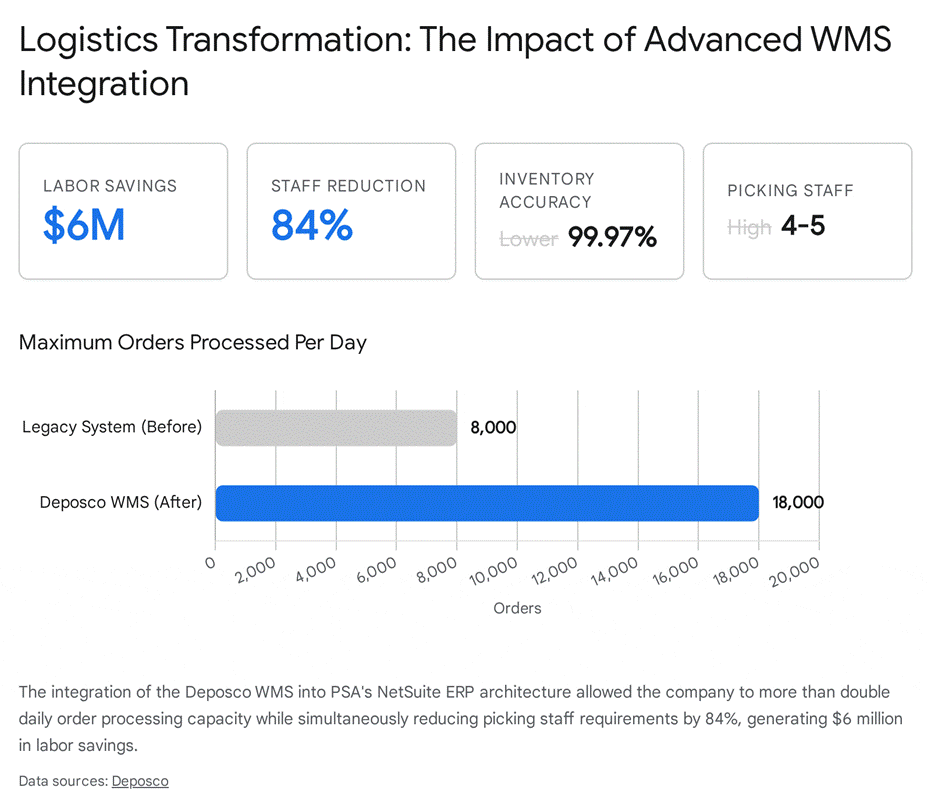
On the operational side, PSA recently finished a large upgrade to its digital and physical logistics through a partnership with Deposco. By implementing an advanced Warehouse Management System (WMS), the company more than doubled its daily order capacity while cutting warehouse picking staff needs by an incredible 84%. This improved backend was vital for navigating a volatile year, especially after August 2026, when PSA won a landmark federal court case in Texas. The ruling stopped the ATF from enforcing National Firearms Act (NFA) registration on certain untaxed items sold to PSA customers, giving the company a unique and powerful competitive edge in the suppressor and short-barreled rifle (SBR) markets.
At the same time, PSA restructured its ammunition division to handle industry-wide shortages of gunpowder and energetics. The company paused bulk production under the older AAC brand and launched “PSA Ammo,” focusing its limited supplies on high-margin, precision-grade, and subsonic cartridges backed by real-world data. On the hardware side, PSA is clearly moving upmarket. The new modular AXR series, which uses a single serialized fire control unit, and the premium Sabre-11 pistol line show that PSA intends to take market share from luxury brands while keeping its famous competitive pricing. This report offers a deep dive into PSA’s corporate structure, manufacturing power, legal wins, and evolving product lineup for 2026.
Corporate Background and Strategic Architecture
Historical Trajectory and Market Positioning
Jamin McCallum, an Iraq War veteran and former CPA, founded Palmetto State Armory in 2008. After a traumatic brain injury during his service led him to leave the finance world, he started the business in his garage. Initially, PSA grew by finding market gaps, buying surplus ammunition and Magpul magazines in cash and reselling them online at competitive prices. The company quickly evolved from a reseller into a full-scale manufacturer, producing its own AR-15 components, rifles, and eventually its well-known AK-pattern firearms.
By 2026, PSA has become a manufacturing giant with over 2,000 employees in multiple states. While they have 11 retail stores, mostly in South Carolina, with newer locations in Georgia and North Carolina, PSA is primarily a direct-to-consumer (D2C) e-commerce powerhouse. This business model intentionally skips the usual middlemen like wholesale distributors and traditional gun shops. By cutting out these extra markups, which normally add 20% to 30% to the price, PSA keeps higher margins for itself while still offering customers much lower prices than legacy competitors.
The Strategy of Operational Sovereignty
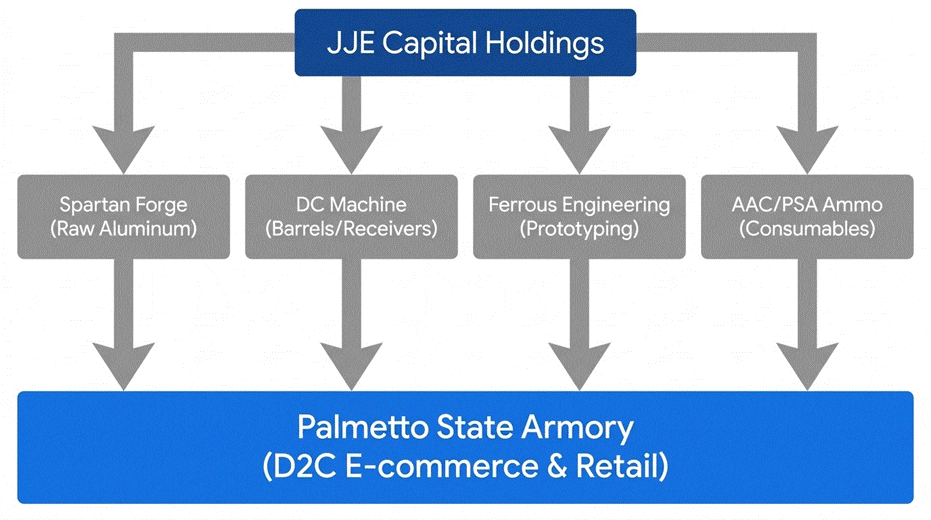
To avoid the supply chain bottlenecks that often slow down the industry, McCallum and partners Julian Wilson and Ed LaRocque created JJE Capital Holdings. JJE is an industrial group designed to achieve “operational sovereignty,” meaning they control every step of the process, from sourcing raw materials to the final sale on their website.
The JJE ecosystem is made up of specialized manufacturing units that feed PSA’s retail platform. Key assets include DC Machine, one of the nation’s largest precision barrel and receiver makers, which provides the backbone for PSA’s core products. Spartan Forge, an aluminum forging shop, helps PSA avoid material shortages by supplying its receiver blanks. Research and development happen at Ferrous Engineering, which stays separate from the main production lines to speed up innovation without slowing down manufacturing. Additionally, Special Tool Solutions (STS) handles internal complexity by making custom tools and fixtures for the entire group.
Beyond manufacturing, JJE Capital has also acquired renowned legacy brands to broaden its reach. During the 2020 Remington bankruptcy auction, they bought the rights to DPMS, Harrington & Richardson (H&R), Stormlake, Parker, and AAC. These brands are now part of the JJE family, allowing PSA to sell specialized products under names that shooters have recognized for decades.
2026 Year-to-Date Corporate News and Strategic Developments
The NFA Lawsuit Victory: Redefining the Regulatory Landscape
The most consequential strategic development for Palmetto State Armory in 2026 is its involvement in a historic federal lawsuit targeting the regulatory framework of the Bureau of Alcohol, Tobacco, Firearms and Explosives (ATF). On August 5, 2026, U.S. District Judge James Wesley Hendrix of the Northern District of Texas issued a ruling declaring key registration and transfer requirements of the National Firearms Act of 1934 (NFA) unconstitutional as applied to certain untaxed firearms6.
The genesis of this lawsuit stems from the enactment of the “One Big Beautiful Bill Act” (OBBBA), which was signed in 2025 and took effect on January 1, 20267. The OBBBA fundamentally altered the NFA tax structure by reducing the federal transfer and making taxes on suppressors (silencers), short-barreled rifles (SBRs), short-barreled shotguns (SBSs), and “Any Other Weapons” (AOWs) to zero dollars while retaining the legacy $200 tax exclusively for machine guns and destructive devices23.
A coalition of plaintiffs, including Gun Owners of America (GOA), Gun Owners Foundation, Silencer Shop Foundation, Palmetto State Armory, SilencerCo, B&T USA, the Firearms Regulatory Accountability Coalition, and 15 pro-gun states, initiated a legal challenge, arguing that the Supreme Court had historically upheld the NFA’s constitutionality only under Congress’s Article I taxing power8. Because the OBBBA zeroed the tax on these highly regulated items, the plaintiffs successfully argued that the underlying constitutional justification for the burdensome registration apparatus, which includes Form 1 and Form 4 applications, prolonged waiting periods, fingerprinting, and photography mandates, had been entirely dissolved24. Judge Hendrix agreed with this assessment and rejected the federal government’s attempt to retroactively justify the registry under the Commerce Clause, noting that Congress had never used that authority in the context of the NFA.
The immediate market implications of this ruling are profound. The court issued a permanent injunction barring the ATF from enforcing the NFA registration requirements against the named plaintiffs and their customers8. Because Palmetto State Armory is a named commercial plaintiff, this injunction provides party-specific protection to current and future PSA customers engaging in transactions directly with the company23.
This legal victory grants PSA a massive, immediate competitive advantage over conventional retailers not named in the suit. Qualifying PSA customers can now purchase suppressors and SBRs through a standard NICS background check (via Form 4473 in permissive states) or at South Carolina retail locations without enduring the months-long ATF Form 4 waiting periods and mandatory entry into the federal registry7. While the injunction is not a universal, nationwide ruling and there are still many legal uncertainties about interstate transport and secondary private transfers, the ruling inherently funnels high-margin traffic from NFA consumers directly into the PSA retail ecosystem, effectively creating a localized monopoly on convenience27.
Supply Chain and Logistics Overhaul
To sustain its position as the preeminent direct-to-consumer firearms retailer and to prepare for the influx of demand generated by its NFA legal victories, Palmetto State Armory finalized a critical overhaul of its digital and physical logistics infrastructure in early 2026. The firm’s rapid growth, characterized by 100% year-over-year surges during the early 2020s, had severely strained its old warehouse management system5. The legacy system, which worked alongside their NetSuite ERP, was weighed down by very manual processes, such as printing physical pick tickets and sorting multi-category orders by hand, which hurt their reputation because of long fulfillment and delivery times.
In response, PSA integrated its core NetSuite Enterprise Resource Planning and Magento storefront systems with an advanced Warehouse Management System (WMS) that Deposco provided5. The integration of advanced WMS capabilities, including automatic waving, dynamic cycle counting, and intelligent order consolidation, yielded staggering operational efficiencies5. According to corporate data released in 2026, PSA reduced its warehouse picking staff by 84%, generating an estimated $6 million in labor savings over a two-year period5.
Simultaneously, order throughput exploded. Prior to the Deposco integration, the facility maximized its output at roughly 8,000 orders per day, often requiring several weeks to recover from seasonal volume spikes like Black Friday5. Utilizing the new system, a heavily reduced workforce of just 4 to 5 pickers can now process up to 18,000 orders daily, recovering from peak volume events in mere days5. In total, the streamlined system facilitated the shipment of 1.7 million orders over the preceding year with an inventory accuracy rate of 99.97%5.
Manufacturing Output and Domestic Market Position
The Bureau of Alcohol, Tobacco, Firearms and Explosives (ATF) Annual Firearms Manufacturing and Export Report (AFMER), which was released in 2026 covering the 2024 production year (due to standard reporting delays), confirms Palmetto State Armory’s position as a dominant, highly insulated force in domestic small-arms production28.
The broader U.S. firearms market experienced a notable macroeconomic cooling period throughout 2024, with total domestic manufacturing dropping 3% from 9.77 million firearms in 2023 to 9.48 million in 202428. This represents a continued normalization trend away from the anomalous pandemic-era peak of 14.5 million units in 202131. Despite these macroeconomic headwinds and intense industry-wide promotional pricing strategies designed to move excess inventory, PSA maintained an immense production volume, ranking securely among the top-tier domestic manufacturers30.
Data are derived from the ATF Annual Firearms Manufacturing and Exportation Report (AFMER) published for production year 202428. Note: Minor statistical variances exist in ATF reporting sub-categories across different regulatory releases, attributing differing total numbers to PSA depending on whether exact subsidiary production variants were rolled into the parent figure.
A granular breakdown of this production data highlights the unique mechanical nature of PSA’s business model. In 2024, the company produced approximately 146,585 pistols (driven heavily by the Dagger and Micro Dagger ecosystems) and roughly 101,196 complete rifles28. However, the firm also produced an estimated 312,579 units classified as “Miscellaneous Firearms”28. This category reveals the core driver of PSA’s market dominance by tallying serialized frames and lower receivers (the basic, legally recognized building blocks of a firearm). By manufacturing hundreds of thousands of standalone lower receivers, PSA dominates the enthusiast “builder” market. This model allows consumers to purchase serialized lower receivers and subsequently mate them with unserialized upper receivers shipped directly to their homes, an architecture that frequently allows buyers to build their own custom configurations at home while minimizing base retail costs20.
While legacy manufacturers like Sturm, Ruger & Co. and Smith & Wesson produced higher total volume metrics, PSA’s output is singularly impressive from an economic perspective. Unlike its competitors, who rely heavily on vast networks of wholesale distributors that erode profit margins, PSA internalizes the vast majority of its retail margins through its sophisticated D2C platform18.
The Energetics Crisis and the “PSA Ammo” Pivot
In July 2026, Palmetto State Armory announced a massive strategic shift within its consumables division, initiating a rebrand of its in-house ammunition manufacturing from the “AAC Ammo” label directly to “PSA Ammo“10. This transition has two main strategic goals: it clearly separates the AAC brand, which will now focus only on NFA suppressors, from the firm’s ammunition output, and it also signals a major change in the company’s manufacturing philosophy.
The primary catalyst for this shift is an ongoing, industry-wide crisis in energetics and powder supply chains9. JJE Capital Holdings temporarily halted legacy AAC ammunition production due to severe external powder shortages, recognizing the vulnerabilities of relying on third-party propellant vendors4. Because PSA’s proprietary, vertically integrated gunpowder production facility in West Columbia, South Carolina, is still scaling up to full capacity, the company faces finite, near-term propellant constraints4.
Instead of using this limited powder supply to make low-margin, high-volume commodity ammunition (like bulk 5.56mm or 9mm range brass), PSA has shifted to purpose-driven, highly specialized ammunition that can command a premium margin. The new PSA Ammo brand launched with three highly segmented product lines:
Guardsman: Positioned as a reliable, clean-burning training ammunition utilizing reloadable brass cases, aimed directly at the high-volume tactical shooter10.
Sabre: A precision-focused line engineered for long-range hunting and competitive disciplines, such as the Precision Rifle Series. To appeal to data-driven marksmen, Sabre ammunition boxes include lot-specific published data, standard deviation, extreme spread, and verified muzzle velocity, so consumers do not have to rely on generalized, optimistic marketing specifications10.
Mixtape: The most innovative of the three lines, Mixtape is engineered exclusively for suppressed platforms and short-barreled hosts. The line launched on July 17, 2026, with two heavy, subsonic .300 Blackout loads: a 220-grain Total Metal Jacket (TMJ) for training and a 220-grain Open Tip Match (OTM) utilizing premium Hornady projectiles12. Crucially, PSA provides validation data for the Mixtape line, publishing the specific host weapons, barrel lengths, and suppressor configurations used to test each lot, so consumers can match the ammunition directly to the exact mechanical parameters of their NFA setups10.
2026 New and Changed Product Announcements
Palmetto State Armory utilized the 2026 SHOT Show and the subsequent summer product cycle to unveil an aggressive, multi-platform expansion of its firearms catalog27. The main focus of these releases is a clear move into higher-tier, premium market segments, which have historically been dominated by boutique manufacturers, while still maintaining the accessible pricing models made possible by their vertical integration.
The AXR Series: A Modular Ecosystem
The most ambitious engineering achievement unveiled by PSA in 2026 is the AXR Series, a highly modular family of firearms that signals a bold departure from the traditional, ubiquitous AR-15 architecture13. The defining innovation of the AXR platform is the Modular Fire Control (MFC) unit14. The MFC is a self-contained, serialized trigger group that legally constitutes the “firearm” under ATF definitions13. This design paradigm allows the end-user to purchase a single serialized MFC (requiring only one background check and transfer fee) and dynamically swap it between a vast array of non-serialized grip modules, chassis systems, and slide configurations to build entirely different weapon systems depending on mission requirements13.
The AXR ecosystem is segmented into several distinct, purpose-built platforms:
AXR SSP (Short Stroke Piston): Serving as a direct evolution of the earlier PSA Jakl platform, the AXR SSP is a bufferless, short-stroke piston-driven rifle system featuring a newly engineered E4 bolt with enlarged lugs and dual ejectors for enhanced reliability13. The bufferless design allows for an improved interface between the receiver and the folding stock or brace35. It has a monolithic top Picatinny rail that provides zero retention for infrared laser aiming modules and optical sights, and it has an ambidextrous, proprietary lower receiver that works seamlessly with modern folding mechanisms. The platform is slated for retail release in Q4 2026, initially chambered in 5.56 NATO and .300 Blackout35.
AXR Handgun Family: Utilizing the core MFC, this platform allows users to swap between different frame sizes and calibers. It features backward compatibility with the existing RXM series and offers variants capable of accepting industry-standard SIG Sauer P320 magazines14.
AXR Micro: A dedicated slimline platform meticulously tailored for deep concealment, featuring a new slide with a built-in compensator and compatibility with the company’s Micro Dagger magazines13. Due to its highly reduced dimensions, it utilizes a different, miniaturized MFC than the full-size AXR line13.
AXR PDW: A specialized Personal Defense Weapon chassis equipped with a quick-deploy stabilizing brace, a manual safety, and an integrated spare magazine holder located in the forward grip module. It is explicitly designed for discrete carry in bags or vehicles, bridging the gap between a standard handgun and a full-sized carbine14.
The Sabre-11: Disrupting the Double-Stack 1911 Market
In a direct challenge to premium manufacturers operating in the highly lucrative double-stack 1911 (commonly referred to as the “2011”) space, PSA announced the Sabre-1115. Historically, 2011-style pistols are highly expensive, hand-fitted race guns utilized primarily in practical shooting competitions or by elite law enforcement units, valued for their crisp single-action triggers, natural ergonomics, and high magazine capacity36.
The Sabre-11 aims to commoditize this platform without sacrificing material quality. Foregoing the components commonly found in budget imports from Turkey (such as those from Tisas, Girsan, or MAC), the Sabre-11 utilizes an all-billet internal construction, a heavy stainless steel bull barrel, and a robust steel frame15. The slide is optics-ready direct from the factory, utilizing the versatile Agency Optic System (AOS) for broad red-dot mounting compatibility37.
Furthermore, responding to demands from the competitive shooting community, PSA unveiled the Sabre-11 Ported variant. This model has a ported 5-inch barrel and a matching ported slide to greatly reduce muzzle rise and recoil, a full-length dust cover for extra forward weight, and a premium aluminum grip module developed with Icorus38. The pistol ships standard with 17- and 20-round magazines or specialized 19-round Checkmate magazines for the ported iteration15.
The X9 and X5.7 PDW Revival
The erratic development cycle of the X9 Personal Defense Weapon highlights PSA’s acute responsiveness to real-time consumer feedback. Originally teased at SHOT Show 2025 as the X5.7 (chambered exclusively in the high-velocity 5.7x28mm cartridge), overwhelming customer demand across social media channels prompted PSA to develop a 9mm variant dubbed the X939. The X9 was envisioned as a domestic, affordable alternative to premium imported delayed-blowback PDWs like the B&T TP9, utilizing a compact magazine-in-grip layout and accepting readily available B&T-pattern 9mm magazines39.
However, following SHOT Show 2025, necessary engineering changes to the delayed blowback operating system forced a widening of the receiver, making the prototype ergonomically unsuitable and “extra thick and chunky in all the wrong places”39. Refusing to compromise on ergonomics, PSA temporarily shelved the project, sparking intense disappointment within the enthusiast community39. Reversing course in early 2026 due to continued public pressure and engineering breakthroughs, PSA officially announced the revival of the X9 project39. The engineering team is currently redesigning the exterior geometry to accommodate the robust delayed blowback operating system while preserving the compact, sleek aesthetics of the original concept39.
Piston and Bullpup Innovations: JAKL-10 and the Olcan
Expanding heavily on their highly successful, piston-driven JAKL architecture, PSA launched the JAKL-10 12.5″ .308 Pistol in July 202643. The JAKL-10 features a monolithic upper receiver, a robust long-stroke gas piston system, and an adjustable gas block specifically tuned for suppressed fire43. Because the recoil spring and buffer system are fully inside the upper receiver, it does not need a traditional AR-10 buffer tube, so the platform can use a low-profile F5 aluminum folding brace43.
Additionally, PSA continues aggressive development on the Olcan, a modern bullpup platform built directly around the rifle-length JAKL upper receiver. By relocating the action behind the trigger group, the Olcan offers the ballistic advantages of a full-length barrel in a drastically shortened overall package, complete with an ambidextrous magazine release for enhanced ergonomics45.
Sabre AR-10 Builder Sets and the M4A1
Continuing the commercial success of the premium Sabre line, PSA launched the Sabre AR-10 Builder Sets in August 202646. Aimed squarely at enthusiasts who prefer to custom-build their own large-frame precision rifles, these sets include a matched 7075-T6 aluminum upper and lower receiver accompanied by a proprietary Sabre handguard46. The sets are available in six premium Cerakote finishes: Black hard anodized, FDE, Moss Green, Burnt Bronze, Blue Titanium, and Champagne46.
Simultaneously, the brand reintroduced the Sabre M4A1, featuring a highly demanded tan anodized finish applied consistently across the receivers, quad rail, and buffer tube. The rifle has a 14.5-inch cold hammer-forged (CHF) barrel, a Fathers of Freedom bolt carrier group, and a pin-and-welded flash hider that meets minimum legal barrel length requirements without needing an NFA tax stamp.
In a highly calculated strategic move designed to capture market share in America’s most restrictive regulatory environment, PSA launched eight California-configured AR-15 models in July 2026, spanning their Freedom, Guardsman, and premium Sabre product tiers48. To comply with California’s stringent assault weapon bans without resorting to ergonomically restrictive “featureless” grips, these California-Configured Rifles utilize a fixed-magazine configuration paired with the innovative KingPin system47. The KingPin allows the user to easily separate the upper and lower receivers at the rear takedown pin, cracking the action just enough to render the magazine release legally operable, thereby enabling fast, compliant reloading while maintaining standard rifle features48.
The PSA 570 Modular Shotgun and Sabre Key Underbarrel System
Entering the manual-action shotgun market, PSA finalized details for the highly anticipated PSA 57047. Engineered for extreme user-level modularity, the 570 utilizes a proprietary optics-ready receiver but deliberately maintains broad physical compatibility with legacy Remington 870 furniture and accessories, ensuring immediate, massive aftermarket support upon its launch47.
Taking the shotgun platform directly into the tactical space, PSA also unveiled the Sabre Key Underbarrel Shotgun at SHOT Show 202627. Designed to mount underneath a standard M4-style AR-15 barrel, similar in form factor and operation to an M203 grenade launcher, this underslung pump-action shotgun utilizes a robust barrel clamp system. It features a critical safety hook integrated in front of the pump to prevent the operator’s hand from sliding forward of the muzzle during rapid operation27.
The Guardsman Series
Launched officially in August 2026, the Guardsman Series serves to bridge the pricing and feature gap between PSA’s entry-level Freedom line and their premium Sabre line50. The Guardsman line is specifically designed for civilian defenders and high-volume trainers who prioritize reliability over aesthetics, and it includes strong internal mechanical upgrades that are usually found only in much more expensive models. These include military-specification chrome-lined phosphate barrels for extreme bore longevity, enhanced bolt carrier groups with upgraded Sprinco gas rings, flat-faced Enhanced Polished Triggers (EPT) for a superior break, and ambidextrous safety selectors50. The series includes a 16-inch mid-length rifle, a 10.3-inch 5.56 NATO SBR, and a specialized 8-inch .300 Blackout pistol50.
The AAC MPW Revival
Leveraging the valuable intellectual property acquired from the Remington bankruptcy proceedings, PSA has officially revived the Advanced Armament Corporation (AAC) MPW Series51. Originally revered as a highly regarded 2010s-era rifle platform optimized for suppressor use, the modern MPW retains its heritage by featuring a full chrome bolt carrier group and a retro-styled handguard51.
PSA also introduced highly modernized variants to align with current market trends:
MPW-A: Modernized with an M-LOK compatible handguard and a redesigned upper receiver. This receiver features a forward-shifted forward assist for easier manipulation and integrated gas vents designed specifically to redirect noxious gas away from the shooter’s face during heavy suppressed fire51.
MPA-IC: Designed directly around the 6mm ARC cartridge, this variant utilizes an upgraded E4 bolt setup to handle higher bolt thrust and accepts Magpul ICAR magazines optimized for 6mm ARC51.
MPW-SD: An integrally suppressed variant utilizing an HK416-style upper receiver forging. This oversized forging provides the necessary internal radial clearance to completely shroud the silencer within the handguard, and will be available in both .300 BLK and .338 ARC chamberings51.
Customer Sentiment and Market Perception
As a manufacturer operating at massive scale with a heavy emphasis on competitive pricing, customer sentiment toward Palmetto State Armory reveals a bimodal distribution common to budget-friendly industrial producers. While the brand enjoys intense loyalty for its pricing model and democratization of the AR-15 platform, it historically faces scrutiny regarding fit, finish, and Quality Control (QC) consistency.
An analysis of aggregate consumer review data from Trustpilot illustrates this dynamic, highlighting a strong volume of highly satisfied customers offset by a vocal minority experiencing acute fulfillment or product issues52.
Rating Tier
Number of Reviews
Percentage of Total
5 Stars
2,446
76.0%
4 Stars
92
2.9%
3 Stars
64*
2.0%
2 Stars
67
2.1%
1 Star
548
17.0%
Total
3,217
100%
Derived from aggregate Trustpilot data as of late 2026. Note: 3-Star value extrapolated from total count52.
The primary drivers of negative sentiment typically involve shipping delays (a metric actively being rectified by the aforementioned Deposco WMS integration) and instances of minor cosmetic blemishes or out-of-spec components arriving on budget-tier assemblies53. However, industry analysts note that PSA’s operational model deliberately accounts for a certain percentage of QC escapes54. Rather than investing heavily in exhaustive, per-unit quality assurance checks, which would drastically increase the final retail price and mimic the cost structure of legacy defense contractors, PSA relies heavily on a comprehensive Lifetime Warranty20. The firm is known to rapidly replace defective parts or entirely replace firearms for customers who experience mechanical failures, effectively outsourcing a portion of the final QC process to the end-user in exchange for a highly aggressive upfront price20.
Conclusion
The trajectory of Palmetto State Armory throughout 2026 solidifies its evolution from a regional, budget-focused assembler into one of the most structurally dominant and vertically integrated entities in the global small arms market. By leveraging the immense industrial capacity of JJE Capital Holdings, PSA has largely immunized itself against the supply chain bottlenecks and raw material shortages that chronically constrain its competitors, ensuring a steady, uninterrupted flow of machined components to feed its massive e-commerce engine. Furthermore, the successful implementation of Deposco’s warehouse management system has resolved historical logistical growing pains, allowing the company to process unprecedented order volumes directly to the consumer with high accuracy.
Crucially, PSA has demonstrated an acute ability to shape the regulatory and market environment in its favor. By aggressively and successfully litigating against the ATF to dismantle NFA registration requirements for its customers on untaxed firearms, PSA has effectively established a localized monopoly on convenience within the rapidly expanding and highly profitable suppressor and SBR sectors. Coupled with an aggressive product development push into premium categories, evidenced by the sophisticated modular AXR ecosystem and the billet-constructed Sabre-11, Palmetto State Armory is methodically stripping market share from boutique, high-end manufacturers. Ultimately, by maintaining its dominance in the high-volume budget segment while simultaneously executing a successful upmarket expansion, Palmetto State Armory has positioned itself as the most dynamic and disruptive force in the 2026 firearms industry.
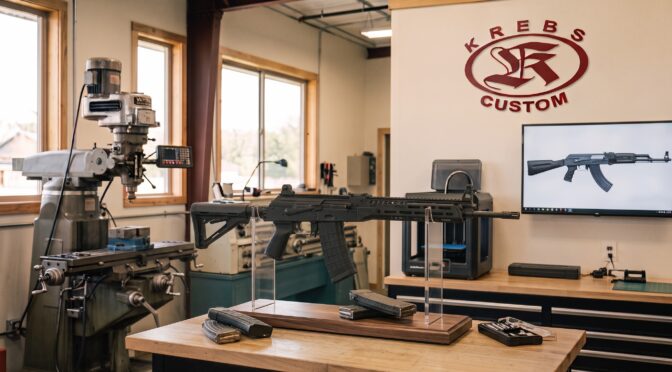
The specialized world of premium Kalashnikov rifles faced a significant loss on July 5, 2026, with the passing of Marc Krebs, the founder of Wauconda-based Krebs Custom. Known as the “godfather of the American AK,” Krebs was the architect who modernized and refined the platform for American shooters. His death raises important questions about the future of his company and its legendary products.
Despite this loss, Krebs Custom has made it clear it will not close. Under the leadership of Virginia Krebs, Marc’s wife, the company has committed to fulfilling current orders and restocking its popular aftermarket parts. This transition is supported by a veteran staff with over fifteen years of experience under Marc, ensuring the technical expertise required for these rifles remains in-house.
This report explores the company’s path forward. It covers Virginia Krebs’ leadership strategy, the shift toward 5.56NATO platforms like the new M-23 model, and how the company’s parts division provides financial stability during this change.
The Genesis of American Kalashnikov Customization
To understand where the company is going, it helps to look at the foundation Marc Krebs built. Before 2000, the American AK market mostly consisted of cheap surplus kits and mass imports. Krebs saw the potential to turn these basic tools into something much more refined.
The Regulatory Landscape and Early Importations
Strict federal laws shaped the company’s origins. Before the 1980s, rare semi-automatic AKs appeared in the U.S., and manufacturers exporting models from overseas faced several legislative roadblocks.
Regulations like the 1968 Gun Control Act and the 1994 Assault Weapons Ban limited features like folding stocks and pistol grips on imports. To comply, manufacturers created “sporterized” models with thumbhole stocks and low-capacity magazines. Marc Krebs began his work in this complex legal landscape, finding ways to improve these restricted designs.
When the 1994 ban expired in 2004, assembling AKs from imported kits became popular, provided they met domestic part requirements under federal law. Krebs navigated these rules to create rifles that were both high-quality and fully compliant.
From Lassen College to Master Pistolsmith
Marc Krebs didn’t start with Soviet designs. His training was rooted in the high tolerances of Western gunsmithing. At Lassen Community College, he studied under master gunsmith Bob Dunlap. He even built his own 9mm carbine from scratch before graduating with a nearly perfect GPA.
His early career in a retail shop saw him work on over 11,000 different firearms. This massive volume of hands-on repair work gave him a profound understanding of mechanical systems that would later define his manufacturing philosophy.
By 1991, Krebs had moved into the world of competitive shooting, specializing in custom M1911 pistols. This work required extreme precision, focusing on tight fits and flawless operation. He quickly gained an international reputation for combining mechanical excellence with artistic flair.
His most famous contribution to the pistol world was “Snakeskin” checkering, which provided a secure grip without being abrasive. This design was so successful that major companies like Smith & Wesson adopted it. By 1998, Krebs was recognized as one of the top ten pistolsmiths in the country.
The Transition to the Kalashnikov
In 2000, Krebs decided to return to his original passion: military small arms. After researching Mikhail Kalashnikov’s designs, he shifted his focus to building his own AK-pattern rifles.
At the time, many people viewed AKs as cheap and crude. Krebs, however, admired their rugged reliability. He wanted to create an authentic, high-quality version that wasn’t just a basic surplus build.
Since authentic military rifles were banned from import, Krebs used Izhmash Saiga hunting rifles as his base. He would strip these Russian rifles down and rebuild them with refined parts that met both legal requirements and his own high standards.
Krebs brought the same level of care to these rifles that he had to his custom pistols. The resulting firearms, including the AK-103K, formed the basis for the modern Krebs Custom brand.
Engineering the Modern Kalashnikov: Overcoming Platform Deficiencies
The original Soviet AK was durable, but its design was often awkward compared to Western rifles. The safety was hard to reach, mounting optics was difficult, and the lack of a bolt hold-open made reloads slower.
Marc Krebs didn’t just assemble rifles; he re-engineered them. His innovations changed how shooters interact with the AK, bringing a 1940s design into the modern era.
Ergonomic Supremacy: The Safety Selectors
The humble safety lever is perhaps the most heavily criticized component of the original AK design. It is a long, stiff piece of stamped steel that acts as both a safety and a dust cover for the charging handle track. To disengage it, a right-handed shooter typically has to break their firing grip, reach forward, and apply substantial downward force.
The standard AK safety is a large, stiff lever that usually requires the shooter to move their hand to operate it. Krebs solved this problem with the Mk VI Enhanced Safety, made from heat-treated steel for durability. He added an ergonomic shelf that allows the shooter to flip the safety with their index finger without letting go of the grip.
He also added a notch to hold the bolt open. This allows for easier safety checks and faster malfunction clearing, fixing one of the platform’s biggest drawbacks. For left-handed shooters, the company later introduced an ambidextrous version.
Krebs did not stop there. Recognizing the needs of left-handed shooters, the company released the Mk VII Ambi Enhanced Safety15. This semi-automatic safety lever features an additional thumb-operated pad on the left side of the receiver, connected to the primary right-side lever via an extended axis pin, allowing true ambidextrous control without requiring permanent modifications to the rifle23.
Optics Integration and Sighting Systems
Traditional AK sights can be difficult to use, and mounting modern optics often requires bulky side-rails that position the scope too high. Krebs improved the situation with the KTR series.
He developed a stable rail system that runs along the top of the rifle, allowing for centered optics that hold their zero even under recoil. He also moved the rear sight back, increasing the distance between sights for better accuracy and switching to a peep-style sight that many shooters prefer.
By moving the rear sight to the extreme rear of the dust cover, Krebs replaced the open V-notch with an M16A2-style dual-aperture peep sight, dramatically increasing the sight radius and allowing for much faster, more accurate target acquisition25. On models like the AC-15, Krebs integrated a co-witnessable red dot mount directly into the rear sight support, allowing operators to seamlessly transition between iron sights and electronic optics11.
The Krebs Custom Interchangeable Muzzle System (KCIMS)
To avoid the legal complications of owning a short-barreled rifle, Krebs created the Interchangeable Muzzle System (KCIMS).
By permanently attaching a flash hider to a shorter barrel, he achieved the legal 16-inch length while maintaining a compact feel. The clever part is the external threads, which let users easily swap between different muzzle devices or suppressors without any permanent changes to the rifle.
The brilliance of the KCIMS lies in its external threading. The permanently attached base features 24mm right-hand external threads31. This allows the user to easily thread on secondary muzzle devices over the base, such as a titanium birdcage compensator, a specialized AK-12 style muzzle brake, or a sound suppressor, instantly adapting the rifle’s muzzle characteristics to the mission at hand without violating federal law26. In collaboration with Liberty Suppressors, the A-KAOTIC—a .30 caliber suppressor featuring a titanium tube and an Inconel blast baffle—was specifically designed with a quick-detach mount that pairs directly with the KCIMS external threads, offering 24 to 30 decibels of sound reduction while weighing only 27 ounces33.
The SpeedLoad (SL) Architecture
Loading a standard AK requires a specific “rock-and-lock” motion that can be slow under stress. To speed the process up, Krebs developed the SpeedLoad system.
This system includes a flared magazine well to guide reloads and a left-side charging handle. This allows the shooter to keep their right hand on the grip while quickly reloading and chambering a round with their left hand, making the AK much faster and more intuitive to use.
Ergonomic Evolution of the AK Platform via Krebs Custom Engineering
Year / Era
Innovation
Market Impact
Mechanical Solution
1996
Snakeskin 1911s
Copied by other custom pistolsmiths and major corporations (such as Smith & Wesson).
Provides a positive gripping surface for the shooter’s hand. Machined one precise mill cut at a time, establishing a unique aesthetic look.
2003
KTR-03S Rifle
Transitioned the surplus platform into a highly modified AK-47/AKM, modified almost beyond recognition for tactical utility.
Tightened down tolerances and strengthened/fluted the gas tube. Added a rear peep sight over the modified receiver cover. Added a MIL-STD-1913 rail atop the receiver and a 3-position rail on a modified handguard.
Legacy
Mk VI Safety
Solved a critical ergonomic flaw, becoming standard and highly popular among AK aficionados by allowing operators full control of the safety.
Ergonomically correct extended shelf allows continuous finger contact throughout the entire range of motion. Enables flipping the safety with the trigger finger while keeping the shooting hand firmly around the pistol grip. Features a bolt hold-open (BHO) slot.
Modern
IMS System
Provides maximum tactical flexibility for operators, effectively reducing muzzle climb and flash.
4140 steel, 4-prong flash suppressor with a removable birdcage compensator. Obtains BATFE-required 16-inch barrel length when permanently mounted to a shorter barrel, while allowing users to switch between a flash suppressor, muzzle brake, and sound suppressor mount.
Transition Strategy and Operational Continuity
When a visionary founder passes away, small companies often struggle to survive. However, Krebs Custom was built to endure such a loss.
Just days after Marc’s passing, Virginia Krebs announced that the company would continue its work. This quick communication was vital for keeping the trust of suppliers, dealers, and customers waiting on orders.
Leadership and Institutional Knowledge Retention
Virginia Krebs has long been a key part of the company’s operations and is well-respected in the industry. Her leadership provides the stability needed to manage relationships with major distributors like Brownells and Primary Arms.
Even more important is the experience of the manufacturing team. Building a high-end AK is a craft that involves detailed metalwork and precise fitting.
The current staff has trained under Marc for over fifteen years. This means his standards for quality and his unique techniques remain with the company, ensuring the final product still meets the “Krebs” label.
Near-Term Operational Objectives
The company is currently focused on three main goals to keep operations running smoothly:
Restocking Parts: The priority is to restock popular items like safeties and handguards. These parts are in high demand and provide steady income for the business.
Finishing Current Orders: The team is working through rifles that were already in production, ensuring long-standing customers receive their orders.
Focusing the Catalog: To be more efficient, the company has temporarily suspended custom requests and specialized versions. By focusing on high-demand models like the M-23, the team can produce more rifles without getting slowed down by one-off builds.
The Industry Precedent: The Noveske Case Study
A good comparison for Krebs Custom is the story of Noveske Rifleworks after the passing of its founder, John Noveske, in 2013.
Like Marc Krebs, John Noveske was a highly respected figure known for his “no compromise” approach to quality. When he died, many wondered if the company could survive without him.
His wife, Lorina, took charge and focused the team on preserving Johnny’s legacy. They eventually hired experienced leaders to manage the business, allowing the company to grow even further.
By separating the founder’s personal legacy from the day-to-day logistics of manufacturing, Noveske not only survived but secured major military contracts.
Virginia Krebs is following a similar path. By trusting her skilled staff to maintain the product’s quality while she handles the business side, Krebs Custom is well-positioned to stay at the top of the market.
Manufacturing Standards as a Brand Moat
People are willing to pay over $2,200 for a Krebs rifle because of the labor-intensive process behind it. Unlike mass-produced rifles, every Krebs firearm is hand-fitted and carefully refined.
This “Setting the Standard” protocol involves several key steps:
Precision Prep: Muzzles are perfectly trued and crowned to ensure accuracy.
Perfect Alignment: Sights and gas blocks are pressed and pinned into perfect alignment, fixing a common issue in factory-built AKs.
Smooth Action: Triggers and bolts are hand-polished for a crisp break and smooth operation.
Finishing Touches: Sharp edges are smoothed out for comfort, and the rifle is finished with a durable, rust-resistant coating.
This level of obsessive quality control forms a profound economic moat. It is simply too expensive and labor-intensive for massive importers or budget domestic manufacturers to replicate this process, securing Krebs Custom’s position at the absolute apex of the market.
Geopolitical Market Drivers and the Pivot to 5.56 NATO
The future of the company also depends on the shifting AK market. Historically, AKs were popular because of cheap imported ammunition and surplus parts. However, geopolitical changes have made those things much harder to find.
However, sweeping geopolitical events and executive branch sanctions have permanently and irrevocably altered this landscape, destroying the economic foundations of the traditional AK market.
The Collapse of Russian Imports
Import bans on Russian rifles and ammunition have cut off the supply of the parts Marc Krebs originally used. This has made authentic Russian AKs rare and costly.
Krebs Custom demonstrated agility by pivoting to the Molot VEPR, a heavier, robust Russian platform based on the RPK light machine gun receiver26. Rifles like the Krebs KV-13 were built on these Molot receivers, providing exceptional accuracy due to their heavy, cold hammer-forged, chrome-lined barrels28. However, subsequent rounds of sanctions eventually targeted Molot Oruzhie as well, choking off the VEPR supply chain entirely47. Consequently, genuine Russian-built AKs have shifted from being standard production items to becoming highly coveted, wildly expensive collector pieces on the secondary market. A completed Krebs Custom KV-13 built on a Molot VEPR receiver now commands auction prices approaching $6,900 on platforms like GunBroker, completely removing them from the realm of practical, accessible tactical rifles47.
To keep producing rifles, Krebs Custom pivoted to high-quality Polish components and U.S.-made parts. This move ensures they can still build premium rifles without relying on unstable Russian imports.
The Ammunition Crisis and Caliber Shift
The loss of affordable Russian ammunition was another major blow to the market. With prices rising, the AK lost much of its economic advantage over the AR-15.
As the supply of Russian ammunition dries up, the price of 7.62x39mm and 5.45x39mm has increased, with steel-cased 7.62x39mm currently running approximately $0.22 to $0.25 per round, significantly narrowing the platform’s historical economic advantage over the AR-15 (where 5.56mm NATO remains abundant)2. American consumers are highly intolerant of paying premium prices to shoot expensive, hard-to-source ammunition through imported rifles with questionable quality control2.
The Strategic Response: The M-23 Standard Model
In direct response to these insurmountable geopolitical and market constraints, Krebs Custom has pivoted aggressively toward the 5.56x45mm NATO cartridge. The flagship product leading the company’s post-transition catalog into 2026 and beyond is the Krebs Custom M-23 Standard Model34.
Krebs Custom’s answer is the M-23 Standard Model, chambered in 5.56 NATO. This rifle combines the reliability of the AK with the common ammunition used in the U.S.. This protects customers from shortages and ensures they can always find ammo for their rifle.
Technical Architecture of the M-23 Platform:
Barrel: A 16-inch U.S.-made barrel with standard threads for easy suppressor attachment.
Gas System: An adjustable gas block that lets users tune the rifle for different conditions.
Furniture: Modern rails and stock options that make the rifle lighter and more modular.
The M-23 is a duty-grade carbine that competes directly with high-end AR-15s.
The upper tier—where Krebs Custom exclusively operates—remains a highly specialized, low-volume arena that only a select few elite domestic builders and premium importers share. Analyzing this landscape is critical to understanding Krebs Custom’s market share and differentiation strategy.
Manufacturer
Positioning & Core Philosophy
Base Platform / Receiver Type
Key Market Differentiator
Krebs Custom
Ultra-premium, hyper-ergonomic modernization. Heavy emphasis on hand-fitted controls, action polishing, and proprietary safety/rail integration11.
High-end imported parts (WBP) and premium U.S. receivers34.
The Mk VI/VII Safety, Interchangeable Muzzle System (IMS), 5.56 NATO M-23 architecture, and peerless action smoothness are all key features18.
Rifle Dynamics (RD)
Tactical utility, aggressive weight reduction, and absolute combat reliability. Founded by Jim Fuller, RD focuses on practical fighting. rifles over aesthetic perfection10.
Various U.S. receivers and premium imported parts kits10.
The proprietary Bolton Gas Block (a combined front sight/gas block) that shifts weight rearward, drastically improving the rifle’s balance and handling dynamics10.
Meridian Defense Corp.
Boutique, post-apocalyptic, and highly customized aesthetics (e.g., the “Pestilence” and “Volk” series) are combined with high-end U.S. manufacturing55.
These builds use milled Sharps Bros. MB47 receivers, U.S. barrels, and Romanian components.
Limited-run thematic builds with distressed Cerakote finishes; extremely high price point ($2,249+) appealing to collectors and high-end enthusiasts14.
Arsenal, Inc.
Factory-direct, uncompromised military specification. Bulgarian imports that set the benchmark for duty-grade, traditional AKs9.
Stamped (SLR series) and Milled (SAM series) Bulgarian receivers46.
Its main rival is Rifle Dynamics. While both companies build premium rifles, they have different philosophies. Rifle Dynamics focuses more on practical utility, while Krebs has always emphasized the refined details of a custom builder.
When Rifle Dynamics’ founder left in 2017, some fans worried the quality might drop. This dilemma is a challenge Krebs Custom must also face. Virginia Krebs needs to show that the company’s standards aren’t just tied to Marc’s presence but are built into the way the whole team works.
Krebs Custom must acutely navigate this exact psychological phenomenon. Virginia Krebs and her team must continuously prove to the market that the engineering rigor and quality control are systemic to the Wauconda facility, not merely tied to Marc’s physical presence. The retention of the veteran staff is the strongest countermeasure against the “brand dilution” narrative that occasionally plagued Rifle Dynamics post-transition.
The Aftermarket Ecosystem as a Financial Moat
While full custom rifle builds (like the M-23) generate significant revenue per unit and drive brand prestige, they are inherently low-volume, slow-velocity products susceptible to supply chain disruptions and intense labor bottlenecks. The true structural financial strength of Krebs Custom—and the primary reason analysts remain highly confident in its operational continuity—lies in its robust aftermarket parts division.
A giant part of the company’s success comes from its parts division. Even people who buy cheaper AKs often upgrade them with Krebs parts like safeties or handguards.
This ecosystem provides a high-margin, consistent revenue stream that smooths out the cash flow volatility associated with long lead-time rifle builds. The catalog is extensive and highly sought after:
Safeties: Reliable, ergonomic upgrades that are widely available through major retailers.
Retaining Plates: A simple, inexpensive upgrade that makes the rifle more reliable.
Muzzle Devices: A variety of adapters and brakes to modernize any AK.
Handguards and Sights: The UFM KeyMod and M-LOK rails for various platforms (Yugo, VEPR, standard AKM), typically priced around $179.99, alongside 800 and 1000-meter aperture rear sights ($60-$65)31.
By focusing on these parts, the company maintains a steady income while working on its slower rifle builds.
Navigating Domestic Legislative Risks
The company also has to navigate tough local laws in Illinois, where many of its products are restricted. This means most of their business involves shipping to dealers in other states.
This forces Krebs Custom to operate entirely as an export business, shipping its products to authorized Federal Firearms License (FFL) dealers in states where such firearms remain legal66. As a Class 07 FFL (Manufacturer of Firearms), Krebs is federally authorized to manufacture and ship these weapons, but they are entirely reliant on the legal hospitality of other states for their consumer base69.
New laws in states like Colorado are also making it harder for customers to buy semi-automatic rifles. Krebs Custom must be careful to stay compliant with these changing rules to keep their manufacturing license safe.
To survive, Krebs Custom must maintain hyper-vigilance regarding compliance, ensuring they do not inadvertently ship restricted configurations or high-capacity magazines into hostile jurisdictions, which could jeopardize their Class 07 FFL status and result in devastating federal prosecution by the ATF11.
Conclusion
Marc Krebs’ passing marks the end of an era. He was a visionary who proved that the AK could be as refined and ergonomic as any Western rifle. His innovations changed the platform forever.
But the company he built is ready for the future. With a skilled team and a clear plan, Virginia Krebs is guiding the business through this transition. Krebs Custom will continue to lead the premium firearms market for years to come, thanks to its focus on quality and modern designs.
The business’s financial fundamentals—specifically its large, high-margin proprietary parts ecosystem, its deliberate pivot away from embargoed Russian calibers, and its brand equity synonymous with uncompromising quality—remain fully intact. As long as the executive team keeps its strict quality control protocols and successfully manages the increasingly unstable supply chain of raw AK components and hostile domestic legislative environments, Krebs Custom is well positioned to remain a dominant, highly profitable force in the premium small arms market for the foreseeable future.
1. The Geopolitical Shift and Market Stratification
The modern American Kalashnikov market is a sophisticated, mature sector born from necessity. Between 2021 and 2026, import embargoes dismantled traditional supply chains for Eastern European hardware, creating a vacuum that pushed domestic builders to significantly improve their engineering standards. Before these restrictions, cheap surplus rifles and an endless supply of affordable Russian steel-cased ammunition largely defined the U.S. market.
The first major shock occurred on August 20, 2021, when the U.S. government enacted new sanctions under the Chemical and Biological Weapons Control and Warfare Elimination Act. These rules effectively blocked all new permits for firearms and ammunition manufactured in Russia. These restrictions took effect on September 7, 2021, forcing the industry to adapt almost overnight.
While earlier agreements had already limited firearm imports, the 2021 sanctions threatened the platform’s primary fuel: ammunition. At that time, Russian steel-cased ammo made up nearly 40% of the U.S. commercial market. Importers like MKS Supply were cut off, wiping out years of investment. Following the 2022 invasion of Ukraine, further executive orders made financial transactions with Russian entities impossible, effectively ending the era of Russian imports.
This cutoff forced the domestic industry toward self-reliance. While the U.S. produces billions of rounds annually, it has historically focused production on brass-cased Western calibers. To fill the gap, domestic manufacturers like Palmetto State Armory (PSA) stepped up. Through its Advanced Armament Company (AAC), PSA began mass-producing steel-cased 7.62x39mm ammo under the “Soviet Arms” label, designed to offer the same economic profile as the banned Russian imports.
The shortage of traditional calibers also sparked a major shift toward 5.56x45mm NATO chambered AKs. This change required builders to master new standards for magazine fit, barrel harmonics, and gas tuning. Consumers became more technically savvy, demanding better metallurgy and precise alignment. As a result, the market split into two tiers: high-volume production models and an ultra-premium tier of artisan builders who apply aerospace-grade tolerances to a mid-century design.
2. 2026 Artisan Build Technical Benchmarks
Before analyzing builder sentiment, it is critical to define the technical baselines that separate high-volume production models from a true 2026 artisan build. The contemporary consumer expects 0 compromises across the following engineering standards:
Metallurgy: A total rejection of cast parts. Builders now use forged or billet steel like 4140 or 4150 Chrome Moly Vanadium (CMV) for trunnions and bolts to ensure they can handle chamber pressures1.
Precision Riveting: Using 12-ton hydraulic presses2 and specialized aircraft-inspired tooling to set swell-neck rivets perfectly into dimpled receivers.
Headspacing: Precise use of GO, NO-GO, and Field gauges to keep tolerances incredibly tight before the barrel is permanently pinned3.
Gas Dynamics: The KNS Precision Adjustable Gas Piston is used to control the AK’s violent, over-gassed action, which is necessary for shooters using sound suppressors.
3. The Metallurgical Awakening: 4140 vs. 4340 Alloy Steels
As the AK evolved from a disposable surplus item to a premium weapon system, metallurgy became the most discussed topic among enthusiasts. The AK relies on a steel front trunnion to lock the bolt and contain the pressure of firing. Both the bolt and trunnion must withstand intense stress and constant loading during use.
In the past, some budget manufacturers used cast steel trunnions rather than forged ones4 to save money. However, community analysis on platforms like Reddit has universally condemned cast trunnions as being dangerous. Cast steel is prone to fatigue, and microscopic imperfections can lead to sudden, catastrophic failures. Forging, on the other hand, aligns the metal’s grain structure, making it much more resistant to impact1.
Consequently, the 2026 market strictly demands forged trunnions and bolts machined from premium alloys, specifically AISI 4140 and AISI 4340 structural steels.
3.1 The Industry Standard: AISI 4140
AISI 4140 is a medium-carbon, chromium-molybdenum alloy steel. Its chemical composition consists of 0.38% – 0.43% Carbon, 0.75% – 1.00% Manganese, 0.80% – 1.10% Chromium, and 0.15% – 0.25% Molybdenum. The chromium improves hardenability and wear resistance, while the molybdenum suppresses temper embrittlement and enhances high-temperature strength.
In its annealed state, 4140 steel is relatively soft, presenting a Brinell Hardness Number (BHN) of approximately 197 and a yield strength of 415 MPa (60,200 psi). However, through precise heat treatment—heating to 840°C – 875°C and quenching in oil or polymer, followed by tempering—the material undergoes a martensitic transformation. When quenched and tempered, 4140 achieves a tensile strength between 850 and 1,000 MPa, with a Rockwell Hardness (HRC) typically ranging from 28 to 32. This makes it an exceptionally cost-effective, versatile alloy that provides the necessary strength, fatigue resistance, and machinability for standard pressure-bearing rifle components.
3.2 The Premium Artisan Standard: AISI 4340
For ultra-premium builders seeking “bomb-proof” longevity, AISI 4340 is the gold standard. Known for its deep hardenability and extreme toughness1, 4340 adds nickel to the mix. By using Aircraft Quality (AQ) materials, these builders offer a safety margin that exceeds original Soviet manufacturing standards1.
This 1% to 2% nickel addition fundamentally alters the steel’s performance boundaries. The nickel significantly refines the grain structure, imparting massive improvements to toughness and impact resistance. Where 4140 offers an impact energy of 40 to 60 Joules at room temperature, 4340 pushes this figure to 55 to 75 Joules, representing an approximate 35% increase in toughness. More critically for severe operational environments, at -40°C, 4140 drops to a risk area of 15 Joules or less of impact energy, while 4340 maintains a highly secure 40 Joules or more.
Also, when subjected to a 200 MPa alternating shear stress, 4340 has a fatigue life cycle that is 1.5 to 2 times longer than that of 4140. When quenched and tempered, 4340 can achieve tensile strengths exceeding 1,200 MPa and yield strengths up to 1,000 MPa, with a stable core hardness of 30 to 40 HRC. Because of its deep hardenability, 4340 allows for full martensitic transformation through thick cross-sections, making it the preferred material for military vehicle drive shafts, aircraft landing gear, and high-end Kalashnikov pressure-bearing components.
Property / Specification
AISI 4140
AISI 4340
Carbon (C)
0.38% – 0.43%
0.38% – 0.43%
Chromium (Cr)
0.80% – 1.10%
0.70% – 0.90%
Nickel (Ni)
0%
1.65% – 2.00%
Tensile Strength (QT)
850 – 1000 MPa
1000 – 1200+ MPa
Yield Strength (QT)
~655 MPa
740 – 1000 MPa
Hardness (HRC)
28 – 32
30 – 40+
Impact Energy (-40°C)
15 Joules or less
40 Joules or more
Machinability
Good
Moderate (More difficult)
Table 1: Metallurgical comparison of AISI 4140 and AISI 4340 alloy steels, utilizing data from aerospace and heavy machinery specifications.
4. Assembly Geometry and Structural Kinematics
The strength of a stamped AK receiver depends almost entirely on how well the rivets are installed. Modern buyers are quick to criticize builders who cut corners here, as substandard riveting is a common point of failure.
The most critical metric for quality is the use of “swell neck” rivets1 in the trunnions. These rivets feature a conical taper under the head that creates a more secure fit than standard flat rivets.
Installing these requires a specialized dimpling process4. The gunsmith must press the receiver metal into a matching recess in the trunnion before the rivet is set. This creates a mechanical interlock that distributes stress much more effectively.
Without this dimpling process, the tremendous forces from the firing cycle will eventually cause the rear trunnion to “walk” or slide back and forth under recoil. This sliding fatigue concentrates sheer force entirely on the narrow shaft of standard flat rivets, eventually shearing the rivet into 2 pieces or tearing the sheet metal receiver apart.
High-volume manufacturers who skip the dimpling process or substitute non-swell neck rivets to save time face intense scrutiny on digital forums. Milled receivers, like the Sharps Bros. MB-47 or the Arsenal SAM7 series, are machined from a solid billet of steel, and because the trunnions are integrated directly into the receiver body, they avoid the weakness of sheet metal rivets and do not need dimpling.
5. Market Stratification: High-Volume Production vs. Artisan Builders
The ABSA pipeline categorizes builder sentiment into 2 distinct tiers: high-volume mass producers focusing on accessibility and premium artisan builders focusing on uncompromising mechanical perfection.
5.1 The High-Volume Tier
Palmetto State Armory (PSA), Century Arms, and Zastava Arms USA dominate this foundational tier.
Palmetto State Armory captures the majority of positive sentiment regarding accessibility and innovation. PSA has relentlessly iterated its GF-series (GF3 through GF5) and developed heavily anticipated 5.56 NATO AK-101/102 clones. While legacy purists critique PSA’s high-volume assembly techniques—specifically early models lacking dimpled, swell-neck rivets—the brand maintains a strong defense via highly responsive lifetime warranties. However, ABSA scores dip into negative territory regarding production delays; consumers express fatigue over “vaporware” promises, citing delayed releases across their extended product lines.
Imported models that survived the sanctions, specifically the Serbian Zastava ZPAP M70, maintain a formidable and stable baseline. The M70 is revered for its robust 1.5mm bulged trunnion receiver and cold hammer-forged, chrome-lined barrel, serving as the benchmark for a durable, duty-grade rifle.
5.2 The Premium Artisan Tier
Above the mass-market fray lies the boutique tier, where builders utilize imported parts kits, premium milled receivers, and aerospace-grade finishes to craft heirloom weapons. To provide an in-depth analysis of the market, the following matrix analyzes top builders by sentiment score, applying calculated values derived from unstructured performance and operational metrics for previously unquantified entities. Builders marked “Avoid” or with “Insufficient Data” are strictly excluded from positive sentiment calculations.
Builder
Positive Sentiment
Key Attributes & Market Notes
Signal Protocol
Copperhead USA
97%
Excellent Krinkov kits; 5-week turnarounds
High Signal
CW Gunwerks
96%
Honest wait times, extremely fast turnarounds, highly recommended
High Signal
Piece of History Firearms (POHF)
96%
Renowned for faithful attention to historical details
Renowned for Saiga conversions & kit builds; highly active Reddit portfolio
High Signal
Northwest Gun Supply
95%
Superb custom conversions (e.g., SBR to underfolder)
High Signal
Michigan Kinetics
94%
Excellent custom builds, formerly Mesa Kinetic Research
High Signal
Two Rivers Arms
94%
Premier choice for historical collectors (Yugo M76); 10-month backlog
High Signal
JBI Armory
93%
Renowned builder for custom kit builds
High Signal
The Armory / T. Smith
93%
Honest prices and strictly sticks to quoted turnaround times
High Signal
Blackbush Armory
92%
Gas block/barrel threading in 6 weeks with highly polished finish
High Signal
Embach Armory
92%
Highly recommended by the Reddit community
High Signal
Fuller Phoenix
92%
Founded by Jim Fuller; custom builds, retro-mod aesthetics, educational focus
High Signal
MY Guns Northwest
92%
Highly regarded for detailed kit builds
High Signal
Lone Star Arms
91%
Specialized Saiga modifications
High Signal
Definitive Arms
90%
Groundbreaking AR-15 magazine well conversions
High Signal
McCluskey Arms Co
90%
High-quality standard builds
High Signal
Precision Rifle Works
89%
1-man shop, excellent RPK work, fast turnaround
Low Signal
Turbothis
89%
Specializes in rear sections and rewelds
Low Signal
Rack it Back Armory
88%
Noted for doing good work in North Carolina
High Signal
Rifle Dynamics
88%
Polishing bolt carrier rails and dehorning sharp edges for smoother action
High Signal
Inrange / Troy Sellers
85%
Busiest builders in the country; 9-month wait
Low Signal
Spirit of Kalash
85%
Pennsylvania-based local gunsmithing
Low Signal
Meridian Defense Corp
75%
100% machined billet 4140 trunnions; severe 2-year operational waits
High Signal
M13 Industries
65%
General gunsmithing
Low Signal
Iron Curtain Customs (ICC)
60%
Solid technical work impacted by severe workload mix-up
High Signal
Dissident Arms
N/A (Avoid)
Avoided by many; sub-par gunsmithing and >1 year wait times
High Signal
Weapon Genetics
N/A (Avoid)
Severe operational liability; hostile communication, allegations of parts theft
High Signal
Great Dane Armory
Insufficient Data
–
–
Table 2: Boutique Builder Performance Matrix. Note: “High Signal” indicates a robust digital footprint and readily available consumer data. “Low Signal” refers to highly specialized boutique gunsmiths who rely primarily on direct word-of-mouth rather than broad social media presence; it does not indicate poor quality.
Meridian Defense Corporation: Meridian has built a strong reputation for the aesthetic appeal of its “Pestilence” and “Volk” rifles. While praised for their smooth actions and high-quality billet trunnions, they have also faced criticism for their business operations. With prices over $3,000 and wait times that can stretch to two years, many consumers are frustrated. Requiring full payment months before a rifle is finished has also led to negative sentiment on enthusiast forums.
Krebs Custom: Marc Krebs was a pioneer of the modernized American AK. Following his passing, his wife Virginia and a veteran manufacturing team have continued the brand’s legacy. Their AC-15 platform remains an industry standard, known for its precision and durable KrebsCoat finish. Their partnership with Liberty Suppressors to create the A-Kaotic silencer further cements their place as a leader in technical innovation.
Rifle Dynamics vs. Fuller Phoenix: This comparison shows how much brand loyalty depends on individual gunsmiths. Rifle Dynamics maintains a high positive score, but some purists feel the company changed after founder Jim Fuller left. Meanwhile, Fuller’s new venture, Fuller Phoenix, commands absolute reverence. Demand is so high that the company has had to halt new orders to maintain quality, a move that actually improved its reputation among serious collectors.
Specialty and Niche Masters: The ABSA data highlights several other top-performing artisan builders dominating specific niches. Two Rivers Arms commands a 94% positive rating as the premier choice for historical collectors valuing authenticity, particularly for Yugoslavian models like the M76, though they currently navigate a 10-month backlog. Definitive Arms (90% positive) receives universal acclaim for their groundbreaking AR-15 magazine well conversions. In the realm of niche platforms, Hillbilly Firearms (Jeff Miller)—often referred to as the “Galil Guru” specializing in the IMI Galil—achieves a 95% positive rating despite a very low digital footprint, perfectly exemplifying the Low Signal protocol. Similarly, Inrange (Troy Sellers) operates as a Low Signal entity but maintains an 85% positive score as 1 of the busiest, highly regarded builders in the nation with a 9-month wait. Furthermore, the community highly recommends Northwest Gun Supply (95% positive) for superb custom conversions, including intricate SBR to underfolder modifications. Lone Star Arms (91% positive) maintains a dedicated following for specialized Saiga shotgun and rifle modifications. For highly complex salvage operations, Appalachian Gunwerks (95% positive) has become a premier destination, specifically praised for flawless milled receiver rewelds. Additionally, a cluster of highly renowned builders is frequently recommended for consumers seeking faithful attention to historical details on kit builds; this includes Piece of History Firearms / POHF (96% positive), JBI Armory (93% positive), and MY Guns Northwest (92% positive). Turbothis (89% positive) is also highly recognized for providing critical repair sections and reweld services. For regional specialists, Spirit of Kalash (85% positive) serves the Pennsylvania area with dedicated AK smithing.
Operational Standouts and Liabilities: When isolating operational sentiment, community recommendations heavily favor CW Gunwerks (96% positive), Embach Armory (92% positive), and The Armory / T. Smith (93% positive) for their strictly honest pricing and highly accurate, fast turnaround times. Copperhead USA dominates the short-barreled space with exceptional Krinkov kit builds and incredibly fast 5-week turnarounds, earning a stellar 97% positive calculation. Blackbush Armory (92% positive) earns praise for completing gas block and barrel threading work in just 6 weeks with a highly polished finish. Additionally, Precision Rifle Works (89% positive) operates as a highly regarded 1-man shop out of Pennsylvania, offering excellent RPK work combined with reasonable pricing and decent turnaround times. Michigan Kinetics (formerly Mesa Kinetic Research) achieves a 94% positive score and is highly recommended by the community for their exceptional work on complex custom builds. Furthermore, Middletown Firearms, helmed by AK-John, has leveraged direct community engagement to build immense brand equity. Operating with a high digital signal, Middletown is frequently praised for flawless Saiga conversions and immaculate kit builds, maintaining a highly respectable 3 to 5-month lead time while regularly sharing their portfolio directly with consumers on platforms like Reddit.
Conversely, many in the community actively avoid Dissident Arms due to widespread reports of subpar gunsmithing and wait times exceeding 1 year. Iron Curtain Customs (ICC) currently sits at a 60% positive sentiment; while noted for solid technical work, their operational score was recently decimated by a major mix-up in their workload management. Similarly, Weapon Genetics serves as a cautionary tale of operational failure. Despite an active Instagram presence, Reddit sentiment analysis reveals overwhelming hostility toward the builder. Consumers report that quoted 5- to 8-week lead times stretch indefinitely, compounded by openly hostile communication when they request updates. Most severely, the brand has been credibly accused within enthusiast circles of swapping premium customer-provided components—specifically rare Russian gas blocks—for cheaper alternatives during the build process, permanently destroying their community trust.
6. Modernization: Chassis Systems and Gas Regulation
The contemporary market has largely abandoned the traditional wood-furnished aesthetic in favor of the “Alpha AK” paradigm—a tactical modernization trend originally developed for Russian special operations (Spetsnaz/FSB) that emphasizes modularity, night-vision capability, and suppressor optimization.
6.1 Free-Float Chassis Architecture
Traditional AK handguards clamp directly to the barrel. Consequently, resting the rifle on a barricade or attaching a bipod applies harmonic pressure to the barrel, causing the point of impact (POI) to shift wildly during engagement. The modern solution is the free-float chassis. Sureshot Armament Group (SAG), operating domestically via Sureshot USA, dominates this sector with its MK3 chassis system. The MK3 system is made from 6061-T6 aluminum and clamps tightly to the receiver and rear sight block, so the handguard floats completely over the barrel and does not affect harmonics. Utilizing a titanium-based locking mechanism, the chassis provides absolute Return-to-Zero (RTZ) capability for laser aiming modules and optics. Sentiment for the SAG MK3 is overwhelmingly positive (“Buy on Sight” status), with consumers praising its ultra-thin profile, though demand perpetually outstrips supply. Domestic competitors, such as Occam Defense Solutions, also command respect with their ODS-1775 MERC free-float rail systems, offering robust, extended mounting real estate.
6.2 Suppressor Kinematics and Gas Management
Suppressing the Kalashnikov platform is notoriously difficult due to its inherently over-gassed kinematics, non-concentric barrel threads, and lack of factory gas regulation. Mounting a suppressor increases backpressure, driving the bolt carrier group violently into the rear trunnion. To mitigate this issue, consumers must retrofit adjustable gas systems. The market relies on two primary engineering philosophies, each with distinct sentiment profiles:
The Bleed-Off Piston (KNS Precision): The KNS adjustable gas piston replaces the factory piston head attached to the bolt carrier. It features an adjustable collar that bleeds excess gas out of the system after it enters the gas tube. Sentiment highly praises the KNS system for its ease of installation—requiring only the drilling out of 1 retaining rivet and pinning the new piston—and its ability to maintain the classic exterior aesthetic of the rifle. However, technical purists and mechanical engineers note that it is inherently less efficient than a gas block because it tries to manage gas pressure only after the gas has violently entered the operating system, which causes a louder “piston pop” at the ejection port.
The Restrictive Gas Block (Definitive Arms DAG-13): The DAG-13 is a 13-position adjustable front sight and gas block combination. Unlike the KNS, it restricts gas flow directly at the barrel port, preventing excess volume and carbon from ever entering the action. NLP analysis indicates that while the DAG-13 requires complex, expensive gunsmithing to install (pressing off old components, realigning journals that vary from 14.5mm on Romanians to 15mm on AKMs, and re-pinning), it is universally recognized as the superior, “bomb-proof” solution. It severely reduces internal fouling and sound signature on dedicated suppressed platforms, making it the premier choice for custom builds.
7. The 5.56 NATO Migration and the Magazine Ecosystem
The most consequential demographic and technical shift identified in this 5-year analysis is the mass migration from the traditional 7.62x39mm and 5.45x39mm Soviet cartridges to the 5.56x45mm NATO cartridge. Driven primarily by the Russian ammunition ban and the desire for sovereign domestic logistics, consumers sought a caliber that could be reliably sourced. However, because the AK platform was never originally standardized for 5.56mm across the Warsaw Pact, dimensional variances in receiver magwells and trunnion geometries have created a highly chaotic, non-standardized magazine compatibility ecosystem.
A sub-analysis of sentiment regarding 5.56 AK magazines reveals a strict hierarchy based on fitment tolerance, reliability, and material science:
Circle 10 (Bulgarian): Widely considered the gold standard for duty use, these are constructed of highly durable steel-reinforced polymer. While they feed flawlessly, negative sentiment clusters around their exorbitant price point (regularly exceeding $50 per magazine) and their overly thick dimensions. They are frequently reported as being far too tight to fit into Polish Beryl or WBP magwells without extensive manual filing.
FB Radom Beryl (Polish): These are the military-issue translucent green magazines. They are aesthetically appealing and feed reliably in Polish-patterned rifles. However, ABSA data highlights a critical material flaw: the polycarbonate feed lips lack steel reinforcement and are highly prone to cracking if left fully loaded for extended periods.
WBP (Polish): Translucent commercial magazines from Poland. They are functional but frequently described by users as having a “cheap feel,” often exhibiting minor binding or friction issues during insertion into the magwell.
AC-Unity (Bosnian): Patterned after the Bulgarian Circle 10 specifications, these polymer windowed magazines are viewed as the premier budget option. While they have reliable steel-reinforced bolt-hold-open (BHO) followers, users often say they need significant Dremel work on the rear locking lug to fit properly in tight magwells on different platforms.
Palmetto State Armory (PSA AK-556): PSA’s entry into the 5.56 AK magazine market has received surprising acclaim. Designed for broader STANAG-adjacent compatibility and heavily reinforced with steel feed lips and locking lugs, they often provide the best out-of-the-box fitment without the need for hand-fitting. They are actively capturing significant market share from legacy European imports.
PodArms Conversions: For purists who demand the classic aesthetic of Russian “Plum” or Bakelite 5.45x39mm magazines on their modern 5.56 rifles, companies like PodArms offer 3D-printed 5.56 conversion followers. While celebrated for preserving the retro look, capacity is reduced to 27 or 28 rounds, making this a strictly aesthetic choice rather than a duty-grade solution.
8. Future Outlook (2026 and Beyond)
The era of cheap, disposable surplus Eastern Bloc Kalashnikovs and unconstrained Russian ammunition is permanently closed. Between 2021 and 2026, the U.S. market fully transitioned into a mature, technically rigorous manufacturing sector driven by extreme consumer scrutiny.
Looking forward, we expect the deep stratification of the market to solidify. High-volume domestic manufacturers will continue to dominate by expanding sovereign supply chains. PSA’s resurrected ammunition venture is one example. Meanwhile, the artisan tier will become increasingly exclusionary and expensive. Boutique builders like Fuller Phoenix, Krebs Custom, and Meridian Defense are pushing the limits of 4340 metallurgy, free-float chassis integration, and tuned suppressor kinematics, while the custom American AK is evolving beyond its utilitarian origins. It now competes directly with high-end AR-15 and AR-10 platforms in both performance metrics and premium pricing. The survival of brands in this space will no longer hinge on assembling surplus parts kits but on mastering the exact mechanical engineering and material sciences demanded by a highly educated, data-driven consumer base.
9. Appendix: Methodology and Data Sources
To accurately quantify the shifting dynamics of this highly specialized market, this report leverages Aspect-Based Sentiment Analysis (ABSA) to decode 5 years of unstructured social media discourse, forum debates (e.g., r/ak47, AKFiles), and verified retail reviews. Traditional coarse-grained sentiment analysis—which assigns a singular positive or negative score to an entire document—is fundamentally inadequate for the firearms domain. A consumer review stating, “The Definitive Arms DAG-13 gas block is a metallurgical masterpiece, but the 14-month lead time for the rifle is entirely unacceptable,” contains conflicting polarities directed at entirely different facets of the transaction. Coarse-grained models would average the review into a “neutral” score, obscuring critical market intelligence.
ABSA deconstructs fine-grained sentiment through 2 primary subtasks: Aspect Term Extraction (ATE) and Aspect Sentiment Classification (ASC). Because baseline Natural Language Processing (NLP) models lack the esoteric lexicon of Kalashnikov gunsmithing (e.g., “swell neck rivets,” “trunnion walk,” and “BHO followers”), an advanced framework was deployed. The analysis utilized a fine-tuned Bidirectional Encoder Representations from Transformers (BERT) architecture tailored for sequence labeling tasks.
The model employed Unsupervised Domain Adaptation (UDA) via Mutual Information Maximization (MIM) to overcome the lack of labeled training data in this niche target domain. This technique transfers common syntactic knowledge from resource-rich source domains to the target domain, utilizing attention weights to determine whether a term is domain-specific or domain-independent. By maximizing mutual information, the cross-domain ABSA model isolates specific technical components (the “aspects”) and predicts their corresponding sentiment polarities with an accuracy that outperforms previous state-of-the-art models by 4.32% Micro-F1 on average. Furthermore, to handle the continuous influx of consumer data and mitigate “concept drift” over the 5-year period, a co-training framework known as SentiStream was integrated, allowing the model to dynamically adapt to shifting terminologies and evolving consumer priorities without requiring total offline retraining.
The modeling strictly adhered to 3 customized NLP protocols requested for this analysis. First, a bifurcated sentiment framework was employed to separate a builder’s “Technical Sentiment” (metallurgy, rivet setting, action smoothness) from their “Operational Sentiment” (lead times, communication, customer service). Extended backlogs heavily drag down Operational Sentiment, even if Technical Sentiment is flawless. Second, Lexicon Disambiguation was applied to domain-specific terminology; in the firearms enthusiast lexicon, a term like “canted” (crooked sights) is correctly identified as a severe negative indicator of poor assembly, rather than a neutral geometric description. Third, the model utilized a “Low Signal” Protocol. Because some elite boutique builders have minimal digital footprints, the model does not conflate a “Low Signal” with poor quality; it recognizes this as an indicator of a highly specialized gunsmith relying on direct word-of-mouth rather than broad social media presence.
Data Sources
The unstructured consumer data driving the Aspect-Based Sentiment Analysis was aggregated from primary digital communities, specialized forums, and verified retail platforms operating between 2021 and 2026. Key data sources include:
Social Media & Forums: Extensive scraping of the r/ak47 subreddit and the AKFiles forum provided the baseline discourse on technical tolerances, lead times, and builder communication.
Retailer & Manufacturer Platforms: Major distributors, including Atlantic Firearms and Arms of America, provided verified purchase reviews and pricing data, which we cross-referenced.
Direct Builder Communications: Video updates and public statements from figures such as Jim Fuller (via YouTube) and official company press releases were used to contextualize operational shifts and backlog announcements.
On August 18, 2026, the American small arms manufacturing sector underwent a major transformation. A consortium of prominent firearms brands—Aero Precision, Ballistic Advantage, Stag Arms, and VG6 Precision—announced a complete change in ownership1. This move effectively ended a difficult period of receivership under Washington State jurisdiction and severed all ties with their former private equity sponsor, White Wolf Capital1. The brands are now consolidated under a new holding company, Aero Ballistic Holdings LLC, which was acquired by a private family investment group2.
This shift marks the end of a highly leveraged era that nearly broke a key part of the domestic supply chain. By introducing a “patient capital” model, the new family investment group offers a stable alternative to the aggressive strategies often seen in private equity. The new owners are self-made professionals from outside the legacy firearms industry who are also strong Second Amendment advocates and supporters of the veteran community1. Instead of radical changes, their immediate goal is to stabilize operations, clear order backlogs, and repair vendor relationships to focus on the company’s core strengths1.
This report analyzes the financial challenges that led to the enterprise’s decline, the details of the 2026 receivership, the profile of the new holding company, and the broader impact on mergers and acquisitions within the tactical products sector.
1. The Private Equity Era: White Wolf Capital’s Expansion and Extraction
To understand the challenges facing Aero Ballistic Holdings LLC, we must look at the financial structure built by White Wolf Capital (WWC). Founded in 2011 by Elie Azar, WWC focused on middle-market buyouts, targeting companies with revenues between $20 million and $200 million5. Over ten years, WWC used a roll-up strategy fueled by debt to build a large firearms conglomerate.
1.1 The Genesis of the Roll-Up (2013-2016)
White Wolf Capital began its industry expansion by acquiring a majority stake in Tacoma-based Aero Precision on November 8, 20137. This buyout allowed Aero Precision to grow from a boutique aerospace manufacturer into a major producer of AR-15 receivers8. Using Aero as a foundation, WWC quickly added more brands to its portfolio.
In December 2014, the firm acquired Ballistic Advantage, a well-known barrel manufacturer in Florida9. This allowed Aero Precision to control a vital component of the rifle platform. By September 2015, WWC also integrated VG6 Precision, adding high-performance muzzle devices to their offerings9.
A major addition came in February 2016 with the acquisition of Connecticut-based Stag Arms12. At the time, Stag Arms was in trouble; its founder had pleaded guilty to record-keeping violations, forcing him to sell the company12. WWC saved the brand, integrated it into the Aero ecosystem, and worked with the ATF to resolve compliance issues9.
1.2 The Financial Engineering of the Dividend Recapitalization
While the conglomerate grew rapidly, the way it was financed eventually led to its downfall. A turning point occurred in November 2018 when White Wolf Capital completed a $30 million debt refinancing7.
Instead of reinvesting in the business, a large portion of this capital was paid out to WWC’s investors through a “dividend recapitalization”7. This tactic gave investors early returns but left Aero Precision with long-term debt and very little working capital. This structural weakness left the company vulnerable to any future economic shifts3.
1.3 Market Volatility and the Pandemic Bullwhip
The debt issues were briefly hidden by a massive surge in demand during the COVID-19 pandemic. Firearms sales reached record highs, and Aero Precision saw its orders skyrocket. However, management overestimated how long this boom would last and invested heavily in expansion14.
In 2021, Aero Precision moved to a massive new facility in Lakewood, Washington, hiring 800 employees15. But by 2023, demand dropped back to normal levels. The company was soon trapped with high overhead costs, heavy debt payments, and not enough sales to cover them17. As Ronin’s Grips noted in their analysis, the portfolio eventually collapsed under the weight of this debt and a hostile legislative environment17.
1.4 Regulatory Headwinds: Washington’s HB 1240
Local laws added even more pressure. In 2023, Washington State passed House Bill 1240, banning many semi-automatic rifles18. For Aero Precision, whose business focused on the AR-15, this was a devastating blow. Although the company challenged the law in court, it immediately disrupted their operations and cut off access to a major market14.
1.5 The Social Media Autopsy: The Public Collapse
The company’s decline became very public throughout 2024 and 2025. On platforms like Reddit, customers who once praised Aero Precision began reporting serious quality control issues14. People waited months for items that were supposed to be in stock, signaling a total breakdown in inventory management17.
Suppliers also felt the impact, with many filing collection actions for unpaid bills18. Rumors circulated that some subcontractors were owed over $600,00014. To save money, owners initiated mass layoffs, which only hurt the brand’s reputation and ability to function14. By June 2026, the enterprise had run out of cash, resulting in severe material shortages and empty retail shelves20.
2. The Legal Mechanics of Collapse: The Pierce County Receivership
Faced with impossible debt, the enterprise needed legal help. Instead of filing for federal bankruptcy, the companies were placed into a state-level general receivership.
2.1 State General Receivership vs. Federal Bankruptcy
On May 5, 2026, a Washington court appointed J.S. Held LLC as the general receiver for Aero Precision and Ballistic Advantage4. This was formalized with a public notice in June18.
A receivership is a court-supervised process meant to recover money for creditors while keeping the business running22. It allowed the brands to continue operating while a buyer was sought4. During the summer of 2026, they kept making products and processing orders at a limited capacity17. As noted by analysts, this was a “holding pattern” to preserve brand value until a sale could be finalized17.
2.2 The Plight of the Unsecured Creditors
The process set strict deadlines for creditors to file claims. General creditors had until early July, while the government had until October18.
Unfortunately, the outlook was bleak for unsecured creditors, such as small vendors and customers with unfulfilled orders. Legal notices warned that there might not be enough assets left to pay them at all22.
In M&A terms, this receivership acted as a “reset.” It allowed a new buyer to purchase the brand name and machinery without taking on the previous owner’s massive debts18. The millions owed by White Wolf Capital effectively disappeared from the brands’ future balance sheets, giving the new owners a fresh start.
3. The August 2026 Acquisition: Unpacking the New Ownership and Terms
On August 18, 2026, Aero Precision announced it had successfully exited receivership1. The statement made it clear that White Wolf Capital was no longer involved in any way1.
3.1 Analyzing the Buyer Profile and Terms
A private family investment group bought the entire portfolio. Like many high-net-worth family offices, they have chosen to remain anonymous1. However, the company shared enough information to reassure customers and partners.
The new owners are described as self-made businesspeople with a track record of success, though they come from outside the firearms industry1. To build trust with enthusiasts, they were highlighted as outdoor lovers, Second Amendment supporters, and dedicated backers of the military and veteran communities1.
While the sale terms are private, the group purchased the “clean” assets out of court. They emphasized a goal of restoration, acknowledging the value of the brands and the loyalty of their customers1. Their main objective isn’t to change the products, but to provide enough capital for the companies to return to what they do best1.
3.2 Social Media Speculation: Who Bought Aero?
Since the buyers are anonymous, rumors have spread quickly online. Analysts have tracked several popular theories regarding who actually bought the brands25.
The “Guntuber” Consortium: Some on Reddit suggested that famous firearms influencers pooled their money together25. This is unlikely, as the cost to restart such a massive operation would be in the tens of millions—far beyond what most influencer groups can provide.
The Political Elite Hypothesis: Others theorized that high-profile political figures, such as the Trump family, were involved25. While they fit the “Second Amendment supporter” profile, there is no evidence to back this up.
The Industry Insider Theory: Some names from within the industry have been mentioned as potential buyers25. Although the owners are supposedly “not currently part of the industry,” it’s common for buyers to use separate holding companies to hide their connections1. Whether these are truly new faces or a cloaked subsidiary remains to be seen.
3.3 The Family Office Advantage over Private Equity
This acquisition highlights a major shift in the market. Traditional private equity funds are often limited by “ESG” mandates, which discourage investing in sectors like firearms and ammunition26. As institutional capital pulls back, family offices are stepping in to fill the gap.
Family offices now manage trillions of dollars and are becoming active buyers in the middle market29. In 2025, their direct investments doubled, and in August 2026 alone, they led over $15 billion in deals30, 31.
For a struggling firearms manufacturer, the family office model offers several key advantages:
Patient Capital: Unlike PE funds that need to sell within 5-7 years, family offices can hold assets indefinitely, weathering market ups and downs without rushing for an exit14, 29.
Lower Leverage: They typically use less debt, prioritizing long-term health over the short-term financial engineering that often sinks companies29.
Ideological Autonomy: Free from institutional constraints, family offices can invest based on their personal values, making them ideal partners for the tactical industry30.
To lead the turnaround, the four brands have been consolidated under Aero Ballistic Holdings LLC1. This new holding company will handle high-level strategy, finance, and human resources for the entire group.
4.1 The Holding Company Strategy
Even with a unified parent company, Aero Precision, Ballistic Advantage, Stag Arms, and VG6 will keep their individual names and marketing1. This is a smart move because brand loyalty is very strong in the firearms market. While they will share logistics and manufacturing strengths, they will still appear as distinct brands to the consumer4.
4.2 Brand Portfolio Breakdown
The acquisition creates a vertically integrated powerhouse in the American supply chain, inheriting advanced manufacturing across several states.
Operating Brand
Core Manufacturing Competency
Geographic Base
Market Position and Operational Role
Aero Precision
AR-15/AR-10 forged aluminum receivers, lower parts kits, builder components, and handguards.
Lakewood, Washington
The dominant mid-tier supplier for the custom rifle builder market. Renowned for machining tight tolerances at highly competitive price points, specifically with their proprietary M4E1 platform16.
A critical OEM supplier for the broader firearms industry. BA produces hundreds of thousands of barrels annually, supplying dozens of competing rifle brands alongside its direct-to-consumer sales18.
Stag Arms
Complete modern sporting rifles, with a legacy specialization in left-handed AR platforms.
Cheyenne, Wyoming
A respected mid-tier complete rifle manufacturer. Successfully modernized and expanded into AR-10 platforms (.308, 6.5 Creedmoor) after its strategic relocation from Connecticut to Wyoming in 201913.
VG6 Precision
Highly engineered muzzle brakes, compensators, and flash hiders.
Integrated with Aero (Washington)
A niche accessory manufacturer known for industry-leading recoil mitigation devices, notably the Epsilon and Gamma series11.
5. Operational Pillars and the Rebuilding Strategy
The new roadmap for Aero Ballistic Holdings focuses on stabilizing production. The company was honest about the recent damage to its reputation, admitting that rebuilding trust with employees and customers will take time1.
5.1 The Criticality of Ballistic Advantage as an OEM Node
Aero Precision may be the most visible brand, but Ballistic Advantage (BA) is arguably the most important. Based in Florida, BA is an OEM giant. Many rifle companies don’t make their own barrels; they rely on specialized subcontractors like BA18.
Making accurate barrels at scale is difficult. BA produces a wide variety of profiles and calibers, using high-quality steel and specialized finishes for both hard-use defensive rifles and precision competition firearms37, 38.
A long-term shutdown at BA would have hurt the entire industry. The recent announcement that manufacturing is ramping back up is a huge signal to the market that a vital supplier is returning to full capacity1, 18.
5.2 Restoring the Forging and Machining Pipeline
Aero Precision specializes in machining forged aluminum into rifle receivers42. To restart production, the new owners must mend fences with suppliers who were likely owed money during the receivership. This will require significant upfront cash to regain trust and secure a place in the supply chain18.
5.3 Geographic Risk Management
The company’s location in Washington State remains a risk due to strict anti-firearm laws like HB 124018. Operating in a state that actively tries to ban the products you make is a difficult long-term strategy.
Stag Arms already successfully moved to Wyoming in 2019 to find a more supportive environment13, 44. The new owners will likely consider whether to stay in Washington or follow Stag’s lead and move more operations to business-friendly states like Wyoming or Florida.
5.4 The Vision for Product Resurgence
The new vision is simple: focus on core products first. The priority is clearing the huge backlog of existing orders1. New products or experiments will have to wait until the basics are restocked and operations are normalized1.
6. The Macroeconomic and M&A Environment for Tactical Products
The recovery of Aero Ballistic Holdings is happening in a complex market. Mid-tier manufacturers are currently very attractive to specific types of investors due to global and domestic pressures.
6.1 Defense Modernization and COTS Opportunities
Global instability has increased the need for tactical products. Aero and Ballistic Advantage are critical American manufacturers that the defense industry needs to keep1, 45. The Department of Defense is also looking more toward commercially available solutions rather than just traditional defense contractors46.
This shift is helping tactical brands grow, with dealmaking up significantly in 202546. Local demand for police equipment is also rising, giving manufacturers like Aero a chance to win government contracts and grow beyond the civilian market24, 46.
6.2 Regulatory Expansion and Compliance Burdens
Running a firearms business in 2026 requires a high level of compliance. New federal laws have increased the legal burdens across the entire supply chain47.
At the same time, the ATF is working to clarify certain rules so that unintentional errors aren’t punished as harshly48. However, ongoing legal battles between states and the federal government keep the environment complicated49. The new owners must invest in top-tier compliance to navigate these complex dynamics successfully49.
7. Conclusion
The move out of receivership on August 18, 2026, is a major win for the industry. It closes a destructive chapter of heavy debt and uncertainty.
By reorganizing under Aero Ballistic Holdings LLC, the brands have shed their past burdens and secured stable, long-term backing. While there is hard work ahead to repair relationships and restock shelves, the brands remain strong. They have world-class facilities and a loyal following. If the new owners stay true to their vision of steady growth, Aero Ballistic Holdings is well-positioned to lead the tactical manufacturing sector once again.
Daniel Defense LLC operates as an American firearms manufacturer that transitioned from a component fabricator into a primary supplier of small arms. Founded in Savannah, Georgia, in 2002 by Marty Daniel, the company established its initial market presence by engineering specialized mounting accessories for the AR-15 platform1. A significant milestone for the company’s expansion was the acquisition of a sole-source contract with the United States Special Operations Command (USSOCOM) in 2005 to provide the Rail Interface System II (RIS II)2. This contract generated the capital necessary for vertical integration and established a reputation for military-grade durability that Daniel Defense subsequently leveraged in the civilian market4.
Currently headquartered in a 300,000-square-foot facility in Black Creek, Georgia, Daniel Defense utilizes a vertically integrated manufacturing model defined by in-house cold hammer forging (CHF) of rifle barrels1. The product portfolio centers on the DDM4 series of AR-15 style rifles but has expanded to include bolt-action precision rifles, pistol caliber carbines (PCCs), sound suppressors, and the Daniel H9 striker-fired handgun6. The company occupies a high-margin, low-volume segment of the firearms market, producing approximately 50,000 to 55,000 units annually, compared to legacy manufacturers that produce over one million units1. Its consumer demographic consists primarily of enthusiasts, competitive sport shooters, and law enforcement agencies5.
Despite robust financial performance—marked by substantial revenue growth in its core rifle segment—the company faces regulatory and legal challenges12. The utilization of military-themed marketing to civilian consumers has drawn intense scrutiny, particularly following the use of a Daniel Defense DDM4 V7 rifle in the 2022 Uvalde school shooting12. The company is navigating congressional investigations and civil litigation aimed at bypassing federal liability shields by targeting its digital marketing and e-commerce practices13. Looking forward, the strategic trajectory of Daniel Defense indicates an ongoing effort to diversify its product architecture beyond the AR-15 platform to insulate against regulatory risks while maintaining its status as a premium-tier manufacturer6.
2. Corporate Origins and Historical Development
The trajectory of Daniel Defense emerged from a hobbyist’s response to specific mechanical limitations within the commercial AR-15 market1.
2.1 Early Entrepreneurship and Initial Products
The company’s founder, Marty Daniel, graduated from Georgia Southern University in 1985 with an electrical engineering degree17. Prior to entering the firearms industry, Daniel founded and operated a business specializing in overhead doors and fireplaces in Garden City, Georgia1.
In 1999, Daniel was introduced to the AR-15 platform during a recreational shooting event17. Recognizing functional limitations in legacy commercial AR-15 designs, particularly regarding the mounting of optics, Daniel sought to acquire a “flat-top” upper receiver (often referred to as a “Big Hole” upper)6. Unable to source this component in single quantities, Daniel contracted a local machine shop to produce a batch of 100 units17. Retaining four for personal use, he successfully sold the remaining 96 through an early e-commerce platform17.
Daniel subsequently engineered the “Sling Loop,” an end-plate replacement that repositioned the sling attachment point to the rear of the receiver, accommodating modern tactical slings6. By 2001, Daniel was exhibiting his components at events such as the Knob Creek machine gun shoot in Kentucky17. During this period, the company’s 12-inch rail systems began seeing limited use by the U.S. Army Marksmanship Unit (USAMU) at Fort Benning, Georgia10. Daniel Defense LLC was officially incorporated in 20021.
2.2 Defense Contracting and Capital Expansion
A significant opportunity for the enterprise occurred when representatives from the U.S. Naval Surface Warfare Center (NSWC), Crane Division, approached Daniel to submit a prototype forend rail system for an upcoming USSOCOM procurement2. At the time, Daniel Defense was operating out of a shared space in Garden City and lacked the capital to develop a military-grade prototype2. To secure funding, Daniel leveraged his family’s farm as collateral, obtaining a $250,000 loan2.
This capital allowed Daniel Defense to procure the necessary materials and machinery to engineer the Rail Interface System II (RIS II)2. In 2003, Daniel Defense entered the solicitation process against industry incumbents2. In 2005, USSOCOM awarded Daniel Defense the sole-source contract for the RIS II, with the first deliveries commencing in 20062.
Building on this success, Daniel Defense pursued international defense contracts. In 2007, the company identified a solicitation by the United Kingdom Ministry of Defence (MoD) to upgrade the standard-issue SA80/L85A1 infantry rifle2. By taking measurements from a rare civilian L85 sample located in the United States, Daniel Defense reverse-engineered a bespoke rail system2. In 2008, the company won the UK MoD solicitation and began production of the L85 rails2.
2.3 Vertical Integration and Facility Expansion
The revenue generated by these IDIQ (Indefinite Delivery, Indefinite Quantity) government contracts enabled significant capital expenditure. In 2007, the company acquired its first advanced CNC (computer numerical control) machine, a HAAS Vf42. Around 2010, Daniel Defense made a major capital investment by purchasing specialized cold hammer forging (CHF) machines, allowing it to produce CHF barrels entirely in-house2.
This vertical integration allowed the company to transition from an accessory supplier to a complete firearms manufacturer. In 2009, Daniel Defense produced its first complete rifle, the DDM4 V1, manufacturing 24 guns that year1. Production scaled to 10,000 guns by 20101. To accommodate this growth, the company relocated from Garden City to a larger facility in Black Creek, Georgia, in 20081. The company briefly operated a secondary 90,000-square-foot facility in Ridgeland, South Carolina, between 2012 and 20161. By late 2017, Daniel Defense consolidated its operations into a newly constructed $29 million, 300,000-square-foot headquarters in Black Creek1.
3. Product Architecture and Technical Capabilities
The Daniel Defense product line emphasizes modularity, high-volume durability, and ergonomic refinement. While the company established its foundation on the AR-15 platform, its technical evolution reflects an expansion into diverse small-arms categories.
3.1 Rail Interface Systems (RIS II and RIS III)
The original Rail Interface System II (RIS II) was a two-piece quad-rail handguard featuring a patented 6-bolt, bolt-up lock-up mechanism18. This design allowed the rail to free-float the barrel while remaining rigid enough to mount an M203 grenade launcher without affecting barrel harmonics or point-of-impact shifting18.
As the firearms industry shifted toward lighter attachment standards, Daniel Defense adapted with the introduction of the RIS III19. The RIS III retains the 6-bolt mounting hardware of the RIS II but replaces the quad-rail design with Magpul’s M-LOK attachment slots19. This evolution reduced overall weight while offering a full-length 1913 Picatinny rail along the top and M-LOK slots around the circumference19. The RIS III platform is backward compatible; users can swap a legacy RIS II quad rail for a RIS III M-LOK rail using the existing bolt-up plate20.
3.2 Cold Hammer Forged Barrel Production
A key differentiator for Daniel Defense is its proprietary in-house barrel manufacturing. The company utilizes a cold hammer forging process, subjecting a steel blank to intense hydraulic pressure over a mandrel to form the rifling18. This realigns the steel’s grain structure, resulting in a dense and durable barrel2.
The barrels are typically constructed from chrome-moly-vanadium steel, finished in a Mil-spec heavy-phosphate coating, and feature chrome lining to resist corrosion5. Independent testing indicates these CHF barrels maintain accuracy well beyond 20,000 rounds of service5.
Daniel Defense optimizes its barrels for varied ballistic requirements, offering specific rifling twist rates based on caliber:
7.62x51mm (.308): 1:11 twist (AR platforms); 1:10 twist (Delta 5)
6mm Creedmoor: 1:7.5 twist3
3.3 The DDM4 Rifle Family
The commercial DDM4 line remains the company’s flagship product division1. Over a decade of improvements, the platform has evolved from the original V1 into highly specialized variants2. Modern iterations feature fully ambidextrous lower receivers (allowing left or right-handed manipulation of the bolt catch, safety selector, and magazine release) and proprietary “GRIP-N-RIP” charging handles designed with an anti-gas feature to divert combustion gases away from the shooter’s face during suppressed fire18.
Model Variant
Key Specifications and Operational Role
MK18 (SBR/Pistol)
10.3″ barrel, 1:7 twist, carbine-length gas system. Designed for close-quarters environments.5
M4A1 RIII
14.5″ barrel (pinned/welded to 16″), mid-length gas system, 12.5″ RIS III M-LOK rail. A general-purpose carbine.20
DDM4 V7 SLW
14.5″ lightweight barrel profile, weighing under 6.5 lbs. Designed for reduced weight and maneuverability.5
DDM4 SPRIII
18″ stainless MK12-profile barrel, rifle-length gas system, Timney trigger, full-length ARCALOCK bottom rail. Designed for distance shooting.25
Compact Personal Defense Weapon chambered in .300 Blackout, available in pistol or SBR configurations.6
3.4 Platform Expansion: DD5, Delta 5, and PCCs
To mitigate reliance on the 5.56mm AR-15 market, Daniel Defense scaled its architecture to larger calibers. The DD5 series represents the entry into the AR-10 platform, chambered in 7.62x51mm NATO and 6.5 Creedmoor5. In 2010, the company branched into the hunting market under the brand name “Ambush Firearms”6. In 2019, the company entered the precision bolt-action market with the Delta 5, integrating AR-style modularity with custom-tier bolt action features6. The company has also introduced Pistol Caliber Carbines (PCCs) in 9mm7.
3.5 Handguns: The Daniel H9 Program
Daniel Defense’s entry into the handgun market involved acquiring the intellectual property of Hudson Mfg., which had filed for bankruptcy in 2019 after its Hudson H9 suffered from mechanical failures27.
Daniel Defense engineers overhauled the design, releasing the Daniel H9 in early 202416. The H9 is a striker-fired 9mm pistol that integrates the straight-pull trigger geometry of a 1911 with a low bore axis that reduces muzzle flip28. The H9 features a frame machined from 7075-T6 aluminum, providing dimensional stability and resistance to frame flex29.
Initial 2024 launch units faced market friction; consumers noted early units shipped devoid of sufficient lubrication, leading to malfunctions out of the box, alongside ergonomic grip complaints and feed ramp jams30. Daniel Defense halted distribution to execute an engineering overhaul16. The mid-2024 redesign addressed these issues by replacing the single recoil spring with a dual recoil spring system, refining the trigger mechanism, polishing the feed ramp geometry, and redesigning the backstrap16. The barrel length was reduced to 4.19 inches, requiring a redesign of the 15-round magazine, and an optics-plate system was integrated for red dot sights27.
In 2013, Daniel Defense introduced the DDM4ISR, its first Integrally Suppressed Weapon System6. In 2017, it launched the DD WAVE, utilizing Direct Metal Laser Sintering (DMLS) technology6. The current suppressor lineup includes the Soundguard series and titanium models such as the MUTE 30Ti and NULL 9Ti8. The company also manufactures proprietary accessories, including a 32-round carbon-fiber-reinforced polymer magazine and glass-filled polymer furniture6.
4. Government and Military Contracting
Government contracting serves as a foundation of Daniel Defense’s brand authority. The company primarily supplies specialized components rather than complete weapon systems to military bodies.
4.1 USSOCOM and the RIS II
The 2005 IDIQ contract for the RIS II rail system solidified Daniel Defense as a supplier to the Department of Defense3. The RIS II was adopted as a primary component of the SOPMOD Block II kit for the M4 carbine20. Daniel Defense has delivered approximately 30,000 RIS II units to USSOCOM3.
4.2 UK Ministry of Defence L85 Upgrade
In 2008, Daniel Defense secured a secondary IDIQ contract with the United Kingdom MoD as the sole source provider for the L85 rail platform2. This modernized the SA80/L85A2 bullpup rifles, allowing British forces to mount contemporary optics5. Daniel Defense has delivered over 110,000 units to the UK MoD3.
4.3 NSWC Crane and the URG-I Program
Daniel Defense is integrated into the Upper Receiver Group-Improved (URG-I) modernization program used by U.S. Army Special Forces and Rangers23. Designed to replace legacy M4A1 upper receivers, the URG-I program contract was awarded to Geissele Automatics (which provides the MK16 M-LOK handguard), but the assembly relies on Daniel Defense cold hammer forged barrels and pinned gas blocks24. In 2022, Daniel Defense was awarded a $9.1 million firm-fixed-price IDIQ contract to supply 11.5-inch and 14.5-inch CHF barrels to NSWC Crane for the URG-I program, scheduled through March 202723.
4.4 Law Enforcement Procurement
Daniel Defense supplies domestic and international law enforcement agencies. In 2014, the company secured contracts supplying DDM4 rifles to the Missouri State Police and the North Dakota Highway Patrol1. The company also fulfills specialized upper receiver requests for tactical units and supplies international bodies like the Philippines National Police11.
5. Market Positioning and Consumer Demographics
The commercial strategy of Daniel Defense revolves around the “halo effect” generated by its military pedigree4. By maintaining IDIQ contracts with entities like USSOCOM, the company positions its commercial products as military-grade4.
With flagship rifles carrying Manufacturer’s Suggested Retail Prices (MSRP) ranging between $2,000 and $2,800, the target audience leans toward affluent enthusiasts, competitive shooters, and professionals7. Analysts note that the durability of the CHF barrels yields a lower total cost of ownership over a high-volume lifecycle5.
To broaden access, the company adopted a direct-to-consumer e-commerce model that included “buy-now-pay-later” consumer credit options, allowing buyers to acquire weapon systems on installment plans1. This practice became a focal point of political and legal scrutiny1.
6. Financial Performance and Production Metrics
Daniel Defense operates as a high-margin, lower-volume producer compared to legacy manufacturing conglomerates9.
6.1 Production Volume and Market Share
Data published by the Bureau of Alcohol, Tobacco, Firearms and Explosives (ATF) indicates steady mid-tier production volumes.
Year
Total USA Firearms Production
Daniel Defense Production
Industry Rank
2020
~11,000,000+
~53,000
N/A
2023
9,772,260
49,706
Top 15-20
2024
9,474,540
55,163
Top 15-20
Data sources: ATF AFMER and industry analyses1.
While total U.S. firearm production experienced a general contraction between 2023 and 2024, Daniel Defense recorded an increase in production, manufacturing 55,163 units in 20249. The company captures less than 1% of the total U.S. firearms volume market share1.
6.2 Revenue Growth Trajectory
A 2022 investigation by the U.S. House Committee on Oversight and Reform noted that Daniel Defense’s gross revenue from AR-15 style rifles tripled in a two-year span, growing from $40 million in 2019 to over $120 million in 202112. This revenue growth secured the company’s historical placement on the Inc. 5000 list of fastest-growing private companies (2012, 2013, 2014)1.
7. Brand Reputation and Product Quality
The operational reputation of Daniel Defense hardware is well-established within the shooting community. Independent testing consistently documents sub-MOA (Minute of Angle) accuracy across the rifle product line22. A noted characteristic of their short-barreled rifles, such as the MK18, is an aggressive gas port sizing. While this ensures reliable cycling under adverse conditions, it can lead to increased carbon fouling within the receiver22.
The company’s commitment to quality control was tested during the initial rollout of the Daniel H9 pistol, which suffered from feeding malfunctions and poor factory lubrication30. Industry analysts noted that Daniel Defense managed the situation proactively by halting distribution, executing mechanical redesigns, and relaunching the product, which reinforced its reputation for product support16.
8. Controversies, Litigation, and Regulatory Scrutiny
The commercialization of military-style firearms presents intrinsic legal risks. For Daniel Defense, these risks materialized acutely in May 2022, when an 18-year-old utilized a Daniel Defense DDM4 V7 during the mass shooting at Robb Elementary School in Uvalde, Texas1. Four Daniel Defense AR-15 style rifles were also found in the arsenal of the perpetrator of the 2017 Las Vegas mass shooting1.
Investigations revealed that the Uvalde shooter utilized the company’s e-commerce platform to procure the weapon1. Evidence indicated that the shooter frequently interacted with Daniel Defense’s online marketing, visiting the website compulsively and creating an account with a DDM4 V7 in a virtual shopping cart while he was still a minor13.
8.1 Congressional Investigations
In July 2022, CEO Marty Daniel was summoned to testify before the House Committee on Oversight and Reform33. A committee memorandum accused manufacturers, including Daniel Defense, of utilizing sales tactics that marketed deadly weapons to youth demographics using video-game aesthetics and appeals to masculinity12. The committee highlighted an industry failure to monitor safety data or track the illicit use of products12.
8.2 Civil Litigation and the PLCAA
The legal actions following the Uvalde shooting present a structural challenge to the company’s operational model. Historically, firearms manufacturers have been shielded from civil liability for the criminal misuse of their products by the 2005 Protection of Lawful Commerce in Arms Act (PLCAA)15.
However, plaintiffs representing victims are attempting to bypass this immunity by utilizing the PLCAA’s “predicate exception,” which allows manufacturers to be held liable if they knowingly violated a statute applicable to the sale or marketing of firearms15. In February 2026, the U.S. Court of Appeals for the Fourth Circuit issued a decision in cases such as Lowy v. Daniel Defense, reversing a lower court’s 2024 dismissal and ruling that plaintiffs possess Article III standing to sue the manufacturer for alleged marketing violations14. The plaintiffs allege that the company’s marketing practices violate Virginia’s False Advertising Statute and Consumer Protection Act14. If successful, this ongoing litigation could establish a precedent affecting PLCAA protections, altering how the firearms industry markets its products digitally and exposing manufacturers to civil damages14.
8.3 Campaign Finance Scrutiny
In January 2021, Daniel Defense made a $100,000 contribution to the Gun Owners Action Fund, a super PAC35. Watchdog groups filed complaints with the Federal Election Commission, noting that Daniel Defense held multiple active IDIQ contracts with the federal government at the time35. Federal campaign finance laws prohibit political contributions from active federal contractors, raising legal questions regarding the company’s compliance with election statutes35.
9. Strategic Trajectory and Future Outlook
Daniel Defense is navigating expanding commercial opportunities set against an adversarial regulatory environment. Strategically, the company is attempting to insulate itself from market saturation by diversifying its portfolio away from the AR-15 platform.
The acquisition of Hudson Manufacturing’s IP and the re-engineering of the Daniel H9 pistol signals a commitment to the defensive handgun market16. Concurrently, the expansion of the titanium suppressor lines targets the NFA-regulated accessory space8. On the defense side, the ongoing delivery of CHF barrels for the USSOCOM URG-I program secures steady government revenue through at least 2027 and sustains the “battle-tested” halo effect necessary for their civilian pricing model4.
A primary threat to the company’s current operational model is legal. If the plaintiffs in the ongoing litigation successfully establish the applicability of the PLCAA marketing predicate exception, Daniel Defense could be forced to restructure its digital marketing and direct-to-consumer e-commerce architectures to mitigate liability13.
10. Conclusion
Over two decades, Daniel Defense has evolved from a boutique component fabricator into a prominent supplier within the small arms sector. By strategically leveraging government contracts with entities like USSOCOM and the UK MoD to validate its engineering capabilities, the company carved out a profitable, premium tier within the civilian commercial market.
Their technical achievements—most notably the in-house scaling of cold hammer forging and the development of modular rail systems—remain standard-setting within the industry. However, the company’s future trajectory will be heavily influenced by its ability to navigate the legal and political ramifications of its historical marketing strategies. Moving forward, Daniel Defense is likely to rely increasingly on its diversified portfolio of handguns, precision bolt-action rifles, and suppressors to maintain revenue growth amid an uncertain regulatory climate for the AR-15 platform.
Geissele Automatics, based in North Wales, Pennsylvania, operates as a manufacturer of firearms, precision fire control groups, and advanced weapons components1. Established in 2004, the firm began as a specialized producer of match-grade triggers for civilian competitive shooting2. Over the subsequent two decades, the company executed a strategic transition, evolving from an accessory vendor into a defense contractor and weapons systems integrator for the United States Special Operations Command (USSOCOM) and various federal law enforcement agencies2.
The company’s initial entry into the defense sector was prompted by the Department of Defense (DoD) adopting its Super Select-Fire (SSF) trigger for M4 carbine platforms2. Leveraging this military validation, Geissele expanded its engineering scope to address specific operational deficiencies in standard military small arms3. This resulted in the development of the Upper Receiver Group Improved (URGI), proprietary metallurgical advancements such as Carpenter 158+ steel, the Nanoweapon solid lubricant coating, and the Super 42 braided wire recoil management system4. To address different market segments, the firm also established a sister company, ALG Defense, focusing on enhanced mil-spec components8.
Geissele presently serves three primary demographics: civilian enthusiasts, military special operations, and federal law enforcement. Recent procurement data indicates a notable increase in the company’s federal contracting footprint, highlighted by multi-million-dollar agreements with Immigration and Customs Enforcement (ICE), Customs and Border Protection (CBP), and the Drug Enforcement Administration (DEA) for complete duty rifles10. Concurrently, the company is engaged in advanced materials research, holding Cooperative Research and Development Agreements (CRADAs) with the U.S. Army Combat Capabilities Development Command (DEVCOM) to develop next-generation rifle barrels utilizing GNB 200 alloy14.
While the brand maintains an established position within the industry, it has navigated market controversies regarding the structural rigidity of early handguard iterations and its corporate pricing and litigation strategies16. Moving forward, Geissele Automatics relies on its proprietary materials science, growing patent portfolio, and government relationships to sustain its position as a major supplier in the small arms market18.
2. Corporate Origins and Historical Evolution
The foundation of Geissele Automatics is closely tied to the mechanical background and engineering pursuits of its founder, William (Bill) H. Geissele. The company’s trajectory reflects a pattern of identifying mechanical deficiencies in existing firearm platforms and engineering targeted solutions.
2.1. Founder Background and Early Mechanical Influences Bill Geissele’s mechanical training began at the age of 15 when he secured an apprenticeship in a local, one-man machine shop3. This early exposure provided foundational instruction in reading technical drawings, setting up machinery, fabricating dies, and maintaining the operational cleanliness required for precision machining3. Concurrently, Geissele developed a practical interest in motorcycle mechanics, further refining his understanding of mechanical systems3.
Pursuing a formal engineering education, Geissele temporarily left his studies to work in heavy industrial sectors, including periods in coal mining operations and the railway system, before returning to New Jersey to complete his degree3. By the early 2000s, while employed in the railway sector, Geissele sought to establish a secondary income stream to support a family, focusing on his recreational pursuits3.
2.2. The Genesis of the Match Trigger (2004) Geissele was an active competitive shooter, participating in sanctioned Civilian Marksmanship Program (CMP) and National Rifle Association (NRA) Hi-Power Rifle matches using the AR-15 platform2. In high-power rifle competition, precise trigger control is a critical variable for maintaining high scores3. Geissele evaluated the match triggers available at the time and found them lacking in mechanical consistency and durability3.
Applying his engineering education and machinist background, he began conceptualizing a two-stage trigger system designed to yield a highly predictable trigger press3. Operating out of the basement of his Pennsylvania row house, Geissele drafted designs and utilized a network of machinist contacts to assist in fabricating the initial components3. In 2004, these efforts culminated in his first production fire control group: the Hi-Speed National Match trigger2. This product formed the commercial foundation of Geissele Automatics, targeting a specialized demographic of civilian competitive shooters2.
2.3. Military Adoption and Corporate Expansion (2005–2008) The transition from a civilian accessory manufacturer to a defense supplier occurred organically. The Hi-Speed trigger gained traction among civilian competitors, drawing the attention of shooters affiliated with the Department of Defense3. During a weekend shooting match, Geissele was introduced to the team captain of a DoD shooting team and confirmed his trigger utilized a standard mil-spec A1 hammer spring3. This detail—critical because reduced-power springs common in match triggers often lead to reliability issues—fostered initial interest from military personnel3.
Although designed strictly for target shooting, the U.S. Military evaluated the Hi-Speed trigger and identified its potential application in semi-automatic sniper weapon systems2. In 2005, the DoD formally approached Geissele Automatics with a specific request: to develop a select-fire fire control group that maintained the precise break and reset characteristics of the civilian Hi-Speed model2.
In response, Bill Geissele engineered the Super Select-Fire (SSF) trigger2. The SSF underwent military evaluation, including official safety certification by the Crane Naval Surface Warfare Center20. Following successful testing, the SSF was formally adopted by entities within the U.S. Special Operations community, becoming a standard trigger for M4 carbine-based weapons within USSOCOM2.
The success of the SSF in military circles generated civilian demand for Geissele products. By 2008, the volume of requested DoD components and commercial sales outpaced basement production capabilities, prompting Geissele to resign from his primary engineering job and relocate operations into a dedicated commercial manufacturing facility3.
3. Product Portfolio and Technical Capabilities
The product catalog of Geissele Automatics has expanded significantly beyond its origins. Today, the company manufactures critical components of the AR-15/M4 platform, emphasizing materials science, proprietary coatings, and mechanical optimization.
3.1. Precision Fire Control Groups (Triggers) Triggers remain a central element of Geissele’s product line. The company offers a diverse array of mechanisms designed for specific operational requirements, ranging from competitive shooting to home defense and military applications. The triggers are manufactured from tool steel and typically coated in a corrosion-resistant black oxide finish1. For platform compatibility, Geissele AR-15 triggers are not compatible with pistol caliber carbines (PCCs) such as the SIG MPX, and users with older Colt rifles must verify whether their receiver utilizes small or large diameter trigger pins1.
The table below outlines the primary trigger models, their specifications, and their intended applications:
Trigger Model
Stage Type
Pull Weight
Intended Application & Features
Hi-Speed National Match
Two-Stage (Adjustable)
Variable (1.5 – 5.5 lbs)
Competitive shooting (CMP, NRA High Power, DMR). Tunable via specific spring sets. Features wire EDM-cut sears and a low-mass hammer1.
Super Select-Fire (SSF)
Two-Stage (Select-Fire)
Non-Adjustable
Military use (USSOCOM). Permits semi-automatic and fully automatic fire. Crane Naval Surface Warfare Center safety certified2.
Super Semi-Automatic (SSA)
Two-Stage
1st: 2.75-3 lbs / 2nd: 1.5-1.75 lbs
Law enforcement, home defense, and civilian use. The non-select-fire derivative of the military SSF2.
SSA-E & SSA X
Two-Stage
Lighter than SSA
Precision shooting. The SSA X variant utilizes a proprietary chrome nitride nanocoating for operation under heavy fouling20.
Single-Stage Precision (SSP)
Single-Stage
3.0 – 3.75 lbs
Duty use and close-quarters engagements. Features negligible take-up, a clean break, and a fast reset20.
Geissele 2 Stage (G2S)
Two-Stage
Identical to SSA
Budget-oriented alternative. Lacks laser markings, uses a different pin retention design, and undergoes batch magnetic particle spot-checking rather than individual inspection20.
Super Dynamic 3 Gun (SD-3G)
Single-Stage Hybrid
Variable via spring
Competitive 3-Gun shooting. Features a flat trigger bow for faster tactile indexing21.
3.2. Upper Receiver Groups and the URGI Program In the mid-2010s, Geissele entered into a collaboration with the United States Army Special Operations Command (USASOC) to address limitations in the existing M4A1 and MK18 upper receiver groups4. Special Operations Forces identified a need for enhanced reliability and durability, a requirement driven largely by the military’s adoption of the M855A1 Enhanced Performance Round (EPR)4. The M855A1 operates at higher chamber pressures than legacy ammunition, which accelerated wear on internal components and caused overactive bolt cycling4.
The resulting product was the Upper Receiver Group – Improved (URGI). The URGI project culminated in initial fielding to USASOC units, including Special Forces and the 75th Ranger Regiment, beginning in 20184. The URGI differs significantly from legacy systems like the MK18 (which is defined by a 10.3-inch barrel and Daniel Defense RIS II quad rail)26. The URGI incorporates several proprietary components designed to mitigate high-pressure ammunition:
Geissele Super Modular Rail (SMR) MK16: The URGI replaces the legacy Picatinny quad-rail system with the MK16 M-LOK handguard, protected by US Patent D844,0944. The MK16 mounts directly to an extended proprietary barrel nut, a design intended to promote rigidity by eliminating independent rail flex and aid in heat dissipation during sustained fire4. The rail is slim, measuring 1.58 inches in diameter25.
Gas System Optimization: To abate the overactive cycling caused by M855A1 ammunition, Geissele altered the gas port location. The URGI utilizes a mid-length gas system combined with a pinned, low-profile Super Gas Block4. Moving the gas port further forward from the chamber reduces port pressure, allowing expanding gas more volume before reaching the gas tube. This reduces bolt velocity, lessens felt recoil, and decreases stress on internal components4.
Barrel Configurations and Muzzle Devices: The military-issue URGI is fielded in two primary lengths: a 10.3-inch variant with a carbine-length gas system for Close Quarters Battle (CQB) and suppressed operations, and a 14.5-inch variant with a mid-length gas system serving as a general-purpose carbine26. Military configurations utilize cold hammer-forged barrels sourced from Daniel Defense23. The muzzle is typically fitted with a SureFire four-prong flash hider or WARCOMP to accept SureFire SOCOM suppressors23.
3.3. Advanced Rail Systems and Optic Mounts Beyond the MK16, Geissele manufactures a variety of Super Modular Rails (SMR) for the civilian and law enforcement markets, including the MK4, MK8, and MK14 series1. The rails are machined from 6061-T6 or 7000-series aluminum depending on the model, and are available in varying lengths1. The MK4 series incorporates short Picatinny rail sections at the muzzle end for laser aiming devices, while the MK8 and MK14 rely on M-LOK attachment slots to reduce weight1. The components are known for their standard “Desert Dirt Color” (DDC) anodized finish, alongside black oxide and phosphate options1.
Geissele also produces the Super Precision line of aluminum optic mounts, accommodating 30mm tubes and specific optics1. Additionally, the company manufactures functional components such as the Maritime Bolt Catch, which features oversized textured pads to aid in weapon manipulation, and the Super Charging Handle (SCH)21.
3.4. Advanced Coatings and Metallurgy (Nanoweapon & REBCG) Geissele’s investment in materials science is primarily manifested in the Reliability Enhanced Bolt Carrier Group (REBCG). Standard military specification bolt carrier groups are typically constructed from 8620 steel carriers and Carpenter 158 steel bolts. To increase longevity, Geissele collaborated with metallurgists at Carpenter Steel to develop a proprietary alloy known as Carpenter 158+6. This material is refined to possess fewer impurities than standard C158, resulting in a cleaner metallic matrix6. The company utilizes a forging process for the bolt—manipulating the grain structure of the metal to follow the contours of the part—which Geissele states yields a component capable of outlasting a standard mil-spec bolt by a factor of five6. The cam pin is machined from H13 tool steel, a material commonly used in medical instrumentation29. The carrier is machined from mil-spec 8620 steel and features extended upper rails for greater stability29.
To protect these components, Geissele utilizes Nanoweapon, a proprietary Durable Solid Lubricant (DSL) coating developed in collaboration with the U.S. Army’s ARDEC at Picatinny Arsenal6. Geissele engineers spent over three years fine-tuning the coating6. Applied at low temperatures to ensure it does not alter the underlying heat treatment, the finish achieves a surface hardness equivalent to 82 HRC (Rockwell Hardness Scale C)6. This extreme hardness makes it highly resistant to abrasion and allows the firearm to operate with minimal liquid lubrication by natively repelling carbon buildup6. Every Geissele bolt is High Pressure Tested (HPT) and Magnetic Particle Inspected (MPI) prior to coating29.
3.5. Recoil Management Systems (Super 42) Addressing the reciprocating mass of the AR-15 operating system, Geissele developed the Super 42 Braided Wire Buffer Spring and Buffer Combo7. Deviating from standard single-coiled springs, the Super 42 utilizes three independent strands of wire braided together, a design conceptually derived from the recoil spring of the German MG42 machine gun7.
This braided construction functions as a harmonic damper7. During the firing cycle, the three independent strands flex separately, creating internal friction that displaces excess kinetic energy and dampens the recoil impulse7. This mitigates the audible “twang” reverberation commonly heard in standard AR-15s and reduces the probability of spring failure7.
Compared to a stock spring, the Super 42 maintains its original length and return force over a higher round count and provides a 15% stronger average return force7. This stronger return aids in stripping rounds from the magazine and driving the bolt into battery when the weapon is fouled7. The spring is paired with proprietary buffers in varying weights (H1, H2, H3), which utilize tungsten inserts to allow users to tune the rifle’s timing based on barrel length, gas port size, and suppressor use7. Due to the smaller internal diameter of the braided wire, the Super 42 requires a buffer with a reduced shoulder and will not fit over a standard mil-spec buffer35. The system is designed for carbine-length receiver extensions and is not compatible with rifle-length or A5 tubes; it is also not recommended for use with 300 Blackout subsonic ammunition, as the stronger return force may induce short-stroking malfunctions7.
3.6. ALG Defense: Market Segmentation Strategy To capture a broader segment of the market without diluting the premium branding of Geissele Automatics, Amy Lynn Geissele founded ALG Defense in 20128. Operating as a registered woman-owned business, ALG Defense shares manufacturing facilities and engineering teams with Geissele but executes a different strategic purpose: providing performance-enhanced versions of standard mil-spec components8.
This is evident in their trigger offerings, such as the ALG Quality Mil-Spec (QMS) and Advanced Combat Trigger (ACT), which do not alter the fundamental geometry or pull weight of a standard M4 trigger9. Instead, ALG takes raw 8620 alloy castings, polishes the sear surfaces, and applies advanced coatings9. The ACT utilizes a process ALG refers to as “HardLubing,” applying an electroless Nickel plate enhanced with an integral modifier (Boron or Teflon) to increase surface hardness and corrosion resistance, resulting in a smoother trigger pull9.
ALG Defense also expanded into non-AR-15 platforms, developing the AKT series of triggers for the AK-47 and AK-74 weapon systems8. Models like the AKT-EL (Enhanced) feature a broader, flatter trigger bow designed to enhance rapid trigger control, contrasting with the precision focus of Geissele-branded triggers37. ALG also produces custom rails and fulfills contracts for both governmental and non-governmental clients8.
4. Market Segmentation and Customer Demographics
Geissele Automatics caters to three primary demographics, leveraging its reputation in military testing to drive sales within the civilian and law enforcement sectors.
4.1. Civilian and Competitive Shooting Market The civilian sector encompasses competitive shooters, hunting enthusiasts, and individuals seeking home defense or training rifles4. This demographic evaluates brand prestige and technical specifications. Geissele serves this market by selling individual components (triggers, rails, REBCGs) and complete firearms, such as the Super Duty line27.
The commercial availability of “clone-correct” military equipment represents a reliable revenue stream. Civilians actively purchase the 14.5-inch URGI upper receiver, which Geissele sells with a permanently attached muzzle device to meet the National Firearms Act (NFA) 16-inch minimum length requirement without necessitating a tax stamp24. Geissele fosters brand loyalty by providing a 10% discount for active-duty military, law enforcement, first responders, and veterans1.
4.2. Military and Special Operations Geissele’s footprint is entrenched within the U.S. military, particularly USSOCOM and USASOC4. The relationship, which began with the adoption of the SSF trigger, expanded to encompass the design and fielding of the URGI program4. While military contracts demand strict adherence to technical data packages and high-volume delivery timelines, they provide the company with stable revenue and field data used to iterate future designs.
4.3. Federal Law Enforcement and Homeland Security A growing segment for Geissele is federal law enforcement, specifically agencies operating under the Department of Homeland Security (DHS) and the Department of Justice (DOJ).
Federal procurement data spanning 2024 through 2026 reveals a significant increase in spending directed toward Geissele Automatics. According to an oversight report published by Senator Adam Schiff, ICE increased its overall contracts for weapons, ammunition, and accessories from $16 million in 2024 to over $76 million in 2025, while CBP doubled its corresponding contracts over the same period13.
Geissele was a primary beneficiary of this procurement. In 2025, the company was awarded a $12.6 million contract to provide AR-15 style rifles, magazines, and replacement parts to ICE and CBP, representing a 136% increase over Geissele’s contracts from the previous three years combined5. ICE finalized delivery orders in late 2025 for the “Geissele Border Patrol Rifle,” a military-specification AR-style rifle available in multiple configurations5. Based on commercial retail pricing of approximately $1,700 to $1,900 per rifle, these contracts indicate the procurement of thousands of weapon systems13.
Additional federal contracts further underscore this trajectory. Customs and Border Protection executed a separate order for $3.06 million for duty rifles in September 202512. The Department of Veterans Affairs Office of Inspector General (OIG) placed orders for $123,860 to replace standard-issue shotguns with Geissele rifles, and the Drug Enforcement Administration (DEA) Office of Training issued a delivery order for $71,477 for Geissele AR Platform Rifles10. These contracts indicate that Geissele is establishing itself as a standard-issue supplier for multiple federal tactical units.
5. Industry Reputation, Brand Equity, and Controversies
Geissele Automatics holds an established reputation in the firearms industry, noted for quality and precision manufacturing. All products are machined in North Wales, Pennsylvania, allowing for in-house quality control1. “Geissele” is frequently utilized as an industry baseline; users routinely upgrade stock firearms by installing a Geissele trigger to maximize performance20. However, the company’s high profile has also subjected it to scrutiny regarding product engineering and corporate behavior.
5.1. The MK16 Rail Controversy A notable engineering controversy surrounding Geissele emerged shortly after the initial fielding of the URGI platform, centering on the structural integrity of the Super Modular Rail MK16. Around 2018-2019, a PowerPoint slide allegedly originating from a U.S. Army testing presentation circulated online, claiming that during drop testing, the Geissele MK16 rail suffered a 10+ MOA shift in laser zero and physical deformation, compared to a 3 MOA shift on a standard quad-rail17.
Civilian end-users attempted to replicate the drop tests with their commercial MK16 rails and documented similar failures17. The community diagnosed the mechanical failure points: the slim profile (1.58 inches) of the handguard created substantial leverage upon impact when heavily weighted at the muzzle end with infrared laser devices like the MAWL17. When dropped, the rail would flex inward, and due to tight internal clearances, the inside of the rail would impact the rigid, pinned gas block17. This impact caused the 6061-T6 aluminum to deform, destroying the laser’s zero17.
5.2. Engineering Revisions and Public Relations Backlash Geissele’s corporate response to the drop-test data was heavily criticized by users. Rather than issuing a technical explanation or product recall, the company’s social media managers deleted critical threads and banned users asking questions on platforms like AR15.com, Facebook, and Instagram16. Bill Geissele issued statements attributing minor rail profile changes to “worn extruder dies” and dismissed the drop-test concerns28.
Geissele subsequently instituted unannounced engineering revisions to the MK16 production line. The company transitioned production from standard 6061-T6 aluminum to a stronger “7000 series” aluminum, matching the tensile strength of the 7075-T6 upper receiver to ensure impact forces were shared more equally27. Engineers also radiused the internal corners of the gas tube channel at the top of the handguard, removing 90-degree angles to eliminate a natural stress riser and increase structural resistance28. Following these revisions, the bending issue was resolved, and USASOC continued to field the MK16 rail, though the public relations response left a lingering negative perception among a subset of the civilian market16.
5.3. Pricing Strategies and Market Perception Geissele has faced scrutiny over its firm pricing and litigation strategies. During the COVID-19 pandemic demand surge, the company experienced consumer backlash for increasing prices across its product lines while some users alleged a simultaneous lowering of finishing standards, citing rusted hardware and poor anodizing16. The company also attempted to sell standard D&H aluminum magazines at an inflated price of $22; following rapid market backlash, the company issued an apology and reduced the price16. The proprietary Geissele Reaction Rod was also criticized for its high price ($99) and tendency to damage index pins if torqued improperly, compared to less expensive alternatives16.
Furthermore, Geissele actively protects its market position through litigation. The company sued Joe Bob’s Outfitters for selling Geissele triggers below the established Minimum Advertised Price (MAP), and engaged in a lawsuit against Jewell, a manufacturer of fully adjustable match triggers16. Critics allege that Jewell produced a trigger that offered finer adjustability and that Geissele’s litigation effectively forced a competitor out of the market16. These actions have contributed to a market perception of the company as an entity focused on aggressively protecting its market share and premium pricing structure16.
6. Future Trajectory and Strategic Initiatives
Geissele Automatics is executing a strategy to expand beyond its status as an accessories provider, investing heavily in research, development, and intellectual property to solve next-generation military challenges.
6.1. Advanced Research: DEVCOM CRADA and GNB 200 Alloy In 2022, Geissele Automatics and Carpenter Technology entered into Cooperative Research and Development Agreements (CRADAs) with the U.S. Army Combat Capabilities Development Command (DEVCOM) Armaments Center14. The objective was to develop small arms gun barrels capable of withstanding the extreme pressures and temperatures generated by modern, high-velocity ammunition without relying on hazardous hexavalent chromium coatings14.
In response, Carpenter Technology developed GNB 200, a premium remelted alloy steel formulated for high-temperature wear resistance and high tensile strength14. Because GNB 200 operates near the upper limit of what can be reliably forged, DEVCOM partnered with Geissele for its specialized manufacturing expertise to perform the cold hammer forging and develop manufacturability parameters14. The DEVCOM team tested the Geissele-forged GNB 200 barrels in M240L machine guns over a three-year period ending in spring 2025, where the alloy demonstrated significantly improved performance over standard barrels15. Following this, Geissele’s CRADA was renewed for an additional three years to further refine advanced barrel coatings15.
6.2. Intellectual Property and the F41A21/18 Profile During the CRADA collaboration, DEVCOM and Geissele engineers co-developed a new internal rifling profile, designated as the F41A21/18 profile, designed to reduce wear and improve shot dispersion14. This geometry deviates from standard Sporting Arms and Ammunition Manufacturers’ Institute (SAAMI) rifling by defining a cross-sectional profile consisting of a proprietary mixture of arcuate (curved) and linear portions19.
Geissele and DEVCOM successfully patented this rifling profile (U.S. Patent 12,203,716 B2) on January 21, 202515. The company maintains an active patent portfolio, demonstrating a commitment to protecting its intellectual property. Recent filings include a hardened cam race designed to fit within the upper receiver to increase durability (Patent 12656072, granted June 2026), and proprietary release mechanism assemblies for collapsible stocks (Publication 20260078980)19.
6.3. Transition to Prime Contractor and Heavy Weapons The fulfillment of multi-million dollar contracts for complete Border Patrol Rifles signifies Geissele’s operational transition into a prime contractor for complete small arms5. Furthermore, Geissele’s strategic acquisition of the 240LW and 240LWS machine gun designs from Barrett Firearms in 2020 indicates an ambition to compete in the heavy, crew-served weapons market18.
By combining the proven 240LW design with the newly developed GNB 200 alloy, Nanoweapon coatings, and cold hammer forging expertise, Geissele is positioning itself to bid on future military hardware replacements18. As military testing concludes and next-generation systems are adopted, it is probable that Geissele will integrate these military-grade advancements into its commercial lines, leveraging military research to drive commercial sales18.
7. Conclusion
Geissele Automatics has executed a consistent, multi-decade expansion strategy. Beginning as a small-scale operation fabricating triggers for competitive marksmen, the company has evolved into an industrial supplier for the U.S. military and federal law enforcement.
The company’s primary competitive advantage lies in its pursuit of materials science—evidenced by Nanoweapon coatings, Carpenter 158+ steel, the Super 42 braided wire system, and GNB 200 barrel alloys—and its ability to translate military research directly into commercial products. While Geissele has faced market criticism regarding early product engineering flaws and corporate public relations tactics, the firm has demonstrated the engineering agility required to revise and improve its mechanical platforms.
Looking forward, Geissele’s trajectory points toward complete systems integration. Backed by renewed federal research agreements, a growing patent portfolio, and significant federal procurement contracts extending through 2026, Geissele Automatics is positioned to remain an influential entity in the small arms industry.
SIG Sauer operates as a primary manufacturer within the global small arms and defense industry. Evolving from a 19th-century Swiss railcar manufacturer into a vertically integrated defense contractor headquartered in the United States, the company’s trajectory illustrates a continuous structural adaptation to international export laws, market demands, and military procurement cycles1. At present, SIG Sauer functions as a principal supplier for the United States military, the Indian Armed Forces, and various global law enforcement agencies, while maintaining a substantial market share in the commercial civilian firearms sector3.
The company’s strategic operational shift occurred in the mid-2000s under the leadership of CEO Ron Cohen. During this period, the organization transitioned from an importer of European pistols into a diversified manufacturer of complete weapon systems5. This model expanded the company’s output to include proprietary electro-optics, advanced suppressors, and hybrid ammunition, which insulated the firm from localized fluctuations in the standalone firearms market7. The implementation of this systems-integration strategy was a central factor in securing the 2022 United States Army Next Generation Squad Weapon (NGSW) contract, a procurement program designed to alter standard squad-level infantry armament9.
Concurrently, the organization has navigated specific operational and legal challenges. The 2020 closure of its legacy German manufacturing facility highlighted the logistical and political difficulties of operating within stringent European export control frameworks11. Furthermore, the company has managed a period of litigation regarding its P320 pistol platform, negotiating settlements and implementing voluntary upgrade programs to address allegations of unintended discharges, while defending its engineering in federal courts14.
This report provides an analysis of the corporate history, product ecosystem, market penetration, consumer relationships, and future trajectory of SIG Sauer, utilizing available market data, contract awards, and historical records to document the company’s position within the global defense industrial base.
1. Corporate Origins and Historical Evolution
1.1 Early Swiss Foundations (1853–1970)
The corporate lineage of SIG Sauer originates in heavy industrial manufacturing rather than the arms trade. The enterprise was founded on November 2, 1853, as Schweizerische Waggonfabrik (Swiss Wagon Factory) in Neuhausen am Rheinfall, Canton of Schaffhausen, Switzerland1. The founders—entrepreneurs Friedrich Peyer im Hof, Heinrich Moser, and Johann Conrad Neher—initially focused on manufacturing railway wagons and locomotives. This early business model capitalized on the expansion of European railway infrastructure, utilizing the hydropower generated by the nearby Rhine Falls to operate heavy metalworking equipment1.
The transition into defense manufacturing was catalyzed by a procurement competition initiated by Switzerland’s Federal Ministry of Defence. In 1860, the company submitted a rifle design developed by gunsmith Jean-Louis Joseph Prélaz and army officer Edouard Burnand1. The design won the competition, resulting in an 1864 government contract to produce 30,000 muzzle-loading Prelaz-Burnand rifles, adopted by the Swiss military as the M18631. Following this pivot toward armaments, the company changed its name to Schweizerische Industrie Gesellschaft (SIG), signaling its broader industrial focus1.
For the subsequent century, SIG operated primarily as a supplier for the Swiss armed forces, developing precision firearms. A notable milestone was the 1947 introduction of the SIG P210 semi-automatic pistol, which was adopted by the Swiss military in 1949 under the designation “Pistole 49”1. The P210 was based heavily on the French Modèle 1935 pistol, which utilized Charles Petter’s licensed refinements of the John Moses Browning Hi-Power design. The P210 utilized external slide rails running inside the frame, a design choice that minimized mechanical play and yielded high accuracy1. While the P210 established the brand’s reputation for premium engineering, production volumes remained constrained by the small size of the Swiss military and the country’s strict export regulations1.
1.2 The Swiss-German Alliance: Formation of SIG Sauer (1970s–1990s)
During the 1970s, SIG sought to expand its revenue through international arms exports. However, Swiss neutrality laws imposed severe restrictions on the ability of domestic companies to export military-grade weaponry to foreign markets1. To bypass these regulatory barriers, SIG required a foreign partner located in a jurisdiction with more permissive export controls.
In 1976, SIG acquired J.P. Sauer & Sohn, a historic German firearms manufacturer based in Eckernförde, West Germany1. Sauer & Sohn brought a lineage dating back to 1751 and extensive experience in mass military production. From 1941 to 1945, Sauer operated within the centrally directed war economy of Nazi Germany, producing firearms such as the Sauer 38H pistol for the Wehrmacht, Luftwaffe, and Waffen-SS1. Following World War II, Sauer’s primary facilities were captured by the East German government, leading the company to relocate and resume business in West Germany in 195118. The 1976 joint venture between SIG and Sauer resulted in the brand name “SIG Sauer,” allowing the precision designs conceived by Swiss engineers to be manufactured in Germany and exported globally18. The first major product of this era was the P220 semi-automatic pistol, launched in 1975 and adopted by the Swiss Army as the P7518.
By 1985, the company recognized the potential of the American civilian and law enforcement markets and established a United States subsidiary, SIGARMS, Inc., in Tyson’s Corner, Virginia, to facilitate the importation of the P220 and P230 models2. In 1987, the subsidiary relocated to a larger facility in Herndon, Virginia, introducing the P225, P226, and P228 models. In 1990, to reduce import reliance and tailor products directly to American consumer preferences, SIGARMS relocated its headquarters to Exeter, New Hampshire, transitioning toward domestic manufacturing2.
1.3 Corporate Restructuring and the Rise of the American Division (2000–Present)
At the turn of the millennium, the Swiss parent company divested its firearms divisions to focus on packaging technology. In 2000, the German investment group L&O Holding—owned by Michael Lüke and Thomas Ortmeier—acquired the small arms operations6. This acquisition fractured the legacy corporate structure into distinct entities under the L&O umbrella.
Corporate Entity
Location
Operational Status
Historical Function
SIG Sauer AG (formerly SAN Swiss Arms AG)
Neuhausen, Switzerland
Active
Production of arms for Swiss military (e.g., SG 550 series).
SIG Sauer GmbH & Co. KG
Eckernförde, Germany
Defunct (Closed 2020)
Legacy manufacturing of European catalog products and sports weapons.
SIG Sauer, Inc. (formerly SIGARMS)
New Hampshire, USA
Active
Primary global headquarters, R&D, and manufacturing hub.
Table 1: Corporate structure of SIG Sauer entities under L&O Holding. [cite: 1, 2, 20]
The American division, which officially rebranded as SIG Sauer, Inc. in 2007, subsequently eclipsed its European counterparts in revenue and operational scale. Operating largely independently of the German facility, the New Hampshire-based entity became the primary driver of corporate strategy, research, and global sales, eventually establishing its modern headquarters in Newington, New Hampshire2.
2. Strategic Transformation and Business Strategy
The modern iteration of SIG Sauer is defined by the strategic initiatives implemented following the appointment of Ron Cohen as CEO in the mid-2000s. Prior to his arrival, the American division faced financial difficulties. By 2004, the company was constrained by declining profits, with merely 130 employees spread across entities in Switzerland, Germany, and America5.
2.1 The Shift to Systems Integration (2004–Present)
Cohen’s turnaround strategy began with product diversification. In 2004, the company introduced AR-15 style rifles to its catalog, capturing a segment of the American commercial market and injecting capital into the firm5. This financed an expansion in personnel and manufacturing capability, transitioning the company from a boutique importer to a mass-market domestic producer.
By 2015, SIG Sauer executed a shift in its business model, moving from a standalone firearms manufacturer to a “complete weapons system” provider5. The company established specialized divisions to design and manufacture electro-optics, advanced sound suppressors, proprietary ammunition, and airguns7.
The strategic rationale for this expansion was rooted in military procurement dynamics. Historically, defense agencies procured rifles, optics, and suppressors from disparate vendors, placing the burden of integration and compatibility on the military end-user. By developing all components in-house, SIG Sauer positioned itself as a single-source contractor capable of ensuring interoperability7. The company expanded its New Hampshire footprint substantially, culminating in the establishment of the SIG Experience Center and SIG Sauer Academy in Epping, New Hampshire, which serves as a training facility, flagship retail space, and corporate museum22.
2.2 The Closure of European Manufacturing (2020)
As the American division achieved growth, the legacy German division, SIG Sauer GmbH in Eckernförde, faced compounding operational hurdles. In June 2020, L&O Holding announced the permanent closure of the German facility, resulting in the termination of approximately 130 employees12.
The rationale provided by the company cited “locational disadvantages” inherent to the German defense industrial base. Legislation in Germany had restricted the domestic sports shooting market, limiting civilian sales12. Furthermore, SIG Sauer found itself systematically disadvantaged in domestic government procurement. Both the German Bundeswehr and federal police agencies predominantly awarded contracts to domestic rivals; for example, the Berlin police selected the Heckler & Koch SFP9 TR in 201713. German military tenders also excluded SIG Sauer due to the heavy inclusion of “U.S. technology” in modern SIG platforms.
Additionally, the German division had faced legal repercussions for export control violations. In 2019, a German court handed former and current managers suspended prison sentences and financial penalties for illegally shipping 38,000 pistols to the Colombian National Police in 2009 without proper end-user authorization11. The combination of a strict regulatory environment, limited domestic sales, and the productivity of the New Hampshire operations rendered the Eckernförde plant economically unviable12. Currently, the brand’s global manufacturing operations reside almost entirely in the United States.
3. Product Ecosystem and Technical Specifications
SIG Sauer’s catalog reflects an architectural philosophy focused on modularity, weight reduction, and systems integration. The product matrix is divided into specific verticals catering to distinct operational requirements7.
3.1 Handgun Platforms
The foundation of SIG Sauer’s commercial and defense sales relies on its pistol lines, which have evolved from traditional double-action/single-action (DA/SA) mechanisms to modular striker-fired designs.
The P320 Series: Introduced to compete in the striker-fired market, the P320’s primary engineering innovation is its serialized Fire Control Unit (FCU). Unlike traditional handguns where the serialized component is the external frame, the P320’s legal “firearm” is a stainless-steel chassis housing the trigger group. This allows the user to interchange the FCU into various un-serialized polymer or metal grip modules (such as the AXG, XFULL, or XCOMPACT), changing the caliber and size of the weapon without requiring multiple background checks or purchasing distinct firearms7.
The P365 Series: Targeted at the concealed carry market, the P365 offered a double-stack magazine capacity within the physical dimensions of a traditional single-stack subcompact pistol.
Legacy Platforms (P226, P220, 1911):SIG retains production of its historic DA/SA metal-framed pistols, servicing law enforcement segments, competitive shooters, and the premium collector market (e.g., the Legion series)18.
3.2 Next-Generation Rifles and Machine Guns
The company has invested in rifle platforms that utilize short-stroke gas piston operations, which perform with greater reliability when suppressed compared to standard AR-15 direct-impingement systems8.
MCX Series and the XM7 (MCX Spear): Designed for military application, the MCX Spear is an adaptive platform utilizing a short-stroke gas piston system. It features an adjustable gas block allowing it to function with suppressors and utilizes ambidextrous controls. The civilian variant of this rifle is currently available on the commercial market8.
M250 and MMG (Medium Machine Gun): Replacing traditional belt-fed systems, the M250 light machine gun is designed to be highly man-portable. It features a side-folding feed cover and side-ejecting brass links. Engineering data states the SIG LMG is up to 40% lighter than legacy systems like the M249, while incorporating a proprietary recoil mitigation system to stabilize high-velocity ammunition. The MMG variant is chambered in heavier calibers, including .338 Norma Magnum8.
The CROSS Rifle: A lightweight bolt-action platform engineered for the precision hunting and long-range competitive shooting markets23.
SIG716: An enhanced AR platform chambered in 7.62 NATO, featuring a 16-inch barrel, M-LOK handguard, and a four-position adjustable gas system26.
3.3 Ancillary Divisions: Electro-Optics, Suppressors, and Ammunition
SIG Sauer’s ancillary divisions operate at a scale rivaling dedicated accessory manufacturers.
Electro-Optics: This division produces red dot sights (ROMEO), magnified riflescopes (TANGO, WHISKEY), thermal observation units, and binoculars (ZULU6). The division utilizes the SBT (SIG Ballistic Turret) system for trajectory compensation and targets market share by offering an “Infinite Guarantee,” providing fully transferable lifetime warranties without receipt requirements28.
Suppressors: Anticipating the normalization of sound suppression in military engagements, SIG developed lines such as the SLX, Hexium, TiN CAN, and Endure. These designs utilize materials like Inconel and Titanium. They prioritize flow-through technology to reduce toxic gas backflow, while integrated flash-hider suppressors combine visual signature reduction with acoustic masking10.
Ammunition: Operating out of a dedicated facility in Arkansas, the ammunition division manufactures commercial target rounds, defensive hollow-points, and the proprietary high-pressure hybrid cartridges required for military contracts8.
4. Buyer Demographics and Contract Analysis
SIG Sauer’s buyer demographic is diversified, segmenting into three primary verticals: United States defense procurement, international military sales, and the domestic civilian and law enforcement market.
4.1 The United States Military Modernization Programs
The foundation of SIG Sauer’s current financial profile is its relationship with the United States Department of Defense. In 2017, the U.S. Army selected the SIG P320 to replace the Beretta M9 as its standard-issue sidearm under the Modular Handgun System (MHS) program, resulting in the fielding of the M17 and M18 pistols16.
In April 2022, SIG Sauer was awarded the initial delivery order for the U.S. Army’s Next Generation Squad Weapon (NGSW) program3. The NGSW represents a shift in infantry armament, replacing the 5.56 NATO M4 carbine and M249 squad automatic weapon in the close combat force9. The Army’s procurement logic was driven by the necessity for greater lethality, longer effective ranges, and the capability to defeat modern adversary body armor. Standard 5.56mm NATO rounds lacked the terminal ballistics to achieve this at extended distances.
SIG Sauer engineered a solution centered around the 6.8 Common Cartridge Family of Ammunition, specifically the 6.8x51mm Hybrid cartridge8. By utilizing a hybrid metallic case—combining a stainless-steel base with a brass body—the cartridge withstands higher chamber pressures than traditional brass. This allows the projectile to reach velocities necessary to penetrate armor without increasing the overall size of the weapon to that of a heavy caliber sniper rifle8. SIG’s selection meant the Army bypassed polymer-based case designs developed by competitors like True Velocity25.
The NGSW contract is structured as a 10-year firm-fixed-price agreement. It carries an initial testing delivery value of $20.4 million, with the Army projecting expenditures of $1.4 billion on the system over the next five years3. The procurement encompasses 15,000 XM7 rifles and 13,000 XM250 automatic rifles in its initial rollout phases24. Furthermore, 29,000 XM157 Fire Control optics will be delivered under a $2.7 billion contract won by Vortex Optics subsidiary Sheltered Wings, which integrate directly onto the SIG platforms9.
Table 2: Overview of the U.S. Army Next Generation Squad Weapon procurement. [cite: 3, 8, 9, 10, 24]
4.2 International Defense Sales and the Indian Subcontinent
SIG Sauer has executed an expansion into the Asian defense market, capitalizing on geopolitical developments between India, Pakistan, and China. The Indian Armed Forces, operating in mountainous terrain along the Line of Control, required a battle rifle with a longer effective range than their domestic 5.56mm INSAS rifles and 7.62x39mm Kalashnikov variants4.
In 2019, the Indian Ministry of Defence awarded SIG Sauer a fast-track contract valued at $90 million for 72,400 SIG716 rifles chambered in the heavier 7.62x51mm NATO cartridge4. The fast-track procedure required deliveries to be completed within one year. The operational fielding of this platform resulted in a follow-on procurement in August 2024 for an additional 73,000 rifles, bringing the total Indian inventory to 145,400 units4. The rifles for this contract are manufactured at SIG Sauer’s facilities in the United States26.
To align with the Indian government’s “Make in India” initiative aimed at domestic self-reliance, SIG Sauer announced a joint venture in November 2024 with Nibe Defence and Aerospace Limited31. This memorandum of understanding, signed in Pune, establishes domestic small-arms and ammunition manufacturing operations in India, transitioning SIG from a foreign importer to an embedded domestic defense partner31. Furthermore, components for SIG weapons are increasingly sourced from suppliers like Indo-MIM (Metal Injection Molding), which operates facilities in both India and Texas26.
4.3 Civilian and Law Enforcement Markets
The commercial and law enforcement markets provide consistent revenue streams. The domestic civilian market frequently views military adoption as an endorsement of reliability. Consequently, commercial variants of military platforms—such as the P320, P365, and the semi-automatic MCX Spear (with an MSRP approaching $7,999)—experience high demand7. SIG supports this demographic through extensive accessory ecosystems and the SIG Sauer Academy, which trains law enforcement personnel and civilians7.
5. Reputation, Litigation, and Quality Control
Despite engineering developments and federal contract awards, SIG Sauer’s reputation has been subjected to scrutiny, primarily stemming from mechanical allegations surrounding the P320 pistol platform, subsequent litigation, and discussions regarding manufacturing volume.
5.1 The P320 Unintended Discharge Allegations
Following its introduction and military adoption, reports surfaced regarding “unintended discharges” involving the P320. Initial reports in 2017 indicated that the pistol was susceptible to discharging if dropped at a specific angle16. The underlying mechanical cause was determined to be the physical mass of the trigger shoe, sear, and striker mechanism; kinetic energy from a specific impact could cause the components to move via inertia, resulting in a discharge16.
Concurrently, a separate wave of allegations emerged from both law enforcement officers and civilians claiming that the weapon fired while fully holstered, without physical interaction with the trigger17. Over 80 injuries were reported in these incidents since 201617. In July 2023, a Maine police deputy filed a lawsuit claiming his holstered P320 discharged while his hands were full, and in May 2022, a North Carolina man filed a $30 million lawsuit claiming his P320 discharged in his pocket17. Plaintiffs alleged that the weapon possessed design defects rendering it unsafe for standard carry.
5.2 The Voluntary Upgrade Program and Legal Resolutions
In response to the drop-safety concerns, SIG Sauer initiated a Voluntary Upgrade Program (VUP) in August 2017. The company offered to retrofit all existing P320s at no cost. The engineering remediation involved installing an alternate design that reduced the physical weight of the trigger, sear, and striker to mitigate inertial movement, while adding a mechanical disconnector to prevent the firearm from discharging when out of battery15.
Legally, SIG Sauer has maintained a defense against claims that the weapon can fire autonomously. The company asserts that internal and independent testing confirms that a post-upgrade P320 physically cannot discharge without a trigger pull14. This defense has been successful in federal courts. In Glasscock v. SIG Sauer, Inc. (2026), the United States Court of Appeals for the Eighth Circuit unanimously dismissed a class-action lawsuit, noting the plaintiff’s claim of a “hypothetical defect” was speculative as the plaintiff had never experienced an unintended discharge14. Similarly, cases in Massachusetts and Colorado were withdrawn with prejudice when plaintiffs and their expert witnesses were unable to replicate a discharge without pulling the trigger. In the Massachusetts case, an internal police department investigation determined the plaintiff’s handling of the weapon violated departmental rules14.
Despite these courtroom outcomes, the company opted to settle a separate class-action lawsuit in March 2020 to avoid the costs of prolonged litigation. Without admitting fault, SIG Sauer agreed to reimburse owners who had previously paid for repairs due to cartridge failure events and offered a transferable limited lifetime warranty on the platform for current owners16.
Legal Issue
Nature of Claim
SIG Sauer Response
Outcome
Drop Safety
Weapon discharges upon specific impact angles.
Initiated Voluntary Upgrade Program (VUP) in 2017. Added mechanical disconnector and lighter components.
VUP implemented globally; mechanics rectified.
Autonomous Discharge
Weapon fires in holster without trigger pull.
Asserted impossibility based on engineering and testing.
Won dismissals (e.g., Glasscock, Mass., Colo.) due to lack of replication.
Class Action (2020)
Financial damages for repairs of pre-2017 models.
Agreed to settle to avoid prolonged litigation costs; no admission of fault.
Table 3: Summary of legal actions and corporate responses regarding the P320 platform. [cite: 14, 15, 16, 17, 34, 35]
5.3 Corporate Culture and Manufacturing Volume
The rapid expansion of the company has led to secondary critiques regarding quality control. Investigations by independent journalists and statements from former employees allege that the corporate culture established under CEO Ron Cohen prioritizes production volume over quality control6. In previous interviews, Cohen analogized the company to Mercedes-Benz, questioning how to grow a company “to be four times bigger while not losing your edge of being the quality leader”6. SIG Sauer’s corporate communications deny any degradation in manufacturing standards, dismissing such critiques as coordinated campaigns by “engagement hacking grifters” and asserting they stand behind the safety and design of all products6.
6. Future Outlook and Market Trajectory
6.1 Global Supply Chain and Joint Ventures
SIG Sauer’s forward trajectory involves the expansion of its localized global manufacturing footprint. The joint venture with Nibe Defence in India serves as an operational template31. By establishing manufacturing nodes directly within allied nations, SIG Sauer circumvents export delays, complies with domestic self-reliance initiatives, and creates regional hubs capable of servicing localized contracts without straining the New Hampshire supply lines.
6.2 The Ecosystem Strategy
The commercial and defense sectors demonstrate a trend toward systems-level integration. Future tenders from NATO-aligned nations will increasingly require platforms that are pre-harmonized with optics, rangefinders, and sound suppression. SIG Sauer’s investment in electro-optics and suppressor technology has created a structural advantage for their core firearms business. Competitors who operate solely as rifle manufacturers are increasingly required to bid as consortiums, which carry higher integration risks than a single-vendor solution7. In the civilian sector, this translates to ecosystem capture; a consumer who purchases a SIG Sauer modular pistol is statistically likely to purchase a SIG Sauer proprietary optic to match the factory-milled slide, creating a compounding revenue model.
Conclusion
SIG Sauer’s evolution from a Swiss industrial manufacturer to an American-led systems integration company represents a successful structural adaptation within the defense sector. By insulating itself from the export laws of Europe and rooting its operations in the United States, the company captured market share in both the civilian and defense sectors. The execution of the U.S. Army’s MHS and NGSW contracts secures the company’s financial stability and operational relevance in military procurement. While rapid scaling has resulted in product liability litigation and localized manufacturing closures in Germany, SIG Sauer has navigated these issues through engineering revisions, legal defense strategies, and strategic joint ventures. The company’s commitment to delivering integrated tactical ecosystems—combining the firearm, optic, suppressor, and ammunition—positions it as a central entity in future global infantry modernization programs.