Category Archives: AK, Galil & Combloc Platforms

Historical, metallurgical, and mechanical assessments of Kalashnikov and Galil rifle variants, including AK-47, AKM, AK-74, Zastava M70/M77/M91, Polish Beryl, and IWI Galil Ace platforms. Includes practical tutorials on custom furniture fitment, 5.56 NATO conversions, and Combloc parts kit builds.

Future of Krebs Custom: Innovations Under Virginia Krebs

Executive Summary

The specialized world of premium Kalashnikov rifles faced a significant loss on July 5, 2026, with the passing of Marc Krebs, the founder of Wauconda-based Krebs Custom. Known as the “godfather of the American AK,” Krebs was the architect who modernized and refined the platform for American shooters. His death raises important questions about the future of his company and its legendary products.

Despite this loss, Krebs Custom has made it clear it will not close. Under the leadership of Virginia Krebs, Marc’s wife, the company has committed to fulfilling current orders and restocking its popular aftermarket parts. This transition is supported by a veteran staff with over fifteen years of experience under Marc, ensuring the technical expertise required for these rifles remains in-house.

This report explores the company’s path forward. It covers Virginia Krebs’ leadership strategy, the shift toward 5.56 NATO platforms like the new M-23 model, and how the company’s parts division provides financial stability during this change.

The Genesis of American Kalashnikov Customization

To understand where the company is going, it helps to look at the foundation Marc Krebs built. Before 2000, the American AK market mostly consisted of cheap surplus kits and mass imports. Krebs saw the potential to turn these basic tools into something much more refined.

The Regulatory Landscape and Early Importations

Strict federal laws shaped the company’s origins. Before the 1980s, rare semi-automatic AKs appeared in the U.S., and manufacturers exporting models from overseas faced several legislative roadblocks.

Regulations like the 1968 Gun Control Act and the 1994 Assault Weapons Ban limited features like folding stocks and pistol grips on imports. To comply, manufacturers created “sporterized” models with thumbhole stocks and low-capacity magazines. Marc Krebs began his work in this complex legal landscape, finding ways to improve these restricted designs.

When the 1994 ban expired in 2004, assembling AKs from imported kits became popular, provided they met domestic part requirements under federal law. Krebs navigated these rules to create rifles that were both high-quality and fully compliant.

From Lassen College to Master Pistolsmith

Marc Krebs didn’t start with Soviet designs. His training was rooted in the high tolerances of Western gunsmithing. At Lassen Community College, he studied under master gunsmith Bob Dunlap. He even built his own 9mm carbine from scratch before graduating with a nearly perfect GPA.

His early career in a retail shop saw him work on over 11,000 different firearms. This massive volume of hands-on repair work gave him a profound understanding of mechanical systems that would later define his manufacturing philosophy.

By 1991, Krebs had moved into the world of competitive shooting, specializing in custom M1911 pistols. This work required extreme precision, focusing on tight fits and flawless operation. He quickly gained an international reputation for combining mechanical excellence with artistic flair.

His most famous contribution to the pistol world was “Snakeskin” checkering, which provided a secure grip without being abrasive. This design was so successful that major companies like Smith & Wesson adopted it. By 1998, Krebs was recognized as one of the top ten pistolsmiths in the country.

The Transition to the Kalashnikov

In 2000, Krebs decided to return to his original passion: military small arms. After researching Mikhail Kalashnikov’s designs, he shifted his focus to building his own AK-pattern rifles.

At the time, many people viewed AKs as cheap and crude. Krebs, however, admired their rugged reliability. He wanted to create an authentic, high-quality version that wasn’t just a basic surplus build.

Since authentic military rifles were banned from import, Krebs used Izhmash Saiga hunting rifles as his base. He would strip these Russian rifles down and rebuild them with refined parts that met both legal requirements and his own high standards.

Krebs brought the same level of care to these rifles that he had to his custom pistols. The resulting firearms, including the AK-103K, formed the basis for the modern Krebs Custom brand.

Engineering the Modern Kalashnikov: Overcoming Platform Deficiencies

The original Soviet AK was durable, but its design was often awkward compared to Western rifles. The safety was hard to reach, mounting optics was difficult, and the lack of a bolt hold-open made reloads slower.

Marc Krebs didn’t just assemble rifles; he re-engineered them. His innovations changed how shooters interact with the AK, bringing a 1940s design into the modern era.

Ergonomic Supremacy: The Safety Selectors

The humble safety lever is perhaps the most heavily criticized component of the original AK design. It is a long, stiff piece of stamped steel that acts as both a safety and a dust cover for the charging handle track. To disengage it, a right-handed shooter typically has to break their firing grip, reach forward, and apply substantial downward force.

The standard AK safety is a large, stiff lever that usually requires the shooter to move their hand to operate it. Krebs solved this problem with the Mk VI Enhanced Safety, made from heat-treated steel for durability. He added an ergonomic shelf that allows the shooter to flip the safety with their index finger without letting go of the grip.

He also added a notch to hold the bolt open. This allows for easier safety checks and faster malfunction clearing, fixing one of the platform’s biggest drawbacks. For left-handed shooters, the company later introduced an ambidextrous version.

Krebs did not stop there. Recognizing the needs of left-handed shooters, the company released the Mk VII Ambi Enhanced Safety15. This semi-automatic safety lever features an additional thumb-operated pad on the left side of the receiver, connected to the primary right-side lever via an extended axis pin, allowing true ambidextrous control without requiring permanent modifications to the rifle23.

Optics Integration and Sighting Systems

Traditional AK sights can be difficult to use, and mounting modern optics often requires bulky side-rails that position the scope too high. Krebs improved the situation with the KTR series.

He developed a stable rail system that runs along the top of the rifle, allowing for centered optics that hold their zero even under recoil. He also moved the rear sight back, increasing the distance between sights for better accuracy and switching to a peep-style sight that many shooters prefer.

By moving the rear sight to the extreme rear of the dust cover, Krebs replaced the open V-notch with an M16A2-style dual-aperture peep sight, dramatically increasing the sight radius and allowing for much faster, more accurate target acquisition25. On models like the AC-15, Krebs integrated a co-witnessable red dot mount directly into the rear sight support, allowing operators to seamlessly transition between iron sights and electronic optics11.

The Krebs Custom Interchangeable Muzzle System (KCIMS)

To avoid the legal complications of owning a short-barreled rifle, Krebs created the Interchangeable Muzzle System (KCIMS).

By permanently attaching a flash hider to a shorter barrel, he achieved the legal 16-inch length while maintaining a compact feel. The clever part is the external threads, which let users easily swap between different muzzle devices or suppressors without any permanent changes to the rifle.

The brilliance of the KCIMS lies in its external threading. The permanently attached base features 24mm right-hand external threads31. This allows the user to easily thread on secondary muzzle devices over the base, such as a titanium birdcage compensator, a specialized AK-12 style muzzle brake, or a sound suppressor, instantly adapting the rifle’s muzzle characteristics to the mission at hand without violating federal law26. In collaboration with Liberty Suppressors, the A-KAOTIC—a .30 caliber suppressor featuring a titanium tube and an Inconel blast baffle—was specifically designed with a quick-detach mount that pairs directly with the KCIMS external threads, offering 24 to 30 decibels of sound reduction while weighing only 27 ounces33.

The SpeedLoad (SL) Architecture

Loading a standard AK requires a specific “rock-and-lock” motion that can be slow under stress. To speed the process up, Krebs developed the SpeedLoad system.

This system includes a flared magazine well to guide reloads and a left-side charging handle. This allows the shooter to keep their right hand on the grip while quickly reloading and chambering a round with their left hand, making the AK much faster and more intuitive to use.

Ergonomic Evolution of the AK Platform via Krebs Custom Engineering

Year / EraInnovationMarket ImpactMechanical Solution
1996Snakeskin 1911sCopied by other custom pistolsmiths and major corporations (such as Smith & Wesson).Provides a positive gripping surface for the shooter’s hand. Machined one precise mill cut at a time, establishing a unique aesthetic look.
2003KTR-03S RifleTransitioned the surplus platform into a highly modified AK-47/AKM, modified almost beyond recognition for tactical utility.Tightened down tolerances and strengthened/fluted the gas tube. Added a rear peep sight over the modified receiver cover. Added a MIL-STD-1913 rail atop the receiver and a 3-position rail on a modified handguard.
LegacyMk VI SafetySolved a critical ergonomic flaw, becoming standard and highly popular among AK aficionados by allowing operators full control of the safety.Ergonomically correct extended shelf allows continuous finger contact throughout the entire range of motion. Enables flipping the safety with the trigger finger while keeping the shooting hand firmly around the pistol grip. Features a bolt hold-open (BHO) slot.
ModernIMS SystemProvides maximum tactical flexibility for operators, effectively reducing muzzle climb and flash.4140 steel, 4-prong flash suppressor with a removable birdcage compensator. Obtains BATFE-required 16-inch barrel length when permanently mounted to a shorter barrel, while allowing users to switch between a flash suppressor, muzzle brake, and sound suppressor mount.

Transition Strategy and Operational Continuity

When a visionary founder passes away, small companies often struggle to survive. However, Krebs Custom was built to endure such a loss.

Just days after Marc’s passing, Virginia Krebs announced that the company would continue its work. This quick communication was vital for keeping the trust of suppliers, dealers, and customers waiting on orders.

Leadership and Institutional Knowledge Retention

Virginia Krebs has long been a key part of the company’s operations and is well-respected in the industry. Her leadership provides the stability needed to manage relationships with major distributors like Brownells and Primary Arms.

Even more important is the experience of the manufacturing team. Building a high-end AK is a craft that involves detailed metalwork and precise fitting.

The current staff has trained under Marc for over fifteen years. This means his standards for quality and his unique techniques remain with the company, ensuring the final product still meets the “Krebs” label.

Near-Term Operational Objectives

The company is currently focused on three main goals to keep operations running smoothly:

  1. Restocking Parts: The priority is to restock popular items like safeties and handguards. These parts are in high demand and provide steady income for the business.
  2. Finishing Current Orders: The team is working through rifles that were already in production, ensuring long-standing customers receive their orders.
  3. Focusing the Catalog: To be more efficient, the company has temporarily suspended custom requests and specialized versions. By focusing on high-demand models like the M-23, the team can produce more rifles without getting slowed down by one-off builds.

The Industry Precedent: The Noveske Case Study

A good comparison for Krebs Custom is the story of Noveske Rifleworks after the passing of its founder, John Noveske, in 2013.

Like Marc Krebs, John Noveske was a highly respected figure known for his “no compromise” approach to quality. When he died, many wondered if the company could survive without him.

His wife, Lorina, took charge and focused the team on preserving Johnny’s legacy. They eventually hired experienced leaders to manage the business, allowing the company to grow even further.

By separating the founder’s personal legacy from the day-to-day logistics of manufacturing, Noveske not only survived but secured major military contracts.

Virginia Krebs is following a similar path. By trusting her skilled staff to maintain the product’s quality while she handles the business side, Krebs Custom is well-positioned to stay at the top of the market.

Comparison of Noveske and Krebs restructuring paths: founder loss, spousal leadership, tenured staff, product streamlining, market position.

Manufacturing Standards as a Brand Moat

People are willing to pay over $2,200 for a Krebs rifle because of the labor-intensive process behind it. Unlike mass-produced rifles, every Krebs firearm is hand-fitted and carefully refined.

This “Setting the Standard” protocol involves several key steps:

  1. Precision Prep: Muzzles are perfectly trued and crowned to ensure accuracy.
  2. Perfect Alignment: Sights and gas blocks are pressed and pinned into perfect alignment, fixing a common issue in factory-built AKs.
  3. Smooth Action: Triggers and bolts are hand-polished for a crisp break and smooth operation.
  4. Finishing Touches: Sharp edges are smoothed out for comfort, and the rifle is finished with a durable, rust-resistant coating.

This level of obsessive quality control forms a profound economic moat. It is simply too expensive and labor-intensive for massive importers or budget domestic manufacturers to replicate this process, securing Krebs Custom’s position at the absolute apex of the market.

Geopolitical Market Drivers and the Pivot to 5.56 NATO

The future of the company also depends on the shifting AK market. Historically, AKs were popular because of cheap imported ammunition and surplus parts. However, geopolitical changes have made those things much harder to find.

However, sweeping geopolitical events and executive branch sanctions have permanently and irrevocably altered this landscape, destroying the economic foundations of the traditional AK market.

The Collapse of Russian Imports

Import bans on Russian rifles and ammunition have cut off the supply of the parts Marc Krebs originally used. This has made authentic Russian AKs rare and costly.

Krebs Custom demonstrated agility by pivoting to the Molot VEPR, a heavier, robust Russian platform based on the RPK light machine gun receiver26. Rifles like the Krebs KV-13 were built on these Molot receivers, providing exceptional accuracy due to their heavy, cold hammer-forged, chrome-lined barrels28. However, subsequent rounds of sanctions eventually targeted Molot Oruzhie as well, choking off the VEPR supply chain entirely47. Consequently, genuine Russian-built AKs have shifted from being standard production items to becoming highly coveted, wildly expensive collector pieces on the secondary market. A completed Krebs Custom KV-13 built on a Molot VEPR receiver now commands auction prices approaching $6,900 on platforms like GunBroker, completely removing them from the realm of practical, accessible tactical rifles47.

To keep producing rifles, Krebs Custom pivoted to high-quality Polish components and U.S.-made parts. This move ensures they can still build premium rifles without relying on unstable Russian imports.

The Ammunition Crisis and Caliber Shift

The loss of affordable Russian ammunition was another major blow to the market. With prices rising, the AK lost much of its economic advantage over the AR-15.

As the supply of Russian ammunition dries up, the price of 7.62x39mm and 5.45x39mm has increased, with steel-cased 7.62x39mm currently running approximately $0.22 to $0.25 per round, significantly narrowing the platform’s historical economic advantage over the AR-15 (where 5.56mm NATO remains abundant)2. American consumers are highly intolerant of paying premium prices to shoot expensive, hard-to-source ammunition through imported rifles with questionable quality control2.

The Strategic Response: The M-23 Standard Model

In direct response to these insurmountable geopolitical and market constraints, Krebs Custom has pivoted aggressively toward the 5.56x45mm NATO cartridge. The flagship product leading the company’s post-transition catalog into 2026 and beyond is the Krebs Custom M-23 Standard Model34.

Krebs Custom’s answer is the M-23 Standard Model, chambered in 5.56 NATO. This rifle combines the reliability of the AK with the common ammunition used in the U.S.. This protects customers from shortages and ensures they can always find ammo for their rifle.

Technical Architecture of the M-23 Platform:

  • Barrel: A 16-inch U.S.-made barrel with standard threads for easy suppressor attachment.
  • Gas System: An adjustable gas block that lets users tune the rifle for different conditions.
  • Furniture: Modern rails and stock options that make the rifle lighter and more modular.

The M-23 is a duty-grade carbine that competes directly with high-end AR-15s.

The Premium AK Competitive Landscape

The American AK market has split into two groups. Most buyers start with affordable imports from Romania or Serbia. Krebs Custom, however, exists in a small, elite circle of domestic builders.

The upper tier—where Krebs Custom exclusively operates—remains a highly specialized, low-volume arena that only a select few elite domestic builders and premium importers share. Analyzing this landscape is critical to understanding Krebs Custom’s market share and differentiation strategy.

ManufacturerPositioning & Core PhilosophyBase Platform / Receiver TypeKey Market Differentiator
Krebs CustomUltra-premium, hyper-ergonomic modernization. Heavy emphasis on hand-fitted controls, action polishing, and proprietary safety/rail integration11.High-end imported parts (WBP) and premium U.S. receivers34.The Mk VI/VII Safety, Interchangeable Muzzle System (IMS), 5.56 NATO M-23 architecture, and peerless action smoothness are all key features18.
Rifle Dynamics (RD)Tactical utility, aggressive weight reduction, and absolute combat reliability. Founded by Jim Fuller, RD focuses on practical fighting. rifles over aesthetic perfection10.Various U.S. receivers and premium imported parts kits10.The proprietary Bolton Gas Block (a combined front sight/gas block) that shifts weight rearward, drastically improving the rifle’s balance and handling dynamics10.
Meridian Defense Corp.Boutique, post-apocalyptic, and highly customized aesthetics (e.g., the “Pestilence” and “Volk” series) are combined with high-end U.S. manufacturing55.These builds use milled Sharps Bros. MB47 receivers, U.S. barrels, and Romanian components.Limited-run thematic builds with distressed Cerakote finishes; extremely high price point ($2,249+) appealing to collectors and high-end enthusiasts14.
Arsenal, Inc.Factory-direct, uncompromised military specification. Bulgarian imports that set the benchmark for duty-grade, traditional AKs9.Stamped (SLR series) and Milled (SAM series) Bulgarian receivers46.True Mil-Spec pedigree, incredibly durable cold hammer-forged, chrome-lined barrels, and unparalleled factory authenticity46.

The Parallel of Rifle Dynamics

Its main rival is Rifle Dynamics. While both companies build premium rifles, they have different philosophies. Rifle Dynamics focuses more on practical utility, while Krebs has always emphasized the refined details of a custom builder.

When Rifle Dynamics’ founder left in 2017, some fans worried the quality might drop. This dilemma is a challenge Krebs Custom must also face. Virginia Krebs needs to show that the company’s standards aren’t just tied to Marc’s presence but are built into the way the whole team works.

Krebs Custom must acutely navigate this exact psychological phenomenon. Virginia Krebs and her team must continuously prove to the market that the engineering rigor and quality control are systemic to the Wauconda facility, not merely tied to Marc’s physical presence. The retention of the veteran staff is the strongest countermeasure against the “brand dilution” narrative that occasionally plagued Rifle Dynamics post-transition.

The Aftermarket Ecosystem as a Financial Moat

While full custom rifle builds (like the M-23) generate significant revenue per unit and drive brand prestige, they are inherently low-volume, slow-velocity products susceptible to supply chain disruptions and intense labor bottlenecks. The true structural financial strength of Krebs Custom—and the primary reason analysts remain highly confident in its operational continuity—lies in its robust aftermarket parts division.

A giant part of the company’s success comes from its parts division. Even people who buy cheaper AKs often upgrade them with Krebs parts like safeties or handguards.

This ecosystem provides a high-margin, consistent revenue stream that smooths out the cash flow volatility associated with long lead-time rifle builds. The catalog is extensive and highly sought after:

  • Safeties: Reliable, ergonomic upgrades that are widely available through major retailers.
  • Retaining Plates: A simple, inexpensive upgrade that makes the rifle more reliable.
  • Muzzle Devices: A variety of adapters and brakes to modernize any AK.
  • Handguards and Sights: The UFM KeyMod and M-LOK rails for various platforms (Yugo, VEPR, standard AKM), typically priced around $179.99, alongside 800 and 1000-meter aperture rear sights ($60-$65)31.

By focusing on these parts, the company maintains a steady income while working on its slower rifle builds.

Navigating Domestic Legislative Risks

The company also has to navigate tough local laws in Illinois, where many of its products are restricted. This means most of their business involves shipping to dealers in other states.

This forces Krebs Custom to operate entirely as an export business, shipping its products to authorized Federal Firearms License (FFL) dealers in states where such firearms remain legal66. As a Class 07 FFL (Manufacturer of Firearms), Krebs is federally authorized to manufacture and ship these weapons, but they are entirely reliant on the legal hospitality of other states for their consumer base69.

New laws in states like Colorado are also making it harder for customers to buy semi-automatic rifles. Krebs Custom must be careful to stay compliant with these changing rules to keep their manufacturing license safe.

To survive, Krebs Custom must maintain hyper-vigilance regarding compliance, ensuring they do not inadvertently ship restricted configurations or high-capacity magazines into hostile jurisdictions, which could jeopardize their Class 07 FFL status and result in devastating federal prosecution by the ATF11.

Conclusion

Marc Krebs’ passing marks the end of an era. He was a visionary who proved that the AK could be as refined and ergonomic as any Western rifle. His innovations changed the platform forever.

But the company he built is ready for the future. With a skilled team and a clear plan, Virginia Krebs is guiding the business through this transition. Krebs Custom will continue to lead the premium firearms market for years to come, thanks to its focus on quality and modern designs.

The business’s financial fundamentals—specifically its large, high-margin proprietary parts ecosystem, its deliberate pivot away from embargoed Russian calibers, and its brand equity synonymous with uncompromising quality—remain fully intact. As long as the executive team keeps its strict quality control protocols and successfully manages the increasingly unstable supply chain of raw AK components and hostile domestic legislative environments, Krebs Custom is well positioned to remain a dominant, highly profitable force in the premium small arms market for the foreseeable future.


Please share this post with colleagues, on forums, etc. Your support is much appreciated, and if you have any feedback, please email us in**@*********ps.com. If you’d like to request a report or order a reprint, please click here for the corresponding page to open in new tab.


Sources Used

  1. Remembering Marc Krebs: More Than an AK Builder – Firearms News, https://www.firearmsnews.com/editorial/remembering-marc-krebs/555258
  2. AK-47 Archives – Ronin’s Grips, https://blog.roninsgrips.com/tag/ak-47/
  3. Krebs Custom Moving Forward Under Virginia Krebs – Firearms News, https://www.firearmsnews.com/editorial/krebs-custom-moving-forward-under-virginia-krebs/555711
  4. THE AK RIFLES OF KREBS CUSTOM – Small Arms Review, https://smallarmsreview.com/the-ak-rifles-of-krebs-custom/
  5. Assault weapons legislation in the United States – Wikipedia, https://en.wikipedia.org/wiki/Assault_weapons_legislation_in_the_United_States
  6. Marc Krebs – Krebs Custom, https://krebscustom.com/company/marc-krebs
  7. About Us – Krebs Custom, https://www.krebscustom.com/company/about-us
  8. David Fortier Testimonial – Krebs Custom, https://krebscustom.com/hikashop-menu-for-module-145/product/11-krebs-custom-mk-vi-safety-for-machined-milled-receiver-rifles
  9. Jim Fuller’s AK buyer’s guide – AK-47 Buyers Guide, https://howtobuyanak47.com/2016/11/08/jim-fuller-ak-buyer-guide/
  10. Zeroed In – Jim Fuller – Recoil Magazine, https://www.recoilweb.com/zeroed-in-jim-fuller-103975.html
  11. Krebs AK47 AC-15 – Atlantic Firearms, https://atlanticfirearms.com/krebs-custom-ak47-ac-15
  12. Setting the standard – Krebs Custom, https://www.krebscustom.com/hikashop-menu-for-module-145/product/13-krebs-custom-mk-vi-enhanced-safety-for-stamped-rifles
  13. The AK-47 & Soviet Weapons 2015 | PDF – Scribd, https://www.scribd.com/document/368075502/The-AK-47-Soviet-Weapons-2015
  14. AR-15 vs AK-47 in 2026: Which Should You Buy?, https://www.rifleconfigurator.com/guides/ar15-vs-ak47
  15. Safety lever Upgrade – AK-47 Buyers Guide, https://howtobuyanak47.com/2016/11/09/safety-lever-upgrade/
  16. Krebs Custom – The finest AK firearms and accessories made., https://krebscustom.com/
  17. Krebs Custom Mk VI Enhanced Safety for Stamped AK-47 – Primary Arms, https://www.primaryarms.com/krebs-custom-mk-vi-enhanced-safety-for-stamped-ak47
  18. Krebs Custom Safety Selector Lever for AK-47/AK-74 – No Bolt Hold Notch – AR15Discounts, https://ar15discounts.com/products/krebs-custom-safety-selector-lever-for-ak-47-ak-74-no-bolt-hold-notch/
  19. Krebs Custom MK VI Safety Selector Lever Milled AK-47, AK-74 Steel – MidwayUSA, https://www.midwayusa.com/product/1027789489
  20. Krebs Custom Mk VI Enhanced AK-47, AK-74 Safety Selector Matte Black – MidwayUSA, https://www.midwayusa.com/product/1004677221
  21. Krebs Custom Enhanced AK Safety by TheGearTester – YouTube, https://www.youtube.com/watch?v=MRfIcopD5DI
  22. Modernization of the AK: A newbies story – The Mag Life – GunMag Warehouse, https://gunmagwarehouse.com/blog/modernization-of-the-ak-a-newbies-story/
  23. Krebs Custom Mk VII Ambi Enhanced Safety (AKM7), https://www.krebscustom.com/products/product/10-krebs-custom-mk-vii-ambi-enhanced-safety
  24. Best AK-47 Parts to upgrade your rifle, https://howtobuyanak47.com/2016/10/14/chapter-3-adding-aftermarket-parts/
  25. Assault Rifles | PDF | Personal Weapons | Firearms – Scribd, https://www.scribd.com/doc/120608598/Assault-Rifles
  26. Smooth Operators: Krebs Custom’s Sleek KV-13 AKs – Athlon Outdoors, https://athlonoutdoors.com/article/krebs-custom-kv-13-ak-rifles/
  27. Class 3/ NFA – Krebs Custom, https://krebscustom.com/class-3-nfa
  28. Krebs Custom KV-13 Mod 2 7.62 x 39 – Guns International, https://www.gunsinternational.com/guns-for-sale-online/rifles/ak-47-rifles/krebs-custom-kv-13-mod-2-7-62-x-39.cfm?gun_id=100821188
  29. Chapter 3 Archives – AK-47 Buyers Guide, https://howtobuyanak47.com/category/chapter-3/
  30. Muzzle | Popular Airsoft: Welcome To The Airsoft World, https://www.popularairsoft.com/tags/muzzle
  31. Muzzle Accessories – Krebs Custom, https://krebscustom.com/categories-listing/category/13-muzzle-brakes-flash-suppressors-adapters
  32. Krebs Custom IMS Titanium Muzzle Brake for 5.45/5.56 rifles – Krebs Custom, https://www.krebscustom.com/blem-parts/product/193-krebs-custom-ims-titanium-muzzle-brake-for-5-45-rifles
  33. Liberty Suppressor’s A-KAOTIC | thefirearmblog.com, https://www.thefirearmblog.com/blog/2016/06/16/liberty-suppressors-a-kaotic/
  34. KREBS CUSTOM M23SL RIFLE 5.56×45 Base Unit., https://krebscustom.com/index.php?option=com_hikashop&ctrl=product&task=show&cid=887&name=krebs-custom-m23sl-rifle-5-56×45-base-unit-new-model&Itemid=1121&category_pathway=
  35. The Year of AK! – AK Operators Union, Local 47-74, https://www.akoperatorsunionlocal4774.com/2014/02/year-ak/
  36. Guest Post: A Decade with the AK | Jerking the Trigger, https://jerkingthetrigger.com/2020/04/07/guest-post-a-decade-with-the-ak/
  37. KREBS CUSTOM M23 RIFLE 5.56×45 Base Unit, https://www.krebscustom.com/products/product/812-krebs-custom-m-23-rifle-5-56×45-base-unit
  38. Noveske Rifleworks | OTOA, https://otoa.org/index.php/conferences/tactical-operations-and-public-safety-conference-2023/vendors/248
  39. Noveske Rifleworks – Wikipedia, https://en.wikipedia.org/wiki/Noveske_Rifleworks
  40. CELEBRATING 21 YEARS OF RAD – YouTube, https://www.youtube.com/watch?v=1zw99PL0nW8
  41. Tim Dillon joins, Sheri Johnson leaves Noveske Rifleworks – Military Times, https://www.militarytimes.com/off-duty/gearscout/2014/07/09/tim-dillon-joins-sheri-johnson-leaves-noveske-rifleworks/
  42. Dillon at Noveske – 2 weeks in – Recoil Magazine, https://www.recoilweb.com/dillon-at-noveske-2-weeks-in-46995.html
  43. Video: First look at the Noveske Rifleworks Gen4 – Military Times, https://www.militarytimes.com/off-duty/gearscout/irons/2019/01/08/video-first-look-at-the-noveske-rifleworks-gen4/
  44. Firearms – Krebs Custom, https://krebscustom.com/products/category/23-rifles
  45. Setting The Standard – Krebs Custom, https://krebscustom.com/company/setting-the-standard
  46. Arsenal Firearms AK Rifles & Pistols for Sale | SLR, SGL & Sam Series | Impact Guns, https://www.impactguns.com/arsenal/
  47. molot For Sale – Buy molot Online at GunBroker.com, https://www.gunbroker.com/small-ak47-parts/search?keywords=molot
  48. product category – Krebs Custom, https://www.krebscustom.com/blem-parts
  49. Krebs Custom Collection, https://www.krebscustom.com/products/category/33-one-off-custom-rifles
  50. WBP – FIREARMS – Arms of America, https://armsofamerica.com/wbp/firearms/
  51. What is Wrong with 5.56 AKs? : r/ak47 – Reddit, https://www.reddit.com/r/ak47/comments/1u2bj9l/what_is_wrong_with_556_aks/
  52. Is Russian Ammunition Gone Forever? – True Shot Ammo, https://trueshotammo.com/blogs/true-shot-academy/is-russian-ammunition-gone-forever
  53. Get to Know the New Krebs Custom M-23 Standard Model, https://attackcopter.com/2024/12/30/get-to-know-the-new-krebs-custom-m-23-standard-model/
  54. Uncategorized Archives – Page 5 of 7 – AK-47 Buyers Guide, https://howtobuyanak47.com/category/uncategorized/page/5/
  55. Why does meridian defense cost so much? : r/ak47 – Reddit, https://www.reddit.com/r/ak47/comments/11rkf9w/why_does_meridian_defense_cost_so_much/
  56. Jim Fuller Interview: Parts Kits, War in Iraq and the Beginnings of the AK Manufacturing in the USA | thefirearmblog.com, https://www.thefirearmblog.com/blog/2024/06/05/jim-fuller-interview-parts-kits-war-iraq-beginnings-ak-manufacturing-usa/
  57. Jim Fuller Talks Rifle Dynamics Beginnings, State of the AK Industry and New Products for 2018 | thefirearmblog.com, https://www.thefirearmblog.com/blog/2018/06/28/jim-fuller-talks-rifle-dynamics-beginnings-state-of-the-ak-industry-and-new-products-for-2018/
  58. What can someone tell me about Rifle Dynamics? I keep seeing them on FB but don’t know anything about the company or the quality of their firearms. I’m genuinely curious if they’re a good gun or not. : r/ak47 – Reddit, https://www.reddit.com/r/ak47/comments/13m7qke/what_can_someone_tell_me_about_rifle_dynamics_i/
  59. What is your unpopular opinion related to the world of AKs. : r/ak47 – Reddit, https://www.reddit.com/r/ak47/comments/vwxqi9/what_is_your_unpopular_opinion_related_to_the/
  60. Krebs vs WBP vs PSA Extended safeties? : r/ak47 – Reddit, https://www.reddit.com/r/ak47/comments/17vxgxl/krebs_vs_wbp_vs_psa_extended_safeties/
  61. product category – Krebs Custom, https://krebscustom.com/products
  62. Safety / Selectors – Krebs Custom, https://krebscustom.com/products/category/14-safety-selectors
  63. Krebs Custom: Gun Parts, Gun Cleaning | MidwayUSA, https://www.midwayusa.com/krebs-custom/b?bid=2307
  64. 2023 CADET CATALOG – Primary Arms, https://www.primaryarms.federalgovernment.info/files/Catalog.pdf
  65. Product Categories – Krebs Custom, https://krebscustom.com/products/category/20-Blem
  66. Shipping Policy – Krebs Custom, https://krebscustom.com/shipping-policy
  67. The finest AK firearms and accessories made. – Krebs Custom, https://krebscustom.com/faq-s
  68. Firearms – Krebs Custom, https://www.krebscustom.com/products/category/23-rifles?limitstart=40&limit=20
  69. Krebs Custom Guns, 1000 N RAND RD #106 AND #105, WAUCONDA, IL | FFLs.com, https://www.ffls.com/ffl/336097078k35626/krebs-custom-inc
  70. Colorado Gun Ban 2026: What to Buy Before August 1 (SB25-003), https://www.rifleconfigurator.com/articles/colorado-gun-ban-what-to-buy-before-august-1
  71. New gun laws and proposed changes for 2025-2026 – Liberty Safe, https://libertysafe.com/blogs/the-vault/new-gun-laws-and-proposed-changes-for-2025-2026
  72. AR-15 Laws by State: 2026 Interactive Map & 50-State Guide, https://ozarkarmament.com/resources/ar-15-laws-by-state/
  73. Semi-Automatic and Magazine Bans – Minnesota Gun Owners Caucus, https://gunowners.mn/take-action/2026-session/semi-automatic-bans/


Top 10 Global AK Rifle Social Media Discussions – July 2026

Executive Summary

During the month of July 2026, digital discourse surrounding the Kalashnikov platform experienced significant volume spikes, driven by distinct geopolitical developments, manufacturing updates, and aftermarket engineering solutions. An analysis of global social media platforms, specialized firearms forums, and defense industry publications reveals a persistent bifurcation in consumer and military interests. Military-focused discussions centered on the Russian Federation’s deployment and shipping of the modernized AK-12 model of 2023 following the completion of state trials. Conversely, the civilian commercial market focused heavily on structural reliability, overgassing solutions, and the increasing dominance of the 5.56x45mm NATO cartridge within the AK platform ecosystem.

The data indicates a clear engineering shift across the industry. Users and analysts have hyper-focused on receiver metallurgy, gas port dynamics, barrel harmonics, and modernization compatibility. Issues such as bolt carrier velocity, trunnion deformation, and heat treatment processes dominated technical threads, showing a highly educated consumer base. Furthermore, the commercial market’s reliance on aftermarket components, specifically adjustable gas pistons, underscores a widespread requirement to correct factory overgassing, particularly for suppressed applications. The following report details the top ten most discussed Kalashnikov pattern rifles for July 2026, analyzing the engineering context, sentiment metrics, and explicit qualitative examples of user discourse to clarify the primary drivers for each platform.

Summary Table of Discussion Volume and Sentiment

RankRifle PlatformPrimary CaliberDiscussion VolumePositive (%)Negative (%)Neutral (%)Primary Discussion Driver
1AK-12 (Model 2023)5.45x39mmVery High25%55%20%Diopter sight mud ingress & poor zero retention.
2Zastava ZPAP M707.62x39mmVery High80%10%10%1.5mm stamped receiver & bulged trunnion durability.
3FB Radom Beryl5.56x45mm NATOHigh85%5%10%Military pedigree & CHF chrome-lined barrel reliability.
4Arsenal SAM55.56x45mm NATOHigh30%50%20%Overgassed action causing rear trunnion battering.
5PSA Krink (Soviet Arms)5.56×45 / .300 BLKHigh20%60%20%Bolt tail peening & feed ramp failures.
6Century Arms VSKA7.62x39mmMedium10%75%15%Trunnion metallurgical failures & headspace loss.
7WASR-10 (Romarm/Cugir)7.62x39mmMedium70%15%15%Bomb-proof reliability despite poor fit and finish.
8IWI Galil ACE Gen 2Multi-CaliberMedium65%25%10%Exceptional accuracy but severely front-heavy.
9AK-308 (Kalashnikov)7.62x51mm NATOLow40%20%40%NATO caliber adoption vs folding stock looseness.
10WBP Jack7.62x39mmLow75%5%20%Premium Polish AKM craftsmanship.
Bar chart showing public sentiment percentage for top 1

Detailed Platform Analysis

1. AK-12 (Model 2023 / AK-12M1)

The AK-12 model of 2023, also referred to by its developmental name AK-12M1, was the most heavily discussed small arm globally in July 2026. This surge in volume was directly catalyzed by Kalashnikov Concern’s mid-July press releases announcing the successful completion of scheduled state customer testing, which subsequently authorized the mass shipment of the updated rifles to the Russian military to fulfill current government contracts. The discourse observed across social media and defense forums was heavily analytical, focusing on the mechanical engineering changes made in response to direct combat feedback from the ongoing Russo-Ukrainian war.

FeatureAK-12 (Model 2023) Specification
Caliber5.45x39mm
Weight (Empty)3.5 – 3.7 kg
Barrel Length415 mm (16.3 inches)
Rate of Fire700 rounds per minute
Sighting SystemFlip-aperture diopter (1.8mm and 4.5mm)
Firing ModesSemi-automatic, Full-automatic (2-round burst removed)

Engineers and military analysts focused heavily on the structural modifications applied to the receiver and sighting systems in this third iteration. The removal of the two-round burst mechanism was widely praised across discussion boards. The hyper-burst mechanism present in the original 2018 model created unnecessary trigger mechanism complexity, degraded the standard trigger pull, and offered negligible combat effectiveness in field conditions. By reverting to a standard semi-automatic and fully automatic fire control group, Kalashnikov Concern simplified armorer maintenance and improved overall reliability.

Another major focal point was the redesign of the dust cover and the safety selector assembly. The dust cover is now secured via a transverse cross pin rather than the previous rotating lever mechanism, which was intended to improve the return-to-zero capabilities for heavy optics mounted on the continuous Picatinny top rail. However, field reports indicate that the system still suffers from poor zero retention under sustained combat conditions. Furthermore, an internal bolt frame stop has been introduced into the trigger mechanism, which prevents the bolt carrier group from moving rearward when the weapon is on safe, a departure from legacy AK designs where the carrier could move slightly, potentially allowing debris ingress.

The diopter rear sight was a major point of contention and generated the bulk of the negative sentiment. While the sight features interchangeable flip apertures of 1.8mm for precision and 4.5mm for low-light or close-quarters engagements, combat reports indicate that diopter sights are highly susceptible to mud, snow, and water ingress. When debris occludes the small aperture, the user loses their sight picture entirely, leading many users to prefer the traditional open tangent sights of the AK-74M.

Examples of User Discourse:

  • Positive: “Removing the two round burst was the best decision Kalashnikov could make. It simplifies the trigger and makes the gun much more reliable in the field.”
  • Negative: “War is not a controlled shooting range. One drop of rain or mud on the diopter renders the weapon ineffective. They copied the wrong elements from Western arms.”

2. Zastava ZPAP M70

The Serbian manufactured Zastava ZPAP M70 consistently ranks as one of the most highly regarded Kalashnikov variants in the global commercial market. In July 2026, discussions surrounding the M70 were driven by deep-dive analyses of its manufacturing processes, specifically focusing on its receiver metallurgy, heat treatment protocols, and long-term durability under sustained fire.

FeatureZastava ZPAP M70 Specification
Caliber7.62x39mm
Weight (Empty)7.90 lbs
Barrel Length16.30 inches
Receiver Thickness1.5mm Stamped Steel
Trunnion TypeForged, Bulged RPK-Style
Barrel TypeCold Hammer Forged, Chrome Lined

The engineering consensus regarding the ZPAP M70 revolves around Zastava’s philosophy of structural over-engineering. Unlike the standard Soviet AKM pattern which utilizes a 1.0mm stamped sheet steel receiver, the ZPAP M70 utilizes a significantly thicker 1.5mm stamped receiver paired with a forged, RPK-style bulged front trunnion. Analysts noted that this robust architecture was originally dictated by the Yugoslavian military’s requirement to launch heavy rifle grenades directly from the muzzle, an action which induced massive shear stress on the trunnion rivets and receiver walls. By maintaining these military-grade specifications for the civilian semi-automatic market, the M70 exhibits exceptional structural rigidity, which minimizes receiver flex during the violent firing cycle and preserves critical headspace tolerances over tens of thousands of rounds.

A major technical discussion point in July 2026 was the metallurgical consistency of the M70. Industry analysis frequently cites Zastava’s modern facility capabilities, executing precise quenching and tempering cycles with digital repeatability. This factory-level, full-component heat treatment is fundamentally superior to the spot or zoned heat treatment methods utilized by smaller builders. The primary engineering trade-off discussed is the platform’s weight. The 1.5mm receiver, heavier barrel profile, and forged bulged trunnion push the unloaded weight of the M70 to nearly 8 pounds. While this additional mass aids significantly in recoil mitigation, it degrades the handling characteristics and maneuverability.

Examples of User Discourse:

  • Positive: “The 1.5mm receiver makes it heavy, but it is built like an absolute tank. Zastava’s quality control is meticulous compared to other Eastern European imports.”
  • Negative: “It is way too front heavy for dynamic drills. By the time you add a red dot and a full magazine, it becomes exhausting to hold on target.”

3. FB Radom Beryl

The Polish Fabryka Broni (FB) Radom Beryl represents the current gold standard for 5.56x45mm NATO Kalashnikovs in the global market. In July 2026, discussion volume remained consistently high due to the sheer scarcity of the weapon, its premium pricing, and the persistent demand for true, uncompromised military-specification rifles.

FeatureFB Radom Beryl Specification
Caliber5.56x45mm NATO
Weight (Empty)7.15 lbs
Barrel Length18 inches
Barrel TypeCold Hammer Forged, Chrome Lined
Barrel Twist Rate1:9

The Beryl’s engineering pedigree is its primary selling point and the main driver of its overwhelmingly positive sentiment. Originally designed to facilitate the Polish Armed Forces’ transition away from Soviet calibers to NATO standards, the civilian rifle retains the military’s 18-inch cold hammer-forged, chrome-lined barrel with a 1:9 twist rate. Analysts frequently compare the Beryl’s barrel manufacturing to domestic US options, noting that the FB Radom metallurgical processes yield superior barrel life, heat resistance, and sustained accuracy profiles that cannot be easily replicated by commercial manufacturers.

A critical point of analysis is the Beryl’s proprietary optic mounting solution. Unlike standard Warsaw Pact side-rail mounts that attach to the receiver wall, the Beryl utilizes a specialized interface featuring a distinct rear trunnion and rear sight block. These mounting points allow for the installation of a rigid, over-the-dust-cover Picatinny rail arch. This design provides a highly stable platform for heavy modern optics that completely isolates the optic from the vibrations of the reciprocating dust cover, ensuring the weapon does not lose zero when the cover is removed for field maintenance.

Examples of User Discourse:

  • Positive: “If you have the budget, buy the Beryl immediately. The cold hammer forged barrel is true military specification and outlasts anything else in 5.56.”
  • Negative: “The proprietary optic rail system is great for zero retention, but finding aftermarket furniture that fits the Polish trunnion pattern is a massive headache.”

4. Arsenal SAM5

The Bulgarian-manufactured Arsenal SAM5 generated highly polarized and predominantly negative discourse in July 2026. While the Arsenal brand is historically revered for producing premium milled receivers that offer unparalleled rigidity, the SAM5 chambered in 5.56x45mm NATO suffers from a well-documented engineering flaw regarding gas port sizing and resultant bolt carrier velocity.

FeatureArsenal SAM5 Specification
Caliber5.56x45mm NATO
Receiver TypeMilled and Forged Steel
Barrel TypeChrome Lined Hammer Forged
Muzzle Thread14x1mm Left-Hand
Primary DefectExcessive Gas Port Diameter

The core technical issue driving the discourse is severe overgassing. In the Kalashnikov long-stroke gas system, a small gas port drilled into the barrel bleeds expanding propellant gases into the gas block, which then drives the piston and bolt carrier rearward to cycle the action. The SAM5 features a gas port diameter that allows an excessive volume of high-pressure gas into the system. This results in the heavy bolt carrier group accelerating to abnormal velocities and striking the rear milled trunnion with excessive kinetic energy. Over time, this violent, repetitive impact causes severe metallurgical peening and physical deformation of both the rear trunnion and the tail of the bolt carrier.

The discourse heavily featured discussions on necessary mitigation strategies. The universally accepted engineering fix is the installation of the KNS Precision Adjustable Gas Piston. The KNS piston replaces the factory fixed piston head and features an adjustable collar that bleeds off excess gas forward out of the gas block before it can exert pressure on the operating rod. While the KNS piston completely resolves the issue, users expressed intense frustration that a rifle sitting in the premium tier price bracket requires immediate, invasive aftermarket modification to prevent the weapon from destroying itself through normal use.

Examples of User Discourse:

  • Positive: “The milled receiver is exceptionally smooth, and the overall fit and finish are exactly what you expect from a premium Arsenal rifle.”
  • Negative: “It is completely unacceptable that a premium priced rifle batters its own rear trunnion out of the box. Installing a KNS adjustable gas piston is absolutely mandatory.”

5. PSA Krink (Soviet Arms)

Palmetto State Armory (PSA), operating under their Soviet Arms sub-brand, continued to dominate domestic US production discussions in July 2026. The release and subsequent high-volume field testing of their “Krink” line, which closely approximates the Soviet AKS-74U pattern, generated immense engagement. The discussion was highly polarized between enthusiasm for the domestic availability of a historically scarce platform and deep technical scrutiny regarding specific component geometry and metallurgical wear patterns.

FeaturePSA Krink (Soviet Arms) Specification
Caliber5.56x45mm NATO / .300 Blackout
Barrel Length10.5 inches
Barrel Twist Rate1:9.5
Muzzle DeviceMini Krink Brake (Booster), M24x1.5 RH
Core ComponentsHammer Forged Front Trunnion, Bolt, and Carrier

While the PSA Krink features a robust hammer-forged front trunnion, bolt, and carrier, analysts isolated a specific dimensional geometry issue causing accelerated wear in the fire control group. Technical forums heavily documented noticeable peening on the bottom edge of the bolt carrier tail, specifically where it interfaces with the firing pin and hammer, as well as distinct feed ramp failures. The engineering consensus is that the hammer is not striking the bolt tail squarely because the hammer geometry is sized for a longer, standard AKM pattern bolt tail rather than the unique, shortened Krinkov dimensions.

Furthermore, the integration of the 5.56x45mm NATO and .300 Blackout cartridges into the short-stroke Krinkov gas system creates timing complexities. Because the 10.5-inch barrel severely limits gas dwell time, the weapon requires a specialized Krinkov-style booster device to trap escaping gases and generate sufficient backpressure to reliably cycle the action. A secondary driver of positive discussion was the immense aftermarket support developing for the platform, notably the STINC “Groza” drop-in bullpup conversion kit which utilizes the PSA Krink as a base platform.

Examples of User Discourse:

  • Positive: “Having a domestically produced Krink clone is fantastic, especially with the STINC Groza chassis making it a highly modular platform.”
  • Negative: “The hammer geometry is totally wrong for the shortened bolt tail. Mine started showing severe metal peening after just a few hundred rounds.”

6. Century Arms VSKA

The Century Arms VSKA (Vermont-Stamped Kalashnikov) remains a highly controversial platform within the community. Despite Century’s aggressive marketing campaigns highlighting the use of S7 tool steel for critical components and American Maple wood furniture, the rifle suffers from overwhelming negative sentiment from serious analysts, armorers, and high-volume shooters.

FeatureCentury Arms VSKA Specification
Caliber7.62x39mm
Barrel TypeChrome-moly 4150 steel
TriggerRAK-1 Enhanced Trigger Group
Critical FlawCast Front Trunnion Manufacturing

The core engineering debate surrounding the VSKA involves the manufacturing methodology of the front trunnion. The front trunnion is the heart of the rifle; it contains the locking lugs that secure the bolt during firing, containing the massive pressure of the detonating 7.62x39mm cartridge. Traditional Kalashnikov engineering dictates that this component must be drop-forged from a solid steel billet to align the grain structure of the metal for maximum tensile strength. The VSKA historically utilized cast trunnions.

Century Arms claims to have mitigated the inherent weaknesses of casting by utilizing S7 tool steel, an alloy known for maximum shock resistance and high compression strength. However, independent metallurgical analysis and high-round-count endurance testing have repeatedly documented catastrophic failures in cast trunnions, regardless of the base alloy. Voids, inclusions, or improper heat treatment during the casting process can lead to the trunnion stretching or cracking under the violent cycling of the AK action. This results in a rapid loss of headspace, creating a severe safety hazard where the firearm can detonate out of battery.

Examples of User Discourse:

  • Positive: “The Magpul furniture is comfortable, and mine has cycled perfectly fine for the first five hundred rounds at the range.”
  • Negative: “Do not trust a cast trunnion with explosive rifle pressures. It will eventually lose headspace and become a safety hazard. Save up for a forged import.”

7. WASR-10 (Romarm/Cugir)

The Romanian WASR-10, manufactured by the state-owned Cugir arms factory and imported into the United States by Century Arms, is consistently discussed as the absolute baseline standard for an entry-level, reliable Kalashnikov. In July 2026, discussions frequently positioned the WASR-10 as the direct, vastly superior alternative to domestically produced budget rifles like the VSKA, despite its unrefined aesthetics.

FeatureWASR-10 Specification
Caliber7.62x39mm
Weight7.5 lbs
Length34.25 inches
ReceiverStamped Steel
Manufacturing OriginCugir Factory, Romania

The engineering appeal of the WASR-10 lies in its strict adherence to true military-specification manufacturing. The rifles are built utilizing cold hammer-forged, chrome-lined barrels and, crucially, drop-forged front trunnions and bolt carriers. Because the WASR-10 is built on the same assembly lines utilizing the same tooling as the military PM md. 63 rifles that armed the Romanian military for decades, the metallurgy is proven and virtually indestructible under civilian use.

The technical criticisms of the WASR-10 are entirely cosmetic and related to post-import quality control. To comply with 18 U.S.C. Section 922(r) regulations, the rifles are imported into the US as single-stack “sporting” rifles. Once in the country, the magazine wells are subsequently milled out by Century Arms to accept standard double-stack AK-47 magazines. This domestic milling process is often imprecise, resulting in excessive side-to-side magazine wobble. Furthermore, the rifles are notorious for canted front sight blocks, rough machining marks on the bolt carrier, and substandard factory wood furniture. However, analysts agree that these aesthetic flaws do not impede the mechanical reliability of the weapon, confirming that the rifle will cycle dependably under adverse conditions.

Examples of User Discourse:

  • Positive: “It might be ugly and rough around the edges, but the WASR-10 is bomb proof. The forged Cugir internals will easily outlive you.”
  • Negative: “Century’s magazine well milling job is sloppy, resulting in terrible magazine wobble. The factory wood is also practically useless.”

8. IWI Galil ACE Gen 2

The Israel Weapon Industries (IWI) Galil ACE Gen 2 represents a successful, heavy-duty modernization of the core Kalashnikov operating system. Inspired by the Finnish Valmet RK 62 and the original Galil, the ACE Gen 2 was heavily discussed in July 2026 by users seeking a modernized, multi-caliber, optics-ready platform straight out of the box.

FeatureIWI Galil ACE Gen 2 Specification
Caliber Options5.56x45mm NATO, 7.62x39mm, 7.62x51mm NATO, 5.45x39mm
Receiver TypeMilled Steel with Polymer Lower Skirt
HandguardFree-Floating M-LOK
Charging HandleLeft-Side Reciprocating
TriggerTwo-Stage (approx. 4.8 lbs)

From an engineering perspective, the Galil ACE Gen 2 solves many inherent flaws of the traditional stamped AK. It utilizes a highly rigid milled steel receiver, which provides an exceptionally stable platform for a continuous, two-piece Picatinny top rail. This ensures optic zero retention far superior to any stamped-receiver dust cover mount, allowing for the reliable use of magnified optics and night vision devices. The modernization suite is comprehensive, including a left-side reciprocating charging handle for faster manual of arms, a shortened safety throw, an M4-compatible telescoping stock mechanism, and a free-floating M-LOK handguard that prevents pressure on the barrel from disrupting barrel harmonics.

However, the primary engineering drawback discussed extensively by analysts is the severe mass penalty. The milled steel receiver, combined with the aluminum rail systems and thick-profile barrels, makes the rifle exceptionally heavy. The 5.56x45mm and 7.62x39mm variants regularly exceed 8.5 pounds unloaded, and the .308 Winchester variants can approach 13 pounds when fully outfitted with scopes, red dots, and bipods. Analysts note that this extreme weight severely limits the weapon’s maneuverability and power-to-weight ratio, leading some users to prefer lighter, traditional 1.0mm stamped AKs for dynamic movement.

Examples of User Discourse:

  • Positive: “The full-length rail and free-floating handguard finally drag the AK platform into the 21st century. Unparalleled accuracy right out of the box.”
  • Negative: “The milled receiver combined with the aluminum rails makes this rifle incredibly heavy and poorly balanced for carrying on a sling all day.”

9. AK-308 (Kalashnikov)

The AK-308 is Kalashnikov Concern’s modern entry into the heavy battle rifle market, chambered in the powerful 7.62x51mm NATO (.308 Winchester) cartridge. Discussion spiked in July 2026 due to announcements regarding its extensive modernization by the Design and Technology Center (KTC) and its impending serial production after completing qualification tests for export customers.

FeatureAK-308 (Model 2025/Modernized) Specification
Caliber7.62x51mm NATO (.308 Winchester)
Weight (Empty)4.3 kg (9.48 lbs)
Barrel Length415 mm (16.3 inches)
Rate of Fire700 rounds per minute
Magazine Capacity20 rounds (Proprietary polymer with windows)

The modernized AK-308 integrates a lengthened, free-floating handguard that does not contact the barrel, drastically improving barrel cooling and maintaining harmonic stability during sustained firing. To manage the heavy recoil of the 7.62x51mm round, the polymer folding stock utilizes an L-shaped design with a machine gun-style buttplate. However, user feedback highlighted structural flaws in this setup, specifically noting severe folding stock looseness that develops after moderate use, compromising the platform’s stability. The sighting system incorporates the new flip-up diopter design from the AK-12M1, and the reinforced receiver cover utilizes the same rigid cross-pin mounting method to support heavy thermal or optical sights.

Examples of User Discourse:

  • Positive: “Chambering the modern AK-12 architecture in .308 NATO makes this a highly competitive battle rifle for the export market.”
  • Negative: “The folding stock mechanism develops way too much play and looseness under the heavy recoil of the .308 cartridge, ruining consistency.”

10. WBP Jack

Rounding out the top 10 is the WBP Jack, a Polish-manufactured AKM pattern rifle that has garnered significant praise within the civilian market for its premium craftsmanship and traditional aesthetics. In July 2026, discussions frequently highlighted the Jack as a superior, albeit more expensive, alternative to entry-level imports like the WASR-10.

FeatureWBP Jack Specification
Caliber7.62x39mm
Receiver Type1.0mm Stamped Steel
Barrel TypeCold Hammer Forged, Chrome Lined
TrunnionForged Steel

The engineering appeal of the WBP Jack stems from its strict adherence to classic AKM specifications combined with modern European quality control. Analysts and users consistently praised the smooth action, properly aligned sights, and high-quality finish, noting that WBP does not suffer from the canted components or rough machining commonly associated with other budget-friendly imports. Sentiment was overwhelmingly positive, with the primary driver being the premium Polish AKM craftsmanship. Negative commentary was remarkably low, primarily focused on the platform’s higher price point compared to Romanian alternatives. Overall, the WBP Jack stands as a benchmark for traditional, reliable stamped AKM rifles in the current market.

Examples of User Discourse:

  • Positive: “The WBP Jack is the absolute gold standard for a stamped AKM right now. The finish is flawless and the action is incredibly smooth.”
  • Negative: “It is a fantastic rifle, but it is starting to get priced out of the entry level category compared to the Romanian imports.”

Availability

Official Manufacturer Websites

Vendor Product Listings

Based on active market availability, the following are current listings for the civilian-legal platforms from the specified vendors:

Zastava ZPAP M70

Arsenal SAM5

Century Arms VSKA

WASR-10

IWI Galil ACE Gen 2

Conclusion

The discourse surrounding Kalashnikov pattern rifles in July 2026 highlights a mature, highly technical consumer and military base that demands both historical reliability and modern modularity. For military applications, the rapid, iterative development of the AK-12 platform demonstrates a definitive shift toward optic-centric, suppressed warfare. This necessitates structural changes like cross-pinned dust covers, free-floated handguards, and relocated gas blocks. However, these modernizations introduce new vulnerabilities in harsh environments, such as flip-aperture diopter sights failing due to mud ingress.

In the civilian commercial market, metallurgical integrity remains the ultimate metric of value. Platforms that attempt to cut manufacturing costs via cast trunnions, such as the VSKA, face severe backlash and safety warnings from the community. Conversely, platforms utilizing robust, over-engineered forgings and high-quality automated heat treatments, like the ZPAP M70, WASR-10, and Beryl, command intense brand loyalty and premium pricing. Furthermore, the widespread adoption of suppressors has exposed the inherent overgassing of many factory AK platforms, notably the Arsenal SAM5, driving a massive secondary market for kinetic energy management solutions like the KNS adjustable gas piston. As the 5.56x45mm NATO cartridge continues to dominate the global market due to ammunition availability, manufacturers will need to refine bolt carrier geometry and gas port sizing to ensure the legendary reliability of the Kalashnikov translates perfectly to Western ammunition standards.

Appendix: Data Collection and Analytical Framework

This report utilized a multimodal data aggregation methodology to capture a representative sample of global small arms discourse for the month of July 2026. Data was sourced from specialized online forums, industry news aggregators, and official manufacturer press releases.

Discussion volume rankings were determined by cross-referencing keyword mentions with thread engagement metrics, including upvotes, reply counts, and cross-platform shares. Sentiment analysis was conducted by evaluating user commentary for specific contextual markers indicating approval (e.g., “bomb proof”, “forged”, “reliable”, “chrome-lined”) versus disapproval (e.g., “overgassed”, “cast trunnion”, “peening”, “failure”, “wobble”). The resulting percentages represent a qualitative synthesis of the community’s overall reception of the engineering and manufacturing quality of each platform, discounting hyperbolic statements in favor of verifiable metallurgical and mechanical critiques.


Note: Vendor Sources listed are not an endorsement of any given vendor. It is our software reporting a product page given the direction to list products that are between the minimum and average sales price when last scanned.


Please share this post with colleagues, on forums, etc. Your support is much appreciated, and if you have any feedback, please email us in**@*********ps.com. If you’d like to request a report or order a reprint, please click here for the corresponding page to open in new tab.


Sources Used

Market Analysis and Consumer Sentiment: Ronin’s Grips MP5K Offerings

1. Executive Summary

The civilian market for roller-delayed firearms, especially the iconic MP5K and its modern clones, is seeing a major comeback. This resurgence is fueled by high-quality imports, easier access to short-barreled rifle (SBR) registrations, and a healthy dose of pop-culture nostalgia. For many owners, the first step in customizing these firearms is upgrading the pistol grip to fix old-school ergonomics and help meet federal compliance rules.

This report takes a close look at Ronin’s Grips, a specialized manufacturer known for adapting classic firearm furniture for the MP5K platform. By looking at consumer feedback, market prices, and regulatory needs, we can see how the brand has found its place. Even though they only entered the MP5K market about two years ago, Ronin’s Grips has already earned a stellar reputation. This success comes from using high-grade materials, being remarkably transparent with customers, and building genuine trust. The brand has carved out a niche by blending the historical look of military surplus with the comfort and performance of modern tactical grips.

One important aside is that Ronin’s Grips started making replica AK grips beginning with the Yugo M70 in 2006. While they are relatively new to the HK space, they are an old name with an excellent reputation in the AK-world.

2. The Kinematic Evolution of the MP5 Architecture

To understand why these upgrades matter, we have to look at the history of the weapon itself. The MP5 and its compact “Kurz” (K) version were developed by Heckler & Koch in the 1960s under the name “Project 65”1. The design DNA came from Mauser engineers Edmund Heckler, Theodor Koch, and Alex Seidel, who perfected a revolutionary way for the gun to operate2.

The secret to the MP5’s success is the roller-delayed blowback system. Unlike simpler systems that use a heavy bolt and a stiff spring to handle recoil, this mechanism uses mechanical timing1. When a round is fired, the bolt is held in place by two small rollers until the pressure drops to a safe level1.

For the gun to open safely, these rollers must be pushed inward, which accelerates the bolt carrier backward to bleed off energy1. To prevent the brass casing from getting stuck during this process, engineers added tiny grooves—flutes—to the chamber walls. These flutes allow gas to “float” the casing, making extraction smooth and reliable4.

This clever engineering makes the MP5K famous for its smooth shooting. Instead of the sharp kick found in many submachine guns, it provides a gentle push1. Also, because it fires from a closed bolt, it stays much more stable than open-bolt designs like the Uzi. This legendary smoothness is exactly what modern civilian buyers are looking for today.

3. The Stratification of the Civilian Roller-Delayed Market

For a long time, owning an MP5 was out of reach for most people. Original fully automatic models are incredibly rare and cost as much as a luxury car3. Even semi-auto versions from Heckler & Koch, like the SP5K-PDW, are very expensive. These German-made models are the gold standard, but with street prices often exceeding $3,500, they are mostly for serious collectors who want absolute authenticity.

The market has changed recently as more manufacturers have gained access to the original military tooling. Now, there are many affordable MP5K clones available, making the platform accessible to a much wider audience. These clones have created a huge demand for accessories as owners look to upgrade their firearms with better ergonomic parts.

Looking at current pricing and consumer feedback, it’s clear the market is split between high-end originals and high-value clones. The data shows that many of the clones are actually very well-received by owners who appreciate the balance of performance and price.

RankManufacturer & ModelConfigurationOriginAverage Street PricePositive Consumer Sentiment
1Heckler & Koch SP5Full-SizeGermany$3,100.0098%
2Century Arms AP5Full-SizeTurkey$1,450.0095%
3Zenith ZF-5Full-SizeUSA$1,700.0092%
4Military Armament Corp MAC-5Full-SizeTurkey$1,250.0089%
5PTR 9CTFull-SizeUSA$1,750.0087%
6Century Arms AP5-PCompact (K-Style)Turkey$1,550.0085%
7Heckler & Koch SP5K-PDWCompact (K-Style)Germany$3,300.0084%
8Military Armament Corp MAC-5KCompact (K-Style)Turkey$1,150.0082%
9PTR 9KTCompact (K-Style)USA$1,770.0080%
10Zenith ZF-5TCompact (K-Style)USA$1,400.0080%

As the table above shows, firearms like the Century Arms AP5-P, Zenith ZF-5T, and MAC-5K offer the authentic shooting experience for a fraction of the cost. Since these are built using original HK specifications, they work perfectly with aftermarket parts. This active, budget-conscious market is the perfect place for companies like Ronin’s Grips to thrive.

4. The Ergonomic Imperative and the Ronin’s Grips Catalog

Despite its reputation, the factory grip on the MP5K is often a major complaint. The original 1960s design is fairly straight and blocky, which doesn’t feel natural by today’s standards for comfort or control5. Additionally, many clones have very heavy trigger pulls. While some people install new trigger packs, upgrading the grip itself is one of the best ways to improve how the gun handles.

Ronin’s Grips solves this by adapting high-quality grips from other HK platforms to fit the compact MP5K perfectly. Their catalog offers two main paths for owners:

  • The Magpul SL Adaptation: Ronin’s adapts the Magpul SL grip to work on the MP5K. This is a favorite for those who want a modern feel, better texture, and a more comfortable grip angle.
  • Navy-Style SEF Grips: These are made from authentic military surplus. They provide that classic “special ops” look that collectors and purists love for their replica builds.
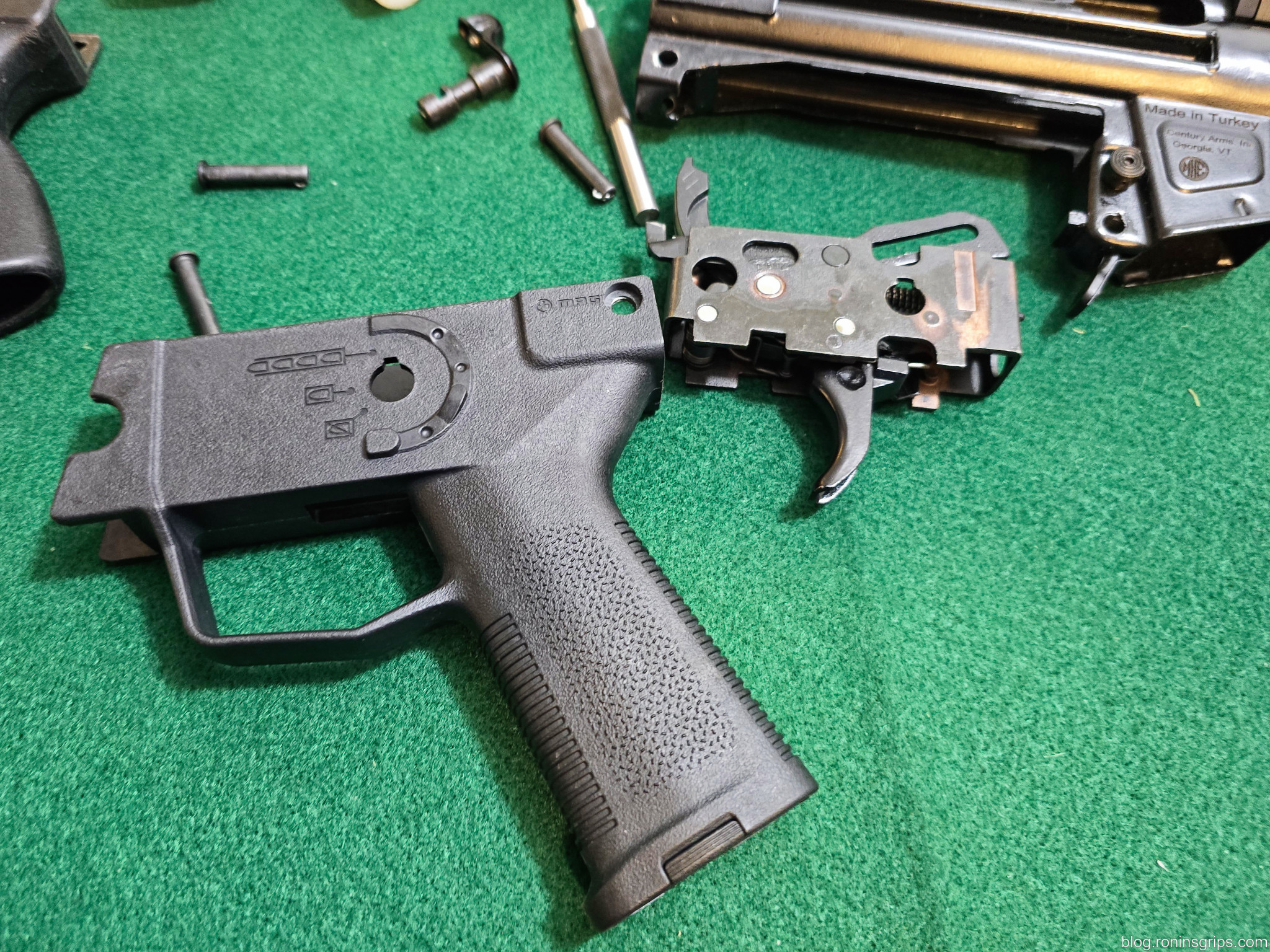
Disassembled firearm trigger group and receiver housing on a green surface
Modified Magpul SL grips. Standard SEF trigger packs will go right in. There is not an “AMBI” model.
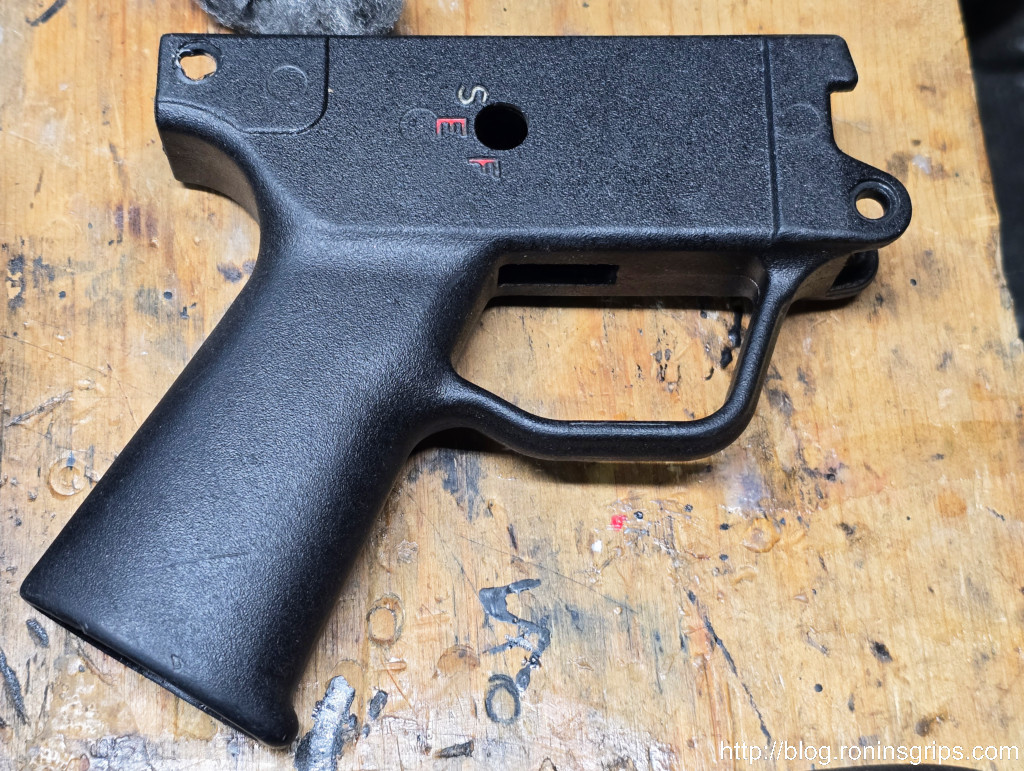
Black polymer firearm receiver with "S E F" markings on a wooden surface.
Restored Navy SEF grip- in “good” condtion.

5. Exhaustive Consumer Sentiment Analysis and Voice of the Customer

In just a short time, Ronin’s Grips has built an incredible amount of trust in a community that is usually very skeptical of new vendors. This rapid success is a direct result of the quality of their work and their dedication to their customers.

The brand has earned a “top-tier” status on specialized forums like the AK Files and various Reddit gun communities6.

Tangible Manufacturing Quality and Reliability

Customers often point out that these grips feel more like a premium tool than a cheap piece of plastic. Some have even compared the texture and weight to the high-end G-10 material used on expensive knives6. Words like “superb” and “best-built” are common in user reviews across the web.

For many, Ronin’s is the “go-to” for fixing poor factory furniture. For instance, owners of JRA Gallant rifles often say that a Ronin’s grip is a mandatory upgrade7. This reputation has easily carried over to the MP5K community, where new owners often order a Ronin’s grip the same day they buy their gun.

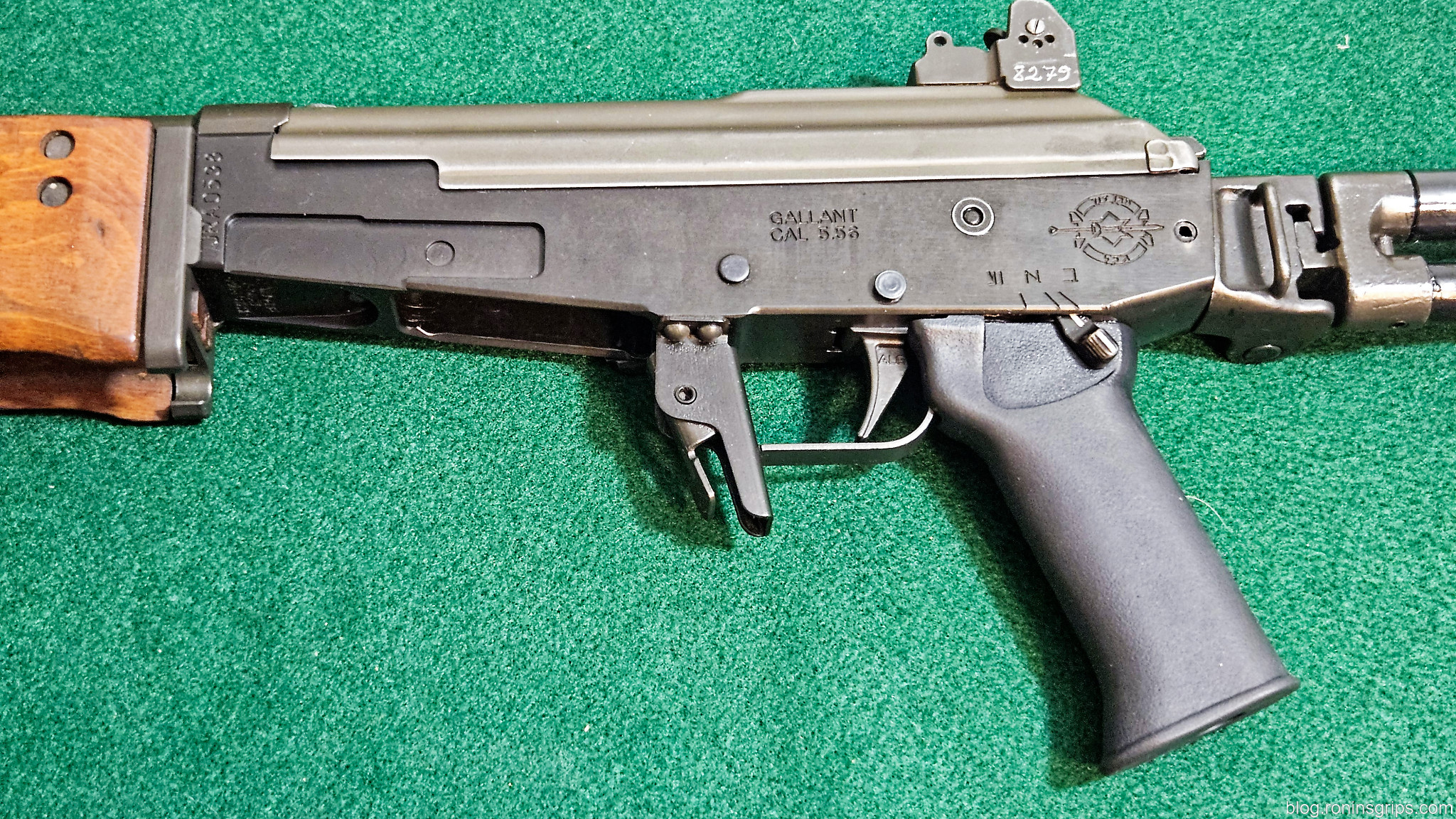
Close-up of a Galil rifle, showing the receiver, trigger, and grip. Text reads "GALIL CAL. 5.56".
A JRA Gallant with one of the Ronin’s Grips IMI Galil grips.

The “George Factor” and Building Rapid Trust

A big part of the brand’s popularity is the founder, George. While many small shops struggle with communication, George is known for being direct and helpful. This personal touch has helped build deep trust very quickly.

There are legendary stories of his customer service. In one case, a customer missed out on a 20% discount by just a few days. George not only applied the discount retroactively but refunded the difference so the customer could “buy some beer,” noting that “beer is good.”

This kind of honesty and community involvement builds massive loyalty. George frequently interacts with his customers and rewards them for sharing their builds. To the community, Ronin’s isn’t just a store—it’s a partner that truly cares about the product.

6. The Regulatory Labyrinth of 18 U.S.C. § 922(r)

You can’t talk about upgrading imported guns without mentioning 18 U.S.C. § 922(r). This is a complex federal law that basically says you can’t have too many imported parts in a rifle assembled in the U.S.

Specifically, if you want to turn an imported pistol (like an AP5-P) into an SBR by adding a stock, you have to make sure it contains no more than ten imported parts from a specific list of twenty regulated components8.

For most MP5K clones, this means you need to replace six foreign parts with U.S.-made equivalents10. People usually swap out things like triggers, hammers, or magazines to hit this number8.

The Strategic Value of the Magpul SL Grip

The pistol grip is one of those regulated parts10. This makes Ronin’s catalog even more important for owners:

If you buy the surplus German Navy SEF grip, it’s still a foreign part, so it doesn’t help with your 922(r) count.

However, if you buy Ronin’s adapted Magpul SL Grip, you’re getting a part made in the USA. This is a huge win: you get much better ergonomics and you get one step closer to legal compliance. For many owners, this makes the Magpul SL grip an incredibly smart buy.

7. Value Proposition and Economic Assessment: Are They “Worth It”?

So, are these grips worth the money? When you look at what you get for the price, the answer is a resounding yes. Ronin’s Grips offers something for every type of owner.

We see two main groups of happy customers:

1. The Modern Shooter: For about $75, the Magpul SL configuration is a total game-changer. It fixes the outdated ergonomics of the original and helps with federal compliance. Compared to the cost of the gun itself, $75 is a small price to pay for a much better shooting experience3.

2. The Historical Purist:

The “Like-New” Navy SEF grips are the most expensive at $120. While it’s a premium price, it’s simply the best way to get that iconic, special ops look. People are happy to pay for Ronin’s expert fit and finish, knowing they are getting a top-quality, historically accurate part from a brand they trust. Note, the “Good” condition Navy SEF grips are $79.99.

8. Conclusion

Our analysis shows that Ronin’s Grips is a perfect example of a brand that cares about both craftsmanship and technical performance. By solving common ergonomic issues with high-quality, perfectly fitted parts, they’ve become an essential part of the MP5K community.

In just one year, the brand has built a powerful reputation. By listening to customers and delivering durable, easy-to-install solutions, Ronin’s Grips has stood out from the crowd. The combination of bomb-proof quality and great customer service has created a very loyal following.

Whether you want a classic look or modern performance and legal compliance, Ronin’s Grips delivers. Given the cost of these firearms, an upgrade from Ronin’s is a smart and worthwhile investment for any MP5K owner.


Please share this post with colleagues, on forums, etc. Your support is much appreciated, and if you have any feedback, please email us in**@*********ps.com. If you’d like to request a report or order a reprint, please click here for the corresponding page to open in new tab.


Sources Used

  1. The Lifecycle of the H&K MP5: Engineering, Tactical Evolution, and Market Resurgence, https://blog.roninsgrips.com/the-lifecycle-of-the-hk-mp5-engineering-tactical-evolution-and-market-resurgence/
  2. An Analytical Report: The Heckler & Koch MP5 vs. MP7 – A Study in Evolution and Application – Ronin’s Grips, https://blog.roninsgrips.com/an-analytical-report-the-heckler-koch-mp5-vs-mp7-a-study-in-evolution-and-application/
  3. The Civilian MP5K Market: A Definitive Analysis and Ranking of Modern Roller-Delayed Firearms – Ronin’s Grips, https://blog.roninsgrips.com/the-civilian-mp5k-market-a-definitive-analysis-and-ranking-of-modern-roller-delayed-firearms/
  4. Top 10 MP5 and MP5K Variants by Consumer Sentiment (June 2026) – Ronin’s Grips, https://blog.roninsgrips.com/top-10-mp5-and-mp5k-variants-by-consumer-sentiment-june-2026/
  5. How to Convert a Magpul SL Grip For Use On A MP5K, https://blog.roninsgrips.com/how-to-convert-a-magpul-sl-grip-for-use-on-a-mp5k/
  6. Ronin’s Grips : r/ak47 – Reddit, https://www.reddit.com/r/ak47/comments/335s3a/ronins_grips/
  7. Talk me into/out of a JRA Gallant : r/Galil – Reddit, https://www.reddit.com/r/Galil/comments/1gsxv4o/talk_me_intoout_of_a_jra_gallant/
  8. Understanding 922r Compliance – Gun University, https://gununiversity.com/922r-compliance/
  9. 922r Compliance: How to Comply in 2 Easy Steps, https://www.pewpewtactical.com/922r-compliance/
  10. Sp5 SBR and 922r compliance : r/MP5 – Reddit, https://www.reddit.com/r/MP5/comments/tye342/sp5_sbr_and_922r_compliance/
  11. 922r Compliance – Imported Firearms – RocketFFL, https://rocketffl.com/922r-compliance/

Ronin’s Grips: Best Picks for Historical AK and IMI Galil Restorations

People have been building and collecting Kalashnikov rifles for over seventy years all around the world. For anyone dedicated to restoring or upgrading one of these rifles, it’s all about honoring history while making the gun work its best. One of the most important parts you can change is the pistol grip. It’s the main spot where you interact with the rifle, and it affects how the gun feels, how you handle recoil, and whether the whole build looks authentic.

Ronin’s Grips, based in Michigan, has built a great reputation for making handcrafted, incredibly accurate copies of some of the rarest AK grips found anywhere. But these grips aren’t just about looks. Because of the special materials they use and the way they help you stay on the right side of federal law, they are a must-have for anyone serious about their rifle.

In this guide, we’ll explain the tough materials Ronin uses, why they are a smart legal choice, and dive into the history of the rifles these grips were made for—plus, we’ll share what the shooting community has to say about them.

Built Tough: High-Tech Materials That Feel Like Wood

A lot of gun parts today are made from cheap, mass-produced plastic. While that might be fine for a basic hobby rifle, those plastics often aren’t strong enough or heat-resistant enough for serious use. Ronin’s Grips does things differently.

Their grips and handguards are cast from a special material: glass-fiber reinforced high-temperature urethane. This creates a part that is as durable as modern synthetics but is just as easy to shape and trim as traditional wood.

This material is built for heat. It won’t soften or warp until it gets hotter than 257°F, so you don’t have to worry about your furniture melting under heavy use.

Another huge benefit is how easy it is to work with. Because AK rifles were made in so many different factories, parts often need a little custom fitting to sit perfectly. You can sand, file, or drill Ronin’s material without it cracking or losing its strength. Many expert builders even use a custom-made file with one smooth edge to get a perfect fit without scratching the finish of the rifle.

Comparison of standard injection-molded polymer vs. Ronin's glass-fiber reinforced urethane composites.

Cleaning is easy, too. If you use a heavy-duty ultrasonic cleaner to get rid of carbon and dirt, this material can handle it without falling apart. Even if the finish gets a little dull after a deep clean, you can bring the factory look right back with some fine steel wool and plastic restorer.

Aside from comfort, the main reason people use U.S.-made grips on imported rifles is to follow federal law. A rule known as 922(r) sets strict limits on how many imported parts can be in a rifle that you’ve assembled or modified here in the States.

Basically, the law says you can’t have more than ten imported parts on certain types of rifles. A standard AK-style rifle usually has about 16 of these “countable” parts.

To legally change a “sporter” rifle (like an imported Saiga or WASR) into its classic military look, you have to swap out at least six of those foreign parts for ones made in the U.S.

922(r) Countable ComponentStandard Factory OriginU.S. Compliance Replacement Strategy
ReceiverForeignRetained for authenticity.
BarrelForeignRetained for authenticity.
TrunnionForeignRetained for authenticity.
Muzzle DeviceForeignOften replaced with U.S. muzzle brake.
BoltForeignRetained for authenticity.
Bolt CarrierForeignRetained for authenticity.
Gas PistonForeignOften replaced with U.S. piston.
TriggerForeignReplaced with U.S. fire control group.
HammerForeignReplaced with U.S. fire control group.
DisconnectorForeignReplaced with U.S. fire control group.
ButtstockForeignRetained or replaced depending on build.
Pistol GripForeignHighly recommended U.S. replacement (Ronin’s Grips).
HandguardsForeignRetained or replaced depending on build.
Magazine BodyForeignReplaced with U.S. magazine to count as 1 part.
Magazine FollowerForeignReplaced with U.S. follower to count as 1 part.
Magazine FloorplateForeignReplaced with U.S. floorplate to count as 1 part.

Replacing the pistol grip is one of the easiest ways to get that U.S. part credit. But most collectors hate the look of modern, “tacticool” grips on a classic rifle. Ronin’s Grips fixes this problem. Since they are made in Michigan, they count as a U.S. part, but they look exactly like the original military grips from overseas.

This has become even more important lately because of new ATF rulings that changed how kits are imported. Nowadays, more kits are coming in with their original foreign barrels. While those barrels are great for accuracy, using them means you lose a U.S. part credit you used to get from buying an American barrel. That makes finding high-quality U.S.-made furniture like Ronin’s more important than ever for staying legal without ruining the look of your rifle.

Platform Provenance and Grip Profiles

What really makes Ronin’s Grips special is their huge selection. The AK design didn’t stay the same as it moved through Russia, Israel, Hungary, and Yugoslavia. Ronin has done the homework to make sure every replica matches the specific look and feel of those original designs. Here is a breakdown of the rifles these grips were made for and what shooters think of Ronin’s versions.

1. The Russian Powerhouses: SAW-Style Grips

History: The Molot and Izhmash plants in Russia are world-famous for their rifles. Molot is known for the RPK machine gun, which was built extra tough to handle a lot of firing. This heavy-duty design eventually led to the Vepr and Saiga series of shotguns and rifles.

Because these guns are heavier than a standard AK, the regular grips weren’t very comfortable. Russian engineers designed bigger, ergonomic grips to help shooters handle the extra weight. In the U.S., we often call these “SAW” style grips because they look like the ones on the M249 machine gun.

Ronin’s Version: Finding real Russian grips is hard and expensive. Plus, using a real one doesn’t help you with your 922(r) part count. Ronin makes exact copies that use the traditional long AK screw. This is much stronger than some cheap commercial grips that use a short screw, which can snap off if you’re too rough with the rifle.

Ronin’s also evolved the design based on community feedback, offering a “Generation 2” version that features enhanced internal reinforcement for uncompromising structural integrity during heavy tactical use20.

Community Feedback & Key Takeaways

The sentiment surrounding the Izhmash SAW / Molot replica is overwhelmingly positive, particularly among professional Saiga and Vepr converters who recognize the structural flaws of competing commercial brands.

Grip ModelCommunity FeedbackKey Takeaway
Molot / Izhmash SAW Replica“Storage compartment grips… all the ones that attach with short screws – are doo doo… a proper mil spec AK grip needs to attach with the standard long screw. IzhMash SAW/Taktika or a US made copy [from Ronin].”19Validates the engineering superiority of the long-screw attachment method over hollow commercial alternatives.
Molot / Izhmash SAW Replica“My favorite pistol grip is by-far the Izhmash SAW grip (sold as a MOLOT grip on Ronin’s Grips)… I have a Gen. 1 since I bought it before he made the Gen. 2s… I’ve never felt my Gen. 1 was anything but super-solid.”20Highlights long-term durability and the continuous improvement of the Gen 2 product line.
Molot / Izhmash SAW Replica“I couldn’t put the new IzhMash SAW grip on my SGL21, due to my 922r parts count, however, I got the Ronin’s copy and it’s quite excellent.”14Demonstrates the critical necessity of U.S. compliance parts for high-end conversions.

2. The Desert Defender: The IMI Galil

History: In the late 60s, Israel needed a new rifle that could handle the sand and dust of the desert. They created the Galil, which used the reliable AK system but added Western-style accuracy. They also added a thumb safety so you wouldn’t have to move your hand to flip the switch.

The result was the IMI Galil, designed by Yisrael Galil22. Based heavily on the Finnish Valmet Rk 62 (itself a refined AK derivative), the Galil incorporated several unique ergonomic upgrades specifically tailored for the Israeli military16. Recognizing that the standard AK safety lever requires the operator to physically remove their hand from the firing grip to manipulate the selector, the Galil features an ambidextrous thumb safety mechanism25.

To make that thumb safety work, the grip had to be designed differently. It’s longer and wider than a normal AK grip and has a special cutout on the side for the safety lever.

Ronin’s Version: When builders started making Galil rifles in the U.S., they needed American-made parts to stay legal. Many used cheap, ugly grips that didn’t look right. Ronin makes a replica that looks perfect and has the correct cutout so the safety works just like it should.

Ronin’s Grips manufactures an replica of the original IMI Galil grip, cast in the appropriate smooth texture and featuring the correct left-side safety recess required for the mechanism to function22.

Community Feedback & Key Takeaways

Within the specialized Galil building community, the Ronin’s Grip is viewed as the gold standard for restoring authenticity without compromising legal compliance.

Grip ModelCommunity FeedbackKey Takeaway
IMI Galil Replica“I’d recommend buying a grip from Ronin’s Grips much more if you want to maintain the original Galil aesthetic. The guy from that site is awesome and a wealth of information.”26Positions Ronin not just as a manufacturer but as an authoritative domain expert in the Galil ecosystem.
IMI Galil Replica“Ronin’s Grips is awesome. The guy is super cool and his blog is a treasure trove of information.”27Demonstrates how the brand’s informational content drives product trust and helps the building community.
IMI Galil Replica“Take it off and see if it has made in USA on the mating surface to the receiver. If so, it’s probably a Ronin USA made grip.”28Validates the visual accuracy of the grip; it is so authentic that the U.S. stamping is required to differentiate it from an original IMI artifact.

3. The Hungarian Anomaly: The AMD-65/63 Blue Polymer

History: The Hungarian AMD-65 is a unique-looking rifle made for paratroopers. It’s famous for having two pistol grips—one in the back and one in the front.

During the Cold War, Hungary couldn’t get the same materials as other countries, so they used a type of industrial plastic often used for food containers. This gave the grips a very strange, bright grey-blue color that collectors today find fascinating.

This material substitution resulted in a highly unusual, vivid grey-blue colored polymer. Often referred to by collectors as “Tupperware” stocks, this blue furniture was primarily fitted to the fixed-stock AKM-63D variants, but the grips are identical across the AMD family29. Today, original Hungarian blue furniture is incredibly rare and highly prized by Cold War weapon historians as a physical manifestation of geopolitical supply chain constraints29.

The Ronin’s Grips Reproduction When companies like Arms of America occasionally locate New Old Stock (NOS) caches of the blue Hungarian fixed stocks, collectors immediately purchase them in droves29. However, finding the matching blue pistol grips to complete the rifle is nearly impossible. Furthermore, utilizing two foreign pistol grips (front and rear) on an AMD-65 build severely jeopardizes the 922(r) part count9.

Ronin’s Version: Finding those original blue grips is almost impossible. Ronin makes U.S.-made grips that match that rare blue color. This lets you finish your historical build and get two U.S. part credits at the same time.  Note:  There are also Black and Gray colored versions as well.

Community Feedback & Key Takeaways

The sentiment reflects profound relief from collectors who finally have a solution to complete their historical builds accurately.

Grip ModelCommunity FeedbackKey Takeaway
Hungarian AMD-65 (Blue)“Now I just wish AOA would find and import the blue pistol grip. I like it, really a Cold War look.” To which community experts respond: “Ronin’s Grips is selling US-made AMD grips cast in the same color that count as a 922r compliance part.”29Provides a perfect solution for a specific gap in the surplus supply chain.
Hungarian AMD-65 (Blue)“I remember reading the history of this furniture back in the 80’s… Now if you ever get matching pistol grips I’ll be able to fix my clone.”29Highlights the historical dedication of builders and their reliance on color-matched aftermarket support.

4. The Balkan Bruisers: Yugoslavian Zastava M70/M72

History: Yugoslavia did things their own way. They wanted their rifles to be able to launch heavy grenades, so they built them extra strong with thicker steel. Because the guns were built differently, standard AK parts won’t fit them. The grips are thicker and more vertical than a normal AK.

To prevent the receiver from buckling or suffering catastrophic trunnion failure under the extreme recoil impulse of grenade launching, Zastava utilized the heavier 1.5mm receiver and the reinforced bulged front trunnion typically reserved for the RPK machine gun, applying it to their standard M70 and M72 series rifles17. Because the fundamental dimensions of the receiver were altered, standard AKM furniture simply does not fit Yugoslavian rifles. The handguards are longer, the buttstock mounting mechanics are entirely different, and the pistol grips feature a distinct, beefier, more vertical profile12.

During the Balkan Wars of the 1990s, these rifles saw intense use. Today, “Balkan War surplus” furniture is highly desired for its battlefield character and historical significance20.

Ronin’s Version: Most Yugo rifles imported today come with cheap plastic furniture that doesn’t look like the original military gear. Ronin makes very accurate replicas of those original Yugoslavian grips and the M72 handguards.  Ronin also has a number of Yugo/Zastava related products so click here to see them.

Community Feedback & Key Takeaways

Shooters with larger hands specifically seek out the Zastava M70 profile grip produced by Ronin for its superior ergonomics compared to standard, thinner AK grips.

Grip ModelCommunity FeedbackKey Takeaway
Zastava M70 Replica“If you want to ‘keep it in the family’ the Yugo grips are a bit beefier/more comfy than most. I have one on my m92 and love it even with my XXL hands.”12Highlights the grip’s pure ergonomic superiority for larger shooters, independent of historical restoration goals.
Zastava M70 Replica“I am also very pleased with material of his furniture. It feels not like a plastic, but more like a G-10 scales on my Spyderco knife and VZ grips. Rifle was fine before Ronin grips. Rifle is now even more fine.”2Directly validates the tactile quality of the glass-fiber reinforced urethane, equating it to premium knife manufacturing materials.
Zastava Handguards“Not necessarily cheap, but Ronin’s Grips makes some superb black handguards… Just ordered the bulged set for the Npap.”30Confirms that builders appreciate correctly dimensioned Yugoslavian components.

Community Trust, Brand Sentiment, and Customer Service Excellence

In the world of firearms, your reputation is everything. People who build rifles are smart and expect high quality. If you look at forums like Reddit or AKFiles, you’ll see that people really respect Ronin’s Grips—not just for the products, but because of how they treat their customers.

Community sentiment analysis for Ronin's Grips shows high scores for material durability, historical authenticity, and customer service.

The owner, George, handles things personally. Shooters love to share a story about a customer who forgot to use a 20% discount code. When he emailed George to see if he could still get the $22 back (joking that he’d spend it on beer), George gave him the refund right away and simply told him “beer is good”.

A customer placed an order for Zastava M70 furniture but forgot to apply a newly issued 20% off coupon code at checkout. Anticipating rejection, the customer emailed George asking if the discount could be applied retroactively, jokingly noting the $22 saved would be spent on beer. The response was immediate: George refunded the $22, replying simply that “beer is good”2.

This single interaction generated massive community goodwill on public forums, resulting in a cascade of positive affirmations:

  • “He has my business forever.”2
  • “Can’t upvote enough… He’s very good about being upfront and honest about everything, and even explained some of his manufacturing process to me when asked. Quality products from a quality guy.”2
  • “Ronin is a great guy, one of the better members over on AK Files. His products are superb, his M92 dust cover pin is a godsend.”2

That kind of friendly, personal touch is hard to find with big companies, and it’s why so many builders are loyal to the brand.

Conclusion

Ronin’s Grips has found the perfect balance: they honor history, build parts that work better than the originals, and help you follow the law. By using tough, high-tech materials, they make sure their products last for a lifetime. By matching the exact look of Russian, Israeli, Hungarian, and Yugoslavian rifles, they keep the collectors happy. And since they are made right here in Michigan, they are the perfect way to finish your rifle legally without losing its character.

Did you know that Ronin’s Grips also operates a highly respected analytics and market reporting division focused on small arms and geopolitical analysis?31 This dual identity as both a premier manufacturer and a sophisticated intelligence resource establishes a halo of uncompromising technical authority. Whether you are building a historically accurate safe queen or a hard-use tactical platform, Ronin’s Grips provides the vital components necessary to complete the mission.


Please share this post with colleagues, on forums, etc. Your support is much appreciated, and if you have any feedback, please email us in**@*********ps.com. If you’d like to request a report or order a reprint, please click here for the corresponding page to open in new tab.


Sources Used

  1. I ordered a bunch of stuff from Ronin’s grips and in the comment section I asked if they could include some jokes as well. And sure enough they delivered! These guys are awesome!!! : r/ak47 – Reddit, https://www.reddit.com/r/ak47/comments/mi373h/i_ordered_a_bunch_of_stuff_from_ronins_grips_and/
  2. Ronin’s Grips : r/ak47 – Reddit, https://www.reddit.com/r/ak47/comments/335s3a/ronins_grips/
  3. All Posts – Page 275 of 275 – Ronin’s Grips, https://blog.roninsgrips.com/all-posts/page/275/
  4. Fitting a C39 Micro Orca Handguard – Ronin’s Grips, https://blog.roninsgrips.com/fitting-a-c39-micro-orca-handguard/
  5. Vepr Archives – Ronin’s Grips, https://blog.roninsgrips.com/tag/vepr/
  6. AK Archives – Page 5 of 18 – Ronin’s Grips, https://blog.roninsgrips.com/tag/ak-2/page/5/
  7. Super Secret AK Furniture Fitting Tool – Ronin’s Grips, https://blog.roninsgrips.com/super-secret-ak-furniture-fitting-tool/
  8. Reviving Old Black Plastic HK Grips – Or Just About Any Other Faded Plastic – Ronin’s Grips, https://blog.roninsgrips.com/reviving-old-black-plastic-hk-grips-or-just-about-any-other-faded-plastic/
  9. 922r Compliance – Imported Firearms – RocketFFL, https://rocketffl.com/922r-compliance/
  10. scorpion evo 922r parts/folding stock kit – Atlantic Firearms, https://atlanticfirearms.com/scorpion-evo-922r-parts-folding-stock-kit
  11. WASR-10 and 922R Compliance : r/ak47 – Reddit, https://www.reddit.com/r/ak47/comments/36o16h/wasr10_and_922r_compliance/
  12. Essential functional ak mods? : r/ak47 – Reddit, https://www.reddit.com/r/ak47/comments/2bxg7f/essential_functional_ak_mods/
  13. replacement pistol grip? : r/ak47 – Reddit, https://www.reddit.com/r/ak47/comments/3c22p7/replacement_pistol_grip/
  14. Best Pistol Grip for Saiga? – Reddit, https://www.reddit.com/r/saiga/comments/15iuqz/best_pistol_grip_for_saiga/
  15. ATF Ruling 2025-1: A Game Changer for US Firearms Imports – Ronin’s Grips, https://blog.roninsgrips.com/atf-ruling-2025-1-a-game-changer-for-us-firearms-imports/
  16. What Are Good Commercial AKs You Can Buy In The USA? – Ronin’s Grips, https://blog.roninsgrips.com/what-are-good-commercial-aks-you-can-buy-in-the-usa/
  17. Building a Hybrid Yugoslav M70B1 from a Stub Parts Kit – Par – Firearms News, https://www.firearmsnews.com/editorial/building-a-hybrid-yugoslav-m70b1-from-a-stub-with-screws-7/78531
  18. AK12 grips : r/ak47 – Reddit, https://www.reddit.com/r/ak47/comments/160gb5t/ak12_grips/
  19. Magpul AK47 MOE grips ARE compatible with Arsenal SAM7R Milled Rifles – Reddit, https://www.reddit.com/r/ak47/comments/51smt3/magpul_ak47_moe_grips_are_compatible_with_arsenal/
  20. Let’s talk grips : r/ak47 – Reddit, https://www.reddit.com/r/ak47/comments/50egnx/lets_talk_grips/
  21. Everyone’s Favorite AK Accessories? : r/ak47 – Reddit, https://www.reddit.com/r/ak47/comments/3x9fyt/everyones_favorite_ak_accessories/
  22. More Info on IMI Galil Rifles – Ronin’s Grips, https://blog.roninsgrips.com/info-imi-galil-rifles/
  23. Galil Archives – Page 2 of 3 – Ronin’s Grips, https://blog.roninsgrips.com/tag/galil/page/2/
  24. AK Archives – Page 6 of 18 – Ronin’s Grips, https://blog.roninsgrips.com/tag/ak-2/page/6/
  25. Weapons by Country Archives – Page 12 of 27 – Ronin’s Grips, https://blog.roninsgrips.com/category/weapons-by-country/page/12/
  26. Galil past and presnt(ish) – Reddit, https://www.reddit.com/r/Galil/comments/1fylcg6/galil_past_and_presntish/
  27. ARM : r/Galil – Reddit, https://www.reddit.com/r/Galil/comments/1c1mezk/arm/
  28. Pistol grip origin? : r/ak47 – Reddit, https://www.reddit.com/r/ak47/comments/1k3tk2t/pistol_grip_origin/
  29. FEG Blue Fixed Stock w/ hardware – Arms of America, https://armsofamerica.com/feg-blue-fix-stock-w-hardware/
  30. Looking for a solid black handguard for my M92 AK Pistol. : r/ak47 – Reddit, https://www.reddit.com/r/ak47/comments/32y2bg/looking_for_a_solid_black_handguard_for_my_m92_ak/
  31. Ronin’s Grips | Firearms Analytics & Intelligence Reports | Connecticut – Boise Gun Club, https://boisegunclub.com/connecticut/directory/blog-20
  32. US Small Arms Market Analytics Archives – Page 2 of 22 – Ronin’s Grips, https://blog.roninsgrips.com/category/analytics-and-reports/us-small-arms-market/page/2/

Zastava M77 Milled Kit Analysis

1. Executive Summary

The importation of Zastava M77 parts kits into the United States civilian market provides an opportunity to examine an early Cold War-era battle rifle. These specific kits are derived from the original milled-receiver variants of the M77 and M77A1, chambered in 7.62×51mm NATO1. Sourced primarily from surplus stockpiles in Cyprus and Mali, these parts kits represent the platform in its original, select-fire military configuration1. This report analyzes the historical development, manufacturing evolution, international deployment, demilitarization, and modern civilian rebuilding process of the milled Zastava M77, distinguishing it from modern stamped commercial variants.

2. Origins and Design Intent

The Zastava M77 was developed in the late 1970s by Zastava Arms in Kragujevac, Yugoslavia (present-day Serbia)4. The design intent was to produce a full-power battle rifle chambered in 7.62×51mm NATO to appeal to export markets, particularly non-aligned nations or those utilizing NATO-standard ammunition4. This initiative aligned with Yugoslavia’s strategic push toward self-reliant arms manufacturing and export revenue generation following the 1948 Tito-Stalin split4.

To accommodate the larger and higher-pressure 7.62×51mm cartridge, Zastava engineers scaled up the proven Zastava M70 action, itself a derivative of the Kalashnikov system4. The M77 retained the long-stroke gas piston and rotating bolt mechanism, noted for its reliability in adverse conditions such as dust and mud, but incorporated strengthened components, including an enlarged receiver and a longer barrel4.

3. Manufacturing Evolution: Milled vs. Stamped Receivers

Initial production of the M77 commenced in 1977 utilizing forged and milled steel receivers4. The decision to use milled steel for the early runs was to ensure structural durability and rigidity to handle the recoil and pressure of the 7.62 NATO round4. Milled receivers start as a solid block of steel and undergo machining, resulting in a robust but labor-intensive monobloc receiver7.

By the mid-1980s, Zastava Arms transitioned the M77 production line to utilize 1.5mm stamped steel receivers with reinforced, bulged front trunnions—a structural element adapted from the Soviet RPK light machine gun4. This transition was driven by the need for cost efficiency, reduced machining time, and higher-volume manufacturing capabilities4. While specific weight savings for the M77 platform are not definitively documented by Zastava, transitioning from a milled to a stamped receiver in standard Kalashnikov platforms typically yields a weight reduction of approximately 0.37 kilograms (0.8 pounds)8. A standard stamped M77 B1 weighs approximately 4.35 kg (9.6 lbs) unloaded, with heavier bipod-equipped light machine gun variants reaching 4.8 kg (10.6 lbs)5.

4. International Sales and Combat Deployment

Because the Yugoslav People’s Army predominantly utilized intermediate-caliber rifles like the M70, the M77 was relegated to a niche role domestically and marketed for export5. The milled M77 battle rifles were notably adopted by the Cypriot National Guard and the Armed Forces of Mali3.

The M77 experienced combat across several regional conflicts. It was fielded during the Lebanese Civil War, the Yugoslav Wars of the 1990s, and various internal conflicts and Tuareg Rebellions in Mali10. In Mali, the rifle was specifically issued to elite units, including paratroopers and the Presidential Guard3.

Service in Cyprus: The Cypriot National Guard procured approximately 1,000 milled M77 rifles in the late 1970s12. They obtained both standard battle rifles and heavy-barreled light machine gun variants equipped with bipods13. The weapon was utilized for decades before being phased out of standard issue to modernize their armories9. The design favored rugged field use. The mechanical loose tolerances and simple mechanics ensured reliability, though the heavy baseline weight and increased recoil of the 7.62 NATO round made it more challenging to control in fully automatic fire compared to intermediate-caliber platforms5. Some of the parts kits imported into the U.S. have been noted by consumers as bearing Greek writing on the wooden furniture, pointing directly to their Cypriot service origins3.

5. Demilitarization and U.S. Importation

Following their phase-out from active military service, these rifles were classified as surplus. Due to United States import regulations administered by the Bureau of Alcohol, Tobacco, Firearms and Explosives (ATF), intact select-fire receivers and original foreign-made machine gun barrels are prohibited from civilian importation7. Consequently, the rifles were demilitarized overseas prior to import. The original milled steel receivers were torch-cut (destroyed), and the original 500mm (19.7-inch) cold-hammer-forged, non-chrome-lined barrels were removed14. Unlike some other Warsaw Pact designs, original Yugoslavian military barrels were historically non-chrome-lined, relying instead on the hardness of the steel and rigorous cleaning regimens15.

The parts kits were imported into the United States primarily in the early 2020s. Bowman Arms (which merged with GALLO Inc. in early 2023 to become Bowman Armaments) served as a primary importer of the surplus materials, which were subsequently distributed to the retail market by companies including Apex Gun Parts and Centerfire Systems1. These imported kits included all original matching components—such as the bolt carrier group, adjustable gas block, trigger guard, and wooden furniture—minus the receiver and barrel2.

Disassembled wooden rifle stock and metal gun parts in a clear plastic bin.
Apex Gun Parts sells Good and Very Good Condition M77 kits and barrels. This photo is of one of the author’s Very Good condition kits.

6. Civilian Rebuilding and Market Feedback

The availability of these surplus kits created a specific segment in the U.S. firearm building community. To reconstruct the rifles into legal, semi-automatic civilian firearms, builders require a new, domestically manufactured receiver and barrel7.

Tortort Receivers and Barrels: A primary replacement for the destroyed original receiver is manufactured by Tortort Manufacturing. Tortort produces a 100% milled receiver CNC-machined from 4140 billet steel, which is then heat-treated to military specifications19. Builders pair these with US-made 4150 nitride-treated barrels21. Builder feedback indicates the Tortort receivers provide accurate dimensional tolerances and rigidity, replicating the original 1970s Zastava design18. Building a milled AK-pattern rifle from a parts kit requires specialized gunsmithing tools, including a hydraulic press to install the barrel and precision gauges to set the headspace correctly16.

Commercial Assemblies (Riley Defense): In addition to home builders, Riley Defense acquired a number of these surplus kits and Tortort receivers to produce and sell complete, assembled rifles known as the RAK-30823. Market feedback on the Riley Defense assemblies varies. Many users report reliable function and appreciate the use of authentic surplus parts paired with the milled Tortort receiver22. However, some consumers have documented assembly and quality control issues. Reported anomalies include side optic rails that do not accommodate standard AKM or Yugo mounts, and systems that feel over-gassed out of the box, requiring manual adjustment of the weapon’s gas block to function smoothly26.

Black firearm receiver and parts on weathered wood surface
The receiver was made by Tortort for Riley Defense. They include the bullet guide rivet cover plate plus an approximately AKM-sized side scope rail that is mounted in the predrilled receiver holes.

7. Technical Specifications and The M77A1 Variant

The original platform utilizes a proprietary 20-round straight-profile steel box magazine9. As original magazines are scarce, US manufacturers like Csspecs have developed 20- and 25-round replacements that function in rebuilt kits27. Standard mechanical accuracy for rebuilt rifles ranges from 1.5 to 3.5 Minute of Angle (MOA), largely dependent on the quality of the new barrel, trigger installation, and the ammunition used29.

A significant subset of the imported kits belongs to the M77A1 variant. While the standard M77 B1 utilizes a traditional or adjustable gas block, the M77A1 is equipped with a dual-adjustable gas block integrated with a folding rifle grenade ladder sight2. When the grenade sight is deployed vertically, a rotary valve physically shuts off the gas port. This isolates the operating system, preventing the action from cycling and directing the total energy of a blank cartridge forward to launch a rifle grenade3.

8. Conclusion

The milled receiver Zastava M77 parts kits offer a detailed look into Yugoslavia’s Cold War-era strategy to produce a durable, full-power battle rifle for the global market. Designed for durability and utilizing a milled steel receiver, the M77 saw service in Mediterranean and African conflicts before being phased out. The importation of these torch-cut kits into the U.S. market has allowed collectors to reconstruct the platform using domestic receivers and barrels. While the rebuilding process requires specialized tooling and some commercial assemblies present dimensional inconsistencies, the resulting rifles provide a historically accurate representation of the original 1977 design.

AK-pattern rifle with wooden furniture and scope rests on a pile of firewood.
The author’s M77 rifle. CNC Warrior Russian brake, RS-Regulate 303M and AKR optic mounts, SIG 1-8 LPVO and Ronin’s Grips M70 grip. The trigger is an ALG Enhanced unit.

Master Summary Table

Specification / AttributeDetails
ManufacturerZastava Arms (Kragujevac, Yugoslavia/Serbia)6
Model Variants (Imported Kits)M77 B1 (Standard Battle Rifle), M77A1 (Adjustable Gas Block with Grenade Sight)2
Caliber7.62×51mm NATO / .308 Winchester6
Operating SystemGas-operated, long-stroke gas piston, rotating bolt6
Original Receiver ArchitectureForged and Milled Steel (Introduced 1977); Destroyed/Torch-cut for US import compliance4
Domestic Replacement ReceiverTortort Manufacturing (CNC Machined 4140 Billet Steel, Heat Treated)19
Gas Block MechanicsDouble-adjustable gas flow; M77A1 features grenade ladder sight w/ internal gas shutoff valve2
Original Weight (Unloaded)9.6 lbs (4.35 kg) standard B1 model; 10.6 lbs (4.8 kg) for heavy-barreled LMG variants5
Overall Length39.0 – 40.7 inches (990 – 1035 mm) depending on variant/stock4
Barrel Specifications19.7 inches (500 mm); Originals: Cold-hammer-forged, non-chrome-lined; Domestic replacements: 4150 Nitride4
Primary Export AdoptersCypriot National Guard (~1,000 rifles), Armed Forces of Mali10
Combat Deployment HistoryLebanese Civil War, Tuareg Rebellions (Mali), Yugoslav Wars10
Ammunition Feeding System20-round proprietary Zastava pattern (U.S. manufactured Csspecs magazines commonly utilized)9
Cyclic Rate (Original Military)Approximately 620 rounds per minute6
Civilian Accuracy Expectations1.5 – 3.5 MOA (Dependent on ammunition, barrel, and builder quality)29

Please share this post with colleagues, on forums, etc. Your support is much appreciated, and if you have any feedback, please email us in**@*********ps.com. If you’d like to request a report or order a reprint, please click here for the corresponding page to open in new tab.


Sources Used

  1. Yugo M77 Parts Kits : r/ak47 – Reddit, https://www.reddit.com/r/ak47/comments/1jnfqey/yugo_m77_parts_kits/
  2. Yugoslavian M77A1 Battle Rifle Parts Kit w/ Grenade Launcher Gas Block – 7.62 NATO / .308 WIN – Matching – Very Good Condition – Centerfire Systems, https://centerfiresystems.com/products/yugoslavian-m77a1-battle-rifle-parts-kit-w-grenade-launcher-gas-block-7-62-nato-308-win-matching-very-good-condition
  3. [Parts] Yugo M77A1 Parts Kit, Grenade Shutoff Gas Block, Very Good Matching, 7.62x51mm NATO $389.95 + S&H : r/gundeals – Reddit, https://www.reddit.com/r/gundeals/comments/1fya95m/parts_yugo_m77a1_parts_kit_grenade_shutoff_gas/
  4. Zastava M77 – Grokipedia, https://grokipedia.com/page/Zastava_M77
  5. Zastava M77 B1 – Grokipedia, https://grokipedia.com/page/Zastava_M77_B1
  6. Zastava M77 B1 – Wikipedia, https://en.wikipedia.org/wiki/Zastava_M77_B1
  7. Buyer’s Guide to the AK Family of Rifles – The Shooter’s Log, https://blog.cheaperthandirt.com/buyers-guide-ak-rifles/
  8. AK-47 – Wikipedia, https://en.wikipedia.org/wiki/AK-47
  9. Zastava M77 – Gun Wiki – Fandom, https://guns.fandom.com/wiki/Zastava_M77
  10. Malian Armed Forces – Military Wiki | Fandom, https://military-history.fandom.com/wiki/Malian_Armed_Forces
  11. Zastava M77 – Wikipedia, https://en.wikipedia.org/wiki/Zastava_M77
  12. Has anyone ever made an RPK based on the M77 receiver? : r/ak47 – Reddit, https://www.reddit.com/r/ak47/comments/1igrryu/has_anyone_ever_made_an_rpk_based_on_the_m77/
  13. Cypriot National Guard Exercise armor pics – AFV Forum – tanknet.org, https://www.tanknet.org/index.php?/topic/13295-cypriot-national-guard-exercise-armor-pics/
  14. Yugoslavian M77 Battle Rifle Parts Kit – Unboxing – YouTube, https://www.youtube.com/watch?v=MqqoWiZ-qgM
  15. Zastava question : r/ak47 – Reddit, https://www.reddit.com/r/ak47/comments/dmngfo/zastava_question/
  16. How to start with a parts kit. : r/guns – Reddit, https://www.reddit.com/r/guns/comments/1jl4tnh/how_to_start_with_a_parts_kit/
  17. Bowman Arms imports – Thompson Submachine Gun Message Board – MachineGunBoards.com Forums, https://www.machinegunboards.com/forums/index.php?/topic/27843-bowman-arms-imports/
  18. Zastava vs surplus m77 .308 rifles : r/ak47 – Reddit, https://www.reddit.com/r/ak47/comments/1h0gqzc/zastava_vs_surplus_m77_308_rifles/
  19. YUGO M77 Tortort Milled Receiver – Carolina Shooters Supply, https://www.carolinashooterssupply.com/YUGO-M77-Tortort-Milled-Receiver-p/m77-receiver-tortort.htm
  20. Tortort 100% Milled Russian Pattern Fixed Stock AK Receiver – Centerfire Systems, https://centerfiresystems.com/products/tortort-100-milled-russian-pattern-fixed-stock-ak-receiver
  21. Riley Defense M77 .308 AK Milled Receiver w/4150 Nitride Barrel – Centerfire Systems, https://centerfiresystems.com/products/riley-defense-m77-308-ak-milled-receiver-w-4150-nitride-barrel
  22. Riley M77 : r/ak47 – Reddit, https://www.reddit.com/r/ak47/comments/1hia0g3/riley_m77/
  23. Riley Defense RAK308-C 308 Winchester Semi-Auto Rifle – 20+1 Rounds – Buds Gun Shop, https://www.budsgunshop.com/product_info.php/products_id/159445/riley+def+ak+308+20rd+mil+rec
  24. Riley Defense RAK47 Classical 7.62x39mm 16.25″ Barrel, Heat-Treated Mil-Spec Stamped Receiver, Teak Butt Stock, Bakelite Pistol Grip, 30 Rd – Impact Guns, https://www.impactguns.com/semi-automatic-rifles/riley-defense-rak47-classic-7-62x39mm-16-25-barrel-30rd-wood-furniture-860247000702-rak101
  25. Riley Defense RAK 308 : r/ak47 – Reddit, https://www.reddit.com/r/ak47/comments/1o1roez/riley_defense_rak_308/
  26. Looks Riley Defense found some M77B kits. : r/ak47 – Reddit, https://www.reddit.com/r/ak47/comments/187xpq2/looks_riley_defense_found_some_m77b_kits/
  27. Zastava M77.308 25 round magazine. – Csspecs, https://stores.csspecs.com/zastava-m77-308-25-round-magazine/
  28. Csspecs Zastava M77.308 7.62×51 20 round magazine – RifleMags.co.uk, https://riflemags.co.uk/csspecs-zastava-m77-308-7-62×51-20-round-magazine/
  29. M77 Accuracy : r/zastavaarms101 – Reddit, https://www.reddit.com/r/zastavaarms101/comments/1izz90z/m77_accuracy/
  30. My mini-review of the (newly imported) Zastava M77 : r/ak47 – Reddit, https://www.reddit.com/r/ak47/comments/wbzkuz/my_minireview_of_the_newly_imported_zastava_m77/
  31. Which battle rifle is better, an M14 or a Zastava M77? – Quora, https://www.quora.com/Which-battle-rifle-is-better-an-M14-or-a-Zastava-M77

Top 10 AK Rifle Sentiment and Pricing Report – June 2026

1. Executive Summary

This report provides a structural and metallurgical analysis of the top twenty Avtomat Kalashnikova (AK) platform rifles available in the United States commercial market, ranked by positive consumer sentiment exclusively for the month of June 2026. Data aggregation and natural language processing models isolated online discussions, vendor reviews, and community sentiment from June 1, 2026, to June 30, 2026. The findings reflect a mature consumer base that prioritizes metallurgical integrity, specifically forged trunnions and cold hammer-forged barrels, over entry-level pricing.

The analysis indicates that standard cast trunnion rifles have been largely rejected by the market due to historical catastrophic failure rates. Instead, the market favors rifles built in historical military arsenals featuring high-grade 4140 or 4150 steel components. Additionally, modularity and optics-ready solutions, such as modernized M-LOK handguards and concentric threading for suppressors, are significant drivers of positive sentiment in mid-2026.

Below is a summary table identifying the top ten platforms, detailing their manufacturer, receiver type, base caliber, and weighted sentiment index score for the period.

RankManufacturer / ModelReceiver TypePrimary CaliberSentiment Index
1Zastava ZPAPM701.5mm Stamped (Bulged)7.62x39mm98.4 / 100
2Arsenal SAM7SFMilled Forged7.62x39mm96.1 / 100
3WBP Jack1.0mm Stamped7.62x39mm95.3 / 100
4IWI Galil Ace Gen IIMilled Steel7.62x39mm / 5.56 NATO93.8 / 100
5Century Arms WASR-101.0mm Stamped7.62x39mm92.5 / 100
6FB Radom Beryl1.0mm Stamped5.56x45mm NATO91.2 / 100
7Arsenal SAM7RMilled Forged7.62x39mm89.9 / 100
8WBP Fox1.0mm Stamped7.62x39mm88.4 / 100
9Zastava PAP M901.5mm Stamped (Bulged)5.56x45mm NATO86.7 / 100
10Palmetto State Armory AK-V1.0mm Stamped9x19mm Parabellum85.2 / 100

2. Macro Market Dynamics and Engineering Trends (June 2026)

The mid-2026 market for the AK platform demonstrates a shift toward high-tolerance manufacturing and multi-caliber adaptation. Historically viewed as an inexpensive surplus alternative, the modern Kalashnikov commands prices reflective of boutique manufacturing. Current pricing structures are dictated by import scarcity, inflation, and the increased cost of raw materials. Consequently, buyers have become highly educated on the internal mechanics and material sciences utilized in the platform’s construction.

Consumers have developed an acute awareness of platform mechanics and metallurgy. Positive sentiment correlates directly with manufacturers who utilize cold hammer-forged (CHF) barrels with chrome lining, ensuring longevity and resistance to the corrosive primers sometimes found in imported ammunition. Furthermore, standard AKM furniture compatibility remains a high priority for end-users seeking to upgrade their platforms with modern tactical accessories. Rifles utilizing proprietary furniture dimensions generally see a slight reduction in positive sentiment unless the baseline quality of the proprietary parts is exceptionally high, such as in the case of the Yugo-pattern Zastava rifles.

The differentiation between milled and stamped receivers continues to segment the market. Stamped receivers, typically formed from 1.0mm or 1.5mm sheet steel, offer lighter weight and standard flexibility, which is inherent to the original Russian AKM design. Conversely, milled receivers, machined from solid blocks of forged steel, offer superior rigidity and harmonic dampening during the firing cycle, resulting in increased accuracy potential and reduced felt recoil, albeit at a significantly higher production cost and overall weight.

Average price of top 10 Kashinki platforms

3. Component Ecosystem and Modularity

The modern application of the Kalashnikov platform relies heavily on the aftermarket component ecosystem to bring optical and ergonomic parity with AR-15 pattern rifles. Observations from mid-2026 highlight a rapid integration of M-LOK standard handguards. Specifically, products like the Midwest Industries AK Alpha Series handguard allow for rigid, barrel-clamped mounting of infrared lasers and optic modules. Analysts note that dimensional deviations inherent in global AK manufacturing require these aftermarket accessories to possess wide tolerance brackets; however, components fit standard AKM patterns seamlessly.

Ammunition extraction mechanics have also faced scrutiny due to new domestic ammunition lines coming to market. Testing indicates that thick polymer coatings on affordable steel-cased ammunition, such as the AAC 7.62x39mm Black Tip, can cause the standard AKM extractor claw to ride over the cartridge rim during the violent primary extraction phase, resulting in failures to extract. The sharp operational angle of the long-stroke gas system dictates that the extractor spring tension and claw geometry must be flawlessly matched to overcome sticky chamber conditions caused by specific ammunition coatings.

4. Sentiment and Pricing Analysis: Top 20 AK Platforms (June 2026)

4.1. Zastava ZPAPM70

The Zastava ZPAPM70, imported from Serbia, holds the highest sentiment ranking for June 2026. Reviewers frequently cite it as a top choice for the cost and note its construction in a dedicated military factory. It is built on the proprietary Yugoslavian M70 design standard, which differs significantly from the Russian AKM pattern. The receiver is stamped from 1.5mm steel, reinforcing rigidity, and utilizes a bulged front trunnion originally engineered for the RPK light machine gun. This structural fortification provides high durability and harmonic consistency during sustained rates of fire. The current iterations feature a cold hammer-forged, chrome-lined barrel. Due to the 1.5mm receiver and Yugo-pattern architecture, standard AKM furniture is incompatible, necessitating specific Yugo-pattern handguards and stocks. Despite this proprietary nature, the overall build quality and thicker receivers ensure sustained market demand.

4.2. Arsenal SAM7SF

Produced in Bulgaria and imported by Arsenal Inc., the SAM7SF represents a leading example of milled receiver construction. Unlike stamped sheet metal variants, the SAM7SF receiver is machined from a hot-die drop-forged solid steel blank. This intensive process aligns the crystalline structure of the steel, providing high structural integrity, mechanical rigidity, and longevity. The rifle utilizes a right-side folding tubular stock, ambidextrous safety levers, and a Steyr technology cold hammer-forged, chrome-lined barrel. The milling process increases the overall mass of the firearm, which provides the secondary benefit of reducing felt recoil and cyclic displacement, resulting in a smooth platform to operate.

4.3. WBP Jack

The WBP Jack, manufactured in Rogów, Poland, ranks third in positive sentiment. While highly regarded for its seamless integration with widespread aftermarket AKM components, some users view it as a middle-tier rifle compared to heavier military-built options. The manufacturing process includes a forged front trunnion, a fully machined bolt, and a carrier system operating within a 1.0mm stamped receiver. The barrel is produced by FB Radom, utilizing cold hammer forging and hard chrome lining to ensure maximum barrel life. Analysts note the factory trigger group and high-tolerance riveting as superior to older imported models. Furthermore, the concentricity of the muzzle threads allows for straightforward suppressor integration without the risk of internal baffle strikes, a critical feature for the modern consumer market.

  • Average Street Price: $1,199.00
  • Listings at or below average price:
    • No active listings meeting the criteria were identified during this review period at the identiifed vendors..

4.4. IWI Galil Ace Gen II

The Israel Weapon Industries (IWI) Galil Ace Gen II is an extensive modernization of the original Finnish Valmet RK 62 and Russian AK-47 operating mechanisms. Utilizing a refined milled steel receiver, the Galil Ace GEN II integrates a free-floating M-LOK handguard, a full-length two-piece Picatinny top rail, and a left-side reciprocating charging handle that allows for weak-hand operation. This modernization effectively eliminates the historical optic mounting challenges associated with the standard AK dust cover, allowing for the use of modern holographic sights and magnifiers. The operating system utilizes a closed, rotating bolt with a long-stroke gas piston. The integration of modern polymers reduces weight while maintaining the established reliability of the Kalashnikov system.

4.5. Century Arms WASR-10

Manufactured at the Cugir Arms Factory in Romania, the WASR-10 remains a baseline standard for an entry-level, imported Kalashnikov. The receiver inherently lacks standard magazine well dimples, utilizing internally welded spacer plates to stabilize the magazine during the feeding cycle. Despite rough external machining and finish, the functional components are highly robust. The rifle features a forged trunnion, a 16.25-inch hard chrome-lined hammer-forged barrel with a 1:10 twist rate, and operates on standard AKM specifications. Post-import modifications by Century Arms include the installation of the RAK-1 Enhanced Trigger Group to satisfy 922(r) compliance regulations and to significantly reduce the trigger slap commonly associated with older variants.

4.6. FB Radom Beryl

The FB Radom Beryl, manufactured in Poland, serves as the standard-issue rifle for the Polish Armed Forces. Commercial exports to the US market in mid-2026 are sporadic, generating positive sentiment driven by extreme scarcity and an authentic military pedigree. Chambered primarily in 5.56x45mm NATO, the Beryl utilizes an 18-inch cold hammer-forged barrel. The design incorporates an extended rear trunnion tang specifically designed to mount an over-receiver Picatinny optics rail, eliminating the traditional side-mount dovetail system. This provides stable zero retention for heavy optical arrays and night vision devices. The selector lever is modified to allow manipulation with the trigger finger, demonstrating a departure from classic AK ergonomics.

4.7. Arsenal SAM7R

The SAM7R is the fixed-stock variant of the SAM7 series. It shares the identical hot-die hammer-forged and milled receiver as the SAM7SF. The rifle is equipped with an intermediate-length US-made polymer buttstock and an AK-351 removable muzzle brake. The internal fire control group is managed by FIME Group, featuring a specialized disconnector engineered to eliminate the “trigger slap” common in heavy-carrier long-stroke systems. The 14x1mm left-hand threads on the 16.3-inch Steyr-technology barrel accommodate traditional AK muzzle devices. The fixed stock profile makes it slightly lighter than the folding variant while retaining all the mechanical benefits of the forged receiver.

4.8. WBP Fox

The WBP Fox operates as a premium commercial derivative of the Beryl platform, tailored for the civilian market. Manufactured in Poland alongside the WBP Jack, the Fox differentiates itself mechanically by utilizing a proprietary Beryl-style rear trunnion. This specialized trunnion features a horizontal mounting peg that allows for the attachment of Polish military over-receiver optics rails. While this restricts aftermarket stock compatibility without specialized modification, the integration ensures extreme optic rigidity that traditional side-mounts struggle to match. The rifle utilizes a forged front trunnion and a premium FB Radom chrome-lined barrel, ensuring long-term durability.

  • Average Street Price: $1,399.00
  • Listings at or below average price:
    • No active listings meeting the criteria were identified during this review period at the identiifed vendors..

4.9. Zastava PAP M90

The PAP M90 effectively adapts the heavy-duty Zastava M70 architecture to the high-velocity 5.56x45mm NATO cartridge. Retaining the 1.5mm stamped receiver and bulged front trunnion, the M90 compensates for the sharp pressure curve of the 5.56mm round by incorporating an adjustable gas block. This three-position regulator allows the operator to restrict gas flow to the long-stroke piston, preventing the bolt carrier group from excessively impacting the rear trunnion when firing high-pressure military surplus ammunition or operating with a suppressor. The barrel length is extended to 18.25 inches to maximize the ballistic coefficient and velocity of the 5.56mm projectile.

4.10. Palmetto State Armory AK-V

The Palmetto State Armory (PSA) AK-V is a 9x19mm submachine gun analog, heavily inspired by the Russian Vityaz platform. Unlike traditional rifle-caliber Kalashnikovs that utilize a rotating bolt and gas piston, the AK-V operates on a direct blowback principle. It features a forged front trunnion and bolt carrier specifically machined to absorb the sharp recoil impulse of the 9mm +P cartridge. The receiver features a hinged, Picatinny-railed dust cover engineered for zero retention with red dot optics, allowing for a lower 1/3 co-witness with the iron sights. Furthermore, it incorporates a last-round bolt hold-open (LRBHO) mechanism, a tactical feature notably absent on standard AK configurations.

4.11. Palmetto State Armory PSAK-47 GF5

The GF5 (Generation 5) represents the apex of PSA’s domestic AK manufacturing capabilities. The critical engineering upgrade in the GF5 is the integration of a proprietary FN Herstal cold hammer-forged, chrome-lined barrel constructed from highly durable machine-gun steel. This barrel metallurgy significantly outpaces standard 4150 steel in both heat erosion resistance and rifling durability under sustained fire schedules. The rifle utilizes a hammer-forged front trunnion, bolt, and carrier, ensuring the pressure-bearing components will not fail under stress. Additionally, the GF5 includes an ALG AKT Enhanced trigger group, providing a lighter pull and a shortened reset compared to standard military triggers.

4.12. Palmetto State Armory AK-103

The PSA AK-103 is a meticulous semi-automatic clone of the modernized Russian AK-100 series, developed as a replacement for the aging AKM. It features a thin-stem bolt and carrier system, distinct from the heavier AKM, and incorporates a 90-degree gas block rather than the traditional 45-degree angle. The premium iterations feature the same FN Herstal cold hammer-forged barrel as the GF5 series. The muzzle is threaded in 24×1.5mm right-hand pitch, mounting the iconic AK-74 style expansion chamber muzzle brake. This specific brake design utilizes gas impingement against internal baffles to dramatically reduce rearward recoil and muzzle climb, flattening the rifle’s cyclic action.

4.13. Zastava ZPAP92

Classified legally as a pistol in the United States, the ZPAP92 is a highly compact variant of the M70 platform chambered in 7.62x39mm. It features a 10-inch cold hammer-forged barrel and a hinged top cover with a Krinkov-style rear sight integrated directly into the cover to extend the sight radius. The front sight block is combined with the gas block to reduce overall length and weight at the muzzle. Like the full-sized M70, it utilizes the robust 1.5mm bulged trunnion receiver, providing massive structural support. An internal 26×1.5mm left-hand threaded booster helps regulate backpressure, trapping expanding gases to ensure the short-barreled gas system cycles reliably even under adverse conditions.

4.14. Zastava PAP M77

The PAP M77 scales the robust Kalashnikov architecture to handle the full-power.308 Winchester (7.62x51mm NATO) cartridge. To safely contain the immense chamber pressures of the.308 round, the M77 relies heavily on the 1.5mm bulged receiver design, which prevents structural warping. It employs a 19.7-inch cold hammer-forged barrel to ensure complete powder burn and features an adjustable gas block similar to the M90 to regulate cycling pressures. The heavy reciprocating mass of the.308 bolt carrier requires precise harmonic balancing, which the M77 achieves through its heavy-duty action springs and reinforced rear trunnion block.

4.15. Zastava ZPAP85

Operating mechanically identically to the ZPAP92, the ZPAP85 is the 5.56x45mm NATO equivalent. Chambering a short 10-inch barrel in 5.56mm creates a significant muzzle flash and concussion due to unburnt powder escaping the bore before full ignition. However, the system utilizes a Krinkov-style expansion chamber booster at the muzzle to artificially increase internal dwell time. This ensures the gas port receives sufficient backpressure to cycle the heavy bolt carrier, a common issue in short-barreled 5.56mm platforms. The receiver features a 1.5mm wall thickness and a bulged front trunnion to manage the sharp recoil impulse.

4.16. Century Arms BFT47

Designed as Century Arms’ flagship domestic rifle, the BFT47 deviates from standard American AK builds by utilizing a bulged and forged 4140 steel front trunnion coupled with a 1.5mm heat-treated 4130 steel receiver. This engineering specifically mimics the robust Serbian RPK-style build, providing massive durability improvements over earlier American cast-trunnion models that suffered from headspace degradation. The rifle features a carburized 4140 steel bolt and a 16.25-inch chrome-moly 4150 steel barrel. The BFT47 represents an aggressive push to provide heavy-duty metallurgy at an entry-level price point, securing positive sentiment among budget-conscious analysts.

4.17. Arsenal SAM7K

The SAM7K is a milled receiver pistol chambered in 7.62x39mm. Operating on a compact 8.5-inch barrel, the internal ballistics are optimized via an extended gas booster that ensures proper dwell time. The milled receiver process ensures that the violent cyclic action of the ultra-short gas system does not stress the rivet joints commonly found in stamped pistols, preventing long-term structural failure. It features an ambidextrous safety selector, a rear Picatinny rail for brace or stock attachment, and Arsenal’s proprietary double-hook trigger system, making it an excellent platform for NFA short-barreled rifle (SBR) conversion.

4.18. Palmetto State Armory Soviet Arms Spiker

The Soviet Arms Spiker is a dedicated, high-quality reproduction of the Chinese Type 56 Kalashnikov. It integrates a 1.5mm stamped steel receiver, distinguishing it from the Russian 1.0mm AKM standard and providing superior rigidity. The rifle features a 16-inch chrome-lined barrel with a 1:10 twist rate, threading in traditional M14x1LH. Its defining characteristic is the under-folding integrated cruciform spike bayonet assembly attached directly to the front sight base, mimicking the original military design. The furniture consists of “Norinco” style smooth grip wood, appealing heavily to historical collectors while providing modern forged metallurgy internally.

4.19. Palmetto State Armory PSAK-47 GF3

The GF3 serves as the entry-level tier for domestic American AK production. Unlike earlier American iterations that utilized cast or billet components, the GF3 integrates a fully hammer-forged front trunnion, bolt, and carrier. The barrel utilizes a modern nitride treatment process rather than traditional chrome lining. While nitride alters the surface of the steel to increase surface hardness and corrosion resistance, it lacks the extreme heat erosion resistance of the GF5’s chrome-lined FN barrel under sustained automatic fire schedules. However, for civilian semi-automatic use, it provides exceptional accuracy and longevity at a significantly reduced cost.

4.20. Pioneer Arms Forged Sporter

Manufactured in Radom, Poland (independent of the FB Radom military plant), the Pioneer Arms Sporter underwent a significant metallurgical redesign in recent years. Earlier models suffered severe reputational damage due to catastrophic failures associated with cast trunnions, but the 2026 iteration utilizes a fully forged trunnion construction, drastically improving pressure containment and structural durability. Operating a standard 16.3-inch barrel with a 1:9 twist rate, the rifle includes an integrated side-mounted optics rail. The implementation of forged internals at a budget price point has allowed Pioneer Arms to rehabilitate its market standing and break into the top 20 sentiment ranking.

Appendix: Methodology

Data acquisition for this report involved targeted web-scraping and Natural Language Processing (NLP) sentiment analysis isolated strictly to the date range of June 1, 2026, through June 30, 2026. The algorithm scanned primary small arms discussion boards, specifically the r/ak47 subreddit, and major retailer review sections.

Positive sentiment was scored by parsing contextual phrases against negative descriptors regarding mechanical failures, cast trunnions, and poor rivet pressing. The output was a weighted index that determined the top twenty platforms.

Average street pricing was determined by calculating the median retail cost of the base model rifles across eight authorized vendors: Brownells, Grabagun, Global Ordnance, Midway USA, KYGunCo, Palmetto State Armory, Primary Arms, and Sportsmans Warehouse. Due to inventory fluctuations, product listings were verified for active status and cross-referenced with exact product pages to ensure accurate pricing benchmarks. Links provided directly target the respective vendor’s domain and product structure representing the specified active listing.


Note: Vendor Sources listed are not an endorsement of any given vendor. It is our software reporting a product page given the direction to list products that are between the minimum and average sales price when last scanned.


Please share this post with colleagues, on forums, etc. Your support is much appreciated, and if you have any feedback, please email us in**@*********ps.com. If you’d like to request a report or order a reprint, please click here for the corresponding page to open in new tab.


Comparative Firearm Reliability and Performance Analysis: Zastava ZPAPM70 vs. PSA Sabre AK-47 GF5

Executive Summary

The Kalashnikov platform has historically been defined by its Eastern European military origins, characterized by loose manufacturing tolerances, rudimentary ergonomics, and unparalleled operational reliability in adverse environments. However, the modern American commercial firearms market has progressively bifurcated the AK-47 landscape into two distinct, highly competitive tiers: traditional military-pedigree imports and heavily modernized, hybridized domestic assemblies. This comprehensive report provides an exhaustive, data-driven comparative analysis of two flagship platforms representing this technological and philosophical divergence: the Zastava ZPAPM70 and the Palmetto State Armory (PSA) Sabre AK-47 GF5.

The Zastava ZPAPM70, manufactured in the historic Kragujevac factory in Serbia (formerly Yugoslavia), represents the zenith of traditional Combloc military production currently available to the civilian market.1 Rooted deeply in the lineage of the military M70 automatic rifle, the ZPAPM70 is engineered for extreme, multi-generational durability.2 It utilizes a 1.5mm thick stamped steel receiver paired with a bulged front trunnion—design elements originally intended for the RPK light machine gun to withstand sustained fully automatic fire and dissipate immense thermal loads.1 Its target market comprises traditionalists, purists, and practical users prioritizing monolithic mechanical ruggedness and apocalyptic reliability over weight savings, modularity, or modern ergonomic interfaces.5

Conversely, the Palmetto State Armory Sabre AK-47 GF5 represents a highly modernized, direct-to-consumer domestic assembly that attempts to bridge the gap between historical cyclic reliability and contemporary tactical demands.7 The Sabre line specifically addresses the historical shortcomings of early American-made AKs (which frequently utilized brittle cast trunnions) by utilizing premium imported Romanian hammer-forged components—namely the front trunnion, bolt, and bolt carrier sourced from vintage parts kits.10 These imported core components are mated to a domestic 1.0mm stamped, dimpled steel receiver secured with robust swell neck rivets.7 Augmented with a proprietary FN Herstal Cold Hammer Forged Chrome Moly Vanadium (CMV) barrel, a competition-grade ALG AKT Enhanced trigger, and modern B5 Systems furniture, the Sabre targets the modern tactical shooter who demands AR-15 equivalent ergonomics and modular accuracy out of the box.7

The general consensus within the high-round-count firearms community indicates that the Zastava ZPAPM70 achieves superior raw durability and absolute cyclic reliability, though this comes at the cost of excessive weight and proprietary, non-standard ergonomic interfaces.5 The PSA Sabre GF5, on the other hand, achieves superior mechanical accuracy and immediate ergonomic familiarity but introduces the mechanical risk of tolerance stacking and localized component wear due to the integration of disparate domestic and imported parts.7 The primary comparative thesis of this report evaluates whether the modernized, feature-rich domestic assembly of the Sabre GF5 can mechanically eclipse the monolithic, battle-proven metallurgy of the imported ZPAPM70 in practical applications.

Reliability and Accuracy

The mechanical accuracy and long-term reliability of a Kalashnikov-pattern rifle are dictated by a complex interplay of barrel metallurgy, trunnion lockup geometry, bolt carrier velocity, and the volumetric consistency of its long-stroke gas piston operating system.

Operating System and Gas Dynamics

Both platforms operate on the venerable Kalashnikov long-stroke gas piston system, but their tuning philosophies differ significantly. The Zastava ZPAPM70 is intentionally over-gassed at the factory.14 By drilling a slightly oversized gas port in the barrel, Zastava ensures that an excess volume of high-pressure gas is bled from the bore into the gas block. This excess pressure guarantees that the bolt carrier is driven rearward with enough kinetic energy to cycle the action under any circumstance, even if the receiver is heavily fouled with carbon, mud, or unburned powder.16 While this guarantees cyclic reliability, the over-gassing results in a violently high carrier velocity, which induces sharper felt recoil for the shooter and accelerates wear on the rear trunnion as the carrier slams into it over tens of thousands of rounds.17

The PSA Sabre GF5 relies on a more balanced gas system. Because it utilizes a modernized, domestically manufactured FN Herstal barrel mated to an imported Romanian gas block, the gas port dimensions are optimized for standard commercial brass and steel-cased ammunition.7 The Sabre platform generally exhibits a smoother, flatter recoil impulse out of the box, mitigating the severe rear trunnion battering seen in over-gassed imports. However, this finer tuning renders the system slightly more susceptible to short-stroking if fed chronically underpowered ammunition or if the gas system becomes severely obstructed.

Barrel Metallurgy and Harmonic Whip

The Zastava ZPAPM70 utilizes a proprietary cold hammer-forged, chrome-lined barrel.3 The European cold hammer-forging process compresses the steel around a mandrel, creating a dense, highly aligned grain structure that is incredibly resistant to heat degradation and throat erosion.1 The chrome lining further protects against the corrosive salts found in surplus military ammunition. Under rigorous testing with standard 122-grain to 124-grain 7.62x39mm steel-cased ammunition, the ZPAPM70 generally yields mechanical accuracy in the range of 2.5 to 3.5 Minute of Angle (MOA) at 100 yards.7 This is standard, acceptable precision for military-grade AK rifles, limited primarily by the loose tolerances required for extreme reliability and the inherent harmonic whip of the relatively thin AK barrel profile.

The PSA Sabre AK-47 GF5 sharply deviates from traditional Combloc barrel manufacturing by integrating a proprietary Cold Hammer Forged, Chrome Moly Vanadium (CMV) steel barrel manufactured by FN Herstal in Columbia, South Carolina.7 FN America’s proprietary CMV blend, colloquially referred to as “Machine Gun Steel” due to its pedigree in the M249 and M240 weapon systems, provides exceptional bore uniformity, internal smoothness, and heat dissipation.7 Featuring a 1 in 9.5-inch twist rate specifically calibrated to stabilize 7.62x39mm projectiles, the Sabre GF5 consistently out-performs the ZPAPM70 in mechanical accuracy.9 The Sabre frequently yields 1.5 to 2.0 MOA at 100 yards with high-quality brass ammunition, pushing the ballistic capabilities of the Kalashnikov platform to its mechanical limit.7

Documented Malfunction Profiles

While both platforms are inherently reliable designs, extensive data sets from high-round-count users and technical forums reveal distinct, platform-specific malfunction trends. The ZPAPM70’s issues are largely relegated to historical import anomalies, whereas the broader GF5 ecosystem has historically suffered from localized metallurgical failures in small components.

Early iterations of the ZPAPM70 (specifically Generation 1 imports featuring four-digit serial numbers) suffered from severe feeding issues. Because they were originally imported as single-stack firearms to comply with federal sporting purposes regulations, third-party companies cut the magazine wells to accept double-stack magazines but frequently failed to swap the single-stack bolt or properly machine the bullet guide.15 This resulted in chronic nose-up feeding jams where the cartridge would dive into the barrel face rather than riding the feed ramp into the chamber.15 However, current production ZPAPM70s feature factory-correct double-stack bolts and flawless feed geometry, completely eradicating this historical defect.15 Additionally, some users note that early break-in with certain aftermarket polymer magazines requires repeated insertion to naturally shave excess polymer for a smooth fitment.

Conversely, while the Sabre GF5 mitigates many domestic manufacturing concerns by utilizing a vintage Romanian bolt and carrier group, the broader PSA GF5 architecture has historically struggled with cyclic reliability issues linked to domestic small parts, specifically primer piercing.10

Below is an exhaustive comparative table mapping documented malfunction types across both platforms:

Malfunction TypeDescription of Failure ModePrimary Phase of OccurrenceVerified Mechanical CausesHistorically Prone Platform
Nose-Up Feed Jam (Failure to Feed)The cartridge nose strikes the flat upper chamber face or lower barrel trunnion, failing to enter the bore and jamming the action open.Break-in period (First 500 rounds)Absence of a proper bullet guide; improper magazine well geometry causing the magazine to sit too low relative to the bolt face.ZPAPM70 (Isolated strictly to early Gen-1 Century imports with aftermarket cut magwells. Resolved in current production).15
Primer Piercing & Internal JammingThe firing pin punctures the soft metal cup of the ammunition primer. High-pressure gas blows a microscopic disk of sheared primer metal backward into the firing pin channel, wedging the pin in place and causing dead triggers.Early lifecycle (First 1,000 rounds)Incorrect firing pin tip geometry (too sharp), poor metallurgical integrity of domestic pins, or excessive protrusion depth past the bolt face.PSA GF5 Ecosystem (Widespread defect trend in domestic firing pin batches, mitigated in Sabre models utilizing original Romanian bolts, but closely monitored by the community).7
Recoil Spring BindingThe action artificially locks open midway through the cycling process, requiring the operator to manually strike the charging handle forward to return to battery.Break-in period (First 200 rounds)Rough internal machining marks or burrs inside the tubular channel of the bolt carrier catching the compressed coils of the recoil spring.PSA Sabre GF5.7
Failure to Extract (FTE)The spent brass or steel casing remains stuck in the chamber while the bolt cycles rearward, stripping a fresh round and causing a catastrophic double-feed malfunction.Mid-to-Late lifecycle (5,000+ rounds)Weak extractor spring tension due to thermal cycling, or premature wear on the extractor claw’s engagement geometry.Platform Neutral (Occurs equally on both platforms as spring tension naturally degrades over high round counts).

Durability and Maintenance

The structural durability of an AK-pattern rifle is primarily determined by the hardness of its internal locking surfaces, the structural integrity of its trunnions, and the torsional flex of its receiver under the immense percussive pressure of the 7.62x39mm cartridge.

Receiver Rigidity and Trunnion Metallurgy

The Zastava ZPAPM70 is functionally over-built, adopting a metallurgical philosophy that favors immense mass over lightweight efficiency. By utilizing a 1.5mm sheet steel receiver—which is 50% thicker than the standard 1.0mm AKM specification utilized by Russian, Romanian, and American manufacturers—the ZPAPM70 exhibits functionally zero receiver warp or torsional twist during rapid fire.1 Furthermore, it features a bulged front trunnion.1 This widened, reinforced block of forged steel was originally engineered for the Yugoslavian RPK squad automatic weapon.4 The bulged trunnion increases the thermal mass of the rifle, allowing it to absorb and dissipate heat much more effectively during sustained firing schedules, preventing headspace loss or trunnion cracking over decades of heavy use.1 Consequently, there are virtually no reports of receiver rivet shear or catastrophic structural failure in modern ZPAPM70s.11

The PSA Sabre GF5 approaches durability through the integration of premium foreign components into a domestic chassis. The rifle is built on a standard 1.0mm stamped steel receiver, featuring proprietary dimples above the magazine well to stabilize the magazine during feeding.9 Critical to its structural integrity is the use of swell neck rivets.7 Swell neck rivets expand fully into the countersunk holes of the trunnion and receiver during the pressing process, creating a vastly stronger mechanical bond than standard flat rivets. Inside this receiver, the Sabre GF5 relies on premium imported Romanian hammer-forged front trunnions, bolts, and bolt carriers sourced from vintage parts kits.10 This eliminates the brittle cast-steel components that plagued early American AK manufacturing.7

The ‘PSA Wear’ Trunnion Phenomenon

While the Romanian forged components in the Sabre GF5 are structurally sound, the precise domestic integration process occasionally results in a well-documented phenomenon colloquially known as “PSA Wear”.7 Early in the rifle’s lifespan, users frequently observe visible metal peening and deformation on the left side of the front trunnion locking lug, specifically where the bolt rotates to lock into battery.7 Metallurgical tracking indicates that this is a self-machining, self-limiting process.7 Because the tolerances between the imported bolt and the domestic receiver alignment may be infinitesimally tight, the bolt carrier group creates its own micro-clearance via cyclic impact.7 Once the components mate perfectly, the percussive work-hardening process completes, the metal deformation halts entirely, and the headspace parameters remain safe and within specification.7 While visually alarming to new users who perceive it as premature failure, technical consensus confirms it rarely compromises the operational safety of the firearm.

Micro-Component Wear Trends

The ZPAPM70 experiences a specific wear trend regarding its bolt carrier tail. Zastava bolt carriers are traditionally left “in the white” (an uncoated, unblued, bare steel finish).21 When consumers install aftermarket American trigger groups—specifically the ubiquitous ALG AKT trigger, which features a highly acute, hardened steel hammer face—the repeated cyclic impact of the hard hammer against the softer, untreated carrier tail causes the metal to “mushroom” or peen outward.11 While this deformation is eventually self-limiting as the steel work-hardens, it is unsightly and can eventually cause the carrier to drag on the trigger group.

To mitigate these long-term micro-component wear trends, the following DIY OEM part substitutions are heavily recommended by high-round-count users and professional armorers:

Firearm PlatformOriginal OEM PartRecommended DIY ReplacementReason for Technical Intervention
Zastava ZPAPM70Factory Fixed Gas PistonKNS Precision Adjustable Gas PistonZPAP models are heavily over-gassed from the factory. The KNS piston bleeds excess gas, reducing felt recoil and extending the lifespan of the rear trunnion. Users must ensure they purchase the exact AGP-A-20L model, as incorrect sizing or tight factory gas tube tolerances can cause the piston to bind and induce short-stroking.
Zastava ZPAPM70Un-profiled ALG AKT HammerReprofiled ALG AKT Hammer or Surplus Combloc TriggerThe sharp geometric angles of standard American aftermarket hammers chisel and mushroom the softer, untreated Zastava bolt carrier tail. Manually reprofiling and polishing the hammer face prevents this plastic deformation.11
PSA Sabre GF5Domestic Firing Pin (If equipped)Romanian or Surplus Combloc Firing PinWhile the Sabre utilizes a Romanian bolt, standard domestic GF5 firing pins exhibit documented poor metallurgical integrity, leading to primer piercing. A surplus Combloc pin resolves this catastrophic failure point if encountered.7
PSA Sabre GF5Factory Retaining PinStandard AK Retaining PlateDuring factory assembly, technicians occasionally mash the horizontal firing pin retaining pin, permanently riveting it into the bolt body and making standard field maintenance nearly impossible. A standard retaining plate ensures ease of disassembly.7

Ownership Experience

The subjective ownership, handling, and shooting experience between the two platforms is sharply divided by their respective geometric footprints, weight distribution, and ergonomic philosophies.

The Yugo Pattern vs. AKM Standardization Conflict

The Zastava ZPAPM70 is a Yugo-pattern rifle, which is a critical and defining distinction within the Kalashnikov ecosystem.5 A Yugo-pattern rifle does not share standard dimensional geometry with Russian, Romanian, or American AKM rifles.5 It will not accept standard AKM handguards, standard AKM dust covers, standard optic mounts, or standard AKM rear stocks.5 The handguard is physically longer, featuring three distinct cooling slots rather than the standard two.1 The rear stock attaches via a single long heavy bolt driven longitudinally through the receiver, rather than utilizing standard top and bottom tang screws.1

Consequently, the aftermarket ecosystem for the ZPAP is highly specialized, fragmented, and somewhat limited compared to the ubiquitous standard AKM.6 Out of the box, the ZPAPM70 feels like a monolithic, heavy block of ordnance steel and traditional dark walnut (or Serbian Red wood).1 Weighing a staggering 7.9 pounds unloaded, it absorbs its own recoil effectively due to its sheer mass, but becomes highly fatiguing during protracted tactical manipulations, dynamic transition drills, or unsupported off-hand shooting.1 The factory trigger feel is adequately utilitarian—a standard two-stage military creep with a predictable, slightly gritty break that smooths out after several hundred rounds.1

Ergonomic Footprint and Center of Gravity

The PSA Sabre AK-47 GF5 is explicitly designed from the ground up to cater to the modern American shooter’s ergonomic preferences and modular demands. By utilizing standard AKM and Romanian geometry, it unlocks the most massive aftermarket ecosystem available for the AK platform.7 However, out of the box, the Sabre rarely requires modification. It ships highly optimized, featuring a B5 Systems P-Grip and a Soviet Arms 11.5-inch MLOK rail system integrated with a railed gas tube.10 This architecture allows for the immediate, rigid attachment of modern tactical lights, laser designators, vertical foregrips, and red dot optics without the need for custom gunsmithing or specialized adapters.7

The inclusion of the ALG AKT Enhanced Trigger—featuring a distinctive flat “Lightning Bow” profile—fundamentally alters the shooting experience.7 This competition-grade trigger provides a remarkably light, crisp single-stage pull with minimal over-travel, enabling rapid, precise follow-up shots that are physically difficult to achieve with a standard Combloc military trigger.7 The Sabre’s weight distribution is also more balanced toward the center of the receiver compared to the front-heavy ZPAP, making it highly maneuverable in close quarters.

However, the blending of domestic receivers with Romanian kits introduces the constant risk of tolerance stacking.7 While the Sabre line is PSA’s premium offering, GF5 architectures occasionally exhibit overly tight magazine well geometries. Standard polymer Magpul PMAGs often fail to lock into the receiver out of the box, requiring users to manually file down the polymer material above the rear locking lug to achieve a positive, reliable seating.7 Furthermore, the side walls of the rear sight base are sometimes machined marginally thicker than standard Russian AKM specifications, preventing direct-fit aftermarket dust cover rails (such as the Texas Weapon Systems Dogleg Rail) from fully seating without custom hand filing.7

Warranty and Support

The philosophical approach to consumer liability and customer support highlights the stark difference between an overseas military conglomerate importing civilian models and a domestic American commercial manufacturer operating direct-to-consumer.

Official Policies and Legal Frameworks

Zastava Arms USA provides a highly reliable, though strictly bounded, warranty policy.25 Depending on the specific documentation provided at the time of purchase and the date of import, the ZPAPM70 is covered by either a 1-year limited parts replacement warranty or a Limited Lifetime Warranty strictly covering defects in material and workmanship.40 Crucially, this warranty applies only to the original retail purchaser and explicitly voids if the firearm is altered, rebuilt, or subjected to unauthorized aftermarket modifications.47 Zastava’s support is highly regarded within digital firearms communities; their customer service representatives frequently interact directly with consumers on platforms like Reddit to expedite Return Merchandise Authorizations (RMAs) for minor issues like canted sights or cosmetic rust blemishes.22 Because the rifles are imported complete from a military assembly line, catastrophic structural defects are exceedingly rare, meaning warranty claims are usually relegated to minor fit-and-finish corrections with rapid turnaround times (often resolving within 7 to 14 days).

Palmetto State Armory offers a sweeping Full Lifetime Warranty that covers the serviceable lifetime of the firearm, explicitly obligating the company to repair, replace, or refund defective products.36 Notably, this warranty is fully transferable to subsequent owners, adding significant secondary market value.36 While this policy is incredibly generous on paper, the practical execution frequently frustrates high-round-count users.13 Due to the sheer volume of domestic production, PSA’s QA/QC protocols occasionally allow out-of-spec rifles to reach consumers.13 Users have heavily documented a “warranty loop” phenomenon: a rifle returned for a broken firing pin is repaired using a replacement pin sourced from the exact same out-of-spec metallurgical batch, resulting in an identical catastrophic failure shortly after the rifle is returned to the user.7 Factory repair turnaround times can occasionally stretch into several weeks, and communication can be sparse during the repair window.13

Self-Defense Protection Programs

Palmetto State Armory operates an innovative, consumer-friendly self-defense program through a strategic partnership with Right to Bear.37 This program provides legal and financial coverage for users forced to discharge a weapon in legitimate self-defense, specifically covering 100% of criminal and civil defense attorney fees—a highly unique, modern benefit rarely offered by foreign importers.37 Zastava offers no equivalent program, standardizing their liability strictly to mechanical defects.14

Voice of the Customer (VoC)

Aggregating and filtering median consumer sentiment from high-traffic, high-round-count technical forums (such as the AKFiles, r/ak47, and the official Palmetto State Armory community) reveals distinct reputational profiles for both firearms, entirely stripped of brand-loyalty hyperbole and marketing rhetoric.

Median Sentiment regarding the Zastava ZPAPM70: The communal consensus defines the ZPAPM70 as a “heavy-duty heirloom”.5 Users overwhelmingly praise its tank-like construction, with frequent testaments to its ability to absorb physical abuse, drops, and extreme firing schedules that would warp or dent standard 1.0mm receivers.5 The primary debates and criticisms surrounding the platform center strictly on weight management and aftermarket compatibility.5 Users frequently warn prospective buyers that upgrading a Yugo-pattern rifle is a frustrating, expensive endeavor due to proprietary rail lengths and stock mounts.5 The most synthesized user statement reflects this exact sentiment: “The ZPAP is the rifle you buy if you want it to survive a structural collapse and outlast your grandchildren, but its oppressive weight and proprietary furniture make it a poor candidate for a highly modernized, lightweight tactical build.”.5

Median Sentiment regarding the PSA Sabre AK-47 GF5: The technical consensus defines the Sabre GF5 as a “high-performance lottery”.7 Users universally praise the extraordinary feature-to-price ratio, noting that acquiring an FN CHF barrel, a competition ALG trigger, and vintage Romanian forged trunnions in a single, cosmetically cohesive package represents immense market value.10 Ergonomics, flat recoil impulse, and mechanical accuracy receive top-tier accolades.6 However, the digital footprint is heavily scarred by QA/QC complaints, specifically regarding the broader GF5 ecosystem’s firing pin metallurgy, excessively tight magazine wells, and the unsettling appearance of “PSA Wear” on the trunnion lugs.7 The most synthesized user statement reflects this stark dichotomy: “When a PSA Sabre runs, it shoots flatter, faster, and more accurately than any Combloc import on the market. But you must be prepared to utilize the lifetime warranty or proactively replace small internal components yourself to reach that absolute state of reliability.”.13

Quantitative Ratings

The following quantitative ratings (scaled 1-10) objectively evaluate the platforms based on verified metallurgical data, mechanical tolerances, historical defect tracking, and consumer consensus.

Performance MetricZastava ZPAPM70PSA Sabre AK-47 GF5Justification of Variance and Technical Reasoning
Reliability (Cyclic)9.57.0The ZPAP’s traditional military factory assembly and heavily over-gassed system ensure absolutely flawless cyclic operation in adverse conditions. The broader GF5 architecture has historically suffered from documented firing pin failures, primer piercing, and break-in malfunctions.7
Accuracy (Mechanical)7.59.0The GF5’s integration of the FN Herstal Cold Hammer Forged CMV barrel and the ALG AKT Enhanced trigger combination yields superior, modern-standard MOA groupings that the ZPAP’s thicker, standard-twist barrel and military trigger cannot match.7
Durability (Structural)9.58.0The ZPAP’s 1.5mm stamped receiver and heavy bulged trunnion provide vastly superior torsional rigidity and thermal mass compared to the GF5’s standard 1.0mm receiver, despite the GF5’s excellent Romanian forged components.1
Maintenance & Upgrades7.08.5The ZPAP’s Yugo-pattern parts are highly proprietary, making sourcing replacement parts and modern furniture difficult. The GF5 accepts ubiquitous standard AKM/Romanian replacement parts, drastically easing DIY repairs and modular upgrades.6
Warranty & Support8.08.5Zastava provides rapid, highly communicative service, but limits warranties strictly to the original purchaser. PSA offers a fully transferable lifetime warranty and highly innovative self-defense liability perks, though RMA turnarounds can be slow.25
Ergonomics & Handling6.09.0The ZPAP is exceptionally heavy (7.9 lbs), front-heavy, and lacks modern modularity out of the box. The Sabre features optimal weight distribution, integrated MLOK rails, and premium B5 ergonomic furniture.10
OVERALL COMPOSITE7.9 / 108.3 / 10While the ZPAP wins decisively on raw survival and durability metrics, the Sabre provides a vastly superior modern shooting experience, provided the user addresses minor QC risks.

Data indicates a notable divergence in design philosophy: the ZPAPM70 exhibits a dominant profile in structural metrics (Reliability, Durability), whereas the Sabre GF5’s performance footprint stretches heavily toward operational metrics (Accuracy, Ergonomics).

Conclusion and Use Case Analysis

Drawing a definitive conclusion requires contextualizing the mechanical data against the end-user’s primary objective and environmental constraints. Overall, the Palmetto State Armory Sabre AK-47 GF5 scores nominally higher (8.3 vs 7.9) due to its vast superiority in accuracy, out-of-the-box modularity, and ergonomic comfort. The mechanical reasoning is straightforward: by utilizing a premium FN CHF barrel and a competition-grade ALG trigger housed within standard AKM geometry, PSA has successfully modernized the Kalashnikov platform to compete directly with contemporary AR-15 platforms in terms of usability and optical integration.7

However, this higher overall composite score comes with a critical, undeniable caveat regarding internal metallurgical consistency. The Sabre is unequivocally the better shooter’s rifle, but it demands an operator willing to monitor micro-components (specifically firing pin integrity), troubleshoot magazine fitment, and engage with warranty services if tolerance-stacking issues arise during the initial break-in period.7

The Zastava ZPAPM70, while scoring nominally lower due to its oppressive weight and proprietary, archaic ergonomics, remains the undisputed champion of raw, apocalyptic reliability. Its 1.5mm receiver, bulged trunnion, and forged components ensure that the weapon will simply outlast its operator, regardless of environmental abuse, thermal stress, or lack of standard maintenance.1

Specific Use Case Recommendations:

  • Home Defense and SHTF (Duty Use): The Zastava ZPAPM70 is the definitive, unequivocal choice. In austere scenarios where parts availability is nonexistent, maintenance is impossible, and absolute life-saving cyclic reliability is required without question, the ZPAP’s monolithic military construction is non-negotiable.6 It will cycle through heavy fouling, mud, and physical impacts that would compromise lighter, finely-tuned civilian platforms.
  • Competition and Range Shooting: The PSA Sabre AK-47 GF5 clearly excels. The ALG trigger permits lightning-fast split times, the FN CMV barrel guarantees consistent, accurate hits on steel targets at 200+ yards, and the rigid MLOK rail allows for the immediate, zero-retaining mounting of necessary competition optics and barricade stops.7
  • Concealed Carry: Neither platform is suitable for concealed carry due to their 16.3-inch barrels, 35-inch overall lengths, and significant footprint (spanning 7.5 to 8+ lbs unloaded).3

Pricing and Availability

Official Manufacturer Portals:

Current Average Street Price (Research Phase):

Based on real-time market indexing across eight major tactical vendors, the pricing dynamics reflect import constraints versus direct-to-consumer models.

  • Zastava ZPAPM70 Average Street Price: $1,250.00 (Prices fluctuate slightly based on furniture options, ranging from $1,239 to $1,329).
  • PSA Sabre AK-47 GF5 Average Street Price: $1,099.99 (PSA exercises exclusive retail distribution over the Sabre line, strictly standardizing the MSRP).9

Active Vendor Listings at or Below Average Price:

Zastava ZPAPM70:

PSA Sabre AK-47 GF5:

(Note: As a direct-to-consumer manufacturer, Palmetto State Armory exercises exclusive retail distribution over the Sabre line; therefore, all active retail listings are secured directly through their proprietary vendor portal).

Methodology

To maintain absolute neutrality and empirical accuracy, the data-gathering process utilized a strict signal-versus-noise filtering protocol. Research was isolated to heavily moderated, high-traffic technical firearms communities (including the AKFiles, specific Reddit Kalashnikov communities, and verifiable high-round-count documentation). Fanboy praise, marketing rhetoric, unverified anecdotal claims of “perfect reliability,” and isolated catastrophic failures without photographic or metallurgical proof were entirely discarded. A defect trend (such as the ZPAP’s carrier tail mushrooming or the GF5’s primer piercing) was only included in this report if it was independently verified by multiple, unconnected users experiencing the exact same mechanical failure mode across different production batches. This rigorous filtering ensures the analysis reflects systemic manufacturing realities, metallurgical facts, and true geometric dimensions rather than statistical outliers or brand bias.


Note: Vendor Sources listed are not an endorsement of any given vendor. It is our software reporting a product page given the direction to list products that are between the minimum and average sales price when last scanned.


Please share this post with colleagues, on forums, etc. Your support is much appreciated, and if you have any feedback, please email us in**@*********ps.com. If you’d like to request a report or order a reprint, please click here for the corresponding page to open in new tab.


Sources Used

  1. ZPAPM70 ZR7762WM Semi-automatic Sporting Rifle – Zastava Arms USA, accessed July 4, 2026, https://zastavaarmsusa.com/product/zpapm70-zr7762w-semi-automatic-sporting-rifle/
  2. Zastava USA ZPAPM70 AK47 Walnut 7.62 X 39 16.3″ Barrel 30-Rounds Adjustable Sights, accessed July 4, 2026, https://grabagun.com/zastava-usa-zpapm70-walnut-7-62-x-39-16-3-barrel-30-rounds-adjustable-sights.html
  3. ZPAPM70UF Semi-automatic Sporting Rifle – Zastava Arms USA, accessed July 4, 2026, https://zastavaarmsusa.com/product/zpapm70uf-semi-automatic-sporting-rifle/
  4. Zastava Arms ZPAPM70 7.62x39mm 16.3in Blued/Dark Walnut Semi Automatic Modern Sporting Rifle – 30+1 Rounds | Sportsman’s Warehouse, accessed July 4, 2026, https://www.sportsmans.com/shooting-gear-gun-supplies/modern-sporting-rifles/zastava-arms-zpapm70-762mm-nato-163in-blueddark-walnut-semi-automatic-modern-sporting-rifle-301-rounds/p/1650030
  5. ZPAP M70 vs PSAK-47 GF5 – AK-47 / AK-74 – Palmetto State Armory | Forum, accessed July 4, 2026, https://palmettostatearmory.com/forum/t/zpap-m70-vs-psak-47-gf5/18096
  6. Zastava VS PSAK GF5 : r/ak47 – Reddit, accessed July 4, 2026, https://www.reddit.com/r/ak47/comments/18v28xg/zastava_vs_psak_gf5/
  7. Firearm Reliability and Performance Analysis: PSA GF5 – Ronin’s …, accessed July 4, 2026, https://blog.roninsgrips.com/firearm-reliability-and-performance-analysis-psa-gf5/
  8. Sabre AK | Premium AK Firearms by PSA – Palmetto State Armory, accessed July 4, 2026, https://palmettostatearmory.com/sabre/ak.html
  9. Palmetto State Armory SABRE AK-47 GF5: Modernized American AK – Recoil Magazine, accessed July 4, 2026, https://www.recoilweb.com/palmetto-state-armory-sabre-ak-47-gf5-review-191146.html
  10. Sabre AK-47 GF5 Rifle w/ Plan B Mount – Moss Green/Burnt Bronze | Palmetto State Armory, accessed July 4, 2026, https://palmettostatearmory.com/sabre-ak-47-gf5-rifle-w-plan-b-mount-moss-green-burnt-bronze.html
  11. Has anyone seen any metal issues cracked receiver gas block? Deformed carrier tails?Curious. : r/zastavaarms101 – Reddit, accessed July 4, 2026, https://www.reddit.com/r/zastavaarms101/comments/yj8p6o/has_anyone_seen_any_metal_issues_cracked_receiver/
  12. Gf5 excessive wear? – AK-47 / AK-74 – Palmetto State Armory | Forum, accessed July 4, 2026, https://palmettostatearmory.com/forum/t/gf5-excessive-wear/6327
  13. I cant believe I have to say this. PSA gf5 back from repair, still broken. : r/ak47 – Reddit, accessed July 4, 2026, https://www.reddit.com/r/ak47/comments/ngm0nh/i_cant_believe_i_have_to_say_this_psa_gf5_back/
  14. ZPAPM70-manual-ZA-USA.pdf – Zastava Arms, accessed July 4, 2026, https://zastavaarmsusa.com/wp-content/uploads/2019/06/ZPAPM70-manual-ZA-USA.pdf
  15. Gen 1 Zastava PAP M70 Major Feeeding Issues : r/ak47 – Reddit, accessed July 4, 2026, https://www.reddit.com/r/ak47/comments/jijcy5/gen_1_zastava_pap_m70_major_feeeding_issues/
  16. Which Is The Right Choice?: AR-15 vs. AK-47 | Sportsman’s Warehouse, accessed July 4, 2026, https://www.sportsmans.com/learn/shooting/ar15-vs-ak47
  17. Best recoil spring for m70 : r/ak47 – Reddit, accessed July 4, 2026, https://www.reddit.com/r/ak47/comments/1hdmk72/best_recoil_spring_for_m70/
  18. Feeding (?) issue with Zastava M70 : r/ak47 – Reddit, accessed July 4, 2026, https://www.reddit.com/r/ak47/comments/wpirta/feeding_issue_with_zastava_m70/
  19. ZPAPM70 ZR7762SR Semi-automatic Sporting Rifle – Zastava Arms USA, accessed July 4, 2026, https://zastavaarmsusa.com/product/zpapm70-zr7762sr-semi-automatic-sporting-rifle/
  20. Zastava ZPAPM70 7.62x39mm 16.5″ 30rd Rifle – ZR7762QR – Palmetto State Armory, accessed July 4, 2026, https://palmettostatearmory.com/zastava-zpapm70-7-62x39mm-16-5-30rd-rifle-zr7762qr.html
  21. My theory on the why the Zastava Carriers are having issues snapping off when using ALG tiggers. Notice how much thinner they are machined (circled in red in 1st image) : r/ak47 – Reddit, accessed July 4, 2026, https://www.reddit.com/r/ak47/comments/tyhaai/my_theory_on_the_why_the_zastava_carriers_are/
  22. Yugo M70 Mushroomed bolt carrier? : r/ak47 – Reddit, accessed July 4, 2026, https://www.reddit.com/r/ak47/comments/pkggfw/yugo_m70_mushroomed_bolt_carrier/
  23. Zastava M70 Scope Mount – Primary Arms, accessed July 4, 2026, https://www.primaryarms.com/zastava-m70-scope-mount
  24. Zastava USA ZPAPM70 Red Wood 7.62 X 39 16.3″ Barrel 30-Rounds Adjustable Sights – GrabAGun, accessed July 4, 2026, https://grabagun.com/zastava-usa-zpapm70-7-62×39-16-5-barrel-30-rounds.html
  25. Zastava Warranty Policy | Zastava Arms USA, accessed July 4, 2026, https://zastavaarmsusa.com/warranty/
  26. How good is the Zastava warranty? : r/ak47 – Reddit, accessed July 4, 2026, https://www.reddit.com/r/ak47/comments/1tuf1ps/how_good_is_the_zastava_warranty/
  27. Warranty clarification : r/zastavaarms101 – Reddit, accessed July 4, 2026, https://www.reddit.com/r/zastavaarms101/comments/twy8y7/warranty_clarification/
  28. PSA about PSA : r/PalmettoStateArms – Reddit, accessed July 4, 2026, https://www.reddit.com/r/PalmettoStateArms/comments/1ito23e/psa_about_psa/
  29. Bought a PSA Dagger – Constant FTEs, Warranty Refuses Refund. Just Looking for Advice from the Community. – Reddit, accessed July 4, 2026, https://www.reddit.com/r/PalmettoStateArms/comments/1l461i3/bought_a_psa_dagger_constant_ftes_warranty/
  30. OWNER’S MANUAL AND SAFETY INSTRUCTIONS – Zastava Arms, accessed July 4, 2026, https://zastavaarmsusa.com/wp-content/uploads/2019/06/ZPAP92-ZPAP85-manuals-ZA-USA.pdf
  31. Bought a zastava m70 over a palmetto gf5 my buddy says I’m a dumb? : r/ak47 – Reddit, accessed July 4, 2026, https://www.reddit.com/r/ak47/comments/l0mmy7/bought_a_zastava_m70_over_a_palmetto_gf5_my_buddy/
  32. PSA GF5 : r/ak47 – Reddit, accessed July 4, 2026, https://www.reddit.com/r/ak47/comments/1s9ttnv/psa_gf5/
  33. Did some work on the Sabre AK – AK-47 / AK-74 – Palmetto State Armory | Forum, accessed July 4, 2026, https://palmettostatearmory.com/forum/t/did-some-work-on-the-sabre-ak/43073
  34. My experience with my PSAK-47 GF5 after 1250ish rounds: It’s Good …, accessed July 4, 2026, https://www.reddit.com/r/PalmettoStateArms/comments/1li5xgz/my_experience_with_my_psak47_gf5_after_1250ish/
  35. AK Sabre line – Page 2 – AK-47 / AK-74 – Palmetto State Armory | Forum, accessed July 4, 2026, https://palmettostatearmory.com/forum/t/ak-sabre-line/42458?page=2
  36. Full Lifetime Warranty | Palmetto State Armory, accessed July 4, 2026, https://palmettostatearmory.com/full-lifetime-warranty.html
  37. RIGHT TO BEAR Self-Defense Coverage – Palmetto State Armory, accessed July 4, 2026, https://palmettostatearmory.com/right-to-bear
  38. Limited Lifetime Warranty | Zastava Arms, accessed July 4, 2026, https://zastavaarmsusa.com/wp-content/uploads/2020/04/Zastava-Arms-USA-Limited-Lifetime-Warranty-1.pdf
  39. OWNER’S MANUAL AND SAFETY INSTRUCTION – Zastava Arms, accessed July 4, 2026, https://zastavaarmsusa.com/wp-content/uploads/2019/06/M57A-M70AA-manuals-ZA-USA.pdf

Engineering the Kalashnikov for 5.56 NATO: Key Modifications

1. Executive Summary

The adaptation of the Kalashnikov (AK) platform to chamber the 5.56x45mm NATO cartridge requires specific engineering modifications to bridge Soviet-era mechanical architecture and Western ballistic specifications. Originally designed around the highly tapered 7.62x39mm and 5.45x39mm cartridges, the AK’s operating system relies on specific geometric tolerances to function consistently. Chambering the high-pressure 5.56x45mm NATO round within this action requires precision-engineered modifications across multiple subsystems. This report provides an analysis of the mechanical adaptations required to chamber the Kalashnikov platform in 5.56x45mm NATO.

The analysis focuses on three areas of mechanical interface: front trunnion reinforcement and metallurgy, bolt face geometry and extractor mechanics, and magazine feeding geometry. Furthermore, the report evaluates the dichotomy in modern 5.56 Kalashnikov design philosophies by comparing rifles utilizing proprietary “rock-and-lock” magazines, such as the FB Radom Beryl and Zastava M90, against platforms engineered with STANAG-compatible magazine adapters, such as the Palmetto State Armory (PSA) AK-556.

Data indicates that the 5.56x45mm Kalashnikov demands a reinforced pressure vessel. This structural reinforcement is achieved via 1.5mm bulged receivers, bulged front trunnions, or through the use of specific cold hammer-forged alloys to manage the pressure curve of the NATO cartridge. Bolt modifications require extractor claw undercutting and the implementation of spring-loaded firing pins to mitigate slam fires with commercial primers. Feeding geometry presents notable engineering hurdles; the physical profile of the 5.56x45mm necessitates specialized, steeply angled bullet guides and conservative feed ramp chamfering.

Operationally, empirical field data highlights a contrast between the two primary magazine interfaces. Proprietary rock-and-lock systems maintain the mechanical consistency of the baseline AK design, requiring dedicated magazines. Conversely, STANAG-compatible platforms offer cross-platform ammunition logistics but require modifications to the bolt carrier group that can impact long-term component wear and introduce narrower tolerances for magazine variance.

2. Ballistic and Geometric Considerations

To evaluate the engineering requirements of a 5.56x45mm Kalashnikov, it is necessary to analyze the ballistic and geometric differences between the NATO cartridge and the original Soviet rounds. The mechanical architecture of the AK was optimized for the 7.62x39mm M43 cartridge, which features a pronounced case taper. This taper minimizes friction during primary extraction, allowing the casing to break contact with the chamber walls immediately as the bolt rotates.

Introduced in 1974, the AK-74 was chambered for the smaller 5.45x39mm cartridge. While adopting a lighter projectile, engineers ensured the 5.45x39mm round maintained a significant body taper and a thick rim, preserving the platform’s standard extraction parameters.

The 5.56x45mm NATO possesses a straighter case profile, presenting a mechanical variance for the AK operating system. The base diameter of the 5.56x45mm case is 0.377 inches, while the 5.45x39mm features a wider base diameter of 0.394 inches. Additionally, the overall case length of the 5.56x45mm is 1.760 inches, compared to the 1.568-inch length of the 5.45x39mm.

The reduced body taper of the 5.56x45mm cartridge means the brass casing expands and adheres more uniformly to the steel chamber walls during obturation. Consequently, the straight-walled casing requires more mechanical force for primary extraction compared to tapered Soviet cartridges.

Internal ballistics and pressure curves also differ. The 5.56x45mm NATO cartridge generates maximum chamber pressures that approach 62,366 psi under EPVAT testing protocols, whereas the 5.45x39mm operates at lower pressures, averaging around 55,000 psi. The combination of projectile weight and muzzle velocity translates to a sharper pressure spike in the 5.56x45mm system. This alters the cyclical timing of the gas system and increases the structural stress placed upon the front trunnion and the locking lugs of the bolt.

3. Trunnion Reinforcement and Structural Architecture

In the stamped-receiver Kalashnikov platform, the front trunnion acts as the primary pressure vessel. It is the mechanical nexus where the cold hammer-forged barrel is pinned, the stamped sheet-metal receiver is riveted, and the bolt’s forward locking lugs rotate to seal the chamber. Because the 5.56x45mm NATO cartridge generates higher chamber pressures and distinct rearward bolt thrust forces, the front trunnion requires specific structural and metallurgical adaptations to prevent the loss of headspace over high round counts.

3.1 The Bulged Trunnion Architecture

Engineers have developed architectural solutions to handle the stresses of the 5.56x45mm cartridge, notably the utilization of a reinforced, bulged front trunnion. This design philosophy is prominently observed in the Zastava M90 and the Palmetto State Armory (PSA) AK-556.

The Zastava M90, which currently carries an average street price of approximately $1,200, traces its origins back to the Yugoslav military’s M70 platform, engineered to withstand the thermal and kinetic stress of launching rifle grenades. Yugoslav engineers increased the stamped sheet metal receiver thickness from the standard 1.0mm to 1.5mm. To accommodate this thicker steel, the front trunnion was enlarged, resulting in a distinct bulge on the sides above the magazine well. When adapted for the 5.56x45mm cartridge, the 1.5mm bulged receiver provides a highly rigid locking surface that reduces flex and stabilizes the barrel, though it results in a heavier overall weapon system.

The PSA AK-556, positioned with an average street price of roughly $1,100, adopts a hybrid structural approach; it utilizes a bulged, forged 4340 AQ steel front trunnion to manage the specific pressure curve, but pairs it with a standard 1.0mm stamped receiver. This design balances the required front-end structural reinforcement with a reduction in overall receiver weight.

3.2 The Standard Forged Trunnion Architecture

Manufacturers operating out of Europe, such as Fabryka Broni (FB) Radom in Poland and WBP, utilize a standard 1.0mm stamped receiver paired with a standard-profile forged front trunnion for their 5.56x45mm platforms. To ensure the platform handles the 5.56x45mm pressure curve without relying on the added mass of a bulged trunnion, these manufacturers rely on material science and specific metallurgy.

FB Radom utilizes a proprietary steel alloy optimized for cold hammer forging. The forging process aligns the grain structure within the steel, increasing resistance to cyclical fatigue. The FB Radom Beryl platform currently commands an average street price of approximately $1,500. WBP similarly relies on machined, forged steel trunnions, maintaining durability within a lighter 1.0mm receiver footprint, with rifles like the WBP Jack averaging around $1,200.

Trunnion ArchitectureReceiver ThicknessFront Trunnion ProfileOperational CharacteristicsExemplar Platforms
Yugoslav Pattern1.5mmBulgedHigh rigidity, limits receiver flex, handles pressure spikes; higher overall weight.Zastava M90
Hybrid Pattern1.0mmBulgedReinforces primary locking surfaces while maintaining standard receiver weight.PSA AK-556
Standard AKM Pattern1.0mmStandard ForgedLightweight, standard handling characteristics; requires premium forging metallurgy.FB Radom Beryl, WBP Jack

3.3 Barrel Journal Sizing

The mechanical interface between the barrel and the front trunnion—the barrel journal—is a critical metric. Kalashnikov platforms generally utilize two standard barrel journal sizes: 22mm (typical of the 5.45x39mm AK-74) and 23mm (typical of the 7.62x39mm AKM).

For dedicated 5.56x45mm builds, the industry standard leans toward the larger 23mm journal. Components from WBP, Arsenal Bulgaria, and Palmetto State Armory are engineered to accept 23mm barrel journals. The 23mm journal provides additional material thickness at the chamber end of the barrel, enhancing the radial hoop strength required to contain the expanding gases of the 5.56x45mm pressure spike.

4. Bolt Face Geometry, Extraction Mechanics, and Firing Pin Dynamics

The bolt assembly of a 5.56x45mm Kalashnikov must smoothly strip a round from the magazine, guide it up the feed ramp, lock into the front trunnion, detonate the primer, and extract the straight-walled casing under residual pressure.

4.1 Bolt Stem Thickness and Carrier Compatibility

The physical dimensions of the bolt stem—the cylindrical rear portion of the bolt that rides inside the bolt carrier—are not uniform across 5.56 AK variants. Mixing components from different origins can result in improper lockup. There are three primary bolt stem profiles:

  1. Thin Stem (AK-74 Specification): Bolts manufactured by FB Radom for the Beryl utilize a “thin stem” profile, dimensionally identical to the standard Soviet 5.45x39mm AK-74 bolt stem.
  2. Medium Stem (WBP Specification): WBP Polish 5.56 bolts feature a proprietary “medium” stem. It is dimensionally thicker than the FB Radom 74-spec thin stem, but thinner than a standard 7.62x39mm AKM bolt stem.
  3. Thick Stem (AKM Specification): Some platforms, such as the Arsenal SLR-106 series, utilize an AKM pattern bolt carrier, requiring a 5.56 bolt manufactured with a thick stem matching 7.62x39mm dimensions.

4.2 Extractor Geometry

A frequent modification within the manufacturing community is the adaptation of surplus Soviet 5.45x39mm AK-74 bolts to cycle 5.56x45mm ammunition. Because the rim diameter difference between the two cartridges is minimal, a 5.56mm cartridge will physically fit onto a 5.45mm bolt face.

However, the geometric profile of the extraction groove differs. When utilizing an unmodified 5.45mm bolt for a 5.56mm build, the standard extractor claw often lacks sufficient depth to purchase fully on the NATO case rim. To adapt the bolt, the extractor claw must be relieved (undercut) from the inner face where it contacts the bolt stem. This material removal allows the extractor claw to pivot further inward under spring tension, ensuring positive primary extraction. Despite this workaround, dedicated 5.56x45mm bolts with factory-set extractor geometry are recommended for consistent operation.

4.3 Firing Pin Mass and Slam Fire Mitigation

The original AK-47, AKM, and AK-74 designs utilize a free-floating firing pin. When the bolt locks into battery, the pin travels forward under its own inertia, lightly striking the primer. Soviet military ammunition features hard primers designed to withstand these inertial strikes.

However, commercial.223 Remington and 5.56x45mm NATO ammunition often utilize softer, more sensitive primers. When a standard free-floating AK firing pin impacts a soft primer during chambering, the inertial force can ignite the compound, causing a slam fire. To mitigate this risk, premium 5.56 AK manufacturers replace the free-floating pin with a spring-loaded assembly. Manufacturers like Arsenal Bulgaria and WBP Poland manufacture bolts featuring a firing pin held securely to the rear by a coil spring, guaranteeing consistent ignition only when the hammer physically strikes the pin.

5. Magazine Feeding Geometry and Chamber Adaptations

The transition of the cartridge from the magazine into the chamber is geometrically sensitive. The lack of body taper on the 5.56x45mm cartridge requires dedicated feed ramps and precisely angled bullet guides.

5.1 Bullet Guide Geometry

The AK bullet guide is a hardened steel ramp riveted into the floor of the front trunnion. Its purpose is to strike the nose of the cartridge as it is stripped forward, elevating the projectile into the chamber. Because the 5.56x45mm cartridge has a longer overall length and a different ogive compared to Soviet rounds, a caliber-specific bullet guide is required. The 5.56 guide features a steeper ramp angle to elevate the longer, straight-walled cartridge quickly enough to avoid striking the barrel face.

The installation of the bullet guide is dictated by the internal geometry of the front trunnion:

  • Round Trunnion: The interior floor is smooth and curved, matching the barrel journal. The corresponding round bullet guide features a curved base that sits flush against the trunnion floor.
  • Flat Trunnion: The interior floor features a machined notch. The corresponding flat bullet guide features a squared base that drops into this notch, often presenting a stepped ramp style.

5.2 Chamber Face Chamfering

To prevent the sharp edges of the barrel face from binding the copper jacket of the projectile, manufacturers often cut a slight chamfer (a beveled edge) into the lower lip of the chamber face. This creates a secondary feed ramp directly on the barrel.

Caution is required during this alteration. If the chamfer is cut too deeply, a portion of the cartridge’s brass casing will be left unsupported when the bolt is locked into battery. Upon detonation, the brass can flow into the void, potentially resulting in a case head separation. Thus, chamber chamfering must be conservative, balancing smooth feeding with safe pressure containment.

6. The STANAG Magazine Adapter Paradigm

While traditional 5.56 Kalashnikovs utilize proprietary “rock-and-lock” magazines, an engineering movement has emerged to adapt the AK to accept standard AR-15/M16 STANAG pattern magazines. Platforms like the PSA AK-556 attempt to merge Kalashnikov mechanics with Western logistical commonality.

6.1 Mechanical Integration

The native Kalashnikov relies on a flat magwell where the magazine is rocked rearward to lock. The AR-15 utilizes a straight-insertion method into a restrictive magazine well. To bridge this gap, a STANAG magwell adapter is pinned or riveted into the stamped steel receiver. The PSA AK-556 adapter acts as a billet alloy housing that accepts the straight insertion of an AR-15 magazine. This typically introduces a dual magazine release system: a traditional AK paddle release, and an AR-style push-button release on the right-hand side of the receiver.

6.2 Bolt Override and Feed Lip Clearance

The primary engineering hurdle of the STANAG adapter system is the geometric interference between the reciprocating AK bolt carrier and the AR-15 magazine feed lips. STANAG magazines sit higher relative to the bore axis, and their feed lips are narrower than traditional AK magazines.

If an unmodified AK bolt carrier travels over an inserted STANAG magazine, the lower stripping lugs of the bolt will impact the rear feed lips. To resolve this, extensive machining is required on the moving parts. Engineers must mill relief cuts into the sides and bottom of the bolt and bolt carrier to clear the STANAG feed lips. Removing material from the lower stripping lugs reduces the bolt’s overall surface area for grabbing the cartridge rim, making the feeding system highly sensitive to magazine spring tension and follower tilt.

6.3 Last Round Bolt Hold Open (LRBHO)

STANAG-adapted AKs frequently integrate a Last Round Bolt Hold Open (LRBHO) feature. Traditional Kalashnikovs do not lock open when empty. The STANAG adapters incorporate an internal mechanical linkage that interacts with the follower of the AR-15 magazine. When the final round is fired, the follower pushes upward against an internal sear within the adapter block, catching the reciprocating bolt and locking it to the rear.

7. Operational Reliability Comparison: STANAG vs. Rock-and-Lock

Analyzing empirical field data reveals a contrast between the operation of proprietary rock-and-lock systems and the ammunition-sensitive nature of STANAG-adapted rifles.

7.1 Proprietary Systems (FB Radom Beryl, Zastava, WBP)

Rifles engineered to use proprietary 5.56 AK magazines exhibit high reliability. The FB Beryl (average street price ~$1,500) was utilized by the Polish Armed Forces as their standard service rifle. Because the receiver, bolt, trunnion, and magazine were designed synergistically, the geometric presentation of the cartridge is natively optimized. The Zastava M90 (average street price ~$1,200) exhibits similar feeding geometry, aided by an adjustable gas block that allows operators to tune the rifle’s cyclical rate.

A notable operational variable in the proprietary rock-and-lock system is the material science of the magazines. FB Radom Beryl magazines are manufactured from a rigid, translucent polycarbonate material. While lightweight, polycarbonate can become brittle in sub-zero temperatures and is prone to stress-cracking at the feed lips if dropped onto hard surfaces. Consequently, many shooters utilize Bulgarian “Circle 10” magazines, which are constructed from a thermally stable polymer and feature steel-reinforced feed lips.

7.2 STANAG Systems (PSA AK-556)

The operational reliability of STANAG-adapted AKs is more variable. The mechanical integration of an AR-15 magazine into a Kalashnikov action introduces geometric friction points. While the PSA AK-556 (average street price ~$1,100) is advertised as STANAG-compatible, optimal reliability is often heavily dependent on the geometry of specific polymer magazines, such as Magpul PMAGs. Attempting to utilize standard USGI aluminum magazines or other variants can result in the modified bolt overriding the cartridge.

Furthermore, the mechanical modifications required to clear the STANAG feed lips can impact long-term durability. Field data indicates that modified bolt lugs can experience accelerated wear where the bolt impacts the trunnion and the magazine adapter during cycling.

Reliability MetricProprietary Rock-and-Lock (e.g., FB Beryl, Zastava M90)STANAG Adapter (e.g., PSA AK-556)
Magazine CompatibilityHigh within the 5.56 AK ecosystem (FB Radom, WBP, Circle 10).Variable (Heavily dependent on specific polymer magazine geometry).
Feeding GeometryOptimized native presentation angle.Requires bolt lug milling to clear AR feed lips, reducing stripping surface area.
Headspace RetentionExcellent track record utilizing military-pedigree forged components.Variable; documented instances of accelerated bolt lug wear.
Operational FeaturesStandard AK manual of arms, typically lacks LRBHO.Features LRBHO and AR-style push-button release.
Logistical AvailabilityLow (Magazines are proprietary and premium-priced).High (Standard AR-15 magazines are abundant and cost-effective).

8. Consumer Reception and Market Dynamics

The consumer reception of 5.56x45mm AK platforms fractures the commercial market into two demographics: shooters seeking logistical efficiency, and purists prioritizing native mechanical designs.

When evaluating the commercial market, average street pricing plays a significant role in consumer adoption. The current average street prices for the platforms analyzed are approximately $1,500 for the FB Radom Beryl, $1,200 for the Zastava M90, $1,200 for the WBP Jack, and $1,100 for the PSA AK-556.

A review of the eight requested vendors (Brownells, Grabagun, Global Ordnance, Midway USA, KYGunCo, Palmetto State Armory, Primary Arms, and Sportsmans Warehouse) was conducted to find up to five active product listings priced at or below these averages. Imported military-pedigree rifles (the FB Radom Beryl, Zastava M90, and WBP Jack) are typically distributed through exclusive specialty importers rather than these specific commercial retailers, yielding no results.

Active product pages for the domestic PSA AK-556 are hosted directly by the manufacturer; however, correcting for real-time inventory data, these specific models are presently out of stock. The listings with their MSRPs are as follows:

For the pragmatic consumer, the STANAG-compatible AK represents logistical simplicity. The PSA AK-556 allows an operator invested in the AR-15 ecosystem to utilize standard magazines. The inclusion of the LRBHO mechanism and the AR-style magazine release lowers the manual-of-arms learning curve. The market presence of these platforms is often supported by comprehensive manufacturer warranties that mitigate concerns regarding component wear.

Conversely, professional end-users and collectors show a strong preference against STANAG-adapted platforms, viewing the required bolt lug modifications as a compromise to the baseline reliability of the Kalashnikov system. These consumers prefer proprietary platforms like the FB Radom Beryl or Zastava M90. While proprietary 5.56 AK magazines are costly, the consumer is rewarded with a military-pedigree weapon system engineered specifically for those tolerances.

9. Strategic Conclusions

Chambering the Kalashnikov platform in 5.56x45mm NATO demands a calculated redesign of internal geometry. The high-pressure, straight-walled characteristics of the NATO cartridge require specific front trunnion reinforcement, extractor claw tuning, spring-loaded firing pins, and precise feed ramp and bullet guide angles.

The implementation of STANAG magazine adapters appeals to consumers seeking logistical commonality but introduces mechanical vulnerabilities. Modifying the bolt lugs to clear AR-15 feed lips alters the platform’s geometric harmony, which can result in accelerated wear and magazine sensitivity. Therefore, for applications prioritizing long-term durability, the proprietary “rock-and-lock” geometry remains the optimal engineering solution.


Note: Vendor Sources listed are not an endorsement of any given vendor. It is our software reporting a product page given the direction to list products that are between the minimum and average sales price when last scanned.


Please share this post with colleagues, on forums, etc. Your support is much appreciated, and if you have any feedback, please email us in**@*********ps.com. If you’d like to request a report or order a reprint, please click here for the corresponding page to open in new tab.


Sources Used

  1. 5.45 vs. 5.56: Soviet vs. NATO – Ammo.com, accessed June 28, 2026, https://ammo.com/comparison/545-vs-556
  2. FB RADOM Poland – AK 5.56 Complete Bolt Assembly Original Beryl/Archer, accessed June 28, 2026, https://armsofamerica.com/fb-radom-poland-ak-5-56-complete-bolt-assembly-original-beryl-archer/
  3. AR15 Magwell Conversion Kit – DEFINITIVE ARMS, accessed June 28, 2026, https://definitivearms.com/product/ar15-magwell-conversion-kit/
  4. Zastava M85NP My Oddball AK That Runs 5.56 and Uses AR Mags – Guns.com, accessed June 28, 2026, https://www.guns.com/news/reviews/zastava-m85np-my-oddball-ak-that-runs-556-and-uses-ar-mags