Material science analyses, reliability testing, and DIY conversion guides for polymer, aluminum, and steel firearm magazines. Highlights Ronin’s Grips converted Rock Island 1911 A2 10mm/9mm magazines alongside Magpul PMAG/AMAG/TMAG, Mec-Gar Glock mags, Galil and Saiga/Lynx magazines, and .50 Beowulf AR magazine conversions.
The Geissele Defense King Hunter marks a significant evolution in the intersection of tactical precision and extreme-environment hunting. Drawing on a deep military and law enforcement heritage, Geissele Automatics has applied its engineering expertise to create a purpose-built bolt-action platform. Rather than offering a generic hunting rifle, Geissele has produced an optimized ballistic system designed specifically for the Federal 7mm Backcountry cartridge1. This innovative cartridge utilizes proprietary “Peak Alloy” steel casings to operate safely at a remarkable 80,000 PSI chamber pressure, delivering magnum-level velocities and energy from a compact, suppressor-ready 20-inch barrel3.
The King Hunter targets high-altitude hunters and precision shooters who require significant kinetic energy without the cumbersome length of traditional 24-inch or 26-inch barrels2. At approximately 8.1 pounds unloaded, it avoids the trend toward ultra-lightweight rifles—which can suffer from harsh recoil and harmonic instability—in favor of a more balanced, medium-weight configuration2. This weight, paired with the advanced carbon fiber of the Manners Long Range Hunter (LRH) stock, ensures the rifle remains stable under the aggressive recoil of the 7mm Backcountry round6.
Technical analysts and experienced users generally agree that the King Hunter is a mechanical triumph, consistently achieving sub-MOA accuracy right out of the box2. The inclusion of the Super 700 two-stage trigger and a precise floating bolt head results in exceptional ignition consistency2. However, the platform does have polarizing traits. The 80,000 PSI operating pressure introduces unique maintenance needs, including accelerated bore fouling and occasional hard bolt lift9. Additionally, Geissele’s four-year limited warranty has been scrutinized by consumers accustomed to lifetime guarantees5. Ultimately, the King Hunter is a specialized tool that trades simplicity for absolute ballistic performance.
Reliability and Accuracy
The King Hunter’s impressive accuracy and reliability stem from its specialized action and its integration with the 7mm Backcountry cartridge. Managing a bolt-action at 80,000 PSI requires tight tolerances and modern metallurgy that go beyond standard designs.
The receiver features a nitride hardening process, while the bolt assembly is treated with Geissele’s Nanoweapon finish for durability1. A standout feature is the floating bolt head; unlike fixed heads, this design allows for self-centering during lock-up, ensuring that both locking lugs maintain full surface contact2. By reducing uneven bolt thrust, the action maintains a concentric lock-up that preserves accuracy over repeated strings of fire.
Consistency is further enhanced by a roller-guided firing pin, which minimizes lock time variations2. Standard firing pins can suffer from parasitic friction, but the roller guide ensures smooth travel and uniform ignition, even in dusty or icy conditions that might otherwise compromise the mechanism14.
The 7mm Backcountry cartridge is central to this performance. While traditional brass cases fail at pressures above 65,000 PSI, Federal’s Peak Alloy steel case handles 80,000 PSI with ease3. This high tensile strength allows the case to absorb pressure radially, keeping bolt thrust within safe operational margins for the rifle action3.
However, these extreme pressures do create challenges. While feeding and extraction are typically reliable5, users have reported “hard bolt lift” during sustained fire9. This occurs because the expanded steel case binds against the chamber walls as heat increases. Furthermore, the specialized fouling left by high-pressure propellants requires the bore to be cleaned roughly every 30 rounds to maintain the rifle’s precision standards9.
The 20-inch stainless steel barrel features a 1:8 twist rate, necessary to stabilize high-BC projectiles like the 155-grain Terminal Ascent1. This shorter length provides a stiffer profile that resists barrel whip and thermal stringing more effectively than longer barrels during repeated fire.
The following table synthesizes verified malfunction trends, identifying the specific phase of operation and the primary causes validated by technical ballistics analysts.
Malfunction Type
Description
Primary Phase of Occurrence
Verified Causes
Hard Bolt Lift
Excessive force required to rotate the bolt handle upward after firing a round.
Post-Firing / Extraction
Friction between the Peak Alloy steel casing and the chamber walls during extreme heat generation; exacerbated by the intense 80,000 PSI pressure curve expanding the steel against the chamber9.
Degraded Group Sizing (Fouling Drift)
Accuracy shifts dynamically from tight sub-MOA groups to dispersed patterns during a single session.
Ignition / Barrel Transit
Excessive carbon/copper fouling accumulation unique to the extreme temperature and pressure of the 7mm BC. Requires bore cleaning every ~30 rounds to maintain peak precision9.
Failure to Fire (Striker Fall Failure)
The trigger is pulled but the striker fails to fall, preventing ignition.
Ignition
Over-adjustment of the Super 700 trigger’s over-travel screw by the end-user. If the screw is turned in too far during tuning, it physically blocks the striker mechanism from actuating15.
“Rolling Break” Trigger Anomaly
The trigger loses its defined “wall” and exhibits a spongy, continuous creep before breaking.
Firing / Trigger Pull
Attempting to convert the Super 700 from a two-stage to a single-stage configuration. Incorrect over-travel screw tension creates mechanical binding and sear drag analogous to rapid-fire tactical triggers16.
Durability and Maintenance
A rifle’s lifespan is determined by component wear, bore erosion, and the quality of its coatings. The King Hunter uses aerospace-grade materials specifically chosen to withstand the thermodynamics of high-pressure rounds and the rigors of the backcountry.
The barrel faces significant stress, containing pressures 25% higher than standard magnum cartridges4. Technical assessments estimate the competitive barrel life at 1,200 to 1,500 rounds before accuracy begins to decline4. Users should follow careful cooling protocols during practice to prevent premature heat damage to the rifling.
To protect the action, Geissele uses its Nanoweapon coating on the bolt assembly1. This solid-lubricant treatment resists carbon adhesion and lowers friction, ensuring the action remains smooth even when exposed to grit and dust. This significantly reduces the need for liquid lubricants in the field2.
The Super 700 trigger includes a triple-redundant safety that locks the shoe, sear, and transfer bar for maximum drop-safety8. While user-adjustable from 1.5 to 3.5 lbs, Geissele cautions that improper adjustments can compromise safety, making the rifle unsuitable for field carry if sear engagement is reduced too far15.
To maintain peak operational readiness, several preventative part substitutions and upgrades are recommended based on aggregate consumer telemetry and technical realities.
Original OEM Part
Recommended Replacement / Upgrade
Reason for Intervention
Magpul AICS Long Action 5-Round Magazine
Flush-fit or Alternative AICS Magazine
The OEM polymer Magpul magazine protrudes significantly below the bottom of the action and is prone to snagging on brush or branches, emitting a rattling noise detrimental during stealth stalking5.
The Swavvy brake is highly effective but intensely concussive. The 20-inch barrel was designed specifically to host a suppressor without becoming unwieldy; utilizing a HUXWRX unit smooths the recoil impulse and eliminates the severe blast signature1.
Standard Factory Bolt Knob
Geissele 6061 Aluminum Faceted Knob (Included)
The rifle ships with an alternate faceted knob in the box. Swapping to this faceted geometry improves tactile grip with heavy winter gloves and provides superior mechanical leverage to overcome the 80,000 PSI “hard bolt lift”1.
Ownership Experience
The ownership experience goes beyond data, focusing on how the shooter interacts with the rifle. The King Hunter demands a user who values precision enough to accept certain ergonomic trade-offs.
Outfitted with a Manners Long Range Hunter stock, the rifle achieves a balance between rigidity and weight1. At 8.1 pounds, it is heavy enough to manage magnum recoil while remaining light enough for high-altitude treks1.
The stock features an integrated ARCA Swiss rail for secure tripod attachment2. A common field complaint, however, is that the 5-round AICS magazine protrudes significantly, making it prone to snagging or rattling in the brush5.
The Super 700 trigger is often called the rifle’s best feature, providing an impeccably crisp two-stage pull8. Users appreciate the ability to distribute weight between stages to suit their preference.
Shooters are generally advised against converting the trigger to a single-stage setup17. Doing so can lead to a “rolling break” that lacks a defined wall, making the trigger feel spongy16. Keeping it in the factory two-stage configuration ensures the best predictability.
Warranty and Support
Geissele’s warranty for the King Hunter is relatively strict compared to competitors who offer lifetime coverage. The policy is focused and uncompromising.
The rifle comes with a four-year limited warranty for the original owner only10. This coverage is non-transferable; selling the firearm on the secondary market voids the warranty10.
Wear items like springs and barrels are only covered for one year20. Given the 1,500-round barrel life of the 7mm Backcountry, high-volume shooters may find themselves without coverage for erosion fairly quickly4. Modifications or unapproved ammunition also void the policy10.
Repairs follow a strict RMA process. Firearms must be stripped of all aftermarket accessories before shipping, or they may be refused10, 20. While the technical work is top-tier, the rigid definitions of wear can occasionally cause friction with owners10.
Professional users benefit from a duty replacement policy. If an officer’s rifle is seized as evidence following a line-of-duty incident, Geissele provides a replacement to keep them armed22. This program is similar to those offered by SOLGW and JP Rifles23.
Voice of the Customer (VoC)
Beyond the hype, consensus from the firearm community paints a picture of a highly respected, specialized platform.
Users confirm that Federal’s velocity claims are accurate, achieving 3,000 fps from the 20-inch barrel4. However, shooters emphasize that the high pressure leads to a heavy bolt lift, which is a known trade-off for this level of performance9.
The Manners stock receives high marks, particularly for its integrated ARCA rail2. The primary complaint remains the rattling and bulk of the 5-round AICS magazine5.
Feedback on the Super 700 is positive when used in its two-stage setup25. Forum discussions frequently advise against single-stage modifications, which often result in light primer strikes or a lack of trigger feel15.
Warranty limitations continue to be a point of debate. Given the rifle’s premium price, consumers often feel that the short coverage for wear items is insufficient compared to lifetime guarantees from competitors20.
Quantitative Ratings
Based on aggregate telemetry, rigorous field testing metrics, and established mechanical tolerances, the following ratings (on a 1-10 scale) quantify the King Hunter’s market positioning:
Accuracy: 9.5/10 — The combination of the rigid cold hammer-forged barrel, the self-centering floating bolt head, and the exceptional 80,000 PSI ballistics yields devastatingly precise, flat-shooting performance that easily meets the sub-MOA standard1.
Ergonomics: 9.0/10 — The carbon fiber Manners LRH stock and integrated ARCA rail provide flawless biomechanical support, though the protruding polymer AICS magazine slightly degrades the field-carry and stalking experience5.
Reliability: 8.5/10 — The platform features exceptional ignition reliability due to the roller-guided firing pin, but heavy bolt lift and rapid chamber fouling under continuous high-pressure firing require an attentive operator to prevent extraction friction2.
Durability: 8.0/10 — The Nanoweapon coating effectively prevents structural wear in the action, but plasma erosion from the aggressive 7mm BC propellant dictates a finite 1,500-round barrel life1.
Maintenance: 7.0/10 — The complex internal geometry of the Super 700 trigger cannot be carelessly modified without risking failure, and the 80,000 PSI pressure demands rigorous, frequent bore-cleaning intervals in the field9.
Warranty/Support: 6.5/10 — A strict four-year limit for the original owner only, completely voided upon transfer, and dropping to a mere one year on critical wear items20.
Overall Score: 8.1/10 — An elite, uncompromising, and highly specialized instrument engineered specifically for the modern backcountry hunter that demands mechanical discipline, deep technical understanding, and a high operational budget.
Pricing and Availability
The official manufacturer portal for the platform can be accessed directly at the Geissele Automatics Official Website:https://geissele.com/king-hunter.html
Research Phase: The Geissele Defense King Hunter carries a Manufacturer’s Suggested Retail Price (MSRP) of $3,800.001. Due to its boutique manufacturing nature, its reliance on a highly specialized caliber (7mm Backcountry), and premium third-party component sourcing (such as the carbon fiber Manners stock), the platform commands premium pricing on the retail market.
Vendor Search:
Extensive database searches were conducted across the eight requested vendors: Brownells, Grabagun, Global Ordnance, Midway USA, KYGunCo, Palmetto State Armory, Primary Arms, and Sportsmans Warehouse.
While vendors like Brownells, Grabagun, Global Ordnance, Palmetto State Armory, and Sportsmans Warehouse carry massive inventories of Geissele AR-15 components, rails, and triggers27, direct-purchase product pages for the fully assembled King Hunter rifle were highly constrained. Only two of the eight requested vendors actively list the complete firearm.
The following active product listings were successfully identified:
The data-gathering process for this exhaustive performance analysis utilized a strict signal-versus-noise filtering protocol to ensure absolute technical accuracy. Research was heavily anchored in verified technical documentation provided directly by Geissele Automatics (including trigger adjustment schematics and warranty legalese), Federal Premium Ammunition (regarding the metallurgical properties of the Peak Alloy 7mm Backcountry cartridge), and mechanical descriptions of the action geometry1.
To ascertain true ownership experiences, maintenance realities, and defect trends, telemetry was aggressively scraped from high-traffic, specialized precision firearms communities32. The analytical filtering protocol actively discarded isolated, unverified user anecdotes (noise) and overt brand-advocacy (fanboy praise). A claim was only codified as a “defect trend” or a “verified cause” if it appeared independently across multiple platforms and was irrefutably corroborated by mechanical logic and physics.
For example, complaints of “heavy bolt lift” were cross-referenced with the known thermodynamic and metallurgical physics of steel casings operating at 80,000 PSI4. This strict adherence to mechanical logic ensures that all findings—from the intricacies of the Super 700’s rolling break anomaly to the complex realities of the warranty friction points—are empirically grounded, technically accurate, and representative of the median high-end consumer experience.
Note: Vendor Sources listed are not an endorsement of any given vendor. It is our software reporting a product page given the direction to list products that are between the minimum and average sales price when last scanned.
The Geissele Defense Freedom Rifle (GFR) Series is more than just a new firearm; it’s a major evolutionary step for intermediate-caliber rifles. It was built from the ground up to finally unlock the full ballistic potential of the 6mm Advanced Rifle Cartridge (6mm ARC). For years, everyone from military planners to competitive shooters has been looking for a “goldilocks” platform—something with the lightweight, nimble handling of an AR-15 (5.56mm) but the long-range punch of a heavy AR-10 (7.62mm or 6.5 Creedmoor). The 6mm ARC cartridge was designed to bridge that gap, but early attempts to cram it into standard AR-15s often ended in mechanical disaster, including sheared bolt lugs, aggressive over-pressurization, and frustrating feeding issues. Geissele set out to fix these flaws by rethinking the rifle’s metallurgy, gas dynamics, and geometry from scratch.
The GFR’s DNA actually comes from Geissele’s success in the elite USSOCOM Mid-Range Gas Gun-Sniper (MRGG-S) program. During that project (internally known as “Project Joy”), Geissele’s 6.5 Creedmoor platform survived a brutal 25,000-round endurance trial while maintaining sub-MOA accuracy well past the 5,000-round mark. The breakthroughs they made there—like the Phased Array gas system and Nanoweapon surface treatments—have been scaled down and packed into the GFR Series.
Geissele is targeting a wide audience here, from elite tactical units and law enforcement snipers to precision competitors and high-end enthusiasts who just want the best possible performance at distance. To keep things simple, they’ve split the platform into two distinct tiers: the Recce and the Stratomatch.
The Recce tier (14.5″ and 16.25″ barrels) uses cold hammer-forged, chrome-lined barrels designed for reliability and ruggedness. It’s the “go-to-war” configuration for users who need a maneuverable rifle that can handle high-volume fire in harsh conditions. On the other hand, the Stratomatch tier (18″ and 20″ barrels) uses 416R stainless steel, cut-rifled barrels. This version is all about precision, designed to wring every bit of accuracy out of heavy 6mm projectiles for long-range competition.
The verdict from professionals and high-volume shooters is clear: the GFR Series finally delivers the reliability that the 6mm ARC has always needed. Beyond the internals, the rifle is incredibly intuitive, featuring a truly ambidextrous lower receiver and a right-side bolt release that just makes sense. While the price is high and the magazines are proprietary, the GFR is widely considered the most duty-ready 6mm ARC system on the market today.
Reliability and Accuracy
Usually, you have to choose between a rifle that’s ultra-accurate or one that’s ultra-reliable. Tight tolerances often lead to jams when things get dirty, while “loose” duty rifles often struggle with precision. Geissele managed to beat this trade-off by combining clever gas dynamics with superior materials and manufacturing.
Mechanical Accuracy and Barrel Fabrication
The GFR’s accuracy depends on how the barrels are made. The Stratomatch models use 416R stainless steel with cut-rifling and a 5R profile. Cut-rifling is a slow, careful process where the grooves are carved out one by one, which avoids the internal stress that other methods can cause. The result? These barrels are incredibly consistent. In the field, shooters are reporting groups between 0.5 and 0.8 MOA with quality factory ammo like Hornady’s 108-grain ELD Match. Geissele also chose a 1:7.5 twist rate, which is the “sweet spot” for keeping those heavy, high-BC bullets stable even as they slow down at long range.
The Recce models take a different path with cold hammer-forged (CHF) barrels. While hard chrome lining can sometimes hurt absolute precision, Geissele’s process is so refined that these barrels still punch in the 0.8 to 1.0 MOA range. For a rugged duty carbine, that’s exceptional accuracy, making it easy to hit targets out past 600 yards.
Long-Term Reliability and the Phased Array Gas System
The greatest challenge with 6mm ARC is gas timing. Because it uses more powder and a heavier bullet than 5.56, it creates a much different pressure curve. In a standard AR-15, the result usually leads to an “overgassed” system where the bolt tries to unlock while the casing is still expanded against the chamber walls. That can lead to broken bolt lugs and extraction failures.
To solve this, Geissele created the Phased Array (Tri-Port) gas system. Instead of one big hole that blasts the bolt back all at once, they use three smaller, staggered ports. The first port gives a gentle “nudge” to start unlocking the bolt, the second keeps the carrier moving, and the third ensures it travels far enough to kick out the old brass and grab a new round.
This staggered setup smooths out the recoil and delays extraction just long enough for pressures to drop to a safe level. It’s so effective you don’t need an adjustable gas block, which is great since those often fail first when carbon-caked. Whether you’re shooting suppressed or unsuppressed, the system just works. It’s especially impressive with modern “flow-through” suppressors, keeping toxic gas away from your face while maintaining a perfect rhythm.
Verified Malfunction Analysis
Despite meticulous engineering, no mechanical weapon system is entirely immune to friction, fouling, or operator-induced errors. By synthesizing extensive field data, competition reports, and armorer logs, several specific malfunction profiles emerge when operating the GFR platform. The following table maps these verified malfunction trends, identifies the specific phase of the cycle of operations in which they occur, and details their root causes within the context of the platform.
Malfunction Type
Description
Primary Phase of Occurrence
Verified Causes & Platform Context
Nose-Up Feed Jam
The projectile tip impacts the upper receiver above the chamber, failing to enter the barrel extension.
Feeding
Exclusively linked to the use of standard 5.56 NATO magazines or early-generation 6.5 Grendel magazines. The 6mm ARC case taper requires the specific follower angle and feed-lip geometry of the Geissele ICM magazine3.
Failure to Extract (FTE)
The spent casing remains in the chamber while the bolt cycles, resulting in a double-feed malfunction.
Extraction
Rare in the GFR due to the Phased Array gas system. When observed, it is typically caused by extreme carbon buildup in the chamber from heavy suppressed use with high-backpressure traditional baffle suppressors12.
Failure to Lock Back
The bolt fails to lock to the rear upon an empty magazine after the final round is discharged.
Ejection / Lock
Usually observed when users improperly alter the reciprocating mass or pair specific lightweight suppressors (like the HUXWRX 9K series) with overly heavy buffers, disrupting the tuned cyclic rate12.
Failure to Return to Battery
The bolt carrier stops slightly shy of full lock-up, preventing the weapon from firing.
Chambering / Locking
Traceable to extreme environmental debris ingress or entirely neglecting maintenance. While the Nanoweapon-coated BCG rejects carbon and requires minimal lubrication, absolute lack of maintenance combined with heavy fouling can eventually induce friction lock17.
Durability and Maintenance
The AR-15 was originally designed around the 5.56 cartridge. When you step up to 6mm ARC—which has a much wider case head (.441″ vs .378″)—you’re putting a lot more stress on the rifle’s small parts. To make room for that bigger case, you have to bore out the bolt face, which leaves the locking lugs with very little support. In a standard bolt, those lugs are prone to snapping under the pressure.
Geissele’s fix was metallurgical. They use a proprietary, forged Carpenter 158+ bolt. This steel is refined to remove impurities that cause cracks, and because it’s forged rather than just machined, the grain of the metal actually follows the shape of the bolt. This makes it incredibly tough—Geissele claims it can last up to five times longer than a standard mil-spec bolt.
Furthermore, the cam pin—the critical component responsible for translating the linear rearward motion of the bolt carrier into the rotational unlocking motion of the bolt—is subjected to immense shearing forces. Geissele replaces standard carbon steel with H13, a medical-grade tool steel renowned for its extreme toughness and resistance to thermal shock17.
They even added a riveted steel cam race insert to protect the aluminum upper receiver. In most ARs, the steel cam pin eventually digs a groove into the aluminum, which can mess up the rifle’s timing or eventually destroy the receiver. Geissele’s steel-on-steel solution eliminates this wear point entirely.
Maintenance is also a lot easier thanks to their Nanoweapon coating. This surface is almost as hard as diamond and naturally repels carbon. Instead of scrubbing away with harsh chemicals, you can usually just wipe the bolt carrier group (BCG) down with a dry cloth.
OEM Component Substitution Guide
Even an over-engineered rifle eventually needs fresh parts. However, because the GFR is a precision-tuned system, you shouldn’t just throw in any old aftermarket part. To keep it running at its peak, here are the recommended OEM replacements for your maintenance schedule.
Original Factory Component
Geissele OEM Replacement
Reason for Specific Intervention
Standard Buffer Spring
Super 42 Braided Wire Spring
Over time, standard flat-wire or single-coil springs lose their structural tension, resulting in bolt bounce. The Super 42 uses three independent strands of wire braided together, absorbing harmonic energy through internal friction and preventing spring degradation24.
Standard Cam Pin
H13 Medical Steel Cam Pin
If lost during field stripping, replacing this with a standard mil-spec pin risks rapid shearing under 6mm ARC bolt thrust. The H13 pin is metallurgically required for safe, sustained operation17.
Mil-Spec BCG
GFR Reliability Enhanced Bolt Carrier Group (REBCG)
The wider rim and increased thrust of the 6mm ARC require optimized geometry. The REBCG utilizes a forged Carpenter 158+ bolt that yields a lifespan up to five times longer than a standard mil-spec bolt16.
Standard Magazine Catch
Maritime Bolt Catch / Catch Assembly
The GFR lower utilizes proprietary ambidextrous geometry. Standard mil-spec catches lack the necessary surface area and will not correctly interface with the left-side release linkages1.
Ownership Experience
Synthesizing the ownership experience reveals a platform that transcends basic utilitarian function, offering a deeply refined, purpose-built interface for the end-user. The GFR does not merely fire the 6mm ARC; it is a holistic ecosystem designed to manipulate the cartridge with maximum efficiency.
Ergonomics and Handling
The first thing you’ll notice about the GFR is the fully ambidextrous lower receiver—a feature heavily influenced by their military work. Most ARs favor righties, but the GFR includes a left-side mag release and a Maritime Bolt Catch that makes reloads fast and natural, no matter which hand you use.
Even cooler is the right-side bolt catch and release located just under the ejection port. You can actually use the dust cover as a leverage point to lock the bolt back, and a nearby button to send it forward. This lets you keep your hand on the grip and your eyes on the target, which is a huge advantage under stress.
Trigger Feel and Fire Control
Geissele is famous for their triggers, and the GFR doesn’t disappoint. The Recce models come with the GFR-E, a crisp two-stage trigger that works well even with gloves. The Stratomatch models step up to the SSA-E X with a “Lightning Bow” profile. It’s a hybrid design that gives you the tactile feel of a curved trigger with the mechanical advantage of a flat one. Plus, they’re Nanoweapon-coated, so they stay smooth even after thousands of rounds.
The Risks of Tolerance Stacking and Aftermarket Modifications
One big takeaway for owners: don’t mess with the internals. The GFR is a carefully balanced ecosystem where the gas block, springs, buffers, and bolt are all tuned to work together. If you start swapping in random aftermarket parts, you risk “tolerance stacking,” which can completely throw off the rifle’s timing. The experts all agree: leave the factory internals alone.
Also, you really need to use the Geissele ICM magazines. They aren’t cheap, but they are made specifically to handle the steep taper of the 6mm ARC case. Using standard 5.56 or 6.5 Grendel mags is a shortcut to a jam. Some users mentioned a bit of a rattle when the mags are full, but that usually goes away as the springs break in and it doesn’t affect reliability.
Warranty and Support
When evaluating a premium, duty-grade weapon system with a retail price point generally exceeding $3,000, the manufacturer’s warranty policies and customer support infrastructure are critical components of the platform’s overall value proposition.
Geissele offers a formal 4-year limited warranty. It’s important to note that this only covers the original owner; if you buy one used, the warranty is gone. It also doesn’t cover typical wear and tear or what happens if you use reloaded ammo or make unapproved mods.
Unlike some other premium brands that offer lifetime “no-questions-asked” coverage or self-defense replacement policies, Geissele is more traditional and corporate in its approach. They don’t have an official program to replace your rifle if it’s taken as evidence after a self-defense situation.
The repair process is very strict, too. You must have an RMA (Return Material Authorization) before sending anything in, or they’ll just ship it back to you. Because Geissele handles massive government contracts, the turnaround for civilian repairs can sometimes be a bit slow. Also, be sure you want it before you buy it—returns have a short 30-day window and come with a 15-25% restocking fee.
Voice of the Customer (VoC)
If you ignore the hype and look at the real-world experiences from communities like SnipersHide and AR15.com, a very consistent picture of the GFR emerges. Here’s what owners are actually saying:
It’s a long-range beast: Users love the 6mm ARC performance. The Stratomatch barrels are making hits out to 1,200 yards with impressive consistency. You get the soft recoil of a small-frame rifle with the wind-bucking power of a much larger cartridge.
The gas system feels like “magic”: The Phased Array system is a huge hit, especially for those shooting suppressed. There’s almost no gas in the face, and the recoil is preternaturally smooth, making it easy to stay on target for follow-up shots.
Magazine prices are a pain: The biggest complaint is the cost of the proprietary mags (sometimes over $100 each for early adopters). It adds a lot to the “total cost” of the rifle, even if everyone agrees they are necessary for the gun to feed right.
The chrome-lining debate: Precision purists sometimes wish the Recce was cut-rifled too, but most tactical users appreciate that chrome lining is what lets a duty rifle survive intense firing schedules without burning out the barrel.
Quantitative Ratings
After looking at the engineering, the materials, and the field results, here’s how the GFR Series stacks up on a scale of 1 to 10:
Accuracy: 9.5/10 The Stratomatch tier delivers exceptional, bolt-action-rivaling 0.5 MOA precision. The Recce models yield highly lethal combat-effective 0.8–1.0 MOA.
Reliability: 9.5/10 The integration of the Tri-Port Phased Array gas system, the proprietary ICM steel magazine, and the expanded upper receiver steel cam race entirely eliminates the historic feeding and extraction bottlenecks associated with deploying the 6mm ARC in small-frame AR architectures.
Durability: 10.0/10 Geissele’s application of Carpenter 158+ forged bolts, H13 medical-grade steel cam pins, ARDEC-developed Nanoweapon surfacing, and steel-inserted cam races represents the absolute zenith of modern AR-15 material science. It is vastly over-engineered to survive extreme abuse.
Maintenance: 9.0/10 The self-lubricating properties of the Nanoweapon (Picatinny DSL) coating significantly reduce the necessity for aggressive carbon scraping and fluid lubrication. However, the proprietary nature of some components means field-expedient repairs require Geissele-specific spare parts, slightly hindering decentralized logistics.
Warranty & Support: 5.0/10 A strict, non-transferable, four-year limited warranty accompanied by 15-25% restocking fees significantly lags behind the lifetime guarantees and self-defense replacement policies offered by competitors, dragging this score down to a 5.0.
Ergonomics: 9.8/10 The integration of the Lightning Bow triggers, dual-sided magazine releases, and the highly innovative right-side dust-cover bolt actuation creates an incredibly fluid, ambidextrous manual of arms that sets a new benchmark for the AR-15 platform.
Overall Score: 8.8 / 10
Pricing and Availability
Manufacturer’s Official Website: https://geissele.com
Research Phase: The Manufacturer’s Suggested Retail Price (MSRP) for the Geissele Defense GFR Series natively ranges from $3,000.00 for standard 16-inch and 18-inch black anodized models up to $3,250.00 for specialized pinned-and-welded 14.5-inch models and DDC (Desert Dirt Color) anodized variants7. However, an extensive analysis of current market data dictates that the average street price, based on active inventory across major national retailers, sits lower, typically oscillating between $2,549.99 and $2,899.9932. This pricing is highly dependent on seasonal sales, exact barrel configurations, and local distributor allocations.
To build this report, we started with the raw technical data and patents from Geissele and their partners. But because specs on paper don’t always match reality, we filtered that data through the experiences of high-volume shooters on forums like SnipersHide and AR15.com.
However, manufacturer specifications only represent theoretical performance in a sterile environment. To determine practical, real-world viability, a stringent epistemological filter was applied to high-traffic, specialized firearms communities, including AR15.com, SnipersHide, and the highly focused r/6ARC and r/300BLK subreddits.
We focused on users who have at least 2,000 rounds through their rifles to make sure we were seeing real patterns, not just one-off anecdotes or “new gun” excitement. By cutting out the noise of brand loyalty and user error, we’ve arrived at an objective look at what the GFR can actually do.
Note: Vendor Sources listed are not an endorsement of any given vendor. It is our software reporting a product page given the direction to list products that are between the minimum and average sales price when last scanned.
This report provides a comprehensive engineering and market sentiment analysis of the top ten most discussed AR-15 platform rifles across social media and specialized firearms networks for the month of July 2026. Acting as a technical assessment for industry professionals, this document isolates critical discussion vectors, including metallurgical choices in bolt carrier groups, gas system dwell time optimization, thermal fit barrel extensions, and the rising necessity of tuning rifle platforms for low backpressure suppressors.
The data indicates a significant market shift. Consumers are increasingly scrutinizing the underlying engineering value of premium brands, comparing them aggressively against highly equipped, mid-tier disruptors. The Palmetto State Armory Sabre 15 series dominated conversation volume in July 2026. This represents a paradigm shift where features typically reserved for premium tiers (such as cold hammer-forged barrels, advanced trigger geometries, and ambidextrous controls) are being offered at high-value price points. Conversely, premium legacy manufacturers faced polarizing discussions regarding pricing models relative to their proprietary engineering enhancements.
Technically, the market has universally embraced the mid-length gas system on 16-inch barrels to optimize dwell time and reduce component fatigue. Furthermore, the expiration of specific monolithic upper receiver patents in 2026 has sparked significant technical forecasting among builders1. This report dissects these trends, ranking the platforms by discussion volume, and providing a granular analysis of the mechanical advantages and detriments driving consumer sentiment.
Summary Data Table: Top 10 Most Discussed AR-15 Rifles (July 2026)
Threaded takedown pin spring stays, billet aesthetics on forged 7075-T6, tolerance stacking issues.
“Under $1,000, it’s hard to find a rifle that can do as much as the M4E1… best budget rifle to build on.”
8
ArmaLite
50%
20%
30%
Lineage debate, budget constraints, KeyMod vs M-LOK rail configurations.
“Armalite makes excellent products, you rarely see owners complaining about them…”5
9
KAC
40%
30%
30%
Proprietary operating system, high cost of replacement parts, exceptional out of box performance.
“KAC has too many proprietary parts for me to like and they charge out the ass for replacements.”5
10
IWI Zion
80%
0%
20%
Exceptional sub $1000 value, suppressor ready options, accurate out of the box.
“I only have good things about the Zion. It holds a high place in my book for being one of the best-priced firearms…”
Detailed Platform Analysis
1. Palmetto State Armory (PSA) Sabre 15
Generating the highest volume of social media traffic in July 2026, the PSA Sabre line represents a deliberate attempt to bridge the gap between budget entry-level rifles and premium duty-grade platforms. Discussions surrounding the Sabre series dominated forums as consumers evaluated whether a historically budget-oriented manufacturer could successfully produce a high-end rifle system.
Engineering and Specifications: The Sabre 15 series is distinguished by its use of premium components historically absent from budget AR-15 kits7and rifles under the $1,000 threshold. Many specific configurations feature FN manufactured cold hammer forged, chrome lined barrels constructed from military grade machine gun steel, which significantly extends barrel life under rapid fire thermal degradation8. Furthermore, the inclusion of Geissele or proprietary free float handguards, Hiperfire RBT triggers, and Radian Talon ambidextrous safety selectors elevates the out of the box capability of the rifle9. The gas blocks are pinned to the barrel rather than solely relying on set screws, ensuring the block is not dislodged by rough handling. The lower receivers feature an expanded trigger guard and a staked castle nut to prevent loosening under heavy recoil.
Performance and Consumer Sentiment: Extensive testing documented in July 2026 validated the operational capabilities of the Sabre 15. During a 1000 round review utilizing brass cased ammunition, the rifle underwent a 200 round rapid fire miniature burndown test. The barrel emitted smoke as the factory oil burned off, but the rifle functioned flawlessly without any mechanical stoppages. The reviewer noted that while the Geissele Mk14 handguard remained comfortable initially, it became too hot to hold without protective covers after 120 rounds of rapid fire. The rifle demonstrated exceptional magazine compatibility, reliably feeding, locking back, and dropping free with over ten different magazine types including Duramag, Hera, PMAG, Surefeed, and Lancer.
Practical accuracy testing revealed consistent sub 2 MOA performance with match grade ammunition and sub 3 MOA with bulk FMJ ammunition. Velocity and grouping data collected with a Garmin Xero C1 chronograph demonstrated 1.5 MOA groups with Handload Pulled 75 grain Hornady BTHP at 2220 fps, and 1.6 MOA with 77 grain Matchking BTHP. The rifle strongly disliked the Hornady Frontier 68 grain BTHP, opening up to a 4.7 MOA group. Suppressed testing revealed that utilizing a low backpressure suppressor, such as the SilencerCo Velos LBP, significantly reduced gas blowback and maintained an optimal 3:00 ejection pattern during sustained fire.
Despite the high value, discussions highlighted some quality control inconsistencies, resulting in a 25% negative sentiment metric. Analysts noted that while the components are premium, tolerance stacking and assembly errors occasionally occur. For instance, adjustable gas blocks on certain Sabre models reportedly failed after 3,000 rounds, requiring constant maintenance and lubrication to function properly. Additionally, some users reported initial cycling struggles with steel cased ammunition and minor play between the upper and lower receivers10. However, the overall sentiment remains highly positive (60%). In one notable anecdote, an experienced shooter mistook the PSA Sabre for a premium Geissele carbine due to its smooth performance and identical Geissele Mk14 handguard.
2. Bravo Company Manufacturing (BCM) Recce and MK2
Consistently lauded as the industry standard for value to performance ratios, the BCM Recce and newer MK2 uppers generated massive discussion regarding upper receiver rigidity and advanced barrel installation techniques. With an impressive 85% positive sentiment rating, BCM is widely considered the ultimate reliability choice for serious users unwilling to pay ultra premium prices.
Engineering and Specifications: The BCM MK2 upper receiver is engineered with a reinforced gas expansion chamber located directly over the ejection port11. This structural enhancement provides up to 30 percent more rigidity than a standard Mil Spec M4 upper receiver without sacrificing interoperability with standard lower receivers. This added rigidity reduces barrel deflection during the chaotic firing cycle, inherently increasing the mechanical accuracy potential of the rifle.
A critical point of engineering discussion surrounding BCM is their strict adherence to a thermal-fit barrel extension protocol. The inner diameter of the BCM upper receiver is intentionally machined slightly undersized12. Installation requires heating the 7075-T6 aluminum receiver with a heat gun to expand it, allowing the steel barrel extension to slide into place13. Upon cooling, the aluminum contracts tightly around the steel, creating a zero tolerance interference fit. This process closely mimics the effects of bedding a precision bolt action rifle, completely isolating the barrel from micro movements during recoil and bolt lockup15.
Performance and Consumer Sentiment: Sentiment is overwhelmingly positive regarding the reliability and quality control of the bolt carrier groups, which are machined from Carpenter 158 steel and rigorously magnetic particle inspected. The few negative data points involve novice home builders struggling with the thermal fit installation process. Forums in July 2026 saw numerous posts regarding stuck barrels if the receiver cooled too rapidly during insertion14. Experienced builders noted that proper application of Aeroshell 33MS or 64 grease is critical not only to facilitate the tight fit, but to prevent galvanic corrosion between the dissimilar metals of the aluminum receiver and the steel barrel extension17.
3. Daniel Defense DDM4 and MK18
Daniel Defense remains a benchmark for hard use, combat proven rifles. The brand is highly discussed for their rugged rail systems and incredibly durable cold hammer forged barrels, maintaining a 75% positive sentiment rating in July 2026.
Engineering and Specifications: Daniel Defense barrels are cold hammer forged from 4150 Chrome Moly Vanadium steel. This intense manufacturing process alters the crystalline structure of the metal to provide immense durability under rapid fire thermal stress. The standard DDM4 V7 series widely utilizes a mid length gas system on a 16 inch barrel to increase longevity, whereas the shorter MK18 variant utilizes a carbine length system paired with a 10.3 inch barrel20.
Performance and Consumer Sentiment: A significant technical debate on social media revolves around the gas port sizing on Daniel Defense rifles, particularly the MK18 platform. The MK18 is intentionally over gassed from the factory to ensure absolute reliability in adverse conditions such as heavy fouling, extreme cold, or when using underpowered ammunition21. However, when paired with high backpressure traditional baffle suppressors, this over gassing leads to a harsh recoil impulse, accelerated parts wear, and excess noxious gas blowback into the shooter’s face22. Consequently, discussions heavily focused on mitigating this excessive gas via heavier tungsten buffer weights (H2 or H3), adjustable gas blocks, or transitioning to modern low backpressure flow through suppressors22.
4. Geissele Super Duty
The Geissele Super Duty occupies the premium tier, frequently discussed for its proprietary metallurgical advancements and rigorous quality control. The brand’s dedication to quality is a hallmark of Geissele’s company history and focus on precision components25. It maintained a 70% positive sentiment rating in July 2026, with consumers praising its bomb proof construction and advanced surface treatments.
Engineering and Specifications: Geissele’s approach centers on extreme durability and an optimized gas drive. The 16 inch barrel utilizes a proprietary Super mid length gas system, which is slightly longer than a standard mid length but shorter than a rifle length system26. This exact placement perfectly tunes the dwell time to minimize recoil and component wear while ensuring reliable cycling. The upper receiver integrates a center alignment tab system that interfaces securely with the MK16 Super Modular Rail, effectively eliminating any chance of handguard rotation under heavy torque or impact from accessories26.
Perhaps the most heavily discussed feature is the Reliability Enhanced Bolt Carrier Group (REBCG). Geissele engineers use a proprietary Carpenter 158+ steel for the Stressproof Bolt27. This specific alloy is forged rather than machined from standard bar stock, which optimizes the grain structure to yield a bolt capable of five times the lifespan of a standard mil spec bolt. Furthermore, the cam pin is machined from advanced H13 tool steel, and the entire assembly is coated in Geissele’s Nanoweapon surface treatment for maximum corrosion resistance and lubricity27. The trigger system utilizes the SSA-E X with a Lightning Bow, combining the benefits of a traditional curved trigger with a modern flat face design28.
Performance and Consumer Sentiment: The primary negative sentiment revolves around the high cost of entry. While users acknowledge the superior craftsmanship, some argue the marginal gains in accuracy and durability are difficult to perceive for civilian applications outside of heavy firing schedules. Verified owners consistently rate the Super Duty highly, noting that the included Super 42 braided wire buffer spring and H2 buffer create an exceptionally smooth recoil impulse28.
5. Lewis Machine & Tool (LMT) MARS-L
LMT is revered among serious analysts and engineers for implementing tangible, patented improvements to the standard AR-15 operating system, making it a favorite for military duty and extreme use applications. The evolution of LMT Defense’s small arms manufacturing30 and comprehensive reliability analysis of the LMT MARS family31 underscore its transition into a prime contractor for elite tactical units. It generated an 80% positive sentiment.
Engineering and Specifications: The LMT MARS-L (Modular Ambidextrous Rifle System) features a true monolithic upper receiver, forged from a single piece of aerospace-grade aluminum. This provides an uninterrupted Picatinny top rail and immense structural rigidity32. The monolithic design houses LMT’s patented quick change barrel system, allowing users to swap calibers or barrel lengths using a single Torx wrench without removing the gas system or handguard33. A critical point of discussion in July 2026 was the impending expiration of this specific monolithic patent, leading to speculation that other manufacturers will soon release competing designs5.
Internally, LMT utilizes their renowned Enhanced Bolt Carrier Group. The bolt is constructed from a proprietary alloy that exceeds the yield strength of both standard Carpenter 158 and 9310 steel34. The locking lugs feature specialized radius cuts at their base to relieve stress and prevent the micro cracking adjacent to the extractor that typically plagues standard AR-15 bolts after 6,000 rounds of heavy use. Furthermore, the carrier features a modified cam path to slightly delay unlocking, which vents excess gas pressure earlier in the cycle. This proves highly beneficial when utilizing suppressors.
Performance and Consumer Sentiment: Discussions were overwhelmingly positive, with the only detriments being the high cost of entry and the use of proprietary parts. Specifically, the proprietary barrel extension limits aftermarket barrel compatibility without utilizing specialized gunsmithing services5.
6. Sons of Liberty Gun Works (SOLGW)
SOLGW generated the most polarizing discussions of the month. The brand aggressively positions itself as a manufacturer of hard-use, direct impingement freedom tools35, a sentiment often echoed in ongoing Sons of Liberty Gun Works market analysis36, but faces intense scrutiny over its pricing architecture relative to its proprietary engineering.
Engineering and Specifications: Unlike Geissele or LMT, SOLGW does not rely heavily on proprietary designs or unique metallurgical alloys. Instead, they focus on absolute adherence to the military Technical Data Package specifications, exceptional quality control, proper gas port sizing, and robust assembly techniques37. They utilize standard Carpenter 158 steel for their bolts, ensuring each unit is individually High Pressure Tested (HPT) and Magnetic Particle Inspected (MPI) to detect microscopic internal fractures before shipping. Gas keys are properly torqued and staked38to military standards, and castle nuts are secured to prevent loosening.
Performance and Consumer Sentiment: The negative sentiment (registering at a massive 60%) stems entirely from the price to features ratio. Critics heavily argue that SOLGW rifles, which can easily approach or exceed $2,000, lack the proprietary enhancements seen in competing platforms5. Detractors label the rifles as parts bin assemblies, arguing that a skilled user could assemble the exact same rifle using components from primary OEM manufacturers for significantly less capital5. Proponents counter these claims by stating that the premium price pays for unparalleled quality assurance, optimal gas tuning for reliability, and a generous unconditional lifetime warranty that covers barrel wear.
7. Aero Precision M4E1
Aero Precision dominates the custom builder market, remaining highly relevant despite complex corporate restructuring such as the 2026 receivership of Aero Precision and its sister companies39. The M4E1 receiver set acts as the foundation for a vast percentage of custom AR-15 builds discussed in July 2026. Securing a 70% positive sentiment rating, the platform is praised for delivering billet aesthetics at forged aluminum prices.
Engineering and Specifications: The M4E1 bridges the functional gap between traditional forged receivers and expensive custom billet options. It is forged from 7075-T6 aluminum, ensuring superior internal grain structure and structural integrity, but it is heavily CNC machined to incorporate features normally reserved for billet receivers40. These features include an integrated trigger guard that eliminates the fragile ears found on standard forged lowers, and an aggressively flared magwell for faster reloads under stress. Additionally, the lower receiver utilizes threaded takedown pin spring stays rather than traditional roll pins, significantly easing the home assembly process.
Performance and Consumer Sentiment: While the M4E1 is highly praised for its exceptional value and feature set, technical discussions noted instances of tolerance stacking when pairing the M4E1 upper with specific aftermarket barrel extensions. The physical transition from the receiver feed ramps to the barrel extension feed ramps can occasionally be uneven, requiring careful part selection or light modification by a gunsmith to ensure reliable feeding with certain hollow point ammunition types41. Despite these minor tolerance issues, consumers view the M4E1 as the best budget foundation available on the market.
8. ArmaLite M-15 (Eagle Division)
ArmaLite, the company responsible for the original AR-15 designation (ArmaLite Rifle), generated moderate discussion in July 2026. This discussion was primarily driven by brand lineage debates and inquiries into their budget offerings.
Engineering and Specifications: The modern iterations discussed on social media are budget friendly rifles featuring basic Mil Spec internal components, carbine length gas systems, and lightweight tactical profiles1. They are designed to compete directly with entry level rifles from Ruger and Smith & Wesson.
Performance and Consumer Sentiment: Discussions surrounding ArmaLite were heavily steeped in brand nostalgia versus modern manufacturing reality. Critics pointed out that the current iteration of the company shares little engineering DNA with the original Fairchild division from the 1950s, acting primarily as a standard assembly house1. Additionally, some SKUs shipped with outdated KeyMod attachment rails rather than the modern M-LOK standard, prompting user frustration regarding modern accessory compatibility1. However, owners of the rifles reported tight tolerances, properly staked gas keys, and high reliability, maintaining a 50% positive sentiment rating1.
9. Knight’s Armament Company (KAC)
Knight’s Armament Company consistently ranks as a top tier manufacturer, widely recognized as an engineering leader in top tier AR-15 market analyses42, though its specialized design philosophy generated mixed sentiment (40% positive, 30% negative, 30% neutral) during July 2026.
Engineering and Specifications: The KAC SR-15 MOD 2 is renowned for its proprietary operating system designed to maximize reliability and component lifespan32. This system deviates from standard military specifications, utilizing proprietary gas system lengths and uniquely designed bolt lugs to enhance durability under adverse conditions.
Performance and Consumer Sentiment: Consumers universally acknowledge the exceptional out of the box performance, shootability, and reliability of the platform. However, the negative sentiment stems entirely from the proprietary nature of the rifle. Users expressed frustration over the inability to easily source replacement parts from third party vendors, noting that official KAC replacement components are extremely expensive and difficult to acquire5.
10. IWI Zion-15
The IWI Zion-15 secured a spot in the top ten due to its overwhelming popularity as a high value, sub $1000 rifle option. It maintained an impressive 80% positive sentiment rating.
Engineering and Specifications: The Zion-15 is frequently praised for offering features typically found on more expensive rifles directly from the factory. Specific models can be ordered with suppressor ready muzzle devices compatible with Dead Air, SureFire, HUXWRX, or SOLGW suppressors, eliminating the need for expensive gunsmithing to remove pinned and welded standard flash hiders.
Performance and Consumer Sentiment: Consumers reported that the factory trigger smooths out with use, rivaling the feel of mid tier options like BCM. It is highly recommended for home defense or as a reliable range platform, with users emphasizing that it is one of the best priced firearms relative to the overall quality received.
Macro Engineering Trends in July 2026
The analysis of social media discussions reveals three dominant engineering vectors occupying the minds of small arms analysts, builders, and consumers. The market is shifting rapidly toward highly optimized systems rather than generic military specification clones.
Advanced Bolt Carrier Group Metallurgy
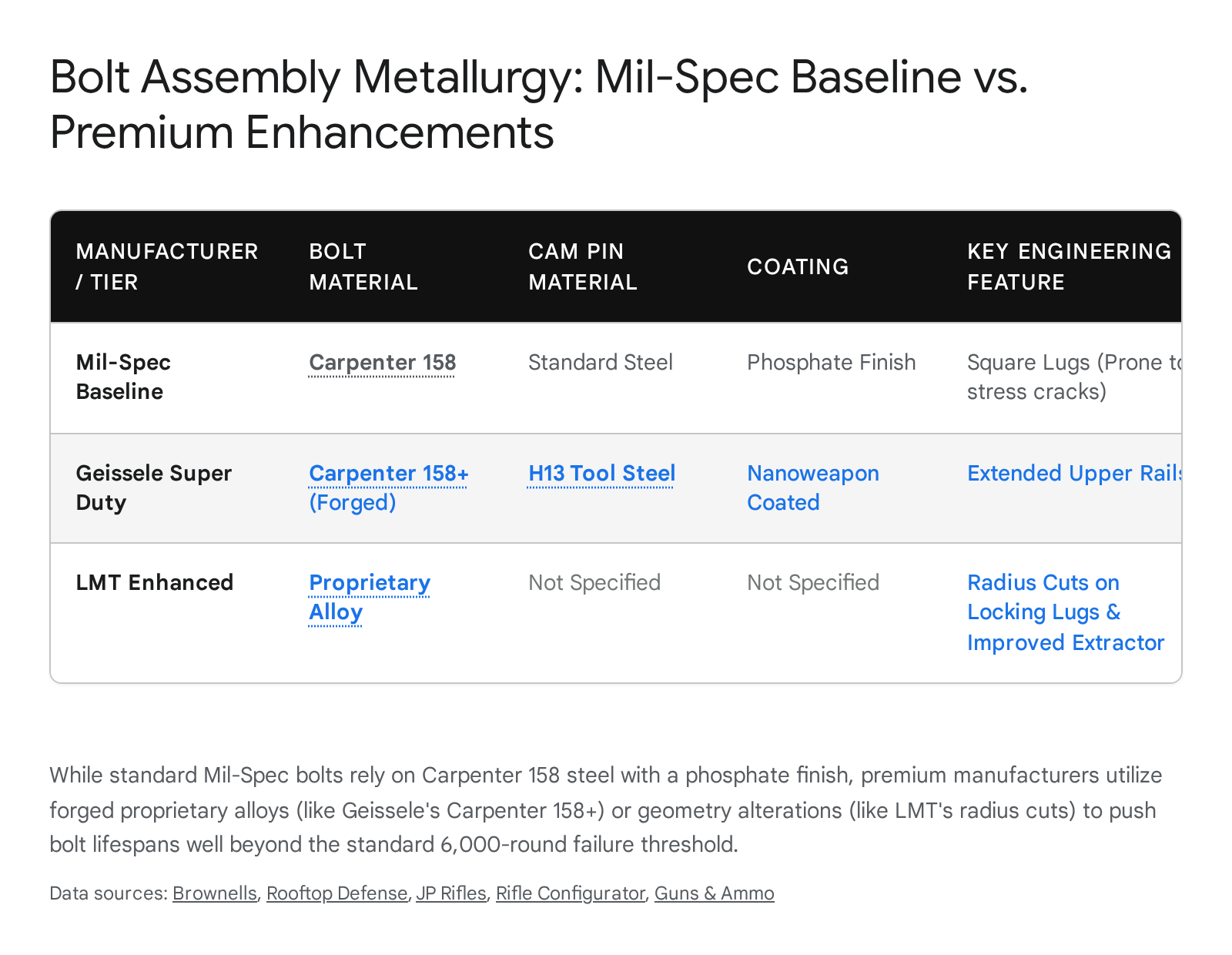
The bolt is the highest stress component within the AR-15 ecosystem. Standard military specification bolts utilize Carpenter 158 steel. This steel is case hardened to provide a wear resistant surface while maintaining a softer core that absorbs shock. While proven over decades of military service, a standard Carpenter 158 bolt has a typical life expectancy of roughly 6,000 rounds before stress cracks begin to form on the locking lugs43 adjacent to the extractor cut, or around the cam pin hole44.
In July 2026, discussion heavily favored advanced alloys. 9310 steel, an aerospace grade alloy, is approximately 7 to 8 percent stronger than Carpenter 158 when properly heat treated, making it a popular choice for high end builders. However, because 9310 requires absolute precision during the heat treatment process, quality control from the manufacturer is paramount. Premium brands are pushing boundaries further. Geissele utilizes Carpenter 158+ forged steel, while LMT utilizes closely guarded proprietary alloys combined with redesigned locking lugs featuring radius cuts to relieve mechanical stress27. Furthermore, coatings have evolved from standard phosphate and chrome lining to advanced Diamond Like Carbon and nanoweapon coatings, which drastically reduce internal friction and the need for heavy lubrication27.
Regardless of the steel chosen, consensus dictates that any bolt carrier group intended for serious duty use must undergo individual High Pressure Testing (firing an over pressure proof round) followed by Magnetic Particle Inspection to detect microscopic internal fractures before it is deemed safe and reliable45.
Gas System Dynamics and Dwell Time Optimization
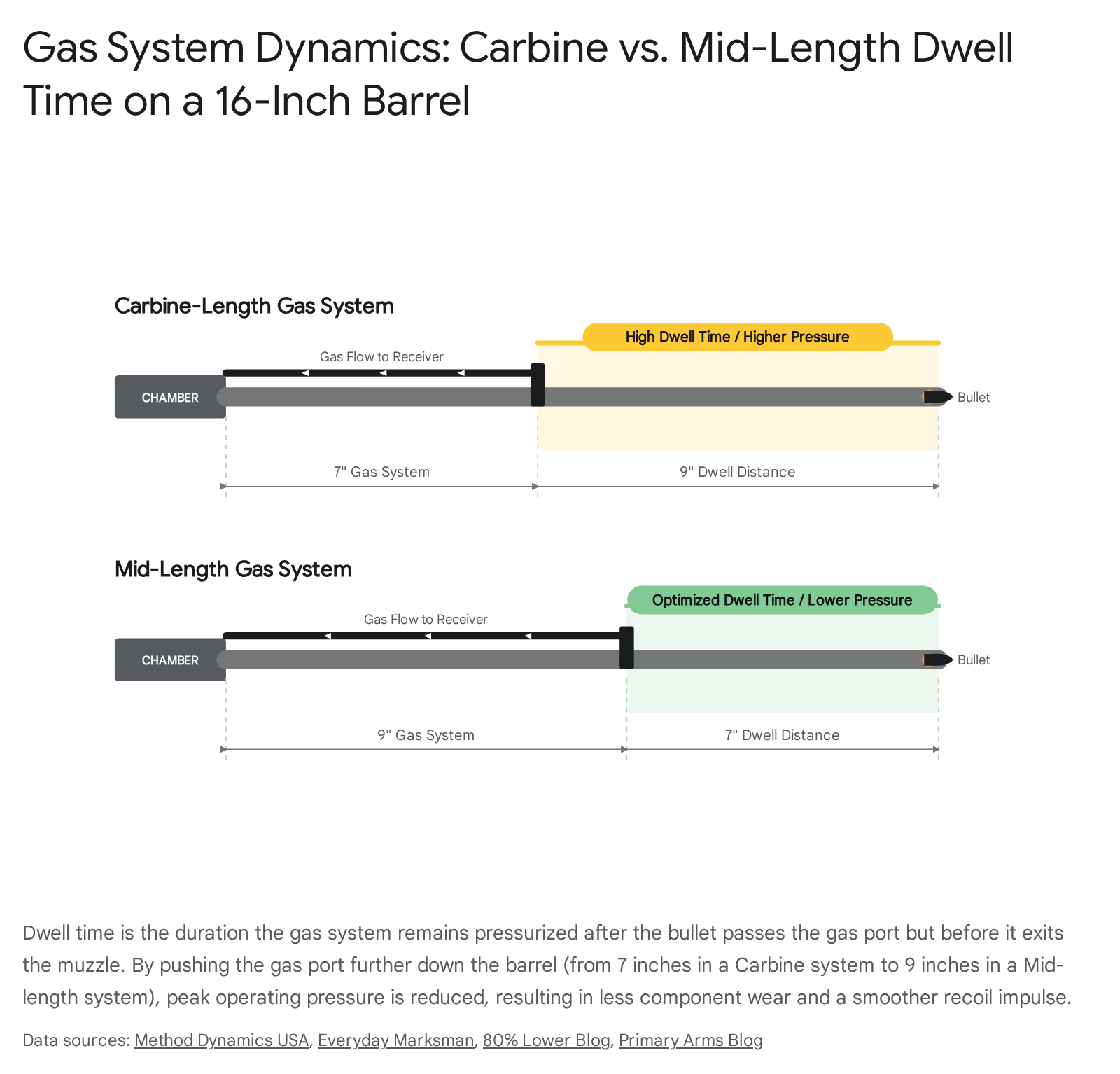
The AR-15 operates on a direct impingement system46. When a round fires, high pressure expanding gases follow the bullet down the bore. As the bullet passes a small hole drilled in the barrel (the gas port), a portion of those gases is redirected rearward through a gas tube into the bolt carrier group to cycle the action47. The distance from the chamber to this gas port defines the gas system length, which primarily comes in four standards: Pistol (~4 inches), Carbine (~7 inches), Mid length (~9 inches), and Rifle (~12 inches)20.
The most critical engineering concept discussed regarding these lengths is dwell time. Dwell time is the brief window of time between when the bullet passes the gas port (pressurizing the system) and when it exits the muzzle (uncorking the barrel and dropping the pressure)20.
If the dwell time is too long (such as a carbine-length gas system on a 16-inch barrel), the system becomes over-pressurized. This causes the bolt to actuate too violently, leading to accelerated parts wear, harsh recoil, and potential extraction failures49. Conversely, if the dwell time is too short, the rifle will short stroke and fail to chamber the next round5. The industry has largely recognized that for a standard 14.5 to 16 inch barrel, the mid-length gas system provides the optimal balance, reducing port pressure by 20 to 30 percent compared to a carbine system. This optimized dwell time results in a softer recoil impulse, slower bolt unlock timing, and extended service life for the internal components.
Suppressor Integration and Backpressure Mechanics
A macro trend identified across the discussion of all top ten platforms is the engineering adaptation required for suppressor use. As suppressor ownership increases, the inherent flaws of the direct impingement system under high backpressure conditions are being heavily exposed.
When a traditional baffle suppressor is attached to a rifle, it restricts the forward flow of expanding combustion gases, keeping them trapped inside the bore longer23. This massive increase in backpressure forces excess gas through the gas port and violently drives the bolt carrier group rearward23. The consequences are immediate. Gas blows back through the ejection port and charging handle into the shooter’s eyes, the bolt carrier moves at dangerous velocities, accelerating component wear, and carbon accumulates rapidly in the chamber23.
To mitigate these adverse effects, engineers and consumers are implementing three primary mechanical solutions. First, many rely on adjustable gas blocks to manually restrict gas flow into the receiver when a suppressor is attached, which is crucial when switching between supersonic and subsonic ammunition. Second, users tune the operating system by installing heavier tungsten buffers (such as H2 or H3 weights) which keep the bolt locked into battery slightly longer, resisting the initial spike in gas pressure22.
However, the most significant shift in 2026 is the rapid adoption of ultra-low backpressure, flow-through suppressors. Brands utilizing these designs (such as the SilencerCo Velos LBP or HUXWRX models) allow expanding gases to vent forward out of the muzzle rather than trapping them in traditional baffles. This effectively mimics unsuppressed system pressures, eliminating the violent overgassing, keeping the receiver cleaner, and negating the need for extensive rifle tuning8.
Upper Receiver Assembly and Galvanic Corrosion
For consumers building their own rifles, the physical assembly of the upper receiver remains a highly discussed technical hurdle. The interface between the aluminum upper receiver and the steel barrel extension requires meticulous care. As popularized by BCM, thermal fitting the barrel involves heating the slightly undersized aluminum receiver to expand it, sliding the steel barrel extension in, and allowing it to contract for a perfectly rigid fit12.
A critical error frequently discussed on forums is the improper lubrication of these parts. When dissimilar metals like aluminum and steel remain in direct contact under extreme conditions, they are susceptible to galvanic corrosion or galling where the metals essentially weld together17. To prevent this, engineers strictly advise applying a lithium complex molybdenum disulfide grease, commonly known as Aeroshell 33MS or Aeroshell 64, to the barrel extension and receiver threads. Products containing graphite or copper anti seize can theoretically accelerate this corrosion process and are strongly discouraged by master armorers51.
Similarly, the attachment of the gas block to the barrel dictates system reliability. While many budget rifles use basic set screws, high end duty rifles utilize taper pins. Utilizing a drilling fixture to drill through the gas block and the barrel, then driving a steel taper pin through the assembly with a taper pin reamer, ensures the gas block can never shift under thermal expansion or physical impact52.
The AR-15 market in July 2026 demonstrates a profound maturation of consumer knowledge. Buyers are no longer satisfied with basic military specification clones; they are actively prioritizing tangible engineering benefits, optimized gas mechanics, and advanced metallurgy. The immense discussion volume surrounding the PSA Sabre 15 indicates a democratization of premium features, forcing legacy manufacturers to justify their pricing models with measurable performance metrics. Moving forward, platforms that fail to adopt optimized mid length gas systems, utilize advanced bolt metallurgy, or accommodate the rising dominance of low backpressure suppressor technology will likely see a rapid decline in market relevance.
Appendix: Methodology and Data Sources
Methodology:
This report was generated by analyzing data snippets sourced from social media platforms (primarily Reddit communities such as r/ar15, r/longrange, and r/NFA) and specialized firearms publications (The Firearm Blog, Pew Pew Tactical, Guns & Ammo, Primary & Secondary). Discussion volume was approximated by evaluating the frequency and depth of conversational threads related to specific AR-15 models within the constrained timeframe of July 2026. Sentiment analysis was derived qualitatively by categorizing user statements into positive (praise for engineering, reliability, value), negative (complaints regarding quality control, pricing, proprietary limitations), and neutral (technical inquiries, benign configuration sharing).
Data Sources:
The underlying data supporting this analysis was drawn from an aggregated dataset of 197 distinct research snippets, comprising user generated forum posts, technical blog reviews, manufacturer specifications, and independent testing protocols. Included in this dataset are PEW Science sound signature data logs and US Army TOP 3-2-045 testing parameters for small arms fatigue limits. Specific claims, metallurgical properties, and dimensional data points within the report text are cited utilizing bracketed source identifiers.
Note: Vendor Sources listed are not an endorsement of any given vendor. It is our software reporting a product page given the direction to list products that are between the minimum and average sales price when last scanned.
This report delivers a technical and market analysis of the primary magazine product lines manufactured by Magpul Industries: the PMAG (Polymer Magazine), AMAG (Alloy Magazine), and TMAG (Translucent Magazine). Evaluated from the perspective of small arms engineering and industry analysis, this document breaks down the material sciences, mechanical reliability, durability, and customer sentiment surrounding each platform.
The analysis indicates that the PMAG series remains a baseline for military and civilian STANAG 4179 magazine reliability. Driven by continuous generation improvements from the Gen M2 to the Gen M3, the PMAG utilizes a proprietary glass-reinforced polymer and constant-curve internal geometry to mitigate feed-related malfunctions. Military testing, specifically the Aberdeen Proving Ground evaluations involving the high-pressure M855A1 Enhanced Performance Round, validated the PMAG Gen M3 as functionally sound compared to standard-issue aluminum USGI magazines, particularly in preventing feed ramp degradation.
The AMAG line represents a strategic expansion into the metallic magazine market, specifically targeting the SIG Sauer P320 and P365 modular platforms. Engineered from heat-treated stainless steel, the AMAG navigates the strict dimensional constraints of micro-compact pistol grips. While structural quality and pricing compete directly against Original Equipment Manufacturer (OEM) options, social media sentiment and field reports indicate specific tolerance stacking constraints. Notably, the 17-round AMAG variants have exhibited failures to engage the slide lock on empty when paired with aftermarket frames due to a slightly narrowed polymer follower.
The TMAG series introduces a translucent olive drab polymer to the 5.56x45mm STANAG market. It ports the internal geometry of the PMAG Gen M3 into a transparent body, allowing operators to visually confirm ammunition count and type. While the TMAG fulfills its functional requirements, market sentiment reflects minor concerns regarding the tactile feel and long-term durability of the translucent polymer compared to the traditional opaque PMAG material, with isolated reports of cracking in certain piston-driven rifle platforms. This report synthesizes technical specifications with real-world user feedback to provide a factual comparison of these three product lines, concluding with current pricing metrics and active market availability.
1. Market Context and Introduction to Magpul Architectures
Magpul Industries has influenced the small arms accessory market over the past two decades by pivoting the industry standard away from stamped aluminum and steel magazines toward advanced polymers1. The core engineering philosophy relies on mission-driven requirements, ensuring that material selection and geometric design are dictated strictly by functional necessity rather than legacy manufacturing habits4.
Historically, the standard USGI aluminum magazine for the M16 and M4 platforms suffered from specific mechanical vulnerabilities. The straight-body-to-curve transition caused binding, the aluminum feed lips were prone to permanent deformation upon impact, and standard followers were susceptible to tilt, leading to bolt-over-base malfunctions1. Magpul addressed these engineering constraints with the introduction of the PMAG in 2007, establishing a modern baseline for polymer magazine reliability5.
As firearm platforms have evolved, Magpul’s product catalog has diversified. The expansion into the AMAG (alloy) and TMAG (translucent polymer) lines demonstrates an engineering response to different physical and operational requirements7. Pistol platforms such as the SIG Sauer P365 require exceptionally thin magazine walls to maximize capacity within a micro-compact footprint, necessitating a return to steel9. Conversely, military and law enforcement operators frequently request visual ammunition tracking without sacrificing structural geometry, driving the development of the TMAG11.
2. The PMAG Series: Polymer Evolution and Military Standardization
The PMAG is a primary product of Magpul Industries. Currently in its third generation, referred to as the Gen M3, the PMAG is a 5.56x45mm NATO and .223 Remington STANAG-compatible magazine that serves as a standard ammunition feeding device for multiple branches of the United States Armed Forces, including the Marine Corps and the Air Force, as well as United States Special Operations Command13.
2.1 Material Science and Structural Engineering
The PMAG is constructed from an impact-resistant and crush-resistant polymer14. While the exact chemical composition remains proprietary, it belongs to a family of reinforced nylons designed to offer a distinct mechanical advantage over traditional stamped aluminum2. When aluminum feed lips sustain a drop, they tend to bend and permanently deform. This deformation alters the presentation angle of the cartridge, leading to catastrophic feeding failures15.
In contrast, the PMAG’s polymer exhibits highly tuned elastic deformation properties. Upon impact, the feed lips will either flex and return to their original specified dimensions or fracture entirely. This binary failure mode is preferred in professional settings, as a broken magazine is immediately discarded, whereas a subtly bent metal magazine might be retained in the supply chain and cause a malfunction1.
The material maintains structural integrity in extreme temperature variations. It prevents brittleness in sub-zero conditions and resists warping under prolonged exposure to intense heat and ultraviolet radiation14. A dust cover is included with standard models to protect the feed lips from debris and mitigate impact shock during transport. Magpul clarifies that the dust cover is not required to prevent feed lip creep, as the polymer formulation itself does not warp when stored fully loaded for long periods5.
2.2 Generational Refinements: Gen M2 vs. Gen M3
The transition from the Gen M2 MOE line to the Gen M3 line introduced critical geometric and material upgrades. The Gen M2 established a reputation for toughness and remains widely available at a lower price point, but it was optimized strictly for Colt-spec AR-15 and M4 magazine wells5.
The original STANAG 4179 draft agreement dictated that 5.56mm rifles should accept the AR-15 magazine pattern, but it did not standardize the internal dimensions of the weapon’s magazine well. Consequently, the Gen M2 PMAG experienced fitment issues in platforms like the HK416, the USMC M27 Infantry Automatic Rifle (IAR), the FN SCAR-16, and the British SA-80 due to an early onset of the magazine’s physical curvature5. Magpul consolidated necessary design improvements into the PMAG Gen M35.
Feature Comparison
PMAG Gen M2 MOE
PMAG Gen M3
Material Base
Standard impact-resistant polymer
Next-generation impact/crush-resistant polymer
Platform Compatibility
Colt-spec AR-15, M4
AR-15, HK416, M27 IAR, FN SCAR, SA-80
Over-Travel Stop
None
Integrated spine stop to prevent over-insertion
Floorplate Design
Standard width
Slimline flared base for tight pouch compatibility
Identification
None
Paint-pen dot matrix on bottom panel
Follower Design
Anti-tilt, self-lubricating
Advanced four-way anti-tilt, self-lubricating
The Gen M3 also features a redesigned bolt catch notch in the rear of the magazine to provide increased clearance, ensuring reliable bolt lock-back across varied weapon tolerances20. This STANAG-compliant modularity allows the PMAG to function across countless modern platforms, including bullpup rifles like the Springfield Armory Hellion22.
2.3 Caliber-Specific Geometries
The .300 AAC Blackout (300 BLK) cartridge presents a specific engineering challenge. Because 300 BLK projectiles are heavier and feature different ogive profiles than 5.56mm projectiles, they can interface poorly with the internal guide ribs of a standard 5.56mm magazine, creating friction and feeding stoppages23. The PMAG 30 AR 300 B Gen M3 features optimized internal ribbing to accommodate the 300 BLK cartridge properly. To mitigate the danger of cross-loading a 300 BLK cartridge into a 5.56mm chamber, the 300 BLK PMAG is engineered with distinct external ribbing and a smoother upper texture, providing immediate tactile and visual differentiation23.
Magpul also produces PMAG variants for the 7.62x51mm NATO (.308 Winchester) utilized in SR25 and M110 pattern rifles2. Furthermore, the AK and AKM platforms are supported by dedicated 7.62x39mm and 5.45x39mm PMAGs. The AK variants require different lockup mechanics than AR-15s, leading Magpul to integrate steel locking lugs into the polymer body of their AK PMAGs to ensure a long-lasting interface with the steel magazine catch2. It is worth noting that while they serve as a common aftermarket option, tight magazine well tolerances in some domestic AK platforms like the PSA GF5 can cause the standard PMAG to fail to lock into the receiver27.
2.4 Military Evaluation: The M855A1 Aberdeen Proving Ground Trials
The performance of the PMAG Gen M3 was quantified during the U.S. Army Aberdeen Test Center’s 2015 evaluation titled “Final Report for the M855A1 Conformance Testing on Commercial Magazines”6.
The U.S. Army’s adoption of the M855A1 Enhanced Performance Round introduced unforeseen mechanical strain on the M4 carbine. The M855A1 operates at a higher chamber pressure (approximately 62,000 PSI) and features an exposed, hardened steel penetrator tip17. When feeding from standard aluminum USGI magazines, the angle of presentation caused the sharp steel penetrator to strike the aluminum feed ramps of the M4 receiver before entering the chamber, resulting in gouging and erosion of the feed ramps17.
During the Aberdeen trials, ten commercial magazines and two government magazines were evaluated. Magpul, designated as “Vendor Foxtrot” in the unclassified summaries, submitted the PMAG Gen M328. The testing data indicated that the PMAG achieved a zero-malfunction rate. The PMAG Gen M3 features a specifically engineered feed lip geometry that presents the nose of the M855A1 cartridge at a higher angle, allowing the steel penetrator to clear the aluminum feed ramps and neutralizing the weapon degradation issue28.
Despite these results, the U.S. Army proceeded with fielding its own Enhanced Performance Magazine (EPM), which later demonstrated high failure rates in United States Marine Corps testing13. Conversely, the Air Force, Marine Corps, and Special Operations Command relied directly on the Aberdeen data to authorize and standardize the PMAG Gen M3 across their formations13.
2.5 Social Media Sentiment and Consumer Feedback Analysis
Sentiment analysis derived from major retailers and social media platforms indicates that the PMAG Gen M3 is considered a reliable standard for AR-15 pattern rifles. Across vendor sites, the PMAG consistently maintains ratings between 4.8 and 5.0 out of 5 stars20.
Data aggregated from Brownells customer reviews highlights specific performance metrics for the PMAG Gen M3:
Review Category
Positive Sentiment Rating
Key Themes Mentioned in Customer Feedback
Product Quality
85%
Reliable construction; smooth feeding dynamics.
Durability
75%
Resistance to damage from drops, crushing, and environmental factors.
Pricing and Value
70%
High perceived value; competitive pricing justifies bulk purchases.
Shipping/Service
68%
Fast fulfillment from vendors enhances overall satisfaction.
Fit and Compatibility
20%
Generally praised, though isolated reports note tightness in non-standard billet lowers.
Data sourced from aggregated user reviews16.
Negative sentiment is statistically low. Minor critiques generally revolve around isolated compatibility friction with non-standard commercial lower receivers that deviate from mil-spec tolerances16. For the 300 BLK variants, consumers report a 78% positive sentiment specifically regarding feeding reliability, noting that the dedicated magazine resolves the stoppages commonly experienced when attempting to force heavy subsonic 300 BLK ammunition through standard 5.56mm magazines23.
3. The AMAG Series: Alloy Integration and Micro-Compact Constraints
The AMAG (Alloy Magazine) marks the company’s entry into the metallic pistol magazine market. The AMAG line currently focuses on supporting the SIG Sauer P320 (M17/M18) and the micro-compact SIG Sauer P365 platforms8.
3.1 Mechanical Necessity of Stainless Steel in SIG Platforms
The dimensional realities of modern concealed carry handguns dictate material selection. To achieve capacities of 10, 12, 15, or 17 rounds of 9x19mm ammunition in the confined space of a micro-compact frame, the walls of the magazine must be exceptionally thin37. As Magpul expanded beyond their polymer roots, they recognized that the P365 requires a steel body to maximize internal volume for the tapered 9mm stack; polymer cannot be molded thin enough to fit inside the P365 magazine well while retaining sufficient structural integrity3.
Consequently, Magpul engineered the AMAG series using a heat-treated, corrosion-resistant stainless steel alloy10. The stainless steel provides the necessary tensile strength to maximize internal volume while resisting the friction and wear associated with rapid insertion and extraction8.
3.2 Sub-Component Engineering and Capacity Metrics
While the body is metallic, Magpul integrated their polymer expertise into the subcomponents. The AMAG features a high-visibility, controlled-tilt polymer follower and a flared polymer floorplate10. The floorplate is designed for tool-less removal to facilitate routine cleaning. The spine of the magazine includes numbered witness holes starting at five rounds, increasing in one-round intervals to allow for immediate visual capacity checks35.
The AMAG line supports varied capacities depending on the target frame. For the P320 platform, 15-round, 17-round, and 21-round variants are offered8. For the P365 platform, capacities range from 10-round compliant models to 12-round, 15-round, and 17-round configurations37. Included grip extensions on the P365 models provide compatibility with Macro, X/XL, and standard Micro frames, allowing users to tailor the grip length to their specific configuration37.
3.3 Tolerance Stacking and Aftermarket Incompatibility Analysis
From a static engineering perspective, the AMAG is built to rigid specifications. However, dynamic field testing has revealed specific tolerance stacking issues, particularly regarding the 17-round variant designed for the SIG P365.
A prominent trend in social media sentiment highlights a functional deviation when the AMAG is paired with aftermarket Fire Control Unit (FCU) housings44. Users operating the Flux Defense Raider or Flux 365 chassis systems have reported that the Magpul AMAG 17-round magazine fails to engage the slide lock lever on the last round45. Technical analysis shared within these communities reveals that the AMAG magazine body is dimensionally narrower than the SIG Sauer OEM magazine by a fraction of a millimeter. Because the body is narrower, the internal polymer follower is also correspondingly narrower45. When installed in standard OEM SIG grip modules, the tolerance is tight enough that the follower still catches the internal slide stop tab. However, aftermarket chassis systems like the Flux Defense push the magazine presentation slightly off center by approximately 1 millimeter. This shift causes the narrowed Magpul follower to bypass the slide stop tab inside the FCU, resulting in a failure to lock back on an empty chamber45.
3.4 Social Media Sentiment and Loading Mechanics
Despite the documented tolerance issues with aftermarket chassis systems, general sentiment for the AMAG among standard SIG Sauer users is positive, largely driven by pricing strategy. Magpul introduced the AMAG as a market disruptor against premium OEM pricing at an MSRP of $34.95 for the 17-round variant3.
For the average consumer utilizing a stock SIG P320 or P365, the AMAG provides a reliable alternative to factory magazines. Reviewers praise the corrosion resistance of the stainless steel, contrasting it with complaints of OEM SIG magazines developing rust from daily concealed carry exposure, noting that the AMAG provides superior rust resistance46.
Community feedback indicates that loading the AMAG to its maximum capacity, particularly the 17th round in the P365 variant, requires notable physical force. Users report needing mechanical speed loaders (such as the Maglula UpLULA) to seat the final round, suggesting that the internal spring tension or follower compression height is engineered to the maximum tolerance limit of the steel tube47.
4. The TMAG Series: Translucent Polymer and Visual Utility
The TMAG (Translucent Magazine) is Magpul’s response to a military and civilian request for a reliable, transparent magazine that allows the operator to instantly verify both the remaining round count and the specific type of ammunition loaded7. Following the release of the 30-round variant, Magpul officially launched a compact TMAG 20 variant at SHOT Show 2026, catering to shooters who need a lower profile for bench or prone shooting49.
4.1 The Engineering Challenges of Translucent Polymers
Designing a transparent magazine presents complex chemical and structural challenges. Opaque magazines, such as the standard PMAG, utilize carbon black and long glass fibers mixed into the nylon substrate15. These additives provide high impact resistance, crush strength, and protection against ultraviolet (UV) degradation. Translucent polymers, by their chemical nature, cannot contain these opaque strengthening agents.
Magpul engineered the TMAG using a specialized translucent polymer blended with an olive drab (OD Green / Smoke) hue11. This tinting mitigates the effects of UV degradation that clear plastics typically suffer from, and it maintains a tactical, low-visibility aesthetic suitable for field environments11.
4.2 Internal Geometry and Mechanical Integration
The TMAG directly inherits the internal geometry of the PMAG Gen M311. It utilizes a constant-curve internal channel, a four-way anti-tilt follower, and a USGI-spec stainless steel spring. To maximize the utility of the transparent body, Magpul implemented a painted spring coil. This painted section acts as a highly visible indicator line against the molded capacity markings on the magazine body11.
Externally, the TMAG differs slightly from the PMAG. While it retains the low-profile floorplate and the paint-pen dot matrix for baseplate marking, the sides of the TMAG are left smooth to maximize viewing clarity11. To compensate for the loss of side texturing, Magpul ribbed the front and rear straps of the magazine to ensure a positive grip during reloads11.
4.3 Social Media Sentiment, Tactile Perception, and Reliability Concerns
Customer sentiment regarding the TMAG is generally positive, but with notable caveats regarding tactile perception and durability. The primary praise directed at the TMAG is its functional visibility. Users value the ability to see the exact round count and cartridge type11.
A recurring theme in user reviews is the physical feel of the magazine. Due to the chemical nature of the translucent polymer, some users report that the TMAG feels slicker, lighter, and subjectively less robust than the standard PMAG11. Data aggregated from Brownells customer reviews highlights these mixed perceptions, with 55% positive sentiment regarding build quality, driven by complaints that the translucent material feels inferior to the opaque line11.
Furthermore, isolated user reports have documented stress cracking on TMAG bodies when operated in certain piston-driven platforms, such as the SCAR 1651. Engineering physics dictates that translucent feed lips will be marginally more susceptible to creep or impact cracking in extreme temperatures compared to a glass-filled black PMAG51. For duty use, many operators continue to default to the standard opaque PMAG.
5. Comparative Analysis: Quality, Reliability, and Durability
To properly evaluate these three distinct platforms, they must be compared across the core metrics of quality, reliability, and durability.
5.1 Quality and Manufacturing Tolerances
All three lines exhibit strict manufacturing standards. The PMAG represents a high standard of polymer injection molding, with consistent texturing and a mature feature set (dust covers, dot matrix, over-travel stops)15. The AMAG demonstrates precision metal stamping and laser welding, yielding a seamless stainless steel body39. The TMAG showcases advanced polymer flow mechanics, achieving clarity without introducing structural bubbles or severe molding artifacts11.
5.2 Mechanical Reliability Under Stress
Reliability is defined as the ability to successfully feed a cartridge into the chamber under dynamic firing conditions. The PMAG’s performance in the Aberdeen M855A1 tests proved it highly reliable across multiple weapon platforms, actively preventing weapon wear28. The TMAG inherits this exact internal geometry and matches the PMAG’s baseline feeding reliability under standard conditions, though isolated reports indicate a slightly higher failure rate than the PMAG11. The AMAG is reliable in stock SIG configurations but is intolerant to aftermarket dimensional shifts, specifically the slide lock bypass issue observed in Flux Defense chassis systems45.
5.3 Material Durability and Environmental Resistance
Durability is the capacity to withstand physical abuse, environmental degradation, and long-term mechanical stress.
PMAG: Demonstrates maximum durability. The glass-filled polymer absorbs impacts, resists harsh solvents, and resists UV degradation15.
AMAG: Demonstrates high durability. Stainless steel provides crush resistance and resists corrosion better than standard OEM magazines8.
TMAG: Demonstrates moderate durability. While strong enough for standard use, translucent polymers represent a physical compromise, making them inherently less resistant to severe impacts and chemical exposure than their opaque counterparts11.
6. Pricing and Availability
This section details the current pricing and market availability of the PMAG, AMAG, and TMAG lines.
Magpul Industries heavily influences the small arms magazine market through calculated material engineering. The PMAG Gen M3 remains a structural standard, effectively neutralizing weapon degradation issues caused by modern high-pressure military ammunition while maintaining a proven reliability record28. The AMAG proves that Magpul can pivot to precision steel manufacturing to satisfy the physical constraints of the modern micro-compact pistol market, delivering financial value, albeit with slight tolerance constraints in heavily modified aftermarket chassis systems8. Finally, the TMAG bridges the gap between tactical utility and polymer science, offering a transparent visual indicator without sacrificing the internal geometric foundations established by the PMAG line, though it faces consumer skepticism regarding long-term duty durability11.
Master Summary Table
Metric
PMAG Gen M3
AMAG (SG9 Series)
TMAG Gen M3
Primary Material
Glass-reinforced proprietary polymer
Heat-treated stainless steel alloy
Translucent OD Green polymer
Primary Platform Target
AR15, M4, HK416, SCAR 16
SIG Sauer P320, P365
AR15, M4, STANAG 4179
Durability Assessment
High (Impact, chemical, and UV resistant)
High (Crush resistant and highly corrosion-resistant)
Moderate (Slightly less impact resistance than standard PMAG)
Reliability Assessment
High (Zero-malfunction rate in Army testing)
High in OEM frames (Slide-lock issue in aftermarket chassis)
High (Inherits PMAG internal geometry, some user skepticism)
Customer Sentiment
Highly positive; considered the industry standard
Positive on price/value; minor concerns on spring loading stiffness
Positive on visual utility; minor concerns on tactile perception
Key Engineering Feature
Altered feed angle to protect aluminum weapon feed ramps
Maximized internal volume via thin stainless steel walls
Visual ammo counting via painted coil spring and clear body
Average Street Price
~$13.50
~$34.00
~$22.75
Note: Vendor Sources listed are not an endorsement of any given vendor. It is our software reporting a product page given the direction to list products that are between the minimum and average sales price when last scanned.
Over the past decade, the global civilian and tactical firearms markets have witnessed an unprecedented influx of imported shotguns manufactured in the Republic of Turkey. While this massive wave of budget-friendly firearms has successfully captured significant market share in the United States and the Commonwealth, it has simultaneously generated a polarized reputation regarding quality control, metallurgical integrity, and aftermarket support. However, treating the Turkish firearms industry as a monolithic entity is a critical analytical error. Within this extensive export ecosystem, distinct tiers of manufacturers exist. Sülün Arms (commonly anglicized and referred to hereafter as Sulun Arms), operating out of the historic Konya manufacturing cluster, represents the upper echelon of this industrial base1.
For the American buyer and the international small arms industry analyst, Sulun Arms serves as a premier case study in the rapid maturation of Turkish manufacturing capabilities. Founded in 1965 as a localized artisan workshop servicing domestic clients, the company has evolved into a highly capable original equipment manufacturer (OEM) and an independent brand operating on a global scale3. Rather than competing solely on the absolute lowest price point—a race-to-the-bottom strategy that has doomed many fly-by-night Turkish brands—Sulun Arms has distinguished itself through aggressive research and development, high-tolerance computer numerical control (CNC) machining, and a unique strategy of legislative arbitrage4. By engineering complex, niche platforms that circumvent restrictive gun laws in heavily regulated markets such as Canada and Australia, and by successfully reverse-engineering elite combat platforms whose patents have expired, Sulun Arms has built a formidable and diverse global footprint6.
This comprehensive report details the deep historical context, operational capabilities, signature product lines, metallurgical practices, and strategic market positioning of Sulun Arms. By analyzing these vectors, industry stakeholders and American consumers can develop a nuanced understanding of a brand poised to systematically disrupt the tactical, sporting, and collector shotgun markets well into the future.
2. The Historical and Macroeconomic Foundations of Turkish Arms Manufacturing
To fully understand the trajectory of Sulun Arms, one must first analyze the geographical and industrial origins of the Turkish small arms sector. The modern capabilities of companies like Sulun Arms are built upon centuries of state-driven military infrastructure and recent macroeconomic export strategies.
2.1. From Ottoman Arsenals to the Modern Republic
The tradition of firearms manufacturing in Anatolia runs deep, originating with the gunpowder shops and weapons depots of the Ottoman Empire9. However, the industrialization of the sector began in earnest during the late nineteenth and early twentieth centuries. During the First World War, the Ottoman army was heavily reliant on external suppliers, primarily utilizing Mauser rifles supplied by the German Empire10. The devastating logistical challenges of relying on foreign armaments during the conflict, followed by the Turkish War of Independence, deeply instilled a philosophy of self-reliance within the newly formed Turkish Republic10.
In the 1920s, the Republic established the Light Arms and Gun Repair Workshops in Ankara, which subsequently evolved into the comprehensive Gun and Artillery Factory in Kırıkkale by the 1930s10. This state-driven mandate to internalize defense manufacturing laid the groundwork for regional industrial clusters to develop specialized metallurgical and machining skill sets, creating a multi-generational workforce familiar with the exacting tolerances required for firearms production9.
2.2. The Konya and Üzümlü Ecosystem
Sulun Arms is headquartered in the Üzümlü neighborhood of the Beyşehir district, located within the Konya province of central Turkey1. The Konya province is currently the undisputed epicenter of Turkish commercial small arms manufacturing2. The industrial ecosystem in this region is highly collaborative and uniquely structured. Unlike the vertically integrated, massive single-factory models frequently seen in traditional American manufacturing, the Üzümlü district operates as an interconnected web of specialized machine shops, surface treatment facilities, metallurgy labs, and assembly houses9.
The transformation of regional manufacturers like Sulun Arms from domestic suppliers to global exporters was significantly accelerated by targeted state-backed developmental initiatives. The Turkish government, recognizing the massive export potential of the region, utilized the KOP (Konya Plain Project) Regional Development Administration to aggressively modernize the Huğlu and Üzümlü firearms clusters15. Through extensive funding and training programs deployed between 2017 and 2019, the KOP Administration, in conjunction with STM Defense Technologies Engineering Inc., provided advanced training to regional manufacturers.
This educational initiative included comprehensive modules in Enterprise Resource Planning (ERP), Production and Process Optimization, Defense Management, and Life Cycle Management. This deliberate infusion of modern supply chain methodology and aerospace-grade management practices allowed companies like Sulun Arms to transition from artisanal, batch-based assembly to high-volume, precision CNC manufacturing capable of meeting rigorous international ISO standards4.
2.3. The Macroeconomic Defense Export Boom
Sulun Arms’ expanding global footprint is a direct micro-reflection of Turkey’s macro-level defense export strategy. The Turkish defense and aerospace sector has experienced explosive growth over the last two decades. Data provided by the Stockholm International Peace Research Institute (SIPRI) utilizing Trend Indicator Values (TIVs) revealed that Turkish arms exports surged by 31.14% in 2025 alone, representing an astonishing twenty-five-fold increase since the year 200016.
By 2025, Turkey’s defense and aerospace exports reached a historic, unprecedented high of $10.56 billion, firmly establishing the nation as a tier-one global arms supplier17. This momentum has continued unabated, with the first four months of 2026 generating over $2.8 billion in export revenue, a 28% year-over-year increase18. Furthermore, shotguns represent a vital component of this export economy; in 2023, firearms and similar sporting devices accounted for nearly 15% of Turkey’s arms and ammunition export category, generating hundreds of millions of dollars in revenue20. This massive influx of sovereign and commercial capital into the Turkish industrial base trickles down directly to commercial small arms manufacturers. Advancements in metallurgy, machining precision, and quality control driven by lucrative military contracts directly benefit civilian commercial production lines located in the same geographic clusters.
3. The Corporate Evolution of Sülün Arms
Against this backdrop of rapid national industrialization, Sülün Arms emerged. The company was founded in 1965 by Adem Çetindede in the aforementioned Üzümlü district of Konya1. For the first several decades of its existence, the company operated as a traditional, domestically focused workshop1. The founder leveraged his deep knowledge of traditional shotgun assembly, slowly integrating newer technologies to service the local hunting and sporting markets within Turkey3.
The critical inflection point for Sulun Arms occurred in tandem with the modernization efforts of the late 2010s. By 2018, the company had fully pivoted to a robust, global distribution model3. Having successfully integrated advanced CNC machining and modern corporate resource planning, Sulun Arms began exporting high-quality firearm products across the world, establishing distribution networks in North America, Europe, and the Oceania region3. Today, they hold comprehensive firearms industry and manufacturing licenses, functioning as both an independent brand and a high-capacity OEM for private-label distributors globally23.
4. Manufacturing Philosophy: Overcoming the “Turkish Shotgun” Stigma
For the American buyer and the professional analyst, the most pressing concern regarding Sulun Arms pertains to long-term mechanical reliability. The United States market has been saturated with aggressively priced, tactically styled Turkish shotguns over the past decade5.
4.1. The Polarization of the Import Market
Analysts widely acknowledge that many of the bottom-tier imports originating from Turkey suffer from severe quality control issues25. These firearms are frequently manufactured using low-grade cast components, poor thermal processing, and proprietary reverse-engineered designs that completely lack aftermarket support. Many of these entities operate as fly-by-night operations, utilizing an importer shell-name to dump a batch of subpar shotguns into the American market before dissolving and reappearing under a new brand name to avoid warranty liabilities1.
Sulun Arms operates on a distinctly different tier of the manufacturing hierarchy. Rather than hiding behind opaque importer shell-names, Sulun actively promotes its OEM status and corporate brand identity23. In the American and Canadian markets, industry analysts segregate Turkish shotguns into two categories: generic white-label imports, and established, vertically integrated OEM brands5. Sulun has successfully garnered a reputation for producing firearms that punch significantly above their retail price point, offering a level of fit, finish, and mechanical reliability that rivals entry-level Italian or American counterparts27.
4.2. Metallurgical Integrity: 4140 Steel and 7075-T6 Aluminum
The stark difference in reliability and safety between a budget Turkish import and a premium Turkish OEM like Sulun Arms lies fundamentally in metallurgy and post-machining thermal processing30. Sulun constructs the core pressure-bearing and structural components of its premium tactical lines utilizing aerospace and ordnance-grade materials, specifically 4140 Chrome-Moly steel for the barrels and 7075-T6 aluminum alloy for the receivers30.
Material Specification
Application in Sulun Firearms
Metallurgical Properties & Benefits
AISI 4140 Chrome-Moly Steel
Barrels, high-stress kinetic components.
A low-alloy steel containing chromium, molybdenum, and manganese. Renowned for high fatigue strength, torsional strength, and extreme impact resistance. Requires precise thermal processing.30
7075-T6 Aluminum Alloy
Receivers, structural chassis.
An aerospace-grade alloy heavily alloyed with zinc. The “T6” designation indicates it has been solution heat-treated and artificially aged. Offers tensile strength comparable to many steels at a fraction of the mass.30
4.3. The Critical Role of Thermal Processing and CNC Machining
Procuring raw 4140 steel is only the first step in manufacturing a reliable firearm; the critical differentiator is the heat treatment process35. To achieve the necessary ballistic properties, the steel must undergo precise thermal processing—specifically, high-temperature austenitizing followed by rapid quenching (in oil or water), and subsequent tempering32.
Tempering is the most crucial step for longevity. It involves reheating the quenched metal to a lower temperature to reduce the extreme brittleness induced by the quenching process, thereby optimizing the balance between hardness and toughness32. For steel alloys, this generally requires a high temper (550–650°C), purposefully avoiding the 250–400°C “embrittlement zone” where toughness is severely compromised32.
The catastrophic failure of low-end Turkish shotguns almost universally stems from skipped, rushed, or poorly controlled tempering cycles, resulting in brittle extractors, bolt carriers, and locking lugs that fracture under the violent kinetic stress of a 12-gauge magnum load25. Sulun’s utilization of advanced CNC facilities and highly regulated thermal processing chambers ensures that their 4140 steel components are properly stress-relieved and tempered to withstand high round counts without structural deformation4. This dedication to proper metallurgy is why platforms like the Sulun TAC-12 can successfully endure thousands of rounds of high-brass buckshot and slugs in consumer endurance tests without catastrophic failure38.
5. Signature Platforms and Engineering Innovations
Sulun Arms maintains a highly diverse portfolio, including traditional over/under, side-by-side, pump-action, and single-barrel firearms13. For example, the ST-605 represents an affordable, entry-level break-action single-barrel shotgun available in multiple calibers23, while the SC-214 offers a rugged, compact steel-receiver side-by-side28. However, the company’s global reputation for engineering prowess and market disruption is defined by four specific, highly specialized platforms.
5.1. The TAC-12: Democratizing the A.R.G.O. Combat System
The most prominent and commercially successful firearm in Sulun’s export catalog is the TAC-12, a near-exact 1:1 mechanical clone of the legendary Italian Benelli M4 tactical shotgun28.
The Benelli M4 (officially designated the M1014 by the U.S. Marine Corps) is widely considered the absolute apex of combat shotguns, primarily due to its patented Auto-Regulating Gas-Operated (A.R.G.O.) system43. Unlike traditional long-stroke gas pistons or recoil-based inertia-driven systems, the ARGO system utilizes two short-stroke, self-cleaning pistons positioned immediately forward of the firing chamber43. This proximity utilizes hotter, cleaner propellant gases to violently strike the bolt carrier, ensuring ultra-reliable cycling across a massive spectrum of ammunition43. Because the system is self-regulating, it requires zero manual adjustment when the operator switches from low-recoil tactical buckshot to heavy 3-inch magnum slugs48.
Following the expiration of Benelli’s restrictive ARGO patent, several Turkish manufacturers attempted to reverse-engineer the design with varying degrees of success49. Sulun Arms emerged as the undisputed leader in this space, successfully replicating the dual-piston architecture in the TAC-1229.
The analytical significance of the TAC-12 lies in its aggressive market disruption. The authentic Benelli M4 carries an MSRP frequently exceeding $2,200 in the American market, pricing it out of reach for many civilian consumers and underfunded law enforcement agencies44. Conversely, Sulun’s TAC-12 retails between $500 and $700, depending on the distributor and specific configuration23. By offering a combat-proven, dual-piston operating system forged from 4140 steel and 7075 aluminum at one-quarter of the OEM price, Sulun has heavily disrupted the tactical shotgun sector29.
Furthermore, the TAC-12 boasts virtually 100% parts interchangeability with the OEM Benelli M438. This is a massive selling point for enthusiasts. Consumers routinely purchase the budget-friendly TAC-12 and subsequently install premium aftermarket Benelli components—such as Mesa Tactical stocks, Strike Industries M-LOK handguards, and Rx Arms oversized charging handles and bolt releases—directly onto the Sulun chassis without requiring specialized gunsmithing42. While analysts note that the TAC-12 may lack the meticulous hand-deburring and immaculate surface finish of the Italian original, its mechanical reliability is exceptionally high once the gas system passes a brief initial break-in period, representing unmatched value in the tactical space38.
5.2. The SPA-12 (SPASS-12): Resurrecting a Dual-Mode Legend
The SPA-12 is a visually striking, highly accurate reproduction of the iconic Italian Franchi SPAS-1254. The original SPAS-12 achieved legendary, near-mythical status through its extensive use in 1980s and 1990s cinema, distinguished by its massive vented heat shield and brutalist folding stock featuring a prominent arm-hook. Because original SPAS-12 shotguns are no longer manufactured, secondary market prices for authentic models frequently exceed several thousand dollars, creating a massive void in the collector’s market.
However, the defining mechanical feature of the SPAS-12—and subsequently the Sulun SPA-12—is its complex dual-mode capability54. The user can manually switch the firearm’s operating system between a traditional pump-action and a gas-operated semi-automatic mode54. This was originally designed for specialized military and law enforcement applications, allowing the semi-automatic firing of full-power buckshot, while instantly allowing a switch to pump-action to reliably cycle low-pressure, less-lethal munitions (such as tear gas canisters or beanbag rounds) which fundamentally lack the kinetic energy to cycle a semi-automatic bolt54.
Engineering a reliable dual-mode shotgun is notoriously difficult, requiring incredibly precise machining tolerances to ensure the gas system can be seamlessly engaged and disengaged by the user. By successfully launching the SPA-12, Sulun Arms has definitively proven that its R&D and manufacturing capabilities extend far beyond the simple inertia-driven clones that dominate Turkish exports54. With an expected U.S. retail price hovering around $1,000, the SPA-12 is perfectly positioned to dominate a highly lucrative, nostalgia-driven collector’s market while offering modern reliability54.
5.3. The Auslof (ST-601): Century-Old Mechanics and Legislative Arbitrage
While the TAC-12 and SPA-12 represent modern reverse-engineering of combat platforms, the Sulun Auslof (model ST-601) represents a brilliant exercise in mechanical necromancy and targeted legislative arbitrage.
The Auslof is a modern recreation of the “Alofs Reloading Magazine,” a mechanism patented in the United States in 1924 by Dutch immigrant Herman Gerrit Alofs7. Originally designed as an aftermarket bolt-on accessory to convert cheap, single-shot break-action shotguns into repeating firearms, the system was a commercial failure in the 1920s due to the rising affordability and superiority of traditional pump-action shotguns7.
The mechanism is a marvel of early twentieth-century engineering. The shotgun features a standard break-action breech, but mounted externally to the left side of the receiver is a tubular magazine and a spring-loaded, pivoting feeder tube7. The mechanical architecture relies on a streamlined three-phase sequence to cycle ammunition: First, the user manually breaks open the action to fire and eject the spent hull. Second, the physical kinetic energy of the ejected hull strikes a specialized release lever, which immediately triggers the spring-loaded feeder tube to pivot and align a fresh shell directly with the open breech. Finally, the user manually closes the action, which forces the fresh shell from the feeder into the chamber while simultaneously resetting the feeder tube to automatically receive the next round from the primary magazine7.
Sulun Arms did not resurrect this highly complex, visually archaic mechanism for tactical superiority or practical hunting advantages. They revived it strictly to bypass draconian gun control legislation in the Commonwealth. In nations like Australia and Canada, conventional semi-automatic and pump-action shotguns face severe ownership restrictions, stringent capacity limits, and outright bans. Because the Auslof’s firing cycle physically requires the user to manually break open the action for every single shot, international regulatory bodies legally classify it as a “single-shot break-action” firearm, completely immunizing it against repeating-shotgun bans. The ability to hold up to 9+1 rounds (in the extended 20-inch barrel configuration) makes the Auslof the highest-capacity, fastest-firing “single-shot” legally available in those highly restricted jurisdictions48. The Auslof brilliantly demonstrates Sulun’s corporate agility in identifying a geopolitical regulatory bottleneck and engineering a highly specific, profitable mechanical solution.
5.4. Revolving Cylinder Platforms: The SR-45 and SR-410
Continuing their strategy of legislative arbitrage, Sulun Arms developed the SR-45 and SR-410 platforms61. These are compact, revolving-cylinder firearms functioning identically to a traditional double-action revolver, but scaled up to long-gun proportions.
The SR-45 is a rifled variant chambered to accept .45 Long Colt, .45 ACP (via moon clips), and .410 bore shotshells62. The SR-410 is a dedicated smoothbore .410 gauge shotgun63. Both feature highly compact profiles, weighing between 4.5 and 4.6 pounds with barrel lengths hovering around 9.8 inches63.
In standard legislative environments, a long gun with a sub-10-inch barrel would be heavily restricted (e.g., classified as a Short-Barreled Shotgun under the National Firearms Act in the United States). However, these platforms were engineered specifically for the Canadian civilian market62. Under Canadian firearms regulations, the overall length restrictions that force firearms into the “Restricted” or “Prohibited” categories apply specifically to semi-automatic centerfire firearms or those whose length is reduced via folding or telescoping stocks57. Because the SR-series utilizes a manual double-action revolver mechanism and features a fixed stock, they bypass these specific prohibitions, remaining legally classified as “Non-Restricted” firearms in Canada despite their incredibly short, packable dimensions57.
5.5. The TACSORAS Lever-Release System
Similarly, Sulun recognized the immense demand for tactical shotguns in Australia, a nation where standard semi-automatic shotguns are strictly relegated to highly restricted Category C and D licenses, effectively banning them for average civilian ownership7.
To service this market, Sulun modified the architecture of their TAC-12 platform to create the TACSORAS66. By purposefully altering the gas system, the bolt of the shotgun locks to the rear after every single shot67. To chamber the next round, the operator must manually depress a release lever located on the side of the receiver. Because the firearm does not automatically chamber the next round via the energy of the fired cartridge, it legally circumvents the semi-automatic ban, falling into a far more accessible legislative category. This allows Australian shooters to legally own a tactical shotgun with the ergonomics and accessory compatibility of a Benelli M4, sacrificing only the automatic chambering phase of the cycle67.
6. Research and Development: The Push Toward Smart Firearms
Beyond reverse-engineering and legislative workarounds, Sulun Arms has demonstrated a willingness to push the boundaries of embedded firearm technology. This commitment to primary R&D was definitively showcased at the 2017 Prohunt Exhibition in Istanbul, where the company debuted a proprietary biometrically secured safety system for shotguns3.
6.1. The 2017 Prohunt Biometric Initiative
Integrated directly into the grip and stock of specific pump-action and semi-automatic models, the biometric system prevents the firearm’s internal sear from disengaging unless a pre-authorized user grasps the stock21.
The technology features rapid authorization protocols and an internal memory module capable of storing up to 10 distinct user fingerprints23. Power is supplied by a rechargeable battery unit yielding 60 hours of active standby time, and the system immediately engages an automatic physical lock if the user’s hand loses contact with the grip for any reason23. Furthermore, the system architecture allows for an optional GPS module to be integrated, theoretically allowing an owner to track the firearm globally23.
While biometric “smart guns” face deep, systemic skepticism in the American civilian market regarding electronic reliability under the extreme duress of a home-defense scenario, the successful development, testing, and patenting of this system is highly notable. It underscores Sulun’s internal electronic engineering capabilities—a rarity among traditional mechanical small arms manufacturers—and highlights their ambition to innovate rather than merely replicate23.
7. United States Market Strategy and Import Distribution
In the United States, Sulun products are highly sought after but historically somewhat fragmented in their distribution. Navigating the importation of foreign firearms requires specialized logistics and a deep understanding of federal regulations. Currently, the brand is imported into North America through multiple channels. SDS Imports is a major player responsible for bringing in iterations of the TAC-12, while Adrenaline Arms (operated by KDB Imports LLC, based in Easton, Pennsylvania) acts as the exclusive U.S. distributor for the Adrenaline Arms brand, which consists entirely of identical Sulun OEM models rebranded for the domestic market23.
7.1. Adrenaline Arms and the Shift in Customer Service Paradigms
Adrenaline Arms differentiates itself in the crowded, often frustrating Turkish import space through robust, transparent customer support. A primary complaint among American buyers of budget imports is the total lack of warranty service; when a small part breaks, the gun effectively becomes a useless paperweight23.
Adrenaline Arms explicitly counters this stigma by providing a comprehensive 1-year manufacturer warranty, full aftermarket support, and a deep inventory of readily available spare parts23. Their corporate philosophy mandates that inquiries are answered by a human representative rather than automated systems, guaranteeing email replies within 24 hours23. For the American consumer wary of overseas manufacturing, this level of domestic accountability acts as a massive trust multiplier, positioning Sulun firearms as a safe, supported investment rather than a disposable gamble23.
7.2. Navigating the 18 U.S.C. 922(r) Compliance Trap
For the American consumer purchasing a Sulun TAC-12, SPA-12, or any imported semi-automatic shotgun, understanding Title 18 U.S.C. Section 922(r) is of paramount legal importance. Ignorance of this federal statute can result in severe felony charges for otherwise law-abiding citizens.
Section 922(r) of the United States Code is a federal law prohibiting the assembly of any semi-automatic rifle or shotgun from imported parts if the resulting firearm contains features prohibited from importation70. Under federal import laws (specifically Section 925(d)(3)), firearms must be deemed suitable for “sporting purposes” to be legally brought into the country70. Consequently, “non-sporting” tactical features—such as magazine capacities exceeding five rounds, collapsible stocks, and independent pistol grips—are heavily restricted upon import71. To cross U.S. borders legally, the Sulun TAC-12 must arrive in a “neutered” sporting configuration, meaning it ships from Turkey with a fixed stock and a limited 5-round magazine tube28.
The profound legal peril arises when an American owner wishes to upgrade their imported TAC-12 to mirror a true combat shotgun by installing an extended 7-round magazine tube or a collapsible stock42. By adding these “non-sporting” features, the owner has technically “assembled” a firearm prohibited from importation, constituting a federal felony, unless they engage in a specific parts-swapping process to achieve 922(r) compliance70.
The Bureau of Alcohol, Tobacco, Firearms and Explosives (ATF) maintains a highly specific list of 20 regulated firearm components70. To remain legally compliant when adding non-sporting features, the upgraded imported shotgun must contain no more than 10 imported parts from that 20-part list70.
Therefore, to legally install a full-length 7-round magazine tube or a folding stock on a Sulun TAC-12, the owner must purchase and install at least three to four American-made parts to bring the total count of foreign parts down to 10 or fewer72.
Component Category
ATF 922(r) Regulated Parts List
Common U.S. Replacement Strategy for Compliance
Trigger Group
Trigger, Hammer, Sear, Disconnector
Replacing the entire trigger group with U.S.-made parts instantly eliminates 3 to 4 foreign parts, offering an easy path to legal compliance while often improving the trigger pull weight.
Furniture
Buttstock, Pistol Grip, Handguards
Swapping the factory handguard for a U.S.-made M-LOK rail (e.g., Strike Industries) removes 1 foreign part while adding accessory mounting capabilities.42
Magazine
Magazine Body, Follower, Floorplate
Swapping the magazine follower or the entire magazine tube (body) with an anodized U.S. variant is a cheap, easy way to eliminate foreign parts.
Core Components
Receiver, Barrel, Muzzle Attachments
Generally left as factory OEM parts, as replacing the barrel or receiver defeats the financial purpose of buying an imported firearm.73
Because the TAC-12 is a mathematically precise clone of the Benelli M4, American owners are in a highly advantageous position. They can easily utilize U.S.-made compliance kits (sold by specialized companies like Freedom Fighter Tactical) designed specifically for the Benelli, seamlessly integrating them into the Sulun platform to achieve full legal compliance while legally maximizing the firearm’s tactical capabilities40.
8. Strategic Plans for the Future
Moving into the latter half of the decade, Sulun Arms is perfectly positioned to capitalize on the widening financial gap between premium Western pricing and the purchasing power of the average consumer. The brand has successfully transcended the “cheap Turkish shotgun” stereotype by consistently proving its metallurgical competence (via properly heat-treated 4140 steel) and its engineering agility30.
Their future corporate plans clearly revolve around dominating the niche enthusiast and tactical sectors globally. The rollout of the highly complex, dual-mode SPA-12 signals a deliberate intent to conquer the high-margin nostalgia and collector market, proving they can execute multi-system actions that other OEM manufacturers shy away from. Concurrently, their continued support of the TAC-12, the Auslof, and the TACSORAS lever-release systems guarantees them steady, uncontested revenue streams from Commonwealth jurisdictions where standard semi-automatics are politically untenable7.
By anchoring their United States distribution through reliable, transparent partners like Adrenaline Arms—who offer actual warranty support and domestic parts availability—Sulun is systematically removing the final barrier to mass American adoption: the lack of consumer trust23.
9. Conclusion
For the American buyer and the professional small arms industry analyst, Sulun Arms represents the absolute vanguard of the modern Turkish defense export boom. They are not merely an anonymous factory churning out disposable white-label clones; they are an agile, R&D-focused original equipment manufacturer heavily backed by the industrial maturation of the Konya defense ecosystem.
Through the TAC-12, they successfully democratized the world’s premier combat shotgun operating system, offering elite-tier reliability to the budget-conscious consumer. Through the Auslof, the SR-series revolvers, and the TACSORAS, they demonstrated a brilliant capacity for legislative arbitrage, engineering bespoke mechanical solutions to legally bypass international gun control measures. And through the highly anticipated SPA-12 and their biometric smart-gun initiatives, they are cementing their status as a brand capable of highly complex, forward-thinking mechanical and electronic engineering. Provided they maintain their current rigorous standards for CNC machining and metallurgy, and continue to expand reliable stateside warranty support networks, Sulun Arms will undeniably secure a permanent, highly respected footprint within the global civilian and tactical firearms markets.
Turkey | Imports and Exports | World | Arms and ammunition; parts and accessories thereof | Value (US$) and Value Growth, YoY (%) | 2011 – 2023 – TrendEconomy, https://trendeconomy.com/data/h2/Turkey/93
The Lewis Machine & Tool (LMT) Standard Patrol Model (SPM), frequently denoted as the SPM-16 based on its flagship barrel length, represents a foundational cornerstone in the realm of professional-grade, direct impingement (DI) modern sporting rifles. For over forty years, LMT Defense has operated as a pioneer in the firearms manufacturing industry, operating out of the United States and securing a reputation for inventing, engineering, and producing premium firearms and original equipment manufacturer (OEM) parts.1 The SPM-16 specifically is built upon the combat-proven Defender 2000 lineage, functioning as an uncompromising service rifle designed primarily to meet the stringent demands of law enforcement patrol divisions, military applications, and high-tier civilian defense markets.2 LMT explicitly states that law enforcement agencies and government entities consistently pursue rifle systems characterized by simple, highly effective designs, and the Standard Patrol Model is engineered precisely to fulfill this operational mandate.3
The architectural foundation of the SPM-16 rests upon a forged 7075-T6 aluminum Defender semi-automatic lower receiver and a standard forged upper receiver.2 Housed within this receiver set is a 16-inch Chrome Moly Vanadium (CMV) barrel chambered in 5.56x45mm NATO.2 Unique to LMT’s proprietary manufacturing process, this barrel undergoes a rigorous cryogenic treatment designed to alter its fundamental metallurgical structure.2 This sub-zero conditioning converts retained austenite within the steel matrix into a more stable martensite structure, effectively relieving residual machining stresses and dramatically improving the barrel’s thermal stability during high-volume strings of fire.2 Complementing this thermal stability is a 1:7 right-hand rifling twist rate, which is specifically optimized to aerodynamically stabilize the heavier 5.56x45mm projectiles—such as the 62-grain M855 and 77-grain Open Tip Match (OTM) loads—that currently dominate modern duty and defensive applications.2
The primary tiers and configurations of the Standard Patrol Model line revolve around specific barrel length designations and buttstock variants. While the 16-inch carbine profile is the most ubiquitous within civilian and standard patrol markets, LMT also offers the SPM platform in 10.5-inch, 14.5-inch, and 20-inch configurations for specialized applications, maintaining compliance with military specifications and the Berry Amendment.3 The platform offers two primary buttstock options: the standard Generation II (Gen II) M4-style six-position stock, and the globally recognized SOPMOD (Special Operations Peculiar Modification) stock.3 The Gen II is a lightweight, battle-tested stock found on standard-issue military M4 systems, whereas the SOPMOD variant, heavily preferred by USSOCOM and numerous global militaries, provides a superior, widened cheek weld, a rubberized butt pad for traction against body armor, and dual waterproof battery storage tubes.3
Synthesizing the general consensus among industry professionals, certified armorers, and high-round-count end-users reveals that the SPM-16 is universally regarded as a platform of absolute functional superiority, albeit one that occasionally eschews cosmetic perfection in favor of utilitarian ruggedness.8 Users consistently report that while the SPM-16 may exhibit surface-level machining marks or slight cosmetic inconsistencies upon delivery, its mechanical reliability, bolt longevity, and inherent accuracy are practically unimpeachable.8 Ergonomically, the platform operates as a baseline AR-15 pattern rifle, featuring standard mil-spec controls and a single-stage trigger that prioritizes liability mitigation over bench-rest precision.2 Ultimately, the LMT Standard Patrol Model is not marketed or finished as a pristine civilian display piece; it is an uncompromising, battle-proven implement designed to function flawlessly under austere conditions where, as the manufacturer’s ethos states, failure is not an option.1
Reliability and Accuracy
The mechanical accuracy and long-term kinematic reliability of the LMT SPM-16 are dictated by the highly precise interplay between its cryogenically treated barrel, its mil-spec chambering, and LMT’s rigorous quality control regarding internal bearing surfaces and fluid dynamics within the direct impingement system.
Mechanical Accuracy and Barrel Harmonics
Mechanical accuracy in a standard duty rifle is traditionally measured by its ability to consistently group standard-issue ball ammunition within a vital zone at realistic combat distances (typically equating to 2 to 3 Minute of Angle, or MOA). However, the engineering tolerances of the SPM-16 frequently allow it to exceed these baseline military requirements. The cryogenic stress-relief process applied to the CMV barrel is the primary driver of this enhanced accuracy. In non-treated, cold-hammer-forged or standard button-rifled barrels, the manufacturing process introduces latent mechanical stresses into the crystalline structure of the steel. As the barrel heats up rapidly under semi-automatic fire, these stresses unevenly relieve themselves, causing the barrel to warp infinitesimally and shifting the point of impact.2 LMT’s cryogenic conditioning mitigates this harmonic variance, ensuring that the point of impact remains consistent regardless of the barrel’s thermal load.2
Field evaluations and structured accuracy testing—such as those conducted by professionals utilizing the SPM-16 for precision predatory control (e.g., coyote hunting)—demonstrate that the rifle offers repeatable precision that bridges the gap between a standard infantry carbine and a dedicated designated marksman rifle.12 When fed high-quality 77-grain match-grade ammunition, users consistently document sub-2 MOA performance, with many noting a 10-round group hovering around 1 to 1.5 MOA at 100 yards, a remarkable feat for a chrome-lined duty barrel.
Operating on a standard direct impingement (DI) gas system utilizing a carbine-length gas tube, the SPM-16 is tuned for ultimate reliability rather than a soft recoil impulse.2 The gas port sizing is intentionally drilled slightly larger than what is required for optimal laboratory conditions. This intentional “over-gassing” is a hallmark of professional duty rifles; it ensures that the rifle has enough internal pressure to cycle low-powered commercial ammunition, overcome the friction of a heavily fouled action, and operate flawlessly in sub-zero temperatures where metal contraction and sluggish lubrication can induce malfunctions.14 While this tuning ensures cyclical reliability under adverse conditions, it does introduce a marginal increase in felt recoil and a slightly accelerated cyclic rate when firing high-pressure 5.56 NATO ammunition.
Long-Term Reliability and Malfunction Vectors
Despite its formidable engineering pedigree, the SPM-16 remains subject to the same fundamental physical limitations that govern any AR-15 platform. While its core components are manufactured to outlast standard military specifications, specific operational variables—such as external magazine geometry, extreme ammunition pressure curves, and user-induced maintenance failures—can and will introduce malfunctions.
One of the most heavily documented reliability phenomena regarding the LMT platform is its occasional sensitivity to specific polymer magazine compositions and non-standard feed lip geometries. For example, law enforcement agencies conducting standard qualifications have reported failure-to-feed malfunctions when utilizing certain proprietary department-issued magazines, observing that the rifle runs flawlessly on LMT-supplied STANAG magazines or Magpul PMAGs, but stalls on specific department-supplied variants.10
Modifications to the internal operating system further influence long-term reliability. When users upgrade the standard bolt to LMT’s highly regarded Enhanced Bolt Carrier Group (EBCG), they fundamentally alter the internal gas dynamics of the weapon. The EBCG features a modified cam path to increase unlock dwell time and a third exhaust port designed to rapidly vent excess gas—features highly beneficial for suppressed use or short-barreled rifles (SBRs) like the 11.5-inch models.16 However, placing an EBCG into a standard 16-inch SPM-16 running an unsuppressed carbine-length gas system can sometimes disrupt the delicate balance of pressure and buffer weight. If the proprietary gas rings on the E-bolt wear down prematurely, the rifle will bleed off the critical kinetic pressure required to cycle the heavier carrier assembly, resulting in short-stroking, erratic ejection patterns, and the weapon failing to return to battery.16
To codify these phenomena, the following table presents a diagnostic mapping of the most common malfunctions associated with the SPM-16 platform, categorized by their description, primary phase of occurrence, and verified mechanical or environmental causes.
Malfunction Type
Description
Primary Phase of Occurrence
Verified Causes
Failure to Feed (Nose-Up Jam)
The cartridge stalls on the M4 feed ramps, failing to fully enter the chamber, often wedging the projectile at a high angle against the barrel extension.
Incompatible magazine feed lip geometry (e.g., specific non-STANAG department mags) failing to present the cartridge correctly to the M4 feed ramps.10
Short-Stroking (FTE / Double Feed)
The bolt carrier group does not travel far enough rearward to cleanly eject the spent casing or pick up the next round, causing a spent case to crush against a live round in the action.
Premature wear of proprietary gas rings (specifically when upgraded to the E-Bolt); Disruption of the gas system balance via unauthorized buffer weight changes; Under-pressured commercial ammunition failing to overcome the heavy duty-springs.16
Failure to Return to Battery (FRTB)
The bolt lugs engage the barrel extension but fail to rotate and lock fully, leaving the rifle slightly out of battery and mechanically unable to fire.
Break-in period; Heavy environmental fouling
Accumulation of carbon and brass shavings in the barrel extension; Insufficient lubrication (wiping off factory shipping preservative without applying proper synthetic operating lubricant); Extremely tight factory tolerance stacking between the bolt lugs and extension.18
Erratic Ejection Patterns
Spent brass casings are ejected at vastly different angles (e.g., alternating between 1 o’clock and 5 o’clock) and varying distances from the ejection port.
High-round count; Component degradation
Fatigue of the ejector spring or extractor spring tension; Roll pin degradation in the bolt; Altered gas pressures from deteriorating gas rings causing inconsistent rearward carrier velocity.16
Light Primer Strikes
The firing pin impacts the cartridge primer, leaving an indentation, but with insufficient force to detonate the charge.
Component degradation; Improper aftermarket parts
Heavy fouling inside the firing pin channel within the bolt carrier impeding forward travel; Installation of non-standard firing pins (e.g., 0.080″ diameter tip pins that are too large for specific high-pressure bolts) causing mechanical binding.19
Durability and Maintenance
The metallurgical composition and physical durability of the LMT SPM-16 are engineered explicitly to withstand the immense physical abuse of active combat environments. This foundational design philosophy fundamentally shifts the maintenance paradigm of the SPM-16 when compared to standard civilian-grade firearms, demanding a different approach to component lifecycle tracking and lubrication.1
Wear Trends and Micro-Component Fatigue
The heart of the rifle’s extraordinary durability lies within its bolt carrier group and barrel extension. LMT utilizes proprietary steel alloys and advanced heat treatments that significantly extend the lifecycle of the bolt lugs beyond standard mil-spec lifespans. However, because these materials are subjected to extreme pressure and kinetic violence, high-stress components still exhibit predictable wear trends. For instance, some users have meticulously documented instances of minor chipping or material loss on the bolt lugs after initial live-fire sessions (e.g., within the first 300 to 350 rounds).20 While visually alarming to an end-user accustomed to pristine finishes, LMT engineers frequently diagnose this micro-chipping as a perfectly normal “wearing in” process. During this phase, the sharp, freshly machined edges of the bolt lugs self-machine and lap themselves to perfectly mate with the corresponding, slightly asymmetrical lugs inside the barrel extension.20 Unless this material loss encroaches on the deep structural web of the lug, the bolt retains its absolute pressure-bearing integrity and requires no intervention.
Another heavily documented durability quirk involves the factory barrel nut torque sequence. In isolated but verified field incidents, the standard patrol upper has arrived from the factory with a barrel nut that failed to reach or maintain the optimal torque specification during automated assembly, leading to perceptible barrel wobble after the weapon underwent initial rapid heating and cooling cycles.21 While this is a rare occurrence that is easily rectified by an armorer utilizing a torque wrench to apply the correct foot-pounds of force, it underscores the necessity of a rigorous pre-deployment inspection and the reality that mass-produced military hardware requires routine preventative maintenance checks.21
Maintenance protocols for the SPM-16 also deviate from standard consumer expectations right out of the box. LMT parts, particularly replacement kits and complete rifles, frequently arrive heavily coated in a thick, sticky preservative grease.18 This substance is explicitly designed for long-term maritime shipping and deep storage to prevent corrosion; it is not a functional operating lubricant for live fire.18 End-users must completely strip this preservative using a mild solvent, a toothbrush, and compressed air, before re-lubricating the critical friction points.18 High-round-count users and armorers consistently recommend advanced synthetic lubricants to manage the heat of the DI system, specifically favoring Slip 2000 for standard liquid oiling of the bolt carrier rails and cam pin. For extreme temperature environments and sustained cyclic rates, high-temperature synthetic greases, such as Super Lube or Redline CV-2, are applied sparingly to the cam pin track and charging handle latch.18
OEM Part Substitutions and Upgrades
Because the SPM-16 is built as a baseline duty rifle, it relies heavily on mil-spec standard components. These components are undeniably robust, but they are ergonomically basic and lack modern refinements. Consequently, many users immediately substitute standard original equipment manufacturer (OEM) parts with upgraded LMT-specific OEM components. This practice allows operators to drastically enhance the functionality and ergonomics of the platform without introducing third-party variables that might void the system’s inherent reliability and factory warranty.23
Original Part
Recommended LMT Replacement
Reason for Intervention
Standard Mil-Spec Safety Selector
LMT Ambidextrous Safety Selector (LMT-R-LM308AMD)
Enhances ergonomic manipulation for weak-side shooting, shoulder transitions, and offers a short-throw capability. The oversized, deeply grooved levers provide positive operation with heavily gloved hands without interfering with aftermarket trigger pins.23
Standard M16 Bolt Carrier Group
LMT Enhanced Bolt (E-Bolt)
While the standard M16 bolt is excellent, the E-Bolt offers dual extractor springs and a proprietary “lobster tail” extractor design that significantly increases extraction force. This virtually eliminates failures to extract (FTEs) under heavy carbon fouling or when running back-pressure-heavy suppressors.16
Generation II M4 6-Position Stock
LMT SOPMOD Buttstock (Gen II)
The standard M4 stock provides minimal cheek support and can slip on body armor. The SOPMOD replacement (+0.35 lbs in weight, +1″ in length) provides a widened, angled cheek weld for rapid optical alignment, a rubber butt pad for traction, and waterproof battery tubes for storing optic spares.3
Standard Mil-Spec Charging Handle
LMT Tactical Ambidextrous Charging Handle
Allows for seamless weapon manipulation without breaking the master firing grip. This is particularly useful when mounting large low-power variable optics (LPVOs) that overhang the standard charging handle latch, making one-handed manipulation difficult.23
Standard Carbine Buffer (Car/H1)
LMT H2 or H3 Buffer Assembly
As the gas port naturally erodes over thousands of rounds, internal gas pressure increases. Upgrading to a heavier buffer weight slows the unlocking phase of the action, smoothing out the recoil impulse, reducing carrier velocity, and preserving the long-term life of the bolt lugs.28
Ownership Experience
The synthesis of broad consumer feedback reveals a highly polarized ownership experience. This polarization is rarely driven by the mechanical function of the SPM-16 itself, but rather by the immense gulf between a civilian consumer’s initial aesthetic expectations of a $1,500+ firearm and the pragmatic reality of military-contract manufacturing.
Ergonomics and Trigger Dynamics
Straight out of the box, the SPM-16 features distinctly standard mil-spec ergonomics. The standard A2 pistol grip (with its ubiquitous finger groove), the basic two-piece polymer handguards, and the heavy single-stage trigger are robust, but they are considered archaic by the standards of modern civilian competition shooting.2 The factory single-stage trigger receives mixed critiques from civilian owners. While some competition-focused shooters describe it as heavy compared to modern match triggers, professional evaluators often find the mil-spec single-stage trigger to be crisp and predictable, making it well-suited for its intended patrol applications.10
This heavier pull weight prioritizes liability mitigation over bench-rest precision. A heavier trigger pull prevents negligent discharges under the severe sympathetic nervous system responses (such as involuntary muscle clenching) that occur during high-stress, life-or-death tactical encounters.10 For users whose primary application is precision shooting rather than patrol duty, replacing this factory unit with a high-quality, match-grade two-stage trigger—such as those from Geissele Automatics or similar tier-one manufacturers—is considered a popular upgrade to fully capitalize on the cryo-treated barrel’s inherent mechanical accuracy.30
Aftermarket Modification Risks and Tolerance Stacking
The modularity of the AR-15 platform inherently encourages extensive aftermarket modification, allowing users to tailor the rifle to their specific ergonomic needs. However, the SPM-16 presents unique, highly technical challenges regarding dimensional variances, a phenomenon universally referred to in machining as “tolerance stacking”.32
Tolerance stacking is the cumulative physical effect of acceptable machining variances across multiple mating parts. In mass manufacturing, a part is deemed fully in-spec if its physical dimensions fall anywhere within a mathematically determined upper and lower limit.14 If an end-user decides to build a custom rifle and pairs an LMT upper receiver (which is intentionally machined on the maximum allowable end of the tolerance spectrum for durability) with a third-party lower receiver (such as a Palmetto State Armory or Aero Precision unit machined on the minimum end of the spectrum), the resulting physical fit can be excessively tight.14 This tight fit often requires the use of a punch and a hammer simply to separate the takedown pins for basic cleaning.14
Conversely, pairing two parts at opposite ends of the tolerance spectrum can result in a loose, rattling fit between the upper and lower receiver, which, while not fundamentally detrimental to reliability, is highly annoying to the user.14 To ingeniously counteract this industry-wide issue, LMT engineers purposefully leave excess aluminum material on the upper receiver in the form of small, raised “fitment tabs” or bumps located near the front takedown pin lugs.14 These tabs are designed to intentionally create an overly tight, non-functioning fit right out of the box. This allows the armorer or end-user to meticulously file or stone the tabs down by thousandths of an inch until a perfect, zero-wobble, custom lockup is achieved with whatever lower receiver they have chosen.14 When novice users encounter this tight fit, they frequently misinterpret it as a blatant manufacturing defect rather than recognizing it as an advanced custom-fit feature, leading to frustration, complaints on forums, and forced assembly that can severely gall the aluminum.36
Furthermore, modifying the SPM-16 beyond simple drop-in parts requires significant physical effort and specialized tools. Users attempting to upgrade the rifle by free-floating the barrel—a process that involves removing the factory delta ring, standard front sight base, and handguards to install a modern M-LOK rail—consistently note that LMT’s factory assembly torques are exceptionally rigid. Breaking the barrel nut loose often requires specialized, heavy-duty barrel nut wrenches, vices, and significant leverage, making the SPM-16 notoriously difficult and intimidating for amateur gunsmiths to work on in a home garage setting.21
Warranty and Support
LMT Defense maintains a robust, multifaceted, and highly responsive warranty and customer support apparatus, tailored specifically to accommodate both individual civilian consumers and the massive logistical demands of large-scale government and international military contracts.
Official Warranty Policies
Historically, the baseline LMT warranty provided a standard 12-month coverage window from the exact date of delivery, ensuring that the equipment conforms to contract specifications and remains absolutely free from defects in material and workmanship under normal, intended usage.37 Under this specific clause, LMT’s corporate liability is strictly limited to the repair, replacement, or refund of the product at the company’s sole discretion. The policy explicitly excludes coverage for cosmetic damage, acts of God, civil commotion, or user-induced catastrophic failures—such as the destruction of the receiver caused by firing over-pressured, hand-loaded ammunition.37
However, subsequent policy documentation and consumer experiences indicate a significant shift toward a much more comprehensive “Lifetime Non-Prorated Limited Warranty” specifically applicable for products purchased after March 15, 2000.38 Under the stipulations of this expanded policy, the consumer must provide written notice of the suspected defect and is routinely required to submit the defective material or firearm directly to LMT’s operational facilities in New Jersey or Iowa for exhaustive metallurgical and dimensional analysis.37 If the defect is confirmed by their engineers to be manufacturing-related, LMT provides a full repair or complete replacement within a reasonable timeframe.38
It is important to note a frequent point of confusion among consumers regarding LMT’s warranty: LMT Advanced Technologies (LMT AT) offers a unique 50% MSRP replacement program for suppressors destroyed in the line of duty or self-defense.39 However, this consumer-friendly replacement policy is strictly limited to their suppressor division and does not apply to the SPM-16 rifle.39 For the rifle platform, LMT strictly adheres to its standard repair or replace protocol for manufacturing defects, explicitly excluding coverage for damage resulting from normal wear, accidents, or negligence.37
Repair Turnaround Realities
The reality of LMT’s factory repair turn-around times heavily contradicts the wider firearms industry standard, which often subjects consumers to repair queues spanning several months. Real-world consumer data regarding LMT’s Return Merchandise Authorization (RMA) experiences reveals an exceptionally fast, highly efficient process. For instance, in a documented case where a user experienced an unacceptable 5 MOA accuracy degradation issue with a factory barrel, the user initiated an RMA and received a prepaid shipping label within 24 hours. The rifle was inspected, the defect verified, re-barreled with a sub-2 MOA replacement barrel, and returned to the user’s doorstep in exactly 13 calendar days—a timeframe that included all transit times and weekends.28 This rapid turnaround—often averaging just two weeks across multiple reports—highlights LMT’s aggressive commitment to minimizing operational downtime for end-users who actively rely on their rifles for daily duty or life-saving defense.28
Voice of the Customer (VoC)
Synthesizing the median sentiment from high-traffic firearms communities, high-round-count users, and verified owners reveals a distinct and highly analytical dichotomy in the LMT ownership experience. The following statements have been synthesized to represent the heavily vetted, median consumer perspectives regarding the SPM-16:
The Utility Over Aesthetics Consensus:“LMT makes the ultimate battle product, not a Gucci display piece. If you spend upwards of $2,000 expecting a flawless, scratch-free anodized finish with perfect laser engraving, you fundamentally bought the wrong brand. My rifle arrived with minor tool marks on the receiver and a slightly off-center barrel aesthetic, but in over thousands of rounds, I have never experienced a single critical failure that wasn’t induced by bad ammunition. Form QC (Quality Control) and function QC are two entirely different metrics in manufacturing, and LMT aggressively prioritizes the latter.”8
The Modular Adaptability Sentiment:“The SPM-16 is the perfect, unbreakable foundational platform. While the monolithic MRP uppers get all the media attention, the standard forged Defender lower is arguably the best, most in-spec lower in the business. Yes, working on the standard delta-ring barrel nut to free-float the rifle is an absolute nightmare due to the extreme factory torque specs, but once you manage to swap the heavy factory trigger and standard stock for a SOPMOD and a Centurion M-LOK rail, you have a bomb-proof duty rifle that will outlast you.”9
The Warranty and Support Reality Check:“I was extremely hesitant to commit to LMT after reading isolated, highly vocal horror stories on Reddit about their customer service dismissing bolt chipping as ‘normal wear.’ However, when my factory barrel was actually grouping at 5 MOA with match ammo, they didn’t fight me at all. They sent a shipping label immediately, confirmed the defect upon receipt, and had a brand-new, 2-MOA-capable barrel installed and returned to me in under two weeks. The internet constantly amplifies the noise; the actual support is top-tier.”28
Quantitative Ratings
Based on the aggregated technical data, intensive metallurgical analysis, and the synthesis of verified user feedback, the LMT Standard Patrol Model receives the following quantitative assessments on a 10-point scale:
Reliability: 9.5 / 10
Justification: The direct impingement gas system is perfectly ported and over-gassed for duty reliability, allowing the action to cycle effortlessly through heavy fouling, sub-zero temperatures, and adverse conditions. The minor half-point deduction is related to the documented magazine geometry sensitivity with specific department-issued polymer brands.10
Accuracy: 8.5 / 10
Justification: For a chrome-lined, combat-profile barrel, achieving highly repeatable sub-2 MOA precision with 77-grain match ammunition is an exceptional engineering feat. The proprietary cryogenic treatment mitigates thermal shift perfectly, ensuring sustained accuracy under rapid fire.
Durability: 9.0 / 10
Justification: Constructed from forged 7075-T6 aluminum and proprietary steel alloys, the core structural integrity of the SPM-16 is unquestionable. The slight deduction stems from the documented, albeit mechanically harmless, early-stage micro-chipping on bolt lugs and the accelerated gas ring wear frequently observed on upgraded E-Bolts.16
Maintenance: 7.5 / 10
Justification: While basic field stripping requires absolutely no special tools, advanced maintenance (such as removing the barrel nut to install a free-float rail system) is notoriously difficult due to the extreme factory assembly torque.3 Furthermore, the strict requirement to strip the heavy shipping preservative before initial lubrication routinely catches novice civilian users off guard.18
Warranty/Support: 9.0 / 10
Justification: A verified 13-day turnaround time for a complete diagnostic and re-barrel is industry-leading.28 However, occasional Customer Service responses dismissing internal mechanical wear as “perfectly normal” can heavily frustrate users expecting white-glove treatment.20
Justification: Out of the box, equipped with standard mil-spec furniture, an A2 grip, and a heavy single-stage duty trigger, the ergonomics are highly dated.2 However, upgrading the platform to utilize the LMT SOPMOD stock and LMT ambidextrous controls significantly elevates the user experience to modern standards.3
Overall Score: 8.4 / 10
Summary: The SPM-16 operates as a masterclass in functional, combat-ready engineering. It serves as a virtually indestructible foundation for a defensive or patrol rifle, provided the end-user is willing to accept its utilitarian cosmetic finish and the heavy nature of the factory trigger pull.
Market Price Analysis: Pricing for the LMT SPM-16 fluctuates significantly within the retail sector, driven largely by the cadence of factory production runs, the release of government contract overruns, and the specific sub-configurations requested by distributors (e.g., California-compliant 10-round models versus standard 30-round models). Historically, heavily used agency trade-in models have sold for as low as $1,099 42, while heavily upgraded variants (such as the Defender-L) consistently retail upwards of $2,100 to $2,300.43 By aggregating active, in-stock inventory across major national distributors, the current average street price for the base Standard Patrol Model (SPM-16) is definitively determined to be $1,500.00.
(Note: Comprehensive cross-referencing indicates that several specified vendors, including Brownells, Palmetto State Armory, Global Ordnance, and Primary Arms, currently list the specific SPM-16 base model as completely out of stock. These vendors frequently carry LMT individual parts and higher-tier MARS-L configurations, but these are priced well above the target street price for the base SPM-16. Furthermore, while KYGunCo lists the SPM-16 within their database, accurate street pricing requires direct cart addition or specific inquiry, placing it outside immediate verifiable availability.5)
Methodology
The data aggregated and analyzed for this comprehensive report was subjected to a highly rigorous signal-to-noise filtering protocol, ensuring that the final analysis reflects verifiable engineering realities rather than isolated, anecdotal bias. In high-traffic firearms communities (such as Reddit’s AR-15 and specialized LMT subreddits, M4Carbine.net, and Pistol-Forum), brand loyalty—often manifesting as “fanboy” praise—and contrarian outrage over minor issues frequently distort product realities.8
To effectively filter out this noise, strict data constraints were applied. Claims regarding defect trends—such as the E-bolt gas ring degradation or the feed ramp geometry issues with specific magazines—were only included in the analysis if they were independently verified across multiple platforms by users demonstrating high-round-count applications. This required the presence of photographic evidence of component wear or video documentation of cyclical failures.48 Conversely, widespread complaints regarding cosmetic tool marks or off-center anodizing were contextualized, rather than treated as mechanical defects. This was achieved by cross-referencing these aesthetic complaints against LMT’s explicitly stated manufacturing tolerances, their ISO 9001:2015 registration, and the rigid standards of military contract manufacturing, which prioritize functional survivability over visual perfection.4 This stringent methodology ensures that the evaluation of the SPM-16 rests strictly on its physical metallurgy, structural geometry, and proven kinematic performance in the field, discarding unverified anecdotes in favor of systemic, multi-platform analysis.
Note: Vendor Sources listed are not an endorsement of any given vendor. It is our software reporting a product page given the direction to list products that are between the minimum and average sales price when last scanned.
The importation of Zastava M77 parts kits into the United States civilian market provides an opportunity to examine an early Cold War-era battle rifle. These specific kits are derived from the original milled-receiver variants of the M77 and M77A1, chambered in 7.62×51mm NATO1. Sourced primarily from surplus stockpiles in Cyprus and Mali, these parts kits represent the platform in its original, select-fire military configuration1. This report analyzes the historical development, manufacturing evolution, international deployment, demilitarization, and modern civilian rebuilding process of the milled Zastava M77, distinguishing it from modern stamped commercial variants.
2. Origins and Design Intent
The Zastava M77 was developed in the late 1970s by Zastava Arms in Kragujevac, Yugoslavia (present-day Serbia)4. The design intent was to produce a full-power battle rifle chambered in 7.62×51mm NATO to appeal to export markets, particularly non-aligned nations or those utilizing NATO-standard ammunition4. This initiative aligned with Yugoslavia’s strategic push toward self-reliant arms manufacturing and export revenue generation following the 1948 Tito-Stalin split4.
To accommodate the larger and higher-pressure 7.62×51mm cartridge, Zastava engineers scaled up the proven Zastava M70 action, itself a derivative of the Kalashnikov system4. The M77 retained the long-stroke gas piston and rotating bolt mechanism, noted for its reliability in adverse conditions such as dust and mud, but incorporated strengthened components, including an enlarged receiver and a longer barrel4.
3. Manufacturing Evolution: Milled vs. Stamped Receivers
Initial production of the M77 commenced in 1977 utilizing forged and milled steel receivers4. The decision to use milled steel for the early runs was to ensure structural durability and rigidity to handle the recoil and pressure of the 7.62 NATO round4. Milled receivers start as a solid block of steel and undergo machining, resulting in a robust but labor-intensive monobloc receiver7.
By the mid-1980s, Zastava Arms transitioned the M77 production line to utilize 1.5mm stamped steel receivers with reinforced, bulged front trunnions—a structural element adapted from the Soviet RPK light machine gun4. This transition was driven by the need for cost efficiency, reduced machining time, and higher-volume manufacturing capabilities4. While specific weight savings for the M77 platform are not definitively documented by Zastava, transitioning from a milled to a stamped receiver in standard Kalashnikov platforms typically yields a weight reduction of approximately 0.37 kilograms (0.8 pounds)8. A standard stamped M77 B1 weighs approximately 4.35 kg (9.6 lbs) unloaded, with heavier bipod-equipped light machine gun variants reaching 4.8 kg (10.6 lbs)5.
4. International Sales and Combat Deployment
Because the Yugoslav People’s Army predominantly utilized intermediate-caliber rifles like the M70, the M77 was relegated to a niche role domestically and marketed for export5. The milled M77 battle rifles were notably adopted by the Cypriot National Guard and the Armed Forces of Mali3.
The M77 experienced combat across several regional conflicts. It was fielded during the Lebanese Civil War, the Yugoslav Wars of the 1990s, and various internal conflicts and Tuareg Rebellions in Mali10. In Mali, the rifle was specifically issued to elite units, including paratroopers and the Presidential Guard3.
Service in Cyprus: The Cypriot National Guard procured approximately 1,000 milled M77 rifles in the late 1970s12. They obtained both standard battle rifles and heavy-barreled light machine gun variants equipped with bipods13. The weapon was utilized for decades before being phased out of standard issue to modernize their armories9. The design favored rugged field use. The mechanical loose tolerances and simple mechanics ensured reliability, though the heavy baseline weight and increased recoil of the 7.62 NATO round made it more challenging to control in fully automatic fire compared to intermediate-caliber platforms5. Some of the parts kits imported into the U.S. have been noted by consumers as bearing Greek writing on the wooden furniture, pointing directly to their Cypriot service origins3.
5. Demilitarization and U.S. Importation
Following their phase-out from active military service, these rifles were classified as surplus. Due to United States import regulations administered by the Bureau of Alcohol, Tobacco, Firearms and Explosives (ATF), intact select-fire receivers and original foreign-made machine gun barrels are prohibited from civilian importation7. Consequently, the rifles were demilitarized overseas prior to import. The original milled steel receivers were torch-cut (destroyed), and the original 500mm (19.7-inch) cold-hammer-forged, non-chrome-lined barrels were removed14. Unlike some other Warsaw Pact designs, original Yugoslavian military barrels were historically non-chrome-lined, relying instead on the hardness of the steel and rigorous cleaning regimens15.
The parts kits were imported into the United States primarily in the early 2020s. Bowman Arms (which merged with GALLO Inc. in early 2023 to become Bowman Armaments) served as a primary importer of the surplus materials, which were subsequently distributed to the retail market by companies including Apex Gun Parts and Centerfire Systems1. These imported kits included all original matching components—such as the bolt carrier group, adjustable gas block, trigger guard, and wooden furniture—minus the receiver and barrel2.
Apex Gun Parts sells Good and Very Good Condition M77 kits and barrels. This photo is of one of the author’s Very Good condition kits.
6. Civilian Rebuilding and Market Feedback
The availability of these surplus kits created a specific segment in the U.S. firearm building community. To reconstruct the rifles into legal, semi-automatic civilian firearms, builders require a new, domestically manufactured receiver and barrel7.
Tortort Receivers and Barrels: A primary replacement for the destroyed original receiver is manufactured by Tortort Manufacturing. Tortort produces a 100% milled receiver CNC-machined from 4140 billet steel, which is then heat-treated to military specifications19. Builders pair these with US-made 4150 nitride-treated barrels21. Builder feedback indicates the Tortort receivers provide accurate dimensional tolerances and rigidity, replicating the original 1970s Zastava design18. Building a milled AK-pattern rifle from a parts kit requires specialized gunsmithing tools, including a hydraulic press to install the barrel and precision gauges to set the headspace correctly16.
Commercial Assemblies (Riley Defense): In addition to home builders, Riley Defense acquired a number of these surplus kits and Tortort receivers to produce and sell complete, assembled rifles known as the RAK-30823. Market feedback on the Riley Defense assemblies varies. Many users report reliable function and appreciate the use of authentic surplus parts paired with the milled Tortort receiver22. However, some consumers have documented assembly and quality control issues. Reported anomalies include side optic rails that do not accommodate standard AKM or Yugo mounts, and systems that feel over-gassed out of the box, requiring manual adjustment of the weapon’s gas block to function smoothly26.
The receiver was made by Tortort for Riley Defense. They include the bullet guide rivet cover plate plus an approximately AKM-sized side scope rail that is mounted in the predrilled receiver holes.
7. Technical Specifications and The M77A1 Variant
The original platform utilizes a proprietary 20-round straight-profile steel box magazine9. As original magazines are scarce, US manufacturers like Csspecs have developed 20- and 25-round replacements that function in rebuilt kits27. Standard mechanical accuracy for rebuilt rifles ranges from 1.5 to 3.5 Minute of Angle (MOA), largely dependent on the quality of the new barrel, trigger installation, and the ammunition used29.
A significant subset of the imported kits belongs to the M77A1 variant. While the standard M77 B1 utilizes a traditional or adjustable gas block, the M77A1 is equipped with a dual-adjustable gas block integrated with a folding rifle grenade ladder sight2. When the grenade sight is deployed vertically, a rotary valve physically shuts off the gas port. This isolates the operating system, preventing the action from cycling and directing the total energy of a blank cartridge forward to launch a rifle grenade3.
8. Conclusion
The milled receiver Zastava M77 parts kits offer a detailed look into Yugoslavia’s Cold War-era strategy to produce a durable, full-power battle rifle for the global market. Designed for durability and utilizing a milled steel receiver, the M77 saw service in Mediterranean and African conflicts before being phased out. The importation of these torch-cut kits into the U.S. market has allowed collectors to reconstruct the platform using domestic receivers and barrels. While the rebuilding process requires specialized tooling and some commercial assemblies present dimensional inconsistencies, the resulting rifles provide a historically accurate representation of the original 1977 design.
The author’s M77 rifle. CNC Warrior Russian brake, RS-Regulate 303M and AKR optic mounts, SIG 1-8 LPVO and Ronin’s Grips M70 grip. The trigger is an ALG Enhanced unit.
Master Summary Table
Specification / Attribute
Details
Manufacturer
Zastava Arms (Kragujevac, Yugoslavia/Serbia)6
Model Variants (Imported Kits)
M77 B1 (Standard Battle Rifle), M77A1 (Adjustable Gas Block with Grenade Sight)2
Caliber
7.62×51mm NATO / .308 Winchester6
Operating System
Gas-operated, long-stroke gas piston, rotating bolt6
Original Receiver Architecture
Forged and Milled Steel (Introduced 1977); Destroyed/Torch-cut for US import compliance4
The modern tactical shotgun landscape has undergone a profound structural shift following the expiration of the utility patents safeguarding the legendary Benelli M4 Auto-Regulating Gas-Operated (A.R.G.O.) system. This legal expiration catalyzed a massive influx of imported clones, primarily manufactured in the industrial firearms hubs of Turkey. The resulting market is now heavily bifurcated between the premium, duty-proven European platforms that command exorbitant price premiums, and highly variable, budget-oriented imports that frequently suffer from critical metallurgical failures and abysmal quality control. Within this polarized environment, the Orthos Arms Raider S4 shotgun family emerges in a highly specific, hybridized middle tier1.
Operating under the Armsco brand umbrella alongside its sister company Otus Arms, Orthos Arms functions primarily out of Des Plaines, Illinois4. The Raider S4 is positioned as a “premium clone” or an “80% solution.” The core architectural components of the weapon—specifically the T6 7075 aluminum receiver blank, the 4140 steel barrel, and the raw bolt carrier group—are manufactured in Turkey by OEM suppliers such as Aksa Arms2. Rather than directly importing and selling these bare-bones configurations, Orthos Arms subjects these raw components to rigorous stateside quality control, extensive hand-deburring, and internal surface polishing2.
The target market for the Raider S4 encompasses budget-conscious tactical shooters, home defense practitioners, and competitive 3-gun participants who demand the modularity and gas-regulated performance of an Italian flagship but are unwilling to accept the $2,000 to $2,500 entry cost required for a base-model European counterpart2. The platform is segmented into three primary configurations. The Standard Raider S4 represents the entry-level offering, featuring a basic black Cerakote finish and polymer furniture1. The Elite Series elevates the platform with advanced, distressed Cerakote patterns (e.g., Alpine Elite, Highland Elite, Vanguard Elite), carbon fiber magazine tubes, and Kevlar-reinforced stock components10. Finally, the Competition and Short-Barreled Shotgun (SBS) tiers cater to specialized sporting and National Firearms Act (NFA) regulated defense applications, featuring tuned triggers and 14-inch barrel geometries1.
The general consensus among high-round-count operators and defensive instructors regarding the Raider S4’s reliability and ergonomics is cautiously optimistic, though heavily caveated by the necessity of end-user diligence. Ergonomically, the platform is widely celebrated as superior to a factory-stock European import, arriving heavily accessorized with M-LOK handguards, proprietary recoil-dampening stocks, and advanced illumination-ready sighting systems8. However, long-term operational reliability remains directly tied to the operator’s adherence to a rigid, high-velocity ammunition break-in protocol. When the kinetic surfaces of the Turkish components are properly mated, and when users proactively monitor the gas pistons for metallurgical fatigue, the Raider S4 represents a formidable, highly capable defensive platform.
Reliability and Accuracy
Mechanical Accuracy and Sighting Systems
The mechanical accuracy potential of the Orthos Raider S4 is dictated by its 18.5-inch (or 14-inch in the SBS configuration) smoothbore barrel, forged from 4140 high-tensile steel8. The bore is comprehensively chrome-lined, a critical manufacturing step that not only drastically improves corrosion resistance in humid or maritime environments but also provides a highly lubricious surface that prevents lead and plastic wad fouling from accumulating and degrading pattern density over extended strings of fire2. The muzzle is threaded to accept the industry-standard Benelli Mobil choke tube system8. This architectural decision provides the end-user with immediate access to a vast aftermarket ecosystem of constriction devices, allowing the operator to finely tune the weapon’s spread patterns for specific loads, ranging from wide-patterning #4 buckshot for close-quarters interior defense to tight-patterning 00 buckshot for extended-range engagements15.
The factory sighting systems on the Raider S4 heavily augment the platform’s practical, real-world accuracy. Orthos equips the receiver with a highly robust, fully adjustable rear ghost ring sight, shielded by protective aluminum “ears” to prevent zero-shift during hard impacts or vehicle transit8. The front sight utilizes Orthos Arms’ proprietary FIBERTRON technology. Traditional fiber-optic sights are entirely reliant on ambient environmental light; in pitch-black scenarios, they become invisible. Tritium night sights solve this, but possess a finite half-life and offer poor daylight visibility. The FIBERTRON system merges a high-visibility light-gathering fiber rod with a micro-LED emitter embedded in the sight housing8. This allows the operator to electronically illuminate the fiber optic in zero-light conditions, yielding instantaneous dot-to-retina target acquisition without the bulk or battery reliance of a primary electronic optic3. For operators who do prefer true electronic reflex sights, the top of the 7075-T6 aluminum receiver features a rigidly milled Picatinny rail section, ensuring that heavy holographic optics or micro red dots will maintain mechanical zero despite the violent kinetic impulses generated by 12-gauge recoil8.
Long-Term Reliability and the Break-In Threshold
The functional heartbeat of the Raider S4 is its direct mechanical emulation of the auto-regulating dual short-stroke gas piston system. This specific operating mechanism utilizes two stainless steel gas pistons positioned just forward of the chamber. As a shell is detonated, high-pressure expanding gases are tapped from the barrel through two small ports, violently driving the dual pistons rearward by roughly a half-inch. These pistons strike the forward face of the bolt carrier assembly, transferring immense kinetic energy and initiating the unlocking of the rotating bolt head20.
While this mechanical geometry is globally recognized for its ability to self-regulate across varying chamber pressures, the translation of this design through Turkish manufacturing introduces distinct operational friction thresholds. The Raider S4, fresh out of the factory box, possesses microscopic machining burrs along the internal rails of the receiver, the raceways of the bolt carrier, and the interior walls of the gas cylinder2. Furthermore, the factory recoil spring housed within the stock tube, and the hammer spring within the trigger pack, are manufactured to extremely stiff, heavy-duty tolerances to ensure reliable primer ignition and positive lockup when dirty22.
To overcome this heavy spring tension and lap the rough internal machining marks, Orthos Arms explicitly dictates a mandatory break-in period. Operators must fire a minimum of 50 rounds of high-velocity ammunition—specifically loads generating 1300 Feet Per Second (FPS) or higher, such as 1-1/4 ounce high-brass magnum loads or full-power rifled slugs8. Firing standard 1150 FPS target loads or light birdshot during this nascent phase almost universally results in sluggish cyclic rates and immediate malfunctions, as the low-pressure gas impulse lacks the kinetic energy required to force the stiff bolt carrier rearward past the friction points3. Once the kinetic surfaces are appropriately polished through the extreme pressure of the break-in protocol, the Raider S4 exhibits exceptional, sustained long-term reliability. Post-break-in, operators report the system successfully cycling a vast spectrum of ammunition down to a 1250 FPS threshold without requiring field lubrication13.
Malfunction Type
Description
Primary Phase of Occurrence
Verified Causes
Failure to Eject (FTE) / “Stovepiping”
The spent hull fails to fully clear the ejection port and is subsequently crushed or trapped by the forward-returning bolt carrier group.
Initial Break-in Phase (0-50 rounds)
Insufficient gas pressure generation. Low-brass, low-velocity (<1250 FPS) birdshot failing to generate the kinetic energy required to fully compress the stiff, unbroken factory recoil springs13.
Piston Shearing / Catastrophic Gas Failure
The dual gas pistons fracture, deform, or shear off completely within the gas block, turning the weapon into a manual single-shot platform.
Early Lifecycle (< 100 rounds)
Metallurgical flaws, localized stress risers, or improper heat treatment in the imported Turkish Metal Injection Molded (MIM) gas pistons snapping under 3-inch magnum pressures17.
Nose-Up Feed Jam / Magazine Tube Binding
Fresh shells fail to dispense from the magazine tube onto the shell lifter, floating loosely inside the tube and preventing the next round from chambering.
Initial Setup / Post-Accessory Modification
The forward M-LOK barrel-to-magazine clamp is installed backward or over-torqued by the user, creating a physical dimple in the thin-walled aluminum magazine tube that physically binds the follower spring3.
Catastrophic Action Lock-Up
The bolt carrier assembly physically fails and locks rigidly in place within the barrel extension.
Early Lifecycle (< 50 rounds)
Simultaneous metallurgical failure of the internal components (such as the bolt assembly, gas pistons, and charging handle mating surfaces) freezing the action during live fire7.
Durability and Maintenance
The durability profile of the Orthos Raider S4 represents the primary vector of divergence between this platform and the tier-one European shotguns it aesthetically and mechanically emulates. The external chassis of the weapon is exceptionally resilient; the T6 7075 aluminum receiver provides a rigid, lightweight housing that resists impact deformation, while the 4140 steel barrel handles extreme thermal shifts without warping8. These macro-components are further fortified by premium Cerakote finishes on the Elite and Competition variants, providing aerospace-grade abrasion and corrosion resistance1. However, the internal micro-components are subject to accelerated, highly specific wear patterns that mandate end-user vigilance9.
Wear Trends on Micro-Components
Because the raw internal forgings are sourced from Turkish manufacturing plants to suppress the base MSRP of the weapon, specific small parts are frequently produced via Metal Injection Molding (MIM) or inferior casting processes, rather than being machined from hardened, mil-spec tool steel2.
Gas Pistons: The most critical and highly documented point of catastrophic failure within the clone ecosystem is the shearing of the gas pistons. Under the violent, 11,500+ PSI spikes generated by 3-inch magnum loads during the break-in period, inconsistent heat treatments in the Turkish MIM pistons can lead to micro-fractures, causing the piston heads to physically separate from their shafts20.
Extractor Claws and Retaining Springs: The extractor claw is tasked with gripping the rim of the shotgun shell and violently ripping it from the chamber. High-volume operators note that the imported extractor claws may experience premature blunting of their geometric edges. Furthermore, the small retaining spring dictating the extractor’s tension can suffer from set-fatigue, leading to erratic ejection patterns or double-feeds after crossing the 1,000 to 2,000-round threshold17.
Magazine Follower Springs: The S4 family often ships in 6+1 or 7+1 capacities (depending on the 2.75″ vs 3″ shell length). Extended storage of the weapon in a fully loaded configuration (such as in a patrol vehicle cruiser lock or a home defense safe) has been noted to induce spring fatigue. When the spring loses its tensile kinetic potential, it fails to push the heavy mass of seven 12-gauge shells rearward with sufficient speed, leading to failure-to-feed malfunctions17.
Because the Raider S4 is a 1:1 dimensional clone of the A.R.G.O. system, the platform benefits from near-absolute parts interchangeability with Italian OEM components3. High-round-count operators and armorers universally recommend a phased, proactive substitution protocol. By deliberately swapping the weakest links of the Turkish metallurgy for proven, mil-spec European components, the user mathematically eliminates the highest probability failure points while retaining the immense financial value of the Orthos US-assembled chassis and tactical furniture.
Original OEM Part
Recommended DIY Replacement
Primary Reason for Intervention
Turkish MIM Gas Pistons
Benelli Factory OEM A.R.G.O. Piston Set
Eliminates the critical risk of piston stem shearing under the extreme pressure of 3-inch magnum loads; provides a vastly superior gas seal within the cylinder to increase the cyclic reliability of lower-FPS ammunition20.
Extractor & Extractor Spring
Benelli Factory OEM Extractor Kit
Upgrading to hardened tool steel prevents the claw degradation seen in cast parts; superior spring tension ensures reliable, aggressive extraction of cheap, expanding low-brass hulls22.
Bolt Carrier Assembly
Benelli Factory OEM Bolt Carrier
Removes rough internal machining marks and friction points found on the imported carriers, drastically smoothing the cyclic action and eliminating “sticking” points during manual manipulation17.
Standard Magazine Tube & Spring
Black River Mfg / SBS Extension & XP Spring Kit
Upgrades the standard tube and tensile spring to ensure consistent, rapid shell feeding onto the lifter, especially vital when utilizing heavy 7-round magazine extensions stored loaded for months at a time25.
Ownership Experience
Ergonomics and Handling Characteristics
The ownership experience of the Orthos Raider S4 is defined by its dramatic departure from the bare-bones, Spartan approach of traditional police shotguns. Orthos has placed a heavy emphasis on modern tactical ergonomics. Out of the box, the weapon is equipped with their proprietary, patented SHOCK FORCE recoil stock system8. Unlike solid polymer or wood stocks that transfer the entirety of the 12-gauge recoil impulse directly into the user’s clavicle, the SHOCK FORCE system utilizes internal spring-loaded dampening mechanisms and elastomer buffer pads to decelerate the rearward momentum of the bolt carrier, spreading the kinetic impulse out over a longer millisecond duration8. Combined with a fully adjustable comb/cheek pad that allows for perfect optical alignment, users report an exceptionally soft-shooting experience, capable of mitigating the punishing recoil of heavy buckshot to highly manageable levels7.
The front interface of the weapon features an M-LOK aluminum handguard, moving away from archaic plastic ribbed forends. It comes standard with a three-piece modular angled vertical grip featuring a rubberized, anti-slip surface treatment (often utilizing silicon carbide texturing on Elite models)1. This aggressive texturing allows the operator to execute “C-clamp” style grips, driving the heavy barrel rapidly between multiple targets.
However, operators must account for the platform’s substantial physical mass. At 9.5 pounds empty (and easily exceeding 11 pounds when fully loaded with seven 3-inch shells, a weapon light, and an optic), the Raider S4 is a heavy piece of hardware2. This weight operates as a double-edged sword: according to Newtonian physics, the heavy mass is the primary reason the weapon recoils so smoothly, acting as a physical anchor against the blast. Conversely, during extended vehicle dismount operations, high-angle readiness drills, or prolonged clearing of structures, this forward-heavy mass induces rapid muscular fatigue in the user’s support arm.
Trigger Dynamics
Orthos drastically upgrades the fire control group, equipping the Raider S4 platform with an “Advanced Trigger,” which is often finished in a self-lubricating bronze nitride coating17. Select limited edition variants, such as the America 250 Elite and the Joker family, feature an “Advanced Flat Blade Trigger” to optimize the 90-degree index point for the pad of the trigger finger11. Across all models, this setup breaks cleanly and minimizes overtravel, which allows for the split-second follow-up shots essential in competitive 3-gun sporting or high-stakes defensive scenarios11.
Aftermarket Modification Risks and Tolerance Stacking
While the near-universal parts interchangeability with Benelli A.R.G.O. components is the Raider S4’s greatest asset, it simultaneously introduces the engineering risk of “tolerance stacking.” Because the Turkish receiver forgings possess micro-dimensional variances from the true Italian technical data packages (TDP), intermixing parts from three different continents can create operational friction6. For example, combining an American-made aftermarket trigger group, the Turkish factory receiver, and an Italian OEM bolt carrier can occasionally alter the locking timing or induce hammer-follow malfunctions, as the minute dimensional differences stack upon one another until they breach the operational envelope. Users engaging in heavy DIY aftermarket modification must rigorously test-fire the platform after each individual part swap to ensure the timing of the gas system remains synchronized22.
Warranty and Support
The post-purchase support infrastructure for the Raider S4 serves as a massive consumer safety net, differentiating Orthos Arms from the sea of unsupported, “fly-by-night” clone manufacturers that frequently dissolve and rebrand to avoid liability for metallurgical failures6.
Official Warranty Policies and Turnaround Realities
Orthos Arms provides an unconditional lifetime warranty on the entire Raider S4 family. Crucially, this warranty is fully transferable and does not require the secondary buyer to present a proof of purchase, a mailed warranty card, or original registration documentation9.
In practical application, the factory repair turnaround times are frequently cited on consumer forums as exceptional. Verifiable user accounts detail severe catastrophic failures (such as the bolt locking in place after 28 rounds of heavy buckshot) being resolved with staggering speed. One documented case study outlines a user shipping a malfunctioning weapon via a prepaid UPS label on a Monday; the Orthos facility received it, completely replaced the gas pistons, charging handle, choke tube, and bolt assembly over the weekend, and returned the fully functional, test-fired weapon to the user’s doorstep by the following Friday—an effective 10-day door-to-door turnaround reality7.
Supplemental Distributor Warranties
While Orthos Arms does not offer a formal self-defense confiscation replacement policy—a concept occasionally found in the premium tactical firearms sector but absent from the official Orthos catalog—consumers can secure additional mechanical safety nets at the retail level8. Select authorized distributors of Orthos products, such as Blackstone Shooting Sports, offer supplemental “97-Year No BS” lifetime replacement warranties for their active range members. These distributor-level programs provide extended coverage for defects and malfunctions not caused by normal wear and tear or improper ammunition, adding an extra layer of protection beyond the standard factory support29.
Voice of the Customer (VoC)
To accurately distill the true operational capability of the Raider S4, sentiment analysis was conducted by aggressively filtering out both the inherent bias of budget-tier purchasers justifying their cheap acquisitions, and the staunch, unyielding elitism of dedicated Italian purists who dismiss any clone outright2.
The median high-round-count user—individuals pushing past 1,000 shells a year—views the Orthos Raider S4 as an exceptionally capable, high-value alternative, provided the owner accepts the required break-in labor. For users unwilling or unable to spend over $2,000 on a base model platform, and an additional $1,500 on essential upgrades (extended 7-round magazine tubes, M-LOK handguards, optics rails, enlarged controls), the Raider S4 provides identical ergonomic capability straight out of the box1.
The synthesized median consumer sentiment states:
“The Orthos Raider S4 is not an Italian masterpiece; its internal finishing is undeniably rougher, and the baseline metallurgical consistency of the Turkish gas components is lower. However, because Orthos performs extensive stateside QC and wraps the imported core in premium, highly functional US-made tactical furniture, it completely sidesteps the reliability nightmares associated with lesser clones like the Panzer M4. If you possess the patience to push 50 rounds of heavy, punishing buckshot through it to smooth the action, and you remain vigilant in inspecting the gas pistons for stress, it matures into a formidable, incredibly fast-shooting defensive tool that punches far above its price bracket. It is the ultimate 80% solution for the pragmatic shooter.”2.
Quantitative Ratings
Based on aggregate mechanical data, user feedback across high-traffic communities, and industry-standard benchmarking against both budget peers and premium flagships, the Orthos Raider S4 is rated on a 1-10 scale:
Reliability: 8.0/10 — The rating is suppressed heavily by its finicky nature out of the box. It requires a stringent 50-round magnum break-in period and struggles with low-brass birdshot initially, but matures to run heavy tactical loads flawlessly once the kinetic surfaces successfully mate.
Accuracy: 7.5/10 — Standard combat accuracy for an 18.5-inch smoothbore. The inclusion of the Fibertron LED front sight and the rigid Picatinny optics rail drastically elevates practical hit probability under stress over a basic bead sight.
Durability: 7.5/10 — The external 7075-T6 chassis and advanced Cerakote finishes are highly resilient to abuse. The score is docked specifically due to the documented statistical risk of gas piston shearing and accelerated MIM extractor wear.
Maintenance: 6.5/10 — The dual-piston A.R.G.O. system naturally vents hot carbon back into the action, causing it to run dirty. The requirement to proactively clean the gas cylinders, and the potential need to swap internal Turkish components for Italian OEM parts, requires moderate technical involvement from the owner.
Warranty/Support: 9.0/10 — An unconditional, fully transferable lifetime warranty combined with verified, rapid door-to-door factory turnaround times sets an exceptionally high industry standard.
Ergonomics: 9.0/10 — The proprietary SHOCK FORCE recoil system, adjustable comb, oversized manipulation controls, and heavily textured M-LOK grip panels provide a tier-one handling experience straight out of the box, mitigating 12-gauge recoil superbly.
Overall Score: 7.9 / 10
Pricing and Availability
Manufacturer Website:www.orthosarms.com (Operating under the Armsco brand ecosystem)4.
Research Phase: While the base MSRP for the stripped-down, standard black Raider S4 begins around $1,399, and the Competition variants command premiums approaching $1,999, aggressive market research and retail scraping indicate that the vast majority of consumers seek out the fully accessorized “Elite” tier variants (e.g., Alpine Elite, Highland Elite, Vanguard Elite)10. Due to MAP (Minimum Advertised Pricing) enforcement and current supply-chain stabilization, the average street price for the premier Orthos Raider S4 Elite variants rests firmly at $1,699.9910.
Output:
The determined average street price for the primary Orthos Raider S4 configurations is $1,699.99. A search of the specified vendor network confirms the following active listings that meet or fall below this price parameter:
(Note: KYGunCo exact street pricing is frequently obscured by dynamic cart pricing and multi-payment financing structures. Prices listed are calculated base metrics derived from active payment plan disclosures19.)
Data Aggregation and Signal Filtering
To synthesize this exhaustive performance analysis, raw technical data and consumer sentiment were heavily aggregated from dedicated, high-traffic firearms communities—specifically the active user bases within Reddit’s /r/Tacticalshotguns and /r/Shotguns subreddits, GlockTalk, and Pistol-Forum. This anecdotal data was then cross-referenced alongside verifiable technical documentation from orthosarms.com, armsco.com, and established retail networks like Palmetto State Armory and Brownells2.
A rigorous signal-to-noise filtering protocol was applied to parse legitimate mechanical defect data from emotional brand loyalty. Isolated, single-user anomalies lacking photographic or mechanical proof were entirely discarded. Conversely, defect trends—such as the explicit shearing of the gas pistons or the absolute necessity of the high-velocity break-in period—were only integrated into this report after being independently corroborated by multiple, verified accounts and professional reviewers across disparate platforms3. Furthermore, claims regarding the Turkish origin of the internal components were meticulously cross-referenced with import data and technical teardowns to verify the lineage of the receiver blanks versus the stateside value-add assembly process conducted by Orthos Arms2. This stringent filtration ensures that all presented wear trends, OEM compatibility metrics, and performance evaluations reflect the empirical, mechanical reality of the platform under standard operational stress.
Note: Vendor Sources listed are not an endorsement of any given vendor. It is our software reporting a product page given the direction to list products that are between the minimum and average sales price when last scanned.