Category Archives: Magazines, Drums & Feeding Conversions

Material science analyses, reliability testing, and DIY conversion guides for polymer, aluminum, and steel firearm magazines. Highlights Ronin’s Grips converted Rock Island 1911 A2 10mm/9mm magazines alongside Magpul PMAG/AMAG/TMAG, Mec-Gar Glock mags, Galil and Saiga/Lynx magazines, and .50 Beowulf AR magazine conversions.

Top 10 9mm Loads for Heckler & Koch MP5

1. Executive Summary

The Heckler & Koch MP5 and its modern semi-automatic civilian derivatives operate on a roller-delayed blowback mechanism. This system demands specific kinematic and pressure parameters from the 9x19mm Parabellum cartridge to function with optimal reliability. Unlike traditional short-recoil, tilting-barrel designs common in modern duty handguns, the fixed-barrel MP5 relies on exact timing between the decay of chamber pressure and the mechanical unlocking of the bolt assembly. Consequently, ammunition selection for this platform is a fundamental component of the weapon’s physical operating system.

This report provides a systematic engineering analysis of 9x19mm ammunition compatibility within the MP5 platform, focusing specifically on civilian-available variants in the United States market, including the HK SP5, Century Arms AP5, PTR 9CT, and Zenith ZF-5. Based on an aggregation of social media performance data, armorer field reports, and ballistic kinematic principles, this document identifies the ten most reliable 9mm loads for the platform. The analysis details the physics of roller-delayed unlocking, the critical nature of chamber fluting, the geometric constraints of the trunnion feed path, and the aerodynamic and structural challenges presented by hollow-point and flat-nosed projectiles. Furthermore, the report provides a detailed sourcing matrix for each of the ten recommended loads across major U.S. ammunition vendors.

2. Roller-Delayed Kinematics and Chamber Dynamics

To fully understand why certain ammunition performs reliably in the MP5 platform while other loads induce malfunctions, it is necessary to dissect the underlying physics of the roller-delayed blowback system. The system’s reliance on specific ammunition impulse profiles dictates its operational threshold.

2.1 The Mechanical Disadvantage and Unlocking Sequence

Upon the ignition of the cartridge, the rapidly expanding gases exert equal pressure in all directions. While the bullet is propelled forward down the rifled bore, an equal and opposite rearward force is exerted on the interior base of the brass cartridge case, which in turn pushes directly against the bolt head. In a simple straight-blowback system, the sheer mass of the bolt and the tension of the recoil spring keep the breech safely closed until pressures drop. However, scaling a 9x19mm straight-blowback bolt to operate safely would require a bolt mass that is prohibitively heavy.

The MP5 solves this engineering challenge through a two-part bolt group consisting of a relatively light bolt head and a significantly heavier bolt carrier, separated by a precisely angled locking piece. When the bolt is in battery, two cylindrical steel rollers are forced outward by the angled wedge of the locking piece into corresponding semi-circular recesses milled into the barrel extension (the trunnion).

When the cartridge fires and pushes rearward on the bolt head, the bolt head cannot move backward freely. The rollers must squeeze inward to allow the bolt head to clear the trunnion recesses and travel rearward. However, to move inward, the rollers must push the angled locking piece—and consequently, the heavy bolt carrier assembly attached to it—rearward at a highly accelerated rate compared to the bolt head. This dynamic creates a mechanical disadvantage, typically resulting in a 4:1 transmission ratio. This means the heavy carrier is forced to move rearward four times faster than the bolt head. This complex mechanical interaction delays the opening of the breech just long enough to ensure the bullet has exited the muzzle and internal chamber pressures have dropped to safe levels.

Ammunition parameters directly dictate this critical timing sequence. The total kinetic impulse of the round—a product of the projectile’s mass and velocity, driven by the specific pressure curve of the burning propellant—must be precisely sufficient to overcome the mechanical disadvantage and drive the heavy carrier assembly fully rearward. This momentum is required to fully extract the spent casing, strike the ejector with sufficient force, and compress the recoil spring enough to strip and chamber a new round on the return stroke. If the ammunition is underpowered, the system experiences a short-stroke event, resulting in a failure to eject (FTE) or a failure to feed (FTF).1

2.2 Bolt Gap and System Wear

The relationship between the bolt head, the rollers, and the locking piece is measured by a metric known as “bolt gap.” Bolt gap is the physical space between the rear of the bolt head and the front of the bolt carrier when the firearm is fully in battery and the hammer is dropped. In a properly tuned MP5, this gap typically measures between 0.25mm and 0.50mm.

Ammunition choice plays a direct role in the wear of this system over time. Consistently firing ammunition that produces a pressure curve outside the system’s design parameters can accelerate wear on the rollers and the trunnion recesses. If the ammunition produces an insufficient impulse, the system batters itself as it struggles to cycle. If the ammunition produces an excessive impulse, the bolt carrier impacts the rear receiver buffer with greater force, and the rollers are forced into the trunnion recesses with higher energy. This can lead to trunnion wear, causing the bolt gap to shrink over time, which eventually requires the armorer to install larger diameter rollers to restore proper mechanical timing.

3. Chamber Fluting and Gas Float Principles

A secondary, yet equally critical, component of the MP5’s reliability matrix is its specifically engineered fluted chamber. Because the bolt head begins moving rearward incrementally while residual high pressure is still expanding the brass casing outward against the steel chamber walls, a traditional smooth-walled chamber would result in high friction. This friction would cause the extractor to tear the rim off the stuck brass casing, leaving the spent shell lodged in the chamber.

3.1 The Mechanics of Chamber Fluting

To mitigate this friction, Heckler & Koch engineers designed sixteen longitudinal flutes cut directly into the front half of the chamber walls. As the cartridge fires and expands, high-pressure gases bleed backward from the case mouth into these longitudinal flutes. This equalizes the pressure on the inside and the outside of the brass casing.

The brass casing is functionally “floated” on a microscopic layer of high-pressure gas, allowing it to slide rearward even while internal chamber pressures remain elevated. This distinctive system is what gives fired MP5 brass its signature striped burn pattern along the exterior of the case body.

3.2 Propellant Cleanliness and Extractor Spring Fatigue

The efficacy of this chamber fluting relies heavily on the cleanliness and precise burn rate of the propellant used in the ammunition. Ammunition with high volumes of unburnt powder, heavy carbon fouling, or excessive metallic particulates can clog these fine flutes over high round counts.2 When the flutes become fouled, the gas no longer properly floats the case, friction increases against the chamber walls, and extraction failures occur.

Furthermore, this increased friction places strain on the extractor spring. The MP5 uses a specialized copper-colored wire spring to maintain tension on the extractor claw. When the chamber flutes are clogged by dirty ammunition, the bolt head pulls rearward while the casing resists, causing the wire spring to flex excessively. This rapid fatigue is a known weak point in the platform, and running exceptionally dirty ammunition can cause an extractor spring to fail prematurely. Therefore, the most reliable ammunition for the MP5 platform generally utilizes clean-burning propellants that leave minimal residue in the chamber flutes.3

4. Feed Geometry: The Projectile Profile Dilemma

The original MP5 was designed in the mid-1960s, engineered strictly around the 9x19mm NATO military standard. This standard military cartridge features a 124-grain Full Metal Jacket (FMJ) projectile characterized by a smooth, elongated round-nose ogive. Consequently, the weapon was engineered without a traditional feed ramp.

In most modern semi-automatic pistol designs, a steep, polished ramp located on the frame or barrel extension guides the nose of the cartridge upward from the magazine directly into the chamber. The MP5 lacks this transitional geometry. Instead, the cartridge is stripped forcefully forward from the dual-column, dual-feed magazine and must glide at a shallow, upward angle directly across the flat breech face and into the chamber mouth.5

4.1 The Structural Failure of Flat Nose and Jacketed Hollow Points

Because there is no machined feed ramp to correct the angle of approach, projectile profiles that deviate from the smooth curve of the traditional FMJ round nose present a distinct mechanical challenge.6 Flat-nosed projectiles, such as truncated cone subsonics, and wide-cavity Jacketed Hollow Points (JHPs) possess a sharp shoulder or a blunt leading meplat.

As the heavy bolt group strips a flat-nosed or JHP round from the magazine, the blunt forward edge frequently impacts the flat vertical face of the barrel breech beneath the chamber opening.7 This geometric conflict causes the projectile to halt abruptly, resulting in a nose-up or nose-down failure to feed. In severe instances, this abrupt halt drives the projectile backward into its own brass casing (bullet setback), which can cause over-pressure spikes if the damaged round is subsequently fired. Social media data and armorer consensus acknowledge that flat-nose and hollow-point ammunition will inherently induce a higher malfunction rate in the MP5 platform than standard ball ammunition.5

4.2 Magazine Tolerance and Presentation Angle

The reliability of non-standard projectile profiles is heavily dependent on the specific magazine utilized, as the magazine feed lips serve as the sole geometric guide for the cartridge. The OEM German Heckler & Koch magazines are manufactured with highly precise lip geometry that presents the cartridge at the optimal upward angle, maintaining a firm grip on the case body until the projectile has cleared the breech face.

Civilian clones utilizing MKE (Turkish manufacturing on HK tooling) or KCI (South Korean) magazines frequently exhibit slightly different presentation angles or weaker spring tension.6 Field data indicates that while some MP5 clones will successfully feed 147gr flat-nose or 150gr synthetic-jacketed flat-nose rounds using genuine HK magazines, they experience a higher failure-to-feed rate when the same ammunition is run through an MKE or KCI magazine.9

These malfunctions most frequently manifest on the final round in the magazine, where follower spring tension is at its lowest, allowing the cartridge to tilt nose-down as the bolt strikes the case rim.8 Thus, when selecting self-defense ammunition or heavy subsonic loads, armorer best practice dictates the use of genuine HK magazines to mitigate the lack of a feed ramp.

5. Kinematic Break-In Procedures for Civilian Clones

Civilian clones of the MP5, specifically the Century Arms AP5, Zenith ZF-5, and PTR 9CT models, feature heavy recoil springs, tightly coiled extractor springs, and fresh protective finishes on the trunnion lockup surfaces that create initial friction.

To properly seat the mating surfaces of the bolt head, rollers, and locking piece, a mechanical break-in period is recommended. Industry consensus generally dictates the firing of approximately 500 rounds of 124-grain NATO specification ammunition prior to utilizing lighter training loads or specialized subsonics.3

5.1 Pressure Differentials: NATO vs. SAAMI Specifications

The 9mm NATO specification is mechanically distinct from standard commercial 9mm Luger (Parabellum). Standard 9mm Luger ammunition in the United States is loaded to a maximum average pressure of 35,000 psi according to SAAMI specifications. The 9mm NATO standard is loaded to approximately 36,500 psi, placing it roughly equivalent to commercial +P pressures.6

The original MP5 system was timed specifically for this higher-pressure, 124-grain impulse. Firing standard pressure 115-grain commercial ammunition during the break-in period frequently results in insufficient rearward bolt velocity. This lack of energy fails to fully compress the new recoil spring, leading to stovepipes (failure to eject), failures to fully strip the next round, or failures to lock the bolt fully to the rear.14 The 124-grain NATO impulse provides the kinetic energy to cycle the stiff action and ensure that the roller locking mechanism beds properly into the trunnion recesses.3 Once this 500-round threshold is achieved, the system loosens sufficiently to cycle standard 115gr and 124gr SAAMI-spec ammunition reliably.

6. Suppressed Operations and Locking Piece Optimization

The MP5 is widely utilized as a suppressor host due to the delayed nature of the roller-locked action, which keeps the breech securely locked long enough to prevent high-pressure gas blowback from escaping into the shooter’s face via the ejection port. However, attaching a suppressor fundamentally alters the gas dynamics, barrel dwell time, and overall kinematics of the weapon system.

6.1 Backpressure and Bolt Acceleration

A suppressor functions by trapping and slowing expanding gases at the muzzle, which creates backpressure that forces residual gas backward down the bore. In a roller-delayed system, this backpressure increases the rearward thrust exerted on the bolt head while it is attempting to unlock.

When firing standard 115gr or 124gr supersonic ammunition without a suppressor, the cyclic rate of a standard full-size MP5 is approximately 800 rounds per minute (RPM). When a suppressor is attached—particularly highly restrictive models—and especially when heavy 147gr or 150gr subsonic ammunition is utilized, the increased dwell time of the heavy bullet, combined with the suppressor’s backpressure, drastically increases the bolt’s rearward velocity.8

Under these conditions, cyclic rates can increase significantly. In testing environments involving high-pressure hollow points and restrictive silencers, cyclic rates have been measured escalating to 1,400 RPM.17 This high bolt velocity causes the bolt carrier group to strike the rear receiver buffer with higher impact energy. Furthermore, the accelerated unlocking causes the rollers to press outward aggressively against the receiver rails. Over time, this action can peen (dent) the receiver rails, causing damage to the stamped steel receiver.19

6.2 The 80-Degree Locking Piece Solution

To counteract this acceleration, the geometry of the locking piece must be mechanically altered. Standard full-size MP5s and most AP5 clones ship from the factory with a 100-degree locking piece. The shorter “K” models (MP5K, AP5-P) typically ship with a 110-degree or 120-degree locking piece to compensate for the lighter bolt mass and shorter barrel.

When running heavy subsonic ammunition (147gr and above) in conjunction with a traditional baffle suppressor, armorers strongly advise swapping the factory locking piece for an 80-degree locking piece (often denoted as the #28 locking piece).3 The shallower 80-degree angle requires significantly more rearward force to push the rollers inward, effectively delaying the unlocking sequence for a fraction of a millisecond longer. This increased mechanical resistance neutralizes the suppressor backpressure, keeps the cyclic rate manageable, and protects the stamped receiver from roller denting.20

7. Comparative Ballistics of Top Training Loads

Data indicates that the kinematic output varies significantly across major manufacturers, which influences the mechanical unlocking timing of the roller-delayed system.

Brand & LoadBullet StyleMuzzle Velocity (fps)Muzzle Energy (ft-lbs)Primary Application
Winchester NATO 124grFMJ1200396Break-in protocol, high-impulse cycling
Sellier & Bellot 124grFMJ1181382Clean burning, high-impulse training
Federal American Eagle 124grFMJ1150364Standard high-pressure training
Fiocchi Shooting Dynamics 124grFMJ1150364Standard high-pressure training
PMC Bronze 124grFMJ1110339Consistent, moderate-impulse training
Speer Lawman 124grTMJ1090327Soft recoil, encapsulated base
CCI Blazer Brass 124grFMJ1090327Economical, soft-recoil training

Higher energy loads provide superior kinetic impulse for breaking in stiff, factory-new clones, while lower energy loads produce a softer recoil impulse suitable for prolonged training sessions in fully broken-in firearms.

8. The Top 10 Most Reliable 9mm Loads for the MP5 Platform

Based on a systematic synthesis of kinematic suitability, projectile geometry, powder cleanliness, and verified field reports, the following ten 9mm loads are identified as reliable options for the MP5 platform available in the civilian U.S. market.

8.1 Winchester 124gr NATO FMJ (Q4318 / USA9NATO)

Kinematic Profile: This is the baseline specification cartridge for the MP5 platform. Loaded to strict NATO pressure specifications, it provides the exact kinetic impulse the weapon’s heavy recoil springs and 100-degree locking piece were originally designed to manage. It features a traditional round-nose FMJ profile that navigates the flat breech face without a feed ramp.

Analysis: It is frequently recommended by armorers and the enthusiast community as the standard break-in ammunition for newly purchased MP5 clones for the initial 500-round cycle.3 While some recent production lots have received criticism for burning dirtier than European counterparts, it remains the mechanical standard for establishing the platform’s reliability baseline.1

Active Product Listings:

8.2 Sellier & Bellot 124gr FMJ (SB9B)

Kinematic Profile: Sellier & Bellot (S&B) produces this round to European CIP standards, meaning it is loaded slightly hotter than standard U.S. SAAMI commercial ammunition, yielding 1181 fps and 382 ft-lbs of energy.15 It utilizes a highly uniform, rigid round-nose FMJ projectile.

Analysis: S&B 124gr is highly regarded within the MP5 operator community as a top-tier range and training ammunition. It is praised for burning clean, which is a critical necessity for preventing carbon and particulate buildup in the MP5’s longitudinal chamber flutes.3 Users report excellent feeding and extraction, and it is frequently cited as a cleaner alternative to domestic white-box loads.1

Active Product Listings:

8.3 Speer Lawman 124gr TMJ (53651)

Kinematic Profile: The Speer Lawman line mimics the recoil impulse and point of aim of premium self-defense hollow points.31 It utilizes a Total Metal Jacket (TMJ), which fully encapsulates the lead core at the base.

Analysis: Generating 1090 fps and 327 ft-lbs of energy, this load provides a consistent pressure curve that mates well with the MP5’s roller-delayed unlocking timing on fully broken-in firearms. Because the TMJ bullet encapsulates the rear base, high-pressure powder gases cannot scorch or burn lead off the bullet base. This reduces toxic fouling inside the suppressor baffles and the weapon’s chamber flutes. It is respected as a highly reliable, clean training load.4

Active Product Listings:

8.4 CCI Blazer Brass 124gr FMJ (5201)

Kinematic Profile: A standard commercial load producing 1090 fps and 327 ft-lbs of muzzle energy.39 It features a traditional round-nose FMJ profile and reloadable boxer-primed brass cases.

Analysis: Blazer Brass represents a solid standard for economical range training. Its ballistic profile provides a softer recoil impulse that minimizes wear on the MP5’s roller system over thousands of rounds. Field reports indicate that the smooth ogive of the projectile feeds consistently in all MP5 magazine variants, including genuine HK, MKE, and KCI magazines, without catching on the trunnion.3 Fully broken-in MP5 clones cycle it with high reliability.

Active Product Listings:

8.5 Federal American Eagle 124gr FMJ (AE9AP)

Kinematic Profile: Federal’s American Eagle line matches the ballistic performance and recoil impulse of their premium Personal Defense loads. The 124gr variant operates at 1150 fps and 364 ft-lbs of energy, placing it on the higher end of the standard pressure spectrum.44

Analysis: The increased velocity and kinetic energy of the American Eagle 124gr provide a robust recoil impulse that promotes positive ejection, even in slightly dirty chambers or newer MP5 clones.14 The traditional round-nose projectile is deeply seated and rigidly crimped at the factory, which helps resist bullet setback during feeding cycles.

Active Product Listings:

8.6 PMC Bronze 124gr FMJ (9G)

Kinematic Profile: Emitting 1110 fps and yielding 339 ft-lbs of muzzle energy, the PMC Bronze load bridges the kinematic gap between softer range loads and full-power defense loads.49

Analysis: PMC is known for stringent internal quality control. Uniform pressure ensures exact unlocking timing shot after shot, resulting in predictable ejection patterns and highly consistent cyclic rates during rapid fire.5

Active Product Listings:

8.7 Fiocchi Shooting Dynamics 124gr FMJ (9APB)

Kinematic Profile: The Fiocchi load delivers 1150 fps and 364 ft-lbs of energy, matching the Federal American Eagle for a stout recoil impulse that ensures the bolt carrier cycles with authority.56

Analysis: Fiocchi ammunition is frequently praised by submachine gun and Pistol Caliber Carbine (PCC) enthusiasts for its clean-burning propellant and reliable primers.5 The casing, combustion profile, and uniform round-nose bullet geometry ensure it feeds reliably on the MP5’s flat breech face while keeping chamber flutes clear.

Active Product Listings:

8.8 Federal Premium Law Enforcement HST 147gr JHP (P9HST2)

Kinematic Profile: Moving at a subsonic 1000 fps and yielding 326 ft-lbs of energy, the 147-grain HST is a heavy, jacketed hollow point designed strictly for law enforcement duty use, prioritizing maximum terminal expansion and weight retention.61

Analysis: The original MP5 was not inherently designed to feed hollow points.6 However, the Federal HST 147gr is widely recognized as a highly effective defensive load deployed in the platform. The projectile’s exterior jacket curves smoothly toward the cavity opening, closely mimicking the presentation profile of a traditional round-nose bullet. Field reports state that when paired strictly with OEM German HK magazines, the 147gr HST feeds with high reliability. This combination makes it an optimal choice for a suppressed, dedicated home-defense MP5 configuration.13

Active Product Listings:

8.9 Speer Lawman 147gr TMJ (53620)

Kinematic Profile: A subsonic training load traveling at 985 fps with 317 ft-lbs of energy. It utilizes a flat-nosed, truncated cone Total Metal Jacket (TMJ) projectile.68

Analysis: As a 147-grain subsonic load, it effectively mitigates the supersonic “crack” of the projectile breaking the sound barrier, making it desirable for suppressed firing. While it features a flat-nose profile—which typically induces feeding malfunctions in MP5 clones—the geometric design of the Lawman bullet is slightly tapered at the shoulders. This taper allows it to navigate the flat breech face better than most competing flat-nosed designs. Users report that it is more reliable than other 147gr flat-nose target loads on the market, though armorer best practice continues to suggest pairing it exclusively with OEM HK magazines for absolute reliability.11

Active Product Listings:

8.10 Federal Syntech Action Pistol 150gr TSJ (AE9SJAP1)

Kinematic Profile: This is a highly specialized load operating at 890 fps with an output of 264 ft-lbs of energy. It features a bright red Total Synthetic Jacket (TSJ) covering a flat-nosed lead core.71

Analysis: The 150gr Syntech is popular among subsonic ammunition enthusiasts in the suppressed MP5 community.5 Due to its extremely low velocity and the absence of copper-on-steel friction (due to the polymer jacket), it produces a very low acoustic signature when fired through a suppressor.8

However, its engineering profile presents distinct physical challenges. The extreme flat-nose design causes significant feeding geometry issues. Users report a high failure-to-feed rate when using non-OEM magazines, where the soft polymer nose rams directly into the bottom of the barrel breech and deforms.8 Furthermore, because the kinematic impulse is low (264 ft-lbs), it requires a fully broken-in weapon to cycle the bolt carrier group fully. When paired strictly with genuine HK magazines and the proper 80-degree locking piece, it represents a highly effective option for suppressed MP5 acoustic performance.8

Active Product Listings:

9. Magazine Selection & Ammunition Symbiosis

It is an engineering certainty that ammunition reliability in the MP5 platform is linked to magazine tolerance.11

Standard 115gr and 124gr ball (round nose) ammunition will typically feed reliably from almost any magazine currently on the market, including OEM HK, Zenith, MKE, KCI, and AC Unity polymer magazines.6 The round nose provides a substantial margin of geometric error, gracefully deflecting off the breech face and guiding itself into the chamber even if the magazine feed angle is slightly out of specification.

Conversely, defensive hollow points and flat-nosed subsonics expose the slightest geometric variations in magazine feed lips.6 Third-party magazines frequently fail to present these non-standard rounds with an adequate upward angle. This failure is particularly pronounced on the last one or two rounds in the magazine where the internal follower spring tension is at its weakest. Without adequate tension, the cartridge tilts downward slightly as the bolt strikes it, resulting in the flat meplat of the bullet burying itself into the trunnion below the chamber.8 Seasoned operators often conclude that if flat-nose or hollow-point ammunition is to be utilized, genuine German-manufactured HK magazines should be employed.9

10. Engineering Conclusions

The Heckler & Koch MP5 platform, governed by the physics of roller-delayed blowback, is highly sensitive to ammunition kinematics and projectile geometry. Ensuring reliable function requires the operator to understand the interplay between the ammunition’s pressure curve, the weapon’s bolt gap, locking piece angle, and magazine feed presentation.

  1. Break-In Phase: Factory-new clones (AP5, ZF-5, PTR) must undergo a strict break-in protocol of 500 rounds using high-impulse, 124-grain NATO-spec ammunition to overcome initial component friction and correctly mate the roller-delayed locking mechanism to the trunnion.3
  2. General Kinematics: Round-nose FMJ projectiles between 115gr and 124gr represent the safest, most mechanically reliable geometry for the platform due to the inherent absence of a traditional feed ramp.5
  3. Suppressed Physics: The introduction of a suppressor and heavy subsonic loads (147gr – 150gr) drastically increases backpressure and bolt velocity.18 Operators must mitigate this acceleration by installing an 80-degree locking piece to delay the unlocking timing, thereby preventing roller-denting to the receiver rails.3
  4. Defensive Deployment: The Federal HST 147gr represents a highly effective defensive capability in the platform, offering terminal expansion. However, this relies on the strict mandate to utilize genuine OEM HK magazines to ensure the hollow-point cavity clears the breech face.18

By adhering to these mechanical and ballistic parameters, the MP5 platform achieves the uninterrupted cyclic reliability for which it was originally engineered in the 1960s.

Appendix: Methodology and Data Sources

The findings and recommendations contained within this report were derived using a multi-faceted data aggregation methodology:

  1. Community and Social Media Aggregation: Data was scraped and aggregated from primary enthusiast hubs, specifically the Reddit r/MP5 subreddit and the HKPro forums. These platforms provide thousands of hours of real-world, peer-reviewed field testing regarding ammunition reliability, malfunction causes, and clone-specific (AP5, PTR, Zenith) mechanical quirks.
  2. Kinematic and Ballistic Analysis: Manufacturer-provided ballistic data (muzzle velocity, projectile weight, muzzle energy, and bullet profile) was analyzed against the known physical constraints of the HK roller-delayed blowback system, specifically focusing on the 4:1 mechanical disadvantage and the requirement for chamber fluting equalization.
  3. Vendor Sourcing: Active product listings and pricing data were gathered by querying the inventories of eight major civilian firearms retailers in the United States (Brownells, Grabagun, Global Ordnance, Midway USA, KYGunCo, Palmetto State Armory, Primary Arms, and Sportsmans Warehouse) to ensure current market availability for all recommended loads. Prices listed are subject to market fluctuation.

Note: Vendor Sources listed are not an endorsement of any given vendor. It is our software reporting a product page given the direction to list products that are between the minimum and average sales price when last scanned.


Please share this post with colleagues, on forums, etc. Your support is much appreciated, and if you have any feedback, please email us in**@*********ps.com.


Sources Used

  1. AP5 FTE 124 NATO : r/MP5 – Reddit, accessed July 6, 2026, https://www.reddit.com/r/MP5/comments/1budyg4/ap5_fte_124_nato/
  2. Recent batch of 124gr Winchester nato sucks : r/MP5 – Reddit, accessed July 6, 2026, https://www.reddit.com/r/MP5/comments/1igf65e/recent_batch_of_124gr_winchester_nato_sucks/
  3. breaking in using 124gr : r/MP5 – Reddit, accessed July 6, 2026, https://www.reddit.com/r/MP5/comments/1q70sq6/breaking_in_using_124gr/
  4. Speer Lawman 9mm Luger 124gr Training Handgun Ammo – 50 Rounds, accessed July 6, 2026, https://www.sportsmans.com/shooting-gear-gun-supplies/ammunition-ammo-for-hunting-shooting-sports/handgun-ammo-hunting-shooting-sports/speer-lawman-9mm-luger-124gr-training-handgun-ammo-50-rounds/p/1223592
  5. 147 grain 9mm. Where do you buy from? : r/MP5 – Reddit, accessed July 6, 2026, https://www.reddit.com/r/MP5/comments/1n2rhh3/147_grain_9mm_where_do_you_buy_from/
  6. New here. Any advice on ammo? Preferred grain? Is cheap stuff okay? : r/MP5 – Reddit, accessed July 6, 2026, https://www.reddit.com/r/MP5/comments/1hhuf14/new_here_any_advice_on_ammo_preferred_grain_is/
  7. 9mm Feeding Issues: Troubleshooting Some Common Ones – Bucking Horse Outpost, accessed July 6, 2026, https://buckinghorseoutpost.com/blog/9mm-feeding-issues-troubleshooting-some-common-ones/
  8. Federal syntech 150 grain : r/MP5 – Reddit, accessed July 6, 2026, https://www.reddit.com/r/MP5/comments/1g6kr7e/federal_syntech_150_grain/
  9. Federal Syntech 150 grain failures : r/MP5 – Reddit, accessed July 6, 2026, https://www.reddit.com/r/MP5/comments/1eq0a8q/federal_syntech_150_grain_failures/
  10. Feeding Flat Nose and Hollow Points in an MP5/Clone – Does Magazine Mfg. Actually Make a Difference? – Reddit, accessed July 6, 2026, https://www.reddit.com/r/MP5/comments/1ukq5ya/feeding_flat_nose_and_hollow_points_in_an/
  11. Feeding Flat Nose and Hollow Points in an MP5/Clone – Does Magazine Mfg. Actually Make a Difference? – YouTube, accessed July 6, 2026, https://www.youtube.com/watch?v=lr1X53FYNCI&vl=en-US
  12. HST 147gr last round issue (MKE) : r/MP5 – Reddit, accessed July 6, 2026, https://www.reddit.com/r/MP5/comments/qvjh63/hst_147gr_last_round_issue_mke/
  13. What ammo should i get? : r/MP5 – Reddit, accessed July 6, 2026, https://www.reddit.com/r/MP5/comments/1gfd5wc/what_ammo_should_i_get/
  14. Anyone use MKE 124gr NATO spec ammo for the AP5-P 500 round break in? – Reddit, accessed July 6, 2026, https://www.reddit.com/r/MP5/comments/vw76sr/anyone_use_mke_124gr_nato_spec_ammo_for_the_ap5p/
  15. Good 124g ammo : r/MP5 – Reddit, accessed July 6, 2026, https://www.reddit.com/r/MP5/comments/1hwsm14/good_124g_ammo/
  16. 9mm NATO recommendations??? : r/MP5 – Reddit, accessed July 6, 2026, https://www.reddit.com/r/MP5/comments/1m4vlta/9mm_nato_recommendations/
  17. Democratization of Cyclic Fire Rate : r/MP5 – Reddit, accessed July 6, 2026, https://www.reddit.com/r/MP5/comments/1msq8aa/democratization_of_cyclic_fire_rate/
  18. God Bless America, and the SSMP5K!!!! : r/MP5 – Reddit, accessed July 6, 2026, https://www.reddit.com/r/MP5/comments/1mrwcdv/god_bless_america_and_the_ssmp5k/
  19. 5,000 Rounds Later…. : r/MP5 – Reddit, accessed July 6, 2026, https://www.reddit.com/r/MP5/comments/1q83i9n/5000_rounds_later/
  20. What defensive loads run the best suppressed? : r/MP5 – Reddit, accessed July 6, 2026, https://www.reddit.com/r/MP5/comments/171a8tx/what_defensive_loads_run_the_best_suppressed/
  21. Winchester USA 9mm Ammo NATO 124gr FMJ Q4318 | Palmetto State Armory, accessed July 6, 2026, https://palmettostatearmory.com/winchester-usa-9mm-nato-124gr-fmj-ammunition-50rds-q4318.html
  22. WINCHESTER USA White Box 9mm NATO 124gr FMJ 50/Box | UPC, accessed July 6, 2026, https://www.brownells.com/ammunition/handgun-ammunition/usa-white-box-9mm-luger-handgun-ammo/?sku=105202501
  23. Winchester Target 9mm Luger 124gr FMJ Handgun Ammo – 50 Rounds, accessed July 6, 2026, https://www.sportsmans.com/shooting-gear-gun-supplies/ammunition-ammo-for-hunting-shooting-sports/handgun-ammo-hunting-shooting-sports/winchester-target-9mm-luger-124gr-fmj-handgun-ammo-50-rounds/p/1251566
  24. Winchester NATO Ammunition 9mm Handgun Ammo 150rd USA9NATOY – GrabAGun, accessed July 6, 2026, https://grabagun.com/winchester-ammunition-nato-ammunition-9mm-150rd-124-gr.html
  25. SELLIER & BELLOT 9mm Luger 124gr Full Metal Jacket 1,000/Case | SKU: 105003902, accessed July 6, 2026, https://www.brownells.com/ammunition/handgun-ammunition/9mm-luger-full-metal-jacket-handgun-ammo/?sku=105003902
  26. How many of you have not used 124gr NATO for your Ap5? : r/MP5 – Reddit, accessed July 6, 2026, https://www.reddit.com/r/MP5/comments/zzhrfy/how_many_of_you_have_not_used_124gr_nato_for_your/
  27. Sellier & Bellot 9mm Luger Ammo 124 Grain Full Metal Jacket Case of – MidwayUSA, accessed July 6, 2026, https://www.midwayusa.com/product/1000483086
  28. Sellier & Bellot 9mm Ammo 124 Grain FMJ 50 rds | Palmetto State Armory, accessed July 6, 2026, https://palmettostatearmory.com/sellier-bellot-9mm-124gr-fmj-ammunition-50rds-sb9b.html
  29. Sellier & Bellot 9mm Luger 124gr FMJ Handgun Ammo – 50 Rounds, accessed July 6, 2026, https://www.sportsmans.com/shooting-gear-gun-supplies/ammunition-ammo-for-hunting-shooting-sports/handgun-ammo-hunting-shooting-sports/sellier-bellot-9mm-luger-124gr-fmj-handgun-ammo-50-rounds/p/1815636
  30. Sellier and Bellot Target Ammo Brass 9mm 124-Grain 50-Rounds FMJ – GrabAGun, accessed July 6, 2026, https://grabagun.com/sellier-and-bellot-target-ammo-brass-9mm-124-grain-50-rounds-fmj.html
  31. Speer Lawman 9mm Luger 124gr TMJ Handgun Ammo – 50 Rounds, accessed July 6, 2026, https://www.sportsmans.com/shooting-gear-gun-supplies/ammunition-ammo-for-hunting-shooting-sports/handgun-ammo-hunting-shooting-sports/speer-lawman-9mm-luger-124gr-tmj-handgun-ammo-50-rounds/p/1629175
  32. SPEER AMMO Lawman 9mm Luger 124 gr Total Metal Jacket Ammunition | 50 Rounds, accessed July 6, 2026, https://www.kygunco.com/product/speer-53651-9mm-luger-124-gr-tmj-lawman-5
  33. Question on ammo use in HK SP5 : r/MP5 – Reddit, accessed July 6, 2026, https://www.reddit.com/r/MP5/comments/eyd0o7/question_on_ammo_use_in_hk_sp5/
  34. Favorite Range Ammo ? : r/MP5 – Reddit, accessed July 6, 2026, https://www.reddit.com/r/MP5/comments/1rtu4nj/favorite_range_ammo/
  35. Speer Lawman Clean-Fire Training 124 gr TMJ 9mm Ammo 53824 | Palmetto State Armory, accessed July 6, 2026, https://palmettostatearmory.com/speer-lawman-clean-fire-training-124-gr-total-metal-jacket-9mm-ammo-50-box-53824.html
  36. Speer Lawman Training 124 gr TMJ 9mm Ammo 53651 | Palmetto State Armory, accessed July 6, 2026, https://palmettostatearmory.com/speer-lawman-training-124-gr-total-metal-jacket-9mm-ammo-50-box-53651.html
  37. Speer Lawman 9mm Handgun Ammo 50rd Brass 53651 076683536518 – GrabAGun, accessed July 6, 2026, https://grabagun.com/speer-53651-9mm-124gr-tmj.html
  38. Speer Lawman Ammo – MidwayUSA, accessed July 6, 2026, https://www.midwayusa.com/interest-hub/speer-lawman-ammo
  39. CCI Blazer Brass 9mm Luger 124gr FMJ Handgun Ammo – 50 Rounds, accessed July 6, 2026, https://www.sportsmans.com/shooting-gear-gun-supplies/ammunition-ammo-for-hunting-shooting-sports/handgun-ammo-hunting-shooting-sports/cci-blazer-brass-9mm-luger-124gr-fmj-handgun-ammo-50-rounds/p/1353141
  40. Blazer Brass 9mm Luger Ammo 124 Grain Full Metal Jacket Box of 50 – MidwayUSA, accessed July 6, 2026, https://www.midwayusa.com/product/1301919355
  41. CCI Blazer Brass 9mm Ammo 124gr FMJ 50rds – Shop Now | Palmetto State Armory, accessed July 6, 2026, https://palmettostatearmory.com/9mm-124gr-fmj-blazer-brass.html
  42. BLAZER AMMO 9mm 124Gr FMJ 50rd – kygunco, accessed July 6, 2026, https://www.kygunco.com/product/blazer-5201-9mm-124gr-fmj-rn-blazer-brass-50rd
  43. CCI Blazer 9mm Luger 124gr Full Metal Jacket 1,000 Case | SKU: 105002704 – Brownells, accessed July 6, 2026, https://www.brownells.com/ammunition/handgun-ammunition/blazer-brass-9mm-luger-handgun-ammo/?sku=105002704
  44. Federal American Eagle 9mm Luger 124gr FMJ Handgun Ammo – 50 Rounds, accessed July 6, 2026, https://www.sportsmans.com/shooting-gear-gun-supplies/ammunition-ammo-for-hunting-shooting-sports/handgun-ammo-hunting-shooting-sports/federal-american-eagle-9mm-luger-124gr-fmj-handgun-ammo-50-rounds/p/306982
  45. Federal American Eagle 9mm Luger Ammo 124 Grain Full Metal Jacket Box – MidwayUSA, accessed July 6, 2026, https://www.midwayusa.com/product/1000171658
  46. Federal American Eagle Brass 9mm 124-Grain 50-Rounds FMJ – GrabAGun, accessed July 6, 2026, https://grabagun.com/fed-am-eagle-9mm-124gr-fmj-50-1000.html
  47. Federal American Eagle 9mm 124 gr Ammo FMJ – 100rds – AE9AP100, accessed July 6, 2026, https://palmettostatearmory.com/federal-american-eagle-9mm-124-gr-ammo-fmj-100rds-ae9ap100.html
  48. FEDERAL 9mm Luger 124gr Full Metal Jacket 1,000/Case | SKU: 105001702 – Brownells, accessed July 6, 2026, https://www.brownells.com/ammunition/handgun-ammunition/american-eagle-9mm-luger-handgun-ammo/?sku=105001702
  49. PMC Bronze 9mm Luger 124gr FMJ Handgun Ammo – 50 Rounds | Sportsman’s Warehouse, accessed July 6, 2026, https://www.sportsmans.com/shooting-gear-gun-supplies/ammunition-ammo-for-hunting-shooting-sports/handgun-ammo-hunting-shooting-sports/pmc-bronze-9mm-luger-124gr-fmj-handgun-ammo-50-rounds/p/1670973
  50. PMC Bronze Ammunition Brass 9mm 124 Grain 50-Rounds FMJ – GrabAGun, accessed July 6, 2026, https://grabagun.com/pmc-ammunition-9g-9mm-tgt-124-fmj-50-20.html
  51. PMC Bronze 9mm Luger 124 gr Full Metal Jacket – Box of 50 – Primary Arms, accessed July 6, 2026, https://www.primaryarms.com/pmc-bronze-9mm-lugar-124gr-fmj-box-of-50
  52. PMC Ammunition Bronze Brass 9mm 147-Grain 50-Rounds FMJ – GrabAGun, accessed July 6, 2026, https://grabagun.com/pmc-ammunition-bronze-brass-9mm-147-grain-50-rounds-fmj.html
  53. PMC Bronze 9mm Luger Ammo 124 Grain Full Metal Jacket Box of 50 – MidwayUSA, accessed July 6, 2026, https://www.midwayusa.com/product/1029535330
  54. PMC AMMUNITION, INC. 9mm Luger 124gr Full Metal Jacket 50/Box | UPC: 741569070300 – Brownells, accessed July 6, 2026, https://www.brownells.com/ammunition/handgun-ammunition/bronze-9mm-luger-handgun-ammo/?sku=105000373
  55. PMC Bronze 9mm 124gr FMJ Ammunition 50rds – 9G – Palmetto State Armory, accessed July 6, 2026, https://palmettostatearmory.com/pmc-9mm-124gr-fmj-50rds-pmc-9g.html
  56. Fiocchi Range Dynamics 9mm Luger 124gr Full Metal Jacket Centerfire Handgun Ammo – 50 Rounds | Sportsman’s Warehouse, accessed July 6, 2026, https://www.sportsmans.com/shooting-gear-gun-supplies/ammunition-ammo-for-hunting-shooting-sports/handgun-ammo-hunting-shooting-sports/fiocchi-range-dynamics-9mm-luger-124gr-full-metal-jacket-centerfire-handgun-ammo-50-rounds/p/1220774
  57. Fiocchi 9mm 124gr Full Metal Jacket Ammo – Box of 50 – Primary Arms, accessed July 6, 2026, https://www.primaryarms.com/fiocchi-9mm-124gr-fmj-ammo-box-of-50
  58. Fiocchi Range Dynamics 9mm Luger Ammo 124 Grain Full Metal Jacket Case – MidwayUSA, accessed July 6, 2026, https://www.midwayusa.com/product/1000267020
  59. Fiocchi 9 Mm Ammunition – GrabAGun, accessed July 6, 2026, https://grabagun.com/shop/fiocchi-9-mm-ammunition.html
  60. Fiocchi 9mm Ammo 124 Grain FMJ 50 rds | Palmetto State Armory, accessed July 6, 2026, https://palmettostatearmory.com/fiocchi-9mm-124gr-fmj-ammunition-50rds-9apb.html
  61. Federal Premium Personal Defense 9mm Luger Ammo 124 Grain Federal HST – MidwayUSA, accessed July 6, 2026, https://www.midwayusa.com/product/100155156
  62. Federal Premium LE Tactical HST 9mm 147gr JHP Ammo, 50rds – P9HST2, accessed July 6, 2026, https://palmettostatearmory.com/federal-premium-le-tactical-hst-9mm-147gr-jhp-ammo-50rds-p9hst2.html
  63. FEDERAL AMMO Premium Law Enforcement 9mm 147Gr HST JHP 50rd – kygunco, accessed July 6, 2026, https://www.kygunco.com/product/federal-ammo-premium-law-enforcement-9mm-147gr-hst-jhp-50rd
  64. FTF with AP5 JHP Federal HST and other JHP’s. Please Need Advice for new HD weapon. : r/MP5 – Reddit, accessed July 6, 2026, https://www.reddit.com/r/MP5/comments/1seauq6/ftf_with_ap5_jhp_federal_hst_and_other_jhps/
  65. What kind of home defense ammo for your mp5? – Reddit, accessed July 6, 2026, https://www.reddit.com/r/MP5/comments/dw4abh/what_kind_of_home_defense_ammo_for_your_mp5/
  66. Federal Personal Defense HST 9mm Luger 147gr HST JHP Handgun Ammo – 20 Rounds, accessed July 6, 2026, https://www.sportsmans.com/shooting-gear-gun-supplies/ammunition-ammo-for-hunting-shooting-sports/handgun-ammo-hunting-shooting-sports/federal-personal-defense-hst-9mm-luger-147gr-hst-jhp-handgun-ammo-20-rounds/p/1561029
  67. FEDERAL 9mm Luger 147gr HST Jacketed Hollow Point 200/Case | SKU: 105002491, accessed July 6, 2026, https://www.brownells.com/ammunition/handgun-ammunition/premium-personal-defense-9mm-luger-ammo-ee06f259/?sku=105002491
  68. Speer Lawman Training 9mm Luger 147gr TMJ Handgun Ammo – 50 Rounds, accessed July 6, 2026, https://www.sportsmans.com/shooting-gear-gun-supplies/ammunition-ammo-for-hunting-shooting-sports/handgun-ammo-hunting-shooting-sports/speer-lawman-training-9mm-luger-147gr-tmj-handgun-ammo-50-rounds/p/1629173
  69. Speer Lawman Brass 9mm 147-Grain 50-Rounds TMJ – GrabAGun, accessed July 6, 2026, https://grabagun.com/spr-lawman-9mm-147gr-tmj-50-1000.html
  70. Speer Lawman Training 147 gr TMJ 9mm Ammo 53620 – Palmetto State Armory, accessed July 6, 2026, https://palmettostatearmory.com/speer-lawman-training-147-gr-total-metal-jacket-9mm-ammo-50-box-53620.html
  71. Federal Syntech 9mm Luger Ammo 150 Grain Total Synthetic Jacket (TSJ) – MidwayUSA, accessed July 6, 2026, https://www.midwayusa.com/product/1018433165
  72. Federal American Eagle Syntech Action Pistol 150 gr Syntech JFN 9mm Ammo AE9SJAP1 | Palmetto State Armory, accessed July 6, 2026, https://palmettostatearmory.com/federal-american-eagle-syntech-action-pistol-150-gr-syntech-jacket-flat-nose-9mm-ammo-50-box-ae9sjap1.html
  73. Federal American Eagle 9mm Luger 150gr SJFN Handgun Ammo – 50 Rounds, accessed July 6, 2026, https://www.sportsmans.com/shooting-gear-gun-supplies/ammunition-ammo-for-hunting-shooting-sports/handgun-ammo-hunting-shooting-sports/federal-american-eagle-9mm-luger-150gr-sjfn-handgun-ammo-50-rounds/p/1629236
  74. Federal Syntech 9mm 150gr Flat Nose Ammo – Ammunition – kygunco, accessed July 6, 2026, https://www.kygunco.com/product/federal-ammo-ae9sjap1-9mm-155gr-tsj-action-pistol-50pk
  75. FEDERAL SYNTECH ACTION PISTOL 9MM LUGER HANDGUN AMMO | UPC – Brownells, accessed July 6, 2026, https://www.brownells.com/ammunition/handgun-ammunition/syntech-action-pistol-9mm-luger-ammo/
  76. Federal Syntech Action Pistol For Sale 9mm AE9SJAP1 … – GrabAGun, accessed July 6, 2026, https://ads.grabagun.com/fed-ae9sjap1-9mm-155-tsj-50-10.html
  77. Feeding Flat Nose and Hollow Points in an MP5/Clone – Does Magazine Mfg. Actually Make a Difference? : r/HecklerKoch – Reddit, accessed July 6, 2026, https://www.reddit.com/r/HecklerKoch/comments/1ukq6jv/feeding_flat_nose_and_hollow_points_in_an/
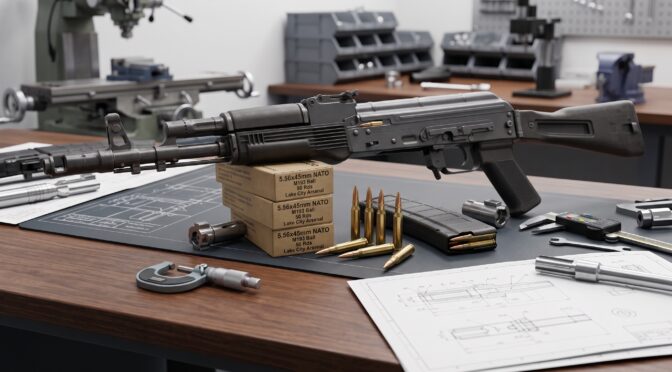
Engineering the Kalashnikov for 5.56 NATO: Key Modifications

1. Executive Summary

The adaptation of the Kalashnikov (AK) platform to chamber the 5.56x45mm NATO cartridge requires specific engineering modifications to bridge Soviet-era mechanical architecture and Western ballistic specifications. Originally designed around the highly tapered 7.62x39mm and 5.45x39mm cartridges, the AK’s operating system relies on specific geometric tolerances to function consistently. Chambering the high-pressure 5.56x45mm NATO round within this action requires precision-engineered modifications across multiple subsystems. This report provides an analysis of the mechanical adaptations required to chamber the Kalashnikov platform in 5.56x45mm NATO.

The analysis focuses on three areas of mechanical interface: front trunnion reinforcement and metallurgy, bolt face geometry and extractor mechanics, and magazine feeding geometry. Furthermore, the report evaluates the dichotomy in modern 5.56 Kalashnikov design philosophies by comparing rifles utilizing proprietary “rock-and-lock” magazines, such as the FB Radom Beryl and Zastava M90, against platforms engineered with STANAG-compatible magazine adapters, such as the Palmetto State Armory (PSA) AK-556.

Data indicates that the 5.56x45mm Kalashnikov demands a reinforced pressure vessel. This structural reinforcement is achieved via 1.5mm bulged receivers, bulged front trunnions, or through the use of specific cold hammer-forged alloys to manage the pressure curve of the NATO cartridge. Bolt modifications require extractor claw undercutting and the implementation of spring-loaded firing pins to mitigate slam fires with commercial primers. Feeding geometry presents notable engineering hurdles; the physical profile of the 5.56x45mm necessitates specialized, steeply angled bullet guides and conservative feed ramp chamfering.

Operationally, empirical field data highlights a contrast between the two primary magazine interfaces. Proprietary rock-and-lock systems maintain the mechanical consistency of the baseline AK design, requiring dedicated magazines. Conversely, STANAG-compatible platforms offer cross-platform ammunition logistics but require modifications to the bolt carrier group that can impact long-term component wear and introduce narrower tolerances for magazine variance.

2. Ballistic and Geometric Considerations

To evaluate the engineering requirements of a 5.56x45mm Kalashnikov, it is necessary to analyze the ballistic and geometric differences between the NATO cartridge and the original Soviet rounds. The mechanical architecture of the AK was optimized for the 7.62x39mm M43 cartridge, which features a pronounced case taper. This taper minimizes friction during primary extraction, allowing the casing to break contact with the chamber walls immediately as the bolt rotates.

Introduced in 1974, the AK-74 was chambered for the smaller 5.45x39mm cartridge. While adopting a lighter projectile, engineers ensured the 5.45x39mm round maintained a significant body taper and a thick rim, preserving the platform’s standard extraction parameters.

The 5.56x45mm NATO possesses a straighter case profile, presenting a mechanical variance for the AK operating system. The base diameter of the 5.56x45mm case is 0.377 inches, while the 5.45x39mm features a wider base diameter of 0.394 inches. Additionally, the overall case length of the 5.56x45mm is 1.760 inches, compared to the 1.568-inch length of the 5.45x39mm.

The reduced body taper of the 5.56x45mm cartridge means the brass casing expands and adheres more uniformly to the steel chamber walls during obturation. Consequently, the straight-walled casing requires more mechanical force for primary extraction compared to tapered Soviet cartridges.

Internal ballistics and pressure curves also differ. The 5.56x45mm NATO cartridge generates maximum chamber pressures that approach 62,366 psi under EPVAT testing protocols, whereas the 5.45x39mm operates at lower pressures, averaging around 55,000 psi. The combination of projectile weight and muzzle velocity translates to a sharper pressure spike in the 5.56x45mm system. This alters the cyclical timing of the gas system and increases the structural stress placed upon the front trunnion and the locking lugs of the bolt.

3. Trunnion Reinforcement and Structural Architecture

In the stamped-receiver Kalashnikov platform, the front trunnion acts as the primary pressure vessel. It is the mechanical nexus where the cold hammer-forged barrel is pinned, the stamped sheet-metal receiver is riveted, and the bolt’s forward locking lugs rotate to seal the chamber. Because the 5.56x45mm NATO cartridge generates higher chamber pressures and distinct rearward bolt thrust forces, the front trunnion requires specific structural and metallurgical adaptations to prevent the loss of headspace over high round counts.

3.1 The Bulged Trunnion Architecture

Engineers have developed architectural solutions to handle the stresses of the 5.56x45mm cartridge, notably the utilization of a reinforced, bulged front trunnion. This design philosophy is prominently observed in the Zastava M90 and the Palmetto State Armory (PSA) AK-556.

The Zastava M90, which currently carries an average street price of approximately $1,200, traces its origins back to the Yugoslav military’s M70 platform, engineered to withstand the thermal and kinetic stress of launching rifle grenades. Yugoslav engineers increased the stamped sheet metal receiver thickness from the standard 1.0mm to 1.5mm. To accommodate this thicker steel, the front trunnion was enlarged, resulting in a distinct bulge on the sides above the magazine well. When adapted for the 5.56x45mm cartridge, the 1.5mm bulged receiver provides a highly rigid locking surface that reduces flex and stabilizes the barrel, though it results in a heavier overall weapon system.

The PSA AK-556, positioned with an average street price of roughly $1,100, adopts a hybrid structural approach; it utilizes a bulged, forged 4340 AQ steel front trunnion to manage the specific pressure curve, but pairs it with a standard 1.0mm stamped receiver. This design balances the required front-end structural reinforcement with a reduction in overall receiver weight.

3.2 The Standard Forged Trunnion Architecture

Manufacturers operating out of Europe, such as Fabryka Broni (FB) Radom in Poland and WBP, utilize a standard 1.0mm stamped receiver paired with a standard-profile forged front trunnion for their 5.56x45mm platforms. To ensure the platform handles the 5.56x45mm pressure curve without relying on the added mass of a bulged trunnion, these manufacturers rely on material science and specific metallurgy.

FB Radom utilizes a proprietary steel alloy optimized for cold hammer forging. The forging process aligns the grain structure within the steel, increasing resistance to cyclical fatigue. The FB Radom Beryl platform currently commands an average street price of approximately $1,500. WBP similarly relies on machined, forged steel trunnions, maintaining durability within a lighter 1.0mm receiver footprint, with rifles like the WBP Jack averaging around $1,200.

Trunnion ArchitectureReceiver ThicknessFront Trunnion ProfileOperational CharacteristicsExemplar Platforms
Yugoslav Pattern1.5mmBulgedHigh rigidity, limits receiver flex, handles pressure spikes; higher overall weight.Zastava M90
Hybrid Pattern1.0mmBulgedReinforces primary locking surfaces while maintaining standard receiver weight.PSA AK-556
Standard AKM Pattern1.0mmStandard ForgedLightweight, standard handling characteristics; requires premium forging metallurgy.FB Radom Beryl, WBP Jack

3.3 Barrel Journal Sizing

The mechanical interface between the barrel and the front trunnion—the barrel journal—is a critical metric. Kalashnikov platforms generally utilize two standard barrel journal sizes: 22mm (typical of the 5.45x39mm AK-74) and 23mm (typical of the 7.62x39mm AKM).

For dedicated 5.56x45mm builds, the industry standard leans toward the larger 23mm journal. Components from WBP, Arsenal Bulgaria, and Palmetto State Armory are engineered to accept 23mm barrel journals. The 23mm journal provides additional material thickness at the chamber end of the barrel, enhancing the radial hoop strength required to contain the expanding gases of the 5.56x45mm pressure spike.

4. Bolt Face Geometry, Extraction Mechanics, and Firing Pin Dynamics

The bolt assembly of a 5.56x45mm Kalashnikov must smoothly strip a round from the magazine, guide it up the feed ramp, lock into the front trunnion, detonate the primer, and extract the straight-walled casing under residual pressure.

4.1 Bolt Stem Thickness and Carrier Compatibility

The physical dimensions of the bolt stem—the cylindrical rear portion of the bolt that rides inside the bolt carrier—are not uniform across 5.56 AK variants. Mixing components from different origins can result in improper lockup. There are three primary bolt stem profiles:

  1. Thin Stem (AK-74 Specification): Bolts manufactured by FB Radom for the Beryl utilize a “thin stem” profile, dimensionally identical to the standard Soviet 5.45x39mm AK-74 bolt stem.
  2. Medium Stem (WBP Specification): WBP Polish 5.56 bolts feature a proprietary “medium” stem. It is dimensionally thicker than the FB Radom 74-spec thin stem, but thinner than a standard 7.62x39mm AKM bolt stem.
  3. Thick Stem (AKM Specification): Some platforms, such as the Arsenal SLR-106 series, utilize an AKM pattern bolt carrier, requiring a 5.56 bolt manufactured with a thick stem matching 7.62x39mm dimensions.

4.2 Extractor Geometry

A frequent modification within the manufacturing community is the adaptation of surplus Soviet 5.45x39mm AK-74 bolts to cycle 5.56x45mm ammunition. Because the rim diameter difference between the two cartridges is minimal, a 5.56mm cartridge will physically fit onto a 5.45mm bolt face.

However, the geometric profile of the extraction groove differs. When utilizing an unmodified 5.45mm bolt for a 5.56mm build, the standard extractor claw often lacks sufficient depth to purchase fully on the NATO case rim. To adapt the bolt, the extractor claw must be relieved (undercut) from the inner face where it contacts the bolt stem. This material removal allows the extractor claw to pivot further inward under spring tension, ensuring positive primary extraction. Despite this workaround, dedicated 5.56x45mm bolts with factory-set extractor geometry are recommended for consistent operation.

4.3 Firing Pin Mass and Slam Fire Mitigation

The original AK-47, AKM, and AK-74 designs utilize a free-floating firing pin. When the bolt locks into battery, the pin travels forward under its own inertia, lightly striking the primer. Soviet military ammunition features hard primers designed to withstand these inertial strikes.

However, commercial.223 Remington and 5.56x45mm NATO ammunition often utilize softer, more sensitive primers. When a standard free-floating AK firing pin impacts a soft primer during chambering, the inertial force can ignite the compound, causing a slam fire. To mitigate this risk, premium 5.56 AK manufacturers replace the free-floating pin with a spring-loaded assembly. Manufacturers like Arsenal Bulgaria and WBP Poland manufacture bolts featuring a firing pin held securely to the rear by a coil spring, guaranteeing consistent ignition only when the hammer physically strikes the pin.

5. Magazine Feeding Geometry and Chamber Adaptations

The transition of the cartridge from the magazine into the chamber is geometrically sensitive. The lack of body taper on the 5.56x45mm cartridge requires dedicated feed ramps and precisely angled bullet guides.

5.1 Bullet Guide Geometry

The AK bullet guide is a hardened steel ramp riveted into the floor of the front trunnion. Its purpose is to strike the nose of the cartridge as it is stripped forward, elevating the projectile into the chamber. Because the 5.56x45mm cartridge has a longer overall length and a different ogive compared to Soviet rounds, a caliber-specific bullet guide is required. The 5.56 guide features a steeper ramp angle to elevate the longer, straight-walled cartridge quickly enough to avoid striking the barrel face.

The installation of the bullet guide is dictated by the internal geometry of the front trunnion:

  • Round Trunnion: The interior floor is smooth and curved, matching the barrel journal. The corresponding round bullet guide features a curved base that sits flush against the trunnion floor.
  • Flat Trunnion: The interior floor features a machined notch. The corresponding flat bullet guide features a squared base that drops into this notch, often presenting a stepped ramp style.

5.2 Chamber Face Chamfering

To prevent the sharp edges of the barrel face from binding the copper jacket of the projectile, manufacturers often cut a slight chamfer (a beveled edge) into the lower lip of the chamber face. This creates a secondary feed ramp directly on the barrel.

Caution is required during this alteration. If the chamfer is cut too deeply, a portion of the cartridge’s brass casing will be left unsupported when the bolt is locked into battery. Upon detonation, the brass can flow into the void, potentially resulting in a case head separation. Thus, chamber chamfering must be conservative, balancing smooth feeding with safe pressure containment.

6. The STANAG Magazine Adapter Paradigm

While traditional 5.56 Kalashnikovs utilize proprietary “rock-and-lock” magazines, an engineering movement has emerged to adapt the AK to accept standard AR-15/M16 STANAG pattern magazines. Platforms like the PSA AK-556 attempt to merge Kalashnikov mechanics with Western logistical commonality.

6.1 Mechanical Integration

The native Kalashnikov relies on a flat magwell where the magazine is rocked rearward to lock. The AR-15 utilizes a straight-insertion method into a restrictive magazine well. To bridge this gap, a STANAG magwell adapter is pinned or riveted into the stamped steel receiver. The PSA AK-556 adapter acts as a billet alloy housing that accepts the straight insertion of an AR-15 magazine. This typically introduces a dual magazine release system: a traditional AK paddle release, and an AR-style push-button release on the right-hand side of the receiver.

6.2 Bolt Override and Feed Lip Clearance

The primary engineering hurdle of the STANAG adapter system is the geometric interference between the reciprocating AK bolt carrier and the AR-15 magazine feed lips. STANAG magazines sit higher relative to the bore axis, and their feed lips are narrower than traditional AK magazines.

If an unmodified AK bolt carrier travels over an inserted STANAG magazine, the lower stripping lugs of the bolt will impact the rear feed lips. To resolve this, extensive machining is required on the moving parts. Engineers must mill relief cuts into the sides and bottom of the bolt and bolt carrier to clear the STANAG feed lips. Removing material from the lower stripping lugs reduces the bolt’s overall surface area for grabbing the cartridge rim, making the feeding system highly sensitive to magazine spring tension and follower tilt.

6.3 Last Round Bolt Hold Open (LRBHO)

STANAG-adapted AKs frequently integrate a Last Round Bolt Hold Open (LRBHO) feature. Traditional Kalashnikovs do not lock open when empty. The STANAG adapters incorporate an internal mechanical linkage that interacts with the follower of the AR-15 magazine. When the final round is fired, the follower pushes upward against an internal sear within the adapter block, catching the reciprocating bolt and locking it to the rear.

7. Operational Reliability Comparison: STANAG vs. Rock-and-Lock

Analyzing empirical field data reveals a contrast between the operation of proprietary rock-and-lock systems and the ammunition-sensitive nature of STANAG-adapted rifles.

7.1 Proprietary Systems (FB Radom Beryl, Zastava, WBP)

Rifles engineered to use proprietary 5.56 AK magazines exhibit high reliability. The FB Beryl (average street price ~$1,500) was utilized by the Polish Armed Forces as their standard service rifle. Because the receiver, bolt, trunnion, and magazine were designed synergistically, the geometric presentation of the cartridge is natively optimized. The Zastava M90 (average street price ~$1,200) exhibits similar feeding geometry, aided by an adjustable gas block that allows operators to tune the rifle’s cyclical rate.

A notable operational variable in the proprietary rock-and-lock system is the material science of the magazines. FB Radom Beryl magazines are manufactured from a rigid, translucent polycarbonate material. While lightweight, polycarbonate can become brittle in sub-zero temperatures and is prone to stress-cracking at the feed lips if dropped onto hard surfaces. Consequently, many shooters utilize Bulgarian “Circle 10” magazines, which are constructed from a thermally stable polymer and feature steel-reinforced feed lips.

7.2 STANAG Systems (PSA AK-556)

The operational reliability of STANAG-adapted AKs is more variable. The mechanical integration of an AR-15 magazine into a Kalashnikov action introduces geometric friction points. While the PSA AK-556 (average street price ~$1,100) is advertised as STANAG-compatible, optimal reliability is often heavily dependent on the geometry of specific polymer magazines, such as Magpul PMAGs. Attempting to utilize standard USGI aluminum magazines or other variants can result in the modified bolt overriding the cartridge.

Furthermore, the mechanical modifications required to clear the STANAG feed lips can impact long-term durability. Field data indicates that modified bolt lugs can experience accelerated wear where the bolt impacts the trunnion and the magazine adapter during cycling.

Reliability MetricProprietary Rock-and-Lock (e.g., FB Beryl, Zastava M90)STANAG Adapter (e.g., PSA AK-556)
Magazine CompatibilityHigh within the 5.56 AK ecosystem (FB Radom, WBP, Circle 10).Variable (Heavily dependent on specific polymer magazine geometry).
Feeding GeometryOptimized native presentation angle.Requires bolt lug milling to clear AR feed lips, reducing stripping surface area.
Headspace RetentionExcellent track record utilizing military-pedigree forged components.Variable; documented instances of accelerated bolt lug wear.
Operational FeaturesStandard AK manual of arms, typically lacks LRBHO.Features LRBHO and AR-style push-button release.
Logistical AvailabilityLow (Magazines are proprietary and premium-priced).High (Standard AR-15 magazines are abundant and cost-effective).

8. Consumer Reception and Market Dynamics

The consumer reception of 5.56x45mm AK platforms fractures the commercial market into two demographics: shooters seeking logistical efficiency, and purists prioritizing native mechanical designs.

When evaluating the commercial market, average street pricing plays a significant role in consumer adoption. The current average street prices for the platforms analyzed are approximately $1,500 for the FB Radom Beryl, $1,200 for the Zastava M90, $1,200 for the WBP Jack, and $1,100 for the PSA AK-556.

A review of the eight requested vendors (Brownells, Grabagun, Global Ordnance, Midway USA, KYGunCo, Palmetto State Armory, Primary Arms, and Sportsmans Warehouse) was conducted to find up to five active product listings priced at or below these averages. Imported military-pedigree rifles (the FB Radom Beryl, Zastava M90, and WBP Jack) are typically distributed through exclusive specialty importers rather than these specific commercial retailers, yielding no results.

Active product pages for the domestic PSA AK-556 are hosted directly by the manufacturer; however, correcting for real-time inventory data, these specific models are presently out of stock. The listings with their MSRPs are as follows:

For the pragmatic consumer, the STANAG-compatible AK represents logistical simplicity. The PSA AK-556 allows an operator invested in the AR-15 ecosystem to utilize standard magazines. The inclusion of the LRBHO mechanism and the AR-style magazine release lowers the manual-of-arms learning curve. The market presence of these platforms is often supported by comprehensive manufacturer warranties that mitigate concerns regarding component wear.

Conversely, professional end-users and collectors show a strong preference against STANAG-adapted platforms, viewing the required bolt lug modifications as a compromise to the baseline reliability of the Kalashnikov system. These consumers prefer proprietary platforms like the FB Radom Beryl or Zastava M90. While proprietary 5.56 AK magazines are costly, the consumer is rewarded with a military-pedigree weapon system engineered specifically for those tolerances.

9. Strategic Conclusions

Chambering the Kalashnikov platform in 5.56x45mm NATO demands a calculated redesign of internal geometry. The high-pressure, straight-walled characteristics of the NATO cartridge require specific front trunnion reinforcement, extractor claw tuning, spring-loaded firing pins, and precise feed ramp and bullet guide angles.

The implementation of STANAG magazine adapters appeals to consumers seeking logistical commonality but introduces mechanical vulnerabilities. Modifying the bolt lugs to clear AR-15 feed lips alters the platform’s geometric harmony, which can result in accelerated wear and magazine sensitivity. Therefore, for applications prioritizing long-term durability, the proprietary “rock-and-lock” geometry remains the optimal engineering solution.


Note: Vendor Sources listed are not an endorsement of any given vendor. It is our software reporting a product page given the direction to list products that are between the minimum and average sales price when last scanned.


Please share this post with colleagues, on forums, etc. Your support is much appreciated, and if you have any feedback, please email us in**@*********ps.com.


Sources Used

  1. 5.45 vs. 5.56: Soviet vs. NATO – Ammo.com, accessed June 28, 2026, https://ammo.com/comparison/545-vs-556
  2. FB RADOM Poland – AK 5.56 Complete Bolt Assembly Original Beryl/Archer, accessed June 28, 2026, https://armsofamerica.com/fb-radom-poland-ak-5-56-complete-bolt-assembly-original-beryl-archer/
  3. AR15 Magwell Conversion Kit – DEFINITIVE ARMS, accessed June 28, 2026, https://definitivearms.com/product/ar15-magwell-conversion-kit/
  4. Zastava M85NP My Oddball AK That Runs 5.56 and Uses AR Mags – Guns.com, accessed June 28, 2026, https://www.guns.com/news/reviews/zastava-m85np-my-oddball-ak-that-runs-556-and-uses-ar-mags

The 1997 North Hollywood Shootout: A Tactical and Strategic Analysis

1. Executive Summary

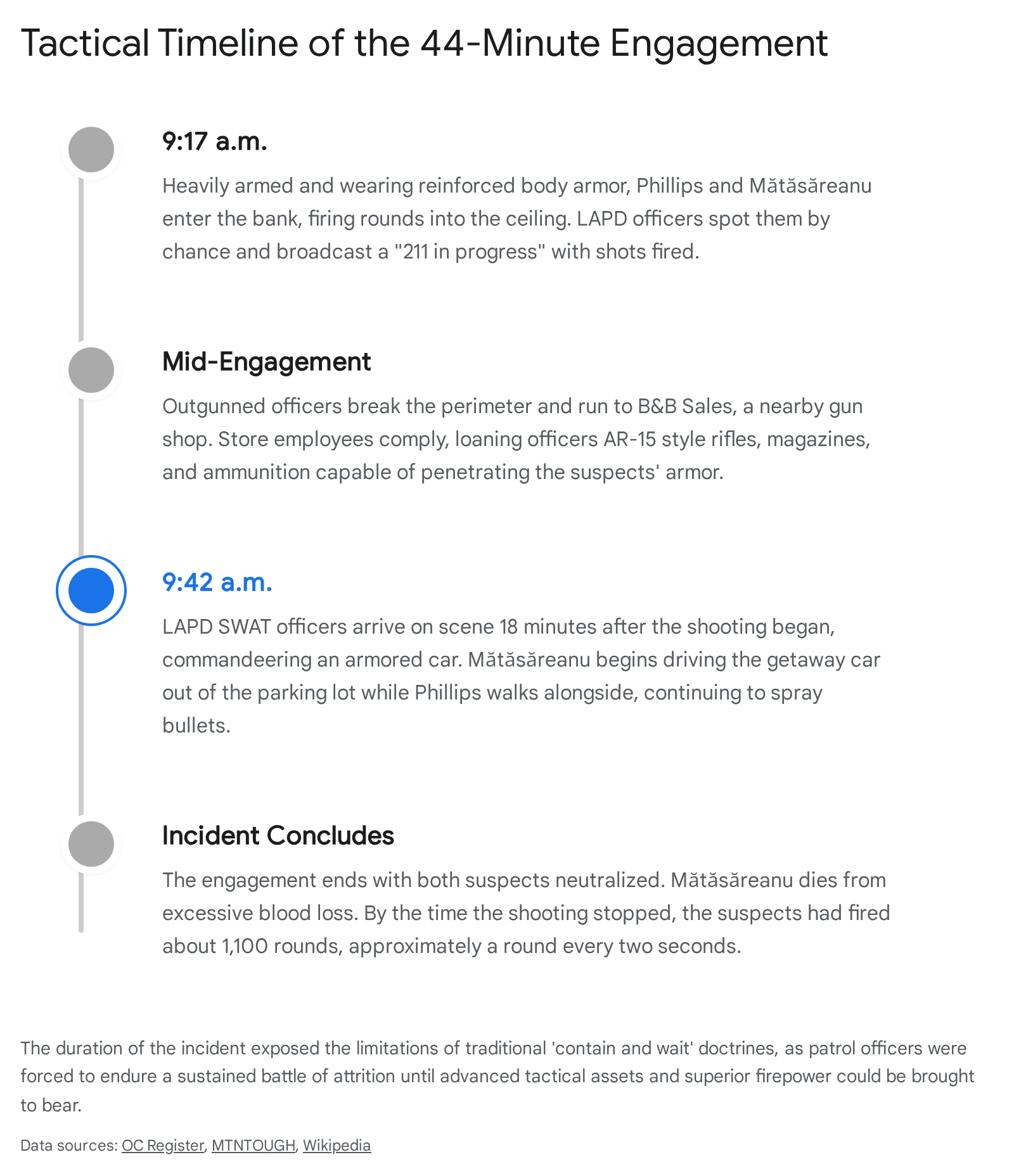
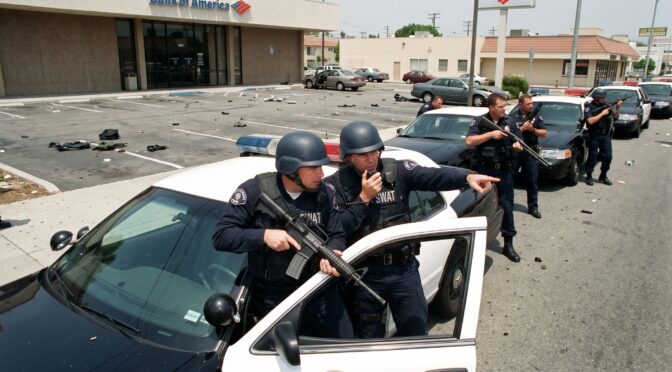
On February 28, 1997, the operational protocols of American municipal law enforcement encountered a severe structural stress test during an event that fundamentally altered modern policing doctrines. Over the course of a 44-minute engagement in the North Hollywood neighborhood of Los Angeles, California, two heavily armed and armored perpetrators confronted the Los Angeles Police Department (LAPD).1 The incident, commonly referred to as the North Hollywood Shootout, originated as an armed robbery at a Bank of America branch and rapidly devolved into a high-intensity urban firefight.1 By the conclusion of the confrontation, the combatants had exchanged approximately 2,000 rounds of ammunition, averaging an anomalous rate of one discharged round every two seconds.1

The engagement resulted in twenty casualties, including twelve sworn police officers and eight civilians, alongside the fatalities of both perpetrators.1 The tactical anomaly of the event was not merely the duration of the firefight, but the stark asymmetry in ballistic capabilities and protective equipment between the suspects and the responding law enforcement personnel.2 Responding patrol officers, equipped under the prevailing law enforcement doctrines of the late twentieth century, carried 9mm semi-automatic pistols,.38 Special revolvers, and 12-gauge pump-action shotguns.2 They found themselves entirely outranged and outgunned by adversaries wielding illegally modified, fully automatic assault rifles chambered in high-velocity calibers, supported by high-capacity drum magazines and armor-piercing ammunition.1

Furthermore, the suspects utilized extensive, custom-fabricated body armor that successfully neutralized standard police small arms fire, granting the perpetrators relative tactical superiority and severely suppressing the initial law enforcement response.2 The failure of standard pistol rounds to penetrate the suspects’ defenses forced LAPD officers to employ unconventional tactical solutions, including the battlefield requisition of civilian firearms from a local dealer and the commandeering of an armored transport vehicle for medical evacuations.5

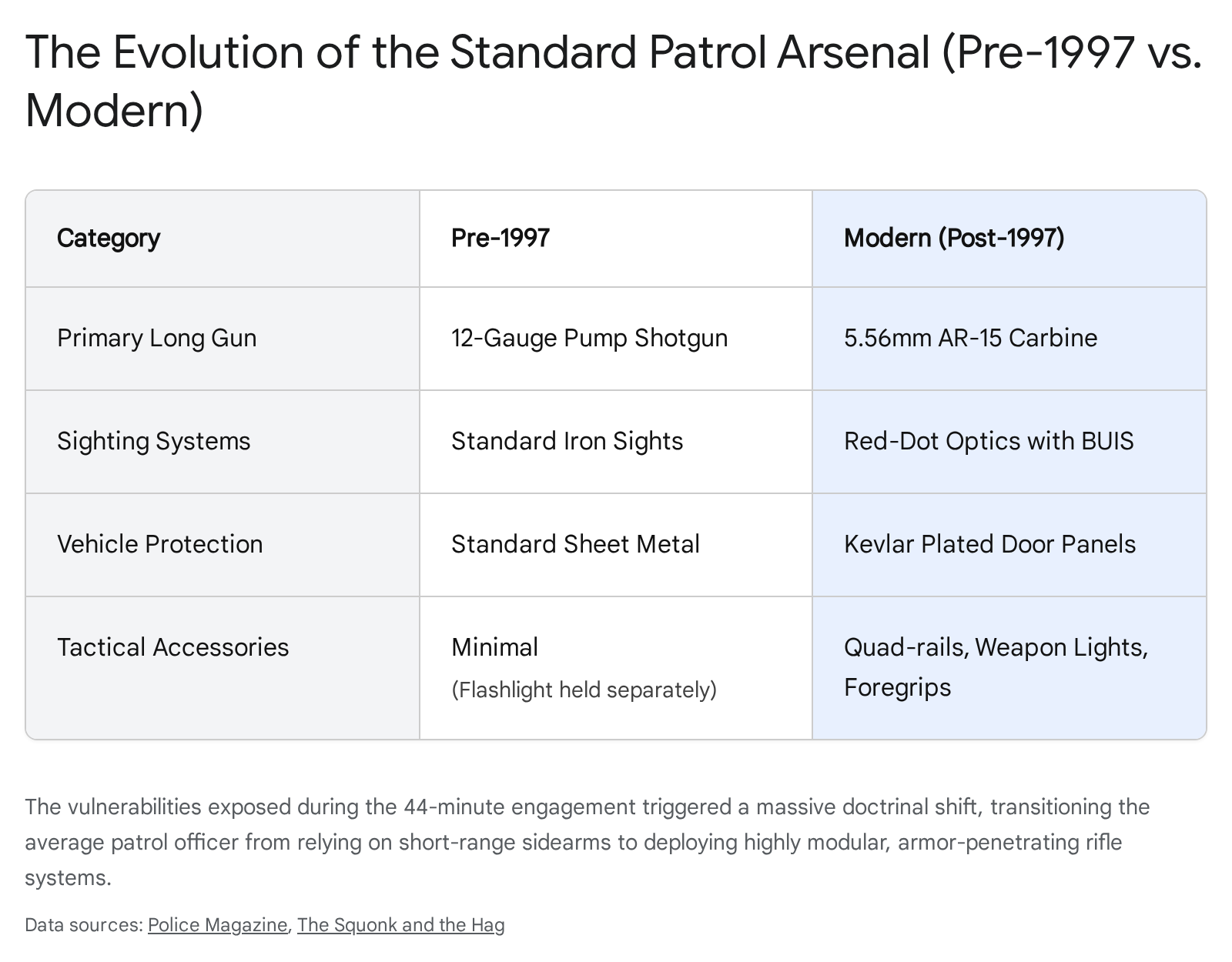
This report provides an analytical review of the North Hollywood Shootout. It examines the historical antecedents of the perpetrators, detailing their operational methodology and tactical planning. The analysis provides a chronological breakdown of the incident, mapping the failure of traditional perimeter containment doctrines and the subsequent battle of attrition. It further investigates the casualty profile, the emergency medical extraction protocols employed under hostile fire, and the complex legal proceedings that followed. Ultimately, this report outlines the profound doctrinal shifts catalyzed by the event, most notably the universal adoption of the semi-automatic patrol rifle, the evolution of active shooter response protocols, and the acceleration of law enforcement militarization through federal surplus initiatives such as the Department of Defense 1033 Program.2

2. Historical Antecedents and Suspect Profiles

Understanding the tactical severity of the North Hollywood Shootout requires a detailed examination of the suspects’ operational history. The event was not a spontaneous act of violence but the culmination of years of escalating criminal activity, meticulous logistical preparation, and a demonstrated reliance on kinetic force.

2.1 The Criminal Trajectory of the “High Incident Bandits”

The perpetrators, Larry Eugene Phillips Jr., 26, and Decebal Ștefan Emilian “Emil” Mătăsăreanu, 30, operated as a highly coordinated criminal partnership.9 Mătăsăreanu, a 283-pound native of Romania who had previously suffered traumatic brain injuries resulting in seizures, and Phillips, characterized by investigators as the primary tactical planner, bonded over a shared interest in weightlifting and high-powered weaponry.2 Law enforcement analysts and investigators had previously classified the pair as the “High Incident Bandits” due to the extreme weaponry, aggressive entry tactics, and body armor utilized in their preceding operations.1 Furthermore, investigators later noted the suspects maintained a strong fixation on the 1995 action film Heat, which features a prolonged, heavy-caliber shootout between bank robbers and law enforcement in Los Angeles.

The suspects’ progression toward the 1997 shootout is marked by several key encounters with law enforcement. In October 1993, the pair was arrested following a traffic stop in Glendale, California, during which officers discovered a significant cache of semi-automatic rifles, handguns, thousands of rounds of ammunition, and body armor in their vehicle.1 Following their release, a significant portion of their seized property was returned to them, with the exception of the confiscated firearms and explosive materials.1

This legal setback did not deter their operations. On June 14, 1995, Phillips and Mătăsăreanu executed a highly violent ambush on a Brink’s armored transport vehicle in Winnetka, California.1 During this tactical ambush, they utilized assault rifles to overpower the transport crew, resulting in the murder of guard Herman Cook and the severe wounding of another guard.1 The success of this operation emboldened the pair. In May 1996, they executed simultaneous or rapid-succession armed robberies of two Bank of America branches in the San Fernando Valley region of Los Angeles, exfiltrating with approximately $1.5 million in stolen currency.1 These prior operations provided the suspects with the necessary capital and operational confidence to further upgrade their arsenals and refine their tactical execution for future targets.

2.2 Operational Planning and Target Selection

The selection of the Bank of America branch located at 6600 Laurel Canyon Boulevard in North Hollywood was the result of extensive reconnaissance and logistical calculation. The perpetrators specifically targeted the bank on the morning of Friday, February 28, 1997, accurately assessing that the vault would contain upwards of $750,000 to accommodate the localized weekend payroll and cash distribution requirements.2

To optimize their operational window, Phillips and Mătăsăreanu utilized radio frequency scanners to actively monitor LAPD dispatch channels.11 This electronic surveillance allowed them to calculate the expected police response times for a standard “211 in progress” (the California penal code designation for armed robbery) dispatch call.11 Their operational blueprint dictated entering the bank, securing the currency, and exfiltrating the premises before standard municipal patrol units could establish a viable containment perimeter.

However, their primary contingency plan relied on brute-force suppression. If their timeline was disrupted and they were confronted by law enforcement, they intended to utilize overwhelming automatic fire and heavy body armor to break through any police cordon.2 The suspects did not plan for a hostage barricade situation; their strategic intent was purely focused on asset acquisition and mobile exfiltration through the application of superior firepower.

3. The Asymmetry of Armament and Ballistic Profiles

The defining characteristic of the North Hollywood Shootout was the severe asymmetry of force between the combatants. The suspects deployed theater-of-war armament within a civilian urban environment, encountering a municipal police force that was equipped strictly for standard peace-keeping and routine criminal apprehension.

3.1 The Suspect Arsenal and Modifications

The perpetrators transported an arsenal of legally purchased, yet illegally modified, firearms and high-capacity magazines to the target location. Their collective armament consisted of nearly 4,000 rounds of ammunition, a significant portion of which featured steel-core, armor-piercing projectiles specifically designed to defeat vehicle engine blocks and standard law enforcement soft body armor.2

The weapons inventory utilized by the suspects was extensive and highly specialized for sustained combat 1:

PerpetratorPrimary Weapon SystemsSecondary Weapon SystemsAmmunition Feed Devices
Larry Phillips Jr.Norinco Type 56S (modified to full auto)

Norinco Type 56 S1 (modified to full auto)
Heckler & Koch HK91

Beretta 92FS Inox
75 to 100-round drum magazines

30-round box magazines
Emil MătăsăreanuBushmaster XM-15 E2S Dissipator (modified to full auto, M16A1 handguard)

Norinco Type 56
N/A100-round Beta-C dual-drum magazines

30-round box magazines

The suspects illicitly modified the civilian semi-automatic Norinco and Bushmaster rifles to function as fully automatic weapons, bypassing the mechanical sear disconnectors to allow continuous fire.1 Furthermore, the utilization of 75- to 100-round drum magazines and Beta-C dual-drum magazines drastically reduced the necessity to perform manual reloads. This logistical advantage allowed them to maintain a nearly continuous wall of high-volume suppressive fire, effectively neutralizing the standard police tactic of moving or returning fire during a suspect’s reloading sequence.1

3.2 Defensive Systems: Suspect Body Armor

Standard issue police firearms were rendered strategically obsolete by the perpetrators’ defensive preparations. Both men wore roughly 40 pounds of custom-fabricated, heavy body armor.4 They assembled and stitched together multiple layers of cut-up Kevlar, specifically reinforcing the material over their vital organs, torsos, and limbs to create a ballistic shield.2

This commando-style coverage spanned from their necks to their feet, effectively encapsulating them in a ballistic cocoon that standard municipal pistol ammunition simply could not penetrate.4 While the suspects did not wear ballistic helmets—utilizing standard ski masks instead to obscure their identities—their torso and limb armor successfully absorbed hundreds of direct impacts without yielding or degrading to the point of failure.14

3.3 Law Enforcement Weaponry and Range Limitations

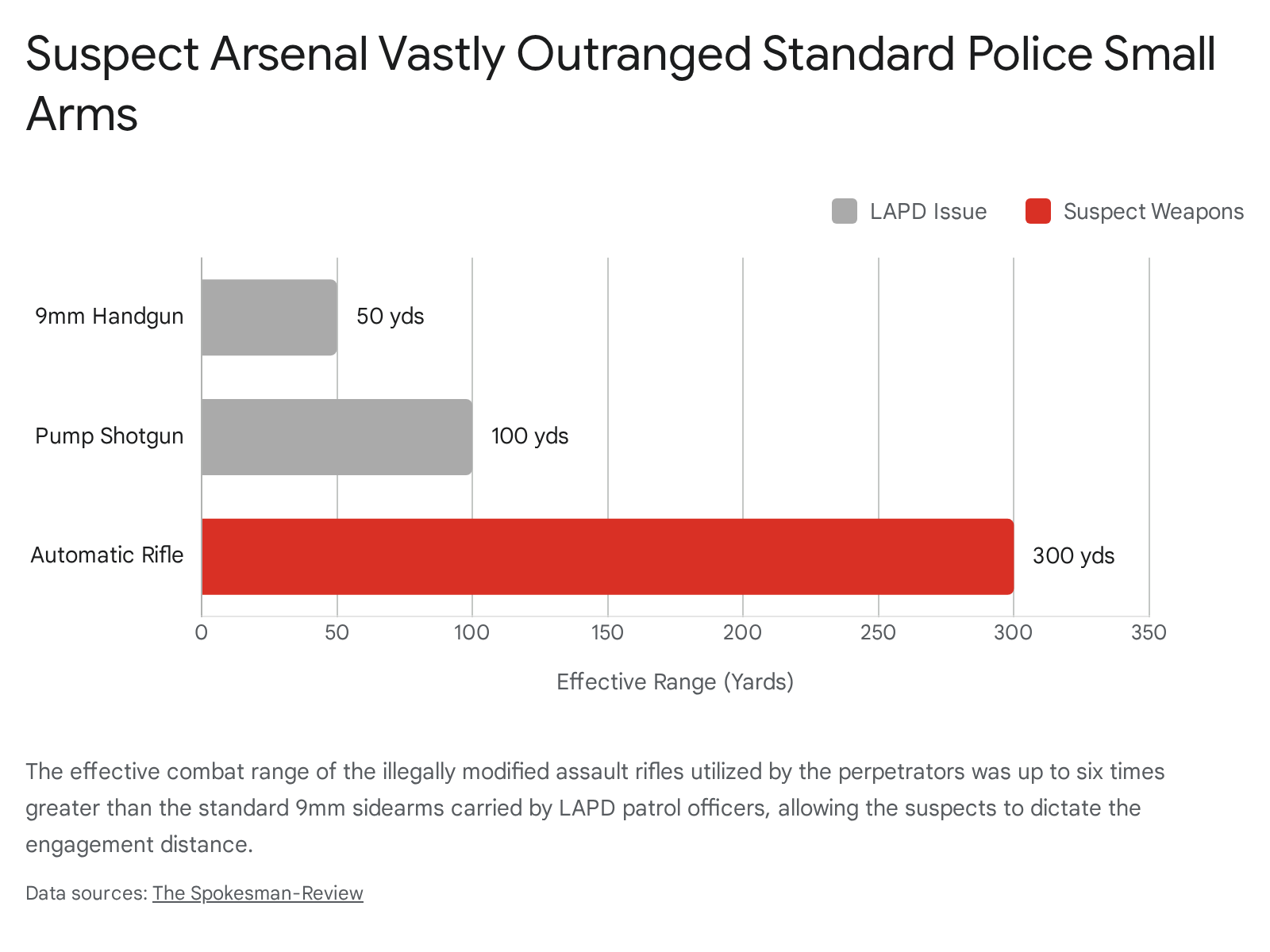
In stark contrast to the suspects’ militarized loadout, the LAPD patrol officers arriving on the scene carried standard issue equipment characteristic of late-twentieth-century policing doctrines. The primary sidearms distributed to the patrol force were 9mm semi-automatic pistols, specifically the Beretta 92FS, alongside older.38 Special revolvers.2 Field supervisors and select units had access to 12-gauge pump-action shotguns housed within their patrol vehicles.3

The tactical disparity was most evident in the effective combat range of the respective weapon systems. The effective range of a standard 9mm pistol in a high-stress combat scenario is generally limited to 50 yards.3 A 12-gauge shotgun loaded with standard 00 buckshot or rifled slugs is practically effective up to roughly 100 yards.3 The suspects’ assault rifles, however, maintained an effective combat range of over 300 yards.3 This disparity allowed the perpetrators to dictate the geometry of the engagement, engaging officers well beyond the effective range of the police return fire and creating a localized zone of absolute tactical dominance.

Bar chart showing the number of police officers in

3.4 Terminal Ballistics and Kinetic Reality

The mathematical and physical realities of terminal ballistics dictated the early phases of the shootout. Kinetic energy, a primary determinant of a projectile’s armor-penetrating capability, is a function of both the mass of the bullet and its velocity. A standard 9mm pistol projectile possesses relatively low mass and lower velocity compared to an intermediate rifle cartridge, yielding insufficient kinetic energy to compromise layered Kevlar.4

When officers fired upon Phillips and Mătăsăreanu, the kinetic energy of the 9mm rounds was safely absorbed and dispersed by the suspects’ heavy armor.4 Witnesses and officers on the scene reported observing police bullets physically ricocheting or bouncing off the suspects, who absorbed multiple kinetic impacts without suffering structural skeletal damage, hydrostatic shock, or incapacitation.4

Conversely, the suspects’ 7.62x39mm and 5.56x45mm rifle rounds traveled at velocities easily exceeding 2,300 to 3,000 feet per second. These rounds carried immense kinetic energy, effortlessly penetrating the thin sheet metal of police cruisers, cinderblock walls, residential structures, and the unarmored bodies of the responding officers.3 The failure of law enforcement vehicles to provide adequate ballistic cover exposed officers to lethal secondary fragmentation and direct impacts, rendering traditional police vehicle-based containment tactics entirely ineffective.

4. Chronological Analysis of the Tactical Engagement

The 44-minute engagement can be dissected into distinct tactical phases, illustrating the breakdown of initial police containment protocols, the ensuing battle of attrition, and the eventual re-establishment of law enforcement superiority through the injection of superior hardware and specialized personnel.

4.1 Phase One: Initiation and Loss of the Element of Surprise (09:16 – 09:20)

At approximately 9:16 a.m. PST, Phillips and Mătăsăreanu breached the Bank of America branch.12 To immediately assert control over the civilian occupants and announce their intent, the robbers discharged rounds from their fully automatic rifles into the ceiling of the bank lobby.12

By sheer coincidence, LAPD Officers Loren Farrell and Martin Perello were driving past the bank exactly as the heavily armed men entered the premises.12 Observing the tactical intrusion, the officers immediately broadcast a “211 in progress” code over the police radio network and reported that shots had been fired.12 This rapid identification derailed the suspects’ meticulously calculated timeline. Because the preliminary police perimeter was established prior to their exit from the bank, the perpetrators lost the critical element of surprise.15

The officers’ immediate containment plan, however, was complicated by the deafening sound of continuous automatic gunfire echoing from within the bank structure.15 The volume of fire indicated that standard response protocols would likely be insufficient, prompting a citywide tactical alert that eventually drew over 300 law enforcement officers to the scene.1 Officer John Caprarelli, who had been operating a radar gun monitoring traffic speeds nearby, was among the numerous personnel who abandoned their routine duties to respond to the frantic radio broadcasts.16

4.2 Phase Two: The Breach and Suppression Tactics (09:20 – 09:30)

Upon exiting the bank, Phillips encountered the converging LAPD perimeter. Realizing the scale of the police response and the failure of their exfiltration timeline, a startled Phillips raised his modified AK-47 style assault rifle and sprayed a continuous 180-degree arc of suppressive fire across the parking lot and surrounding intersections.15

This single action dictated the operational tempo for the remainder of the battle. The suspects employed aggressive, sustained automatic fire to “fix” the police officers in place, effectively pinning them behind inadequate cover—such as patrol car doors and trees—that offered visual concealment but minimal to zero ballistic protection against rifle-caliber ammunition.17 The sheer volume and velocity of the fire prevented the officers from executing any coordinated tactical movements or flanking maneuvers. During this phase, numerous officers and civilians sustained gunshot wounds from armor-piercing rounds tearing through the urban environment.1 The suspects maintained a calm, methodical demeanor, slowly advancing and firing short, controlled bursts or long suppressive strings to keep the police force entirely immobilized.

4.3 Phase Three: The B&B Sales Civilian Re-Armament (09:30 – 09:40)

Recognizing that standard sidearms were completely ineffective against the armored suspects and that the distance of the engagement precluded effective shotgun deployment, the LAPD encountered a critical command crisis. Frustrated and outgunned, field personnel realized they were fighting a militarized force without the requisite tools. In an unprecedented operational deviation, several LAPD officers broke off from the perimeter and drove to a nearby civilian firearms dealer, B&B Gun Sales, located in North Hollywood.2

The officers rushed the commercial storefront, informing the management that they were fighting a heavily armed force resembling an army and desperately required high-powered, patrol-level rifles.3 The store management and employees immediately opened their warehouse inventory to the desperate officers. Employees and officers rapidly loaded half a dozen patrol cars with approximately $8,000 worth of hardware.3

The requisitioned civilian arsenal included six semi-automatic rifles (primarily AR-15 variants), two high-capacity semi-automatic shotguns, and approximately 4,000 rounds of high-velocity ammunition.3 Returning to the scene with these weapons, the officers were finally equipped to return accurate fire at extended ranges, though the simultaneous arrival of LAPD SWAT operators ultimately provided the definitive rifle fire that turned the tide of the battle.1

4.4 Phase Four: SWAT Arrival and Mobile Exfiltration (09:42 – 09:50)

At approximately 9:42 a.m., 18 minutes after the first shots were fired and the situation had devolved into a static battle of attrition, the LAPD Metropolitan Division SWAT team arrived on the scene.1 The team, consisting of elite operators including Donnie Anderson, Steve Gomez, Peter Weireter, and Rick Massa, had been engaged in an exercise run when the tactical alert was issued.1 Foregoing the time required to fully dress in tactical uniforms, the operators responded directly in their running shoes and physical training shorts, donning their heavy ballistic armor plates directly over their athletic wear.1 Armed with standard-issue, specialized AR-15s, SWAT integrated into the chaotic perimeter, bringing highly disciplined, accurate, armor-penetrating return fire to bear against the suspects.1

Simultaneously, the suspects attempted to break the containment. Mătăsăreanu entered the driver’s seat of their getaway vehicle, slowly maneuvering it out of the bank parking lot.12 Phillips opted to remain on foot, using the moving vehicle as rolling cover while methodically walking alongside it and laying down heavy suppressing fire against the police lines.12

4.5 Phase Five: Culmination and Resolution (09:50 – 10:01)

The tactical coordination between the two suspects faltered as Phillips separated from the vehicle, attempting to engage multiple targets simultaneously. Heavily engaged by SWAT operators and regular patrol officers, Phillips sustained a gunshot wound to the arm.16 He attempted to reposition behind a parked civilian semi-truck to clear a mechanical malfunction in his weapon or to reload.16 Subjected to highly accurate return fire that finally penetrated the unarmored gaps in his protection, Phillips sustained a total of 11 gunshot wounds.1 Surrounded and severely compromised, the engagement for Phillips culminated in a self-inflicted gunshot wound to the chin.1 Simultaneously, an LAPD rifle round struck Phillips, severing his spine.1

Mătăsăreanu continued to drive the heavily damaged getaway car down the street before its tires and engine block were completely disabled by concentrated police fire. Abandoning the immobilized vehicle, he attempted to hijack a passing civilian pickup truck to continue his exfiltration.1 However, SWAT operators quickly closed the distance, utilizing the concept of forced movement to aggressively press the suspect.4 Mătăsăreanu was subjected to intense, concentrated fire targeting the unprotected areas of his lower legs beneath his custom body armor. He sustained 29 gunshot wounds, primarily to his lower extremities, and collapsed onto the pavement.1 Mătăsăreanu succumbed to excessive blood loss at the scene, ending the 44-minute engagement at 10:01 a.m..1

Screenshot of a text description related to the North

5. Casualty Profile and Emergency Medical Extraction

The sheer volume of fire—estimated at a combined 2,000 rounds—created an environment of extreme peril that severely complicated standard emergency medical service (EMS) responses.1 The engagement zone was transformed into a lethal area where movement without heavy ballistic protection resulted in immediate injury.

5.1 Analysis of Personnel Casualties

Despite the devastating firepower deployed by the suspects, the incident concluded without any police or civilian fatalities, a statistical anomaly attributed largely to the perpetrators’ reliance on suppressive rather than aimed fire, and the protective actions of the responding officers. However, twenty individuals suffered varying degrees of traumatic injury.1 For their extraordinary bravery under fire, 18 LAPD officers were subsequently awarded the Medal of Valor and honored by President Bill Clinton.10

Twelve LAPD officers were wounded, sustaining hits from high-velocity rounds or secondary shrapnel generated by bullet impacts on concrete and metal. Sergeant Larry “Dean” Haynes sustained gunshot wounds to the shoulder and legs.1 Officer Martin Whitfield suffered severe, life-threatening injuries, being shot four times across his left arm, right femur, and chest.1 Other wounded officers included Conrado Torrez, James Zboravan, William “John” Krulac, Tracey Angeles, Stuart Guy, Earl Valladares, Ed Brentlinger, William Lantz, John Goodman, David Grimes, and Manuel Valladares.1

Eight civilians were also injured during the crossfire. Individuals such as Mildred Nolte, Juan Villigrana, Javier Orozco, Barry Golding, Tracy Fisher, Michael Horen, Jose Haro, and William Marr sustained injuries ranging from direct gunshot wounds to lacerations from flying glass and concrete fragments.1

The response of the outgunned patrol officers was defined by a commitment to mutual survival. For instance, Officer James Zboravan, who had graduated from the police academy merely two months prior to the incident, utilized his own unarmored body and standard soft ballistic vest to physically shield other officers from the barrage of machine-gun fire.2 Zboravan sustained four gunshot wounds to his lower body during this protective action before managing to leap through an exploding glass doorway to secure cover.1

5.2 Tactical Medical Extraction Under Fire

Standard municipal EMS protocols strictly prohibit unarmed ambulance crews from entering an active “hot zone” where gunfire is ongoing. Because Phillips and Mătăsăreanu possessed weapons capable of shooting through the thin exterior of standard municipal ambulances, paramedics were forced to stage outside the perimeter.8 This protocol left critically wounded officers, such as Officer Whitfield, and civilians trapped and bleeding in the street with no immediate access to trauma care.8

To solve this critical extraction crisis, SWAT officers resorted to improvised armored mobility. The officers commandeered a civilian armored transport vehicle—a reinforced money truck—driven by civilians Hector Quevedo and David Campbell.1 LAPD personnel utilized the heavy ballistic plating of the truck as mobile cover, instructing the drivers to navigate directly into the kill zone. The officers used the vehicle to physically shield the wounded, scoop them from the pavement into the back of the truck, and transport them safely to the medical triage staging areas outside the perimeter.1

6. Legal Proceedings and Ethical Considerations

The aftermath of the shootout triggered a complex legal and ethical debate regarding the duty of care owed by law enforcement to an incapacitated threat following a lethal engagement.

6.1 The Mătăsăreanu Civil Rights Lawsuit

Emil Mătăsăreanu sustained 29 gunshot wounds during his final confrontation with SWAT operators, primarily to the lower extremities, incapacitating him but not killing him instantly.1 He ultimately died from severe physical trauma and excessive blood loss roughly an hour after his initial capture and restraint.1

A civil rights lawsuit was subsequently filed in federal court under 42 U.S.C. § 1983 by Valeria Nicolescu Matasareanu on behalf of Mătăsăreanu’s two young children.9 The lawsuit named the City of Los Angeles, former LAPD Chief Willie Williams, and specific officers present at the scene, including retired Detective James Vojtecky and Officer John Futrell.18 The plaintiffs alleged that the LAPD exhibited deliberate indifference to human life, intentionally delaying the arrival of medical personnel and allowing the suspect to bleed to death in the street as a form of extrajudicial punishment.9

6.2 Legal Defense and Resolution

The defense countered these allegations by focusing on the operational realities of the chaotic scene. They argued that the surrounding neighborhood remained an un-cleared, active combat zone. The area was filled with unexploded ordnance, discarded weapons, and the persistent, unverified threat of a potential third suspect or booby traps.19 Under these conditions, officers argued it was tactically unsound and a violation of protocol to bring unarmed paramedics into the immediate vicinity until the area was definitively secured.19 Officer Zboravan also testified that it took roughly 30 minutes for him and Detective Krulac to receive medical attention, demonstrating that the delay was systemic due to the combat environment, rather than a malicious action directed solely at the suspect.20

The trial, held in 2000, resulted in a deadlocked jury, and the judge subsequently declared a mistrial.19 While the plaintiffs initially intended to retry the case, the lawsuit was eventually dismissed with prejudice later that year, ending the protracted legal battle.

7. Evolution of Tactical Response and Incident Command

The hardware deficiencies exposed during the shootout were matched by equally critical failures in operational philosophy. The North Hollywood Shootout instigated a foundational overhaul of law enforcement tactical psychology, incident command protocols, and standard operating procedures.

7.1 The Shift from Containment to Rapid Deployment

Prior to 1997, standard police training for high-risk, heavily armed encounters was based primarily on the concepts of containment and isolation. Officers were trained to establish a secure perimeter, evacuate civilians, and hold their positions, waiting for specialized SWAT units to arrive, mobilize, and neutralize the threat.21 This protocol was deemed appropriate for traditional hostage barricade situations where time was considered an asset.21

The North Hollywood incident demonstrated that heavily armored, highly aggressive suspects intending to inflict maximum damage would not passively accept containment. Phillips and Mătăsăreanu proved that standard patrol officers could no longer afford to wait; they had to possess the training and capability to “stand and fight” independently during high-intensity firefights.4 Tactical training for patrol personnel transitioned away from static marksmanship toward integrated dynamic movements, emphasizing the “Communicate, Move, Shoot” doctrine.4 This paradigm required officers to utilize covering fire, bounding overwatch, and aggressive forced movement to close the distance and neutralize threats.

This doctrinal pivot served as the immediate precursor to modern Rapid Deployment protocols. While the 1999 Columbine High School massacre is widely cited as the definitive catalyst for active shooter training, the fundamental tactical philosophy—the necessity for swift and immediate intervention by the first responding patrol officers to prevent death or great bodily injury—was birthed in the parking lots of North Hollywood.2

7.2 Historical Lineage and the “7 C’s” of Incident Coordination

The shootout belongs to a historical continuum of localized tragedies that forced systemic changes in policing. It mirrored the lessons of the 1970 Newhall shooting, which revolutionized reality-based training, the 1980 Norco shootout, which first introduced the debate over patrol rifles, and the 1986 Miami FBI shootout, which altered ballistic standards and survival mindsets.13

However, the chaos of the 44-minute engagement in North Hollywood, exacerbated by the simultaneous response of over 300 officers from various jurisdictions, revealed critical specific flaws in interagency communication and command integration.1 Radio frequencies were instantly overwhelmed by the sheer volume of overlapping transmissions, leading to localized command vacuums, confusion, and delayed situational awareness.24

In post-action analyses, law enforcement strategists encapsulated the required structural changes into the “7 C’s” of incident response to ensure better coordination in future mass-casualty events 24:

The 7 C’s of Law Enforcement ResponseStrategic Tactical Application
CommunicationEnsuring clear, unjammed, and continuous information flow via encrypted digital radio systems and prioritized dispatch channels.
CollaborationFacilitating seamless tactical integration across multiple responding municipal, county, and state agencies.
CoordinationSynchronizing the movements of hundreds of autonomous units to prevent friendly fire and crossfire scenarios.
Contingency PlanningTraining for high-impact, low-probability events, such as encountering suspects utilizing heavy body armor or military ordnance.
CommandEstablishing a rigid, easily identifiable incident command structure on the ground amidst chaotic, dynamic engagements.
ControlAsserting physical dominance over the perimeter, the suspect, and the flow of civilian traffic in the engagement zone.
CooperationFostering mutual aid agreements and standardizing active shooter response protocols across geographic boundaries.

These structural frameworks forced police departments nationwide to invest heavily in upgraded, redundant dispatch technologies and standardized incident command systems.24

8. Hardware Modernization and the Rise of the Patrol Rifle

The North Hollywood Shootout is widely recognized by analysts as the definitive conclusion of the “Revolver and Shotgun” era of urban policing.4 The profound vulnerability exhibited by the LAPD on national television served as a catalyst for a sweeping, national overhaul of patrol arsenals.

8.1 The Integration of the AR-15 Platform

Prior to 1997, semi-automatic rifles were strictly the purview of specialized tactical units. The average patrol officer was expected to handle routine crime with a 9mm or.38 caliber sidearm. However, the shootout proved that organized criminals possessed the means and intent to acquire military-grade weapons and body armor, necessitating an equal or superior response capability from first responders.17

In the immediate aftermath, law enforcement agencies initiated massive procurement programs to issue 5.56x45mm (.223 Remington) semi-automatic rifles to standard patrol units.4 The intermediate 5.56mm cartridge was selected for specific ballistic advantages: it possessed the velocity required to penetrate standard soft body armor, extended an officer’s effective engagement range out to 300 yards, and exhibited lower risks of over-penetration through building materials compared to heavy pistol rounds or shotgun slugs.4

8.2 The Evolution of Rifle Ergonomics and Accessories

The integration of the patrol rifle evolved rapidly over the subsequent decades, shifting from rudimentary military surplus designs to highly specialized tactical systems tailored for law enforcement environments.4

  • Carbines over Full-Length Rifles: Early adoptions included standard, fixed-stock 20-inch barrel rifles (such as the M16 style). These were quickly abandoned in favor of the M4-style carbine configuration, utilizing 16-inch barrels with adjustable stocks. The carbine format proved significantly more viable for rapid deployment from the cramped confines of a patrol car and for Close Quarters Battle within indoor environments.4
  • Optics and Sighting Systems: Initially equipped with standard iron sights mounted on carrying handles, modern patrol rifles transitioned heavily to electronic, red-dot optic systems. These sighting devices allow for vastly superior target acquisition speed in dynamic, low-light, and high-stress scenarios. Standard backup iron sights are maintained concurrently for mechanical redundancy.4
  • Modularity and Rails: Standard two-piece plastic handguards were replaced with modular quad rails and Picatinny systems. These structural additions allow officers to equip mission-critical accessories such as high-lumen weapon lights, vertical foregrips, and advanced tactical sling mounts.4
  • Operating Systems: To increase reliability under harsh field conditions, many departments adopted piston-driven AR systems, which redirect carbon fouling and hot gases away from the receiver chamber, ensuring cleaner operation compared to traditional direct gas impingement systems.4

8.3 Secondary Armament and Vehicle Armor Upgrades

The demand for superior stopping power extended beyond long guns. Four days after the shootout, the Los Angeles Board of Police Commissioners authorized immediate field testing for larger-caliber.45 ACP semi-automatic pistols to replace or supplement the standard 9mm platforms.4

Furthermore, recognizing the extreme vulnerability of patrol vehicles, which offered zero ballistic protection against rifle fire and failed to provide adequate cover for pinned officers in North Hollywood, police departments began structural retrofitting programs. Agencies initiated the installation of bullet-resistant Kevlar plating directly into the door panels of standard patrol cruisers, transforming them into viable mobile cover platforms.10

Evolution of police patrol manual for tactical analysis

9. Strategic Implications and the Law Enforcement Militarization Debate

While the immediate tactical lessons of the shootout were universally acknowledged within the law enforcement community, the long-term strategic and societal impacts proved vastly more complex. The visual of American police officers outgunned by body-armored criminals on live national television altered the political consensus regarding the arming of domestic police forces.1

9.1 The Pentagon 1033 Program and Rapid Procurement

The most direct and immediate mechanism for upgrading law enforcement firepower without straining municipal budgets was the rapid expansion of the Department of Defense (DoD) 1033 Program. This federal initiative permits the transfer of surplus military equipment to civilian law enforcement agencies.28

In the direct aftermath of the North Hollywood Shootout, the LAPD heavily leveraged the 1033 Program. Under the administration of Chief Willie Williams, the department acquired approximately 1,680 M16 assault rifles from the Pentagon, closing the firepower gap that had been exposed.10 The program also authorized the transfer of heavy armored vehicles with tracks, weaponized platforms, grenade launchers, and high-caliber ammunition to domestic police departments.28

9.2 The Ongoing Societal and Political Debate

The North Hollywood Shootout became the definitive historical reference point used by police administrators to justify the continuous acquisition of Mine-Resistant Ambush Protected (MRAP) vehicles and heavily armored rescue transports.8 Proponents consistently argued that such vehicles were an operational necessity; the inability of unarmed paramedics to reach bleeding officers in North Hollywood definitively proved that standard police cruisers were insufficient for crisis extraction or perimeter establishment against rifle fire.8

However, this rapid, federally subsidized acquisition of military hardware sparked an enduring national debate regarding the militarization of police. Critics and sociologists argued that outfitting domestic police with surplus military gear inherently blurs the critical line between a civilian police force and an occupying military presence.28

Investigations into the 1033 Program later revealed that the system suffered from systemic oversight failures. For instance, the Pentagon continued to approve the transfer of M16 assault rifles to the LAPD even while the department was under the watch of a federal monitor resulting from a Justice Department investigation into civil rights violations.30 Similar situations occurred in jurisdictions like Warren, Ohio, raising concerns about the lack of communication between federal defense suppliers and domestic justice regulators.30 Furthermore, audit reports indicated that numerous police departments lost track of issued military equipment, raising security concerns about fully automatic weapons entering the black market.32 In response to public pressure against militarization, some municipal leaders, such as the mayor of Davis, California, opted to return their acquired MRAPs to the government as a symbolic gesture against the trend.8

Despite these controversies, the operational specter of the North Hollywood Shootout remains a powerful justification for maintaining robust tactical arsenals within domestic policing.8 The enduring fear of encountering another heavily armored, deeply entrenched threat equipped with military-grade hardware continues to drive procurement strategies, training doctrines, and tactical philosophies across the United States.

10. Conclusion

The North Hollywood Shootout stands as a definitive watershed event in the history of American municipal policing. When Larry Phillips Jr. and Emil Mătăsăreanu emerged from the Bank of America clad in custom Kevlar and armed with fully automatic assault rifles, they instantly rendered decades of standard law enforcement doctrine obsolete. The ensuing 44 minutes of chaotic gunfire exposed the fatal limitations of the police revolver and the shotgun, the inadequacy of standard perimeter containment tactics against an aggressive mobile threat, and the deadly consequences of interagency communication bottlenecks.

Yet, the legacy of the shootout is largely defined by rapid, systemic adaptation. The actions of the outgunned officers on Laurel Canyon Boulevard catalyzed the immediate modernization of the police arsenal, directly resulting in the universal adoption of the patrol rifle and the integration of advanced vehicle armor. Furthermore, the incident forced a psychological shift in tactical response, demanding that standard patrol officers possess the training and equipment to act as immediate, aggressive intervention forces rather than passive perimeter guards. The event’s profound impact on modern law enforcement and culture was later dramatized in the 2003 film 44 Minutes: The North Hollywood Shoot-Out 33, and the 18 responding officers were honored with the Medal of Valor by President Bill Clinton.10 While the subsequent militarization of police forces via federal surplus initiatives remains a subject of intense societal debate, the tactical imperatives born from February 28, 1997, are undeniable, ensuring that law enforcement agencies continuously adapt to meet the evolving capabilities of modern criminal threats.


Please share this post with colleagues, on forums, etc. Your support is much appreciated, and if you have any feedback, please email us in**@*********ps.com.


Sources Used

  1. North Hollywood shootout – Wikipedia, accessed June 19, 2026, https://en.wikipedia.org/wiki/North_Hollywood_shootout
  2. How the North Hollywood shootout changed policing – Police1, accessed June 19, 2026, https://www.police1.com/police-products/body-armor/articles/how-the-north-hollywood-shootout-changed-policing-9eDfyRUJOR0FiYNt/
  3. Outmatched Police Made Run To Gun Shop – The Spokesman-Review, accessed June 19, 2026, https://www.spokesman.com/stories/1997/mar/01/outmatched-police-made-run-to-gun-shop/
  4. How the North Hollywood Shootout Changed Patrol Arsenals …, accessed June 19, 2026, https://www.policemag.com/articles/how-the-north-hollywood-shootout-changed-patrol-arsenals
  5. accessed June 19, 2026, https://mtntough.com/blogs/mtntough-blog/lights-camera-gun-fight-the-north-hollywood-shootout-part-ii#:~:text=They%20ran%20to%20B%26B%20Sales,to%20re%2Dengage%20more%20effectively.
  6. Who Ya Gonna Call? Various Types and Applications of Armored Rescue Vehicles, accessed June 19, 2026, https://policeandsecuritynews.com/2019/01/14/who-ya-gonna-call-various-types-and-applications-of-armored-rescue-vehicles/
  7. The 1033 Program and Police Militarization – The Policing Project, accessed June 19, 2026, https://www.policingproject.org/1033
  8. Why police agencies are well served by the 1033 Program – Police1, accessed June 19, 2026, https://www.police1.com/officer-safety/articles/why-police-agencies-are-well-served-by-the-1033-program-RRF7j3XO6xdkf5Zm/
  9. 20 years after the North Hollywood shootout, echoes of the terror remain, accessed June 19, 2026, https://lapd.com/article/20-years-after-north-hollywood-shootout-echoes-terror-remain
  10. Armored Assailants: The North Hollywood Shootout and Killdozer both create millions of dollars of damage | Episode 5, accessed June 19, 2026, https://thesquonkandthehag.com/2022/08/18/ep-5-armored-assailants-the-north-hollywood-shootout-and-killdozer-both-creates-millions-of-dollars-of-damage/
  11. Officers Remember 1997 North Hollywood Shootout – PBS SoCal, accessed June 19, 2026, https://www.pbssocal.org/shows/socal-connected/officers-remember-1997-north-hollywood-shootout
  12. Timeline of Terror: How the infamous North Hollywood shootout unfolded 20 years ago |, accessed June 19, 2026, https://projects.ocregister.com/north-hollywood-shootout/
  13. Questions of Preparedness: A Spring of Tragedy for Law Enforcement, accessed June 19, 2026, https://domesticpreparedness.com/articles/questions-of-preparedness-a-spring-of-tragedy-for-law-enforcement/
  14. Due to the large number of injuries, rounds fired, weapons used, and overall length of the shootout, The North Hollywood Shootout is regarded as one of the most intense gun battles in U.S. police history. : r/wikipedia – Reddit, accessed June 19, 2026, https://www.reddit.com/r/wikipedia/comments/kc2xn9/due_to_the_large_number_of_injuries_rounds_fired/
  15. WHEN GREEN AND BLUE COLLIDE: THE RELATIVE SUPERIORITY THEORY AND LAW ENFORCEMENT INCIDENTS, accessed June 19, 2026, https://www.hsdl.org/c/view?docid=831046
  16. Lights, Camera, Gun Fight: The North Hollywood Shootout – Part 2 – mtntough, accessed June 19, 2026, https://mtntough.com/blogs/mtntough-blog/lights-camera-gun-fight-the-north-hollywood-shootout-part-ii
  17. 1997 shootout revisited – LA Times e-newspaper, accessed June 19, 2026, https://enewspaper.latimes.com/infinity/article_popover_share.aspx?guid=a239c467-8bb6-45cd-a0c1-573bd057fba1
  18. MATASAREANU v. WILLIAMS | No. CV 97-6531-CAS(RC). | C.D. Cal. – CaseMine, accessed June 19, 2026, https://www.casemine.com/judgement/us/59148051add7b04934470e07
  19. Jury Unsure If Cops Let Shooter Die – CBS News, accessed June 19, 2026, https://www.cbsnews.com/news/jury-unsure-if-cops-let-shooter-die/
  20. North Hollywood Shootout: Baptism of Fire – Police Magazine, accessed June 19, 2026, https://www.policemag.com/articles/north-hollywood-shootout-baptism-of-fire
  21. The Police Response to Active Shooter Incidents, accessed June 19, 2026, https://www.policeforum.org/assets/docs/Critical_Issues_Series/the%20police%20response%20to%20active%20shooter%20incidents%202014.pdf
  22. Active Shooter Response & Tactics – Public Intelligence, accessed June 19, 2026, https://info.publicintelligence.net/LAactiveshootertactics.pdf
  23. Learning from the Past | Police Magazine, accessed June 19, 2026, https://www.policemag.com/articles/learning-from-the-past
  24. Remembering the North Hollywood Shootout: A Turning Point in …, accessed June 19, 2026, https://lampkinfoundation.org/white-papers/north-hollywood-shootout-turning-point-policing/
  25. An Evolution – The Birth of the Modern Patrol Rifle – Athlon Outdoors, accessed June 19, 2026, https://athlonoutdoors.com/article/the-evolution-of-the-patrol-rifle/
  26. The Evolution of the American Police Patrol Rifle – UN12Magazine, accessed June 19, 2026, https://un12magazine.com/the-evolution-of-the-american-police-patrol-rifle/
  27. The North Hollywood Shootout (1997) : r/history – Reddit, accessed June 19, 2026, https://www.reddit.com/r/history/comments/1hlqplc/the_north_hollywood_shootout_1997/
  28. Police Militarization in America: A Negative or Positive Trend? – AMU Edge, accessed June 19, 2026, https://amuedge.com/police-militarization-in-america-a-negative-or-positive-trend-2/
  29. Former LAPD Chief Willie L. Williams Dies at 72 NR16139jh – LAPD Online, accessed June 19, 2026, https://www.lapdonline.org/newsroom/former-lapd-chief-willie-l-williams-dies-at-72-nr16139jh/
  30. Pentagon program allows police departments censured for civil rights violations to get military gear | US news | The Guardian, accessed June 19, 2026, https://www.theguardian.com/world/2014/sep/22/pentagon-police-military-gear-civil-rights-justice-department
  31. Law Enforcements Socially Constructed Perception of Violence and its Influence on Police Militarization – DTIC, accessed June 19, 2026, https://apps.dtic.mil/sti/trecms/pdf/AD1008954.pdf
  32. Police Departments Have Lost Military Equipment Issued by Pentagon | The Takeaway, accessed June 19, 2026, https://www.wnycstudios.org/podcasts/takeaway/segments/police-departments-have-lost-equipment-issued-pentagon
  33. 44 Minutes: The North Hollywood Shoot-Out – Wikipedia, accessed June 19, 2026, https://en.wikipedia.org/wiki/44_Minutes:_The_North_Hollywood_Shoot-Out