Category Archives: Law Enforcement Small Arms, SWAT & Federal Tactical Teams

Procurement analyses, duty weapon evaluations, and small arms loadouts for municipal police departments, state agencies, SWAT teams, and federal tactical units. Covers patrol rifles, duty handguns, tactical shotguns, and specialized weaponry fielded by LAPD SWAT, FBI HRT, U.S. Marshals SOG, U.S. Secret Service, DSS MSD, and OST.

2026 U.S. Law Enforcement and Military Duty AR-15 Market Intelligence Report: Top 10 Head-to-Head Platform Comparisons

Across calendar year 2026 (January 1 through November 11, 2026), U.S. law enforcement fleet procurements, Individual Officer Purchase (IOP) programs, SWAT selections, and military commercial-off-the-shelf (COTS) evaluations centered on four hardware priorities: suppressed 11.5-inch to 14.5-inch carbines, rigid free-float or monolithic rails that hold infrared (IR) laser zero, factory ambidextrous lower receivers, and single-manufacturer Officer-Involved Shooting (OIS) warranties1. In comparison volume across armorer forums, officer communities, and defense evaluations, the matchup between the Geissele Super Duty Mod 1 / Mod 1-A and the Daniel Defense DDM4 V7 / DD4 RIII set the 2026 market baseline (Total Mentions Index [TMI] = 100)3. Geissele edged Daniel Defense on the weighted 2026 Duty Brand Performance Score (9.3 vs. 9.0), supported by its September 2026 U.S. Secret Service rifle contract award, factory low-backpressure suppressor mount, tuned gas port, and two-stage match trigger3. In the standard patrol workhorse tier (Tier 2), rising retail prices on legacy staples pushed armorers toward the Sionics Weapon Systems Patrol Rifle III (BPS = 9.1), which joined Tier 1’s FN 15 SRP G2 (BPS = 8.6) as a primary quality-to-price gatekeeper for credentialed buyers1.

Two structural shifts drove buyer decisions in 2026:

  1. Federal NFA Deregulation and Officer Health Mandates: Effective January 1, 2026, Congress reduced federal making and transfer taxes on short-barreled rifles (SBRs) and suppressors from $200 to $014. Following the August 5, 2026 federal court injunction in Silencer Shop Foundation v. ATF, the Bureau of Alcohol, Tobacco, Firearms, and Explosives (ATF) issued nationwide guidance on October 9, 2026 ending enforcement of prior NFA approval and federal registration for SBRs and suppressors where lawful under state law, as detailed in the ATF Update to NFA Transfer Guidance15. At the same time, 2026 occupational health studies documenting sharp indoor lead and toxic-fume spikes from conventional baffled cans accelerated agency adoption of flow-through suppressors17.
  2. Commercial Restructuring and Factory-Serialized Rifle Rules: Mid-market component disruptions, highlighted by Aero Precision’s May to August 2026 Washington State Receivership and sale to new ownership, reinforced agency policies banning officer-assembled “hybrid” upper/lower builds in favor of factory-serialized patrol carbines backed by critical-incident replacement policies1.

Data and Pricing Scope Note: Closed professional boards (such as member-only National Tactical Officers Association [NTOA] portals and vetted armorer forums) do not publish raw post-count APIs20. In addition, manufacturers including Daniel Defense, LWRCI, Sons of Liberty Gun Works (SOLGW), Colt, IWI US, and Sionics gate direct agency or IOP price sheets behind credential portals such as Daniel Defense’s MILE Program, LWRCI’s Military and Law Enforcement Discount Program, and Sionics’ Law Enforcement Agency Portal, or route sales through regional law enforcement distributors like Primary Arms Government, GT Distributors, and Kiesler Police Supply21. Accordingly, TMI, Sentiment Polarity, and Duty BPS represent structured analyst indices built from observable 2026 threads, public contract solicitations, distributor listings, and live-fire tests, while all tables separate verified 2026 LEO/exchange/promotional prices from credential-gated IOP programs3.

1.0 Duty Market Stratification in 2026

The 2026 law enforcement and military AR-15 market divides into five procurement tiers based on Mil-Spec Technical Data Package (TDP) compliance, operating system, rail rigidity under IR laser aiming modules, and armorer sustainment3. First-responder portals, military exchange catalogs, law enforcement distributors, and retail promotions routinely price duty carbines 12% to 25% below commercial MSRP, and more than 40% below MSRP on high-volume fleet baselines like the FN 15 SRP G2 or promotional DDM4 V7 sales8. Table 1.0 reports strictly verified 2026 LEO portal, military exchange, distributor, and retail promotional floors alongside commercial street and MSRP ceilings. (Note: Where direct vendor IOP portals are credential-gated, the interactive chart below displays modeled first-responder discount estimates for visual range comparison, whereas Table 1.0 and Table 2.0 cite verified 2026 public figures8.)

2026 Duty TierPrimary Mission ProfileMinimum Technical ThresholdVerified 2026 LE / Street Promo Floor2026 Commercial Street / MSRP BandRepresentative 2026 Platforms
Tier 1: Fleet / Patrol BaselinePool cruisers, correctional perimeter, rural fleet replacementForged 7075-T6 receivers, chrome-lined 4150/41V50 barrel, pinned gas block, HPT/MPI bolt (commercial crossover exceptions noted)$699.99 – $1,399.99 (FN Dist. from $805; Colt Street from $1,180.99)$699.99 – $1,749Colt LE6920-EPRII / PRO, FN 15 SRP G2 / G2P, (Crossover: PSA Sabre-15, S&W Sport III)
Tier 2: Standard Duty / IOP WorkhorsesDaily patrol carry, individual deputy/officer purchase, task forcesFree-float M-LOK rail, CHF or air-gauged/X-rayed CL barrel, individual HPT/MPI BCG, staked castle nut & gas key, duty/OIS warranty$1,049.95 – $1,400 (Sionics LEO from $1,049.95; SOLGW LE gated)$1,249.95 – $2,299Sionics Patrol Rifle III, BCM RECCE / MK2 BFH, SOLGW M4 L89 / EXO3
Tier 3: Enhanced Patrol & SWAT TacticalFull-time/part-time SWAT, patrol supervisors, suppressed CQB/IOPCHF CL or CHF NiCorr barrel, factory 2-stage or enhanced trigger, full ambi lower options, rigid anti-rotation rail, suppressor QD mount$1,099.99 – $1,799.99 (DD V7 $1,099.99 Promo; IC-DI 10.5″ $1,506.67; Mod 1 $1,799.99; MILE/LE gated)$1,799.99 – $2,725Geissele Super Duty Mod 1 / Mod 1-A, Daniel Defense DDM4 V7 / DD4 RIII, LWRCI IC-DI
Tier 4: Specialized Tactical & Piston DutyHigh-volume suppressed entry, maritime/shield teams, multi-caliber SWATShort-stroke gas piston, multi-position suppressed gas regulator, monolithic/semi-monolithic or folding chassis, .300 BLK swap options$1,499.99 MSRP – $3,499.99 Sale / $3,749 Exchange (Direct LE portals gated)$1,499.99 – $4,399HK MR556A4, Sig Sauer MCX-SPEAR LT, LWRCI IC MKII, IWI US ARAD 5
Tier 5: Tier-1 / SOF & Contract-GradeDomestic/allied special operations, federal HRT, military COTSActive SOF contract down-select pedigree, proprietary dual-ejector or buffered BCG, monolithic/flanged/Drivelock upper, laser cable routing$2,200 Base – $3,288+ (Direct contract quotes gated)$2,554 – $4,500+KAC SR-15 KS-1 (L403A1), LMT MARS-L (MRP/Specwar), SOLGW MK1, Daniel Defense DD4 X1
Chart showing patrol rifle procurement tiers and pricing ranges for different models.
Timeline of 2026 US gun regulatory and supply chain events: NFA reform, new Colt, Aero Precision, ATF ruling.

Year-Over-Year SKU Evolution and Contract Displacements (2024-2025 vs. 2026)

Compared to 2024-2025, major manufacturers updated their core duty SKUs in 2026 to eliminate non-free-floated handguards, right-hand-only lower controls, and bare A2 flash hiders on suppressed patrol builds:

  1. Fleet Baseline Modernization: At SHOT Show 2026 (January 2026), Colt updated its legacy polymer-handguard LE6920 with the Colt Enhanced Patrol Rifle II (EPR II) and EPR II PRO Series, adding a 7-sided free-float M-LOK rail, 11.5-inch (LE6933-EPRII) and 16.1-inch (LE6920-EPRII) suppressor-ready barrels, and Radian/ambidextrous PRO controls to compete directly against the FN 15 SRP G2 and SRP G2P34.
  2. Workhorse and Tactical Refresh: In Tier 2, Sionics gained state-level contract traction, highlighted by a September 2026 New Mexico State Police Patrol Rifle and Suppressor Solicitation ($150,000 to $1.2 million estimated value) specifying 11.5-inch through 16-inch Sionics Patrol and Premium carbines31. SOLGW shifted patrol focus from legacy M4-76/M89 models to the Drive-Lock SOLGW M4 L89 Series (fielded by U.S. Marshals Service Fugitive Task Forces and Sheriff’s offices) while launching its USSOCOM-selected SOLGW MK1 in Tier 537. In Tier 3, Geissele standardized HUXWRX QD mounts on the Super Duty Mod 1 and full ambidextrous controls on the Mod 1-A, winning a September 23, 2026 $20 Million U.S. Secret Service Rifle Contract to replace legacy Knight’s Armament rifles alongside municipal bids such as Warren, Michigan’s October 2026 patrol rifle solicitation8. Daniel Defense transitioned agencies from quad-rail RIS II uppers to the ambidextrous DD4 RIII / RIII S and unveiled its British Special Forces Project Hunter rifle, the Daniel Defense DD4 X13.
  3. Piston Tier Realignment: Heckler & Koch replaced the single-sided MR556A1 with the lighter, fully ambidextrous, adjustable-gas HK MR556A438. In April 2026, IWI US disrupted piston fleet pricing by launching its Tennessee-built, quick-change-barrel IWI US ARAD 5 (Z15ARD516) at a $1,499.99 MSRP, undercutting $2,250 to $4,399 piston rivals from Sig Sauer, LWRCI, and HK3.

Post-$0 NFA Tax Deregulation, Suppressor Integration, and Officer Health

Federal regulatory changes transformed IOP and municipal SBR and suppressor procurement in 2026. On January 1, 2026, the One Big Beautiful Bill Act (Pub. L. No. 119-21) lowered federal making and transfer taxes to $0 on SBRs, short-barreled shotguns (SBSs), silencers, and “any other weapons” (AOWs)14. On August 5, 2026, a federal court ruled in Silencer Shop Foundation v. ATF, No. 6:25-cv-056 (N.D. Tex.), that without an active tax, NFA registration and prior-approval mandates exceeded Congress’s taxing power15. On October 9, 2026, the Department of Justice declined to appeal, and the ATF issued an Open Letter on Nationwide NFA Non-Enforcement ending mandatory Form 1, Form 4, and tax-exempt Form 5 prior approvals, Form 3 dealer-to-dealer silencer transfer approvals, and federal registry enforcement nationwide for $0-tax items15.

Important federal and state legal rules still apply in late 2026:

  • Gun Control Act (GCA) & Retail Transfers: SBRs and suppressors remain GCA “firearms” requiring serialization, ATF Form 4473, and NICS background checks for individual officers, with the ATF exercising interim discretion not to enforce 18 U.S.C. § 922(b)(4) while drafting new GCA transfer rules15. Official-use FFL transfers to state and local agencies remain statutorily exempt under 18 U.S.C. § 925(a)15. Machineguns and destructive devices retain the $200 tax and full NFA enforcement15.
  • State Restrictions & Interstate Travel: Federal non-enforcement does not override state SBR or suppressor bans under 18 U.S.C. § 922(b)(2)15. Because several states still require federal registration as a condition of lawful possession (and future administrations could revise enforcement discretion), the ATF still processes voluntary Forms 1, 2, 3, and 4, and officers transporting personally owned SBRs across state lines must still file ATF Form 20 under the GCA15.
  • ITAR-to-EAR Export Reform: Dealers and manufacturers must still pay annual Special Occupational Taxes (SOT)15. However, under joint State and Commerce Department Interim Final Rules Taking Effect November 20, 2026, standard non-full-auto suppressors move off the International Traffic in Arms Regulations (ITAR) U.S. Munitions List to Commerce Export Administration Regulations (EAR); after November 20, 2026, ITAR registration applies only to machineguns and suppressors specially designed for full-auto weapons15.

Eliminating the $200 tax and multi-month wait shifted officer demand toward suppressed 11.5-inch carbines, since adding a suppressor to a 16-inch barrel creates roughly a 20-inch rifle that binds in cruiser racks and tight hallways, as noted in 2026 Patrol Rifle Setup Logs on r/police2. Simultaneously, 2026 occupational health research made toxic-fume mitigation a central procurement requirement. A May 2026 University of Washington Indoor Police Firing Range Study by Dr. Mohammad Fidahusain found that firing suppressed AR-15s indoors increased officer breathing-zone airborne lead concentrations 13- to 21-fold per 100 rounds compared to unsuppressed firing, with 100% of suppressor sessions exceeding the OSHA Action Level and 50% exceeding the OSHA Permissible Exposure Limit18. Complementing this, an August 2026 Military Times Investigation on Toxic Suppressor Blowback cited Dr. Chris Palmer’s review of over 100 studies showing conventional suppressors vent concentrated hydrogen cyanide, ammonia, and heavy-metal particulates back into the shooter’s face, causing acute headaches and nausea and prompting federal contracts (including the FBI Hostage Rescue Team’s adoption of HUXWRX flow-through cans) and FY2027 NDAA safety reform proposals17.

To protect both hearing and respiratory health during indoor training and vehicle entries, 2026 agencies pair conservative gas ports (such as Geissele’s 0.075-inch 16-inch Mod 1 port and Sionics’ patrol porting) and Vltor A5 / BCM Mk2 buffer systems with forward-venting, low-backpressure suppressors (which cut shooter-face toxic fume exposure by up to 50%), including the HUXWRX Flow 556k and 556 Ti, B&T Print-XH, CAT WB, SilencerCo Velos, and compact duty cans like the SureFire SOCOM556-Mini2 ($825 street promo in November 2026)1.

Armorer QC Standards, Training Ecosystems, Warranties, and Commercial Restructuring

Department armorers in 2026 enforce strict mechanical screening before approving patrol rifles: forged 7075-T6 receivers, pinned or keyed gas blocks, staked castle nuts, staked carrier gas keys (such as Sionics’ knurled Michiguns OCKS [Optimized Carrier Key Screws] or LWRCI’s integrally machined keyless carrier), and individual rather than batch bolt testing3. Under TDP standards, every individual Carpenter 158 (or proprietary alloy) bolt is proof-fired with an overpressure High-Pressure Test (HPT) load and inspected under UV magnetic fields via Magnetic Particle Inspection (MPI) to catch micro-cracks, as verified on BCM, Daniel Defense, Geissele, SOLGW, and Sionics BCGs37. By contrast, lower-tier commercial vendors often perform statistical batch testing or MPI without HPT proof-firing, risking premature lug shear on short-barreled suppressed firing schedules3.

Institutional buyers also weigh factory armorer courses, NTOA field evaluations, and OIS replacement warranties:

  • Armorer Certification & NTOA Vetting: Agencies prioritize brands backed by 2-day (16-hour) factory or regional LE armorer courses, such as Daniel Defense’s 16-Hour AR-15 Armorer Course, SOLGW’s nationally recognized Armorer’s Courses, and 16-hour SLR15 law enforcement AR-15 armorer classes documented on Primary & Secondary and AR15.com, alongside field-vetted gear from the NTOA Member Tested and Recommended (MTR) Program (which has approved SOLGW’s Patrol SL and M4-89 carbines as well as 2026 patrol optics and weapon lights)20.
  • Critical Incident / OIS Replacement Policies: Because a patrol rifle used in an officer-involved shooting is impounded as evidence, SOLGW’s Critical Incident Warranty and Sionics’ Lifetime Guarantee both cover normal barrel wear and provide a free loaner or replacement rifle after a justifiable duty shooting1. While HK USA’s MR A4 Lifetime Barrel Guarantee replaces worn-out barrels, its published terms apply only to the original consumer purchaser for individual use rather than agency fleet accounts87.
  • Commercial Restructuring Impact: On May 5, 2026, a Washington Superior Court placed Aero Precision and sister barrel-maker Ballistic Advantage into general receivership (Case No. 26-2-08316-4) before a private family investment group acquired Aero, Ballistic Advantage, Stag Arms, and VG6 in August 202690. The GunPartPicker 2026 Aero Share Shift Study showed that stockouts and backlogs (rather than machining defects) cut Aero’s custom builder selection share by roughly one-third between February and August 202619. Coupled with Ruger’s July 2025 closure of Anderson Manufacturing3, these disruptions reinforced department mandates requiring single-manufacturer, factory-serialized patrol rifles.

Duty Caliber, Barrel Length, and Terminal Ballistics Sub-Trends

Across all five tiers, 5.56x45mm NATO remains the standard law enforcement chambering, stabilized via 1:7 or 1:8 twist barrels for barrier-blind soft-point and heavy match duty ammunition, specifically Speer Gold Dot (55gr and 62gr), Federal Tactical Bonded (62gr and 64gr), Hornady TAP (62gr TAP Barrier, TAP Urban, and 75gr TAP SBR formulated for short barrels), and Black Hills 5.56mm 77gr OTM / TMK3. In NFA-permissive states, 11.5-inch 5.56 SBRs have largely replaced 10.3-inch MK18 uppers, gaining roughly 150 fps of muzzle velocity to preserve expansion and fragmentation thresholds with 62- to 77-grain duty loads while clearing cruiser racks with a can attached2. Where state laws or agency rules require 16-inch statutory rifles, officers favor 13.7-, 13.9-, and 14.5-inch barrels with pinned-and-welded suppressor mounts2.

For specialized roles, .300 Blackout serves confined-space SWAT entry teams in 7- to 10.5-inch suppressed platforms (such as the 7-inch Daniel Defense DDM4 PDW, 8-inch Geissele Super Duty Mod 1 and Tri-Port-gassed GFW, 10.5-inch LWRCI IC-DI, Sig MCX-SPEAR LT, and modular IWI ARAD), though armorers enforce strict magazine marking to prevent catastrophic kabooms from chambering .300 BLK in 5.56 bores3. For rural overwatch and designated marksmen, small-frame 6mm ARC expanded in 2026 via the Geissele GFR Mod 1 (adapting controls and Tri-Port Phased Array gas tech from Geissele’s large-frame 6.5 Creedmoor / .308 Win MRGG Mark 1) and SOLGW 6mm ARC SPR barrels104. Military COTS buyers also tracked FY2026 fielding of USSOCOM’s 7.62mm NATO / 6.5 Creedmoor Mk 24 MRGG-A under LMT Defense’s August 2025 10-Year, $92 Million Contract, while Army infantry threads on r/QualityTacticalGear M7 Loadouts noted that switching from 5.56 M4 carbines to the 6.8mm M7 cuts a seven-magazine combat load from 210 rounds to 140 rounds, sustaining tactical demand for lightweight 5.56 carbines107.

2.0 Executive Summary and 2026 Top 10 Duty Comparison Matrix

Analyst Framing Note

Table 2.0 ranks the 10 most frequently requested duty AR-15 comparisons across U.S. law enforcement, armorer, and military channels in 2026. Total Mentions Index (TMI) scales comparison volume proportionally against Rank #1 (Baseline TMI = 100). Sentiment Polarity (% Positive / % Negative / % Neutral) measures professional user sentiment strictly within that specific head-to-head matchup, meaning a brand’s sentiment shifts depending on whether it faces a higher-priced rival or a lower-cost challenger. 2026 Duty Brand Performance Score (BPS) grades every platform on a unified 1.0 to 10.0 rubric (full math in Section 5.3), where 8.5 marks the Institutional Duty Gatekeeper Threshold: the minimum score required for unconditional patrol or tactical fleet recommendation without pre-issue parts upgrades or supplemental armorer rework.

Geissele vs. Daniel Defense 2026 Volume & Brand Performance Scores
Rank & 2026 Duty Matchup (Brand X vs. Brand Y)Duty Market Segment2026 Verified LE / Promo vs. Commercial Street / MSRPTMISentiment Polarity (Pos / Neg / Neu)2026 Duty BPS (X vs. Y)Core Procurement / Officer Question
1. Geissele Super Duty Mod 1 / Mod 1-A vs. Daniel Defense DDM4 V7 / DD4 RIIITier 3: Enhanced Patrol & SWAT TacticalG$: LE Gated (1,799.99-2,389.99 Street; 2,125-2,725 MSRP)

DD: MILE Gated; V7 1,099.99Promo(1,928-$2,554 Street)3
100G$: 81% / 7% / 12%

DD: 77% / 10% / 13%
9.3 vs. 9.0Does Geissele’s USSS-selected design, SSA-E X trigger, HUXWRX mount, and softer gas port outweigh DD’s stiffer 6-bolt RIS III laser rail?3
2. BCM RECCE / MK2 BFH vs. SOLGW M4 L89 / EXO3Tier 2: Standard Duty / IOP WorkhorsesBCM: ~$1,375 Pistol / 1,400BandFloor(1,599-$1,660 RECCE-16)

SOLGW: Direct LE Gated ($2,099 Anodized / $2,299 Cerakote L89 14.5″ P&W)3
91BCM: 75% / 11% / 14%

SOLGW: 66% / 20% / 14%
8.6 vs. 8.6Should an IOP officer prioritize BCM’s lighter 5.56 NATO CHF barrel or SOLGW’s Drive-Lock rail, A5/HUXWRX setup, L2S trigger, and free OIS replacement?1
3. Sionics Patrol Rifle III vs. BCM RECCE / MK2 BFHTier 2: Standard Duty / IOP WorkhorsesSionics: 1,049.95-1,249.95 LEO/MIL ($1,079 Promo; 1,249.95-1,264.95 Comm.)

BCM: ~1,375-1,400 Floor (1,599-1,660 RECCE-16)3
82Sionics: 88% / 4% / 8%

BCM: 72% / 13% / 15%
9.1 vs. 8.6Why pay 350-550 more for a combat-gassed BCM when Sionics delivers X-rayed CL barrels, conservative gas ports, NP3 BCGs, and OIS coverage near $1,050 IOP?1
4. Colt LE6920-EPRII / PRO vs. FN 15 SRP G2 / G2PTier 1: Fleet / Patrol BaselineColt: LE Quote Gated (1,180.99-1,581.99 Street; 1,449-1,749 MSRP)

FN: 805-1,399.99 New Dist./LE ($1,529 Comm. / $1,689 LE MSRP)11
76Colt: 69% / 14% / 17%

FN: 78% / 8% / 14%
8.3 vs. 8.6Does Colt’s 2026 EPR II M-LOK and PRO ambi overhaul justify a 300-400 street premium over FN’s sub-$1,000 distributor-priced, mid-length SRP G2 baseline?30
5. LWRCI IC-DI (M-LOK) vs. Daniel Defense DDM4 V7 / DD4 RIIITier 3: Enhanced Patrol & SWAT TacticalLWRCI: Direct LE Gated; 1,506.6710.5″Sale(1,926-$2,267 Street/MSRP)

DD: MILE Gated; V7 1,099.99Promo(1,928-$2,554 Street)3
68LWRCI: 82% / 7% / 11%

DD: 75% / 12% / 13%
8.8 vs. 9.0Does LWRCI’s mirrored ambi lower, keyless NiB BCG, and Monoforge upper beat DD’s standard TDP parts compatibility, 11.5″/14.5″ SBR range, and CL bore?3
6. Heckler & Koch MR556A4 vs. Sig Sauer MCX-SPEAR LTTier 4: Specialized Tactical & Piston DutyHK: $3,499.99 Sale / 3,749Exchange(3,999-$4,399 MSRP)

Sig: LE Gated (~2,250-2,729.99 Street)3
63HK: 80% / 9% / 11%

Sig: 61% / 24% / 15%
9.0 vs. 8.3For suppressed SWAT entry, is Sig’s bufferless folding stock and .300 BLK modularity worth its handguard laser deflection and blowback vs. HK’s heavier, pricier A4?40
7. Knight’s Armament SR-15 KS-1 vs. LMT Defense MARS-L (MRP)Tier 5: Tier-1 / SOF & Contract-GradeKAC: Contract Priority ($3,288 KS-1 / $3,144 KS-2)

LMT: 2,200BaseFloor(2,599 CQB M-LOK; up to $3,000)3
57KAC: 79% / 11% / 10%

LMT: 76% / 12% / 12%
9.1 vs. 9.0Does KAC’s dual-ejector E3.2 bolt and lighter handling outweigh commercial scarcity when LMT offers a one-piece monolithic upper and quick-swap barrels now?3
8. SOLGW MK1 (USSOCOM) vs. Daniel Defense DD4 X1 / RIII ContractTier 5: Tier-1 / SOF & Contract-GradeSOLGW: LE Gated (2,699-3,200 Comm.; ~$4,500 Contract Ti)

DD: RIII S $2,554; X1 In Mil/LE Trials3
51SOLGW: 78% / 10% / 12%

DD: 68% / 17% / 15%
9.3 vs. 9.0Between 2026’s SOF-pedigree designs, does SOLGW’s NSW-contract MK1 (120+ day lead time) outscore DD’s Project Hunter flanged-barrel X1 and RIS III series?36
9. IWI US ARAD 5 vs. LWRCI IC MKII (IC-A5)Tier 4: Specialized Tactical & Piston DutyIWI: LE/Gov Gated ($1,499.99 MSRP)

LWRCI: Direct LE Gated ($2,788 Street; 2,700-3,000 Band)3
42IWI: 74% / 8% / 18%

LWRCI: 81% / 8% / 11%
8.6 vs. 9.0Can IWI US’s $1,499.99 semi-monolithic, tool-free CamLok barrel-swapping piston carbine rival LWRCI’s lighter CHF IC MKII and full ambi lower at half the price?3
10. PSA Sabre-15 (FN CHF / Forged Trim) vs. S&W M&P15 Sport IIITier 1: Legacy Rural Fleet & Crossover QualificationPSA: 807.49-899.99 Nitride; 869.99-999.99 FN CHF M4A1/13.7″

S&W: 699.99MSRP(700-$900 Street)3
36PSA: 64% / 19% / 17%

S&W: 55% / 23% / 22%
7.9 vs. 7.3For budget-capped rural fleets replacing aging cruisers, can Sabre’s FN CHF trim or S&W’s OEM support clear patrol qualification, or should agencies buy an $805 FN SRP G2?3

3.0 Segment-by-Segment Brand-vs.-Brand Deep Dives

Across all 10 matchups, armorer evaluations focus on how upper receiver lockup and gas management perform when an officer mounts both a front-end suppressor and a 12 o’clock IR laser aiming module3. Three mechanical designs compete across Tiers 1 through 5: flow-tuned direct impingement (DI), pairing conservative gas ports, pinned gas blocks, and low-backpressure QD mounts with multi-bolt anti-rotation M-LOK rails3; short-stroke gas piston, venting propellant gas forward at an adjustable gas block while driving an operating rod against a solid carrier strike face to keep the receiver cool and clean39; and monolithic or semi-monolithic quick-change uppers, machining the upper receiver and rail as a continuous structure around a quick-swap barrel extension to eliminate barrel-nut flex beneath aiming lasers3.

3.1 Geissele Super Duty Mod 1 / Mod 1-A vs. Daniel Defense DDM4 V7 / DD4 RIII

Tier 3: Enhanced Patrol & SWAT Tactical | TMI: 100 | Duty BPS: Geissele 9.3 vs. Daniel Defense 9.0

  • Benchmark Role & Pricing: This matchup is the highest-volume tactical rifle decision of 2026 across municipal SWAT teams, federal agents, and IOP buyers3. Daniel Defense serves as the Tier 3 Institutional Benchmark ($1,928 to $2,554 typical street; VerifyPass MILE pricing; periodic DDM4 V7 retail sales down to $1,099.99), setting the baseline for CHF barrel life and rail rigidity3. However, Geissele ($1,799.99 to $2,389.99 street at EuroOptic; $2,125 to $2,725 MSRP; $1,240 complete 16-inch Mod 1 upper on the Military Exchange) captured a 9.3 to 9.0 BPS lead because it ships turnkey for suppressed duty without $200 to $350 in trigger and muzzle swaps3.
  • Technical Differentiators (Rail, Bolt & Barrel): Both brands supply in-house CHF chrome-lined 1:7 barrels and individually HPT/MPI-inspected bolts, and the Geissele Super Duty posted top endurance results in YouTube Full-Auto Meltdown Torture Tests by GoldenWebb3. Daniel Defense leads in non-monolithic rail stiffness: its 11.5-inch DD4 RIII S (2,554)and14.5-inchM4A1RIII(2,290) retain USSOCOM’s six-bolt Bolt-Up plate to resist IR laser zero shift3. Geissele leads internally, equipping the Mod 1 with its Nanoweapon-coated Stressproof Carpenter 158+ REBCG (rated up to five times standard mil-spec bolt life with an H13 tool-steel cam pin), Airborne Charging Handle (ACH), reinforced steel QD rail inserts, and two-stage SSA-E X Lightning Bow trigger (plus full ambidextrous lower controls on Mod 1-A SKUs)7.Technical Differentiators (Rail, Bolt & Barrel): Both brands supply in-house CHF chrome-lined 1:7 barrels and individually HPT/MPI-inspected bolts, and the Geissele Super Duty posted top endurance results in YouTube Full-Auto Meltdown Torture Tests by GoldenWebb3. Daniel Defense leads in non-monolithic rail stiffness: its 11.5-inch DD4 RIII S (2,554)and14.5-inchM4A1RIII(2,290) retain USSOCOM’s six-bolt Bolt-Up plate to resist IR laser zero shift3. Geissele leads internally, equipping the Mod 1 with its Nanoweapon-coated Stressproof Carpenter 158+ REBCG (rated up to five times standard mil-spec bolt life with an H13 tool-steel cam pin), Airborne Charging Handle (ACH), reinforced steel QD rail inserts, and two-stage SSA-E X Lightning Bow trigger (plus full ambidextrous lower controls on Mod 1-A SKUs)7.
  • Suppressed Patrol & Entry Performance: Geissele integrates a factory HUXWRX Flash Hider-QD 556 and tuned gas ports (0.075-inch on 16-inch Mod 1 barrels), delivering soft recoil and reduced indoor gas blowback out of the box3. Daniel Defense countered on the 14.5-inch DD4 V7 SLW ($2,363, 6.2 lbs) with a pinned Dead Air Xeno suppressor mount and mid-length gas, though its lightweight barrel heats faster during rapid strings than heavier duty profiles3.
  • 2026 QC, Agency Support & Sentiment Drivers: Geissele (81% Positive / 7% Negative) gained major institutional validation from its September 23, 2026 $20 million U.S. Secret Service rifle contract (70US0926D70092116) and municipal bids like Warren, Michigan’s October 2026 patrol rifle solicitation; its 7% Negative feedback on 2026 r/ar15 Mod 1 vs. DDM4V7 Threads centers on SMR MK16 center-tab rail deflection under heavy pressure and minor anodizing shade variance3. Daniel Defense (77% Positive / 10% Negative) maintains strong LE support through responsive warranty replacement and 16-hour factory AR-15 armorer courses, with negative sentiment limited to its factory mil-spec trigger3.
  • Buyer Persona Fit: Select the Daniel Defense DD4 RIII / RIII S for night-vision SWAT fleets prioritizing maximum M-LOK rail stiffness under IR aiming lasers; select the Geissele Super Duty Mod 1 / Mod 1-A for federal/municipal tactical teams and IOP officers wanting a factory two-stage match trigger and immediate HUXWRX flow-through suppressor readiness3.

3.2 Bravo Company Mfg. (BCM) RECCE / MK2 BFH vs. Sons of Liberty Gun Works (SOLGW) M4 L89 / EXO3

Tier 2: Standard Duty / IOP Workhorses | TMI: 91 | Duty BPS: BCM 8.6 vs. SOLGW 8.6

  • Benchmark Role & Pricing: Across 2026 Personal Patrol Rifle Threads on r/ar15, officers buying an out-of-pocket duty rifle split evenly (8.6 vs. 8.6 BPS) between BCM ($1,599 to 1,660RECCE-16MCMR;~1,375 RECCE-11 pistol) and SOLGW ($2,099 anodized / $2,299 OD Green Cerakote on the 14.5-inch P&W M4 L89; credential-gated LE pricing)1. BCM serves as the long-standing Tier 2 Patrol Reliability Gatekeeper, though its recent price increases pushed buyers to weigh BCM’s CHF barrel specs against SOLGW’s upgraded rail, trigger, and OIS coverage1.Benchmark Role & Pricing: Across 2026 Personal Patrol Rifle Threads on r/ar15, officers buying an out-of-pocket duty rifle split evenly (8.6 vs. 8.6 BPS) between BCM ($1,599 to 1,660RECCE-16MCMR;~1,375 RECCE-11 pistol) and SOLGW ($2,099 anodized / $2,299 OD Green Cerakote on the 14.5-inch P&W M4 L89; credential-gated LE pricing)1. BCM serves as the long-standing Tier 2 Patrol Reliability Gatekeeper, though its recent price increases pushed buyers to weigh BCM’s CHF barrel specs against SOLGW’s upgraded rail, trigger, and OIS coverage1.
  • Technical Differentiators (Rail, Bolt & Barrel): BCM holds the advantage in barrel forging, true 5.56 NATO chambering, and low weight (6.1 lbs on RECCE-16), pairing FN-attributed CHF chrome-lined barrels with individually 70,000 psi HPT/MPI and test-fired BCGs using 5-coil extractor springs, inserts, and O-rings1. SOLGW splits by trim: entry EXO3 models use QPQ-nitrided CMV barrels, whereas the SOLGW M4 L89 14.5-Inch P&W Rifle uses a chrome-lined 41V50 medium-contour barrel with a .223 Wylde chamber, an individually machinegun-test-fired C158 HPT/MPI BCG, a 4.5-pound Liberty 2-Stage (L2S) trigger, and a rigid 13.75-inch L89 Drive-Lock rail (extended steel barrel nut, anti-rotation tabs, and alignment pin) for superior IR laser stability over BCM’s lighter MCMR rail4. Neither standard rifle has full ambidextrous lower controls: BCM is single-sided, and the forged M4 L89 adds only an ambidextrous safety and Liberty charging handle1.
  • Suppressed Patrol & Entry Performance: BCM carbine and mid-length uppers are “combat gassed” to cycle dirty or weak ammo, causing brisk gas blowback unless paired with a flow-through suppressor or adjustable gas block111. SOLGW tunes the M4 L89 specifically for suppressed patrol with a 9-position A5H2 buffer system, stainless extra-power rifle spring, and pinned HUXWRX QD 556 flash hider37.
  • 2026 QC, Agency Support & Sentiment Drivers: SOLGW (66% Positive / 20% Negative) wins strong officer loyalty via NTOA MTR approvals (Patrol SL and M4-89), USMS task-force adoption, factory armorer courses, and its Unlimited Wear and Critical Incident Replacement Policy, which replaces shot-out parts and provides a free replacement rifle if an officer’s carbine is seized in evidence after an OIS; its 20% Negative sentiment comes from armorers and dealers critical of .223 Wylde chambers on duty rifles and high prices on outsourced barrels1. BCM (75% Positive / 11% Negative) earns praise for assembly QC, with minor knocks for 1.5- to 2.0-MOA accuracy (and heat shift on thin ELW barrels) and its basic single-stage PNT trigger40.
  • Buyer Persona Fit: Choose the BCM MK2 BFH for shift carry requiring sub-6.2-pound weight and a CHF chrome-lined 5.56 NATO chamber; choose the SOLGW M4 L89 for urban IOP officers prioritizing a rigid Drive-Lock rail, two-stage trigger, A5/HUXWRX suppressor tuning, and free OIS weapon replacement1.

3.3 Sionics Weapon Systems Patrol Rifle III vs. Bravo Company Mfg. (BCM) RECCE / MK2

Tier 2: Standard Duty / IOP Workhorses | TMI: 82 | Duty BPS: Sionics 9.1 vs. BCM 8.6

  • Benchmark Role & Pricing: In 2026 armorer discussions, the Sionics Patrol Rifle III overtook BCM (9.1 vs. 8.6 BPS) to become the Armorer’s Tier 2 Value Gatekeeper1. While BCM RECCE-16 rifles retail at $1,599 to $1,660, Sionics’ Protected LEO/MIL IOP Catalog prices its 11.5- and 12.5-inch Patrol Three SBRs at $1,049.95, its 14.8-inch Pin & Weld at $1,074.95, and its 16-inch Patrol Rifle Three at 1,249.95(1,079 on periodic retail sales; $1,549.95 to $1,589.95 for Hodge/Icon Drivelock-railed Premium models)3.Benchmark Role & Pricing: In 2026 armorer discussions, the Sionics Patrol Rifle III overtook BCM (9.1 vs. 8.6 BPS) to become the Armorer’s Tier 2 Value Gatekeeper1. While BCM RECCE-16 rifles retail at $1,599 to $1,660, Sionics’ Protected LEO/MIL IOP Catalog prices its 11.5- and 12.5-inch Patrol Three SBRs at $1,049.95, its 14.8-inch Pin & Weld at $1,074.95, and its 16-inch Patrol Rifle Three at 1,249.95(1,079 on periodic retail sales; $1,549.95 to $1,589.95 for Hodge/Icon Drivelock-railed Premium models)3.
  • Technical Differentiators (Rail, Bolt & Barrel): Every Sionics Patrol Rifle Three features an air-gauged, radiograph (X-ray) inspected, and MP-inspected 41V50 chrome-lined 5.56 NATO 1:8 medium-contour barrel that consistently out-groups BCM’s 1.5- to 2.0-MOA standard with 62- to 77-grain duty loads12. Sionics pairs this with its NP3-coated (PTFE-nickel) or phosphate BCG using an individually HPT/MPI-tested Carpenter 158 bolt, Sprinco 5-coil heavy extractor spring, knurled Michiguns OCKS carrier-key screws, and live-fire M193 function/lock-back testing on every upper, plus +$50 factory two-stage trigger and Vltor A5 buffer options12. BCM retains an edge in CHF bore life (BFH series) and lighter ELW carry profiles1.
  • Suppressed Patrol & Entry Performance: Armorers consistently favor Sionics’ conservative factory gas-port sizing on 11.5-inch and 12.5-inch SBRs, which tames cyclic speed, parts wear, and indoor toxic blowback far better out of the box than BCM’s generously ported carbine uppers1.
  • 2026 QC, Agency Support & Sentiment Drivers: Sionics posted the highest positive sentiment in this report (88% Positive / 4% Negative) on 2026 Sionics vs. BCM Threads, reinforced by New Mexico State Police’s September 2026 multi-model Sionics solicitation and a written lifetime guarantee covering both shot-out barrel replacements and free OIS evidence seizure replacements1. Its sole drawback (4% Negative / 8% Neutral) is smaller batch capacity, leading to multi-week build queues and periodic stockouts on 14.8-inch and Premium SKUs versus BCM’s wider dealer stock12.
  • Buyer Persona Fit: Select the Sionics Patrol Rifle III for state/municipal fleet bids and IOP officers who can plan around build lead times to get X-rayed barrel precision, conservative suppressed gassing, an NP3/OCKS BCG, and OIS coverage near $1,050; select BCM when immediate off-the-shelf availability or lightweight unsuppressed carry is mandatory1.

3.4 Colt Enhanced Patrol Rifle II (LE6920-EPRII / PRO) vs. FN 15 SRP G2 / SRP G2P

Tier 1: Fleet / Patrol Baseline | TMI: 76 | Duty BPS: Colt 8.3 vs. FN 8.6

  • Benchmark Role & Pricing: For pool-car and state agency procurements restricted to legacy M4 military contractors, Colt’s SHOT Show 2026 debut of the Colt Enhanced Patrol Rifle II challenged the FN 15 SRP G2 / G2P, with FN holding the Tier 1 Institutional Fleet Gatekeeper spot (8.6 vs. 8.3 BPS, clearing the 8.5 duty threshold)11. Colt’s 2026 EPR II (LE6920-EPRII 16.1-inch and LE6933-EPRII 11.5-inch SBR) carries a 1,449baseMSRP(1,180.99 to $1,362.99 street on 16.1-inch; $1,239.99 to $1,249.99 on 11.5-inch SBR), while the PRO trim lists at $1,689 to 1,749MSRP(1,399 to $1,581.99 street)34. By contrast, while FN’s MSRP sits at $1,529 to $1,689, 2026 Distributor Pricing Records show new 16-inch and 14.7-inch P&W FN 15 SRP G2 rifles selling between $805 and 979(1,341 to $1,399.99 on 11.5-inch SBRs and G2PH LE12 trims)11.Benchmark Role & Pricing: For pool-car and state agency procurements restricted to legacy M4 military contractors, Colt’s SHOT Show 2026 debut of the Colt Enhanced Patrol Rifle II challenged the FN 15 SRP G2 / G2P, with FN holding the Tier 1 Institutional Fleet Gatekeeper spot (8.6 vs. 8.3 BPS, clearing the 8.5 duty threshold)11. Colt’s 2026 EPR II (LE6920-EPRII 16.1-inch and LE6933-EPRII 11.5-inch SBR) carries a 1,449baseMSRP(1,180.99 to $1,362.99 street on 16.1-inch; $1,239.99 to $1,249.99 on 11.5-inch SBR), while the PRO trim lists at $1,689 to 1,749MSRP(1,399 to $1,581.99 street)34. By contrast, while FN’s MSRP sits at $1,529 to $1,689, 2026 Distributor Pricing Records show new 16-inch and 14.7-inch P&W FN 15 SRP G2 rifles selling between $805 and 979(1,341 to $1,399.99 on 11.5-inch SBRs and G2PH LE12 trims)11.Benchmark Role & Pricing: For pool-car and state agency procurements restricted to legacy M4 military contractors, Colt’s SHOT Show 2026 debut of the Colt Enhanced Patrol Rifle II challenged the FN 15 SRP G2 / G2P, with FN holding the Tier 1 Institutional Fleet Gatekeeper spot (8.6 vs. 8.3 BPS, clearing the 8.5 duty threshold)11. Colt’s 2026 EPR II (LE6920-EPRII 16.1-inch and LE6933-EPRII 11.5-inch SBR) carries a 1,449baseMSRP(1,180.99 to $1,362.99 street on 16.1-inch; $1,239.99 to $1,249.99 on 11.5-inch SBR), while the PRO trim lists at $1,689 to 1,749MSRP(1,399 to $1,581.99 street)34. By contrast, while FN’s MSRP sits at $1,529 to $1,689, 2026 Distributor Pricing Records show new 16-inch and 14.7-inch P&W FN 15 SRP G2 rifles selling between $805 and 979(1,341 to $1,399.99 on 11.5-inch SBRs and G2PH LE12 trims)11.Benchmark Role & Pricing: For pool-car and state agency procurements restricted to legacy M4 military contractors, Colt’s SHOT Show 2026 debut of the Colt Enhanced Patrol Rifle II challenged the FN 15 SRP G2 / G2P, with FN holding the Tier 1 Institutional Fleet Gatekeeper spot (8.6 vs. 8.3 BPS, clearing the 8.5 duty threshold)11. Colt’s 2026 EPR II (LE6920-EPRII 16.1-inch and LE6933-EPRII 11.5-inch SBR) carries a 1,449baseMSRP(1,180.99 to $1,362.99 street on 16.1-inch; $1,239.99 to $1,249.99 on 11.5-inch SBR), while the PRO trim lists at $1,689 to 1,749MSRP(1,399 to $1,581.99 street)34. By contrast, while FN’s MSRP sits at $1,529 to $1,689, 2026 Distributor Pricing Records show new 16-inch and 14.7-inch P&W FN 15 SRP G2 rifles selling between $805 and 979(1,341 to $1,399.99 on 11.5-inch SBRs and G2PH LE12 trims)11.
  • Technical Differentiators (Rail, Bolt & Barrel): Both carbines deliver TDP core metallurgy: 1:7 hard-chrome-lined barrels, cross-pinned gas blocks, free-float M-LOK handguards, and proof-fired HPT/MPI M16 BCGs11. In American Rifleman’s March 2026 Review of the Colt EPR II Pro, the 6.7 lb rifle averaged 1.14 inches across six 5-shot 100-yard groups and added a Radian Raptor handle, ambidextrous magazine catch, Magpul MBUS Pro metal sights, and MOE-K2 grip, but retained a carbine-length gas system and M203-stepped government barrel on the 16.1-inch SKU34. FN’s button-rifled 14.7-inch P&W and 16-inch SRP G2/G2P carbines (6.2 to 6.35 lbs) upgrade to a softer mid-length gas system that extends internal parts life, while the G2P adds a Radian charging handle, ambidextrous safety, MBUS sights, and 5-QD-socket rail (lacking only Colt PRO’s ambi mag catch and steel sights)11. Both ship with standard mil-spec triggers (>6 lbs on Colt; 4.75 to 7.75 lbs on FN)46.
  • Suppressed Patrol & Entry Performance: Both lines ship suppressor-ready with concentric 1/2×28 threads (except 14.7-inch P&W A2 fleet trims) but include basic A2 flash hiders rather than suppressor QD mounts11. Under suppression on 16-inch patrol barrels, FN’s mid-length gas system produces less carrier velocity and blowback than Colt’s carbine-length 16.1-inch system, whereas both brands’ 11.5-inch SBRs (LE6933-EPRII and FN15 11.5 SRP G2P) pair best with flow-through cans34.
  • 2026 QC, Agency Support & Sentiment Drivers: FN (78% Positive / 8% Negative) wins fleet praise for sub-$1,000 distributor value and mid-length shootability; Colt (69% Positive / 14% Negative) earns credit for sub-1.2-MOA accuracy and PRO controls, but draws fleet pushback for carbine-length gas on a $1,400+ 16-inch rifle, keeping Colt just below the 8.5 gatekeeper mark at 8.3 BPS30.
  • Buyer Persona Fit: Procure the FN 15 SRP G2 / G2P for municipal and county pool cruisers needing TDP specs and mid-length gas under $1,000; procure the Colt LE6933-EPRII (11.5-inch SBR, ~$1,240 street) or EPR II PRO for Colt-certified armorer shops wanting factory metal sights and bilateral magazine releases30.

3.5 LWRCI IC-DI (M-LOK) vs. Daniel Defense DDM4 V7 / DD4 RIII

Tier 3: Enhanced Patrol & SWAT Tactical | TMI: 68 | Duty BPS: LWRCI 8.8 vs. Daniel Defense 9.0

  • Benchmark Role & Pricing: Against Tier 3 benchmark Daniel Defense ($1,928 to $2,554 regular street; $1,099.99 November 2026 V7 promo), the LWRCI IC-DI ($1,506.67 street sale on 10.5-inch pistols off $1,990 MSRP; $1,926 MAP on 16.1-inch M-LOK rifles; $2,267.19 Competition MSRP; $1,239 complete uppers; plus direct LE portal discounts) serves as the Ambidextrous DI Value Contender (8.8 vs. 9.0 BPS)3.
  • Technical Differentiators (Rail, Bolt & Barrel): Every LWRCI IC-DI uses a coined Monoforge upper receiver where the free-float M-LOK rail bolts directly to an integrated upper bridge rather than a barrel nut, resisting optic and IR laser shift116. Internally, LWRCI pairs an in-house 41V45 CHF NiCorr (nitrocarburized) heavy spiral-fluted barrel with a proprietary keyless Nickel-Boron bolt carrier (machining the gas key integrally so gas-key screws can never shear or come unstaked), a Nickel-Teflon enhanced trigger, and a fully ambidextrous lower receiver71. Daniel Defense matches bilateral controls on the DD4 RIII at $350 to $600 higher typical street cost with a basic mil-spec trigger, but provides hard-chrome-lined CHF bores preferred by traditional armorers over nitrocarburized barrels during heavy firing schedules3.
  • Suppressed Patrol & Entry Performance: Both rifles use standard non-adjustable DI gas blocks (mid-length on 16-inch models) and ship with A2 flash hiders3. However, Daniel Defense dominates suppressed patrol configurations by offering 10.3-, 11.5-, and 14.5-inch 5.56 uppers, whereas LWRCI’s DI catalog splits between 10.5-inch (5.56 NATO and .300 BLK) and 16.1-inch barrels, omitting the 11.5- and 14.5-inch patrol sweet spots3.
  • 2026 QC, Agency Support & Sentiment Drivers: LWRCI (82% Positive / 7% Negative) earns strong marks for machining, lubricity, and bilateral ergonomics; its drawbacks involve proprietary upper/rail/carrier parts that restrict third-party swaps and 6- to 10-week built-to-order upper lead times3. Daniel Defense (75% Positive / 12% Negative) leads on universal M4 parts interchangeability and immediate distributor inventory3.
  • Buyer Persona Fit: Select the LWRCI IC-DI for left-handed officers and 16.1-inch or 10.5-inch IOP buyers wanting full ambidextrous controls, a keyless NiB BCG, and Monoforge rail stability below $2,000; select the Daniel Defense DD4 RIII / RIII S for fleets standardizing on 11.5- or 14.5-inch suppressed 5.56 SBRs with mil-spec parts logistics3.

3.6 Heckler & Koch MR556A4 vs. Sig Sauer MCX-SPEAR LT (5.56 NATO & .300 BLK)

Tier 4: Specialized Tactical & Piston Duty | TMI: 63 | Duty BPS: HK 9.0 vs. Sig Sauer 8.3

  • Benchmark Role & Pricing: Among high-volume suppressed entry teams, the Heckler & Koch MR556A4 ($3,749.99 to $3,932.99 on 11-inch pistol/SBR; $2,499 on 14.5-inch Upper Receiver Kit for mil-spec AR lowers; $3,499.99 sale / $3,749 Exchange / $3,999 to $4,399 MSRP on 16.5-inch rifles) stands as the Tier 4 Piston Duty Benchmark (9.0 BPS), outscoring the modular Sig Sauer MCX-SPEAR LT (~$2,250 to $2,729.99 street, 8.3 BPS, below the 8.5 gatekeeper threshold due to rail flex and blowback reports)3.
  • Technical Differentiators (Rail, Bolt & Barrel): Upgrading the legacy A1, the MR556A4 (7.67 lbs in 16.5-inch) incorporates a slimmer M-LOK rail that holds IR laser zero reliably, concentric 1/2×28 threads, an angled magazine well, and full ambidextrous controls with a 45-degree safety3. Its cannon-grade match CHF barrel is unlined for sub-MOA precision and demonstrated 12,000-round accuracy retention in HK testing55. Conversely, the Spear LT (6.5 to 6.9 lbs in 11.5-inch) houses dual recoil springs inside the upper, eliminating the buffer tube so its 1913 stock folds and fires in tight vehicles or behind ballistic shields, while offering quick-change chrome-lined CHF barrels across 5.56 NATO and .300 BLK and standard AR trigger compatibility3. However, r/HecklerKoch and r/NFA Owners of Both Platforms frequently report handguard and barrel deflection on the Spear LT that degrades rail-mounted IR laser zero, alongside a heavily Rocksetted muzzle device120.
  • Suppressed Patrol & Entry Performance: Although both use two-position short-stroke piston valves, users report heavy gas blowback on suppressed 11.5-inch 5.56 Spear LTs unless paired with a flow-through suppressor3. By contrast, the MR556A4 pairs its two-position regulator with interchangeable HK Gas Vent Screws (0.8mm to 2.5mm ports, ~$34.99) to fine-tune carrier speed and minimize toxic blowback39.
  • 2026 QC, Agency Support & Sentiment Drivers: HK (80% Positive / 9% Negative) is backed by federal demand such as the NASA Shared Services Center MR556A1/A4 Brand-Name Justification; its drawbacks are high price, an inconsistent factory trigger break noted on March 2026 AR15.com Threads, and the fine print on HK’s Lifetime Barrel Guarantee, which covers worn-out bores only for the original individual consumer purchaser rather than agency fleets87. Sig (61% Positive / 24% Negative) draws criticism for rail flex and perceived value relative to its $2,500+ price120.
  • Buyer Persona Fit: Procure the HK MR556A4 (11-inch SBR or 14.5-inch URK) for full-time SWAT/federal entry teams and individual IOP tactical officers prioritizing accuracy, laser zero retention, and vent-screw gas tuning; procure the Sig MCX-SPEAR LT for vehicle protection details and .300 BLK shield operators needing folded-stock firing paired with a flow-through suppressor3.

3.7 Knight’s Armament Co. (KAC) SR-15 KS-1 vs. LMT Defense MARS-L (MRP / Specwar)

Tier 5: Tier-1 / SOF & Contract-Grade | TMI: 57 | Duty BPS: KAC 9.1 vs. LMT 9.0

  • Benchmark Role & Pricing: Both the Knight’s Armament SR-15 KS-1 ($3,288 in 13.7-inch, 6.88 lbs; $3,144 on 14.5-inch KS-2) and LMT Defense MARS-L ($2,599 on 16-inch CQB M-LOK within a $2,200 to $3,000 base band, 6.99 lbs, plus 11.5-inch and 12.5-inch Specwar trims) serve as Tier 5 SOF Contract Gatekeepers, separated by 9.1 vs. 9.0 BPS3.
  • Technical Differentiators (Rail, Bolt & Barrel): KAC engineers around internal bolt survival and light balance: the KS-1 pairs its proprietary E3.2 dual-ejector rounded-lug bolt and Mod 2 self-indexing DI gas system with a 13.7-inch 1:7 CHF 32CrMoV12-10 dimpled heavy-profile chrome-lined barrel and full ambidextrous bolt-stop controls3. LMT engineers around structural rigidity and armorer modularity: the MARS-L uses a one-piece Monolithic Rail Platform (MRP) upper receiver with zero handguard-to-receiver joint to flex under IR lasers or clip-on thermal sights, a two-bolt quick-change barrel system, and mirrored MARS-L ambidextrous lower controls3.
  • Suppressed Patrol & Entry Performance: Both platforms excel under heavy suppressed firing schedules: KAC’s E3.2 dual ejectors maintain positive extraction under high suppressor backpressure and fouling, while LMT’s monolithic upper lets armorers swap shot-out or mission-specific barrels (11.5-, 12.5-, 14.5-, or 16-inch 5.56 and .300 BLK) in roughly a minute3.
  • 2026 QC, Agency Support & Sentiment Drivers: KAC (79% Positive / 11% Negative) holds elite military pedigree with U.S. Navy SEALs and UK Royal Marines / Army Rangers (L403A1), even as the U.S. Secret Service moved in September 2026 to replace aging KAC rifles with Geissele carbines; however, Sniper’s Hide KAC Availability Logs highlight severe commercial backorders and proprietary bolt/gas part scarcity (6.6 C6 support score)3. LMT (76% Positive / 12% Negative) reinforced its defense credentials with its 92millionUSSOCOMMk24MRGG-Acontractandoffersfarbetterdomesticpartsandrifleavailabilityat~689 lower base cost, tempered by historical defense-contract warranty retrofits (2018 New Zealand MARS-L firing pins and 2024-2025 Estonian 7.62mm gas blocks, under 10% fault rate)3.2026 QC, Agency Support & Sentiment Drivers: KAC (79% Positive / 11% Negative) holds elite military pedigree with U.S. Navy SEALs and UK Royal Marines / Army Rangers (L403A1), even as the U.S. Secret Service moved in September 2026 to replace aging KAC rifles with Geissele carbines; however, Sniper’s Hide KAC Availability Logs highlight severe commercial backorders and proprietary bolt/gas part scarcity (6.6 C6 support score)3. LMT (76% Positive / 12% Negative) reinforced its defense credentials with its 92millionUSSOCOMMk24MRGG-Acontractandoffersfarbetterdomesticpartsandrifleavailabilityat~689 lower base cost, tempered by historical defense-contract warranty retrofits (2018 New Zealand MARS-L firing pins and 2024-2025 Estonian 7.62mm gas blocks, under 10% fault rate)3.
  • Buyer Persona Fit: Select the KAC SR-15 KS-1 for federal or military COTS units ordering directly on contract with spare E3.2 bolt kits; select the LMT MARS-L (MRP or Specwar) for metro SWAT teams and IOP officers requiring deliverable inventory, monolithic laser zero retention, and field-swappable barrels3.

3.8 Sons of Liberty Gun Works (SOLGW) MK1 vs. Daniel Defense DD4 X1 / RIS III Contract Series

Tier 5: Tier-1 / SOF & Contract-Grade | TMI: 51 | Duty BPS: SOLGW MK1 9.3 vs. Daniel Defense Contract Series 9.0

  • Benchmark Role & Pricing: This 2026 Tier 5 matchup pits the USSOCOM / Naval Special Warfare-selected SOLGW MK1 ($2,699 to $3,200 commercial across 11.5-inch CAR and 2,89914.5-inchReccemodels;~4,500 in DLC-titanium anti-salt contract trim) as the 2026 SOF-Contract Commercial Benchmark (9.3 BPS) against the UK Project Hunter-derived Daniel Defense DD4 X1 (in 2026 Mil/LE partner trials) and fielded $2,554 DD4 RIII S (9.0 combined BPS)3.Benchmark Role & Pricing: This 2026 Tier 5 matchup pits the USSOCOM / Naval Special Warfare-selected SOLGW MK1 ($2,699 to $3,200 commercial across 11.5-inch CAR and 2,89914.5-inchReccemodels;~4,500 in DLC-titanium anti-salt contract trim) as the 2026 SOF-Contract Commercial Benchmark (9.3 BPS) against the UK Project Hunter-derived Daniel Defense DD4 X1 (in 2026 Mil/LE partner trials) and fielded $2,554 DD4 RIII S (9.0 combined BPS)3.
  • Technical Differentiators (Rail, Bolt & Barrel): Highlighted in Garand Thumb’s June 2026 MK1 Test and SOLGW’s Official MK1 Specs, the MK1 (6.2 lbs in 11.5-inch CAR; 6.85 lbs in 14.5-inch Recce) pairs a matched billet receiver set and MK1 DriveLock rail (coated titanium barrel nut, dual stainless dowels, hex laser stippling, dehorned Picatinny slots, and vented gas-tube zip-tie anchors for B.E. Meyers DAGIR-V1 lasers) with Chrome-Lined 41V50 or Stainless Steel P3 (3-groove polygonal) barrels (noting neither ARMAD barrels nor Aermet 100 bolts were part of the 2024 SOCOM down-select), a 4.5-pound L2S two-stage trigger, an oversized left-side Maritime Bolt Release, and a Badger ambi safety3. Daniel Defense’s DD4 X1 counters with a 4-screw flanged barrel extension bolted directly to a proprietary upper (eliminating the barrel nut), a thermal-reducing carbon-fiber barrel sleeve, IR-defeating Cerakote, a DLC BCG with an internal unlock-delay buffer, a 5- to 6-pound Combat Trigger, and full DD5 ambidextrous controls43.
  • Suppressed Patrol & Entry Performance: The MK1 uses heavy .30-caliber 5/8×24 muzzle threads under a factory HUXWRX Flash Hider-QD 556 so thicker muzzle walls prevent bore constriction and heat stringing, while a low-drag upper raceway cycles reliably on conservative gas with an A5H2 buffer3. The DD4 X1 mitigates suppressed carrier speed mechanically via its internal BCG delay buffer, alongside DD’s new 3D-printed titanium MUTE 30Ti and NULL 9Ti suppressors43.
  • 2026 QC, Agency Support & Sentiment Drivers: SOLGW (78% Positive / 10% Negative) benefits from active NSW contract credibility and OIS replacement coverage, tempered by an estimated 120+ day factory lead time, limited 5/8×24 5.56 muzzle-device choices, and no right-side bolt catch3. Daniel Defense (68% Positive / 17% Negative) drew critical commentary on SHOT Show 2026 Review Channels because Project Hunter ultimately selected KAC’s KS-1 over the X1 and commercial X1 pricing/release dates remain unannounced, leaving immediate buyers on the mil-spec-triggered DD4 RIII S3.
  • Buyer Persona Fit: Order the SOLGW MK1 for SWAT, maritime, and IOP buyers who can plan around a 120+ day lead time for a lightweight, HUXWRX-ready SOF contract carbine; request agency T&E on the Daniel Defense DD4 X1 for thermal/IR signature roles, or issue the DD4 RIII S when immediate delivery, full right-side bolt controls, and standard 1/2×28 threads are required3.

3.9 IWI US ARAD 5 vs. LWRCI IC MKII (IC-A5)

Tier 4: Specialized Tactical & Piston Duty | TMI: 42 | Duty BPS: IWI 8.6 vs. LWRCI 9.0

  • Benchmark Role & Pricing: Launched in April 2026 from Andersonville, Tennessee at a $1,499.99 MSRP, the IWI US ARAD 5 (Z15ARD516) entered Tier 4 as a Piston Value Disruptor (8.6 BPS, clearing the 8.5 duty threshold) against the established domestic piston standard, the LWRCI IC MKII ($2,788 street; $2,700 to $3,000 band; 9.0 BPS)3.
  • Technical Differentiators (Rail, Bolt & Barrel): Procurement officers must distinguish IWI’s international military ARAD 5 (6.83 lbs, full monolithic upper, CHF barrel, two-stage trigger, and ambidextrous lower) from the $1,499.99 domestic IWI US Z15ARD516 (7 lbs 8.3 oz)41. The U.S. Z15ARD516 pairs a semi-monolithic M-LOK upper and floated 16-inch 4150 CMV barrel retained by IWI’s tool-free CamLok quick-change barrel latch (supporting zero-retaining swaps and .300 BLK family modularity) with a standard single-sided M4 lower receiver and B5 SOPMOD stock to keep unit cost low and trigger/parts logistics universal41. LWRCI’s IC MKII (7.3 lbs) justifies its higher tier standing with a lighter 16.1-inch CHF NiCorr spiral-fluted barrel, Monoforge one-piece upper, Nickel-Boron BCG, Skirmish folding iron sights, and mirrored ambidextrous lower controls3.
  • Suppressed Patrol & Entry Performance: Both short-stroke piston systems vent propellant gases forward at two-position (unsuppressed/suppressed) gas regulators—via an accessible under-handguard paddle on the IC MKII and a front gas-block valve on the ARAD 5—keeping internal receivers clean and reducing shooter-face blowback during indoor entries3.
  • 2026 QC, Agency Support & Sentiment Drivers: Backed by Israeli MoD service, an October 2026 selection by Argentina’s Armed Forces, and 2026-2027 Dutch AIA co-production, IWI (74% Positive / 8% Negative / 18% Neutral) earns strong early value praise while domestic agencies build long-term round-count logs on the April 2026 U.S. release41. LWRCI (81% Positive / 8% Negative) maintains mature U.S. LE armorer support, held back mainly by $2,700+ pricing and proprietary piston parts3.
  • Buyer Persona Fit: Select the IWI US ARAD 5 for county/regional SWAT teams and patrol fleets wanting clean suppressed piston operation, semi-monolithic laser stability, and tool-free CamLok barrel swaps at $1,499.99; select the LWRCI IC MKII for $2,700+ agency budgets requiring lighter weight, CHF barrel life, included sights, and full ambidextrous controls3.

3.10 Legacy Rural Fleet & Crossover Qualification: PSA Sabre-15 (FN CHF / Forged Trim) vs. Smith & Wesson M&P15 Sport III

Tier 1: Legacy Fleet Replacement Crossover | TMI: 36 | Duty BPS: PSA Sabre-15 7.9 vs. S&W Sport III 7.3

  • Benchmark Role & Pricing: While non-TDP budget rifles are excluded from standard police bids, budget-capped rural agencies and reserve deputies replacing aging cruisers under $1,000 frequently compare the Palmetto State Armory (PSA) Sabre-15 Line ($807.49 to $899.99 on 16-inch 4150V nitride Forged trims; $869.99 to $999.99 on 13.7-inch P&W, 14.5-inch M4A1, and 16-inch M4A1 FN CHF chrome-lined complete rifles, plus $99.99 to $249.99 Sabre ambi receiver sets) against the Smith & Wesson M&P15 Sport III ($699.99 MSRP; $700 to $900 street)3. On the 2026 Duty BPS rubric, both fall short of the 8.5 Institutional Duty Gatekeeper Threshold (7.9 vs. 7.3), which is anchored in Tier 1 by the $805 to $979 FN 15 SRP G2 (8.6 BPS)3.
  • Technical Differentiators (Rail, Bolt & Barrel): On parts specs alone, PSA’s Sabre-15 outclasses the Sport III, pairing forged 7075-T6 receivers with FN CHF chrome-lined (on M4A1/13.7-inch trims) or 4150V nitride barrels, MicroBest (“Fathers of Freedom”) C158 MPI or DLC/hard-chrome BCGs, Sabre Claw two-stage DLC or ALG triggers, Radian Raptor LT handles, Radian Talon ambi safeties, and B5 furniture3. S&W’s Sport III (6.52 lbs) upgrades the older Sport II with mid-length gas and a 15-inch free-float M-LOK rail, but retains an unlined 4140 steel 1:8 5R barrel (below 4150 CMV TDP steel), single-sided controls, and a mushy mil-spec trigger3.
  • Suppressed Patrol & Entry Performance: Mid-length gas on 16-inch Sabre and Sport III rifles softens recoil over carbine-gassed budget guns, and selected PSA Sabre trims offer factory Riflespeed adjustable gas blocks or pinned HUXWRX, SilencerCo ASR, and SureFire Warcomp mounts3. However, unlined 4140 barrels on the Sport III erode faster under high-heat suppressed training schedules3.
  • 2026 QC, Agency Support & Sentiment Drivers: Although YouTube endurance tests—including GoldenWebb’s PSA Sabre Meltdown and Elliott Delp’s 5,000-Round Tests—show improved durability on CHF/Sabre trims, 2026 Armorer QC Guides emphasize that PSA Sabre (64% Positive / 19% Negative) still requires armorer self-QC upon receipt to verify gas-key staking, gas-block set screws, extractor springs, and buffer weights3. Conversely, S&W (55% Positive / 23% Negative) offers consistent factory proof-testing and 4- to 6-week OEM warranty turnarounds, but lacks duty barrel metallurgy3. Because new TDP-compliant FN 15 SRP G2 rifles cost $805 to $979 at distributors, fleet armorers rarely need to accept either compromise11.
  • Buyer Persona Fit: Restrict the S&W M&P15 Sport III to academy familiarization or low-volume perimeter security; approve the PSA Sabre-15 (FN CHF trim) for rural reserve IOP carry only after a certified department armorer verifies staking, headspace, and a 200- to 300-round duty-ammo shakedown; otherwise, direct $805 to $1,050 agency funds to the FN 15 SRP G2 or Sionics Patrol III3.

4.0 Analyst’s Concluding Market View

Synthesizing 2026 contract awards, armorer logs, health studies, and regulatory reforms yields four actionable takeaways for agency quartermasters, SWAT commanders, and defense COTS buyers entering 2027:

  1. Agency Policies Now Favor Factory-Serialized Carbines Over Hybrid Builds: Prior to 2026, IOP buyers routinely mated an Aero Precision M4E1 lower with a BCM, Daniel Defense, or Geissele upper1. Aero Precision’s May-to-August 2026 receivership and stockouts, following Anderson Manufacturing’s July 2025 closure, exposed the sustainment risks of multi-vendor builds3. More importantly, if an officer’s custom hybrid rifle is held in evidence after an OIS, no vendor replaces the complete carbine, whereas factory-serialized SOLGW and Sionics rifles include free OIS replacement policies and OEMs like FN, Geissele, Daniel Defense, Colt, LWRCI, and HK provide single-manufacturer liability backing (subject to fine-print checks such as HK’s consumer-only barrel wear guarantee)1.
  2. Total Suppressed & Low-Toxicity System Cost Has Replaced Bare-Rifle MSRP: With federal NFA taxes at $0, mandatory NFA registration un-enforced since October 9, 2026, and May/August 2026 indoor range studies confirming 13- to 21-fold airborne lead spikes and hydrogen cyanide/ammonia blowback from legacy cans, quartermasters now budget for the complete low-backpressure suppressed system15. A $1,950 bare rifle with an A2 birdcage, mil-spec trigger, and oversized gas port requires $250 to $400 in muzzle, trigger, and buffer upgrades before mounting an $800+ flow-through can3. Platforms bundling factory HUXWRX/QD mounts, conservative gas ports, and duty two-stage triggers—led by Geissele’s Super Duty Mod 1, Sionics’ Patrol III, and SOLGW’s M4 L89 / MK1—captured the strongest 2026 procurement momentum7.
  3. Verifiable Component Testing Separates Duty Leaders from Legacy Nameplates: Brand recognition no longer shields manufacturers from armorer teardown audits. In 2026, buyers rewarded documented engineering: X-rayed and air-gauged chrome-lined bores with knurled OCKS screws and individual HPT/MPI bolts (Sionics), Stressproof C158+ Nanoweapon or E3.2 dual-ejector bolts (Geissele, KAC), keyless NiB carriers (LWRCI), anti-constriction 5/8×24 muzzle shoulders (SOLGW MK1), and monolithic, six-bolt, or Drive-Lock rails that hold IR laser zero (LMT, DD RIS III, LWRCI, HK, IWI, SOLGW)3. Conversely, $2,000+ rifles shipping with .223 Wylde or unlined OEM barrels, basic mil-spec triggers, or noticeable handguard laser flex faced consistent pushback1.
  4. 2027 Law Enforcement and Defense Procurement Outlook: Three trends will define 2027 solicitations:
    • Bifurcated Barrel Standards by State Law: Agencies in NFA-permissive states are standardizing on 11.5- and 12.5-inch 5.56 SBRs paired with 3D-printed flow-through suppressors (HUXWRX Flow, B&T Print-XH, CAT WB, and new titanium entries like Daniel Defense’s MUTE 30Ti) loaded with 62- to 75-grain barrier-blind/SBR duty ammo, while NFA-restricted states sustain demand for 13.7-, 13.9-, and 14.5-inch pinned-and-welded carbines2.
    • Faster Bundled Rifle-and-Suppressor Bids: Eliminating Form 3 inter-dealer approvals alongside the November 20, 2026 transfer of non-full-auto suppressors from ITAR to Commerce EAR jurisdiction reduces distributor compliance bottlenecks for bundled agency rifle/suppressor contracts like New Mexico’s September 2026 solicitation15.
    • 6mm ARC Overwatch Expansion: While 5.56 NATO dominates patrol cruisers, SWAT sniper/overwatch units and rural sheriff’s offices will expand trials of small-frame 6mm ARC carbines (led by Geissele’s GFR Mod 1 alongside large-frame 6.5 Creedmoor / 7.62 NATO USSOCOM MRGG-A fielding) for extended intermediate-barrier precision104.

5.0 Online Vendor Links

Upper Receiver Groups

6.0 Appendix – Methodology and Cited Sources

6.1 Sampling Scope, Temporal Filtering, and Evidentiary Limitations

This study examined U.S. law enforcement, armorer, and military AR-15 comparison activity from January 1, 2026 through November 11, 2026 across three channels:

  1. End-User & Officer Communities: Duty-filtered threads on r/ar15, r/QualityTacticalGear, r/NFA, r/police, r/AskLE, r/Danieldefense, r/HecklerKoch, r/kac, and r/gundeals1.
  2. Technical & Armorer Channels: Primary & Secondary (armorer course AARs), AR15.com, Sniper’s Hide, The High Road, and public NTOA Member Tested & Recommended records10.
  3. Procurement, Video & Editorial Records: SAM.gov federal awards, state/municipal HigherGov solicitations (New Mexico DPS, Warren MI), ATF/DOS Federal Register rules, UW NWCOHS and Military Times health reports, SHOT Show 2026 / DALO Industry Days releases, Police1, American Rifleman, Tasker Network, GunPartPicker, RifleConfigurator, and YouTube live-fire/meltdown channels (Garand Thumb, GoldenWebb, Elliott Delp)3.

Unproofed commercial budget builds (Bear Creek Arsenal, defunct Anderson Manufacturing, cast/polymer lowers) were excluded except where rural fleet replacement threads explicitly weighed PSA’s Sabre-15 and S&W’s Sport III against TDP baselines3. Stale pre-2026 coupon posts were excluded from tabular 2026 pricing. Because closed forums (Primary & Secondary, Lightfighter, M4Carbine.net, and member-only NTOA databases) lack open post-count APIs, TMI and Sentiment Polarity represent calibrated analyst indices rather than automated scraper counts.

6.2 Total Mentions Index (TMI) and Sentiment Polarity Normalization

Each matchup’s 2026 discussion frequency was divided by the volume of the top-ranked comparison (Geissele Super Duty Mod 1 vs. Daniel Defense DDM4 V7 / DD4 RIII, Baseline TMI = 100), multiplied by 100, and rounded to the nearest integer. Within each matchup, brand comments were coded as Positive (endorsement for patrol/SWAT reliability, gassing, accuracy, QC, or OIS warranty), Negative (rail flex, gas blowback, batch/unlined parts, heavy/inconsistent triggers, .223 Wylde duty objections, or long lead times), or Neutral (spec comparisons or pending trials), summing to 100% per brand1.

6.3 2026 Duty Brand Performance Score (BPS) Weighting and Audit Ledger

Each platform’s 2026 Duty BPS (1.0 to 10.0 scale, where 8.5 = Institutional Duty Gatekeeper Threshold) equals the weighted sum across seven procurement criteria (BPS = 0.25*C1 + 0.15*C2 + 0.15*C3 + 0.15*C4 + 0.10*C5 + 0.10*C6 + 0.10*C7):

  • C1 (25%): Hard-Use Reliability, Firing-Schedule Durability & Individual QC/TDP Consistency
  • C2 (15%): Suppressor Readiness, Gas Port Tuning, SBR Handling & Toxic-Fume Mitigation
  • C3 (15%): Core Internal Specs (Barrel Steel/Lining, Individual HPT/MPI Bolt, Pinned Gas Block & Duty Trigger)
  • C4 (15%): Duty Ammunition Accuracy (62-77gr Barrier-Blind / SBR Loads) & Recoil Impulse
  • C5 (10%): Ambidextrous Controls, Rail Rigidity (IR Laser Zero Retention) & Ergonomics in Kit
  • C6 (10%): Agency Support, Armorer Courses, Lead Times & Critical Incident / OIS Replacement Policy
  • C7 (10%): IOP / Agency Contract Value Proposition within Tier
Evaluated 2026 PlatformTierC1 (25%)C2 (15%)C3 (15%)C4 (15%)C5 (10%)C6 (10%)C7 (10%)Exact Weighted SumFinal Duty BPS
Geissele Super Duty Mod 1 / Mod 1-ATier 39.49.59.79.48.59.08.99.2809.3
SOLGW MK1 (11.5″ CAR / 14.5″ Recce)Tier 59.59.69.59.59.28.87.99.2559.3
Sionics Weapon Systems Patrol Rifle IIITier 29.39.29.29.08.49.09.79.1459.1
Knight’s Armament SR-15 KS-1 (13.7″)Tier 59.89.59.79.59.56.67.39.0959.1
Daniel Defense DDM4 V7 / DD4 RIIITier 39.68.48.59.39.49.48.39.0409.0
LMT Defense MARS-L (MRP / Specwar)Tier 59.19.09.38.99.88.58.39.0159.0
Daniel Defense DD4 X1 / RIII Contract SeriesTier 59.58.99.09.39.58.47.69.0059.0
LWRCI IC MKII (Piston 16.1″ / SBR)Tier 49.39.19.18.99.48.67.78.9609.0
Heckler & Koch MR556A4 (11″ / 14.5″ / 16.5″)Tier 49.69.48.49.58.98.57.28.9559.0
LWRCI IC-DI (M-LOK 16.1″ / 10.5″)Tier 39.28.39.08.99.38.38.58.8408.8
SOLGW M4 L89 / EXO3Tier 28.88.98.58.68.49.67.48.6408.6
IWI US ARAD 5 (Z15ARD516 16″)Tier 48.78.98.38.38.67.99.68.6108.6
Bravo Company Mfg. (BCM) RECCE / MK2 BFHTier 29.48.08.88.08.38.68.38.5908.6
FN 15 SRP G2 / SRP G2PTier 18.98.18.48.38.28.89.28.5658.6
Colt LE6920-EPRII / EPRII PROTier 18.87.88.38.28.38.77.98.3358.3
Sig Sauer MCX-SPEAR LT (5.56 / .300 BLK)Tier 48.28.28.88.18.18.77.88.2758.3
PSA Sabre-15 (FN CHF / Forged Trim)Tier 17.37.88.48.08.26.59.37.8557.9
Smith & Wesson M&P15 Sport IIITier 17.46.86.47.67.28.08.57.3407.3

6.4 Cited 2026 Sources Documentation

Source CategoryCited 2026 Document, Portal, or Technical DiscussionPrimary Data Contribution
Regulatory & JudicialATF Update to NFA Transfer Guidance and October 9, 2026 Open Letter and Department of State ITAR Suppressor Interim Final Rule15Silencer Shop v. ATF injunction, nationwide NFA non-enforcement, GCA § 922(b)(4) discretion, and Nov 20, 2026 ITAR-to-EAR suppressor transfer
Officer Health & FumesUW NWCOHS May 2026 Indoor Police Range Suppressor Lead Study, Military Times August 2026 Toxic Suppressor Blowback Report, and Silencer Central Flow-Through Analysis1713-21x indoor airborne lead spike (100% > OSHA Action Level), hydrogen cyanide/ammonia blowback data, FBI HRT HUXWRX contract, and 50% fume reduction
Federal & Municipal ContractsSAM.gov U.S. Secret Service $20M Geissele Award, NM State Police Sionics Solicitation, Warren MI PD Geissele Solicitation, NASA HK Justification, and Military Times LMT $92M MRGG-A Report9Sept 2026 USSS $20M Geissele award, Sept 2026 NM State Police Sionics bid, Oct 2026 Warren PD bid, NASA HK filing, and USSOCOM MRGG-A fielding
Legal RestructuringTacoma Daily Index Aero Precision Notice of Receivership, American Rifleman Aero New Ownership, and GunPartPicker Aero Share Shift Study19May 5, 2026 Pierce County receivership, August 2026 sale, and 1/3 custom builder part-selection decline
Armorer QC, NTOA & IOPRifleConfigurator 2026 BCG Testing Guide, Sionics OCKS & Individual HPT/MPI Specs, Daniel Defense 16-Hour Armorer Course, Primary & Secondary SLR15 Armorer AAR, NTOA MTR Program, and Primary Arms Gov IOP20Individual vs. batch HPT/MPI bolt testing, knurled OCKS staking, 16-hour LE armorer courses, NTOA field testing, and LE IOP distributor channels
OEM LE Portals & SpecsColt 2026 Catalog, American Rifleman Colt EPR II Pro Review, FN 15 SRP G2 / G2P Specs, and Sionics Patrol III & LEO Catalog11Colt EPR II carbine gas and 1.14″ accuracy, FN mid-length LE specs, and Sionics 1,049.95-1,249.95 LEO/MIL pricing
OEM LE Portals & SpecsSOLGW Warranty, M4 L89 Specs, MK1 Recce Specs, Geissele Mod 1 Specs, LWRCI DI Manual, HK USA Warranty, and KAC KS-1 Specs7L89 .223 Wylde & L2S specs, MK1 120+ day lead time, Geissele 0.075″ port, LWRCI keyless NiB BCG, consumer-only HK barrel warranty, and KAC E3.2 bolt
Retail & Sabre PricingEuroOptic Geissele and LWRCI Listings, Gritr Sports Colt EPR II, TrueGunValue FN SRP G2, and PSA Sabre FN CHF M4A1 Catalog8Verified 2026 street pricing across Geissele, LWRCI, Colt, FN (805+),andPSASabreFNCHF(869.99-$999.99)
2026 Tech, Video & AmmoRifleConfigurator 2026 Brand Guide, DD4 X1 Report, IWI ARAD 5 Launch, Tasker Network MK1 Dive, Garand Thumb MK1 Video, GoldenWebb Super Duty & Sabre Meltdowns, and r/ar15 Patrol Duty Ammo Threads32026 tier rankings, YouTube meltdown/5,000-round endurance findings, and 55-77gr Gold Dot, Tactical Bonded, TAP SBR, and Black Hills TMK duty loads
End-User & Officer Forumsr/ar15 BCM vs. SOLGW, Sionics vs. BCM, Geissele Mod 1 vs. DDM4V7, r/police Patrol SBR Setup, r/HecklerKoch MR556A4 vs. Spear LT, and r/QualityTacticalGear M7 Loadouts1Officer and dealer reports on rail flex, gassing, cruiser rack SBR fitment, OIS warranties, and 5.56 vs. 6.8mm combat loads

Please share this post with colleagues, on forums, etc. Your support is much appreciated, and if you have any feedback, please email us in**@*********ps.com.


Sources Used

  1. BCM vs. SOLGW for a personally owned patrol rifle? : r/ar15 – Reddit, https://www.reddit.com/r/ar15/comments/1xlfowu/bcm_vs_solgw_for_a_personally_owned_patrol_rifle/
  2. Patrol Rifle Setup : r/police – Reddit, https://www.reddit.com/r/police/comments/1qf1vee/patrol_rifle_setup/
  3. Best AR-15 Brands 2026: BCM vs Daniel Defense & PSA, https://www.rifleconfigurator.com/guides/ar-brand-comparison
  4. Sons of Liberty Gun Works | SOLGW AR-15 Rifles | Mile High Shooting, https://www.milehighshooting.com/brands/sons-of-liberty-gun-works/?page=3
  5. DDM4V7 11.5” or Geissele Super Duty Mod 1 11.5” : r/ar15 – Reddit, https://www.reddit.com/r/ar15/comments/1xm6gmp/ddm4v7_115_or_geissele_super_duty_mod_1_115/
  6. DD RIS III vs G$ super duty : r/ar15 – Reddit, https://www.reddit.com/r/ar15/comments/1tj858m/dd_ris_iii_vs_g_super_duty/
  7. Super Duty® MOD1 Rifle, 16″, 5.56MM – Black, https://geissele.com/super-duty-mod1-rifle-16-5-56mm-black.html
  8. Geissele Super Duty Rifles: MOD1, MOD1-A & SBRs – EuroOptic.com, https://www.eurooptic.com/geissele-automatics-super-duty-rifles
  9. 5.56 Rifle and Accessories – SAM.gov, https://sam.gov/opp/d8863da5d1d5472fb4305d215701a8d8/view
  10. US Secret Service is dropping their KAC rifles (Page 1 of 4), https://www.ar15.com/forums/general/US-Secret-Service-is-dropping-their-KAC-rifles/5-2860468/
  11. FN 15® SRP G2 | FN® Firearms, https://fnamerica.com/products/law-enforcement/fn-15-srp-g2-2/
  12. 16″ SIONICS Patrol Rifle Three, https://sionicsweaponsystems.com/lawenforcement/sionics-patrol-rifle-three/
  13. LEO MIL ONLY – SIONICS Weapon Systems, https://sionicsweaponsystems.com/product-category/leo-mil-only/
  14. How the $0 Tax Stamp Ended NFA Registration, https://www.nfawatch.com/queue-state/the-tax-that-built-the-registry-august-2026
  15. Update to NFA Transfer Guidance – ATF, https://www.atf.gov/firearms/update-to-nfa-transfer-guidance
  16. ATF Drops NFA Registration For Suppressors, SBRs, And SBSs, https://www.concealedcarry.com/court-decisions/atf-drops-nfa-registration-for-suppressors-sbrs-and-sbss-what-changed-and-what-didnt/
  17. Toxic suppressor blowback necessitates military safety reforms, https://www.militarytimes.com/news/your-military/2026/08/25/toxic-suppressor-blowback-warrants-military-safety-reforms-advocates-say/
  18. Impact of AR-15 Noise Suppressors on Lead Exposure, https://oshce.uw.edu/courses/course/NWCOHSweb-050126
  19. Aero Precision After the Receivership: Build Data | GunPartPicker, https://gunpartpicker.net/guides/aero-precision-share-shift
  20. Member Tested Program | NTOA, https://www.ntoa.org/mtp/
  21. ARAD Series: Models and Technical Data – IWI, https://iwi.net/model/arad/
  22. SIONICS Law Enforcement Program, https://sionicsweaponsystems.com/sionics-law-enforcement-program/
  23. Law Enforcement & Government Sales – Sons Of Liberty Gun Works, https://sonsoflibertygw.com/le-gov-sales/
  24. Discount – LWRC, https://www.lwrci.com/discount.html
  25. Daniel Defense MILE Program | Military, LEO & First Responders, https://danieldefense.com/mile-program
  26. Military and LE Pricing – Primary Arms, https://www.primaryarms.com/government/military-and-le-pricing
  27. LEO / Mil Discount Links (and FF & EMS) – add yours (Page 4 of 9), https://www.ar15.com/forums/general/LEO-Mil-Discount-Links-and-FF-and-EMS-add-yours/76-842189/&page=4
  28. 2025 OTOA Conference Brochure – FlipHTML5, https://fliphtml5.com/mrgeg/ivmo/2025_OTOA_Conference_Brochure/
  29. HK MR556A4 5.56 NATO 16.5 in. Barrel with M-LOK Rail 30 Rnd, https://www.shopmyexchange.com/hk-mr556a4-556-nato-165-in-barrel-with-mlok-rail-30-rnd-rifle-black-4634294/4634294
  30. FN FN15 SRP New and Used Price, Value, & Trends 2026, https://truegunvalue.com/rifle/fnh-usa/fn-fn15-srp/price-historical-value-624
  31. Law Enforcement Patrol Rifles, Suppressors, and Accessories, https://www.highergov.com/sl/contract-opportunity/nm-law-enforcement-patrol-rifles-suppresso-74126295/
  32. [Rifle] SIONICS Patrol Rifle Three $1079 : r/gundeals – Reddit, https://www.reddit.com/r/gundeals/comments/1f4hy5s/rifle_sionics_patrol_rifle_three_1079/
  33. LWRC ICDI M-LOK Direct Impingement 5.56 16″Bbl Tungsten Grey, https://www.eurooptic.com/lwrc-icdi-m-lok-direct-impingement-556-16-tungsten-grey-rifle-icdir5tg16ml
  34. https://www.rifleconfigurator.com/articles/colt-epr-m5-shot-show-2026
  35. COLT Enhanced Patrol Rifle Gen Rifle LE6920-EPRII-PRO, https://gritrsports.com/colt-enhanced-patrol-rifle-gen-rifle-le6920-eprii-pro
  36. MK1 Recce Rifle – 14.5″ 5.56mm – Anodized Finish, https://sonsoflibertygw.com/product/mk1-recce-rifle-14-5-5-56mm-anodize/
  37. M4 L89 14.5″ HUX P&W – OD Green Cerakote, https://sonsoflibertygw.com/product/m4-l89-rifle-14-5-5-56mm-with-pw-huxwrx-fh-od-green-cerakote/
  38. MR556 A4 16.5″ – HK USA, https://hk-usa.com/product/mr556-a4/
  39. HECKLER KOCH MR556A4 16″ 5.56NATO RIFLE, https://zerowhiskeytacticalarms.com/rifle/heckler-koch-mr556a4-16-5-56nato-rifle/
  40. 11 Best AR Pistols (AR-15 & ARP Guns) 2026: Tested & Ranked, https://www.usa-gun-shop.com/best-ar-pistols/
  41. IWI ARAD 5: Piston-Driven AR-15 Launches from Tennessee at, https://www.rifleconfigurator.com/articles/iwi-arad-5-launch
  42. U.K. Royal Marines adopt a 6.5CM LMT as the L129A2, ft. HUXWRX, https://www.thefirearmblog.com/blog/2023/09/21/u-k-royal-marines-adopt-6-5cm-lmt-l129a2-ft-huxwrx-leupold/
  43. Daniel Defense SHOT Show 2026: DD4 X1, MUTE 30Ti, NULL 9Ti, https://www.rifleconfigurator.com/articles/daniel-defense-shot-show-2026
  44. https://taskernetwork.com/the-new-standard-solgw-mk1-car/
  45. ENHANCED PATROL RIFLE II – Colt’s Manufacturing Company LLC, https://www.colt.com/detail-page/enhanced-patrol-rifle-ii-2/
  46. FN 15® SRP G2P | FN® Firearms, https://fnamerica.com/products/law-enforcement/fn-15-srp-g2p/
  47. Colt LE6920 Enhanced Patrol Rifle Gen II PRO 5.56 NATO Black, https://www.budsgunshop.com/products/rifles/colt-le6920-enhanced-patrol-rifle-gen-ii-pro-556-nato-30-plus-1-161-inch-black-rifle-186340
  48. COMMERCIAL PRODUCTS – Colt, https://www.colt.com/wp-content/uploads/2026/02/26-COLT-0200-COLLATERAL-Commercial_Catalog-RND2-FINAL-Flipbook.pdf
  49. SOLGW L89 Rifles & Pistols, https://sonsoflibertygw.com/product-category/firearms/l89-rifles-pistols/
  50. Sons of Liberty Gun Works Awarded U.S. SOCOM Contract for MK1, https://sonsoflibertygw.com/sons-of-liberty-gun-works-awarded-u-s-socom-contract-for-mk1-rifle/
  51. Geissele Super Duty Mod1 Complete AR-15 Upper 5.56 Nato 16 in, https://www.shopmyexchange.com/geissele-super-duty-mod1-complete-ar15-upper-556-nato-16-in-barrel-black-4261758/4261758
  52. 5.56 Rifle and Accessories – SAM.gov, https://sam.gov/workspace/contract/opp/d8863da5d1d5472fb4305d215701a8d8/view
  53. Rifle Systems – HigherGov, https://www.highergov.com/sl/contract-opportunity/mi-rifle-systems-75381675/
  54. Daniel Defense DD4 X1, the new AR15-style platform – YouTube, https://www.youtube.com/watch?v=5kt6ifncgco
  55. Heckler & Koch USA Introduces All-New MR A4 Series Rifles, https://hk-usa.com/2024/12/06/heckler-koch-usa-introduces-all-new-mr-a4-series-rifles/
  56. NFA 2026: $0 Tax Stamp and ATF’s New Rules for Dealers, https://www.firearmdistributors.com/blog/nfa-tax-stamp-zero-2026-what-dealers-need-to-know
  57. ATF NFA update: no registration for SBRs and suppressors, https://www.artakedowntool.com/blogs/blogs/atf-nfa-update-sbr-suppressor-registration-2026
  58. How to Sell or Transfer a Suppressor (2026) – Angstadt Arms, https://angstadtarms.com/blog/how-to-transfer-a-suppressor/
  59. Shipping a Suppressor to the Manufacturer for Repair (2026), https://texasguntrust.com/ship-suppressor-to-manufacturer-for-repair.html
  60. FFL Guide: Suppressor & SBR Transfers on a Form 4473 (2026), https://www.guntrustguru.com/ffl-guide-nfa-transfers-form-4473/
  61. NFA Laws by State 2026: Suppressors, SBRs, SBSs and AOWs, https://fflsafe.com/nfa-items-state-by-state/
  62. 4473 Suppressor vs. Form 4: Pros, Cons, and Risks | Capitol Armory, https://www.capitolarmory.com/4473-only-vs-form-4-risks
  63. U.S. Department of State Issues an Interim Final Rule to Eliminate, https://www.state.gov/releases/bureau-of-political-military-affairs/2026/07/u-s-department-of-state-issues-an-interim-final-rule-to-eliminate-burdensome-regulations-on-firearms-suppressors
  64. International Traffic in Arms Regulations: USML Category I Firearm, https://www.federalregister.gov/documents/2026/07/23/2026-14943/international-traffic-in-arms-regulations-usml-category-i-firearm-suppressors
  65. Brady Center to Prevent Gun Violence – Regulations.gov, https://downloads.regulations.gov/DOS-2026-0760-0019/attachment_1.pdf
  66. Implementation of EAR Export Controls on Silencers, Mufflers, and, https://www.federalregister.gov/documents/2026/07/23/2026-14942/implementation-of-ear-export-controls-on-silencers-mufflers-and-sound-suppressors-and-other-firearms
  67. How to Become a Suppressor Manufacturer: 07 FFL + SOT, https://rocketffl.com/how-to-become-a-suppressor-manufacturer/
  68. HUXWRX Patents, https://huxwrx.com/pat
  69. Cedar Rapids Police Department – PowerDMS, https://public.powerdms.com/CRPDIA/documents/184616
  70. How Flow-Through Suppressors Work – Silencer Central, https://www.silencercentral.com/blog/flow-through-suppressors/
  71. 2025 CATALOG – LWRC, https://www.lwrci.com/assets/pdfs/catalogs/LWRCI_2025_Catalog_1-2025.pdf
  72. Which BCG? : r/ar15 – Reddit, https://www.reddit.com/r/ar15/comments/1h0yicw/which_bcg/
  73. SIONICS Phosphate Bolt Carrier Group, https://sionicsweaponsystems.com/lawenforcement/sionics-bolt-carrier-group-phosphate/
  74. AR Bolt Carrier Group Design and Selection Guide – Para Bellum Arms, https://pb-arms.com/design/bolt-carrier-group/
  75. Best AR-15 BCG 2026: Duty, Suppressed & Budget Picks, https://www.rifleconfigurator.com/guides/bcg-selection-guide
  76. Best AR-15 Bolt Carrier Groups (BCG): Hands-On Tested, https://www.pewpewtactical.com/best-ar-15-bcg-bolt-carrier-group/
  77. PSA – Differences in BCGs? > Palmetto State Armory > AR15.COM, https://www.ar15.com/forums/t_2_301/247308_PSA___Differences_in_BCGs_.html
  78. Warranty – Sons Of Liberty Gun Works, https://sonsoflibertygw.com/warranty/
  79. The INFORCE GEN 3 Rifle Lights Earn NTOA Recognition, https://inforcelights.com/blogs/inforce-blog/the-inforce-gen-3-rifle-lights-earn-ntoa-recognition
  80. Sons of Liberty Gun Works Sets Another Milestone with NTOA, https://soldiersystems.net/2022/06/01/sons-of-liberty-gun-works-sets-another-milestone-with-ntoa-member-approved-models/
  81. NTOA | Primary Arms Recommendations, https://www.primaryarms.com/ntoa
  82. Class list – 2026 — Georgia Tactical Officers Association, http://www.gatactical.com/class-list-2026
  83. AAR SLR15 AR15 / M16 / M4 / AR308 Armorer & Advanced Armorer, https://primaryandsecondary.com/forum/index.php?threads/aar-slr15-ar15-m16-m4-ar308-armorer-advanced-armorer-courses-greenwood-in.11704/
  84. AAR SLR15 AR15 / M16 / M4 / AR308 Armorer Course, Cedar, https://primaryandsecondary.com/forum/index.php?threads/aar-slr15-ar15-m16-m4-ar308-armorer-course-cedar-rapids-ia.11699/
  85. AAR SLR15 AR15 / M16 / M4 / AR308 Armorer Course, Jordan MN, https://www.ar15.com/forums/training/AAR-SLR15-AR15-M16-M4-AR308-Armorer-Course-Jordan-MN/19-237495/
  86. SOLG Warranty experiences : r/ar15 – Reddit, https://www.reddit.com/r/ar15/comments/1i7jrjd/solg_warranty_experiences/
  87. HK MR556/Civilian HK416(Is it worth the price?) (Page 1 of 2), https://www.ar15.com/forums/general/hk-mr556-civilian-hk416-is-it-worth-the-price-/5-2836515/
  88. Only one SBR : r/ar15 – Reddit, https://www.reddit.com/r/ar15/comments/1wlh0ll/only_one_sbr/
  89. Warranty – HK USA, https://hk-usa.com/warranty/
  90. Case No. 26-2-08316-4 -NOTICE OF RECEIVERSHIP, https://www.tacomadailyindex.com/2026/06/03/case-no-26-2-08316-4-notice-of-receivership/
  91. Is Aero Precision Going Out Of Business? The Facts, https://liftbusinesspoint.com/is-aero-precision-going-out-of-business/
  92. Aero Precision New Ownership Ends White Wolf Era, https://www.offgridweb.com/preparation/aero-precision-new-ownership/
  93. A New Era – Aero Precision, https://www.aeroprecisionusa.com/a-new-era
  94. FN FN 15 SRP G2P Law Enforcement Carbine Rifle | Bud’s Gun Shop, https://www.budsgunshop.com/products/rifles/fn-fn-15-srp-g2p-law-enforcement-carbine-223-remington-556-nato-blue-black-rifle-30-plus-1-16-inch-411561101
  95. What ammo do police departments typically use for their duty rifles?, https://www.reddit.com/r/ar15/comments/1qkfytm/what_ammo_do_police_departments_typically_use_for/
  96. Personal defense ammunition : r/ar15 – Reddit, https://www.reddit.com/r/ar15/comments/1qomspn/personal_defense_ammunition/
  97. The Best 5.56 Ammo for Home Defense Chosen by Experts, https://ammo.com/best/best-5.56-ammo-for-defense
  98. Free mag and 30 rounds of ammo? : r/ar15 – Reddit, https://www.reddit.com/r/ar15/comments/1qjze4h/free_mag_and_30_rounds_of_ammo/
  99. My Work MK18 : r/Danieldefense – Reddit, https://www.reddit.com/r/Danieldefense/comments/1qeizbi/my_work_mk18/
  100. I think I’ve narrowed it down, appreciate any insight! : r/ar15 – Reddit, https://www.reddit.com/r/ar15/comments/1w4ecgy/i_think_ive_narrowed_it_down_appreciate_any/
  101. Geissele Automatics Super Duty Mod1, 5.56 NATO, 13.9″ P&W W, https://www.ableammo.com/catalog/geissele-automatics-super-duty-mod1-556-nato-139-huxwrx-flash-hider-black-08479b-p-201885.html
  102. Daniel Defense Vs. Geissele Automatics | Which Is Better? – YouTube, https://www.youtube.com/watch?v=GgyYrZJ5si4
  103. IWI ARAD – Wikipedia, https://en.wikipedia.org/wiki/IWI_ARAD
  104. Geissele SHOT Show 2026: GFW, GFR Mod 1, MRGG Mark 1 & Bolt, https://www.rifleconfigurator.com/articles/geissele-shot-show-2026
  105. LWRC ICDI M-LOK Direct Impingement .300 Blackout 10.5″ 1:7″ 1, https://www.eurooptic.com/lwrc-icdi-m-lok-direct-impingement-300-blackout-105-1-7-1-2×28-bbl-fde-pistol-w-
  106. Barrels – Sons Of Liberty Gun Works, https://sonsoflibertygw.com/product-category/upper-parts/barrels/
  107. Unit is getting M7s looking for gear and setup recommendations, https://www.reddit.com/r/QualityTacticalGear/comments/1qywf29/unit_is_getting_m7s_looking_for_gear_and_setup/
  108. Not ‘just a gun’: New SOCOM rifle allows barrel swapping and, https://www.militarytimes.com/news/your-military/2026/06/01/not-just-a-gun-new-socom-rifle-allows-barrel-swapping-and-cartridge-changes/
  109. Mid-Range Gas Gun – Wikipedia, https://en.wikipedia.org/wiki/Mid-Range_Gas_Gun
  110. BCM vs SOLGW : r/ar15 – Reddit, https://www.reddit.com/r/ar15/comments/1cdxplt/bcm_vs_solgw/
  111. Sionics (patrol 3 or premium)11.5 vs BCM mk2 11.5 : r/ar15 – Reddit, https://www.reddit.com/r/ar15/comments/1vkxixn/sionics_patrol_3_or_premium115_vs_bcm_mk2_115/
  112. FN 15® SRP G2 | FN® Firearms, https://fnamerica.com/products/fn-15-series/fn-15-srp-g2/
  113. Colt Enhanced Patrol Rifle .223 Rem 16.1″ Black LE6920-EPRII, https://www.superioroutfitters.com/colt-enhanced-patrol-rifle-223-rem-16-1-black-le6920-eprii/
  114. FN-15 SRP G2 Review: Deeply Discounted AR Offers Solid Value, https://www.guns.com/news/reviews/fn-15-srp-g2-ar-offers-great-value
  115. https://www.americanrifleman.org/content/review-colt-enhanced-patrol-rifle-ii-pro/
  116. New AR-15 Rifles for 2022 | An Official Journal Of The NRA, https://www.shootingillustrated.com/content/new-ar-15-rifles-for-2022/
  117. Best AR-15s Available Now – Guns.com, https://www.guns.com/news/best-ar-15-rifles-available
  118. IC DI Upper 10.5″ M-LOK (5.56 NATO) – LWRC, https://www.lwrci.com/IC-DI-Upper-105-M-LOK-556-NATO_p_99.html
  119. Heckler & Koch MR556 A4 5.56 NATO 11″ Black 81001050, https://www.superioroutfitters.com/h-k-mr556-a4-5-56-nato-11-black-81001050/
  120. HK MR556 A4 or Sig Spear Lt? : r/HecklerKoch – Reddit, https://www.reddit.com/r/HecklerKoch/comments/1mf53bv/hk_mr556_a4_or_sig_spear_lt/
  121. r/NFA – Piston rifle suggestions. What’s y’all’s favorite piston ARs?, https://www.reddit.com/r/NFA/comments/1l58ave/piston_rifle_suggestions_whats_yalls_favorite/
  122. Knights Armament parts availability | Sniper’s Hide Forum, https://www.snipershide.com/shooting/threads/knights-armament-parts-availability.7226758/
  123. KS-1 – Knight’s Armament, https://www.knightarmco.com/28951/shop/military/ks/ks-1
  124. The Daniel Defense X1 Military Contract Rifle | SHOT Show 2026, https://www.youtube.com/watch?v=C12Gees99x4
  125. PSA Sabre-15 Forged 16″ FN CHF CL M4A1 with Quad Rail and, https://palmettostatearmory.com/psa-sabre-15-forged-16-fn-chf-cl-m4a1-with-quad-rail-and-vertical-grip-classic-rifle.html
  126. Sabre Mil-Spec Firearms & Parts | Palmetto State Armory, https://palmettostatearmory.com/sabre/ar/ar-15/mil-spec.html
  127. Sabre Mil-Spec Complete AR-15 Guns | Palmetto State Armory, https://palmettostatearmory.com/sabre/ar/ar-15/mil-spec/complete-guns.html
  128. Geissele super duty or Daniel defense ddm4v7 pro : r/ar15 – Reddit, https://www.reddit.com/r/ar15/comments/1qihh82/geissele_super_duty_or_daniel_defense_ddm4v7_pro/
  129. Geissele super duty meltdown autopsy now with HBAR and URGI, https://www.ar15.com/forums/general/Geissele-super-duty-meltdown-autopsy-now-with-HBAR-and-URGI-NEW-GFR-6-arc-at-1-000-yds-video-/5-2741869/
  130. GEISSELE SUPER DUTY 10K ROUND REVIEW & LWRC, https://www.youtube.com/watch?v=zzRbfebKppk&vl=ja
  131. Super Duty® MOD1 Rifle, 14.5″, 5.56MM – DDC, https://geissele.com/super-duty-mod1-rifle-14-5-5-56m-ddc.html
  132. Bcm or solgw : r/ar15 – Reddit, https://www.reddit.com/r/ar15/comments/1rz0zxv/bcm_or_solgw/
  133. BCM or SOLGW Barrels : r/ar15 – Reddit, https://www.reddit.com/r/ar15/comments/1pueq0r/bcm_or_solgw_barrels/
  134. FAQ – Sons Of Liberty Gun Works, https://sonsoflibertygw.com/faq/
  135. SOLGW vs Sionics barrels and bcgs? : r/ar15 – Reddit, https://www.reddit.com/r/ar15/comments/18p89yx/solgw_vs_sionics_barrels_and_bcgs/
  136. SIONICS FIREARMS, https://sionicsweaponsystems.com/sionics-firearms/
  137. PATROL RIFLES – SIONICS Weapon Systems, https://sionicsweaponsystems.com/patrol-rifle/
  138. Colt LE6920 EPR II PRO 5.56 16.1″ M-LOK Rifle, https://www.recoilgunworks.com/colt-le6920-epr-ii-pro-5-56-rifle/
  139. Colt EPR II Patrol 11.5″ SBR (LE6933-EPRII) – Rifle Configurator, https://www.rifleconfigurator.com/catalog/platforms/colt-le6933-epr-ii-sbr
  140. Enhanced Patrol Rifle II – Colt’s Manufacturing Company LLC, https://www.colt.com/detail-page/enhanced-patrol-rifle-ii/
  141. Colt EPR-2 Pro: Does a Factory-Upgraded AR Still Offer Good Value?, https://shop.proarmory.com/blogs/reviews/colt-epr-2-pro-does-a-factory-upgraded-ar-still-offer-good-value
  142. IC DI Upper 16.1″ (5.56 NATO) M-LOK – LWRC, https://www.lwrci.com/IC-DI-Upper-161-556-NATO-M-LOK_p_102.html
  143. IC DI M-LOK 5.56 – LWRC, https://www.lwrci.com/IC-DI-M-LOK-556_p_250.html
  144. 2020 PRODUCT CATALOG – LWRC, https://www.lwrci.com/assets/pdfs/catalogs/LWRCI20CATALOG.pdf
  145. operator’s manual – LWRC, https://www.lwrci.com/assets/pdfs/lwrci-di-manual.pdf
  146. IC DI Coyote Tan 5.56 NATO – MGE Wholesale Exclusive – LWRC, https://www.lwrci.com/IC-DI-Coyote-Tan-556-NATO–MGE-Wholesale-Exclusive_p_291.html
  147. Looking to buy an AR. Daniel Defense ddm4v7 vs LWRC IC DI?, https://www.reddit.com/r/ar15/comments/18oo2s0/looking_to_buy_an_ar_daniel_defense_ddm4v7_vs/
  148. Heckler & Koch MR556A4 Upper Receiver Kit, AR-15, 5.56 NATO, https://blackstoneshooting.com/heckler-koch-mr556a4-upper-receiver/
  149. mr a4 series – HK USA, https://hk-usa.com/wp-content/uploads/2025/01/6645d4e1-3f98-4a78-b3a8-ae5d97767b70.pdf
  150. HK MR556A4 11″ 556 Nato – Free State Gun Company, https://freestateguncompany.com/hk-mr556a4-11-556-nato/
  151. H&K USA Introduces MR A4 Series Rifles – Firearms Friday, https://firearmsfriday.com/firearm-news/hk-usa-introduces-mr-a4-series-rifles
  152. Upper Receiver Parts | Rifle Parts – Heckler & Koch, https://us.hkwebshop.com/hkstorefront/hk/en/Rifle-Parts/Upper-Receiver-Parts/c/604?q=%3Arelevance&page=1
  153. Heckler And Koch HK416 / MR556 Gas Vent Screw 2.4mm: MGW, https://www.midwestgunworks.com/page/mgwi/prod/236956
  154. Nefarious Arms HK Gas Vent Screw – Individual | T20, https://nefariousarms.com/products/nefarious-arms-hk-gas-vent-screw-individual
  155. 10 MR556A4 rifles as scoped and designed for the GRC Office of, https://console.sweetspotgov.com/federal-contracts/1df513aa-4b7a-54fa-a7a8-e9d99089226b
  156. My Take on KAC vs LMT – Reddit, https://www.reddit.com/r/kac/comments/18peec9/my_take_on_kac_vs_lmt/
  157. LMT MARS-L – NamuWiki, https://en.namu.wiki/w/LMT%20MARS-L
  158. Knights Armament SR-15 KS-1, 5.56 NATO, 13.70″ Barrel, 30 Rds, https://blackstoneshooting.com/knights-armament-sr-15-ks-1-5-56-nato-13-70-barrel-30-rds-adjustable-stock-matte-black/
  159. [SHOT 2026] Daniel Defense DD4 X1 Will Take Them To The Next, https://www.thefirearmblog.com/blog/shot-2026-daniel-defense-dd4-x1-will-take-them-to-the-next-level-44825515
  160. SOLGW MK1 – the rifle U.S. Special Operations Command selected, https://www.daloindustrydays.com/products/product/solgw-mk1-the-rifle-u-s-special-operations-command-selected
  161. SOLGW MK1 : r/groundbranch – Reddit, https://www.reddit.com/r/groundbranch/comments/1u62fr6/solgw_mk1/
  162. US Special Operations New Rifle; The SOLGW MK1 – YouTube, https://www.youtube.com/watch?v=lPQWPTRf8_I
  163. NEW Daniel Defense X1 Military Contract Rifle Revealed – YouTube, https://www.youtube.com/watch?v=GqdUNNI6rWE
  164. https://iwi.net/product/arad-5-16/
  165. The ARAD Rifle in 5.56X45mm and 300 Blackout | Officer, https://www.officer.com/tactical/firearms/rifles/product/21106399/iwi-israeli-weapon-industries-us-inc-the-arad-rifle-in-556x45mm-and-300-blackout
  166. Israeli rifles and machine guns to be made in the Netherlands, https://defence-blog.com/israeli-rifles-and-machine-guns-to-be-made-in-the-netherlands/
  167. IWI’s ARAD 5 & 7 Selected by Argentina’s Armed Forces, https://raksha-anirveda.com/iwis-arad-5-7-selected-by-argentinas-armed-forces/
  168. Israel MoD Orders IWI Arad Assault Rifles for Forces, https://www.army-technology.com/news/israel-mod-iwi-arad-riflrs/
  169. PSA Sabre Line Explained 2026: Which Model to Buy, https://www.rifleconfigurator.com/guides/psa-sabre-line-explained
  170. PSA Custom 5.56 Full Auto Bolt Carrier Group Fathers of Freedom, https://palmettostatearmory.com/psa-custom-full-auto-phosphate-bolt-carrier-group-by-microbest.html
  171. PSA Sabre AR-15 “M4A1″ FN CHF CL 16” Upper w/ Quad Rail and, https://palmettostatearmory.com/psa-sabre-ar-15-m4a1-chf-cl-16-upper-w-quad-rail-and-vertical-grip.html
  172. PSA Torture Test – YouTube, https://www.youtube.com/watch?v=kpx-5mp9tc0
  173. PSA Sabre Ambi Mil-Spec Lower — Ambidextrous Bolt Catch with 6, https://www.youtube.com/watch?v=P9XXhuoZ3ck
  174. Client Alert : BIS and DDTC Transfer Certain Firearm Suppressors, https://shiptlr.com/bis-and-ddtc-transfer-certain-firearm-suppressors/
  175. GFR – Firearms – Geissele Automatics, https://geissele.com/firearms/gfr-6mm-arc.html
  176. What is the wildest patrol rifle you have seen approved by a … – Reddit, https://www.reddit.com/r/AskLE/comments/1salj34/what_is_the_wildest_patrol_rifle_you_have_seen/
  177. AR-15 MPI/HP bolts | The High Road, https://www.thehighroad.org/index.php?threads/ar-15-mpi-hp-bolts.718776/
  178. 2026 SHOT Show Day 1: Patrol-ready gear that caught our eye, https://www.police1.com/shot-show/2026-shot-show-day-1-patrol-ready-gear-that-caught-our-eye
  179. Aero Precision Returns with New Owners – American Rifleman, https://www.americanrifleman.org/content/aero-precision-returns-with-new-owners/
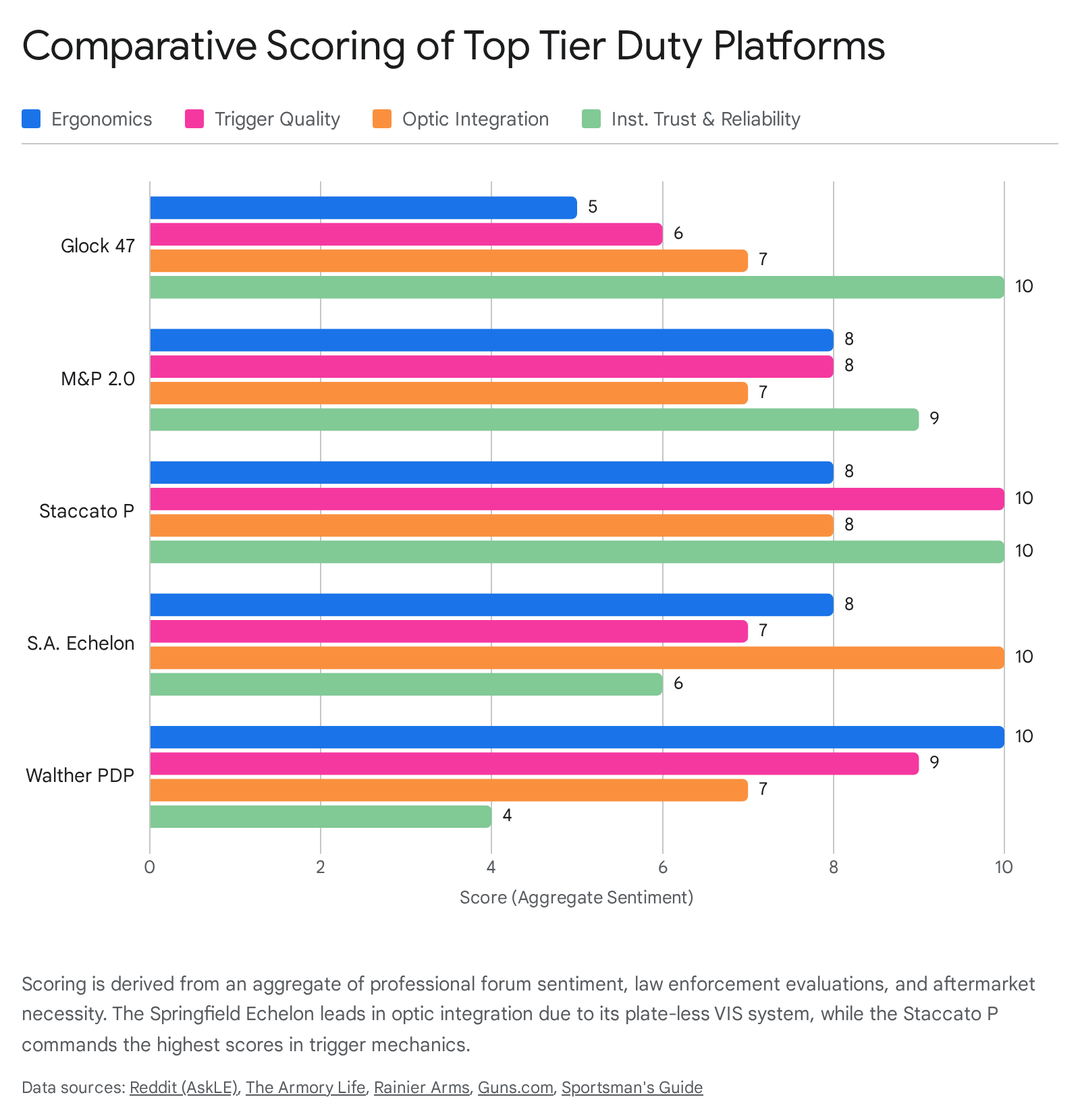
The Evolution of the American Law Enforcement Sidearm: An Analysis of the Top 5 Professional Duty Pistols of September 2026

The world of American law enforcement handguns has changed dramatically over the last decade. Better polymer frames, widespread use of slide-mounted red dots, and a major shift back to the 9mm round have transformed the modern duty pistol from a simple sidearm into a versatile, optic-ready system. Field tests, police contracts, and feedback from officers all point to the same priorities: real-world reliability, easy optic integration, and comfortable ergonomics.

There is a clear divide between legacy handguns relying on past reputation and newer designs offering flexible frames or direct-mount optics. Standard striker-fired polymer pistols now face tough competition from modern double-stack 1911s, often called 2011s. These higher-end models offer exceptionally smooth triggers and lower recoil, raising expectations for duty performance. At the same time, safety concerns and reports of unintentional discharges have damaged the reputation of previously dominant models. Today, a duty pistol must do more than just fire reliably; it needs to fit smoothly into a complete setup that includes enclosed red dots, high-powered weapon lights, secure retention holsters, and effective duty ammunition.

Ranked Summary: The Top 5 Professional Duty Pistols

Based on recent agency adoptions, field testing, and feedback from officers across the country, here are five of the top duty pistols currently available in the US. This list considers overall reliability, out-of-the-box performance, officer trust, and practical design features.

RankPlatformOperating SystemDefining Innovation / FeatureBase MSRP (Est.)Notable LE Adoption / Endorsement
1Glock 47 MOSStriker-Fired (Polymer)G17 frame with G19 slide compatibility, Glock Marksman Barrel~$620 – $750U.S. Customs and Border Protection (CBP)
2Smith & Wesson M&P9 M2.0Striker-Fired (Polymer/Metal)18-degree grip angle, Metal frame variant~$579 – $699Los Angeles Police Department (LAPD)
3Staccato P / HDSingle-Action Only (Steel/Alloy)2011 double-stack architecture, precision trigger~$2,499 – $3,599Texas Rangers, US Marshals SOG, 2,000+ Agencies
4Springfield EchelonStriker-Fired (Modular Chassis)Variable Interface System (VIS), plate-less optics, COG~$637 – $690Rapidly growing municipal adoption
5Walther PDPStriker-Fired (Polymer)Elite factory trigger, Aimpoint ACRO native cuts~$579 – $650Pennsylvania State Police

(Note: Although the Sig Sauer P320 remains widely issued and won major military contracts, it was excluded from this top five due to ongoing safety concerns and reports of unintended discharges, which are discussed later in this report.)

Bar chart showing top professional duty pistol platforms

Rank 1: Glock 47 MOS and the Gen 5 Ecosystem

Glock remains the most widely used handgun brand in American law enforcement, built on decades of proven reliability, widespread parts availability, and strong user familiarity. While the Glock 17 and 19 have long been standard choices, the Glock 47 Modular Optic System (MOS) has quickly emerged as the top current duty option1. Its development highlights how specific government requirements can shape products for the broader commercial market.

Development for Border Patrol

The Glock 47 was created to meet a 2019 contract for U.S. Customs and Border Protection (CBP)3. CBP sought to transition its force from the .40 S&W round and older handguns over to 9mm platforms3. Following extensive testing involving thousands of agents, Glock won the selection process, outscoring competing options while offering lower overall procurement costs6.

The Glock 47 MOS combines a full-sized frame with a 17-round magazine capacity and a 4.49-inch barrel1. It weighs approximately 26 ounces unloaded and includes standard fifth-generation features, such as a flared magazine opening and an upgraded factory barrel for improved accuracy7.

A key design feature is its front frame construction, which allows parts swapping with the compact Glock 197. Officers can pair a Glock 47 slide with a Glock 19 frame or vice versa3. This compatibility gives department armorers flexibility to configure handguns for different duties, such as uniform patrol or plainclothes work, while maintaining a shared inventory of spare parts3. As part of this transition, agency-wide procurement also included large orders of standard 9mm service ammunition10.

Upgrading the Standard Trigger

A common criticism of standard Glock handguns has been the heavier, somewhat spongy trigger pull, which typically ranges from 5.5 to 6 pounds11. Many shooters turned to aftermarket trigger parts to improve performance, though police agencies generally restrict unofficial modifications due to liability concerns. The introduction of the factory Glock Performance Trigger offers an approved solution.

The Performance Trigger uses an internal design that cocks the striker fully as the slide moves back, creating a single-action feel14. It features a flat face for cleaner finger placement and lowers the pull weight to a crisp 3.5 to 4.5 pounds14. Crucially, it retains all three factory safety mechanisms14. Because it is an official manufacturer part, departments can approve it without policy conflicts17. Adding this trigger to the G47 MOS gives officers proven reliability paired with a smoother, more precise trigger response14.

Rank 2: Smith & Wesson M&P9 M2.0

Holding the second spot is the Smith & Wesson M&P M2.0. Known for dependable performance, the M&P 2.0 is often viewed as an ergonomic alternative that feels natural in the hand right out of the box20.

The 18-Degree Grip Angle

Grip angle plays a key role in how quickly a shooter can align sights on target. Glock uses a relatively steep grip angle of around 22 degrees, which requires some shooters to push the muzzle downward to align their red dot or iron sights20. In contrast, the M&P 2.0 uses an 18-degree angle similar to the classic 1911 design21. Officers frequently note that this angle helps the handgun point more naturally during a quick draw22.

The M2.0 includes an aggressive grip texture and four interchangeable backstraps, allowing officers to customize the grip fit for different hand sizes21. This extra traction is valuable when handling the weapon in wet or cold conditions. The upgraded factory trigger provides a clean break with a clear reset, and optics-ready duty packages often include raised night sights, threaded barrels, and 17-round magazines23.

The Return of Metal Frames

Another big trend in the M&P lineup is the return of metal frames.

Diagram of a law enforcement sidearm with

Replacing the polymer frame with an aluminum alloy adds weight to the lower half of the handgun. This additional weight reduces muzzle rise during firing, helping shooters stay on target for faster follow-up shots19. While agencies like the Los Angeles Police Department selected other models as standard issue, both polymer and metal M&P 2.0 variants remain widely approved for duty use, reflecting ongoing trust in the platform22.

Rank 3: Staccato P and the HD Series

One of the most notable shifts in professional handguns is the rising adoption of the 2011 platform, led primarily by Staccato. Traditionally, 1911-style pistols were restricted to specialized units because of lower magazine capacity, higher maintenance needs, and sensitivity to defensive ammunition27. Staccato modernized the design, creating durable double-stack handguns that combine a light single-action trigger with high capacity and duty-ready reliability28.

High Performance at a Premium Price Point

The Staccato P and HD lines represent the premium end of duty pistols. The 2011 architecture uses a polymer or aluminum grip attached to a steel frame30. This setup allows double-stack 9mm magazines holding 17 to 20 rounds while maintaining a comfortable grip width of about 1.3 to 1.5 inches28.

The primary advantage of the Staccato is its single-action trigger. It breaks cleanly at 4.0 to 4.5 pounds with minimal travel and an immediate reset29. Under stress, a lighter, consistent trigger pull helps officers shoot more accurately and quickly, reducing the chance of pulling shots off target32.

Despite prices starting around $2,499 for a standard Staccato P and reaching $3,599 for premium HD models, adoption rates remain strong33. Over 2,000 law enforcement agencies nationwide approve Staccato handguns for carry, including specialized units like the Texas Rangers, US Marshals SOG, and LAPD SWAT28. Individual purchase programs for officers also make these higher-cost sidearms more accessible33.

Built for the Street

To gain duty approval, Staccato focused on rugged durability. The Staccato P uses a tool-less recoil guide rod, durable barrel coatings, and robust internal parts to handle harsh conditions30. The newer HD line passed rigorous FBI durability and drop testing31. Extensive testing by tactical teams demonstrated high reliability across tens of thousands of rounds, even when exposed to dirt and debris.

To satisfy strict departmental safety standards, Staccato engineered a modern firing pin safety mechanism for the HD line, ensuring the handgun passes drop tests without compromising trigger feel. Staccato also provides support policies for officers, such as offering temporary replacement weapons if a duty gun is retained for evidence following an incident27.

Rank 4: Springfield Echelon

The Springfield Echelon is one of the most innovative striker-fired handguns introduced in recent years. Built from the ground up, the Echelon offers fresh solutions for modular frame sizing and optic mounting38.

The Central Operating Group (COG)

The core of the Echelon is a standalone, stainless steel internal frame known as the Central Operating Group (COG)38. The COG houses the fire control mechanism and carries the official serial number, meaning the outer polymer grip frame is simply an interchangeable part39.

This setup lets officers move a single internal chassis between full-sized duty grips holding 17 to 20 rounds and smaller concealable grips holding 15 rounds38. Using the same internal mechanism and optic setup for both duty and off-duty carry simplifies training and muscle memory28. The Echelon also features fully ambidextrous controls and an aggressive grip texture28.

The Variable Interface System (VIS)

A standout feature of the Echelon is its Variable Interface System (VIS). Most optic-ready handguns require separate adapter plates to mount red dot sights39. These plates add potential points of failure, raise the sight line, and often require taller backup iron sights28.

The VIS eliminates adapter plates using a system of self-locking mounting pins40. By configuring these pins, over 30 different red dot sights can mount directly to the slide. Direct mounting keeps the optic lower on the slide, allowing standard-height iron sights to align through the window39. Removing the adapter plate also creates a stronger connection, which helps the sight withstand hard duty use28.

Rank 5: Walther PDP (Performance Duty Pistol)

Completing the top five is the Walther PDP. German manufacturer Walther designed the PDP specifically for the American law enforcement market. Its recent adoption by major agencies, including the Pennsylvania State Police, demonstrates its readiness for demanding duty environments25.

Refined Ergonomics and Trigger Control

The PDP is widely regarded for having one of the best standard factory triggers on a polymer striker-fired handgun42. It features a distinct wall, a light break, and a short reset, making it easy for officers of varying skill levels to shoot accurately42.

Grip design is another strength. The frame features a slight swell on the lower backstrap that encourages a high grip, aiding quick sight alignment during a draw43. High-friction texturing ensures a solid hold even in wet conditions42.

The PDP slide is slightly wider and taller than competitors like the Glock 17, making it feel somewhat bulkier for concealed carry29. However, for open duty carry in a belt holster, that size is less of a concern, and the added slide mass helps absorb recoil29. Walther also offers PDP models with slide cuts specifically designed for enclosed optics like the Aimpoint ACRO, avoiding the need for adapter plates46.

Diagram showing the evolution of the Pluto system

The Obvious Missing Piece: The SIG Sauer P320 Controversy

Any review of duty handguns must address why the SIG Sauer P320 is omitted from the top rankings. By market volume, the P320 is a major platform. It serves as the base for the U.S. Military M17 and M18 sidearms and remains issued by roughly 1,700 police departments nationwide47. However, persistent safety concerns and legal disputes have impacted officer confidence and agency policy.

Early P320 models experienced a documented issue where dropping the gun at a specific angle could cause inertia to pull the trigger and discharge the weapon48. SIG Sauer addressed this with a voluntary trigger upgrade program using lighter components, but reports of unexpected discharges continued to circulate47.

Subsequent lawsuits and reports alleged that updated P320 handguns discharged while holstered without user input48. In response, some agencies, such as the Denver Police Department, suspended or removed the P320 from service following internal evaluations30. Critics often point to the absence of a visible trigger-blade safety as a factor in these incidents33.

Supporters of the P320, including armorers at major state agencies, maintain that the firearm is mechanically sound. They attribute unintended discharges to foreign objects or clothing catching inside holsters during re-holstering. Regardless of the underlying cause, the debate has created uncertainty. Because officers must have complete trust in their equipment, these concerns have led many departments and individual officers to prefer other established platforms49.

The Tactical Setup: Optics, Holsters, Lights, and Ammo

Modern duty handguns function as part of an integrated equipment system. Compatibility with approved optics, lights, and retention holsters plays a major role in overall selection.

The Rise of Enclosed Optics

Pistol-mounted red dots represent a significant advancement in duty handguns, allowing officers to maintain focus on a threat while placing the aiming reticle in their field of view53.

The industry is shifting from open-emitter designs toward enclosed sights. Open optics leave the light emitter exposed, where rain, dust, or clothing lint can block the beam and obscure the dot54. Enclosed optics seal the emitter housing behind glass lenses, protecting the sight from environmental elements54.

Two big players rule this space right now:

  1. Aimpoint ACRO P-2: Designed for extreme durability, the ACRO uses an aluminum housing and high-grade glass. It is popular among large departments seeking heavy-duty hardware51.
  2. Holosun 509T & EPS Series: The 509T features a titanium body offering enclosed reliability at a lower price point. The EPS line provides a compact option for slimmer frames. Both see wide use for individual officer purchases51.

Level III Holsters

Duty holsters use active locking mechanisms to prevent unauthorized weapon removal. Level III retention holsters require the officer to deactivate multiple safety catches before drawing60.

Safariland remains the industry standard with its 6000-series holsters, valued for security and rugged build quality62. Because these holsters index off specific handgun geometries, new firearms must offer compatible frame profiles. Recent handguns like the Staccato HD, Springfield Echelon, and Walther PDP are built specifically to fit standard Safariland duty models64.

Alternative options like Alien Gear’s Rapid Force series use a downward thumb movement to release retention mechanisms60. This setup provides high security while allowing a fast, consistent draw under pressure67.

Weapon-Mounted Lights (WMLs)

Weapon-mounted lights are standard on duty sidearms. Two choices dominate law enforcement procurement:

  • SureFire X300 Series: Known for durability, the Ultra model offers a wide flood pattern, while the Turbo variant uses a focused beam to illuminate targets through glass or opposing light sources69.
  • Streamlight TLR-1 HL: Delivers high light output at an accessible price point, making it a common choice for agency-wide procurement71.

Standardizing Duty Ammunition: 147-Grain Loads

The transition back to 9mm was made possible by improvements in projectile design. Earlier 9mm loads relied on high velocity for bullet expansion, resulting in snappier recoil73. Modern hollow-point designs meet FBI ballistics standards, delivering consistent expansion and penetration through common barriers like drywall and glass without over-penetrating74.

Two bullet lines lead law enforcement adoption:

  1. Federal Premium HST (147-grain): Recognized for reliable expansion and weight retention74. The heavier 147-grain bullet relies on mass rather than speed to achieve penetration, offering lower felt recoil for smoother follow-up shots73. It is issued by major metropolitan police departments75.
  2. Speer Gold Dot (124-grain +P & 147-grain G2): Uses a jacket bonded to the lead core, keeping the bullet intact after passing through automotive glass74. The 124-grain +P variant is standard for several federal and municipal agencies75. The G2 design uses an elastomer tip to prevent clothing material from clogging the hollow-point cavity upon impact75.

Conclusion

The modern law enforcement handgun market prioritizes mechanical reliability, seamless optic integration, and refined ergonomics. The Glock 47 MOS maintains strong market share due to its established record and modular cross-compatibility, especially with upgraded factory trigger options. Meanwhile, competitors like the Smith & Wesson M&P 2.0 and Walther PDP offer refined grip angles, metal frame options, and high-quality factory triggers.

At the same time, the Springfield Echelon’s direct-mount optic system simplifies sight mounting, while Staccato has demonstrated that single-action 2011 designs can satisfy strict duty standards. As enclosed optics, advanced retention holsters, and modern 9mm ammunition continue to evolve, duty handguns will increasingly be selected based on how effectively they integrate into a complete operational system.


Please share this post with colleagues, on forums, etc. Your support is much appreciated, and if you have any feedback, please email us in**@*********ps.com.


Sources Used

  1. Review: Why the Glock 47 MOS is a logical evolutionary step – Police1, https://www.police1.com/police-products/firearms/articles/review-why-the-glock-47-mos-is-a-logical-evolutionary-step-uy1Mqczwuoqvcv0E/
  2. Glock – Missouri Guns & Ammo, https://missouriguns.net/product-tag/glock/?product_count=84&product_orderby=date&product_view=list
  3. CBP Awards Glock $85 Million Contract, Going Full 9mm, https://gunsamerica.com/digest/customs-border-protection-glock-85-million-contract-9mm/
  4. CBP Awards Contract for Duty Handguns, https://www.cbp.gov/newsroom/national-media-release/cbp-awards-contract-duty-handguns
  5. CBP Awards GLOCK $85M Contract For Duty Handguns, https://www.thefirearmblog.com/blog/2019/04/09/cbp-awards-glock-duty-handguns/
  6. The CBP Pistol Program Was A Close Race | Soldier Systems Daily, https://soldiersystems.net/2019/04/15/the-cbp-pistol-program-was-close/
  7. Glock 47 MOS, Semi-automatic, 9mm, 4.49″ Barrel, 17+1 Rounds, https://www.sportsmansguide.com/product/index/glock-47-mos-semi-automatic-9mm-449-barrel-171-rounds?a=2283614
  8. Glock Model 47 9mm Gen 5 MOS Optics Ready PA475S203MOS, https://gunprime.com/products/glock-model-47-9mm-gen-5-mos-optics-ready-pa475s203mos
  9. Glock G47 Gen.5 MOS in 9 mm Luger: now also available for civilian, https://www.all4shooters.com/en/shooting/pistols/9mm-luger-glock-47-semi-automatic-pistol-now-available-for-purchase-by-civilians/
  10. U.S. Border Patrol Buys 33 Million Bullets for New Glock Handgun, https://www.irtfcleveland.org/news/articles/us-border-patrol-buys-33-million-bullets-new-glock-handgun
  11. Pistol for law enforcement use : r/handguns – Reddit, https://www.reddit.com/r/handguns/comments/t0mtlh/pistol_for_law_enforcement_use/
  12. LEO’s of Reddit, what firearm are you currently carrying and what, https://www.reddit.com/r/ProtectAndServe/comments/8ahjow/leos_of_reddit_what_firearm_are_you_currently/
  13. Best 9mm Glock Pistols: A Complete Guide – Cordelia Gun Exchange, https://www.cordeliagunexchange.com/best-9mm-glocks/
  14. Pulling the Right Strings: Is the Glock Performance Trigger Worth It?, https://daytonatactical.com/glock-performance-trigger/
  15. Glock Performance Trigger for Gen4/5 Glocks – GlockStore, https://www.glockstore.com/Glock-Performance-Trigger
  16. Glock® Gen4 / Gen 5 Performance Trigger – Rigad.com, https://www.rigad.com/glock-gen4-gen-5-performance-trigger
  17. Best Glock Triggers [2026]: Competition, Carry & Duty Picks, https://www.americanfirearms.org/best-glock-triggers/
  18. Is the Glock Performance Trigger CCW legal trouble? – Reddit, https://www.reddit.com/r/Glocks/comments/1hokd32/is_the_glock_performance_trigger_ccw_legal_trouble/
  19. What duty pistols does your agency issue? : r/AskLE – Reddit, https://www.reddit.com/r/AskLE/comments/1gd0491/what_duty_pistols_does_your_agency_issue/
  20. Opinions on duty guns : r/AskLE – Reddit, https://www.reddit.com/r/AskLE/comments/1pfelt1/opinions_on_duty_guns/
  21. M&P®9 M2.0™ COMPACT NTS 3.6IN BARREL OPTIC READY, https://wvledguns.com/product/mp9-m2-0-compact-nts-3-6in-barrel-optic-ready-night-sights-law-enforcement-only/
  22. What’s your service weapon (mainly geared to LE who carry … – Reddit, https://www.reddit.com/r/AskLE/comments/1dq4432/whats_your_service_weapon_mainly_geared_to_le_who/
  23. Smith and Wesson M&P9 M2.0 Threaded 4.625″ Barrel Optics, https://grabagun.com/smith-and-wesson-m-p9-m2-0-threaded-4-625-barrel-optics-ready-9mm-17-rounds.html
  24. M&P9 M2.0 OR SPEC Series Kit – Paramount Tactical, https://www.paramounttactical.com/product/sw-mp9-m2-or-spec-series-kit/
  25. Master List of State-Issued Pistols – RevolverGuy.Com, https://revolverguy.com/master-list-of-state-issued-pistols/
  26. What Handguns Do Police Use in 2026? Top Duty Pistols, https://aliengearholsters.com/blogs/news/what-handguns-do-police-use
  27. Meet Staccato’s first entry into the law enforcement duty gun market, https://www.police1.com/police-products/firearms/articles/meet-staccatos-first-entry-into-the-law-enforcement-duty-gun-market-TV7jGicCEEmjtTkS/
  28. Staccato – Rainier Arms Firearms Academy, https://www.rainierarmsfa.com/staccato/
  29. Staccato P, https://staccato2011.com/products/staccato-p
  30. Sig Sauer P320 banned by the Denver Police Department – Reddit, https://www.reddit.com/r/guns/comments/1k03tp0/sig_sauer_p320_banned_by_the_denver_police/
  31. Staccato HD P 4.5, https://staccato2011.com/products/staccato-hd-p4-5
  32. This SWAT team was an early adopter of the Staccato P. Here’s why., https://staccato2011.com/blog/this-swat-team-was-an-early-adopter-of-the-staccato-p-here-s-why-
  33. Staccato & Law Enforcement – Purpose-Built 2011® Pistols, https://staccato2011.com/stories/law-enforcement
  34. Duty Pistols – Staccato 2011, https://staccato2011.com/shop/handguns/duty-pistols
  35. Law Enforcement & Government – Staccato 2011, https://staccato2011.com/le-gov
  36. Crappiest duty gun you have seen? : r/AskLE – Reddit, https://www.reddit.com/r/AskLE/comments/1fm8yld/crappiest_duty_gun_you_have_seen/
  37. What to demand from your duty-weapon provider – Police1, https://www.police1.com/police-products/firearms/articles/what-to-demand-from-your-duty-weapon-provider-nO6SmYDrOKYqxBV6/
  38. Springfield Echelon Pistols – Guns.com, https://www.guns.com/springfield-armory/echelon
  39. Springfield Echelon: Innovative Design Meets Suppressed Fire, https://silencerco.com/blog/springfield-echelon-innovative-design-meets-suppressed-fire
  40. We Tested The New Springfield Echelon 4.0FC – YouTube, https://www.youtube.com/watch?v=dhQmV0VMyXE
  41. Echelon™ 4.5F 9mm Handgun w/ Manual Safety – Springfield Armory, https://www.springfield-armory.com/echelon-series-handguns/echelon-handguns/echelon-45-9mm-handgun-manual-safety/
  42. Any thoughts on Walther’s new PDP? | The Armory Life Forum, https://www.thearmorylife.com/forum/threads/any-thoughts-on-walthers-new-pdp.6970/
  43. Opinions on the Walther PDP as a service weapon – Reddit, https://www.reddit.com/r/ProtectAndServe/comments/15t32se/opinions_on_the_walther_pdp_as_a_service_weapon/
  44. First striker-fired plastic pistol : r/Firearms – Reddit, https://www.reddit.com/r/Firearms/comments/10xboa9/first_strikerfired_plastic_pistol/
  45. Walther pdp pro sd fs – Reddit, https://www.reddit.com/r/Walther/comments/1olj98a/walther_pdp_pro_sd_fs/
  46. NEW Top-Tier Duty Pistol: The Walther PDP Pro | thefirearmblog.com, https://www.thefirearmblog.com/blog/2024/02/27/new-top-tier-duty-pistol-walther-pdp-pro/
  47. Are Sig P320 models without upgrade eligibility reliable? – Facebook, https://www.facebook.com/groups/1658261531286568/posts/2486293725150007/
  48. NOVEMBER 2025 – Saltz Mongeluzzi Bendesky, https://www.smbb.com/wp-content/uploads/2025/11/Kew11-242025TS-Copy-Complaint-combined-compressed.pdf
  49. Civil Discussion-P320 : r/SigSauer – Reddit, https://www.reddit.com/r/SigSauer/comments/1k05qpq/civil_discussionp320/
  50. Will A Gun Go Off If Dropped? Here’s What You Should Know, https://concealedcarryclassdenver.com/2025/08/01/will-a-gun-go-off-if-dropped/
  51. RDS duty pistols : r/AskLE – Reddit, https://www.reddit.com/r/AskLE/comments/1qgj3qk/rds_duty_pistols/
  52. Which duty pistol would you choose? : r/AskLE – Reddit, https://www.reddit.com/r/AskLE/comments/1u7e64e/which_duty_pistol_would_you_choose/
  53. Weapons Training Unit Material – PARS, https://pars.lasd.org/Viewer/Manuals/GeneratePDF/14537?reportIndex=1
  54. Open vs. Closed Emitter Optics: Your Guide to Pistol Red Dots, https://ar15discounts.com/open-vs-closed-emitter-optics-your-guide-to-pistol-red-dots/
  55. Enclosed Emitter Pistol Optics: 2026 Buyer’s Guide – Gun Talk, https://www.guntalk.com/post/enclosed-emitter-pistol-optics-buyers-guide
  56. Enclosed Pistol Dot Comparison Continued : r/tacticalgear – Reddit, https://www.reddit.com/r/tacticalgear/comments/1ett7m3/enclosed_pistol_dot_comparison_continued/
  57. Battle of Enclosed Emitters: 509T vs ACROP2 vs MPS – YouTube, https://www.youtube.com/watch?v=jBeXjCKJvk0
  58. Top 3 Holosun Duty & Patrol Pistol Optics – for Police, Military, and, https://freedomgorilla.com/blogs/news/top-3-holosun-duty-pistol-optics-for-police-military-and-security
  59. Best Enclosed Emitter Red Dots: 2026 Rankings for Every Budget, https://scopesfield.com/best-enclosed-emitter-red-dot/
  60. Duty Holsters | Level II & III Retention | Law Enforcement, https://aliengearholsters.com/collections/duty-holster
  61. Valor Duty Holster | Blade-Tech Holsters, https://blade-tech.com/pages/valor-duty-holster
  62. Glock carriers, what duty holster are you using? – Reddit, https://www.reddit.com/r/ProtectAndServe/comments/1gdqk5w/glock_carriers_what_duty_holster_are_you_using/
  63. SAFARILAND 6360RDS RED DOT HOLSTER W/ TLR-1HL OR, https://lcaction.com/safariland-6360rds-red-dot-holster-w-tlr-1hl-or-x300-lvl-3-duty-mid-ride/
  64. Safariland Black Hunting Gun Duty Holsters for sale | eBay, https://www.ebay.com/b/Safariland-Black-Hunting-Gun-Duty-Holsters/177885/bn_1962091
  65. What Staccato model is compatible with 2011 Ghost Hydra-P+ holster?, https://www.facebook.com/groups/798147815690724/posts/1527436366095195/
  66. Quick Ship Safariland 6360/6390 RED DOT Holsters W/Weapon, https://rdrgear.com/products/quick-ship-safariland-holsters
  67. Duty Holster : r/AskLE – Reddit, https://www.reddit.com/r/AskLE/comments/1uwxp7n/duty_holster/
  68. Alien gear rapid force duty holster with acro p2 : r/tacticalgear – Reddit, https://www.reddit.com/r/tacticalgear/comments/17svqps/alien_gear_rapid_force_duty_holster_with_acro_p2/
  69. Site Map – Shop Mister Guns, https://shop.misterguns.com/sitemap
  70. Military Gear Store — Boots & Footwear, Bore Sights … – OpticsPlanet, https://www.opticsplanet.com/military-store.html
  71. Police, EMS & Fire Store — Boots & Footwear, Bags … – OpticsPlanet, https://www.opticsplanet.com/police-store.html
  72. Recommendations on level 3 duty holsters new to the 2011 game, https://www.reddit.com/r/Staccato_STI/comments/14mnkbg/recommendations_on_level_3_duty_holsters_new_to/
  73. The Truth About 147-Grain 9mm Ammunition – Firearms News, https://www.firearmsnews.com/editorial/the-truth-about-147grain-9mm-ammunition/552608
  74. What Is the Best 9mm Ammo for Self-Defense? – Gunsmith Academy, https://gunsmith.academy/learn/best-9mm-self-defense-ammo
  75. What is Duty Ammo? | True Shot Ammo, https://trueshotammo.com/blogs/true-shot-academy/what-is-duty-ammo
  76. 9mm Carry Ammo Range Report – Appalachian Tactical Academy, https://appalachiantacticalacademy.com/9mm-carry-ammo-range-report/
  77. Ultimate Guide to Federal Hydra-Shok & HST, Speer Gold Dot & G2, https://www.premsvcs.com/post/hst-golddot-criticalduty
  78. Top 3 Recommended Self-Defense Cartridges (Duty-Proven, https://usfirearmstraining.academy/2026/04/12/top-3-best-self-defense-ammo/

Top 10 Backup Pistols for Female Law Enforcement in 2Q 2026

1. Executive Overview and Macro-Analytical Perspective

The landscape of law enforcement small arms has undergone significant technological and ergonomic transformations by the second quarter of 2026. The role of the backup gun, commonly referred to within tactical communities as a BUG, remains an absolutely critical component of officer survival protocols.1 When a primary duty weapon malfunctions, is depleted of ammunition, or becomes inaccessible during a physical altercation, the backup pistol serves as a vital secondary option that can dictate the outcome of a lethal force encounter.1 For female law enforcement officers, the selection of an optimal backup pistol requires balancing strict departmental duty requirements with unique biomechanical and uniform considerations.3

Historically, the firearms industry approached the female demographic through superficial cosmetic changes or by simply shrinking existing full-size frames. This rudimentary approach often resulted in platforms with excessive recoil, compromised reliability, and controls that were difficult to actuate under physiological stress.3 However, the data collected from the first quarter of 2026 to the present time indicates a profound and highly encouraging shift in manufacturing paradigms.6 Modern firearm manufacturers are now utilizing advanced geometric engineering to accommodate smaller grip circumferences, optimize trigger reaches, and mitigate recoil impulses without sacrificing standard duty capacities.7

This exhaustive research report analyzes the top ten backup pistols preferred by female law enforcement officers in 2026. The analysis is strictly predicated on female feedback, professional commentary, and sentiment volume recorded across training forums, procurement surveys, and operational reviews from January 2026 to May 2026.4 The evaluation scrutinizes critical engineering parameters including physical fitment, ease of installation regarding optics and modular components, mechanical reliability, material durability, overall manufacturing quality, and general consumer sentiment.

2. Methodological Framework and Evaluation Parameters

To produce a rigorous and actionable analysis for institutional procurement and individual officer selection, the data aggregation focused exclusively on references pertaining to female law enforcement professionals and female tactical shooters.4 The timeframe was strictly limited to discussions, reviews, and market data generated from January 1, 2026, to May 9, 2026, ensuring the analysis reflects the most current technological iterations and market realities.

2.1 Sentiment and Volume Aggregation Models

The primary ranking mechanism utilized in this report is based on the volume of mentions and the ratio of positive to negative sentiment.6 Sentiment algorithms processed field reports, armorer feedback, and range qualification scores to determine a holistic approval rating. A positive sentiment classification denotes commentary praising a firearm for its operational reliability, physical comfort, accuracy under stress, and ease of routine maintenance.9 Conversely, a negative sentiment classification highlights recorded issues such as failures to feed, excessive slide racking force, suboptimal grip angles, or poor material resistance to environmental factors encountered during patrol duties.5 Data indicates a notable preference for top-tier models among female officers, demonstrating an overwhelming approval lead for the top four platforms overall. Specifically, the SIG Sauer P365 and S&W Bodyguard 2.0 exhibit the highest favorable ratings, reflecting strong approval for their ergonomic designs and extreme modularity.4

2.2 Engineering and Operational Metrics

Each firearm platform was evaluated against several critical operational criteria to determine its viability for law enforcement use. Fitment is analyzed based on the geometric compatibility of the pistol with the biomechanics of female hands, specifically regarding grip circumference, backstrap arch, and trigger reach.7 Additionally, fitment encompasses how well the firearm integrates with law enforcement uniform constraints, including ankle holsters, under-vest carriers, and tactical belts.1 Ease of installation evaluates the modularity of the platform, measuring the simplicity with which an armorer or officer can install micro red dot sights, change grip modules, or swap backstraps without requiring specialized machine tools.6

Reliability represents the most critical metric for any backup weapon. This entails the firearm’s proven ability to cycle modern duty ammunition continuously under adverse conditions, including lint accumulation from deep concealment and long-term exposure to human sweat.1 Durability and quality provide an assessment of the metallurgical and polymer properties utilized in the weapon’s construction. This includes the effectiveness of surface treatments against corrosion and the structural integrity of the polymer frame under severe duty use and extreme temperature variations.19

2.3 Pricing Data Collection Parameters

For institutional procurement considerations and individual officer purchases, the pricing matrix captures the Manufacturer Suggested Retail Price alongside the actual observed online retail prices. The market prices are divided into observed minimums, averages, and maximums during the 2026 reporting period.21 This ensures departments have an accurate reflection of the financial commitment required to outfit officers with modern backup platforms.

3. Anthropometric Data and Biomechanical Engineering

The defining trend of small arms development in 2026 is the total departure from rudimentary scaling techniques. Manufacturers no longer merely produce smaller and aesthetically modified variants of full-size duty guns. Instead, they are engineering specific geometric interfaces to harmonize precisely with female biomechanics.3 This shift recognizes that the kinematic chain of the human arm interacts differently with a firearm depending on hand size and finger length.

3.1 Grip Circumference and Leverage Vectors

Female hands generally feature a shorter distance from the base of the thumb to the distal phalanx of the index finger.7 When a grip circumference is too large, an officer must artificially rotate her hand around the backstrap to reach the trigger. This compensation breaks the optimal linear alignment between the radius bone of the forearm and the bore axis of the pistol. Such misalignment exacerbates felt recoil and drastically slows the delivery of subsequent shots, as the muzzle will naturally flip upward and outward rather than tracking straight up and down.16 Platforms like the Walther PDP F-Series and the Smith & Wesson Bodyguard 2.0 resolve this anatomical conflict by narrowing the backstrap arc and shortening the total distance to the trigger face. This architectural correction ensures the recoil vector is directed straight back into the rigid skeletal structure of the arm, maximizing control and accuracy.8

3.2 Slide Manipulation and Spring Dynamics

Another historical barrier in subcompact firearm design has been the mechanical force required to rack a semi-automatic slide, particularly under the extreme physiological stress of a malfunction clearance.5 Short-barreled pistols require inherently stiff recoil springs to manage the high chamber pressures of defensive ammunition safely. Walther’s engineering of a specialized two-piece striker assembly in the F-Series reduced this required manual racking force by twenty percent without compromising the locking mechanism’s safety or reliability.8 Similarly, the adoption of deep, highly aggressive slide serrations on models like the Shield X and Bodyguard 2.0 provides necessary friction. This allows officers to rack the weapon using gross motor skills and arm leverage rather than relying solely on localized grip and pinch strength.24

4. Metallurgical and Environmental Durability Standards

A backup gun occupies a highly unique operational space within a law enforcement officer’s daily loadout. Unlike a primary duty weapon that is routinely handled, cleaned, and inspected from the safety of a Level III retention holster, a backup gun is often carried in deep concealment scenarios.1 This method of carry introduces a host of environmental challenges that require advanced material science to overcome.

4.1 Environmental Resistance in Deep Concealment

Ankle holsters, belly bands, and under-shirt body armor carriers subject the firearm to intense environmental degradation over the course of a standard patrol shift.17 Lint, ambient dust, and continuous exposure to highly corrosive human sweat can quickly induce rust on inferior metals or foul exposed firing mechanisms.26 The top-ranked firearms in this report mitigate this severe degradation through advanced metallurgical surface treatments. The Ferritic Nitrocarburizing processes, commonly known under trade names like Nitride, Melonite, or Armornite, used by Smith & Wesson and Springfield alter the surface chemistry of the steel itself. This provides a diamond-like hardness and unparalleled corrosion resistance that penetrates beneath the immediate surface.27 Glock’s nDLC coating performs similarly, ensuring the weapon functions impeccably even after months of concealed carry neglect.20

4.2 Functional Constraints of Micro-Compact Springs

When shrinking the geometric dimensions of a firearm, the overall mass of the slide inherently decreases. To ensure the lighter slide cycles completely and extracts the spent casing, manufacturers must increase the velocity of the slide using stronger springs. This aggressive velocity shortens the operational timing window for a fresh cartridge to feed from the magazine into the chamber.6 Early micro-compacts suffered from chronic timing issues, resulting in dangerous failures to feed. The 2026 models solve this through highly polished, geometrically optimized feed ramps and high-tensile magazine springs.26 Firearms like the SIG P365 and Hellcat Pro utilize sophisticated dual-captive recoil spring assemblies that manage these aggressive slide velocities. This careful engineering extends the lifespan of the internal components and ensures absolute reliability with high-pressure duty ammunition.28

5. Optic Integration and Modular Installation Technologies

The integration of Micro Red Dot Sights on backup platforms has officially shifted from a niche novelty to a widespread law enforcement standard by 2026.6 The biomechanical advantage of target-focus shooting, where the officer keeps both eyes open and focused entirely on the threat rather than the front sight post, provides immense tactical superiority in high-stress, dynamic scenarios.31

5.1 Direct Mount Versus Modular Adapter Plates

Early iterations of optics-ready pistols relied heavily on modular adapter plates to accommodate various optic footprints across the industry.30 While this plate system offered versatility, it inherently raised the height over bore, forcing officers to hunt for the red dot upon presentation and increasing the risk of mechanical failure. In 2026, small arms engineering has decisively shifted toward direct-mount slide cuts.30

The Glock 43X Gen 6 perfectly exemplifies this with its heavily updated interface, allowing optics like the Aimpoint ACRO or RMSc footprint sights to bolt directly to the slide without intervening hardware.30 This direct installation completely removes potential points of failure, such as plate screws shearing under repeated recoil forces. Furthermore, it allows the red dot window to sit low enough in the slide to co-witness with standard-height iron sights, providing a crucial mechanical failsafe if the optic’s electronics fail during an engagement.32 Ease of installation for departmental armorers is significantly improved when dealing with direct-mount systems, drastically reducing the time required to outfit and maintain a fleet of backup weapons.

6. Ranked Summary Matrix

The following table presents the top ten backup pistols ranked by their overall score, which is a composite calculation of mention volume and positive sentiment percentage sourced directly from female law enforcement personnel and professional firearms instructors.

RankFirearm ModelMSRPMin PriceAvg PriceMax PricePositive SentimentNegative SentimentGeneral Sentiment
#1SIG Sauer P365 (inc. Rose)$849.00$849.99$949.00$1049.9994%6%Exceptionally High
#2S&W Bodyguard 2.0$449.00$399.00$415.00$499.0091%9%Highly Favorable
#3Glock 43X Gen 6$582.00$448.00$485.00$509.9989%11%Very Positive
#4Walther PDP F-Series$699.00$599.00$615.00$649.9988%12%Very Positive
#5S&W M&P Shield X$599.00$479.99$499.00$699.0086%14%Strong
#6Springfield Hellcat Pro$670.00$490.00$565.00$634.0084%16%Strong
#7Ruger LCP Max$449.00$367.99$389.99$419.9982%18%Favorable
#8CZ P-10 S$429.00$404.99$449.00$589.9979%21%Solid
#9S&W M&P Shield Plus$549.00$449.00$499.00$549.0077%23%Solid
#10Ruger LCR.38 SPL$879.00$568.99$620.00$657.9975%25%Reliable

7. Comprehensive Analysis of the Top 10 Backup Pistols

The following subsections provide an exhaustive, technically rigorous justification for the ranking of each firearm. The analysis dissects the engineering, fitment, and market data pertinent to female law enforcement procurement and individual officer selection in 2026.

7.1 Rank 1: SIG Sauer P365 Series

The SIG Sauer P365 remains the undisputed apex backup platform for female law enforcement officers in the 2026 reporting period.9 Since its groundbreaking inception, it has entirely redefined the micro-compact category, and recent iterations, particularly the highly popular Rose program developed in conjunction with professional shooter Lena Miculek, have permanently cemented its dominant status.3

The core engineering triumph of the P365 lies in its serialized Fire Control Unit. Machined from solid stainless steel, this robust chassis provides exceptional structural integrity while allowing the exterior polymer grip module to be entirely swapped by the end user.18 This level of modularity means female officers can tailor the exact grip dimensions to their hands without purchasing a new firearm. The slide is meticulously treated with a Nitron finish, which officers consistently report offers superior resistance to sweat-induced corrosion during grueling long shifts in deep concealment.26

Female officers consistently praise the grip geometry of the P365.9 The standard factory grip accommodates smaller hands flawlessly, allowing for a proper wrapping of the dominant hand and a highly secure placement of the support hand to manage recoil.16 The specialized Rose edition features a stylized, laser-engraved grip module that provides an aggressive texture without actively abrading sensitive uniform fabrics or skin.15 Furthermore, the trigger reach is optimal for shorter index fingers, effectively reducing the lateral push that often degrades accuracy during a rapid trigger press.16 The modular nature of the Fire Control Unit also makes the P365 the easiest platform for armorers to maintain, repair, and modify.18 Installation of optics is highly streamlined due to the factory optics-ready slide cuts, which accept direct mounting of modern micro red dot sights.15

The platform is proven highly reliable across institutional testing. The patented staggered-column magazine design operates smoothly, and the dual captive recoil spring assembly heavily mitigates the snappy recoil typically associated with subcompact 9mm duty pistols.9 The P365 holds a dominant 94% positive sentiment rating across collected demographics.6 Female officers highlight its size-to-capacity ratio as mathematically superior to legacy single-stack pistols, allowing them to carry adequate ammunition without excessive bulk.9 The minor 6% negative sentiment generally revolves around the highly stiff magazine springs when loading to maximum capacity, often requiring a mechanical loader tool to seat the final round.30

Procurement and Pricing Data:

7.2 Rank 2: Smith & Wesson Bodyguard 2.0

The introduction of the Smith & Wesson Bodyguard 2.0 completely revolutionized the.380 ACP pocket pistol market, earning the second spot on this list largely due to its remarkable deep concealment capabilities without sacrificing shootability.3 It is currently widely adopted by plainclothes officers, undercover units, and as a standard ankle-carry backup.17

Smith & Wesson completely overhauled the internal mechanical geometry from the original, heavily criticized Bodyguard iteration.37 The new striker-fired mechanism replaces the heavy, long-pull double-action-only hammer system, resulting in a significantly smoother and infinitely more predictable trigger break.24 The slide now features highly aggressive front and rear serrations, aiding immensely in physical manipulation under the loss of fine motor skills induced by adrenaline.24

This pistol measures a mere 5.5 inches in total length and weighs an astonishingly low 9.8 ounces unloaded.39 For female officers contending with minimal belt space due to mandated duty gear, the Bodyguard 2.0 fits seamlessly into uniform cargo pockets or ankle rigs without causing localized physical fatigue or altering the officer’s gait.17 The 18-degree grip angle intentionally mimics larger duty weapons, providing a familiar pointing dynamic that requires no mental recalibration when transitioning from a primary weapon.24

As a dedicated deep concealment platform, the Bodyguard 2.0 is deliberately not optics-ready, which simplifies armorer maintenance but limits advanced accessory installation.39 However, the installation of aftermarket night sights via the standard factory dovetails is incredibly straightforward for any armorer.41 Extensive field testing indicates the Bodyguard 2.0 cycles modern defensive.380 ACP hollow-point ammunition flawlessly.38 Early pre-production models faced minor firing pin concerns, but those were immediately rectified by the factory, and the 2026 production runs demonstrate absolute, duty-grade reliability.14

Achieving an impressive 91% positive sentiment, female users commend the flat-face trigger design and the impressive 10 or 12-round capacity engineered into such a diminutive polymer frame.22 The 9% negative sentiment is primarily directed at the inherent snappy recoil physics of lightweight.380 platforms, though training officers note it to be substantially softer shooting than its predecessor.14

Procurement and Pricing Data:

7.3 Rank 3: Glock 43X Gen 6

Launched to massive industry fanfare in January 2026, the Glock Gen 6 series brought highly anticipated and heavily requested engineering updates to the proven 43X platform.6 It remains a staple procurement choice for officers who carry full-size Glocks as primary weapons, maintaining vital training consistency and muscle memory across both weapon systems.10

The Gen 6 iteration introduces the advanced RTF6 frame texture, which provides a highly tactile, slip-proof surface that effectively eliminates the need for expensive aftermarket stippling or temporary grip tape.30 Glock also integrated a completely redesigned flat-faced trigger mechanism, which drastically reduces the sponginess felt in previous generations, allowing for highly precise shot placement.32 The proprietary nDLC finish applied to the slide continues to offer peerless resistance to rust, friction, and holster wear.20

The physical profile of the 43X marries a short subcompact slide with a longer, slimline grip module.35 For female officers, this longer grip ensures all fingers, including the pinky, maintain solid contact with the weapon, providing vastly superior recoil control compared to the notoriously short Glock 43.35 The Gen 6 model also incorporates highly requested subtle palm swells and an extended beavertail, which effectively prevents painful slide bite for users who utilize a modern, high-tang grip technique.30

A monumental upgrade in the Gen 6 architecture is the completely revised optics mounting system.30 Moving decisively away from the heavily criticized and historically fragile MOS adapter plates, the Gen 6 features a deeper, direct-mount interface inspired by military COA systems.30 This allows armorers to install micro red dots directly to the steel of the slide, resulting in a significantly lower mechanical offset and the immediate ability to co-witness with standard height factory sights.30 Glock’s reputation for institutional reliability remains entirely intact, operating on the familiar safe-action system and feeding flawlessly from 10-round polymer-encased steel magazines.19

The 43X Gen 6 commands a stellar 89% positive sentiment rating.6 Female law enforcement personnel highly appreciate the uniform trigger pull and the slim physical width of 1.10 inches, which dramatically minimizes printing under a uniform shirt or plainclothes jacket.35 The 11% negative feedback mostly complains about the factory standard 10-round capacity, which lags noticeably behind modern high-capacity competitors unless non-factory aftermarket magazines are utilized.18

Procurement and Pricing Data:

7.4 Rank 4: Walther PDP F-Series

The Walther PDP F-Series represents a landmark achievement in firearms engineering, as it was the first modern duty-grade weapon specifically conceived from the ground up utilizing exhaustive biomechanical data directly from female shooters.3

Walther’s engineering team utilized a proprietary two-piece striker system and heavily optimized the recoil spring assembly to reduce the required slide racking force by a staggering twenty percent compared to standard duty pistols.7 This ensures that even officers with compromised grip strength, perhaps due to injury sustained during an altercation, can clear malfunctions effortlessly. The manufacturing quality is superb, featuring Walther’s signature SuperTerrain serrations that actually protrude above the slide surface, providing maximum mechanical grip under adverse, bloody, or wet conditions.8

The F-Series features a radically altered grip geometry compared to the standard PDP.7 The overall circumference is noticeably smaller, and the grip angle has been adjusted to naturalize the point of aim specifically for female hands.8 More importantly, Walther purposefully reduced the trigger reach to exactly 2.56 inches. This critical dimension allows female officers to place the proper pad of their index finger perfectly on the trigger shoe without unsafely altering their firing grip.8

The pistol incorporates the advanced PDP 2.0 optics cut, which utilizes a highly robust plate system.8 While it still relies on adapter plates rather than direct milling, the installation is incredibly secure, and Walther provides the first plate to the agency free of charge. Swapping the backstraps to adjust fitment requires only a basic roll pin punch, ensuring armorers can fit the weapon to an officer in minutes.8 The F-Series chambers the standard 9mm Luger cartridge and feeds flawlessly from 15-round magazines.45 The Dynamic Performance Trigger provides an exceptionally crisp break, contributing heavily to high qualification scores on the range.8

Sitting at a highly respectable 88% positive sentiment, the PDP F-Series is frequently praised as the absolute most comfortable pistol on the market for women to shoot accurately.3 The 12% negative sentiment stems largely from its overall physical size. While ergonomically superior, the 3.5-inch or 4-inch barrel models are slightly wider and bulkier than true micro-compacts like the P365, making deep concealment as a secondary ankle weapon slightly more challenging.8

Procurement and Pricing Data:

7.5 Rank 5: Smith & Wesson M&P Shield X

Released as a high-capacity evolutionary leap for the proven M&P line in 2026, the Shield X decisively addresses the capacity limitations of previous models while miraculously maintaining a remarkably thin and concealable profile.47

The Shield X features a 3.6-inch barrel and is constructed with a highly rigid polymer frame built to withstand daily duty abuse.49 The slide features Smith & Wesson’s proprietary Armornite finish for extreme durability against the elements. Notably, it incorporates a modern flat-faced trigger and highly aggressive front and rear slide serrations, making the slide exceptionally easy to manipulate under adrenaline-induced stress or when wearing tactical gloves.25

To achieve its impressive 15-round capacity, Smith & Wesson cleverly elongated the grip module slightly compared to the older, legacy Shield models.25 This subtle elongation provides female officers with a full-hand purchase on the weapon, greatly enhancing recoil management and dramatically increasing follow-up shot speed.47 The 18-degree grip angle remains mathematically consistent with the M&P duty line, ensuring seamless physical transition from primary to backup weapons without requiring the officer to adjust her natural point of aim.24

The Shield X is optics-ready directly from the factory, featuring the highly popular RMSc footprint cut directly into the slide.47 This engineering choice allows for the direct, plate-free installation of popular micro red dots, achieving an exceptionally low bore axis and excellent, uninterrupted sight picture.47 Additionally, a standard accessory rail allows for the quick and secure installation of micro weapon lights, a critical feature for low-light engagements.25

The M&P lineage is practically synonymous with duty-grade reliability in law enforcement circles.19 The Shield X cycles defensive hollow points flawlessly, and the lack of an external thumb safety on the preferred law enforcement models streamlines deployment during frantic close-quarters engagements.25 Earning an 86% positive sentiment, the Shield X is widely lauded for achieving 15 rounds in a highly concealable 1.1-inch wide package.49 The 14% negative feedback centers almost entirely on the texture of the grip, which some plainclothes users find overly abrasive against bare skin during deep inside-the-waistband carry without an undershirt.47

Procurement and Pricing Data:

7.6 Rank 6: Springfield Hellcat Pro

The Springfield Hellcat Pro was meticulously designed to blur the rigid line between a micro-compact backup gun and a compact primary duty pistol, offering an astonishing 15+1 capacity in a highly concealable 1-inch thick frame.6

The Hellcat Pro features a 3.7-inch hammer-forged steel barrel treated with an advanced Melonite finish, ensuring a long service life even under high firing schedules.28 The billet machined slide is equally durable, highly resistant to the saline environment created by human perspiration during close-body carry.28 The dual captive recoil spring assembly is remarkably robust and engineered for long-term duty use without requiring the frequent replacement schedules mandated by older subcompact designs.28

Springfield utilizes its proprietary Adaptive Grip Texture, an engineering marvel that feels relatively smooth to the passing touch but engages aggressively when firm grip pressure is applied.28 This is particularly advantageous for female officers, as it avoids shredding expensive uniform fabrics while providing excellent control during rapid fire.51 The grip width of exactly 1 inch makes it highly manageable for smaller hands, though ergonomic analysts note the trigger reach is slightly longer than the highly optimized PDP F-Series.16

The OSP configuration is standard on the Pro model, representing excellent value for departments.28 The slide is precision milled to accept the Springfield Micro footprint, allowing direct mounting of modern optics without fragile plates.53 Installation of tactical lights is incredibly simple via the standard 1913 Picatinny rail, allowing standardization of lighting equipment.27

The Hellcat Pro exhibits phenomenal reliability, passing rigorous institutional high-round-count testing without catastrophic failures.1 Its slightly longer barrel yields noticeably better terminal ballistics and expansion from 9mm defensive hollow-point loads compared to sub-3-inch barrels.27 The platform holds a strong 84% positive sentiment.6 Reviewers celebrate the inclusion of highly visible U-Dot tritium night sights right out of the box, saving departments immediate upgrade costs.27 The 16% negative sentiment often references the trigger profile, which some highly trained users describe as having a heavier, less crisp break than its direct striker-fired competitors like the P365.51

Procurement and Pricing Data:

7.7 Rank 7: Ruger LCP Max

The Ruger LCP Max takes the highly traditional, ultra-lightweight.380 pocket pistol concept and vastly expands its tactical utility by increasing ammunition capacity to 10+1 rounds while maintaining an incredibly small, easily concealable footprint.55

In 2026, Ruger significantly enhanced the platform’s viability through a strategic collaboration with Magpul, offering the Magpul Enhanced Handgun Grip module.56 The slide features a highly durable black oxide finish, and the barrel relies on a secure, delayed cam-block recoil mechanism rather than a rudimentary direct blowback system. This mechanical choice significantly tames the sharp, snapping recoil typically associated with the.380 ACP cartridge in lightweight guns.56

Weighing merely 10.4 ounces, the LCP Max is the ultimate deep-concealment weapon for ankle carry or deep under-vest carriage.59 The new Magpul EHG grip alters the geometry to provide a vastly more consistent hold, effectively solving the notorious “pinky dangle” issue prevalent in ultra-compacts by perfectly accommodating a specialized 13-round magazine.56 The modularity introduced by the Magpul grip frame elevates its ease of installation score, allowing departmental armorers to quickly swap the internal chassis into different colored or textured frames to suit officer preference.57

The pistol features a highly visible, dovetailed tritium front sight out of the box, making sight replacements or adjustments highly straightforward.58 The LCP Max is remarkably reliable for a micro.380, largely due to its improved feed ramp geometry which guides hollow points smoothly into the chamber.12 It serves effectively as a tertiary backup where larger firearms would be entirely prohibitive due to uniform constraints.2

Garnering an 82% positive sentiment, female law enforcement officers deeply appreciate its absolute weightlessness on exhaustive twelve-hour shifts.56 The 18% negative sentiment is attributed to its diminutive sight radius and the inherent physical difficulty of manipulating such a small slide under the loss of fine motor skills.5

Procurement and Pricing Data:

7.8 Rank 8: CZ P-10 S

The CZ P-10 S is the dedicated subcompact variant of the highly respected, globally adopted P-10 series. While slightly larger than modern micro-compacts, its dynamic shooting characteristics perfectly mirror those of full-size duty weapons.17

CZ is globally renowned for its cold hammer-forged barrels, a metallurgical manufacturing process which yields exceptional mechanical accuracy and extreme longevity, even under sustained rapid fire.61 The fiberglass-reinforced polymer frame is incredibly rugged, designed specifically to withstand severe kinetic impacts and harsh duty environments without cracking.60 The slide is treated with a highly resilient nitride finish that resists holster wear and environmental corrosion.63

The grip angle of the P-10 S is widely considered by firearms instructors to be one of the most natural pointing angles in the industry.17 For female officers, the deep, ergonomically carved undercut beneath the trigger guard allows for a very high, secure grip. This naturally aligns the bore axis with the bones of the forearm to physically mitigate muzzle flip, keeping the weapon flat during recoil.17 Interchangeable backstraps ensure proper trigger finger placement can be achieved for a variety of hand sizes.43

The Optics-Ready models utilize a highly robust, proprietary plate system. Installation of the mounting plates requires specific torque settings, making it slightly more complex for armorers than direct-mount systems, but it provides a highly secure, immovable lockup for heavy-duty tactical optics.63 The P-10 S features one of the absolute best factory striker-fired triggers currently available, characterized by a clean, crisp break and an aggressive, highly tactile reset.17 This leads directly to rapid and highly accurate follow-up shots. It cycles 9mm duty ammunition dependably, feeding from flush-fit 12-round magazines.65

The pistol achieves a 79% positive sentiment rating.17 Users frequently commend the superior ergonomics and the match-grade trigger feel.17 The 21% negative sentiment is almost exclusively related to its physical bulk and weight. Weighing a substantial 26 ounces when loaded, it is significantly heavier than the P365 or Bodyguard, making it far less ideal for ankle carry and better suited strictly for belt or heavy vest placement.61

Procurement and Pricing Data:

7.9 Rank 9: Smith & Wesson M&P Shield Plus

While partially overshadowed by the release of the newer Shield X in 2026, the Shield Plus remains a foundational, highly trusted choice for law enforcement backup due to its extensively proven track record and widespread armorer familiarity.6

Built on a highly rigid polymer frame reinforced with steel chassis inserts, the Shield Plus features a stainless steel barrel and slide, both finished with the proprietary Armornite treatment.22 The internal chassis system provides rigid, unyielding rails for the slide to ride on, contributing heavily to its renowned mechanical longevity and accuracy.67

The Shield Plus famously maintains a highly concealable, slim 1.1-inch profile despite its double-stack magazine.68 Smith & Wesson optimized the grip texture to be slightly less aggressive than the M&P 2.0 full-size models, striking an ideal, practical balance for concealed carry without abrading the skin or destroying uniform shirts.68 The flat-face trigger design significantly improves the biomechanics of the trigger pull for smaller hands compared to the heavily curved, articulated triggers of older generations.68

Optics-ready variants are readily available, though they typically require aftermarket adapter plates for certain optic footprints, adding a layer of complexity and potential failure points during armorer installation compared to the direct-mount Shield X.67 The Shield Plus boasts an impeccable duty record across thousands of agencies. It is widely praised for its ability to function reliably even when subjected to extensive neglect, a crucial attribute for a backup gun that may rarely be drawn but must fire instantly to save a life.1

The platform holds a solid 77% positive sentiment rating.5 Female officers favor its highly manageable recoil impulse and the option for a 13+1 extended capacity.68 The 23% negative sentiment is generally from users who are currently transitioning away from it in favor of newer, more capacity-dense or lighter micro-compacts like the Bodyguard 2.0 or Hellcat Pro.22

Procurement and Pricing Data:

7.10 Rank 10: Ruger LCR.38 SPL

The only revolver to make the top ten list in 2026, the Ruger LCR, representing the Lightweight Compact Revolver, remains a highly relevant, deeply trusted backup tool. Its enclosed hammer and absolute operational simplicity make it practically fail-proof in the chaotic, unpredictable nature of physical struggles.1

The LCR utilizes a monolithic, aerospace-grade aluminum frame combined seamlessly with a polymer fire control housing.69 The heavily fluted stainless steel cylinder is treated with an advanced PVD finish to prevent wear from constant holster friction.70 A proprietary friction-reducing cam system sits at the heart of the trigger mechanism, generating a non-stacking, exceptionally smooth double-action trigger pull that defies traditional heavy revolver triggers.69

Weighing between 17 and 17.2 ounces depending on the exact model, the LCR is highly portable.69 The factory installed Hogue Tamer Monogrip effectively absorbs the sharp, punishing recoil generated by modern.38 Special +P defensive loads, protecting the web of the hand from pain and fatigue.69 The fully enclosed hammer design on the standard LCR model ensures that the firearm will not snag on uniform fabric or loose clothing when drawn rapidly from an ankle rig or uniform pocket under extreme duress.71

As a revolver, modularity is inherently low. Installation is generally limited to changing the physical grip, which simply requires removing a single screw at the base of the frame.69 It does not support modern red dot optics, relying instead on a highly traditional, pinned ramp front sight.72

However, the LCR is entirely immune to the complex feed failures that can plague semi-automatics during close-quarters struggles, such as out-of-battery malfunctions caused by aggressively pressing the muzzle directly against an assailant’s body.1 If a round fails to detonate due to a hard primer, the officer simply pulls the trigger again to cycle the next fresh chamber, requiring no complex malfunction clearance drills.2

The LCR commands a 75% positive sentiment rating among surveyed personnel.6 Female officers highly value its absolute mechanical reliability and the physical inability to limp-wrist the firearm and cause a malfunction during a violent struggle.2 The 25% negative sentiment focuses primarily on its highly limited 5-round capacity, the slow reload times associated with manual speed strips, and the complete lack of modern optic integration.71

Procurement and Pricing Data:

8. Strategic Conclusions and Institutional Procurement Guidelines

The empirical data aggregated from the first half of 2026 clearly dictates that female law enforcement officers no longer have to compromise between deep concealability and lethal operational capability.4 The firearms market has successfully evolved to produce duty-grade, high-capacity firearms that perfectly fit the biomechanical realities of smaller hands without inducing excessive recoil or requiring unrealistic manual strength to operate.5

The SIG Sauer P365 remains the dominant, unparalleled force in the law enforcement backup market, driven by its unmatched modularity and highly reliable performance across thousands of agencies.9 However, the rapid ascent of the Smith & Wesson Bodyguard 2.0 clearly demonstrates a high, unmet demand for ultra-lightweight, highly ergonomic deep-concealment options for plainclothes and specialized units.37 Furthermore, the introduction of the Glock 43X Gen 6 proves that legacy platforms can remain highly competitive and relevant by aggressively adopting modern optic-mounting solutions and superior texturing protocols.30

For departmental procurement boards and individual officer selection, prioritizing direct-mount optics capabilities, specialized geometric fitment for varying hand sizes, and advanced corrosion-resistant finishes will ensure maximum operational readiness and, ultimately, officer survivability in lethal force encounters. By transitioning away from the outdated paradigm of simply scaling down duty weapons, agencies can equip their female officers with backup platforms that truly enhance their tactical effectiveness and confidence.


Note: Vendor Sources listed are not an endorsement of any given vendor. It is our software reporting a product page given the direction to list products that are between the minimum and average sales price when last scanned.


Please share this post with colleagues, on forums, etc. Your support is much appreciated, and if you have any feedback, please email us in**@*********ps.com.


Sources Used

  1. Back-Up Guns for Cops: What Do They Use? – The Armory Life, accessed May 9, 2026, https://www.thearmorylife.com/back-up-guns-for-cops/
  2. Top 10 Concealed Backup Guns in 2026 That Could Save Your Life! – YouTube, accessed May 9, 2026, https://www.youtube.com/watch?v=Ny8DkYfmI0E
  3. 8 Best Handguns for Women [Reviewed] – Pew Pew Tactical, accessed May 9, 2026, https://www.pewpewtactical.com/best-handguns-women/
  4. Women in Firearms Attachment (WiFA) programme to increase female representation in firearms roles | College of Policing, accessed May 9, 2026, https://www.college.police.uk/support-forces/practices/women-firearms-attachment-wifa-programme-increase-female-representation-firearms-roles
  5. Top 9 Guns for Women: Best Concealed Carry Pistols for Everyday Defense, accessed May 9, 2026, https://aliengearholsters.com/blogs/news/9-great-guns-for-women
  6. 13 Best Concealed Carry Guns in 2026 [Tested & Ranked], accessed May 9, 2026, https://lynxdefense.com/best-concealed-carry-guns/
  7. Walther PDP Series Features, accessed May 9, 2026, https://waltherarms.com/defense/pdp/pdp-features
  8. New For 2024: Walther Arms PDP F-Series PRO | An Official Journal Of The NRA, accessed May 9, 2026, https://www.americanrifleman.org/content/new-for-2024-walther-arms-pdp-f-series-pro/
  9. Best Handgun for Women [2026 ] No, They Aren’t Pink – Gun University, accessed May 9, 2026, https://gununiversity.com/best-handguns-for-women/
  10. Backup firearm piece : r/police – Reddit, accessed May 9, 2026, https://www.reddit.com/r/police/comments/1mn9rvj/backup_firearm_piece/
  11. Female police officers’ on-the-job experiences diverge from those of male officers, accessed May 9, 2026, https://www.pewresearch.org/short-reads/2017/01/17/female-police-officers-on-the-job-experiences-diverge-from-those-of-male-officers/
  12. Best Concealed Carry Guns In 2026 [Field Tested] – Gun Digest, accessed May 9, 2026, https://gundigest.com/handguns/concealed-carry/best-concealed-carry-handguns
  13. Best Budget Handguns [2026] – Pew Pew Tactical, accessed May 9, 2026, https://www.pewpewtactical.com/best-affordable-handguns/
  14. PPT Review: Smith & Wesson Bodyguard 2.0 – Pew Pew Tactical, accessed May 9, 2026, https://www.pewpewtactical.com/smith-wesson-bodyguard-2-0-review/
  15. SIG SAUER P365-380 ROSE | Personal Protection for Women, accessed May 9, 2026, https://www.sigsauer.com/p365-380-rose.html
  16. Best Handgun for Women 2026: P365, Shield EZ, 43X Ranked | Rifle Configurator, accessed May 9, 2026, https://www.rifleconfigurator.com/guides/best-handgun-for-women
  17. Best Handguns for Women: 6 Picks for Any Scenario – American Firearms, accessed May 9, 2026, https://www.americanfirearms.org/best-handguns-for-women/
  18. BATTLE OF THE SUBCOMPACTS – GLOCK 43X OR THE SIG P365? – BTO Range, accessed May 9, 2026, https://www.bto-range.com/2023/04/03/battle-of-the-subcompacts-glock-43x-or-the-sig-p365/
  19. 10 Pistols Police STILL Trust in 2026 – The #1 Might Surprise You! – YouTube, accessed May 9, 2026, https://www.youtube.com/watch?v=ylpQ21IMsok
  20. GLOCK G43X 9mm 3.4in | Semi-Auto Handguns – kygunco, accessed May 9, 2026, https://www.kygunco.com/product/glock-px4350201-g43x-3.41-9mm-101-white-dot-sights-black
  21. SIG SAUER, INC. P365 ROSE .380 ACP SEMI-AUTO HANDGUN W/ROMEO-RS – Brownells, accessed May 9, 2026, https://www.brownells.com/guns/handguns/semi-auto-handguns/p365-rose-.380-acp-semi-auto-handgun-wromeo-rs/
  22. S&W Exclusive “Mid-Bro” M&P Bodyguard 2.0 Thumb Safety Handgun .380 Auto 10(1)&12(1)rd Magazines 2.75″ Barrel Midnight Bronze Grip – Shooting Surplus, accessed May 9, 2026, https://shootingsurplus.com/s-w-exclusive-mid-bro-m-p-bodyguard-2-0-thumb-safety-handgun-380-auto-10-1-12-1-rd-magazines-2-75-barrel-midnight-bronze-grip/
  23. SMITH & WESSON Bodyguard 2.0 380 ACP 2.75″ 10/12rd Pistol No Manual Safety – Black, accessed May 9, 2026, https://www.kygunco.com/product/smith-wesson-bodyguard-2.0-380-acp-2.75-10-12rd-pistol-no-manual-safety-black
  24. Smith & Wesson Bodyguard 2.0 NTS 380 ACP Pistol 2.75 Barrel 12+1 Round – MidwayUSA, accessed May 9, 2026, https://www.midwayusa.com/product/1027462969
  25. S&W M&P9 Shield X 9mm 3.6″ 15rd Black No Safety – kygunco, accessed May 9, 2026, https://www.kygunco.com/product/smith-wesson-mp9-shield-x-9mm-3.6-15rd-black-w-no-thumb-safety
  26. Sig Sauer P365 .380 ACP 12-Round Magazine – GunMag Warehouse, accessed May 9, 2026, https://gunmagwarehouse.com/sig-sauer-p365-380-acp-12-round-magazine.html
  27. Springfield Hellcat Pro 9mm 15rd Pistol W/ Crimson Trace Optic, (3) Mags, Range Bag, accessed May 9, 2026, https://www.bereli.com/hcp9379fospct-15/
  28. Hellcat® Pro OSP™ 9mm Handgun w/ Manual Safety – Springfield Armory, accessed May 9, 2026, https://www.springfield-armory.com/hellcat-series-handguns/hellcat-pro-handguns/hellcat-pro-osp-9mm-handgun-manual-safety/?spec-sheet
  29. Which is better? Sig P365 vs Glock 43X and 48 – YouTube, accessed May 9, 2026, https://www.youtube.com/watch?v=D4Tp7e7X3Cg
  30. BREAKING – The GLOCK Gen6 pistols are coming! – All4Shooters.com, accessed May 9, 2026, https://www.all4shooters.com/en/shooting/pistols/glock-gen6-pistols-announced-available-from-january-20th-2026/
  31. SHOT Show 2026 range review: Glock GEN6 and Franklin Armory Prevail – Police1, accessed May 9, 2026, https://www.police1.com/shot-show/two-very-different-guns-one-shared-goal-performance-under-pressure
  32. Gen 6 vs Gen 5 | Ergonomics, Trigger Feel & Optics Explained – YouTube, accessed May 9, 2026, https://www.youtube.com/watch?v=k1bnEU-WCvM
  33. The Glock 43X vs SIG P365: How Do They Compare? – Inside Safariland, accessed May 9, 2026, https://inside.safariland.com/blog/the-glock-43x-vs-sig-p365-how-do-they-compare/
  34. P365-XL COMP ROSE | Stylish 9MM Pistol – Sig Sauer, accessed May 9, 2026, https://www.sigsauer.com/p365-xl-comp-rose.html
  35. Comparing the Glock 43X, Sig P365, and Springfield Hellcat: A Battle of Subcompact Pistols, accessed May 9, 2026, https://oregonindoorshootingrange.com/subcompactcarrygun/
  36. Sig P365 vs. Glock 43X — Battle of the Latest CCWs – The Mag Life – GunMag Warehouse, accessed May 9, 2026, https://gunmagwarehouse.com/blog/sig-p365-vs-glock-43x-battle-of-the-latest-ccws/
  37. Smith & Wesson Bodyguard 2.0: Full Review – Guns and Ammo, accessed May 9, 2026, https://www.gunsandammo.com/editorial/smith-bodyguard-2/505182
  38. S&W Bodyguard 2.0 Review: A Bit of a Disappointment – Swift | Silent | Deadly, accessed May 9, 2026, https://www.swiftsilentdeadly.com/blog/sw-bodyguard-2-0-review-bit-of-a-disappointment
  39. SMITH & WESSON BODYGUARD 2.0 380 ACP SEMI-AUTO HANDGUN CA COMPLIANT – Brownells, accessed May 9, 2026, https://www.brownells.com/guns/handguns/semi-auto-handguns/bodyguard-2.0-380-acp-semi-auto-handgun-ca-compliant/
  40. S&W® BODYGUARD® 2.0 NTS | Smith & Wesson, accessed May 9, 2026, https://www.smith-wesson.com/product/sw-bodyguard-2-nts
  41. Smith & Wesson Performance Center Bodyguard 2.0 Carry Comp 380 ACP – MidwayUSA, accessed May 9, 2026, https://www.midwayusa.com/product/1028798540
  42. Gen6 – GLOCK Perfection, accessed May 9, 2026, https://eu.glock.com/en/Technology/Gen6
  43. Glock Gen.6 pistols – GUNSweek.com, accessed May 9, 2026, https://gunsweek.com/en/pistols/news/glock-gen6-pistols
  44. G43X – Glock, accessed May 9, 2026, https://us.glock.com/en/products/commercial-firearms/pistols/g43x-us
  45. Walther PDP F-Series 9mm Luger 4in Black Handgun – 15+1 Rounds, accessed May 9, 2026, https://www.sportsmans.com/shooting-gear-gun-supplies/handguns/walther-pdp-f-series-9mm-luger-4in-black-handgun-151-rounds/p/1741142
  46. Walther PDP F-Series 9mm Luger 3.5in Black Pistol – 15+1 Rounds, accessed May 9, 2026, https://www.sportsmans.com/shooting-gear-gun-supplies/handguns/walther-pdp-f-series-9mm-luger-35in-black-pistol-151-rounds/p/1741141
  47. S&W M&P9 Shield X 9mm 3.6″ 13/15rd – kygunco, accessed May 9, 2026, https://www.kygunco.com/product/smith-wesson-mp9-shield-x-9mm-3.6-13rd-15rd-black-w-no-thumb-safety
  48. Smith & Wesson M&P Shield X high capacity micro-compact pistol – GUNSweek.com, accessed May 9, 2026, https://gunsweek.com/en/pistols/news/smith-wesson-mp-shield-x-high-capacity-micro-compact-pistol
  49. SMITH & WESSON M&P9 Shield X 9mm 3.6″ 13rd & 15rd – Black w/ Thumb Safety – kygunco, accessed May 9, 2026, https://www.kygunco.com/product/smith-wesson-mp9-shield-x-9mm-3.6-13rd-15rd-black-w-thumb-safety
  50. M&P® SHIELD X™ NO THUMB SAFETY | Smith & Wesson, accessed May 9, 2026, https://www.smith-wesson.com/product/m-p-shield-x-no-thumb-safety
  51. Hellcat® Series Handguns – Springfield Armory, accessed May 9, 2026, https://www.springfield-armory.com/hellcat-series-handguns/
  52. Hellcat® Pro OSP™ 9mm Handgun – HCP9379BOSP – Springfield Armory, accessed May 9, 2026, https://www.springfield-armory.com/hellcat-series-handguns/hellcat-pro-handguns/hellcat-pro-osp-9mm-handgun/
  53. Springfield – Firstline – Hellcat Pro 9mm Optic ready pistol with Shield SMSc Sight, accessed May 9, 2026, https://www.bereli.com/springfield-firstline-hellcat-pro-9mm-optic-ready-pistol-with-shield-smsc-sight/
  54. Why should I not buy this? Someone plz stop me $569 for hellcat pro with optic – Reddit, accessed May 9, 2026, https://www.reddit.com/r/SpringfieldArmory/comments/1brvra0/why_should_i_not_buy_this_someone_plz_stop_me_569/
  55. Ruger LCP MAX 380 Auto (ACP) 2.8in Black Pistol – 10+1 Rounds | Sportsman’s Warehouse, accessed May 9, 2026, https://www.sportsmans.com/shooting-gear-gun-supplies/handguns/ruger-lcp-max-380-auto-acp-28in-black-pistol-101-rounds/p/1708845
  56. Ruger Introduces LCP MAX Pistol with Magpul Enhanced Handgun Grip, accessed May 9, 2026, https://ruger.com/news/2026-04-29.html
  57. The LCP Meets Magpul: Ruger’s LCP Max with Magpul’s EHG | An Official Journal Of The NRA – American Rifleman, accessed May 9, 2026, https://www.americanrifleman.org/content/the-lcp-meets-magpul-ruger-s-lcp-max-with-magpul-s-ehg/
  58. RUGER LCP MAX 380 ACP 2.8″ BBL (1)10RD Mag Black SKU: 100042874 – Brownells, accessed May 9, 2026, https://www.brownells.com/guns/handguns/semi-auto-handguns/lcp-max-380-acp-semi-auto-handgun/?sku=100042874
  59. Ruger® LCP® MAX Centerfire Pistol Model 13766, accessed May 9, 2026, https://ruger.com/products/lcpMax/specSheets/13766.html
  60. CZ P-10 Series | Reliable Polymer Frame Pistols​, accessed May 9, 2026, https://www.czfirearms.com/en-us/products/pistols/series-cz-p-10
  61. CZ P-10 S by CZ – $449 | 2026 Review – Rifle Configurator, accessed May 9, 2026, https://www.rifleconfigurator.com/catalog/platforms/cz-p10s
  62. CZ P-10 – Wikipedia, accessed May 9, 2026, https://en.wikipedia.org/wiki/CZ_P-10
  63. CZ P-10 S Optics Ready 9mm Luger Pistol 3.5 Barrel 12+1 Round Black – MidwayUSA, accessed May 9, 2026, https://www.midwayusa.com/product/1026953560
  64. CZ P-10 S Semi-Auto Pistol – Bass Pro Shops, accessed May 9, 2026, https://www.basspro.com/p/cz-p-10-s-semi-auto-pistol-101153382
  65. CZ P10 S Subcompact 9mm Pistol | Black – Palmetto State Armory, accessed May 9, 2026, https://palmettostatearmory.com/cz-p10-s-subcompact-9mm-pistol-black-91560.html
  66. [Tested] Smith & Wesson M&P Shield X Review: Best Shield Yet? – Pew Pew Tactical, accessed May 9, 2026, https://www.pewpewtactical.com/smith-wesson-shield-x-review/
  67. Smith & Wesson M&P9 Shield Plus Optics Ready 9mm Luger Pistol 3.1 – MidwayUSA, accessed May 9, 2026, https://www.midwayusa.com/product/1024349584
  68. Shop Smith & Wesson® M&P®9 SHIELD™ PLUS – kygunco, accessed May 9, 2026, https://www.kygunco.com/group/shield-plus
  69. Ruger® LCR® Double-Action Revolver Models, accessed May 9, 2026, https://ruger.com/products/lcr/models.html
  70. Shop 10 RUGER Revolvers | Brownells, accessed May 9, 2026, https://www.brownells.com/brands/ruger/guns/handguns/revolvers/
  71. Ruger LCR Revolvers | Sportsman’s Warehouse, accessed May 9, 2026, https://www.sportsmans.com/shooting-gear-gun-supplies/handguns/model/c/cat-ruger-lcr-revolvers
  72. RUGER LCR® 357 MAGNUM REVOLVER – Brownells, accessed May 9, 2026, https://www.brownells.com/guns/handguns/revolvers/lcr-357-magnum-revolver/
  73. 5 Best Backup Guns: When All Else Fails, accessed May 9, 2026, https://www.pewpewtactical.com/best-backup-guns/

Understanding Officer Mental Exhaustion in Modern Policing

The operational landscape of modern law enforcement has fundamentally shifted, evolving into a highly complex, hyper-vigilant environment defined by relentless operational tempo, sophisticated threat matrices, and unprecedented levels of public, legal, and administrative scrutiny. For organizations like Ronin’s Grips—a data-driven intelligence resource providing analytical reporting on tactical programs, law enforcement procurement, and human performance 1—analyzing the internal architecture of the human operator is just as critical as evaluating external hardware. Amidst the external pressures of the policing profession lies a critical, yet frequently overlooked, internal vulnerability: the physiological and cognitive collapse of the frontline patrol officer. Data synthesized from the 2026 operational environment paints a stark portrait of a profession operating at the bleeding edge of human endurance, routinely pushing personnel past the point of biological failure.

The finding that 57% of patrol officers finish their shifts mentally exhausted is not merely an occupational grievance or a metric of low morale; it is a profound tactical liability.2 Mental exhaustion of this magnitude jeopardizes situational awareness, escalates the probability of fatal tactical errors, and accelerates the deterioration of an officer’s long-term survivability in the field. When officers are deployed in a continuous, compounding state of depletion, the foundational systems required for threat assessment and survival are systematically dismantled.

This exhaustive analysis dissects the hidden, compounding costs of the modern patrol shift. By bridging advanced neurobiology, cognitive science, cardiovascular physiology, and empirical tactical data, the following report examines how the structural reality of back-to-back dispatching and the systematic eradication of inter-call recovery time degrades the architecture of the human brain. When officers are denied the biological necessity of autonomic reset, the resulting physiological state—characterized by chronic sympathetic arousal and acute executive depletion—creates a compounding vector for operational failure. The downstream effects are measurable and severe: degraded use-of-force decision-making, elevated rates of lethal motor vehicle collisions, and a physiological “dual-hit” vulnerability that precipitates sudden cardiac death.

The Anatomy of Shift Exhaustion: A Data-Driven Reality

To comprehend the sheer magnitude of the physiological and cognitive crisis facing modern law enforcement, one must first examine the empirical realities of the patrol environment as it exists today. Polling and demographic data from the 2026 “What Cops Want” survey, encompassing 1,777 active-duty professionals, reveal a structural framework in which the fundamental biological requirements for human cognitive recovery are entirely absent.2 The modern patrol shift operates on a deficit model, demanding continuous cognitive output while providing zero physiological input in the form of rest.

According to this exhaustive industry polling, a staggering 85% of officers report operating in an environment where they are denied adequate time to recover after stressful or physically demanding calls, as only 15% indicate they actually receive this necessary downtime.2 This chronic lack of an inter-call recovery buffer dictates that the vast majority of personnel transition directly from high-stress, adrenaline-fueled encounters—such as violent domestic disputes, high-speed pursuits, or foot chases—to the next dispatch without the requisite period of physiological normalization. Consequently, 57% of officers finish their shifts in a state of severe mental exhaustion, a condition that severely compromises their ability to perform their duties safely and effectively.2

Metric CategoryPercentage of Officers ReportingOperational Implication
End-of-Shift Mental Exhaustion57%Severe degradation of prefrontal cortex functioning, leading to impaired judgment, delayed reaction times, and heightened emotional reactivity.2
Inadequate Recovery Time85%Chronic sympathetic nervous system dominance, preventing cortisol clearance and accelerating the onset of allostatic load and cardiovascular strain.2
Interrupted Report WritingOver 50%Forced cognitive context-switching, rapid depletion of executive functioning resources, and heightened decision fatigue throughout the shift.2
Zero Proactive Policing Time25%Operational posture reduced to pure reaction; inability to engage in strategic deterrence, leading to a feeling of inefficacy and loss of tactical control.2
Leadership Disconnect84%Erosion of institutional trust; 84% of officers demand leaders periodically work a patrol shift to comprehend the compounding fatigue, while only 30% believe leaders currently understand it.2

This mental exhaustion does not occur in a vacuum; it is actively compounded by administrative burdens, staffing shortages, and the fragmentation of attention. Over half of the active patrol force indicates that their report writing and administrative duties are frequently or always interrupted by new calls for service.2 This constant interruption forces the human brain to continuously engage in context-switching, a highly taxing cognitive process that rapidly depletes metabolic resources in the prefrontal cortex, stripping the officer of the mental bandwidth required for complex problem-solving.

operational reality of the 205 patrol

Furthermore, the operational reality of “single crewing”—where officers are forced to patrol without a partner due to severe staffing deficits—exponentially exacerbates this fatigue. Officers subjected to frequent single crewing bear the absolute entirety of the cognitive load for situational awareness, navigation, radio communication, and threat assessment. Data proves that this heightened vulnerability translates directly to increased danger; single-crewed officers are statistically over 100% more likely to be verbally insulted, verbally threatened, and physically attacked during their shifts compared to double-crewed units.3

The systemic nature of this fatigue crisis is further exacerbated by structural resource deficits, which leave officers completely unsupported. A National Institute of Health (NIH) study demonstrated that smaller police departments experience a significantly higher suicide rate than larger departments, a disparity likely driven by the lack of available mental health assistance, increased workload, and high community visibility.4 While high-risk occupations such as commercial aviation and maritime transportation have universally adopted biometric fatigue monitoring and dynamic risk mitigation strategies 5, conventional law enforcement remains largely tethered to antiquated, endurance-based operational models that ignore the biological limits of the human operator.6

The compounding nature of this specific environment dictates that officers are not simply experiencing acute, transient tiredness; they are accumulating massive sleep debt and profound cognitive depletion that carries over from one shift to the next, year after year. This relentless operational tempo fundamentally alters the neurochemical balance and structural connectivity of the brain, degrading the very physiological systems required for survival, ethical policing, and effective force application in high-stakes encounters.

The Neurobiology of the “Back-to-Back” Call Environment

To accurately comprehend why mental exhaustion degrades tactical performance to such a severe degree, the analysis must shift from external dispatch metrics to the internal neurobiological architecture governing threat response and executive functioning. The human brain, despite its immense capabilities, is not evolutionarily designed to sustain high levels of acute stress without subsequent, proportional periods of downregulation and recovery. When a police officer responds to a critical incident, the autonomic nervous system (ANS) shifts dramatically and instantaneously into sympathetic dominance—the physiological state commonly understood as the “fight, flight, or freeze” response.7

The Amygdala, the Limbic System, and Neural Hijacking

During a stressful or threatening encounter, the limbic system takes immediate precedence over conscious thought. The amygdala acts as the brain’s primary emotional radar, rapidly assessing the threat value of incoming sensory information—often processing danger milliseconds before the conscious mind is even aware of it.7 Upon detecting a threat, the amygdala triggers the hypothalamus, which floods the bloodstream with catecholamines (adrenaline and noradrenaline) and cortisol.7 This initiates powerful autonomic responses: heart rate spikes, pupils dilate to broaden the field of vision, and muscular tension increases to prepare for explosive physical action.7

Simultaneously, the hippocampus rapidly searches for past encounters similar to the current threat, amplifying the sense of danger based on prior trauma or experience, while the Anterior Cingulate Cortex (ACC) spikes in activity.7 This entire cascade is a vital survival adaptation designed to keep the organism alive in the face of immediate physical danger.

However, this massive mobilization of biological resources comes at a steep cognitive cost. Under acute stress, the amygdala effectively bypasses the slower, highly rational, and analytical pathways of the brain in a neurobiological phenomenon known as “neural hijacking”.7 Concurrently, the prefrontal cortex (PFC)—the highly evolved region of the brain responsible for critical thinking, executive functioning, impulse control, problem-solving, and complex, nuanced decision-making—is actively suppressed.8 Cortisol prevents the amygdala from relaxing, and when the amygdala is locked in full activation mode, it cuts off the flow of information to the prefrontal cortex.8 The officer is kept on extreme high alert, stripped of the cognitive apparatus required to consider mitigating information, formulate long-term plans, or exercise fine impulse control.8

In a biologically healthy operational cycle, the resolution of the physical threat would be followed by a commensurate period of rest. This recovery window allows the parasympathetic nervous system (the “rest and digest” branch of the ANS) to engage, clear the residual cortisol, lower the heart rate, and restore baseline metabolic functioning to the prefrontal cortex. In the modern patrol environment, however, this crucial recovery window is systematically eliminated. The mere 15% of officers who report having adequate recovery time are the extreme exception; the vast majority are immediately dispatched to subsequent calls, forcing their neurobiology to remain suspended in a state of synthetic, cortisol-driven arousal.2

Allostatic Load and the Shrinking Window of Tolerance

When the human body is repeatedly subjected to sympathetic arousal without adequate parasympathetic recovery, the physiological result is elevated “allostatic load”.9 Allostatic load refers directly to the cumulative, physical wear and tear on biological systems resulting from chronic, unmitigated stress system activation.9 Every single traumatic exposure and rapid transition from boredom to terror adds a measurable, physical weight to this systemic load.9

As the allostatic load increases over months and years of a patrol career, the body’s regulatory systems begin to break down, manifesting psychologically as a severely narrowed “window of tolerance”.9 When chronically exhausted, officers are relentlessly pushed out of this optimal window and begin to oscillate violently between states of hyperarousal (extreme hypervigilance and reactive hostility) and hypoarousal (emotional numbness and dissociation).9

The architecture of the brain literally alters its network connectivity in response to this chronic load. Neuroimaging studies of individuals with high occupational trauma show structural hyperactivity in the default mode network (DMN) and the salience network, leading directly to amygdala and insula hyperreactivity, alongside systemic hypoactivity in the ventromedial prefrontal cortex (vmPFC).10 This depletion of metabolic resources in the dorsolateral prefrontal cortex (dlPFC)—the executor of rational control—means the officer physically lacks the neurotransmitter flux required to suppress impulsive responses or interpret nuanced environmental cues accurately.11

Cognitive Depletion, Decision Fatigue, and the SIDI Model

The operational intersection of high allostatic load, sleep debt, and continuous prefrontal cortex suppression manifests most dangerously in the realm of tactical decision-making and the application of lethal force. High-stress environments demand “shared cognition” and implicit, rules-based procedural knowledge, which allows highly trained officers to bypass slow memory retrieval and act decisively in fractions of a second.12 However, severe fatigue forcefully degrades these very cognitive functions, specifically targeting attention, spatial perception, pattern recognition, and action/reaction time.13

The Architecture of Decision Fatigue

Throughout a standard patrol shift, officers are forced to make hundreds of decisions, drawing from a strictly finite cognitive resource pool and resulting in profound decision fatigue.14 Decision fatigue is rooted in the dynamic interplay of metabolic resource allocation; as the shift progresses, the brain’s physical ability to evaluate options degrades.11 Science dictates that officers just starting their shifts possess a significantly higher capacity for sound, rational decision-making than those who have been on duty for several hours.15 Reduced processing speed and impaired executive functioning cement decision fatigue as a structural failure of the brain’s capacity, not a time management issue.16

This biological vulnerability is ironically compounded by modern administrative attempts to regulate police behavior. “Policy inflation”—the proliferation of excessively detailed or poorly structured operating procedures—creates severe cognitive collision.17 When exhausted officers are confronted with highly complex use-of-force continuums during a rapidly unfolding physical confrontation, the required cognitive load vastly exceeds their depleted processing capacity.17 This dynamic invites extreme decision fatigue, forcing the exhausted brain to abandon policy entirely in favor of primitive, survival-based heuristics.17

The Stress Induced Deliberation-to-Intuition (SIDI) Model

To understand how officers react when their executive functioning is depleted by fatigue and overwhelmed by policy complexity, neuroscience offers the “Stress Induced Deliberation-to-Intuition” (SIDI) model.18 Under the SIDI model, researchers propose that high levels of stress and fatigue elicit a hard switch from the brain’s slow, demanding analytic reasoning system to fast, effortless, intuitive processes.18

When the stakes are highest, the fatigued brain abandons goal-directed choices, becomes incapable of adjusting initial judgments based on new information, and relies entirely on unexamined innate responses generated by subcortical reactive emotion areas.18 The stress heavily influences the arbitration between the emotional responses of the amygdala and the deliberative processes of the prefrontal cortex, effectively severing the connection.18

Diagram illustrating neurocognitive pathway of shift

In a practical tactical setting, this neurobiological switch is devastating. Without mental clarity, the officer is left with only raw survival instincts, defaulting to either an immediate, potentially excessive application of physical force, or a highly dangerous state of “freezing”.14 If an officer is confronted with an active aggressor and is in a state of profound decision fatigue, the possibility of the officer taking no action at all—freezing because the brain cannot compute the policy matrix—becomes statistically likely, resulting in catastrophic injury or death for the officer.14

Degradation of Tactical Decision-Making and Lethal Force Errors

The correlation between compounding fatigue and severely degraded use-of-force execution is heavily documented in clinical law enforcement studies. Groundbreaking research by David Blake (MSc, a retired police officer) and Dr. Edward Cumella (a professor of psychology) directly addressed the profound impact of sleep deprivation and fatigue on officers’ performance within deadly-force situations.19

The Blake and Cumella Fatigue Studies

Testing 53 active-duty police officers over the course of a week, the researchers meticulously tracked the participants’ total time awake (TTA), sleep quality, shift schedules, and consecutive days worked.19 The officers were then subjected to rigorous, simulated shoot/don’t shoot scenarios utilizing imagery of potential targets classified into three categories: clear “shoot” responses, clear “don’t shoot” responses, and highly ambiguous scenarios.19

The empirical findings present a severe warning regarding current operational tempos. High levels of fatigue—specifically driven by greater total time awake, poor subjective sleep quality, consecutive days worked, and the execution of disruptive night or swing shifts—strongly and negatively correlated with impaired decision-making and significantly slowed reaction times.19

Critically, Blake and Cumella noted that these cognitive failures occurred most frequently when officers were faced with the more difficult, highly nuanced decisions within the “don’t shoot” or ambiguous scenarios.19 When an officer is presented with a clear lethal threat, the amygdala correctly identifies it and initiates survival responses. However, when the scenario is ambiguous—such as a suspect reaching into a waistband for a dark object—the brain requires the analytical processing power of the prefrontal cortex to decipher contextual clues.19 When the prefrontal cortex is exhausted by a 57% exhaustion rate and 85% lack of recovery time, the ability to process ambiguity collapses.2

Furthermore, the study conclusively demonstrated that fatigue effects compound throughout the workday, with officers’ reaction times increasing consistently from their pre-shift assessments to their post-shift assessments.20 This means an officer responding to a high-risk call at hour eleven of a shift is physiologically operating with severe tactical latency, placing both the officer and the public in extreme peril.

Postural Freezing and the Illusion of Shared Cognition

Further compounding the danger, high spatial and temporal variability is observed in fatigued officers responding to identical tactical scenarios.12 A comprehensive study analyzing the behavioral responses of 42 officers to a live-acted assailant scenario revealed extensive variability in movement patterns, final positioning, and weapon responses.12 The researchers found that the officers’ prior training and years of experience did not positively impact their responses during the threat.12 Instead, longer hours awake and lower reported rest directly constrained their visual search patterns and negated the effects of their training, proving they could not utilize “shared cognition” due to fatigue.12

Neuroimaging studies utilizing fMRI on police recruits provide further context to this phenomenon. Preparation for shooting decisions under the threat of shock is associated with intense midbrain activity, specifically in the periaqueductal gray (PAG), and PAG-amygdala connectivity.21 This network is deeply associated with postural freezing as the brain rapidly attempts to process the threat.21 The switch from this freezing state to overt defensive action requires the medial prefrontal cortex (mPFC) to override the amygdala.21 If the mPFC is offline due to exhaustion, the officer remains locked in the freezing response.

The Physical Manifestations: Motor Vehicle Collisions and Lethality

While the degradation of tactical decision-making captures immense attention, the physical toll of the compounding patrol shift manifests most lethally in motor vehicle operations. Motor vehicle collisions account for nearly 9% of all police officer injuries nationwide and remain a leading cause of accidental on-duty deaths year after year.22 Officers frequently spend half their total shift inside their vehicles, frequently required to multi-task by operating mobile data terminals, reading dispatch screens, and utilizing cell phones while navigating complex roadways.22 When this intense, divided-attention environment is combined with the reality that 57% of the force is mentally exhausted 2, the patrol vehicle transforms into a highly dangerous kinetic weapon.

The Blood Alcohol Content (BAC) Equivalency of Fatigue

Transportation and occupational health research directly equates extreme fatigue to alcohol intoxication. A human being awake for 17 to 19 hours exhibits cognitive and motor impairment directly comparable to a Blood Alcohol Content (BAC) of 0.05.23 At 24 hours awake, the impairment equates to a BAC of 0.10, well beyond the legal limit for operating a motor vehicle.23

The specific metrics associated with this sleep debt are catastrophic for high-speed driving:

Impairment MetricDegradation at 17-19 Hours AwakeDegradation at 24 Hours Awake
Reaction Time SpeedDecreased by 9%Decreased by 16% 23
Dual Task SpeedDecreased by 10%Decreased by 20% 23
Hand-Eye CoordinationDecreased by 10%(Data extrapolates severe drop) 23
Reaction Time AccuracyDecreased by 225%Decreased by 680% 23

These impairment metrics synthesize into a terrifying probability matrix: officers who have been awake for more than 20 hours are up to 63 times more likely to be involved in a motor vehicle collision than a rested counterpart.23

The Ubiquity of the Danger and the 10-Year Veteran Anomaly

Data highlights the absolute ubiquity of this danger across the profession. A comprehensive survey revealed that 85% of officers admit to driving their patrol vehicles while drowsy, and a deeply concerning 39% admit to having actually fallen asleep at the wheel while on duty.24 Furthermore, 56% of officers report getting less than 6.5 hours of sleep daily.24 Analysis of collision timing reveals that 41.6% of crashes occur between 0000 and 0759 hours, aligning perfectly with the deepest troughs of the human circadian rhythm.24 Additionally, in fatality accidents, 42.4% of officers were not wearing seatbelts, leading to a 15.1% total ejection rate.24

Intriguingly, demographic analysis reveals a counter-intuitive anomaly regarding the officers most at risk. In law enforcement, the officers most at risk of dying in a motor vehicle collision are not inexperienced rookies, but rather officers in their mid-30s possessing approximately 10 years of policing experience.22 This anomaly suggests a lethal intersection of psychology and physiology. Officers with a decade of experience have accumulated a massive, unresolved allostatic load and chronic sleep debt, while simultaneously developing a deeply ingrained sense of invincibility that overrides their conscious risk-assessment capabilities.22

Sudden Cardiac Death and the “Dual-Hit” Vulnerability

Beyond the immediate kinetic dangers, the compounding patrol shift exacts a silent and frequently lethal toll on the officer’s cardiovascular system. Police officers represent an exceptionally high-risk group for Sudden Cardiac Death (SCD).25 Cardiology researchers have elucidated a distinct “dual-hit model” that links the unique stressors of the modern patrol shift directly to SCD, demonstrating that it is rarely a random genetic event.25

Under this model, the chronic stress of the job—the continuous, unresolved sympathetic arousal—acts as the first hit. It progressively disrupts cardiovascular homeostasis (via autonomic imbalance, myocardial electrophysiological instability, endothelial dysfunction, and systemic inflammation), fundamentally remodeling the architecture of the officer’s heart and creating a highly vulnerable substrate.25 The mental exhaustion reported by 57% of the force is therefore a direct warning sign of profound underlying cardiovascular vulnerability.2 When the acute operational trigger (the second hit, such as sudden high-intensity physical exertion) occurs, the weakened cardiovascular system simply shorts out, resulting in a fatal arrhythmia.25

Advanced Biomarkers and Real-Time Monitoring: The Role of HRV

The primary administrative challenge in mitigating the hidden costs of the patrol shift has historically been the inability to objectively measure fatigue in real-time. Heart Rate Variability (HRV)—the physiological measure of the specific variation in time between consecutive heartbeats—has emerged as the premier, non-invasive biomarker for assessing an officer’s resilience and allostatic load.26 HRV directly mirrors the dynamic, real-time balance between the sympathetic and parasympathetic branches of the ANS.27

A consistently high HRV indicates a highly resilient autonomic nervous system, while a consistently low HRV is a clinical indicator of heightened stress levels and homeostatic disturbance.27 While an acute operational stressor appropriately precipitates a temporary decrease in HRV 28, repeated exposure to potentially psychologically traumatic events (PPTEs) without adequate inter-call recovery leads to a permanently exhausted autonomic response and chronically depressed HRV.28 Crucially, HRV monitoring serves as an accurate diagnostic tool; individuals suffering from PTSD almost universally exhibit severely depressed HRV.27 By utilizing biometric wearables to track HRV daily, command staff can objectively identify specific officers whose autonomic systems are failing under the load.

Tactical Recovery Interventions: Reversing the Damage

Acknowledging the severe cognitive and physiological degradation intrinsic to the modern shift requires the immediate implementation of evidence-based, tactical recovery interventions aimed at the deliberate, manual stimulation of the parasympathetic nervous system.

Autonomic Override via Tactical Breathing

The most immediate, field-expedient method for an officer to forcefully shift their nervous system back to a balanced state is through highly controlled respiratory protocols.29 Deep, diaphragmatic breathing techniques mechanically stimulate the vagus nerve, which commands an immediate physiological response: a rapid decrease in heart rate, lowered blood pressure, and a cessation of stress hormone secretion.29 This mechanical process effectively “re-boots” the prefrontal cortex.8

“Box breathing” (also known as tactical breathing)—a specific pattern involving equal counts of inhalation, breath retention, exhalation, and a post-exhale empty-lung pause (most commonly a 4-4-4-4 second cadence)—has been widely adopted by military special operations units and is highly applicable to law enforcement.30 Initiating the breath through the nose is particularly critical, as it is directly linked to the release of nitric oxide, which promotes vasodilation.31

Implementing a brief box breathing protocol immediately after clearing a high-stress call provides an engineered “tactical pause” that manually clears the chemical remnants of the acute stress response, preventing the trauma from compounding into the next dispatch.29

Structured Cardiovascular Remodeling

Mitigating the long-term, systemic risk of Sudden Cardiac Death requires actively reversing the physical remodeling of the heart. Structured physical exercise acts as a targeted, multi-level modulator for the cardiovascular system.32 Evidence-based exercise prescriptions restore autonomic rebalancing, act as a powerful systemic anti-inflammatory, and directly improve endothelial integrity.32 By enhancing the body’s stress recovery capabilities, targeted high-intensity exercise protocols directly reduce the cumulative allostatic load, modifying the vulnerable cardiovascular substrate so that it can successfully withstand the massive adrenaline dump of an operational trigger.32

Institutional Evolution: Fatigue Risk Management Systems (FRMS)

The traditional model of managing police fatigue relies almost exclusively on simplistic, compliance-based restrictions regarding consecutive hours worked.5 This legacy model is dangerously inadequate because it fails to account for sleep quality or the compounding neurobiological nature of the back-to-back call environment.6

High-risk, zero-fail sectors such as commercial aviation have long recognized that hours-compliance is insufficient and rely heavily on Fatigue Risk Management Systems (FRMS).6 An FRMS is a formalized, dynamic, data-driven set of management practices designed to systematically identify and actively mitigate fatigue-related safety risks.5 Integrated directly into an organization’s broader Safety Management System, an FRMS utilizes advanced biomathematical models to proactively predict periods of high fatigue risk across the force.33

Implementing an FRMS is a tactical necessity that requires moving beyond subjective self-reporting to utilize anonymized biometric data, adopting forward-rotating schedules optimized for sleep hygiene, and establishing strict dispatch protocols that mandate biologically necessary buffer periods for autonomic downregulation. With 84% of officers stating agency leadership needs to periodically work a patrol shift to truly understand these compounding realities 2, transitioning from an endurance-based culture to a highly analytical risk-management culture via FRMS bridges this dangerous operational disconnect.

Conclusions and Strategic Directives

The exhaustive data surrounding the modern patrol shift reveals a systemic, catastrophic failure to respect the biological and neurological limits of the human operator. When 57% of a tactical force finishes daily operations in a state of severe mental exhaustion, and 85% are denied the basic physiological requirement of recovery time, the organization exists in a state of extreme, constant vulnerability.2 The systematic eradication of inter-call recovery time creates a compounding cycle of autonomic dysregulation, characterized by a hyperactive amygdala, a chronically suppressed prefrontal cortex, and a steadily accumulating allostatic load.

Neurobiological exhaustion physically degrades the brain’s capacity for complex decision-making, drastically elevating the probability of fatal errors in ambiguous, lethal-force encounters.19 Furthermore, operational sleep debt induces impairment levels exceeding legal intoxication, transforming routine vehicle operation into highly lethal endeavors 23, while remodeling the officer’s cardiovascular system to be uniquely susceptible to Sudden Cardiac Death.25

Strategic imperatives for the modern force must include:

  • The Institutionalization of Tactical Recovery: Agencies must mandate and rigorously train vagal nerve stimulation techniques, specifically box breathing, to act as forced, non-negotiable “tactical pauses” between calls.30
  • Biometric Monitoring as Standard Issue: Deploying HRV tracking wearables to establish baseline autonomic health across the force, allowing leadership to objectively identify personnel approaching operational failure or clinical PTSD.27
  • The Adoption of FRMS: Discarding purely hours-based compliance models in favor of dynamic Fatigue Risk Management Systems utilizing biomathematical forecasting to mandate true inter-call recovery periods.5
  • Eradication of Policy Inflation: Reversing the administrative trend of excessively complex operational policies to ensure that an officer’s depleted prefrontal cortex is not further burdened by bureaucratic collision during split-second incidents.17

The modernization of law enforcement strategy can no longer be limited solely to the acquisition of advanced hardware. The true tactical imperative lies in defending and optimizing the neurobiological architecture of the human operator.


Please share this post with colleagues, on forums, etc. Your support is much appreciated, and if you have any feedback, please email us in**@*********ps.com.


Sources Used

  1. Ronin’s Grips | Firearms Analytics & Intelligence Reports | Connecticut – Boise Gun Club, accessed June 25, 2026, https://boisegunclub.com/connecticut/directory/blog-20
  2. What Cops Want in 2026: The reality of patrol – Police1, accessed June 25, 2026, https://www.police1.com/what-cops-want/what-cops-want-in-2026-the-reality-of-patrol
  3. 2016 Police Officer Welfare, Demand, and Capacity Survey Inferential Results, accessed June 25, 2026, https://polfed.org/media/14062/pfew-inferential-results-report-27-12-17-v10-002.pdf
  4. Officer Safety and Wellness Backgrounder | MN.gov, accessed June 25, 2026, https://assets.dps.mn.gov/files/ca/officer-safety-and-wellness-backgrounder.pdf
  5. AC 120-103A – Fatigue Risk Management Systems for Aviation Safety – FAA, accessed June 25, 2026, https://www.faa.gov/regulations_policies/advisory_circulars/index.cfm/go/document.information/documentid/1021088
  6. Developing Tools for Fatigue Risk Management in First Responders – safte-fast, accessed June 25, 2026, https://www.saftefast.com/safte-fast-blog/developing-tools-for-fatigue-risk-management-in-first-responders
  7. The Limbic System Deep Dive: How Does This Relate to Successful Proactive Policing?, accessed June 25, 2026, https://bluetogold.com/the-limbic-system-deep-dive-how-does-this-relate-to-successful-proactive-policing/
  8. What threat does to the brain – American Police Beat Magazine, accessed June 25, 2026, https://apbweb.com/2023/09/what-threat-does-to-the-brain/
  9. The Window of Tolerance in First Responders: Managing Hyperarousal and Shutdown, accessed June 25, 2026, https://balancedmindofny.com/blog/window-of-tolerance-in-first-responders/
  10. Cumulative trauma, neural circuits, and burnout: an integrative model of healthcare worker post-traumatic stress syndromes – PMC, accessed June 25, 2026, https://pmc.ncbi.nlm.nih.gov/articles/PMC12997488/
  11. Neurobiological Exhaustion: Metabolic and Network Mechanisms of Decision Fatigue, accessed June 25, 2026, https://gc-bs.org/articles/neurobiological-exhaustion-metabolic-and-network-mechanisms-of-decision-fatigue/
  12. Full article: Assessing between-officer variability in responses to a live-acted deadly force encounter as a window to the effectiveness of training and experience – Taylor & Francis, accessed June 25, 2026, https://www.tandfonline.com/doi/full/10.1080/00140139.2023.2278416
  13. Factoring Fatigue into Police Deadly Force Encounters: Decision-Making and Reaction Times – Human Performance Training and Consulting Inc, accessed June 25, 2026, https://www.hptc-pro.com/wp-content/uploads/2014/01/Fatigue-David-Blake.pdf
  14. Decision Fatigue and Why It Should Be Understood by Law Enforcement Leadership: Can Science Provide Insight into How Officers Make Decisions? – Police Chief Magazine, accessed June 25, 2026, https://www.policechiefmagazine.org/decision-fatigue/
  15. Do cops have too many tools on their belts? – Police1, accessed June 25, 2026, https://www.police1.com/officer-safety/articles/do-cops-have-too-many-tools-on-their-belts-plEoIDNnPG6NrTYu/
  16. The Precision of Capacity and Why Decision Fatigue is Not a Time, accessed June 25, 2026, https://www.brainzmagazine.com/post/the-precision-of-capacity-and-why-decision-fatigue-is-not-a-time-problem
  17. Designing policies for real-world policing: From compliance to cognitive accessibility, accessed June 25, 2026, https://www.police1.com/law-enforcement-policies/designing-policies-for-real-world-policing-from-compliance-to-cognitive-accessibility
  18. Stress potentiates decision biases: A stress induced deliberation-to-intuition (SIDI) model, accessed June 25, 2026, https://pmc.ncbi.nlm.nih.gov/articles/PMC5146206/
  19. How lack of sleep may cause deadly police errors – Police1, accessed June 25, 2026, https://www.police1.com/officer-safety/articles/how-lack-of-sleep-may-cause-deadly-police-errors-GBdpITo4dm1hhlZU/
  20. (PDF) Factoring Fatigue into Police Deadly Force Encounters …, accessed June 25, 2026, https://www.researchgate.net/publication/284553924_Factoring_Fatigue_into_Police_Deadly_Force_Encounters_Decision-Making_and_Reaction_Times
  21. Neural Dynamics of Shooting Decisions and the Switch from Freeze to Fight – PMC, accessed June 25, 2026, https://pmc.ncbi.nlm.nih.gov/articles/PMC6414631/
  22. UNDERSTANDING AND REDUCING RCMP MOTOR VEHICLE COLLISIONS – UFV, accessed June 25, 2026, https://www.ufv.ca/media/assets/criminal-justice-research/Police-Motor-Vehicle-Crash-Report.pdf
  23. The Role of Law Enforcement Culture in Officer Safety During Driving and Roadway Operations – National Policing Institute, accessed June 25, 2026, https://www.policinginstitute.org/wp-content/uploads/2024/03/NLERSP-Roadway-Safety-Culture-Issue-Brief_web-FINAL.pdf
  24. Officer Roadside Safety Program Student Handout Materials, accessed June 25, 2026, https://nleomf.org/wp-content/uploads/2022/09/Master-Handout-05-22-16.pdf
  25. Occupational stress, cardiovascular vulnerability and sudden cardiac death in police officers: mechanisms and the protective role of structured exercise – Frontiers, accessed June 25, 2026, https://www.frontiersin.org/journals/public-health/articles/10.3389/fpubh.2026.1838794/full
  26. Trends in Daily Heart Rate Variability Fluctuations Are Associated with Longitudinal Changes in Stress and Somatisation in Police Officers – PMC, accessed June 25, 2026, https://pmc.ncbi.nlm.nih.gov/articles/PMC8776208/
  27. The Role of HRV in Enhancing Police Officers’ Resilience Against PTSD – Biostrap, accessed June 25, 2026, https://biostrap.com/academy/enhancing-police-officers-resilience-hrv-monitoring-combating-ptsd/
  28. Cardioautonomic lability assessed by heart rate variability changes in Royal Canadian Mounted Police cadets during the cadet training program – Frontiers, accessed June 25, 2026, https://www.frontiersin.org/journals/psychology/articles/10.3389/fpsyg.2023.1144783/full
  29. 3 effective breathwork techniques for first responders (and when to use them) – EMS1, accessed June 25, 2026, https://www.ems1.com/wellness-week/3-effective-breathwork-techniques-for-first-responders-and-when-to-use-them
  30. Box Breathing: How It Works and Why It’s So Effective | Neurosity, accessed June 25, 2026, https://neurosity.co/guides/box-breathing-how-it-works
  31. Unload your backpack: 8 strategies to improve police health, wellness and resilience, accessed June 25, 2026, https://www.police1.com/wellness-week/unload-your-backpack-8-strategies-to-improve-police-health-wellness-and-resilience
  32. Occupational stress, cardiovascular vulnerability and sudden cardiac death in police officers – Frontiers, accessed June 25, 2026, https://www.frontiersin.org/journals/public-health/articles/10.3389/fpubh.2026.1838794/pdf
  33. 5. Fatigue Risk Management Systems | Office of Rail and Road – ORR, accessed June 25, 2026, https://www.orr.gov.uk/managing-rail-staff-fatigue/5-fatigue-risk-management-systems

Bridging the Command-Frontline Disconnect in Law Enforcement

1. Introduction: The State of the Law Enforcement Profession in 2026

The institution of American law enforcement has arrived at a profound and existential inflection point in the year 2026. Agencies across the nation are facing a confluence of unprecedented internal and external pressures that fundamentally threaten their core functional capacities, manifesting most visibly in a deepening, systemic workforce crisis. This crisis is characterized by hemorrhaging retention rates, a precipitously shrinking pipeline of qualified applicants, and the mass exodus of seasoned, mid-career professionals who represent the tactical and institutional backbone of the profession.1 While the prevailing public and political narratives often attribute this exodus to compensation disparities, intense public scrutiny, the rise of specialized oversight commissions, or the inherent physical dangers of the occupation, rigorous organizational behavior analysis reveals a far more insidious, structural catalyst. The primary driver of the current retention crisis is a profound leadership deficit—specifically, an expanding and severe disconnect between executive command structures and frontline patrol operations.2

In 2026, the law enforcement profession is grappling with the total collapse of outdated organizational structures. Traditional hierarchical models, which are essentially vestiges of the Industrial Revolution designed for rigid compliance rather than dynamic problem-solving, are comprehensively failing to accommodate the psychological, tactical, and social complexities of twenty-first-century policing.4 As an inevitable consequence of these archaic frameworks, executive leadership often becomes structurally and culturally shielded from the authentic voices and operational realities of the frontline personnel they command.5 This structural shielding has generated a cascading sequence of organizational failures that compound upon one another. These failures include the severe misalignment of Key Performance Indicators (KPIs), the suffocating expansion of administrative burdens placed upon first-line supervisors, the erosion of authentic field leadership presence, and the cultivation of a deeply risk-averse culture defined by tactical hesitation and the pervasive fear of administrative betrayal.2

The consequences of this executive-patrol divide extend far beyond internal morale surveys or localized grumbling in the precinct locker room. When executive leadership relies on socially distanced, compliance-driven management models rather than engaged, field-based leadership, the operational readiness and tactical efficacy of the entire agency are fundamentally compromised.8 Frontline officers, feeling utterly abandoned by their command staff and subjected to extreme, adversarial internal scrutiny, are experiencing unparalleled levels of burnout, moral injury, and psychological fatigue.2 This exhaustive strategic report, prepared for the readership of blog.roninsgrips.com, will deconstruct the anatomy of the command-frontline disconnect. It will explore how misaligned metrics, administrative bloat, and organizational betrayal have accelerated officer burnout and compromised tactical readiness. Furthermore, it will outline the strategic, evidence-based imperatives required to bridge this divide, restore organizational trust, and stabilize the workforce before the institutional knowledge drain becomes irreversible.

2. The Enduring Divide: Reuss-Ianni’s “Two Cultures” in the Digital Age

To accurately diagnose the current schism within modern police organizations, it is necessary to examine the foundational organizational sociology of law enforcement. In 1983, researcher Elizabeth Reuss-Ianni introduced a seminal theoretical framework known as the “Two Cultures of Policing,” positing that modern police departments are not monolithic entities with a unified ethos, but rather are deeply divided into two distinct, and often fiercely competing, cultural spheres: “Street Cop Culture” and “Management Cop Culture”.10 Over four decades later, this framework remains the most accurate diagnostic tool for understanding the 2026 retention crisis, as the divide has not only persisted but has exponentially widened.

The Taxonomy of the Two Cultures

Street Cop Culture operates exclusively at the precinct, sector, and patrol level. It is characterized by high group loyalty, an entrenched “us-versus-them” mentality developed in direct response to a perceived hostile external environment, and a heavy reliance on informal, experience-based decision-making rather than rigid procedural manuals.11 The solidarity within this street-level culture is paramount for physical and psychological survival in unpredictable, high-stress, and often violent operational environments. It is a culture built on the fundamental premise of “having each other’s six” when the system fails.2

Conversely, Management Cop Culture is rooted in the executive, administrative, and political echelons of the department. This culture is bureaucratically juxtaposed to the street level. It prioritizes rationalization, strict policy compliance, statistical performance metrics, public relations, and the delicate navigation of municipal politics.10 Reuss-Ianni observed that the loyalties of the “bosses” naturally and inevitably gravitate toward the social and political networks of municipal management—mayors, city councils, civilian oversight boards—rather than to the men and women on the street. This misalignment of loyalty causes a sharp division with grave consequences for departmental cohesion, as the two cultures pursue fundamentally different objectives.10

The Exacerbation of the Divide in the Modern Context

While Reuss-Ianni identified this phenomenon in the early 1980s, the digital transformation of policing, coupled with the socio-political upheaval of the early 2020s, has exponentially widened this divide into a chasm. The advent of pandemic-era policing normalized “socially distanced” forms of leadership, which drastically decreased the frequency of positive, organic, face-to-face interactions between frontline officers and their commanders.8 These distanced management protocols severed the few remaining relational bridges between the Street Cop and the Management Cop.

Furthermore, as individuals ascend the ranks within modern agencies, they become increasingly disconnected from street-level realities, transitioning fully into the Management Cop paradigm.9 Executives are frequently tasked with implementing sweeping reform legislation, consent decrees, and massive policy overhauls dictated by external political bodies. However, frontline officers become highly skeptical—and passively resistant—when new operational directives are authored by civilians, academics, or senior police leaders who have not actively patrolled a sector or engaged in a use-of-force incident in over a decade.5

The cultural mandate of Street Cop loyalty fundamentally clashes with the Management Cop mandate of institutional risk mitigation. When management prioritizes appeasing external political pressures or media narratives over supporting the tactical realities of the frontline, the Street Cop Culture perceives this not merely as poor management, but as a fundamental and unforgivable breach of loyalty. This perceived breach catalyzes the development of a deeply entrenched, adversarial “them” (command staff) and “us” (frontline officers) mentality, which serves as the psychological bedrock for the current retention crisis, driving officers to seek employment in agencies where the divide is less pronounced, or to leave the profession entirely.3

3. Goodhart’s Law and the Severe Misalignment of Key Performance Indicators (KPIs)

The schism between Management Cops and Street Cops is operationalized and enforced most visibly through the deployment of performance metrics. Modern police administration has been heavily influenced by data-driven management models, most notably CompStat and its various derivative systems.15 While these systems were initially designed in the 1990s to increase accountability, identify crime trends, and optimize resource allocation, their current application in many agencies serves as a textbook manifestation of Goodhart’s Law, resulting in the systemic distortion of police work.

The Mechanism of Goodhart’s Law in Modern Policing

Coined by British economist Charles Goodhart, the law stipulates a fundamental truth of organizational behavior: “When a measure becomes a target, it ceases to be a good measure”.16 This principle warns organizations of the inherent risks of relying on misaligned Key Performance Indicators (KPIs) that prioritize quantifiable, easily tracked metrics over meaningful, holistic outcomes.17

In the law enforcement context, when executive command mandates strict targets for specific, easily measurable outputs—such as the number of traffic citations issued, pedestrian stops conducted, field interview cards submitted, or arbitrary arrest quotas—these metrics become the sole focus of organizational behavior. Officers, adapting to the pressure of the Management Cop Culture and seeking to avoid punitive administrative action for “low productivity,” begin to optimize their behavior to satisfy the spreadsheet rather than to enhance public safety.16 The metric, originally intended to measure proactive police work, becomes a quota that incentivizes system gaming.

The Unintended Consequences of Rigid Metrics

This hyper-focus on quantitative targets produces severe unintended consequences that directly compromise tactical readiness and community relations. For example, focusing solely on minimizing call-response times or maximizing call clearance rates pressures frontline officers to rush complex, volatile engagements. This manufactured urgency limits the time available for crucial de-escalation protocols, thorough investigations, and meaningful community engagement, ultimately leading to unresolved issues, higher recidivism, unnecessary uses of force, and degraded public trust.17

Furthermore, misaligned KPIs are deeply demoralizing for the frontline patrol officer. When an officer’s professional worth, career trajectory, and specialized unit transfer prospects are reduced to a numerical output that lacks qualitative context, the inherent value of their public service is marginalized. The vast majority of officers enter the profession to do impactful police work—taking dangerous, violent offenders off the street, solving complex local problems, and protecting vulnerable populations. When command staff evaluates them based on a misaligned scorecard that rewards high-volume, low-impact enforcement (e.g., writing dozens of minor equipment violations) over low-volume, high-impact work (e.g., conducting a weeks-long investigation into a local narcotics distributor), it creates a profound sense of cognitive dissonance and accelerates burnout.16 The system treats officers as interchangeable variables in a data set rather than autonomous professionals exercising critical discretion.

Goodhart's Law impact on police performance metrics

The CompStat model, while theoretically capable of supporting community policing, often devolves into a punitive forum where precinct commanders are berated over minor statistical fluctuations. This pressure flows directly down the chain of command, resulting in sergeants demanding raw numbers from their squads simply to survive the next executive briefing.15 This dynamic perfectly encapsulates the Management Cop Culture’s triumph over the Street Cop Culture’s operational reality, sacrificing long-term community trust for short-term statistical compliance.

4. The Administrative Anchor: Pulling Supervisors Off the Street

The strength, resilience, and operational discipline of any law enforcement organization rest squarely on its first-line supervisors, primarily individuals holding the rank of Sergeant. Sergeants represent the critical translation layer between executive policy formulation and street-level tactical execution. They are tasked with translating abstract directives into practical action, setting the tone during crises, modeling leadership under extreme pressure, and ensuring immediate, on-the-ground accountability.19 However, the current command-frontline disconnect is severely exacerbated by the rapidly evolving nature of the Sergeant’s role, which has been fundamentally altered by an overwhelming, systemic influx of administrative burdens.

The Paradox of Managerial Leadership at the Frontline

Academic research into the everyday practices of police supervisors reveals a striking and highly problematic paradox: while frontline supervisors define themselves and their professional responsibilities in terms of “leadership,” the actual activities they perform are overwhelmingly classified as “management work”.20 Agencies everywhere, struggling with budget constraints and civilian staffing shortages, are asking more from fewer supervisors, stretching them dangerously thin across multiple sectors. Sergeants are increasingly tasked with managing larger spans of control while juggling a crushing administrative load that acts as an anchor, physically keeping them off the street and confined to a desk inside the precinct.19 Recent data confirms the severity of this administrative bloat, revealing that more than three hours per shift—approximately 40% of the workday—gets swallowed by paperwork. Furthermore, a national survey indicated that 38% of police officers spend two to four hours per shift on administrative tasks, with another 16% spending more than half their entire shift on paperwork.

When sergeants are transformed by organizational design into administrators rather than tactical leaders, the entire organizational structure fractures at its most critical stress point. The consequences are predictable, immediate, and severe: interpersonal communication degrades, tactical oversight during complex incidents vanishes, accountability for minor infractions fades, and squad morale plummets.19 Officers in the field quickly realize that their primary leader is absent, replaced by a digital signature on a digital report.

The Body-Worn Camera Paradox and the Auditing Burden

A primary, and highly contemporary, contributor to this administrative anchor is the widespread implementation of transparency technologies, most notably Body-Worn Cameras (BWCs). While BWCs are invaluable, necessary tools for public accountability, civil liability protection, and evidence gathering, the logistical and administrative requirements surrounding data storage, management, and routine auditing are staggering and largely fall upon the shoulders of the first-line supervisor.21

Agencies, driven by the risk-mitigation imperatives of the Management Cop Culture, are frequently requiring sergeants to routinely review and audit hours of BWC footage to ensure policy compliance, check for uniform violations, and identify training needs.22 The time investment required for this oversight is massive and unsustainable. For instance, the redaction and detailed review process can consume up to one hour of administrative staff or supervisory time for every ten minutes of video recording.22 While this auditing function satisfies the risk-mitigation desires of executive command and municipal oversight bodies, it directly and unavoidably cannibalizes the time sergeants have to be physically present in the field alongside their personnel. The supervisor is effectively sidelined, auditing past behavior rather than leading current operations.

Command Presence vs. Command Being Present

The nature of law enforcement demands a strong “command presence”—projecting authority, control, and fearlessness to establish order in chaotic environments.24 However, the administrative demands placed on supervisors prevent a more vital organizational concept: command being present.

Officers consistently report in extensive national surveys that visible, engaged, and communicative leadership is directly linked to higher morale, enhanced psychological safety, and safer tactical operations.19 Officers fundamentally need to see their leadership aligned with the realities of street-level policing. When command staff and immediate supervisors remain physically and emotionally distant—relying on email directives, digital dashboards, or infrequent, highly formalized briefings—it breeds profound feelings of isolation and abandonment among the patrol force.25 The most effective strategy for improving morale within a fractured department is strong, consistent leadership engagement through regular roll call visits, authentic open-door policies, and active participation in field operations where appropriate.25 When administrative burdens prevent this engagement, the leadership vacuum on the street is quickly filled by cynicism, degraded standards, and tactical hesitation.

5. Tactical Hesitation: The Weaponization of Administrative Fear

As the physical, emotional, and cultural distance between executive command and the frontline grows, it profoundly impacts the physiological and psychological responses of officers in high-stress, volatile situations. The command disconnect manifests operationally as “tactical hesitation”—a highly dangerous phenomenon where officers delay, alter, or completely avoid necessary lawful action due to overwhelming anxiety regarding the subsequent administrative and public fallout.6

The Mechanics of Conditioned Hesitation

When a human being—including a highly trained police officer—is faced with a violent, non-compliant, or potentially lethal threat, human physiology dictates a rapid subconscious response categorized into five distinct reactions: fight, flight, freeze, posture, or submit.27 Without a doubt, fear in and of itself can cause performance failure, leading to the “freezing” response. However, in the 2026 policing environment, this paralysis is increasingly not driven by a fear for the officer’s physical safety or a lack of tactical proficiency; rather, it is a “conditioned hesitation” engineered by a hyper-critical, unsupportive administrative environment. The primary driver of this hesitation is the profound fear of litigation, relentless internal affairs investigations, public crucifixion without agency defense, and the potential loss of career, freedom, and pension.6

In an era defined by viral social media outrage and immediate public condemnation based on fragmented video clips, officers are acutely aware that any use-of-force incident—no matter how legally justified or tactically sound—will be subjected to intense, microscopic, frame-by-frame review by individuals who were not present, who have never worn a badge, and who possess the ultimate luxury of hindsight.2 When the prevailing agency culture is heavily focused on strict compliance and punitive action rather than coaching, support, and the understanding of human performance limitations under stress, officers deeply internalize this threat.

The Dilution of Battlefield Initiative

Deviating from perfectly scripted standard procedures—even when such deviation is operationally necessary to secure a rapidly escalating and chaotic scene—inevitably subjects the officer to a rigorous conduct-based analysis that dilutes critical battlefield aggressiveness and initiative.26 The result is the rise of “defensive policing.” In a defensive policing paradigm, risk avoidance supersedes proactive public safety. Officers may choose to disengage from suspicious activity, delay physical intervention until an assault is fully underway, or avoid high-crime areas entirely to minimize their statistical exposure to a use-of-force incident. This hesitation endangers the officer, their partners, and the vulnerable community members who rely on proactive intervention.

Attempting to Address the Hesitancy Through Training

Resolving tactical hesitation requires a sophisticated, multi-pronged approach. Agencies have attempted to address this through modernized training frameworks, such as the National Decision Model (NDM) utilized in the United Kingdom, or Modern Police Compliance Control Tactics (MPCCT).29 These models provide officers with structured, reality-based frameworks for force application, emphasizing continuous risk assessment, de-escalation, and simple, effective control tactics designed to gain verbal and physical compliance while upholding constitutional rights.29

However, tactical training alone is fundamentally insufficient to cure conditioned hesitation. If the hesitancy stems from political, administrative, or legal scrutiny rather than a lack of physical confidence, the solution requires a massive cultural shift at the executive level. Executive command must engage in continuous, open communication to build understanding and proactively reassure personnel that lawful, proportionate actions will be vigorously and publicly defended by the agency, regardless of the immediate political optics.28 Without this assurance, the finest tactical training in the world will be overridden by the survival instinct to avoid administrative destruction.

6. The Anatomy of Betrayal: Moral Injury in the Ranks

The fear of administrative reprisal is intimately linked to a deeper, more insidious psychological trauma currently ravaging the law enforcement profession: Organizational Betrayal. This concept represents the profound emotional and psychological devastation that occurs when an officer perceives that their agency’s leadership—the very institution that demanded their sacrifice—has abandoned them during their greatest time of need.2

Defining Organizational and Administrative Betrayal

Introduced to the psychological lexicon by researcher Jennifer Freyd, “organizational betrayal” (frequently referred to interchangeably as institutional betrayal) describes the specific wrongdoings committed by an institution against the individuals who rely upon it for support, safety, and operational backing.2 In the specific context of law enforcement, this phenomenon is often termed “administrative betrayal,” representing both deliberate acts of commission and cowardly acts of omission by superior officers, particularly the Chief Executive or Sheriff.7

While police officers are rigorously trained in the academy to endure critical incidents, extreme violence, and the chaotic, traumatic nature of the street, they are rarely equipped to survive the prolonged internal aftermath of these events.2 Following a lethal-force encounter, an in-custody death, or a highly publicized critical incident, officers are immediately subjected to extreme internal scrutiny, relentless “Monday morning quarterbacking,” and physical isolation pending the outcome of multi-jurisdictional investigations.2 This distance from co-workers and the sudden removal from the camaraderie of the profession when placed on official administrative leave serves to severely compound the trauma of the incident itself.

The Trauma of Leadership Silence

The deepest, most enduring trauma often stems not from the operational hazard or the threat to the officer’s physical life, but from the silence, distancing, or outright hostility of leadership in the immediate aftermath. When a critical incident captures national media attention, the involved officer is legally and administratively gagged, utterly lacking a public voice to defend their actions, provide context, or explain their state of mind.31 In these highly volatile moments, executive leaders are the only viable bridge between the officer and the public narrative.

When leadership courts the press, issues premature condemnations to appease political pressure, or simply remains silent in the face of rampant misinformation, they commit a profound administrative betrayal.31 In many jurisdictions, police officers feel they are subjected to the same hostile treatment and lack of understanding that Vietnam veterans faced upon their return, viewed as guilty by default by segments of the community even in the total absence of evidence.31 This perceived abandonment by command staff shatters the foundational law enforcement ethos of brotherhood, sisterhood, and “having each other’s six”.2 The failure of leaders to assert and hold a firm boundary demanding a fair, just, and impartial process inflicts severe moral injury upon the officer.31

Diagram illustrating the process of a political campaign

The psychological toll of this betrayal is devastating and long-lasting. Officers report that organizational betrayal leads to deep bitterness, suppressed emotions, feelings of profound hopelessness, and an erosion of trust that reverberates far beyond the individual, poisoning the culture of the entire agency.2 This moral fatigue not only accelerates burnout but directly impairs an officer’s ability to engage compassionately and patiently with the public, thereby actively undermining the very procedural justice and community policing initiatives that the executive command claims to champion.32

7. The Silent Killer: Organizational vs. Operational Stress

The cumulative, unmitigated effect of misaligned KPIs, suffocating bureaucracy, tactical hesitation, and the ever-present threat of administrative betrayal culminates in a highly toxic environment that generates massive amounts of organizational stress. While police recruits enter the academy fully expecting to face operational dangers—responding to violent incidents, navigating high-speed pursuits, managing traumatic crime scenes, and dealing with human suffering—they are wholly unprepared for the crushing stress originating from within the agency itself.33

The Dominance of Organizational Stressors

Extensive, longitudinal research conducted by experts in police psychology, such as Dr. Karen Amendola at the National Policing Institute, highlights a startling and counter-intuitive reality: organizational stressors have a significantly greater negative impact on officer health, daily performance, and long-term well-being than the operational dangers inherent to the street.33

Operational stress is generally episodic, predictable in its unpredictability, and somewhat mitigated by intense tactical training, specialized equipment, and peer support networks. When an officer survives a shootout, the trauma is acknowledged, understood, and treated. Conversely, organizational stress is insidious, ongoing, systemic, and cumulative.33 It stems from factors largely within the direct control of law enforcement leaders, yet it is rarely acknowledged or treated with the same urgency as physical trauma.

To understand the disparity, it is crucial to delineate the core components of organizational stress as identified by researchers 33:

Stressor CategoryManifestation in the Law Enforcement EnvironmentImpact on Officer Wellness
Toxic Culture & Internal PoliticsFavoritism in promotions, punitive leadership styles, and an environment that fosters mistrust and backstabbing over collaboration.2Erodes unit cohesion, destroys trust in the chain of command, and generates chronic anxiety regarding career stability.
Ineffective SupervisionA lack of clear guidance, inconsistent application of discipline (e.g., punishing one officer while ignoring another for the same infraction), or unfair treatment.33Breeds deep resentment, cynicism, and a feeling that the system is fundamentally rigged against the frontline worker.
Policy InstabilityConstantly changing, reactive policies imposed from the top down without frontline input, practical consideration, or adequate training.5Creates “gotcha” environments where officers feel it is impossible to comply with contradictory or poorly communicated directives.
Workforce ManagementMandatory overtime, extended shifts causing extreme fatigue, and arbitrary shift or unit reassignments made without officer input or consideration for family life.33Destroys work-life balance, leads to sleep deprivation, increases the likelihood of critical errors in the field, and strains marriages.

Because these stressors are generated by the organization itself, officers often feel completely powerless to combat them. They cannot arrest a bad policy, nor can they tactically de-escalate a toxic captain. This profound lack of control, compounded by the failure of executive leaders to acknowledge or address these internal hazards (often because the leaders themselves are the source of the stress), leads to severe psychological distress, sleep disturbances, cardiovascular issues, and eventual burnout.34 Decades of empirical data confirm that poor supervision, lack of recognition, and internal friction destroy police careers far more effectively and consistently than violent encounters on the street.33

8. The 2026 Retention Crisis: Analyzing the Hemorrhage

The convergence of these systemic failures—the cultural schism, misaligned metrics, administrative overload, tactical hesitation, moral injury, and chronic organizational stress—has precipitated a historic and potentially irreversible retention and recruitment crisis in 2026. The pipeline of new applicants remains critically strained due to generational shifts in career preferences, a strong labor market in other sectors, and a perpetually hostile socio-political climate surrounding policing.1 The nationwide impact is staggering: from 2020 to 2025, the number of police officers across the nation dropped by 5.2 percent, with smaller agencies (fewer than 50 officers) seeing a 60 percent rise in resignations compared to 2019. However, while recruitment is a challenge, the far more pressing operational threat is the sheer inability to retain experienced, seasoned officers.

The Illusion of Financial Motivation

It is a common, comforting misconception among municipal leaders, city managers, and even some police executives that officers are leaving the profession primarily for better financial compensation or sign-on bonuses in neighboring jurisdictions. While competitive pay and benefits are always relevant factors, deep qualitative data indicates a remarkably different reality: officers are leaving because of poor leadership, lack of support, and toxic organizational climates.3 Officers who desire a positive workplace culture where they feel valued, supported, and heard will actively seek employment in other agencies, or abandon the law enforcement profession entirely, to escape the pervasive sense of hopelessness generated by executive disconnect and administrative betrayal.3 They are not fleeing the danger of the job; they are fleeing their own command staff.

The Catastrophic “Brain Drain” Phenomenon

According to a comprehensive late 2024 survey conducted by the International Association of Chiefs of Police (IACP), which encompassed 1,158 agencies nationwide, the demographic reality is stark. Nearly 18% of commissioned personnel were eligible for immediate retirement, with projections indicating a rise to a staggering 24% by early 2025.46 This mass exodus represents a catastrophic “brain drain” of vital institutional knowledge.

Departments are rapidly losing the veteran officers who serve as the true cultural compass of the agency. These are the officers who act as informal leaders, mentor raw junior personnel, possess the emotional intelligence to navigate complex high-stakes incidents without resorting to force, and hold deep, irreplaceable, decades-long relationships with community members.1 As these veterans leave, those who remain are stretched far beyond their physical and mental limits to cover the staffing gaps, creating a vicious, self-perpetuating cycle of fatigue, mandatory overtime, and further resignations.1 The loss of these veterans cannot be replaced by simply pushing more recruits through a 19-week academy.36

The Autopsy vs. Preventative Medicine: Exit and Stay Interviews

Despite the severity of the turnover crisis, law enforcement agencies remain remarkably reactive rather than proactive in their workforce management strategies. They are attempting to treat a hemorrhage with a post-mortem exam. Research from the 30×30 Initiative reveals profound, systemic deficiencies in how police agencies gather and utilize employee retention data.37

Agencies generally rely on exit interviews to understand why personnel are leaving. However, exit interviews act merely as organizational autopsies—they only tell you why the patient died, they do not save the patient. The data indicates that only 22% of agencies actually use exit interview data to inform concrete policy changes, and 57% of respondents were unsure if the interviews ever led to any actionable improvements whatsoever.37 Most concerningly, 71% of agencies that fail to conduct exit interviews cite a simple lack of standardized tools or procedures as the primary barrier, indicating a massive failure of HR infrastructure within policing.37

Conversely, “stay interviews”—structured, proactive conversations with current, high-performing employees to understand why they continue to serve and what specific factors could be improved—act as preventative medicine.38 They provide proactive insights into organizational culture, satisfaction with command staff, and potential flight risks long before the officer decides to resign.39 Yet, the adoption rate of this crucial, low-cost tool is alarmingly low across the profession.

Graphic showing the percentage of law enforcement officers

To fully grasp the magnitude of this failure in workforce intelligence gathering, consider the specific findings from the 30×30 Initiative regarding agency practices 37:

Metric / PracticeExit Interviews (Reactive)Stay Interviews (Proactive)Implication for Agency Command
Overall PrevalenceWidely assumed standard, yet 71% of non-participating agencies lack tools to execute them.Only 12% of agencies conduct them.Command is almost entirely blind to the motivations of their current workforce.
Data UtilizationOnly 22% use data for policy changes; 68% review data only “as needed.”47% of the few agencies conducting them use the data to inform practices.Even when data on toxic leadership is collected, executive command rarely acts upon it to enact systemic change.
Core Topics CoveredReasons for leaving, grievances.Perceptions of culture (79%), satisfaction with leadership (68%).Stay interviews directly target the command disconnect, yet are ignored by 88% of the profession.

By failing to engage in open, structured dialogue with the personnel who have not yet left, executives remain willfully blind to the internal friction driving the exodus.41 They continue to manage based on assumptions rather than data, further alienating the Street Cop Culture.

9. Strategic Imperatives: Bridging the Disconnect in 2026

The survival, efficacy, and legitimacy of law enforcement agencies in the coming decade depend entirely on the willingness of executive command to acknowledge their own complicity in the current crisis and systematically dismantle the barriers separating the Management Cop from the Street Cop. Addressing this crisis requires a fundamental paradigm shift away from bureaucracy, risk-aversion, and compliance-driven metrics toward engaged, emotionally intelligent leadership and the restoration of organizational trust.24

Redefining Leadership, Accountability, and Emotional Intelligence

Executives must fundamentally redefine what effective leadership looks like within their ranks, moving away from the authoritarian models of the past. Accountability and morale are not diametrically opposed concepts requiring a trade-off; they are deeply interconnected partners in organizational health.42 When leadership leans too heavily on punitive discipline without providing context, training, or support, it breeds resentment and tactical hesitation. Conversely, when standards slip in an attempt to buy cheap morale, organizational integrity fails. Effective supervisors utilize accountability to build structure and psychological safety, shifting their paradigm from post-incident criticism to proactive, pre-incident coaching.42

To achieve this, agencies must prioritize the rigorous assessment and continuous development of Emotional Intelligence (EQ) in their command staff and promotional candidates. The difference between adequate, bureaucratic managers and transformational, effective leaders lies precisely in their capacity to demonstrate self-awareness, regulate emotional responses, and handle complex interpersonal relationships judiciously and empathetically.24 Leaders must be trained not just in tactical deployment, ICS command, or budget management, but in the highly nuanced psychological realities of managing human beings who are operating under chronic, severe stress.

Dismantling the Administrative Anchor

To restore the vital, stabilizing presence of first-line supervisors in the field, executives must ruthlessly audit and eliminate non-essential administrative burdens. The primary operational goal must be to create supervisors who have the bandwidth to manage people, not just process paperwork.19

This requires aggressive technological and procedural innovation. If BWC auditing is consuming massive amounts of supervisory time, agencies must invest in AI-driven redaction technologies, permanently delegate administrative review to civilian professional staff, or fundamentally revise review thresholds to require manual supervisory auditing only for critical incidents, flagged encounters, or specific training interventions.22 Freeing the Sergeant from the desk is the first non-negotiable step in re-establishing a visible, supportive command presence on the street that officers can actually see and interact with.

Confronting Organizational Betrayal with Trauma-Informed Leadership

To mitigate the devastating effects of organizational betrayal and moral injury, agencies must adopt trauma-informed leadership practices. This begins with how an agency communicates during a crisis. Executive leaders must have the courage to stand as a buffer between their officers and the immediate rush to public judgment.31

While leaders absolutely cannot pre-judge an ongoing investigation or cover up genuine misconduct, they must publicly assert and vigorously defend a boundary that demands a fair, impartial, and evidence-based process for the involved officer, refusing to sacrifice their personnel for cheap political capital.31 Furthermore, internal administrative policies must be comprehensively reviewed to ensure that the necessary isolation of an officer post-incident is handled with profound psychological care. Officers must be provided with immediate, confidential access to culturally competent mental health professionals and vetted peer support teams, rather than being treated immediately as a criminal liability to the city.2 Clinical care following a critical incident must be biologically grounded and administered by providers who intimately understand the unique ethos, traditions, and risks of the law enforcement profession.44 Some agencies are finding success in utilizing trauma-informed chaplains to address the specific moral injuries resulting from these incidents.32

Institutionalizing Proactive Workforce Engagement

Finally, agencies must institutionalize continuous, structured, and protected feedback mechanisms. The implementation of Stay Interviews must transition from a niche HR concept to a standard operational procedure mandated by the Chief Executive.40 To be effective, agencies must ensure these sessions are conducted in a psychologically safe space, potentially utilizing independent officers with similar experiences to foster authentic dialogue without the fear of retaliation or judgment.40 By systematically identifying and actively solving the organizational stressors that drive burnout—whether that is a toxic middle manager, a cumbersome and redundant reporting system, or an unpredictable scheduling matrix that destroys family life—leadership demonstrates that they are not just listening, but acting.2

Furthermore, frontline officers must be given a legitimate seat at the table when creating new operational policies. The era of the ivory tower policy is over. Ensuring that the personnel who actually execute the directives on the street have direct input into their creation bridges the cultural gap, reveals unintended consequences before implementation, and signals a profound level of professional respect.5 Getting closest to the problem means empowering the people closest to the problem.

10. Conclusion

The severe, systemic disconnect between police executive command and frontline patrol operations in 2026 is not a mere failure of internal communication; it is a profound structural, cultural, and psychological crisis that threatens the very viability of the law enforcement profession in the United States. The historical divide between the Street Cop and the Management Cop, identified by Reuss-Ianni over forty years ago, has been inadvertently weaponized by a modern policing environment obsessed with misaligned statistical metrics, suffocating administrative requirements, and a defensive, risk-averse posture that routinely sacrifices frontline support for political expediency.

When the Management Cop Culture isolates itself completely from the gritty, unpredictable realities of the street, the result is exactly what the profession is currently experiencing: a workforce paralyzed by conditioned hesitation, devastated by organizational betrayal, and crushed by entirely preventable internal organizational stress. The ensuing retention crisis cannot be bought off with sign-on bonuses, relaxed grooming standards, or marginally elevated pay scales. It can only be resolved through a radical, uncompromising recommitment to authentic, courageous leadership.

Law enforcement executives must step out from behind the veil of data dashboards, endless Zoom meetings, and digital directives to re-engage with the human element of policing. By dismantling administrative anchors, aligning performance metrics with holistic public safety outcomes rather than arbitrary quotas, and acting as steadfast, vocal advocates for their personnel during crises, command staff can begin the arduous process of repairing shattered trust. Bridging this disconnect is no longer an aspirational goal for modern police administration; it is the absolute, non-negotiable prerequisite for organizational survival in the latter half of this decade.


Please share this post with colleagues, on forums, etc. Your support is much appreciated, and if you have any feedback, please email us in**@*********ps.com.


Sources Used

  1. Six Trends to Watch in American Policing in 2026, accessed June 25, 2026, https://www.policinginstitute.org/infocus/six-trends-to-watch-in-american-policing-in-2026/
  2. Betrayed from within – American Police Beat Magazine, accessed June 25, 2026, https://apbweb.com/2025/11/betrayed-from-within/
  3. Cops aren’t leaving law enforcement for money — they’re leaving because of poor leadership – Police1, accessed June 25, 2026, https://www.police1.com/chiefs-sheriffs/cops-arent-leaving-law-enforcement-for-money-theyre-leaving-because-of-poor-leadership
  4. The Thin Blue Line: Confronting Contemporary Leadership Challenges – McAfee Institute, accessed June 25, 2026, https://www.mcafeeinstitute.com/blog/modern-leadership-challenges-in-law-enforcement
  5. Understanding the Disconnect Between Police Leaders and Frontline Officers – PA Times, accessed June 25, 2026, https://patimes.org/understanding-the-disconnect-between-police-leaders-and-frontline-officers/
  6. Combating Conditioned Hesitation – Office of Justice Programs, accessed June 25, 2026, https://www.ojp.gov/ncjrs/virtual-library/abstracts/combating-conditioned-hesitation
  7. Betrayal: The Hidden Driver of PTSD for Cops – Psychology Today, accessed June 25, 2026, https://www.psychologytoday.com/us/blog/cop-doc/201806/betrayal-the-hidden-driver-of-ptsd-for-cops
  8. Policing the pandemic: Frontline officers’ perspectives on organisational justice – PMC, accessed June 25, 2026, https://pmc.ncbi.nlm.nih.gov/articles/PMC9629051/
  9. Crisis point: A wake-up call for police leaders on officers’ mental health and wellness, accessed June 25, 2026, https://www.police1.com/what-cops-want/crisis-point-a-wake-up-call-for-police-leaders-on-officers-mental-health-and-wellness
  10. Two Cultures of Policing: Street Cops and Management Cops – 1st Editio – Routledge, accessed June 25, 2026, https://www.routledge.com/Two-Cultures-of-Policing-Street-Cops-and-Management-Cops/Reuss-Ianni/p/book/9781560006541
  11. Taking stock: Toward a richer understanding of police culture, accessed June 25, 2026, https://static.spokanecity.org/documents/bcc/committees/police-leadership-advisory-committee/resources/paolini-review-of-police-culture.pdf
  12. response pieces to global impunity how police culture shapes use of lethal force – Digital Commons @ Georgia Law, accessed June 25, 2026, https://digitalcommons.law.uga.edu/cgi/viewcontent.cgi?article=2509&context=gjicl
  13. The general intervention model of policing: a narrative review of the literature – PMC, accessed June 25, 2026, https://pmc.ncbi.nlm.nih.gov/articles/PMC12320052/
  14. Two Cultures of Policing: Street Cops and Management Cops|Paperback – Barnes & Noble, accessed June 25, 2026, https://www.barnesandnoble.com/w/two-cultures-of-policing-elizabeth-reuss-ianni/1111371784
  15. Compstat and Community Policing: Are They Compatible? – COPS Office, accessed June 25, 2026, https://cops.usdoj.gov/pdf/workshops/thursday/WillisMastrofski.pdf
  16. What is Goodhart’s Law? – Splunk, accessed June 25, 2026, https://www.splunk.com/en_us/blog/learn/goodharts-law.html
  17. Avoid the Pitfalls of Goodhart’s Law: How ACT Aligns KPIs for Success, accessed June 25, 2026, https://www.acttoday.com/blog/goodharts-law-kpi-alignment-success/
  18. The use of metrics management systems in U.S. policing (such as CompStat) leads to increases in minor arrests, no decreases in serious crime, and substantial data manipulation (police reclassify serious crimes so they do not get counted). – Reddit, accessed June 25, 2026, https://www.reddit.com/r/science/comments/q26v07/the_use_of_metrics_management_systems_in_us/
  19. Lexipol Connect 2025: The frontline factor in law enforcement leadership – Police1, accessed June 25, 2026, https://www.police1.com/leadership/intel-brief-the-frontline-factor
  20. Revaluing management work in leadership: the frontline supervisor perspective | Policing: An International Journal – Emerald Insight, accessed June 25, 2026, https://www.emerald.com/pijpsm/article/48/4/716/1255418/Revaluing-management-work-in-leadership-the
  21. Police Officer Body-Worn Cameras: Assessing the Evidence – Agency Portal, accessed June 25, 2026, https://portal.cops.usdoj.gov/resourcecenter/content.ashx/cops-p289-pub.pdf
  22. Cost and Benefits Of Body-Worn Camera Deployments – Police Executive Research Forum (PERF), accessed June 25, 2026, https://www.policeforum.org/assets/BWCCostBenefit.pdf
  23. With Body Worn Cameras, NOPD is Improving Officer Transparency, Accountability, accessed June 25, 2026, https://nopdnews.com/post/april-2016/our-beat-with-body-worn-cameras,-nopd-is-improvin/
  24. Leadership Spotlight: Redefining Leadership Presence | FBI: Law Enforcement Bulletin, accessed June 25, 2026, https://leb.fbi.gov/spotlights/leadership-spotlight-redefining-leadership-presence
  25. How Police Departments Can Boost Officer Morale and Retention – CityGov, accessed June 25, 2026, https://www.citygov.com/article/how-police-departments-can-boost-officer-morale-and-retention
  26. Belligerent Targeting and the Invalidity of a Least Harmful Means Rule, accessed June 25, 2026, https://digital-commons.usnwc.edu/cgi/viewcontent.cgi?article=1023&context=ils
  27. Combating Conditioned Hesitation – Police Magazine, accessed June 25, 2026, https://www.policemag.com/articles/combating-conditioned-hesitation
  28. Deadly hesitancy: A three-pronged approach to resolving this officer safety issue – Police1, accessed June 25, 2026, https://www.police1.com/police-training/articles/deadly-hesitancy-a-three-pronged-approach-to-resolving-this-officer-safety-issue-ifnV1vMrbKQAeFPN/
  29. Modern Force Tactics for Safer Policing – UOF – Police Chief Magazine, accessed June 25, 2026, https://www.policechiefmagazine.org/modern-force-tactics-safer-policing/
  30. Guiding Principles On Use of Force – Police Executive Research Forum (PERF), accessed June 25, 2026, https://www.policeforum.org/assets/30%20guiding%20principles.pdf
  31. Administrative betrayal: Why the silence of leaders is the greatest trauma for many LEOs, accessed June 25, 2026, https://www.police1.com/what-cops-want/administrative-betrayal-why-the-silence-of-leaders-is-the-greatest-trauma-for-many-leos
  32. Officer Wellness Spotlight: Addressing Moral Injury Using Trauma …, accessed June 25, 2026, https://leb.fbi.gov/spotlights/officer-wellness-spotlight-addressing-moral-injury-using-trauma-informed-chaplains
  33. Harmful Organizational Stress in Policing: Can It Be Prevented or …, accessed June 25, 2026, https://www.policinginstitute.org/onpolicing/harmful-organizational-stress-in-policing-can-it-be-prevented-or-reduced/
  34. Organizational Stress and Officer Wellness – Justice Clearinghouse, accessed June 25, 2026, https://www.justiceclearinghouse.com/resource/organizational-stress-and-officer-wellness/
  35. Adverse Impacts of Organizational Stress on Officer Health and Wellness: Causes, Correlates, and Mitigation – National Policing Institute, accessed June 25, 2026, https://www.policinginstitute.org/projects/adverse-impacts-of-organizational-stress-on-officer-health-and-wellness-causes-correlates-and-mitigation/
  36. Full article: Explaining police officer intentions to leave their career field – Taylor & Francis, accessed June 25, 2026, https://www.tandfonline.com/doi/full/10.1080/0735648X.2025.2475182
  37. Stay & Exit Interview Survey Findings -30×30 Agencies, accessed June 25, 2026, https://30x30initiative.org/wp-content/uploads/2025/02/30×30-Exit-Stay-Interview-Findings_RETAINS_Feb-2025.pdf
  38. Recruitment and Retention Challenges for Pennsylvania Police, Corrections, and Prosecutors – JOINT STATE GOVERNMENT COMMISSION, accessed June 25, 2026, https://jsg.legis.state.pa.us/resources/documents/ftp/publications/2026-06-23%20Final%20Report%20(SR94)%20Recruitment%20and%20Retention%20of%20Law%20Enforcement%206.23.26.pdf
  39. Using Stay Interviews to Spot Red Flags and Boost Retention – SHRM, accessed June 25, 2026, https://www.shrm.org/topics-tools/flagships/hr-daily/using-stay-interviews-to-spot-red-flags-and-boost-retention
  40. Stay interviews for staff and officer retention | College of Policing, accessed June 25, 2026, https://www.college.police.uk/support-forces/practices/stay-interviews-staff-and-officer-retention
  41. Addressing police turnover: Challenges, strategies, and future research directions, accessed June 25, 2026, https://www.rti.org/rti-press-publication/addressing-police-turnover-challenges-strategies-future-research-directions
  42. Balancing Accountability and Morale in Policing – Command Presence Training, accessed June 25, 2026, https://www.commandpresence.net/blogs/police-leadership-accountability-and-morale
  43. Free Online Documents – Police Executive Research Forum (PERF), accessed June 25, 2026, https://www.policeforum.org/free-online-documents
  44. Behind the Badge – Peace Officers Research Association of California, accessed June 25, 2026, https://porac.org/article/behind-the-badge/
  45. Building a Diverse Workforce in Law Enforcement – National Policing Institute, accessed June 25, 2026, https://www.policinginstitute.org/onpolicing/building-a-diverse-workforce-in-law-enforcement/
  46. The State of Police Recruitment and Retention: A Continuing Concern – Lexipol, accessed June 25, 2026, https://www.lexipol.com/resources/blog/the-state-of-police-recruitment-and-retention-a-continuing-concern/

The 1997 North Hollywood Shootout: A Tactical and Strategic Analysis

1. Executive Summary

On February 28, 1997, the operational protocols of American municipal law enforcement encountered a severe structural stress test during an event that fundamentally altered modern policing doctrines. Over the course of a 44-minute engagement in the North Hollywood neighborhood of Los Angeles, California, two heavily armed and armored perpetrators confronted the Los Angeles Police Department (LAPD).1 The incident, commonly referred to as the North Hollywood Shootout, originated as an armed robbery at a Bank of America branch and rapidly devolved into a high-intensity urban firefight.1 By the conclusion of the confrontation, the combatants had exchanged approximately 2,000 rounds of ammunition, averaging an anomalous rate of one discharged round every two seconds.1

The engagement resulted in twenty casualties, including twelve sworn police officers and eight civilians, alongside the fatalities of both perpetrators.1 The tactical anomaly of the event was not merely the duration of the firefight, but the stark asymmetry in ballistic capabilities and protective equipment between the suspects and the responding law enforcement personnel.2 Responding patrol officers, equipped under the prevailing law enforcement doctrines of the late twentieth century, carried 9mm semi-automatic pistols,.38 Special revolvers, and 12-gauge pump-action shotguns.2 They found themselves entirely outranged and outgunned by adversaries wielding illegally modified, fully automatic assault rifles chambered in high-velocity calibers, supported by high-capacity drum magazines and armor-piercing ammunition.1

Furthermore, the suspects utilized extensive, custom-fabricated body armor that successfully neutralized standard police small arms fire, granting the perpetrators relative tactical superiority and severely suppressing the initial law enforcement response.2 The failure of standard pistol rounds to penetrate the suspects’ defenses forced LAPD officers to employ unconventional tactical solutions, including the battlefield requisition of civilian firearms from a local dealer and the commandeering of an armored transport vehicle for medical evacuations.5

This report provides an analytical review of the North Hollywood Shootout. It examines the historical antecedents of the perpetrators, detailing their operational methodology and tactical planning. The analysis provides a chronological breakdown of the incident, mapping the failure of traditional perimeter containment doctrines and the subsequent battle of attrition. It further investigates the casualty profile, the emergency medical extraction protocols employed under hostile fire, and the complex legal proceedings that followed. Ultimately, this report outlines the profound doctrinal shifts catalyzed by the event, most notably the universal adoption of the semi-automatic patrol rifle, the evolution of active shooter response protocols, and the acceleration of law enforcement militarization through federal surplus initiatives such as the Department of Defense 1033 Program.2

2. Historical Antecedents and Suspect Profiles

Understanding the tactical severity of the North Hollywood Shootout requires a detailed examination of the suspects’ operational history. The event was not a spontaneous act of violence but the culmination of years of escalating criminal activity, meticulous logistical preparation, and a demonstrated reliance on kinetic force.

2.1 The Criminal Trajectory of the “High Incident Bandits”

The perpetrators, Larry Eugene Phillips Jr., 26, and Decebal Ștefan Emilian “Emil” Mătăsăreanu, 30, operated as a highly coordinated criminal partnership.9 Mătăsăreanu, a 283-pound native of Romania who had previously suffered traumatic brain injuries resulting in seizures, and Phillips, characterized by investigators as the primary tactical planner, bonded over a shared interest in weightlifting and high-powered weaponry.2 Law enforcement analysts and investigators had previously classified the pair as the “High Incident Bandits” due to the extreme weaponry, aggressive entry tactics, and body armor utilized in their preceding operations.1 Furthermore, investigators later noted the suspects maintained a strong fixation on the 1995 action film Heat, which features a prolonged, heavy-caliber shootout between bank robbers and law enforcement in Los Angeles.

The suspects’ progression toward the 1997 shootout is marked by several key encounters with law enforcement. In October 1993, the pair was arrested following a traffic stop in Glendale, California, during which officers discovered a significant cache of semi-automatic rifles, handguns, thousands of rounds of ammunition, and body armor in their vehicle.1 Following their release, a significant portion of their seized property was returned to them, with the exception of the confiscated firearms and explosive materials.1

This legal setback did not deter their operations. On June 14, 1995, Phillips and Mătăsăreanu executed a highly violent ambush on a Brink’s armored transport vehicle in Winnetka, California.1 During this tactical ambush, they utilized assault rifles to overpower the transport crew, resulting in the murder of guard Herman Cook and the severe wounding of another guard.1 The success of this operation emboldened the pair. In May 1996, they executed simultaneous or rapid-succession armed robberies of two Bank of America branches in the San Fernando Valley region of Los Angeles, exfiltrating with approximately $1.5 million in stolen currency.1 These prior operations provided the suspects with the necessary capital and operational confidence to further upgrade their arsenals and refine their tactical execution for future targets.

2.2 Operational Planning and Target Selection

The selection of the Bank of America branch located at 6600 Laurel Canyon Boulevard in North Hollywood was the result of extensive reconnaissance and logistical calculation. The perpetrators specifically targeted the bank on the morning of Friday, February 28, 1997, accurately assessing that the vault would contain upwards of $750,000 to accommodate the localized weekend payroll and cash distribution requirements.2

To optimize their operational window, Phillips and Mătăsăreanu utilized radio frequency scanners to actively monitor LAPD dispatch channels.11 This electronic surveillance allowed them to calculate the expected police response times for a standard “211 in progress” (the California penal code designation for armed robbery) dispatch call.11 Their operational blueprint dictated entering the bank, securing the currency, and exfiltrating the premises before standard municipal patrol units could establish a viable containment perimeter.

However, their primary contingency plan relied on brute-force suppression. If their timeline was disrupted and they were confronted by law enforcement, they intended to utilize overwhelming automatic fire and heavy body armor to break through any police cordon.2 The suspects did not plan for a hostage barricade situation; their strategic intent was purely focused on asset acquisition and mobile exfiltration through the application of superior firepower.

3. The Asymmetry of Armament and Ballistic Profiles

The defining characteristic of the North Hollywood Shootout was the severe asymmetry of force between the combatants. The suspects deployed theater-of-war armament within a civilian urban environment, encountering a municipal police force that was equipped strictly for standard peace-keeping and routine criminal apprehension.

3.1 The Suspect Arsenal and Modifications

The perpetrators transported an arsenal of legally purchased, yet illegally modified, firearms and high-capacity magazines to the target location. Their collective armament consisted of nearly 4,000 rounds of ammunition, a significant portion of which featured steel-core, armor-piercing projectiles specifically designed to defeat vehicle engine blocks and standard law enforcement soft body armor.2

The weapons inventory utilized by the suspects was extensive and highly specialized for sustained combat 1:

PerpetratorPrimary Weapon SystemsSecondary Weapon SystemsAmmunition Feed Devices
Larry Phillips Jr.Norinco Type 56S (modified to full auto)

Norinco Type 56 S1 (modified to full auto)
Heckler & Koch HK91

Beretta 92FS Inox
75 to 100-round drum magazines

30-round box magazines
Emil MătăsăreanuBushmaster XM-15 E2S Dissipator (modified to full auto, M16A1 handguard)

Norinco Type 56
N/A100-round Beta-C dual-drum magazines

30-round box magazines

The suspects illicitly modified the civilian semi-automatic Norinco and Bushmaster rifles to function as fully automatic weapons, bypassing the mechanical sear disconnectors to allow continuous fire.1 Furthermore, the utilization of 75- to 100-round drum magazines and Beta-C dual-drum magazines drastically reduced the necessity to perform manual reloads. This logistical advantage allowed them to maintain a nearly continuous wall of high-volume suppressive fire, effectively neutralizing the standard police tactic of moving or returning fire during a suspect’s reloading sequence.1

3.2 Defensive Systems: Suspect Body Armor

Standard issue police firearms were rendered strategically obsolete by the perpetrators’ defensive preparations. Both men wore roughly 40 pounds of custom-fabricated, heavy body armor.4 They assembled and stitched together multiple layers of cut-up Kevlar, specifically reinforcing the material over their vital organs, torsos, and limbs to create a ballistic shield.2

This commando-style coverage spanned from their necks to their feet, effectively encapsulating them in a ballistic cocoon that standard municipal pistol ammunition simply could not penetrate.4 While the suspects did not wear ballistic helmets—utilizing standard ski masks instead to obscure their identities—their torso and limb armor successfully absorbed hundreds of direct impacts without yielding or degrading to the point of failure.14

3.3 Law Enforcement Weaponry and Range Limitations

In stark contrast to the suspects’ militarized loadout, the LAPD patrol officers arriving on the scene carried standard issue equipment characteristic of late-twentieth-century policing doctrines. The primary sidearms distributed to the patrol force were 9mm semi-automatic pistols, specifically the Beretta 92FS, alongside older.38 Special revolvers.2 Field supervisors and select units had access to 12-gauge pump-action shotguns housed within their patrol vehicles.3

The tactical disparity was most evident in the effective combat range of the respective weapon systems. The effective range of a standard 9mm pistol in a high-stress combat scenario is generally limited to 50 yards.3 A 12-gauge shotgun loaded with standard 00 buckshot or rifled slugs is practically effective up to roughly 100 yards.3 The suspects’ assault rifles, however, maintained an effective combat range of over 300 yards.3 This disparity allowed the perpetrators to dictate the geometry of the engagement, engaging officers well beyond the effective range of the police return fire and creating a localized zone of absolute tactical dominance.

Bar chart showing the number of police officers in

3.4 Terminal Ballistics and Kinetic Reality

The mathematical and physical realities of terminal ballistics dictated the early phases of the shootout. Kinetic energy, a primary determinant of a projectile’s armor-penetrating capability, is a function of both the mass of the bullet and its velocity. A standard 9mm pistol projectile possesses relatively low mass and lower velocity compared to an intermediate rifle cartridge, yielding insufficient kinetic energy to compromise layered Kevlar.4

When officers fired upon Phillips and Mătăsăreanu, the kinetic energy of the 9mm rounds was safely absorbed and dispersed by the suspects’ heavy armor.4 Witnesses and officers on the scene reported observing police bullets physically ricocheting or bouncing off the suspects, who absorbed multiple kinetic impacts without suffering structural skeletal damage, hydrostatic shock, or incapacitation.4

Conversely, the suspects’ 7.62x39mm and 5.56x45mm rifle rounds traveled at velocities easily exceeding 2,300 to 3,000 feet per second. These rounds carried immense kinetic energy, effortlessly penetrating the thin sheet metal of police cruisers, cinderblock walls, residential structures, and the unarmored bodies of the responding officers.3 The failure of law enforcement vehicles to provide adequate ballistic cover exposed officers to lethal secondary fragmentation and direct impacts, rendering traditional police vehicle-based containment tactics entirely ineffective.

4. Chronological Analysis of the Tactical Engagement

The 44-minute engagement can be dissected into distinct tactical phases, illustrating the breakdown of initial police containment protocols, the ensuing battle of attrition, and the eventual re-establishment of law enforcement superiority through the injection of superior hardware and specialized personnel.

4.1 Phase One: Initiation and Loss of the Element of Surprise (09:16 – 09:20)

At approximately 9:16 a.m. PST, Phillips and Mătăsăreanu breached the Bank of America branch.12 To immediately assert control over the civilian occupants and announce their intent, the robbers discharged rounds from their fully automatic rifles into the ceiling of the bank lobby.12

By sheer coincidence, LAPD Officers Loren Farrell and Martin Perello were driving past the bank exactly as the heavily armed men entered the premises.12 Observing the tactical intrusion, the officers immediately broadcast a “211 in progress” code over the police radio network and reported that shots had been fired.12 This rapid identification derailed the suspects’ meticulously calculated timeline. Because the preliminary police perimeter was established prior to their exit from the bank, the perpetrators lost the critical element of surprise.15

The officers’ immediate containment plan, however, was complicated by the deafening sound of continuous automatic gunfire echoing from within the bank structure.15 The volume of fire indicated that standard response protocols would likely be insufficient, prompting a citywide tactical alert that eventually drew over 300 law enforcement officers to the scene.1 Officer John Caprarelli, who had been operating a radar gun monitoring traffic speeds nearby, was among the numerous personnel who abandoned their routine duties to respond to the frantic radio broadcasts.16

4.2 Phase Two: The Breach and Suppression Tactics (09:20 – 09:30)

Upon exiting the bank, Phillips encountered the converging LAPD perimeter. Realizing the scale of the police response and the failure of their exfiltration timeline, a startled Phillips raised his modified AK-47 style assault rifle and sprayed a continuous 180-degree arc of suppressive fire across the parking lot and surrounding intersections.15

This single action dictated the operational tempo for the remainder of the battle. The suspects employed aggressive, sustained automatic fire to “fix” the police officers in place, effectively pinning them behind inadequate cover—such as patrol car doors and trees—that offered visual concealment but minimal to zero ballistic protection against rifle-caliber ammunition.17 The sheer volume and velocity of the fire prevented the officers from executing any coordinated tactical movements or flanking maneuvers. During this phase, numerous officers and civilians sustained gunshot wounds from armor-piercing rounds tearing through the urban environment.1 The suspects maintained a calm, methodical demeanor, slowly advancing and firing short, controlled bursts or long suppressive strings to keep the police force entirely immobilized.

4.3 Phase Three: The B&B Sales Civilian Re-Armament (09:30 – 09:40)

Recognizing that standard sidearms were completely ineffective against the armored suspects and that the distance of the engagement precluded effective shotgun deployment, the LAPD encountered a critical command crisis. Frustrated and outgunned, field personnel realized they were fighting a militarized force without the requisite tools. In an unprecedented operational deviation, several LAPD officers broke off from the perimeter and drove to a nearby civilian firearms dealer, B&B Gun Sales, located in North Hollywood.2

The officers rushed the commercial storefront, informing the management that they were fighting a heavily armed force resembling an army and desperately required high-powered, patrol-level rifles.3 The store management and employees immediately opened their warehouse inventory to the desperate officers. Employees and officers rapidly loaded half a dozen patrol cars with approximately $8,000 worth of hardware.3

The requisitioned civilian arsenal included six semi-automatic rifles (primarily AR-15 variants), two high-capacity semi-automatic shotguns, and approximately 4,000 rounds of high-velocity ammunition.3 Returning to the scene with these weapons, the officers were finally equipped to return accurate fire at extended ranges, though the simultaneous arrival of LAPD SWAT operators ultimately provided the definitive rifle fire that turned the tide of the battle.1

4.4 Phase Four: SWAT Arrival and Mobile Exfiltration (09:42 – 09:50)

At approximately 9:42 a.m., 18 minutes after the first shots were fired and the situation had devolved into a static battle of attrition, the LAPD Metropolitan Division SWAT team arrived on the scene.1 The team, consisting of elite operators including Donnie Anderson, Steve Gomez, Peter Weireter, and Rick Massa, had been engaged in an exercise run when the tactical alert was issued.1 Foregoing the time required to fully dress in tactical uniforms, the operators responded directly in their running shoes and physical training shorts, donning their heavy ballistic armor plates directly over their athletic wear.1 Armed with standard-issue, specialized AR-15s, SWAT integrated into the chaotic perimeter, bringing highly disciplined, accurate, armor-penetrating return fire to bear against the suspects.1

Simultaneously, the suspects attempted to break the containment. Mătăsăreanu entered the driver’s seat of their getaway vehicle, slowly maneuvering it out of the bank parking lot.12 Phillips opted to remain on foot, using the moving vehicle as rolling cover while methodically walking alongside it and laying down heavy suppressing fire against the police lines.12

4.5 Phase Five: Culmination and Resolution (09:50 – 10:01)

The tactical coordination between the two suspects faltered as Phillips separated from the vehicle, attempting to engage multiple targets simultaneously. Heavily engaged by SWAT operators and regular patrol officers, Phillips sustained a gunshot wound to the arm.16 He attempted to reposition behind a parked civilian semi-truck to clear a mechanical malfunction in his weapon or to reload.16 Subjected to highly accurate return fire that finally penetrated the unarmored gaps in his protection, Phillips sustained a total of 11 gunshot wounds.1 Surrounded and severely compromised, the engagement for Phillips culminated in a self-inflicted gunshot wound to the chin.1 Simultaneously, an LAPD rifle round struck Phillips, severing his spine.1

Mătăsăreanu continued to drive the heavily damaged getaway car down the street before its tires and engine block were completely disabled by concentrated police fire. Abandoning the immobilized vehicle, he attempted to hijack a passing civilian pickup truck to continue his exfiltration.1 However, SWAT operators quickly closed the distance, utilizing the concept of forced movement to aggressively press the suspect.4 Mătăsăreanu was subjected to intense, concentrated fire targeting the unprotected areas of his lower legs beneath his custom body armor. He sustained 29 gunshot wounds, primarily to his lower extremities, and collapsed onto the pavement.1 Mătăsăreanu succumbed to excessive blood loss at the scene, ending the 44-minute engagement at 10:01 a.m..1

Screenshot of a text description related to the North

5. Casualty Profile and Emergency Medical Extraction

The sheer volume of fire—estimated at a combined 2,000 rounds—created an environment of extreme peril that severely complicated standard emergency medical service (EMS) responses.1 The engagement zone was transformed into a lethal area where movement without heavy ballistic protection resulted in immediate injury.

5.1 Analysis of Personnel Casualties

Despite the devastating firepower deployed by the suspects, the incident concluded without any police or civilian fatalities, a statistical anomaly attributed largely to the perpetrators’ reliance on suppressive rather than aimed fire, and the protective actions of the responding officers. However, twenty individuals suffered varying degrees of traumatic injury.1 For their extraordinary bravery under fire, 18 LAPD officers were subsequently awarded the Medal of Valor and honored by President Bill Clinton.10

Twelve LAPD officers were wounded, sustaining hits from high-velocity rounds or secondary shrapnel generated by bullet impacts on concrete and metal. Sergeant Larry “Dean” Haynes sustained gunshot wounds to the shoulder and legs.1 Officer Martin Whitfield suffered severe, life-threatening injuries, being shot four times across his left arm, right femur, and chest.1 Other wounded officers included Conrado Torrez, James Zboravan, William “John” Krulac, Tracey Angeles, Stuart Guy, Earl Valladares, Ed Brentlinger, William Lantz, John Goodman, David Grimes, and Manuel Valladares.1

Eight civilians were also injured during the crossfire. Individuals such as Mildred Nolte, Juan Villigrana, Javier Orozco, Barry Golding, Tracy Fisher, Michael Horen, Jose Haro, and William Marr sustained injuries ranging from direct gunshot wounds to lacerations from flying glass and concrete fragments.1

The response of the outgunned patrol officers was defined by a commitment to mutual survival. For instance, Officer James Zboravan, who had graduated from the police academy merely two months prior to the incident, utilized his own unarmored body and standard soft ballistic vest to physically shield other officers from the barrage of machine-gun fire.2 Zboravan sustained four gunshot wounds to his lower body during this protective action before managing to leap through an exploding glass doorway to secure cover.1

5.2 Tactical Medical Extraction Under Fire

Standard municipal EMS protocols strictly prohibit unarmed ambulance crews from entering an active “hot zone” where gunfire is ongoing. Because Phillips and Mătăsăreanu possessed weapons capable of shooting through the thin exterior of standard municipal ambulances, paramedics were forced to stage outside the perimeter.8 This protocol left critically wounded officers, such as Officer Whitfield, and civilians trapped and bleeding in the street with no immediate access to trauma care.8

To solve this critical extraction crisis, SWAT officers resorted to improvised armored mobility. The officers commandeered a civilian armored transport vehicle—a reinforced money truck—driven by civilians Hector Quevedo and David Campbell.1 LAPD personnel utilized the heavy ballistic plating of the truck as mobile cover, instructing the drivers to navigate directly into the kill zone. The officers used the vehicle to physically shield the wounded, scoop them from the pavement into the back of the truck, and transport them safely to the medical triage staging areas outside the perimeter.1

6. Legal Proceedings and Ethical Considerations

The aftermath of the shootout triggered a complex legal and ethical debate regarding the duty of care owed by law enforcement to an incapacitated threat following a lethal engagement.

6.1 The Mătăsăreanu Civil Rights Lawsuit

Emil Mătăsăreanu sustained 29 gunshot wounds during his final confrontation with SWAT operators, primarily to the lower extremities, incapacitating him but not killing him instantly.1 He ultimately died from severe physical trauma and excessive blood loss roughly an hour after his initial capture and restraint.1

A civil rights lawsuit was subsequently filed in federal court under 42 U.S.C. § 1983 by Valeria Nicolescu Matasareanu on behalf of Mătăsăreanu’s two young children.9 The lawsuit named the City of Los Angeles, former LAPD Chief Willie Williams, and specific officers present at the scene, including retired Detective James Vojtecky and Officer John Futrell.18 The plaintiffs alleged that the LAPD exhibited deliberate indifference to human life, intentionally delaying the arrival of medical personnel and allowing the suspect to bleed to death in the street as a form of extrajudicial punishment.9

6.2 Legal Defense and Resolution

The defense countered these allegations by focusing on the operational realities of the chaotic scene. They argued that the surrounding neighborhood remained an un-cleared, active combat zone. The area was filled with unexploded ordnance, discarded weapons, and the persistent, unverified threat of a potential third suspect or booby traps.19 Under these conditions, officers argued it was tactically unsound and a violation of protocol to bring unarmed paramedics into the immediate vicinity until the area was definitively secured.19 Officer Zboravan also testified that it took roughly 30 minutes for him and Detective Krulac to receive medical attention, demonstrating that the delay was systemic due to the combat environment, rather than a malicious action directed solely at the suspect.20

The trial, held in 2000, resulted in a deadlocked jury, and the judge subsequently declared a mistrial.19 While the plaintiffs initially intended to retry the case, the lawsuit was eventually dismissed with prejudice later that year, ending the protracted legal battle.

7. Evolution of Tactical Response and Incident Command

The hardware deficiencies exposed during the shootout were matched by equally critical failures in operational philosophy. The North Hollywood Shootout instigated a foundational overhaul of law enforcement tactical psychology, incident command protocols, and standard operating procedures.

7.1 The Shift from Containment to Rapid Deployment

Prior to 1997, standard police training for high-risk, heavily armed encounters was based primarily on the concepts of containment and isolation. Officers were trained to establish a secure perimeter, evacuate civilians, and hold their positions, waiting for specialized SWAT units to arrive, mobilize, and neutralize the threat.21 This protocol was deemed appropriate for traditional hostage barricade situations where time was considered an asset.21

The North Hollywood incident demonstrated that heavily armored, highly aggressive suspects intending to inflict maximum damage would not passively accept containment. Phillips and Mătăsăreanu proved that standard patrol officers could no longer afford to wait; they had to possess the training and capability to “stand and fight” independently during high-intensity firefights.4 Tactical training for patrol personnel transitioned away from static marksmanship toward integrated dynamic movements, emphasizing the “Communicate, Move, Shoot” doctrine.4 This paradigm required officers to utilize covering fire, bounding overwatch, and aggressive forced movement to close the distance and neutralize threats.

This doctrinal pivot served as the immediate precursor to modern Rapid Deployment protocols. While the 1999 Columbine High School massacre is widely cited as the definitive catalyst for active shooter training, the fundamental tactical philosophy—the necessity for swift and immediate intervention by the first responding patrol officers to prevent death or great bodily injury—was birthed in the parking lots of North Hollywood.2

7.2 Historical Lineage and the “7 C’s” of Incident Coordination

The shootout belongs to a historical continuum of localized tragedies that forced systemic changes in policing. It mirrored the lessons of the 1970 Newhall shooting, which revolutionized reality-based training, the 1980 Norco shootout, which first introduced the debate over patrol rifles, and the 1986 Miami FBI shootout, which altered ballistic standards and survival mindsets.13

However, the chaos of the 44-minute engagement in North Hollywood, exacerbated by the simultaneous response of over 300 officers from various jurisdictions, revealed critical specific flaws in interagency communication and command integration.1 Radio frequencies were instantly overwhelmed by the sheer volume of overlapping transmissions, leading to localized command vacuums, confusion, and delayed situational awareness.24

In post-action analyses, law enforcement strategists encapsulated the required structural changes into the “7 C’s” of incident response to ensure better coordination in future mass-casualty events 24:

The 7 C’s of Law Enforcement ResponseStrategic Tactical Application
CommunicationEnsuring clear, unjammed, and continuous information flow via encrypted digital radio systems and prioritized dispatch channels.
CollaborationFacilitating seamless tactical integration across multiple responding municipal, county, and state agencies.
CoordinationSynchronizing the movements of hundreds of autonomous units to prevent friendly fire and crossfire scenarios.
Contingency PlanningTraining for high-impact, low-probability events, such as encountering suspects utilizing heavy body armor or military ordnance.
CommandEstablishing a rigid, easily identifiable incident command structure on the ground amidst chaotic, dynamic engagements.
ControlAsserting physical dominance over the perimeter, the suspect, and the flow of civilian traffic in the engagement zone.
CooperationFostering mutual aid agreements and standardizing active shooter response protocols across geographic boundaries.

These structural frameworks forced police departments nationwide to invest heavily in upgraded, redundant dispatch technologies and standardized incident command systems.24

8. Hardware Modernization and the Rise of the Patrol Rifle

The North Hollywood Shootout is widely recognized by analysts as the definitive conclusion of the “Revolver and Shotgun” era of urban policing.4 The profound vulnerability exhibited by the LAPD on national television served as a catalyst for a sweeping, national overhaul of patrol arsenals.

8.1 The Integration of the AR-15 Platform

Prior to 1997, semi-automatic rifles were strictly the purview of specialized tactical units. The average patrol officer was expected to handle routine crime with a 9mm or.38 caliber sidearm. However, the shootout proved that organized criminals possessed the means and intent to acquire military-grade weapons and body armor, necessitating an equal or superior response capability from first responders.17

In the immediate aftermath, law enforcement agencies initiated massive procurement programs to issue 5.56x45mm (.223 Remington) semi-automatic rifles to standard patrol units.4 The intermediate 5.56mm cartridge was selected for specific ballistic advantages: it possessed the velocity required to penetrate standard soft body armor, extended an officer’s effective engagement range out to 300 yards, and exhibited lower risks of over-penetration through building materials compared to heavy pistol rounds or shotgun slugs.4

8.2 The Evolution of Rifle Ergonomics and Accessories

The integration of the patrol rifle evolved rapidly over the subsequent decades, shifting from rudimentary military surplus designs to highly specialized tactical systems tailored for law enforcement environments.4

  • Carbines over Full-Length Rifles: Early adoptions included standard, fixed-stock 20-inch barrel rifles (such as the M16 style). These were quickly abandoned in favor of the M4-style carbine configuration, utilizing 16-inch barrels with adjustable stocks. The carbine format proved significantly more viable for rapid deployment from the cramped confines of a patrol car and for Close Quarters Battle within indoor environments.4
  • Optics and Sighting Systems: Initially equipped with standard iron sights mounted on carrying handles, modern patrol rifles transitioned heavily to electronic, red-dot optic systems. These sighting devices allow for vastly superior target acquisition speed in dynamic, low-light, and high-stress scenarios. Standard backup iron sights are maintained concurrently for mechanical redundancy.4
  • Modularity and Rails: Standard two-piece plastic handguards were replaced with modular quad rails and Picatinny systems. These structural additions allow officers to equip mission-critical accessories such as high-lumen weapon lights, vertical foregrips, and advanced tactical sling mounts.4
  • Operating Systems: To increase reliability under harsh field conditions, many departments adopted piston-driven AR systems, which redirect carbon fouling and hot gases away from the receiver chamber, ensuring cleaner operation compared to traditional direct gas impingement systems.4

8.3 Secondary Armament and Vehicle Armor Upgrades

The demand for superior stopping power extended beyond long guns. Four days after the shootout, the Los Angeles Board of Police Commissioners authorized immediate field testing for larger-caliber.45 ACP semi-automatic pistols to replace or supplement the standard 9mm platforms.4

Furthermore, recognizing the extreme vulnerability of patrol vehicles, which offered zero ballistic protection against rifle fire and failed to provide adequate cover for pinned officers in North Hollywood, police departments began structural retrofitting programs. Agencies initiated the installation of bullet-resistant Kevlar plating directly into the door panels of standard patrol cruisers, transforming them into viable mobile cover platforms.10

Evolution of police patrol manual for tactical analysis

9. Strategic Implications and the Law Enforcement Militarization Debate

While the immediate tactical lessons of the shootout were universally acknowledged within the law enforcement community, the long-term strategic and societal impacts proved vastly more complex. The visual of American police officers outgunned by body-armored criminals on live national television altered the political consensus regarding the arming of domestic police forces.1

9.1 The Pentagon 1033 Program and Rapid Procurement

The most direct and immediate mechanism for upgrading law enforcement firepower without straining municipal budgets was the rapid expansion of the Department of Defense (DoD) 1033 Program. This federal initiative permits the transfer of surplus military equipment to civilian law enforcement agencies.28

In the direct aftermath of the North Hollywood Shootout, the LAPD heavily leveraged the 1033 Program. Under the administration of Chief Willie Williams, the department acquired approximately 1,680 M16 assault rifles from the Pentagon, closing the firepower gap that had been exposed.10 The program also authorized the transfer of heavy armored vehicles with tracks, weaponized platforms, grenade launchers, and high-caliber ammunition to domestic police departments.28

9.2 The Ongoing Societal and Political Debate

The North Hollywood Shootout became the definitive historical reference point used by police administrators to justify the continuous acquisition of Mine-Resistant Ambush Protected (MRAP) vehicles and heavily armored rescue transports.8 Proponents consistently argued that such vehicles were an operational necessity; the inability of unarmed paramedics to reach bleeding officers in North Hollywood definitively proved that standard police cruisers were insufficient for crisis extraction or perimeter establishment against rifle fire.8

However, this rapid, federally subsidized acquisition of military hardware sparked an enduring national debate regarding the militarization of police. Critics and sociologists argued that outfitting domestic police with surplus military gear inherently blurs the critical line between a civilian police force and an occupying military presence.28

Investigations into the 1033 Program later revealed that the system suffered from systemic oversight failures. For instance, the Pentagon continued to approve the transfer of M16 assault rifles to the LAPD even while the department was under the watch of a federal monitor resulting from a Justice Department investigation into civil rights violations.30 Similar situations occurred in jurisdictions like Warren, Ohio, raising concerns about the lack of communication between federal defense suppliers and domestic justice regulators.30 Furthermore, audit reports indicated that numerous police departments lost track of issued military equipment, raising security concerns about fully automatic weapons entering the black market.32 In response to public pressure against militarization, some municipal leaders, such as the mayor of Davis, California, opted to return their acquired MRAPs to the government as a symbolic gesture against the trend.8

Despite these controversies, the operational specter of the North Hollywood Shootout remains a powerful justification for maintaining robust tactical arsenals within domestic policing.8 The enduring fear of encountering another heavily armored, deeply entrenched threat equipped with military-grade hardware continues to drive procurement strategies, training doctrines, and tactical philosophies across the United States.

10. Conclusion

The North Hollywood Shootout stands as a definitive watershed event in the history of American municipal policing. When Larry Phillips Jr. and Emil Mătăsăreanu emerged from the Bank of America clad in custom Kevlar and armed with fully automatic assault rifles, they instantly rendered decades of standard law enforcement doctrine obsolete. The ensuing 44 minutes of chaotic gunfire exposed the fatal limitations of the police revolver and the shotgun, the inadequacy of standard perimeter containment tactics against an aggressive mobile threat, and the deadly consequences of interagency communication bottlenecks.

Yet, the legacy of the shootout is largely defined by rapid, systemic adaptation. The actions of the outgunned officers on Laurel Canyon Boulevard catalyzed the immediate modernization of the police arsenal, directly resulting in the universal adoption of the patrol rifle and the integration of advanced vehicle armor. Furthermore, the incident forced a psychological shift in tactical response, demanding that standard patrol officers possess the training and equipment to act as immediate, aggressive intervention forces rather than passive perimeter guards. The event’s profound impact on modern law enforcement and culture was later dramatized in the 2003 film 44 Minutes: The North Hollywood Shoot-Out 33, and the 18 responding officers were honored with the Medal of Valor by President Bill Clinton.10 While the subsequent militarization of police forces via federal surplus initiatives remains a subject of intense societal debate, the tactical imperatives born from February 28, 1997, are undeniable, ensuring that law enforcement agencies continuously adapt to meet the evolving capabilities of modern criminal threats.


Please share this post with colleagues, on forums, etc. Your support is much appreciated, and if you have any feedback, please email us in**@*********ps.com.


Sources Used

  1. North Hollywood shootout – Wikipedia, accessed June 19, 2026, https://en.wikipedia.org/wiki/North_Hollywood_shootout
  2. How the North Hollywood shootout changed policing – Police1, accessed June 19, 2026, https://www.police1.com/police-products/body-armor/articles/how-the-north-hollywood-shootout-changed-policing-9eDfyRUJOR0FiYNt/
  3. Outmatched Police Made Run To Gun Shop – The Spokesman-Review, accessed June 19, 2026, https://www.spokesman.com/stories/1997/mar/01/outmatched-police-made-run-to-gun-shop/
  4. How the North Hollywood Shootout Changed Patrol Arsenals …, accessed June 19, 2026, https://www.policemag.com/articles/how-the-north-hollywood-shootout-changed-patrol-arsenals
  5. accessed June 19, 2026, https://mtntough.com/blogs/mtntough-blog/lights-camera-gun-fight-the-north-hollywood-shootout-part-ii#:~:text=They%20ran%20to%20B%26B%20Sales,to%20re%2Dengage%20more%20effectively.
  6. Who Ya Gonna Call? Various Types and Applications of Armored Rescue Vehicles, accessed June 19, 2026, https://policeandsecuritynews.com/2019/01/14/who-ya-gonna-call-various-types-and-applications-of-armored-rescue-vehicles/
  7. The 1033 Program and Police Militarization – The Policing Project, accessed June 19, 2026, https://www.policingproject.org/1033
  8. Why police agencies are well served by the 1033 Program – Police1, accessed June 19, 2026, https://www.police1.com/officer-safety/articles/why-police-agencies-are-well-served-by-the-1033-program-RRF7j3XO6xdkf5Zm/
  9. 20 years after the North Hollywood shootout, echoes of the terror remain, accessed June 19, 2026, https://lapd.com/article/20-years-after-north-hollywood-shootout-echoes-terror-remain
  10. Armored Assailants: The North Hollywood Shootout and Killdozer both create millions of dollars of damage | Episode 5, accessed June 19, 2026, https://thesquonkandthehag.com/2022/08/18/ep-5-armored-assailants-the-north-hollywood-shootout-and-killdozer-both-creates-millions-of-dollars-of-damage/
  11. Officers Remember 1997 North Hollywood Shootout – PBS SoCal, accessed June 19, 2026, https://www.pbssocal.org/shows/socal-connected/officers-remember-1997-north-hollywood-shootout
  12. Timeline of Terror: How the infamous North Hollywood shootout unfolded 20 years ago |, accessed June 19, 2026, https://projects.ocregister.com/north-hollywood-shootout/
  13. Questions of Preparedness: A Spring of Tragedy for Law Enforcement, accessed June 19, 2026, https://domesticpreparedness.com/articles/questions-of-preparedness-a-spring-of-tragedy-for-law-enforcement/
  14. Due to the large number of injuries, rounds fired, weapons used, and overall length of the shootout, The North Hollywood Shootout is regarded as one of the most intense gun battles in U.S. police history. : r/wikipedia – Reddit, accessed June 19, 2026, https://www.reddit.com/r/wikipedia/comments/kc2xn9/due_to_the_large_number_of_injuries_rounds_fired/
  15. WHEN GREEN AND BLUE COLLIDE: THE RELATIVE SUPERIORITY THEORY AND LAW ENFORCEMENT INCIDENTS, accessed June 19, 2026, https://www.hsdl.org/c/view?docid=831046
  16. Lights, Camera, Gun Fight: The North Hollywood Shootout – Part 2 – mtntough, accessed June 19, 2026, https://mtntough.com/blogs/mtntough-blog/lights-camera-gun-fight-the-north-hollywood-shootout-part-ii
  17. 1997 shootout revisited – LA Times e-newspaper, accessed June 19, 2026, https://enewspaper.latimes.com/infinity/article_popover_share.aspx?guid=a239c467-8bb6-45cd-a0c1-573bd057fba1
  18. MATASAREANU v. WILLIAMS | No. CV 97-6531-CAS(RC). | C.D. Cal. – CaseMine, accessed June 19, 2026, https://www.casemine.com/judgement/us/59148051add7b04934470e07
  19. Jury Unsure If Cops Let Shooter Die – CBS News, accessed June 19, 2026, https://www.cbsnews.com/news/jury-unsure-if-cops-let-shooter-die/
  20. North Hollywood Shootout: Baptism of Fire – Police Magazine, accessed June 19, 2026, https://www.policemag.com/articles/north-hollywood-shootout-baptism-of-fire
  21. The Police Response to Active Shooter Incidents, accessed June 19, 2026, https://www.policeforum.org/assets/docs/Critical_Issues_Series/the%20police%20response%20to%20active%20shooter%20incidents%202014.pdf
  22. Active Shooter Response & Tactics – Public Intelligence, accessed June 19, 2026, https://info.publicintelligence.net/LAactiveshootertactics.pdf
  23. Learning from the Past | Police Magazine, accessed June 19, 2026, https://www.policemag.com/articles/learning-from-the-past
  24. Remembering the North Hollywood Shootout: A Turning Point in …, accessed June 19, 2026, https://lampkinfoundation.org/white-papers/north-hollywood-shootout-turning-point-policing/
  25. An Evolution – The Birth of the Modern Patrol Rifle – Athlon Outdoors, accessed June 19, 2026, https://athlonoutdoors.com/article/the-evolution-of-the-patrol-rifle/
  26. The Evolution of the American Police Patrol Rifle – UN12Magazine, accessed June 19, 2026, https://un12magazine.com/the-evolution-of-the-american-police-patrol-rifle/
  27. The North Hollywood Shootout (1997) : r/history – Reddit, accessed June 19, 2026, https://www.reddit.com/r/history/comments/1hlqplc/the_north_hollywood_shootout_1997/
  28. Police Militarization in America: A Negative or Positive Trend? – AMU Edge, accessed June 19, 2026, https://amuedge.com/police-militarization-in-america-a-negative-or-positive-trend-2/
  29. Former LAPD Chief Willie L. Williams Dies at 72 NR16139jh – LAPD Online, accessed June 19, 2026, https://www.lapdonline.org/newsroom/former-lapd-chief-willie-l-williams-dies-at-72-nr16139jh/
  30. Pentagon program allows police departments censured for civil rights violations to get military gear | US news | The Guardian, accessed June 19, 2026, https://www.theguardian.com/world/2014/sep/22/pentagon-police-military-gear-civil-rights-justice-department
  31. Law Enforcements Socially Constructed Perception of Violence and its Influence on Police Militarization – DTIC, accessed June 19, 2026, https://apps.dtic.mil/sti/trecms/pdf/AD1008954.pdf
  32. Police Departments Have Lost Military Equipment Issued by Pentagon | The Takeaway, accessed June 19, 2026, https://www.wnycstudios.org/podcasts/takeaway/segments/police-departments-have-lost-equipment-issued-pentagon
  33. 44 Minutes: The North Hollywood Shoot-Out – Wikipedia, accessed June 19, 2026, https://en.wikipedia.org/wiki/44_Minutes:_The_North_Hollywood_Shoot-Out

Top 10 Law Enforcement Duty Pistols – May 2026

1. Executive Summary

This comprehensive evaluative document provides an exhaustive engineering and market analysis of the top law enforcement duty handguns available in the United States market, explicitly isolated to data and market discourse from May 2026. The objective is to establish a definitive hierarchy of duty-grade platforms based on a synthesized aggregate of market discussion volume and quantifiable positive sentiment from active duty professionals, armorers, and operational logistics experts.

The evaluation framework mandates the exclusion of obsolete or discontinued platforms and heavily weights real-world deployment data, such as recent large-scale agency adoptions or dismissals. During the observation window of May 2026, the duty handgun landscape experienced significant shifts. Prominently, the California Highway Patrol formally finalized their transition to the Smith & Wesson M&P9 M2.0 following an exhaustive testing phase.1 Simultaneously, ongoing litigation and safety concerns surrounding uncommanded discharges prompted several municipal agencies, such as Port Hueneme, to initiate transitions away from the Sig Sauer P320 platform.3 Furthermore, the introduction of the Generation 6 framework for the Glock ecosystem drastically impacted discussion volumes, setting new benchmarks for ergonomic standardization and optic-ready architectures.4

The synthesized ranking relies on a composite index of discussion volume and net positive sentiment. The platforms identified represent the pinnacle of modern ballistic engineering, metallurgical resilience, and logistical viability.

May 2026 Ranking by Volume and Sentiment:

  1. Smith & Wesson M&P9 M2.0 (Highest combination of adoption volume and positive sentiment).
  2. Glock 19 (Gen 5 / Gen 6)
  3. Glock 45
  4. Walther PDP
  5. Glock 47 MOS
  6. Glock 17 Gen 5
  7. Staccato P
  8. FN 509 Tactical / MRD-LE
  9. Heckler & Koch VP9
  10. Sig Sauer P320 Nitron / Carry (High volume, but penalized heavily by negative sentiment).

The subsequent sections detail the mechanical architecture, operational logistics, and performance metrics of each platform.

Line graph illustrating market share of law enforcement duty firearms

2. The Macro-Environmental Context of May 2026

To appropriately analyze the duty firearm market, the technical data must be contextualized within the specific operational ecosystem of May 2026. During this discrete window, three major catalysts drove professional discourse, deeply influencing the sentiment and perceived viability of various platforms.

First, the California Highway Patrol (CHP) concluded an exhaustive logistical evaluation of modern duty weapons. On May 7, 2026, it was formally announced that the CHP had selected the Smith & Wesson M&P9 M2.0 (optic-ready configuration) as its next-generation duty weapon.1 The testing protocol was remarkably stringent, involving over 16,000 rounds fired by the Academy Weapons Training Unit and the Department of General Services Engineering Division. The testing utilized both standard duty ammunition and frangible training loads, resulting in zero reported malfunctions.2 This zero-malfunction threshold over a high-volume firing schedule propelled the M&P9 M2.0 to the top of the sentiment index, validating its mechanical architecture on a national scale.

Second, the market continued to react to mechanical and legal scrutiny surrounding the Sig Sauer P320 platform. While Sig Sauer achieved key legal victories in May 2026—specifically, the dismissal of P320-related cases in Massachusetts and Colorado federal courts 6—municipal agencies continued to reassess their inventory. Law enforcement entities, such as the Port Hueneme Police Department, cited industry-wide concerns regarding uncommanded discharges resulting from mechanical failure or impact.3 This ongoing narrative resulted in highly polarized sentiment, driving massive discussion volume but severely impacting the platform’s net positive rating. The risk mitigation strategies of department armorers have led to active searches for replacement platforms, fundamentally altering procurement pipelines across the United States.

Third, legislative actions surrounding firearm components generated significant discourse. In Illinois, HB4471 cleared the House Gun Violence Prevention Committee in May 2026. This bill uniquely targeted the sale and transfer of semiautomatic pistols equipped with cruciform trigger bars, primarily affecting the Glock ecosystem while explicitly exempting platforms like the Sig P320, S&W M&P, HK VP9, and Walther PDP.7 Despite this localized legislative pressure, the introduction of the Glock Generation 6 architecture—featuring the RTF6 grip texture, enhanced optic-ready systems, flat-faced triggers, and integrated anti-switch mechanisms—solidified Glock’s position across multiple ranking slots.4

3. Review 1: Smith & Wesson M&P9 M2.0

Engineering and Mechanical Architecture

The Smith & Wesson M&P9 M2.0 achieved the highest overall score in the May 2026 evaluation framework. Mechanically, the M2.0 series represents a significant evolutionary leap over its predecessor, primarily through the integration of an extended, rigid stainless steel chassis embedded within the polymer frame. This chassis drastically reduces lateral flex and torsional strain during the firing cycle, accelerating target re-acquisition by flattening the recoil impulse.3 The rigid substructure prevents the polymer from absorbing and unpredictably releasing kinetic energy, ensuring that slide velocity remains consistent regardless of the shooter’s grip pressure or environmental temperature variables.

The platform utilizes a low bore axis, which minimizes muzzle rise by aligning the recoil vector more closely with the radiocarpal joint of the shooter’s wrist. The barrel features a 1:10 twist rate and is treated with an Armornite finish—a hardened nitrocarburizing process that permeates the steel on a molecular level, providing supreme resistance to environmental degradation, perspiration, and harsh cleaning solvents.8 The sear geometry and trigger linkage have been optimized to eliminate the tactile ambiguity of the earlier generation. The integration of a flatter-faced trigger shoe alters the biomechanical leverage applied by the index finger, yielding a crisp break with an audible, positive reset that is easily detected even through heavy tactical gloves.8

Lifecycle Management and Armorer Logistics

The M&P9 M2.0 has proven to be an exceptionally viable platform for large-scale municipal deployment. The ability to field the platform across various uniform types is bolstered by its native C.O.R.E. (Competition Optics Ready Equipment) system, allowing armorers to mount enclosed emitter optics easily without relying on third-party milling services that void factory warranties.10 The May 2026 CHP adoption underscored its durability; 16,000 rounds of mixed frangible and duty ammunition without a single Class 1, 2, or 3 malfunction validates its operational lifecycle.2

From an armorer’s perspective, routine maintenance cycles require fewer proprietary tools compared to complex standalone chassis systems, reducing departmental overhead. The interchangeable palmswell grip inserts allow a single inventory item to be issued to officers ranging from the lowest to the highest biometrical percentiles, ensuring proper trigger reach and mitigating the risk of lateral shot deviation caused by improper finger placement.9

May 2026 Market Discourse

The overwhelming positive sentiment surrounding the M&P9 M2.0 is directly correlated to the California Highway Patrol’s procurement announcement and subsequent validation testing.1 Furthermore, as agencies like the Port Hueneme Police Department proactively warehouse their existing P320 inventories in favor of the M&P9 M2.0, the platform is increasingly viewed as the premier liability-mitigating choice for risk management divisions.3

Performance Metrics and Street Pricing

MetricScore / Data
Positive Sentiment96%
Negative Sentiment4%
Reliability9.8 / 10
Accuracy9.2 / 10
Durability9.5 / 10
Customer Support9.0 / 10
Minimum Street Price$550.00
Average Street Price$611.99
Maximum Street Price$749.99

Sourcing and Vendor Availability:

The following links reflect authorized distributors listing the platform between the minimum and average street pricing parameters.

4. Review 2: Glock 19 (Gen 5 / Gen 6)

Engineering and Mechanical Architecture

The Glock 19 remains the undisputed benchmark against which all other compact duty pistols are measured, balancing adequate thermal mass for sustained engagements with a profile amenable to plainclothes operations.12 In May 2026, professional discourse heavily transitioned from the proven Gen 5 standard to the newly detailed Gen 6 ecosystem. The Generation 5 Glock 19 introduced the Glock Marksman Barrel (GMB), which utilized a modified polygonal rifling profile with an improved crown to tighten dispersion at twenty-five meters, correcting historical deficiencies in mechanical accuracy.14

The Generation 6 iteration elevates the platform’s ergonomics through the RTF6 (Rough Textured Frame) pattern, offering expanded friction coverage including a textured thumb rest to mitigate muzzle flip via active downward pressure.15 Critically, Gen 6 standardizes the optic-ready architecture across the line, abandoning legacy dovetail constraints in favor of a deeper structural cut supporting direct plate mounting.4 The internal kinematic chain maintains the ubiquitous Safe Action system but introduces a factory flat-faced trigger shoe, correcting historical criticisms regarding lateral trigger flex under stress.16 The transition to an nDLC (Diamond-Like Carbon) finish provides exceptional lubricity and hardness, reducing the coefficient of friction on reciprocating surfaces.

Lifecycle Management and Armorer Logistics

From a logistical standpoint, the Glock 19 represents the path of least resistance for agency adoption.12 The cross-compatibility of internal components across generations, the universal availability of Level III retention holsters, and the extremely low cost of replacement magazines (averaging $23 to $34) ensure a minimal total cost of ownership over a ten-year departmental lifecycle.18 The predictable break of the striker and its legendary tolerance for severe neglect ensure that officers with limited training cycles maintain baseline proficiency. The incorporation of an anti-switch mechanism in the Gen 6 models proactively shields departments from the liability of illicit full-auto conversions, a growing concern in urban law enforcement.5

May 2026 Market Discourse

The Glock 19 maintains an immense volume of discussion. The May 2026 announcement of the Generation 6 framework reinvigorated the platform, shifting the narrative from complacency to technological modernization.5 While legislative threats such as Illinois HB4471 attempt to restrict cruciform trigger bars, the law enforcement exemptions and sheer inertia of the Glock ecosystem ensure it remains functionally untouchable in professional circles.7

Performance Metrics and Street Pricing

MetricScore / Data
Positive Sentiment94%
Negative Sentiment6%
Reliability9.9 / 10
Accuracy8.8 / 10
Durability9.8 / 10
Customer Support9.5 / 10
Minimum Street Price$539.00
Average Street Price$620.00
Maximum Street Price$750.00

Sourcing and Vendor Availability:

The following links reflect authorized distributors listing the platform between the minimum and average street pricing parameters.

5. Review 3: Glock 45

Engineering and Mechanical Architecture

The Glock 45 utilizes a highly successful “crossover” layout, marrying the compact 4.02-inch slide assembly of the Glock 19 with the full-sized, seventeen-round grip frame of the Glock 17.14 This architecture resolves several specific biomechanical challenges associated with duty belt carry. The shorter slide clears a Level III retention duty holster fractionally faster than a full-size slide during the draw stroke, and it critically minimizes impingement against patrol vehicle bucket seats, enhancing comfort during prolonged shifts. Conversely, the full-size grip frame provides maximum surface area for the shooter’s master grip, optimizing recoil mitigation and rapid visual indexing.

Engineered with the same exacting metallurgical specifications as the G19—including the nDLC surface treatment and the proprietary Glock Marksman Barrel (GMB) profile—the Glock 45 has seen widespread adoption by both tactical units and uniformed patrol divisions.21 The Gen 6 iteration of the Glock 45 features deeply undercut trigger guards to lower the bore axis relative to the shooter’s radiocarpal joint, while the deeper forward and rear slide serrations ensure positive manipulation even when subjected to blood, hydraulic fluid, or extreme weather conditions.4

Lifecycle Management and Armorer Logistics

Because the Glock 45 operates on the exact same captive recoil spring assembly and locking block geometry as the Glock 19, agencies can run both platforms simultaneously without expanding their armorer spare parts bins. Magazines are fully interchangeable with the standard Glock 17 and Glock 47, streamlining procurement and enabling cross-loading during mass casualty incidents. The 21.7-ounce unloaded weight strikes an optimal balance for all-day duty belt carriage without sacrificing the thermal mass required to dissipate heat during high-volume strings of fire.4

May 2026 Market Discourse

The crossover concept has moved from a niche experiment to a dominant paradigm in law enforcement. Discussions in May 2026 frequently highlight the Glock 45 Gen 6 as the ultimate Goldilocks platform for general issue, combining the concealability required for plainclothes detectives with the capacity demanded by uniformed patrol.23 The inclusion of three interchangeable optic plates from the factory demonstrates Glock’s commitment to modern sighting doctrines, further driving positive sentiment.25

Performance Metrics and Street Pricing

MetricScore / Data
Positive Sentiment94%
Negative Sentiment6%
Reliability9.9 / 10
Accuracy9.0 / 10
Durability9.8 / 10
Customer Support9.5 / 10
Minimum Street Price$539.00
Average Street Price$620.00
Maximum Street Price$749.00

Sourcing and Vendor Availability:

The following links reflect authorized distributors listing the platform between the minimum and average street pricing parameters.

6. Review 4: Walther PDP

Engineering and Mechanical Architecture

The Walther Performance Duty Pistol (PDP) has rapidly captured significant market share due to its unyielding focus on trigger mechanics and optic-native slide geometry.26 Unlike partially tensioned striker systems, the PDP is engineered around the Performance Duty Trigger (PDT), a pre-tensioned striker system that offers a highly distinct wall and an incredibly short physical reset. This mechanical efficiency reduces the time required between split shots and minimizes the potential for trigger-jerk-induced angular deviation.

The slide features proprietary “SuperTerrain” serrations, which protrude above the surface level of the slide rather than being cut into it.28 This unique machining approach offers vastly superior tactile purchase when operating the slide with heavily gloved hands or under immense physiological stress. A critical, yet often overlooked, engineering detail of the PDP is its stepped chamber. This internal geometry ensures that the forward portion of the cartridge case obturates (expands) faster upon detonation, sealing the chamber and preventing carbon fouling from blowing back into the action. This drastically increases the mean rounds between failures (MRBF) when operating in suppressed configurations or with dirty, low-pressure training ammunition.29

Lifecycle Management and Armorer Logistics

The PDP has successfully transitioned from the civilian competition realm into rigorous duty environments, highlighted by its adoption by the Pennsylvania State Police and several prominent Florida agencies.27 The frame utilizes a modular backstrap system layered with a tetrahedron texture pattern, which provides immense friction against human skin without being overly abrasive to expensive uniform fabrics or duty gear. With a high factory capacity (up to 18 rounds in the full-size variant) and an extremely robust, standardized optic cut that natively supports plates for virtually every enclosed emitter on the market, the PDP operates as a turnkey solution for modern patrol needs.30

May 2026 Market Discourse

The sentiment regarding the Walther PDP remains overwhelmingly positive, particularly among armorers and firearms instructors who value mechanical accuracy. Discussions in May 2026 frequently highlight the PDP F-Series, which offers redesigned ergonomics specifically tailored for smaller-handed shooters, thereby resolving longstanding diversity and inclusion challenges in law enforcement qualification standards.32 The only consistent negative feedback involves the platform’s relatively high bore axis, which generates slightly more perceived muzzle flip compared to chassis-based competitors, though the superior trigger mitigates much of this effect.

Performance Metrics and Street Pricing

MetricScore / Data
Positive Sentiment93%
Negative Sentiment7%
Reliability9.5 / 10
Accuracy9.7 / 10
Durability9.2 / 10
Customer Support8.9 / 10
Minimum Street Price$549.00
Average Street Price$649.00
Maximum Street Price$899.00

Sourcing and Vendor Availability:

The following links reflect authorized distributors listing the platform between the minimum and average street pricing parameters.

7. Review 5: Glock 47 MOS

Engineering and Mechanical Architecture

The Glock 47 MOS represents a paradigm shift in full-size duty pistol engineering, effectively operating as the direct successor to the legacy Glock 17.33 Originally developed under a highly demanding contract for United States Customs and Border Protection (CBP), the Glock 47 features a full-size (4.49-inch) barrel and slide, but it operates on a shortened dust cover frame.

This specific engineering choice is revolutionary for dynamic recoil management and logistics: it allows the Glock 47 to utilize the exact same recoil spring assembly as the compact Glock 19. The internal tolerances, locking block geometry, and slide mass are meticulously balanced to ensure that the slide velocity remains perfectly timed for extraction and ejection despite the shorter recoil spring. This delicate balance of kinetic energy transfer ensures that the weapon runs flawlessly with everything from 115-grain standard pressure target loads to 124-grain +P duty ammunition.

Lifecycle Management and Armorer Logistics

The Glock 47 represents the zenith of supply chain optimization. By standardizing the recoil spring assembly across the G19, G45, and G47, an entire agency spanning plainclothes detectives (G19) and uniformed patrol (G47) can be serviced with identical internal spare parts. Furthermore, the G47 slide can be swapped directly onto a G19 frame to create a long-slide compact, and a G19 slide can be swapped onto a G47 frame to create a G45. This unheralded modularity ensures that the G47 is rapidly outpacing the G17 in institutional adoptions, as it allows quartermasters to effectively build the required firearm for any specific mission profile from a highly constrained parts bin.

Diagram of modular G9/G9 firearm architecture

May 2026 Market Discourse

Discussion volume around the Glock 47 in May 2026 centered on its role as the definitive replacement for the Glock 17. As legacy G17 Gen 4 and Gen 5 models age out of their lifecycle, agencies are heavily favoring the G47 due to its superior modularity and inherent optic-ready (MOS) design.33 The sentiment is nearly universally positive, with the only detractions stemming from officers who prefer the slightly longer aesthetic of the traditional full-length dust cover.

Performance Metrics and Street Pricing

MetricScore / Data
Positive Sentiment91%
Negative Sentiment9%
Reliability9.8 / 10
Accuracy9.1 / 10
Durability9.7 / 10
Customer Support9.5 / 10
Minimum Street Price$550.00
Average Street Price$620.00
Maximum Street Price$750.00

Sourcing and Vendor Availability:

The following links reflect authorized distributors listing the platform between the minimum and average street pricing parameters.

8. Review 6: Glock 17 Gen 5

Engineering and Mechanical Architecture

Despite the rise of the Glock 47, the Glock 17 Gen 5 remains a cornerstone of American law enforcement, operating as the fundamental baseline against which all modern pistol standards are established.12 Mechanically, it operates on a modified Browning cam-lock system. The Gen 5 introduced a dual captive recoil spring assembly designed to dramatically increase the lifecycle of the spring prior to necessary maintenance replacement, absorbing the sharpest spikes of the recoil impulse before they transfer to the polymer frame.

The polygonal rifling of earlier generations was replaced with the Glock Marksman Barrel (GMB), which utilizes a hybrid rifling process designed to mechanically stabilize a wider variety of projectile weights, particularly the heavy 147-grain subsonic duty loads favored for their terminal ballistics. The trigger mechanism relies on a partially tensioned striker, providing an inherent drop safety that physically blocks the firing pin channel until the trigger bar physically engages and displaces the safety plunger.

Lifecycle Management and Armorer Logistics

As repeatedly noted by law enforcement armorers during May 2026 evaluations, the Glock 17 minimizes uncertainty at massive scale.12 Its internal mechanisms are ubiquitously understood, and training programs, qualification standards, and maintenance schedules across thousands of departments are universally built around its specific operational tempo. While the Glock 47 is actively cannibalizing the Glock 17’s future market share due to superior modularity, the Glock 17 remains deeply entrenched due to existing Level III holster contracts and vast reserves of agency-owned spare parts. Replacing the Glock 17 entirely would introduce more complexity than benefit for heavily invested departments.12

May 2026 Market Discourse

The Glock 17 Gen 5 is often described in May 2026 discussions as “unexciting but essential”.12 It does not dominate innovation conversations, but it maintains an incredibly steady volume of discourse related to bulk ammunition testing, holster fitment, and long-term durability tracking. The sentiment remains highly positive, rooted entirely in its proven historical reliability rather than novel features.

Performance Metrics and Street Pricing

MetricScore / Data
Positive Sentiment88%
Negative Sentiment12%
Reliability9.9 / 10
Accuracy9.0 / 10
Durability9.8 / 10
Customer Support9.5 / 10
Minimum Street Price$539.00
Average Street Price$610.00
Maximum Street Price$700.00

Sourcing and Vendor Availability:

The following links reflect authorized distributors listing the platform between the minimum and average street pricing parameters.

9. Review 7: Staccato P

Engineering and Mechanical Architecture

The Staccato P represents the absolute pinnacle of the “2011” platform paradigm, successfully modernizing the legendary John Browning 1911 architecture for double-stack 9mm duty use.34 Unlike the polymer-framed, striker-fired pistols that dominate the rest of this list, the Staccato P utilizes a highly complex modular two-piece frame. A precision-machined billet steel or aerospace-grade aluminum main frame houses the critical fire control group, which is then bolted to a proprietary injection-molded polymer grip module.

The kinematic efficiency of the Staccato P is mechanically unmatched in the duty space. It features a single-action, sliding trigger mechanism that provides a perfectly linear 4.0-pound break, allowing for vastly superior accuracy under stress compared to pivoting striker triggers. The heavy, flared bull barrel interfaces directly with the slide without the need for a traditional barrel bushing, increasing lockup consistency and thermal stability during rapid, high-volume fire. In May 2026, engineering discussions highlighted a critical refinement in the ecosystem: the transition to polymer-overmolded steel feed lips on their magazines, which drastically reduces the traditional logistical vulnerabilities and deformation risks associated with legacy 2011 magazine geometries.36

Lifecycle Management and Armorer Logistics

The primary barrier to universal municipal adoption is unit cost. With an average street price hovering near $2,700, the Staccato P is generally reserved for specialized tactical teams (SWAT/SRT), hostage rescue units, or elite federal task forces.34 Maintenance requires a substantially higher degree of armorer competency, particularly regarding extractor tensioning, sear spring tuning, and recoil spring lifecycle management. However, its performance metrics dictate its inclusion and high positive sentiment; the platform consistently yields measurably faster split times and higher qualification scores during dynamic movement drills.

May 2026 Market Discourse

Discussions surrounding the Staccato P in May 2026 focus heavily on the intersection of extreme performance and high acquisition cost. While critics point to the platform being “overpriced” for standard patrol use, operators who are issued the weapon report near-unanimous satisfaction.34 The introduction of enhanced magazines has mitigated the platform’s only historic weakness, cementing its status as the premier high-end duty sidearm.

Performance Metrics and Street Pricing

MetricScore / Data
Positive Sentiment97%
Negative Sentiment3%
Reliability9.4 / 10
Accuracy9.9 / 10
Durability9.5 / 10
Customer Support9.8 / 10
Minimum Street Price$2,499.00
Average Street Price$2,700.00
Maximum Street Price$3,200.00

Sourcing and Vendor Availability:

The following links reflect authorized distributors listing the platform between the minimum and average street pricing parameters.

10. Review 8: FN 509 Tactical / MRD-LE

Engineering and Mechanical Architecture

The FN 509 series, specifically the Tactical and MRD-LE variants, was borne out of the grueling United States Joint Combat Pistol program and subsequently refined for domestic law enforcement.38 The mechanical architecture boasts a cold hammer-forged stainless steel barrel with a highly polished chamber and feed ramp to ensure flawless ingestion of aggressive hollow-point cavity geometries. The Tactical variant includes a 4.5-inch threaded barrel, allowing for the direct attachment of sound suppressors—a growing trend in tactical units prioritizing auditory protection in confined spaces.40

The slide utilizes FN’s proprietary Low-Profile Optics-Mounting System. Unlike modular plate systems that artificially elevate the optic above the slide, FN’s engineering solution utilizes a series of interlocking plates and O-rings that allow a wide variety of red dot sights to co-witness directly with suppressor-height iron sights. This eliminates points of failure, reduces the height-over-bore axis, and protects the optic from violent shock transfer.42 The fire control group features a flatter-faced trigger than early standard models, breaking at roughly 5.5 pounds, equipped with a robust drop safety interface to prevent inertial discharges.

Lifecycle Management and Armorer Logistics

The FN 509 is heavily utilized by massive metropolitan agencies, including the Los Angeles Police Department.43 Logistically, its fully ambidextrous slide stop and magazine release straight out-of-the-box present significant value for training academies managing left-handed recruits without requiring time-consuming physical modifications. The platform ships with varying capacity magazines, including highly reliable extended 24-round magazines, which are heavily favored for immediate tactical deployment scenarios.40

May 2026 Market Discourse

While the FN 509 Tactical is highly respected for its durability and optics mounting system, it carries an 18% negative sentiment rating, the highest of the top-tier striker guns on this list.44 Market discourse in May 2026 frequently targets the trigger pull, which is often described as heavy and gritty prior to an extended break-in period. However, its phenomenal reliability score ensures it remains a top contender for agencies prioritizing absolute function over refined trigger mechanics.

Performance Metrics and Street Pricing

MetricScore / Data
Positive Sentiment82%
Negative Sentiment18%
Reliability9.5 / 10
Accuracy8.8 / 10
Durability9.4 / 10
Customer Support8.5 / 10
Minimum Street Price$574.99
Average Street Price$850.00
Maximum Street Price$1,074.00

Sourcing and Vendor Availability:

The following links reflect authorized distributors listing the platform between the minimum and average street pricing parameters.

11. Review 9: Heckler & Koch VP9

Engineering and Mechanical Architecture

The Heckler & Koch VP9 (Volkspistole 9) remains unique among polymer striker-fired pistols due to the precise engineering of its ignition system. While broadly classified as a striker-fired weapon, the VP9 utilizes a fully pre-cocked striker mechanism. When the slide cycles, the striker is captured by the sear in a fully tensioned state. Consequently, the trigger bar does not have to compress the striker spring rearward during the trigger press; it only acts to drop the sear. This mechanical reality yields what is widely considered the finest trigger break in the polymer-frame class, directly contributing to exceptionally high accuracy scores during qualification.45

The barrel is cold hammer-forged with a polygonal bore profile, contributing to higher muzzle velocities via superior gas seals and extending the barrel lifespan well beyond standard land-and-groove rifling. The slide features patented charging supports—raised polymer ridges at the extreme rear of the slide that assist officers with diminished grip strength, or those operating with blood-slicked hands, in cycling the weapon under duress.

Lifecycle Management and Armorer Logistics

The VP9 features a highly customizable grip geometry, offering three interchangeable backstraps and six distinct lateral side panels. This allows armorers to fit the weapon perfectly to the biometric dimensions of any officer, reducing training hours required to correct poor grip mechanics. While Illinois legislative action (HB4471) aggressively targeted several platforms with cruciform trigger bars in May 2026, the VP9’s unique internal architecture explicitly exempted it, ensuring its continued legal and logistical viability in highly restrictive jurisdictions.7

May 2026 Market Discourse

The VP9 holds a 90% positive sentiment rating, praised heavily for its ergonomics and out-of-the-box accuracy. However, its discussion volume is lower than Glock or S&W due to procurement economics. Replacement parts, proprietary tools, and steel magazines carry a premium cost compared to domestic equivalents, slightly lowering its economic efficiency matrix for budget-constrained municipal departments.

Performance Metrics and Street Pricing

MetricScore / Data
Positive Sentiment90%
Negative Sentiment10%
Reliability9.6 / 10
Accuracy9.5 / 10
Durability9.2 / 10
Customer Support8.2 / 10
Minimum Street Price$650.00
Average Street Price$750.00
Maximum Street Price$899.00

Sourcing and Vendor Availability:

The following links reflect authorized distributors listing the platform between the minimum and average street pricing parameters.

12. Review 10: Sig Sauer P320 Nitron / Carry

Engineering and Mechanical Architecture

The mechanical heart of the Sig Sauer P320 is the Fire Control Unit (FCU), a serialized stainless steel chassis that contains the trigger, sear, and striker safety components.46 This engineering marvel allows the FCU to be easily extracted and placed into various polymer grip modules of differing circumferences and lengths without initiating a new background check or modifying the core serialized firearm. The Nitron finish on the slide provides high corrosion resistance, and the platform natively supports a wide footprint of red dot optics via milled slides.48

However, the kinematic architecture of the P320 has been the subject of immense engineering and legal scrutiny. The lack of an external, articulated trigger safety dongle (as seen on Glocks or the M&P) means the system relies entirely on internal drop safeties and sear engagement geometry to prevent inertial discharges. Following highly publicized reports of uncommanded discharges resulting from mechanical failure, sharp impact, or inadvertent trigger movement within the holster, engineering investigations scrutinized the mass of the trigger shoe and the tension of the internal striker return springs.3

Lifecycle Management and Armorer Logistics

Logistically, the modularity of the P320 theoretically allows a department to purchase one FCU and adapt it to plainclothes, uniformed patrol, and tactical roles simply by swapping inexpensive grip modules. Despite this theoretical advantage, the May 2026 data indicates a high volume of logistical disruption. Risk-averse agencies, such as the Port Hueneme, Simi Valley, Santa Barbara, and Oxnard Police Departments, have restricted or transitioned entirely away from the platform due to liability concerns regarding the aforementioned uncommanded discharges.3

May 2026 Market Discourse

The Sig Sauer P320 is an anomaly in this evaluation. It generates an immense volume of discussion, but the sentiment is heavily negative (55% negative). While Sig Sauer experienced major legal victories in May 2026, including the formal dismissal of P320-related cases in Massachusetts and Colorado federal courts affirming the weapon’s safety, the negative market sentiment heavily suppresses its ranking.6 Armorers are engaged in fierce debates regarding post-upgrade safety protocols, making the P320 the most highly scrutinized firearm in the current law enforcement ecosystem.

Performance Metrics and Street Pricing

MetricScore / Data
Positive Sentiment45%
Negative Sentiment55%
Reliability8.0 / 10
Accuracy9.2 / 10
Durability8.5 / 10
Customer Support8.0 / 10
Minimum Street Price$489.99
Average Street Price$579.00
Maximum Street Price$799.00

Sourcing and Vendor Availability:

The following links reflect authorized distributors listing the platform between the minimum and average street pricing parameters.

13. Master Data Summary Table

The following matrix synthesizes the quantitative engineering and market data strictly isolated to the May 2026 observation window, providing a rapid comparative baseline for procurement officers and departmental armorers.

RankManufacturer & ModelPositive SentimentReliabilityAccuracyDurabilityCustomer SupportStreet Price (Avg)
1Smith & Wesson M&P9 M2.096%9.89.29.59.0$611.99
2Glock 19 (Gen 5 / Gen 6)94%9.98.89.89.5$620.00
3Glock 4594%9.99.09.89.5$620.00
4Walther PDP93%9.59.79.28.9$649.00
5Glock 47 MOS91%9.89.19.79.5$620.00
6Glock 17 Gen 588%9.99.09.89.5$610.00
7Staccato P97%9.49.99.59.8$2,700.00
8FN 509 Tactical82%9.58.89.48.5$850.00
9Heckler & Koch VP990%9.69.59.28.2$750.00
10Sig Sauer P320 Nitron/Carry45%8.09.28.58.0$579.00

14. Appendix: Analytical Framework

The evaluative findings and subsequent hierarchy presented in this document were formulated using a rigid data assimilation and scoring model designed to filter out historical bias and isolate current market realities. The parameters required the strict isolation of social media discussions, logistical procurement announcements, and legal documentation explicitly published or actively discussed during the calendar month of May 2026.

To satisfy the engineering and analytical requirements, the primary ranking coefficient was generated by multiplying the normalized volume of professional market discourse by the net positive sentiment score. Platforms that achieved high discussion volumes due to negative events—such as active litigation, catastrophic mechanical failures, or agency-wide procurement cancellations—were severely mathematically penalized. The Sig Sauer P320 serves as the primary example of this penalty in action, where immense volume was heavily discounted by safety concerns. Conversely, platforms that generated massive positive discourse through confirmed institutional testing success—such as the 16,000-round zero-malfunction test of the M&P9 M2.0 conducted by the California Highway Patrol—were heavily elevated.

Platforms that failed to register active market discourse during the May 2026 window, or platforms that have been officially retired from active manufacturing lines, were automatically culled from the data set prior to the engineering evaluation. Metric scores assigned for Reliability, Accuracy, Durability, and Customer Support (scaled 1 through 10) reflect the aggregated consensus of active law enforcement armorers, tactical instructors, and metallurgical stress testing data referenced within the isolated timeframe. Minimum, average, and maximum retail pricing data points were extracted from authorized commercial distributors to map the exact logistical acquisition costs realistically faced by procuring entities in current market conditions.


Note: Vendor Sources listed are not an endorsement of any given vendor. It is our software reporting a product page given the direction to list products that are between the minimum and average sales price when last scanned.


Please share this post with colleagues, on forums, etc. Your support is much appreciated, and if you have any feedback, please email us in**@*********ps.com.


Sources Used

  1. California Highway Patrol – Wikipedia, accessed June 5, 2026, https://en.wikipedia.org/wiki/California_Highway_Patrol
  2. America’s Largest State Law Enforcement Agency Choice | M&P M2.0 – YouTube, accessed June 5, 2026, https://www.youtube.com/watch?v=kqzWLdkbCv0
  3. DATE: March 16, 2026 TO: Honorable City Council FROM: James Vega, City Manager Robert Albertson, Police Commander SUBJECT: POLI – Port Hueneme, accessed June 5, 2026, https://www.ci.port-hueneme.ca.us/DocumentCenter/View/9798/2026-03-16—06-CC—PD-Firearm-Replacement
  4. GLOCK 45 GEN 6 9MM LUGER SEMI-AUTO HANDGUN – Brownells, accessed June 5, 2026, https://www.brownells.com/guns/handguns/semi-auto-handguns/45-gen-6-9mm-luger-semi-auto-handgun/
  5. GLOCK Announces Generation 6: G17, G19, and G45 Get Ergonomic Overhaul, accessed June 5, 2026, https://www.thefirearmblog.com/blog/glock-announces-generation-6-g17-g19-and-g45-get-ergonomic-overhaul-44824474
  6. The Truth About the SIG P320, accessed June 5, 2026, https://www.sigsauer.com/p320-truth-news-updates
  7. Illinois HB4471 Glock Ban: What It Does and Pistol Alternatives – Rifle Configurator, accessed June 5, 2026, https://www.rifleconfigurator.com/articles/illinois-hb4471-glock-ban-alternatives
  8. Smith and Wesson M&P9 M2.0 Metal OR CC 9mm 4.2″ Barrel 17-Rounds – GrabAGun, accessed June 5, 2026, https://grabagun.com/smith-and-wesson-m-p9-m2-0-metal-or-cc-grey-9mm-4-2-barrel-17-rounds.html
  9. Smith & Wesson M&P9 M2.0 Metal HD Pistol – MidwayUSA, accessed June 5, 2026, https://www.midwayusa.com/product/1029434193
  10. Best Enclosed Emitter Pistol Optics [All Budgets] – Pew Pew Tactical, accessed June 5, 2026, https://www.pewpewtactical.com/best-enclosed-emitter-pistol-optics/
  11. Smith & Wesson For Sale – Primary Arms, accessed June 5, 2026, https://www.primaryarms.com/handguns/semi-automatic-pistols/brand/smith-and-wesson
  12. 10 Pistols Police STILL Trust in 2026 – The #1 Might Surprise You! – YouTube, accessed June 5, 2026, https://www.youtube.com/watch?v=ylpQ21IMsok
  13. Best Glocks for Concealed Carry [2026] – Pew Pew Tactical, accessed June 5, 2026, https://www.pewpewtactical.com/best-glocks-concealed-carry/
  14. The 7 Best Glocks of 2026: [Home Defense, Concealed Carry & More] – CAT Outdoors, accessed June 5, 2026, https://catoutdoors.com/best-glocks/
  15. Glock 19 Gen 6 ORS 9mm Luger Pistol 4.02 Barrel 15+1 Round Black – MidwayUSA, accessed June 5, 2026, https://www.midwayusa.com/product/1029291148
  16. GLOCK 19 Gen 6 Optics Ready 9mm Pistol – 4.02″, accessed June 5, 2026, https://www.primaryarms.com/glock-19-gen-6-optic-ready-9mm-pistol-4-02in
  17. Glock 19 Gen 6 9mm Luger 4.0″ BBL (3)10RD Mag ORS Black – Brownells, accessed June 5, 2026, https://www.brownells.com/guns/handguns/semi-auto-handguns/19-gen-6-9mm-luger-semi-auto-handgun/?sku=430115173
  18. Glock 19 Gen 5 Review: 3500+ Round Report – Pew Pew Tactical, accessed June 5, 2026, https://www.pewpewtactical.com/glock-19-gen-5-review/
  19. Search results for: ‘Glock 19 Gen 5’ – GrabAGun, accessed June 5, 2026, https://grabagun.com/glock-19-gen-5-pink-9mm-4-02-barrel-15-rounds-black-slide.html
  20. Glock 45 Gen 6 MOS 9mm 4.02″ Barrel 17-Rounds – GrabAGun, accessed June 5, 2026, https://grabagun.com/glock-45-gen-6-mos-9mm-4-02-barrel-17-rounds.html
  21. The 7 Duty Pistols That Police Actually Trust Most in 2026 – YouTube, accessed June 5, 2026, https://www.youtube.com/watch?v=teH29gAYUZc
  22. Glock 45 Gen 6 ORS 9mm Luger Pistol 4.02 Barrel 10+1 Round Black – MidwayUSA, accessed June 5, 2026, https://www.midwayusa.com/product/102929121
  23. (UPC 764503071072): Specs, Gen6 Upgrades, and Why This Crossover 9mm Matters | DLD VIP, accessed June 5, 2026, https://dld-vip.com/guides/glock-45-gen-6-blue-labelgsc_guide/
  24. Glock 45 Gen 6 Review: All the Upgrades It Needed – YouTube, accessed June 5, 2026, https://www.youtube.com/watch?v=4OlmFPwFusA&vl=en-US
  25. GLOCK 45 Gen 6 Optics Ready 9mm Pistol – 4.02″, accessed June 5, 2026, https://www.primaryarms.com/glock-45-gen-6-optic-ready-9mm-pistol-4-02in
  26. Product Registration – Walther Arms, accessed June 5, 2026, https://waltherarms.com/product-registration
  27. Walther PDP – Wikipedia, accessed June 5, 2026, https://en.wikipedia.org/wiki/Walther_PDP
  28. Walther PDP Compact Pro SD 9mm Semi Auto Handguns 18rd – GrabAGun, accessed June 5, 2026, https://grabagun.com/walther-pdp-compact-pro-sd-steel-9mm-4-6-barrel-15-rounds-includes-3-magazines.html
  29. Best 9mm Pistols for Everyday Carry – May 2026! – YouTube, accessed June 5, 2026, https://www.youtube.com/watch?v=4okBYV4gloM
  30. Best Handgun for Beginners & Home Defense [2026], accessed June 5, 2026, https://www.pewpewtactical.com/best-handgun-beginners-home-defense/
  31. WALTHER ARMS INC PDP FULL-SIZE OR 9MM LUGER SEMI-AUTO HANDGUN, accessed June 5, 2026, https://www.brownells.com/guns/handguns/semi-auto-handguns/pdp-full-size-optic-ready-9mm-luger-semi-auto-handgun/
  32. High ergonomics: Walther PDP F-Series pistols – GUNSweek.com, accessed June 5, 2026, https://gunsweek.com/en/pistols/news/high-ergonomics-walther-pdp-f-series-pistols
  33. 6 Best 9mm Glock Pistols [Hands-On Tested] – Pew Pew Tactical, accessed June 5, 2026, https://www.pewpewtactical.com/ultimate-guide-every-9mm-glock/
  34. Your Ultimate Staccato Dealer in Pennsylvania: Main Line Armory, accessed June 5, 2026, https://mainlinearmory.com/your-ultimate-staccato-dealer/
  35. 13 Best 1911 Guns [2026] – Hands On Tested and Reviewed – CAT Outdoors, accessed June 5, 2026, https://catoutdoors.com/best-1911-guns/
  36. 2026’s Top 2011 Pistols: Market Leaders Compared – Ronin’s Grips, accessed June 5, 2026, https://blog.roninsgrips.com/2026s-top-2011-pistols-market-leaders-compared/
  37. Men will see this and say hell yeah : r/Staccato_STI – Reddit, accessed June 5, 2026, https://www.reddit.com/r/Staccato_STI/comments/1fq0sti/men_will_see_this_and_say_hell_yeah/
  38. FNH USA FNX-45 Duty Pistol – Police Magazine, accessed June 5, 2026, https://www.policemag.com/articles/fnh-usa-fnx-45-duty-pistol
  39. Law Enforcement | FN® Firearms, accessed June 5, 2026, https://fnamerica.com/law-enforcement/
  40. FN 509 Tactical Review: Best Full-Size Tactical Pistol?, accessed June 5, 2026, https://www.pewpewtactical.com/fn-509-tactical-review/
  41. FN 509 For Sale – From $458.15, Rating, Price – Pew Pew Tactical, accessed June 5, 2026, https://www.pewpewtactical.com/products/fn-509/
  42. FN 509 Compact Tactical, accessed June 5, 2026, https://www.pewpewtactical.com/products/fn-america-llc-509c-tactical/
  43. What Handguns Do Police Use in 2026? Top Duty Pistols – Alien Gear Holsters, accessed June 5, 2026, https://aliengearholsters.com/blogs/news/what-handguns-do-police-use
  44. Top 20 Duty Pistols Reviewed: 2026 YTD Performance Insights …, accessed June 5, 2026, https://blog.roninsgrips.com/united-states-duty-pistol-market-landscape-and-performance-ranking-2026-engineering-analysis/
  45. H&K’s VP9 Certified Under NIJ’s Semi-Auto Pistol Standard – American Cop, accessed June 5, 2026, https://americancop.com/hks-vp9-and-nijs-semi-auto-pistol-standard/
  46. The Difference Between the Sig Sauer P320, M17 & M18 – Pew Pew Tactical, accessed June 5, 2026, https://www.pewpewtactical.com/sig-sauer-p320-vs-m17-vs-m18/
  47. SIG Sauer P320 Nitron Compact 9mm Optic Ready Pistol – 15rd – Qualified Individuals Only, accessed June 5, 2026, https://www.primaryarms.com/sig-sauer-p320-nitron-compact-9mm-optic-ready-pistol-15rd-qualified-individuals-only
  48. Sig Sauer P320 Full Nitron 9mm 4.7″ Barrel 17-Rounds Optics Ready – GrabAGun, accessed June 5, 2026, https://grabagun.com/sig-sauer-p320-nitron-9mm-4-7-barrel-17-rounds-optics-ready.html
  49. Sig Sauer For Sale – Primary Arms, accessed June 5, 2026, https://www.primaryarms.com/brand/sig-sauer/mount-compatibility/eotech-eflx
  50. SIG Sauer Issues Voluntary Upgrade of P320 Pistol – The Shooter’s Log – Cheaper Than Dirt, accessed June 5, 2026, https://blog.cheaperthandirt.com/sig-sauer-issues-voluntary-upgrade-p320-pistol/
  51. Which Sig Sauer Misfires? P320 Lawsuit Update | JTNY – Law Office of Jason Tenenbaum, accessed June 5, 2026, https://jtnylaw.com/2025/07/sig-sauers-11-million-misfire-what-gun-owners-need-to-know/

Unified Command at Large-Scale Public Events: A Baseline Analysis of the 2026 FIFA World Cup

The Evolution of Incident Management at Mega-Events

The landscape of public safety, emergency management, and tactical response has undergone a profound transformation over the past two decades. This evolution is driven by the increasing scale, logistical complexity, and elevated threat matrix associated with mass gatherings. Mega-events—characterized by massive, densely packed crowds, sprawling multi-jurisdictional footprints, and intense global media visibility—represent the ultimate stress test for domestic incident management systems.1 Historically, emergency management infrastructure has been specifically geared toward discrete, time-limited events: a singular natural disaster, a localized terrorist attack, or a one-day National Special Security Event (NSSE) such as a presidential inauguration or a major summit.1 However, the contemporary risk environment requires a radically different operational posture. It demands an architecture capable of sustaining high-intensity, multi-agency coordination over extended periods, effectively bridging the operational gap between steady-state civic administration and active, multi-front crisis response.1

The 2026 FIFA World Cup serves as the definitive baseline model for this evolution in public safety architecture. Co-hosted by the United States, Canada, and Mexico, the tournament is an undertaking of unprecedented magnitude, encompassing 104 professional matches across 16 North American cities over a 39-day period.3 Within the United States alone, 11 metropolitan areas will host 78 of these matches, drawing an anticipated influx of over six million international visitors and generating an estimated $40.9 billion in gross economic output, with $17.2 billion in GDP directly impacting the U.S. economy.4

Unlike a traditional discrete event, the 2026 World Cup does not function as a series of isolated local incidents that can be managed independently by municipal authorities. Rather, it operates operationally as a continuous, synchronized national and international campaign environment.1 A sudden surge in resource demand in one host city—such as Los Angeles, Dallas, or the New York/New Jersey complex—does not remain localized. It immediately ripples through the national aviation networks, interstate transportation corridors, mutual aid systems, and federal support apparatuses that countless smaller jurisdictions depend upon for daily operations.1 Managing an event of this duration and magnitude requires the establishment of a flawless Unified Command structure, a deeply integrated Multiagency Coordination System (MACS), seamless telecommunications interoperability, and rigorous, universally understood tactical protocols for mass casualty mitigation.7

The Unified Command and Multiagency Coordination Systems Framework

The foundational bedrock of modern public safety architecture in the United States relies heavily on the National Incident Management System (NIMS). Initiated following Homeland Security Presidential Directive-5 (HSPD-5), NIMS establishes a standardized, all-hazards approach to incident management that enables federal, state, tribal, local, and private sector partners to collaborate seamlessly.7 Within this comprehensive framework, the Incident Command System (ICS) provides the localized tactical structure. However, large-scale mega-events routinely exceed the capacity of a standard ICS deployment, necessitating the immediate elevation of operational control to Unified Command and Area Command structures, fundamentally supported by overarching Multiagency Coordination Systems.7

Navigating Jurisdictional Complexities Through Unified Command

In a large-scale public event that spans multiple political, geographical, and disciplinary boundaries, no single response agency possesses the legal authority, operational capacity, or resource depth to unilaterally manage the environment.12 The traditional singular Incident Commander model becomes obsolete. Unified Command resolves this structural deficiency by allowing designated officials from various agencies—each holding jurisdictional or functional responsibility—to collaboratively establish a common set of incident objectives, shared strategies, and a single, comprehensive Incident Action Plan (IAP).12

A critical principle of Unified Command is that it does not compromise or neglect the individual legal authorities of the participating agencies.13 Instead, it ensures that law enforcement, fire rescue, emergency medical services, and facility management can participate equitably in the decision-making process. The system maintains the vital “Unity of Command” principle, dictating that each field employee still reports to only one immediate supervisor, eliminating contradictory orders while operating under a single, unified command staff.8

For events as expansive as the World Cup, which involve not just stadiums but distributed base camps, sprawling fan zones, and critical transit hubs across a massive metropolitan region, a standard Unified Command may be elevated to an Area Command.12 An Area Command is utilized to oversee the management of multiple separate incidents that are each being handled by their own ICS organizations, or to manage a single massive event characterized by multiple incident management teams.13 The Area Command relinquishes direct tactical execution to the on-scene Incident Commanders and focuses entirely on macro-level strategy, the allocation of critical resources according to overarching priorities, and ensuring that strategic objectives are consistently met across the entire theater of operations.12

The Architecture of Multiagency Coordination Systems (MACS)

When incidents escalate to the point that they exhaust local resources and cross into regional, state, or federal domains, Multiagency Coordination Systems (MACS) provide the necessary architectural framework for high-level integration.12 It is a common misconception that a MACS is a specific physical facility. Rather, a MACS represents an integrated combination of facilities, equipment, personnel, standard operating procedures, and communications frameworks designed explicitly to support policy coordination, resource prioritization, and macro-level information management.8

The operational hub of a MACS is typically the Emergency Operations Center (EOC). EOCs serve as the centralized, physical (or virtual) locations where strategic information is collected, analyzed, and disseminated to establish a Common Operating Picture (COP).12 Furthermore, EOCs handle the complex logistics of resource dispatching, tracking, and allocation.12 However, the policy direction executing these allocations stems from the Multiagency Coordination Group (MAC Group).15 The MAC Group consists of agency administrators, elected officials, or senior executives who possess the inherent authority to make wide-ranging policy decisions, commit significant financial resources, and resolve conflicting priorities among different agencies.15

This structural separation is vital for large-scale events. It ensures that while on-scene tactical commanders remain laser-focused on the immediate physical environment—such as crowd control at a stadium gate—the MAC Group navigates the complex political, legislative, and budgetary ramifications of a sustained multi-jurisdictional deployment.8 Integrating a Joint Information System (JIS) within this structure further guarantees that public messaging regarding traffic, weather threats, or security incidents is consistent, accurate, and timely across all participating agencies.15 Ultimately, the success of a MACS relies heavily on achieving “Unity of Effort”—the coordination of activities among disparate organizations, often possessing differing mandates and operational cultures, to achieve common objectives without requiring a rigid, single chain of command.8

The 2026 World Cup: A Baseline for Interagency Synchronization

The ongoing operational preparations for the 2026 FIFA World Cup illuminate the practical, real-world application of these theoretical NIMS frameworks. The security architecture necessitated by this event demands an extensive, multi-layered approach to threat mitigation and preparedness. It requires seamless synchronization spanning local municipalities, state governments, federal intelligence apparatuses, and international partners.16 The sheer scale of the event—described by federal officials as four times the typical SEAR 1/2 event load, occurring concurrently with the America 250 commemorations—demands a generational leap in logistical planning.5

The Federal and Regional Governance Structure

To manage the unprecedented scale of the tournament, coordination is structured through a heavily layered, partner-driven governance model. At the apex of this hierarchy is the White House Task Force on the FIFA World Cup 2026.4 Established by presidential executive order and led by an Executive Director, this task force is dedicated to leading and coordinating all federal efforts, ensuring strong alignment across executive departments and tackling macro-issues ranging from international visa processing and transportation to national safety and security.4

Beneath the White House level, the Department of Homeland Security (DHS) operates a dedicated World Cup Coordination Office.5 This office houses senior DHS component officials and integrates vital intelligence and operational equities from the Department of Justice, the Department of Defense, the FBI, the Office of the Director of National Intelligence (ODNI), and the Department of Health and Human Services.5 The Consequence Management aspect of the tournament is spearheaded by the Federal Emergency Management Agency (FEMA).5 Over eighteen months in advance of the tournament, FEMA established a National-Level Unified Coordination Group and deployed 11 city-level Federal Coordination Teams to interface directly with the local Host City Committee Task Forces.5

The threat matrix dictates stringent security classifications. The Department of Homeland Security has designated the semi-final matches in Dallas and Atlanta, the bronze final in Miami, and the championship final in New York/New Jersey as Special Event Assessment Rating (SEAR) 1 events.3 This rating indicates events of significant national importance requiring extensive federal interagency support. All other 74 U.S. matches are designated as SEAR 2 events.3 Furthermore, it is anticipated that select matches will be elevated to full National Special Security Event (NSSE) status, bringing them under the operational control of the U.S. Secret Service and unlocking the highest levels of federal security resourcing.2

Diagram of a company's organizational

Financial Architecture and Grant Allocations

To support the massive logistical and security requirements mandated by these SEAR classifications, robust financial architectures have been deployed. FEMA’s Grant Programs Directorate established the FIFA World Cup Grant Program (FWCGP), a standalone initiative distributing $625 million in federal funding to the 11 host cities.6 These funds are routed through governor-designated State Administrative Agencies and are explicitly earmarked to enhance physical security, protect critical infrastructure against potential terrorist attacks, and significantly increase police and emergency medical response staffing at venues, hotels, and transportation hubs.6

The distribution of these funds highlights the scale of local investment required to secure urban centers for sustained operations:

State Administrative AgencyHost City Committee Task ForceFWCGP Grant Allocation ($)
FloridaMiami$73,698,993
GeorgiaAtlanta$73,390,940
New Jersey (for NY/NJ)New York/New Jersey$66,205,076
TexasHouston$64,676,165
Missouri (for KS/MO)Kansas City$59,522,190
CaliforniaLos Angeles$57,934,146
TexasDallas$51,584,327
CaliforniaSan Francisco$51,191,244
PennsylvaniaPhiladelphia$48,490,887
MassachusettsBoston$46,053,187
WashingtonSeattle$32,252,845

Data representing the distribution of the $625 million FWCGP allocations administered by DHS and FEMA to enhance venue and critical infrastructure security across the 11 U.S. Host Cities.18

In addition to physical security staffing, a specialized $250 million grant through the Counter Unmanned Aircraft Systems (C-UAS) program has been released.17 State and local law enforcement will utilize these funds to procure technology to detect, identify, track, and, when necessary, mitigate dangerous drone threats near sensitive airspace surrounding stadiums and base camps.17

Regional Ecosystems and Cross-Border Complexities

The security environment is further complicated by the emergence of regional tournament ecosystems. Evaluating the tournament purely by stadium footprint vastly underestimates the scope of the operation. For example, the Seattle operational cluster functions within a four-city “Western Region” framework alongside Los Angeles, San Francisco, and Vancouver, British Columbia.20 This regional structure dictates highly interdependent security relationships, requiring harmonized cybersecurity protocols, shared threat intelligence, and compatible incident response procedures across federal, state, and provincial jurisdictions.20

Furthermore, the operational footprint extends deep into surrounding municipalities. Visiting national teams occupy designated “Base Camps”—comprising high-end training facilities and resort hotels—for several weeks.3 In the Pacific Northwest, potential base camps and training hubs extend to Renton, Gonzaga University, and the University of Portland, expanding the security perimeter beyond Washington state boundaries.20 Fans follow these teams, establishing massive “Fan Zones” and viewing festivals in cities like Bellingham, Everett, and Yakima, which require extensive crowd management systems, integrated emergency communication networks, and localized security deployments independent of the main stadium operations.20 The sustained protection of these peripheral assets demands a highly elastic, enduring public safety posture capable of absorbing infrastructure stress and public health challenges without faltering.20

Interoperable Communications: Bridging Disparate Architectures

The most pervasive and historically fatal vulnerability in mass casualty responses—from the September 11 attacks to modern natural disasters—has been the inability of disparate public safety agencies to communicate effectively across jurisdictional lines. Traditional Land Mobile Radio (LMR) networks are often heavily siloed, constrained by proprietary technology, restricted frequency bands, and rigidly defined geographic coverage areas.22 The technical requirement for a mega-event is a unified communications architecture that seamlessly integrates law enforcement, fire rescue, emergency medical services, and federal agents into a single, reliable framework capable of withstanding the extreme bandwidth pressure generated by hundreds of thousands of spectators.

The Nationwide Public Safety Broadband Network (NPSBN)

A cornerstone of modern interoperability is the Nationwide Public Safety Broadband Network (NPSBN), managed by the First Responder Network Authority (FirstNet) and constructed under a 25-year contract with AT&T.9 Established in the wake of the 9/11 Commission Report, FirstNet utilizes Band 14—a dedicated block of wireless spectrum exclusively reserved for the public safety community.9

During a massive public event, civilian mobile device usage routinely overloads local cellular towers, crippling standard communication networks. FirstNet resolves this by providing emergency responders with true preemption and priority access, effectively bumping commercial cellular traffic off the network to ensure that police and paramedics maintain high-speed voice, data, and video streaming capabilities.9 Recently, the deployment of FirstNet Fusion has further advanced this capability.25 Fusion acts as a mission-critical communications platform that connects teams across virtually any radio system or U.S. wireless carrier, bringing together push-to-talk applications, NextGen 9-1-1 dispatch, and connected devices to create a more efficient emergency response ecosystem.25

Gateway Solutions and Console Integration

To implement a flawless Unified Command, communication centers require vendor-agnostic dispatch consoles capable of managing these hybrid IP and radio networks. Technologies such as the JPS ACU-M and ACU-T tactical interconnect systems provide highly portable, rapidly deployable Radio Over IP (RoIP) gateways.26 RoIP technology digitizes traditional analog voice and radio control signals—specifically Push-To-Talk (PTT) and Channel Busy indicators—and transmits them over secure internet protocols.27 This eliminates legacy frequency incompatibilities, allowing an officer on a digital P25 radio system to communicate seamlessly with a federal agent using an LTE-based Push-To-Talk over Cellular (PoC) application.25

For centralized dispatch environments and EOCs, IP-based software consoles like Telex C-Soft, Avtec Scout, and the Motorola MCC 7500E offer scalable, highly configurable solutions.26 The Telex C-Soft console, for instance, provides direct IP interfaces for digital radio equipment and allows system administrators to design customized operator screens that integrate SIP telephony, RoIP, and legacy analog traffic.29 This technical architecture enables a dispatcher to initiate immediate crosspatches between disparate agencies during an escalating incident, effectively bridging a municipal fire department with state troopers at the click of a mouse.31

Stadium Data Center Architecture

The physical data architecture inside the host venues must robustly support these advanced networks while handling concurrent civilian demands. Modern high-capacity stadiums utilize dual, physically isolated data center environments to ensure operational integrity.32 One data center is strictly dedicated to general IT operations—ticketing processing, back-office administration, public Wi-Fi access, and facility security cameras.32

A secondary, distinct media data center handles ultra-low latency broadcast workflows. As the broadcast industry advances toward 8K video, live production streams can consume massive bandwidth, reaching up to 100 Gbps.32 Utilizing technologies like Cisco’s IP Fabric for Media (IPFM), this physical and logical isolation ensures that a sudden surge in broadcast bandwidth demand does not choke the network pipelines, thereby compromising the performance of the public safety communications or the venue’s critical lifeline sectors (energy, water, and communications) heavily prioritized by the Cybersecurity and Infrastructure Security Agency (CISA).32

Tactical Data Fusion and the Common Operating Picture

Voice communication, while essential, is insufficient for effective command and control during a complex mega-event; commanders require an accurate, real-time Common Operating Picture (COP).14 A COP is defined as an overview of an incident that fuses disparate data streams—unit locations, incident reports, sensor data, and infrastructure status—into a single, visually intuitive interface, enabling the Unified Command and supporting agencies to make effective, consistent, and timely decisions.14 The rapid fusion of data at the tactical edge has become a fundamental requirement for multi-domain operations, driving the adoption of cloud-native situational awareness software over legacy paper-based tracking.36

Geospatial Intelligence and Mission Software

Platforms such as ArcGIS Mission have become critical to managing event security and executing public safety workflows.34 By integrating an organization’s existing Geographic Information System (GIS) data with live feeds, these platforms allow tactical commanders to define Areas of Interest (AOI), map resource assignments, and visualize the precise geospatial location of field personnel in real time via GPS tracks.34 The software architecture typically includes three components: ArcGIS Mission Server, which brokers activities and stores data; ArcGIS Mission Manager, a web application for command center analysts; and ArcGIS Mission Responder, an application for field personnel.36

A critical feature for mega-events—where commercial cellular networks may experience localized outages or where adversaries may deploy electronic warfare jamming techniques—is the ability of these systems to operate in a network-disconnected environment.36 Advanced platforms can automatically switch over to a peer-to-peer radio mesh network, ensuring that tactical situational awareness and persistent team communication are maintained even under austere, degraded conditions.34 Furthermore, these platforms provide automated logging of all mission data, time-stamping locations, chats, and photographs to facilitate comprehensive after-action reviews and legal compliance.36

AI-Driven Threat Intelligence and the JOC

To achieve a proactive rather than reactive security posture, the COP must be fed by advanced intelligence streams. The sheer complexity of securing the World Cup across multiple cities and countries necessitates the use of AI-powered real-time event and risk intelligence platforms, such as Dataminr.41 By continuously fusing multi-modal, multi-source data—including open-source intelligence, social media activity, local transit feeds, and environmental sensors—AI platforms can detect anomalies at machine speed.41 This predictive and automated response capability is critical for identifying potential bottlenecks, crowd crush risks, coordinated hostile actions, or cyber vulnerabilities before they escalate into uncontrollable crises.41

These fused intelligence streams are monitored within Joint Operations Centers (JOCs). A modern JOC focuses on supporting the direct, monitor, assess, and plan functions for the Unified Command.42 Technical architecture within the JOC typically features a pod structure, bringing together representatives from law enforcement, fire, EMS, intelligence, and transit authorities in a shared physical space to streamline data sharing.42 In advanced scenarios, such as the defense of space and cyber assets, organizations like the Joint Commercial Operations (JCO) cell utilize a “follow-the-sun” approach to crew staffing across geographically diverse global locations, ensuring continuous, 24/7 analysis using a common operations baseline.44

Active Threat Mitigation: Rescue Task Force Deployment

Despite layered security perimeters and advanced intelligence, the risk of an active assailant remains a persistent threat at high-capacity venues. The increasing frequency of Active Shooter and Hostile Events (ASHER) has forced a radical, industry-wide paradigm shift in pre-hospital emergency medical response.45 Historically, Fire and EMS personnel operated under a strict “secure-and-treat” protocol; they staged at a safe distance in the cold zone, waiting for law enforcement to entirely neutralize the threat and definitively secure the building before entering to treat the wounded. This delay often resulted in preventable deaths due to severe hemorrhage and airway compromise.10

The contemporary standard, heavily codified in guidelines such as NFPA 3000 (Standard for an Active Shooter/Hostile Event Response Program) and essential for securing stadium-sized venues, is the rapid deployment of the Rescue Task Force (RTF).10

Defining Operational Threat Zones

Effective RTF deployment is entirely contingent upon the strict definition, communication, and enforcement of operational threat zones by the Unified Command 10:

  1. The Hot Zone: An uncontrolled geographic area presenting a direct, immediate, and known hazard or threat to life.10 This is where the active assailant is believed to be operating. RTFs absolutely do not enter the Hot Zone.10 Threat suppression, suspect apprehension, and initial victim extraction in this zone are strictly the purview of heavily armed law enforcement Contact Teams or specialized Special Weapons and Tactics (SWAT) units.52
  2. The Warm Zone: An area of indirect threat where law enforcement has cleared or isolated the immediate hazard, reducing the risk to a minimal or mitigated level.10 The area is considered cleared but not definitively secure. This is the primary operational environment for the RTF.10
  3. The Cold Zone: A safe area with little to no threat, fully secured by law enforcement, typically located well outside the venue perimeter.51 This zone houses the Incident Command Post (ICP), primary Staging Areas, and the definitive Triage, Treatment, and Transport areas.51

RTF Composition and Tactical Medicine

An RTF is a purpose-built, cross-disciplinary team comprising Fire/EMS medical personnel partnered directly with Law Enforcement Officers (LEOs).10 The LEOs are assigned exclusively as force protection; their sole duty is to provide a 360-degree security envelope for the medical personnel. They must not separate from the medical team to pursue the threat, even if gunfire is heard elsewhere.48 Under this strict force protection, the RTF enters the Warm Zone to initiate rapid triage and provide immediate, point-of-wounding medical care.10

The clinical protocols utilized by the RTF are derived from Tactical Emergency Casualty Care (TECC) guidelines, which are the civilian, pre-hospital adaptation of military Tactical Combat Casualty Care (TCCC) developed from battlefield injury studies.10 Care in the Warm Zone is austere and strictly limited to life-saving interventions, primarily focused on massive hemorrhage control and rapid airway management.10 The operational priority is guided by the THREAT acronym championed by the Hartford Consensus: Threat suppression, Hemorrhage control, Rapid Extrication to safety, Assessment by medical providers, and Transport to definitive care.10

Diagram showing stages of a rescue task within a unified

Pre-Staging and Logistical Preparedness Inside Stadiums

For a stadium event housing upwards of 80,000 spectators, attempting to deploy an RTF from exterior staging areas introduces critical, life-threatening delays.53 Best practices mandate the strategic pre-staging of RTF elements and comprehensive equipment caches deep within the venue infrastructure before the event begins.50

Agencies must establish dedicated medical cache trailers or prepositioned lockers in highly accessible but secure locations, such as wide service tunnels, lower concourses, or dedicated mass casualty staging areas.56 These localized caches must contain bulk supplies of Combat Application Tourniquets (CAT), hemostatic dressings (e.g., QuikClot), chest seals, and soft stretchers designed for the rapid extraction of non-ambulatory victims.54

Furthermore, recognizing the inherent fluidity of active threat environments—where a cleared Warm Zone can rapidly revert to a Hot Zone if the assailant doubles back or a secondary device detonates—all Fire and EMS personnel assigned to an RTF must be equipped with Ballistic Protective Equipment (BPE).48 State guidelines emphasize that providing BPE, including Level IIIA or Level IV body armor and ballistic helmets, to medical personnel is an absolute best practice for operating in areas of direct or indirect threat.54 Integrating comprehensive familiarization training, standardizing the donning and doffing of BPE, and maintaining strict maintenance protocols are essential steps to ensure these assets are rapidly deployable when a crisis initiates.58

Mass Casualty Triage and Logistics at Mega-Events

A Mass Casualty Incident (MCI) at a mega-event fundamentally alters the operational paradigm and ethical framework of emergency medical care. The World Health Organization defines an MCI as an event characterized by a quantity, severity, and diversity of patients that rapidly overwhelms the ability of local medical resources to deliver comprehensive and definitive medical care.59 In daily operations, EMS providers dedicate significant time and resources to securing definitive, individualized care for the most critically injured patient on the scene. Conversely, during an MCI, the operational objective pivots violently to strict utilitarianism: doing the greatest good for the greatest number of people under conditions of severe resource scarcity and time compression.59

The Transition to the SALT Triage Protocol

Historically, first responders across the United States utilized the Simple Triage and Rapid Treatment (START) algorithm to categorize victims.61 However, citing the need for greater accuracy and nationwide standardization, contemporary guidelines developed by a Centers for Disease Control and Prevention-sponsored working group heavily endorse the adoption of the SALT triage protocol.61 Endorsed by the American College of Emergency Physicians and the American College of Surgeons Committee on Trauma, SALT provides improved accuracy, particularly by significantly lowering the rates of undertriage—the dangerous misclassification of critical patients as delayed.61

The SALT algorithm (Sort, Assess, Lifesaving Interventions, Treatment/Transport) operates through a highly dynamic, fluid workflow designed for rapid forward movement 59:

  1. Sort: Responders initially use global voice commands to sort the crowd. Those who can walk are directed to move to a designated safe area; those who cannot walk but can wave or make purposeful movements are identified next; the remaining immobile or unresponsive victims are assessed first.63
  2. Assess and Lifesaving Interventions: Responders rapidly evaluate patients in place and perform immediate, critical interventions. This is limited strictly to controlling major hemorrhage, opening airways, needle decompression for tension pneumothorax, and administering auto-injector antidotes if applicable.60
  3. Categorization (Color Coding): Following intervention, patients are tagged based on their clinical acuity to determine transport priority:
Triage CategoryColor CodeClinical Definition & Operational Priority
ImmediateRedPatients requiring rapid, life-saving care who have a high probability of survival. Priority 1 for evacuation to Level 1 Trauma Centers. 48
DelayedYellowPatients with serious but stable injuries who can tolerate a delay in care and transport without immediate risk of death. 48
MinimalGreenThe “walking wounded” whose injuries are minor (e.g., abrasions, minor lacerations). Kept clear of the treatment zone until Red/Yellow are evacuated. 48
ExpectantGrayPatients whose severe injuries exceed the currently available medical resources and are unlikely to survive given the circumstances. They receive palliative care to preserve resources for salvageable patients. 63
DeadBlackNon-salvageable patients who exhibit no spontaneous breathing even after airway repositioning. 48

Data outlining the standardized SALT mass casualty triage categorization system utilized by first responders to optimize resource allocation during overwhelming incidents.48

Digital Patient Tracking and Evacuation Workflows

In the chaotic, high-stress environment of a stadium disaster, analog paper triage tags are highly prone to physical damage, detachment, and human error.64 To establish unassailable patient accountability from the initial point of injury through transport and arrival at the destination facility, jurisdictions are aggressively integrating digital patient tracking solutions.65

Systems utilizing Radio Frequency Identification (RFID) tags allow Incident Commanders to remotely query the location and status of casualties as they are moved through the evacuation pipeline.64 Advanced tagging systems, such as DMS All-Risk Triage Tags, physically integrate military barcodes, removable acuity receipts, and contamination indicators, which can then feed data directly into regional hospital surge management software.65 Cutting-edge wireless technologies, such as those developed under the WIISARD (Wireless Internet Information System for Medical Response in Disasters) project, utilize 802.11 mesh networks to continuously transmit vital signs from wireless pulse oximeters attached to patients directly to the command center, ensuring continuous monitoring over extended periods before transport is available.64

Managing the physical logistics of victim evacuation from a mega-venue requires heavily secured, pre-designated zones. Best practices dictate that stadium venues establish a primary Mass Casualty Staging Area—ideally located inside the structure’s lower levels but physically separate from the field of play—to serve as a primary Casualty Collection Point (CCP).56 A secondary, highly controlled area outside the stadium structure must be secured to establish dedicated ambulance loading zones, preventing traffic bottlenecks that can paralyze extraction.56

For catastrophic incidents, venues must designate pre-planned helipads, utilizing local athletic fields or adjacent parking infrastructure, to facilitate the immediate aeromedical evacuation of “Red” priority patients directly to regional trauma centers.69 Programs like the NFL and FEMA’s “Mission Ready Venues” initiative highlight how stadiums themselves can be repurposed during large-scale emergencies to serve as safe spaces, logistical hubs, and staging grounds for response and recovery missions.71 Because a severe MCI within an 80,000-seat venue will instantaneously exhaust local municipal ambulance and hospital capacity, the Transport Officer and Medical Communication Coordinator must enact pre-established Large Scale Mutual Aid agreements.48 These binding agreements coordinate the rapid dispatch of regional medical task forces, surge mobile medical units, and interstate ambulance deployments, ensuring that the distribution of patients is balanced across the broader geographic region rather than paralyzing the nearest proximate hospital.57

Conclusion

The strategic framework and logistical architecture required to secure a mega-event like the 2026 FIFA World Cup represent the pinnacle of modern public safety planning. The ultimate success of the operation is not solely dependent on the intensity of the initial tactical response; rather, it hinges entirely on the endurance, elasticity, and interoperability of the overarching national incident management system.1 A flawless Unified Command structure demands the seamless fusion of disparate legal authorities under a comprehensive Multiagency Coordination System, prioritizing unity of effort over isolated jurisdictional control and territorial boundaries.

Technological advancements—from FirstNet broadband prioritization and Radio over IP gateways to AI-driven Common Operating Pictures utilizing geospatial mission software—provide the critical nervous system required to maintain situational awareness across millions of data points and dozens of interconnected jurisdictions. However, these digital systems must be inextricably paired with rigorous, aggressive tactical protocols on the ground. The pre-staging of ballistic-equipped Rescue Task Forces deep within venue infrastructure, coupled with the absolute mastery of the SALT mass casualty triage algorithm, ensures that when prevention mechanisms fail, the mitigation of human suffering is executed with rapid, calculated precision. Ultimately, the legacy of emergency management at the 2026 World Cup will be defined by its ability to function not merely as a localized response to a single threat, but as a synchronized, highly resilient, and continuously operating national ecosystem capable of absorbing unprecedented logistical stress.


Please share this post with colleagues, on forums, etc. Your support is much appreciated, and if you have any feedback, please email us in**@*********ps.com.


Works cited

  1. COLUMN: World Cup 2026: A Nationwide Stress Test for Emergency Management Systems, accessed May 10, 2026, https://www.hstoday.us/subject-matter-areas/emergency-preparedness/column-world-cup-2026-a-nationwide-stress-test-for-emergency-management-systems/
  2. Big Events in 2026: Security Classifications – Domestic Preparedness, accessed May 10, 2026, https://www.domesticpreparedness.com/articles/big-events-in-2026-security-classifications/
  3. Interim Considerations for Advanced Preparedness for Potential Public Health Threats Connected to FIFA World Cup 2026 March 06, – SETRAC, accessed May 10, 2026, https://www.setrac.org/wp-content/uploads/2026/03/World-Cup-STLT-Interim-Considerations_March-9-2026_508c.pdf
  4. FIFA World Cup 2026 Task Force – The White House, accessed May 10, 2026, https://www.whitehouse.gov/fifa-2026-task-force/
  5. FEMA World Cup Briefing for Industry Partners – Report and Key Takeaways, accessed May 10, 2026, https://www.hsdf.org/fema-world-cup-briefing-for-industry-partners-report-and-key-takeaways/
  6. View PDF – FEMA, accessed May 10, 2026, https://www.fema.gov/ht/print/pdf/node/706313
  7. Appendix H: Coordination and Command for Mass Evacuations – Catastrophic Hurricane Evacuation Plan Evaluation: A Report to Congress – Federal Highway Administration, accessed May 10, 2026, https://www.fhwa.dot.gov/reports/hurricanevacuation/appendixh.htm
  8. Multiagency Coordination Groups and How to Create a County ESF 17 Plan Robert King, Blue Skies Professional Services – Florida SART, accessed May 10, 2026, https://flsart.org/EventMeetings/presentationlibrary/documents/2019FloridaSARTPlanningMeetingPresentations/Presentations/Day%201_Blue%20Skies%20Creating%20a%20MAC%20ESF17%20Plan.pdf
  9. FirstNet Operations Manual – FirstNet Authority, accessed May 10, 2026, https://firstnet.gov/sites/default/files/FirstNet_Operations_Manual_2026_0.pdf
  10. Model Response Guidance to Active Shooter Hostile Event (ASHE) – Florida Fire Chief’s Association, accessed May 10, 2026, https://www.ffca.org/assets/docs/Model%20Response%20Guidance%20to%20Active%20Shooter%20Hostile%20Event%20revised%20JBD.1.31.17.pdf
  11. National Incident Management System – FEMA, accessed May 10, 2026, https://www.fema.gov/sites/default/files/2020-07/fema_nims_doctrine-2017.pdf
  12. Lesson 3: Command and Management Under NIMS—Part 2 – USDA, accessed May 10, 2026, https://www.usda.gov/sites/default/files/documents/NIMLesson03.pdf
  13. G 0402 NIMS and ICS Overview for Senior Officials (Executives, Elected, and Appointed) – Unit 1 Course Introduction – MT DES, accessed May 10, 2026, https://des.mt.gov/NIMS-Overview-slides.pdf
  14. CAStatewide Multi-Agency Coordination System(CSMACS)Guide 2013 – California Governor’s Office of Emergency Services, accessed May 10, 2026, https://www.caloes.ca.gov/wp-content/uploads/Preparedness/Documents/CAStatewideMulti-AgencyCoordinationSystemCSMACSGuide2013.pdf
  15. Emergency Operations Center How-to Quick Reference Guide | FEMA, accessed May 10, 2026, https://www.fema.gov/sites/default/files/documents/fema_eoc-quick-reference-guide.pdf
  16. Securing the 2026 FIFA World Cup: Risks, Realities, and Mitigation in a Tricontinental Mega Event, accessed May 10, 2026, https://rsdi.ae/en/publications/securing-the-2026-fifa-world-cup-risks-realities-and-mitigation-in-a-tricontinental-mega-event
  17. FEMA is Actively Coordinating with Federal, State, Local and Private-Sector Partners to Ensure Safety During FIFA World Cup 2026, accessed May 10, 2026, https://www.fema.gov/press-release/20260506/fema-actively-coordinating-federal-state-local-and-private-sector-partners
  18. FIFA World Cup Grant Program | FEMA.gov, accessed May 10, 2026, https://www.fema.gov/grants/preparedness/fifa-world-cup-grant-program
  19. World Cup Support – CNA.org., accessed May 10, 2026, https://www.cna.org/quick-looks/2025/12/World-Cup-Support.pdf
  20. Washington State: Preparing for the 2026 FIFA World Cup | WaTech, accessed May 10, 2026, https://watech.wa.gov/sites/default/files/2025-10/Washington-State-Preparing-for-the-2026-FIFA-World-Cup.pdf
  21. A Peek Behind the Pitch: Washington Local Governments Prepare for the World Cup – MRSC, accessed May 10, 2026, https://mrsc.org/stay-informed/mrsc-insight/february-2026/peek-at-pitch
  22. Law Enforcement Tech Guide for Communications Interoperability – Agency Portal, accessed May 10, 2026, https://portal.cops.usdoj.gov/resourcecenter/content.ashx/cops-w0714-pub.pdf
  23. Critical Connect: Mission Critical Public Safety Interoperability Ecosystem – Motorola Solutions, accessed May 10, 2026, https://www.motorolasolutions.com/content/dam/msi/docs/products/command-center-software/critical-connect/ciritical_connect_e-book.pdf
  24. Broadband Communications Prioritization and Interoperability Guidance for Law Enforcement: Critical Considerations in the Transi – RAND, accessed May 10, 2026, https://www.rand.org/content/dam/rand/pubs/research_reports/RRA2000/RRA2019-1/RAND_RRA2019-1.pdf
  25. FirstNet Fusion to Revolutionize Mission-Critical Communications, accessed May 10, 2026, https://www.firstnet.com/community/news/introducing-firstnet-fusion.html
  26. Console Systems Archives – Continental Wireless Inc, accessed May 10, 2026, https://www.cntlwire.com/product-category/products/console-systems/?product_view=list
  27. What Is a RoIP Gateway? The Ultimate Guide to Radio Over IP Communication, accessed May 10, 2026, https://www.omnitronicsworld.com/what-is-a-roip-gateway-the-ultimate-guide-to-radio-over-ip-communication/
  28. 1 Radio Communication Gateway – JPS Interoperability Solutions, accessed May 10, 2026, https://jps.com/solutions/communications-interoperability/
  29. Radio dispatch – Telex Products, accessed May 10, 2026, https://products.telex.com/na/en/radio-dispatch
  30. Dispatch Communication Consoles – Motorola Solutions, accessed May 10, 2026, https://www.motorolasolutions.com/en_us/products/dispatch/dispatch-consoles.html
  31. Telex Radio Dispatch, accessed May 10, 2026, https://telex.com/radio-dispatch/products/
  32. How Stadium Data Centers Power Fans, Operations, and Broadcast, accessed May 10, 2026, https://www.datacenterknowledge.com/networking/how-stadium-data-centers-power-fans-operations-and-broadcast
  33. CISA Releases Dynamic New Guide for Stadium and Arena Owners to Fortify Operations, Mitigate Vulnerabilities and Elevate Emergency Preparedness, accessed May 10, 2026, https://www.cisa.gov/news-events/news/cisa-releases-dynamic-new-guide-stadium-and-arena-owners-fortify-operations-mitigate-vulnerabilities
  34. Situational Awareness & Critical Incident Mapping Software | ArcGIS Mission – Esri, accessed May 10, 2026, https://www.esri.com/en-us/arcgis/products/arcgis-mission/overview
  35. IOC Product Gallery – ArcGIS Experience Builder, accessed May 10, 2026, https://experience.arcgis.com/experience/258f9ae6cedb4380a51937ddcae360a1
  36. Incident Management Software for Emergency Response – Homeland Security, accessed May 10, 2026, https://www.dhs.gov/sites/default/files/2022-01/SAVER%20IMS%20MSR_05Jan2022-508.pdf
  37. Download Smart Data Fusion Hubs for Multi Domain Operations research paper PDF, accessed May 10, 2026, https://www.irisresearch.com/library/public/documents/Smart-Data-Fusion-Hubs-for-Multidomain-Ops.pdf
  38. Monitor Citywide Operations in Real Time – Esri, accessed May 10, 2026, https://www.esri.com/content/dam/esrisites/en-us/media/ebooks/city-of-chicago-operational-intelligence.pdf
  39. What’s New in ArcGIS Mission 12.0, accessed May 10, 2026, https://www.esri.com/arcgis-blog/products/arcgis-mission/emergency-management/whats-new-in-arcgis-mission-12-0
  40. From Seams to Seamless: Unifying Multi-Agency Field Operations – Esri, accessed May 10, 2026, https://www.esri.com/arcgis-blog/products/arcgis-mission/field-mobility/from-seams-to-seamless-unifying-multi-agency-field-operations
  41. Preparing for the 2026 World Cup: Security Challenges and How to Tackle Them – Dataminr, accessed May 10, 2026, https://www.dataminr.com/resources/blog/preparing-for-the-2026-world-cup-security-challenges-and-how-to-tackle-them/
  42. Joint Headquarters Organization, Staff Integration, and Battle Rhythm, accessed May 10, 2026, https://www.jcs.mil/Portals/36/Documents/Doctrine/fp/jtf_hq_org_fp.pdf
  43. CBRNE – Metropolitan Washington Council of Governments, accessed May 10, 2026, https://www.mwcog.org/file.aspx?A=sHKawvgoHknImoec2gop%2F7ikYa4uTjoEQIAWg45%2BHtM%3D
  44. Joint Commercial Operations (JCO) Introduction and Way Forward Barbara Golf U.S. Space Force Strategic Advisor for Space Domain – AMOS Conference, accessed May 10, 2026, https://amostech.com/TechnicalPapers/2024/Featured/Golf.pdf
  45. Creating an Active Shooter/Hostile Event Response Guideline for the Unified Fire Authority of, accessed May 10, 2026, https://apps.usfa.fema.gov/pdf/efop/efo247481.pdf
  46. Implementation of Combined Law Enforcement, Fire, and Emergency Medical Service (EMS) Cross-Disciplinary – DTIC, accessed May 10, 2026, https://apps.dtic.mil/sti/tr/pdf/ADA620912.pdf
  47. First Responder Guide for Improving Survivability in Improvised Explosive Device and/or Active Shooter Incidents – Homeland Security, accessed May 10, 2026, https://www.dhs.gov/sites/default/files/publications/First%20Responder%20Guidance%20June%202015%20FINAL%202.pdf
  48. Pre-Hospital Mass Casualty Incident (MCI) Active Shooter/Hostile …, accessed May 10, 2026, https://flfca.memberclicks.net/assets/docs/MCI%20ASHE%20Procedure%207%2010%202025%20with%20FOGs.pdf
  49. ALERRT Best Practice Policy, accessed May 10, 2026, https://www.lemitonline.org/programs/documents/14TPCLS/ALERRT%20-%20Monday/ALERRT%20Active%20Attack%20Best%20Practice%20Policy.pdf
  50. ACTIVE SHOOTER/HOSTILE EVENT PREPAREDNESS AND RESPONSE – URMC.Rochester.edu, accessed May 10, 2026, https://www.urmc.rochester.edu/MediaLibraries/URMCMedia/flrtc/documents/NFPA-3000-Fact-Sheet.pdf
  51. Active Shooter Incidents: The Rescue Task Force Concept – Domestic Preparedness, accessed May 10, 2026, https://www.domesticpreparedness.com/articles/active-shooter-incidents-the-rescue-task-force-concept/
  52. INCIDENT COMMAND SYSTEM PUBLICATION UNIFIED RESPONSE TO VIOLENCE INCIDENTS ICS 701 January 2023 – Firescope, accessed May 10, 2026, https://firescope.caloes.ca.gov/ICS%20Documents/ICS%20701.pdf
  53. RESCUE TASK FORCE RESPONSE PLAN STANDARD OPERATING GUIDANCE DOCUMENT – Aurora Health Care, accessed May 10, 2026, https://www.aurorahealthcare.org/-/media/Project/Health-System-Enterprise/AuroraHealthCareOrg/aurorahealthcare/documents/about-aurora/documents/education/walworth-county-rtf-response-plan.pdf?rev=41026f2d01a145ec86fbffabab0bc89b&hash=6EF1BDA1B6D5BF4A8CA3B2CB1F3DB89C
  54. Mitigating Community Risks of Active Shooter Incidents Through Best Practices – National Fire Academy, accessed May 10, 2026, https://apps.usfa.fema.gov/pdf/efop/efo49581.pdf
  55. Complex Operating Environment—Stadiums and Arenas, accessed May 10, 2026, https://www.dni.gov/files/NCTC/documents/jcat/firstresponderstoolbox/Complex_Operating_EnvironmentStadiums_and_Arenas.pdf
  56. 5.4 Safety and security – Inside FIFA, accessed May 10, 2026, https://inside.fifa.com/innovation/stadium-guidelines/technical-guidelines/stadiums-guidelines/safety-and-security
  57. Mobile Medical Unit Cache Resources – HHS.gov, accessed May 10, 2026, https://files.asprtracie.hhs.gov/documents/aspr-tracie-ta—mobile-medical-unit-cache-resources—8-2-19.pdf
  58. Ballistic Protective Equipment Guidance & Recommendations for Fire/Rescue/EMS – Maryland Active Assailant Interdisciplinary Work Group (AAIWG), accessed May 10, 2026, https://aaiwg.maryland.gov/wp-content/uploads/sites/35/2024/04/AAIWG-Body_Armor_for_EMS_Guidance_Recommendations-Dec-2023.pdf
  59. EMS Mass Casualty Triage – StatPearls – NCBI Bookshelf – NIH, accessed May 10, 2026, https://www.ncbi.nlm.nih.gov/books/NBK459369/
  60. Pre-Hospital Mass Casualty Triage and Trauma Care | ASPR TRACIE – HHS.gov, accessed May 10, 2026, https://asprtracie.hhs.gov/technical-resources/33/pre-hospital-mass-casualty-triage-and-trauma-care/0
  61. Mass casualty triage guidelines revised – Mayo Clinic, accessed May 10, 2026, https://www.mayoclinic.org/medical-professionals/trauma/news/mass-casualty-triage-guidelines-revised/mac-20512735
  62. SALT Mass Casualty Triage – National Disaster Life Support Foundation (NDLSF), accessed May 10, 2026, https://www.ndlsf.org/salt
  63. SALT Mass Casualty Triage – Emergency Medicine, accessed May 10, 2026, https://em.umaryland.edu/files/uploads/ems/salt_2008.pdf
  64. An Intelligent 802.11 Triage Tag For Medical Response to Disasters – PMC – NIH, accessed May 10, 2026, https://pmc.ncbi.nlm.nih.gov/articles/PMC1560742/
  65. Disaster Management Systems, Inc, accessed May 10, 2026, https://www.triagetags.com/
  66. All Risk® Triage Tags by Disaster Management Systems Available for both START and SALT Triage – YouTube, accessed May 10, 2026, https://www.youtube.com/watch?v=epIOsJai2h0
  67. RFID Triage Tags | Homeland Security, accessed May 10, 2026, https://www.dhs.gov/publication/rfid-triage-tags
  68. All Risk Triage Tag Overview Video – Life-Assist, accessed May 10, 2026, https://www.life-assist.com/video/175/all-risk-triage-tag-overview-video
  69. FIFA World Cup Qatar 2022TM stadium patient evacuation: A system testing simulation-based exercise – PMC, accessed May 10, 2026, https://pmc.ncbi.nlm.nih.gov/articles/PMC9810483/
  70. EMS Mass Gatherings – StatPearls – NCBI Bookshelf – NIH, accessed May 10, 2026, https://www.ncbi.nlm.nih.gov/books/NBK597369/
  71. NFL, FEMA launch national strategy to build resilience in communities, designate venues as mission ready locations during disasters, accessed May 10, 2026, https://www.nfl.com/news/nfl-fema-launch-national-strategy-to-build-resilience-in-communities-designate-venues-as-mission-ready-locations-during-disasters
  72. Operational Templates and Guidance for EMS Mass Incident Deployment | USFA.FEMA.gov, accessed May 10, 2026, https://www.usfa.fema.gov/downloads/pdf/publications/templates_guidance_ems_mass_incident_deployment.pdf