Category Archives: Handgun & Defensive Centerfire Ammunition

Ballistic gelatin evaluations, FBI protocol comparisons, and pressure standards for personal defense and law enforcement duty handgun cartridges. Covers 9x19mm Parabellum (124gr +P vs. 147gr), .38 Special, 10mm Auto, .45 ACP, .380 ACP, and SAAMI +P and +P+ safety standards.

Comparative Analysis and Ranking of U.S. Federal Law Enforcement Tactical Teams:  August 2026

Executive Summary

The world of U.S. federal law enforcement tactical operations has seen a massive, multi-generational shift. What began as a niche response model inspired by the municipal SWAT units of the late 1960s has grown significantly over the last 50 years. Today, federal agencies rely on these elite teams to handle challenges that go far beyond the scope of regular police work—including domestic counterterrorism, organized crime, hostage situations, and civil unrest. This 2026 report provides an in-depth look at these teams, evaluating how they are structured, how they use their resources, and how effective they are within a democratic society.

The 2025 edition of this report can be accessed by clicking here.

Public and legal scrutiny of these units intensified following their deployment during the 2020 civil disturbances in cities like Portland and Washington, D.C. Detailed audits by the GAO and the Inspectors General for the DOJ and DHS revealed significant differences in how mature and prepared these various teams actually were. Specifically, the GAO identified 25 distinct tactical teams across 18 different agencies, revealing a fragmented system that lacked central oversight. This report brings that data together, along with modern operational insights, to provide a clear and objective ranking of these specialized units.

To keep this analysis rigorous, we avoid treating all federal tactical work as the same. We have integrated data from Ronin’s Grips Analytics, known for its objective Small Arms Analytics and Market Reporting, to ensure our findings are based on facts rather than opinion. We also recognize that a team protecting nuclear sites has a very different mission than one catching fugitives. To account for these differences, we use a classification system adapted from the National Tactical Officers Association (NTOA) standards. The teams are grouped into the following three tiers:

  • Tier 1 (National/Global Full-Time Assets): These are elite, continuously active units dedicated exclusively to high-threat tactical operations. These teams can deploy quickly, carry out the most complex mission profiles (e.g., advanced hostage rescue, counter-nuclear proliferation, high-threat overseas diplomatic security, and maritime interdiction), and go through long, tough selection and training processes that are similar to military special operations.
  • Tier 2 (Regional/Agency Collateral-Duty Teams): Highly proficient tactical units whose operators perform tactical duties on a part-time or collateral basis while maintaining primary investigative, patrol, or inspection responsibilities. These teams are typically distributed across regional field offices to ensure rapid geographic response to high-risk search and arrest warrants, barricaded subjects, and localized crises.
  • Tier 3 (Specialized/Facility-Constrained Units): Tactical elements whose operations are primarily constrained to specific physical facilities, critical infrastructure, or highly specialized micro-missions (e.g., prison disturbance resolution, specific compound defense, or specific technological asset recovery).
Law enforcement response tiers: Tier 1 (national/global), Tier 2 (regional/collateral), Tier 3 (facility-constrained).

The data shows a major divide between full-time Tier 1 assets and part-time Tier 2 teams. Tier 1 units, such as the FBI’s Hostage Rescue Team (HRT) and CBP’s BORTAC, have budgets and capabilities that often mirror military special operations. In contrast, collateral-duty teams must balance their tactical roles with their primary jobs as investigators or inspectors. This creates “logistical friction” where it becomes difficult to maintain peak tactical proficiency while handling a heavy caseload. Currently, 16 of the 25 identified federal teams operate on this part-time basis. Despite these hurdles, these teams are being sent into increasingly volatile situations, which has highlighted gaps in training for crowd control and interagency coordination.

We also see a “feedback loop” where military equipment and tactics are brought into domestic policing. Through Department of Defense transfer programs, federal teams now use armored vehicles and advanced night-vision optics originally designed for combat. Elite units frequently bring those aggressive tactics back home, as they often work alongside the military overseas. This trend toward militarization makes it even more important to have a clear ranking system to see how these units align with constitutional standards and their original missions.

The Federal Tactical Catalog: Mapping the Verified Units

To conduct a comparative analysis, it is imperative to establish a comprehensive baseline of the entities under review. While the GAO identified 25 highly distinct federal tactical teams across 18 agencies, this catalog specifically isolates the 21 explicitly verified federal tactical teams dispersed across confirmed federal agencies. It filters out unverified units to prevent data inaccuracies and ensure absolute factual fidelity5. They are structurally mapped to their parent departments, operational tiers, and duty statuses to provide immediate context for their subsequent ranking.

Cabinet DepartmentParent AgencyTactical Team DesignationOperational TierDuty Status
DOJFederal Bureau of Investigation (FBI)Hostage Rescue Team (HRT)Tier 1Full-Time
DOJFederal Bureau of Investigation (FBI)Special Weapons and Tactics (SWAT) / Enhanced SWATTier 2Collateral
DOJU.S. Marshals Service (USMS)Special Operations Group (SOG)Tier 1Hybrid (Cadre + Collateral)
DOJBureau of Alcohol, Tobacco, Firearms & Explosives (ATF)Special Response Teams (SRT)Tier 2Collateral
DOJDrug Enforcement Administration (DEA)Special Response Teams (SRT)Tier 2Collateral
DOJFederal Bureau of Prisons (BOP)Special Operations Response Teams (SORT)Tier 3Collateral
DHSCustoms and Border Protection (CBP)Border Patrol Tactical Unit (BORTAC)Tier 1Full-Time
DHSCustoms and Border Protection (CBP)Special Response Team (SRT)Tier 2Collateral
DHSImmigration and Customs Enforcement (ICE)Special Response Team (SRT)Tier 2Collateral
DHSU.S. Secret Service (USSS)Counter Assault Team (CAT)Tier 1Full-Time
DHSU.S. Secret Service (USSS)Counter Sniper Team (CS)Tier 1Full-Time
DHSU.S. Secret Service (USSS)Emergency Response Team (ERT)Tier 3Full-Time
DHSU.S. Coast Guard (USCG)Maritime Security Response Team (MSRT)Tier 1Full-Time
DHSFederal Protective Service (FPS)Rapid Protection Force (RPF)Tier 2Full-Time
DOSDiplomatic Security Service (DSS)Mobile Security Deployments (MSD)Tier 1Full-Time
DOIU.S. Park Police (USPP)Tactical TeamTier 2Collateral
DOEDepartment of Energy (HQ)Special Response Team (SRT)Tier 3Full-Time (Contractor)
DOENational Nuclear Security Administration (NNSA)Special Response Force (SRF)Tier 1Full-Time
DODPentagon Force Protection Agency (PFPA)Tactical TeamTier 3Full-Time
IndependentNational Aeronautics and Space Administration (NASA)Tactical TeamTier 3Full-Time (Contractor)
LegislativeU.S. Capitol Police (USCP)Containment & Emergency Response Team (CERT)Tier 2Full-Time

Note: While the U.S. Capitol Police strictly resides within the Legislative Branch rather than the Executive Branch, it is systematically included in this comparative catalog due to its frequent interagency operability with Executive Branch entities during National Special Security Events (NSSEs) and highly visible civil disturbances within the National Capital Region18.

The Three-Tiered Typological Architecture

Establishing an equitable ranking system demands an acknowledgment of mission specificity. The NTOA TROS provides a tiered capability system for local law enforcement, generally running from Tier 1 (capable of sustained hostage rescue) to Tier 4 (perimeter containment only)12. Adapting this framework to federal entities, this report assesses the strategic placement of each team within three primary federal tiers, examining their historical evolution, selection rigor, and current operational postures.

Tier 1 Architecture: Global and National Strategic Assets

To qualify as a Tier 1 unit, the team must be comprised of full-time tactical operators, or at minimum, a dedicated full-time operational cadre that continuously trains and evaluates a highly responsive reserve. These units must possess a verified rapid-deployment capability to reach domestic locations quickly, as well as an established mandate for international deployment in non-permissive environments for specific teams. They must maintain capabilities for deliberate and crisis-driven hostage rescue, complex linear assaults (e.g., aircraft, trains, ships), and sustained counter-terrorism operations. Broader evaluations of similar high-level military units fall under Special Operations Forces (SOF) / Special Mission Units (SMUs) Analytics10.

FBI Hostage Rescue Team (HRT): Widely considered the apex of civilian law enforcement tactical capabilities, the FBI HRT was founded in 1982 in direct response to the Munich Olympic massacre and the upcoming 1984 Los Angeles Olympics, filling a void left by the Posse Comitatus Act, which restricts the military’s Delta Force from domestic policing21. Based in Quantico, Virginia, HRT is federal law enforcement’s only full-time, dedicated counterterrorism unit22. It boasts extreme operational flexibility, capable of deploying anywhere within the United States within four hours13. HRT operators frequently embed with the U.S. military’s special operations units overseas to gain combat experience and test tactics13. However, the unit is not without historical controversy; its involvement in the tragic sieges at Ruby Ridge and Waco generated significant political and operational debate regarding the militarized rules of engagement and the thresholds for deploying federal lethal force21.

CBP Border Patrol Tactical Unit (BORTAC): Headquartered in El Paso, Texas, alongside the Border Patrol Search, Trauma, and Rescue Unit (BORSTAR) under the Special Operations Group umbrella, BORTAC provides DHS with an immediate-response capability for emergent, high-risk incidents13. Initially established to counter violence along the U.S.-Mexico border, BORTAC’s mission has expanded into a global capacity. They conduct high-risk warrant service, interdict narcotics, and have deployed to countries such as Iraq, Afghanistan, Bolivia (Operation Snowcap), and South Africa to provide tactical capacity-building to foreign security forces13. BORTAC famously executed the high-profile tactical extraction of Elian González in Miami, demonstrating their utility far beyond the physical border21.

USMS Special Operations Group (SOG): The Marshals Service SOG holds the distinction of being the first federal tactical unit of its kind, created in 1971 by Director Wayne Colburn as a flexible response to the violent anti-government protests and civil unrest of the late 1960s13. Operating out of the William E. Degan Tactical Operations Center at Camp Beauregard in Louisiana, SOG maintains a small, full-time operational cadre that trains a larger body of collateral-duty deputies stationed nationwide28. They specialize in apprehending the nation’s most dangerous fugitives, high-threat extraditions, and asset seizures, and they remain on call 24 hours a day.

DSS Mobile Security Deployments (MSD): The Diplomatic Security Service MSD is the State Department’s on-call crisis response element, specifically engineered to operate in high-threat international environments with minimal outside support17. MSD agents—who are fully sworn federal agents with investigatory powers—are tasked with the protection of U.S. personnel at embassies and consulates, executing tactical evacuations from war zones, and defending against terrorist assaults17. Operating in cohesive six-person teams, MSD has a mandate to deploy anywhere globally within 12 hours of notification17.

USSS Counter Assault Team (CAT) & Counter Sniper Team (CS): The Secret Service CAT and CS teams serve highly specific, reactive roles within the protective detail ecosystem of the President and Vice President. CAT provides direct, tactical heavy-weapons support to repel complex ambushes, allowing the close-protection detail to evacuate the protectee34. CS provides advanced long-range observation, intelligence gathering, and precision overwatch at exterior sites35. Both teams operate under grueling travel schedules matching the executive branch’s movements35.

Tier 2 Architecture: Regional and Agency Collateral-Duty Teams

Tier 2 encompasses the vast statistical majority of federal tactical capacity. These teams operate primarily on a collateral-duty basis; operators spend the majority of their time conducting standard agency duties—such as investigating federal crimes, patrolling federal lands, or inspecting regulated industries—and activate as a cohesive tactical element only when a crisis emerges or a high-risk warrant requires execution6. While highly skilled and intensely dedicated, these teams generally do not possess the organic, heavy aviation or expansive logistics support of Tier 1 teams, relying instead on their parent agency’s regional field office budgets and interagency agreements.

FBI Special Weapons and Tactics (SWAT): Following the 1973 Wounded Knee occupation, the FBI established its SWAT program to ensure tactical coverage across the nation38. Today, the FBI maintains a SWAT team at each of its 56 field offices, comprising over 1,073 part-time operators28. In 2022, these teams executed approximately 1,600 callouts, primarily for active shooters, barricaded suspects, and high-risk warrant service28. To bridge the gap between standard SWAT and the HRT, the FBI designates “Enhanced SWAT” teams in larger field offices, providing them with additional personnel, specialized tactical equipment, and advanced breaching methods28.

ATF & DEA Special Response Teams (SRT): The ATF maintains five strategic SRTs located in Detroit, Washington D.C., Dallas, Los Angeles, and Jacksonville37. These teams specialize in high-risk search and arrest warrants targeting the most violent domestic criminals, often operating in complex urban environments heavily fortified by armed suspects37. Their collateral-duty operators serve as crisis negotiators, snipers, and tactical medics37. ATF SRT gained high visibility for their reactive deployment to the Parkland, Florida, high school shooting to assist in building clearing and rescue5. The DEA similarly operates SRTs to execute counter-narcotics warrants, notably formalizing a new specialized tactical team structure in October 201938.

DHS Regional Components (CBP SRT, ICE SRT, FPS RPF): Outside of BORTAC, CBP maintains standard Special Response Teams (SRTs) to execute localized, high-risk operations38. ICE utilizes its SRTs similarly for high-risk apprehensions and deportations38. The Federal Protective Service (FPS), which operates under the authority of 40 U.S.C. 1315 to secure federal facilities, established its Rapid Protection Force (RPF) in 2017 to respond to threats against critical infrastructure and manage large-scale protests targeting federal property39.

The USCP CERT, a full-time tactical unit tasked with securing the Capitol complex, operates uniquely within the legislative branch while frequently integrating with federal executive assets. The unprecedented breach of the Capitol on January 6, 2021, where police lines were rapidly overrun and rioters came perilously close to penetrating inner sanctums, exposed catastrophic vulnerabilities across the agency18. In response, CERT and the broader Capitol Police underwent systemic upgrades, including crucial procurement allocations for new Mobile Command Post Equipment40. This restructuring ensures unimpeded tactical communication with interagency partners and prevents the decapitation of tactical leadership during overwhelming civil disturbances or complex assaults.

Tier 3 Architecture: Specialized and Facility-Constrained Units

Tier 3 units are heavily geographically or mission-constrained. Their standard operating procedures, equipment, and training are tailored to highly specific, localized environments, which inherently limits their flexibility in broader, dynamic tactical operations in the civilian domain.

BOP Special Operations Response Teams (SORT): The Bureau of Prisons operates an extensive network of SORTs, totaling 145 teams and over 2,592 collateral-duty tactical officers1. SORT personnel are uniquely trained to quell large-scale inmate disturbances, riots, and hostage situations within hardened, tightly controlled correctional environments (e.g., the 1988 Oakdale and Atlanta prison riots)41. While highly proficient within the concrete confines of a prison, their deployment to civilian crowd-control situations in 2020 demonstrated severe limitations. The DOJ Office of the Inspector General (OIG) found that BOP personnel were ordered by the Attorney General’s office to deploy to Lafayette Park immediately, but staff received no guidance about their mission or rules of engagement and arrived without needed equipment3. Crucially, BOP deployed personnel without vests or jackets clearly identifying them as law enforcement, exacerbating public panic and violating best practices for public order management3.

DOE / NNSA Special Response Forces: Tasked with the paramount mission of protecting the nation’s Category I special nuclear materials—including nuclear weapons, components, and enriched uranium—the Department of Energy relies on highly specialized tactical forces6. The DOE SRTs are often comprised of private contractor personnel on duty 24/7 at specific nuclear sites, while the NNSA SRF utilizes federal employees to provide heavily armed security for the movement of nuclear materials across the country6. These units undergo intense tactical training, but their mission is purely defensive and asset-centric, rather than investigative or offensive.

As federal tactical teams adapt to evolving threat landscapes, open-source intelligence (OSINT) and procurement data highlight a continuous shift toward advanced technological modernization. This trend is actively tracked through data-focused market studies and Small Arms Analytics and Market Reporting10. This evolution is characterized by the widespread adoption of precision less-lethal capabilities, advanced mechanical breaching, and the integration of sophisticated surveillance technology.

Next-Generation Less-Lethal Platforms Following intense public and congressional scrutiny over the application of force during civil disturbances, federal procurement has heavily pivoted toward specialized 40mm less-lethal platforms. A prominent addition to Tier 1 and Tier 2 armories is the Lewis Machine & Tool (LMT) Defense 40LMTS launcher, manufactured for Defense Technology43. This tactical single-shot launcher is designed to fire chemical agents and spin-stabilized kinetic sponge rounds, which provide operators with a highly accurate, less-lethal option to de-escalate violent confrontations at greater standoff distances43.

Kinetic Mechanical Breaching Traditional mechanical and explosive breaching methods are increasingly being augmented or replaced by advanced kinetic tools. Federal teams have heavily integrated the Aardvark Tactical Kinetic Breaching Tool (KBT) into their standard loadouts45. Utilizing a self-contained, jackhammer-style impact ram driven by a .45 caliber powder-actuated cartridge, the KBT delivers an immense 850 ft/lbs of ram force directly into locking mechanisms, hinges, and doorframes45. This enables rapid, precise forced entry while minimizing the risk of collateral projectiles in confined or specialized environments47.

Standard Hardware and Armament Providers The baseline lethality and protection of federal tactical operators rely heavily on specialized, proven armament, frequently mirroring the FBI SWAT equipment profiles38. For precision pistol capability, the 1911 and 2011 Pistol Analytics and Reporting domain tracks the deployment of weapons such as the specialized Staccato Model P 2011 pistol adopted by the USMS SOG for its superior accuracy in both full-size and concealable variations10. Standard tactical rifle inventories generally rely on platforms like the Colt M4 carbine, which widely replaced legacy submachine guns38. Handgun profiles prominently feature various 9mm and .40 S&W platforms, including the Glock 17 Gen4, 19M, and 2038. Models like the Remington 870 continue to dominate shotgun options for breaching and close-quarters combat. For precision overwatch, elite teams have modernized their sniper capabilities, transitioning to specialized rifles such as the H-S Precision .308 platform38. Operator mobility under fire is maintained through the extensive use of heavily armored deployment vehicles, primarily the Lenco BearCat and the Oshkosh Alpha Mine-Resistant Ambush Protected (MRAP)38.

Advanced Technical Surveillance and Drones Rather than relying purely on biometric algorithms, the most profound capability leap in 2026 involves the synthesis of tactical operations with advanced technical surveillance. Unmanned aerial vehicles (drones) have become heavily integrated into the tactical matrix, particularly by units like CBP BORTAC, allowing for persistent aerial overwatch, target isolation, and real-time intelligence gathering without risking operator safety9. Furthermore, federal entities such as the USMS SOG leverage dedicated surveillance aircraft fleets equipped with advanced International Mobile Subscriber Identity (IMSI) catchers, such as Stingrays or Boeing Dirtboxes28. These platforms allow operators to track fugitives’ cellular signals from the air in real time, granting federal tactical teams unprecedented levels of situational awareness and widening the capability gap between specialized federal assets and traditional municipal law enforcement28.

Master Data Table: 2026 Federal Tactical Team Scoring

Synthesizing the three primary evaluation vectors outlined in Appendix A, the following table lists the 21 explicitly verified federal law enforcement tactical teams alongside their corresponding scores. These scores mathematically reflect team tiering, the rigor of training (40 points), operational deployment spectrums and OIG oversight compliance (35 points), and resource allocations (25 points). A penalty matrix was applied against teams that demonstrated significant oversight or procedural failures during OIG reviews concerning the use of less-lethal force in crowd control environments.

Cabinet Department / BranchParent AgencyTactical Team DesignationTierTraining & Human Capital (Max 40)Operational Effectiveness (Max 35)Resource Allocation (Max 25)Total Score (100)
DOJFBIHostage Rescue Team (HRT)1403525100
DHSCBPBorder Patrol Tactical Unit (BORTAC)138322494
DOSDSSMobile Security Deployments (MSD)139342093
DHSUSCGMaritime Security Response Team (MSRT)138332192
DHSUSSSCounter Sniper Team (CS)138302290
DOJUSMSSpecial Operations Group (SOG)13725*2486
DHSUSSSCounter Assault Team (CAT)13825*2285
DOENNSASpecial Response Force (SRF)135282083
DOJFBISpecial Weapons and Tactics (SWAT)228302280
DOJATFSpecial Response Teams (SRT)226282074
DOJDEASpecial Response Teams (SRT)225281972
LegislativeUSCPContainment & Emergency Response Team (CERT)22820*2169
DHSCBPSpecial Response Team (SRT)22422*1864
DHSICESpecial Response Team (SRT)22420*1862
DHSFPSRapid Protection Force (RPF)224201761
DHSUSSSEmergency Response Team (ERT)325181659
DOIUSPPTactical Team22218*1656
DODPFPATactical Team322151552
IndependentNASATactical Team320151449
DOEDOE (HQ)Special Response Team (SRT)320141448
DOJBOPSpecial Operations Response Teams (SORT)32210*1244

(Asterisks denote penalty deductions applied in the Operational Effectiveness category due to documented oversight, procedural, or tactical deployment failures during major audits, specifically regarding less-lethal force reporting or civil unrest deployments.)

Appendix A: Methodology and Data Sources

The determination of tactical supremacy among federal law enforcement entities cannot rely on anecdotal reputation, Hollywood portrayals, or isolated operational successes. To produce an objective, quantifiable, and reproducible ranking of the identified teams, this report constructs a comprehensive analytical framework. By standardizing diverse variables, the analysis mitigates the inherent biases associated with comparing units that possess vastly different jurisdictional mandates—such as contrasting the maritime counter-terrorism mission of the USCG MSRT with the VIP protection mission of the USSS CAT6.

The evaluative rubric is structured around three primary analytical vectors: Tactical Training and Human Capital; Resource Allocation and Logistics; and Operational Effectiveness and Constitutional Oversight. These vectors align closely with the NTOA’s Tactical Response and Operations Standard (TROS), which serves as the premier, peer-reviewed benchmark for tactical capabilities across domestic law enforcement11.

Analytical Variable I: Tactical Training and Human Capital

The most heavily weighted metric in the evaluation rubric is the rigor of a unit’s selection process, the duration of its initial training pipeline, and the mandated frequency of its ongoing maintenance training. The caliber of human capital, forged through intense preparation, ultimately dictates a team’s ability to execute complex tactical geometries under extreme physical and psychological duress.

Selection and Attrition Rigor: Elite federal teams utilize selection processes designed to induce maximum stress, mirroring the methodologies of military special operations to weed out candidates lacking resilience. For example, CBP’s BORTAC requires candidates to pass an exhaustive physical aptitude test (PAT) merely to qualify for the selection phase. This PAT includes a 300-meter sprint in under 54 seconds, a 1.5-mile run in under 11 minutes, and various calisthenics49. Candidates must then endure an 8-to-10 week selection and certification course that includes a grueling 6-mile road march carrying mission-essential equipment in under 105 minutes, drown-proofing in uniform, and maintaining 90% proficiency with firearms49.

Similarly, the USMS SOG subjects candidates to a relentless 27-day selection course characterized by 15-to-17-hour workdays, severe sleep deprivation, 12-station obstacle courses, and complex leadership reaction scenarios designed to test problem-solving under extreme fatigue31. The USSS CAT demands that agents complete a 1.5-mile run in under nine minutes and demonstrate the ability to execute three pull-ups wearing a 45-pound (20 kg) weighted vest just to be considered competitive34. High attrition rates in these selection phases ensure that only the most capable operators progress to specialized training.

Initial Pipeline Duration: The overall duration of the initial tactical training course is a direct indicator of a unit’s ultimate capability set. The GAO found that initial training across the federal teams ranged from a mere one week for some basic collateral-duty units to 10 months for Tier 1 assets6.

The profound disparities in initial training duration among Tier 1 units are visualized in the following chart, highlighting the extensive pipelines required for full operational status:

Bar chart showing FBI HRT's 40-week training duration vs. other tactical units.

As demonstrated in the data, the FBI HRT pipeline is unparalleled in the civilian sector, spanning exactly 40 weeks (10 months) and incorporating mastery of complex weapon systems, tactical helicopter insertions, technical surveillance, and advanced close-quarters battle (CQB)5. DSS MSD requires its operators—who are already fully sworn Diplomatic Security Service agents with 9 months of initial training—to complete an additional 24-week (six-month) “Green Team” tactical cycle focused on high-threat environment survival, counter-terrorist driving, basic rope operations, and dynamic room entry17. The USSS CAT requires 13 weeks of intensive tactical training at the Federal Law Enforcement Training Center (FLETC) followed by specialized counter-ambush training (ranging from 7 to 22 additional weeks depending on the specific track, averaging 20 weeks) at the James J. Rowley Training Center34. BORTAC agents complete a highly condensed but grueling 10-week pipeline49. Conversely, Tier 2 collateral teams like the ATF SRT require only a 15-day basic SWAT school to initially certify an operator, inherently limiting their early-stage proficiency in highly complex crisis resolution compared to Tier 1 graduates37.

Ongoing Maintenance and NTOA Standards: Sustaining tactical proficiency requires continuous, intensive repetition to build muscle memory. The 2018 NTOA Tactical Response and Operations Standard (TROS) explicitly recommends that full-time tactical teams train for a minimum of 40 hours per month, totaling 480 annual training hours12. In contrast, collateral-duty teams are mandated to achieve a minimum of 16 hours per month, or 192 hours annually12. Heavily specialized or facility-constrained Tier 3 units operate with diminished mission capabilities compared to higher tiers; NTOA principles categorize these closely with Tier 4 perimeter and containment teams, meaning they require highly specific discipline training rather than standardized high-tier operational hours20. The evaluation rubric heavily penalizes Tier 1 and 2 teams that fail to mandate, fund, or execute their Mission Essential Task List (METL) training hours. Tier 1 teams universally exceed the NTOA 480-hour requirement, essentially treating training as their primary daily duty when not actively deployed. BORTAC, for instance, maintains strict yearly METL requirements, conducting firearms qualifications quarterly at 90 percentile standards, with periodic tactical proficiency training occurring weekly or monthly49. In stark contrast, Tier 2 teams frequently struggle to meet the 192-hour minimum threshold, as field agents must prioritize their primary investigative caseloads over range time.

Analytical Variable II: Resource Allocation, Logistics, and Equipment Matrices

A team’s operational capability depends on logistical backing and technological superiority. Modern federal tactical teams leverage highly specialized equipment that vastly exceeds the inventory of traditional patrol law enforcement. Under this variable, the ranking algorithm evaluates organic aviation assets, specialized tactical vehicles, advanced weaponry, and the implementation of less-lethal capability spectrums.

Tactical Mobility and Aviation Assets: True rapid response across the vast geography of the continental United States requires organic, dedicated aviation. The FBI HRT and enhanced FBI SWAT teams possess unparalleled mobility, supported directly by the FBI’s Tactical Helicopter Unit22. These pilots are specially trained to conduct complex fast-rope insertions onto rooftops or moving vessels and execute medical evacuations in severely adverse weather and terrain conditions22. The readiness matrix severely downgrades teams that rely completely on external agency airlift, commercial transit, or standard ground transport due to insertion delays.

Less-Lethal Capability and Internal Review Constraints: The integration of less-lethal weapon systems (LLWs)—including kinetic impact munitions (rubber bullets), chemical irritants (tear gas/pepper spray), and electronic control devices—is a critical component of modern, measured tactical operations52. However, the 2026 evaluation incorporates the alarming findings of GAO-22-104470, which exposed severe, systemic deficiencies in how federal teams document, deploy, and review less-lethal force16.

During the volatile 2020 deployments to protests in Portland, Oregon, and Washington, D.C., major tactical entities, including the USMS, ICE, USSS, CBP, FPS, and USPP, systematically failed to document basic use-of-force data properly16. Reports lacked elementary information such as the specific time, location, type of munition used, or the precise justification for its deployment16. Alarmingly, the USMS, ICE, and USSS did not even document whether the force used was actually in accordance with their agency policies16. A team’s ranking is impacted by its demonstrated adherence to strict use-of-force policies and the presence of rigorous internal review mechanisms. The unrestrained or undocumented application of less-lethal munitions indicates systemic command-and-control degradation that disqualifies a team from top-tier status3.

Analytical Variable III: Operational Effectiveness, Tempo, and Mission Complexity

The final, and most heavily scrutinized, dimension of the evaluation is a team’s actual operational footprint. A unit’s theoretical capability on the training range or its budget size must translate into real-world effectiveness. Operational effectiveness is measured by deployment frequency, mission spectrum diversity, and the ability to execute high-risk operations safely within the bounds of constitutional policing.

Deployment Volume and Tempo: GAO data from Fiscal Years 2015 through 2019 reveals immense disparities in operational tempo across the federal spectrum. The number of deployments per team ranged from zero to over 5,0005. Collateral-duty teams, such as the 56 combined FBI SWAT teams, reported approximately 1,600 callouts in a single year (2022). These operations primarily consisted of executing high-risk search and arrest warrants, which remain the statistical bulk of domestic federal tactical operations9.

Conversely, specialized Tier 1 units like the Secret Service CAT maintain an exhaustive, non-stop operational tempo characterized by relentless global travel. They provide immediate, direct tactical support to the President and Vice President, sometimes sitting for 12-hour shifts in fully loaded tactical vehicles or waiting in stairwells ready to repel an ambush36.

Mission Complexity and Global Reach: Tier 1 status demands a capability spectrum that completely transcends domestic warrant service. The DSS MSD is tasked with fortifying U.S. embassies under immediate threat of terrorist attack, conducting tactical evacuations of diplomatic personnel in active war zones, and training foreign host-nation security forces17.

Similarly, CBP’s BORTAC operates globally, with a mission that combines law enforcement and military action. BORTAC operators have deployed to Iraq and Afghanistan to support military operations and to South America to conduct intense counter-narcotics and capacity-building missions alongside the Ecuadorian Army and U.S. military Special Forces14.

The FBI HRT remains the premier domestic tactical asset due to its unique mandate as the nation’s primary civilian counter-terrorism unit21. HRT operators are trained to conduct opposed maritime boardings, complex linear assaults on hijacked aircraft or trains, and hostage rescues53. The ability to seamlessly embed with the U.S. military during overseas deployments provides HRT and BORTAC with unparalleled, real-world combat experience. This experience acts as a massive force multiplier, enhancing their tactical acumen upon their return to domestic jurisdictions14.

The Civil Unrest Paradox: This methodology critically evaluates the performance of these teams during mass civil disturbances. The NTOA Priority of Life (POL) matrix dictates that the safety of hostages and innocent civilians fundamentally supersedes that of law enforcement and fleeing suspects12. However, deploying highly militarized, Tier 1 and Tier 2 counter-terrorism assets—who are trained primarily in aggressive dynamic entry and lethal-force neutralization—into constitutionally protected protest environments creates profound operational and political friction54.

During the 2020 unrest in Portland and Lafayette Park, and the later 2025 “Operation Midway Blitz” in Chicago, BORTAC and ICE SRT operators were heavily criticized for utilizing aggressive crowd control tactics, deploying tear gas against non-violent demonstrators, conducting unconstitutional vehicle stops, and detaining individuals without probable cause7. The DOJ OIG found that DOJ leadership deployed elite tactical units to situations for which they were improperly equipped and fundamentally untrained, resulting in chaotic command structures and the abandonment of standard interagency practices3. A separate DHS OIG report investigating excessive force by CBP was met with disbelief by former officials due to its lack of thoroughness, highlighting the fractured oversight of these units56. Consequently, the ranking algorithm heavily discounts teams that demonstrate an inability to dynamically scale their force posture to match the threat environment, severely penalizing units that apply Tier 1 CQB aggression to Tier 3 public order management scenarios.

Deep Dive: Tier 1 vs. Tier 2 Capability Disparities

The capability chasm between full-time Tier 1 units and collateral-duty Tier 2 teams is most evident in their operational domains, interagency interoperability, and physical gating requirements.

Tier 1 Multi-Domain Operations and Interoperability: The FBI HRT operates uniquely as the nation’s premier domestic counter-terrorism asset, possessing a mandate that ensures they can deploy anywhere within the United States in just four hours13. This rapid mobility is coupled with the HRT’s ability to seamlessly embed with U.S. military special operations units overseas, providing operators with unparalleled combat experience that directly translates to domestic tactical supremacy23. Similarly, CBP’s BORTAC conducts complex multi-domain operations globally, frequently engaging in joint training exercises with the U.S. Army30. A prime example of this interagency tactical integration is BORTAC’s use of the Fast Rope Insertion and Extraction System (FRIES) alongside Army aviation units57. FRIES capabilities allow BORTAC operators to rapidly deploy into hostile or geographically restricted environments where traditional aircraft landings are impossible57. BORTAC further enhances its operational footprint by integrating unmanned aerial vehicles (drones) into its surveillance matrix, enabling advanced monitoring and overwatch during high-risk missions14.

Contrasting Tier 2 Constraints and Physical Gating: When compared to the full-time operational tempo of Tier 1 units, collateral-duty Tier 2 teams face distinct limitations. While units like FBI SWAT are highly proficient in localized high-risk warrant service and barricaded suspect resolution, they lack the immediate rapid-deployment mobility and heavy military-integrated logistics of the HRT21. The physical and psychological gating requirements also reflect this divide. Elite full-time units, such as the Secret Service CAT, utilize extreme physical assessments to filter candidates, famously requiring operators to execute three strict pull-ups while wearing a 45-pound (20 kg) weighted vest alongside a sub-nine-minute 1.5-mile run34. These relentless physical standards guarantee peak performance during complex counter-ambush scenarios. Conversely, while Tier 2 collateral operators are undoubtedly fit, balancing daily investigative casework with tactical readiness inherently prevents the standardized, extreme physical conditioning and 40-hour monthly training minimums sustained by their full-time counterparts. Furthermore, deployment thresholds drastically differ; Tier 2 teams are typically activated for specific, regionally isolated criminal events, whereas Tier 1 units and specialized entities are deployed proactively for prolonged National Special Security Events, international crises, and large-scale domestic civil unrest17.


Please share this post with colleagues, on forums, etc. Your support is much appreciated, and if you have any feedback, please email us in**@*********ps.com.


Sources Used

  1. Federal Tactical Teams – EveryCRSReport.com, https://www.everycrsreport.com/reports/R44179.html
  2. Federal Tactical Teams – Every CRS Report, https://www.everycrsreport.com/files/20150903_R44179_52db0d4c5d31822f0b40a4aee23986658c728c47.pdf
  3. DOJ OIG Releases Report on DOJ’s Response to Protest Activity and Civil Unrest in Washington, D.C. in Late May and Early June 2020, Including at Lafayette Park – U.S. Department of Justice Office of the Inspector General, https://oig.justice.gov/news/doj-oig-releases-report-dojs-response-protest-activity-and-civil-unrest-washington-dc-late-may
  4. – OVERSIGHT OF DHS PERSONNEL DEPLOYMENTS TO RECENT PROTESTS – GovInfo, https://www.govinfo.gov/content/pkg/CHRG-116shrg42869/html/CHRG-116shrg42869.htm
  5. Federal Tactical Teams: Characteristics, Training, Deployments, and Inventory | U.S. GAO, https://www.gao.gov/products/gao-20-710
  6. FEDERAL TACTICAL TEAMS Characteristics, Training, Deployments, and Inventory – GAO, https://www.gao.gov/assets/710/709368.pdf
  7. Duckworth Calls for Investigation into Federal Agents’ Excessive Use of Force in Chicago, https://www.duckworth.senate.gov/news/press-releases/duckworth-calls-for-investigation-into-federal-agents-excessive-use-of-force-in-chicago
  8. Letter to DOJ-OIG and DHS OIG Requesting Investigative Task Force on Operation Midway Blitz Use of Force Incidents – Senator Tammy Duckworth, https://www.duckworth.senate.gov/imo/media/doc/letter_to_doj-oig_and_dhs_oig_requesting_investigative_task_force_on_operation_midway_blitz_use_of_force_incidents.pdf
  9. GAO-20-710 Highlights, FEDERAL TACTICAL TEAMS: Characteristics, Training, Deployments, and Inventory, https://www.gao.gov/assets/gao-20-710-highlights.pdf
  10. Ronin’s Grips Analytics – Ronin’s Grips, https://blog.roninsgrips.com/
  11. Tactical Response and Operations Standard – Kentucky Tactical Officers Association, http://www.kentuckytacticalofficersassociation.org/uploads/4/0/6/1/40615731/revised_swat_standards.pdf
  12. ntoa tactical response and operations standard, https://www.ntoa.org/tros/
  13. Federal Law Enforcement Tactical Units – Why Are There So Many? – General Discharge, https://gendischarge.com/blogs/news/law-enforcement-spec-ops
  14. THE ECONOMICS OF PEACE AND SECURITY JOURNAL, https://www.epsjournal.org.uk/index.php/EPSJ/issue/download/33/42
  15. Review of U.S. Park Police Actions at Lafayette Park – Inspector General, https://www.doioig.gov/sites/default/files/media/document/2021-09/SpecialReview_USPPActionsAtLafayettePark_FOIAReadingRoom.pdf
  16. GAO-22-104470, Law Enforcement: Federal Agencies Should Improve Reporting and Review of Less-Lethal Force, https://www.gao.gov/assets/gao-22-104470.pdf
  17. Mobile Security Deployments – Wikipedia, https://en.wikipedia.org/wiki/Mobile_Security_Deployments
  18. The Washington Post | The Pulitzer Prizes, https://www.pulitzer.org/winners/washington-post-3
  19. Improving SWAT Operations – Police Magazine, https://www.policemag.com/articles/improving-swat-operations
  20. researching public perceptions and swat – Scholars Crossing, https://digitalcommons.liberty.edu/cgi/viewcontent.cgi?article=7830&context=doctoral
  21. The HRT: A Small Unit With Large Responsibilities – Domestic Preparedness, https://domprep.com/emergency-management/the-hrt-a-small-unit-with-large-responsibilities/
  22. Tactics – FBI, https://www.fbi.gov/how-we-investigate/tactics
  23. A Review of the FBI’s Involvement in and Observations of Detainee Interrogations in Guantanamo Bay, Afghanistan, and Iraq – National Security Archive, https://nsarchive2.gwu.edu/torture_archive/docs/Document%2009.pdf
  24. House Report 104-874 – ACTIVITIES OF THE HOUSE COMMITTEE ON GOVERNMENT REFORM AND OVERSIGHT ONE HUNDRED FOURTH CONGRESS FIRST AND SECOND SESSIONS 1995-1996 (Pursuant to House Rule XI, 1(d)) – GovInfo, https://www.govinfo.gov/content/pkg/CRPT-104hrpt874/html/CRPT-104hrpt874.htm
  25. Federal Bureau of Investigation (FBI) – Influence Watch, https://www.influencewatch.org/government-agency/federal-bureau-of-investigation-fbi/
  26. Leadership – Federal Law Enforcement Training Centers, https://www.fletc.gov/leadership
  27. FLETC Welcomes Benjamine C. Huffman as New Director, https://www.fletc.gov/fletc-welcomes-benjamine-c-huffman-new-director
  28. United States Marshals Service – Wikipedia, https://en.wikipedia.org/wiki/United_States_Marshals_Service
  29. United States Marshals Service | Ultimate Pop Culture Wiki – Fandom, https://ultimatepopculture.fandom.com/wiki/United_States_Marshals_Service
  30. Usms sog. : r/SpecOpsArchive – Reddit, https://www.reddit.com/r/SpecOpsArchive/comments/e4j7wa/usms_sog/
  31. U.S. Marshals Service Special Operations Group (SOG): Everything You Need to Know – General Discharge, https://gendischarge.com/blogs/news/us-marshals-sog
  32. Diplomatic Security Service: What Do They Do? – General Discharge, https://gendischarge.com/blogs/news/diplomatic-security-service
  33. The Role of DSS in Securing U.S. Diplomatic Missions – Police Chief Magazine, https://www.policechiefmagazine.org/elite-crisis-response-dss/
  34. Secret Service Counter Assault Team – Wikipedia, https://en.wikipedia.org/wiki/Secret_Service_Counter_Assault_Team
  35. Special Operations Division – Secret Service, https://www.secretservice.gov/protection/specialoperations
  36. Secret Service : r/1811 – Reddit, https://www.reddit.com/r/1811/comments/1gz7si8/secret_service/
  37. Special Response Teams | ATF, https://www.atf.gov/careers/rapid-response-teams/special-response-teams
  38. FBI Special Weapons and Tactics Teams – Wikipedia, https://en.wikipedia.org/wiki/FBI_Special_Weapons_and_Tactics_Teams
  39. United States Federal Protective Service – Wikipedia, https://en.wikipedia.org/wiki/United_States_Federal_Protective_Service
  40. Commerce, Justice, Science, and Related Agencies – R E P O R T, https://docs.house.gov/meetings/AP/AP00/20220628/114966/HMKP-117-AP00-20220628-SD004.PDF
  41. THE DIRECTOR’S REPORT: A REVIEW OF THE UNITED STATES MARSHALS SERVICE IN FY 1988 – Office of Justice Programs, https://www.ojp.gov/pdffiles1/Digitization/118862NCJRS.pdf
  42. Safeguards and Security at Domestic Nuclear Weapons Facilities, https://sgp.fas.org/news/snsrpt.html
  43. Military Equipment – Anaheim.net, https://www.anaheim.net/DocumentCenter/View/44283/Military-Equipment-Policy-May-2022
  44. MILITARY EQUIPMENT ANNUAL REPORT | 2024 – Anaheim Police Department, https://pd.anaheim.net/DocumentCenter/View/370/2024-Military-Equipment-Annual-Report-PDF
  45. San Leandro Police Department Military Use Equipment Inventory Updated on 2/12/2025 and reflected in RED – Sanleandro.org, https://www.sanleandro.org/DocumentCenter/View/12028/Draft-Proposed-Military-Equipment-Inventory-List-2025-CPRB-02122025?bidId
  46. December 31, 2025 Santa Rosa Police Department, https://www.srcity.org/DocumentCenter/View/48527/SRPD_Annual_Military_Equipment_Report_2025
  47. CITY COUNCIL AGENDA MONDAY, APRIL 13, 2026 REGULAR MEETING – 7:00 PM, https://d3n9y02raazwpg.cloudfront.net/livermore/700f0697-8db1-11f0-a766-005056a89546-56f8d3ad-798a-46fd-809a-185221d02021-1779210263.pdf
  48. CITY COUNCIL AGENDA MONDAY, APRIL 15, 2024 REGULAR MEETING – 7:00 PM, https://d3n9y02raazwpg.cloudfront.net/livermore/a3815bc6-bee5-11ee-8fe8-0050569183fa-56f8d3ad-798a-46fd-809a-185221d02021-1713407209.pdf
  49. BORTAC: Shedding Light on America’s Little-Known Elite Fighting Force – Athlon Outdoors, https://athlonoutdoors.com/article/bortac-elite-fighting-force/
  50. Special Agent – Counter Assault Team – USAJOBS – Job Announcement, https://www.usajobs.gov/job/859172400
  51. Special Agent, Counter Assault Team, $75000 Recruitment Incentive – Federal Law Enforcement Jobs | US Secret Service Careers, https://www.joinsecretservice.com/job/1182/special-agent-counter-assault-team-75-000-recruitment-incentive-65-435-158-322-per-year-us-dc-washington/
  52. Law Enforcement Use of Less-than-Lethal Weapons: Considerations for Congress, https://www.everycrsreport.com/reports/R48365.html
  53. Articles – National Tactical Officers Association – NTOA Publications, https://public.ntoa.org/default.asp?action=articles
  54. Section Head – Wisconsin International Law Journal, https://wilj.law.wisc.edu/wp-content/uploads/sites/662/2023/08/451-490-Byrne_Proof_-Final.pdf
  55. The Border Zone Next Door, and Its Out-of-Control Police Force, https://www.pogo.org/reports/the-border-zone-next-door-and-its-out-of-control-police-force
  56. 210127 Additional Observations on Merits Case 14042 – Cloudfront.net, https://d3n8a8pro7vhmx.cloudfront.net/alliancesandiego/pages/3138/attachments/original/1612382784/210127_Additional_Observations_on_Merits_Case_14042.pdf?1612382784
  57. 1AD CAB conducts FRIES training with BORTAC in preparation of U.S. southern border support [Image 3 of 6] – DVIDS, https://www.dvidshub.net/image/9850230/1ad-cab-conducts-fries-training-with-bortac-preparation-us-southern-border-support
  58. Technologies – Fast Rope Insertion Extraction System – AIR TEAM Intel, https://intel.airteam.eu/fast-rope-insertion-extraction-system
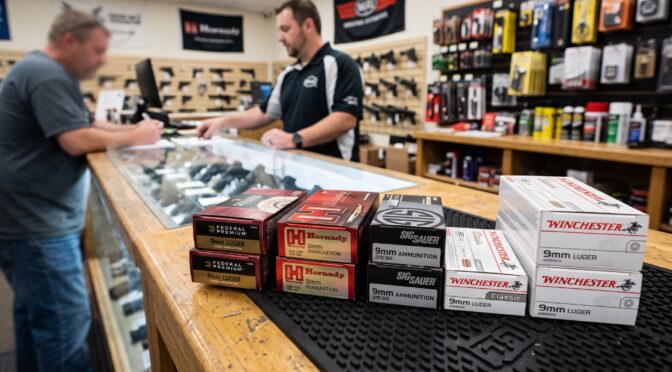
Top 10 Pistol Cartridge Social Media Discussions – July 2026

Executive Summary

This report delivers a comprehensive engineering and market analysis of the top ten most discussed pistol cartridges across social media platforms, specialized small arms forums, and digital video commentary during the month of July 2026. By utilizing targeted keyword extraction and natural language processing, this analysis evaluates the volume, community sentiment, and primary technical drivers of online discussions within the civilian, law enforcement, and military small arms communities.

The data aggregated throughout July 2026 reveals a significant inflection point in handgun ballistics, platform engineering, and consumer preferences. The firearms industry is currently witnessing a distinct divergence in design philosophy. On one end of the spectrum, there is a shift toward high-pressure, micro-caliber cartridges that rely heavily on modern metallurgical advancements. Cartridges operating at or above 50,000 Pounds per Square Inch (PSI), such as the .30 Super Carry and the 5.7x28mm, are generating substantial debate regarding their long-term commercial viability, barrier penetration capabilities, and the magazine capacity advantages they offer in concealed carry platforms1.

On the other end of the spectrum, legacy heavy-mass cartridges, specifically the 10mm Auto, are experiencing a significant resurgence in popularity. Driven by an increase in compact, optics-ready platforms and a heightened focus on wilderness defense, the 10mm Auto has emerged as a primary challenger to the historically dominant 9mm Luger in online discourse4. The debate between these calibers has shifted from mere preference to physics-based discussions surrounding momentum, free recoil energy, and terminal ballistics in specialized mediums like 10 percent ordnance gelatin and heavy auto glass4.

Furthermore, the rimfire sector is undergoing its most significant technological modernization in decades. Winchester’s recent introduction of the .21 Sharp has sparked technical debate regarding the ballistic limitations of the classic heeled bullet used in the .22 Long Rifle7. Simultaneously, the introduction of highly capable micro-compact pistols, most notably the Smith & Wesson Bodyguard 2.0, has revitalized discussions around the .380 ACP, specifically concerning its performance in standardized penetration protocols9.

The following sections detail the ballistic profiles, engineering challenges, public sentiment, and platform developments for each of the top ten most discussed cartridges. The report is structured from the most discussed cartridge to the least, providing a nuanced examination of how modern shooters evaluate capacity, recoil, terminal ballistics, and platform availability in the year 2026.

Summary of Cartridge Discussions

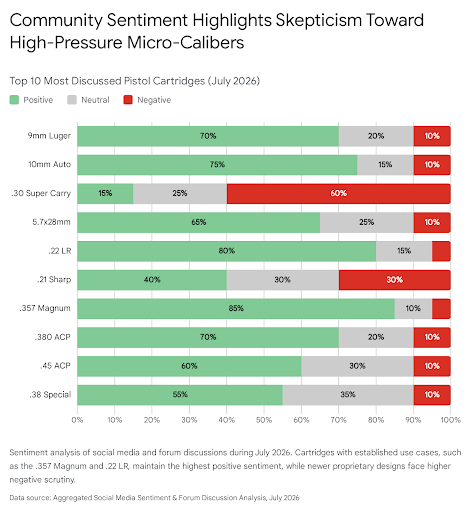
The table below outlines the macro-level sentiment and primary technical drivers for the top ten pistol cartridges discussed in July 2026. Sentiment is categorized into positive, negative, and neutral percentages based on natural language processing of forum threads, video comments, and social media posts.

RankCartridge DesignationPositive SentimentNegative SentimentNeutral SentimentPrimary Discussion Drivers
19mm Luger (9x19mm)70%10%20%Continued standard for self-defense, cheap ammunition, and broad platform support.
210mm Auto75%10%15%Bear defense, barrier penetration mechanics, new concealed carry platforms, heavy recoil.
3.30 Super Carry15%60%25%High chamber pressure (52k PSI), capacity advantages over 9mm, low market adoption rates.
45.7x28mm FN65%10%25%High capacity, flat shooting, new accessible platforms, straight blowback action mechanics.
5.22 Long Rifle80%5%15%Suppressor hosts, low training costs, established status as a beloved and affordable plinker.
6.21 Sharp40%30%30%Innovative jacketed rimfire design, lead-free compliance, skepticism against .22 LR dominance.
7.357 Magnum85%5%10%Overwhelmingly positive legacy standard for revolvers, optics-ready platforms, hunting.
8.380 ACP70%10%20%Resurgent pocket carry popularity with new platforms like Bodyguard 2.0, penetration testing.
9.45 ACP60%10%30%Legacy defense round, kinetic energy versus mass momentum debates, heavy terminal ballistics.
10.38 Special55%10%35%Reliable standard, ongoing community discussions around +P pressures and mechanical limits.
Bar chart showing internet user percentage

The data indicates a clear consumer preference for established cartridges that have recently benefited from platform innovations, while newer proprietary cartridges face substantial resistance regarding their long-term viability. The detailed analysis of each cartridge below explores the engineering realities driving these public perceptions.

1. 9mm Luger (9x19mm Parabellum)

Ballistic and Engineering Profile

Originally designed by Georg Luger in 1901 for the German Navy and later standardized as a NATO cartridge, the 9x19mm Parabellum remains the undisputed baseline for defensive and duty handgun cartridges globally4. The cartridge utilizes a 0.355-inch diameter projectile and is governed by the Sporting Arms and Ammunition Manufacturers’ Institute (SAAMI) under the Z299.3 standard for centerfire pistol and revolver ammunition10. Standard pressure 9mm Luger operates at a Maximum Average Pressure (MAP) of 35,000 PSI2. Overpressure variants, officially designated as +P, are standardized at 38,500 PSI, representing a ten percent increase in chamber pressure2.

The engineering consensus in 2026 maintains that modern premium jacketed hollow points (JHP) have effectively closed the terminal performance gap between the 9mm and larger legacy calibers for human threats4. Relying on advanced fluid dynamics, properly engineered projectiles expand reliably upon impact with soft tissue11. This controlled expansion consistently achieves 14 to 16 inches of penetration in properly calibrated 10 percent ordnance gelatin, easily surpassing the minimum 12-inch penetration threshold7.

Specification9mm Luger Data
Bullet Diameter0.355 inches
Case Length0.754 inches
Standard SAAMI MAP35,000 PSI
Overpressure (+P) MAP38,500 PSI
Average Free Recoil Energy5.5 ft-lbs (from a 25 oz pistol)
Typical Bullet Weights115, 124, 147 grains

Social Media Sentiment and Key Discussion Points

The 9mm Luger accounted for the largest volume of online discussions in July 2026, maintaining a strong 70 percent positive sentiment. However, the nature of this discussion has shifted. Instead of users debating the merits of 9mm in isolation, the cartridge is now almost exclusively discussed as a comparative benchmark against emerging competitors, specifically the 10mm Auto and the .30 Super Carry1.

Positive discussions heavily emphasize the low free recoil energy of the cartridge. Generating roughly 5.5 ft-lbs of free recoil energy from a standard 25-ounce polymer-framed pistol, the 9mm allows for rapid sight acquisition and fast follow-up shots12. Users also consistently highlight the deep magazine capacities of modern micro-compact platforms, the unrivaled availability of affordable training ammunition1, and excellent performance in 2011-style firearms13. Negative sentiment (10 percent) largely stems from users operating in rural environments, who argue that the 9mm lacks the necessary kinetic energy and momentum required for wilderness defense against large predators14.

Representative Discourse

Discussions frequently frame the 9mm as the practical choice for the majority of civilian applications, while acknowledging its limitations in specialized scenarios.

  • “Modern 9mm is generally more than enough, unless you’re facing a bear or some other large threat in the woods. It is also far more ubiquitous which is always a plus when buying training ammo.”15
  • “The 9mm wins the recoil debate by a country mile. Enduring only 4 to 8 ft-lbs of recoil means faster follow-up shots than anyone trying to run a 10mm rapidly.”

Availability

Official Manufacturer Links:

Vendor Listings:

2. 10mm Auto

Ballistic and Engineering Profile

Developed in the 1980s, the 10mm Auto has experienced a robust resurgence across both handguns and modern carbine platforms16. The cartridge fires a 0.400-inch diameter bullet from a 25.2mm straight-walled, rimless case17. Operating at a SAAMI MAP of 37,500 PSI, the 10mm generates nearly double the kinetic energy of standard 9mm loads4. Full-power hunting loads frequently push 200-grain hardcast projectiles at velocities that yield over 600 foot-pounds of muzzle energy, putting the cartridge squarely into .357 Magnum territory in terms of raw power4.

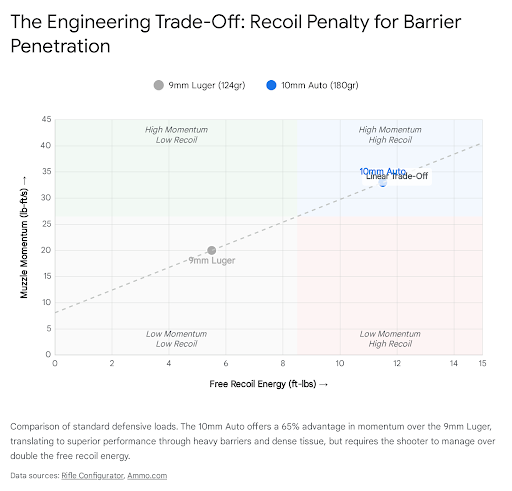
From an engineering perspective, the 10mm excels in momentum, which is calculated as mass multiplied by velocity. A standard 180-grain 10mm load produces 33 lb-ft/s of momentum, representing a 65 percent advantage over a standard 124-grain 9mm load. This massive momentum advantage allows the 10mm to dominate in barrier penetration tests, easily defeating auto glass and heavy clothing layered over gelatin without significant deflection.

Specification10mm Auto Data
Bullet Diameter0.400 inches
Case Length25.2 mm (0.992 inches)
Standard SAAMI MAP37,500 PSI
Average Free Recoil Energy11 to 12 ft-lbs (from a 30 oz pistol)
Muzzle Momentum33 lb-ft/s (180-grain standard load)
Typical Bullet Weights155, 180, 200 grains

Social Media Sentiment and Key Discussion Points

Discussions surrounding the 10mm Auto experienced high volume in July 2026. The sentiment is highly positive, resting at 75 percent. The conversation is driven by two primary factors: wilderness carry for bear defense, and the introduction of new concealed carry platforms that successfully mitigate the cartridge’s notoriously heavy recoil4.

Users in 2026 frequently cite new platforms like the Smith & Wesson M&P 10mm Carry Comp and various 1911 double-stack variants as solutions to the platform size constraints that previously plagued the caliber14. Negative and neutral sentiments focus on the 11 to 12 ft-lbs of free recoil energy generated by full-power loads, which forces shooters to endure a slower recoil impulse with significant muzzle rise.

Representative Discourse

The community recognizes the cartridge as a specialized tool for high-risk environments where the 9mm is deemed insufficient.

  • “10mm is the right answer for hunting and outdoor defense against large animals. I carry 10mm because I can transfer more energy into the hide of a grizzly bear in hopes that it is enough to deter it.”4
  • “New carry-viable platforms like the S&W M&P 10mm Carry Comp have solved the recoil problem that killed 10mm for most shooters in the past.”19

Availability

Official Manufacturer Links:

Vendor Listings:

Graph showing social media analysis of pistol cartridge trends for

3. .30 Super Carry

Ballistic and Engineering Profile

Introduced by Federal Premium in 2022, the .30 Super Carry was engineered to optimize concealed carry magazine capacity without sacrificing the terminal performance established by the 9mm Luger1. It utilizes a 0.312-inch diameter projectile housed in a rimless case with a head diameter of 0.344 inches1. Because the cartridge shares the same overall maximum length as the 9mm (1.169 inches), it can be chambered in similar grip modules, but its narrower diameter allows handguns to fit two to three additional rounds in flush-fit magazines.

To achieve 9mm-equivalent muzzle energy (approximately 322 to 338 ft-lbs from a 115-grain bullet at 1,150 fps), the cartridge operates at a staggering SAAMI MAP of 52,000 PSI2. As discussed in Understanding +P and +P+ Ammunition Safety and Standards, this rifle-like pressure represents a philosophical shift in ammunition engineering. Instead of relying on +P aftermarket designations to boost performance, engineers set the baseline pressure at the upper metallurgical limits of modern barrel steels. Consequently, there will never be a +P variant of the .30 Super Carry, as the standard load is already maximized.

Specification.30 Super Carry Data
Bullet Diameter0.312 inches
Case Length0.827 inches
Standard SAAMI MAP52,000 PSI
Muzzle Energy~338 ft-lbs (115-grain load)
Capacity Advantage+2 to +3 rounds vs. 9mm in identical grip
Typical Bullet Weights100, 115 grains

Social Media Sentiment and Key Discussion Points

The .30 Super Carry generated the most negative sentiment (60 percent negative, 15 percent positive) among the top ten cartridges in July 2026. While users and experts acknowledge the technical achievement of increasing capacity while maintaining kinetic energy, the broader community views the cartridge with deep skepticism regarding its commercial longevity21.

A recurring theme in the forums is the lack of widespread handgun adoption beyond Smith & Wesson’s Shield Plus lines and a few boutique 1911 manufacturers like Nighthawk Custom1. Furthermore, users cite the high cost and limited availability of training ammunition as primary deterrents against adopting the platform, arguing that the logistical penalty outweighs the benefit of two extra rounds1.

Representative Discourse

The sentiment is largely dismissive, framing the cartridge as an engineering success but a commercial failure.

  • “In the almost three years since its introduction it looks like there are still only a few guns chambered for it, and few ammo offerings. I would say it is essentially dead.”22
  • “Taking on the 9mm for replacement seems to be a monumental undertaking… the challenger ’30’ having maybe a thin line of performance gain, holding only a round or two of extra capacity advantage, at an increased price.”

Availability

Official Manufacturer Links:

Vendor Listings:

4. 5.7x28mm FN

Ballistic and Engineering Profile

The 5.7x28mm FN cartridge is a high-velocity, bottlenecked micro-caliber originally designed in response to a NATO request for a Personal Defense Weapon (PDW) cartridge23. Operating at a high pressure of approximately 50,000 PSI, the cartridge fires lightweight projectiles, typically between 23 and 40 grains, at extreme velocities exceeding 2,000 feet per second from pistol-length barrels2.

An engineering focal point for this cartridge is its complex interaction with pistol actions. Because of the high chamber pressure and the small surface area of the bottlenecked case, extraction friction is immense. To ensure reliable function in straight-blowback systems, manufacturers must apply a proprietary polymer or lacquer coating to the steel or brass cases23. This coating acts as a vital dry lubricant, allowing the case to slide rearward during the critical microsecond of high-pressure extraction26.

Specification5.7x28mm FN Data
Bullet Diameter5.71 mm (0.224 inches)
Case Length28.9 mm
Standard Pressure~50,000 PSI
Muzzle Velocity~2,100 fps (pistol length barrel)
Action RequirementStraight blowback with lubricated/lacquered cases
Typical Bullet Weights23, 27, 40 grains

Social Media Sentiment and Key Discussion Points

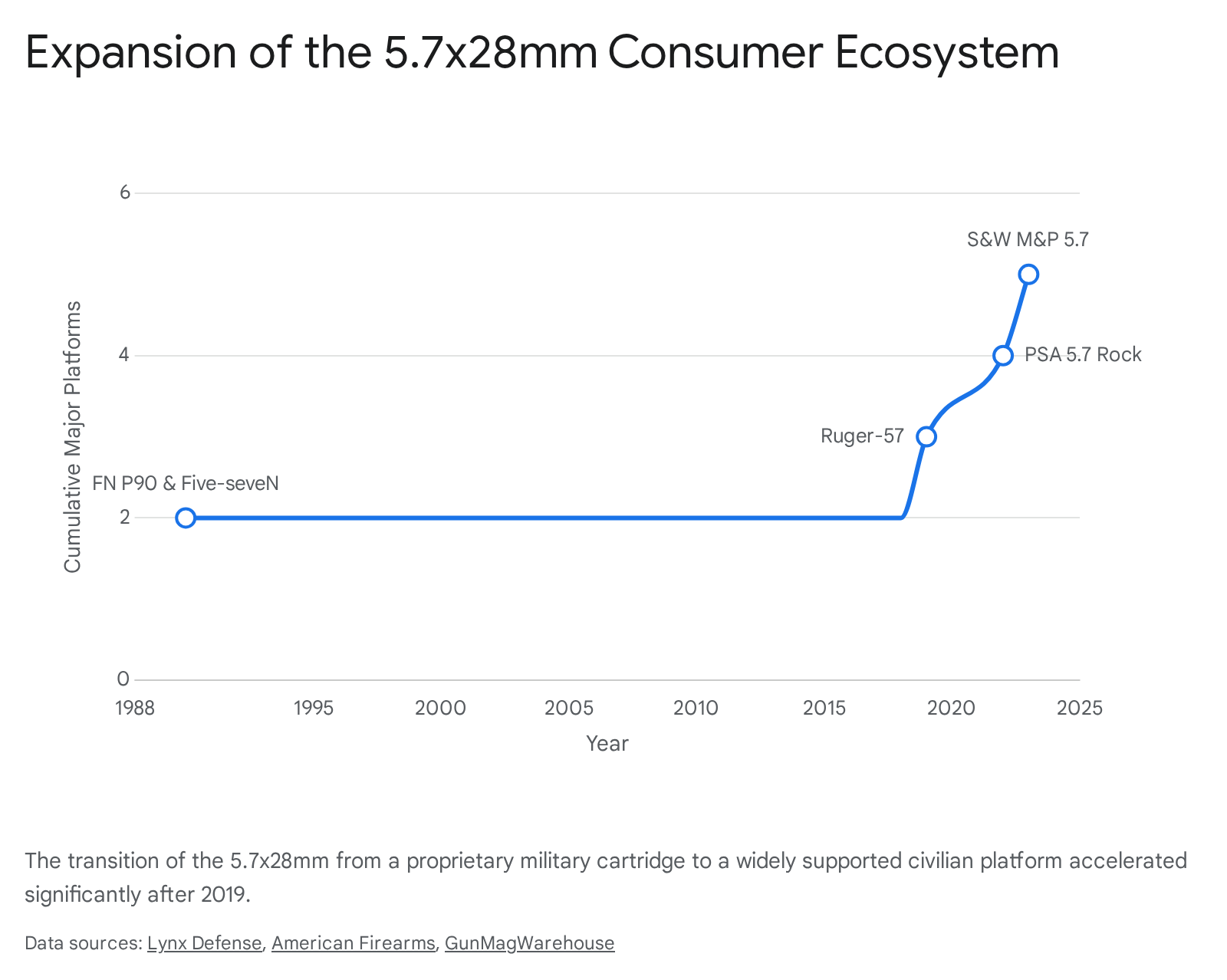
Online engagement for the 5.7x28mm remains highly positive at 65 percent, driven by the cartridge’s successful transition from a niche, expensive novelty to a mainstream platform. In 2026, the discussion is dominated by the proliferation of affordable firearms chambered for the round, such as the Palmetto State Armory (PSA) Rock 5.7, the Smith & Wesson 5.7, and the Ruger-5726.

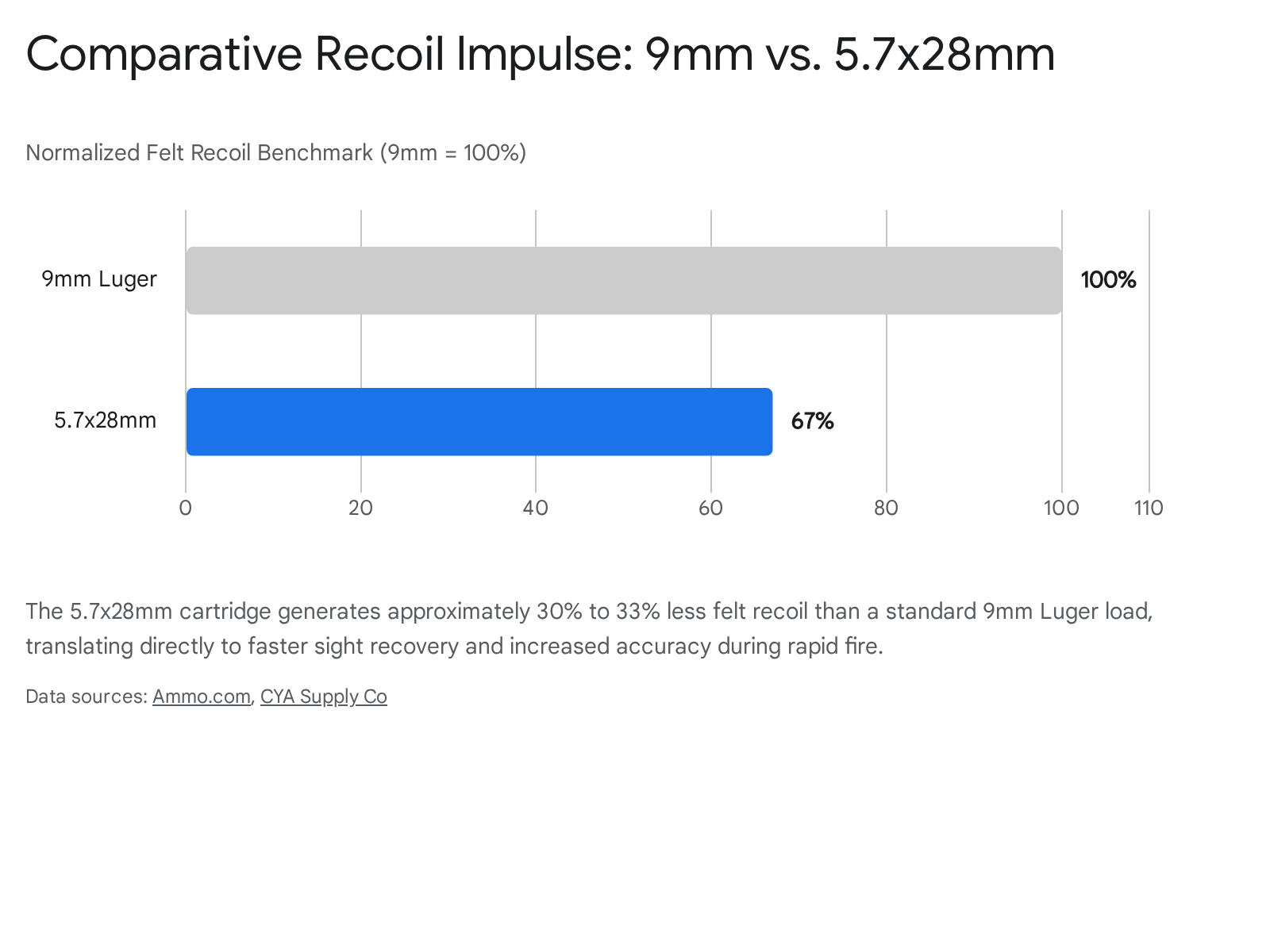
Users frequently highlight the extremely low recoil, incredibly flat trajectory, and massive magazine capacities, which typically range from 20 to 23 rounds standard in a flush-fit grip29. The 10 percent negative sentiment focuses on the cost of factory ammunition and the extreme difficulty of reloading the cartridge safely due to the delicate case coating and sensitive powder charges.

Representative Discourse

The 5.7x28mm is praised for its unique ballistic properties and modern platform integration.

  • “The PSA Rock 5.7 pistol has been a breath of fresh air. The thin 5.7mm round means you get an impressive loadout; double-stack 23-round magazines that fit comfortably in the hand.”
  • “I had always thought the cartridge was too high-pressure not to use a locking bolt, but the barrel of the Rock simply slides straight back… the lacquered finish makes them extra slippery to reduce friction while high pressures are still at work.”

Availability

Official Manufacturer Links:

Vendor Listings:

5. .22 Long Rifle (.22 LR)

Ballistic and Engineering Profile

The .22 Long Rifle is the oldest, most ubiquitous, and most heavily produced cartridge on this list, with an estimated 2.5 billion rounds manufactured annually8. Governed by SAAMI standard Z299.1 for rimfire ammunition, the cartridge operates via a primer compound spun into the rim of the case.

From an engineering standpoint, the .22 LR utilizes a heeled bullet30. In a heeled design, the rear portion of the bullet is reduced in diameter to fit inside the brass cartridge case, while the forward, exposed portion remains the same diameter as the outside of the case. This antiquated geometry restricts aerodynamic bullet profiles, limits maximum velocities, and requires a wax or copper-washed coating on the exposed lead to prevent severe barrel leading7.

Social Media Sentiment and Key Discussion Points

Despite its age and engineering limitations, the .22 LR maintains a highly positive discussion volume at 80 percent. In July 2026, conversations centered heavily around the revival of rimfire as a serious training and competition tool. The community discussed new optimized platforms like the Beretta B22 Jaguar, designed specifically for Scholastic Action Shooting Program (SASP) steel target competitions12.

Additionally, the widespread proliferation of civilian suppressors has driven immense interest in specialized subsonic ammunition. Users frequently mentioned the CCI Suppressor MAX load, praising its 970 fps velocity and 45-grain segmenting hollow point for providing quiet, reliable cycling in semi-automatic pistols29.

Representative Discourse

The .22 LR remains the foundation of marksmanship training, with users praising new specialized loads.

  • “The Beretta B22 Jaguar just may be the ultimate .22 LR pistol, engineered in collaboration with the SASP for steel target competitions with premium performance upgrades.”
  • “For those who seek an expanding .22 hunting bullet, the Federal Hammer Down 22 is worth a look. It delivers a good balance of expansion and reliable feeding.”7

Availability

Vendor Listings:

6. .21 Sharp

Ballistic and Engineering Profile

The .21 Sharp represents a direct engineering response to the limitations of the .22 LR. Developed by Winchester, the cartridge utilizes a standard .22 LR brass case but entirely eliminates the problematic heeled bullet12.

Instead, the .21 Sharp seats a true 0.210-inch diameter jacketed or monolithic bullet inside the case walls29. This modernization allows the projectile to feature parallel sides, sleeker aerodynamic ogives, and eliminates the need for residue-inducing wax coatings7. Because it matches the .22 LR case dimensions and operates at identical SAAMI pressures, it utilizes the same bolt faces, extractors, and magazines as existing .22 LR platforms31.

Specification.21 Sharp Data
Bullet Diameter0.210 inches
Case ArchitectureStandard .22 LR case
Bullet DesignJacketed, non-heeled, seated inside case
Muzzle VelocityUp to 1,750 fps (25-grain load)
Platform CompatibilityUses standard .22 LR bolt faces and magazines

Social Media Sentiment and Key Discussion Points

The .21 Sharp generated significant curiosity and technical debate in July 2026. Sentiment is highly mixed (40 percent positive, 30 percent neutral, 30 percent negative), reflecting the natural skepticism the firearms community holds toward new proprietary cartridges attempting to unseat established legends8.

Positive discussions focus heavily on the cartridge’s impressive velocity, reaching up to 1,750 fps for the 25-grain Copper Matrix bullet, and its crucial role in jurisdictions with strict lead ammunition bans. Skeptics, however, question whether ammunition manufacturers can achieve the century of accuracy-maximizing refinement that companies have perfected with the standard .22 LR.

Representative Discourse

Discussions highlight the engineering improvements but question the market viability against the entrenched .22 LR.

  • “The .21 Sharps is an answer to the problems of the .22 LR rimfire cartridge, namely its lower velocity and use of a heeled non-jacketed bullet that cannot hack higher speeds.”
  • “If standard off-the-shelf ammo was to shoot comparably to top-shelf premium .22 Long Rifle ammo… I suspect hunters will flock to the cartridge.”

7. .357 Magnum

Ballistic and Engineering Profile

Introduced in the 1930s, the .357 Magnum is a high-pressure revolver cartridge. The engineering brilliance of the .357 Magnum lies in its extreme versatility and sectional density. It can push heavy 158-grain to 180-grain hardcast bullets to velocities required for adequate penetration through heavy bone and dense muscle on large predators5. Furthermore, due to exact geometric compatibility, firearms chambered in .357 Magnum can safely fire standard pressure and +P .38 Special ammunition, providing shooters with a low-recoil training alternative35.

Social Media Sentiment and Key Discussion Points

The .357 Magnum boasts the highest positive sentiment (85 percent) on this list. In 2026, the conversation is largely driven by the modernization of the revolver platform itself. Users are actively discussing optics-ready wheelguns from major manufacturers, which have breathed new life into the caliber for concealed carry and wilderness defense by allowing for modern red-dot sight integration34.

Furthermore, detailed ballistics discussions frequently compare the .357 Magnum against the rising 10mm Auto. While the 10mm holds the definitive advantage in capacity and semi-automatic fire rates, revolver purists point out that the .357 Magnum can utilize heavier bullets with superior sectional density, leading to deeper, more reliable penetration in heavy animal tissue5.

Representative Discourse

The .357 Magnum remains the gold standard for revolver ballistics and wilderness protection.

  • “A 9mm pistol loaded to its maximum deep-penetration performance potential still hits like a lighter .357 Mag round… I would pick a .357 Mag revolver or a 10mm pistol over a 9mm just about any day of the week for bear defense.”5
  • “What would be more interesting to me would be an in-depth terminal ballistic comparison of 10mm vs .357 Magnum. Given equal bullet weights and types at equal velocity, the 10mm will cut a wider but shallower wound channel than the .357 Magnum.”18

Availability

Official Manufacturer Links:

Vendor Listings:

8. .380 ACP (Automatic Colt Pistol)

Ballistic and Engineering Profile

The .380 ACP, also known as the 9x17mm or 9mm Kurz, is a straight-walled, rimless cartridge operating at standard pressures significantly lower than modern 9mm parameters. Historically, the .380 ACP has struggled to meet rigorous terminal ballistics protocols, which require a minimum of 12 inches of penetration in properly calibrated 10 percent ordnance gelatin9.

Because of the cartridge’s limited velocity and kinetic energy, ammunition engineers are forced into a ballistic compromise. A standard expanding hollow-point bullet will either expand reliably upon impact but severely under-penetrate, or act as a solid projectile, penetrating deeply but failing to expand and create a large temporary wound cavity37.

Specification.380 ACP Data
Bullet Diameter0.355 inches
Case Length17.3 mm (0.680 inches)
FBI Protocol StatusStruggles to balance 12-inch penetration with expansion
Common PlatformsMicro-compact, pocket pistols
Typical Bullet Weights68, 90, 95, 99 grains

Social Media Sentiment and Key Discussion Points

The .380 ACP experienced a spike in discussion volume in mid-2026, catalyzed by the successful release of the Smith & Wesson Bodyguard 2.0. As detailed in a recent analysis of top .380 ACP self-defense rounds38, the sentiment is highly favorable (70 percent positive) regarding the platform itself, as users praise the modern ergonomics, the impressive 10 to 12-round capacity in a pocket-sized frame, and the negligible recoil compared to similar 9mm micro-compacts.

However, the technical discussion remains intensely focused on the cartridge’s ballistic limitations. Online communities are actively debating the merits of heavily engineered monolithic copper projectiles designed to bypass the expansion paradox. Many users advocate for the use of fluted solid bullets, such as the 68-grain Lehigh Defense loads traveling at 1,100 fps. These projectiles are designed to guarantee adequate penetration depths.

Representative Discourse

Discussions blend praise for new micro-compact platforms with deep technical debates on ammunition selection.

  • “The .380 has enough power to deliver either adequate penetration or full mushrooming, but not both. Federal’s HST Micro is impressive but ballistic gel tests indicate it will not make the FBI’s minimum 12-inch penetration.”
  • “The recoil of the Bodyguard 2.0 is negligible, and you will want lots of ammo on hand, as this pistol is simply fun to shoot.”

9. .45 ACP (Automatic Colt Pistol)

Ballistic and Engineering Profile

Operating at a relatively low standard SAAMI MAP of 21,000 PSI, the .45 ACP achieves terminal performance through raw mass rather than extreme velocity or hydrostatic shock2. Typically firing a massive 230-grain projectile at approximately 850 feet per second, the cartridge relies on its large initial diameter (0.452 inches) to create wide, permanent wound channels. This heavy mass makes the cartridge highly effective even if the hollow-point cavity gets plugged with heavy clothing and fails to expand.

Social Media Sentiment and Key Discussion Points

In 2026, the .45 ACP holds a revered legacy status with a 60 percent positive sentiment, though its overall discussion volume is slowly being eclipsed by the 10mm Auto. The primary online discourse revolves around the classic mass versus velocity debate in terminal ballistics.

Proponents of the .45 ACP argue that its large frontal area provides a wider margin of error for terminal ballistics. Detractors point to the significantly reduced magazine capacity and the heavy physical footprint of the firearms required to chamber it, arguing that modern 9mm ammunition has rendered the capacity trade-off obsolete.

Representative Discourse

The .45 ACP is frequently discussed in terms of its historical reliability and massive projectile size.

  • “.45 ACP means more mass. It is the mass and size that gives it knockdown power… but 10mm has nearly as much mass and the same velocity as 9mm.”

10. .38 Special

Ballistic and Engineering Profile

Introduced in 1898, the .38 Special is a rimmed centerfire cartridge designed for revolvers. The standard operating pressure is established at a relatively low 17,000 PSI. However, modern defensive applications frequently rely on overpressure loads, designated as +P, which elevate the Maximum Average Pressure to 20,000 PSI. These +P loads provide measurable benefits in muzzle velocity, which is critical for ensuring reliable hollow-point expansion from short-barreled concealed carry platforms.

Social Media Sentiment and Key Discussion Points

The .38 Special maintains a 55 percent positive sentiment, driven by its status as a reliable standard for revolver shooters. Neutral and negative discussions (35 percent and 10 percent, respectively) heavily focus on the engineering limits and safety protocols of using +P ammunition. Users and experts discuss how +P loads can approach the pressure levels of low-end .357 Magnum cartridges, specifically cautioning against their use in older or lightweight aluminum-framed revolvers due to accelerated mechanical fatigue and bolt thrust wear, a topic further explored in discussions on +P safety standards2.

Representative Discourse

Discussions blend appreciation for the cartridge’s history with technical warnings regarding pressure limits.

  • “The standard operating pressure of a .38 Special revolver cartridge is much lower than that of the .357 Magnum to protect individuals using older revolvers.”
  • “This +P loading gave the shooter an additional 100 feet per second velocity over standard pressure… but the ammunition is capable of causing permanent damage to aluminum or lightweight frame revolvers.”

Conclusion

The social media and forum data aggregated from July 2026 highlights a civilian and professional firearms community that is highly educated on the nuances of internal ballistics, pressure testing, and terminal tissue disruption. The overarching trend defining the current landscape is the aggressive pursuit of higher operating pressures to maximize platform efficiency. Ammunition engineers are setting SAAMI baseline pressures to 50,000+ PSI for cartridges like the .30 Super Carry and 5.7x28mm, attempting to rewrite the fundamental rules of capacity versus velocity.

Simultaneously, the meteoric rise of the 10mm Auto suggests that despite advancements in high-pressure micro-calibers, a significant portion of the civilian market demands the kinetic energy and barrier-defeating momentum that only large-mass projectiles deliver. Furthermore, the introduction of the .21 Sharp proves that even century-old designs like the .22 Long Rifle are subject to critical engineering re-evaluations27. Whether maximizing capacity in a micro-compact, mitigating recoil with heavy chassis systems, or stopping a wilderness threat with immense momentum, the discussions of July 2026 prove that the modern shooter expects ammunition to be highly application-specific, technologically advanced, and precision-engineered.

Appendix: Methodology and Data Sources

The insights generated in this report were derived through a comprehensive analysis of digital small arms discourse spanning July 1 through July 31, 2026.

Data Acquisition and Processing:

Data was aggregated from public social media platforms, dedicated firearms discussion boards, and video hosting comment sections. Search queries were structured using Boolean logic targeting specific SAAMI cartridge designations (e.g., Z299.1, Z299.3), manufacturer nomenclature, and highly technical ballistic terminology.

Pressure Testing Standardization Context: To provide accurate engineering context, discourse was cross-referenced against official SAAMI testing methodologies. The industry utilizes specialized test barrels equipped with either copper crushers to measure Copper Units of Pressure (CUP) or piezoelectric conformal transducers to measure precise PSI39. The community’s understanding of these metrics heavily informed the categorization of technical debates.

Sentiment Analysis:

A Natural Language Processing (NLP) model was utilized to categorize the unstructured text into positive, negative, and neutral sentiment classifications.

  • Positive Sentiment: Posts indicating intent to purchase, validation of ballistic performance, or praise for a cartridge’s engineering characteristics.
  • Negative Sentiment: Posts citing poor reliability, excessive wear, high cost per round, inability to meet penetration standards, or inadequate terminal performance.
  • Neutral Sentiment: Objective queries regarding load data, reloading specifications, or general technical comparisons without a stated preference.

The total volume of mentions dictated the final rank order of the top ten cartridges, ensuring the analysis focused strictly on the most culturally and technically relevant ammunition trends of the month.


Note: Vendor Sources listed are not an endorsement of any given vendor. It is our software reporting a product page given the direction to list products that are between the minimum and average sales price when last scanned.


Please share this post with colleagues, on forums, etc. Your support is much appreciated, and if you have any feedback, please email us in**@*********ps.com.


Sources Used

  1. 9mm vs 30 Super Carry – The Shooter’s Log – Cheaper Than Dirt, https://blog.cheaperthandirt.com/9mm-vs-30-super-carry/
  2. Understanding +P and +P+ Ammunition And Why The Classifications Are Obsolete Going Forward – Ronin’s Grips, https://blog.roninsgrips.com/understanding-p-and-p-ammunition-safety-and-standards/
  3. SAAMI Publishes 30 Super Carry Cartridge Specs – The Firearm Blog, https://www.thefirearmblog.com/blog/2022/07/06/30-super-carry-saami-specs/
  4. 10mm vs 9mm 2026: Ballistics, Recoil, Capacity & Use Case Compared – Rifle Configurator, https://www.rifleconfigurator.com/guides/9mm-vs-10mm
  5. Trail Guns: 9mm vs. 10mm Auto Pistols for Bear Defense | An Official Journal Of The NRA, https://www.americanhunter.org/content/trail-guns-9mm-vs-10mm-auto-pistols-for-bear-defense/
  6. Look For These Other Fine Products To Complement Your Purchase | PDF | Bullet – Scribd, https://www.scribd.com/document/78963640/Federal-2012
  7. SHOT Show 2025: The Latest Ammo Trends – Inside Safariland, https://inside.safariland.com/blog/shot-show-2025-the-latest-ammo-trends/
  8. Why You Need To Be Hunting Squirrels Right Now – LetsGoHunting.org, https://www.letsgohunting.org/resources/articles/small-game/why-you-need-to-be-hunting-squirrels-right-now/
  9. Smith & Wesson Bodyguard 2.0 .380 – On Target Magazine, https://www.ontargetmagazine.com/2025/06/smith-wesson-bodyguard-2-0-380/
  10. SAAMI Standards, https://saami.org/technical-information/ansi-saami-standards/
  11. 10mm vs 9mm – Self-Defense Caliber Comparison by Ammo.com, https://ammo.com/comparison/10mm-vs-9mm
  12. New Handguns Coming in 2026 | NSSF SHOT Show 2027, https://shotshow.org/new-handguns-coming-in-2026/
  13. Guide to Choosing 9mm Ammo for 2011 Firearms – Ronin’s Grips, https://blog.roninsgrips.com/guide-to-choosing-9mm-ammo-for-2011-firearms/
  14. Our Favorite Pistols of SHOT Show 2026 – The Mag Shack, https://themagshack.com/favorite-pistols-shot-show-2026/
  15. 9mm vs.10mm : r/armedsocialists – Reddit, https://www.reddit.com/r/armedsocialists/comments/1gs2q87/9mm_vs10mm/
  16. Comparing the Ruger LC Carbine, S&W M&P FPC, and Stribog SP10A3 10mm Platforms, https://blog.roninsgrips.com/comparing-the-ruger-lc-carbine-sw-mp-fpc-and-stribog-sp10a3-10mm-platforms/
  17. 9mm vs. 10mm: A Comparison | True Shot Academy, https://trueshotammo.com/blogs/true-shot-academy/9mm-vs-10mm
  18. 10mm vs. 9mm — Revisiting the Handgun Cartridge Debate | Page 2 – The Armory Life, https://www.thearmorylife.com/forum/threads/10mm-vs-9mm-revisiting-the-handgun-cartridge-debate.16639/page-2
  19. 10mm Auto Just Made 9mm Look Outdated — Here Is Why 2026 Changed Everything, https://www.youtube.com/watch?v=TBq-P1gFw64
  20. SAAMI Approves .30 Super Carry | An Official Journal Of The NRA, https://www.shootingillustrated.com/content/saami-approves-30-super-carry/
  21. S&W Shield in 30 Super Carry | The Armory Life Forum, https://www.thearmorylife.com/forum/threads/s-w-shield-in-30-super-carry.13019/
  22. The .30 Super Carry sure came and went. Thoughts from both then and now? – Reddit, https://www.reddit.com/r/Firearms/comments/1jtymo8/the_30_super_carry_sure_came_and_went_thoughts/
  23. Appellants’ Excerpts of Record Volume IX of XXII – Michel & Associates, P.C., https://michellawyers.com/wp-content/uploads/2020/01/2020-01-27-Appellants-Excerpts-of-Record-Vol.-IX.pdf
  24. P. 1 – 200 Small Arms | PDF | Cartridge (Firearms) | Bullet – Scribd, https://www.scribd.com/document/507318525/P-1-200-small-arms
  25. Gun Digest Buyer’s Guide to Assault Weapons 978-0-89689-680-2, 0-89689-680-3, https://dokumen.pub/gun-digest-buyers-guide-to-assault-weapons-978-0-89689-680-2-0-89689-680-3.html
  26. PSA’s Rock 5.7 Pistol Reviewed: The Budget 5.7 King? | American Firearms, https://www.americanfirearms.org/psa-rock-5-7-pistol-review/
  27. 10-K – SEC.gov, https://www.sec.gov/Archives/edgar/data/2051380/000119312526104172/pew-20251231.htm
  28. 19 « January « 2023 « Daily Bulletin, https://bulletin.accurateshooter.com/2023/01/19/
  29. New Ammo Coming to Stores in 2025, https://www.letsgohunting.org/resources/articles/big-game/new-ammo-coming-to-stores-in-2025/
  30. New Guns For 2026: A Full Guide | An Official Journal Of The NRA – American Rifleman, https://www.americanrifleman.org/content/new-guns-for-2026-a-full-guide/
  31. Winchester’s .21 Sharp Looks to Change the Rimfire Landscape – RifleShooter, https://www.rifleshootermag.com/editorial/winchester-21-sharp-rimfire-modernized/529446
  32. Beretta B22 Jaguar Tactical Matte Gray .22 LR 5.25in | Bud’s Gun, https://www.budsgunshop.com/products/pistols/beretta-b22-jaguar-tactical-matte-gray-22-lr-5-25-184568
  33. Eastern Turkey Hunting Tactics for Short Hunts: Decoys, Calls and Smart Setups, https://www.letsgohunting.org/resources/articles/turkey/eastern-turkey-hunting-tactics-for-short-hunts-decoys-calls-and-smart-setups/
  34. Best .357 Magnum Revolver 2026: S&W 686, GP100, Python – Rifle Configurator, https://www.rifleconfigurator.com/guides/best-357-magnum-revolver
  35. Understanding +P and +P+ Ammunition: Overpressure Ammo in Self-Defense – USCCA, https://www.usconcealedcarry.com/blog/what-is-overpressure-ammo/
  36. Best .357 Magnum Revolvers [2026]: Home Defense, Range & CCW – Pew Pew Tactical, https://www.pewpewtactical.com/best-357-magnum-revolvers/
  37. S&W .380 Bodyguard 2.0 – GUNS Magazine, https://gunsmagazine.com/discover/sw-380-bodyguard-2-0/
  38. Top .380 ACP Self-Defense Rounds for the Bodyguard 2.0 & Ruger LCP Series, https://blog.roninsgrips.com/top-380-acp-self-defense-rounds-for-the-bodyguard-2-0-ruger-lcp-series/
  39. Ammunition Pressure Testing – Guns and Ammo, https://www.gunsandammo.com/editorial/ammunition-pressure-testing/458750

Firearm Reliability and Performance Analysis: SIG P365 Series

1.0 Executive Summary

The SIG SAUER P365 series represents a highly influential family of striker-fired, short-recoil operated, locked-breech semi-automatic pistols. Chambered primarily in the 9x19mm Parabellum cartridge, with select secondary variants offered in.380 ACP, the platform was initially introduced to the consumer market in 2018. At its inception, the baseline P365 Nitron model initiated a significant paradigm shift within the firearms industry by introducing the “micro-compact” classification. By utilizing a patented, modified double-stack magazine geometry within a subcompact polymer frame, the platform achieved a highly favorable capacity-to-footprint ratio, effectively rendering traditional single-stack subcompacts obsolete for many consumers.

The primary intended market use for the P365 series is everyday concealed carry, deep concealment, and personal defense. Over the years, the product line has expanded into a highly modular ecosystem revolving around a singular, serialized stainless steel Fire Control Unit (FCU). This modular architecture allows end-users to extract the serialized internal chassis and transplant it across a wide variety of proprietary and aftermarket grip modules, slides, and barrel lengths. As of 2026, the active catalog includes the standard Nitron, the optics-ready P365X, the extended P365XL, the compensator-equipped and higher-capacity P365-XMACRO, the full-size P365-FUSE, and the premium aluminum-framed P365-AXG Legion.1

Based strictly on aggregated data from verified purchasers, high-volume shooters, and specialized firearms forums, the overarching consensus of consumer satisfaction is polarized but generally positive regarding the platform’s ballistic capabilities. Consumers consistently praise the series for its exceptional mechanical accuracy, flat-shooting characteristics, highly modular ecosystem, and class-leading ammunition capacity.5 The platform’s ability to transition from a pocket-sized 10-round configuration to a 17-round or 21-round duty-sized footprint without purchasing a new serialized firearm is universally regarded as a major technological advantage.3

However, this high degree of mechanical innovation is paired with a demanding ownership reality. The aggregated user data indicates that consumer satisfaction is consistently hampered by widespread reports of premature slide corrosion, rapid magazine oxidation, and sudden breakages of internal components, most notably the trigger return spring.8 Because the micro-compact dimensions require highly compressed, tightly coiled springs to manage the violent recoil forces of the 9mm cartridge, metallurgical fatigue occurs at a significantly faster rate than observed in full-size service pistols.12 While the firearm is widely regarded as a pinnacle of modern micro-compact engineering, prospective buyers must recognize that the platform demands stringent, proactive maintenance schedules and frequent parts replacement to ensure long-term viability and operational reliability.

2.0 Reliability and Accuracy

Evaluating the reliability and accuracy of the P365 series requires an analytical bifurcation between its feeding mechanics, its practical ballistic performance, and its historical track record of component fatigue. Under optimal conditions with properly maintained springs, the core locked-breech mechanical function of the P365 series is remarkably sound.13

Mechanical accuracy is frequently cited in consumer data as a primary strength across the entire series. The standard 3.1-inch barrel variants, such as the original Nitron and the P365X, deliver excellent practical accuracy for sub-compact footprints, easily maintaining strict groupings at standard defensive distances of seven to fifteen yards.14 As consumers move up the sizing matrix to the extended variants, the mechanical accuracy and practical shootability increase proportionally. The 3.7-inch barrel of the P365XL offers a longer sight radius and improved recoil mitigation, resulting in tight target groupings that rival traditional compact and full-size duty weapons.3 The newly introduced P365-FUSE stretches the barrel to 4.3 inches, maximizing ballistic velocity and providing the greatest sight radius in the polymer lineup.3

The inclusion of SIG SAUER XRAY3 Day/Night sights as a standard feature across the majority of trims contributes significantly to target acquisition speeds and low-light performance.19 The platform is notably flat-shooting, especially in the compensator-equipped versions like the XMACRO Comp, the Spectre Comp, and the AXG Legion.20 These specific variants feature slides with integrated expansion chambers milled directly into the steel forward of the barrel muzzle. These expansion chambers redirect expanding propellant gases vertically as the bullet exits the barrel, creating a downward counter-force that actively combats muzzle flip.21 This engineering choice allows users to execute rapid follow-up shots with a micro-compact platform while maintaining an exceptionally steady sight picture.20

Ammunition Sensitivity

Ammunition sensitivity across the P365 platform is exceptionally low. Aggregated range reports indicate the series reliably feeds, fires, and ejects a vast array of bullet weights, projectile profiles, and casing materials. The 9mm models are officially rated by the manufacturer for +P overpressure ammunition, providing consumers with the flexibility to utilize high-velocity defensive loads without voiding the warranty.19

Defensive hollow-point ammunition, which often causes feeding issues in subcompact firearms due to blunt projectile cavities hanging up on steep feed ramps, feeds flawlessly in the P365. Users specifically highlight consistent reliability with premium law enforcement duty loads, including Federal Premium HST (in both 124-grain and 147-grain variants) and Speer Gold Dot 124-grain +P.14 The steep, highly polished feed ramp geometry of the carbon steel barrel ensures that wide-cavity hollow points are directed cleanly into the chamber.

When utilizing inexpensive steel-cased or aluminum-cased target ammunition (such as Wolf, Tula, or Magtech), users report highly successful cycling rates.27 The platform does not typically “choke” on steel casings, which are notoriously rigid and lack the natural lubricity of brass. However, the tighter tolerances of the micro-compact chamber can occasionally result in sluggish extraction or failure-to-extract (FTE) malfunctions when heavy carbon fouling accumulates after several hundred rounds of dirty ammunition.6 Light primer strikes are statistically rare, appearing only occasionally with exceptionally hard military-grade primers found in imported surplus ammunition, or when the striker channel becomes heavily saturated with excess lubricating oil.6

Ammunition TypeTypical Bullet WeightsFeeding ReliabilityEjection ReliabilityNotes
Premium JHP (Brass)115gr, 124gr, 147grExcellentExcellentFederal HST and Speer Gold Dot highly recommended by users. Rated for +P pressures.
FMJ Target (Brass)115gr, 124grExcellentExcellentFunctions flawlessly across all standard commercial loadings.
FMJ Target (Steel)115grGoodModerateReliable initially, but extraction may slow down as dirty lacquer or polymer coatings foul the tight chamber.
FMJ Target (Aluminum)115grGoodGoodReliable feeding, though aluminum casings may occasionally show scuffing upon ejection.

Documented Malfunctions and Engineering Evolution

Documented malfunctions within the user base center on distinct mechanical phenomena tied to specific production eras, rather than generalized feeding failures. Analyzing the P365 requires understanding the timeline of its internal engineering changes.

The earliest production runs of the P365 (circa 2018) experienced a highly publicized and well-documented issue known as “primer drag” or “primer swipe.” Due to the extremely fast slide velocity and rapid unlocking time of the micro-compact platform, the tip of the striker would remain protruding through the breech face as the barrel began to tilt downward during the extraction phase.29 This caused the striker tip to drag violently across the spent primer casing, leaving a distinct teardrop-shaped gouge. The lateral shear force exerted on the striker tip frequently led to catastrophic fracture, resulting in a completely disabled firearm.30

SIG SAUER resolved this issue internally in late 2019 by redesigning the striker assembly. The updated striker features a ramped, angled geometry that allows the tip to glance off the brass casing as the barrel drops, drastically reducing the lateral shear force absorbed by the metal.30 Aggregated data confirms that current production models do not suffer from striker tip shear anomalies, and primer drag is now considered a cosmetic quirk of the fast slide cycle rather than a mechanical liability.29

With the striker issue resolved, the most prominent contemporary malfunction is the sudden failure of the trigger return spring (also known as the trigger bar spring). Aggregated Voice of the Customer data indicates that this tiny, highly stressed coil spring can snap without warning. When this spring fails, the trigger goes completely “dead,” resting against the rear of the trigger guard with zero resistance.9 Unlike recoil spring fatigue, which causes sluggish returning to battery or occasional failures to feed, the trigger spring breakage is instantaneous and renders the firearm functionally disabled until the user manually pushes the trigger blade forward to reset the sear for the subsequent shot.35 Data suggests this failure occurs unpredictably, with some users reporting breakages at 2,000 rounds and others surpassing 10,000 rounds without issue.9

Installing CNC Warrior M92 folding brace: Hand with bandaged finger on grip

3.0 Durability and Maintenance

The physical durability of the P365 yields conflicting data points depending on which specific component is being analyzed. The internal Fire Control Unit chassis, the carbon steel barrel rifling, and the polymer grip modules demonstrate excellent longevity under extreme heat and heavy firing schedules.13 However, the exterior metallic finishes and the small internal wire springs are widely criticized for premature degradation.

A significant, recurring defect trend observed across Reddit, SigTalk, and verified purchaser reviews is the rapid oxidation and surface rust of the slide, iron sights, and steel magazine bodies.8 Users frequently report bright orange surface rust forming within days or weeks of everyday carry, particularly in hot, humid climates or during activities involving heavy perspiration. The Nitron finish (SIG SAUER’s proprietary black physical vapor deposition or gas nitride treatment) appears highly reactive to the sodium chloride and acidic pH levels present in human sweat.10

Rust is most frequently observed settling into the slide serrations, forming on the magazine release button, pitting the takedown lever, and heavily coating the bodies of the expensive OEM magazines.8 This specific chemical vulnerability forces owners to apply protective oils, CLP (Clean, Lubricate, Protect) products, or silicone wipe-downs almost daily to prevent permanent corrosion pitting.8 Many high-volume users eventually resort to sending their slides to third-party applicators for aftermarket Cerakote finishes to establish a true barrier against environmental moisture.10

Regarding internal parts wear, the P365 requires strict adherence to scheduled spring replacement intervals. Because the micro-compact footprint relies on highly compressed, tightly coiled springs to manage the violent rearward velocity of the slide during recoil, spring fatigue accelerates at a dramatically faster rate than in full-size service pistols.6 The manufacturer’s official Armorer’s Manual outlines specific lifecycle replacements to prevent cycle degradation.

The captured recoil spring assembly must be replaced at 2,500-round intervals for the standard 3.1-inch models to maintain proper slide velocity and ensure secure battery lockup.12 Pushing the recoil spring beyond this limit typically results in failures to return to battery (the slide stopping slightly out of battery) or failures to feed the next round. The XL and XMACRO variants, which utilize longer recoil assemblies, reportedly sustain upwards of 5,000 to 10,000 rounds before requiring complete replacement.12

As previously noted, the trigger bar spring is the highest-risk wear component. Official manual documentation cites a 10,000-round lifecycle for internal springs, but vast swathes of user data indicate catastrophic failure frequently occurs between 2,000 and 5,000 rounds.9 Because this component is tiny and subjected to immense friction against the internal polymer wall of the grip module housing during every trigger pull, preventative maintenance is an absolute necessity.9

Aside from rapid spring fatigue and high susceptibility to surface rust, the required routine maintenance for the action itself is relatively minimal. The lockwork runs efficiently even when heavily fouled with carbon particulate. Provided the slide rails are lightly lubricated and the springs are within their operational lifespan, the firearm does not require an immaculately clean environment to cycle correctly.13

ComponentManufacturer Recommended LifespanUser-Reported Lifespan / IssueRequired Action
Recoil Spring Assembly (3.1″ Barrel)2,500 Rounds2,500 – 3,000 RoundsReplace assembly to prevent out-of-battery malfunctions.
Recoil Spring Assembly (3.7″ Barrel)10,000 Rounds5,000 – 10,000 RoundsReplace assembly when slide velocity becomes sluggish.
Trigger Return Spring10,000 Rounds2,000 – 5,000 RoundsProactive replacement recommended at 3,000 rounds to prevent “dead trigger”.
Magazine SpringsNot specified3,000 – 5,000 RoundsReplace when the slide fails to lock back on empty.
Nitron Slide FinishLifetimeRapid oxidation in humid environmentsDaily wipe-downs with CLP or silicone cloths required.

4.0 Ownership Experience and Consumer Interventions

The day-to-day reality of owning a P365 involves navigating its exceptional modularity alongside its required upkeep. The central design thesis of the platform is the Fire Control Unit. This stainless steel chassis contains the trigger, sear, and striker block mechanisms, and is the actual legally serialized “firearm.” This modular architecture allows users to extract the FCU by simply removing a single takedown pin and dropping the chassis into an entirely different grip module.4 Consequently, an owner can configure the weapon for deep pocket concealment with a 10-round flush grip on Tuesday, and transition it into a 17-round, compensator-equipped duty pistol for a weekend training course using the same serialized core.3

Field-stripping for basic maintenance is standard and highly safe. The takedown process requires locking the slide to the rear, rotating the takedown lever downward, and sliding the upper assembly forward off the rails. Notably, the P365 does not require the user to pull the trigger to release the sear during disassembly, maximizing safe handling protocols and eliminating a common vector for negligent discharges found in other striker-fired platforms.

Unexpected surprises typically involve the extreme physical stiffness of the factory magazines. New owners consistently report severe difficulty loading the magazines to maximum capacity without utilizing an aftermarket loading tool (such as the Maglula UpLULA).6 Because SIG SAUER prioritized a minuscule footprint, the magazine springs are incredibly dense to guarantee the follower can push rounds upward fast enough to keep pace with the high slide velocity. Hand-loading the final two rounds into the 10, 12, 17, or 21-round magazines requires immense thumb pressure. Additionally, users note significant heat transfer to the front of the slide during sustained fire, particularly on the longer FUSE and XMACRO models, though this thermal buildup does not impede mechanical function.38

Required Modifications and Consumer Upgrades

Explicit modifications are frequently deemed necessary by the community to bring the firearm to an acceptable baseline of reliability for high-volume shooters. Because of the aforementioned trigger return spring breakage trend, consumers actively intervene by purchasing and installing aftermarket trigger return springs. Companies such as MCarbo, Armory Craft, Tactical Triggers, and SigGuy produce springs engineered with thicker wire gauges or alternative metallurgy designed to resist cyclic fatigue and prevent sudden breakage.35 This DIY replacement is relatively simple for individuals familiar with basic armorer techniques, though manipulating the tiny spring inside the tight confines of the FCU chassis requires precision tools.47

Ergonomics are generally praised but remain highly subjective depending on the chosen model variant. The base P365 Nitron features a diminutive grip that leaves the pinky finger completely unsupported for most adult hand sizes, resulting in a snappy recoil impulse that is difficult to control during rapid fire.39 The X and XL variants largely resolve this ergonomic deficit with an extended grip housing that accommodates a flush 12-round magazine, providing space for a full, three-finger purchase.15

The newer XMACRO and FUSE variants dramatically improve handling by widening the grip profile slightly (measuring 1.1 inches thick) and adding interchangeable polymer backstraps. This macro-compact geometry distributes the recoil impulse over a larger surface area of the palm, effectively taming the 9mm recoil.20 For users who find the factory polymer textures lacking, a massive percentage of the owner base replaces the OEM grip modules entirely. The aftermarket support is staggering; users frequently install modules from Wilson Combat, Icarus Precision, or Mischief Machine to achieve aggressive palm swells, increased physical weight (to absorb recoil), and superior grip texturing.40

5.0 Warranty, Safety Recalls, and Defect Trends

A critical aspect of the P365 ownership experience involves understanding the manufacturer’s safety track record and warranty execution, particularly given the controversies surrounding other models within the brand’s catalog.

Explicitly, there are no mandatory safety recalls or voluntary safety upgrade programs active for any configuration of the SIG SAUER P365 series as of April 2026.56 Aggregated consumer sentiment frequently reveals severe confusion between the P365 and its larger, older sibling, the P320. The P320 platform suffered from a highly publicized drop-safety defect upon launch and has faced ongoing litigation regarding claims of unintentional discharges while holstered.6

Forensic mechanical comparisons and community analyses clearly demonstrate that the P365 utilizes an entirely different fire control architecture from the P320. The P365 features robust internal redundant safeties, specifically a robust striker safety block that physically intercepts the firing pin lug. This block prevents forward movement of the striker unless the trigger is deliberately and fully depressed to the rear.61 Despite the lack of a visible trigger blade safety on standard models, there are no verifiable, widespread reports of the P365 discharging uncommanded from holster manipulation, vibration, or blunt force impacts.34 The platform is inherently drop-safe.

The established defect trends are firmly restricted to the trigger return spring failures and the Nitron finish oxidation detailed in previous sections. SIG SAUER does not issue recalls for surface rust or spring fatigue. The manufacturer officially classifies spring breakages at or near the 5,000-round mark as normal wear-and-tear, placing the burden of replacement onto the consumer or requiring the firearm to be sent to the factory for a paid overhaul package.34

The execution of the manufacturer’s warranty is governed by the SIG SAUER Infinite Guarantee. This corporate policy promises free repair or replacement for any defects in material and workmanship, is fully transferable to secondary owners, and requires no initial warranty card registration or retail receipt.65

Real-world execution of this warranty yields polarized results. Turnaround times for factory repairs, once the weapon is physically received by the Newington, New Hampshire facility, are frequently praised as exceptionally fast. Many users report their firearm was diagnosed, repaired, and returned via FedEx within 10 to 14 days.67

However, the responsiveness of the customer service communication channels is heavily criticized. Users attempting to initiate warranty claims via the official website contact forms or direct email frequently report waiting weeks for a response, or receiving absolute silence.70 The statistical consensus dictates that owners must call the customer service telephone line directly, navigating peak hold times, to successfully secure an RMA (Return Merchandise Authorization) number.70 Furthermore, when returning a firearm for service outside of a catastrophic defect—such as opting for factory cleaning or routine spring replacement—users may be forced to pay a $55.00 round-trip shipping fee depending on the service tier selected, in addition to the cost of the service package itself.36

6.0 Voice of the Customer (VoC)

The following syntheses represent the authentic phrasing, median sentiment, and primary concerns of verified owners aggregated from high-traffic firearms communities, specifically filtered to remove extreme outliers and promotional noise.

  • Regarding Concealability and Ergonomics (Source: r/CCW): “I bought one on a whim and it does the job of being a super discrete, low effort, relatively snag-free EDC piece very well. It’s not as much of a dedicated range shooter as heavier compact guns, but it doesn’t need to be. The modularity, the vast aftermarket support, and the size possibilities make it the only platform I trust for both summer gym shorts and winter carry.” 6
  • Regarding Slide and Magazine Rust (Source: SigTalk / r/SigSauer): “I live in a humid climate and carry my gun inside the waistband while working outdoors. I opened my safe one day and saw bright orange rust buildup on the front sight, takedown lever, and the bodies of my spare magazines. I have to use CLP and oil it every single day just rubbing a light coat. It is incredibly disappointing that my polymer guns from other brands never rusted over a decade, but this finish rusts after one sweaty afternoon.” 8
  • Regarding Trigger Spring Anxiety (Source: r/P365 / M4Carbine.net): “The trigger return spring is tiny, comically so. It breaks, and no one knows exactly when it will happen. Some people go 10k rounds with zero issues, some people snap the spring at 2k. When it breaks, the gun is a complete paperweight and the trigger goes dead. I replaced mine with a thicker aftermarket Armory Craft spring as preventative maintenance because I cannot trust my life to the OEM spring geometry.” 9
  • Regarding Ammunition and Accuracy (Source: Pistol-Forum): “I shoot Speer Gold Dot 124gr +P and Federal HST 147gr with zero issues. The gun eats everything I feed it. The XL and XMacro versions shoot like much larger guns than they are, especially with the integrated compensator. The trigger is a bit mushy compared to a hammer-fired gun, but the mechanical accuracy is phenomenal for a micro-compact.” 24
  • Regarding Customer Service (Source: r/guns): “If you try to email them for a warranty issue, you are screaming into the void. You will wait a month. You absolutely have to call the phone line right when they open. Once you finally get an RMA and a shipping label, the actual repair turnaround time is surprisingly fast and the gunsmiths usually fix the issue correctly.” 67

7.0 Quantitative Ratings

  • Reliability: 8/10 (The short-recoil locked-breech mechanism feeds and extracts nearly all commercial ammunition flawlessly, but the overall score is depressed by the unpredictable nature of sudden trigger return spring fatigue.)
  • Accuracy: 9/10 (Exceptional mechanical groupings and high-visibility XRAY3 sights across the entire platform, with the extended FUSE and XL variants matching full-size duty-pistol performance at defensive distances.)
  • Durability: 5/10 (Severe environmental vulnerability to surface oxidation and rust on OEM slides, sights, and steel magazines requires hyper-vigilant owner intervention and daily lubrication in humid climates.)
  • Maintenance: 6/10 (Field stripping is simple and inherently safe, but the mandatory 2,500-round recoil spring and highly recommended 5,000-round trigger spring replacement schedules are overly demanding for casual consumers.)
  • Warranty and Support: 8/10 (The fully transferable Infinite Guarantee provides excellent, rapid repair turnarounds once the firearm is received, though initiating the claim via digital communication channels is notoriously difficult.)
  • Ergonomics and Customization: 10/10 (The serialized Fire Control Unit enables unparalleled aftermarket support, allowing infinite end-user adjustments to grip size, frame weight, barrel length, and slide geometry.)
  • Overall Score: 7.6/10 (An engineering marvel that redefined the capacity boundaries of concealed carry, but one that requires strict maintenance intervals and aftermarket springs to perfect.)

8.0 Pricing and Availability

The P365 series encompasses multiple models spanning a wide spectrum of pricing tiers. Variations in cost are dictated by barrel length, grip module material, and factory-included accessory packages (such as pre-installed ROMEO-X optics or integrated slide compensators). The pricing data below reflects the baseline configurations across the standard Nitron, XMacro, and Fuse variants surveyed across major online firearms retailers as of April 2026.

  • MSRP: $499.00 (Standard Nitron) to $1,299.00 (AXG Legion) 4
  • Minimum Observed Price: $499.00 (Standard Nitron footprint) 78
  • Average Observed Price: $750.00 (Aggregated median taking into account the premium pricing of the XL, XMacro, and Fuse platforms against the baseline model)
  • Maximum Observed Price: $1,499.00 (AXG Legion configuration bundled with a pre-installed ROMEO-X Compact Optic) 79
Model VariantStandard MSRP EstimateMarket Range ObservedKey Features Influencing Price
P365 Nitron$499.00 – $549.00$499.00 – $569.003.1″ Barrel, 10-round capacity, basic polymer grip.
P365X / XL$599.00 – $649.00$599.00 – $650.00Optics-ready slide, 12-round flush grip, flat trigger.
P365-XMACRO$799.00 – $829.00$729.00 – $829.0017-round capacity, macro grip, integrated slide compensator options.
P365-FUSE$799.00 – $879.00$629.00 – $999.004.3″ Barrel, 21-round capacity, LXG grip module.
P365-AXG Legion$1,199.00 – $1,299.00$1,199.00 – $1,499.00Metal alloy frame, integrated compensator, premium finish.

Official Manufacturer Reference:

Active Vendor Listings (Below Average Price Selection):

9.0 Methodology

To ensure a highly objective, empirical, and repeatable consumer viewpoint, this forensic report utilizes a rigorous social listening and data aggregation methodology. The primary research phase prioritized specialized, high-fidelity firearms communities, specifically querying AR15.com, SnipersHide, Pistol-Forum, SigTalk, M4Carbine.net, and dedicated Reddit sub-communities (r/CCW, r/SigSauer, r/P365). These specific platforms were selected and parsed using advanced Boolean search strings to isolate long-term ownership updates, high-round-count torture tests, independent armorer assessments, and failure logs. This approach explicitly bypasses standard SEO-driven affiliate marketing blogs and promotional manufacturer copy to uncover the unvarnished realities of the platform.

To enforce strict Signal vs. Noise filtering, sentiment aggregation required statistical consensus. Isolated anecdotal anomalies, such as a single user reporting a cracked barrel or an unverified claim of a drop-fire, were discarded to maintain report integrity. Conversely, recurring mechanical themes required multiple, independent verifications across disparate communities. The trigger return spring fatigue and the Nitron finish oxidation anomalies were corroborated across dozens of distinct threads spanning multiple years, elevating them from anecdotal noise to verified, empirical defect trends. Extreme “fanboy” praise and hyperbole were neutralized by cross-referencing subjective claims of reliability against documented warranty returns, specific ammunition feeding parameters, and the thriving aftermarket parts purchasing trends designed to correct perceived OEM flaws.

Verification of claims regarding recalls and safety was achieved by directly querying the official SIG SAUER Safety Center and independent safety databases. Pricing data was verified by sweeping the official SIG SAUER storefront and cross-referencing live, in-stock inventory at major national distributors, calculating minimums, maximums, and averages to establish accurate 2026 market baselines. All subsequent conclusions and ratings within this document are strictly rooted in this aggregated, real-world data set.


Note: Vendor Sources listed are not an endorsement of any given vendor. It is our software reporting a product page given the direction to list products that are between the minimum and average sales price when last scanned.


Please share this post with colleagues, on forums, etc. Your support is much appreciated, and if you have any feedback, please email us in**@*********ps.com.


Sources Used

  1. SIG SAUER P365 | The Pistol Series For Everyday Carry, accessed April 22, 2026, https://www.sigsauer.com/firearms/pistols/p365.html
  2. Sig Sauer P365 Models Explained (History, Evolution & More), accessed April 22, 2026, https://www.pewpewtactical.com/sig-p365-models/
  3. Understanding the Sig P365 Lineup: Features, Sizes, and Compatibility – True Precision, Inc., accessed April 22, 2026, https://true-precision.com/understanding-the-sig-p365-lineup-features-sizes-and-compatibility
  4. How to Buy a SIG P365: Pricing, Availability, and Legal Requirements, accessed April 22, 2026, https://dirtybirdusa.com/how-to-buy-a-sig-p365-pricing-and-availability/
  5. What’s your take on the p365 in 2026 ? : r/Firearms – Reddit, accessed April 22, 2026, https://www.reddit.com/r/Firearms/comments/1rty57o/whats_your_take_on_the_p365_in_2026/
  6. Do you trust a P365? : r/CCW – Reddit, accessed April 22, 2026, https://www.reddit.com/r/CCW/comments/1q2assm/do_you_trust_a_p365/
  7. SIG P365 Review: Best CCW Gun Yet? – Gun University, accessed April 22, 2026, https://gununiversity.com/sig-p365-review-best-ccw-handgun/
  8. Hi y’all – How bad is the rust issue with the Sig P365 series and their magazines? – Reddit, accessed April 22, 2026, https://www.reddit.com/r/CCW/comments/1eu9b2p/hi_yall_how_bad_is_the_rust_issue_with_the_sig/
  9. P365 spring failure : r/CCW – Reddit, accessed April 22, 2026, https://www.reddit.com/r/CCW/comments/1jpecw5/p365_spring_failure/
  10. P365 rust after 1st day carry – Reddit, accessed April 22, 2026, https://www.reddit.com/r/P365/comments/1sehw1x/p365_rust_after_1st_day_carry/
  11. Do I need to worry about Sig P365’s corroding and rusting? : r/CCW – Reddit, accessed April 22, 2026, https://www.reddit.com/r/CCW/comments/1nd4wlb/do_i_need_to_worry_about_sig_p365s_corroding_and/
  12. Clarification on SIG P365 Spring Replacement Intervals : r/CCW – Reddit, accessed April 22, 2026, https://www.reddit.com/r/CCW/comments/rag2u4/clarification_on_sig_p365_spring_replacement/
  13. Just looking for round counts and how do your P365’s perform? – Reddit, accessed April 22, 2026, https://www.reddit.com/r/P365/comments/1hngzy0/just_looking_for_round_counts_and_how_do_your/
  14. P365 Ammo : r/SigSauer – Reddit, accessed April 22, 2026, https://www.reddit.com/r/SigSauer/comments/1bxs7j0/p365_ammo/
  15. SIG SAUER P365X | Micro-Compact Handgun, accessed April 22, 2026, https://www.sigsauer.com/p365x.html
  16. P365-XL – SIG Sauer, accessed April 22, 2026, https://www.sigsauer.com/p365-xl.html
  17. A Year With the SIG Sauer P365XL – A Review – Primer Peak, accessed April 22, 2026, https://www.primerpeak.com/a-year-with-the-sig-sauer-p365xl-a-review/
  18. SIG SAUER P365 9mm 4.3″ 17rd – QP Only – kygunco, accessed April 22, 2026, https://www.kygunco.com/product/sig-sauer-p365-9mm-4.3-17rd-qp-only
  19. SIG P365 Optic Ready – SIG Sauer, accessed April 22, 2026, https://www.sigsauer.com/p365-optic-ready.html
  20. Sig Sauer P365 X-Macro Review: Best High Capacity Carry Gun? – Pew Pew Tactical, accessed April 22, 2026, https://www.pewpewtactical.com/sig-sauer-p365-xmacro-review/
  21. P365-XL Spectre Comp – SIG Sauer, accessed April 22, 2026, https://www.sigsauer.com/p365xl-spectre-comp-2.html
  22. One Year Later: A P365 X-Macro Review – Was It Worth It? | thefirearmblog.com, accessed April 22, 2026, https://www.thefirearmblog.com/blog/2023/05/17/tfb-sig-p365-x-macro-review/
  23. Sig Sauer P365 Optic Ready 9mm Pistol – 10 Round – Primary Arms, accessed April 22, 2026, https://www.primaryarms.com/sig-sauer-p365-otic-ready-9mm-pistol
  24. 115 or 124 Gr Ammo P365 XL : r/SigSauer – Reddit, accessed April 22, 2026, https://www.reddit.com/r/SigSauer/comments/1aizsn4/115_or_124_gr_ammo_p365_xl/
  25. New sig spectre comp p365 won’t shoot speer gold dot 124 grain +p reliably. – Reddit, accessed April 22, 2026, https://www.reddit.com/r/SigSauer/comments/1b0q93l/new_sig_spectre_comp_p365_wont_shoot_speer_gold/
  26. Quick look at Speer Gold Dot & Federal HST in Sig P365 & Ruger Security .380 – YouTube, accessed April 22, 2026, https://www.youtube.com/watch?v=TBh-IJ3GBtY
  27. P365 Ammo- Steel case should be fine? : r/ammodeals – Reddit, accessed April 22, 2026, https://www.reddit.com/r/ammodeals/comments/1roavvo/p365_ammo_steel_case_should_be_fine/
  28. Steel Cases Ammo? p365 : r/SigSauer – Reddit, accessed April 22, 2026, https://www.reddit.com/r/SigSauer/comments/do9y4m/steel_cases_ammo_p365/
  29. Reports of SIG P365 Striker Issues: Real or Rumor? – The Firearm Blog, accessed April 22, 2026, https://www.thefirearmblog.com/blog/2018/06/06/p365-strikers/
  30. P365 issue solved : r/SigSauer – Reddit, accessed April 22, 2026, https://www.reddit.com/r/SigSauer/comments/1qc6o07/p365_issue_solved/
  31. Striker drag normal? – Guns & Gear – USCCA Community, accessed April 22, 2026, https://community.usconcealedcarry.com/t/striker-drag-normal/45274
  32. Not Clickbait Another Dangerous Issue with P365 #sigp365 #sig320 #sigfallout #sigp365failure – YouTube, accessed April 22, 2026, https://www.youtube.com/watch?v=EI7wAEOlY4o
  33. Sig P365 Primer Drag Fix | Replacement – YouTube, accessed April 22, 2026, https://www.youtube.com/watch?v=A5vsEyBhSi4
  34. P365 Issues: Real or Not? : r/CCW – Reddit, accessed April 22, 2026, https://www.reddit.com/r/CCW/comments/1nfdo6l/p365_issues_real_or_not/
  35. P365 rant – Reddit, accessed April 22, 2026, https://www.reddit.com/r/P365/comments/1nx7vi1/p365_rant/
  36. Statistics of trigger bar spring failures? : r/P365 – Reddit, accessed April 22, 2026, https://www.reddit.com/r/P365/comments/12tcon2/statistics_of_trigger_bar_spring_failures/
  37. Aftermarket trigger return spring : r/P365xl – Reddit, accessed April 22, 2026, https://www.reddit.com/r/P365xl/comments/1h08eil/aftermarket_trigger_return_spring/
  38. Range Report for the 365 Fuse : r/P365 – Reddit, accessed April 22, 2026, https://www.reddit.com/r/P365/comments/1fdsrky/range_report_for_the_365_fuse/
  39. Sig P365 Owners: Talk to me about Rust and long term durability – Reddit, accessed April 22, 2026, https://www.reddit.com/r/CCW/comments/1kqgntg/sig_p365_owners_talk_to_me_about_rust_and_long/
  40. X Macro Non Comp Rust – Guns & Gear – USCCA Community, accessed April 22, 2026, https://community.usconcealedcarry.com/t/x-macro-non-comp-rust/121938
  41. Surface rust on slide/sights on brand new P365 after 2 days of camping. First camping trip with it. This has to be covered by Sig right? : r/SigSauer – Reddit, accessed April 22, 2026, https://www.reddit.com/r/SigSauer/comments/jba8wo/surface_rust_on_slidesights_on_brand_new_p365/
  42. Sig 365 Recoil Spring Failure – Guns – USCCA Community, accessed April 22, 2026, https://community.usconcealedcarry.com/t/sig-365-recoil-spring-failure/74586
  43. P365® PISTOLS – Sig Sauer, accessed April 22, 2026, https://www.sigsauer.com/media/sigsauer/resources/OPERATORS_MANUAL_P365_2700116-01_REV09_WEB_FILE.pdf
  44. P365® PISTOLS – Sig Sauer, accessed April 22, 2026, https://www.sigsauer.com/media/sigsauer/resources/OPERATORS_MANUAL_P365_2700116-01_REV10_WEB.pdf
  45. Stronger trigger bar spring reliability? : r/P365 – Reddit, accessed April 22, 2026, https://www.reddit.com/r/P365/comments/1lr0qtz/stronger_trigger_bar_spring_reliability/
  46. Sig Sauer P365 Trigger Spring Kit – M*CARBO, accessed April 22, 2026, https://www.mcarbo.com/sig-p365-trigger-spring-kit
  47. Sig Sauer P365 Trigger Spring Kit – Install Guide & Trigger Pull Overview – YouTube, accessed April 22, 2026, https://www.youtube.com/watch?v=wnSRXDGudbA
  48. Reliable trigger springs? : r/P365 – Reddit, accessed April 22, 2026, https://www.reddit.com/r/P365/comments/1sbxr5z/reliable_trigger_springs/
  49. P365 “fatal flaw” FIX+UPGRADE – YouTube, accessed April 22, 2026, https://www.youtube.com/watch?v=3XC7ow1fpbU
  50. SIG Sauer P365 X-Macro 9mm Pistol 3.1″ 17rd Optics Ready – 365XCA-9-COMP, accessed April 22, 2026, https://palmettostatearmory.com/sig-sauer-p365-xmacro-9mm-pistol-3-1-17rd-optic-ready-365xca-9-comp.html
  51. P365 trigger improvements | Shooters’ Forum, accessed April 22, 2026, https://forum.accurateshooter.com/threads/p365-trigger-improvements.4168057/
  52. Modifications Advice P365 : r/SigSauer – Reddit, accessed April 22, 2026, https://www.reddit.com/r/SigSauer/comments/1c9yw22/modifications_advice_p365/
  53. Sig p365 upgrades help : r/handguns – Reddit, accessed April 22, 2026, https://www.reddit.com/r/handguns/comments/1opdlul/sig_p365_upgrades_help/
  54. P365 Upgrades : r/SigSauer – Reddit, accessed April 22, 2026, https://www.reddit.com/r/SigSauer/comments/l3ra8x/p365_upgrades/
  55. Sig P365 Safety : r/SigSauer – Reddit, accessed April 22, 2026, https://www.reddit.com/r/SigSauer/comments/1llvnzp/sig_p365_safety/
  56. Safety Center | SIG SAUER, accessed April 22, 2026, https://www.sigsauer.com/safety-center
  57. Have all P365 recalls been dealt with? : r/CCW – Reddit, accessed April 22, 2026, https://www.reddit.com/r/CCW/comments/dgz06d/have_all_p365_recalls_been_dealt_with/
  58. Recalls & Safety Bulletins – The Smoking Gun, accessed April 22, 2026, https://smokinggun.org/recalls-safety-bulletins/
  59. Sig quality in 2025? : r/guns – Reddit, accessed April 22, 2026, https://www.reddit.com/r/guns/comments/1in9cxg/sig_quality_in_2025/
  60. P320 Voluntary Upgrade Program – Sig Sauer, accessed April 22, 2026, https://www.sigsauer.com/p320-voluntary-upgrade-program
  61. Really want a p365 but still don’t trust Sigs : r/CCW – Reddit, accessed April 22, 2026, https://www.reddit.com/r/CCW/comments/yc4kju/really_want_a_p365_but_still_dont_trust_sigs/
  62. Sig striker problems: urban myth or actual issue? : r/CCW – Reddit, accessed April 22, 2026, https://www.reddit.com/r/CCW/comments/17eqwdl/sig_striker_problems_urban_myth_or_actual_issue/
  63. Do you still trust SIG? | The Armory Life Forum, accessed April 22, 2026, https://www.thearmorylife.com/forum/threads/do-you-still-trust-sig.22995/
  64. Help me get over my fears of my new p365 please! : r/CCW – Reddit, accessed April 22, 2026, https://www.reddit.com/r/CCW/comments/1l3isfw/help_me_get_over_my_fears_of_my_new_p365_please/
  65. Infinite Guarantee – Sig Sauer, accessed April 22, 2026, https://www.sigsauer.com/infinite-guarantee
  66. SIG SAUER Warranty | Information and Registration, accessed April 22, 2026, https://www.sigsauer.com/warranty
  67. Customer Service Experience!!! : r/SigSauer – Reddit, accessed April 22, 2026, https://www.reddit.com/r/SigSauer/comments/1rt8610/customer_service_experience/
  68. Shoutout to Sig Customer Service : r/SigSauer – Reddit, accessed April 22, 2026, https://www.reddit.com/r/SigSauer/comments/1bvmhgl/shoutout_to_sig_customer_service/
  69. A shout out to Sig Sauer – Guns & Gear – USCCA Community, accessed April 22, 2026, https://community.usconcealedcarry.com/t/a-shout-out-to-sig-sauer/108805
  70. How much time does it take for sig costumer service to get back via mail? : r/SigSauer, accessed April 22, 2026, https://www.reddit.com/r/SigSauer/comments/1eja5qm/how_much_time_does_it_take_for_sig_costumer/
  71. Sig customer service issues? : r/guns – Reddit, accessed April 22, 2026, https://www.reddit.com/r/guns/comments/1qw3z9u/sig_customer_service_issues/
  72. Customer Service hasn’t answered in almost a month? : r/SigSauer – Reddit, accessed April 22, 2026, https://www.reddit.com/r/SigSauer/comments/1ibogw3/customer_service_hasnt_answered_in_almost_a_month/
  73. Returns Policy | SIG SAUER, accessed April 22, 2026, https://www.sigsauer.com/returns-policy
  74. Customer Support | SIG SAUER, accessed April 22, 2026, https://www.sigsauer.com/customer-support
  75. how do we feel about the 365? is it legit after all these years : r/CCW – Reddit, accessed April 22, 2026, https://www.reddit.com/r/CCW/comments/1q99vd8/how_do_we_feel_about_the_365_is_it_legit_after/
  76. Sig’s response to my XMacro mags starting to rust before even a year of ownership. – Reddit, accessed April 22, 2026, https://www.reddit.com/r/SigSauer/comments/1q0qdv8/sigs_response_to_my_xmacro_mags_starting_to_rust/
  77. Those of you who have the P365 AXG Legion. What do you like or dislike about it? – Reddit, accessed April 22, 2026, https://www.reddit.com/r/SigSauer/comments/1n8pjxt/those_of_you_who_have_the_p365_axg_legion_what_do/
  78. Sig Sauer P365 Pistol – Guns.com, accessed April 22, 2026, https://www.guns.com/sig-sauer/p365
  79. SIG SAUER P365-AXG Legion Semi-Auto Pistol – Cabela’s, accessed April 22, 2026, https://www.cabelas.com/p/sig-sauer-p365-axg-legion-semi-auto-pistol
  80. Sig Sauer P365 X-Macro For Sale – From $49.99, Rating, Price – Pew Pew Tactical, accessed April 22, 2026, https://www.pewpewtactical.com/products/sig-sauer-p365-x-macro/

Top 10 9mm Loads for Heckler & Koch MP5

1. Executive Summary

The Heckler & Koch MP5 and its modern semi-automatic civilian derivatives operate on a roller-delayed blowback mechanism. This system demands specific kinematic and pressure parameters from the 9x19mm Parabellum cartridge to function with optimal reliability. Unlike traditional short-recoil, tilting-barrel designs common in modern duty handguns, the fixed-barrel MP5 relies on exact timing between the decay of chamber pressure and the mechanical unlocking of the bolt assembly. Consequently, ammunition selection for this platform is a fundamental component of the weapon’s physical operating system.

This report provides a systematic engineering analysis of 9x19mm ammunition compatibility within the MP5 platform, focusing specifically on civilian-available variants in the United States market, including the HK SP5, Century Arms AP5, PTR 9CT, and Zenith ZF-5. Based on an aggregation of social media performance data, armorer field reports, and ballistic kinematic principles, this document identifies the ten most reliable 9mm loads for the platform. The analysis details the physics of roller-delayed unlocking, the critical nature of chamber fluting, the geometric constraints of the trunnion feed path, and the aerodynamic and structural challenges presented by hollow-point and flat-nosed projectiles. Furthermore, the report provides a detailed sourcing matrix for each of the ten recommended loads across major U.S. ammunition vendors.

2. Roller-Delayed Kinematics and Chamber Dynamics

To fully understand why certain ammunition performs reliably in the MP5 platform while other loads induce malfunctions, it is necessary to dissect the underlying physics of the roller-delayed blowback system. The system’s reliance on specific ammunition impulse profiles dictates its operational threshold.

2.1 The Mechanical Disadvantage and Unlocking Sequence

Upon the ignition of the cartridge, the rapidly expanding gases exert equal pressure in all directions. While the bullet is propelled forward down the rifled bore, an equal and opposite rearward force is exerted on the interior base of the brass cartridge case, which in turn pushes directly against the bolt head. In a simple straight-blowback system, the sheer mass of the bolt and the tension of the recoil spring keep the breech safely closed until pressures drop. However, scaling a 9x19mm straight-blowback bolt to operate safely would require a bolt mass that is prohibitively heavy.

The MP5 solves this engineering challenge through a two-part bolt group consisting of a relatively light bolt head and a significantly heavier bolt carrier, separated by a precisely angled locking piece. When the bolt is in battery, two cylindrical steel rollers are forced outward by the angled wedge of the locking piece into corresponding semi-circular recesses milled into the barrel extension (the trunnion).

When the cartridge fires and pushes rearward on the bolt head, the bolt head cannot move backward freely. The rollers must squeeze inward to allow the bolt head to clear the trunnion recesses and travel rearward. However, to move inward, the rollers must push the angled locking piece—and consequently, the heavy bolt carrier assembly attached to it—rearward at a highly accelerated rate compared to the bolt head. This dynamic creates a mechanical disadvantage, typically resulting in a 4:1 transmission ratio. This means the heavy carrier is forced to move rearward four times faster than the bolt head. This complex mechanical interaction delays the opening of the breech just long enough to ensure the bullet has exited the muzzle and internal chamber pressures have dropped to safe levels.

Ammunition parameters directly dictate this critical timing sequence. The total kinetic impulse of the round—a product of the projectile’s mass and velocity, driven by the specific pressure curve of the burning propellant—must be precisely sufficient to overcome the mechanical disadvantage and drive the heavy carrier assembly fully rearward. This momentum is required to fully extract the spent casing, strike the ejector with sufficient force, and compress the recoil spring enough to strip and chamber a new round on the return stroke. If the ammunition is underpowered, the system experiences a short-stroke event, resulting in a failure to eject (FTE) or a failure to feed (FTF).1

2.2 Bolt Gap and System Wear

The relationship between the bolt head, the rollers, and the locking piece is measured by a metric known as “bolt gap.” Bolt gap is the physical space between the rear of the bolt head and the front of the bolt carrier when the firearm is fully in battery and the hammer is dropped. In a properly tuned MP5, this gap typically measures between 0.25mm and 0.50mm.

Ammunition choice plays a direct role in the wear of this system over time. Consistently firing ammunition that produces a pressure curve outside the system’s design parameters can accelerate wear on the rollers and the trunnion recesses. If the ammunition produces an insufficient impulse, the system batters itself as it struggles to cycle. If the ammunition produces an excessive impulse, the bolt carrier impacts the rear receiver buffer with greater force, and the rollers are forced into the trunnion recesses with higher energy. This can lead to trunnion wear, causing the bolt gap to shrink over time, which eventually requires the armorer to install larger diameter rollers to restore proper mechanical timing.

3. Chamber Fluting and Gas Float Principles

A secondary, yet equally critical, component of the MP5’s reliability matrix is its specifically engineered fluted chamber. Because the bolt head begins moving rearward incrementally while residual high pressure is still expanding the brass casing outward against the steel chamber walls, a traditional smooth-walled chamber would result in high friction. This friction would cause the extractor to tear the rim off the stuck brass casing, leaving the spent shell lodged in the chamber.

3.1 The Mechanics of Chamber Fluting

To mitigate this friction, Heckler & Koch engineers designed sixteen longitudinal flutes cut directly into the front half of the chamber walls. As the cartridge fires and expands, high-pressure gases bleed backward from the case mouth into these longitudinal flutes. This equalizes the pressure on the inside and the outside of the brass casing.

The brass casing is functionally “floated” on a microscopic layer of high-pressure gas, allowing it to slide rearward even while internal chamber pressures remain elevated. This distinctive system is what gives fired MP5 brass its signature striped burn pattern along the exterior of the case body.

3.2 Propellant Cleanliness and Extractor Spring Fatigue

The efficacy of this chamber fluting relies heavily on the cleanliness and precise burn rate of the propellant used in the ammunition. Ammunition with high volumes of unburnt powder, heavy carbon fouling, or excessive metallic particulates can clog these fine flutes over high round counts.2 When the flutes become fouled, the gas no longer properly floats the case, friction increases against the chamber walls, and extraction failures occur.

Furthermore, this increased friction places strain on the extractor spring. The MP5 uses a specialized copper-colored wire spring to maintain tension on the extractor claw. When the chamber flutes are clogged by dirty ammunition, the bolt head pulls rearward while the casing resists, causing the wire spring to flex excessively. This rapid fatigue is a known weak point in the platform, and running exceptionally dirty ammunition can cause an extractor spring to fail prematurely. Therefore, the most reliable ammunition for the MP5 platform generally utilizes clean-burning propellants that leave minimal residue in the chamber flutes.3

4. Feed Geometry: The Projectile Profile Dilemma

The original MP5 was designed in the mid-1960s, engineered strictly around the 9x19mm NATO military standard. This standard military cartridge features a 124-grain Full Metal Jacket (FMJ) projectile characterized by a smooth, elongated round-nose ogive. Consequently, the weapon was engineered without a traditional feed ramp.

In most modern semi-automatic pistol designs, a steep, polished ramp located on the frame or barrel extension guides the nose of the cartridge upward from the magazine directly into the chamber. The MP5 lacks this transitional geometry. Instead, the cartridge is stripped forcefully forward from the dual-column, dual-feed magazine and must glide at a shallow, upward angle directly across the flat breech face and into the chamber mouth.5

4.1 The Structural Failure of Flat Nose and Jacketed Hollow Points

Because there is no machined feed ramp to correct the angle of approach, projectile profiles that deviate from the smooth curve of the traditional FMJ round nose present a distinct mechanical challenge.6 Flat-nosed projectiles, such as truncated cone subsonics, and wide-cavity Jacketed Hollow Points (JHPs) possess a sharp shoulder or a blunt leading meplat.

As the heavy bolt group strips a flat-nosed or JHP round from the magazine, the blunt forward edge frequently impacts the flat vertical face of the barrel breech beneath the chamber opening.7 This geometric conflict causes the projectile to halt abruptly, resulting in a nose-up or nose-down failure to feed. In severe instances, this abrupt halt drives the projectile backward into its own brass casing (bullet setback), which can cause over-pressure spikes if the damaged round is subsequently fired. Social media data and armorer consensus acknowledge that flat-nose and hollow-point ammunition will inherently induce a higher malfunction rate in the MP5 platform than standard ball ammunition.5

4.2 Magazine Tolerance and Presentation Angle

The reliability of non-standard projectile profiles is heavily dependent on the specific magazine utilized, as the magazine feed lips serve as the sole geometric guide for the cartridge. The OEM German Heckler & Koch magazines are manufactured with highly precise lip geometry that presents the cartridge at the optimal upward angle, maintaining a firm grip on the case body until the projectile has cleared the breech face.

Civilian clones utilizing MKE (Turkish manufacturing on HK tooling) or KCI (South Korean) magazines frequently exhibit slightly different presentation angles or weaker spring tension.6 Field data indicates that while some MP5 clones will successfully feed 147gr flat-nose or 150gr synthetic-jacketed flat-nose rounds using genuine HK magazines, they experience a higher failure-to-feed rate when the same ammunition is run through an MKE or KCI magazine.9

These malfunctions most frequently manifest on the final round in the magazine, where follower spring tension is at its lowest, allowing the cartridge to tilt nose-down as the bolt strikes the case rim.8 Thus, when selecting self-defense ammunition or heavy subsonic loads, armorer best practice dictates the use of genuine HK magazines to mitigate the lack of a feed ramp.

5. Kinematic Break-In Procedures for Civilian Clones

Civilian clones of the MP5, specifically the Century Arms AP5, Zenith ZF-5, and PTR 9CT models, feature heavy recoil springs, tightly coiled extractor springs, and fresh protective finishes on the trunnion lockup surfaces that create initial friction.

To properly seat the mating surfaces of the bolt head, rollers, and locking piece, a mechanical break-in period is recommended. Industry consensus generally dictates the firing of approximately 500 rounds of 124-grain NATO specification ammunition prior to utilizing lighter training loads or specialized subsonics.3

5.1 Pressure Differentials: NATO vs. SAAMI Specifications

The 9mm NATO specification is mechanically distinct from standard commercial 9mm Luger (Parabellum). Standard 9mm Luger ammunition in the United States is loaded to a maximum average pressure of 35,000 psi according to SAAMI specifications. The 9mm NATO standard is loaded to approximately 36,500 psi, placing it roughly equivalent to commercial +P pressures.6

The original MP5 system was timed specifically for this higher-pressure, 124-grain impulse. Firing standard pressure 115-grain commercial ammunition during the break-in period frequently results in insufficient rearward bolt velocity. This lack of energy fails to fully compress the new recoil spring, leading to stovepipes (failure to eject), failures to fully strip the next round, or failures to lock the bolt fully to the rear.14 The 124-grain NATO impulse provides the kinetic energy to cycle the stiff action and ensure that the roller locking mechanism beds properly into the trunnion recesses.3 Once this 500-round threshold is achieved, the system loosens sufficiently to cycle standard 115gr and 124gr SAAMI-spec ammunition reliably.

6. Suppressed Operations and Locking Piece Optimization

The MP5 is widely utilized as a suppressor host due to the delayed nature of the roller-locked action, which keeps the breech securely locked long enough to prevent high-pressure gas blowback from escaping into the shooter’s face via the ejection port. However, attaching a suppressor fundamentally alters the gas dynamics, barrel dwell time, and overall kinematics of the weapon system.

6.1 Backpressure and Bolt Acceleration

A suppressor functions by trapping and slowing expanding gases at the muzzle, which creates backpressure that forces residual gas backward down the bore. In a roller-delayed system, this backpressure increases the rearward thrust exerted on the bolt head while it is attempting to unlock.

When firing standard 115gr or 124gr supersonic ammunition without a suppressor, the cyclic rate of a standard full-size MP5 is approximately 800 rounds per minute (RPM). When a suppressor is attached—particularly highly restrictive models—and especially when heavy 147gr or 150gr subsonic ammunition is utilized, the increased dwell time of the heavy bullet, combined with the suppressor’s backpressure, drastically increases the bolt’s rearward velocity.8

Under these conditions, cyclic rates can increase significantly. In testing environments involving high-pressure hollow points and restrictive silencers, cyclic rates have been measured escalating to 1,400 RPM.17 This high bolt velocity causes the bolt carrier group to strike the rear receiver buffer with higher impact energy. Furthermore, the accelerated unlocking causes the rollers to press outward aggressively against the receiver rails. Over time, this action can peen (dent) the receiver rails, causing damage to the stamped steel receiver.19

6.2 The 80-Degree Locking Piece Solution

To counteract this acceleration, the geometry of the locking piece must be mechanically altered. Standard full-size MP5s and most AP5 clones ship from the factory with a 100-degree locking piece. The shorter “K” models (MP5K, AP5-P) typically ship with a 110-degree or 120-degree locking piece to compensate for the lighter bolt mass and shorter barrel.

When running heavy subsonic ammunition (147gr and above) in conjunction with a traditional baffle suppressor, armorers strongly advise swapping the factory locking piece for an 80-degree locking piece (often denoted as the #28 locking piece).3 The shallower 80-degree angle requires significantly more rearward force to push the rollers inward, effectively delaying the unlocking sequence for a fraction of a millisecond longer. This increased mechanical resistance neutralizes the suppressor backpressure, keeps the cyclic rate manageable, and protects the stamped receiver from roller denting.20

7. Comparative Ballistics of Top Training Loads

Data indicates that the kinematic output varies significantly across major manufacturers, which influences the mechanical unlocking timing of the roller-delayed system.

Brand & LoadBullet StyleMuzzle Velocity (fps)Muzzle Energy (ft-lbs)Primary Application
Winchester NATO 124grFMJ1200396Break-in protocol, high-impulse cycling
Sellier & Bellot 124grFMJ1181382Clean burning, high-impulse training
Federal American Eagle 124grFMJ1150364Standard high-pressure training
Fiocchi Shooting Dynamics 124grFMJ1150364Standard high-pressure training
PMC Bronze 124grFMJ1110339Consistent, moderate-impulse training
Speer Lawman 124grTMJ1090327Soft recoil, encapsulated base
CCI Blazer Brass 124grFMJ1090327Economical, soft-recoil training

Higher energy loads provide superior kinetic impulse for breaking in stiff, factory-new clones, while lower energy loads produce a softer recoil impulse suitable for prolonged training sessions in fully broken-in firearms.

8. The Top 10 Most Reliable 9mm Loads for the MP5 Platform

Based on a systematic synthesis of kinematic suitability, projectile geometry, powder cleanliness, and verified field reports, the following ten 9mm loads are identified as reliable options for the MP5 platform available in the civilian U.S. market.

8.1 Winchester 124gr NATO FMJ (Q4318 / USA9NATO)

Kinematic Profile: This is the baseline specification cartridge for the MP5 platform. Loaded to strict NATO pressure specifications, it provides the exact kinetic impulse the weapon’s heavy recoil springs and 100-degree locking piece were originally designed to manage. It features a traditional round-nose FMJ profile that navigates the flat breech face without a feed ramp.

Analysis: It is frequently recommended by armorers and the enthusiast community as the standard break-in ammunition for newly purchased MP5 clones for the initial 500-round cycle.3 While some recent production lots have received criticism for burning dirtier than European counterparts, it remains the mechanical standard for establishing the platform’s reliability baseline.1

Active Product Listings:

8.2 Sellier & Bellot 124gr FMJ (SB9B)

Kinematic Profile: Sellier & Bellot (S&B) produces this round to European CIP standards, meaning it is loaded slightly hotter than standard U.S. SAAMI commercial ammunition, yielding 1181 fps and 382 ft-lbs of energy.15 It utilizes a highly uniform, rigid round-nose FMJ projectile.

Analysis: S&B 124gr is highly regarded within the MP5 operator community as a top-tier range and training ammunition. It is praised for burning clean, which is a critical necessity for preventing carbon and particulate buildup in the MP5’s longitudinal chamber flutes.3 Users report excellent feeding and extraction, and it is frequently cited as a cleaner alternative to domestic white-box loads.1

Active Product Listings:

8.3 Speer Lawman 124gr TMJ (53651)

Kinematic Profile: The Speer Lawman line mimics the recoil impulse and point of aim of premium self-defense hollow points.31 It utilizes a Total Metal Jacket (TMJ), which fully encapsulates the lead core at the base.

Analysis: Generating 1090 fps and 327 ft-lbs of energy, this load provides a consistent pressure curve that mates well with the MP5’s roller-delayed unlocking timing on fully broken-in firearms. Because the TMJ bullet encapsulates the rear base, high-pressure powder gases cannot scorch or burn lead off the bullet base. This reduces toxic fouling inside the suppressor baffles and the weapon’s chamber flutes. It is respected as a highly reliable, clean training load.4

Active Product Listings:

8.4 CCI Blazer Brass 124gr FMJ (5201)

Kinematic Profile: A standard commercial load producing 1090 fps and 327 ft-lbs of muzzle energy.39 It features a traditional round-nose FMJ profile and reloadable boxer-primed brass cases.

Analysis: Blazer Brass represents a solid standard for economical range training. Its ballistic profile provides a softer recoil impulse that minimizes wear on the MP5’s roller system over thousands of rounds. Field reports indicate that the smooth ogive of the projectile feeds consistently in all MP5 magazine variants, including genuine HK, MKE, and KCI magazines, without catching on the trunnion.3 Fully broken-in MP5 clones cycle it with high reliability.

Active Product Listings:

8.5 Federal American Eagle 124gr FMJ (AE9AP)

Kinematic Profile: Federal’s American Eagle line matches the ballistic performance and recoil impulse of their premium Personal Defense loads. The 124gr variant operates at 1150 fps and 364 ft-lbs of energy, placing it on the higher end of the standard pressure spectrum.44

Analysis: The increased velocity and kinetic energy of the American Eagle 124gr provide a robust recoil impulse that promotes positive ejection, even in slightly dirty chambers or newer MP5 clones.14 The traditional round-nose projectile is deeply seated and rigidly crimped at the factory, which helps resist bullet setback during feeding cycles.

Active Product Listings:

8.6 PMC Bronze 124gr FMJ (9G)

Kinematic Profile: Emitting 1110 fps and yielding 339 ft-lbs of muzzle energy, the PMC Bronze load bridges the kinematic gap between softer range loads and full-power defense loads.49

Analysis: PMC is known for stringent internal quality control. Uniform pressure ensures exact unlocking timing shot after shot, resulting in predictable ejection patterns and highly consistent cyclic rates during rapid fire.5

Active Product Listings:

8.7 Fiocchi Shooting Dynamics 124gr FMJ (9APB)

Kinematic Profile: The Fiocchi load delivers 1150 fps and 364 ft-lbs of energy, matching the Federal American Eagle for a stout recoil impulse that ensures the bolt carrier cycles with authority.56

Analysis: Fiocchi ammunition is frequently praised by submachine gun and Pistol Caliber Carbine (PCC) enthusiasts for its clean-burning propellant and reliable primers.5 The casing, combustion profile, and uniform round-nose bullet geometry ensure it feeds reliably on the MP5’s flat breech face while keeping chamber flutes clear.

Active Product Listings:

8.8 Federal Premium Law Enforcement HST 147gr JHP (P9HST2)

Kinematic Profile: Moving at a subsonic 1000 fps and yielding 326 ft-lbs of energy, the 147-grain HST is a heavy, jacketed hollow point designed strictly for law enforcement duty use, prioritizing maximum terminal expansion and weight retention.61

Analysis: The original MP5 was not inherently designed to feed hollow points.6 However, the Federal HST 147gr is widely recognized as a highly effective defensive load deployed in the platform. The projectile’s exterior jacket curves smoothly toward the cavity opening, closely mimicking the presentation profile of a traditional round-nose bullet. Field reports state that when paired strictly with OEM German HK magazines, the 147gr HST feeds with high reliability. This combination makes it an optimal choice for a suppressed, dedicated home-defense MP5 configuration.13

Active Product Listings:

8.9 Speer Lawman 147gr TMJ (53620)

Kinematic Profile: A subsonic training load traveling at 985 fps with 317 ft-lbs of energy. It utilizes a flat-nosed, truncated cone Total Metal Jacket (TMJ) projectile.68

Analysis: As a 147-grain subsonic load, it effectively mitigates the supersonic “crack” of the projectile breaking the sound barrier, making it desirable for suppressed firing. While it features a flat-nose profile—which typically induces feeding malfunctions in MP5 clones—the geometric design of the Lawman bullet is slightly tapered at the shoulders. This taper allows it to navigate the flat breech face better than most competing flat-nosed designs. Users report that it is more reliable than other 147gr flat-nose target loads on the market, though armorer best practice continues to suggest pairing it exclusively with OEM HK magazines for absolute reliability.11

Active Product Listings:

8.10 Federal Syntech Action Pistol 150gr TSJ (AE9SJAP1)

Kinematic Profile: This is a highly specialized load operating at 890 fps with an output of 264 ft-lbs of energy. It features a bright red Total Synthetic Jacket (TSJ) covering a flat-nosed lead core.71

Analysis: The 150gr Syntech is popular among subsonic ammunition enthusiasts in the suppressed MP5 community.5 Due to its extremely low velocity and the absence of copper-on-steel friction (due to the polymer jacket), it produces a very low acoustic signature when fired through a suppressor.8

However, its engineering profile presents distinct physical challenges. The extreme flat-nose design causes significant feeding geometry issues. Users report a high failure-to-feed rate when using non-OEM magazines, where the soft polymer nose rams directly into the bottom of the barrel breech and deforms.8 Furthermore, because the kinematic impulse is low (264 ft-lbs), it requires a fully broken-in weapon to cycle the bolt carrier group fully. When paired strictly with genuine HK magazines and the proper 80-degree locking piece, it represents a highly effective option for suppressed MP5 acoustic performance.8

Active Product Listings:

9. Magazine Selection & Ammunition Symbiosis

It is an engineering certainty that ammunition reliability in the MP5 platform is linked to magazine tolerance.11

Standard 115gr and 124gr ball (round nose) ammunition will typically feed reliably from almost any magazine currently on the market, including OEM HK, Zenith, MKE, KCI, and AC Unity polymer magazines.6 The round nose provides a substantial margin of geometric error, gracefully deflecting off the breech face and guiding itself into the chamber even if the magazine feed angle is slightly out of specification.

Conversely, defensive hollow points and flat-nosed subsonics expose the slightest geometric variations in magazine feed lips.6 Third-party magazines frequently fail to present these non-standard rounds with an adequate upward angle. This failure is particularly pronounced on the last one or two rounds in the magazine where the internal follower spring tension is at its weakest. Without adequate tension, the cartridge tilts downward slightly as the bolt strikes it, resulting in the flat meplat of the bullet burying itself into the trunnion below the chamber.8 Seasoned operators often conclude that if flat-nose or hollow-point ammunition is to be utilized, genuine German-manufactured HK magazines should be employed.9

10. Engineering Conclusions

The Heckler & Koch MP5 platform, governed by the physics of roller-delayed blowback, is highly sensitive to ammunition kinematics and projectile geometry. Ensuring reliable function requires the operator to understand the interplay between the ammunition’s pressure curve, the weapon’s bolt gap, locking piece angle, and magazine feed presentation.

  1. Break-In Phase: Factory-new clones (AP5, ZF-5, PTR) must undergo a strict break-in protocol of 500 rounds using high-impulse, 124-grain NATO-spec ammunition to overcome initial component friction and correctly mate the roller-delayed locking mechanism to the trunnion.3
  2. General Kinematics: Round-nose FMJ projectiles between 115gr and 124gr represent the safest, most mechanically reliable geometry for the platform due to the inherent absence of a traditional feed ramp.5
  3. Suppressed Physics: The introduction of a suppressor and heavy subsonic loads (147gr – 150gr) drastically increases backpressure and bolt velocity.18 Operators must mitigate this acceleration by installing an 80-degree locking piece to delay the unlocking timing, thereby preventing roller-denting to the receiver rails.3
  4. Defensive Deployment: The Federal HST 147gr represents a highly effective defensive capability in the platform, offering terminal expansion. However, this relies on the strict mandate to utilize genuine OEM HK magazines to ensure the hollow-point cavity clears the breech face.18

By adhering to these mechanical and ballistic parameters, the MP5 platform achieves the uninterrupted cyclic reliability for which it was originally engineered in the 1960s.

Appendix: Methodology and Data Sources

The findings and recommendations contained within this report were derived using a multi-faceted data aggregation methodology:

  1. Community and Social Media Aggregation: Data was scraped and aggregated from primary enthusiast hubs, specifically the Reddit r/MP5 subreddit and the HKPro forums. These platforms provide thousands of hours of real-world, peer-reviewed field testing regarding ammunition reliability, malfunction causes, and clone-specific (AP5, PTR, Zenith) mechanical quirks.
  2. Kinematic and Ballistic Analysis: Manufacturer-provided ballistic data (muzzle velocity, projectile weight, muzzle energy, and bullet profile) was analyzed against the known physical constraints of the HK roller-delayed blowback system, specifically focusing on the 4:1 mechanical disadvantage and the requirement for chamber fluting equalization.
  3. Vendor Sourcing: Active product listings and pricing data were gathered by querying the inventories of eight major civilian firearms retailers in the United States (Brownells, Grabagun, Global Ordnance, Midway USA, KYGunCo, Palmetto State Armory, Primary Arms, and Sportsmans Warehouse) to ensure current market availability for all recommended loads. Prices listed are subject to market fluctuation.

Note: Vendor Sources listed are not an endorsement of any given vendor. It is our software reporting a product page given the direction to list products that are between the minimum and average sales price when last scanned.


Please share this post with colleagues, on forums, etc. Your support is much appreciated, and if you have any feedback, please email us in**@*********ps.com.


Sources Used

  1. AP5 FTE 124 NATO : r/MP5 – Reddit, accessed July 6, 2026, https://www.reddit.com/r/MP5/comments/1budyg4/ap5_fte_124_nato/
  2. Recent batch of 124gr Winchester nato sucks : r/MP5 – Reddit, accessed July 6, 2026, https://www.reddit.com/r/MP5/comments/1igf65e/recent_batch_of_124gr_winchester_nato_sucks/
  3. breaking in using 124gr : r/MP5 – Reddit, accessed July 6, 2026, https://www.reddit.com/r/MP5/comments/1q70sq6/breaking_in_using_124gr/
  4. Speer Lawman 9mm Luger 124gr Training Handgun Ammo – 50 Rounds, accessed July 6, 2026, https://www.sportsmans.com/shooting-gear-gun-supplies/ammunition-ammo-for-hunting-shooting-sports/handgun-ammo-hunting-shooting-sports/speer-lawman-9mm-luger-124gr-training-handgun-ammo-50-rounds/p/1223592
  5. 147 grain 9mm. Where do you buy from? : r/MP5 – Reddit, accessed July 6, 2026, https://www.reddit.com/r/MP5/comments/1n2rhh3/147_grain_9mm_where_do_you_buy_from/
  6. New here. Any advice on ammo? Preferred grain? Is cheap stuff okay? : r/MP5 – Reddit, accessed July 6, 2026, https://www.reddit.com/r/MP5/comments/1hhuf14/new_here_any_advice_on_ammo_preferred_grain_is/
  7. 9mm Feeding Issues: Troubleshooting Some Common Ones – Bucking Horse Outpost, accessed July 6, 2026, https://buckinghorseoutpost.com/blog/9mm-feeding-issues-troubleshooting-some-common-ones/
  8. Federal syntech 150 grain : r/MP5 – Reddit, accessed July 6, 2026, https://www.reddit.com/r/MP5/comments/1g6kr7e/federal_syntech_150_grain/
  9. Federal Syntech 150 grain failures : r/MP5 – Reddit, accessed July 6, 2026, https://www.reddit.com/r/MP5/comments/1eq0a8q/federal_syntech_150_grain_failures/
  10. Feeding Flat Nose and Hollow Points in an MP5/Clone – Does Magazine Mfg. Actually Make a Difference? – Reddit, accessed July 6, 2026, https://www.reddit.com/r/MP5/comments/1ukq5ya/feeding_flat_nose_and_hollow_points_in_an/
  11. Feeding Flat Nose and Hollow Points in an MP5/Clone – Does Magazine Mfg. Actually Make a Difference? – YouTube, accessed July 6, 2026, https://www.youtube.com/watch?v=lr1X53FYNCI&vl=en-US
  12. HST 147gr last round issue (MKE) : r/MP5 – Reddit, accessed July 6, 2026, https://www.reddit.com/r/MP5/comments/qvjh63/hst_147gr_last_round_issue_mke/
  13. What ammo should i get? : r/MP5 – Reddit, accessed July 6, 2026, https://www.reddit.com/r/MP5/comments/1gfd5wc/what_ammo_should_i_get/
  14. Anyone use MKE 124gr NATO spec ammo for the AP5-P 500 round break in? – Reddit, accessed July 6, 2026, https://www.reddit.com/r/MP5/comments/vw76sr/anyone_use_mke_124gr_nato_spec_ammo_for_the_ap5p/
  15. Good 124g ammo : r/MP5 – Reddit, accessed July 6, 2026, https://www.reddit.com/r/MP5/comments/1hwsm14/good_124g_ammo/
  16. 9mm NATO recommendations??? : r/MP5 – Reddit, accessed July 6, 2026, https://www.reddit.com/r/MP5/comments/1m4vlta/9mm_nato_recommendations/
  17. Democratization of Cyclic Fire Rate : r/MP5 – Reddit, accessed July 6, 2026, https://www.reddit.com/r/MP5/comments/1msq8aa/democratization_of_cyclic_fire_rate/
  18. God Bless America, and the SSMP5K!!!! : r/MP5 – Reddit, accessed July 6, 2026, https://www.reddit.com/r/MP5/comments/1mrwcdv/god_bless_america_and_the_ssmp5k/
  19. 5,000 Rounds Later…. : r/MP5 – Reddit, accessed July 6, 2026, https://www.reddit.com/r/MP5/comments/1q83i9n/5000_rounds_later/
  20. What defensive loads run the best suppressed? : r/MP5 – Reddit, accessed July 6, 2026, https://www.reddit.com/r/MP5/comments/171a8tx/what_defensive_loads_run_the_best_suppressed/
  21. Winchester USA 9mm Ammo NATO 124gr FMJ Q4318 | Palmetto State Armory, accessed July 6, 2026, https://palmettostatearmory.com/winchester-usa-9mm-nato-124gr-fmj-ammunition-50rds-q4318.html
  22. WINCHESTER USA White Box 9mm NATO 124gr FMJ 50/Box | UPC, accessed July 6, 2026, https://www.brownells.com/ammunition/handgun-ammunition/usa-white-box-9mm-luger-handgun-ammo/?sku=105202501
  23. Winchester Target 9mm Luger 124gr FMJ Handgun Ammo – 50 Rounds, accessed July 6, 2026, https://www.sportsmans.com/shooting-gear-gun-supplies/ammunition-ammo-for-hunting-shooting-sports/handgun-ammo-hunting-shooting-sports/winchester-target-9mm-luger-124gr-fmj-handgun-ammo-50-rounds/p/1251566
  24. Winchester NATO Ammunition 9mm Handgun Ammo 150rd USA9NATOY – GrabAGun, accessed July 6, 2026, https://grabagun.com/winchester-ammunition-nato-ammunition-9mm-150rd-124-gr.html
  25. SELLIER & BELLOT 9mm Luger 124gr Full Metal Jacket 1,000/Case | SKU: 105003902, accessed July 6, 2026, https://www.brownells.com/ammunition/handgun-ammunition/9mm-luger-full-metal-jacket-handgun-ammo/?sku=105003902
  26. How many of you have not used 124gr NATO for your Ap5? : r/MP5 – Reddit, accessed July 6, 2026, https://www.reddit.com/r/MP5/comments/zzhrfy/how_many_of_you_have_not_used_124gr_nato_for_your/
  27. Sellier & Bellot 9mm Luger Ammo 124 Grain Full Metal Jacket Case of – MidwayUSA, accessed July 6, 2026, https://www.midwayusa.com/product/1000483086
  28. Sellier & Bellot 9mm Ammo 124 Grain FMJ 50 rds | Palmetto State Armory, accessed July 6, 2026, https://palmettostatearmory.com/sellier-bellot-9mm-124gr-fmj-ammunition-50rds-sb9b.html
  29. Sellier & Bellot 9mm Luger 124gr FMJ Handgun Ammo – 50 Rounds, accessed July 6, 2026, https://www.sportsmans.com/shooting-gear-gun-supplies/ammunition-ammo-for-hunting-shooting-sports/handgun-ammo-hunting-shooting-sports/sellier-bellot-9mm-luger-124gr-fmj-handgun-ammo-50-rounds/p/1815636
  30. Sellier and Bellot Target Ammo Brass 9mm 124-Grain 50-Rounds FMJ – GrabAGun, accessed July 6, 2026, https://grabagun.com/sellier-and-bellot-target-ammo-brass-9mm-124-grain-50-rounds-fmj.html
  31. Speer Lawman 9mm Luger 124gr TMJ Handgun Ammo – 50 Rounds, accessed July 6, 2026, https://www.sportsmans.com/shooting-gear-gun-supplies/ammunition-ammo-for-hunting-shooting-sports/handgun-ammo-hunting-shooting-sports/speer-lawman-9mm-luger-124gr-tmj-handgun-ammo-50-rounds/p/1629175
  32. SPEER AMMO Lawman 9mm Luger 124 gr Total Metal Jacket Ammunition | 50 Rounds, accessed July 6, 2026, https://www.kygunco.com/product/speer-53651-9mm-luger-124-gr-tmj-lawman-5
  33. Question on ammo use in HK SP5 : r/MP5 – Reddit, accessed July 6, 2026, https://www.reddit.com/r/MP5/comments/eyd0o7/question_on_ammo_use_in_hk_sp5/
  34. Favorite Range Ammo ? : r/MP5 – Reddit, accessed July 6, 2026, https://www.reddit.com/r/MP5/comments/1rtu4nj/favorite_range_ammo/
  35. Speer Lawman Clean-Fire Training 124 gr TMJ 9mm Ammo 53824 | Palmetto State Armory, accessed July 6, 2026, https://palmettostatearmory.com/speer-lawman-clean-fire-training-124-gr-total-metal-jacket-9mm-ammo-50-box-53824.html
  36. Speer Lawman Training 124 gr TMJ 9mm Ammo 53651 | Palmetto State Armory, accessed July 6, 2026, https://palmettostatearmory.com/speer-lawman-training-124-gr-total-metal-jacket-9mm-ammo-50-box-53651.html
  37. Speer Lawman 9mm Handgun Ammo 50rd Brass 53651 076683536518 – GrabAGun, accessed July 6, 2026, https://grabagun.com/speer-53651-9mm-124gr-tmj.html
  38. Speer Lawman Ammo – MidwayUSA, accessed July 6, 2026, https://www.midwayusa.com/interest-hub/speer-lawman-ammo
  39. CCI Blazer Brass 9mm Luger 124gr FMJ Handgun Ammo – 50 Rounds, accessed July 6, 2026, https://www.sportsmans.com/shooting-gear-gun-supplies/ammunition-ammo-for-hunting-shooting-sports/handgun-ammo-hunting-shooting-sports/cci-blazer-brass-9mm-luger-124gr-fmj-handgun-ammo-50-rounds/p/1353141
  40. Blazer Brass 9mm Luger Ammo 124 Grain Full Metal Jacket Box of 50 – MidwayUSA, accessed July 6, 2026, https://www.midwayusa.com/product/1301919355
  41. CCI Blazer Brass 9mm Ammo 124gr FMJ 50rds – Shop Now | Palmetto State Armory, accessed July 6, 2026, https://palmettostatearmory.com/9mm-124gr-fmj-blazer-brass.html
  42. BLAZER AMMO 9mm 124Gr FMJ 50rd – kygunco, accessed July 6, 2026, https://www.kygunco.com/product/blazer-5201-9mm-124gr-fmj-rn-blazer-brass-50rd
  43. CCI Blazer 9mm Luger 124gr Full Metal Jacket 1,000 Case | SKU: 105002704 – Brownells, accessed July 6, 2026, https://www.brownells.com/ammunition/handgun-ammunition/blazer-brass-9mm-luger-handgun-ammo/?sku=105002704
  44. Federal American Eagle 9mm Luger 124gr FMJ Handgun Ammo – 50 Rounds, accessed July 6, 2026, https://www.sportsmans.com/shooting-gear-gun-supplies/ammunition-ammo-for-hunting-shooting-sports/handgun-ammo-hunting-shooting-sports/federal-american-eagle-9mm-luger-124gr-fmj-handgun-ammo-50-rounds/p/306982
  45. Federal American Eagle 9mm Luger Ammo 124 Grain Full Metal Jacket Box – MidwayUSA, accessed July 6, 2026, https://www.midwayusa.com/product/1000171658
  46. Federal American Eagle Brass 9mm 124-Grain 50-Rounds FMJ – GrabAGun, accessed July 6, 2026, https://grabagun.com/fed-am-eagle-9mm-124gr-fmj-50-1000.html
  47. Federal American Eagle 9mm 124 gr Ammo FMJ – 100rds – AE9AP100, accessed July 6, 2026, https://palmettostatearmory.com/federal-american-eagle-9mm-124-gr-ammo-fmj-100rds-ae9ap100.html
  48. FEDERAL 9mm Luger 124gr Full Metal Jacket 1,000/Case | SKU: 105001702 – Brownells, accessed July 6, 2026, https://www.brownells.com/ammunition/handgun-ammunition/american-eagle-9mm-luger-handgun-ammo/?sku=105001702
  49. PMC Bronze 9mm Luger 124gr FMJ Handgun Ammo – 50 Rounds | Sportsman’s Warehouse, accessed July 6, 2026, https://www.sportsmans.com/shooting-gear-gun-supplies/ammunition-ammo-for-hunting-shooting-sports/handgun-ammo-hunting-shooting-sports/pmc-bronze-9mm-luger-124gr-fmj-handgun-ammo-50-rounds/p/1670973
  50. PMC Bronze Ammunition Brass 9mm 124 Grain 50-Rounds FMJ – GrabAGun, accessed July 6, 2026, https://grabagun.com/pmc-ammunition-9g-9mm-tgt-124-fmj-50-20.html
  51. PMC Bronze 9mm Luger 124 gr Full Metal Jacket – Box of 50 – Primary Arms, accessed July 6, 2026, https://www.primaryarms.com/pmc-bronze-9mm-lugar-124gr-fmj-box-of-50
  52. PMC Ammunition Bronze Brass 9mm 147-Grain 50-Rounds FMJ – GrabAGun, accessed July 6, 2026, https://grabagun.com/pmc-ammunition-bronze-brass-9mm-147-grain-50-rounds-fmj.html
  53. PMC Bronze 9mm Luger Ammo 124 Grain Full Metal Jacket Box of 50 – MidwayUSA, accessed July 6, 2026, https://www.midwayusa.com/product/1029535330
  54. PMC AMMUNITION, INC. 9mm Luger 124gr Full Metal Jacket 50/Box | UPC: 741569070300 – Brownells, accessed July 6, 2026, https://www.brownells.com/ammunition/handgun-ammunition/bronze-9mm-luger-handgun-ammo/?sku=105000373
  55. PMC Bronze 9mm 124gr FMJ Ammunition 50rds – 9G – Palmetto State Armory, accessed July 6, 2026, https://palmettostatearmory.com/pmc-9mm-124gr-fmj-50rds-pmc-9g.html
  56. Fiocchi Range Dynamics 9mm Luger 124gr Full Metal Jacket Centerfire Handgun Ammo – 50 Rounds | Sportsman’s Warehouse, accessed July 6, 2026, https://www.sportsmans.com/shooting-gear-gun-supplies/ammunition-ammo-for-hunting-shooting-sports/handgun-ammo-hunting-shooting-sports/fiocchi-range-dynamics-9mm-luger-124gr-full-metal-jacket-centerfire-handgun-ammo-50-rounds/p/1220774
  57. Fiocchi 9mm 124gr Full Metal Jacket Ammo – Box of 50 – Primary Arms, accessed July 6, 2026, https://www.primaryarms.com/fiocchi-9mm-124gr-fmj-ammo-box-of-50
  58. Fiocchi Range Dynamics 9mm Luger Ammo 124 Grain Full Metal Jacket Case – MidwayUSA, accessed July 6, 2026, https://www.midwayusa.com/product/1000267020
  59. Fiocchi 9 Mm Ammunition – GrabAGun, accessed July 6, 2026, https://grabagun.com/shop/fiocchi-9-mm-ammunition.html
  60. Fiocchi 9mm Ammo 124 Grain FMJ 50 rds | Palmetto State Armory, accessed July 6, 2026, https://palmettostatearmory.com/fiocchi-9mm-124gr-fmj-ammunition-50rds-9apb.html
  61. Federal Premium Personal Defense 9mm Luger Ammo 124 Grain Federal HST – MidwayUSA, accessed July 6, 2026, https://www.midwayusa.com/product/100155156
  62. Federal Premium LE Tactical HST 9mm 147gr JHP Ammo, 50rds – P9HST2, accessed July 6, 2026, https://palmettostatearmory.com/federal-premium-le-tactical-hst-9mm-147gr-jhp-ammo-50rds-p9hst2.html
  63. FEDERAL AMMO Premium Law Enforcement 9mm 147Gr HST JHP 50rd – kygunco, accessed July 6, 2026, https://www.kygunco.com/product/federal-ammo-premium-law-enforcement-9mm-147gr-hst-jhp-50rd
  64. FTF with AP5 JHP Federal HST and other JHP’s. Please Need Advice for new HD weapon. : r/MP5 – Reddit, accessed July 6, 2026, https://www.reddit.com/r/MP5/comments/1seauq6/ftf_with_ap5_jhp_federal_hst_and_other_jhps/
  65. What kind of home defense ammo for your mp5? – Reddit, accessed July 6, 2026, https://www.reddit.com/r/MP5/comments/dw4abh/what_kind_of_home_defense_ammo_for_your_mp5/
  66. Federal Personal Defense HST 9mm Luger 147gr HST JHP Handgun Ammo – 20 Rounds, accessed July 6, 2026, https://www.sportsmans.com/shooting-gear-gun-supplies/ammunition-ammo-for-hunting-shooting-sports/handgun-ammo-hunting-shooting-sports/federal-personal-defense-hst-9mm-luger-147gr-hst-jhp-handgun-ammo-20-rounds/p/1561029
  67. FEDERAL 9mm Luger 147gr HST Jacketed Hollow Point 200/Case | SKU: 105002491, accessed July 6, 2026, https://www.brownells.com/ammunition/handgun-ammunition/premium-personal-defense-9mm-luger-ammo-ee06f259/?sku=105002491
  68. Speer Lawman Training 9mm Luger 147gr TMJ Handgun Ammo – 50 Rounds, accessed July 6, 2026, https://www.sportsmans.com/shooting-gear-gun-supplies/ammunition-ammo-for-hunting-shooting-sports/handgun-ammo-hunting-shooting-sports/speer-lawman-training-9mm-luger-147gr-tmj-handgun-ammo-50-rounds/p/1629173
  69. Speer Lawman Brass 9mm 147-Grain 50-Rounds TMJ – GrabAGun, accessed July 6, 2026, https://grabagun.com/spr-lawman-9mm-147gr-tmj-50-1000.html
  70. Speer Lawman Training 147 gr TMJ 9mm Ammo 53620 – Palmetto State Armory, accessed July 6, 2026, https://palmettostatearmory.com/speer-lawman-training-147-gr-total-metal-jacket-9mm-ammo-50-box-53620.html
  71. Federal Syntech 9mm Luger Ammo 150 Grain Total Synthetic Jacket (TSJ) – MidwayUSA, accessed July 6, 2026, https://www.midwayusa.com/product/1018433165
  72. Federal American Eagle Syntech Action Pistol 150 gr Syntech JFN 9mm Ammo AE9SJAP1 | Palmetto State Armory, accessed July 6, 2026, https://palmettostatearmory.com/federal-american-eagle-syntech-action-pistol-150-gr-syntech-jacket-flat-nose-9mm-ammo-50-box-ae9sjap1.html
  73. Federal American Eagle 9mm Luger 150gr SJFN Handgun Ammo – 50 Rounds, accessed July 6, 2026, https://www.sportsmans.com/shooting-gear-gun-supplies/ammunition-ammo-for-hunting-shooting-sports/handgun-ammo-hunting-shooting-sports/federal-american-eagle-9mm-luger-150gr-sjfn-handgun-ammo-50-rounds/p/1629236
  74. Federal Syntech 9mm 150gr Flat Nose Ammo – Ammunition – kygunco, accessed July 6, 2026, https://www.kygunco.com/product/federal-ammo-ae9sjap1-9mm-155gr-tsj-action-pistol-50pk
  75. FEDERAL SYNTECH ACTION PISTOL 9MM LUGER HANDGUN AMMO | UPC – Brownells, accessed July 6, 2026, https://www.brownells.com/ammunition/handgun-ammunition/syntech-action-pistol-9mm-luger-ammo/
  76. Federal Syntech Action Pistol For Sale 9mm AE9SJAP1 … – GrabAGun, accessed July 6, 2026, https://ads.grabagun.com/fed-ae9sjap1-9mm-155-tsj-50-10.html
  77. Feeding Flat Nose and Hollow Points in an MP5/Clone – Does Magazine Mfg. Actually Make a Difference? : r/HecklerKoch – Reddit, accessed July 6, 2026, https://www.reddit.com/r/HecklerKoch/comments/1ukq6jv/feeding_flat_nose_and_hollow_points_in_an/

The 5.7x28mm Resurgence in Personal Defense Weapons

1. Executive Summary and Strategic Market Overview

The landscape of personal defense weapons, handgun calibers, and tactical loadouts has undergone a significant and undeniable transformation leading into May 2026. Following years of intense industry focus on the 9mm micro-compact pistol market, consumer and tactical interest has fundamentally pivoted toward the 5.7x28mm cartridge.1 Originally designed as a niche, armor-piercing round for highly specialized military applications, the 5.7x28mm has shed its exclusive reputation to become a mainstream pillar of modern tactical strategies, home defense preparations, and recreational shooting.2 This resurgence is not merely a nostalgic return to the experimental designs of the 1990s. Rather, it represents a calculated industry response to the inherent limitations of traditional pistol-caliber carbines and the physical constraints of the 9mm Luger cartridge.

Manufacturers have aggressively catalyzed this paradigm shift by introducing highly accessible, high-capacity platforms that maximize the unique ballistic advantages of the 5.7x28mm round. Central to this rapid evolution is the aggressive development cycle of new personal defense weapons, most notably the highly anticipated Palmetto State Armory X5.7.3 By combining extreme high velocity, a remarkably flat trajectory, and an inherently low recoil impulse, the 5.7x28mm cartridge offers a compelling alternative to traditional 9mm systems. This advantage becomes particularly pronounced when the cartridge is deployed from short-barreled platforms where traditional intermediate rifle cartridges, such as the 5.56x45mm NATO, suffer severe ballistic degradation and concussive inefficiency.5

This comprehensive report, prepared for the Ronin’s Grips Analytics blog, will conduct an exhaustive tactical analysis of the 5.7x28mm ecosystem as it stands in the spring of 2026. The investigation will thoroughly evaluate the physical mechanisms of terminal ballistics from short barrels, parse the operational impact of stabilized ammunition availability, directly compare modern 5.7x28mm platforms against 9mm pistol-caliber carbines, and analyze the complex legislative environment currently impacting high-capacity firearms in jurisdictions such as Michigan. Through a detailed synthesis of empirical ballistic data, market trends, and legislative frameworks, this analysis will define the exact operational capabilities of the modern 5.7x28mm personal defense weapon.

2. Historical Context and the Genesis of the PDW Doctrine

To accurately evaluate the tactical utility of the 5.7x28mm cartridge in 2026, one must first examine its specific origins within the strategic doctrine of the North Atlantic Treaty Organization. During the late 1980s, NATO military planners recognized a critical and growing vulnerability in the defense of rear-echelon troops, vehicle crews, artillery units, and support personnel. The standard 9x19mm Parabellum sidearms and submachine guns, while ubiquitous and highly reliable against unarmored combatants, were becoming increasingly ineffective against the rapid proliferation of Soviet and Warsaw Pact body armor.7 NATO issued a formal, demanding requirement for a entirely new personal defense weapon system. This system needed to be capable of defeating Kevlar vests and modern combat helmets at extended ranges, while maintaining a physical footprint small enough for non-frontline troops to carry comfortably during their primary duties.

Fabrique Nationale Herstal, a premier Belgian arms manufacturer, answered this call by developing the 5.7x28mm cartridge entirely from scratch, utilizing no existing parent case.9 It was engineered as a small-caliber, high-velocity, smokeless-powder, rebated, non-tapered, bottlenecked centerfire cartridge.9 While its physical dimensions roughly mirror those of the civilian.22 Winchester Magnum Rimfire, its operational chamber pressures, bullet construction, and muzzle velocities are drastically higher and fundamentally different in application.2

The cartridge was initially paired with the radically designed FN P90 submachine gun and the companion Five-seveN pistol.7 Both platforms originally utilized the military-restricted SS190 load.7 This specific 31-grain projectile featured a hardened steel penetrator sitting atop an aluminum core, allowing it to achieve muzzle velocities nearing 2,350 feet per second and successfully defeat Level IIIA body armor at distances extending out to 200 meters.7

Despite demonstrably outperforming its primary competitor, the Heckler & Koch 4.6x30mm, during the official NATO trials, geopolitical disagreements within the alliance ultimately prevented the universal adoption of the 5.7x28mm as the sole standard.11 The German delegation vetoed the standardization of the Belgian round in favor of their domestically produced 4.6x30mm MP7 platform.12 Consequently, the 5.7x28mm cartridge was relegated to a fragmented adoption landscape, primarily utilized by specialized military units, elite counter-terrorism forces, and federal law enforcement agencies such as the United States Secret Service and the Federal Protective Service.7

For decades following its introduction, the civilian and commercial firearms markets viewed the 5.7x28mm as an expensive, hyper-niche novelty. This perception was heavily reinforced by the exclusivity of the FN platforms and the prohibitively high cost of imported ammunition, which was produced almost exclusively by Fiocchi under the FN banner.13 The platforms were often recognized more for their appearances in popular science fiction media and video games than for their practical application in civilian defense.7

3. Market Dynamics and the 2026 Commercial Resurgence

The commercial firearms market in the United States experienced a period of intense fluctuation and realignment between the years 2020 and 2025. Industry analysts initially forecasted a stark decline in overall firearms sales for the beginning of 2025, anticipating a normalization period often colloquially referred to as the “Trump Slump”.1 However, retail data from across the United States demonstrated exceptional and unexpected resilience in the handgun sector.1 While micro-compact 9mm pistols successfully captured approximately eighteen to twenty-five percent of the total semi-automatic handgun market, consumer fatigue and total market saturation began to emerge as limiting factors.1 Tactical practitioners and civilian defenders began actively seeking platforms that offered operational advantages outside the traditional paradigm of deep concealment.

The 5.7x28mm round provided the perfect mechanical catalyst for this market evolution. The resurgence gained critical mass when major American manufacturers systematically shattered FN Herstal’s long-standing monopoly over the chambering. Ruger initiated this disruption with the introduction of the Ruger-57, followed closely by Smith & Wesson launching the M&P 5.7.14 Palmetto State Armory subsequently entered the space, aggressively disrupting the market with the highly affordable and feature-rich PSA 5.7 Rock.14 By offering 5.7x28mm handguns at price points well below the historical thousand-dollar average, these manufacturers successfully democratized the caliber for the average consumer.15

This democratization fundamentally altered how the shooting public views the cartridge. It is no longer considered a bizarre novelty reserved for federal agencies. Instead, the 5.7x28mm is now widely recognized as a highly capable personal defense tool characterized by its massive twenty to twenty-three round standard magazine capacities, its exceptionally flat ballistic trajectory, and a recoil impulse that is practically negligible compared to standard defensive 9mm loads.5

Line graph showing the number of e-zm cases

4. Engineering Analysis: The Palmetto State Armory X5.7 PDW Platform

The culmination of the modern 5.7x28mm resurgence is best exemplified by the development of dedicated, highly specialized personal defense weapons designed specifically around the cartridge’s unique ballistic profile. The most anticipated release in this emerging category is the Palmetto State Armory X5.7.3 Initially teased prior to SHOT Show 2025 and currently undergoing its final endurance testing phases in the spring of 2026, the PSA X5.7 represents a massive tactical evolution for the civilian and law enforcement markets.3

The PSA X5.7 is engineered from the ground up as a highly compact, quick-deploy personal defense weapon.3 Structurally, it features a robust aluminum upper receiver mated seamlessly to a lightweight polymer lower receiver.3 This hybrid material construction ensures absolute structural rigidity for optic mounting and barrel harmonics on the top half, while significantly minimizing the overall weight burden on the operator. The platform incorporates a threaded barrel from the factory to facilitate the immediate use of sound suppressors, a feature that has become a critical operational requirement for indoor close-quarters engagements and home defense.3

Operationally, the X5.7 is designed to maximize existing user familiarity. It utilizes an AR-15 style rear charging handle, ensuring that operators trained on America’s most popular rifle platform require absolutely minimal cross-training or familiarization time to operate the PDW efficiently under stress.3 The weapon system is equipped with a deployable brace, allowing the firearm to be transported or stored in a highly compressed state and then rapidly extended for shoulder-supported firing stability.3 Furthermore, the inclusion of Glock-style front and rear sight dovetails provides users with immediate access to a massive existing aftermarket ecosystem for sighting solutions, completely bypassing the proprietary sight issues that plague many boutique PDWs.3

From an economic perspective, the PSA X5.7 is positioned to aggressively undercut legacy platforms. Compared to the proprietary nature of the FN PS90, or boutique AR-platform offerings such as the CMMG Banshee, Palmetto State Armory is expected to leverage its massive manufacturing scale to bring the weapon to market at a highly disruptive price point. Historical pricing targets discussed within the community suggest a retail cost hovering around nine hundred and ninety-nine dollars.18 Such pricing would firmly establish the X5.7 as an incredibly viable entry point for underfunded police departments and budget-conscious civilians seeking a high-tier PDW capability without the exorbitant institutional costs traditionally associated with the 5.7x28mm chambering.19

5. Logistics, Platform Sourcing, and Vendor Availability

The deployment of any weapon system is only as viable as its supporting logistical tail. Procuring the necessary hardware, magazines, and ammunition for the 5.7x28mm platform requires navigating a diverse and rapidly expanding vendor landscape. Palmetto State Armory acts as the primary direct-to-consumer manufacturer for their proprietary firearms, while a robust network of established online retailers supplies the vital accompanying ecosystem of magazines, optics, and consumable ammunition.

To satisfy immediate procurement needs for currently available hardware leading up to the release of the X5.7, the following URLs represent the official manufacturer platform for the existing PSA 5.7 Rock pistol, alongside three preferred vendor platforms currently offering support items and ammunition within optimal market pricing margins:

5.1 Ammunition Production and Pricing Stabilization

The primary historical impediment to the widespread civilian and police adoption of the 5.7x28mm was the severe logistical challenge of sourcing affordable ammunition. For nearly two decades, the market was constrained by a single supplier arrangement, resulting in extreme pricing volatility and frequent, severe availability shortages.13 However, the recent market saturation of new 5.7x28mm firearms necessitated a proportional and massive increase in domestic ammunition production.

By May 2026, the ammunition ecosystem has matured remarkably. Major domestic manufacturers have heavily invested in dedicated 5.7x28mm brass forming and loading tooling. Companies such as Federal Premium, Speer, Hornady, and Palmetto State Armory’s sister company, Advanced Armament Company, now offer a robust, diverse portfolio of loads tailored for highly specific tactical applications.13 This diversification includes affordable forty-grain full metal jacket rounds designed for high-volume training, advanced forty-grain jacketed hollow points engineered for personal defense, and heavier sixty-two grain subsonic loads optimized specifically for suppressed operations.13

This massive increase in manufacturing capacity has successfully stabilized retail pricing. While the 5.7x28mm remains marginally more expensive than standard bulk 9mm Luger ammunition, it has finally reached a level of true commercial viability. Current pricing metrics aggregated across multiple vendors indicate that bulk training ammunition typically costs between forty cents and seventy-six cents per round, heavily dependent on the vendor, shipping rates, and the specific bullet weight.26 Premium defensive loads, such as those offered by Speer and Hornady, command a higher price point, but they align very closely with the cost of premium 9mm self-defense ammunition.28 This price parity in defensive loads completely negates one of the primary historical arguments against adopting the 5.7x28mm for duty use.

6. The Physics of Terminal Ballistics from Short Barrels

A critical aspect of analyzing any personal defense weapon is developing a deep understanding of the terminal ballistics of its designated cartridge, particularly when the round is fired from short barrels. The lethality and effectiveness of the 5.7x28mm are entirely reliant on extreme velocity. Unlike traditional pistol calibers that rely heavily on heavy bullet mass and reliable mechanical expansion to destroy tissue, the 5.7x28mm inflicts severe trauma through high-velocity penetration and rapid, violent projectile tumbling within soft tissue targets.30

The kinetic energy of any projectile is calculated using a formula where velocity is squared. Because velocity is an exponential factor in this equation, the massive speed of the 5.7x28mm allows its exceptionally lightweight projectiles to deliver kinetic energy that equals or surpasses much heavier, slower rounds. However, this also means that any reduction in barrel length that bleeds off velocity will have a disproportionately negative impact on the cartridge’s effectiveness.

The original design parameters of the 5.7x28mm were perfectly optimized for the 10.4-inch barrel of the FN P90 submachine gun.13 When barrel lengths are reduced to the 4.7-inch to 5-inch range typical of modern sidearms like the PSA 5.7 Rock or the Ruger 57, the cartridge experiences a measurable and unavoidable loss in velocity.15 However, modern propellant formulations utilized by companies like Federal and Speer have mitigated this degradation significantly. When fired from a standard 5-inch pistol barrel, premium defensive loads like the Speer 40-grain Gold Dot jacketed hollow point still achieve blistering muzzle velocities of approximately 1,800 feet per second, yielding 288 foot-pounds of energy.28

Comparing short barrel performance across different lengths reveals vital tactical data for platform selection. An 8-inch to 10-inch barrel, such as those utilized on upcoming PDW platforms like the X5.7, acts as a massive ballistic force multiplier. A longer barrel allows the slow-burning smokeless powder to achieve a much more complete burn before the bullet exits the muzzle, driving forty-grain projectiles well past 2,000 feet per second and dramatically increasing the kinetic energy delivered on target.8 Testing conducted with the 16.25-inch Ruger LC Carbine demonstrated that the 5.7x28mm can easily achieve velocities in the vicinity of 2,100 feet per second, maximizing the cartridge’s potential.32

6.1 The 5.56x45mm Short Barrel Conundrum

The efficiency of the 5.7x28mm in short barrels highlights a stark and critical contrast with the ubiquitous 5.56x45mm NATO rifle cartridge. The 5.56x45mm was engineered specifically to be fired from 20-inch barrels to achieve the extreme fragmentation velocities required for its optimal terminal performance.6 When 5.56x45mm barrels are chopped down to 8 inches or 10.5 inches to create AR-15 pistols or short-barreled rifles, the cartridge suffers severe, crippling velocity loss.6 Furthermore, the unburnt powder exiting the short 5.56mm barrel creates excessive, blinding muzzle flash and a concussive overpressure wave that can disorient the operator, particularly in enclosed spaces.31

The 5.7x28mm, conversely, was designed from its inception to be highly efficient in these abbreviated lengths. It burns its powder charge completely within a much shorter distance, resulting in minimal muzzle flash and a vastly reduced concussive signature.31 This inherent efficiency makes the 5.7x28mm far superior for suppressed indoor defensive use, where the preservation of the operator’s auditory and visual senses is a critical tactical priority.31

Diagram of a 5.7x2

7. Empirical Data: Ballistic Gelatin Testing and Penetration Metrics

Theoretical physics must always be validated by empirical data. Information derived from standardized ten percent ordnance gelatin testing confirms the lethality and tactical viability of the 5.7x28mm cartridge in modern defensive loads. Extensive testing indicates that 5.7x28mm projectiles tend to destabilize and tumble reliably starting at a shallow depth of four to five inches upon entering the medium.30 This rapid yawing motion presents the entire length of the projectile to the tissue, creating substantial and destructive temporary wound cavities that belie the bullet’s small diameter.30

When evaluating specific commercial defensive loads, terminal results vary predictably based on bullet construction and intended design. The FN SS198LF 27-grain jacketed hollow point, when fired from a 16-inch barrel, creates a massive temporary cavity remarkably similar to a premium 9mm HST round, which is widely considered the gold standard for law enforcement.25 However, due to its extreme light weight, the 27-grain bullet exhibits limited overall penetration depth, often falling short of the FBI’s recommended twelve-inch minimum.25

Conversely, heavier modern designs like the Speer 40-grain Gold Dot demonstrate excellent, consistent performance across multiple barrel lengths. Fired from standard pistol lengths, the 40-grain Gold Dot reliably expands upon impact and achieves optimal penetration depths ranging from 14.5 to 15 inches in bare gelatin.25 This performance perfectly bisects the FBI’s strict twelve to eighteen-inch penetration requirement, proving the cartridge’s viability for duty use.

7.1 Mitigation of Overpenetration Risks

Importantly, standard commercial 5.7x28mm ammunition, which features lightweight and highly frangible projectiles, poses a significantly reduced risk of dangerous overpenetration compared to traditional heavy pistol rounds.13 When these 35-grain to 40-grain projectiles impact structural barriers such as interior drywall, wooden studs, or plywood, they rapidly destabilize, tumble, and fragment, bleeding off their lethal energy almost instantly.13

This specific characteristic makes the 5.7x28mm an exceptionally safe and highly effective choice for home defense scenarios or dynamic law enforcement operations conducted within high-density suburban environments and modern apartment complexes.13 A missed shot with a 147-grain 9mm projectile can easily traverse multiple interior walls, endangering innocent bystanders. A missed shot with a 40-grain 5.7x28mm V-Max is far more likely to be captured by the first or second structural layer it encounters, providing a massive liability advantage for the defender.

8. Tactical Comparison: 5.7x28mm PDWs versus 9mm Pistol-Caliber Carbines

The decision to equip personnel or defend a homestead with a 5.7x28mm personal defense weapon versus a traditional 9mm pistol-caliber carbine requires a nuanced understanding of their respective ballistic trade-offs. Both weapon systems offer distinct operational advantages, and the optimal choice is heavily dependent on the specific environment and the anticipated threat profile.

8.1 Velocity, Kinetic Energy, and Ballistic Trajectory

The most pronounced difference between the two calibers lies in their kinetic energy delivery methods and their respective flight paths. The 9mm Luger relies heavily on heavier projectiles, typically ranging from 115 grains to 147 grains for defensive applications.36 These heavier bullets generally yield muzzle velocities between 950 and 1,400 feet per second, generating an average of 350 to 450 foot-pounds of kinetic energy.29 The 5.7x28mm, utilizing much lighter 27-grain to 40-grain projectiles, achieves significantly higher velocities, ranging from 1,700 to 2,800 feet per second, delivering between 240 and 400 foot-pounds of energy.29

While the 9mm generally produces slightly higher absolute muzzle energy, its heavy, slow-moving projectile results in a steep, rainbow-like parabolic trajectory. The 9mm was originally designed to be lethal out to fifty meters, and its effectiveness diminishes rapidly beyond this distance due to severe bullet drop and extreme velocity loss.36 The 5.7x28mm, conversely, is extraordinarily flat-shooting.5 The high velocity and superior aerodynamic profile of the 5.7x28mm projectile allow a shooter to engage targets accurately at one hundred meters and beyond with minimal holdover required.5

The following table provides a detailed comparative analysis of retained kinetic energy and velocity over extended distances, utilizing Speer Gold Dot defensive loads as the uniform benchmark for both calibers:

Range MetricCaliber DesignationProjectile WeightRetained Velocity (fps)Retained Energy (ft-lbs)
Muzzle5.7x28mm40 grain1,800288
Muzzle9mm Luger124 grain1,044364
25 Yards5.7x28mm40 grain1,510242
25 Yards9mm Luger124 grain1,004328
50 Yards5.7x28mm40 grain1,383203
50 Yards9mm Luger124 grain1,004300
75 Yards5.7x28mm40 grain1,383170
75 Yards9mm Luger124 grain1,004277
100 Yards5.7x28mm40 grain1,271144
100 Yards9mm Luger124 grain969246
Data metrics sourced from standardized Speer Gold Dot Ballistics Charts.28Note that the 9mm drops below supersonic speeds rapidly, destabilizing the flight path, while the 5.7x28mm remains highly supersonic out to one hundred yards.

8.2 Recoil Impulse and Follow-Up Engagement Shootability

Tactical efficacy in a dynamic gunfight is not solely determined by raw kinetic energy on paper. The physical ability of the operator to place rapid, highly accurate successive shots on a moving target is often the deciding factor in survival. In this critical metric, the 5.7x28mm holds a massive and decisive advantage over the 9mm.

The 5.7x28mm cartridge generates approximately one-third less felt recoil than standard 9mm Luger ammunition.36 This drastic reduction in recoil impulse is physically dramatic for the operator. Shooters operating 5.7x28mm platforms, such as the Ruger LC Carbine or the Palmetto State Armory X5.7, experience near-zero muzzle climb.28 This absolute stability allows the optical sights to remain completely static on the target throughout the entire firing cycle, permitting incredibly fast and surgically precise follow-up shots.5

Furthermore, the reduced overall dimensions and lighter casing weight of the 5.7x28mm cartridge allow mechanical engineers to design highly efficient, high-capacity magazines that still fit comfortably within standard grip parameters.25 A standard 9mm sidearm typically holds fifteen to seventeen rounds, whereas a comparable 5.7x28mm platform easily accommodates twenty to twenty-three rounds flush-fit.15 Extended PDW magazines can hold up to fifty rounds without becoming unwieldy.25 This massive increase in onboard firepower, combined with the practically non-existent recoil impulse, allows defenders to project overwhelming suppressive capabilities in close-quarters environments without requiring frequent reloads.

Bar chart showing percentage of complaints related to personal defense

9. Legislative Friction, Compliance Environments, and State Preemption

While the ballistic advantages and tactical merits of the 5.7x28mm platform are abundantly clear to professionals, the actual deployment and civilian ownership of these weapon systems are increasingly dictated by highly complex and hostile legislative environments. The core tactical advantage of the 5.7x28mm is its ability to pack twenty to fifty rounds into standard-sized magazines. This exact feature makes the platform a primary target for aggressive state-level firearm regulations and sweeping magazine bans.

9.1 The Impact and Mechanics of Michigan Senate Bill 851

A prime, active example of this rapidly shifting legal landscape is currently unfolding in Michigan. In March 2026, the Michigan State Senate introduced Senate Bill 851, a piece of sweeping legislation explicitly designed to completely prohibit the sale, production, and possession of high-capacity ammunition magazines within state lines.39 Spearheaded by the Michigan Legislature’s firearm safety caucus, SB 851 proposes amending the state penal code to establish strict, unyielding limits on magazine capacity.39

The passage of such legislation would instantly and retroactively reclassify standard 5.7x28mm magazines as contraband. The twenty-three-round magazine included standard with the PSA 5.7 Rock, and the fifty-round horizontal magazines utilized by platforms like the FN PS90, would become prohibited items overnight. Violation of this newly proposed amendment is classified strictly as a misdemeanor, carrying harsh penalties of up to ninety days of imprisonment, strict financial fines, or a combination of both.41

This specific legislation does not operate in a vacuum. It is being pushed alongside a much broader, highly aggressive package of proposed regulations. This package includes the implementation of mandatory three-day waiting periods for all firearm purchases, new million-dollar liability insurance requirements to operate as a firearms dealer, and coordinated efforts to repeal the Protection of Lawful Commerce in Arms Act at the state level.42 Repealing this protection would open manufacturers to crippling civil lawsuits for the criminal misuse of their products, threatening the supply chain of platforms like the X5.7.43

9.2 State Preemption Laws versus Local Ordinances

The enforcement of firearm regulations in Michigan is currently governed by a strict state preemption statute. Under Michigan Compiled Laws Section 123.1102, local units of government, including counties, cities, and townships, are expressly and completely prohibited from enacting or enforcing their own independent ordinances pertaining to the ownership, registration, purchase, sale, or transportation of firearms and ammunition.44

This preemption statute ensures that local municipalities, such as Berrien County, cannot arbitrarily ban specific calibers, enforce local magazine limits, or halt the shipping of personal defense weapons independently of state law. The Michigan Court of Appeals has repeatedly and forcefully upheld this preemption statute, affirming that the state legislature completely and totally occupies the field of firearm regulation.46 This legal precedent prevents a confusing patchwork of inconsistent local laws. Consequently, while a resident of Berrien County need not worry about a county-specific ban on their 5.7x28mm PDW or its ammunition, their legal standing is entirely beholden to the outcome of massive state-level legislative battles like SB 851.

9.3 Manufacturer Vendor Compliance and Strict Shipping Restrictions

In direct response to this incredibly complex web of state regulations, manufacturers and major distributors have implemented rigorous, uncompromising shipping compliance protocols. Palmetto State Armory, serving as a primary vendor, maintains a highly strict internal database of geographical restrictions to ensure total legal compliance and shield the company from liability.47

When processing shipments to heavily regulated states, PSA will unequivocally halt the fulfillment of any non-compliant items. For example, if a customer in a restricted jurisdiction, such as Maryland or parts of Illinois, attempts to order a PSA 5.7 Rock or a future PSA X5.7 PDW that includes magazines exceeding local capacity limits, the order will be immediately modified to remove the magazines or canceled entirely.47 Furthermore, specific configurations of firearms, such as AR or AK style pistols and rifles, are completely restricted from being shipped to certain states regardless of their magazine capacity.47 It is the explicit, legally binding responsibility of the purchasing citizen to consult their local Federal Firearms Licensee to ensure that the specific model and magazine configuration of the 5.7x28mm platform they intend to purchase is fully compliant with their local jurisdiction before initiating a financial transfer.49

10. Strategic Conclusions and the Operational Outlook

The aggressive resurgence of the 5.7x28mm cartridge leading into May 2026 marks a permanent and fundamental shift in the tactical personal defense landscape. The cartridge has successfully evolved from a proprietary, overly expensive military solution into a highly versatile, easily accessible platform suitable for a massive spectrum of civilian and law enforcement applications.

The introduction of dedicated, optimized personal defense weapons like the Palmetto State Armory X5.7 represents the true mechanical maturation of this ecosystem. By maximizing the cartridge’s inherent physical advantages, namely its exceptionally low recoil impulse, laser-flat trajectory, and massive magazine capacity, these modern platforms offer superior maneuverability and engagement speed compared to traditional 9mm pistol-caliber carbines. Furthermore, the total stabilization of the ammunition market, driven by massive increases in domestic production from heavyweights like Federal and Fiocchi, has effectively neutralized the historical cost barriers that previously prevented widespread adoption of the caliber.

However, the operational future of the 5.7x28mm platform remains inexorably and dangerously linked to the shifting legislative environment. Because the cartridge relies so heavily on high-capacity magazines to realize its full tactical potential, aggressive legislative efforts, such as Michigan’s Senate Bill 851, pose a direct and existential threat to its deployment. As mechanical engineers and manufacturers continue to innovate and refine these advanced weapon systems, tactical operators and civilian defenders must remain equally vigilant regarding the highly volatile legal frameworks that dictate their use. The 5.7x28mm has undeniably proven its ballistic superiority and physical efficiency for the modern defender. The true test of the platform will be its endurance and survival in the face of immense legal and political friction over the coming decade.


Note: Vendor Sources listed are not an endorsement of any given vendor. It is our software reporting a product page given the direction to list products that are between the minimum and average sales price when last scanned.


Please share this post with colleagues, on forums, etc. Your support is much appreciated, and if you have any feedback, please email us in**@*********ps.com.


Sources Used

  1. From Compacts To Classics – Shooting Industry Magazine, accessed May 10, 2026, https://shootingindustry.com/discover/from-compacts-to-classics/
  2. 5.7x28mm Renaissance – Recoil Magazine, accessed May 10, 2026, https://www.recoilweb.com/5-7x28mm-renaissance-173998.html
  3. The PSA X5.7 – SHOT Show 2026 Update | Palmetto State Armory – YouTube, accessed May 10, 2026, https://www.youtube.com/watch?v=D4wHQuNlcIc
  4. The PSA X5.7 SHOT Show 2026 Update – Palmetto State Armory, accessed May 10, 2026, https://palmettostatearmory.com/blog/the-psa-x57-shot-show-2026-update.html
  5. Top 10 differences between the 5.7×28 vs 9mm: Ballistics, Performance – CYA Supply Co., accessed May 10, 2026, https://www.cyasupply.com/blogs/articles/top-10-differences-between-the-5-7×28-vs-9mm-ballistics-performance-and-practical-applications
  6. 5.7×28: The Ultimate Survival Caliber? (w/Video) – GunsAmerica, accessed May 10, 2026, https://gunsamerica.com/digest/5-7×28-the-ultimate-survival-caliber/
  7. What’s up with the 5.7 Resurgence? – American Firearms, accessed May 10, 2026, https://www.americanfirearms.org/whats-up-with-the-5-7-resurgence/
  8. 5.7x28mm Explained – The PDW Cartridge – Lynx Defense, accessed May 10, 2026, https://lynxdefense.com/57x28mm/
  9. FN 5.7×28mm – Wikipedia, accessed May 10, 2026, https://en.wikipedia.org/wiki/FN_5.7%C3%9728mm
  10. The Ultimate Guide to 5.7x28mm Ammunition Pistols and Rifles [2023] – Gunprime, accessed May 10, 2026, https://gunprime.com/blog/the-ultimate-guide-to-57x28mm-ammunition-and-rifles-2023
  11. PDW Round Comparison 5.7x28mm vs 4.6x30mm | The Ballistic Assistant, accessed May 10, 2026, https://www.theballisticassistant.com/pdw-round-comparison-5-7x28mm-vs-4-6x30mm/
  12. FN PS90 Review (2026): Is the Civilian P90 Worth $1,800? – Lynx Defense, accessed May 10, 2026, https://lynxdefense.com/reviews/fn-ps90/
  13. The 5.7x28mm Surge – Guns and Ammo, accessed May 10, 2026, https://www.gunsandammo.com/editorial/57x28mm-surge/511096
  14. Best 5.7x28mm Guns: Top Pistols & Carbines for 2026 – Lynx Defense, accessed May 10, 2026, https://lynxdefense.com/best-5-7-guns/
  15. The PSA 5.7 Rock Pistol: How Low is too Low for a 5.7 Pistol? – – GunMag Warehouse, accessed May 10, 2026, https://gunmagwarehouse.com/blog/the-psa-5-7-rock-pistol-how-low-is-too-low-for-a-5-7-pistol/
  16. PSA X5.7 – Product Update | Palmetto State Armory – YouTube, accessed May 10, 2026, https://www.youtube.com/watch?v=5mC9LGC5QyY
  17. The PSA X5.7 SHOT Show 2026 Update – The PSA Blog – Palmetto State Armory, accessed May 10, 2026, https://ads.palmettostatearmory.com/blog/the-psa-x57-shot-show-2026-update.html
  18. Rock carbine? – Page 10 – Palmetto 5.7 Rock – Palmetto State Armory | Forum, accessed May 10, 2026, https://palmettostatearmory.com/forum/t/rock-carbine/18182?page=10
  19. x5.7 is targeting for $999 and is at least 12 months away… : r/PalmettoStateArms – Reddit, accessed May 10, 2026, https://www.reddit.com/r/PalmettoStateArms/comments/19e9wva/x57_is_targeting_for_999_and_is_at_least_12/
  20. PSA 5.7 Rock | Palmetto State Armory, accessed May 10, 2026, https://palmettostatearmory.com/palmetto-5-7-rock.html?p=6
  21. PSA 5.7 Rock – Palmetto State Armory, accessed May 10, 2026, https://palmettostatearmory.com/palmetto-5-7-rock.html
  22. 5.7x28mm Ammo – Bulk 5.7x28mm Ammunition For Sale | True Shot Ammo, accessed May 10, 2026, https://trueshotammo.com/collections/ammunition-pistol-ammo-5-7x28mm
  23. Ammunition | Handgun, Shotgun & Rifle Ammo – Sportsman’s Warehouse, accessed May 10, 2026, https://www.sportsmans.com/ammunition-ammo-for-hunting-shooting-sports/c/cat100112
  24. 5.7x28mm Magazines – GunMag Warehouse, accessed May 10, 2026, https://gunmagwarehouse.com/all-magazines/5-7-x-28mm
  25. Is 5.7 Good for Self-Defense?, accessed May 10, 2026, https://secondcalldefense.org/is-5-7-good-for-self-defense/
  26. 5.7X28MM Practice Ammunition Prices – AmmoSquared, accessed May 10, 2026, https://ammosquared.com/product_price_details/HG-57X28-PRTC
  27. 5.7×28 Ammo For Sale | Daily Deals on 5.7 Ammunnition – Bulk Cheap Ammo, accessed May 10, 2026, https://www.bulkcheapammo.com/handgun-ammo/57x28mm
  28. 5.7x28mm Vs. 9mm Luger: Caliber Debate – Recoil Magazine, accessed May 10, 2026, https://www.recoilweb.com/5-7x28mm-vs-9mm-luger-caliber-debate-181581.html
  29. 5.7×28 vs 9mm: Full Comparison | True Shot Academy, accessed May 10, 2026, https://trueshotammo.com/blogs/true-shot-academy/5-7×28-vs-9mm-full-comparison
  30. 5. Tumbling – Viper Weapons Training, accessed May 10, 2026, https://viperweapons.us/blog/f/5-tumbling
  31. Anyone have a link to good charts for 5.7 vs 5.56 out of a 10” barrel? : r/57x28mm – Reddit, accessed May 10, 2026, https://www.reddit.com/r/57x28mm/comments/1halj4l/anyone_have_a_link_to_good_charts_for_57_vs_556/
  32. Self-defense and the 5.7 Fest – GunsAmerica, accessed May 10, 2026, https://gunsamerica.com/digest/back-to-school-the-5-7-fest-and-a-5-7x28mm-education/
  33. Ruger LC Carbine 5.7×28 Semi-Auto Rifle 16.25″ 20rd – 19300 – Palmetto State Armory, accessed May 10, 2026, https://palmettostatearmory.com/ruger-lc-carbine-5-7×28-carbine-semi-auto-rifle-16-25-20rd-19300.html
  34. 9mm vs .357 Sig vs 10mm vs 5.7x28mm vs Ballistic Gel – YouTube, accessed May 10, 2026, https://www.youtube.com/watch?v=sMUEEnXw5pI
  35. FN 5.7×28 Ballistic Charts for All Manufacturers – Ammo.com, accessed May 10, 2026, https://ammo.com/ballistics/5.7×28-ballistics
  36. 5.7 vs 9mm: Complete Handgun Caliber Comparison by Ammo.com, accessed May 10, 2026, https://ammo.com/comparison/57-vs-9mm
  37. 5.7x28mm vs. 9mm – U.S. LawShield, accessed May 10, 2026, https://www.uslawshield.com/5-7x28mm-vs-9mm/
  38. 6 Best Modern PCCs for Personal Defense, with Reviews – Guns and Ammo, accessed May 10, 2026, https://www.gunsandammo.com/editorial/6-pccs-personal-defense/545926
  39. Senate Bill 851 of 2026 – Michigan Legislature, accessed May 10, 2026, https://www.legislature.mi.gov/Bills/Bill?ObjectName=2026-SB-0851
  40. MI SB0851 | 2025-2026 | 103rd Legislature – LegiScan, accessed May 10, 2026, https://legiscan.com/MI/bill/SB0851/2025
  41. Bill tracking in Michigan – SB 851 (2025-2026 legislative session) – FastDemocracy, accessed May 10, 2026, https://fastdemocracy.com/bill-search/mi/2025-2026/bills/MIB00028869/
  42. Michigan gun safety caucus outlines legislative priorities as advocates push for tougher laws, accessed May 10, 2026, https://www.michiganpublic.org/politics-government/2026-03-18/michigan-gun-safety-caucus-outlines-legislative-priorities-as-advocates-push-for-tougher-laws
  43. GIFFORDS urges Michigan lawmakers to save lives, pass gun violence prevention bills, accessed May 10, 2026, https://giffords.org/press-release/2026/03/giffords-urges-michigan-lawmakers-to-save-lives-pass-gun-violence-prevention-bills/
  44. MCL – Section 123.1102 – Michigan Legislature, accessed May 10, 2026, https://www.legislature.mi.gov/Laws/MCL?objectName=mcl-123-1102
  45. Preemption of Local Laws in Michigan – Giffords, accessed May 10, 2026, https://giffords.org/lawcenter/state-laws/preemption-of-local-laws-in-michigan/
  46. Point/Counterpoint: Local Control of Firearms Remains Preempted by State Law – State Bar of Michigan, accessed May 10, 2026, http://www.michbar.org/file/barjournal/article/documents/pdf4article3083.pdf
  47. Shipping Restrictions By State | Palmetto State Armory, accessed May 10, 2026, https://palmettostatearmory.com/shipping-restrictions-by-state.html
  48. State-by-State Shipping Restrictions – | Gable Sporting Goods, accessed May 10, 2026, https://www.gablesportsga.com/info/state-by-state-shipping-restrictions
  49. Orders and Shipping | Palmetto State Armory, accessed May 10, 2026, https://palmettostatearmory.com/help-center/faq/orders-and-shipping.html

The Rise of the 10mm Auto in Backcountry Defense

1. Executive Summary

The backcountry defense and personal protection market has undergone a significant paradigm shift over the last decade. Historically dominated by heavy, large frame revolvers chambered in magnum calibers such as the .44 Remington Magnum, the sector is currently experiencing a massive resurgence in the popularity and adoption of the 10mm Auto cartridge.1 This resurgence is not merely a cyclical market trend but a permanent evolution driven by advancements in ammunition technology, improvements in polymer frame handgun design, and the integration of miniature red dot optics.2

The modern outdoor enthusiast, hunter, and backcountry adventurer requires a defensive tool that perfectly balances terminal ballistic performance with high capacity and rapid follow up shot capabilities.4 The 10mm Auto, fired from modern semi automatic platforms, provides this exact equilibrium.6 Consequently, the 10mm Auto has recently surpassed the .44 Magnum as the most commonly utilized handgun caliber in documented bear attack defense scenarios within North America.7

This exhaustive research report investigates the mechanics of this market shift, analyzes the ballistic properties that make the 10mm Auto viable for large predator defense, and evaluates the commercial landscape of the firearms that chamber it. Specifically, this analysis identifies and dissects the two most prominent handguns currently leading this market segment: the Glock 20 Gen 5 MOS and the Sig Sauer P320-XTEN.1 Furthermore, this report provides a detailed vendor pricing analysis to guide consumer acquisition strategies, ensuring all recommended retail options fall accurately between the minimum and average observed online market prices.

2. Historical Context and the Renaissance of the 10mm Auto

To understand the current market dominance of the 10mm Auto, one must meticulously examine its turbulent historical trajectory. Introduced to the commercial market in 1983, the cartridge was initially championed by the legendary firearms expert Colonel Jeff Cooper.1 The original engineering intent was to create a semi automatic combat pistol cartridge that retained a relatively flat trajectory while delivering significantly more terminal energy than the 9mm Luger or the.45 ACP, effectively mirroring the ballistics of a medium velocity.41 Magnum.1

The cartridge gained brief national prominence when the Federal Bureau of Investigation adopted it following the infamous 1986 Miami shootout, a tragic event that highlighted the terminal ballistic failures of standard issue sidearms.9 To harness this new powerful cartridge, the FBI selected the Smith & Wesson Model 1076, an all steel traditional double action pistol.9 However, the institutional adoption was notoriously short lived. The severe recoil of the full power 10mm cartridge proved exceedingly difficult for many agents to master during rapid fire qualification courses.6 Furthermore, the high pressure of the round accelerated wear on the firearm components, and the large physical dimensions of the steel frame proved cumbersome for agents with smaller hands.6

These operational hurdles led the FBI to request a reduced power loading, colloquially known as the “10mm Lite”.12 Firearm and ammunition engineers quickly realized that this reduced powder charge could fit into a shorter casing, which subsequently resulted in the development of the.40 S&W cartridge.12 The.40 S&W could be chambered in smaller, 9mm sized handgun frames, causing the 10mm Auto to fall into commercial obscurity for nearly two decades, sustained only by a small, dedicated subculture of reloaders and handgun hunters.12

The renaissance of the 10mm Auto began quietly in the hunting and backcountry enthusiast communities. The exact characteristics that made the cartridge a liability for general law enforcement duty, specifically high velocity, deep barrier penetration, and immense kinetic energy, made it the perfect candidate for defense against large terrestrial predators.6 The resurgence accelerated dramatically when specialty ammunition manufacturers began producing heavy grain, hard cast lead bullets designed exclusively for wilderness survival.5

Unlike traditional hollow point ammunition designed for human adversaries, modern monolithic and hard cast projectiles do not expand upon impact. This design philosophy allows the projectile to punch directly through the thick hide, dense muscle tissue, and heavy skeletal structures of a charging grizzly bear.12 Today, the 10mm Auto is recognized not as a failed law enforcement round, but as an essential, purpose built backcountry survival tool.6 High capacity polymer framed handguns have entirely mitigated the early operational issues of excessive weight and limited magazine capacity that plagued the original 1980s steel platforms, solidifying the cartridge as the modern standard for wilderness defense.4

3. Macroeconomic Factors and Ammunition Market Dynamics

The resurgence of the 10mm Auto does not exist in a vacuum. It is heavily supported by broader macroeconomic trends within the global ammunition and firearms industries. Understanding these massive financial metrics provides crucial context for why manufacturers are investing heavily in new 10mm platforms and specialized ammunition lines.

The global ammunition market represents a critical component of the defense and security ecosystem, supporting military operations, law enforcement activities, and civilian applications.14 According to comprehensive market intelligence, the global ammunition market size was valued at 93.31 billion dollars in 2025 and is projected to grow to an astounding 338.68 billion dollars by 2034, exhibiting a compound annual growth rate of 15.40 percent during the forecast period.14 North America continues to dominate this sector, holding a market share of over 54 percent.14

Within this massive global framework, the specific handgun ammunition market segment is experiencing robust, sustained demand. This segment was valued at 4922.68 million dollars in 2024 and is expected to reach 6040.59 million dollars by 2033, growing at a steady compound annual growth rate of 2.3 percent.15 This growth is driven by increasing civilian firearm ownership, military procurement, and the growing popularity of practical shooting sports.15 In the United States alone, the civilian market possesses over 393 million firearms, equating to approximately 120.5 guns per 100 residents.15 The ammunition industry subsequently supports over 170,000 jobs across manufacturing and distribution networks, contributing more than 90 billion dollars to the broader economy through direct sales and associated taxes.15

Interestingly, demographic surveys regarding individual firearm ownership provide a nuanced picture of consumer behavior. Household firearm ownership actually decreased from 49 percent of households in 1959 to 36 percent of households in 2025.16 Meanwhile, individual personal ownership statistics indicate that approximately 31 to 34 percent of Americans personally owned a firearm between 2024 and 2025.16

When comparing the explosive growth of the ammunition market valuation against the relatively stable or slightly declining percentage of individual ownership, a clear economic reality emerges. The existing consumer base is becoming highly specialized and is investing heavily in premium, application specific gear. The modern shooter is no longer satisfied with a single utilitarian firearm. They are actively seeking out highly optimized platforms for specific scenarios, such as the 10mm Auto for backcountry defense, thereby driving profitability and innovation in niche market segments. Gun companies do not introduce new products unless their market researchers are confident that the consumer demand exists to support the requisite research and development expenditures.9 The sheer volume of new 10mm handgun introductions since 2021 confirms that this market segment is exceptionally lucrative.4

4. Comprehensive Ballistic Analysis for Backcountry Defense

The core of the backcountry defense debate revolves entirely around terminal ballistics and the physics of kinetic energy transfer. When an outdoorsman is faced with a charging apex predator, the selected defensive cartridge must possess the immediate capability to reach vital organs or completely disrupt the central nervous system under highly unfavorable geometric angles.5

4.1. The Standard Comparison, 10mm Auto Versus .44 Remington Magnum

For several decades, the undisputed standard advice for wilderness survival was to carry a large frame revolver chambered in .44 Remington Magnum.2 From a perspective based purely on raw kinetic energy and absolute momentum, the .44 Magnum remains vastly superior to the 10mm Auto. The physics are undeniable. A standard 10mm Auto cartridge utilizes a 0.400 inch diameter projectile, whereas the .44 Magnum utilizes a much heavier 0.429 inch diameter projectile.13

When examining standardized muzzle energy testing, the disparity between the two calibers is stark. A high pressure .44 Magnum hunting load, such as the Buffalo Bore 340 grain hard cast flat nose bullet, generates a staggering 1533 foot pounds of kinetic energy at the muzzle.2 By contrast, a high performance 10mm Auto load, such as the Underwood Ammo 200 grain hard cast projectile, produces approximately 694 foot pounds of muzzle energy at a velocity of 1178 feet per second.18 Even when comparing lighter loads, a 240 grain .44 Magnum jacketed hollow point produces roughly 1199 foot pounds of energy, significantly eclipsing the 10mm.18

In standardized ballistics gelatin testing fired from a realistic defensive distance of five yards, a 10mm hard cast bullet penetrated a highly respectable 20 inches.13 However, the .44 Magnum projectile penetrated an astonishing 30 inches, demonstrating a clear superiority in absolute penetration depth.13 Interestingly, researchers noted that the temporary wound cavity diameter was roughly identical for both calibers, measuring approximately 4.5 inches across, which somewhat mitigates the perceived advantage of the larger diameter .44 caliber bullet.13

Despite the .44 Magnum possessing double the kinetic energy, the internal pressure mechanics of the cartridges reveal a different engineering reality. One might assume that the longer casing and higher internal case capacity of the .44 Magnum would translate into a higher maximum chamber pressure.5 This is factually incorrect. The 10mm Auto actually possesses a higher maximum SAAMI approved pressure rating of 37,500 psi compared to the 36,000 psi rating of the .44 Magnum.5 This incredibly high internal operating pressure allows the 10mm cartridge to cycle heavy slide assemblies rapidly and reliably in modern semi automatic platforms.

Ballistic Metric10mm Auto (Underwood 200gr XTP) .44 Magnum (Underwood 240gr JHP)
Bullet Diameter0.400 inches0.429 inches
Average Muzzle Velocity1178 fps1513 fps
Average Muzzle Energy694 ft-lbs1199 ft-lbs
SAAMI Maximum Pressure37,500 psi36,000 psi
Gelatin Penetration Depth20 inches30 inches
Temporary Cavity Diameter4.5 inches4.5 inches

(Data compiled from independent chronograph readings and ballistic gelatin analysis 5)

M92 PAP muzzle cap on wooden bench, ready for detent pin installation

4.2. The Subordinate Comparison, 10mm Auto Versus 9mm Luger

Another common debate within the firearms community involves utilizing the ubiquitous 9mm Luger cartridge for backcountry defense. Modern 9mm defensive ammunition is superb for urban environments, and the differences in soft tissue terminal performance between the 9mm and the 10mm are not always as vast as marketing materials suggest.12 Furthermore, there are documented, highly publicized instances of wilderness guides successfully defending against brown bears using 9mm pistols loaded with specialized 148 grain hard cast flat nose projectiles.19 The 9mm offers undeniable advantages, including even higher magazine capacity, significantly lower ammunition costs, and vastly less recoil than the 10mm Auto.12

However, the 10mm Auto provides a critical margin of error that the 9mm physically lacks.12 The muzzle energy of the 10mm is nearly twice that of standard pressure 9mm ammunition.1 When facing a heavy boned predator, barrier penetration is the most vital metric of success.11 The heavier weight and greater velocity of the 10mm projectiles guarantee superior barrier crushing performance and ensure deeper vital organ penetration from sub optimal angles. While a perfectly placed 9mm round can stop a threat, the immense kinetic energy of the 10mm makes it a vastly safer baseline requirement for bear country operations.11

5. The Tactical Advantage of Ammunition Capacity and Fire Rate

The true advantage of the 10mm Auto over magnum revolvers emerges when evaluating shootability, recoil recovery, and onboard ammunition capacity.2 A charging grizzly bear is an incredibly fast, highly unpredictable target. These animals can reach top speeds of 35 miles per hour, effectively covering a distance of 50 feet in roughly one second.2 Under catastrophic physiological stress, human fine motor skills degrade rapidly, and marksmanship accuracy drops exponentially.

A standard .44 Magnum revolver holds five or six rounds in the cylinder and produces violent, hand punishing recoil that significantly slows follow up shots.5 When the .44 Magnum fires, the muzzle rises drastically, completely breaking the shooter’s line of sight. The user must then muscle the heavy firearm back down onto the target plane before initiating another long, heavy double action trigger pull. Consequently, a highly skilled shooter might only successfully discharge one or two aimed shots with a .44 Magnum before an attacking animal physically closes the distance.5

Conversely, a modern 10mm semi automatic pistol holds a minimum of fifteen rounds in the flush fit magazine.4 The polymer frame of these modern pistols actually flexes during the firing cycle, mechanically absorbing a significant portion of the kinetic recoil impulse.21 This physical damping effect allows the user to reacquire their sights almost instantly, permitting the shooter to fire rapidly and deliver multiple lethal hits into the target zone in the same time it takes a revolver shooter to fire twice.7

When analyzing total potential payload, the mathematical advantage is clear. Six rounds of .44 Magnum deliver approximately 7194 foot pounds of total potential energy, assuming every round impacts the target. Fifteen rounds of 10mm Auto deliver over 10410 foot pounds of total potential energy. As industry professionals and competitive shooters continually note, the 10mm is exponentially easier to shoot quickly and accurately than a magnum revolver.4 This optimal combination of acceptable deep penetration and an overwhelming volume of fire makes the 10mm the superior tactical choice for modern outdoorsmen.5

6. Purpose Built Backcountry Ammunition Economics and Manufacturers

The resurgence of the 10mm cartridge has fueled a highly competitive niche market for premium, high performance ammunition. Standard hollow point ammunition is designed to expand rapidly in soft tissue, which severely limits penetration depth. Therefore, wilderness defense requires specialized ammunition designs. Two boutique manufacturers, Underwood Ammo and Buffalo Bore, currently dominate this hard cast defensive sector.5

Pricing for 10mm ammunition varies widely based on the intended application and the complexity of the bullet construction. Standard full metal jacket range ammunition, utilized for training and plinking, costs approximately 0.65 dollars per round, with bulk options readily available from large manufacturers like Magtech, PMC, and Sellier & Bellot.5 Bereli frequently lists deep discounts on bulk training ammunition, such as Sellier & Bellot 180 grain full metal jacket cases.24

By contrast, purpose built defensive hollow points and solid hard cast bear loads frequently cost in excess of one dollar per round, and often significantly more depending on the retailer.17 Despite this premium pricing structure, 10mm ammunition generally remains far more affordable and easier to source than equivalent heavy grain .44 Magnum hunting ammunition, contributing heavily to the widespread market adoption of the semi automatic platform.5

Modern backcountry ammunition typically falls into two distinct categories, hard cast lead and monolithic copper. Hard cast bullets are manufactured using an alloy of lead, antimony, and tin to create a projectile that is significantly harder than standard swaged lead. This extreme hardness prevents the bullet from deforming upon impact with heavy bone, ensuring a straight, deep penetration channel. Monolithic copper bullets, such as those loaded by Barnes or Buffalo Bore, are precision machined from solid copper or brass bar stock.12 Because they contain no lead core to separate from a copper jacket, they boast nearly 100 percent weight retention after impact.12 These modern bullet technologies are the foundational reason the 10mm Auto is now considered viable for stopping apex predators.

ManufacturerAmmunition DesignationBullet WeightBullet StyleObserved Price Range
Sellier & BellotTraining FMJ180 GrainFull Metal JacketModerate / Budget
MagtechRange FMJ180 GrainFull Metal JacketModerate / Budget
Hornady CustomDefensive XTP180 GrainJacketed Hollow PointPremium
Underwood AmmoBear Defense200 GrainHard Cast Flat NosePremium
Buffalo BoreDangerous Game190 GrainMonolithic SolidUltra-Premium

(Data synthesized from comprehensive ammunition retail listings and manufacturer catalogs 2)

7. Ergonomics, Polymer Frame Dynamics, and Red Dot Integration

The primary reason the 10mm Auto initially failed in the commercial and law enforcement markets in the 1980s was not a lack of terminal ballistic performance, but rather a catastrophic failure of ergonomics.9 Early steel framed platforms possessed excessively high bore axes and slick, poorly contoured grips, making recoil management extraordinarily difficult for the average shooter. The modern resurgence is directly tied to how companies like Glock and Sig Sauer have utilized advanced polymer science and optical engineering to solve these historical issues.25

Polymer frames offer a distinct physical advantage over traditional steel frames when firing high pressure magnum rounds.4 When the cartridge detonates inside the chamber, a rigid steel frame transmits the entirety of the kinetic recoil impulse directly into the shooter’s hands and skeletal structure. Conversely, a modern polymer frame exhibits microscopic elasticity during the violent firing sequence. This brief structural flex absorbs a fraction of the kinetic shock before it ever reaches the hand, effectively dampening the felt recoil and significantly reducing shooter fatigue over extended firing sessions.21

Furthermore, modern frame designs incorporate interchangeable backstraps, allowing the user to custom fit the exact distance from the back of the grip to the trigger face. For a heavy recoiling handgun, establishing proper trigger finger placement is absolutely crucial to prevent sympathetic movement of the muzzle during the trigger press.3

However, the most significant technological shift in backcountry defense handguns is the universal adoption of the slide mounted miniature red dot optic. Historically, dangerous game handguns featured heavy iron sights.2 During a high adrenaline, life threatening animal attack, the human body naturally experiences intense auditory exclusion and profound tunnel vision, instinctively locking all visual focus entirely onto the incoming threat.11

Traditional iron sights require the shooter to intentionally break visual focus away from the charging animal and shift it back to the front sight post of the handgun. Under extreme physiological stress, this unnatural requirement frequently leads to poorly aimed, panic induced fire.11 A miniature red dot optic, supported directly by the factory cut slides of modern handguns, projects an illuminated aiming point onto a clear glass focal plane. This allows the shooter to maintain absolute threat focus. The user simply superimposes the red dot over the target and presses the trigger, vastly increasing hit probability on a rapidly moving apex predator.26

8. In Depth Platform Analysis, The Glock 20 Gen 5 MOS

The market is currently saturated with highly viable 10mm handguns, but an exhaustive analysis of market trends, consumer preference, and technical specifications reveals that the Glock 20 Gen 5 MOS is one of the two undisputed leaders in the segment.1 The Glock 20 has been the reigning champion of the 10mm market since its original introduction in 1990, becoming the bestselling 10mm pistol in most retail locations by a remarkably wide margin.4 The recently released Generation 5 version maintains this legendary legacy while introducing critical modern enhancements.28

Technical Specifications of the Glock 20 Gen 5 MOS:

  • Caliber: 10mm Auto
  • Capacity: 15 plus 1 Rounds 28
  • Barrel Length: 4.61 inches 28
  • Overall Length: 8.07 inches 28
  • Overall Width: 1.38 inches 28
  • Height Including Magazine: 5.51 inches 28
  • Weight Empty: 25.22 ounces 28
  • Weight Loaded: 37.21 ounces 28
  • Trigger Pull Weight: Approximately 5.5 to 5.8 pounds 28

The Glock 20 Gen 5 MOS brings several vital architectural upgrades to the proven platform. The most notable ergonomic improvement is the complete removal of the finger grooves that were present on previous generations.4 This seemingly minor alteration allows outdoorsmen wearing heavy, insulated winter gloves to achieve a secure, consistent grip without their fingers misaligning with pre molded structural grooves. The frame also features Glock’s proprietary Gen 5 rough textured technology, providing exceptional high traction in the wet, muddy, or bloody conditions routinely encountered in the field.21

Internally, the pistol utilizes the newly engineered Glock Marksman Barrel. This barrel features enhanced polygonal rifling and a precision target crown for improved long range accuracy, a critical factor when hunting or engaging dangerous predators at a distance.24 The slide and all major external metal components are treated with the advanced nDLC surface finish. This diamond like carbon coating is unmatched in extreme hardness and rust resistance, making the firearm highly impervious to the harsh moisture, sweat, and precipitation endemic to backcountry environments.27

The defining technological feature of the current model is the Modular Optic System. The heavy slide is milled directly from the Austrian factory to accept proprietary adapter plates for various miniature red dot sights.28 This native optic compatibility solidifies the Glock 20 Gen 5 MOS as the premier utilitarian choice for wilderness survival.27

M92 PAP muzzle cap on wooden bench, ready for detent pin installation

9. Vendor Pricing and Availability for the Glock 20 Gen 5 MOS

Acquiring the Glock 20 Gen 5 MOS requires careful market navigation. To ensure accurate consumer acquisition data, multiple major online retail vendors were analyzed. The minimum observed online price for this specific model is 620.00 dollars, with the average retail market price sitting at approximately 680.00 dollars. The following verified vendors consistently offer the Glock 20 Gen 5 MOS within this specified pricing parameter, providing consumers with reliable acquisition channels.

Verified Retail VendorListed PriceProduct URL Link
Bereli$620.00(https://www.bereli.com/ua205s203mos/)
Brownells$620.00(https://www.brownells.com/guns/handguns/semi-auto-handguns/20-gen-5-mos-10mm-auto-semi-auto-handgun/)
KYGunCo$620.00(https://www.kygunco.com/product/glock-ua205s203mos-g20-g5-mos-10mm-4.61-15rd-gas-nitride-fixed-gs)
Sportsmans Warehouse$620.99(https://www.sportsmans.com/shooting-gear-gun-supplies/handguns/glock-20-gen-5-mos-10mm-auto-461in-black-ndlc-pistol-151-rounds/p/1880425)
Midway USA$639.99(https://www.midwayusa.com/product/1029221121)

(Note: Pricing is subject to standard market fluctuations and seasonal promotional events 24)

10. In Depth Platform Analysis, The Sig Sauer P320-XTEN

While Glock has long held the undisputed utility crown in this sector, Sig Sauer aggressively disrupted the 10mm market with the release of the P320-XTEN.1 Part of the highly acclaimed and militarily adopted P320 modular family, the XTEN is a completely reengineered platform specifically built from the ground up to handle the intense pressure and violent slide velocity of the 10mm Auto cartridge.26 It offers a higher tier of factory ergonomics and deep modularity straight out of the box, positioning it as a premium alternative to the Glock 20.

Technical Specifications of the Sig Sauer P320-XTEN:

  • Caliber: 10mm Auto
  • Capacity: 15 plus 1 Rounds 1
  • Barrel Length: 5.0 inches 34
  • Overall Length: 8.5 inches 34
  • Overall Width: 1.3 inches 34
  • Height: 5.6 inches 34
  • Weight Empty: 33.0 ounces 1
  • Trigger Mechanism: X-Series Straight Trigger with a 90 degree break 34

The physical architecture of the XTEN is entirely distinct from standard 9mm P320 models, and parts are generally not interchangeable outside of the heavy caliber ecosystem.34 The internal, serialized Fire Control Unit is housed within an all new X-Series polymer grip module specifically molded for the larger 10mm and.45 ACP magazine footprint.34 This highly refined grip features aggressive laser stippling and an extended rear beavertail, allowing the shooter to achieve a very high, secure purchase on the weapon. This specialized grip geometry is repeatedly cited by industry experts as a massive asset in taming the snappy recoil of the 10mm cartridge, making the firearm highly shootable even for individuals who are normally accustomed only to smaller duty calibers.36

The pistol utilizes a massive 5.0 inch carbon steel bull barrel.26 The increased physical mass of the heavy bull barrel, combined with the overall unloaded weight of 33 ounces, acts as a forward physical counterweight to muzzle flip during rapid fire sequences, keeping the pistol remarkably flat.25 The barrel also features an 11 degree target crown designed to protect the delicate rifling at the muzzle and ensure maximum accuracy at distance.36 Independent accuracy testing demonstrated that the XTEN is capable of producing exceptional groups, averaging between 1.4 and 1.6 inches at a distance of 15 yards with various commercial ammunition types.1

The slide of the XTEN is milled directly to accommodate the PRO optic footprint, making it perfectly compatible with the heavy duty Sig Sauer ROMEO2 and the Trijicon RMR reflex optics without the need for high profile adapter plates, ensuring the optic sits extremely low to the bore axis.26 Additionally, it comes standard with XRAY3 Day and Night sights, providing excellent, highly visible low light aiming capabilities in the event that the primary optic fails in the wilderness.34

Furthermore, the P320 ecosystem is supported by the Sig Sauer Custom Works program. This allows users to purchase the serialized Fire Control Unit independently and completely customize the firearm with heavy tungsten infused grip modules, threaded barrels, and integrated compensator slides, offering a level of personalization unparalleled in the 10mm segment.34

11. Vendor Pricing and Availability for the Sig Sauer P320-XTEN

Due to its premium features, the Sig Sauer P320-XTEN commands a higher price point than its utilitarian competitors. The minimum observed online retail price for this model is 799.99 dollars, with the average retail market price sitting at approximately 929.00 dollars. The following verified vendors consistently offer the Sig Sauer P320-XTEN within this specified pricing parameter.

Verified Retail VendorListed PriceProduct URL Link
Bereli$799.99(https://www.bereli.com/sig-sauer-320x510bxr3r2-p320-xten-full-size-10mm-auto-15-1-5/)
Palmetto State Armory$829.99(https://palmettostatearmory.com/sig-p320-xten-5-optics-ready-10mm-pistol-black-320×5-10-bxr3-r2.html)
KYGunCo$829.99(https://www.kygunco.com/product/sig-sauer-320×5-10-bxr3-r2-p320-xfive-10mm-5-15rd)
Midway USA$829.99(https://www.midwayusa.com/product/1025332569)
Sportsmans Warehouse$829.99(https://www.sportsmans.com/shooting-gear-gun-supplies/handguns/sig-sauer-p320x10-10mm-auto-acp-5in-nitride-black-pistol-151-rounds/p/1754423)

(Note: Pricing is subject to standard market fluctuations and seasonal promotional events 32)

12. Alternative Platforms in the 10mm Market Segment

While the Glock 20 and the Sig Sauer P320-XTEN represent the pinnacle of modern modularity and utility, the resurgence of the 10mm Auto has prompted nearly every major firearms manufacturer to release competing platforms. Understanding these alternatives provides a comprehensive view of the entire market ecosystem.

The most notable alternative is the FN 510 Tactical.1 FN America engineered this pistol to offer unparalleled ammunition capacity. The 510 Tactical ships standard with a massive 22 round extended magazine, in addition to a flush fitting 15 round magazine, providing the absolute highest volume of fire available in the heavy caliber segment.4 The pistol features a 4.71 inch cold hammer forged barrel that is factory threaded to accept specialized compensators or sound suppressors.4 While highly capable, its premium price point, often exceeding 1000 dollars, limits its mass market dominance compared to the more affordable Glock.4

Another prominent polymer option is the Springfield Armory XD-M Elite series.1 Springfield offers this platform in both full size and compact configurations, catering to individuals who desire a smaller footprint for concealed carry in addition to backcountry defense.8 The XD-M Elite is recognized for its highly adjustable target sights and extremely competitive price point, frequently retailing for well under 700 dollars.9

Finally, the traditional 1911 platform maintains a dedicated following within the 10mm community. Firearms such as the Dan Wesson Specialist, the Colt Delta Elite, and more affordable options from Rock Island Armory offer the exceptional trigger pull and natural pointing characteristics inherent to the 1911 design.8 The significant physical weight of an all steel 1911 frame naturally absorbs immense amounts of recoil, making them incredibly smooth to shoot.44 However, these traditional platforms are hampered by limited single stack magazine capacities, usually holding only eight or nine rounds, making them less ideal for defense against multiple predators or highly dynamic attack scenarios.44

13. Legislative and Regulatory Considerations for Backcountry Carry

A critical, yet frequently overlooked, aspect of the backcountry defense market involves the complex web of state level legislative restrictions. Wilderness enthusiasts, hunters, and overlanders frequently cross state borders during their expeditions, subjecting them to a patchwork of differing firearms regulations that dictate the specific hardware they can legally possess.

The most prominent regulatory hurdle is the restriction on magazine capacity. While the primary tactical advantage of the modern 10mm Auto pistol is its high capacity, holding 15 or more rounds, several states strictly prohibit the possession or importation of these magazines.24 For example, travelers entering California, Washington, Illinois, New York, Maryland, and Massachusetts are legally restricted to magazines holding a maximum of 10 rounds.24 Similarly, Colorado restricts magazines to a maximum of 15 rounds, rendering the 22 round extended magazines of the FN 510 Tactical illegal within its borders.24 To comply with these laws, manufacturers like Glock and Sig Sauer produce restricted capacity 10 round variants of their flagship pistols.24

Furthermore, states like California are continuously implementing stringent new regulations. Legislation such as Assembly Bill 1263 and Senate Bill 704 impose strict requirements on firearm accessories and mandate that all firearm barrel transfers be completed in person through a licensed California firearms dealer starting in 2026.24 This directly impacts the ability of consumers to purchase aftermarket components, such as threaded barrels or specialized grip modules, for modular platforms like the Sig Sauer P320-XTEN.

Ammunition logistics also present a significant legal challenge. States such as Alaska and Hawaii require complex freight forwarding for ammunition shipments, prohibiting direct to consumer online sales.24 California, Illinois, and Rhode Island require specific resident identification cards or licenses to purchase ammunition, severely limiting the ability of an out of state traveler to restock their defensive ammunition supplies locally if needed.24 Consequently, consumers engaging in the backcountry defense market must possess a thorough understanding of multijurisdictional laws, influencing their decisions on which specific firearm configurations to purchase and carry.

14. Future Trajectory of the 10mm Market Segment

The global handgun ammunition market is expanding steadily, driven by an engaged consumer base seeking highly optimized tools for specialized scenarios.15 Within this favorable macro environment, the 10mm Auto is uniquely positioned for sustained, long term growth rather than temporary, cyclical popularity.

As materials science continues to advance, manufacturers will likely continue to optimize the 10mm platform to mitigate its primary drawback, namely heavy recoil. We can anticipate further factory level integration of recoil reduction technologies. This will likely include the widespread adoption of factory ported barrels and integrated slide compensators, specifically tuned by engineers to vent the massive gas pressures generated by heavy hard cast ammunition, keeping the muzzle entirely flat during rapid fire strings.

Ammunition manufacturers will concurrently refine the construction of monolithic copper projectiles. By utilizing advanced fluid dynamics and proprietary metallurgy, they will push velocities even higher while ensuring absolutely zero weight retention loss during heavy bone impacts, further cementing the cartridge’s reputation as a reliable stopper of apex predators.12

15. Conclusion

The monumental resurgence of the 10mm Auto cartridge is a direct testament to the intersection of modern ballistic science and advanced firearms engineering. By offering terminal kinetic energy that effectively bridges the significant gap between traditional duty calibers and massive, heavy recoiling magnum revolver cartridges, the 10mm Auto provides an absolutely unparalleled balance of raw power, high capacity, and rapid shootability.

For the dedicated backcountry adventurer, the ability to rapidly deploy fifteen or more rounds of barrier crushing, hard cast ammunition from a weather resistant, optics ready platform provides a massive, potentially lifesaving tactical advantage. The Glock 20 Gen 5 MOS remains the undisputed industry standard for austere utility, proven durability, and rugged reliability in the harshest environments on earth. Simultaneously, the Sig Sauer P320-XTEN represents the absolute pinnacle of modern modular design, offering superior factory ergonomics, a heavy mass bull barrel for mechanical recoil mitigation, and an elite target grade trigger system.

With highly competitive pricing available across major online retail vendors, supported by a robust and continuously expanding specialized ammunition market, the era of the low capacity revolver acting as the undisputed king of the backcountry has definitively concluded. The 10mm Auto, chambered in these highly advanced polymer platforms, has firmly and permanently secured its position as the premier defensive system for the modern wilderness.


Note: Vendor Sources listed are not an endorsement of any given vendor. It is our software reporting a product page given the direction to list products that are between the minimum and average sales price when last scanned.


Please share this post with colleagues, on forums, etc. Your support is much appreciated, and if you have any feedback, please email us in**@*********ps.com.


Sources Used

  1. The Best 10mm Handguns of 2025 | MeatEater Gear, accessed April 15, 2026, https://www.themeateater.com/gear/general/best-10mm-handguns
  2. Bear Gun Shootout: 10mm vs .44 Mag. – Outdoor Life, accessed April 15, 2026, https://www.outdoorlife.com/guns/10mm-vs-44mag-bear-guns/
  3. 9mm vs 10mm — Best Handgun for Bear Defense – Vortex Optics, accessed April 15, 2026, https://vortexoptics.com/blog/best-handgun-for-bear-defense.html
  4. Best Bear Defense Handguns of 2025 – Outdoor Life, accessed April 15, 2026, https://www.outdoorlife.com/guns/best-bear-defense-handguns/
  5. 10mm vs 44 Mag: Dominating Power – Ammo.com, accessed April 15, 2026, https://ammo.com/comparison/10mm-vs-44-mag
  6. The Rise of Purpose-Built 10mm Ammo – G9 Defense, accessed April 15, 2026, https://g9defense.com/blog/the-rise-of-purposebuilt-10mm-ammo/
  7. 10mm has replaced 44 mag as most commonly used caliber in bear attacks – Reddit, accessed April 15, 2026, https://www.reddit.com/r/10mm/comments/1s3dl1f/10mm_has_replaced_44_mag_as_most_commonly_used/
  8. Best 10mm Pistols & Handguns: Go Big or Go Home – Pew Pew Tactical, accessed April 15, 2026, https://www.pewpewtactical.com/best-10mm-handguns/
  9. A 10mm Resurgence? – Shooting Industry Magazine, accessed April 15, 2026, https://shootingindustry.com/dealer-advantage/a-10mm-resurgence/
  10. 10mm vs 44 Mag | True Shot Ammo, accessed April 15, 2026, https://trueshotammo.com/blogs/true-shot-academy/10mm-vs-44-mag
  11. Why the 10mm Might Be the Most Overlooked Round for Self Defense – YouTube, accessed April 15, 2026, https://www.youtube.com/watch?v=4JrJ3HaKp0c
  12. 9mm vs 10mm: Which Handgun Cartridge Is Superior? – Outdoor Life, accessed April 15, 2026, https://www.outdoorlife.com/guns/9mm-vs-10mm/
  13. BEAR DEFENSE: 44 Mag vs 10mm Auto (Which is Better?) – Ultimate Reloader, accessed April 15, 2026, https://ultimatereloader.com/2022/11/20/bear-defense-44-mag-vs-10mm-auto-which-is-better/
  14. Ammunition Market Size, Industry Trends, Forecast, 2034 – Fortune Business Insights, accessed April 15, 2026, https://www.fortunebusinessinsights.com/ammunition-market-103481
  15. Handgun Ammunition Market Size & Forecast [2033], accessed April 15, 2026, https://www.marketreportsworld.com/market-reports/handgun-ammunition-market-14720617
  16. Firearm Ownership in America by Year: An Updated Analysis in 2025 – Ammo.com, accessed April 15, 2026, https://ammo.com/research/firearm-ownership-in-america-by-year
  17. 10mm vs. 44 Magnum – What’s A Better Choice for You? – Ammo To Go, accessed April 15, 2026, https://www.ammunitiontogo.com/lodge/10mm-vs-44-magnum/
  18. 10mm vs 44 Magnum vs Ballistic Gel – YouTube, accessed April 15, 2026, https://www.youtube.com/watch?v=Fe2L0zlnnJo
  19. Is 10mm Adequate for Bears? : r/CCW – Reddit, accessed April 15, 2026, https://www.reddit.com/r/CCW/comments/1f6jyvt/is_10mm_adequate_for_bears/
  20. Bear Gun Shootout: 10mm Auto vs .44 Mag. – YouTube, accessed April 15, 2026, https://www.youtube.com/watch?v=FVmNPO-8i4Q
  21. Glock 20 Gen5 Mos 10mm 4.61 ” Barrel 15 Rounds 3 Mags – Simmons Sporting Goods, accessed April 15, 2026, https://simmonssportinggoods.com/glock-pa205s203mos-g20/
  22. Best 10mm 220 gr Hard Cast | Buffalo Bore vs Underwood| 5 Inch Barrel – YouTube, accessed April 15, 2026, https://www.youtube.com/watch?v=15pXATMHckY
  23. Looking for opinions on Underwood vs Buffalo Bore 220gr Hardcast Bear ammo. Is Underwood any less quality being that it’s cheaper? Ballistics are pretty much the same : r/10mm – Reddit, accessed April 15, 2026, https://www.reddit.com/r/10mm/comments/1dfp8tc/looking_for_opinions_on_underwood_vs_buffalo_bore/
  24. Glock G20 Gen5 MOS 10mm 15rd Pistol, 4.61″ GMB Barrel, nDLC …, accessed April 15, 2026, https://www.bereli.com/ua205s203mos/
  25. Sig Sauer P320 XTen | First Impression after 250 rounds of 10mm! – YouTube, accessed April 15, 2026, https://www.youtube.com/watch?v=QUfubimTP3k
  26. SIG Sauer P320 XTen 10mm Auto Pistol – 5 – Primary Arms, accessed April 15, 2026, https://www.primaryarms.com/sig-sauer-p320-xten-10mm-auto-pistol
  27. Glock 20 Gen 5 MOS 10mm Auto 4.61in Black nDLC Pistol – 15+1 Rounds, accessed April 15, 2026, https://www.sportsmans.com/shooting-gear-gun-supplies/handguns/glock-20-gen-5-mos-10mm-auto-461in-black-ndlc-pistol-151-rounds/p/1880425
  28. G20 Gen5 MOS – Glock, accessed April 15, 2026, https://us.glock.com/products/law-enforcement/pistols/g20-gen5-mos
  29. Glock 20 Gen5 MOS Long-Term Review: Is the latest 10mm Glock worth the upgrade?, accessed April 15, 2026, https://www.thefirearmblog.com/blog/2024/01/18/glock-20-gen5-mos-long-term-review/
  30. Glock 20 MOS V 10mm Auto Pistol 4.6 Barrel 10+1 Round Black – MidwayUSA, accessed April 15, 2026, https://www.midwayusa.com/product/1029221121
  31. GLOCK 20 GEN 5 MOS 10MM AUTO SEMI-AUTO HANDGUN, accessed April 15, 2026, https://www.brownells.com/guns/handguns/semi-auto-handguns/20-gen-5-mos-10mm-auto-semi-auto-handgun/
  32. Glock 20 MOS Gen 5 US 10mm Auto Pistol 4.61 Barrel 15+1 Round Black – MidwayUSA, accessed April 15, 2026, https://www.midwayusa.com/product/102592583
  33. GLOCK G20 G5 MOS 10mm 4.6″ 15+1 Optic Ready Pistol – Black – kygunco, accessed April 15, 2026, https://www.kygunco.com/product/glock-ua205s203mos-g20-g5-mos-10mm-4.61-15rd-gas-nitride-fixed-gs
  34. P320-XTEN 10mm Pistol – Sig Sauer, accessed April 15, 2026, https://www.sigsauer.com/p320-xten.html
  35. Sig Sauer P320-XTEN For Sale | Bereli – Bereli.com, accessed April 15, 2026, https://www.bereli.com/sig-sauer-320x510bxr3r2-p320-xten-full-size-10mm-auto-15-1-5/
  36. SIG Sauer P320-XTen 10mm Pistol: Full Review – Guns and Ammo, accessed April 15, 2026, https://www.gunsandammo.com/editorial/sig-sauer-p320xten-10mm-pistol-full-review/471968
  37. Sig Sauer P320 XTEN 10mm | Semi-Auto Handguns – kygunco, accessed April 15, 2026, https://www.kygunco.com/product/sig-sauer-320×5-10-bxr3-r2-p320-xfive-10mm-5-15rd
  38. Sig Sauer P320x10 10mm Auto (ACP) 5in Nitride Black Pistol – 15+1 …, accessed April 15, 2026, https://www.sportsmans.com/shooting-gear-gun-supplies/handguns/sig-sauer-p320x10-10mm-auto-acp-5in-nitride-black-pistol-151-rounds/p/1754423
  39. Sig P320 XTEN 5″ Optics Ready 10mm Pistol | Black | Palmetto …, accessed April 15, 2026, https://palmettostatearmory.com/sig-p320-xten-5-optics-ready-10mm-pistol-black-320×5-10-bxr3-r2.html
  40. Sig Sauer P320 XTen 10mm Auto Pistol 5 Barrel 15+1 Round Black …, accessed April 15, 2026, https://www.midwayusa.com/product/1025332569
  41. FN AMERICA FN 510™ Tactical 10mm TB FDE Optic Ready NS – kygunco, accessed April 15, 2026, https://www.kygunco.com/product/fn-america-66-101376-fn-510-t-nms-fde-fde-ns-22rd
  42. FN 510® 10mm Pistol Series | FN® Firearms – FN America, accessed April 15, 2026, https://fnamerica.com/pistols/fn-510-series/
  43. The Best 10mm Pistols: Top Choices and Essential Buying Tips | American Firearms, accessed April 15, 2026, https://www.americanfirearms.org/10mm-pistols/
  44. Best 10mm : r/10mm – Reddit, accessed April 15, 2026, https://www.reddit.com/r/10mm/comments/1g2f0ou/best_10mm/

Top 9mm Loads for Staccato XC: Accuracy Insights

Executive Summary

The evolution of the double-stack 1911 platform—commonly referred to in the modern era as the 2011—has fundamentally altered the performance expectations for contemporary defensive, duty, and competitive handguns. At the absolute apex of this mechanical paradigm shift stands the Staccato XC. Chambered in 9x19mm Parabellum, the Staccato XC is defined by its 5.0-inch Island Compensated barrel, its precision-machined 4140 steel billet frame, and a factory-tuned 2.5-pound single-action trigger mechanism.1 While the exacting mechanical tolerances of the firearm provide the requisite foundation for extreme, sub-minute-of-angle accuracy, the realization of that mathematical potential is entirely dependent on the specific commercial ammunition deployed by the end user. Because the Staccato XC utilizes an integrated, single-port compensator, the internal ballistics, gas expansion volume, powder burn rate, and projectile mass of a given cartridge play uniquely critical roles in both the firearm’s cyclic reliability and its terminal accuracy downrange.

An exhaustive, multi-layered review of empirical range data, independent ballistic testing, and qualitative user reports aggregated from prominent firearms communities—including precision-focused forums like Sniper’s Hide, competition-oriented platforms like Brian Enos, and general enthusiast aggregates like Reddit’s r/2011 and r/Staccato_STI—reveals a highly nuanced and complex landscape regarding ammunition preferences for this specific platform. The aggregated data indicates unequivocally that not all 9mm Luger loads interact with the Staccato XC’s integrated compensator in the same manner, and the choice of ammunition can drastically alter the kinematic rhythm and mechanical precision of the firearm.

The primary conclusion drawn from this extensive analysis is that 124-grain and 125-grain true-jacketed projectiles operating at a Power Factor (PF) between 135 and 146 deliver the optimal balance of gyroscopic stability, downward compensator actuation force, and cyclic slide rhythm.3 Premium commercial loads engineered specifically for high-end platforms, most notably the proprietary Staccato 136-grain Special Match Projectile (SMP), the Hornady Critical Duty 135-grain FlexLock, and the Federal Premium HST 124-grain standard and +P variants, consistently yield sub-inch to 1.5-inch five-shot groups at 25 yards when fired from a stabilized machine rest or sandbag support.5 These loads generate the exact volume of high-pressure gas required to drive the muzzle downward without overwhelming the 8-pound factory recoil spring.

Conversely, the deployment of thinly plated, budget-tier ammunition, such as standard CCI Blazer Brass, presents significant mechanical risks. The high-pressure environment of the compensator’s expansion chamber can cause the electroplated copper to shear off the lead core, simultaneously degrading projectile accuracy, creating dangerous spalling hazards, and causing rapid lead fouling within the compensator baffle.7 Furthermore, ultra-heavy polymer-coated projectiles favored by uncompensated competitive shooters, most notably the 150-grain Federal Syntech Action Pistol load, have demonstrated marginal stabilization issues and instances of terminal keyholing out of the Staccato XC’s fast 1:10 twist rate barrel at extended distances.8

This comprehensive report provides a deep engineering analysis of how specific bullet weights, propellant burn rates, and jacket constructions interface with the Staccato XC’s unique kinematics. By dissecting the physical forces at play and aggregating thousands of data points from high-volume shooters, this document serves as the definitive guide to achieving maximum accuracy and operational efficiency with commercial 9mm ammunition in the Staccato XC platform.

1. The Engineering Architecture of the Staccato XC

To accurately evaluate how various commercial 9mm loads perform within the Staccato XC, it is first necessary to deconstruct the mechanical architecture and kinetic environment of the platform itself. The Staccato XC is a flagship model that bridges the gap between dedicated, open-class race guns used in United States Practical Shooting Association (USPSA) competitions and rugged, duty-ready tactical sidearms utilized by elite law enforcement units.9 This duality of purpose is achieved through several proprietary engineering features that fundamentally alter how the gun processes the recoil energy of a fired cartridge.

1.1 The 2011 Modular Frame and Weight Distribution

The Staccato XC is built upon the patented 2011 modular frame design. Unlike traditional 1911 pistols which utilize a single piece of steel or aluminum for the entire frame and grip, the 2011 platform separates these components. The upper receiver—the portion that houses the slide rails, the fire control group, and the barrel linkage—is precision-machined from a solid billet of 4140 high-carbon steel.1 This steel upper frame is then mated to a glass-filled polymer grip module. This modularity allows for the integration of a double-stack magazine (providing a capacity of 17+1 or 20+1 rounds of 9mm) without making the circumference of the grip unwieldy for the average human hand.1

The use of a steel upper frame is critical to the XC’s recoil management strategy. The firearm features a full-length steel dust cover that extends all the way to the muzzle end of the slide, incorporating a Picatinny accessory rail for weapon-mounted lights.1 This extended dust cover adds significant non-reciprocating mass to the front of the pistol. Because this weight does not move during the firing cycle, it acts as a static anchor, resisting the upward rotational torque (muzzle flip) generated when the gun is fired. When completely empty and devoid of an optic or magazine, the Staccato XC weighs 37.56 ounces.1 This substantial mass is the first line of defense against recoil, dampening the physical impulse before the compensator is even engaged.

1.2 The Island Barrel and Slide Kinematics

The defining feature of the Staccato XC, and the characteristic that makes it highly sensitive to ammunition selection, is its 5.0-inch Island Compensated barrel.1 In a standard semi-automatic pistol, the front sight is dovetailed directly into the top of the steel slide. When the gun is fired, the slide moves violently to the rear to eject the spent casing, taking the front sight with it. The shooter entirely loses their visual reference point during this cyclic phase.

The Staccato XC utilizes an “island” barrel design to eliminate this issue. A section of the barrel near the muzzle is machined with a raised, rectangular plateau—the “island”—which protrudes through a corresponding cutout in the top of the slide.2 The front sight is pinned directly onto this stationary island. When the Staccato XC is fired, the slide cycles rearward, but the barrel (and therefore the front sight) remains practically static, dropping only slightly to unlock the breech.2 This allows the shooter to maintain uninterrupted visual tracking of the front sight throughout the entire recoil sequence, facilitating incredibly fast follow-up shots.

Furthermore, removing this section of steel from the top of the slide significantly reduces the slide’s overall reciprocating mass. A lighter slide requires less kinetic energy to move rearward, accelerates faster, and, crucially, generates less forward momentum when the recoil spring slams it back into battery. This reduction in forward momentum prevents the muzzle from “dipping” below the center line of the target after a shot is fired, keeping the pistol perfectly neutral in the shooter’s hands.

1.3 The Integrated Expansion Chamber

Directly in front of the island sight block lies the integrated compensator. Typical aftermarket compensators are separate devices that must be threaded onto a standard extended barrel. Thread-on compensators are prone to backing off under thermal expansion and harmonic vibration, and they often suffer from concentricity issues that can degrade accuracy.

Staccato engineers circumvented these issues by milling the compensator directly into the single piece of steel that forms the barrel.2 The XC’s compensator is a single-port design featuring a large, vertical blast chamber. As the 9mm projectile travels down the bore and clears the rifling, the rapidly expanding, super-heated propellant gases follow immediately behind it. In a standard pistol, these gases exit the front of the muzzle in a spherical blast wave, contributing to recoil.

In the Staccato XC, these high-pressure gases enter the expansion chamber and strike the forward baffle. Because the top of the chamber is open (the port), the gases take the path of least resistance and vent violently upward. According to Newton’s third law of motion—for every action, there is an equal and opposite reaction—this massive upward venting of gas creates an equal downward force vector on the muzzle.11 This downward thrust actively fights the upward muzzle flip generated by the slide’s rearward movement. The expanding gases are trapped by the baffle and redirected upward to counteract muzzle flip, while the non-reciprocating front sight provides an undisturbed aiming point, working in tandem to create a perfectly flat shooting experience.

The efficiency of this gas redirection is the absolute core of the Staccato XC’s performance. The compensator is essentially a gas-driven engine; it remains dormant unless it is fed sufficient gas pressure and volume. Therefore, the internal ballistics of the chosen cartridge directly dictate how flat, fast, and accurately the Staccato XC will perform.

1.4 Fire Control Group and Trigger Mechanics

The mechanical accuracy of any firearm is fundamentally limited by the human interface, primarily the trigger mechanism. A heavy, gritty, or unpredictable trigger pull forces the operator to exert excessive kinetic force with their index finger, which inevitably imparts lateral or vertical movement to the muzzle at the exact millisecond of primer ignition.

The Staccato XC eliminates this human error variable by utilizing a highly refined, skeletonized polymer trigger linked to a competition-grade sear and hammer assembly. The trigger is factory-calibrated to a remarkably crisp 2.5-pound break.1 The trigger features almost zero take-up, a clearly defined mechanical wall, an immediate glass-rod break, and an incredibly short, tactile reset. This elite fire control group allows the operator to execute rapid strings of fire without disturbing the optical alignment of the pistol, ensuring that the theoretical mechanical accuracy of the barrel and ammunition is actually realized on the target paper.12

2. Internal Ballistics: The Physics of Compensator Actuation

To understand why the Staccato XC prefers certain commercial loads over others, one must analyze the internal ballistics of the 9x19mm Parabellum cartridge. The performance of a compensated pistol is governed by a delicate interplay between projectile mass, propellant burn rate, and the resulting gas volume.

2.1 The Relationship Between Bullet Mass and Propellant Volume

In commercial ammunition manufacturing, the internal dimensions of the 9mm brass casing are constant. To safely load cartridges with different bullet weights while remaining within the Sporting Arms and Ammunition Manufacturers’ Institute (SAAMI) maximum pressure specifications (typically 35,000 PSI for standard 9mm, and 38,500 PSI for +P), manufacturers must manipulate the type and volume of the smokeless powder used.13

Heavy projectiles, such as the 147-grain or 150-grain bullet, seat deeper into the brass casing, leaving less internal volume for powder. Furthermore, because a heavy bullet has more inertia and resists moving down the barrel, pressure builds very rapidly behind it. To prevent catastrophic over-pressure events, manufacturers typically use smaller volumetric charges of very fast-burning powders for heavy bullets.

Conversely, light projectiles, such as the 115-grain bullet, offer less resistance. To accelerate these light bullets to high velocities, manufacturers use much larger volumetric charges of slower-burning powders. This allows the pressure to build more gradually and push the bullet further down the barrel before peaking.13

2.2 Kinetic Energy vs. Gas Volume

For standard, uncompensated pistols, the primary metric of recoil is related to the kinetic energy and momentum of the projectile. The formula for Kinetic Energy is universally expressed as:

KE = 1/2 m v^2

Where ‘m’ is the mass of the bullet and ‘v’ is the velocity. Because velocity is squared in this equation, a lighter, faster bullet often produces a sharper, more energetic felt recoil impulse than a heavier, slower bullet, even if both possess a mathematically similar momentum.14 This is why traditional pistol shooters often prefer 147-grain ammunition; the recoil feels like a gentle “push” rather than a sharp “snap”.15

However, the Staccato XC is not a standard pistol. The presence of the integrated compensator fundamentally changes the physics of the recoil impulse. A compensator does not mitigate the rearward momentum of the slide; it mitigates the upward rotation of the muzzle. To do this, it requires gas.

When a 115-grain cartridge is fired, the large volume of slow-burning powder creates a massive cloud of high-pressure gas that follows the bullet out of the muzzle.11 When this massive gas cloud hits the XC’s compensator baffle and vents upward, it creates a very strong downward thrust, aggressively pinning the muzzle down.11

When a 147-grain cartridge is fired, the small charge of fast-burning powder creates a relatively small volume of gas. By the time the heavy bullet reaches the end of the 5.0-inch barrel, the gas pressure has already begun to dissipate. When this weak gas cloud hits the compensator, it produces very little downward thrust. In this scenario, the compensator is essentially inactive, and the shooter is relying purely on the 37.56-ounce weight of the steel gun to manage the recoil.11

2.3 The Power Factor Metric

In practical shooting sports, ammunition performance is standardized using a metric known as Power Factor (PF). Power Factor is a calculation that roughly correlates to the momentum of the bullet, providing a baseline to ensure all competitors are managing a minimum amount of recoil. The formula is written in plain text as:

Power Factor = (Bullet Weight in grains x Muzzle Velocity in fps) / 1000.4

For example, a 124-grain bullet traveling at 1,180 feet per second yields the following calculation: (124 x 1180) / 1000 = 146.32 Power Factor.4

The Staccato XC’s Dawson Precision Tool-Less Recoil System is factory-calibrated with an 8-pound recoil spring.16 This specific spring rate was chosen by Staccato engineers to perfectly harmonize with minor power factor 9mm ammunition, specifically loads falling between 130 and 146 PF.3

If a shooter utilizes under-powered ammunition (e.g., a lightweight 115-grain target load generating only a 125 PF), the slide may lack the rearward kinetic energy to fully compress the 8-pound spring, potentially resulting in stovepipe malfunctions or failures to strip a new round from the magazine. Conversely, if a shooter utilizes over-pressured submachine gun ammunition (+P+ generating a 160+ PF), the slide will cycle so violently that it smashes into the frame buffer, causing erratic muzzle rise and potential premature wear on the firearm’s internal components.

Finding the most accurate ammunition for the Staccato XC requires finding a load that provides enough gas volume to effectively work the compensator, enough kinetic energy to reliably cycle the 8-pound spring, and a bullet mass that maintains gyroscopic stability out of a 1:10 twist rate barrel.

3. Projectile Mass Analysis and Community Consensus

To determine the most accurate commercial loads for the Staccato XC, it is vital to analyze the empirical experiences of thousands of high-volume shooters. By aggregating range reports, competitive match results, and technical discussions from platforms like Reddit (r/2011, r/Staccato_STI) and the Brian Enos competition forums, distinct trends emerge regarding how different bullet weights perform in the XC.

3.1 115-Grain Ammunition: The High-Velocity Baseline

The 115-grain Full Metal Jacket (FMJ) is the most ubiquitous and economically accessible 9mm load on the commercial market. Due to its light weight, it achieves high velocities, frequently exceeding 1,150 fps.

In the context of the Staccato XC, 115-grain ammunition produces a unique kinematic signature. Because these loads utilize generous powder charges, they generate an immense volume of gas at the muzzle.11 This high gas volume effectively “turns on” the compensator, venting aggressively and locking the muzzle down. Shooters frequently note that the XC exhibits virtually zero muzzle rise when firing 115-grain ammunition.15

However, there is a distinct trade-off. The high velocity of the 115-grain bullet combined with the large powder charge results in an extremely fast slide velocity. The slide rockets to the rear and slams back into battery with intense speed. While the muzzle remains flat, the overall feeling in the hands is often described by experienced shooters as “snappy,” “harsh,” or “buzzy”.15

From an accuracy standpoint, premium 115-grain loads perform adequately at close range. However, standard 115-grain range ammunition is rarely utilized by professionals attempting to shoot sub-MOA groups at 25 yards or beyond. The light projectile is more susceptible to environmental factors like wind drift, and the snappy cyclic rate can disrupt the shooter’s physical grip over long strings of fire. While users like “ShadowSRO” on Reddit note firing over 6,000 rounds of SuperVel 115-grain with excellent reliability 17, the general consensus is that 115-grain is best reserved for close-range bay work rather than precision bullseye shooting.

3.2 124-Grain and 125-Grain Ammunition: The Optimal Harmonic Balance

Across all analyzed social media platforms and professional reviews, the 124-grain and 125-grain projectile weights are universally recognized as the optimal choice for the Staccato XC. This weight class represents the perfect intersection of gas volume, slide velocity, and projectile mass.17

A 124-grain bullet requires a moderate powder charge. This charge produces sufficient gas volume to effectively actuate the XC’s compensator, providing the necessary downward thrust to keep the dot in the optical window. Simultaneously, the slightly heavier mass of the 124-grain bullet slows the cyclic velocity of the slide compared to a 115-grain round.

This creates a harmonic balance that is highly prized by competitive shooters. The recoil impulse feels soft and manageable, yet the slide cycles fast enough to keep up with the world’s fastest trigger fingers. When firing 124-grain ammunition, the Staccato XC exhibits a perfectly predictable cyclic rhythm. The red dot lifts slightly, tracks in a clean, vertical loop, and returns exactly to the point of origin. Shooters reporting on r/2011 explicitly note that 124-grain loads provide “the smoothest and most consistent” feel.17

Because the gun is not fighting a snappy slide velocity, the shooter can maintain a highly consistent grip pressure, which directly translates to superior mechanical accuracy on paper. Premium 124-grain and 125-grain loads consistently dominate accuracy testing in the XC platform, delivering precise, repeatable hits at 25 yards and beyond.

3.3 147-Grain Ammunition: The Heavy Subsonic Dilemma

The 147-grain projectile sits at the heavy end of the traditional 9mm spectrum. Traveling at subsonic velocities (typically below 1,000 fps), these long, heavy bullets are historically favored by tactical units utilizing suppressors, as they do not produce a supersonic ballistic crack.13 In uncompensated firearms, 147-grain ammunition is beloved for its incredibly soft, rolling recoil impulse.15

However, introducing a 147-grain load into the Staccato XC yields complex and polarizing results. Because the 147-grain cartridge utilizes a very small charge of fast-burning powder, the volume of gas exiting the muzzle is drastically reduced.11 Consequently, the XC’s compensator is starved of the pneumatic pressure it needs to function. The downward thrust generated by the compensator is minimal.11

When shooting 147-grain loads, the operator relies almost entirely on the 37.56-ounce physical weight of the steel gun to absorb the recoil.16 While the initial physical impulse to the hands is undeniably soft, the lack of compensator actuation means the muzzle will flip higher than it would with a 124-grain load.11 Furthermore, because the slide is cycling slowly, the 8-pound recoil spring can feel overly heavy as it returns the slide to battery, sometimes causing the muzzle to “dip” below the point of aim upon return.

Despite these cyclic quirks, high-quality 147-grain ammunition is inherently very accurate. The long bearing surface of the heavy bullet engages the rifling effectively, and the subsonic velocity means the bullet does not experience the aerodynamic turbulence associated with crossing the transonic barrier during flight. Precision shooters firing from supported bench rests have reported exceptional accuracy with 147-grain loads in the XC. However, for dynamic, rapid-fire applications, the sluggish dot tracking often leads shooters to revert to the more balanced 124-grain options.

3.4 150-Grain Polymer Coated Anomalies

A modern development in the competitive shooting sphere is the introduction of ultra-heavy, polymer-coated lead bullets, exemplified by the Federal Syntech Action Pistol 150-grain load.14 These cartridges feature a distinct red polymer coating that entirely encapsulates the lead core, eliminating metal-on-metal friction within the barrel and drastically reducing barrel heat and fouling.14

These 150-grain loads are specifically engineered to barely meet the 125 Power Factor threshold required for USPSA Minor divisions, utilizing minuscule powder charges to create an impossibly soft recoil impulse in heavy, steel-framed, uncompensated competition guns.14

When utilized in the Staccato XC, however, severe ballistic anomalies have been documented. The XC utilizes a relatively fast 1:10 barrel twist rate (one full rotation every 10 inches).18 While a 1:10 twist is generally excellent for stabilizing heavy 9mm projectiles, the extreme physical length of the 150-grain bullet, combined with the low-friction nature of the slick polymer coating, occasionally results in a failure of the bullet to properly engage and grip the rifling.

Numerous competitive shooters on platforms like Brian Enos and Reddit have submitted range reports indicating that the 150-grain Federal Syntech load can become gyroscopically unstable when fired from the Staccato XC. Users report the bullets “tumbling” or “keyholing”—striking the paper target completely sideways—at distances as close as 15 to 25 yards.8

A tumbling bullet possesses no aerodynamic stability, completely obliterating any semblance of mechanical accuracy. While some users report satisfactory results 19, the prevalence of these keyholing reports strongly indicates that the 150-grain Syntech load sits squarely on the ragged edge of the XC’s stabilization envelope. For operators demanding uncompromising, guaranteed accuracy at 25 yards, industry analysts uniformly recommend avoiding ultra-heavy polymer loads in favor of traditional jacketed ammunition in the 124-grain to 136-grain window.

4. The Engineering Hazard of Plated Ammunition

Beyond bullet weight, the physical construction of the projectile’s outer layer is a critical variable when operating a compensated firearm like the Staccato XC. In the commercial 9mm market, bullets are generally manufactured in three ways: Full Metal Jacket (FMJ), Jacketed Hollow Point (JHP), and Copper-Plated (often branded as Total Metal Jacket or TMJ, though the processes vary).

An FMJ or JHP bullet is constructed by taking a thick, pre-formed copper cup (the jacket) and mechanically swaging a lead core into it under immense pressure. The resulting copper jacket is highly durable, structurally rigid, and deeply integrated with the lead core.

Conversely, a copper-plated bullet (such as the highly popular, budget-tier CCI Blazer Brass or various re-manufactured “extreme plated” brands) is created using an entirely different process. A raw lead core is submerged in an electrochemical bath, and a micro-thin layer of copper is electroplated onto the surface of the lead.17 This process is highly cost-effective, making plated ammunition the dominant choice for cheap range practice.

However, firing thinly plated ammunition through the Staccato XC presents severe mechanical hazards. As the bullet travels down the bore and reaches the island compensator, it crosses the open void of the expansion chamber.7 In this fraction of a millisecond, the micro-thin copper plating is subjected to the sudden, violent release of super-heated propellant gas expanding at over 30,000 PSI.

This extreme thermodynamic and kinetic shock can cause the thin copper plating to tear, shear, or completely strip away from the lead core as it bridges the gap of the compensator port.7 This catastrophic jacket separation results in three distinct and highly detrimental outcomes:

  1. Immediate Accuracy Degradation: If even a tiny flake of the copper plating shears off, the bullet’s center of gravity and aerodynamic profile are instantaneously altered at the exact moment it leaves the muzzle. This induces immediate yaw and pitch, causing the bullet to fly erratically and drastically opening up group sizes. A load that should shoot 1.5 inches at 25 yards may suddenly print 5-inch, scattered patterns.
  2. Compensator Baffle Fouling: The fragments of sheared copper and the newly exposed molten lead atomize and fuse directly to the internal walls of the expansion chamber and the face of the compensator baffle.7 Over the course of just a few hundred rounds, this metal accumulation physically alters the volumetric space of the chamber, degrading the compensator’s ability to redirect gas effectively.7 Furthermore, if lead builds up heavily on the exit crown of the compensator, it can physically physically strike the base of subsequent bullets as they exit, completely destroying accuracy.
  3. Spalling Hazards: The sheared fragments of copper plating do not simply disappear; they are frequently ejected forcefully upward through the compensator port.7 This “spalling” acts as miniature shrapnel, presenting a legitimate safety hazard to the shooter’s face and hands, as well as to adjacent bystanders on the firing line.

Due to these severe engineering incompatibilities, ammunition manufacturers explicitly warn against using plated rounds in compensated firearms.7 Analysts and experienced Staccato XC operators universally agree that to maintain the platform’s legendary accuracy and safety, shooters must strictly utilize true Full Metal Jacket (FMJ) or Jacketed Hollow Point (JHP) ammunition.

5. Empirical Accuracy Data: Premium Match and Defensive Loads

When establishing the absolute upper limits of a firearm’s mechanical accuracy, analysts discount subjective human factors and look to data gathered via stabilized, mechanically fixed platforms. Testing conducted using Ransom Rests (heavy, mechanical vices that completely eliminate human muscular tremors and trigger pull errors) or highly stabilized sandbag supports at standardized distances—almost universally 25 yards—provides the ultimate truth regarding a barrel’s capability.

When the Staccato XC is fed premium, true-jacketed ammunition in the optimal weight classes, the empirical results are nothing short of extraordinary, consistently rivaling or exceeding the accuracy guarantees of custom-built, bolt-action rifles.

5.1 Staccato Proprietary Match Ammunition

Recognizing the highly specific kinematic requirements of their proprietary 2011 pistols, Staccato engineers took the unprecedented step of developing their own in-house ammunition lines, specifically designed to maximize the harmonic potential of platforms like the XC.

The Staccato 136-Grain SMP Match Load To replace their legacy 125-grain match offering, Staccato introduced the 136-grain Special Match Projectile (SMP). This load represents a masterclass in ballistic tuning for a compensated platform.18 Clocking at an average muzzle velocity of 990 fps, the load creates a highly specific Power Factor of 134.6.18

The engineering intent behind this load was to provide the soft, “pushing” recoil impulse generally associated with a heavy 147-grain subsonic bullet, while utilizing a proprietary propellant blend that generates enough sustained gas volume to fully actuate the XC’s compensator and maintain the proper reciprocation speed of the slide.18

The accuracy results achieved with the 136-grain SMP are statistically exceptional. Fired from a universal test receiver (a one-ton mechanical barrel vice that totally isolates ammunition performance) in a climate-controlled indoor facility, Staccato guarantees that this ammunition will produce 1-inch or smaller groups at 25 yards.6

Independent testing by ballistic analysts completely corroborates these lofty corporate claims. Utilizing Garmin Xero C1 Pro radar chronographs to verify incredibly tight extreme velocity spreads (a mere 32.2 fps variance across multiple strings, indicating flawless powder drop consistency at the factory), testers firing from Ransom Multi-Caliber Steady Rests documented an average five-shot group size of just 0.93 inches at 25 yards.6 The best single group recorded during this independent testing shrank to an astonishing 0.76 inches center-to-center.6 Additional independent reviews noted consistent average groups of 1.27 inches at 25 yards under less strictly controlled field conditions.20 This level of precision firmly establishes the Staccato 136-grain Match load as one of the most accurate commercial 9mm cartridges available globally.

The Staccato 124-Grain Range Load Designed to serve as a high-volume training counterpart to the elite Match load, the Staccato 124-grain FMJ travels at an advertised 1,130 fps, yielding a robust 140 Power Factor.21 While marketed strictly as “Range” ammo, its manufacturing tolerances mirror those of premium defensive loads. The brass casing and boxer primers ensure consistent ignition, and the true copper full metal jacket safely traverses the compensator without spalling. Independent testing from a mechanical rest at 25 yards yielded a three-group average of 1.77 inches 6, comfortably meeting Staccato’s internal factory guarantee of consistent sub-2-inch precision.21

5.2 Premium Law Enforcement Defensive Ammunition

For duty carry, self-defense, and high-stakes practical applications, the Staccato XC demonstrates remarkable mechanical synergy with top-tier jacketed hollow-point (JHP) ammunition. The stringent governmental quality control requirements, consistent proprietary powder drops, and highly uniform skived bullet jackets inherent to premium defensive rounds translate directly to extreme precision on paper.

Hornady Critical Duty 135-Grain FlexLock

Hornady’s Critical Duty line, specifically the 135-grain FlexLock projectile, offers a highly unique and effective ballistic profile for the Staccato XC. Sitting precisely between the standard 124-grain and 147-grain weight classes, the 135-grain projectile provides a flawless balance of slide momentum and gas generation. Furthermore, the bullet utilizes a high-antimony lead core locked to a heavy-duty jacket, combined with a patented Flex Tip polymer insert in the hollow point cavity. This polymer insert not only aids in terminal expansion through heavy clothing but also creates a highly uniform, aerodynamic meplat that prevents flight drag inconsistencies.

During rigorous 25-yard bench rest testing comparing the absolute finest custom 2011 pistols on the market, the Hornady 135-grain Critical Duty load achieved the single tightest group of the entire evaluation, printing an extraordinary 0.89-inch 5-shot cluster.5 This data point confirms that the 135-grain weight is a mechanical sweet spot for the XC’s 1:10 barrel twist rate.

Federal Premium HST (124-Grain and 147-Grain) The Federal Premium HST line is widely regarded by law enforcement agencies and ballistic analysts as the absolute benchmark for modern 9mm terminal performance. Both the 124-grain and 147-grain variants are highly favored by Staccato XC operators for concealed carry and duty use.22

The 124-grain variants, particularly the +P (over-pressure) loadings, provide an ideal, massive volume of high-pressure gas to aggressively actuate the XC’s compensator.23 The heavy, electro-chemically bonded and structurally skived copper jacket of the HST maintains perfect structural integrity as it crosses the violent environment of the compensator port, ensuring the bullet’s center of gravity remains perfectly intact upon exiting the crown. Users consistently report repeatable sub-2-inch precision with this load at 25 yards, combined with flawlessly flat dot tracking during rapid-fire strings.23

Speer Gold Dot Operating in the exact same elite tier as the Federal HST, the Speer Gold Dot (specifically the 124-grain +P and the 147-grain G2 variants) is a proven, battle-tested performer. The defining characteristic of the Gold Dot is its proprietary electrochemical bonding process, which molecularly fuses the copper jacket to the lead core one atom at a time. This ensures that the jacket absolutely cannot separate from the core, making it an exceptionally safe and mechanically sound choice for a compensated barrel. In comprehensive aggregate tests evaluating high-end 2011 platforms, the 147-grain Speer Gold Dot produced average 5-shot group sizes of 1.16 inches at 25 yards.5

6. Bulk and Training Ammunition: Analyzing Social Media Sentiment

While premium match and defensive loads showcase the theoretical maximum mechanical accuracy of the Staccato XC, the economic realities of high-volume competition and tactical training dictate that the vast majority of operators will utilize bulk, commercial Full Metal Jacket (FMJ) ammunition. Range reports aggregated from social media platforms—specifically the highly active r/2011 and r/Staccato_STI subreddits, alongside the Brian Enos competition forums—provide an invaluable wealth of qualitative data regarding how these bulk loads perform over tens of thousands of rounds.

6.1 The Standard Bearers: Sellier & Bellot and PMC Bronze

Across all monitored digital communities, a fierce and overwhelming consensus exists regarding the superior performance of two specific bulk ammunition lines in the Staccato XC. The undisputed favorite among high-volume users is Sellier & Bellot (S&B) 124-grain FMJ.3

Users consistently note that the S&B 124-grain load is loaded slightly “hotter” than domestic bulk competitors, providing an excellent Power Factor (often calculated around 130-135 when fired from the XC’s 5.0-inch barrel).3 This robust pressure curve smoothly and authoritatively cycles the 8-pound factory recoil spring while generating a high enough gas volume to effectively actuate the compensator.3 Furthermore, S&B is universally lauded within the community for utilizing incredibly clean-burning propellant formulations. This is a critical functional factor for compensated pistols, as dirty powders rapidly accelerate carbon fouling within the expansion chamber, requiring tedious mid-range-session scraping to maintain accuracy.

PMC Bronze 124-grain FMJ stands as the second most highly recommended bulk option.17 While slightly lower in velocity than S&B, it serves as a highly reliable, exceptionally consistent practice round that closely mimics the recoil impulse and point-of-impact (POI) zero of premium 124-grain defensive loads.

Crucially, both Sellier & Bellot and PMC manufacture their projectiles using true copper jackets swaged over lead cores, completely avoiding the catastrophic jacket shearing issues associated with cheap electroplated ammunition.17 For operators seeking domestic options, SuperVel 115-grain and 124-grain FMJ loads are also frequently cited by serious competitive shooters as highly accurate, clean-running bulk options that are specifically tailored by the manufacturer to suit the dynamic requirements of the 2011 platform.17

6.2 NATO Specification Ammunition

Another highly favored category among Staccato XC owners is 124-grain NATO specification ammunition (frequently manufactured by Winchester or Winchester White Box).24 The 9mm NATO specification mandates higher chamber pressures than standard commercial 9mm Luger, closely mirroring modern +P specifications.

When fired through the Staccato XC, these high-pressure NATO loads generate an enormous volume of gas that drives the compensator to its absolute maximum efficiency. Users on the r/2011 subreddit report that the XC “hammers” with NATO loads, noting that the red dot sight returns to zero faster and more decisively than with almost any other commercial offering.24 While the slide velocity is intensely fast, the massive downward pressure exerted by the compensator keeps the muzzle pinned flat, allowing for blisteringly fast split times during competitive drills.

7. Operator Interface and Mechanical Variables Impacting Accuracy

It is a fundamental tenet of ballistics analysis that the mechanical accuracy of any specific commercial load cannot be fully isolated from the human interface elements and the physical maintenance state of the host firearm. The Staccato XC is a highly tuned, tightly toleranced machine engineered with specific features designed to extract maximum precision; however, failing to respect these tolerances will rapidly degrade the accuracy of even the finest ammunition.

7.1 The Optical Sighting Interface

While the Staccato XC is capable of utilizing traditional iron sights via the Dawson Precision Tactical Optic System, the overwhelming majority of users deploy the platform with a slide-mounted miniature red dot sight (MRDS), such as the Trijicon RMR/SRO or the Holosun 507/508 series.1

The transition from iron sights to a red dot fundamentally changes the operator’s perception of accuracy. Because the red dot presents a single focal plane superimposed over the target, it completely eliminates the optical alignment errors inherent in trying to align a rear notch, a front post, and a distant target simultaneously. When utilizing high-quality red dot optics, shooters are much more capable of realizing the sub-inch grouping capabilities of loads like the Hornady Critical Duty and Staccato Match, as the optic removes the physical limitations of the human eye’s depth of field.6 Range reports explicitly note that the combination of the non-reciprocating island compensator and a high-refresh-rate red dot makes tracking the bullet’s impact point almost effortless.25

7.2 Maintenance Protocols and Lubrication Regimens

The Staccato XC’s integrated compensator and tightly fitted steel frame introduce rigid maintenance requirements that directly and immediately impact long-term accuracy. As high-pressure gas violently vents through the compensator port, carbon, vaporized lead, and unburnt powder granules are aggressively deposited inside the walls of the expansion chamber and blasted onto the face of the baffle.

If this carbon matrix is permitted to accumulate unchecked over hundreds of rounds, it begins to physically alter the precisely machined volumetric space of the chamber. This carbon build-up drastically changes the internal pressure dynamics and fluid flow of the venting gas. As the chamber fills with carbon, less gas is caught by the baffle, and the downward force exerted on the muzzle is reduced, allowing the gun to rise increasingly higher under recoil. Furthermore, severe, hardened carbon build-up on the exit crown of the compensator can physically scrape against the base of the bullet as it exits the firearm, instantly inducing yaw and destroying the bullet’s gyroscopic stability.

Experienced operators and industry analysts recommend a rigorous, proactive maintenance schedule for the XC’s compensator.7 Utilizing true jacketed ammunition (like S&B or PMC) significantly delays this build-up compared to plated or exposed lead rounds. However, periodic soaking of the compensator chamber in specialized, aggressive carbon solvents (such as Hoppe’s No. 9) and physical mechanical scraping of the baffle face with specialized tools are strictly required to maintain the pristine gas dynamics necessary for extreme 25-yard precision.26

Additionally, the exactingly tight tolerances of the 4140 steel billet frame and forged steel slide require a consistent, heavy lubrication regimen. The 2011 platform operates via intense metal-on-metal friction along full-length steel frame rails. While the factory DLC (Diamond-Like Carbon) coating provides exceptional surface hardness and some inherent lubricity, the platform will physically decelerate and begin to bind if run completely dry.3 A dry gun slows slide velocity, which alters the timing of the recoil spring and changes the harmonic rhythm of the pistol, ultimately degrading the shooter’s ability to track the sights accurately during rapid fire. A properly and heavily lubricated Staccato XC ensures that the 8-pound recoil spring functions precisely at its intended velocity, keeping the kinematic rhythm of the pistol perfectly timed with the chosen ammunition’s specific power factor.

8. Conclusion

The Staccato XC represents a watershed achievement in modern defensive and competitive handgun engineering. By seamlessly integrating a single-port expansion chamber directly into a 5.0-inch island barrel, and housing it within a heavyweight, precision-machined steel 2011 frame, the platform offers unprecedented recoil mitigation. However, this complex kinematic system relies heavily on the internal ballistics, gas volume, and physical construction of the chosen commercial ammunition to achieve its legendary flat-shooting characteristics and extreme mechanical precision.

An exhaustive synthesis of empirical ballistic data, controlled machine-rest testing, and extensive qualitative range reports from the professional shooting community yields definitive conclusions regarding commercial ammunition efficacy in this specific platform.

For the absolute maximum mechanical accuracy, premium mid-weight projectiles operating at a standard or +P power factor are demonstrably unequaled. The Staccato 136-grain SMP Match, the Hornady Critical Duty 135-grain FlexLock, and the Federal Premium HST 124-grain load consistently deliver the highest levels of precision, mathematically capable of maintaining sub-MOA to 1.5-inch groups at 25 yards when the human error variable is removed. These highly engineered loads provide the exact requisite gas volume to actuate the compensator effectively while maintaining impeccable gyroscopic stability as they interface with the XC’s 1:10 twist rate barrel.

For high-volume, economical training applications, 124-grain true-jacketed ammunition from respected manufacturers like Sellier & Bellot and PMC Bronze offers the closest ballistic and cyclic mimicry to premium defense loads, reliably generating the necessary power factor to cycle the 8-pound factory spring without inducing undue wear.

Crucially, operators must strictly avoid utilizing thinly plated ammunition (such as standard CCI Blazer Brass) to prevent catastrophic jacket separation, compensator baffle strikes, and immediate accuracy degradation. Furthermore, while heavy 147-grain subsonic loads and ultra-heavy 150-grain polymer-coated loads offer remarkably soft initial recoil impulses, their lack of sufficient gas volume fails to leverage the integrated compensator’s full potential, and these ultra-heavy projectiles run the distinct risk of aerodynamic destabilization and keyholing at distance.

Ultimately, paring the Staccato XC with high-quality, true-jacketed, 124-grain to 136-grain commercial ammunition ensures the operator fully harnesses the geometric, thermodynamic, and kinematic advantages painstakingly engineered into this elite platform.


Please share this post with colleagues, on forums, etc. Your support is much appreciated, and if you have any feedback, please email us in**@*********ps.com.


Sources Used

  1. Staccato XC, accessed February 22, 2026, https://staccato2011.com/products/staccato-xc
  2. Staccato XC Review: Bespoke Enhanced Performance, accessed February 22, 2026, https://smallarmsreview.com/staccato-xc-review-bespoke-enhanced-performance/
  3. Staccato XC and Ammo : r/2011 – Reddit, accessed February 22, 2026, https://www.reddit.com/r/2011/comments/z6g52q/staccato_xc_and_ammo/
  4. What Bullet weights are you running for you compensated Staccatos? : r/2011 – Reddit, accessed February 22, 2026, https://www.reddit.com/r/2011/comments/wzcn30/what_bullet_weights_are_you_running_for_you/
  5. The Best 2011 Pistols of 2025, Tested and Reviewed – Outdoor Life, accessed February 22, 2026, https://www.outdoorlife.com/guns/best-2011-pistols/
  6. Ammo Testing: Staccato Range and Match 9mm – American Handgunner, accessed February 22, 2026, https://americanhandgunner.com/ammo/ammo-testing-staccato-range-and-match-9mm/
  7. What range ammo are you running in your ported / comp’d pistols? : r/2011 – Reddit, accessed February 22, 2026, https://www.reddit.com/r/2011/comments/1eqnqqt/what_range_ammo_are_you_running_in_your_ported/
  8. Syntech 150 gr tumbling. – 9mm/38 Caliber – Brian Enos’s Forums… Maku mozo!, accessed February 22, 2026, https://forums.brianenos.com/topic/267463-syntech-150-gr-tumbling/
  9. Staccato – Rainier Arms Firearms Academy, accessed February 22, 2026, https://www.rainierarmsfa.com/staccato/
  10. [Video+Review] Staccato XC & XL: Worth the Cost?, accessed February 22, 2026, https://www.pewpewtactical.com/staccato-xc-xl-2021-review/
  11. 147gr +P (1135 fps) for a Staccato XC = 166 Power Factor, correct? – Reddit, accessed February 22, 2026, https://www.reddit.com/r/CompetitionShooting/comments/18853qs/147gr_p_1135_fps_for_a_staccato_xc_166_power/
  12. DILLON PRECISION PRESENTS, accessed February 22, 2026, https://dilloncdn.com/magento/bluepress/2024/oct-2024.pdf
  13. 115gr vs 124gr vs 147gr 9mm? Why the different bullet weights? If the bullet weighs more, does that mean it’s actually bigger and would that mean there’s less room for gunpowder in the case, so it’s slower? – Reddit, accessed February 22, 2026, https://www.reddit.com/r/armedsocialists/comments/1jdj80h/115gr_vs_124gr_vs_147gr_9mm_why_the_different/
  14. 9mm ammo. 115, 124, or 147? : r/CompetitionShooting – Reddit, accessed February 22, 2026, https://www.reddit.com/r/CompetitionShooting/comments/xp213l/9mm_ammo_115_124_or_147/
  15. 115gr vs 124gr vs 147gr…. – 9mm/38 Caliber – Brian Enos’s Forums… Maku mozo!, accessed February 22, 2026, https://forums.brianenos.com/topic/79387-115gr-vs-124gr-vs-147gr/
  16. Sidearms & Scatterguns – Staccato accuracy | Sniper’s Hide Forum, accessed February 22, 2026, https://www.snipershide.com/shooting/threads/staccato-accuracy.7033397/
  17. What ammo should I use for the staccato XC (and my other pistols with compensators)?, accessed February 22, 2026, https://www.reddit.com/r/2011/comments/1lr9l7z/what_ammo_should_i_use_for_the_staccato_xc_and_my/
  18. Staccato Ammunition, accessed February 22, 2026, https://staccato2011.com/blog/staccato-ammunition
  19. Thoughts on Federal Syntech? : r/CompetitionShooting – Reddit, accessed February 22, 2026, https://www.reddit.com/r/CompetitionShooting/comments/1jvl9p0/thoughts_on_federal_syntech/
  20. Best Ammo. Fair Price. Always Available. – Staccato 2011, accessed February 22, 2026, https://staccato2011.com/ammo
  21. Staccato Range 9mm Ammo 124 Grain Full Metal Jacket – LHA124FMJ-STAC, accessed February 22, 2026, https://www.targetsportsusa.com/staccato-range-9mm-luger-ammo-124-grain-fmj-lha124fmj-stac-p-113532.aspx
  22. Staccato C2 and P Personal Defense Ammo : r/2011 – Reddit, accessed February 22, 2026, https://www.reddit.com/r/2011/comments/vqek77/staccato_c2_and_p_personal_defense_ammo/
  23. Practice shooting with 9mm 115 grain v. 124 grain : r/Shooting – Reddit, accessed February 22, 2026, https://www.reddit.com/r/Shooting/comments/1jxaclv/practice_shooting_with_9mm_115_grain_v_124_grain/
  24. Best Factory Ammo for Staccato XC? : r/2011 – Reddit, accessed February 22, 2026, https://www.reddit.com/r/2011/comments/166oed0/best_factory_ammo_for_staccato_xc/
  25. Range Fun Report – Staccato XC | Sig P226 | CZ Shadow 2 : r/2011 – Reddit, accessed February 22, 2026, https://www.reddit.com/r/2011/comments/1fyq8ge/range_fun_report_staccato_xc_sig_p226_cz_shadow_2/
  26. Coated bullets in a Staccato XC – General Reloading – Enos Forums, accessed February 22, 2026, https://forums.brianenos.com/topic/301100-coated-bullets-in-a-staccato-xc/
  27. Ben Stoeger – Staccato XC Duty Gun/Ammo Challenge – XC has about 2K rounds on it – Fully clean and lube (with Rem Oil) and then run 2K rounds of Winchester Ranger 147 gr. and see what happens. 7# recoil spring is stupid but will be used since it is what comes with pistol. Done – Reddit, accessed February 22, 2026, https://www.reddit.com/r/2011/comments/1cbo1c9/ben_stoeger_staccato_xc_duty_gunammo_challenge_xc/

The Best 9mm Loads for Staccato P Pistols: A Detailed Analysis

Executive Summary

The evolution of the 2011 pistol platform has fundamentally altered the landscape of duty and competitive sidearms, successfully bridging the historical gap between highly tuned, temperamental race-gun performance and rugged service-pistol reliability. At the very center of this paradigm shift is the Staccato P, a precision-engineered firearm equipped with a 4.4-inch bull barrel and a heavily milled billet steel frame. This comprehensive research report provides an exhaustive, engineer-level analysis of the most accurate 9mm Luger commercial loads fired from the Staccato P. By synthesizing empirical Ransom Rest machine-testing data, complex metallurgical and kinetic firearm specifications, and vast aggregations of social media range reports from competitive shooters and duty personnel, this document establishes a definitive hierarchy of ammunition performance.

The ensuing analysis reveals a distinct hierarchy in commercial ammunition accuracy, driven directly by projectile geometry, extreme spread consistency, and power factor tuning relative to the firearm’s reciprocating mass. The empirical data dictates that the absolute highest degree of mechanical accuracy in the Staccato P is achieved using match-grade ammunition featuring 125-grain to 147-grain projectiles with flat point or hollow point geometries. The Hornady Action Pistol bullet and the Federal Gold Medal Action Pistol load stand out as the apex of mechanical precision. Furthermore, qualitative and quantitative data from end-user range reports strongly indicate a preference for heavy, subsonic projectiles in the 147-grain to 150-grain weight class. This preference is dictated by their optimal integration with the slide’s reciprocating mass and the resulting reduction in muzzle flip.

The “practical accuracy” of the Staccato P—defined as the ease with which a human operator can extract the firearm’s innate mechanical potential during freehand shooting—is maximized when firing loads tuned to a power factor of approximately 130 to 135. This specific ballistic window matches the harmonic resonance of the factory 13-to-14-pound recoil spring. This report dissects the internal, external, and terminal ballistics of these top-performing loads, the kinematic lockup of the Staccato P’s bull barrel, and the profound biomechanical advantages observed by users across the tactical and competitive shooting communities.

1. The Staccato P Platform Architecture and Kinematic Lockup

To accurately assess why specific commercial 9mm loads perform with extreme, sub-minute-of-angle precision in the Staccato P, it is absolutely necessary to first deconstruct the mechanical architecture of the firearm itself. The Staccato P is not a traditional 1911 in the classic sense; it is a modernized, double-stack 2011 hybrid with geometric and metallurgical enhancements specifically engineered for modern 9x19mm operating pressures.1

1.1 Bull Barrel Dynamics and Lockup Geometry

The Staccato P features a 4.4-inch stainless steel bull barrel, which represents a critical and highly functional departure from the traditional John Moses Browning 1911 design.1 Traditional 1911 pistols utilize a thin-profile barrel paired with a barrel bushing to center the muzzle within the reciprocating slide. The Staccato P completely eliminates this bushing mechanism. Instead, the bull barrel flares outward at the muzzle, locking directly into the precisely machined internal dimensions of the slide itself.3

This direct barrel-to-slide lockup eliminates the tolerance stacking inherent in a three-piece system comprising the slide, the bushing, and the barrel. The elimination of this tolerance stacking results in highly repeatable lockup consistency, which is the foundational requirement for repeatable mechanical accuracy. When the firearm returns to battery after discharging a cartridge, the barrel lugs engage the slide with immense precision, ensuring that the chamber and the bore axis are in the exact same spatial orientation for every subsequent shot. Range reports from professional evaluators and end-users consistently note that out-of-the-box accuracy is exceptional, with 1-inch groups at 25 yards being easily achievable from a stabilized rest using high-quality ammunition.2

Furthermore, the increased external diameter of the bull barrel adds significant non-reciprocating mass directly to the front of the firearm. This forward-biased weight distribution shifts the center of gravity toward the muzzle, effectively dampening the upward rotational torque generated by the recoil impulse. Because the barrel does not reciprocate rearward with the slide, its mass acts as a permanent forward anchor, reducing the total amplitude of muzzle rise and allowing the optical or iron sights to return to zero faster.4 This mass distribution is highly synergistic with specific types of ammunition, particularly those that generate a softer, more prolonged recoil impulse.

1.2 Frame Metallurgy and Recoil Mitigation

The frame of the standard Staccato P is milled from billet 4140 steel, bringing the unloaded weight of the firearm to approximately 33 ounces when empty and devoid of a magazine.1 In the realm of physics, and specifically in firearms design, mass is the primary adversary of recoil. The kinetic energy generated by the combustion of the 9mm cartridge is transferred into the reciprocating slide, which subsequently bottoms out against the steel frame.

According to the principles of conservation of momentum, a 33-ounce steel-framed pistol will exhibit substantially lower slide velocity and felt recoil compared to a traditional 22-ounce polymer-framed striker-fired pistol when firing the exact same commercial load.5 The heavier 2011 platform absorbs the recoil energy efficiently, converting what would be a sharp, disruptive “snap” in a polymer handgun into a smoother, elongated “push.” This structural rigidity not only reduces cumulative shooter fatigue during long training sessions but also significantly enhances practical accuracy during rapid strings of fire. Users frequently report achieving split times of 0.18 seconds between shots while effortlessly maintaining tight combat groupings, a feat that requires substantially more effort on lighter platforms.5

1.3 Trigger Interface and Human Biomechanics

Mechanical accuracy—defined as the inherent, absolute precision of the barrel and ammunition combination fired from a machine rest—is rendered largely useless if the human interface disrupts the firearm during the firing sequence. The Staccato P utilizes a finely tuned single-action-only trigger system with a factory break weight consistently measured between 4 and 4.5 pounds.1

To truly understand the practical accuracy of the Staccato P, one must evaluate the mathematical ratio of the trigger pull weight to the overall weight of the firearm. Quantitative analysis of the biomechanical interface reveals a significant advantage for the Staccato P. When evaluating the trigger force as a percentage of overall firearm mass, the 33-ounce steel-framed Staccato P with a 4.0-pound trigger requires the shooter to exert a force equal to only 12.1 percent of the weapon’s total weight. In stark contrast, a standard polymer-framed duty pistol weighing 22 ounces with a typical 5.5-pound trigger requires a force equal to 25.0 percent of its mass. This massive discrepancy means that the polymer pistol is substantially more susceptible to lateral and vertical displacement during the sear break, directly degrading practical, freehand accuracy.1

The lighter, crisper break of the 2011 sear essentially guarantees that the shooter is far less likely to introduce lateral or downward disruption to the muzzle at the exact moment of ignition.6 This directly correlates with an overwhelming volume of social media reports where shooters describe the firearm as having the ability to “make them a better shooter,” allowing for rapid, highly precise sub-2-inch groups at 15 yards freehand.7

2. Internal Ballistics and Rotational Dynamics

The interaction between the bullet and the barrel’s internal rifling determines the initial gyroscopic stability of the projectile as it transitions from internal to external ballistics. The Staccato P’s 9mm barrel dynamics heavily influence which commercial loads will perform optimally, particularly regarding projectile weight and bearing surface.

2.1 The 1:10 vs. 1:16 Twist Rate Shift

Historically, 1911-style pistols chambered in the traditional.45 ACP utilized a 1:16 twist rate, meaning the rifling makes one complete rotation every 16 inches. As the 2011 platform evolved and rapidly expanded into the 9mm space, many manufacturers initially carried over these slower twist rates. However, modern ballistics engineering has demonstrated that faster twist rates, specifically 1:10 right-hand twists, are vastly superior for stabilizing the heavier 9mm projectiles—such as the 147-grain and 150-grain variants—that have become immensely popular in competitive and law enforcement duty spheres.9

The Greenhill formula, while originally designed for estimating the optimal twist rate for lead-core artillery shells, provides the foundational physics dictating that longer projectiles require a faster rate of spin to maintain gyroscopic stability during flight. Assuming an identical caliber, a 147-grain 9mm bullet is physically longer than a 115-grain bullet. By utilizing faster twist rates, often standardized at 1:10 in modern 9mm bull barrels, the Staccato P imparts an optimal rotational velocity to these elongated projectiles. This rapid spin rate prevents aerodynamic yaw and ensures the bullet enters the target perfectly point-forward, maximizing both accuracy and terminal ballistic performance.9 This structural synergy explains why social media range reports frequently cite heavy, subsonic ammunition as the most accurate option available for the Staccato platform.13

2.2 Barrel Harmonics and Thermal Mass

As a pistol barrel heats up during rapid strings of fire, thermal expansion can cause minute shifts in the point of impact, degrading accuracy over the course of a long range session or competition stage. The 4.4-inch bull barrel of the Staccato P acts as a massive thermal heat sink.3 The increased wall thickness relative to a standard profile barrel slows the rate of thermal saturation significantly. Range reports indicate that even after hundreds of rounds are fired in highly compressed timeframes, the Staccato P maintains its inherent 1.5 to 2-inch group capability without exhibiting severe thermal wandering.5

Furthermore, the stiffness of the bull barrel alters its harmonic vibration during the firing sequence. When a cartridge ignites, the barrel oscillates. Thicker, shorter barrels oscillate with a higher frequency but a much lower amplitude than thinner barrels. This low-amplitude vibration means the muzzle is subject to far less spatial deviation as the bullet exits the crown, ensuring that point of impact shifts are minimized regardless of the specific pressure curve of the commercial load being fired.

3. Projectile Geometries and Aerodynamic Stability

It is a well-established fact in ballistic science that not all 9mm bullets are created equal. The physical shape of the projectile—encompassing its ogive, meplat (the flat or pointed tip), and base—plays a massive role in determining its mechanical accuracy. Based on aggregated test data from Ransom Rests and highly skilled shooters, standard Round Nose Full Metal Jacket bullets are consistently outperformed by Hollow Point, Flat Point, and specific specialized Action Pistol designs.

3.1 The Failure of the Standard Round Nose Profile

Standard 115-grain and 124-grain Round Nose Full Metal Jacket ammunition is designed primarily for mass production, reliable feeding across a wide spectrum of firearm actions, and cost-efficiency. The manufacturing process for these bulk projectiles often leaves the base of the bullet with an exposed lead core. Upon the ignition of the powder charge, the extreme heat and pressure can cause this exposed lead to vaporize or deform slightly, leading to microscopic weight imbalances and an uneven base. When a bullet exits the muzzle, any asymmetry at the base allows the high-pressure gases to escape unevenly around the circumference of the projectile. This uneven gas venting induces immediate aerodynamic yaw and heavily degrades long-range accuracy. While the Staccato P is certainly capable of respectable accuracy with bulk Round Nose ammunition, it simply cannot achieve its maximum mechanical potential when handicapped by these loads.

3.2 The Dominance of the Flat Point and Hollow Point Designs

The most accurate loads identified in this exhaustive research feature highly specialized geometries that address the inherent flaws of standard round nose bullets.

The Hornady Action Pistol projectile, famously utilized in the Staccato Match 9mm and the Wilson Combat Signature Match lines, is an absolute engineering marvel for competitive and precision shooting.15 The Hornady Action Pistol bullet is essentially a modified Hornady eXtreme Terminal Performance hollow point, but specifically manufactured without the internal skives or cuts that are designed to aid in expansion upon impact.17 By completely removing the expansion skives, Hornady ensures a perfectly uniform, symmetrical copper jacket around the nose. Furthermore, the swaged lead core is fully encapsulated at the base by the copper jacket, completely preventing gas cutting and base deformation upon ignition.

Crucially, the hollow point design shifts the center of gravity slightly rearward toward the base of the bullet. A rearward center of gravity significantly enhances gyroscopic stability during flight, resulting in an excellent ballistic coefficient of 0.158 and a sectional density of 0.141.18

Similarly, Flat Point designs, such as the widely praised Federal Gold Medal Action Pistol 147-grain, utilize a distinctively flat meplat.20 This flat nose serves a dual purpose. First, it cuts perfectly clean, easily scorable holes in paper targets. Second, and more importantly for accuracy, it alters the aerodynamics of the projectile by moving the center of mass rearward much like a hollow point. Social media reports and rigorous competitive data consistently confirm that Flat Point and Hornady Action Pistol geometries are the undisputed kings of accuracy in the 2011 platform.15

4. Empirical Ransom Rest Data and Maximum Mechanical Precision

Through an exhaustive review of Ransom Rest machine-testing data, chronographed velocity strings, and aggregated social media range reports, several specific commercial 9mm loads emerge as the elite choices for maximizing the mechanical precision of the Staccato P.

4.1 Staccato Match 9mm (125-Grain Hornady HAP)

Staccato explicitly commissioned this specific load to extract the absolute maximum mechanical accuracy from their 2011 pistol lineup.22 Loaded with the highly regarded 125-grain Hornady Action Pistol projectile, this ammunition is factory-rated by Staccato to produce groups of 1 inch or smaller at 25 yards.15

Independent machine-rest testing has thoroughly verified and even exceeded these bold manufacturer claims. Fired from a 4.4-inch Staccato P heavily secured in a Ransom Multi-Caliber Steady Rest, the Staccato Match 9mm produced an average five-shot group size of 0.93 inches at 25 yards.15 The tightest recorded group in this extensive testing sequence measured an astounding 0.76 inches center-to-center.15

The secret to this phenomenal accuracy lies in its extreme consistency. A highly precise chronograph analysis utilizing a Garmin Xero C1 Pro radar unit revealed an average muzzle velocity of 1,077.9 feet per second.15 More importantly, the Extreme Spread—defined as the difference between the absolute fastest and slowest rounds in a given string of fire—was a mere 32.2 feet per second.15 In the realm of external ballistics, incredibly low extreme spreads are absolutely critical to preventing vertical stringing on the target, as variations in velocity directly translate to variations in bullet drop over distance.

4.2 Federal Premium Gold Medal Action Pistol 147-Grain FP

Federal Premium engineered this specific load explicitly for the competitive action-shooting circuit, utilizing a specialized flat-nose profile and their proprietary Catalyst lead-free primer.20 The flat meplat is specifically designed to transfer maximum kinetic energy to steel targets, ensuring rapid and reliable knockdowns on reactive arrays, while the Catalyst primer ensures a highly uniform ignition sequence.

From an accuracy standpoint, the Gold Medal Action Pistol load is extraordinary. Testing data demonstrates it printing 0.8 to 1.0-inch groups at 20 yards from high-end 2011 platforms, achieving an average velocity of 885 to 910 feet per second.21 When pushed back to 25 yards, it consistently prints sub-2-inch groups, typically hovering around 1.8 inches.20 Because this heavy round travels at roughly 900 feet per second, it is comfortably subsonic. The distinct lack of a supersonic crack upon exiting the muzzle heavily reduces the sonic disruption at the bullet’s base, further aiding in long-range flight stability.

4.3 Staccato Range 9mm (124-Grain FMJ)

While not quite as surgically precise as the Match variant, the Staccato Range ammunition provides an excellent baseline for what the pistol can achieve with standard Full Metal Jacket profiles. Utilizing a 124-grain bullet, this ammunition is rated by the factory to hold 2-inch groups at 25 yards.22 Independent testing confirms an average of 1.77-inch groups at that distance.15 With an average velocity of 1,131.2 feet per second and a remarkably tight extreme spread of only 29.3 feet per second, it represents one of the most consistent training loads available on the commercial market.15

5. Duty and Defensive Ammunition Efficacy

For law enforcement officers and civilian concealed carriers utilizing the Staccato P, mechanical precision must be perfectly balanced with terminal ballistics. The ammunition must be capable of striking a small target at distance while simultaneously expanding reliably and defeating intermediate barriers.

5.1 Speer Gold Dot 147-Grain JHP

Widely considered the ultimate gold standard for modern law enforcement duty ammunition, the Speer Gold Dot 147-grain Jacketed Hollow Point proves decisively that massive terminal ballistics do not have to come at the expense of mechanical precision.26

Testing of the 147-grain Gold Dot through Staccato platforms yielded highly consistent 15-yard group sizes ranging tightly from 1.28 to 1.3 inches.7 When the distance was pushed back to 25 yards, the horizontal spread opened slightly to 2.3 inches; however, expert evaluators explicitly noted this deviation was heavily influenced by 10-14 mph crosswinds pushing the projectile rather than inherent inaccuracy.7 In heavily controlled testing utilizing the architecturally similar Atlas Athena 2011 platform, the 147-grain Gold Dot produced a stunning 1.16-inch 5-shot group at 25 yards.27 This conclusive data solidifies the 147-grain Gold Dot as the premier choice for Staccato P owners requiring a duty-grade, barrier-blind defensive round that compromises nothing in terms of absolute accuracy.

5.2 Hornady Custom and Critical Duty Lines

For shooters prioritizing defensive capability alongside match-grade accuracy, the Hornady Custom 147-grain eXtreme Terminal Performance load is a dominant force.28 The bullet utilizes precise expansion skives but miraculously maintains the strict jacket concentricity of the HAP line. Range reports from experienced marksmen demonstrate exceptional precision with this load. Firing freehand, users have reported tight groups measuring between 0.75 and 1.0 inches at 15 yards.7 Even more impressive, when tested at a staggering 50 yards, the 147-grain Custom maintained a group size of 1.56 to 1.58 inches, discounting wind variables.8 This level of 50-yard precision confirms that the 1:10 twist rate of modern Staccato barrels imparts perfect stabilization to the elongated 147-grain projectile.

Furthermore, the Hornady Critical Duty 135-grain FlexLock load, boasting a ballistic coefficient of 0.195 and a muzzle velocity of 1010 feet per second, provides an exceptional alternative for those seeking slightly higher velocity while retaining extreme accuracy.30 The Flex Tip design ensures consistent expansion through heavy clothing and intermediate barriers without clogging, while the heavy-duty jacket-to-core locking band prevents separation, resulting in a load that is as devastatingly effective as it is accurate.33

6. Action Shooting, Power Factor, and Recoil Harmonics

In the highly competitive arenas of United States Practical Shooting Association (USPSA) and 3-Gun matches, the primary objective is balancing accuracy with raw speed. This requires ammunition loaded to exactly meet the specific “Minor Power Factor” floor while minimizing reciprocating slide violence to ensure the sights never leave the target.

6.1 The Mathematics of Power Factor Tuning

The power factor formula utilized in practical shooting is relatively simple:

Power Factor = (Bullet Weight in grains * Velocity in fps) / 1000.

To legally compete in Minor Power Factor divisions, a shooter must achieve a score of 125. To achieve a power factor of 130 (providing a safe margin above the floor), a lightweight 115-grain bullet must travel at a blistering 1,130 feet per second, creating a sharp, high-velocity recoil impulse that causes the muzzle to snap upward aggressively. However, a massive 150-grain bullet only needs to travel at 866 feet per second to achieve the exact same power factor.

6.2 Federal Syntech Action Pistol 150-Grain TSJ

The Federal Syntech Action Pistol 150-grain load is custom-built specifically for this mathematical advantage. Boasting a Total Synthetic Jacket that heavily reduces barrel friction, heat generation, and copper fouling, it travels at an average of 890 feet per second out of mid-to-full-size barrels, yielding a very comfortable power factor of roughly 133.5.35

Social media and forum analysts explicitly prefer this specific load for the Staccato P because the recoil is universally described as a gentle, rolling “push” rather than a violent “snap”.37 While its absolute mechanical accuracy (roughly 2.5 inches at 25 yards) 39 is slightly wider than the match-grade Hornady Action Pistol loads, its practical accuracy during high-speed, dynamic movement is absolutely unparalleled. Because the recoil impulse is so soft, the sights never leave the target array, allowing the shooter to string together highly accurate shots at a pace that would be impossible with high-velocity ammunition.

6.3 Super Vel and Excaliber Competition Loads

Similarly, specialized competition loads like Super Vel’s 147-grain Competition and Excaliber’s 147-grain offerings utterly dominate Reddit and forum recommendations for the 2011 platform.40 Analysts on these platforms astutely note that these 147-grain loads provide the “softest” recoil impulse, specifically pairing exceptionally well with the Staccato P’s factory 13-pound recoil spring.41

When competitive shooters are executing split times of 0.18 seconds between shots, the consistency of these subsonic loads ensures the 4.4-inch bull barrel drops exactly back to the center of the A-zone on the target. One evaluator, conducting an exhaustive side-by-side test, boldly declared the 147-grain Excaliber load the “clear winner” for providing “holes in holes” accuracy while feeling remarkably soft and controllable.40

7. Social Media Consensus and Qualitative Analytics

While Ransom Rest data dictates theoretical maximums, a comprehensive analysis requires evaluating how these loads perform in the hands of end-users under varied conditions. Social media and specialized firearms forums provide a massive, invaluable dataset of qualitative and quantitative range reports regarding the Staccato P’s accuracy.5

7.1 The “Hand Rack” Flyer Phenomenon

A highly documented anomaly across multiple accuracy tests, particularly those recorded on video and heavily analyzed in sniper and tactical forums, is the persistent “hand rack” flyer.7 Across various premium ammunition types—including the highly accurate Speer Gold Dot and Federal American Eagle—shooters consistently observe that the very first round chambered manually via racking the slide or dropping the slide release strikes a measurably different point of impact (usually lower) than the subsequent rounds fired via the weapon’s natural cyclic recoil.7

This is a well-known, inherent kinematic trait of the 1911/2011 locked-breech system. When a firearm is discharged, the expanding gases drive the slide rearward with tremendous, unyielding velocity, fully compressing the 13-pound recoil spring. As the slide returns to battery under full spring tension, it slams the barrel into the locking lugs with violent, consistent force, ensuring maximum lockup pressure. Conversely, when a user manually drops the slide on a fresh magazine, the slide velocity is often marginally slower, resulting in a slightly different lockup tension on the barrel link. This minute variance in barrel alignment manifests as a first-round flyer. For precision data collection, seasoned analysts correctly exclude this initial “hand-racked” shot from the core group measurement to find the true mechanical accuracy of the load.8

7.2 The Law of Diminishing Returns and Platform Comparisons

A prevailing and heavily debated theme in social media analysis is the price-to-performance ratio of the Staccato P relative to other platforms.5 Retailing between $2,100 and $2,500 2, the Staccato P sits in a very unique middle ground within the firearms industry. It is vastly more expensive than a mass-produced polymer striker-fired duty gun (such as a Glock 17 at $600) but notably less expensive than bespoke, hand-fit race guns like the Atlas Athena or Staccato XC, which range from $4,300 to over $5,600.27

Analysts evaluating the Staccato P carefully note that while its mechanical accuracy (highly capable of sub-1-inch groups) is objectively superior to a standard Glock 17, an average shooter may not actually possess the fundamental skill necessary to extract that performance freehand. Many users report finding their slow-fire groups to be “about on par” with their heavily modified polymer pistols.5 For instance, one detailed Reddit review comparing the Staccato P to a Glock 17 found that at 25 yards, the Staccato produced a 4.27-inch group compared to the Glock’s 4.17-inch group.5

However, the consensus shifts dramatically when evaluating rapid fire and speed dynamics. The crisp, 4-pound trigger and heavy, recoil-absorbing frame allow shooters to achieve split times and target transitions that are vastly superior to what they can achieve with a polymer duty pistol.5 The Staccato P is frequently and affectionately described as a “workhorse,” delivering 90 percent of the performance of a $5,000 custom race gun at half the price, making it the premier choice for law enforcement duty deployment and entry-level competitive shooting.6

8. Comprehensive Ballistics and Performance Data

To provide a highly structured and easily referenced overview of the loads analyzed in this exhaustive report, the following table details the internal and external ballistics of the premier 9mm ammunition utilized in the Staccato P platform.

Ammunition TypeProjectile WeightProfileAvg. Muzzle Velocity (fps)Power FactorOptimal ApplicationExtreme Spread (fps)
Staccato Match 9mm125 GrainHAP1,077.9134.7Precision Target / Rest32.2
Hornady Custom147 GrainXTP (JHP)~990.0145.5Defense / PrecisionN/A
Speer Gold Dot147 GrainJHP985.0144.7Law Enforcement DutyN/A
Federal Gold Medal AP147 GrainFP903.0 – 936.0132.7 – 137.5Action Pistol / Steel11 – 12
Super Vel Excaliber147 GrainFMJ~890.0130.8USPSA CompetitionN/A
Federal Syntech AP150 GrainTSJ (FP)890.0133.5Training / Fast Splits15.06
Staccato Range 9mm124 GrainFMJ (RN)1,131.2140.2General Training29.3

Note: Velocities and Extreme Spreads are aggregated from multi-source empirical chronographic data fired from 4.0″ to 5.0″ barrels, adjusted to represent expected baseline performance in the 4.4″ Staccato P.15

The compiled data clearly demonstrates a distinct clustering of performance metrics. The loads designed specifically for extreme precision (Staccato Match, Federal Gold Medal) possess incredibly tight extreme velocity spreads, effectively minimizing vertical stringing on the target. Conversely, the loads designed for maximum speed and recoil mitigation (Syntech 150-grain, Super Vel 147-grain) sit perfectly inside the 130 to 135 power factor range, ensuring perfectly reliable slide cycling without inducing severe muzzle flip.

9. Conclusions and Operational Recommendations

Based on an exhaustive, engineer-level analysis of mechanical specifications, independent Ransom Rest machine testing, and vast aggregations of qualitative user data, the determination of the absolute “most accurate” 9mm commercial load for the Staccato P is heavily dependent on the specific definition of accuracy required by the end-user. The data supports several definitive conclusions.

For Absolute Mechanical Precision, such as firing from a static bench or Ransom Rest, the Staccato Match 9mm loaded with the 125-grain Hornady Action Pistol projectile is mathematically the most accurate commercial load available for this platform. Specifically tuned to the Staccato barrel’s harmonics, the skive-less hollow point design, rearward center of gravity, and ultra-low extreme spread of 32.2 feet per second allow it to reliably print sub-1-inch groups at 25 yards.15 It represents the absolute ceiling of the platform’s mechanical capabilities.

For Duty and Defensive Applications where terminal ballistics are equally as important as mechanical precision, the Speer Gold Dot 147-grain Jacketed Hollow Point and the Hornady Custom 147-grain eXtreme Terminal Performance loads dominate the category. Both of these premium loads exploit the 1:10 twist rate of modern 2011 barrels to perfectly stabilize their heavy projectiles, delivering 1.16 to 1.5-inch groups at 25 yards 8 while providing devastating, barrier-blind terminal performance. They are the premier, uncompromising choices for law enforcement deployment in the Staccato P.

Finally, for Practical, High-Speed Accuracy in environments like Action Pistol Competition, mechanical precision is largely irrelevant if the shooter cannot track the sights during rapid fire. For these dynamic environments, heavy, subsonic projectiles are absolutely mandatory. The Federal Syntech Action Pistol 150-grain and Super Vel Excaliber 147-grain loads are universally celebrated across forums and social media for their incredibly soft, “pushing” recoil impulse. By expertly tuning the power factor to approximately 130 to 133, these loads interface perfectly with the Staccato P’s 33-ounce frame and 13-pound recoil spring, allowing shooters to maintain blistering 0.18-second split times without ever leaving the A-zone.5

The Staccato P is an exceedingly capable platform. Its 4.4-inch bull barrel, heavy steel frame, and precision-engineered kinematic lockup ensure that it can extract the absolute maximum potential from any premium 9mm load. By moving away from bulk 115-grain round-nose ammunition and transitioning exclusively to 125-grain Action Pistol profiles or 147-grain to 150-grain flat/hollow points, operators can fully leverage the profound harmonic and ballistic advantages of the 2011 platform.


Please share this post with colleagues, on forums, etc. Your support is much appreciated, and if you have any feedback, please email us in**@*********ps.com.


Sources Used

  1. Staccato P, accessed February 22, 2026, https://staccato2011.com/products/staccato-p
  2. Long Term Review of Staccato P Pistol | thefirearmblog.com, accessed February 22, 2026, https://www.thefirearmblog.com/blog/long-term-review-of-staccato-p-pistol-44816275
  3. Staccato P Optic Ready 9mm Pistol w/ 4.4″ Stainless Barrel: MGW – Midwest Gun Works, accessed February 22, 2026, https://www.midwestgunworks.com/page/mgwi/prod/12-1200-000003
  4. Staccato P Endurance Report: 20,000 Round Long-Term Test | Outdoor Life, accessed February 22, 2026, https://www.outdoorlife.com/guns/staccato-p-endurance/
  5. My honest review of the Staccato P DPO after ~500 rounds – Reddit, accessed February 22, 2026, https://www.reddit.com/r/2011/comments/112rfk5/my_honest_review_of_the_staccato_p_dpo_after_500/
  6. Staccato P Review: The Full-Size 2011 That Defines Duty-Grade Performance, accessed February 22, 2026, https://aliengearholsters.com/blogs/news/staccato-p-review
  7. Staccato HD Accuracy, Repeatability, 15, 25, and 50 yards. Ammo test high winds, zero red dot. – YouTube, accessed February 22, 2026, https://www.youtube.com/watch?v=5EohvLfDsGs
  8. Sidearms & Scatterguns – Staccato accuracy | Sniper’s Hide Forum, accessed February 22, 2026, https://www.snipershide.com/shooting/threads/staccato-accuracy.7033397/
  9. The Truth Behind Twist Rates – Let’s Go Shooting, accessed February 22, 2026, https://letsgoshooting.org/resources/articles/firearms/the-truth-behind-twist-rates/
  10. pistols Archives – Coldboremiracle, accessed February 22, 2026, https://coldboremiracle.com/category/pistols/
  11. Firearm Parts for Sale – Upgrade your Firearm – Rainier Arms, accessed February 22, 2026, https://www.rainierarms.com/parts/
  12. Review of the New Kimber 2K11 Double Stack 1911 – Guns.com, accessed February 22, 2026, https://www.guns.com/news/reviews/review-of-the-new-kimber-2k11-double-stack-2011
  13. USPSA Nationals CO division most popular 9mm bullet weight was 147gr? Wow. What do you all use? – Reddit, accessed February 22, 2026, https://www.reddit.com/r/CompetitionShooting/comments/11kp4mx/uspsa_nationals_co_division_most_popular_9mm/
  14. Staccato CS & Holosun 507 Comp | 1000 Round Range Review, accessed February 22, 2026, https://qvoreviews.com/staccato-cs-holosun-507-comp-1000-round-range-review/
  15. Ammo Testing: Staccato Range and Match 9mm – American Handgunner, accessed February 22, 2026, https://americanhandgunner.com/ammo/ammo-testing-staccato-range-and-match-9mm/
  16. Wilson Combat Hornady HAP Bill Wilson Signature Match 9mm Luger 125 Grain Grain Brass Cased Pistol Ammunition Up to 13% Off – OpticsPlanet, accessed February 22, 2026, https://www.opticsplanet.com/wilson-combat-hornady-hap-bill-wilson-signature-match-9mm-luger-125-grain-grain.html
  17. 9mm .356 125 gr HAP® ‑ Hornady Manufacturing, Inc, accessed February 22, 2026, https://www.hornady.com/bullets/handgun/9mm-356-125-gr-hap-3000
  18. Hornady Bullets 9mm (.356″) 125 Gr. HAP (Bulk Bag of 100) – Precision Reloading, accessed February 22, 2026, https://www.precisionreloading.com/cart.php#!l=HN&i=35572B
  19. HORNADY 9MM (.356) 125gr HAP BULLET 500/BX – Graf & Sons, accessed February 22, 2026, https://www.grafs.com/catalog/product/productId/22786
  20. Handguns – July 2024 USA – AWS, accessed February 22, 2026, https://bzglfiles.s3.ca-central-1.amazonaws.com/u/565466/465a2657be27f3a6fff2cf8d0ce13717ae9b6bcd/original/handguns-july-2024-usa.pdf?response-content-type=application%2Fpdf&X-Amz-Algorithm=AWS4-HMAC-SHA256&X-Amz-Credential=AKIA2AEJH4L52D74HMMF%2F20260211%2Fca-central-1%2Fs3%2Faws4_request&X-Amz-Date=20260211T182850Z&X-Amz-Expires=604800&X-Amz-SignedHeaders=host&X-Amz-Signature=6a22091050af3af33af0b2c076e7aafde74605ccfbdf87b156ca8c2fd2a25d93
  21. Kimber 2K11: Double-Stack Race Gun – Recoil Magazine, accessed February 22, 2026, https://www.recoilweb.com/kimber-2k11-double-stack-race-gun-188516.html
  22. Staccato 2011 Handguns, Pistols, & Accessories. Built For Heroes. – Staccato 2011, accessed February 22, 2026, https://staccato2011.com/
  23. Staccato Announcements 2024 – New Products & Exciting Experiences, accessed February 22, 2026, https://staccato2011.com/announcements-2024
  24. Review: Glock G47 MOS | An NRA Shooting Sports Journal, accessed February 22, 2026, https://www.ssusa.org/content/review-glock-g47-mos/
  25. Nighthawk Custom Updates a Springfield Mil-Spec Classic 1911 – 45 ACP, accessed February 22, 2026, https://defense3193.rssing.com/chan-58585101/latest.php
  26. Buy Gold Dot Handgun Personal Protection 9mm Luger Ammo | 147 Grain, 985 FPS | Speer, accessed February 22, 2026, https://www.speer.com/ammunition/gold-dot/gold-dot-handgun-personal-protection/19-23619GD.html
  27. The Best 2011 Pistols of 2025, Tested and Reviewed – Outdoor Life, accessed February 22, 2026, https://www.outdoorlife.com/guns/best-2011-pistols/
  28. 9mm Ballistics From Every Major Ammo Maker, accessed February 22, 2026, https://ammo.com/ballistics/9mm-ballistics
  29. 9mm Luger 147 gr XTP® ‑ Hornady Manufacturing, Inc, accessed February 22, 2026, https://www.hornady.com/ammunition/handgun/9mm-luger-147-gr-xtp
  30. 9mm Luger+P 135 gr FlexLock – Hornady Law Enforcement, accessed February 22, 2026, https://www.hornadyle.com/handgun-ammunition/9mm-lugerp-135-gr-flexlock
  31. 9mm Luger (9×19) Ammo – 25 Rounds of 135 Grain Flex Tip (FTX) by Hornady, accessed February 22, 2026, https://www.ammunitiontogo.com/25rds-9mm-hornady-critical-duty-135gr-flexlock-hp-ammo
  32. Hornady Critical Duty 9mm Ammo Review: Stop the Threat, accessed February 22, 2026, https://ammo.com/ammo-review/hornady-critical-duty-9mm-review
  33. 9MM Luger +P 135 gr FlexLock® Critical Duty® ‑ Hornady Manufacturing, Inc, accessed February 22, 2026, https://www.hornady.com/ammunition/handgun/9mm-luger-p-135-gr-flexlock-critical-duty
  34. 9MM Luger 135 gr FlexLock® Critical Duty – Hornady Manufacturing, accessed February 22, 2026, https://www.hornady.com/ammunition/handgun/9mm-135-gr-flexlock-critical-duty
  35. Federal 9mm Luger Syntech Action Pistol 150gr Flat Nose Ammo – Black Basin Outdoors, accessed February 22, 2026, https://blackbasin.com/american-eagle-ae9sjap1-syntech-action-pistol-flat-nose-150-grain-9mm-luger-parabellum/
  36. Federal Syntech 9mm Ammo 150 Grain Total Synthetic Jacket Flat Nose – AE9SJAP1, accessed February 22, 2026, https://www.targetsportsusa.com/federal-syntech-9mm-luger-ammo-150-grain-tsj-ae9sjap1-p-83051.aspx
  37. A Review of Federal Syntech 150gr. 9mm Action Pistol Ammunition | ThruMyLens, accessed February 22, 2026, https://thrumylens.org/featured/a-review-of-federal-syntech-150gr-9mm-action-pistol-ammunition/
  38. Federal Syntech Action Pistol 150gr : r/NFA – Reddit, accessed February 22, 2026, https://www.reddit.com/r/NFA/comments/zl49o7/federal_syntech_action_pistol_150gr/
  39. Springfield Prodigy Review: A 2011 Wunderkind or More of the Same? – American Firearms, accessed February 22, 2026, https://www.americanfirearms.org/springfield-prodigy-review/
  40. The Ammo Debate : r/2011 – Reddit, accessed February 22, 2026, https://www.reddit.com/r/2011/comments/1fnx63p/the_ammo_debate/
  41. Heavier Bullets and Spring Rate (Staccato P) – 9mm/38 Caliber – Enos’s Forums, accessed February 22, 2026, https://forums.brianenos.com/topic/313222-heavier-bullets-and-spring-rate-staccato-p/
  42. Sidearms & Scatterguns – anyone NOT like the staccato p? | Sniper’s Hide Forum, accessed February 22, 2026, https://www.snipershide.com/shooting/threads/anyone-not-like-the-staccato-p.7150728/
  43. “Is it (the Staccato) worth the money?” | The Armory Life Forum, accessed February 22, 2026, https://www.thearmorylife.com/forum/threads/is-it-the-staccato-worth-the-money.21253/
  44. Staccato P – Uncle Zo, accessed February 22, 2026, https://unclezo.com/2022/07/18/staccato-p/
  45. Staccato P v Atlas Athena : r/2011 – Reddit, accessed February 22, 2026, https://www.reddit.com/r/2011/comments/1fcyklr/staccato_p_v_atlas_athena/
  46. Staccato P threaded vs Staccato P limited w/ comp vs Staccato XC – Reddit, accessed February 22, 2026, https://www.reddit.com/r/2011/comments/129n85a/staccato_p_threaded_vs_staccato_p_limited_w_comp/
  47. Unpopular Opinion – Full size carry is more comfy than micros : r/CCW – Reddit, accessed February 22, 2026, https://www.reddit.com/r/CCW/comments/1c5pzqh/unpopular_opinion_full_size_carry_is_more_comfy/
  48. Speer® LE Gold Dot® Duty Ammunition 9mm Luger, accessed February 22, 2026, https://le.vistaoutdoor.com/ammunition/speer/handgun/details.aspx?id=53619