1. Executive Summary and Strategic Market Overview
The landscape of personal defense weapons, handgun calibers, and tactical loadouts has undergone a significant and undeniable transformation leading into May 2026. Following years of intense industry focus on the 9mm micro-compact pistol market, consumer and tactical interest has fundamentally pivoted toward the 5.7x28mm cartridge.1 Originally designed as a niche, armor-piercing round for highly specialized military applications, the 5.7x28mm has shed its exclusive reputation to become a mainstream pillar of modern tactical strategies, home defense preparations, and recreational shooting.2 This resurgence is not merely a nostalgic return to the experimental designs of the 1990s. Rather, it represents a calculated industry response to the inherent limitations of traditional pistol-caliber carbines and the physical constraints of the 9mm Luger cartridge.
Manufacturers have aggressively catalyzed this paradigm shift by introducing highly accessible, high-capacity platforms that maximize the unique ballistic advantages of the 5.7x28mm round. Central to this rapid evolution is the aggressive development cycle of new personal defense weapons, most notably the highly anticipated Palmetto State Armory X5.7.3 By combining extreme high velocity, a remarkably flat trajectory, and an inherently low recoil impulse, the 5.7x28mm cartridge offers a compelling alternative to traditional 9mm systems. This advantage becomes particularly pronounced when the cartridge is deployed from short-barreled platforms where traditional intermediate rifle cartridges, such as the 5.56x45mm NATO, suffer severe ballistic degradation and concussive inefficiency.5
This comprehensive report, prepared for the Ronin’s Grips Analytics blog, will conduct an exhaustive tactical analysis of the 5.7x28mm ecosystem as it stands in the spring of 2026. The investigation will thoroughly evaluate the physical mechanisms of terminal ballistics from short barrels, parse the operational impact of stabilized ammunition availability, directly compare modern 5.7x28mm platforms against 9mm pistol-caliber carbines, and analyze the complex legislative environment currently impacting high-capacity firearms in jurisdictions such as Michigan. Through a detailed synthesis of empirical ballistic data, market trends, and legislative frameworks, this analysis will define the exact operational capabilities of the modern 5.7x28mm personal defense weapon.
2. Historical Context and the Genesis of the PDW Doctrine
To accurately evaluate the tactical utility of the 5.7x28mm cartridge in 2026, one must first examine its specific origins within the strategic doctrine of the North Atlantic Treaty Organization. During the late 1980s, NATO military planners recognized a critical and growing vulnerability in the defense of rear-echelon troops, vehicle crews, artillery units, and support personnel. The standard 9x19mm Parabellum sidearms and submachine guns, while ubiquitous and highly reliable against unarmored combatants, were becoming increasingly ineffective against the rapid proliferation of Soviet and Warsaw Pact body armor.7 NATO issued a formal, demanding requirement for a entirely new personal defense weapon system. This system needed to be capable of defeating Kevlar vests and modern combat helmets at extended ranges, while maintaining a physical footprint small enough for non-frontline troops to carry comfortably during their primary duties.
Fabrique Nationale Herstal, a premier Belgian arms manufacturer, answered this call by developing the 5.7x28mm cartridge entirely from scratch, utilizing no existing parent case.9 It was engineered as a small-caliber, high-velocity, smokeless-powder, rebated, non-tapered, bottlenecked centerfire cartridge.9 While its physical dimensions roughly mirror those of the civilian.22 Winchester Magnum Rimfire, its operational chamber pressures, bullet construction, and muzzle velocities are drastically higher and fundamentally different in application.2
The cartridge was initially paired with the radically designed FN P90 submachine gun and the companion Five-seveN pistol.7 Both platforms originally utilized the military-restricted SS190 load.7 This specific 31-grain projectile featured a hardened steel penetrator sitting atop an aluminum core, allowing it to achieve muzzle velocities nearing 2,350 feet per second and successfully defeat Level IIIA body armor at distances extending out to 200 meters.7
Despite demonstrably outperforming its primary competitor, the Heckler & Koch 4.6x30mm, during the official NATO trials, geopolitical disagreements within the alliance ultimately prevented the universal adoption of the 5.7x28mm as the sole standard.11 The German delegation vetoed the standardization of the Belgian round in favor of their domestically produced 4.6x30mm MP7 platform.12 Consequently, the 5.7x28mm cartridge was relegated to a fragmented adoption landscape, primarily utilized by specialized military units, elite counter-terrorism forces, and federal law enforcement agencies such as the United States Secret Service and the Federal Protective Service.7
For decades following its introduction, the civilian and commercial firearms markets viewed the 5.7x28mm as an expensive, hyper-niche novelty. This perception was heavily reinforced by the exclusivity of the FN platforms and the prohibitively high cost of imported ammunition, which was produced almost exclusively by Fiocchi under the FN banner.13 The platforms were often recognized more for their appearances in popular science fiction media and video games than for their practical application in civilian defense.7
3. Market Dynamics and the 2026 Commercial Resurgence
The commercial firearms market in the United States experienced a period of intense fluctuation and realignment between the years 2020 and 2025. Industry analysts initially forecasted a stark decline in overall firearms sales for the beginning of 2025, anticipating a normalization period often colloquially referred to as the “Trump Slump”.1 However, retail data from across the United States demonstrated exceptional and unexpected resilience in the handgun sector.1 While micro-compact 9mm pistols successfully captured approximately eighteen to twenty-five percent of the total semi-automatic handgun market, consumer fatigue and total market saturation began to emerge as limiting factors.1 Tactical practitioners and civilian defenders began actively seeking platforms that offered operational advantages outside the traditional paradigm of deep concealment.
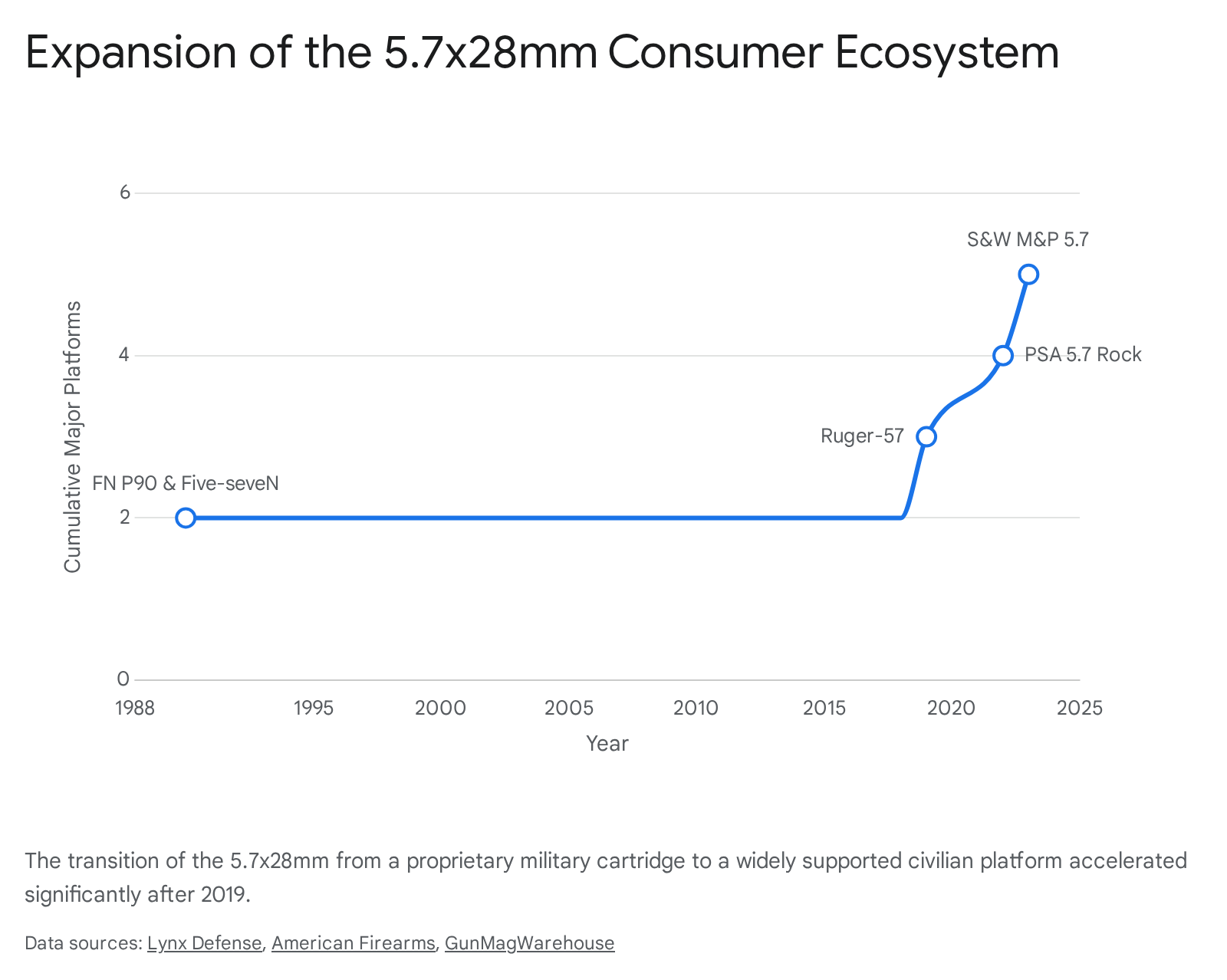
The 5.7x28mm round provided the perfect mechanical catalyst for this market evolution. The resurgence gained critical mass when major American manufacturers systematically shattered FN Herstal’s long-standing monopoly over the chambering. Ruger initiated this disruption with the introduction of the Ruger-57, followed closely by Smith & Wesson launching the M&P 5.7.14 Palmetto State Armory subsequently entered the space, aggressively disrupting the market with the highly affordable and feature-rich PSA 5.7 Rock.14 By offering 5.7x28mm handguns at price points well below the historical thousand-dollar average, these manufacturers successfully democratized the caliber for the average consumer.15
This democratization fundamentally altered how the shooting public views the cartridge. It is no longer considered a bizarre novelty reserved for federal agencies. Instead, the 5.7x28mm is now widely recognized as a highly capable personal defense tool characterized by its massive twenty to twenty-three round standard magazine capacities, its exceptionally flat ballistic trajectory, and a recoil impulse that is practically negligible compared to standard defensive 9mm loads.5
4. Engineering Analysis: The Palmetto State Armory X5.7 PDW Platform
The culmination of the modern 5.7x28mm resurgence is best exemplified by the development of dedicated, highly specialized personal defense weapons designed specifically around the cartridge’s unique ballistic profile. The most anticipated release in this emerging category is the Palmetto State Armory X5.7.3 Initially teased prior to SHOT Show 2025 and currently undergoing its final endurance testing phases in the spring of 2026, the PSA X5.7 represents a massive tactical evolution for the civilian and law enforcement markets.3
The PSA X5.7 is engineered from the ground up as a highly compact, quick-deploy personal defense weapon.3 Structurally, it features a robust aluminum upper receiver mated seamlessly to a lightweight polymer lower receiver.3 This hybrid material construction ensures absolute structural rigidity for optic mounting and barrel harmonics on the top half, while significantly minimizing the overall weight burden on the operator. The platform incorporates a threaded barrel from the factory to facilitate the immediate use of sound suppressors, a feature that has become a critical operational requirement for indoor close-quarters engagements and home defense.3
Operationally, the X5.7 is designed to maximize existing user familiarity. It utilizes an AR-15 style rear charging handle, ensuring that operators trained on America’s most popular rifle platform require absolutely minimal cross-training or familiarization time to operate the PDW efficiently under stress.3 The weapon system is equipped with a deployable brace, allowing the firearm to be transported or stored in a highly compressed state and then rapidly extended for shoulder-supported firing stability.3 Furthermore, the inclusion of Glock-style front and rear sight dovetails provides users with immediate access to a massive existing aftermarket ecosystem for sighting solutions, completely bypassing the proprietary sight issues that plague many boutique PDWs.3
From an economic perspective, the PSA X5.7 is positioned to aggressively undercut legacy platforms. Compared to the proprietary nature of the FN PS90, or boutique AR-platform offerings such as the CMMG Banshee, Palmetto State Armory is expected to leverage its massive manufacturing scale to bring the weapon to market at a highly disruptive price point. Historical pricing targets discussed within the community suggest a retail cost hovering around nine hundred and ninety-nine dollars.18 Such pricing would firmly establish the X5.7 as an incredibly viable entry point for underfunded police departments and budget-conscious civilians seeking a high-tier PDW capability without the exorbitant institutional costs traditionally associated with the 5.7x28mm chambering.19
5. Logistics, Platform Sourcing, and Vendor Availability
The deployment of any weapon system is only as viable as its supporting logistical tail. Procuring the necessary hardware, magazines, and ammunition for the 5.7x28mm platform requires navigating a diverse and rapidly expanding vendor landscape. Palmetto State Armory acts as the primary direct-to-consumer manufacturer for their proprietary firearms, while a robust network of established online retailers supplies the vital accompanying ecosystem of magazines, optics, and consumable ammunition.
To satisfy immediate procurement needs for currently available hardware leading up to the release of the X5.7, the following URLs represent the official manufacturer platform for the existing PSA 5.7 Rock pistol, alongside three preferred vendor platforms currently offering support items and ammunition within optimal market pricing margins:
- Manufacturer Hardware Portal:Palmetto State Armory offers the baseline optics-ready 5.7 Rock directly to consumers, serving as the foundational building block for the caliber ecosystem. https://palmettostatearmory.com/palmetto-5-7-rock.html 20
- Ammunition Procurement (TrueShot Ammo):TrueShot Ammo provides bulk purchasing options for both training and defensive 5.7x28mm loads, operating closely within the forty to seventy-six cents per round average. https://trueshotammo.com/collections/ammunition-pistol-ammo-5-7x28mm 22
- Ammunition Procurement (Sportsmans Warehouse):Sportsmans Warehouse serves as an alternative high-volume vendor for securing specialized loads such as the Speer Gold Dot and Federal American Eagle. https://www.sportsmans.com/ammunition-ammo-for-hunting-shooting-sports/c/cat100112 23
- Magazine and Accessory Procurement (GunMagWarehouse):Securing proprietary twenty-three round steel magazines for the Palmetto State Armory platforms is critical for operational readiness. https://gunmagwarehouse.com/all-magazines/5-7-x-28mm 24
5.1 Ammunition Production and Pricing Stabilization
The primary historical impediment to the widespread civilian and police adoption of the 5.7x28mm was the severe logistical challenge of sourcing affordable ammunition. For nearly two decades, the market was constrained by a single supplier arrangement, resulting in extreme pricing volatility and frequent, severe availability shortages.13 However, the recent market saturation of new 5.7x28mm firearms necessitated a proportional and massive increase in domestic ammunition production.
By May 2026, the ammunition ecosystem has matured remarkably. Major domestic manufacturers have heavily invested in dedicated 5.7x28mm brass forming and loading tooling. Companies such as Federal Premium, Speer, Hornady, and Palmetto State Armory’s sister company, Advanced Armament Company, now offer a robust, diverse portfolio of loads tailored for highly specific tactical applications.13 This diversification includes affordable forty-grain full metal jacket rounds designed for high-volume training, advanced forty-grain jacketed hollow points engineered for personal defense, and heavier sixty-two grain subsonic loads optimized specifically for suppressed operations.13
This massive increase in manufacturing capacity has successfully stabilized retail pricing. While the 5.7x28mm remains marginally more expensive than standard bulk 9mm Luger ammunition, it has finally reached a level of true commercial viability. Current pricing metrics aggregated across multiple vendors indicate that bulk training ammunition typically costs between forty cents and seventy-six cents per round, heavily dependent on the vendor, shipping rates, and the specific bullet weight.26 Premium defensive loads, such as those offered by Speer and Hornady, command a higher price point, but they align very closely with the cost of premium 9mm self-defense ammunition.28 This price parity in defensive loads completely negates one of the primary historical arguments against adopting the 5.7x28mm for duty use.
6. The Physics of Terminal Ballistics from Short Barrels
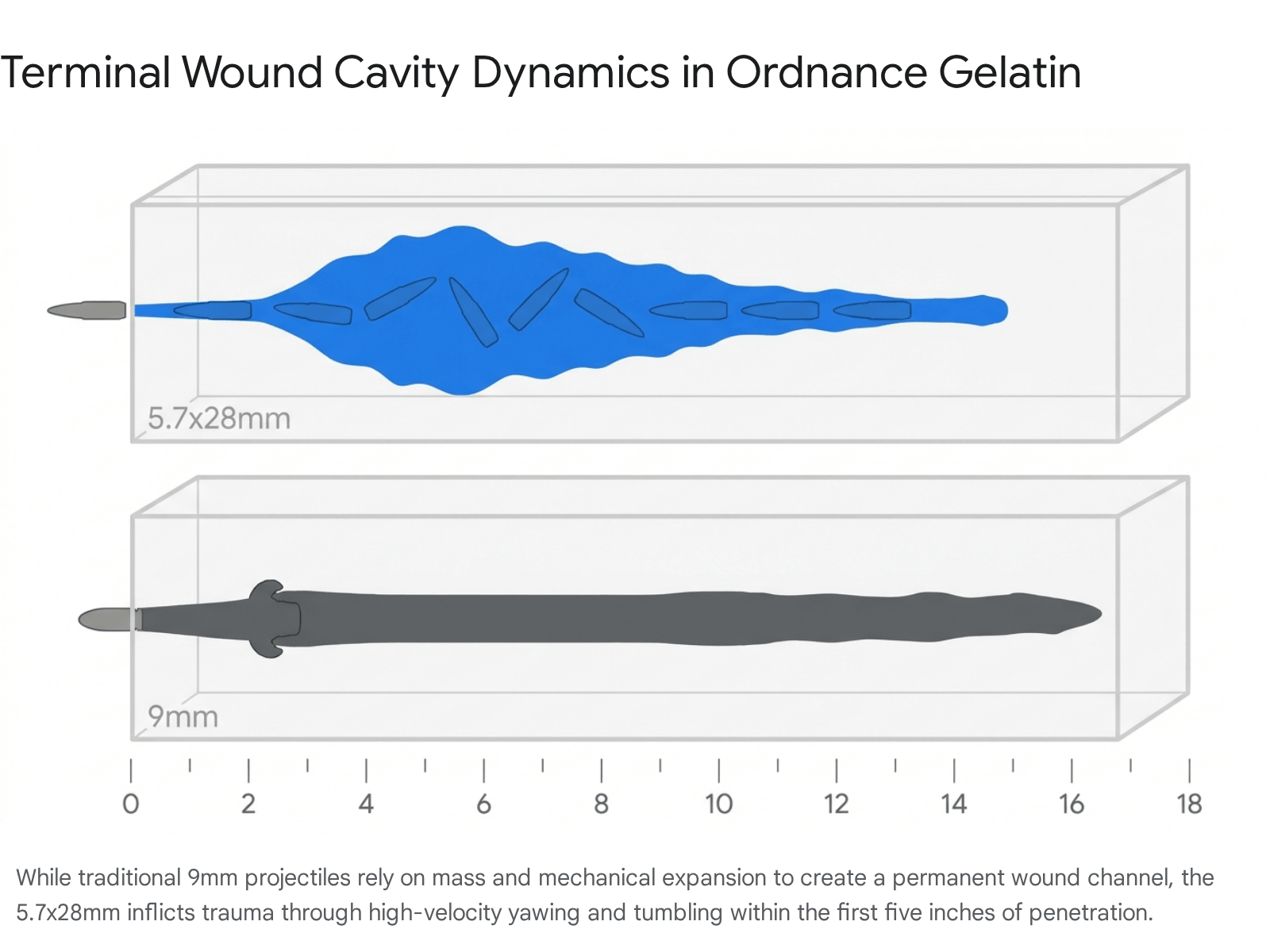
A critical aspect of analyzing any personal defense weapon is developing a deep understanding of the terminal ballistics of its designated cartridge, particularly when the round is fired from short barrels. The lethality and effectiveness of the 5.7x28mm are entirely reliant on extreme velocity. Unlike traditional pistol calibers that rely heavily on heavy bullet mass and reliable mechanical expansion to destroy tissue, the 5.7x28mm inflicts severe trauma through high-velocity penetration and rapid, violent projectile tumbling within soft tissue targets.30
The kinetic energy of any projectile is calculated using a formula where velocity is squared. Because velocity is an exponential factor in this equation, the massive speed of the 5.7x28mm allows its exceptionally lightweight projectiles to deliver kinetic energy that equals or surpasses much heavier, slower rounds. However, this also means that any reduction in barrel length that bleeds off velocity will have a disproportionately negative impact on the cartridge’s effectiveness.
The original design parameters of the 5.7x28mm were perfectly optimized for the 10.4-inch barrel of the FN P90 submachine gun.13 When barrel lengths are reduced to the 4.7-inch to 5-inch range typical of modern sidearms like the PSA 5.7 Rock or the Ruger 57, the cartridge experiences a measurable and unavoidable loss in velocity.15 However, modern propellant formulations utilized by companies like Federal and Speer have mitigated this degradation significantly. When fired from a standard 5-inch pistol barrel, premium defensive loads like the Speer 40-grain Gold Dot jacketed hollow point still achieve blistering muzzle velocities of approximately 1,800 feet per second, yielding 288 foot-pounds of energy.28
Comparing short barrel performance across different lengths reveals vital tactical data for platform selection. An 8-inch to 10-inch barrel, such as those utilized on upcoming PDW platforms like the X5.7, acts as a massive ballistic force multiplier. A longer barrel allows the slow-burning smokeless powder to achieve a much more complete burn before the bullet exits the muzzle, driving forty-grain projectiles well past 2,000 feet per second and dramatically increasing the kinetic energy delivered on target.8 Testing conducted with the 16.25-inch Ruger LC Carbine demonstrated that the 5.7x28mm can easily achieve velocities in the vicinity of 2,100 feet per second, maximizing the cartridge’s potential.32
6.1 The 5.56x45mm Short Barrel Conundrum
The efficiency of the 5.7x28mm in short barrels highlights a stark and critical contrast with the ubiquitous 5.56x45mm NATO rifle cartridge. The 5.56x45mm was engineered specifically to be fired from 20-inch barrels to achieve the extreme fragmentation velocities required for its optimal terminal performance.6 When 5.56x45mm barrels are chopped down to 8 inches or 10.5 inches to create AR-15 pistols or short-barreled rifles, the cartridge suffers severe, crippling velocity loss.6 Furthermore, the unburnt powder exiting the short 5.56mm barrel creates excessive, blinding muzzle flash and a concussive overpressure wave that can disorient the operator, particularly in enclosed spaces.31
The 5.7x28mm, conversely, was designed from its inception to be highly efficient in these abbreviated lengths. It burns its powder charge completely within a much shorter distance, resulting in minimal muzzle flash and a vastly reduced concussive signature.31 This inherent efficiency makes the 5.7x28mm far superior for suppressed indoor defensive use, where the preservation of the operator’s auditory and visual senses is a critical tactical priority.31
7. Empirical Data: Ballistic Gelatin Testing and Penetration Metrics
Theoretical physics must always be validated by empirical data. Information derived from standardized ten percent ordnance gelatin testing confirms the lethality and tactical viability of the 5.7x28mm cartridge in modern defensive loads. Extensive testing indicates that 5.7x28mm projectiles tend to destabilize and tumble reliably starting at a shallow depth of four to five inches upon entering the medium.30 This rapid yawing motion presents the entire length of the projectile to the tissue, creating substantial and destructive temporary wound cavities that belie the bullet’s small diameter.30
When evaluating specific commercial defensive loads, terminal results vary predictably based on bullet construction and intended design. The FN SS198LF 27-grain jacketed hollow point, when fired from a 16-inch barrel, creates a massive temporary cavity remarkably similar to a premium 9mm HST round, which is widely considered the gold standard for law enforcement.25 However, due to its extreme light weight, the 27-grain bullet exhibits limited overall penetration depth, often falling short of the FBI’s recommended twelve-inch minimum.25
Conversely, heavier modern designs like the Speer 40-grain Gold Dot demonstrate excellent, consistent performance across multiple barrel lengths. Fired from standard pistol lengths, the 40-grain Gold Dot reliably expands upon impact and achieves optimal penetration depths ranging from 14.5 to 15 inches in bare gelatin.25 This performance perfectly bisects the FBI’s strict twelve to eighteen-inch penetration requirement, proving the cartridge’s viability for duty use.
7.1 Mitigation of Overpenetration Risks
Importantly, standard commercial 5.7x28mm ammunition, which features lightweight and highly frangible projectiles, poses a significantly reduced risk of dangerous overpenetration compared to traditional heavy pistol rounds.13 When these 35-grain to 40-grain projectiles impact structural barriers such as interior drywall, wooden studs, or plywood, they rapidly destabilize, tumble, and fragment, bleeding off their lethal energy almost instantly.13
This specific characteristic makes the 5.7x28mm an exceptionally safe and highly effective choice for home defense scenarios or dynamic law enforcement operations conducted within high-density suburban environments and modern apartment complexes.13 A missed shot with a 147-grain 9mm projectile can easily traverse multiple interior walls, endangering innocent bystanders. A missed shot with a 40-grain 5.7x28mm V-Max is far more likely to be captured by the first or second structural layer it encounters, providing a massive liability advantage for the defender.
8. Tactical Comparison: 5.7x28mm PDWs versus 9mm Pistol-Caliber Carbines
The decision to equip personnel or defend a homestead with a 5.7x28mm personal defense weapon versus a traditional 9mm pistol-caliber carbine requires a nuanced understanding of their respective ballistic trade-offs. Both weapon systems offer distinct operational advantages, and the optimal choice is heavily dependent on the specific environment and the anticipated threat profile.
8.1 Velocity, Kinetic Energy, and Ballistic Trajectory
The most pronounced difference between the two calibers lies in their kinetic energy delivery methods and their respective flight paths. The 9mm Luger relies heavily on heavier projectiles, typically ranging from 115 grains to 147 grains for defensive applications.36 These heavier bullets generally yield muzzle velocities between 950 and 1,400 feet per second, generating an average of 350 to 450 foot-pounds of kinetic energy.29 The 5.7x28mm, utilizing much lighter 27-grain to 40-grain projectiles, achieves significantly higher velocities, ranging from 1,700 to 2,800 feet per second, delivering between 240 and 400 foot-pounds of energy.29
While the 9mm generally produces slightly higher absolute muzzle energy, its heavy, slow-moving projectile results in a steep, rainbow-like parabolic trajectory. The 9mm was originally designed to be lethal out to fifty meters, and its effectiveness diminishes rapidly beyond this distance due to severe bullet drop and extreme velocity loss.36 The 5.7x28mm, conversely, is extraordinarily flat-shooting.5 The high velocity and superior aerodynamic profile of the 5.7x28mm projectile allow a shooter to engage targets accurately at one hundred meters and beyond with minimal holdover required.5
The following table provides a detailed comparative analysis of retained kinetic energy and velocity over extended distances, utilizing Speer Gold Dot defensive loads as the uniform benchmark for both calibers:
| Range Metric | Caliber Designation | Projectile Weight | Retained Velocity (fps) | Retained Energy (ft-lbs) |
| Muzzle | 5.7x28mm | 40 grain | 1,800 | 288 |
| Muzzle | 9mm Luger | 124 grain | 1,044 | 364 |
| 25 Yards | 5.7x28mm | 40 grain | 1,510 | 242 |
| 25 Yards | 9mm Luger | 124 grain | 1,004 | 328 |
| 50 Yards | 5.7x28mm | 40 grain | 1,383 | 203 |
| 50 Yards | 9mm Luger | 124 grain | 1,004 | 300 |
| 75 Yards | 5.7x28mm | 40 grain | 1,383 | 170 |
| 75 Yards | 9mm Luger | 124 grain | 1,004 | 277 |
| 100 Yards | 5.7x28mm | 40 grain | 1,271 | 144 |
| 100 Yards | 9mm Luger | 124 grain | 969 | 246 |
8.2 Recoil Impulse and Follow-Up Engagement Shootability
Tactical efficacy in a dynamic gunfight is not solely determined by raw kinetic energy on paper. The physical ability of the operator to place rapid, highly accurate successive shots on a moving target is often the deciding factor in survival. In this critical metric, the 5.7x28mm holds a massive and decisive advantage over the 9mm.
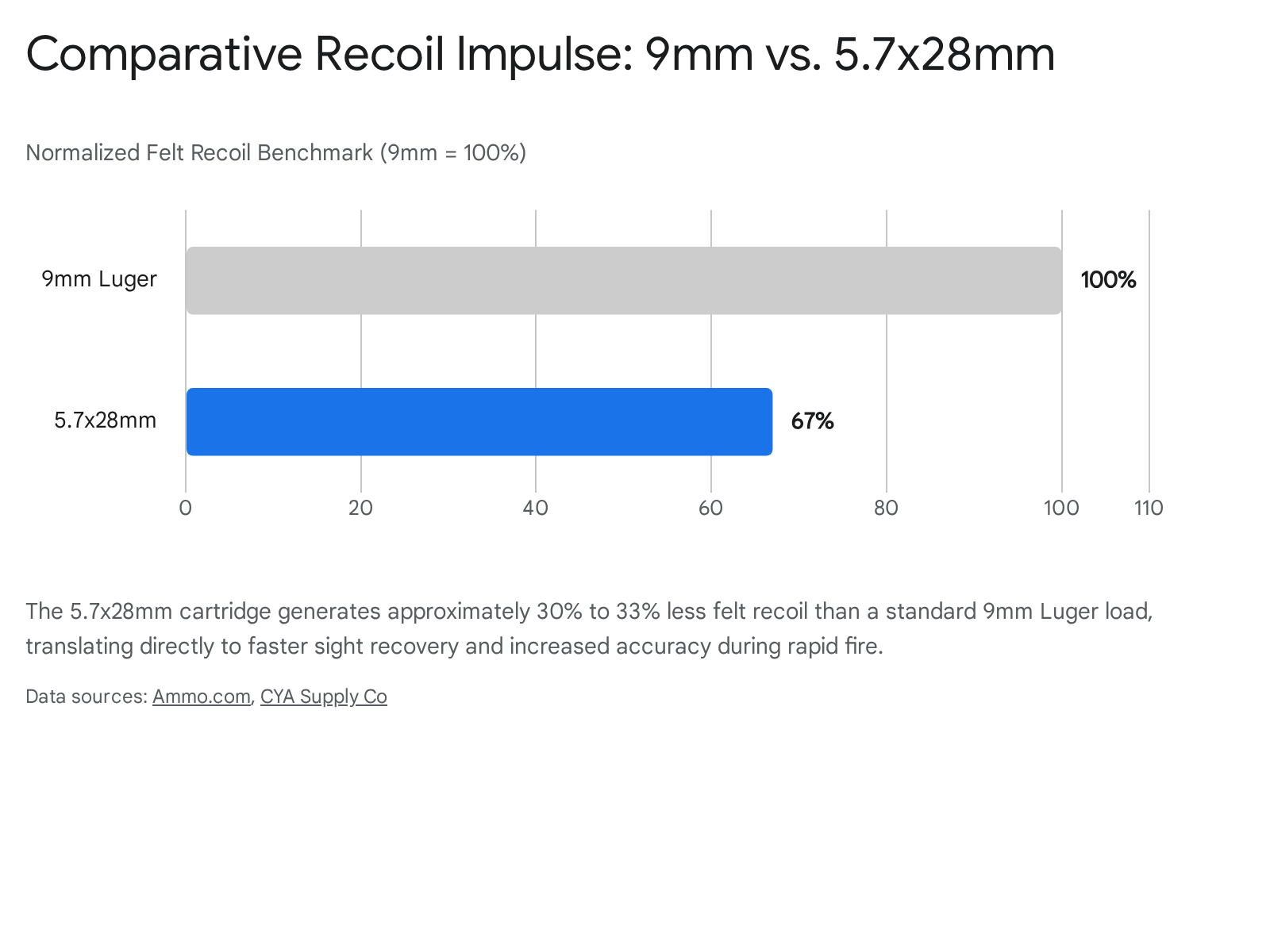
The 5.7x28mm cartridge generates approximately one-third less felt recoil than standard 9mm Luger ammunition.36 This drastic reduction in recoil impulse is physically dramatic for the operator. Shooters operating 5.7x28mm platforms, such as the Ruger LC Carbine or the Palmetto State Armory X5.7, experience near-zero muzzle climb.28 This absolute stability allows the optical sights to remain completely static on the target throughout the entire firing cycle, permitting incredibly fast and surgically precise follow-up shots.5
Furthermore, the reduced overall dimensions and lighter casing weight of the 5.7x28mm cartridge allow mechanical engineers to design highly efficient, high-capacity magazines that still fit comfortably within standard grip parameters.25 A standard 9mm sidearm typically holds fifteen to seventeen rounds, whereas a comparable 5.7x28mm platform easily accommodates twenty to twenty-three rounds flush-fit.15 Extended PDW magazines can hold up to fifty rounds without becoming unwieldy.25 This massive increase in onboard firepower, combined with the practically non-existent recoil impulse, allows defenders to project overwhelming suppressive capabilities in close-quarters environments without requiring frequent reloads.
9. Legislative Friction, Compliance Environments, and State Preemption
While the ballistic advantages and tactical merits of the 5.7x28mm platform are abundantly clear to professionals, the actual deployment and civilian ownership of these weapon systems are increasingly dictated by highly complex and hostile legislative environments. The core tactical advantage of the 5.7x28mm is its ability to pack twenty to fifty rounds into standard-sized magazines. This exact feature makes the platform a primary target for aggressive state-level firearm regulations and sweeping magazine bans.
9.1 The Impact and Mechanics of Michigan Senate Bill 851
A prime, active example of this rapidly shifting legal landscape is currently unfolding in Michigan. In March 2026, the Michigan State Senate introduced Senate Bill 851, a piece of sweeping legislation explicitly designed to completely prohibit the sale, production, and possession of high-capacity ammunition magazines within state lines.39 Spearheaded by the Michigan Legislature’s firearm safety caucus, SB 851 proposes amending the state penal code to establish strict, unyielding limits on magazine capacity.39
The passage of such legislation would instantly and retroactively reclassify standard 5.7x28mm magazines as contraband. The twenty-three-round magazine included standard with the PSA 5.7 Rock, and the fifty-round horizontal magazines utilized by platforms like the FN PS90, would become prohibited items overnight. Violation of this newly proposed amendment is classified strictly as a misdemeanor, carrying harsh penalties of up to ninety days of imprisonment, strict financial fines, or a combination of both.41
This specific legislation does not operate in a vacuum. It is being pushed alongside a much broader, highly aggressive package of proposed regulations. This package includes the implementation of mandatory three-day waiting periods for all firearm purchases, new million-dollar liability insurance requirements to operate as a firearms dealer, and coordinated efforts to repeal the Protection of Lawful Commerce in Arms Act at the state level.42 Repealing this protection would open manufacturers to crippling civil lawsuits for the criminal misuse of their products, threatening the supply chain of platforms like the X5.7.43
9.2 State Preemption Laws versus Local Ordinances
The enforcement of firearm regulations in Michigan is currently governed by a strict state preemption statute. Under Michigan Compiled Laws Section 123.1102, local units of government, including counties, cities, and townships, are expressly and completely prohibited from enacting or enforcing their own independent ordinances pertaining to the ownership, registration, purchase, sale, or transportation of firearms and ammunition.44
This preemption statute ensures that local municipalities, such as Berrien County, cannot arbitrarily ban specific calibers, enforce local magazine limits, or halt the shipping of personal defense weapons independently of state law. The Michigan Court of Appeals has repeatedly and forcefully upheld this preemption statute, affirming that the state legislature completely and totally occupies the field of firearm regulation.46 This legal precedent prevents a confusing patchwork of inconsistent local laws. Consequently, while a resident of Berrien County need not worry about a county-specific ban on their 5.7x28mm PDW or its ammunition, their legal standing is entirely beholden to the outcome of massive state-level legislative battles like SB 851.
9.3 Manufacturer Vendor Compliance and Strict Shipping Restrictions
In direct response to this incredibly complex web of state regulations, manufacturers and major distributors have implemented rigorous, uncompromising shipping compliance protocols. Palmetto State Armory, serving as a primary vendor, maintains a highly strict internal database of geographical restrictions to ensure total legal compliance and shield the company from liability.47
When processing shipments to heavily regulated states, PSA will unequivocally halt the fulfillment of any non-compliant items. For example, if a customer in a restricted jurisdiction, such as Maryland or parts of Illinois, attempts to order a PSA 5.7 Rock or a future PSA X5.7 PDW that includes magazines exceeding local capacity limits, the order will be immediately modified to remove the magazines or canceled entirely.47 Furthermore, specific configurations of firearms, such as AR or AK style pistols and rifles, are completely restricted from being shipped to certain states regardless of their magazine capacity.47 It is the explicit, legally binding responsibility of the purchasing citizen to consult their local Federal Firearms Licensee to ensure that the specific model and magazine configuration of the 5.7x28mm platform they intend to purchase is fully compliant with their local jurisdiction before initiating a financial transfer.49
10. Strategic Conclusions and the Operational Outlook
The aggressive resurgence of the 5.7x28mm cartridge leading into May 2026 marks a permanent and fundamental shift in the tactical personal defense landscape. The cartridge has successfully evolved from a proprietary, overly expensive military solution into a highly versatile, easily accessible platform suitable for a massive spectrum of civilian and law enforcement applications.
The introduction of dedicated, optimized personal defense weapons like the Palmetto State Armory X5.7 represents the true mechanical maturation of this ecosystem. By maximizing the cartridge’s inherent physical advantages, namely its exceptionally low recoil impulse, laser-flat trajectory, and massive magazine capacity, these modern platforms offer superior maneuverability and engagement speed compared to traditional 9mm pistol-caliber carbines. Furthermore, the total stabilization of the ammunition market, driven by massive increases in domestic production from heavyweights like Federal and Fiocchi, has effectively neutralized the historical cost barriers that previously prevented widespread adoption of the caliber.
However, the operational future of the 5.7x28mm platform remains inexorably and dangerously linked to the shifting legislative environment. Because the cartridge relies so heavily on high-capacity magazines to realize its full tactical potential, aggressive legislative efforts, such as Michigan’s Senate Bill 851, pose a direct and existential threat to its deployment. As mechanical engineers and manufacturers continue to innovate and refine these advanced weapon systems, tactical operators and civilian defenders must remain equally vigilant regarding the highly volatile legal frameworks that dictate their use. The 5.7x28mm has undeniably proven its ballistic superiority and physical efficiency for the modern defender. The true test of the platform will be its endurance and survival in the face of immense legal and political friction over the coming decade.
Note: Vendor Sources listed are not an endorsement of any given vendor. It is our software reporting a product page given the direction to list products that are between the minimum and average sales price when last scanned.
Please share the link on Facebook, Forums, with colleagues, etc. Your support is much appreciated and if you have any feedback, please email us in**@*********ps.com. If you’d like to request a report or order a reprint, please click here for the corresponding page to open in new tab.
Sources Used
- From Compacts To Classics – Shooting Industry Magazine, accessed May 10, 2026, https://shootingindustry.com/discover/from-compacts-to-classics/
- 5.7x28mm Renaissance – Recoil Magazine, accessed May 10, 2026, https://www.recoilweb.com/5-7x28mm-renaissance-173998.html
- The PSA X5.7 – SHOT Show 2026 Update | Palmetto State Armory – YouTube, accessed May 10, 2026, https://www.youtube.com/watch?v=D4wHQuNlcIc
- The PSA X5.7 SHOT Show 2026 Update – Palmetto State Armory, accessed May 10, 2026, https://palmettostatearmory.com/blog/the-psa-x57-shot-show-2026-update.html
- Top 10 differences between the 5.7×28 vs 9mm: Ballistics, Performance – CYA Supply Co., accessed May 10, 2026, https://www.cyasupply.com/blogs/articles/top-10-differences-between-the-5-7×28-vs-9mm-ballistics-performance-and-practical-applications
- 5.7×28: The Ultimate Survival Caliber? (w/Video) – GunsAmerica, accessed May 10, 2026, https://gunsamerica.com/digest/5-7×28-the-ultimate-survival-caliber/
- What’s up with the 5.7 Resurgence? – American Firearms, accessed May 10, 2026, https://www.americanfirearms.org/whats-up-with-the-5-7-resurgence/
- 5.7x28mm Explained – The PDW Cartridge – Lynx Defense, accessed May 10, 2026, https://lynxdefense.com/57x28mm/
- FN 5.7×28mm – Wikipedia, accessed May 10, 2026, https://en.wikipedia.org/wiki/FN_5.7%C3%9728mm
- The Ultimate Guide to 5.7x28mm Ammunition Pistols and Rifles [2023] – Gunprime, accessed May 10, 2026, https://gunprime.com/blog/the-ultimate-guide-to-57x28mm-ammunition-and-rifles-2023
- PDW Round Comparison 5.7x28mm vs 4.6x30mm | The Ballistic Assistant, accessed May 10, 2026, https://www.theballisticassistant.com/pdw-round-comparison-5-7x28mm-vs-4-6x30mm/
- FN PS90 Review (2026): Is the Civilian P90 Worth $1,800? – Lynx Defense, accessed May 10, 2026, https://lynxdefense.com/reviews/fn-ps90/
- The 5.7x28mm Surge – Guns and Ammo, accessed May 10, 2026, https://www.gunsandammo.com/editorial/57x28mm-surge/511096
- Best 5.7x28mm Guns: Top Pistols & Carbines for 2026 – Lynx Defense, accessed May 10, 2026, https://lynxdefense.com/best-5-7-guns/
- The PSA 5.7 Rock Pistol: How Low is too Low for a 5.7 Pistol? – – GunMag Warehouse, accessed May 10, 2026, https://gunmagwarehouse.com/blog/the-psa-5-7-rock-pistol-how-low-is-too-low-for-a-5-7-pistol/
- PSA X5.7 – Product Update | Palmetto State Armory – YouTube, accessed May 10, 2026, https://www.youtube.com/watch?v=5mC9LGC5QyY
- The PSA X5.7 SHOT Show 2026 Update – The PSA Blog – Palmetto State Armory, accessed May 10, 2026, https://ads.palmettostatearmory.com/blog/the-psa-x57-shot-show-2026-update.html
- Rock carbine? – Page 10 – Palmetto 5.7 Rock – Palmetto State Armory | Forum, accessed May 10, 2026, https://palmettostatearmory.com/forum/t/rock-carbine/18182?page=10
- x5.7 is targeting for $999 and is at least 12 months away… : r/PalmettoStateArms – Reddit, accessed May 10, 2026, https://www.reddit.com/r/PalmettoStateArms/comments/19e9wva/x57_is_targeting_for_999_and_is_at_least_12/
- PSA 5.7 Rock | Palmetto State Armory, accessed May 10, 2026, https://palmettostatearmory.com/palmetto-5-7-rock.html?p=6
- PSA 5.7 Rock – Palmetto State Armory, accessed May 10, 2026, https://palmettostatearmory.com/palmetto-5-7-rock.html
- 5.7x28mm Ammo – Bulk 5.7x28mm Ammunition For Sale | True Shot Ammo, accessed May 10, 2026, https://trueshotammo.com/collections/ammunition-pistol-ammo-5-7x28mm
- Ammunition | Handgun, Shotgun & Rifle Ammo – Sportsman’s Warehouse, accessed May 10, 2026, https://www.sportsmans.com/ammunition-ammo-for-hunting-shooting-sports/c/cat100112
- 5.7x28mm Magazines – GunMag Warehouse, accessed May 10, 2026, https://gunmagwarehouse.com/all-magazines/5-7-x-28mm
- Is 5.7 Good for Self-Defense?, accessed May 10, 2026, https://secondcalldefense.org/is-5-7-good-for-self-defense/
- 5.7X28MM Practice Ammunition Prices – AmmoSquared, accessed May 10, 2026, https://ammosquared.com/product_price_details/HG-57X28-PRTC
- 5.7×28 Ammo For Sale | Daily Deals on 5.7 Ammunnition – Bulk Cheap Ammo, accessed May 10, 2026, https://www.bulkcheapammo.com/handgun-ammo/57x28mm
- 5.7x28mm Vs. 9mm Luger: Caliber Debate – Recoil Magazine, accessed May 10, 2026, https://www.recoilweb.com/5-7x28mm-vs-9mm-luger-caliber-debate-181581.html
- 5.7×28 vs 9mm: Full Comparison | True Shot Academy, accessed May 10, 2026, https://trueshotammo.com/blogs/true-shot-academy/5-7×28-vs-9mm-full-comparison
- 5. Tumbling – Viper Weapons Training, accessed May 10, 2026, https://viperweapons.us/blog/f/5-tumbling
- Anyone have a link to good charts for 5.7 vs 5.56 out of a 10” barrel? : r/57x28mm – Reddit, accessed May 10, 2026, https://www.reddit.com/r/57x28mm/comments/1halj4l/anyone_have_a_link_to_good_charts_for_57_vs_556/
- Self-defense and the 5.7 Fest – GunsAmerica, accessed May 10, 2026, https://gunsamerica.com/digest/back-to-school-the-5-7-fest-and-a-5-7x28mm-education/
- Ruger LC Carbine 5.7×28 Semi-Auto Rifle 16.25″ 20rd – 19300 – Palmetto State Armory, accessed May 10, 2026, https://palmettostatearmory.com/ruger-lc-carbine-5-7×28-carbine-semi-auto-rifle-16-25-20rd-19300.html
- 9mm vs .357 Sig vs 10mm vs 5.7x28mm vs Ballistic Gel – YouTube, accessed May 10, 2026, https://www.youtube.com/watch?v=sMUEEnXw5pI
- FN 5.7×28 Ballistic Charts for All Manufacturers – Ammo.com, accessed May 10, 2026, https://ammo.com/ballistics/5.7×28-ballistics
- 5.7 vs 9mm: Complete Handgun Caliber Comparison by Ammo.com, accessed May 10, 2026, https://ammo.com/comparison/57-vs-9mm
- 5.7x28mm vs. 9mm – U.S. LawShield, accessed May 10, 2026, https://www.uslawshield.com/5-7x28mm-vs-9mm/
- 6 Best Modern PCCs for Personal Defense, with Reviews – Guns and Ammo, accessed May 10, 2026, https://www.gunsandammo.com/editorial/6-pccs-personal-defense/545926
- Senate Bill 851 of 2026 – Michigan Legislature, accessed May 10, 2026, https://www.legislature.mi.gov/Bills/Bill?ObjectName=2026-SB-0851
- MI SB0851 | 2025-2026 | 103rd Legislature – LegiScan, accessed May 10, 2026, https://legiscan.com/MI/bill/SB0851/2025
- Bill tracking in Michigan – SB 851 (2025-2026 legislative session) – FastDemocracy, accessed May 10, 2026, https://fastdemocracy.com/bill-search/mi/2025-2026/bills/MIB00028869/
- Michigan gun safety caucus outlines legislative priorities as advocates push for tougher laws, accessed May 10, 2026, https://www.michiganpublic.org/politics-government/2026-03-18/michigan-gun-safety-caucus-outlines-legislative-priorities-as-advocates-push-for-tougher-laws
- GIFFORDS urges Michigan lawmakers to save lives, pass gun violence prevention bills, accessed May 10, 2026, https://giffords.org/press-release/2026/03/giffords-urges-michigan-lawmakers-to-save-lives-pass-gun-violence-prevention-bills/
- MCL – Section 123.1102 – Michigan Legislature, accessed May 10, 2026, https://www.legislature.mi.gov/Laws/MCL?objectName=mcl-123-1102
- Preemption of Local Laws in Michigan – Giffords, accessed May 10, 2026, https://giffords.org/lawcenter/state-laws/preemption-of-local-laws-in-michigan/
- Point/Counterpoint: Local Control of Firearms Remains Preempted by State Law – State Bar of Michigan, accessed May 10, 2026, http://www.michbar.org/file/barjournal/article/documents/pdf4article3083.pdf
- Shipping Restrictions By State | Palmetto State Armory, accessed May 10, 2026, https://palmettostatearmory.com/shipping-restrictions-by-state.html
- State-by-State Shipping Restrictions – | Gable Sporting Goods, accessed May 10, 2026, https://www.gablesportsga.com/info/state-by-state-shipping-restrictions
- Orders and Shipping | Palmetto State Armory, accessed May 10, 2026, https://palmettostatearmory.com/help-center/faq/orders-and-shipping.html