
The global small arms industry operates at an exceptionally complex intersection of precision mechanical engineering, highly regulated international defense procurement frameworks, stringent export controls, and intense brand loyalty within both the civilian and law enforcement sectors. Few organizations have navigated this intricate matrix as successfully—and in recent years, as tumultuously—as the Swiss defense manufacturer B&T AG. Renowned for its exacting manufacturing standards and its dominance in the high-tier tactical weapon systems market, B&T has historically enjoyed a sterling, almost mythic reputation among elite military units and premium civilian consumers alike.1 However, the recent and highly publicized corporate schism between the Swiss parent company, B&T AG, and its designated United States distributor and licensee, B&T USA, has exposed profound structural vulnerabilities in international licensing architectures, cross-border supply chains, and domestic corporate governance.
The comprehensive settlement formally announced in June 2026 between B&T AG and B&T USA marks the conclusion of a bitter, multi-front legal and financial dispute that threatened to irrevocably damage one of the industry’s most prestigious names.3 This resolution not only redraws the operational map for B&T in the world’s most lucrative firearms market but also serves as a critical, cautionary case study for the broader defense industry regarding corporate governance, intellectual property defense, and brand preservation under extreme geopolitical and legal duress. By examining the structural origins of this transatlantic partnership, the specific catalysts for its catastrophic failure, the nuances of the subsequent federal legal settlement, and the resulting bifurcated market landscape, a clear and actionable picture emerges of the go-forward strategy for both entities. Furthermore, this strategic realignment carries significant, immediate, and long-term implications for United States consumers, who are now forced to navigate a highly fragmented warranty landscape, disrupted supply chains, and the chaotic aftermath of unfulfilled backorders.
1. The Ascent of Brügger & Thomet: A Legacy of Swiss Precision
To fully comprehend the magnitude of the 2026 settlement and the subsequent legal warfare, one must first examine the foundational architecture of the relationship between B&T AG and its American counterpart. The underlying value of the dispute is intrinsically tied to the historical prestige of the Swiss brand. Founded in May 1991 in the town of Spiez, situated on Lake Thun in Switzerland, the company originally known as Brügger & Thomet Feintechnik was established by Karl Brügger and his partner, Heinrich Thomet.5 Brügger, who began his career as a mechanical apprentice in 1985 working on a suppressor project for the Swiss Army, eventually bought out his partner to become the sole owner of the enterprise.1
In its nascent stages, the company focused almost exclusively on producing a line of firearm suppressors for the domestic Swiss market, leveraging the long history of suppressor use in Swiss sport shooting dating back to the late 1800s.5 Operating initially out of a modest 150-square-meter backyard shop with little more than a lathe, a mill, a welding machine, and $30,000 in capital, B&T systematically built a reputation for uncompromising quality.1 The company was fully licensed by the Swiss government from its inception for the sales, importation, and manufacturing of small arms for police and public authorities.6
By 1997, the company was converted into a public limited company under Swiss law, and in 2004, it relocated its headquarters and primary manufacturing facilities to Thun, Switzerland—strategically positioned near the Swiss Army Panzerschule and NCO school.6 In April 2011, the company officially rebranded as B&T AG, a move designed to simplify its corporate identity while emphasizing its accelerating global footprint.7 This era saw the company transition from a boutique suppressor manufacturer to a dominant force in complete, state-of-the-art tactical weapon systems.8 B&T became a critical supplier of suppressors and specialized components to nearly every major European defense contractor, including Heckler & Koch, Glock, FN Herstal, Beretta, Accuracy International, CZ, Walther, Steyr, and Sako.1
The defining characteristic of B&T AG during this period was its absolute dedication to precision and quality control. The company’s internal processes, encompassing manufacturing, quality management, environmental management, information security, and occupational health and safety, were rigidly governed by international standards, specifically ISO 9001:2015, ISO 14001:2015, ISO 27001:2022, and ISO 45001:2018.9 This obsessive control over the manufacturing ecosystem—where all receivers, bolts, and CNC-machined components were milled domestically, and polymer components were injection molded using over 200 proprietary molds stored in Switzerland—created the aura of “Swiss engineering” that commanded premium pricing globally.9 It was this exact reputation that the American subsidiary would eventually leverage, and subsequently jeopardize.
2. The Genesis of the American Enterprise and the SCW Milestone
As B&T AG’s global footprint expanded, the United States market—representing an unparalleled concentration of civilian, law enforcement, and military capital—became an unavoidable strategic imperative.7 However, direct importation of complete weapon systems into the United States is heavily restricted by federal law, including the sporting purposes test and 18 U.S.C. § 922(r) compliance requirements. To directly serve the American market, facilitate compliance with U.S. regulations, and support localized sales to law enforcement and civilian channels, a dedicated U.S. subsidiary, B&T USA, LLC, was established in Tampa, Florida, operating under a formal licensing agreement from the Swiss parent company.7 The company later expanded its footprint, relocating aspects of its operations to Herriman, Utah.11
2.1. The United States Army Sub Compact Weapon (SCW) Contract
The defining catalyst that cemented B&T USA’s presence and fundamentally altered the trajectory of the brand in North America was the pursuit of the United States Army’s Sub Compact Weapon (SCW) contract. In 2018, the U.S. Army issued a Prototype Opportunity Notice (W15QKN-18-R-032M) requesting industry submissions for a highly concealable sub compact weapon system.12 The specification demanded a platform capable of engaging threat personnel with a high volume of lethal force while accurately firing at close range with minimal collateral damage, specifically intended for deployment by specialized close protection teams.12
The industry consensus heavily favored domestic giants, particularly SIG SAUER, which possessed a dedicated military procurement team and a highly mature platform in the MPX lineup.12 However, in a stunning upset announced on April 1, 2019, the Army awarded the SCW contract to B&T USA LLC.12 Under Section 815 Other Transaction Agreements (OTA) authority (10 U.S.C. § 2371b(f)), the U.S. Army Contracting Command – New Jersey awarded a fixed amount Production-Other Transaction Agreement to B&T USA LLC.13 The contract, valued at $2,575,811.76, stipulated the initial purchase of 350 SCWs, with an option for additional quantities of up to 1,000 SCWs, alongside slings, manuals, accessories, and spare parts.12
The selected weapon, an optimized variant of the B&T APC9K PRO, was heavily tailored to Army requirements.12 It featured a collapsing stock, dual folding non-reciprocating charging handles, M-Lok slots on the handguard, and was optimized around 147-grain ammunition for suppressed operation.12 Notably, the platform featured a threaded barrel with a tri-lug thread protector to maximize compatibility with existing suppressors, and an adaptable lower receiver engineered to accept standard AR15 pistol grips.12 The lower receiver was specifically engineered to function with the U.S. Army’s chosen M17 magazines (produced by Mec-Gar under NSNs 1005-01-665-3062 and 1005-01-665-4553), as well as Glock and standard B&T subgun magazines.12 This procurement marked a historic event: it was the first time the U.S. Army had formally adopted a new submachine gun since the introduction of the M3 Grease Gun in 1943.5
2.2. The 51/49 Ownership Vulnerability
Securing United States Department of Defense contracts requires navigating the strictures of the Berry Amendment and other complex domestic sourcing and ownership compliance frameworks. To meet these rigorous domestic compliance requirements, B&T USA was structured as a distinct legal entity from its Swiss parent, operating under a complex joint venture structure.14
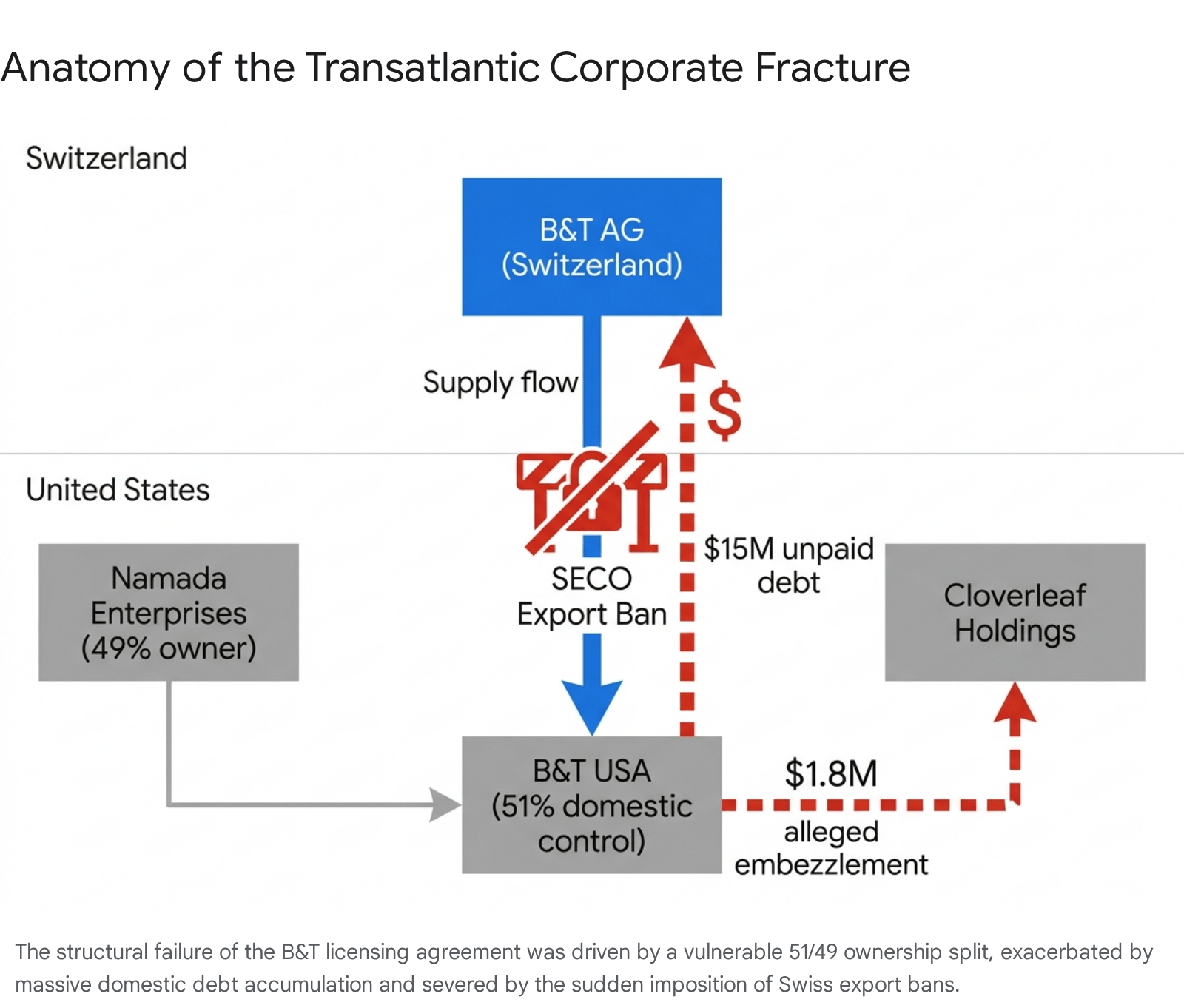
Corporate filings, federal litigation dockets, and industry disclosures reveal a deliberately bifurcated ownership model. Namada Enterprises, Inc., a holding company acting as a corporate proxy for the Swiss parent B&T AG (and identifying Corporate Parent SLS Invest AG in federal disclosures), held a 49% minority stake in B&T USA, LLC.15 The remaining 51% majority control was held by domestic ownership interests, identified in corporate disclosures as Cloverleaf Holdings, LLC, which was deeply tied to the American executive leadership, specifically former CEO Sean Sullivan.16
This 51/49 corporate structure satisfied domestic contracting compliance rules but inherently diluted the absolute operational control that Karl Brügger and B&T AG could exert over the American enterprise.14 B&T USA was established not merely as a wholly owned subsidiary acting on orders from Thun, but as an independent licensee operating under the formidable B&T trademark. B&T USA was responsible for importation, local assembly, domestic manufacturing of specific 922(r) compliance components, and, increasingly, the independent development and additive manufacturing (3D printing) of the Print-X suppressor line.14
While this arrangement successfully secured defense contracts and rapidly scaled civilian distribution, it sowed the seeds of the eventual crisis. The Swiss headquarters relied on the American entity to uphold the stringent, ISO-certified quality control that defined the brand.9 Conversely, the American entity relied on continuous, unfettered access to Swiss-manufactured core components to fulfill its domestic obligations. When corporate governance within the American entity collapsed under the weight of debt and criminal exposure, the structural firewall designed for regulatory compliance became an insurmountable barrier to operational intervention.
3. The Catalysts of Rupture: Financial Malfeasance and Executive Turmoil
The deterioration of the relationship between Thun, Switzerland, and the American operational hubs in Tampa and Herriman was not the result of a single catastrophic event. Rather, it was driven by a confluence of severe financial mismanagement, executive criminal exposure, and a total collapse of fiduciary oversight within the American entity. The crisis culminated in early 2026, leading to a cascade of federal litigation and the severing of the licensing agreement.
3.1. The $15 Million Debt and Embezzlement Allegations
The most acute point of failure within B&T USA centralized around its executive leadership and highly irregular financial practices. Court filings and industry analysis reveal a staggering accumulation of debt that threatened the solvency of the transatlantic relationship. According to formal complaints filed in federal court by Namada Enterprises, B&T USA accrued and subsequently defaulted on over $15 million in debt owed to its main supplier and minority owner, B&T AG.16 This massive capital deficit meant that revenue generated from American civilian and law enforcement sales—for products that had been actively imported and sold—was allegedly not being remitted back to Switzerland to cover the cost of goods sold.20 The American subsidiary was effectively utilizing the Swiss parent as an uncompensated line of credit, severely straining the cash flow of the European manufacturing base.
The situation escalated from standard corporate debt delinquency to severe allegations of executive malfeasance. The Namada Enterprises complaint explicitly alleged that B&T USA was at risk of significant financial instability and further embezzlement.16 Namada’s legal filings claim that Cloverleaf Holdings (the domestic majority owner entity) diverted $1.78 million to a personal account associated with B&T USA CEO Sean Sullivan.16 Industry intelligence and community analysis suggest these funds may have been tied to a massive international procurement contract, potentially involving the Malaysian government, for goods that were paid for but faced extreme fulfillment delays.21
Furthermore, internal reporting mechanisms and fiduciary oversight within B&T USA apparently failed completely. Community sources and industry observers note that when the Chief Financial Officer (CFO) of B&T USA discovered the financial irregularities regarding the missing $15 million and initiated a formal internal investigation, she was placed on administrative leave by CEO Sean Sullivan, effectively halting any internal fiduciary scrutiny.20 The installation of unqualified personnel into executive roles further degraded the operational integrity of the company. Allegations emerged that Sullivan installed a former barista, identified in court documents as Ridley Key (a 2020 undergraduate), as acting CEO with no defense industry experience to maintain shadow control of operations and corporate credit lines.20
3.2. Federal Criminal Exposure
Compounding the catastrophic financial toxicity was severe reputational damage stemming from a separate, high-profile federal criminal case targeting the highest levels of B&T USA’s leadership. Sean Sullivan found himself deeply entangled in a federal prosecution (United States v. Sullivan, 1:23-cr-00257, D. Maryland) related to an illegal machine gun smuggling and importation ring involving prominent industry figures, including former Delta Force operator Larry Vickers.20
The federal indictment detailed a conspiracy involving the falsification of law enforcement demonstration letters to illegally import and transfer post-1986 machine guns.20 Sullivan ultimately accepted a plea agreement, pleading down to eight counts of Class A Federal misdemeanors, facing a potential sentence of up to one year in federal custody.20 The presence of an executive facing severe federal firearms charges at the helm of a primary Department of Defense contractor and a premium civilian brand constituted an existential threat to B&T AG’s global standing. It became fundamentally untenable for a Swiss defense contractor, deeply reliant on maintaining pristine international export licenses, to remain legally tethered to an American entity mired in federal arms smuggling convictions.
4. Geopolitical Headwinds: The SECO Export Ban
While the financial malfeasance and criminal scandals isolated B&T USA administratively and destroyed its relationship with its parent company, an external geopolitical shock entirely paralyzed its physical supply chain. The Swiss defense industry operates under some of the most rigorous export control regimes in the world, heavily influenced by domestic political initiatives and a strict adherence to international neutrality.
Historically, Switzerland has debated the ethics of arms exports, with domestic Non-Governmental Organizations (NGOs) like the “Group for a Switzerland without an Army” (GSwA) frequently pushing for total constitutional bans on military materiel exports.23 Despite these pressures, the Swiss defense sector is robust; in 2020, over 130 Swiss companies exported military materiel worth CHF 901.2 million (approximately $965 million USD) to 62 countries, representing 0.7% of all official military equipment exports globally.23 However, following the launch of the “Correction Initiative” by human rights alliances in 2018, the Swiss parliament tightened the criteria for arms exports, notably removing the Federal Council’s so-called “escape clause” that allowed for unilateral loosening of export regulations.23
In this highly charged regulatory environment, the State Secretariat for Economic Affairs (SECO) wields immense power over companies like B&T AG.24 In March 2026, SECO and the Swiss Federal Council suspended all new arms export licenses specifically to the United States. This drastic measure was triggered by Washington’s involvement in an escalating conflict with Iran, dubbed ‘Operation Epic Fury’ by the Trump administration. Under Article 22a of the Swiss Federal Act on War Materiel, Switzerland is strictly prohibited from authorizing the export of war materiel to any country actively involved in an international armed conflict. While existing export licenses were spared for now—as authorities deemed them to have “no relevance” to the ongoing war—an interdepartmental expert group was established to place all current and future exports under extreme scrutiny.
Despite the temporary preservation of legacy licenses, the invocation of this neutrality law resulted in a near-total and immediate cessation of new firearms and critical serialized parts flowing from Switzerland to the American market. For B&T USA, a company already teetering on insolvency due to its $15 million debt default and struggling to fulfill massive customer backorders, the SECO ban triggered an irreversible supply chain failure.26 B&T USA physically could no longer acquire the new Swiss components necessary to build, complete, or service the firearms it had actively sold to American consumers.16 The geopolitical blockade meant that even if B&T USA could somehow resolve its massive debt to B&T AG, the Swiss parent was legally barred by its own government from exporting the required materiel.
4.1. The Termination of the License
Reacting to the unpaid invoices, the embezzlement allegations, the federal criminal convictions of key U.S. personnel, and the finalized SECO export embargo, B&T AG executed the only remaining strategic option. In early 2026, B&T AG formally and publicly terminated the trademark and distribution license agreement with B&T USA, LLC.27 The Swiss headquarters issued an urgent notice to U.S. customers stating that the decision followed B&T USA’s failure to settle outstanding invoices for products previously delivered.27 This unilateral action immediately revoked B&T USA’s legal right to market, sell, or manufacture products under the internationally recognized B&T brand name, setting the stage for a brutal legal confrontation.
5. The Multidimensional Legal Theater
The termination of the licensing agreement triggered a highly complex, multi-front legal battle within the United States federal court system. The litigation was characterized not only by the bitter, high-stakes dispute between the parent company and the subsidiary over brand ownership but also by a highly strategic, simultaneous intellectual property battle involving a major third-party competitor.
Table: Matrix of 2025-2026 B&T Federal Litigation
| Case Number | Filing Date | Court | Presiding Judge | Plaintiffs | Defendants | Primary Cause of Action |
| 8:26-cv-00714 | March 17, 2026 | U.S. District Court, Middle District of Florida | Kathryn Kimball Mizelle | B&T USA, LLC | B&T A.G., Namada Enterprises, Karl Brügger | Trademark Dispute (28:1331 Fed. Question) 15 |
| 8:26-cv-00698 | March 16, 2026 | U.S. District Court, Middle District of Florida | Kathryn Kimball Mizelle | Cloverleaf Holdings, B&T USA | Peter Penzell | Civil Complaint (Details sealed/pending) 17 |
| 8:25-cv-01408 | May 30, 2025 | U.S. District Court, Middle District of Florida | Thomas P. Barber | B&T USA, LLC & B&T AG | SureFire, LLC | Patent Infringement (Quick-Release Mount) 10 |
5.1. The Internal Civil War: B&T USA, LLC v. B&T A.G. et al.
On March 17, 2026—remarkably, just days before the full impact of the SECO export ban was realized in the market—B&T USA, LLC filed a federal lawsuit against B&T AG, Namada Enterprises, Inc., and Karl Brügger personally.26 The case (8:26-cv-00714) was filed in the U.S. District Court for the Middle District of Florida and was ultimately presided over by Judge Kathryn Kimball Mizelle, with Magistrate Judge Thomas G. Wilson referring.15 The suit was categorized under federal trademark property rights (28 U.S.C. § 1331).15
This lawsuit represented a desperate, aggressive counter-offensive by the American entity to retain the rights to the B&T trademark within the U.S. market despite the Swiss termination of the licensing agreement. For B&T USA, losing the trademark meant instant commercial obsolescence; the premium pricing commanded by their remaining inventory and their domestically produced 3D-printed suppressors (the Print-X line) was entirely dependent on the prestige of the Swiss B&T logo.30
The legal maneuvering was swift and highly tactical. On May 11, 2026, the Swiss defendants (B&T A.G., Namada, and Brügger) filed a comprehensive motion to dismiss for lack of jurisdiction and failure to state a claim, supported by a formal declaration from Karl Brügger himself.28 Recognizing the mutually assured destruction of protracted litigation, both parties rapidly pivoted toward negotiation. On May 27, 2026, a joint motion to stay proceedings was filed, which Judge Mizelle granted on June 3, staying all deadlines until July 3, 2026, to allow the parties to negotiate a settlement or face continued motion practice.15
5.2. The Strange Bedfellows: The SureFire Patent Litigation
Fascinatingly, while B&T AG and B&T USA were fracturing internally and suing each other over the trademark in early 2026, they were simultaneously acting as co-plaintiffs against an external competitor in a massive patent dispute. On May 30, 2025, the two entities had jointly filed a patent infringement and declaratory judgment lawsuit against SureFire, LLC, also in the Middle District of Florida (Case Number: 8:25-cv-01408, presided by Judge Thomas P. Barber).10
At the center of this dispute was US Patent No. 7,676,976, which protects SureFire’s renowned and highly proven quick-release mounting system for suppressors—a technology that allows a suppressor to be mounted with less than five turns rather than requiring extensive threading.10 The joint B&T complaint sought a judgment to invalidate SureFire’s patent, arguing that B&T had actually developed the underlying technology in 2001, presented it at trade fairs, and sold it to the U.S. military and Navy SEALs beginning in 2002—making the technology significantly older than SureFire’s 2005 patent for the equivalent ROTEX system.10
The suit also alleged that SureFire had breached a long-standing “handshake agreement.” According to B&T founder Karl Brügger, there was an unwritten agreement between the companies not to seek patent litigation against each other or their respective customers.10 This detente was allegedly broken when SureFire recently initiated legal action against B&T commercial partners, such as Sons of Liberty Gun Works.10 This parallel litigation highlights the immense financial value of the intellectual property at stake in the small arms market. Even as the corporate relationship between B&T AG and B&T USA devolved into hostility over financial fraud and unpaid debts, the absolute necessity of defending their core suppressor mounting technology against a domestic titan like SureFire required temporary, strategic legal alignment.
6. Anatomy of the June 2026 Comprehensive Settlement
The prolonged friction of active federal litigation, combined with a completely frozen supply chain, massive consumer backlash, and the looming threat of further criminal exposure for U.S. executives, proved utterly unsustainable. On June 25, 2026, the respective entities released simultaneous public statements announcing a comprehensive settlement that effectively concluded the legal hostilities and mapped a drastically altered operational framework for the future.3
Analyzing the carefully worded statements provided by both B&T AG and B&T USA reveals a highly strategic, calculated capitulation by both parties, designed primarily to save the underlying value of the brand architecture. The settlement can be analytically deconstructed into three core pillars:
6.1. The Reversion of Intellectual Property
The paramount, non-negotiable victory for B&T AG was regaining full, uncontested control of the B&T trademark within the United States.3 By forcing B&T USA to permanently relinquish the license and drop its trademark lawsuit (8:26-cv-00714), B&T AG successfully excised the rogue American entity from its global brand identity. This crucial legal maneuver prevents B&T USA from continuing to market domestically produced, non-Swiss-approved products under the B&T banner, thereby halting the active dilution of the brand’s premium reputation in the commercial market.33
6.2. The Debt Forgiveness Trade-Off
While the official press releases prioritize language regarding the dismissal of all pending litigation and continued cooperation 4, industry analysts and market observers universally note the underlying financial mechanics of the deal. The settlement essentially functioned as a massive, leveraged write-off. In order to secure the immediate return of the trademark, B&T AG almost certainly agreed to forgive the staggering $15 million in unpaid debt and cease pursuit of the $1.8 million in allegedly embezzled funds directed toward Cloverleaf Holdings.21
In exchange, B&T USA surrendered the trademark without a protracted, years-long court battle, and the domestic executives avoided further forensic financial discovery that could have worsened their existing federal criminal exposure. It was a calculated, albeit painful, loss for the Swiss parent—sacrificing upwards of $15 million in real capital to ensure the long-term survival and purity of a global brand worth exponentially more.
6.3. The Time-Limited Transition Framework
The settlement is not an immediate, hard severance that leaves current owners stranded; rather, it establishes a strictly “time-limited framework for continued cooperation”.4 During this interim transitional phase, the legacy B&T USA organization is contractually obligated to continue functioning as the primary point of contact for existing U.S. consumers.33 They are tasked with handling active warranty claims, providing general service and technical support, and distributing replacement parts for the current circulating inventory until B&T AG can fully establish its new operational footprint.33
This transition period serves a vital dual purpose: it prevents a sudden, catastrophic abandonment of the American consumer base (which would irreparably harm the B&T name regardless of who owned it), and it provides B&T AG the necessary runway and operational breathing room to legally and physically establish its own independent infrastructure on American soil.
7. The Go-Forward Strategy: B&T AG’s Autonomy and “Authentic Swiss” Reintegration
With the legal entanglements dissolved and the trademark safely returned to Thun, B&T AG immediately pivoted to a radical restructuring of its United States strategy. The core tenet of this new phase is absolute, uncompromising control over the supply chain, product quality, and corporate governance.
7.1. Establishing the Wholly Swiss-Owned Operation
To replace the deeply flawed 51/49 licensing model that led to the crisis, B&T AG announced the imminent establishment of a new, wholly Swiss-owned U.S. operation, scheduled to launch in late 2026, and which is widely expected to be named B&T Swiss.11 By owning the U.S. operation outright—without relying on domestic holding companies like Cloverleaf to satisfy contracting requirements—B&T AG eliminates the risk of domestic executives overriding Swiss quality control protocols, mismanaging funds, or engaging in unauthorized side-projects.32 The immediate mandate for this new entity involves establishing the necessary federal licenses (FFL/SOT), building a reliable, SECO-compliant supply chain, and deploying a vetted team to interface directly with American consumers, dealers, and law enforcement agencies.32
7.2. Brand Purification and Origin Transparency
A critical element of B&T AG’s post-settlement communication strategy is the aggressive, public reassertion of its Swiss heritage. The corporate press release deliberately utilized precise language, promising consumers a return to “Swiss engineering,” “uncompromising craftsmanship,” and “authentic, Swiss-made products”.32 This rhetoric serves as a strategic, albeit subtle, indictment of the previous regime, confirming widespread market suspicions that B&T USA had been cutting corners, diluting product quality, or sourcing subpar domestic components to maximize profit margins while simultaneously neglecting their debt obligations to Switzerland.33
To codify this commitment and rebuild consumer trust, B&T AG released a highly detailed “Statement Regarding Manufacturing and Component Origins” in May 2026.9 The statement was a masterclass in corporate transparency, designed to assure the market that all core components are strictly manufactured in Europe. It detailed that receivers, bolts, and CNC-machined components are exclusively manufactured in Switzerland.9 Polymer components are injection molded in Switzerland using the company’s proprietary molds, and barrel materials are exclusively sourced from premium German suppliers like Merkel or Lothar Walther before final Swiss processing.9 The heavy emphasis on their annual ISO-certified processes (9001, 14001, 27001, 45001) is intended to contrast sharply with the allegedly chaotic, unregulated, and fraudulent environment of the former American subsidiary.9
7.3. Reclaiming the Suppressor Market via Additive Manufacturing
Historically, because of the severe complexities and delays associated with National Firearms Act (NFA) importation laws, B&T USA was heavily involved in the domestic production of suppressors for the American market, most notably the 3D-printed Print-X line.14 Moving forward, B&T AG has explicitly stated its intention to introduce its own range of authentic Swiss suppressor designs directly to the US market.32
B&T AG utilized the 2026 SHOT Show to heavily promote its internal additive manufacturing capabilities, emphasizing that all of its 3D-printed suppressor bodies and internal geometries are manufactured entirely in-house in Thun, Switzerland.9 This deliberate messaging pushes back against the narrative that advanced additive manufacturing was solely the domain of the American subsidiary.14 This indicates a massive strategic shift: B&T AG is centralizing all R&D and 3D printing production back at the European headquarters, refusing to rely on U.S.-based intellectual property for its premium NFA items.
8. The Fate of the Legacy Entity: Rebranding and Orphaned IP
While B&T AG rapidly builds its new infrastructure to capture the premium market, the entity formerly known as B&T USA faces a highly precarious future. Stripped of the globally recognized trademark that drove the vast majority of its sales, the domestic company must undergo a comprehensive metamorphosis simply to survive.
8.1. Forced Rebranding and Strategic Pivot
Under the strict terms of the settlement, B&T USA will continue to exist as a corporate entity but will be legally compelled to operate under a completely new name and brand identity.33 Market consensus and industry analysis indicate that this newly rebranded identity will attempt to pivot primarily into a domestic suppressor and additive manufacturing company.14 While they lost the B&T name, they retain their physical assets—namely the expensive 3D printing farms and domestic manufacturing infrastructure acquired during their tenure—as well as the specific engineering data for the suppressors they developed independently from Switzerland.18
8.2. The Dilemma of the “Print-X” Line
The most significant asset—and simultaneously the greatest liability—retained by the rebranded legacy entity is the Print-X line of suppressors. Because these specific products were designed, researched, and manufactured domestically by the American entity (albeit initially under a joint venture mindset), B&T AG holds no engineering data on them and legally considers them completely distinct from the authentic Swiss product line.19
Consequently, the Print-X suppressors are effectively “orphaned” intellectual property. The rebranded former B&T USA must now attempt to market and sell these suppressors without the immense halo effect of the B&T name.14 This forces them to compete in an already highly saturated American suppressor market based solely on the merits of their domestic engineering. This is a daunting prospect, complicated by existing community rumors of poor quality control, missing manuals, and loose HUB adapters associated with the American-made cans.14 Without the Swiss cross to justify premium pricing, the legacy entity faces a steep uphill battle for market share.
9. Market Implications for United States Consumers
While the macro-level corporate settlement resolves the legal disputes between the corporate entities, it translates into immediate, highly tangible disruptions for the micro-level American consumer. Individuals and law enforcement agencies heavily invested in the B&T ecosystem are currently facing a prolonged period of uncertainty regarding order fulfillment, financial exposure, and long-term warranty support.
9.1. Backorder Chaos, Financial Exposure, and the Trust Deficit
Prior to the final collapse and settlement, B&T USA aggressively marketed pre-orders and backorders for highly anticipated, niche models, such as the integrally suppressed KH45-SD.37 Post-settlement analysis reveals a shocking level of dysfunction regarding these retail practices. Consumers reaching out to B&T AG regarding these specific projects discovered that firearms like the KH45-SD had never actually been fully greenlit for scaled production by the Swiss headquarters.37 B&T USA was actively offering pre-orders and collecting funds for prototypes that Switzerland had no immediate intention of manufacturing or exporting.37
As the reality of the supply chain failure set in—driven by both the $15 million debt default and the SECO export ban—consumers attempting to cancel unfulfilled backorders encountered predatory financial policies. B&T USA’s published terms and conditions mandated a punitive 10% cancellation fee on all canceled orders, explicitly including items on backorder.38 Consequently, consumers who waited months for products that were structurally impossible to deliver were financially penalized for withdrawing their capital.21 This has triggered a massive wave of credit card chargebacks and formal bank disputes as consumers bypass the company entirely to reclaim their funds.21 The reputational damage to the legacy entity is catastrophic, and B&T AG will require extensive, transparent public relations efforts to rebuild baseline trust when its new subsidiary launches.
9.2. The Bifurcated Warranty Landscape
The most complex hurdle for existing owners is navigating the newly bifurcated warranty and support system. The settlement creates a rigid, two-tiered framework determining who services a defective product, based entirely on its origin of manufacture rather than the logo stamped on the receiver.
Tier 1: Authentic Swiss Products (Supported by B&T AG) B&T AG has issued a decisive, public warranty statement confirming that they—in conjunction with their future U.S. distribution entity—will fully honor the warranty for all “Swiss Made” products manufactured and assembled entirely in Switzerland.2 This covers the vast majority of the legacy serialized firearms (e.g., the APC9, GHM9, SPC9, and APR series) that were physically imported over the past decade.27 While consumers must temporarily interface with the rebranded B&T USA for service during the interim transition period 34, long-term lifecycle support for these core platforms is guaranteed by the solvent, highly capable Swiss parent company.
Tier 2: Domestically Produced Suppressors (Supported Only by the Rebranded Entity) Conversely, B&T AG explicitly disavows any general warranty commitment for suppressors (such as the Print-X series) and HUB adapters manufactured domestically by B&T USA LLC.33 Because B&T AG did not design, manufacture, or control the quality of these specific items, they refuse to assume financial or legal liability for them.14
This leaves owners of B&T USA suppressors in a highly precarious position. Historically, B&T USA offered an unrivaled suppressor warranty, promising free replacements or out-of-production upgrades if a suppressor became non-functional during non-negligent use (provided a 0 twist rifled barrel was not used, which explicitly voided the warranty).27 However, consumers are now entirely reliant on the legacy, rebranded American entity to honor these terms.27 Given the company’s massive recent debt default, executive criminal turbulence, and total loss of its primary trademark, the long-term solvency of this rebranded entity is highly questionable.36 If the rebranded company enters receivership or dissolves entirely, the owners of these domestically produced suppressors will be left with unserviceable, un-warrantied items—a severe financial and operational loss given the inherent friction, $200 tax stamps, and extended ATF wait times associated with acquiring NFA items in the United States.30
Table: Post-Settlement Warranty Liability Matrix
| Product Category | Origin of Manufacture | Primary Servicing Entity (Interim) | Long-Term Warranty Guarantor | Risk Profile for Consumer |
| Serialized Firearms (APC, GHM, SPC Series) | Switzerland (B&T AG) | Legacy B&T USA (Transitional) | New B&T AG Swiss-Owned Subsidiary | Low Risk: Fully backed by solvent Swiss parent. |
| Swiss-Made Suppressors (Older imported models) | Switzerland (B&T AG) | Legacy B&T USA (Transitional) | New B&T AG Swiss-Owned Subsidiary | Low Risk: Validated as authentic Swiss QC. |
| Domestically Printed Suppressors (e.g., Print-X Line) | United States (B&T USA) | Rebranded B&T USA Entity | Rebranded B&T USA Entity (Swiss AG disavowed) | High Risk: Dependent on the survival of a distressed, rebranded corporate entity. |
| HUB Adapters & Accessories (US-Made) | United States (B&T USA) | Rebranded B&T USA Entity | Rebranded B&T USA Entity | High Risk: Orphaned IP lacking Swiss support. |
10. Defense Contracting and Institutional Implications
Beyond the commercial civilian market, the B&T settlement forces a massive re-evaluation within defense, federal, and local law enforcement procurement circles. Institutional buyers despise risk, and the events of 2026 have exposed severe supply chain vulnerabilities.
The U.S. Army’s SCW contract was originally awarded directly to B&T USA LLC, the very entity that is now stripping its branding and reeling from financial scandal.12 While the initial delivery of 350 units was likely completed prior to the implosion, the option for the additional 1,000 units is now mired in corporate ambiguity.13 Procurement officers prioritize institutional stability and uninterrupted supply chains above almost all other metrics. The revelation that the American prime contractor was effectively cut off from its Swiss manufacturer due to $15 million in unpaid invoices, compounded by geopolitical export bans (SECO), presents an unacceptable risk profile for future government tenders.
Moving forward, the new wholly Swiss-owned U.S. operation will need to aggressively lobby the Department of Defense and federal agencies to transfer existing contracts. More importantly, they must definitively prove that the new corporate architecture—wholly owned and centrally controlled by Thun—is completely insulated against the systemic fiduciary failures, executive malfeasance, and supply chain disruptions that ultimately destroyed its predecessor.
11. Conclusion
The corporate fracture and subsequent June 2026 settlement between B&T AG and B&T USA represents a watershed moment in the international small arms industry. It brutally illustrates the inherent operational and reputational risks of leveraging premium international intellectual property through minority-controlled domestic licensees, especially in a sector as highly regulated as defense manufacturing. For B&T AG, the settlement was a painful but absolutely necessary strategic amputation; absorbing a massive eight-figure financial loss and abandoning years of established domestic infrastructure was deemed an acceptable casualty to regain absolute control over a brand identity built on decades of uncompromising Swiss precision.
The go-forward strategy for the Swiss giant is unequivocally clear: a radical centralization of corporate power, the elimination of third-party domestic manufacturing for core products, and a total reliance on transparent, ISO-certified Swiss origins, utilizing wholly owned subsidiaries to interface with the American market. However, the collateral damage of this corporate divorce falls squarely on the American consumer base and institutional partners. While the long-term outlook promises a return to the pristine quality that initially defined the B&T brand, the immediate market reality is characterized by fractured warranty support, orphaned suppressor technologies, and a profound deficit of consumer trust. The successful resurrection of the B&T empire in the United States will depend not merely on the quality of the new Swiss-imported steel and 3D printed titanium, but on the ability of the new subsidiary to painstakingly rebuild the foundational confidence that its predecessor so thoroughly and publicly dismantled.
Please share the link on Facebook, Forums, with colleagues, etc. Your support is much appreciated and if you have any feedback, please email us in**@*********ps.com. If you’d like to request a report or order a reprint, please click here for the corresponding page to open in new tab.
Sources Used
- Karl Brügger on 40 Years of Building B&T Suppressors | FIRST LAST NEXT Ep 5 – YouTube, accessed June 26, 2026, https://www.youtube.com/watch?v=SMH8eDAo138
- Handguns, suppressor and weapon attachments – B&T AG (CH), accessed June 26, 2026, https://bt-ag.ch/en/
- accessed June 26, 2026, https://bt-ag.ch/en/2026/bt-ag-and-bt-usa-reach-settlement/#:~:text=B%26T%20AG%20has%20reached%20a,a%20clearly%20defined%20transition%20framework.
- accessed June 26, 2026, https://bt-usa.com/bt-ag-and-bt-usa-have-reached-a-comprehensive-settlement/#:~:text=B%26T%20AG%20and%20B%26T%20USA%20have%20reached%20a%20comprehensive%20settlement,-June%2025th%2C%202026&text=All%20pending%20litigation%20will%20be,dealers%2C%20and%20the%20B%26T%20brand.
- About | B&T USA, accessed June 26, 2026, https://bt-usa.com/support/about-history/
- History | B&T USA, accessed June 26, 2026, https://bt-usa.com/support/history/
- B&T – Grokipedia, accessed June 26, 2026, https://grokipedia.com/page/Br%C3%BCgger_&_Thomet
- B&T USA: Home, accessed June 26, 2026, https://bt-usa.com/
- Statement Regarding B&T AG Manufacturing and Component Origins, accessed June 26, 2026, https://bt-ag.ch/en/2026/statement-regarding-bt-ag-manufacturing-and-component-origins/
- B&T sues Surefire – Background & Updates – Lowready Magazine, accessed June 26, 2026, https://lowreadymagazine.com/en/articles/b-and-t-surefire-llc-en
- B&T USA Announces Agreement with B&T AG – Swiss to Establish …, accessed June 26, 2026, https://soldiersystems.net/2026/06/25/bt-usa-announces-agreement-with-bt-ag/
- Army Awards First Submachine Gun Contract in over 50 Years to B&T – Recoil Magazine, accessed June 26, 2026, https://www.recoilweb.com/army-awards-first-submachine-gun-contract-in-over-50-years-to-bt-148719.html
- Sub Compact Weapon Production-Other Transaction Agreement – SAM.gov, accessed June 26, 2026, https://sam.gov/workspace/contract/opp/e001bfaf6f293d0401029cd8052312ec/view
- Seems that B&T AG and B&T USA have reached a settlement in their legal dispute according to B&T USA. : r/NFA – Reddit, accessed June 26, 2026, https://www.reddit.com/r/NFA/comments/1uf9n6f/seems_that_bt_ag_and_bt_usa_have_reached_a/
- B&T USA, LLC v. B&T AG et al – PacerMonitor, accessed June 26, 2026, https://www.pacermonitor.com/public/case/63640242/BT_USA,_LLC_v_BT_AG_et_al
- MASSIVE FRAUD – proof that Sean Sullivan EMBEZZELED $1.8M from B&T USA – Reddit, accessed June 26, 2026, https://www.reddit.com/r/bruggerthomet/comments/1szgle3/massive_fraud_proof_that_sean_sullivan_embezzeled/
- Cloverleaf Holdings, LLC et al v. Penzell 8:2026cv00698 – Justia Dockets, accessed June 26, 2026, https://dockets.justia.com/docket/florida/flmdce/8:2026cv00698/455819
- B&T Switzerland got their trademark rights back!!!! : r/bruggerthomet – Reddit, accessed June 26, 2026, https://www.reddit.com/r/bruggerthomet/comments/1uf984e/bt_switzerland_got_their_trademark_rights_back/
- B&T Suppressors in the US Market : r/bruggerthomet – Reddit, accessed June 26, 2026, https://www.reddit.com/r/bruggerthomet/comments/1t3gljy/bt_suppressors_in_the_us_market/
- B&T CFO Under Internal Investigation : r/bruggerthomet – Reddit, accessed June 26, 2026, https://www.reddit.com/r/bruggerthomet/comments/1s7stqi/bt_cfo_under_internal_investigation/
- B&T USA is fucked. : r/BT_APC – Reddit, accessed June 26, 2026, https://www.reddit.com/r/BT_APC/comments/1t4i0kl/bt_usa_is_fucked/
- I have questions for u/bt-usa regarding the present state of the company – Reddit, accessed June 26, 2026, https://www.reddit.com/r/bruggerthomet/comments/1ryyqij/i_have_questions_for_ubtusa_regarding_the_present/
- Security & Defence European, accessed June 26, 2026, https://euro-sd.com/wp-content/uploads/2022/02/ESD_2_2022.pdf
- “The world will not become a more peace- ful place without our air defence systems.” – The Swiss Defence Industry, accessed June 26, 2026, https://euro-sd.com/2022/02/articles/exclusive/25252/the-world-will-not-become-a-more-peace-ful-place-without-our-air-defence-systems-the-swiss-defence-industry/
- Justice served? Swiss Attorney General’s Office turns blind eye to machinery supplies for Russian military plant – The Insider, accessed June 26, 2026, https://theins.press/en/politics/265275
- US Small Arms Market Analytics Archives – Page 3 of 19 – Ronin’s Grips, accessed June 26, 2026, https://blog.roninsgrips.com/category/analytics-and-reports/us-small-arms-market/page/3/
- B&T AG has terminated the license agreement with B&T USA, LLC. : r/BT_APC – Reddit, accessed June 26, 2026, https://www.reddit.com/r/BT_APC/comments/1rz8gt7/bt_ag_has_terminated_the_license_agreement_with/
- B&T USA, LLC v. B&T A.G. et al 8:2026cv00714 – Justia Dockets, accessed June 26, 2026, https://dockets.justia.com/docket/florida/flmdce/8:2026cv00714/455882
- B&T USA, LLC et al v. Surefire, LLC 8:2025cv01408 – Justia Dockets, accessed June 26, 2026, https://dockets.justia.com/docket/florida/flmdce/8:2025cv01408/442617
- Interview With Karl About B&T’s Lawsuit : r/bruggerthomet – Reddit, accessed June 26, 2026, https://www.reddit.com/r/bruggerthomet/comments/1t4kzdf/interview_with_karl_about_bts_lawsuit/
- Why Did B&T Just Sue Surefire? Interview with B&T CEO Karl Brügger – YouTube, accessed June 26, 2026, https://www.youtube.com/watch?v=KjS3TNBgi_o
- B&T AG regains full control of the B&T brand in the United States, accessed June 26, 2026, https://bt-ag.ch/en/2026/bt-ag-and-bt-usa-reach-settlement/
- b&t usa statement on settlement : r/BT_APC – Reddit, accessed June 26, 2026, https://www.reddit.com/r/BT_APC/comments/1ufa5li/bt_usa_statement_on_settlement/
- B&T AG and B&T USA have reached a comprehensive settlement, accessed June 26, 2026, https://bt-usa.com/bt-ag-and-bt-usa-have-reached-a-comprehensive-settlement/
- Inside B&T’s New 3D Printed Suppressors | SHOT Show 2026 – YouTube, accessed June 26, 2026, https://www.youtube.com/watch?v=G_jOZtZRAPw
- Implications of the death of B&T USA? : r/NFA – Reddit, accessed June 26, 2026, https://www.reddit.com/r/NFA/comments/1t5mnf0/implications_of_the_death_of_bt_usa/
- B&T AG and B&T USA Update on KH45-SD Project (Full Email from Customer Support – No Production Before 2027) : r/BT_APC – Reddit, accessed June 26, 2026, https://www.reddit.com/r/BT_APC/comments/1t95ri5/bt_ag_and_bt_usa_update_on_kh45sd_project_full/
- Terms, Conditions, & Shipping Restrictions | B&T USA, accessed June 26, 2026, https://bt-usa.com/terms-and-conditions/
- Company – B&T AG (CH), accessed June 26, 2026, https://bt-ag.ch/en/b-and-t/firma/