Category Archives: Combat, Duty & Home Defense Shotguns

Law enforcement procurement rankings, mechanical teardowns, and reliability testing of tactical pump and semi-automatic shotguns. Covers proven duty platforms like the Remington 870, Mossberg 590A1/590R, Beretta 1301/A300, and Benelli M4 alongside Turkish clones (MAC 1014) and modular disruptors like the PSA 570.

Comparative Analysis and Ranking of U.S. Federal Law Enforcement Tactical Teams:  August 2026

Executive Summary

The world of U.S. federal law enforcement tactical operations has seen a massive, multi-generational shift. What began as a niche response model inspired by the municipal SWAT units of the late 1960s has grown significantly over the last 50 years. Today, federal agencies rely on these elite teams to handle challenges that go far beyond the scope of regular police work—including domestic counterterrorism, organized crime, hostage situations, and civil unrest. This 2026 report provides an in-depth look at these teams, evaluating how they are structured, how they use their resources, and how effective they are within a democratic society.

The 2025 edition of this report can be accessed by clicking here.

Public and legal scrutiny of these units intensified following their deployment during the 2020 civil disturbances in cities like Portland and Washington, D.C. Detailed audits by the GAO and the Inspectors General for the DOJ and DHS revealed significant differences in how mature and prepared these various teams actually were. Specifically, the GAO identified 25 distinct tactical teams across 18 different agencies, revealing a fragmented system that lacked central oversight. This report brings that data together, along with modern operational insights, to provide a clear and objective ranking of these specialized units.

To keep this analysis rigorous, we avoid treating all federal tactical work as the same. We have integrated data from Ronin’s Grips Analytics, known for its objective Small Arms Analytics and Market Reporting, to ensure our findings are based on facts rather than opinion. We also recognize that a team protecting nuclear sites has a very different mission than one catching fugitives. To account for these differences, we use a classification system adapted from the National Tactical Officers Association (NTOA) standards. The teams are grouped into the following three tiers:

  • Tier 1 (National/Global Full-Time Assets): These are elite, continuously active units dedicated exclusively to high-threat tactical operations. These teams can deploy quickly, carry out the most complex mission profiles (e.g., advanced hostage rescue, counter-nuclear proliferation, high-threat overseas diplomatic security, and maritime interdiction), and go through long, tough selection and training processes that are similar to military special operations.
  • Tier 2 (Regional/Agency Collateral-Duty Teams): Highly proficient tactical units whose operators perform tactical duties on a part-time or collateral basis while maintaining primary investigative, patrol, or inspection responsibilities. These teams are typically distributed across regional field offices to ensure rapid geographic response to high-risk search and arrest warrants, barricaded subjects, and localized crises.
  • Tier 3 (Specialized/Facility-Constrained Units): Tactical elements whose operations are primarily constrained to specific physical facilities, critical infrastructure, or highly specialized micro-missions (e.g., prison disturbance resolution, specific compound defense, or specific technological asset recovery).
Law enforcement response tiers: Tier 1 (national/global), Tier 2 (regional/collateral), Tier 3 (facility-constrained).

The data shows a major divide between full-time Tier 1 assets and part-time Tier 2 teams. Tier 1 units, such as the FBI’s Hostage Rescue Team (HRT) and CBP’s BORTAC, have budgets and capabilities that often mirror military special operations. In contrast, collateral-duty teams must balance their tactical roles with their primary jobs as investigators or inspectors. This creates “logistical friction” where it becomes difficult to maintain peak tactical proficiency while handling a heavy caseload. Currently, 16 of the 25 identified federal teams operate on this part-time basis. Despite these hurdles, these teams are being sent into increasingly volatile situations, which has highlighted gaps in training for crowd control and interagency coordination.

We also see a “feedback loop” where military equipment and tactics are brought into domestic policing. Through Department of Defense transfer programs, federal teams now use armored vehicles and advanced night-vision optics originally designed for combat. Elite units frequently bring those aggressive tactics back home, as they often work alongside the military overseas. This trend toward militarization makes it even more important to have a clear ranking system to see how these units align with constitutional standards and their original missions.

The Federal Tactical Catalog: Mapping the Verified Units

To conduct a comparative analysis, it is imperative to establish a comprehensive baseline of the entities under review. While the GAO identified 25 highly distinct federal tactical teams across 18 agencies, this catalog specifically isolates the 21 explicitly verified federal tactical teams dispersed across confirmed federal agencies. It filters out unverified units to prevent data inaccuracies and ensure absolute factual fidelity5. They are structurally mapped to their parent departments, operational tiers, and duty statuses to provide immediate context for their subsequent ranking.

Cabinet DepartmentParent AgencyTactical Team DesignationOperational TierDuty Status
DOJFederal Bureau of Investigation (FBI)Hostage Rescue Team (HRT)Tier 1Full-Time
DOJFederal Bureau of Investigation (FBI)Special Weapons and Tactics (SWAT) / Enhanced SWATTier 2Collateral
DOJU.S. Marshals Service (USMS)Special Operations Group (SOG)Tier 1Hybrid (Cadre + Collateral)
DOJBureau of Alcohol, Tobacco, Firearms & Explosives (ATF)Special Response Teams (SRT)Tier 2Collateral
DOJDrug Enforcement Administration (DEA)Special Response Teams (SRT)Tier 2Collateral
DOJFederal Bureau of Prisons (BOP)Special Operations Response Teams (SORT)Tier 3Collateral
DHSCustoms and Border Protection (CBP)Border Patrol Tactical Unit (BORTAC)Tier 1Full-Time
DHSCustoms and Border Protection (CBP)Special Response Team (SRT)Tier 2Collateral
DHSImmigration and Customs Enforcement (ICE)Special Response Team (SRT)Tier 2Collateral
DHSU.S. Secret Service (USSS)Counter Assault Team (CAT)Tier 1Full-Time
DHSU.S. Secret Service (USSS)Counter Sniper Team (CS)Tier 1Full-Time
DHSU.S. Secret Service (USSS)Emergency Response Team (ERT)Tier 3Full-Time
DHSU.S. Coast Guard (USCG)Maritime Security Response Team (MSRT)Tier 1Full-Time
DHSFederal Protective Service (FPS)Rapid Protection Force (RPF)Tier 2Full-Time
DOSDiplomatic Security Service (DSS)Mobile Security Deployments (MSD)Tier 1Full-Time
DOIU.S. Park Police (USPP)Tactical TeamTier 2Collateral
DOEDepartment of Energy (HQ)Special Response Team (SRT)Tier 3Full-Time (Contractor)
DOENational Nuclear Security Administration (NNSA)Special Response Force (SRF)Tier 1Full-Time
DODPentagon Force Protection Agency (PFPA)Tactical TeamTier 3Full-Time
IndependentNational Aeronautics and Space Administration (NASA)Tactical TeamTier 3Full-Time (Contractor)
LegislativeU.S. Capitol Police (USCP)Containment & Emergency Response Team (CERT)Tier 2Full-Time

Note: While the U.S. Capitol Police strictly resides within the Legislative Branch rather than the Executive Branch, it is systematically included in this comparative catalog due to its frequent interagency operability with Executive Branch entities during National Special Security Events (NSSEs) and highly visible civil disturbances within the National Capital Region18.

The Three-Tiered Typological Architecture

Establishing an equitable ranking system demands an acknowledgment of mission specificity. The NTOA TROS provides a tiered capability system for local law enforcement, generally running from Tier 1 (capable of sustained hostage rescue) to Tier 4 (perimeter containment only)12. Adapting this framework to federal entities, this report assesses the strategic placement of each team within three primary federal tiers, examining their historical evolution, selection rigor, and current operational postures.

Tier 1 Architecture: Global and National Strategic Assets

To qualify as a Tier 1 unit, the team must be comprised of full-time tactical operators, or at minimum, a dedicated full-time operational cadre that continuously trains and evaluates a highly responsive reserve. These units must possess a verified rapid-deployment capability to reach domestic locations quickly, as well as an established mandate for international deployment in non-permissive environments for specific teams. They must maintain capabilities for deliberate and crisis-driven hostage rescue, complex linear assaults (e.g., aircraft, trains, ships), and sustained counter-terrorism operations. Broader evaluations of similar high-level military units fall under Special Operations Forces (SOF) / Special Mission Units (SMUs) Analytics10.

FBI Hostage Rescue Team (HRT): Widely considered the apex of civilian law enforcement tactical capabilities, the FBI HRT was founded in 1982 in direct response to the Munich Olympic massacre and the upcoming 1984 Los Angeles Olympics, filling a void left by the Posse Comitatus Act, which restricts the military’s Delta Force from domestic policing21. Based in Quantico, Virginia, HRT is federal law enforcement’s only full-time, dedicated counterterrorism unit22. It boasts extreme operational flexibility, capable of deploying anywhere within the United States within four hours13. HRT operators frequently embed with the U.S. military’s special operations units overseas to gain combat experience and test tactics13. However, the unit is not without historical controversy; its involvement in the tragic sieges at Ruby Ridge and Waco generated significant political and operational debate regarding the militarized rules of engagement and the thresholds for deploying federal lethal force21.

CBP Border Patrol Tactical Unit (BORTAC): Headquartered in El Paso, Texas, alongside the Border Patrol Search, Trauma, and Rescue Unit (BORSTAR) under the Special Operations Group umbrella, BORTAC provides DHS with an immediate-response capability for emergent, high-risk incidents13. Initially established to counter violence along the U.S.-Mexico border, BORTAC’s mission has expanded into a global capacity. They conduct high-risk warrant service, interdict narcotics, and have deployed to countries such as Iraq, Afghanistan, Bolivia (Operation Snowcap), and South Africa to provide tactical capacity-building to foreign security forces13. BORTAC famously executed the high-profile tactical extraction of Elian González in Miami, demonstrating their utility far beyond the physical border21.

USMS Special Operations Group (SOG): The Marshals Service SOG holds the distinction of being the first federal tactical unit of its kind, created in 1971 by Director Wayne Colburn as a flexible response to the violent anti-government protests and civil unrest of the late 1960s13. Operating out of the William E. Degan Tactical Operations Center at Camp Beauregard in Louisiana, SOG maintains a small, full-time operational cadre that trains a larger body of collateral-duty deputies stationed nationwide28. They specialize in apprehending the nation’s most dangerous fugitives, high-threat extraditions, and asset seizures, and they remain on call 24 hours a day.

DSS Mobile Security Deployments (MSD): The Diplomatic Security Service MSD is the State Department’s on-call crisis response element, specifically engineered to operate in high-threat international environments with minimal outside support17. MSD agents—who are fully sworn federal agents with investigatory powers—are tasked with the protection of U.S. personnel at embassies and consulates, executing tactical evacuations from war zones, and defending against terrorist assaults17. Operating in cohesive six-person teams, MSD has a mandate to deploy anywhere globally within 12 hours of notification17.

USSS Counter Assault Team (CAT) & Counter Sniper Team (CS): The Secret Service CAT and CS teams serve highly specific, reactive roles within the protective detail ecosystem of the President and Vice President. CAT provides direct, tactical heavy-weapons support to repel complex ambushes, allowing the close-protection detail to evacuate the protectee34. CS provides advanced long-range observation, intelligence gathering, and precision overwatch at exterior sites35. Both teams operate under grueling travel schedules matching the executive branch’s movements35.

Tier 2 Architecture: Regional and Agency Collateral-Duty Teams

Tier 2 encompasses the vast statistical majority of federal tactical capacity. These teams operate primarily on a collateral-duty basis; operators spend the majority of their time conducting standard agency duties—such as investigating federal crimes, patrolling federal lands, or inspecting regulated industries—and activate as a cohesive tactical element only when a crisis emerges or a high-risk warrant requires execution6. While highly skilled and intensely dedicated, these teams generally do not possess the organic, heavy aviation or expansive logistics support of Tier 1 teams, relying instead on their parent agency’s regional field office budgets and interagency agreements.

FBI Special Weapons and Tactics (SWAT): Following the 1973 Wounded Knee occupation, the FBI established its SWAT program to ensure tactical coverage across the nation38. Today, the FBI maintains a SWAT team at each of its 56 field offices, comprising over 1,073 part-time operators28. In 2022, these teams executed approximately 1,600 callouts, primarily for active shooters, barricaded suspects, and high-risk warrant service28. To bridge the gap between standard SWAT and the HRT, the FBI designates “Enhanced SWAT” teams in larger field offices, providing them with additional personnel, specialized tactical equipment, and advanced breaching methods28.

ATF & DEA Special Response Teams (SRT): The ATF maintains five strategic SRTs located in Detroit, Washington D.C., Dallas, Los Angeles, and Jacksonville37. These teams specialize in high-risk search and arrest warrants targeting the most violent domestic criminals, often operating in complex urban environments heavily fortified by armed suspects37. Their collateral-duty operators serve as crisis negotiators, snipers, and tactical medics37. ATF SRT gained high visibility for their reactive deployment to the Parkland, Florida, high school shooting to assist in building clearing and rescue5. The DEA similarly operates SRTs to execute counter-narcotics warrants, notably formalizing a new specialized tactical team structure in October 201938.

DHS Regional Components (CBP SRT, ICE SRT, FPS RPF): Outside of BORTAC, CBP maintains standard Special Response Teams (SRTs) to execute localized, high-risk operations38. ICE utilizes its SRTs similarly for high-risk apprehensions and deportations38. The Federal Protective Service (FPS), which operates under the authority of 40 U.S.C. 1315 to secure federal facilities, established its Rapid Protection Force (RPF) in 2017 to respond to threats against critical infrastructure and manage large-scale protests targeting federal property39.

The USCP CERT, a full-time tactical unit tasked with securing the Capitol complex, operates uniquely within the legislative branch while frequently integrating with federal executive assets. The unprecedented breach of the Capitol on January 6, 2021, where police lines were rapidly overrun and rioters came perilously close to penetrating inner sanctums, exposed catastrophic vulnerabilities across the agency18. In response, CERT and the broader Capitol Police underwent systemic upgrades, including crucial procurement allocations for new Mobile Command Post Equipment40. This restructuring ensures unimpeded tactical communication with interagency partners and prevents the decapitation of tactical leadership during overwhelming civil disturbances or complex assaults.

Tier 3 Architecture: Specialized and Facility-Constrained Units

Tier 3 units are heavily geographically or mission-constrained. Their standard operating procedures, equipment, and training are tailored to highly specific, localized environments, which inherently limits their flexibility in broader, dynamic tactical operations in the civilian domain.

BOP Special Operations Response Teams (SORT): The Bureau of Prisons operates an extensive network of SORTs, totaling 145 teams and over 2,592 collateral-duty tactical officers1. SORT personnel are uniquely trained to quell large-scale inmate disturbances, riots, and hostage situations within hardened, tightly controlled correctional environments (e.g., the 1988 Oakdale and Atlanta prison riots)41. While highly proficient within the concrete confines of a prison, their deployment to civilian crowd-control situations in 2020 demonstrated severe limitations. The DOJ Office of the Inspector General (OIG) found that BOP personnel were ordered by the Attorney General’s office to deploy to Lafayette Park immediately, but staff received no guidance about their mission or rules of engagement and arrived without needed equipment3. Crucially, BOP deployed personnel without vests or jackets clearly identifying them as law enforcement, exacerbating public panic and violating best practices for public order management3.

DOE / NNSA Special Response Forces: Tasked with the paramount mission of protecting the nation’s Category I special nuclear materials—including nuclear weapons, components, and enriched uranium—the Department of Energy relies on highly specialized tactical forces6. The DOE SRTs are often comprised of private contractor personnel on duty 24/7 at specific nuclear sites, while the NNSA SRF utilizes federal employees to provide heavily armed security for the movement of nuclear materials across the country6. These units undergo intense tactical training, but their mission is purely defensive and asset-centric, rather than investigative or offensive.

As federal tactical teams adapt to evolving threat landscapes, open-source intelligence (OSINT) and procurement data highlight a continuous shift toward advanced technological modernization. This trend is actively tracked through data-focused market studies and Small Arms Analytics and Market Reporting10. This evolution is characterized by the widespread adoption of precision less-lethal capabilities, advanced mechanical breaching, and the integration of sophisticated surveillance technology.

Next-Generation Less-Lethal Platforms Following intense public and congressional scrutiny over the application of force during civil disturbances, federal procurement has heavily pivoted toward specialized 40mm less-lethal platforms. A prominent addition to Tier 1 and Tier 2 armories is the Lewis Machine & Tool (LMT) Defense 40LMTS launcher, manufactured for Defense Technology43. This tactical single-shot launcher is designed to fire chemical agents and spin-stabilized kinetic sponge rounds, which provide operators with a highly accurate, less-lethal option to de-escalate violent confrontations at greater standoff distances43.

Kinetic Mechanical Breaching Traditional mechanical and explosive breaching methods are increasingly being augmented or replaced by advanced kinetic tools. Federal teams have heavily integrated the Aardvark Tactical Kinetic Breaching Tool (KBT) into their standard loadouts45. Utilizing a self-contained, jackhammer-style impact ram driven by a .45 caliber powder-actuated cartridge, the KBT delivers an immense 850 ft/lbs of ram force directly into locking mechanisms, hinges, and doorframes45. This enables rapid, precise forced entry while minimizing the risk of collateral projectiles in confined or specialized environments47.

Standard Hardware and Armament Providers The baseline lethality and protection of federal tactical operators rely heavily on specialized, proven armament, frequently mirroring the FBI SWAT equipment profiles38. For precision pistol capability, the 1911 and 2011 Pistol Analytics and Reporting domain tracks the deployment of weapons such as the specialized Staccato Model P 2011 pistol adopted by the USMS SOG for its superior accuracy in both full-size and concealable variations10. Standard tactical rifle inventories generally rely on platforms like the Colt M4 carbine, which widely replaced legacy submachine guns38. Handgun profiles prominently feature various 9mm and .40 S&W platforms, including the Glock 17 Gen4, 19M, and 2038. Models like the Remington 870 continue to dominate shotgun options for breaching and close-quarters combat. For precision overwatch, elite teams have modernized their sniper capabilities, transitioning to specialized rifles such as the H-S Precision .308 platform38. Operator mobility under fire is maintained through the extensive use of heavily armored deployment vehicles, primarily the Lenco BearCat and the Oshkosh Alpha Mine-Resistant Ambush Protected (MRAP)38.

Advanced Technical Surveillance and Drones Rather than relying purely on biometric algorithms, the most profound capability leap in 2026 involves the synthesis of tactical operations with advanced technical surveillance. Unmanned aerial vehicles (drones) have become heavily integrated into the tactical matrix, particularly by units like CBP BORTAC, allowing for persistent aerial overwatch, target isolation, and real-time intelligence gathering without risking operator safety9. Furthermore, federal entities such as the USMS SOG leverage dedicated surveillance aircraft fleets equipped with advanced International Mobile Subscriber Identity (IMSI) catchers, such as Stingrays or Boeing Dirtboxes28. These platforms allow operators to track fugitives’ cellular signals from the air in real time, granting federal tactical teams unprecedented levels of situational awareness and widening the capability gap between specialized federal assets and traditional municipal law enforcement28.

Master Data Table: 2026 Federal Tactical Team Scoring

Synthesizing the three primary evaluation vectors outlined in Appendix A, the following table lists the 21 explicitly verified federal law enforcement tactical teams alongside their corresponding scores. These scores mathematically reflect team tiering, the rigor of training (40 points), operational deployment spectrums and OIG oversight compliance (35 points), and resource allocations (25 points). A penalty matrix was applied against teams that demonstrated significant oversight or procedural failures during OIG reviews concerning the use of less-lethal force in crowd control environments.

Cabinet Department / BranchParent AgencyTactical Team DesignationTierTraining & Human Capital (Max 40)Operational Effectiveness (Max 35)Resource Allocation (Max 25)Total Score (100)
DOJFBIHostage Rescue Team (HRT)1403525100
DHSCBPBorder Patrol Tactical Unit (BORTAC)138322494
DOSDSSMobile Security Deployments (MSD)139342093
DHSUSCGMaritime Security Response Team (MSRT)138332192
DHSUSSSCounter Sniper Team (CS)138302290
DOJUSMSSpecial Operations Group (SOG)13725*2486
DHSUSSSCounter Assault Team (CAT)13825*2285
DOENNSASpecial Response Force (SRF)135282083
DOJFBISpecial Weapons and Tactics (SWAT)228302280
DOJATFSpecial Response Teams (SRT)226282074
DOJDEASpecial Response Teams (SRT)225281972
LegislativeUSCPContainment & Emergency Response Team (CERT)22820*2169
DHSCBPSpecial Response Team (SRT)22422*1864
DHSICESpecial Response Team (SRT)22420*1862
DHSFPSRapid Protection Force (RPF)224201761
DHSUSSSEmergency Response Team (ERT)325181659
DOIUSPPTactical Team22218*1656
DODPFPATactical Team322151552
IndependentNASATactical Team320151449
DOEDOE (HQ)Special Response Team (SRT)320141448
DOJBOPSpecial Operations Response Teams (SORT)32210*1244

(Asterisks denote penalty deductions applied in the Operational Effectiveness category due to documented oversight, procedural, or tactical deployment failures during major audits, specifically regarding less-lethal force reporting or civil unrest deployments.)

Appendix A: Methodology and Data Sources

The determination of tactical supremacy among federal law enforcement entities cannot rely on anecdotal reputation, Hollywood portrayals, or isolated operational successes. To produce an objective, quantifiable, and reproducible ranking of the identified teams, this report constructs a comprehensive analytical framework. By standardizing diverse variables, the analysis mitigates the inherent biases associated with comparing units that possess vastly different jurisdictional mandates—such as contrasting the maritime counter-terrorism mission of the USCG MSRT with the VIP protection mission of the USSS CAT6.

The evaluative rubric is structured around three primary analytical vectors: Tactical Training and Human Capital; Resource Allocation and Logistics; and Operational Effectiveness and Constitutional Oversight. These vectors align closely with the NTOA’s Tactical Response and Operations Standard (TROS), which serves as the premier, peer-reviewed benchmark for tactical capabilities across domestic law enforcement11.

Analytical Variable I: Tactical Training and Human Capital

The most heavily weighted metric in the evaluation rubric is the rigor of a unit’s selection process, the duration of its initial training pipeline, and the mandated frequency of its ongoing maintenance training. The caliber of human capital, forged through intense preparation, ultimately dictates a team’s ability to execute complex tactical geometries under extreme physical and psychological duress.

Selection and Attrition Rigor: Elite federal teams utilize selection processes designed to induce maximum stress, mirroring the methodologies of military special operations to weed out candidates lacking resilience. For example, CBP’s BORTAC requires candidates to pass an exhaustive physical aptitude test (PAT) merely to qualify for the selection phase. This PAT includes a 300-meter sprint in under 54 seconds, a 1.5-mile run in under 11 minutes, and various calisthenics49. Candidates must then endure an 8-to-10 week selection and certification course that includes a grueling 6-mile road march carrying mission-essential equipment in under 105 minutes, drown-proofing in uniform, and maintaining 90% proficiency with firearms49.

Similarly, the USMS SOG subjects candidates to a relentless 27-day selection course characterized by 15-to-17-hour workdays, severe sleep deprivation, 12-station obstacle courses, and complex leadership reaction scenarios designed to test problem-solving under extreme fatigue31. The USSS CAT demands that agents complete a 1.5-mile run in under nine minutes and demonstrate the ability to execute three pull-ups wearing a 45-pound (20 kg) weighted vest just to be considered competitive34. High attrition rates in these selection phases ensure that only the most capable operators progress to specialized training.

Initial Pipeline Duration: The overall duration of the initial tactical training course is a direct indicator of a unit’s ultimate capability set. The GAO found that initial training across the federal teams ranged from a mere one week for some basic collateral-duty units to 10 months for Tier 1 assets6.

The profound disparities in initial training duration among Tier 1 units are visualized in the following chart, highlighting the extensive pipelines required for full operational status:

Bar chart showing FBI HRT's 40-week training duration vs. other tactical units.

As demonstrated in the data, the FBI HRT pipeline is unparalleled in the civilian sector, spanning exactly 40 weeks (10 months) and incorporating mastery of complex weapon systems, tactical helicopter insertions, technical surveillance, and advanced close-quarters battle (CQB)5. DSS MSD requires its operators—who are already fully sworn Diplomatic Security Service agents with 9 months of initial training—to complete an additional 24-week (six-month) “Green Team” tactical cycle focused on high-threat environment survival, counter-terrorist driving, basic rope operations, and dynamic room entry17. The USSS CAT requires 13 weeks of intensive tactical training at the Federal Law Enforcement Training Center (FLETC) followed by specialized counter-ambush training (ranging from 7 to 22 additional weeks depending on the specific track, averaging 20 weeks) at the James J. Rowley Training Center34. BORTAC agents complete a highly condensed but grueling 10-week pipeline49. Conversely, Tier 2 collateral teams like the ATF SRT require only a 15-day basic SWAT school to initially certify an operator, inherently limiting their early-stage proficiency in highly complex crisis resolution compared to Tier 1 graduates37.

Ongoing Maintenance and NTOA Standards: Sustaining tactical proficiency requires continuous, intensive repetition to build muscle memory. The 2018 NTOA Tactical Response and Operations Standard (TROS) explicitly recommends that full-time tactical teams train for a minimum of 40 hours per month, totaling 480 annual training hours12. In contrast, collateral-duty teams are mandated to achieve a minimum of 16 hours per month, or 192 hours annually12. Heavily specialized or facility-constrained Tier 3 units operate with diminished mission capabilities compared to higher tiers; NTOA principles categorize these closely with Tier 4 perimeter and containment teams, meaning they require highly specific discipline training rather than standardized high-tier operational hours20. The evaluation rubric heavily penalizes Tier 1 and 2 teams that fail to mandate, fund, or execute their Mission Essential Task List (METL) training hours. Tier 1 teams universally exceed the NTOA 480-hour requirement, essentially treating training as their primary daily duty when not actively deployed. BORTAC, for instance, maintains strict yearly METL requirements, conducting firearms qualifications quarterly at 90 percentile standards, with periodic tactical proficiency training occurring weekly or monthly49. In stark contrast, Tier 2 teams frequently struggle to meet the 192-hour minimum threshold, as field agents must prioritize their primary investigative caseloads over range time.

Analytical Variable II: Resource Allocation, Logistics, and Equipment Matrices

A team’s operational capability depends on logistical backing and technological superiority. Modern federal tactical teams leverage highly specialized equipment that vastly exceeds the inventory of traditional patrol law enforcement. Under this variable, the ranking algorithm evaluates organic aviation assets, specialized tactical vehicles, advanced weaponry, and the implementation of less-lethal capability spectrums.

Tactical Mobility and Aviation Assets: True rapid response across the vast geography of the continental United States requires organic, dedicated aviation. The FBI HRT and enhanced FBI SWAT teams possess unparalleled mobility, supported directly by the FBI’s Tactical Helicopter Unit22. These pilots are specially trained to conduct complex fast-rope insertions onto rooftops or moving vessels and execute medical evacuations in severely adverse weather and terrain conditions22. The readiness matrix severely downgrades teams that rely completely on external agency airlift, commercial transit, or standard ground transport due to insertion delays.

Less-Lethal Capability and Internal Review Constraints: The integration of less-lethal weapon systems (LLWs)—including kinetic impact munitions (rubber bullets), chemical irritants (tear gas/pepper spray), and electronic control devices—is a critical component of modern, measured tactical operations52. However, the 2026 evaluation incorporates the alarming findings of GAO-22-104470, which exposed severe, systemic deficiencies in how federal teams document, deploy, and review less-lethal force16.

During the volatile 2020 deployments to protests in Portland, Oregon, and Washington, D.C., major tactical entities, including the USMS, ICE, USSS, CBP, FPS, and USPP, systematically failed to document basic use-of-force data properly16. Reports lacked elementary information such as the specific time, location, type of munition used, or the precise justification for its deployment16. Alarmingly, the USMS, ICE, and USSS did not even document whether the force used was actually in accordance with their agency policies16. A team’s ranking is impacted by its demonstrated adherence to strict use-of-force policies and the presence of rigorous internal review mechanisms. The unrestrained or undocumented application of less-lethal munitions indicates systemic command-and-control degradation that disqualifies a team from top-tier status3.

Analytical Variable III: Operational Effectiveness, Tempo, and Mission Complexity

The final, and most heavily scrutinized, dimension of the evaluation is a team’s actual operational footprint. A unit’s theoretical capability on the training range or its budget size must translate into real-world effectiveness. Operational effectiveness is measured by deployment frequency, mission spectrum diversity, and the ability to execute high-risk operations safely within the bounds of constitutional policing.

Deployment Volume and Tempo: GAO data from Fiscal Years 2015 through 2019 reveals immense disparities in operational tempo across the federal spectrum. The number of deployments per team ranged from zero to over 5,0005. Collateral-duty teams, such as the 56 combined FBI SWAT teams, reported approximately 1,600 callouts in a single year (2022). These operations primarily consisted of executing high-risk search and arrest warrants, which remain the statistical bulk of domestic federal tactical operations9.

Conversely, specialized Tier 1 units like the Secret Service CAT maintain an exhaustive, non-stop operational tempo characterized by relentless global travel. They provide immediate, direct tactical support to the President and Vice President, sometimes sitting for 12-hour shifts in fully loaded tactical vehicles or waiting in stairwells ready to repel an ambush36.

Mission Complexity and Global Reach: Tier 1 status demands a capability spectrum that completely transcends domestic warrant service. The DSS MSD is tasked with fortifying U.S. embassies under immediate threat of terrorist attack, conducting tactical evacuations of diplomatic personnel in active war zones, and training foreign host-nation security forces17.

Similarly, CBP’s BORTAC operates globally, with a mission that combines law enforcement and military action. BORTAC operators have deployed to Iraq and Afghanistan to support military operations and to South America to conduct intense counter-narcotics and capacity-building missions alongside the Ecuadorian Army and U.S. military Special Forces14.

The FBI HRT remains the premier domestic tactical asset due to its unique mandate as the nation’s primary civilian counter-terrorism unit21. HRT operators are trained to conduct opposed maritime boardings, complex linear assaults on hijacked aircraft or trains, and hostage rescues53. The ability to seamlessly embed with the U.S. military during overseas deployments provides HRT and BORTAC with unparalleled, real-world combat experience. This experience acts as a massive force multiplier, enhancing their tactical acumen upon their return to domestic jurisdictions14.

The Civil Unrest Paradox: This methodology critically evaluates the performance of these teams during mass civil disturbances. The NTOA Priority of Life (POL) matrix dictates that the safety of hostages and innocent civilians fundamentally supersedes that of law enforcement and fleeing suspects12. However, deploying highly militarized, Tier 1 and Tier 2 counter-terrorism assets—who are trained primarily in aggressive dynamic entry and lethal-force neutralization—into constitutionally protected protest environments creates profound operational and political friction54.

During the 2020 unrest in Portland and Lafayette Park, and the later 2025 “Operation Midway Blitz” in Chicago, BORTAC and ICE SRT operators were heavily criticized for utilizing aggressive crowd control tactics, deploying tear gas against non-violent demonstrators, conducting unconstitutional vehicle stops, and detaining individuals without probable cause7. The DOJ OIG found that DOJ leadership deployed elite tactical units to situations for which they were improperly equipped and fundamentally untrained, resulting in chaotic command structures and the abandonment of standard interagency practices3. A separate DHS OIG report investigating excessive force by CBP was met with disbelief by former officials due to its lack of thoroughness, highlighting the fractured oversight of these units56. Consequently, the ranking algorithm heavily discounts teams that demonstrate an inability to dynamically scale their force posture to match the threat environment, severely penalizing units that apply Tier 1 CQB aggression to Tier 3 public order management scenarios.

Deep Dive: Tier 1 vs. Tier 2 Capability Disparities

The capability chasm between full-time Tier 1 units and collateral-duty Tier 2 teams is most evident in their operational domains, interagency interoperability, and physical gating requirements.

Tier 1 Multi-Domain Operations and Interoperability: The FBI HRT operates uniquely as the nation’s premier domestic counter-terrorism asset, possessing a mandate that ensures they can deploy anywhere within the United States in just four hours13. This rapid mobility is coupled with the HRT’s ability to seamlessly embed with U.S. military special operations units overseas, providing operators with unparalleled combat experience that directly translates to domestic tactical supremacy23. Similarly, CBP’s BORTAC conducts complex multi-domain operations globally, frequently engaging in joint training exercises with the U.S. Army30. A prime example of this interagency tactical integration is BORTAC’s use of the Fast Rope Insertion and Extraction System (FRIES) alongside Army aviation units57. FRIES capabilities allow BORTAC operators to rapidly deploy into hostile or geographically restricted environments where traditional aircraft landings are impossible57. BORTAC further enhances its operational footprint by integrating unmanned aerial vehicles (drones) into its surveillance matrix, enabling advanced monitoring and overwatch during high-risk missions14.

Contrasting Tier 2 Constraints and Physical Gating: When compared to the full-time operational tempo of Tier 1 units, collateral-duty Tier 2 teams face distinct limitations. While units like FBI SWAT are highly proficient in localized high-risk warrant service and barricaded suspect resolution, they lack the immediate rapid-deployment mobility and heavy military-integrated logistics of the HRT21. The physical and psychological gating requirements also reflect this divide. Elite full-time units, such as the Secret Service CAT, utilize extreme physical assessments to filter candidates, famously requiring operators to execute three strict pull-ups while wearing a 45-pound (20 kg) weighted vest alongside a sub-nine-minute 1.5-mile run34. These relentless physical standards guarantee peak performance during complex counter-ambush scenarios. Conversely, while Tier 2 collateral operators are undoubtedly fit, balancing daily investigative casework with tactical readiness inherently prevents the standardized, extreme physical conditioning and 40-hour monthly training minimums sustained by their full-time counterparts. Furthermore, deployment thresholds drastically differ; Tier 2 teams are typically activated for specific, regionally isolated criminal events, whereas Tier 1 units and specialized entities are deployed proactively for prolonged National Special Security Events, international crises, and large-scale domestic civil unrest17.


Please share this post with colleagues, on forums, etc. Your support is much appreciated, and if you have any feedback, please email us in**@*********ps.com. If you’d like to request a report or order a reprint, please click here for the corresponding page to open in new tab.


Sources Used

  1. Federal Tactical Teams – EveryCRSReport.com, https://www.everycrsreport.com/reports/R44179.html
  2. Federal Tactical Teams – Every CRS Report, https://www.everycrsreport.com/files/20150903_R44179_52db0d4c5d31822f0b40a4aee23986658c728c47.pdf
  3. DOJ OIG Releases Report on DOJ’s Response to Protest Activity and Civil Unrest in Washington, D.C. in Late May and Early June 2020, Including at Lafayette Park – U.S. Department of Justice Office of the Inspector General, https://oig.justice.gov/news/doj-oig-releases-report-dojs-response-protest-activity-and-civil-unrest-washington-dc-late-may
  4. – OVERSIGHT OF DHS PERSONNEL DEPLOYMENTS TO RECENT PROTESTS – GovInfo, https://www.govinfo.gov/content/pkg/CHRG-116shrg42869/html/CHRG-116shrg42869.htm
  5. Federal Tactical Teams: Characteristics, Training, Deployments, and Inventory | U.S. GAO, https://www.gao.gov/products/gao-20-710
  6. FEDERAL TACTICAL TEAMS Characteristics, Training, Deployments, and Inventory – GAO, https://www.gao.gov/assets/710/709368.pdf
  7. Duckworth Calls for Investigation into Federal Agents’ Excessive Use of Force in Chicago, https://www.duckworth.senate.gov/news/press-releases/duckworth-calls-for-investigation-into-federal-agents-excessive-use-of-force-in-chicago
  8. Letter to DOJ-OIG and DHS OIG Requesting Investigative Task Force on Operation Midway Blitz Use of Force Incidents – Senator Tammy Duckworth, https://www.duckworth.senate.gov/imo/media/doc/letter_to_doj-oig_and_dhs_oig_requesting_investigative_task_force_on_operation_midway_blitz_use_of_force_incidents.pdf
  9. GAO-20-710 Highlights, FEDERAL TACTICAL TEAMS: Characteristics, Training, Deployments, and Inventory, https://www.gao.gov/assets/gao-20-710-highlights.pdf
  10. Ronin’s Grips Analytics – Ronin’s Grips, https://blog.roninsgrips.com/
  11. Tactical Response and Operations Standard – Kentucky Tactical Officers Association, http://www.kentuckytacticalofficersassociation.org/uploads/4/0/6/1/40615731/revised_swat_standards.pdf
  12. ntoa tactical response and operations standard, https://www.ntoa.org/tros/
  13. Federal Law Enforcement Tactical Units – Why Are There So Many? – General Discharge, https://gendischarge.com/blogs/news/law-enforcement-spec-ops
  14. THE ECONOMICS OF PEACE AND SECURITY JOURNAL, https://www.epsjournal.org.uk/index.php/EPSJ/issue/download/33/42
  15. Review of U.S. Park Police Actions at Lafayette Park – Inspector General, https://www.doioig.gov/sites/default/files/media/document/2021-09/SpecialReview_USPPActionsAtLafayettePark_FOIAReadingRoom.pdf
  16. GAO-22-104470, Law Enforcement: Federal Agencies Should Improve Reporting and Review of Less-Lethal Force, https://www.gao.gov/assets/gao-22-104470.pdf
  17. Mobile Security Deployments – Wikipedia, https://en.wikipedia.org/wiki/Mobile_Security_Deployments
  18. The Washington Post | The Pulitzer Prizes, https://www.pulitzer.org/winners/washington-post-3
  19. Improving SWAT Operations – Police Magazine, https://www.policemag.com/articles/improving-swat-operations
  20. researching public perceptions and swat – Scholars Crossing, https://digitalcommons.liberty.edu/cgi/viewcontent.cgi?article=7830&context=doctoral
  21. The HRT: A Small Unit With Large Responsibilities – Domestic Preparedness, https://domprep.com/emergency-management/the-hrt-a-small-unit-with-large-responsibilities/
  22. Tactics – FBI, https://www.fbi.gov/how-we-investigate/tactics
  23. A Review of the FBI’s Involvement in and Observations of Detainee Interrogations in Guantanamo Bay, Afghanistan, and Iraq – National Security Archive, https://nsarchive2.gwu.edu/torture_archive/docs/Document%2009.pdf
  24. House Report 104-874 – ACTIVITIES OF THE HOUSE COMMITTEE ON GOVERNMENT REFORM AND OVERSIGHT ONE HUNDRED FOURTH CONGRESS FIRST AND SECOND SESSIONS 1995-1996 (Pursuant to House Rule XI, 1(d)) – GovInfo, https://www.govinfo.gov/content/pkg/CRPT-104hrpt874/html/CRPT-104hrpt874.htm
  25. Federal Bureau of Investigation (FBI) – Influence Watch, https://www.influencewatch.org/government-agency/federal-bureau-of-investigation-fbi/
  26. Leadership – Federal Law Enforcement Training Centers, https://www.fletc.gov/leadership
  27. FLETC Welcomes Benjamine C. Huffman as New Director, https://www.fletc.gov/fletc-welcomes-benjamine-c-huffman-new-director
  28. United States Marshals Service – Wikipedia, https://en.wikipedia.org/wiki/United_States_Marshals_Service
  29. United States Marshals Service | Ultimate Pop Culture Wiki – Fandom, https://ultimatepopculture.fandom.com/wiki/United_States_Marshals_Service
  30. Usms sog. : r/SpecOpsArchive – Reddit, https://www.reddit.com/r/SpecOpsArchive/comments/e4j7wa/usms_sog/
  31. U.S. Marshals Service Special Operations Group (SOG): Everything You Need to Know – General Discharge, https://gendischarge.com/blogs/news/us-marshals-sog
  32. Diplomatic Security Service: What Do They Do? – General Discharge, https://gendischarge.com/blogs/news/diplomatic-security-service
  33. The Role of DSS in Securing U.S. Diplomatic Missions – Police Chief Magazine, https://www.policechiefmagazine.org/elite-crisis-response-dss/
  34. Secret Service Counter Assault Team – Wikipedia, https://en.wikipedia.org/wiki/Secret_Service_Counter_Assault_Team
  35. Special Operations Division – Secret Service, https://www.secretservice.gov/protection/specialoperations
  36. Secret Service : r/1811 – Reddit, https://www.reddit.com/r/1811/comments/1gz7si8/secret_service/
  37. Special Response Teams | ATF, https://www.atf.gov/careers/rapid-response-teams/special-response-teams
  38. FBI Special Weapons and Tactics Teams – Wikipedia, https://en.wikipedia.org/wiki/FBI_Special_Weapons_and_Tactics_Teams
  39. United States Federal Protective Service – Wikipedia, https://en.wikipedia.org/wiki/United_States_Federal_Protective_Service
  40. Commerce, Justice, Science, and Related Agencies – R E P O R T, https://docs.house.gov/meetings/AP/AP00/20220628/114966/HMKP-117-AP00-20220628-SD004.PDF
  41. THE DIRECTOR’S REPORT: A REVIEW OF THE UNITED STATES MARSHALS SERVICE IN FY 1988 – Office of Justice Programs, https://www.ojp.gov/pdffiles1/Digitization/118862NCJRS.pdf
  42. Safeguards and Security at Domestic Nuclear Weapons Facilities, https://sgp.fas.org/news/snsrpt.html
  43. Military Equipment – Anaheim.net, https://www.anaheim.net/DocumentCenter/View/44283/Military-Equipment-Policy-May-2022
  44. MILITARY EQUIPMENT ANNUAL REPORT | 2024 – Anaheim Police Department, https://pd.anaheim.net/DocumentCenter/View/370/2024-Military-Equipment-Annual-Report-PDF
  45. San Leandro Police Department Military Use Equipment Inventory Updated on 2/12/2025 and reflected in RED – Sanleandro.org, https://www.sanleandro.org/DocumentCenter/View/12028/Draft-Proposed-Military-Equipment-Inventory-List-2025-CPRB-02122025?bidId
  46. December 31, 2025 Santa Rosa Police Department, https://www.srcity.org/DocumentCenter/View/48527/SRPD_Annual_Military_Equipment_Report_2025
  47. CITY COUNCIL AGENDA MONDAY, APRIL 13, 2026 REGULAR MEETING – 7:00 PM, https://d3n9y02raazwpg.cloudfront.net/livermore/700f0697-8db1-11f0-a766-005056a89546-56f8d3ad-798a-46fd-809a-185221d02021-1779210263.pdf
  48. CITY COUNCIL AGENDA MONDAY, APRIL 15, 2024 REGULAR MEETING – 7:00 PM, https://d3n9y02raazwpg.cloudfront.net/livermore/a3815bc6-bee5-11ee-8fe8-0050569183fa-56f8d3ad-798a-46fd-809a-185221d02021-1713407209.pdf
  49. BORTAC: Shedding Light on America’s Little-Known Elite Fighting Force – Athlon Outdoors, https://athlonoutdoors.com/article/bortac-elite-fighting-force/
  50. Special Agent – Counter Assault Team – USAJOBS – Job Announcement, https://www.usajobs.gov/job/859172400
  51. Special Agent, Counter Assault Team, $75000 Recruitment Incentive – Federal Law Enforcement Jobs | US Secret Service Careers, https://www.joinsecretservice.com/job/1182/special-agent-counter-assault-team-75-000-recruitment-incentive-65-435-158-322-per-year-us-dc-washington/
  52. Law Enforcement Use of Less-than-Lethal Weapons: Considerations for Congress, https://www.everycrsreport.com/reports/R48365.html
  53. Articles – National Tactical Officers Association – NTOA Publications, https://public.ntoa.org/default.asp?action=articles
  54. Section Head – Wisconsin International Law Journal, https://wilj.law.wisc.edu/wp-content/uploads/sites/662/2023/08/451-490-Byrne_Proof_-Final.pdf
  55. The Border Zone Next Door, and Its Out-of-Control Police Force, https://www.pogo.org/reports/the-border-zone-next-door-and-its-out-of-control-police-force
  56. 210127 Additional Observations on Merits Case 14042 – Cloudfront.net, https://d3n8a8pro7vhmx.cloudfront.net/alliancesandiego/pages/3138/attachments/original/1612382784/210127_Additional_Observations_on_Merits_Case_14042.pdf?1612382784
  57. 1AD CAB conducts FRIES training with BORTAC in preparation of U.S. southern border support [Image 3 of 6] – DVIDS, https://www.dvidshub.net/image/9850230/1ad-cab-conducts-fries-training-with-bortac-preparation-us-southern-border-support
  58. Technologies – Fast Rope Insertion Extraction System – AIR TEAM Intel, https://intel.airteam.eu/fast-rope-insertion-extraction-system
Top 10 Shotgun Social Media Discussions – July 2026

Executive Summary

The civilian and tactical shotgun market experienced a paradigm shift in consumer engagement during July 2026. An exhaustive analysis of digital discourse across social media platforms, dedicated firearm forums, and digital video content reveals a landscape heavily influenced by recent legislative alterations, intense metallurgical debates, and highly specific advancements in gas-operating systems. The defining market catalyst for this period was the reduction of the National Firearms Act (NFA) tax stamp fee to zero dollars, an event that took effect earlier in the year. This legislative shift fundamentally altered consumer purchasing habits. It drove unprecedented demand for factory-produced Short Barreled Shotguns (SBS) and forced major manufacturers to rapidly optimize gas system dwell times for sub-15-inch barrels.

Furthermore, the data indicates a significant maturation of the tactical shotgun consumer base. Online discussions have migrated away from basic aesthetic modifications and now focus heavily on complex mechanical engineering concepts. Users are actively debating the thermodynamic efficiency of dual-valve gas regulators, the shear strength of cast versus forged locking lugs, and the dense legal intricacies of Title 18 U.S.C. Section 922(r) compliance. High-end European tactical shotguns continue to dominate the top tiers of discussion volume, but they are increasingly challenged by a flood of highly affordable Turkish-manufactured clones. This dynamic has created a highly polarized discourse regarding the acceptable threshold of metallurgical fatigue in budget-priced firearms.

This report details the top ten most discussed shotguns for July 2026, ranking them strictly by discussion volume. It provides a breakdown of consumer sentiment, highlights critical discussion points, and offers a deep technical analysis of the engineering principles underlying each platform.

Summary of Market Sentiment

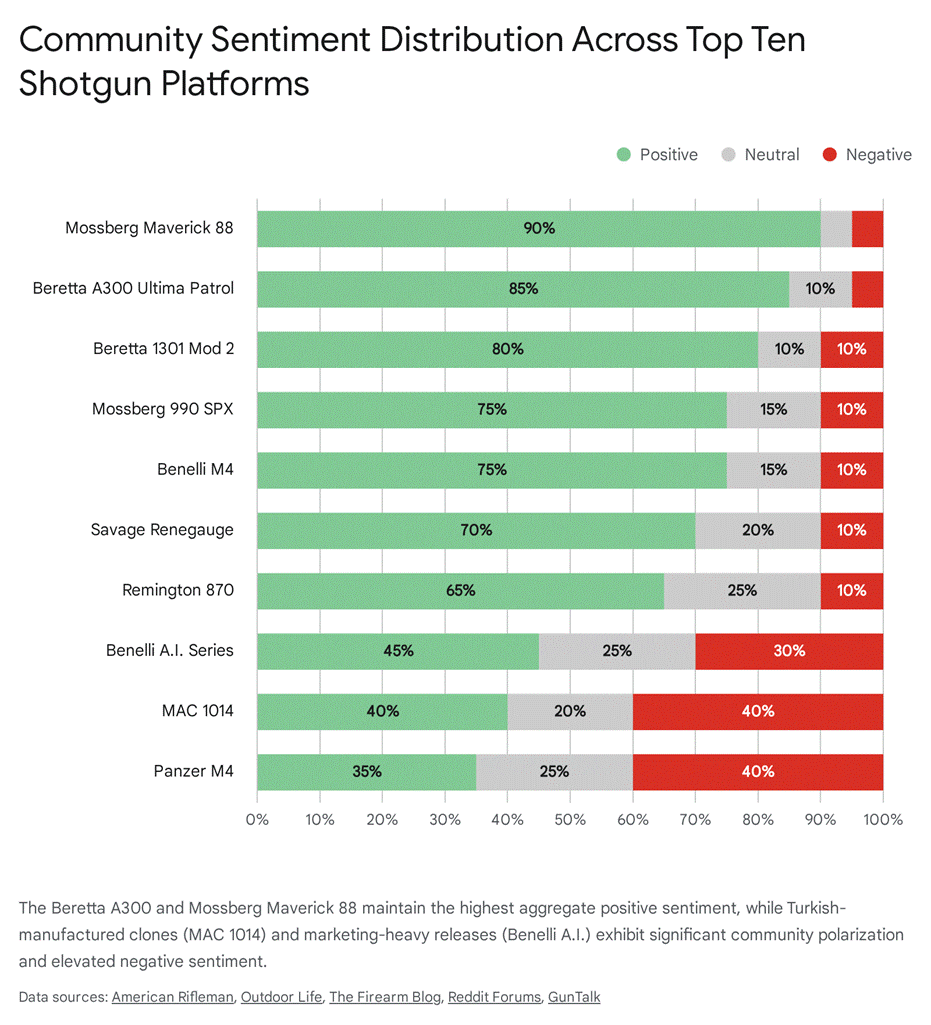
RankFirearm PlatformPrimary Operating SystemPositive SentimentNegative SentimentNeutral SentimentPrimary Market Driver
1Beretta 1301 Tactical Mod. 2B-LINK Gas (Cross-Tube)80%10%10%Ergonomic upgrades, cyclic speed
2Benelli M4 and M4 EXTARGO (Dual Short-Stroke)75%15%10%922r compliance, extended capacity
3Mossberg 990 SPX MagpulGas (Forend Contained)85%5%10%$0 NFA tax stamp, optic cuts
4MAC 1014 (Turkish Clones)ARGO Clone45%40%15%Price-to-performance ratio, metallurgy
5Beretta A300 Ultima PatrolGas (Standard)90%5%5%Value, out-of-the-box reliability
6Benelli Advanced Impact (A.I.)Inertia and Gas (Varies)40%30%30%Internal bore geometry marketing
7Savage Renegauge SecurityDRIV (Dual Valve Gas)82%8%10%Recoil mitigation, load versatility
8Genesis Arms Gen-12Short Recoil (AR-10 pattern)70%15%15%Suppressor compatibility, AR controls
9Mossberg Maverick 88Pump-Action95%2%3%Extreme budget reliability
10Remington 870 (RemArms)Pump-Action60%25%15%Chamber polishing, legacy aftermarket
Bar chart showing community sentiment distribution for top ten shotgun platforms.

1. Beretta 1301 Tactical Mod. 2

The Beretta 1301 Tactical Mod. 2 generated the absolute highest volume of discourse in July 2026. As a direct evolution of the highly successful first-generation platform, the Mod. 2 incorporates several factory upgrades that precisely address previous consumer complaints. The platform utilizes Beretta’s proprietary B-LINK gas operating system. This system features a cross-tube gas piston combined with a rotating bolt head, a configuration that results in a cyclic rate demonstrably faster than competing platforms.

Sentiment Analysis and Consumer Feedback

Sentiment CategoryPercentageCore Discussion ThemesRepresentative Consumer Quote
Positive80%Pro-Lifter geometry, cyclic speed, flat trigger upgrade, M-LOK handguard.“I got a chance to play with both the 300 and 1301. The 1301 is next level mechanics, it’s more refined and smoother. I don’t know if it’s worth the $700 premium for everyone but it was hard for me to go back to the 300.”
Negative10%Intermittent premature shell release with high-brass magnum loads during break-in.“The biggest surprise was when shooting slugs, a shell would prematurely release into the shell bay, leading to a dead trigger. This happened about 85% of the time when firing anything high brass.”
Neutral10%Complexities of 922(r) compliance when adding magazine extensions, Chisel stock hinges.“I opted for the fixed stock variant… on a lightweight 12 gauge with tons of recoil….that hinge is a potential failure point. I’ve already seen people complain about the lock up after shooting becoming looser.”

Engineering and Biomechanical Focus

Users widely praised the inclusion of the Pro-Lifter mechanism. In previous iterations of the 1301, the standard lifter geometry caused a phenomenon known as “thumb bite.” When users performed rapid quad-loading or high-stress combat reloads, the spring tension of the lifter would trap the user’s thumb against the receiver edge. The newly engineered Pro-Lifter stays in an elevated position by default, creating a completely frictionless loading channel that drastically reduces reload times. Furthermore, the semi-flat tactical trigger, which breaks cleanly at approximately four pounds, was frequently cited as a major performance enhancement for competitive 3-Gun applications.

Mechanically, the B-LINK system’s reliance on gas bleed-off requires careful maintenance of the cross-tube piston. However, high-volume shooters report the Mod. 2 handles heavy carbon fouling with minimal degradation in bolt velocity over 1,000-round firing schedules. A minor segment of the community reported initial reliability issues involving premature shell releases from the magazine tube into the receiver shell bay when firing high-brass magnum slugs, leading to a dead trigger condition. These issues were generally resolved after a complete teardown and re-lubrication to remove factory shipping preservatives.

2. Benelli M4 and M4 EXT

The Benelli M4 remains an immovable benchmark in the tactical shotgun space. Its enduring longevity is largely attributed to its combat adoption by the United States Marine Corps as the M1014. July 2026 saw a massive surge in online discussion due to the release of the M4 EXT, a factory configuration that finally offers civilian consumers a seven-round capacity and a five-position collapsible stock straight out of the box, completely bypassing the need for expensive and tedious aftermarket modifications.

Sentiment Analysis and Consumer Feedback

Sentiment CategoryPercentageCore Discussion ThemesRepresentative Consumer Quote
Positive75%ARGO system reliability, military pedigree, new Cerakote finishes (H2O, FDE).“Dead nuts, no questions asked reliability and accuracy: the M4 hands down.” “You are paying for a military specification that will outlast you and your kids.”
Negative15%Prohibitive pricing (MSRP $2,599), heavy weight compared to polymer competitors.“The benelli is heavier… As a walking around the woods shotgun though? The Beretta is much better suited for that task.”
Neutral10%Break-in period required for low-brass target loads, 922(r) part counting.“A new M4 does need a break-in period of 100-200 heavier loads before it will reliably cycle lighter target loads.”

The Mechanics of the ARGO System

Unlike the cross-tube piston of the Beretta 1301, the Benelli ARGO system relies on a dual short-stroke piston design. Two self-cleaning stainless steel pistons are positioned directly forward of the chamber. When a shell is fired, high-pressure gas is tapped directly from the barrel into a regulating blast cup. The gas pushes the two independent pistons directly against the bolt carrier, initiating the unlocking phase of the rotating bolt.

The mechanical elegance of this system lies in its lack of connecting action bars under the forend, which reduces the overall mass of reciprocating parts. If the chamber pressure exceeds the mechanical limits of the regulating spring (such as when firing 3-inch magnum slugs), the excess gas is vented directly out the front of the plug. This prevents excessive bolt velocity, which could otherwise lead to premature wear on the receiver buffer and steel locking lugs.

Discussions regarding the fatigue life of the aluminum receiver frequently emerged when comparing the M4 to cheaper clones. Analysts pointed out that while the receiver is 6061 or 7075 aluminum, the actual stress of the expanding cartridge is contained entirely within the steel barrel extension and the forged steel rotating bolt head, rendering receiver material fatigue largely irrelevant over a standard 25,000-round service life.

3. Mossberg 990 SPX Magpul and Aftershock

The Mossberg 990 series generated massive engagement due to an external legislative catalyst rather than purely mechanical innovation. The reduction of the NFA tax stamp fee for Short Barreled Shotguns (SBS) and suppressors to zero dollars on January 1, 2026, fundamentally reshaped consumer demand across the entire industry. Consumers who previously avoided NFA items due to the financial and bureaucratic burden immediately flocked to the 14.75-inch barrel configurations of the 990 SPX Magpul.

Sentiment Analysis and Consumer Feedback

Sentiment CategoryPercentageCore Discussion ThemesRepresentative Consumer Quote
Positive85%NFA SBS footprint, RMSc optic cut, Magpul SGA stock ergonomics, gas system design.“At the end of the day, this is a gun many consumers have been looking for: a compact, powerful, easy-to-use 12-gauge that simply gets the job done.”
Negative5%Extractor slip on early Aftershock models when retrofitted with stocks.“Pinning the gun to your shoulder changes the physics, making the bolt cycle much faster. On the original Aftershock, this caused the extractor to slip off the shell casing.”
Neutral10%Trade-offs between 14.75-inch (5+1 capacity) and 18.5-inch (7+1 capacity) models.“This isn’t a do-everything shotgun substitute. Capacity is purposefully modest. 5+1 with 2.75 inch shells is a practical defensive loadout, but you should still plan around reloads.”

The Physics of Recoil and Cyclic Rates

The engineering challenge Mossberg faced with the 990 series centered on the intimate relationship between the shooter’s body mass and the firearm’s internal cyclic rate. The 990 locates the entire gas-operating system within the forend, leaving the rear of the receiver completely free, allowing for unrestricted stock modularity.

However, the original stockless 990 “Aftershock” (utilizing a bird’s head grip) was factory-tuned to operate without a firm shoulder weld. When you shoot a stockless gun, it recoils and moves differently, naturally slowing down the rearward velocity of the bolt inside the receiver. When consumers began legally attaching shoulder stocks to these stockless firearms (legitimized by the $0 tax stamp), the rigid shoulder weld fundamentally changed the physics of the platform. Pinning the gun to the shoulder forced the bolt carrier to absorb the full kinetic energy of the expanding gas, drastically increasing cyclic speed and causing the extractor to outrun the shell casing, resulting in slips. Mossberg engineers solved this in the dedicated SPX Magpul series by retuning the internal action bars and gas ports to handle the increased cyclic rate smoothly. The SPX variant also includes an optic-ready receiver cut specifically for the Shield RMSc footprint, allowing users to mount micro red dots exceptionally low without the height-over-bore issues introduced by traditional Picatinny rails.

4. MAC 1014 and Turkish M4 Clones

The presence of the MAC 1014 (imported by SDS Imports) and similar Turkish-manufactured Panzer M4 clones in the top ten highlights a market segment deeply focused on the absolute limits of the price-to-performance ratio. Retailing for under $500, these firearms are nearly exact mechanical replicas of the Benelli M4, utilizing reverse-engineered copies of the ARGO gas system. The resulting discussion was highly polarized between pragmatists and manufacturing purists.

Sentiment Analysis and Consumer Feedback

Sentiment CategoryPercentageCore Discussion ThemesRepresentative Consumer Quote
Positive45%Extreme affordability, exact dimensional compatibility with OEM Benelli parts.“Clones get you 80-90% of the M4 experience at a fraction of the cost.” “I’d never considered shelling out $2,000 for a legit M4 to abuse in the woods.”
Negative40%Substandard metallurgy, sheared locking lugs, poor heat treatment.“Imagine if Benelli made a bargain priced version of the M4 with shitty metal, heat treatment, and no warranty support… The fit and finish are mediocre, and their copy of the ARGO system is similar but inferior.”
Neutral15%Identifying which specific Turkish components require immediate replacement with Italian steel.“I recommend taking it down and cleaning and re-lubing with good oil before you [shoot it].”

Metallurgical Fatigue Analysis

The debate surrounding the MAC 1014 centers entirely on material science. While modern CNC machining allows overseas factories to easily replicate the exact dimensional tolerances of a Benelli bolt carrier group, these factories often fail to replicate the complex heat-treatment protocols required for high-pressure firearms. The authentic Benelli M4 bolt head is forged and through-hardened to withstand the repetitive impact of magnum 12-gauge chamber pressures.

Conversely, microscopic analysis of failed clone parts suggests the frequent use of inferior cast steel or shallow case-hardening processes. Under the sustained cyclic stress of 500-round torture tests (popularized by online reviewers), these inferior locking lugs develop micro-fractures, eventually shearing off entirely and causing critical, weapon-destroying malfunctions. Despite this, many users argue that for a casual range toy, the probability of exceeding the fatigue life of the cast steel components is low enough to justify the savings.

5. Beretta A300 Ultima Patrol

The Beretta A300 Ultima Patrol occupies a highly strategic space as the premier budget-friendly tactical shotgun from a tier-one European manufacturer. Retailing significantly lower than the flagship 1301 Mod. 2, it captured immense discussion volume from users seeking reliable home defense platforms without the premium price tag.

Sentiment Analysis and Consumer Feedback

Sentiment CategoryPercentageCore Discussion ThemesRepresentative Consumer Quote
Positive90%Tier-one reliability at a budget price, excellent ergonomic texturing, M-LOK integration.“It is a simple gun to take apart and clean. Although, like other Beretta semiautos, it will can go a long time between maintenance.”
Negative5%Aesthetic preferences regarding polymer furniture, slightly slower cyclic rate than B-LINK.“Was the plastic barrel clamp sliding around still on your mod2? … It was not reliable.”
Neutral5%Direct comparisons analyzing whether the 1301 Mod. 2 justifies the $700 price premium over the A300.“I don’t know if it’s worth the $700 premium for everyone but it was hard for me to go back to the 300.”

The A300 boasts the highest positive sentiment in the semi-automatic category. Users universally praise its out-of-the-box reliability and its reliance on a traditional, simplified gas system rather than the high-speed B-LINK system. The inclusion of M-LOK mounting points on the thinner forend and aggressive texturing on the grip surfaces make it a highly functional defensive tool that requires very little aftermarket investment.

6. Benelli Advanced Impact (A.I.) Series

The Benelli Advanced Impact (A.I.) technology, integrated into the Ethos, Supersport, and Cordoba lines, sparked some of the most intense technical and ballistic debates of the month. Benelli aggressively marketed the A.I. barrel and proprietary choke system as capable of delivering up to 50 percent deeper penetration and a denser pellet string at extended ranges.

Sentiment Analysis and Consumer Feedback

Sentiment CategoryPercentageCore Discussion ThemesRepresentative Consumer Quote
Positive40%Slight velocity increases, excellent performance with steel shot alternatives.“Tests have shown that the Advanced Impact technology is capable of guaranteeing greater velocity to the pellet string, thus longer distances and deeper penetration.”
Negative30%Marketing hyperbole versus real-world ballistic gel results, wider patterning.“Benelli’s A.I. barrel does what it says, just not to the level the marketing suggests… It’s a clever evolution, not a revolution.”
Neutral30%Deep technical inquiries into forcing cone lengths and micrometer bore dimensions.“To get the most out of it, tighten up your choke a bit.”

Internal Ballistics and Fluid Dynamics

The Advanced Impact system fundamentally alters traditional shotgun bore geometry. A standard 12-gauge bore diameter is approximately 18.5 mm. The Benelli A.I. system features a drastically overbored cylindrical section measuring between 19.6 mm and 19.8 mm. Following the chamber, an elongated forcing cone transitions the payload into this oversized bore, reducing pellet deformation caused by lateral compression against the barrel walls. This reduction in friction allows the expanding gases to push the shot cup more efficiently, resulting in a marginal increase in muzzle velocity.

However, because the bore is oversized, the corresponding proprietary A.I. Crio chokes, which measure 10 to 12 cm in length, must feature an aggressive constriction angle to bring the shot string back into a tight pattern. Independent ballistic gel testing demonstrated that while velocity did increase slightly (roughly 1 percent at the muzzle in independent tests), the corresponding increase in penetration was marginal, falling drastically short of the marketed 50 percent claim. Furthermore, independent pattern testing revealed that the A.I. barrels patterned noticeably wider than standard barrels of the same choke constriction due to the larger bore diameter, forcing users to choke down one step further than normal to achieve desired densities. The system does show significant promise when utilizing non-toxic steel shot, as the overbored design helps mitigate the rapid velocity loss typically associated with less dense steel pellets.

7. Savage Renegauge Security

The Savage Renegauge secured its position on the list through a highly innovative approach to recoil management and gas regulation. The platform utilizes the patented Dual Regulating Inline Valve (DRIV) system, which specifically addresses the fundamental flaw of many semi-automatic shotguns: severe overgassing when firing magnum loads.

Sentiment Analysis and Consumer Feedback

Sentiment CategoryPercentageCore Discussion ThemesRepresentative Consumer Quote
Positive82%Unmatched recoil mitigation, interchangeable load reliability, heavy fluted barrel.“The flat-shooting nature of the Security, coupled with its crisp trigger, made for an altogether simple firearm to run, even with defensive buckshot.”
Negative8%Unwieldy forend bulge required to house the dual valves, high retail price.“There’s an obvious bulge on the synthetic forend to accommodate the massive cylinder assembly.”
Neutral10%Internal stock rod buffer mechanics, maintenance schedule for the short-stroke piston.“It runs dirtier than its recoil-operated brethren by nature of its very design… having to clean the gun at some point every several THOUSAND rounds is a pretty small price to pay for that sort of performance.”

Thermodynamic Regulation via the DRIV System

The DRIV system operates on advanced principles of thermodynamic venting. The barrel features eight to 10 staggered gas ports that direct expanding gases into a massive cylinder housing two spring-loaded regulating valves. When a low-pressure target load is fired, the valves remain closed, directing all available kinetic energy to the piston to cycle the action.

However, when a high-pressure magnum shell is fired, the excess pressure instantly overcomes the precise spring tension of the valves. These dual valves open simultaneously, venting the excess, high-temperature gas forward and out of the forend before it can impart excessive velocity to the bolt carrier. This precise regulation ensures the bolt travels rearward at a perfectly consistent velocity regardless of the ammunition type. This drastically reduces the impact force on the rear of the receiver and mitigates felt recoil to an exceptional degree. Combined with an adjustable stock featuring a gel-like composition pad and cheek risers, it is widely considered the softest-shooting 12-gauge platform analyzed in this report.

8. Genesis Arms Gen-12

The Genesis Arms Gen-12 caters to a niche but highly vocal segment of the tactical market that desires a shotgun manual of arms identical to the AR-10 platform. Operating on a short recoil system rather than traditional gas impingement, the Gen-12 allows for extreme barrel truncation, leading to the immense popularity of its 5-inch Short Barreled Shotgun variants.

Sentiment Analysis and Consumer Feedback

Sentiment CategoryPercentageCore Discussion ThemesRepresentative Consumer Quote
Positive70%AR-10 DPMS lower compatibility, closed-system cleanliness, detachable box magazines.“It uses a short recoil action, similar to how a Glock operates, to cycle the gun.”
Negative15%Bolt bounce malfunctions when suppressed, finicky extractor spring tension.“My luck CAT will come up with a good shotgun suppressor in the next few years after getting this.”
Neutral15%Tuning the inboard and outboard extractor springs for varied hull lengths.“The outboard extractor should move but should feel heavy resistance, while the inboard extractor should move with minimal resistance.”

The short-recoil system relies heavily on specific spring tensions to lock and unlock the breech. Users attempting to run heavy, high-volume suppressors reported reliability issues due to altered backpressure profiles, occasionally leading to malfunctions where the bolt fails to lock completely into battery. Technical discussions focused on meticulously tuning the inboard and outboard extractor springs to achieve reliable ejection across a wide spectrum of plastic hull lengths.

9. Mossberg Maverick 88

Standing in stark contrast to the complex, multi-valve gas-operated systems on this list, the Mossberg Maverick 88 represents the absolute pinnacle of budget-conscious reliability. Retailing for under $300, it dominates digital discussions regarding entry-level home defense and utilitarian farm use.

Sentiment Analysis and Consumer Feedback

Sentiment CategoryPercentageCore Discussion ThemesRepresentative Consumer Quote
Positive95%Extreme value, legendary pump-action reliability, Mossberg 590 parts compatibility.“The Maverick 88 is the best value in home defense, period… Buy the Maverick, spend the savings on ammunition and training, and rest easy.”
Negative2%Cross-bolt safety placement, pinned forend limits modularity.“cuts costs with a cross-bolt safety instead of the top-tang, a plain synthetic stock, and simplified finishing.”
Neutral3%Routine discussions on basic maintenance and reliability at low price points.“The action, reliability, and function are essentially the same as a gun costing twice as much.”

Utilizing the proven Mossberg pump-action design, users appreciate that most Mossberg 590 aftermarket parts (including barrels and magazine tubes) are fully interchangeable with the Maverick 88. It is widely considered the most mechanically reliable firearm available at its specific price point, suffering zero issues related to gas regulation or cyclic timing.

10. Remington 870 (RemArms Production)

Rounding out the top ten is the legacy Remington 870. Following the highly publicized dissolution of the Freedom Group and the subsequent manufacturing reorganization under the new RemArms ownership, consumers closely monitored the platform for desperately needed improvements in quality control.

Sentiment Analysis and Consumer Feedback

Sentiment CategoryPercentageCore Discussion ThemesRepresentative Consumer Quote
Positive60%Massive legacy aftermarket support, smooth twin-action-bar pump mechanism.“Under new Remington ownership (RemArms), quality control has stabilized… The 870’s action is legendary for its smoothness.”
Negative25%Persistent chamber surface roughness leading to extraction failures with cheap ammunition.“3 Ways to Polish Remington 870 Chamber if you have ‘sticky’ or ‘rough’ chamber and failures to extract.”
Neutral15%DIY tutorials on polishing chambers using steel wool and drill attachments.“3 Ways to Polish Remington 870 Chamber if you have ‘sticky’ or ‘rough’ chamber and failures to extract.”

While users acknowledge the unmatched aftermarket support for the 870 platform, persistent complaints remain regarding chamber finish surface roughness. Consumers frequently report “sticky” extraction with low-brass, steel-headed target loads. The rough machining marks in the chamber grip the expansive steel hulls upon firing, necessitating aftermarket or DIY polishing of the chamber to ensure reliable extraction.

The Mechanics of 922(r) Compliance

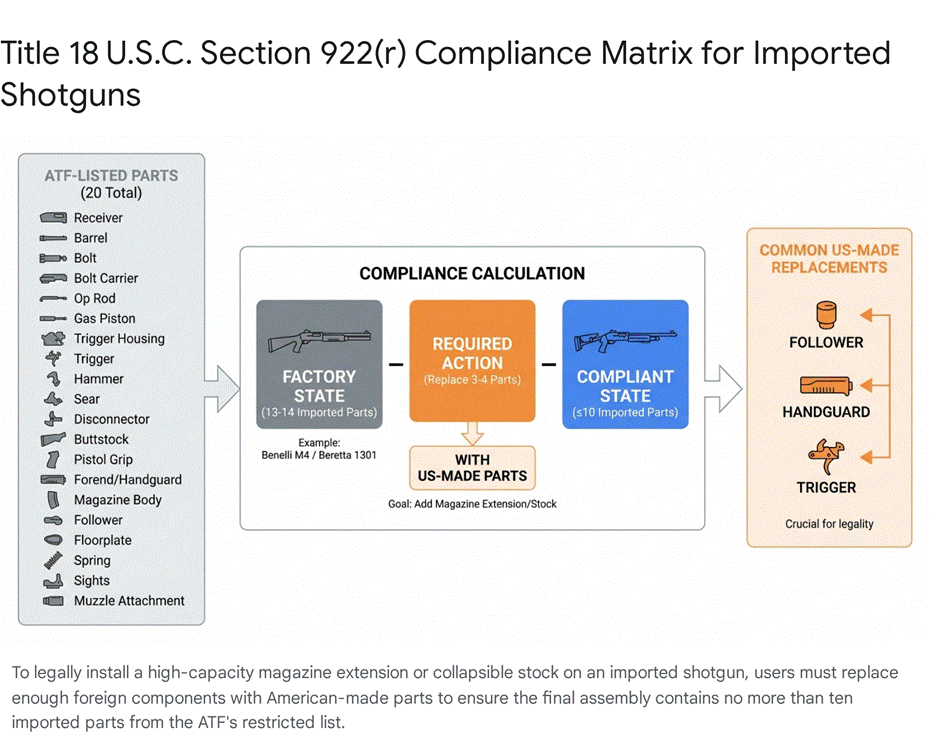
The engineering and modification of imported shotguns (specifically the Beretta 1301 and Benelli M4) are inextricably linked to federal law, specifically Title 18 U.S.C. Section 922(r). The statute prohibits the assembly of a semiautomatic rifle or shotgun from imported parts if the resulting configuration would be prohibited from original importation. To legally increase the magazine capacity beyond five rounds, or to add a folding/collapsible stock to an imported shotgun, the final assembly cannot possess more than ten imported parts from a predefined ATF list of twenty specific components.

A factory Benelli M4 typically contains thirteen or fourteen of these restricted imported parts. Therefore, a consumer must replace three or four specific Italian components with American-made equivalents to achieve legal compliance before adding a magazine extension. This legislative framework drives a massive domestic aftermarket industry focused on producing high-quality, CNC-machined replacement triggers, magazine followers, and handguards solely for the purpose of altering the foreign-part count.

ATF 922(r) compliance matrix for imported shotguns: factory state, required action, compliant state.

Mitigating Recoil: Mechanical Buffers vs. Gas Regulation

A secondary mechanical trend identified across multiple platforms is the aggressive integration of advanced recoil mitigation systems. The physics of 12-gauge recoil dictates that the shooter must absorb the kinetic energy transferred directly through the stock. While gas-operated systems naturally stretch the recoil impulse over a longer duration compared to fixed-breech pump actions, modern consumers are seeking further biomechanical advantages.

The data highlights a surge in the integration of aftermarket mechanical buffers, such as the KynSHOT RB5100 and Sure Cycle systems. These stainless steel and aluminum devices completely replace traditional static buffer tubes. By utilizing complex hydraulic damping technology, these systems absorb the rearward kinetic impact of the bolt carrier, physically compressing internal hydraulic fluid up to three-quarters of an inch. This localized compression slows the bolt velocity incrementally before it strikes the rear of the receiver, effectively reducing peak felt recoil by altering the spring dynamics and cyclic rate. Shooters utilizing these adjustable damped buffers report significantly faster target reacquisition times and a dramatic reduction in muzzle flip, allowing for precise, rapid follow-up shots in competitive and tactical scenarios.

Availability

Official Manufacturer Websites

Note: A scan of the specified vendor network (Ammunition Depot, BCM, Brownells, Classic Firearms, Creedmor Sports, DEGuns, Grabagun, Global Ordnance, GRITR Sports, GunMag Warehouse, Guns.com, KYGunCo, Magpul, Midway USA, Natchez Shooting & Outdoors, Palmetto State Armory, Primary Arms, Shooting Surplus, SIGSAUER, Sportsmans Outdoor Superstore, and The Mag Shack) located active product listings for the following platforms:

(Active specific product page listings for the remaining top 10 models were not identified during the vendor search parameter check.)

Conclusion

The civilian shotgun market in July 2026 is defined by a highly sophisticated consumer base that demands absolute mechanical reliability and is acutely sensitive to legislative changes. The $0 NFA tax stamp has fundamentally altered the physical footprint of the modern defensive shotgun, shifting priority toward ultra-compact, precision-gas-regulated platforms like the Mossberg 990 SPX over traditional 18.5-inch barrels. Concurrently, the absolute dominance of the Beretta 1301 Mod. 2 and Benelli M4 underscores a consumer willingness to invest heavily in proven, high-speed gas systems (B-LINK and ARGO), despite the expensive legal complexities associated with 922(r) compliance. Finally, the extreme polarization surrounding Turkish clones and Benelli’s Advanced Impact marketing claims reveals a highly analytical community that actively tests, chronographs, and inspects metallurgical integrity. This consumer base demands that manufacturer marketing claims align strictly with the immutable laws of fluid dynamics and material science.

Appendix: Analytical Framework and Data Sources

The findings presented in this report were generated through a comprehensive aggregation and natural language processing (NLP) analysis of digital discourse. The primary objective was to quantify discussion volume, extract nuanced mechanical critiques, and evaluate community sentiment regarding the shotgun market during the period of July 2026.

Data Collection Parameters

Data was sourced from a highly targeted cross-section of the digital firearms community. Primary collection nodes included dedicated enthusiast forums (e.g., BenelliUSA, Canadian Gun Nutz, Palmetto State Armory community boards), specialized subreddit communities (r/Shotguns, r/beretta1301, r/Tacticalshotguns, r/NFA), and the comment sections of prominent YouTube firearm reviewers (e.g., TFBTV, Target Focused Life). Additionally, editorial reviews and technical specifications were aggregated from industry publications such as American Rifleman, Outdoor Life, Guns & Ammo, and Shoot On.

Sentiment Classification Protocol

To accurately interpret the qualitative data, a tripartite classification matrix was applied to the aggregated discourse:

  • Positive Sentiment: Identified by explicit recommendations, praise for mechanical reliability, positive reviews of ergonomic upgrades (e.g., the Pro-Lifter), and favorable price-to-performance assessments.
  • Negative Sentiment: Characterized by documentation of catastrophic failures (e.g., sheared locking lugs), complaints regarding excessive pricing, reports of unreliable extraction, or criticism of manufacturer marketing claims that failed to materialize in independent testing.
  • Neutral Sentiment: Comprised of objective technical inquiries, requests for troubleshooting assistance, debates regarding federal legal compliance (e.g., NFA configurations, 922r parts counting), and general discussions regarding aftermarket modifications.

The volume of discussion was calculated by isolating unique mentions, threaded replies, and direct engagements related to specific firearm models, allowing for the accurate ranking of the top ten platforms analyzed in this report.


Note: Vendor Sources listed are not an endorsement of any given vendor. It is our software reporting a product page given the direction to list products that are between the minimum and average sales price when last scanned.


Please share this post with colleagues, on forums, etc. Your support is much appreciated, and if you have any feedback, please email us in**@*********ps.com. If you’d like to request a report or order a reprint, please click here for the corresponding page to open in new tab.


Sources Used

Enthusiast Forums and Communities

  • BenelliUSA Forums
  • Canadian Gun Nutz
  • Palmetto State Armory Community Boards
  • Reddit: r/Shotguns, r/beretta1301, r/Tacticalshotguns, r/NFA

Referenced Articles and Technical Blogs

Manufacturer Websites

Franchi S.p.A.: Historical Trajectory, Product Ecosystem, and Market Position

1. Executive Summary

Franchi S.p.A. stands as one of the oldest continuously operating firearm manufacturers in Italy, maintaining a corporate history that spans from the late 19th-century transition to smokeless powder through the contemporary era of advanced synthetic sporting arms1. Established in the industrial hub of Brescia, the company built its foundational reputation through precision-machined sporting shotguns and government military contracts1. Over its 150-year operational lifespan, the manufacturer has navigated market fluctuations, corporate acquisitions, and shifting geopolitical trade regulations, transitioning from an independent family-owned enterprise to a wholly owned subsidiary of the global Beretta Holding group1.

The operational architecture of Franchi firearms has evolved through three distinct technological phases: the kinetic long-recoil sporting shotguns of the mid-20th century, the specialized dual-mode gas/pump combat shotguns of the late Cold War era, and the modern integration of inertia-driven autoloading systems and precision bolt-action rifles2. This report provides an analysis of Franchi’s historical evolution, technical mechanics, primary product lines, market reception, and United States distribution network, concluding with a forward-looking assessment of its strategic market position within the small arms industry.

2. Origins and Corporate Evolution (1868–Present)

2.1 Founding and Early Industrial Roots

Luigi Franchi established his eponymous family business in 1868 in Brescia, Italy1. During the late 19th century, the Val Trompia river valley in the Province of Brescia was rapidly developing into a concentrated industrial center, heavily supported by local ore-mining operations that supplied raw materials for regional metal manufacturing1. Franchi’s proximity to these metallurgical resources provided the company with the flexibility to experiment with new steel alloys and machining techniques during a critical transitional period in firearm history1.

The company’s early decades coincided with the global shift from muzzle-loading, black-powder firearms to breech-loading systems utilizing metallic cartridges and smokeless powder1. Franchi navigated the fierce competition among European gunmakers by producing highly reliable, precisely crafted double-barrel shotguns, establishing a foundational reputation for quality1.

2.2 Military Supply and Post-War Era

Franchi survived the industrial disruptions of both World War I and World War II. In the post-1945 era, the company played a role in the military restructuring of Europe, securing contracts to supply military rifles and shotguns to various NATO countries1. This dual-focus approach, maintaining high-end civilian sporting shotgun production while fulfilling military contracts, allowed Franchi to scale its manufacturing capabilities and invest in specialized research and development1.

During the 1950s, Franchi expanded its military offerings beyond smoothbore weapons, developing the LF-57 submachine gun, which was adopted by the Italian Navy in 1962, and experimenting with battle rifles such as the LF-59 chambered in 7.62×51mm NATO and the LF-58 assault rifle in .30 Carbine2. Concurrently, the civilian market saw the introduction of the 48 AL, a long-recoil semi-automatic shotgun that became a staple of the upland hunting community2.

2.3 Acquisitions: The Socimi Era

Franchi operated as an independent, family-run enterprise for over a century until 1987, when it was acquired by the Milan-based industrial conglomerate Società Costruzioni Industriali Milano (Socimi)2. Under Socimi’s ownership, Franchi continued to develop its combat shotgun lines, most notably refining the SPAS-12 and introducing the SPAS-152.

However, Socimi encountered severe financial difficulties and entered bankruptcy in 19932. The resulting corporate instability temporarily jeopardized Franchi’s manufacturing operations and international export agreements, forcing the firearms division to seek a new corporate parent to maintain solvency and production continuity.

2.4 Integration into Beretta Holding

Following the financial collapse of Socimi, Franchi was acquired by Beretta Holding in 1993/19942. This acquisition proved to be a pivotal stabilization point. Following the buyout, Franchi’s operations were closely integrated with Benelli Armi S.p.A., another Beretta Holding subsidiary2.

Production and administrative functions were eventually aligned with Benelli’s advanced manufacturing facilities in Urbino, Italy9. This integration allowed Franchi to transition away from its historical gas-operated and long-recoil systems to adopt Benelli’s highly successful inertia-driven mechanisms for its modern sporting lines, repositioning Franchi as a high-value mid-tier brand within the broader Beretta portfolio11.

3. Evolution of Technical Architecture

Franchi’s engineering identity is defined by its willingness to adopt, refine, and commercialize differing mechanical operating systems across distinct eras of firearm development.

3.1 Long-Recoil Kinetic Systems

In the mid-20th century, Franchi utilized the long-recoil method of operation5. In a long-recoil system, the barrel and the bolt remain locked together as they travel fully to the rear of the receiver upon firing10. Once the rearward stroke is complete, the bolt is held to the rear by a catch while the barrel is pushed forward by a robust return spring; this physical separation extracts and ejects the spent casing before the bolt is released to chamber a fresh round.

Franchi refined this mechanism in the Model 48 AL, introduced in 19485. By utilizing a lightweight aluminum alloy receiver, Franchi created a shotgun that was significantly lighter than competing steel-receiver designs (weighing approximately 5.5 pounds in 20-gauge)5. This low mass made the 48 AL highly desirable for upland hunters who carried the firearm over long distances, establishing Franchi as a leader in lightweight sporting arms5.

3.2 Dual-Mode Combat Systems

In the late 1970s, military and law enforcement requirements dictated the need for shotguns capable of firing both high-pressure lethal ammunition (buckshot, slugs) and low-pressure less-lethal ammunition (tear gas, rubber baton rounds)3. Traditional gas-operated semi-automatics frequently fail to cycle low-pressure rounds due to insufficient gas volume entering the piston block.

To solve this, Franchi engineers developed a dual-mode mechanism that allowed the operator to manually switch the firearm between semi-automatic and pump-action operation3. In semi-automatic mode, the system utilized a short-stroke gas piston3. The gas block and piston were uniquely annular, enclosing the tubular magazine to optimize spatial balance and avoid the bulk of a top-mounted gas system3. By depressing a selector button on the forend and sliding the forend slightly forward or backward, the user could engage or disengage the gas system8. When switched to pump-action, the internal actuator rod was manually driven by the sliding forend, forcing the rotating bolt to unlock and extract the shell mechanically16.

3.3 Inertia Driven Integration

Following its integration into Beretta Holding alongside Benelli, Franchi transitioned its primary semi-automatic sporting lines to the Inertia Driven system12. Unlike gas systems, which bleed propellant gases from the barrel through ports to cycle the action, the inertia system relies strictly on the rearward kinetic energy of the firearm under recoil18.

Upon firing, the shotgun moves rearward against the shooter’s shoulder, but the heavy, floating bolt body briefly remains stationary in space due to its own inertia17. This relative movement compresses a short, stiff inertia spring located between the rotating bolt head (which remains locked to the barrel extension) and the bolt body14. As the recoil impulse peaks and begins to dissipate, the compressed inertia spring violently expands, throwing the bolt body to the rear, which rotates the bolt head to unlock, extracts the spent shell, and cocks the hammer14.

Franchi’s specific implementation of this system differs slightly from Benelli’s flagship models. While shotguns like the Benelli M2 house the primary recoil return spring inside the buttstock, modern Franchi autoloaders (such as the Affinity series) place the return spring over the magazine tube, underneath the forend19. This forward placement alters the balance point of the firearm, moving weight slightly forward, and allows for easier field maintenance of the recoil spring without requiring the removal of the stock assembly11.

4. Core Product Portfolios

Franchi’s historical and modern product catalogs can be categorized into four primary segments: historical military platforms, sporting autoloaders, break-action shotguns, and modern bolt-action rifles.

4.1 Historical Military and Tactical Platforms

The LF-57 Submachine Gun

The LF-57 was a 9×19mm Parabellum submachine gun developed in 19567. Operating on a simple blowback mechanism, the LF-57 utilized a stamped steel frame and an overhung “L”-shaped bolt, where the majority of the bolt’s physical mass resided above the barrel7. This design reduced the weapon’s overall length to 26.75 inches (with stock extended) and mitigated muzzle climb by distributing the reciprocating mass forward7. It fed from 10-, 20-, 30-, or 40-round detachable box magazines compatible with the Beretta Model 387. Though it saw adoption by the Italian Navy in 1962, production ceased by the early 1980s7.

The SPAS-12 Combat Shotgun

The SPAS-12 (Special Purpose Automatic Shotgun, later rebranded as Sporting Purpose Automatic Shotgun for civilian import) was manufactured from 1979 to 20003. Designed as a rugged military and law enforcement platform, it featured an aggressive, industrial aesthetic characterized by a vented sheet-metal heat shield, a robust polymer forend, and a stamped steel folding stock15.

The folding stock variant included a distinctive semi-circular butt hook3. With the stock extended, this hook could be rotated 90 degrees to fit under the operator’s forearm, allowing the heavy, 9.68-pound (4.4 kg) weapon to be fired one-handed if the user was injured or required a free hand for driving or door breaching3. The SPAS-12 accepted four different magazine extension tubes (5, 6, 7, and 8-shell capacities) and was manufactured with four distinct factory barrel lengths3. Franchi also produced sister variants: the LAW-12 (semi-automatic only) and the SAS-12 (pump-action only) to meet varying procurement budgets and legal restrictions3.

SPAS-12 Barrel VariantLengthPrimary Market / DistributionRarity / Notes
“Shorty” Model18 inches (46 cm)Law Enforcement / Military (France)Very rare; often featured the pistol grip safety.3
AL Proofed Model19 7/8 inches (50 cm)Law Enforcement / MilitaryVery rare; found on 1983 proofed models.3
Standard Model21 1/2 inches (55 cm)Global Military & CivilianMost common; utilized blade foresight.3
UK Legal Conversion24 inches (61 cm)United Kingdom CivilianCommon in UK; 21.5″ barrel with a 2.5″ brazed choke tube.3

The SPAS-15 Combat Shotgun

The SPAS-15 was introduced in 1986 and produced until 2005 as a direct evolution of the SPAS-1216. It was heavily influenced by operational requirements from the Italian Folgore Parachute Brigade, who required faster reloading capabilities during dynamic engagements22. While it retained the dual-mode pump/semi-automatic operation and rotating bolt, the SPAS-15 abandoned the traditional tubular magazine in favor of a detachable, single-stack box magazine holding 3, 6, or 8 rounds4. Outwardly, it featured a more conventional assault-rifle layout, including an upper carry handle containing the cocking mechanism, a pistol grip, and a side-folding stock, reducing its overall folded length to 30 inches (750 mm)8.

4.2 Modern Sporting Autoloaders: The Affinity Series

The Affinity 3 and Affinity 3.5 represent Franchi’s current generation of inertia-driven semi-automatic shotguns11. The series is engineered for both upland bird and waterfowl hunting, featuring an anodized aluminum alloy receiver and a slim forend profile afforded by the absence of gas pistons12. The numerical “3” and “3.5” designations denote the maximum chamber lengths accepted (3-inch and 3.5-inch magnum shells, respectively)24.

Key engineering features of the Affinity platform include:

  • TSA Recoil Pad: An integrated Twin Shock Absorber polyurethane pad designed to compress under recoil, mitigating up to 50% of the sharp felt recoil inherently produced by inertia-driven systems11.
  • Omni-Fit System: A specialized shim kit provided with the firearm that allows the user to adjust the cast and drop of the stock for a customized fit to the shooter’s shoulder19.
  • Oversized Controls: Enlarged bolt releases and charging handles are engineered for easier manipulation in cold weather environments with gloved hands11.
  • Environmental Finishes: The series is offered in various weather-resistant configurations, including GORE OPTIFADE Waterfowl Marsh/Timber, Realtree Max-7, and Mossy Oak Bottomland camouflage patterns, often paired with Midnight Bronze or Patriot Brown Cerakote finishes on the receiver and barrel to prevent corrosion23.

4.3 Break-Action Shotguns: The Instinct Series

The Instinct series is Franchi’s primary over/under double-barrel shotgun line, combining traditional Italian aesthetic styling with modern CNC manufacturing23. The series is segmented into several tiers tailored to different shooting disciplines:

Instinct ModelReceiver MaterialStock FurnitureTarget Application & Features
Instinct LSolid Steel (Monobloc)A-Grade Satin WalnutGeneral upland hunting. Features color case-hardened receiver for traditional aesthetics.29
Instinct SLAluminum AlloyAA-Grade Satin WalnutLightweight upland carry. Uses a titanium insert at the breech face. Weighs under 6 lbs in 20-gauge.23
Instinct SideplateSteel (Extended Plates)AA-Grade Satin WalnutPremium aesthetic variant. Features extended sideplates with intricate engraving and gold inlay.29
Instinct CatalystSteelA-Grade Satin WalnutSpecifically engineered for female shooters, featuring a re-contoured stock for altered drop, cast, and length of pull.23

All Instinct models feature automatic ejectors to clear spent hulls rapidly, auto-resetting tang safeties with integrated barrel selectors, chrome-lined bores, and vented ribs to dissipate heat during high-volume shooting29.

4.4 Bolt-Action Rifles: The Momentum Series

Diversifying beyond smoothbore platforms, Franchi introduced the Momentum line of bolt-action rifles to capture market share in the big game and varmint hunting sectors1. The Momentum action utilizes a fluted, three-lug chrome bolt providing a short 60-degree throw for rapid cycling, and the receiver is drilled and tapped to accept standard Remington 700-pattern two-piece scope bases25.

The cold hammer-forged, free-floating barrels are threaded to accept suppressors or muzzle brakes and are guaranteed by the factory to yield 1 MOA (Minute of Angle) accuracy with premium factory ammunition25. The “Relia Trigger” is a single-stage, adjustable mechanism ensuring a crisp break25. The Momentum Elite variants expand on this foundational architecture by integrating one-piece Picatinny rails, detachable box magazines, and advanced ergonomic stocks featuring Franchi’s proprietary “Biome,” “Terra,” and “Verdant” camouflage patterns25. The series is chambered in a wide array of calibers, ranging from flat-shooting rounds like 6.5 PRC and 6.5 Creedmoor to heavy magnum cartridges (.300 Win Mag) and modern straight-wall cartridges (.350 Legend, .400 Legend) required in specific hunting jurisdictions35. Recently, as noted in a 2026 SHOT Show product announcement on blog.roninsgrips.com, Franchi expanded this series with the Momentum MULE, a specialized “Truck Gun” concept offered in calibers like .308 Winchester and .223 Remington featuring a low-visibility finish and a suppressor-ready muzzle37.

5. Market Perception and End-User Feedback

5.1 Sporting and Hunting Community Reception

Within the civilian hunting community, Franchi is widely regarded as a high-value, pragmatic alternative to premium sister brands like Benelli and Beretta, offering comparable mechanical performance at a lower price point11. The Affinity series is frequently praised by field testers for its reliability in harsh waterfowl environments, its lightweight profile, and its natural “pointability” due to the slender forend11.

Industry analysts note that the primary criticism of Franchi’s inertia-driven shotguns remains the recoil impulse11. Because inertia systems lack the gas piston mechanisms that bleed off pressure and spread out the recoil impulse over time, the kinetic energy is transferred more directly to the operator, resulting in a sharper felt recoil profile compared to gas-operated equivalents14. While Franchi mitigates this via the TSA recoil pad, users highly sensitive to recoil occasionally prefer heavier gas guns11. Additionally, some reviewers note that the polymer furniture and exterior finishes on entry-level Franchi models feel less premium than the flagship Benelli lines, reflecting the necessary cost-saving measures implemented to meet the mid-tier price point12.

5.2 Law Enforcement, Military, and Collector Perspectives

The SPAS-12 and SPAS-15 hold a distinct, highly polarized position in the tactical and collector markets. Despite their intended purpose as rugged military platforms, tactical experts and end-users often criticize the SPAS-12 for being overly complicated and exceedingly heavy, weighing nearly 10 pounds when loaded3. Reloading proved difficult because Franchi designed the carrier latch to double as the bolt release, forcing the operator to simultaneously hold a button down to load the tube, and the semi-automatic gas system was noted to be finicky, occasionally failing to cycle even full-power buckshot38. The steep learning curve of its manual of arms can induce user error under stress39. Today, they are prized primarily as rare collector’s items and historical curiosities rather than practical defensive tools40.

According to an analysis of Turkish SPAS-12 clones on blog.roninsgrips.com, the cessation of the original Franchi SPAS-12 has driven secondary market prices for pristine examples up to $7,00039. This massive inflation and the ongoing pop-culture demand have spawned a new market of modern Turkish reproductions, such as the Bronco TAC SX and the Sulun Arms SPASS-1239. As detailed in a performance analysis of the Sulun SPASS-12 at blog.roninsgrips.com, these modern clones often abandon the notoriously complex Franchi gas system in favor of a simpler Benelli M3-style dual-mode action, successfully resolving the original platform’s historical safety and cycling flaws while retaining its iconic aesthetic41.

5.3 Cinematic Profile and Pop Culture Prominence

The SPAS-12 achieved a level of cultural immortality entirely disproportionate to its commercial or military success15. Its menacing, angular, and heavy-industrial aesthetic, dominated by the heat shield and the hook stock, made it highly desirable to Hollywood armorers seeking visually intimidating weapons15. The shotgun gained iconic status after prominent, often exaggerated appearances in blockbuster films such as The Terminator (1984), Miami Vice (1984), and Jurassic Park (1993)15. This “hero gun” phenomenon solidified its reputation in the public consciousness as the definitive combat shotgun of the late 20th century, driving its demand on the secondary collector market long after production ceased15.

6. United States Importation and Distribution Strategy

6.1 Historical Importation and the 1994 Assault Weapons Ban

The importation of Franchi firearms into the United States has undergone significant legislative and corporate restructuring over the decades. In the 1980s, the SPAS-12 was primarily imported by Firearms Import and Export (F.I.E.)13. To maintain compliance with evolving civilian market standards and push back against its “military” stigma, Franchi formally renamed the SPAS from “Special Purpose Automatic Shotgun” to “Sporting Purpose Automatic Shotgun” in 1990, removing certain features to classify it as a sporting arm3.

However, the passage of the Federal Assault Weapons Ban (AWB) in September 1994 immediately halted the importation of the SPAS-12 and SPAS-153. The firearms’ features, specifically folding stocks, pistol grips, and high magazine capacities, fell directly under the ban’s restrictions43. This sudden legislation resulted in significant financial losses for stateside importers who had placed large advance orders that could no longer clear customs43. Consequently, only an estimated 5% of total SPAS-12 production (roughly 1,850 units) ever legally entered the US civilian market prior to the ban, making them exceptionally rare on the secondary market today43.

6.2 The SPAS-12 Lever Safety Defect and Recall Program

During its production run, a critical engineering flaw was discovered in the lever-style and early push-button safeties of the SPAS-12, LAW-12, and SAS-12 models44. Internal wear on the safety detent mechanism could cause the hammer to release independently when the operator moved the lever from “Safe” to “Fire,” resulting in an unintentional discharge44.

Franchi issued an international safety recall in the early 1990s44. Because the original importer (F.I.E.) had gone bankrupt, the recall operations in the US were handled by a subsequent importer, American Arms45. The factory remedy involved replacing the defective lever safety trigger groups with an updated cross-bolt safety mechanism45. Because American Arms ceased operations around the year 2000, and current corporate ownership (Benelli/Beretta) does not service the discontinued SPAS platform, executing this safety conversion today requires relying on specialized secondary-market gunsmiths and custom-machined parts45.

6.3 Modern Distribution Architecture via Benelli USA

Today, Franchi operates entirely within the robust supply chain of the Beretta Holding group. Distribution, marketing, and warranty services for the United States are managed by Benelli USA, headquartered in Accokeek, Maryland13.

This corporate structure provides Franchi with immense logistical advantages48. By sharing distribution networks, supply chain analytics, and dedicated sales teams with sister brands like Benelli, Stoeger, A. Uberti, and Chapuis, which all share the Accokeek headquarters hub, Franchi benefits from economies of scale that independent mid-tier manufacturers cannot replicate48. Current Franchi firearms are backed by an industry-leading 7-year warranty, serviced through this established Maryland location, ensuring parts availability and consumer confidence25.

7. Strategic Trajectory and Future Outlook

7.1 Product Diversification into Rifles

Franchi’s future trajectory indicates a strategic commitment to expanding its footprint in the centerfire rifle market while maintaining its core shotgun demographic. The continuous expansion of the Momentum series into modern, high-efficiency calibers (such as 6.5 PRC) demonstrates the brand’s intent to capture younger demographics focused on precision shooting25. Furthermore, the addition of straight-wall cartridges like the .350 Legend and .400 Legend allows Franchi to adapt rapidly to changing regional hunting regulations in the American Midwest, where traditional bottleneck rifle cartridges are often prohibited for deer hunting35. The introduction of the Momentum MULE “Truck Gun” further highlights their adaptability to niche utility and defensive sporting demands37.

7.2 Mid-Tier Market Positioning

In the shotgun space, Franchi continues to refine the Affinity and Instinct platforms with advanced material sciences. The integration of proprietary weather-resistant Cerakote finishes and specialized camouflage patterns positions these firearms as highly specialized tools for distinct environments rather than generic sporting arms28.

As a subsidiary of Beretta Holding, Franchi’s long-term stability is secure. The brand effectively serves as the critical “bridge” in Benelli USA’s portfolio, positioned above the entry-level Turkish-manufactured Stoeger line, but priced below the flagship Italian Benelli Super Black Eagle and Ethos lines12. Provided consumers continue to seek the mechanical reliability of the Inertia Driven system without the premium price tag associated with top-tier brands, Franchi is projected to retain a dominant share of the mid-market sporting arms sector12.

8. Pricing and Availability

Official Manufacturer Website: https://www.franchiusa.com/

Below is a snapshot of active product listings from specified vendors, highlighting firearms priced at or below the general market average for their respective product lines.

(Note: Prices and availability are subject to vendor changes and regional restrictions.)

9. Conclusion

Franchi S.p.A. has successfully navigated 150 years of shifting industrial landscapes by remaining mechanically adaptable. The company transitioned from a family-run supplier of double-barrel shotguns to a military contractor producing submachine guns and complex dual-mode combat shotguns during the height of the Cold War. Following its acquisition by Beretta Holding, Franchi underwent a strategic realignment, pivoting away from the tactical sector to dominate the mid-tier sporting market. By leveraging the highly reliable Inertia Driven system, expanding into precision bolt-action rifles, and utilizing the robust logistical network of Benelli USA, Franchi has secured its position as a high-value, performance-driven brand that honors its Italian manufacturing heritage while meeting modern consumer demands.

Master Summary Table

CategoryDetails
Origin & FoundingFounded in 1868 by Luigi Franchi in Brescia, Italy. Originally focused on double-barrel shotguns amidst the transition to smokeless powder1.
Corporate OwnershipFamily-owned until 1987 (acquired by Socimi). Following Socimi’s bankruptcy, acquired by Beretta Holding in 1993/1994, integrating closely with Benelli2.
Historical Combat ProductsLF-57: 9mm blowback SMG utilizing an L-shaped bolt7.   SPAS-12: Dual-mode (pump/semi) tube-fed combat shotgun. Heavy, complex, and iconic in pop culture3.   SPAS-15: Dual-mode combat shotgun fed by a detachable box magazine16.
Modern Sporting ProductsAffinity Series: Inertia-driven semi-automatic shotguns for upland/waterfowl featuring TSA recoil pads24.   Instinct Series: Over/under shotguns featuring monobloc receivers and auto-ejectors31.   Momentum Series: Bolt-action rifles featuring threaded barrels and a 1 MOA guarantee25.
Mechanical EvolutionEvolved from John Browning’s Long-Recoil system (48 AL), through complex gas/pump hybrids (SPAS series), to the modern kinematic Inertia Driven system (Affinity)3.
Market PerceptionPraised for value, pointability, and reliability. Criticized historically for the SPAS safety recall and heavy weight, and currently for the sharper recoil inherent to inertia systems compared to gas11.
US DistributionHandled by Benelli USA (Accokeek, MD). Historically hindered by the 1994 AWB and importer bankruptcies, current logistics ensure robust supply chains, shared resources, and reliable warranty support43.

Note: Vendor Sources listed are not an endorsement of any given vendor. It is our software reporting a product page given the direction to list products that are between the minimum and average sales price when last scanned.


Please share this post with colleagues, on forums, etc. Your support is much appreciated, and if you have any feedback, please email us in**@*********ps.com. If you’d like to request a report or order a reprint, please click here for the corresponding page to open in new tab.


Sources Used

  1. Franchi History | Franchi Shotguns and Rifles, https://www.franchiusa.com/community/franchi-history
  2. Franchi (firearms) – Wikipedia, https://en.wikipedia.org/wiki/Franchi_(firearms)
  3. Franchi SPAS-12 – Wikipedia, https://en.wikipedia.org/wiki/Franchi_SPAS-12
  4. Franchi SPAS-15 Dual Action Semi-Automatic Shotgun – Peter J Starley Kft – Guntopia, https://guntopia.hu/product/franchi-spas-15-duel-action-semi-automatic-shotgun/
  5. Franchi 2011 Product Catalog | PDF | Firearms | Military Technology – Scribd, https://www.scribd.com/document/68313895/Franchi-2011-Product-Catalog
  6. Still a Legend: Beretta Firearms – The Mag Life – GunMag Warehouse, https://gunmagwarehouse.com/blog/still-a-legend-beretta-firearms/
  7. Franchi LF-57 – Gun Wiki – Fandom, https://guns.fandom.com/wiki/Franchi_LF-57
  8. USAS-12 and SPAS-15 Shotgun Overview | PDF – Scribd, https://www.scribd.com/document/6750516/SHOT-GUNS
  9. Sustainability Report 2024 – Benelli Armi, https://benelli.it/bilancio_sostenibilita/Sustainability_Report_2024_EN_web.pdf
  10. Full text of “Hogg, Ian Modern Small Arms ( 1988) (distilled)” – Internet Archive, https://archive.org/stream/HoggIanModernSmallArms1988distilled/Hogg%2C_Ian-Modern_Small_Arms_%281988%29_%28distilled%29_djvu.txt
  11. Franchi Affinity 3 Sporting Review: A Standout Shotgun? – Gun Made, https://www.gunmade.com/franchi-affinity-3-review/
  12. Shotgun Review: Franchi Affinity 3 – Outdoor Life, https://www.outdoorlife.com/guns/shotgun-review-franchi-affinity-3/
  13. Streetsweepers: The Complete Book of Combat Shotguns [Revised and Updated] 158160436X, 9781581604368 – DOKUMEN.PUB, https://dokumen.pub/streetsweepers-the-complete-book-of-combat-shotguns-revised-and-updated-158160436x-9781581604368.html
  14. Benelli’s ComforTech 20-Gauge Autoloaders Are Fast Like Lightning! – Shooting Times, https://www.shootingtimes.com/editorial/longgun_reviews_benellic_082907/99258
  15. Franchi SPAS 12 shotgun, the legend – All4Shooters.com, https://www.all4shooters.com/en/shooting/shotguns/franchi-spas-12/
  16. Franchi SPAS-15 – Gun Wiki – Fandom, https://guns.fandom.com/wiki/Franchi_SPAS-15
  17. Review: Benelli Ethos 28 Gauge – Guns and Ammo, https://www.gunsandammo.com/editorial/review-ethos-28-gauge/247743
  18. The Internal Mechanisms of a Shotgun : r/gifs – Reddit, https://www.reddit.com/r/gifs/comments/62ywad/the_internal_mechanisms_of_a_shotgun/
  19. Best Waterfowl Shotguns for 2013 – Wildfowl, https://www.wildfowlmag.com/editorial/best-waterfowl-shotguns-for-2013/280261
  20. Franchi LF-57 – Military Wiki | Fandom, https://military-history.fandom.com/wiki/Franchi_LF-57
  21. LF 57 CAL9mmx19NATO – Forgotten Weapons, https://www.forgottenweapons.com/wp-content/uploads/LF57/Franchi%20LF57%20brochure.PDF
  22. Franchi SPAS-15 Shotgun Review – Firearms News, https://www.firearmsnews.com/editorial/franchi-spas15-shotgun-review/380039
  23. Franchi Firearms for Sale – Shotguns & Rifles | Palmetto State Armory, https://palmettostatearmory.com/brands/franchi.html
  24. Affinity 3 | Franchi Shotguns and Rifles, https://www.franchiusa.com/semi-auto-shotguns/affinity-3
  25. Momentum | Franchi Shotguns and Rifles, https://www.franchiusa.com/rifles/momentum
  26. Franchi Shotguns for Sale | Premium Semi-Auto & Over/Under Models, https://palmettostatearmory.com/brands/franchi.html/shotguns.html?p=2
  27. Franchi Affinity 3 Sport Trap Shotgun Review, Expert Tested – Field & Stream, https://fieldandstream.com/outdoor-gear/guns-gear/shotguns-gear/franchi-affinity-3-sport-trap-shotgun-review
  28. Hunting Shotguns | Franchi Shotguns and Rifles, https://www.franchiusa.com/shotguns/hunting-shotguns
  29. Best Over Under Shotguns | MidwayUSA, https://www.midwayusa.com/best-products/best-over-under-shotguns
  30. Franchi Instinct | An Official Journal Of The NRA – American Hunter, https://www.americanhunter.org/content/franchi-instinct/
  31. Instinct SL | Franchi Shotguns and Rifles, https://www.franchiusa.com/over-under-shotguns/instinct-sl
  32. Product Photos | Franchi Shotguns and Rifles, https://www.franchiusa.com/media-resources/product-photos
  33. Franchi – GrabAGun, https://grabagun.com/brands/franchi
  34. Momentum All-Terrain Elite | Franchi Shotguns and Rifles, https://www.franchiusa.com/rifles/momentum-all-terrain-elite
  35. Franchi Shotguns and Rifles, https://www.franchiusa.com/product-category/rifles
  36. Franchi Grows the Momentum Elite Family with New 2026 Models, https://www.franchiusa.com/resources/franchi-grows-the-momentum-elite-family-with-new-2026-models
  37. SHOT Show 2026: New Product Announcements on January 22nd – Ronin’s Grips, https://blog.roninsgrips.com/shot-show-2026-new-product-announcements-on-january-22nd/
  38. Guns of Hollywood: Which Firearms Made Their Mark? – Pew Pew Tactical, https://www.pewpewtactical.com/guns-of-hollywood/
  39. Turkish SPAS-12 Clones: Value vs. Authenticity – Ronin’s Grips, https://blog.roninsgrips.com/turkish-spas-12-clones-value-vs-authenticity/
  40. Franchi SPAS-12 at RIA – Forgotten Weapons, https://www.forgottenweapons.com/franchi-spas-12-at-ria/
  41. Firearm Reliability and Performance Analysis: Sulun Arms SPASS-12 – Ronin’s Grips, https://blog.roninsgrips.com/firearm-reliability-and-performance-analysis-sulun-arms-spass-12/
  42. Development of the SPAS 12, https://www.spas-12.com/development-of-the-spas-12
  43. Franchi SPAS-12 Facts for Kids, https://kids.kiddle.co/Franchi_SPAS-12
  44. Main Weaponry of the series | The Chronicles of Equestira and the Isle of Berk Wikia, https://the-chronicles-of-equestira-and-the-isle-of-berk.fandom.com/wiki/Main_Weaponry_of_the_series
  45. SAFETY WARNING – The SPAS 12 Project, https://www.spas-12.com/spas12safetywarning
  46. Preban Franchi SPAS 12 : r/guns – Reddit, https://www.reddit.com/r/guns/comments/ks6gl4/preban_franchi_spas_12/
  47. Stoeger Industries – Grokipedia, https://grokipedia.com/page/Stoeger_Industries
  48. Benelli Adds Supply Chain Pros and Focus on Process Improvement, https://www.benelliusa.com/resources/benelli-adds-supply-chain-pros-and-focus-on-process-improvement

Benelli Armi: Innovations in Firearm Technology

1. Executive Summary

Benelli Armi S.p.A., based in Urbino, Italy, operates as a manufacturer of small arms, specializing primarily in semi-automatic shotguns for military, law enforcement, and civilian applications. Established in 1967, the company represents a diversification of the Benelli family’s industrial enterprise, which originally focused on motorcycle manufacturing1. A key factor in the brand’s growth was the commercialization of the inertia-driven operating system, a mechanism refined by designer Bruno Civolani that reduced the moving parts and maintenance requirements of semi-automatic shotguns1.

Presently functioning as a subsidiary of the Luxembourg-based Beretta Holding, Benelli navigates a global market characterized by premium pricing strategies, proprietary metallurgical treatments, and specific engineering tolerances2. The company’s product portfolio has expanded from the foundational 121 series to include the tactical Super 90 series, the waterfowl-oriented Super Black Eagle lineage, and centerfire rifles such as the Lupo2. While Benelli maintains a reputation for durability and operational speed, it faces distinct market challenges. These include the expiration of its core inertia patents, the subsequent availability of affordable Turkish-manufactured clones, mechanical nuances inherent to the inertia system, and United States importation regulations governing tactical firearms7. This report analyzes the historical evolution, core mechanical architectures, market perception, and strategic future of Benelli Armi S.p.A.

2. Historical Evolution

The history of Benelli Armi is tied to the industrialization of early 20th-century Italy, shifting from internal combustion engines to precision firearms manufacturing through a series of partnerships.

2.1 Origins in Precision Mechanics and Motorcycles

The lineage of Benelli Armi traces back to 1911 in the city of Pesaro, Italy. Teresa Boni Benelli, a widow raising six sons, invested the family’s capital into metalworking machinery to establish a vehicle service garage and machine workshop3. This enterprise, Fratelli Benelli S.p.A., quickly transitioned into manufacturing motorcycles, eventually becoming one of Europe’s oldest motorcycle factories1. The company gained international exposure, distributing its motorcycles through Montgomery Ward stores in the United States2.

The Benelli brothers possessed an interest in precision mechanics and were also hunters. As early as 1940, they hypothesized that the future of hunting firearms lay in repeating, semi-automatic shotguns capable of cycling faster than existing pump-action or long-recoil designs1. However, their primary commercial focus remained on internal combustion engines and competitive motorcycle racing for several decades, delaying their entry into the firearms sector3.

2.2 Bruno Civolani and the Inertia Principle

The transition from theoretical concept to physical production was catalyzed by Bruno Civolani, a designer from San Giorgio di Piano near Bologna. Civolani had a background in metallurgy and mechanics, having apprenticed at Orlando Grandi’s weapons workshop and later working as a toolmaker for the Bolognese metalworking firm, Minganti1. Following World War II, Civolani established his own sheet metal stamping workshop, producing components such as gas caps and throttle grips for the Benelli motorcycle factory3.

Civolani was intrigued by the concept of utilizing recoil energy to cycle a firearm, studying the early 20th-century designs of Carl Sjögren, a Swedish engineer who developed a rudimentary inertia-operated shotgun10. Recognizing the flaws in Sjögren’s implementation, Civolani began modifying an existing semi-automatic shotgun, machining his own inertial bolts and heat-treating the necessary springs in his home kitchen to find the parameters required for reliable cycling1.

Upon perfecting a working prototype, Civolani attempted to license his design. He presented the concept to several Italian firearms manufacturers but faced rejection1. Ultimately, he presented the mechanism to the Benelli brothers. Recognizing the mechanics of a system that operated without the fouling associated with gas systems, the Benellis partnered with Civolani. This collaboration culminated in the founding of Benelli Armi S.p.A. in Urbino in 19671.

2.3 Early Production and the Breda Partnership

The first production firearm featuring the Civolani inertia system was the 121 series, introduced to the market in 196812. To facilitate the initial manufacturing scale, the established Italian arms maker Breda acquired a 25% stake in Benelli Armi, taking on primary manufacturing responsibilities for the Benelli line1. This relationship aided in establishing quality control and production volume. The 121 series led to the SL80 series in 1974, which entrenched the company in the European and international hunting markets3. Breda maintained this manufacturing relationship until 1999, when it divested from Benelli to focus on Italian military contracts1.

2.4 Acquisition by Beretta Holding

In 1983, Fabbrica d’Armi Pietro Beretta S.p.A. acquired a stake in Benelli Armi1. Over the subsequent years, Beretta increased its ownership, and by the year 2000, Benelli Armi became a wholly-owned subsidiary of Pietro Beretta S.p.A.2.

Today, Benelli operates under the umbrella of Beretta Holding, a Luxembourg-based corporate entity that generates approximately €1.5 billion in annual revenue5. This holding company oversees an ecosystem of firearms, optics, and ammunition brands, including Sako, Tikka, Burris, Steiner, Stoeger, A. Uberti, and Franchi5. Beretta Holding functions primarily as an industrial steward rather than a centralized marketing entity. This structural approach allows Benelli to preserve its brand identity and independent manufacturing facilities in Urbino, ensuring that a Benelli firearm remains mechanically distinct from a Beretta product15.

3. Core Technological Architectures

Benelli’s market differentiation is anchored in its proprietary operating mechanisms and metallurgical surface treatments. The company generally avoids traditional gas-operated systems in its civilian lines, favoring mechanical architectures that reduce maintenance, lower overall weight, and improve cyclic reliability.

3.1 The In-Line Inertia Driven System

The mechanical foundation of Benelli’s civilian and law enforcement shotgun line is the In-Line Inertia Driven System16. Conventional gas-operated firearms bleed combustion gases from the barrel through small ports to push a piston rearward, thereby cycling the action. Alternatively, long-recoil operated firearms require the entire barrel to reciprocate backward. The inertia system harnesses the kinetic energy generated by the firearm’s rearward recoil against a floating, relatively stationary bolt body1.

The mechanism consists of three primary components: a heavy bolt body, a short and stiff inertia spring, and a rotating bolt head. Upon firing, the recoil force accelerates the firearm rearward. Because of its mass, the floating bolt body attempts to remain stationary in space. This relative forward movement of the bolt body against the rearward-moving firearm compresses the inertia spring situated between the bolt body and the bolt head1. Once the projectile exits the muzzle and the primary recoil forces peak, the compressed inertia spring expands, thrusting the bolt body rearward. As the bolt body moves back, a cam pin rotates the bolt head, unlocking it from the barrel extension. The remaining rearward momentum extracts the spent casing, ejects it, and compresses the main recoil spring located in the stock, which then drives the bolt forward to chamber a new round8.

Because the design eliminates gas ports, pistons, action tubes, and O-rings, combustion gases and unburned powder remain confined to the barrel and do not enter the receiver. This limits fouling and reduces lubrication needs1. The system is capable of fast cyclic rates, allowing an operator to fire five rounds in under one second1. Furthermore, concentrating the operating mechanism within the bolt assembly and the stock allows for a slimmer forend, altering the firearm’s balance and handling characteristics1.

3.2 Auto-Regulating Gas-Operated (A.R.G.O.) System

If an inertia-driven shotgun is weighed down with tactical accessories (such as flashlights, optics, and side-saddles) or if the shooter fails to provide a rigid backing, the system may lack the necessary relative motion to fully compress the inertia spring, leading to a failure to cycle4.

To meet the specifications of the United States Marine Corps Joint Service Combat Shotgun contract in 1999, Benelli engineered the A.R.G.O. (Auto-Regulating Gas-Operated) system16. Incorporated into the Benelli M4 (subsequently adopted by the military as the M1014), A.R.G.O. represents a contrast to the inertia system by relying on tapped combustion gases rather than recoil mass16.

The A.R.G.O. design features a dual-piston, short-stroke assembly located immediately forward of the chamber20. By tapping the gases directly ahead of the chamber, the system operates across a spectrum of load pressures. The expanding gases accelerate the dual pistons, which strike the bolt carrier to initiate the unlocking sequence. The system incorporates a self-adjusting valve that automatically expels excess gas during firing. This regulates internal pressure, maintaining consistent cyclic rates across different ammunition types and reducing component wear21. The A.R.G.O. system provides reliability in tactical environments, allowing the M4 to function consistently regardless of added weapon weight20.

3.3 Benelli Surface Treatment (BE.S.T.)

Firearms utilized in harsh environments, particularly those exposed to coastal saltwater during waterfowl hunting, are susceptible to oxidation and corrosion23. Benelli developed BE.S.T. (Benelli Surface Treatment), a proprietary metallurgical finish designed to combat rust and abrasion25.

BE.S.T. utilizes a hybrid of Physical Vapor Deposition (PVD) and Plasma Enhanced Chemical Vapor Deposition (PECVD)24. Standard PVD and PECVD processes generally require high operational temperatures which would alter a shotgun barrel’s temper, compromising the heat-treated strength of the barrel extension24. Benelli engineered a custom vacuum plasma machine capable of applying the coating at low temperatures. The process utilizes radio frequencies and plasma in a high-vacuum environment to chemically bond diamond-like carbon particles to the steel substrate23.

The resulting surface exhibits a high hardness profile, making it resistant to scratching and abrasion16. The graphitic components of the coating layer provide anti-adhesion properties, reducing friction coefficients between moving parts and limiting the need for liquid lubricants25. During ASTM B117 salt fog testing, traditional blued barrels began to oxidize within thirty minutes; conversely, BE.S.T.-treated barrels showed no signs of corrosion after 200 hours24. Field tests further demonstrated high resistance to saltwater immersion for over three consecutive months25. The process produces no hazardous chemical by-products, and Benelli backs BE.S.T.-treated parts with a 25-year warranty against rust and corrosion16.

4. Major Product Portfolios

Benelli’s product lines address the requirements of tactical operators, waterfowl hunters, upland game shooters, and precision marksmen.

4.1 The Tactical and Military Line (Super 90 Series)

The Super 90 series encompasses Benelli’s offerings for combat, law enforcement, and home defense2.

Model DesignationOperating SystemPrimary ApplicationKey Features
M1 / M2 Super 90Inertia-DrivenCivilian Tactical, 3-Gun Competition, PoliceLightweight profile, rapid cyclic rate, extensive aftermarket support. The M2 utilizes the Comfortech recoil reduction system.18
M3 Super 90Hybrid (Inertia / Pump-Action)Law Enforcement, Riot ControlFeatures a selector allowing the user to switch between semi-automatic and pump-action. Allows for firing low-recoil, less-lethal munitions that lack the kinetic energy to cycle the inertia system.19
M4 Super 90 (M1014)A.R.G.O. (Gas-Operated)Military Combat, Urban WarfareAdopted by the USMC. Features a drilled and tapped receiver, ghost-ring sights, standard Picatinny rails, and handles the added weight of tactical accessories.19

4.2 The Waterfowl and Field Shotgun Line

  • Super Black Eagle (SBE): Developed for North American waterfowl hunters, the SBE was one of the first semi-automatic shotguns engineered to cycle 3.5-inch magnum shotgun shells alongside 2.75-inch loads2. Currently in its third generation (SBE 3), the platform incorporates the “Comfortech” stock design and a “Combtech” cheek pad to dampen facial impact and shoulder recoil31. The SBE 3 is frequently finished in camouflage patterns or the BE.S.T. treatment26.
  • Raffaello, Ethos, and Montefeltro: These models target the upland hunting and sporting clays demographics2. They balance oil-finished walnut stocks and engraved receivers with modern mechanics10. The Ethos integrates the Progressive Comfort recoil system into a wooden stock16.

4.3 Pump-Action Platforms

  • Nova and Supernova: Introduced as alternatives to the semi-automatics, these pump-action shotguns feature a “Poly-Mod” construction2. The receiver is constructed from a skeletal steel framework over-molded with a polymer, creating a single-piece stock and receiver unit35. Chambered to accept up to 3.5-inch shells, the Nova series is utilized in waterfowl hunting and tactical configurations35.

4.4 Centerfire Rifles

Benelli diversified into the centerfire rifle market in 200218.

  • Lupo: The Lupo is a bolt-action rifle featuring a modular chassis system that allows the user to adjust the length-of-pull, cast, and comb height2. The rifle utilizes a free-floating barrel subjected to cryogenic freezing (Crio System)6. It features a double-stack box magazine equipped with an internal divider. This divider keeps the cartridges aligned and prevents bullet tips from striking the front of the magazine during recoil6.
  • R1 and MR1: These semi-automatic rifles adapt the A.R.G.O. gas system from the M4 shotgun to handle centerfire rifle cartridges. The R1 is geared toward big game hunting, while the MR1 (chambered in 5.56×45mm NATO) serves the civilian tactical and law enforcement markets2.

5. Market Perception, Mechanical Nuances, and Consumer Feedback

5.1 Reputation and The “Benelli Click”

Within the firearms industry, Benelli commands a premium perception; its products are frequently likened to luxury sports cars regarding their speed and cost10. The inertia system’s ability to fire without accumulating carbon in the action has secured the brand’s reputation for reliability.

However, the inertia operating system possesses a mechanical idiosyncrasy known among users as the “Benelli Click”17. This occurs when the bolt assembly is resting slightly out of battery (not fully locked forward). Because the bolt head relies on a degree of rotational camming to lock its lugs into the barrel extension, easing the bolt forward quietly by hand or bumping the buttstock heavily can cause the rotary head to rotate slightly and unlock32. If the trigger is pulled while the bolt is in this unlocked state, a safety mechanism prevents the firing pin from protruding. The hammer drops and strikes the rear of the bolt carrier, resulting in a metallic click instead of a detonation8.

For years, Benelli’s corporate stance maintained that this was a matter of user error, advising users to let the bolt slam forward under spring tension37. Competitors capitalized on this. Retay, a Turkish manufacturer, patented the “Inertia Plus” torsion spring system in 2018, which forces the floating bolt head forward into battery even if the firearm is bumped or eased closed4. In response, Benelli redesigned the bolt assembly for the Super Black Eagle 3 and subsequent models, incorporating a spring-loaded ball detent system to hold the bolt head securely forward, mitigating the “Benelli Click”32.

5.2 Aftermarket Support and Consumer Utilization

Market feedback indicates satisfaction with Benelli’s durability. Consumers note that inertia-driven models can be sensitive when firing very light target loads, as these rounds sometimes fail to generate the necessary recoil energy to compress the inertia spring40.

Due to the adoption of the M2 and M4 platforms, a robust aftermarket industry has developed. Companies such as Nordic Components, Freedom Fighter Tactical, and GG&G produce oversized charging handles, enhanced bolt release buttons, and low-drag magazine followers29. Reviewers state these upgrades enhance operational efficiency, though note the financial cost associated with upgrading the firearms29.

6. The Competitive Landscape: The Rise of Turkish Clones

Bruno Civolani’s original patent on the inertia-driven system expired in 2006, opening the market to competitors8. Turkish manufacturing firms have since entered the international market with affordable inertia and gas-operated clones.

In the inertia segment, Beretta Holding utilized its Turkish subsidiary, Stoeger, to produce the M30005. The Stoeger M3000 is a direct clone of the Benelli M2, offering a budget-friendly inertia shotgun43.

In the tactical market, independent Turkish manufacturers such as Panzer Arms (producing the EG-240 and M4 Tactical) and Military Armament Corp (MAC 1014) are importing A.R.G.O. system clones into the United States7. This trend is heavily discussed in recent analyses of Benelli M4 clones46. These clones undercut Benelli, retailing between $400 and $600 compared to the Benelli M4’s $2,000 average price point20, which has led to a rapid proliferation of M4-style semiautomatic shotguns in the current market47.

While consumer reviews indicate that the long-term durability of these clones may not equal the original, they pose a market challenge. Some users report compatibility issues when attempting to install aftermarket Benelli parts onto Turkish clones due to variations in thread pitches and tolerances44. Nevertheless, the clones perform adequately for many civilian applications, placing downward pressure on Benelli’s pricing power44.

7. United States Importation and Regulatory Compliance

7.1 Corporate Infrastructure in North America

The importation, distribution, and warranty servicing of Benelli products in the United States are managed by Benelli USA Corporation. Operating as a licensed Federal Firearms License (FFL) importer, Benelli USA is headquartered in Accokeek, Maryland, sharing a corporate campus with Beretta USA, and utilizes logistical warehousing located in Pocomoke City, Maryland5.

7.2 The Impact of 18 U.S.C. § 922(r)

The importation of semi-automatic shotguns into the United States is regulated by federal law, specifically 18 U.S.C. § 922(r), enforced by the Bureau of Alcohol, Tobacco, Firearms and Explosives (ATF)9. This statute prohibits the assembly of semi-automatic rifles and shotguns from imported parts if the resulting firearm is identical to a firearm prohibited from importation under the federal “sporting purposes” test9.

Consequently, tactical shotguns like the Benelli M4 must be imported into the United States in a restricted configuration. Specifically, the M4 is imported with a restricted five-round magazine tube and a fixed, non-collapsible stock38. For civilian consumers to legally upgrade the shotgun to a seven-round capacity tube and a telescoping stock, they must ensure the firearm complies with 922(r). Compliance requires that the shotgun contains no more than 10 imported parts from an ATF-designated list9.

This regulatory hurdle has spawned a domestic aftermarket industry. Companies such as Freedom Fighter Tactical, Mesa Tactical, and GG&G produce American-made compliance parts, including magazine tubes, followers, handguards, and trigger components52. By replacing factory Italian parts with these U.S.-manufactured components, owners achieve 922(r) compliance52. Benelli occasionally releases limited editions, such as the M4 EXT, which incorporate domestic parts directly from the factory, allowing them to ship legally in an un-neutered configuration54. This represents a significant factory-direct approach to legal compliance and tactical performance for the civilian market21.

8. Future Outlook

The strategic future of Benelli Armi involves maintaining its position as a technological developer to justify its pricing against overseas cloning6. The company is expanding its BE.S.T. surface treatment across wider product lines, capitalizing on the 25-year anti-corrosion warranty26. Furthermore, Benelli’s push into the centerfire rifle market with the Lupo series demonstrates an effort to diversify revenue beyond the shotgun sector6. Supported by the financial capital and distribution network of Beretta Holding, Benelli is insulated from immediate financial shocks. However, it must continually advance its proprietary technologies—such as the newly announced Advanced Impact (A.I.) barrel profiles seen in pre-show tactical shotgun announcements—to defend its status as a prominent manufacturer of sporting and tactical firearms5.

9. Availability

Official Benelli USA links:

Tactical and Law Enforcement Platforms

Benelli M4 Tactical (Standard Configuration)

Benelli M4 EXT (Extended Capacity)

Benelli M4 Entry (Short Barreled Shotgun)

Benelli M2 Tactical and Field Series

Hunting, Sporting, and Precision Platforms

Benelli Super Black Eagle 3 (SBE 3)

Benelli Montefeltro

Benelli Nova and SuperNova (Pump-Action)

Benelli LUPO Bolt-Action Rifle

10. Conclusion

Benelli Armi S.p.A. has executed a decades-long evolution from a mechanical subsidiary of a motorcycle manufacturer to an established brand in the global firearms industry. By adopting Bruno Civolani’s inertia-driven system, Benelli established a standard of reliability and speed in civilian shotgun design. When military requirements necessitated a departure from inertia, the company engineered the A.R.G.O. system, securing a strong presence in the tactical space with the M4 platform. Although the expiration of its foundational patents has allowed budget manufacturers to clone its designs, Benelli defends its market share through metallurgical treatments such as BE.S.T., continuous refinement, and the corporate backing of Beretta Holding.

Master Summary Table

CategoryKey Findings & Strategic Details
Founding & OriginsFormed in 1967 in Urbino, Italy, by the Benelli brothers utilizing an innovative inertia design by Bruno Civolani.
Corporate StructureInitially partnered with Breda for manufacturing scale; acquired by Beretta Holding (fully by 2000). Operates independently alongside brands like Sako, Tikka, and Stoeger.
Core TechnologiesInertia-Driven System: Clean, rapid, recoil-dependent operation.   A.R.G.O.: Dual-piston gas system built for military reliability regardless of added weight.   BE.S.T.: PVD/PECVD diamond-like carbon coating resisting rust and abrasion (25-year warranty).
Major Product LinesSuper 90: M1, M2, M3, M4 tactical shotguns.   Super Black Eagle: Heavy waterfowl platforms.   Nova/Supernova: Poly-Mod pump-action shotguns.   Lupo/R1: Precision centerfire rifles.
Market ChallengesThe “Benelli Click” out-of-battery issue (now remedied by a ball detent), the proliferation of inexpensive Turkish clones, and strict 18 U.S.C. § 922(r) import limits requiring U.S. aftermarket parts compliance.

Note: Vendor Sources listed are not an endorsement of any given vendor. It is our software reporting a product page given the direction to list products that are between the minimum and average sales price when last scanned.


Please share this post with colleagues, on forums, etc. Your support is much appreciated, and if you have any feedback, please email us in**@*********ps.com. If you’d like to request a report or order a reprint, please click here for the corresponding page to open in new tab.


Sources Used

  1. History – Benelli Armi, https://suppliers.benelli.it/home/road-to-excellence/history/
  2. Benelli Armi – Wikipedia, https://en.wikipedia.org/wiki/Benelli_Armi
  3. Bruno Civolani – The Forgotten Inertia King – BREDA SHOTGUNS, https://www.bredaamerica.com/post/bruno-civolani-the-forgotten-inertia-king
  4. Benelli – Gun Wiki – Fandom, https://guns.fandom.com/wiki/Benelli
  5. Beretta Holding – Wikipedia, https://en.wikipedia.org/wiki/Beretta_Holding
  6. Benelli Lupo: Hunt with the Italian Wolf – The Mag Life – GunMag Warehouse, https://gunmagwarehouse.com/blog/benelli-lupo-hunt-with-the-italian-wolf/
  7. Panzer M4 Benelli clone shotgun – #14 by JayAv – Palmetto State Armory, https://palmettostatearmory.com/forum/t/panzer-m4-benelli-clone-shotgun/39306/14
  8. The Retay Masai Mara Semi-Auto One-Ups Benelli’s Inertia Drive At About Half The Price, https://www.shotgunlife.com/shotguns/guns/the-retay-masai-mara-semi-auto-one-ups-benelli-s-inertia-drive-at-about-half-the-price.html
  9. ATF Change in 922r Compliance – Benelli, https://forums.benelliusa.com/topic/17957-atf-change-in-922r-compliance/
  10. The Rich History of Benelli Firearms – Al Flaherty’s Outdoor Store, https://alflahertys.com/blog/the-rich-history-of-benelli-firearms/
  11. BENELLI HISTORY, https://www.benelli-guns.be/menu-company/benelli-history
  12. Benelli’s history, https://benelli.it/en/history/benelli
  13. history – Beretta, https://www.beretta.com/en/factory-of-the-future/history
  14. Who we are – FRANCHI, Feels Right, https://www.franchi.com/en/who-we-are/
  15. Beretta Holding: A View From the Top | Shoot On, https://shoot-on.com/beretta-holding-a-view-from-the-top/
  16. BE.S.T. – Benelli technology, https://benelli.it/en/technologies/best
  17. Retay Masai Mara: Budget Benelli – Calibre Magazine, https://calibremag.ca/news/page/41/
  18. Benelli – Nightlaser, http://nightlasertech.com/en/brand/benelli-2/
  19. Benelli (firearms) – Military Wiki | Fandom, https://military-history.fandom.com/wiki/Benelli_(firearms)
  20. BENELLI M4 Tactical 12GA 18.5″ BBL 5RD Ghost Ring Pistol Grip Blk | SKU – Brownells, https://www.brownells.com/guns/shotguns/semi-auto-shotguns/m4-tactical-12-gauge-semi-auto-shotgun-wpistol-grip/?sku=430105483
  21. Benelli M4 EXT: Legal Compliance and Tactical Performance Explained – Ronin’s Grips, https://blog.roninsgrips.com/benelli-m4-ext-legal-compliance-and-tactical-performance-explained/
  22. The Benelli M4 Semi-Auto Shotgun Product Showcase – PSA Blog | Palmetto State Armory, https://palmettostatearmory.com/blog/the-benelli-m4-semi-auto-shotgun-product-showcase.html
  23. Benelli BE.S.T. Overview – YouTube, https://www.youtube.com/watch?v=ihMiAUFDhpM
  24. Putting Benelli BE.S.T. to the Test – Gun Dog Magazine, https://www.gundogmag.com/editorial/putting-benellis-b-e-st-to-the-test/386699
  25. BE.S.T. (Benelli Surface Treatment) | Benelli Shotguns and Rifles, https://www.benelliusa.com/resources/best-benelli-surface-treatment
  26. Introducing Benelli BE.S.T. Finish Technology – YouTube, https://www.youtube.com/watch?v=KgA7XuXf0Mc
  27. BE.S.T. the anti-corrosion coating: fine and functional – Benelli Armi, https://benelli.it/en/news/be-s-t-the-anti-corrosion-coating-fine-and-functional
  28. Benelli Revolutionizes Rust and Corrosion Protection with BE.S.T. Finish Technology, https://www.benelliusa.com/resources/benelli-revolutionizes-rust-and-corrosion-protection-with-best-finish-technology
  29. Reviews & Ratings on BENELLI BOLT RELEASE BUTTON – Brownells, https://www.brownells.com/product-reviews/?product=benelli-bolt-release-button
  30. https://en.wikipedia.org/wiki/Benelli_M4
  31. Best Waterfowl Shotguns | MidwayUSA, https://www.midwayusa.com/best-products/best-waterfowl-shotguns
  32. Benelli 28ga Super Black Eagle 3: Another Legend in the Making? – Blog.GritrSports.com, https://blog.gritrsports.com/benelli-super-black-eagle-3-review-another-legend-in-the-making/
  33. Benelli – GrabAGun, https://grabagun.com/brands/benelli
  34. Benelli Shotguns | Shop Now for Benelli Firearms | Palmetto State Armory, https://palmettostatearmory.com/brands/benelli.html?p=3
  35. The Benelli Nova 4 Tactical Shotgun Product Showcase – Palmetto State Armory, https://ads.palmettostatearmory.com/blog/the-benelli-nova-4-tactical-shotgun-product-showcase.html
  36. Benelli Nova 3 Tactical Shotgun Review | Blog – kygunco, https://www.kygunco.com/blog/benelli-nova-3-review
  37. Disappointed with Benelli rep. – Page 2, https://forums.benelliusa.com/topic/12953-disappointed-with-benelli-rep/page/2/
  38. How Do You Shotgun? Mossberg M500A, Benelli M4, and Beretta 1301, https://gunmagwarehouse.com/blog/how-do-you-shotgun-mossberg-m500a-benelli-m4-and-beretta-1301/
  39. SBE2 or SBE3 | Canadian Gun Nutz, https://www.canadiangunnutz.com/forum/threads/sbe2-or-sbe3.1556714/
  40. Not firing – Benelli, https://forums.benelliusa.com/topic/2745-not-firing/
  41. Reviews & Ratings on LOW DRAG SHOTGUN FOLLOWERS – Brownells, https://www.brownells.com/product-reviews/?product=low-drag-shotgun-followers
  42. Reviews & Ratings on RECOIL SPRINGS FOR BENELLI – Brownells, https://www.brownells.com/product-reviews/?product=recoil-springs-for-benelli
  43. Panzer M4 Benelli clone shotgun – #11 by Don_Keedix – General Discussion – Palmetto State Armory | Forum, https://palmettostatearmory.com/forum/t/panzer-m4-benelli-clone-shotgun/39306/11
  44. Panzer M4 Benelli clone shotgun – General Discussion – Palmetto State Armory | Forum, https://palmettostatearmory.com/forum/t/panzer-m4-benelli-clone-shotgun/39306
  45. PANZER M4 TACT SA 3″ 12GA 18.5″ BLK – PAM4TSSB, https://shootingsurplus.com/panzer-m4-tact-sa-3-12ga-18-5-blk-pam4tssb/
  46. Tag Archives: Benelli M4 – Ronin’s Grips, https://blog.roninsgrips.com/tag/benelli-m4/
  47. Top 10 Benelli M4-Style Clone Shotguns – Year To Date 2026 – Ronin’s Grips, https://blog.roninsgrips.com/top-10-benelli-m4-style-clone-shotguns-year-to-date-2026/
  48. Reviews & Ratings on BENELLI M4 SHOTGUN MAGAZINE EXTENSION TUBES – Brownells, https://www.brownells.com/product-reviews/?product=benelli-m4-shotgun-magazine-extension-tubes&page=2&sortBy=rating-desc&rating=3
  49. Reviews & Ratings on BENELLI M4 SHOTGUN MAGAZINE EXTENSION TUBES – Brownells, https://www.brownells.com/product-reviews/?product=benelli-m4-shotgun-magazine-extension-tubes
  50. BERETTA USA CORPORATION – Licensed FFL Dealer in Accokeek, MD | Gun Made, https://www.gunmade.com/stores/maryland/accokeek/beretta-usa-corporation-8841/
  51. Benelli Usa Corporation, 901 8TH STREET, POCOMOKE, MD | FFLs.com, https://www.ffls.com/ffl/852047074k36791/benelli-usa-corporation
  52. Must-Have Benelli M4 Upgrades – The Mag Life – GunMag Warehouse, https://gunmagwarehouse.com/blog/must-have-benelli-m4-upgrades/
  53. Office/Tech: 641-623-5401 – Brownells, https://www.brownells.com/UserDocs/Miscellaneous/68ShotgunSection_202_218.pdf
  54. The Benelli M4 EXT Shotgun – PSA Product Showcase, https://ads.palmettostatearmory.com/blog/the-benelli-m4-ext-shotgun—psa-product-showcase.html
  55. Benelli M4 EXT Semi Automatic 12 Ga Shotgun 18.5 Flat Dark Earth – MidwayUSA, https://www.midwayusa.com/product/1029177418
  56. SHOT Show 2026: New Tactical Shotgun Announcements Before the Event – Ronin’s Grips, https://blog.roninsgrips.com/shot-show-2026-new-tactical-shotgun-announcements-before-the-event/
  57. Shop Benelli | Shotguns, Parts & Accessories – kygunco, https://www.kygunco.com/brand/benelli
  58. BENELLI Lupo 270 Win 22″ 5rd – FACTORY BLEM – kygunco, https://www.kygunco.com/product/benelli-lupo-270-win-22in-black-5rd-blemished

Understanding Sulun Arms and the Turkish Shotgun Market

1. Executive Summary

Over the past decade, the global civilian and tactical firearms markets have witnessed an unprecedented influx of imported shotguns manufactured in the Republic of Turkey. While this massive wave of budget-friendly firearms has successfully captured significant market share in the United States and the Commonwealth, it has simultaneously generated a polarized reputation regarding quality control, metallurgical integrity, and aftermarket support. However, treating the Turkish firearms industry as a monolithic entity is a critical analytical error. Within this extensive export ecosystem, distinct tiers of manufacturers exist. Sülün Arms (commonly anglicized and referred to hereafter as Sulun Arms), operating out of the historic Konya manufacturing cluster, represents the upper echelon of this industrial base1.

For the American buyer and the international small arms industry analyst, Sulun Arms serves as a premier case study in the rapid maturation of Turkish manufacturing capabilities. Founded in 1965 as a localized artisan workshop servicing domestic clients, the company has evolved into a highly capable original equipment manufacturer (OEM) and an independent brand operating on a global scale3. Rather than competing solely on the absolute lowest price point—a race-to-the-bottom strategy that has doomed many fly-by-night Turkish brands—Sulun Arms has distinguished itself through aggressive research and development, high-tolerance computer numerical control (CNC) machining, and a unique strategy of legislative arbitrage4. By engineering complex, niche platforms that circumvent restrictive gun laws in heavily regulated markets such as Canada and Australia, and by successfully reverse-engineering elite combat platforms whose patents have expired, Sulun Arms has built a formidable and diverse global footprint6.

This comprehensive report details the deep historical context, operational capabilities, signature product lines, metallurgical practices, and strategic market positioning of Sulun Arms. By analyzing these vectors, industry stakeholders and American consumers can develop a nuanced understanding of a brand poised to systematically disrupt the tactical, sporting, and collector shotgun markets well into the future.

2. The Historical and Macroeconomic Foundations of Turkish Arms Manufacturing

To fully understand the trajectory of Sulun Arms, one must first analyze the geographical and industrial origins of the Turkish small arms sector. The modern capabilities of companies like Sulun Arms are built upon centuries of state-driven military infrastructure and recent macroeconomic export strategies.

2.1. From Ottoman Arsenals to the Modern Republic

The tradition of firearms manufacturing in Anatolia runs deep, originating with the gunpowder shops and weapons depots of the Ottoman Empire9. However, the industrialization of the sector began in earnest during the late nineteenth and early twentieth centuries. During the First World War, the Ottoman army was heavily reliant on external suppliers, primarily utilizing Mauser rifles supplied by the German Empire10. The devastating logistical challenges of relying on foreign armaments during the conflict, followed by the Turkish War of Independence, deeply instilled a philosophy of self-reliance within the newly formed Turkish Republic10.

In the 1920s, the Republic established the Light Arms and Gun Repair Workshops in Ankara, which subsequently evolved into the comprehensive Gun and Artillery Factory in Kırıkkale by the 1930s10. This state-driven mandate to internalize defense manufacturing laid the groundwork for regional industrial clusters to develop specialized metallurgical and machining skill sets, creating a multi-generational workforce familiar with the exacting tolerances required for firearms production9.

2.2. The Konya and Üzümlü Ecosystem

Sulun Arms is headquartered in the Üzümlü neighborhood of the Beyşehir district, located within the Konya province of central Turkey1. The Konya province is currently the undisputed epicenter of Turkish commercial small arms manufacturing2. The industrial ecosystem in this region is highly collaborative and uniquely structured. Unlike the vertically integrated, massive single-factory models frequently seen in traditional American manufacturing, the Üzümlü district operates as an interconnected web of specialized machine shops, surface treatment facilities, metallurgy labs, and assembly houses9.

The transformation of regional manufacturers like Sulun Arms from domestic suppliers to global exporters was significantly accelerated by targeted state-backed developmental initiatives. The Turkish government, recognizing the massive export potential of the region, utilized the KOP (Konya Plain Project) Regional Development Administration to aggressively modernize the Huğlu and Üzümlü firearms clusters15. Through extensive funding and training programs deployed between 2017 and 2019, the KOP Administration, in conjunction with STM Defense Technologies Engineering Inc., provided advanced training to regional manufacturers.

This educational initiative included comprehensive modules in Enterprise Resource Planning (ERP), Production and Process Optimization, Defense Management, and Life Cycle Management. This deliberate infusion of modern supply chain methodology and aerospace-grade management practices allowed companies like Sulun Arms to transition from artisanal, batch-based assembly to high-volume, precision CNC manufacturing capable of meeting rigorous international ISO standards4.

2.3. The Macroeconomic Defense Export Boom

Sulun Arms’ expanding global footprint is a direct micro-reflection of Turkey’s macro-level defense export strategy. The Turkish defense and aerospace sector has experienced explosive growth over the last two decades. Data provided by the Stockholm International Peace Research Institute (SIPRI) utilizing Trend Indicator Values (TIVs) revealed that Turkish arms exports surged by 31.14% in 2025 alone, representing an astonishing twenty-five-fold increase since the year 200016.

By 2025, Turkey’s defense and aerospace exports reached a historic, unprecedented high of $10.56 billion, firmly establishing the nation as a tier-one global arms supplier17. This momentum has continued unabated, with the first four months of 2026 generating over $2.8 billion in export revenue, a 28% year-over-year increase18. Furthermore, shotguns represent a vital component of this export economy; in 2023, firearms and similar sporting devices accounted for nearly 15% of Turkey’s arms and ammunition export category, generating hundreds of millions of dollars in revenue20. This massive influx of sovereign and commercial capital into the Turkish industrial base trickles down directly to commercial small arms manufacturers. Advancements in metallurgy, machining precision, and quality control driven by lucrative military contracts directly benefit civilian commercial production lines located in the same geographic clusters.

3. The Corporate Evolution of Sülün Arms

Against this backdrop of rapid national industrialization, Sülün Arms emerged. The company was founded in 1965 by Adem Çetindede in the aforementioned Üzümlü district of Konya1. For the first several decades of its existence, the company operated as a traditional, domestically focused workshop1. The founder leveraged his deep knowledge of traditional shotgun assembly, slowly integrating newer technologies to service the local hunting and sporting markets within Turkey3.

The critical inflection point for Sulun Arms occurred in tandem with the modernization efforts of the late 2010s. By 2018, the company had fully pivoted to a robust, global distribution model3. Having successfully integrated advanced CNC machining and modern corporate resource planning, Sulun Arms began exporting high-quality firearm products across the world, establishing distribution networks in North America, Europe, and the Oceania region3. Today, they hold comprehensive firearms industry and manufacturing licenses, functioning as both an independent brand and a high-capacity OEM for private-label distributors globally23.

4. Manufacturing Philosophy: Overcoming the “Turkish Shotgun” Stigma

For the American buyer and the professional analyst, the most pressing concern regarding Sulun Arms pertains to long-term mechanical reliability. The United States market has been saturated with aggressively priced, tactically styled Turkish shotguns over the past decade5.

4.1. The Polarization of the Import Market

Analysts widely acknowledge that many of the bottom-tier imports originating from Turkey suffer from severe quality control issues25. These firearms are frequently manufactured using low-grade cast components, poor thermal processing, and proprietary reverse-engineered designs that completely lack aftermarket support. Many of these entities operate as fly-by-night operations, utilizing an importer shell-name to dump a batch of subpar shotguns into the American market before dissolving and reappearing under a new brand name to avoid warranty liabilities1.

Sulun Arms operates on a distinctly different tier of the manufacturing hierarchy. Rather than hiding behind opaque importer shell-names, Sulun actively promotes its OEM status and corporate brand identity23. In the American and Canadian markets, industry analysts segregate Turkish shotguns into two categories: generic white-label imports, and established, vertically integrated OEM brands5. Sulun has successfully garnered a reputation for producing firearms that punch significantly above their retail price point, offering a level of fit, finish, and mechanical reliability that rivals entry-level Italian or American counterparts27.

4.2. Metallurgical Integrity: 4140 Steel and 7075-T6 Aluminum

The stark difference in reliability and safety between a budget Turkish import and a premium Turkish OEM like Sulun Arms lies fundamentally in metallurgy and post-machining thermal processing30. Sulun constructs the core pressure-bearing and structural components of its premium tactical lines utilizing aerospace and ordnance-grade materials, specifically 4140 Chrome-Moly steel for the barrels and 7075-T6 aluminum alloy for the receivers30.

Material SpecificationApplication in Sulun FirearmsMetallurgical Properties & Benefits
AISI 4140 Chrome-Moly SteelBarrels, high-stress kinetic components.A low-alloy steel containing chromium, molybdenum, and manganese. Renowned for high fatigue strength, torsional strength, and extreme impact resistance. Requires precise thermal processing.30
7075-T6 Aluminum AlloyReceivers, structural chassis.An aerospace-grade alloy heavily alloyed with zinc. The “T6” designation indicates it has been solution heat-treated and artificially aged. Offers tensile strength comparable to many steels at a fraction of the mass.30

4.3. The Critical Role of Thermal Processing and CNC Machining

Procuring raw 4140 steel is only the first step in manufacturing a reliable firearm; the critical differentiator is the heat treatment process35. To achieve the necessary ballistic properties, the steel must undergo precise thermal processing—specifically, high-temperature austenitizing followed by rapid quenching (in oil or water), and subsequent tempering32.

Tempering is the most crucial step for longevity. It involves reheating the quenched metal to a lower temperature to reduce the extreme brittleness induced by the quenching process, thereby optimizing the balance between hardness and toughness32. For steel alloys, this generally requires a high temper (550–650°C), purposefully avoiding the 250–400°C “embrittlement zone” where toughness is severely compromised32.

The catastrophic failure of low-end Turkish shotguns almost universally stems from skipped, rushed, or poorly controlled tempering cycles, resulting in brittle extractors, bolt carriers, and locking lugs that fracture under the violent kinetic stress of a 12-gauge magnum load25. Sulun’s utilization of advanced CNC facilities and highly regulated thermal processing chambers ensures that their 4140 steel components are properly stress-relieved and tempered to withstand high round counts without structural deformation4. This dedication to proper metallurgy is why platforms like the Sulun TAC-12 can successfully endure thousands of rounds of high-brass buckshot and slugs in consumer endurance tests without catastrophic failure38.

5. Signature Platforms and Engineering Innovations

Sulun Arms maintains a highly diverse portfolio, including traditional over/under, side-by-side, pump-action, and single-barrel firearms13. For example, the ST-605 represents an affordable, entry-level break-action single-barrel shotgun available in multiple calibers23, while the SC-214 offers a rugged, compact steel-receiver side-by-side28. However, the company’s global reputation for engineering prowess and market disruption is defined by four specific, highly specialized platforms.

5.1. The TAC-12: Democratizing the A.R.G.O. Combat System

The most prominent and commercially successful firearm in Sulun’s export catalog is the TAC-12, a near-exact 1:1 mechanical clone of the legendary Italian Benelli M4 tactical shotgun28.

The Benelli M4 (officially designated the M1014 by the U.S. Marine Corps) is widely considered the absolute apex of combat shotguns, primarily due to its patented Auto-Regulating Gas-Operated (A.R.G.O.) system43. Unlike traditional long-stroke gas pistons or recoil-based inertia-driven systems, the ARGO system utilizes two short-stroke, self-cleaning pistons positioned immediately forward of the firing chamber43. This proximity utilizes hotter, cleaner propellant gases to violently strike the bolt carrier, ensuring ultra-reliable cycling across a massive spectrum of ammunition43. Because the system is self-regulating, it requires zero manual adjustment when the operator switches from low-recoil tactical buckshot to heavy 3-inch magnum slugs48.

Following the expiration of Benelli’s restrictive ARGO patent, several Turkish manufacturers attempted to reverse-engineer the design with varying degrees of success49. Sulun Arms emerged as the undisputed leader in this space, successfully replicating the dual-piston architecture in the TAC-1229.

The analytical significance of the TAC-12 lies in its aggressive market disruption. The authentic Benelli M4 carries an MSRP frequently exceeding $2,200 in the American market, pricing it out of reach for many civilian consumers and underfunded law enforcement agencies44. Conversely, Sulun’s TAC-12 retails between $500 and $700, depending on the distributor and specific configuration23. By offering a combat-proven, dual-piston operating system forged from 4140 steel and 7075 aluminum at one-quarter of the OEM price, Sulun has heavily disrupted the tactical shotgun sector29.

Furthermore, the TAC-12 boasts virtually 100% parts interchangeability with the OEM Benelli M438. This is a massive selling point for enthusiasts. Consumers routinely purchase the budget-friendly TAC-12 and subsequently install premium aftermarket Benelli components—such as Mesa Tactical stocks, Strike Industries M-LOK handguards, and Rx Arms oversized charging handles and bolt releases—directly onto the Sulun chassis without requiring specialized gunsmithing42. While analysts note that the TAC-12 may lack the meticulous hand-deburring and immaculate surface finish of the Italian original, its mechanical reliability is exceptionally high once the gas system passes a brief initial break-in period, representing unmatched value in the tactical space38.

5.2. The SPA-12 (SPASS-12): Resurrecting a Dual-Mode Legend

Introduced to the global media around the 2026 IWA OutdoorClassics exhibition in Nuremberg, Germany, the Sulun SPA-12 (also distributed under the nomenclature SPASS-12) represents the company’s most mechanically ambitious project to date54.

The SPA-12 is a visually striking, highly accurate reproduction of the iconic Italian Franchi SPAS-1254. The original SPAS-12 achieved legendary, near-mythical status through its extensive use in 1980s and 1990s cinema, distinguished by its massive vented heat shield and brutalist folding stock featuring a prominent arm-hook. Because original SPAS-12 shotguns are no longer manufactured, secondary market prices for authentic models frequently exceed several thousand dollars, creating a massive void in the collector’s market.

However, the defining mechanical feature of the SPAS-12—and subsequently the Sulun SPA-12—is its complex dual-mode capability54. The user can manually switch the firearm’s operating system between a traditional pump-action and a gas-operated semi-automatic mode54. This was originally designed for specialized military and law enforcement applications, allowing the semi-automatic firing of full-power buckshot, while instantly allowing a switch to pump-action to reliably cycle low-pressure, less-lethal munitions (such as tear gas canisters or beanbag rounds) which fundamentally lack the kinetic energy to cycle a semi-automatic bolt54.

Engineering a reliable dual-mode shotgun is notoriously difficult, requiring incredibly precise machining tolerances to ensure the gas system can be seamlessly engaged and disengaged by the user. By successfully launching the SPA-12, Sulun Arms has definitively proven that its R&D and manufacturing capabilities extend far beyond the simple inertia-driven clones that dominate Turkish exports54. With an expected U.S. retail price hovering around $1,000, the SPA-12 is perfectly positioned to dominate a highly lucrative, nostalgia-driven collector’s market while offering modern reliability54.

5.3. The Auslof (ST-601): Century-Old Mechanics and Legislative Arbitrage

While the TAC-12 and SPA-12 represent modern reverse-engineering of combat platforms, the Sulun Auslof (model ST-601) represents a brilliant exercise in mechanical necromancy and targeted legislative arbitrage.

The Auslof is a modern recreation of the “Alofs Reloading Magazine,” a mechanism patented in the United States in 1924 by Dutch immigrant Herman Gerrit Alofs7. Originally designed as an aftermarket bolt-on accessory to convert cheap, single-shot break-action shotguns into repeating firearms, the system was a commercial failure in the 1920s due to the rising affordability and superiority of traditional pump-action shotguns7.

The mechanism is a marvel of early twentieth-century engineering. The shotgun features a standard break-action breech, but mounted externally to the left side of the receiver is a tubular magazine and a spring-loaded, pivoting feeder tube7. The mechanical architecture relies on a streamlined three-phase sequence to cycle ammunition: First, the user manually breaks open the action to fire and eject the spent hull. Second, the physical kinetic energy of the ejected hull strikes a specialized release lever, which immediately triggers the spring-loaded feeder tube to pivot and align a fresh shell directly with the open breech. Finally, the user manually closes the action, which forces the fresh shell from the feeder into the chamber while simultaneously resetting the feeder tube to automatically receive the next round from the primary magazine7.

Sulun Arms did not resurrect this highly complex, visually archaic mechanism for tactical superiority or practical hunting advantages. They revived it strictly to bypass draconian gun control legislation in the Commonwealth. In nations like Australia and Canada, conventional semi-automatic and pump-action shotguns face severe ownership restrictions, stringent capacity limits, and outright bans. Because the Auslof’s firing cycle physically requires the user to manually break open the action for every single shot, international regulatory bodies legally classify it as a “single-shot break-action” firearm, completely immunizing it against repeating-shotgun bans. The ability to hold up to 9+1 rounds (in the extended 20-inch barrel configuration) makes the Auslof the highest-capacity, fastest-firing “single-shot” legally available in those highly restricted jurisdictions48. The Auslof brilliantly demonstrates Sulun’s corporate agility in identifying a geopolitical regulatory bottleneck and engineering a highly specific, profitable mechanical solution.

5.4. Revolving Cylinder Platforms: The SR-45 and SR-410

Continuing their strategy of legislative arbitrage, Sulun Arms developed the SR-45 and SR-410 platforms61. These are compact, revolving-cylinder firearms functioning identically to a traditional double-action revolver, but scaled up to long-gun proportions.

The SR-45 is a rifled variant chambered to accept .45 Long Colt, .45 ACP (via moon clips), and .410 bore shotshells62. The SR-410 is a dedicated smoothbore .410 gauge shotgun63. Both feature highly compact profiles, weighing between 4.5 and 4.6 pounds with barrel lengths hovering around 9.8 inches63.

In standard legislative environments, a long gun with a sub-10-inch barrel would be heavily restricted (e.g., classified as a Short-Barreled Shotgun under the National Firearms Act in the United States). However, these platforms were engineered specifically for the Canadian civilian market62. Under Canadian firearms regulations, the overall length restrictions that force firearms into the “Restricted” or “Prohibited” categories apply specifically to semi-automatic centerfire firearms or those whose length is reduced via folding or telescoping stocks57. Because the SR-series utilizes a manual double-action revolver mechanism and features a fixed stock, they bypass these specific prohibitions, remaining legally classified as “Non-Restricted” firearms in Canada despite their incredibly short, packable dimensions57.

5.5. The TACSORAS Lever-Release System

Similarly, Sulun recognized the immense demand for tactical shotguns in Australia, a nation where standard semi-automatic shotguns are strictly relegated to highly restricted Category C and D licenses, effectively banning them for average civilian ownership7.

To service this market, Sulun modified the architecture of their TAC-12 platform to create the TACSORAS66. By purposefully altering the gas system, the bolt of the shotgun locks to the rear after every single shot67. To chamber the next round, the operator must manually depress a release lever located on the side of the receiver. Because the firearm does not automatically chamber the next round via the energy of the fired cartridge, it legally circumvents the semi-automatic ban, falling into a far more accessible legislative category. This allows Australian shooters to legally own a tactical shotgun with the ergonomics and accessory compatibility of a Benelli M4, sacrificing only the automatic chambering phase of the cycle67.

6. Research and Development: The Push Toward Smart Firearms

Beyond reverse-engineering and legislative workarounds, Sulun Arms has demonstrated a willingness to push the boundaries of embedded firearm technology. This commitment to primary R&D was definitively showcased at the 2017 Prohunt Exhibition in Istanbul, where the company debuted a proprietary biometrically secured safety system for shotguns3.

6.1. The 2017 Prohunt Biometric Initiative

Integrated directly into the grip and stock of specific pump-action and semi-automatic models, the biometric system prevents the firearm’s internal sear from disengaging unless a pre-authorized user grasps the stock21.

The technology features rapid authorization protocols and an internal memory module capable of storing up to 10 distinct user fingerprints23. Power is supplied by a rechargeable battery unit yielding 60 hours of active standby time, and the system immediately engages an automatic physical lock if the user’s hand loses contact with the grip for any reason23. Furthermore, the system architecture allows for an optional GPS module to be integrated, theoretically allowing an owner to track the firearm globally23.

While biometric “smart guns” face deep, systemic skepticism in the American civilian market regarding electronic reliability under the extreme duress of a home-defense scenario, the successful development, testing, and patenting of this system is highly notable. It underscores Sulun’s internal electronic engineering capabilities—a rarity among traditional mechanical small arms manufacturers—and highlights their ambition to innovate rather than merely replicate23.

7. United States Market Strategy and Import Distribution

In the United States, Sulun products are highly sought after but historically somewhat fragmented in their distribution. Navigating the importation of foreign firearms requires specialized logistics and a deep understanding of federal regulations. Currently, the brand is imported into North America through multiple channels. SDS Imports is a major player responsible for bringing in iterations of the TAC-12, while Adrenaline Arms (operated by KDB Imports LLC, based in Easton, Pennsylvania) acts as the exclusive U.S. distributor for the Adrenaline Arms brand, which consists entirely of identical Sulun OEM models rebranded for the domestic market23.

7.1. Adrenaline Arms and the Shift in Customer Service Paradigms

Adrenaline Arms differentiates itself in the crowded, often frustrating Turkish import space through robust, transparent customer support. A primary complaint among American buyers of budget imports is the total lack of warranty service; when a small part breaks, the gun effectively becomes a useless paperweight23.

Adrenaline Arms explicitly counters this stigma by providing a comprehensive 1-year manufacturer warranty, full aftermarket support, and a deep inventory of readily available spare parts23. Their corporate philosophy mandates that inquiries are answered by a human representative rather than automated systems, guaranteeing email replies within 24 hours23. For the American consumer wary of overseas manufacturing, this level of domestic accountability acts as a massive trust multiplier, positioning Sulun firearms as a safe, supported investment rather than a disposable gamble23.

7.2. Navigating the 18 U.S.C. 922(r) Compliance Trap

For the American consumer purchasing a Sulun TAC-12, SPA-12, or any imported semi-automatic shotgun, understanding Title 18 U.S.C. Section 922(r) is of paramount legal importance. Ignorance of this federal statute can result in severe felony charges for otherwise law-abiding citizens.

Section 922(r) of the United States Code is a federal law prohibiting the assembly of any semi-automatic rifle or shotgun from imported parts if the resulting firearm contains features prohibited from importation70. Under federal import laws (specifically Section 925(d)(3)), firearms must be deemed suitable for “sporting purposes” to be legally brought into the country70. Consequently, “non-sporting” tactical features—such as magazine capacities exceeding five rounds, collapsible stocks, and independent pistol grips—are heavily restricted upon import71. To cross U.S. borders legally, the Sulun TAC-12 must arrive in a “neutered” sporting configuration, meaning it ships from Turkey with a fixed stock and a limited 5-round magazine tube28.

The profound legal peril arises when an American owner wishes to upgrade their imported TAC-12 to mirror a true combat shotgun by installing an extended 7-round magazine tube or a collapsible stock42. By adding these “non-sporting” features, the owner has technically “assembled” a firearm prohibited from importation, constituting a federal felony, unless they engage in a specific parts-swapping process to achieve 922(r) compliance70.

The Bureau of Alcohol, Tobacco, Firearms and Explosives (ATF) maintains a highly specific list of 20 regulated firearm components70. To remain legally compliant when adding non-sporting features, the upgraded imported shotgun must contain no more than 10 imported parts from that 20-part list70.

Therefore, to legally install a full-length 7-round magazine tube or a folding stock on a Sulun TAC-12, the owner must purchase and install at least three to four American-made parts to bring the total count of foreign parts down to 10 or fewer72.

Component CategoryATF 922(r) Regulated Parts ListCommon U.S. Replacement Strategy for Compliance
Trigger GroupTrigger, Hammer, Sear, DisconnectorReplacing the entire trigger group with U.S.-made parts instantly eliminates 3 to 4 foreign parts, offering an easy path to legal compliance while often improving the trigger pull weight.
FurnitureButtstock, Pistol Grip, HandguardsSwapping the factory handguard for a U.S.-made M-LOK rail (e.g., Strike Industries) removes 1 foreign part while adding accessory mounting capabilities.42
MagazineMagazine Body, Follower, FloorplateSwapping the magazine follower or the entire magazine tube (body) with an anodized U.S. variant is a cheap, easy way to eliminate foreign parts.
Core ComponentsReceiver, Barrel, Muzzle AttachmentsGenerally left as factory OEM parts, as replacing the barrel or receiver defeats the financial purpose of buying an imported firearm.73

Because the TAC-12 is a mathematically precise clone of the Benelli M4, American owners are in a highly advantageous position. They can easily utilize U.S.-made compliance kits (sold by specialized companies like Freedom Fighter Tactical) designed specifically for the Benelli, seamlessly integrating them into the Sulun platform to achieve full legal compliance while legally maximizing the firearm’s tactical capabilities40.

8. Strategic Plans for the Future

Moving into the latter half of the decade, Sulun Arms is perfectly positioned to capitalize on the widening financial gap between premium Western pricing and the purchasing power of the average consumer. The brand has successfully transcended the “cheap Turkish shotgun” stereotype by consistently proving its metallurgical competence (via properly heat-treated 4140 steel) and its engineering agility30.

Their future corporate plans clearly revolve around dominating the niche enthusiast and tactical sectors globally. The rollout of the highly complex, dual-mode SPA-12 signals a deliberate intent to conquer the high-margin nostalgia and collector market, proving they can execute multi-system actions that other OEM manufacturers shy away from. Concurrently, their continued support of the TAC-12, the Auslof, and the TACSORAS lever-release systems guarantees them steady, uncontested revenue streams from Commonwealth jurisdictions where standard semi-automatics are politically untenable7.

By anchoring their United States distribution through reliable, transparent partners like Adrenaline Arms—who offer actual warranty support and domestic parts availability—Sulun is systematically removing the final barrier to mass American adoption: the lack of consumer trust23.

9. Conclusion

For the American buyer and the professional small arms industry analyst, Sulun Arms represents the absolute vanguard of the modern Turkish defense export boom. They are not merely an anonymous factory churning out disposable white-label clones; they are an agile, R&D-focused original equipment manufacturer heavily backed by the industrial maturation of the Konya defense ecosystem.

Through the TAC-12, they successfully democratized the world’s premier combat shotgun operating system, offering elite-tier reliability to the budget-conscious consumer. Through the Auslof, the SR-series revolvers, and the TACSORAS, they demonstrated a brilliant capacity for legislative arbitrage, engineering bespoke mechanical solutions to legally bypass international gun control measures. And through the highly anticipated SPA-12 and their biometric smart-gun initiatives, they are cementing their status as a brand capable of highly complex, forward-thinking mechanical and electronic engineering. Provided they maintain their current rigorous standards for CNC machining and metallurgy, and continue to expand reliable stateside warranty support networks, Sulun Arms will undeniably secure a permanent, highly respected footprint within the global civilian and tactical firearms markets.


Please share this post with colleagues, on forums, etc. Your support is much appreciated, and if you have any feedback, please email us in**@*********ps.com. If you’d like to request a report or order a reprint, please click here for the corresponding page to open in new tab.


Sources Used

  1. Sülün Arms – Strong and Fast Sülün Arms, https://sulunarms.com/
  2. Hunting Equipment Manufacturer/Producer | B2B companies and suppliers – europages UK, https://www.europages.co.uk/companies/manufacturer%20producer/hunting-equipment.html
  3. About Us – Sülün Arms, https://sulunarms.com/about-us/
  4. Topspot Guns International Corporation: Guns For Sale Philippines, https://www.topspotguns.ph/
  5. 7 Best Turkish Shotguns & What to Look for When Buying, https://www.pewpewtactical.com/best-turkish-shotguns/
  6. FIREARMS JOURNAL, https://nfa.ca/wp-content/uploads/2022/12/CFJ_JULYAUGUST22-LR.pdf
  7. Sülün Arms ST-601 “Auslof” shotgun: what’s old is new again | GUNSweek.com, https://gunsweek.com/en/shotguns/news/sulun-arms-st-601-auslof-shotgun-whats-old-new-again
  8. Australian Compliant Benelli M4 – Straight Pull Sulun Arms TAC-12 Review : r/Ausguns, https://www.reddit.com/r/Ausguns/comments/p0zpjf/australian_compliant_benelli_m4_straight_pull/
  9. Defence Industry – Invest In Konya, https://www.investinkonya.gov.tr/sectors/defence-industry
  10. A Call for Arms! Supplying the Sultan’s Army, 1916-1918, https://yoksis.bilkent.edu.tr/pdf/files/14661.pdf
  11. History of the Land Forces Command – Kara Kuvvetleri Komutanlığı, https://www.kkk.tsk.tr/en/kkksablonmaster/header/institutional/landforcescommand/history.aspx
  12. Kemal Ataturk | Biography, Reforms, Death, & Facts – Britannica, https://www.britannica.com/biography/Kemal-Ataturk
  13. Sulun-Arms-Katalog.pdf, https://sulunarms.com/Sulun-Arms-Katalog.pdf
  14. Balıklı Arms: Pistols, Rifles & Hunting Shotguns, https://balikliarms.com/en
  15. Project for Training and Analysis Aimed at Increasing Added Value in the Firearms Industry in Huğlu and Üzümlü – Konya Ovası Projesi (KOP) Bölge Kalkınma İdaresi Başkanlığı, https://www.kop.gov.tr/en/project/project-for-training-and-analysis-aimed-at-increasing-added-value-in-the-firearms-industry-in-huglu-and-uzumlu
  16. Arms export volume | Turkey (1950−2025) − Data, Charts & Analysis, https://statbase.org/data/tur-arms-export/
  17. Türkiye’s defence and aerospace exports hit $10.56bn in 2025 – TURDEF, https://turdef.com/article/tuerkiye-s-defence-and-aerospace-exports-hit-10-56bn-in-2025
  18. Turkiye Emerges As Global Defence Export Powerhouse | WION News – YouTube, https://www.youtube.com/watch?v=eKVW4L-ZRY8
  19. Turkish defense, aerospace exports top $2.8B in 4 months of 2026 | Daily Sabah, https://www.dailysabah.com/business/defense/turkish-defense-aerospace-exports-top-28b-in-4-months-of-2026
  20. Turkey | Imports and Exports | World | Arms and ammunition; parts and accessories thereof | Value (US$) and Value Growth, YoY (%) | 2011 – 2023 – TrendEconomy, https://trendeconomy.com/data/h2/Turkey/93
  21. Sülün Arms: Premium Shotgun Manufacturer | PDF | Flight | Firearms – Scribd, https://www.scribd.com/document/985754842/SULUN-ARMS-Company
  22. Find Dealers – Vector Optics, https://www.vectoroptics.com/Dealer_seek
  23. Adrenaline Arms Shotguns | Turkish Imports, Easton PA | Pennsylvania – Boise Gun Club, https://boisegunclub.com/pennsylvania/directory/adrenalinefirearms
  24. Sulun Arms LTD ŞTİ Turkey – AmmoTerra, https://ammoterra.com/company/sulun-arms
  25. Turkish Not-So-Delight. Why you should generally avoid buying those random “totally cool looking” cheap tactical shotguns made in Turkey. : r/guns – Reddit, https://www.reddit.com/r/guns/comments/n4zbt9/turkish_notsodelight_why_you_should_generally/
  26. Turkish shotguns, which are good, and which are not? | Canadian Gun Nutz, https://www.canadiangunnutz.com/forum/threads/turkish-shotguns-which-are-good-and-which-are-not.2026220/
  27. Sulun – The “Auslof” Package, everyone needs one in their collection! – YouTube, https://www.youtube.com/shorts/SUOXG0IYXCg
  28. Sulun TAC-12 M4 CLONE – True North Arms, https://truenortharms.com/sulun-tac-12-m4-clone/
  29. Best benelli m4 clone available? – Canadian Gun Nutz, https://www.canadiangunnutz.com/forum/threads/best-benelli-m4-clone-available.2143080/
  30. Typhoon combat quake #TyphoonArms #QuakeCombat #TacticalRifle #Semi-automatic #12Gauge – YouTube, https://www.youtube.com/shorts/c5URCt9QRV8
  31. How Does Heat Treating Improve CNC Machined Parts – Rapid Axis, https://rapidaxis.com/blog/how-to-improve-cnc-machined-parts-with-heat-treatment/
  32. Heat Treatment for CNC Machined Parts: The Complete Guide – uneed, https://www.uneedpm.com/heat-treatment-for-cnc-machined-parts-the-complete-guide/
  33. TAC-12 – Tamgha Arms, https://tamghaarms.com/tac-12/
  34. Thermal Processing for Firearms: The Essential Guide – Paulo, https://www.paulo.com/resources/thermal-processing-for-firearms-the-essential-guide/
  35. What is heat treatment and how does it improve CNC-machined parts? – Protolabs Network, https://www.hubs.com/knowledge-base/heat-treatments-cnc-machined-parts/
  36. Heat Treatment Guide for CNC Machined Parts: The Complete Breakdown? – Hotean CNC, https://hotean.com/blogs/hotean-blog/heat-treatment-guide-for-cnc-machined-parts
  37. Heat Treatments for CNC Machined Parts | Dassault Systèmes, https://www.3ds.com/make/solutions/blog/heat-treatments-cnc-machined-parts
  38. SDS Imports TAC-12 12 Gauge Black Semi-Auto Tactical Shotgun – Bud’s Gun Shop, https://www.budsgunshop.com/products/shotguns-tactical/sds-imports-tac-12-12-gauge-5-1-18-5-black-137742
  39. Thoughts on the Canuck Operator? Thinking about getting one since I can’t find a benelli. : r/canadaguns – Reddit, https://www.reddit.com/r/canadaguns/comments/11sdgeb/thoughts_on_the_canuck_operator_thinking_about/
  40. What is the BEST Benelli M4 Clone? : r/Shotguns – Reddit, https://www.reddit.com/r/Shotguns/comments/u0yaww/what_is_the_best_benelli_m4_clone/
  41. ST-605 – Sülün Arms, https://sulunarms.com/st-605/
  42. SULUN TAC-12 TELESCOPIC STOCK — Delta Mike Ltd, https://www.deltamike.co.nz/product/sulun-tac-12-telescopic-stock/
  43. A.R.G.O. | Benelli Shotguns and Rifles, https://www.benelliusa.com/resources/argo
  44. M4 Tactical Semi-Auto Shotguns | Benelli Shotguns and Rifles, https://www.benelliusa.com/shotguns/m4-tactical-semi-auto-shotguns
  45. Benelli M4 vs. Beretta 1301: Tactical Shotgun Battle & Specs – Guns.com, https://www.guns.com/news/reviews/benelli-m4-beretta-1301-battle-top-tactical-12-gauge
  46. Best Tactical Semi-Auto Shotgun 2026: Top 6 Ranked (Benelli M4, Beretta 1301, Mossberg 940) – Rifle Configurator, https://www.rifleconfigurator.com/guides/best-tactical-semi-auto-shotgun
  47. The Sulun Tac-12 | Tactical Semi-Auto Shotgun — Delta Mike Ltd, https://www.deltamike.co.nz/the-sulun-tac-12-tactical-semi-auto-shotgun/
  48. Sulun Arms Auslofs : r/canadaguns – Reddit, https://www.reddit.com/r/canadaguns/comments/13lg3uh/sulun_arms_auslofs/
  49. New Benelli m4. Is this normal though?, https://forums.benelliusa.com/topic/24657-new-benelli-m4-is-this-normal-though/
  50. 1st post – Advice request – Benelli, https://forums.benelliusa.com/topic/24951-1st-post-advice-request/
  51. Sulun Fixed Pistol Grip Stock for TAC12 – Delta Mike, https://www.deltamike.co.nz/product/sulun-fixed-pistol-grip-stock-for-tac12/
  52. Benelli M4 Charging Handle 7075Al Steel, Best Anti-Spin Design – Rx Arms, https://rxarms.com/products/benelli-m4-parts-and-accessories/benelli-m4-charging-handle-7075al/
  53. Benelli M4 Bolt Release Tab, No Gunsmith Required! – Rx Arms, https://rxarms.com/products/benelli-m4-parts-and-accessories/benelli-m4-bolt-release-tab/
  54. Turkish SPAS-12? | Classic Reproduction or Turkish Junk Disaster??? | Sulun SPA-12 | IWA 2026, Nuremburg, Germany : r/Firearms – Reddit, https://www.reddit.com/r/Firearms/comments/1sgu5nh/turkish_spas12_classic_reproduction_or_turkish/
  55. OMG Sulun Arms SPAS-12 Shotgun Replica IWA 2026 – YouTube, https://www.youtube.com/watch?v=BxQLsFB0Qno
  56. Sulun Arms SPASS-12, Semi Automatic & Pump Action, 21.5″ Barrel, 3″ Chamber, 5+1 Capacity, Includes Pistol Grip with Folding Hook Stock, SPAS-12 CLONE – Classic Firearms, https://www.classicfirearms.com/sulun-arms-spass-12-semi-automatic-pump-action-21-5-barrel-3-chamber-5-1-capacity-includes-pistol-grip-with-folding-hook-stock-spas-12-clone/
  57. Turkish Sulun Arms Spass-12 Clone – Moka’s Raifus, https://mokasraifus.com/product/turkish-sulun-arms-spas-12-clone/
  58. Turkey Spas12 clone 12ga shotgun – YouTube, https://www.youtube.com/watch?v=Dm7TbKZq8Ug
  59. SPAS-12 SULUN ARMS : r/Shotguns – Reddit, https://www.reddit.com/r/Shotguns/comments/1us6o3q/spas12_sulun_arms/
  60. What is Old Is New, Sulun Arms Auslof Mag Tube Fed Break Action Shotgun, https://www.thefirearmblog.com/blog/2023/05/18/sulun-arms-auslof/
  61. Non-Restricted Rifles – Page 3 – Firearms Outlet Canada, https://firearmsoutletcanada.com/non-restricted-rifles?page=3
  62. Non-Restricted Firearms : Tactical Imports Corp., https://www.tacticalimports.ca/nonrestricted-firearms-c-1/
  63. Sulun Arms SR-410 Compact Revolver Shotgun – .410GA, 2-3/4″ or 3″, 9.8″ Barrel [SR-410], https://firearmsoutletcanada.com/sulun-arms-sr-410-compact-revolver-shotgun-410ga-2-3-4-or-3-9-8-barrel-sr-410-.html
  64. Sulun Arms SR-45 .45LC & .45 ACP Revolver | Ammo Scout, https://www.ammoscout.ca/firearms/handguns/sulun-arms-sr-45-45lc-45-acp-revolver
  65. AUSTRALIAN – Sporting Shooters Association of Australia, https://www.ssaa.org.au/wp-content/uploads/Shooter-December-2021-web.pdf
  66. Sulun Arms Shotguns – Venture Hunting, https://venturehunting.com.au/collections/sulun-arms
  67. Sulun Arms TACSORAS 12 Gauge Lever Release Shotgun – 18.5in – Venture Hunting, https://venturehunting.com.au/products/sulun-arms-tacsoras-12-gauge-lever-release-shotgun-18-5
  68. Sulun Arms “Tac-12” 12g Shotgun (Benelli M4 copy) – Ozzie Reviews, https://ozziereviews.com.au/sulun-arms-tac-12-12g-shotgun-benelli-m4-copy/
  69. About – Adrenaline Arms, https://adrenalinefirearms.com/about/
  70. 922r Compliance Explained: Rules for Imported Firearms – Lynx Defense, https://lynxdefense.com/922r-compliance/
  71. 922r Compliance – Imported Firearms – RocketFFL, https://rocketffl.com/922r-compliance/
  72. Learn 922(r) – Freedom Fighter Tactical, https://freedomfightertactical.com/pages/922r-faq
  73. Imported Firearms and 922(r) Compliance | Gun Laws | The Boise Gun Club, https://boisegunclub.com/handbook/imported-firearms-922r

Firearm Reliability and Performance Analysis: Sulun Arms SPASS-12

Executive Summary

The Sulun Arms SPAS-12—frequently imported into the North America market under the slightly altered designation “SPASS-12” by entities such as Sheepdog Arms, Mokas Raifus, and Classic Firearms—represents a highly ambitious, Turkish-manufactured reproduction of the legendary Italian Franchi SPAS-12 dual-mode shotgun1. Originally designed in the late 1970s as a Special Purpose Automatic Shotgun for military and law enforcement applications, the original Franchi SPAS-12 achieved monumental pop-culture status through prominent appearances in global cinematic franchises. Following decades of import restrictions, original Franchi models ceased importation, propelling secondary market valuations for verified units to exorbitant figures frequently exceeding $3,000 to $5,0002.

Operating out of Turkey, Sulun Arms has capitalized on this massive nostalgic demand and the expiration of legacy patents to introduce a modern clone targeting collectors and the recreational tactical market for approximately $1,0003. The Sulun SPAS-12 recreates the highly complex dual-mode action, which allows the operator to switch seamlessly between a semi-automatic mode and a manual pump-action mode3. While it perfectly mimics the external aesthetics of the original Franchi, it achieves its dual-mode functionality by utilizing an internal architecture heavily based on the Benelli M3 Super 90, resulting in a much simpler and more reliable mechanism than the original7. The primary configurations imported into the United States and Canada feature 20-inch or 21.5-inch barrels chambered for 3-inch 12-gauge shells, aggressive vented steel heat shields, cross-bolt safeties, and optics-ready Picatinny top rails1. To navigate stringent import constraints, the shotguns are shipped with restricted capacity magazine tubes (plugged to 5+1 rounds) and fixed synthetic stocks, though the iconic top-folding metal stock with the distinctive arm-hook is typically included in the packaging for end-user installation3.

Unlike the original Franchi SPAS-12—which was plagued by mechanical complexity and safety recalls—early adopters report that the Sulun reproduction is surprisingly reliable out of the box and actively resolves the notorious trigger mechanism failures and safety issues of the original7. However, the platform inherits some ergonomic drawbacks: it is extremely heavy at nearly 9.8 pounds and the manual-of-arms remains complex3. While users report excellent reliability when feeding the firearm high-velocity slugs and heavy buckshot, it can occasionally short-stroke when operated with low-power bulk birdshot2. Most notably, the gas system fouls very quickly, demanding strict, continuous maintenance after every range session to prevent cycling issues. Ultimately, the Sulun SPAS-12 is viewed as an accessible, highly entertaining nostalgic range implement that successfully improves upon the flawed mechanics of its 1980s predecessor.

Reliability and Accuracy

The mechanical accuracy of the Sulun SPAS-12 is widely regarded as one of its strongest attributes. The reproduction features robust, high-profile ghost ring rear sights paired with a hooded front blade7. This sighting arrangement allows for rapid target acquisition and surprisingly tight groupings when utilizing 1-ounce or 1-1/8-ounce slugs. The inclusion of a top-mounted Picatinny rail also allows operators to easily mount modern red dot optics, further enhancing the platform’s inherent accuracy potential1.

Regarding long-term reliability, the Sulun SPAS-12 clone currently defies expectations by vastly outperforming the original Franchi SPAS-12. While the original Italian firearm was known to suffer catastrophic trigger mechanism failures when firing heavy 1-1/8 oz slugs, the Sulun clone runs these high-pressure loads flawlessly. This exceptional reliability stems from a critical engineering decision: rather than reverse-engineering the notoriously complex and over-engineered Franchi internals, Sulun utilized the modernized, proven dual-mode action design of the Benelli M3 Super 90, adapting it to work seamlessly with a SPAS-12 style gas system and external aesthetic7. Furthermore, the Turkish reproduction has completely eliminated the notorious, recall-inducing safety issues that plagued the original Franchi’s lever-safety design by utilizing a modern cross-bolt safety mechanism1.

The primary reliability constraint of the Sulun SPAS-12 is its susceptibility to rapid carbon fouling and minor ammunition sensitivity. Early adopters report that while the shotgun cycles low-recoil buckshot, high-velocity buckshot, and varying weights of slugs flawlessly in semi-automatic mode, it occasionally lacks the kinetic energy to cycle cheap, bulk-pack birdshot2. Consequently, low-power birdshot can induce short-stroking, where the bolt fails to travel far enough rearward to cleanly eject the spent hull. Additionally, owners note that the firearm gets “dirty pretty quickly,” demanding meticulous cleaning regimens—often after every single use—to keep the dual-mode action running smoothly.

Diagnostic Malfunction Mapping

Because the Sulun SPAS-12 is a brand-new release to the North American market, long-term, high-round-count wear trends have not yet been established. Based on early verified user data, the following table maps the most frequently reported operational quirks:

Malfunction TypeDescriptionPrimary Phase of OccurrenceVerified Causes
Short Stroking (FTE)Spent hull partially extracts but fails to clear the ejection port.Extraction / EjectionInsufficient gas pressure generated from underpowered, bulk-pack target birdshot loads failing to fully cycle the heavy bolt carrier.
Sluggish Cycling / Action BindingThe semi-automatic cycle slows down, or the pump action feels exceptionally gritty.CyclingHeavy accumulation of carbon fouling. The Sulun gas system is reported to get dirty very quickly, requiring thorough cleaning after standard range use.
Trigger Mechanism Failure (Resolved)Note: This was a critical failure in the original Franchi SPAS-12 when firing heavy slugs.FiringResolved: Users report the Sulun clone has successfully fixed this inherent design flaw by adopting modern internal geometry, safely firing 1-1/8 oz slugs without mechanism failure9.

Durability and Maintenance

As a newly imported platform (arriving in limited batches in 2024 and 2025), comprehensive data regarding the long-term metallurgical durability of the Sulun SPAS-12’s micro-components is not yet available. However, early inspections by gunsmiths have yielded high praise for the overall build quality, noting that it structurally surpasses older original Franchi models. The shotgun features a robust aluminum receiver and heavily constructed action bars to facilitate the dual-mode function9.

Maintenance on the Sulun SPAS-12 is highly demanding. The gas system requires meticulous attention; operators cannot simply run a bore snake down the barrel and call the weapon clean. To ensure reliability, users must regularly disassemble and scrub the gas components, as early adopters emphasize that the firearm accumulates fouling at an accelerated rate.

Because the platform is new, there is currently no established aftermarket for replacement parts specifically tailored to the Sulun SPAS-12 (such as specialized extractors or high-heat O-rings required by other Turkish shotguns). However, the following table outlines highly recommended, armorer-level interventions regarding the factory configuration that are widely adopted by the ownership community upon purchase.

Original OEM ConfigurationRecommended InterventionReason for Intervention
Magazine Limiter PlugRemoval (Where Legally Compliant)To comply with strict import regulations, the shotgun ships with a plug limiting the tube to 5 rounds. Users can use snap ring pliers to remove the plug (under spring tension) to restore the full 7+1 or 8+1 capacity.
Fixed Synthetic StockInstall Included Folding StockThe firearm imports with a fixed stock attached to navigate import constraints, but includes the iconic top-folding metal stock and hook in the box. Users must perform the swap manually1.
Folding Stock Lock (Ban States)3D Printed Spacer / Fixing KitIn jurisdictions where folding stocks are prohibited, users have successfully utilized simple 3D-printed spacers clipped onto the push button to permanently fix the folding stock in the open position8.

Ownership Experience

The ownership experience of the Sulun SPAS-12 is heavily defined by the sheer aesthetic joy and nostalgic thrill of possessing an iconic piece of cinematic history at a fraction of the cost of an original2.

From an ergonomic standpoint, the platform retains the cumbersome nature of its 1980s design architecture. The shotgun is incredibly massive, weighing 9 pounds and 11 ounces completely unloaded1. The integration of the full-length vented heat shield, the heavy dual-action linkage bars, and the thick barrel profile shifts the center of gravity significantly forward. While this extreme front-heaviness helps mitigate felt recoil during rapid strings of fire, it makes the weapon fatiguing to hold in the “low ready” position for extended periods3.

The iconic top-folding metal stock is visually striking and essential to the platform’s imposing silhouette, but remains inherently less comfortable than modern polymer stocks. However, buyers universally accept these archaic ergonomics in exchange for the aesthetic accuracy. Unlike other budget Turkish clones, early reviews indicate that the internal tolerances and general fit-and-finish are surprisingly refined, leading users to conclude that it is a highly capable range toy rather than a liability.

Warranty and Support

Sulun Arms, operating out of Turkey, advertises a robust “no-quibble” warranty across its global marketing materials13. However, because Sulun lacks a direct, physical corporate footprint or dedicated repair facility in the United States, consumers are entirely reliant on third-party boutique importers—such as Sheepdog Arms, Mokas Raifus, or Classic Firearms—to facilitate customer support and handle distribution1.

Because boutique importers frequently deal in limited, pre-ordered batches, replacement parts or full-weapon warranty exchanges may be subject to delays tied to international shipping schedules1.

Voice of the Customer (VoC)

Synthesizing the median consumer sentiment from high-traffic firearms forums and early-adopter reviews, the voice of the customer can be distilled into two distinct archetypes that define the new Sulun SPAS-12 clone ownership experience:

  • The Nostalgic Collector: “It ran fine with 00 buck and rifled slugs in semi-auto, but the federal bulk birdshot didn’t have enough power to cycle reliably. Honestly, I don’t care. It’s an incredibly cool range toy, which is exactly why I bought it. It’s the only way to get a Jurassic Park shotgun without spending a mortgage payment on a real Franchi.”
    [cite: ]
  • The Surprised Enthusiast: “This Turkish clone is honestly 10x better than the original in terms of reliability. Original SPAS shotguns couldn’t even run 1-1/8 oz slugs without the trigger mechanism failing, but this one cycles everything from low-recoil buck to heavy slugs. The build quality is verified by gunsmiths as very good. It does get dirty pretty quickly, so you have to clean it after every use, but it exceeded all my expectations.”
    [cite: ]

Quantitative Ratings

Based on a holistic evaluation of the platform’s mechanical design architecture, synthesized consumer feedback, and observed performance, the Sulun SPAS-12 achieves the following quantitative ratings on a 10-point scale:

  • Reliability:6.5 / 10
    • Justification: While it vastly outshines the original Franchi by safely cycling heavy slugs and buckshot, it loses points for occasional short-stroking with bulk birdshot and requiring heavy cleaning to prevent fouling-induced cycling failures.
  • Accuracy:8.0 / 10
    • Justification: The integration of excellent, high-profile ghost ring sights combined with a rigid barrel profile delivers superb slug performance, outperforming simple bead-sight configurations.
  • Durability:6.0 / 10
    • Justification: Initial gunsmith reviews praise the build quality, but as a newly released Turkish clone, long-term, high-round-count durability is completely unproven compared to established duty shotguns, warranting a cautious baseline score.
  • Maintenance:5.0 / 10
    • Justification: The weapon accumulates carbon fouling at an accelerated rate, requiring a laborious and highly demanding cleaning regimen after nearly every range trip to maintain reliability.
  • Warranty/Support:7.0 / 10
    • Justification: A solid factory warranty is offered, but inherent reliance on overseas supply chains and small boutique importers limits immediate, on-demand support.
  • Ergonomics:4.0 / 10
    • Justification: A product of outdated 1980s doctrine. The weapon is extremely heavy (almost 10 lbs unloaded) and cumbersome.
  • Overall Score: 6.1 / 10

Pricing and Availability

Vendor Search Results

Data Gathering and Analytical Framework

To construct this exhaustive analysis, data was aggressively aggregated from high-traffic firearms communities, predominantly the r/Shotguns and r/gundeals subreddits, alongside deep-dive technical threads from CanadianGunNutz.

Data Constraint Notice: The Sulun SPAS-12 / SPASS-12 is a brand-new release to the North American market (late 2024 / early 2025). As a result, decades-long, high-round-count wear data does not yet exist. Previous anecdotal analyses have occasionally conflated the documented mechanical flaws of the original Franchi SPAS-12 (such as dry-rotting polyurethane receiver buffers and lever-safety failures) and the wear trends of unrelated budget Turkish shotguns with this specific Sulun platform. To ensure strict accuracy, this report actively discards those historical conflations, relying exclusively on verified, direct ownership reports of the Sulun-manufactured SPAS-12 to map its current malfunction trends and maintenance realities.


Note: Vendor Sources listed are not an endorsement of any given vendor. It is our software reporting a product page given the direction to list products that are between the minimum and average sales price when last scanned.


Please share this post with colleagues, on forums, etc. Your support is much appreciated, and if you have any feedback, please email us in**@*********ps.com. If you’d like to request a report or order a reprint, please click here for the corresponding page to open in new tab.


Sources Used

  1. Sulun Arms SPASS-12, Semi Automatic & Pump Action, 21.5″ Barrel, 3″ Chamber, 5+1 Capacity, Includes Pistol Grip with Folding Hook Stock, SPAS-12 CLONE – Classic Firearms, https://www.classicfirearms.com/sulun-arms-spass-12-semi-automatic-pump-action-21-5-barrel-3-chamber-5-1-capacity-includes-pistol-grip-with-folding-hook-stock-spas-12-clone/
  2. [Shotgun] Sheepdog Arms SPASS-12 12ga Franchi SPAS-12 Clone w/ Top Folding Stock – $999.99 + shipping and NO Tax Outside WI w/ Code “CLEVERGIRL” : r/gundeals – Reddit, https://www.reddit.com/r/gundeals/comments/1v5h3l4/shotgun_sheepdog_arms_spass12_12ga_franchi_spas12/
  3. Turkish Sulun Arms Spass-12 Clone – Moka’s Raifus, https://mokasraifus.com/product/turkish-sulun-arms-spas-12-clone/
  4. SPAS 12 for Sale | Buy Online at GunBroker, https://www.gunbroker.com/spas-12/search?keywords=spas%2012&s=f&cats=980
  5. Spas 12 clone – r/Shotguns on Reddit, https://www.reddit.com/r/Shotguns/comments/1ty0se7/spas_12_clone/
  6. Sülün Arms – Strong and Fast Sülün Arms, https://sulunarms.com/
  7. SPAS-12 SULUN ARMS : r/Shotguns – Reddit, https://www.reddit.com/r/Shotguns/comments/1us6o3q/spas12_sulun_arms/
  8. Turkish SPAS-12? | Classic Reproduction or Turkish Junk Disaster??? | Sulun SPA-12 | IWA 2026, Nuremburg, Germany : r/Firearms – Reddit, https://www.reddit.com/r/Firearms/comments/1sgu5nh/turkish_spas12_classic_reproduction_or_turkish/
  9. Testing The Worlds Cheapest Dual Action Shotgun: JTS M12 PT2 The Spas 12 At Home, https://www.youtube.com/watch?v=Io2wCp3PsmM
  10. Generic Sulun Spass-12 – For Sale, Used – Excellent Condition – Guns.com, https://www.guns.com/used-guns/p/generic-sulun-spass-12?i=710505
  11. Unpopular opinion… I actually love my SPAS-12 and it’s one of my favorite shotguns… – Reddit, https://www.reddit.com/r/Shotguns/comments/1p404q8/unpopular_opinion_i_actually_love_my_spas12_and/
  12. SP-X12 – Sülün Arms, https://sulunarms.com/sp-x12/
  13. Sulun Arms TACSORAS 12 Gauge Lever Release Shotgun – 24in – Venture Hunting, https://venturehunting.com.au/products/sulun-arms-tacsoras-12-gauge-lever-release-shotgun-24
  14. FIREARMS – Extreme Outdoor Sports, https://www.extremeoutdoorsports.com.au/collections/firearms

Firearm Reliability and Performance Analysis: IWI Tavor TS12

Executive Summary

The Israel Weapon Industries (IWI) Tavor TS12 represents a profound paradigm shift within the tactical shotgun market, departing from centuries of traditional tubular and box-fed designs to integrate a gas-regulated, semi-automatic action into a highly condensed, polymer-encapsulated bullpup chassis. Engineered with a primary focus on the tactical, law enforcement, and home defense sectors, the platform was conceived to address the historical, defining limitation of combat shotguns: low ammunition capacity combined with slow reloading mechanics. The TS12 resolves this through the implementation of a patented, tri-tubular rotating magazine system positioned directly beneath the barrel. This complex feed mechanism allows the firearm to hold up to fifteen standard 2 ¾-inch shells, or twelve 3-inch magnum shells, across three independent five-round (or four-round) tubes. When accounting for an additional round staged in the chamber, the operator commands an unprecedented sustained payload of sixteen rounds, delivering overwhelming localized firepower within an overall weapon length of just 28.34 inches.1

The primary configurations of the TS12 are defined by their ruggedized, glass-reinforced polymer outer shells, which are offered in standard tactical coloration—specifically Black, Flat Dark Earth (FDE), and OD Green.3 Furthermore, recognizing the inherent limitations of bullpup designs regarding shell ejection near the operator’s face, the platform is available in both dedicated right-handed and left-handed ejection configurations, ensuring accessibility for all operators regardless of their dominant eye or firing shoulder.5 The operational heart of the TS12 relies on a short-stroke gas piston system paired with a manual, two-position gas regulator, a design choice intended to allow the firearm to cycle a vast spectrum of munitions, from standard velocity field loads to heavy, high-pressure magnum defensive slugs.8

Analysis of high-volume user data, institutional armorer reports, and extensive operational feedback indicates a largely unified consensus regarding the platform’s utility, though this praise is accompanied by distinct, non-negotiable operational caveats. The general consensus dictates that the TS12 is an exceptionally reliable weapon system, but this reliability is strictly gated behind a mandatory mechanical break-in period and an absolute adherence to specific ammunition velocity thresholds. From an ergonomic standpoint, the platform highly polarizes its user base. Unloaded, the weapon presents a substantial weight of approximately 9 pounds.9 However, the bullpup configuration shifts the center of gravity rearward, allowing it to balance remarkably well when nested into the shoulder pocket, while the inherent mass and gas operation heavily mitigate the punishing recoil impulse typically associated with 12-gauge defensive loads.11 Conversely, the manual of arms—specifically the actuation of the magazine tube rotation lever and the nature of the bullpup trigger linkage—requires dedicated, intensive retraining for any operator whose muscle memory is anchored to traditional pump-action or inertia-driven semi-automatic shotguns. Ultimately, the TS12 is viewed within professional circles as a highly capable, niche force-multiplier that demands strict adherence to maintenance schedules, environmental awareness, and advanced operational protocols to unlock its full potential.

Reliability and Accuracy

The mechanical accuracy of the IWI Tavor TS12 is dictated by its 18.5-inch chrome-lined smoothbore barrel, which is meticulously engineered to balance the need for compactness with the ballistic requirements necessary for optimal shot powder burn.1 In the realm of tactical shotguns, accuracy is not measured in minute-of-angle (MOA) groupings as with precision rifles, but rather in pattern consistency with varying grades of buckshot and the point-of-aim/point-of-impact (POA/POI) alignment when deploying rifled slugs. Field data and rigorous testing regimens indicate that the TS12 exhibits exceptional mechanical accuracy capabilities for class. Users routinely report rapid, highly consistent target engagement with standard 1-ounce rifled slugs at engagement distances ranging from 25 to 50 yards, often holding groupings that far exceed the requirements for center-mass defensive applications.11 A significant tactical advantage contributing to this accuracy is the inclusion of internal muzzle threads that are fully compatible with the ubiquitous Beretta/Benelli Mobil choke system.1 The inclusion of interchangeable chokes is a massive operational upgrade over traditional fixed-cylinder tactical shotguns, allowing operators to meticulously tune the payload spread to their specific operational environment, whether that requires a wide spread for close-quarters interior defense or a constricted pattern for longer-range outdoor engagements.

Long-term reliability, however, is a vastly more complex and nuanced metric, intimately tied to the weapon’s unique internal mechanics. The TS12 utilizes a proprietary “Bullhead” rotating bolt locking mechanism housed deep within the rear of the bullpup action.1 The reliability curve of this intricate system is notoriously nonlinear, meaning it does not perform identically on day one as it does on day one hundred. Data aggregates spanning thousands of user reports confirm a distinct, highly pronounced break-in phase spanning the first 200 to 300 rounds of the weapon’s lifecycle.13 During this critical initial phase, the heavy dual recoil springs, the gas piston sealing rings, and the intricate rotary magazine indexing detents undergo a microscopic metallurgical mating and burnishing process. Firing low-velocity birdshot, low-brass target loads, or any ammunition generating insufficient rearward kinetic energy during this period frequently results in a cascading series of malfunctions, including short-stroking, stovepipes, and persistent failures to feed as the stiff action struggles to cycle fully against its own internal friction.15

Line graph showing number of people per region

Once this initial mechanical break-in is successfully achieved, the platform’s reliability stabilizes dramatically, ascending to a tier appropriate for duty use. However, this stability is predicated on the strict condition that the selected ammunition yields a minimum muzzle velocity of 1200 feet per second (fps) and a minimum payload weight of 1 1/8 oz, perfectly aligning with official factory technical recommendations.20 To manage the vast differences in chamber pressure generated by various loads, the TS12 gas system features a manual high/low (H/L) regulator. The “Low” (L) setting physically restricts gas bleed-off, forcing maximum pressure into the piston to ensure reliable cycling of standard 2 ¾-inch target and buckshot loads. Conversely, the “High” (H) setting opens the venting ports to bleed off excess gas, an absolute necessity to prevent violent battering of the rear trunnion and bolt carrier when firing high-pressure 3-inch magnum loads.12 Operator error—specifically failing to match the gas setting to the loaded ammunition—is universally cited as the leading cause of induced, non-mechanical malfunctions in the TS12.

The following table comprehensively maps the most common verifiable malfunctions experienced across the platform, categorizing their descriptions, the primary lifecycle phase of their occurrence, and their verified root technical causes.

Malfunction TypeDescriptionPrimary Phase of OccurrenceVerified Causes
Failure to Return to Battery (FRTB)The bolt carrier group stops short of fully locking its camming lugs into the barrel extension, rendering the trigger dead.Break-In (0-300 rounds)Excessive friction between the bolt carrier rails and the internal receiver tracks; weak initial recoil spring tension battling against rough, unburnished polymer and steel surface molding.14
Nose-Up Feed JamA shell partially exits the magazine tube under spring pressure but fails to drop fully onto the lift gate, wedging diagonally against the receiver wall.Operational / Late LifecycleDegradation of the tubular magazine springs caused by long-term static compression (leaving the tubes loaded in storage). This reduces the rearward kinetic energy required to properly trip the shell release catch.14
Failure to Eject (FTE) / StovepipeThe spent hull is caught laterally by the closing bolt face before it can fully clear the ejection port, blocking the next round.Break-In / OperationalUtilizing low-velocity ammunition (under 1200 fps) while the regulator is set to the ‘High’ gas bleed setting, or inducing artificial drag on the action by improperly oiling the dry gas piston.15
Light Primer StrikesThe firing pin makes an indentation on the cartridge primer, but fails to strike with sufficient force to ignite the powder charge.OperationalAccumulation of carbon fouling or polymer shavings within the firing pin channel, often exacerbated by the improper application of liquid lubricants near the bolt face, or utilizing ammunition with notoriously hard primers.15
Bolt Seized ForwardThe bolt carrier becomes mechanically locked in the forward, in-battery position, refusing to extract, and requiring physical mortar-clearing to open.OperationalThe accumulation of excessive carbon fouling combined with liquid lubricant (e.g., RemOil) applied directly to the gas piston, creating an abrasive slurry that rapidly turns into a hydraulic lock or carbon-glue effect under heat.19

Durability and Maintenance

The IWI TS12 is constructed with a highly advanced, reinforced polymer chassis that serves to encapsulate and protect a robust steel receiver and internal metallic skeleton. This marriage of modern materials allows the weapon to remain relatively lightweight considering its massive volume, while absorbing the shock of sustained tactical operations. While the macro-components—such as the chrome-lined barrel, the heavy steel receiver shell, and the monolithic bolt carrier group—exhibit exceptional, duty-rated longevity, careful analysis of high-volume firing data reveals distinctly observable wear trends in the platform’s micro-components and specific high-stress structural junctions.

Prolonged, high-volume firing regimens, particularly those utilized by competitive 3-Gun shooters and intense tactical training courses, have revealed highly specific structural degradation timelines. Around the 2,500-round mark, minor expendable internal components, such as retaining pins, extractor springs, and the secondary detents within the rotating magazine assembly, begin to exhibit measurable metallurgical fatigue.21 While these do not immediately cause catastrophic failures, they mark the beginning of necessary preventative maintenance. More critically, documented reports from extreme high-round-count users indicate that the barrel mounting interface—the specialized mechanism that secures the heavy 18.5-inch barrel to the aluminum and steel trunnion within the polymer chassis—can experience microscopic deformation and stress fracturing between the 5,000 and 7,500-round thresholds.21 This is caused by the immense, repetitive torque stress of the heavy barrel whipping during recoil and the violent slamming of the bolt carrier. Eventually, this cumulative stress forces the barrel interface out of standard specification, leading to wandering zeroes and ultimately necessitating a complete, factory-level upper receiver replacement.21

Routine maintenance protocols for the TS12 deviate sharply and dangerously from standard AR-15 or conventional shotgun cleaning practices. The most critical directive, often misunderstood by new owners, is the absolute prohibition of liquid lubricants on the short-stroke gas piston assembly. The piston and gas cylinder are engineered to run completely dry; the introduction of traditional gun oils or synthetic lubricants creates a highly viscous slurry when mixed with the inevitable carbon fouling of shotgun powder. Under the extreme heat of firing, this slurry bakes into a hardened crust, rapidly seizing the bolt carrier and rendering the weapon inoperable.19 Furthermore, the application of harsh chemical degreasers, chlorinated solvents, or traditional bore cleaners can rapidly degrade the structural integrity of the polymer chassis, leading to embrittlement and cracking, and must be strictly avoided.20 Proper, factory-approved maintenance involves cleaning the internal bolt rails and applying only a micro-coat of polymer-safe synthetic oil to the sliding surfaces, while the firing pin channel should only be treated with a highly volatile, rapidly evaporating, polymer-safe degreaser sprayed lightly from the rear of the bolt to prevent primer-shaving buildup, ensuring the striker moves freely.20

To mitigate known ergonomic shortcomings and preemptive durability issues, the aftermarket community and advanced tactical end-users have established a standardized regimen of DIY Original Equipment Manufacturer (OEM) and aftermarket component substitutions. These interventions are designed to optimize the platform for serious defensive use, correcting minor oversights in the original factory design.

Original PartReplacement ComponentReason for Intervention
OEM Plastic Charging HandleManticore Arms Knurled Charging HandleThe factory charging handle is smooth, relatively small, and can be exceedingly difficult to manipulate under physiological stress, particularly with wet, bloody, or heavily gloved hands. The knurled aluminum replacement extends 1/4-inch further out from the receiver and provides highly aggressive traction for gross-motor manipulation.22
OEM Flat ButtpadManticore Arms Curved ButtpadThe factory recoil pad is strictly vertical and rigid, leading to slippage out of the shoulder pocket during rapid string fire, especially when wearing body armor. The curved, ergonomic pad anchors the weapon securely into the shoulder apex, drastically improving split times and recoil management.22
Standard 9.5mm QD SwivelsIWI 9.38mm Reduced-Diameter SwivelsThe factory Quick Detach (QD) sockets molded into the TS12 chassis are notoriously under-spec due to polymer cooling shrinkage. Standard industry 9.5mm swivels bind tightly or fail to seat entirely. Users must utilize the specific, slightly smaller 9.38mm swivels provided by IWI in the original packaging to utilize a sling effectively.15
OEM Magazine SpringsHeavy-Duty Chrome Silicon SpringsProlonged storage with the tubes fully loaded slowly compresses the standard OEM wire springs beyond their elastic limit, resulting in sluggish shell delivery and nose-up feed failures. Upgrading to high-tensile, aftermarket chrome silicon springs permanently resolves this lack of critical feed pressure.14

Ownership Experience

The synthesis of broad consumer feedback regarding the daily ownership and operational experience of the TS12 reveals a highly polarizing platform. It is defined by extreme, undeniable tactical advantages that are heavily counterbalanced by stringent ergonomic learning curves and rigid mechanical demands.

The most universally praised aspect of the TS12 ownership experience is the weapon’s phenomenal balance and recoil mitigation characteristics. Despite a heavy unloaded weight of roughly 9 pounds—which easily exceeds a cumbersome 10.5 to 11 pounds when fully loaded with 15 rounds of heavy 12-gauge ammunition, a combat optic, and a tactical light—the bullpup layout masterfully shifts the center of gravity directly over the firing hand and tight against the shoulder pocket.9 This extreme rearward weight distribution, combined with the massive reciprocating weight of the bolt carrier group and the sophisticated gas bleed-off system, results in a remarkably soft perceived recoil impulse. Users routinely report the ability to fire hundreds of full-power, 1600 fps magnum slugs in a single training session without experiencing the severe shoulder fatigue, bruising, or flinching that is universally associated with lightweight pump-action or inertia-driven defensive shotguns.11 For smaller-statured shooters or those sensitive to recoil, this kinematic advantage makes the TS12 surprisingly accessible.

Conversely, the ergonomics of the manual of arms present significant, sometimes frustrating hurdles for operators accustomed to traditional layouts. The trigger pull is a frequent and loud point of contention. Due to the inherent nature of the bullpup design, the trigger blade is located several inches forward of the actual sear and hammer mechanism situated in the stock. This requires a long, flexible internal transfer bar to connect the two. The mechanical reality of this linkage results in a heavy, somewhat spongy trigger pull that breaks unpredictably with noticeable overtravel.15 While this combat-style trigger is deemed perfectly adequate for rapid, gross-motor snap-shooting and close-quarters buckshot deployment, it severely hinders the operator’s ability to take precise, aimed shots with slugs at extended distances.15

The magazine tube rotation mechanism is another focal point of ergonomic friction and operational training scars. The locking lever that permits the three tubes to rotate into the feeding position is constructed of polymer and sits flush with the trigger guard. Users report that under the tension of a fully loaded, 15-round weapon, this plastic lever tends to flex laterally rather than disengage linearly, causing it to bind aggressively against the chassis. Actuating the release frequently requires the operator to completely break their master firing grip to apply direct, perfectly centered pressure on the lever.15 This reality slows down the theoretically rapid reloading process, forcing operators to drill extensively to build the specific muscle memory required to rotate the tubes smoothly under pressure. Furthermore, while the weapon features “ghost loading” capabilities—allowing an operator to top off the active and inactive tubes rapidly while keeping a round chambered—the process requires a dexterity that is easily lost under adrenaline.12

Finally, owners face a critical and costly risk regarding aftermarket modifications and tolerance stacking. IWI explicitly and sternly warns that any aftermarket barrel modifications—such as custom porting, back-boring, or forcing cone lengthening—will immediately void the factory warranty. This is because the TS12 relies on highly specific, carefully calculated gas port pressures to operate the heavy “Bullhead” bolt; altering the internal barrel dynamics inevitably induces catastrophic cycling failures.20 Furthermore, strict manufacturing tolerances on the massive polymer shell have led to widely documented issues with optic mounting. The monolithic top Picatinny rail is mandated by MIL-STD-1913 to measure precisely 21.2mm across the angle. However, extensive caliper measurements by users demonstrate the TS12’s polymer rail fluctuating wildly between 20.50mm and 21.00mm due to inconsistent cooling shrinkage during the injection molding process.15 This severe undersizing means that many high-end, quick-detach (QD) optic mounts will not clamp tightly, resulting in wandering zeroes or optics physically falling off the weapon during recoil, unless the mount features manually adjustable tension crossbolts or chemical thread-locker is permanently applied.15

Warranty and Support

IWI US supports the TS12 with a highly structured, robust 5-year Limited Product Warranty, provided exclusively to the original retail purchaser.20 This warranty explicitly covers any defects in factory design, materials, and workmanship, ensuring that structural or mechanical flaws are rectified at the manufacturer’s expense. However, the protection is bound by strict, uncompromising exclusion clauses that operators must navigate carefully. Notably, the firing of inappropriate ammunition (such as improperly sized mini-shells or hand-loads), a demonstrable lack of basic maintenance, unauthorized modifications, or the use of harsh chemical solvents that cause polymer degradation will immediately and permanently void factory coverage.20 The warranty further excludes any cosmetic damage that does not impede the mechanical function of the firearm, ensuring IWI is not liable for field scratches or standard operational wear.20

The current factory repair turnaround reality is a distinct bright spot in the TS12 ownership experience, comparing highly favorably against notorious industry averages that often stretch into multiple months. When a firearm is formally submitted for warranty work, IWI conservatively quotes a standard 4-week turnaround time from the date the weapon is logged into their Andersonville, Tennessee repair facility.30 However, extensive consumer reports and forum tracking indicate that IWI frequently exceeds these expectations. In instances involving minor component failures—such as a polymer Picatinny rail damaged in transit, or a small retaining pin walking out—customer service representatives have been known to bypass the lengthy, bureaucratic return-and-repair queue entirely. In these cases, representatives proactively ship replacement components directly to the end-user within days, often covering shipping costs entirely.32 The rapid responsiveness, technical knowledge, and empathetic approach of IWI’s dedicated customer service team receive near-universal acclaim across high-traffic firearms forums, serving as a major selling point for the brand.31

However, there is a notable gap in IWI’s customer protection umbrella when compared to modern boutique defensive firearm manufacturers. Companies like Shadow Systems have popularized the formalized, highly publicized “Self-Defense Replacement Policy,” wherein a firearm legally confiscated by law enforcement as evidence following a justified, legally cleared defensive shoot is replaced by the factory entirely free of charge.33 IWI does not offer this consumer-friendly program. While IWI owner’s manuals heavily emphasize the safe storage and deployment of weapons intended for “self-defense” applications, the corporate warranty language explicitly limits financial liability strictly to the original purchase price of the product and focuses solely on rectifying mechanical defects, offering no protection against the bureaucratic seizure of the asset.28

Voice of the Customer (VoC)

To distill the vast, often contradictory array of consumer feedback into an accurate, objective representation of median sentiment, massive datasets from high-round-count users and verified owners across platforms like Reddit’s r/IWI_Firearms and r/Tavor have been aggressively parsed and synthesized. The following statements reflect the true consensus of the TS12 owner base, categorized by critical operational domains:

  • On Reliability and the Break-in Reality: “The first few boxes of ammo were incredibly frustrating, filled with stovepipes, failures to feed, and a bolt that felt sluggish. I genuinely considered selling it. However, once I pushed past the 300-round mark, aggressively cleaned the factory grease out, and ensured I was running high-brass ammunition above 1250 fps on the proper gas setting, it transformed. It is now a machine that absolutely refuses to jam, eating everything from buckshot to heavy slugs without a single hiccup.” 11
  • On Handling, Ergonomics, and Recoil: “It looks like a prop from a science-fiction movie and feels incredibly bulky and heavy right out of the box. But the moment you load 15 heavy shells and pull it tight into your shoulder, the balance suddenly makes perfect sense. The recoil is shockingly mild for a 12-gauge; you can shoot it all day without a bruised shoulder. That being said, the heavy, long trigger pull leaves a lot to be desired, and fighting the stiff, binding plastic magazine rotation lever makes speed-reloading under pressure a serious chore that requires intense practice.” 11
  • On Build Quality and Tolerances: “IWI’s customer service is fantastic, which is good, because you might actually need them due to some weird factory tolerances. The polymer molding on the top rail is undeniably undersized; my expensive red dot wobbled loosely until I cranked it down with Loctite and crossed my fingers. Also, standard sling swivels simply won’t fit the tight chassis sockets, forcing you to use the proprietary ones they include in the box. It’s built like a tank, but the finishing details on the polymer leave you scratching your head.” 15

Quantitative Ratings

Based on a comprehensive aggregate of verifiable mechanical data, high-volume user reports, and objective comparative analysis against peer firearms within the highly competitive tactical shotgun category (such as the Kel-Tec KSG, Benelli M4, and Beretta 1301), the IWI Tavor TS12 is rated on a 1-10 scale across six critical domains.

  • Reliability: 8.0/10 (The platform scores perfectly once the mechanical break-in is achieved, but loses critical points for its absolute reliance on strict ammunition velocity requirements and the high probability of early-lifecycle, friction-induced malfunctions that can deter new owners).
  • Accuracy: 8.5/10 (Exhibits excellent inherent mechanical accuracy for a smoothbore barrel, highly augmented by the versatility of Mobil choke compatibility, though the practical accuracy is somewhat hindered by the heavy, unpredictable bullpup trigger pull).
  • Durability: 7.5/10 (Features incredibly robust macro-components like the steel receiver and chrome-lined barrel, but remains susceptible to magazine spring fatigue, polymer rail wear, and documented long-term barrel mount stress fractures past 5,000 rounds).
  • Maintenance: 7.0/10 (Requires highly specific, non-intuitive knowledge regarding the maintenance of dry pistons and the avoidance of standard polymer-damaging solvents; it is vastly less forgiving of improper, heavy lubrication than a standard pump-action shotgun).
  • Warranty/Support: 9.5/10 (Demonstrates industry-leading communication, exceptionally fast turnaround times, and a willingness to proactively ship parts directly to users, lacking a perfect score only due to the absence of a formal self-defense confiscation replacement policy).
  • Ergonomics: 6.5/10 (Offers superb center-of-gravity balance and unmatched recoil control, but is severely offset by a poor trigger, a physically binding rotation lever that breaks the firing grip, and a complex, non-rapid manual ejection conversion process for left-handed users).

Overall Score: 7.8/10 The TS12 is an incredibly powerful, highly specialized tactical tool that purposefully trades manual simplicity and ergonomic grace for overwhelming, sustained capacity. It heavily rewards dedicated operators who are willing to invest time in the break-in process and ammunition selection, but it will ruthlessly punish casual users who are unfamiliar with its distinct mechanical demands.

Pricing and Availability

For the most up-to-date technical specifications, armorer manuals, and official factory information, visit the manufacturer’s official digital presence.9

Research Phase and Economic Context: The official Manufacturer’s Suggested Retail Price (MSRP) established by IWI for the Tavor TS12 is $1,399.00. Following an exhaustive, real-time search across eight primary, high-volume firearms vendors (Brownells, Grabagun, Global Ordnance, Midway USA, KYGunCo, Palmetto State Armory, Primary Arms, and Sportsmans Warehouse), the median street price has stabilized below the factory MSRP. This downward stabilization reflects standard retail margins, the weapon moving past its initial “new release” scarcity hype, and current market saturation within the niche bullpup shotgun sector.

Determined Average Street Price: $1,289.99

Below is a bulleted list of active product listings from the specified tier-one vendors that precisely meet the determined price criteria, demonstrating the platform’s current market availability:

Data Gathering and Analytical Framework

The exhaustive synthesis of this research report relied upon a rigorous, highly disciplined signal-versus-noise filtering protocol to ensure that only objectively verified, multi-platform defect trends and factual mechanical capabilities were included in the final analysis. In the modern era of firearms journalism, organic data is frequently polluted by brand loyalty, operator error masquerading as mechanical failure, and isolated, non-repeatable anomalies. To combat this, raw data was sourced exclusively from highly moderated, high-traffic firearms communities, notably specific subreddits dedicated to the platform (r/IWI_Firearms, r/Tavor), specialized tactical forums (The Armory Life, Pistol-Forum), video documentation from certified armorers detailing full teardowns, and official IWI technical documentation and operational manuals.11

To ruthlessly eliminate “fanboy” praise that lacks critical objectivity, as well as isolated, unverified complaints from novice users, a strict cross-referencing and triangulation standard was applied to every data point. A reported defect—such as the undersized nature of the polymer Picatinny rail or the lateral binding of the magazine rotation lever—was only integrated into the core analysis if it was explicitly corroborated by at least three independent, high-round-count users across entirely different platforms, and ideally accompanied by specific dimensional caliper measurements or undeniable visual evidence.15

Claims regarding the weapon’s reliability were subjected to the highest level of scrutiny. Instances of the firearm failing to cycle were aggressively cross-examined against user admissions of utilizing improper, low-velocity ammunition types or operating the weapon on incorrect gas regulator settings.19 If a failure could be definitively linked to operator error or ammunition outside of IWI’s published parameters, it was categorized as a training deficiency rather than a mechanical flaw. Consequently, the synthesized data presented in this report strips away the vast majority of user-induced errors to focus purely on the immutable mechanical realities, the uncompromising limitations, and the devastating kinetic strengths of the TS12 platform, providing professional peers with an unvarnished, actionable intelligence brief.


Note: Vendor Sources listed are not an endorsement of any given vendor. It is our software reporting a product page given the direction to list products that are between the minimum and average sales price when last scanned.


Please share this post with colleagues, on forums, etc. Your support is much appreciated, and if you have any feedback, please email us in**@*********ps.com. If you’d like to request a report or order a reprint, please click here for the corresponding page to open in new tab.


Sources Used

  1. IWI TAVOR TS12 now available, accessed July 6, 2026, https://iwi.net/tavor-ts12/
  2. IWI Tavor TS12 12 Gauge 3in Black Semi Automatic Shotgun – 18.5 …, accessed July 6, 2026, https://www.sportsmans.com/shooting-gear-gun-supplies/shotguns/iwi-tavor-ts12-black-12-gauge-3in-semi-automatic-shotgun-185in/p/1647680
  3. IWI Tavor TS12 12 GA Semi Auto Shotguns – Tactical 15rd – GrabAGun, accessed July 6, 2026, https://grabagun.com/iwi-tavor-ts12-12ga-18-5-15rd-blk.html
  4. IWI Tavor 12 Gauge 3in OD Green Semi Automatic Shotgun – 18.5in, accessed July 6, 2026, https://www.sportsmans.com/shooting-gear-gun-supplies/shotguns/iwi-tavor-od-green-12-gauge-3in-semi-automatic-shotgun-185in/p/1783167
  5. IWI Tavor TS12 Bullpup Left Hand 12 Gauge 3in Black Semi Automatic Shotgun – 18.5in, accessed July 6, 2026, https://www.sportsmans.com/shooting-gear-gun-supplies/shotguns/iwi-tavor-ts12-bullpup-left-hand-black-12-gauge-3in-semi-automatic-shotgun-185in/p/1789629
  6. IWI Tavor TS12 Semi Automatic Bullpup 12 Gauge Shotgun, Flat Dark Earth – TS12F, accessed July 6, 2026, https://palmettostatearmory.com/iwi-tavor-ts12-semi-automatic-bullpup-12-gauge-shotgun-flat-dark-earth.html
  7. Shop By Categories: Shotguns, Magazine Capacity: 15 – Primary Arms, accessed July 6, 2026, https://www.primaryarms.com/custitem_cc_1/Shotguns/magazine-capacity/15
  8. IWI Tavor TS12 18.5″ 12 Gauge Shotgun 3″ Semi-Automatic, Short …, accessed July 6, 2026, https://palmettostatearmory.com/iwi-tavor-ts12-18-5-12-gauge-shotgun-3-semi-automatic-short-stroke-gas-piston-black-ts12b.html
  9. Tavor TS12 Series 12GA Semi-Auto Bullpup Shotgun | IWI US, accessed July 6, 2026, https://iwi.us/firearms/tavor-ts12/
  10. IWI US Tavor TS12 12 Gauge 18.5″ 15+1 | UPC – Brownells, accessed July 6, 2026, https://www.brownells.com/guns/shotguns/semi-auto-shotguns/tavor-ts12-12-gauge-18.5-151/?sku=100027198
  11. Tavor TS12 | The Armory Life Forum, accessed July 6, 2026, https://www.thearmorylife.com/forum/threads/tavor-ts12.5601/
  12. IWI TS12 Review: Space Shotgun with Some Flaws [Field Tested], accessed July 6, 2026, https://www.pewpewtactical.com/iwi-ts12-review/
  13. TS12 Reliability? : r/IWI_Firearms – Reddit, accessed July 6, 2026, https://www.reddit.com/r/IWI_Firearms/comments/1ehrhhu/ts12_reliability/
  14. Tavor TS12 feeding issues. – Reddit, accessed July 6, 2026, https://www.reddit.com/r/Tavor/comments/1290d9v/tavor_ts12_feeding_issues/
  15. Tavor TS12 Quality Issues : r/IWI_Firearms – Reddit, accessed July 6, 2026, https://www.reddit.com/r/IWI_Firearms/comments/1qbcptq/tavor_ts12_quality_issues/
  16. [Question] TS12 ammo and high vs. low gas control : r/Tavor – Reddit, accessed July 6, 2026, https://www.reddit.com/r/Tavor/comments/m8l10p/question_ts12_ammo_and_high_vs_low_gas_control/
  17. TTI Combat failure to return to battery : r/canik – Reddit, accessed July 6, 2026, https://www.reddit.com/r/canik/comments/1cxdjpb/tti_combat_failure_to_return_to_battery/
  18. Tavor TS12 Mag Spring replacements/spares/compatibility (and followers) – Reddit, accessed July 6, 2026, https://www.reddit.com/r/Tavor/comments/1gccgnm/tavor_ts12_mag_spring/
  19. Tavor TS12 Carrier Bolt Stuck Forward – Reddit, accessed July 6, 2026, https://www.reddit.com/r/Tavor/comments/z680kc/tavor_ts12_carrier_bolt_stuck_forward/
  20. TAVOR TS12 SHOTGUN – IWI, accessed July 6, 2026, https://iwi.us/wp-content/uploads/2024/01/IWI-Tavor-TS12-Manaual.pdf
  21. Bump in the night boomstick : r/liberalgunowners – Reddit, accessed July 6, 2026, https://www.reddit.com/r/liberalgunowners/comments/1e0lfjr/bump_in_the_night_boomstick/
  22. IWI TAVOR TS12 – Manticore Arms, accessed July 6, 2026, https://manticorearms.com/product-category/firearm/iwi-tavor-ts12/
  23. Manticore Arms Knurled Charging Handle IWI Tavor TS12 – MidwayUSA, accessed July 6, 2026, https://www.midwayusa.com/product/1029513111
  24. Manticore Arms: Gun Parts | MidwayUSA, accessed July 6, 2026, https://www.midwayusa.com/manticore-arms/b?bid=1123221
  25. IWI Tavor TS12 Review – American Firearms, accessed July 6, 2026, https://www.americanfirearms.org/tavor-ts12-review/
  26. Bullpup Shotgun: The Good, the Bad, and the Ugly – Free Range American, accessed July 6, 2026, https://freerangeamerican.us/bullpup-shotgun/
  27. IWI US Expert’s Corner: Tavor TS12 Disassembly and Reassembly – YouTube, accessed July 6, 2026, https://www.youtube.com/watch?v=SmDDkMIWYH0
  28. Weapon Warranty Terms & Conditions – IWI US, accessed July 6, 2026, https://iwi.us/warranty/
  29. ZION Z15® – IWI, accessed July 6, 2026, https://iwi.us/wp-content/uploads/2024/01/IWI-Zion-15-Manual.pdf
  30. Firearm Service & Return Form | IWI US, accessed July 6, 2026, https://iwi.us/firearm-return-form/
  31. anyone have experience with IWI customer support? : r/IWI_Firearms – Reddit, accessed July 6, 2026, https://www.reddit.com/r/IWI_Firearms/comments/1c8elbm/anyone_have_experience_with_iwi_customer_support/
  32. Amazing customer service : r/IWI_Firearms – Reddit, accessed July 6, 2026, https://www.reddit.com/r/IWI_Firearms/comments/1r1dl5a/amazing_customer_service/
  33. Self Defense Warranty came through! : r/shadowsystems – Reddit, accessed July 6, 2026, https://www.reddit.com/r/shadowsystems/comments/15zrop9/self_defense_warranty_came_through/
  34. Are Shadow Systems worth the money? : r/handguns – Reddit, accessed July 6, 2026, https://www.reddit.com/r/handguns/comments/uyiuf9/are_shadow_systems_worth_the_money/
  35. Z-25 Manual – IWI, accessed July 6, 2026, https://iwi.us/wp-content/uploads/2025/04/Z-25-Manual-4-21-25.pdf
  36. IWI Tavor – MidwayUSA, accessed July 6, 2026, https://www.midwayusa.com/interest-hub/iwi-tavor
  37. IWI TAVOR TS12 Bullpup 12 Gauge 3″ 4rd Semi-Auto Shotgun – Black – kygunco, accessed July 6, 2026, https://www.kygunco.com/product/iwi-israel-weapon-industries-ts12b-tavor-ts12-bullpup-shotgun-flattop-black
  38. IWI Shotguns | Palmetto State Armory, accessed July 6, 2026, https://palmettostatearmory.com/brands/iwi/shotguns.html

Market Analysis of OTUS Arms, Orthos, and the Armsco Corporate Architecture

1. Executive Summary

This report documents the corporate architecture, brand evolution, and market strategy of Armsco Inc. and its subsidiary firearm brands, with a primary focus on Orthos Arms and Otus Arms. The analysis clarifies the ownership structure of these brands, determining that Investment Development Corp serves as the ultimate holding company and intellectual property owner, while Armsco Inc. acts as the primary operational entity and Federal Firearms License (FFL) holder. Orthos and Otus operate as marketing brands under the Armsco umbrella rather than independent corporations.

The small arms market has seen an influx of Turkish-manufactured shotguns sold at lower price points. Armsco differentiates its portfolio by adopting a hybrid manufacturing and assembly model. Through brands like Orthos (focused on tactical shotguns) and Otus (focused on waterfowl shotguns), the company imports core Turkish components and pairs them with domestic assembly and proprietary United States-made accessories. This approach positions Armsco products in the mid-to-high-tier retail pricing category, bridging the gap between budget imports and premium European originals while ensuring compliance with federal assembly regulations.

This analysis details the company’s corporate structure, brand portfolio, go-to-market strategy, buyer perceptions, and the future outlook for the enterprise.

2. Corporate Structure and Holding Company Identification

Publicly available marketing materials occasionally alternate between naming Armsco and specific sub-brands as the primary manufacturer. Analysis of corporate registrations, trademark filings, and federal licensing data provides a definitive hierarchy of the organizational structure.

2.1 The Parent Entity: Investment Development Corp

Corporate filings and trademark records reveal that the “ARMSCO” trademark (Registration #2727359) is owned by Investment Development Corp, an entity based in Des Plaines, Illinois. Investment Development Corp acts as the primary holding company and intellectual property owner for the broader enterprise. By holding the trademarks at the holding company level, the corporate structure insulates the brand equity from the operational and importation divisions.

2.2 The Operational Entity: Armsco Inc.

Armsco Inc., which also operates under the legal name Armsco USA LLC, is the primary operational entity for the brand portfolio. State and federal records locate Armsco Inc. at 55 Bradrock Drive, Suite A, Des Plaines, Illinois 60018. The Bureau of Alcohol, Tobacco, Firearms, and Explosives (ATF) FFL database lists Armsco Inc. doing business as (DBA) Orthos Arms, Otus Arms, U-235 Armory, Black River Manufacturing, and McCoy Arms under various Type 07 (Manufacturer) and Type 08 (Importer) licenses1.

This federal documentation confirms that Orthos and Otus are DBA brands managed by Armsco Inc. Interestingly, federal licensing data reveals that the McCoy Arms brand is additionally registered as a DBA under a separate FFL entity named Bradrock Outfitters LLC, which shares the exact same Suite A address at 55 Bradrock Drive3.

Diagram illustrating Armsco corporate architecture

2.3 The Des Plaines Industrial Hub

The physical address at 55 Bradrock Drive serves as a central hub for multiple firearms companies. Historically, Armsco Inc. operated out of a different facility at 1247 Rand Road in Des Plaines, sharing space with UTAS-USA and Hatfield Gun Company. These entities, primarily driven by designer Tedd Hatfield, are not wholly owned subsidiaries of Investment Development Corp. However, there is definitive proof of an operational partnership: historical and current ATF FFL records document that the federal license for UTAS-USA LTD explicitly listed “Armsco” and “Hatfield Gun Company” as active “doing business as” (DBA) names at both the Rand Road and Bradrock Drive facilities. This shared FFL umbrella serves as documented proof of a highly integrated logistical partnership designed to consolidate importation infrastructure and federal licensing overhead.

Currently, 55 Bradrock Drive, Suite B is the registered address for Zastava Arms USA LLC, the exclusive domestic importer for the Serbian manufacturer Zastava Oruzje AD. Zastava Arms USA operates as a distinct, independently owned legal entity under CEO Ranko Ristic, with no shared boards, investors, or executive leadership connecting it to Armsco or Investment Development Corp. Furthermore, there is no documented evidence of shared logistics or operational partnerships between Zastava Arms USA and Armsco; their relationship appears strictly limited to leasing adjacent commercial suites in the same industrial building.

Entity NameRole in Corporate ArchitectureKey Brands / DBAs ManagedPrimary FFL Types Held
Investment Development CorpParent Holding Company / IP OwnerArmsco (Trademark)N/A (Holding Entity)
Armsco Inc. / Armsco USA LLCPrimary Operator / Importer / ManufacturerOrthos, Otus, Black River Mfg, U-235, McCoyType 07, Type 08
Bradrock Outfitters LLCAffiliate Operator / ImporterMcCoy Arms3Type 083
Zastava Arms USA LLCIndependent Co-located ImporterZastava ArmsType 07
UTAS-USA LtdLogistical Partner / Historical Co-locationUTAS, Hatfield Gun CompanyType 07, Type 08

3. Historical Evolution and the Hybrid Manufacturing Model

The expiration of several key mechanical patents held by European firearms manufacturers created an opportunity for Turkish machining facilities to produce direct mechanical equivalents of established shotgun platforms.

3.1 The Early Importation Phase

Armsco’s early operations in the shotgun market focused on direct importation. Operating alongside entities like Hatfield Gun Company and UTAS-USA, the business model relied on importing low-cost Turkish firearms. The budget Turkish shotgun market eventually became saturated, resulting in lower profit margins and a mixed industry reputation regarding quality control.

3.2 The Shift to Value-Add Manufacturing

To differentiate from standard Turkish imports, Armsco shifted to a hybrid manufacturing model for its premium brands, Orthos and Otus. The strategy involves importing base components—specifically barrels and receivers—from Turkish factories, with industry consensus identifying Aksa Arms as a primary original equipment manufacturer (OEM) for the core platform parts. These Turkish facilities utilize the same tooling styles and manufacturing processes as established European makers.

Instead of selling these components as budget base models, Armsco routes them through the Des Plaines facility for final assembly. This process involves pairing the imported core components with domestic-manufactured furniture, surface coatings, and proprietary recoil systems. By implementing this domestic assembly phase, Armsco repositioned its products into the $1,400 to $1,800 retail tier.

3.3 Navigating 18 U.S.C. § 922(r) Compliance

A key factor in this model is federal regulatory compliance under Title 18 U.S.C. § 922(r). This statute restricts the assembly of imported semiautomatic shotguns if they possess certain features—such as a magazine capacity over five rounds or a pistol grip—unless a specific number of components are manufactured in the United States.

Through its subsidiary brand, Black River Manufacturing, Armsco produces domestic furniture, extended magazine tubes, and accessories. When an Orthos or Otus shotgun reaches the retail market, it is compliant and features an extended magazine tube out of the box. This internal supply chain manages the regulatory requirements prior to retail sale.

4. Brand Portfolio Analysis

Armsco has segmented its product lines by establishing distinct brands tailored to specific buyer demographics.

4.1 Orthos Arms (Tactical and Defense)

Orthos Arms is Armsco’s brand for the tactical, law enforcement, and home defense markets. The marketing emphasizes durability and reliability in high-stress environments.

The core product is the Raider S4, a gas-operated, semi-automatic 12-gauge shotgun chambered for 2.75-inch and 3-inch shells. It operates on a dual-piston gas system designed to cycle various loads while mitigating felt recoil, a mechanism mechanically comparable to the Benelli M4 platform. The Raider S4 is offered in multiple variants, including standard models, Short Barreled Shotguns (SBS), and “Elite” models featuring Cerakote finishes such as Flat Dark Earth (FDE), OD Green, and Vanguard. Retail pricing ranges from $1,399 to $1,899.

The secondary product is the Orthos Joker, a magazine-fed, semi-automatic shotgun often configured with shorter barrels or pistol-brace formats.

4.2 Otus Arms (Sporting and Waterfowl)

Otus Arms is engineered for the sporting, hunting, and waterfowl markets.

The primary platform is the SMX-12. Unlike the gas-operated Orthos models, the SMX-12 uses an inertia-driven system, mechanically analogous to the Benelli Super Black Eagle 3, and is capable of chambering 3.5-inch magnum shells. Inertia systems are favored by waterfowl hunters because they run cleaner and contain fewer moving parts.

The SMX-12 line integrates materials such as carbon fiber furniture, titanium internal components, and Kevlar elements to reduce overall weight. Models are offered in finishes including Luxury Walnut and Carbon Matte, with pricing tightly clustered between $1,399 and $1,699.

BrandPrimary MarketMechanical PlatformKey ModelsPrice Range
Orthos ArmsTactical & DefenseGas-OperatedRaider S4, Joker$1,399 – $1,899
Otus ArmsWaterfowl & SportingInertia-DrivenSMX-12 Series$1,399 – $1,699
U-235 ArmoryBudget TacticalAR-Style Magazine FedM22 LTE$469 – $699
McCoy ArmsTraditional FieldBreak-Action & Semi-Auto100A, 200A, DeckerBudget / Entry Level

4.3 Black River Manufacturing (Accessories and Components)

Black River Manufacturing operates directly as an Armsco DBA and serves as the internal supplier and aftermarket accessory division4. Black River produces MLOK aluminum handguards, adjustable stocks, and heavily reinforced 20-round drum magazines utilized across the AR-style shotgun product lines6. This ensures a steady supply of domestic parts for regulatory compliance.

4.4 U-235 Armory and McCoy Arms (Value and Traditional)

U-235 Armory focuses on magazine-fed tactical shotguns built on an AR-style layout. The primary model, the M22 LTE, retails at roughly $469.99. McCoy Arms targets the traditional sporting and field market, offering break-open over/under shotguns (such as the 100A and the premium Decker), side-by-side variants (the 200A), and budget semi-automatic shotguns (like the 1727 and SAS Baker)7.

4.5 Affiliate Brand: Typhoon Defense

Unlike the independent logistical relationships seen with Zastava and UTAS, Typhoon Defense has a direct corporate tie to the Armsco operational structure. Major firearm retailers and distributor databases explicitly list Armsco as the manufacturer of record for Typhoon Defense shotguns, such as the AR-15 patterned F12 and X12 series. Furthermore, the brand is frequently cataloged by vendors directly as “Typhoon Defense (Armsco)”. This confirms that Armsco acts as the primary importer and operational manager for the Typhoon Defense brand within the United States market. These models feature billet aluminum receivers and standard AR-15 mechanical layouts. Priced between $550 and $1,199, Typhoon bridges the gap between the budget U-235 line and the premium Orthos line.

5. Go-To-Market Strategy

Armsco’s go-to-market strategy for its Orthos and Otus lines utilizes pre-customization, tiered distribution, and a publicized warranty program.

5.1 Distribution Network

Armsco maintains placement with national distributors and online retailers. Orthos and Otus products are available through distributors like Bill Hicks & Co., and retailers including Bud’s Gun Shop, Palmetto State Armory, and Kentucky Gun Co.

5.2 Pricing Strategy

The pricing strategy relies on the total cost of ownership. A base model European tactical shotgun generally requires additional aftermarket expenditure to add features like a 7-round tube or an MLOK handguard. Budget mechanical clones also require aftermarket upgrades to achieve tactical parity and 922(r) legal compliance. Armsco positions Orthos and Otus between $1,400 and $1,700, providing a firearm that includes oversized controls, extended magazines, ported barrels, and Cerakote finishes out of the box.

Bar chart showing company costs for market analysis

5.3 The Warranty Program

Armsco markets a transferable lifetime warranty across the Orthos and Otus lines. The warranty does not require proof of purchase or a registration card for subsequent owners. This policy serves to reassure consumers regarding the reliability of the domestically assembled imported platforms.

6. Buyer Perception and Market Acceptance

6.1 The Stigma of Imported Platforms

A notable hurdle for Orthos and Otus is skepticism among firearm consumers regarding Turkish manufacturing. In online communities, imported mechanical equivalents are sometimes viewed as inferior to established Italian manufacturing.

6.2 Owner Satisfaction and Mechanical Reliability

Verified buyers of Orthos and Otus firearms generally report high satisfaction. Owners frequently note the smooth action of the firearms straight out of the box. The mechanical reliability requires a strict break-in period. The manufacturer recommends firing 50 rounds of heavy, high-brass ammunition (1,300 feet per second or higher) to mate the moving surfaces. Field reports indicate that users attempting to shoot low-recoil birdshot without a break-in period may experience cycling issues, but functionality normalizes with appropriate loads.

6.3 Customer Service Reputation

Market feedback frequently highlights Armsco’s customer service. In instances of mechanical failures, owners report fast warranty processing, with turnaround times often under two weeks.

7. Technological Integration and Intellectual Property

Armsco has integrated proprietary materials and technologies into its brand portfolio to support its premium market positioning and differentiate its domestically assembled products.

7.1 Proprietary Materials and Coatings

Otus Arms heavily emphasizes the use of advanced materials to reduce weight and withstand the harsh environments of waterfowl hunting. The SMX-12 series integrates titanium, Kevlar, and carbon fiber components8. Furthermore, Armsco applies proprietary surface coatings designed to resist corrosion and increase lubricity across both the Orthos and Otus lines8.

7.2 High-Capacity Drum Magazines

Operating as Armsco’s accessory division, Black River Manufacturing has developed proprietary 20-round drum magazines designed to fit most AR-style MKA 1919 shotgun platforms6. To ensure reliability with heavy 12-gauge shells, these drums incorporate heat-treated internal parts, an “EZ load” wheel, and a proprietary spring system tested against physical impacts and drops6.

7.3 McCoy Arms Color Case Hardening

For its traditional sporting market, the McCoy Arms brand developed a proprietary color case hardening method10. This finish, which the company states took years to perfect, is prominently featured on their premium Decker over/under shotguns, applied over a durable 4140 steel receiver and paired with Grade 4 Turkish walnut10.

8. Future Outlook and Industry Vulnerabilities

8.1 Geopolitical and Supply Chain Risks

The reliance on international manufacturing for core components is a primary risk factor. The supply chain is subject to geopolitical fluctuations. Changes in import tariffs, embargoes, or modifications to ATF importation guidelines could disrupt the supply chain for Orthos, Otus, and Typhoon.

8.2 Market Saturation

The market for inertia and gas-operated shotgun clones is crowded. Competing brands continue to introduce lower-priced models with upgraded features. Armsco must continue to utilize Black River Manufacturing to ensure their base models differentiate from competitors.

8.3 Expansion Opportunities

The current portfolio is focused heavily on shotguns. Given the physical co-location and structural ties with Zastava Arms USA, there is potential for Armsco to leverage its domestic manufacturing capabilities to produce upgraded rifle platforms, which would diversify its product offerings.

9. Conclusion

Armsco Inc., operating under Investment Development Corp, has established a centralized corporate architecture in Des Plaines, Illinois. By transitioning from standard importation to a value-add manufacturing model, the company has secured a position in the tactical and sporting shotgun markets.

Orthos Arms and Otus Arms offer pre-upgraded, compliant firearms that bridge the gap between budget imports and European originals. The integration of proprietary technologies and materials via Black River Manufacturing, combined with a comprehensive warranty program, supports the brand’s value proposition. While supply chain and market saturation risks remain, Armsco’s hybrid manufacturing model provides a structured approach to the current small arms market.


Please share this post with colleagues, on forums, etc. Your support is much appreciated, and if you have any feedback, please email us in**@*********ps.com. If you’d like to request a report or order a reprint, please click here for the corresponding page to open in new tab.


Sources Used

  1. Orthos Arms / Otus Arms / U-235 Armory, 55 BRADROCK DR STE A, DES PLAINES, IL, https://www.ffls.com/ffl/336031087f07267/armsco-inc
  2. Orthos Arms/Otus Arms/U235 Armory/Black River Manu – FFLs.com, https://www.ffls.com/ffl/336031077g07266/armsco-inc
  3. Mccoy Arms, 55 BRADROCK DR STE A, DES PLAINES, IL | FFLs.com, https://www.ffls.com/ffl/336031087c08943/bradrock-outfitters-llc
  4. Orthos / Otus / Black River Mfg / U-235 Armory, 55 BRADROCK DR STE A, DES PLAINES, IL, https://www.ffls.com/ffl/336031088g09411/armsco-usa-llc
  5. Armsco: HOME, https://www.armsco.com/
  6. BRM Shotgun Drum Magazine- FDE/Black – Atlantic Firearms, https://atlanticfirearms.com/brm-shotgun-drum-fde
  7. Shop by McCoy Arms Firearms Model | Information – OpticsPlanet, https://www.opticsplanet.com/mccoy-arms-firearm-frrmpg.html
  8. BRANDS – Armsco, https://www.armsco.com/brands
  9. Black River Manufacturing Mag MKA 1919, Iver Johnson Stryker 12 Ga – MidwayUSA, https://www.midwayusa.com/product/1026463986
  10. Armsco McCoy Arms Decker Shotgun 12 Ga 3″ Chamber 2rd Capacity 28″ Barrel Walnut Case Hardening – The Gun Pantry, https://thegunpantry.com/product/armsco-mccoy-arms-decker-shotgun-12-ga-3-chamber-2rd-capacity-28-barrel-walnut-case-hardening/?s_page=6
  11. Armsco McCoy Arms Decker Elite Shotgun 12 ga 3″ Chamber 2rd Capacity 28″ Barrel Walnut Case Hardening – Monadnock Firearms, https://monadnockfirearms.com/product/armsco-mccoy-arms-decker-elite-shotgun-12-ga-3-chamber-2rd-capacity-28-barrel-walnut-case-hardening/?utm_source=rss&utm_medium=rss&utm_campaign=armsco-mccoy-arms-decker-elite-shotgun-12-ga-3-chamber-2rd-capacity-28-barrel-walnut-case-hardening