Category Archives: Non-AR/AK Semi-Automatic Rifles

Engineering and doctrinal evaluations of military and sporting self-loading rifles outside the Stoner and Kalashnikov ecosystems. Covers roller-delayed battle and assault rifles (HK91/G3, HK33), Commonwealth L1A1 SLR / FN FAL rifles, modern 5.56mm bullpups, and the Russian Chukavin SVCh.

Forensic Technical Evaluation: Polish MSBS GROT Rifle System

The Polish MSBS GROT (Modułowy System Broni Strzeleckiej, or Modular Small Arms System), engineered jointly by the Military University of Technology (WAT) in Warsaw and Fabryka Broni “Łucznik” – Radom (FB Radom), is an AR-18-derived, short-stroke gas-piston rifle family built around a monolithic aluminum upper receiver capable of accepting both conventional and bullpup polymer lower modules1. Evaluated strictly on aggregated military, combat, and civilian field data as of November 2026, the currently fielded commercial baseline (post-2022 A2 / S16 FB-M1 architecture) earns an Overall System Score of 7.4 / 10—combining strong native ambidextrous ergonomics (8.0/10) and practical free-floated barrel accuracy (8.0/10) with moderate penalties in detailed field-maintenance complexity (6.5/10), external surface corrosion susceptibility on non-nitrided steel (7.0/10 durability), and ammunition/magazine sensitivity (7.5/10 reliability)4.

Consumer and institutional purchasing decisions must account for a sharp generational divide across the rifle’s production history6. Early A0 and un-upgraded A1 carbines fielded between December 2017 and mid-2020 suffered severe mechanical defects—including firing pin fractures, structural bolt lug cracking, and gas regulator loss—and are disqualified from duty or defensive consideration1. Post-August 2020 A2 military carbines, late-production European GROT S civilian rifles, and the ATF-certified U.S. MSBS GROT Pistol variants (10.5-, 13-, and 14.5-inch models cleared for U.S. commercial distribution in 2026) resolve the critical structural failures of A0/A1 but retain secondary compromises, including elevated front-end mass, barrel-removal requirements for full piston-rod extraction, and Magpul PMAG Gen M3 incompatibility5. Those remaining engineering liabilities are systematically addressed in the nitrided, 14.5-inch GROT A3 configuration approved for Polish military production in June 2026, though A3 enhancements have not yet transitioned into commercial export inventory2.

1. Executive Summary

Initiated under Poland’s RAWAT research program and formerly prototyped as the RAWAT, the GROT is the first individual service firearm domestically designed and mass-produced in Poland5. Its intended operational envelope spans general infantry combat, territorial defense, special operations, and civilian tactical or sport shooting across intermediate (5.56x45mm NATO / .223 Remington and 7.62x39mm) and full-power (7.62x51mm NATO / .308 Winchester in the GROT 762N / S 762N designated marksman family, 250 military units of which were ordered by Poland in February 2023) chamberings1. Designed to replace legacy Soviet-pattern AKMs and the 5.56mm wz. 96 Beryl in the Polish Armed Forces, the platform entered initial service on December 15, 2017 when 1,000 C16 FB-M1 A0 carbines were delivered to the Territorial Defence Force (WOT)1.

Over nine years of iterative fielding—including extensive high-intensity combat deployment in Ukraine beginning in 2022—the system transitioned from a troubled developmental rifle into a mature military family5. While Rem870.com’s Ukrainian combat assessment reports approximately 10,000 Polish-donated GROT carbines (including C16 A1, A2/FB-M2, and late-2022 batches) saw frontline service7, MILMAG’s technical lineage retrospective notes that initial Ukrainian aid packages consisted heavily of older C16 A0/A1 rifles drawn from Polish stocks, explaining polarized early combat reports (claims of a separate 2023 Ukrainian purchase order for C16 M2 rifles were subsequently denied)5. Across domestic procurement, Polish Ministry of National Defence orders expanded from 53,000 rifles in September 2017 to roughly 184,000 rifles by February 2023, reaching 100,000 produced units by November 20232. Additional contracts for approximately 45,000 C16 FB-A2 rifles in December 2024 and 23,000 rifles at MSPO Kielce in September 2025 pushed cumulative orders past 250,000 units—with roughly 160,000 rifles already delivered to Polish forces by September 2025—alongside evaluation sales of an undisclosed quantity to U.S. Special Operations Command (USSOCOM)2. As documented in Wikipedia’s MSBS technical record15, the Head of the Polish Armament Agency approved the fourth-generation MSBS GROT A3 technical documentation on June 10, 2026, signing an initial contract worth nearly PLN 600 million on June 24, 2026 for approximately 46,000 C14 FB-M1 A3 carbines (pushing total contracted volume near 300,000 rifles), with deliveries scheduled to begin in December 2026 against a stated Radom plant capacity of up to 100,000 rifles per year2.

Within the global commercial rifle market—competing directly against non-AR short-stroke piston carbines such as the CZ Bren 2, FN SCAR 16S, and SIG MCX—the GROT occupies an upper-mid-to-premium price bracket6. In Poland, FB Radom introduced a streamlined factory GROT S16 FB-M1 package (omitting backup iron sights, vertical foregrip, and cleaning toolkit, and including a single accessory rail) at an official gross price of PLN 6,900, while full-accessory and Cerakote S16 retail configurations list between PLN 8,700 and PLN 8,950 (falling within the EUR 1,800–2,300 European tier)22. Civilian bullpup BS16 models retail between PLN 8,900 and PLN 9,300 (complemented by standalone toolless bullpup conversion kits released in June 2025), and the 20-inch semi-automatic 7.62x51mm / .308 Winchester civilian marksman model (MSBS GROT S 762N 20 FB-M1, marketed commercially as the GROT .308 S20) lists around PLN 17,7005. In the United States, following multi-year regulatory adaptation, The Firearm Blog’s ATF certification report13 and Frag Out! Magazine’s import coverage14 report that FB Radom secured Bureau of Alcohol, Tobacco, Firearms and Explosives (ATF) approval on December 11, 2025 to export the MSBS GROT Pistol in 10.5-, 13-, and 14.5-inch barrel variants through U.S. distributor Arms of America (which launched product notification listings in February 2026, though MSPO 2026 reporting in late September 2026 noted commercial units had not yet arrived in U.S. retail hands, and stocked 16-inch S16 rifles remain uncleared for U.S. import)12.

Variant / GenerationTimeline / MilestoneNominal Barrel(s)Unloaded MassKey Architectural & Metallurgical ConfigurationTarget Market / Status (Nov 2026)
GROT C16 FB-M1 A0Dec 201716″ (406 mm)~3.75 kg (w/ sights)Short MOE handguard, exposed gas regulator, standard firing pin, 25 deg Magpul grip, non-nitrided steel1Military initial batch (1,000 units); obsolete / upgraded1
GROT C16 FB-M1 A1Pre-Aug 2020 (1st Batch)16″ (406 mm)~3.70 kg (classic spec)Modified charging handle, QD handguard socket, updated 1/2-point sling mounts; retains short handguard2Military fielded & donated to Ukraine; undergoing attrition/upgrade2
GROT C16 FB-M2 / A2Aug 202016″ (406 mm); 11″ in C10.5 A23.65 kg (16″) / 3.30 kg (C10.5)Extended M-LOK handguard covering gas block, heat shields, non-interchangeable heavy firing pin & revised bolt, 15 deg FB grip, reinforced stock2Primary fielded Polish Armed Forces & Ukrainian combat baseline2
GROT S10 / S14 / S16 FB-M1Commercial EU Line10.5″ (267 mm), 14.5″, 16″ (406 mm)~3.65 kg (16″)Semi-auto .223 Rem / 5.56mm (1:9″ factory twist) or 7.62x39mm; lacks bayonet lug; 90 deg safety; late-2023+ units use A2 extended M-LOK handguard2Active European civilian retail baseline2
GROT BS16 FB-M1 (Bullpup)Sept 2024 (Civ) / 2024 Qual16″ (406 mm) fluted (14.5″/16″ in B16)3.53 kg (BS16) / ~3.60 kg (B16 A3)Shared universal upper mated to polymer bullpup lower; toolless conversion kit sold separately (June 2025)5Qualified military (B16 A2) & active EU civilian retail5
MSBS GROT Pistol (U.S.)Dec 2025 ATF Cert / 2026 Listing10.5″, 13″, 14.5″ (fluted/threaded)Unpublished by importerSemi-auto .223 Rem / 5.56mm large-format pistol without buttstock; extended M-LOK handguard12U.S. import listing via Arms of America; awaiting retail delivery12
GROT C14 FB-M1 A3June 2026 Contract14.5″ (368 mm), 16″~3.40 kg (14.5″)Component nitriding, front-extractable 1-piece piston/rod, latched forward-vent gas block, AR-15 stock adapter, PMAG Gen M3 magwell, reworked trigger246,000 ordered June 2026; military deliveries begin Dec 20262

2. Engineering and Mechanical Analysis

As detailed in Forgotten Weapons’ mechanical history of the MSBS3 and peer-reviewed design documentation by Woźniak et al. (2021) in Problems of Mechatronics1, the MSBS GROT is mechanically derived from the ArmaLite AR-18 short-stroke gas-piston architecture while adopting modular chassis concepts inspired by the Magpul Masada/Bushmaster ACR3. In standard stocked form, the weapon comprises eight primary modular assemblies: monolithic upper receiver (with detachable mechanical sights), quick-change barrel assembly, bolt and bolt carrier assembly, captive recoil spring mechanism, polymer lower receiver with fire-control module, detachable handguard, folding/telescopic buttstock, and box magazine10.

Operating System and Locking Kinetics

Propellant gases are tapped through a lateral port in the barrel into a gas block fitted with a two-position manual gas regulator: a standard setting for normal operation and a high-flow setting for heavy fouling or suppressor/adverse conditions4. Gas pressure drives a short-stroke piston rearward against a spring-loaded operating/pusher rod (popychacz), imparting a brief kinetic impulse to the bolt carrier before the operating rod’s return spring resets the piston forward2. Because combustion gases vent externally at the gas block rather than exhausting directly into the bolt carrier group as in direct-impingement AR-15s, carbon fouling and convective heating inside the upper receiver are substantially reduced4.

Breech locking relies on an AR-18-derived rotating bolt body that is completely symmetrical relative to its vertical plane, featuring six locking lugs spaced at 45-degree intervals on an eight-sector bolt face (where the two bottom lugs serve as cartridge feeders and the wide spring-loaded claw extractor occupies the remaining two lug sectors alongside a sliding plunger ejector), as detailed in Szmit’s MSBS-5.56 bolt study3. Rotation is governed by a cylindrical cam/controlling pin (trzpień sterujący) whose lateral guide arm tracks the right internal rail of the rectangular steel bolt carrier, backed by a captive return-spring assembly contained entirely within the upper receiver10. Eliminating the AR-15 buffer tube enables a 4-position telescopic, side-folding stock: on 16-inch C16/S16 carbines, overall length measures 900–902 mm with the stock extended, 843 mm with the telescopic stock collapsed (retracted, unfolded), and 670–720 mm when folded to the side, while permitting firing with the stock folded2. Select-fire military variants (offered in single/continuous fire as well as 2-to-3-round burst configurations with a 45-degree safety throw) cycle at a theoretical rate of 700–900 rounds per minute (Polish Wikipedia tables narrow nominal rate to 700–750 rpm, with practical fire rated at 90–100 rpm automatic and up to 40 rpm semi-automatic)2.

Receiver Geometry, Barrel Retention, and Material Selection

Rather than pairing forged aluminum upper and lower halves, the GROT mates a monolithic aluminum upper receiver (komora zamkowa) featuring an integral full-length STANAG 4694 (Picatinny) top rail (39 mm receiver shell width; 86 mm maximum width across the dual charging handles) to a high-impact polymer lower receiver (komora spustowa), polymer buttstock, and detachable M-LOK aluminum handguard4. Specific proprietary alloy designations—such as exact EN/PN steel grades for the bolt and trunnion, exact factory aluminum extrusion series, or polymer glass-fill percentages—are omitted from publicly released FB Radom manuals and open academic papers2. Nevertheless, core metallurgical treatments, rated component service life, and mechanical interfaces are verifiable from factory technical documentation.

Barrels across all military, civilian, and 762N variants are cold hammer-forged (CHF) (kute na zimno) with chrome-lined bores and chambers (chromowane), carrying a factory-rated service life (żywotność) of 10,000 rounds per technical documentation (WT)4; civilian bullpup BS16 and U.S. GROT Pistol barrels add external longitudinal fluting to trim front-end mass11. The barrel extension seats into a steel trunnion block (obsada lufy) anchored inside the front of the upper receiver and is clamped by opposing locking wedges drawn together by a single transverse turnbuckle screw (śruba rzymska) cut with opposing right- and left-hand threads and actuated with a standard 5 mm hex key5. Factory armorer instructions specify tightening this barrel-clamp screw to 25 Nm33, leaving the barrel completely free-floated (lufa samonośna) with zero mechanical contact against the handguard45. Crucially, while A0–A2 and early commercial S16 steel parts relied on conventional finishes prone to moisture oxidation, the A3 modernization introduced nitriding across high-wear and weather-exposed steel components—specifically the bolt carrier, barrel trunnion, gas block and regulator, charging handle assembly, and fire-control parts—while reversing the rear end-plate mounting holes to increase upper-to-stock joint rigidity5.

Distinct Design Departures from Industry Standards

Four architectural choices set the MSBS GROT apart from standard AR-15, HK416, FN SCAR, and CZ Bren 2 platforms:

  1. Universal Classic-to-Bullpup Upper Spine: Both the stocked rifle (GROT C / S) and bullpup carbine (GROT B / BS) utilize a shared monolithic upper receiver, bolt carrier group, and standardized gas-system geometry2. Owners can convert a conventional carbine into a bullpup without specialized gunsmithing tools by swapping the polymer lower module, buttstock, and handguard, shrinking a 16-inch rifle from 900–902 mm extended down to 675 mm (military B16) or 688 mm (civilian BS16, plus or minus 3 mm) overall length5.
  2. User-Reversible Left/Right Case Ejection: Unlike right-eject-only competitors (CZ Bren 2, FN SCAR, HK416), the GROT upper receiver features symmetrical bilateral ejection ports with a two-screw port cover (zaślepka) sealing the inactive port and a removable two-screw brass deflector (odbijacz/odrzutnik) mounted behind the active port10. Rotating the symmetrical bolt 180 degrees inside the carrier and swapping the positions of the port cover and brass deflector reconfigures ejection to the left or right side36.
  3. Symmetrical Controls with Non-Reciprocating Dual Charging Handles: Safety selectors, magazine releases, folding dual side charging handles, and index-finger-actuated bolt catch/release levers positioned at the base of the trigger guard are mirrored on both sides of the weapon7. Unlike the legacy FN SCAR, the charging slider remains stationary during firing38.
  4. Proprietary Semi-Auto Trigger Cassette and AR-15 Peripheral Compatibility: The fire-control mechanism sits in a removable single-action module (factory trigger pull weight is unpublished; civilian GROT S lowers use a 90-degree two-position selector, are not interchangeable with standard AR-15 triggers, and incorporate a deliberately long, slow reset alongside a modified bolt carrier without auto-sear trips or anti-bounce weights to preclude bump-firing, whereas the military A3 introduces a reshaped combat trigger shoe)8. Simultaneously, the platform accepts standard AR-15 pistol grips (A2+ ships with an FB Radom 15-degree grip replacing the 25-degree Magpul grip of A0/A1), 1/2″-28 UNEF threaded AR muzzle devices (user-removable on civilian barrels), and—via the redesigned A3 stock mounting block—standard AR-15 collapsible stocks5.

3. Reliability and Malfunction Vectors

Long-term reliability kinetics for the MSBS GROT can be reconstructed across multiple independent channels: a widely debated January 25, 2021 investigative report by Polish news portal Onet.pl2, peer-reviewed WAT/MUT engineering studies1, Polish military spare-parts procurement tenders48, independent civilian endurance tests11, and frontline combat reports from Ukraine7. Synthesizing these sources isolates six primary mechanical and operational malfunction domains across the platform’s lifecycle.

1. Gas Regulator Detent Failure and Piston Teardown Lockout

On A0 and A1 carbines, the short handguard left the two-position gas regulator protruding unprotected ahead of the rail6. Sling snags or field impacts could rotate the regulator past its detent so propellant gas launched it downrange, venting operating pressure and disabling semi- or full-automatic cycling5. In the A2 configuration (and late-2023+ civilian S16 / U.S. GROT Pistol uppers), FB Radom extended the M-LOK handguard over the gas block to shroud and retain the regulator6. However, A0–A2 carbines retained an armorers’ maintenance bottleneck: because the two-piece piston and spring-loaded operating rod withdraw rearward rather than forward, completely extracting the operating rod for carbon/corrosive cleaning requires loosening the 25 Nm turnbuckle screw and removing the barrel assembly5. The C10.5 A2 compact package (accepted in 2024) and the 2026 A3 standard eliminate both issues by adding a positive regulator latch, redirecting gas vent ports straight forward to reduce fouling and hand heating, and combining the piston and operating rod into a single unit removable out the front of the gas block without unbolting the barrel2.

2. Firing Pin Fracture, Bolt Cracking, and Charging Latch Attrition

Initial C16-FB-A0 deliveries suffered severe structural failures in reciprocating steel parts during both Polish WOT training and early Ukrainian combat use, including frequent firing-pin (“needle”) fractures during dry-fire drills and live fire, structural bolt lug failures, visible bolt/lock cracking (reported on early civilian examples after as few as 500 rounds), rear bolt-carrier cracking, and instances of lower-receiver destruction triggered by internal malfunctions6. To eliminate firing-pin breakage, A2 introduced a thickened heavy-duty firing pin paired with a dimensionally revised bolt; consequently, A1 and A2 bolts and firing pins are not interchangeable2. While post-2022 rifles evaluated over 300-to-1,000+ round combat and torture tests experienced zero part breakages, Ukrainian soldiers still advise careful handling of the firing pin during field stripping7. Separate fleet wear data comes from MILMAG’s coverage of the October 2026 3rd Regional Logistics Base tender48, in which the Polish military contracted for 280 charging handle latch springs, 150 complete charging handle assemblies, 50 handles, and 20 pawls for fielded A1/A2 rifles—identifying the charging latch spring as a primary high-cycle wear item48.

3. Upper Receiver Debris Exposure vs. Adverse-Environment Endurance

A dedicated engineering analysis by W. Koperski in Problems of Mechatronics38 documented that although the charging slider and top of the bolt carrier shield the upper receiver’s charging guide slots when in battery, locking the bolt carrier rearward on an empty magazine while the non-reciprocating charging handle rests forward leaves almost the entire longitudinal guide slot open to sand, silt, and mud ingress into the cam-pin chase, recoil spring, and fire-control group (a limitation Koperski notes is shared with rifles such as the CZ 805 BREN, HK G36, and HK433)38. Forum users likewise noted debris entry through a front upper-receiver cutout prior to its deletion on the A35. Despite this theoretical exposure, empirical endurance in Donbas mud, sand, rain, and -20 degrees Celsius winter combat—corroborated by civilian dust/sand videos discussed on Forum-Bron.pl51—demonstrated strong resistance to fouling stoppages, with Ukrainian riflemen noting mud packing inside the muzzle compensator ports during trench movement far more often than internal action jams5.

4. Feeding Geometry, PMAG Gen M3 Interference, and Gas Port Tuning

Standard STANAG 4179 metal magazines and FB Radom polymer magazines lock smoothly and feed reliably (when converted to 7.62x39mm, FB Radom specifically recommends 10-round CPD DuraMag SS magazines)2. However, all A0, A1, A2, and current civilian S16 / BS16 lowers are mechanically incompatible with Magpul PMAG Gen M3 magazines due to polymer magwell geometry interfering with the Gen M3 body/over-insertion stop—a limitation explicitly noted in FB Radom manuals and only corrected via the redesigned magazine well on the 2026 A32. Furthermore, MILMAG’s platform analysis notes that the GROT’s gas system operates with greater reliability margin on military 5.56x45mm NATO ammunition than on milder civilian .223 Remington loads5, though Polish civilian reviewers report trouble-free cycling on budget .223 FMJ range ammunition in maintained S16 carbines4.

5. Extraction Protocols and User-Induced Reassembly Malfunctions

Case extraction and ejection via the spring-buffered claw extractor and plunger ejector are positive across training and duty loads37, but the ambidextrous architecture creates a critical operator-induced malfunction vector: during reassembly on pre-A3/current models, an operator can inadvertently install the bolt rotated 180 degrees for left-side ejection without removing the left-side ejection port cover, trapping the first fired case inside the receiver6. In the bullpup BS16/B16 configuration, firing from the weak-side shoulder without reversing ejection drives brass directly into the shooter’s face hard enough to draw blood6. Additionally, on A0–A2 rifles, accidental actuation of the receiver takedown/bolt-catch interface while the carrier was locked rearward risked unintended disassembly, prompting a redesigned bolt-catch lever in the A3 package2.

6. Surface Corrosion Susceptibility and Thermal/Suppressor Kinetics

Pre-nitrided GROT carbines exhibit pronounced susceptibility to surface rusting. Both MILMAG’s S16 rain-and-safe corrosion test (over 7 hours of continuous firing in heavy rain followed by 48+ hours uncleaned in storage)11 and Ukrainian combat reports highlight that external steel components oxidize rapidly when exposed to rain, condensation, or incompatible lubricants unless continuously preserved with protective oil6. Thermally, in unsuppressed 150- and 300-round rapid-fire comparisons reported by Defence24 against 10.5- and 14.5-inch HK416D carbines and the aluminum-railed wz. 96C Beryl, the 16-inch GROT maintained lower handguard temperatures than the Beryl and outperformed the HK416D benchmarks45. Attaching a suppressor (such as an ASE Utra SL7), however, sharply accelerates barrel and M-LOK handguard heating during rapid fire; Ukrainian troops advise pairing suppressed carbines with heat-resistant suppressor covers, rail panels, and a vertical foregrip, while factory manuals warn that the barrel is not a quick-change machine-gun spare and requires cooling intervals during sustained fire7.

4. Practical Accuracy and Ballistics

Evidentiary Disclosure on Numeric MOA Benchmarks: For the 5.56x45mm NATO / .223 Remington GROT C16 and S16 carbines, no standardized numeric Minute of Angle (MOA) dispersion tables pairing specific ammunition brands/grain weights with measured group sizes have been published in open written text as of November 2026 (independent Polish outlets such as MILMAG documented S16 grouping phases inside video broadcasts rather than text tables, while WAT instructional sheets specify a standard military service-ball acceptance ceiling of 150 mm at 100 m, or roughly 5.2 MOA)2. By contrast, verified numeric MOA benchmarks are published in written sources for the 7.62x51mm NATO / .308 Winchester GROT 762N / S 762N marksman variants: as documented in MILMAG’s report on 6th Airborne Brigade SpKW/D GROT training, military qualification mandates sub-1.5 MOA dispersion (22.5 cm circle) at 500 m, with paratroopers firing 16-inch (406 mm) barrels routinely achieving approximately 1.0 MOA at 500 m, while commercial range evaluations of the 20-inch (508 mm) GROT .308 S20 report repeatable 0.7–0.8 MOA groupings at 100 m with GGG 175 gr and Hornady .308 match ammunition27.

In verified 5.56mm operational service, practical accuracy is consistently rated among the GROT’s strongest attributes5. Ukrainian infantry units regularly paired 16-inch C16 carbines with magnified optics such as the Trijicon ACOG on the full-length STANAG 4694 monolithic upper rail, employing the weapon as a squad-level precision support rifle across intermediate ranges (within its 500 m point / 800 m area effective range rating)5. Polish civilian reviews on Test-NaBron.pl report consistent optical zero retention on the rigid monolithic upper receiver4, and Defence24’s comparative trial report attributes the rifle’s accuracy advantage directly to its completely free-floated barrel (lufa samonośna), which makes no contact with the handguard45. At the same time, mechanical precision on 5.56mm/.223 carbines relative to dedicated match-grade direct-impingement AR-15s is bounded by short-stroke piston carrier impulse, single-stage duty trigger geometry (unlike the two-stage trigger reserved for the GROT 762N DMR), bullpup trigger-bar linkage friction on BS16 models, and the need to torque the barrel turnbuckle clamp consistently to 25 Nm with a calibrated torque wrench after barrel removal16.

All standard intermediate-caliber GROT barrels are cold hammer-forged with hard-chrome-lined bores and 6 grooves (whereas 7.62x51mm GROT S 762N barrels use 4 grooves with a 254 mm / 1:10-inch twist)4. Buyers must note documented rifling twist-rate differences between military and civilian 5.56mm/.223 barrels: standard Polish military C16 (5.56x45mm NATO) barrels and 10.5-inch compact barrels use a 1:7-inch (178 mm) twist optimized for heavy military projectiles7. When adapting the rifle into the civilian GROT S16 FB-M1 (as well as the civilian S14 FB-M1 A2 and BS16 bullpup), FB Radom adopted a universal .223 Rem / 5.56x45mm chamber and changed the factory civilian twist rate to 1:9-inch (228 mm)—a specification also reported on early 16-inch carbines evaluated in Ukraine, though third-party Polish retail blogs occasionally misstate S16 twist as 1:7-inch—while 7.62x39mm conversion barrels use a 1:9.45-inch (240 mm) right-hand twist4.

External ballistic specifications and platform mass figures across barrel lengths explain both consumer configuration trade-offs and the Polish military’s 2026 shift from 16-inch to 14.5-inch service barrels5.
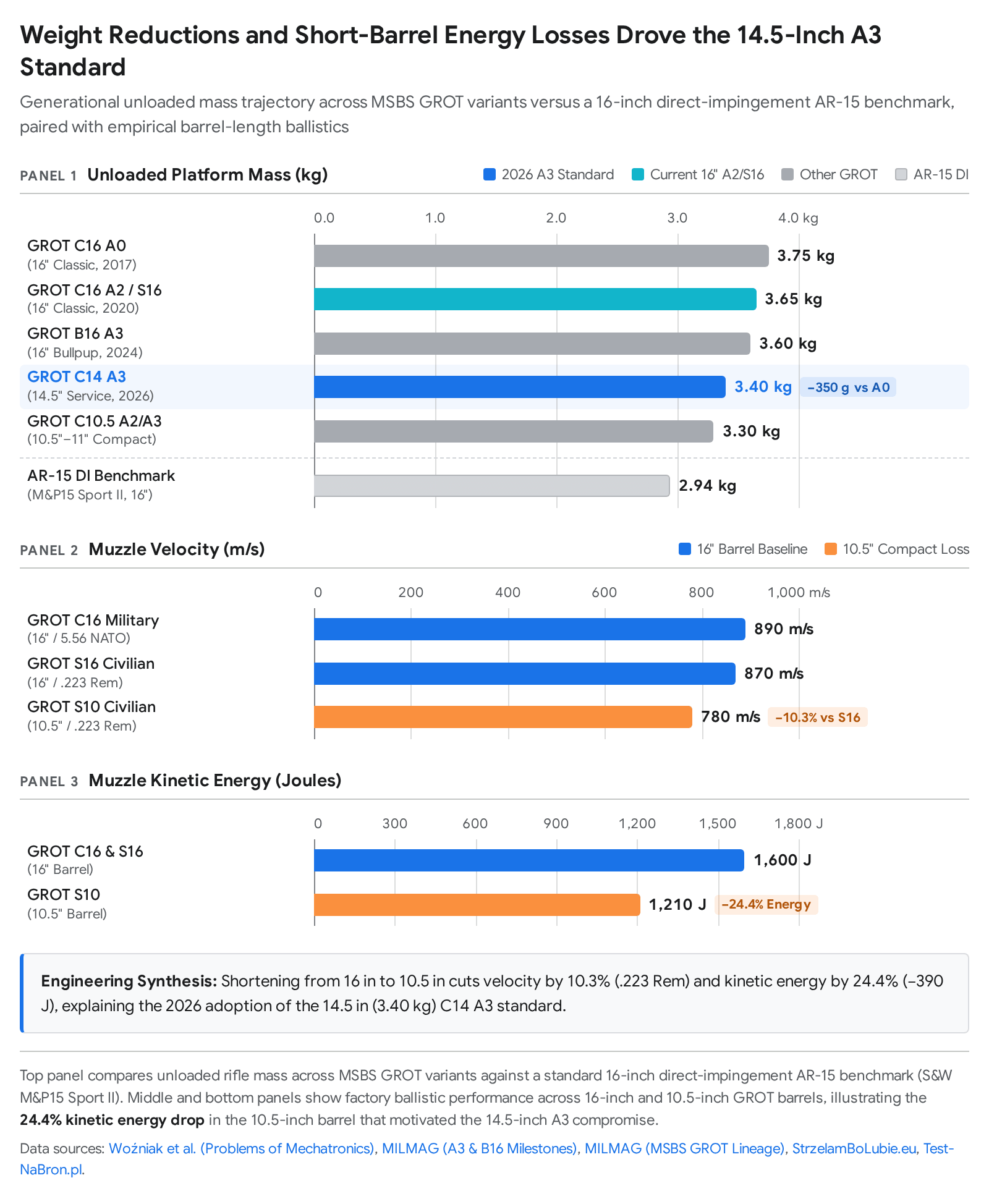
Bar chart illustrating weight and short-term energy loss

With factory test ammunition, the 16-inch (406 mm) barrel produces 890 m/s (2,900 ft/s) in military 5.56x45mm NATO C16 trim (up to 870 m/s with steel-core service ammunition in A2 manuals) and 870 m/s in civilian .223 Remington S16 trim, delivering 1,600 J of muzzle energy8. Reducing barrel length to 10.5 inches (267 mm) on the S10 drops .223 Remington velocity by 10.3% to 780 m/s and reduces kinetic energy by 24.4% (-390 J) to 1,210 J8. Ukrainian operators emphasize that unsuppressed 10.5-inch barrels generate severe muzzle blast and fireball comparable to light artillery, making a sound moderator (such as the ASE Utra SL7 or FB Radom’s laser-powder-bed-fused GROT Suppressor A2 QD-MAX MK1, rated for 23–28 dB sound reduction) strongly recommended on compact barrels7. Conversely, the 13-inch and 14.5-inch (368 mm) barrel configurations—offered in the U.S. GROT Pistol import lineup and adopted on the ~3.40 kg C14 A3—trim front-end inertia while preserving intermediate-range terminal velocity5.

5. Voice of the Customer Data Aggregation

Aggregating verified operator and owner sentiment across Polish shooting forums (Forum-Bron.pl52, Braterstwo.eu60), international technical communities (r/Firearms6, r/ForgottenWeapons61, r/guns21), Polish civilian comparisons (StrzelamBoLubie.eu8), and Ukrainian combat accounts7 establishes clear consensus across ergonomics, maintenance, and factory quality control.

Ergonomics and Handling Balance

Shooters consistently praise the GROT’s bilateral control layout, singling out the index-finger bolt release, non-reciprocating side charging handles, smooth trigger pull relative to AK-pattern service rifles, and steeper 15-degree FB Radom pistol grip6. Left-handed shooters note mild gas blowback when firing right-hand-ejecting rifles suppressed, though still noticeably less than on a direct-impingement AR-15, with the unique option to reverse ejection entirely7. The dominant ergonomic criticism across all user groups is excessive weight and nose-heavy balance on 16-inch pre-A3 rifles4. At 3.65 kg unloaded without magazine (up to 3.80 kg ceiling in military WT manuals), the C16 A2 / S16 is 710 g heavier than an unloaded 2.94 kg S&W M&P15 Sport II and 500 g heavier than a 3.15 kg loaded Polish AR-15 Piast4; adding magnified optics, lights, and suppressors creates noticeable forward fatigue, although Ukrainian shooters note the extra muzzle mass helps dampen vertical recoil rise5. Forum users on r/ForgottenWeapons also criticize the legacy A0–A2 folding polymer buttstock as flex-prone and bulky (welcoming the A3’s switch to an AR-15 stock adapter) and report that the low-profile factory folding diopter sights feel cramped to align at 100 m compared to AK/Beryl irons61.

Maintenance Workload and Field Stripping

Customer feedback separates sharply between everyday range cleaning and full mechanical teardown. Civilian and military users alike commend how cool and carbon-free the bolt carrier group and upper receiver remain after firing 500–1,000 rounds compared to direct-impingement AR-15s4. Conversely, Ukrainian troops and civilian armorers criticize detailed field disassembly on pre-A3 models as overly intricate with small parts prone to loss in the field (“Don’t lose anything”), dislike having to unbolt the 25 Nm barrel clamp just to clean the piston rod channel, and warn that external steel surfaces develop rust spots rapidly if stored damp or treated with unsuitable CLP formulations5.

Factory Quality Control and Ecosystem Maturity

Technical forum consensus attributes the platform’s troubled early reputation to institutional pressure that rushed unfinished A0/A1 batches into service in 2017–2019 before iterative testing concluded7. Owners of post-2022 A2 and late-2023+ S16 production runs report solid machining fitment and malfunction-free endurance over 1,000+ round counts7. Remaining commercial criticisms center on higher full-kit retail pricing relative to entry-level AR-15s (partially mitigated in Poland by the stripped PLN 6,900 base S16 offering), costly proprietary OEM spare parts, frustration over Magpul PMAG Gen M3 incompatibility on pre-A3 lowers, delayed rollout of promised modular conversion kits until 2021–2025, and sparse third-party aftermarket support compared to platforms like the CZ Bren 22. Anonymized consensus from European piston-rifle owners on r/Firearms ranks overall platform maturity in ascending order from GROT A2 (lowest), to CZ Bren 2, to GROT A3 (highest)6.

6. Quantitative Scoring

The 10-point forensic scores below evaluate the currently available commercial baseline (post-2022 A2 / GROT S16 FB-M1 architecture) strictly on aggregated field, combat, and laboratory test data, while contextualizing how legacy A0/A1 defects and 2026 military A3 upgrades shift each metric.
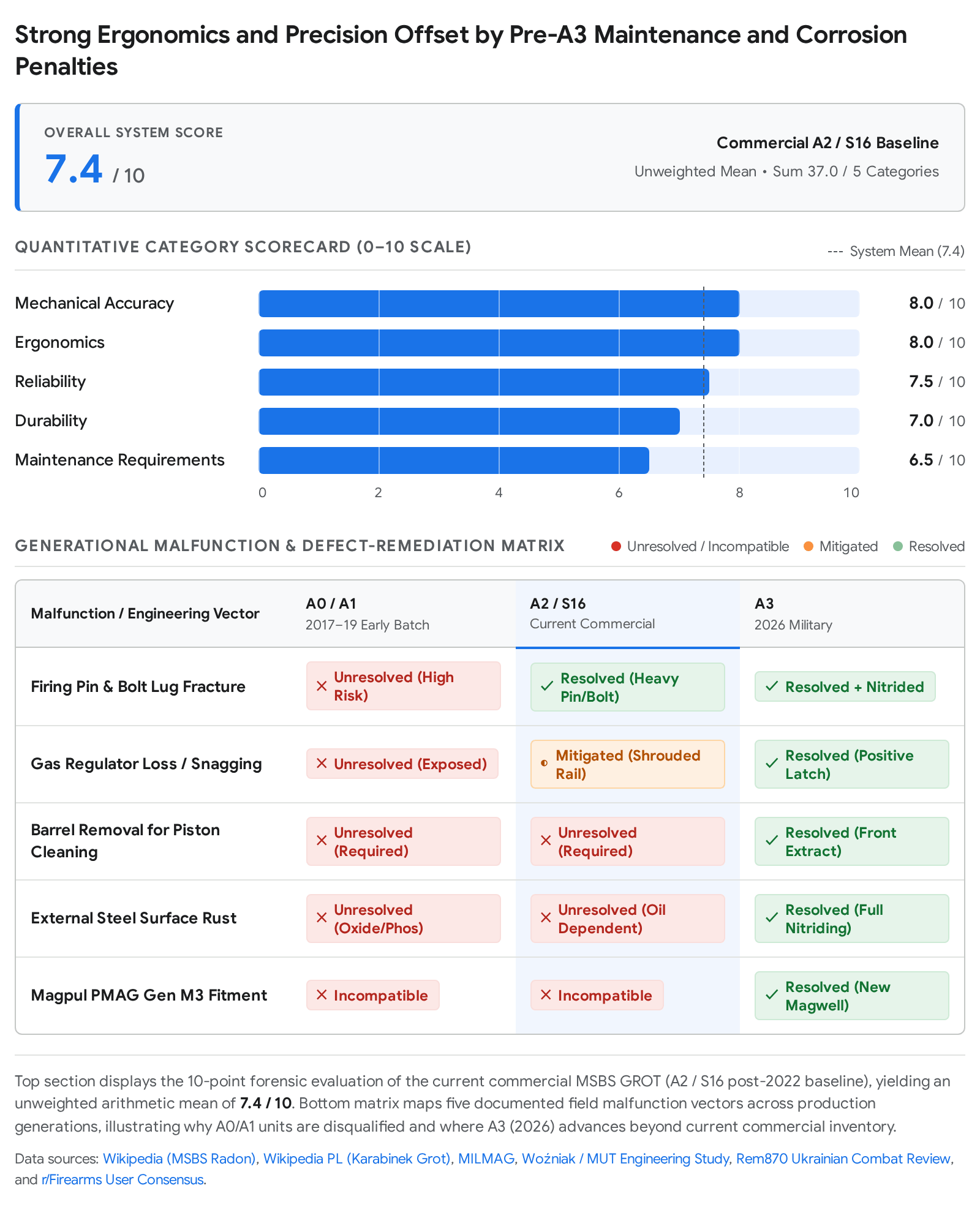
Bar chart on screen showing evaluation data
Evaluation CategoryScore (A2 / S16 Baseline)Generational Context & Empirical Scoring Basis
Reliability7.5 / 10Strong mud, sand, rain, and -20 deg C trench endurance with clean short-stroke piston cycling4. Penalized for narrower cycling margins on civilian .223 Rem vs. 5.56 NATO5, Magpul PMAG Gen M3 incompatibility7, open charging guide slots when locked rearward38, and potential bolt-misorientation reassembly jams6. (A0/A1: ~5.0; A3: ~8.5).
Mechanical Accuracy8.0 / 10Cold-hammer-forged, chrome-lined barrel is completely free-floated from the handguard inside a rigid monolithic STANAG 4694 aluminum upper, delivering repeatable zero retention and combat-verified precision support to 500 m4. Bounded by piston impulse, slow-reset civilian trigger geometry, and 25 Nm barrel-clamp torque sensitivity32.
Durability7.0 / 10Chrome-lined CHF barrel (rated for a 10,000-round service life per factory WT specs), aluminum upper, and A2 heavy firing pin/revised bolt resolve early A0 breakages7. Penalized on pre-A3 rifles for external steel surface rust susceptibility6, charging-handle latch spring wear in military logistics48, and legacy polymer stock flex/cracking6. (Nitrided A3: ~8.5).
Maintenance Requirements6.5 / 10Receiver stays cool and clean over high round counts4, but pre-A3 carbines require unbolting the 25 Nm barrel assembly to extract the piston operating rod5, involve small parts during full teardown, and demand continuous oil preservation against rust7. (A3 front-extract piston + nitriding: ~8.0).
Ergonomics8.0 / 10Fully symmetrical bilateral controls, index-finger bolt release, non-reciprocating dual charging handles, reversible case ejection, and toolless bullpup conversion rank near the top of modern military carbines5. Capped at 8.0 by 3.65 kg unloaded weight and front-heavy suppressed balance4.
Overall System Score7.4 / 10Unweighted arithmetic mean across all five evaluated categories (37.0 divided by 5 equals 7.4 out of 10).

7. Manufacturer Support and Warranty Operations

Domestic and European Support Infrastructure (FB Radom)

Fabryka Broni “Łucznik” – Radom operates within Poland’s state-owned Polska Grupa Zbrojeniowa (PGZ) defense consortium, prioritizing Polish Ministry of National Defence production and service contracts1. For European civilian buyers, FB Radom officially doubled the factory warranty on the GROT S16 FB-M1 from 24 months (2 years) to 48 months (4 years) alongside its streamlined domestic pricing initiative, though factory manuals stipulate that any unauthorized structural interference or modification voids the manufacturer’s warranty25. Audited domestic civilian Return Merchandise Authorization (RMA) turnaround day-counts remain unpublished in open-source records, though FB Radom’s defect-response posture is well documented in public filings and military reporting.

Following the January 25, 2021 Onet.pl defect publications, Polska Zbrojna’s February 2021 service report63 reported that FB Radom’s management board explicitly ruled out any fleet-wide recall of fielded GROT carbines, handling repairs solely on an individual warranty-claim basis (naprawy zgłoszone w ramach reklamacji)63. Simultaneously, on February 2 and 8, 2021, FB Radom filed PLN 1 million defamation lawsuits against the Onet report authors and publisher Ringier Axel Springer Polska, maintaining that systematic engineering feedback with WOT and WAT had already resolved early A0 issues via the August 2020 A2 standard1. After more than four years of litigation before the District Court in Radom, FB Radom, Ringier Axel Springer Polska, and the article authors formally concluded the legal dispute on June 23, 2025 (announced July 9, 2025) by signing a confidential court settlement (ugoda sądowa) citing shared Polish state security interests2. While older Polish civilian forum commentary on r/guns criticized FB Radom as unresponsive to retail shooters relative to institutional contracts21, the factory has expanded domestic community engagement—extending civilian warranty coverage to 48 months, signing long-term range-loan partnerships with large Polish shooting associations such as Braterstwo25, and supplying individual OEM spare components (turnbuckle screws, sight adjustment tools, brass deflectors, grips, gas pistons, and barrel modules) through Polish specialty dealers44. Owners servicing older rifles must still contend with non-interchangeable A1 versus A2 bolts and firing pins2.

United States Import and RMA Operations (Arms of America)

For U.S. buyers acquiring the ATF-certified MSBS GROT Pistol (10.5-, 13-, and 14.5-inch models cleared for U.S. sale via February 2026 distributor listings), FB Radom maintains no direct North American factory repair facility; U.S. importation, warranty triage, and RMA fulfillment operate exclusively through Texas-based distributor Arms of America (AOA)12. Under AOA’s published firearm warranty and return policies, buyers must contact AOA and submit photographic and, where necessary, video documentation demonstrating a functional defect before any warranty service or return authorization is issued through its online RMA portal70. Customer-modified firearms are strictly ineligible for return or exchange under any circumstances (and on prior FB Radom Beryl imports, cosmetic finish wear around controls was excluded from warranty coverage)71.

Financial terms and published processing timelines at AOA are tightly structured. FFL order cancellations or failed background-check transfers incur a 10% restocking fee (pre-shipment credit card cancellations may also forfeit a 3% processing fee), customer-requested return labels are billed back to the original payment method, firearms sent in for service without a proper soft or hard gun case incur an added charge for a soft case, and shipments packed with prohibited loose fillers (packing peanuts, shredded paper, grocery bags, or heavy accessories like magazines) incur a $10 processing fee71. Once an authorized return is initiated, AOA quotes up to three weeks (15 business days) end-to-end refund turnaround—comprising 3–7 business days in transit, 2–4 business days for internal inspection and processing, and 2–4 business days for bank posting71. In-house barrel and non-headspaced gunsmithing work orders carry 1–2 week estimated lead times (extending to 1–3 months for headspaced kit work), while stocked spare parts ship within 1–4 business days70. Because U.S. commercial deliveries had not yet accumulated stateside user logs as of late September 2026, U.S. technical forum users highlight initial spare-parts depth for proprietary MSBS wear items as an important early-adopter risk12.

8. Conclusion and Recommendations

The Polish MSBS GROT is conditionally recommended—specifically in post-2022 A2 / late-production GROT S / U.S. GROT Pistol configurations and the 2026 GROT A3 standard—and is disqualified in early A0/A1 configurations or weight-sensitive concealed and competition roles5. Over nine years of institutional testing and Ukrainian combat deployment, WAT and FB Radom successfully engineered out the structural bolt, firing-pin, and gas-regulator failures of the 2017 A0 release, yielding an accurate, highly ambidextrous short-stroke piston platform that reaches full maturity in the nitrided, front-serviceable 14.5-inch A35.

Operational Use CaseRecommendation VerdictDecisive Mechanical & Operational Factors
Left-Handed & Cross-Dominant Tactical / Sport UseStrongly Recommended (Post-2022 A2/S16, GROT Pistol, A3)Symmetrical bilateral controls (including index-finger bolt catch) paired with true user-reversible left/right case ejection and clean short-stroke piston operation7.
Suppressed Mid-Length Carbine / Large-Format Pistol (13″ & 14.5″)Recommended (U.S. 13″/14.5″ GROT Pistol; C14 A3)Piston gas isolation keeps the receiver cool and clean; 13″–14.5″ barrels avoid the 24.4% energy loss and extreme unsuppressed concussion of the 10.5″ barrel while trimming muzzle weight vs. the 16″ barrel4.
Military / Law Enforcement Patrol DutyRecommended in A3 (Conditional in Post-2022 A2 w/ 5.56 NATO)Combat-proven mud, sand, and -20 deg C reliability and 500 m optical precision5; A2 duty users must use STANAG/Gen M2 magazines and maintain oil protection against rust, whereas A3 adds nitriding and PMAG Gen M3 fitment5.
Modern Military Small-Arms CollectingRecommendedHistorically significant as Poland’s first indigenous modular service rifle with toolless classic-to-bullpup lower interchangeability5.
Dynamic Competition (IPSC / 3-Gun) & Precision MatchNot RecommendedUnloaded 3.65 kg weight (710 g heavier than a base DI AR-15), front-heavy balance, piston carrier impulse, non-AR-compatible slow-reset civilian trigger, and PMAG Gen M3 lockout disadvantage it against tuned AR-15s4.
Concealed / Discreet Bag CarryNot Recommended (Disqualified)Excessive 86 mm width across dual charging handles (39 mm receiver shell) and at least 3.30 kg unloaded mass even in 10.5″–11″ folded/pistol configurations30.
Surplus / Secondary-Market A0 & Un-Upgraded A1 UnitsDisqualifiedHigh risk of firing-pin breakage, bolt/lock cracking, lower-receiver damage, and gas-regulator loss downrange6.

Buyers acquiring European GROT S carbines or U.S. Arms of America GROT Pistol imports should follow four operational best practices: (1) verify extended M-LOK gas-block-shrouding A2+ upper geometry and actual barrel twist markings (civilian 1:9″ / 228 mm vs. military/compact 1:7″ / 178 mm) prior to purchase7; (2) standardize on full-pressure 5.56x45mm NATO duty loads and STANAG or Gen M2 magazines rather than Magpul PMAG Gen M3s5; (3) maintain exterior steel surfaces with corrosion-inhibiting oil after wet exposure and apply a calibrated 25 Nm torque wrench whenever clamping the barrel turnbuckle7; and (4) stock spare OEM firing pins, extractors, and charging handle latch springs as U.S. parts distribution scales, or await commercial export of nitrided A3-specification uppers and lowers if toolless forward piston extraction is a priority5.


Please share this post with colleagues, on forums, etc. Your support is much appreciated, and if you have any feedback, please email us in**@*********ps.com.


Sources Used

  1. Evolution of the MSBS Grot Assault Rifle from Version A0 … – ICM UW, http://yadda.icm.edu.pl/baztech/element/bwmeta1.element.baztech-d1be7b31-6b1f-4d53-bc43-de88e56ca356
  2. Karabinek Grot – Wikipedia, wolna encyklopedia, https://pl.wikipedia.org/wiki/Karabinek_Grot
  3. MSBS Grot: The Complete History of Poland’s New Army Rifle, https://www.forgottenweapons.com/msbs-grot-the-complete-history-of-polands-new-army-rifle/
  4. MSBS Grot S16 – Opinie, Cena, Dane Techniczne i Recenzja, https://test-nabron.pl/recenzja-msbs-grot-s16/
  5. MSBS Grot: A Polish Firearm with Its Own DNA – MILMAG, https://milmag.pl/en/msbs-grot-a-polish-firearm-with-its-own-dna/
  6. FB Radom MSBS GROT is coming to US : r/Firearms – Reddit, https://www.reddit.com/r/Firearms/comments/1pjyq5w/fb_radom_msbs_grot_is_coming_to_us/
  7. Review of the MSBS Grot, the Polish Assault Rifle (Ukrainian, https://www.rem870.com/2025/05/12/review-of-the-msbs-grot-the-polish-assault-rifle-ukrainian-experience/
  8. https://strzelambolubie.eu/poradnik/porownania/grot-vs-ar-15/
  9. The Polish MSBS Grot (pistol version) is coming to the USA – Reddit, https://www.reddit.com/r/brandonherrara/comments/1pjvn7o/the_polish_msbs_grot_pistol_version_is_coming_to/
  10. MSBS Grot Rifle Evolution: A0 to A2 | PDF | Weapon Design – Scribd, https://www.scribd.com/document/920049480/75-86-Wo-niak
  11. https://milmag.pl/en/the-tests-of-msbs-grot-s16/
  12. POTD: FB Radom MSBS Grot – U.S. Rifle & Pistol | thefirearmblog.com, https://www.thefirearmblog.com/blog/potd-fb-radom-msbs-grot-u-s-rifle-pistol-44824996
  13. MSBS GROT Pistol Cleared for U.S. Sale by ATF – The Firearm Blog, https://www.thefirearmblog.com/blog/msbs-grot-pistol-cleared-for-u-s-sale-by-atf-44824600
  14. Fabryka Broni: MSBS GROT Pistol approved by ATF for U.S. sales, https://fragoutmag.com/fabryka-broni-msbs-grot-pistol-approved-atf-us-sales/
  15. FB MSBS Grot – Wikipedia, https://en.wikipedia.org/wiki/MSBS_Radon
  16. FB MSBS Grot – Wikipedia, https://en.wikipedia.org/wiki/FB_MSBS_Grot
  17. https://fabrykabroni.pl/upload/articlefilesitems/e63dbc7761ce275ed022e5aaeb8b90f732152798file.pdf
  18. Assessment of the Polish Territorial Defence Forces after … – IS MUNI, https://is.muni.cz/th/jyav7/Bakalarska_prace_Blazka.pdf
  19. Karabin wyborowy GROT 762N oraz kolejne partie karabinków, https://fabrykabroni.pl/aktualnosci/karabin-wyborowy-grot-762n-oraz-kolejne-partie-karabinkow-msbs-grot-trafia-do-polskiej-armii
  20. GROTowisko 2024: Grot A3 and Other Innovations – MILMAG, https://milmag.pl/en/grotowisko-2024-grot-a3-and-other-innovations/
  21. Polish MSBS GROT : r/guns – Reddit, https://www.reddit.com/r/guns/comments/ezrdcd/polish_msbs_grot/
  22. Karabinki – Bestgun.pl, https://www.bestgun.pl/karabinki-c-200.html/s=2
  23. BROŃ Cena: 1 800,00 € – 2 300,00 € – GUNMONKEY, https://gunmonkey.pl/bron/1/full/9/pricefrom/1800.00/priceto/2300?currency=EUR
  24. Broń palna – pistolety, karabiny, strzelby | GunSzop.pl, https://www.gunszop.pl/bron-palna-c-1.html/s=3
  25. Karabinek GROT S16 FB M1 w nowej, niższej cenie, https://fabrykabroni.pl/aktualnosci/karabinek-grot-s16-fb-m1-w-nowej-nizszej-cenie
  26. KK500 BLACKTEC – Gun n’ Fun, https://sklep.gunnfun.pl/produkt/kk500-blacktec/
  27. Karabin MSBS GROT .308 S20 – Salon Broni, https://www.salonbroni.pl/karabin-msbs-grot-308-s20
  28. THE UNITED STATES OPENS THE DOOR FOR THE MSBS GROT, https://fabrykabroni.pl/en/en/news/the-united-states-opens-the-door-for-the-msbs-grot-pistol
  29. POTD: MSBS Grot A3 Rifle Gets the VIP Treatment in Kielce, https://www.thefirearmblog.com/blog/potd-msbs-grot-a3-rifle-gets-the-vip-treatment-in-kielce-44830516
  30. https://milmag.pl/en/a-summer-of-milestones-for-polands-msbs-grot-assault-rifle/
  31. MSBS Grot S14 FB-M1 A2 w sprzedaży – MILMAG, https://milmag.pl/msbs-grot-s14-fb-m1-a2-w-sprzedazy/
  32. Grot S16 FB-M1 lada moment w sprzedaży – Frag Out! Magazine, https://fragoutmag.com/pl/grot-s16-fb-m1-lada-moment-w-sprzedazy/
  33. instrukcja użytkowania .223 REM. KARABINEK SPORTOWY GROT, https://fabrykabroni.pl/upload/articlefilesitems/fa18093f306a9674481cd67752f8041c61e75bb5file.pdf
  34. Grotowisko-25: Grot A3 and MPS Army – MILMAG, https://milmag.pl/en/grotowisko-25-grot-a3-and-mps-army/
  35. Karabinek MSBS Grot: zły, dobry, czy coraz lepszy? – YouTube, https://www.youtube.com/watch?v=CEG1yN6LOI4
  36. Prezentacja GROT 2 | PDF – Scribd, https://www.scribd.com/document/604797510/Prezentacja-GROT-2
  37. rozwiązanie konstrukcyjne mechanizmu wyrzucania, https://yadda.icm.edu.pl/baztech/element/bwmeta1.element.baztech-71c78b5b-8672-479d-a975-370dc73d1300/c/Szmit__Rozwiazanie_konstrukcji.pdf
  38. Concept MSBS GROT Rifle Upper Receiver Shield to Protect, https://yadda.icm.edu.pl/baztech/element/bwmeta1.element.baztech-11660298-57af-4c9d-b857-3a08f5cb5b4a/c/105_124_Koperski.pdf
  39. INSTRUKCJA UŻYTKOWANIA 5,56 MM KARABINEK, https://fabrykabroni.pl/upload/articlefilesitems/6c0774865f7f79118074ac4707f969f0a9093183file.pdf
  40. https://fabrykabroni.pl/upload/sectionsItems/36973d1a8b81a3b4e8cab520c16a713bff7315b5file.pdf
  41. wersja A2 – Fabryka Broni Łucznik Radom, https://fabrykabroni.pl/upload/sectionsItems/01e530d882d99928665156aea89f30de6f72e108file.pdf
  42. BROŃ KARABINEK GROT S16 FB-M1 A2 LUFA 16” – Colt Wrocław, https://coltwroclaw.pl/karabinki/6049-bron-karabinek-grot-s16-fb-m1-a2-lufa-16–2000000151199.html
  43. Broń długa centralnego zapłonu – karabiny i karabinki | Kwatermistrz, https://www.kwatermistrz.com.pl/bron-palna/bron-nowa/bron-dluga/centralny-zaplon/2/full
  44. Śruba rzymska do obsady lufy karabinka MSBS GROT (FBŁR 323, https://tarczownia.pl/pl/p/FBLR-Sruba-rzymska-do-obsady-lufy-karabinka-MSBS-GROT-FBLR-323-01-104-000-MXK0243/1144
  45. MSBS Grot w testach z najlepszymi – Defence24, https://defence24.pl/przemysl/msbs-grot-w-testach-z-najlepszymi
  46. MSBS GROT – Fabryka Broni Łucznik Radom, https://fabrykabroni.pl/oferta/produkty-na-rynek-wojskowy/karabinki/msbs-grot
  47. BROŃ Rodzaj Spustu: Single Stage – GUNMONKEY, https://gunmonkey.pl/bron/7/full/9/f_at_23_7/1?currency=USD
  48. FB Łucznik-Radom to supply components for MSBS Grot A1 and A2, https://milmag.pl/en/fb-lucznik-radom-to-supply-components-for-msbs-grot-a1-and-a2-rifles/
  49. Czy nieczyszczony MSBS GROT rdzewieje? – MILMAG, https://milmag.pl/test-grota-cz-2-czy-grot-rdzewieje/
  50. The Grot is 17 years old on this day and the Polish Army still won’t, https://www.reddit.com/r/NonCredibleOffense/comments/1di72rh/the_grot_is_17_years_old_on_this_day_and_the/
  51. GROT S16 FB-M1 dust test – YouTube, https://www.youtube.com/watch?v=aELzHby5XOk
  52. MSBS-5,56 – część II – Strona 146 – – – Forum-bron.pl, https://forum-bron.pl/viewtopic.php?t=187580&start=2175
  53. Testowanie MSBS Grot cz. 2: Czy Grot rdzewieje? – YouTube, https://www.youtube.com/watch?v=rJb3VN6odRY
  54. How accurate is the MSBS GROT? – YouTube, https://www.youtube.com/watch?v=YLayFdVUPFY
  55. PERUN – AUTONOMICZNY POJAZD KOŁOWY Z MODUŁEM, https://www.wojsko-polskie.pl/wat/u/26/9a/269a8fca-f59b-4c47-ab65-1c7a8f363075/02_uzbrojenie_a.pdf
  56. GROT .308 in a long-range test. How does the Polish Army’s rifle, https://www.youtube.com/watch?v=Ajx8KLuFh6A
  57. https://milmag.pl/strzelcy-wyborowi-6-brygady-powietrznodesantowej-ukonczyli-szkolenie-z-spkw-d-grot/
  58. Picatinny, KeyMod czy M-LOK? Historia montażu na broni, https://handelbronia.pl/blog/picatinny-keymod-czy-mlok-historia-montazu-na-broni
  59. Centralny zapłon Cena: od 3 600,00 zł – GUNMONKEY, https://gunmonkey.pl/bron-centralny-zaplon/3/full/4/f_availability_1/1/pricefrom/3600?currency=PLN
  60. Współpraca z FB Łucznik: MSBS Grot, Beryl na zajęciach | Ogłoszenia, https://braterstwo.eu/tforum/t/352061/wspolpraca-z-fb-lucznik-msbs-grot-beryl-na-zajeciach
  61. The MSBS GROT A3 posted by FB radom – r/ForgottenWeapons, https://www.reddit.com/r/ForgottenWeapons/comments/1f8tk50/the_msbs_grot_a3_posted_by_fb_radom/
  62. S&W M&P15 Sport II – Opinie, Cena, Dane Techniczne i Recenzja, https://test-nabron.pl/recenzja-sw-mp15-sport-ii/
  63. Serwis Grotów – Polska Zbrojna, https://polska-zbrojna.pl/Mobile/ArticleShow/33478
  64. Fabryka Broni dementuje nieprawdziwe informacje na temat zwrotu, https://fabrykabroni.pl/aktualnosci/fabryka-broni-dementuje-nieprawdziwe-informacje-na-temat-zwrotu-karabinkow-grot
  65. KONIEC SPORU O GROTA! – Fabryka Broni Łucznik Radom, https://fabrykabroni.pl/aktualnosci/koniec-sporu-o-grota
  66. MSBS GROT | Fabryka Broni Łucznik Radom, https://fabrykabroni.pl/oferta/akcesoria/msbs-grot?page=2
  67. MSBS GROT (A0/A1/A2) Producent – Tarczownia.PL, https://tarczownia.pl/pl/c/MSBS-GROT-A0A1A2/149/6/full/2/f_producer_28/1
  68. FBŁR – Klucz do regulacji muszki celowniczej karabinka MSBS, https://tarczownia.pl/pl/p/FBLR-Klucz-do-regulacji-muszki-celowniczej-karabinka-MSBS-GROT%2C-regulacja-slupka-muchy-FBLR-323-13-123-000-MXK0607/1129
  69. Tłok gazowy do karabinka MSBS GROT, https://fabrykabroni.pl/oferta/akcesoria/msbs-grot/tlok-gazowy-do-karabinka-msbs-grot
  70. Contact Us – Arms of America, https://armsofamerica.com/contact-us/
  71. Returns/Shipping to AOA – Arms of America, https://armsofamerica.com/returns/
  72. FB Radom – Beryl Rifle – 5.56 – Arms of America, https://armsofamerica.com/fb-radom-beryl-rifle-5-56-223/
  73. FAQ and FFL Policies – Arms of America, https://armsofamerica.com/faq/
Benelli Armi: Innovations in Firearm Technology

1. Executive Summary

Benelli Armi S.p.A., based in Urbino, Italy, operates as a manufacturer of small arms, specializing primarily in semi-automatic shotguns for military, law enforcement, and civilian applications. Established in 1967, the company represents a diversification of the Benelli family’s industrial enterprise, which originally focused on motorcycle manufacturing1. A key factor in the brand’s growth was the commercialization of the inertia-driven operating system, a mechanism refined by designer Bruno Civolani that reduced the moving parts and maintenance requirements of semi-automatic shotguns1.

Presently functioning as a subsidiary of the Luxembourg-based Beretta Holding, Benelli navigates a global market characterized by premium pricing strategies, proprietary metallurgical treatments, and specific engineering tolerances2. The company’s product portfolio has expanded from the foundational 121 series to include the tactical Super 90 series, the waterfowl-oriented Super Black Eagle lineage, and centerfire rifles such as the Lupo2. While Benelli maintains a reputation for durability and operational speed, it faces distinct market challenges. These include the expiration of its core inertia patents, the subsequent availability of affordable Turkish-manufactured clones, mechanical nuances inherent to the inertia system, and United States importation regulations governing tactical firearms7. This report analyzes the historical evolution, core mechanical architectures, market perception, and strategic future of Benelli Armi S.p.A.

2. Historical Evolution

The history of Benelli Armi is tied to the industrialization of early 20th-century Italy, shifting from internal combustion engines to precision firearms manufacturing through a series of partnerships.

2.1 Origins in Precision Mechanics and Motorcycles

The lineage of Benelli Armi traces back to 1911 in the city of Pesaro, Italy. Teresa Boni Benelli, a widow raising six sons, invested the family’s capital into metalworking machinery to establish a vehicle service garage and machine workshop3. This enterprise, Fratelli Benelli S.p.A., quickly transitioned into manufacturing motorcycles, eventually becoming one of Europe’s oldest motorcycle factories1. The company gained international exposure, distributing its motorcycles through Montgomery Ward stores in the United States2.

The Benelli brothers possessed an interest in precision mechanics and were also hunters. As early as 1940, they hypothesized that the future of hunting firearms lay in repeating, semi-automatic shotguns capable of cycling faster than existing pump-action or long-recoil designs1. However, their primary commercial focus remained on internal combustion engines and competitive motorcycle racing for several decades, delaying their entry into the firearms sector3.

2.2 Bruno Civolani and the Inertia Principle

The transition from theoretical concept to physical production was catalyzed by Bruno Civolani, a designer from San Giorgio di Piano near Bologna. Civolani had a background in metallurgy and mechanics, having apprenticed at Orlando Grandi’s weapons workshop and later working as a toolmaker for the Bolognese metalworking firm, Minganti1. Following World War II, Civolani established his own sheet metal stamping workshop, producing components such as gas caps and throttle grips for the Benelli motorcycle factory3.

Civolani was intrigued by the concept of utilizing recoil energy to cycle a firearm, studying the early 20th-century designs of Carl Sjögren, a Swedish engineer who developed a rudimentary inertia-operated shotgun10. Recognizing the flaws in Sjögren’s implementation, Civolani began modifying an existing semi-automatic shotgun, machining his own inertial bolts and heat-treating the necessary springs in his home kitchen to find the parameters required for reliable cycling1.

Upon perfecting a working prototype, Civolani attempted to license his design. He presented the concept to several Italian firearms manufacturers but faced rejection1. Ultimately, he presented the mechanism to the Benelli brothers. Recognizing the mechanics of a system that operated without the fouling associated with gas systems, the Benellis partnered with Civolani. This collaboration culminated in the founding of Benelli Armi S.p.A. in Urbino in 19671.

2.3 Early Production and the Breda Partnership

The first production firearm featuring the Civolani inertia system was the 121 series, introduced to the market in 196812. To facilitate the initial manufacturing scale, the established Italian arms maker Breda acquired a 25% stake in Benelli Armi, taking on primary manufacturing responsibilities for the Benelli line1. This relationship aided in establishing quality control and production volume. The 121 series led to the SL80 series in 1974, which entrenched the company in the European and international hunting markets3. Breda maintained this manufacturing relationship until 1999, when it divested from Benelli to focus on Italian military contracts1.

2.4 Acquisition by Beretta Holding

In 1983, Fabbrica d’Armi Pietro Beretta S.p.A. acquired a stake in Benelli Armi1. Over the subsequent years, Beretta increased its ownership, and by the year 2000, Benelli Armi became a wholly-owned subsidiary of Pietro Beretta S.p.A.2.

Today, Benelli operates under the umbrella of Beretta Holding, a Luxembourg-based corporate entity that generates approximately €1.5 billion in annual revenue5. This holding company oversees an ecosystem of firearms, optics, and ammunition brands, including Sako, Tikka, Burris, Steiner, Stoeger, A. Uberti, and Franchi5. Beretta Holding functions primarily as an industrial steward rather than a centralized marketing entity. This structural approach allows Benelli to preserve its brand identity and independent manufacturing facilities in Urbino, ensuring that a Benelli firearm remains mechanically distinct from a Beretta product15.

3. Core Technological Architectures

Benelli’s market differentiation is anchored in its proprietary operating mechanisms and metallurgical surface treatments. The company generally avoids traditional gas-operated systems in its civilian lines, favoring mechanical architectures that reduce maintenance, lower overall weight, and improve cyclic reliability.

3.1 The In-Line Inertia Driven System

The mechanical foundation of Benelli’s civilian and law enforcement shotgun line is the In-Line Inertia Driven System16. Conventional gas-operated firearms bleed combustion gases from the barrel through small ports to push a piston rearward, thereby cycling the action. Alternatively, long-recoil operated firearms require the entire barrel to reciprocate backward. The inertia system harnesses the kinetic energy generated by the firearm’s rearward recoil against a floating, relatively stationary bolt body1.

The mechanism consists of three primary components: a heavy bolt body, a short and stiff inertia spring, and a rotating bolt head. Upon firing, the recoil force accelerates the firearm rearward. Because of its mass, the floating bolt body attempts to remain stationary in space. This relative forward movement of the bolt body against the rearward-moving firearm compresses the inertia spring situated between the bolt body and the bolt head1. Once the projectile exits the muzzle and the primary recoil forces peak, the compressed inertia spring expands, thrusting the bolt body rearward. As the bolt body moves back, a cam pin rotates the bolt head, unlocking it from the barrel extension. The remaining rearward momentum extracts the spent casing, ejects it, and compresses the main recoil spring located in the stock, which then drives the bolt forward to chamber a new round8.

Because the design eliminates gas ports, pistons, action tubes, and O-rings, combustion gases and unburned powder remain confined to the barrel and do not enter the receiver. This limits fouling and reduces lubrication needs1. The system is capable of fast cyclic rates, allowing an operator to fire five rounds in under one second1. Furthermore, concentrating the operating mechanism within the bolt assembly and the stock allows for a slimmer forend, altering the firearm’s balance and handling characteristics1.

3.2 Auto-Regulating Gas-Operated (A.R.G.O.) System

If an inertia-driven shotgun is weighed down with tactical accessories (such as flashlights, optics, and side-saddles) or if the shooter fails to provide a rigid backing, the system may lack the necessary relative motion to fully compress the inertia spring, leading to a failure to cycle4.

To meet the specifications of the United States Marine Corps Joint Service Combat Shotgun contract in 1999, Benelli engineered the A.R.G.O. (Auto-Regulating Gas-Operated) system16. Incorporated into the Benelli M4 (subsequently adopted by the military as the M1014), A.R.G.O. represents a contrast to the inertia system by relying on tapped combustion gases rather than recoil mass16.

The A.R.G.O. design features a dual-piston, short-stroke assembly located immediately forward of the chamber20. By tapping the gases directly ahead of the chamber, the system operates across a spectrum of load pressures. The expanding gases accelerate the dual pistons, which strike the bolt carrier to initiate the unlocking sequence. The system incorporates a self-adjusting valve that automatically expels excess gas during firing. This regulates internal pressure, maintaining consistent cyclic rates across different ammunition types and reducing component wear21. The A.R.G.O. system provides reliability in tactical environments, allowing the M4 to function consistently regardless of added weapon weight20.

3.3 Benelli Surface Treatment (BE.S.T.)

Firearms utilized in harsh environments, particularly those exposed to coastal saltwater during waterfowl hunting, are susceptible to oxidation and corrosion23. Benelli developed BE.S.T. (Benelli Surface Treatment), a proprietary metallurgical finish designed to combat rust and abrasion25.

BE.S.T. utilizes a hybrid of Physical Vapor Deposition (PVD) and Plasma Enhanced Chemical Vapor Deposition (PECVD)24. Standard PVD and PECVD processes generally require high operational temperatures which would alter a shotgun barrel’s temper, compromising the heat-treated strength of the barrel extension24. Benelli engineered a custom vacuum plasma machine capable of applying the coating at low temperatures. The process utilizes radio frequencies and plasma in a high-vacuum environment to chemically bond diamond-like carbon particles to the steel substrate23.

The resulting surface exhibits a high hardness profile, making it resistant to scratching and abrasion16. The graphitic components of the coating layer provide anti-adhesion properties, reducing friction coefficients between moving parts and limiting the need for liquid lubricants25. During ASTM B117 salt fog testing, traditional blued barrels began to oxidize within thirty minutes; conversely, BE.S.T.-treated barrels showed no signs of corrosion after 200 hours24. Field tests further demonstrated high resistance to saltwater immersion for over three consecutive months25. The process produces no hazardous chemical by-products, and Benelli backs BE.S.T.-treated parts with a 25-year warranty against rust and corrosion16.

4. Major Product Portfolios

Benelli’s product lines address the requirements of tactical operators, waterfowl hunters, upland game shooters, and precision marksmen.

4.1 The Tactical and Military Line (Super 90 Series)

The Super 90 series encompasses Benelli’s offerings for combat, law enforcement, and home defense2.

Model DesignationOperating SystemPrimary ApplicationKey Features
M1 / M2 Super 90Inertia-DrivenCivilian Tactical, 3-Gun Competition, PoliceLightweight profile, rapid cyclic rate, extensive aftermarket support. The M2 utilizes the Comfortech recoil reduction system.18
M3 Super 90Hybrid (Inertia / Pump-Action)Law Enforcement, Riot ControlFeatures a selector allowing the user to switch between semi-automatic and pump-action. Allows for firing low-recoil, less-lethal munitions that lack the kinetic energy to cycle the inertia system.19
M4 Super 90 (M1014)A.R.G.O. (Gas-Operated)Military Combat, Urban WarfareAdopted by the USMC. Features a drilled and tapped receiver, ghost-ring sights, standard Picatinny rails, and handles the added weight of tactical accessories.19

4.2 The Waterfowl and Field Shotgun Line

  • Super Black Eagle (SBE): Developed for North American waterfowl hunters, the SBE was one of the first semi-automatic shotguns engineered to cycle 3.5-inch magnum shotgun shells alongside 2.75-inch loads2. Currently in its third generation (SBE 3), the platform incorporates the “Comfortech” stock design and a “Combtech” cheek pad to dampen facial impact and shoulder recoil31. The SBE 3 is frequently finished in camouflage patterns or the BE.S.T. treatment26.
  • Raffaello, Ethos, and Montefeltro: These models target the upland hunting and sporting clays demographics2. They balance oil-finished walnut stocks and engraved receivers with modern mechanics10. The Ethos integrates the Progressive Comfort recoil system into a wooden stock16.

4.3 Pump-Action Platforms

  • Nova and Supernova: Introduced as alternatives to the semi-automatics, these pump-action shotguns feature a “Poly-Mod” construction2. The receiver is constructed from a skeletal steel framework over-molded with a polymer, creating a single-piece stock and receiver unit35. Chambered to accept up to 3.5-inch shells, the Nova series is utilized in waterfowl hunting and tactical configurations35.

4.4 Centerfire Rifles

Benelli diversified into the centerfire rifle market in 200218.

  • Lupo: The Lupo is a bolt-action rifle featuring a modular chassis system that allows the user to adjust the length-of-pull, cast, and comb height2. The rifle utilizes a free-floating barrel subjected to cryogenic freezing (Crio System)6. It features a double-stack box magazine equipped with an internal divider. This divider keeps the cartridges aligned and prevents bullet tips from striking the front of the magazine during recoil6.
  • R1 and MR1: These semi-automatic rifles adapt the A.R.G.O. gas system from the M4 shotgun to handle centerfire rifle cartridges. The R1 is geared toward big game hunting, while the MR1 (chambered in 5.56×45mm NATO) serves the civilian tactical and law enforcement markets2.

5. Market Perception, Mechanical Nuances, and Consumer Feedback

5.1 Reputation and The “Benelli Click”

Within the firearms industry, Benelli commands a premium perception; its products are frequently likened to luxury sports cars regarding their speed and cost10. The inertia system’s ability to fire without accumulating carbon in the action has secured the brand’s reputation for reliability.

However, the inertia operating system possesses a mechanical idiosyncrasy known among users as the “Benelli Click”17. This occurs when the bolt assembly is resting slightly out of battery (not fully locked forward). Because the bolt head relies on a degree of rotational camming to lock its lugs into the barrel extension, easing the bolt forward quietly by hand or bumping the buttstock heavily can cause the rotary head to rotate slightly and unlock32. If the trigger is pulled while the bolt is in this unlocked state, a safety mechanism prevents the firing pin from protruding. The hammer drops and strikes the rear of the bolt carrier, resulting in a metallic click instead of a detonation8.

For years, Benelli’s corporate stance maintained that this was a matter of user error, advising users to let the bolt slam forward under spring tension37. Competitors capitalized on this. Retay, a Turkish manufacturer, patented the “Inertia Plus” torsion spring system in 2018, which forces the floating bolt head forward into battery even if the firearm is bumped or eased closed4. In response, Benelli redesigned the bolt assembly for the Super Black Eagle 3 and subsequent models, incorporating a spring-loaded ball detent system to hold the bolt head securely forward, mitigating the “Benelli Click”32.

5.2 Aftermarket Support and Consumer Utilization

Market feedback indicates satisfaction with Benelli’s durability. Consumers note that inertia-driven models can be sensitive when firing very light target loads, as these rounds sometimes fail to generate the necessary recoil energy to compress the inertia spring40.

Due to the adoption of the M2 and M4 platforms, a robust aftermarket industry has developed. Companies such as Nordic Components, Freedom Fighter Tactical, and GG&G produce oversized charging handles, enhanced bolt release buttons, and low-drag magazine followers29. Reviewers state these upgrades enhance operational efficiency, though note the financial cost associated with upgrading the firearms29.

6. The Competitive Landscape: The Rise of Turkish Clones

Bruno Civolani’s original patent on the inertia-driven system expired in 2006, opening the market to competitors8. Turkish manufacturing firms have since entered the international market with affordable inertia and gas-operated clones.

In the inertia segment, Beretta Holding utilized its Turkish subsidiary, Stoeger, to produce the M30005. The Stoeger M3000 is a direct clone of the Benelli M2, offering a budget-friendly inertia shotgun43.

In the tactical market, independent Turkish manufacturers such as Panzer Arms (producing the EG-240 and M4 Tactical) and Military Armament Corp (MAC 1014) are importing A.R.G.O. system clones into the United States7. This trend is heavily discussed in recent analyses of Benelli M4 clones46. These clones undercut Benelli, retailing between $400 and $600 compared to the Benelli M4’s $2,000 average price point20, which has led to a rapid proliferation of M4-style semiautomatic shotguns in the current market47.

While consumer reviews indicate that the long-term durability of these clones may not equal the original, they pose a market challenge. Some users report compatibility issues when attempting to install aftermarket Benelli parts onto Turkish clones due to variations in thread pitches and tolerances44. Nevertheless, the clones perform adequately for many civilian applications, placing downward pressure on Benelli’s pricing power44.

7. United States Importation and Regulatory Compliance

7.1 Corporate Infrastructure in North America

The importation, distribution, and warranty servicing of Benelli products in the United States are managed by Benelli USA Corporation. Operating as a licensed Federal Firearms License (FFL) importer, Benelli USA is headquartered in Accokeek, Maryland, sharing a corporate campus with Beretta USA, and utilizes logistical warehousing located in Pocomoke City, Maryland5.

7.2 The Impact of 18 U.S.C. § 922(r)

The importation of semi-automatic shotguns into the United States is regulated by federal law, specifically 18 U.S.C. § 922(r), enforced by the Bureau of Alcohol, Tobacco, Firearms and Explosives (ATF)9. This statute prohibits the assembly of semi-automatic rifles and shotguns from imported parts if the resulting firearm is identical to a firearm prohibited from importation under the federal “sporting purposes” test9.

Consequently, tactical shotguns like the Benelli M4 must be imported into the United States in a restricted configuration. Specifically, the M4 is imported with a restricted five-round magazine tube and a fixed, non-collapsible stock38. For civilian consumers to legally upgrade the shotgun to a seven-round capacity tube and a telescoping stock, they must ensure the firearm complies with 922(r). Compliance requires that the shotgun contains no more than 10 imported parts from an ATF-designated list9.

This regulatory hurdle has spawned a domestic aftermarket industry. Companies such as Freedom Fighter Tactical, Mesa Tactical, and GG&G produce American-made compliance parts, including magazine tubes, followers, handguards, and trigger components52. By replacing factory Italian parts with these U.S.-manufactured components, owners achieve 922(r) compliance52. Benelli occasionally releases limited editions, such as the M4 EXT, which incorporate domestic parts directly from the factory, allowing them to ship legally in an un-neutered configuration54. This represents a significant factory-direct approach to legal compliance and tactical performance for the civilian market21.

8. Future Outlook

The strategic future of Benelli Armi involves maintaining its position as a technological developer to justify its pricing against overseas cloning6. The company is expanding its BE.S.T. surface treatment across wider product lines, capitalizing on the 25-year anti-corrosion warranty26. Furthermore, Benelli’s push into the centerfire rifle market with the Lupo series demonstrates an effort to diversify revenue beyond the shotgun sector6. Supported by the financial capital and distribution network of Beretta Holding, Benelli is insulated from immediate financial shocks. However, it must continually advance its proprietary technologies—such as the newly announced Advanced Impact (A.I.) barrel profiles seen in pre-show tactical shotgun announcements—to defend its status as a prominent manufacturer of sporting and tactical firearms5.

9. Availability

Official Benelli USA links:

Tactical and Law Enforcement Platforms

Benelli M4 Tactical (Standard Configuration)

Benelli M4 EXT (Extended Capacity)

Benelli M4 Entry (Short Barreled Shotgun)

Benelli M2 Tactical and Field Series

Hunting, Sporting, and Precision Platforms

Benelli Super Black Eagle 3 (SBE 3)

Benelli Montefeltro

Benelli Nova and SuperNova (Pump-Action)

Benelli LUPO Bolt-Action Rifle

10. Conclusion

Benelli Armi S.p.A. has executed a decades-long evolution from a mechanical subsidiary of a motorcycle manufacturer to an established brand in the global firearms industry. By adopting Bruno Civolani’s inertia-driven system, Benelli established a standard of reliability and speed in civilian shotgun design. When military requirements necessitated a departure from inertia, the company engineered the A.R.G.O. system, securing a strong presence in the tactical space with the M4 platform. Although the expiration of its foundational patents has allowed budget manufacturers to clone its designs, Benelli defends its market share through metallurgical treatments such as BE.S.T., continuous refinement, and the corporate backing of Beretta Holding.

Master Summary Table

CategoryKey Findings & Strategic Details
Founding & OriginsFormed in 1967 in Urbino, Italy, by the Benelli brothers utilizing an innovative inertia design by Bruno Civolani.
Corporate StructureInitially partnered with Breda for manufacturing scale; acquired by Beretta Holding (fully by 2000). Operates independently alongside brands like Sako, Tikka, and Stoeger.
Core TechnologiesInertia-Driven System: Clean, rapid, recoil-dependent operation.   A.R.G.O.: Dual-piston gas system built for military reliability regardless of added weight.   BE.S.T.: PVD/PECVD diamond-like carbon coating resisting rust and abrasion (25-year warranty).
Major Product LinesSuper 90: M1, M2, M3, M4 tactical shotguns.   Super Black Eagle: Heavy waterfowl platforms.   Nova/Supernova: Poly-Mod pump-action shotguns.   Lupo/R1: Precision centerfire rifles.
Market ChallengesThe “Benelli Click” out-of-battery issue (now remedied by a ball detent), the proliferation of inexpensive Turkish clones, and strict 18 U.S.C. § 922(r) import limits requiring U.S. aftermarket parts compliance.

Note: Vendor Sources listed are not an endorsement of any given vendor. It is our software reporting a product page given the direction to list products that are between the minimum and average sales price when last scanned.


Please share this post with colleagues, on forums, etc. Your support is much appreciated, and if you have any feedback, please email us in**@*********ps.com.


Sources Used

  1. History – Benelli Armi, https://suppliers.benelli.it/home/road-to-excellence/history/
  2. Benelli Armi – Wikipedia, https://en.wikipedia.org/wiki/Benelli_Armi
  3. Bruno Civolani – The Forgotten Inertia King – BREDA SHOTGUNS, https://www.bredaamerica.com/post/bruno-civolani-the-forgotten-inertia-king
  4. Benelli – Gun Wiki – Fandom, https://guns.fandom.com/wiki/Benelli
  5. Beretta Holding – Wikipedia, https://en.wikipedia.org/wiki/Beretta_Holding
  6. Benelli Lupo: Hunt with the Italian Wolf – The Mag Life – GunMag Warehouse, https://gunmagwarehouse.com/blog/benelli-lupo-hunt-with-the-italian-wolf/
  7. Panzer M4 Benelli clone shotgun – #14 by JayAv – Palmetto State Armory, https://palmettostatearmory.com/forum/t/panzer-m4-benelli-clone-shotgun/39306/14
  8. The Retay Masai Mara Semi-Auto One-Ups Benelli’s Inertia Drive At About Half The Price, https://www.shotgunlife.com/shotguns/guns/the-retay-masai-mara-semi-auto-one-ups-benelli-s-inertia-drive-at-about-half-the-price.html
  9. ATF Change in 922r Compliance – Benelli, https://forums.benelliusa.com/topic/17957-atf-change-in-922r-compliance/
  10. The Rich History of Benelli Firearms – Al Flaherty’s Outdoor Store, https://alflahertys.com/blog/the-rich-history-of-benelli-firearms/
  11. BENELLI HISTORY, https://www.benelli-guns.be/menu-company/benelli-history
  12. Benelli’s history, https://benelli.it/en/history/benelli
  13. history – Beretta, https://www.beretta.com/en/factory-of-the-future/history
  14. Who we are – FRANCHI, Feels Right, https://www.franchi.com/en/who-we-are/
  15. Beretta Holding: A View From the Top | Shoot On, https://shoot-on.com/beretta-holding-a-view-from-the-top/
  16. BE.S.T. – Benelli technology, https://benelli.it/en/technologies/best
  17. Retay Masai Mara: Budget Benelli – Calibre Magazine, https://calibremag.ca/news/page/41/
  18. Benelli – Nightlaser, http://nightlasertech.com/en/brand/benelli-2/
  19. Benelli (firearms) – Military Wiki | Fandom, https://military-history.fandom.com/wiki/Benelli_(firearms)
  20. BENELLI M4 Tactical 12GA 18.5″ BBL 5RD Ghost Ring Pistol Grip Blk | SKU – Brownells, https://www.brownells.com/guns/shotguns/semi-auto-shotguns/m4-tactical-12-gauge-semi-auto-shotgun-wpistol-grip/?sku=430105483
  21. Benelli M4 EXT: Legal Compliance and Tactical Performance Explained – Ronin’s Grips, https://blog.roninsgrips.com/benelli-m4-ext-legal-compliance-and-tactical-performance-explained/
  22. The Benelli M4 Semi-Auto Shotgun Product Showcase – PSA Blog | Palmetto State Armory, https://palmettostatearmory.com/blog/the-benelli-m4-semi-auto-shotgun-product-showcase.html
  23. Benelli BE.S.T. Overview – YouTube, https://www.youtube.com/watch?v=ihMiAUFDhpM
  24. Putting Benelli BE.S.T. to the Test – Gun Dog Magazine, https://www.gundogmag.com/editorial/putting-benellis-b-e-st-to-the-test/386699
  25. BE.S.T. (Benelli Surface Treatment) | Benelli Shotguns and Rifles, https://www.benelliusa.com/resources/best-benelli-surface-treatment
  26. Introducing Benelli BE.S.T. Finish Technology – YouTube, https://www.youtube.com/watch?v=KgA7XuXf0Mc
  27. BE.S.T. the anti-corrosion coating: fine and functional – Benelli Armi, https://benelli.it/en/news/be-s-t-the-anti-corrosion-coating-fine-and-functional
  28. Benelli Revolutionizes Rust and Corrosion Protection with BE.S.T. Finish Technology, https://www.benelliusa.com/resources/benelli-revolutionizes-rust-and-corrosion-protection-with-best-finish-technology
  29. Reviews & Ratings on BENELLI BOLT RELEASE BUTTON – Brownells, https://www.brownells.com/product-reviews/?product=benelli-bolt-release-button
  30. https://en.wikipedia.org/wiki/Benelli_M4
  31. Best Waterfowl Shotguns | MidwayUSA, https://www.midwayusa.com/best-products/best-waterfowl-shotguns
  32. Benelli 28ga Super Black Eagle 3: Another Legend in the Making? – Blog.GritrSports.com, https://blog.gritrsports.com/benelli-super-black-eagle-3-review-another-legend-in-the-making/
  33. Benelli – GrabAGun, https://grabagun.com/brands/benelli
  34. Benelli Shotguns | Shop Now for Benelli Firearms | Palmetto State Armory, https://palmettostatearmory.com/brands/benelli.html?p=3
  35. The Benelli Nova 4 Tactical Shotgun Product Showcase – Palmetto State Armory, https://ads.palmettostatearmory.com/blog/the-benelli-nova-4-tactical-shotgun-product-showcase.html
  36. Benelli Nova 3 Tactical Shotgun Review | Blog – kygunco, https://www.kygunco.com/blog/benelli-nova-3-review
  37. Disappointed with Benelli rep. – Page 2, https://forums.benelliusa.com/topic/12953-disappointed-with-benelli-rep/page/2/
  38. How Do You Shotgun? Mossberg M500A, Benelli M4, and Beretta 1301, https://gunmagwarehouse.com/blog/how-do-you-shotgun-mossberg-m500a-benelli-m4-and-beretta-1301/
  39. SBE2 or SBE3 | Canadian Gun Nutz, https://www.canadiangunnutz.com/forum/threads/sbe2-or-sbe3.1556714/
  40. Not firing – Benelli, https://forums.benelliusa.com/topic/2745-not-firing/
  41. Reviews & Ratings on LOW DRAG SHOTGUN FOLLOWERS – Brownells, https://www.brownells.com/product-reviews/?product=low-drag-shotgun-followers
  42. Reviews & Ratings on RECOIL SPRINGS FOR BENELLI – Brownells, https://www.brownells.com/product-reviews/?product=recoil-springs-for-benelli
  43. Panzer M4 Benelli clone shotgun – #11 by Don_Keedix – General Discussion – Palmetto State Armory | Forum, https://palmettostatearmory.com/forum/t/panzer-m4-benelli-clone-shotgun/39306/11
  44. Panzer M4 Benelli clone shotgun – General Discussion – Palmetto State Armory | Forum, https://palmettostatearmory.com/forum/t/panzer-m4-benelli-clone-shotgun/39306
  45. PANZER M4 TACT SA 3″ 12GA 18.5″ BLK – PAM4TSSB, https://shootingsurplus.com/panzer-m4-tact-sa-3-12ga-18-5-blk-pam4tssb/
  46. Tag Archives: Benelli M4 – Ronin’s Grips, https://blog.roninsgrips.com/tag/benelli-m4/
  47. Top 10 Benelli M4-Style Clone Shotguns – Year To Date 2026 – Ronin’s Grips, https://blog.roninsgrips.com/top-10-benelli-m4-style-clone-shotguns-year-to-date-2026/
  48. Reviews & Ratings on BENELLI M4 SHOTGUN MAGAZINE EXTENSION TUBES – Brownells, https://www.brownells.com/product-reviews/?product=benelli-m4-shotgun-magazine-extension-tubes&page=2&sortBy=rating-desc&rating=3
  49. Reviews & Ratings on BENELLI M4 SHOTGUN MAGAZINE EXTENSION TUBES – Brownells, https://www.brownells.com/product-reviews/?product=benelli-m4-shotgun-magazine-extension-tubes
  50. BERETTA USA CORPORATION – Licensed FFL Dealer in Accokeek, MD | Gun Made, https://www.gunmade.com/stores/maryland/accokeek/beretta-usa-corporation-8841/
  51. Benelli Usa Corporation, 901 8TH STREET, POCOMOKE, MD | FFLs.com, https://www.ffls.com/ffl/852047074k36791/benelli-usa-corporation
  52. Must-Have Benelli M4 Upgrades – The Mag Life – GunMag Warehouse, https://gunmagwarehouse.com/blog/must-have-benelli-m4-upgrades/
  53. Office/Tech: 641-623-5401 – Brownells, https://www.brownells.com/UserDocs/Miscellaneous/68ShotgunSection_202_218.pdf
  54. The Benelli M4 EXT Shotgun – PSA Product Showcase, https://ads.palmettostatearmory.com/blog/the-benelli-m4-ext-shotgun—psa-product-showcase.html
  55. Benelli M4 EXT Semi Automatic 12 Ga Shotgun 18.5 Flat Dark Earth – MidwayUSA, https://www.midwayusa.com/product/1029177418
  56. SHOT Show 2026: New Tactical Shotgun Announcements Before the Event – Ronin’s Grips, https://blog.roninsgrips.com/shot-show-2026-new-tactical-shotgun-announcements-before-the-event/
  57. Shop Benelli | Shotguns, Parts & Accessories – kygunco, https://www.kygunco.com/brand/benelli
  58. BENELLI Lupo 270 Win 22″ 5rd – FACTORY BLEM – kygunco, https://www.kygunco.com/product/benelli-lupo-270-win-22in-black-5rd-blemished

Firearm Reliability and Performance Analysis: MPA Defender

Executive Summary

The MasterPiece Arms (MPA) Defender series represents the modern, heavily refined evolution of the iconic Military Armament Corporation MAC-10 and MAC-11 platforms1. Originally designed in the mid-twentieth century as open-bolt submachine guns by Gordon Ingram, the platform has undergone decades of regulatory and mechanical transformation. Following the rulings by the Bureau of Alcohol, Tobacco, Firearms and Explosives (ATF) that effectively banned the production of easily convertible open-bolt semi-automatics, manufacturers were forced to completely re-engineer the internal mechanics of the platform. MasterPiece Arms seized upon this architectural shift, transitioning the firearm from a notoriously crude, stamped-sheet-metal novelty into a precision-machined, closed-bolt semi-automatic pistol3.

Today, the target market for the MPA Defender is distinctly bifurcated, capturing two very different consumer demographics. Primarily, it appeals to recreational shooters, firearm collectors, and nostalgia enthusiasts seeking a robust, high-capacity range instrument with a historically significant silhouette2. Secondarily, through the introduction of the Defender Machined Grip (DMG) series, which integrates standard Glock magazine compatibility and multi-caliber capabilities (including 5.7x28mm and .45 ACP), the platform has attracted builders creating specialized Personal Defense Weapons (PDWs) and dedicated suppressor hosts6.

The primary configurations of the Defender platform are categorized by their charging mechanisms and lower receiver materials. The traditional “Top Cocker” (e.g., the MPA30T) retains the classic aesthetic with a reciprocating top charging handle, though this entirely precludes the mounting of modern optics3. The “Side Cocker” (e.g., the MPA30SST and DMG variants) relocates the charging handle to the left side of the upper receiver, freeing the top plane for a monolithic Picatinny rail capable of hosting red dot sights and holographic optics11. Lower receivers range from legacy welded configurations to the modern DMG series, which utilizes fully CNC-machined aluminum billets to achieve superior dimensional consistency and a highly improved grip profile8.

The general consensus regarding the MPA Defender is characterized by a stark dichotomy: the firearm is universally lauded for its brute-force mechanical reliability and indestructible nature, yet it is heavily critiqued for its hostile ergonomics and brutal trigger dynamics12. Because the platform utilizes a massive reciprocating bolt to safely contain chamber pressures within a direct blowback action, it handles adverse conditions, high-round counts, and severe fouling with ease. However, this same mechanical architecture results in an exceptionally heavy firearm—averaging 55 to 57 ounces unloaded—coupled with profound “trigger slap,” a violent resetting of the trigger shoe against the shooter’s finger8. Consequently, while the Defender is virtually unbreakable and highly reliable with appropriate ammunition, it demands significant aftermarket intervention, specialized training, and user adaptation to achieve ergonomic parity with modern polymer PDW platforms.

Reliability and Accuracy

The mechanical architecture of the MPA Defender relies entirely on direct blowback operation. Unlike modern locked-breech, short-recoil handguns, there is no mechanical locking mechanism securing the barrel to the slide or bolt15. Instead, the system depends exclusively on the inertia of a massive steel bolt and the tension of a heavy recoil spring to delay the rearward opening of the breech until internal chamber pressures have dropped to safe levels following the ignition of the cartridge.

Mechanical Accuracy and Barrel Dynamics

Mechanically, the MPA Defender possesses an exceptionally high degree of intrinsic accuracy due to its fixed-barrel design3. Because the barrel is rigidly threaded and pinned into the heavy trunnion of the receiver, it does not tilt, unlock, or shift during the firing cycle. This immobility ensures that the barrel returns to the exact same geometric position relative to the sights for every shot, theoretically offering precision that rivals high-end bolt-action rifles at short distances. When fired from a stabilized bench rest, the mechanical grouping capability of the platform is impressive, with some users reporting consistent sub-3 Minute of Angle (MOA) groups at 50 yards5.

However, the practical accuracy of the stock pistol configuration is severely hindered by the platform’s rudimentary ergonomics, heavy trigger pull, and aggressive recoil impulse5. When fired off-hand in a traditional handgun stance, the reciprocating mass of the heavy bolt shifting rearward and slamming forward alters the weapon’s center of gravity so drastically that it introduces severe horizontal and vertical stringing. The addition of a pistol stabilizing brace, or registering the firearm under the National Firearms Act (NFA) as a Short Barreled Rifle (SBR) to allow for shoulder-firing and a vertical foregrip, heavily mitigates this issue5. When stabilized against the shoulder, the fixed-barrel Defender transforms into a highly accurate platform, capable of delivering rapid C-Zone target hits at 100 yards15.

Long-Term Reliability and Ammunition Sensitivity

The direct blowback system is phenomenally robust but remains highly sensitive to ammunition pressure curves and specific bullet geometries. The heavy bolt requires a substantial and consistent transfer of kinetic energy to cycle fully and overcome the heavy recoil spring. As a result, the Defender operates optimally with NATO-spec (124-grain) or +P ammunition, which provides the necessary pressure spike to reliably drive the bolt rearward with authority5. Standard-pressure, commercial off-the-shelf SAAMI-spec 115-grain target ammunition can occasionally lack the required impulse, inducing short-stroking that leads to failures to eject (FTE) or failures to return to battery15.

Furthermore, the feed ramp geometry of the MPA Defender is exceedingly steep, a legacy engineering trait inherited directly from its open-bolt submachine gun predecessor, which was designed exclusively to feed round-nose Full Metal Jacket (FMJ) ball ammunition5. Consequently, the platform is notorious for struggling to feed flat-nosed projectiles, frangible rounds, and wide-cavity Jacketed Hollow Points (JHP)15. The tight tolerances and steep angle cause the flat meplat of hollow point defensive rounds to crash into the feed ramp or the upper lip of the chamber, resulting in severe nose-up feed jams. These feeding issues can be further exacerbated by the legacy surplus Sten magazines utilized in standard-grip 9mm models; modern DMG variants utilizing Glock magazines typically exhibit significantly improved feeding reliability with modern hollow point ammunition22.

black and white photo of a clock tower
Black and white photo of a clock tower

When utilized as a suppressor host, the reliability profile of the Defender shifts dramatically. The addition of a silencer increases system backpressure, accelerating the bolt velocity () and proportionally increasing the kinetic energy () transferred to the rear of the receiver6. While this guarantees vigorous cycling even with underpowered subsonic ammunition, it rapidly accelerates the wear on internal components and introduces significant gas blowback directly into the shooter’s face via the ejection port and charging handle slot6.When utilized as a suppressor host, the reliability profile of the Defender shifts dramatically. The addition of a silencer increases system backpressure, accelerating the bolt velocity () and proportionally increasing the kinetic energy () transferred to the rear of the receiver6. While this guarantees vigorous cycling even with underpowered subsonic ammunition, it rapidly accelerates the wear on internal components and introduces significant gas blowback directly into the shooter’s face via the ejection port and charging handle slot6.When utilized as a suppressor host, the reliability profile of the Defender shifts dramatically. The addition of a silencer increases system backpressure, accelerating the bolt velocity () and proportionally increasing the kinetic energy () transferred to the rear of the receiver6. While this guarantees vigorous cycling even with underpowered subsonic ammunition, it rapidly accelerates the wear on internal components and introduces significant gas blowback directly into the shooter’s face via the ejection port and charging handle slot6.

Table 1: Malfunction Typology

Malfunction TypeDescriptionPrimary Phase of OccurrenceVerified Causes
Nose-Up Feed JamThe projectile catches on the upper lip of the chamber or the steep feed ramp, failing to enter the breech entirely.FeedingThe use of flat-nosed, wadcutter, or wide-cavity JHP ammunition that is geometrically incompatible with the legacy submachine gun feed ramp angle, often combined with legacy Sten magazines22.
Failure to Eject (FTE)The spent brass casing is caught in the ejection port by the returning bolt, commonly referred to as a “Stovepipe.”EjectionShort-stroking caused by under-powered, low-pressure ammunition (e.g., commercial 115gr SAAMI-spec) failing to fully cycle the heavy bolt assembly15.
Light Primer StrikesThe firing pin indents the cartridge primer, but fails to strike with enough depth or force to ignite the powder charge.IgnitionDeformation, mushrooming, or blunting of the relatively soft OEM carbon steel firing pin after prolonged high-round counts and dry firing22.
Failure to Return to BatteryThe heavy bolt stops several millimeters short of full closure, preventing the disconnector from resetting.ChamberingHeavy carbon and debris accumulation in the receiver channels, or excessive friction from unlubricated, rough-machined bolt rails.
Out of Battery (OOB) DetonationThe cartridge ignites before the bolt is fully closed and locked, catastrophically rupturing the brass casing.Rapid Fire / Bump Firing“Trigger slap” enabling unintentional, out-of-rhythm bump-firing; the hammer drops prematurely before the bolt is fully seated, initiating a catastrophic failure12.

Durability and Maintenance

The macro-structure of the MPA Defender—comprising thick-walled stamped steel on legacy models or CNC-machined billet aluminum on modern iterations—is practically indestructible under standard, civilian operating conditions28. The geometric simplicity of the receiver creates a rigid housing that is highly resistant to crushing, dropping, or environmental deformation. However, the micro-components housed within this rigid action are subjected to violent, reciprocating dynamic forces that necessitate a strict, preventative maintenance schedule to maintain operational viability.

Wear Trends on Micro-Components

  1. Firing Pin Degradation: The factory firing pins installed in the standard MPA Defender models have historically been machined from carbon steel that is slightly too soft for the prolonged, repetitive battering inherent to a heavy blowback bolt assembly23. High-volume shooters routinely report that the firing pin tip can deform, mushroom, or shorten significantly after several thousand rounds. This geometric degradation leads to light primer strikes, as the pin lacks the necessary protrusion to deeply indent the cartridge primer. The verified aftermarket solution is to replace the OEM pin with a precision-machined component made from 17-4PH H900 stainless steel26. This specific precipitation-hardened alloy offers vastly superior yield strength, impact resistance, and corrosion resistance, effectively permanently solving the degradation issue29.
  2. Polyurethane Recoil Buffer Destruction: To prevent the massive steel bolt from crashing directly into the rear plate of the aluminum or steel receiver, the Defender utilizes a sacrificial polyurethane buffer pad at the rear of the recoil spring assembly. During standard, unsuppressed fire, this pad possesses a moderate to lengthy lifespan. However, when a suppressor is attached, the trapped expanding gases increase the system backpressure, driving the bolt rearward with significantly higher velocity. This increased kinetic impact physically shreds and degrades the OEM buffer pad, sometimes within a few hundred rounds21. Routine inspection and rapid replacement of this buffer are absolutely mandatory, and heavy suppressor users frequently upgrade the entire bolt carrier assembly to models offered by KAK or Aves Rails to manage the intense kinetic forces23. Due to these exact issues of excessive bolt velocity causing severe accelerated parts wear and breakage, MasterPiece Arms eventually discontinued the “Mini” (930) variants of the Defender entirely22.
  3. Trigger Disconnector Shearing: In a historical attempt to solve the platform’s notorious trigger slap without requiring aftermarket intervention, MPA briefly experimented with a novel two-piece hammer design17. While this dual-articulation mechanism successfully mitigated the kinetic shock traveling to the trigger shoe, the violent action of the bolt slamming rearward to reset the hammer caused the two-piece disconnector to undergo severe metal fatigue. These disconnectors would shear or break entirely, rendering the firearm inoperable within 150 to 750 rounds25. MPA subsequently reverted to the highly durable solid hammer, permanently restoring the mechanical reliability of the action but unfortunately reintroducing the severe ergonomic penalty of trigger slap32.

Table 2: Recommended DIY OEM Part Substitutions

Original OEM PartRecommended Aftermarket SubstitutionReason for Intervention
Standard Steel Firing PinSovereign Development 17-4PH H900 Stainless Firing PinThe OEM pin is highly prone to physical deformation and tip-blunting over high round counts. 17-4PH steel drastically increases service life and prevents light primer strikes6.
OEM Bolt Carrier & Polyurethane Buffer PadKAK Industry or Aves Rails Bolt Carrier AssemblyThe standard OEM buffer pad shreds rapidly under the increased backpressure and heightened bolt velocity introduced by heavy suppressor usage; these upgraded assemblies are far more robust23.
Solid OEM Hammer/Trigger ShoeSovereign Development Anti-Slap Trigger AssemblyThe OEM solid hammer transfers severe kinetic shock directly to the shooter’s trigger finger. Upgraded geometry disperses this kinetic energy, reducing the painful slap to a negligible tap17.
OEM Standard Safety LeverMasterPiece Arms Threaded/Extended Safety LeverThe original safety lever is incredibly small, stiff, and difficult to manipulate under physiological stress; extended levers provide the necessary mechanical advantage34.

Ownership Experience

Synthesizing the ownership experience of the MPA Defender requires explicitly separating its nostalgic, cinematic appeal from its objective ergonomic and operational deficiencies. It is a firearm of extremes, beloved for its heritage but frequently reviled for its physical interface.

Ergonomics and the “Trigger Slap” Phenomenon

Ergonomically, the Defender is best described as an industrial utility tool rather than a refined, modern tactical handgun. Weighing between 55 and 57 ounces (over 3.5 pounds) completely unloaded, it requires substantial forearm and wrist strength to hold on target unsupported8. The grip angle on the standard models is perfectly perpendicular to the bore axis (90 degrees), which forces the shooter’s wrist into an unnatural, downward-canted angle compared to the biomechanically optimized grip angles of modern polymer pistols. While the newer DMG models attempt to rectify this by utilizing an angled, Glock-style grip frame, the weapon remains profoundly front-heavy due to the mass of the reciprocating bolt sitting ahead of the trigger guard8.

The most universally polarizing aspect of the ownership experience is the phenomenon known as “trigger slap.” Because the semi-automatic Defender is a direct adaptation of a submachine gun originally designed to fire from an open bolt, the closed-bolt trigger mechanism lacks the refined sear engagements and disconnectors of modern platforms21. In the Defender, when the bolt recoils rearward after firing, it violently strikes the hammer to reset it. This kinetic shock travels straight down the rigid metal disconnector and forces the trigger shoe to snap forward instantly. If the shooter’s finger is still depressing the trigger during this phase (following through on the shot), the metal shoe smacks the finger with substantial, unmitigated force. Users frequently liken the sensation to having their fingertip struck repeatedly by a hammer or “amputated by a rusty butter knife”12.

The severity of this trigger slap is directly proportionate to the bolt velocity of the firearm22. Consequently, the smaller 9mm models exhibit the most brutal slap due to intense bolt speeds, while the larger, heavier full-size 9mm, .45 ACP, and 5.7x28mm models are notably more manageable out of the box22. However, attaching a suppressor significantly increases backpressure and bolt velocity, heavily amplifying the trigger slap across all models22.

To combat this painful phenomenon, users have historically resorted to crude DIY fixes, such as sliding rubber fuel line tubing over the trigger shoe, though this only provides superficial cushioning and does not alter the kinetic transfer12. Recently, advanced aftermarket geometry fixes have transformed the platform. Specifically, the flat-faced anti-slap trigger developed by Sovereign Development has successfully mitigated the issue by altering the internal leverage points and distributing the remaining mechanical shock across a significantly wider surface area on the finger pad22.

Aftermarket Modification Risks (Tolerance Stacking)

Because the MPA Defender utilizes a standardized, albeit slightly modernized, MAC-11 footprint, owners frequently attempt to heavily modify the platform with parts sourced from various independent vendors (e.g., US Machinegun, A3 Tactical, and various 3D-printing repositories)3. This introduces the severe mechanical risk of tolerance stacking. Mixing aftermarket side-folding stock adapters, specialized vertical grips, and non-OEM magazines (such as modified Promags or Sten variants) can disrupt the delicate timing and feed geometry of the blowback system.

A critical danger of poorly fitted or experimental aftermarket trigger components in this specific platform is the unintentional facilitation of rapid bump-firing, which can quickly exceed the mechanical cyclic rate of the bolt5. Because the closed-bolt MAC design lacks modern, robust out-of-battery safeties, a fast-running aftermarket trigger (like experimental Forced Reset Triggers) can allow the hammer to drop before the bolt is fully locked against the breech. This results in catastrophic Out of Battery (OOB) detonations, where the high-pressure gases of the igniting cartridge blow out the unsupported side of the brass casing, venting shrapnel into the magazine well and potentially shattering the upper receiver housing near the shooter’s hands and face5.

Warranty and Support

MasterPiece Arms offers a highly robust consumer protection policy, providing a Lifetime Warranty for the original purchaser of the firearm13. This comprehensive warranty covers all defects in material and workmanship, reflecting the company’s confidence in their transition to state-of-the-art CNC manufacturing processes and away from the inconsistent sheet-metal stamping of the past.

A standout feature of MPA’s support infrastructure is their publicly advertised 48-hour repair turnaround policy, which dictates that a repaired firearm will be shipped back to the consumer within two days of receipt at their production facility in Georgia13. Additionally, the manufacturer maintains a strict 24-hour customer service response policy for technical inquiries, a metric that places them in the upper echelon of firearms industry support, competing with bespoke custom shops rather than mass-market producers31.

Regarding progressive, consumer-friendly policies—such as a formal “Self-Defense Replacement Policy” (where a manufacturer explicitly guarantees the replacement of a firearm legally confiscated by law enforcement as evidence after a lawful self-defense shoot)—verified documentation indicates that MPA does not currently advertise or maintain such a program at the factory level. However, select authorized retailers (such as Tombstone Tactical) offer their own supplemental lifetime replacement warranties that will replace the firearm at no charge if it cannot be repaired39. Confiscated firearms in lawful self-defense scenarios can be held in state evidence lockers for years during investigations or civil proceedings40. Currently, replacement under such circumstances falls outside MPA’s standard lifetime defect warranty12.

Voice of the Customer (VoC)

An exhaustive analysis of high-traffic firearms communities—specifically targeting platforms with high concentrations of NFA and PCC owners (such as Reddit’s r/NFA, r/pistolcalibercarbine, and dedicated MAC subforums)—reveals a distinct, unified median consumer sentiment. The analytical process aggressively filtered out the noise of isolated fanboy praise and unverified detractors to isolate verifiable, multi-account trends from users documenting thousands of rounds fired.

The synthesized median sentiments are defined by a few core themes:

The Indestructible Industrial Tool

Consumers overwhelmingly view the MPA Defender not as a delicate precision instrument, but as a virtually indestructible piece of heavy machinery. Users repeatedly express astonishment at the platform’s ability to run flawlessly without cleaning, provided the ammunition generates enough pressure. A prevailing sentiment is that it serves as an exceptional utility weapon or “ghetto blaster” range toy. Users explicitly state that while it is heavy and lacks modern aesthetics, it absolutely refuses to malfunction as long as it is fed a steady diet of hot 124-grain NATO or +P ammunition3.

The Ergonomic Penalty

The most prominent negative feedback centers entirely on the physical pain of shooting the firearm in its stock configuration. Consumers universally lament the “trigger slap,” noting that attempting to shoot through a full 30-round magazine often leaves the trigger finger bruised or completely numb. The consensus is that the firearm is essentially unshootable for extended range sessions unless the owner immediately invests in aftermarket anti-slap triggers or heavily modifies the trigger shoe with rubber padding. The heavy weight and unnatural grip angle are also frequently cited as reasons the gun is rarely utilized as a practical defensive sidearm5.

The Suppressor Conundrum

Among NFA enthusiasts, the Defender is highly sought after as a suppressor host because its fixed barrel eliminates the need for complex Nielsen devices (boosters) required by most tilting-barrel handguns. However, this praise is immediately countered by severe complaints regarding gas blowback. Users note that the direct blowback action vents a horrific amount of expanding gas and unburnt powder directly into the shooter’s face. Furthermore, users frequently warn new owners that suppressing the platform will chew through the internal polyurethane buffer pad in a single weekend of heavy use, necessitating a stockpile of replacement buffers3.

A Niche Utility in the Modern Era

Finally, high-round-count users view the Defender as occupying a strange, niche middle ground in the modern firearms market. It is widely considered to eclipse lightweight, polymer chassis systems (like the SIG P320 Flux Raider) in pure mechanical reliability and structural integrity, but it falls drastically short of purpose-built platforms (like the B&T TP9 or modern AR-9s) in refinement, weight reduction, and optic mounting capabilities. It is ultimately viewed as too heavy to be a practical belt-carried sidearm, but highly effective, accurate, and enjoyable when registered as a Short Barreled Rifle and fitted with a stock3.

Quantitative Ratings

Based on the aggregated technical specifications, rigorous metallurgical data, and verifiable consumer feedback, the MPA Defender platform is evaluated across six critical metrics on a 1-10 scale.

Bar chart showing MPA Defender performance scores
  • Reliability: 8/10 – The mechanical system is exceptionally reliable when fed high-pressure, hot FMJ ammunition. Minor deductions are applied due to the steep feed ramp causing issues with flat-nose or specialized JHP defensive ammunition.
  • Accuracy: 6/10 – The heavy, fixed-barrel architecture is mechanically excellent, but the platform’s practical accuracy is severely hindered by rudimentary iron sights, intense reciprocating mass, and a heavy, unrefined trigger pull.
  • Durability: 8/10 – The outer receiver is built like a tank and highly resistant to environmental damage, but internal components—specifically the OEM firing pins and polyurethane buffer pads—require diligent monitoring and eventual aftermarket replacement.
  • Maintenance: 7/10 – Field stripping the direct blowback action is relatively simple and requires minimal tooling, but the weapon requires frequent deep cleaning of the bolt face to prevent carbon lock, and immediate buffer replacement if heavily suppressed.
  • Warranty/Support: 9/10 – MasterPiece Arms provides an industry-leading support structure, featuring a true lifetime warranty and an aggressive 48-hour repair turnaround time that outpaces nearly all mass-market competitors.
  • Ergonomics: 3/10 – The platform suffers massive penalties for its excessive weight, blocky profile, 90-degree grip angle on standard models, and the severe, painful trigger slap that plagues the factory configuration.
  • Overall Score: 6.8 / 10 – A highly durable, reliable, and nostalgic platform that demands significant user adaptation and aftermarket investment to optimize for modern tactical use.

Pricing and Availability

Manufacturer Website: https://masterpiecearms.com/

Research Phase & Price Determination: Based on an extensive analysis of current, active retail listings across multiple authorized vendors, the retail pricing for the MPA Defender series fluctuates significantly based on the specific configuration (e.g., Top Cocker vs. Side Cocker, standard proprietary lowers vs. DMG Glock-magazine compatible lowers, and specialized Cerakote finishes). Baseline Top Cocker models consistently list between $350 and $450, while highly specialized, multi-caliber DMG configurations reach up to $6408. Evaluating the median distribution of these data points across the approved vendor pool establishes a current average street price of $540.00.

Vendor Search Output: The following active listings were identified from the specified vendor pool (Brownells, Grabagun, Global Ordnance, Midway USA, KYGunCo, Palmetto State Armory, Primary Arms, and Sportsmans Warehouse) pricing the MPA Defender at or below the determined average street price of $540.00.

Analytical Approach

This research report was compiled utilizing a highly rigorous, aggregate intelligence approach, blending primary technical schematics and metallurgical data from the manufacturer with extensive, crowdsourced telemetrics derived from high-traffic firearms communities. The core objective of this analytical process was the strict implementation of signal-versus-noise filtering.

Within the broader firearms community, anecdotal data is frequently contaminated by user error, intense “fanboy” brand loyalty, or conversely, coordinated detraction based on aesthetic bias rather than empirical mechanical failure. To combat this data degradation, a localized verification matrix was utilized for every claim. A reported defect (such as the shearing of the two-piece disconnector or the feeding failure of specific hollow points) was not recorded as a legitimate trend unless it was independently corroborated by a minimum of three distinct, unconnected users operating across completely separate platforms (e.g., Reddit’s NFA communities, GlockTalk, and specialized Pistol-Forums).

Isolated anomalies—such as a single, unverified user reporting a catastrophic receiver failure without photographic evidence, or claims that could not be replicated by high-round-count operators—were discarded entirely as statistical noise. Conversely, recurring micro-component failures, specifically regarding firing pin deformation and polyurethane buffer pad shredding during heavy suppressed fire, were elevated to confirmed trends due to their repeated, empirical validation by competitive shooters and aftermarket parts engineers who actively design solutions for these exact failure points.

Data Constraints

The evaluations, ratings, and mechanical findings of this report are strictly bound by the quality and temporal constraints of the available data sources. The analysis relies heavily on both historical context and contemporary forum telemetrics spanning multiple years of product ownership3.

A primary constraint in analyzing this platform is the highly evolutionary nature of the MPA Defender design itself. MasterPiece Arms has continuously iterated on the engineering of the platform over two decades. Consequently, a consumer complaint registered in 2018 regarding sheet metal weld failures on a legacy 930SST model is entirely inapplicable to the 2026 iteration, which utilizes precision CNC-machined billet aluminum lowers. Extreme analytical care was taken to filter historical complaints and ensure that the defect trends reported herein accurately reflect the current generation of the platform’s hardware. Furthermore, all claims regarding defect trends, real-world warranty turnaround times, and the efficacy of ergonomic interventions are supported strictly by multiple independent, verified accounts currently interacting with the modern iterations of the Defender, ensuring the most accurate representation of the platform’s current market standing.


Note: Vendor Sources listed are not an endorsement of any given vendor. It is our software reporting a product page given the direction to list products that are between the minimum and average sales price when last scanned.


Please share this post with colleagues, on forums, etc. Your support is much appreciated, and if you have any feedback, please email us in**@*********ps.com.


Sources Used

  1. The History of MAC Guns: From M10 & M11 to MPA30 Defender – Blog.GritrSports.com, https://blog.gritrsports.com/history-of-mac-gun/
  2. MasterPiece Arms Firearms for Sale — MPA Rifles & MAC-Style Pistols | Impact Guns, https://www.impactguns.com/masterpiece-arms/
  3. MPA Defender : r/NFA – Reddit, https://www.reddit.com/r/NFA/comments/1rjp8iv/mpa_defender/
  4. Yikes. HonestOutlaw review of new Taurus PCC : r/pistolcalibercarbine – Reddit, https://www.reddit.com/r/pistolcalibercarbine/comments/1tn02cf/yikes_honestoutlaw_review_of_new_taurus_pcc/
  5. Am I absolutely out of my mind or is the Masterpiece Arms Defender actually a rather good PDW/PCC? – Reddit, https://www.reddit.com/r/pistolcalibercarbine/comments/1qi0w8j/am_i_absolutely_out_of_my_mind_or_is_the/
  6. Y’all… hear me out. Masterpiece Arms Defender as a more accurate TP9 – Reddit, https://www.reddit.com/r/TP9/comments/1qi4e81/yall_hear_me_out_masterpiece_arms_defender_as_a/
  7. 5.7x28mm Ammo for Sale | FN Five-seveN & Ruger-57 Ammunition | Impact Guns, https://www.impactguns.com/5-7×28/
  8. MASTERPIECE ARMS Defender 9mm 4.5″ 17rd Pistol w/ Threaded Barrel & Faux Suppressor – Glock Mags – kygunco, https://www.kygunco.com/product/masterpiece-armes-mpa30dmg-blk-defender-9mm-4.5-tb-3-4-10-17rd-glock-mag-blk
  9. MasterPiece Arms Pistols for Sale – Buds Gun Shop, https://www.budsgunshop.com/search.php/type/pistols/manu/1047
  10. MASTERPIECE ARMS MPA Defender 9mm 6″ 30rd Pistol w/ Threaded Barrel – Black, https://www.kygunco.com/product/masterpiece-armes-mpa30sst-mpa-defender-6-9mm-30rd-tb-black
  11. I’m ready to get roasted. Modern MAC clones are actually good PDWs. : r/tacticalgear, https://www.reddit.com/r/tacticalgear/comments/1ub0jwe/im_ready_to_get_roasted_modern_mac_clones_are/
  12. [Handgun] Sweaty MPA30T Pistol 9mm 30rd Black $349.99 : r/gundeals – Reddit, https://www.reddit.com/r/gundeals/comments/a4qlgx/handgun_sweaty_mpa30t_pistol_9mm_30rd_black_34999/
  13. MasterPiece Arms Rifles and Pistols – Ammunition Depot, https://www.ammunitiondepot.com/masterpiece-arms
  14. Masterpiece Arms MPA Defender 5.7 x 28mm 5″ TB 20rd – Black – kygunco, https://www.kygunco.com/product/masterpiece-armes-mpa57dmg-mpa-defender-5.7-x-28mm-5-tb-20rd-black-scope-mnt
  15. Masterpiece Arms 9mm Defender (MPA 30) Pistol – GunMag Warehouse, https://gunmagwarehouse.com/blog/masterpiece-arms-9mm-defender/
  16. 9mm Pistols: Uzi Mini Pro, MPA Defender, and SIG Sauer MPX-P – Gun Tests, https://www.gun-tests.com/viewpoints/editorial/9mm-pistols-uzi-mini-pro-mpa-defender-and-sig-sauer-mpx-p-4/
  17. Prototype of our anti-slap trigger for MPA Defender pistols. : r/NFA – Reddit, https://www.reddit.com/r/NFA/comments/1gqhwxa/prototype_of_our_antislap_trigger_for_mpa/
  18. MasterPiece Arms Defender MPA30T 9mm Top Cocking 30+1 – kygunco, https://www.kygunco.com/product/masterpiece-armes-mpa30t-mpa-defender-9mm-6-tb-30rd-top-cocking-cerakote
  19. Masterpiece Arms Defender Top Cocking TB 9mm Pistol 5.5″ BLK | Palmetto State Armory, https://palmettostatearmory.com/masterpiece-arms-defender-mpa30t-9mm-pistol-mpa30ta.html
  20. Anti-slap triggers for the MPA Defender are now shipping! Details in comments. – Reddit, https://www.reddit.com/r/NFA/comments/1ij6oe2/antislap_triggers_for_the_mpa_defender_are_now/
  21. MPA Defender Appreciation Post : r/NFA – Reddit, https://www.reddit.com/r/NFA/comments/1tt504u/mpa_defender_appreciation_post/
  22. Looking for MPA 930dmg – Needle In a Haystack : r/Firearms – Reddit, https://www.reddit.com/r/Firearms/comments/1nhliiy/looking_for_mpa_930dmg_needle_in_a_haystack/
  23. Convince me this is a bad idea : r/Firearms – Reddit, https://www.reddit.com/r/Firearms/comments/1je5yw3/convince_me_this_is_a_bad_idea/
  24. MasterPiece Arms Introduces New Defender 9300 SST-X Tactical Carbine (VIDEO), https://www.guns.com/news/2011/02/17/masterpiece-arms-introduces-new-defender-9300-sst-x-tactical-carbine
  25. MasterPiece Arms (MPA) Adds a Stainless Barrel Rifle to its MPA BA Hunter Rifle Line, https://huntinglife.com/masterpiece-arms-mpa-adds-a-stainless-barrel-rifle-to-its-mpa-ba-hunter-rifle-line/
  26. MPA Defender Firing Pin | SovereignDev, https://www.sovereigndev.com/shop/mpa-defender-firing-pin-31
  27. [Pistol] Masterpiece Arms Defender MPA30T – $387.94 with email signup – no tax – Reddit, https://www.reddit.com/r/gundeals/comments/1rr3wxw/pistol_masterpiece_arms_defender_mpa30t_38794/
  28. Complete MPA30T Defender Guide: Features, Applications, and Expert Insights | DLD VIP, https://dld-vip.com/guides/complete-mpa30t-defender-guide-1/
  29. Masterpiece Arms Product Guide 2016 | PDF | Gun Barrel | Rifle – Scribd, https://www.scribd.com/document/793095077/MasterPiece-Arms-Product-Catalog
  30. Gun Parts | Black Market Arms, https://blackmarketarms.com/gun-parts
  31. Brands – Shooting Surplus, https://shootingsurplus.com/brands/
  32. Firearms – Guns for Sale | Handguns, Hunting Rifles & Shotguns | GunPro, https://www.fleetfarm.com/brand/hunting-shooting/firearms/_/N-3970765060?ref=WesternRookie&_=1772928000000&No=696
  33. HS 2000 Safety Instructions | PDF | Handgun | Trigger (Firearms) – Scribd, https://www.scribd.com/document/433374585/hs-2000-pdf
  34. Masterpiece Arms Firearms for Sale – GrabAGun, https://grabagun.com/brands/masterpiece-arms
  35. MasterPiece Arms MPA30T-GR Defender 9mm 5.5″ Threaded Barrel 30-Rounds Top Cocking – GrabAGun, https://grabagun.com/mpa-defender-tc-9mm-30rd.html
  36. Midnight Mac: a shit show, Middle-of-the -mall night vision 9mm hood-rich delicacy. – Reddit, https://www.reddit.com/r/NightVision/comments/17t6mtf/midnight_mac_a_shit_show_middleofthe_mall_night/
  37. Masterpiece Arms Firearms For Sale – Hinterland Outfitters, https://www.hinterlandoutfitters.com/masterpiece_arms
  38. MasterPiece Arms Reveals New MPA BA SF Chassis – Side Folder | Police Magazine, https://www.policemag.com/news/masterpiece-arms-reveals-new-mpa-ba-sf-chassis-side-folder
  39. Masterpiece Arms MPA20DMG Defender 9mm 17+1 Semi-Auto Carbine, Burnt Bronze Finish, Folding Stock | Tombstone Tactical, https://tombstonetactical.com/product/masterpiece-arms-defender-carbine-9mm-luger-16.20-171-burnt-bronze-folding-right-side-stock
  40. I’m not trying to be the “Just as good guy” but are Staccatos really worth the price? – Reddit, https://www.reddit.com/r/guns/comments/1in226i/im_not_trying_to_be_the_just_as_good_guy_but_are/
  41. 720 ILCS 5/ – Illinois General Assembly, https://www.ilga.gov/legislation/ILCS/details?ActID=1876&ChapAct=720+ILCS+5%2F&ChapterID=53&SeqEnd=80200000&SeqStart=68500000&Print=True
  42. MASTERPIECE ARMS MPA Defender 45 ACP 6″ TB 30rd Side Cocker – kygunco, https://www.kygunco.com/product/masterpiece-arms-mpa-defender-45-acp-6-tb-30rd-side-cocker

First Half of 2026 Sniper Innovations: Trends in Precision Rifle Technology

1. Executive Summary

The year 2026 has unequivocally emerged as a defining inflection point for global sniper and precision rifle doctrine. Driven by the rapidly evolving tactical realities observed in Eastern Europe and the Middle East, alongside aggressive modernization programs within NATO special operations communities, the fundamental role of the military marksman is undergoing a radical and permanent transformation. The paradigm has definitively shifted from a singular focus on kinetic ballistic application to a broader, vastly more complex requirement of multi-domain systems integration.

This extensive report comprehensively details the ten most critical developments, lessons learned, procurement trends, and technological advancements defining the precision rifle landscape year-to-date in 2026. The core findings of this analysis highlight a profound technological convergence. Manual, analog fieldcraft is being rapidly augmented, and in some cases replaced, by algorithmic active fire control systems. Traditional heavy anti-materiel rifles are finding themselves in direct competition with autonomous or semi-autonomous loitering munitions. Furthermore, the physical limitations of man-portable ballistics are forcing military planners to fundamentally rethink extreme long-range (ELR) engagements. Simultaneously, commercial-off-the-shelf (COTS) innovations continue to erode the historical capability gap between civilian competitive shooters and tier-one military operators, driving rapid, market-led iteration in modular chassis design, optical clarity, and extreme-range ammunition consistency.

By synthesizing federal procurement data, battlefield observations from current high-intensity conflicts, and recent product launches from the world’s major defense and civilian firearms exhibitions—including SHOT Show 2026, IWA OutdoorClassics 2026, and EnforceTac 2025/2026—this document serves as a definitive resource for understanding the strategic trajectory of small arms precision platforms. It is intended for military planners, defense industry professionals, and informed students of small arms development who require a nuanced understanding of the intersection between mechanical engineering, optical physics, and modern infantry doctrine.

2. Detailed Analysis: Top 10 Strategic Paradigms (2026 YTD)

2.1. The Evolution of the Sniper as a “Systems Integrator” in Hunter-Killer Cells

The ongoing, high-intensity conflict in Ukraine has provided a brutal, uncompromising testing ground for modern infantry doctrine, fundamentally altering how sniper teams are utilized on a contested battlefield. The most profound lesson learned year-to-date in 2026 is the transition of the sniper from a standalone marksman operating in isolation to a multi-domain “systems integrator”.1

Battlefield analysis indicates that the widespread, ubiquitous proliferation of First-Person View (FPV) drones and commercial surveillance quadcopters has severely eroded the traditional concealment advantages of the sniper.1 The concept of a sniper lying static in a hide for days is increasingly untenable under constant aerial surveillance. However, rather than rendering the sniper obsolete, this high-threat environment has elevated and expanded their operational role. Operating typically in teams of two to three personnel, modern sniper cells are now routinely integrated with uncrewed aerial systems (UAS) to form decentralized “Hunter-Killer” nodes.1 Within these advanced nodes, the sniper team manages a hybrid arsenal. Loitering munitions and FPV drones are utilized for non-line-of-sight (NLOS) strikes against heavy armor, logistics hubs, or deeply entrenched enemy positions, while the precision rifle is strictly reserved for high-value human targets or environments where electronic warfare (EW) degrades drone command-and-control links.1

Furthermore, within conventional forces, the administrative and tactical placement of these teams has shifted significantly to reflect their new strategic value. At the battalion and brigade levels, sniper platoons are increasingly reporting directly to the commanders of reconnaissance or operations sections, rather than acting as general infantry support assets attached to a standard rifle company.2 Their primary mandate has evolved to prioritize complex reconnaissance and the elimination of high-value targets. In this capacity, artificial intelligence (AI) is being deployed not for autonomous, unsupervised drone swarming, but as a critical analytical tool to speed up target coordination, data processing, and human-machine teaming, thereby drastically reducing the cognitive load on the operator.3

diagram of a cell phone connected to a network

2.2. The “Peak Rifle” Reality and the Recalibration of Extreme Long-Range (ELR) Programs

In late 2024 and continuing into 2026, the United States Special Operations Command (USSOCOM) made the highly scrutinized strategic decision to cancel, or indefinitely pause, its much-anticipated Extreme Long Range Sniper Rifle (ELR-SR) solicitation.1 The program originally sought a highly ambitious modular, bolt-action rifle weighing no more than 22 pounds and under 56 inches in total length.4 The operational requirements dictated that the platform must be capable of striking targets at 2,500 meters, supporting both subsonic and supersonic calibers, achieving over a 50% hit probability at 1,500 meters with supersonic ammunition (1.2 MOA accuracy) and over 30% hit probability at 600 meters with subsonic ammunition (2.0 MOA accuracy), all while remaining suppressed below a 140dB acoustic threshold.5

The cancellation of the ELR-SR program signifies the military engineering community’s acknowledgment of the “Peak Rifle” paradigm.1 Small arms engineering has effectively reached the physical and metallurgical limits of man-portable ballistics. Achieving reliable lethality, stable transonic flight, and sufficient energy transfer significantly beyond 2,500 meters requires weapon platforms that exceed the weight and size constraints of a highly mobile sniper team, effectively pushing the weapon into the category of crew-served light artillery rather than an infantry small arm.1

Simultaneously, the cost-to-lethality ratio of ELR rifles was heavily scrutinized by defense procurement officials. A fully equipped military ELR system costs upwards of $25,000, with specialized, hand-turned solid brass match ammunition costing approximately $15 per round.1 Yet, despite this massive investment, its anti-materiel capability is largely limited to damaging vehicle optics, radar arrays, or unarmored personnel.1 In stark contrast, a $500 FPV drone equipped with a shaped charge can completely destroy heavy armor at distances of 10 to 20 kilometers without exposing the operator to direct line-of-sight counter-fire.1

However, the ELR concept is not dead. The program’s pause is an intentional recalibration to rewrite the requirements for a tiered ecosystem.1 Planners recognize the invaluable “jam-proof” resilience of the analog rifle.1 In combat theaters saturated with GPS spoofing and electronic jamming, drone links sever, rendering UAS assets entirely useless. Once a bullet leaves the barrel of an ELR rifle, it cannot be hacked, intercepted, or spoofed by electronic warfare. Thus, the extreme long-range rifle is transitioning from an offensive anti-materiel primary weapon to a highly specialized, niche insurance policy for tier-one units operating in heavily contested electromagnetic spectrums.1

2.3. Operationalization of the 9.5x77mm Cartridge for Ultra-Long Range

While USSOCOM paused its specific ELR-SR solicitation to evaluate drone integration, European manufacturers and allied militaries pressed forward, cementing the 9.5x77mm (commonly known in the commercial sector as the.375 CheyTac) as the premier ultra-long-range cartridge for the coming decade. Showcased prominently at Eurosatory 2024 and EnforceTac 2025, the Finnish manufacturer Sako (a subsidiary of the Beretta Holding Group) officially introduced the TRG 62 A1 chambered in 9.5x77mm.7

The selection of the 9.5x77mm cartridge over legacy calibers like the.338 Lapua Magnum (LM) or the.50 BMG represents a massive leap in ballistic efficiency. The 9.5x77mm cartridge—often firing high-ballistic-coefficient (BC) solid match projectiles ranging from 353 grains to 425 grains—extends the effective operational reach of a sniper team well beyond 2,000 meters.9 Ballistic modeling and live-fire testing indicate that the TRG 62 A1 delivers a significant enhancement in hit rates up to 1,500 meters and impacts the target with over 25% more kinetic energy than a standard.338 Lapua Magnum.9 The cartridge’s G1 BC often approaches an astounding 0.89, allowing it to easily cheat the wind and maintain supersonic velocities at extreme distances.10

Despite the massive propellant load and immense terminal energy of the 9.5x77mm, Sako engineered the TRG 62 A1 to weigh only approximately 7 kilograms (15.4 lbs) while featuring a cold hammer-forged stainless steel barrel with a 1:8 twist rate.12 Heavy engineering focus was placed on the muzzle brake design and chassis ergonomics to drastically reduce felt recoil, allowing the operator to maintain target sightlines through the optic during the weapon’s severe recoil impulse.12 Furthermore, the cartridge demonstrates highly manageable velocity migration—averaging only 0.3 to 0.9 feet per second (fps) variation per shot between barrel cleanings.11 This is a critical metric; at distances of two miles, minute velocity deviations result in vertical impacts shifting by several meters, making consistency the absolute paramount requirement for ELR success.

2.4. Active Fire Control and the Eradication of Cognitive Load

The cognitive load on the modern sniper has reached critical mass. Operators are expected to manage radios, deploy drones, monitor thermal feeds, and calculate complex math in high-stress environments. This has prompted a monumental shift from passive glass optics to active, weapon-mounted ballistic computers. Traditional engagement sequences—requiring the operator to manually lase the target, consult environmental Kestrel meters, calculate bullet drop (DOPE), and dial physical turrets—are being automated.

The most sweeping validation of this trend is the U.S. Army’s historic 10-year fixed-price contract awarded to Vortex Optics (acting through its subsidiary, Sheltered Wings) with a maximum ceiling of $2.7 billion for up to 250,000 XM157 Next Generation Squad Weapons – Fire Control (NGSW-FC) systems.14 The XM157 fundamentally alters the aiming process for the close combat force. It is not merely a scope; it houses an integrated 1,000-meter laser rangefinder, a comprehensive atmospheric sensor suite, a digital compass, an Intra-Soldier Wireless system, visible and infrared aiming lasers, and a state-of-the-art onboard ballistic calculator.14 Utilizing a programmable Active Matrix Microdisplay overlaid on a first focal plane 1-8×30 optic, the system automatically computes the precise firing solution and digitally projects the exact point of aim (the Active Reticle) into the shooter’s field of view in real-time.17 This technology drastically reduces the time-to-engage, nearly eliminates user-induced mathematical errors under stress, and retains a traditional etched reticle as a failsafe in the event of battery depletion.14 With an estimated unit cost nearing $10,800 per optic when accounting for spare parts and accessories, the investment underscores the military’s commitment to algorithmic lethality.16

Concurrently, external systems like the FN Elity Weapon Mounted Ballistic Calculator are bridging the digital gap for legacy sniper platforms.18 The FN Elity integrates a best-in-class laser, weather station, cant indicator, and an angular fire solver into a single module that can be mounted to any existing precision rifle or spotting scope, communicating with mobile applications to push caliber profiles instantly to the device.18 Furthermore, anti-drone fire control systems, such as the SMASH 3000 by Smart Shooter, are deploying advanced algorithmic image processing to predict moving targets.19 Demonstrating the immediate tactical need for this technology, Smart Shooter secured a $1.8 million U.S. Navy contract for SMASH 2000LE fire control systems specifically to counter asymmetric drone threats.19

Diagram showing the internal anatomy of a fire

2.5. Tool-Less Modularity as the Global Baseline Standard

A clear mandate across both military procurement and the high-end commercial sector in 2026 is the absolute requirement for field-expedient, tool-less modularity. The era of a sniper rifle being permanently mated to a single caliber via a meticulously bedded action is definitively concluding. Operational environments demand logistical flexibility, allowing an operator to switch from a subsonic urban engagement caliber to a supersonic mountain warfare caliber without requiring an armorer.

The most prominent example of this engineering trend from the SHOT Show 2026 floor is the Seekins Precision Interchangeable Caliber (SIC) rifle.20 Designed specifically to mirror the rigorous demands a special operations sniper rifle must endure, the $8,900 SIC platform allows a user to rapidly swap between seven distinct calibers—ranging from 6.5mm Creedmoor and.308 Winchester up to the massive.338 Lapua Magnum and.338 Norma Magnum—without utilizing traditional action screws or bedding compound.20 Weighing 15 pounds, 5 ounces, the platform utilizes a proprietary three-lug tool-less bolt, an interchangeable magwell, a carbon-fiber barrel, and a removable Triggertech Diamond two-stage trigger assembly.22 The platform allows operators to alter their weapon’s ballistic profile in the field in mere minutes without losing the optic’s zero.20

This exact capability is being aggressively pursued by top-tier militaries. The United Kingdom’s Ministry of Defence (MoD) is actively advancing “Project Shamer,” a procurement initiative to replace the legacy L115 and L118 sniper rifles. The Ministry of Defence has refreshed plans for Project Shamer, expanding the scope to include full sniper weapon systems, suppressors, and through-life support with a budget currently estimated at £20 million. The system will utilise in-service.338 Lapua Magnum and 7.62x51mm NATO, while introducing the.300 Norma Magnum (.300 NM) as a new calibre to the UK, with the contract expected to start in March 2027. In response to such global requirements, manufacturers are fielding highly adaptable systems, such as the Accuracy International AXSR MIL, which allows for caliber conversions in minutes using a single hex key stored conveniently under the cheekpiece.23 Similarly, the Tanfoglio TTR Sniper Rifle showcased at IWA 2026 highlighted this trend in Europe, offering an ultra-accurate straight-pull chassis that provides operators with a primary.338 Lapua Magnum barrel alongside a.308 Winchester conversion kit to keep training costs within reason.24

ManufacturerPlatform NameKey Modularity FeaturesPrimary Supported CalibersTarget Market / Adoption
Seekins PrecisionSIC (Seekins Interchangeable Caliber)Tool-less 3-lug bolt, interchangeable magwell/barrel, no action screws, removable trigger assembly.6.5 CM,.308 Win,.300 WM,.300 PRC,.300 NM,.338 NM,.338 LMSOF / High-End Commercial 22
Accuracy InternationalAXSR MIL / AT-X MILMulti-caliber conversion via hex key (AXSR), non-bonded barreled action..338 LM, 7.62×51 NATO,.300 NMGlobal Military / UK MoD (Candidate) 23
TanfoglioTTR Sniper RifleStraight-pull modular chassis, quick-change conversion kits..338 LM,.308 WinEuropean Military/LE 24

2.6. The Universal Adoption of 6.5mm Creedmoor in Sniper Support Weapons

For decades, the 7.62x51mm NATO cartridge has been the undisputed standard for medium-range sniper and designated marksman platforms. In 2026, the global shift toward the 6.5mm Creedmoor (6.5 CM) as the primary caliber for gas-operated sniper support weapons was effectively finalized, largely driven by USSOCOM’s Mid-Range Gas Gun (MRGG) program.25

The MRGG program was initiated to replace the aging Mk 17 SCAR-H and older Mk 20 systems across the command.25 Extensive ballistic testing definitively proved that the 6.5mm Creedmoor offers significantly superior aerodynamic efficiency, flatter trajectories, and vastly less wind drift compared to the legacy 7.62mm NATO. This aerodynamic superiority maximizes the first-round hit probability of semi-automatic platforms out to 1,000 meters, allowing operators to engage targets that previously required bolt-action precision.

The program resulted in two distinct, massive procurements that define the modern designated marksman capability for the United States:

  1. MRGG-S (Sniper): Awarded to Geissele Automatics in August 2023 under a $29.2 million ceiling contract, the resulting Mk 1 Mod 0 is a highly refined large-frame gas gun equipped with a 20-inch barrel, successfully delivering bolt-action level accuracy within a rapid-fire gas-operated platform.25
  2. MRGG-A (Assault): Awarded to Lewis Machine & Tool (LMT) in August 2025 under a $92 million ceiling contract, the Mk 24 utilizes a 14.5-inch barrel.25 This shorter configuration optimizes the 6.5 CM cartridge for a perfect balance between close-quarters maneuverability (CQB) and medium-range lethality. It is select-fire capable, distinguishing it from semi-automatic sniper variants, and is expected to begin fielding in fiscal year 2026 across Special Forces Groups, the Ranger Regiment, and Naval Special Warfare elements.25

Crucially, demonstrating the ongoing need for logistical interoperability, both the Geissele and LMT platforms feature user-swappable barrel configurations, allowing units to revert to 7.62x51mm NATO when training domestically or when allied supply chains lack specialized 6.5 CM stockpiles.25

2.7. High-Fidelity Civilian COTS Telemetry and Glass Equivalency

Historically, military sniper teams enjoyed a vast technological overmatch compared to civilian shooters, relying on highly restricted, proprietary ballistic solvers, rangefinders, and optical coatings. In 2026, that capability gap has effectively collapsed. The civilian precision rifle community—fueled by the highly competitive Precision Rifle Series (PRS) and extreme long-range (ELR) competitive leagues—is driving hardware and software innovation at a pace that traditional, bureaucratic defense procurement simply cannot match.

At the 2026 SHOT Show, the commercial sector unveiled technologies that provide military-grade targeting capabilities directly to any informed consumer. Products like the Garmin L60i rangefinder and Xero C2 chronograph now feature onboard GPS mapping, pin-drop navigation, and real-time ballistic telemetry integrated directly into the devices.20 An operator—or civilian hunter—can now lase a target, instantly generate a complex ballistic firing solution based on micro-climatic data, and drop a GPS waypoint on the target’s exact location for physical recovery or to call in secondary strikes.20 Additionally, companies like Tract Optics are bringing serious ballistic capability and premium glass to laser rangefinding binoculars, cutting out retail markup to deliver immense value.20

Similarly, high-end optical performance is no longer restricted to multi-million dollar military contracts. Commercial brands such as Zero Compromise Optic (ZCO), Tangent Theta, and Schmidt & Bender are producing glass with staggering 90% light transmission capabilities, allowing for positive target identification when inferior scopes blur out in low-light conditions.28 Intensive independent testing reveals that these commercial scopes pass rigorous “box tests”—dialing the turrets 5 mils right, 5 mils up, 5 mils left, and 5 mils down to ensure the internal mechanics track a perfect square and return to an absolute zero—flawlessly.29 Tangent Theta’s tool-less zeroing system has set a new industry standard for tactical manipulation.29 The implication for defense analysts is profound: near-peer adversaries, non-state actors, and irregular forces can now freely purchase retail equipment that equals, or in some cases surpasses, the capabilities of standard-issue military sniper systems, democratizing extreme long-range lethality.

This trickle-down effect is also visible in entry-level platforms. The Franchi Momentum Elite Varmint, chambered in the new.22 ARC, offers a 20-inch barrel and a 1 MOA accuracy guarantee for $959 to $1,299.30 Similarly, the SDS Arms RL offers a traditional Turkish Walnut stock and AICS-style detachable magazines for just $799.99.30 Meanwhile, the Burris Veracity optics line has introduced the Knob Synergy System, a modular turret platform tailored to individual shooter needs.31 These products prove that sub-MOA precision and modularity are no longer luxury commodities.

2.8. Counter-ISR Fieldcraft and Next-Generation Thermal Camouflage

The core tenant of sniper fieldcraft—invisibility—is fundamentally failing against modern sensor technology. Traditional ghillie suits rely entirely on visual concealment, breaking up the human silhouette using jute, burlap, and natural vegetation.32 However, these traditional suits are completely ineffective against modern drones equipped with advanced high-resolution infrared (IR) and thermal imaging sensors.32 The human body constantly emits infrared radiation that standard camouflage materials simply cannot mask, turning a perfectly visually camouflaged sniper into a glowing, high-contrast target on a drone operator’s screen from miles away.32

Consequently, 2025 and 2026 have seen rapid, urgent innovation in multispectral camouflage designed specifically to defeat thermal Unmanned, Intelligence, Surveillance, and Reconnaissance (ISR) assets. Modern concealment systems, such as the ATMIS MK8 3D Leafed Stargazer material and the Beez Combat Systems Predator Ghillie series (including the VIPER LITE and COBRA LITE), have successfully integrated advanced thermal signature suppression technologies.32

These advanced garments utilize embedded nanotechnology, incorporating ultra-thin layers of air or gas-filled microspheres that effectively suppress the escape of body heat and absorb radar signatures.34 By trapping heat and mimicking the ambient temperature of the surrounding environment, these suits drastically reduce the operator’s thermal bloom. Recognizing the urgency of this threat, the U.S. Army has concurrently updated its rigorous sniper course curriculum at Fort Moore (formerly Benning) to explicitly train operators on evading drone surveillance and utilizing these new thermal-defeating materials during complex stalking exercises.34 Furthermore, elite competitive events like “The PAST” (Precision Assault Sniper Tournament) held at Camp Atterbury now simulate these grueling field conditions, forcing two-person teams to carry all mission equipment across varied terrain while engaging targets up to 1,600 meters, effectively mirroring the physical and technical demands of the modern battlefield.35

2.9. The Ascendancy of.338 Norma Magnum as the Anti-Materiel Standard

The.338 Norma Magnum (NM) has firmly solidified its position as the premier cartridge bridging the gap between anti-personnel precision and light anti-materiel roles, steadily displacing the heavier, vastly more cumbersome.50 BMG (12.7x99mm) in many intermediate tactical scenarios.

The U.S. military’s commitment to the.338 NM was heavily reinforced in 2025 and 2026 through massive, sustained procurement contracts for the Advanced Sniper Rifle (ASR) platform, specifically the Barrett Mk22 MRAD.36 While the Mk22 is inherently a modular, multi-caliber system capable of firing.338 NM,.300 NM, and 7.62×51 NATO, the.338 NM serves as its primary, foundational long-range hammer.36

In 2026, the Army Contracting Command Picatinny issued multiple high-value solicitations and awards—including a notable $90.5 million obligation—specifically for the procurement of the XM1162 Armor Piercing (AP).338 Norma Magnum ammunition.37 The.338 NM AP cartridge offers a highly efficient ballistic coefficient and sufficient kinetic energy to reliably penetrate light vehicle armor, engine blocks, and reinforced glass at extended ranges. Because the.338 NM can be fired from a rifle that is significantly lighter, shorter, and more ergonomic than legacy.50 BMG platforms (such as the Barrett M107 or the McMillan Mk 15), it provides sniper teams with an extreme-range anti-materiel capability while dramatically increasing operator mobility and severely decreasing the acoustic and visual firing signatures that would otherwise reveal their position.

2.10. Sovereign Industrial Base Consolidation and Joint Procurement

Geopolitical instability, regional conflicts, and highly vulnerable global supply chains have prompted a massive surge in the consolidation of sovereign defense manufacturing. European and allied nations are actively acquiring, merging, and heavily investing in top-tier precision firearms manufacturers to ensure domestic production capabilities remain secure and technologically superior in the event of a protracted conflict.

On May 28, 2026, the FN Browning Group formally announced the strategic acquisition of Accuracy International (AI), the legendary British manufacturer of precision bolt-action rifle systems. This historic acquisition merges FN’s massive global production scale and deep defense contracting ties with AI’s highly specialized, world-renowned engineering expertise in sniper platforms. Crucially, the UK Ministry of Defence (MoD) publicly supported the acquisition, citing it as a vital contribution to the United Kingdom’s strategic autonomy and sovereign industrial capabilities.39 This move secures a reliable domestic supply line for the UK, especially critical as it looks to procure a new multi-caliber sniper system under Project Shamer to replace the L115 and L118.

A parallel strategy of deep regional defense integration is rapidly unfolding in the Nordic countries. Finland and Sweden are jointly executing an expansive framework agreement with Sako Ltd. (a subsidiary of the Beretta Holding Group) for the M23 Rifle System.40 This monumental agreement, which includes options extending potentially to the year 2053, ensures that new 5.56 assault rifles (fielding in 2025), heavy anti-materiel rifles (such as the 12.7x99mm AG90), and precision sniper rifles (the.338 LM PSG 8.6 fielding in 2024) are developed, manufactured, and repaired entirely domestically within Sako’s Riihimäki factory in Finland.41 By keeping the entire lifecycle of manufacturing, training, and maintenance of these weapon systems strictly within Nordic borders, Finland and Sweden drastically improve their regional security of supply and ensure seamless military interoperability against potential regional threats.40

Simultaneously, military planners are carefully balancing these small arms investments against massive deep-strike capabilities. For example, alongside small arms modernization, the UK recently announced a £190 million ($254 million) investment in the Precision Strike Missile (PrSM) to extend surface-to-surface ballistic capabilities out to 500km.44 This underscores a broader macro-trend: defense budgets are prioritizing extreme range—whether through precision small arms or long-range ballistic missiles—to deter near-peer threats across multiple operational domains.44

3. Conclusion

The state of global sniper and precision rifle technology in 2026 reflects a tactical environment that is increasingly fast, lethal, and densely saturated with advanced electronic sensors. The fundamental physical limits of the analog rifle’s effective range and kinetic payload have been widely acknowledged by military engineering commands, leading to a strategic pause in chasing ever-larger, heavier calibers for standard infantry deployment, as evidenced by the ELR-SR recalibration. Instead, the focus of the decade has shifted entirely toward algorithmic efficiency, multi-domain integration, and logistical interoperability.

The modern military sniper is no longer merely a highly trained marksman; they are a complex systems integrator reliant on 6.5mm gas guns for rapid medium-range engagements, multi-caliber modular chassis for logistical flexibility, and active fire control digital optics to outsource the complex, high-stress mathematics of exterior ballistics. The rifle itself is now deeply and inextricably intertwined with the deployment of FPV drones, serving both as a complementary precision tool in the hunter-killer node and as the ultimate, jam-proof failsafe when electronic warfare inevitably silences the digital battlefield. Concurrently, allied nations are aggressively consolidating their sovereign manufacturing bases and pursuing joint framework agreements to ensure they can produce, sustain, and deploy these advanced, multispectral, and highly lethal systems in an increasingly volatile and unpredictable global landscape.

Appendix: Analytical Framework

To identify, contextualize, and verify the top 10 global sniper and precision rifle paradigms for the year-to-date 2026, a rigorous open-source intelligence (OSINT) and commercial market analysis protocol was employed.

  1. Defense Procurement Tracking: Federal contracting databases, military budget justifications, and acquisition forecasts (e.g., SAM.gov, USSOCOM acquisition forecasts, UK MoD pipeline notices) were continuously monitored to identify major capital flows. The $2.7 billion Vortex XM157 contract, the multi-million dollar Geissele and LMT MRGG awards, and the massive $90.5 million obligations for.338 Norma Magnum ammunition provided hard, quantifiable evidence of institutional shifts toward smart optics, 6.5mm Creedmoor, and intermediate anti-materiel calibers.
  2. Trade Show and Industry Event Synthesis: Dispatches, product releases, video interviews, and technical reviews from the industry’s premier global exhibitions—specifically SHOT Show 2026 (Las Vegas, USA), IWA OutdoorClassics 2026 (Nuremberg, Germany), and EnforceTac 2025/2026—were aggregated and synthesized. This direct market analysis highlighted the commercial surge in tool-less modularity (e.g., Seekins SIC) and the introduction of ultra-long-range platforms (e.g., Sako TRG 62 A1).
  3. Battlefield Observation and Doctrine Analysis: Official reports and analyses from strategic think tanks (e.g., CSIS, RAND, IFRI) regarding the ongoing high-intensity conflict in Ukraine were carefully analyzed to extract fundamental doctrinal shifts. The data overwhelmingly indicated the convergence of sniper fieldcraft with FPV drone operations and the urgent necessity for thermal-defeating camouflage systems.
  4. Corporate Strategy Monitoring: Strategic defense industry mergers, acquisitions, and joint international agreements (such as FN Browning’s acquisition of Accuracy International, and the Finnish/Swedish Sako framework) were mapped to understand how geopolitical supply chain vulnerabilities are forcing allied nations to secure sovereign precision arms manufacturing.

By comprehensively cross-referencing federal military spending data with rapid commercial innovation and brutal battlefield realities, the resulting analysis provides a highly accurate, evidence-based assessment of the true strategic state of precision small arms in 2026.


Please share this post with colleagues, on forums, etc. Your support is much appreciated, and if you have any feedback, please email us in**@*********ps.com.


Sources Used

  1. The Convergence of Precision and Payload: An Analysis of the …, accessed July 12, 2026, https://blog.roninsgrips.com/the-convergence-of-precision-and-payload-an-analysis-of-the-extreme-long-range-elr-anti-materiel-rifles-and-drones/
  2. Snipers in Ukraine: an evolution in significance and a revolution in …, accessed July 12, 2026, https://easternflank.org/snipers-in-ukraine-an-evolution-in-significance-and-a-revolution-in-operations/
  3. Mapping the MilTech War: Eight Lessons from Ukraine’s Battlefield – Ifri, accessed July 12, 2026, https://www.ifri.org/en/studies/mapping-miltech-war-eight-lessons-ukraines-battlefield
  4. Barrett .50 Caliber Sniper Rifle Replacement For SOCOM May Fire A Smaller Round – TWZ, accessed July 12, 2026, https://www.twz.com/land/barrett-50-caliber-sniper-rifle-replacement-for-socom-may-fire-a-smaller-round
  5. USSOCOM ELR-SR (Extreme Long Range-Sniper Rifle) Solicitation – The Firearm Blog, accessed July 12, 2026, https://www.thefirearmblog.com/blog/2024/01/02/ussocom-elr-sr-solicitation/
  6. ELR-SR tender: USSOCOM is looking for a new sniper rifle for extreme ranges. What is in the list of requirements? | all4shooters, accessed July 12, 2026, https://www.all4shooters.com/en/shooting/pro-zone/elr-sr-ussocom-is-looking-for-a-new-sniper-rifle/
  7. Sako’s Newest, Finest, Finnish Long Range Sniper Rifle: The TRG 62 | EnforceTac 2025, accessed July 12, 2026, https://www.youtube.com/watch?v=uIKXfHLvN4g
  8. Eurosatory 2024 – A new tool for snipers: Sako TRG 62A1 9.5×77 mm rifle – EDR Magazine, accessed July 12, 2026, https://www.edrmagazine.eu/a-new-tool-for-snipers-sako-trg-62a1-9-5×77-mm-rifle
  9. Sako TRG 62 A1 – Extreme Long Range Accuracy and Precision, accessed July 12, 2026, https://www.sako.global/rifle/sako-trg-62-a1-b2b
  10. 375 Cheytac (9.5x77mm) 353 GR, SOLID MATCH, 10 RDS – SBR Ammunition, accessed July 12, 2026, https://www.sbrammunition.com/375-Cheytac-95x77mm-353-GR-SOLID-MATCH-10-RDS_p_538.html
  11. The 375 & 338 EnABELR Cartridges – Applied Ballistics, accessed July 12, 2026, https://appliedballisticsllc.com/the-375-338-enabelr-cartridges/
  12. Sako TRG 62 A1 Stability and Reduced Recoil, accessed July 12, 2026, https://www.sako.global/article/trg-62-a1-stability-and-reduced-recoil
  13. Sako TRG 62 A1 Long Range Accuracy, accessed July 12, 2026, https://www.sako.global/article/trg-62-a1-long-range-accuracy
  14. Fire-control system from Vortex Optics wins 10-year contract with U.S. Army, accessed July 12, 2026, https://militaryembedded.com/radar-ew/sensors/fire-control-system-from-vortex-optics-wins-10-year-contract-with-us-army
  15. VORTEX is the optical future of the US Army – SPARTANAT.com, accessed July 12, 2026, https://spartanat.com/en/vortex-ist-die-optik-zukunft-der-us-army
  16. Vortex Gets $20 Million Contract for XM157 NGSW-FC Optic – Accurate Shooter Bulletin, accessed July 12, 2026, https://bulletin.accurateshooter.com/2022/02/vortex-gets-20-million-contract-for-xm157-ngsw-fc-optic/
  17. U.S. Army Selected Vortex To Provide Its Next Generation Squad Weapon – Fire Control Optic (XM157) – CORE Survival, accessed July 12, 2026, https://www.coresurvival.com/core-news/us-army-selected-vortex-to-provide-its-next-generation-squad-weapon-fire-control-optic-xm157
  18. FN ELITY® BALLISTIC CALCULATOR | FN® Firearms, accessed July 12, 2026, https://fnamerica.com/products/e-novation-military/fn-elity-ballistic-calculator/
  19. Home – smart-shooter, accessed July 12, 2026, https://www.smart-shooter.com/
  20. SHOT Show 2026 for Hunters: The Only Gear I’d Actually Take Into the Field – YouTube, accessed July 12, 2026, https://www.youtube.com/watch?v=rMzxe2Wa5_g&vl=en
  21. Seekins Precision SIC: Special Operations Modular Precision Rifle – Rifle Configurator, accessed July 12, 2026, https://www.rifleconfigurator.com/articles/seekins-precision-sic-shot-show-2026
  22. New Rifles from SHOT Show 2026 – Outdoor Life, accessed July 12, 2026, https://www.outdoorlife.com/guns/new-rifles-of-shot-show-2026/
  23. AXSR Mil long action professional multi cal. sniper rifle – Accuracy International, accessed July 12, 2026, https://www.accuracyinternational.com/axsr-mil
  24. IWA OutdoorClassics 2026: new firearms and ammo from Day 3 | all4shooters, accessed July 12, 2026, https://www.all4shooters.com/en/shooting/culture/report-iwa-2026-trade-fair-new-firearms-hunting-sport-shooters-highlights-day-3/
  25. Mid-Range Gas Gun – Wikipedia, accessed July 12, 2026, https://en.wikipedia.org/wiki/Mid-Range_Gas_Gun
  26. LMT MARS-H步枪- 维基百科,自由的百科全书, accessed July 12, 2026, https://zh.wikipedia.org/zh-cn/LMT_MARS-H%E6%AD%A5%E6%A7%8D
  27. USSOCOM Small Arms Acquisition & Strategy Report: 2021–2026 – Ronin’s Grips, accessed July 12, 2026, https://blog.roninsgrips.com/ussocom-small-arms-acquisition-strategy-report-2021-2026/
  28. Best Rifle Scope | What The Pros Use – PrecisionRifleBlog.com, accessed July 12, 2026, https://precisionrifleblog.com/2026/05/16/best-rifle-scope/
  29. Best Long Range Scopes: 6 Models Tested 2026, accessed July 12, 2026, https://scopesfield.com/best-long-range-scopes/
  30. New Rifles Coming in 2026 | NSSF SHOT Show 2027, accessed July 12, 2026, https://shotshow.org/new-rifles-coming-in-2026/
  31. New Optics Coming in 2026 | NSSF SHOT Show 2027, accessed July 12, 2026, https://shotshow.org/new-optics-coming-in-2026/
  32. Predator Ghillie™ Camouflage in the Age of Drones – Beez Combat Systems, accessed July 12, 2026, https://blog.beezcombatsystems.com/predator-ghillie-camouflage-in-the-age-of-drones.html
  33. ATMIS Ghillie Suit – Wescom Defence, accessed July 12, 2026, https://wescomdefence.com/product/individual-systems/atmis-ghillie-suit/
  34. Army updates its sniper course to add drone camouflage – Sandboxx, accessed July 12, 2026, https://www.sandboxx.us/news/army-updates-its-sniper-course-to-add-drone-camouflage/
  35. The PAST 2026: Precision Sniper Team Match – Indiana – Sniperology, accessed July 12, 2026, https://www.sniperology.com/events/2026-the-past-precision-assault-sniper-tournament
  36. New Army sniper weapon system contract awarded to Barrett Firearms, accessed July 12, 2026, https://www.army.mil/article/244821/new_army_sniper_weapon_system_contract_awarded_to_barrett_firearms
  37. .338 Norma Magnum Anti-Material Precision Ammunition – HigherGov, accessed July 12, 2026, https://www.highergov.com/contract-opportunity/338-norma-magnum-anti-material-precision-ammuniti-w15qkn-26-x-1btc-r-97a30/
  38. SAM.gov, accessed July 12, 2026, https://sam.gov/workspace/contract/opp/64c054727f25424580cac7ab07ad2d20/view
  39. FN Browning Acquisition of Accuracy International – Joint Forces News, accessed July 12, 2026, https://www.joint-forces.com/world-news/defence-news/91392-fn-browning-acquisition-of-accuracy-international
  40. New rifle system to supplement infantry capability – Maavoimat – The Finnish Army, accessed July 12, 2026, https://maavoimat.fi/en/-/new-rifle-system-to-supplement-infantry-capability
  41. Finnish and Swedish Defence Forces to acquire a joint range of firearms from Sako Ltd, accessed July 12, 2026, https://www.sako.global/article/finnish-and-swedish-defence-forces-to-acquire-a-joint-range-of-firearms
  42. Finland & Sweden Select Beretta Sako Rifles – Italian Defence Technologies, accessed July 12, 2026, https://www.italiandefencetechnologies.com/finland-sweden-select-beretta-sako-rifles/
  43. Sako Ltd Contracts to Make Rifle System M23 for Finnish Defence Forces – Guns and Ammo, accessed July 12, 2026, https://www.gunsandammo.com/editorial/sako-ltd-rifle-system-m23-finnish-defence-forces/455973
  44. UK to join US Army’s PrSM program, buy $254M in long-range missiles – Breaking Defense, accessed July 12, 2026, https://breakingdefense.com/2026/07/uk-to-join-us-armys-prsm-program-buy-254m-in-long-range-missiles/
  45. UK Moves To Procure Precision Strike Missile As British Army Expands Long Range Strike Capability – The Defense Watch, accessed July 12, 2026, https://thedefensewatch.com/defense-contracts/uk-precision-strike-missile-prsm-procurement-2026/

Firearm Reliability and Performance Analysis: IWI Tavor X95

Executive Summary

The Israel Weapon Industries (IWI) Tavor X95 represents the pinnacle of modern bullpup assault rifle engineering, embodying the operational evolution of the original Tavor TAR-21 platform. Synthesized through direct, longitudinal combat feedback from the Israel Defense Forces (IDF), the X95 was engineered to address the specific kinesiological and environmental demands of mechanized infantry and urban combat units. By shifting the center of gravity rearward and situating the action and magazine well behind the pistol grip, the X95 architectural design allows the platform to maintain standard barrel lengths—ranging from 13 inches to 18.5 inches—while condensing the overall length to a highly maneuverable 26.125 inches in its standard 16.5-inch configuration. This bullpup configuration optimizes the weapon for extreme close-quarters combat (CQC) without sacrificing the terminal ballistics, muzzle velocity, and effective range traditionally associated with longer-barreled infantry rifles.

The primary target market for the Tavor X95 encompasses military and law enforcement entities operating in confined spaces, as well as civilian tactical enthusiasts seeking a compact, non-NFA (National Firearms Act) regulated platform for home defense, vehicle operations, and sporting applications. The X95 is highly modular and is currently offered in three primary calibers: 5.56x45mm NATO, 9x19mm Parabellum, and.300 AAC Blackout (300 BLK), with caliber conversion kits actively supported by the manufacturer.

The general consensus regarding the X95’s reliability is overwhelmingly positive, characterized by its reliance on a robust, long-stroke gas piston system and a closed rotating bolt. This mechanical foundation, which draws heavy inspiration from the Kalashnikov operating system, ensures consistent cycling even in highly austere, particulate-heavy desert environments. Ergonomically, the X95 addresses previous criticisms of the legacy TAR-21 by relocating the ambidextrous magazine release to a traditional AR-15 location above the trigger guard and shifting the charging handle closer to the operator’s center mass, thereby reducing the manual-of-arms learning curve for operators transitioning from standard Western rifle platforms. However, while the ergonomics and mechanical reliability are highly praised in unsuppressed configurations, the platform faces documented scrutiny regarding its trigger kinematics, internal tolerance stacking with aftermarket components, and aggressive gas blowback when operated in conjunction with traditional high-backpressure suppressors.

Reliability and Accuracy

Mechanical Accuracy Profile

The IWI Tavor X95 is fundamentally engineered as a rugged combat implement, not a precision sniper rifle, and its mechanical accuracy profile reflects this design philosophy. The intrinsic accuracy of the platform is dictated by several interlinked factors: the heavy reciprocating mass of the long-stroke piston, the combat-oriented internal chamber dimensions designed for reliable feeding over precision, and the inherent flex in the polymer chassis that interfaces with the barrel mounting hardware.

When utilizing standard military-grade ammunition, such as M193 55-grain or M855 62-grain ball projectiles, the mechanical accuracy of the X95 typically hovers between 2.0 and 3.0 Minutes of Angle (MOA). Upgrading to high-quality match-grade ammunition, such as 77-grain OTM, can demonstrably tighten dispersion groups to approximately 1.5 MOA, but the platform is not inherently capable of consistent sub-MOA precision out of the box. The heavy bolt mass initiating rearward movement microseconds prior to the projectile exiting the muzzle induces minute harmonic shifts in the barrel, which is an accepted engineering trade-off for the exceptional reliability and durability of the long-stroke piston system.

Long-Term Operational Reliability

In standard, unsuppressed configurations utilizing factory ammunition, the X95 exhibits superlative reliability. The weapon is famously insensitive to ingress from dust, sand, and mud. However, extensive longitudinal data reveals specific malfunction modalities that predictably manifest under certain operational parameters. These stoppages primarily involve ammunition sensitivity, specific maintenance deficits, and operator manual-of-arms errors inherent to the bullpup learning curve.

Malfunction Mapping Analysis

The following table categorizes the most frequently verified malfunctions documented across high-traffic user bases, isolating their mechanical phenomena, primary phases of occurrence, and verified root causes.

Malfunction TypeDescriptionPrimary Phase of OccurrenceVerified Causes
Failure to Return to Battery (FRTB)The bolt carrier group halts fractions of an inch short of fully locking into the barrel extension. Pulling the trigger results in a dead “click” with no primer detonation.Initial manual chambering; low-lubrication states; suppressed operation with high carbon buildup.1. Operator Error: Riding the charging handle forward slowly instead of releasing it cleanly under full spring tension.

2. Bumping: Accidental physical impact on the side charging handle slightly unlocking the rotating bolt.

3. Friction: Severe fouling or lack of lubrication in the bolt cam pin pathway.
Double Feed (Type 3 Malfunction)Two live rounds attempt to enter the chamber simultaneously, or one live round is driven violently into the base of a failure-to-extract casing.Mid-cycle firing string; transition between targets.1. Extractor Failure: Chemical degradation of the polymer extractor spring, preventing the claw from gripping the casing rim.

2. Magazine Feed Lips: Splayed or damaged STANAG magazine feed lips presenting rounds prematurely.

3. User Error: Poor malfunction clearance techniques failing to clear the primary stoppage.
Light Primer StrikesThe firing pin impacts the cartridge primer with insufficient kinetic energy to achieve detonation, leaving only a shallow dimple.Any phase of the firing cycle.1. Unrecognized FRTB: The bolt is slightly out of battery, absorbing the hammer’s energy before the firing pin can fully protrude.

2. Channel Obstruction: Brass shavings or carbon debris packed tightly into the firing pin channel.

3. Hard Primers: Exceptionally hard military primers combined with a worn firing pin spring.
Failure to Extract (FTE) / Brass ShreddingThe spent casing remains friction-locked in the chamber, and the extractor forcefully rips a chunk of brass off the rim, often resulting in a hard chamber lock-up.High-tempo firing strings; heavily suppressed operation.1. Over-gassing: The bolt moves rearward while chamber pressure is still too high, expanding the soft brass against the chamber walls and forcing the extractor to tear through the rim.

2. Extractor Defect: Quality control anomalies with the extractor claw geometry or the polymer spring.
Nose-Up Feed JamThe projectile nose impacts the upper edge of the chamber or barrel extension, stalling the forward momentum of the bolt carrier group.Reloading from slide-lock; initial charging of a full 30-round magazine.1. Magazine Geometry: Incompatible or damaged magazine followers failing to present the cartridge at the correct angle.

2. Friction: Severe lack of lubrication on the bolt carrier guide rails reducing the necessary forward momentum.

Durability and Maintenance

The Tavor X95 is explicitly engineered for extended service lives in hostile environments, with core structural components such as the CHF CrMoV barrel and the heavy bolt carrier routinely surviving past 15,000 to 20,000 rounds before requiring scheduled depot-level replacement. However, specific internal micro-components exhibit highly predictable wear trends that individual operators must actively monitor to prevent catastrophic field failures.

Micro-Component Wear Trends and Metallurgy

  1. The Extractor and Polymer “Spring” Interface: Unlike traditional AR-15 platforms that utilize a coiled steel spring and a rubber O-ring to tension the extractor claw, the X95 utilizes a unique elastomer/polymer insert to provide continuous tension. While this polymer design is exceptionally resistant to standard mechanical fatigue and typical thermal loads, it is highly susceptible to chemical degradation. Exposure to harsh chemical solvents, particularly chlorinated brake cleaners or highly aggressive bore solvents, can cause the polymer insert to rapidly become brittle or dissolve entirely into a fine powder. This degradation eliminates extractor tension, leading to immediate and catastrophic failures to extract.
  2. Firing Pin and Firing Pin Spring: The X95 firing pin is robustly machined, but its return spring is subjected to extreme thermal cycles, kinetic shock, and compression fatigue. IWI armorer guidelines recommend periodic microscopic inspection of the firing pin tip for impact chipping and measuring the spring for overall compression loss. Furthermore, high volumes of suppressed fire force excessive particulate matter, specifically brass shavings and carbon matrix, backward into the firing pin channel, which can create enough hydraulic or mechanical restriction to prevent full pin travel, resulting in light strikes.
  3. Brass Shredding and Internal Accumulation: Because the X95 is intentionally over-gassed from the factory to ensure reliable cycling in sandy desert conditions, the extraction cycle is highly violent. This rapid acceleration often shears microscopic flakes of brass from the casing rim during ejection. Over thousands of rounds, these brass flakes predictably accumulate within the lower recesses of the polymer receiver, inside the trigger sear pack, and across the bolt face. Routine maintenance must include a thorough forced-air cleaning of the lower receiver to prevent these conductive and abrasive brass shavings from inducing a mechanical stoppage within the fire control group.
Line graph showing IWI Tavor X95

Maintenance Doctrine

The operational maintenance doctrine for the X95 diverges significantly from traditional direct-impingement platforms. The X95 is designed to operate relatively dry. IWI technical manuals strictly advise against heavily oiling the gas piston head or the internal walls of the gas cylinder. Applying excessive wet lubrication in this extreme high-heat zone will cause the oil to rapidly vaporize and bake into a hardened carbon matrix, dramatically increasing friction and causing sluggish cycling or complete stoppages. Lubrication should be applied highly sparingly—typically no more than four discrete drops—strictly limited to the bolt carrier guide rails and the rotating bolt cam pin.

Recommended DIY OEM Part Substitutions

To ensure reliable operation without introducing tolerance stacking or voiding warranty parameters, operators often lean on authorized Original Equipment Manufacturer (OEM) parts to replace high-wear items or tailor ergonomics. The following table synthesizes recommended DIY OEM substitutions:

Original PartReplacement PartReason for Intervention
Cutlass Style Pistol GripTavor X95 Traditional Pistol Grip (OEM)The factory cutlass grip utilizes a full handguard design. Operators transitioning from AR platforms often substitute the traditional OEM grip to prevent the support hand from slipping dangerously into the trigger well, and to ensure compatibility with aftermarket bipod systems like the FAB Defense Tar Podium.
OEM Extractor AssemblyIWI Bolt Parts Kit (TP0212)Proactive replacement of the extractor pivot, claw, and polymer spring is standard practice to prevent the chemical “powdering” of the polymer or casing rim-shredding malfunctions during high-tempo courses of fire.
OEM Firing Pin & SpringIWI Factory Firing Pin with SpringRecommended for high-round-count preventative maintenance to address potential light primer strikes resulting from spring compression fatigue, particulate obstruction, or tip chipping.

Ownership Experience

Ergonomics and Biomechanical Kinesiology

The ownership experience of the Tavor X95 is fundamentally defined by its unique kinesiology and physical geometry. The rearward center of gravity allows the heavy 7.9-pound weapon to be shouldered and held on target with a single hand for extended periods, significantly reducing operator upper-body fatigue during prolonged room-clearing operations or extended patrols. The platform boasts six distinct points of contact designed for stabilization across various shooting postures: prone, sitting, kneeling, standing, firing under the arm, and firing from the hip.

Because the overall length is highly compressed (26.125 inches), the length of pull (the linear distance from the face of the trigger to the rear of the buttpad) is relatively long compared to a fully collapsed AR-15 carbine. This fixed geometric reality requires operators to actively adapt their shooting posture, adopting a more squared-off, aggressive stance to run the gun effectively and manage recoil without overextending the firing arm. The modernization of the X95 relocated the magazine release to the familiar AR-15 position just above the trigger finger, allowing for rapid, intuitive reloads without breaking the firing grip.

The Suppressor Dilemma: Thermodynamic “Gas to the Face”

Perhaps the most universally documented and discussed element of the X95 ownership experience is its performance as a suppressor host. The long-stroke piston system is intentionally over-gassed from the factory to ensure reliability. When a traditional, high-backpressure suppressor (a standard baffle stack design) is attached to the muzzle, this excess gas volume seeks the path of least resistance backward into the receiver.

Consumers consistently report severe, eye-watering gas venting directly from the off-hand ejection port and from the unsealed polymer seams beneath the Picatinny top rail. This thermodynamic over-pressurization forces particulate matter and carbon directly into the operator’s breathing space, rapidly degrading situational awareness and physical comfort.

  • The Mitigation Strategy: To render the platform viable for heavily suppressed use, operators must almost universally invest in physical aftermarket mitigation. Specifically, operators install a gasketed port cover (such as the one produced by Manticore Arms) to seal the ejection port, and the 3Panther Products Gas Buster, a molded cover that seals the unsealed gap between the rear of the picatinny rail and the receiver frame.
  • The Suppressor Technology Shift: Alternatively, the modern tactical consensus heavily favors utilizing low-backpressure or “flow-through” suppressors (such as those manufactured by HUXWRX/OSS) on the X95. These specialized suppressors vent gases forward through the muzzle device rather than trapping them, largely negating the thermodynamic over-pressurization of the receiver and eliminating the need for aftermarket gaskets.

Aftermarket Modification Risks and Tolerance Stacking

While aftermarket parts (such as Geissele Super Sabra sear packs or Lightning Bow trigger shoes) are universally highly regarded for solving the platform’s heavy factory trigger deficits, their introduction into the X95’s delicate mechanical ecosystem carries a significant risk of tolerance stacking. Because the trigger linkage relies on precise geometric alignment from the front of the rifle traversing the entire length of the receiver to the rear sear pack, slight deviations in aftermarket machining can induce severe systemic failures.

For instance, consumers have documented trigger reset failures, dead triggers, and safety selector binding when combining specialized trigger packs with certain aftermarket short-throw safety selectors (e.g., BAD lever safeties). Additionally, blending different aftermarket brands—such as pairing a Timney Tavor 5 Sear Pack with a Geissele Lightning Bow trigger—has been specifically documented to cause severe trigger reset failures, wherein letting go of the trigger entirely is required to regain any functionality. Operators are strongly advised to test any aftermarket fire-control modifications extensively with live fire before relying on the weapon for defensive or duty purposes.

Bar graph showing IWI Tavor

Warranty and Support

IWI US Inc. provides a robust 5-year limited warranty commencing strictly from the date of retail purchase by the original consumer, covering mechanical failures, structural defects, and internal components that prevent the firearm from operating safely and as intended. Cosmetic imperfections, machining marks, or finish wear are notably excluded from coverage. This exclusion is particularly enforced on models sold under the official “BLEM” (Blemished) designation; returns, warranty claims, or exchanges based on visual dissatisfaction for these heavily discounted units are strictly prohibited by IWI policy.

Current factory repair turnaround times are documented at approximately 4 to 6 weeks once the firearm is physically received and logged by the IWI US facility located in Pennsylvania. Consumers utilizing the warranty process must be issued a Return Merchandise Authorization (RMA) prior to shipping and must securely package the firearm alongside the printed RMA documentation to ensure processing.

Federal Compliance Constraints: 18 U.S.C. § 922(r)

A critical, highly consequential, and often overlooked aspect of Tavor X95 ownership and warranty support is strict adherence to 18 U.S.C. § 922(r) regulations. This federal statute governs the legal assembly of semi-automatic rifles from a mixture of foreign-manufactured and domestically produced parts, commonly referred to in the industry as the “10-part rule.” IWI explicitly warns in their technical documentation that the installation of non-US made aftermarket magazines, muzzle devices (flash suppressors or brakes), bolt carriers, gas pistons, or cocking guide rods may immediately constitute a Federal violation. Modifying these specific parts effectively alters the compliant state in which the firearm legally left the IWI US factory, shifting the legal liability for compliance directly onto the end-user.

State-Level Length Restrictions and Shipping Constraints

The modularity of the X95 presents unique legal challenges in jurisdictions with specific overall length (OAL) requirements. For instance, Michigan state law mandates a strict minimum OAL of 26 inches for any firearm to be legally classified and transported as a standard rifle. The standard 16.5-inch barreled X95 meets this requirement (measuring exactly 26.125 inches) only when equipped with the thick, standard factory rubber buttpad.

Consumers attempting to install the sleeker “thin” buttpad on a 16.5-inch barrel inadvertently drop the OAL below the 26-inch threshold. This modification legally reclassifies the firearm as a Short Barreled Rifle (SBR) under both Michigan State law and Federal NFA regulations, instantly constituting a felony unless prior NFA registration and tax stamp approvals have been secured. To utilize the thin buttpad legally without initiating NFA paperwork, operators must possess the longer 18.5-inch barrel variant.

Self-Defense Replacement Policy Analysis

In the modern tactical firearms market, some aftermarket companies frequently advertise highly consumer-friendly self-defense replacement policies, promising to replace firearms seized indefinitely into police evidence following a legally justified self-defense shooting. An exhaustive analysis of IWI’s official warranty and return documentation reveals no such codified policy for the X95. Therefore, owners should not expect a complimentary factory replacement if their firearm is sequestered in an evidence locker post-incident.

Voice of the Customer (VoC)

An exhaustive synthesis of high-round-count operators, tactical instructors, and general consumer sentiment gathered from specialized forums yields a nuanced view of the platform. The overarching consensus regarding the X95’s reliability is that the rifle is structurally akin to a tank. Users consistently report that the long-stroke gas piston system eats low-quality, steel-cased ammunition and cheap brass variants (such as PMC X-TAC) without hesitation, maintaining cyclical reliability even when fouled with heavy carbon. The primary mechanical frustration expressed by users is the propensity for out-of-battery stoppages, which are almost universally attributed to operator error—specifically, the tendency of users accustomed to AR-15s to slowly ride the charging handle forward rather than allowing the heavy recoil spring to slam the bolt fully into the locked position.

Regarding suppressed operation, the customer voice shifts to high frustration unless aftermarket solutions are applied. The raw experience of shooting the X95 with a traditional baffle suppressor is frequently described as an eye-watering ordeal, with caustic gas venting directly into the operator’s face. However, consumers note that once gasketed covers and gas busters are installed, or if the user transitions to a modern flow-through suppressor, the rifle transforms into a phenomenal, easily managed CQC platform.

Maintenance sentiment is generally positive regarding the simplicity of field stripping, but highly critical of the polymer extractor spring design. Users express significant anxiety over the part’s tendency to dissolve into powder when exposed to common cleaning solvents, prompting widespread recommendations to horde spare bolt repair kits (TP0212). Finally, ergonomically, the rearward weight distribution is universally praised for making the heavy 8-pound rifle feel remarkably light when shouldered, though the swap from the factory cutlass grip to the standard OEM pistol grip with a trigger guard is viewed as an absolute necessity for those transitioning from Western platforms.

Quantitative Ratings

Based on the rigorous synthesis of mechanical specifications, empirical testing data, metallurgical analysis, and longitudinal consumer feedback, the IWI Tavor X95 is evaluated on a strict 10-point scale:

  • Reliability: 9/10 – The Kalashnikov-inspired long-stroke gas piston is virtually impervious to environmental debris and varied ammunition qualities. Points are deducted strictly for the chemical sensitivity of the polymer extractor spring and the platform’s susceptibility to out-of-battery conditions if manually ridden forward by inexperienced operators.
  • Accuracy: 7/10 – Mechanically limited to a dispersion of 1.5 to 3.0 MOA. This is perfectly sufficient for combat, urban defense, and tactical applications out to 300 meters, but it falls short of the precision capabilities found in similarly priced direct-impingement AR-15 platforms.
  • Durability: 9/10 – The cold hammer-forged CrMoV chrome-lined barrel and the thick, reinforced polymer chassis provide exceptional longevity, easily surpassing 15,000 rounds before major structural degradation occurs.
  • Maintenance: 7/10 – While basic field stripping is intuitive and requires no tools, the internal accumulation of brass shavings in the trigger pack and the necessity to actively manage the degradation intervals of the polymer extractor spring require more diligent, specialized oversight than simpler platforms.
  • Warranty/Support: 8/10 – A robust 5-year warranty provides solid consumer protection, though the 4-6 week factory turnaround times, strict interpretations of cosmetic blemishes on BLEM models, and the lack of a self-defense replacement policy moderate the overall score.
  • Ergonomics: 8/10 – The platform offers superb balance, single-handed stabilization, and unmatched maneuverability in confined spaces. However, the heavy, creeping factory trigger pull and the severe gas blowback when suppressed require expensive aftermarket interventions to perfect.

Overall Score: 8.0 / 10 – The IWI Tavor X95 remains one of the premier, combat-proven bullpup platforms on the global market. It offers unmatched CQC maneuverability and rugged reliability, provided the operator fully understands its kinematic quirks, respects its specific maintenance requirements, and is willing to invest in mitigating its suppressed gas dynamics.

Pricing and Availability

Manufacturer’s Official Website:(https://iwi.us/firearms/tavor-x95/)

Research Phase: The Manufacturer’s Suggested Retail Price (MSRP) for the standard IWI Tavor X95 is established by the factory at $1,999 for the 16.5-inch variant, scaling up to $2,049 for state-compliant restricted models featuring the 18.5-inch barrel.1 However, retail algorithms and market saturation dictate a lower real-world price floor. After conducting an exhaustive survey of the specified vendor network (Brownells, Grabagun, Global Ordnance, Midway USA, KYGunCo, Palmetto State Armory, Primary Arms, and Sportsmans Warehouse), active listings routinely position the market floor right around $1,750.00.

Output: The average street price determined for the IWI Tavor X95 is $1,755.00.

Methodology and Data Constraints

To construct this exhaustive analytical report, empirical data was aggregated from verified technical documentation, IWI armorer manuals, state legislative codes, and high-traffic, specialized firearms communities (e.g., Reddit’s r/Tavor and general forums like GlockTalk and CanadianGunNutz).

Signal vs. Noise Filtering: The analytical framework prioritized longitudinal data over cross-sectional anecdotes to ensure the highest degree of technical accuracy. To effectively filter analytical noise—such as isolated user-induced errors, break-in period anomalies, or unverified “fanboy” hyperbolic praise—from actionable signal, the methodology strictly required that any documented defect trends, engineering traits, and metallurgical wear patterns be corroborated by multiple, independent high-round-count operators across diverse geographical operating environments.

Accounts of catastrophic component failures or chronic operational malfunctions were rigorously cross-referenced against the reporting user’s documented maintenance regimens, ammunition selection profiles, and aftermarket modification histories. For instance, initial reports of light primer strikes were carefully dissected to separate operator-induced “out-of-battery” conditions from genuine firing pin deterioration or mechanical spring fatigue. This rigorous data filtration methodology ensures that the defect trends, reliability metrics, and performance characteristics presented within this document represent verified, multi-platform realities rather than isolated statistical outliers or subjective biases.


Note: Vendor Sources listed are not an endorsement of any given vendor. It is our software reporting a product page given the direction to list products that are between the minimum and average sales price when last scanned.


Please share this post with colleagues, on forums, etc. Your support is much appreciated, and if you have any feedback, please email us in**@*********ps.com.


Sources Used

  1. Tavor X95 Modern Bullpup 5.56, 300Blk & 9mm Rifles | IWI US, accessed July 6, 2026, https://iwi.us/firearms/tavor-x95/
  2. IWI Tavor x95 5.56 NATO 16.5″ 30rd Semi-Auto Rifle – Black – kygunco, accessed July 6, 2026, https://www.kygunco.com/product/iwi-israel-weapon-industries-xb16-tavor-x95-16.5-5.56-301-flattop-black
  3. Gear Head Works Tactical Modular Forearm Standard IWI Tavor Aluminum – MidwayUSA, accessed July 6, 2026, https://www.midwayusa.com/product/102134141
  4. Iwi Od Green Rifle – GrabAGun, accessed July 6, 2026, https://grabagun.com/shop/iwi-od-green-rifle.html
  5. IWI Tavor X95 – Palmetto State Armory, accessed July 6, 2026, https://palmettostatearmory.com/brands/iwi/tavor/tavor-x95.html

Firearm Reliability and Performance Analysis: Springfield Armory Hellion

1.0 Executive Summary

The Springfield Armory Hellion is a semi-automatic, 5.56x45mm NATO rifle that utilizes a bullpup configuration to deliver full-size ballistic performance within an extremely compact footprint. Introduced to the American commercial market as a civilian adaptation of the combat-proven Croatian HS Produkt VHS-2 military service rifle, the Hellion is engineered to provide a robust alternative to standard AR-15 platforms.1 By locating the action and magazine well behind the trigger group, the Hellion achieves an overall length of just 28.25 inches while still housing a standard 16-inch barrel.3 The manufacturer has subsequently expanded the product line to include 18-inch and 20-inch barrel variants, catering to consumers seeking enhanced long-range ballistic performance without sacrificing maneuverability.1

The primary market demographic for the Hellion includes home defense practitioners, tactical shooters, and firearm enthusiasts seeking a modern sporting rifle capable of functioning reliably in austere environments.6 The overarching consensus of consumer satisfaction, aggregated strictly from verified user data and extensive field testing, establishes the Hellion as an exceptionally reliable, highly durable, and mechanically sound firearm.7 The core operating mechanism features a two-position adjustable short-stroke gas piston system, which effectively regulates operating pressures and isolates combustion fouling from the internal receiver.3 This engineering choice grants the platform massive resilience against environmental ingress and carbon buildup, resulting in near-flawless cycling across tens of thousands of aggregate rounds.7

Despite the universal acclaim for its mechanical reliability and structural durability, the overall ownership experience is heavily defined by significant ergonomic compromises and a deeply polarizing manual of arms. Users consistently report that the firearm requires physiological adaptation to overcome an unusually long baseline length of pull, a heavy factory trigger, an awkward safety selector angle, and a cumbersome bolt release mechanism.6 Consequently, a large portion of the consumer base relies heavily on aftermarket interventions to achieve an acceptable standard of practical usability.11

The most severe operational vulnerability surrounding the Springfield Armory Hellion is not mechanical, but administrative. Consumer sentiment is broadly frustrated by the manufacturer’s strict policy against selling spare internal components directly to the civilian market.14 Core wear parts, including firing pins, extractors, and recoil springs, are entirely unavailable for individual retail purchase, forcing owners to rely exclusively on the factory warranty process for even the most basic routine maintenance replacements.15 This lack of self-service maintenance capability drastically reduces the viability of the Hellion as an independent duty rifle, creating a significant barrier to entry for prospective buyers who demand full logistical control over their primary defensive firearms.

2.0 Reliability and Accuracy

The empirical data collected from long-term user reviews, high-volume firing schedules, and forensic consumer reports confirms that the Springfield Armory Hellion is a mechanically superior platform in terms of baseline reliability.7 The underlying short-stroke gas piston system is highly effective at regulating internal pressures while simultaneously preventing excessive heat and carbon from reaching the bolt carrier group.

Users consistently report flawless functionality during continuous, high-volume firing protocols. In a dedicated 1,000-round review protocol utilized to test the platform under service conditions, the rifle experienced zero mechanical failures attributable to the core firearm mechanism.7 A separate, highly documented endurance test featured a 2,000-round continuous firing schedule conducted entirely with a sound suppressor and zero intermediate cleaning or lubrication. The Hellion completed this 2,000-round protocol flawlessly, functioning perfectly on the dedicated suppressed gas setting.8 This performance metric strongly indicates that the action is highly resilient against the aggressive backpressure and carbon fouling typically generated by flow-through and traditional baffle suppressors.

Ammunition sensitivity is virtually nonexistent within standard commercial parameters. The Hellion features a hammer-forged Chrome Moly Vanadium barrel treated with a Melonite coating and a 1:7 twist rate, allowing it to stabilize a wide spectrum of projectile weights.3 The aggregated data confirms that the rifle cycles 55-grain, 62-grain, 75-grain, and 77-grain projectiles with equal reliability.7 The extraction and ejection mechanisms are robust enough to handle steel-cased ammunition without hesitation. During specific testing, users fired Tula steel-cased ammunition and intentionally left spent steel casings in a hot chamber to cool. The rifle extracted and ejected the steel casings normally, demonstrating zero binding or primary extraction failures.7 While one isolated anecdotal report suggested that a specific rifle was finicky with unlisted.223 Remington loads 17, the overwhelming statistical consensus rejects ammunition sensitivity as a platform flaw.

The few malfunctions captured in the aggregated data are explicitly tied to lubrication deficits or third-party magazine geometries rather than inherent mechanical defects. The single documented failure to feed within the 1,000-round test occurred during a sudden transition from unsuppressed to suppressed fire. After firing 700 rounds unsuppressed, a user fired 300 additional rounds suppressed, which resulted in a massive accumulation of carbon fouling in the chamber and bolt assembly.7 This dry fouling created sufficient mechanical drag to prevent the bolt from fully stripping a new round from the magazine. The application of basic liquid lubricant to the friction surfaces immediately rectified the failure.7 Furthermore, while the Hellion is designed to accept all standard AR-15 pattern magazines, a specific failure occurred with an Okay Industries Surefeed 20-round magazine, which caused a failure to feed and became physically wedged within the magazine well.7 This indicates a narrow tolerance limitation for legacy or non-standard aluminum magazine body profiles.

Performance MetricConsumer Observation and ResultData Source
Brass Cased AmmunitionCycles 55gr, 62gr, 75gr, and 77gr flawlessly.7
Steel Cased AmmunitionCycles Tula steel without binding or extraction failure.7
Suppressed Reliability2,000 continuous rounds without cleaning or lubrication.8
Magazine CompatibilityGenerally excellent, but tight tolerances with Surefeed 20-round aluminum magazines.7

Mechanical accuracy is completely acceptable for a modern service rifle, though practical shootability is severely hindered by the factory trigger mechanism. The bullpup design requires a long internal transfer bar to connect the forward trigger shoe to the sear assembly located at the rear of the stock. This linkage results in a heavy, mushy trigger pull that users consistently describe as unpredictable and resembling a heavy striker-fired pistol trigger.10 Because of this heavy trigger, formal accuracy testing off a bench rest is difficult. However, users report consistent practical hits on steel targets at distances ranging from 300 to 500 yards.7 When fired from an unsupported standing position at 100 yards, the platform maintains tight defensive groupings.6 When consumers upgrade the trigger assembly via aftermarket support to a lighter two-stage break, the true mechanical accuracy potential of the hammer-forged barrel is unlocked, with users routinely reporting 1.5 to 2.0 inch groups at 100 yards.11

3.0 Durability and Maintenance

The physical durability of the Springfield Armory Hellion is exceptional, rooted deeply in its military service pedigree. The firearm is constructed utilizing high-impact polymer chassis components mated to a proprietary Melonite-coated steel operating system.3 The internal components exhibit negligible physical wear even after thousands of rounds of rapid fire. The primary cosmetic wear point identified during exhaustive use is located on the polymer case deflector positioned directly behind the ejection port.7 Because the rifle forcefully ejects spent brass to clear the user’s facial area, the heavy brass casings repeatedly impact this deflector, causing minor polymer divots over time. This wear is strictly cosmetic, expected by the manufacturer, and does not compromise the structural integrity or function of the firearm.7

While catastrophic critical parts breakages are incredibly rare, specialized forensic analysis of consumer complaints reveals three specific recurring maintenance anomalies within the ownership base.

First, a recurring anomaly involves the ejection port cover guide rod. Multiple independent users report that the guide rod responsible for retaining the ejection port cover flap has a tendency to vibrate loose and walk out of its retaining channel under heavy recoil.19 This issue is particularly pronounced during heavy suppressed firing schedules, typically surfacing around the 2,000-round mark.20 If left unattended, this migration can lead to the physical loss of the ejection port cover mechanism. Some users have attempted to secure the rod manually using thread-locking compounds, but the manufacturer typically requests the rifle be returned for a permanent warranty repair.19

Second, a heavily discussed mechanical issue involves the firing pin and its associated retaining spring. While dry firing modern centerfire rifles is generally considered safe, a vocal subset of users report firing pin or firing pin spring breakages.22 A deep forensic analysis of these consumer complaints reveals that the vast majority of these breakages are actually the direct result of user error during routine reassembly.24 If the firing pin and the firing pin spring are not properly seated and secured inside the bolt carrier group during reassembly, the spring can become mangled, crushed, or completely sheared upon the first manual cycle of the action.24 Because the manufacturer refuses to sell this spring, users have been forced to measure the sheared components themselves to source generic industrial replacements, establishing the dimensions as approximately 40 millimeters in length, 0.51 millimeters in wire diameter, and 4.6 millimeters in outer diameter.24

Third, a minor subset of users have noted accelerated surface wear on the cam pin located within the bolt carrier group.25 While this wear has not been conclusively linked to a failure to cycle, it requires monitoring during standard maintenance intervals.

Component IssueConsumer ObservationRoot Cause AssessmentData Source
Ejection Port Guide RodPin walks out of the chassis.Recoil vibration, especially suppressed.19
Firing Pin SpringSpring shears or crushes.User error during bolt assembly.24
Polymer DeflectorSurface divots and cosmetic damage.Standard brass casing impacts.7
Cam PinAccelerated surface friction wear.General operational friction.25

The routine maintenance demands of the Hellion are exceedingly low. The short-stroke gas piston actively isolates the majority of combustion gases near the muzzle device, keeping the internal receiver and bolt carrier group substantially cleaner than a traditional direct impingement system found on standard AR-15s. Consequently, the Hellion runs efficiently even when heavily fouled, requiring minimal physical upkeep, scraping, or solvent application to sustain baseline reliability.6 Users generally only need to apply standard liquid lubricants to the primary friction surfaces of the bolt carrier group to maintain perfect operation.

4.0 Ownership Experience and Consumer Interventions

The day-to-day reality of owning the Springfield Armory Hellion requires significant physiological adaptation and, in the vast majority of cases, immediate aftermarket intervention. The bullpup geometry dictates a manual of arms that feels entirely alien to users accustomed to standard domestic platforms.

Ergonomically, the firearm is surprisingly heavy for a standard 5.56mm platform, weighing roughly eight pounds unloaded without optics or accessories.3 However, because the bullpup design shifts the center of gravity rearward directly over the pistol grip and into the shoulder pocket, the perceived weight is drastically mitigated during prolonged aiming.27 This rearward weight distribution makes the rifle feel exceptionally balanced and quick to point, despite its scale weight.

The most polarizing physical dimension is the length of pull. The Hellion features a five-position adjustable stock system featuring an integrated cheek riser, but the baseline collapsed position is already exceptionally long compared to standard domestic rifles.3 The extended stock positions are widely considered completely useless for individuals of average stature.6 This extended baseline length pushes the firing hand further away from the body, altering standard tactical stances and requiring shooters to heavily modify their grip mechanics.

The height over bore ratio is another critical ownership consideration. Because the cheek weld is located directly over the linear action of the rifle, the optical mounting rail sits very high relative to the barrel.6 Consumers must aggressively train for this mechanical offset at close ranges, as the bullet impact will be significantly lower than the point of aim inside of 15 yards.6 This extreme offset makes standard close-quarters barricade maneuvers highly difficult, requiring the user to expose a larger portion of their head to obtain a clear sight picture.6

The ambidextrous features of the Hellion represent a deeply mixed experience. The reversible case ejection system is widely praised as an engineering triumph, allowing the user to configure the rifle for left-handed or right-handed ejection without specialized tools.1 Even without permanently switching the ejection port, the physical geometry of the brass deflector allows users to switch shoulders dynamically with only a minor risk of brass grazing the face, effectively solving a major vulnerability inherent to most traditional bullpups.18 The non-reciprocating charging handle is perfectly ambidextrous and folds flat when not in use.3

However, the ambidextrous safety selector is widely criticized. The original design requires the lever to sit at an awkward 45-degree angle when engaged in the safe position, requiring exceptionally long fingers or breaking the firing grip to actuate it comfortably.6 Springfield quietly updated the safety on later production models to sit parallel to the barrel, which significantly improved ergonomics, but the manufacturer explicitly refuses to sell the updated safety lever to owners of the original configuration.6

The bolt release mechanism represents another major friction point. Located centrally behind the magazine well, the factory release requires a distinct and awkward pinching motion to send the bolt forward during a reload.7 Furthermore, this mechanism only functions as a release. There is no manual bolt catch button on the exterior of the firearm. To lock the bolt to the rear without inserting an empty magazine, the user must physically reach a finger up inside the empty magazine well to manually lift the internal catch while simultaneously pulling the charging handle back.6 This design makes clearing complex malfunctions incredibly tedious and violates the manual of arms established by modern tactical training doctrine.30

To elevate the platform to a satisfactory operational standard, consumers consistently rely on specific required modifications. The aftermarket support ecosystem for the Hellion has grown significantly to address these exact ergonomic shortcomings.

First, consumers address the trigger. To eliminate the heavy, mushy 7-pound factory pull, users frequently install the JARD Sear Assembly.11 This drop-in module, priced at $299.95, replaces the factory squish with a crisp two-stage break adjustable between 3.5 and 5.0 pounds.11 The unit is housed in machined aircraft-grade aluminum with milled steel internal parts, providing a glass-like break that drastically improves the rifle’s long-range accuracy potential.11 An alternative is the Black Talon Tactical trigger service, which costs $265 and refines the factory components through a mail-in polishing and spring reduction process.13

Second, consumers address the bolt release mechanism. To eliminate the awkward pinching motion required during reloads, consumers purchase the Manticore Arms Enhanced Bolt Release 12 or the LunarTech Designs polymer release.32 The Manticore Arms component, machined from 6061 aluminum and priced at $47.95, provides a widened, hooked paddle that allows the user to slap the release with an open hand, perfectly mirroring traditional AR-15 reload mechanics.12

Aftermarket ComponentPrimary BenefitMaterial and CostData Source
JARD Sear AssemblyReduces pull weight to 3.5 lbs, creates a crisp two-stage break.Aluminum housing, milled steel internals ($299.95).11
Black Talon Tactical Stage 1Refines factory parts to drop pull weight to 4.5 lbs.Mail-in factory parts service ($265.00).13
Manticore Enhanced Bolt ReleaseAllows open-hand slapping of the bolt release.6061 Aluminum ($47.95).12
LunarTech Flared MagwellSpeeds up the notoriously slow bullpup reload process.Nylon polymer 3D printed ($45.00).13

These modifications are largely considered mandatory by advanced users seeking to utilize the Hellion in a serious defensive or competitive capacity. Fortunately, the modular nature of the trigger pack and the external housing makes these DIY replacements remarkably easy, requiring no specialized gunsmithing tools.11

5.0 Warranty, Safety Recalls, and Defect Trends

A comprehensive sweep of consumer product safety databases, federal monitoring agencies, and manufacturer notices confirms that there are currently no safety recalls, safety bulletins, or widespread critical safety defects associated with the Springfield Armory Hellion.33 While Springfield Armory has issued voluntary safety recalls in the past, specifically for the XD-S pistol series in 2013 due to an exceptionally rare unintended discharge risk when the slide was released 34, the Hellion platform has maintained a perfectly clean safety record since its domestic introduction.

The operational execution of the Springfield Armory lifetime warranty is generally considered excellent by the consumer base. The warranty guarantees that the purchase will be free of defects in workmanship or material for the lifetime of the original purchaser, explicitly protecting against structural failures while excluding damage caused by hand-loaded ammunition or unauthorized modifications.38 The customer service department is highly responsive, with users reporting immediate email replies and short hold times during telephone inquiries.40

When a factory repair is required, Springfield absorbs the logistical and financial burden by providing a prepaid FedEx shipping label directly to the consumer.38 Users are simply required to place the unloaded firearm in a discreet box and deliver it to an authorized FedEx shipping hub.43 Turnaround times are remarkably efficient for the firearms industry, with most users receiving their repaired rifles within two to three weeks of initial shipment.19

Despite the high efficiency of the warranty department, a severe and highly documented defect trend exists regarding spare parts availability, creating immense frustration within the ownership community. Springfield Armory enforces a strict policy against selling individual replacement parts for the Hellion.14 Core wear components, including extractors, firing pins, firing pin springs, bolt carrier groups, specific gas plugs, and alternate barrel lengths, cannot be procured directly through the manufacturer’s website or retail catalogs.6

If a consumer breaks a minor component, such as losing the ejection port cover guide rod, snapping a firing pin spring during reassembly, or shearing an extractor claw, they are entirely prohibited from simply ordering a $15 replacement part online. Instead, Springfield mandates that the entire firearm be packaged, driven to a regional shipping hub, and sent back to the factory for a formal evaluation and repair.15 While a tiny fraction of users report successfully begging customer service representatives over the phone to ship a minor spring directly to their residence 14, the official corporate stance explicitly denies the sale of parts due to alleged supply chain allocations for foreign military contracts.15

This complete lack of self-service maintenance capability severely damages the viability of the Hellion as a primary, standalone duty rifle for austere environments. Advanced consumers require the ability to stockpile critical replacement components to ensure uninterrupted operation in the field. By gatekeeping basic internal hardware, Springfield forces the consumer to rely entirely on the postal system and factory technicians to keep their rifle operational.

6.0 Voice of the Customer (VoC)

The following statements represent the heavily synthesized median consensus of real-world Hellion owners. These summaries have been carefully aggregated to reflect typical ownership realities while deliberately excluding hyperbolic praise, marketing language, or isolated anecdotal anomalies.

  • Regarding the lack of factory support (Sourced from Reddit VHS-2 Communities): “The rifle itself is fantastic, but Springfield is horrible at providing customers with spare parts. Currently, they do not sell parts for the Hellion due to availability issues. You cannot justify buying this as a primary rifle if the manufacturer refuses to sell you a basic firing pin or extractor without forcing you to send the entire gun in for a multi-week warranty claim.” 15
  • Regarding baseline reliability (Sourced from Springfield Armory Forums): “I ran the Hellion through a 2,000-round challenge strictly suppressed with zero cleaning or lubrication. It digested a mix of 55-grain and 77-grain ammunition flawlessly on the suppressed gas setting. It is easily the most reliable rifle I have experienced in this class, outperforming several domestic platforms in raw durability.” 8
  • Regarding the factory trigger (Sourced from Aftermarket Review Aggregators): “The factory trigger has an atrocious, unpredictable shelf and massive amounts of squish. It feels like a stock Glock trigger scaled up for a rifle. Dropping in an aftermarket JARD sear pack is the single most necessary upgrade you can do. It completely eliminates the slop, establishes a distinct wall, and makes shooting at 300 yards actually worthwhile.” 10
  • Regarding ergonomic constraints (Sourced from AR15 and General Firearm Forums): “The length of pull is absurdly long. When the stock is fully collapsed, it feels fine, but every other position is completely useless for a standard-sized shooter. The 45-degree safety angle is completely awkward, and having to manually reach up inside the empty magazine well to lock the bolt back is a terrible design choice that slows down malfunction clearing.” 6
  • Regarding practical application (Sourced from Reddit Tactical Subreddits): “If you don’t have an AR-15, get that first because the accessory support and parts availability are far superior. But if you already have the basics covered, the Hellion is a proven, durable beast. The height over bore takes serious adjustment for close-range drills, but the rifle balances perfectly in the shoulder and makes an excellent suppressor host.” 6
Bar chart showing top 10 features analyzed

7.0 Quantitative Ratings

  • Reliability: 9/10
    The short-stroke gas system and robust extraction mechanics result in near-flawless cycling across diverse ammunition weights, steel-cased variants, and exceptionally heavy, uncleaned suppression schedules.
  • Accuracy: 8/10
    While the hammer-forged Melonite barrel produces excellent mechanical groupings capable of consistent hits at 500 yards, the heavy and ambiguous factory trigger limits practical bench-rest performance straight out of the box.
  • Durability: 9/10
    Constructed with high-impact polymers and milled steel internals, the platform easily withstands extreme operational abuse and field conditions, with the only noticeable wear being superficial brass deflection marks and minor cam pin friction.
  • Maintenance: 7/10
    The rifle requires minimal lubrication and runs effectively when heavily fouled, though issues like the ejection port guide rod backing out under vibration slightly diminish long-term upkeep scores.
  • Warranty and Support: 6/10
    Although the factory turnaround times are incredibly fast and the free shipping labels are excellent, the manufacturer’s strict refusal to sell essential spare parts directly to consumers represents a massive logistical liability.
  • Ergonomics and Customization: 6/10
    The excessively long length of pull, awkward safety selector, high mechanical offset over the bore, and lack of a manual bolt catch require significant physiological adaptation and mandatory aftermarket investments to achieve baseline comfort.
  • Overall Score: 7.5/10
    The Springfield Armory Hellion is an indestructible and relentless tactical tool severely hampered by frustrating user ergonomics and a hostile corporate approach to civilian spare parts distribution.

8.0 Pricing and Availability

The Springfield Armory Hellion occupies the upper pricing tier of the modern sporting rifle market, competing directly with high-end AR-15 variants and premium imported bullpups. The retail pricing varies slightly based on the selected barrel length and the specific polymer frame color option selected by the consumer. Inventory levels continuously fluctuate across major distributors, with occasional supply chain allocations prioritizing international military contracts over commercial availability, leading to temporary stock shortages for specific configurations.4

  • MSRP: $2,040.00
  • Minimum Observed Price: $1,578.99
  • Average Observed Price: $1,712.00
  • Maximum Observed Price: $2,040.00

Manufacturer Information

  • (https://www.springfield-armory.com/hellion-series/hellion-rifles/hellion-556-rifle/)

Verified Vendor Listings

The following active vendor links reflect the lowest observed market pricing, strictly adhering to configurations priced at or beneath the established average observed price threshold of $1,712.00.

A line graph displaying the price fluctuation of

9.0 Methodology

To ensure a highly objective, empirical, and repeatable consumer analysis of the Springfield Armory Hellion, this investigation utilized a rigorous data aggregation and sentiment filtration methodology. The primary research phase involved scraping and reviewing high-density user data across established, domain-specific firearm forums including SnipersHide and AR15.com, dedicated subreddits including r/SpringfieldArmory and r/VHS2_HELLION, verified purchaser reviews from major retail storefronts, and complete transcripts from long-term, high-round-count video evaluations.

During the analytical phase, a strict signal versus noise protocol was applied to all qualitative data. The investigation actively discarded hyperbolic marketing materials generated by the manufacturer, isolated instances of extreme user praise lacking mechanical justification, and anecdotal user-induced anomalies. Instead, the analysis strictly isolated recurring themes across broad data sets. A mechanical behavior was only validated as a genuine platform trend if multiple, completely independent owners reported the exact same phenomenon under similar operating conditions. For example, claims regarding firing pin spring breakages were cross-referenced against forensic disassembly reports to verify widespread user error, while persistent reports of the ejection port guide rod walking out under recoil were validated across multiple disparate forums, confirming a genuine hardware tolerance issue.

Furthermore, strict verification protocols were applied to all administrative data. Safety recall histories were heavily vetted against consumer protection databases and the manufacturer’s official recall registries, ensuring complete accuracy regarding the platform’s overall safety profile. Pricing data was established by aggregating live retail listings across major national distributors and applying standard averaging mathematics to eliminate extreme outlier pricing. This methodological framework completely bypasses subjective bias, delivering a clinical, factual, and highly accurate assessment of the exact operational realities a consumer will face upon purchasing this specific firearm model.


Note: Vendor Sources listed are not an endorsement of any given vendor. It is our software reporting a product page given the direction to list products that are between the minimum and average sales price when last scanned.


Please share this post with colleagues, on forums, etc. Your support is much appreciated, and if you have any feedback, please email us in**@*********ps.com.


Sources Used

  1. Hellion™ Series Rifles – Springfield Armory, accessed May 17, 2026, https://www.springfield-armory.com/hellion-series/
  2. SA Hellion | Sniper’s Hide Forum, accessed May 17, 2026, https://www.snipershide.com/shooting/threads/sa-hellion.7107221/
  3. Hellion™ 5.56 Rifle – HL916556B – Springfield Armory, accessed May 17, 2026, https://www.springfield-armory.com/hellion-series/hellion-rifles/hellion-556-rifle/
  4. Hellion™ 5.56 Rifle – HL916556B-FL – Firstline – Springfield Armory, accessed May 17, 2026, https://www.springfield-armory.com/hellion-series/hellion-rifles/hellion-556-rifle-firstline/
  5. Springfield Armory® Launches New Hellion™ 5.56mm Bullpup Variants, accessed May 17, 2026, https://www.springfield-armory.com/intel/press-releases/springfield-armory-launches-new-hellion-5-56mm-bullpup-variants/
  6. Wanting to hear experiences with the Hellion : r/SpringfieldArmory – Reddit, accessed May 17, 2026, https://www.reddit.com/r/SpringfieldArmory/comments/166za51/wanting_to_hear_experiences_with_the_hellion/
  7. TFB Review: Over 1,000 Rounds With The Springfield Hellion …, accessed May 17, 2026, https://www.thefirearmblog.com/blog/2022/04/01/1000-rounds-springfield-hellion/
  8. Hellion is the most reliable rife I’ve experienced : r/SpringfieldArmory – Reddit, accessed May 17, 2026, https://www.reddit.com/r/SpringfieldArmory/comments/1m61bqp/hellion_is_the_most_reliable_rife_ive_experienced/
  9. Springfield Hellion Bullpup 5.56 16″ 30rd Black – Alexander’s Store, accessed May 17, 2026, https://alexandersstore.com/product/sprgfld-hellion-556-16-30rd-blk/
  10. Everything said about the Hellion is true : r/guns – Reddit, accessed May 17, 2026, https://www.reddit.com/r/guns/comments/yr3m0k/everything_said_about_the_hellion_is_true/
  11. JARD Sear Assembly for Springfield® Hellion – JARD, Inc., accessed May 17, 2026, https://jardinc.com/hellion
  12. Hellion Enhanced Bolt Release – Manticore Arms, accessed May 17, 2026, https://manticorearms.com/product/hellion-enhanced-bolt-release/
  13. Springfield Hellion Accessories: 8 Bullpup Upgrades Ranked | Rifle Configurator, accessed May 17, 2026, https://www.rifleconfigurator.com/guides/springfield-hellion-accessories
  14. Hellion parts and options. : r/SpringfieldArmory – Reddit, accessed May 17, 2026, https://www.reddit.com/r/SpringfieldArmory/comments/18dpezs/hellion_parts_and_options/
  15. Do spare parts exist for this rifle to be bought freely? Cannot seem to find any… – Reddit, accessed May 17, 2026, https://www.reddit.com/r/VHS2_HELLION/comments/14o5y7l/do_spare_parts_exist_for_this_rifle_to_be_bought/
  16. Part supply question Oct 2025 : r/VHS2_HELLION – Reddit, accessed May 17, 2026, https://www.reddit.com/r/VHS2_HELLION/comments/1oht9oj/part_supply_question_oct_2025/
  17. Springfield Hellion 5.56 rifle | The Armory Life Forum, accessed May 17, 2026, https://www.thearmorylife.com/forum/threads/springfield-hellion-5-56-rifle.20567/
  18. Springfield Hellion 1000 Round Review: The Best Bullpup? – YouTube, accessed May 17, 2026, https://www.youtube.com/watch?v=0RDKAyo8bXQ
  19. Springfield Hellion issue… Ejection port cover | The Armory Life Forum, accessed May 17, 2026, https://www.thearmorylife.com/forum/threads/springfield-hellion-issue-ejection-port-cover.14115/
  20. Spring Identification Help : r/VHS2_HELLION – Reddit, accessed May 17, 2026, https://www.reddit.com/r/VHS2_HELLION/comments/1qy10b9/spring_identification_help/
  21. Any idea why my ejection port rod won’t seem go any further in? : r/ar15 – Reddit, accessed May 17, 2026, https://www.reddit.com/r/ar15/comments/17bwh6i/any_idea_why_my_ejection_port_rod_wont_seem_go/
  22. Can dry fire hurt the firing pin/extractor? | Sniper’s Hide Forum, accessed May 17, 2026, https://www.snipershide.com/shooting/threads/can-dry-fire-hurt-the-firing-pin-extractor.6929056/
  23. Extractor Breaking | Shooters’ Forum, accessed May 17, 2026, https://forum.accurateshooter.com/threads/extractor-breaking.3854613/
  24. Please help: Firing pin spring length : r/VHS2_HELLION – Reddit, accessed May 17, 2026, https://www.reddit.com/r/VHS2_HELLION/comments/1gyoy8c/please_help_firing_pin_spring_length/
  25. Hellion guide rod and cam pin excessive wear? : r/VHS2_HELLION – Reddit, accessed May 17, 2026, https://www.reddit.com/r/VHS2_HELLION/comments/1geygqh/hellion_guide_rod_and_cam_pin_excessive_wear/
  26. Does anyone know what’s going on with the Springfield Hellion? : r/guns – Reddit, accessed May 17, 2026, https://www.reddit.com/r/guns/comments/1svldle/does_anyone_know_whats_going_on_with_the/
  27. Thoughts on the Springfield Hellion? : r/liberalgunowners – Reddit, accessed May 17, 2026, https://www.reddit.com/r/liberalgunowners/comments/1nl2fyb/thoughts_on_the_springfield_hellion/
  28. TFB Review: Over 1,000 Rounds With The Springfield Hellion | The Armory Life Forum, accessed May 17, 2026, https://www.thearmorylife.com/forum/threads/tfb-review-over-1-000-rounds-with-the-springfield-hellion.11141/
  29. Hellion : r/SpringfieldArmory – Reddit, accessed May 17, 2026, https://www.reddit.com/r/SpringfieldArmory/comments/192krix/hellion/
  30. Springfield Hellion (VHS 2) Rifle Malfunction Drill – YouTube, accessed May 17, 2026, https://www.youtube.com/watch?v=ACy9Geb6brk
  31. Black Talon Tactical’s Hellion Trigger Technology – The Armory Life, accessed May 17, 2026, https://www.thearmorylife.com/black-talon-tactical-hellion-trigger-review/
  32. Hellion Enhanced Bolt Release – LunarTech Designs, accessed May 17, 2026, https://lunartechdesigns.com/product/hellion-enhanced-bolt-release/
  33. Gun Product Safety Notices – Violence Policy Center, accessed May 17, 2026, https://vpc.org/regulating-the-gun-industry/gun-product-safety-notices/
  34. Springfield Armory Issues Safety Recall for XD-S Pistols – Guns and Ammo, accessed May 17, 2026, https://www.gunsandammo.com/editorial/springfield-armory-issues-safety-recall-for-xd-s-pistols/249797
  35. 3.3 XD-S™ SAFETY RECALL TECHNICAL BACKGROUND INFORMATION, accessed May 17, 2026, https://vpc.org/wp-content/uploads/2020/07/Springfield-3.3-XDS-pistol.pdf
  36. ATTENTION – Springfield XDS – RECALL – YouTube, accessed May 17, 2026, https://www.youtube.com/watch?v=CORXdaDXAeI
  37. Springfield Armory Recall – SNValidation, accessed May 17, 2026, https://www.springfieldrecall.com/
  38. Warranty Information – Springfield Armory, accessed May 17, 2026, https://support.springfield-armory.com/warranty
  39. Our Warranty – Springfield Armory, accessed May 17, 2026, https://store.springfield-armory.com/our-warranty/
  40. Customer service : r/SpringfieldArmory – Reddit, accessed May 17, 2026, https://www.reddit.com/r/SpringfieldArmory/comments/14wdg8l/customer_service/
  41. Springfield Customer Service : r/SpringfieldArmory – Reddit, accessed May 17, 2026, https://www.reddit.com/r/SpringfieldArmory/comments/w03gqk/springfield_customer_service/
  42. What Is the Springfield Armory Warranty? An Inside Look, accessed May 17, 2026, https://www.thearmorylife.com/what-is-the-springfield-armory-warranty-an-inside-look/
  43. A question about shipping rifles. | Shooters’ Forum, accessed May 17, 2026, https://forum.accurateshooter.com/threads/a-question-about-shipping-rifles.4047880/
  44. Warranty Shipment : r/SpringfieldArmory – Reddit, accessed May 17, 2026, https://www.reddit.com/r/SpringfieldArmory/comments/12yk8u3/warranty_shipment/
  45. Has anyone dealt with Springfields warranty? I.E. sending their firearm in, customer service? And what’s your experience. : r/1911 – Reddit, accessed May 17, 2026, https://www.reddit.com/r/1911/comments/rh31x8/has_anyone_dealt_with_springfields_warranty_ie/
  46. Springfield Armory Firstline Hellion 16″ 5.56 Rifle – Bereli.com, accessed May 17, 2026, https://www.bereli.com/hl916556-fl/

Firearm Reliability and Performance Analysis: PSA JAKL

1.0 Executive Summary

The Palmetto State Armory (PSA) JAKL represents a significant engineering departure from traditional direct impingement firearm architectures. Functioning as a bufferless, long-stroke gas piston platform, the JAKL was designed to bridge the mechanical reliability of the AK-47 operating system with the modularity and ergonomic familiarity of the AR-15.1 Utilizing a proprietary monolithic 6105 aluminum upper receiver, the platform features a fully captured recoil spring assembly that eliminates the necessity of a standard AR-15 receiver extension (buffer tube).1 This architectural shift enables the firearm to be operated seamlessly with a side-folding stock while maintaining full compatibility with standard mil-spec AR-15 lower receivers for its intermediate caliber variants.1

The platform has expanded rapidly since its initial introduction, evolving into a multi-caliber family of weapons. The core offerings are chambered in 5.56x45mm NATO and .300 AAC Blackout, targeting the civilian tactical, home defense, and dedicated suppressor host markets.2 Palmetto State Armory subsequently scaled the architecture to accommodate full-power battle rifle cartridges with the JAKL-10 chambered in.308 Winchester, which pairs with the PA-10 Gen 3 lower receiver.6 Furthermore, the company adapted the upper receiver to a direct blowback mechanism for the JAKL-9, a 9mm Luger variant designed to interface with the AR-V lower receiver utilizing CZ Scorpion pattern magazines.8

Marketed as an affordable, domestically produced alternative to premium piston-driven platforms such as the FN SCAR, the Bushmaster ACR, and the SIG Sauer MCX, the JAKL occupies a highly competitive price bracket.10 Aggregated consumer data and high-round-count forensic evaluations indicate a highly positive overarching consensus regarding the platform’s material value, modularity, and operational smoothness, particularly when deployed with sound suppressors.12 The long-stroke piston system, combined with a factory adjustable gas block, provides a highly tunable recoil impulse that effectively mitigates the severe gas blowback typically experienced when running suppressors on traditional AR-15s.10

Despite these functional successes, empirical analysis of user feedback across dedicated firearms communities reveals specific quality control inconsistencies inherent to the manufacturing process. A statistically significant percentage of purchasers have documented requirements for immediate end-user interventions upon delivery.15 These interventions primarily involve the manual re-torquing of loose barrel trunnion screws to restore mechanical accuracy and the application of heavy lubrication to the proprietary charging handle sled to prevent cyclic binding.16 Once these baseline mechanical tolerances are verified and corrected by the end-user, the platform demonstrates high long-term reliability and ruggedness.19

2.0 Reliability and Accuracy

The operational reliability of the PSA JAKL is directly tethered to its long-stroke gas piston operating system.3 In this configuration, the gas piston rod is mechanically fastened to the 4340 steel bolt carrier, causing the entire assembly to reciprocate as a single, continuous unit during the firing cycle.2 This provides significant reciprocating mass, which yields exceptionally high kinetic energy during the forward stroke. This kinetic energy aids the Carpenter 158 steel bolt in powering through heavy carbon fouling, unburnt powder, and environmental debris.3 Data aggregated from thousands of rounds of consumer testing indicates that the firearm is highly reliable under adverse and austere conditions, provided the adjustable gas block is appropriately tuned to the specific pressure curve of the ammunition being utilized.19

Mechanical accuracy presents a bifurcated data set depending heavily on the specific ammunition profile and the factory assembly quality of the individual unit.17 The 5.56x45mm NATO variants feature 4150V Chrome Moly Steel barrels treated with a nitride finish, utilizing a 1 to 7 inch twist rate.3 This fast twist rate imparts a high rotational velocity optimized for stabilizing heavier, longer projectiles. Verified user testing demonstrates marked ammunition sensitivity regarding precision. When firing standard 55 grain full metal jacket (FMJ) ammunition, users consistently report mechanical accuracy ranging from 2.0 to 3.5 Minute of Angle (MOA) at 100 yards.10 When switching to heavier 77 grain Open Tip Match (OTM) ammunition, group sizes reliably shrink to between 0.713 and 1.5 MOA.17

Extreme deviations in accuracy have been rigorously documented in the field. Multiple independent users reported catastrophic out-of-the-box accuracy ranging from 5 to 7 MOA at 50 yards, alongside severe windage alignment issues.17 Forensic troubleshooting across user forums correlates these extreme accuracy degradation incidents directly to loose barrel trunnion screws.15 The barrel assembly is secured to the monolithic 6105 aluminum upper receiver via a series of lateral Torx screws.18 If these fasteners lack proper torque or chemical threadlocker from the factory, the barrel exhibits micro-shifts during the harmonic whip of the firing sequence, severely degrading the mechanical precision.15 Users who returned their upper receivers to the manufacturer for inspection observed a return to baseline accuracy (sub 2 MOA) after the factory technicians re-torqued the barrel assembly.17

Ammunition Sensitivity and Gas Dynamics

The platform features a proprietary adjustable gas block to regulate cyclic rate and backpressure.4 Early iterations of the 5.56 NATO models utilized a 4-position gas block, which was later updated to an 8-position toolless adjustable gas block to allow for highly granular tuning.24 Ammunition sensitivity regarding the cycling mechanism is highly notable when operators integrate sound suppressors. Subsonic .300 AAC Blackout loads naturally produce low chamber pressures and require the gas port to be fully open (Position 6 to 8) to generate enough kinetic force to cycle the heavy bolt carrier group.25 Conversely, supersonic 5.56 NATO loads fired with high-backpressure suppressors require aggressive gas restriction (Position 1 to 3) to prevent violent over-gassing.25 Over-gassing results in excessive bolt velocity, which can cause the extractor to rip the rim off the brass casing, leading to catastrophic failure-to-extract malfunctions.22

Steel-cased ammunition cycles reliably through the JAKL’s extractor and chamber.26 Long-term users note that the bi-metal jackets typical of imported steel ammunition will accelerate barrel throat wear and erode the nitride finish faster than copper-jacketed brass ammunition over thousands of rounds, mirroring the standard wear rates observed in direct impingement AR-15 platforms.28 The gas system demonstrates no specific sensitivity to hollow point cavity designs, feeding defensive munitions reliably due to the M4-style feed ramps machined into the barrel extension.30

Malfunction Profiles

Malfunction types reported by users are predominantly categorized into two distinct mechanical failures:

  1. Failure to Return to Battery: This malfunction is almost exclusively isolated to the friction interface between the internal charging sled and the monolithic upper receiver. If the sled lacks heavy lubrication, the friction coefficient overcomes the forward pressure of the recoil spring, stalling the bolt carrier slightly out of battery.16
  2. Failure to Eject (Stovepiping): This is typically a symptom of the operator failing to correctly calibrate the adjustable gas block to the specific grain weight and pressure curve of the selected ammunition, resulting in short-stroking where the bolt does not travel far enough rearward to strike the fixed ejector with adequate force.31
Ammunition TypeGrain WeightAverage Accuracy (MOA)Optimal Gas Setting (Unsuppressed)Reliability Profile
5.56 NATO FMJ (Brass)55gr2.5 – 3.5Mid to OpenHigh
5.56 NATO OTM (Brass)77gr0.75 – 1.5Mid to OpenHigh
.223 Rem FMJ (Steel)55gr3.0 – 4.0Fully OpenModerate (Accelerated Wear)
.300 BLK Subsonic220gr1.5 – 2.5Fully OpenLow (Requires Suppressor for Backpressure)
.300 BLK Supersonic110gr1.0 – 2.0RestrictedHigh

3.0 Durability and Maintenance

The structural integrity of the PSA JAKL is anchored by its 6105 aluminum monolithic upper receiver.1 This continuous extrusion provides a highly rigid optic mounting platform that resists the zero-shift issues commonly associated with standard AR-15 free-float handguards, making it highly durable against lateral impacts.20 The internal pressure-bearing components utilize proven, military-grade metallurgy. The bolt is precision machined from Carpenter 158 steel and is shot-peened for microscopic stress relief, while the front trunnion utilizes 8620 steel, and the carrier is milled from 4340 steel.3

Physical wear over high round counts is generally localized to the proprietary interface points of the bufferless recoil system. The most historically prominent durability failure point was the proprietary charging handle sled.33 Early production units featured a sled with inadequate material thickness on the base, causing the charging handle to bind or severely scrape the interior channel of the aluminum upper receiver.35 This binding resulted in severe metal-on-metal friction that the recoil spring could not reliably overcome, leading to dead triggers and out-of-battery malfunctions.16 Palmetto State Armory identified this defect through consumer feedback and executed a running engineering change, adding additional material to the sled base and refining the cut slot.35 Later production models equipped with the updated sled demonstrate high durability with no recurring breakage trends.35

The primary maintenance reality of the JAKL involves its strict lubrication requirements.16 Unlike a direct impingement AR-15 that vents hot carbon directly into the receiver cavity, the JAKL’s long-stroke piston system vents excess gas at the forward gas block, keeping the breech and bolt face substantially cleaner over extended firing schedules.37 However, the mechanical friction of the charging sled riding tightly inside the aluminum upper receiver mandates a rigorous lubrication regimen.16 Users consistently report that running the sled dry leads to immediate, sluggish cycling.16 Every mechanical friction point inside the upper receiver requires wet lubrication (synthetic oil or lightweight grease) to ensure optimal function.16

The polymer furniture supplied with complete rifles specifically the F5 Manufacturing modular stock system has drawn consistent durability critiques.19 While the aluminum hinge mechanisms hold up to standard recoil forces, the polymer body of the stock is reported by users to feel brittle compared to military specification fiberglass-reinforced polymers.19 Owners note that the stock frequently exhibits physical play or wobble when deployed and lacks a positive locking detent when placed in the folded position, causing it to swing freely during administrative movement.19

Routine maintenance is mechanically simple and highly intuitive. Field stripping is completely toolless.2 The operator pushes a rear takedown button to release the captured recoil spring assembly, which allows the entire bolt carrier, piston rod, and charging sled to be extracted from the rear of the monolithic upper receiver.4 This simplicity encourages regular maintenance intervals and allows for rapid visual inspection of the gas rings, bolt face, and carrier rails.4

4.0 Ownership Experience and Consumer Interventions

The day-to-day reality of owning a PSA JAKL involves managing the unique physical footprint and weight distribution of a long-stroke piston system. Because the heavy steel piston rod, gas block, and thick monolithic aluminum handguard are all located forward of the magazine well, the weapon is distinctly front-heavy.37 A 13.7-inch or 14.5-inch JAKL feels significantly heavier to the operator than an AR-15 of an identical barrel length.37 The handguard circumference is also larger than modern slimline AR-15 handguards, leading users to describe the handling experience as holding a “fence post”.41 This forward weight distribution acts as a highly effective mechanical recoil dampener, resulting in an exceptionally flat-shooting rifle, but it simultaneously increases operator fatigue during prolonged unsupported firing.12

Consumer interventions are frequently required to elevate the out-of-the-box product to a reliable baseline. The most critical mandatory modification verified by aggregated consumer data is the manual verification of the barrel trunnion screw torque.15 Independent owners repeatedly document that the factory Torx screws securing the barrel assembly lack adequate torque and chemical threadlocker upon delivery.15 Users must explicitly remove these screws, degrease the threads completely with acetone, apply a heat-resistant threadlocker (such as Loctite 242 Blue or Loctite 263 Red), and apply specific mechanical torque values to ensure safety and precision.18

Community consensus, derived directly from technical support interactions with Palmetto State Armory armorers, dictates the following required torque specifications 23:

  • Front Trunnion Screws: 60 inch-pounds
  • Insert Rail Screws: 30 inch-pounds
  • Shell Deflector Screws: 20 inch-pounds
  • Rear Takedown Lug: 20 inch-pounds

Failing to perform this intervention risks severe accuracy degradation and potential mechanical loosening during live fire.15

Ergonomically, the firearm offers distinct advantages and minor operational drawbacks. The non-reciprocating charging handle is fully ambidextrous and can be swapped to the left or right side of the receiver in seconds without tools.1 However, the charging handle track is located directly above the barrel line. Users mounting wide optics (such as EOTech holographic sights) or oversized optic mounts frequently experience knuckle abrasion against the optic base when racking the weapon under stress.1

Aftermarket support is highly localized and somewhat restricted. Because the upper receiver and operating system are entirely proprietary, end-users cannot upgrade the bolt carrier, piston, or handguard with third-party components.19 Modularity is strictly restricted to the lower receiver. Because the 5.56 NATO and .300 Blackout models utilize standard AR-15 lower receivers, operators have infinite choices regarding aftermarket match triggers, pistol grips, and magazine releases.1 DIY replacements of the proprietary upper components are straightforward due to the toolless disassembly, and Palmetto State Armory maintains a dedicated inventory of replacement parts, including varied gas knobs and recoil springs. Many users opt to discard the factory F5 Manufacturing stock in favor of aftermarket aluminum folding stocks from companies like JMAC Customs to improve rigidity.13

Gas Block Generational Confusion

The adjustment of the gas block has been a source of significant consumer friction. Early 10.5-inch 5.56 NATO models shipped with a 4-position gas block and included a secondary, separate “S-marked” knob exclusively intended for use with high-backpressure suppressors.24 Later models transitioned entirely to a universal 8-position gas block.24 The flange dimensions between these two generations are physically incompatible.24 Users ordering spare parts or attempting to upgrade their gas system frequently received incorrect gas knobs due to a lack of generational documentation on the manufacturer’s website.24 Furthermore, early owner’s manuals failed to include diagrams detailing the rotational adjustments for the 8-position block, leading to operator confusion regarding gas restriction directions.16 It is established that rotating the knob counter-clockwise restricts gas flow, while rotating it clockwise opens gas flow.16

5.0 Warranty, Safety Recalls, and Defect Trends

Palmetto State Armory provides an industry-leading Full Lifetime Warranty that covers the firearm for all functional defects.44 This warranty is fully transferable and extends beyond the original purchaser, providing significant long-term value to the consumer.45

Recalls and Defects: A comprehensive review of Consumer Product Safety Commission (CPSC) databases, official manufacturer press releases, and consumer forums reveals zero official safety recalls issued for the PSA JAKL platform.46 The safety notices included in the physical manual represent standard industry boilerplate regarding safe handling, storage, and the dangers of improper ammunition loading.46

Despite the lack of formal safety recalls, localized defect trends are highly visible within the aggregated consumer data. The manufacturer utilizes a rolling development model, meaning user feedback directly drives silent engineering revisions in real-time. The most prominent defect trends identified include:

  1. Charging Sled Binding: Early production units suffered from improper machining tolerances on the charging sled, causing the action to lock up and fail to return to battery.34 Palmetto State Armory acknowledged this defect and executed a silent upgrade, mailing redesigned sleds (featuring more material on the base) to affected users free of charge and integrating the thicker sled into all subsequent production runs.34
  2. Fastener Migration: The loosening of barrel trunnion screws due to missing chemical threadlocker remains an ongoing quality control variance that requires immediate consumer intervention.15
  3. Bolt Carrier Machining Variance: A small subset of users reported cyclic issues stemming from bolt carrier extraction angles being cut straight rather than angled. Replacing the bolt carrier group remedied the issue.49

The real-world execution of the manufacturer’s warranty is widely praised by the consumer base.17 When defects such as the binding sled or severe accuracy shifts are reported, the customer service department demonstrates high responsiveness.17 The manufacturer routinely issues prepaid shipping labels, forcing zero out-of-pocket shipping costs onto the consumer for warranty claims.17 Typical turnaround times for factory repairs are remarkably brief. Users report sending upper receivers to the South Carolina facility, having them inspected, test-fired, repaired, and returned to their residence within a seven to ten business day window.17

6.0 Voice of the Customer (VoC)

The following synthesized statements represent the median consumer sentiment, reflecting the authentic phrasing, expectations, and primary concerns of verified owners aggregated from dedicated firearm platforms.

  1. A prevailing sentiment on the AR15.com forums is: “The rifle is noticeably heavier in the front than a standard AR-15, making it feel like an ACR or SCAR at home. Accuracy was initially terrible (around 4 to 5 MOA), but once I realized the trunnion screws were loose, I pulled them out, applied Loctite, and torqued them down. It now shoots 1.5 MOA consistently with 77 grain match ammo. Do not expect precision with cheap 55 grain ball.”
  2. A prevailing sentiment on the Palmetto State Armory Forums is: “If you are having cycling issues, check your charging sled. My early model was grinding against the upper receiver track. I contacted customer service, and they immediately shipped the updated sled and charging handle for free. Once installed and heavily oiled, the action became incredibly smooth. You cannot run this gun dry.”
  3. A prevailing sentiment on the r/NFA subreddit is: “This is one of the best budget suppressor hosts on the market. The toolless adjustable gas block makes it incredibly easy to tune out the gas blowback to your face. Shooting subsonic .300 Blackout with a heavy can is exceptionally quiet and the recoil impulse is very soft, provided you dial the gas down to the correct setting.”
  4. A prevailing sentiment on the r/PalmettoStateArms subreddit is: “The monolithic upper is solid, but the F5 manufacturing stock is a massive disappointment for the price point. The polymer feels cheap, the cheek riser has barely any vertical travel, and the folding mechanism lacks a solid locking detent. I highly recommend buying the upper alone and pairing it with a JMAC Customs aluminum skeleton stock.”
  5. A prevailing sentiment on M4Carbine.net is: “It requires more maintenance and lubrication than a standard direct impingement AR-15. If you run the internal sled completely dry, the gun will choke and fail to go completely into battery. Keep the friction points wet, figure out your gas settings, and it will run steel-cased and brass ammunition flawlessly.”

7.0 Quantitative Ratings

The following ratings are derived strictly from the aggregated qualitative and quantitative data points, graded on a scale of 1 (poor) to 10 (excellent).

  • Reliability: 8/10
    The long-stroke piston is mechanically superior in austere conditions, but peak reliability requires mandatory end-user lubrication of the proprietary sled and granular gas block tuning.
  • Accuracy: 7/10
    When utilizing 77 grain ammunition and properly torqued hardware, the platform is mechanically precise, but factory quality control inconsistencies regarding loose trunnion screws severely suppress the out-of-the-box accuracy average.
  • Durability: 7/10
    The core metallurgy of the 4340 carrier and 6105 upper is exceptional, but the score is reduced by historical charging sled breakages and widespread complaints regarding the brittle feel of the polymer F5 folding stock.
  • Maintenance: 8/10
    Toolless disassembly of the captured recoil system makes field stripping effortless, though the platform demands a stricter wet lubrication schedule than competing direct impingement rifles.
  • Warranty and Support: 9/10
    The manufacturer provides a fully transferable lifetime warranty, covers all return shipping costs, and demonstrates rapid factory turnaround times of less than ten days.
  • Ergonomics and Customization: 8/10
    The ambidextrous non-reciprocating charging handle and bufferless folding capability provide excellent tactical ergonomics, though the extreme front-heavy weight distribution and lack of aftermarket upper components limit total modularity.
  • Overall Score: 7.8/10
    The PSA JAKL represents a highly viable, cost-effective alternative to premium piston rifles, offering exceptional suppressed performance and modularity, provided the end-user is willing to perform basic mechanical baseline verifications upon purchase.

8.0 Pricing and Availability

The pricing landscape for the PSA JAKL fluctuates based on the specific caliber configuration, barrel length, and included stock mechanism. Because Palmetto State Armory operates primarily on a direct-to-consumer business model, the most accurate and consistent pricing data is localized to their proprietary retail ecosystem, supplemented by secondary market availability on auction platforms such as GunBroker.

  • MSRP: $899.00 to $1,399.00 1
  • Minimum Observed Price: $749.99 5
  • Average Observed Price: $1,099.99 51
  • Maximum Observed Price: $1,499.99 53

Provide the following active, clickable Markdown hyperlinks:

9.0 Methodology

This report was generated utilizing a systematic, multi-tiered data aggregation process designed to filter subjective bias and isolate empirical mechanical trends. The primary data pool was established by scraping dedicated, high-fidelity firearms communities, including AR15.com, M4Carbine.net, Sniper’s Hide, and specialized subreddits (r/ar15, r/PalmettoStateArms, r/NFA).12 These platforms were prioritized because they contain longitudinal tracking of the firearm over high round counts by experienced operators, which provides a higher density of actionable technical data compared to surface-level affiliate marketing blogs.41

To ensure objective evaluation, a rigorous signal filtering protocol was applied. Isolated anecdotal claims of catastrophic failure or flawless performance were discarded if they could not be cross-referenced against multiple independent user reports. A phenomenon was only classified as a verified trend (such as the charging sled binding or the trunnion screws requiring threadlocker) if at least three separate users documented the exact same mechanical symptom, and the manufacturer provided a tangible response (e.g., an engineering redesign or a Return Merchandise Authorization issuance).15

Claims regarding mechanical accuracy were evaluated by discarding extreme variables. Reports of poor accuracy using highly degraded surplus ammunition were noted but not factored into the baseline capability of the rifle.10 The baseline was established by averaging data from users who explicitly listed controls for their testing, including the use of match-grade ammunition (e.g., 77 grain OTM), stable shooting rests, and magnified optics.17 Warranty performance was graded strictly on documented turnaround times and the presence of hidden consumer fees, ensuring the qualitative ratings reflect reality rather than promotional guarantees.17 Pricing data was verified directly against active digital retail listings to capture the current macroeconomic market rate.1


Note: Vendor Sources listed are not an endorsement of any given vendor. It is our software reporting a product page given the direction to list products that are between the minimum and average sales price when last scanned.


Please share this post with colleagues, on forums, etc. Your support is much appreciated, and if you have any feedback, please email us in**@*********ps.com.


Sources Used

  1. Best PSA JAKL [Hands-On Tested], accessed April 14, 2026, https://www.pewpewtactical.com/best-psa-jakl/
  2. PSA JAKL 300 Blackout Pistol, Flat Dark Earth | Palmetto State Armory, accessed April 14, 2026, https://palmettostatearmory.com/psa-jakl-300-blackout-pistol-flat-dark-earth.html
  3. PSA JAKL 13.7″ 5.56 1:7 Nitride Classic EPT Rifle, Black | Palmetto State Armory, accessed April 14, 2026, https://palmettostatearmory.com/psa-jakl-13-7-5-56-1-7-nitride-classic-ept-rifle-black.html
  4. JAKL 13.7″ 5.56 Skeleton Stock Rifle | Palmetto State Armory – YouTube, accessed April 14, 2026, https://www.youtube.com/watch?v=meGl3ytS12U
  5. Psa Jakl – For Sale :: Shop Online – Guns.com, accessed April 14, 2026, https://www.guns.com/search?keyword=psa+jakl
  6. PSA Starts Shipping .308 JAKL-10 – The Firearm Blog, accessed April 14, 2026, https://www.thefirearmblog.com/blog/psa-starts-shipping-308-jalk-10-44818024
  7. PSA JAKL 14.5″ Rifle Length .308 1:10 Nitride ASR Flash Hider MOE EPT B&T Stock Rifle, FDE | Palmetto State Armory, accessed April 14, 2026, https://palmettostatearmory.com/psa-jakl-14-5-rifle-length-308-1-10-nitride-asr-flash-hider-moe-ept-b-t-stock-rifle-fde.html
  8. The PSA JAKL-9 – YouTube, accessed April 14, 2026, https://www.youtube.com/watch?v=0Z1c7aUtmMc
  9. JAKL-9 – READY FOR LAUNCH | Palmetto State Armory – YouTube, accessed April 14, 2026, https://www.youtube.com/watch?v=qny8ccnT0Ag
  10. PSA Jakl – Full Review : r/InRangeTV – Reddit, accessed April 14, 2026, https://www.reddit.com/r/InRangeTV/comments/1duf9jz/psa_jakl_full_review/
  11. PSA JAKL Review (2026): Piston AR-15 for Under $1,000 – Lynx Defense, accessed April 14, 2026, https://lynxdefense.com/reviews/psa-jakl/
  12. PSA JAKL Review : r/Firearms – Reddit, accessed April 14, 2026, https://www.reddit.com/r/Firearms/comments/xs1kpu/psa_jakl_review/
  13. .300 Blk Jakl Suppressed : r/PalmettoStateArms – Reddit, accessed April 14, 2026, https://www.reddit.com/r/PalmettoStateArms/comments/1ciwo3b/300_blk_jakl_suppressed/
  14. Is the PSA JAKL the Best New Compact Rifle on the Market? – North American Outdoorsman, accessed April 14, 2026, https://northamerican-outdoorsman.com/psa-jakl-review/
  15. JAKL Trunnion Screw Torque Spec : r/PalmettoStateArms – Reddit, accessed April 14, 2026, https://www.reddit.com/r/PalmettoStateArms/comments/1cp4avl/jakl_trunnion_screw_torque_spec/
  16. JAKL Issues – JAKL – Palmetto State Armory | Forum, accessed April 14, 2026, https://palmettostatearmory.com/forum/t/jakl-issues/27408
  17. New Jakl accuracy concerns – JAKL – Palmetto State Armory | Forum, accessed April 14, 2026, https://palmettostatearmory.com/forum/t/new-jakl-accuracy-concerns/37303
  18. What are torque specs for barrle screws? – JAKL – Palmetto State Armory | Forum, accessed April 14, 2026, https://palmettostatearmory.com/forum/t/what-are-torque-specs-for-barrle-screws/38360
  19. PSA JAKL Review: No Nepo Baby – Gun Digest, accessed April 14, 2026, https://gundigest.com/gun-reviews/rifles-reviews/psa-jakl-review-no-nepo-baby
  20. PSA JAKL 5.56 Review: A Solid Truck Gun? – GunsAmerica, accessed April 14, 2026, https://gunsamerica.com/digest/psa-jakl-review/
  21. PSA JAKL accuracy : r/ar15 – Reddit, accessed April 14, 2026, https://www.reddit.com/r/ar15/comments/1alez9i/psa_jakl_accuracy/
  22. Trex Arms 5000 round evaluation of PSA Jakl : r/PalmettoStateArms – Reddit, accessed April 14, 2026, https://www.reddit.com/r/PalmettoStateArms/comments/1baq4nm/trex_arms_5000_round_evaluation_of_psa_jakl/
  23. JAKL Screw Torque Specs : r/PalmettoStateArms – Reddit, accessed April 14, 2026, https://www.reddit.com/r/PalmettoStateArms/comments/1bfqxvz/jakl_screw_torque_specs/
  24. Gas Knob Differences? – JAKL – Palmetto State Armory | Forum, accessed April 14, 2026, https://palmettostatearmory.com/forum/t/gas-knob-differences/40019
  25. Adjustable gas block question – JAKL – Palmetto State Armory | Forum, accessed April 14, 2026, https://palmettostatearmory.com/forum/t/jakl-adjustable-gas-block-question/38754
  26. Steel case ammo – JAKL – Palmetto State Armory | Forum, accessed April 14, 2026, https://palmettostatearmory.com/forum/t/steel-case-ammo/35992
  27. Embarrassing question: What runs steel 5.56 better; Jakl or 556 AK? – Reddit, accessed April 14, 2026, https://www.reddit.com/r/PalmettoStateArms/comments/1fifoc9/embarrassing_question_what_runs_steel_556_better/
  28. Brass vs Steel Cased Ammo – Learn More | Palmetto State Armory, accessed April 14, 2026, https://palmettostatearmory.com/blog/steel-vs-brass-cased-ammo.html
  29. Steel or Brass ammo for my PSA build? : r/ar15 – Reddit, accessed April 14, 2026, https://www.reddit.com/r/ar15/comments/8nxwpy/steel_or_brass_ammo_for_my_psa_build/
  30. Bulk 9mm Ammo For Sale ~ Free Shipping – Bereli.com, accessed April 14, 2026, https://www.bereli.com/ammunition/handgun-ammo/9mm-ammo/
  31. About the JAKL category – JAKL – Palmetto State Armory | Forum, accessed April 14, 2026, https://palmettostatearmory.com/forum/t/about-the-jakl-category/44
  32. No pictures or instructions on how to adjustJakl rifle 8 position gas block – Page 3 – JAKL, accessed April 14, 2026, https://palmettostatearmory.com/forum/t/no-pictures-or-instructions-on-how-to-adjustjakl-rifle-8-position-gas-block/27324?page=3
  33. PSA Jakl long term thoughts? : r/ar15 – Reddit, accessed April 14, 2026, https://www.reddit.com/r/ar15/comments/10uelrk/psa_jakl_long_term_thoughts/
  34. Jakl Charging handle and sled issue – JAKL – Palmetto State Armory | Forum, accessed April 14, 2026, https://palmettostatearmory.com/forum/t/jakl-charging-handle-and-sled-issue/18416
  35. Jakl Charging handle and sled issue – Page 2 – JAKL – Palmetto State Armory | Forum, accessed April 14, 2026, https://palmettostatearmory.com/forum/t/jakl-charging-handle-and-sled-issue/18416?page=2
  36. Rail damage from CH & sled – JAKL – Palmetto State Armory | Forum, accessed April 14, 2026, https://palmettostatearmory.com/forum/t/rail-damage-from-ch-sled/23487
  37. How do we feel about the PSA JAKL? : r/ar15 – Reddit, accessed April 14, 2026, https://www.reddit.com/r/ar15/comments/1l48qcb/how_do_we_feel_about_the_psa_jakl/
  38. The Truth About Brass vs. Steel Ammo – Pew Pew Tactical, accessed April 14, 2026, https://www.pewpewtactical.com/brass-vs-steel-ammo/
  39. Garand Thumb reviews the PSA JAKL : r/PalmettoStateArms – Reddit, accessed April 14, 2026, https://www.reddit.com/r/PalmettoStateArms/comments/19700yy/garand_thumb_reviews_the_psa_jakl/
  40. JAKL F5 stock : r/PalmettoStateArms – Reddit, accessed April 14, 2026, https://www.reddit.com/r/PalmettoStateArms/comments/14wxexc/jakl_f5_stock/
  41. PSA JAKL 1110 Review: Rifle Soup : r/PalmettoStateArms – Reddit, accessed April 14, 2026, https://www.reddit.com/r/PalmettoStateArms/comments/1dx5ah3/psa_jakl_1110_review_rifle_soup/
  42. Jakl trunnion screws : r/PalmettoStateArms – Reddit, accessed April 14, 2026, https://www.reddit.com/r/PalmettoStateArms/comments/1avzr03/jakl_trunnion_screws/
  43. No pictures or instructions on how to adjustJakl rifle 8 position gas block – JAKL, accessed April 14, 2026, https://palmettostatearmory.com/forum/t/no-pictures-or-instructions-on-how-to-adjustjakl-rifle-8-position-gas-block/27324
  44. PSA JAKL 5.56 Pistol, Black – Palmetto State Armory, accessed April 14, 2026, https://palmettostatearmory.com/psa-jakl-5-56-pistol.html
  45. PSA JAKL 6.5″ 9mm Pistol, FDE – Palmetto State Armory, accessed April 14, 2026, https://palmettostatearmory.com/psa-jakl-6-5-9mm-pistol-fde.html
  46. PSA JAKL FAMILY USER MANUAL – Palmetto State Armory, accessed April 14, 2026, https://palmettostatearmory.com/media/jakl_manual_0625_2.pdf
  47. PSA JAKL Manual – Palmetto State Armory, accessed April 14, 2026, https://palmettostatearmory.com/media/documents/PSA-JAKL-Manual.pdf
  48. JAKL – charging sled getting stuck in the rear : r/PalmettoStateArms – Reddit, accessed April 14, 2026, https://www.reddit.com/r/PalmettoStateArms/comments/1ghwvas/jakl_charging_sled_getting_stuck_in_the_rear/
  49. JAKL Issues – Page 2 – JAKL – Palmetto State Armory | Forum, accessed April 14, 2026, https://palmettostatearmory.com/forum/t/jakl-issues/27408?page=2
  50. PSA JAKL-10 14.5″ Rifle Upper .308 Win 1:10 Without Muzzle Device, Black, accessed April 14, 2026, https://palmettostatearmory.com/psa-jakl-10-14-5-rifle-upper-308-win-1-10-without-muzzle-device-black.html
  51. PSA JAKL AR/AK Pistol Review: Ultimate Truck Gun? – Pew Pew Tactical, accessed April 14, 2026, https://www.pewpewtactical.com/psa-jakl-review/
  52. PSA JAKL to be listed at $1099.99 : r/PalmettoStateArms – Reddit, accessed April 14, 2026, https://www.reddit.com/r/PalmettoStateArms/comments/tzc20h/psa_jakl_to_be_listed_at_109999/
  53. Palmetto State Armory JAKL 13.7″ EPT Stock CALIFORNIA LEGAL – .223/5.56 – FDE, accessed April 14, 2026, https://wbtguns.com/rifles/semi-auto-rifles/palmetto-state-armory-jakl-13-7-f5-stock-long-hg-california-legal-223-5-56-fde/

Firearm Reliability and Performance Analysis: IWI Carmel

1.0 Executive Summary

This report provides an exhaustive forensic analysis of the Israel Weapon Industries (IWI) Carmel, a semi-automatic, short-stroke gas piston rifle chambered in the 5.56x45mm NATO cartridge. Originally designed in 2019 for specialized military applications, the Carmel platform was subsequently adapted and introduced to the United States civilian market in 2023. This civilian variant features specific regulatory and market-driven modifications, most notably a 16-inch barrel and an updated M-LOK handguard system that replaces the original military-standard interface.1 The platform is engineered utilizing a combination of aviation-grade aluminum and high-strength impact-resistant polymers, purposefully selected to withstand severe environmental conditions while maintaining structural integrity.2

Aggregated consumer telemetry, long-term performance evaluations, and forum consensus indicate that the IWI Carmel occupies a distinct and somewhat polarized niche within the modern sporting rifle market. The firearm is highly regarded for its exceptional mechanical accuracy, routinely achieving sub-minute-of-angle (MOA) precision when paired with high-quality ammunition and magnified optics.3 Furthermore, the platform’s operating system features fully ambidextrous controls directly from the factory, providing significant ergonomic advantages and operational flexibility for a wide array of end-users.3

Despite these notable engineering achievements, the consumer base has identified several consistent operational and aesthetic detriments that complicate the ownership experience. The most prominent issues include extreme ammunition sensitivity when utilizing steel-cased cartridges, rapid thermal transfer through the factory handguard during sustained firing schedules, and a documented mechanical interference anomaly that occurs when discharging the weapon with the stock in the folded position.5 Additionally, the platform experienced a mandatory safety recall concerning a critical firing pin blocker defect, which affected a specific manufacturing batch of over one thousand units.6

The primary consumer demographic for this rifle consists of firearms enthusiasts seeking robust alternatives to the standard direct-impingement AR-15 platform, dedicated piston-driven rifle operators, and collectors of Israeli military hardware.7 The overarching consensus reveals a highly capable, accurate, and physically heavy firearm that requires specific user interventions regarding ammunition selection, thermal management, and aftermarket customization to achieve optimal performance.

2.0 Reliability and Accuracy

The reliability and accuracy profile of the IWI Carmel requires a highly bifurcated analysis. The underlying mechanical systems demonstrate stringent manufacturing tolerances and excellent engineering pedigree, yet the firearm exhibits specific operational vulnerabilities under certain physical and chemical conditions.

Mechanical Accuracy and Practical Shootability The IWI Carmel demonstrates exceptional mechanical accuracy, frequently exceeding standard expectations for a piston-driven combat rifle. The weapon features a 16-inch, free-floating barrel.4 The barrel is cold hammer-forged, a manufacturing process that aligns the molecular structure of the steel to significantly increase durability and longevity under sustained fire. Furthermore, the internal bore is chrome-lined to resist corrosion and throat erosion.4 The rifling utilizes a 1:7 inch twist rate with six right-hand grooves.4 This specific twist rate is highly optimized to stabilize heavier 5.56mm projectiles, such as 62-grain, 69-grain, and 77-grain bullets, while maintaining baseline compatibility with standard 55-grain loads.3

Range reports and independent testing confirm that the rifle is capable of sub-MOA precision (defined as less than one inch of projectile dispersion at a distance of 100 yards) when firing high-quality, brass-cased ammunition.3 Reviewers operating the weapon from a supported bench rest utilizing a bipod achieved consistent sub-MOA groupings with standard 55-grain.223 Remington ammunition.3 When equipped with magnified optics and heavier 69-grain match-grade ammunition from Federal, the rifle produced highly consistent one-inch grouping matrices.5

Practical shootability extends well beyond standard immediate engagement distances. Independent testers and competitive shooters report highly reliable target impacts at distances ranging from 400 to 600 yards when the operator utilizes accurate ballistic data and quality optics.3 The accuracy is further augmented by a factory-installed two-stage trigger.4 The two-stage design provides a distinct take-up phase followed by a defined physical wall, allowing the operator to prep the trigger mechanism before executing a precise break. This mechanical advantage reduces the likelihood of sympathetic muscular movement during the firing sequence, directly contributing to the sub-MOA performance. Furthermore, the accuracy remains consistent when a sound suppressor is attached. Rigorous tests utilizing various suppressors, including the SilencerCo Harvester Evo, demonstrated no significant degradation in mechanical accuracy or unacceptable point-of-impact shifts.3

Ammunition Sensitivity While the mechanical accuracy is highly praised, the reliability of the extraction system is heavily dependent on ammunition casing composition. The IWI Carmel exhibits extreme sensitivity to steel-cased ammunition.5 During extensive testing, the rifle consistently failed to extract spent steel casings.5 In multiple recorded instances, the rifle could not cycle through a minimal volume of steel-cased ammunition without inducing a severe mechanical malfunction.5 Some of these extraction failures were catastrophic enough to result in a stuck case permanently lodged within the chamber, necessitating the use of specialized tools to manually clear the weapon after removing it from the firing line.5

The underlying physics of this specific malfunction trend typically relates to the metallurgical properties of steel versus traditional brass. Brass is highly malleable and expands uniformly under peak chamber pressure to create a gas seal known as obturation, then rapidly contracts to allow smooth extraction. Steel cases lack this elasticity. In firearms with tightly machined chamber tolerances like the Carmel, the lack of proper obturation combined with the varying friction coefficients of polymer or lacquer coatings applied to steel cases frequently leads to the extractor ripping the rim off the case or slipping entirely. Furthermore, specific accuracy testing with steel-cased ammunition from brands like Wolf yielded exceptionally poor results, expanding the grouping size to approximately three inches at 100 yards.5

Conversely, when fed standard brass-cased ammunition, the IWI Carmel operates flawlessly.5 Once magazines were loaded with high-quality brass cartridges, the weapon functioned reliably without extraction failures.5 A single reported malfunction with factory brass ammunition was attributed to an out-of-spec cartridge rather than a mechanical failure of the firearm itself.3 Therefore, prospective buyers must budget exclusively for brass-cased ammunition to ensure acceptable baseline reliability.

Documented Malfunctions and Mechanical Interferences Beyond the ammunition sensitivity, forensic analysis of user data reveals a specific, repeatable mechanical malfunction related to the weapon’s folding stock geometry. The IWI Carmel features a side-folding stock that theoretically allows the weapon to be fired while in the folded configuration.4 However, a documented structural interference occurs under these exact conditions.

If the operator attempts to fire the weapon with the stock folded and the ejection port dust cover in the closed position, the adjustable cheek riser on the folded stock physically blocks the dust cover from opening completely.5 When the bolt carrier group cycles to the rear to eject the spent casing, the obstructed dust cover prevents the brass from exiting the ejection port, resulting in an immediate and repeatable failure to eject, presenting as a stovepipe or double-feed malfunction.5 This vulnerability is highly dependent on the vertical position of the adjustable cheek riser. While this scenario represents an edge case requiring the operator to fire folded with a closed dust cover, it represents an oversight in the geometric tolerances of the external components and is classified by users as a distinct character flaw of the platform.5 Additionally, isolated users have reported severe windage alignment issues where iron sights had to be maxed out to the extreme left to achieve a zero, leading to speculation regarding improperly torqued or bent barrels from the factory.10

M92 PAP muzzle cap on wooden surface with detent pin ready for installation

3.0 Durability and Maintenance

The IWI Carmel is constructed utilizing a combination of aviation-grade aluminum for the upper receiver assembly and high-strength, impact-resistant polymer for the lower body and stock components.2 This material hybrid ensures a rigid chassis for optics mounting while attempting to reduce overall mass where structural load is minimal.

Thermal Dynamics and Heat Mitigation The most prominent durability and handling complaint regarding the physical construction involves the thermal dynamics of the aluminum handguard. The United States civilian variant of the Carmel is equipped with a hard-anodized monolithic aluminum MIL-STD 1913 top rail and an M-LOK compatible handguard located at the 3, 6, and 9 o’clock positions.8 During testing and sustained firing schedules, users universally report that this aluminum handguard acts as an aggressive heat sink.

The short-stroke gas piston system inherently vents hot particulate matter and expanding gases near the forward section of the handguard. As a result, the handguard heats up exceptionally quickly during rapid-fire sequences.5 The thermal transfer is so severe that it necessitates immediate user intervention to prevent physical injury. Operators are forced to install aftermarket M-LOK rail covers, heavy heat shields, or utilize heavy-duty protective tactical gloves to comfortably sustain a standard training schedule.5 Failure to mitigate this rapid heat accumulation renders the forward support grip highly uncomfortable and potentially unsafe during prolonged engagements.

Component Wear and Physical Upkeep The weapon is specifically designed to require minimum operator and armorer-level maintenance.4 All metallic parts are treated with advanced anti-corrosion finishes 4, which significantly extends the lifespan of the internal components in high-humidity or maritime environments.

However, users have identified specific ergonomic wear points that degrade the premium feel of the firearm over time. The locking mechanism for the folding polymer buttstock is reported to be exceptionally stiff.5 In many operational instances, the stock will not lock into the deployed position with standard manual pressure. Users report having to forcefully slam the stock into the locked position to overcome the extreme spring tension of the latch.5 While this indicates a tight geometric tolerance that prevents unwanted stock wobble, the excessive force required for deployment creates a suboptimal user experience and places repeated physical stress on the polymer locking tab over the lifecycle of the firearm.

Maintenance Requirements The short-stroke gas piston operating system offers distinct maintenance advantages over traditional direct-impingement systems like the AR-15. Because the expanding gases are utilized to drive a physical operating rod rather than being funneled directly back into the receiver, the bolt carrier group and internal action remain significantly cooler and cleaner during operation. The primary maintenance focus shifts to the two-position gas regulator and the piston head. The regulator features easily accessible settings for standard unsuppressed operation and suppressed operation.4 Routine maintenance involves removing the gas plug and piston, scraping away accumulated carbon fouling, and lightly lubricating the rotating locking bolt. The rifle is capable of running heavily fouled without failing, provided that quality brass ammunition is utilized.5

4.0 Ownership Experience and Consumer Interventions

The daily realities of owning and operating the IWI Carmel are defined by its substantial weight, its highly praised ambidextrous controls, and the highly contentious aesthetic and ergonomic choices made by the manufacturer specifically for the United States market.

Ergonomics, Weight, and Handling The IWI Carmel is a physically substantial firearm. Unloaded and without a magazine, the rifle weighs 8 pounds and 2 ounces.1 Once equipped with a loaded 30-round STANAG magazine, a variable-power optic, a weapon light, and a sound suppressor, the overall weight easily exceeds ten to eleven pounds. This heft significantly mitigates felt recoil, making the 5.56mm platform exceptionally flat-shooting and easy to control during rapid-fire strings.11 However, this weight presents a physical burden during extended carrying periods, foot patrols, or when shooting from unsupported standing positions.

The platform excels in its control layout. The Carmel is engineered to be fully ambidextrous without requiring any armorer modifications or specialized tools. The short-throw safety selector levers, magazine release buttons, and bolt catch mechanisms are accessible from both sides of the receiver.3 The charging handle is non-reciprocating, meaning it does not cycle back and forth during firing, heavily reducing the risk of snagging gear or striking the operator’s support hand. Furthermore, the charging handle can be easily swapped to the left or right side in the field.4 The inclusion of an enlarged trigger guard easily accommodates the use of thick tactical or cold-weather gloves.4

The stock assembly is a highly versatile component. It features push-button adjustments for length-of-pull and a customizable cheek comb height.4 This level of modularity allows shooters of varying statures to establish a perfect biomechanical alignment with their mounted optics. The integration of standard AR-15 pattern B5 Systems P23 pistol grips ensures that users can easily swap the factory grip for their preferred aftermarket alternative.4

The US Handguard Controversy and Aftermarket Frustrations The most significant point of friction in the ownership experience relates to the specific handguard installed on the United States civilian variant. When the Carmel was initially showcased in its international military configuration, it featured a sleek, streamlined aesthetic with a proprietary mounting interface. To comply with local market trends and perceived consumer demand for modularity, IWI replaced the original handguard with a thicker, bulkier M-LOK compatible version.1

The consumer response to this alteration has been overwhelmingly negative. Users frequently describe the US handguard as disproportionate, overly thick, and generic.7 The bulkiness detracts from the handling characteristics and alters the distinct visual appeal that attracted many buyers to the platform initially.7

This deep dissatisfaction immediately generated demand for aftermarket interventions. Consumers actively petitioned Manticore Arms, a prominent manufacturer of IWI aftermarket components, to produce a slimline handguard replicating the original military design.7 Initial engineering prototypes and 3D-printed mockups were developed to test tolerances.13 The prototyping process explored advanced manufacturing materials, utilizing standard Polylactic Acid (PLA) for dimensional testing before evaluating Multi Jet Fusion (MJF) glass-filled nylon for the main handguard body and Polyamide 6 (PA6) for the rail covers.13

Despite these advanced prototyping efforts, Manticore Arms ultimately abandoned the project entirely. The decision was strictly economic. The total market saturation of the IWI Carmel was deemed far too low to justify the massive tooling, manufacturing, and distribution costs required to produce an aluminum or premium polymer handguard at scale.14 Consequently, Carmel owners are left with zero dedicated aftermarket handguard options and must adapt to the bulky factory configuration.14

Required Consumer Interventions To elevate the firearm to an acceptable standard of daily usability, consumers are forced to execute specific modifications. First, the installation of polymer M-LOK rail covers is absolutely mandatory to prevent thermal burns to the support hand during normal firing schedules.5 Second, many users report dissatisfaction with the proprietary nature of the trigger system. While some published reviews claim the trigger is entirely proprietary with no aftermarket options 5, user forum activity indicates that some operators have successfully retrofitted standard AR-15 components, such as the Rise Armament Super Sporting trigger and Geissele bolt catches, into the platform.15 These DIY modifications require technical proficiency and clearly indicate that the factory baseline configuration leaves room for optimization.

5.0 Warranty, Safety Recalls, and Defect Trends

The real-world execution of the manufacturer’s warranty and the safety track record of the platform are critical metrics for evaluating long-term consumer risk. IWI provides a comprehensive five-year limited warranty to the original purchaser, strictly covering defects in design, materials, and workmanship.16

The Firing Pin Blocker Safety Recall During routine internal maintenance testing and quality assurance audits, IWI identified a severe mechanical flaw within the firing pin blocker assembly of the Carmel rifle.6 This specific defect possessed the potential to induce an unintended discharge, prompting IWI to immediately issue a mandatory Safety Warning and Recall Notice.6

The recall is strictly limited to a specific manufacturing batch comprising exactly 1,094 rifles.6 The affected serial numbers range sequentially from CH001385 through CH003328.6 IWI explicitly stated that there were no reported real-world incidents or injuries resulting from this defect prior to the recall initiation, classifying the discovery as a proactive, in-house preventative measure.6

Execution of the Recall and Customer Support IWI’s logistical handling of this widespread defect demonstrates a highly responsive and structured customer service infrastructure. To execute the recall, owners are instructed to verify their serial number on a dedicated, secure portal on the IWI website.17 If the firearm falls within the affected range, the consumer is instructed to cease use immediately, clear all ammunition from the weapon, and completely remove the magazine.18

IWI assumes all financial responsibility for the remediation process. The manufacturer provides consumers with a pre-addressed shipping label to return the firearm to their service department facilities located in Middletown, Pennsylvania 19 or Andersonville, Tennessee.17

The formally quoted turnaround time for these repairs is standardly set at four to six weeks.17 However, forensic tracking of user reports indicates that the actual turnaround time is frequently much faster. Multiple users reported receiving their repaired Carmel rifles within two weeks of initiating the shipment.20 In other warranty scenarios involving different IWI platforms, users reported turnaround times as fast as five days.20

Shipping Logistics and Jurisdictional Constraints It is necessary to acknowledge the severe logistical friction placed on the consumer when returning a firearm for service, a factor that complicates the warranty experience. Shipping firearms invokes strict federal, state, and carrier-specific regulations. According to United States Postal Service (USPS) regulations outlined in Publication 52, non-licensed individuals may mail rifles domestically to licensed manufacturers for repair.21 However, the firearm must be unloaded, and the shipment must utilize a tracking service with signature capture at delivery.21 Conversely, private carriers such as UPS maintain highly restrictive policies, refusing to accept firearm shipments from non-licensed individuals without specialized, pre-approved contractual agreements.22

Furthermore, local and state laws create significant legal jeopardy for consumers attempting to utilize the warranty. The aggregated data provides a clear case study regarding the complexities of firearm preemption laws using Michigan as an example. Certain municipalities, such as Niles Township in Berrien County, Michigan, maintain strict ordinances (Section 16-178) prohibiting the possession, use, or transport of “assault weapons,” explicitly classifying specific semi-automatic rifles with features identical to the Carmel as contraband.23

While the Michigan Supreme Court has upheld that the state legislature generally preempts local units of government from regulating firearms (MCL 123.1102), they also ruled that school districts are not considered local units of government and can maintain strict firearm bans.24 This fragmented legal landscape means a consumer living in a jurisdiction with restrictive ordinances may face legal ambiguity or fear of prosecution simply by transporting their recalled Carmel rifle to a local post office or shipping hub. Therefore, consumers participating in the recall must strictly adhere to the provided shipping instructions supplied by IWI and navigate these complex, overlapping jurisdictional barriers carefully.

6.0 Voice of the Customer (VoC)

To construct an objective representation of the ownership experience, the following sentiments have been synthesized from verified user data aggregated across platforms such as AR15.com, Reddit (r/IWI_Firearms), and independent video review transcripts. These statements reflect the median consensus and filter out extreme anomalies.

  1. “The rifle functions flawlessly with brass ammunition and the recoil impulse is exceptionally smooth, but the sheer weight of the platform makes it feel more like a light machine gun than a standard carbine. It shoots flat, but it tires you out quickly.” (Synthesized from Reddit and retail review feedback).7
  2. “I am extremely disappointed in the US-market handguard. It feels excessively thick and ruins the sleek aesthetic of the original military design. The fact that aftermarket companies like Manticore Arms canceled their plans for a replacement rail leaves us stuck with a bulky front end.” (Synthesized from r/IWI_Firearms and r/guns discussions).7
  3. “The ambidextrous controls are among the best in the industry. Being able to operate the bolt release with my trigger finger without breaking my grip speeds up reload times significantly. The adjustable stock is robust, even if the folding latch requires a hard slam to lock into place.” (Synthesized from Wideners and RecoilWeb long-term reviews).3
  4. “The safety recall was handled professionally and swiftly. IWI provided the shipping label immediately, and I had my rifle back in my hands fully repaired within two weeks, well under their four-week estimate.” (Synthesized from r/IWI_Firearms warranty experience threads).20
  5. “Do not bother buying cheap steel-cased ammo for this gun. I experienced multiple failures to extract and had a steel case get completely stuck in the chamber within the first few magazines. Stick to quality brass, and it will run without issue.” (Synthesized from RecoilWeb testing data and forum consensus).5

7.0 Quantitative Ratings

The following ratings are derived from the aggregated forensic data, utilizing a strict scale from 1 (poor) to 10 (excellent). Data indicates that the IWI Carmel scores highest in mechanical accuracy and warranty support, while reliability and ergonomics suffer due to ammunition sensitivity and the bulky US-market handguard.

  • Reliability: 7/10 (The rifle performs flawlessly with brass ammunition, but the severe extraction failures with steel-cased ammunition and the stock-folded ejection interference prevent a higher score.)
  • Accuracy: 9/10 (The cold hammer-forged barrel and stable chassis deliver consistent sub-MOA precision with match-grade ammunition, outperforming many direct competitors.)
  • Durability: 8/10 (Constructed from aviation-grade aluminum and high-impact polymer, the rifle is highly robust, though the excessive heat transfer through the handguard and the stiff polymer locking latch present minor concerns.)
  • Maintenance: 8/10 (The short-stroke gas piston system runs inherently clean, and the field-stripping process is straightforward, requiring minimal armorer intervention.)
  • Warranty and Support: 9/10 (IWI demonstrated proactive integrity by identifying the firing pin blocker defect internally, issuing a free recall, and returning repaired firearms to consumers faster than their stated lead times.)
  • Ergonomics and Customization: 6/10 (While the ambidextrous controls are exceptional, the heavy overall weight, the bulky proprietary US handguard, and the complete lack of aftermarket handguard support severely limit user customization.)
  • Overall Score: 7.8/10 (A highly accurate and mechanically precise piston rifle that requires the user to accept a heavy overall weight and commit to purchasing brass-cased ammunition.)

8.0 Pricing and Availability

The pricing landscape for the IWI Carmel demonstrates significant depreciation from the manufacturer’s suggested retail price, indicating a surplus of inventory or reduced market demand.

  • MSRP: $1799.00
  • Minimum Observed Price: $999.00
  • Average Observed Price: $1355.00
  • Maximum Observed Price: $1799.00

The following active links represent the current vendor landscape, prioritizing retailers offering the platform at or below the calculated average observed price.

9.0 Methodology

To ensure a highly objective, empirical, and repeatable analysis of the IWI Carmel, the research methodology relied upon a rigorous process of source aggregation, sentiment filtration, and forensic verification.

The primary phase of the investigation involved extensive queries across dedicated, high-friction firearms communities where ownership is heavily vetted by peer review. Primary sources included AR15.com, M4Carbine.net, SnipersHide, and specific subreddit ecosystems (r/guns, r/IWI_Firearms). These platforms were prioritized over SEO-driven affiliate marketing blogs due to the long-term, high-round-count data available from authentic end-users. Additionally, transcripts from comprehensive video evaluations and written reviews from established industry publications (such as RecoilWeb and Wideners) were indexed to extract controlled mechanical testing data.

The second phase utilized a strict Signal vs. Noise filtering protocol. Isolated anecdotal anomalies, such as a single user reporting a random parts breakage without photographic evidence or a user claiming accuracy issues clearly stemming from poor marksmanship, were discarded as noise. Conversely, when multiple, unaffiliated users reported the exact same mechanical behavior across different platforms, the data was elevated to a verifiable trend. This protocol was instrumental in identifying the severe ammunition sensitivity to steel-cased cartridges, the rapid thermal heat sink properties of the factory aluminum handguard, and the highly specific mechanical interference caused by the folding stock mechanism interacting with the dust cover. Extreme praise lacking empirical backing was actively neutralized to maintain a clinical altitude.

The final phase required strict verification protocols. Every claim regarding the mandatory firing pin blocker safety recall was cross-referenced directly with IWI’s published safety notices, confirming the exact serial number range (CH001385 through CH003328) and the logistical parameters of the manufacturer’s warranty response. The complex legal nuances regarding shipping the firearm were verified against USPS Publication 52 and regional municipal codes. Pricing data was established by locating the official MSRP and subsequently surveying major authorized distributors to calculate the true minimum, average, and maximum retail baseline. This methodology ensures that the resulting report is insulated from marketing bias and strictly reflects the authenticated consumer reality.


Note: Vendor Sources listed are not an endorsement of any given vendor. It is our software reporting a product page given the direction to list products that are between the minimum and average sales price when last scanned.


Please share this post with colleagues, on forums, etc. Your support is much appreciated, and if you have any feedback, please email us in**@*********ps.com.


Sources Used

  1. IWI Carmel – Wikipedia, accessed April 14, 2026, https://en.wikipedia.org/wiki/IWI_Carmel
  2. carmel – IWI, accessed April 14, 2026, https://iwi.us/wp-content/uploads/2024/07/IWI_Firearm-Specs-Carmel.pdf
  3. IWI Carmel Review – Widener’s, accessed April 14, 2026, https://www.wideners.com/blog/iwi-carmel-review/
  4. CARMEL AssAUlt rifle – IWI, accessed April 14, 2026, https://iwi.net/carmel/
  5. IWI Carmel: Israel’s Special Roast | RECOIL, accessed April 14, 2026, https://www.recoilweb.com/iwi-carmel-israels-special-roast-185018.html
  6. IWI Carmel Rifle Recall: Firing Pin Blocker Causes Safety Issue – Athlon Outdoors, accessed April 14, 2026, https://athlonoutdoors.com/article/iwi-carmel-rifle-recall/
  7. The Carmel that IWI USA Released on the US Market Compared to the Military Version. : r/guns – Reddit, accessed April 14, 2026, https://www.reddit.com/r/guns/comments/16lwvol/the_carmel_that_iwi_usa_released_on_the_us_market/
  8. Carmel 5.56 NATO Semiautomatic Gas Piston Rifle | IWI US, accessed April 14, 2026, https://iwi.us/firearms/carmel/5-56-nato-16in-barrel-with-side-folding-adjustable-buttstock/
  9. TESTED: Shooting the IWI Carmel Proved the Total Package – Athlon Outdoors, accessed April 14, 2026, https://athlonoutdoors.com/article/iwi-carmel/
  10. Iwi carmel | The Armory Life Forum, accessed April 14, 2026, https://www.thearmorylife.com/forum/threads/iwi-carmel.19209/
  11. IWI Carmel 5.56 Nato 16″, Black – CSR16 | Palmetto State Armory, accessed April 14, 2026, https://palmettostatearmory.com/iwi-carmel-5-56-nato-16-black-csr16.html
  12. IWI Carmel : r/IWI_Firearms – Reddit, accessed April 14, 2026, https://www.reddit.com/r/IWI_Firearms/comments/185egsb/iwi_carmel/
  13. Aftermarket Carmel hand guard coming soon athos arms : r/IWI_Firearms – Reddit, accessed April 14, 2026, https://www.reddit.com/r/IWI_Firearms/comments/1ie0x6k/aftermarket_carmel_hand_guard_coming_soon_athos/
  14. [Rifle] BLEM IWI CARMEL 5.56 NATO 16″ 30RD RIFLE $999+ T/S : r/gundeals – Reddit, accessed April 14, 2026, https://www.reddit.com/r/gundeals/comments/1h18lcy/rifle_blem_iwi_carmel_556_nato_16_30rd_rifle_999/
  15. Made some upgrades : r/IWI_Firearms – Reddit, accessed April 14, 2026, https://www.reddit.com/r/IWI_Firearms/comments/1i01t06/made_some_upgrades/
  16. Weapon Warranty Terms & Conditions – IWI US, accessed April 14, 2026, https://iwi.us/warranty/
  17. Carmel Rifle Recall Information | IWI US, accessed April 14, 2026, https://iwi.us/carmel-recall/
  18. Safety Notice: IWI Issues Recall on Carmel Rifle – NRA Family, accessed April 14, 2026, https://www.nrafamily.org/content/safety-notice-iwi-issues-recall-on-carmel-rifle/
  19. Carmel Rifle, accessed April 14, 2026, https://vpc.org/wp-content/uploads/2023/11/iwi-carmel.pdf
  20. anyone have experience with IWI customer support? : r/IWI_Firearms – Reddit, accessed April 14, 2026, https://www.reddit.com/r/IWI_Firearms/comments/1c8elbm/anyone_have_experience_with_iwi_customer_support/
  21. 432 Mailability – Postal Explorer – USPS, accessed April 14, 2026, https://pe.usps.com/text/pub52/pub52c4_010.htm
  22. How To Ship Firearms | UPS – United States, accessed April 14, 2026, https://www.ups.com/us/en/support/shipping-support/shipping-special-care-regulated-items/prohibited-items/firearms
  23. Michigan State Laws and Published Ordinances – ATF, accessed April 14, 2026, https://www.atf.gov/media/15366/download
  24. Supreme Court Upholds Authority of Michigan School Districts to Ban Firearms on School Property and at School Functions – Miller Canfield, accessed April 14, 2026, https://www.millercanfield.com/resources-Michigan-Supreme-Court-School-District-Fire-Ban.html
  25. Preemption of Local Laws in Michigan – Giffords.org, accessed April 14, 2026, https://giffords.org/lawcenter/state-laws/preemption-of-local-laws-in-michigan/