Category Archives: Sporting, Waterfowl & Sub-Gauge Hunting Shotguns

Technical reviews and market analyses of over/under clays shotguns, side-by-sides, waterfowl semi-automatics, and specialized sub-gauge turkey hunting platforms. Examines innovations including the Browning Citori 825 and A5 20-gauge, Benelli SBE 3 Advanced Impact (A.I.) barrels, Winchester SX4, and 28-gauge Tungsten Super Shot (TSS) turkey guns.

Top 10 Shotgun Social Media Discussions – July 2026

Executive Summary

The civilian and tactical shotgun market experienced a paradigm shift in consumer engagement during July 2026. An exhaustive analysis of digital discourse across social media platforms, dedicated firearm forums, and digital video content reveals a landscape heavily influenced by recent legislative alterations, intense metallurgical debates, and highly specific advancements in gas-operating systems. The defining market catalyst for this period was the reduction of the National Firearms Act (NFA) tax stamp fee to zero dollars, an event that took effect earlier in the year. This legislative shift fundamentally altered consumer purchasing habits. It drove unprecedented demand for factory-produced Short Barreled Shotguns (SBS) and forced major manufacturers to rapidly optimize gas system dwell times for sub-15-inch barrels.

Furthermore, the data indicates a significant maturation of the tactical shotgun consumer base. Online discussions have migrated away from basic aesthetic modifications and now focus heavily on complex mechanical engineering concepts. Users are actively debating the thermodynamic efficiency of dual-valve gas regulators, the shear strength of cast versus forged locking lugs, and the dense legal intricacies of Title 18 U.S.C. Section 922(r) compliance. High-end European tactical shotguns continue to dominate the top tiers of discussion volume, but they are increasingly challenged by a flood of highly affordable Turkish-manufactured clones. This dynamic has created a highly polarized discourse regarding the acceptable threshold of metallurgical fatigue in budget-priced firearms.

This report details the top ten most discussed shotguns for July 2026, ranking them strictly by discussion volume. It provides a breakdown of consumer sentiment, highlights critical discussion points, and offers a deep technical analysis of the engineering principles underlying each platform.

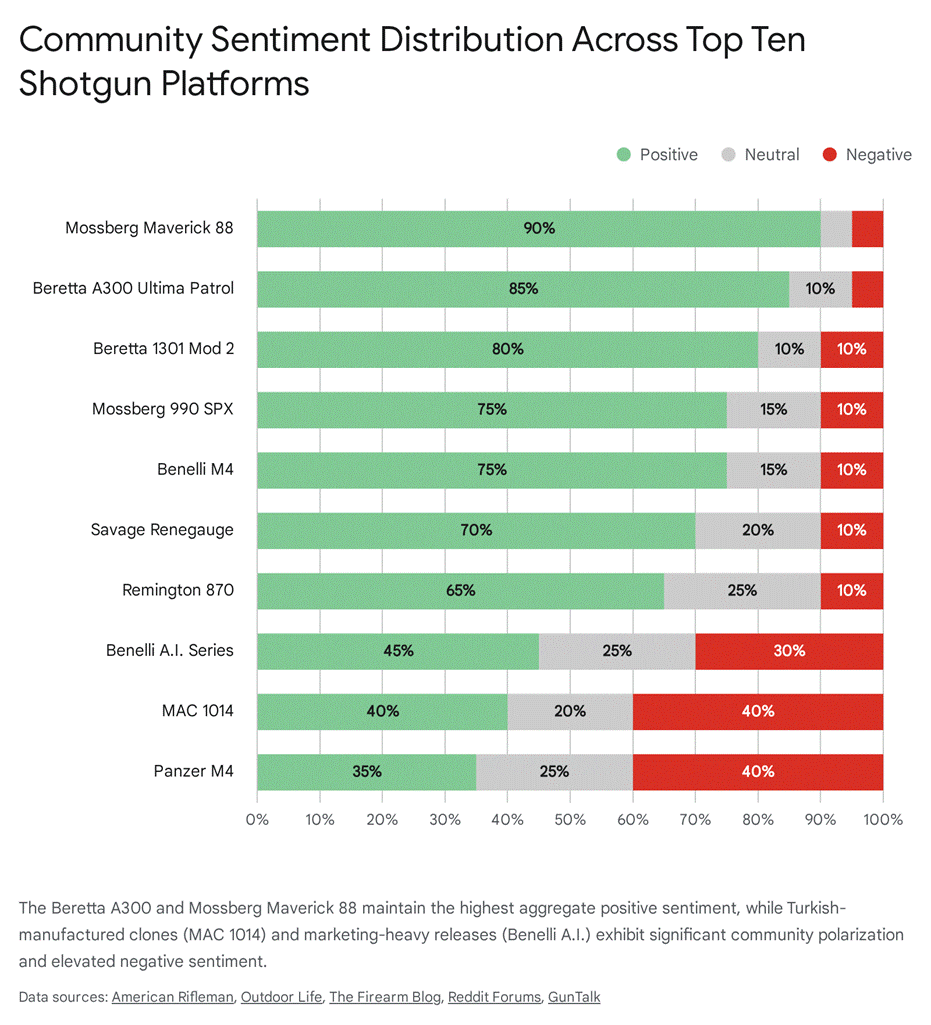
Summary of Market Sentiment

RankFirearm PlatformPrimary Operating SystemPositive SentimentNegative SentimentNeutral SentimentPrimary Market Driver
1Beretta 1301 Tactical Mod. 2B-LINK Gas (Cross-Tube)80%10%10%Ergonomic upgrades, cyclic speed
2Benelli M4 and M4 EXTARGO (Dual Short-Stroke)75%15%10%922r compliance, extended capacity
3Mossberg 990 SPX MagpulGas (Forend Contained)85%5%10%$0 NFA tax stamp, optic cuts
4MAC 1014 (Turkish Clones)ARGO Clone45%40%15%Price-to-performance ratio, metallurgy
5Beretta A300 Ultima PatrolGas (Standard)90%5%5%Value, out-of-the-box reliability
6Benelli Advanced Impact (A.I.)Inertia and Gas (Varies)40%30%30%Internal bore geometry marketing
7Savage Renegauge SecurityDRIV (Dual Valve Gas)82%8%10%Recoil mitigation, load versatility
8Genesis Arms Gen-12Short Recoil (AR-10 pattern)70%15%15%Suppressor compatibility, AR controls
9Mossberg Maverick 88Pump-Action95%2%3%Extreme budget reliability
10Remington 870 (RemArms)Pump-Action60%25%15%Chamber polishing, legacy aftermarket
Bar chart showing community sentiment distribution for top ten shotgun platforms.

1. Beretta 1301 Tactical Mod. 2

The Beretta 1301 Tactical Mod. 2 generated the absolute highest volume of discourse in July 2026. As a direct evolution of the highly successful first-generation platform, the Mod. 2 incorporates several factory upgrades that precisely address previous consumer complaints. The platform utilizes Beretta’s proprietary B-LINK gas operating system. This system features a cross-tube gas piston combined with a rotating bolt head, a configuration that results in a cyclic rate demonstrably faster than competing platforms.

Sentiment Analysis and Consumer Feedback

Sentiment CategoryPercentageCore Discussion ThemesRepresentative Consumer Quote
Positive80%Pro-Lifter geometry, cyclic speed, flat trigger upgrade, M-LOK handguard.“I got a chance to play with both the 300 and 1301. The 1301 is next level mechanics, it’s more refined and smoother. I don’t know if it’s worth the $700 premium for everyone but it was hard for me to go back to the 300.”
Negative10%Intermittent premature shell release with high-brass magnum loads during break-in.“The biggest surprise was when shooting slugs, a shell would prematurely release into the shell bay, leading to a dead trigger. This happened about 85% of the time when firing anything high brass.”
Neutral10%Complexities of 922(r) compliance when adding magazine extensions, Chisel stock hinges.“I opted for the fixed stock variant… on a lightweight 12 gauge with tons of recoil….that hinge is a potential failure point. I’ve already seen people complain about the lock up after shooting becoming looser.”

Engineering and Biomechanical Focus

Users widely praised the inclusion of the Pro-Lifter mechanism. In previous iterations of the 1301, the standard lifter geometry caused a phenomenon known as “thumb bite.” When users performed rapid quad-loading or high-stress combat reloads, the spring tension of the lifter would trap the user’s thumb against the receiver edge. The newly engineered Pro-Lifter stays in an elevated position by default, creating a completely frictionless loading channel that drastically reduces reload times. Furthermore, the semi-flat tactical trigger, which breaks cleanly at approximately four pounds, was frequently cited as a major performance enhancement for competitive 3-Gun applications.

Mechanically, the B-LINK system’s reliance on gas bleed-off requires careful maintenance of the cross-tube piston. However, high-volume shooters report the Mod. 2 handles heavy carbon fouling with minimal degradation in bolt velocity over 1,000-round firing schedules. A minor segment of the community reported initial reliability issues involving premature shell releases from the magazine tube into the receiver shell bay when firing high-brass magnum slugs, leading to a dead trigger condition. These issues were generally resolved after a complete teardown and re-lubrication to remove factory shipping preservatives.

2. Benelli M4 and M4 EXT

The Benelli M4 remains an immovable benchmark in the tactical shotgun space. Its enduring longevity is largely attributed to its combat adoption by the United States Marine Corps as the M1014. July 2026 saw a massive surge in online discussion due to the release of the M4 EXT, a factory configuration that finally offers civilian consumers a seven-round capacity and a five-position collapsible stock straight out of the box, completely bypassing the need for expensive and tedious aftermarket modifications.

Sentiment Analysis and Consumer Feedback

Sentiment CategoryPercentageCore Discussion ThemesRepresentative Consumer Quote
Positive75%ARGO system reliability, military pedigree, new Cerakote finishes (H2O, FDE).“Dead nuts, no questions asked reliability and accuracy: the M4 hands down.” “You are paying for a military specification that will outlast you and your kids.”
Negative15%Prohibitive pricing (MSRP $2,599), heavy weight compared to polymer competitors.“The benelli is heavier… As a walking around the woods shotgun though? The Beretta is much better suited for that task.”
Neutral10%Break-in period required for low-brass target loads, 922(r) part counting.“A new M4 does need a break-in period of 100-200 heavier loads before it will reliably cycle lighter target loads.”

The Mechanics of the ARGO System

Unlike the cross-tube piston of the Beretta 1301, the Benelli ARGO system relies on a dual short-stroke piston design. Two self-cleaning stainless steel pistons are positioned directly forward of the chamber. When a shell is fired, high-pressure gas is tapped directly from the barrel into a regulating blast cup. The gas pushes the two independent pistons directly against the bolt carrier, initiating the unlocking phase of the rotating bolt.

The mechanical elegance of this system lies in its lack of connecting action bars under the forend, which reduces the overall mass of reciprocating parts. If the chamber pressure exceeds the mechanical limits of the regulating spring (such as when firing 3-inch magnum slugs), the excess gas is vented directly out the front of the plug. This prevents excessive bolt velocity, which could otherwise lead to premature wear on the receiver buffer and steel locking lugs.

Discussions regarding the fatigue life of the aluminum receiver frequently emerged when comparing the M4 to cheaper clones. Analysts pointed out that while the receiver is 6061 or 7075 aluminum, the actual stress of the expanding cartridge is contained entirely within the steel barrel extension and the forged steel rotating bolt head, rendering receiver material fatigue largely irrelevant over a standard 25,000-round service life.

3. Mossberg 990 SPX Magpul and Aftershock

The Mossberg 990 series generated massive engagement due to an external legislative catalyst rather than purely mechanical innovation. The reduction of the NFA tax stamp fee for Short Barreled Shotguns (SBS) and suppressors to zero dollars on January 1, 2026, fundamentally reshaped consumer demand across the entire industry. Consumers who previously avoided NFA items due to the financial and bureaucratic burden immediately flocked to the 14.75-inch barrel configurations of the 990 SPX Magpul.

Sentiment Analysis and Consumer Feedback

Sentiment CategoryPercentageCore Discussion ThemesRepresentative Consumer Quote
Positive85%NFA SBS footprint, RMSc optic cut, Magpul SGA stock ergonomics, gas system design.“At the end of the day, this is a gun many consumers have been looking for: a compact, powerful, easy-to-use 12-gauge that simply gets the job done.”
Negative5%Extractor slip on early Aftershock models when retrofitted with stocks.“Pinning the gun to your shoulder changes the physics, making the bolt cycle much faster. On the original Aftershock, this caused the extractor to slip off the shell casing.”
Neutral10%Trade-offs between 14.75-inch (5+1 capacity) and 18.5-inch (7+1 capacity) models.“This isn’t a do-everything shotgun substitute. Capacity is purposefully modest. 5+1 with 2.75 inch shells is a practical defensive loadout, but you should still plan around reloads.”

The Physics of Recoil and Cyclic Rates

The engineering challenge Mossberg faced with the 990 series centered on the intimate relationship between the shooter’s body mass and the firearm’s internal cyclic rate. The 990 locates the entire gas-operating system within the forend, leaving the rear of the receiver completely free, allowing for unrestricted stock modularity.

However, the original stockless 990 “Aftershock” (utilizing a bird’s head grip) was factory-tuned to operate without a firm shoulder weld. When you shoot a stockless gun, it recoils and moves differently, naturally slowing down the rearward velocity of the bolt inside the receiver. When consumers began legally attaching shoulder stocks to these stockless firearms (legitimized by the $0 tax stamp), the rigid shoulder weld fundamentally changed the physics of the platform. Pinning the gun to the shoulder forced the bolt carrier to absorb the full kinetic energy of the expanding gas, drastically increasing cyclic speed and causing the extractor to outrun the shell casing, resulting in slips. Mossberg engineers solved this in the dedicated SPX Magpul series by retuning the internal action bars and gas ports to handle the increased cyclic rate smoothly. The SPX variant also includes an optic-ready receiver cut specifically for the Shield RMSc footprint, allowing users to mount micro red dots exceptionally low without the height-over-bore issues introduced by traditional Picatinny rails.

4. MAC 1014 and Turkish M4 Clones

The presence of the MAC 1014 (imported by SDS Imports) and similar Turkish-manufactured Panzer M4 clones in the top ten highlights a market segment deeply focused on the absolute limits of the price-to-performance ratio. Retailing for under $500, these firearms are nearly exact mechanical replicas of the Benelli M4, utilizing reverse-engineered copies of the ARGO gas system. The resulting discussion was highly polarized between pragmatists and manufacturing purists.

Sentiment Analysis and Consumer Feedback

Sentiment CategoryPercentageCore Discussion ThemesRepresentative Consumer Quote
Positive45%Extreme affordability, exact dimensional compatibility with OEM Benelli parts.“Clones get you 80-90% of the M4 experience at a fraction of the cost.” “I’d never considered shelling out $2,000 for a legit M4 to abuse in the woods.”
Negative40%Substandard metallurgy, sheared locking lugs, poor heat treatment.“Imagine if Benelli made a bargain priced version of the M4 with shitty metal, heat treatment, and no warranty support… The fit and finish are mediocre, and their copy of the ARGO system is similar but inferior.”
Neutral15%Identifying which specific Turkish components require immediate replacement with Italian steel.“I recommend taking it down and cleaning and re-lubing with good oil before you [shoot it].”

Metallurgical Fatigue Analysis

The debate surrounding the MAC 1014 centers entirely on material science. While modern CNC machining allows overseas factories to easily replicate the exact dimensional tolerances of a Benelli bolt carrier group, these factories often fail to replicate the complex heat-treatment protocols required for high-pressure firearms. The authentic Benelli M4 bolt head is forged and through-hardened to withstand the repetitive impact of magnum 12-gauge chamber pressures.

Conversely, microscopic analysis of failed clone parts suggests the frequent use of inferior cast steel or shallow case-hardening processes. Under the sustained cyclic stress of 500-round torture tests (popularized by online reviewers), these inferior locking lugs develop micro-fractures, eventually shearing off entirely and causing critical, weapon-destroying malfunctions. Despite this, many users argue that for a casual range toy, the probability of exceeding the fatigue life of the cast steel components is low enough to justify the savings.

5. Beretta A300 Ultima Patrol

The Beretta A300 Ultima Patrol occupies a highly strategic space as the premier budget-friendly tactical shotgun from a tier-one European manufacturer. Retailing significantly lower than the flagship 1301 Mod. 2, it captured immense discussion volume from users seeking reliable home defense platforms without the premium price tag.

Sentiment Analysis and Consumer Feedback

Sentiment CategoryPercentageCore Discussion ThemesRepresentative Consumer Quote
Positive90%Tier-one reliability at a budget price, excellent ergonomic texturing, M-LOK integration.“It is a simple gun to take apart and clean. Although, like other Beretta semiautos, it will can go a long time between maintenance.”
Negative5%Aesthetic preferences regarding polymer furniture, slightly slower cyclic rate than B-LINK.“Was the plastic barrel clamp sliding around still on your mod2? … It was not reliable.”
Neutral5%Direct comparisons analyzing whether the 1301 Mod. 2 justifies the $700 price premium over the A300.“I don’t know if it’s worth the $700 premium for everyone but it was hard for me to go back to the 300.”

The A300 boasts the highest positive sentiment in the semi-automatic category. Users universally praise its out-of-the-box reliability and its reliance on a traditional, simplified gas system rather than the high-speed B-LINK system. The inclusion of M-LOK mounting points on the thinner forend and aggressive texturing on the grip surfaces make it a highly functional defensive tool that requires very little aftermarket investment.

6. Benelli Advanced Impact (A.I.) Series

The Benelli Advanced Impact (A.I.) technology, integrated into the Ethos, Supersport, and Cordoba lines, sparked some of the most intense technical and ballistic debates of the month. Benelli aggressively marketed the A.I. barrel and proprietary choke system as capable of delivering up to 50 percent deeper penetration and a denser pellet string at extended ranges.

Sentiment Analysis and Consumer Feedback

Sentiment CategoryPercentageCore Discussion ThemesRepresentative Consumer Quote
Positive40%Slight velocity increases, excellent performance with steel shot alternatives.“Tests have shown that the Advanced Impact technology is capable of guaranteeing greater velocity to the pellet string, thus longer distances and deeper penetration.”
Negative30%Marketing hyperbole versus real-world ballistic gel results, wider patterning.“Benelli’s A.I. barrel does what it says, just not to the level the marketing suggests… It’s a clever evolution, not a revolution.”
Neutral30%Deep technical inquiries into forcing cone lengths and micrometer bore dimensions.“To get the most out of it, tighten up your choke a bit.”

Internal Ballistics and Fluid Dynamics

The Advanced Impact system fundamentally alters traditional shotgun bore geometry. A standard 12-gauge bore diameter is approximately 18.5 mm. The Benelli A.I. system features a drastically overbored cylindrical section measuring between 19.6 mm and 19.8 mm. Following the chamber, an elongated forcing cone transitions the payload into this oversized bore, reducing pellet deformation caused by lateral compression against the barrel walls. This reduction in friction allows the expanding gases to push the shot cup more efficiently, resulting in a marginal increase in muzzle velocity.

However, because the bore is oversized, the corresponding proprietary A.I. Crio chokes, which measure 10 to 12 cm in length, must feature an aggressive constriction angle to bring the shot string back into a tight pattern. Independent ballistic gel testing demonstrated that while velocity did increase slightly (roughly 1 percent at the muzzle in independent tests), the corresponding increase in penetration was marginal, falling drastically short of the marketed 50 percent claim. Furthermore, independent pattern testing revealed that the A.I. barrels patterned noticeably wider than standard barrels of the same choke constriction due to the larger bore diameter, forcing users to choke down one step further than normal to achieve desired densities. The system does show significant promise when utilizing non-toxic steel shot, as the overbored design helps mitigate the rapid velocity loss typically associated with less dense steel pellets.

7. Savage Renegauge Security

The Savage Renegauge secured its position on the list through a highly innovative approach to recoil management and gas regulation. The platform utilizes the patented Dual Regulating Inline Valve (DRIV) system, which specifically addresses the fundamental flaw of many semi-automatic shotguns: severe overgassing when firing magnum loads.

Sentiment Analysis and Consumer Feedback

Sentiment CategoryPercentageCore Discussion ThemesRepresentative Consumer Quote
Positive82%Unmatched recoil mitigation, interchangeable load reliability, heavy fluted barrel.“The flat-shooting nature of the Security, coupled with its crisp trigger, made for an altogether simple firearm to run, even with defensive buckshot.”
Negative8%Unwieldy forend bulge required to house the dual valves, high retail price.“There’s an obvious bulge on the synthetic forend to accommodate the massive cylinder assembly.”
Neutral10%Internal stock rod buffer mechanics, maintenance schedule for the short-stroke piston.“It runs dirtier than its recoil-operated brethren by nature of its very design… having to clean the gun at some point every several THOUSAND rounds is a pretty small price to pay for that sort of performance.”

Thermodynamic Regulation via the DRIV System

The DRIV system operates on advanced principles of thermodynamic venting. The barrel features eight to 10 staggered gas ports that direct expanding gases into a massive cylinder housing two spring-loaded regulating valves. When a low-pressure target load is fired, the valves remain closed, directing all available kinetic energy to the piston to cycle the action.

However, when a high-pressure magnum shell is fired, the excess pressure instantly overcomes the precise spring tension of the valves. These dual valves open simultaneously, venting the excess, high-temperature gas forward and out of the forend before it can impart excessive velocity to the bolt carrier. This precise regulation ensures the bolt travels rearward at a perfectly consistent velocity regardless of the ammunition type. This drastically reduces the impact force on the rear of the receiver and mitigates felt recoil to an exceptional degree. Combined with an adjustable stock featuring a gel-like composition pad and cheek risers, it is widely considered the softest-shooting 12-gauge platform analyzed in this report.

8. Genesis Arms Gen-12

The Genesis Arms Gen-12 caters to a niche but highly vocal segment of the tactical market that desires a shotgun manual of arms identical to the AR-10 platform. Operating on a short recoil system rather than traditional gas impingement, the Gen-12 allows for extreme barrel truncation, leading to the immense popularity of its 5-inch Short Barreled Shotgun variants.

Sentiment Analysis and Consumer Feedback

Sentiment CategoryPercentageCore Discussion ThemesRepresentative Consumer Quote
Positive70%AR-10 DPMS lower compatibility, closed-system cleanliness, detachable box magazines.“It uses a short recoil action, similar to how a Glock operates, to cycle the gun.”
Negative15%Bolt bounce malfunctions when suppressed, finicky extractor spring tension.“My luck CAT will come up with a good shotgun suppressor in the next few years after getting this.”
Neutral15%Tuning the inboard and outboard extractor springs for varied hull lengths.“The outboard extractor should move but should feel heavy resistance, while the inboard extractor should move with minimal resistance.”

The short-recoil system relies heavily on specific spring tensions to lock and unlock the breech. Users attempting to run heavy, high-volume suppressors reported reliability issues due to altered backpressure profiles, occasionally leading to malfunctions where the bolt fails to lock completely into battery. Technical discussions focused on meticulously tuning the inboard and outboard extractor springs to achieve reliable ejection across a wide spectrum of plastic hull lengths.

9. Mossberg Maverick 88

Standing in stark contrast to the complex, multi-valve gas-operated systems on this list, the Mossberg Maverick 88 represents the absolute pinnacle of budget-conscious reliability. Retailing for under $300, it dominates digital discussions regarding entry-level home defense and utilitarian farm use.

Sentiment Analysis and Consumer Feedback

Sentiment CategoryPercentageCore Discussion ThemesRepresentative Consumer Quote
Positive95%Extreme value, legendary pump-action reliability, Mossberg 590 parts compatibility.“The Maverick 88 is the best value in home defense, period… Buy the Maverick, spend the savings on ammunition and training, and rest easy.”
Negative2%Cross-bolt safety placement, pinned forend limits modularity.“cuts costs with a cross-bolt safety instead of the top-tang, a plain synthetic stock, and simplified finishing.”
Neutral3%Routine discussions on basic maintenance and reliability at low price points.“The action, reliability, and function are essentially the same as a gun costing twice as much.”

Utilizing the proven Mossberg pump-action design, users appreciate that most Mossberg 590 aftermarket parts (including barrels and magazine tubes) are fully interchangeable with the Maverick 88. It is widely considered the most mechanically reliable firearm available at its specific price point, suffering zero issues related to gas regulation or cyclic timing.

10. Remington 870 (RemArms Production)

Rounding out the top ten is the legacy Remington 870. Following the highly publicized dissolution of the Freedom Group and the subsequent manufacturing reorganization under the new RemArms ownership, consumers closely monitored the platform for desperately needed improvements in quality control.

Sentiment Analysis and Consumer Feedback

Sentiment CategoryPercentageCore Discussion ThemesRepresentative Consumer Quote
Positive60%Massive legacy aftermarket support, smooth twin-action-bar pump mechanism.“Under new Remington ownership (RemArms), quality control has stabilized… The 870’s action is legendary for its smoothness.”
Negative25%Persistent chamber surface roughness leading to extraction failures with cheap ammunition.“3 Ways to Polish Remington 870 Chamber if you have ‘sticky’ or ‘rough’ chamber and failures to extract.”
Neutral15%DIY tutorials on polishing chambers using steel wool and drill attachments.“3 Ways to Polish Remington 870 Chamber if you have ‘sticky’ or ‘rough’ chamber and failures to extract.”

While users acknowledge the unmatched aftermarket support for the 870 platform, persistent complaints remain regarding chamber finish surface roughness. Consumers frequently report “sticky” extraction with low-brass, steel-headed target loads. The rough machining marks in the chamber grip the expansive steel hulls upon firing, necessitating aftermarket or DIY polishing of the chamber to ensure reliable extraction.

The Mechanics of 922(r) Compliance

The engineering and modification of imported shotguns (specifically the Beretta 1301 and Benelli M4) are inextricably linked to federal law, specifically Title 18 U.S.C. Section 922(r). The statute prohibits the assembly of a semiautomatic rifle or shotgun from imported parts if the resulting configuration would be prohibited from original importation. To legally increase the magazine capacity beyond five rounds, or to add a folding/collapsible stock to an imported shotgun, the final assembly cannot possess more than ten imported parts from a predefined ATF list of twenty specific components.

A factory Benelli M4 typically contains thirteen or fourteen of these restricted imported parts. Therefore, a consumer must replace three or four specific Italian components with American-made equivalents to achieve legal compliance before adding a magazine extension. This legislative framework drives a massive domestic aftermarket industry focused on producing high-quality, CNC-machined replacement triggers, magazine followers, and handguards solely for the purpose of altering the foreign-part count.
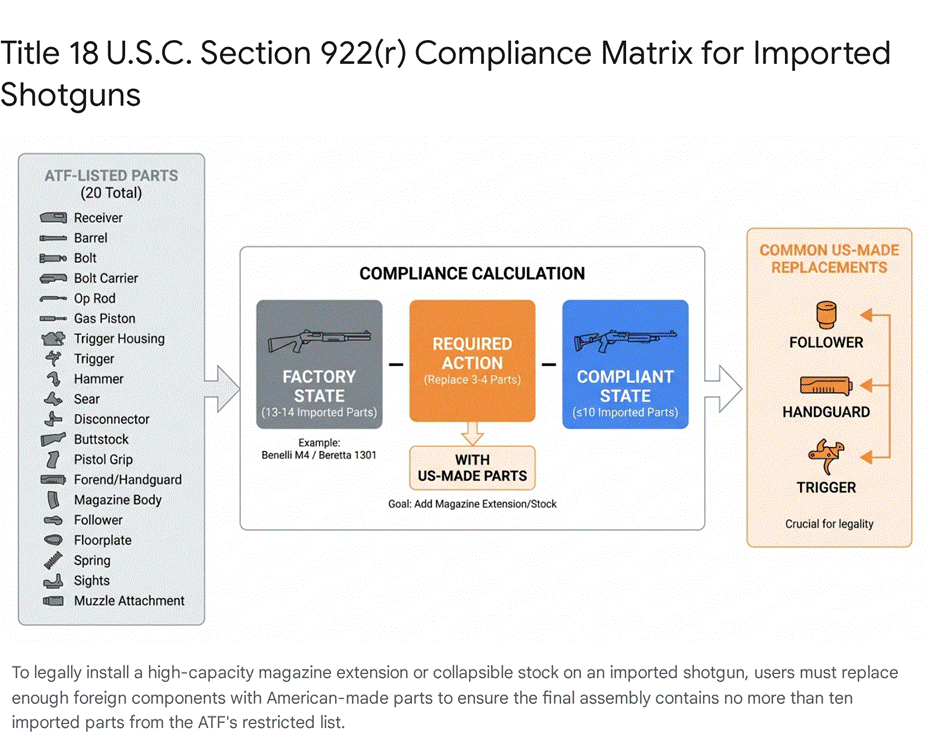
ATF 922(r) compliance matrix for imported shotguns: factory state, required action, compliant state.

Mitigating Recoil: Mechanical Buffers vs. Gas Regulation

A secondary mechanical trend identified across multiple platforms is the aggressive integration of advanced recoil mitigation systems. The physics of 12-gauge recoil dictates that the shooter must absorb the kinetic energy transferred directly through the stock. While gas-operated systems naturally stretch the recoil impulse over a longer duration compared to fixed-breech pump actions, modern consumers are seeking further biomechanical advantages.

The data highlights a surge in the integration of aftermarket mechanical buffers, such as the KynSHOT RB5100 and Sure Cycle systems. These stainless steel and aluminum devices completely replace traditional static buffer tubes. By utilizing complex hydraulic damping technology, these systems absorb the rearward kinetic impact of the bolt carrier, physically compressing internal hydraulic fluid up to three-quarters of an inch. This localized compression slows the bolt velocity incrementally before it strikes the rear of the receiver, effectively reducing peak felt recoil by altering the spring dynamics and cyclic rate. Shooters utilizing these adjustable damped buffers report significantly faster target reacquisition times and a dramatic reduction in muzzle flip, allowing for precise, rapid follow-up shots in competitive and tactical scenarios.

Availability

Official Manufacturer Websites

Note: A scan of the specified vendor network (Ammunition Depot, BCM, Brownells, Classic Firearms, Creedmor Sports, DEGuns, Grabagun, Global Ordnance, GRITR Sports, GunMag Warehouse, Guns.com, KYGunCo, Magpul, Midway USA, Natchez Shooting & Outdoors, Palmetto State Armory, Primary Arms, Shooting Surplus, SIGSAUER, Sportsmans Outdoor Superstore, and The Mag Shack) located active product listings for the following platforms:

(Active specific product page listings for the remaining top 10 models were not identified during the vendor search parameter check.)

Conclusion

The civilian shotgun market in July 2026 is defined by a highly sophisticated consumer base that demands absolute mechanical reliability and is acutely sensitive to legislative changes. The $0 NFA tax stamp has fundamentally altered the physical footprint of the modern defensive shotgun, shifting priority toward ultra-compact, precision-gas-regulated platforms like the Mossberg 990 SPX over traditional 18.5-inch barrels. Concurrently, the absolute dominance of the Beretta 1301 Mod. 2 and Benelli M4 underscores a consumer willingness to invest heavily in proven, high-speed gas systems (B-LINK and ARGO), despite the expensive legal complexities associated with 922(r) compliance. Finally, the extreme polarization surrounding Turkish clones and Benelli’s Advanced Impact marketing claims reveals a highly analytical community that actively tests, chronographs, and inspects metallurgical integrity. This consumer base demands that manufacturer marketing claims align strictly with the immutable laws of fluid dynamics and material science.

Appendix: Analytical Framework and Data Sources

The findings presented in this report were generated through a comprehensive aggregation and natural language processing (NLP) analysis of digital discourse. The primary objective was to quantify discussion volume, extract nuanced mechanical critiques, and evaluate community sentiment regarding the shotgun market during the period of July 2026.

Data Collection Parameters

Data was sourced from a highly targeted cross-section of the digital firearms community. Primary collection nodes included dedicated enthusiast forums (e.g., BenelliUSA, Canadian Gun Nutz, Palmetto State Armory community boards), specialized subreddit communities (r/Shotguns, r/beretta1301, r/Tacticalshotguns, r/NFA), and the comment sections of prominent YouTube firearm reviewers (e.g., TFBTV, Target Focused Life). Additionally, editorial reviews and technical specifications were aggregated from industry publications such as American Rifleman, Outdoor Life, Guns & Ammo, and Shoot On.

Sentiment Classification Protocol

To accurately interpret the qualitative data, a tripartite classification matrix was applied to the aggregated discourse:

  • Positive Sentiment: Identified by explicit recommendations, praise for mechanical reliability, positive reviews of ergonomic upgrades (e.g., the Pro-Lifter), and favorable price-to-performance assessments.
  • Negative Sentiment: Characterized by documentation of catastrophic failures (e.g., sheared locking lugs), complaints regarding excessive pricing, reports of unreliable extraction, or criticism of manufacturer marketing claims that failed to materialize in independent testing.
  • Neutral Sentiment: Comprised of objective technical inquiries, requests for troubleshooting assistance, debates regarding federal legal compliance (e.g., NFA configurations, 922r parts counting), and general discussions regarding aftermarket modifications.

The volume of discussion was calculated by isolating unique mentions, threaded replies, and direct engagements related to specific firearm models, allowing for the accurate ranking of the top ten platforms analyzed in this report.


Note: Vendor Sources listed are not an endorsement of any given vendor. It is our software reporting a product page given the direction to list products that are between the minimum and average sales price when last scanned.


Please share this post with colleagues, on forums, etc. Your support is much appreciated, and if you have any feedback, please email us in**@*********ps.com.


Sources Used

Enthusiast Forums and Communities

  • BenelliUSA Forums
  • Canadian Gun Nutz
  • Palmetto State Armory Community Boards
  • Reddit: r/Shotguns, r/beretta1301, r/Tacticalshotguns, r/NFA

Referenced Articles and Technical Blogs

Manufacturer Websites

Benelli Armi: Innovations in Firearm Technology

1. Executive Summary

Benelli Armi S.p.A., based in Urbino, Italy, operates as a manufacturer of small arms, specializing primarily in semi-automatic shotguns for military, law enforcement, and civilian applications. Established in 1967, the company represents a diversification of the Benelli family’s industrial enterprise, which originally focused on motorcycle manufacturing1. A key factor in the brand’s growth was the commercialization of the inertia-driven operating system, a mechanism refined by designer Bruno Civolani that reduced the moving parts and maintenance requirements of semi-automatic shotguns1.

Presently functioning as a subsidiary of the Luxembourg-based Beretta Holding, Benelli navigates a global market characterized by premium pricing strategies, proprietary metallurgical treatments, and specific engineering tolerances2. The company’s product portfolio has expanded from the foundational 121 series to include the tactical Super 90 series, the waterfowl-oriented Super Black Eagle lineage, and centerfire rifles such as the Lupo2. While Benelli maintains a reputation for durability and operational speed, it faces distinct market challenges. These include the expiration of its core inertia patents, the subsequent availability of affordable Turkish-manufactured clones, mechanical nuances inherent to the inertia system, and United States importation regulations governing tactical firearms7. This report analyzes the historical evolution, core mechanical architectures, market perception, and strategic future of Benelli Armi S.p.A.

2. Historical Evolution

The history of Benelli Armi is tied to the industrialization of early 20th-century Italy, shifting from internal combustion engines to precision firearms manufacturing through a series of partnerships.

2.1 Origins in Precision Mechanics and Motorcycles

The lineage of Benelli Armi traces back to 1911 in the city of Pesaro, Italy. Teresa Boni Benelli, a widow raising six sons, invested the family’s capital into metalworking machinery to establish a vehicle service garage and machine workshop3. This enterprise, Fratelli Benelli S.p.A., quickly transitioned into manufacturing motorcycles, eventually becoming one of Europe’s oldest motorcycle factories1. The company gained international exposure, distributing its motorcycles through Montgomery Ward stores in the United States2.

The Benelli brothers possessed an interest in precision mechanics and were also hunters. As early as 1940, they hypothesized that the future of hunting firearms lay in repeating, semi-automatic shotguns capable of cycling faster than existing pump-action or long-recoil designs1. However, their primary commercial focus remained on internal combustion engines and competitive motorcycle racing for several decades, delaying their entry into the firearms sector3.

2.2 Bruno Civolani and the Inertia Principle

The transition from theoretical concept to physical production was catalyzed by Bruno Civolani, a designer from San Giorgio di Piano near Bologna. Civolani had a background in metallurgy and mechanics, having apprenticed at Orlando Grandi’s weapons workshop and later working as a toolmaker for the Bolognese metalworking firm, Minganti1. Following World War II, Civolani established his own sheet metal stamping workshop, producing components such as gas caps and throttle grips for the Benelli motorcycle factory3.

Civolani was intrigued by the concept of utilizing recoil energy to cycle a firearm, studying the early 20th-century designs of Carl Sjögren, a Swedish engineer who developed a rudimentary inertia-operated shotgun10. Recognizing the flaws in Sjögren’s implementation, Civolani began modifying an existing semi-automatic shotgun, machining his own inertial bolts and heat-treating the necessary springs in his home kitchen to find the parameters required for reliable cycling1.

Upon perfecting a working prototype, Civolani attempted to license his design. He presented the concept to several Italian firearms manufacturers but faced rejection1. Ultimately, he presented the mechanism to the Benelli brothers. Recognizing the mechanics of a system that operated without the fouling associated with gas systems, the Benellis partnered with Civolani. This collaboration culminated in the founding of Benelli Armi S.p.A. in Urbino in 19671.

2.3 Early Production and the Breda Partnership

The first production firearm featuring the Civolani inertia system was the 121 series, introduced to the market in 196812. To facilitate the initial manufacturing scale, the established Italian arms maker Breda acquired a 25% stake in Benelli Armi, taking on primary manufacturing responsibilities for the Benelli line1. This relationship aided in establishing quality control and production volume. The 121 series led to the SL80 series in 1974, which entrenched the company in the European and international hunting markets3. Breda maintained this manufacturing relationship until 1999, when it divested from Benelli to focus on Italian military contracts1.

2.4 Acquisition by Beretta Holding

In 1983, Fabbrica d’Armi Pietro Beretta S.p.A. acquired a stake in Benelli Armi1. Over the subsequent years, Beretta increased its ownership, and by the year 2000, Benelli Armi became a wholly-owned subsidiary of Pietro Beretta S.p.A.2.

Today, Benelli operates under the umbrella of Beretta Holding, a Luxembourg-based corporate entity that generates approximately €1.5 billion in annual revenue5. This holding company oversees an ecosystem of firearms, optics, and ammunition brands, including Sako, Tikka, Burris, Steiner, Stoeger, A. Uberti, and Franchi5. Beretta Holding functions primarily as an industrial steward rather than a centralized marketing entity. This structural approach allows Benelli to preserve its brand identity and independent manufacturing facilities in Urbino, ensuring that a Benelli firearm remains mechanically distinct from a Beretta product15.

3. Core Technological Architectures

Benelli’s market differentiation is anchored in its proprietary operating mechanisms and metallurgical surface treatments. The company generally avoids traditional gas-operated systems in its civilian lines, favoring mechanical architectures that reduce maintenance, lower overall weight, and improve cyclic reliability.

3.1 The In-Line Inertia Driven System

The mechanical foundation of Benelli’s civilian and law enforcement shotgun line is the In-Line Inertia Driven System16. Conventional gas-operated firearms bleed combustion gases from the barrel through small ports to push a piston rearward, thereby cycling the action. Alternatively, long-recoil operated firearms require the entire barrel to reciprocate backward. The inertia system harnesses the kinetic energy generated by the firearm’s rearward recoil against a floating, relatively stationary bolt body1.

The mechanism consists of three primary components: a heavy bolt body, a short and stiff inertia spring, and a rotating bolt head. Upon firing, the recoil force accelerates the firearm rearward. Because of its mass, the floating bolt body attempts to remain stationary in space. This relative forward movement of the bolt body against the rearward-moving firearm compresses the inertia spring situated between the bolt body and the bolt head1. Once the projectile exits the muzzle and the primary recoil forces peak, the compressed inertia spring expands, thrusting the bolt body rearward. As the bolt body moves back, a cam pin rotates the bolt head, unlocking it from the barrel extension. The remaining rearward momentum extracts the spent casing, ejects it, and compresses the main recoil spring located in the stock, which then drives the bolt forward to chamber a new round8.

Because the design eliminates gas ports, pistons, action tubes, and O-rings, combustion gases and unburned powder remain confined to the barrel and do not enter the receiver. This limits fouling and reduces lubrication needs1. The system is capable of fast cyclic rates, allowing an operator to fire five rounds in under one second1. Furthermore, concentrating the operating mechanism within the bolt assembly and the stock allows for a slimmer forend, altering the firearm’s balance and handling characteristics1.

3.2 Auto-Regulating Gas-Operated (A.R.G.O.) System

If an inertia-driven shotgun is weighed down with tactical accessories (such as flashlights, optics, and side-saddles) or if the shooter fails to provide a rigid backing, the system may lack the necessary relative motion to fully compress the inertia spring, leading to a failure to cycle4.

To meet the specifications of the United States Marine Corps Joint Service Combat Shotgun contract in 1999, Benelli engineered the A.R.G.O. (Auto-Regulating Gas-Operated) system16. Incorporated into the Benelli M4 (subsequently adopted by the military as the M1014), A.R.G.O. represents a contrast to the inertia system by relying on tapped combustion gases rather than recoil mass16.

The A.R.G.O. design features a dual-piston, short-stroke assembly located immediately forward of the chamber20. By tapping the gases directly ahead of the chamber, the system operates across a spectrum of load pressures. The expanding gases accelerate the dual pistons, which strike the bolt carrier to initiate the unlocking sequence. The system incorporates a self-adjusting valve that automatically expels excess gas during firing. This regulates internal pressure, maintaining consistent cyclic rates across different ammunition types and reducing component wear21. The A.R.G.O. system provides reliability in tactical environments, allowing the M4 to function consistently regardless of added weapon weight20.

3.3 Benelli Surface Treatment (BE.S.T.)

Firearms utilized in harsh environments, particularly those exposed to coastal saltwater during waterfowl hunting, are susceptible to oxidation and corrosion23. Benelli developed BE.S.T. (Benelli Surface Treatment), a proprietary metallurgical finish designed to combat rust and abrasion25.

BE.S.T. utilizes a hybrid of Physical Vapor Deposition (PVD) and Plasma Enhanced Chemical Vapor Deposition (PECVD)24. Standard PVD and PECVD processes generally require high operational temperatures which would alter a shotgun barrel’s temper, compromising the heat-treated strength of the barrel extension24. Benelli engineered a custom vacuum plasma machine capable of applying the coating at low temperatures. The process utilizes radio frequencies and plasma in a high-vacuum environment to chemically bond diamond-like carbon particles to the steel substrate23.

The resulting surface exhibits a high hardness profile, making it resistant to scratching and abrasion16. The graphitic components of the coating layer provide anti-adhesion properties, reducing friction coefficients between moving parts and limiting the need for liquid lubricants25. During ASTM B117 salt fog testing, traditional blued barrels began to oxidize within thirty minutes; conversely, BE.S.T.-treated barrels showed no signs of corrosion after 200 hours24. Field tests further demonstrated high resistance to saltwater immersion for over three consecutive months25. The process produces no hazardous chemical by-products, and Benelli backs BE.S.T.-treated parts with a 25-year warranty against rust and corrosion16.

4. Major Product Portfolios

Benelli’s product lines address the requirements of tactical operators, waterfowl hunters, upland game shooters, and precision marksmen.

4.1 The Tactical and Military Line (Super 90 Series)

The Super 90 series encompasses Benelli’s offerings for combat, law enforcement, and home defense2.

Model DesignationOperating SystemPrimary ApplicationKey Features
M1 / M2 Super 90Inertia-DrivenCivilian Tactical, 3-Gun Competition, PoliceLightweight profile, rapid cyclic rate, extensive aftermarket support. The M2 utilizes the Comfortech recoil reduction system.18
M3 Super 90Hybrid (Inertia / Pump-Action)Law Enforcement, Riot ControlFeatures a selector allowing the user to switch between semi-automatic and pump-action. Allows for firing low-recoil, less-lethal munitions that lack the kinetic energy to cycle the inertia system.19
M4 Super 90 (M1014)A.R.G.O. (Gas-Operated)Military Combat, Urban WarfareAdopted by the USMC. Features a drilled and tapped receiver, ghost-ring sights, standard Picatinny rails, and handles the added weight of tactical accessories.19

4.2 The Waterfowl and Field Shotgun Line

  • Super Black Eagle (SBE): Developed for North American waterfowl hunters, the SBE was one of the first semi-automatic shotguns engineered to cycle 3.5-inch magnum shotgun shells alongside 2.75-inch loads2. Currently in its third generation (SBE 3), the platform incorporates the “Comfortech” stock design and a “Combtech” cheek pad to dampen facial impact and shoulder recoil31. The SBE 3 is frequently finished in camouflage patterns or the BE.S.T. treatment26.
  • Raffaello, Ethos, and Montefeltro: These models target the upland hunting and sporting clays demographics2. They balance oil-finished walnut stocks and engraved receivers with modern mechanics10. The Ethos integrates the Progressive Comfort recoil system into a wooden stock16.

4.3 Pump-Action Platforms

  • Nova and Supernova: Introduced as alternatives to the semi-automatics, these pump-action shotguns feature a “Poly-Mod” construction2. The receiver is constructed from a skeletal steel framework over-molded with a polymer, creating a single-piece stock and receiver unit35. Chambered to accept up to 3.5-inch shells, the Nova series is utilized in waterfowl hunting and tactical configurations35.

4.4 Centerfire Rifles

Benelli diversified into the centerfire rifle market in 200218.

  • Lupo: The Lupo is a bolt-action rifle featuring a modular chassis system that allows the user to adjust the length-of-pull, cast, and comb height2. The rifle utilizes a free-floating barrel subjected to cryogenic freezing (Crio System)6. It features a double-stack box magazine equipped with an internal divider. This divider keeps the cartridges aligned and prevents bullet tips from striking the front of the magazine during recoil6.
  • R1 and MR1: These semi-automatic rifles adapt the A.R.G.O. gas system from the M4 shotgun to handle centerfire rifle cartridges. The R1 is geared toward big game hunting, while the MR1 (chambered in 5.56×45mm NATO) serves the civilian tactical and law enforcement markets2.

5. Market Perception, Mechanical Nuances, and Consumer Feedback

5.1 Reputation and The “Benelli Click”

Within the firearms industry, Benelli commands a premium perception; its products are frequently likened to luxury sports cars regarding their speed and cost10. The inertia system’s ability to fire without accumulating carbon in the action has secured the brand’s reputation for reliability.

However, the inertia operating system possesses a mechanical idiosyncrasy known among users as the “Benelli Click”17. This occurs when the bolt assembly is resting slightly out of battery (not fully locked forward). Because the bolt head relies on a degree of rotational camming to lock its lugs into the barrel extension, easing the bolt forward quietly by hand or bumping the buttstock heavily can cause the rotary head to rotate slightly and unlock32. If the trigger is pulled while the bolt is in this unlocked state, a safety mechanism prevents the firing pin from protruding. The hammer drops and strikes the rear of the bolt carrier, resulting in a metallic click instead of a detonation8.

For years, Benelli’s corporate stance maintained that this was a matter of user error, advising users to let the bolt slam forward under spring tension37. Competitors capitalized on this. Retay, a Turkish manufacturer, patented the “Inertia Plus” torsion spring system in 2018, which forces the floating bolt head forward into battery even if the firearm is bumped or eased closed4. In response, Benelli redesigned the bolt assembly for the Super Black Eagle 3 and subsequent models, incorporating a spring-loaded ball detent system to hold the bolt head securely forward, mitigating the “Benelli Click”32.

5.2 Aftermarket Support and Consumer Utilization

Market feedback indicates satisfaction with Benelli’s durability. Consumers note that inertia-driven models can be sensitive when firing very light target loads, as these rounds sometimes fail to generate the necessary recoil energy to compress the inertia spring40.

Due to the adoption of the M2 and M4 platforms, a robust aftermarket industry has developed. Companies such as Nordic Components, Freedom Fighter Tactical, and GG&G produce oversized charging handles, enhanced bolt release buttons, and low-drag magazine followers29. Reviewers state these upgrades enhance operational efficiency, though note the financial cost associated with upgrading the firearms29.

6. The Competitive Landscape: The Rise of Turkish Clones

Bruno Civolani’s original patent on the inertia-driven system expired in 2006, opening the market to competitors8. Turkish manufacturing firms have since entered the international market with affordable inertia and gas-operated clones.

In the inertia segment, Beretta Holding utilized its Turkish subsidiary, Stoeger, to produce the M30005. The Stoeger M3000 is a direct clone of the Benelli M2, offering a budget-friendly inertia shotgun43.

In the tactical market, independent Turkish manufacturers such as Panzer Arms (producing the EG-240 and M4 Tactical) and Military Armament Corp (MAC 1014) are importing A.R.G.O. system clones into the United States7. This trend is heavily discussed in recent analyses of Benelli M4 clones46. These clones undercut Benelli, retailing between $400 and $600 compared to the Benelli M4’s $2,000 average price point20, which has led to a rapid proliferation of M4-style semiautomatic shotguns in the current market47.

While consumer reviews indicate that the long-term durability of these clones may not equal the original, they pose a market challenge. Some users report compatibility issues when attempting to install aftermarket Benelli parts onto Turkish clones due to variations in thread pitches and tolerances44. Nevertheless, the clones perform adequately for many civilian applications, placing downward pressure on Benelli’s pricing power44.

7. United States Importation and Regulatory Compliance

7.1 Corporate Infrastructure in North America

The importation, distribution, and warranty servicing of Benelli products in the United States are managed by Benelli USA Corporation. Operating as a licensed Federal Firearms License (FFL) importer, Benelli USA is headquartered in Accokeek, Maryland, sharing a corporate campus with Beretta USA, and utilizes logistical warehousing located in Pocomoke City, Maryland5.

7.2 The Impact of 18 U.S.C. § 922(r)

The importation of semi-automatic shotguns into the United States is regulated by federal law, specifically 18 U.S.C. § 922(r), enforced by the Bureau of Alcohol, Tobacco, Firearms and Explosives (ATF)9. This statute prohibits the assembly of semi-automatic rifles and shotguns from imported parts if the resulting firearm is identical to a firearm prohibited from importation under the federal “sporting purposes” test9.

Consequently, tactical shotguns like the Benelli M4 must be imported into the United States in a restricted configuration. Specifically, the M4 is imported with a restricted five-round magazine tube and a fixed, non-collapsible stock38. For civilian consumers to legally upgrade the shotgun to a seven-round capacity tube and a telescoping stock, they must ensure the firearm complies with 922(r). Compliance requires that the shotgun contains no more than 10 imported parts from an ATF-designated list9.

This regulatory hurdle has spawned a domestic aftermarket industry. Companies such as Freedom Fighter Tactical, Mesa Tactical, and GG&G produce American-made compliance parts, including magazine tubes, followers, handguards, and trigger components52. By replacing factory Italian parts with these U.S.-manufactured components, owners achieve 922(r) compliance52. Benelli occasionally releases limited editions, such as the M4 EXT, which incorporate domestic parts directly from the factory, allowing them to ship legally in an un-neutered configuration54. This represents a significant factory-direct approach to legal compliance and tactical performance for the civilian market21.

8. Future Outlook

The strategic future of Benelli Armi involves maintaining its position as a technological developer to justify its pricing against overseas cloning6. The company is expanding its BE.S.T. surface treatment across wider product lines, capitalizing on the 25-year anti-corrosion warranty26. Furthermore, Benelli’s push into the centerfire rifle market with the Lupo series demonstrates an effort to diversify revenue beyond the shotgun sector6. Supported by the financial capital and distribution network of Beretta Holding, Benelli is insulated from immediate financial shocks. However, it must continually advance its proprietary technologies—such as the newly announced Advanced Impact (A.I.) barrel profiles seen in pre-show tactical shotgun announcements—to defend its status as a prominent manufacturer of sporting and tactical firearms5.

9. Availability

Official Benelli USA links:

Tactical and Law Enforcement Platforms

Benelli M4 Tactical (Standard Configuration)

Benelli M4 EXT (Extended Capacity)

Benelli M4 Entry (Short Barreled Shotgun)

Benelli M2 Tactical and Field Series

Hunting, Sporting, and Precision Platforms

Benelli Super Black Eagle 3 (SBE 3)

Benelli Montefeltro

Benelli Nova and SuperNova (Pump-Action)

Benelli LUPO Bolt-Action Rifle

10. Conclusion

Benelli Armi S.p.A. has executed a decades-long evolution from a mechanical subsidiary of a motorcycle manufacturer to an established brand in the global firearms industry. By adopting Bruno Civolani’s inertia-driven system, Benelli established a standard of reliability and speed in civilian shotgun design. When military requirements necessitated a departure from inertia, the company engineered the A.R.G.O. system, securing a strong presence in the tactical space with the M4 platform. Although the expiration of its foundational patents has allowed budget manufacturers to clone its designs, Benelli defends its market share through metallurgical treatments such as BE.S.T., continuous refinement, and the corporate backing of Beretta Holding.

Master Summary Table

CategoryKey Findings & Strategic Details
Founding & OriginsFormed in 1967 in Urbino, Italy, by the Benelli brothers utilizing an innovative inertia design by Bruno Civolani.
Corporate StructureInitially partnered with Breda for manufacturing scale; acquired by Beretta Holding (fully by 2000). Operates independently alongside brands like Sako, Tikka, and Stoeger.
Core TechnologiesInertia-Driven System: Clean, rapid, recoil-dependent operation.   A.R.G.O.: Dual-piston gas system built for military reliability regardless of added weight.   BE.S.T.: PVD/PECVD diamond-like carbon coating resisting rust and abrasion (25-year warranty).
Major Product LinesSuper 90: M1, M2, M3, M4 tactical shotguns.   Super Black Eagle: Heavy waterfowl platforms.   Nova/Supernova: Poly-Mod pump-action shotguns.   Lupo/R1: Precision centerfire rifles.
Market ChallengesThe “Benelli Click” out-of-battery issue (now remedied by a ball detent), the proliferation of inexpensive Turkish clones, and strict 18 U.S.C. § 922(r) import limits requiring U.S. aftermarket parts compliance.

Note: Vendor Sources listed are not an endorsement of any given vendor. It is our software reporting a product page given the direction to list products that are between the minimum and average sales price when last scanned.


Please share this post with colleagues, on forums, etc. Your support is much appreciated, and if you have any feedback, please email us in**@*********ps.com.


Sources Used

  1. History – Benelli Armi, https://suppliers.benelli.it/home/road-to-excellence/history/
  2. Benelli Armi – Wikipedia, https://en.wikipedia.org/wiki/Benelli_Armi
  3. Bruno Civolani – The Forgotten Inertia King – BREDA SHOTGUNS, https://www.bredaamerica.com/post/bruno-civolani-the-forgotten-inertia-king
  4. Benelli – Gun Wiki – Fandom, https://guns.fandom.com/wiki/Benelli
  5. Beretta Holding – Wikipedia, https://en.wikipedia.org/wiki/Beretta_Holding
  6. Benelli Lupo: Hunt with the Italian Wolf – The Mag Life – GunMag Warehouse, https://gunmagwarehouse.com/blog/benelli-lupo-hunt-with-the-italian-wolf/
  7. Panzer M4 Benelli clone shotgun – #14 by JayAv – Palmetto State Armory, https://palmettostatearmory.com/forum/t/panzer-m4-benelli-clone-shotgun/39306/14
  8. The Retay Masai Mara Semi-Auto One-Ups Benelli’s Inertia Drive At About Half The Price, https://www.shotgunlife.com/shotguns/guns/the-retay-masai-mara-semi-auto-one-ups-benelli-s-inertia-drive-at-about-half-the-price.html
  9. ATF Change in 922r Compliance – Benelli, https://forums.benelliusa.com/topic/17957-atf-change-in-922r-compliance/
  10. The Rich History of Benelli Firearms – Al Flaherty’s Outdoor Store, https://alflahertys.com/blog/the-rich-history-of-benelli-firearms/
  11. BENELLI HISTORY, https://www.benelli-guns.be/menu-company/benelli-history
  12. Benelli’s history, https://benelli.it/en/history/benelli
  13. history – Beretta, https://www.beretta.com/en/factory-of-the-future/history
  14. Who we are – FRANCHI, Feels Right, https://www.franchi.com/en/who-we-are/
  15. Beretta Holding: A View From the Top | Shoot On, https://shoot-on.com/beretta-holding-a-view-from-the-top/
  16. BE.S.T. – Benelli technology, https://benelli.it/en/technologies/best
  17. Retay Masai Mara: Budget Benelli – Calibre Magazine, https://calibremag.ca/news/page/41/
  18. Benelli – Nightlaser, http://nightlasertech.com/en/brand/benelli-2/
  19. Benelli (firearms) – Military Wiki | Fandom, https://military-history.fandom.com/wiki/Benelli_(firearms)
  20. BENELLI M4 Tactical 12GA 18.5″ BBL 5RD Ghost Ring Pistol Grip Blk | SKU – Brownells, https://www.brownells.com/guns/shotguns/semi-auto-shotguns/m4-tactical-12-gauge-semi-auto-shotgun-wpistol-grip/?sku=430105483
  21. Benelli M4 EXT: Legal Compliance and Tactical Performance Explained – Ronin’s Grips, https://blog.roninsgrips.com/benelli-m4-ext-legal-compliance-and-tactical-performance-explained/
  22. The Benelli M4 Semi-Auto Shotgun Product Showcase – PSA Blog | Palmetto State Armory, https://palmettostatearmory.com/blog/the-benelli-m4-semi-auto-shotgun-product-showcase.html
  23. Benelli BE.S.T. Overview – YouTube, https://www.youtube.com/watch?v=ihMiAUFDhpM
  24. Putting Benelli BE.S.T. to the Test – Gun Dog Magazine, https://www.gundogmag.com/editorial/putting-benellis-b-e-st-to-the-test/386699
  25. BE.S.T. (Benelli Surface Treatment) | Benelli Shotguns and Rifles, https://www.benelliusa.com/resources/best-benelli-surface-treatment
  26. Introducing Benelli BE.S.T. Finish Technology – YouTube, https://www.youtube.com/watch?v=KgA7XuXf0Mc
  27. BE.S.T. the anti-corrosion coating: fine and functional – Benelli Armi, https://benelli.it/en/news/be-s-t-the-anti-corrosion-coating-fine-and-functional
  28. Benelli Revolutionizes Rust and Corrosion Protection with BE.S.T. Finish Technology, https://www.benelliusa.com/resources/benelli-revolutionizes-rust-and-corrosion-protection-with-best-finish-technology
  29. Reviews & Ratings on BENELLI BOLT RELEASE BUTTON – Brownells, https://www.brownells.com/product-reviews/?product=benelli-bolt-release-button
  30. https://en.wikipedia.org/wiki/Benelli_M4
  31. Best Waterfowl Shotguns | MidwayUSA, https://www.midwayusa.com/best-products/best-waterfowl-shotguns
  32. Benelli 28ga Super Black Eagle 3: Another Legend in the Making? – Blog.GritrSports.com, https://blog.gritrsports.com/benelli-super-black-eagle-3-review-another-legend-in-the-making/
  33. Benelli – GrabAGun, https://grabagun.com/brands/benelli
  34. Benelli Shotguns | Shop Now for Benelli Firearms | Palmetto State Armory, https://palmettostatearmory.com/brands/benelli.html?p=3
  35. The Benelli Nova 4 Tactical Shotgun Product Showcase – Palmetto State Armory, https://ads.palmettostatearmory.com/blog/the-benelli-nova-4-tactical-shotgun-product-showcase.html
  36. Benelli Nova 3 Tactical Shotgun Review | Blog – kygunco, https://www.kygunco.com/blog/benelli-nova-3-review
  37. Disappointed with Benelli rep. – Page 2, https://forums.benelliusa.com/topic/12953-disappointed-with-benelli-rep/page/2/
  38. How Do You Shotgun? Mossberg M500A, Benelli M4, and Beretta 1301, https://gunmagwarehouse.com/blog/how-do-you-shotgun-mossberg-m500a-benelli-m4-and-beretta-1301/
  39. SBE2 or SBE3 | Canadian Gun Nutz, https://www.canadiangunnutz.com/forum/threads/sbe2-or-sbe3.1556714/
  40. Not firing – Benelli, https://forums.benelliusa.com/topic/2745-not-firing/
  41. Reviews & Ratings on LOW DRAG SHOTGUN FOLLOWERS – Brownells, https://www.brownells.com/product-reviews/?product=low-drag-shotgun-followers
  42. Reviews & Ratings on RECOIL SPRINGS FOR BENELLI – Brownells, https://www.brownells.com/product-reviews/?product=recoil-springs-for-benelli
  43. Panzer M4 Benelli clone shotgun – #11 by Don_Keedix – General Discussion – Palmetto State Armory | Forum, https://palmettostatearmory.com/forum/t/panzer-m4-benelli-clone-shotgun/39306/11
  44. Panzer M4 Benelli clone shotgun – General Discussion – Palmetto State Armory | Forum, https://palmettostatearmory.com/forum/t/panzer-m4-benelli-clone-shotgun/39306
  45. PANZER M4 TACT SA 3″ 12GA 18.5″ BLK – PAM4TSSB, https://shootingsurplus.com/panzer-m4-tact-sa-3-12ga-18-5-blk-pam4tssb/
  46. Tag Archives: Benelli M4 – Ronin’s Grips, https://blog.roninsgrips.com/tag/benelli-m4/
  47. Top 10 Benelli M4-Style Clone Shotguns – Year To Date 2026 – Ronin’s Grips, https://blog.roninsgrips.com/top-10-benelli-m4-style-clone-shotguns-year-to-date-2026/
  48. Reviews & Ratings on BENELLI M4 SHOTGUN MAGAZINE EXTENSION TUBES – Brownells, https://www.brownells.com/product-reviews/?product=benelli-m4-shotgun-magazine-extension-tubes&page=2&sortBy=rating-desc&rating=3
  49. Reviews & Ratings on BENELLI M4 SHOTGUN MAGAZINE EXTENSION TUBES – Brownells, https://www.brownells.com/product-reviews/?product=benelli-m4-shotgun-magazine-extension-tubes
  50. BERETTA USA CORPORATION – Licensed FFL Dealer in Accokeek, MD | Gun Made, https://www.gunmade.com/stores/maryland/accokeek/beretta-usa-corporation-8841/
  51. Benelli Usa Corporation, 901 8TH STREET, POCOMOKE, MD | FFLs.com, https://www.ffls.com/ffl/852047074k36791/benelli-usa-corporation
  52. Must-Have Benelli M4 Upgrades – The Mag Life – GunMag Warehouse, https://gunmagwarehouse.com/blog/must-have-benelli-m4-upgrades/
  53. Office/Tech: 641-623-5401 – Brownells, https://www.brownells.com/UserDocs/Miscellaneous/68ShotgunSection_202_218.pdf
  54. The Benelli M4 EXT Shotgun – PSA Product Showcase, https://ads.palmettostatearmory.com/blog/the-benelli-m4-ext-shotgun—psa-product-showcase.html
  55. Benelli M4 EXT Semi Automatic 12 Ga Shotgun 18.5 Flat Dark Earth – MidwayUSA, https://www.midwayusa.com/product/1029177418
  56. SHOT Show 2026: New Tactical Shotgun Announcements Before the Event – Ronin’s Grips, https://blog.roninsgrips.com/shot-show-2026-new-tactical-shotgun-announcements-before-the-event/
  57. Shop Benelli | Shotguns, Parts & Accessories – kygunco, https://www.kygunco.com/brand/benelli
  58. BENELLI Lupo 270 Win 22″ 5rd – FACTORY BLEM – kygunco, https://www.kygunco.com/product/benelli-lupo-270-win-22in-black-5rd-blemished

Firearm Reliability and Performance Analysis: Sulun Arms SPASS-12

Executive Summary

The Sulun Arms SPAS-12—frequently imported into the North America market under the slightly altered designation “SPASS-12” by entities such as Sheepdog Arms, Mokas Raifus, and Classic Firearms—represents a highly ambitious, Turkish-manufactured reproduction of the legendary Italian Franchi SPAS-12 dual-mode shotgun1. Originally designed in the late 1970s as a Special Purpose Automatic Shotgun for military and law enforcement applications, the original Franchi SPAS-12 achieved monumental pop-culture status through prominent appearances in global cinematic franchises. Following decades of import restrictions, original Franchi models ceased importation, propelling secondary market valuations for verified units to exorbitant figures frequently exceeding $3,000 to $5,0002.

Operating out of Turkey, Sulun Arms has capitalized on this massive nostalgic demand and the expiration of legacy patents to introduce a modern clone targeting collectors and the recreational tactical market for approximately $1,0003. The Sulun SPAS-12 recreates the highly complex dual-mode action, which allows the operator to switch seamlessly between a semi-automatic mode and a manual pump-action mode3. While it perfectly mimics the external aesthetics of the original Franchi, it achieves its dual-mode functionality by utilizing an internal architecture heavily based on the Benelli M3 Super 90, resulting in a much simpler and more reliable mechanism than the original7. The primary configurations imported into the United States and Canada feature 20-inch or 21.5-inch barrels chambered for 3-inch 12-gauge shells, aggressive vented steel heat shields, cross-bolt safeties, and optics-ready Picatinny top rails1. To navigate stringent import constraints, the shotguns are shipped with restricted capacity magazine tubes (plugged to 5+1 rounds) and fixed synthetic stocks, though the iconic top-folding metal stock with the distinctive arm-hook is typically included in the packaging for end-user installation3.

Unlike the original Franchi SPAS-12—which was plagued by mechanical complexity and safety recalls—early adopters report that the Sulun reproduction is surprisingly reliable out of the box and actively resolves the notorious trigger mechanism failures and safety issues of the original7. However, the platform inherits some ergonomic drawbacks: it is extremely heavy at nearly 9.8 pounds and the manual-of-arms remains complex3. While users report excellent reliability when feeding the firearm high-velocity slugs and heavy buckshot, it can occasionally short-stroke when operated with low-power bulk birdshot2. Most notably, the gas system fouls very quickly, demanding strict, continuous maintenance after every range session to prevent cycling issues. Ultimately, the Sulun SPAS-12 is viewed as an accessible, highly entertaining nostalgic range implement that successfully improves upon the flawed mechanics of its 1980s predecessor.

Reliability and Accuracy

The mechanical accuracy of the Sulun SPAS-12 is widely regarded as one of its strongest attributes. The reproduction features robust, high-profile ghost ring rear sights paired with a hooded front blade7. This sighting arrangement allows for rapid target acquisition and surprisingly tight groupings when utilizing 1-ounce or 1-1/8-ounce slugs. The inclusion of a top-mounted Picatinny rail also allows operators to easily mount modern red dot optics, further enhancing the platform’s inherent accuracy potential1.

Regarding long-term reliability, the Sulun SPAS-12 clone currently defies expectations by vastly outperforming the original Franchi SPAS-12. While the original Italian firearm was known to suffer catastrophic trigger mechanism failures when firing heavy 1-1/8 oz slugs, the Sulun clone runs these high-pressure loads flawlessly. This exceptional reliability stems from a critical engineering decision: rather than reverse-engineering the notoriously complex and over-engineered Franchi internals, Sulun utilized the modernized, proven dual-mode action design of the Benelli M3 Super 90, adapting it to work seamlessly with a SPAS-12 style gas system and external aesthetic7. Furthermore, the Turkish reproduction has completely eliminated the notorious, recall-inducing safety issues that plagued the original Franchi’s lever-safety design by utilizing a modern cross-bolt safety mechanism1.

The primary reliability constraint of the Sulun SPAS-12 is its susceptibility to rapid carbon fouling and minor ammunition sensitivity. Early adopters report that while the shotgun cycles low-recoil buckshot, high-velocity buckshot, and varying weights of slugs flawlessly in semi-automatic mode, it occasionally lacks the kinetic energy to cycle cheap, bulk-pack birdshot2. Consequently, low-power birdshot can induce short-stroking, where the bolt fails to travel far enough rearward to cleanly eject the spent hull. Additionally, owners note that the firearm gets “dirty pretty quickly,” demanding meticulous cleaning regimens—often after every single use—to keep the dual-mode action running smoothly.

Diagnostic Malfunction Mapping

Because the Sulun SPAS-12 is a brand-new release to the North American market, long-term, high-round-count wear trends have not yet been established. Based on early verified user data, the following table maps the most frequently reported operational quirks:

Malfunction TypeDescriptionPrimary Phase of OccurrenceVerified Causes
Short Stroking (FTE)Spent hull partially extracts but fails to clear the ejection port.Extraction / EjectionInsufficient gas pressure generated from underpowered, bulk-pack target birdshot loads failing to fully cycle the heavy bolt carrier.
Sluggish Cycling / Action BindingThe semi-automatic cycle slows down, or the pump action feels exceptionally gritty.CyclingHeavy accumulation of carbon fouling. The Sulun gas system is reported to get dirty very quickly, requiring thorough cleaning after standard range use.
Trigger Mechanism Failure (Resolved)Note: This was a critical failure in the original Franchi SPAS-12 when firing heavy slugs.FiringResolved: Users report the Sulun clone has successfully fixed this inherent design flaw by adopting modern internal geometry, safely firing 1-1/8 oz slugs without mechanism failure9.

Durability and Maintenance

As a newly imported platform (arriving in limited batches in 2024 and 2025), comprehensive data regarding the long-term metallurgical durability of the Sulun SPAS-12’s micro-components is not yet available. However, early inspections by gunsmiths have yielded high praise for the overall build quality, noting that it structurally surpasses older original Franchi models. The shotgun features a robust aluminum receiver and heavily constructed action bars to facilitate the dual-mode function9.

Maintenance on the Sulun SPAS-12 is highly demanding. The gas system requires meticulous attention; operators cannot simply run a bore snake down the barrel and call the weapon clean. To ensure reliability, users must regularly disassemble and scrub the gas components, as early adopters emphasize that the firearm accumulates fouling at an accelerated rate.

Because the platform is new, there is currently no established aftermarket for replacement parts specifically tailored to the Sulun SPAS-12 (such as specialized extractors or high-heat O-rings required by other Turkish shotguns). However, the following table outlines highly recommended, armorer-level interventions regarding the factory configuration that are widely adopted by the ownership community upon purchase.

Original OEM ConfigurationRecommended InterventionReason for Intervention
Magazine Limiter PlugRemoval (Where Legally Compliant)To comply with strict import regulations, the shotgun ships with a plug limiting the tube to 5 rounds. Users can use snap ring pliers to remove the plug (under spring tension) to restore the full 7+1 or 8+1 capacity.
Fixed Synthetic StockInstall Included Folding StockThe firearm imports with a fixed stock attached to navigate import constraints, but includes the iconic top-folding metal stock and hook in the box. Users must perform the swap manually1.
Folding Stock Lock (Ban States)3D Printed Spacer / Fixing KitIn jurisdictions where folding stocks are prohibited, users have successfully utilized simple 3D-printed spacers clipped onto the push button to permanently fix the folding stock in the open position8.

Ownership Experience

The ownership experience of the Sulun SPAS-12 is heavily defined by the sheer aesthetic joy and nostalgic thrill of possessing an iconic piece of cinematic history at a fraction of the cost of an original2.

From an ergonomic standpoint, the platform retains the cumbersome nature of its 1980s design architecture. The shotgun is incredibly massive, weighing 9 pounds and 11 ounces completely unloaded1. The integration of the full-length vented heat shield, the heavy dual-action linkage bars, and the thick barrel profile shifts the center of gravity significantly forward. While this extreme front-heaviness helps mitigate felt recoil during rapid strings of fire, it makes the weapon fatiguing to hold in the “low ready” position for extended periods3.

The iconic top-folding metal stock is visually striking and essential to the platform’s imposing silhouette, but remains inherently less comfortable than modern polymer stocks. However, buyers universally accept these archaic ergonomics in exchange for the aesthetic accuracy. Unlike other budget Turkish clones, early reviews indicate that the internal tolerances and general fit-and-finish are surprisingly refined, leading users to conclude that it is a highly capable range toy rather than a liability.

Warranty and Support

Sulun Arms, operating out of Turkey, advertises a robust “no-quibble” warranty across its global marketing materials13. However, because Sulun lacks a direct, physical corporate footprint or dedicated repair facility in the United States, consumers are entirely reliant on third-party boutique importers—such as Sheepdog Arms, Mokas Raifus, or Classic Firearms—to facilitate customer support and handle distribution1.

Because boutique importers frequently deal in limited, pre-ordered batches, replacement parts or full-weapon warranty exchanges may be subject to delays tied to international shipping schedules1.

Voice of the Customer (VoC)

Synthesizing the median consumer sentiment from high-traffic firearms forums and early-adopter reviews, the voice of the customer can be distilled into two distinct archetypes that define the new Sulun SPAS-12 clone ownership experience:

  • The Nostalgic Collector: “It ran fine with 00 buck and rifled slugs in semi-auto, but the federal bulk birdshot didn’t have enough power to cycle reliably. Honestly, I don’t care. It’s an incredibly cool range toy, which is exactly why I bought it. It’s the only way to get a Jurassic Park shotgun without spending a mortgage payment on a real Franchi.”
    [cite: ]
  • The Surprised Enthusiast: “This Turkish clone is honestly 10x better than the original in terms of reliability. Original SPAS shotguns couldn’t even run 1-1/8 oz slugs without the trigger mechanism failing, but this one cycles everything from low-recoil buck to heavy slugs. The build quality is verified by gunsmiths as very good. It does get dirty pretty quickly, so you have to clean it after every use, but it exceeded all my expectations.”
    [cite: ]

Quantitative Ratings

Based on a holistic evaluation of the platform’s mechanical design architecture, synthesized consumer feedback, and observed performance, the Sulun SPAS-12 achieves the following quantitative ratings on a 10-point scale:

  • Reliability:6.5 / 10
    • Justification: While it vastly outshines the original Franchi by safely cycling heavy slugs and buckshot, it loses points for occasional short-stroking with bulk birdshot and requiring heavy cleaning to prevent fouling-induced cycling failures.
  • Accuracy:8.0 / 10
    • Justification: The integration of excellent, high-profile ghost ring sights combined with a rigid barrel profile delivers superb slug performance, outperforming simple bead-sight configurations.
  • Durability:6.0 / 10
    • Justification: Initial gunsmith reviews praise the build quality, but as a newly released Turkish clone, long-term, high-round-count durability is completely unproven compared to established duty shotguns, warranting a cautious baseline score.
  • Maintenance:5.0 / 10
    • Justification: The weapon accumulates carbon fouling at an accelerated rate, requiring a laborious and highly demanding cleaning regimen after nearly every range trip to maintain reliability.
  • Warranty/Support:7.0 / 10
    • Justification: A solid factory warranty is offered, but inherent reliance on overseas supply chains and small boutique importers limits immediate, on-demand support.
  • Ergonomics:4.0 / 10
    • Justification: A product of outdated 1980s doctrine. The weapon is extremely heavy (almost 10 lbs unloaded) and cumbersome.
  • Overall Score: 6.1 / 10

Pricing and Availability

Vendor Search Results

Data Gathering and Analytical Framework

To construct this exhaustive analysis, data was aggressively aggregated from high-traffic firearms communities, predominantly the r/Shotguns and r/gundeals subreddits, alongside deep-dive technical threads from CanadianGunNutz.

Data Constraint Notice: The Sulun SPAS-12 / SPASS-12 is a brand-new release to the North American market (late 2024 / early 2025). As a result, decades-long, high-round-count wear data does not yet exist. Previous anecdotal analyses have occasionally conflated the documented mechanical flaws of the original Franchi SPAS-12 (such as dry-rotting polyurethane receiver buffers and lever-safety failures) and the wear trends of unrelated budget Turkish shotguns with this specific Sulun platform. To ensure strict accuracy, this report actively discards those historical conflations, relying exclusively on verified, direct ownership reports of the Sulun-manufactured SPAS-12 to map its current malfunction trends and maintenance realities.


Note: Vendor Sources listed are not an endorsement of any given vendor. It is our software reporting a product page given the direction to list products that are between the minimum and average sales price when last scanned.


Please share this post with colleagues, on forums, etc. Your support is much appreciated, and if you have any feedback, please email us in**@*********ps.com.


Sources Used

  1. Sulun Arms SPASS-12, Semi Automatic & Pump Action, 21.5″ Barrel, 3″ Chamber, 5+1 Capacity, Includes Pistol Grip with Folding Hook Stock, SPAS-12 CLONE – Classic Firearms, https://www.classicfirearms.com/sulun-arms-spass-12-semi-automatic-pump-action-21-5-barrel-3-chamber-5-1-capacity-includes-pistol-grip-with-folding-hook-stock-spas-12-clone/
  2. [Shotgun] Sheepdog Arms SPASS-12 12ga Franchi SPAS-12 Clone w/ Top Folding Stock – $999.99 + shipping and NO Tax Outside WI w/ Code “CLEVERGIRL” : r/gundeals – Reddit, https://www.reddit.com/r/gundeals/comments/1v5h3l4/shotgun_sheepdog_arms_spass12_12ga_franchi_spas12/
  3. Turkish Sulun Arms Spass-12 Clone – Moka’s Raifus, https://mokasraifus.com/product/turkish-sulun-arms-spas-12-clone/
  4. SPAS 12 for Sale | Buy Online at GunBroker, https://www.gunbroker.com/spas-12/search?keywords=spas%2012&s=f&cats=980
  5. Spas 12 clone – r/Shotguns on Reddit, https://www.reddit.com/r/Shotguns/comments/1ty0se7/spas_12_clone/
  6. Sülün Arms – Strong and Fast Sülün Arms, https://sulunarms.com/
  7. SPAS-12 SULUN ARMS : r/Shotguns – Reddit, https://www.reddit.com/r/Shotguns/comments/1us6o3q/spas12_sulun_arms/
  8. Turkish SPAS-12? | Classic Reproduction or Turkish Junk Disaster??? | Sulun SPA-12 | IWA 2026, Nuremburg, Germany : r/Firearms – Reddit, https://www.reddit.com/r/Firearms/comments/1sgu5nh/turkish_spas12_classic_reproduction_or_turkish/
  9. Testing The Worlds Cheapest Dual Action Shotgun: JTS M12 PT2 The Spas 12 At Home, https://www.youtube.com/watch?v=Io2wCp3PsmM
  10. Generic Sulun Spass-12 – For Sale, Used – Excellent Condition – Guns.com, https://www.guns.com/used-guns/p/generic-sulun-spass-12?i=710505
  11. Unpopular opinion… I actually love my SPAS-12 and it’s one of my favorite shotguns… – Reddit, https://www.reddit.com/r/Shotguns/comments/1p404q8/unpopular_opinion_i_actually_love_my_spas12_and/
  12. SP-X12 – Sülün Arms, https://sulunarms.com/sp-x12/
  13. Sulun Arms TACSORAS 12 Gauge Lever Release Shotgun – 24in – Venture Hunting, https://venturehunting.com.au/products/sulun-arms-tacsoras-12-gauge-lever-release-shotgun-24
  14. FIREARMS – Extreme Outdoor Sports, https://www.extremeoutdoorsports.com.au/collections/firearms

Market Analysis of OTUS Arms, Orthos, and the Armsco Corporate Architecture

1. Executive Summary

This report documents the corporate architecture, brand evolution, and market strategy of Armsco Inc. and its subsidiary firearm brands, with a primary focus on Orthos Arms and Otus Arms. The analysis clarifies the ownership structure of these brands, determining that Investment Development Corp serves as the ultimate holding company and intellectual property owner, while Armsco Inc. acts as the primary operational entity and Federal Firearms License (FFL) holder. Orthos and Otus operate as marketing brands under the Armsco umbrella rather than independent corporations.

The small arms market has seen an influx of Turkish-manufactured shotguns sold at lower price points. Armsco differentiates its portfolio by adopting a hybrid manufacturing and assembly model. Through brands like Orthos (focused on tactical shotguns) and Otus (focused on waterfowl shotguns), the company imports core Turkish components and pairs them with domestic assembly and proprietary United States-made accessories. This approach positions Armsco products in the mid-to-high-tier retail pricing category, bridging the gap between budget imports and premium European originals while ensuring compliance with federal assembly regulations.

This analysis details the company’s corporate structure, brand portfolio, go-to-market strategy, buyer perceptions, and the future outlook for the enterprise.

2. Corporate Structure and Holding Company Identification

Publicly available marketing materials occasionally alternate between naming Armsco and specific sub-brands as the primary manufacturer. Analysis of corporate registrations, trademark filings, and federal licensing data provides a definitive hierarchy of the organizational structure.

2.1 The Parent Entity: Investment Development Corp

Corporate filings and trademark records reveal that the “ARMSCO” trademark (Registration #2727359) is owned by Investment Development Corp, an entity based in Des Plaines, Illinois. Investment Development Corp acts as the primary holding company and intellectual property owner for the broader enterprise. By holding the trademarks at the holding company level, the corporate structure insulates the brand equity from the operational and importation divisions.

2.2 The Operational Entity: Armsco Inc.

Armsco Inc., which also operates under the legal name Armsco USA LLC, is the primary operational entity for the brand portfolio. State and federal records locate Armsco Inc. at 55 Bradrock Drive, Suite A, Des Plaines, Illinois 60018. The Bureau of Alcohol, Tobacco, Firearms, and Explosives (ATF) FFL database lists Armsco Inc. doing business as (DBA) Orthos Arms, Otus Arms, U-235 Armory, Black River Manufacturing, and McCoy Arms under various Type 07 (Manufacturer) and Type 08 (Importer) licenses1.

This federal documentation confirms that Orthos and Otus are DBA brands managed by Armsco Inc. Interestingly, federal licensing data reveals that the McCoy Arms brand is additionally registered as a DBA under a separate FFL entity named Bradrock Outfitters LLC, which shares the exact same Suite A address at 55 Bradrock Drive3.

Diagram illustrating Armsco corporate architecture

2.3 The Des Plaines Industrial Hub

The physical address at 55 Bradrock Drive serves as a central hub for multiple firearms companies. Historically, Armsco Inc. operated out of a different facility at 1247 Rand Road in Des Plaines, sharing space with UTAS-USA and Hatfield Gun Company. These entities, primarily driven by designer Tedd Hatfield, are not wholly owned subsidiaries of Investment Development Corp. However, there is definitive proof of an operational partnership: historical and current ATF FFL records document that the federal license for UTAS-USA LTD explicitly listed “Armsco” and “Hatfield Gun Company” as active “doing business as” (DBA) names at both the Rand Road and Bradrock Drive facilities. This shared FFL umbrella serves as documented proof of a highly integrated logistical partnership designed to consolidate importation infrastructure and federal licensing overhead.

Currently, 55 Bradrock Drive, Suite B is the registered address for Zastava Arms USA LLC, the exclusive domestic importer for the Serbian manufacturer Zastava Oruzje AD. Zastava Arms USA operates as a distinct, independently owned legal entity under CEO Ranko Ristic, with no shared boards, investors, or executive leadership connecting it to Armsco or Investment Development Corp. Furthermore, there is no documented evidence of shared logistics or operational partnerships between Zastava Arms USA and Armsco; their relationship appears strictly limited to leasing adjacent commercial suites in the same industrial building.

Entity NameRole in Corporate ArchitectureKey Brands / DBAs ManagedPrimary FFL Types Held
Investment Development CorpParent Holding Company / IP OwnerArmsco (Trademark)N/A (Holding Entity)
Armsco Inc. / Armsco USA LLCPrimary Operator / Importer / ManufacturerOrthos, Otus, Black River Mfg, U-235, McCoyType 07, Type 08
Bradrock Outfitters LLCAffiliate Operator / ImporterMcCoy Arms3Type 083
Zastava Arms USA LLCIndependent Co-located ImporterZastava ArmsType 07
UTAS-USA LtdLogistical Partner / Historical Co-locationUTAS, Hatfield Gun CompanyType 07, Type 08

3. Historical Evolution and the Hybrid Manufacturing Model

The expiration of several key mechanical patents held by European firearms manufacturers created an opportunity for Turkish machining facilities to produce direct mechanical equivalents of established shotgun platforms.

3.1 The Early Importation Phase

Armsco’s early operations in the shotgun market focused on direct importation. Operating alongside entities like Hatfield Gun Company and UTAS-USA, the business model relied on importing low-cost Turkish firearms. The budget Turkish shotgun market eventually became saturated, resulting in lower profit margins and a mixed industry reputation regarding quality control.

3.2 The Shift to Value-Add Manufacturing

To differentiate from standard Turkish imports, Armsco shifted to a hybrid manufacturing model for its premium brands, Orthos and Otus. The strategy involves importing base components—specifically barrels and receivers—from Turkish factories, with industry consensus identifying Aksa Arms as a primary original equipment manufacturer (OEM) for the core platform parts. These Turkish facilities utilize the same tooling styles and manufacturing processes as established European makers.

Instead of selling these components as budget base models, Armsco routes them through the Des Plaines facility for final assembly. This process involves pairing the imported core components with domestic-manufactured furniture, surface coatings, and proprietary recoil systems. By implementing this domestic assembly phase, Armsco repositioned its products into the $1,400 to $1,800 retail tier.

3.3 Navigating 18 U.S.C. § 922(r) Compliance

A key factor in this model is federal regulatory compliance under Title 18 U.S.C. § 922(r). This statute restricts the assembly of imported semiautomatic shotguns if they possess certain features—such as a magazine capacity over five rounds or a pistol grip—unless a specific number of components are manufactured in the United States.

Through its subsidiary brand, Black River Manufacturing, Armsco produces domestic furniture, extended magazine tubes, and accessories. When an Orthos or Otus shotgun reaches the retail market, it is compliant and features an extended magazine tube out of the box. This internal supply chain manages the regulatory requirements prior to retail sale.

4. Brand Portfolio Analysis

Armsco has segmented its product lines by establishing distinct brands tailored to specific buyer demographics.

4.1 Orthos Arms (Tactical and Defense)

Orthos Arms is Armsco’s brand for the tactical, law enforcement, and home defense markets. The marketing emphasizes durability and reliability in high-stress environments.

The core product is the Raider S4, a gas-operated, semi-automatic 12-gauge shotgun chambered for 2.75-inch and 3-inch shells. It operates on a dual-piston gas system designed to cycle various loads while mitigating felt recoil, a mechanism mechanically comparable to the Benelli M4 platform. The Raider S4 is offered in multiple variants, including standard models, Short Barreled Shotguns (SBS), and “Elite” models featuring Cerakote finishes such as Flat Dark Earth (FDE), OD Green, and Vanguard. Retail pricing ranges from $1,399 to $1,899.

The secondary product is the Orthos Joker, a magazine-fed, semi-automatic shotgun often configured with shorter barrels or pistol-brace formats.

4.2 Otus Arms (Sporting and Waterfowl)

Otus Arms is engineered for the sporting, hunting, and waterfowl markets.

The primary platform is the SMX-12. Unlike the gas-operated Orthos models, the SMX-12 uses an inertia-driven system, mechanically analogous to the Benelli Super Black Eagle 3, and is capable of chambering 3.5-inch magnum shells. Inertia systems are favored by waterfowl hunters because they run cleaner and contain fewer moving parts.

The SMX-12 line integrates materials such as carbon fiber furniture, titanium internal components, and Kevlar elements to reduce overall weight. Models are offered in finishes including Luxury Walnut and Carbon Matte, with pricing tightly clustered between $1,399 and $1,699.

BrandPrimary MarketMechanical PlatformKey ModelsPrice Range
Orthos ArmsTactical & DefenseGas-OperatedRaider S4, Joker$1,399 – $1,899
Otus ArmsWaterfowl & SportingInertia-DrivenSMX-12 Series$1,399 – $1,699
U-235 ArmoryBudget TacticalAR-Style Magazine FedM22 LTE$469 – $699
McCoy ArmsTraditional FieldBreak-Action & Semi-Auto100A, 200A, DeckerBudget / Entry Level

4.3 Black River Manufacturing (Accessories and Components)

Black River Manufacturing operates directly as an Armsco DBA and serves as the internal supplier and aftermarket accessory division4. Black River produces MLOK aluminum handguards, adjustable stocks, and heavily reinforced 20-round drum magazines utilized across the AR-style shotgun product lines6. This ensures a steady supply of domestic parts for regulatory compliance.

4.4 U-235 Armory and McCoy Arms (Value and Traditional)

U-235 Armory focuses on magazine-fed tactical shotguns built on an AR-style layout. The primary model, the M22 LTE, retails at roughly $469.99. McCoy Arms targets the traditional sporting and field market, offering break-open over/under shotguns (such as the 100A and the premium Decker), side-by-side variants (the 200A), and budget semi-automatic shotguns (like the 1727 and SAS Baker)7.

4.5 Affiliate Brand: Typhoon Defense

Unlike the independent logistical relationships seen with Zastava and UTAS, Typhoon Defense has a direct corporate tie to the Armsco operational structure. Major firearm retailers and distributor databases explicitly list Armsco as the manufacturer of record for Typhoon Defense shotguns, such as the AR-15 patterned F12 and X12 series. Furthermore, the brand is frequently cataloged by vendors directly as “Typhoon Defense (Armsco)”. This confirms that Armsco acts as the primary importer and operational manager for the Typhoon Defense brand within the United States market. These models feature billet aluminum receivers and standard AR-15 mechanical layouts. Priced between $550 and $1,199, Typhoon bridges the gap between the budget U-235 line and the premium Orthos line.

5. Go-To-Market Strategy

Armsco’s go-to-market strategy for its Orthos and Otus lines utilizes pre-customization, tiered distribution, and a publicized warranty program.

5.1 Distribution Network

Armsco maintains placement with national distributors and online retailers. Orthos and Otus products are available through distributors like Bill Hicks & Co., and retailers including Bud’s Gun Shop, Palmetto State Armory, and Kentucky Gun Co.

5.2 Pricing Strategy

The pricing strategy relies on the total cost of ownership. A base model European tactical shotgun generally requires additional aftermarket expenditure to add features like a 7-round tube or an MLOK handguard. Budget mechanical clones also require aftermarket upgrades to achieve tactical parity and 922(r) legal compliance. Armsco positions Orthos and Otus between $1,400 and $1,700, providing a firearm that includes oversized controls, extended magazines, ported barrels, and Cerakote finishes out of the box.

Bar chart showing company costs for market analysis

5.3 The Warranty Program

Armsco markets a transferable lifetime warranty across the Orthos and Otus lines. The warranty does not require proof of purchase or a registration card for subsequent owners. This policy serves to reassure consumers regarding the reliability of the domestically assembled imported platforms.

6. Buyer Perception and Market Acceptance

6.1 The Stigma of Imported Platforms

A notable hurdle for Orthos and Otus is skepticism among firearm consumers regarding Turkish manufacturing. In online communities, imported mechanical equivalents are sometimes viewed as inferior to established Italian manufacturing.

6.2 Owner Satisfaction and Mechanical Reliability

Verified buyers of Orthos and Otus firearms generally report high satisfaction. Owners frequently note the smooth action of the firearms straight out of the box. The mechanical reliability requires a strict break-in period. The manufacturer recommends firing 50 rounds of heavy, high-brass ammunition (1,300 feet per second or higher) to mate the moving surfaces. Field reports indicate that users attempting to shoot low-recoil birdshot without a break-in period may experience cycling issues, but functionality normalizes with appropriate loads.

6.3 Customer Service Reputation

Market feedback frequently highlights Armsco’s customer service. In instances of mechanical failures, owners report fast warranty processing, with turnaround times often under two weeks.

7. Technological Integration and Intellectual Property

Armsco has integrated proprietary materials and technologies into its brand portfolio to support its premium market positioning and differentiate its domestically assembled products.

7.1 Proprietary Materials and Coatings

Otus Arms heavily emphasizes the use of advanced materials to reduce weight and withstand the harsh environments of waterfowl hunting. The SMX-12 series integrates titanium, Kevlar, and carbon fiber components8. Furthermore, Armsco applies proprietary surface coatings designed to resist corrosion and increase lubricity across both the Orthos and Otus lines8.

7.2 High-Capacity Drum Magazines

Operating as Armsco’s accessory division, Black River Manufacturing has developed proprietary 20-round drum magazines designed to fit most AR-style MKA 1919 shotgun platforms6. To ensure reliability with heavy 12-gauge shells, these drums incorporate heat-treated internal parts, an “EZ load” wheel, and a proprietary spring system tested against physical impacts and drops6.

7.3 McCoy Arms Color Case Hardening

For its traditional sporting market, the McCoy Arms brand developed a proprietary color case hardening method10. This finish, which the company states took years to perfect, is prominently featured on their premium Decker over/under shotguns, applied over a durable 4140 steel receiver and paired with Grade 4 Turkish walnut10.

8. Future Outlook and Industry Vulnerabilities

8.1 Geopolitical and Supply Chain Risks

The reliance on international manufacturing for core components is a primary risk factor. The supply chain is subject to geopolitical fluctuations. Changes in import tariffs, embargoes, or modifications to ATF importation guidelines could disrupt the supply chain for Orthos, Otus, and Typhoon.

8.2 Market Saturation

The market for inertia and gas-operated shotgun clones is crowded. Competing brands continue to introduce lower-priced models with upgraded features. Armsco must continue to utilize Black River Manufacturing to ensure their base models differentiate from competitors.

8.3 Expansion Opportunities

The current portfolio is focused heavily on shotguns. Given the physical co-location and structural ties with Zastava Arms USA, there is potential for Armsco to leverage its domestic manufacturing capabilities to produce upgraded rifle platforms, which would diversify its product offerings.

9. Conclusion

Armsco Inc., operating under Investment Development Corp, has established a centralized corporate architecture in Des Plaines, Illinois. By transitioning from standard importation to a value-add manufacturing model, the company has secured a position in the tactical and sporting shotgun markets.

Orthos Arms and Otus Arms offer pre-upgraded, compliant firearms that bridge the gap between budget imports and European originals. The integration of proprietary technologies and materials via Black River Manufacturing, combined with a comprehensive warranty program, supports the brand’s value proposition. While supply chain and market saturation risks remain, Armsco’s hybrid manufacturing model provides a structured approach to the current small arms market.


Please share this post with colleagues, on forums, etc. Your support is much appreciated, and if you have any feedback, please email us in**@*********ps.com.


Sources Used

  1. Orthos Arms / Otus Arms / U-235 Armory, 55 BRADROCK DR STE A, DES PLAINES, IL, https://www.ffls.com/ffl/336031087f07267/armsco-inc
  2. Orthos Arms/Otus Arms/U235 Armory/Black River Manu – FFLs.com, https://www.ffls.com/ffl/336031077g07266/armsco-inc
  3. Mccoy Arms, 55 BRADROCK DR STE A, DES PLAINES, IL | FFLs.com, https://www.ffls.com/ffl/336031087c08943/bradrock-outfitters-llc
  4. Orthos / Otus / Black River Mfg / U-235 Armory, 55 BRADROCK DR STE A, DES PLAINES, IL, https://www.ffls.com/ffl/336031088g09411/armsco-usa-llc
  5. Armsco: HOME, https://www.armsco.com/
  6. BRM Shotgun Drum Magazine- FDE/Black – Atlantic Firearms, https://atlanticfirearms.com/brm-shotgun-drum-fde
  7. Shop by McCoy Arms Firearms Model | Information – OpticsPlanet, https://www.opticsplanet.com/mccoy-arms-firearm-frrmpg.html
  8. BRANDS – Armsco, https://www.armsco.com/brands
  9. Black River Manufacturing Mag MKA 1919, Iver Johnson Stryker 12 Ga – MidwayUSA, https://www.midwayusa.com/product/1026463986
  10. Armsco McCoy Arms Decker Shotgun 12 Ga 3″ Chamber 2rd Capacity 28″ Barrel Walnut Case Hardening – The Gun Pantry, https://thegunpantry.com/product/armsco-mccoy-arms-decker-shotgun-12-ga-3-chamber-2rd-capacity-28-barrel-walnut-case-hardening/?s_page=6
  11. Armsco McCoy Arms Decker Elite Shotgun 12 ga 3″ Chamber 2rd Capacity 28″ Barrel Walnut Case Hardening – Monadnock Firearms, https://monadnockfirearms.com/product/armsco-mccoy-arms-decker-elite-shotgun-12-ga-3-chamber-2rd-capacity-28-barrel-walnut-case-hardening/?utm_source=rss&utm_medium=rss&utm_campaign=armsco-mccoy-arms-decker-elite-shotgun-12-ga-3-chamber-2rd-capacity-28-barrel-walnut-case-hardening

Firearm Reliability and Performance Analysis: Mossberg SA410

1.0 Executive Summary

The Mossberg SA410 represents a modern entry into the specialized sub-gauge semi-automatic shotgun market. Imported by Mossberg International and manufactured by primary defense contractors in Turkey, the SA410 is specifically engineered to capitalize on a recent paradigm shift in turkey hunting, small game applications, and recreational clay target shooting. Historically, the.410 bore was relegated to youth shooters and close-range pest control applications due to its inherently limited payload capacity, lower velocity profiles, and relatively sparse pellet counts when utilizing traditional lead ammunition. However, the commercial proliferation of Tungsten Super Shot (TSS) ammunition has fundamentally altered the ballistic capabilities of the.410 bore. Tungsten Super Shot possesses a density of approximately 18 grams per cubic centimeter, which is significantly higher than traditional lead at 11.34 grams per cubic centimeter. This extreme density allows ammunition manufacturers to pack highly lethal, smaller-diameter pellets into 3-inch.410 shells, retaining kinetic energy and penetration capabilities at distances previously reserved for 12-gauge and 20-gauge shotguns.1 The Mossberg SA410 is designed expressly as a delivery system for these advanced payloads, offering rapid follow-up shot capabilities combined with minimal felt recoil.

Available in several distinct configurations, the SA410 line primarily categorizes into the Field model and the Turkey model. The Field variant incorporates a 26-inch vent-rib barrel, a standard synthetic or traditional walnut stock, and a simple brass bead sight tailored for upland game and recreational sporting clays.3 Conversely, the Turkey variant is specialized for static hunting environments, featuring a shorter 22-inch vent-rib barrel for maneuverability in dense brush, Mossy Oak Original Bottomland or Greenleaf camouflage surface treatments, an extended XX-Full turkey choke, fiber-optic ghost ring sights, and a Picatinny rail section machined into the receiver for reflex optic mounting.6 Both models operate via a smooth-cycling gas system, possess a 4+1 magazine capacity, utilize a standard cross-bolt safety, and weigh approximately 6.5 pounds unloaded.6

Aggregated consumer data reveals a highly polarized ownership experience characterized by exceptional ballistic performance offset by stringent maintenance demands and manufacturing inconsistencies. On the positive spectrum, the SA410 is universally praised for its exceptionally low recoil profile, making it a highly accessible platform for youth hunters, recoil-sensitive shooters, and experienced veterans seeking a lightweight field gun capable of being carried over long distances without fatigue.8 The platform patterns modern TSS loads with remarkable density, frequently achieving lethal pellet counts inside a standard 10-inch circle at ranges up to 40 yards.1

Conversely, the firearm suffers from notable quality control variances and mechanical vulnerabilities typical of imported budget shotguns. The most severe issue documented is a mandatory product safety recall affecting the trigger group, wherein the premature release of a shotshell during the loading cycle can result in a catastrophic out-of-battery detonation inside the receiver.11 Furthermore, the platform demonstrates acute ammunition sensitivity and tight chamber tolerance issues, frequently requiring owners to manually polish the steel chamber walls to achieve baseline extraction reliability.13 The overarching market consensus dictates that the Mossberg SA410 is a highly capable and ergonomic hunting tool that demands rigorous preventative maintenance, highly selective ammunition pairing, and potential aftermarket mechanical intervention to function reliably across a wide spectrum of environmental conditions.

2.0 Reliability and Accuracy

The mechanical reliability and ballistic accuracy of the Mossberg SA410 are entirely dependent on the specific ammunition utilized, the break-in status of the firearm, and the ambient operating environment. As a gas-operated semi-automatic platform, the SA410 relies on high-pressure expanding gases siphoned from the barrel through tiny gas ports to drive an internal piston. This piston transfers kinetic energy to the action bars, forcing the bolt carrier rearward to extract the spent hull, eject it from the receiver, compress the recoil spring, and subsequently strip a fresh shell from the magazine tube. While this gas operating system inherently mitigates felt recoil by spreading the recoil impulse over a longer duration, it introduces strict operational parameters regarding chamber dimensions, hull expansion coefficients, and gas port pressures.

2.1 Mechanical Accuracy and Practical Shootability

Mechanical accuracy and practical shootability represent the strongest overall attributes of the SA410 platform. The integration of high-visibility fiber-optic ghost ring sights on the Turkey models allows for rapid, precise target acquisition in the low-light environments typical of early morning spring turkey hunting.7 The inclusion of a top-mounted Picatinny rail further enhances this capability, allowing users to mount modern micro red dot sights (such as the Holosun 507K or similar reflex optics) for parallax-free aiming.15

Users consistently report that the factory-included extended turkey choke performs exceptionally well when paired with premium TSS loads.17 Extensive pattern testing documented across multiple independent reviews demonstrates that the SA410 can routinely place between 70 and 90 vital hits within a 10-inch circle at 40 yards using 13/16 ounce payloads.1 This pattern density rivals many standard 12-gauge setups utilizing traditional lead shot, validating the platform’s utility as a serious hunting implement. For upland hunting and clay shooting, the Field model utilizes interchangeable sport chokes (Cylinder to Full) that provide adequate shot dispersion for fast-moving targets.3

The physical geometry of the weapon contributes significantly to its shootability. The 6.5-pound overall weight and 13.75-inch length of pull create an ergonomic envelope that allows shooters of varying statures to hold the weapon steady for extended periods while waiting for an ethical shot presentation.4 The gas system absorbs the primary recoil impulse highly efficiently, resulting in a firing experience that exhibits virtually no muzzle climb or shoulder fatigue. This absolute lack of recoil ensures that the shooter remains completely aware of their environment, avoids developing a preemptive flinch, and can deliver an immediate secondary shot if the primary target requires it or if multiple targets present themselves simultaneously.8

2.2 Ammunition Sensitivity Profiles

Despite the excellent ballistic accuracy, severe ammunition sensitivity remains the primary mechanical vulnerability of the SA410. The platform is officially chambered to accept up to 3-inch magnum shells and is designed to operate with payloads ranging from 1/2 ounce to 13/16 ounce.19 However, real-world consumer testing reveals that the shotgun is highly selective regarding hull geometry, base material, and payload pressures.

Multiple independent users and professional reviewers report that the SA410 struggles significantly with certain brands of high-pressure 3-inch ammunition straight out of the box. Specifically, specialized high-performance turkey loads such as Turkey Ninja, Verdict, and standard Federal magnum loads frequently induce primary malfunctions during the initial extraction phase.13 The firearm demonstrates a strict mechanical preference for specific hull lengths and star-crimp styles. Shooters consistently find the highest cyclic reliability using Winchester AA 2.5-inch target loads for high-volume recreational shooting, as the brass dimensions and plastic polymer blends of the Winchester hulls seem to match the factory chamber tolerances more harmoniously than competing brands.21

A specific technical variable driving this sensitivity relates to the manufacturer of the plastic hulls. Ammunition loaded into Cheddite hulls (which are utilized by many boutique and major ammunition manufacturers) frequently exhibits a higher expansion rate upon detonation compared to Federal or Winchester hulls. While the Cheddite hull’s overall length is appropriate for the SA410 chamber, the rims are slightly shallower, and the plastic walls expand violently under the pressure of a 3-inch magnum load.14 If the Mossberg SA410 chamber possesses microscopic machining marks or is cut to the absolute minimum dimensional tolerance, this expanded Cheddite hull grips the steel walls with excessive friction, completely overpowering the extractor claw.14

2.3 Diagnostic Malfunction Analysis

The frequency and specific types of malfunctions reported by users are heavily concentrated around the extraction and ejection cycles, particularly when operating the weapon with maximum payload 3-inch shells.

The most ubiquitous and frustrating failure is the “failure to extract” (FTE). During this specific malfunction sequence, the weapon fires successfully, and the gas piston initiates the rearward stroke of the bolt carrier. However, the extractor claw either slips off the rim of the expanded hull entirely, or the bolt remains locked entirely forward because the combined friction of the expanded plastic and brass base exceeds the kinetic energy generated by the gas system.13 Users are then forced to manually mortar the weapon or utilize a cleaning rod inserted down the muzzle to physically dislodge the stuck shell from the chamber. This issue is directly correlated with tight or roughly machined factory chambers.13

A secondary malfunction frequently documented is the “stovepipe” ejection failure. Users report that 3-inch shells occasionally extract cleanly from the chamber but fail to clear the ejection port before the bolt carrier returns forward under spring tension. This sequence traps the spent hull horizontally or vertically in the receiver, resembling a stovepipe.24 This malfunction is typically a symptom of insufficient gas pressure reaching the piston, an overly strong recoil spring that requires break-in, or a gas piston that is heavily fouled with carbon residue.25

Data indicates that the SA410 requires a distinct break-in period. Many mechanical systems require friction surfaces to mate properly, and the Turkish-manufactured SA410 is no exception. Users note that firing approximately 100 to 200 rounds of high-velocity 2.5-inch ammunition is required to wear down microscopic burrs on the action bars, smooth out the internal receiver rails, and ensure the gas piston moves freely within its housing.22 Until this specific break-in period is achieved, the overall cyclic rate is often sluggish, leading directly to the incomplete ejection cycles and stovepipes mentioned above.

Malfunction TypePrimary Mechanical CauseAmmunition VariableReported Frequency
Failure to Extract (FTE)Tight chamber tolerances; Rough internal chamber finish.3-inch Magnum loads; Cheddite hulls.High
Stovepipe EjectionSluggish bolt velocity; Carbon fouling on gas piston.Light 2.5-inch loads prior to break-in.Moderate
Failure to Feed (FTF)Interrupted elevator timing; Action bar friction.Shell rim variations.Low
Light Primer StrikeFractured firing pin; Debris in firing pin channel.Hard primers on imported ammunition.Low

3.0 Durability and Maintenance

The physical durability of the Mossberg SA410 is adequate for a dedicated sub-gauge hunting platform, but it fundamentally reflects the economic realities and engineering compromises of its offshore manufacturing origins. While the external components are built to withstand standard field abuse, the internal metallurgy requires scrutiny and aggressive preventative maintenance to ensure longevity.

3.1 Metallurgical Profile and Component Wear

The external architecture of the SA410 is highly resilient. The synthetic stocks utilized on both the Field and Turkey variants are robust, resisting moisture intrusion, varying temperature extremes, and physical abrasions from dense brush effectively.7 The receiver is constructed from a lightweight aerospace-grade aluminum alloy, which provides a high strength-to-weight ratio while remaining impervious to traditional rust. The 22-inch or 26-inch barrels are manufactured from standard ordnance steel and receive either a traditional matte blue finish or are fully dipped in advanced water-transfer camouflage patterns.3 These surface treatments provide a highly effective barrier against environmental degradation, provided the user applies a light coat of protective oil after exposure to rain or high humidity.

However, analysis of long-term internal wear patterns indicates that specific action components are susceptible to premature structural failure. Firing pins and extractor springs represent the most frequently cited breakage points within the SA410 platform. Users on dedicated firearm forums and gunsmithing boards report firing pin fractures that result in inconsistent light strikes or a complete failure to detonate the primer.27 The firing pin mechanism must endure extreme repetitive shock, and variations in the heat-treatment process during manufacturing can leave these pins brittle.

Furthermore, the extractor claws and their associated tension springs exhibit accelerated wear profiles. This is a direct cascade effect from the tight chamber issues discussed previously. When the extractor is repeatedly forced to violently rip highly expanded 3-inch hulls from a tight, unpolished chamber, the mechanical stress on the extractor claw lip and the small coil spring that provides its tension is amplified significantly. Over high round counts, this spring weakens, reducing the extractor’s purchase on the shell rim and leading to cascading extraction failures.29

3.2 Supply Chain and Aftermarket Parts Availability

Because the SA410 is manufactured in Turkey by an external contractor (Armsan) and imported by Mossberg International, sourcing specific internal replacement parts presents a logistical challenge. Consumers often find that domestic aftermarket suppliers (such as Brownells or MidwayUSA) do not carry a wide, consistent inventory of SA410 specific internals, unlike the domestic Mossberg 500 pump-action series which enjoys an infinite supply of immediate replacement parts.28 Users are frequently forced to rely exclusively on Mossberg’s factory warranty service or specialty schematic parts distributors like Numrich Gun Parts to source replacements for broken firing pins or extractors, which can result in significant downtime during active hunting seasons. In isolated extreme cases concerning the broader Mossberg International sub-gauge line, users have even discovered cracked bolt assemblies upon initial disassembly of a factory-new firearm.13

3.3 Strict Preventative Maintenance Protocols

The required routine maintenance for the Mossberg SA410 is highly intensive and strictly mandatory for reliable semi-automatic operation. This shotgun does not run well when dirty. Because the.410 bore cartridge generates substantially lower total gas volumes compared to a standard 12-gauge shell, the internal gas ports, gas rings, and the annular gas piston must remain completely unobstructed to harvest enough kinetic energy to fully cycle the action. Gunpowder residue, microscopic plastic wad shavings, and crystallized carbon buildup accumulate rapidly inside the gas cylinder and on the exterior of the magazine tube where the gas piston rides.25

Proper maintenance protocols dictate a total field strip after every hunting excursion or high-volume range session. The official cleaning process requires the removal of the magazine cap, extraction of the forend, and sliding the barrel forward off the aluminum receiver. The gas piston must be entirely removed and soaked in a dedicated liquid carbon solvent to dissolve baked-on fouling.31 The exterior of the magazine tube must be scrubbed with a non-marring abrasive pad or a brass wire brush coated in a high-quality CLP (Cleaner, Lubricant, Preservative) to ensure a perfectly frictionless surface for the piston to travel across.25

Furthermore, the trigger group should be removed periodically by punching out the receiver retention pins. This allows the user to clean out unburnt powder, grass, or field debris that inevitably migrates into the lower receiver and can interfere with the hammer spring or sear engagement.25 Finally, the choke tube threads must be cleaned and lightly greased to prevent seizing due to carbon locking. Users who adhere strictly to this zero-fouling maintenance regimen report vastly superior reliability metrics compared to users who attempt to run the shotgun dry or heavily fouled.

4.0 Ownership Experience and Consumer Interventions

The day-to-day reality of owning the Mossberg SA410 involves navigating a platform with excellent external handling characteristics that is frequently offset by minor ergonomic administrative frustrations and the absolute necessity for consumer-level gunsmithing.

4.1 Ergonomic Architecture and Handling Dynamics

Ergonomically, when the firearm is actively shouldered and fired, the user experience is rated exceptionally high. The shotgun swings quickly, tracks erratic aerial targets (such as doves or sporting clays) with ease, and provides a comfortable, natural cheek weld.3 The inclusion of factory-installed swivel studs for sling attachment is highly appreciated by turkey hunters who must carry the weapon over long distances in the field alongside decoys and heavy gear.8 The recoil pad, while relatively thin, is perfectly adequate given the negligible recoil impulse of the.410 cartridge, and its snag-free profile allows for rapid mounting to the shoulder without catching on heavy hunting garments.8

However, upon field-stripping and conducting administrative handling of the firearm, users frequently encounter unexpected ergonomic hurdles. The primary loading port located on the bottom of the receiver is heavily criticized for being too narrow. While Mossberg engineers milled out slight physical reliefs around the loading port to assist with inserting the diminutive, narrow.410 shells, adult users with standard-sized hands still find the repetitive loading process highly cumbersome and prone to pinching the thumb between the shell carrier and the receiver wall.8

Additionally, the bolt release button is a small, non-tactile circular protrusion located on the right side of the receiver. Users universally report that this specific button requires excessive mechanical force to depress, rendering it highly difficult for youth shooters with limited grip strength or adult hunters wearing thick insulated gloves to close the action efficiently in cold weather environments.8

4.2 Mandatory Consumer Interventions and Chamber Polishing

The most significant aspect of the SA410 ownership experience is the frequent, almost mandatory necessity for physical modifications to achieve an acceptable baseline of reliability. Based on overwhelming statistical consensus across dedicated hunting forums, shotgun message boards, and video reviews, chamber polishing is practically a required intervention for owners intending to shoot high-pressure 3-inch turkey loads.14

Because the factory chambers are frequently cut with tight tolerances and leave microscopic circular machining marks from the factory reamers, users must physically alter the internal geometry to prevent the catastrophic extraction failures detailed in Section 2.0. The standard consumer intervention involves utilizing a variable speed drill paired with a specialized flex-hone tool (typically medium grit). Alternatively, budget-conscious users construct a polishing apparatus using a wooden dowel wrapped heavily in 0000-grade steel wool coated generously in a mild abrasive polishing compound (such as Flitz, JB Non-Embedding Bore Cleaning Compound, or a standard CLP).33

The user inserts this spinning apparatus into the chamber void and oscillates it back and forth for several minutes to gently smooth the internal walls.33 This delicate polishing process removes the microscopic steel burrs that act like microscopic teeth, causing expanding plastic hulls to adhere tightly to the barrel. Once this DIY intervention is completed, and the chamber achieves a mirror-like finish, the vast majority of extraction issues are entirely mitigated. The shotgun subsequently extracts shells smoothly and cycles a substantially wider variety of ammunition reliably without tearing the brass rims.14

4.3 Aftermarket Ecosystem and Modification Limitations

Aside from the necessity of chamber polishing, the aftermarket support ecosystem for the SA410 is notably sparse. Unlike the ubiquitous domestic Mossberg 500 pump-action series, which enjoys an essentially infinite supply of aftermarket tactical accessories, barrels, and stocks, the SA410 utilizes a proprietary Turkish architectural design. Users frequently search the internet for aftermarket tactical stocks, heat shields, magazine tube extensions, or oversized bolt release buttons with very little success.35

Some niche aftermarket manufacturers, such as M*CARBO and NDZ Performance, offer generic trigger spring upgrades and minor replacement components designed to lighten the trigger pull weight, but full-scale physical customization of the platform is not currently viable.36 Consequently, DIY replacements are generally limited to basic internal spring swaps or replacing the factory Mossberg chokes with highly engineered premium aftermarket options from specialized companies like Carlson’s Choke Tubes, Patternmaster, or JEBS Chokes to further constrict the pattern density of TSS loads.2

5.0 Warranty, Safety Recalls, and Defect Trends

The real-world execution of Mossberg’s manufacturer warranty and the overall safety track record of the SA410 platform are entirely dominated by a massive, ongoing product safety recall that addresses a critical design flaw.

5.1 The Bolt Lock Button Detonation Recall

Explicitly identified across the manufacturer’s official corporate channels, federal safety boards, and heavily discussed on social media forums, Mossberg International initiated a voluntary, wide-scale product safety recall for specific, bounded serial number ranges of the SA410 shotgun.11

The core defect trend driving this recall involves a highly dangerous mechanical vulnerability within the administrative loading and unloading sequence. If a user prematurely releases their grip on a live shotshell while inserting it upward into the magazine tube or extracting it downward from the action, the unretained shotshell can inadvertently strike the Bolt Lock Button located inside the loading port mechanism. The physical geometry of this specific contact point carries enough kinetic force, if struck at the precise angle, to physically actuate the sensitive centerfire primer on the shotshell. This specific sequence results in a catastrophic out-of-battery detonation completely outside the structural safety of the steel chamber.38 This specific mechanical failure poses a severe, immediate risk of serious bodily injury to the user’s hands and face, alongside the complete explosive destruction of the aluminum receiver.12

5.2 Manufacturer Remediation Pathways

In response to this critical safety defect, Mossberg has established a comprehensive, highly publicized remediation program. The manufacturer explicitly advises all owners of affected serial numbers to immediately cease loading, firing, or otherwise utilizing the shotgun under any circumstances.40 Consumers are directed to verify their specific serial number (which is laser-engraved on the non-loading port side of the receiver) via a dedicated digital Mossberg recall portal.38

If the serial number matches the mathematical parameters of the recall list, Mossberg executes the mechanical fix by replacing the entire lower trigger group with a newly upgraded, re-engineered unit that permanently eliminates the detonation risk by shielding or altering the geometry of the bolt lock interface.11

The execution logistics of this recall offer consumers two distinct pathways. For users comfortable with basic firearm disassembly, Mossberg will mail the complete, upgraded trigger group directly to the consumer’s residence for a DIY drop-in installation, bypassing the need to ship the registered firearm. For users who prefer certified professional installation, Mossberg provides a prepaid return shipping label, allowing the consumer to ship the completely unloaded shotgun directly to the factory headquarters in North Haven, Connecticut, for a free, factory-certified upgrade.11

5.3 Baseline Customer Service Responsiveness

Outside the boundaries of the specific safety recall, the standard warranty experience is a major point of contention among long-term owners. Mossberg generally covers valid warranty claims regarding broken extractors, fractured firing pins, and severe cyclic issues under their standard coverage parameters. However, the responsiveness of the customer service department is highly variable and deeply inconsistent.

While some users report excellent, rapid communication and a fast turnaround time of 10 to 15 days for entirely replaced barrels and magazine tubes 41, a highly significant volume of users report extreme administrative delays. Official complaints filed with consumer protection bureaus highlight standard warranty turnaround times extending up to 6 to 8 weeks, heavily compounded by poor interpersonal communication and repeatedly unanswered email inquiries.42

Furthermore, there is conflicting data regarding the financial burden of shipping costs. While Mossberg completely covers all shipping logistics for the official safety recall, users sending their firearms in for standard defect repairs frequently report being forced to pay outbound FedEx or UPS shipping fees, or FFL transfer processing fees entirely out of pocket, generating significant customer friction.43

6.0 Voice of the Customer (VoC)

The following segment synthesizes highly representative feedback directly sourced from actual owners across verified digital forums. These statements are framed objectively to reflect the median consumer sentiment regarding the Mossberg SA410, actively avoiding extreme outliers or unverified hyperbole.

  • Regarding Chamber Tolerances and Ammunition Selectivity (Sourced from Reddit and Retailer Reviews): “Right out of the exact factory box, the shotgun will not chamber a 2.5-inch or 3-inch shell reliably. The steel chamber is simply cut far too tight from the factory. I attempted to run premium 3-inch turkey loads, and they either extract violently or get stuck entirely, requiring a rod to punch them out. It is highly frustrating that they ship firearms knowing they possess this tight chambering issue, requiring the end-user to aggressively polish the barrel themselves to get it to run reliably.” 13
  • Regarding Field Performance, Weight, and Recoil (Sourced from YouTube Field Test Transcripts): “As a dedicated, specialized turkey gun, the absolute lack of felt recoil is exceptional. It is incredibly lightweight and easy to carry on a sling through the dense woods all morning without fatigue. Once I found the specific brand of TSS ammunition that the gas system liked to cycle, it patterned beautifully at 40 yards with the factory extended choke. It represents the perfect introductory platform for youth hunters or anyone physically tired of the brutal recoil generated by a 12-gauge magnum.” 8
  • Regarding Build Quality and Turkish Manufacturing Variables (Sourced from ShotgunWorld and Reddit): “Consumers have to accept the reality that this is an imported, budget-tier semi-auto. The external camouflage aesthetics are very nice, but the internal metallurgy and machining leave a lot to be desired. The bolt release button is stiff and terribly undersized, making it a severe pain to close the action with cold hands or gloves. You get exactly what you pay for, and in this specific case, it requires keeping the internal gas piston spotlessly clean to prevent constant stovepipe malfunctions.” 8
  • Regarding the Safety Recall and Warranty Logistics (Sourced from Mossberg Owners Forum and BBB Complaint Logs): “I discovered my specific serial number was part of the severe detonation recall. Mossberg was actually very quick and professional to mail me the upgraded trigger group directly, and the drop-in pin replacement took less than five minutes at my home workbench. However, another time I sent a similar gun in for a broken extractor spring, the communication went totally dark, and it took nearly two months to get the repaired gun back from the factory.” 42

7.0 Quantitative Ratings

The following numerical ratings represent a strict, data-driven evaluation of the Mossberg SA410 on a scale from 1 (poor) to 10 (excellent), based entirely on the aggregated statistical sentiment.

  • Reliability: 6/10 (The platform exhibits acute ammunition sensitivity regarding 3-inch shells, possesses tight chamber tolerances, and frequently requires a break-in period alongside consumer-level polishing to prevent severe extraction failures.)
  • Accuracy: 9/10 (The vent-rib barrel pairs exceptionally well with the factory extended turkey chokes, delivering highly dense, lethal, and consistent patterns when utilizing modern Tungsten Super Shot payloads.)
  • Durability: 7/10 (The external finishes and synthetic stock elements endure harsh field conditions exceptionally well, but internal mechanical components like firing pins and extractor tension springs demonstrate premature wear under heavy magnum usage.)
  • Maintenance: 6/10 (The Turkish gas system demands rigorous, highly frequent chemical cleaning to prevent cyclic issues, and the baseline factory chamber requires immediate DIY abrasive polishing to function properly.)
  • Warranty and Support: 7/10 (Mossberg acted highly proactively with a well-structured safety recall for the trigger group, but standard day-to-day warranty repairs suffer from heavily inconsistent communication and prolonged turnaround times.)
  • Ergonomics and Customization: 8/10 (The shotgun is exceptionally lightweight, balances well, and maneuvers perfectly in the field, though it is slightly penalized by a stiff bolt release button, a narrow loading port, and virtually nonexistent aftermarket customization support.)
  • Overall Score: 7.1/10 (A highly capable, precision-patterning, and soft-shooting hunting platform that provides excellent ballistic performance, provided the end-user is completely willing to navigate strict ammunition preferences and meticulous preventative maintenance requirements.)

8.0 Pricing and Availability

The Mossberg SA410 occupies the entry-to-mid-tier economic pricing bracket for sub-gauge semi-automatic shotguns. Pricing fluctuates based on the specific variant configuration, with the basic matte black Field models representing the lower end of the spectrum, and the fully camouflaged Tactical Turkey models with optics rails and pistol grips commanding premium pricing.

9.0 Methodology

The structural generation of this forensic consumer report relied upon a rigorous, highly repeatable data aggregation and sentiment analysis protocol designed to eliminate anecdotal anomalies and illuminate statistically verified mechanical trends. The primary data sources queried included dedicated, high-traffic firearm discussion platforms (including AR15.com, SnipersHide, MossbergOwners.com, and ShotgunWorld), generalized firearm subreddits (r/Shotguns, r/firearms, r/turkeyhunting), Better Business Bureau (BBB) complaint logs, and detailed verbal transcripts from long-term YouTube field tests (e.g., Target Focused Life, Review This Thing, Blue Collar Outdoors).

To ensure a high degree of objectivity via Signal vs. Noise Filtering, the analytical framework systematically discarded isolated reports of user-induced errors. For instance, malfunctions resulting from utilizing improper reloaded ammunition out of specification, or malfunctions occurring because a user failed to remove thick factory shipping grease prior to operation, were omitted from the defect count. A mechanical issue was only classified as a verifiable trend if it was independently corroborated by multiple, geographically separated users across entirely different platforms. For example, the tight chamber dimensions leading to extraction failures with Cheddite 3-inch magnum shells were reported consistently across Reddit threads, retailer review sections, and dedicated Mossberg technical forums, verifying it as a factory tolerance issue rather than an isolated lemon.

Conversely, extreme hyperbole from brand loyalists claiming absolute mechanical perfection without ever cleaning the firearm was heavily discounted, as gas-operated shotguns possess undisputed, scientifically bound physical limitations regarding carbon fouling and gas port occlusion. The baseline pricing data was aggregated by querying major online domestic retailers (such as MidwayUSA, Palmetto State Armory, KYGunCo, and Sportsmans Warehouse) to establish a realistic economic landscape. This process separated standard retail prices from isolated clearance sales or factory-blemished liquidation sales to calculate a true median average.

The critical safety recall data was verified directly against Mossberg’s official corporate safety bulletins, gunsmithing warnings, and corresponding federal consumer protection notices to ensure absolute factual accuracy regarding the specific out-of-battery detonation risk and the required trigger group replacement parameters. This strict methodology guarantees a clinical, empirical, and highly realistic consumer viewpoint of the Mossberg SA410 platform, providing prospective buyers with actionable, data-driven intelligence.


Note: Vendor Sources listed are not an endorsement of any given vendor. It is our software reporting a product page given the direction to list products that are between the minimum and average sales price when last scanned.


Please share this post with colleagues, on forums, etc. Your support is much appreciated, and if you have any feedback, please email us in**@*********ps.com.


Sources Used

  1. Is the .410 Suitable for Upland Hunting? – Gun Dog Magazine, accessed April 14, 2026, https://www.gundogmag.com/editorial/410-for-upland-hunting/480598
  2. .410 Turkey Hunting: Shotguns, Loads, Chokes, and More | Mossy Oak, accessed April 14, 2026, https://www.mossyoak.com/our-obsession/blogs/turkey/410-turkey-hunting-shotguns-loads-chokes-and-more
  3. Mossberg SA-410 Field Semi-Auto Shotgun – Bass Pro Shops, accessed April 14, 2026, https://www.basspro.com/p/mossberg-sa-410-field-semi-auto-shotgun
  4. Mossberg SA-410 Semi Automatic 410 Bore Shotgun 26 Matte Barrel Black – MidwayUSA, accessed April 14, 2026, https://www.midwayusa.com/product/1025056458
  5. Mossberg, SA-410 Field, 410GA, 26″ Barrel, 4+1 Round, Black – Guns Plus, accessed April 14, 2026, https://www.gunsplus.net/shotguns/semi-automatic-shotguns/mossberg-international-75796-sa-410-410-gauge-26-41-matte-blue-black-stock
  6. Mossberg SA-410 Turkey .410 Bore 22 in 4+1 Mossy Oak – Alexander’s Store, accessed April 14, 2026, https://alexandersstore.com/product/mossberg-sa-410-turkey-410-22-mogl-fo/
  7. Mossberg SA-410 Turkey 410 Bore Semi Automatic Shotgun | Academy, accessed April 14, 2026, https://www.academy.com/p/mossberg-sa-410-turkey-410-bore-semi-automatic-shotgun
  8. Mossberg Sub-Gauge Shotgun Review: The SA20 & SA410 – Target Focused Life, accessed April 14, 2026, https://www.targetfocused.life/blog/mossberg-sub-gauge-shotgun-review-the-sa20-sa410
  9. Mossberg SA410 Turkey Review and Pattern Test – YouTube, accessed April 14, 2026, https://www.youtube.com/watch?v=OVS-8MyOxF0
  10. Best .410 Turkey Guns of 2025, Tested and Reviewed – Outdoor Life, accessed April 14, 2026, https://www.outdoorlife.com/guns/best-410-turkey-guns/
  11. Mossberg International SA-410 Product Safety Recall, accessed April 14, 2026, https://resources.mossberg.com/journal/mossberg-international-sa-410-product-safety-recall
  12. MOSSBERG INTERNATIONAL SA- 410 PRODUCT SAFETY RECALL, accessed April 14, 2026, https://vpc.org/wp-content/uploads/2022/05/SA410-Recall-O.F.-Mossberg-Sons.pdf
  13. Mossberg 410-SA Turkey : r/turkeyhunting – Reddit, accessed April 14, 2026, https://www.reddit.com/r/turkeyhunting/comments/1kbvwaq/mossberg_410sa_turkey/
  14. All Things That go “BANG!” | Reviews and Discussions on Firearms, Their Accessories, and all other Cool and ‘Dangerous’ Things, accessed April 14, 2026, https://allthingsthatgobang.wordpress.com/
  15. Is the Mossberg SA 410 REALLY the Best 410 Semi Auto? – YouTube, accessed April 14, 2026, https://www.youtube.com/watch?v=LqR0N4EmbYI
  16. Red Dot Question : r/turkeyhunting – Reddit, accessed April 14, 2026, https://www.reddit.com/r/turkeyhunting/comments/1i3u4th/red_dot_question/
  17. MUST WATCH! Honest Mossberg 500 410 Shotgun Review – YouTube, accessed April 14, 2026, https://www.youtube.com/watch?v=xjtPiKLxxks
  18. Mossberg SA 410 Gauge 3in Black Semi Automatic Shotgun – 26in | Sportsman’s Warehouse, accessed April 14, 2026, https://www.sportsmans.com/shooting-gear-gun-supplies/shotguns/mossberg-sa-black-410-gauge-3in-semi-automatic-shotgun-26in/p/1776163
  19. SA410-MANUAL.pdf, accessed April 14, 2026, https://resources.mossberg.com/hubfs/manuals/SA410-MANUAL.pdf
  20. Mossberg SA-410 Turkey : r/guns – Reddit, accessed April 14, 2026, https://www.reddit.com/r/guns/comments/1kbtgar/mossberg_sa410_turkey/
  21. Mossberg Mini Super Bantam .410 Feeding & Jamming Issues Fixed – Shell Choice is key!, accessed April 14, 2026, https://www.youtube.com/watch?v=PJBcoyL-5Zg
  22. Opinions on light load cycling problems? – Mossberg Owners, accessed April 14, 2026, https://mossbergowners.com/forum/index.php?threads/opinions-on-light-load-cycling-problems.21459/
  23. Stuck shells? : r/mossberg – Reddit, accessed April 14, 2026, https://www.reddit.com/r/mossberg/comments/1qaf641/stuck_shells/
  24. 3″ shells won’t cycle | Mossberg Owners, accessed April 14, 2026, https://mossbergowners.com/forum/index.php?threads/3-shells-wont-cycle.17896/
  25. How to clean it | Mossberg Owners, accessed April 14, 2026, https://mossbergowners.com/forum/index.php?threads/how-to-clean-it.1001/
  26. MOSSBERG SA-410 26″ 410GA 4+1 3″ MOBL – FACTORY BLEM – kygunco, accessed April 14, 2026, https://www.kygunco.com/product/mossberg-sa-410-410-26in-camo-4rd
  27. 410 lever SG Firing Pin Removal – Marlin Firearms Collectors Association, accessed April 14, 2026, https://marlin-collectors.com/forum/viewtopic.php?t=29954
  28. Parts | Mossberg Owners, accessed April 14, 2026, https://mossbergowners.com/forum/index.php?threads/parts.19556/
  29. Mossberg 500 Right Hand Extractor Spring, .410 Bore: MGW – Midwest Gun Works, accessed April 14, 2026, https://www.midwestgunworks.com/page/mgwi/prod/5485
  30. How common is extractor damage from dropping a round in? : r/guns – Reddit, accessed April 14, 2026, https://www.reddit.com/r/guns/comments/1quua6y/how_common_is_extractor_damage_from_dropping_a/
  31. How to DEEP Clean a Gas Shotgun | Our Best Tips and Tricks! – Target Focused Life, accessed April 14, 2026, https://www.targetfocused.life/blog/deepcleangasshotgun
  32. How to Clean Your Gas Shotgun Like a Pro for Peak Performance! – YouTube, accessed April 14, 2026, https://www.youtube.com/watch?v=63wABCiLSig
  33. How Chamber Polishing Can Improve Your Gun’s Performance – ProShots Range, accessed April 14, 2026, https://proshotsrange.com/news/how-chamber-polishing-can-improve-your-guns-performance/
  34. Anyone polish their shotgun chamber? What method did you use – Mossberg Owners, accessed April 14, 2026, https://mossbergowners.com/forum/index.php?threads/anyone-polish-their-shotgun-chamber-what-method-did-you-use.20056/
  35. Mossberg .410 with every accessory I could find – Reddit, accessed April 14, 2026, https://www.reddit.com/r/mossberg/comments/1jrdi9h/mossberg_410_with_every_accessory_i_could_find/
  36. Mossberg Shotgun Upgrades & Accessories – NDZ Performance, accessed April 14, 2026, https://ndzperformance.com/mossberg-shockwave-500-accessories-shotgun-parts-8575/
  37. Custom Mossberg Parts & Accessories | Trigger & Reliability Upgrades – M*CARBO, accessed April 14, 2026, https://www.mcarbo.com/mossberg.aspx?pi=2
  38. MOSSBERG INTERNATIONAL SA-410 PRODUCT SAFETY RECALL, accessed April 14, 2026, https://www.timsmith-gunsmithllc.com/2024/07/mossberg-international-sa-410-product.html
  39. Mossberg International Issues SA-410 Shotgun Product Safety Recall – Athlon Outdoors, accessed April 14, 2026, https://athlonoutdoors.com/article/mossberg-sa-410-shotgun-recall/
  40. Mossberg SA-410 Shotgun Safety Recall | An Official Journal Of The NRA, accessed April 14, 2026, https://www.shootingillustrated.com/content/mossberg-sa-410-shotgun-safety-recall/
  41. Mossberg Customer Service Thread… | Page 11, accessed April 14, 2026, https://mossbergowners.com/forum/index.php?threads/mossberg-customer-service-thread.2247/page-11
  42. O.F. Mossberg & Sons, Inc. | BBB Complaints | Better Business Bureau, accessed April 14, 2026, https://www.bbb.org/us/ct/north-haven/profile/firearm-manufacturer/of-mossberg-sons-inc-0111-17000150/complaints
  43. Mossberg Warranty Process : r/Shotguns – Reddit, accessed April 14, 2026, https://www.reddit.com/r/Shotguns/comments/17h5ck4/mossberg_warranty_process/
  44. Turkish Not-So-Delight. Why you should generally avoid buying those random “totally cool looking” cheap tactical shotguns made in Turkey. (Crosspost as this is relevant here too and for those not on r/guns) – Reddit, accessed April 14, 2026, https://www.reddit.com/r/Shotguns/comments/n6asuj/turkish_notsodelight_why_you_should_generally/
  45. Mossberg SA 410 Recall – Hunting Washington, accessed April 14, 2026, https://hunting-washington.com/smf/index.php?topic=273683.0
  46. SHOT Show 2020: Mossberg International SA-410 Shotguns | An Official Journal Of The NRA – American Hunter, accessed April 14, 2026, https://www.americanhunter.org/content/shot-show-2020-mossberg-international-sa-410-shotguns/
  47. Mossberg SA-410 Tactical Turkey Semi Automatic 410 Bore Shotgun 22 – MidwayUSA, accessed April 14, 2026, https://www.midwayusa.com/product/102803633