Category Archives: Revolvers & Wheelguns

Technical reviews, historical analyses, and market reports covering double-action and single-action revolvers across defensive, hunting, and competition roles. Includes coverage of .38 Special and magnum wheelguns, Smith & Wesson competition revolvers, the Henry Golden Boy Revolver, and .410/.45 Colt home defense revolvers like the Taurus Judge.

Understanding Sulun Arms and the Turkish Shotgun Market

1. Executive Summary

Over the past decade, the global civilian and tactical firearms markets have witnessed an unprecedented influx of imported shotguns manufactured in the Republic of Turkey. While this massive wave of budget-friendly firearms has successfully captured significant market share in the United States and the Commonwealth, it has simultaneously generated a polarized reputation regarding quality control, metallurgical integrity, and aftermarket support. However, treating the Turkish firearms industry as a monolithic entity is a critical analytical error. Within this extensive export ecosystem, distinct tiers of manufacturers exist. Sülün Arms (commonly anglicized and referred to hereafter as Sulun Arms), operating out of the historic Konya manufacturing cluster, represents the upper echelon of this industrial base1.

For the American buyer and the international small arms industry analyst, Sulun Arms serves as a premier case study in the rapid maturation of Turkish manufacturing capabilities. Founded in 1965 as a localized artisan workshop servicing domestic clients, the company has evolved into a highly capable original equipment manufacturer (OEM) and an independent brand operating on a global scale3. Rather than competing solely on the absolute lowest price point—a race-to-the-bottom strategy that has doomed many fly-by-night Turkish brands—Sulun Arms has distinguished itself through aggressive research and development, high-tolerance computer numerical control (CNC) machining, and a unique strategy of legislative arbitrage4. By engineering complex, niche platforms that circumvent restrictive gun laws in heavily regulated markets such as Canada and Australia, and by successfully reverse-engineering elite combat platforms whose patents have expired, Sulun Arms has built a formidable and diverse global footprint6.

This comprehensive report details the deep historical context, operational capabilities, signature product lines, metallurgical practices, and strategic market positioning of Sulun Arms. By analyzing these vectors, industry stakeholders and American consumers can develop a nuanced understanding of a brand poised to systematically disrupt the tactical, sporting, and collector shotgun markets well into the future.

2. The Historical and Macroeconomic Foundations of Turkish Arms Manufacturing

To fully understand the trajectory of Sulun Arms, one must first analyze the geographical and industrial origins of the Turkish small arms sector. The modern capabilities of companies like Sulun Arms are built upon centuries of state-driven military infrastructure and recent macroeconomic export strategies.

2.1. From Ottoman Arsenals to the Modern Republic

The tradition of firearms manufacturing in Anatolia runs deep, originating with the gunpowder shops and weapons depots of the Ottoman Empire9. However, the industrialization of the sector began in earnest during the late nineteenth and early twentieth centuries. During the First World War, the Ottoman army was heavily reliant on external suppliers, primarily utilizing Mauser rifles supplied by the German Empire10. The devastating logistical challenges of relying on foreign armaments during the conflict, followed by the Turkish War of Independence, deeply instilled a philosophy of self-reliance within the newly formed Turkish Republic10.

In the 1920s, the Republic established the Light Arms and Gun Repair Workshops in Ankara, which subsequently evolved into the comprehensive Gun and Artillery Factory in Kırıkkale by the 1930s10. This state-driven mandate to internalize defense manufacturing laid the groundwork for regional industrial clusters to develop specialized metallurgical and machining skill sets, creating a multi-generational workforce familiar with the exacting tolerances required for firearms production9.

2.2. The Konya and Üzümlü Ecosystem

Sulun Arms is headquartered in the Üzümlü neighborhood of the Beyşehir district, located within the Konya province of central Turkey1. The Konya province is currently the undisputed epicenter of Turkish commercial small arms manufacturing2. The industrial ecosystem in this region is highly collaborative and uniquely structured. Unlike the vertically integrated, massive single-factory models frequently seen in traditional American manufacturing, the Üzümlü district operates as an interconnected web of specialized machine shops, surface treatment facilities, metallurgy labs, and assembly houses9.

The transformation of regional manufacturers like Sulun Arms from domestic suppliers to global exporters was significantly accelerated by targeted state-backed developmental initiatives. The Turkish government, recognizing the massive export potential of the region, utilized the KOP (Konya Plain Project) Regional Development Administration to aggressively modernize the Huğlu and Üzümlü firearms clusters15. Through extensive funding and training programs deployed between 2017 and 2019, the KOP Administration, in conjunction with STM Defense Technologies Engineering Inc., provided advanced training to regional manufacturers.

This educational initiative included comprehensive modules in Enterprise Resource Planning (ERP), Production and Process Optimization, Defense Management, and Life Cycle Management. This deliberate infusion of modern supply chain methodology and aerospace-grade management practices allowed companies like Sulun Arms to transition from artisanal, batch-based assembly to high-volume, precision CNC manufacturing capable of meeting rigorous international ISO standards4.

2.3. The Macroeconomic Defense Export Boom

Sulun Arms’ expanding global footprint is a direct micro-reflection of Turkey’s macro-level defense export strategy. The Turkish defense and aerospace sector has experienced explosive growth over the last two decades. Data provided by the Stockholm International Peace Research Institute (SIPRI) utilizing Trend Indicator Values (TIVs) revealed that Turkish arms exports surged by 31.14% in 2025 alone, representing an astonishing twenty-five-fold increase since the year 200016.

By 2025, Turkey’s defense and aerospace exports reached a historic, unprecedented high of $10.56 billion, firmly establishing the nation as a tier-one global arms supplier17. This momentum has continued unabated, with the first four months of 2026 generating over $2.8 billion in export revenue, a 28% year-over-year increase18. Furthermore, shotguns represent a vital component of this export economy; in 2023, firearms and similar sporting devices accounted for nearly 15% of Turkey’s arms and ammunition export category, generating hundreds of millions of dollars in revenue20. This massive influx of sovereign and commercial capital into the Turkish industrial base trickles down directly to commercial small arms manufacturers. Advancements in metallurgy, machining precision, and quality control driven by lucrative military contracts directly benefit civilian commercial production lines located in the same geographic clusters.

3. The Corporate Evolution of Sülün Arms

Against this backdrop of rapid national industrialization, Sülün Arms emerged. The company was founded in 1965 by Adem Çetindede in the aforementioned Üzümlü district of Konya1. For the first several decades of its existence, the company operated as a traditional, domestically focused workshop1. The founder leveraged his deep knowledge of traditional shotgun assembly, slowly integrating newer technologies to service the local hunting and sporting markets within Turkey3.

The critical inflection point for Sulun Arms occurred in tandem with the modernization efforts of the late 2010s. By 2018, the company had fully pivoted to a robust, global distribution model3. Having successfully integrated advanced CNC machining and modern corporate resource planning, Sulun Arms began exporting high-quality firearm products across the world, establishing distribution networks in North America, Europe, and the Oceania region3. Today, they hold comprehensive firearms industry and manufacturing licenses, functioning as both an independent brand and a high-capacity OEM for private-label distributors globally23.

4. Manufacturing Philosophy: Overcoming the “Turkish Shotgun” Stigma

For the American buyer and the professional analyst, the most pressing concern regarding Sulun Arms pertains to long-term mechanical reliability. The United States market has been saturated with aggressively priced, tactically styled Turkish shotguns over the past decade5.

4.1. The Polarization of the Import Market

Analysts widely acknowledge that many of the bottom-tier imports originating from Turkey suffer from severe quality control issues25. These firearms are frequently manufactured using low-grade cast components, poor thermal processing, and proprietary reverse-engineered designs that completely lack aftermarket support. Many of these entities operate as fly-by-night operations, utilizing an importer shell-name to dump a batch of subpar shotguns into the American market before dissolving and reappearing under a new brand name to avoid warranty liabilities1.

Sulun Arms operates on a distinctly different tier of the manufacturing hierarchy. Rather than hiding behind opaque importer shell-names, Sulun actively promotes its OEM status and corporate brand identity23. In the American and Canadian markets, industry analysts segregate Turkish shotguns into two categories: generic white-label imports, and established, vertically integrated OEM brands5. Sulun has successfully garnered a reputation for producing firearms that punch significantly above their retail price point, offering a level of fit, finish, and mechanical reliability that rivals entry-level Italian or American counterparts27.

4.2. Metallurgical Integrity: 4140 Steel and 7075-T6 Aluminum

The stark difference in reliability and safety between a budget Turkish import and a premium Turkish OEM like Sulun Arms lies fundamentally in metallurgy and post-machining thermal processing30. Sulun constructs the core pressure-bearing and structural components of its premium tactical lines utilizing aerospace and ordnance-grade materials, specifically 4140 Chrome-Moly steel for the barrels and 7075-T6 aluminum alloy for the receivers30.

Material SpecificationApplication in Sulun FirearmsMetallurgical Properties & Benefits
AISI 4140 Chrome-Moly SteelBarrels, high-stress kinetic components.A low-alloy steel containing chromium, molybdenum, and manganese. Renowned for high fatigue strength, torsional strength, and extreme impact resistance. Requires precise thermal processing.30
7075-T6 Aluminum AlloyReceivers, structural chassis.An aerospace-grade alloy heavily alloyed with zinc. The “T6” designation indicates it has been solution heat-treated and artificially aged. Offers tensile strength comparable to many steels at a fraction of the mass.30

4.3. The Critical Role of Thermal Processing and CNC Machining

Procuring raw 4140 steel is only the first step in manufacturing a reliable firearm; the critical differentiator is the heat treatment process35. To achieve the necessary ballistic properties, the steel must undergo precise thermal processing—specifically, high-temperature austenitizing followed by rapid quenching (in oil or water), and subsequent tempering32.

Tempering is the most crucial step for longevity. It involves reheating the quenched metal to a lower temperature to reduce the extreme brittleness induced by the quenching process, thereby optimizing the balance between hardness and toughness32. For steel alloys, this generally requires a high temper (550–650°C), purposefully avoiding the 250–400°C “embrittlement zone” where toughness is severely compromised32.

The catastrophic failure of low-end Turkish shotguns almost universally stems from skipped, rushed, or poorly controlled tempering cycles, resulting in brittle extractors, bolt carriers, and locking lugs that fracture under the violent kinetic stress of a 12-gauge magnum load25. Sulun’s utilization of advanced CNC facilities and highly regulated thermal processing chambers ensures that their 4140 steel components are properly stress-relieved and tempered to withstand high round counts without structural deformation4. This dedication to proper metallurgy is why platforms like the Sulun TAC-12 can successfully endure thousands of rounds of high-brass buckshot and slugs in consumer endurance tests without catastrophic failure38.

5. Signature Platforms and Engineering Innovations

Sulun Arms maintains a highly diverse portfolio, including traditional over/under, side-by-side, pump-action, and single-barrel firearms13. For example, the ST-605 represents an affordable, entry-level break-action single-barrel shotgun available in multiple calibers23, while the SC-214 offers a rugged, compact steel-receiver side-by-side28. However, the company’s global reputation for engineering prowess and market disruption is defined by four specific, highly specialized platforms.

5.1. The TAC-12: Democratizing the A.R.G.O. Combat System

The most prominent and commercially successful firearm in Sulun’s export catalog is the TAC-12, a near-exact 1:1 mechanical clone of the legendary Italian Benelli M4 tactical shotgun28.

The Benelli M4 (officially designated the M1014 by the U.S. Marine Corps) is widely considered the absolute apex of combat shotguns, primarily due to its patented Auto-Regulating Gas-Operated (A.R.G.O.) system43. Unlike traditional long-stroke gas pistons or recoil-based inertia-driven systems, the ARGO system utilizes two short-stroke, self-cleaning pistons positioned immediately forward of the firing chamber43. This proximity utilizes hotter, cleaner propellant gases to violently strike the bolt carrier, ensuring ultra-reliable cycling across a massive spectrum of ammunition43. Because the system is self-regulating, it requires zero manual adjustment when the operator switches from low-recoil tactical buckshot to heavy 3-inch magnum slugs48.

Following the expiration of Benelli’s restrictive ARGO patent, several Turkish manufacturers attempted to reverse-engineer the design with varying degrees of success49. Sulun Arms emerged as the undisputed leader in this space, successfully replicating the dual-piston architecture in the TAC-1229.

The analytical significance of the TAC-12 lies in its aggressive market disruption. The authentic Benelli M4 carries an MSRP frequently exceeding $2,200 in the American market, pricing it out of reach for many civilian consumers and underfunded law enforcement agencies44. Conversely, Sulun’s TAC-12 retails between $500 and $700, depending on the distributor and specific configuration23. By offering a combat-proven, dual-piston operating system forged from 4140 steel and 7075 aluminum at one-quarter of the OEM price, Sulun has heavily disrupted the tactical shotgun sector29.

Furthermore, the TAC-12 boasts virtually 100% parts interchangeability with the OEM Benelli M438. This is a massive selling point for enthusiasts. Consumers routinely purchase the budget-friendly TAC-12 and subsequently install premium aftermarket Benelli components—such as Mesa Tactical stocks, Strike Industries M-LOK handguards, and Rx Arms oversized charging handles and bolt releases—directly onto the Sulun chassis without requiring specialized gunsmithing42. While analysts note that the TAC-12 may lack the meticulous hand-deburring and immaculate surface finish of the Italian original, its mechanical reliability is exceptionally high once the gas system passes a brief initial break-in period, representing unmatched value in the tactical space38.

5.2. The SPA-12 (SPASS-12): Resurrecting a Dual-Mode Legend

Introduced to the global media around the 2026 IWA OutdoorClassics exhibition in Nuremberg, Germany, the Sulun SPA-12 (also distributed under the nomenclature SPASS-12) represents the company’s most mechanically ambitious project to date54.

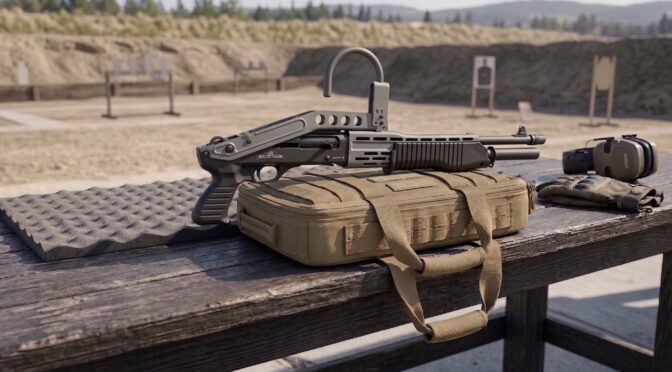
The SPA-12 is a visually striking, highly accurate reproduction of the iconic Italian Franchi SPAS-1254. The original SPAS-12 achieved legendary, near-mythical status through its extensive use in 1980s and 1990s cinema, distinguished by its massive vented heat shield and brutalist folding stock featuring a prominent arm-hook. Because original SPAS-12 shotguns are no longer manufactured, secondary market prices for authentic models frequently exceed several thousand dollars, creating a massive void in the collector’s market.

However, the defining mechanical feature of the SPAS-12—and subsequently the Sulun SPA-12—is its complex dual-mode capability54. The user can manually switch the firearm’s operating system between a traditional pump-action and a gas-operated semi-automatic mode54. This was originally designed for specialized military and law enforcement applications, allowing the semi-automatic firing of full-power buckshot, while instantly allowing a switch to pump-action to reliably cycle low-pressure, less-lethal munitions (such as tear gas canisters or beanbag rounds) which fundamentally lack the kinetic energy to cycle a semi-automatic bolt54.

Engineering a reliable dual-mode shotgun is notoriously difficult, requiring incredibly precise machining tolerances to ensure the gas system can be seamlessly engaged and disengaged by the user. By successfully launching the SPA-12, Sulun Arms has definitively proven that its R&D and manufacturing capabilities extend far beyond the simple inertia-driven clones that dominate Turkish exports54. With an expected U.S. retail price hovering around $1,000, the SPA-12 is perfectly positioned to dominate a highly lucrative, nostalgia-driven collector’s market while offering modern reliability54.

5.3. The Auslof (ST-601): Century-Old Mechanics and Legislative Arbitrage

While the TAC-12 and SPA-12 represent modern reverse-engineering of combat platforms, the Sulun Auslof (model ST-601) represents a brilliant exercise in mechanical necromancy and targeted legislative arbitrage.

The Auslof is a modern recreation of the “Alofs Reloading Magazine,” a mechanism patented in the United States in 1924 by Dutch immigrant Herman Gerrit Alofs7. Originally designed as an aftermarket bolt-on accessory to convert cheap, single-shot break-action shotguns into repeating firearms, the system was a commercial failure in the 1920s due to the rising affordability and superiority of traditional pump-action shotguns7.

The mechanism is a marvel of early twentieth-century engineering. The shotgun features a standard break-action breech, but mounted externally to the left side of the receiver is a tubular magazine and a spring-loaded, pivoting feeder tube7. The mechanical architecture relies on a streamlined three-phase sequence to cycle ammunition: First, the user manually breaks open the action to fire and eject the spent hull. Second, the physical kinetic energy of the ejected hull strikes a specialized release lever, which immediately triggers the spring-loaded feeder tube to pivot and align a fresh shell directly with the open breech. Finally, the user manually closes the action, which forces the fresh shell from the feeder into the chamber while simultaneously resetting the feeder tube to automatically receive the next round from the primary magazine7.

Sulun Arms did not resurrect this highly complex, visually archaic mechanism for tactical superiority or practical hunting advantages. They revived it strictly to bypass draconian gun control legislation in the Commonwealth. In nations like Australia and Canada, conventional semi-automatic and pump-action shotguns face severe ownership restrictions, stringent capacity limits, and outright bans. Because the Auslof’s firing cycle physically requires the user to manually break open the action for every single shot, international regulatory bodies legally classify it as a “single-shot break-action” firearm, completely immunizing it against repeating-shotgun bans. The ability to hold up to 9+1 rounds (in the extended 20-inch barrel configuration) makes the Auslof the highest-capacity, fastest-firing “single-shot” legally available in those highly restricted jurisdictions48. The Auslof brilliantly demonstrates Sulun’s corporate agility in identifying a geopolitical regulatory bottleneck and engineering a highly specific, profitable mechanical solution.

5.4. Revolving Cylinder Platforms: The SR-45 and SR-410

Continuing their strategy of legislative arbitrage, Sulun Arms developed the SR-45 and SR-410 platforms61. These are compact, revolving-cylinder firearms functioning identically to a traditional double-action revolver, but scaled up to long-gun proportions.

The SR-45 is a rifled variant chambered to accept .45 Long Colt, .45 ACP (via moon clips), and .410 bore shotshells62. The SR-410 is a dedicated smoothbore .410 gauge shotgun63. Both feature highly compact profiles, weighing between 4.5 and 4.6 pounds with barrel lengths hovering around 9.8 inches63.

In standard legislative environments, a long gun with a sub-10-inch barrel would be heavily restricted (e.g., classified as a Short-Barreled Shotgun under the National Firearms Act in the United States). However, these platforms were engineered specifically for the Canadian civilian market62. Under Canadian firearms regulations, the overall length restrictions that force firearms into the “Restricted” or “Prohibited” categories apply specifically to semi-automatic centerfire firearms or those whose length is reduced via folding or telescoping stocks57. Because the SR-series utilizes a manual double-action revolver mechanism and features a fixed stock, they bypass these specific prohibitions, remaining legally classified as “Non-Restricted” firearms in Canada despite their incredibly short, packable dimensions57.

5.5. The TACSORAS Lever-Release System

Similarly, Sulun recognized the immense demand for tactical shotguns in Australia, a nation where standard semi-automatic shotguns are strictly relegated to highly restricted Category C and D licenses, effectively banning them for average civilian ownership7.

To service this market, Sulun modified the architecture of their TAC-12 platform to create the TACSORAS66. By purposefully altering the gas system, the bolt of the shotgun locks to the rear after every single shot67. To chamber the next round, the operator must manually depress a release lever located on the side of the receiver. Because the firearm does not automatically chamber the next round via the energy of the fired cartridge, it legally circumvents the semi-automatic ban, falling into a far more accessible legislative category. This allows Australian shooters to legally own a tactical shotgun with the ergonomics and accessory compatibility of a Benelli M4, sacrificing only the automatic chambering phase of the cycle67.

6. Research and Development: The Push Toward Smart Firearms

Beyond reverse-engineering and legislative workarounds, Sulun Arms has demonstrated a willingness to push the boundaries of embedded firearm technology. This commitment to primary R&D was definitively showcased at the 2017 Prohunt Exhibition in Istanbul, where the company debuted a proprietary biometrically secured safety system for shotguns3.

6.1. The 2017 Prohunt Biometric Initiative

Integrated directly into the grip and stock of specific pump-action and semi-automatic models, the biometric system prevents the firearm’s internal sear from disengaging unless a pre-authorized user grasps the stock21.

The technology features rapid authorization protocols and an internal memory module capable of storing up to 10 distinct user fingerprints23. Power is supplied by a rechargeable battery unit yielding 60 hours of active standby time, and the system immediately engages an automatic physical lock if the user’s hand loses contact with the grip for any reason23. Furthermore, the system architecture allows for an optional GPS module to be integrated, theoretically allowing an owner to track the firearm globally23.

While biometric “smart guns” face deep, systemic skepticism in the American civilian market regarding electronic reliability under the extreme duress of a home-defense scenario, the successful development, testing, and patenting of this system is highly notable. It underscores Sulun’s internal electronic engineering capabilities—a rarity among traditional mechanical small arms manufacturers—and highlights their ambition to innovate rather than merely replicate23.

7. United States Market Strategy and Import Distribution

In the United States, Sulun products are highly sought after but historically somewhat fragmented in their distribution. Navigating the importation of foreign firearms requires specialized logistics and a deep understanding of federal regulations. Currently, the brand is imported into North America through multiple channels. SDS Imports is a major player responsible for bringing in iterations of the TAC-12, while Adrenaline Arms (operated by KDB Imports LLC, based in Easton, Pennsylvania) acts as the exclusive U.S. distributor for the Adrenaline Arms brand, which consists entirely of identical Sulun OEM models rebranded for the domestic market23.

7.1. Adrenaline Arms and the Shift in Customer Service Paradigms

Adrenaline Arms differentiates itself in the crowded, often frustrating Turkish import space through robust, transparent customer support. A primary complaint among American buyers of budget imports is the total lack of warranty service; when a small part breaks, the gun effectively becomes a useless paperweight23.

Adrenaline Arms explicitly counters this stigma by providing a comprehensive 1-year manufacturer warranty, full aftermarket support, and a deep inventory of readily available spare parts23. Their corporate philosophy mandates that inquiries are answered by a human representative rather than automated systems, guaranteeing email replies within 24 hours23. For the American consumer wary of overseas manufacturing, this level of domestic accountability acts as a massive trust multiplier, positioning Sulun firearms as a safe, supported investment rather than a disposable gamble23.

7.2. Navigating the 18 U.S.C. 922(r) Compliance Trap

For the American consumer purchasing a Sulun TAC-12, SPA-12, or any imported semi-automatic shotgun, understanding Title 18 U.S.C. Section 922(r) is of paramount legal importance. Ignorance of this federal statute can result in severe felony charges for otherwise law-abiding citizens.

Section 922(r) of the United States Code is a federal law prohibiting the assembly of any semi-automatic rifle or shotgun from imported parts if the resulting firearm contains features prohibited from importation70. Under federal import laws (specifically Section 925(d)(3)), firearms must be deemed suitable for “sporting purposes” to be legally brought into the country70. Consequently, “non-sporting” tactical features—such as magazine capacities exceeding five rounds, collapsible stocks, and independent pistol grips—are heavily restricted upon import71. To cross U.S. borders legally, the Sulun TAC-12 must arrive in a “neutered” sporting configuration, meaning it ships from Turkey with a fixed stock and a limited 5-round magazine tube28.

The profound legal peril arises when an American owner wishes to upgrade their imported TAC-12 to mirror a true combat shotgun by installing an extended 7-round magazine tube or a collapsible stock42. By adding these “non-sporting” features, the owner has technically “assembled” a firearm prohibited from importation, constituting a federal felony, unless they engage in a specific parts-swapping process to achieve 922(r) compliance70.

The Bureau of Alcohol, Tobacco, Firearms and Explosives (ATF) maintains a highly specific list of 20 regulated firearm components70. To remain legally compliant when adding non-sporting features, the upgraded imported shotgun must contain no more than 10 imported parts from that 20-part list70.

Therefore, to legally install a full-length 7-round magazine tube or a folding stock on a Sulun TAC-12, the owner must purchase and install at least three to four American-made parts to bring the total count of foreign parts down to 10 or fewer72.

Component CategoryATF 922(r) Regulated Parts ListCommon U.S. Replacement Strategy for Compliance
Trigger GroupTrigger, Hammer, Sear, DisconnectorReplacing the entire trigger group with U.S.-made parts instantly eliminates 3 to 4 foreign parts, offering an easy path to legal compliance while often improving the trigger pull weight.
FurnitureButtstock, Pistol Grip, HandguardsSwapping the factory handguard for a U.S.-made M-LOK rail (e.g., Strike Industries) removes 1 foreign part while adding accessory mounting capabilities.42
MagazineMagazine Body, Follower, FloorplateSwapping the magazine follower or the entire magazine tube (body) with an anodized U.S. variant is a cheap, easy way to eliminate foreign parts.
Core ComponentsReceiver, Barrel, Muzzle AttachmentsGenerally left as factory OEM parts, as replacing the barrel or receiver defeats the financial purpose of buying an imported firearm.73

Because the TAC-12 is a mathematically precise clone of the Benelli M4, American owners are in a highly advantageous position. They can easily utilize U.S.-made compliance kits (sold by specialized companies like Freedom Fighter Tactical) designed specifically for the Benelli, seamlessly integrating them into the Sulun platform to achieve full legal compliance while legally maximizing the firearm’s tactical capabilities40.

8. Strategic Plans for the Future

Moving into the latter half of the decade, Sulun Arms is perfectly positioned to capitalize on the widening financial gap between premium Western pricing and the purchasing power of the average consumer. The brand has successfully transcended the “cheap Turkish shotgun” stereotype by consistently proving its metallurgical competence (via properly heat-treated 4140 steel) and its engineering agility30.

Their future corporate plans clearly revolve around dominating the niche enthusiast and tactical sectors globally. The rollout of the highly complex, dual-mode SPA-12 signals a deliberate intent to conquer the high-margin nostalgia and collector market, proving they can execute multi-system actions that other OEM manufacturers shy away from. Concurrently, their continued support of the TAC-12, the Auslof, and the TACSORAS lever-release systems guarantees them steady, uncontested revenue streams from Commonwealth jurisdictions where standard semi-automatics are politically untenable7.

By anchoring their United States distribution through reliable, transparent partners like Adrenaline Arms—who offer actual warranty support and domestic parts availability—Sulun is systematically removing the final barrier to mass American adoption: the lack of consumer trust23.

9. Conclusion

For the American buyer and the professional small arms industry analyst, Sulun Arms represents the absolute vanguard of the modern Turkish defense export boom. They are not merely an anonymous factory churning out disposable white-label clones; they are an agile, R&D-focused original equipment manufacturer heavily backed by the industrial maturation of the Konya defense ecosystem.

Through the TAC-12, they successfully democratized the world’s premier combat shotgun operating system, offering elite-tier reliability to the budget-conscious consumer. Through the Auslof, the SR-series revolvers, and the TACSORAS, they demonstrated a brilliant capacity for legislative arbitrage, engineering bespoke mechanical solutions to legally bypass international gun control measures. And through the highly anticipated SPA-12 and their biometric smart-gun initiatives, they are cementing their status as a brand capable of highly complex, forward-thinking mechanical and electronic engineering. Provided they maintain their current rigorous standards for CNC machining and metallurgy, and continue to expand reliable stateside warranty support networks, Sulun Arms will undeniably secure a permanent, highly respected footprint within the global civilian and tactical firearms markets.


Please share this post with colleagues, on forums, etc. Your support is much appreciated, and if you have any feedback, please email us in**@*********ps.com.


Sources Used

  1. Sülün Arms – Strong and Fast Sülün Arms, https://sulunarms.com/
  2. Hunting Equipment Manufacturer/Producer | B2B companies and suppliers – europages UK, https://www.europages.co.uk/companies/manufacturer%20producer/hunting-equipment.html
  3. About Us – Sülün Arms, https://sulunarms.com/about-us/
  4. Topspot Guns International Corporation: Guns For Sale Philippines, https://www.topspotguns.ph/
  5. 7 Best Turkish Shotguns & What to Look for When Buying, https://www.pewpewtactical.com/best-turkish-shotguns/
  6. FIREARMS JOURNAL, https://nfa.ca/wp-content/uploads/2022/12/CFJ_JULYAUGUST22-LR.pdf
  7. Sülün Arms ST-601 “Auslof” shotgun: what’s old is new again | GUNSweek.com, https://gunsweek.com/en/shotguns/news/sulun-arms-st-601-auslof-shotgun-whats-old-new-again
  8. Australian Compliant Benelli M4 – Straight Pull Sulun Arms TAC-12 Review : r/Ausguns, https://www.reddit.com/r/Ausguns/comments/p0zpjf/australian_compliant_benelli_m4_straight_pull/
  9. Defence Industry – Invest In Konya, https://www.investinkonya.gov.tr/sectors/defence-industry
  10. A Call for Arms! Supplying the Sultan’s Army, 1916-1918, https://yoksis.bilkent.edu.tr/pdf/files/14661.pdf
  11. History of the Land Forces Command – Kara Kuvvetleri Komutanlığı, https://www.kkk.tsk.tr/en/kkksablonmaster/header/institutional/landforcescommand/history.aspx
  12. Kemal Ataturk | Biography, Reforms, Death, & Facts – Britannica, https://www.britannica.com/biography/Kemal-Ataturk
  13. Sulun-Arms-Katalog.pdf, https://sulunarms.com/Sulun-Arms-Katalog.pdf
  14. Balıklı Arms: Pistols, Rifles & Hunting Shotguns, https://balikliarms.com/en
  15. Project for Training and Analysis Aimed at Increasing Added Value in the Firearms Industry in Huğlu and Üzümlü – Konya Ovası Projesi (KOP) Bölge Kalkınma İdaresi Başkanlığı, https://www.kop.gov.tr/en/project/project-for-training-and-analysis-aimed-at-increasing-added-value-in-the-firearms-industry-in-huglu-and-uzumlu
  16. Arms export volume | Turkey (1950−2025) − Data, Charts & Analysis, https://statbase.org/data/tur-arms-export/
  17. Türkiye’s defence and aerospace exports hit $10.56bn in 2025 – TURDEF, https://turdef.com/article/tuerkiye-s-defence-and-aerospace-exports-hit-10-56bn-in-2025
  18. Turkiye Emerges As Global Defence Export Powerhouse | WION News – YouTube, https://www.youtube.com/watch?v=eKVW4L-ZRY8
  19. Turkish defense, aerospace exports top $2.8B in 4 months of 2026 | Daily Sabah, https://www.dailysabah.com/business/defense/turkish-defense-aerospace-exports-top-28b-in-4-months-of-2026
  20. Turkey | Imports and Exports | World | Arms and ammunition; parts and accessories thereof | Value (US$) and Value Growth, YoY (%) | 2011 – 2023 – TrendEconomy, https://trendeconomy.com/data/h2/Turkey/93
  21. Sülün Arms: Premium Shotgun Manufacturer | PDF | Flight | Firearms – Scribd, https://www.scribd.com/document/985754842/SULUN-ARMS-Company
  22. Find Dealers – Vector Optics, https://www.vectoroptics.com/Dealer_seek
  23. Adrenaline Arms Shotguns | Turkish Imports, Easton PA | Pennsylvania – Boise Gun Club, https://boisegunclub.com/pennsylvania/directory/adrenalinefirearms
  24. Sulun Arms LTD ŞTİ Turkey – AmmoTerra, https://ammoterra.com/company/sulun-arms
  25. Turkish Not-So-Delight. Why you should generally avoid buying those random “totally cool looking” cheap tactical shotguns made in Turkey. : r/guns – Reddit, https://www.reddit.com/r/guns/comments/n4zbt9/turkish_notsodelight_why_you_should_generally/
  26. Turkish shotguns, which are good, and which are not? | Canadian Gun Nutz, https://www.canadiangunnutz.com/forum/threads/turkish-shotguns-which-are-good-and-which-are-not.2026220/
  27. Sulun – The “Auslof” Package, everyone needs one in their collection! – YouTube, https://www.youtube.com/shorts/SUOXG0IYXCg
  28. Sulun TAC-12 M4 CLONE – True North Arms, https://truenortharms.com/sulun-tac-12-m4-clone/
  29. Best benelli m4 clone available? – Canadian Gun Nutz, https://www.canadiangunnutz.com/forum/threads/best-benelli-m4-clone-available.2143080/
  30. Typhoon combat quake #TyphoonArms #QuakeCombat #TacticalRifle #Semi-automatic #12Gauge – YouTube, https://www.youtube.com/shorts/c5URCt9QRV8
  31. How Does Heat Treating Improve CNC Machined Parts – Rapid Axis, https://rapidaxis.com/blog/how-to-improve-cnc-machined-parts-with-heat-treatment/
  32. Heat Treatment for CNC Machined Parts: The Complete Guide – uneed, https://www.uneedpm.com/heat-treatment-for-cnc-machined-parts-the-complete-guide/
  33. TAC-12 – Tamgha Arms, https://tamghaarms.com/tac-12/
  34. Thermal Processing for Firearms: The Essential Guide – Paulo, https://www.paulo.com/resources/thermal-processing-for-firearms-the-essential-guide/
  35. What is heat treatment and how does it improve CNC-machined parts? – Protolabs Network, https://www.hubs.com/knowledge-base/heat-treatments-cnc-machined-parts/
  36. Heat Treatment Guide for CNC Machined Parts: The Complete Breakdown? – Hotean CNC, https://hotean.com/blogs/hotean-blog/heat-treatment-guide-for-cnc-machined-parts
  37. Heat Treatments for CNC Machined Parts | Dassault Systèmes, https://www.3ds.com/make/solutions/blog/heat-treatments-cnc-machined-parts
  38. SDS Imports TAC-12 12 Gauge Black Semi-Auto Tactical Shotgun – Bud’s Gun Shop, https://www.budsgunshop.com/products/shotguns-tactical/sds-imports-tac-12-12-gauge-5-1-18-5-black-137742
  39. Thoughts on the Canuck Operator? Thinking about getting one since I can’t find a benelli. : r/canadaguns – Reddit, https://www.reddit.com/r/canadaguns/comments/11sdgeb/thoughts_on_the_canuck_operator_thinking_about/
  40. What is the BEST Benelli M4 Clone? : r/Shotguns – Reddit, https://www.reddit.com/r/Shotguns/comments/u0yaww/what_is_the_best_benelli_m4_clone/
  41. ST-605 – Sülün Arms, https://sulunarms.com/st-605/
  42. SULUN TAC-12 TELESCOPIC STOCK — Delta Mike Ltd, https://www.deltamike.co.nz/product/sulun-tac-12-telescopic-stock/
  43. A.R.G.O. | Benelli Shotguns and Rifles, https://www.benelliusa.com/resources/argo
  44. M4 Tactical Semi-Auto Shotguns | Benelli Shotguns and Rifles, https://www.benelliusa.com/shotguns/m4-tactical-semi-auto-shotguns
  45. Benelli M4 vs. Beretta 1301: Tactical Shotgun Battle & Specs – Guns.com, https://www.guns.com/news/reviews/benelli-m4-beretta-1301-battle-top-tactical-12-gauge
  46. Best Tactical Semi-Auto Shotgun 2026: Top 6 Ranked (Benelli M4, Beretta 1301, Mossberg 940) – Rifle Configurator, https://www.rifleconfigurator.com/guides/best-tactical-semi-auto-shotgun
  47. The Sulun Tac-12 | Tactical Semi-Auto Shotgun — Delta Mike Ltd, https://www.deltamike.co.nz/the-sulun-tac-12-tactical-semi-auto-shotgun/
  48. Sulun Arms Auslofs : r/canadaguns – Reddit, https://www.reddit.com/r/canadaguns/comments/13lg3uh/sulun_arms_auslofs/
  49. New Benelli m4. Is this normal though?, https://forums.benelliusa.com/topic/24657-new-benelli-m4-is-this-normal-though/
  50. 1st post – Advice request – Benelli, https://forums.benelliusa.com/topic/24951-1st-post-advice-request/
  51. Sulun Fixed Pistol Grip Stock for TAC12 – Delta Mike, https://www.deltamike.co.nz/product/sulun-fixed-pistol-grip-stock-for-tac12/
  52. Benelli M4 Charging Handle 7075Al Steel, Best Anti-Spin Design – Rx Arms, https://rxarms.com/products/benelli-m4-parts-and-accessories/benelli-m4-charging-handle-7075al/
  53. Benelli M4 Bolt Release Tab, No Gunsmith Required! – Rx Arms, https://rxarms.com/products/benelli-m4-parts-and-accessories/benelli-m4-bolt-release-tab/
  54. Turkish SPAS-12? | Classic Reproduction or Turkish Junk Disaster??? | Sulun SPA-12 | IWA 2026, Nuremburg, Germany : r/Firearms – Reddit, https://www.reddit.com/r/Firearms/comments/1sgu5nh/turkish_spas12_classic_reproduction_or_turkish/
  55. OMG Sulun Arms SPAS-12 Shotgun Replica IWA 2026 – YouTube, https://www.youtube.com/watch?v=BxQLsFB0Qno
  56. Sulun Arms SPASS-12, Semi Automatic & Pump Action, 21.5″ Barrel, 3″ Chamber, 5+1 Capacity, Includes Pistol Grip with Folding Hook Stock, SPAS-12 CLONE – Classic Firearms, https://www.classicfirearms.com/sulun-arms-spass-12-semi-automatic-pump-action-21-5-barrel-3-chamber-5-1-capacity-includes-pistol-grip-with-folding-hook-stock-spas-12-clone/
  57. Turkish Sulun Arms Spass-12 Clone – Moka’s Raifus, https://mokasraifus.com/product/turkish-sulun-arms-spas-12-clone/
  58. Turkey Spas12 clone 12ga shotgun – YouTube, https://www.youtube.com/watch?v=Dm7TbKZq8Ug
  59. SPAS-12 SULUN ARMS : r/Shotguns – Reddit, https://www.reddit.com/r/Shotguns/comments/1us6o3q/spas12_sulun_arms/
  60. What is Old Is New, Sulun Arms Auslof Mag Tube Fed Break Action Shotgun, https://www.thefirearmblog.com/blog/2023/05/18/sulun-arms-auslof/
  61. Non-Restricted Rifles – Page 3 – Firearms Outlet Canada, https://firearmsoutletcanada.com/non-restricted-rifles?page=3
  62. Non-Restricted Firearms : Tactical Imports Corp., https://www.tacticalimports.ca/nonrestricted-firearms-c-1/
  63. Sulun Arms SR-410 Compact Revolver Shotgun – .410GA, 2-3/4″ or 3″, 9.8″ Barrel [SR-410], https://firearmsoutletcanada.com/sulun-arms-sr-410-compact-revolver-shotgun-410ga-2-3-4-or-3-9-8-barrel-sr-410-.html
  64. Sulun Arms SR-45 .45LC & .45 ACP Revolver | Ammo Scout, https://www.ammoscout.ca/firearms/handguns/sulun-arms-sr-45-45lc-45-acp-revolver
  65. AUSTRALIAN – Sporting Shooters Association of Australia, https://www.ssaa.org.au/wp-content/uploads/Shooter-December-2021-web.pdf
  66. Sulun Arms Shotguns – Venture Hunting, https://venturehunting.com.au/collections/sulun-arms
  67. Sulun Arms TACSORAS 12 Gauge Lever Release Shotgun – 18.5in – Venture Hunting, https://venturehunting.com.au/products/sulun-arms-tacsoras-12-gauge-lever-release-shotgun-18-5
  68. Sulun Arms “Tac-12” 12g Shotgun (Benelli M4 copy) – Ozzie Reviews, https://ozziereviews.com.au/sulun-arms-tac-12-12g-shotgun-benelli-m4-copy/
  69. About – Adrenaline Arms, https://adrenalinefirearms.com/about/
  70. 922r Compliance Explained: Rules for Imported Firearms – Lynx Defense, https://lynxdefense.com/922r-compliance/
  71. 922r Compliance – Imported Firearms – RocketFFL, https://rocketffl.com/922r-compliance/
  72. Learn 922(r) – Freedom Fighter Tactical, https://freedomfightertactical.com/pages/922r-faq
  73. Imported Firearms and 922(r) Compliance | Gun Laws | The Boise Gun Club, https://boisegunclub.com/handbook/imported-firearms-922r

Rossi Arms: Corporate Evolution, Product Strategy, and Market Position Analysis

1. Executive Summary

Amadeo Rossi S.A., operating globally under the brand name Rossi, represents one of the oldest and most historically significant small arms manufacturers in South America. Founded in 1889 in São Leopoldo, Brazil, the company has navigated over a century of profound geopolitical, macroeconomic, and industrial shifts to maintain a distinct position in the modern global firearms market.1 Today, Rossi is recognized primarily for producing budget-friendly, historically inspired firearms, most notably lever-action rifles and single-shot platforms, alongside a recently revived line of stainless and carbon steel revolvers, and a newly introduced line of centerfire bolt-action rifles.17

The trajectory of Rossi cannot be understood in isolation. The brand is deeply intertwined with the broader consolidation of the Brazilian defense and sporting arms manufacturing sector. Over the past three decades, Rossi transitioned from an independent, family-run enterprise into a subsidiary brand managed by a massive corporate conglomerate. Through a series of acquisitions beginning in 1997 and culminating in corporate restructuring between 2008 and 2015, the Rossi brand was effectively absorbed by Forjas Taurus S.A. (now Taurus Armas S.A.), which was subsequently acquired by Companhia Brasileira de Cartuchos, globally recognized as CBC Global Ammunition.3 This complex corporate architecture dictates that the “Rossi” of today operates as a brand identity rather than a standalone manufacturing entity. Production is bifurcated based on firearm type: Rossi-branded revolvers are manufactured by Taurus at their facility in São Leopoldo, while Rossi-branded long guns are predominantly manufactured by CBC at their facility in Montenegro, Brazil.3

In the North American market, which constitutes the critical driver of revenue for these Brazilian exports, Rossi products are imported and serviced by BrazTech International L.C., a subsidiary of Taurus Holdings based in Bainbridge, Georgia.6 The current product portfolio emphasizes the modernization of classic designs alongside aggressive expansion into new hunting markets. The flagship lever-action lines, the R92 (a Winchester Model 1892 pattern) and the rapidly expanding R95 (a Marlin 336 pattern), are offered with modern enhancements such as threaded barrels, Picatinny rails, and Cerakote finishes. Simultaneously, the brand has entered the precision hunting market with the bolt-action Expedition and RB lines, and expanded its utilitarian offerings with the Lightweight Carbine (LWC) and the Brawler single-shot pistol.17

Despite competitive pricing and successful product line expansions, market sentiment analysis reveals persistent vulnerabilities in quality control and post-sale customer support, further exacerbated by recent financial downturns at the parent company level. The brand previously suffered significant reputational and financial damage stemming from a major drop-fire safety recall and subsequent thirty-eight million dollar class-action settlement affecting millions of revolvers produced between 2005 and 2017.8 Furthermore, current consumer reports frequently highlight mechanical friction in lever-action platforms, specifically regarding loading gate geometry and tension, and characterize BrazTech’s warranty fulfillment infrastructure as slow and opaque, recently hindered by corporate software transitions and inventory shortages.10 This report provides a detailed examination of Rossi’s corporate evolution, manufacturing infrastructure, current product segmentation, mechanical design nuances, and the ongoing dichotomy between its high-value product positioning and persistent customer service challenges.

2. Historical Evolution and Corporate Restructuring

The history of Rossi serves as an analytical model for the evolution of regional industrial manufacturing and the eventual necessity of global market consolidation. The brand has transitioned through three distinct operational eras over the last one hundred and thirty years: the independent founding era, the Taurus acquisition period, and the modern CBC Global conglomerate era.

2.1 The Founding Era and South American Industrialization

The foundation of the company dates to 1889, when Amadeo Rossi established a small machining and metallurgical operation in São Leopoldo, located in the Brazilian state of Rio Grande do Sul.1 Initially operating as a metallurgical forge and tool manufacturer, the company steadily integrated precision engineering capabilities, allowing it to transition into firearms manufacturing. By the mid-twentieth century, Amadeo Rossi S.A. had established itself as one of the largest privately held weapons manufacturers in Brazil, producing a wide array of pistols, revolvers, and shotguns for both the civilian market and domestic security forces.12

For over a century, the company remained under the operational control of the Rossi family. The brand built its reputation on a core manufacturing philosophy: delivering affordable firearms to the domestic and export markets without sacrificing basic mechanical reliability.1 Throughout the late twentieth century, Rossi achieved substantial market penetration in the United States. Initially, the company relied on third-party import entities such as Interarms, based in Alexandria, Virginia, to distribute its products to American consumers.13 During this period, Rossi became particularly well-known for its “Puma” branded Winchester 1892 clones and a series of highly affordable.38 Special and.357 Magnum revolvers. These firearms filled a distinct market void for buyers seeking the aesthetics and function of classic American firearms at a fraction of the domestic manufacturing cost.

2.2 The Taurus Partnership and Subsequent Acquisition

The late 1990s marked a pivotal shift in the Brazilian small arms industry, driven by the need for consolidated export power. Forjas Taurus S.A., another massive manufacturer operating in the same Brazilian state, recognized the strategic value of Rossi’s established market share, particularly in the competitive revolver segment. In 1997, Forjas Taurus executed a strategic agreement to purchase the exclusive rights and tooling equipment necessary to manufacture Rossi-branded revolvers.14

Concurrently, in December 1997, a new logistical entity named BrazTech International L.C. was established in Miami, Florida. BrazTech was created to serve as the exclusive North American importer for Rossi firearms, effectively cutting ties with previous distributors like Interarms.6 This reorganization created a hybrid operational model that lasted for a decade. Under this arrangement, Taurus manufactured Rossi revolvers in its São Leopoldo facility, while the Rossi family continued to independently manufacture classic rifles and single-shot shotguns in a separate plant, with BrazTech handling U.S. distribution for both product lines.6

This decade-long manufacturing partnership culminated in a complete corporate takeover. On September 9, 2008, Forjas Taurus S.A. formally announced the acquisition of the manufacturing and distribution rights for all remaining Rossi products, including the highly successful Model 92 lever-action rifles, single-shot rifles, and muzzleloaders.4 This acquisition allowed Taurus to instantly capture a ready-made, long-gun manufacturing brand, significantly diversifying its portfolio beyond handguns and mitigating the costs associated with developing a proprietary long-gun manufacturing division from the ground up.15

Diagram illustrating Rossi Arms' manufacturing flow

2.3 Integration into the CBC Global Ammunition Conglomerate

The consolidation of the Brazilian arms industry reached its apex in 2015. Companhia Brasileira de Cartuchos, a globally dominant ammunition manufacturer founded in 1926 and known internationally under its Magtech brand, took controlling interest in Taurus Armas S.A. Because Taurus outright owned the Rossi brand and its associated intellectual property, CBC effectively became the ultimate parent company of the Rossi imprint.

By 2017, the operational architecture of the brand was fundamentally reorganized to maximize industrial efficiency. CBC assumed direct physical control over the design, production, and export of all Rossi long guns, including rifles and shotguns.1 This restructuring created the current manufacturing paradigm where the Rossi brand name is utilized by separate manufacturing entities operating under the same corporate umbrella. As market analysts point out, CBC manufactures the majority of Rossi rifles at its dedicated facility in Montenegro, Rio Grande do Sul, while Taurus continues to manufacture Rossi revolvers at its original facility in São Leopoldo.5 Despite sharing the brand name and historical lineage, the administration, technological integration, and physical production lines of the rifles and revolvers are functionally distinct operations.

3. Global Manufacturing and Supply Chain Architecture

Understanding the physical origins of Rossi firearms is vital for assessing product consistency, technological integration, and quality control. The manufacturing infrastructure is divided across primary geographic and corporate nodes, each serving a distinct logistical purpose.

3.1 São Leopoldo and Porto Alegre, Brazil: Taurus Production Nodes

São Leopoldo remains the historical homeland of the Rossi brand and continues to serve as the manufacturing hub for its wheelguns.2 Operating under the direct supervision of Taurus Armas, this facility leverages decades of revolver manufacturing expertise. Today, the São Leopoldo plant is responsible for producing the newly revived RP and RM lines of stainless and carbon steel.357 Magnum revolvers. The integration with Taurus ensures that these revolvers share quality assurance protocols and material sourcing networks with Taurus’s own branded handguns. Interestingly, not all Rossi long guns originate in Montenegro; the Rossi Circuit Judge is uniquely assembled at a Taurus facility in Porto Alegre alongside the Taurus Judge revolver.

3.2 Montenegro, Brazil: Precision Rifle and Shotgun Production

In 2017, the production of all other Rossi rifles and shotguns was fully transferred to CBC’s state-of-the-art manufacturing plant in Montenegro, Rio Grande do Sul.3 Originally established in 1998 to expand CBC’s global ammunition output, the Montenegro facility was heavily updated and retooled to accommodate modern firearms manufacturing.3

This shift to CBC management marked a distinct change in the manufacturing ethos of Rossi long guns. CBC is heavily invested in mass-production efficiency, advanced metallurgical finishing, and polymer molding technologies. Consequently, modern Rossi long guns, such as the R95 lever-action and the LWC single-shot platforms, exhibit manufacturing characteristics typical of a high-volume, modern industrial plant. This includes the widespread utilization of cold-hammer-forged barrels and precise CNC machining, contrasting sharply with the more traditional, hand-fitted aesthetic of earlier generation Rossi rifles produced under independent family ownership.17

3.3 Bainbridge, Georgia, U.S.: Importation and Logistical Hub

The North American market accounts for an overwhelming majority of Brazilian firearms exports; financial disclosures indicate that the U.S. traditionally accounts for nearly eighty percent of Taurus’s total global sales.2 To manage this massive logistical requirement, Taurus Holdings Inc. utilizes BrazTech International, L.C., as the specialized importer and warranty servicer for all Rossi-branded firearms.7

For nearly four decades, Taurus USA and BrazTech were headquartered in Miami, Florida.18 However, constrained by urban sprawl and lacking the physical space necessary for industrial expansion, the company initiated a highly publicized relocation effort in 2019. Taurus Holdings officially moved its headquarters, importation operations, and domestic manufacturing capabilities to a new, purpose-built facility in Bainbridge, Georgia.

The Bainbridge facility sits on seventy-three acres in Decatur County and represents a twenty-two and a half million dollar initial infrastructure investment. Spanning over two hundred thousand square feet, the plant was designed from the ground up to optimize the efficiency of receiving, inspecting, repairing, and distributing firearms, boasting a production and processing capacity of between 6,000 and 8,000 guns per week. The relocation brought over three hundred manufacturing and administrative jobs to the rural Georgia community and positioned BrazTech in a more politically favorable and economically viable operational environment compared to metropolitan Miami.19

4. Modern Product Portfolio and Market Segmentation

Rossi’s modern product strategy relies heavily on the juxtaposition of traditional aesthetics with modern tactical and utilitarian features. The brand avoids competing in the saturated striker-fired, polymer-frame semi-automatic pistol market, leaving that specific demographic to its sister company, Taurus. Instead, Rossi dominates specific, high-demand niche categories where historical aesthetics meet modern manufacturing efficiency.

4.1 The R92 Platform: Modernizing the Winchester 1892 Action

The cornerstone of the Rossi brand is its lever-action rifle portfolio, primarily consisting of the legacy R92 platform. The Rossi R92 is a mechanical clone of the revered Winchester Model 1892, a locking-block lever action originally designed by John Moses Browning. Built specifically to handle pistol-caliber cartridges, the R92 is currently offered in a wide array of chamberings including.357 Magnum,.38 Special,.44 Magnum,.45 Colt, and the high-pressure.454 Casull.20

Rossi offers an extensive variety of configurations within the R92 line, including 16-inch, 20-inch, and 24-inch octagonal barrels, utilizing traditional hardwood stocks, grey laminates, polished stainless steel, and standard black oxide finishes.20 A notable modern addition to the R92 line is the “Triple Black” model, which features black Cerakote finishing, black wood furniture, and threaded barrels, appealing directly to the modern tactical lever-action market. Despite its enduring popularity, the R92 platform relies on a traditional top-ejecting action. This mechanical reality makes mounting modern optical sights directly over the bore exceedingly difficult.

4.2 The R95 Platform: Capturing the Marlin 336 Market Void

Introduced recently to capitalize on the soaring consumer demand for rifle-caliber lever-actions, the R95 represents a significant evolution in Rossi’s engineering strategy. Moving away from the top-ejecting Winchester designs, the R95 is functionally a clone of the Marlin Model 336. The strategic brilliance of this design choice lies in its solid-top receiver and side-ejecting bolt mechanism, which allows for the easy, secure, and flush mounting of optics directly on the receiver roof.

The R95 was engineered to be highly cross-compatible with aftermarket parts originally designed for Marlin rifles, including specialized handguards, scope rails, and upgraded sights.21 Originally chambered in.30-30 Winchester and.45-70 Government, the R95 line saw significant expansion for the 2025 market year, adding new chamberings in.44 Magnum,.357 Magnum,.444 Marlin, and the straight-walled.360 Buckhammer cartridge. The platform includes several variants, such as standard 20-inch models and the highly popular 16.5-inch Trapper model, which features a weather-resistant black oxide finish and a threaded muzzle designed for direct suppressor integration.21

A significant mechanical upgrade present in the R95 platform is the redesign of the extraction system. Unlike traditional flat-top lever actions that rely on stamped spring-steel extractors, Rossi engineered the R95 with a robust, coil-spring-actuated M16-style extractor pinned directly into the bolt body. This engineering change significantly enhances primary extraction reliability, especially when cycling modern, high-pressure hunting ammunition.

Feature ComparisonRossi R95 Trapper (.30-30 Win)Rossi R95 Trapper (.45-70 Govt)
Action TypeLever-Action (Side-Eject)Lever-Action (Side-Eject)
Barrel Length16.5 inches (Cold-Hammer-Forged)16.5 inches (Alloy Steel)
Rifling Twist Rate1:12″ Right-Hand Twist1:20″ Right-Hand Twist
Magazine Capacity5+1 Rounds5+1 Rounds
Overall Length35.5 inches35.5 inches
Weight (Unloaded)6.7 to 6.11 lbs7.40 lbs
Metal FinishBlack OxideBlack Oxide
Muzzle ThreadingUnthreadedThreaded (5/8”x24 UNF)
Extractor SystemM16-Style (Pinned/Coil Spring)M16-Style (Pinned/Coil Spring)

(Data organized from manufacturer technical specifications)

4.3 Single-Shot Utility: The Brawler and Lightweight Carbine (LWC)

In an era dominated by high-capacity semiautomatics, Rossi has carved out a successful niche by leaning into minimalist, break-action, single-shot designs. The Brawler is an unconventional break-action, single-shot pistol chambered to safely fire both.45 Colt metallic cartridges and.410 bore (3-inch) shotshells.22 Featuring a 9-inch alloy steel barrel mated to a heavily overmolded polymer receiver and grip, the weapon weighs a substantial 36.8 ounces, mitigating the recoil generated by defensive buckshot loads. Priced at a highly accessible MSRP of around two hundred and forty dollars, the Brawler is marketed primarily as a rugged utility or backpacking gun. Rossi also adapted this platform into a dedicated.300 Blackout pistol variant.23

Utilizing the same polymer-overmolded receiver architecture, the Lightweight Carbine (LWC) is a single-shot, break-action rifle designed for the minimalist hunter.24 It is offered in chamberings suited for short-range brush hunting and suppressor use, including.300 Blackout,.350 Legend, 5.56x45mm, 6.5 Creedmoor, and 8.6 Blackout.25 Weighing just over five pounds with a 16.5-inch threaded barrel, the LWC breaks down completely to fit inside a standard rucksack.25 Field testing indicates that the cold-hammer-forged barrels are capable of sub-2 MOA accuracy, making it competitive against entry-level bolt-action rifles.25

4.4 Centerfire Bolt-Action Expansion: The Expedition and RB Lines

Historically absent from the centerfire bolt-action rifle market, Rossi marked a major strategic expansion in the 2024 and 2025 market years by introducing the Expedition and RB (Rifle Bolt) platforms. This move targets the lucrative mid-tier hunting and precision shooting demographics.

The flagship Expedition model is built around the footprint of the prolific Remington 700 action, utilizing a hammer-forged barrel and a Diamond-Like Carbon (DLC) finish. It is highly modernized, feeding from AICS pattern magazines and featuring a scalloped synthetic stock with an integrated M-LOK rail and Spartan Precision attachment points for bipods and tripods. The Expedition is offered in prominent medium-game and precision calibers, including.308 Winchester, 6.5 Creedmoor,.223 Remington, and.243 Winchester, and comes standard with a threaded muzzle for suppressor use.

Complementing the Expedition is the RB line, which serves as a more traditional, entry-level bolt-action offering. Chambered in the same four calibers, the RB utilizes a carbon steel receiver and barrel treated with a weather-resistant Cerakote finish. It offers consumers the choice between a modern synthetic stock and a classic German Beech wood stock, adhering to Rossi’s philosophy of blending traditional aesthetics with modern manufacturing techniques. (Note: In the United States, the Expedition is frequently marketed and imported under the Taurus brand name, further illustrating the fluid corporate synergy between the two entities).

4.5 The Revival of the Revolver Line: RP and RM Series

Following a multi-year hiatus in revolver production, Rossi officially re-entered the double-action revolver market in 2023 with a completely redesigned lineup.27 These new revolvers abandon the troubled lockwork of the early 2000s models, representing a clean-slate engineering approach.

The new series is built entirely from satin-finished stainless steel or carbon steel and features a firing pin mounted directly to the hammer face, ensuring reliable primer detonation and eliminating the complex transfer bar block issues that plagued earlier models. The lineup consists of three primary.357 Magnum /.38 Special models: The RP63 is a 3-inch, round-butt stainless steel revolver designed for everyday concealed carry; the RM64 is a 4-inch, carbon steel model with a satin black finish marketed as a trail gun; and the RM66 is a 6-inch stainless steel model tailored for range use and hunting.28 Independent analysts note the smooth triggers, ergonomic rubber grips, and strong price-to-performance ratio.

4.6 The Circuit Judge and Specialty Shotguns

While briefly thought by some in the industry to be facing discontinuation, the Rossi Circuit Judge continues to be an active and updated part of the catalog, with a revised 2026 model recently entering the market. Originally introduced alongside the Taurus Judge revolver, it is a revolving carbine chambered in.45 Colt and.410 bore. Featuring a five-shot cylinder, a full wooden rifle stock, and a specialized gas shield mechanism to protect the shooter’s forearm from cylinder blast, it remains a unique hybrid platform. Notably, it is assembled at the Taurus factory in Porto Alegre rather than the CBC long-gun plant in Montenegro.

In the shotgun and rimfire categories, Rossi produces the Tuffy line of minimalist, single-shot.410 bore shotguns featuring skeletonized polymer stocks designed to hold extra ammunition, including extended 26-inch barrel Turkey models.29 They also maintain the Rio Bravo lever-action rimfire line and the RS22 semi-automatic platforms.30

4.7 Legacy Platforms: The Ranch Hand

The Ranch Hand, categorized legally as a handgun under United States federal law, was a “Mare’s Leg” version of the 1892 lever action.31 It featured a significantly shortened 12-inch barrel and a chopped, abbreviated stock that could not be shouldered.31 While Rossi discontinued marketing the Ranch Hand under its own imprint, the firearm is still produced on the same Brazilian assembly lines and sold under the Taurus-owned “Heritage Manufacturing” brand name, demonstrating the fluidity of product placement within the corporate conglomerate.

5. Quality Assurance, Engineering Nuances, and Mechanical Friction

A comprehensive analysis of consumer sentiment and professional gunsmith evaluations reveals a stark dichotomy within the Rossi ecosystem. Customers widely praise the conceptual design, aesthetic appeal, and raw value-proposition of the firearms. However, they uniformly criticize the execution of specific mechanical components, assembly tolerances, and systemic issues within BrazTech’s post-sale customer service infrastructure.

5.1 Raw Manufacturing Capability vs. Assembly Tolerances

These are budget-tier, mass-produced tools designed to hit aggressive retail price points. Given this economic constraint, the raw manufacturing quality, particularly on the modern CBC-produced lines like the R95 and LWC, is often considered excellent for the price. The cold-hammer-forged barrels yield impressive, repeatable accuracy, and the wood-to-metal fit on the newer R95 platforms is generally tight and well-finished.

However, cost-cutting measures during final assembly are evident. Customers frequently report minor aesthetic defects, such as noticeable daylight gaps between the wood stock and the metal receiver tang on rimfire rifles, which customer service representatives often dismiss as being within acceptable factory tolerances.5 Furthermore, the internal machining of the receivers on legacy designs often exhibits heavy tool marks and rough edges that induce operational friction. Purchasing a Rossi lever-action occasionally requires the consumer to possess basic gunsmithing knowledge to polish internals or tighten loose hardware straight out of the box.

5.2 The Lever-Action Loading Gate Failure Paradigm

The most pervasive and consistently documented mechanical flaw across Rossi’s lever-action rifles, specifically the R92 and some early production runs of the R95, involves the loading gate and cartridge feeding geometry.

Consumers routinely describe the R92 as incredibly difficult to load due to immense resistance against the loading gate after only three or four rounds are inserted.32 A critical mechanical failure point involves the internal loading gate screw. Due to inadequate torque application or a lack of thread locker applied during factory assembly, this exceptionally small screw can back out of its threads by as little as three-quarters of a turn during normal operation.10 When this occurs, the loading gate loses its rigid alignment and floats inward, directly interfering with the vertical rise of the internal cartridge carrier.10 This physical interference jams the action wide open, rendering the firearm temporarily inoperable.10

Additionally, some users have reported that the lifters on certain early R95 models were machined too long or bent at the incorrect angle, allowing live cartridges to slip past the cartridge stop and cause severe internal binding.34 These persistent issues have spawned a robust aftermarket industry offering reduced-power ejector springs, replacement followers, and instructional media for modifying factory parts.32

6. Customer Support Infrastructure and Warranty Fulfillment

While minor mechanical flaws in budget firearms are somewhat expected by the consumer base, a manufacturer’s long-term reputation relies heavily on the efficiency and transparency of its warranty support. In this specific metric, the operations handled by BrazTech and Rossi USA consistently struggle.

Rossi officially offers a one-year warranty to the original retail purchaser, promising to repair defects in material or workmanship, or replace the firearm entirely if a repair is not feasible.35 However, the real-world application of this warranty policy is fraught with extreme logistical friction. Market sentiment aggregated from specialized forums, consumer protection sites like the Better Business Bureau (where Rossi USA is currently not accredited), and editorial reviews paints a picture of a customer service apparatus in Bainbridge that is often overwhelmed, structurally opaque, and chronically short of replacement parts.

Diagram of Rossi Arms' fulfillment process

6.1 Communication Breakdowns and Repair Timelines

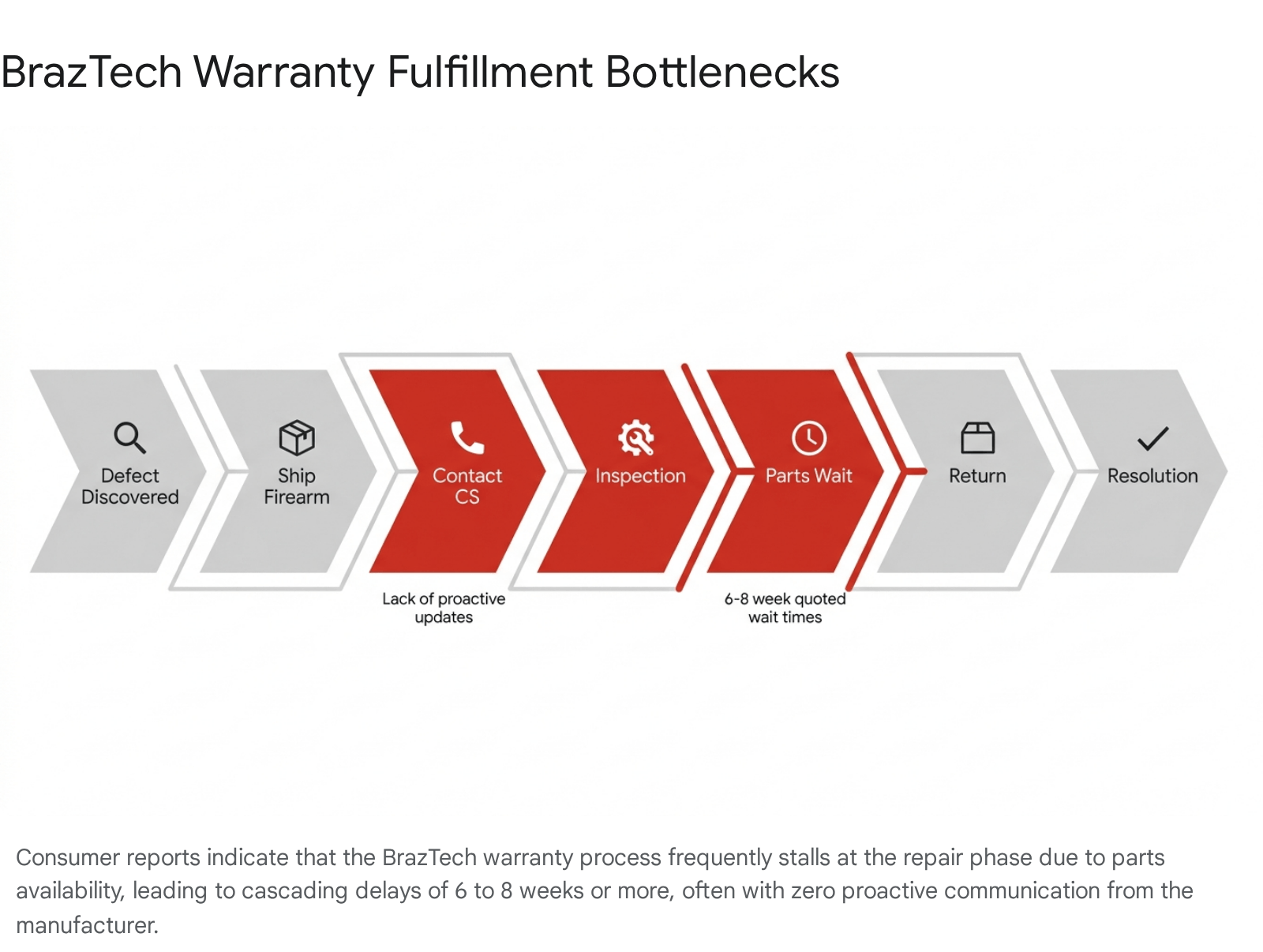
Consumers attempting to utilize the warranty service are routinely quoted four to eight weeks for highly minor repairs, such as replacing a single cross-threaded screw in the receiver body.11 In many documented cases, defective firearms sit at the Bainbridge facility for months awaiting major components, such as replacement barrels or levers, with no definitive timeline for completion provided to the owner.11

Exacerbating these delays are systemic internal disruptions. Recent records from 2025 consumer complaints indicate that BrazTech experienced significant delays stemming from an internal transition to a new Enterprise Resource Planning (ERP) software system, severely disrupting inventory fulfillment and leading to canceled replacement orders due to a lack of available stock. Furthermore, customers report that BrazTech rarely initiates proactive communication regarding repair status updates via email or phone, forcing consumers to continuously call the support line for information.38

6.2 International Parts Embargoes and the Secondary Market

The customer service issues are further magnified in international markets, such as Canada. Authorized importers and distributors often refuse to sell Original Equipment Manufacturer (OEM) replacement parts directly to consumers or independent gunsmiths, restricting parts allocation strictly to in-house factory warranty work.39 This corporate policy effectively renders out-of-warranty firearms entirely useless if a proprietary component fractures during normal use.

7. The 2019 Drop-Fire Safety Recall and Class Action Settlement

No operational analysis of the Rossi brand is complete without examining the catastrophic safety recall that fundamentally halted their revolver production for several years and resulted in a massive class-action settlement.

7.1 Identification of the Transfer Bar Defect

In September 2018, Forjas Taurus and BrazTech were forced to issue a critical, mandatory safety warning regarding multiple lines of Rossi brand.38 Special and.357 Magnum double-action revolvers. The underlying mechanical issue was a severe safety defect regarding the ignition system. Investigations revealed that the internal hammer block, utilizing a transfer bar safety mechanism, could fail under physical stress, allowing the revolver to unintentionally discharge a chambered round if the firearm was dropped or subjected to a sharp, sudden impact.8

This drop-fire defect affected an enormous swath of historical production. The recall encompassed the R35102, R35202, R85104, R97206, R97104, R46202, and R46102 model lines.40 Specifically, the safety warning included all revolvers within these model parameters manufactured between January 1, 2005, and December 31, 2017.8

7.2 Settlement Terms, Financial Impact, and the Enhanced Warranty Program

The revelation of the drop-fire defect precipitated a massive class-action lawsuit, formally styled as Burrow v. Forjas Taurus, S.A., filed in the United States District Court for the Southern District of Florida. While Taurus and BrazTech officially denied all allegations of strict liability and wrongdoing throughout the legal proceedings, the companies ultimately agreed to a comprehensive thirty-eight million dollar settlement to resolve the claims and avoid protracted litigation.9

Finalized and approved by the federal court, the settlement established robust remedies for the class members. The central pillar of the settlement mandated that BrazTech establish an “Enhanced Warranty” program managed by the legal services firm Epiq.8 Owners were instructed to ship their affected revolvers for free inspection, mechanism cleaning, and repair of the drop-fire defect by replacing the faulty transfer bar system.9 To highly incentivize consumer participation, the settlement offered a fifty-dollar cash “Inconvenience Payment” to any class member who submitted a valid claim.8 The lasting legacy of the recall forced Rossi to completely scrap its existing revolver internal architecture, culminating in the 2023 release of the RP and RM lines, which utilize a direct hammer-mounted firing pin to entirely bypass the mechanisms responsible for the 2018 failure.

8. Strategic Direction and Market Outlook

Analyzing the current trajectory of Rossi Arms, it is evident that CBC Global and Taurus Holdings are executing a highly calculated, niche-oriented market strategy. Rossi is not positioned to compete in the premium sporting rifle or duty-grade tactical handgun markets. Instead, the brand’s strategic direction relies on maintaining aggressive pricing structures, the modernization of legacy mechanical platforms, and the exploitation of utilitarian, entry-level markets.

8.1 Capitalizing on Modern Lever-Action Trends and Bolt-Action Expansion

The most vital indicator of Rossi’s future direction is the engineering philosophy behind the R95 lever-action and the LWC single-shot platforms. By equipping these traditional action types with modern accoutrements such as threaded barrels, Picatinny optics rails, and weather-resistant finishes, Rossi is aggressively targeting the modern, suppressor-owning demographic and the tactical-lever-action subculture. The introduction of new straight-walled and heavy-hitting chamberings for the 2025 R95 lineup further proves their commitment to capturing the modern hunting demographic. Additionally, the recent introduction of the Expedition and RB bolt-action platforms demonstrates a calculated effort to capture market share in the traditional North American and European hunting sectors, moving beyond their historical reliance on lever-action designs.

8.2 Supply Chain Optimization and Future Viability

Black and white photo of a clock tower

The physical and corporate bifurcation of the brand, with revolvers built by Taurus and long guns built by CBC, allows for highly optimized manufacturing based on facility expertise. However, recent economic headwinds have presented challenges. According to 2025 financial disclosures, parent company Taurus Armas S.A. reported a 13% decline in full-year revenue down to R17.7 million. These financial constraints place immense pressure on Rossi’s high-volume, low-margin business model.The physical and corporate bifurcation of the brand, with revolvers built by Taurus and long guns built by CBC, allows for highly optimized manufacturing based on facility expertise. However, recent economic headwinds have presented challenges. According to 2025 financial disclosures, parent company Taurus Armas S.A. reported a 13% decline in full-year revenue down to R17.7 million. These financial constraints place immense pressure on Rossi’s high-volume, low-margin business model.

Looking forward, maximizing the output and efficiency of the Bainbridge, Georgia facility will be the ultimate determinant of Rossi’s U.S. market health. The physical infrastructure now exists to resolve the debilitating customer service bottlenecks and manage massive production capabilities (up to 8,000 units weekly across the Taurus/Rossi/Heritage brands). If BrazTech can streamline its domestic parts availability, successfully navigate its internal software and inventory transitions, and radically improve warranty turnaround times, the value proposition of Rossi’s inherently clever and affordable designs will remain highly competitive. However, if the customer support apparatus remains opaque and inefficient amidst tightening corporate margins, the brand risks alienating its core consumer base regardless of how innovative its newest product lines may be.

9. Appendix: Methodology and Data Sources

This research report was synthesized utilizing a highly structured analytical methodology, processing a corpus of over one hundred distinct data snippets detailing the historical, operational, and market performance of Amadeo Rossi S.A., Companhia Brasileira de Cartuchos (CBC), and Taurus Armas S.A.

The core methodological approach relied on corporate genealogy mapping, where data regarding the acquisition timelines, facility locations, and corporate hierarchies were cross-referenced between official corporate histories and financial press releases to establish an accurate timeline of the brand’s transition from an independent entity to a CBC subsidiary. Product specification analysis was conducted by extracting technical metrics for current production models (including their recent entry into the bolt-action centerfire rifle market) directly from the manufacturer’s digital catalogs, product manuals, and verified third-party editorial reviews published in recognized industry periodicals.

Furthermore, qualitative consumer sentiment regarding quality control and customer service was aggregated from direct consumer reports on consumer protection platforms, specialized firearm user forums, and independent video analyses by professional gunsmiths. Anomalies or individual complaints were discarded unless corroborated by multiple independent sources, establishing a verifiable pattern of mechanical defects, warranty fulfillment delays, and internal software transitions affecting logistics. Legal documentation concerning the 2019 drop-fire safety recall and 2025 financial disclosures for Taurus Armas were sourced directly from the official settlement notices, class-action administrative documentation, and publicly traded market reports to ensure precise reporting of corporate health and liabilities.


Please share this post with colleagues, on forums, etc. Your support is much appreciated, and if you have any feedback, please email us in**@*********ps.com.


Sources Used

  1. About Us – Rossi Firearms, accessed July 6, 2026, https://rossi-international.com/rossi-about-us/
  2. Taurus Armas – Wikipedia, accessed July 6, 2026, https://en.wikipedia.org/wiki/Taurus_Armas
  3. About Us – CBC Global Ammunition -, accessed July 6, 2026, https://cbcglobal-ammunition.com/about-us/
  4. Major News: Taurus Acquires Rossi | thefirearmblog.com, accessed July 6, 2026, https://www.thefirearmblog.com/blog/2008/09/10/major-news-taurus-acquires-rossi/
  5. Rossi Quality : r/22lr – Reddit, accessed July 6, 2026, https://www.reddit.com/r/22lr/comments/14l9g1c/rossi_quality/
  6. Our History – Rossi USA, accessed July 6, 2026, https://rossiusa.com/company/about-rossi-usa/
  7. Company Information – Taurus Holdings, Inc., accessed July 6, 2026, https://www.taurususa.com/company/about-us/
  8. Warning: Some Rossi Revolvers May Fire When Dropped Owners of .38 Special and .357 Magnum Rossi revolvers can receive benefits from a Class Action Settlement., accessed July 6, 2026, https://rossirevolversettlement.com/images/documents/Notice.pdf
  9. Rossi Revolver ‘Drop-Fire’ Gun Defect Settlement Website Active – Class Action Lawsuits, accessed July 6, 2026, https://topclassactions.com/lawsuit-settlements/lawsuit-news/rossi-revolver-drop-fire-gun-defect-settlement-website-active/
  10. Lever Action Won’t Close? Loose Loading Gate Screw Fix | Over the Gunsmith’s Shoulder Ep. 31 – YouTube, accessed July 6, 2026, https://www.youtube.com/watch?v=Jm7iQXQxOKA
  11. Rossi USA | BBB Complaints | Better Business Bureau, accessed July 6, 2026, https://www.bbb.org/us/ga/bainbridge/profile/gun-dealers/rossi-usa-0743-101374/complaints
  12. Amadeo Rossi – Wikipedia, accessed July 6, 2026, https://en.wikipedia.org/wiki/Amadeo_Rossi
  13. The story of the Rossi 1892, as best I can tell… – SASS Wire Forum, accessed July 6, 2026, https://forums.sassnet.com/index.php?/topic/218209-the-story-of-the-rossi-1892-as-best-i-can-tell/
  14. Taurus Acquires Rossi Firearms – Gun Tests, accessed July 6, 2026, https://www.gun-tests.com/handguns/taurus-acquires-rossi-firearms/
  15. Rossi and Taurus Unite Legacies | An Official Journal Of The NRA – American Rifleman, accessed July 6, 2026, https://www.americanrifleman.org/content/rossi-and-taurus-unite-legacies/
  16. Companhia Brasileira de Cartuchos – Grokipedia, accessed July 6, 2026, https://grokipedia.com/page/Companhia_Brasileira_de_Cartuchos
  17. The Rossi revolution of firearm design and manufacture started with the founding of the company in 1889 by Amadeo Rossi. Over, accessed July 6, 2026, https://www.frankonia-b2b.com/images/multimedia/pdf/Rossi-Produkt-Katalog_2024-2025.pdf
  18. Taurus USA Opens Georgia Manufacturing Facility | An Official Journal Of The NRA, accessed July 6, 2026, https://www.shootingillustrated.com/content/taurus-usa-opens-georgia-manufacturing-facility/
  19. Taurus USA’s Big Move – YouTube, accessed July 6, 2026, https://www.youtube.com/watch?v=QPaE1DemMPU
  20. Lever Action Rifles | Rossi USA, accessed July 6, 2026, https://rossiusa.com/firearms/rifles/lever-action/
  21. Brazilian Cowboy: Rossi R95 Trapper Review – RifleShooter, accessed July 6, 2026, https://www.rifleshootermag.com/editorial/rossi-r95-trapper-lever-rifle/503561
  22. Review: Rossi Brawler .45 Colt/.410 Single-Shot Pistol | An Official Journal Of The NRA, accessed July 6, 2026, https://www.americanrifleman.org/content/review-rossi-brawler-45-colt-410-single-shot-pistol/
  23. Range Review: Rossi Brawler .300 BLK Single-Shot Pistol | An Official Journal Of The NRA, accessed July 6, 2026, https://www.americanhunter.org/content/range-review-rossi-brawler-300-blk-single-shot-pistol/
  24. Review: Rossi LWC | An Official Journal Of The NRA – American Hunter, accessed July 6, 2026, https://www.americanhunter.org/content/review-rossi-lwc/
  25. Rossi LWC Review: We Tested the Cheapest Deer Rifle You Can Buy – Outdoor Life, accessed July 6, 2026, https://www.outdoorlife.com/guns/rossi-lwc-tested-and-reviewed/
  26. Single Shot Rifles – Rossi USA, accessed July 6, 2026, https://rossiusa.com/firearms/rifles/single-shot-rifles/
  27. Rossi Announces Return with 3 New Revolvers – The Firearm Blog, accessed July 6, 2026, https://www.thefirearmblog.com/blog/2023/01/12/rossi-announces-3-new-revolvers/
  28. Firearm, Repair & General FAQ – Rossi USA, accessed July 6, 2026, https://rossiusa.com/support/faq/
  29. Rossi_2023_Catalog.pdf – Rossi USA, accessed July 6, 2026, https://rossiusa.com/wp-content/uploads/2025/01/Rossi_2023_Catalog.pdf
  30. PRODUCT CATALOGUE 2022 2023 | – Rossi Firearms, accessed July 6, 2026, https://rossi-international.com/wp-content/uploads/2021/10/Rossi-International-Catalogue-2022-digital.pdf
  31. Rossi Ranch Hand Review | An Official Journal Of The NRA – American Rifleman, accessed July 6, 2026, https://www.americanrifleman.org/content/rossi-ranch-hand-review/
  32. New Rossi R92 difficult to load and gouges bullet tips : r/LeverGuns – Reddit, accessed July 6, 2026, https://www.reddit.com/r/LeverGuns/comments/swq0os/new_rossi_r92_difficult_to_load_and_gouges_bullet/
  33. Fixing the Rossi R92 Loading Gate – YouTube, accessed July 6, 2026, https://www.youtube.com/watch?v=JvO-jAVdy6s
  34. Rossi r95 has serious problems : r/LeverGuns – Reddit, accessed July 6, 2026, https://www.reddit.com/r/LeverGuns/comments/1qysh6a/rossi_r95_has_serious_problems/
  35. Firearm Warranty & Repair Policy – Rossi USA, accessed July 6, 2026, https://rossiusa.com/support/repair-policy/
  36. Customer Service Rossi/Heritage | Shooters’ Forum, accessed July 6, 2026, https://forum.accurateshooter.com/threads/customer-service-rossi-heritage.4149524/
  37. Differences in Customer service | Shooters’ Forum, accessed July 6, 2026, https://forum.accurateshooter.com/threads/differences-in-customer-service.4136605/
  38. Horrible Customer Service From Rossi. (Need to Vent) : r/LeverGuns – Reddit, accessed July 6, 2026, https://www.reddit.com/r/LeverGuns/comments/10mvjq7/horrible_customer_service_from_rossi_need_to_vent/
  39. Very disappointed with Rossi service. Don’t buy a Rossi! | Canadian Gun Nutz, accessed July 6, 2026, https://www.canadiangunnutz.com/forum/threads/very-disappointed-with-rossi-service-dont-buy-a-rossi.2433276/
  40. WARNING SOME ROSSI REVOLVERS MAY FIRE WHEN DROPPED, accessed July 6, 2026, https://vpc.org/wp-content/uploads/2021/02/rossi-38.pdf
  41. Rossi Revolver ‘Drop Fire’ Gun Defect Class Action Settlement, accessed July 6, 2026, https://topclassactions.com/lawsuit-settlements/closed-settlements/rossi-revolver-drop-fire-gun-defect-class-action-settlement/

Firearm Reliability and Performance Analysis: S&W Nightguard

1.0 Executive Summary

The Smith & Wesson Nightguard series, specifically comprising the Model 386 chambered in.357 Magnum and the Model 396 chambered in.44 Special, represents a highly specialized category of defensive firearms. Originally introduced to the consumer market in 2008 and subsequently discontinued due to high manufacturing costs and shifting consumer preferences toward polymer-framed semi-automatic pistols, the Nightguard line was resurrected in 2026. This revival is the direct result of a collaboration between Smith & Wesson and Lipsey’s, a prominent national firearms distributor. The 2026 iteration merges the mechanical DNA of Smith & Wesson’s “Mountain Gun” and “Ultimate Carry” lines to produce a revolver optimized explicitly for concealed carry and close-quarters personal defense.

Constructed on the medium-sized Smith & Wesson L-Frame architecture, these revolvers utilize advanced metallurgy to achieve an extreme reduction in physical mass. The frame is forged from a proprietary scandium-aluminum alloy, while the cylinder is machined from stainless steel and treated with a Physical Vapor Deposition (PVD) coating. This combination yields an empty weight of approximately 23.4 to 24.4 ounces, an exceptionally light configuration for firearms chambered in major magnum and large-bore calibers.

Based on an exhaustive aggregation of verified consumer data, forensic product analysis, and long-term ownership reports, the Nightguard series generates highly polarized consumer satisfaction. The platform is universally praised for its carrying comfort, the inclusion of high-visibility tritium night sights, and the highly anticipated elimination of the controversial internal locking mechanism. However, the drastic reduction in weight introduces rigid physical and mechanical limitations. The recoil impulse is severe, accelerated mechanical wear is a documented reality under high-volume use, and the platform exhibits a profound susceptibility to ammunition-induced malfunctions. Prospective buyers must evaluate the Nightguard series not as a high-volume training implement, but as a specialized, low-round-count defensive tool that demands rigorous ammunition vetting and precise chemical maintenance.

Specification Model 386 Nightguard Model 396 Nightguard
Caliber .357 Magnum /.38 Special .44 S&W Special
Capacity 7 Rounds 5 Rounds
Frame Size Medium (L-Frame) Medium (L-Frame)
Empty Weight 24.4 oz 23.4 oz
Barrel Length 3.0 inches 3.0 inches
Action Double-Action / Single-Action Double-Action / Single-Action
Frame Material Scandium Alloy Scandium Alloy
Cylinder Material Stainless Steel (PVD Coated) Stainless Steel (PVD Coated)
Sights XS Tritium Front, Adjustable Rear XS Tritium Front, Adjustable Rear

2.0 Reliability and Accuracy

The mechanical reliability and practical accuracy of the Smith & Wesson 386 and 396 Nightguard revolvers are heavily contingent upon operator proficiency and strict adherence to specific ammunition parameters. When operated within its physical limitations, the platform demonstrates consistent baseline mechanical function. When pushed outside those parameters, reliability degrades rapidly.

Mechanical Accuracy and Shootability

Both the Model 386 and Model 396 are equipped with a three-inch stainless steel barrel housed within a protective scandium alloy outer shroud.1 This specific barrel length represents a half-inch extension over the legacy 2008 Nightguard specifications.2 The three-inch architecture provides two distinct mechanical advantages. First, it elongates the sight radius, theoretically improving mechanical alignment for the operator. Second, the extended barrel shroud accommodates a full-length ejector rod. A full-length ejector rod is an essential component for defensive revolvers, as it provides the physical stroke distance required to completely push expanded magnum brass out of the cylinder chambers during an emergency reload.1 Shorter, two-inch barrels often feature abbreviated ejector rods that leave empty casings partially stuck in the cylinder.

Out of the box, the revolvers feature an advanced sighting system heavily biased toward rapid, combat-effective target acquisition rather than precision bullseye shooting. The front sight is an XS Sights flat-top post featuring a centralized tritium insert surrounded by a high-visibility fluorescent green ring.1 This is paired with a fully adjustable rear sight featuring a blackened, serrated face to reduce glare.1 This configuration allows the operator to regulate the point of impact to match the wide variety of projectile weights available in both.357 Magnum and.44 Special chamberings.

Mechanical accuracy is more than sufficient for defensive applications. Bench-rested testing by consumers and analysts typically yields groups ranging from 2.0 to 3.0 inches at 25 yards when using premium defensive ammunition.3 The factory double-action trigger pull averages between 7.5 and 10.5 pounds.1 Users report that the double-action stroke is smooth and exhibits no noticeable “stacking” (a progressive increase in resistance) before the hammer breaks.4 The single-action pull breaks cleanly at approximately 3.0 to 3.5 pounds.1

Despite sound mechanical precision, practical shootability is severely challenged by the extreme recoil generated by firing high-pressure cartridges in a 24-ounce platform.4 Recoil management requires excellent grip fundamentals to prevent the disruption of the sight picture and the onset of flinching. The physical shock transmitted to the operator’s hands is substantial, often limiting practice sessions to brief intervals.

Ammunition Sensitivity and Kinetic Bullet Creep

The most critical reliability concern documented by owners is a phenomenon known as “crimp jump” or kinetic bullet creep. This malfunction is a direct result of the firearm’s lightweight construction and represents a systemic limitation inherent to all scandium alloy revolvers chambered for heavy projectiles.6

The physics of this malfunction are straightforward. When a cartridge is discharged, the 24-ounce firearm violently recoils rearward. According to the principles of inertia, the heavy lead projectiles seated in the unfired cartridges within the cylinder attempt to remain stationary. If the metallic friction and the factory brass roll crimp holding the bullet inside the casing are insufficient to overcome the recoil force, the revolver is essentially pulled backward away from the bullets. After successive shots, these unfired bullets progressively back out of their casings, protruding past the front face of the cylinder.6 Once a protruding bullet makes physical contact with the rear of the barrel forcing cone, the cylinder physically binds, completely locking the mechanism and disabling the firearm.7

Aggregated consumer data confirms this is a widespread, repeatable issue with both the Model 386 and Model 396 when firing maximum-pressure or heavy grain-weight ammunition.7 Buyers of the.44 Special Model 396 are explicitly warned by specialized ammunition manufacturers against using boutique, maximum-power loads in lightweight frames due to this exact failure mode.7

Consumers must independently test every chosen carry load. The standard protocol involves loading a full cylinder, firing all but one round, and then extracting the final unfired round to measure its overall length. If the bullet has perceptibly moved forward, that specific ammunition brand or grain weight is unsuitable for carry in the Nightguard series. Owners typically find success with standard-pressure.38 Special loads in the Model 386, or mid-velocity jacketed hollow points in the Model 396, explicitly avoiding 240-grain or heavier unjacketed lead projectiles.

Malfunction Trends and Factory Defects

Beyond the ammunition-induced cylinder lockup, the baseline mechanical operation is mostly reliable, though quality control anomalies exist. The primary documented malfunctions involve factory timing issues. Multiple users, including verified purchasers reporting on dedicated consumer platforms, have documented timing failures and cylinder binding within the first 200 rounds of operation.4

These anomalies typically manifest as the cylinder failing to “carry up” and fully lock into the indexing notch before the hammer falls. When a revolver fires slightly out of time, the bullet is not perfectly aligned with the forcing cone. This results in off-center primer strikes and the dangerous potential for lead shaving, where fragments of the bullet are sheared off and projected sideways out of the cylinder gap.4 A verified report from a 2026 purchaser detailed a severe timing failure on one specific chamber, leading to immediate factory return within a week of purchase.4

3.0 Durability and Maintenance

The structural integrity and long-term maintenance protocols of the Nightguard series differ entirely from traditional carbon steel or stainless steel revolvers. The inclusion of scandium alloy mandates highly specific care regimens to prevent rapid physical and chemical degradation.

Physical Wear and Accelerated Degradation

Scandium is a rare earth element. When alloyed with aluminum in precise quantities, it aligns the crystalline grain structure of the metal to drastically increase overall tensile strength.8 This metallurgical advancement allows a lightweight aluminum frame to withstand the internal chamber pressures of a.357 Magnum without suffering catastrophic structural failure. However, scandium alloy does not possess the same surface hardness, wear resistance, or elasticity as traditional firearm steel.9

Prolonged use of full-power magnum ammunition accelerates a condition known as frame stretch. Each discharge channels a severe recoil impulse directly through the frame, causing microscopic structural distortions.9 Over high round counts, these distortions permanently accumulate, elongating the frame window and creating excessive front-to-back play in the cylinder assembly, an issue formally known as endshake.9 As endshake increases, the cylinder acts as a slide hammer during recoil, further battering the frame and exponentially accelerating the wear cycle.9 For this reason, defensive instructors and experienced users dictate that the Nightguard series should be carried frequently but shot sparingly with full-power loads.

To combat plasma torching, Smith & Wesson engineers installed a thin, hardened stainless steel blast shield into the top strap directly above the cylinder gap.1 When a cartridge detonates, high-pressure, superheated gas escapes the gap between the cylinder and the barrel at extreme velocities. Without this protective shield, the gas would act as a plasma torch, instantly cutting a trench into the softer scandium top strap. Users must routinely inspect this blast shield during cleaning. If the shield cracks or begins to erode, the firearm must be sent to the factory for immediate replacement to prevent permanent frame destruction.

Additionally, the physical appearance of the revolver degrades rapidly. The black Physical Vapor Deposition (PVD) finish applied to the stainless steel cylinder is prone to immediate cosmetic wear.1 Drag lines, the physical scoring left by the cylinder stop riding against the cylinder during rotation, appear almost immediately upon standard operation and dry firing.4

Chemical Maintenance Realities

Routine maintenance introduces a severe and unexpected hazard for uninformed owners. The scandium frame and its proprietary clear-coat protective finish are highly vulnerable to aggressive chemical cleaning solvents.10

Standard ammoniated bore solvents, specifically foaming cleaners and traditional aggressive liquids such as Hoppe’s No. 9, have been widely reported to cause severe chemical damage to the protective finish of scandium and titanium Smith & Wesson revolvers.11 Prolonged exposure to these specific solvents can strip the clear topcoat, permanently alter the color of the underlying metal, and in extreme cases involving foaming agents, create a glue-like chemical residue that infiltrates the lockwork and physically seizes the internal trigger mechanism.12

Smith & Wesson explicitly warns against using any ammoniated or alkaline-based cleaners and completely prohibits prolonged solvent immersion or ultrasonic cleaning for the Nightguard series.13 To maintain baseline usability and prevent chemical damage, owners must exclusively utilize mild, synthetic multi-purpose lubricants (CLP) and soft nylon brushes to scrub away carbon deposits.14 The internals should only be lubricated with precise, needle-nose oilers applied specifically to the pivot pins and bearing surfaces.14

4.0 Ownership Experience and Consumer Interventions

The day-to-day reality of owning a Model 386 or Model 396 Nightguard is characterized by a balance between unparalleled carrying comfort and demanding operator interventions. Users frequently modify the platform to optimize it for personal defense.

Ergonomics and Handling

Weighing approximately 24 ounces unloaded, both revolvers are exceptionally comfortable for daily inside-the-waistband (IWB) or outside-the-waistband (OWB) carry applications.1 The frame has been thoroughly “de-horned” at the factory. This process ensures that all sharp edges on the cylinder release, rear sight assembly, and external frame contours have been aggressively rounded off to prevent snagging on clothing or holster material during an emergency draw stroke.1 Furthermore, the cylinder faces are chamfered for easier holstering, and the rear of each individual chamber is beveled to facilitate rapid reloads using speedloaders or moon clips.1

Recoil management relies entirely on the grip interface. Smith & Wesson ships the Nightguard series with Hogue Bantam overmolded rubber stocks.1 These synthetic grips feature a cobblestone texture, distinct finger grooves, and an open backstrap design.1 While the rubber compound successfully absorbs a significant portion of the recoil impulse, consumer sentiment regarding the ergonomics is mixed. A segment of the user base finds the profile perfect for concealment, while other operators report that the specific geometry of the Hogue grip places painful, localized pressure directly on the median nerve of the hand during heavy recoil.4

The Removal of the Internal Lock Mechanism

The most universally celebrated aspect of the 2026 ownership experience is the complete omission of the Smith & Wesson internal locking mechanism.1 Since 2001, almost all Smith & Wesson revolvers have featured a key-operated lock located just above the cylinder release latch.16 This mechanism has been universally detested by the consumer base due to its aesthetic disruption and, more importantly, documented instances of the locking cam engaging itself under heavy recoil, rendering the weapon completely inoperable.17

The 2026 Lipsey’s Nightguard models feature a solid frame with no internal lock, marking a highly anticipated return to traditional mechanical reliability.1 This specific design choice has generated overwhelming praise within enthusiast communities, as it eliminates a primary point of mechanical failure that operators previously had to mitigate with aftermarket plug kits.18

Required Consumer Interventions and Modifications

Achieving optimal performance frequently requires consumer intervention. Owners commonly alter the following components to elevate the firearm to an acceptable defensive standard:

  1. Grip Replacements: Due to the polarizing nature of the factory Hogue grips and their tendency to grip clothing and cause the firearm to print through garments, many users install aftermarket grips.20 Products from manufacturers like VZ Grips, Pachmayr, or Craig Spegel are highly favored.20 Hardwood or G10 composite grips conceal significantly better by allowing clothing to slide over the weapon, though they transmit substantially more kinetic shock to the skeletal structure of the hand during firing.
  2. Trigger Spring Tuning: The factory double-action trigger pull is intentionally heavy to ensure positive primer ignition across all global ammunition brands.1 Consumers frequently install aftermarket reduced-power spring kits from specialized vendors such as Wilson Combat, TK Custom, or M-CARBO to lower the trigger weight and smooth the action.22
  3. Firing Pin Extensions: Installing reduced-power mainsprings significantly increases the risk of light primer strikes, especially when utilizing magnum cartridges featuring thick primer cups. To counteract this induced failure mode, users who install spring kits must often install aftermarket extended firing pins simultaneously to guarantee reliable ignition while maintaining the lighter trigger pull.21

Holster support for the platform is exceptionally broad and robust. Because the Nightguard series utilizes the standardized L-Frame architecture paired with a 3-inch barrel, owners have immediate access to decades of aftermarket leather and Kydex holster designs originally patterned for the ubiquitous Smith & Wesson Model 686.25 Premium manufacturers such as Wright Leather Works, JM Custom Kydex, and ANR Design offer direct-fit options tailored for the L-Frame 3-inch geometry.25

5.0 Warranty, Safety Recalls, and Defect Trends

Smith & Wesson supports the Nightguard series with a comprehensive Lifetime Service Policy covering any defects in material or workmanship for the original retail purchaser.27

Safety Recalls and General Defects

An exhaustive review of federal product safety databases, the Violence Policy Center’s defect tracking records, and the manufacturer’s official recall portals confirms that there are no active, specific safety recalls for the 2026 Model 386 or Model 396 Nightguard series.29 While Smith & Wesson has issued critical safety alerts for other platforms in its catalog, the modern L-Frame scandium revolvers currently remain free of mandatory factory recalls.

However, verified consumer data reveals a noticeable trend of initial quality control defects upon retail delivery. The modern firearms industry has experienced a generalized increase in assembly line oversights, and the Nightguard series is not immune. Specific to the 386 and 396 models, users report isolated but recurring instances of improper cylinder timing, poorly machined forcing cones, and rough internal trigger engagements slipping past factory inspection protocols.4 A highly detailed account from a 2026 purchaser documented a timing failure on a single chamber that required factory warranty service within the first week of ownership, after firing fewer than 200 rounds.4

Warranty Execution and Customer Service

When defects are identified by the consumer, Smith & Wesson’s customer service apparatus is highly responsive and effective. Consumers can initiate warranty claims via a dedicated phone line or through direct online service portals.31

In instances of mechanical failure covered under the warranty policy, Smith & Wesson typically issues a pre-paid shipping label, completely absorbing the round-trip transportation costs.27 The consumer packages the unloaded firearm and delivers it to an authorized shipping hub. Because the firearm is being sent directly to the licensed manufacturer for repair and returned to the exact same original owner, federal law permits the weapon to be shipped directly back to the consumer’s private residence without requiring an intermediate, fee-based transfer through a local Federal Firearms License (FFL) dealer.33

Turnaround times vary significantly based on seasonal repair volume, but generally range from two to six weeks.11 User reports from recent years consistently indicate that the repair department frequently performs complimentary action tuning, timing adjustments, and general internal polishing while resolving the primary defect, often returning a firearm that operates smoother than standard factory specifications.33

6.0 Voice of the Customer (VoC)

To establish an objective median of consumer sentiment, raw data was aggregated from specialized firearm discussion boards, including the USCCA Community, r/Revolvers, and long-term YouTube review transcripts. The following synthesized statements reflect the prevailing attitudes, operational frustrations, and specific praises of actual owners, strictly avoiding extreme outlier opinions.

  • On Carry Comfort vs. Recoil Penalty (Sourced from r/Revolvers and GrabAGun Reviews): “The weight savings achieved by the scandium frame are undeniable, making a 7-shot L-frame revolver actually viable for daily concealed carry. However, the recoil penalty when firing full-house 158-grain magnums is brutal on the hands. It is a firearm you carry constantly but only shoot a single cylinder through at the end of your training sessions.”
  • On the Absence of the Internal Lock (Sourced from Pistol-Forum and Reddit): “The complete deletion of the internal key lock is the primary reason I purchased this revolver. It proves the manufacturer is finally listening to the enthusiast base. You receive the modern metallurgy and tritium night sights without the liability of a proprietary locking mechanism failing and seizing the gun under heavy magnum recoil.”
  • On Quality Control Skepticism (Sourced from USCCA Community): “The design concept is brilliant, but you must act as your own final quality control inspector. Mine arrived with excellent lockup, but I have documented others with timing issues straight out of the box. You absolutely cannot trust it for carry until you have personally run a few hundred rounds through the cylinder to verify the timing and mechanical alignment.”
  • On Ammunition Selection and Crimp Jump (Sourced from S&W Forums and Reddit): “If you buy the.44 Special Model 396 or the.357 Model 386, you must test your chosen carry ammo for bullet creep. I loaded heavy 200-grain rounds and the bullet backed out of the casing, locking the cylinder entirely on the fourth shot. You must exclusively utilize ammunition with a heavy, distinct roll crimp to keep the bullets seated in this lightweight frame.”
  • On Chemical Maintenance Warnings (Sourced from AR15.com and Reddit): “Do not use traditional Hoppe’s No. 9 or any foaming bore cleaners on the scandium frame. The ammonia completely strips the protective clear coat and leaves a permanent cloudy stain on the metal. You must switch to mild CLP lubricants and purely mechanical scrubbing with nylon brushes to clean the blast shield and top strap.”

7.0 Quantitative Ratings

The following metrics are rated on a strict 1 to 10 scale, derived purely from the aggregated technical specifications, metallurgical realities, and verified consumer feedback.

  • Reliability: 7/10
    Baseline mechanics are sound, but the high susceptibility to ammunition-induced crimp jump and documented instances of factory timing defects prevent a top-tier score for out-of-the-box dependability.
  • Accuracy: 9/10
    The elongated three-inch barrel, highly visible XS tritium sights, and exceptionally crisp single-action trigger provide excellent practical defensive accuracy across standard engagement distances.
  • Durability: 6/10
    While the scandium alloy prevents catastrophic frame bursting under pressure, it inherently suffers from accelerated frame stretching, endshake, and extreme chemical finish vulnerability compared to traditional forged steel frames.
  • Maintenance: 7/10
    Field stripping and internal lubrication follow standard revolver protocols, but the strict prohibition on common ammoniated solvents complicates the cleaning process and creates a hazard for uninformed users.
  • Warranty and Support: 9/10
    Smith & Wesson’s lifetime service policy is robust, generally covers two-way shipping logistics, and customer service effectively resolves mechanical defects when they arise.
  • Ergonomics and Customization: 8/10
    The de-horned frame geometry and vast L-frame aftermarket make customization simple, though the factory rubber grips cause specific nerve discomfort for a subset of the shooting population.
  • Overall Score: 7.6/10
    The Nightguard series is a highly specialized, expertly conceptualized defensive tool that demands rigorous ammunition testing, strict maintenance protocols, and meticulous chemical care from a highly educated end-user.

8.0 Pricing and Availability

The 2026 revival of the Nightguard series is distributed exclusively through Lipsey’s to localized Federal Firearms Licensees and major online vendors. Because it is a premium, specialized model utilizing expensive rare earth alloys and advanced surface coatings, the pricing reflects a top-tier market position.

  • MSRP: $1269.00
  • Minimum Observed Price: $1169.00
  • Average Observed Price: $1239.00
  • Maximum Observed Price: $1499.00

Official Manufacturer Reference:

Vendor Links:

9.0 Methodology

The generation of this forensic consumer report utilized a systematic data aggregation and filtering process to ensure absolute objectivity and strict adherence to empirical evidence.

Source aggregation prioritized primary user data and field reports over promotional marketing material. The analysis systematically scanned dedicated firearms enthusiast platforms, including the USCCA Community, r/Revolvers, AR15.com, Pistol-Forum, and detailed YouTube field-testing transcripts. These specialized platforms provide unfiltered, long-term performance data that remains uninfluenced by affiliate marketing incentives or brand sponsorships.

To maintain empirical integrity, a rigorous signal-versus-noise filtering protocol was applied to all qualitative data. Isolated consumer complaints regarding accuracy were dismissed if the phrasing indicated a fundamental lack of operator proficiency with heavy double-action triggers. Conversely, when multiple, unaffiliated users across different geographic regions reported the exact same mechanical failure (such as bullet creep locking the cylinder or chemical degradation from ammoniated solvents), these anomalies were elevated and documented as verifiable systemic trends.

Verification of safety notices and factory recalls involved cross-referencing user claims against the official Smith & Wesson consumer safety portal and the Violence Policy Center’s defect tracking databases. Pricing data was established by surveying active stock keeping units across primary digital vendors to calculate the absolute baseline, pricing ceiling, and current median retail cost, ensuring the prospective buyer receives a highly realistic financial forecast.


Note: Vendor Sources listed are not an endorsement of any given vendor. It is our software reporting a product page given the direction to list products that are between the minimum and average sales price when last scanned.


Please share this post with colleagues, on forums, etc. Your support is much appreciated, and if you have any feedback, please email us in**@*********ps.com.


Sources Used

  1. S&W’s Night Guard Series: Model 386 & 396 – Athlon Outdoors, accessed April 22, 2026, https://athlonoutdoors.com/article/sws-night-guard-series-model-386-396/
  2. New for 2026: Smith & Wesson Night Guard Revolvers | An Official Journal Of The NRA, accessed April 22, 2026, https://www.americanrifleman.org/content/new-for-2026-smith-wesson-night-guard-revolvers/
  3. Own the night – Handguns, accessed April 22, 2026, https://www.handgunsmag.com/editorial/featured_handguns_hg_ownthenight_200901/138385
  4. Smith&Wesson 386 NIGHT GUARD – Guns & Gear – USCCA Community, accessed April 22, 2026, https://community.usconcealedcarry.com/t/smith-wesson-386-night-guard/125124
  5. MODEL 386 NIGHT GUARD – Smith & Wesson, accessed April 22, 2026, https://www.smith-wesson.com/product/model-386-night-guard
  6. Crimp Jump: The revolver malfunction that can get you killed – YouTube, accessed April 22, 2026, https://www.youtube.com/watch?v=BaAm_6PpqCE
  7. Bullet jump failure : r/SmithAndWesson – Reddit, accessed April 22, 2026, https://www.reddit.com/r/SmithAndWesson/comments/1cip0st/bullet_jump_failure/
  8. How to Shear Your Scandium .44 Mag Revolver in Half – Accurate Shooter Bulletin, accessed April 22, 2026, https://bulletin.accurateshooter.com/2010/05/how-to-shear-your-scandium-44-mag-revolver-in-half/
  9. Care and Maintenance of Lightweight Revolvers | Personal Defense Network, accessed April 22, 2026, https://www.personaldefensenetwork.com/post/care-and-maintenance-of-lightweight-revolvers
  10. E:\Tri-Pac\Material Safety Data Sheets\MSDS (Tri-Pac) No. 9 Solvent – Liquid Revision 1.wpd – CopQuest, accessed April 22, 2026, https://www.copquest.com/knowledgebase/MSDS_Hoppes_No_9_Solvent.pdf
  11. S and W Scandium Guns – ltwguns.com, accessed April 22, 2026, https://forum.ltwguns.com/viewtopic.php?t=1266
  12. Hoppes 9 foaming cleaner problem? – Guns & Gear – USCCA Community, accessed April 22, 2026, https://community.usconcealedcarry.com/t/hoppes-9-foaming-cleaner-problem/110295
  13. How to Clean a Revolver: Step-by-Step Guide for Gun Owners – USCCA, accessed April 22, 2026, https://www.usconcealedcarry.com/blog/how-to-clean-a-revolver/
  14. How to Clean a Smith and Wesson Model 629 Revolver – YouTube, accessed April 22, 2026, https://www.youtube.com/watch?v=5NAZOr33nUo
  15. Wheelgun 101: Proper Maintenance of Your Smith & Wesson Revolver – Athlon Outdoors, accessed April 22, 2026, https://athlonoutdoors.com/article/smith-wesson-revolver-maintenance/
  16. The Revolver Lock Nobody Asked For – Backlash and Beyond – Lucky Gunner Lounge, accessed April 22, 2026, https://www.luckygunner.com/lounge/the-revolver-lock-nobody-asked-for-backlash-and-beyond/
  17. S&W revolver lock problems – SASS Wire Saloon, accessed April 22, 2026, https://forums.sassnet.com/index.php?/topic/286066-sw-revolver-lock-problems/
  18. INTERNAL LOCK REMOVAL – YouTube, accessed April 22, 2026, https://www.youtube.com/watch?v=LzOQ_h8-8oM
  19. Do the Smith and Wesson internal lock make or break getting one? : r/Revolvers – Reddit, accessed April 22, 2026, https://www.reddit.com/r/Revolvers/comments/13ssk8c/do_the_smith_and_wesson_internal_lock_make_or/
  20. 386 Night Guard, 2.5″ : r/Revolvers – Reddit, accessed April 22, 2026, https://www.reddit.com/r/Revolvers/comments/1qxa8n4/386_night_guard_25/
  21. Suns out wheels out for WGW! S&W 386 Nightguard + 19-9CC : r/Revolvers – Reddit, accessed April 22, 2026, https://www.reddit.com/r/Revolvers/comments/1fzx4je/suns_out_wheels_out_for_wgw_sw_386_nightguard/
  22. Wilson Combat Custom-Tune Spring Kit S&W K, L, N-Frame – MidwayUSA, accessed April 22, 2026, https://www.midwayusa.com/product/100415959
  23. Upgrade Your Revolver Performance with TK Custom Spring Kits, accessed April 22, 2026, https://tkcustom.com/collections/revolver-spring-kits
  24. Smith & Wesson J-Frame Trigger Spring Kit – Step-by-Step Install & Disassembly Guide, accessed April 22, 2026, https://www.youtube.com/watch?v=2UAMJWftgYs
  25. Smith & Wesson L-Frame Model 686 3″ Holster – Wright Leather Works, accessed April 22, 2026, https://www.wrightleatherworks.com/pages/smith-wesson-l-frame-model-686-3-holster
  26. Smith & Wesson 386 Night Guard : r/Revolvers – Reddit, accessed April 22, 2026, https://www.reddit.com/r/Revolvers/comments/1soc29g/smith_wesson_386_night_guard/
  27. Warranty | Smith & Wesson, accessed April 22, 2026, https://www.smith-wesson.com/customer-service/warranty
  28. Warranty Information – Smith & Wesson, accessed April 22, 2026, https://store.smith-wesson.com/warranty.html
  29. Consumer Firearm Recalls – Smith & Wesson, accessed April 22, 2026, https://www.smith-wesson.com/safety/recalls
  30. Gun Product Safety Notices – Violence Policy Center, accessed April 22, 2026, https://vpc.org/regulating-the-gun-industry/gun-product-safety-notices/
  31. Wesson Customer Service | Contact Us – 1-800-331-0852 – Smith, accessed April 22, 2026, https://www.smith-wesson.com/customer-service/contact-us
  32. Firearm Shipping & Returns – Smith & Wesson, accessed April 22, 2026, https://www.smith-wesson.com/customer-service/shipping-returns
  33. Has anyone here sent in a gun for a warranty repair? : r/CAguns – Reddit, accessed April 22, 2026, https://www.reddit.com/r/CAguns/comments/1ozmpi0/has_anyone_here_sent_in_a_gun_for_a_warranty/