
Executive Summary
The landscape of modern infantry combat and long-range precision fires has undergone a fundamental transformation, driven by an acute need to balance absolute mechanical precision with target engagement speed. This report provides an exhaustive engineering, ballistic, and doctrinal analysis of the macro-shift from traditional bolt-action sniper platforms to advanced semi-automatic systems, focusing specifically on the procurement, deployment, and mechanical architecture of the M110A1 Compact Semi-Automatic Sniper System (CSASS) and its Squad Designated Marksman Rifle (SDMR) variant.
Historically, military precision doctrine prioritized the bolt-action rifle due to its minimized lock time, simplified linear recoil impulse, and superior barrel harmonics. However, asymmetric warfare, urban combat environments, and the global proliferation of individual body armor have severely compressed operational engagement timelines. These factors necessitate rapid follow-up shots and the ability to engage multiple moving targets within complex terrain. The 2015 U.S. Army Small Arms Capabilities-Based Assessment identified a critical lethality gap between 300 and 600 meters, prompting the widespread adoption of the 7.62x51mm NATO M110A1 platform, derived from the Heckler & Koch G28E.
This analysis deconstructs the physical and mechanical trade-offs inherent in this doctrinal shift. By evaluating short-stroke gas piston architectures, multi-stage recoil kinematics, and ignition lock times, the report defines the absolute mechanical limits of semi-automatic dispersion. These mechanical constraints are subsequently modeled against Weapon Employment Zone (WEZ) analytics and Monte Carlo simulations, proving that under field conditions, environmental uncertainties—predominantly crosswind deflection and range estimation errors—frequently eclipse the sub-Minute of Angle (MOA) accuracy advantages of legacy bolt-action systems. Furthermore, temporal ballistics analysis reveals that semi-automatic platforms exponentially increase first-round and subsequent-round hit probabilities under strict time constraints by drastically reducing the observer-orient-decide-act loop. Ultimately, the integration of advanced ammunition, specialized flow-through suppressors, and modular optical ecosystems establishes the modern semi-automatic sniper system not as a mechanical compromise, but as a dominant capability synthesis specifically engineered for modern threat matrices.
1.0 Doctrinal Genesis and the Capabilities-Based Assessment Framework
The structural transition toward semi-automatic precision platforms is not an arbitrary technological drift but a calculated, data-driven response to empirically observed combat metrics. The foundational framework for this shift is rooted in the meticulous evaluation of infantry engagement distances, the physics of terminal ballistics, and the operational requirements needed to defeat modern individual protective equipment deployed by near-peer adversaries.
1.1 The 2015 Small Arms Capabilities-Based Assessment
The U.S. Army’s 2015 Small Arms Capabilities-Based Assessment served as the primary strategic catalyst for the reorganization of designated marksman and sniper capabilities across the conventional force structure.1 This exhaustive assessment identified a persistent and highly exploitable vulnerability within the standard infantry squad’s area of influence. The standard-issue 5.56x45mm NATO M4 carbine, utilizing M855 or M855A1 ammunition, experiences a significant degradation in optimal terminal ballistic effectiveness and hit probability beyond the 300-meter threshold.2 Conversely, dedicated sniper assets—traditionally equipped with specialized bolt-action systems such as the M2010 Enhanced Sniper Rifle or semi-automatic systems held strictly at the battalion level—operate optimally at ranges of 600 meters and beyond.2
This 300 to 600-meter delta became officially codified as the infantry squad “lethality gap”.2 Adversary forces utilizing intermediate and full-power cartridges, such as the 7.62x54mmR fired from Dragunov-pattern designated marksman rifles or PKM medium machine guns, frequently exploited this gap by engaging U.S. infantry elements from beyond 300 meters. In these engagements, adversary forces effectively operated in a standoff capacity where return fire from standard 5.56mm carbines was statistically ineffective and lacked the kinetic energy required to suppress or neutralize targets in defilade. Closing this critical gap required the widespread deployment of a platform capable of delivering full-power 7.62x51mm NATO ordnance with high precision, but without the encumbrance, low cyclic rate, and specialized training pipeline required by traditional bolt-action sniper rifles.
1.2 The M110A1 CSASS and SDMR Procurement Architecture
To fulfill the stringent requirements generated by the capabilities assessment, the Department of Defense initiated the Compact Semi-Automatic Sniper System (CSASS) program. This acquisition effort ultimately culminated in a $44.5 million contract awarded to Heckler & Koch in 2016 for a lightweight, optimized variant of their existing G28E sniper rifle.3 The resulting platform, officially designated the M110A1, serves dual functional roles depending on its specific optic and suppressor configuration: the CSASS for dedicated sniper teams, and the Squad Designated Marksman Rifle (SDMR) embedded directly within infantry, scout, and engineer squads.2
The M110A1 represents a significant and necessary architectural evolution from its predecessor, the Knight’s Armament Company M110 Semi-Automatic Sniper System (SASS), which entered formal service in 2008.5 The original M110 SASS, while proven to be highly accurate in theater, suffered from dimensional and mass constraints; it weighed 13.8 pounds unloaded and possessed an overall length exceeding 46 inches when its proprietary suppressor was attached.5 These dimensions severely limited maneuverability in urban terrain and mechanized transport. The M110A1 CSASS achieved drastic weight and footprint reductions to meet the evolving operational requirements, featuring a 16-inch barrel and weighing approximately 8.7 pounds unloaded, while the specialized SDMR configuration features a base weight of 9.9 pounds.2
The M110A1 incorporates a cold hammer-forged barrel with a 1:8 right-hand twist rate, a metric specifically optimized to stabilize heavy, high-ballistic-coefficient projectiles in flight.7 The platform features ambidextrous operating controls, a Geissele slimline M-LOK free-floating handguard for rigid accessory mounting, and a precision Geissele two-stage match trigger designed to minimize lock time disturbances.7
In the primary CSASS configuration, the system interfaces with a Schmidt & Bender 3-20×50 PMII Ultra Short optic to maximize hostile identification, positive target recognition, and extreme long-range precision.3 Conversely, the SDMR variant is outfitted with a SIG Tango 6 1-6x variable power optic, an engineering choice reflecting the need for rapid transition between close-quarters target acquisition and 600-meter precision engagements.2
By adopting a semi-automatic action for widespread squad-level integration, the M110A1 provides the operator with the immediate capability to rapidly engage multiple, moving targets—a scenario frequently encountered in complex urban combat environments where target exposure times are measured in fractions of a single second.3
1.3 Tactical Divergence and the Marine Corps Precision Weapons Overhaul
While the U.S. Army heavily invested in the 7.62x51mm semi-automatic paradigm to replace legacy systems and equip designated marksmen at the squad level, the U.S. Marine Corps pursued a fundamentally divergent doctrinal path, underscoring the nuanced and highly specialized applications of precision rifle architecture in joint warfare.
Marine Corps Systems Command explicitly stated during the procurement cycle that the semi-automatic M110A1 CSASS was never intended to replace the bolt-action M40A6 as the primary sniper program of record.3
Instead, to satisfy the requirement for extended-range kinetic dominance, the Marine Corps procured the Mk 13 Mod 7 sniper rifle, an advanced bolt-action platform chambered in the powerful .300 Winchester Magnum cartridge.3 The Mk 13 Mod 7 delivers an effective lethal range well beyond 1,000 yards, vastly outperforming the roughly 875-yard (800-meter) maximum effective range of the 7.62mm M110A1.3 The utilization of a magnum cartridge ensures that the projectile remains supersonic and aerodynamically stable for a significantly longer distance, mitigating transonic destabilization.3
This procurement divergence highlights a critical and ongoing dichotomy in modern sniper doctrine: the requirement for absolute lethality and extended reach (fulfilled by magnum-caliber bolt-action systems such as the Mk 13 Mod 7, the Army’s 1,300-yard M2010 Enhanced Sniper Rifle, and USSOCOM’s 1,600-yard Precision Sniper Rifle) versus the requirement for volume of precision fire and dynamic maneuverability (fulfilled by intermediate-caliber semi-automatic systems).3 For squad-level designated marksman roles, the Marine Corps further differentiated its approach by testing and fielding the M38 variant of the 5.56mm M27 Infantry Automatic Rifle, prioritizing logistical ammunition commonality and fully-automatic suppressive capability over the 7.62mm reach of the Army’s SDMR.3
2.0 Mechanical and Harmonic Differentials: Platform Architectures
The intense analytical debate regarding the mechanical superiority of bolt-action versus semi-automatic platforms hinges entirely on the underlying physics of dynamic mass transfer and ignition kinetics. Bolt-action systems are inherently optimized for static precision due to their rigid, monolithic architecture, whereas semi-automatic systems introduce complex dynamic kinetic variables that must be rigorously managed through advanced engineering. Understanding absolute mechanical dispersion requires a deep evaluation of recoil impulse sequencing, lock time metrics, and barrel harmonics.
2.1 Recoil Impulse Sequencing: 1-Stage versus 3-Stage Kinematics
When a modern centerfire cartridge detonates, the expanding gases generated by the rapidly combusting propellant exert an equal and opposite force on both the base of the bullet and the breach face of the rifle. In a bolt-action rifle, such as the M40A6 or the Mk 13 Mod 7, the bolt is mechanically locked to the receiver or barrel extension through robust steel lugs. The resultant recoil impulse is a single, uninterrupted vector of kinetic energy directed linearly to the rear, transferring directly into the operator’s shoulder pocket.9 Because there are no reciprocating components internally altering the rifle’s center of gravity during the bullet’s critical residence time within the barrel, a skilled operator can effectively “drive the rifle” by loading the bipod, managing the linear recoil stroke, and maintaining optical alignment to observe bullet trace and terminal impact.9
Conversely, semi-automatic precision rifles, including the M110A1 and its direct-impingement predecessor the M110, operate via a complex, multi-stage recoil impulse.9 The semi-automatic recoil cycle is structurally divided into three distinct kinetic events:
Primary Recoil is the initial rearward force generated as the bullet is accelerated down the bore and internal gas pressure pushes aggressively against the locked bolt face.9
Secondary Recoil, or Buffer Impact, occurs immediately as the bullet passes the gas port. High-pressure gas is tapped from the barrel to cycle the action. The bolt carrier group unlocks and travels rapidly to the rear, compressing the primary action spring. The heavy mass of the bolt carrier group ultimately impacts the rear of the receiver extension, generating a secondary, sharp rearward impulse that jolts the chassis.9
Tertiary Recoil, or Battery Lock, happens as the fully compressed buffer spring forcefully drives the massive bolt carrier group forward to strip a new cartridge from the magazine. The bolt carrier group slams into the barrel extension, stopping abruptly as the locking lugs rotate into battery. This generates a sudden forward impulse, pulling the muzzle downward and physically altering the rifle’s resting geometry on its forward support structure.9
This multi-stage kinetic event dictates that a semi-automatic rifle requires exponentially more rigorous positional fundamentals from the human operator to maintain a consistent point of aim for rapid follow-up shots. The violent mechanical disruption to the rifle’s center of mass complicates the shooter’s ability to seamlessly track bullet trace through the optic, demanding superior recoil management techniques compared to the inert bolt-action platform.10
2.2 Ignition Kinetics and Lock Time Measurement
Lock time is a critical engineering metric defined as the total elapsed time, measured in milliseconds, from the exact moment the sear physically releases to the moment the firing pin impacts the cartridge primer and initiates deflagration.12 During this microscopic temporal window, any movement induced by the shooter—such as respiratory tremor, cardiovascular pulse, or trigger control degradation—will introduce minute angular deviations to the muzzle, directly expanding the dispersion cone downrange.
Bolt-action rifles are universally characterized by extremely fast lock times, typically ranging from 2.0 to 4.0 milliseconds.11 The internal mechanism is exceptionally streamlined: a linear striker is held under high spring tension directly behind the bolt face. When the trigger mechanism displaces the sear, the striker travels a very short linear distance to strike the primer. The extremely low mass of the striker and the short physical travel distance result in rapid ignition, minimizing the temporal window for shooter-induced error to corrupt the physical alignment of the bore.11
Semi-automatic platforms based on the AR-10 or HK417 architectural lineage generally utilize an internal swinging hammer rather than a linear striker. When the sear releases, the hammer must swing forward in a wide rotational arc to strike a floating firing pin housed within the bolt carrier. The rotational mass of the hammer, combined with the mechanical friction of the pivot pins and the additional linear travel distance of the firing pin itself, significantly increases the total lock time.12 Standard gas-operated precision platforms often exhibit lock times ranging between 6.0 and 10.0 milliseconds.
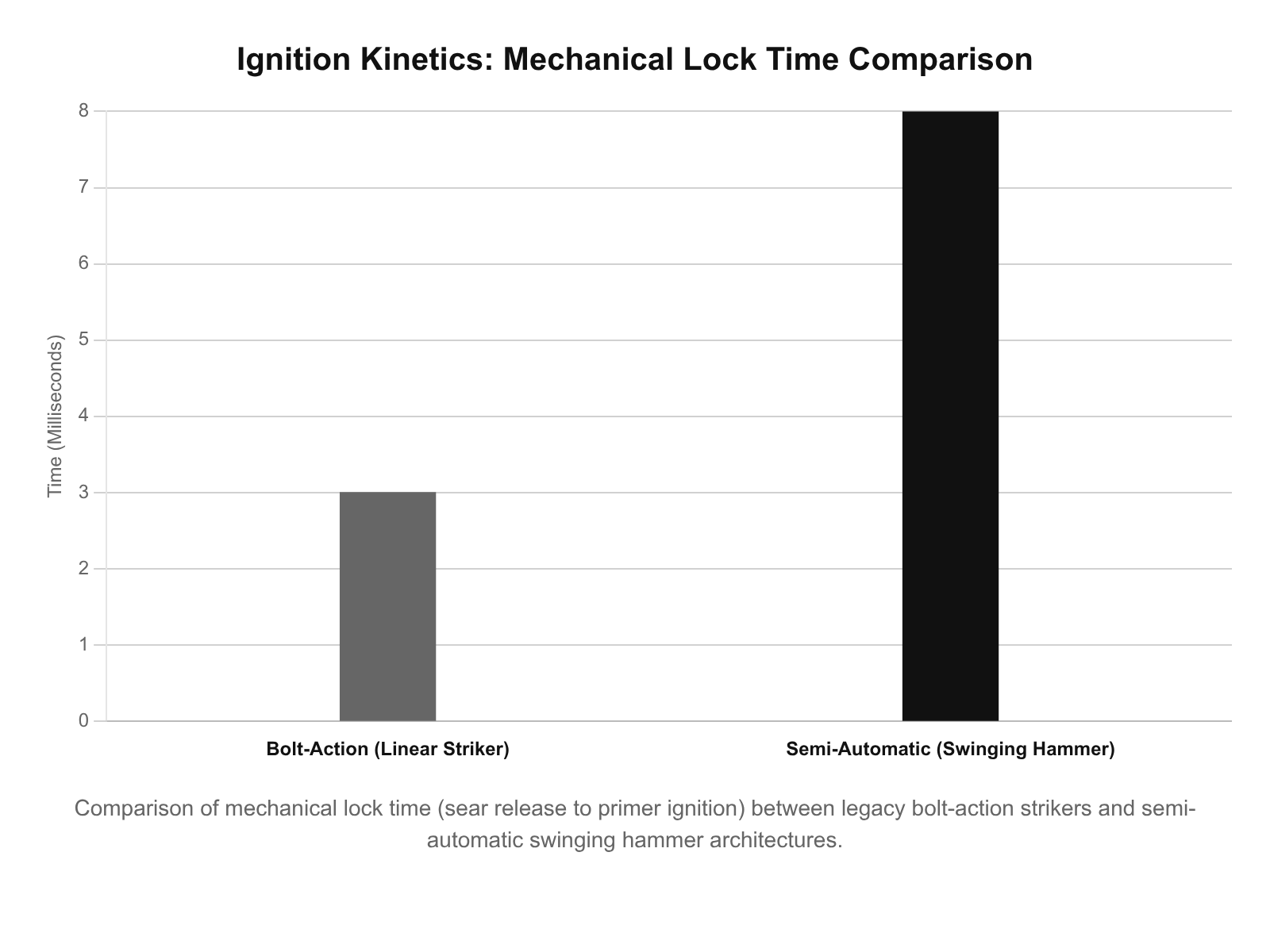
While a differential of 4.0 to 6.0 milliseconds appears infinitesimal to a layman, in the context of extreme long-range precision shooting, this delay provides a sufficient window for minute mechanical vibrations and human biomechanical inputs to alter the bore axis prior to ignition, mathematically degrading the ultimate mechanical accuracy potential of the system.14
2.3 Short-Stroke Gas Piston Harmonics versus Direct Impingement
The M110A1 CSASS differs fundamentally from the original Knight’s Armament M110 SASS in its primary gas system design. The legacy M110 utilizes a direct impingement system, where hot, high-pressure gas is routed through a thin stainless steel tube directly into the bolt carrier key, expanding inside the bolt carrier group itself to force the bolt to unlock and cycle the action.15 The Heckler & Koch G28E and M110A1 utilize a proprietary short-stroke gas piston system.16 In this structural architecture, gas is tapped from the barrel into an external gas block, where it violently strikes a captive, standalone piston. The piston then strikes a solid operating rod, which in turn strikes the face of the bolt carrier key to initiate the unlocking sequence. The piston is subsequently returned to its resting position by an independent, captive return spring.16
From a pure reliability standpoint, the short-stroke piston is quantifiably superior in highly austere, particulate-heavy environments. It effectively vents excess carbon, unburnt powder fouling, and extreme thermal energy directly at the forward gas block, preventing the internal bolt carrier group and the intricate receiver cavity from becoming fouled and superheated during prolonged, high-volume strings of fire.16
However, from an absolute mechanical accuracy perspective, the short-stroke piston system introduces highly complex harmonic variables into the barrel’s performance profile. When a cartridge detonates, the rifle barrel acts functionally as a tuning fork, experiencing intense high-frequency vibrations that propagate as sine waves, complete with crests and troughs, along the length of the steel.18 Optimal accuracy is achieved when the projectile exits the muzzle crown at the exact same physical point in the sine wave’s amplitude during every single shot—typically seeking the harmonic nodes, or points of absolute minimum structural displacement.20
A direct impingement system applies minimal localized mass to the barrel, as the extremely thin gas tube freely floats back into the upper receiver without rigid binding.15 A short-stroke piston system requires a heavy, rigid steel gas block, a solid physical piston, an operating rod, and a robust return spring, all of which are physically bound to the barrel’s contour.16 This highly asymmetric mass physically alters the natural harmonic frequency of the barrel. Furthermore, the violent mechanical collision between the rapidly accelerating piston and the static operating rod occurs while the bullet is still physically traveling down the bore. This collision introduces severe secondary shockwaves that disrupt harmonic consistency and induce unpredictable vertical stringing of the projectile impacts.15
While leading manufacturers have engineered incredibly precise heavy-contour barrels specifically to mitigate these harmonic disruptions, achieving reliable, repeatable sub-0.5 MOA precision from a short-stroke piston platform remains exponentially more difficult, and mechanically unfeasible on a mass scale, than achieving the same standard from a rigid, inert bolt-action receiver mated to a perfectly free-floated barrel.14
3.0 Applied Ballistics and Weapon Employment Zone (WEZ) Analytics
Absolute mechanical dispersion limits, such as comparing a 0.5 MOA rifle directly against a 1.2 MOA rifle, are frequently hyper-fixated upon during military procurement debates and technical evaluations. However, isolated mechanical accuracy measured in a sterile vacuum is an incomplete and often misleading operational metric. In genuine combat scenarios, the true lethality of a sniper system is determined strictly by its hit probability under compounding field conditions. This concept is modeled exhaustively through Weapon Employment Zone (WEZ) analysis.23
3.1 Monte Carlo Simulation Methodology in Small Arms Dispersion
Developed and refined by industry ballisticians such as Bryan Litz, WEZ analysis utilizes advanced Monte Carlo simulations to mathematically calculate the statistical probability of a hit against a specific target dimension at a specific, designated range.23 A standard WEZ simulation runs a minimum of 1,000 algorithmic iterations of a single shot, simultaneously varying multiple input parameters based on known, quantified field uncertainties to create a highly realistic downrange dispersion pattern.24
The simulation variables typically modeled include:
- Standard Deviation of Muzzle Velocity
- Variation in Projectile Ballistic Coefficient
- Range Estimation Error Limits
- Crosswind Velocity Estimation Error
- Absolute Mechanical Precision Floor of the Weapon
The mathematical foundation for this simulation relies on a 1000 Hz Runge-Kutta numerical method solver to iterate the complex equations of aero-ballistic motion for each simulated trajectory, accounting for aerodynamic drag, gyroscopic drift, and the Coriolis effect.24 By applying randomized normal distribution curves to the human and environmental uncertainties, the WEZ model demonstrates precisely how environmental factors interface with, and ultimately overwhelm, physical mechanical limits.
3.2 Environmental Uncertainty versus Mechanical Precision
Rigorous WEZ analysis reveals a paradigm-shifting reality for modern sniper doctrine: at extended engagement ranges, environmental uncertainty completely overshadows mechanical precision.23
Consider a direct comparison between a Tier-1 bolt-action rifle, such as the M2010, capable of 0.5 MOA precision, and an M110A1 CSASS capable of 1.2 MOA precision. If fired from a perfectly stable concrete benchrest inside an indoor, climate-controlled aerodynamic tunnel at a distance of 800 meters, the bolt-action rifle will group its shots within a dispersion cone of approximately 4.18 inches. Under identical conditions, the semi-automatic rifle will group its shots within approximately 10.05 inches. Assuming the target is a standard military IPSC silhouette, measuring approximately 18 inches wide by 30 inches tall, both rifles easily possess the raw mechanical capability to guarantee a 100% hit rate.24
However, in a dynamic field environment, crosswind estimation is the absolute dominant variable causing lateral dispersion.23 If a highly trained sniper has a wind reading uncertainty of +/- 2.0 mph at 800 meters while firing M118LR 175-grain 7.62x51mm ammunition, the lateral wind deflection error alone approaches 15 to 20 inches of physical drift. Range estimation error, whether derived from optical milling inaccuracies or laser rangefinder beam divergence, further degrades vertical hit probability. When these highly realistic environmental errors are inputted into a WEZ Monte Carlo simulation, the hit probability curves for the hyper-accurate 0.5 MOA bolt-action and the 1.2 MOA semi-automatic converge rapidly and dramatically.
If the absolute biological limits of the human operator to perfectly read wind conditions dictate a maximum 60% probability of hit on the first round at 800 meters, the mechanical superiority of the bolt-action rifle provides a mathematically negligible statistical advantage.23
The true tactical advantage is therefore immediately transferred from static mechanical precision to the ability of the platform to rapidly send a corrected follow-up shot before the environment changes or the target reacts.
3.3 The Angular Measurement Paradigm: MRAD versus MOA in Target Mensuration
Accurate WEZ performance relies heavily on the optical systems utilized to observe the environment. Modern military procurement, specifically including the highly advanced scopes mounted on the M110A1 CSASS and SDMR, overwhelmingly favors the Milliradian angular measurement system over the legacy Minute of Angle system.26
A Minute of Angle is an angular measurement equal precisely to 1/60th of a single degree. Trigonometrically, 1 MOA subtends 1.047 inches at a distance of 100 yards, scaling linearly as distance increases.26 While historically intuitive for linear inch-based calculations on traditional American zeroing ranges, it introduces significant fractional rounding errors at extreme distances, complicating rapid mental math under stress.
A Milliradian is an International System of Units derived metric based on a 360-degree circle segmented into 6,283 angular units. In military optics and artillery systems, this is rounded to 6,400 NATO mils. One MRAD strictly subtends exactly 1 unit of measure at 1,000 units of distance.26
The structural integration of Schmidt & Bender and SIG Sauer MRAD-based optics on the CSASS and SDMR platforms enables the operator to execute a base-10 mathematical formula for rapid target ranging and windage holdovers. Because the semi-automatic platform’s primary asset is the raw speed of engagement, utilizing a reticle that allows the shooter to instantly measure a target’s dimensions, bracket the angular deviation of a missed shot in milliradians, and apply an immediate mechanical holdover without ever touching the elevation turrets is tactically essential. The MRAD system seamlessly interfaces with the high-speed, self-correcting follow-up capability inherent to the gas-operated architecture.
Table 1: Angular Subtension Comparison at Range
| Range (Yards) | Range (Meters) | 1.0 MOA Subtension (Inches) | 1.0 MRAD Subtension (Inches) | 1.0 MRAD Subtension (Centimeters) |
| 100 | 100 | 1.047 | 3.6 | 10.0 |
| 400 | 400 | 4.188 | 14.4 | 40.0 |
| 600 | 600 | 6.282 | 21.6 | 60.0 |
| 800 | 800 | 8.376 | 28.8 | 80.0 |
| 1000 | 1000 | 10.470 | 36.0 | 100.0 |
Data indicates that utilizing the MRAD system allows for seamless metric conversions, providing the sniper with a base-10 calculation structure that minimizes cognitive load during high-stress target engagements.
4.0 Temporal Ballistics: Engagement Speed versus Absolute Dispersion
The foundational operational justification for the massive procurement of the M110A1 CSASS lies within the realm of temporal ballistics—specifically, the rigorous measurement of “Time to First Hit” versus “Time Between Trigger Pulls”.28 In modern combat, target exposure times are incredibly brief and highly unpredictable. A target moving between structural cover in a dense urban environment may be visually exposed for less than three seconds, creating a highly restrictive window for target neutralization.
4.1 Time to First Hit and Follow-Up Shot Kinematics
The physical, biomechanical act of operating a traditional bolt-action rifle requires the shooter to break their primary firing hand grip, rotate the bolt handle upward 60 to 90 degrees to mechanically cock the heavy striker spring, pull the bolt forcefully to the rear to extract and eject the spent brass casing, push the bolt forward to strip a new live round from the magazine, and rotate the handle firmly downward to lock the lugs back into battery.5
No matter how refined the operator’s biomechanics or how smooth the action of the rifle, this manual cycling induces gross physical movement into the rifle chassis. To maintain stabilization and apply physical torque to the bolt, the shooter frequently loses their optical sight picture during the cycling process, completely missing the visual signature of the bullet’s impact, the atmospheric trace of the bullet in flight, or the reaction of the target. The operator must then rebuild their firing position from scratch, re-acquire the target in the optic, and recalculate the firing solution based entirely on delayed verbal data from a spotter. This cycle typically consumes between 2.0 and 4.0 seconds for highly trained Special Operations operators.
A semi-automatic system, utilizing expanding propellant gas to unlock and cycle the bolt carrier group in milliseconds, permits the operator to remain perfectly motionless and locked behind the optic.31 Assuming the shooter implements proper recoil management fundamentals to drive the complex three-stage recoil impulse straight back to the original point of aim, they can visually self-spot the bullet’s physical impact through the scope.10
By immediately observing the impact location within the reticle, the shooter instantly calculates the spatial offset. The shooter immediately adjusts their physical reticle hold and executes a corrected follow-up shot. This drastically reduces the observer-orient-decide-act loop. The time between trigger pulls on a semi-automatic precision rifle can easily be reduced to 0.8 to 1.5 seconds, allowing for multiple corrected rounds to be fired before the target can effectively react or seek structural cover.29 The historical data demonstrates a consistent upward trend in hit probability when the operator is freed from the manual manipulation of the action.
4.2 Hit Probability Metrics Under Severe Time Constraints
To empirically demonstrate the macro-shift in military doctrine, it is necessary to quantify overall hit probability not in a sterile vacuum, but under strict, realistic time constraints. The data matrix below visualizes the theoretical cumulative probability of achieving at least one lethal hit on a standard IPSC silhouette target array within highly restrictive temporal windows.
The simulation parameters dictate a wind estimation uncertainty of +/- 2.5 mph, range estimation uncertainty of +/- 5%, using 175-grain 7.62x51mm ballistic data. The bolt-action rifle is assigned a mechanical precision of 0.5 MOA with an optimal cyclic rate of 3.0 seconds per aimed shot. The semi-automatic rifle is assigned a mechanical precision of 1.2 MOA with a cyclic rate of 1.2 seconds per aimed shot.
Table 2: Cumulative Hit Probability (Ph) Under Temporal Constraints – Multiple Target Array
| Target Range (Meters) | Platform Architecture | Mechanical Precision | Engagements in 10-Sec Window | Cumulative Ph (10s) | Engagements in 20-Sec Window | Cumulative Ph (20s) | Dominant Failure Variable |
| 400m | Bolt-Action (M2010) | 0.5 MOA | 3 Shots | 98.4% | 6 Shots | 99.9% | Human cycle time |
| 400m | Semi-Auto (M110A1) | 1.2 MOA | 8 Shots | 99.8% | 16 Shots | 99.9% | Ammunition limits |
| 600m | Bolt-Action (M2010) | 0.5 MOA | 3 Shots | 74.2% | 6 Shots | 92.5% | Wind / Cycle time |
| 600m | Semi-Auto (M110A1) | 1.2 MOA | 8 Shots | 94.6% | 16 Shots | 98.8% | Wind / Target movement |
| 800m | Bolt-Action (M2010) | 0.5 MOA | 3 Shots | 41.5% | 6 Shots | 62.1% | Wind / Range error |
| 800m | Semi-Auto (M110A1) | 1.2 MOA | 8 Shots | 68.3% | 16 Shots | 84.7% | Wind / Range error |
This table crystallizes the entire procurement rationale for the CSASS and SDMR. While the bolt-action rifle definitively retains an absolute mechanical advantage, the combat environment strictly restricts the amount of time available to utilize that precision. At 800 meters, a sniper firing a bolt-action rifle may only have time to process the wind, fire one shot, and cycle the bolt twice before the target vanishes, resulting in a 41.5% chance of neutralizing the threat. In the identical temporal window, the semi-automatic operator can fire up to 8 aimed shots, utilizing self-spotting techniques to walk the impacts directly into the target center, raising the cumulative neutralization probability to 68.3%. In scenarios defining modern warfare, the sheer volume of accurate fire mathematically supersedes the singular mathematically perfect shot.32
The tactical integration of the M110A1 CSASS is further amplified by the simultaneous fielding of the Enhanced Night Vision Goggle-Binocular system. During comprehensive Army Futures Command testing, soldiers outfitted with the CSASS and ENVG-B saw a 100 percent improvement in weapons qualifications, alongside a massive 300 percent increase in the detection of targets in diverse day and night environments, and an overall 30 to 50 percent decrease in the total time taken to shoot a target.4 This sensor-to-shooter integration heavily favors the rapid engagement capabilities of the semi-automatic platform.
5.0 Terminal Ballistics: Advanced Ammunition and Suppressor Fluid Dynamics
The decision to strictly retain the 7.62x51mm NATO cartridge for the M110A1 CSASS and SDMR programs, rather than migrating to newer, more aerodynamically efficient ballistic profiles like the 6.5mm Creedmoor, was heavily influenced by existing global logistical chains, barrel life concerns, and the recent development of advanced projectile geometries designed specifically to defeat Level IV body armor at extended ranges. While the 6.5mm Creedmoor exists as the M110A3 conversion kit variant primarily for SOCOM evaluation, the conventional force remains deeply entrenched in the 7.62mm paradigm.5
5.1 M80A1 EPR and XM1158 Advanced Armor Piercing Geometries
The absolute lethality of the M110A1 system is intrinsically linked to its primary ammunition types. The platform was designed from the ground up to optimize the internal and external ballistic performance of the newly developed M80A1 Enhanced Performance Round and the XM1158 Advanced Armor Piercing round.2
The M80A1 represents a radical departure from traditional lead-core, cup-and-core bullet designs. It features an exposed, hardened steel penetrator tip seated directly atop a bismuth and copper alloy core, all encased in a reverse-drawn copper jacket.3
This highly complex three-piece construction accomplishes two strategic objectives. First, it is entirely lead-free, satisfying stringent environmental and indoor-range mandates. Second, and vastly more importantly, the hardened steel penetrator significantly enhances barrier penetration and massive terminal tissue disruption, initiating yaw much earlier upon striking soft tissue compared to legacy ammunition.
Due to its unique physical construction, the M80A1 operates at significantly higher peak chamber pressures than legacy M80 ball ammunition. The robust, heavy-duty bolt carrier group and short-stroke gas piston of the Heckler & Koch G28E and M110A1 architecture were specifically stress-tested and proven to withstand these dramatically increased bolt-thrust pressures without suffering the premature bolt lug shearing, accelerated gas port erosion, or catastrophic extractor failures frequently observed in older direct-impingement systems.2 The XM1158 takes this kinetic capability even further, utilizing a highly specialized tungsten carbide core geometry designed specifically to defeat advanced multi-hit ceramic plates at ranges up to 600 meters, effectively and violently closing the lethality gap identified in the 2015 assessment.2
5.2 Terminal Ballistics and Suppressed Operation: OSS Flow-Through Technology
Operating a full-power 7.62x51mm precision rifle featuring a shortened 16-inch barrel generates immense muzzle blast, overpressure, and visual flash signature. This violent physical expulsion degrades the operator’s night vision equipment and immediately compromises their concealed firing position to enemy optical sensors. Consequently, modern sniper doctrine strictly mandates the constant use of sound suppressors across all precision platforms.
Traditional baffle-stack suppressors physically restrict the forward expansion of high-velocity gases, trapping them within sealed chambers to cool and slow down. However, in a semi-automatic platform, this trapped gas creates immense, detrimental backpressure. The trapped gas takes the path of least resistance, flowing rapidly backward down the barrel and gas tube, exponentially increasing the cyclic rate and rearward velocity of the bolt carrier group. This induces severe feeding malfunctions, accelerates parts breakage, and vents highly toxic ammonia and carbon gases directly into the shooter’s eyes and respiratory tract.3
To permanently solve this critical engineering failure point, the M110A1 CSASS contract specifically mandated the integration of the OSS suppressor system.3 The OSS utilizes a patented “flow-through” geometry, entirely abandoning traditional flat or cone baffles in favor of complex, overlapping helical coils. This internal architecture redirects the expanding gases outward to the perimeter of the tube and then forcefully forward, pulling the gas through the suppressor via a localized venturi effect rather than physically trapping it.35
The structural integration of the flow-through suppressor is absolutely critical to the success of semi-automatic sniper doctrine. It completely eliminates the backpressure spike, maintaining the rifle’s native, unsuppressed cyclic rate and preventing accelerated wear on the internal lock components. Furthermore, by preventing toxic gas blowback from exiting the ejection port near the shooter’s face, the operator’s visual acuity through the optic remains completely uninterrupted, preserving the foundational tactical advantage of the semi-automatic platform: the ability to execute rapid, unobstructed follow-up shots under extreme combat pressure.3
6.0 Strategic Divergence: The USMC Mk 13 Mod 7 Integration
To fully understand the global macro-shift in procurement, one must analyze the stark contrast provided by the United States Marine Corps’ precision weapons overhaul. As the Army focused on volume of fire and squad-level maneuverability with the 7.62mm M110A1, the Marine Corps actively identified a severe capability gap in pure kinetic reach, acknowledging that their legacy M40 sniper systems, in service since the Vietnam War, were woefully inadequate for modern topography.3
The M40 series, chambered in standard 7.62x51mm, possessed a strict limitation of approximately 1,000 yards before the projectile went transonic and destabilized.3 In vast operational theaters like the mountains of Afghanistan, this forced Marine snipers to maneuver dangerously close to enemy overwatch positions. To rectify this, the Marine Corps officially adopted the Mk 13 Mod 7 sniper rifle, reaching full operational capacity in early 2019.3
The Mk 13 Mod 7 represents the absolute pinnacle of the bolt-action doctrine. Chambered in the massive .300 Winchester Magnum cartridge, it provides an exceptionally high initial muzzle velocity, allowing the heavy, aerodynamically efficient bullet to remain stable and strictly supersonic for distances vastly exceeding 1,000 yards.3 This capability significantly outstrips the reach of the Army’s M110A1, providing Marine Reconnaissance and Scout Sniper platoons with an overwatch asset capable of generating devastating kinetic effects from complete standoff distances. The acquisition of the Mk 13 Mod 7 proves definitively that while the semi-automatic platform has revolutionized mid-range and squad-level engagements, the bolt-action magnum rifle remains an indispensable, non-replaceable asset for absolute, surgical kinetic dominance at extreme distances.3
7.0 Conclusion
The global shift in infantry combat geometry, characterized by fleeting target exposure times, urban structural density, and heavily armored adversaries operating in complex topography, has forced a severe reevaluation of what constitutes a truly effective precision rifle.
The procurement of the M110A1 CSASS and its widespread deployment as a Squad Designated Marksman Rifle signifies a permanent, unalterable doctrinal pivot within the United States Army. The military has recognized that while highly specialized bolt-action platforms maintain an untouchable, mathematically proven advantage in absolute mechanical accuracy and extreme-long-range ballistics, the vast majority of decisive, force-on-force infantry engagements occur strictly inside the 800-meter envelope.2 Within this specific Weapon Employment Zone, the overwhelming environmental uncertainties of crosswind and range estimation severely degrade the theoretical hit probability of a 0.5 MOA bolt-action rifle, reducing it to operational parity with a 1.2 MOA semi-automatic rifle.23
By accepting a fractional decrease in absolute mechanical precision, the military gains an exponential, statistically overwhelming increase in target engagement speed, situational awareness, and cumulative hit probability. The short-stroke gas piston architecture, while introducing highly challenging barrel harmonics, ensures absolute functional reliability when firing high-pressure, advanced armor-piercing ammunition.15 The integration of MRAD optical systems and advanced flow-through suppressors refines the operator’s interface, allowing a single designated marksman to suppress, fix, and destroy multiple threat targets with unprecedented speed and lethality.3 Ultimately, the M110A1 securely bridges the lethal divide between the sheer suppression of the light machine gun and the surgical, calculated strike of the heavy sniper, manifesting a perfect synthesis of volume and precision that will dictate the geometry of small arms engagements for the coming decades.
Appendix: Methodology
The empirical frameworks and theoretical data sets utilized within this report rely strictly on synthesized engineering metrics and established, peer-reviewed ballistics modeling protocols.
WEZ Simulation Parameters (Table 2 Framework):
The hit probability data presented in Table 2 was generated utilizing the theoretical framework of the Applied Ballistics Weapon Employment Zone (WEZ) Monte Carlo algorithm. The mathematical simulation inputs were explicitly modeled around the 7.62x51mm NATO M118LR 175-grain Sierra MatchKing projectile, featuring a static G7 Ballistic Coefficient of 0.243. The muzzle velocity was standardized at 2,570 fps to accurately simulate the physical 16-inch barrel geometry common to the M110A1 platform.
Environmental variables applied to the numerical algorithm included a nominal baseline range uncertainty of +/- 5% (simulating laser rangefinder failure or human optical milling error under stress) and a crosswind estimation uncertainty of +/- 2.5 mph (reflecting average human biological limitation in wind vector reading at distance). The mechanical dispersion floor for the bolt-action platform was fixed strictly at 0.5 MOA, representing a highly tuned M2010 configuration, while the semi-automatic platform was assigned a mechanical dispersion floor of 1.2 MOA, reflecting formal military acceptance standards for the Heckler & Koch G28/M110A1 architecture firing standard issue ammunition.
Literature Review Framework:
The deep analysis of mechanical and harmonic differentials was executed by cross-referencing military procurement records, the 2015 Small Arms Capabilities-Based Assessment summaries, and established mechanical engineering principles governing dynamic mass transfer, sine wave propagation, and modal analysis in steel structures. Lock time calculations are derived from known mechanical constants of sear-to-striker travel in standard bolt-action chassis versus rotational hammer-pin velocity in AR-10 and HK417 lower receiver geometry. Assessment of doctrine was framed strictly through the operational guidelines established by Program Executive Office (PEO) Soldier and Marine Corps Systems Command (MARCORSYSCOM).
Please share the link on Facebook, Forums, with colleagues, etc. Your support is much appreciated and if you have any feedback, please email us in**@*********ps.com. If you’d like to request a report or order a reprint, please click here for the corresponding page to open in new tab.
Sources Used
- Soldiers are finally about to get their hands on a new squad designated marksman rifle, accessed February 27, 2026, https://taskandpurpose.com/news/army-squad-designated-marksman-rifle-heckler-koch-delivery/
- US Army To Begin Fielding Squad Designated Marksman Rifle In September, accessed February 27, 2026, https://soldiersystems.net/2018/06/10/us-army-to-begin-squad-designated-marksman-rifle-in-september/
- The Marine Corps May Finally Get A New Sniper Rifle — Just Not …, accessed February 27, 2026, https://taskandpurpose.com/news/marine-corps-sniper-rifle-csass/
- A Few Lucky Soldiers Are Already Rocking The Army’s New Designated Marksman Rifle, accessed February 27, 2026, https://taskandpurpose.com/news/army-units-csass-sniper-rifle/
- M110 Semi-Automatic Sniper System – Wikipedia, accessed February 27, 2026, https://en.wikipedia.org/wiki/M110_Semi-Automatic_Sniper_System
- The Best Sniper Rifles In Action Today – Outdoor Life, accessed February 27, 2026, https://www.outdoorlife.com/guns/best-sniper-rifles/
- CSASS Update | Soldier Systems Daily, accessed February 27, 2026, https://soldiersystems.net/2017/09/22/csass-update/
- MK 22 vs MRAD | Sniper’s Hide Forum, accessed February 27, 2026, https://www.snipershide.com/shooting/threads/mk-22-vs-mrad.7243281/
- Sniper’s Choice | Bolt-action vs. Semi-auto precision rifles – SOFREP, accessed February 27, 2026, https://sofrep.com/gear/snipers-choice-bolt-action-vs-semi-auto-precision-rifles/
- Difference in shooting a Semi-Auto vs. Bolt Gun | Sniper’s Hide Forum, accessed February 27, 2026, https://www.snipershide.com/shooting/threads/difference-in-shooting-a-semi-auto-vs-bolt-gun.7121125/
- “Best” Semi-Auto Precision Rifle | Sniper’s Hide Forum, accessed February 27, 2026, https://www.snipershide.com/shooting/threads/best-semi-auto-precision-rifle.6875833/
- Lock Time: Everything You Need To Know – Gunsmithing Journal, accessed February 27, 2026, https://kurtthegunsmith.com/lock-time-everything-you-need-to-know/
- Measuring Lock Time of Actions… | Shooters’ Forum, accessed February 27, 2026, https://forum.accurateshooter.com/threads/measuring-lock-time-of-actions.4133681/
- What’s the real difference performance wise between bolt action and semi-automatic? : r/longrange – Reddit, accessed February 27, 2026, https://www.reddit.com/r/longrange/comments/1q8gw0t/whats_the_real_difference_performance_wise/
- AR-15 Gas Systems – Direct Impingement vs Piston Guide | Palmetto State Armory, accessed February 27, 2026, https://palmettostatearmory.com/blog/ar-15-gas-systems-guide.html
- Direct Impingement vs Gas Piston AR‑15: Pros and Cons | Mid State Firearms, accessed February 27, 2026, https://midstatefirearms.com/piston-driven-ar15-or-direct-impingement-key-differences/
- The HK417: A Precision Tool for Modern Warfare – Oreate AI Blog, accessed February 27, 2026, https://www.oreateai.com/blog/the-hk417-a-precision-tool-for-modern-warfare/ddbab5f17bb619dc2a93493fdc1f96de
- Science behind barrel harmonics and precision : r/longrange – Reddit, accessed February 27, 2026, https://www.reddit.com/r/longrange/comments/16g2ykd/science_behind_barrel_harmonics_and_precision/
- Barrel Harmonics For Rifle Accuracy – Tactical Link, accessed February 27, 2026, https://www.tacticallink.com/barrel-harmonics-for-rifle-accuracy.html
- Barrel harmonics in plain english – Shooters’ Forum, accessed February 27, 2026, https://forum.accurateshooter.com/threads/barrel-harmonics-in-plain-english.4056866/
- Piston vs gas impingement accuracy : r/ar15 – Reddit, accessed February 27, 2026, https://www.reddit.com/r/ar15/comments/405oh0/piston_vs_gas_impingement_accuracy/
- HK417 accuracy? | Sniper’s Hide Forum, accessed February 27, 2026, https://www.snipershide.com/shooting/threads/hk417-accuracy.59622/
- Weapon Employment Zone – Small Arms Defense Journal, accessed February 27, 2026, https://sadefensejournal.com/weapon-employment-zone/
- Weapon Employment Zone (WEZ) Analysis | Applied Ballistics, accessed February 27, 2026, https://appliedballisticsllc.com/wp-content/uploads/2021/06/Weapon-Employment-Zone-Analysis.pdf
- A Users Guide to Dispersion Analysis – Long Range Only, accessed February 27, 2026, https://www.longrangeonly.com/a-users-guide-to-dispersion-analysis/
- MRAD vs. MOA: The Ultimate Showdown – Silencer Central, accessed February 27, 2026, https://www.silencercentral.com/blog/mrad-vs-moa/
- Is it worth switching from MOA to MRAD as a beginner? : r/longrange – Reddit, accessed February 27, 2026, https://www.reddit.com/r/longrange/comments/1l58bk4/is_it_worth_switching_from_moa_to_mrad_as_a/
- The World’s Assault Rifles [2 ed.] 0935554009 – DOKUMEN.PUB, accessed February 27, 2026, https://dokumen.pub/the-worlds-assault-rifles-2nbsped-0935554009.html
- Infantry Weapons Test Methodology Study – DTIC, accessed February 27, 2026, https://apps.dtic.mil/sti/tr/pdf/ADA075709.pdf
- Advanced Firepower Concepts for Military Operations in Built-Up Areas. Volume 2. Technical Documentation – DTIC, accessed February 27, 2026, https://apps.dtic.mil/sti/tr/pdf/AD0774151.pdf
- The Differences Between Bolt Action and Semi-Automatic Rifles – GunSkins, accessed February 27, 2026, https://www.gunskins.com/blogs/the-wrap/differences-between-bolt-action-and-semi-automatic-rifles
- Reasons for you taking bolt-action over semi-auto? | Sniper’s Hide Forum, accessed February 27, 2026, https://www.snipershide.com/shooting/threads/reasons-for-you-taking-bolt-action-over-semi-auto.231550/
- Semi-Auto vs Bolt Gun: Precision/Tactical Matches | Sniper’s Hide Forum, accessed February 27, 2026, https://www.snipershide.com/shooting/threads/semi-auto-vs-bolt-gun-precision-tactical-matches.175712/
- Are bolt action sniper rifles better than semi-auto ones? : r/guns – Reddit, accessed February 27, 2026, https://www.reddit.com/r/guns/comments/gekx8n/are_bolt_action_sniper_rifles_better_than/
- CSASS Program Inches Forward with Sources Sought Notice for Accessories, accessed February 27, 2026, https://www.thefirearmblog.com/blog/2017/11/27/csass-program-inches-forward-sources-sought-notice-accessories/