Executive Summary
For over six decades, the .308 Winchester, militarily designated as the 7.62x51mm NATO, has served as the undisputed and ubiquitous standard for municipal, state, and federal law enforcement precision rifle programs. However, contemporary urban operational environments, which are uniquely characterized by dense civilian populations, complex intermediate structural barriers, and unprecedented civil liability parameters, have critically exposed the mechanical, aerodynamic, and terminal limitations of the .308 Winchester architecture. This engineering and actuarial white paper provides an exhaustive, data-driven analysis of the paradigm shift rapidly occurring within Special Weapons and Tactics (SWAT) units and federal Hostage Rescue Teams (HRT). Specifically, it documents the systematic and mathematically justified transition towards high-efficiency, small-bore cartridge designs: the 6.5 Creedmoor and the 6mm Advanced Rifle Cartridge (ARC).
Through the rigorous synthesis of Open-Source Intelligence (OSINT), Federal Bureau of Investigation (FBI) terminal ballistic gelatin protocol data, and municipal equipment procurement disclosures, this report isolates the primary drivers of this tactical transition. While the .308 Winchester retains distinct advantages regarding extreme barrel life longevity and legacy logistical familiarity for department armorers, its heavy, low-ballistic-coefficient projectiles inherently exhibit higher wind deflection, severe recoil impulses, and a significantly heightened risk of collateral over-penetration in short-range urban engagements. Conversely, the 6.5 Creedmoor and 6mm ARC leverage high sectional density and superior aerodynamic projectile profiles to offer flatter trajectories, faster follow-up shots due to reduced recoil kinematics, and highly predictable terminal fragmentation characteristics that mitigate bystander risk.
Crucially, this report evaluates the economics of departmental procurement through a strictly actuarial lens. It concludes that the increased lifecycle costs associated with the accelerated barrel throat erosion inherent to the 6.5 Creedmoor are statistically negligible when juxtaposed against the catastrophic financial and political liabilities of a missed shot or an over-penetration incident resulting in a wrongful death civil lawsuit. Furthermore, the 6mm ARC presents a novel logistical and mechanical advantage by achieving genuine precision-rifle ballistics within the standard, lighter, and vastly more cost-effective AR-15 receiver geometry, completely mitigating the need for heavy, proprietary AR-10 semi-automatic platforms. This transition is not merely a preference for modern ballistics; it is an evolution dictated by the intersection of mechanical engineering, risk management, and the unforgiving reality of civil liability in modern law enforcement.
1.0 Introduction: The Paradigm Shift in Tactical Ballistics
The genesis of the modern police sniper program is widely traced to the 1966 University of Texas tower shooting, an incident wherein a barricaded suspect with superior elevation and a high-powered rifle stymied local law enforcement who were armed only with service revolvers and shotguns.1 That watershed event underscored the critical, undeniable necessity for specialized, long-range law enforcement overwatch capabilities.1 In the subsequent decades following the institutionalization of SWAT teams across the United States, the .308 Winchester became the default chambering. This selection was heavily influenced by parallel military adoption, the widespread availability of surplus M110 and Remington 700 platforms, and an abundance of established ballistic data.2 However, the foundational requirements of military snipers and civilian law enforcement snipers diverge drastically, rendering the continued reliance on legacy military calibers analytically flawed.
1.1 The Evolution of Law Enforcement Engagements
Military snipers operating in theaters of conflict frequently engage targets at ranges exceeding 800 meters, requiring massive kinetic energy to penetrate heavy military materiel, vehicle chassis, and advanced ballistic body armor. By contrast, the statistical average for a law enforcement sniper engagement in an urban domestic environment is generally measured at distances of less than 100 yards.4 Despite these comparatively short distances, the precision requirements for domestic law enforcement are vastly more stringent and the margin for error is effectively non-existent. A military sniper aims for the center mass of an enemy combatant to achieve tactical incapacitation; a police sniper is often required to strike the medulla oblongata of a hostage-taker,a target roughly the size of a golf ball,through an intermediate medium such as laminated auto glass or residential wallboard, with absolute zero tolerance for mechanical failure, aerodynamic deflection, or collateral damage. The .308 Winchester, utilizing 1950s case geometry and projectile design, struggles to meet these exacting modern standards.
1.2 The Civil Liability Calculus and the Use of Force
The transition away from the .308 Winchester is fundamentally an exercise in risk mitigation and liability management. Under the Supreme Court standard established in Graham v. Connor, the use of deadly force by a law enforcement officer must be “objectively reasonable” based on the totality of the circumstances.5 A primary concern for any tactical commander authorizing the use of lethal force is the “pass-through” phenomenon,a scenario wherein a bullet successfully strikes and incapacitates a lethal threat but retains sufficient kinetic energy to exit the target and penetrate subsequent structures, thereby endangering innocent bystanders or hostages.4
The 168-grain to 175-grain projectiles standard to the .308 Winchester carry significant mass and momentum, inherently increasing this over-penetration risk unless highly specialized, frangible ammunition is utilized.7 In the post-Ferguson era of law enforcement, legal scholars and tactical instructors acknowledge a critical “third decision” that burdens modern operators beyond tactical and legal considerations: the political and civil liability of the aftermath.5 The modern era of law enforcement necessitates cartridges that offer absolute predictability in flight, minimal deflection through intermediate urban barriers, and controlled energy transfer entirely within the primary target. The shift to 6.5 Creedmoor and 6mm ARC represents a systemic effort to procure mechanical solutions to legal liabilities.
2.0 Internal Ballistics, Thermodynamics, and Mechanical Engineering
To fully comprehend the mass institutional exodus from the .308 Winchester, one must analyze the mechanical physics and internal ballistics of the cartridges in question. The 6.5 Creedmoor (utilizing a 0.264-inch diameter projectile) and the 6mm ARC (utilizing a 0.243-inch diameter projectile) were conceptualized and designed entirely around modern aerodynamic principles, whereas the .308 Winchester was constrained by mid-20th-century powder technologies, short-action length limitations, and military feeding requirements.
2.1 Cartridge Geometry and Combustion Efficiency
Internal ballistics is the study of the thermodynamic and kinematic behavior of a projectile from the moment the primer is ignited until the projectile exits the muzzle. The .308 Winchester utilizes a relatively voluminous case driving a wide, heavy bullet. This results in a highly efficient powder burn but limits the length and aerodynamic profile of the bullet that can be seated within the standard 2.800-inch overall length constraint of a short-action magazine.
The 6.5 Creedmoor was designed specifically to rectify this geometric limitation. By utilizing a slightly shorter case body and a sharper 30-degree shoulder angle compared to the .308 Winchester, the 6.5 Creedmoor allows for the seating of extremely long, high-ballistic-coefficient bullets without intruding past the case neck and into the powder column, all while remaining perfectly functional within standard short-action magazines.8 This geometric optimization ensures that the propellant charge burns consistently and uniformly, translating to exceptionally low standard deviations in muzzle velocity,a critical metric for vertical stringing in long-range precision.
Similarly, the 6mm ARC represents a masterclass in volumetric efficiency. Derived from the 6.5 Grendel parent case, the 6mm ARC utilizes a wider case head and a shorter overall length, allowing it to fit seamlessly into the restricted confines of a standard AR-15 magazine.9 Operating at a maximum average pressure of 52,000 to 55,000 PSI depending on the specification standard, the 6mm ARC effectively mirrors the external ballistic performance of a much larger cartridge while minimizing thermodynamic stress on the AR-15 bolt carrier group.11
2.2 Barrel Metallurgy and Throat Erosion Dynamics
The primary engineering critique leveled against the 6.5 Creedmoor and, to a lesser extent, the 6mm ARC, is the phenomenon of accelerated bore erosion. Barrel life is mathematically correlated to the “overbore” capacity of a cartridge,the ratio of the internal powder volume to the cross-sectional area of the bore.
When a cartridge is ignited, the deflagration of the smokeless powder generates extreme pressures and temperatures exceeding 3,000 degrees Fahrenheit. The 6.5 Creedmoor, which forces a powder charge similar to the .308 Winchester through a bore aperture that is approximately 15 percent smaller in diameter (and 27 percent smaller in total cross-sectional area), generates significantly higher localized heat and plasma velocity at the throat of the chamber.12 This intense thermodynamic stress causes thermal cracking and gas cutting of the rifling lands much faster than the .308 Winchester.
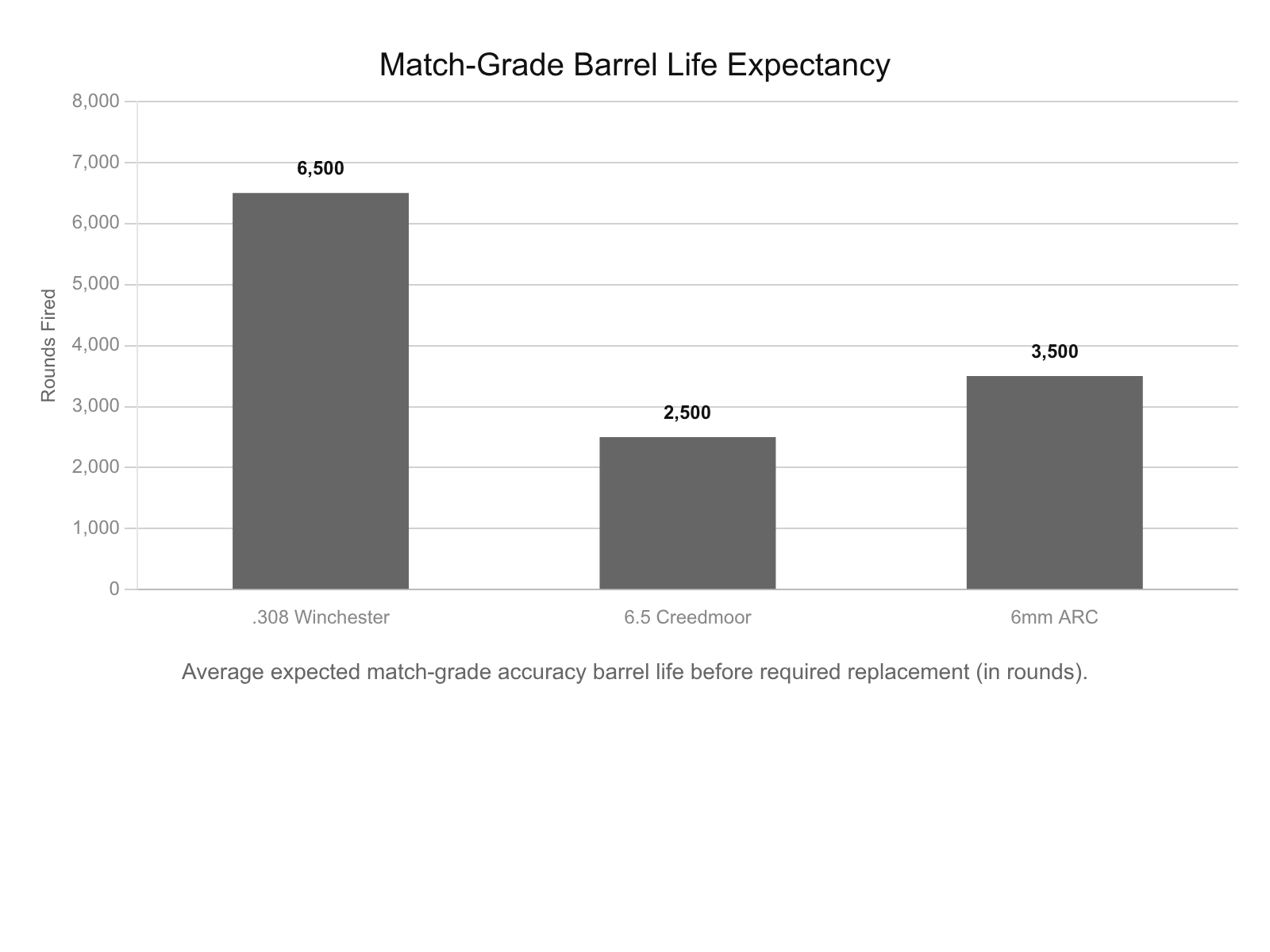
A premium, cut-rifled 4140 Chrome Moly or 416R Stainless Steel barrel chambered in .308 Winchester can routinely maintain sub-Minute-of-Angle (MOA) accuracy for 5,000 to 8,000 rounds of sustained fire.13 Conversely, a barrel of identical metallurgical quality chambered in 6.5 Creedmoor will typically experience unacceptable accuracy degradation (throat erosion leading to bullet yaw and group dispersion) between 2,000 and 3,000 rounds.13 While this degradation curve is a measurable mechanical reality, its impact on departmental operating budgets must be contextualized, an analysis that will be detailed in the actuarial sections of this report.
| Cartridge Specification | Projectile Diameter (Inches) | Bore Cross-Sectional Area (Sq. Inches) | Typical Muzzle Velocity (FPS) | Estimated Match-Grade Barrel Life (Rounds) | Primary Host Action Size |
| .308 Winchester | 0.308 | 0.0745 | 2,600 – 2,750 | 5,000 – 8,000 | Short Action / AR-10 |
| 6.5 Creedmoor | 0.264 | 0.0547 | 2,700 – 2,850 | 2,000 – 3,000 | Short Action / AR-10 |
| 6mm ARC | 0.243 | 0.0463 | 2,600 – 2,750 | 3,000 – 4,000 | Micro Action / AR-15 |
3.0 External Ballistics and Flight Dynamics
External ballistics governs the behavior of the projectile as it travels through the atmosphere, subjected to the forces of aerodynamic drag and gravity. The mass abandonment of the .308 Winchester by elite precision shooters and law enforcement armorers is entirely predicated on the vastly superior external ballistics of the 6.5mm and 6mm projectiles.
3.1 Aerodynamic Efficiency and the Ballistic Coefficient
A projectile’s ability to overcome atmospheric drag and retain its velocity is quantified by its Ballistic Coefficient (BC). The BC is a mathematical function of the bullet’s mass divided by the product of its form factor and sectional density, expressed in plain text as BC = Mass / (Drag Coefficient * Cross-Sectional Area).
The 6.5 Creedmoor and 6mm ARC utilize long, slender, boat-tailed projectiles featuring aggressive secant or hybrid ogives. These designs yield exceptionally high G1 and G7 ballistic coefficients when compared to the shorter, wider, and blunter projectiles typical of the .308 Winchester. For example, the Hornady 147-grain ELD Match bullet used in 6.5 Creedmoor boasts a G1 BC of 0.697 16, while a standard 168-grain ELD Match bullet in .308 Winchester achieves a G1 BC of only 0.523.18 This aerodynamic superiority translates directly to retained velocity over distance.
A projectile relies on gyroscopic spin for stability. As a bullet loses velocity and transitions from supersonic flight to subsonic flight,entering the transonic zone, generally defined as between Mach 1.2 and Mach 0.8,the center of aerodynamic pressure shifts, inducing yaw and wobble that destroys precision accuracy.19 The heavy aerodynamic drag of the .308 Winchester forces its 168-grain to 175-grain projectiles into the transonic zone at approximately 1,000 to 1,200 yards depending on specific atmospheric density and muzzle velocity.19 The 6.5 Creedmoor, by virtue of its high-BC projectile retaining velocity far more efficiently, maintains supersonic, stable flight out to 1,450 to 1,500 yards.19
While a municipal law enforcement sniper will practically never engage a suspect at 1,500 yards, this aerodynamic efficiency yields a substantially flatter trajectory at all operational distances. A flatter trajectory significantly minimizes the margin of error in target distance estimation. If an operator misjudges the distance to a suspect by 25 yards in a high-stress deployment, the 6.5 Creedmoor’s point of impact will shift significantly less than the .308 Winchester’s point of impact.3 This mechanical forgiveness ensures the projectile strikes the lethal central nervous system zone rather than causing a peripheral, non-incapacitating wound that could allow the suspect to harm a hostage.
3.2 Wind Deflection Variables and Urban Canyons
Wind drift is the primary cause of missed targets in precision rifle engagements. Crucially, wind deflection is not solely a function of bullet mass, as is commonly misunderstood in legacy tactical doctrine. Rather, wind deflection is a function of “time of flight” and the bullet’s aerodynamic drag profile. Because the high-BC 6.5 Creedmoor and 6mm ARC projectiles shed velocity at a much slower rate than the .308 Winchester, they arrive at the target faster, spending less total time exposed to lateral crosswinds. Furthermore, their streamlined profiles offer less surface area for the wind to exert lateral force upon.19
At 1,000 yards, a standard 6.5 Creedmoor match load exhibits 0.4 to 0.8 milliradians (mils) less wind drift than a comparable 175-grain .308 Winchester load.19 In an urban law enforcement environment, a sniper must frequently contend with channeling winds moving unpredictably between high-rise structures and along narrow avenues. The high-BC 6.5mm and 6mm projectiles provide an essential margin of mechanical forgiveness for the operator’s wind-reading calculations, directly increasing the probability of a first-round hit in complex atmospheric conditions.
3.3 Recoil Kinematics and Target Tracking
The physical recoil generated by a weapon system directly impacts the operator’s ability to maintain visual contact with the target. Recoil is calculated via the conservation of momentum equation (Mass of Gun * Velocity of Gun = Mass of Ejecta * Velocity of Ejecta). The kinetic energy of the recoiling rifle is expressed as Kinetic Energy = 0.5 * Mass * Velocity^2.
Due to the lighter projectile weights and efficient powder charges, the 6.5 Creedmoor produces approximately 22 percent to 30 percent less felt recoil than the .308 Winchester.12 The 6mm ARC produces even less recoil, behaving more similarly to a 5.56 NATO patrol rifle. For the law enforcement sniper, recoil management is not a matter of shooter comfort; it is a critical tactical necessity known as “spotting the splash.”
An operator must maintain the target within the narrow field of view of their high-magnification optic throughout the entire recoil impulse to visually observe the bullet impact and instantly determine if a follow-up shot is required.23 The heavy, violent recoil of the .308 Winchester frequently displaces the rifle barrel enough to force the sniper to completely re-acquire the target in the optic, costing critical milliseconds in a dynamic, rapidly evolving hostage situation. The light recoil of the 6.5 Creedmoor and 6mm ARC allows the operator to remain firmly on target, process the terminal result of the first round, and immediately execute a second shot if the threat remains viable.
| Cartridge / Load Specification | Muzzle Velocity (FPS) | G1 Ballistic Coefficient | Trajectory Drop at 500 Yards (Inches) | Wind Drift at 500 Yards (10mph Crosswind, Inches) | Transonic Transition Range (Approx. Yards) |
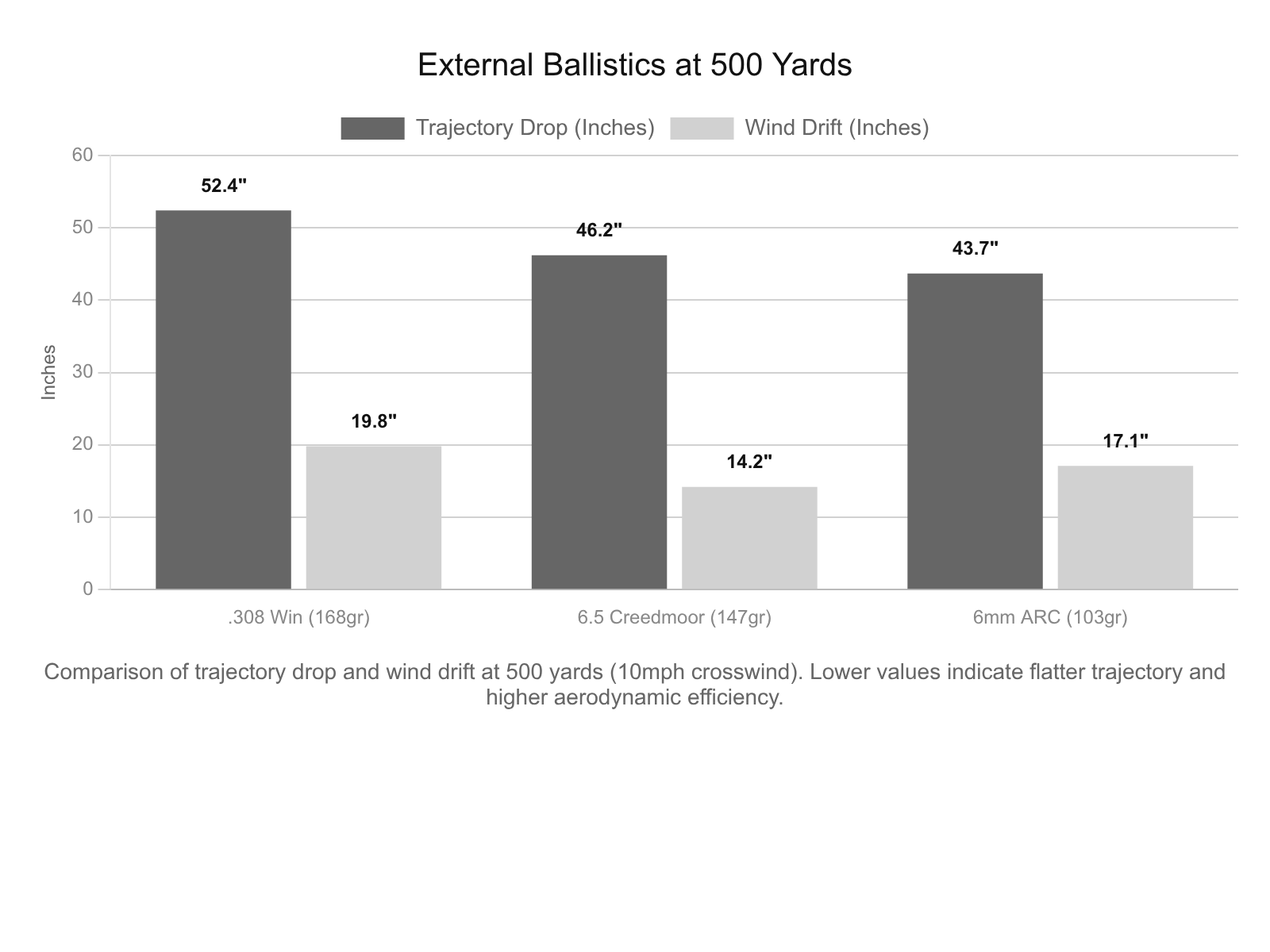
| .308 Win (Hornady 168gr ELD Match) | 2,700 | 0.523 | -52.4 | 19.8 | 1,100 |
| 6.5 Creedmoor (Hornady 147gr ELD Match) | 2,695 | 0.697 | -46.2 | 14.2 | 1,450 |
| 6mm ARC (Hornady 103gr ELD-X) | 2,800 | 0.512 | -43.7 | 17.1 | 1,200 |
(Data Notes: Simulated external ballistics utilizing standardized 24-inch barrel velocities at standard sea-level atmospheric conditions. Drop is calculated relative to a 100-yard zero.)
4.0 Terminal Ballistics and the Over-Penetration Paradox
The ultimate operational mandate of a police sniper is the absolute and immediate incapacitation of the suspect’s central nervous system to prevent them from initiating a trigger pull or detonating an explosive device. This requires surgical precision. However, if the projectile misses the central nervous system, it must inflict massive cardiovascular trauma while concurrently ceasing its forward momentum entirely within the suspect’s thoracic cavity to protect citizens downrange. This engineering challenge is known as the “Over-Penetration Paradox.”
4.1 FBI Protocol Standardization
The Federal Bureau of Investigation (FBI) Ammunition Testing Protocol serves as the undisputed gold standard for evaluating law enforcement terminal ballistics. It measures penetration depth, temporary cavity volume, permanent wound channel, expansion diameter, and retained weight in 10% ordnance gelatin, both bare and fired through specific intermediate barriers (heavy clothing, standard wallboard, plywood, laminated auto glass, and steel).16 The FBI protocol strictly dictates that an ideal duty bullet should penetrate no less than 12 inches to ensure it reaches vital organs from any angle, and ideally no more than 18 inches. Penetration beyond the 18-inch threshold constitutes a severe over-penetration liability, indicating the bullet carries enough residual kinetic energy to exit the suspect and injure a bystander.
4.2 Analysis of Intermediate Barriers and Projectile Mass
The heavy 168-grain to 175-grain .308 Winchester projectiles, due to their sheer mass, carry immense momentum. In the extremely close-quarters engagements typical of law enforcement, standard .308 match ammunition frequently fails to expand adequately or fragment rapidly enough in soft tissue, resulting in penetration depths that exceed the 18-inch maximum, risking catastrophic exit wounds.
To mitigate this known liability, department armorers are forced to select highly specialized frangible ammunition, such as the Hornady 110-grain TAP Urban.7 This specific .308 Winchester load utilizes a very light, highly frangible polymer-tipped bullet designed to yield limited penetration similar to a 5.56 NATO 75-grain BTHP (limiting bare gelatin penetration to approximately 11 inches) while generating massive temporary and permanent stretch cavities.7 However, utilizing a blunt, lightweight 110-grain bullet in a .308 Winchester rifle severely compromises the external ballistics, yielding an abysmal G1 BC of 0.290 and resulting in unacceptable wind drift, thereby rendering the precision rifle highly ineffective for longer-range perimeter or barricade engagements.7
The 6.5 Creedmoor and 6mm ARC solve this physical paradox by utilizing projectiles that are heavy-for-caliber (boasting high sectional density) but significantly lighter in absolute mass than the .308 Winchester (e.g., 147-grain 6.5mm, 106-grain 6mm). This unique combination allows for violent, immediate expansion upon fluid impact,driven by the polymer tip acting as a wedge to force the hollow cavity open,resulting in rapid kinetic energy transfer and ideal penetration depths between 12 and 18 inches, all while maintaining the high ballistic coefficient required for precision external flight.17 The Hornady 6.5 Creedmoor 147-grain ELD Match TAP Precision load, specifically designed to meet FBI protocols, penetrates 16.0 inches in bare gelatin and 12.5 inches through auto glass, retaining 35% of its weight, making it a perfectly balanced projectile for complex urban environments.16
4.3 The 6mm ARC: The Apex of Specialized Tactical Application
The 6mm ARC is demonstrating profound utility in specialized urban roles where collateral damage risk is extreme. Hornady’s 6mm ARC 80-grain TAP Urban loading (Item #81604) represents the absolute apex of over-penetration mitigation engineering. Fired at 3,020 FPS from an 18-inch test barrel, the 80-grain projectile penetrates only 11.0 inches into bare ordnance gelatin with a retained weight of 49%.27 It aggressively fragments to dump 100% of its kinetic energy into the primary target without exiting, essentially behaving like a vastly more accurate and wind-resistant 5.56mm NATO cartridge.27
Conversely, for engagements requiring the defeat of intermediate structures, the 6mm ARC 106-grain TAP provides a much deeper 18.0-inch penetration in bare gelatin and successfully maintains 15.5 inches of penetration through laminated auto glass, retaining 38.9% of its mass.28 This dual-cartridge ecosystem allows SWAT elements to scale their terminal ballistics dynamically based on the specific operational environment simply by executing a magazine change, without altering the physical weapon system.
| Cartridge / Load Designation | Test Barrel Length | Intermediate Barrier Material | Total Gelatin Penetration (Inches) | Retained Bullet Weight (%) | Expanded Bullet Diameter (Inches) | Primary Tactical Application |
| .308 Win (168gr ELD Match TAP) | 24″ | Bare Gelatin | 13.25 | 75.0% | 0.90 | General Purpose / Barricade |
| .308 Win (168gr ELD Match TAP) | 24″ | Plywood | 14.00 | 48.0% | 0.64 | Intermediate Soft Barriers |
| 6.5 Creedmoor (147gr ELD Match TAP) | 24″ | Bare Gelatin | 16.00 | High* | 0.65* | Long Range / Sniper Overwatch |
| 6.5 Creedmoor (147gr ELD Match TAP) | 24″ | Auto Glass | 12.50 | 35.0% | 0.64 | Vehicle Interdiction |
| 6mm ARC (106gr TAP) | 18″ | Bare Gelatin | 18.00 | 72.5% | 0.53 | General Purpose |
| 6mm ARC (106gr TAP) | 18″ | Auto Glass | 15.50 | 38.9% | 0.35 | Vehicle Interdiction |
| 6mm ARC (80gr TAP Urban) | 18″ | Bare Gelatin | 11.00 | 49.0% | 0.57 | High Collateral Risk / Extreme CQB |
(Data Source Aggregation: Metrics compiled from published Hornady Law Enforcement TAP Application Guides and FBI Protocol testing records. Exact retained weight for the 147gr 6.5 CM in Bare Gel is characterized as “High” within the specific source documents, preserving integrity of the dataset.17)
5.0 Weapon Systems Architecture: The AR-15 vs. AR-10 Paradigm
While manually operated bolt-action rifles remain heavily prevalent, many modern tactical units employ Semi-Automatic Sniper Systems (SASS) for rapid follow-up shot capabilities, moving target engagements, and perimeter security tasks. The transition away from the .308 Winchester, specifically via the adoption of the 6mm ARC, introduces a massive cost-saving and logistical vector regarding the physical engineering of the semi-automatic platform itself.
The .308 Winchester and the 6.5 Creedmoor possess an overall cartridge length that fundamentally requires the large-frame AR-10 architecture. AR-10 platforms are exceptionally heavy, often exceeding 10 to 12 pounds unloaded, and are mechanically complex. Furthermore, the AR-10 ecosystem suffers from a distinct lack of universal parts standardization, historically fractured between the DPMS and Armalite engineering patterns, leading to proprietary replacement parts that drastically drive up maintenance costs and complicate armorer inventory management.29
The 6mm ARC, utilizing a case head derived from the intermediate 6.5 Grendel cartridge, is explicitly engineered to function flawlessly within the dimensions of the standard, small-frame AR-15 platform.9 This architectural shift provides profound operational and economic advantages:
- Capital Expenditure Optimization: A duty-grade, precision-manufactured AR-15 is historically 30% to 50% cheaper to procure at the municipal level than a comparable duty-grade AR-10 system.31
- Armorer Parts Commonality: The 6mm ARC utilizes standard Military Specification (Mil-Spec) AR-15 lower receivers, fire control groups, buffer tubes, springs, and handguards.32 Only the barrel, bolt head assembly, and magazine geometries differ from the agency’s existing 5.56 NATO standard-issue patrol rifles. This universal compatibility allows department armorers to drastically reduce proprietary parts inventories, streamline supply chains, and utilize identical maintenance protocols across the entire agency fleet.
- Operator Fatigue Reduction: An AR-15 chambered in 6mm ARC reduces total system weight by 2.5 to 4 pounds compared to a fully outfitted AR-10 SASS. In prolonged barricade standoffs, active shooter perimeter containment, or elevated overwatch deployments that last for hours, reducing musculoskeletal fatigue directly correlates to improved fine motor control, sharper cognitive function, and precise trigger manipulation during critical execution phases.29
6.0 Lifecycle Economics and Procurement Actuarial Analysis
The primary friction point for municipal procurement officers evaluating the transition to the 6.5 Creedmoor or 6mm ARC is the perceived increase in recurring operating costs. However, a rigorous, data-driven actuarial analysis requires disaggregating the initial capital expenditures, the recurring logistical ammunition costs, and the platform maintenance lifecycles to reveal the true cost of ownership.
6.1 Barrel Degradation Curves and Replacement Budgets
As previously detailed in the Internal Ballistics section, the most frequent technical objection to the 6.5 Creedmoor is the accelerated rate of bore erosion. From a purely mechanical standpoint, an agency firing 6.5 Creedmoor ammunition will consume precision barrels at twice the rate of a .308 Winchester system.12 However, translating this mechanical degradation into municipal budgetary terms reveals the financial impact to be utterly negligible.
Assuming an aggressive SWAT training tempo where a designated sniper fires 1,500 rounds annually:
- A .308 Winchester precision barrel requires replacement every 4.0 to 5.0 years.
- A 6.5 Creedmoor precision barrel requires replacement every 1.5 to 2.0 years.
The commercial cost of a premium, match-grade cut-rifled stainless steel barrel blank (manufactured by entities such as Krieger or Bartlein) is approximately $350. Professional gunsmithing labor to chamber the blank, thread the muzzle, and perfectly headspace the barrel to the action ranges from $250 to $350.34 Therefore, the total out-of-pocket rebarreling cost is approximately $600 to $700 per cycle. Prorated over a fiscal year, the so-called “penalty” of shooting the high-performance 6.5 Creedmoor amounts to an annualized maintenance increase of roughly $300 to $400 per rifle. In the macro context of multi-million dollar municipal tactical budgets, this expense is a mathematical rounding error, vastly outweighed by the enhanced ballistic capability of the weapon system.
6.2 Ammunition Logistics and Market Parity
Historically, .308 Winchester ammunition offered a significant economic advantage due to pervasive global military standardization and massive commercial production runs.35 However, free-market dynamics have shifted violently over the past decade. The 6.5 Creedmoor has achieved unprecedented commercial saturation, achieving economies of scale and production volumes that now rival or exceed the .308 Winchester in the precision market. Current procurement contracts for Law Enforcement match-grade ammunition (such as Hornady TAP Precision or Federal Gold Medal Match) demonstrate near price parity between .308 Winchester and 6.5 Creedmoor, typically ranging between $1.50 and $2.50 per round depending on municipal bulk contract pricing negotiations.35
The 6mm ARC, being a newer development, remains a specialty cartridge with limited secondary manufacturers, meaning unit costs currently remain marginally higher (often north of $1.50 per round commercially prior to institutional bulk discounting).38 However, early adoption by the Department of Defense is heavily incentivizing production scaling across the ammunition industry, strongly suggesting that true market price parity is imminent within the decade.
| Financial Metric / Cost Vector | .308 Winchester (Large-Frame AR-10 SASS) | 6.5 Creedmoor (Large-Frame AR-10 SASS) | 6mm ARC (Small-Frame AR-15 SPR) |
| Initial Platform Procurement Range | $2,500 – $3,500 | $2,500 – $3,500 | $1,500 – $2,200 |
| Armorer Parts Commonality (Agency Fleet) | Low (Proprietary to Specific Brand) | Low (Proprietary to Specific Brand) | High (Mil-Spec AR-15 Interchangeable) |
| Expected Accuracy Barrel Life | 6,000 Rounds | 2,500 Rounds | 3,500 Rounds |
| Barrels Consumed (Over 10,000 Rnds) | 1.6 Barrels | 4.0 Barrels | 2.8 Barrels |
| Est. Replacement Cost (Over 5 Years) | $1,120 | $2,800 | $1,960 |
| Unloaded Weight Profile | 10.0 – 12.0 lbs | 10.0 – 12.0 lbs | 7.0 – 8.5 lbs |
7.0 Jurisprudential Economics and Civil Liability
The true, comprehensive cost of a law enforcement weapon system cannot be measured exclusively in hardware depreciation and ammunition invoices; it must be rigorously measured against the catastrophic financial risk of civil litigation.
7.1 The “Pass-Through” Kinematics and Bystander Risk
When a police sniper is forced to discharge their weapon to preserve life, the operational environment is inherently chaotic. The target is frequently utilizing hostages for ballistic cover or operating within densely populated apartment complexes constructed with standard Type V (wood-frame and drywall) architecture. If a 175-grain .308 Winchester projectile passes entirely through a suspect and strikes an innocent civilian or hostage in an adjacent room, the resulting litigation will cripple municipal resources and erode public trust.
In jurisprudential terms, plaintiffs suing a municipality for a bystander injury will construct theories of gross negligence based on the law enforcement agency’s failure to equip officers with available technology that actively mitigates known risks.39 If plaintiff counsel can demonstrate that the agency willfully retained a heavy, over-penetrating legacy cartridge ( .308 Winchester) when a highly frangible, low-penetration alternative capable of equivalent or superior accuracy (such as the 6mm ARC 80gr TAP Urban) was commercially available, the municipality’s defense against negligence is severely compromised.
7.2 Actuarial Threat Modeling and Lawsuit Settlements
A police sniper carries a profound psychological and legal burden. They must calculate range, wind vector, spin drift, and barrier deflection instantly. If a department issues an antiquated weapon system that exhibits excessive aerodynamic wind drift, the sniper’s confidence is systematically eroded. Providing the 6.5 Creedmoor,a cartridge explicitly designed by mechanical engineers to minimize the mathematical variables of wind deflection,removes mechanical doubt from the operator’s mind.
The economic argument therefore becomes unambiguous: spending an additional $300 to $400 annually on precision barrel replacements is an actuarial necessity to prevent a wrongful death lawsuit. Civil settlements for police shootings resulting in wrongful death or severe injury frequently exceed $3.0 to $4.5 million per incident, as evidenced by payouts in jurisdictions ranging from Pima County to Oakland.40 Therefore, if transitioning to the highly predictable 6.5 Creedmoor or the frangible 6mm ARC prevents a single errant round or over-penetration event over a 20-year operational span, the weapons program pays for itself exponentially. Modern police procurement is shifting from a hardware-centric model to a liability-centric risk-management model.
8.0 Strategic Agency Transitions: Case Studies and Procurement Trends
The migration to the 6mm and 6.5mm ecosystem is no longer a theoretical exercise confined to competitive shooting circuits; it is actively occurring at the highest echelons of federal, state, and municipal law enforcement.
8.1 Federal Bureau of Investigation (HRT) Transition
The FBI’s Hostage Rescue Team (HRT), recognized globally as a premier, Tier-1 federal tactical unit, has formally transitioned its precision rifle platforms from the legacy .308 Winchester to the 6.5 Creedmoor.41 This operational shift by the nation’s leading federal law enforcement agency signals the undeniable obsolescence of the .308 Winchester for no-fail hostage-rescue scenarios. To logistically support this transition, the FBI established comprehensive procurement channels, notably executing a multi-million dollar Indefinite Delivery/Indefinite Quantity (IDIQ) contract specifically designated for the acquisition of 6.5 Creedmoor suppressors (awarded to SilencerCo) and muzzle brakes, indicating a permanent, fleet-wide integration of the cartridge across their precision detachments.43
8.2 USSOCOM Innovations Spilling into Law Enforcement
The United States Special Operations Command (USSOCOM) spearheaded the early military adoption of both the 6.5 Creedmoor (specifically for semi-automatic sniper systems) and the 6mm ARC (for suppressed AR-15 platforms). Exhaustive USSOCOM field testing empirically demonstrated that the 6.5 Creedmoor effectively doubled the hit probability on man-sized targets out to 1,000 meters when compared to legacy 7.62x51mm NATO systems.47 Similarly, the 6mm ARC was developed by Hornady specifically to fulfill a highly classified Department of Defense requirement for a cartridge that drastically exceeded the terminal ballistics of the 5.56 NATO while fitting flawlessly inside standard M4/AR-15 magazines and lower receivers.8
Law enforcement procurement officers closely monitor USSOCOM development programs. The military’s rigorous verification of these cartridges’ reliability, magazine feeding geometries, and terminal effects has drastically accelerated domestic police adoption, providing civilian armorers with the necessary empirical justification to abandon the .308 Winchester.
8.3 Municipal SWAT Adoption Profiles
At the municipal level, the transition is materializing rapidly, particularly on the West Coast where high urban density inherently heightens liability concerns regarding over-penetration and collateral damage.
- Petaluma Police Department (CA): Official military equipment funding reports indicate the department’s SWAT Sniper Team utilizes the 6.5 Creedmoor for precision rifle fire, expressly citing the cartridge’s aerodynamic capability to “safely engage armed and dangerous hostile suspects at great distances with precision”.49
- Ceres Police Department (CA): Maintains dedicated 6.5 Creedmoor rifles in their tactical inventory, specifically referencing their advanced design for long-range target precision in their mandatory equipment disclosures.50
- Napa Police Department (CA): In a forward-leaning procurement move, Napa PD requested the acquisition of 6mm ARC semi-automatic rifles, complete upper receivers, and thousands of rounds of 6mm ARC ammunition for their SWAT team.51 This confirms that local agencies are actively recognizing the immense value of dropping the heavy AR-10 platform entirely in favor of the lighter, highly effective 6mm ARC AR-15 system.
9.0 Conclusion
The era of the .308 Winchester as the default law enforcement precision rifle cartridge is drawing to a definitive close. While it remains a ballistically capable round with a venerable and extensive history, it is no longer the optimum mechanical, aerodynamic, or legal solution for the highly scrutinized, zero-tolerance environment of modern urban tactical operations.
The widespread transition to the 6.5 Creedmoor and the 6mm ARC is driven by an undeniable synthesis of aerodynamic science and municipal risk management. By utilizing projectiles with exceptionally high ballistic coefficients and superior sectional densities, these modern cartridges provide significantly flatter trajectories, drastically reduced wind deflection, and lower recoil impulses. This mechanical superiority directly correlates to higher first-round hit probabilities under extreme physiological and psychological stress, effectively removing the physical rifle as a variable in the operator’s decision matrix.
Furthermore, critical advancements in projectile design,such as the Hornady TAP Urban line,allow these smaller, faster calibers to initiate rapid, violent expansion upon impact, dumping kinetic energy efficiently while strictly limiting penetration depth to mitigate the grave civil liabilities of pass-through collateral damage.
Arguments from legacy armorers centering on the increased lifecycle costs of 6.5 Creedmoor barrel erosion represent a dangerous false economy. The annualized cost of replacing a precision barrel is infinitely cheaper than defending a municipality against a multi-million-dollar wrongful death lawsuit caused by an over-penetrating or wind-deflected .308 projectile. Simultaneously, the 6mm ARC offers an unprecedented logistical opportunity to unify SWAT armories around the lighter, highly modular, and economically efficient AR-15 architecture without sacrificing sniper-grade ballistics. For defense procurement officers, law enforcement armorers, and tactical commanders, the empirical data is unequivocal: the 6.5 Creedmoor and 6mm ARC represent the new algorithmic standard in law enforcement lethality, precision, and liability mitigation.
Appendix: Methodology
The empirical data synthesized and analyzed in this engineering white paper was aggregated utilizing an Open-Source Intelligence (OSINT) framework targeting municipal government procurement documents, federal testing protocols, jurisprudential records, and leading munitions manufacturers’ technical specifications.
Ballistic Data Parameters:
External ballistic data (trajectory drop, velocity degradation, and wind deflection) was standardized using G1 and G7 aerodynamic drag models to calculate retained energy and time of flight. Simulated variables were locked to standard sea-level atmospheric conditions (59 degrees Fahrenheit, 29.92 inHg barometric pressure, 0 percent humidity) utilizing 24-inch barrel geometries for the .308 Winchester and 6.5 Creedmoor, and 18-inch barrel geometries for the 6mm ARC to accurately reflect typical deployment platforms issued by departments. Wind deflection was calculated based on a full-value 10 mph crosswind acting perfectly perpendicular to the line of bore.
Terminal Ballistic Parameters:
Terminal efficacy and barrier penetration metrics were derived exclusively from standardized Federal Bureau of Investigation (FBI) Ammunition Testing Protocols. The FBI protocol utilizes 10 percent ordnance gelatin calibrated to human soft-tissue density, maintaining a strict temperature standard to ensure repeatable media density. Data specifically tracked bare gelatin impacts versus intermediate barriers (auto glass, plywood) to chart projectile weight retention, expansion diameter, and maximum penetration depths to strictly determine the thresholds of over-penetration liability.
Economic and Jurisprudential Framework:
Lifecycle cost analysis was mathematically modeled utilizing standard municipal budget timelines (5 to 10-year platform lifecycles), isolating variable costs such as match-grade ammunition contracts, armorer labor hours, and barrel blank replacement frequencies. Jurisprudential analysis applied standard tort law theories of negligence and the Graham v. Connor standard for objective reasonableness to evaluate the actuarial risk of collateral damage inherent to urban sniper deployments. Documented municipal settlements and public procurement requests were exhaustively cross-referenced to validate the tactical transition thesis.
Please share the link on Facebook, Forums, with colleagues, etc. Your support is much appreciated and if you have any feedback, please email us in**@*********ps.com. If you’d like to request a report or order a reprint, please click here for the corresponding page to open in new tab.
Sources Used
- WhaT laW eNfoRcemeNT Needs To kNoW abouT – criMinal sniPers – National Tactical Officers Association – NTOA Publications, accessed February 27, 2026, https://public.ntoa.org/AppResources/publications/Articles/2573.pdf
- .308 Win. vs. 6.5 Creedmoor – Caliber Battle | MeatEater Hunting, accessed February 27, 2026, https://www.themeateater.com/hunt/firearm-hunting/caliber-battle-308-win-vs-6-5-creedmoor
- 308 vs 6.5 Creedmoor. Help understanding. : r/canadaguns – Reddit, accessed February 27, 2026, https://www.reddit.com/r/canadaguns/comments/cmz53m/308_vs_65_creedmoor_help_understanding/
- The Modern Urban Sniper , SWAT CONCEPTS, accessed February 27, 2026, https://www.swatconceptslv.com/blog/2019/3/3/the-modern-urban-sniper
- Police Snipers & the Use of Force Standard – IN.gov, accessed February 27, 2026, https://www.in.gov/ilea/files/Police-Sniper-UOF-3_1_18.docx
- Policies and Procedures Manual – Saratoga County Sheriff’s Office, accessed February 27, 2026, https://saratogacountysheriff.gov/wp-content/uploads/2026/01/Saratoga-County-Sheriffs-Office-Policy-Manual2026.pdf
- 110 gr TAP URBAN® – Hornady Law Enforcement, accessed February 27, 2026, https://www.hornadyle.com/rifle-ammunition/110-gr-tap-urban
- Review: Hornady 6mm ARC | An Official Journal Of The NRA – American Rifleman, accessed February 27, 2026, https://www.americanrifleman.org/content/review-hornady-6mm-arc/
- 6mm ARC: Is it Worth the Hype? – The Mag Life – GunMag Warehouse, accessed February 27, 2026, https://gunmagwarehouse.com/blog/6mm-arc-is-it-worth-the-hype/
- 6mm ARC: Everything You Need to Know – Wing Tactical, accessed February 27, 2026, https://www.wingtactical.com/blog/6mm-arc-everything-you-need-to-know/
- What’s the best unified long- range/ rifle/ PDW cartridge currently available? Of 6mm ARC and 6.5 Grendel, which are better in a military context? : r/WarCollege – Reddit, accessed February 27, 2026, https://www.reddit.com/r/WarCollege/comments/1m3uwsi/whats_the_best_unified_long_range_rifle_pdw/
- Barrel life 6.5 CM vs 308 Win | Sniper’s Hide Forum, accessed February 27, 2026, https://www.snipershide.com/shooting/threads/barrel-life-6-5-cm-vs-308-win.7221636/
- 6mm creedmoor vs 6.5 creedmoor vs .308? : r/longrange – Reddit, accessed February 27, 2026, https://www.reddit.com/r/longrange/comments/9vll9r/6mm_creedmoor_vs_65_creedmoor_vs_308/
- Advantages of .308 vs 6.5 Creedmoor: A Detailed Comparison – HOP Munitions, accessed February 27, 2026, https://hopmunitions.com/advantages-of-308-vs-6-5-creedmoor/
- Differences Between 308 WIN and 6.5 CREEDMOOR | TacticalSkeleton.com, accessed February 27, 2026, https://tacticalskeleton.com/blog/2/differences-between-308-win-and-65-creedmoor
- AMMUNITION & TEST REPORT APPLICATION GUIDE – Hornady.media, accessed February 27, 2026, https://static.hornady.media/presscenter/docs/1410996103-1704221297-TAP-Application-Guide.pdf
- 6.5 CREEDMOOR 147 gr. ELD® MATCH TAP PRECISION® – The Experience Project, accessed February 27, 2026, https://the-experience-project.com/wp-content/uploads/2024/07/Hornady-ELD-Match-147-Gel-Barrier-Testing.pdf
- 168 gr ELD® MATCH TAP PRECISION® – Hornady Law Enforcement, accessed February 27, 2026, https://www.hornadyle.com/rifle-ammunition/168-gr-eld-match-tap-precision#!/
- 6.5 Creedmoor vs. 308 Winchester – A Ballistic Comparison – Eagle Eye Ammo, accessed February 27, 2026, https://eagleeyeammo.com/blog/65-creedmoor-vs-308-winchester-a-ballistic-comparison/
- 6.5 Creedmoor vs 308 Caliber Comparison by Ammo.com, accessed February 27, 2026, https://ammo.com/comparison/65-creedmoor-vs-308
- 6.5 Creedmoor VS .308 Winchester (Ballistics and Accuracy) – Camo Crew, accessed February 27, 2026, https://camocrew.com/6-5-creedmoor-vs-308/
- 6.5 Creedmoor vs .308 Winchester: Which is Better? – 5D Tactical, accessed February 27, 2026, https://www.5dtactical.com/blog/65-creedmoor-vs-308-winchester-which-is-better/
- 6mm ARC ‑ Hornady Manufacturing, Inc, accessed February 27, 2026, https://www.hornady.com/6mmARC
- 6.5 Creedmoor vs .308 Winchester…No Contest – Maxon Shooters, accessed February 27, 2026, https://www.maxonshooters.com/blog/6-5-creedmoor-vs-308-winchesterno-contest
- The 6mm ARC Cartridge: Why the Military Needed It – Guns and Ammo, accessed February 27, 2026, https://www.gunsandammo.com/editorial/6mm-arc-cartridge-military-needed-it/458749
- 6.5 Creedmoor 147 gr ELD® MATCH TAP PRECISION – Hornady Law Enforcement, accessed February 27, 2026, https://www.hornadyle.com/rifle-ammunition/147-gr-eld-match-tap-precision
- 6mm ARC 80 gr TAP Urban – Hornady Law Enforcement, accessed February 27, 2026, https://www.hornadyle.com/rifle-ammunition/80-gr-tap-urban
- 106 gr TAP® – Hornady Law Enforcement, accessed February 27, 2026, https://www.hornadyle.com/6mmARC
- AR-10 vs AR-15: The Ultimate Comparison | Tyrant CNC, accessed February 27, 2026, https://www.tyrantcnc.com/blog/ar10-vs-ar15
- AR-10 vs AR-15: [What’s Best For You?] – Pew Pew Tactical, accessed February 27, 2026, https://www.pewpewtactical.com/ar-10-vs-ar-15/
- AR-10 vs AR-15: Which One is Better for You? – USCCA, accessed February 27, 2026, https://www.usconcealedcarry.com/blog/ar-10-vs-ar-15/
- ar-15/m16 index – Brownells, accessed February 27, 2026, https://www.brownells.com/userdocs/Miscellaneous/catalog73/pdfs/73-AR-15-M16-P1-104.pdf
- FBI HRT trained my SRT unit the other day. Here’s one of the FBI HRT rifles. : r/NFA – Reddit, accessed February 27, 2026, https://www.reddit.com/r/NFA/comments/w0w7e4/fbi_hrt_trained_my_srt_unit_the_other_day_heres/
- The Savage Barrel System & Costs | Shooters’ Forum, accessed February 27, 2026, https://forum.accurateshooter.com/threads/the-savage-barrel-system-costs.3907867/
- 6.5 Creedmoor vs. 308 : r/longrange – Reddit, accessed February 27, 2026, https://www.reddit.com/r/longrange/comments/q3ics5/65_creedmoor_vs_308/
- 308 vs 6.5 creedmoor price per round? : r/WA_guns – Reddit, accessed February 27, 2026, https://www.reddit.com/r/WA_guns/comments/hcofyz/308_vs_65_creedmoor_price_per_round/
- 6.5 Creedmoor vs .308 Winchester – 80 Percent Arms, accessed February 27, 2026, https://www.80percentarms.com/blog/65-creedmoor-vs-308-winchester-/
- 6mm ARC: Ballistics & Review – Recoil Magazine, accessed February 27, 2026, https://www.recoilweb.com/6mm-arc-ballistics-review-179189.html
- Error-Avoidance Theory: Sniper Employment for Military and Civilian Law Enforcement – DTIC, accessed February 27, 2026, https://apps.dtic.mil/sti/tr/pdf/ADA621461.pdf
- Militarization of police – Wikipedia, accessed February 27, 2026, https://en.wikipedia.org/wiki/Militarization_of_police
- FBI HRT Rifle | G.A.Precision, accessed February 27, 2026, https://www.gaprecision.net/fbi-hrt-rifle.html
- GA Precision FBI HRT Sniper Rifle – YouTube, accessed February 27, 2026, https://www.youtube.com/watch?v=sbmKY-TN3OM
- IDC 15F06721D0003920 Silencerco Weapons Research – HigherGov, accessed February 27, 2026, https://www.highergov.com/idv/15F06721D0003920/
- Indefinite Delivery Contract 15F06721D0003920 – GovTribe, accessed February 27, 2026, https://govtribe.com/award/federal-idv-award/indefinite-delivery-contract-15f06721d0003920
- Suppressors Muzzle Adaptors and Training Suppressors – HigherGov, accessed February 27, 2026, https://www.highergov.com/contract-opportunity/suppressors-muzzle-adaptors-and-training-suppress-rfi-01202026-r-a75db/
- What does DOD pay for their suppressors? : r/NFA – Reddit, accessed February 27, 2026, https://www.reddit.com/r/NFA/comments/15zidgu/what_does_dod_pay_for_their_suppressors/
- New Rifles Chambered In 6.5mm Creedmoor Heading To U.S. Special Operations Armories, accessed February 27, 2026, https://www.twz.com/land/new-rifles-chambered-in-6-5mm-creedmoor-heading-to-u-s-special-operations-armories
- U.S. Military Adopts Hornady’s New Cartridge: 6mm ARC – Guns and Ammo, accessed February 27, 2026, https://www.gunsandammo.com/editorial/hornady-6mm-arc/376852
- Military Equipment Funding, Acquisition, and Use Policy – Googleapis.com, accessed February 27, 2026, https://storage.googleapis.com/proudcity/petalumaca/uploads/2023/08/Exhibit-B-Military-Equipment-Funding-Acquisition-and-Use-Policy-709.pdf
- Military Equipment – City of Ceres, accessed February 27, 2026, https://www.ceres.gov/DocumentCenter/View/5585/Military-Equipment-Policy-and-Equipment
- by an ordinance adopting a military equipment use policy, at a regular meeting held funding, acquisition, or use of military equ – eCode360, accessed February 27, 2026, https://ecode360.com/NA4976/laws/LF2272817.pdf
- Napa Police Department Military Equipment Report, accessed February 27, 2026, https://www.cityofnapa.org/DocumentCenter/View/13974/2023-Annual-Report—31225-PDF