1. Executive Summary
The period spanning late 2023 through the spring of 2026 has witnessed the most intense, sustained naval and aerospace combat operations undertaken by the United States and its allies since the conclusion of the Cold War. Beginning with the maritime defense operations against Houthi proxy forces in the Red Sea and culminating in the high-intensity, multi-domain strikes of Operation Epic Fury against the Islamic Republic of Iran, the U.S. military has been forced to confront the harsh realities of modern saturation warfare and the proliferation of low-cost precision munitions. For strategic planners and national intelligence analysts, these Middle Eastern operational theaters serve as a vital crucible. They have exposed critical vulnerabilities in the defense industrial base, illuminated the limits of legacy operational doctrines that rely exclusively on exquisite platforms, and forced rapid tactical innovations that are directly transferable to a potential high-end contingency with the People’s Republic of China (PRC) in the Indo-Pacific theater.
The foundational lesson derived from this extended period of conflict is the absolute necessity of inverting the cost-asymmetry equation in modern warfare. Throughout the early phases of the Red Sea conflict, the United States Navy achieved near-flawless tactical interception rates against uncrewed aerial systems (UAS) and anti-ship ballistic missiles (ASBMs). However, these tactical victories translated into a strategic vulnerability due to an unsustainable cost-exchange ratio—expending multi-million-dollar interceptors to neutralize inexpensive attritable drones.1 This dynamic exposed the inherent fragility of an operational framework overly reliant on a limited inventory of expensive, difficult-to-replace defensive munitions. The subsequent strategic pivot toward what the Department of Defense has termed “Algorithmic Warfare” and the mass deployment of low-cost, autonomous systems during Operation Epic Fury demonstrates a structural adaptation.2 The U.S. military has recognized that it must weaponize mass, shifting from absorbing painful asymmetric costs to actively imposing them upon adversaries.
Concurrently, the operational realities of these Middle Eastern conflicts have catalyzed unprecedented advancements in fleet survivability, logistics, and multi-domain integration. The successful development and demonstration of the Transferrable Reload At-sea Method (TRAM), which allows surface combatants to reload their Vertical Launching Systems (VLS) while underway in the open ocean, represents a strategic breakthrough.4 This capability is essential for sustaining high-tempo maritime operations across the vast geographic expanse of the Pacific, where returning to port imposes unacceptable operational penalties. Furthermore, the indispensable role of land-based integrated air and missile defense (IAMD) in protecting joint force maneuver, combined with the rapid acceleration of the Combined Joint All-Domain Command and Control (CJADC2) architecture, has fundamentally redefined the requirements for allied interoperability and decentralized command structures.6
Meanwhile, the PRC has meticulously observed these conflicts, drawing its own doctrinal conclusions. The People’s Liberation Army (PLA) has sought to validate its long-standing investments in saturation warfare, advanced space-based intelligence, surveillance, and reconnaissance (ISR), and deep infrastructure hardening.9 As the U.S. military pivots its strategic posture toward the Indo-Pacific to counter the PRC’s anti-access/area-denial (A2/AD) capabilities, the hard-won lessons forged in the Red Sea and the contested airspace over Iran provide the blueprint for deterring and, if necessary, defeating peer adversaries.
2. Geopolitical Context and Economic Asymmetries in Maritime Chokepoints
2.1 The Red Sea Equilibrium and Commercial Shipping Incentives
To extract accurate lessons for the Indo-Pacific, analysts must first understand the unique geopolitical and economic forces that defined the Red Sea crisis. From late 2023 through early 2025, Operation Prosperity Guardian sought to maintain the free flow of commerce through the Bab el-Mandeb Strait, a vital chokepoint connecting the Mediterranean Sea to the Indian Ocean. Despite the visible deterrent presence of Western naval task forces, the theater settled into a fragile equilibrium where the Houthis maintained readiness and commercial shipping lines engaged in complex risk calculations.11
The operation failed to achieve its strategic objective of fully restoring commercial traffic because it did not account for the divergent financial incentives of the global shipping industry. Many major shipping conglomerates financially benefited from the crisis.1 The mass diversion of vessels around the Cape of Good Hope—adding roughly 11,000 nautical miles and 7 to 10 days to a voyage—helped alleviate a preexisting condition of “overcapacity” within the shipping industry.1 High consumer demand allowed carriers to pass the increased fuel and crew costs (reaching up to $2 million per delayed voyage) directly to consumers via spiked freight rates.1 Consequently, major operators like Maersk significantly upgraded their financial guidance, projecting an underlying EBITDA of $9 to $11 billion due to the robust container market demand combined with the constrained supply chain.1
Furthermore, the insurance market actively disincentivized Red Sea transits for Western-aligned vessels. War risk insurance premiums spiked dramatically, reaching up to 1% of a vessel’s hull value.1 For a brand-new Very Large Crude Carrier (VLCC), a 1% premium added an immediate $1.3 million to the cost of a single transit.1 When underwriters and shipowners weighed these astronomical insurance premiums against the increased operational costs of circumnavigating Africa, the longer, safer route frequently proved to be the more economically rational choice.1
2.2 Chinese Shipping Arbitrage and Geopolitical Signaling
While Western shipping companies absorbed costs and rerouted, Chinese and Russian commercial actors actively capitalized on the geopolitical friction. Houthi leadership explicitly stated that vessels from China and Russia were guaranteed safe passage, allowing smaller Chinese shipping companies to utilize the Red Sea as a lucrative, risk-free trading lane.1 To enforce this protection and signal their identity to targeting networks, Chinese vessels employed overt signaling methods. They updated their Automatic Identification System (AIS) transponders to broadcast phrases such as “All Chinese” or “Chinese Company,” and visibly draped extra-large national flags across their bridge masts during daylight transits.1
This dynamic allowed Chinese-linked tonnage to surge in the region, representing up to 28% of the boxships transiting the chokepoint during early 2024, capitalizing on sky-high regional freight rates left in the vacuum of departing European carriers.1 A significant portion of this Chinese tonnage was directly tied to synergies with Russian trade, moving goods between Asian ports and St. Petersburg.1
The lesson for Indo-Pacific planners is profound: naval superiority and the physical protection of sea lanes do not guarantee economic security if adversaries can successfully manipulate risk perceptions, insurance markets, and non-state proxies. In a conflict scenario, the PRC possesses the capability to artificially inflate global logistics costs for U.S. and allied commercial networks while simultaneously subsidizing its own state-owned enterprises through protected proxy corridors.
2.3 Energy Security and “Strategic Suffocation”
The maritime disruptions directly impact global energy security, a critical vulnerability for the PRC. The U.S. counterblockade on Iranian oil exports highlighted the interconnected nature of the global energy market. Analysts describe this dynamic as a “bathtub” effect; removing Iranian oil from the market lowers the overall supply level for all nations, including the United States, driving up global prices.12 However, the specific targeting of these flows disproportionately affects China, which historically purchases an estimated 90% of Iran’s global oil exports.13
The PRC’s indirect reliance on Iranian proxy networks creates a complex strategic dependency. While China benefits from Iranian support to Houthi militants who disrupt Western shipping, the escalation of the conflict threatens the PRC’s own energy lifelines.13 Consequently, Beijing views the potential disruption of energy and trade at maritime chokepoints—such as the Strait of Hormuz and the Strait of Malacca—as an existential threat of “strategic suffocation” for its highly import-dependent economy.10 This fear is a primary driver behind the PLA Navy’s rapid transition toward “far-seas protection” capabilities and the pursuit of deep-sea basing agreements in the Indian Ocean and the Horn of Africa, designed to secure energy flows beyond the First Island Chain.10
2.4 Geographic Disparities: Red Sea vs. South China Sea
While the Red Sea provides a template for managing non-state actors and proxy threats, the physical and political geography of the South China Sea presents an entirely different strategic environment. The South China Sea is not merely a transit corridor; it is a complex geopolitical space defined by competing territorial claims over islands, rocks, and low-tide elevations.14
In this theater, the PRC utilizes “gray-zone” tactics that operate below the threshold of open warfare to further its territorial ambitions without triggering U.S. mutual defense treaties.15 Much like the Houthis utilized non-state ambiguity to target specific commercial entities, the PRC employs the China Coast Guard (CCG) and a vast maritime militia to exert control.15 For example, the CCG has sustained intense blockades of the Second Thomas Shoal, utilizing aggressive maneuvers and water cannons to prevent Philippine resupply missions.15
The strategic parallel between the two theaters is the manipulation of legal narratives and the exploitation of ambiguity. China justifies its aggressive actions in the South China Sea through expansive domestic laws and the controversial “nine-dash line,” framing legitimate actors operating under the United Nations Convention on the Law of the Sea (UNCLOS) as the aggressors.14 To operate effectively in the Pacific, the U.S. military must recognize that countering the PRC requires not only kinetic readiness but also the ability to decisively counter narrative posturing, misinformation, and the weaponization of domestic legal frameworks designed to legitimize coercion.15
3. The Inversion of the Cost Asymmetry: From Defensive Attrition to Algorithmic Warfare
3.1 The Unsustainable Mathematics of Defensive Sea Control
The most glaring operational vulnerability exposed during the defense of the Red Sea was the fundamental economic asymmetry of the engagements. The U.S. Navy’s surface combatants, primarily Arleigh Burke-class guided-missile destroyers, were subjected to persistent, layered attacks involving uncrewed aerial systems (UAS), anti-ship cruise missiles (ASCMs), and anti-ship ballistic missiles (ASBMs).1 While the Navy achieved tactical perfection—ensuring no American warships were struck during the campaign—the cost of this defense was alarming.
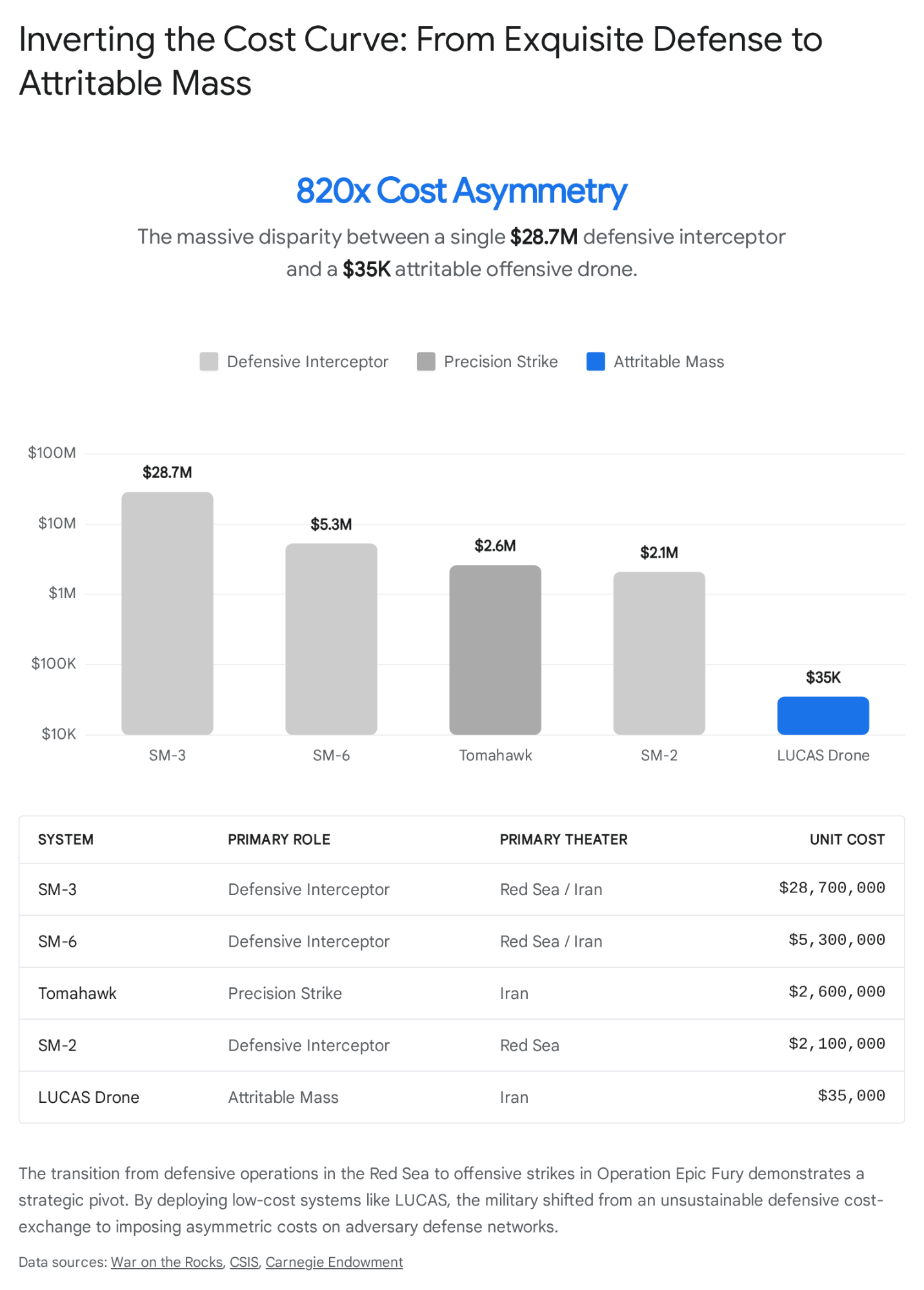
Naval doctrine traditionally dictates launching two interceptors to defeat a single incoming threat to guarantee a high probability of kill.1 To neutralize approximately 380 Houthi threats over a 15-month period, the Navy expended a massive quantity of advanced munitions. This included 120 SM-2 missiles (costing approximately $2.1 million each), 80 SM-6 missiles (costing roughly $5.3 million each), and 20 highly advanced Evolved Sea Sparrow Missiles (ESSM) and SM-3 interceptors, with the SM-3 variants costing between $9.6 million and nearly $28.7 million per unit.1
The expenditure of multi-million-dollar interceptors against drones that cost a fraction of that amount created an untenable cost-exchange ratio. This dynamic forces commanders into uncomfortable risk calculations: maintaining a high state of defense rapidly depletes finite magazines, leaving the fleet vulnerable to subsequent, higher-tier threats. Observers noted that relying on pricey assets to eliminate cheap threats raises profound questions regarding the sustainability of such tactics in a conflict against a peer adversary possessing vastly larger missile inventories.17
3.2 Operation Epic Fury: Weaponizing Asymmetry
The realization that current air defense economic models are flawed led to a profound doctrinal evolution observed during Operation Epic Fury, a major U.S.-Israeli military campaign launched against Iranian nuclear and military infrastructure in early 2026.18 During the first 100 hours of the conflict, the U.S. military incurred an estimated munitions replacement cost of $3.1 billion, highlighting the extreme financial burn rate of high-intensity warfare.20
However, rather than relying exclusively on small inventories of highly exquisite penetrating munitions like the $2.6 million Tomahawk cruise missile, U.S. Central Command intentionally inverted the cost calculus by deploying massed, low-cost drones to overwhelm Iranian defenses.2 At the center of this offensive shift was the Low-cost Unmanned Combat Attack System (LUCAS).21 Procured for approximately $35,000 per unit, the LUCAS drone effectively allowed the U.S. military to reverse-engineer the adversary’s asymmetry.21
By deploying nearly 2,000 LUCAS systems in the opening salvos, the U.S. imposed operational dislocation on Iran’s air-defense network.20 These attritable systems forced Iranian defenders to expend their limited supply of sophisticated surface-to-air missiles against cheap targets, effectively degrading the integrated air defense system (IADS) before the introduction of crewed strike aircraft and multi-million-dollar precision fires. What began as a defensive cost-exchange crisis in the Red Sea evolved into an offensive cost-imposition strategy over Iran.2 The lesson is clear: mass matters, cost can be decisive, and “good enough” precision delivered at scale can generate significant operational advantages over highly exquisite, but numerically limited, systems.21
3.3 The Drone Dominance Program and Replicator Initiatives
To institutionalize this capability, the Department of Defense launched a series of aggressive procurement initiatives aimed at rapidly scaling the defense industrial base for autonomous systems. The Drone Dominance Program (DDP) was established with the ambitious objective of acquiring up to 300,000 low-cost, attritable drones by 2027, with an interim target of 30,000 units slated for delivery by July 2026.23 The DDP is designed to help the commercial industry organize around the urgent need for secure, high-volume manufacturing, injecting $1 billion into the sector through “Gauntlet challenges” and fixed-price prototype orders.23 By utilizing multiple vendors and standardized architectures, the DoD aims to eventually drive the per-unit cost of systems like LUCAS down to as little as $5,000.24
This offensive scaling operates alongside the defensive priorities of the Replicator initiatives. While Replicator 1 focused on fielding thousands of autonomous systems across multiple domains by August 2025 to achieve mass, Replicator 2 shifted focus directly to the counter-UAS (C-UAS) mission.25 Acknowledging the threat posed by small enemy drones to domestic installations and forward bases, Replicator 2 focuses on rapidly acquiring systems like the DroneHunter F700.25 These initiatives bypass traditional, sluggish bureaucratic acquisition cycles, partnering directly with venture capitalists and tech startups to deliver capabilities at the speed of relevance.25
Collectively, the integration of massed attritable systems, autonomous networks, and decentralized command architectures is officially termed “Algorithmic Warfare”.3 For INDOPACOM planners, this represents the foundational doctrine required to dismantle the PRC’s dense A2/AD network in the Western Pacific. By fielding hundreds of thousands of autonomous assets, the U.S. can force the PLA to consume its finite interceptor magazines on low-value targets, clearing the airspace for decisive joint force maneuver.3
4. Tactical and Deckplate Innovations in Air and Missile Defense
4.1 Modifying Legacy Systems: The 5-Inch Gun and the “Murder Hornet”
The unprecedented intensity of the Red Sea combat required the Navy to look beyond its standard missile inventories and innovate at the tactical level, demonstrating the imperative of platform flexibility. Innovation frequently occurred not at the strategic level, but on the deckplates. For example, during a months-long deployment, a fire control sailor assigned to the guided-missile destroyer USS Mason observed the complex flight profiles of incoming Houthi drones.1 Recognizing that utilizing SM-2s against these targets was inefficient, the sailor altered the operational parameters of the ship’s 5-inch automatic artillery gun, developing a novel targeting adaptation that significantly increased the gun’s lethality against unmanned aerial threats.1 This grassroots adaptation was subsequently codified into formal military tactics and distributed fleet-wide, providing destroyers with a critical, low-cost inner-layer defense mechanism.1
Naval aviation demonstrated a similar capacity for rapid adaptation to maximize magazine depth. To counter the high volume of kamikaze drones and preserve the missile inventories of the Carrier Strike Groups, the Navy introduced a specialized weapons configuration for the F/A-18 Super Hornet, officially designated the “Murder Hornet” loadout.1 Bypassing standard ordnance restrictions via a rapid engineering crash program, the Navy cleared the aircraft to carry an unprecedented nine air-to-air missiles—five AIM-120 Advanced Medium-Range Air-to-Air Missiles (AMRAAMs) and four AIM-9X Sidewinders.1 Crucially, the aircraft utilized outboard underwing stations (stations 2 and 10) previously restricted from carrying the AIM-9X, while deliberately leaving other pylons empty to reduce drag and retain the jet’s dash speed and maneuverability.1
This high-capacity configuration was heavily reliant on the integration of the AN/ASQ-228 Advanced Targeting Forward-Looking Infrared (ATFLIR) pod.1 The pod allowed for positive identification (PID) of targets at beyond-visual-range (BVR) and in complex night environments, ensuring that pilots could accurately classify and engage hostile drones before they entered the fleet’s inner defensive perimeter.1 The “Murder Hornet” configuration exemplifies the necessity of maximizing the utility of existing platforms through agile engineering and software integration, a critical requirement for generating sufficient combat power in the Pacific.
4.2 Multi-Domain Synergy and Operational Dislocation
The conflicts also highlighted the limits of relying purely on defensive interception, validating the tactical philosophy of “shooting the archer, not the arrows”.28 Neutralizing the threat before it can be launched requires a highly synergistic application of multi-domain assets. This concept was vividly demonstrated during Israel’s “Operation Rising Lion” in June 2025, which served as a preemptive component against Iranian infrastructure.29
In a highly complex sequence, Israeli special operations commandos reportedly infiltrated Iranian territory months prior to position swarms of small explosive drones near critical air-defense radars and communication nodes.29 When the operation commenced, these pre-positioned swarms were launched simultaneously, saturating early-warning networks and decoying attention away from the primary strike vectors.29 Minutes later, over 200 Israeli fighter aircraft, including F-35 Adirs carrying standoff munitions, exploited the gaps in the blinded radar network to conduct precision strikes against more than 100 military and nuclear targets.29
This operation achieved “operational dislocation.” By pairing unconventional ground-based assets with advanced airpower, the attacking force generated asymmetrical shock, fracturing the adversary’s decision-making channels just as the penetrating fires arrived.29 For INDOPACOM, Operation Rising Lion provides a viable blueprint for penetrating China’s sophisticated A2/AD envelope. Inserting autonomous electronic warfare nodes or loitering munitions deep within contested territory to temporarily blind specific PLA radar sectors could create the fleeting windows of opportunity required for U.S. B-21 Raiders and stealth fighters to execute their strike missions.29
4.3 Countering Uncrewed Surface Vessels (USVs)
The proliferation of uncrewed systems extends beyond the aerospace domain. The U.S. military has observed the devastating impact of uncrewed surface vessels (USVs) in the Black Sea, where Ukrainian forces utilized small, scalable maritime drones to sink or disable a third of the Russian Black Sea Fleet, neutralizing a once-feared force without risking their own personnel.31
The Houthis attempted to replicate this success in the Red Sea, launching explosive-laden USVs against commercial and naval shipping.17 The U.S. Navy adapted its defensive posture, frequently calling upon MH-60S/R Sea Hawk helicopters armed with Hellfire missiles to engage and destroy these small boats before they could impact the hull of a destroyer.27 The lesson is that traditional naval architecture must increasingly incorporate close-in, multi-domain defenses against swarming surface threats, as the PLA possesses the technological and industrial capacity to launch massive USV swarms in the Taiwan Strait or the South China Sea.
5. Logistics, Industrial Capacity, and Sustained Maritime Maneuver
5.1 The Logistics Imperative: VLS Reloading at Sea
While tactical adaptations like the “Murder Hornet” and 5-inch gun modifications can temporarily extend a ship’s operational window, the ultimate limitation on a surface combatant is the hard capacity of its Vertical Launching System (VLS) cells. During the Red Sea operations, guided-missile destroyers that exhausted their interceptor magazines were forced to withdraw from the theater and transit to distant, secure ports for reloading.34 In the context of the Middle East, this occasionally required vessels like the Royal Navy’s HMS Diamond to sail as far as Gibraltar to rearm.34
In a conflict spanning the vast expanse of the Pacific Ocean, forcing an Arleigh Burke-class destroyer to transit thousands of miles to Guam, Hawaii, or Yokosuka for a VLS reload imposes a devastating, perhaps fatal, operational penalty. It removes critical combat power from the Weapons Engagement Zone precisely when it is most needed, validating the PLA’s strategy of outlasting U.S. magazines through massed missile barrages.35
To neutralize this severe logistical vulnerability, the Navy aggressively accelerated the development and deployment of the Transferrable Reload At-sea Method (TRAM).4 Initially conceptualized in the 1990s as a proof of concept, TRAM was revived to enable connected replenishment (CONREP) of heavy missile canisters.4
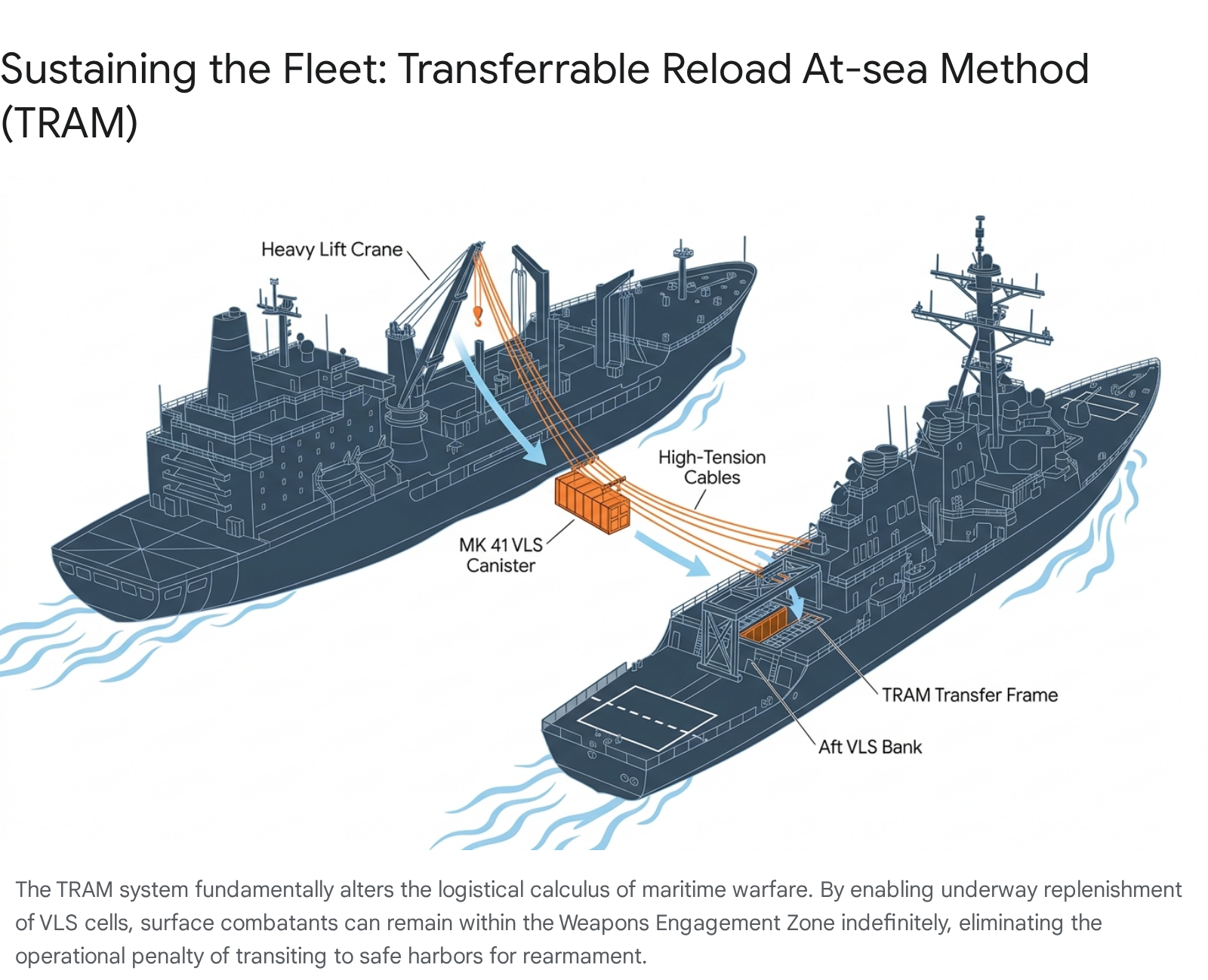
In October 2024, the Navy achieved a historic breakthrough. Sailors aboard the Ticonderoga-class cruiser USS Chosin successfully utilized a hydraulically powered TRAM device to receive and strike down an empty missile canister from the supply ship USNS Washington Chambers while underway in the open ocean off the coast of San Diego.4 Subsequent demonstrations during Large Scale Exercise 2025 involved the USS Farragut receiving reloads to both its forward and aft MK 41 VLS banks from a ready reserve crane ship, utilizing a frame-style reloader that demonstrated significantly increased reload rates.36
The strategic implications of TRAM for the Indo-Pacific are transformative. By achieving underway replenishment of heavy ordnance, the Navy effectively multiplies the persistent combat power of its existing surface fleet. Warfighters can remain near the fight, receiving fuel, provisions, and multi-million-dollar interceptors simultaneously, fundamentally altering the calculus of naval sustainment in a contested A2/AD environment.5
5.2 Revitalizing the Defense Industrial Base
The extraordinary expenditure of interceptors during the Middle Eastern campaigns highlighted a severe vulnerability within the U.S. defense industrial base. The realization that the Navy expended roughly a year’s worth of RIM-161 (SM-3) production in a mere 12 days during the early phases of the conflict served as a profound wake-up call to strategic planners.9 A protracted war with the PRC would generate munitions demands exponentially higher than those observed against Iranian proxies.
In response, the Department of Defense fundamentally shifted its procurement strategy, moving away from a model optimized for peacetime efficiency and towards a model designed for high-volume surge capacity.38 American defense primes, historically optimized for small numbers of exquisite, expensive systems, were tasked with drastically accelerating output.38
By early 2026, major defense contractors secured long-term agreements to expand output across several high-demand systems crucial for the Indo-Pacific. Lockheed Martin announced a seven-year agreement to scale the production of the Patriot Advanced Capability-3 Missile Segment Enhancement (PAC-3 MSE) interceptor from 600 to 2,000 missiles annually, supported by a $4.7 billion undefinitized contract action.39 Concurrently, RTX secured agreements to dramatically increase the production of offensive and defensive naval fires. Under these frameworks, annual production of Tomahawk cruise missiles is expected to exceed 1,000 units, AIM-120 AMRAAM output will reach at least 1,900 units, and SM-6 production will surpass 500 units annually.39 Furthermore, the highly specialized SM-3 interceptors, central to the Aegis ballistic missile defense architecture, are slated to be manufactured at up to four times their pre-war rate.39
| Munition System | Primary Function | Estimated Prewar Inventory (2025) | Usage in Epic Fury (First 100 Hrs) | Unit Cost (USD) |
| Tomahawk | Long-Range Precision Strike | 3,100 | 850+ | $2.6M |
| JASSM | Air-Launched Strike | 4,400 | 1,000+ | $2.6M |
| SM-3 | Ballistic Missile Defense | 410 | 130-250 | $28.7M |
| SM-6 | Multi-Role Interceptor | 1,160 | 190-370 | $5.3M |
| THAAD | High-Altitude BMD | 360 | 190-290 | $15.5M |
| Patriot (PAC-3) | Terminal Air Defense | 2,330 | 1,060-1,430 | $3.9M |
| LUCAS | Attritable Unmanned Strike | N/A (Surge scaling) | ~2,000 | $0.035M |
This aggressive industrial pivot ensures that the joint force will possess the necessary magazine depth to sustain a high-end conflict across the Pacific, mitigating the risk of going “Winchester” (depleting critical ammunition reserves) during the decisive opening weeks of a great power war.16 Furthermore, planners recognize that high munition usage necessitates the rapid development and fielding of cheaper alternatives, such as Long Range Anti-Ship Missiles (LRASMs, currently $3 million each) and Joint Air-to-Surface Missile-Extended Range (JASSM-ER, $1.5 million each), to attrit PLA naval forces without bankrupting the procurement budget.30
6. Command, Control, and the Information Environment
6.1 Accelerating the CJADC2 Architecture
The technological sophistication of the joint force is entirely dependent on its ability to rapidly process and disseminate targeting data. The operational experiences of 2024-2026 have proven that legacy command and control (C2) structures are insufficient for modern saturation warfare. Current tactical datalinks, such as the ubiquitous Link 16 (initially developed in 1975), are increasingly vulnerable to jamming and struggle to support the data requirements of low-observable (LO) strike assets.42 Furthermore, large airborne C2 platforms—the traditional “iron triad”—are being pushed further away from the tactical edge by advanced adversary anti-aircraft weapons, limiting their effectiveness.42
To address these vulnerabilities, the DoD is aggressively implementing the Combined Joint All-Domain Command and Control (CJADC2) strategy.6 CJADC2 aims to connect sensors and shooters across all military services and international partners, establishing a resilient, mesh-networked digital nervous system.3 The goal is to eliminate the inefficient “swivel chair” analysis model—where operators must manually transfer data between incompatible, siloed systems—and replace it with an integrated, data-centric security approach.7
However, the implementation of CJADC2 faces significant institutional hurdles. A primary hindrance to achieving seamless data sharing, particularly with coalition partners, is the persistence of overly restrictive data classification policies.7 To successfully operate in the Indo-Pacific, where allied contributions are vital, the U.S. military must resolve these classification barriers and prioritize interoperability, allowing for decentralized C2 that enables forward-deployed units to operate autonomously if communication with higher headquarters is severed by PLA electronic warfare.42
6.2 Coalition Interoperability: Lessons from Operation Iron Shield
The necessity of CJADC2 and seamless data sharing was vividly demonstrated during the April 2024 defense of Israel, an engagement characterized by unprecedented coalition coordination.44 During this event, Iran launched a massive, synchronized barrage consisting of approximately 170 kamikaze drones, 30 cruise missiles, and over 120 ballistic missiles, designed to arrive simultaneously and overwhelm Israeli defenses.45
The limited success of this attack—with a reported 99% interception rate—was not solely due to the technological prowess of Israel’s Iron Dome and Arrow systems.44 It was primarily the result of smoothly functioning, highly effective military cooperation and interoperability among the United States, the United Kingdom, France, and regional Arab partners (such as Jordan, Saudi Arabia, and the UAE), who shared critical early-warning intelligence and coordinated interception sectors in real-time.44
For INDOPACOM planners, Operation Iron Shield serves as the gold standard for coalition air defense. No single nation possesses the interceptor capacity to defeat a massive PLA missile barrage independently. Regional security in the Pacific will depend entirely on the ability to network sensors from allied nations—such as Japan, South Korea, and Australia—into a unified, coherent defensive architecture capable of tracking and prosecuting hypersonic and ballistic threats across thousands of miles.28
6.3 Closing the Kill Chain: Rapid Iteration of TTPs
In the modern information environment, software dominance is as critical as hardware capability. During the Red Sea operations, the Navy’s Information Warfare (IW) community achieved a significant strategic advantage by accelerating the feedback loop and rapidly iterating Tactics, Techniques, and Procedures (TTPs).1
The Navy established a functional “reach-back” apparatus centered around the Naval Information Warfighting Development Center (NIWDC) and the Naval Surface and Mine Warfighting Development Center.1 Combat data regarding Houthi drone flight algorithms, missile trajectories, and radar cross-sections recorded by deployed destroyers was instantly transmitted back to stateside experts.47 These analysts evaluated the engagements and rapidly formulated optimized radar tuning parameters, software updates, and engagement protocols, which were pushed back to the fleet in near real-time.1
This capability to ingest raw battle data, update algorithmic responses, and deploy software patches to the tactical edge continuously increased the proficiency of the Aegis combat system and the commander’s decision space.33 In a conflict with the PRC, where the electromagnetic spectrum will be fiercely contested and new adversary capabilities will emerge daily, this rapid learning cycle will be a decisive asymmetric advantage, ensuring that U.S. systems remain adaptive and lethal.1 Furthermore, analyzing this data allows the Navy to refine its non-kinetic, electronic warfare (EW) “soft kill” capabilities, utilizing directed energy and jamming to neutralize threats without expending kinetic interceptors.17
7. The Indispensability of Landpower in Joint Multi-Domain Operations
A persistent pre-war assumption regarding a potential conflict in the Pacific was the absolute primacy of air and naval forces, relegating ground forces to a peripheral or purely supporting role. However, the operational dynamics of the Middle Eastern campaigns, particularly Operation Epic Fury, definitively shattered this paradigm.8 Despite the campaign being defined publicly by deep-strike aviation and naval dominance, landpower emerged as the critical enabler that made joint operations possible.8
As Iran launched successive waves of ballistic missiles and long-range drones aimed at U.S. forces and regional partners, the U.S. Army’s ground-based integrated air and missile defense (IAMD) architecture formed the indispensable protective backbone of the theater.8 Army units operating Patriot PAC-3 and Terminal High-Altitude Area Defense (THAAD) batteries maintained continuous, high-tempo operations, intercepting incoming threats and shielding vulnerable forward air bases, command nodes, and strategic logistical hubs.8 Without this persistent terrestrial shield, the joint force could not have generated the sortie rates required for the offensive air campaign, nor could naval assets maneuver safely within littoral strike range.8
For INDOPACOM planners, this dictates that the Army’s Multi-Domain Operations (MDO) framework and the Integrated Battle Command System (IBCS) are non-negotiable prerequisites for survival.48 Establishing resilient, localized A2/AD bubbles across the First Island Chain—utilizing robust ground-based air defense to protect Marine Corps stand-in forces, Air Force Agile Combat Employment (ACE) hubs, and critical maritime chokepoints—is the foundation upon which Pacific deterrence rests.48
However, the complexities of multi-domain operations also introduce severe friction points. The chaotic airspace of high-intensity conflict greatly increases the risk of fratricide. During the opening hours of Operation Epic Fury, a tragic friendly-fire incident occurred wherein a single Kuwaiti F-18 fighter shot down three U.S. F-15E strike eagles.51 Similarly, in the Red Sea, the USS Gettysburg inadvertently engaged and downed a U.S. F/A-18 Super Hornet.1 These incidents underscore the urgent need for enhanced Identification Friend or Foe (IFF) systems, rigorous joint and coalition training, and transparent operational debriefs to ensure that the layered defense architectures designed to protect the force do not inadvertently degrade it.51
8. Chinese Strategic Observations and Doctrinal Counter-Adaptations
The U.S. military is not alone in extracting profound lessons from the Middle East. The Chinese People’s Liberation Army (PLA) has intensely scrutinized both the tactical successes and the industrial shortfalls of U.S. and allied operations, generating significant doctrinal adjustments designed to exploit perceived American weaknesses in a future conflict over Taiwan or the South China Sea.9
8.1 Embracing Saturation Warfare
Historically, American military operations in the Persian Gulf have shaped the PLA’s understanding of modern warfare. While the 1990-1991 Gulf War exposed Beijing to the necessity of high-technology precision strikes, the 2026 US-Israel-Iran conflict has reinforced a different operational theme: saturation warfare.9 The PLA observed that inexpensive, slow-moving systems like the Shahed drones successfully degraded high-value U.S. air-defense assets, acting essentially as flying ammunition to overwhelm interceptor algorithms.9
The PLA calculates that mass can reliably offset technological superiority.9 Beijing noted that even advanced layered defenses, such as the Iron Dome and Patriot systems, possess hard saturation limits. When adversaries integrate cluster munitions into their payloads, defenders are forced to expend multi-million-dollar interceptors against significantly cheaper threats, rapidly eroding the efficiency and resilience of the defensive architecture.9 Recognizing the severe strain placed on U.S. interceptor inventories during these conflicts, the PLA intends to leverage China’s massive industrial base and surge manufacturing capacity to sustain prolonged barrages, aiming to physically exhaust U.S. and allied magazines in the opening phases of a Pacific war.9
8.2 Enhancing Infrastructure Resilience and Space-Based ISR
The PLA has carefully analyzed the survivability of Iranian military infrastructure during the massive airstrikes of Operation Epic Fury. Observing that Iranian capabilities largely survived bunker-busting strikes by utilizing deep, hardened underground command facilities, shoot-and-scoot mobile launcher tactics, and decentralized command structures, Beijing is accelerating its own investments in infrastructure resilience.10 The PLA Rocket Force (PLARF) is prioritizing depth, redundancy, strict concealment protocols, and extensive tunneling for its vast inventory of conventional ballistic and cruise missiles located at installations such as Base 51, 52, 53, and 55 (housing systems like the DF-21D anti-ship ballistic missile, DF-21C, DF-16, and CSS-5).10
Furthermore, to counter the U.S. military’s reliance on low-observable (stealth) platforms, the PLA is aggressively leveraging intelligence derived from the Middle Eastern theater. China has reportedly utilized operational data regarding the flight profiles and radar signatures of advanced U.S. platforms (such as the F-35 and B-21) to continually update and refine the algorithms powering its BeiDou-3 and Jilin-1 space-based multi-spectral imaging constellations.10 The PLA’s objective is to achieve “electronic sovereignty”—creating a highly transparent, “glass” battlefield where U.S. stealth advantages are neutralized by pervasive, real-time satellite surveillance.10
8.3 Horizontal Escalation and Institutional Inertia
Strategically, the PLA recognizes the severe toll that high-intensity operations exact on personnel and equipment readiness. Noting how continuous operational tempo led to system fatigue for U.S. platforms and sharp drops in fighter availability due to part cannibalization, Beijing intends to exploit this friction through a strategy of “horizontal escalation”.10 By threatening regional sea lanes and aiming precise missile strikes at highly vulnerable forward logistical bases in Japan (such as Okinawa) and the Philippines (such as Luzon), China aims to alter the political risk calculus of U.S. allies.10 The objective is to make the risks of hosting American forces outweigh the benefits, politically pressuring allies into denying basing access and forcing the U.S. military to operate from extreme distances.10
However, the PLA also faces its own institutional challenges in learning these lessons. Western analysts assess that the PLA’s pre-existing, massive financial investments in highly sophisticated, AI-enabled drone swarms and large, expensive reconnaissance platforms may skew their interpretation of the Middle Eastern conflicts.54 This institutional inertia might lead Beijing to overlook the specific value of cheap, purely attritable drones in favor of exquisite systems that do not align with the cost-imposition dynamics defining modern battlefields.38 This potential misalignment provides a narrow window of opportunity for the U.S. and its partners, such as Taiwan, to develop asymmetric advantages by fully embracing low-cost attritable mass before the PLA fully adjusts its procurement models.54
9. Strategic Implications for Indo-Pacific Posture
The U.S. military’s profound experiences traversing the contested waters of the Red Sea and prosecuting the highly complex, multi-domain airspace during Operation Epic Fury have shattered several foundational pre-war assumptions. The era of relying exclusively on small inventories of hyper-advanced, exquisite platforms to secure maritime and aerospace dominance is definitively over. The mathematical realities of saturation warfare—where adversaries can generate threat volume significantly faster and cheaper than defenders can produce sophisticated interceptors—dictate a fundamental, structural reorganization of military capability.
To effectively deter the PRC in the Indo-Pacific, the United States must finalize its transition to a highly resilient, dual-capability force structure.
First, the military must ruthlessly expand its capacity for attritable mass. The rapid implementation of the Drone Dominance Program, the Replicator initiatives, and the successful operational integration of low-cost systems like the LUCAS drone prove that the U.S. can master and operationalize the cost-imposition strategy.2 Swarming the contested battlespace with hundreds of thousands of autonomous aerial, surface, and sub-surface systems shifts the defensive burden squarely onto the adversary, forcing the PLA to consume its high-end effectors while protecting crewed American platforms and creating the operational dislocation necessary for decisive strikes.
Second, the logistical and industrial backbone of the joint force must be uncompromisingly fortified for high-intensity, protracted combat. The successful development and deployment of the TRAM VLS reload system guarantees that naval surface combatants can sustain pressure within the critical First Island Chain without surrendering strategic momentum or positional advantage to re-arm.5 Simultaneously, the aggressive, multi-year scaling of the defense industrial base to mass-produce critical munitions—ranging from PAC-3 MSEs and SM-6 interceptors to Tomahawk cruise missiles and Long Range Anti-Ship Missiles (LRASMs)—ensures that the joint force possesses the requisite magazine depth to weather the massive initial shocks of a regional conflict and maintain sustained fires.30
Finally, the indispensable role of land-based air and missile defense, coupled with the critical necessity of rapid, secure coalition data-sharing via the CJADC2 architecture, highlights that modern great-power warfare is an inherently integrated, allied endeavor.6 The U.S. military cannot secure the Pacific theater in isolation. The PRC has studied these exact conflicts and is actively accelerating its own robust capabilities to blind U.S. sensors, suffocate regional logistics, and saturate allied defenses.10
Consequently, the true, enduring value of the Middle Eastern conflicts lies not solely in the tactical victories achieved by individual vessels or squadrons, but in the institutional awakening they provoked across the Department of Defense. By fully embracing algorithmic warfare, rapidly revitalizing maritime logistics, and decisively inverting the cost asymmetry of munitions, the U.S. military has fundamentally repositioned itself to manage and defeat the pacing threat in the Indo-Pacific.
Please share the link on Facebook, Forums, with colleagues, etc. Your support is much appreciated and if you have any feedback, please email us in**@*********ps.com. If you’d like to request a report or order a reprint, please click here for the corresponding page to open in new tab.
Sources Used
- How the Biden Administration Won Tactically but Failed Strategically …, accessed April 26, 2026, https://warontherocks.com/how-the-biden-administration-won-tactically-but-failed-strategically-in-the-red-sea/
- From Red Sea Defense to Epic Fury: How the U.S. Flipped the Drone Cost Equation, accessed April 26, 2026, https://defense.info/re-shaping-defense-security/2026/03/from-red-sea-defense-to-epic-fury-how-the-u-s-flipped-the-drone-cost-equation/
- America’s Algorithmic Arsenal: How Drone Dominance, Replicator, and JADC2 Are Rewriting the Rules of War – Foreign Affairs Forum, accessed April 26, 2026, https://www.faf.ae/home/2026/4/22/americas-algorithmic-arsenal-how-drone-dominance-replicator-and-jadc2-are-rewriting-the-rules-of-war
- Reloading Vertical Launching Systems at Sea | Johns Hopkins University Applied Physics Laboratory, accessed April 26, 2026, https://www.jhuapl.edu/work/projects-and-missions/reloading-vertical-launching-systems-sea
- Navy Demonstrates First At-sea Reloading of Vertical Launching System – Navsea, accessed April 26, 2026, https://www.navsea.navy.mil/Media/News/Article/3935575/navy-demonstrates-first-at-sea-reloading-of-vertical-launching-system/
- Summary of the Joint All-Domain Command and Control Strategy – Department of War, accessed April 26, 2026, https://media.defense.gov/2022/Mar/17/2002958406/-1/-1/1/SUMMARY-OF-THE-JOINT-ALL-DOMAIN-COMMAND-AND-CONTROL-STRATEGY.PDF
- GAO-25-106454, DEFENSE COMMAND AND CONTROL: Further Progress Hinges on Establishing a Comprehensive Framework, accessed April 26, 2026, https://www.gao.gov/assets/gao-25-106454.pdf
- What Does Landpower Bring to an Air and Naval Fight? – Modern War Institute, accessed April 26, 2026, https://mwi.westpoint.edu/what-does-landpower-bring-to-an-air-and-naval-fight/
- Chinese Lessons from the US-Israel-Iran War in 2026 | Centre of Excellence for Himalayan Studies – Shiv Nadar University, accessed April 26, 2026, https://snu.edu.in/centres/centre-of-excellence-for-himalayan-studies/research/chinese-lessons-from-the-us-israel-iran-war-in-2026/en/
- Chinese Lessons from the US-Israel-Iran War in 2026 | Centre of …, accessed April 26, 2026, https://snu.edu.in/centres/centre-of-excellence-for-himalayan-studies/research/chinese-lessons-from-the-us-israel-iran-war-in-2026/
- Red Sea Uncertainty: A 2026 Forecast for the Houthis Actions, accessed April 26, 2026, https://thinkdeterrence.com/red-sea-uncertainty-a-2026-forecast-for-the-houthis-actions/
- What the Iran war reveals about U.S. energy security – Defense Priorities, accessed April 26, 2026, https://www.defensepriorities.org/qa/what-the-iran-war-reveals-about-u-s-energy-security/
- China & Taiwan Update, March 6, 2026 | ISW, accessed April 26, 2026, https://understandingwar.org/research/china-taiwan/china-taiwan-update-march-6-2026/
- The Political Geography of the South China Sea Disputes | RAND, accessed April 26, 2026, https://www.rand.org/content/dam/rand/pubs/perspectives/PEA2000/PEA2021-1/RAND_PEA2021-1.pdf
- Comparing Gray-Zone Tactics in the Red Sea and the South China Sea – Dryad Global, accessed April 26, 2026, https://channel16.dryadglobal.com/comparing-gray-zone-tactics-in-the-red-sea-and-the-south-china-sea
- Last Rounds? Status of Key Munitions at the Iran War Ceasefire – CSIS, accessed April 26, 2026, https://www.csis.org/analysis/last-rounds-status-key-munitions-iran-war-ceasefire
- What the Navy is learning from its fight in the Red Sea – Navy Times, accessed April 26, 2026, https://www.navytimes.com/news/your-navy/2024/01/18/what-the-navy-is-learning-from-its-fight-in-the-red-sea/
- Epic Fury: The Campaign Against Iran’s Missile & Nuclear Infrastructure – CSIS, accessed April 26, 2026, https://www.csis.org/analysis/epic-fury-campaign-against-irans-missile-nuclear-infrastructure
- Experts React: What the Epic Fury Iran Strikes Signal to the World – Stimson Center, accessed April 26, 2026, https://www.stimson.org/2026/experts-react-what-the-epic-fury-iran-strikes-signal-to-the-world/
- $3.7 Billion: Estimated Cost of Epic Fury’s First 100 Hours – CSIS, accessed April 26, 2026, https://www.csis.org/analysis/37-billion-estimated-cost-epic-furys-first-100-hours
- What We Know About Drone Use in the Iran War, accessed April 26, 2026, https://carnegieendowment.org/emissary/2026/03/iran-drones-shahed-us-lessons
- The Iran conflict exposes the new cost curve of war – Atlantic Council, accessed April 26, 2026, https://www.atlanticcouncil.org/blogs/menasource/the-iran-conflict-exposes-the-new-cost-curve-of-war/
- Pentagon unveils Drone Dominance Program with ‘Gauntlets’ to rapidly expand its small UAS arsenal | DefenseScoop, accessed April 26, 2026, https://defensescoop.com/2025/12/02/hegseth-drone-dominance-program-ddp-gauntlets-website-rfi/
- LUCAS: Scaling the Drone War – Defense Security Monitor – Forecast International, accessed April 26, 2026, https://dsm.forecastinternational.com/2025/12/22/lucas-scaling-the-drone-war/
- Joint Interagency Task Force Announces First Replicator 2 Purchase to Counter Homeland Drone Threats – Department of War, accessed April 26, 2026, https://www.war.gov/News/News-Stories/Article/Article/4377021/joint-interagency-task-force-announces-first-replicator-2-purchase-to-counter-h/
- Replicator and beyond: The future of drone warfare – Brookings Institution, accessed April 26, 2026, https://www.brookings.edu/events/replicator-and-beyond-the-future-of-drone-warfare/
- CNO Franchetti: ‘We’re continuing to learn’ countering drones, missiles in the Red Sea, accessed April 26, 2026, https://nationalsecuritymedia.gwu.edu/2024/10/04/cno-franchetti-were-continuing-to-learn-countering-drones-missiles-in-the-red-sea/
- Lessons from Iran’s attack on Israel | The American Legion, accessed April 26, 2026, https://www.legion.org/information-center/news/landing-zone/2024/may/lessons-from-irans-attack-on-israel
- Ungentlemanly Robots: Israel’s Operation Rising Lion and the New Way of War – CSIS, accessed April 26, 2026, https://www.csis.org/analysis/ungentlemanly-robots-israels-operation-rising-lion-and-new-way-war
- The Next Offset: Winning the Fight Before It Starts – CSIS, accessed April 26, 2026, https://www.csis.org/analysis/next-offset-winning-fight-it-starts
- Lessons from Ukraine and the Red Sea on Autonomous Systems and the Future of the US Navy, accessed April 26, 2026, https://nps.edu/documents/110773463/156219640/EAG_Lessons+from+Ukraine+and+the+Red+Sea+on+Autonomous+Systems+and+the+Future+of+the+US+Navy.pdf/33b910f4-24a4-98d6-f427-6e1ae9426662?t=1744381910002
- Lessons from an Unlikely Enemy – Marine Corps Association, accessed April 26, 2026, https://www.mca-marines.org/gazette/lessons-from-an-unlikely-enemy/
- Red Sea Shoot-Downs Offer Hugely Valuable Lessons, Also Pose Big Intel Risk, accessed April 26, 2026, https://www.twz.com/red-sea-shoot-downs-offer-key-lessons-for-navy-intel-for-adversaries
- Navies and reloads: no silver bullet? – The International Institute for Strategic Studies, accessed April 26, 2026, https://www.iiss.org/online-analysis/military-balance/2024/10/navies-and-reloads-no-silver-bullet/
- Sea Control – Marine Corps University, accessed April 26, 2026, https://www.usmcu.edu/Outreach/Marine-Corps-University-Press/MCU-Journal/JAMS-vol-11-no-2/Sea-Control/
- U.S. Navy Tests At-Sea VLS Reloading During Command Drills – Naval News, accessed April 26, 2026, https://www.navalnews.com/naval-news/2025/07/u-s-navy-tests-at-sea-vls-reloading-during-command-drills/
- Navy Demonstrates ‘Game-Changing’ System to Rearm Warships at Sea – DLA, accessed April 26, 2026, https://www.dla.mil/About-DLA/News/News-Article-View/Article/3861597/navy-demonstrates-game-changing-system-to-rearm-warships-at-sea/
- What Recent Wars Mean for U.S.-India Defense Cooperation | The Heritage Foundation, accessed April 26, 2026, https://www.heritage.org/defense/commentary/what-recent-wars-mean-us-india-defense-cooperation
- Accelerating U.S. Missile Development and Naval Posture in the Indo-Pacific, accessed April 26, 2026, https://dsm.forecastinternational.com/2026/02/17/accelerating-u-s-missile-development-and-naval-posture-in-the-indo-pacific/
- U.S. Army advances accelerated PAC-3 MSE production through contract action | Article, accessed April 26, 2026, https://www.army.mil/article/291670/u_s_army_advances_accelerated_pac_3_mse_production_through_contract_action
- (PDF) Surge Capacity Issues for Selected United States Active Missiles – ResearchGate, accessed April 26, 2026, https://www.researchgate.net/publication/399448741_Surge_Capacity_Issues_for_Selected_United_States_Active_Missiles
- Optimizing Joint All-Domain C2 in the Indo-Pacific – ASPJ – Special Issue Summer 2021, accessed April 26, 2026, https://www.airuniversity.af.edu/Portals/10/ASPJ/journals/Volume-35_Special_Issue/V-Morrell.pdf
- Evaluation of a Line of Effort in the DoD’s Implementation of the Combined Joint All Domain Command and Control (CJADC2) Strategy (Report No. DODIG-2025-126), accessed April 26, 2026, https://www.dodig.mil/Reports/Audits-and-Evaluations/Article/4250222/evaluation-of-a-line-of-effort-in-the-dods-implementation-of-the-combined-joint/
- Three Strategic Lessons of the Iran-Israel Escalation – German Marshall Fund, accessed April 26, 2026, https://www.gmfus.org/news/three-strategic-lessons-iran-israel-escalation
- What We Can Learn From Iran’s Attack on Israel – FDD, accessed April 26, 2026, https://www.fdd.org/analysis/2024/04/16/what-we-can-learn-from-irans-attack-on-israel/
- Naval information forces taking rapid lessons from Red Sea attacks – DefenseScoop, accessed April 26, 2026, https://defensescoop.com/2024/02/15/naval-information-forces-lessons-red-sea-attacks/
- US Navy updating tactics for sensors, weapons based on Houthi attacks – Defense News, accessed April 26, 2026, https://www.defensenews.com/newsletters/2024/02/14/us-navy-updating-tactics-for-sensors-weapons-based-on-houthi-attacks/
- The Army Is Now Relevant to the Pacific. Congress Should Budget Accordingly., accessed April 26, 2026, https://www.heritage.org/defense/commentary/the-army-now-relevant-the-pacific-congress-should-budget-accordingly
- ARMY AIR AND MISSILE DEFENSE 2028, accessed April 26, 2026, https://www.smdc.army.mil/Portals/38/Documents/Publications/Publications/SMDC_0120_AMD-BOOK_Finalv2.pdf
- Preparing for Protracted Conflict with China and the Air and Missile Defense Shortfalls, accessed April 26, 2026, https://www.lineofdeparture.army.mil/Journals/Air-Defense-Artillery/ADA-Archive/2025-E-Edition/Protracted-Conflict/
- The Iran war’s early lessons | Responsible Statecraft, accessed April 26, 2026, https://responsiblestatecraft.org/iran-war-lessons/
- Navy Leaders Say Faster Training Is Key Lesson Learned from Red Sea Conflict, accessed April 26, 2026, https://www.military.com/daily-news/2025/01/14/navy-leaders-say-faster-training-key-lesson-learned-red-sea-conflict.html
- China Near Seas Combat Capabilities – U.S. Naval War College Digital Commons, accessed April 26, 2026, https://digital-commons.usnwc.edu/context/cmsi-red-books/article/1010/viewcontent/Web_CMS11__1_.pdf
- Lessons-learned with Chinese Characteristics: Understanding the Limits of PLA Efforts to Adapt to Contemporary Warfare – Institute for the Study of War, accessed April 26, 2026, https://understandingwar.org/research/china-taiwan/lessons-learned-with-chinese-characteristics-understanding-the-limits-of-pla-efforts-to-adapt-to-contemporary-warfare/