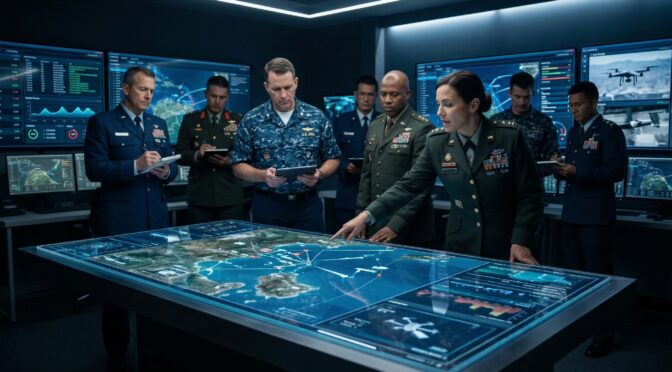
1.0 Executive Summary
As of 12:00 UTC on March 5, 2026, the coordinated military campaign against the Islamic Republic of Iran,designated Operation Epic Fury by the United States and Operation Roaring Lion by Israel,has entered a highly volatile, transitional phase characterized by deep-penetration strikes and multi-domain regional spillover. The preceding 36-hour reporting window indicates a definitive shift from initial decapitation and air defense suppression efforts toward a systemic dismantling of Iran’s military-industrial complex and internal security apparatus.1 The geopolitical and military landscape of the Middle East is currently experiencing its most severe systemic shock since the 2003 invasion of Iraq, marked by compounding crises spanning kinetic warfare, global energy market disruptions, and a burgeoning constitutional crisis within Tehran.2
The strategic map of the conflict has expanded into a massive geographic theater. Geospatial analysis of the conflict’s current posture reveals primary strike vectors from the United States and Israel penetrating deep into Iranian territory, specifically targeting command nodes in Tehran, missile facilities in Isfahan, and defense infrastructure in Tabriz.3 In response, Iranian and proxy retaliatory strike vectors are radiating outward, targeting central Israel, the Gulf Cooperation Council (GCC) states, and, in a significant escalation over the last 24 hours, the Republic of Azerbaijan.5 Compounding this regional instability is a maritime blockade zone at the Strait of Hormuz, where Iranian asymmetric naval tactics have effectively halted commercial transit.7
The most critical escalations over the last 36 hours center on three primary axes. First, the United States and Israel have reportedly established “localized air superiority” over Iranian skies, enabling continuous, uncontested bomber sorties,including the deployment of B-1 Lancer and B-2 Spirit stealth bombers,deep into Iranian airspace.9 The successful degradation of Iran’s integrated air defense systems (IADS) has fundamentally altered the tactical balance. Second, in response to the degradation of its strategic ballistic missile forces and the systematic destruction of its naval assets, the Islamic Revolutionary Guard Corps (IRGC) has pivoted to a strategy of asymmetric regional cost-imposition.1 Tehran has launched the 19th and 20th waves of “Operation True Promise 4,” utilizing massed loitering munitions to target civilian, economic, and military infrastructure across the region.13 Third, a nascent secondary ground front has materialized; the Israel Defense Forces (IDF) 91st Division has crossed into southern Lebanon to neutralize Hezbollah infrastructure, while credible intelligence indicates that heavily armed Iranian Kurdish opposition groups are executing cross-border incursions into northwestern Iran to exploit the regime’s weakened internal security posture.15
The systemic shifts observed indicate that the conflict’s center of gravity is moving from immediate military neutralization to regime destabilization. Inside Iran, the assassination of Supreme Leader Ayatollah Ali Khamenei has triggered a chaotic and heavily coerced succession process.18 The IRGC has functionally superseded the civilian and clerical establishment, pressuring the Assembly of Experts to rapidly install Mojtaba Khamenei as the new Supreme Leader in an extra-constitutional emergency session.18 This militarization of the state apparatus is occurring concurrently with an escalating economic crisis, driven by Iran’s functional closure of the Strait of Hormuz, which has choked off approximately 20% of the global oil supply and triggered emergency interventions by the U.S. Navy to protect commercial shipping.2
2.0 Chronological Timeline of Key Events (Last 36 Hours)
The following timeline details the escalation cycle from the morning of March 4 to the midday hours of March 5, 2026. All times are recorded in Coordinated Universal Time (UTC) and aligned with regional combat theater reports to ensure standardized tracking across multiple operational zones.
- March 4, 05:26 UTC: Iran launches a heavily coordinated missile barrage targeting northern and southern Israel. Air raid sirens activate in the southern port city of Eilat for the first time since the outbreak of hostilities.20
- March 4, 05:28 UTC: A suspected Iranian drone strike impacts the CIA station situated inside the U.S. Embassy compound in Riyadh, Saudi Arabia, triggering localized fires but resulting in no confirmed casualties. Simultaneously, the IRGC claims it has targeted U.S. infantry personnel in Dubai and military infrastructure in Kuwait and Bahrain.20
- March 4, 05:56 UTC: The IDF executes a targeted drone strike on the headquarters of the Kurdistan Democratic Party of Iran (KDPI) in Erbil, Iraq, amidst chaotic reports of Kurdish border mobilizations against Iranian forces.20
- March 4, 07:17 UTC: The IDF officially announces the commencement of “large-scale operations across Iran,” marking a transition to deep-inland targeting. Concurrently, Hezbollah launches a barrage of rockets from southern Lebanon toward northern Israeli settlements.20
- March 4, 14:09 UTC: The Pentagon confirms that U.S. Central Command (CENTCOM) is rapidly burning through precision munitions and air defense interceptors. Field commanders report they are utilizing Anthropic’s “Claude” AI tool, integrated with Palantir’s “Maven Smart System,” to process satellite surveillance and automate real-time target prioritization.22
- March 4, 15:02 UTC: Sri Lankan naval forces and local authorities report the recovery of over 80 bodies belonging to Iranian sailors after a U.S. submarine utilizes a Mark 48 torpedo to sink the Iranian Moudge-class frigate IRIS Dena in the Indian Ocean.20
- March 4, 17:03 UTC: Omani naval vessels rescue the 24-person crew of the Palau-flagged cargo ship Skylight, which was struck and set ablaze by two Iranian projectiles near the Strait of Hormuz.22
- March 4, 18:05 UTC: Israeli warplanes conduct intense bombing runs on the Laylaki area in Beirut’s southern suburbs. This is closely followed by a sweeping IDF evacuation order for all Lebanese territory south of the Litani River.20
- March 4, 19:43 UTC: Qatar’s Foreign Ministry reports a massive incoming Iranian assault comprising 101 ballistic missiles, 98 drones, and 3 cruise missiles. While the vast majority are intercepted, localized strikes force the emergency shutdown of critical Liquefied Natural Gas (LNG) facilities at Ras Laffan.22
- March 4, 20:21 UTC: NATO air defense systems deployed in the Eastern Mediterranean intercept an Iranian ballistic missile over Hatay province, Turkey, highlighting the expanding geographic footprint of the conflict.20
- March 4, 21:08 UTC: The Israeli Air Force (IAF) conducts concentrated bombing on Mehrabad Airport in Tehran, systematically destroying its surveillance capabilities and associated air defense radar arrays.20
- March 5, 01:16 UTC: Hezbollah executes precision drone attacks on Israeli Iron Dome radar systems in Haifa and the Ein Shemer base, located approximately 75 kilometers from the Lebanese border.20
- March 5, 06:07 UTC: The IRGC officially announces the initiation of the 19th wave of “Operation True Promise 4.” The operation is described as a combined hypersonic missile and drone assault specifically targeting the Israeli Ministry of Defense complex in Tel Aviv and Ben Gurion Airport.13
- March 5, 07:10 UTC: The U.S. Senate definitively defeats a War Powers resolution (47-53) aimed at blocking President Trump from utilizing further military force in Iran, effectively securing legislative maneuvering room for sustained operations.5
- March 5, 08:30 UTC: Iranian Arash-2 kamikaze drones strike the terminal at Nakhchivan Autonomous Republic Airport and a nearby school in Azerbaijan. This marks the first direct Iranian kinetic strike on Azerbaijani territory during the current conflict.5
- March 5, 09:37 UTC: The U.S. Department of Defense officially identifies the fifth U.S. soldier killed in the March 1 Iranian drone attack on Port Shuaiba, Kuwait, as Maj. Jeffrey R. O’Brien. The remains of a sixth soldier, believed to be Chief Warrant Officer 3 Robert Marzan, undergo final medical examiner verification.22
3.0 Situation by Primary Country
3.1 Iran
3.1.1 Military Actions & Posture
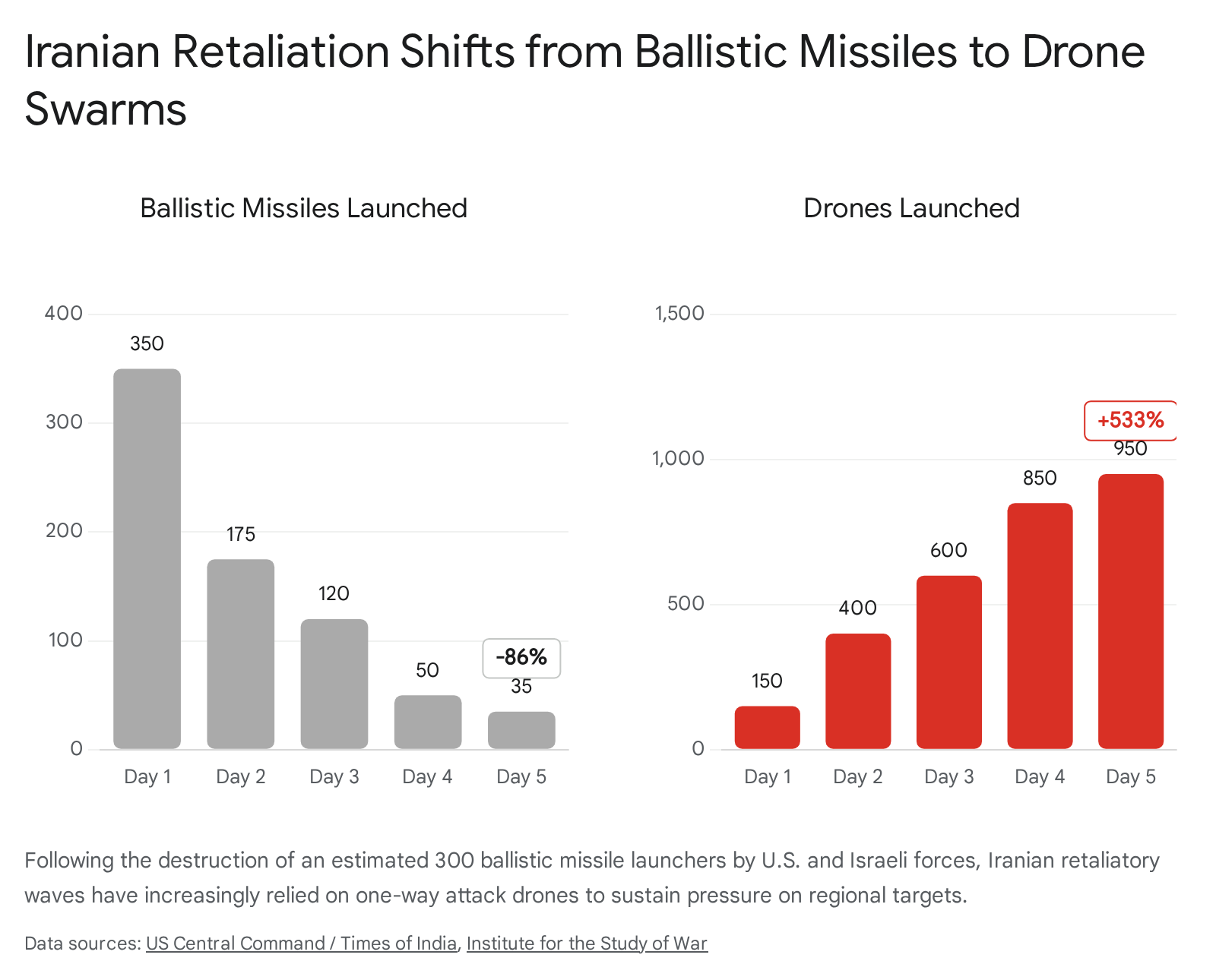
The Iranian military apparatus has suffered catastrophic kinetic degradation over the last 36 hours, yet it remains highly lethal through the deployment of asymmetric and unconventional warfare strategies.1 The combined U.S. and Israeli air campaigns have systematically dismantled Iran’s integrated air defense networks, allowing Western coalition forces to establish localized air superiority. According to CENTCOM assessments and statements by the Chairman of the Joint Chiefs of Staff, Gen. Dan Caine, Iranian ballistic missile launches have dropped by 86% since the opening day of the conflict.9 This reduction is directly attributable to the verified destruction of approximately 300 heavy ballistic missile launchers by IDF and U.S. forces.1
In the maritime domain, the Iranian Navy (IRIN) and the IRGC Navy (IRGCN) have been functionally neutralized. The U.S. military confirmed the sinking of the IRIS Dena via submarine-launched Mark 48 torpedo in the Indian Ocean,resulting in the deaths of over 80 Iranian sailors,and the destruction of at least 17 to 20 other vessels.22 Satellite imagery confirms that a Fateh-class coastal submarine was struck directly within its fortified pen at Bandar Abbas.29 The loss of these capital ships has forced Iran to abandon conventional naval posturing.
Stripped of its primary conventional deterrents, the IRGC has transitioned entirely to its “Operation True Promise 4” framework.30 This strategy relies on massed swarms of low-cost, one-way attack (OWA) drones to overwhelm regional air defenses. The 19th and 20th waves of this operation were launched in the early hours of March 5, utilizing Shahed and Arash-2 drones alongside residual short-range ballistic missiles (SRBMs).25 Furthermore, the IRGC has officially declared the Strait of Hormuz closed to international shipping. While lacking the naval surface vessels to enforce a traditional maritime blockade, Iran is successfully utilizing shore-based anti-ship missiles and drone harassment to deter commercial traffic, reducing tanker movement by 90% and effectively weaponizing global energy supply chains.7
3.1.2 Policy & Diplomacy
The Iranian state is currently navigating an unprecedented constitutional and leadership crisis. Following the confirmed death of Supreme Leader Ayatollah Ali Khamenei on February 28, the country has nominally been operating under an Interim Leadership Council.33 However, intelligence assessments over the last 36 hours indicate that the succession process is being violently accelerated and commandeered by the IRGC.18
The Assembly of Experts, the 88-member clerical body constitutionally tasked with selecting the Supreme Leader, scheduled an emergency online session for Thursday, March 5.18 The meeting is being managed from a highly secure location near the Fatima Masumeh shrine in Qom, deliberately chosen to deter Israeli airstrikes due to its religious significance.18 Intelligence confirms that IRGC commanders have exerted immense psychological and political pressure on the clerics,including threats and coercive lobbying,to bypass standard constitutional debates and immediately appoint 56-year-old Mojtaba Khamenei, the late leader’s son.18 The IRGC views Mojtaba, who has served as a powerful, behind-the-scenes gatekeeper with deep ties to the security apparatus, as the only candidate capable of maintaining regime cohesion during a state of total war.34
This overt coercion has triggered severe backlash from traditionalist factions within the clerical establishment. At least eight members of the Assembly are actively boycotting the March 5 session.18 Dissenters argue that appointing Mojtaba effectively transitions the Islamic Republic into a hereditary monarchy,a direct violation of the 1979 revolutionary ethos.18 Furthermore, opponents cite Mojtaba’s lack of the requisite religious ranking (Ayatollah) as a fatal blow to the theological legitimacy of the Velayat-e Faqih (Guardianship of the Islamic Jurist).18 This internal fracturing suggests that the U.S. and Israeli strategy of regime disruption is forcing the IRGC to prioritize immediate security control over long-term institutional legitimacy.
3.1.3 Civilian Impact
The civilian toll inside Iran is mounting rapidly amidst the collapse of basic infrastructure. The Iranian Foundation of Martyrs and Veterans Affairs reported on March 5 that the confirmed death toll has reached 1,045, with over 6,186 wounded nationwide.22 Tragically, this figure includes at least 180 individuals under the age of 18, with women and girls accounting for 13% of the fatalities.22
The mass casualty event at the Shajareh Tayyebeh girls’ school in Minab on February 28 remains a major domestic and international flashpoint. High-resolution satellite imagery analyzed on March 4 and 5 confirmed the school was located immediately adjacent to the Seyyed Al-Shohada Barracks, a highly fortified IRGC military compound.5 The imagery revealed multiple collapsed buildings and impact craters within the military site, indicating that the school suffered catastrophic collateral damage from strikes aimed at the IRGC facility. The U.S. Department of Defense has denied intentionally targeting civilians and has initiated an internal investigation into the strike.38
Civilian infrastructure is heavily degraded across the nation. Internet connectivity remains suppressed to approximately 1% of normal capacity due to sustained U.S. Cyber Command operations and internal regime throttling.3 Domestic commercial flights are entirely grounded. The state funeral for Ali Khamenei, originally intended to be a massive public rallying event in Tehran, was indefinitely postponed on March 4.22 Authorities cited the inability to secure the airspace and manage logistics for millions of attendees amidst continuous Israeli bombardment.40
3.2 Israel
3.2.1 Military Actions & Posture
The Israel Defense Forces (IDF) are executing Operation Roaring Lion with unprecedented operational tempo, marking the largest, most sustained aerial campaign in the history of the Israeli Air Force (IAF).41 Operating in seamless, synchronized coordination with U.S. Central Command, over 200 IAF aircraft have deployed more than 4,000 precision munitions on Iranian targets.4 Over the last 36 hours, the IDF has transitioned to deep-penetration strikes, targeting critical regime infrastructure in the heart of Tehran.1
The tactical execution of this phase has focused heavily on neutralizing internal security nodes designed to suppress Iranian domestic dissent. The IDF successfully targeted and destroyed the headquarters of the IRGC Intelligence Organization (Unit 4000), multiple Basij paramilitary regional bases, and the headquarters of the 27th Mohammad Rasoul Ollah Provincial Unit (the primary internal security force for Tehran).1 By degrading the regime’s domestic enforcement mechanisms, Israel’s strategy aims to facilitate internal uprisings while simultaneously degrading Iran’s ability to coordinate its external proxy network. Additionally, the IAF achieved a notable milestone when an F-35I “Adir” shot down an Iranian Yak-130 fighter jet over Tehran,the first confirmed air-to-air combat kill by an F-35 against another manned aircraft.4
Simultaneously, Israel has violently escalated the northern front against Hezbollah to secure its borders. On March 4, the IDF 91st Division initiated localized ground incursions south of the Litani River in Lebanon to establish a physical security buffer.15 The IAF heavily bombarded the Dahiyeh suburb in Beirut, eliminating senior Hamas officials and IRGC-Quds Force operatives, including Daoud Alizadeh, the deputy commander of the Quds Force’s Lebanon Corps.4
3.2.2 Policy & Diplomacy
Israeli political and military leadership are projecting a posture of absolute resolve and maximalist objectives. Defense Minister Israel Katz confirmed to military intelligence officers on March 4 that Operation Roaring Lion was initially planned for mid-2026.43 However, the timeline was drastically accelerated due to aligned strategic objectives with the Trump administration and highly actionable intelligence regarding Iran’s nuclear breakout capacity. Israeli intelligence assessed that Iran was within two weeks of enriching uranium to 90% (weapons-grade purity), though Tehran still lacked a finalized, deployable weaponization mechanism.5
Katz issued a severe diplomatic and military warning regarding the ongoing Iranian succession crisis, stating unequivocally that whoever is chosen by the Assembly of Experts to succeed Ali Khamenei will be marked as an “unequivocal target for elimination,” irrespective of their title or geographic location.36 Domestically, the war effort enjoys overwhelming support; recent polling indicates that 82% of the general Israeli public, and 93% of Jewish Israelis, support the continuation of the military campaign until the Ayatollah regime is entirely overthrown and its nuclear capabilities dismantled.46
3.2.3 Civilian Impact
The Israeli home front remains under a legally declared “special emergency situation,” granting the IDF Home Front Command extensive authority over civilian movements and infrastructure.47 Since the conflict’s inception, 12 Israeli civilians have been killed, primarily due to the initial, dense ballistic missile barrages penetrating the Arrow and David’s Sling defense layers, most notably resulting in nine fatalities in Beit Shemesh.4 As of the morning of March 5, the Israeli Health Ministry reported that 1,473 individuals had been evacuated to hospitals, though officials noted a significant portion of these injuries were sustained organically while civilians rushed to bomb shelters rather than from direct shrapnel impacts.49
While the total volume of Iranian missile fire has drastically reduced, the psychological and economic toll remains severe. Air raid sirens sounded continuously over the Gush Dan (Tel Aviv) region, Haifa, and Jerusalem on March 4 and 5 due to coordinated, simultaneous drone and missile salvos launched from both Iran and Lebanon.11 The aviation sector is severely constrained; Ben Gurion Airport has reopened for highly restricted, incoming-only passenger flights,capped at approximately one flight per hour,to facilitate the gradual repatriation of an estimated 100,000 Israelis currently stranded abroad.5
3.3 United States
3.3.1 Military Actions & Posture
The U.S. Department of Defense has deployed the largest concentration of military firepower in the Middle East in a generation, encompassing over 50,000 troops, two carrier strike groups (including the USS Abraham Lincoln and USS Gerald R. Ford), and dedicated strategic bomber wings.28 Operation Epic Fury has successfully struck over 2,000 targets in its first 100 hours of execution.53 U.S. kinetic operations have been characterized by a heavy reliance on strategic bombers; CENTCOM confirmed that B-1 Lancers and B-2 Spirit stealth bombers (utilizing 2,000-pound and 30,000-pound bunker-buster munitions) have been actively striking hardened, deeply buried underground ballistic missile and nuclear infrastructure sites.11
Technologically, the U.S. is leveraging advanced artificial intelligence to manage the battlespace. The integration of Palantir’s Maven Smart System with Anthropic’s “Claude” AI architecture has allowed CENTCOM to process vast amounts of satellite telemetry and signals intelligence.22 This AI integration has automated target prioritization, directly enabling the unprecedented pace of the air campaign. Furthermore, U.S. Cyber Command and Space Command initiated the conflict with extensive non-kinetic layering, crippling Iranian sensor networks, jamming satellite uplinks, and blinding early warning systems to facilitate the subsequent kinetic aerial blitz.55
However, the immense scale and operational tempo of the campaign are generating severe logistical friction. Pentagon officials warned on March 4 that CENTCOM is burning through its global reserves of precision-guided munitions and Terminal High Altitude Area Defense (THAAD) interceptors at an unsustainable rate.22 Commanders indicated they are days away from being forced to strictly triage incoming threats to preserve interceptor stockpiles for the defense of high-value strategic assets.
| Confirmed U.S. Casualties in Operation Epic Fury (As of March 5, 2026) |
| Location of Incident: Port Shuaiba, Kuwait (Tactical Operations Center) |
| Mechanism of Attack: Iranian Unmanned Aircraft System (UAS) / Drone |
| Unit Affected: 103rd Sustainment Command (U.S. Army Reserve, Des Moines, Iowa) |
| Total Killed In Action (KIA): 6 |
| Identified Personnel: Capt. Cody A. Khork (35), Sgt. 1st Class Noah L. Tietjens (42), Sgt. 1st Class Nicole M. Amor (39), Sgt. Declan J. Coady (20), Maj. Jeffrey R. O’Brien (45), Chief Warrant Officer 3 Robert Marzan (54) |
| Total Wounded In Action (WIA): 18 (10 remaining in serious condition) |
| Data derived from official Pentagon casualty identification releases.22 |
3.3.2 Policy & Diplomacy
In Washington, the executive and legislative branches have clashed over the scope, timeline, and authorization of the war. On March 4, the U.S. Senate held a highly contentious vote on a War Powers resolution introduced by Democrats aiming to block President Trump from continuing military operations without formal, prior congressional authorization. The resolution was defeated 47-53, largely along party lines, effectively granting the administration a legislative mandate to continue the campaign indefinitely.5
President Trump has maintained an aggressive, unyielding public posture, rating the military’s performance a “15 out of 10” and indicating the campaign could stretch well beyond the initial four-to-five-week timeline.22 The administration’s stated strategic goals remain maximalist: the total destruction of Iran’s missile production capabilities, the complete annihilation of the Iranian Navy, the severance of regional proxy networks, and an absolute guarantee that Iran never achieves nuclear breakout.22 In response to the severe economic fallout of the Strait of Hormuz closure, President Trump issued an executive directive ordering the U.S. Navy to begin escorting commercial oil tankers through the strait and mandated the U.S. Development Finance Corporation (DFC) to immediately provide political risk insurance to international shipping lines to incentivize continued maritime trade.19
3.3.3 Civilian Impact
The domestic impact within the United States is currently dominated by mounting economic concerns and logistical challenges abroad. Global oil prices have surged, with international benchmark Brent crude jumping 10-13% to over $82-$85 per barrel.7 This spike is rapidly driving up prices at the pump for American consumers and threatening broader inflationary pressures.
Concurrently, the U.S. State Department is executing a massive logistical operation to extract American citizens from the conflict zone. As of March 4, 17,500 Americans had been successfully evacuated from the Middle East.22 However, the State Department has issued severe “Level 4: Do Not Travel / Depart Immediately” advisories for 14 nations across the region.62 Due to the near-total collapse of commercial aviation in the Gulf, U.S. embassies in Qatar, Kuwait, and Bahrain have explicitly warned citizens that government-sponsored evacuation flights cannot be guaranteed, advising Americans to shelter in place and seek alternative overland routes where possible, leaving thousands highly vulnerable.62
4.0 Regional and Gulf State Impacts
The strategic fallout of Operation Epic Fury has shattered the Gulf Cooperation Council’s (GCC) decades-long security doctrine, which relied on insulating themselves from direct U.S.-Iran military confrontation.65 Iran’s retaliatory doctrine treats the entire U.S. forward-basing network as a unified operational system, resulting in unprecedented, indiscriminate strikes across sovereign Arab territories.66
The Republic of Azerbaijan: In a significant geographic expansion of the conflict, hostilities reached the Caucasus on March 5. Iranian Arash-2 kamikaze drones struck the Nakhchivan Autonomous Republic, an Azerbaijani exclave bordering northwestern Iran.5 Drones directly impacted the main terminal at Nakhchivan International Airport and detonated near a secondary school in the village of Shekarabad, injuring two civilians.5 Baku fiercely condemned the attack, summoned the Iranian ambassador to issue a formal protest, and publicly warned that it reserves the right to enact “retaliatory measures”.5 This development raises the severe risk of Azerbaijan,a key Israeli military ally and major weapons recipient,opening a northern front against Iran.26
The State of Qatar: Qatar, host to the massive Al Udeid Air Base (the forward headquarters of U.S. Central Command), has suffered intense bombardment. On March 4, Qatar intercepted the majority of a massive Iranian barrage comprising 101 ballistic missiles, 98 drones, and 3 cruise missiles, alongside the incursion of two Iranian Su-24 fighter jets.22 Despite successful interceptions, falling debris and localized strikes severely damaged civilian infrastructure and forced QatarEnergy to declare force majeure, halting liquid natural gas (LNG) production at the Ras Laffan industrial city.22 This emergency shutdown has effectively removed 20% of the global LNG supply from the market.69 Furthermore, Qatari state security announced the arrest of an active IRGC espionage cell operating within the country.30
The United Arab Emirates (UAE): The UAE has acted as the primary sponge for Iranian retaliatory fire, absorbing over 1,138 drone and missile attacks since February 28.1 On March 5, debris from intercepted drones injured six expatriate workers (Pakistani and Nepali nationals) in Abu Dhabi.5 The sustained attacks have paralyzed the UAE’s critical aviation hub model; major carriers including Emirates, Etihad, and FlyDubai have sustained massive flight cancellations, leaving tens of thousands of passengers stranded.50 Terminal 3 at Dubai International Airport previously suffered a direct drone impact, forcing evacuations and extensive rerouting.70
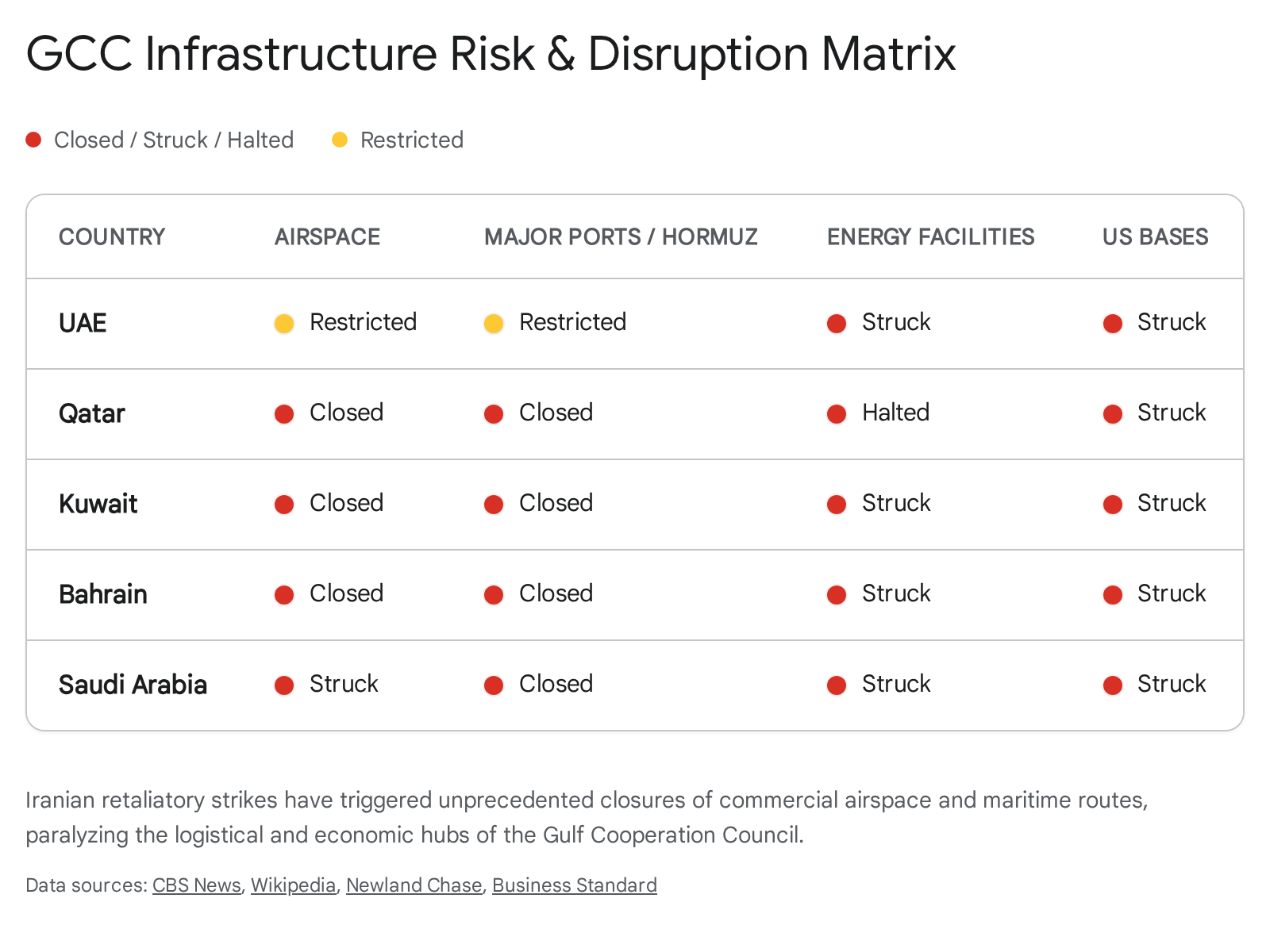
The Kingdom of Saudi Arabia: Saudi Arabia’s Eastern Province and the capital, Riyadh, have been repeatedly targeted by Iranian drones. On March 4, the U.S. Embassy in Riyadh was struck by two drones, prompting the emergency evacuation of non-essential personnel and their families.20 Saudi Aramco was forced to temporarily suspend operations at the massive Ras Tanura oil refinery due to fires caused by intercepted drone debris.72 While Riyadh has officially condemned the Iranian aggression and affirmed its right to self-defense, the Kingdom remains heavily reliant on U.S. Patriot and THAAD batteries to maintain the integrity of its airspace.73
The Kingdom of Bahrain & The State of Kuwait: Bahrain, which hosts the headquarters of the U.S. Navy’s 5th Fleet, suffered direct ballistic missile strikes on the Naval Support Activity (NSA) base in Manama, as well as hits on the Arab Shipbuilding and Repair Yard (ASRY) in Al Hidd.75 In Kuwait, the Ali Al Salem Air Base and Camp Arifjan have sustained heavy structural damage to logistics warehouses and aircraft shelters.1 The deadly March 1 drone strike at Port Shuaiba claimed the lives of six U.S. soldiers. Consequently, Kuwait’s airspace remains entirely closed to commercial traffic, and the U.S. Embassy in Kuwait City has suspended all consular services, explicitly ordering personnel to shelter in place.63
The Sultanate of Oman & The Hashemite Kingdom of Jordan: Oman, traditionally a strictly neutral diplomatic mediator between Washington and Tehran, has not been spared. Its strategic port at Duqm was hit by drones, and the Omani Navy was forced to conduct emergency rescue operations for the crew of the Palau-flagged Skylight tanker after it was struck by an Iranian projectile in the Strait of Hormuz.22 Jordan has been forced to continuously activate its air defense networks to intercept Iranian missiles violating its sovereign airspace en route to Israel. The Jordanian Armed Forces (JAF) have publicly warned that they will firmly shoot down any projectile,whether Iranian or Israeli,that breaches their territorial integrity, aiming to prevent the Kingdom from becoming a proxy battlefield.78
Kurdish Region (Iraq/Iran Border): A highly volatile sub-conflict is rapidly emerging in the Zagros Mountains along the Iran-Iraq border. U.S. and Israeli officials report that thousands of fighters from the Kurdistan Free Life Party (PJAK) and the Democratic Party of Iranian Kurdistan (KDPI) are massing for, or actively engaging in, a ground offensive into Iran’s West Azerbaijan and Kurdistan provinces.17 The strategic intent is to exploit the destruction of IRGC border posts by U.S. airstrikes to spark a broader ethno-nationalist uprising inside Iran. While the Iraqi Kurdistan Regional Government has officially denied these troop movements, the IRGC has preemptively launched drone and missile strikes against KDPI headquarters in Erbil to disrupt the mobilization.1 Should the CIA and U.S. military actively arm and provide close air support to these Kurdish militias,as reportedly under consideration in Washington,it would represent a definitive strategic shift from military containment to the active territorial balkanization of the Iranian state.21
5.0 Appendices
Appendix A: Methodology
This Situation Report (SITREP) was compiled using a comprehensive, multi-domain sweep of real-time open-source intelligence (OSINT), official state broadcasts, and military command updates generated between March 4, 2026, 00:00 UTC, and March 5, 2026, 12:00 UTC. The 36-hour operational window was utilized to capture preceding late-night events that directly informed morning strategic shifts, ensuring absolute continuity of the battlespace narrative. Data streams were weighted heavily toward primary sources, prioritizing U.S. Central Command (CENTCOM) press releases, IDF operational updates, and IRGC Public Relations Office statements disseminated via Tasnim and Fars news agencies. In instances of conflicting information,such as the initial Iranian claim of sinking a U.S. oil tanker,reports were rigorously cross-verified against independent maritime tracking data (e.g., UKMTO, Vanguard), which conclusively identified the vessel as the Bahamas-flagged commercial ship Sonangol Namibe.5 Claims regarding Kurdish ground offensives remain categorized as highly credible but officially uncorroborated, based on diplomatic denials juxtaposed against verified troop movement indicators and preemptive IRGC strikes.
Appendix B: Glossary of Acronyms
- CENTCOM: United States Central Command. The geographic combatant command of the U.S. Department of Defense responsible for military operations in the Middle East, Central Asia, and parts of South Asia.
- DFC: U.S. International Development Finance Corporation. The federal agency tasked with providing political risk insurance to safeguard global energy supplies and maritime trade.
- GCC: Gulf Cooperation Council. A political and economic union comprising Bahrain, Kuwait, Oman, Qatar, Saudi Arabia, and the United Arab Emirates.
- IADS: Integrated Air Defense System. A heavily networked system of early warning radars, command centers, and surface-to-air missiles utilized by Iran to protect its airspace.
- IAF: Israeli Air Force.
- IDF: Israel Defense Forces.
- IRGC: Islamic Revolutionary Guard Corps. A multi-service primary branch of the Iranian Armed Forces, distinct from the regular army, tasked specifically with protecting the Islamic Republic’s political system and overseeing its strategic missile and proxy forces.
- KDPI: Democratic Party of Iranian Kurdistan. An armed Kurdish opposition group based in northern Iraq, currently involved in border mobilizations against the Iranian regime.
- LNG: Liquefied Natural Gas. A critical global energy commodity, heavily disrupted by the shutdown of Qatari production facilities.
- OSINT: Open-Source Intelligence. Intelligence gathered from publicly available sources, including satellite imagery, commercial maritime tracking, and social media.
- OWA: One-Way Attack. A military designation for loitering munitions, commonly referred to as kamikaze or suicide drones (e.g., the Shahed or Arash-2 series).
- PJAK: Kurdistan Free Life Party. A militant Kurdish nationalist group operating along the Iran-Iraq border.
- THAAD: Terminal High Altitude Area Defense. An advanced American anti-ballistic missile defense system currently experiencing stockpile depletion due to high interception rates.
Appendix C: Glossary of Foreign Words
- Basij: “The Mobilization.” A volunteer paramilitary militia operating directly under the command of the IRGC. The Basij are heavily utilized for internal security, moral policing, and the violent suppression of domestic protests. Their headquarters have been primary targets for IDF strikes.
- Dahiyeh: The predominantly Shia southern suburbs of Beirut, Lebanon. This area serves as the primary headquarters, logistical hub, and stronghold for Hezbollah, currently subject to intense IAF bombardment.
- Majlis: The Islamic Consultative Assembly, which serves as the national legislative body (parliament) of Iran.
- Quds Force: The elite expeditionary and unconventional warfare branch of the IRGC. It is responsible for funding, training, and directing the “Axis of Resistance” proxy groups across the Middle East, including Hezbollah, Hamas, and the Houthis.
- Velayat-e Faqih: “Guardianship of the Islamic Jurist.” The foundational political and theological doctrine of the Islamic Republic of Iran. It mandates that a high-ranking, qualified Islamic cleric (the Supreme Leader) holds ultimate political and religious authority over the state, a principle currently challenged by the proposed hereditary succession of Mojtaba Khamenei.
Please share the link on Facebook, Forums, with colleagues, etc. Your support is much appreciated and if you have any feedback, please email us in**@*********ps.com. If you’d like to request a report or order a reprint, please click here for the corresponding page to open in new tab.
Sources Used
- Iran Update Evening Special Report, March 4, 2026 | ISW, accessed March 5, 2026, https://understandingwar.org/research/middle-east/iran-update-evening-special-report-march-4-2026/
- The Strait that Moves the Market: The 2026 Strait of Hormuz Crisis and the Anatomy of a Global Energy Shock | Atlas Institute for International Affairs, accessed March 5, 2026, https://atlasinstitute.org/the-strait-that-moves-the-market-the-2026-strait-of-hormuz-crisis-and-the-anatomy-of-a-global-energy-shock/
- OPERATION ROARING LION , INTELLIGENCE CODEX – Succession Decapitation · Proxy Retaliation Cascade · Munitions Attrition Horizon – https://debuglies.com, accessed March 5, 2026, https://debuglies.com/2026/03/03/operation-roaring-lion-intelligence-codex-succession-decapitation-%C2%B7-proxy-retaliation-cascade-%C2%B7-munitions-attrition-horizon/
- Daily Report – The Second Iran War | March 4, 2026, accessed March 5, 2026, https://israel-alma.org/daily-report-the-second-iran-war-march-4-2026/
- Live Updates: U.S. and Iran vow to step up attacks in fast-spreading …, accessed March 5, 2026, https://www.cbsnews.com/live-updates/us-iran-war-spreads-azerbaijan-israel-strikes-tehran-lebanon/
- Iran Targets Azerbaijan’s Civilian Infrastructure with Kamikaze Drones, accessed March 5, 2026, https://caspiannews.com/news-detail/iran-targets-azerbaijans-civilian-infrastructure-with-kamikaze-drones-2026-3-5-10/
- 2026 Strait of Hormuz crisis – Wikipedia, accessed March 5, 2026, https://en.wikipedia.org/wiki/2026_Strait_of_Hormuz_crisis
- The Strait of Hormuz crisis and its devastating impact on Asia-Gulf trade, accessed March 5, 2026, https://www.seatrade-maritime.com/tankers/the-strait-of-hormuz-crisis-and-its-devastating-impact-on-asia-gulf-trade
- US: Iran missile launches down 86%, 23% over last day, accessed March 5, 2026, https://www.jpost.com/middle-east/iran-news/article-888847
- Secretary of War Pete Hegseth and Chairman of the Joint Chiefs of Staff Gen. Dan Caine Hold a Press Briefing, accessed March 5, 2026, https://www.war.gov/News/Transcripts/Transcript/Article/4421037/secretary-of-war-pete-hegseth-and-chairman-of-the-joint-chiefs-of-staff-gen-dan/
- Live Updates: Israel, US intensify campaign against Iran | The Jerusalem Post, accessed March 5, 2026, https://www.jpost.com/middle-east/iran-news/2026-03-04/live-updates-888739
- (PDF) Scorched Earth in the Persian Gulf: Iran’s Multi-Domain Retaliatory Strategy Following Operation Epic – ResearchGate, accessed March 5, 2026, https://www.researchgate.net/publication/401488030_Scorched_Earth_in_the_Persian_Gulf_Iran’s_Multi-Domain_Retaliatory_Strategy_Following_Operation_Epic
- IRGC launches 19th wave of Operation True Promise 4; says operation against “American-Zionist terrorists”, accessed March 5, 2026, https://www.aninews.in/news/world/middle-east/irgc-launches-19th-wave-of-operation-true-promise-4-says-operation-against-american-zionist-terrorists20260305085721
- Live Coverage of the Iran–U.S.–Israel Conflict / March 05, accessed March 5, 2026, https://wanaen.com/live-coverage-of-the-iran-u-s-israel-conflict-march-05/
- 2026 Iran war – Wikipedia, accessed March 5, 2026, https://en.wikipedia.org/wiki/2026_Iran_conflict
- Operation Roaring Lion: Day 4, accessed March 5, 2026, https://www.calcalistech.com/ctechnews/article/byavlzvyzl
- Kurds start ground offensive against Iran, accessed March 5, 2026, https://www.jpost.com/middle-east/iran-news/article-888881
- Guards push fast Mojtaba Khamenei announcement amid dissent …, accessed March 5, 2026, https://www.iranintl.com/en/202603052337
- ‘Free flow of energy’: Donald Trump orders US Navy to escort tankers through Strait of Hormuz, accessed March 5, 2026, https://timesofindia.indiatimes.com/world/middle-east/free-flow-of-energy-donald-trump-orders-us-navy-to-escort-tankers-through-strait-of-hormuz/articleshow/128990051.cms
- LIVE BLOG: Missile Exchanges Intensify as Tehran Signals Long …, accessed March 5, 2026, https://www.palestinechronicle.com/live-blog-missile-exchanges-intensify-as-tehran-signals-long-war-france-deploys-carrier-day-5/
- Iran’s Second Front: Assessing the Kurdish Ground Incursions – SpecialEurasia, accessed March 5, 2026, https://www.specialeurasia.com/2026/03/05/iran-kurdish-incursion/
- Pentagon identifies 5th U.S. soldier killed in drone attack – The …, accessed March 5, 2026, https://www.washingtonpost.com/world/2026/03/04/us-iran-israel-strikes-trump-live-updates/
- Iran-Israel war day 5 highlights: Air strike hits Hezbollah’s Beirut stronghold after Israel warning; Hegseth says U.S. submarine sank Iranian warship off Sri Lanka, accessed March 5, 2026, https://www.thehindu.com/news/international/iran-israel-us-war-attacks-strikes-west-asia-trump-netanyahu-live-updates/article70701838.ece
- Iran Strike Scenarios: Retaliation, Transition, and the Path Forward – Middle East Forum, accessed March 5, 2026, https://www.meforum.org/mef-reports/iran-strike-scenarios-retaliation-transition-and-the-path-forward
- Iran strikes Israeli Defense Ministry in unprecedented hypersonic missile barrage, accessed March 5, 2026, https://cloudflare.egyptindependent.com/iran-strikes-israeli-defense-ministry-in-unprecedented-hypersonic-missile-barrage/
- Azerbaijan threatens to respond after Iranian drones hit airport and near school, accessed March 5, 2026, https://www.timesofisrael.com/azerbaijan-threatens-to-respond-after-iranian-drones-hit-airport-and-near-school/
- Pentagon identifies two other soldiers killed in Kuwait drone attack, accessed March 5, 2026, https://www.washingtonexaminer.com/policy/defense/4481360/pentagon-identity-two-soldiers-kuwait-iran-drone-attack/
- Operation Epic Fury delivers unprecedented strikes on Iran – CENTCOM, accessed March 5, 2026, http://www.iranintl.com/en/202603043156
- Much of Iran’s navy has been neutralized, accessed March 5, 2026, https://asiatimes.com/2026/03/much-of-irans-navy-has-been-neutralized/
- Operation True Promise IV | Historica Wiki | Fandom, accessed March 5, 2026, https://historica.fandom.com/wiki/Operation_True_Promise_IV
- Iran Launches 19th Missile Wave toward Israel as Israel Bombs Lebanon and Iran, accessed March 5, 2026, https://www.palestinechronicle.com/iran-launches-19th-missile-wave-toward-israel-as-israel-bombs-lebanon-and-iran/
- Oil tanker traffic through Strait of Hormuz down 90% amid war on Iran: Kpler, accessed March 5, 2026, https://clubofmozambique.com/news/oil-tanker-traffic-through-strait-of-hormuz-down-90-amid-war-on-iran-kpler/
- Iran says interim leadership is functioning; hints at new leader appointment ‘in a day or two’, accessed March 5, 2026, https://timesofindia.indiatimes.com/world/middle-east/iran-says-interim-leadership-is-functioning-hints-at-new-leader-appointment-in-a-day-or-two/articleshow/128918901.cms
- Who is Mojtaba Khamenei, frontrunner to be Iran’s supreme leader?, accessed March 5, 2026, https://www.al-monitor.com/originals/2026/03/who-mojtaba-khamenei-frontrunner-be-irans-supreme-leader
- Mojtaba Khamenei emerges as front-runner to succeed Iran’s Supreme Leader – Gulf News, accessed March 5, 2026, https://gulfnews.com/world/mena/mojtaba-khamenei-emerges-as-leading-contender-to-succeed-irans-supreme-leader-1.500462994
- Who Is Mojtaba Khamenei, The Man Who Could Become Iran’s Next Supreme Leader And Israel’s Target?, accessed March 5, 2026, https://www.benzinga.com/news/politics/26/03/51059428/who-is-mojtaba-khamenei-the-man-who-could-become-irans-next-supreme-leader-and-israels-target
- US sinks Iranian warship as Iran warns of widespread destruction in the Middle East, accessed March 5, 2026, https://www.wsls.com/news/world/2026/03/04/explosions-sound-in-the-iranian-capital-and-jerusalem-as-war-with-us-and-israel-enters-a-fifth-day/
- Middle East crisis live: US submarine sank Iranian warship, Hegseth says; Israel launches fresh strikes on Tehran, accessed March 5, 2026, https://www.theguardian.com/world/live/2026/mar/04/iran-war-live-updates-us-israel-latest-news-strait-of-hormuz-middle-east-crisis
- US Iran News LIVE updates: Iranian drones hit Azerbaijan airport, 2 injured; Tehran warns over warship sinking | World News, accessed March 5, 2026, https://www.hindustantimes.com/world-news/us-iran-war-israel-news-flights-today-uae-gulf-mojtaba-khamenei-trump-tehran-drone-strikes-5th-march-2026-latest-101772671925269.html
- Iran postpones state funeral for Khamenei: state TV, accessed March 5, 2026, https://www.bssnews.net/international/366065
- Operation Roaring Lion: IDF unveils dramatic footage of first-ever strike in ‘heart of Tehran’ , watch, accessed March 5, 2026, https://timesofindia.indiatimes.com/defence/international/operation-roaring-lion-idf-unveils-dramatic-footage-of-first-ever-strike-in-heart-of-tehran-watch/articleshow/128912234.cms
- ILTV On The Hour – March 4, 2026 | F-35 Downs Iranian Jet | Massive Strikes in Tehran, accessed March 5, 2026, https://www.youtube.com/watch?v=YRlcBwLbK7s
- Israel advanced timeline for ‘Operation Roaring Lion’ by months – JNS.org, accessed March 5, 2026, https://www.jns.org/israel-advanced-timeline-for-operation-roaring-lion-by-months/
- Katz: Iran operation was originally planned for mid-2026, was moved up due to developments, accessed March 5, 2026, https://www.timesofisrael.com/liveblog_entry/katz-iran-operation-was-originally-planned-for-mid-2026-was-moved-up-due-to-developments/
- US is ‘winning decisively’ against Iran in Operation Epic Fury, Hegseth says, accessed March 5, 2026, https://www.foxnews.com/live-news/us-iran-israel-war-latest-march-4
- Iran War Could Extend Weeks, Says Official as Majority of Israeli Jews Back Campaign, accessed March 5, 2026, https://themedialine.org/headlines/iran-war-could-extend-weeks-says-official-as-majority-of-israeli-jews-back-campaign/
- Explainer Operation Roaring Lion: A Special Home Front Situation, accessed March 5, 2026, https://en.idi.org.il/articles/63607
- Israel’s ‘Roaring Lion’: Military Target to Political Decision in Iran – RUSI, accessed March 5, 2026, https://my.rusi.org/resource/israels-roaring-lion-military-target-to-political-decision-in-iran.html
- Health Ministry summarizes first days of Iran war | The Jerusalem Post, accessed March 5, 2026, https://www.jpost.com/israel-news/defense-news/article-888934
- US–Israel–Iran Armed Conflict: Middle East Travel, Immigration & Corporate Mobility Impact, accessed March 5, 2026, https://newlandchase.com/crisis-advisory-faq/
- NEW: US Central Command update on ‘Operation Epic Fury’ in Iran, accessed March 5, 2026, https://www.youtube.com/watch?v=-rKtTf9o-B0
- ‘Operation Epic Fury’: How US, Israel encircled Iran before joint strikes, accessed March 5, 2026, https://timesofindia.indiatimes.com/defence/international/operation-epic-fury-how-us-israel-encircled-iran-before-joint-strikes/articleshow/128881852.cms
- ‘Didn’t start war, but we’re finishing it’: US releases video of first 100 hours of Operation Epic Fury against Iran, accessed March 5, 2026, https://timesofindia.indiatimes.com/defence/international/didnt-start-war-but-were-finishing-it-us-releases-video-of-first-100-hours-of-operation-epic-fury-against-iran/articleshow/129069891.cms
- Operation Epic Fury: Unmatched Power, Unrelenting Force of America’s Warriors, accessed March 5, 2026, https://www.whitehouse.gov/articles/2026/03/operation-epic-fury-unmatched-power-unrelenting-force-of-americas-warriors/
- U.S. space and cyber forces lead early phase of Operation Epic Fury, enabling strikes on more than 1,000 Iranian targets – Defence Industry, accessed March 5, 2026, https://defence-industry.eu/u-s-space-and-cyber-forces-lead-early-phase-of-operation-epic-fury-enabling-strikes-on-more-than-1000-iranian-targets/
- The Iran Precedent: Operation Epic Fury and the Law of Armed Conflict in Space – SatNews, accessed March 5, 2026, https://satnews.com/2026/03/04/the-iran-precedent-operation-epic-fury-and-the-law-of-armed-conflict-in-space/
- DoW Identifies Army Casualties, accessed March 5, 2026, https://www.war.gov/News/Releases/Release/Article/4420475/dow-identifies-army-casualties/
- Final 2 soldiers killed in Kuwait attack identified, accessed March 5, 2026, https://www.ms.now/news/final-2-soldiers-killed-in-kuwait-attack-identified
- Trump says Iran war could last 4-5 weeks, offers 3 options for new leadership, accessed March 5, 2026, https://www.turkiyetoday.com/region/trump-says-iran-war-could-last-4-5-weeks-offers-3-options-for-new-leadership-3215435
- Peace Through Strength: President Trump Launches Operation Epic Fury to Crush Iranian Regime, End Nuclear Threat, accessed March 5, 2026, https://www.whitehouse.gov/articles/2026/03/peace-through-strength-president-trump-launches-operation-epic-fury-to-crush-iranian-regime-end-nuclear-threat/
- Important Notice: Update on the ongoing Middle East Security Situation, accessed March 5, 2026, https://www.scangl.com/news/important-notice-update-on-the-ongoing-middle-east-security-situation/
- Americans Urged To Leave Middle East But Struggle With Evacuation Options, accessed March 5, 2026, https://www.military.com/feature/2026/03/04/americans-urged-leave-middle-east-struggle-evacuation-options.html
- Security Alert: U.S. Embassy Kuwait, Kuwait March 4, 2026, accessed March 5, 2026, https://kw.usembassy.gov/security-alert-u-s-mission-to-the-uae-march-4-2026/
- Security Alert #4: Drone/Missile Attacks – OSAC, accessed March 5, 2026, https://www.osac.gov/Content/Report/5800ec94-c541-4e2d-bdaa-2986950be228
- The GCC’s Dilemma: Bound by Washington, Exposed by Iran, accessed March 5, 2026, https://gulfif.org/the-gccs-dilemma-bound-by-washington-exposed-by-iran/
- Iran Responds to Operation Epic Fury with Layered Military, Cyber, and Proxy Strategy Amid Escalation Constraints, accessed March 5, 2026, https://www.hstoday.us/subject-matter-areas/counterterrorism/iran-responds-to-operation-epic-fury-with-layered-military-cyber-and-proxy-strategy-amid-escalation-constraints/
- Two wounded in Iranian drone strike on Azerbaijani airport, accessed March 5, 2026, https://www.jns.org/two-wounded-in-iranian-drone-strike-on-azerbaijani-airport/
- Middle East Special Issue: March 2026, accessed March 5, 2026, https://acleddata.com/update/middle-east-special-issue-march-2026
- The Gulf Monarchies Are Caught Between Iran’s Desperation and the U.S.’s Recklessness, accessed March 5, 2026, https://carnegieendowment.org/emissary/2026/03/gulf-states-iran-war-security
- Iran’s threat to airline travel: The Gulf’s skies are now a chokepoint too | Lowy Institute, accessed March 5, 2026, https://www.lowyinstitute.org/the-interpreter/iran-s-threat-airline-travel-gulf-s-skies-are-now-chokepoint-too
- Morning Briefing: March 3, 2026, accessed March 5, 2026, https://www.aa.com.tr/en/turkiye/morning-briefing-march-3-2026/3847491
- Five Things to Know, March 2, 2026, accessed March 5, 2026, https://www.legion.org/information-center/news/security/2026/march/five-things-to-know-march-2-2026
- Gulf states condemn ‘heinous’ Iranian attacks and stress legal right to respond | The National, accessed March 5, 2026, https://www.thenationalnews.com/news/gulf/2026/03/02/gcc-countries-condemn-heinous-iran-attacks-and-affirm-right-to-respond/
- HRH the Crown Prince Chairs Cabinet Session, accessed March 5, 2026, https://www.spa.gov.sa/en/N2527847
- BAHRAIN: US Navy Base Bombarded, Iran Targets 5th Fleet Service Center in Manama, accessed March 5, 2026, https://www.youtube.com/watch?v=YDtiB3Xv450
- 2026 Israeli–United States strikes on Iran – Wikipedia, accessed March 5, 2026, https://en.wikipedia.org/wiki/2026_Israeli%E2%80%93United_States_strikes_on_Iran
- The Regional Reverberations of the U.S. and Israeli Strikes on Iran – CSIS, accessed March 5, 2026, https://www.csis.org/analysis/regional-reverberations-us-and-israeli-strikes-iran
- Iranian Missiles Are Targeting Jordanian Territory, Not Merely Passing Through | International | jordan pulse, accessed March 5, 2026, https://www.jordanpulse.com/article/12844
- Jordan condemns Iranian missile attack, reaffirms solidarity with Gulf states, accessed March 5, 2026, https://jordantimes.com/news/local/jordan-air-force-conducts-sorties-to-protect-kingdoms-skies-military
- Thousands of Kurdish Fighters Launch Ground Offensive Inside Iran: Report, accessed March 5, 2026, https://caspianpost.com/iran/thousands-of-kurdish-fighters-launch-ground-offensive-inside-iran-report
- Airstrikes hit Iran-Iraq border as US and Israeli plan to mobilise Kurds gathers pace, accessed March 5, 2026, https://www.theguardian.com/world/2026/mar/04/airstrikes-hit-iran-iraq-border-as-us-and-israeli-plan-to-mobilise-kurds-gathers-pace
- Kurdish fighters launch ground operation in Iran; Tehran announces attack on separatists in Iraq’s Kurdistan, accessed March 5, 2026, https://www.livemint.com/news/world/kurdish-armed-group-ground-operation-in-iran-tehran-strikes-separatists-in-iraqs-kurdistan-11772685452579.html
- A New Front In Iran War? US Considers Arming Iranian Kurdish Opposition Groups – Analysis – Eurasia Review, accessed March 5, 2026, https://www.eurasiareview.com/05032026-a-new-front-in-iran-war-us-considers-arming-iranian-kurdish-opposition-groups-analysis/