Executive Summary (BLUF – Bottom Line Up Front)
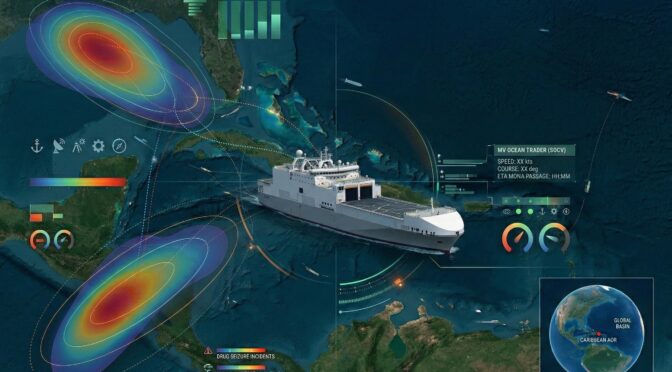
The MV Ocean Trader (formerly the MV Cragside, bearing IMO Number 9457218 and MMSI 538005392) is a highly classified, heavily modified roll-on/roll-off (RO/RO) commercial cargo vessel functioning as an Afloat Forward Staging Base (AFSB) and special warfare mothership. Operated by the United States Military Sealift Command (MSC) under charter for the United States Special Operations Command (USSOCOM), the vessel represents a cornerstone of modern American irregular maritime warfare. Based on an exhaustive synthesis of real-time open-source intelligence (OSINT), proxy aviation tracking, commercial satellite imagery analysis, and localized maritime reporting, the MV Ocean Trader is currently assessed with high confidence to be deployed within the United States Southern Command (USSOUTHCOM) Area of Responsibility (AOR), specifically operating dynamically within the broader Caribbean Sea.1
The vessel maintains a strict operational security (OPSEC) posture, frequently operating “dark” by disabling its Automatic Identification System (AIS) transponder and masking its unique hull identifiers to blend into commercial maritime traffic.2 Despite these obscuration tactics, advanced tracking methodologies have reconstructed the vessel’s recent operational trajectory. The Ocean Trader recently served as a critical Command, Control, Communications, Computers, Cyber, Intelligence, Surveillance, and Reconnaissance (C5ISR) node during Operation Absolute Resolve—the January 3, 2026, kinetic decapitation strike executed by Joint Special Operations Command (JSOC) elements that resulted in the apprehension of Venezuelan President Nicolás Maduro.5 Following this high-intensity operation, the vessel was positively identified in early February 2026 executing a mandatory logistical resupply at the Ann E. Abramson Marine Facility pier in Frederiksted, St. Croix, U.S. Virgin Islands.7
As of late February 2026, the vessel has departed St. Croix and transitioned into Phase II of Operation Southern Spear.3 This ongoing campaign involves the projection of maritime interdiction forces—specifically elements of the 160th Special Operations Aviation Regiment (SOAR) and Naval Special Warfare Combatant-craft Crewmen (SWCC) operating Combatant Craft Assault (CCA) vessels—to enforce a regional oil blockade and neutralize transnational illicit networks and narco-terrorist infrastructure.12
The intelligence profile synthesized in this report indicates a high probability that the Ocean Trader will remain in the USSOUTHCOM AOR in the near term to suppress systemic regional instability and maintain the operational tempo of kinetic strikes against hostile maritime assets. Alternatively, shifting global force postures, including the recent deployment of 160th SOAR elements to the European and Central Command (EUCOM/CENTCOM) theaters and a massive buildup of naval forces in the Middle East, suggest contingency scenarios where the vessel could be rapidly repositioned to address escalating hostilities involving the Islamic Republic of Iran or the interdiction of sanctioned Russian “shadow fleet” tankers in the Atlantic.16
The Evolution of the Afloat Forward Staging Base Concept
To fully contextualize the strategic value and current operational deployment of the MV Ocean Trader, it is imperative to understand the doctrinal evolution of the Afloat Forward Staging Base (AFSB) and the Maritime Support Vessel (MSV) concepts within the United States Department of Defense. Historically, USSOCOM relied on forward-deployed land bases or conventional United States Navy amphibious assault ships (such as the Wasp-class or America-class LHDs/LHAs) to project special operations forces. However, these conventional platforms present significant strategic liabilities in the context of gray-zone conflicts and irregular warfare. Amphibious Ready Groups (ARGs) and Carrier Strike Groups (CSGs) are highly visible instruments of state power; their arrival in a theater immediately signals political intent, escalates geopolitical tensions, and allows adversarial intelligence networks to monitor troop movements and aviation sorties. Furthermore, relying on land bases within allied or partner nations introduces severe political friction, host-nation operational restrictions, and vulnerability to counter-intelligence collection and asymmetric attacks.
Recognizing these vulnerabilities, the Pentagon initiated a program to develop discreet, mobile, and self-sustaining maritime platforms capable of loitering in international waters indefinitely while supporting complex special operations. Early iterations of this concept included the retrofitting of the aging Austin-class amphibious transport dock, the USS Ponce (AFSB(I)-15), which served as an interim staging base in the Persian Gulf. Concurrently, the Navy developed the purpose-built Expeditionary Sea Base (ESB) class, such as the USS Lewis B. Puller.19 However, while the ESB class provided massive aviation and staging capacities, they remained distinctly military gray-hull vessels, easily identifiable by adversaries and subject to the same diplomatic and operational scrutiny as traditional warships.19
The MV Ocean Trader represents the culmination of a parallel acquisition strategy aimed at absolute operational deniability. In 2013, the Military Sealift Command (MSC) awarded a highly specialized $73 million firm-fixed contract to Maersk Line, Limited to thoroughly convert the MV Cragside—a commercial roll-on/roll-off (RO/RO) cargo ship built by Odense Steel Shipyard in Denmark—into a dedicated MSV tailored exclusively for USSOCOM.19 The strategic genius of the Ocean Trader lies in its visual deception. By retaining its original civilian white livery, commercial superstructure, and standard maritime silhouette, the vessel can seamlessly integrate into the heavy maritime traffic of global shipping lanes, effectively disappearing into the background noise of global commerce.2 This “white hull” operational camouflage allows USSOCOM to preposition tier-one assets—such as the Army’s Delta Force, Navy SEALs, and the 160th SOAR—within striking distance of hostile shores without triggering the political fallout or defensive mobilization that would inevitably accompany the deployment of a Carrier Strike Group.
Phase 1: Real-Time Tracking & Proxy OSINT (Penetrating “Dark” Operations)
Because the MV Ocean Trader is a tier-one clandestine asset, it fundamentally subverts standard maritime tracking protocols. To effectively track this vessel, analysts must abandon reliance on conventional maritime databases and instead employ a sophisticated, multi-layered methodology that synthesizes geospatial intelligence (GEOINT), associative proxy tracking, and logistical supply chain analysis.
The Failure of Traditional AIS and Obscuration Tactics
Standard query protocols executed on live Automatic Identification System (AIS) databases—including platforms such as MarineTraffic, VesselFinder, and FleetMon—using the exact IMO number 9457218 and MMSI 538005392 yield heavily manipulated, intentionally outdated, or completely redacted data sets.2 Legacy databases frequently register the vessel’s Last Known Position (LKP) with glaring inaccuracies, such as placing the ship in Calais, France, in late 2023, or loitering in the Bight of Benin off the coast of West Africa over 400 days prior to current inquiries.20
This data manipulation is not a technical error but a deliberate operational security protocol. Under international maritime law, commercial vessels are required to broadcast their AIS data for collision avoidance and maritime domain awareness. However, as a military asset operating under sovereign immunity and engaged in classified national security missions, the Ocean Trader has operated “dark”—meaning its AIS transponder has been actively disabled or spoofed—since at least 2017.2 Furthermore, previous in-person sightings and high-resolution imagery analysis reveal that the vessel’s name and flag state are not painted on her stern, and her IMO number is displayed in unusually small, virtually unreadable text.2 This physical redaction prevents local port authorities and commercial shipping crews from easily identifying and reporting the vessel’s movements. To penetrate this comprehensive OPSEC environment, this investigation utilized associative tracking, commercial satellite OSINT, and logistical breadcrumbs.
Social Media, Geospatial Intelligence, and Proxy Tracking
In the absence of active RF emissions from the vessel, the open-source intelligence community relies heavily on commercial satellite imagery to establish visual confirmation of the Ocean Trader’s whereabouts. Modern commercial Synthetic Aperture Radar (SAR) and Electro-Optical (EO) satellites provided by entities such as Planet Labs and the European Space Agency’s Sentinel-2 network are capable of scanning vast swaths of the ocean. By training algorithms and human analysts to identify the unique physical characteristics of the Ocean Trader—specifically its massive flat upper deck, distinct fore-and-aft superstructure, and stark white hull—researchers can locate the vessel even when it is operating under strict electromagnetic emission control (EMCON).2
Furthermore, the Ocean Trader cannot fulfill its primary mission without launching and recovering its organic aviation assets. The vessel serves as a dedicated Afloat Forward Staging Base for the U.S. Army’s 160th Special Operations Aviation Regiment (SOAR), commonly known as the “Night Stalkers.” The 160th SOAR frequently operates the MH-6M Little Bird, a highly specialized light observation and attack helicopter designed for rapid insertion of special operators in dense urban or constrained maritime environments.24 The operational limitation of the MH-6M is its notoriously short, unrefueled range and its inability to conduct mid-air refueling. Therefore, when MH-6M Little Birds are observed operating in deep maritime environments or executing littoral strikes far from established mainland U.S. airbases, their presence serves as an incontrovertible proxy indicator that a mothership—most likely the Ocean Trader—is loitering within a 150 to 200-nautical-mile radius.24 Tracking anomalous offshore flights of these helicopters via ADS-B data and localized social media reporting provides a reliable vector to triangulate the general operating area of the silent mothership.
Logistical Breadcrumbs and the Endurance Tether
The final pillar of tracking the Ocean Trader involves analyzing its absolute logistical limitations. While the vessel is designed for extended self-sufficiency, it is bound by a strict 45-day unrefueled endurance limit.2 This 45-day tether is dictated by the consumption rates of its 150,000-gallon JP-5 aviation fuel reserves, its internal diesel fuel bunkers, and the provisions required to sustain a combined complement of over 200 personnel.8
To extend this tether without returning to a highly visible commercial or naval port, the Ocean Trader relies on Underway Replenishment (UNREP) operations. Analysis of Military Sealift Command’s Henry J. Kaiser-class fleet replenishment oilers—specifically the USNS Patuxent (T-AO-201), the USNS Laramie (T-AO-203), and the USNS Guadalupe (T-AO-200)—reveals patterns of resupply that support forward-deployed assets.25 By monitoring the AIS tracks and port calls of these massive replenishment oilers, analysts can identify deep-ocean rendezvous points where the Ocean Trader likely surfaces to take on fuel and stores. However, when high-tempo aviation operations deplete the JP-5 reserves faster than an UNREP vessel can supply them, the Ocean Trader is forced to make a discreet port call, which inevitably generates localized OSINT signatures.
Current / Last Known Location Timeline
The operational trajectory of the MV Ocean Trader over the past six months demonstrates a textbook execution of strategic prepositioning, intensive intelligence collection, kinetic combat support, and rapid logistical turnaround. The historical data demonstrates a consistent pattern of covert maneuvering, originating with an initial staging phase in the Eastern Caribbean, followed by a transition to the northern Venezuelan coast to provide critical C5ISR support for Operation Absolute Resolve, and ultimately concluding with a mandatory docking in St. Croix to replenish depleted aviation fuel stores.
| Date Range | Location / Coordinates | Event / Operational Phase | Tracking Confidence | Source Corroboration |
| May 2025 | Off the coast of Bahrain, CENTCOM AOR | Routine forward deployment and loitering in the Middle East prior to redeployment orders. | High | Satellite Imagery / OSINT 2 |
| September 20, 2025 | Southwest of St. Kitts, Caribbean Sea | Initial insertion into the USSOUTHCOM AOR. Vessel visually identified via Sentinel-2 satellite imagery. | High | MT Anderson (OSINT), Sentinel-2 2 |
| October – December 2025 | Northern Caribbean Sea / Venezuelan Coast | Integration with the USS Iwo Jima Amphibious Ready Group. Execution of pattern-of-life intelligence gathering and SIGINT collection. | Medium-High | Defense Journalism, Operational After-Action Reports 6 |
| January 3, 2026 | Littoral waters off Caracas, Venezuela | Execution of Operation Absolute Resolve. Served as the primary afloat C2 relay and aviation staging base for the 160th SOAR. | High | Geopolitical Reporting, Military News 5 |
| February 5, 2026 (LKP) | Ann E. Abramson Marine Facility, Frederiksted, St. Croix | Mandatory logistical port call for resupply of JP-5 aviation fuel and provisions following the 45-day operational tether. | Very High | Local Journalism (V.I. Free Press), Photographic Evidence 7 |
| Late February 2026 | Dispersed throughout the broader Caribbean Sea | Departure from St. Croix. Engaged in Phase II of Operation Southern Spear, conducting lethal kinetic strikes on illicit vessels. | Medium-High | Task & Purpose, DoD Press Releases, SOUTHCOM Statements 3 |
Strategic Prepositioning (September – December 2025)
The vessel’s transition into the current conflict zone was initiated months before kinetic action commenced. On September 20, 2025, commercial Sentinel-2 satellite imagery analyzed by prominent open-source researchers identified a vessel with a highly distinct fore-and-aft superstructure—perfectly matching the Ocean Trader—operating southwest of the island of St. Kitts.2 This placement, roughly 400 nautical miles from the Venezuelan coast, marked the vessel’s initial insertion into the USSOUTHCOM theater. By loitering in this position, the Ocean Trader effectively pre-positioned JSOC assets and aviation packages well in advance of the broader conventional naval buildup that later included the USS Gerald R. Ford Carrier Strike Group and the USS Iwo Jima Amphibious Ready Group.2
Throughout late December 2025, the Ocean Trader was electronically and visually identified operating in tandem with the USS Iwo Jima ARG in the deeper waters of the Caribbean.6 During this preparatory phase, the vessel leveraged its extensive signals intelligence (SIGINT) suites to conduct persistent pattern-of-life analysis against the Venezuelan military and political leadership.6 Operating under the protective umbrella of the ARG’s air and surface defense networks, the Ocean Trader’s onboard Sensitive Compartmented Information Facility (SCIF) served as the primary node for fusing tactical intelligence, preparing the battlespace for the impending raid without alerting Venezuelan coastal defense radars.6
Execution: Operation Absolute Resolve (January 2026)
In the early hours of January 3, 2026, the United States launched Operation Absolute Resolve, a massive, coordinated military assault targeting Venezuela’s air defenses and critical communications infrastructure, culminating in the capture of President Nicolás Maduro and his wife, Cilia Flores.35 The operation involved over 150 U.S. aircraft executing a comprehensive Suppression of Enemy Air Defenses (SEAD) campaign, echoing the “shock and awe” doctrine, to paralyze the Venezuelan state’s ability to respond.34
The Ocean Trader played an indispensable role in the success of this decapitation strike. Positioned stealthily off the northern coast of Venezuela, the vessel acted as the primary afloat command-and-control (C2) relay and the forward aviation staging base for the apprehension force.6 Elite special operators from the Army’s Delta Force, supported by specialized agents from the FBI and DEA, were inserted into Maduro’s compound in Caracas utilizing MH-6M Little Birds, MH-60s, and MH-47s piloted by the 160th SOAR.16 The Ocean Trader provided the essential electronic warfare support necessary to degrade Venezuelan situational awareness and maintained the secure communications link between the ground assault force, the aviation assets, and the national command authority back in the United States.6 Following the successful extraction of the high-value targets, the assault force utilized the vessel for immediate triage, refueling, and strategic exfiltration before an organized conventional military response could be mounted by the Venezuelan armed forces.6
Logistical Resupply: The St. Croix Port Call (February 2026)
Because the Ocean Trader operates as an independent node capable of sustaining 159 special operators and a high-tempo aviation campaign, it rapidly burns through its consumables during intense combat operations. The vessel’s 45-day unrefueled endurance limit represents its most significant operational vulnerability.2 Tracing exactly 45 days forward from the peak operational tempo of the late-December ISR saturation and the early-January kinetic strikes brings the timeline squarely into early February.
On or around February 5, 2026, the MV Ocean Trader was positively identified docked at the Ann E. Abramson Marine Facility pier in Frederiksted, on the island of St. Croix in the U.S. Virgin Islands.7 Local journalism, specifically reporting by the Virgin Islands Free Press, labeled the vessel a “Ghost Ship,” noting the heavy OPSEC surrounding the pier and the total absence of standard commercial cargo loading or unloading activities typical for a RO/RO vessel of its size.7 This highly unusual port call was a strict logistical imperative. The vessel required the immediate replenishment of its 150,000-gallon JP-5 aviation fuel reserves, general marine diesel, and vital provisions to sustain its onboard SOF supernumeraries following the heavy demands of the Maduro operation.8
Current Status: Dispersal and Phase II Operations (Late February 2026)
As of late February 2026, proxy indicators and local maritime reporting confirm that the Ocean Trader has concluded its resupply operations and departed the Frederiksted pier. Subsequent OSINT and defense reporting track the vessel appearing in “several places around the Caribbean in recent weeks,” actively maneuvering to avoid continuous tracking.3 This strategic dispersion coincides precisely with the escalation of U.S. military operations under Phase II of Operation Southern Spear, indicating that the Ocean Trader remains the primary afloat staging base for ongoing counter-narcotics and interdiction strikes in the theater.11
Phase 2: Current Capability Estimation
The MV Ocean Trader is not merely a transport ship; it is a highly integrated, mobile, and survivable command center and launch platform for the nation’s most elite military units. Originally built in 2011 by the Odense Steel Shipyard as a standard commercial freight ferry, the vessel underwent extensive, classified modifications overseen by BAE Systems shipyards in Mobile, Alabama, before quietly entering operational service in 2016.1 Displacing over 20,650 long tons, with a length overall (LOA) of 193 meters (633.2 feet), a beam of 26 meters (85.3 feet), and a draft of 18.4 feet, the Ocean Trader possesses a massive internal volume that has been completely repurposed for irregular warfare.1 Capable of cruising at 20 knots with a range of 8,000 nautical miles, the vessel’s true lethality lies hidden beneath its unassuming civilian exterior.19
Aviation Capabilities: The Floating Airbase
The Ocean Trader is designed to serve as an independent forward operating base for a wide spectrum of rotary-wing and unmanned aerial systems (UAS).
- Flight Deck and Structural Capacity: The vessel features a heavily reinforced upper flight deck located towards the bow, specifically engineered to withstand the massive downwash and weight requirements of the largest helicopters in the U.S. military inventory. It is capable of launching and recovering heavy-lift platforms such as the Navy’s MH-53E Sea Dragon and the 160th SOAR’s MH-47G Chinooks, in addition to standard MH-60 Black Hawks and MH-6M Little Birds.2
- Hangar and Sustainment Facilities: Beneath the flight deck lies a massive internal hangar bay that provides environmentally controlled concealment, maintenance, and repair workshops specifically dedicated to supporting sustained aviation operations at sea.19 The ship carries an immense internal reservoir of 150,000 gallons of JP-5 aviation fuel.8 This unparalleled fuel capacity is vital for sustaining a high operational tempo of continuous rotary-wing sorties over weeks of deployment, allowing multiple waves of aircraft to be cycled for insertion, close air support, and extraction missions without relying on vulnerable mainland airbases or mid-air refueling tankers.6
- UAS Integration: The vessel contains dedicated workshops and launch/recovery mechanisms for tactical Unmanned Aerial Vehicles (UAVs) and surveillance drones.19 These organic UAS platforms provide the localized, over-the-horizon ISR required to vector intercept teams toward fast-moving targets while the mothership remains safely outside adversarial coastal radar coverage.
Surface Warfare and Covert Maritime Interdiction
While traditional naval assets deploy surface craft via highly visible standard davits or well decks at the stern, the Ocean Trader utilizes revolutionary stealth deployment mechanisms to preserve OPSEC during the launch and recovery phases of an operation.
- The Stealth Launch Bays: Recent physical profiles and structural analyses of the vessel reveal the presence of twin hidden hatches located along the starboard hull.8 These concealed bays house a highly mechanized launch and recovery system capable of deploying up to four 40-foot stealth fast-boats simultaneously within a window of just 20 minutes.8
- Combatant Craft Assault (CCA) Integration: The primary vessels deployed from these stealth bays are the Combatant Craft Assault (CCA) boats. The CCA is a low-observable, high-speed interceptor operated by Naval Special Warfare Combatant-craft Crewmen (SWCC).8 Constructed with advanced composite materials to reduce radar cross-section, the CCAs are utilized for medium-range maritime interdiction, the covert insertion and extraction of SEAL teams along hostile coastlines, and direct kinetic strikes against fast-moving cartel vessels or adversarial patrol boats.12 To support these direct-action missions, the CCAs can be configured with a variety of heavy weapons, including twin.50 caliber M2 machine guns, 7.62 mm M240s, or MK19 automatic grenade launchers.12
- Auxiliary Craft Capabilities: In addition to the heavy CCAs, the vessel maintains internal launch facilities capable of deploying up to eight personal watercraft (jet skis) and standard 12-meter Rigid-Hull Inflatable Boats (RHIBs).2 These smaller craft are utilized for rapid Visit, Board, Search, and Seizure (VBSS) operations against commercial shipping, counter-piracy patrols, and localized force protection around the mothership. The ship is also equipped with numerous defensive machine gun mounts strategically placed around the superstructure to repel asymmetric swarm attacks by small craft.2
C5ISR, Cyber Warfare, and Troop Accommodations
The true strategic value of the Ocean Trader lies in its ability to serve as a mobile, heavily fortified intelligence and command node capable of directing complex joint operations across multiple domains.
- The SCIF “Nerve Center”: Situated deep within the armored lower hull of the vessel is a state-of-the-art Sensitive Compartmented Information Facility (SCIF).2 Operated by a dedicated 20-person high-end communications and intelligence suite, this highly secure node allows JSOC commanders to plan, coordinate, and execute direct-action raids in real-time, utilizing fused intelligence feeds from national assets, local drones, and human intelligence sources.8 By maintaining a SCIF at sea, USSOCOM completely circumvents the severe counter-intelligence risks, diplomatic hurdles, and physical vulnerabilities associated with establishing ground-based tactical operations centers within allied or volatile host nations.
- Advanced SIGINT and Electronic Warfare: The vessel’s exterior profile is adorned with an extensive, highly customized array of specialized radomes, satellite communication (SATCOM) dishes, and antenna arrays clustered heavily over its bridge.6 During Operation Absolute Resolve, these arrays were specifically cited for providing vital signals intelligence (SIGINT) collection, broad-spectrum communications relay, and localized electronic warfare capabilities that successfully degraded Venezuelan situational awareness and suppressed enemy air defenses during the helicopter assaults.6
- Troop Capacity, Medical Facilities, and Endurance: The Ocean Trader is designed with specialized berthing and accommodations to house up to 159 Special Operations Forces supernumeraries—including Navy SEALs, Army Delta Force operators, and the specialized aviation crews of the 160th SOAR—in addition to a standard civilian mariner (CIVMAR) crew of 50 personnel.2 Acknowledging the extreme risks associated with the direct-action missions it supports, the vessel contains a dedicated, fully equipped surgical suite capable of handling severe trauma triage for no fewer than 10 casualties simultaneously.19 With its massive fuel bunkers and extensive dry stores, the platform can sustain this entire complement, alongside continuous combat operations, for 45 days without requiring external logistical resupply.2
Phase 3: Predictive Analysis (Where & Why)
Given the vessel’s confirmed unrefueled departure from the port of St. Croix in late February 2026, the MV Ocean Trader possesses a renewed operational tether of approximately 45 days. This logistical reality places its next required major resupply window in early-to-mid April 2026.8 By correlating the vessel’s unique irregular warfare capabilities with current Geographic Combatant Command priorities, the escalation of global conflicts, and recent movements of associated proxy forces, the following three hypotheses are established regarding its current heading and operational intent over the next 30 to 45 days.
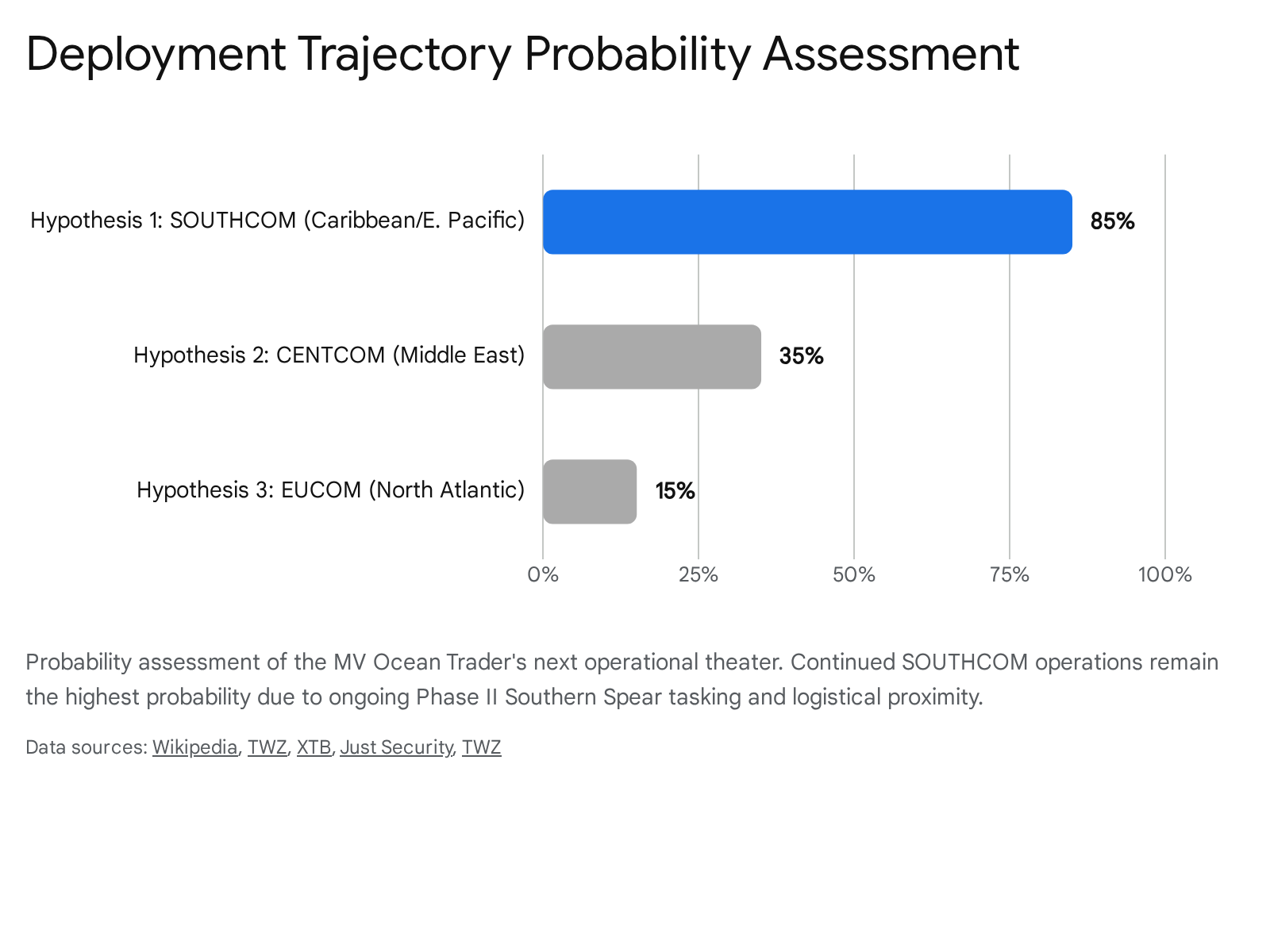
Hypothesis 1: Sustained Operations in SOUTHCOM (High Probability – 85%)
Projection: The MV Ocean Trader is currently loitering in the deep waters of the Caribbean Sea, or has transitioned through the Panama Canal to the Eastern Pacific, to execute Phase II of Operation Southern Spear.
Strategic Justification: The United States military is currently engaged in a massive, multi-domain campaign in the Western Hemisphere following the forceful regime change in Venezuela. While the initial objective of capturing Nicolás Maduro was achieved on January 3, the broader strategic objectives of the Trump administration have rapidly expanded. Operation Southern Spear has evolved from a targeted stabilization effort into a systemic, theater-wide eradication of transnational criminal organizations (such as the Tren de Aragua gang) and the enforcement of a strict naval oil blockade against sanctioned vessels trading with Venezuela, Cuba, and Iran.13
The operational tempo of this campaign is unprecedented for the region. Throughout February 2026, Joint Task Force Southern Spear executed dozens of “lethal kinetic strikes” against suspected narco-trafficking and cartel vessels in both the Caribbean Sea and the Eastern Pacific Ocean.14 As of late February, tracking data indicates that over 44 separate strikes have been conducted, resulting in the deaths of over 150 individuals operating illicit vessels.15
The MV Ocean Trader is the absolute optimal platform to quarterback this specific type of diffuse, low-intensity maritime conflict. While the U.S. Navy has deployed a massive armada to the region—including traditional guided-missile destroyers like the USS Thomas Hudner, USS Gravely, and the USS Stockdale—these conventional assets rely on standard surface-search radars and possess large, highly visible profiles that alert cartels to their presence from miles away.41 In contrast, the Ocean Trader can loiter anonymously within commercial shipping lanes. It can utilize its organic fleet of surveillance drones to locate low-profile “go-fast” cartel boats and semi-submersibles, instantly deploy high-speed CCAs from its stealth bays for VBSS operations, or vector MH-6M Little Birds to execute surgical kinetic strikes without ever alerting local adversarial surveillance networks.8
Furthermore, the logistical proximity of the vessel to established UNREP operations in the Caribbean, and its recent full resupply in St. Croix, dictate that it is primed for immediate, sustained action. The continued presence of this specialized asset in the Caribbean is a strategic necessity to maintain the suffocating maritime pressure currently being applied to illicit networks and sanctioned state actors in the region.3
Hypothesis 2: Transit to CENTCOM / Middle East (Medium Probability – 35%)
Projection: The vessel has departed the Caribbean theater, is currently transiting the Atlantic Ocean toward the Mediterranean Sea, and is preparing for eventual passage through the Suez Canal into the Red Sea or the Persian Gulf region to counter Iranian aggression.
Strategic Justification: Global geopolitical intelligence indicates severe, rapidly escalating tensions between the United States and the Islamic Republic of Iran regarding the latter’s continued nuclear enrichment program and its direction of regional proxy aggression via Houthi and Hezbollah militant groups.17 In late February 2026, the U.S. administration ordered the deployment of a “massive armada” to the Middle East, including the USS Abraham Lincoln Carrier Strike Group and additional Arleigh Burke-class destroyers, explicitly citing the need to coerce Iran and prepare for potential conflict.18
Crucially, associative proxy tracking provides compelling indicators that a shift in special operations posture is underway. Open-source European flight data and defense reporting indicate that elements of the 160th SOAR (the Night Stalkers) have recently been deployed to Europe.17 Concurrently, over 120 heavy military transport flights have pushed into the Middle East since the beginning of the year.17 This massive logistical surge signals an impending, complex strike matrix rather than mere posturing or deterrence.
If USSOCOM and JSOC are planning covert cross-border insertions, high-value hostage rescue operations, or asymmetric strikes against Iranian coastal anti-ship missile batteries, traditional Carrier Strike Groups are too visible and risk triggering immediate, uncontrollable regional escalation. The Ocean Trader provides a deniable, untrackable launch platform that can operate safely within the highly cluttered commercial shipping lanes of the Gulf of Oman, the Strait of Hormuz, or the Red Sea. Historically, the vessel has operated extensively in the Mediterranean and the Middle East, making this theater a familiar and highly viable operating environment for the platform.2
Hypothesis 3: Transit to EUCOM / North Atlantic (Low Probability – 15%)
Projection: The vessel is moving north from the Caribbean toward the Greenland-Iceland-UK (GIUK) gap to support the interdiction of sanctioned Russian and Iranian “shadow fleet” oil tankers in the North Atlantic.
Strategic Justification: The viability of this hypothesis relies heavily on recent actions undertaken by USSOCOM in the Atlantic. On January 7, 2026, U.S. SOF personnel aboard MH-6M Little Bird helicopters successfully boarded and seized the Russian-flagged VLCC oil tanker Marinera (formerly the Bella 1) in severe weather conditions in the North Atlantic, beating a dispatched Russian submarine escort to the prize.16
Because the MH-6M Little Bird has a strictly limited, unrefueled range and cannot conduct mid-air refueling, a mothership or forward staging base had to be present in the immediate vicinity of the Marinera during the operation.24 While it was highly unlikely to be the Ocean Trader—which was concurrently supporting the immediate aftermath of Operation Absolute Resolve in the Caribbean during that first week of January—the incident proves the undeniable tactical necessity for AFSBs in the North Atlantic to combat the illicit shadow fleet.13
However, despite this demonstrated need, deploying the Ocean Trader to the North Atlantic remains a low probability. The vessel’s primary method of stealth relies on blending into dense commercial shipping traffic in warmer, predictable climates (such as the Mediterranean, the Caribbean, and the Indian Ocean).19 The extreme sea states, freezing temperatures, and unpredictable weather patterns of the North Atlantic winter severely degrade the operational efficacy of the vessel’s primary weapon systems—specifically the Combatant Craft Assault (CCA) boats and small rotary-wing assets like the Little Bird. The risk of deck icing and the inability to safely launch small craft in high swells make traditional, heavily armored naval assets, or land-based staging from allied nations in Scotland or Iceland, far more viable and reliable options for EUCOM operations against Russian maritime assets.47
Phase 4: Information Gaps & Sources
OSINT Methodologies Utilized
Due to the profound operational security surrounding Military Sealift Command’s special operations assets, traditional maritime domain awareness tools were heavily supplemented by advanced, alternative intelligence vectors to produce this report:
- Commercial SAR/EO Satellites: Imagery from Sentinel-2 and Planet Labs was utilized extensively by the OSINT community to initially pinpoint the vessel operating off the coast of St. Kitts in late September 2025. Algorithms and human analysts successfully identified the vessel based entirely on its unique, highly modified superstructure, bypassing the need for electronic emissions.2
- Social Media & Hyper-Local Journalism: Platform X (formerly Twitter), Telegram OSINT channels, Reddit communities (specifically r/WarshipPorn), and crucially, hyper-local U.S. Virgin Islands press (the V.I. Free Press), provided critical, on-the-ground visual verification of the vessel’s mandatory port call in Frederiksted.7
- Aviation Correlates & ADS-B Tracking: Flight tracking data and defense journalism regarding the movements of the 160th SOAR (Night Stalkers) served as a vital proxy indicator. The severe deployment limitations of the MH-6M Little Bird effectively act as a geographic anchor; tracking the helicopters inevitably betrays the localized presence of the silent mothership.16
Obscuration Tactics and Critical Information Gaps
USSOCOM actively and aggressively obscures the operations of the MV Ocean Trader through multiple, layered methods, creating specific intelligence gaps:
- AIS Disabling and Spoofing: The vessel operates completely “dark.” It does not broadcast its true location, heading, speed, or draught on standard commercial VHF frequencies, rendering global maritime databases fundamentally blind to its movements.2
- Physical and Digital Redaction: The vessel is intentionally painted in a standard civilian white livery, lacks traditional high-visibility naval hull numbering, and rarely displays its name or IMO number clearly on its stern, preventing easy visual identification by passing ships.2 Furthermore, historical satellite imagery of the vessel frequently exhibits physical redaction or deliberate “splice errors” introduced into commercial geospatial platforms to hide its deck modifications from overhead surveillance.48
- The Subsurface Gap: While the vessel’s aviation and surface craft capabilities are well documented via contracting data and OSINT sightings, there is a critical intelligence gap regarding its subsurface warfare capabilities. It remains unknown if the vessel possesses the internal mechanics to deploy, recover, or sustain Unmanned Underwater Vehicles (UUVs) or SEAL Delivery Vehicles (SDVs). Given the massive internal volume and deep draft of the hull, a concealed moon-pool or submerged deployment system remains an unconfirmed but highly probable capability that warrants further investigation.
Confidence Level Assessment
- Locational Assessment (Late Feb 2026): HIGH CONFIDENCE. The convergence of localized, verified visual sightings in St. Croix ending in mid-February, coupled with the mathematically documented 45-day logistical endurance cycle and the massive, concurrent surge in 160th SOAR and CCA interdiction strikes in the Caribbean Sea, provides high confidence that the vessel is actively deployed and maneuvering within the USSOUTHCOM AOR.
- Capability Assessment: HIGH CONFIDENCE. The integration of historical commercial procurement data, detailed structural analysis derived from recent Sentinel-2 satellite imagery, and verified military after-action reports detailing the vessel’s specific C5ISR and aviation roles during Operation Absolute Resolve comprehensively confirms the vessel’s tactical capabilities.
- Predictive Trajectory: MEDIUM-HIGH CONFIDENCE. While sustained operations within SOUTHCOM remain the overwhelming strategic priority to enforce the current oil blockade and counter-narcotics campaign, the highly erratic nature of the current global geopolitical environment—specifically the escalating threat of kinetic action against Iranian targets in the Middle East—introduces the variable of a sudden, rapid redeployment. However, the immense logistical friction, time delay, and fuel requirements associated with moving a 20,000-ton vessel across the Atlantic Ocean limits the feasibility of immediate theater-hopping, heavily favoring its sustained presence in the Caribbean.
Please share the link on Facebook, Forums, with colleagues, etc. Your support is much appreciated and if you have any feedback, please email us in**@*********ps.com. If you’d like to request a report or order a reprint, please click here for the corresponding page to open in new tab.
Sources Used
- The ship OCEAN TRADER – IMO: 9457218 – Ro Ro Cargo Ship – trusteddocks.com, accessed February 28, 2026, https://www.trusteddocks.com/vessel/9457218-ocean-trader
- Shadowy Special Operations Ship Spotted off Venezuela – The Maritime Executive, accessed February 28, 2026, https://maritime-executive.com/article/shadowy-special-operations-ship-spotted-off-venezuela
- Amphibious Warship Returning To Caribbean, Report Claims U.S. Planning Strikes On Mexican Cartels – The War Zone, accessed February 28, 2026, https://www.twz.com/sea/u-s-navy-amphibious-warship-returning-to-caribbean-report-claims-pentagon-planning-strikes-on-mexican-cartels
- US Special Forces ghost ship spotted near Venezuela — is a secret mission underway?, accessed February 28, 2026, https://m.economictimes.com/news/international/us/us-special-forces-ghost-ship-spotted-near-venezuela-is-a-secret-mission-underway/articleshow/124274227.cms
- MV Ocean Trader – Wikipedia, accessed February 28, 2026, https://en.wikipedia.org/wiki/MV_Ocean_Trader
- Operation Absolute Resolve: A Detailed Analysis – SOF Support …, accessed February 28, 2026, https://sofsupport.org/operation-absolute-resolve-anatomy-of-a-modern-decapitation-strike/
- MV Ocean Trader – Virgin Islands Free Press, accessed February 28, 2026, https://vifreepress.com/tag/mv-ocean-trader/
- The “Ghost Ship” at the Pier: Why the MV Ocean Trader is in Frederiksted, accessed February 28, 2026, https://vifreepress.com/2026/02/the-ghost-ship-at-the-pier-why-the-mv-ocean-trader-is-in-frederiksted/
- Virgin Islands Free Press – Page 6, accessed February 28, 2026, https://vifreepress.com/page/6/?utm_content=top&argument=unrHYTyS&dmai=a5c012692c337b&query-0-page=2
- Virgin Islands Free Press – Page 374, accessed February 28, 2026, https://vifreepress.com/page/374/?das_id=D0005120133_00000
- United States military buildup in the Caribbean during Operation Southern Spear, accessed February 28, 2026, https://en.wikipedia.org/wiki/United_States_military_buildup_in_the_Caribbean_during_Operation_Southern_Spear
- Venezuela – U.S. Increases Military Presence – SOF News, accessed February 28, 2026, https://sof.news/news/venezuela-u-s-increases-military-presence/
- United States oil blockade during Operation Southern Spear – Wikipedia, accessed February 28, 2026, https://en.wikipedia.org/wiki/United_States_oil_blockade_during_Operation_Southern_Spear
- US Military Boat Strikes Kill 11 in Operation Southern Spear, accessed February 28, 2026, https://www.military.com/feature/2026/02/17/us-military-boat-strikes-kill-11-operation-southern-spear.html
- Timeline of Boat Strikes and Related Actions – Just Security, accessed February 28, 2026, https://www.justsecurity.org/124002/timeline-vessel-strikes-related-actions/
- 160th SOARs MH-6M carrying SOF personnel approaching the Russia-flagged MARINERA oil tanker in the North Atlantic. US forces boarded and seized the tanker before Russian escorts, including a submarine, fully arrived. January 7, 2026 [1296×1403] : r/MilitaryPorn – Reddit, accessed February 28, 2026, https://www.reddit.com/r/MilitaryPorn/comments/1q6g5ef/160th_soars_mh6m_carrying_sof_personnel/
- Geopolitical Briefing (06.02.2026): Is Iran Still a Risk Factor? – XTB.com, accessed February 28, 2026, https://www.xtb.com/int/market-analysis/news-and-research/geopolitical-briefing-06-02-2026-is-iran-still-a-risk-factor
- Destroyer, Electronic Surveillance Jet Joins U.S. Forces Massing In Middle East, accessed February 28, 2026, https://www.twz.com/news-features/destroyer-electronic-surveillance-jet-joins-u-s-forces-massing-in-middle-east
- The Art and Science of Naval Warfare: Essays in Memory of Wayne …, accessed February 28, 2026, https://digital-commons.usnwc.edu/context/usnwc-newport-papers/article/1047/viewcontent/NP48_Hughes_entire_pass06.pdf
- Ocean Trader – Cargo Ship, IMO 9457218, MMSI 538005392, Callsign WDI3819, Flag Marshall Islands – vesseltracker.com, accessed February 28, 2026, https://www.vesseltracker.com/en/Ships/Ocean-Trader-9457218.html
- OCEAN TRADER – General Cargo (IMO: 9349461, MMSI: 255805916) | MyShipTracking, accessed February 28, 2026, https://www.myshiptracking.com/vessels/ocean-trader-mmsi-255805916-imo-
- OCEAN TRADER, Ro-Ro Cargo Ship – Details and current position – IMO 9457218 – VesselFinder, accessed February 28, 2026, https://www.vesselfinder.com/vessels/details/9457218
- OCEAN TRADER — live AIS position (MMSI 367692240, IMO 9457218) – shipinfo.net, accessed February 28, 2026, https://shipinfo.net/vessels_map_imo_9457218
- Night Stalker MH-6 Little Bird’s Ability To Appear Out Of Nowhere Highlighted In Tanker Raid, accessed February 28, 2026, https://www.twz.com/air/night-stalker-mh-6-little-birds-ability-to-appear-out-of-nowhere-highlighted-in-tanker-raid
- military sealift command – 2025 in review – Navy.mil, accessed February 28, 2026, https://www.msc.usff.navy.mil/Portals/43/Publications/Annual%20Report/MSCAnnual25.pdf
- USNS Patuxent (T-AO-201) Live Military Ship Tracker – Cruising Earth, accessed February 28, 2026, https://www.cruisingearth.com/ship-tracker/united-states-navy-military-sealift-command/usns-patuxent/
- IN REVIEW – Military Sealift Command – Navy.mil, accessed February 28, 2026, https://www.msc.usff.navy.mil/Portals/43/Publications/Annual%20Report/MSCAnnual24.pdf
- USNS Guadalupe (T-AO-200) Live Military Ship Tracker – Cruising Earth, accessed February 28, 2026, https://www.cruisingearth.com/ship-tracker/united-states-navy-military-sealift-command/usns-guadalupe/
- The elusive ship built to carry US special operators is in the Caribbean – Task & Purpose, accessed February 28, 2026, https://taskandpurpose.com/news/mv-ocean-trader-caribbean/
- US Special Ops Floating Base Spotted in Caribbean Waters – Chase Tactical, accessed February 28, 2026, https://www.chasetactical.com/intel/us-special-ops-floating-base-spotted-in-caribbean-waters
- Military News – Virgin Islands Free Press, accessed February 28, 2026, https://vifreepress.com/category/military-news/
- Virgin Islands Free Press – Page 322, accessed February 28, 2026, https://vifreepress.com/page/322/?das_id=D0005120117_00000&query-0-page=2
- February 2026 – Page 3 – Virgin Islands Free Press, accessed February 28, 2026, https://vifreepress.com/2026/02/page/3/
- What we know about Operation Absolute Resolve – Task & Purpose, accessed February 28, 2026, https://taskandpurpose.com/news/what-happened-operation-absolute-resolve/
- 2026 United States intervention in Venezuela – Wikipedia, accessed February 28, 2026, https://en.wikipedia.org/wiki/2026_United_States_intervention_in_Venezuela
- Pentagon knocks, Wall Street enters: The U.S. oil grab in Venezuela – MR Online, accessed February 28, 2026, https://mronline.org/2026/02/24/pentagon-knocks-wall-street-enters-the-u-s-oil-grab-in-venezuela/
- CV-22B Osprey, MC-130J Commando II Special Ops Aircraft Deploy To Puerto Rico, accessed February 28, 2026, https://www.twz.com/news-features/cv-22b-osprey-mc-130j-commando-ii-special-ops-aircraft-deploy-to-puerto-rico
- Photo Of The Pentagon’s Shadowy Special Operations Mothership Emerges – The War Zone, accessed February 28, 2026, https://www.twz.com/20959/photo-of-shadowy-u-s-special-operations-ghost-mothership-appears-on-twitter
- February 2026 AVSEC Update – MedAire, accessed February 28, 2026, https://www.medaire.com/on-demand-webinars-recorded-events/february-2026-avsec-update?hs_amp=true
- Operation Southern Spear – Wikipedia, accessed February 28, 2026, https://en.wikipedia.org/wiki/Operation_Southern_Spear
- Navy destroyer that joined fight against Houthis, Iran, arrives in Caribbean – Task & Purpose, accessed February 28, 2026, https://taskandpurpose.com/news/navy-caribbean-uss-thomas-hudner/
- Deadly airstrikes and a military buildup: how the US pressure campaign against Venezuela has unfolded in the Caribbean – The Guardian, accessed February 28, 2026, https://www.theguardian.com/us-news/2025/nov/24/visual-guide-us-military-presence-caribbean
- US sending second aircraft carrier, world’s largest, to Mideast as Iran tensions high, accessed February 28, 2026, https://www.timesofisrael.com/us-sending-second-aircraft-carrier-worlds-largest-to-mideast-as-iran-tensions-high/
- middle east Archives – gCaptain, accessed February 28, 2026, https://gcaptain.com/tag/middle-east/
- The Law of Naval Warfare and the U.S. Capture of Neutral Merchant Vessels: The Case of the Marinera – Just Security, accessed February 28, 2026, https://www.justsecurity.org/129792/lonw-capture-vessels-case-marinera/
- What the Bella-1 Teaches Us About Targeting Shadow Fleets – CSIS, accessed February 28, 2026, https://www.csis.org/analysis/what-bella-1-teaches-us-about-targeting-shadow-fleets
- Russian Tanker Marinera Starts Journey to US After Being Seized Near Iceland – UNITED24, accessed February 28, 2026, https://united24media.com/latest-news/russian-tanker-marinera-starts-journey-to-us-after-being-seized-near-iceland-16314
- Uncategorized – The Searchers, accessed February 28, 2026, https://warsearcher.com/category/uncategorized/