
1.0 Executive Summary
During the preceding 36-hour operational window (covering approximately 1800Z on March 04 to 0600Z on March 06, 2026), the allied military campaign comprising United States Operation Epic Fury and Israeli Operation Roaring Lion transitioned decisively into its secondary phase. This transition is characterized by a systemic shift away from the initial suppression of enemy air defenses (SEAD) and leadership decapitation, moving toward the systematic, theater-wide dismantlement of the Islamic Republic of Iran’s defense industrial base, naval power projection capabilities, and retaliatory infrastructure.1 The conflict has simultaneously undergone significant geographic internationalization, with kinetic spillover affecting the Caucasus, the wider Persian Gulf, and the deep waters of the Indian Ocean.3
The most critical escalations and systemic shifts over the last 36 hours encompass three primary domains: Naval Decimation and Maritime Expansion, Regional Spillover and Diplomatic Rupture, and Theocratic Succession Crisis and Internal Destabilization.
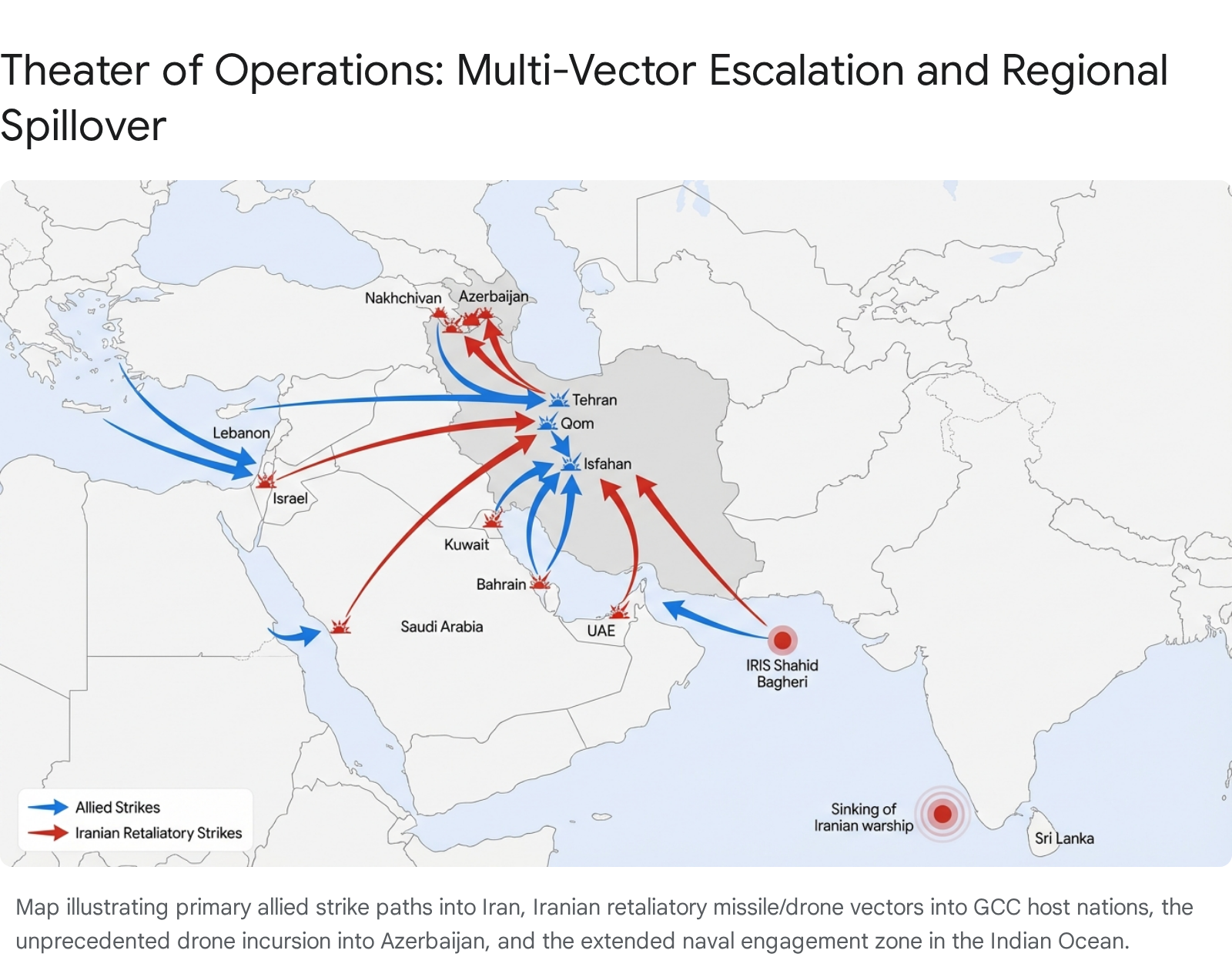
Firstly, within the maritime domain, the United States Navy and allied forces have severely degraded the Islamic Revolutionary Guard Corps Navy (IRGCN) and the Islamic Republic of Iran Navy (IRIN). Notable engagements include the unprecedented sinking of an Iranian warship by a U.S. nuclear-powered submarine operating in the Indian Ocean off the coast of Sri Lanka, and the targeted destruction of the IRIS Shahid Bagheri, a converted commercial container ship utilized as a forward-deployed drone carrier.3 These actions effectively neutralize Iran’s blue-water asymmetric projection capabilities but have triggered soaring maritime war-risk insurance premiums and massive disruptions to global shipping logistics.6
Secondly, the Iranian retaliatory strategy has expanded from targeting specific U.S. and Israeli military assets to imposing systemic costs on Gulf Cooperation Council (GCC) host nations and neighboring states. This is a deliberate “barrage-thy-neighbors” doctrine designed to leverage regional vulnerability to force an allied cessation of hostilities. In an unprecedented escalation of the theater of war, Iranian suicide drones breached the airspace of the Caucasus, striking the Nakhchivan exclave of Azerbaijan.7 This attack damaged an airport and a civilian school, prompting the government in Baku to completely withdraw its diplomatic personnel from Tehran and Tabriz.7 Simultaneously, heavy ballistic missile barrages targeted the Kingdom of Bahrain, the United Arab Emirates, and the State of Kuwait, aimed at maximizing geopolitical pressure on sovereign nations hosting U.S. military bases.4
Thirdly, inside the Islamic Republic, the structural integrity of the regime faces profound constitutional challenges following the elimination of Supreme Leader Ayatollah Ali Khamenei. Allied airstrikes intentionally targeted the Assembly of Experts compound in Qom,the 88-member clerical body constitutionally mandated to select the next Supreme Leader under the doctrine of Velayat-e Faqih.11 By physically disrupting the succession apparatus, the allied campaign seeks to induce severe command-and-control paralysis and permanently disrupt the enemy’s decision loop.12 Unconfirmed intelligence reports suggest the expedited elevation of Mojtaba Khamenei by surviving hardline factions, though this has been preemptively rejected by U.S. political leadership, signaling an uncompromising allied posture toward regime continuity.1
In summation, the conflict has moved beyond a localized punitive expedition into a theater-wide, multi-domain war of attrition. While allied forces maintain absolute air supremacy, Iran’s strategy relies heavily on instilling fear and artificially inflating the economic and diplomatic costs of the war. Tehran is banking on its deep civilizational resilience and the mounting threat of global energy shocks to fracture the allied coalition before its domestic security apparatus completely collapses.14
2.0 Chronological Timeline of Key Events (Last 36 Hours)
(Note: All times are approximated to Coordinated Universal Time based on synthesized regional reporting.)
- March 04, 2026 | 15:30 UTC: Saudi Arabian air defense forces intercept hostile drones and cruise missiles directed toward the Prince Sultan Air Base and the King Khalid International Airport, marking a significant escalation in regional targeting.16
- March 04, 2026 | 17:00 UTC: The Israel Defense Forces (IDF) formally announce the completion of over 1,600 “strike sorties” against Iranian military targets since the initiation of Operation Roaring Lion, alongside confirmation of at least seven distinct waves of Iranian retaliatory ballistic missile launches.17
- March 04, 2026 | 19:30 UTC: Allied aircraft execute heavy, localized airstrikes in southeastern Tehran, specifically targeting the headquarters of multiple Islamic Revolutionary Guard Corps (IRGC) branches and the IRGC Ground Forces Research and Self-Sufficiency Jihad Organization.18
- March 04, 2026 | 21:00 UTC: A United States nuclear-powered submarine successfully launches a torpedo strike in the Indian Ocean, sinking an Iranian warship. Sri Lankan maritime authorities mount a rescue operation, retrieving 32 of the 180 sailors aboard.3
- March 05, 2026 | 02:15 UTC: The IDF issues formal evacuation warnings for civilian residents situated in the southern suburbs of Beirut (Dahiyeh) and several villages in the Bekaa Valley, signaling an imminent and aggressive expansion of the northern front against Hezbollah.1
- March 05, 2026 | 04:00 UTC: Sustained Iranian ballistic missile barrages target the Kingdom of Bahrain. Bahraini air defense grids intercept 65 of 75 incoming missiles. Ten missiles impact the ground, inflicting structural damage on a hotel and residential structures in Manama, as well as an industrial facility in Maameer.10
- March 05, 2026 | 06:30 UTC: The United Arab Emirates (UAE) Ministry of Defense publicly confirms the successful interception of six out of seven incoming ballistic missiles and 125 out of 131 suicide drones targeting Emirati sovereign territory.1
- March 05, 2026 | 09:00 UTC: An unprecedented northern territorial spillover occurs as four Iranian suicide drones violate Azerbaijani airspace in the Nakhchivan exclave. The strikes damage the local airport terminal and detonate near a secondary school, resulting in traumatic brain injuries to four civilians.4
- March 05, 2026 | 11:45 UTC: The IDF issues secondary, targeted evacuation warnings for the Abbas Abad Industrial Zone and the Shenzar Industrial Zone located in Pakdasht, Tehran Province, preceding precision kinetic strikes on critical Iranian missile production facilities.1
- March 05, 2026 | 14:00 UTC: In Washington D.C., the United States House of Representatives rejects a bipartisan Iran War Powers Resolution in a tight 212-219 vote, maintaining the executive branch’s authority to prosecute the conflict.20
- March 05, 2026 | 16:30 UTC: The Islamic Resistance in Iraq (IRI), acting as an Iranian proxy, claims responsibility for a series of drone strikes targeting U.S. forces stationed at Camp Buehring in Kuwait and military installations in Erbil, Iraqi Kurdistan.1
- March 05, 2026 | 21:00 UTC: Israel initiates an intensive “broad-scale wave” of airstrikes (publicly designated as the 12th wave) on Tehran, focusing strictly on regime command and control (C2) centers, ballistic missile launchers, and remaining air defense perimeters.21
- March 05, 2026 | 23:30 UTC: At least 11 synchronized Israeli airstrikes pound the Dahiyeh district in Beirut, targeting Hezbollah infrastructure, sparking widespread fires near gas stations, and causing mass civilian displacement across the Lebanese capital.23
- March 06, 2026 | 02:00 UTC: U.S. forces locate, strike, and heavily damage the IRIS Shahid Bagheri, an Iranian drone-carrier vessel operating at sea, significantly degrading Iran’s offshore UAV launch and maritime surveillance capabilities.5
- March 06, 2026 | 04:30 UTC: The Azerbaijani Ministry of Foreign Affairs officially announces the total evacuation of its diplomatic personnel from the embassy in Tehran and the consulate in Tabriz in direct response to the Nakhchivan drone strikes.9
3.0 Situation by Primary Country
3.1 Iran
3.1.1 Military Actions & Posture
The operational capacity of the Iranian armed forces,encompassing both the conventional Artesh and the ideologically driven Islamic Revolutionary Guard Corps (IRGC),has been heavily degraded across multiple domains, though their asymmetric retaliatory capabilities remain functionally lethal. Intelligence assessments provided by U.S. Central Command (CENTCOM) indicate that the frequency of Iranian ballistic missile launches has precipitously decreased by 86% since the campaign’s inception, while suicide drone deployment has seen a commensurate 73% reduction.25 This statistical collapse is not indicative of a lack of Iranian resolve, but rather reflects the profound success of allied forces in actively hunting, identifying, and neutralizing mobile truck-mounted launchers across the expansive Iranian plateau.26 During the initial 100 hours of the conflict, allied airpower methodically dismantled Iran’s Integrated Air Defense System (IADS), allowing coalition aircraft to operate with near impunity in Iranian airspace.27
Consequently, the Iranian military posture has been forced to adapt rapidly. Depleted of heavy ballistic interceptors and facing entirely uncontested skies, the IRGC has shifted its strategic focus toward overwhelming regional air defenses through swarm tactics. This involves the mass deployment of cheaper, loitering munitions and suicide drones designed to exhaust the interceptor stockpiles of Israel and the Gulf States.18 Furthermore, the Iranian Air Force suffered notable tactical losses, including the downing of at least one YAK-130 fighter jet by an Israeli F-35 over Tehran, alongside the destruction of legacy airframes including F-4Es, F-5Es, Su-22M4s, and Su-24MKs.13
The naval domain has proven particularly catastrophic for the Islamic Republic. The U.S. Navy and allied assets have executed a relentless campaign of maritime interdiction. The confirmed sinking of 18 warships, one submarine, and the critical drone-carrier vessel IRIS Shahid Bagheri has effectively neutralized Iran’s ability to project sea control beyond the immediate littoral waters of the Strait of Hormuz.5 The IRIS Shahid Bagheri is not a standard naval vessel; it is a converted commercial container ship featuring a 180-meter flight deck, capable of traveling 22,000 nautical miles without refueling, and described by CENTCOM as being roughly the size of a World War II aircraft carrier.5 Its destruction removes a vital offshore platform for launching drone swarms against commercial shipping. Furthermore, the loss of a major Iranian warship to a U.S. submarine torpedo in the deep waters of the Indian Ocean,resulting in 87 sailors killed in action and 61 missing off the coast of Sri Lanka,underscores the absolute maritime dominance of allied forces and demonstrates a zero-tolerance policy for Iranian naval presence globally.3
3.1.2 Policy & Diplomacy
The Iranian regime is currently navigating an unprecedented constitutional, political, and existential crisis following the assassination of Supreme Leader Ayatollah Ali Khamenei on February 28. In a textbook application of leadership decapitation strategy, the allied campaign has sought to get inside the enemy’s decision loop by systematically eliminating seasoned commanders, thereby forcing the system to become consumed by succession, suspicion, and internal coordination.12 To disrupt the physical reconstitution of centralized authority, allied strikes systematically targeted the infrastructure of the Assembly of Experts in Qom and Tehran.11 This 88-member clerical body is legally required under the Iranian constitution to ratify the next Supreme Leader. Striking this facility is a direct assault on the foundational principle of Velayat-e Faqih (Guardianship of the Islamic Jurist), designed to undermine the legitimacy of the regime’s continuity.11
Despite this physical and psychological dislocation, the regime’s underlying civilizational and bureaucratic resilience has engaged. Power has been heavily devolved to regional military and civil commanders to ensure the continuity of government operations and to maintain state functions despite the severe disruptions at the top.11 Persistent intelligence leaks and regional reporting suggest that Mojtaba Khamenei, the son of the late Supreme Leader, has been quietly elected or is being aggressively positioned for the role by surviving hardline factions within the IRGC.13 Diplomatically, Tehran has adopted an absolutist and uncompromising stance; senior officials, including interim leadership figure Ali Larijani, have publicly stated that negotiations with the United States are permanently off the table, arguing that any future diplomatic attempt would begin from a position of diminished Iranian credibility.14 Iran continues to leverage its historical narrative of civilizational continuity, claiming an institutional capacity to outlast military campaigns, a resilience it intends to utilize to endure the current bombardment.14
3.1.3 Civilian Impact
The humanitarian situation within the borders of the Islamic Republic is deteriorating at a rapid and alarming pace. The Iranian Red Crescent Society formally acknowledges a death toll of at least 787 individuals, while independent human rights organizations monitoring the situation within Iran estimate civilian casualties to be as high as 1,097 killed and over 5,402 injured.28 Allied targeting parameters have heavily focused on military, internal security, and nuclear infrastructure; however, the sheer volume of ordnance deployed in densely populated urban centers,particularly Tehran, Isfahan, Karaj, and Kermanshah,has inevitably resulted in severe collateral damage and civilian loss of life.28
Critical civilian infrastructure has been struck amidst the bombardment. The 12,000-seat Azadi indoor stadium in Tehran has sustained massive damage, and tragedy struck early in the conflict when the Minab primary school, located adjacent to an IRGC complex, was destroyed, reportedly killing nearly 170 children.29 The strikes have also impacted irreplaceable cultural heritage sites, including damage to the historic Golestan Palace.13 Public mourning ceremonies, including the highly anticipated state funeral for the late Supreme Leader,whose predecessor’s funeral in 1989 drew millions,have been indefinitely postponed due to the continuous and overwhelming threat of aerial bombardment.3 This disruption of the mourning process further traumatizes a civilian populace already grappling with mass internal displacement, widespread urban fires, severed communications, and a collapsing domestic economy.
3.2 Israel
3.2.1 Military Actions & Posture
The Israel Defense Forces (IDF) are operating under a highly complex, dual-front, high-intensity warfare paradigm, leveraging their technological superiority to maximize impact. On the primary eastern front against Iran, the Israeli Air Force (IAF) has conducted an astonishing 1,600 strike sorties deep into Iranian territory over the course of the conflict.17 With the Iranian air defense network largely neutralized during the first 72 hours, Israeli F-35 stealth fighters and F-15 strike eagles are operating with near impunity.27 The tactical focus of Operation Roaring Lion has evolved significantly; having completed the initial decapitation and SEAD phases, the IDF is presently executing its 12th wave of strikes, explicitly shifting focus to the systematic destruction of the Iranian defense industrial base.1 This includes targeted evacuation warnings and subsequent strikes on the Abbas Abad and Shenzar Industrial Zones in Pakdasht, centers for Iranian missile production.1 Furthermore, Israeli forces successfully struck and dismantled a covert nuclear compound near Tehran, designated “Minzadehei,” aimed at permanently degrading Iran’s nuclear latency.17
Simultaneously, on the northern front, the IDF has aggressively escalated preemptive and retaliatory operations against Hezbollah in Lebanon to secure Israel’s northern border and prevent a coordinated Axis of Resistance counter-offensive. Between the late hours of March 5 and the early hours of March 6, the IDF launched at least 11 synchronized, high-yield airstrikes against Hezbollah command nodes embedded in the Dahiyeh district of southern Beirut.23 Ground operations remain limited but highly active, focused on dismantling forward-deployed Hezbollah infrastructure in southern Lebanon to prevent cross-border proxy incursions and secure northern Israeli communities.31
3.2.2 Policy & Diplomacy
Israeli political and military leadership project an aura of absolute resolve, operating under a clearly defined doctrine of “peace through strength”.32 The government views the current operational window as a historic, generational opportunity to permanently alter the balance of power in the Middle East by physically dismantling the capabilities of the Iranian regime and its proxy network. An Israeli official succinctly noted that the nation intends to make it “very expensive to touch us,” demonstrating a punitive deterrence strategy.32 Despite mounting international concern regarding the humanitarian impact in Lebanon and the potential for wider regional destabilization, Israel has shown no inclination whatsoever toward de-escalation. Diplomatic messaging remains tightly synchronized with Washington, reinforcing a unified front that will not accept an Iranian reconstitution of forces, the preservation of its nuclear program, or the appointment of a hostile successor to Khamenei.1
3.2.3 Civilian Impact
While the IDF has successfully exported the vast majority of kinetic destruction to foreign soil, the Israeli home front remains under sustained psychological and physical pressure. Over the course of the conflict, 12 Israelis have been killed, 11 are missing, and 1,274 have been injured.28 The country remains under near-constant air raid alerts. Coordinated Hezbollah rocket fire directed at northern communities and Iranian ballistic missiles targeting central Israel,including major population centers like Tel Aviv, Petah Tikva, Jerusalem, and Beit Shemesh,require the continuous, round-the-clock activation of the Iron Dome, David’s Sling, and Arrow defense systems.15 The economic activity of the nation is heavily restricted, educational institutions are operating under emergency protocols, and the civilian population remains in a high state of mobilization and anxiety, living in close proximity to fortified shelters as the war of attrition continues.
3.3 United States
3.3.1 Military Actions & Posture
United States Central Command (CENTCOM) is executing Operation Epic Fury with an overwhelming deployment of strategic, tactical, and naval assets. The U.S. has unleashed over 2,000 precision munitions utilizing a formidable triad of strategic bombers (B-1, B-2, and the venerable B-52 Stratofortresses, which have seen action in every major conflict since 1965), F-22 and F-35 stealth fighters, and submarine-launched Tomahawk cruise missiles.34 The U.S. military posture is increasingly focused on dominating the maritime domain and the systematic hunting of mobile missile launchers on land. The torpedoing of deep-water Iranian warships and the aerial destruction of the drone carrier IRIS Shahid Bagheri demonstrate a comprehensive strategy to eliminate Iranian naval presence across the region.5
Secretary of War Pete Hegseth, conducting briefings from CENTCOM headquarters at MacDill Air Force Base alongside Navy Adm. Brad Cooper, emphasized that American munitions stockpiles are vast, resilient, and fully capable of sustaining prolonged operations. Hegseth explicitly warned that the kinetic strikes against Tehran were “about to surge dramatically,” underscoring that the U.S. military has “only just begun to fight”.23 To date, the human cost to U.S. forces includes six service members killed in action and at least 18 injured, alongside the loss of three F-15E aircraft attributed to a friendly-fire incident over Kuwait airspace.28 Additionally, U.S. forces recently executed a complex operation to recover the remains of two previously unaccounted-for service members from a facility struck during the initial Iranian counter-attacks.39
3.3.2 Policy & Diplomacy
In Washington D.C., the executive branch maintains an aggressive, unyielding policy posture toward Tehran. President Donald Trump has publicly categorized the ongoing military operation’s performance as a “15 out of 10,” clearly articulating that the ultimate strategic objective is the total dismantlement of the Iranian security apparatus and the permanent prevention of nuclear weaponization.26 The President has also explicitly inserted the United States into the highly sensitive Iranian succession process, declaring to Western media that Washington must be involved in selecting a new leader and flatly refusing to accept the appointment of Mojtaba Khamenei or any figure who continues the anti-American policies of the previous regime.1
Domestically, the conflict has generated intense partisan friction and debate regarding the executive authority to wage war, though legislative attempts to curtail the conflict have failed. On March 5, the U.S. House of Representatives rejected a bipartisan Iran War Powers Resolution in a narrow 212-219 vote. This legislative outcome functionally provides the executive branch with continued political latitude and legal cover to prosecute the war without immediate Congressional interference, despite concerns raised by lawmakers over the lack of a defined exit strategy and the risks of “boots on the ground”.13
3.3.3 Civilian Impact
The immediate impact of the conflict on the U.S. civilian population is predominantly economic and logistical, rather than kinetic. Global energy markets have reacted violently to the instability in the Persian Gulf and the disruption of transit routes. Brent crude oil estimates have surged past $95 to $110 per barrel, leading to the largest single-day spike in domestic U.S. gasoline prices since 2005, exerting immediate inflationary pressure on American consumers.6 U.S. stock markets have also experienced high volatility, with the Dow Jones dropping over 1,000 points as the economic realities of a protracted Middle Eastern war set in.20
Logistically, the U.S. State Department has been forced into emergency footing, issuing urgent “DEPART NOW” advisories for over a dozen Middle Eastern nations.13 The department has initiated massive operations to extract citizens stranded by the widespread closure of regional airspace. While over 17,500 Americans have been successfully evacuated,largely via commercial means prior to the total airspace shutdown,the government is now actively securing military and charter aircraft to extract the remaining citizens as commercial options evaporate.41
| Nation / Actor | Military KIA (Estimated) | Civilian KIA (Estimated) | Total Injured | Key Infrastructure Losses |
| Iran | 1,000–1,500 28 | 787–1,097 28 | 5,402+ 28 | 18 Warships, 1 Submarine, Assembly of Experts, Minzadehei Nuclear Site 11 |
| Israel | Minimal (2 injured) 28 | 12 28 | 1,274 28 | Minor structural damage from missile debris (Tel Aviv, Petah Tikva) 15 |
| United States | 6 28 | 0 | 18+ 28 | 3 F-15E aircraft (friendly fire) 28 |
| Lebanon / Hezbollah | 48 Leaders 28 | 72–123 23 | 437 28 | Dahiyeh Command Nodes, Al-Manar TV HQ 15 |
Table 1: Summary of Kinetic Impacts & Casualties (Data aggregated from allied military briefings, Iranian Red Crescent, and independent human rights observers).
4.0 Regional and Gulf State Impacts
The strategic geography of the Persian Gulf ensures that any high-intensity conflict involving the Islamic Republic of Iran inevitably bleeds into the sovereign territory and economic lifeblood of the Gulf Cooperation Council (GCC) states. Iran’s prevailing military doctrine,leveraging its geography to hold the global economy hostage,has resulted in the simultaneous targeting of every GCC state hosting U.S. military personnel, an unprecedented historical occurrence.6 This “barrage-thy-neighbors” strategy aims to instill fear and apply immense geopolitical pressure on U.S. allies, forcing them to demand a halt to the American campaign to save their own economies.15
4.1 Saudi Arabia
Despite early diplomatic efforts to distance itself from the U.S.-Israeli campaign and prioritize its 2023 rapprochement with Tehran, Riyadh has been drawn directly into the kinetic exchange. Iranian ballistic missiles and suicide drones have repeatedly targeted the Kingdom’s Eastern Province, a critical hub for global energy processing. Specifically, the massive Aramco refinery facility at Ras Tanura and the Prince Sultan Air Base have been subjected to incoming fire.44 The Royal Saudi Air Defense Forces have successfully intercepted the majority of these projectiles, claiming the destruction of at least 10 drones and 2 cruise missiles.46 However, the psychological and economic impact remains profound. Saudi Arabia has extended the suspension of its national carrier, Saudia, to eight major regional destinations, citing the unacceptable risk to civilian aviation, effectively isolating the Kingdom from key regional transit hubs.47
4.2 United Arab Emirates (UAE)
The UAE has experienced significant and highly visible aerial incursions, severely disrupting its status as a safe haven for international business. On March 5, Emirati air defenses were forced to engage a massive swarm, intercepting 125 out of 131 incoming suicide drones and six out of seven ballistic missiles.1 One missile successfully bypassed the defense grid, striking Emirati territory alongside six drones. The strikes have caused localized panic in civilian centers like Dubai, where mobile phones alerted residents to incoming fire, and have reportedly damaged offshore oil platforms.10 Diplomatically, the UAE has severed all remaining ties with Tehran, announcing the immediate closure of its embassy and the complete withdrawal of all diplomatic personnel.48 Furthermore, Abu Dhabi is reportedly exploring the implementation of severe economic countermeasures, including freezing all Iranian financial assets held within the Emirates, which would constitute a major blow to Iran’s ability to circumvent international sanctions and fund its proxy networks.50
4.3 Bahrain & Qatar
Bahrain, which serves as the critical headquarters for the U.S. Navy’s Fifth Fleet, has been subjected to some of the heaviest retaliatory barrages of the conflict. Early on March 5, Bahraini defense forces were overwhelmed as they intercepted 65 of 75 incoming Iranian ballistic missiles.10 Ten missiles successfully bypassed the defense grid, striking two residential buildings, a hotel in the capital city of Manama, and an industrial site in the crucial oil refining town of Maameer.10 Consequently, a state of emergency has been declared, and operations at the vital Khalifa bin Salman port have been suspended due to the threat environment. Notably, Qatari naval forces stationed inside a targeted Bahraini base survived the barrage unharmed, avoiding a direct intra-GCC diplomatic incident.19 Qatar itself has endured missile strikes targeting the Al Udeid Airbase, the largest U.S. military facility in the Middle East. While Qatari air defenses intercepted one missile and another caused no casualties, the threat previously forced Doha to temporarily shut down its liquid natural gas (LNG) exports. This closure briefly removed 20% of the global LNG supply from the market, causing European gas prices to aggressively spike by 50%.6
4.4 Kuwait, Oman, and Jordan
Kuwait has sustained tragic casualties among its military personnel due to Iranian proxy strikes aimed at U.S. installations. The Islamic Resistance in Iraq (IRI) claims to have launched dozens of drones at the U.S. Camp Buehring and Ali al Salem bases, resulting in the deaths of at least two Kuwaiti troops, prompting formal condolences from U.S. Secretary of State Marco Rubio.20 Oman, traditionally the most reliable and neutral mediator in the region, has seen its diplomatic efforts totally collapse. Iranian drones successfully struck Omani oil storage tanks, effectively ending Muscat’s neutrality and forcing its alignment with the unprecedented joint GCC-U.S. statement condemning Iranian aggression and asserting the right to self-defense.6 Jordan, while further removed, has also reported proxy drone incursions into its airspace, necessitating high states of military readiness.4
| GCC Nation | Key Targets Attacked | Intercepts / Impacts | Diplomatic / Economic Action Taken |
| Saudi Arabia | Prince Sultan Air Base, Ras Tanura Refinery | 10 Drones, 2 Cruise Missiles Intercepted | Condemns attacks; Saudia airlines suspends flights to 8 destinations. |
| UAE | Dubai vicinity, Offshore Platforms | 125/131 Drones Intercepted; 6/7 Missiles Intercepted | Closes Embassy in Tehran; Threatens total freeze of Iranian assets. |
| Bahrain | Manama (Hotels/Residential), Maameer | 65/75 Missiles Intercepted; 10 Impacts | Declares State of Emergency; Suspends Khalifa bin Salman port. |
| Qatar | Al Udeid Airbase | 1 Missile Intercepted; 1 Impact (No casualties) | Condemns attacks; Naval forces in Bahrain survive strikes unharmed. |
| Kuwait | Camp Buehring, Ali al Salem | Multiple drone incursions | Mourns 2 Kuwaiti troops KIA; aligns with joint GCC condemnation. |
Table 2: Gulf Cooperation Council (GCC) Kinetic Impacts and Diplomatic Responses.
4.5 The Caucasus Spillover: Azerbaijan
In perhaps the most highly destabilizing regional development of the last 36 hours, the conflict violently breached the Middle East and entered the Caucasus. On March 5, at least four Iranian suicide drones crossed the northern border into the Azerbaijani exclave of Nakhchivan. The drones targeted civilian infrastructure, striking the local airport terminal and detonating near a secondary school, resulting in traumatic brain injuries to four Azerbaijani civilians.4
The geopolitical ramifications of this spillover are severe and threaten to ignite a secondary regional war. Iran has historically viewed Azerbaijan with deep suspicion due to Baku’s close military and intelligence ties with Israel, fearing that Azerbaijani airbases could be used as staging grounds for the IAF.7 The Iranian armed forces officially denied launching the attack, baselessly accusing Israel of staging a “false flag” provocation from within Azerbaijani territory to drag Baku into the war.7 In immediate and furious retaliation, Azerbaijani President Ilham Aliyev accused Iran of state terrorism, placed the military on its highest alert level (mobilization level number one), and ordered the complete and immediate evacuation of all Azerbaijani diplomatic personnel from the embassy in Tehran and the consulate in Tabriz.7 This rupture shatters regional stability in the Caucasus and opens the distinct possibility of a secondary, northern front, forcing a beleaguered Iran to divert critically needed military resources to secure its borders with a well-armed neighbor.
4.6 Global Economic and Aviation Paralysis
The regional airspace across the Middle East has effectively ceased to function as a viable commercial transit corridor. The European Union Aviation Safety Agency (EASA) has updated and extended its Conflict Zone Information Bulletin (CZIB), advising all operators to strictly avoid the airspace of Iran, Iraq, Israel, Jordan, Lebanon, Bahrain, Kuwait, Qatar, the UAE, Oman, and Saudi Arabia due to the extreme risk from interceptors and ballistic missiles.51
The logistical fallout is staggering. Over 27,000 flights to Middle Eastern hubs have been canceled since the conflict began on February 28, representing over half of the 51,600 flights scheduled for the region, leaving hundreds of thousands of international travelers stranded in transit hubs.41 Major carriers including Air France, KLM, British Airways, Emirates, and Etihad have completely suspended or drastically modified their regional services.52 Maritime trade through the vital Strait of Hormuz has dropped to near zero. Following the targeting of commercial and naval vessels, major shipping conglomerates,including Maersk, MSC, Hapag-Lloyd, and CMA CGM,have suspended all transits due to the total withdrawal of war-risk insurance for the Persian Gulf, essentially severing the region’s hydrocarbon exports from the global market.6
5.0 Appendices
Appendix A: Methodology
This Situation Report (SITREP) was synthesized utilizing a comprehensive, real-time deep research sweep of global Open-Source Intelligence (OSINT). Sources prioritized in this analysis include official state broadcasts (e.g., United States Central Command press releases, UAE Ministry of Foreign Affairs diplomatic statements, Azerbaijani state media outputs), established military monitor networks (e.g., The Institute for the Study of War, Critical Threats Project), international news syndicates (Reuters, Associated Press, Al Jazeera), and independent human rights monitors.
To ensure absolute continuity of events and avoid reporting gaps, an intentional 36-hour temporal overlap was utilized, capturing the highly fluid transition of events from the late evening of March 04, 2026, through the early morning of March 06, 2026. Conflicting data points,such as discrepancies between allied strike success rates, Iranian state media casualty reports, and independent ground observers,were weighed by defaulting to the most conservative overlapping estimates, or by presenting both claims with strict attribution to maintain absolute analytical neutrality and factual integrity.
Appendix B: Glossary of Acronyms
- C2: Command and Control. The exercise of authority and direction by a properly designated commander over assigned and attached forces.
- CENTCOM: United States Central Command. The unified combatant command responsible for U.S. military operations in the Middle East, Central Asia, and parts of South Asia.
- CZIB: Conflict Zone Information Bulletin. Advisories issued by aviation authorities (like EASA) detailing risks to civilian flight paths.
- EASA: European Union Aviation Safety Agency.
- GCC: Gulf Cooperation Council. A regional intergovernmental political and economic union comprising Bahrain, Kuwait, Oman, Qatar, Saudi Arabia, and the United Arab Emirates.
- IADS: Integrated Air Defense System. A networked system of radars, anti-aircraft artillery, and surface-to-air missiles.
- IAF: Israeli Air Force.
- IDF: Israel Defense Forces.
- IRGC: Islamic Revolutionary Guard Corps. The primary branch of the Iranian Armed Forces, distinct from the conventional military, focused on regime survival, internal security, and asymmetric warfare.
- IRGCN: Islamic Revolutionary Guard Corps Navy.
- IRI: Islamic Resistance in Iraq. An umbrella term for various Iran-backed Shia militias operating in Iraq and Syria.
- KIA: Killed in Action.
- LNG: Liquefied Natural Gas.
- SEAD / DEAD: Suppression of Enemy Air Defenses / Destruction of Enemy Air Defenses. Military actions to neutralize ground-based air defenses.
- UAV: Unmanned Aerial Vehicle (Drone).
Appendix C: Glossary of Foreign Words
- Artesh: The conventional military forces of the Islamic Republic of Iran, operating parallel to the IRGC.
- Assembly of Experts: An 88-member deliberative body of Islamic theologians in Iran, constitutionally charged with electing, supervising, and theoretically removing the Supreme Leader.
- Basij: A paramilitary volunteer militia established in Iran, subordinate to the IRGC, utilized primarily for internal security, crowd control, and moral policing.
- Dahiyeh: A predominantly Shia Muslim suburb located south of Beirut, Lebanon; historically serving as the central command hub, administrative center, and primary stronghold for Hezbollah.
- Khamenei: Referring to Ayatollah Ali Khamenei, the second Supreme Leader of Iran (assassinated in the opening strikes on Feb 28, 2026), or Mojtaba Khamenei, his son and a highly controversial potential successor currently maneuvering for power.
- Velayat-e Faqih: “Guardianship of the Islamic Jurist,” the foundational political and theological doctrine of the Islamic Republic of Iran, which grants absolute political and religious authority to a single, highly qualified religious scholar (the Supreme Leader).
Please share the link on Facebook, Forums, with colleagues, etc. Your support is much appreciated and if you have any feedback, please email us in**@*********ps.com. If you’d like to request a report or order a reprint, please click here for the corresponding page to open in new tab.
Sources Used
- Iran Update Evening Special Report, March 5, 2026 | ISW, accessed March 6, 2026, https://understandingwar.org/research/middle-east/iran-update-evening-special-report-march-5-2026/
- Israel Vows More ‘Surprises’ As Operations Focus On Iranian Missiles, accessed March 6, 2026, https://aviationweek.com/defense/budget-policy-operations/israel-vows-more-surprises-operations-focus-iranian-missiles
- US sinks Iranian warship as Iran warns of widespread destruction in the Middle East, accessed March 6, 2026, https://www.wsls.com/news/world/2026/03/04/explosions-sound-in-the-iranian-capital-and-jerusalem-as-war-with-us-and-israel-enters-a-fifth-day/
- Daily Update 5.3.2026 – Iranian attacks in the Middle East (Day 6 of the war), accessed March 6, 2026, https://israel-alma.org/daily-update-5-3-2026-iranian-attacks-in-the-middle-east-day-6-of-the-war/
- Intense Israeli strikes target Iran and Lebanon as US warns bombardment to ‘surge dramatically’ – KIRO 7, accessed March 6, 2026, https://www.kiro7.com/news/business/intense-israeli/NO3FSUKT5Q3CRKCUJNL6SU4TSM/?outputType=amp
- Gulf Situation Assessment: Iran’s Attacks on Arab States Will Backfire, accessed March 6, 2026, https://jinsa.org/jinsa_report/gulf-situation-assessment-irans-attacks-on-arab-states-will-backfire/
- Azerbaijan says evacuating diplomats from Iran after drone attack, accessed March 6, 2026, https://www.spacewar.com/afp/260306101609.p4x68gi7.html
- Azerbaijan withdraws its diplomats from Iran – Al Arabiya, accessed March 6, 2026, https://english.alarabiya.net/News/world/2026/03/06/azerbaijan-withdraws-its-diplomats-from-iran
- FM: Azerbaijan withdrawing entire diplomatic staff from Iran, accessed March 6, 2026, https://report.az/en/foreign-politics/fm-azerbaijan-withdrawing-entire-diplomatic-staff-from-iran
- The Latest: New Iranian attacks target Israel and US bases as more Israeli strikes hit Lebanon, accessed March 6, 2026, https://www.click2houston.com/news/2026/03/05/the-latest-new-iranian-attacks-target-israel-and-us-bases-as-more-israeli-strikes-hit-lebanon/
- Iran Update Evening Special Report, March 3, 2026, accessed March 6, 2026, https://understandingwar.org/research/middle-east/iran-update-evening-special-report-march-3-2026/
- The US and Israel are waging war on an Iran they think they know. The reality is very different, accessed March 6, 2026, https://www.theguardian.com/commentisfree/2026/mar/05/us-israel-war-iran-islamic-republic-theocracy-dictatorship
- Situation Report: Epic Fury (US-Iranian Conflict) as of March 04 …, accessed March 6, 2026, https://roancp.com/situation-report-epic-fury-us-iranian-conflict-as-of-march-04-2026/
- Operation Epic Fury Fails To Break Iran As Civilisational Resilience Prevails, accessed March 6, 2026, https://www.thefridaytimes.com/06-Mar-2026/operation-epic-fury-fails-break-iran-civilisational-resilience-prevails
- Chaos sown by Iran’s attacks across the Persian Gulf is key to its strategy, accessed March 6, 2026, https://www.ksat.com/news/world/2026/03/05/irans-barrage-of-attacks-across-the-persian-gulf-shows-regional-chaos-is-key-to-its-strategy/
- Timeline of the 2026 Iran conflict – Wikipedia, accessed March 6, 2026, https://en.wikipedia.org/wiki/Timeline_of_the_2026_Iran_conflict
- Israel conducts 1,600 strikes on Iran in 4 days of war, weathers Iranian missile and drones, accessed March 6, 2026, https://www.fdd.org/analysis/2026/03/04/israel-conducts-1600-strikes-on-iran-in-4-days-of-war-weathers-iranian-missile-and-drones/
- Iran Update Evening Special Report, March 4, 2026 | ISW, accessed March 6, 2026, https://understandingwar.org/research/middle-east/iran-update-evening-special-report-march-4-2026/
- US–Israel war on Iran enters day 7: Dubai Airports handles 1,140 flights in 84 hours, UAE warns against sensitive videos, accessed March 6, 2026, https://gulfnews.com/uae/usisrael-war-on-iran-enters-day-7-limited-gcc-flights-warning-over-sensitive-videos-1.500465016
- The Latest: House joins Senate in rejecting war powers resolution to halt Trump’s attacks on Iran, accessed March 6, 2026, https://www.clickorlando.com/news/2026/03/05/the-latest-new-iranian-attacks-target-israel-and-us-bases-as-more-israeli-strikes-hit-lebanon/
- ILTV On The Hour – March 5, 2026 | US Military Releases New Strike Footage – YouTube, accessed March 6, 2026, https://www.youtube.com/watch?v=4nD8LcYnh10
- Intense Israeli strikes hit Iran and Lebanon as US warns the bombardment will ‘surge dramatically’, accessed March 6, 2026, https://apnews.com/article/iran-israel-us-march-6-2026-6108249f19c4bc162eacd7847976c174
- Intense Israeli strikes hit Iran and Lebanon as US warns the bombardment will ‘surge dramatically’, accessed March 6, 2026, https://www.5newsonline.com/article/news/nation-world/attack-on-iran/israeli-us-airstrikes-surge-in-iran/507-0dae406a-9c56-4c28-9417-1d37568846cf
- Azerbaijan recalls its diplomats from Iran, accessed March 6, 2026, https://aze.media/azerbaijan-recalls-its-diplomats-from-iran/
- Iran Update Morning Special Report, March 4, 2026, accessed March 6, 2026, https://understandingwar.org/research/middle-east/iran-update-morning-special-report-march-4-2026/
- Watch: U.S releases new ‘unclassified’ footage showing attacks on Iran’s mobile missile ‘threats’, accessed March 6, 2026, https://m.economictimes.com/news/new-updates/watch-u-s-releases-new-unclassified-footage-showing-attacks-on-irans-mobile-missile-threats/articleshow/129071895.cms
- The US-Israel campaign in Iran, accessed March 6, 2026, https://www.iiss.org/online-analysis/online-analysis/2026/02/the-us-israel-campaign-in-iran/
- 2026 Iran war – Wikipedia, accessed March 6, 2026, https://en.wikipedia.org/wiki/2026_Iran_conflict
- Middle East Special Issue: March 2026 – ACLED, accessed March 6, 2026, https://acleddata.com/update/middle-east-special-issue-march-2026
- Iran retaliates after Israel strikes Beirut and Tehran as war enters Day 7, accessed March 6, 2026, https://www.wypr.org/2026-03-06/iran-retaliates-after-israel-strikes-beirut-and-tehran-as-war-enters-day-7
- Operation “Epic Fury:” SITREP (3 MAR 2026) – ICT, accessed March 6, 2026, https://ict.org.il/operation-epic-fury-sitrep-3-mar-2026/
- From Hamas attack to U.S. war with Iran, violence forges a new Middle East, accessed March 6, 2026, https://www.washingtonpost.com/world/2026/03/04/iran-israel-middle-east-future/
- At least nine killed after Iranian strike on Israel’s Beit Shemesh – Al Jazeera, accessed March 6, 2026, https://www.aljazeera.com/news/2026/3/1/at-least-nine-killed-after-iranian-strike-on-israels-beit-shemesh
- America’s Unstoppable Momentum in Operation Epic Fury, accessed March 6, 2026, https://www.whitehouse.gov/articles/2026/03/americas-unstoppable-momentum-in-operation-epic-fury/
- Operation Epic Fury Fact Sheet 260303, accessed March 6, 2026, https://media.defense.gov/2026/Mar/03/2003882557/-1/-1/1/OPERATION-EPIC-FURY-FACT-SHEET-260303.PDF
- The Latest: Israeli strikes pound Iran and Lebanon as US warns attacks will intensify, accessed March 6, 2026, https://www.ksat.com/news/2026/03/06/the-latest-israeli-strikes-pound-iran-and-lebanon-as-us-warns-attacks-will-intensify/
- Hegseth Says There’s No Shortage of American Will, Resources in Operation Epic Fury, accessed March 6, 2026, https://www.war.gov/News/News-Stories/Article/Article/4424786/hegseth-says-theres-no-shortage-of-american-will-resources-in-operation-epic-fu/
- Operation Epic Fury Update > U.S. Central Command > Statements View – Centcom, accessed March 6, 2026, https://www.centcom.mil/MEDIA/STATEMENTS/Statements-View/Article/4418506/operation-epic-fury-update/
- Operation Epic Fury Update > U.S. Central Command > Statements View, accessed March 6, 2026, https://www.centcom.mil/MEDIA/STATEMENTS/Statements-View/Article/4419315/operation-epic-fury-update/
- U.S. Rep. Kathy Castor Statement on Iran War Powers Resolution, accessed March 6, 2026, https://castor.house.gov/news/documentsingle.aspx?DocumentID=405144
- Anxious travelers scramble as Iran war strands hundreds of thousands across the Middle East, accessed March 6, 2026, https://apnews.com/article/iran-war-middle-east-travel-7fa70acc92e8250c36b64d7809ef013c
- The Latest: US submarine sinks Iranian navy ship as war expands, accessed March 6, 2026, https://www.ksat.com/news/2026/03/04/the-latest-explosions-heard-in-tehran-and-jerusalem-on-fifth-day-of-war/
- 6 American troops killed since launch of Operation Epic Fury, US military says, accessed March 6, 2026, https://www.indiatoday.in/world/story/middle-east-crisis-6-american-troops-killed-since-launch-of-operation-epic-fury-against-iran-us-military-says-2876740-2026-03-03
- The Gulf Monarchies Are Caught Between Iran’s Desperation and the U.S.’s Recklessness, accessed March 6, 2026, https://carnegieendowment.org/emissary/2026/03/gulf-states-iran-war-security
- US-Israel-Iran war Day 6: Iran-Israel strikes continue; UAE extends limited flights – Gulf News, accessed March 6, 2026, https://gulfnews.com/world/americas/us-israel-iran-war-day-6-iran-israel-strikes-continue-uae-extends-limited-flights-1.500463753
- 2026 Iranian strikes on Saudi Arabia – Wikipedia, accessed March 6, 2026, https://en.wikipedia.org/wiki/2026_Iranian_strikes_on_Saudi_Arabia
- Saudia extends flight suspensions until March 6: 8 destinations affected amid Iran-US–Israel conflict, accessed March 6, 2026, https://timesofindia.indiatimes.com/world/middle-east/saudia-extends-flight-suspensions-until-march-6-8-destinations-affected-amid-iran-usisrael-conflict/articleshow/129048978.cms
- UAE Announces Closure of Embassy in Tehran and Withdrawal of Ambassador and Diplomatic Mission, Condemns Iranian Missile Attacks, accessed March 6, 2026, https://www.mofa.gov.ae/en/mediahub/news/2026/3/1/uae-iran
- UAE Announces Closure of Embassy in Tehran and Withdrawal of Ambassador and Diplomatic Mission, Condemns Iranian Missile Attacks, accessed March 6, 2026, https://www.uae-embassy.org/news/uae-announces-closure-embassy-tehran-and-withdrawal-ambassador-and-diplomatic-mission-condemns
- UAE explores freezing Iranian assets after attacks – WSJ | Iran International, accessed March 6, 2026, https://www.iranintl.com/en/202603060255
- Middle East Airspace – Current Operational Picture – International Ops 2025 – OpsGroup, accessed March 6, 2026, https://ops.group/blog/middle-east-airspace-current-operational-picture/
- Middle East flight update amid Iran war: Emirates, Etihad resume limited services; IndiGo, Air India add extra flights, accessed March 6, 2026, https://timesofindia.indiatimes.com/business/international-business/middle-east-flight-update-amid-iran-war-emirates-etihad-resume-limited-services-indigo-air-india-add-extra-flights/articleshow/129138563.cms