1.0 Executive Summary
The military confrontation encompassing the United States, Israel, and the Islamic Republic of Iran has entered its eleventh day, marked by a severe escalation in regional economic warfare and an accelerated transition of Iranian leadership. The last 36 hours of Operation Epic Fury, executed by the United States, and Operation Roaring Lion, executed by Israel, alongside the corresponding Iranian retaliatory campaign, Operation True Promise 4, represent a critical inflection point in the conflict. Combat operations have definitively expanded beyond counter-force military strikes and have transitioned into the systematic targeting of strategic economic infrastructure across the broader Middle East.
In the political domain, the Iranian Assembly of Experts moved decisively to fill the leadership vacuum created by the assassination of Ayatollah Ali Khamenei on February 28. The formal appointment of his son, Mojtaba Khamenei, as the new Supreme Leader signals a total rejection of diplomatic off-ramps by the Iranian regime.1 This dynastic succession, unprecedented in the history of the Islamic Republic, consolidates political power firmly within the Islamic Revolutionary Guard Corps (IRGC) and the hardline security apparatus.3 Consequently, the Iranian military posture has shifted toward a doctrine of cumulative regional attrition, aiming to inflict unacceptable economic pain on the global energy market and United States allies in the Persian Gulf.4
Militarily, the United States and Israel maintain overwhelming air superiority, having struck more than 5,000 targets within Iran since the conflict began.6 The joint force has successfully degraded an estimated 90 percent of Iran’s overall ballistic missile and drone launch capacity.7 However, the remaining Iranian arsenals are being deployed with calculated precision. The IRGC has initiated the 33rd, 34th, and 35th waves of Operation True Promise 4, utilizing hypersonic missiles equipped with warheads exceeding 1,000 kilograms to bypass regional air defense networks.9
The strategic messaging from the United States remains highly fluid. United States President Donald Trump has issued conflicting statements, characterizing the war as “pretty much complete” and a “short-term excursion,” while simultaneously threatening to escalate strikes twentyfold if Iran disrupts global oil supplies through the Strait of Hormuz.7 Conversely, Israeli leadership insists the campaign requires significantly more time to completely fracture the Iranian clerical leadership and eliminate its nuclear latency.7
The most alarming development over the past 36 hours is the deliberate targeting of civilian energy infrastructure in nations hosting United States military installations. Iranian drones successfully bypassed regional air defenses to strike the Ruwais Industrial Complex in the United Arab Emirates and the Bapco Energies refinery in the Kingdom of Bahrain.12 These strikes triggered precautionary shutdowns of massive refining capacities and prompted declarations of force majeure, sending Brent crude prices surging past the $100 per barrel threshold before stabilizing near $90.7 The Strait of Hormuz remains effectively choked, isolating approximately 20 percent of the global oil supply and forcing over 40,000 commercial flight cancellations across the Middle East.15 The conflict has now metastasized from a targeted decapitation campaign into a systemic regional crisis threatening the foundational stability of the global economy.
2.0 Chronological Timeline of Key Events (Last 36 Hours)
The following timeline details the kinetic, diplomatic, and economic developments recorded between March 9, 2026, and March 10, 2026. All times are recorded in Coordinated Universal Time (UTC) to ensure standardized global tracking, incorporating an intentional overlap with the previous reporting period to preserve absolute continuity of events.
- March 9, 2026, 04:00 UTC: The Iranian Assembly of Experts officially confirms Mojtaba Khamenei as the third Supreme Leader of the Islamic Republic of Iran. The announcement prompts nationwide pledges of allegiance from the IRGC and regional proxy groups, signaling a continuation of hardline policies.2
- March 9, 2026, 12:00 UTC: Global oil markets react violently to the escalating regional conflict. Brent crude oil briefly surges to $120 per barrel before retreating to approximately $90 following statements from the United States regarding the potential release of strategic petroleum reserves.7
- March 9, 2026, 16:30 UTC: The United States Department of War publicly confirms the identity of the seventh American service member killed in the conflict. Sergeant Benjamin N. Pennington, assigned to the 1st Space Battalion, succumbed to injuries sustained during a March 1 Iranian drone strike on Prince Sultan Air Base in Saudi Arabia.17
- March 9, 2026, 21:00 UTC: United States President Donald Trump engages in a telephone conference with Russian President Vladimir Putin. The leaders discuss potential mediation frameworks and the stabilization of global energy markets.7
- March 9, 2026, 22:53 UTC: Iraqi Prime Minister Mohammed Shia al-Sudani communicates directly with United States Secretary of State Marco Rubio, reaffirming Iraqi neutrality and explicitly stating that Iraqi territory will not be utilized as a staging ground for regional military operations.10
- March 10, 2026, 01:15 UTC: An unidentified airstrike targets a facility operated by the 40th Brigade of the Popular Mobilization Forces in Kirkuk, Iraq, resulting in the deaths of five pro-Iranian militiamen and wounding four others.7
- March 10, 2026, 03:25 UTC: Hezbollah forces execute a coordinated anti-armor ambush in southern Lebanon near the town of Khiam. The militant group reportedly destroys multiple Israeli Merkava tanks with guided munitions.10
- March 10, 2026, 04:54 UTC: In response to depleted interceptor stockpiles, the United States Department of Defense initiates the transfer of Terminal High Altitude Area Defense (THAAD) components from South Korea to the Middle East theater.10
- March 10, 2026, 07:33 UTC: Emergency sirens activate across the United Arab Emirates and the Kingdom of Bahrain. The UAE Ministry of Defense announces the successful interception of multiple ballistic missiles and suicide drones.15
- March 10, 2026, 08:48 UTC: Iranian explosive drones strike the Bapco Energies refinery complex on Sitra Island in Bahrain. The resulting conflagration injures 32 civilians and forces the company to declare a state of force majeure on all contractual delivery obligations.13
- March 10, 2026, 09:11 UTC: A secondary wave of Iranian drone strikes targets the Ruwais Industrial Complex in the Emirate of Abu Dhabi. The Abu Dhabi National Oil Company (ADNOC) executes an emergency precautionary shutdown of the massive refining facility.12
- March 10, 2026, 11:51 UTC: Iranian Foreign Minister Abbas Araghchi issues a public statement ruling out any immediate ceasefire negotiations with the United States, describing the American military strategy as chaotic.10
- March 10, 2026, 13:21 UTC: The Israeli Home Front Command activates nationwide air raid sirens across northern, central, and southern Israel in response to a massive, coordinated barrage of Iranian ballistic missiles and Hezbollah rockets.10
- March 10, 2026, 14:33 UTC: The IRGC publicly announces the commencement of the 34th wave of Operation True Promise 4. Iranian military spokespersons confirm the deployment of hypersonic missiles equipped with warheads exceeding 1,000 kilograms, explicitly targeting United States military installations in the UAE and Israeli airbases.9
3.0 Situation by Primary Country
3.1 Iran
3.1.1 Military Actions & Posture
The Iranian armed forces, spearheaded by the IRGC Aerospace Force, have fundamentally shifted their tactical methodology to maximize the psychological and economic impact of their surviving munitions. Operating under the umbrella designation of “Operation True Promise 4,” Iran launched its 33rd, 34th, and 35th consecutive waves of strikes within the past 36 hours.21 Despite suffering an estimated 90 percent degradation in overall launch capacity since the commencement of hostilities on February 28, the IRGC has begun deploying its most advanced and destructive strategic assets.7
Iranian commanders confirmed the utilization of solid-fuel Kheibar Shekan, Qadr, Emad, and Fattah hypersonic ballistic missiles.10 To counter the high interception rates of the Israeli Arrow-3 and United States THAAD defense systems, the IRGC has equipped these missiles with heavy payloads exceeding 1,000 kilograms.9 The 34th wave specifically targeted United States military support bases, including Al Dhafra in the UAE and Al Juffair in Bahrain, alongside the Israeli Ramat David airbase and civilian infrastructure in Haifa.10 Furthermore, Israeli military authorities and international monitors reported that Iran has begun deploying ballistic missiles armed with cluster munition warheads.23 These parent munitions detonate at high altitudes, scattering dozens of lethal submunitions across wide civilian areas in central Israel, severely complicating the post-strike cleanup process and endangering civilians long after the initial impact.24
Simultaneously, Iran has dramatically escalated its asymmetric cyber warfare operations. Following a massive digital disruption during the opening phase of Operation Epic Fury that reduced Iranian internet connectivity to 4 percent of its normal volume, IRGC-affiliated cyber units, including Advanced Persistent Threat groups APT33 and APT42, have been activated.4 These state-sponsored hackers have launched retaliatory denial-of-service and ransomware attacks against critical infrastructure, government platforms, and energy companies in Israel, the United States, and the Gulf states.4 The Iranian military is also maintaining a defensive posture, reporting the successful interception and destruction of an Israeli Heron TP reconnaissance drone near Tehran and Hermes-900 drones in western provinces.27
3.1.2 Policy & Diplomacy
The defining political event of the reporting period is the formal appointment of Mojtaba Khamenei as the new Supreme Leader of the Islamic Republic of Iran. Selected by the Assembly of Experts to succeed his father, the 56-year-old cleric represents the triumph of the ultra-conservative security establishment over the traditional pragmatic factions.1 Mojtaba Khamenei lacks the extensive theological credentials of his predecessors but possesses deeply entrenched operational ties to the IRGC and the Basij paramilitary forces, having operated as a key power broker within his father’s office for decades.3
This dynastic succession serves as a direct message of defiance to Washington and Jerusalem. By selecting a leader explicitly condemned by the United States administration, Tehran is signaling its commitment to regime continuity and long-term resistance.29 Iranian Foreign Minister Abbas Araghchi and parliamentary speaker Mohammad Bagher Ghalibaf have both issued statements confirming that Iran will not seek diplomatic negotiations under military duress, warning that any hostile action by adversaries will receive an immediate and proportionate response.7
The regime’s diplomatic messaging is currently focused on leveraging global economic anxieties. By threatening to permanently close the Strait of Hormuz, Tehran intends to fracture the international coalition by inflicting severe economic pain on nations dependent on Middle Eastern energy exports. Ali Larijani, the secretary of Iran’s Supreme National Security Council, explicitly warned that the strait could become a “choking point” for those dreaming of war, while the IRGC stated that only nations expelling United States and Israeli envoys would be granted safe maritime passage.15
3.1.3 Civilian Impact
The civilian toll within the borders of Iran remains catastrophic. Human rights organizations and the Iranian Ministry of Health estimate that over 1,700 civilians have been killed and approximately 6,000 injured since the onset of Operation Epic Fury.8 The continuous aerial bombardment has severely damaged civil infrastructure, leaving roughly 100,000 citizens internally displaced and destroying over 4,000 commercial and residential buildings across 26 of the country’s 31 provinces.8
The environmental and public health impacts of the airstrikes are compounding the humanitarian crisis. Heavy bombardments of fuel storage complexes in the Kuhak and Shahran districts of Tehran, as well as industrial zones in Karaj, have blanketed the capital in toxic smoke. The World Health Organization has issued urgent warnings regarding “black rain” and severe respiratory hazards, advising the population of Tehran to remain indoors.32 The Iranian civilian populace is trapped between the relentless external bombardment and a severe internal security crackdown initiated by the Ministry of Intelligence and the Basij forces, who recently announced the arrest of 30 individuals accused of espionage to suppress potential anti-regime uprisings.4
3.2 Israel
3.2.1 Military Actions & Posture
The Israel Defense Forces (IDF) are concurrently managing intense combat operations on two distinct fronts. Under the designation of Operation Roaring Lion, the Israeli Air Force continues to strike deep into Iranian territory. Over the last 36 hours, the IDF expanded its target matrix beyond primary command nodes in Tehran to include IRGC drone operational headquarters and internal security bases in Isfahan, Karaj, and Shiraz.15 Israeli defense officials estimate that 75 percent of Iran’s ballistic missile launchers have been successfully neutralized, achieving near-complete air superiority over Iranian skies.34
Simultaneously, the IDF has aggressively escalated its campaign against the Iranian proxy network in Lebanon. Israeli combat aircraft dropped heavy ordnance on the southern suburbs of Beirut, specifically targeting the Haret Hreik, Ghobeiry, and Burj al-Barajneh districts after issuing mandatory evacuation orders.10 A notable shift in Israeli tactical doctrine involves the systematic destruction of Hezbollah’s financial infrastructure. The IDF conducted precision strikes against more than 30 civilian branches of the Al-Qard Al-Hasan association, a financial institution utilized by Hezbollah to circumvent international sanctions, procure weaponry, and distribute salaries to its operatives.4 Ground operations in southern Lebanon remain highly volatile, with the IDF conducting focused raids to eliminate Hezbollah infrastructure while facing sophisticated anti-armor ambushes.10
3.2.2 Policy & Diplomacy
The Israeli government remains steadfast in its maximalist objectives. Prime Minister Benjamin Netanyahu addressed the Israeli public from the National Health Command Centre, explicitly stating that the military campaign is “not done yet.” He articulated a strategic vision aimed at “breaking the bones” of the Iranian clerical leadership, expressing a desire to degrade the regime’s security apparatus to the point where the Iranian populace can overthrow the government from within.7
Diplomatically, Israel is working to maintain the cohesion of its alliance with the United States amid shifting political winds in Washington. Israeli defense planners are reportedly operating under an accelerated timetable, attempting to inflict maximum irreversible damage on Iranian nuclear and military infrastructure. Intelligence sources indicate that the IDF is operating under the assumption that the United States administration may abruptly order an end to the hostilities to stabilize global energy markets, necessitating a rapid intensification of current strike packages.10
3.2.3 Civilian Impact
The daily reality for Israeli civilians is defined by perpetual disruption and physical danger. The Home Front Command has maintained restrictive defense policies through March 14, requiring citizens to remain near fortified shelters as Hezbollah and Iranian forces launch coordinated, simultaneous missile barrages.7 The introduction of Iranian cluster munitions has elevated the threat level significantly, as unexploded submunitions litter residential and commercial areas, posing a lethal risk to first responders and civilians attempting to return to their normal routines.24
Since the beginning of the conflict, the Israeli Ministry of Health reports that over 2,238 citizens have been evacuated to hospitals due to trauma, shock, or injuries sustained from intercepted shrapnel.38 The national death toll stands at 15, including a recent fatality resulting from a direct missile impact on a construction site in the central city of Holon.7 Economic continuity is severely strained by the mobilization of reserves and the disruption of commercial aviation, though the government has attempted to mitigate losses by authorizing the phased return of repatriation flights through Ben Gurion Airport and releasing thousands of reserve soldiers to ease workforce shortages.10
3.3 United States
3.3.1 Military Actions & Posture
The United States military posture is characterized by total air dominance and the continuous application of overwhelming kinetic force. United States Central Command (CENTCOM) reports that over 5,000 discrete targets have been struck inside Iran.6 The ordnance deployed includes 30,000-pound GBU-57 Massive Ordnance Penetrators dropped by B-2 stealth bombers to obliterate deeply buried nuclear and ballistic missile facilities, specifically targeting the Fordow Fuel Enrichment Plant.40 Other assets utilized in the campaign include B-1B Lancers, B-52 Stratofortresses, F-35 Lightning II stealth fighters, and A-10 attack jets.6
The maritime component of Operation Epic Fury has been devastating to the Iranian naval apparatus. United States naval assets, including nuclear-powered submarines and guided-missile destroyers, have systematically hunted and destroyed over 46 Iranian naval vessels, effectively neutralizing Iran’s ability to project conventional maritime power or lay sea mines in the Gulf of Oman.7
To defend against the ongoing Iranian retaliation against regional bases, the Pentagon has authorized the immediate redeployment of Terminal High Altitude Area Defense (THAAD) batteries from the Indo-Pacific theater to the Middle East, while drawing upon Patriot missile stockpiles.10 This defensive logistical shift highlights the severe strain that continuous drone and ballistic missile interceptions are placing on allied munition inventories.
| Weapon System Deployed | Primary Operational Role | Target Class |
| B-2 Stealth Bomber | Deep Penetration Strike | Hardened Underground Nuclear Sites (Fordow) |
| B-1B Lancer | Strategic Bombardment | Ballistic Missile Production Facilities |
| F-35 Lightning II | Stealth Air Superiority | Advanced Integrated Air Defense Systems |
| M-142 HIMARS | Precision Rocket Artillery | Forward Proxy Command Nodes |
| Nuclear Submarines | Torpedo / Cruise Missile Strike | Iranian Frigates and Naval Assets |
3.3.2 Policy & Diplomacy
The executive branch of the United States government is transmitting highly complex and occasionally contradictory strategic messaging. President Donald Trump has publicly characterized the military campaign as a “short-term excursion,” claiming the war is “very complete, pretty much” and far ahead of schedule.7 He has suggested that the primary objectives of the operation, neutralizing the immediate nuclear threat, have been achieved and that key targets involving electricity production have been intentionally spared to observe Iranian behavioral changes.7
However, recognizing the severe economic peril posed by the Iranian blockade of the Strait of Hormuz, the President has simultaneously threatened maximum escalation. Trump warned that any Iranian attempt to halt the global oil supply would result in the United States hitting the regime “twenty times harder,” unleashing “Death, Fire, and Fury” that would permanently destroy the nation’s capacity to rebuild.7
Behind the scenes, diplomatic channels are highly active. Reports indicate that advisors are pressuring the administration to formulate a definitive exit strategy due to the severe inflationary pressures caused by surging oil prices, which threaten domestic economic stability.10 Furthermore, the State Department has initiated a significant diplomatic drawdown, ordering the evacuation of all non-emergency personnel and their families from United States embassies and consulates in Saudi Arabia, Kuwait, Bahrain, Iraq, Qatar, Jordan, and the UAE.44
3.3.3 Civilian Impact
The direct impact on American civilians is largely economic and logistical, though the human cost of the military engagement continues to rise. The Department of War officially confirmed the death of the seventh American service member, Sergeant Benjamin N. Pennington, a 26-year-old logistics specialist from Kentucky. Sergeant Pennington succumbed to injuries sustained during an Iranian strike on Prince Sultan Air Base in Saudi Arabia.17 Vice President JD Vance attended the dignified transfer of his remains at Dover Air Force Base.7 Furthermore, Major Sorffly Davius, a New York National Guard member, died during a health-related non-combat incident in Kuwait.47
The conflict has triggered a massive logistical extraction effort. The State Department confirmed that over 36,000 American citizens have fled the Middle East region since hostilities commenced, relying on a patchwork of military transport and limited commercial charters to navigate the closed airspace.7 Domestically, the economic repercussions are becoming highly visible, with average gasoline prices surging 16.4 percent in just ten days, triggering bipartisan concern over inflation and supply chain stability.10
The United States military is also navigating the diplomatic fallout of a tragic operational error. Preliminary intelligence assessments suggest that a United States Tomahawk cruise missile likely malfunctioned or misidentified its target, striking a girls’ elementary school in the Iranian city of Minab and killing an estimated 165 civilians, predominantly children.7 The incident is currently under formal investigation by the Department of Defense.
4.0 Regional and Gulf State Impacts
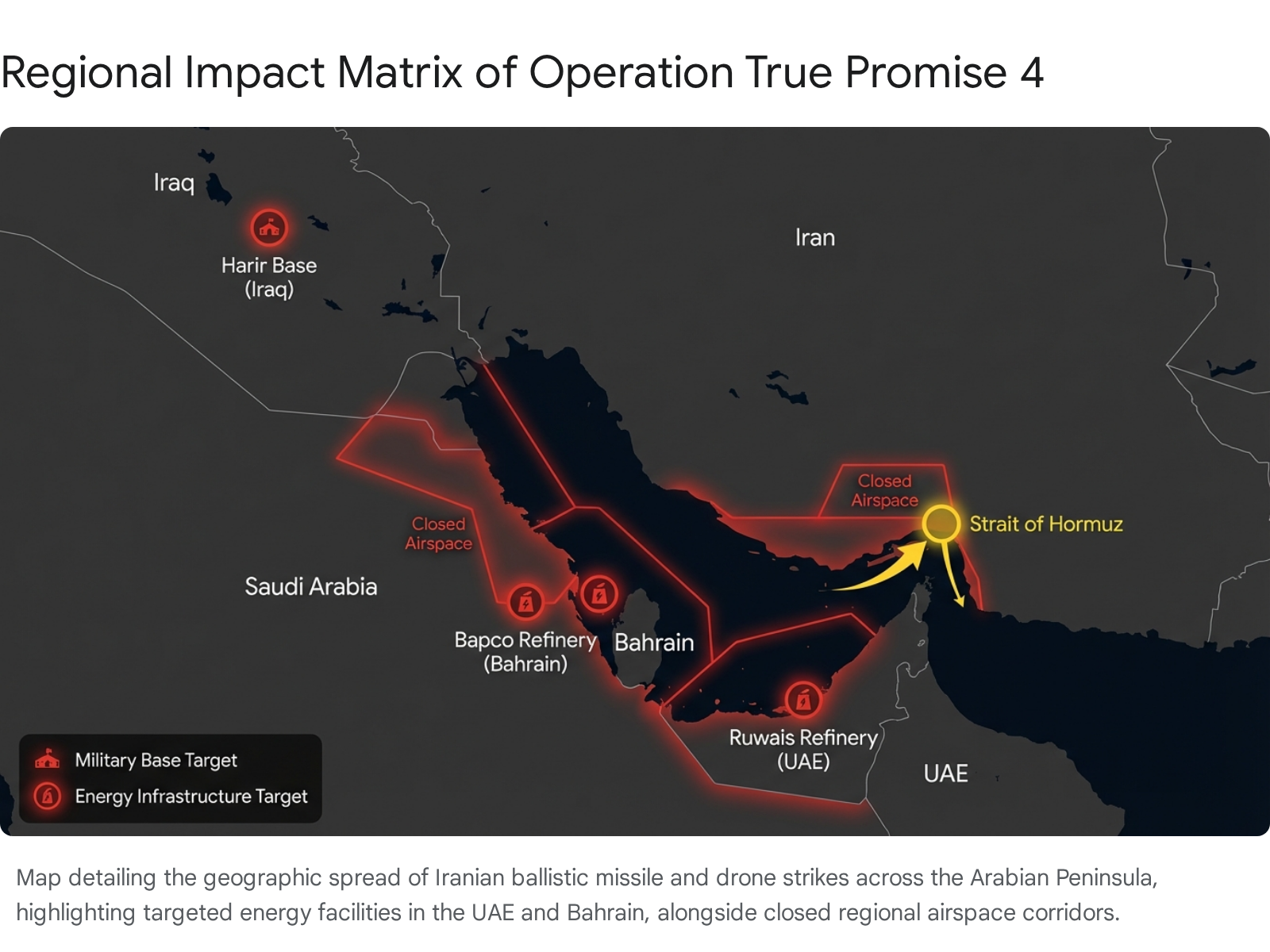
The expansion of Iranian retaliatory strikes has forced the Gulf Cooperation Council (GCC) states into the center of the conflict. The Iranian strategy relies on punishing nations that host United States military bases, hoping that the resulting economic damage will force these host nations to pressure Washington into a ceasefire.
United Arab Emirates (UAE): The UAE has absorbed the highest volume of incoming Iranian fire, intercepting over 1,500 rockets and drones since the war began.15 In the last 36 hours, a major Iranian drone strike bypassed local air defenses and impacted the Ruwais Industrial Complex in the Emirate of Abu Dhabi.12 The strike triggered a massive fire, forcing the Abu Dhabi National Oil Company (ADNOC) to execute a precautionary shutdown of the Ruwais refinery. This facility is the largest single-site refinery in the Middle East, capable of processing 922,000 barrels of crude oil per day.12
In response to the continuous barrage, which has resulted in eight civilian deaths and 122 injuries over the past ten days, the UAE has implemented the Emergency Security Control of Air Traffic (ESCAT) protocol, heavily restricting commercial aviation.10 Despite official statements reaffirming neutrality and prohibiting the use of Emirati bases for offensive operations against Iran, the economic toll is mounting. Top Wall Street banks have authorized the temporary relocation of their personnel out of the country.15 The UAE has also voluntarily reduced its oil output by 500,000 to 800,000 barrels per day due to export bottlenecks.15
Kingdom of Saudi Arabia (KSA): The Saudi military remains on high alert following multiple drone incursions. Saudi air defense networks successfully intercepted Iranian drones over the eastern oil-rich regions, including incidents near Al-Kharj and a drone impact in a residential area in Zulfi province that caused minor damage.10 The Kingdom has issued stern diplomatic warnings to Tehran, stating that continued aggression will yield a devastating response and permanently sever bilateral relations.51 The United States has ordered the departure of non-emergency diplomatic personnel from the Kingdom due to the unpredictable security environment.53
Kingdom of Bahrain: Bahrain suffered a direct hit to its critical energy infrastructure. Iranian explosive drones struck the Sitra Island refinery complex, operated by the state-owned Bapco Energies.13 The attack ignited a large fire and injured 32 civilians in the surrounding residential districts, including several children requiring emergency surgery.13 Consequently, Bapco was forced to declare a formal state of force majeure, suspending its international contractual obligations for refined petroleum exports.13 Bahrain’s airspace remains under total closure.50
State of Qatar: Qatar finds its traditional role as a neutral mediator severely compromised. Iranian strikes previously targeted the Ras Laffan industrial city, resulting in a complete halt of Qatari Liquefied Natural Gas (LNG) production, removing 20 percent of the global LNG supply from the market.54 In the past 36 hours, Qatari air defenses intercepted incoming missiles, prompting the Foreign Ministry to issue a stark warning that attacks on energy infrastructure establish a “dangerous precedent” that threatens the global economy.15 The Indian government successfully coordinated the evacuation of 1,000 Indian nationals from Doha via Qatar Airways.15
State of Kuwait: Kuwait continues to suffer collateral damage due to its hosting of vital United States logistical hubs. The IRGC launched targeted drone and missile strikes against Camp Arifjan and Camp Buehring.56 The Kuwaiti National Guard successfully shot down six inbound drones.7 In response to the violation of its territorial integrity, the Kuwaiti Ministry of Foreign Affairs dispatched identical letters to the United Nations Security Council, officially documenting the Iranian aggression and reserving the right to self-defense under Article 51 of the UN Charter.58
Sultanate of Oman & Hashemite Kingdom of Jordan: Oman and Jordan have largely avoided direct kinetic impacts in the last 36 hours but remain highly vulnerable to the regional fallout. Oman’s airspace remains open and has become a vital hub for international repatriation flights fleeing the closed corridors of the Persian Gulf.50 The Omani Foreign Ministry continues to advocate for an immediate ceasefire. Jordan’s airspace remains technically open but highly restricted, requiring incoming aircraft to carry surplus fuel to manage unpredictable routing delays caused by regional missile interceptions.50
| Nation | Airspace Status (NOTAM) | Key Infrastructure Impacted | Diplomatic Posture |
| UAE | Restricted (ESCAT Protocol) | Ruwais Refinery (Shutdown) | Condemns attacks; denies use of bases for strikes. |
| Bahrain | Total Closure | Bapco Sitra Refinery (Force Majeure) | High alert; fully aligned with U.S. defensive posture. |
| Saudi Arabia | Partial Closure (Eastern borders) | Ras Tanura, Shaybah Oil Field | Threatens retaliation if strikes continue. |
| Qatar | Restricted (ESCAT Protocol) | Ras Laffan LNG Complex | Mediation suspended; warns of global market collapse. |
| Kuwait | Total Closure | Camp Arifjan, Camp Buehring | Submitted formal aggression complaints to the UN. |
5.0 Appendices
Appendix A: Methodology
This Situation Report (SITREP) was synthesized using a comprehensive, real-time sweep of open-source intelligence (OSINT), official state broadcasts, military command press releases, and global financial monitors captured between March 9, 2026, 02:16 UTC, and March 10, 2026, 14:33 UTC. The analytical methodology prioritized primary source documentation, including U.S. Central Command (CENTCOM) operational summaries, Israel Defense Forces (IDF) Home Front Command directives, and official statements from the Islamic Revolutionary Guard Corps (IRGC) Public Relations Office. To assess regional impacts, data was aggregated from the European Union Aviation Safety Agency (EASA), Flightradar24 telemetry, and corporate disclosures from entities such as Bapco Energies and ADNOC. Where conflicting casualty figures or damage assessments arose between belligerent states, the report utilized neutral third-party verification from international human rights monitors and commercial satellite imagery analysis to maintain strict objectivity.
Appendix B: Glossary of Acronyms
- ADNOC: Abu Dhabi National Oil Company. The state-owned oil company of the United Arab Emirates.
- Bapco: Bahrain Petroleum Company. The national energy corporation of Bahrain.
- CENTCOM: United States Central Command. The geographic combatant command responsible for U.S. military operations in the Middle East, Central Asia, and parts of South Asia.
- ESCAT: Emergency Security Control of Air Traffic. A protocol utilized to restrict and manage civilian airspace during times of severe military conflict.
- GCC: Gulf Cooperation Council. A political and economic union consisting of Bahrain, Kuwait, Oman, Qatar, Saudi Arabia, and the United Arab Emirates.
- IDF: Israel Defense Forces. The national military of the State of Israel.
- IRGC: Islamic Revolutionary Guard Corps. A multi-service primary branch of the Iranian Armed Forces, tasked with protecting the Islamic Republic’s political system.
- LNG: Liquefied Natural Gas.
- NOTAM: Notice to Air Missions. Official alerts provided to aviation authorities to inform pilots of potential hazards along a flight route.
- THAAD: Terminal High Altitude Area Defense. An American anti-ballistic missile defense system designed to intercept short, medium, and intermediate-range ballistic missiles.
- UAV: Unmanned Aerial Vehicle.
Appendix C: Glossary of Foreign Words
- Basij: A voluntary paramilitary militia established in Iran in 1979, operating as a subordinate branch of the IRGC, primarily utilized for internal security and moral policing.
- Knesset: The unicameral national legislature of the State of Israel.
- Majlis: The Islamic Consultative Assembly, which serves as the national legislative body of Iran.
- Merkava: A series of main battle tanks used extensively by the Israel Defense Forces.
- Operation Epic Fury: The official operational codename designated by the United States Department of Defense for the military campaign against the Islamic Republic of Iran initiated on February 28, 2026.
- Operation Roaring Lion: The official operational codename designated by the Israel Defense Forces for their parallel military campaign against Iran and its proxy networks.
- Operation True Promise 4: The official operational codename designated by the IRGC for their retaliatory ballistic missile and drone strikes against the United States, Israel, and regional allies.
- Ayatollah: A high-ranking title given to major Shia clerics in Iran. Ayatollah Ali Khamenei served as the Supreme Leader until his death during this conflict.
Please share the link on Facebook, Forums, with colleagues, etc. Your support is much appreciated and if you have any feedback, please email us in**@*********ps.com. If you’d like to request a report or order a reprint, please click here for the corresponding page to open in new tab.
Sources Used
- Iran’s likely future under Mojtaba Khamenei | The Jerusalem Post, accessed March 10, 2026, https://www.jpost.com/middle-east/iran-news/article-889373
- Ali Khamenei’s son Mojtaba chosen as Iran’s new supreme leader, accessed March 10, 2026, https://www.theguardian.com/world/2026/mar/08/ali-khameneis-son-mojtaba-chosen-as-irans-new-supreme-leader
- Iran’s New Supreme Leader: Strategic Outlook of Mojtaba Khamenei, accessed March 10, 2026, https://lansinginstitute.org/2026/03/09/irans-new-supreme-leader-strategic-outlook-of-mojtaba-khamenei/
- Middle East in Focus – International Institute for Counter-Terrorism, accessed March 10, 2026, https://ict.org.il/middle-east-in-focus/
- TACO vs Tehran: Who will blink first—Trump or Khamenei?, accessed March 10, 2026, https://timesofindia.indiatimes.com/world/middle-east/taco-vs-tehran-who-will-blink-firsttrump-or-khamenei/articleshow/129391478.cms
- From B-1 bombers to A-10 attack jets: US details military assets used in ‘first 10 days of war’ against Iran, accessed March 10, 2026, https://timesofindia.indiatimes.com/defence/international/from-b-1-bombers-to-a-10-attack-jets-us-details-military-assets-used-in-first-10-days-of-war-against-iran/articleshow/129368823.cms
- As U.S.-Israeli war with Iran intensifies, Trump says it is “very far …, accessed March 10, 2026, https://www.cbsnews.com/live-updates/us-iran-war-israel-stock-prices-down-oil-prices-up-despite-trump-reassurance/
- Iran’s missile fire rate has collapsed by 92%: What comes next? – analysis, accessed March 10, 2026, https://www.jpost.com/defense-and-tech/article-889435
- Politician: Witkoff and Kushner want to apply the “Gaza model” to Iran and Ukraine as well – LIVE, accessed March 10, 2026, https://www.agenzianova.com/en/news/Politician-Witkoff-and-Kushner-want-to-apply-the-Gaza-model-to-Iran-and-Ukraine/
- LIVE BLOG – Trump Threatens Iran Over Hormuz as Tehran Vows to …, accessed March 10, 2026, https://www.palestinechronicle.com/live-blog-trump-threatens-iran-over-hormuz-as-tehran-vows-to-decide-wars-end-day-11/
- Trump’s mixed message: ‘We’ve already won, but we haven’t won enough’, accessed March 10, 2026, https://www.washingtonexaminer.com/daily-on-defense/4486252/trumps-mixed-message-weve-already-won-but-we-havent-won-enough/
- Drone hit sparks fire at major ADNOC refinery in Middle East, unit shut ‘as precaution’, accessed March 10, 2026, https://indianexpress.com/article/world/abu-dhabi-adnco-refinery-fire-drone-strike-ruwais-complex-10575042/
- Iran Targets Bahrain’s Biggest Oil Refinery Bapco, Company Declares ‘Force Majeure’, accessed March 10, 2026, https://www.republicworld.com/world-news/iran-targets-bahrain-s-biggest-oil-refinery-bapco-company-declares-force-majeure-watch
- Bahrain’s Bapco Energies declares ‘force majeure’ after Iran attack, accessed March 10, 2026, https://www.hindustantimes.com/business/bahrains-bapco-energies-declares-force-majeure-after-iran-attack-101773038208631.html
- Dubai Abu Dhabi news LIVE: 1,000 Indians evacuated from Qatar …, accessed March 10, 2026, https://www.hindustantimes.com/world-news/dubai-abu-dhabi-news-live-updates-uae-saudi-qatar-iran-us-israel-war-flights-airport-missile-explosion-latest-news-101773103543259.html
- Oil prices jump and markets slide as Iran names new supreme leader and digs in, accessed March 10, 2026, https://www.ctvnews.ca/world/mideast-conflict/article/oil-prices-jump-and-markets-slide-as-iran-names-new-supreme-leader-and-digs-in/
- DoW Identifies Army Casualty – War.gov, accessed March 10, 2026, https://www.war.gov/News/Releases/Release/Article/4428396/dow-identifies-army-casualty/
- Pentagon confirms identity of seventh service member during Iran operation, accessed March 10, 2026, https://www.washingtonexaminer.com/policy/defense/4485244/pentagon-confirms-identity-seventh-service-member-killed-iran-operation-benjamin-pennington/
- Bahrain’s Bapco issues force majeure after refinery hit | Latest Market News – Argus Media, accessed March 10, 2026, https://www.argusmedia.com/news-and-insights/latest-market-news/2798255-bahrain-s-bapco-issues-force-majeure-after-refinery-hit
- Abu Dhabi shuts Ruwais refinery after drone strike as Gulf energy crisis deepens, accessed March 10, 2026, https://in-cyprus.philenews.com/international/adnoc-ruwais-refinery-shut-drone-strike-gulf-energy-disruption-live/
- Live Coverage of the Iran–U.S.–Israel Conflict / March 10 – WANA, accessed March 10, 2026, https://wanaen.com/live-coverage-of-the-iran-u-s-israel-conflict-march-10/
- ഇസ്രയേലിനെ കബളിപ്പിക്കും; 1000 കിലോ ഭാരമുള്ള യുദ്ധമുനകള് മാത്രം; ഖോറാംഷഹര് മിസൈലുകള് ഇറക്കി ഇറാന് – Manorama News, accessed March 10, 2026, https://www.manoramanews.com/gulf-and-global/world/2026/03/10/iran-preparing-to-strike-with-1000kg-heavy-warhead-khorramshahr-missiles-ready-for-strikes.html
- Israel says Iran is using cluster munitions. What to know about the weapons, accessed March 10, 2026, https://www.king5.com/article/syndication/associatedpress/israel-says-iran-is-using-cluster-munitions-what-to-know-about-the-weapons/616-4ffc64be-8076-4708-a616-1132811c9f12
- Israel says Iran is using cluster munitions. What to know about the weapons, accessed March 10, 2026, https://www.washingtonpost.com/world/2026/03/10/israel-iran-war-cluster-munitions-bomblets/cbe414ea-1c9b-11f1-a29c-fd43da9a479a_story.html
- Israel says Iran is using cluster munitions. What to know about the weapons – The Durango Herald, accessed March 10, 2026, https://www.durangoherald.com/articles/israel-says-iran-is-using-cluster-munitions-what-to-know-about-the-weapons/
- Defending Against Iranian Cyber Threats in the Wake of Operation Epic Fury, accessed March 10, 2026, https://securityboulevard.com/2026/03/defending-against-iranian-cyber-threats-in-the-wake-of-operation-epic-fury/
- Op. True Promise 4, wave 34: IRGC deploys 1-ton warhead missiles | Al Mayadeen English, accessed March 10, 2026, https://english.almayadeen.net/news/politics/op–true-promise-4–wave-34–irgc-deploys-1-ton-warhead-miss
- War in Waves: What Do the Numbers Reveal About Iran’s Strikes on Israel?, accessed March 10, 2026, https://www.palestinechronicle.com/war-in-waves-what-do-the-numbers-reveal-about-irans-strikes-on-israel/
- More hardline than his father, Mojtaba Khamenei’s appointment signals defiance and revenge, accessed March 10, 2026, https://www.timesofisrael.com/more-hardline-than-his-father-mojtaba-khameneis-appointment-signals-defiance-and-revenge/
- Iran links Strait of Hormuz passage to diplomatic stance as Trump warns of further strikes, accessed March 10, 2026, https://www.dailynewsegypt.com/2026/03/10/iran-links-strait-of-hormuz-passage-to-diplomatic-stance-as-trump-warns-of-further-strikes/
- ACLED Middle East Special Issue: March 2026, accessed March 10, 2026, https://reliefweb.int/report/iran-islamic-republic/acled-middle-east-special-issue-march-2026
- Israel-Iran war LIVE: Jaishankar speaks with Iranian Foreign Minister; U.S. bombers take off from a British base, accessed March 10, 2026, https://www.thehindu.com/news/international/israel-iran-war-west-asia-conflict-march-10-2026-live-updates/article70724870.ece
- Day 10 of Epic Fury strikes Guards bases and drone hubs in Iran, accessed March 10, 2026, https://www.iranintl.com/en/202603105687
- March 10, 2026, accessed March 10, 2026, https://www.fdd.org/overnight-brief/march-10-2026/
- Israel-Iran War Highlights: After India Condoles Khamenei’s Death, Jaishankar Speaks To Araghchi – NDTV, accessed March 10, 2026, https://www.ndtv.com/world-news/us-israel-iran-war-live-updates-dubai-news-middle-east-crisis-iran-live-missile-attacks-drone-strikes-oil-market-news-ayatollah-ali-khamenei-death-11166125
- Operations Epic Fury and Roaring Lion: 3/10/26 Update – JINSA, accessed March 10, 2026, https://jinsa.org/wp-content/uploads/2026/03/Operations-Epic-Fury-and-Roaring-Lion-03-10-26.pdf
- Lebanese parliament extends term by 2 years as Israel intensifies attacks on Lebanon, accessed March 10, 2026, https://www.wsls.com/news/2026/03/09/human-rights-watch-accuses-israel-of-using-white-phosphorus-in-southern-lebanese-town/
- 2238 In Israel Hospitalized due to Iranian/Hezbollah Attacks Since Start of War, accessed March 10, 2026, https://israel.com/health/2238-in-israel-hospitalized-due-to-iranian-hezbollah-attacks-since-start-of-war/?amp=1
- Israel Update: March 5, 2026 – Jewish Dallas, accessed March 10, 2026, https://www.jewishdallas.org/news/israel-update-march-5-2026/
- The Strategic Rupture: Analysing U.S. Operation Epic Fury and Iran’s Operation True Promise-4 – INSIGHT EU MONITORING, accessed March 10, 2026, https://ieu-monitoring.com/editorial/the-strategic-rupture-analysing-the-u-s-operation-epic-fury-and-irans-operation-true-promise-4/890420?utm_source=ieu-portal
- Seventh US soldier death in Operation Epic Fury, CENTCOM announces | wtsp.com, accessed March 10, 2026, https://www.wtsp.com/article/news/nation-world/seventh-us-soldier-death-operation-epic-fury-centcom-iran/67-70092d2a-6b19-4cc3-b947-6f60c0ed2c41
- Operation Epic Fury Fact Sheet 260303, accessed March 10, 2026, https://media.defense.gov/2026/Mar/03/2003882557/-1/-1/1/OPERATION-EPIC-FURY-FACT-SHEET-260303.PDF
- Operation Epic Fury: Unmatched Power, Unrelenting Force of America’s Warriors, accessed March 10, 2026, https://www.whitehouse.gov/articles/2026/03/operation-epic-fury-unmatched-power-unrelenting-force-of-americas-warriors/
- Explosions sound in the Iranian capital as war with US and Israel enters a fifth day, accessed March 10, 2026, https://apnews.com/article/iran-israel-us-03-03-2026-8755877b603e46ed3df8107689c1ee23
- Middle East Travel, Immigration & Corporate Mobility: FAQs for Employers | Newland Chase, accessed March 10, 2026, https://newlandchase.com/crisis-advisory-faq/
- Seventh US service member killed in war with Iran identified, accessed March 10, 2026, https://www.theguardian.com/world/2026/mar/09/seventh-us-service-member-killed-iran-war
- US National Guard member dies from ‘health-related incident’ in Kuwait, accessed March 10, 2026, https://www.firstcoastnews.com/article/news/nation-world/attack-on-iran/us-national-guard-member-dies-health-related-incident-kuwait-deployment/507-f30a7a7a-0e0f-4f82-b5b1-63865aa207bf
- US State Department Admits 36,000 Americans Have Fled Region, accessed March 10, 2026, https://www.saba.ye/en/news3662657.htm
- Majority of Americans oppose military action in Iran, new poll finds | PBS News, accessed March 10, 2026, https://www.pbs.org/newshour/politics/majority-of-americans-oppose-military-action-in-iran-new-poll-finds
- Airspace closures following Israeli and US strikes on Iran, accessed March 10, 2026, https://www.flightradar24.com/blog/live/israel-launches-pre-emptive-strikes-on-iran-airspace-closures-going-into-place/
- Saudi Arabia sharpens warnings to Iran, says attacks will deal long-term harm to ties, accessed March 10, 2026, https://www.timesofisrael.com/liveblog_entry/saudi-arabia-sharpens-warnings-to-iran-says-attacks-will-deal-long-term-harm-to-ties/
- Saudi Arabia Affirms Right to Defend Its Security Against Iranian Attacks, Warns Iran of Greatest Loss in Wider Escalation, accessed March 10, 2026, https://spa.gov.sa/en/N2531967
- State Department Orders U.S. Diplomats to Leave Saudi Arabia as Iran Strikes Gulf Neighbors, accessed March 10, 2026, https://www.democracynow.org/2026/3/10/headlines/state_department_orders_us_diplomats_to_leave_saudi_arabia_as_iran_strikes_gulf_neighbors
- Gulf Situation Assessment: Iran’s Attacks on Arab States Will Backfire – Middle East Forum, accessed March 10, 2026, https://www.meforum.org/mef-online/gulf-situation-assessment-irans-attacks-on-arab-states-will-backfire
- Operation Epic Fury, Regime Change, and the Collapse of Legal Constraint – CIP, accessed March 10, 2026, https://internationalpolicy.org/publications/epic-fury-international-law/
- Iran Update Evening Special Report, March 1, 2026 | ISW, accessed March 10, 2026, https://understandingwar.org/research/middle-east/iran-update-evening-special-report-march-1-2026/
- Iran Update Evening Special Report, March 5, 2026 | ISW, accessed March 10, 2026, https://understandingwar.org/research/middle-east/iran-update-evening-special-report-march-5-2026/
- Kuwait Sends Two New Letters to UN and UNSC on Iran’s Savage …, accessed March 10, 2026, https://qna.org.qa/en/News-Area/News/2026-3/10/kuwait-sends-two-new-letters-to-un-and-unsc-on-irans-savage-aggression-against-its-territory
- Kuwait Sends Two Identical Letters to UN, UNSC on Iran’s Aggression – Qatar news agency, accessed March 10, 2026, https://qna.org.qa/en/News-Area/News/2026-3/4/kuwait-sends-two-identical-letters-to-un-unsc-on-irans-aggression