Executive Summary (BLUF)
The traditional law enforcement duty belt, historically designed to carry a minimal assortment of lightweight tools, has evolved into a critical occupational hazard that systematically degrades the musculoskeletal health of police personnel. Modern operational and tactical requirements dictate that officers carry between 15 and 30 pounds of mandatory equipment distributed circumferentially around the waist and pelvic girdle. This localized load concentration operates as a primary biomechanical vector for musculoskeletal disorders (MSDs), specifically chronic lower back pain (LBP), sciatica, and accelerated lumbar intervertebral disc degeneration. Current epidemiological data and occupational health surveillance indicate that up to 60% of all law enforcement officers (LEOs) will experience clinically significant lower back pain during their careers, leading to severe personnel shortages, early medical retirements, and extraordinary financial liabilities for municipalities.
The financial translation of this physiological damage is staggering. The average workers’ compensation settlement for a duty-related back injury ranges from $40,000 to $80,000, with complex surgical interventions—such as multi-level spinal fusions—frequently pushing individual medical and indemnity claim costs well beyond $175,000 to $300,000. When factoring in lost productivity, mandatory overtime to backfill injured officers’ shifts, and long-term disability pensions, the aggregate annual cost of lower back pain in the law enforcement sector approaches an estimated $56 billion nationwide.
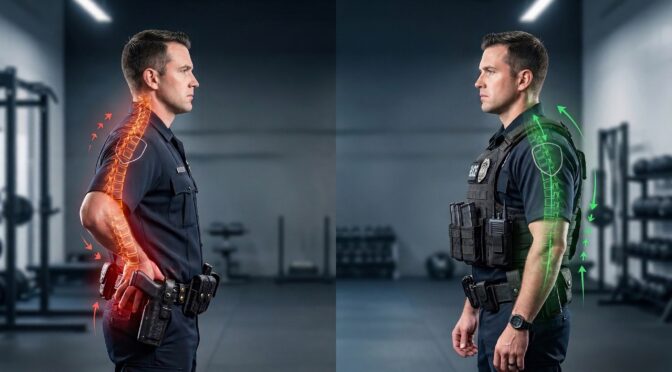
Recent biomechanical studies, continuous pressure-mapping diagnostics, and rigorous departmental pilot programs offer compelling, data-driven evidence that transitioning from traditional pelvic duty belts to load-bearing vest (LBV) outer carriers significantly mitigates these acute and chronic risks. By redistributing equipment mass across the broader surface area of the upper thorax and shoulders, LBVs eliminate the “pelvic wedge” effect that occurs in patrol vehicles, thereby reducing compressive forces on the highly vulnerable L4-L5 and L5-S1 spinal segments. Objective body-seat interface pressure mapping demonstrates that load-bearing vests decrease contact pressure in the lower back from 37.8 mmHg to 30.8 mmHg—a reduction that crosses the clinical threshold for predicting cumulative trauma. Furthermore, physiological modeling reveals that transferring weight away from the hips rectifies anterior pelvic tilt and drastically reduces the compensatory torque required by the erector spinae muscles to maintain static posture.
Despite marginal increases in upper back contact pressure and lingering departmental aesthetic concerns regarding the “militarization” of the police uniform, the strategic procurement of load-bearing vests represents a high-yield ergonomic intervention. With an average unit cost of approximately $300 to $500 per vest system, the return on investment (ROI) is realized rapidly through the prevention of a single six-figure medical claim, reduced overtime expenditures, and enhanced operational readiness. This comprehensive white paper provides an exhaustive, cross-source analysis of the biomechanical parameters, actuarial impacts, and tactical implications of duty gear load placement, serving as a definitive framework for law enforcement command staff, risk management actuaries, and defense procurement officers.
1.0 Introduction and the Evolution of Law Enforcement Load Carriage
1.1 Historical Context and the Escalation of Equipment Requirements
For the past century, law enforcement officers have quite literally carried the weight of public safety upon their waists. Twenty-five years ago, the standard police duty belt was a relatively simple apparatus.1 Constructed primarily of rigid leather, it was designed to hold a minimal inventory of essential tools: a six-shot revolver, a single set of handcuffs, a wooden straight baton, and a bulky but relatively light two-way radio.1 Even in that era, officers occasionally reported discomfort and localized fatigue from the gear’s weight and rigidity.1 To reduce weight and maintenance requirements, equipment manufacturers eventually transitioned the industry to nylon web construction.1 However, these modern materials required thicker weaves, reinforced polymer stitching, and rigid Velcro inner-belt attachments to prevent gear shifting, which inadvertently created new, highly localized pressure points and drastically reduced the belt’s overall flexibility.1
Concurrently, the escalation of public safety threats, the advent of new non-lethal technologies, and the evolution of post-Columbine active shooter protocols mandated a significant expansion of the individual patrol officer’s daily loadout.1 The contemporary inventory is extensive and dense. It typically includes a high-capacity, polymer-framed semi-automatic firearm, two to three spare high-capacity ammunition magazines, a collapsible steel baton, Oleoresin Capsicum (OC) chemical spray, an electronic control weapon (e.g., TASER), a high-lumen heavy-duty flashlight, a digital encrypted radio with lapel microphone, two sets of linked or hinged handcuffs, an individual first aid kit (IFAK), a tourniquet, and a body-worn camera system.1
1.2 Engineering Profile and Mass Distribution of the Modern Duty Loadout
The aggregate weight of this mandatory protective and tactical gear is substantial. An unloaded, baseline nylon duty belt itself weighs approximately 3.4 lbs (1.5 kg).2 When fully equipped with the aforementioned tools, the duty belt regularly weighs between 15 and 20 pounds.1 When combined with mandatory concealed internal soft body armor, the total weight of the daily uniform frequently exceeds 25 to 30 pounds, representing approximately 8 to 12% of the total body mass of the average United States law enforcement officer.2
| Equipment Component | Average Estimated Weight (lbs) | Average Estimated Weight (kg) |
| Concealed Protective Vest (Level II/IIIA) | 6.4 | 2.9 |
| Loaded Semi-Automatic Duty Pistol | 2.4 | 1.1 |
| Base Nylon Duty Belt (Unloaded) | 3.4 | 1.5 |
| Spare Ammunition (2 Magazines) | 1.2 | 0.5 |
| Electronic Control Weapon (TASER) | 1.0 | 0.4 |
| Digital Radio & Battery | 1.5 | 0.7 |
| Handcuffs (2 Pairs) & Pouches | 1.5 | 0.7 |
| Expandable Steel Baton | 1.2 | 0.5 |
| Flashlight, OC Spray, IFAK, Misc. | 2.5 | 1.1 |
| Total Estimated System Mass | 21.1 lbs | 9.4 kg |
Table 1.1: Standardized weight distribution of modern law enforcement mandatory protective gear and tactical appointments.1
The human musculoskeletal system is not anatomically optimized to sustain a circumferential, rigidly tethered load of this magnitude around the iliac crest for 8 to 12 hours per day. This mass is not perfectly symmetrically distributed; the firearm and spare magazines inherently place a dense, concentrated mass on specific quadrants of the hips, forcing the pelvis to tilt and the lumbar spine to curve laterally to maintain the body’s center of gravity.4 The resulting kinetic chain disruption serves as the foundation for widespread occupational injury.
2.0 Epidemiological Landscape of Law Enforcement Musculoskeletal Disorders
2.1 Prevalence and Incidence Rates of Lumbar Pathologies
The epidemiological data regarding law enforcement personnel and musculoskeletal degradation paints a stark, mathematically undeniable picture of severe occupational hazard. Law enforcement officers experience lower back pain at a frequency that is equal to or significantly greater than the general industrial workforce.4 Broad industry surveillance indicates that approximately 60% of all law enforcement officers will experience clinically significant lower back pain (LBP) during their careers.7
Specialized cohort studies analyzing active-duty personnel provide even more granular insight. A comprehensive survey of active-duty Swedish police officers revealed that 43% of the force reported experiencing debilitating lower back pain one or more days every single week.2 In targeted biomechanical evaluations where officer health histories were audited, up to 63% of sampled officers reported experiencing low back pain either while on duty or immediately following their shifts.2 When these officers undergo functional physical assessments, the damage is evident. Clinical sit-and-reach assessments of patrol officers wearing traditional gear reveal flexibility deficits that are severe; their functional range of motion is nearly half of the mean distance reported in healthy civilian baseline literature.2 This lack of flexibility, combined with the inherently sedentary nature of vehicular patrol duties, creates a physiological environment that is highly susceptible to both acute muscle sprains and chronic discogenic diseases.2
A comprehensive national study tracking non-fatal occupational injuries across a 12-year period (2003 to 2014) quantified this disparity. The overall injury rate for law enforcement officers was 635 per 10,000 full-time equivalent (FTE) workers.8 In stark contrast, the injury rate for all other combined U.S. workers during the same period was only 213 per 10,000 FTE.8 Specific incidence rates observed in individual precinct studies have reported staggering figures, ranging from 410 injuries per 1000 personnel per year to as high as 610.5 injuries per 1000 personnel per year, with sprains and strains to the trunk and lower extremities consistently ranking as the most common medical diagnoses.8
2.2 Vehicular Patrol Dynamics and the Seating Wedge Effect
The biomechanical hazard of the duty belt is catastrophically amplified when the officer is seated in a patrol vehicle. Modern policing is heavily vehicle-dependent, and driving for four or more hours per day—a standard metric for proactive patrol units—vastly increases, and often doubles, the risk of developing chronic lower back pain.6
Patrol vehicle seats are universally engineered for civilian commuters. They are not designed to accommodate an operator wearing 20 pounds of rigid polymer and metal gear strapped to their waist.4 In a seated position, the rigid duty belt is trapped between the officer’s posterior pelvis and the vehicle seat bolstering. This dynamic creates a “mechanical wedge.” The bulk of the rear-mounted equipment (often handcuffs, baton, or IFAK) physically displaces the officer’s torso forward, preventing the lower back from making flush contact with the seat’s engineered ergonomic lumbar support.4
Consequently, the spine is forced out of its natural lordotic curve and into a kyphotic (slouched or C-shaped) posture while driving.4 This sustained kyphotic posture places immense static strain on the posterior longitudinal ligament and forces the anterior aspect of the intervertebral discs to bear the entirety of the upper body’s compressive load, accelerating annulus fibrosus tearing and subsequent disc herniation.4
2.3 Kinematic Degradation and Tactical Vulnerability
Beyond the realm of chronic orthopedic injury, the duty belt severely restricts acute physical performance, introducing severe tactical vulnerabilities. The rigid mass of the belt physically limits ankle dorsiflexion and plantar flexion, and significantly alters peak power generation during the stance phase of walking and running gaits.11
More alarmingly, the equipment causes a measurable and profound decline in explosive power. Biomechanical performance studies testing the vertical jump of officers—both with and without their duty gear—revealed a 16% decrease in absolute power output when fully equipped.2 Duty belts and their associated loads demonstrably reduce officer agility, maximum sprinting speeds, and the critical ability to rapidly pivot, accelerate, and exit from a low car seat.12
In high-stakes tactical scenarios, such as rapidly exiting a patrol vehicle during an ambush, scaling a chain-link fence during a foot pursuit, or physically overpowering a non-compliant suspect, this kinematic restriction directly imperils officer safety.2 The inability to generate explosive power or rotate the hips freely means that officers must rely on upper-body strength and momentum, further increasing the risk of acute tearing in the lumbar musculature.2
3.0 Biomechanical Modeling: The Lumbar Spine as a Lever System
To mathematically and physiologically understand why the duty belt is so destructive, it is necessary to examine the human spine not simply as a column of bones, but as a complex biomechanical lever system. Epidemiological studies have conclusively shown that the loads imposed on the human spine during daily occupational tasks play a primary role in the onset of low back pain.13 The loads applied to the lumbar spine are shared by multiple biological structures: the erector spinae and rectus abdominis muscles; the posterior elements, including the articular facets and complex ligamentous networks; and the intervertebral discs of the ligamentous motion segments.13
3.1 Static Equilibrium and Lever Arm Mechanics
In biomechanical engineering, the human body operates on lever systems comprising four parts: a pivot (the joint), an effort arm (muscle force applied at an insertion point), a lever arm (the bone), and a load arm (the resistance or weight to be moved).14 The lower lumbar spine, specifically the intervertebral discs at L4-L5 and L5-S1, serves as the primary fulcrum for the entirety of the human torso.16
When an officer is standing, walking, or bending, the weight of the body parts above the L5-S1 joint acts as a resistance lever. To prevent the torso from simply collapsing forward under the pull of gravity, the erector spinae muscles (the vertical ridge muscles running along the back) must contract to provide the primary motive pulling force.16
Crucially, this lever system operates at a massive mechanical disadvantage. The “power arm”—the distance from the action line of the erector spinae muscles to the spinal fulcrum (the center of the disc)—is exceptionally short. In standard biomechanical models, this internal moment arm is typically estimated to be only 5 to 6 centimeters.17 Because this power arm is exponentially shorter than the resistance arm (the length of the torso plus the extended arms and any held weight), the back muscles must generate a massive amount of internal tension to counteract relatively small external loads.16
3.2 Mathematical Formulation of L4-L5 and L5-S1 Compressive Forces
The physics of this physiological load can be calculated using a static equilibrium model of the waist. In a simplified, sagittally symmetric weight-holding task, the net reaction consists of a compressive force (C) acting downward on the lumbar motion segment, and a tension (E) generated by a single equivalent of the erector muscles.17
The static equilibrium equations require that the internal forces balance the external forces. Therefore: Net Reaction Force (Fz) = Compressive Force (C) – Erector Tension (E).17 Moment of Force (M) = length of internal effort arm (e) * Erector Tension (E).17
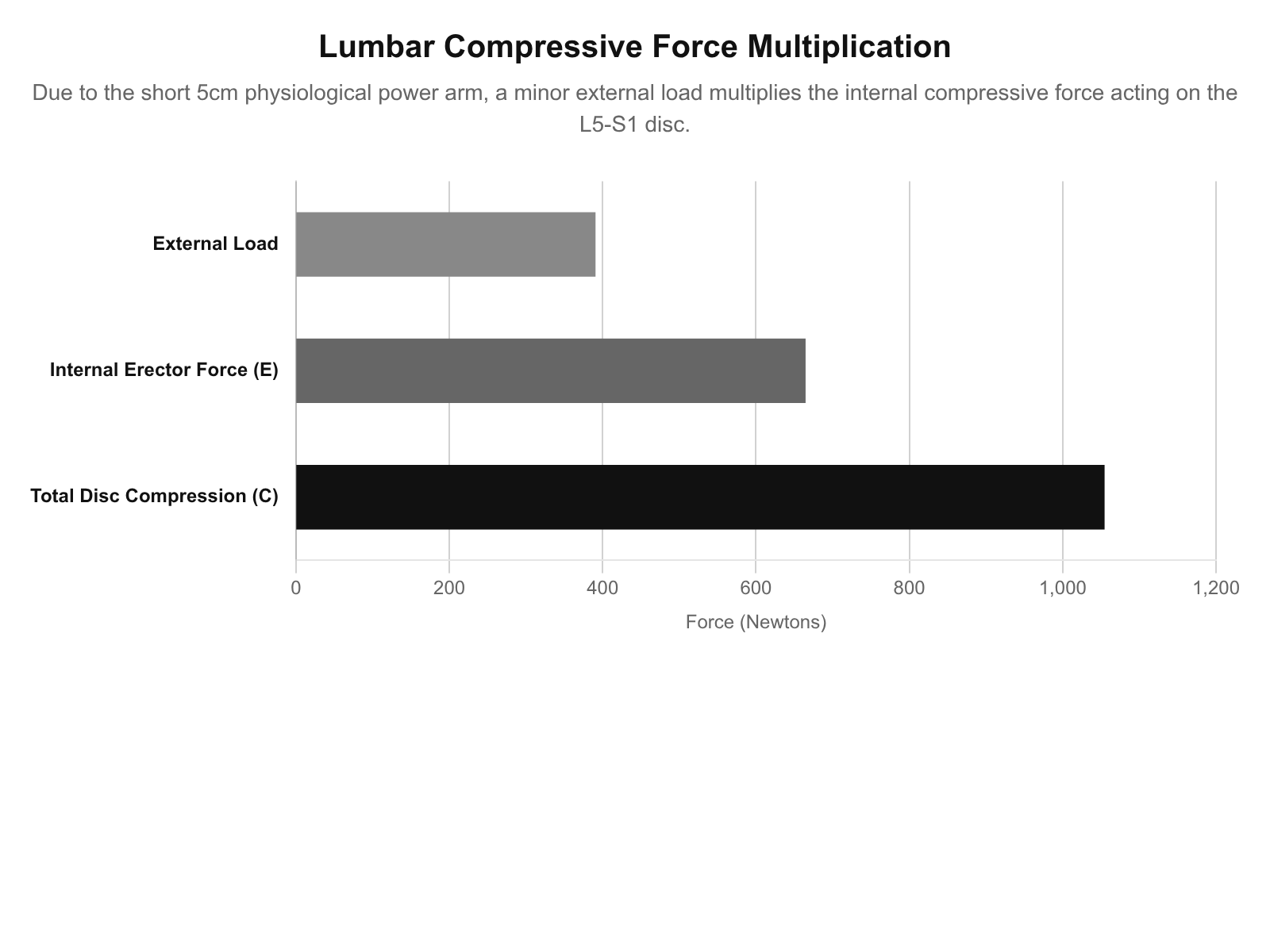
If we assume a standard internal effort arm (e) of 5 cm, and an external lifting moment requiring 3320 Ncm of torque, the required erector tension is calculated as: E = 3320 Ncm / 5 cm = 664 Newtons of force.17
If the external weight creates a downward force of 390 N, the total compressive force (C) crushing the intervertebral disc is the sum of the external weight and the internal muscle tension pulling down to stabilize the spine: C = 390 N + 664 N = 1054 Newtons.17
This model demonstrates a fundamental biomechanical truth: the internal compressive force (C) is consistently and considerably larger than the actual net weight of the external load.17 The magnitude of the moments of the external forces—how far away the weight is from the spine—is the major determinant of spinal destruction, rather than the absolute weight itself.17
Furthermore, human physiology is rarely statically determinate. In reality, the rectus abdominis muscles (the front core) also contract simultaneously to provide stiffness and stability when a heavy load is held. This co-contraction introduces a new variable (R) into the equation: Fz = C – E – R.17 M = (e * E) – (r * R).17
If the rectus abdominis contracts with just 200 N of force at a distance (r) of 10 cm, it forces the erector spinae to pull even harder to overcome both the external load and the abdominal contraction. In this scenario, the erector tension (E) jumps to 1064 N, and the total compressive force (C) on the disc spikes to 1654 N.17
3.3 The Physiological Load of a 20lb Duty Belt
When we apply these mathematical formulas to the law enforcement duty belt, the mechanism of injury becomes explicitly clear. A 20-pound belt does not simply add 20 pounds of downward force to the spine.
Because the belt sits below the natural center of gravity and pushes the pelvis anteriorly (forward), it creates an exaggerated lumbar lordosis (swayback).4 To compensate for this shift and prevent the torso from falling forward, the erector spinae muscles must enter a hyper-tonic state—a constant, low-level contraction.4 Because of the extreme mechanical disadvantage of the 5 cm power arm, counteracting a 20lb offset load requires hundreds of pounds of continuous internal muscle force.
Advanced biomechanical simulations utilizing Jack software and Human Posture Analysis (HPA) confirm that dynamic lifting and twisting while wearing these loads causes L4-L5 and L5-S1 compressive forces to skyrocket, varying from 3.4 to 5.0 times the total body weight of the officer.13 For a 200-pound officer, the lumbar discs may be subjected to nearly 1,000 pounds of compressive force during dynamic suspect apprehension.13
Prolonged exposure to these extreme compressive forces leads to ischemia. The intervertebral discs are largely avascular; they rely on osmotic diffusion to receive nutrients and expel cellular waste. Sustained, high-level compression physically squeezes fluid out of the disc and prevents the influx of nutrient-rich blood, accelerating cellular death, disc desiccation, and ultimately resulting in degenerative disc disease (DDD) and herniation.4
4.0 The Load-Bearing Vest (LBV) Intervention: Comparative Biomechanics
To mathematically and physiologically mitigate the extreme hazards of the pelvic load, the law enforcement industry and biomechanical researchers have increasingly turned to the Load-Bearing Vest (LBV), commonly referred to as an Outer Duty Carrier. This system physically uncouples heavy appointments—the radio, handcuffs, TASER, spare magazines, and heavy flashlights—from the waist and attaches them via modular webbing to a reinforced vest worn over the uniform shirt. This vest typically utilizes the officer’s existing internal ballistic armor panels or houses new panels directly within the carrier.21
4.1 Shift in Center of Mass and Thoracic Load Distribution
When 15 to 20 pounds of equipment is relocated from the rigid duty belt to the LBV, the biomechanical dynamics of the torso shift significantly. The vest distributes the mass over a vastly larger surface area—the pectoral region, the upper trapezius, the latissimus dorsi, and the clavicles—rather than concentrating it entirely upon the narrow ridge of the iliac crest.5
By removing the pelvic restriction, the hips are allowed to rotate naturally during the gait cycle, and the spine can return to a more neutral, anatomical alignment. This rectifies the anterior pelvic tilt and reduces the constant, low-level isometric firing of the erector spinae muscles.5
However, this systemic redistribution introduces a complex, but acceptable, biomechanical trade-off. While the vest completely eliminates pelvic restriction and sciatic nerve impingement, the weight of the equipment is now mounted on the chest. This anterior load is added with a relatively long moment arm relative to the lower lumbar spine.23 This longer moment arm subsequently produces a larger flexor moment on the lumbar spine, which the erector spinae must actively balance to prevent the officer from leaning forward.23 Fatigue endurance tests indicate that wearing a loaded vest can cause a faster drop in median muscle frequency (a sign of fatigue) compared to wearing no equipment at all.23 Yet, when directly compared to the destructive nature of the duty belt, the elimination of direct point-pressure on the pelvis and the restoration of natural pelvic kinematics overwhelmingly outweigh the negative impact of the anterior thoracic weight.
4.2 Pressure Mapping and Body-Seat Interface Optimization
The most conclusive, undeniable evidence supporting the transition to load-bearing vests comes from objective pressure mapping studies conducted on active-duty officers seated in standard fleet vehicles.2
Researchers utilized highly sensitive Tekscan CONFORMat sensor mats to measure contact pressure (recorded in millimeters of mercury, mmHg) and contact area (cm²) across the posterior chain of the body.10 The direct comparison of body-seat interface pressures between the two load-carriage systems reveals the precise mechanical benefit of the LBV.
| Anatomical Region | Standard Duty Belt (Pressure) | Load-Bearing Vest (Pressure) | Statistical Significance |
| Lower Back | 37.8 mmHg | 30.8 mmHg | Significant Reduction (p < 0.05) |
| Left Buttocks | 40.8 mmHg | 37.4 mmHg | Trending Lower (p = 0.052) |
| Right Thigh | 29.6 mmHg | 33.5 mmHg | Significant Increase (p = 0.011) |
| Upper Back | 20.4 mmHg | 24.1 mmHg | Significant Increase (p < 0.05) |
Table 4.1: Objective Body-Seat Interface Pressure Comparison: Duty Belt vs. Load-Bearing Vest.10
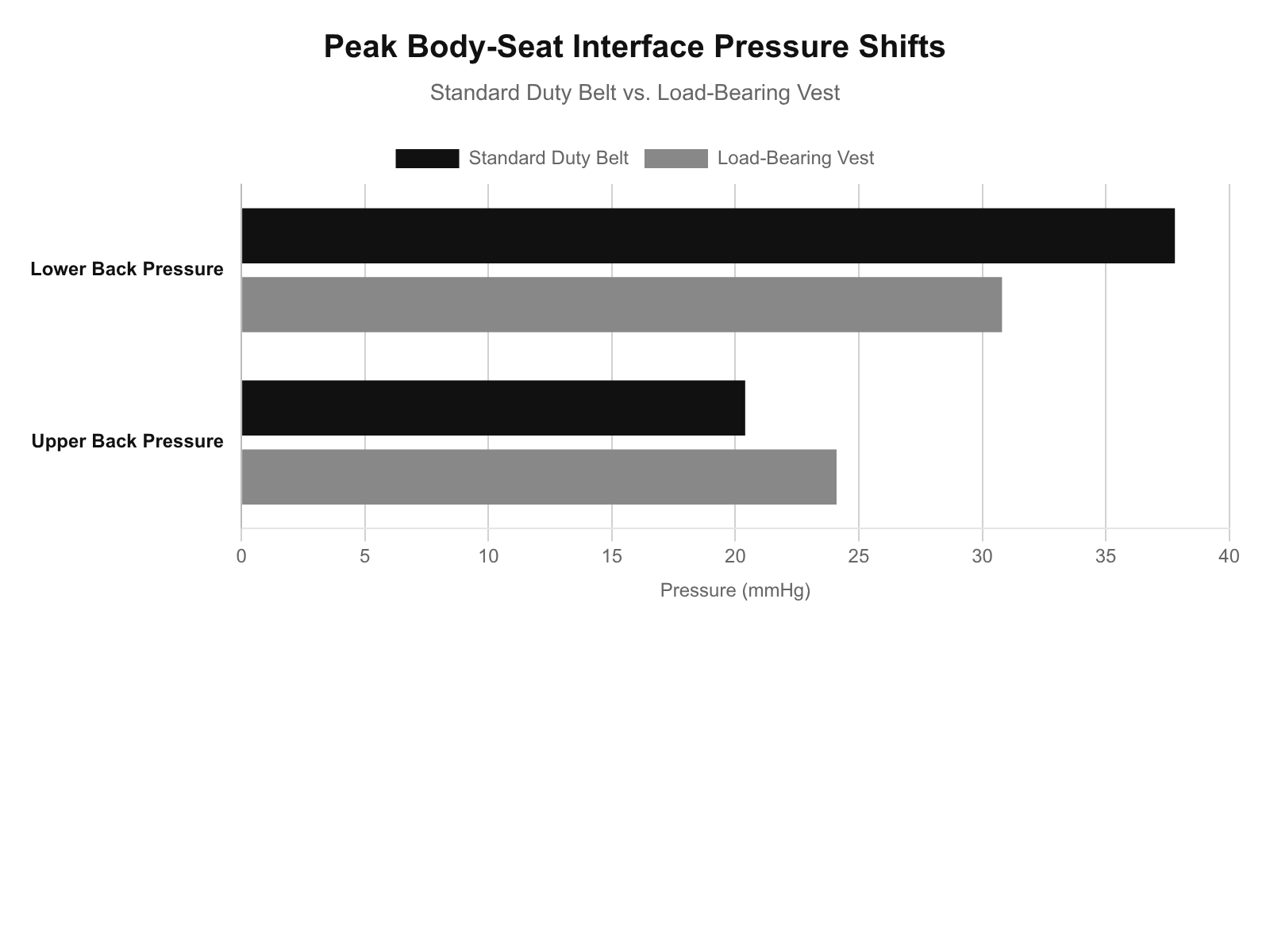
Interpretation of Interface Pressure Shifts: Relocating the bulk of the equipment to the LBV achieves the primary ergonomic objective: it significantly and permanently reduces contact pressure in the highly vulnerable lower back region, dropping the pressure by a massive 7 mmHg.10 By removing the bulky items (handcuffs, radios) from the posterior of the belt, the officer’s buttocks and lower lumbar spine can sit perfectly flush, allowing them to position themselves much further back into the seat.10
Consequently, because the officer is sitting deeper in the seat, the upper body is now able to apply resting force directly against the backrest. This biomechanical shift perfectly explains the observed increase in upper back pressure (from 20.4 to 24.1 mmHg).10 While this does transfer some of the static load to the thoracic spine, it is a highly favorable trade-off. The thoracic region is anatomically supported by the ribcage, creating a highly stable “ribcage-sternum-spine complex”.24 This complex functions biomechanically like a series of parallel springs, distributing load across multiple rigid structures.24 Therefore, the thoracic spine is vastly more capable of absorbing and dissipating compressive forces than the isolated, unsupported lumbar spine.24 The slight increase in thigh pressure observed with the vest is a secondary effect of the modified, more natural hip angle allowed by the removal of the rigid belt constraints.10
Subjective discomfort ratings directly mirror this objective data. Utilizing the Automobile Seating Discomfort Questionnaire (ASDQ) measured on a 100mm visual analogue scale, officers rated the duty belt itself as the primary cause of seated discomfort (36 mm), with the lower back experiencing the most intense regional discomfort (30.5 mm).10 A persistent discomfort score of 30.5 mm is clinically recognized by physical therapists and ergonomists as a definitive predictor of future chronic musculoskeletal pain and imminent tissue failure.10 Wearing the LBV drastically reduced these subjective pain scores.10
4.3 Neuromuscular Activation, Fatigue, and Postural Sway
Surface electromyography (sEMG) sensors placed bilaterally on the rectus abdominis, multifidus, biceps femoris, and rectus femoris have been utilized to analyze peak muscle activity during bodyweight hip hinging and lifting tasks.7 These analyses found that wearing a vest versus a duty belt does not drastically alter the acute maximum muscle activity during isolated lifting events.7
However, analyzing simple peak muscle activity during a 5-minute test fails to capture the grueling reality of a 12-hour patrol shift. Subjective ratings derived from these exact same studies are overwhelmingly conclusive regarding endurance: participants rated the load-bearing vest condition as significantly more comfortable (p < 0.05) and noticeably less physically restrictive (p < 0.05) than the traditional law enforcement duty belt.7
This reduction in physical restriction translates directly to a delayed onset of muscular fatigue over the course of a long shift, primarily because the core musculature does not have to constantly fight the unnatural rigidity of the belt simply to perform routine tasks like exiting a vehicle or bending to pick up a dropped item. Furthermore, tests on Center of Pressure (CoP) and postural sway indicate that the vest keeps the body’s center of mass more aligned with the anatomical midline, reducing the micro-corrections the ankles and calves must make to maintain balance.25
5.0 Actuarial Analysis and Workers’ Compensation Liabilities
The physiological destruction detailed in the biomechanical models inevitably translates into severe, often crippling, financial liabilities for municipalities, county governments, and state agencies. Lower back pain is the second most common reason for missed work days, long-term light-duty assignments, disability claims, and early medical retirements among sworn police officers.6
5.1 Baseline Costs of Lumbar Pathologies in Law Enforcement
When factoring in the direct costs of medical treatment, surgical intervention, physical therapy, and the indirect costs of lost productivity, overtime required to backfill injured officers’ vacant shifts, and administrative overhead, the holistic macroeconomic cost is staggering. The National Institute for Occupational Safety and Health (NIOSH) and associated labor economists estimate that the aggregate annual cost of lower back pain and associated MSDs in the law enforcement sector approaches $56 billion nationwide.7
Workers’ compensation (WC) data serves as a critical, albeit trailing, indicator of the systemic failure of current load-bearing practices.26 Medical treatment for lumbar spine injuries is notoriously expensive, non-linear, and prone to complication. Treatment protocols typically progress from conservative physical therapy and pharmacological management to highly invasive epidural steroid injections, and ultimately to complex spinal fusion or microdiscectomy surgeries.27
Industry aggregate data reveals the following financial baselines for back injury settlements:
- The average workers’ compensation back injury settlement across all general U.S. industries is approximately $44,158.28
- However, for high-impact, physically demanding roles like law enforcement, where return to full duty requires passing rigorous physical fitness and defensive tactics standards, settlements are significantly higher, typically ranging from $40,000 to $80,000 for moderate, non-surgical injuries.29
5.2 State-Level Data: MIOSHA and California Settlement Benchmarks
State-level occupational health data provides a clear picture of the ongoing risk. The Michigan Occupational Safety and Health Administration (MIOSHA), in conjunction with the Bureau of Labor Statistics, continuously tracks injury rates across the public sector.30 While aggressive safety programs have successfully driven down the overall private industry incidence rate in Michigan from 11.0 per 100 FTE workers in 1977 to a historic low of 2.8 in 2023, the law enforcement sector remains disproportionately hazardous, stubbornly resisting these broader safety trends due to the unyielding nature of the duty gear.31 Furthermore, workers’ compensation surveillance programs in Michigan have specifically targeted musculoskeletal diseases as a primary cross-sector program for intervention due to their high frequency and cost.32
To mathematically illustrate the escalating financial risk based on injury severity, actuarial data from California workers’ compensation averages provides a highly accurate, tiered cost structure that risk managers can utilize for forecasting:
| Clinical Injury Classification | Estimated Direct Medical Costs | Estimated Indemnity (Lost Wages/Disability) | Total Expected WC Settlement Range |
| Minor Lumbar Sprain/Strain | $5,000 – $15,000 | N/A (Short Term Recovery) | $8,000 – $25,000 27 |
| Herniated Disc (Non-Surgical) | $15,000 – $35,000 | $10,000 – $25,000 | $25,000 – $60,000 27 |
| Herniated Disc (Surgical Intervention) | $40,000 – $70,000 | $30,000 – $50,000 | $70,000 – $120,000 27 |
| Fractured Lumbar Vertebrae | $50,000 – $90,000 | $40,000 – $75,000 | $90,000 – $165,000 27 |
| Multi-level Spinal Fusion Surgery | $100,000+ | $75,000+ (Potential Medical Retirement) | $175,000 – $300,000+ 27 |
Table 5.1: Tiered Workers’ Compensation Settlement Estimates for Occupational Lumbar Injuries. Extrapolated from California WC settlement parameters and OSHA averages.27
5.3 Return on Investment (ROI) Modeling for LBV Procurement
This financial reality frames the procurement of load-bearing vests not as a discretionary uniform expense, but as a critical, high-yield risk mitigation strategy. The RAND Corporation has published extensive studies demonstrating that proactive public investment in police resources and equipment can generate substantial social and financial returns, emphasizing the need for straightforward cost-benefit analyses of personnel expenditures.33
Consider a mid-sized municipal department employing 100 sworn patrol officers. Based on the 60% prevalence rate, 60 officers will require some form of medical intervention for lower back pain during their tenure.7
- If only 10% of those afflicted officers (just 6 individuals) suffer an injury severe enough to require surgical intervention (e.g., a herniated disc requiring a discectomy), the agency faces a baseline liability of $100,000 per officer.
- This equates to $600,000 in direct settlement costs, entirely exclusive of the massive overtime costs required to backfill their vacant shifts during a 6 to 12-month recovery period.
Conversely, outfitting that entire 100-officer department with top-tier load-bearing vest carriers—which average approximately $300 to $500 per unit depending on modularity and armor compatibility—represents a one-time capital expenditure of only $30,000 to $50,000.5
The prevention of a single moderate herniated disc claim ($60,000) instantly pays for the complete outfitting of a 100-man department. The ROI is immediate, asymmetrical, and compounding over the lifecycle of the equipment.
6.0 Operational Case Studies and Departmental Policy Shifts
The synthesis of empirical biomechanical data and undeniable actuarial pressure has driven forward-thinking law enforcement agencies across the country to radically update uniform policies and initiate immediate equipment transition programs. A review of recent departmental interventions validates the laboratory models in real-world operational environments.
6.1 The University of Wisconsin-Eau Claire Empirical Study
Faced with a rapidly rising volume of internal complaints regarding severe back and hip pain among patrol officers, the Eau Claire (Wisconsin) Police Department (ECPD) took a proactive, scientific approach to the problem.5 Deputy Chief Matt Rokus partnered with the kinesiology department at the University of Wisconsin-Eau Claire and the Mayo Clinic Health System to conduct a rigorous, highly controlled six-month operational study.5
The methodology was highly robust. Researchers recruited 15 active-duty ECPD patrol officers and divided them into crossover groups.5 For the first three months, one group wore customized load-bearing vests while the control group continued to carry all gear on the traditional duty belt.5 The vests housed all heavy, dense equipment—the encrypted radio, multiple sets of handcuffs, and the heavy flashlight—while the firearm and TASER remained secured on a vastly lightened duty belt.5 At the three-month mark, the groups switched equipment.5 After every single 12-hour shift, the officers rigorously self-reported and documented their pain levels, any physical discomfort, and specific areas of joint restriction, generating a massive proprietary dataset.5
The findings were unambiguous:
- Officers experienced significantly and consistently less hip and lower-back pain when wearing the LBVs.5
- Crucially, the university researchers found absolutely no unintended negative consequences regarding the health of the officers or the functional safety of the vest.5 The vests did not limit range of motion, nor did they impede the officers’ tactical functioning or ability to draw weapons.5
- Based on these empirical, peer-reviewed findings, the ECPD authorized a permanent transition for all 100 sworn officers in the department.5 The agency’s leadership publicly stated that the $300 unit cost per vest, alongside the associated retraining costs, was a non-negotiable, essential investment in the long-term health and survival of their officers.5
6.2 Berrien County Sheriff’s Office: Tragedy-Driven Procurement and Policy Modernization
Other jurisdictions have mirrored this transition, though often their procurement cycles are tragically accelerated following localized critical incidents or extreme workforce demands. The Berrien County Sheriff’s Office in Michigan provides a poignant case study in rapid equipment modernization and policy adaptation.3
In July 2016, a horrific incident occurred at the Berrien County Courthouse. An inmate being transported from a holding cell managed to overpower a bailiff and secure his firearm during a struggle.36 The inmate subsequently shot and killed two veteran court officers, bailiffs Ron Kienzle and Joe Zangaro, before being neutralized by responding tactical officers.36 In the wake of this tragedy, the local community rallied to improve officer safety and survivability, with the Berrien Community Foundation raising over $52,229 from private citizens and local corporations (including Whirlpool and LECO).36
Sheriff Paul Bailey utilized these funds to implement sweeping safety upgrades that targeted both tactical lethality and ergonomic survivability. The department procured Level 3 security holsters (adding complex retention steps to prevent disarming), weapon-mounted LED flashlights, and crucially, modern outer vest carriers capable of stopping high-velocity rifle rounds.36
To standardize this rapid influx of new equipment, the department codified strict uniform regulations. Berrien County’s official policy mandated that all Outer Duty Carriers must utilize matching uniform material to maintain a professional appearance, require a rear drag handle for extracting wounded officers under fire, and feature integrated mounts to properly stabilize body-worn cameras.3 Furthermore, their Special Response Team (SRT) conducted a grueling evaluation of nine different tactical vests, ultimately selecting the TYR Tactical system.37 The TYR vest provided superior maneuverability and, remarkably, weighed 13 pounds less than the archaic, 14-year-old legacy gear the SWAT officers were previously forced to wear, massively reducing their spinal load during prolonged barricaded gunman callouts.37 The holistic approach to armor extended even to the K9 unit, with specialized vests donated for police dogs Blek, Maxx, and Mika.38
6.3 California State University Channel Islands (CSUCI) Pilot Implementation
The momentum of these findings has spread to specialized law enforcement agencies, including university policing. Citing the seminal UW-Eau Claire research and direct, persistent requests from their own patrol officers, the CSU Channel Islands (CSUCI) Police Department launched an External Load Bearing Vest Pilot Program.35
The department’s official announcement explicitly outlined the actuarial reality driving the decision, noting that “across the Law Enforcement profession, many officers miss patrol shifts because of back issues, which leads to staffing shortages, overtime costs and numerous worker comp claims”.35 By proactively transitioning away from the 30-pound pelvic load, CSUCI aims to capture both short-term morale improvements and long-term health benefits, ensuring their relatively small force remains operationally viable.
7.0 Alternative Ergonomic Interventions and Engineering Shortfalls
For agencies where severe municipal budget constraints or archaically strict uniform appearance policies prohibit the immediate adoption of outer vests, several alternative load-redistribution systems have been engineered and evaluated. However, biomechanical data indicates these are largely stopgap measures.
7.1 Articulated Inner Belts and External Lumbar Supports
Equipment manufacturers have attempted to solve the duty belt problem by re-engineering the belt itself. Systems like the “Balteus Belt” utilize modern, ergonomic geometry to contour the rigid nylon to the natural, organic shape of the human hips.1 The goal is to reduce highly localized pressure points and alleviate direct strain on the sciatic nerve.1
Other interventions include external lumbar support braces, such as the “BackUpBrace.” These devices attach directly to standard 2-inch duty belts, aiming to shift the load from the waistline down onto the wider structure of the hips, utilizing physics similar to the padded waist belt of a heavy-duty hiking backpack.4 They attempt to mechanically stabilize the natural lumbar curve under load and create a padded pressure buffer between the rigid belt and the officer’s spine.4
While these modifications offer measurable, incremental relief from acute surface pressure, they fail to address the fundamental biomechanical flaw: the mass is still located below the center of gravity, and they absolutely do not resolve the vehicular seating wedge issue. When seated, the equipment still physically prevents the officer from utilizing the vehicle’s lumbar support.
7.2 Suspenders and Harness Systems
Duty suspenders represent an older, but still utilized, approach. These simple strap systems attach to the existing duty belt via keepers and transfer a portion of the vertical load from the pelvis upward to the trapezius muscles and clavicles.41
While highly effective at reducing the sheer downward compressive force on the hips, suspenders introduce their own ergonomic hazards. They can cause nerve impingement in the shoulders if worn tightly, and like ergonomic belts, they completely fail to eliminate the pelvic wedge effect when seated in a patrol vehicle. The rigid gear remains exactly where it causes the most postural damage during the 4 to 8 hours an officer spends driving.4 The empirical data consistently indicates that these are half-measures compared to the comprehensive, multi-axis load redistribution achieved by a full outer carrier system.
8.0 Strategic Procurement Recommendations and Tactical Considerations
Transitioning a police force from traditional belts to load-bearing vests is not merely a medical or financial decision; it is a profound tactical shift that requires careful consideration of officer performance, training liabilities, and public perception.
8.1 Muscle Memory, Training, and Lethal Force Access
When critical equipment is relocated from the waist to the chest, the muscle memory required to instinctively access those tools—specifically the encrypted radio, handcuffs, and spare magazines—must be entirely reprogrammed.5
Under the extreme physiological stress and auditory exclusion of a lethal force encounter, fine motor skills degrade, and officers default to highly ingrained reflexive muscle memory. If an officer instinctively reaches for a waist-mounted magazine pouch that has been moved to their chest, that split-second delay can be fatal. Therefore, agencies must pair the physical issuance of new vests with mandatory, high-repetition defensive tactics and firearms training.5 The Eau Claire study specifically noted that all officers underwent extensive retraining to create new reflexive responses before the equipment was authorized for street patrol.5
From a kinematic perspective, once the retraining is complete, the vest massively improves tactical geometry. By clearing the waistline, officers can achieve deeper, unimpeded knee flexion and full-range hip rotation during foot pursuits, suspect apprehension, and ground-fighting scenarios.
8.2 Thermal Burden and Environmental Adaptability
A frequently cited concern regarding outer carriers is the thermal burden they place on the officer during summer months. Traditional uniform shirts worn over internal soft body armor trap immense amounts of heat against the core, as the Kevlar acts as a highly effective insulator.
Modern outer carriers actually resolve this issue. They allow officers to wear specialized, moisture-wicking synthetic “combat shirts” or base layers underneath the vest. More importantly, the outer carrier provides modularity. When an officer returns to the precinct to spend three hours writing arrest reports, they can easily un-Velcro and doff the heavy vest entirely, allowing their core to cool. This rapid donning and doffing capability is impossible with the traditional locked-in internal vest setup, making the LBV superior for overall thermal regulation.
8.3 Mitigating the “Militarization” Aesthetic Concern
The primary obstacle preventing the universal adoption of load-bearing vests across the United States is aesthetic and political, not functional. Many traditional, highly conservative police departments resist the transition out of concern that external tactical vests project an aggressive, “militaristic” appearance that damages community relations and creates psychological barriers between the police and the public.2
These agencies often prioritize the clean, approachable, “Sheriff Andy Taylor” look of the traditional Class A/B uniform with a polished duty belt, adhering strictly to a historical paradigm of policing.2
However, defense contractors and equipment manufacturers have rapidly responded to this political concern by developing “uniform-style” outer carriers. These highly engineered vests are tailored using the exact same polyester/wool blend fabrics as the department’s standard shirts. They feature faux buttons down the center, sewn-in military creases, standard metal badge grommets, and traditional nametag placements. They perfectly mimic the appearance of a standard button-down uniform shirt, while covertly providing the load-bearing capability and concealed MOLLE (Modular Lightweight Load-carrying Equipment) webbing necessary to mount gear safely.
The aesthetic argument against load-bearing vests is increasingly difficult for command staff to justify when directly weighed against the objective reality of crippling officer injuries, massive six-figure financial liabilities, and demonstrably degraded tactical performance.
9.0 Conclusion
The traditional law enforcement duty belt is an ergonomic anachronism. As the physical demands, non-lethal tool requirements, and tactical complexities of modern policing have exponentially expanded, the 2-inch waist belt has transformed from a simple utility tool into a profound occupational hazard. The concentration of 15 to 30 pounds of rigid, unyielding mass upon the pelvic girdle fundamentally disrupts human lumbar biomechanics. It forces the erector spinae muscles into continuous hyper-tonic contraction, generates extreme, localized pressure points within fleet vehicles, and is the direct, undeniable causal factor in the epidemic of lower back pain afflicting 60% of all law enforcement officers.
The financial consequences of maintaining this outdated paradigm are unsustainable. With individual workers’ compensation claims for lumbar spinal injuries routinely exceeding $75,000 to $150,000, and system-wide macroeconomic costs reaching into the billions, municipal liability is acute and compounding.
Conversely, the biomechanical, kinematic, and epidemiological data supporting the transition to Load-Bearing Vest (LBV) outer carriers is robust and conclusive. By transferring the mass from the vulnerable lumbar fulcrum to the highly stable, parallel-spring structure of the thoracic ribcage, LBVs completely alleviate the biomechanical wedge effect in vehicle seating, reducing lower back interface pressure by nearly 20%. Rigorous field trials confirm significant, permanent reductions in officer pain without compromising tactical effectiveness, agility, or range of motion.
Command staff and procurement officers must view the procurement of Load-Bearing Vests not as a discretionary uniform expenditure, but as a critical medical intervention, an essential risk management tool, and a vital investment in the operational lethality and longevity of their personnel. The mandate is clear: optimizing the physiological survival of the individual police officer directly correlates with enhanced public safety, massively reduced municipal financial liability, and the preservation of the highly trained law enforcement workforce.
Appendix: Methodology & Data Sources
This analytical white paper was synthesized utilizing rigorous, cross-source Open-Source Intelligence (OSINT) and academic database retrieval protocols. The deep-research methodology involved a systematic, qualitative, and quantitative review of peer-reviewed biomechanical literature, governmental occupational safety reports (NIOSH, MIOSHA), municipal workers’ compensation actuarial data, and localized law enforcement agency policy documents.
Data Parameters and Analytical Framework:
- Biomechanical Metrics: Engineering data was extracted from advanced kinematic and pressure-mapping studies detailing L4-L5 and L5-S1 compressive forces, static equilibrium net reaction models, and body-seat interface pressures (measured in mmHg) for standard police fleet vehicles.
- Epidemiological & Financial Data: Statistical baselines were sourced from the Bureau of Labor Statistics (BLS), state-level workers’ compensation actuary tables (specifically utilizing California severity tiers and OSHA national averages), and longitudinal occupational health studies of both U.S. and Swedish active-duty police personnel.
- Operational Case Studies: Real-world policy shifts and pilot program data were collated from municipal press announcements, university research partnerships (e.g., University of Wisconsin-Eau Claire Kinesiology Department), and local news reporting on departmental transitions (e.g., Berrien County Sheriff’s Office, CSUCI Police Department).
- Data Synthesis: Disparate data points were unified through a static equilibrium biomechanical model to definitively and mathematically compare the physiological toll of pelvic-borne (belt) versus torso-borne (vest) load carriage systems.
Ronin’s Grips Analytics provides custom, agency-specific data on this topic. Contact us to commission a tailored internal audit or procurement forecast for your department.
Please share the link on Facebook, Forums, with colleagues, etc. Your support is much appreciated and if you have any feedback, please email us in**@*********ps.com. If you’d like to request a report or order a reprint, please click here for the corresponding page to open in new tab.
Sources Used
- A Deep Dive into the Balteus Belt: Solving the Pain of Traditional Duty Gear – Urban Tactical, accessed March 5, 2026, https://urbantactical.com/blogs/product-reviews-and-comparisons/a-deep-dive-into-the-balteus-belt-solving-the-pain-of-traditional-duty-gear
- Protective Gear Negatively Impacts Police Officer Mobility, Stability, and Power Generation – PMC, accessed March 5, 2026, https://pmc.ncbi.nlm.nih.gov/articles/PMC12452377/
- 3-03/350.00 – Protective Vests – PARS Public Viewer, accessed March 5, 2026, https://pars.lasd.org/Viewer/Manuals/10008/Content/19076#!
- How to Prevent Duty Belt Back Pain – BackUpBrace.com, accessed March 5, 2026, https://backupbrace.com/blogs/news/how-to-prevent-back-pain-from-duty-belt
- UW-Eau Claire research aims to improve police officers’ health, quality of life | All In Wisconsin, accessed March 5, 2026, https://www.wisconsin.edu/all-in-wisconsin/story/uw-eau-claire-research-aims-to-improve-police-officers-health-quality-of-life/
- Back Pain Relief for Police Officers – Wellness Support, accessed March 5, 2026, https://www.spinalrehabilitationwellnesscenter.com/relief-for-police-officers-who-suffer-with-back-pain/
- Effect of the Law Enforcement Duty Belt on Muscle Activation during Hip Hinging Movements in Young, Healthy Adults – PMC, accessed March 5, 2026, https://pmc.ncbi.nlm.nih.gov/articles/PMC10366834/
- NON-FATAL INJURIES TO LAW ENFORCEMENT OFFICERS – National Policing Institute, accessed March 5, 2026, https://www.policinginstitute.org/wp-content/uploads/2018/07/Non-fatal-Injuries-to-LEOs-Research-Summary-2018.pdf
- A Profile of Injuries Sustained by Law Enforcement Officers: A Critical Review – PMC, accessed March 5, 2026, https://pmc.ncbi.nlm.nih.gov/articles/PMC5334696/
- Duty belt or load-bearing vest? Discomfort and pressure distribution for police driving standard fleet vehicles. – Diva-Portal.org, accessed March 5, 2026, https://www.diva-portal.org/smash/get/diva2:1193715/FULLTEXT01.pdf
- Impacts of Duty Belts and Load Placement on Police Officers: A Systematic Review – Bond University, accessed March 5, 2026, https://pure.bond.edu.au/ws/portalfiles/portal/246711146/Impacts_of_Duty_Belts_and_Load_Placement_on_Police_Officers.pdf
- Impacts of Duty Belts and Load Placement on Police Officers: A Systematic Review – Semantic Scholar, accessed March 5, 2026, https://pdfs.semanticscholar.org/edf5/69df6360b9cf12e484c84edc59e26ea47336.pdf
- Loads in the Spinal Structures During Lifting: Development of a Three-Dimensional Comprehensive Biomechanical Model – PubMed, accessed March 5, 2026, https://pubmed.ncbi.nlm.nih.gov/7552650/
- What levers does your body use? – Science Learning Hub, accessed March 5, 2026, https://www.sciencelearn.org.nz/resources/1924-what-levers-does-your-body-use
- Biomechanics: Lever Systems in the Body, accessed March 5, 2026, https://www.visiblebody.com/blog/biomechanics-lever-systems-in-the-body
- A Biomechanical Waist Comfort Model for Manual Material Lifting – PMC, accessed March 5, 2026, https://pmc.ncbi.nlm.nih.gov/articles/PMC7459927/
- Analysis of Loads on the Lumbar Spine – CDC Stacks, accessed March 5, 2026, https://stacks.cdc.gov/view/cdc/224809/cdc_224809_DS1.pdf
- Low Back Biomechanics during Repetitive Deadlifts: A Narrative Review – PMC – NIH, accessed March 5, 2026, https://pmc.ncbi.nlm.nih.gov/articles/PMC9837526/
- (PDF) A Biomechanical Waist Comfort Model for Manual Material Lifting – ResearchGate, accessed March 5, 2026, https://www.researchgate.net/publication/343693703_A_Biomechanical_Waist_Comfort_Model_for_Manual_Material_Lifting
- Disc disease and a weighted vest: Still a good idea? | Physical Therapy Bellingham, accessed March 5, 2026, https://integrativephysicaltherapyservices.com/disc-disease-and-a-weighted-vest-still-a-good-idea/
- Evaluation of Low Back Pain and Duty Equipment Wear Configurations in Police Officers – CDC, accessed March 5, 2026, https://www.cdc.gov/niosh/hhe/reports/pdfs/2017-0049-3367.pdf
- Load-bearing vest vs. duty belt: Ergonomic researchers determine the winner – Police1, accessed March 5, 2026, https://www.police1.com/officer-safety/articles/load-bearing-vest-vs-duty-belt-ergonomic-researchers-determine-the-winner-BXAKXHhAdMdbM2qR/
- Influence of Wearing Ballistic Vests on Physical Performance of Danish Police Officers: A Cross-Over Study – PMC, accessed March 5, 2026, https://pmc.ncbi.nlm.nih.gov/articles/PMC7961692/
- A Biomechanical Model for Estimating Loads on Thoracic and Lumbar Vertebrae – PMC, accessed March 5, 2026, https://pmc.ncbi.nlm.nih.gov/articles/PMC2949493/
- Figure 1. Center of pressure (CoP) group score comparison of vest… – ResearchGate, accessed March 5, 2026, https://www.researchgate.net/figure/Center-of-pressure-CoP-group-score-comparison-of-vest-group-1-no-equipment-group-2_fig1_357586081
- On-duty Injuries Among Ohio Law Enforcement Officers | NIOSH Blogs – CDC, accessed March 5, 2026, https://www.cdc.gov/niosh/blogs/2023/leo-injuries.html
- How Much Are Workers Comp Lower Back Injury Settlements in CA? – Scher, Bassett & Hames, accessed March 5, 2026, https://scherandbassett.com/workers-compensation-settlement-amounts-lower-back-injuries-california/
- Workers’ Comp Back Injury Settlements – Matt Fendon Law Group, accessed March 5, 2026, https://www.fendonlaw.net/blog/workers-comp-settlement-back-injury/
- What’s the Average Workers’ Comp Settlement for a Back Injury? | Pasternack Tilker Ziegler Walsh Stanton & Romano LLP Attorneys At Law, accessed March 5, 2026, https://www.workerslaw.com/posts/whats-the-average-workers-comp-settlement-for-a-back-injury/
- Non-Fatal Occupational Injury & Illness Data – State of Michigan, accessed March 5, 2026, https://www.michigan.gov/leo/bureaus-agencies/miosha/resources/data-and-statistics/non-fatal-occupational-injury-illness-data
- MIOSHA eNews — December 3, 2024 – GovDelivery, accessed March 5, 2026, https://content.govdelivery.com/accounts/MILEO/bulletins/3c373bb
- Final Progress Report Use of Michigan Workers’ Compensation Data for Surveillance of Work-Related Injuries and Illnesses Award, accessed March 5, 2026, https://oem.msu.edu/images/resources/Works%20Comp/FinalReport2020.pdf
- Research Demonstrates Quantifiable Benefits from Police Personnel Investments – RAND, accessed March 5, 2026, https://www.rand.org/news/press/2010/03/16.html
- The hidden benefits of reducing LEOs’ back pain | PoliceOne – Police1, accessed March 5, 2026, https://www.police1.com/police-products/duty-gear/articles/the-hidden-benefits-of-reducing-leos-back-pain-1tcAPsdVLgX9BYbb/
- External Load Bearing Vest Pilot Program – Police Operations – CSU Channel Islands, accessed March 5, 2026, https://www.csuci.edu/publicsafety/police/load-bearing-vest.htm
- Thousands raised to outfit Berrien County Sheriff’s Dept. with new safety gear – ABC57, accessed March 5, 2026, https://www.abc57.com/news/thousands-raised-to-outfit-berrien-county-sheriffs-dept-with-new-safety-gear
- Police Officers in Warren, Michigan to Receive New Body Armor, accessed March 5, 2026, https://www.bodyarmornews.com/police-officers-to-receive-new-body-armor/
- Berrien County K9s join the ‘pack’ with new body armor | Moody on the Market, accessed March 5, 2026, https://www.moodyonthemarket.com/berrien-county-k9s-join-the-pack-with-new-body-armor/
- Something to Wag About: Body armor donated to Berrien County police dogs | wzzm13.com, accessed March 5, 2026, https://www.wzzm13.com/article/life/animals/something-to-wag-about-body-armor-donated-to-berrien-county-police-dogs/69-ec2dfad7-16f9-413c-8967-78493e994de1
- Berrien County Sheriff’s Department sued over allegations of sexual discrimination, accessed March 5, 2026, https://www.999ycountry.com/2026/02/27/berrien-county-sheriffs-department-sued-over-allegations-of-sexual-discrimination/
- Ergonomic Load Bearing Systems – Office of Justice Programs, accessed March 5, 2026, https://www.ojp.gov/pdffiles1/nij/grants/229710.pdf