
Executive Summary
This intelligence estimate assesses the probability that the United States Special Operations Command (USSOCOM) is currently operating a covert “sister ship” to the Maritime Support Vessel (MSV) MV Ocean Trader (IMO 9457218) within the United States Central Command (CENTCOM) Area of Responsibility (AOR). The operational imperative for such a vessel in the Middle East-specifically in the Red Sea, Gulf of Aden, Arabian Sea, and Persian Gulf-is ostensibly high. This demand is driven by the persistent requirement to interdict Iranian lethal aid smuggling networks and to conduct clandestine direct action and reconnaissance operations against Houthi militant infrastructure in Yemen.
Through an exhaustive aggregation of open-source intelligence (OSINT), defense procurement forensics, global maritime tracking data, and aviation deployment anomalies spanning from 2014 to February 2026, this analysis yields a highly calculated, probabilistic intelligence estimate. The findings definitively point away from the presence of a covert sister ship in the Middle East, revealing instead a paradigm shift in how USSOCOM projects maritime power in highly contested littorals.
The primary probabilistic conclusions are as follows:
- Probability of a Structural Twin (A converted 20,000-ton commercial Ro-Ro): LOW (<15%). Bureaucratic and financial footprints indicate that concerted attempts by the Department of Defense to procure a direct structural sister ship to the MV Ocean Trader were actively pursued but ultimately abandoned due to severe funding constraints. This is most notably evidenced by the cancellation of the Military Sealift Command (MSC) Request for Proposals (RFP) N32205-19-R-3510 in 2019 following unaffordable commercial bids.1 Subsequent USSOCOM procurement budgets have been heavily diverted toward aviation assets, such as the Armed Overwatch program, leaving the massive capital required for a Ro-Ro conversion unfunded.2
- Probability of a Functional Shadow Fleet Equivalent in CENTCOM: LOW (10-15%). If a structural twin does not exist, USSOCOM historically relies on a “shadow fleet” of functional proxy vessels-smaller, highly modified Offshore Supply Vessels (OSVs) that fulfill the Afloat Forward Staging Base (AFSB) role. However, the known roster of these functional proxies, including the T-AGSE submarine support fleet and the Edison Chouest Offshore (ECO) special mission ships, is mathematically and geographically accounted for in the United States Indo-Pacific Command (INDOPACOM), United States Strategic Command (STRATCOM), and United States Southern Command (SOUTHCOM) AORs.4
- Probability of Overt/Tactical Substitution in CENTCOM: HIGH (95%). Geopolitical and tactical realities in early 2026 dictate that the traditional disguise of an MSV-mimicking a civilian merchant vessel to blend into background maritime traffic-has devolved from a strategic asset into a severe tactical liability. In the Red Sea, indiscriminate Houthi anti-ship ballistic missile (ASBM) and unmanned surface vehicle (USV) attacks actively target commercial shipping.7 Consequently, USSOCOM has pivoted away from the covert MSV doctrine in CENTCOM. Instead, operations rely on a bifurcated strategy of overt heavy staging via Expeditionary Sea Bases (e.g., USS Lewis B. Puller) 6 and discreet, decentralized tactical staging utilizing Arleigh Burke-class destroyers hosting specially modified 160th Special Operations Aviation Regiment (SOAR) elements.10
The MV Ocean Trader itself is currently deployed to the Caribbean Sea in support of Operation Absolute Resolve and Operation Southern Spear.11 In its absence, the CENTCOM AOR is not relying on a dark, covert Ro-Ro surrogate, but rather a modernized framework of overt naval power projection and integrated surface combatant lethality.
Section 1: The Maritime Support Vessel Doctrine and the MV Ocean Trader Baseline
To accurately hunt for a sister ship, it is methodologically necessary to first establish the baseline parameters, operational doctrine, and physical characteristics of the MV Ocean Trader. The concept of the Afloat Forward Staging Base and the specialized MSV evolved out of the necessity for USSOCOM to possess sovereign, highly mobile, and clandestine platforms capable of projecting Special Operations Forces (SOF) without relying on the diplomatic clearances and host-nation footprint associated with terrestrial bases.
Historical Context and Doctrinal Evolution
The requirement for maritime staging bases has deep roots in modern U.S. naval history, most notably crystalizing during the “Tanker War” phase of the Iran-Iraq War in the late 1980s. During Operation Prime Chance and Operation Earnest Will, U.S. forces utilized leased oil barges (such as the Hercules and Wimbrown VII) to host 160th SOAR helicopters and Navy SEALs to interdict Iranian minelaying operations.14 This ad-hoc, improvisational approach proved highly effective but exposed the dire need for dedicated, purpose-built platforms.
Over the decades, this requirement was partially filled by legacy amphibious ships and the hybrid-crewed USS Ponce (AFSB(I)-15), which gained significant media attention as an interim staging base.15 However, overt U.S. Navy warships broadcast their presence, making clandestine insertion and intelligence gathering exceedingly difficult in gray-zone conflicts. USSOCOM required a vessel that could entirely “disappear amid an ocean filled with commercial shipping” while retaining the lethality and command-and-control capabilities of a capital warship.16
The Acquisition and Conversion of the MV Cragside
The MV Ocean Trader represents the zenith of this covert staging doctrine. Originally constructed as the MV Cragside, the vessel was built in 2011 at the Odense Steel Shipyard in Denmark (Yard #222) for the prominent shipping conglomerate Maersk Line.17 The ship was designed as a Flensburger-derived roll-on/roll-off (Ro-Ro) cargo ferry, a ubiquitous and highly common design in European and global commercial shipping.15 Between 2011 and 2014, the Cragside operated under various commercial entities, including DFDS Seaways, Grimaldi Lines, Visemar Line, and LD Lines, effectively establishing a verifiable, mundane commercial legend.18
In November 2013, the Military Sealift Command (MSC)-the agency responsible for providing sealift and ocean transportation for the Department of Defense-awarded Maersk Line Limited an initial $73 million firm-fixed contract to heavily modify the vessel.16 After facing and surviving a legal protest from rival maritime firm Crowley, the Cragside was sent to the BAE Systems shipyard in Mobile, Alabama, in January 2014 to undergo radical militarization.19 The contract, built around a highly modified time charter format specific to the MSV mission, included options that extended its potential value to over $143 million.16 Following its conversion, the ship was chartered by MSC under the Special Mission program explicitly for USSOCOM and renamed the MV Ocean Trader.16
Technical Specifications and SOF Capabilities
The resulting platform is a 20,650-long-ton, 633-foot floating command center that hides in plain sight.17 By retaining its original white livery and commercial silhouette, it is designed to meld seamlessly into the background of global maritime trade.21 However, its internal and external military modifications are formidable, effectively transforming it into a “secretive helicopter carrier”.15
- Endurance, Range, and Propulsion: The vessel possesses a draft of 18.4 feet and a beam of 85.3 feet.17 Powered by dual MaK 9M43 engines, it is capable of sustaining a transit speed of 20 to 21.5 knots and boasts an unrefueled range of 8,000 nautical miles.17 Crucially for SOCOM operations, it is designed for extreme endurance, capable of operating for 45 days without resupply while hosting a full complement of 209 personnel (comprising 50 civilian mariners and up to 159 special operations forces).17 It is also fully capable of Fuel At Sea (FAS) via instream single probe procedures and Vertical Replenishment (VERTREP), allowing it to remain deployed for over a year.16
- Aviation Integration: Addressing the primary shortfall of previous, smaller proxy vessels, the Ocean Trader features massive aviation upgrades. A NAVAIR Level I Class 2 certified flight deck was constructed forward of the main house, surrounded by drop-down safety nets.15 This deck is capable of simultaneously launching and recovering two MH-60 class helicopters or a single massive CH-53E/MH-53E heavy-lift helicopter in both day and night Instrument Meteorological Conditions (IMC).22 It supports the full spectrum of USSOCOM rotary-wing assets, including the MH-6 Little Bird, MH-47G Chinook, and the MV-22 Osprey.22 Behind the flight deck, an extensive, humidity-controlled hangar facility was added, capable of housing two MH-60 class helicopters with rotors folded, alongside space for unmanned aerial vehicles (UAVs), spare parts, and dedicated aviation maintenance workshops.17 To sustain high-tempo flight operations, the ship possesses a 150,000-gallon capacity for JP-5 aviation fuel.17
- Surface and Subsurface Projection: The vessel’s commercial Ro-Ro rear ramps and internal upper cargo decks were highly customized for maritime strike operations. The ship can simultaneously launch and recover up to four 12.5-meter combat craft (weighing up to 30,000 lbs each) within a twenty-minute window.17 These bays are known to deploy stealthy Naval Special Warfare Combatant Craft Assault (CCA) speedboats, rigid-hull inflatable boats (RHIBs), and specialized personal watercraft (jet skis) used for coastal infiltration.19 Furthermore, the vessel’s crane architecture suggests it is the primary launch platform for the Lockheed Martin Dry Combat Submersible (DCS), a surface-launched mini-submarine utilized by Navy SEALs.24
- Command, Control, and Sustainment: The ship’s superstructure is festooned with concealed communications arrays and satellite domes.17 Internally, it houses a 40-person Sensitive Compartmented Information Facility (SCIF) built to rigorous ICD 705 standards, enabling top-secret intelligence fusion and mission planning.17 It contains 22 climate-controlled Ready Service Lockers (RSLs) for ordnance, dive lockers for up to 60 Naval Special Warfare personnel, a 2,600-square-foot gymnasium, and an emergency medical/surgical suite capable of handling up to 10 trauma casualties simultaneously.17 For localized self-defense, it is equipped with external FLIR monitoring and mounts for 0.50-caliber machine guns.17
Operating under a cloak of plausible deniability, the Ocean Trader does not broadcast its location on commercial Automatic Identification System (AIS) trackers, rendering it a “ghost ship” that only appears when actively engaged in forward operations or captured by high-resolution satellite imagery.20
Section 2: Phase 1 Analysis – The “Structural” Sister Ship Investigation
The initial phase of this intelligence estimate investigates whether the Department of Defense successfully procured, converted, and deployed a direct, structural twin to the MV Ocean Trader. Because the Ocean Trader is a highly specialized, $143 million conversion of a massive Odense-built Ro-Ro, a structural sister ship would inherently require a similarly enormous commercial hull, a massive shipyard conversion footprint, and a highly visible budgetary appropriation.
Hull Forensics and Commercial Lineage
To ascertain if a duplicate vessel was acquired, one must examine the specific commercial lineage of the MV Cragside. The ship was not a bespoke naval design but rather part of a distinct, mass-produced class of Ro-Ro vessels. Its near sister ships, based on the broader Flensburger design, include the four Point-class vessels (e.g., Hurst Point, Eddystone) that were chartered by the United Kingdom Ministry of Defense for their Strategic RORO Service in 2002.15
More specifically, the exact sister hulls constructed at the Odense Staalskibsværft A/S yard in Denmark alongside the Cragside are thoroughly documented in global shipping registries. These include the Cabo Star, California Star, Francesco Nullo, Lista, Paqize, Pol Stella, and Stena Shipper.18
A rigorous, exhaustive search of port state control inspection databases, maritime insurance registries, and global shipbreaking records reveals a stark lack of anomalies regarding these specific sister hulls. When the MV Cragside was acquired by the U.S. Navy in 2013, it abruptly dropped out of standard commercial charter circulation, transitioning to the BAE Systems shipyard in Mobile, Alabama, for its multi-year, highly visible militarization.19
In contrast, the remaining Odense-built sister hulls have maintained uninterrupted, verifiable commercial operations. There are no sudden transfers of ownership to Maersk Line Limited (the U.S. flag subsidiary that manages the Ocean Trader), nor are there any unexplained, multi-year disappearances into specialized defense shipyards like BAE Systems, Detyens Shipyards, or General Dynamics NASSCO. Open-source maritime intelligence confirms that the physical raw materials required to construct a structural twin-a matching 20,000-ton hull-were never diverted from the commercial sector to the military sector.
Budgetary Forensics and the Failure of the MSV-3 Program
While hull tracking provides strong negative evidence, the absence of a structural twin is conclusively proven by the bureaucratic, legal, and financial paper trail within the Department of Defense.
The procurement of these vessels requires immense bureaucratic coordination. Operating under the PM8 (Expeditionary Fast Transport / Special Mission) and PM2 programs, the Military Sealift Command is responsible for the actual chartering of the base vessel using Navy Working Capital Funds.23 Concurrently, USSOCOM must utilize its specialized Major Force Program 11 (MFP-11) funding to pay for the massive, SOF-peculiar modifications, such as the SCIFs, flight decks, and secure armories.25
A critical and highly illuminating inflection point in USSOCOM’s maritime procurement occurred in early 2019. Recognizing the operational strain on the single MV Ocean Trader and the growing necessity for dispersed maritime staging in an era of great power competition, MSC issued Request for Proposals (RFP) No. N32205-19-R-3510 for the long-term charter and conversion of a new Maritime Support Vessel.1 In defense procurement circles, this initiative was colloquially referred to as “MSV-3”.1
To fund this ambitious acquisition, USSOCOM generated a Military Interdepartmental Purchase Request (MIPR), officially certifying to the Navy that $120 million in Fiscal Year 2019 (FY19) funds were available and allocated for the MSV-3 procurement.1 This confirms that USSOCOM desperately wanted a sister ship.
However, the reality of the commercial defense industrial base shattered these plans. Two major defense maritime contractors, including U.S. Marine Management, Inc. (USMMI), submitted proposals by the April 18, 2019, closing date.1 The bids received substantially exceeded the rigid $120 million budget cap established by the USSOCOM MIPR.1 Faced with a massive funding shortfall and an inability to legally award a contract that exceeded available appropriations, the MSC Contracting Officer made the difficult decision to officially cancel the solicitation entirely.1
Unwilling to lose the lucrative contract, USMMI protested the cancellation to the Government Accountability Office (GAO). The GAO subsequently reviewed the financial data and denied the protest, issuing a formal ruling (GAO Decision B-417353.3) that confirmed the agency’s decision to cancel the RFP due to a lack of available funding was entirely reasonable and legally sound.1
The documented collapse of the MSV-3 solicitation is the defining piece of evidence in this phase of the investigation. It proves unequivocally that while USSOCOM recognized the strategic necessity for an additional massive MSV platform in 2019, they failed to acquire one due to an insurmountable financial roadblock.
Since the 2019 cancellation, USSOCOM budgets have been increasingly stretched by shifting strategic mandates. A comprehensive review of USSOCOM Research, Development, Test, and Evaluation (RDT&E) and Procurement budget justifications from FY2020 through FY2026 demonstrates that the command’s capital expenditures have heavily pivoted toward aviation modernization and unmanned systems.3 Specifically, massive outlays have been dedicated to the procurement of the Armed Overwatch program (Program Number 814), which seeks to field deployable OA-1K crewed aircraft for close air support and armed reconnaissance.2 The FY2026 budget alone requests funds for the procurement of six OA-1K aircraft.3 Furthermore, maritime RDT&E funds (PE 1160483BB) have been intensely focused on underwater systems, such as next-generation mixed gas breathing apparatuses and diver propulsive equipment, rather than massive surface vessel conversions.26 There is absolutely no subsequent budgetary allocation of the $150M+ that would be required to revive the defunct MSV-3 Ro-Ro conversion project.
Phase 1 Conclusion: Based on the continuous commercial operation of the Odense sister hulls, the documented financial collapse of the MSV-3 solicitation in 2019, and the subsequent diversion of USSOCOM procurement funds toward the Armed Overwatch program, the probability that a literal structural twin of the MV Ocean Trader exists and is operating covertly in CENTCOM is assessed as extremely low (<15%).
Section 3: Phase 2 Analysis – Disposition of the Functional Shadow Fleet
If a 20,000-ton Ro-Ro structural twin does not exist due to cost prohibitions, standard USSOCOM doctrine dictates a reliance on functional surrogates. These vessels-often referred to as the “shadow fleet”-are smaller, contractor-owned, highly modified Offshore Supply Vessels (OSVs) or deep-water tugs that fulfill the Afloat Forward Staging Base and covert mothership roles on a reduced, localized scale.22
To determine if one of these functional sister ships is currently operating in the Middle East to support operations against the Houthis, the entire known inventory of MSC’s Special Mission (PM2) and Service Support (PM4) fleet must be meticulously accounted for. If a vessel can be definitively tracked to another global theater, it eliminates the possibility of its presence in the CENTCOM AOR.
The T-AGSE Submarine and Special Warfare Support Fleet
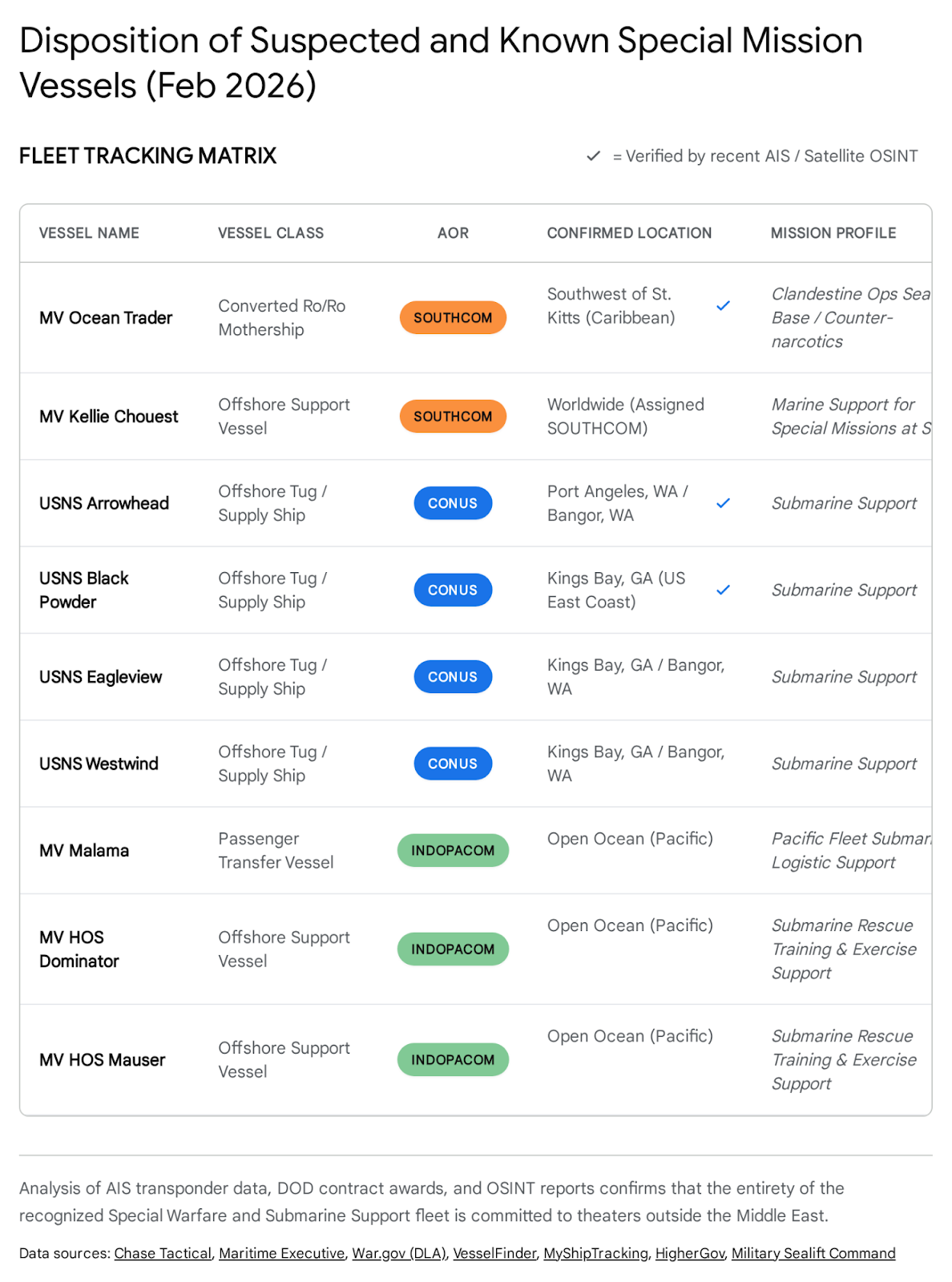
The most prominent functional proxies are the vessels of the Transportation Auxiliary General Submarine Escort (T-AGSE) fleet. This specialized squadron consists of four primary vessels: the USNS Black Powder (T-AGSE-1), USNS Westwind (T-AGSE-2), USNS Eagleview (T-AGSE-3), and USNS Arrowhead (T-AGSE-4).6
Originally constructed as 250EDF class offshore supply vessels for the commercial firm Hornbeck Offshore Services, they were subsequently acquired by the U.S. government and heavily modified to support Naval Special Warfare, open-ocean passenger transfers, and ballistic missile submarine (SSBN) escort missions.6 While these 250-foot vessels possess the exact low-profile, commercial silhouette ideal for a covert mothership, forensic contracting data and real-time tracking confirm their operational tempo is strictly tethered to the continental United States (CONUS) and the Navy’s strategic nuclear deterrent force.
- Contractual Anchoring: In February 2025, the Department of Defense awarded Hornbeck Offshore Operators a $48.3 million firm-fixed-price contract (N3220525C4134) for the operation and maintenance of all four T-AGSE vessels.5 The contract stipulates that performance will take place explicitly at the two primary SSBN hubs: Kings Bay, Georgia, and Bangor, Washington.5 The contract covers the period from March 2025 through February 2026, with options extending into 2031.5 This legally binds the vessels to domestic strategic support roles.
- Geospatial Confirmation: Real-time Automatic Identification System (AIS) tracking in late February 2026 provides undeniable geospatial confirmation of this contractual lock. The USNS Arrowhead and USNS Westwind are documented operating near Port Angeles, Washington, directly supporting the Bangor submarine base in the Pacific Northwest.30 Simultaneously, the USNS Eagleview is moored in Port Angeles.33 On the eastern seaboard, the USNS Black Powder is actively operating off the U.S. East Coast, en route to its homeport in Kings Bay, Georgia.34
The T-AGSE fleet is therefore entirely accounted for and mathematically excluded from the CENTCOM AOR.
The Edison Chouest Offshore (ECO) Fleet
Beyond the T-AGSE vessels, the defense contractor Edison Chouest Offshore has long been the premier provider of specialized contractor-owned, contractor-operated (COCO) vessels for USSOCOM and the Navy. The MV C-Champion, a 220-foot ECO specialty vessel converted for a mere $7 million, served as a highly successful early proof-of-concept for the MSV doctrine, proving that civilian OSVs could yield immense tactical value for special forces support, despite lacking robust aviation facilities.22
However, an analysis of the current status of the ECO special mission fleet precludes their involvement in the Middle East:
- MV Carolyn Chouest: This 238-foot vessel has a storied history, originally serving as the primary tender for the Navy’s NR-1 nuclear research submarine, assisting in the recovery of EgyptAir Flight 990, and surveying the wreck of the HMHS Britannic.23 Following the NR-1’s decommissioning, it was heavily modified with communications arrays and drone catapults, serving for years as the primary Afloat Forward Staging Base for Special Operations Command Pacific (SOCPAC).23 It operated under a 5-year, $60.1 million Indefinite Delivery Indefinite Quantity (IDIQ) contract.23 However, in late 2022, the Pentagon moved to permanently discontinue its lease to trim $2.7 billion in legacy programs and reallocate funds toward modernization.23 It is no longer an active USSOCOM asset.
- MV Kellie Chouest: This vessel remains highly active but is securely deployed to the Western Hemisphere. It is currently operating under a $71 million MSC Special Time Charter that extends through January 2026, assigned specifically to U.S. Southern Command (SOUTHCOM).4 The Kellie Chouest acts as an afloat forward staging base and logistics support vessel supporting Joint Interagency Task Force South (JIATF-S), primarily engaged in counter-illicit drug trafficking operations and bilateral maritime interdiction exercises in the Caribbean and Eastern Pacific (such as those conducted with the Dominican Republic).38
- MV Malama and MV HOS Dominator: These specialized vessels are structurally dedicated to U.S. Pacific Fleet (INDOPACOM) operations, focusing on submarine rescue training, open-ocean passenger transfer, and logistics support for the Pacific submarine force, firmly rooting them far outside the Middle East.6
Short-Term Special Time Charters
If the permanent shadow fleet is occupied, the Military Sealift Command possesses the authority and capability to rapidly militarize civilian OSVs via short-term “Special Time Charters.” A comprehensive review of late 2025 and 2026 MSC contracting activity reveals several active solicitations, but none point to a dark SOF mothership in the Middle East.
For instance, an active MSC solicitation seeks information for a Special Time Charter for a U.S.-flagged, Jones Act-compliant Maritime Support Vessel to assist in counternarcotics operations in the Caribbean Sea and Eastern Pacific Ocean from May 2026 to April 2027.41 This simply reinforces the intense focus on the SOUTHCOM AOR. In the CENTCOM AOR (5th Fleet), a December 2025 solicitation sought a two-helicopter detachment capable of Vertical Replenishment (VERTREP) based out of Bahrain.43 However, this clearly points to standard logistical support for the overt fleet rather than the chartering of a highly classified SOF staging base.
Phase 2 Conclusion: The established functional shadow fleet is entirely accounted for and fully deployed to SOUTHCOM, INDOPACOM, and CONUS strategic bases. Furthermore, there is no forensic contracting evidence of an obscured short-term charter of sufficient size operating in the Red Sea, Gulf of Aden, or Arabian Sea. The probability of a functional surrogate operating in CENTCOM is assessed as low (10-15%).
Section 4: The 2026 Global Force Posture and the Inversion of Covert Utility
To understand precisely why USSOCOM is not operating a covert sister ship in CENTCOM-despite the intense operational need to counter Iranian weapons smuggling to the Houthis-one must analyze the strategic macro-environment of early 2026. The deployment of scarce, high-value maritime SOF assets is currently dictated by a brutal competition between two major theaters of crisis: the Caribbean/Venezuela and the Red Sea/Yemen.
The Caribbean Surge: Operation Absolute Resolve
In January and February 2026, the United States executed a series of massive, highly kinetic operations in the Western Hemisphere. These included Operation Absolute Resolve, a daring decapitation strike against Venezuelan leadership that resulted in the capture of dictator Nicolás Maduro, and Operation Southern Spear, a comprehensive counter-narcoterrorism interdiction campaign targeting cartel shipping.11
These complex operations demanded the totality of USSOCOM’s premier maritime assets. The MV Ocean Trader itself was definitively geolocated via open-source satellite imagery (Sentinel-2) southwest of St. Kitts in the Caribbean in late 2025 and early 2026.13 Functioning as the ultimate mobile “lily pad,” the Ocean Trader operated alongside the USS Iwo Jima Amphibious Ready Group and the USS Gerald R. Ford Carrier Strike Group.45 The Ocean Trader provided crucial signals intelligence (SIGINT) collection, communications relay, and served as the primary command-and-control node for the Delta Force and 160th SOAR elements executing the daring Caracas raid.46 With the Ocean Trader actively engaged as the linchpin of the Venezuelan operation, CENTCOM was stripped of its primary covert MSV capability.
The Red Sea Threat Environment: Operation Rough Rider
Simultaneously, the CENTCOM AOR witnessed unprecedented maritime hostilities. From mid-March to May 2025, the U.S. military executed Operation Rough Rider, an unrelenting air and naval bombardment campaign targeting Houthi infrastructure in Yemen.48 Despite expending over $1 billion in advanced munitions, conducting over 1,000 airstrikes, and suffering the loss of multiple aircraft (including F/A-18 Super Hornets and MQ-9 Reapers), the campaign failed to fully degrade Houthi capabilities or restore deterrence in the Red Sea.50
In the aftermath of Operation Rough Rider, Houthi militants have maintained a highly sophisticated anti-access/area denial (A2/AD) campaign.54 They utilize a potent mix of anti-ship ballistic missiles (ASBMs), cruise missiles, and increasingly lethal Unmanned Surface Vehicles (USVs), such as the sleek, high-speed Tufan-1 drone boat.8
Crucially, the Houthis have specifically and successfully targeted civilian commercial vessels with perceived U.S., UK, or Israeli affiliations.7 This systematic targeting has resulted in catastrophic damage to global shipping, highlighted by the hijacking and repurposing of the Bahamas-flagged car carrier Galaxy Leader into a floating Houthi radar station, and the outright sinking of the bulk carriers Magic Seas and Eternity C in July 2025, which resulted in the deaths of multiple civilian seafarers.7
The Third-Order Insight: The Inversion of Covert Utility
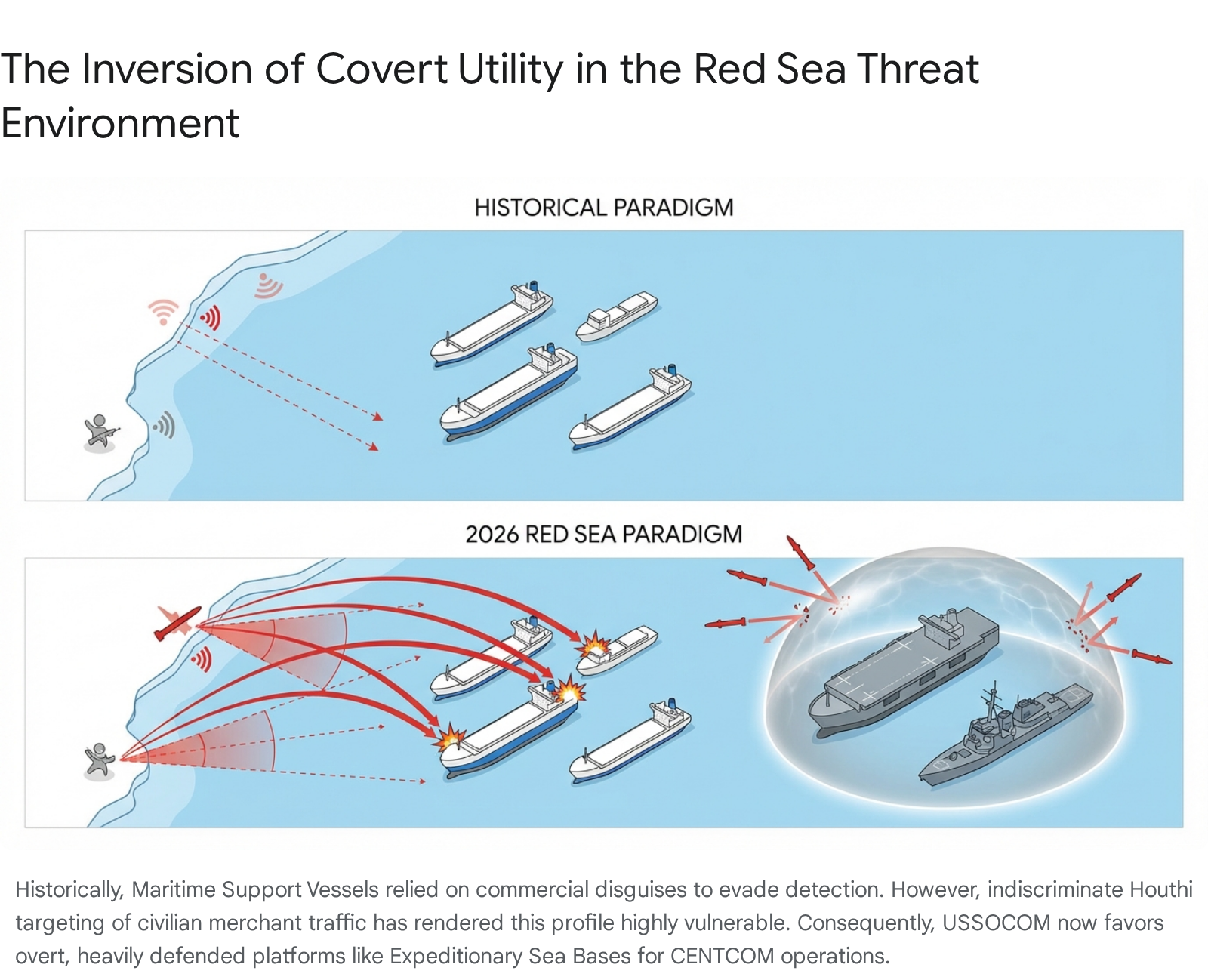
Analyzing the intersection of the MSV doctrine and the Houthi A2/AD campaign reveals a profound third-order strategic insight: the “Inversion of Covert Utility.”
The original tactical premise of the MV Ocean Trader and its functional surrogates was to achieve stealth by blending seamlessly into the dense flow of commercial maritime traffic.15 By adopting the visual profile of a standard civilian Ro-Ro cargo ship or an offshore supply vessel, an MSV could loiter off the coast of Somalia or Yemen without drawing the attention of state militaries or insurgent spotters.
However, in the Red Sea environment of 2026, this paradigm has violently inverted. Because the Houthis are utilizing coastal radar, Iranian intelligence ship targeting data, and visual spotters to actively hunt, hijack, and sink commercial merchant vessels, looking like a civilian cargo ship is now the single most dangerous profile a vessel can adopt in the region. A slow-moving, white-hulled civilian ferry profile no longer provides the protection of obscurity; it invites catastrophic attack.
Operating a covert, lightly armored MSV in the Bab el-Mandeb Strait today would require an immense, continuous escort of Arleigh Burke-class destroyers to provide a protective Aegis combat system air defense umbrella. The sheer presence of a multi-destroyer escort immediately shatters the illusion that the vessel is merely a civilian merchant ship, entirely negating the foundational value of the MSV’s disguise. Therefore, placing a highly valuable, multi-hundred-million-dollar covert MSV into the Red Sea is a tactical paradox that USSOCOM planners have almost certainly rejected. The disguise has become the target.
Section 5: Phase 3 Analysis – CENTCOM Proxies and Overt Alternatives
If USSOCOM has eschewed the covert MSV model in CENTCOM due to the unavailability of the Ocean Trader and the extreme threat environment, how are they executing their mandatory maritime special operations against Iranian smuggling networks? Real-time OSINT tracking of aviation anomalies, fleet replenishment logistical constraints, and the deployment of overt staging bases reveals a decentralized, heavily defended approach that substitutes the MSV.
Aviation OSINT: The 160th SOAR Surface Integration
The 160th Special Operations Aviation Regiment (Airborne)-the “Night Stalkers”-is the premier aviation support element for USSOCOM, providing heavily modified helicopters for high-risk attack, assault, and reconnaissance missions.14 Operating aircraft such as the MH-6M Little Bird transport, the heavily weaponized MH-60M Direct Action Penetrator (DAP), and the long-range MH-47G Chinook, the regiment requires specialized flight decks to project power over water.14
In mid-2024, highly significant visual anomalies emerged regarding the 160th SOAR’s maritime posture. U.S. Army Special Operations Aviation Command (USASOAC) released imagery showing MH-6 Little Birds painted in a unique, multi-tone blue maritime camouflage scheme.10 Crucially, these blue-painted SOF helicopters were not documented operating from a massive, secretive aviation mothership. Instead, they were photographed conducting deck landing qualifications and integrated training directly on the flight deck of the Arleigh Burke-class guided-missile destroyer USS Bainbridge (DDG-96).10
This visual evidence provides a vital proxy indicator for current CENTCOM operations. Rather than centralizing SOF aviation on a single, vulnerable, and undefended covert mothership, USSOCOM is dispersing its aviation assets across the fleet’s premier air-defense platforms. By operating MH-6s and MH-60s directly from Aegis destroyers, special operations forces maintain a persistent, lethal proximity to Houthi smuggling routes while operating safely within a virtually impenetrable air and missile defense umbrella.
Logistics OSINT: CLF Oiler Strain and Loitering Patterns
If a covert MSV were indeed loitering “dark” (AIS disabled) in the vastness of the Arabian Sea or the Gulf of Aden, it would inevitably require periodic underway replenishment (UNREP) of fuel, stores, and ammunition. Tracking the Military Sealift Command’s Combat Logistics Force (CLF)-specifically fleet replenishment oilers like the USNS Arctic, USNS Kanawha, and USNS Patuxent-often reveals the presence of dark vessels. When oilers abruptly diverge from scheduled Carrier Strike Group (CSG) support routes to loiter in empty sectors of the ocean, it is a strong indicator they are refueling a covert SOF vessel.6
However, MSC operational reports for 2025 and early 2026 demonstrate that the CLF is heavily strained, leaving no logistical slack to support a phantom 20,000-ton Ro-Ro. During the intense sortie generation rates of Operation Rough Rider, the fast combat support ship USNS Arctic (T-AOE-8) operated as the primary CLF vessel in the Red Sea, directly tethered to the massive, unrelenting fuel demands of the USS Harry S. Truman Carrier Strike Group.6 Following the arrival of the USS Abraham Lincoln Carrier Strike Group in January 2026 to reinforce the region 62, the logistical chain remains entirely absorbed by the overt fleet. There are no anomalous CLF loitering patterns in the 5th Fleet AOR that would suggest the maintenance of a massive, hidden MSV.
The Overt Substitution: Expeditionary Sea Bases
The final, and most conclusive, piece of the operational puzzle is the maturation and deployment of the Expeditionary Sea Base (ESB) platform. The ESB class was born from the exact same doctrinal requirements that originally spawned the MSV concept: the need for a massive, floating forward staging base capable of supporting vast contingents of troops, aviation assets, and small craft.9
The USS Lewis B. Puller (ESB-3), which was notably commissioned as a formal warship rather than a civilian-crewed USNS vessel to provide greater operational flexibility and legal protection in combat zones, is a 784-foot, 78,000-ton behemoth currently deployed to the U.S. 5th Fleet.9 The vessel’s specifications far exceed those of a converted Ro-Ro. It possesses a massive aviation hangar and a sprawling flight deck with four operating spots capable of landing heavy-lift MH-53E helicopters and MV-22 Ospreys.6 It features vast accommodations for embarked Special Operations Forces, including specialized ordnance storage and secure command-and-control workspaces.6
The Puller has been highly active in the precise role a covert MSV would otherwise fill. It has trained extensively with coastal patrol craft, supported Aviation Mine Countermeasure missions, and, crucially, served as the primary launching pad for U.S. Navy SEAL Visit, Board, Search, and Seizure (VBSS) operations.6 Official Department of Justice and CENTCOM records confirm that U.S. naval forces have operated directly from the USS Lewis B. Puller to intercept stateless dhows in the Arabian Sea, successfully seizing advanced Iranian conventional weapons, anti-ship ballistic missile components, and UAV parts destined for Houthi forces in Yemen.65
The continuous presence, immense capabilities, and heavy operational tempo of the USS Lewis B. Puller in the CENTCOM AOR entirely negate the immediate need for a covert surrogate. The ESB provides magnitudes more space, superior aviation support, and greater inherent survivability than a converted civilian Ro-Ro, and it operates openly under the protection of the joint fleet.
Section 6: Phase 4 Synthesis – Probabilistic Intelligence Estimate
Based on the rigorous aggregation of defense procurement data, global fleet disposition forensics, and tactical theater analysis, the final probabilistic intelligence estimate is structured as follows:
1. Assessment of a Structural Sister Ship: It is highly improbable (<15%) that USSOCOM possesses a second 20,000-ton Ro-Ro vessel identical to the MV Ocean Trader. The forensic evidence demonstrates that while USSOCOM generated the requirements and allocated initial funding for “MSV-3” in 2019, the effort collapsed entirely due to exorbitant commercial bids and the subsequent cancellation of RFP N32205-19-R-3510.1 The massive subsequent budgetary shifts toward great power competition and crewed aviation programs (Armed Overwatch) indicate this maritime capability gap was never backfilled with a large-hull commercial conversion.3
2. Assessment of a Functional Shadow Fleet Presence in CENTCOM: It is unlikely (10-15%) that a smaller, dedicated functional proxy (such as a T-AGSE or ECO vessel) is currently operating in the Red Sea or Arabian Sea. The entirety of the known shadow fleet is contractually and physically tethered to operations in INDOPACOM (submarine support) and SOUTHCOM (counter-narcoterrorism and leadership decapitation operations).5 Furthermore, there is no evidence of a recent MSC Special Time Charter of sufficient magnitude originating in the 5th Fleet AOR.41
3. The CENTCOM Deployment Hypothesis:
In the absence of a covert MSV, USSOCOM is executing its critical maritime interdiction and direct action missions against Houthi forces through a bifurcated, overt strategy.
- Heavy Staging: The USS Lewis B. Puller (ESB-3) is actively fulfilling the role of the primary Afloat Forward Staging Base. It is currently loitering in the Arabian Sea or Gulf of Aden, serving as the central, protected hub for Navy SEAL VBSS operations targeting Iranian weapons smuggling networks.65
- Light/Distributed Staging: 160th SOAR elements, specifically MH-6M and MH-60M helicopters, are operating directly from the flight decks of Arleigh Burke-class destroyers (such as the USS Bainbridge).10 This tactical distribution allows SOF to maintain a persistent, lethal presence dangerously close to the Yemeni coast while remaining firmly shielded by the fleet’s Aegis air and missile defense systems.
Information Gaps & Confidence Level
This intelligence assessment operates with a High Confidence Level regarding the absence of a structural twin, relying on verified GAO protest documentation, public shipyard records, and historical budget justifications. The assessment operates with a Moderate-to-High Confidence Level regarding the current CENTCOM deployment hypothesis.
The primary intelligence gaps involve the highly classified nature of Major Force Program 11 (MFP-11) funding streams, which can theoretically obscure the ad-hoc chartering of very small, low-profile offshore supply vessels on short-term contracts. Additionally, the complete blackout of AIS data in the Red Sea-a mandatory defensive measure adopted by nearly all military and allied commercial vessels to thwart Houthi targeting-prevents precise geospatial confirmation of the USS Lewis B. Puller’s exact daily loitering patterns relative to the Yemeni coastline.
Conclusion
The allure of a shadowy fleet of disguised merchant vessels executing covert raids captures the imagination, but modern naval warfare is ultimately governed by inflexible budgets and highly lethal threat environments. The MV Ocean Trader remains a singular, highly effective asset, currently applying its unique clandestine capabilities in the Caribbean where the threat of anti-ship missiles is negligible. In the Middle East, however, the rapid proliferation of advanced Iranian anti-ship weaponry has rendered commercial disguises obsolete and extraordinarily dangerous. USSOCOM has adapted to this reality by stepping out of the shadows and projecting its specialized power from the armored, heavily defended decks of the U.S. Navy’s overt surface fleet.
Works cited
- U.S. Marine Management, Inc. – GAO, accessed February 28, 2026, https://www.gao.gov/products/b-417353.3%2Cb-417353.4
- Department of Defense Fiscal Year (FY) 2021 Budget Estimates – Justification Book, accessed February 28, 2026, https://comptroller.defense.gov/Portals/45/Documents/defbudget/fy2021/budget_justification/pdfs/02_Procurement/SOCOM_PB2021.pdf
- Budget request – Under Secretary of War (Comptroller), accessed February 28, 2026, https://comptroller.war.gov/Portals/45/Documents/defbudget/FY2026/budget_justification/pdfs/02_Procurement/PROC_SOCOM_PB_2026.pdf
- 140-day Special Time Charter – HigherGov, accessed February 28, 2026, https://www.highergov.com/contract-opportunity/140-day-special-time-charter-n32205-ss-pm4-26-051-r-60516/
- Contracts for Feb. 27, 2026 – War.gov, accessed February 28, 2026, https://www.war.gov/News/Contracts/Contract/Article/4418081/contracts-for-feb-27-2026/
- military sealift command – 2025 in review – Navy.mil, accessed February 28, 2026, https://www.msc.usff.navy.mil/Portals/43/Publications/Annual%20Report/MSCAnnual25.pdf
- 2025-012-Red Sea, Bab el Mandeb Strait, Gulf of Aden, Arabian Sea, Persian Gulf, and Somali Basin-Houthi Attacks on Commercial Vessels | MARAD – Department of Transportation, accessed February 28, 2026, https://www.maritime.dot.gov/msci/2025-012-red-sea-bab-el-mandeb-strait-gulf-aden-arabian-sea-persian-gulf-and-somali-basin
- Small, Agile Houthi Drone Boat Shown Obliterating Ship During Test – The War Zone, accessed February 28, 2026, https://www.twz.com/news-features/small-and-agile-houthi-drone-boat-shown-obliterating-ship-during-test
- U.S. Navy Commissions USS Lewis B. Puller – The Maritime Executive, accessed February 28, 2026, https://maritime-executive.com/article/us-navy-commissions-uss-lewis-b-puller
- Blue Camouflage MH-6 Little Birds Point To Night Stalkers’ Pacific Pivot – The War Zone, accessed February 28, 2026, https://www.twz.com/air/blue-camouflage-mh-6-little-birds-point-to-night-stalkers-pacific-pivot
- 365 Days of Peace Through Strength | U.S. Department of War, accessed February 28, 2026, https://www.war.gov/Multimedia/Experience/Peace-Through-Strength/
- Trump Announces U.S. Military’s Capture of Maduro – Department of War, accessed February 28, 2026, https://www.war.gov/News/News-Stories/Article/Article/4370431/trump-announces-us-militarys-capture-of-maduro/
- US Special Ops Floating Base Spotted in Caribbean Waters – Chase Tactical, accessed February 28, 2026, https://www.chasetactical.com/intel/us-special-ops-floating-base-spotted-in-caribbean-waters
- 160th Special Operations Aviation Regiment (Airborne) – Wikipedia, accessed February 28, 2026, https://en.wikipedia.org/wiki/160th_Special_Operations_Aviation_Regiment_(Airborne)
- Navy’s Stealthiest Warship May Be a Merchant Vessel – The Maritime Executive, accessed February 28, 2026, https://maritime-executive.com/editorials/navys-stealthiest-warship-may-be-a-merchant-vessel
- The Art and Science of Naval Warfare: Essays in Memory of Wayne P. Hughes Jr., accessed February 28, 2026, https://digital-commons.usnwc.edu/context/usnwc-newport-papers/article/1047/viewcontent/NP48_Hughes_entire_pass06.pdf
- MV Ocean Trader – Wikipedia, accessed February 28, 2026, https://en.wikipedia.org/wiki/MV_Ocean_Trader
- The ferry site, accessed February 28, 2026, https://www.ferry-site.dk/ferry.php?id=9457218&lang=en
- The Navy’s Getting a Big, Secretive Special Operations ‘Mothership’ | by Trench Art, accessed February 28, 2026, https://medium.com/war-is-boring/the-navys-getting-a-big-secretive-special-operations-mothership-12801da6f353
- SOF | Center for International Maritime Security, accessed February 28, 2026, https://cimsec.org/tag/sof/
- Shadowy Special Operations Ship Spotted off Venezuela – The Maritime Executive, accessed February 28, 2026, https://maritime-executive.com/article/shadowy-special-operations-ship-spotted-off-venezuela
- The Return of the Auxiliary Mothership | Think Defence, accessed February 28, 2026, https://thinkdefence.wordpress.com/2014/01/31/return-auxiliary-mothership/
- This Is The Shadowy Special Operations Mothership You’ve Never Heard Of – The War Zone, accessed February 28, 2026, https://www.twz.com/the-shadowy-special-operations-mothership-youve-never-heard-of
- Dry_Combat_Submersible – Covert Shores, accessed February 28, 2026, https://www.hisutton.com/Dry_Combat_Submersible.html
- Military Sealift Command – Wikipedia, accessed February 28, 2026, https://en.wikipedia.org/wiki/Military_Sealift_Command
- Department of Defense Fiscal Year (FY) 2026 Budget Estimates – Justification Book, accessed February 28, 2026, https://comptroller.war.gov/Portals/45/Documents/defbudget/FY2026/budget_justification/pdfs/03_RDT_and_E/RDTE_SOCOM_PB_2026.pdf
- MSC Handbook 2016 | PDF | United States Merchant Marine – Scribd, accessed February 28, 2026, https://www.scribd.com/document/346228487/Msc-Handbook-2016
- Hornbeck awarded $48.3M Navy contract – Marine Log, accessed February 28, 2026, https://www.marinelog.com/news/hornbeck-awarded-48-3m-navy-contract/
- USNS Black Powder (T-AGSE 1) – laststandonzombieisland, accessed February 28, 2026, https://laststandonzombieisland.com/tag/usns-black-powder-t-agse-1/
- USNS ARROWHEAD – Military ops (IMO: 9472373, MMSI: 368926300) | MyShipTracking, accessed February 28, 2026, https://www.myshiptracking.com/vessels/usns-arrowhead-mmsi-368926300-imo-9472373
- USNS Westwind (T-AGSE-2) Live Military Ship Tracker – Cruising Earth, accessed February 28, 2026, https://www.cruisingearth.com/ship-tracker/united-states-navy-military-sealift-command/usns-westwind/
- USNS Arrowhead (T-AGSE-4) Live Military Ship Tracker – Cruising Earth, accessed February 28, 2026, https://www.cruisingearth.com/ship-tracker/united-states-navy-military-sealift-command/usns-arrowhead/
- USNS Eagleview (T-AGSE-3) Live Military Ship Tracker – Cruising Earth, accessed February 28, 2026, https://www.cruisingearth.com/ship-tracker/united-states-navy-military-sealift-command/usns-eagleview/
- USNS BLACK POWDER, Offshore Tug/Supply Ship – Details and current position – IMO 9472347 – VesselFinder, accessed February 28, 2026, https://www.vesselfinder.com/vessels/details/9472347
- USNS Black Powder (T-AGSE-1) Live Military Ship Tracker – Cruising Earth, accessed February 28, 2026, https://www.cruisingearth.com/ship-tracker/united-states-navy-military-sealift-command/usns-black-powder/
- MV Carolyn Chouest – Wikipedia, accessed February 28, 2026, https://en.wikipedia.org/wiki/MV_Carolyn_Chouest
- Chouest affiliate awarded $70.2 million MSC contract – Marine Log, accessed February 28, 2026, https://www.marinelog.com/news/kellie-chouest-awarded-70-2-million-msc-contract/
- U.S. and Dominican Republic Conduct Bilateral Maritime Interdiction Exercise – SouthCom, accessed February 28, 2026, https://www.southcom.mil/MEDIA/NEWS-ARTICLES/Article/2829291/us-and-dominican-republic-conduct-bilateral-maritime-interdiction-exercise/
- House Report 118-125 – NATIONAL DEFENSE AUTHORIZATION ACT FOR FISCAL YEAR 2024 – GovInfo, accessed February 28, 2026, https://www.govinfo.gov/content/pkg/CRPT-118hrpt125/html/CRPT-118hrpt125.htm
- IN REVIEW – Military Sealift Command – Navy.mil, accessed February 28, 2026, https://www.msc.usff.navy.mil/Portals/43/Publications/Annual%20Report/MSCAnnual24.pdf
- CHARTERED MARITIME VESSEL SUPPORT SERVICES – Federal Contracts – Sweetspot, accessed February 28, 2026, https://console.sweetspotgov.com/opportunity/federal-contract/8a97ffcb-e87b-5fde-8403-97d3a37820aa
- PR15414031 Marine Personnel Transport Vessel – Federal Contracts – Sweetspot, accessed February 28, 2026, https://console.sweetspotgov.com/opportunity/federal-contract/8df13362-6da5-5357-8420-14e59769ca2a
- Military Sealift Command VERTREP NAVCENT Detachment A – Federal Contracts, accessed February 28, 2026, https://console.sweetspotgov.com/opportunity/federal-contract/0e9942cd-3708-52ae-a04a-8a228a8885c6
- Imagery from Venezuela Shows a Surgical Strike, Not Shock and Awe – CSIS, accessed February 28, 2026, https://www.csis.org/analysis/imagery-venezuela-shows-surgical-strike-not-shock-and-awe
- America’s Military Buildup Around Iran: What We Know and What It Means, accessed February 28, 2026, https://www.meforum.org/mef-reports/americas-military-buildup-around-iran-what-we-know-and-what-it-means
- Operation Absolute Resolve: Anatomy of a Modern Decapitation Strike, accessed February 28, 2026, https://sofsupport.org/operation-absolute-resolve-anatomy-of-a-modern-decapitation-strike/
- The Ship to Watch. JANUARY 11, 2026 | by Andy Blackmore – Medium, accessed February 28, 2026, https://medium.com/@andy_blackmore/the-ship-to-watch-122219f673d8
- accessed February 28, 2026, https://www.washingtonexaminer.com/feed-issue/?issue=may-14-2025
- Feature Commentary: An Assessment of Operation Rough Rider – Combating Terrorism Center at West Point, accessed February 28, 2026, https://ctc.westpoint.edu/feature-commentary-an-assessment-of-operation-rough-rider/
- US–UK airstrikes on Yemen – Wikipedia, accessed February 28, 2026, https://en.wikipedia.org/wiki/US%E2%80%93UK_airstrikes_on_Yemen
- 1 Costs of United States Military Activities in the Wider Middle East Since October 7, 2023 Linda J. Bilmes1 October 7, 2025 – Costs of War, accessed February 28, 2026, https://costsofwar.watson.brown.edu/sites/default/files/2025-10/Wider-Middle-East-Costs_Costs-of-War_Bilmes_10.7.25.pdf
- Despite overwhelming US military might, Iran campaign would pose complex challenges, accessed February 28, 2026, https://www.timesofisrael.com/despite-overwhelming-military-might-us-faces-complex-challenges-in-iran-campaign/
- From Smugglers to Supply Chains: How Yemen’s Houthi Movement Became a Global Threat – The Century Foundation, accessed February 28, 2026, https://tcf.org/content/report/from-smugglers-to-supply-chains-how-yemens-houthi-movement-became-a-global-threat/
- Lethal Attacks Show Strengthened Houthi Control over Red Sea Transit, accessed February 28, 2026, https://www.washingtoninstitute.org/policy-analysis/lethal-attacks-show-strengthened-houthi-control-over-red-sea-transit
- USCENTCOM Forces Continue to Target Houthi Terrorists, accessed February 28, 2026, https://www.centcom.mil/MEDIA/PRESS-RELEASES/Press-Release-View/Article/4167047/uscentcom-forces-continue-to-target-houthi-terrorists/
- Iran, China, Russia, and the collapse of deterrence in the Red Sea – Atlantic Council, accessed February 28, 2026, https://www.atlanticcouncil.org/blogs/menasource/iran-china-russia-and-the-collapse-of-deterrence-in-the-red-sea/
- 160th SOAR (A): The Night Stalkers – Grey Dynamics, accessed February 28, 2026, https://greydynamics.com/160th-soar-a-the-night-stalkers/
- This Is What The Night Stalkers’ MH-60M Direct Action Penetrator Brought To The Venezuelan Op – The War Zone, accessed February 28, 2026, https://www.twz.com/air/this-is-what-the-night-stalkers-mh-60m-direct-action-penetrator-brought-to-the-venezuelan-op
- Fleet Replenishment Oiler – Military Sealift Command, accessed February 28, 2026, https://www.msc.usff.navy.mil/Ships/Ship-Inventory/Fleet-Replenishment-Oiler/
- Detyens wins $8.1 million MSC contract – Marine Log, accessed February 28, 2026, https://www.marinelog.com/shipbuilding/shipyards/shipyard-news/detyens-wins-81-million-msc-contract/
- The Flagship 07.10.2025 by Military News – Issuu, accessed February 28, 2026, https://issuu.com/militarynews/docs/the_flagship_07.10.2025
- 2026 United States military buildup in the Middle East – Wikipedia, accessed February 28, 2026, https://en.wikipedia.org/wiki/2026_United_States_military_buildup_in_the_Middle_East
- USS Lewis B. Puller (ESB-3) – Wikipedia, accessed February 28, 2026, https://en.wikipedia.org/wiki/USS_Lewis_B._Puller_(ESB-3)
- Untitled – Military Sealift Command, accessed February 28, 2026, https://www.msc.usff.navy.mil/Portals/43/Publications/Annual%20Report/MSCAnnual2022.pdf
- United States Charges Four Mariners from Arabian Sea Vessel Transporting Suspected Iranian-Made Advanced Conventional Weapons – Justice.gov, accessed February 28, 2026, https://www.justice.gov/archives/opa/pr/united-states-charges-four-mariners-arabian-sea-vessel-transporting-suspected-iranian-made