
Executive Summary and Strategic Baseline
As of April 4, 2026, the operational environment within the United States Central Command (CENTCOM) Area of Responsibility (AOR) has entered a critical phase of structural transition. Following five weeks of intensive joint U.S. and Israeli standoff bombardment under the auspices of Operation Epic Fury, exhaustive analysis of open-source intelligence (OSINT), flight telemetry, maritime automatic identification system (AIS) data, and diplomatic posturing reveals a definitive shift in U.S. military strategy. The campaign is rapidly evolving from a purely kinetic air and naval strike paradigm toward the immediate preparation for complex, limited-objective ground assaults and deep-penetration special operations raids.1
The President of the United States has issued an explicit 48-hour ultimatum to the Iranian regime, demanding the reopening of the Strait of Hormuz and capitulation on nuclear material retention, warning that “all Hell will reign down” if compliance is not achieved.4 In direct correlation with this political deadline, OSINT tracking confirms an unprecedented, sustained surge in the movement of U.S. special warfare units, airborne quick-reaction forces, and marine infantry from the continental United States (CONUS) and European staging areas into advanced forward operating bases surrounding the Persian Gulf and the Caspian Basin.2
The volume of military traffic has not only increased but has structurally shifted in its composition. The arrival of massive logistical airlifters, dedicated special operations infiltration platforms, and specialized trauma medical networks indicates that the U.S. is no longer merely replenishing aviation ordnance. The convergence of these force posture modifications, coupled with the sudden suspension of routine consular services and non-combatant evacuation orders (NEOs) across key allied Gulf nations, serves as a classic intelligence indicator of impending ground escalation.9 Based on the alignment of force readiness with the expiration of the presidential ultimatum, the likelihood of a U.S. ground attack in Iran—specifically characterized by coastal interdiction and deep inland special operations—within the next 3 to 5 days is assessed as highly probable.
The Evolution of Operation Epic Fury: Air Supremacy to Tactical Friction
To understand the necessity of the current ground force buildup, it is imperative to analyze the diminishing marginal returns and emerging tactical friction of the ongoing air campaign. Since its initiation on February 28, 2026, Operation Epic Fury has executed a staggering volume of strikes, conducting over 13,000 combat flights and successfully prosecuting more than 12,300 targets.12 The initial phases of the campaign effectively degraded the command and control networks of the Islamic Revolutionary Guard Corps (IRGC), inflicted severe damage on the Iranian Navy, and forced a 90% reduction in Iran’s daily missile and drone launch rates.14 Strategic assets, including B-1, B-2, and B-52 bombers, alongside U.S. Navy destroyers and submarines, have expended vast quantities of precision munitions, including over 850 Tomahawk Land Attack Missiles (TLAMs), marking the highest expenditure in a single campaign.13
However, despite this overwhelming application of firepower, the campaign is encountering the inherent limitations of standoff warfare against a heavily fortified, deeply entrenched adversary. U.S. intelligence assessments indicate that while Iranian capabilities have been degraded, the regime retains approximately 50% of its mobile ballistic missile launchers and a vast, dispersed arsenal of one-way attack drones.16 Iranian military engineering units are demonstrating significant resilience, rapidly restoring missile shelters, fortifying subterranean complexes, and utilizing complex terrain to shield high-value assets.6
Furthermore, the air campaign has begun to incur tangible and strategically significant losses, forcing a shift in operational realities. On April 3, 2026, Iraqi and Iranian ground fire successfully targeted a multi-ship U.S. formation operating deep within hostile airspace.16 This engagement resulted in the downing of an F-15E Strike Eagle, an A-10 Thunderbolt II, an MQ-9 Reaper drone, and severe damage to two HH-60 rescue helicopters.16 While the pilots of the fighter aircraft survived the immediate engagements, a Weapons Systems Officer (WSO) from the downed F-15E remains missing in action behind enemy lines.12
The presence of downed, unrecovered airmen fundamentally alters the risk calculus of the campaign. It necessitates the immediate execution of high-risk Combat Search and Rescue (CSAR) operations, which inherently require the insertion of specialized ground and rotary-wing elements into non-permissive environments. The transition from pure standoff strikes to physical infiltration is therefore not merely a strategic option, but an immediate operational necessity. Concurrently, the targeting strategy has evolved to physically isolate specific geographic theaters within Iran. On April 2, U.S. forces severed the B1 (Bileghan) Bridge connecting Tehran to the Alborz Province.18 This deliberate infrastructure strike was designed to physically interdict the transfer of short-range ballistic missiles—such as the Haj Qassem and Kheibar Shekan—from production facilities in the capital to launch sites in western Iran.18 Isolating the battlespace by cutting major logistical arteries is fundamentally a shaping operation, historically utilized to prevent adversary mechanized reinforcement prior to the insertion of ground troops.
Special Warfare Force Posture: Tracking the Northern and Southern Infiltration Vectors
The most critical indicators answering the intelligence requirement regarding the likelihood of a ground attack lie in the highly anomalous tracking signatures of U.S. special operations forces. While conventional forces are visibly massing in the Persian Gulf, specialized tracking reveals the preparation of distinct, highly classified operational vectors designed for deep penetration.
The Transponder-Silent Northern Vector: Azerbaijan Staging
OSINT analysis of automated dependent surveillance-broadcast (ADS-B) data has uncovered the deliberate positioning of elite Air Force Special Operations Command (AFSOC) assets along Iran’s northern border. On January 29, 2026, analysts tracked an MC-130J Commando II executing a direct, highly unusual flight profile from U.S. facilities in the United Kingdom (specifically RAF Mildenhall or RAF Fairford) directly to Baku, Azerbaijan.2 Open-source tracking noted intermittent transponder deactivation during critical segments of the flight, a measure routinely employed to limit real-time visibility during sensitive force positioning associated with covert contingency planning.2
The arrival of the MC-130J in Baku is a profound escalation indicator. The MC-130J is specifically engineered to infiltrate, exfiltrate, and resupply special operations forces in hostile, denied territory, as well as to provide low-altitude, in-flight refueling for specialized rotary-wing assets.2 Bypassing the congested, highly monitored, and politically sensitive airspace of the Persian Gulf to stage in Azerbaijan establishes a northern operational geometry directly on the Caspian Sea.2 This arrival perfectly correlates with earlier, discrete staging of rotary-wing elements from the elite 160th Special Operations Aviation Regiment (SOAR)—the “Night Stalkers”—including MH-60 Black Hawks and extended-range MH-47G Chinooks, in the same region.2
The aggregation of these specific airframes indicates the assembly of a layered special operations strike package. The tactical profile of these units strongly aligns with documented intelligence briefings detailing a deeply penetrating raid into the Iranian mainland.1 Specifically, operational planners have assessed the feasibility of inserting elite commandos (likely Joint Special Operations Command elements) to retrieve or permanently neutralize highly enriched uranium from Iranian nuclear facilities—such as Fordow or Natanz—that were previously damaged by U.S. GBU-57 Massive Ordnance Penetrator (MOP) bunker-buster munitions during earlier phases of the conflict.1 The use of a northern staging ground in Azerbaijan significantly reduces the flight distance to central Iranian nuclear sites compared to launching from the Persian Gulf, minimizing exposure to Iran’s dense southern integrated air defense networks (IADS) and exploiting radar gaps in the mountainous terrain. Experts draw direct parallels between this anticipated operation and the spectacular, helicopter-borne special operations assault executed on January 3, 2026, to extract Nicolás Maduro from a fortified compound in Caracas, Venezuela.1
The Southern Vector: Gulf Staging and Over-the-Horizon Capabilities
Simultaneously, specialized tracking indicates an expansion of AFSOC and conventional special warfare capabilities in the southern theater. Flight routing data from late January and extending into early April demonstrates a persistent buildup of CV-22B Osprey tiltrotor aircraft and AC-130J Ghostrider gunships transitioning from the European theater into the CENTCOM AOR.2 The AC-130J, recently slated for integration with Harpoon anti-ship missiles, provides unparalleled close air support, armed reconnaissance, and overwatch for ground forces operating in austere environments.19
The movement of these assets correlates with the massing of U.S. Navy SEAL and Marine Raider elements, likely staging from afloat forward staging bases (AFSBs) or allied installations in Bahrain and the UAE. The presence of the 160th SOAR in this theater suggests preparations for highly complex maritime boarding operations. Intelligence indicates that the Russian-flagged Marinera tanker, currently operating in the region, has been identified as a hardened target that may require specialized boarding teams to interdict illicit cargo or regime leadership attempting exfiltration.19 The simultaneous development of both a northern deep-penetration vector and a southern littoral interdiction vector demonstrates a mature, multi-axis special warfare campaign plan ready for immediate execution.
Strategic Airlift and the Global Logistics Surge: The Indisputable Air Bridge
The deployment of specialized operators requires a massive conventional logistical tail. The global strategic airlift operations observed over the past weeks provide the most undeniable OSINT signatures of an impending shift to ground combat operations.
C-17 and C-5M Heavy Armor Transport
Data compiled from publicly available flight trackers, including Flightradar24, highlights an astronomical surge in heavy transport traffic. During a compressed window, the U.S. Air Force deployed at least 42 heavy transport aircraft into the Middle East, comprising 41 C-17A Globemaster III aircraft and one C-5M Super Galaxy.7 These flights primarily originated from major global logistics hubs, including Ramstein and Spangdahlem Air Bases in Germany, RAF Lakenheath in the United Kingdom, and Robert Gray Airfield in Texas.7
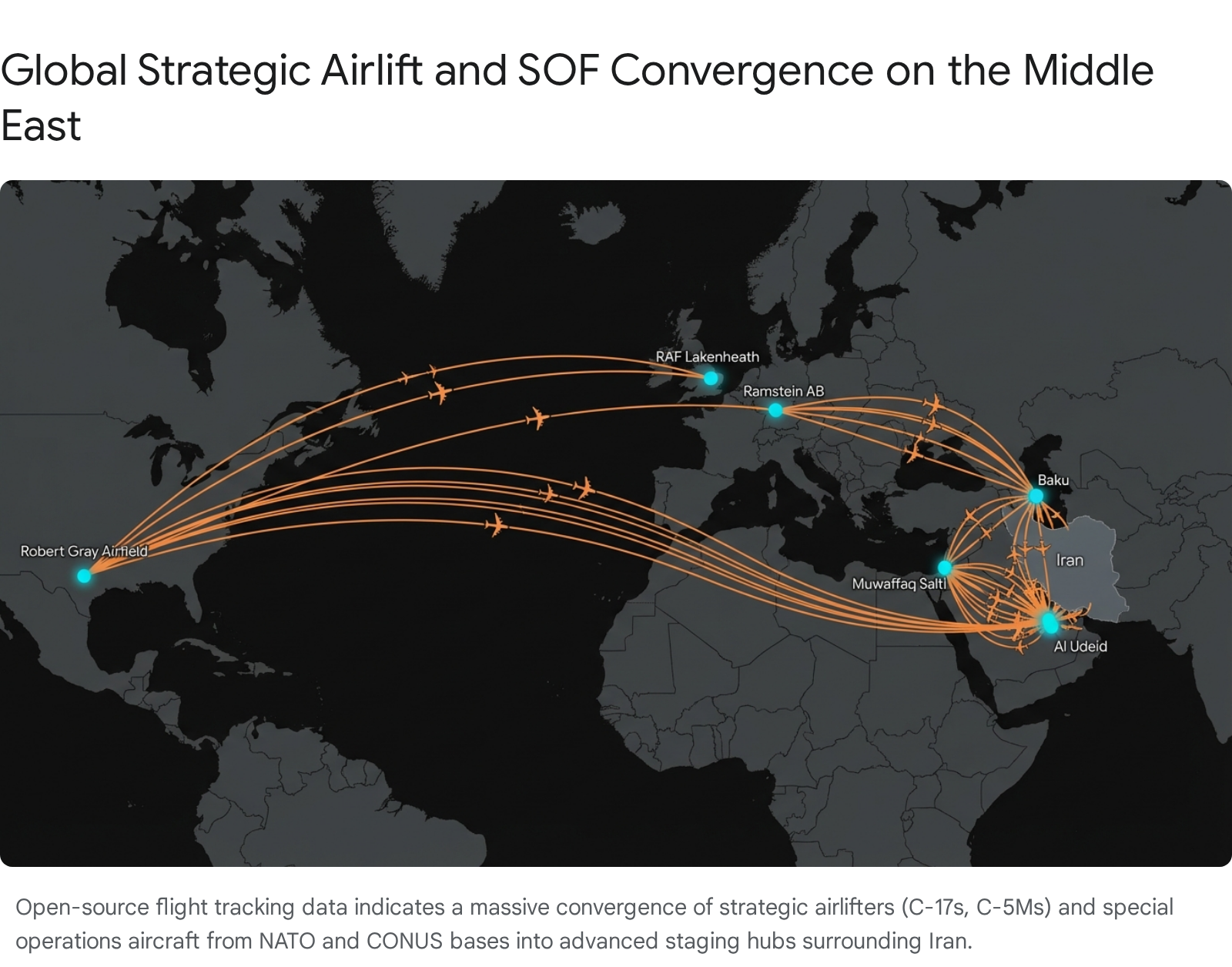
The destinations for this massive airlift were the critical U.S. forward staging bases: Al Udeid Air Base in Qatar, Muwaffaq Salti Air Base in Jordan, Ali Al Salem Air Base in Kuwait, Prince Sultan Air Base in Saudi Arabia, and various facilities in Israel, including Nevatim Airbase.7 The specific capabilities of the airframes involved reveal the nature of the buildup. The C-17A has a payload capacity exceeding 170,000 pounds, engineered specifically to transport outsized combat cargo, including M1 Abrams main battle tanks, Bradley infantry fighting vehicles, High Mobility Artillery Rocket Systems (HIMARS), and modular air defense systems such as Patriot and THAAD interceptors.13 The simultaneous massing of these logistical assets confirms the forward deployment of heavy ground combat equipment and the establishment of robust staging areas capable of supporting sustained mechanized and infantry operations, rather than merely replenishing aviation ordnance.
Aerial Refueling Armada and Tactical Fighter Positioning
As of April 3, flight monitoring analysts recorded an ongoing, large-scale intercontinental airlift involving at least 19 KC-135R/T Stratotanker and KC-46A Pegasus aircraft crossing the Atlantic toward the Middle East.6 This armada of aerial refueling assets is essential for dragging short-range tactical fighters—including stealth F-35 Lightnings, F-22 Raptors, and F-16 Fighting Falcons—into the theater without relying on vulnerable intermediate landing strips.6 The density of tanker traffic indicates a desire to maximize localized air superiority umbrellas, a strict prerequisite for protecting vulnerable amphibious landing craft, low-flying troop transport helicopters, and slow-moving A-10 Thunderbolt II ground-attack aircraft deployed for close air support and counter-drone missions.6
Medical Logistics and the Ready Reserve Force Activation
In modern expeditionary warfare, the movement of medical supplies—specifically bulk whole blood, surgical units, and trauma kits—is one of the most reliable predictors of anticipated ground casualties. Open-source humanitarian reports indicate that emergency medical needs within Iran are already surging exponentially due to the air campaign, with the International Federation of Red Cross and Red Crescent Societies warning of severe shortages.27
Concurrently, the U.S. military is closely managing its own medical and logistical posture. The activation of elements within the Ready Reserve Force (RRF), alongside the strategic positioning of specialized medical evacuation protocols managed by U.S. Transportation Command (TRANSCOM), points directly to preparations for managing traumatic injuries sustained during ground combat.29 The Marine Corps Reserve has issued stark directives to its personnel to “prepare your family” for rapid activation, ensuring that the 33,600 reservists are postured to backfill active-duty casualties or provide strategic depth.32 While the massive hospital ships USNS Mercy and USNS Comfort currently remain moored in U.S. ports, the broader logistical supply chain is heavily prioritizing trauma readiness and field hospital deployment across the CENTCOM AOR.34
Airborne Quick Reaction Forces and Theater Infantry Massing
Complementing the logistical buildup is the rapid, highly publicized deployment of the U.S. military’s premier rapid-reaction infantry forces. The character of these deployments leaves little ambiguity regarding their intended use.
The 82nd and 101st Airborne Divisions
The Pentagon has initiated the deployment of thousands of paratroopers from the 82nd Airborne Division, specifically the 1st Brigade Combat Team (the “Devil Brigade”), from Fort Bragg, North Carolina, into the Middle East.1 Consisting of approximately 3,000 to 4,000 elite infantrymen, the 82nd Airborne serves as the Department of Defense’s Immediate Response Force. They are uniquely trained to parachute into contested or hostile territory, rapidly secure key infrastructure, seize airfields, and establish robust defensive perimeters against mechanized counterattacks.36
The arrival of the division’s command headquarters, logistics enablers, and primary combat elements into undisclosed staging bases within Israel and Jordan provides theater commanders with a highly lethal, highly mobile hammer.8 Furthermore, elements of the 101st Airborne Division (Air Assault), the 1st Cavalry Division, and the 10th Mountain Division have been actively rotating and staging to provide follow-on forces and logistical sustainment.40 The specific integration of the 82nd Airborne into the theater suggests a concept of operations where special operations commandos infiltrate high-value sites (such as nuclear facilities), while larger airborne or marine forces rapidly drop in to cordon off the area, repel IRGC counterattacks, and secure extraction routes.1
Amphibious Envelopment and Marine Expeditionary Units
Complementing the airborne forces is a massive concentration of naval infantry. The U.S. Navy has effectively collapsed two separate Amphibious Ready Groups (ARGs) into the CENTCOM AOR, fundamentally altering the maritime balance of power.
The USS Tripoli (LHA-7) ARG has arrived in the Persian Gulf carrying the 31st Marine Expeditionary Unit (MEU).1 The Tripoli is currently operating as a “Lightning Carrier,” uniquely configured without a well deck to maximize its aviation complement, heavily laden with F-35B short-takeoff vertical-landing stealth fighters for sea control and inland strikes.43 The 31st MEU comprises over 2,200 Marines equipped with amphibious assault vehicles and a dedicated aviation combat element.44
Simultaneously, the USS Boxer ARG, carrying the 11th MEU and the battle-hardened 3rd Battalion, 5th Marines, was accelerated across the Pacific Ocean to join the buildup.1 Together, these dual MEUs provide approximately 5,000 to 7,000 Marines postured directly off the Iranian coast. This maritime force is specifically engineered for forced-entry amphibious landings, coastal interdiction, small boat defense, and the rapid seizure of littoral chokepoints.
Timeline of Force Convergence
The arrival of these diverse combat elements is not coincidental but highly synchronized. The operational readiness of Carrier Strike Groups (including the USS Abraham Lincoln, USS George H.W. Bush, and USS Gerald R. Ford), Amphibious Ready Groups, and Airborne units aligns perfectly with the expiration of the diplomatic windows.
Table 1: U.S. Strike Force Convergence and Readiness Posture
| Strategic Combat Element | Force Type / Capabilities | Deployment Status & Location | Estimated Personnel | Alignment with April 6 Deadline |
| 82nd Airborne Div. (1st BCT) | Rapid Response Infantry, Airfield Seizure | Arriving/In Theater (Jordan, Israel) 8 | ~3,000 – 4,000 38 | Fully operational; postured for immediate insertion. |
| 31st MEU (USS Tripoli ARG) | Amphibious Assault, Coastal Interdiction, F-35B Strikes | In Theater (Persian Gulf) 43 | ~3,500 43 | On station; immediate amphibious capability established. |
| 11th MEU (USS Boxer ARG) | Follow-on Amphibious Assault, Blockade Enforcement | En Route (Transiting Pacific) 1 | ~2,500 1 | Providing strategic depth and follow-on reinforcement. |
| Carrier Strike Groups (CSG) | Sustained Air Supremacy, TLAM Strikes | In Theater (Arabian Sea, Mediterranean) 44 | >18,000 combined | Sustaining airspace control to cover ground insertions. |
| 160th SOAR & AFSOC | Deep Infiltration, High-Value Target Raids, CSAR | In Theater (Baku, UK, Gulf bases) 2 | Classified | Covertly staged; awaiting execution orders. |
Data compiled from OSINT flight tracking, CENTCOM press releases, and global maritime AIS data.
The Geopolitical Trigger: The Strait of Hormuz, Kharg Island, and Economic Warfare
The overarching catalyst driving the necessity of an immediate ground assault is the complete breakdown of maritime security and the resultant economic strangulation in the Strait of Hormuz. The Iranian regime has effectively choked the transit of global oil, gas, and fertilizer through this critical chokepoint, anchoring their strategic leverage to a territorial zone where their authority under international law is fiercely contested.16
The IRGC Blockade and Yuan-Based Toll Enforcement
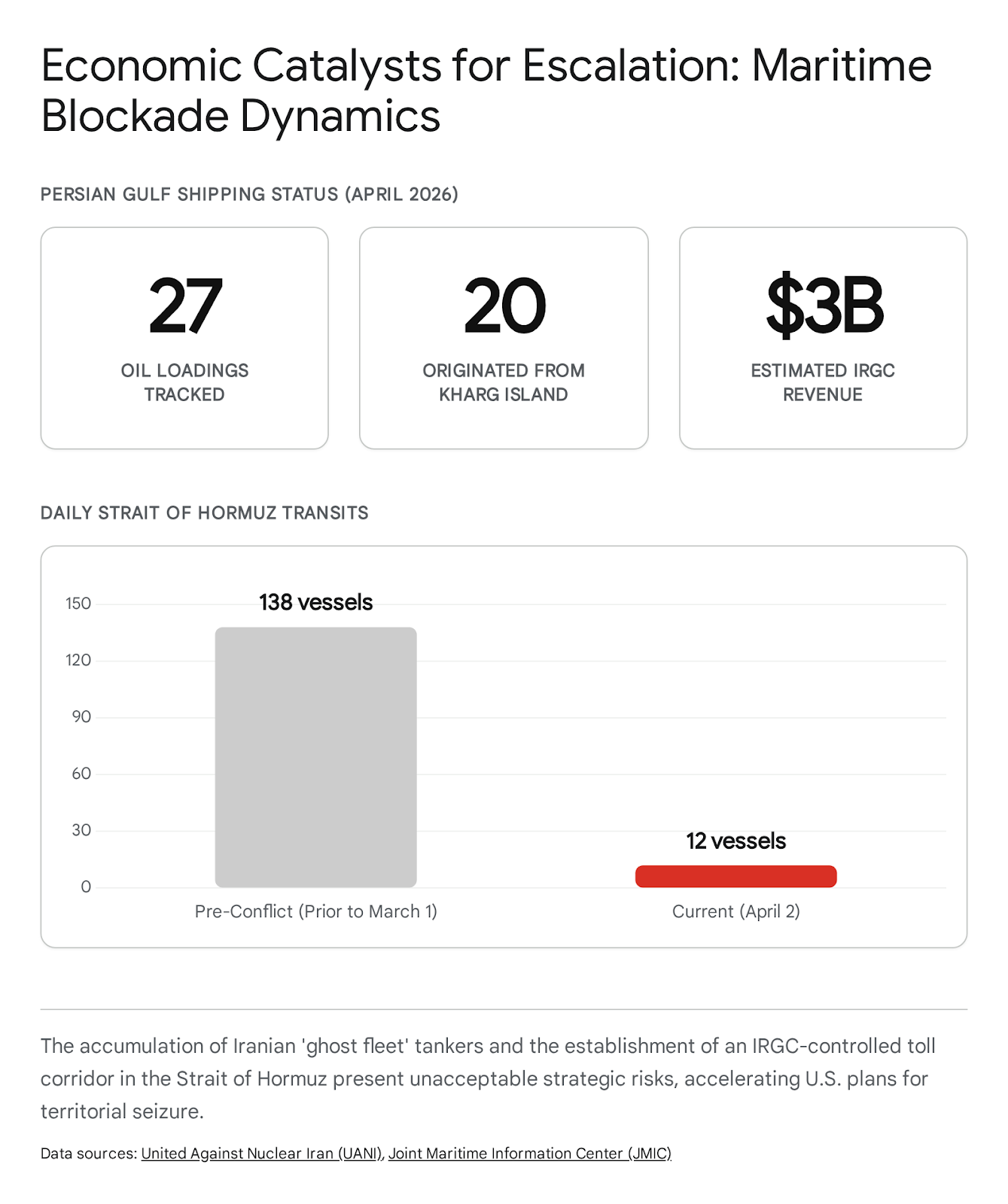
Intelligence reports indicate that Western-linked vessels are increasingly being forced to navigate through an IRGC-controlled corridor within Iranian territorial waters, abandoning international traffic separation schemes.47 To secure passage, international shipping conglomerates are allegedly being coerced into paying extortionate transit fees directly to the IRGC, transacted exclusively in Chinese yuan to bypass Western financial sanctions.47 On April 3, the French-operated container ship CMA CGM Kribi became the first Western vessel to transit the strait under IRGC escort after submitting to these demands, highlighting the failure of current deterrence.47
Furthermore, UANI (United Against Nuclear Iran) tracking data has identified a massive “ghost fleet.” At least 27 ghost fleet tankers laden with approximately 38 million barrels of Iranian crude are currently operating inside the Persian Gulf.49 This illicit trade is generating an estimated $3 billion in revenue, directly funding the IRGC’s war effort and its continued production of ballistic missiles and drones.49 The U.S. Navy acutely recognizes that sailing standard surface action groups—composed of multi-billion-dollar Arleigh Burke-class destroyers—directly into the narrow confines of the strait exposes them to unacceptable, asymmetrical risks from shore-based anti-ship missiles, fast-attack swarm boat tactics, and sophisticated naval mines.48 Because the U.S. Navy cannot easily or safely secure the strait solely from the water, the physical neutralization of the land-based threats overseeing the chokepoint becomes an absolute tactical imperative.
The Kharg Island Vulnerability and Territorial Seizure
Consequently, military planners have actively briefed the administration on the operational feasibility of seizing Iranian sovereign territory to break the maritime deadlock. The primary objective is Kharg Island.1 Located just 16 miles off the Iranian mainland in the northern Persian Gulf, Kharg Island is the vital, beating heart of the Iranian economy, serving as the terminal for 90% of Iran’s crude oil exports.52
Satellite imagery from mid-March confirms that U.S. airstrikes have already heavily targeted and “totally obliterated” the military infrastructure defending the island, softening the target for a ground assault.52 The insertion of the 31st MEU, supported by the 82nd Airborne, to physically occupy Kharg Island presents the U.S. with a massive, decisive strategic bargaining chip. Controlling the island would totally sever the IRGC’s primary revenue stream and cripple the national economy without requiring a protracted, bloody, and politically unviable march toward Tehran.52 An alternative or concurrent objective involves seizing Qeshm Island or the Greater and Lesser Tunbs, located directly in the Strait of Hormuz, to systematically dismantle the coastal radar arrays and anti-ship missile batteries currently enforcing the toll corridor.1
Escalation Precursors: Diplomacy, Intelligence, and Adversary Response
Military operations of this magnitude and complexity are rarely initiated without distinct bureaucratic, diplomatic, and logistical precursors. Across multiple domains, non-combat indicators are flashing red, aligning perfectly with the 3-to-5-day attack window.
Diplomatic Evacuations and Consular Suspensions
The U.S. Department of State has taken drastic, highly visible measures to clear the regional battlespace of vulnerable American non-combatants. The U.S. Embassy in Kuwait City has entirely suspended routine consular services, operating solely on an emergency basis to facilitate rapid departures.9 Similarly, an ordered departure of non-emergency U.S. government personnel and their families has been executed in Qatar due to the specific “risk of armed conflict”.11 Travel advisories demanding immediate commercial departure have been broadcast for Iraq, Saudi Arabia, Israel, Jordan, and Lebanon.10 Historically, the synchronized drawdown of diplomatic footprints and the initiation of Non-Combatant Evacuation Operations (NEOs) in allied staging nations serve as the final administrative phase prior to the commencement of high-intensity kinetic operations.
Adversary Force Posture and Horizontal Escalation
Iran and its Axis of Resistance are acutely aware of these amassing threats and have shifted their defensive postures accordingly. The Iranian aviation authority has issued urgent Notices to Airmen (NOTAMs) declaring restricted, hazardous airspace up to 25,000 feet over the entirety of the Strait of Hormuz to facilitate live-fire military drills and position air defense assets.57
Domestically, the Iranian high command has initiated mass mobilization efforts—reportedly including the recruitment of minors, reminiscent of the darkest days of the Iran-Iraq war—to fortify coastal defenses, man anti-aircraft batteries, and prepare for an anticipated amphibious landing.17 Iran has explicitly threatened to “obliterate” regional desalination plants and energy infrastructure across the Gulf if Kharg Island is seized, promising that “the doors of hell will be opened”.61
Furthermore, Iranian proxy forces, specifically Hezbollah in Lebanon, the Houthis in Yemen, and the Islamic Resistance in Iraq, have dramatically increased the tempo of their drone, ballistic missile, and anti-tank guided missile attacks against U.S. bases in the region and civilian centers in northern Israel.18 This surge in proxy violence is a deliberate attempt to horizontally escalate the conflict, stretch U.S. and Israeli defensive capabilities (such as the Patriot and THAAD interceptor networks), and deter Washington from initiating the main ground assault by threatening a regional conflagration.13 The international community is also reacting to the imminent threat; Russia has begun evacuating nearly 200 workers from the Bushehr nuclear facility following nearby strikes, and a European coalition led by the U.K. and France is desperately attempting to negotiate a separate peace to open the Strait of Hormuz without U.S. military intervention.6
Strategic Assessment and Operational Prognosis: The 3-to-5 Day Outlook
Based on the synthesis of OSINT tracking data, force posture modifications, strategic airlift volumes, and stated political objectives, the likelihood of a U.S. ground attack in Iran within the next 3-to-5 days is assessed to be HIGH.
The President’s public 48-hour ultimatum serves as the primary temporal forcing function.5 The synchronized arrival of the 31st MEU in the Persian Gulf and the forward deployment of the 82nd Airborne Division place U.S. forces at absolute optimal readiness precisely as this deadline expires.1 Furthermore, the transition of the air campaign toward isolating western Iran via infrastructure strikes, the urgent operational requirement to conduct CSAR missions for downed aircrews, and the untenable economic reality of the IRGC’s yuan-based toll system in the Strait of Hormuz indicate that the battlespace has been fully shaped for physical entry.16
However, intelligence and doctrinal analysis suggest this will not manifest as a sweeping, conventional mechanized invasion of the Iranian mainland aimed at regime change via a march on Tehran. The mountainous terrain, the intact remnants of Iran’s drone and ballistic missile arsenal, and domestic U.S. political sensitivities regarding high casualties preclude a massive, protracted occupation footprint.52
Instead, the operational design will likely execute simultaneously along two distinct, highly focused axes:
- The Coastal Interdiction Axis: A combined airborne and amphibious assault spearheaded by the Marine Expeditionary Units and the 82nd Airborne targeting key littoral nodes. The seizure of Kharg Island offers maximum economic leverage by neutralizing 90% of Iran’s oil export capacity, effectively bankrupting the regime’s war machine.52 Concurrent raids on Qeshm Island or the Greater/Lesser Tunbs would physically dismantle the IRGC coastal defense cruise missile (CDCM) batteries currently enforcing the blockade in the Strait of Hormuz.1
- The Deep Infiltration Axis: Covert operations executed by AFSOC and JSOC elements, leveraging the transponder-silent northern vector through Azerbaijan.2 These highly specialized teams, utilizing MC-130Js and MH-47Gs, will likely conduct rapid, helicopter-borne raids into central Iran to secure, sabotage, or extract highly enriched uranium stockpiles previously exposed by bunker-buster munitions.1
The U.S. military has amassed an unparalleled concentration of combat power in the Middle East, representing the largest buildup since the 2003 invasion of Iraq.3 The logistical lifelines have been solidified, the diplomatic footprint has been evacuated, and the political rhetoric has boxed the administration into an enforcement paradigm from which there is little retreat. Absent an immediate, total, and publicly verifiable capitulation by the Iranian regime regarding the reopening of the Strait of Hormuz and the relinquishment of nuclear material, the commencement of Phase II ground operations is imminent.
Please share the link on Facebook, Forums, with colleagues, etc. Your support is much appreciated and if you have any feedback, please email us in**@*********ps.com. If you’d like to request a report or order a reprint, please click here for the corresponding page to open in new tab.
Sources Used
- US deployments fuel speculation of ground combat against Iran, accessed April 4, 2026, https://signalscv.com/2026/04/us-deployments-fuel-speculation-of-ground-combat-against-iran/
- US MC-130J Commando II Flight to Azerbaijan Signals Escalating Special Operations Posture as Iran Tensions Intensify – Defence Security Asia, accessed April 4, 2026, https://defencesecurityasia.com/en/us-mc130j-commando-ii-azerbaijan-iran-special-operations-escalation/
- U.S. Forces Launch Operation Epic Fury – centcom, accessed April 4, 2026, https://www.centcom.mil/MEDIA/PRESS-RELEASES/Press-Release-View/Article/4418396/us-forces-launch-operation-epic-fury/
- Iran to Trump’s Deadline: Get Ready for $150 Oil – WANA News, accessed April 4, 2026, https://wanaen.com/iran-to-trumps-deadline-get-ready-for-150-oil/
- Trump warns ‘all hell will reign down’ on Iran as 48-hour Hormuz deadline nears, accessed April 4, 2026, https://www.fox5dc.com/news/trump-warns-all-hell-will-reign-down-iran-within-48-hours
- US Redirects 19 More Tanker Aircraft to Middle East, accessed April 4, 2026, https://militarnyi.com/en/news/us-redirects-19-aircraft-to-middle-east/
- U.S. Air Force sends dozens of cargo aircraft to Middle East, accessed April 4, 2026, https://defence-blog.com/u-s-air-force-sends-dozens-of-cargo-aircraft-to-middle-east/
- US Deploys Special Forces, Airborne Troops to Middle East – Hunter Today, accessed April 4, 2026, https://nationaltoday.com/us/tn/hunter-tn/news/2026/03/31/us-deploys-special-forces-airborne-troops-to-middle-east/
- Security Alert – U.S. Embassy Kuwait – April 1, 2026, accessed April 4, 2026, https://kw.usembassy.gov/security-alert-u-s-embassy-kuwait-april-1-2026/
- Vital Information for U.S. Citizens Traveling in the Middle East | Congressman Abe Hamadeh, accessed April 4, 2026, https://hamadeh.house.gov/news/documentsingle.aspx?DocumentID=728
- Qatar International Travel Information, accessed April 4, 2026, https://travel.state.gov/content/travel/en/international-travel/International-Travel-Country-Information-Pages/Qatar.html
- Live Updates: Trump warns Iran has 48 hours to reopen Strait of Hormuz as search for U.S. crew member continues, accessed April 4, 2026, https://www.cbsnews.com/live-updates/iran-war-us-trump-warns-more-coming-oil-gas-strait-hormuz/
- OPERATION EPIC FURY, accessed April 4, 2026, https://media.defense.gov/2026/Apr/01/2003905658/-1/-1/1/OPERATION-EPIC-FURY-FACT-SHEET-APRIL-1-UPDATE.PDF
- US hit over 10,000 targets in Iran, CENTCOM commander says, accessed April 4, 2026, https://www.iranintl.com/en/202603251291
- The 850 Tomahawks Launched in Operation Epic Fury Is the Most Fired in a Single Campaign – CSIS, accessed April 4, 2026, https://www.csis.org/analysis/850-tomahawks-launched-operation-epic-fury-most-fired-single-campaign
- Epic Fury Update 5 April 2026 | SOF News, accessed April 4, 2026, https://sof.news/middle-east/epic-fury-update-5-april-2026/
- April 3, 2026 – FDD, accessed April 4, 2026, https://www.fdd.org/overnight-brief/april-3-2026/
- Iran Update, April 2, 2026 | ISW, accessed April 4, 2026, https://understandingwar.org/research/middle-east/iran-update-special-report-april-2-2026/
- U.S. Special Ops Aircraft Arriving In UK Could Point To Looming Oil Tanker Boarding Operation – The War Zone, accessed April 4, 2026, https://www.twz.com/air/u-s-special-ops-aircraft-arriving-in-uk-could-point-to-looming-oil-tanker-boarding-operation
- Epic Fury Update – April 3, 2026, accessed April 4, 2026, https://sof.news/middle-east/20260403/
- U.S. Military in the Middle East: Numbers Behind Trump’s Threats Against Iran – CSIS, accessed April 4, 2026, https://www.csis.org/analysis/us-military-middle-east-numbers-behind-trumps-threats-against-iran
- U.S. Deploys CV-22B Tiltrotors and MC-130J Commando II Aircraft Closer to Venezuela, accessed April 4, 2026, https://militarnyi.com/en/news/u-s-deploys-cv-22b-tiltrotors-and-mc-130j-commando-ii-aircraft-closer-to-venezuela/
- Flightradar24: US military transport aircraft fly cargo from Texas to Middle East | Caliber.Az, accessed April 4, 2026, https://caliber.az/en/post/flightradar24-us-military-transport-aircraft-fly-cargo-from-texas-to-middle-east
- US monitor Persian Gulf after considerable military build-up – Airforce Technology, accessed April 4, 2026, https://www.airforce-technology.com/features/us-monitor-persian-gulf-after-considerable-military-build-up/
- US monitor Persian Gulf after considerable military build-up – Naval Technology, accessed April 4, 2026, https://www.naval-technology.com/features/us-monitor-persian-gulf-after-considerable-military-build-up/
- US military activity expands in Europe with A-10 deployment, B-52 bombers amid war with Iran, accessed April 4, 2026, https://www.aa.com.tr/en/middle-east/us-military-activity-expands-in-europe-with-a-10-deployment-b-52-bombers-amid-war-with-iran/3888314
- Iran medical needs surge as supplies under threat: Red Cross – The New Arab, accessed April 4, 2026, https://www.newarab.com/news/iran-medical-needs-surge-supplies-under-threat-red-cross
- Medical needs surging in Iran and supplies under threat, Red Cross warns, accessed April 4, 2026, https://www.straitstimes.com/world/europe/medical-needs-surging-in-iran-and-supplies-under-threat-red-cross-warns?ref=latest
- Pentagon eyes ‘more and more bunkers’ and other tech to shield troops in Operation Epic Fury | DefenseScoop, accessed April 4, 2026, https://defensescoop.com/2026/03/31/iran-war-casualties-force-protection-operation-epic-fury/
- Into the Desert: Mobilizing for Desert Shield | Air & Space Forces Magazine, accessed April 4, 2026, https://www.airandspaceforces.com/article/into-the-desert-mobilizing-for-desert-shield/
- The Ready Reserve Force (RRF) | MARAD – Department of Transportation, accessed April 4, 2026, https://www.maritime.dot.gov/national-defense-reserve-fleet/ndrf/maritime-administration%E2%80%99s-ready-reserve-force
- ‘Prepare your family’: Marine Reserve commander gives warlike safety brief – Military Times, accessed April 4, 2026, https://www.militarytimes.com/news/your-military/2026/04/02/prepare-your-family-marine-reserve-commander-gives-warlike-safety-brief/
- CAMPAIGN PLAN – Marine Forces Reserve, accessed April 4, 2026, https://www.marforres.marines.mil/portals/116/Docs/CmdDeck/Campaign%20Plan/2026%20Campaign%20Plan.pdf
- Mercy – Other Ship, IMO 7390454, MMSI 367816000, Callsign NMER, Flag United States of America – vesseltracker.com, accessed April 4, 2026, https://www.vesseltracker.com/en/Ships/Mercy-7390454.html
- USNS Mercy – Military Sealift Command, accessed April 4, 2026, https://www.msc.usff.navy.mil/Ships/Mercy/
- Thousands of US Army paratroopers arrive in Middle East as buildup intensifies, accessed April 4, 2026, https://m.economictimes.com/news/defence/thousands-of-us-army-paratroopers-arrive-in-middle-east-as-buildup-intensifies/articleshow/129907491.cms
- At Least 1,000 US Troops from 82nd Airborne Set to Deploy to Mideast, Sources Say, accessed April 4, 2026, https://www.military.com/daily-news/2026/03/25/least-1000-us-troops-82nd-airborne-set-deploy-mideast-sources-say.html
- Thousands of more US troops to deploy to Middle East: Report | LiveNOW from FOX, accessed April 4, 2026, https://www.livenowfox.com/news/thousands-more-us-troops-deploy-middle-east-report
- 82nd Airborne Division cancels All American Week amid Iran war deployments, accessed April 4, 2026, https://taskandpurpose.com/news/82nd-airbone-event-cancelled-iran-war/
- Army announces upcoming unit deployments | Article | The United States Army, accessed April 4, 2026, https://www.army.mil/article/290877/army_announces_upcoming_unit_deployments
- Army begins deployment of units to Europe | Article, accessed April 4, 2026, https://www.army.mil/article/264585/army_begins_deployment_of_units_to_europe
- 101st Airborne Division (Air Assault) – DVIDS, accessed April 4, 2026, https://www.dvidshub.net/unit/HQ-101ABN
- US Marine Corps Expeditionary Unit Arrives in Persian Gulf Region, accessed April 4, 2026, https://militarnyi.com/en/news/us-marine-corps-expeditionary-unit-arrives-in-persian-gulf-region/
- Carrier Tracker As Of April 3, 2026 – The War Zone, accessed April 4, 2026, https://www.twz.com/sea/carrier-tracker-as-of-april-3-2026
- Iran War: What a Marine Expeditionary Unit is – and other US military terms – Al Jazeera, accessed April 4, 2026, https://www.aljazeera.com/news/2026/4/1/iran-war-what-a-marine-expeditionary-unit-is-and-other-us-military-terms
- Thousands more US troops are heading to the Middle East, accessed April 4, 2026, https://apnews.com/article/iran-war-us-troops-deployment-aircraft-carrier-7c015aa5156525fcc95c42897de52e0f
- First Western Ships Cross Hormuz Since War Began, Paying Iran in Yuan – House of Saud, accessed April 4, 2026, https://houseofsaud.com/hormuz-iran-toll-gate-western-ships-april-2026/
- Why the US Navy won’t blast the Iranians and ‘open’ Strait of Hormuz, accessed April 4, 2026, https://responsiblestatecraft.org/iran-strait-of-hormuz/
- Iran War Shipping Update – April 2, 2026 | UANI, accessed April 4, 2026, https://www.unitedagainstnucleariran.com/blog/iran-war-shipping-update-april-2-2026
- Iran War Shipping Update—April 1, 2026 | UANI, accessed April 4, 2026, https://www.unitedagainstnucleariran.com/blog/iran-war-shipping-update-april-1-2026
- How to Lose a Navy in 10 Days – CSIS, accessed April 4, 2026, https://www.csis.org/analysis/how-lose-navy-10-days
- Explainer-Drones and mines: taking Kharg Island would pose risks for US troops, accessed April 4, 2026, https://www.al-monitor.com/originals/2026/03/explainer-drones-and-mines-taking-kharg-island-would-pose-risks-us-troops
- Satellite images show impact sites across Kharg Island after U.S. strikes hit strategic Gulf oil hub – YouTube, accessed April 4, 2026, https://www.youtube.com/watch?v=QxPvo7rv1js
- Chances of US-Iran deal ‘very small,’ Israeli officials tell ‘Post’, accessed April 4, 2026, https://www.jpost.com/middle-east/iran-news/article-891012
- Kuwait International Travel Information – State Department, accessed April 4, 2026, https://travel.state.gov/content/travel/en/international-travel/International-Travel-Country-Information-Pages/Kuwait.html
- Consular Information for Americans in the Middle East – Travel – State Department, accessed April 4, 2026, https://travel.state.gov/en/international-travel/travel-advisories/global-events/middle-east.html
- Iran declares restricted airspace over the Strait of Hormuz amid escalating US tensions, accessed April 4, 2026, https://www.turkiyetoday.com/region/iran-declares-restricted-airspace-over-the-strait-of-hormuz-amid-escalating-us-tensio-3213643
- Iran issues airspace notice for military drills near Strait of Hormuz – Anadolu Ajansı, accessed April 4, 2026, https://www.aa.com.tr/en/middle-east/iran-issues-airspace-notice-for-military-drills-near-strait-of-hormuz/3812508
- Iran issues NOTAM over planned rocket launches on Thursday | The Jerusalem Post, accessed April 4, 2026, https://www.jpost.com/middle-east/iran-news/article-887169
- Iran alerts airspace ahead of military exercises near Strait of Hormuz – News.az, accessed April 4, 2026, https://news.az/news/iran-alerts-airspace-ahead-of-military-exercises-near-strait-of-hormuz
- Trump Threatens To ‘Obliterate’ Iran Oil Hub Due to Strait of Hormuz Closure | Military.com, accessed April 4, 2026, https://www.military.com/daily-news/headlines/2026/03/30/Iran-Threatens-Obliterate-Iran-Oil-Hub-War
- Trump gives Iran 48 hours to open Strait of Hormuz as search continues for missing US pilot, accessed April 4, 2026, https://apnews.com/article/iran-us-israel-trump-lebanon-april-4-2026-b1f73e5c2a88ddcf71d93f49f9494e1b
- Iran Update Evening Special Report, March 1, 2026 | ISW, accessed April 4, 2026, https://understandingwar.org/research/middle-east/iran-update-evening-special-report-march-1-2026/
- 2026 United States military buildup in the Middle East – Wikipedia, accessed April 4, 2026, https://en.wikipedia.org/wiki/2026_United_States_military_buildup_in_the_Middle_East