1. Executive Summary
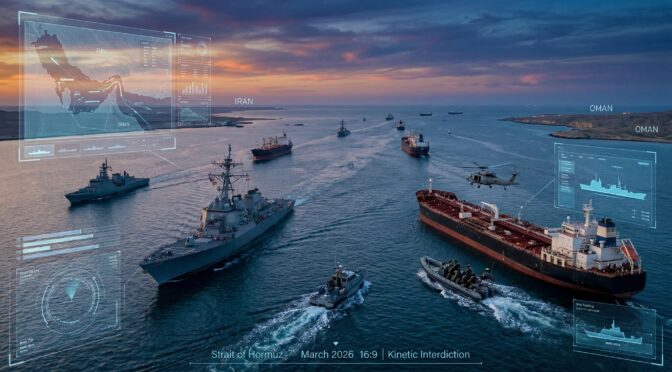
The geopolitical and maritime security architecture of the Middle East underwent a fundamental, irreversible paradigm shift on February 28, 2026. The initiation of Operation Epic Fury,a massive, coordinated, and preemptive strike campaign executed by the United States and Israel,resulted in the deliberate decapitation of the Iranian political and military leadership, including the verified death of Supreme Leader Ayatollah Ali Khamenei and the upper echelon of the Islamic Revolutionary Guard Corps (IRGC).1 In immediate retaliation, the remnants of the Iranian state and its newly decentralized military apparatus activated a comprehensive sea-denial strategy, effectively closing the Strait of Hormuz to all global commercial shipping.4
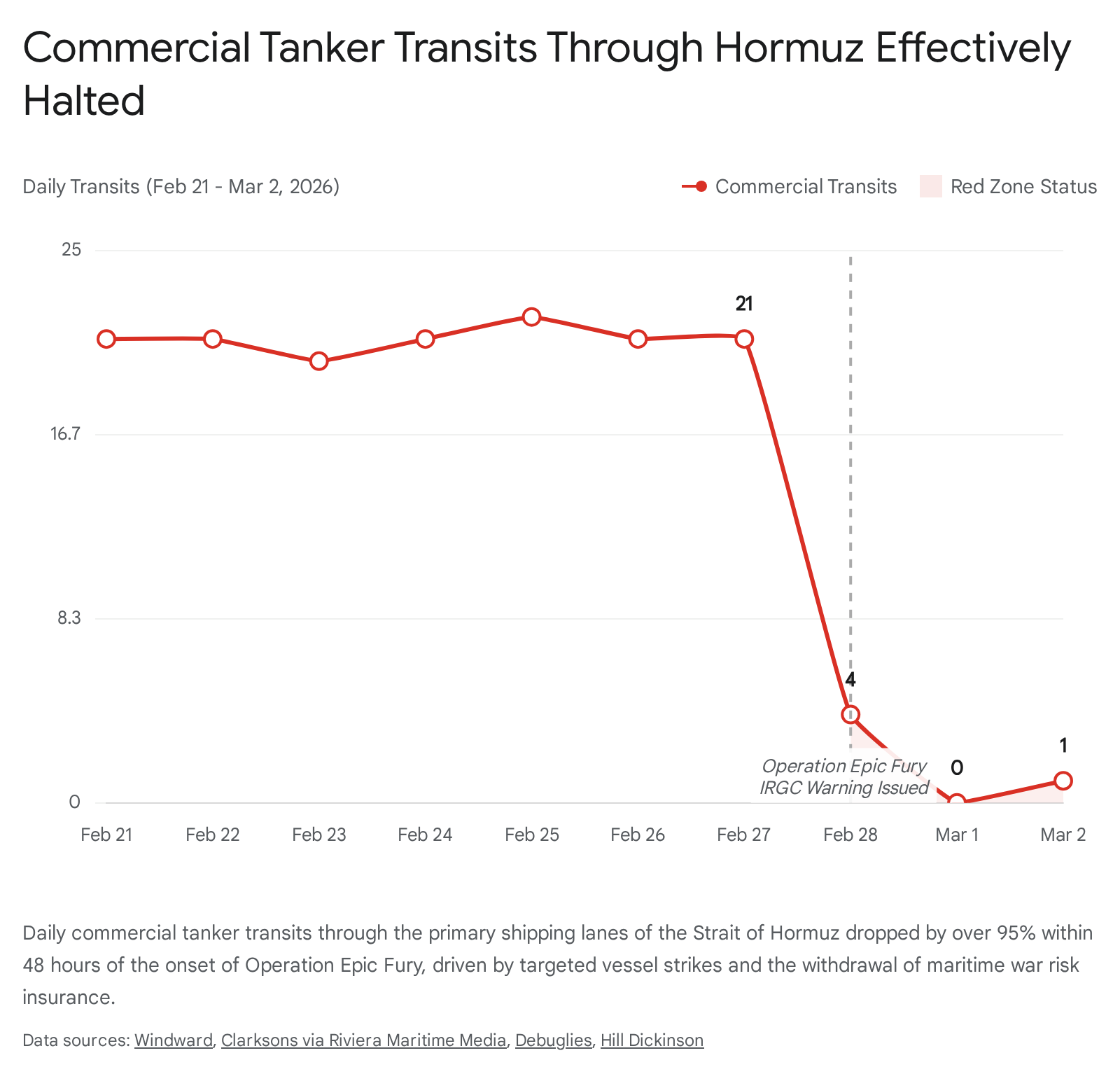
As of early March 2026, the Strait of Hormuz,a highly constrained, 33-kilometer-wide geographic chokepoint that normally processes approximately 20 to 21 million barrels of crude oil per day and one-fifth of global liquefied natural gas (LNG) trade,has collapsed into an active kinetic interdiction environment.7 Commercial tanker transits have plummeted from a stabilized baseline of 21 passages per day to virtually zero.8 Operating under fragmented command and control structures due to the elimination of their strategic oversight, local IRGC Navy (IRGCN) commanders have launched direct kinetic attacks on neutral commercial vessels using a combination of explosive unmanned surface vessels (USVs), one-way attack drones, and coastal defense systems.10
The second-order geoeconomic effects of this maritime blockade have triggered an unprecedented global supply chain shock. War risk insurance premiums have spiked by over 300%, and major Protection and Indemnity (P&I) clubs have issued notices of cancellation for the entire Persian Gulf, legally and financially paralyzing the international merchant fleet.8 Furthermore, an indiscriminate Iranian strike on QatarEnergy’s Ras Laffan facility has forced a total halt in Qatari LNG production, severing a critical energy artery to Asian and European markets and exacerbating the crisis.14
This intelligence report provides an exhaustive, multi-domain assessment of the current security environment in the Strait of Hormuz. It analyzes the immediate threat vectors posed by decentralized Iranian forces and their regional proxies, details the aggressive operational posture of U.S. and allied naval task forces, examines the systemic collapse of regional marine traffic, and delivers a strategic forecast for the short and medium term.
2. Strategic Context: The Catalyst of Operation Epic Fury
To accurately assess the current maritime security environment, one must understand the preceding strategic deterioration that culminated in the events of February 28, 2026. The crisis did not emerge in a vacuum; it was the inevitable climax of a months-long escalation spiral involving domestic Iranian instability, failed diplomacy, and massive international military mobilization.
2.1 The Prelude to Conflict
Tensions between the Islamic Republic of Iran and the United States began to intensify exponentially in late 2025. Following massive, nationwide anti-regime protests driven by the collapse of the Iranian rial and severe economic stagnation, the Iranian government engaged in harsh domestic crackdowns.3 Simultaneously, negotiations regarding the Iranian nuclear program, mediated by Omani Foreign Minister Sayyid Badr Albusaidi in Geneva, reached a critical deadlock.17 During the second round of these talks in mid-February, Supreme Leader Ali Khamenei issued direct threats against the United States Navy, explicitly stating that Iran was “capable of sinking them”.3
In response to these threats and the lack of diplomatic progress, the United States executed one of the most significant force posture realignments in the Middle East since the 2003 invasion of Iraq.20 Throughout February 2026, the Pentagon massed unprecedented naval and air assets in the theater. This included the deployment of two Carrier Strike Groups,CSG 3 (led by the USS Abraham Lincoln) and CSG 12 (led by the USS Gerald R. Ford),creating a rare dual-carrier presence designed for sustained, high-intensity combat operations.20 Air components were heavily reinforced, with F-22 Raptors deploying to the hardened shelters at Ovda Airbase in southern Israel (marking the first U.S. deployment of offensive weaponry in Israel), F-15E Strike Eagles relocating to Muwaffaq Salti Air Base in Jordan, and Royal Air Force Eurofighter Typhoons staging at Al-Udeid Air Base in Qatar.20
| Strategic Prelude Timeline | Key Geopolitical and Military Developments |
| Late Dec 2025 – Jan 2026 | Massive nationwide anti-regime protests erupt in Iran due to the collapse of the rial; regime initiates severe crackdowns.3 |
| Mid-February 2026 | Nuclear negotiations stall in Geneva. Khamenei issues threats to sink U.S. warships in the region.3 |
| Feb 13 – 24, 2026 | U.S. deploys CSG 12 (USS Gerald R. Ford) to join CSG 3. F-22 Raptors deploy to Israel, F-15Es to Jordan.20 |
| Feb 28, 2026 (1:15 AM ET) | U.S. Central Command initiates Operation Epic Fury. Joint strikes with Israel commence across Iranian territory.3 |
| Feb 28 – Mar 1, 2026 | Iranian leadership decapitated (Khamenei, Pakpour killed). IRGC initiates retaliatory blockade of Hormuz.2 |
Table 1: Chronological sequence of escalating events leading to the kinetic closure of the Strait of Hormuz in March 2026.3
2.2 Operation Epic Fury and Leadership Decapitation
At 1:15 AM ET on February 28, 2026, directed by the President of the United States, U.S. Central Command (CENTCOM) and the Israel Defense Forces (IDF) launched Operation Epic Fury.21 Utilizing long-range munitions, stealth aircraft, and sea-launched Tomahawk cruise missiles, the coalition achieved immediate air superiority and executed a highly coordinated decapitation strike against the Iranian command structure.22
The strikes targeted Tehran’s political and security nerve center, reducing the office compound of Supreme Leader Khamenei to rubble and killing him.3 The IDF confirmed the deaths of virtually the entire Iranian strategic leadership apparatus, including Ali Shamkhani (Secretary of the Defense Council), Major General Mohammad Pakpour (IRGC Commander-in-Chief), Brigadier General Aziz Nasir Zadeh (Defense Minister), and Saleh Asadi (head of the Intelligence Directorate).2
The military objectives of Operation Epic Fury went far beyond leadership targeting. The operational doctrine, internally referred to as the “Archer” strategy, shifted the U.S. from a defensive posture of intercepting incoming missiles to an offensive posture aimed at destroying the origin points.25 The coalition struck over 2,000 targets within the first 48 hours, prioritizing IRGC command and control facilities, air defense networks, ballistic missile production chains, and the strategic naval infrastructure required to threaten the Strait of Hormuz.21
3. The Maritime Security Environment: Status of the Strait of Hormuz
The immediate consequence of the decapitation strikes was the activation of Iran’s long-standing contingency plan: the closure of the Strait of Hormuz. Deprived of their central command, the surviving elements of the IRGC and the Artesh Navy resorted to asymmetric sea-denial tactics, transforming one of the world’s most critical economic arteries into an active war zone.
3.1 The Anatomy of the Blockade and Legal Ambiguity
The closure of the Strait of Hormuz is functionally absolute, despite the lack of formal international legal frameworks validating it. On Saturday, February 28, vessels operating in the region received VHF radio broadcasts from the IRGC declaring that the Strait was “basically closed” and that navigation was forbidden “till further notice”.4 Iranian media amplified these warnings, with Ebrahim Jabari, a senior adviser to the IRGC, explicitly stating that any ships attempting to pass would be “set ablaze”.5
From a strict perspective of international maritime law, these declarations hold no weight. Under the United Nations Convention on the Law of the Sea (UNCLOS), Iran cannot legally hamper transit passage through an international strait, and VHF broadcasts do not constitute a lawful restriction on navigation.4 The UK Maritime Trade Operations (UKMTO) center in Dubai repeatedly advised mariners that the broadcasts were not legally binding and that vessels remained free to navigate international waters.4
However, the legal debate was immediately rendered moot by physical reality. The execution of kinetic strikes against commercial shipping by Iranian drone boats and coastal batteries demonstrated that the IRGC possessed both the capability and the intent to enforce their illegal blockade through deadly force.11 Consequently, the maritime corridor, while technically open under international law, has functionally and operationally ceased to exist as a viable transit route.10
3.2 Open Source Intelligence (OSINT) Analysis of Traffic Collapse
The cessation of marine traffic was immediate, severe, and measurable. Prior to the initiation of Operation Epic Fury, the Strait of Hormuz facilitated the transit of approximately 18 to 21 major commercial tankers per day, representing roughly 30% of global seaborne oil flows and carrying over 20 million barrels of crude, condensate, and fuels.5
Independent open-source intelligence (OSINT) and maritime tracking data from Windward, Kpler, and Clarksons confirm a catastrophic drop in transit volumes. Within 24 hours of the strikes, traffic had dropped by 70%, and by March 1, the primary shipping lanes saw a 40-50% reduction in activity.6 By March 2, Windward analysis indicated that zero active tanker transits were occurring in the primary Hormuz shipping lanes.10 Only a single, small 12,000 DWT tanker and one minor cargo vessel were observed attempting the transit.10 No U.S., UK, or EU-flagged vessels have been observed transiting since the conflict began.10
3.3 Vessel Entrapment and the Accumulation of Stranded Assets
The suddenness of the blockade has resulted in a massive logistical bottleneck, trapping an unprecedented volume of global shipping capacity either inside the Persian Gulf or at anchorages just outside the Strait. The merchant fleet has adopted a posture of “self-exclusion,” refusing to enter the Red Zone.8
Inside the Persian Gulf, Clarksons estimates that approximately 3,200 vessels,representing a staggering 4% of global maritime tonnage,are currently trapped, unable to safely exit.31 This trapped fleet includes 112 crude tankers, of which more than 70 are Very Large Crude Carriers (VLCCs), accounting for 8% of the global VLCC fleet.31 Additionally, 195 product tankers and 21 Very Large Gas Carriers (VLGCs) are ensnared in the conflict zone.31 The container shipping industry is similarly impacted, with approximately 170 containerships, totaling roughly 450,000 TEU of capacity, locked inside the Gulf.4
Outside the Strait, the situation is characterized by massive, expanding anchorages of stranded assets. Maritime tracking reveals that over 150 crude and LNG tankers have dropped anchor in the open waters of the Gulf of Oman, clustering off the coasts of Fujairah in the UAE, Saudi Arabia, and Oman.12 Windward analysis notes an additional 700+ vessels of various classes drifting or holding position in the approaches, awaiting diplomatic resolution or military escort.8 This intense accumulation of vessels at anchorage introduces secondary maritime risks, including a heightened probability of collisions, dragging anchors, and constrained maneuvering space in the event of an incoming missile threat.33
| Operational Metric | Pre-Strike Baseline (Feb 21-27) | Active Conflict (March 1-3) | Strategic Implication |
| Daily Tanker Transits (Hormuz) | 18 – 21 vessels | 0 – 1 vessels | Complete cessation of 20% of global oil flows.5 |
| Vessels Trapped Inside Gulf | Fluid / Rotational | ~3,200 vessels | 4% of global maritime tonnage immobilized.31 |
| VLCCs Trapped Inside Gulf | Fluid / Rotational | 70+ vessels | 8% of the global VLCC fleet removed from the market.31 |
| Vessels Anchored Outside Strait | < 15 drifting | 706+ drifting/anchored | Massive logistical bottleneck; extreme supply chain disruption.8 |
| War Risk Insurance Premium | ~0.25% of hull value | 1.00% – 1.50%+ | Financial paralysis of the commercial merchant fleet.8 |
Table 2: Synthesis of critical marine traffic metrics demonstrating the collapse of transit operations and the accumulation of stranded assets in the Gulf region.5
3.4 The Insurance Cascade: Financial and Legal Paralysis
The physical reality of the kinetic environment has been reinforced by an insurmountable financial barrier: the total collapse of the maritime insurance market for the Persian Gulf. Commercial shipping cannot operate without comprehensive insurance, specifically war risk cover, which protects shipowners against liabilities and damages resulting from state-level warfare, terrorism, and piracy.13
Immediately following the strikes on February 28, leading mutual marine insurers and Protection and Indemnity (P&I) clubs,including Norway’s Gard and Skuld, the UK’s NorthStandard, the London P&I Club, and the New York-based American Club,issued formal Notices of Cancellation for war risk cover for vessels operating in the Gulf, effective March 5.13 The Lloyd’s of London market followed suit, issuing cancellations to allow underwriters time to reassess the fundamentally altered risk landscape.13
While insurers generally offer the option to reinstate coverage on a case-by-case basis (“terms to be agreed”), the newly calculated premiums are economically devastating. War risk premiums, which sat at approximately 0.25% of a vessel’s hull value prior to the conflict, have surged by over 300%, now demanding 1.00% or more per transit.8 For a modern VLCC carrying upwards of $130 million worth of crude oil, this translates to a minimum of $1.3 million in pure insurance premiums for a single passage, rendering the voyage commercially unviable for most operators.
This financial reality intersects with complex maritime legal doctrines. Carriers are increasingly invoking liberty clauses within their charterparties regarding war and safety risks.4 Even without express clauses, ship masters possess an implied right and obligation to deviate from contractual routes to ensure the safety of the vessel, crew, and cargo.4 Under the Hague/Hague-Visby Rules, the current threat environment renders any deviation away from the Strait “reasonable”.4 Furthermore, if BIMCO War Risk Clauses (CONWARTIME and VOYWAR 2025) are incorporated into contracts, owners have the explicit right to refuse orders that would require their vessels to proceed into the exposed areas of the Gulf.4
Consequently, the world’s largest container and tanker operators,including Maersk, MSC, Hapag-Lloyd, and CMA CGM,have officially suspended all transits indefinitely, instructing their fleets to seek designated safe shelter areas or to begin the arduous, costly rerouting process around the Cape of Good Hope.27
4. Kinetic Interdictions: OSINT Analysis of Marine Casualties
The mass withdrawal of insurance and the suspension of corporate shipping operations are fully justified by the tactical reality on the water. Between February 28 and March 3, 2026, Iranian forces executed a series of targeted kinetic strikes against commercial shipping, proving that their VHF warnings were backed by lethal intent.
Analysis of the targeting matrix reveals a critical intelligence insight: the strikes are consistent with an indiscriminate area-denial strategy rather than precision affiliation targeting.10 In previous years, Iran primarily targeted vessels with direct links to the United States or Israel. However, the current campaign is striking neutral, non-aligned shipping, indicating a blanket approach to enforcing the blockade.
Confirmed maritime security incidents include:
- MT MKD Vyom (IMO 9284386): In the early hours of March 1, 2026 (with AIS data showing a drastic speed reduction around this time), a Marshall Islands-flagged oil tanker was struck by an Iranian drone boat approximately 52 nautical miles off the coast of Muscat, Oman. The explosive payload detonated above the waterline, triggering a massive fire in the main engine room.12 Tragically, the attack resulted in the death of one Indian seafarer.11 The vessel was carrying approximately 59,463 metric tonnes of cargo, and the crew of 21 (comprising Indian, Bangladeshi, and Ukrainian nationals) was subjected to an intense emergency response before the fire was brought under control.12
- MT Skylight (IMO 9330020): On March 1, 2026 (shortly after its position was confirmed at 02:05 UTC), a Palau-flagged tanker was targeted approximately 5 nautical miles north of Khasab Port in Oman’s Musandam Governorate. The vessel suffered a direct projectile strike that resulted in injuries to four crew members.29 The severity of the damage necessitated a full evacuation of the 20-person crew, which consisted of 15 Indian nationals and 5 Iranian nationals.29
- Hercules Star (IMO 9295531): On March 1, 2026, this Gibraltar-flagged oil tanker was targeted and struck by a projectile while transiting approximately 17 nautical miles northwest of Mina Saqr, UAE, causing a fire onboard which was subsequently extinguished.
- MT Sea La Donna (IMO 9380532): On March 2, 2026, this vessel reported a kinetic attack that is currently undergoing detailed investigation by the Joint Maritime Information Center (JMIC) to determine the exact nature of the ordnance used and the extent of the damage.
These strikes occurred despite earlier, less lethal harassment attempts by the IRGC in the weeks prior to the war, such as the February 3, 2026 (09:00 UTC) attempt to hail and stop the U.S.-flagged Stena Imperative,a vessel operating under the Department of Defense Tanker Security Program, which was successfully defended by the USS McFaul. The transition from VHF harassment to lethal drone boat strikes underscores the extreme escalation in Iranian rules of engagement.
In response to these casualties, the Indian government,whose nationals comprise a significant portion of the global seafaring workforce and were directly impacted by the MKD Vyom and Skylight attacks,has issued severe shipping advisories.36 Concurrently, the Nautilus International maritime union successfully lobbied for the designation of the Strait of Hormuz as a “High-Risk Area” under the Warlike Operations Area Committee, activating enhanced protections for seafarers and granting them the explicit contractual right to refuse deployment into the Gulf without fear of penalty or termination.37
| Targeted Vessel | IMO Number | Flag State | Date & Time | Incident Location | Weapon Employed | Casualties / Status |
| MT MKD Vyom | 9284386 | Marshall Islands | March 1, 2026 (Early hours) | 52 nm off Muscat, Oman | Explosive Drone Boat (USV) | 1 killed (Indian national); Engine room fire. |
| MT Skylight | 9330020 | Palau | March 1, 2026 (Post-02:05 UTC) | 5 nm north of Khasab, Oman | Unspecified Projectile | 4 injured; Full crew evacuated. |
| Hercules Star | 9295531 | Gibraltar | March 1, 2026 | 17 nm NW of Mina Saqr, UAE | Unspecified Projectile | Fire extinguished; continued voyage.40 |
| MT Sea La Donna | 9380532 | Unspecified | March 2, 2026 | Approaches to Hormuz | Under Investigation | Attack confirmed; details pending JMIC review. |
Table 3: Confirmed kinetic interdictions of commercial shipping by Iranian forces in the Strait of Hormuz and Gulf of Oman (March 1 – 2, 2026).
5. Threat Assessment: Iranian Naval Doctrine and Proxy Activation
The maritime threat environment is currently defined by a dangerous paradox: the operational success of the U.S. decapitation strikes has inadvertently created a more volatile and unpredictable tactical situation on the water.
5.1 The Paradox of Decapitation: Decentralized IRGC Command
Operation Epic Fury successfully eliminated the strategic apex of the Iranian military, including Supreme Leader Khamenei and IRGC Commander-in-Chief Pakpour.2 While this dismantled the regime’s ability to coordinate a unified, national-level conventional response, it severely compromised the command-and-control (C2) architecture governing the IRGC Navy.
The IRGCN has historically operated under a “mosaic defense” doctrine, which relies on thousands of decentralized, highly mobile fast attack craft (FAC), coastal missile batteries, and asymmetric platforms spread across the coastline.8 With the central command structure annihilated, local IRGCN commanders have seemingly been granted,or have autonomously assumed,total operational freedom.38 This power vacuum renders the maritime domain deeply unpredictable; traditional deterrence models are ineffective against disjointed, hyper-local units operating without strategic oversight, diplomatic restraints, or sophisticated target identification capabilities.8 The indiscriminate strikes on the MKD Vyom and Skylight,vessels with no U.S. or Israeli affiliation,are direct manifestations of this uncoordinated, localized execution of the area-denial mandate.
5.2 Asymmetric Capabilities: Stealth Undersea Killers and Drone Swarms
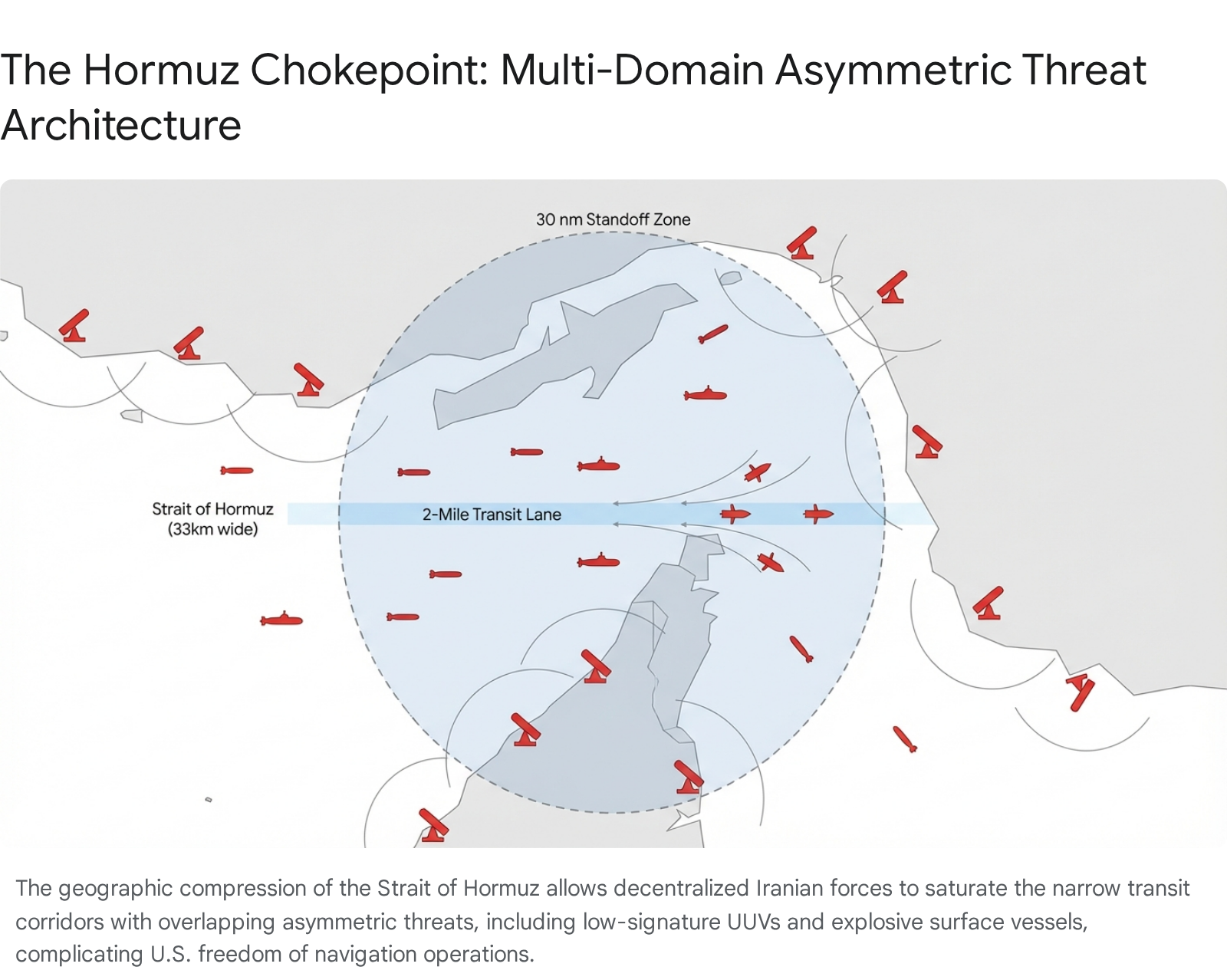
Iran’s surviving naval capabilities remain uniquely tailored for the highly constrained bathymetry of the Strait of Hormuz. The geography of the waterway,which compresses massive shipping lanes into a navigable 2-mile corridor within a 33-kilometer-wide strait,allows even rudimentary, low-signature systems to achieve disproportionate strategic effects.5
Intelligence assessments highlight the deployment of advanced unmanned underwater vehicles (UUVs), specifically the domestically produced Nazir-series. Described in defense analyses as “stealth undersea killers,” these platforms represent a significant evolution in Iranian asymmetric warfare.39 The UUVs reportedly possess a 24-hour endurance capability and can dive to depths of 200 meters.39 In the shallow, acoustically complex littoral environment of the Persian Gulf, these UUVs can lurk well below typical sonar and patrol thresholds.39 They operate as hybrid threat nodes, capable of reconnaissance, acting as smart loitering mines, or functioning as direct-strike torpedo delivery systems.39 This capability introduces a submerged dimension to the conflict that fundamentally complicates U.S. anti-submarine warfare (ASW) efforts, which are traditionally optimized for deep-water engagements.
Above the surface, the IRGCN continues to deploy explosive one-way unmanned surface vessels (USVs), commonly referred to as “drone boats,” which have proven highly lethal, as evidenced by the fatal strike on the MKD Vyom.11 Furthermore, U.S. intelligence notes the presence of surviving stockpiles of Shahed-136 and Shahed-129 one-way attack drones.26 Compounding these physical threats is an aggressive electronic warfare campaign; marine authorities have reported severe, widespread GNSS/GPS spoofing, AIS disruptions, and VHF communications interference across the Gulf.8 This electronic fog of war drastically increases the risk of misidentification, friendly fire incidents, and navigational disasters in the congested anchorages.
5.3 The Activation of the Axis of Resistance
The death of the Iranian Supreme Leader has triggered the full, uncoordinated mobilization of Iran’s regional proxy network,the Axis of Resistance,compounding the threat to the maritime environment and surrounding logistics nodes across multiple theaters.
In Iraq, powerful Iranian-aligned Shiite militias, notably Kataib Hezbollah and Saraya Awliya al-Dam, have launched a barrage of drone and rocket attacks targeting U.S. outposts and critical infrastructure.1 These strikes have hit the Baghdad airport, a U.S. air base in northern Iraq, the U.S. embassy compound in Kuwait, and facilities in Jordan, prompting the State Department to urge the departure of diplomatic staff from Amman.41 This northern proxy activation threatens the broader Gulf logistics corridors and forces the U.S. to disperse its defensive assets.
In the Levant, Lebanese Hezbollah has engaged in intense missile exchanges with Israel, prompting Israeli retaliatory strikes in Beirut that killed a senior Hezbollah official and resulted in mass casualties.42 The IDF has explicitly stated its intent to eliminate the threat from Lebanon, vowing to target Hezbollah chief Naim Kassem.42
Crucially for maritime security, European intelligence agencies and maritime security firms warn of a highly credible risk of a “dual-theatre disruption.” It is assessed as highly likely that Houthi forces in Yemen will capitalize on the regional chaos to resume full-scale kinetic operations in the Red Sea and the Bab el-Mandeb Strait.33 A synchronized, dual-chokepoint blockade would be devastating, neutralizing both the Suez Canal route and the Strait of Hormuz simultaneously.
6. Coalition Force Posture and Maritime Protection Initiatives
In response to the multi-axis threat environment, the United States and its regional allies have adopted an aggressive, preemptive military posture designed to annihilate Iran’s capacity to sustain the blockade, while simultaneously issuing strict navigational directives to protect the merchant fleet from the ensuing crossfire.
6.1 Defensive Posture: MARAD Directives and the 30-Nautical-Mile Buffer
To manage the chaotic maritime environment and prevent miscalculation or collateral damage, the U.S. Maritime Administration (MARAD) issued a critical emergency directive: Maritime Alert 2026-001A.45 This alert explicitly mandates that any commercial vessels that are U.S.-flagged, owned, or crewed operating within the Strait of Hormuz, Persian Gulf, Gulf of Oman, or Arabian Sea must maintain a strict, minimum standoff distance of 30 nautical miles from any U.S. military vessel.33
This massive buffer zone is a direct reflection of the extreme “Red Zone” kinetic environment. U.S. warships,including the Arleigh Burke-class destroyers attached to the Carrier Strike Groups,are actively engaged in continuous ballistic missile defense (BMD) and offensive strike operations.48 In an environment plagued by GPS spoofing and explosive drone boats, any unidentified radar track that breaches this 30nm perimeter risks being classified as an asymmetric threat and engaged with lethal force.4 Commercial vessels are instructed to maintain constant contact with the Naval Cooperation and Guidance for Shipping (NCAGS) under Naval Forces Central Command (NAVCENT) to verify their identity and intentions.4
6.2 The “Archer” Strategy: Systemic Degradation of Iranian Naval Assets
While defensive measures protect the fleet, CENTCOM’s offensive operations are focused on permanently breaking the blockade. Under Operation Epic Fury, U.S. forces have shifted their strategic logic from a defensive, reactive posture to an offensive doctrine internally described as the “Archer” strategy.25 Rather than expending multi-million-dollar Patriot and THAAD interceptors to shoot down incoming Iranian drones and missiles (the “arrows”), U.S. and Israeli forces are systematically annihilating the production facilities, storage depots, and launch platforms (the “archers”).25
In the maritime domain, this strategy has been ruthlessly executed against both the regular Iranian Navy (Artesh) and the IRGCN to degrade their capacity to coordinate and sustain the Hormuz closure.22 Early battle damage assessments (BDA) indicate that U.S. naval and air forces have sunk at least 11 major Iranian naval vessels since the commencement of hostilities.1
Confirmed high-value targets neutralized by coalition strikes include:
- The IRIS Jamaran: A formidable Moudge-class frigate belonging to the IRGCN, sunk near the Imam Ali Base in Chabahar.26 The Jamaran was a seasoned asset, having previously operated in the Red Sea and famously seized two U.S. unmanned surface vessels in 2022.26
- The Shahid Bagheri: The IRGCN’s dedicated drone carrier, a highly strategic asset capable of launching swarms of UAVs while underway at sea, was located and sunk in the Gulf of Oman, neutralizing a massive mobile threat projection node.49
- IRIS Bayandor and IRIS Naghdi: Iran’s two remaining Bayandor-class patrol corvettes, equipped with modern radar, 76mm guns, and anti-ship missiles, were destroyed at the Artesh Navy 3rd Naval District base in Konarak.26 Satellite imagery suggests the coalition utilized heavy bunker-buster munitions to penetrate the fortified concrete hangars at the facility.26
- IRIS Kurdistan: A Makran-class forward base ship utilized by the Artesh Navy, its destruction significantly degrades Iran’s ability to project sustained logistical support to its smaller, decentralized patrol craft.49
By systematically targeting these capital ships, floating forward operating bases, and coastal radar installations (such as the radar struck on Kish Island), the U.S. coalition aims to blind the IRGC and deny them the infrastructure necessary to coordinate their swarms of fast attack craft.50 Furthermore, CENTCOM’s Task Force Scorpion Strike has innovated tactically by employing low-cost, one-way attack drones in combat for the first time, effectively turning Iran’s preferred asymmetric tactic against its own coastal defense infrastructure.21
| Iranian Naval Asset Destroyed | Class / Type | Strategic Function | Location of Destruction |
| Shahid Bagheri | Drone Carrier (IRGCN) | Mobile UAV swarm launch platform | Gulf of Oman.49 |
| IRIS Jamaran | Moudge-class Frigate | Regional force projection; anti-surface warfare | Chabahar (Imam Ali Base).26 |
| IRIS Bayandor | Bayandor-class Corvette | Coastal patrol; anti-ship missile platform | Konarak (3rd Naval District).26 |
| IRIS Naghdi | Bayandor-class Corvette | Coastal patrol; anti-ship missile platform | Konarak (3rd Naval District).26 |
| IRIS Kurdistan | Makran-class Base Ship | Forward logistical support node | Southern Fleet operating area.49 |
Table 4: Confirmed battle damage assessment (BDA) detailing the destruction of high-value Iranian naval assets by U.S. and allied forces during Operation Epic Fury.26
7. Geoeconomic Shock: Energy Markets and Global Supply Chains
The strategic importance of the Strait of Hormuz extends far beyond regional geopolitics; it is the central cardiovascular system of the global carbon economy. The operational closure of the waterway, combined with targeted strikes on energy infrastructure, has induced an immediate, violent repricing across global energy markets, driven by inelastic demand and the sudden, catastrophic removal of immense supply volumes.
7.1 The Crude Oil Shock and Infrastructure Vulnerability
Within hours of the blockade’s enforcement and the subsequent kinetic strikes, global oil markets reacted with intense volatility. Brent crude oil futures spiked by 13% during intraday trading, testing the $100-per-barrel threshold and reaching baseline levels of over $82 per barrel,the highest recorded since early 2025.6
The math of the disruption is unforgiving. The Strait of Hormuz facilitates the transit of over 20 million barrels of crude, condensate, and fuels daily, representing 30% of global seaborne oil flows.5 While alternative pipeline routes exist, they are entirely insufficient to cover the deficit. Saudi Arabia can theoretically divert up to 5 million barrels per day via its East-West Pipeline to the Red Sea, and the UAE can route 1.5 million barrels per day through the Habshan-Fujairah line.53 However, these pipelines are already operating near capacity, and they offer zero relief for the massive export volumes generated by Iraq, Kuwait, Qatar, and Bahrain.54 Consequently, millions of barrels of crude are trapped in the Gulf, forcing immediate, severe drawdowns of strategic petroleum reserves globally.
Furthermore, the physical infrastructure of the Gulf energy sector is under direct attack. Reports indicate that Iranian forces targeted the Ras Tanura refinery in Saudi Arabia, one of the region’s most critical crude export hubs.10 This strike elevates the risk profile for Saudi export infrastructure, forcing tankers to abandon loading operations and flee the immediate vicinity.10
7.2 The Qatari LNG Crisis and the Gas Market Explosion
While the oil shock was anticipated, the most profound and immediate macroeconomic damage occurred in the natural gas sector. The Iranian strike campaign intentionally targeted critical, non-combatant Gulf infrastructure, including a verified drone strike on QatarEnergy’s facilities at Ras Laffan Industrial City and a water tank at a power plant in Mesaieed Industrial City.14
Ras Laffan is the largest single liquefied natural gas (LNG) facility on the planet, responsible for the vast majority of Qatar’s exports, which constitute roughly 20% of the entire global LNG supply.14 Citing the military strikes and invoking force majeure clauses, QatarEnergy completely ceased the production of all LNG and associated products on March 2.14
The combination of the Ras Laffan shutdown and the inability of existing LNG carriers to transit the Strait of Hormuz triggered a cataclysmic reaction in global gas pricing. The Dutch TTF natural gas contract,the European benchmark,surged by an astonishing 46% to 54% in a single day, reaching €130/MWh.8 Asian LNG spot prices followed suit, spiking by 39%.14
The ripple effects of this supply chain collapse are ravaging Asian economies. India, which relies heavily on the Middle East and receives 42% of its LNG requirements from Qatar, has been forced into immediate gas rationing.14 Downstream state distributors like Gail and Petronet have informed customers of immediate supply curtailments, as their chartered LNG carriers remain trapped at anchorage outside Ras Laffan, unable to load or depart.15 If QatarEnergy remains offline for merely a week, it will result in a global shortage of at least 21 massive LNG cargoes, fundamentally destabilizing the energy security of Japan, Taiwan, South Korea, and India.15
Additionally, the blockade has quietly triggered a crisis in the global agricultural sector. Roughly one-third of the world’s urea fertilizer trade, including sulfur and ammonia, transits the Strait from producers in Qatar, Saudi Arabia, and the UAE.32 A prolonged blockage risks severely tightening the supply of agricultural inputs, guaranteeing a secondary wave of inflation in global food prices.32
8. The Trilateral Paradox: China, Russia, and Diplomatic Fractures
The crisis in the Strait of Hormuz has brutally exposed the deep, underlying strategic contradictions in the emerging Eurasian geopolitical alignment between Russia, China, and Iran.
In mid-February 2026, mere weeks before the outbreak of hostilities, the three nations proudly announced the execution of the “Maritime Security Belt 2026” joint naval exercises directly in the Strait of Hormuz.18 This trilateral drill, involving Russian warships, Chinese destroyers, and IRGCN vessels, was intended to project a unified, anti-Western front, challenge U.S. naval hegemony, and demonstrate cooperation in securing international shipping lanes.57
However, the reality of the Iranian blockade has shattered this diplomatic narrative, revealing a severe misalignment of vital interests. China is dangerously exposed to the Hormuz closure; it purchases over 90% of Iran’s oil (serving as Tehran’s primary economic lifeline) and relies on Qatar for 30% of its critical LNG imports.55 The Iranian drone strikes on Qatar’s Ras Laffan facility were, in effect, a direct kinetic attack on Beijing’s core energy security architecture.55
Consequently, Beijing has abandoned the rhetoric of the Maritime Security Belt and engaged in urgent, high-level diplomatic backchanneling.55 Senior executives at Chinese state-owned gas firms, backed by government officials, are forcefully pressing their Iranian counterparts to immediately halt attacks on Qatari export hubs and to guarantee safe passage for Chinese-destined tankers traversing the Strait.55
This dynamic reveals a critical strategic vulnerability for Iran: its most vital economic and political patron is fundamentally opposed to its primary military tactic. While Russian analysts and state media attempt to frame the crisis as an opportunity for China and Russia to broker a trilateral “safety corridor” exclusively for non-Western tonnage, the reality of the maritime domain makes this impossible.8 The global war risk insurance market does not differentiate based on a vessel’s flag of convenience; it evaluates the geographic risk of the entire zone.8 Furthermore, the decentralized, autonomous IRGC drone boats executing the attacks do not possess the sophisticated Identify Friend or Foe (IFF) systems required to distinguish a Chinese-owned tanker from a Western-aligned vessel in the fog of war. Beijing is learning in real-time that its strategic partnership with a revolutionary, decentralized state actor carries severe, uncontrollable risks to its own supply chains.
9. Strategic Forecast: Short and Medium-Term Horizons
The trajectory of the conflict indicates a prolonged period of severe maritime disruption, transitioning from acute shock to a grinding war of attrition across multiple domains.
9.1 Short-Term Forecast (0 – 30 Days): Sustained Kinetic Interdiction
In the immediate 30-day horizon, the Strait of Hormuz will remain a highly restrictive, legally perilous “Red Zone” combat environment.38 U.S. President Donald Trump and senior military leadership have explicitly stated that the military campaign is designed to last “several weeks,” indicating no immediate intent to de-escalate.42
The U.S. and Israeli strike matrix will likely transition from capital-centric shock effects (leadership decapitation) toward system-wide disruption, moving progressively eastward into Iran to destroy inland missile production facilities and inland IRGC bases.64 As long as the coalition continues to dismantle Iranian infrastructure, the decentralized remnants of the IRGCN will maintain their asymmetric area-denial operations in the Gulf as their sole mechanism for imposing costs on the international community.
Consequently, the commercial maritime blockade will persist. Shipping companies will not risk $130+ million assets without comprehensive war risk insurance, and P&I clubs will not reinstate coverage at commercially viable rates until there is a verified, sustained cessation of kinetic activity.8
Key Intelligence Indicators for the Resumption of Traffic:
- Insurance Premium Contraction: A verifiable reduction in war risk premiums back below the 0.5% threshold, signaling that maritime actuaries assess the immediate threat of arbitrary strikes has passed.65
- Implementation of Sovereign Convoys: The establishment of a formalized, multi-national naval escort system (similar to the Operation Earnest Will convoys of the 1980s) specifically tasked with shielding flagged commercial vessels through the chokepoint.
- Vessel Tracking Data Reversal: A sustained 48-to-72-hour period where the 150+ vessels anchored in the Gulf of Oman begin crossing the threshold into the Strait without incident.65
9.2 Medium-Term Forecast (1 – 6 Months): Dual-Theatre Disruption and Systemic Fatigue
Looking toward the medium term, the primary strategic risk is the normalization of a “dual-theatre” maritime crisis. If the conflict in Lebanon continues to escalate, and if Houthi forces in Yemen capitalize on the regional chaos to resume full-scale interdiction operations in the Bab el-Mandeb Strait, the global shipping industry will face an unprecedented bifurcated crisis.33
Rerouting vessels around the Cape of Good Hope,currently the default mitigation strategy,adds immense fuel costs, extends transit times from Asia to Europe by up to two weeks, and severely limits global tonnage availability.4 A prolonged diversion of this magnitude will inevitably lead to severe berth congestion at key load and discharge ports, massive delays in port clearance, and intense short-term volatility in freight rates as global tonnage availability tightens.66
Furthermore, prolonged U.S. military operations face significant logistical and diplomatic headwinds. While the U.S. currently enjoys absolute air superiority, sustained dual-carrier operations require massive logistical tails. The political friction generated by the U.S. utilizing airspace and bases in Gulf nations (such as the UAE and Qatar) to strike Iran may lead to severe host-nation fatigue, particularly as these nations suffer retaliatory strikes on their own civilian and economic infrastructure, including luxury hotels in Dubai and energy terminals in Doha.1
Finally, the regime transition in Iran remains the ultimate geopolitical wildcard. With Khamenei, Pakpour, and the top IRGC brass dead, a brutal internal power struggle for control of the Iranian state is inevitable.2 If a hardline, apocalyptic faction successfully consolidates control over the fractured military apparatus, the Hormuz blockade will be maintained indefinitely as a point of leverage, dragging the global economy into a protracted recession. Conversely, if the internal chaos leads to state collapse, or if a pragmatic interim leadership emerges that prioritizes economic survival over ideological resistance, a swift de-escalation heavily mediated by China is a plausible off-ramp.55
10. Strategic Conclusions
The March 2026 crisis in the Strait of Hormuz represents a systemic fracture in the global maritime security architecture. The U.S.-Israeli Operation Epic Fury achieved its primary kinetic objectives with devastating efficiency, successfully decapitating the Iranian leadership and neutralizing massive swaths of the Iranian regular navy and strategic air defense network.2 However, this overwhelming conventional military victory has catalyzed an asymmetric maritime nightmare.
The destruction of Iran’s centralized command apparatus has empowered autonomous, localized IRGC units equipped with sophisticated, low-cost asymmetric weaponry,including deep-diving UUVs and explosive drone boats.12 This localized, fragmented command structure cannot be easily deterred through traditional state-on-state diplomacy or threats of massive retaliation, as the tactical operators on the water lack strategic oversight. Consequently, the Strait of Hormuz has devolved from a peaceful international shipping lane into a deadly, unpredictable littoral combat zone.
The subsequent withdrawal of the global maritime insurance market has formalized the blockade, proving definitively that kinetic threats do not need to physically sink every ship to close a waterway; they merely need to raise the financial risk beyond the threshold of commercial viability.8 As a result, 20% of the world’s oil supply and 20% of the world’s LNG supply are entirely severed from the global market, triggering energy price spikes that threaten to deeply destabilize the global macroeconomic environment.14
Moving forward, the restoration of freedom of navigation in the Strait of Hormuz cannot be achieved solely through the application of U.S. air and naval firepower. It will require the total exhaustion of Iran’s localized asymmetric arsenals, the reconstitution of a responsible governing authority in Tehran capable of reigning in rogue IRGC units, and immense, sustained diplomatic pressure from Beijing, which finds its own economic survival directly threatened by the actions of its nominal ally. Until these conditions are met, the Strait of Hormuz will remain closed, and the global economy will bear the escalating cost of the blockade.
Please share the link on Facebook, Forums, with colleagues, etc. Your support is much appreciated and if you have any feedback, please email us in**@*********ps.com. If you’d like to request a report or order a reprint, please click here for the corresponding page to open in new tab.
Sources Used:
- Maritime Traffic Choked By Middle East War – Bangladesh Defence Journal, accessed March 3, 2026, https://defencejournalbd.com/geopolitics-security/short-news/maritime-traffic-choked-by-middle-east-war/
- Iran Update Special Report: US and Israeli Strikes, February 28, 2026, accessed March 3, 2026, https://understandingwar.org/research/middle-east/iran-update-special-report-us-and-israeli-strikes-february-28-2026/
- IRAN IN TRANSITION: STRATEGIC INTELLIGENCE ASSESSMENT …, accessed March 3, 2026, https://debuglies.com/2026/03/01/iran-in-transition-strategic-intelligence-assessment-post-khamenei-succession-crisis-retaliatory-doctrine-regional-escalation-calculus/
- Strait of Hormuz closure | Hill Dickinson, accessed March 3, 2026, https://www.hilldickinson.com/our-view/articles/strait-of-hormuz-closure/
- ‘Will set on fire any ship that passes through’: Iran shuts down Strait of Hormuz – Why it matters, accessed March 3, 2026, https://timesofindia.indiatimes.com/business/international-business/middle-east-crisis-global-oil-markets-on-edge-as-iran-closes-strait-of-hormuz-why-it-matters/articleshow/128954824.cms
- 2026 Strait of Hormuz crisis – Wikipedia, accessed March 3, 2026, https://en.wikipedia.org/wiki/2026_Strait_of_Hormuz_crisis
- Strait of Hormuz Disruption: Global Energy Risk Guide – Discovery Alert, accessed March 3, 2026, https://discoveryalert.com.au/global-energy-vulnerability-maritime-chokepoints-2026/
- THE HORMUZ CODEX: KINETIC ESCALATION, LEADERSHIP DECAPITATION AND MARITIME SYSTEMIC COLLAPSE – https://debuglies.com, accessed March 3, 2026, https://debuglies.com/2026/03/02/the-hormuz-codex-kinetic-escalation-leadership-decapitation-and-maritime-systemic-collapse/
- Strait of Hormuz Energy Risk: Global Supply Threats, accessed March 3, 2026, https://discoveryalert.com.au/geographic-bottleneck-analysis-2026-risk-constraints/
- March 2, 2026: Iran War Maritime Intelligence Daily – Windward, accessed March 3, 2026, https://windward.ai/blog/march-2-iran-war-maritime-intelligence-daily/
- Gulf of Oman update: US declassifies video of bombing of Iranian vessels; ‘they have zero…’, accessed March 3, 2026, https://www.hindustantimes.com/world-news/gulf-of-oman-update-us-declassifies-video-of-bombing-of-iranian-vessels-they-have-zero-101772484329168.html
- Another oil tanker hit by drone boat as Strait of Hormuz tensions rise, accessed March 3, 2026, https://www.hellenicshippingnews.com/another-oil-tanker-hit-by-drone-boat-as-strait-of-hormuz-tensions-rise/
- Maritime insurers cancel war risk cover in Gulf as Iran conflict disrupts shipping, accessed March 3, 2026, https://www.theguardian.com/business/2026/mar/02/maritime-insurers-war-risk-cover-gulf-iran-shipping-strait-of-hormuz
- Explained: How Iran’s Strait of Hormuz blockade and Qatar’s LNG halt could trigger an unprecedented global energy shock, accessed March 3, 2026, https://www.opindia.com/2026/03/explained-how-irans-strait-of-hormuz-blockade-and-qatars-lng-halt-could-trigger-an-unprecedented-global-energy-shock/
- Asia to face tighter LNG supply on Qatar output halt | Latest Market News – Argus Media, accessed March 3, 2026, https://www.argusmedia.com/en/news-and-insights/latest-market-news/2795408-asia-to-face-tighter-lng-supply-on-qatar-output-halt
- After hit, Qatar shuts world’s largest gas unit, accessed March 3, 2026, https://timesofindia.indiatimes.com/business/international-business/after-hit-qatar-shuts-worlds-largest-gas-unit/articleshow/128967416.cms
- Prelude to the 2026 Iran conflict – Wikipedia, accessed March 3, 2026, https://en.wikipedia.org/wiki/Prelude_to_the_2026_Iran_conflict
- Russia, Iran and China send ships for joint drills in Strait of Hormuz, accessed March 3, 2026, https://www.iranintl.com/en/202602170033
- Russia, China, Iran deploy ships for joint exercises in Strait of Hormuz – Middle East Monitor, accessed March 3, 2026, https://www.middleeastmonitor.com/20260217-russia-china-iran-deploy-ships-for-joint-exercises-in-strait-of-hormuz/
- 2026 United States military buildup in the Middle East – Wikipedia, accessed March 3, 2026, https://en.wikipedia.org/wiki/2026_United_States_military_buildup_in_the_Middle_East
- U.S. Forces Launch Operation Epic Fury – centcom, accessed March 3, 2026, https://www.centcom.mil/MEDIA/PRESS-RELEASES/Press-Release-View/Article/4418396/us-forces-launch-operation-epic-fury/
- The US-Israel campaign in Iran, accessed March 3, 2026, https://www.iiss.org/online-analysis/online-analysis/2026/02/the-us-israel-campaign-in-iran/
- Iran Strike Scenarios: Retaliation, Transition, and the Path Forward, accessed March 3, 2026, https://www.meforum.org/mef-reports/iran-strike-scenarios-retaliation-transition-and-the-path-forward
- Iran’s supreme leader killed in U.S.-Israeli attack; Tehran strikes Israel, Arab states, accessed March 3, 2026, https://www.washingtonpost.com/world/2026/02/28/israel-strikes-iran-live-updates/
- FDD Action, accessed March 3, 2026, https://www.fddaction.org/secure-line-readout/2026/03/02/operation-epic-fury-battle-damage-assessment-and-strategic-outlook/
- Iran Update Evening Special Report, March 1, 2026 | ISW, accessed March 3, 2026, https://understandingwar.org/research/middle-east/iran-update-evening-special-report-march-1-2026/
- Shipping companies tell vessels to steer clear of Gulf, accessed March 3, 2026, https://www.newsofbahrain.com/business/127688.html
- Conflict Widens To Lebanon, Iran Threatens Ships, accessed March 3, 2026, https://www.marinelink.com/news/conflict-widens-lebanon-iran-threatens-536384
- Middle East crisis: Oil tanker hit near Oman in Strait of Hormuz amid Iranian retaliation; 15 Indian nationals evacuated, accessed March 3, 2026, https://timesofindia.indiatimes.com/world/middle-east/middle-east-crisis-oil-tanker-hit-near-oman-in-strait-of-hormuz-amid-iranian-retaliation-15-indian-nationals-evacuated/articleshow/128913500.cms
- How US-Israel attacks on Iran threaten the Strait of Hormuz, oil markets – Al Jazeera, accessed March 3, 2026, https://www.aljazeera.com/amp/news/2026/3/1/how-us-israel-attacks-on-iran-threaten-the-strait-of-hormuz-oil-markets
- News Content Hub – 112 crude tankers trapped in Persian Gulf as Iran claims Straits of Hormuz closure, accessed March 3, 2026, https://www.rivieramm.com/news-content-hub/what-we-know-about-the-straits-of-hormuz-and-tanker-shipping-87986
- Strait of Hormuz crisis disrupts energy, shipping and food markets, accessed March 3, 2026, https://sana.sy/en/international/2300104/
- Maritime security update: Gulf Region / Strait of Hormuz and Red Sea – Skuld, accessed March 3, 2026, https://www.skuld.com/topics/port/port-news/asia/maritime-security-update-gulf-region–strait-of-hormuz-and-red-sea/
- Suspension of Strait of Hormuz Transits Due to Security Closure – Hapag-Lloyd, accessed March 3, 2026, https://www.hapag-lloyd.com/en/services-information/news/2026/02/suspension-of-strait-of-hormuz-transits-due-to-security-closure.html
- Container Lines Adjust to New Risks in Strait of Hormuz and Red Sea, accessed March 3, 2026, https://maritime-executive.com/article/container-lines-adjust-to-new-risks-in-strait-of-hormuz-and-red-sea
- Iran-Israel War: India issues shipping advisory as security risks rise in Persian Gulf, Strait of Hormuz, accessed March 3, 2026, https://m.economictimes.com/industry/transportation/shipping-/-transport/iran-israel-war-india-issues-shipping-advisory-as-security-risks-rise-in-persian-gulf-strait-of-hormuz/articleshow/128960691.cms
- High Risk Area designation for Strait of Hormuz, accessed March 3, 2026, https://www.nautilusint.org/en/news-insight/news/high-risk-area-designation-for-strait-of-hormuz/
- 2026 Strategic Regional Security Assessment for Expatriates, HR Managers and Travellers: Middle East Combat Environment – iPMI Global, accessed March 3, 2026, https://ipmiglobal.com/in-focus/country-guides/2026-strategic-regional-security-assessment-for-expatriates-hr-managers-and-travellers-middle-east-combat-environment
- US DRONE HORROR: Iran’s Stealth Undersea Killers Threaten US Carrier Strike Groups in the Persian Gulf Power Shift – Defence Security Asia, accessed March 3, 2026, https://defencesecurityasia.com/en/us-drone-horror-iran-stealth-undersea-killers-threaten-us-carrier-strike-groups-persian-gulf/
- Joint Maritime Information Center Update 002 – JMIC Advisory Note: 01 March 2026 – UKMTO, accessed March 3, 2026, https://www.ukmto.org/-/media/ukmto/products/update-002—001—jmic-advisory-note-28_feb_2026_final.pdf
- The Latest: Iranian-backed militias join fight as war on Iran widens, accessed March 3, 2026, https://www.wwltv.com/article/syndication/associatedpress/the-latest-iranian-backed-militias-join-fight-as-war-on-iran-widens/616-d9f86f5e-e7d6-4519-b4eb-05a9c722eea4
- War in the Mideast Widens as Trump Says Strikes on Iran Could Last Several Weeks, accessed March 3, 2026, https://www.military.com/daily-news/2026/03/02/war-mideast-widens-trump-says-strikes-iran-could-last-several-weeks.html
- War in the Middle East: What implications for the EU and the world?, accessed March 3, 2026, https://www.iss.europa.eu/publications/commentary/war-middle-east-what-implications-eu-and-world
- Shipping lines reroute from Red Sea avoiding Houthi threat – Seatrade Maritime News, accessed March 3, 2026, https://www.seatrade-maritime.com/containers/shipping-lines-reroute-from-red-sea-avoiding-houthi-threat
- 2026-001A-Strait of Hormuz, Persian Gulf, Gulf of Oman, and Arabian Sea-Military Operations and Potential Retaliatory Strikes by Iranian Forces | MARAD – Department of Transportation, accessed March 3, 2026, https://www.maritime.dot.gov/msci/2026-001a-strait-hormuz-persian-gulf-gulf-oman-and-arabian-sea-military-operations-and
- Persian Gulf Maritime Activity: February 28, 2026 Intelligence Brief – Pole Star Global, accessed March 3, 2026, https://www.polestarglobal.com/resources/persian-gulf-maritime-activity-february-28-2026-intelligence-brief/
- US calls on vessels to keep clear of Strait of Hormuz, surrounding waters amid military escalation | Hellenic Shipping News Worldwide, accessed March 3, 2026, https://www.hellenicshippingnews.com/us-calls-on-vessels-to-keep-clear-of-strait-of-hormuz-surrounding-waters-amid-military-escalation/
- Good Offense Leads to Effective Defense During Operation Epic Fury | AFCEA International, accessed March 3, 2026, https://www.afcea.org/signal-media/defense-operations/good-offense-leads-effective-defense-during-operation-epic-fury
- Iran Update Evening Special Report, March 2, 2026 | ISW, accessed March 3, 2026, https://understandingwar.org/research/middle-east/iran-update-evening-special-report-march-2-2026/
- Iran Update Evening Special Report, February 28, 2026, accessed March 3, 2026, https://understandingwar.org/research/middle-east/iran-update-evening-special-report-february-28-2026/
- Iran conflict disrupts global shipping as tankers are stranded, damaged, accessed March 3, 2026, https://www.tbsnews.net/worldbiz/middle-east/iran-conflict-disrupts-global-shipping-tankers-are-stranded-damaged-1375891
- IRGC Blocks Strait of Hormuz Following US-Israel Strikes; Brent Crude Tests $100, accessed March 3, 2026, http://markets.chroniclejournal.com/chroniclejournal/article/marketminute-2026-3-2-irgc-blocks-strait-of-hormuz-following-us-israel-strikes-brent-crude-tests-100
- U.S. and Israel strike Iran | DWS, accessed March 3, 2026, https://www.dws.com/en-us/insights/cio-view/cio-flash/2026/us-and-israel-strike-iran/
- Strait of Hormuz on the Brink: De Facto Closure Drives Oil Surge and Global Energy Crisis Fears, accessed March 3, 2026, https://www.indrastra.com/2026/03/strait-of-hormuz-on-brink-de-facto.html
- China presses Iran to keep Hormuz open as Asian buyers brace for LNG shortfalls, accessed March 3, 2026, https://www.iranintl.com/en/202603036746
- US-Iran war rattles LNG market; Qatar and UAE supply at risk, accessed March 3, 2026, https://www.vortexa.com/insights/us-iran-lng-update
- Russia, China, Iran Launch “Maritime Security Belt 2026” Naval Drills in Strait of Hormuz as US Deploys Dual Carrier Strike Groups, accessed March 3, 2026, https://defencesecurityasia.com/en/russia-china-iran-maritime-security-belt-2026-strait-of-hormuz-us-carrier-strike-group/
- Iran, Russia, China to hold naval drill in Strait of Hormuz – Mehr News Agency, accessed March 3, 2026, https://en.mehrnews.com/news/241865/Iran-Russia-China-to-hold-drill-in-Strait-of-Hormuz
- Strait of Hormuz: Key oil route in middle of Iran crisis, accessed March 3, 2026, https://www.timesofisrael.com/strait-of-hormuz-key-oil-route-in-middle-of-iran-crisis/
- China calls on all sides to safeguard ships in Strait of Hormuz, accessed March 3, 2026, https://www.straitstimes.com/world/middle-east/china-calls-on-all-sides-to-safeguard-ships-in-strait-of-hormuz
- Strait of Hormuz LNG Disruption: Global Price Cascade, China’s Energy Chokepoint Exposure and the Northern Corridor Imperative, accessed March 3, 2026, https://debuglies.com/2026/03/01/strait-of-hormuz-lng-disruption-global-price-cascade-chinas-energy-chokepoint-exposure-and-the-northern-corridor-imperative/
- EU guidelines on trials of Marine Autonomous Surface Ships – ESC, accessed March 3, 2026, https://europeanshippers.eu/eu-guidelines-on-trials-of-marine-autonomous-surface-ships/
- As conflict widens, US says attacks on Iran will last weeks, accessed March 3, 2026, https://www.ironmountaindailynews.com/news/local-news/2026/03/as-conflict-widens-us-says-attacks-on-iran-will-last-weeks/
- The US and Israel Strike on Iran: Day 2 – Leadership Vacuum and the Regionalization of Conflict – SETA, accessed March 3, 2026, https://www.setav.org/en/the-us-and-israel-strike-on-iran-day-2
- Tanker Traffic Disruption Strait of Hormuz Energy Impact, accessed March 3, 2026, https://discoveryalert.com.au/tanker-traffic-disruption-hormuz-energy-2026/
- Strait of Hormuz escalation rattles global shipping with war levies and insurance cover cuts, accessed March 3, 2026, https://www.thenationalnews.com/business/economy/2026/03/02/hormuz-iran-us-shipping-war/
- Ex-CIA director says Iran erred by expanding attacks to Persian Gulf states, accessed March 3, 2026, https://www.iranintl.com/en/202603038843