Executive Summary
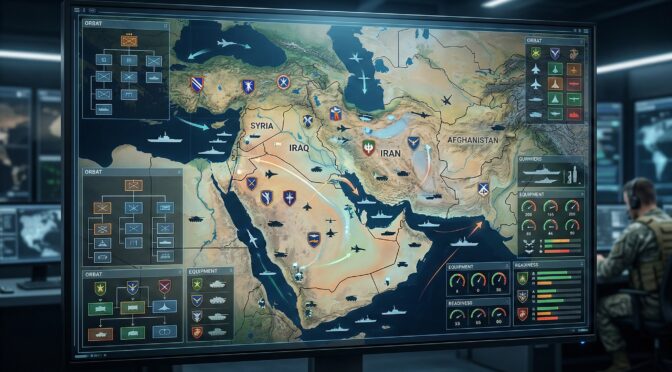
The strategic environment within the United States Central Command (CENTCOM) Area of Responsibility (AOR) has undergone a fundamental and violent transformation following the initiation of Operation Epic Fury on February 28, 2026. Executed in tight operational synchronization with Israeli forces operating under the parallel designation of Operation Roaring Lion, this campaign represents the largest and most dense concentration of American military firepower assembled in the Middle East since the 2003 invasion of Iraq.1 The rapid transition from a posture of coercive diplomacy and deterrence to one of active, high-intensity major combat operations has mobilized a vast, multi-domain array of naval, aerospace, and cyber assets. The primary strategic objective is the systematic dismantling of the Iranian regime’s security apparatus, prioritizing the neutralization of the Islamic Revolutionary Guard Corps (IRGC) command structures, integrated air defense systems, and ballistic missile production facilities, culminating in unprecedented leadership decapitation strikes.4
The current United States Order of Battle (ORBAT) is anchored by a formidable dual-carrier maritime presence. This naval architecture spans the Arabian Sea and the Eastern Mediterranean, establishing overlapping, multi-axis zones of air superiority and long-range conventional strike capability.7 This maritime power projection is augmented by an unprecedented “aerial tsunami” of forward-deployed land-based aviation.8 Fifth-generation stealth fighters, heavy strategic bombers, and specialized electronic warfare platforms have surged into partner nations, notably Israel and Jordan, overcoming significant diplomatic friction and airspace access denials from several Gulf Cooperation Council (GCC) states fearful of Iranian reprisal.1
Furthermore, the operational integration of artificial intelligence into the targeting kill chain marks a watershed moment in automated, algorithmic warfare. Utilizing advanced ontological models to synthesize vast intelligence data streams, the coalition has directed low-cost uncrewed combat attack systems (LUCAS) alongside traditional precision-guided munitions, radically compressing the sensor-to-shooter timeline.10
However, this rapid kinetic escalation has triggered a severe attritional crisis within the coalition’s Air and Missile Defense (AMD) architecture. Iranian retaliatory barrages,employing a “Mosaic Defense” doctrine consisting of synchronized ballistic missiles, cruise missiles, and one-way attack drones,have stressed regional defense magazines to critical breaking points.13 This has exposed acute vulnerabilities in interceptor replenishment cycles, forcing strategic rationing of defensive fires across the theater.14 Concurrently, the kinetic expansion into maritime chokepoints has effectively closed the Strait of Hormuz to commercial transit, generating cascading disruptions across global energy markets and logistics supply chains.15 This intelligence estimate provides an exhaustive, granular mapping of the verified United States force posture, asset locations, logistical vulnerabilities, and operational integration as of early March 2026.
1.0 Strategic Context and the Operational Environment
The operational environment is currently defined by continuous, high-intensity, multi-domain combat operations encompassing the Persian Gulf, the Gulf of Oman, the Levant, and the Eastern Mediterranean. Following the collapse of nuclear negotiations in Geneva in mid-February 2026, the United States executed a rapid, massive surge of military assets to the region, culminating in the launch of Operation Epic Fury.1 The stated objective of this campaign extends far beyond punitive counter-proliferation strikes,such as those witnessed during the June 2025 Operation Midnight Hammer,aiming instead for the systemic degradation of the Iranian state’s ability to project power and maintain internal security.18
The opening salvos of the campaign were characterized by deep-penetrating strikes against hardened facilities and complex leadership decapitation operations. These strikes successfully targeted supreme leadership, including Ayatollah Ali Khamenei, alongside senior IRGC commanders such as Major General Mohammad Pakpour and Defense Minister Brigadier General Aziz Nasir Zadeh.5 The geographical disposition of United States naval and air assets establishes overlapping zones of strike capability. By positioning forces in the Eastern Mediterranean, the Arabian Sea, and allied airbases in the Levant, coalition planners have created a multi-directional strike geometry that effectively stretches Iranian early warning and air defense networks across multiple axes of advance.
1.1 The Weaponization of the Maritime Domain and the Hormuz Blockade
The immediate and most globally destabilizing consequence of this kinetic escalation has been the weaponization of the maritime domain. In response to the decapitation strikes, Iranian forces and their regional proxies have initiated a strict area-denial strategy in the Strait of Hormuz and the Gulf of Oman. This chokepoint is historically responsible for the daily transit of approximately twenty percent of the world’s petroleum liquids and a significant portion of global liquefied natural gas (LNG).15
The operationalization of this blockade was violently demonstrated by the kinetic strike against the Palau-flagged commercial tanker Skylight.17 Occurring approximately five nautical miles north of the Khasab Port off Oman’s Musandam peninsula, the strike caused a significant fire, injured four mariners, and necessitated an evacuation by Omani naval forces.17 Forensic analysis reveals a complex layer of “Shadow Fleet” operations; the Skylight had been designated by the U.S. Department of the Treasury’s Office of Foreign Assets Control (OFAC) just days prior, on February 25, 2026, for facilitating illicit Iranian petroleum sales.17 Iran’s decision to target its own logistical asset,justified by Tehran as a penalty for the vessel defying orders to halt transit,demonstrates a strategic willingness to transcend immediate economic logic in favor of enforcing a total, indiscriminate interdiction zone.17
Simultaneously, the Sultanate of Oman,traditionally the primary diplomatic mediator between Washington and Tehran,found its own infrastructure targeted. Duqm Port suffered drone strikes, marking the first kinetic involvement of Omani territory in the conflict.17 In response to this indiscriminate targeting, the commercial maritime system has effectively collapsed in the region. Major maritime logistics providers, including Maersk, MSC, Hapag-Lloyd, and CMA CGM, have halted all Gulf transits and suspended routing through the Suez Canal.24 Vessels currently operating in the Gulf have been instructed to seek designated safe shelter areas, resulting in hundreds of ships drifting or holding position in the Gulf of Oman, while war-risk maritime insurance premiums have spiked by fifty percent, with many providers issuing cancellation notices.15 This environment necessitates a robust, continuously operating U.S. naval and air umbrella to maintain localized sea control, defend expeditionary staging bases, and attempt to re-establish secure sea lines of communication (SLOCs).
2.0 Current Naval Order of Battle (ORBAT)
The foundation of the United States power projection in the CENTCOM theater relies on an immense concentration of naval surface and subsurface combatants. Operating under a refined doctrine of distributed lethality, the Navy has amassed roughly forty-one percent of its global ready-for-operations fleet in the Middle East and Eastern Mediterranean, comprising at least sixteen major surface warships alongside critical support vessels.21 This armada is engineered to deliver sustained, high-volume standoff precision fires while simultaneously providing an integrated air and missile defense umbrella over localized maritime transit routes and expeditionary forces.
2.1 Dual-Carrier Strike Group Operations
The centerpiece of the naval ORBAT is the rare and highly complex deployment of two supercarriers within striking distance of the Iranian landmass. This dual-carrier geometry allows for continuous, twenty-four-hour cyclic flight operations, mitigating the traditional limitations of carrier deck resetting, maintenance cycles, and pilot fatigue, thereby applying relentless, uninterrupted pressure on hostile air defenses.7
The USS Abraham Lincoln (CVN-72) Carrier Strike Group, designated CSG 3, is currently operating in the Arabian Sea.7 Having redeployed from the Indo-Pacific theater under expedited orders in late January 2026 to counter rising tensions, the Lincoln hosts Carrier Air Wing 9.1 This air wing provides a highly versatile, integrated mix of strike and electronic warfare capabilities, notably featuring squadrons of F-35C Lightning II stealth fighters, F/A-18E/F Super Hornets, EA-18G Growler electronic attack aircraft, and E-2D Hawkeye airborne early warning and control (AEW&C) platforms.1 The presence of the F-35C is a critical enabler for penetrating contested airspace, utilizing its low-observable characteristics and advanced sensor fusion to locate targets for follow-on strikes. Crucially, the EA-18Gs fulfill the essential suppression of enemy air defenses (SEAD) mission, utilizing their jamming pods to blind Iranian early warning radars and disrupt surface-to-air missile (SAM) targeting capabilities, paving the way for the Super Hornets to deliver their payloads. The strike group is heavily escorted by Arleigh Burke-class destroyers and Ticonderoga-class cruisers, providing a dense Aegis Combat System shield against inbound anti-ship cruise missiles (ASCMs) and unmanned aerial vehicles.1
Operating on the western axis is the USS Gerald R. Ford (CVN-78) Carrier Strike Group, designated CSG 12. Having been redirected from operations in the Caribbean and transiting the Strait of Gibraltar in late February, the Ford is currently moored near Souda Bay, Greece, in the Eastern Mediterranean.7 As the lead ship of her class, the Ford represents a generational leap in naval aviation capabilities. It utilizes Electromagnetic Aircraft Launch Systems (EMALS) and Advanced Arresting Gear (AAG) to achieve sortie generation rates significantly higher than legacy Nimitz-class vessels.28 The Ford brings an additional seventy-five plus tactical aircraft to the operational envelope.7 Its strategic position in the Mediterranean creates a highly complex targeting dilemma for Iranian defense planners. Strike packages originating from the Mediterranean force Iranian early warning networks to scan multiple, disparate vectors simultaneously, stretching their defensive resources thin and complicating their interception calculus.
2.2 Surface Combatants and Independent Deployers
The carrier strike groups are augmented by a flotilla of independent deployers heavily engaged in both offensive land-attack operations and defensive interception missions. The U.S. Navy has positioned a ring of guided-missile destroyers (DDGs) capable of launching massive salvos of Tomahawk Land Attack Missiles (TLAMs). Analysis indicates that if all thirteen destroyers currently in the theater move into optimal firing positions, they possess the combined vertical launch system (VLS) capacity to deliver between 150 and 250 Tomahawk missiles, forming the critical backbone of the initial decapitation and infrastructure strikes.21
Specific vessels actively participating in Operation Epic Fury have been identified through official disclosures and visual evidence. The USS Spruance (DDG-111) and the USS Thomas Hudner (DDG-116) have been confirmed launching TLAMs from undisclosed locations within the CENTCOM AOR during the opening hours of the campaign.3 Furthermore, the USS Delbert D. Black (DDG-119) has actively engaged in strike operations following its recent departure from a port visit in Israel.32 The USS John Finn (DDG-113) was previously reported gathering near the Iranian coast just prior to the commencement of hostilities, likely acting as a forward picket and strike node.1 Additionally, the USS Mahan (DDG-72) is currently operating as a primary escort for the Ford in the Mediterranean.7
These surface combatants are operating under extreme threat conditions. Iran has demonstrated its reach and intent by deploying anti-ship ballistic missiles and drone swarms targeting naval assets across the Gulf of Oman, the Persian Gulf, and the Red Sea.4 The Aegis-equipped destroyers are required to operate in a dual-mission profile: executing offensive TLAM strikes while simultaneously tracking and intercepting inbound asymmetric threats to protect themselves, the carriers, and the remaining commercial shipping in the area. The successful sinking of multiple Iranian naval vessels, including the confirmed destruction of an Iranian Jamaran-class corvette at a pier in Chah Bahar by U.S. forces, highlights the intensity of the maritime engagements.23
2.3 Subsurface Posture and Covert Strike Capacity
The subsurface ORBAT remains largely classified under strict Operational Security (OPSEC) protocols; however, the Pentagon has utilized strategic declassification of specific submarine movements to signal deterrence and bolster its visible strike capacity. An Ohio-class guided-missile submarine (SSGN), confirmed to be the USS Georgia (SSGN-729), was ordered by Secretary of Defense Lloyd Austin to accelerate its deployment to the region.37
These converted SSGNs represent the absolute apex of covert conventional strike capability. Originally designed to carry nuclear ballistic missiles, four Ohio-class boats were converted to carry up to 154 Tomahawk cruise missiles each, distributed across twenty-two multiple-all-up-round canisters.39 The deployment of an SSGN provides theater commanders with a massive, survivable magazine that can initiate high-volume precision strikes without revealing its launch vector or presence until the moment the missiles break the surface. This presents a severe, virtually undetectable threat to Iranian coastal and inland targets. The USS Georgia was recently observed transiting the Suez Canal, placing it within optimal, highly secure strike range in the Red Sea or the Arabian Sea.40
| Naval Domain Asset | Platform Class / Air Wing | Verified Location / Operating Area | Primary Operational Role |
| USS Abraham Lincoln (CVN-72) | Nimitz-Class Supercarrier | Arabian Sea | Force projection, carrier aviation strike (Carrier Air Wing 9); SEAD operations |
| USS Gerald R. Ford (CVN-78) | Ford-Class Supercarrier | Eastern Mediterranean (Souda Bay, Greece) | Force projection, rapid sortie generation via EMALS |
| USS Georgia (SSGN-729) | Ohio-Class SSGN | Location undisclosed but operating in the AOR (Recent Suez Transit) | Covert, high-volume Tomahawk strike delivery |
| USS Spruance (DDG-111) | Arleigh Burke-Class Destroyer | Location undisclosed but operating in the AOR | TLAM delivery, Aegis fleet defense |
| USS Thomas Hudner (DDG-116) | Arleigh Burke-Class Destroyer | Location undisclosed but operating in the AOR | TLAM delivery, Aegis fleet defense |
| USS Delbert D. Black (DDG-119) | Arleigh Burke-Class Destroyer | Location undisclosed but operating in the AOR | TLAM delivery, Aegis fleet defense |
| USS Mahan (DDG-72) | Arleigh Burke-Class Destroyer | Eastern Mediterranean | Escort operations and defense for CSG 12 |
| USS John Finn (DDG-113) | Arleigh Burke-Class Destroyer | Location undisclosed but operating in the AOR | Forward picket, strike capability |
3.0 Current Air Order of Battle (ORBAT)
The mobilization and forward deployment of land-based air power for Operation Epic Fury has been accurately described by defense analysts as an “aerial tsunami”.8 Over 330 United States military aircraft are currently positioned across the Middle East, representing a highly complex, diverse ecosystem of fifth-generation air dominance fighters, heavy strategic bombers, close air support platforms, and critical logistical and intelligence enablers.41
The strategic placement of these assets reflects a delicate and complex diplomatic negotiation. Several Gulf Cooperation Council (GCC) states, fearing immediate and devastating Iranian retaliation against their vulnerable energy infrastructure, have restricted U.S. access to their airspace and airbases for offensive strike missions.1 Consequently, the United States has been forced to heavily utilize, and rapidly expand, bases in the Levant,specifically in Israel and Jordan,to launch and sustain operations.1
3.1 Fifth-Generation Fighters and Multi-Role Strike Aircraft
The vanguard of the air campaign, responsible for dismantling the adversary’s anti-access/area denial (A2/AD) capabilities, relies on low-observable, fifth-generation platforms capable of surviving deep inside the engagement envelopes of advanced integrated air defense systems. A squadron of at least eleven F-22 Raptors has deployed to Ovda Air Base in the southern Negev Desert of Israel.1
The F-22s, redeployed from RAF Lakenheath in the United Kingdom, provide unparalleled air superiority.43 They are tasked with the critical offensive counter-air mission: clearing the skies of hostile aircraft and neutralizing early warning radars to open secure corridors for follow-on, non-stealthy strike packages. The choice of Ovda Air Base is highly strategic; located far from civilian population centers in the south, it has a history of hosting aggressor squadrons and is heavily defended by Israel’s Arrow anti-ballistic missile systems, providing a secure sanctuary for these high-value assets.43 The unprecedented basing of America’s premier air-dominance fighter directly in Israel underscores the depth of the joint operation and circumvents the severe basing restrictions encountered elsewhere in the region.9 (It is noted that twelve F-22s initially departed the UK, but one airframe returned due to a technical anomaly, leaving eleven on station).42
Complementing the stealth fighter force is a massive deployment of F-15E Strike Eagles, universally recognized as the U.S. Air Force’s premier deep-interdiction and all-weather strike platform. Upward of twenty-four to thirty-six F-15Es, drawing from units including the 494th Expeditionary Fighter Squadron, the 391st Fighter Squadron, and a squadron from Seymour Johnson AFB, are heavily concentrated at Muwaffaq Salti Air Base in Jordan.7 These dual-role fighters possess the exceptional range and heavy payload capacity necessary to deliver precision bunker-busting munitions deep into Iranian territory.
Jordan’s Muwaffaq Salti Air Base has rapidly evolved into the Pentagon’s most critical deployment hub for this conflict. Recent satellite imagery confirms it is hosting not only the F-15Es but also A-10C Thunderbolt II attack aircraft,utilized for close air support, forward air control, and potentially maritime interdiction against Iranian fast attack craft swarms,alongside multi-role F-16C/CM/CJ Fighting Falcons.8 An element of F-35A Lightning II aircraft is also confirmed to be operating from Muwaffaq Salti, bringing the total fifth-generation presence in Jordan to an estimated thirty airframes.48 To secure strategic logistical nodes located outside the immediate high-threat zone, additional F-16s have been forward-deployed to the remote Indian Ocean outpost of Diego Garcia, defending the facility against potential long-range Iranian drone or cruise missile attacks.49
3.2 Strategic Bomber Task Forces
To engage deeply buried, heavily fortified, or geographically dispersed targets,specifically Iran’s ballistic missile production infrastructure, hardened command bunkers, and nuclear program remnants,the United States has activated its strategic bomber fleet. B-2 Spirit stealth bombers, operating directly from bases in the continental United States (CONUS), have conducted ultra-long-range, unacknowledged penetrations into highly contested Iranian airspace. Official releases from CENTCOM confirm the B-2s were utilized to strike hardened ballistic missile facilities overnight during the opening phases of the campaign. The strikes employed 2,000-pound precision-guided munitions, highly likely to be the GBU-31(V)3 Joint Direct Attack Munitions (JDAM) equipped with BLU-109 penetrator warheads, designed specifically to destroy subterranean infrastructure.4
Operating in tandem with the stealth fleet, B-1B Lancer supersonic heavy bombers have also been actively employed in the theater. Launching from Ellsworth Air Force Base in South Dakota, the B-1Bs executed nighttime, low-altitude penetration missions, dropping massive conventional payloads on ground-based ballistic missile bases and command and control facilities.51 The operational use of the non-stealthy B-1B,which relies on speed, low-altitude terrain masking, and electronic countermeasures rather than radar cross-section reduction,strongly indicates that initial SEAD operations by EA-18Gs and cyber units successfully degraded the Iranian radar network. This suppression created permissive environments, allowing conventional heavy bombers to operate with relative impunity and deliver massive volumes of ordnance.51
3.3 Tactical Unmanned Systems: Task Force Scorpion Strike
A significant and highly innovative evolution in United States tactical doctrine observed during Operation Epic Fury is the operational debut of Task Force Scorpion Strike (TFSS). Established in December 2025 and operating from an undisclosed location within the CENTCOM AOR, TFSS is the military’s first operational squadron dedicated exclusively to the deployment of one-way attack drones (loitering munitions).52 The unit operates the Low-cost Uncrewed Combat Attack System (LUCAS), designed and manufactured by Spektreworks, based in Phoenix, Arizona.52
The LUCAS platform represents a calculated strategic asymmetry and a direct adaptation of adversary tactics. The drones are effectively reverse-engineered, American-manufactured variants of Iran’s own highly successful Shahed-136 loitering munitions, which have seen extensive use by Russia in the Ukrainian theater.3 Costing approximately thirty-five thousand dollars per unit, the LUCAS drones are dramatically cheaper than traditional standoff weapons like the 1.3 million dollar Tomahawk cruise missile. This low cost point enables high-volume swarm attacks.12
Deployed for the first time in combat during the opening hours of Operation Epic Fury, the LUCAS drones are utilized to overwhelm Iranian point defenses, strike soft targets such as radar arrays and exposed missile erector launchers, and critically exhaust enemy interceptor inventories. By employing a weapon system modeled on the adversary’s primary asymmetric tool, the U.S. military is effectively turning Iran’s own attritional doctrine against it, forcing Tehran to expend expensive surface-to-air missiles on expendable drones.20
3.4 Intelligence, Surveillance, Reconnaissance (ISR) and Critical Enablers
The entire kinetic architecture of Operation Epic Fury is entirely dependent on a vast, continuous constellation of support aircraft. The sheer scale and geographic breadth of the strike operations require massive aerial refueling capabilities to sustain the tempo. An estimated eighty-six KC-46 Pegasus and KC-135 Stratotanker aircraft are currently deployed to the theater. These vital assets are heavily concentrated at Prince Sultan Air Base in Saudi Arabia, which serves as a primary logistical hub, with additional tankers staging out of Ben Gurion Airport in Israel to support the Levant-based fighter wings.1 These tankers bridge the vast distances required for deep strikes, enabling the F-15Es and F-22s to loiter over target areas, and providing the critical gas required for the CONUS-based bombers to complete their global sorties.
High-altitude Intelligence, Surveillance, and Reconnaissance (ISR) is provided by MQ-9 Reaper drones operating primarily from Al Dhafra Air Base in the United Arab Emirates. These platforms have been visually confirmed circling over major Iranian cities, including Tehran and Shiraz, to provide real-time battle damage assessment, track mobile missile launchers, and provide laser designation for time-sensitive, high-value targets.3
Electronic intelligence, signals interception, and maritime patrol are conducted by specialized RC-135V Rivet Joint and P-8A Poseidon aircraft. Notably, to ensure platform survivability amid the threat of Iranian ballistic missile counter-strikes against regional bases, RC-135 operations have been relocated from the highly vulnerable Al Udeid Air Base in Qatar to the Greek island of Crete in the Mediterranean.56 Similarly, E-3 Sentry Airborne Warning and Control System (AWACS) aircraft and E-11A Battlefield Airborne Communications Node (BACN) platforms are deployed to provide the overarching command, control, and communications relay network required to synchronize the massive air armada.8
| Air Domain Asset | Unit / Squadron | Verified Location / Staging Base | Primary Operational Role |
| F-22 Raptor | Unspecified Squadron | Ovda Air Base, Israel | Stealth air superiority, offensive counter-air, radar neutralization |
| F-15E Strike Eagle | 494th EFS, 391st FS, Seymour Johnson unit | Muwaffaq Salti Air Base, Jordan | Deep strike, heavy precision interdiction, defensive counter-air |
| F-35A/C Lightning II | Unspecified | Muwaffaq Salti (A); CVN-72 (C) | Stealth multi-role strike, advanced sensor fusion |
| A-10C Thunderbolt II | Moody AFB unit | Muwaffaq Salti Air Base, Jordan | Close air support, forward air control, maritime interdiction |
| F-16C/CM/CJ | Aviano AB unit | Muwaffaq Salti, Jordan; Diego Garcia | Multi-role strike, base defense (Diego Garcia) |
| B-2 Spirit | Bomber Task Force | CONUS Origin | Stealth strategic bombardment, bunker-busting hardened targets |
| B-1B Lancer | Bomber Task Force (Ellsworth AFB) | CONUS Origin | High-payload conventional strategic strike, low-altitude penetration |
| LUCAS Drones | Task Force Scorpion Strike | Location undisclosed but operating in the AOR | Low-cost, high-volume one-way attack, air defense saturation |
| MQ-9 Reaper | 380th AEW | Al Dhafra Air Base, UAE | Persistent ISR, time-sensitive targeting, battle damage assessment |
| RC-135V Rivet Joint | Unspecified | Crete, Greece (Relocated from Qatar) | Signals intelligence, electronic reconnaissance |
| KC-135 / KC-46 | Multiple | Prince Sultan AB, Saudi Arabia; Ben Gurion, Israel | Aerial refueling, range extension for fighters and bombers |
| E-3 Sentry AWACS | Unspecified | Prince Sultan AB, Saudi Arabia | Airborne early warning, battle management, command and control |
4.0 Air and Missile Defense (AMD) Posture and the Interceptor Crisis
The rapid escalation of hostilities has subjected the coalition’s integrated air and missile defense networks to unprecedented and unsustainable levels of stress. Iranian military doctrine eschews traditional air-to-air combat in favor of a “Mosaic Defense” and attritional warfare. This strategy relies heavily on launching massive, coordinated swarms of ballistic missiles, land-attack cruise missiles, and Shahed-series unmanned aerial vehicles to oversaturate defending systems and overwhelm radar tracking capacities.13 In response, the United States has deployed a highly sophisticated, layered defensive architecture across its Gulf State partners, but this shield is currently facing a critical logistical breaking point.
4.1 Theater Defense Architecture
The terminal defense layer is anchored by Patriot Advanced Capability-3 (PAC-3) batteries, which are deployed extensively across Qatar, the United Arab Emirates, Kuwait, Jordan, and Saudi Arabia.59 These systems provide point defense, designed to intercept short and medium-range ballistic missiles and cruise missiles in their final phase of flight, protecting vital military installations and critical energy infrastructure. Upper-tier, wide-area defense is provided by Terminal High Altitude Area Defense (THAAD) batteries, which engage incoming threats at much higher altitudes and longer ranges, providing a first line of defense against intermediate-range ballistic missiles.59
Furthermore, the theater defense architecture is heavily integrated with the Aegis Ashore system situated in Eastern Europe. Originally conceptualized under the European Phased Adaptive Approach (EPAA) to protect NATO allies from Iranian missile proliferation, the Aegis Ashore site in Deveselu, Romania, and the recently completed and operationalized site in Redzikowo, Poland, are actively monitoring the exoatmospheric threat environment.61 Operating under NATO command at Ramstein Air Base, these installations utilize the AN/SPY-1 radar and SM-3 interceptors to provide critical early warning tracking data and engagement capability for intermediate-range ballistic missiles that might be launched toward European or Levantine targets.61
4.2 The Interceptor Depletion Crisis
Despite the immense technological sophistication of these systems, the mathematical reality of modern interceptor warfare strongly favors the attacker. Current U.S. military doctrine dictates the expenditure of two to three interceptors per inbound threat to ensure a high probability of kill and minimize the risk of “leakers” impacting critical infrastructure.14
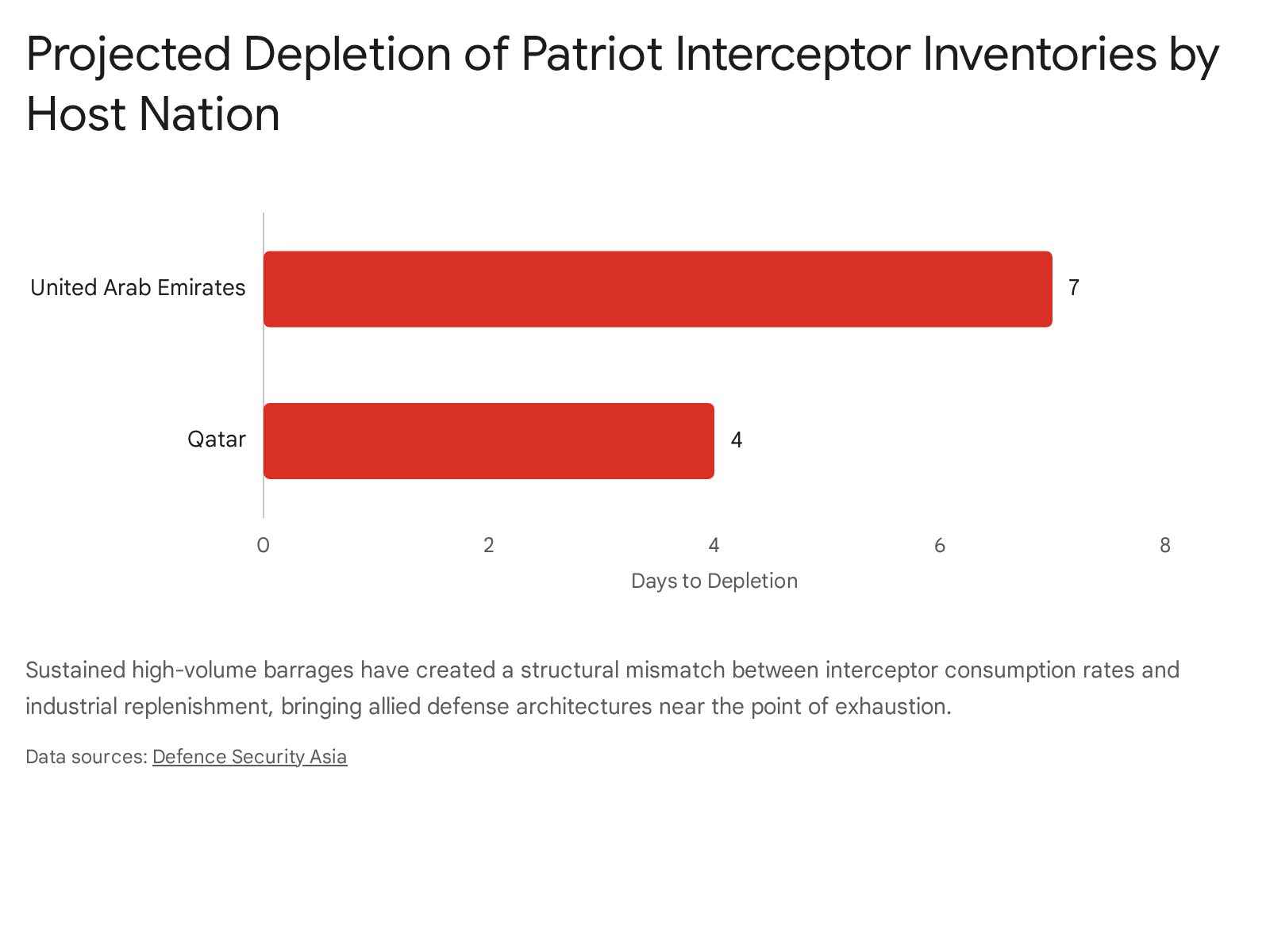
When Iran launches high-volume, coordinated barrages of relatively inexpensive munitions, coalition defensive inventories are drained at a massive multiplier effect. Analysts warn that interceptor stocks across the region are now “dangerously low,” representing a severe structural mismatch between the rate of consumption in active, daily combat and the peacetime capacity of the defense industrial base to replenish them.14 By early March 2026, intelligence assessments project a dire logistical reality: Qatar’s Patriot missile stocks will be entirely exhausted within four days of sustained operations, while the United Arab Emirates possesses only an estimated seven-day supply.14 The U.S. has reportedly admitted that “years of production” of these highly complex missiles have already been exhausted during the conflict.14
The financial asymmetry exacerbating this crisis is severe. A single THAAD interceptor costs approximately fifteen million dollars, and these multi-million dollar assets are frequently utilized to defeat Iranian drones or older ballistic missiles that cost a fraction of that amount.14 This magazine exhaustion crisis is fundamentally altering tactical decision-making; CENTCOM commanders are being forced to ration defensive engagements. They must prioritize the protection of strategic oil infrastructure and major expeditionary airbases, while leaving secondary civilian or military targets exposed, creating visible gaps in the regional defense umbrella that Iranian forces are actively trained to exploit.14
The strategic implications of this shortage are profound. The crisis is prompting Pentagon planners to consider the unprecedented and highly risky step of redeploying Patriot and THAAD batteries,as well as MQ-9 Reaper drones,from permanent bases in South Korea to the Middle East.64 Such a move, while necessary to sustain the defense of Gulf allies, would dangerously expose the Korean Peninsula and U.S. Forces Korea (USFK) to North Korean ballistic missile threats, demonstrating the global ripple effects of a sustained Middle Eastern conflict.64
| Air & Missile Defense Asset | Verified Location | Primary Operational Role | System Status / Notes |
| Patriot PAC-3 Batteries | Qatar, UAE, Kuwait, Jordan, Saudi Arabia | Terminal point defense (Short/Medium Range) | Critical depletion; rationing of engagements required |
| THAAD Batteries | Qatar, UAE, Kuwait, Jordan, Saudi Arabia | Upper-tier wide-area defense | Severe interceptor shortage; unsustainable cost-exchange ratio |
| Aegis Ashore | Deveselu, Romania; Redzikowo, Poland | Exoatmospheric tracking and interception | Fully operational; providing vital theater-level early warning |
5.0 Assets in Transit and Reinforcements
Recognizing the potential for a protracted conflict characterized by high attrition rates, and the absolute necessity of sustaining cyclic carrier operations and ground security, the Department of Defense has initiated a surge of reinforcements toward the CENTCOM theater. The sheer volume of munitions expended requires constant logistical resupply, and the potential for asset degradation demands rotational replacements.
In the naval domain, the USS George H.W. Bush (CVN-77) Carrier Strike Group is actively spinning up for emergency deployment. Currently completing expedited Composite Training Unit Exercises (COMPTUEX) off the coast of Virginia in the Atlantic Ocean, the Bush could receive orders to deploy immediately.1 However, even with an expedited departure, transit across the Atlantic Ocean and through the Mediterranean Sea (or around the Cape of Good Hope if Suez transit is deemed too high-risk) would require several weeks before the carrier could arrive on station.67 The arrival of a third supercarrier would provide the necessary tactical airpower to sustain offensive operations if the conflict protracts, or allow for the safe rotation of the USS Abraham Lincoln out of the high-threat environment.
Ground force reinforcements are also mobilizing to secure staging areas and logistical hubs. While the administration maintains there are no American conventional combat troops operating on the ground inside Iranian territory 60, force protection and base security requirements in allied nations have necessitated fresh troop deployments. The Department of the Army has announced the deployment of the 2nd Mobile Brigade Combat Team, 10th Mountain Division, to the CENTCOM AOR.68 This newly reorganized unit, a product of the Army’s “Transform in Contact” initiative, is specifically designed for rapid mobility and reduced electromagnetic signature, making it highly survivable in environments saturated by enemy drone surveillance and indirect fire.70 They will replace elements of the National Guard (specifically the 34th Infantry Division), joining other rotational units such as the 101st Airborne Division, which is currently managing the return of its Combat Aviation Brigade after a lengthy deployment supporting Operation Inherent Resolve.69
6.0 Operational Capabilities & Integration: The AI-Driven Kill Chain
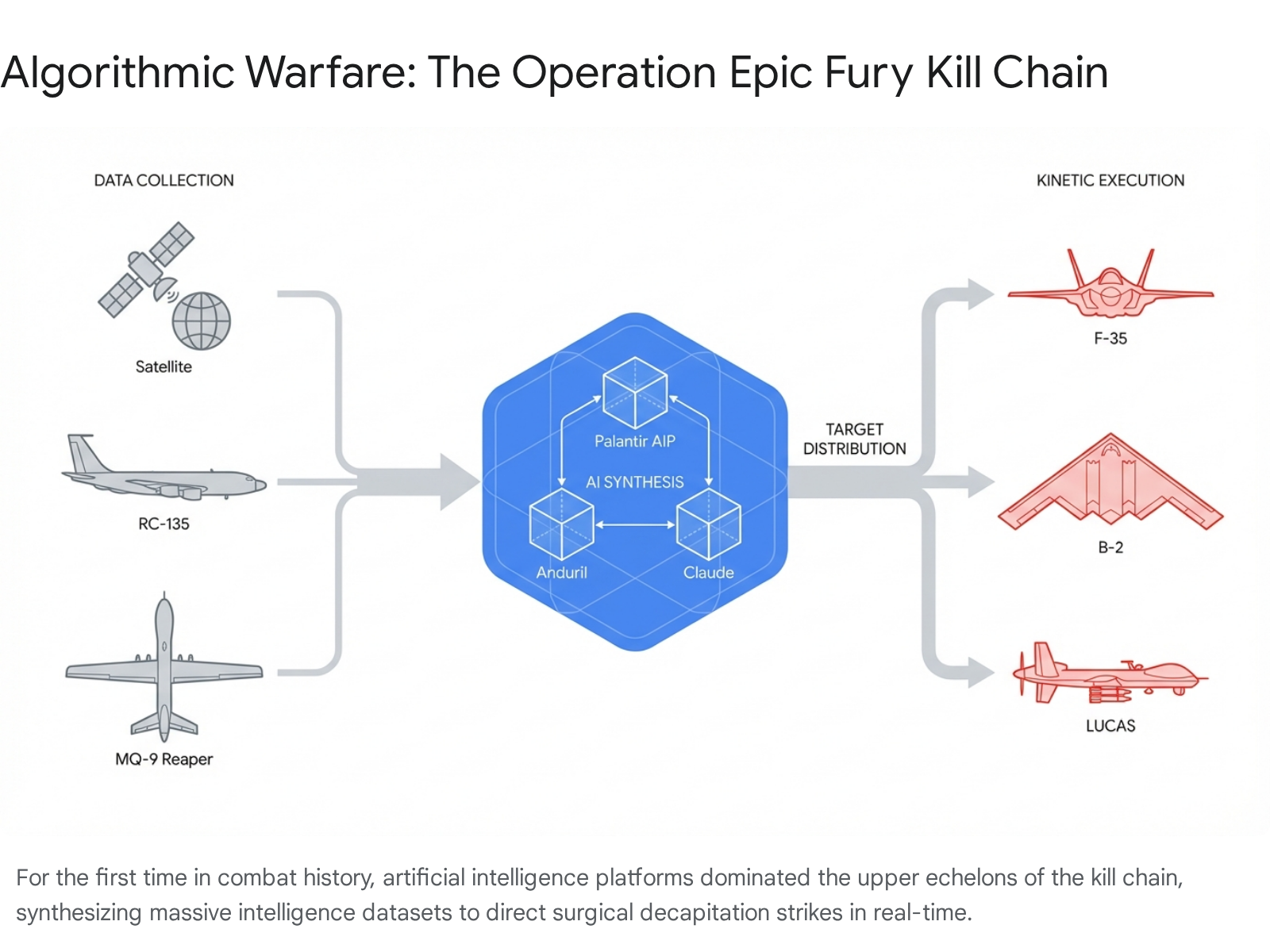
Operation Epic Fury is not merely a display of overwhelming kinetic force; it represents a fundamental paradigm shift in the application of artificial intelligence and algorithmic decision-making in modern warfare. The operational capability of the United States forces relies on a highly integrated, multi-domain kill chain that has drastically compressed the time between target acquisition and payload delivery. For the first time in human history, an artificial intelligence network fully dominated the upper echelons of the kill chain in a high-level decapitation strike.10
6.1 Suppression of Enemy Air Defenses (SEAD) and Cyber Operations
The initial phase of the operation focused on the total suppression of Iranian integrated air defense systems, specifically targeting the advanced, Russian-supplied S-300 and S-400 surface-to-air missile networks. Before physical munitions were dropped, United States Cyber Command (CYBERCOM) executed highly sophisticated digital disruptions against the Iranian air defense grid. These cyber strikes were designed to blind early warning radars, sever command-and-control datalinks, and inject false telemetry into the Iranian system.73
This invisible cyber offensive was instantly followed by aggressive electronic attack aircraft operations. EA-18G Growlers launched from the USS Abraham Lincoln flooded the remaining electromagnetic spectrum with jamming signals, effectively neutralizing any radars that survived the cyber-attack.2 This synchronized cyber-electronic warfare effort created a temporary permissive environment, allowing the physical strike packages to cross into Iranian airspace undetected.
6.2 The Algorithmic Targeting Network
Once the air defense network was degraded, the target acquisition phase was managed by an unprecedented global surveillance and strike network. Intelligence gathering transitioned from manual human analysis,which is often too slow to prosecute mobile targets,to an AI-driven “battlefield brain.” Systems provided by defense technology firms Palantir and Anduril, integrated with advanced large language models like Claude, analyzed vast quantities of remote sensing data, satellite imagery, and intercepted communications in real-time.10
Palantir’s flagship product, Gotham 5, utilized its “ontology” mapping to break down historical data silos between various intelligence agencies. This system rapidly synthesized disparate data points to identify the precise, fleeting locations of high-value targets, including the subterranean command centers utilized by the IRGC and the Supreme Leader.11 The AI system did not merely display data; it actively generated targeting solutions based on probabilities of location and asset availability.
6.3 Kinetic Execution and Payload Delivery
This AI network effectively automated the upper echelons of the kill chain, distributing firing solutions to the most optimal, available platforms in the theater. For deep, hardened targets identified by the AI, the system directed B-2 stealth bombers to deliver heavy penetrator munitions (GBU-31(V)3).2 For time-sensitive, dynamic targets,such as mobile ballistic missile erector-launchers moving into firing positions,targeting data was instantly relayed via datalink to forward-deployed F-15E Strike Eagles and F-35s loitering in the theater, kept aloft by the massive organic tanking operations.4
Simultaneously, the network directed the LUCAS drone swarms of Task Force Scorpion Strike to prosecute soft targets and overwhelm any remaining point defenses. By integrating Tomahawk strikes from the sea, B-2 bombers from the air, and drone swarms directed by AI, the coalition created a chaotic, multi-vector, simultaneous assault that completely collapsed the Iranian defensive doctrine from within.10 This synthesis of cyber disruption, algorithmic targeting, and precision kinetic delivery represents the core operational capability enabling the rapid degradation of the Iranian state security apparatus.
7.0 Information Gaps and OPSEC Limitations
While open-source intelligence and official disclosures provide a comprehensive overview of the theater posture, several critical intelligence gaps remain due to strict Operational Security (OPSEC) measures enforced by the Department of Defense. The precise operating areas of independent naval deployers, specifically the Arleigh Burke-class destroyers and the Ohio-class SSGN, remain undisclosed to preserve their survivability against long-range anti-ship ballistic missiles. Furthermore, the specific munitions loadouts of the forward-deployed fighter squadrons, the exact number of fifth-generation fighters currently operational (accounting for routine maintenance and potential battle damage), and the true extent of the subterranean damage to Iranian nuclear facilities cannot be definitively verified via recent unclassified channels. Any subsequent strategic analysis must account for these deliberate ambiguities in the public record.
Please share the link on Facebook, Forums, with colleagues, etc. Your support is much appreciated and if you have any feedback, please email us in**@*********ps.com. If you’d like to request a report or order a reprint, please click here for the corresponding page to open in new tab.
Sources Used
- 2026 United States military buildup in the Middle East – Wikipedia, accessed March 3, 2026, https://en.wikipedia.org/wiki/2026_United_States_military_buildup_in_the_Middle_East
- Weapons of ‘Epic Fury’: Fighters, Missiles, and ‘Special Capabilities’, accessed March 3, 2026, https://www.airandspaceforces.com/weapons-of-epic-fury-fighters-missiles-and-special-capabilities/
- Operation Epic Fury: From B-2s to HIMARS, here’s how US is unleashing full war arsenal on Iran, accessed March 3, 2026, https://gulfnews.com/world/mena/operation-epic-fury-from-b-2s-to-himars-here-s-how-us-is-unleashing-full-war-arsenal-on-iran-1.500460573
- US targets Iran’s military command, missile sites, naval assets in first 48 hours of ‘Operation Epic Fury’: CENTCOM, accessed March 3, 2026, https://www.aa.com.tr/en/middle-east/us-targets-irans-military-command-missile-sites-naval-assets-in-first-48-hours-of-operation-epic-fury-centcom/3847478
- Iran Update Special Report: US and Israeli Strikes, February 28, 2026, accessed March 3, 2026, https://understandingwar.org/research/middle-east/iran-update-special-report-us-and-israeli-strikes-february-28-2026/
- 2026 Israeli–United States strikes on Iran – Wikipedia, accessed March 3, 2026, https://en.wikipedia.org/wiki/2026_Israeli%E2%80%93United_States_strikes_on_Iran
- Iran-US-Israel Escalation Dynamics – Nuclear Leverage, Military Buildup and Retaliatory Postures February 2026 – https://debuglies.com, accessed March 3, 2026, https://debuglies.com/2026/02/24/iran-us-israel-escalation-dynamics-nuclear-leverage-military-buildup-and-retaliatory-postures-february-2026/
- The military buildup map behind Trump’s Iran decision – Israel Hayom, accessed March 3, 2026, https://www.israelhayom.com/2026/02/27/the-military-buildup-map-behind-trumps-iran-decision/
- Chinese firm publishes photos of US F-22s at Israeli base | The Jerusalem Post, accessed March 3, 2026, https://www.jpost.com/israel-news/article-888153
- AI-Driven Operation Targets Iranian Leader, Sparks Ethical Debate, accessed March 3, 2026, https://www.kucoin.com/news/flash/ai-driven-operation-targets-iranian-leader-sparks-ethical-debate
- Unveiling the First AI-Led Decapitation Strike: How Did Claude and …, accessed March 3, 2026, https://news.futunn.com/en/post/69412646/unveiling-the-first-ai-led-decapitation-strike-how-did-claude
- US struck Iran with copies of its own drones, accessed March 3, 2026, https://www.theregister.com/2026/03/02/us_iran_clone_drones/
- US-Israeli campaign triggers Iranian counteroffensive targeting Gulf energy, critical infrastructure, accessed March 3, 2026, https://industrialcyber.co/industrial-cyber-attacks/us-israeli-campaign-triggers-iranian-counteroffensive-targeting-gulf-energy-critical-infrastructure/
- Interceptor Stocks ‘Dangerously Low’: US, Israel and Gulf States …, accessed March 3, 2026, https://defencesecurityasia.com/en/interceptor-stocks-dangerously-low-us-israel-gulf-iran-missile-barrage-2025/
- Strait of Hormuz Maritime Blockade and Its Economic Impact – SpecialEurasia, accessed March 3, 2026, https://www.specialeurasia.com/2026/03/02/blockade-hormuz-maritime-economy/
- March 2, 2026: Iran War Maritime Intelligence Daily – Windward, accessed March 3, 2026, https://windward.ai/blog/march-2-iran-war-maritime-intelligence-daily/
- THE HORMUZ CODEX: KINETIC ESCALATION, LEADERSHIP DECAPITATION AND MARITIME SYSTEMIC COLLAPSE, accessed March 3, 2026, https://debuglies.com/2026/03/02/the-hormuz-codex-kinetic-escalation-leadership-decapitation-and-maritime-systemic-collapse/
- Hegseth Says ‘Epic Fury’ Goals in Iran Are ‘Laser-Focused’, accessed March 3, 2026, https://www.war.gov/News/News-Stories/Article/Article/4418826/hegseth-says-epic-fury-goals-in-iran-are-laser-focused/
- Operation Epic Fury Takes Flight: Inside the Strike Strategy and What Comes Next, accessed March 3, 2026, https://sofrep.com/news/operation-epic-fury-begins-inside-the-strike-strategy-and-what-comes-next/
- U.S. Forces Launch Operation Epic Fury – DVIDS, accessed March 3, 2026, https://www.dvidshub.net/news/559169/us-forces-launch-operation-epic-fury
- U.S. Military in the Middle East: Numbers Behind Trump’s Threats …, accessed March 3, 2026, https://www.csis.org/analysis/us-military-middle-east-numbers-behind-trumps-threats-against-iran
- The US-Israel campaign in Iran – The International Institute for Strategic Studies, accessed March 3, 2026, https://www.iiss.org/online-analysis/online-analysis/2026/02/the-us-israel-campaign-in-iran/
- The First 36 Hours: Strait of Hormuz Becomes a War Zone, Tankers Hit, Shipping Giants Halt Gulf Transits, accessed March 3, 2026, https://gcaptain.com/the-first-36-hours-strait-of-hormuz-becomes-a-war-zone-tankers-hit-shipping-giants-halt-gulf-transits/
- Carriers divert ships after US and Israeli strikes on Iran, dashing Red Sea return hopes, accessed March 3, 2026, https://www.worldcargonews.com/news/2026/03/carriers-divert-ships-after-us-and-israeli-strikes-on-iran-dashing-red-sea-return-hopes/
- Shipping companies tell vessels to steer clear of Gulf | THE DAILY TRIBUNE | KINGDOM OF BAHRAIN – Newsofbahrain, accessed March 3, 2026, https://www.newsofbahrain.com/business/127688.html
- The Strait of Hormuz Crisis: Iran Conflict Impact on Oil and Markets, accessed March 3, 2026, https://www.middleeastbriefing.com/news/strait-of-hormuz-crisis-iran-conflic-energy-business/
- US military assembles largest force of warships, aircraft in Middle East in decades, accessed March 3, 2026, https://www.militarytimes.com/news/your-military/2026/02/26/us-military-assembles-largest-force-of-warships-aircraft-in-middle-east-in-decades/
- The U.S. Navy Just Deployed 3 Supercarriers in ‘Coordinated Strategy’ – 19FortyFive, accessed March 3, 2026, https://www.19fortyfive.com/2026/01/the-u-s-navy-just-deployed-3-supercarriers-in-coordinated-strategy/
- 2026 Iran conflict order of battle – Wikipedia, accessed March 3, 2026, https://en.wikipedia.org/wiki/2026_Iran_conflict_order_of_battle
- U.S. Naval Update Map: Feb. 26, 2026, accessed March 3, 2026, https://worldview.stratfor.com/article/us-naval-update-map-feb-26-2026
- USS Thomas Hudner supports Operation Epic Fury [Image 5 of 12], accessed March 3, 2026, https://www.dvidshub.net/image/9542637/uss-thomas-hudner-supports-operation-epic-fury
- U.S. Central Command (CENTCOM) Official Press Releases, accessed March 3, 2026, https://www.centcom.mil/MEDIA/PRESS-RELEASES/
- U.S. Forces Launch Operation Epic Fury, accessed March 3, 2026, https://www.centcom.mil/MEDIA/IMAGERY/igphoto/2003882156/
- USS Delbert D. Black (DDG 119) Fires a Tomahawk Land Attack Missile [Image 1 of 5] – DVIDS, accessed March 3, 2026, https://www.dvidshub.net/image/9543682/uss-delbert-d-black-ddg-119-fires-tomahawk-land-attack-missile
- Five Things to Know, March 2, 2026 | The American Legion, accessed March 3, 2026, https://www.legion.org/information-center/news/security/2026/march/five-things-to-know-march-2-2026
- USA/Israel-Iran clashes February/March 2026 : r/FighterJets – Reddit, accessed March 3, 2026, https://www.reddit.com/r/FighterJets/comments/1rh19vr/usaisraeliran_clashes_februarymarch_2026/
- US orders nuclear-powered submarine deployment to Middle East – MEO, accessed March 3, 2026, https://middle-east-online.com/node/786496
- US orders submarine to Middle East, carrier strike group to sail faster – Al Jazeera, accessed March 3, 2026, https://www.aljazeera.com/news/2024/8/12/us-orders-submarine-to-middle-east-carrier-strike-group-to-sail-faster
- Hamas Freaked: U.S. Navy ‘Unstealthed’ Ohio-Class ‘Missile Sub’ as a Dire Warning, accessed March 3, 2026, https://nationalinterest.org/blog/buzz/hamas-freaked-us-navy-unstealthed-ohio-class-missile-sub-dire-warning-207240
- US guided missile sub shows up in Suez Canal – Responsible Statecraft, accessed March 3, 2026, https://responsiblestatecraft.org/us-guided-missile-sub-shows-up-in-suez-canal/
- US ramps up deployments to CENTCOM despite ongoing talks with Iran – Anadolu Ajansı, accessed March 3, 2026, https://www.aa.com.tr/en/americas/us-ramps-up-deployments-to-centcom-despite-ongoing-talks-with-iran/3842362
- US build-up in Middle East grows as F-22s reach Israel and USS Ford deploys, accessed March 3, 2026, https://aerospaceglobalnews.com/news/us-f22-raptors-israel-ford-middle-east/
- First Ever U.S. F-22 Raptor Stealth Fighter Deployment in Israel Exposed in New Chinese Satellite Footage – Military Watch Magazine, accessed March 3, 2026, https://militarywatchmagazine.com/article/first-ever-us-f22-israel-exposed
- 11 U.S. Air Force F-22 Raptor Stealth Fighters Are Now Based in Iran’s Backyard, accessed March 3, 2026, https://www.19fortyfive.com/2026/02/11-u-s-air-force-f-22-raptor-stealth-fighters-are-now-based-in-irans-backyard/
- US Deploys F-22 Stealth Fighters To Israel – Grand Pinnacle Tribune, accessed March 3, 2026, https://evrimagaci.org/gpt/us-deploys-f22-stealth-fighters-to-israel-531716
- Why In The World Did The US Air Force Fly Some F-15s To The Middle East?, accessed March 3, 2026, https://simpleflying.com/why-usaf-transport-fly-f-15s-middle-east/
- Lakenheath F-15E Strike Eagles Deploy to the Middle East – The Aviationist, accessed March 3, 2026, https://theaviationist.com/2026/01/21/strike-eagles-deploy-to-the-middle-east/
- U.S. Deploys 24 F-15E, 30 F-35A and A-10 Jets to Jordan: Massive Airpower Buildup Near Iran Signals Escalation in Middle East Tensions, accessed March 3, 2026, https://defencesecurityasia.com/en/us-f35-f15e-a10-deployment-jordan-muwaffaq-salti-air-base-iran-tensions-2026/
- F-16s Arrive To Protect Diego Garcia, F-22s Forward Deploy To Israel – The War Zone, accessed March 3, 2026, https://www.twz.com/news-features/f-16s-arrive-to-protect-diego-garcia-f-22s-forward-deploy-to-israel
- B-2 Spirit Stealth Bombers Take Part in Night Strikes on Iran, accessed March 3, 2026, https://theaviationist.com/2026/03/01/b-2-spirit-night-strikes-on-iran/
- B-1 Bombers Strike Iran’s Missile Bases, Signaling U.S. Air Superiority, accessed March 3, 2026, https://www.chosun.com/english/world-en/2026/03/03/ELPSALJCKFACFPDCJGSPVZXQBI/
- US CENTCOM confirms first combat use of LUCAS drones, accessed March 3, 2026, https://www.airforce-technology.com/news/us-centcom-lucas-drone-iran/
- Centcom Launches Attack Drone Task Force in Middle East – Department of War, accessed March 3, 2026, https://www.war.gov/News/News-Stories/Article/Article/4347258/centcom-launches-attack-drone-task-force-in-middle-east/
- New US attack drones make first operational appearance, accessed March 3, 2026, https://www.jpost.com/defense-and-tech/article-888313
- After first combat appearance, LUCAS drones ‘remain ready’ for future Epic Fury strikes against Iran, accessed March 3, 2026, https://defensescoop.com/2026/03/02/lucas-drones-operation-epic-fury-iran-strikes/
- US military build up in the Middle East: What aircraft and ships have arrived so far?, accessed March 3, 2026, https://aerospaceglobalnews.com/news/us-military-build-up-middle-east-aircraft-ships/
- World: Iran strikes countries hosting US forces in Middle Ea – New Vision, accessed March 3, 2026, https://www.newvision.co.ug/category/world/iran-strikes-countries-hosting-us-forces-in-m-NV_228945_032026
- US Amasses More Airpower in Middle East with Dozens of Fighters, accessed March 3, 2026, https://www.airandspaceforces.com/us-amasses-more-airpower-middle-east-iran/
- US strengthening air, missile defenses across Middle East as part of preparation before striking Iran: Reports, accessed March 3, 2026, https://www.aa.com.tr/en/americas/us-strengthening-air-missile-defenses-across-middle-east-as-part-of-preparation-before-striking-iran-reports/3817305
- ‘Just Beginning’: Pentagon Officials Provide Latest Update on Iran Mission | Military.com, accessed March 3, 2026, https://www.military.com/daily-news/headlines/2026/03/02/just-beginning-endless-war-hegseth-defends-expanding-iran-combat.html
- Aegis Ashore – Missile Defense Advocacy Alliance, accessed March 3, 2026, https://www.missiledefenseadvocacy.org/defense-systems/aegis-ashore/
- NATO Assumes Command of Aegis Ashore Site in Poland, accessed March 3, 2026, https://shape.nato.int/news-archive/2024/nato-assumes-command-of-aegis-ashore-site-in-poland
- Aegis Ashore Poland Completes First Maintenance Availability – NAVSEA – Navy.mil, accessed March 3, 2026, https://www.navsea.navy.mil/Media/News/Article/3799399/aegis-ashore-poland-completes-first-maintenance-availability/
- U.S. Considers Relocating THAAD, Patriots to Middle East, accessed March 3, 2026, https://www.chosun.com/english/national-en/2026/03/03/OTCQNNDNORCHHG6Q5RB6YZ4NLA/
- U.S. to Relocate Air Defense Systems from South Korea to the Middle East – Jordan News, accessed March 3, 2026, https://www.jordannews.jo/Section-111/All/U-S-to-Relocate-Air-Defense-Systems-from-South-Korea-to-the-Middle-East-49313
- US may redeploy South Korea-based air defense assets if Iran campaign drags on, accessed March 3, 2026, https://www.turkiyetoday.com/region/us-may-redeploy-south-korea-based-air-defense-assets-if-iran-campaign-drags-on-3215500
- Second Carrier Strike Group Ordered To Spin-Up For Deployment To Middle East: Report, accessed March 3, 2026, https://www.twz.com/news-features/second-carrier-strike-group-ordered-to-spin-up-for-deployment-to-middle-east-report
- Army to deploy 10th Mountain Division brigade to CENTCOM – Military Times, accessed March 3, 2026, https://www.militarytimes.com/news/your-military/2026/02/04/army-to-deploy-10th-mountain-division-brigade-to-centcom/
- Army announces upcoming unit deployments | Article | The United States Army, accessed March 3, 2026, https://www.army.mil/article/290289/army_announces_upcoming_unit_deployments
- Soldiers with the 10th Mountain Division are headed back to the Middle East, accessed March 3, 2026, https://taskandpurpose.com/news/10th-mountain-deployment-2026/
- 101st Combat Aviation Brigade coming home from deployment to Middle East – ClarksvilleNow.com, accessed March 3, 2026, https://clarksvillenow.com/local/101st-combat-aviation-brigade-coming-home-from-deployment-to-middle-east/
- 101st Airborne Division Soldiers to Deploy to Middle East – Clarksville Online, accessed March 3, 2026, https://www.clarksvilleonline.com/2024/09/14/101st-airborne-division-soldiers-to-deploy-to-middle-east/
- Here’s how cyber could have been used to target Iran in Operation Epic Fury, accessed March 3, 2026, https://breakingdefense.com/2026/03/heres-how-cyber-could-have-been-used-to-target-iran-in-operation-epic-fury/
- Exclusive: US used cyber weapons to disrupt Iranian air defenses during 2025 strikes, accessed March 3, 2026, https://therecord.media/iran-nuclear-cyber-strikes-us
- US targets numerous Iranian military assets in first 24 hours of ‘Operation Epic Fury’: CENTCOM, accessed March 3, 2026, https://www.aa.com.tr/en/americas/us-targets-numerous-iranian-military-assets-in-first-24-hours-of-operation-epic-fury-centcom/3845723