1. Executive Summary
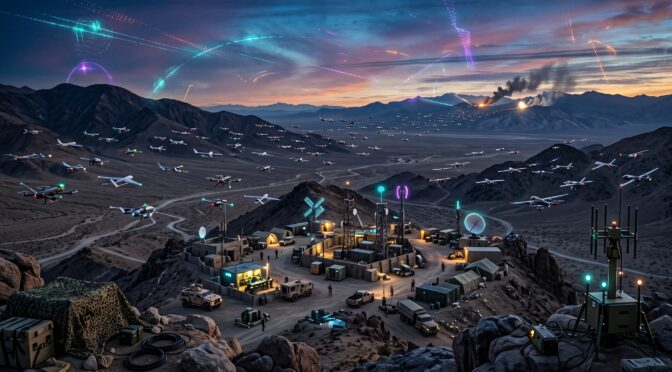
As the character of modern multidomain warfare undergoes a rapid paradigm shift toward the deployment of distributed, unmanned systems, the United States Department of War (DoW)—reorganized under the January 2026 Artificial Intelligence Strategy memorandum—is actively accelerating the procurement, development, and fielding of autonomous drone swarms. Central to this strategic military pivot is the “Swarm Forge” initiative. Designated as a “pace-setting” project by Secretary of War Pete Hegseth, Swarm Forge is spearheaded by the Chief Digital and Artificial Intelligence Office (CDAO) in coordination with the Office of the Secretary of War (OSW) and the Defense Innovation Unit (DIU).1 Designed to circumvent and compress the traditional defense acquisition cycle, the Swarm Forge initiative utilizes quarterly operational evaluations—known as “Crucibles”—to iteratively co-develop hardware, software, and multi-agent swarm tactics under highly realistic field conditions.1 The explicit programmatic goal is the delivery of validated swarm packages ready for transition to operational military units in 90 days or less.1
The upcoming Crucible 2 demonstration, scheduled to take place from June 22 to June 26, 2026, at the Camp Blanding Joint Training Center in Florida, serves as a critical inflection point for both the defense industrial base and joint force tactical doctrine.4 Featuring 25 down-selected commercial technology partners operating alongside elite operators from the U.S. Special Operations Command (USSOCOM), U.S. Army Special Operations Command, and the U.S. National Drone Association (USNDA), the event is designed to stress-test the absolute limits of current autonomous capabilities. However, the core challenge evaluated at the Crucible 2 demonstration extends far beyond metrics such as aerodynamic performance or battery endurance. The fundamental operational barrier being evaluated is the execution of coordinated, heterogeneous multi-agent missions in heavily contested electromagnetic (EM) environments.5
Historically, continuous command and control (C2) radio links have served as the backbone of unmanned aerial system (UAS) operations. However, data from contemporary conflicts demonstrates that these C2 links have emerged as critical vulnerabilities against near-peer adversaries.6 Adversaries equipped with advanced electronic warfare (EW) systems possess the capability to sever C2 data links through broadband noise generation, spoof Global Navigation Satellite Systems (GNSS) to induce navigational failure, and conduct lethal kinetic counter-battery strikes against drone operators by utilizing passive radio frequency (RF) direction-finding.7
Consequently, the integration of “edge autonomy” is no longer an optional secondary feature; it is a structural and architectural necessity.5 To survive and remain combat-effective, drone swarms must possess the onboard computational intelligence to navigate, coordinate, and execute independent kill chains—spanning the entire “Find, Fix, Finish” operational sequence—without requiring human micromanagement or continuous cloud-based connectivity.1 This requirement necessitates a heavy reliance on passive sensing architectures, specifically Visual Inertial Odometry (VIO) and semantic Simultaneous Localization and Mapping (SLAM), to maintain precise physical localization in completely GPS-denied environments.11 Furthermore, coordinating a decentralized swarm over a degraded communications network requires sophisticated machine learning (ML) software stacks that utilize gossip protocols and market-based auction algorithms, such as the Consensus-Based Bundle Algorithm (CBBA) and Harmony DTA, to achieve distributed consensus and task allocation.5
Operating within this highly autonomous regime directly intersects with the legal and ethical frameworks established by DoD Directive 3000.09, which governs the use of autonomous weapon systems.15 As advanced ML allows the software itself to function as the primary weapon system, the Swarm Forge Crucible demonstrations represent the essential testing ground for validating that decentralized edge AI can apply lethal force within strict legal, ethical, and operational guardrails, even when entirely disconnected from real-time human oversight.17
2. Strategic Context and the Swarm Forge Initiative
The traditional research, development, and acquisition methodologies of the United States military have historically prioritized the procurement of highly exquisite, technologically complex, and exceedingly expensive legacy platforms.1 These centralized platforms, while highly capable, require multi-year acquisition cycles and massive logistical tails, creating a “Post-Cold War Efficiency Trap” that prioritizes commercial outsourcing and minimizes redundancy.7 This methodology fundamentally fails to yield the deployable mass, rapid adaptability, and attritable resilience required for contemporary multidomain operations against near-peer adversaries, who are innovating and adapting at unprecedented speeds.1
In direct response to these institutional shortfalls and the evolving nature of global threats, Secretary of War Pete Hegseth mandated a series of AI-focused “pace-setting” projects, which led to the formal establishment of the Swarm Forge prototype project.2
2.1 Programmatic Structure and Objectives
Spearheaded by the CDAO under the Office of the Under Secretary of Defense for Research and Engineering (OUSD/RE), and operating in conjunction with the OSW Drone Dominance Program (DDP), Swarm Forge is structurally engineered as a continuous learning engine.1 Rather than relying on rigid, theoretical engineering specifications drafted years in advance, the program is anchored by dynamic, quarterly “Crucible” field experiments.1 These intensive events forcibly combine elite operators from across the joint force with leading commercial technology vendors. The objective is to co-develop tactics, techniques, and procedures (TTPs) concurrently with hardware and software iteration under realistic, highly stressful field conditions.1
The primary programmatic objective of the Swarm Forge initiative is the rapid discovery, validation, and fielding of heterogeneous, Group 1 (under 20 lbs) and Group 2 (21-55 lbs) UAS swarming capabilities functioning at Technology Readiness Level 6 (TRL 6) or higher.1
The initiative defines “heterogeneous swarming” with strict specificity: it does not merely mean flying different types of drones from the same manufacturer. Instead, it mandates the seamless command, control, and autonomy of UAS across multiple competing vendors.1 This requirement actively resists vendor lock-in, forcing the defense industrial base to adopt modular, open-architecture ecosystems. Participating vendors must demonstrate systems capable of operating non-deterministically in Denied, Degraded, Intermittent, or Limited (DDIL) communication environments, utilizing a minimum of four unmanned aerial systems simultaneously to achieve targeted tactical effects.1
2.2 The 90-Day Rapid Fielding Mandate
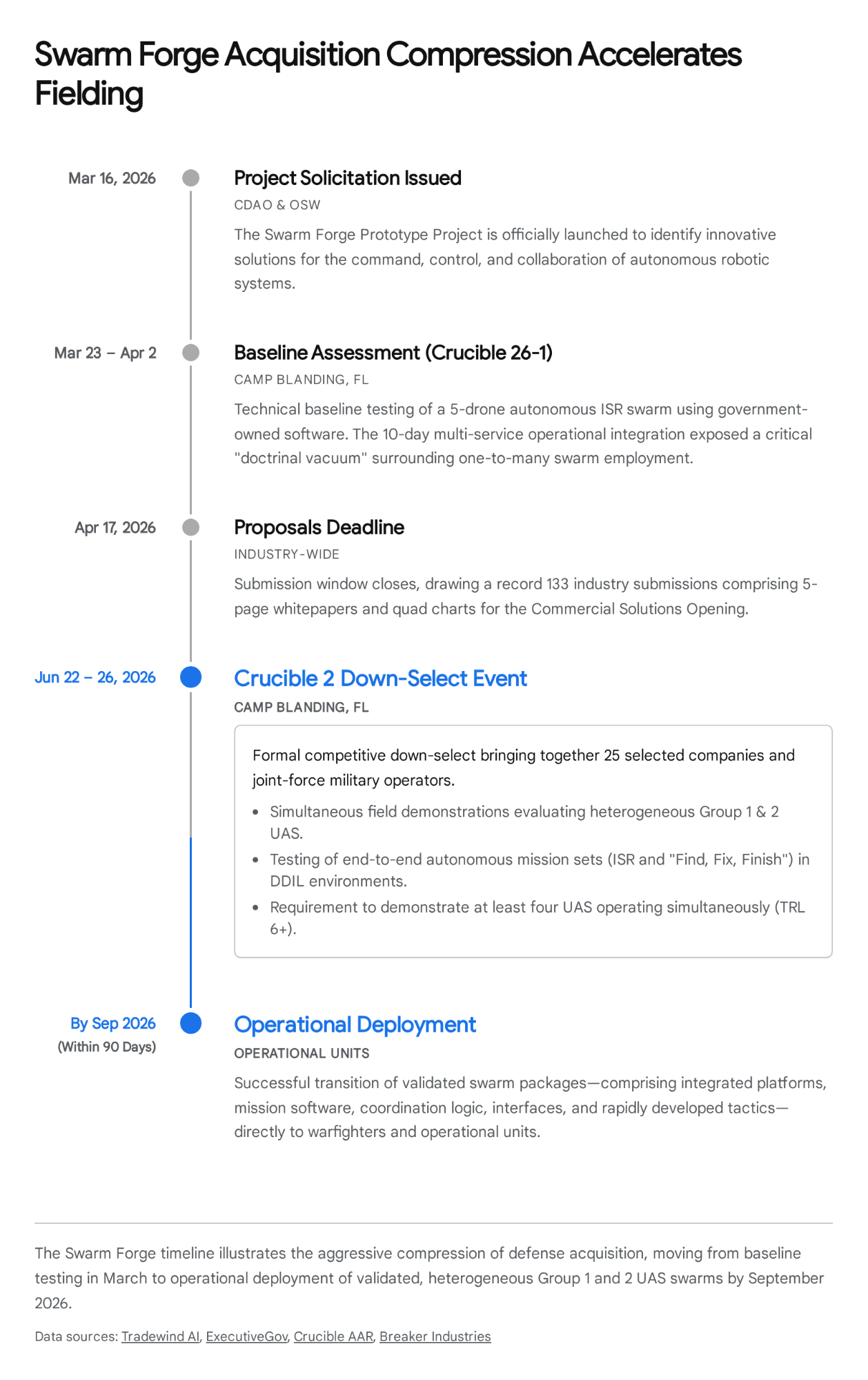
The most radical departure from standard defense acquisition protocols is the Swarm Forge fielding timeline. The initiative is legally and operationally structured through Other Transaction Authority (OTA) mechanisms to deliver validated swarm packages—comprising integrated platforms, mission-specific software, coordination logic, user interfaces, and newly developed tactics—ready for immediate transition to operational military units in 90 days or less following a successful Crucible evaluation.1
This extreme compression of the acquisition cycle serves as a deliberate signal to the defense industrial base: the DoW will no longer wait years for theoretical perfection.5 Software and hardware must be ready to scale immediately upon validation. Consequently, the operational speed required of both the government evaluators and the participating commercial vendors places unprecedented pressure on the underlying autonomous architectures to perform flawlessly out of the box.
3. Drone Crucible 26-1: Baseline Findings and the Doctrinal Vacuum
To accurately contextualize the operational requirements and stakes heading into the June 2026 Crucible 2 event, it is necessary to conduct a detailed analysis of the preceding baseline demonstration, Drone Crucible 26-1. Executed between March 23 and April 2, 2026, at the Camp Blanding Joint Training Center in Florida (Lat: 29.9741°N | Lon: 81.7781°W), this event served as the foundational stress test for the Swarm Forge framework.22
Crucible 26-1 was a multi-service, multi-stakeholder operational integration and experimentation event executed by the U.S. National Drone Association (USNDA) in coordination with the Department of War.22 The event involved a total of 77 elite joint-force operators, alongside government stakeholders and select industry partners.22 The specific military elements participating underscored the tactical importance of the event, including operators from Naval Special Warfare Group 1 (SEAL Teams 1, 5, 7) and Group 2 (SEAL Teams 4, 8), the United States Marine Corps (4th ANGLICO, 4th LAR, MARSOC), Army Special Operations (3/20th SFG), the Florida Air National Guard (125th FW EOD), and allied partners from the UK Royal Marines.22
3.1 The Six Operational Phases of Crucible 26-1
The 10-day event was structured as six sequential, rapidly escalating phases designed to push existing hardware and software to their operational limits.22
| Phase | Date Range (2026) | Primary Activities and Objectives | Key Outcomes and Observations |
| 1. Integration & DDP Industry Day | March 23 – 26 | Range familiarization; initial technology validation; DDP Industry Day featuring ~40 pre-selected vendors. | Established the technical baseline; initiated Swarm Forge baseline testing; aligned operators with acquisition stakeholders.22 |
| 2. TTP Co-Development | March 25 – 29 | Collaborative TTP development via free-play and structured scenarios (Close-Quarters Combat, night ops, QRF dynamics). | Stressed drone systems under degraded visibility; identified cross-service interoperability friction points.22 |
| 3. Counter-UAS & Kinetic | March 30 | Ballistic Counter-UAS engagements evaluating low-cost kinetic defenses (shotguns, 5.56mm) against live aerial targets. | Assessed accuracy and engagement envelopes; highlighted integration friction with current force protection frameworks.22 |
| 4. Air-Launched FPV Ops | April 1 | Deployment of FPV drones from a moving Florida Army National Guard UH-60L helicopter in a crawl-walk-run progression. | Validated Manned-Unmanned Teaming (MUM-T) viability at standoff distances (~5km); identified severe antenna alignment gaps.22 |
| 5. Joint Live-Fire Competition | March 31 – April 1 | Joint drone teams paired with 60mm mortars against unknown land targets; aerial drone strikes against moving maritime targets. | Demonstrated multi-domain targeting effectiveness; emphasized rapid target ID and coordination of aerial/indirect fires.22 |
| 6. Consolidation & AAR | April 2 | Synthesis of operator feedback; identification of high-impact capabilities for rapid acquisition; briefing to program leadership. | Proved that joint doctrine can be iteratively co-developed alongside hardware in real-time, compressing acquisition timelines.22 |
3.2 Critical Friction Points: C2 and the Doctrinal Vacuum
The After Action Review (AAR) for Drone Crucible 26-1 yielded critical strategic insights that directly shaped the requirements for Crucible 2. The most significant finding was that hardware capabilities—such as drone speed, payload capacity, or aerodynamic design—were not the primary limiting factors on the battlefield.22 Across all escalating phases, command-and-control (C2) and communications architecture emerged as the absolute primary operational bottleneck.22 Evaluators concluded that standardized, highly resilient C2 protocols must be established before multi-domain unmanned operations can effectively scale.22
Furthermore, while the Swarm Forge initiative successfully validated the technical baseline of a five-drone autonomous intelligence, surveillance, and reconnaissance (ISR) swarm utilizing the government-owned “Sky Breaker” software stack, the experiments highlighted a severe “doctrinal vacuum” surrounding “one-to-many” swarm employment.22 The U.S. military currently lacks the integrated doctrine, training pipelines, and operational concepts required to deploy massed, coordinated robotic systems under extreme combat stress.1
The success of Phase 4—launching FPV drones from a moving UH-60L helicopter at speeds up to 80 knots—proved that Manned-Unmanned Teaming (MUM-T) is operationally viable today.22 The limiting factors preventing immediate operational deployment are not technical, but rather the absence of standardized launch protocols, resilient antenna architectures, and integration doctrine.22
4. Crucible 2: The June 2026 Competitive Down-Select
Building directly upon the friction points exposed during the March baseline, Crucible 2 serves as the formal competitive down-select for the Swarm Forge Commercial Solutions Opening (CSO).22 Slated for June 22-26, 2026, at Camp Blanding, the event will pit 25 top technology companies head-to-head in simultaneous, complex demonstrations involving 25 or more drones at a time.4
The Crucible 2 solicitation drew a record 133 submissions from the defense industrial base, highlighting the intense commercial interest in the program.4 The 25 selected participants—which include prime contractors like Lockheed Martin and Palantir USG alongside specialized AI and autonomy firms such as Anduril Technologies, Shield AI, AeroVironment, and Breaker—will either perform live demonstrations or observe activities before being placed on rapid-fielding contracts.4
The evaluation parameters for Crucible 2 are uniquely stringent. Vendors must demonstrate their technology using a minimum of four UAS operating simultaneously.19 Crucially, these swarms must execute coordinated mission sets against simulated adversary defenses with human supervisors merely monitoring the systems, not micromanaging or piloting them directly.5 The event will serve as a structured stress test simulating highly contested environments where adversaries are actively attempting to jam, spoof, intercept, or commandeer the control links.5 The companies that successfully prove their AI architecture can survive and adapt in these simulated DDIL environments will transition their systems to operational units by September 2026.
5. The Contested Electromagnetic Spectrum: Vulnerabilities of Continuous C2 Links
The extreme operational parameters defining Crucible 2 are not theoretical; they are heavily influenced by tactical realities observed in contemporary conflicts. The Russo-Ukrainian war has fundamentally altered how unmanned systems must be employed.6 Today’s multidomain battlefield is thoroughly saturated with electronic warfare assets designed specifically to detect, degrade, and destroy unmanned operations. In this context, relying on continuous RF C2 links or unencrypted commercial satellite navigation is a fatal architectural flaw.
5.1 Spectrum Denial and Broadband RF Disruption
Near-peer adversaries operate highly layered, sophisticated EW complexes capable of denying broad swathes of the electromagnetic spectrum. Using the military innovations theory developed by Michael C. Horowitz and Shira Pindyck, analysts note that the Armed Forces of the Russian Federation (AFRF) have demonstrated a remarkable capacity to adapt their conduct of war by rapidly incubating and implementing new EW technologies to counter Western-supplied precision weapons and drones.20
Russian EW doctrine heavily emphasizes the deployment of high-powered, automated jamming systems at the tactical, brigade, and division levels to create impenetrable domes of electronic noise.9
| Russian EW System | Operational Frequency Range | Primary Targeted Signals | Strategic Purpose and Capabilities |
| R-330Zh Zhitel | 100 MHz – 2 GHz | GPS, Satcom (Iridium/Inmarsat), VHF/UHF tactical links | Deployed at the tactical level to protect command posts. Transmits continuous jamming signals at ~10 kW of power, effectively masking control telemetry and precision GPS guidance.9 |
| RB-310B Borisoglebsk-2 | 3 MHz – 3 GHz | Tactical communications, advanced drone control links | Provides deep, broad-spectrum electronic suppression across multiple echelons, severing data exchange between ground stations and UAS.10 |
| Repellent-1 | 200 MHz – 6 GHz | Micro-UAS and FPV control channels | A dedicated counter-UAS electronic attack system designed to disable small, commercial-off-the-shelf drone variants.10 |
| RB-341V Leer-3 | 935 MHz – 1.785 GHz | Cellular networks, specialized telemetry | Airborne electronic warfare system utilizing UAVs to project cellular disruption and localized jamming over wide areas.10 |
| 1RL257 Krasukha-4 | 8.5 – 10.7 GHz & 13.4 – 17.7 GHz | Airborne radar, low-earth orbit satellites | Strategic suppression of high-altitude ISR platforms and advanced precision-guided munitions.10 |
These systems are engineered to create true DDIL environments. When a conventional drone swarm enters a jammed sector, the high-power RF noise floor generated by systems like the Zhitel effectively drowns out the significantly weaker telemetry signals transmitted by distant human operators.26 For localized defense, systems like the vehicle-mounted SERP-FPV provide 360-degree jamming coverage targeting common FPV control frequencies, including civilian bands, forcing drones into fail-states.46
This vulnerability is not limited to drones; classified US Department of Defense documents leaked in early 2023 revealed significant concerns that Russian GPS jamming was causing highly sophisticated US-supplied munitions, such as the JDAM-ER (Joint Direct Attack Munition-Extended Range), to miss their targets.26 If a system relies on a continuous human-in-the-loop (HITL) control signal or continuous GPS fixes to function, the introduction of a broadband noise generator will cause the system to either execute a forced landing, attempt to return to a pre-programmed home location (which is often blocked or spoofed), fall uncontrollably from the sky, or fly off erratically.27
5.2 Kinetic Targeting and the Operator Survivability Problem
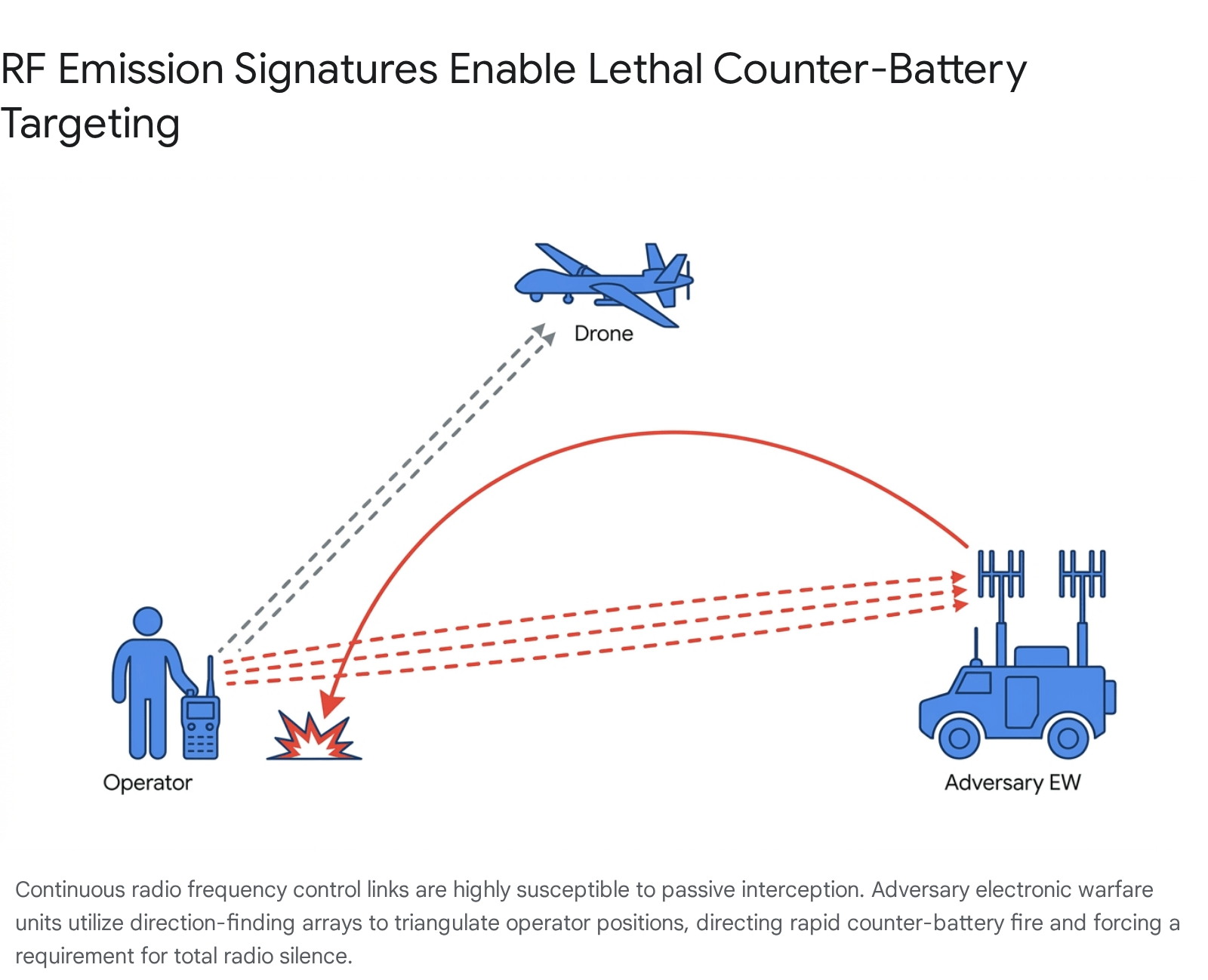
Beyond the tactical denial of control links and GPS, the emission of an RF signal actively and lethally endangers the human operator. Ground stations transmitting high-power telemetry to a drone swarm emit a clear, persistent electromagnetic signature. Using advanced direction-finding (DF) techniques, adversaries can passively acquire these C2 emissions with terrifying speed and precision.28
Modern EW systems utilize networks of Angle of Arrival (AoA) antennas or Time Difference of Arrival (TDoA) localization grids to rapidly triangulate the physical location of the drone operator.27 Systems utilizing TDoA can provide real-time geolocation of incoming C2 and telemetry signals, remaining completely resistant to GNSS spoofing because they operate entirely passively.28
Once the drone operator’s geographic coordinates are mathematically acquired, they are immediately passed via integrated command networks to artillery batteries or precision-strike assets to execute counter-battery fire. The brutal lessons learned from the front lines in Ukraine demonstrate that drone operators have become high-value targets; they are often vastly easier to locate and neutralize than the small, agile, attritable platforms they pilot.7 Drone strikes and counter-strikes account for up to 70 percent of casualties in certain sectors, highlighting the lethal reality of modern EW.29
5.3 The Insufficiency of Tactical Countermeasures
In response to the EW threat, militaries have engaged in rapid tactical iteration. Combatants frequently employ customized radio frequencies, rapid frequency-hopping protocols, and distributed relay networks to maintain FPV drone control.30 However, these measures offer only temporary reprieves and remain inherently vulnerable to brute-force broadband white-noise generators.31
For example, the Ukrainian military successfully deployed the Pokrova EW system in 2024 to intercept Russian attack drones. By generating overwhelming white noise across the 850-940 MHz radio frequency range—a highly common bandwidth for FPV drone control links—the system forces FPV drones to lose communication with their operators, causing them to deviate from their routes and crash.31 The efficacy of such systems is staggering; in just one week in July 2024, Ukrainian EW units forcibly neutralized 7,916 enemy UAVs across the frontline, equating to 82 drones neutralized per hour.32 This scale of attrition proves that attempting to maintain agile RF links in a saturated EM environment is mathematically and operationally unsustainable.
6. The Architectural Imperative of Edge Autonomy
The convergence of C2 signal disruption and lethal operator targeting dictates a new operational reality: continuous data links are a profound liability, not a feature. Consequently, the operational requirements surfaced by the Crucible 2 evaluation explicitly demand that distributed autonomous operation under extreme communications stress must be treated as a fundamental, foundational architecture problem, rather than a secondary software update or an operational afterthought.5
6.1 Node-Level Intelligence and SWaP-C Constraints
To survive a DDIL environment, “edge autonomy” must be fully realized. This means that all mission-essential decision-making capabilities—navigation, target identification, conflict resolution, and kinetic engagement—must reside directly on the computing hardware of the drone platform itself.5
Swarms can no longer rely on cloud-hosted mission planning, over-the-air machine learning model updates, or high-performance ground-station-resident AI processing.5 These models fail catastrophically the moment the communications link is severed. When the C2 link drops due to physical severing, terrain masking, or active EW jamming, the swarm must not lose coherence or degrade to manual fail-safes; it must seamlessly transition into a self-governing, independent entity capable of completing the mission.5
Implementing this level of sophisticated intelligence on Group 1 and Group 2 UAS is incredibly complex due to strict Size, Weight, Power, and Cost (SWaP-C) constraints.5 Because these platforms are classified as “attritable” (expendable in combat), they cannot house heavy, power-hungry server racks, liquid-cooled GPUs, or high-cost proprietary radar systems. The onboard edge AI must execute via advanced model compression techniques and quantized inference running on specialized, highly efficient low-power silicon architectures.5 Each individual node within the swarm must possess enough onboard computational intelligence to maintain its own situational awareness, interpret complex optical sensor data, identify contingencies mid-flight, and collaborate dynamically with adjacent nodes without requiring direction from a centralized compute resource.5
6.2 Open Architecture, Interoperability, and Supply Chain Security
The Swarm Forge prototype project strictly mandates that these highly advanced edge architectures comply with open architecture standards.5 To prevent the U.S. military from becoming technologically tethered to single-vendor proprietary ecosystems, the autonomy stack must expose standardized Application Programming Interfaces (APIs) utilizing established frameworks such as Open Mission Systems (OMS) and the Universal Command and Control Interface (UCI).5 This architectural mandate ensures that the swarm can be dynamically managed through a common, service-agnostic C2 infrastructure, allowing the rapid reconstitution of forces using multi-vendor components in the field.1
Furthermore, extending complex machine learning intelligence to the tactical edge exponentially expands the cyber attack surface. If an adversary cannot jam a drone, they will attempt to hack it or corrupt its neural network weights. Consequently, the Crucible evaluates the security and supply chain integrity of the edge compute firmware with extreme rigor. Vendors must demonstrate full compliance with the Cybersecurity Maturity Model Certification (CMMC) requirements and adhere strictly to the DoD’s Zero Trust Strategy 2.0 standards, which extend supply chain transparency requirements directly down to operational technology and embedded firmware.5
7. GPS-Denied Navigation: Visual Inertial Odometry and Passive Sensing
If an adversary successfully deploys a system like the R-330Zh Zhitel to simultaneously jam both the RF control link and the GNSS/GPS navigation signals, the drone swarm is rendered deaf and blind to the outside world. To execute a kill chain under these conditions, the swarm must rely entirely on internal, un-jammable sensing mechanisms to navigate terrain, avoid dynamic obstacles, and locate specific targets. The primary technological solution required for these environments is Visual Inertial Odometry (VIO).11
7.1 The Mechanics of Sensor Fusion at the Edge
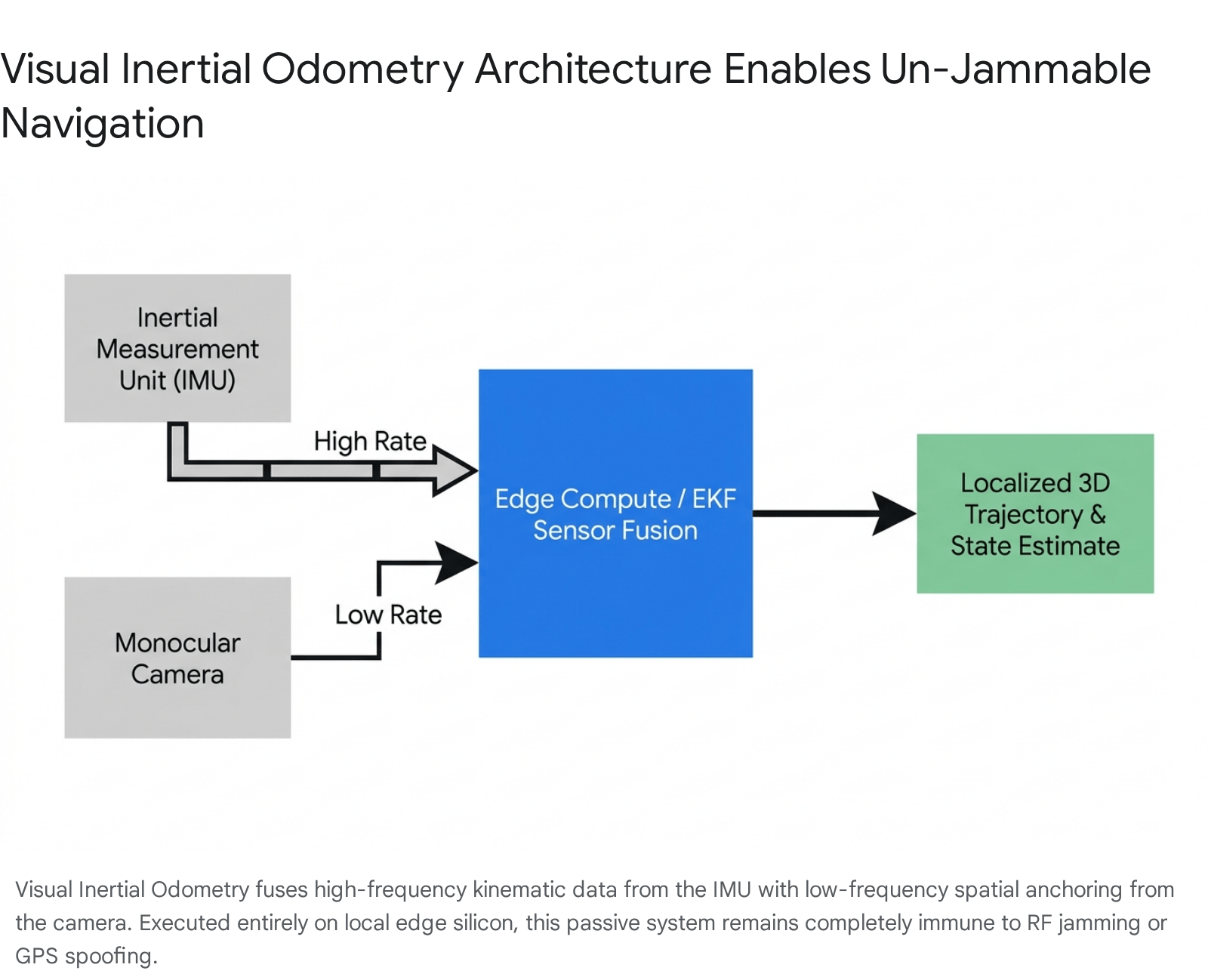
VIO is not a single sensor, but a highly complex mathematical fusion architecture that combines two distinct streams of data: optical inputs from an onboard monocular or stereo camera, and kinetic inputs from a standard Inertial Measurement Unit (IMU).11
- Inertial Data (The Vestibular System): The IMU contains sensitive accelerometers and gyroscopes that provide a very high-rate state prediction of the drone’s acceleration and rotation in three-dimensional space.11 This high-frequency data is crucial for maintaining flight stability during rapid, aggressive tactical maneuvers where camera images may suffer from motion blur.11 However, relying solely on an IMU for navigation is impossible due to the phenomenon of integration drift. Tiny, microscopic measurement errors inherent in the IMU’s sensors rapidly accumulate during the integration process, causing the system’s perceived location to drift exponentially away from reality over a matter of seconds.11
- Visual Data (The Optical System): To correct this catastrophic IMU drift, the onboard camera continuously extracts geometric features—such as edges, sharp corners, and distinct planes—from the physical environment across successive video frames.34 By applying algorithms like Principal Component Analysis (PCA) to extract and track how these fixed, rigid landmarks move across the camera’s field of view over time, the system can highly accurately estimate the drone’s ego-motion (its velocity and trajectory relative to the environment).35
In a tightly coupled Extended Kalman Filter (EKF) or within an optimization-based computational back-end, the visual data acts as an anchor. The camera essentially “anchors” the rapidly drifting IMU estimate to fixed physical landmarks in the real world.11 The resulting synthesis provides a highly accurate, continuous sense of 3D spatial positioning, scale, and gravity direction, achieving remarkable drift rates as low as 1% to 2% of total distance traveled, all without any reliance on satellites or external navigational beacons.11
7.2 The Strategic Security of Passive Sensing
The profound strategic advantage of VIO lies in its physical nature: it is entirely passive. The system merely receives ambient photons of light and feels the physical inertia of its own movement.11 Unlike active targeting radar or lidar systems, which emit highly detectable energy pulses, and unlike GPS or RF control links, which require external signal reception, VIO produces absolutely no electromagnetic emission signature and relies on no external frequencies.11
Consequently, there is no signal for an adversary to intercept, no frequency bandwidth to overwhelm with noise jamming, and no external link to sever.11 When VIO is coupled with Semantic Simultaneous Localization and Mapping (SLAM)—which allows the onboard AI to not only build a spatial map but computationally understand the semantic meaning of obstacles and targets within it—the resulting architecture creates unmanned systems that are fundamentally un-tethered and structurally un-jammable.37
8. Decentralized Swarm Coordination: Machine Learning Software Requirements
Once individual UAS platforms possess the edge intelligence to navigate and process their environment autonomously, the subsequent, exponentially more difficult requirement is swarm coordination. A collection of autonomous drones operating in the same airspace does not constitute a “swarm” unless the individual platforms exhibit emergent, collective behavior to achieve a unified tactical goal.5
In traditional military C2 structures, a central node—whether a human operator with a tablet or a high-powered ground-based command server—acts as the brain, assigning tasks, tracking drone health, and directing movement.5 However, in a DDIL environment where the central node is inaccessible due to EW jamming, and where communication between the drones themselves is severely spotty, delayed, or bandwidth-constrained, central coordination fails entirely.12 To survive and execute a coordinated kill chain, the swarm must utilize distributed consensus algorithms.5
8.1 Market-Based Task Allocation and the CBBA
The most prominent mathematical frameworks for achieving decentralized coordination are market-based auction algorithms, specifically the Consensus-Based Bundle Algorithm (CBBA).39 Rather than receiving top-down orders from a commander, individual drones within a swarm act as independent, rational agents participating in a localized digital economy. They “bid” on mission tasks based on their specific utility, status, and capabilities.14
The standard CBBA operates in two distinct, alternating phases to ensure conflict-free assignment:
- The Bidding Phase (Bundle Construction): Each drone independently assesses the list of available mission tasks (e.g., surveil grid alpha, strike target bravo, relay comms at point charlie). The drone calculates a numeric “bid” for each task based on a complex internal scoring scheme. This score factors in the drone’s current physical location, its payload type (kinetic vs. ISR), remaining battery life, and its existing task commitments.14 It then creates a “bundle” of desired tasks, attempting to mathematically maximize its own operational utility and efficiency.41
- The Consensus Phase (Conflict Resolution): Because multiple drones will inevitably bid on the same high-priority, high-value task, they must resolve conflicts without a central referee. The drones communicate their winning bid values and task bundles to their immediate, physically closest neighbors using local, limited communication channels. By continuously sharing and updating these lists across the network topology, the swarm rapidly reaches a mathematical consensus on which specific drone is optimally suited for which task.14 The algorithm guarantees a conflict-free assignment and mathematically converges on a solution with a guaranteed 50% optimality threshold.14
8.2 Advanced Implementations: Harmony DTA and TLC-CBBA
While the foundational CBBA is highly robust to variations in network topology, it requires significant communication overhead to repeatedly broadcast bidding lists to reach consensus. This overhead can be fatal under severe EW jamming where bandwidth is virtually nonexistent. To address this, recent advancements tested for modern swarm applications include refined algorithms like Harmony DTA and the Two-Level Clustered CBBA (TLC-CBBA).13
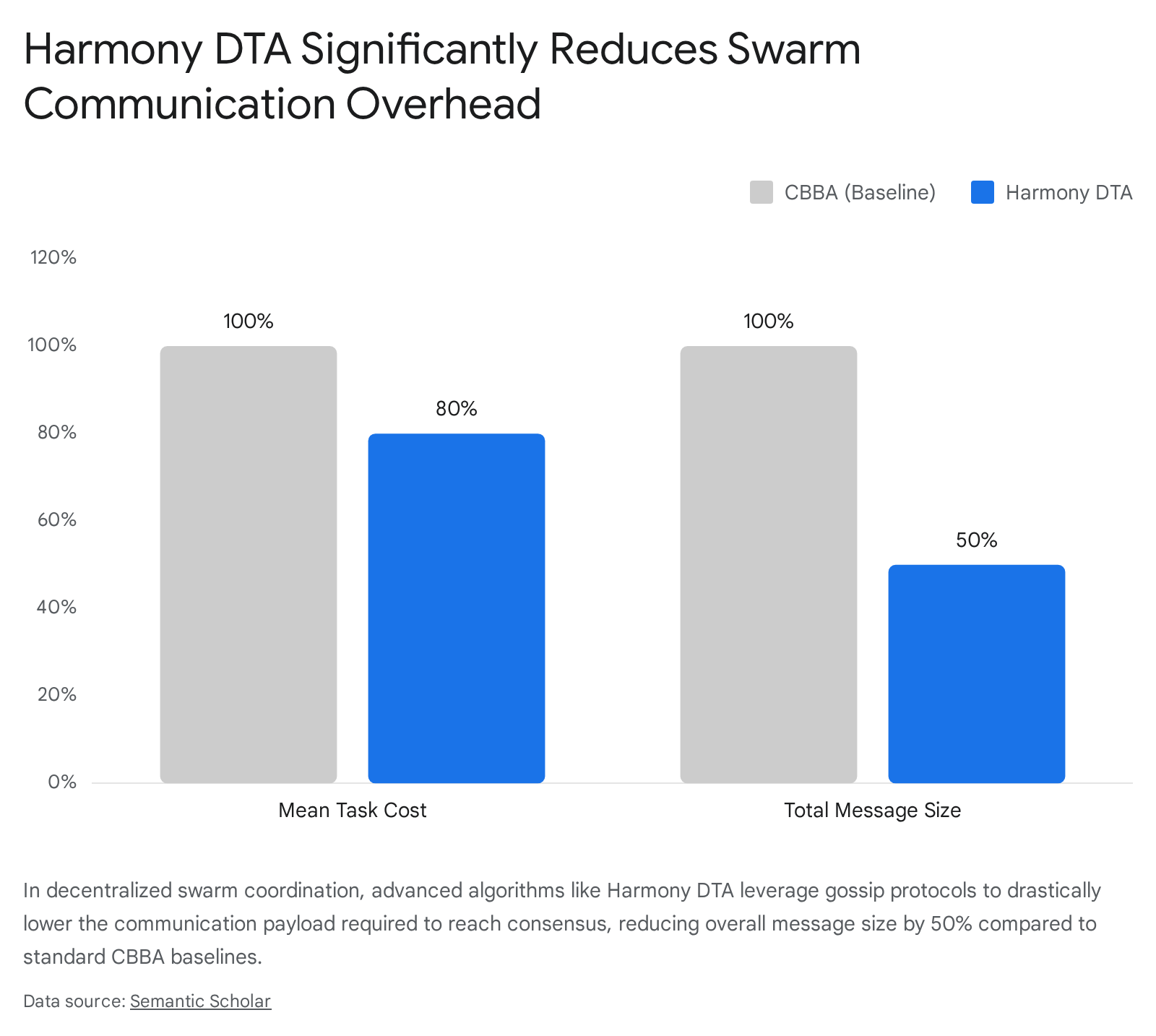
- Harmony DTA: This algorithm introduces an enhanced cost calculation function that prioritizes an equitable distribution of workload across the swarm, preventing specific agents from being overburdened and depleting their batteries prematurely.13 In standard Monte Carlo simulations, Harmony DTA achieved a 20% reduction in mean task cost and a massive 50% reduction in total message size compared to the standard CBBA.13 However, in situations where communication obstacles lead to dropped messages, the baseline Harmony DTA can exhibit inferior performance to CBBA due to conflicting assignments arising from the absence of a robust consensus phase.13 To rectify this in true DDIL environments, researchers must augment the two-stage auction process with a secondary gossip-based consensus protocol (epidemic routing).44 This allows nodes to synchronize states by randomly exchanging small data packets only with immediate neighbors, ensuring conflict-free assignments despite severe network degradation.45
- TLC-CBBA: For large-scale swarms operating over wide geographic areas, TLC-CBBA implements hierarchical clustering.42 The swarm dynamically divides itself into sub-clusters based on spatial compactness and resource balance. It conducts local consensus within the cluster first before sharing aggregated, compressed data globally, significantly reducing computational complexity and communication time across the macro-network.42
| Coordination Algorithm | Primary Mechanism | Key Advantages in DDIL Environments | Performance Impact vs. Baseline |
| Standard CBBA | Two-phase market auction (Bidding and Consensus) | Conflict-free allocation; highly robust to inconsistent situational awareness.41 | Guaranteed 50% optimality threshold.14 |
| Harmony DTA | Two-stage auction + Gossip protocol | Reduces overhead and ensures equitable workload, but requires secondary gossip protocols to prevent conflicts during packet loss.13 | 20% reduction in mean cost; 50% reduction in total message size under ideal conditions.13 |
| TLC-CBBA | Hierarchical clustering + Distributed bundle construction | Highly scalable for massive swarms; unifies clustering and conflict resolution into a single framework.42 | Faster solving speed for multi-UAV missions under constraint.42 |
8.3 Resiliency and Intelligent Replanning
The ultimate tactical value of these decentralized algorithms is the capacity for “Intelligent Replanning” in the face of kinetic attrition.12 In combat, drones will be shot down. If an adversary successfully destroys a node, the swarm registers this as a “liquidation event”—the immediate release of all tasks assigned to the destroyed drone.12
Because there is no central server to crash or confuse, the remaining drones automatically detect the node failure through the interruption of the gossip protocol.12 They instantly update the global system state and automatically trigger a reverse-auction protocol to dynamically redistribute the fallen drone’s tasks among the surviving agents. This process can leverage frameworks like the Intelligent Replanning Drone Swarm (IRDS) architecture, which utilizes a Reverse-Auction Market employing distance-weighted pricing. This mathematically minimizes the collective travel distance required to maintain sector coverage after a node failure.12 Empirical validation of these resilient architectures using physics-based simulations demonstrates the capacity to maintain mission success rates above 93% even following significant stochastic fault injections (massive workforce loss).12 This emergent, healing capability ensures the kill chain remains fully intact despite physical attrition and total EM isolation.
9. Independent Kill Chains and DoD Directive 3000.09
The seamless integration of Visual Inertial Odometry for passive navigation and the Consensus-Based Bundle Algorithm for decentralized task coordination yields a swarm capable of entirely autonomous, lethally armed operation. However, the application of lethal force by an autonomous system operating in a severed C2 environment introduces profound policy, legal, and ethical complexities. The Swarm Forge Crucible, by mandating autonomous completion of the “Find, Fix, Finish” sequence, inherently tests the boundaries of DoD Directive 3000.09, which establishes policy for the development and use of autonomous weapon systems.1
9.1 Redefining the Weapon System
Historically, DoD regulations and international law viewed the physical platform (the drone, the missile, the tank) as the weapon system. However, the accelerated integration of ML and edge AI is forcing a profound conceptual shift at the Pentagon. Advances in AI are redrawing what counts as a weapon; it is no longer just the effector (the loitering munition) that delivers force, but the AI-enabled kill chain itself.17 The software stack that fuses VIO sensor feeds, evaluates semantic maps, coordinates via CBBA, selects targets, and decides when to strike is now the actual weapon system.17
Directive 3000.09 functionally and legally defines a lethal autonomous weapon system as one that, once activated, can “select and engage targets without further intervention by an operator”.15 During the Crucible 2 demonstrations, swarms executing strike mission sets in DDIL environments will technically meet this definition.1 Because the control link is deliberately severed or jammed by simulated adversary EW, real-time human intervention prior to the kinetic strike is physically impossible.1
9.2 Human Oversight vs. Human Control
To remain legally compliant with international humanitarian law and the strict internal guidelines of the DoD, the AI architecture evaluated at Camp Blanding must correctly interpret the directive’s core mandate: systems must be designed to “allow commanders and operators to exercise appropriate levels of human judgment over the use of force”.15
In a disconnected, autonomous swarm, “appropriate levels of human judgment” cannot possibly mean real-time joystick control or a final push of a button. Instead, human judgment is shifted earlier in the temporal kill chain, embedded directly into the software’s parameters prior to launch.17 The human operator exercises judgment by defining the strict geographic bounding box (the kill box), dictating the specific semantic and visual signatures of the target (e.g., distinguishing between a T-90 tank and civilian infrastructure), and programming the precise rules of engagement into the swarm’s logic matrix.15
The Crucible serves to rigorously verify and validate (V&V) that the onboard edge AI adheres strictly to these pre-programmed boundaries in unpredictable environments.15 The swarm must physically demonstrate that it functions exactly as anticipated against adaptive adversaries, completes engagements within a timeframe consistent with the commander’s intentions, and crucially, possesses the internal logic to instantly terminate the engagement or abort the strike if it cannot verify the target with high statistical confidence.15 The 2023 update to Directive 3000.09 reflects this moving technological baseline, acknowledging that software orchestration on the edge—not the human finger on a trigger—is the determining factor in the legal, ethical use of autonomous force.16
10. Conclusion
The Swarm Forge Crucible 2 demonstration represents far more than a procurement exercise; it is a critical evaluation of the United States military’s capacity to field functional, lethal robotic mass at the speed of relevance. The extreme architectural constraints imposed by contested electromagnetic environments fundamentally alter the design philosophy for modern unmanned systems.
Continuous C2 links have proven to be a fatal vulnerability against near-peer electronic warfare, placing both the mission and the human operators at severe kinetic risk. Therefore, transitioning intelligence from centralized command nodes directly to the tactical edge is mandatory. Success in this new paradigm relies on systems that utilize completely passive sensing—such as Visual Inertial Odometry—to achieve un-jammable navigation, paired seamlessly with decentralized machine learning protocols—like Harmony DTA and TLC-CBBA—to facilitate swarm coordination and intelligent replanning without human oversight.
Furthermore, as the legal definition of a weapon system expands to encompass the software kill chain itself under DoD Directive 3000.09, the defense industrial base must prioritize algorithmic resilience, open architecture compliance, and rigorous edge compute validation. The 25 vendors participating at Camp Blanding must definitively prove that their autonomous architectures can survive, coordinate, and execute legally compliant lethality when the radio link inevitably goes dark.
Appendix: Methodology and Data Sources
This analysis synthesizes a broad spectrum of qualitative, technical, and doctrinal data regarding the Swarm Forge initiative, electronic warfare threat vectors, autonomous navigation systems, and machine learning coordination algorithms.
Data Synthesis Approach:
- Programmatic Evaluation: Assessed DoD and CDAO mandates, including the 90-day rapid fielding cycle constraint, the specific definition of heterogeneous autonomy, and the requirements for Group 1/2 UAS tested in DDIL environments, utilizing primary source solicitations and post-event AARs from Crucible 26-1.1
- Threat Vector Analysis: Evaluated the modern electromagnetic threat landscape, utilizing operational data from the Russo-Ukrainian war and specific technical parameters of Russian EW systems (e.g., R-330Zh Zhitel, Borisoglebsk-2, Pokrova) to establish the absolute necessity of edge autonomy and the lethal reality of operator targeting.6
- Technical Stack Review: Analyzed computer vision techniques (Visual Inertial Odometry) for GNSS-denied navigation, detailing the fusion of IMU and optical data.11 Mapped multi-agent coordination frameworks (CBBA, Harmony DTA, TLC-CBBA) to understand how drone swarms distribute workloads, manage message size overhead, and achieve consensus utilizing gossip protocols.12
- Policy Alignment: Correlated the technological capabilities of independent software kill chains with the legal and operational guardrails mandated by the 2023 update to DoD Directive 3000.09, defining the shifting nature of human oversight in autonomous weapons.15
Please share the link on Facebook, Forums, with colleagues, etc. Your support is much appreciated and if you have any feedback, please email us in**@*********ps.com. If you’d like to request a report or order a reprint, please click here for the corresponding page to open in new tab.
Sources Used
- Swarm Forge Prototype Project – Tradewind AI, accessed July 1, 2026, https://www.tradewindai.com/swarm-forge
- Swarm Forge Archives – DefenseScoop, accessed July 1, 2026, https://defensescoop.com/tag/swarm-forge/
- Pentagon preparing for drone swarm ‘crucible’ – DefenseScoop, accessed July 1, 2026, https://defensescoop.com/2026/03/31/pentagon-preparing-drone-swarm-crucible/
- DOW CDAO Selects 25 Companies for Crucible 2 Swarm Forge Initiative – ExecutiveGov, accessed July 1, 2026, https://www.executivegov.com/articles/cdao-crucible-2-swarm-forge-initiative-pentagon
- The Replicator Crucible: What the Pentagon’s Drone Swarm Push …, accessed July 1, 2026, https://www.spartancorp.us/signal/replicator-drone-swarm-edge-ai-requirements
- Mapping the MilTech War: Eight Lessons from Ukraine’s Battlefield – Ifri, accessed July 1, 2026, https://www.ifri.org/en/studies/mapping-miltech-war-eight-lessons-ukraines-battlefield
- Lessons from the Ukraine Conflict: Modern Warfare in the Age of Autonomy, Information, and Resilience – CSIS, accessed July 1, 2026, https://www.csis.org/analysis/lessons-ukraine-conflict-modern-warfare-age-autonomy-information-and-resilience
- Six Key Lessons from Ukraine’s Drone War – Irregular Warfare Center, accessed July 1, 2026, https://irregularwarfarecenter.org/publications/insights/six-key-lessons-from-ukraines-drone-war/
- R-330Zh Zhitel – Wikipedia, accessed July 1, 2026, https://en.wikipedia.org/wiki/R-330Zh_Zhitel
- Russian Electronic Warfare Systems – Neliti, accessed July 1, 2026, https://media.neliti.com/media/publications/625248-analiz-zastosuvannia-zasobiv-radioelektr-bcee0736.pdf
- GPS-Denied Drone Navigation: Why VIO and Edge AI Are the Future, accessed July 1, 2026, https://veriprajna.com/blog/gps-denied-drone-navigation-vio-edge-ai
- Market-Based Replanning for Safety-Critical UAV Swarms in Search and Rescue Missions, accessed July 1, 2026, https://arxiv.org/html/2606.01970v1
- Auction-based distributed task allocation algorithm for drone swarms Dron sürüleri için müzakere tabanlı dağıtık görev – Semantic Scholar, accessed July 1, 2026, https://pdfs.semanticscholar.org/d0de/bd522187960c6453124e5eb1269684dd7335.pdf
- A Consensus-Based Grouping Algorithm for Multi-agent Cooperative Task Allocation with Complex Requirements – PMC, accessed July 1, 2026, https://pmc.ncbi.nlm.nih.gov/articles/PMC4150994/
- DoD Directive 3000.09, November 21, 2012; Incorporating Change 1, May 8, 2017, accessed July 1, 2026, https://ogc.osd.mil/Portals/99/autonomy_in_weapon_systems_dodd_3000_09.pdf
- DoD Directive 3000.09, “Autonomy in Weapon Systems,” January 25, 2023 – Executive Services Directorate, accessed July 1, 2026, https://www.esd.whs.mil/portals/54/documents/dd/issuances/dodd/300009p.pdf
- Defining Autonomy: Why Software, Not Drones, Will Decide the Next War – CSIS, accessed July 1, 2026, https://www.csis.org/analysis/defining-autonomy-why-software-not-drones-will-decide-next-war
- Exploring the 2023 U.S. Directive on Autonomy in Weapon Systems – CEBRI, accessed July 1, 2026, https://cebri.org/revista/en/artigo/114/exploring-the-2023-us-directive-on-autonomy-in-weapon-systems
- DOD Seeks Proposals for Autonomous Drone Swarm Initiative – MeriTalk, accessed July 1, 2026, https://www.meritalk.com/articles/dod-seeks-proposals-for-autonomous-drone-swarm-initiative/
- Russia’s Changes in the Conduct of War Based on Lessons from Ukraine, accessed July 1, 2026, https://www.armyupress.army.mil/Journals/Military-Review/English-Edition-Archives/September-October-2025/Lessons-from-Ukraine/
- Pentagon preparing for drone swarm ‘crucible’ – YouTube, accessed July 1, 2026, https://www.youtube.com/shorts/8dwAcZBIyPg
- AFTER ACTION REPORT — DRONE CRUCIBLE 26-1, accessed July 1, 2026, https://crucible-aar.com/
- Breaker Secures AU$1.2M Australian Government Grant to Advance Voice-Controlled Robot AI Agents, accessed July 1, 2026, https://breakerindustries.com/news-insights/breaker-secures-au-1-2m-australian-government-grant-to-advance-voice-controlled-robot-ai-agents
- Robot Transformation Toys BMB Galvatron BS02 Aircraft Deformation Action Figure Sky Breaker Dragoon BS-02 – AliExpress, accessed July 1, 2026, https://www.aliexpress.com/item/1005009433202088.html
- Russia’s Electronic Warfare Capabilities to 2025 – International Centre for Defence and Security, accessed July 1, 2026, https://icds.ee/wp-content/uploads/2018/ICDS_Report_Russias_Electronic_Warfare_to_2025.pdf
- Jamming JDAM: The Threat to US Munitions from Russian Electronic Warfare – RUSI, accessed July 1, 2026, https://www.rusi.org/explore-our-research/publications/commentary/jamming-jdam-threat-us-munitions-russian-electronic-warfare
- 10 Types of Counter-drone Technology to Detect and Stop Drones Today – Robin Radar, accessed July 1, 2026, https://www.robinradar.com/resources/10-counter-drone-technologies-to-detect-and-stop-drones-today
- How Authorities Use RF Direction Finding to Detect Drones – A Practical Use Case, accessed July 1, 2026, https://www.narda-sts.com/en/newsblog/how-authorities-use-rf-direction-finding-to-detect-drones-a-practical-use-case/
- Innovating Under Fire: Lessons from Ukraine’s Frontline Drone Workshops, accessed July 1, 2026, https://mwi.westpoint.edu/innovating-under-fire-lessons-from-ukraines-frontline-drone-workshops/
- FPV drones in Ukraine are changing modern warfare – Atlantic Council, accessed July 1, 2026, https://www.atlanticcouncil.org/blogs/ukrainealert/fpv-drones-in-ukraine-are-changing-modern-warfare/
- Ukraine’s Digital Transformation Minister reveals new electronic warfare system that can counter FPV drones – photo | Ukrainska Pravda, accessed July 1, 2026, https://www.pravda.com.ua/eng/news/2024/01/23/7438551/
- Ukraine and electronic warfare – Wikipedia, accessed July 1, 2026, https://en.wikipedia.org/wiki/Ukraine_and_electronic_warfare
- Vision-Based Learning for Drones: A Survey – arXiv, accessed July 1, 2026, https://arxiv.org/html/2312.05019v2
- Drone Swarm Navigation in GNSS-Challenged and Cluttered Environments – Medium, accessed July 1, 2026, https://medium.com/@gwrx2005/drone-swarm-navigation-in-gnss-challenged-and-cluttered-environments-d50388bc31b3
- R-LVIO: Resilient LiDAR-Visual-Inertial Odometry for UAVs in GNSS-denied Environment, accessed July 1, 2026, https://www.mdpi.com/2504-446X/8/9/487
- Relative navigation of fixed-wing aircraft in GPS-denied environments, accessed July 1, 2026, https://navi.ion.org/content/67/2/255
- GNSS-Denied Navigation: VIO and Edge AI for Autonomous Drones, accessed July 1, 2026, https://veriprajna.com/whitepapers/autonomy-paradox-gnss-denied-navigation-solutions
- GNSS-Denied Drone Navigation with Edge AI & VIO | Veriprajna, accessed July 1, 2026, https://veriprajna.com/technical-whitepapers/gnss-denied-navigation-autonomous-drones
- Priority Basis Task Allocation for Drone Swarms – School of Computing – University of South Alabama, accessed July 1, 2026, https://schoolofcomputing.southalabama.edu/~segev/publications/2023_AAAI_Priority_Basis_Task_Allocation.pdf
- Improved Consensus-Based Bundle Algorithm for Multi-to-Multi UAV Interception, accessed July 1, 2026, https://www.researchgate.net/publication/368451647_Improved_Consensus-Based_Bundle_Algorithm_for_Multi-to-Multi_UAV_Interception
- Consensus-Based Decentralized Auctions for Robust Task Allocation – DSpace@MIT, accessed July 1, 2026, https://dspace.mit.edu/entities/publication/b0bf0a05-be3b-433b-9f4b-ce314ed5178b
- A Two-Level Clustered Consensus-Based Bundle Algorithm for Dynamic Heterogeneous Multi-UAV Multi-Task Allocation – PMC, accessed July 1, 2026, https://pmc.ncbi.nlm.nih.gov/articles/PMC12610533/
- Auction-based distributed task allocation algorithm for drone swarms Dron sürüleri için müzakere tabanlı dağıtık görev – DergiPark, accessed July 1, 2026, https://dergipark.org.tr/tr/download/article-file/3813174
- A Gossip-Based Auction Algorithm for Decentralized Task Rescheduling in Heterogeneous Drone Swarms – PlumX, accessed July 1, 2026, https://plu.mx/plum/a/?doi=10.1109/taes.2025.3528390
- A Gossip-Based Auction Algorithm for Decentralized Task Rescheduling in Heterogeneous Drone Swarms | Request PDF – ResearchGate, accessed July 1, 2026, https://www.researchgate.net/publication/387989729_A_Gossip-Based_Auction_Algorithm_for_Decentralized_Task_Rescheduling_in_Heterogeneous_Drone_Swarms
- Russia develops new jammer to counter FPV drone attacks – YouTube, accessed July 1, 2026, https://www.youtube.com/watch?v=6RC92NG4WZ4