1. Executive Overview and Market Landscape
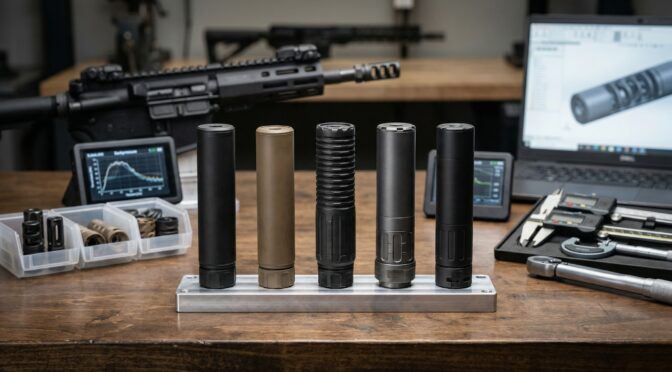
The landscape of small arms suppression has undergone a radical, paradigm-altering transformation in the first quarter of 2026. The historic elimination of the $200 National Firearms Act tax stamp, effective January 1, 2026, has catalyzed unprecedented market growth across the entire industry.1 This legislative change has effectively shifted suppressors from highly regulated, niche tactical accessories to standard, everyday components for the modern sporting rifle. With wait times dropping to mere days and the financial barrier to entry drastically reduced, consumer demand has skyrocketed.1 This surge in demand has driven manufacturers to innovate rapidly to capture a much broader, highly educated audience, resulting in significant advancements in additive manufacturing, thermal management, and internal fluid dynamics.
The 5.56x45mm NATO cartridge presents highly unique challenges for suppression. The round relies on high chamber pressures, immense velocity, and a relatively small bore diameter to achieve its terminal ballistic effects. Traditional baffle designs, while highly effective at capturing sound at the muzzle, often induce excessive backpressure into the host firearm. This backpressure accelerates the cyclic rate of the weapon, increases wear on critical internal components like the bolt carrier group, and forces toxic combustion gases back into the operator’s face through the ejection port and charging handle gap.2 Consequently, the Q1 2026 market is heavily dominated by low backpressure designs and advanced flow-through architectures that prioritize the health of the host weapon and the comfort of the shooter over chasing absolute decibel reduction at the muzzle.4
This exhaustive research report analyzes social media sentiment, technical specifications, metallurgical advancements, and current market pricing to identify and rank the top ten 5.56x45mm suppressors currently available to consumers and professionals alike.
2. The Physics of Suppressing the 5.56x45mm NATO Cartridge
To truly understand the rankings and the engineering criteria used to evaluate these devices, one must first understand the intense physics involved in suppressing the 5.56x45mm NATO cartridge. Unlike pistol calibers or subsonic rifle rounds like the.300 Blackout, the 5.56mm round is incredibly violent. It leaves the muzzle of a standard 16-inch barrel at approximately 3,000 feet per second, carrying a massive volume of rapidly expanding, superheated gas.
2.1 The Challenge of Dwell Time and Port Pressure
In a standard direct impingement AR-15 rifle, gas is tapped from a port in the barrel and routed back through a gas tube into the upper receiver to cycle the action. When a traditional, restrictive suppressor is attached to the muzzle, it acts as a bottleneck. It holds the expanding gases inside the barrel for a longer duration, a concept known as increased dwell time. This increased dwell time causes a significantly higher volume of gas to be forced back through the gas port and into the receiver.
The immediate result is a drastic increase in bolt velocity. The bolt carrier group unlocks earlier than intended, often while residual pressure remains high in the chamber. This premature unlocking leads to aggressive recoil impulses, rapid wear on extractor lugs, accelerated buffer spring fatigue, and frequent malfunctions such as failures to extract or double feeds.2 Furthermore, the excess gas vents out of the ejection port right next to the shooter’s face, causing eye irritation and exposing the operator to toxic heavy metals and unburnt carbon.5
2.2 The Shift Toward Low Backpressure Systems
Due to the mechanical issues caused by traditional baffle stacks, small arms engineers have aggressively pivoted toward low backpressure systems.6 These modern designs utilize highly complex internal geometries to vent gases forward and out of the front of the suppressor, rather than trapping them entirely within the expansion chambers. By allowing the gas to flow through the unit continuously, the internal pressure drops rapidly, mimicking the pressure curve of an unsuppressed bare muzzle.
This technological leap allows shooters to mount a suppressor on a factory-tuned rifle without needing to install heavier buffers, stiffer action springs, or adjustable gas blocks.7 While some flow-through designs sacrifice a small degree of sound reduction at the muzzle compared to highly restrictive traditional cans, the reduction in port pop (the sound of high-pressure gas escaping the ejection port) often results in a quieter overall experience at the shooter’s ear.7 The industry has largely concluded that a slight increase in muzzle decibels is a worthwhile trade for absolute weapon reliability and the elimination of toxic gas blowback.4
3. Methodology and Evaluation Criteria
The evaluation matrix utilized for this comprehensive report relies on a synthesis of social media sentiment analysis, rigorous engineering review, and current retail economic data collected from the beginning of Q1 2026 to the present time. The analysis deliberately filters out discontinued models, prototypes not yet available for retail purchase, and products lacking sufficient real-world field data to make an informed technical judgment.
3.1 Technical Evaluation Metrics
The engineering analysis of each suppressor focuses on several core mechanical competencies. Fitment evaluates the versatility and modularity of the mounting system. The industry has largely coalesced around the 1.375×24 TPI internal thread pitch, commonly referred to as the HUB standard.9 Suppressors that utilize this standard score higher in ease of installation, as they allow users to adapt the device to their preferred quick-detach ecosystem, whether that be the Dead Air KeyMo, SilencerCo ASR, Rearden Atlas, or Q Plan-B. Proprietary mounting systems, while sometimes highly effective, limit user choice and negatively impact the fitment score.5
Reliability and durability are assessed through metallurgical composition and manufacturing techniques. The evaluation specifically notes the use of materials capable of withstanding extreme thermal stress and erosion, such as 17-4 heat-treated stainless steel, Grade 5 Titanium, Inconel 718, and Haynes 282 superalloys. Quality encompasses the precise manufacturing technique utilized, with a heavy emphasis on Direct Metal Laser Sintering and weldless construction processes that eliminate potential failure points.9
3.2 Sentiment and Economic Metrics
Social media platforms, dedicated firearm forums, and verified retail reviews were meticulously parsed to generate a positive and negative sentiment ratio for each product. Platforms such as Reddit (specifically the r/NFA, r/ar15, and r/suppressors subreddits), SnipersHide, and AR15.com provided thousands of data points regarding user satisfaction.11 General sentiment captures the overarching community consensus on the product’s value proposition, sound signature, and gas mitigation capabilities.
Economic data includes the Manufacturer Suggested Retail Price alongside the minimum, average, and maximum actual online prices currently observed at authorized vendors. Preferred vendors such as Bereli, Brownells, Midway USA, Primary Arms, Palmetto State Armory, and Shooting Surplus were prioritized during the data collection and validation phases.
A comparative analysis of market data reveals a distinct relationship between the average market price of the top tier suppressors and their positive sentiment scores. When mapping these two continuous numerical variables, the resulting distribution highlights the value proposition of each model. Suppressors positioned in the optimal value quadrant, typically ranging from $400 to $1600 on the pricing axis and 70 to 100 percent on the sentiment scale, offer exceptional community approval at a lower average price, allowing consumers to easily separate budget-friendly performers from premium flagship models.
4. Advanced Metallurgy and Manufacturing Techniques
The first quarter of 2026 has clearly established additive manufacturing, commonly known as 3D printing, as the dominant production method for high-performance rifle suppressors.10 Understanding the materials used in these processes is crucial for determining the lifespan and intended use case of each device.
4.1 Traditional Subtractive Manufacturing
Historically, suppressors were made by turning blocks of steel or titanium on a lathe to create outer tubes and individual cone baffles. These baffles were then stacked inside the tube and welded together. While this subtractive manufacturing method is cost-effective and proven, it limits internal geometries to simple shapes. Furthermore, every weld represents a potential point of failure under extreme heat and pressure. Traditional designs are still highly effective for maximum sound reduction but struggle to manage backpressure effectively.15
4.2 Direct Metal Laser Sintering (DMLS)
DMLS is an additive manufacturing process that uses a high-powered laser to fuse micro-particles of metal powder together, layer by microscopic layer. This technology allows engineers to design incredibly complex internal structures that would be physically impossible to machine using traditional tools. 3D printing enables the creation of helical flow channels, cross-chamber regulation systems, and triskelion structures that manipulate expanding gases over a much longer internal path without restricting forward flow.10 DMLS also allows for completely weldless, monolithic construction, significantly increasing the structural integrity of the suppressor.
4.3 Material Science in 2026
Material selection defines a suppressor’s weight, durability, and cooling rate. The industry currently relies on four primary metals.
The first is 17-4 PH Stainless Steel. When heat-treated to the H900 condition, 17-4 stainless steel offers phenomenal yield strength and excellent corrosion resistance.15 It is the workhorse material for budget-friendly and duty-grade suppressors. It can withstand aggressive firing schedules but is notably heavy compared to exotic alloys.
The second is Grade 5 Titanium (Ti-6Al-4V). Titanium provides an exceptional strength-to-weight ratio, making it the preferred choice for hunters and precision shooters who carry their rifles over long distances.17 However, titanium rapidly loses its yield strength when heated above 800 degrees Fahrenheit. Furthermore, under the extreme heat and pressure of short-barreled 5.56x45mm platforms, titanium is prone to sparking, creating a visible white-hot flash signature that can easily wash out night vision goggles.18
The third is Inconel 718. Inconel is a nickel-chromium superalloy initially developed for aerospace applications and gas turbine engines. It retains immense tensile strength even at extreme temperatures, making it the gold standard for hard-use military applications and belt-fed machine guns.10 It is notoriously difficult to machine traditionally but is perfectly suited for DMLS printing.
The fourth and newest material to disrupt the market is Haynes 282. Introduced heavily in late 2025 and early 2026, Haynes 282 is a nickel-chromium-cobalt-molybdenum superalloy that surpasses the high-temperature capabilities of Inconel 718 by approximately 500 degrees Fahrenheit.9 Suppressors constructed from Haynes 282 offer near-indestructible durability and can easily survive extreme firing schedules that would cause traditional metals to warp or fail.9
5. Ranked Summary Table and Economic Overview
The following table presents the top ten 5.56x45mm suppressors currently available on the market. These rankings are the result of a comprehensive evaluation of engineering quality, acoustic performance, gas mitigation, and prevailing social media sentiment from Q1 2026 to the present.
| Rank | Manufacturer & Model | % Positive | % Negative | MSRP | Min Price | Avg Price | Max Price |
| 1 | Ambient Arms EXO 5.56 | 92% | 8% | $1,349.00 | $1,348.99 | $1,349.00 | $1,426.80 |
| 2 | EchoCore Sector 556 | 90% | 10% | $1,045.00 | $1,015.00 | $1,019.00 | $1,045.00 |
| 3 | HUXWRX Flow 556k | 88% | 12% | $1,306.00 | $869.98 | $1,099.00 | $1,318.00 |
| 4 | CAT WB 718 | 87% | 13% | $1,190.00 | $890.00 | $1,048.00 | $1,250.00 |
| 5 | TBAC Spiro 5.56 | 85% | 15% | $995.00 | $969.00 | $980.00 | $995.00 |
| 6 | B&T Print-XH RBS 5.56 | 83% | 17% | $1,050.00 | $699.00 | $950.00 | $1,050.00 |
| 7 | CAT Super Thug (ST) 718 | 82% | 18% | $1,090.00 | $1,040.00 | $1,090.00 | $1,190.00 |
| 8 | Sig Sauer SLX 556 | 80% | 20% | $1,999.99 | $1,399.99 | $1,449.99 | $1,999.99 |
| 9 | OCL Polonium | 78% | 22% | $550.00 | $453.60 | $532.00 | $550.00 |
| 10 | AB Suppressor A-10 | 75% | 25% | $532.50 | $420.00 | $450.00 | $532.50 |
6. Detailed Product Analysis and Justification
6.1 Ambient Arms EXO 5.56
The Ambient Arms EXO 5.56 has entirely dominated industry discussions and social media channels since its high-profile debut at SHOT Show 2026.21 It represents a massive paradigm shift in suppressor engineering by moving beyond standard flow-through designs and introducing active thermal management to the civilian and professional markets.
Engineering, Durability, and Quality: The EXO 5.56 is 3D printed entirely from high-strength titanium and utilizes a revolutionary, patent-pending architecture known as the Ambient Intake System.23 Traditional suppressors act as thermal insulators, trapping immense heat that creates severe mirage issues for optical sights and poses burn hazards to the operator. The EXO 5.56 bypasses this issue entirely. The design features strategically placed intake ports along the outer tube that create localized low-pressure zones. As superheated muzzle gases travel forward through the internal core, fluid dynamics force cool ambient air to be drawn into the suppressor body from the outside environment.23 This continuous mixing of hot exhaust and cool atmospheric air results in an operating temperature that is up to 75% cooler than leading competitors, making it the coldest-running suppressor currently in existence.21
Fitment and Installation: Weighing a highly manageable 14.5 ounces and measuring 6.9 inches in length, the EXO 5.56 balances perfectly on modern carbines.25 It features the universal 1.375×24 HUB mount system, ensuring that ease of installation is exceptional. Users are not locked into a proprietary ecosystem and can utilize direct thread adapters or any industry-standard quick-detach mechanism.25
Performance and Sentiment: Acoustically, the EXO 5.56 achieves a massive 35dB total report reduction and tests up to 15dB quieter at the muzzle than typical high-flow designs.24 It is fully auto-rated and has passed rigorous SOCOM surge testing without any barrel length restrictions, achieving a TRL 9 readiness level.24 Community sentiment is overwhelmingly positive at 92%, with operators repeatedly praising the total elimination of gas blowback and the shocking ability to handle the suppressor shortly after extended firing strings.21 The minor 8% negative sentiment is focused entirely on the premium cost of entry, as titanium 3D printing remains an expensive manufacturing process.
- Manufacturer URL: https://ambientarms.com/exo-5-56/
- Vendor 1 (Silencer Shop): https://www.silencershop.com/ambient-arms-exo-5-56.html
- Vendor 2 (Primary Arms): https://www.primaryarms.com/brand/ambient-arms
- Vendor 3 (Midway USA): https://www.midwayusa.com/ambient-arms
6.2 EchoCore Sector 556
EchoCore Suppressors emerged rapidly in late 2025 and early 2026, instantly capturing industry attention by taking both first and second place at the highly respected 2025 Silencer Summit in the 5.56 category based on Shooter’s Ear LEQ dBA measurements.26
Engineering, Durability, and Quality: The Sector 556 is manufactured via state-of-the-art additive 3D printing using aerospace-grade 718 Inconel.10 The core engineering achievement of the Sector is its proprietary Cross Chamber Regulation (XCR) technology. This system utilizes a long-form helical baffle assembly that stabilizes internal pressures and optimizes gas flow into a complex spiral pattern.10 This architecture drastically reduces backpressure and felt blowback without sacrificing the acoustic performance usually lost in standard flow-through designs.28 The monolithic, weld-free Inconel construction ensures extreme reliability, resisting thermal degradation and corrosion under heavy, full-auto firing schedules.
Fitment and Installation: The full-size unit is robust and designed for hard duty, weighing 18 ounces with an overall length of 7.06 inches.29 Installation is facilitated through the standard 1.375×24 HUB interface, allowing users total freedom to adapt it to their preferred muzzle devices.29
Performance and Sentiment: Securing a 90% positive sentiment score, the Sector 556 is lauded across forums for its incredibly deep, pleasant acoustic tone and its total lack of the “flow-through hiss” that plagues competing low-backpressure models.30 It features a low-flash vented endcap that effectively mitigates visual signatures under night vision devices. The 10% negative sentiment is generally directed at the 18-ounce weight of the full-size model, which some users feel makes shorter carbines overly front-heavy during prolonged engagements.29
- Manufacturer URL: https://www.echocoresuppressors.com/product-page/sector-556
- Vendor 1 (Silencer Shop): https://www.silencershop.com/echocore-sector-556-full-size.html
- Vendor 2 (Brownells): https://www.brownells.com/brands/echocore/
- Vendor 3 (Shooting Surplus): https://shootingsurplus.com/brands/echocore/
6.3 HUXWRX Flow 556k
The HUXWRX Flow 556k remains a foundational pillar in the modern low-backpressure category. Despite being on the market slightly longer than the new 2026 releases, its proven military track record and relentless reliability keep it firmly near the top of the analyst rankings.7
Engineering, Durability, and Quality: Constructed entirely from DMLS 3D-printed 17-4 stainless steel, the Flow 556k utilizes patented Flow-Through technology.7 The internal geometry consists of a helical coil and core deflector design that rapidly channels toxic gases forward and away from the shooter.7 It also incorporates a unique GeoFlash Cap geometry specifically designed to mitigate the excessive muzzle flash that is commonly associated with high-flow suppressor designs.7
Fitment and Installation: The unit is highly compact and maneuverable, measuring exactly 5.5 inches in length and weighing a very reasonable 12.9 ounces.7 While ease of installation is excellent due to the taper-locking mechanism, fitment versatility is a known limitation. The Flow 556k requires the use of proprietary HUXWRX left-hand threaded muzzle devices, completely locking the user into their Torque Lock ecosystem.7 This system is mechanically brilliant, ensuring the suppressor physically tightens itself onto the barrel during firing and never backs off, but it removes aftermarket modularity.
Performance and Sentiment: Community sentiment holds very strong at 88% positive. Tactical operators and civilian enthusiasts repeatedly praise the total elimination of gas blowback to the face and the fact that host rifles require absolutely zero buffer or gas block tuning to cycle reliably.31 It is fully auto-rated and has passed strict SOCOM reliability stress testing.7 The 12% negative sentiment stems from a noticeable first-round pop, slightly higher acoustic levels to bystanders compared to traditional sealed baffles, and the aforementioned restriction to proprietary mounts.7
- Manufacturer URL: https://huxwrx.com/flow-556k/
- Vendor 1 (Bereli): https://www.bereli.com/hux24/
- Vendor 2 (Palmetto State Armory): https://palmettostatearmory.com/huxwrx-flow-556k-rifle-suppressor-black.html
- Vendor 3 (Primary Arms): https://www.primaryarms.com/huxwrx-flow-556k-suppressor-with-qd-556-1-2×28-flash-hider-black
6.4 CAT WB 718
Combat Application Technologies struck gold with the release of the WB, colloquially known throughout the industry as “White Bread.” It is routinely cited across sniper forums and AR-15 enthusiast boards as possessing the absolute best balance of compact size and raw acoustic performance.18
Engineering, Durability, and Quality: The WB 718 is constructed from rugged DMLS Inconel 718. It relies on CAT’s highly proprietary Surge Bypass technology, which was meticulously engineered and tuned around the specific pressure curves and velocity profiles of the supersonic 5.56 NATO cartridge.19 This extreme specialization allows the WB to provide exceptional acoustic output while maintaining highly manageable backpressure levels, preventing accelerated weapon wear.
Fitment and Installation: Measuring only 5.45 inches in overall length and weighing 14.6 ounces, the WB is incredibly maneuverable and perfectly suited for 11.5-inch and 14.5-inch close-quarters platforms.19 Fitment is universally excellent due to the inclusion of the 1.375×24 HUB interface, allowing for widespread aftermarket mounting compatibility. The dense Inconel construction provides excellent durability, boasting a minimum barrel length rating of just 8 inches.19
Performance and Sentiment: With an 87% positive sentiment rating, the WB is celebrated across social media for punching well above its physical weight class in terms of tone and sound suppression.33 The 13% negative sentiment usually revolves around its extreme specialization, it is explicitly not recommended for use with other popular cartridges like the 6mm ARC due to differing ballistic characteristics.19 Furthermore, some users note that the compact Inconel body reaches glowing temperatures faster than larger, higher-volume units during rapid strings of fire.35
- Manufacturer URL: https://specterscat.com/product/cat-wb/
- Vendor 1 (Silencer Shop): https://www.silencershop.com/cat-wb-718.html
- Vendor 2 (Shooting Surplus): https://shootingsurplus.com/brands/combat-application-technologies/
- Vendor 3 (Midway USA): https://www.midwayusa.com/combat-application-technologies
6.5 Thunder Beast Arms (TBAC) Spiro 5.56
Thunder Beast Arms Corporation, a brand historically synonymous with ultra-precise, lightweight titanium bolt-action suppressors, entered the hard-use tactical carbine market with massive success in 2026 with the release of the Spiro.9
Engineering, Durability, and Quality: The true engineering marvel of the Spiro lies in its advanced metallurgical composition. Unlike the vast majority of its peers, the Spiro is machined from Haynes 282.9 This superalloy is vastly stronger than Inconel 718 at elevated temperatures, providing a thermal threshold that is nearly impossible to compromise with civilian or standard military firing schedules.9 The internal flow design restricts the backpressure gas increase to a mere 50% over a bare muzzle, resulting in a negligible 5% increase in the cyclic rate of a standard short-barreled MK18.9
Fitment and Installation: The Spiro measures 5.9 inches and weighs 15.5 ounces.9 It is available to consumers in either a dedicated Direct Thread format or a highly versatile 1.375×24 HUB variant.9 Its durability is essentially unmatched in this specific weight class. Officially rated for “Hard-Use/Full-Auto Mod 1,” the manufacturer guarantees it to survive over 20 consecutive SOCOM SURG cycles on an aggressive 8-inch barrel.9
Performance and Sentiment: The Spiro holds a highly respectable 85% positive sentiment rating. Professional analysts and operators praise the absolute indestructible nature of the Haynes 282 construction and the highly significant 40% recoil reduction it provides.9 The 15% negative feedback generally points out the slightly heavier weight compared to purely 3D-printed titanium flow-through designs, alongside minor complaints regarding the lack of included mounting hardware in the HUB-compatible version.9
- Manufacturer URL: https://thunderbeastarms.com/products/spiro
- Vendor 1 (Silencer Shop): https://www.silencershop.com/tbac-spiro-hub-black.html
- Vendor 2 (Brownells): https://www.brownells.com/brands/thunder-beast-arms/
- Vendor 3 (Palmetto State Armory): https://palmettostatearmory.com/brands/thunder-beast-arms.html
6.6 B&T Print-XH RBS 5.56
B&T, a legendary Swiss manufacturer known for supplying global military and police forces, has refined their renowned duty suppressors by blending advanced manufacturing techniques to create the Print-XH RBS, offering a highly unique hybrid material solution.14
Engineering, Durability, and Quality: The Print-XH unit utilizes a weldless, 3D-printed titanium outer structure combined with a dense 718 Inconel blast baffle.14 This hybrid approach secures the primary blast chamber against violent erosion and thermal shock while keeping the overall weight of the elongated tube highly manageable. B&T’s proprietary Reduced Backpressure System restricts weapon bolt speed increases to less than 2 percent, practically eliminating excess gas blowback and preserving the operational lifespan of the host rifle.14 A stainless steel low-flash endcap ensures excellent visual signature reduction under low-light conditions.
Fitment and Installation: The suppressor weighs an impressive 10.5 ounces for its size and measures 7.1 inches in length.14 It features the industry-standard 1.375×24 HUB interface, providing great ease of installation and vast mounting adaptability.14 Durability is fully validated for military applications, having endured grueling SOCOM burn-down testing equivalent to over 22,000 rounds fired without structural failure.14
Performance and Sentiment: Generating an 83% positive sentiment across forums, the community deeply respects the proven B&T pedigree and the perfect engineering balance of titanium weight savings with an Inconel protective blast shield.3 The 17% negative sentiment usually surrounds the slightly longer 7.1-inch footprint compared to modern, ultra-compact “K” cans, which some tactical users find somewhat unwieldy for vehicle operations or tight CQB applications.14
- Manufacturer URL: https://bt-usa.com/products/print-xh-rbs-ss/
- Vendor 1 (Bereli): https://www.bereli.com/sd-556rbs-sc-ti/
- Vendor 2 (Midway USA): https://www.midwayusa.com/product/1029006832
- Vendor 3 (Silencer Shop): https://www.silencershop.com/b-t-print-xh-rbs-556-blk.html
6.7 CAT Super Thug (ST) 718
Positioned as the spiritual successor and larger, higher-volume sibling to the compact WB model, the CAT Super Thug is the premier offering from Combat Application Technologies for a generic, do-it-all 5.56mm suppressor.39
Engineering, Durability, and Quality: The ST utilizes an advanced evolution of CAT’s SBX internal geometry, which is explicitly tuned to manage the violent, erratic pressure spikes common to short, mid, and full-length 5.56 barrels.39 Unlike the highly specialized WB, the ST requires no platform-specific compromises. The design focuses heavily on extreme visual output reduction, bringing flash signature to near invisibility even on aggressive, short-barreled host weapons while stabilizing backpressure to ensure highly reliable cyclic rates.39
Fitment and Installation: Available with the universal 1.375×24 HUB interface, the durable Inconel variant weighs 17.5 ounces and spans 6.0 inches in overall length.39 The build quality is exceptional, featuring a high-end PVD finish to resist surface wear. It is built explicitly for punishing, sustained firing schedules with a lenient minimum barrel length restriction of just 10.3 inches.39
Performance and Sentiment: The ST currently holds an 82% positive sentiment rating on social platforms. Early adopters and analytical reviewers note that it runs noticeably quieter, cooler, and flatter than previous suppressor generations, completely mitigating forward concussive overpressure and blast propagation.39 The 18% negative sentiment is largely driven by its relatively high weight of 17.5 ounces, alongside the fact that it is a very new product lacking the years of widespread civilian field data enjoyed by older models.40
- Manufacturer URL: https://specterscat.com/product/cat-st/
- Vendor 1 (Primary Arms): https://www.primaryarms.com/brand/cat-alleycat
- Vendor 2 (Brownells): https://www.brownells.com/brands/combat-application-technologies/
- Vendor 3 (Shooting Surplus): https://shootingsurplus.com/brands/combat-application-technologies/
6.8 Sig Sauer SLX 556
Developed directly from rigorous military contracts and Next Generation Squad Weapon program requirements, the Sig Sauer SLX series provides a monolithic, absolute no-compromise approach to visual and acoustic signature reduction.5
Engineering, Durability, and Quality: The SLX 556 features a heavily reinforced, monolithic core construction manufactured entirely from high-temperature Inconel.5 Its defining engineering trait is the highly effective Low-Tox multi-flow path technology, which exhausts expanding gases rapidly forward. This vital health-focused design prevents up to 80% of toxic fumes from traveling backward down the barrel and ejecting into the operator’s breathing space.5
Fitment and Installation: The full-size SLX measures 7.4 inches and weighs 17.3 ounces, making it one of the larger options on this list.5 Ease of installation is dependent on the specific model chosen, utilizing either direct thread or the proprietary Clutch-LOK QD system. The Clutch-LOK provides a highly intuitive, tactile locking ring that is extremely repeatable and prevents carbon lock. Born directly from strict military requirements, the dense Inconel body is practically impervious to sustained supersonic firing schedules and extreme physical abuse.5
Performance and Sentiment: The SLX 556 maintains a solid 80% positive sentiment. Military users and civilians alike highly value the massive reduction in toxic fumes and the battle-proven durability.13 However, the 20% negative feedback is vocal and points clearly to the highly prohibitive retail cost approaching two thousand dollars, the heavy physical weight, and the absolute reliance on proprietary mounting solutions, making it significantly less versatile for users heavily invested in the universal HUB ecosystem.
- Manufacturer URL: https://www.sigsauer.com/slx-suppressor.html
- Vendor 1 (Bereli): https://www.bereli.com/slx556-qd/
- Vendor 2 (Midway USA): https://www.midwayusa.com/product/1028874931
- Vendor 3 (Palmetto State Armory): https://palmettostatearmory.com/sig-sauer-slx-suppressor-5-56-black-slx-ng556-qd.html
6.9 Otter Creek Labs (OCL) Polonium
The Otter Creek Labs Polonium proudly serves as the absolute benchmark for traditional, sealed baffle stack designs, offering phenomenal duty-grade performance at an incredibly accessible entry-level price point.15
Engineering, Durability, and Quality: Unlike complex, highly expensive 3D-printed rivals, the Polonium is a masterclass in traditional machining. It is a CNC-welded, tubeless design crafted entirely from H900 heat-treated 17-4 stainless steel.15 It utilizes a highly tuned 6mm bore to maximize acoustic suppression on 5.56 and 6mm cartridges. The exterior features aggressive, functional machining to remove unnecessary material, resulting in 10% more surface area to shed heat rapidly during intense courses of fire.15
Fitment and Installation: Weighing 13.5 ounces and measuring 5.8 inches, the standard Polonium provides an excellent, well-balanced footprint for general-purpose rifles.15 Installation is standard and highly versatile via a 1.375×24 HUB thread pattern. Its durability is highly respected across the industry; it is fully auto-rated and even explicitly rated for responsible use on belt-fed machine guns utilizing minimum 7.5-inch barrels.15
Performance and Sentiment: With a 78% positive rating, the Polonium is the undisputed king of economic value, offering world-class acoustic suppression at the muzzle that rivals suppressors costing three times as much.15 The 22% negative sentiment is entirely attributed to its extremely high backpressure. Users universally agree that the host firearm must be rigorously tuned with heavier buffers and adjustable gas blocks to prevent excessive gas blowback and violent cycling.2 For shooters willing to tune their rifles, it represents an unbeatable bargain.
- Manufacturer URL: https://ottercreeklabs.com/product/polonium/
- Vendor 1 (Shooting Surplus): https://shootingsurplus.com/ocl-polonium-k-556nato/
- Vendor 2 (Palmetto State Armory): https://palmettostatearmory.com/otter-creek-polonium-556-rifle-suppressor-black.html
- Vendor 3 (Silencer Shop): https://www.silencershop.com/otter-creek-labs-polonium.html
6.10 AB Suppressor A-10 5.56
The AB Suppressor A-10 operates as a massive sleeper hit in the 2026 market, delivering excellent, no-frills direct-thread performance on a strict, highly accessible budget.8
Engineering, Durability, and Quality: Manufactured entirely from H900 heat-treated 17-4 stainless steel, the A-10 utilizes a proprietary SpiralTech baffle geometry.44 The blast tube incorporates unique internal reinforcing rings that actively induce air turbulence to capture sound waves while simultaneously strengthening the outer wall against pressure spikes.44 The exterior features a distinct ribbed profile, which serves the dual purpose of significant weight reduction and acting as a thermal radiator to prevent extreme erosion and heat buildup.
Fitment and Installation: The A-10 measures a highly compact 5.5 inches in length and weighs a remarkably low 10.6 ounces, making it one of the lightest steel options available.45 Ease of installation is incredibly straightforward, relying on a simple, fail-proof 1/2×28 flush direct-thread mount. The unit is fully auto-rated with a very reasonable minimum barrel length restriction of 10.5 inches for the 5.56mm cartridge.45
Performance and Sentiment: Earning a 75% positive sentiment score, budget-conscious shooters deeply appreciate the A-10 for being unreasonably quiet for its highly compact size and incredibly low retail cost.8 The 25% negative sentiment stems from its traditional, non-flow-through architecture causing noticeable port pop on untuned rifles, and minor aesthetic complaints regarding the ribbed “warthog” exterior design, which some users find polarizing compared to smooth-tube alternatives.8
- Manufacturer URL: https://www.absuppressor.com/a-10
- Vendor 1 (Silencer Shop): https://www.silencershop.com/ab-a-10-5-56mm.html
- Vendor 2 (Bauer Precision): https://www.bauer-precision.com/ab-suppressor-a-10-5-56mm-w-1-2×28-flush-mount/
- Vendor 3 (Primary Arms): https://www.primaryarms.com/brand/ab-suppressor
7. The Evolution of Suppressor Mounting Ecosystems
A critical factor observed throughout the 2026 market analysis is the fierce competition between open-source mounting standards and proprietary quick-detach (QD) ecosystems. Historically, purchasing a suppressor meant marrying into that specific manufacturer’s muzzle device ecosystem.
The widespread adoption of the 1.375×24 TPI HUB standard has revolutionized consumer choice. This universal internal threading allows an operator to purchase a suppressor from one manufacturer (such as Otter Creek Labs or Thunder Beast) and utilize a mounting adapter from an entirely different company.15 This is particularly vital for users who own multiple rifles equipped with varying muzzle devices, as it drastically reduces the financial burden of retrofitting an entire armory to match a single new suppressor purchase.
Conversely, manufacturers like HUXWRX and Sig Sauer continue to rely on highly proprietary systems. While these systems often offer superior mechanical lockup, preventing the dangerous phenomenon of a suppressor unthreading during rapid fire, they significantly limit aftermarket versatility. Social media sentiment strongly favors the HUB standard, indicating that future market dominance will likely require manufacturers to adopt open-source fitment architectures to satisfy an increasingly educated consumer base.
8. Conclusion and Strategic Outlook
The Q1 2026 suppressor market reflects a highly mature, rapidly advancing industry that has successfully transitioned from pursuing simple acoustic reduction toward holistic weapon system optimization. The removal of the NFA tax stamp has injected massive capital and consumer interest into the sector, fueling a technological arms race.1
While traditional, highly restrictive baffle architectures like the OCL Polonium continue to dominate the entry-level market through raw, brute-force sound suppression capability, the premium high-end sector has firmly and irrevocably embraced advanced thermal and pneumatic management. Models like the EchoCore Sector and HUXWRX Flow demonstrate clearly that manipulating internal fluid dynamics via complex additive manufacturing is the absolute key to preserving host weapon reliability and operator health.
Furthermore, the highly disruptive debut of the Ambient Arms EXO proves that active thermal cooling is the next major frontier in small arms signature reduction. Moving forward, prospective buyers must carefully weigh their specific operational requirements, evaluating whether the total mitigation of gas blowback, the elimination of toxic fumes, and active thermal cooling justify the premium pricing inherent to advanced DMLS Inconel and titanium designs, or if a simple, durable steel baffle stack is sufficient for their needs.
Note: Vendor Sources listed are not an endorsement of any given vendor. It is our software reporting a product page given the direction to list products that are between the minimum and average sales price when last scanned.
Please share the link on Facebook, Forums, with colleagues, etc. Your support is much appreciated and if you have any feedback, please email us in**@*********ps.com. If you’d like to request a report or order a reprint, please click here for the corresponding page to open in new tab.
Sources Used
- Why Suppressors Are Trending in 2026 – Guns.com, accessed March 31, 2026, https://www.guns.com/news/2026/03/20/trending-suppressors-background
- Ocl Polonium 600 round test against the CAT WB and Hux Flow556k : r/NFA – Reddit, accessed March 31, 2026, https://www.reddit.com/r/NFA/comments/1of0bzk/ocl_polonium_600_round_test_against_the_cat_wb/
- Suppressor Recommendations for 11.5″ in 5.56? : r/ar15 – Reddit, accessed March 31, 2026, https://www.reddit.com/r/ar15/comments/1rc1jdj/suppressor_recommendations_for_115_in_556/
- Top 5 Best 5.56 Suppressors of 2026: Get the Best Silencers for AR-15s, accessed March 31, 2026, https://www.silencershop.com/blog/5-best-556-suppressors-2026
- SIG SLX Suppressor Technology | Low-Tox Sound Reduction, accessed March 31, 2026, https://www.sigsauer.com/slx-suppressor.html
- Opinions on Current Lineup of 5.56 Suppressors | Sniper’s Hide Forum, accessed March 31, 2026, https://www.snipershide.com/shooting/threads/opinions-on-current-lineup-of-5-56-suppressors.7269080/
- FLOW 556k – Huxwrx, accessed March 31, 2026, https://huxwrx.com/flow-556k/
- One of the most slept-on 5.56 cans? | Sniper’s Hide Forum, accessed March 31, 2026, https://www.snipershide.com/shooting/threads/one-of-the-most-slept-on-5-56-cans.7237010/
- Products | SPIRO – Thunder Beast Arms Corporation [TBAC], accessed March 31, 2026, https://thunderbeastarms.com/products/spiro
- Echocore Sector Full-Size, 5.56mm, Suppressor – BattleHawk Armory, accessed March 31, 2026, https://battlehawkarmory.com/product/echocore-sector-full-size-5.56mm-suppressor
- 5.56 Suppressor Suggestions : r/NFA – Reddit, accessed March 31, 2026, https://www.reddit.com/r/NFA/comments/1s22fs3/556_suppressor_suggestions/
- Suppressor for AR15 multi cal | Sniper’s Hide Forum, accessed March 31, 2026, https://www.snipershide.com/shooting/threads/suppressor-for-ar15-multi-cal.7244251/
- Best direct thread suppressor in 2026 for 5.56? : r/ar15 – Reddit, accessed March 31, 2026, https://www.reddit.com/r/ar15/comments/1r2r9oa/best_direct_thread_suppressor_in_2026_for_556/
- XH-556 Suppressor – B&T USA, accessed March 31, 2026, https://bt-usa.com/products/print-xh-rbs-ti/
- Polonium & Polonium-K – Otter Creek Labs, accessed March 31, 2026, https://ottercreeklabs.com/product/polonium/
- Hottest New Suppressors | SHOT Show 2026 – YouTube, accessed March 31, 2026, https://www.youtube.com/watch?v=nD3R2aQVPcM
- Ambient Arms EXO 5.56 Suppressor | Titanium HUB – Silencer Shop, accessed March 31, 2026, https://www.silencershop.com/ambient-arms-exo-5-56.html
- 5.56 Suppressor Recommendations : r/NFA – Reddit, accessed March 31, 2026, https://www.reddit.com/r/NFA/comments/1dpwmje/556_suppressor_recommendations/
- CAT/WB – Specters Cat, accessed March 31, 2026, https://specterscat.com/product/cat-wb/
- Thunder Beast: Spiro-HUB, .223 Cal Suppressor – Mile High Shooting Accessories, accessed March 31, 2026, https://www.milehighshooting.com/thunder-beast-spiro-hub-223-cal-suppressor/
- Suppressors & SHOT Show: 2026 Brings Fresh Innovation – Inside Safariland, accessed March 31, 2026, https://inside.safariland.com/blog/suppressors-shot-show-2026-brings-fresh-innovation/
- Best Of SHOT Show 2026: Top Suppressors | An NRA Shooting Sports Journal, accessed March 31, 2026, https://www.ssusa.org/content/best-of-shot-show-2026-top-suppressors/
- Ambient Arms EXO Suppressor: Revolutionary Cooling Tech at SHOT Show 2026, accessed March 31, 2026, https://www.rifleconfigurator.com/articles/ambient-arms-exo-suppressor-shot-show-2026
- Ambient Arms Exo 556Ti 5.56mm Suppressor – BattleHawk Armory, accessed March 31, 2026, https://battlehawkarmory.com/product/ambient-arms-exo-5.56ti-5.56mm-suppressor
- Exo 5.56 – Ambient Arms, accessed March 31, 2026, https://ambientarms.com/exo-5-56/
- Sector 5.56 – EchoCore Suppressors, accessed March 31, 2026, https://www.echocoresuppressors.com/product-page/sector-556
- Why EchoCore Is the Suppressor Brand Everyone’s Talking About | SHOT Show 2026, accessed March 31, 2026, https://www.youtube.com/watch?v=Ck8hZiYYpGg
- Sector 5.56 Compact – EchoCore Suppressors, accessed March 31, 2026, https://www.echocoresuppressors.com/product-page/sector-556-sub-compact
- EchoCore Sector 5.56 Full-Size Suppressor – SBR Optimized | Silencer Shop, accessed March 31, 2026, https://www.silencershop.com/echocore-sector-556-full-size.html
- These 5.56 Suppressors Beat EVERYTHING?! (No Ear Pro, 11.5″) | ECHOCORE – YouTube, accessed March 31, 2026, https://www.youtube.com/watch?v=oHYpztRR7Z8
- Update on HuxWrx flow 556k 11.5 : r/ar15 – Reddit, accessed March 31, 2026, https://www.reddit.com/r/ar15/comments/1pyoliq/update_on_huxwrx_flow_556k_115/
- New Sound Signature Reviews – HUXWRX FLOW 556 Ti on the MK18 and 14.5-in M4A1 and Low Back Pressure Research : r/NFA – Reddit, accessed March 31, 2026, https://www.reddit.com/r/NFA/comments/1gb17uv/new_sound_signature_reviews_huxwrx_flow_556_ti_on/
- Cat WB TI 2026 : r/SpectersCat – Reddit, accessed March 31, 2026, https://www.reddit.com/r/SpectersCat/comments/1qmxu8h/cat_wb_ti_2026/
- CAT SUPPRESSOR TESTING!!! CAT WB Ti 5.56 HUB vs QD – Does the Mount Matter???, accessed March 31, 2026, https://www.youtube.com/watch?v=WT1Z3RRLuqY
- CAT WB deal for under $1k worth ? : r/NFA – Reddit, accessed March 31, 2026, https://www.reddit.com/r/NFA/comments/1p4de2c/cat_wb_deal_for_under_1k_worth/
- Print-XH RBS 556 Ti – B&T USA, accessed March 31, 2026, https://bt-usa.com/products/print-xh-rbs-ss/
- B&T PRINT-XH RBS 5.56 – BLK – Silencer Shop, accessed March 31, 2026, https://www.silencershop.com/b-t-print-xh-rbs-556-blk.html
- Which Suppressor? : r/ar15 – Reddit, accessed March 31, 2026, https://www.reddit.com/r/ar15/comments/1pmj1ze/which_suppressor/
- CAT/ST – Specters Cat, accessed March 31, 2026, https://specterscat.com/product/cat-st/
- $1,500 budget, gun to your head. Which 556 can do you buy in 2026. : r/suppressors – Reddit, accessed March 31, 2026, https://www.reddit.com/r/suppressors/comments/1rlr5ki/1500_budget_gun_to_your_head_which_556_can_do_you/
- SureFire SOCOM556-RC3 Suppressor: Full Review – Guns and Ammo, accessed March 31, 2026, https://www.gunsandammo.com/editorial/surefire-socom556-rc3-full-review/517304
- Otter Creek Labs Polonium 5.56 Duty Suppressor | BattleHawk Armory, accessed March 31, 2026, https://battlehawkarmory.com/product/otter-creek-labs-polonium-5.56-duty-suppressor
- Ab Suppressor Duty Can 5.56nato – For Sale – Guns.com, accessed March 31, 2026, https://www.guns.com/silencers/p/ab-suppressor-duty-can-5-56nato?i=536878
- AB A-10 – 7.62MM – Silencer Shop, accessed March 31, 2026, https://www.silencershop.com/ab-a-10-7-62mm.html
- AB A-10 5.56 Suppressor – J&A Outdoors, accessed March 31, 2026, https://jaoutdoors.com/product/ab-a-10-5-56-suppressor/
- A-10 – AB Suppressor, accessed March 31, 2026, https://www.absuppressor.com/a-10