Executive Summary
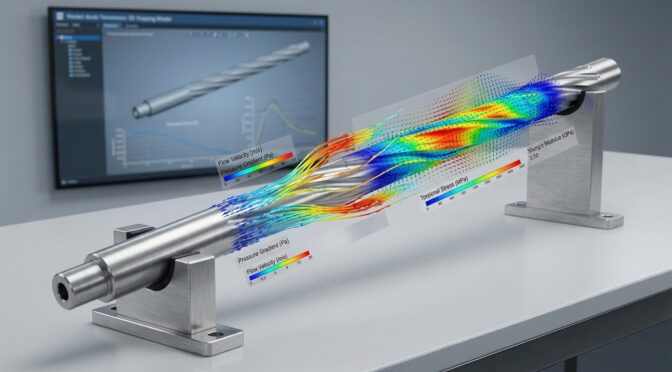
The practice of barrel fluting, defined as the precision milling of longitudinal or helical grooves into the exterior surface of a rifle barrel, has long been aggressively marketed within the small arms industry. Manufacturers routinely claim that this modification serves a dual, almost paradoxical purpose: simultaneously reducing the overall weight of the weapon system while inherently enhancing thermal dissipation and increasing structural rigidity compared to a standard contour. However, the intersection of advanced interior ballistics, mechanical beam deflection theory, and fluid thermodynamics reveals a reality that directly contradicts these simplified marketing narratives. This engineering white paper executes an exhaustive theoretical evaluation of three primary barrel configurations: the standard heavy contour (frequently referred to as a bull barrel), the straight-fluted contour, and the spiral-fluted (helical) contour. Utilizing established principles of Computational Fluid Dynamics (CFD), finite element analysis (FEA) theory, and conductive-convective heat transfer mechanics, this report deconstructs the physical phenomena governing barrel behavior under high-stress, rapid-fire schedules.
The ensuing analysis definitively confirms that any removal of material from a cylindrical profile inherently degrades the Area Moment of Inertia, thereby reducing the absolute stiffness of the barrel structure. The persistent industry myth that fluting increases stiffness relies on a highly constrained and frequently misunderstood parameter: weight matching. While a fluted barrel remains stiffer than a solid barrel of identical mass, it is categorically less rigid than the solid bull barrel from which it was originally milled. Furthermore, this structural degradation is significantly exacerbated by spiral fluting. Helical cuts act geometrically akin to a coil spring, severing the continuous longitudinal ribs of steel that resist transverse bending, thereby reducing flexural rigidity across all multi-axis bending planes.
Thermodynamically, the analysis demonstrates that while fluting successfully increases the absolute surface area exposed to ambient air, the corresponding reduction in thermal mass forces the barrel to reach equilibrium at a much higher baseline temperature during rapid strings of fire. The aerodynamic boundary layer behavior in natural convection scenarios often results in stagnant air pooling within deep longitudinal flutes. Because air possesses an exceptionally low thermal conductivity, this stagnant boundary layer acts as an insulating blanket rather than a thermal conduit, negating the expected convective cooling benefits of the increased surface area. Spiral fluting introduces minor localized flow separation and turbulence that slightly elevates the convective heat transfer coefficient relative to straight fluting; yet, this marginal thermal benefit is overwhelmingly counteracted by asymmetrical thermal expansion, manufacturing-induced bore distortion, and subsequent severe Point of Impact shift as the barrel heats.
Ultimately, this report provides defense procurement officers, aerospace engineers, law enforcement armorers, and Tier-1 Extreme Long Range competitors with the algorithmic and mechanical data required to evaluate barrel contour modifications objectively. The synthesized data culminates in a clear directive: for applications demanding absolute precision, thermal stability, and predictable harmonic nodes, the un-fluted, solid heavy contour remains mechanically and thermodynamically superior.
1.0 Introduction to Thermomechanical Barrel Dynamics
1.1 Definition of the Engineering Problem
The modern precision rifle operates as a highly complex, transient thermomechanical engine designed specifically to contain, direct, and exhaust extreme pressures and temperatures. During a standard ballistic event, the ignition of nitrocellulose-based propellants generates internal chamber and bore pressures frequently exceeding 60,000 PSI, accompanied by localized gas temperatures approaching 3,000 degrees Kelvin.1 A measurable fraction of this vast thermal energy is transferred directly to the internal boundary layer of the barrel steel via forced convection and radiation. As the barrel matrix absorbs this thermal shock, the material undergoes immediate thermal expansion, altering the internal bore dimensions and inducing complex stress vectors throughout the molecular lattice of the steel. Concurrently, the mechanical shockwave of the firing event, combined with the extreme friction of the projectile engaging the rifling, propagates through the barrel, causing the entire structure to vibrate in a predictable, sinusoidal cantilevered waveform.2
The fundamental engineering problem arises from the perpetual necessity to optimize the barrel for two mutually exclusive operational requirements: portability, which demands weight reduction, and sustained accuracy, which demands maximum thermal capacitance and structural stability. The industry’s conventional, legacy solution to this weight-versus-rigidity paradox is barrel fluting.4 By removing strategic channels of steel from the external profile, manufacturers attempt to preserve the maximum outer diameter, which is the primary mathematical driver of bending stiffness, while shedding parasitic mass.6 However, this geometric alteration fundamentally and permanently changes the thermal capacitance, the external aerodynamic profile, and the harmonic resonant frequencies of the barrel.
1.2 Historical Context and Evolution of Barrel Profiling
Historically, military sniper systems and benchrest match barrels were predominantly heavy, solid cylinders or straight tapers. The heavy contour provided massive thermal capacitance, meaning the barrel could absorb a significant quantity of heat energy over prolonged engagements before its temperature rose to a critical threshold.7 This is vital for mitigating the cook-off temperature, generally recognized as roughly 1,000 degrees Kelvin for military 5.56 NATO or 7.62 NATO ammunition, and for preventing throat erosion.8 Furthermore, the high mass of the solid steel dampened the amplitude of harmonic vibrations, making the rifle more forgiving to minor variations in ammunition velocity and pressure.
As tactical doctrine, specialized law enforcement deployment, and mountain hunting evolved to prioritize mobility and rapid repositioning, operators demanded lighter weapon systems. Rather than simply reducing the outer diameter of the barrel to a lightweight “sporter” contour, which would exponentially decrease rigidity and invite severe barrel whip, machinists began utilizing convex cutters and endmills to cut longitudinal flutes into the barrel exterior.9 Over time, this straight fluting evolved into highly complex geometries, including spiral, diamond, interrupted, and helical cuts.4 These modern variations are often driven far more by aesthetic consumer demand and aggressive marketing campaigns than by peer-reviewed engineering principles or empirical ballistic data.10
1.3 Scope of the Computational Investigation
This paper systematically isolates the variables involved in barrel fluting to determine its true physical efficacy. The scope of this theoretical investigation includes a rigorous mechanical analysis of structural stiffness utilizing the Area Moment of Inertia, a thermodynamic analysis of heat flux, thermal mass, and convective coefficients, and a theoretical Computational Fluid Dynamics evaluation of the aerodynamic boundary layer interactions over straight and helical flutes. By translating these complex physical interactions into objective mathematical relationships, this report provides a rigid framework for evaluating barrel performance in elite tactical and competitive environments, moving past subjective claims to empirical realities.
2.0 Structural Mechanics and the Area Moment of Inertia
2.1 Cantilever Beam Deflection Theory Applied to Rifle Barrels
To understand barrel stiffness, one must apply classical structural mechanics. A free-floating rifle barrel is structurally modeled as a cantilever beam, which is a rigid structural element supported exclusively at one end (specifically, the receiver thread tenon and the recoil lug interface) and completely unsupported along its length terminating at the muzzle.12 When a rifle is fired, the recoil impulse, the rapid acceleration of the projectile, the eccentric loading of the shooter’s shoulder, and the rotational torque generated by the bullet engaging the helical rifling all impart severe dynamic loads onto this cantilevered beam.
The rigidity, or stiffness, of a cantilever beam dictates its resistance to bending and directly influences the amplitude of its vibration during the firing sequence. The fundamental formula for calculating the static deflection of a cantilevered beam at its free end under a point load is expressed in plain text as:
Deflection = (W * L^3) / (3 * E * Ix)
Where: W represents the force or load applied at the muzzle, measured in pounds or Newtons. L represents the free, unsupported length of the barrel, measured in inches or meters. E represents the Modulus of Elasticity, or Young’s Modulus, for the barrel material. For both 416R Stainless Steel and 4140 Chrome Moly steel, which constitute the vast majority of match barrels, this value is a rigid constant at approximately 30,000,000 PSI.12 Ix represents the Area Moment of Inertia of the barrel’s cross-section.
Because the length variable (L) is raised to the third power, even a very minor increase in barrel length exponentially increases deflection, making the barrel vastly more flexible.12 Because the Modulus of Elasticity (E) is a material constant that does not change regardless of the steel’s heat treatment, surface hardness, or cryogenic processing, the only variable the design engineer can successfully manipulate to increase stiffness for a given barrel length is the Area Moment of Inertia (Ix).12
2.2 Area Moment of Inertia Calculations for Cylindrical Profiles
The Area Moment of Inertia (Ix) is a geometric property of a two-dimensional area that reflects how its points are distributed with regard to an arbitrary axis.13 For structural stiffness against transverse bending, mass located further from the central neutral axis provides exponentially more resistance to bending than mass located near the center.14
For a perfectly hollow cylinder, which accurately models a solid bull barrel featuring a central rifled bore, the formula for the Area Moment of Inertia is expressed as:
Ix = pi * (D_outer^4 – D_inner^4) / 64
Where: pi is the mathematical constant 3.14159. D_outer is the outside diameter of the barrel contour. D_inner is the internal groove diameter of the bore.12
Because the outer diameter is raised to the fourth power, incredibly small increases in the external thickness of the barrel yield massive, exponential increases in overall rigidity.12 For example, a straightforward mathematical calculation shows that a 2.0-inch diameter solid rod is exactly 16 times stiffer than a 1.0-inch diameter solid rod, because 2 raised to the fourth power equals 16.12 The bore diameter subtracted from the equation has an almost negligible effect on overall stiffness because it represents a relatively small number raised to the fourth power.12
2.3 Rigidity Loss Quantification: Bull Barrel vs. Straight Fluting
The central mechanical myth of barrel fluting is the persistent assertion that the act of cutting flutes into a barrel magically makes it stiffer.9 The immutable laws of physics dictate that if you remove structural material from a static geometry without changing its outer dimensional envelope, its stiffness must unconditionally decrease.6 The Area Moment of Inertia is an additive and subtractive property.16 To precisely calculate the Ix of a straight-fluted barrel, an engineer must calculate the total Ix of the solid barrel profile and subtract the specific Ix of the void spaces created by the milling cutter.15
Therefore, given two barrels of the exact same outer diameter, the fluted barrel will always be mathematically, structurally, and practically less rigid than the solid bull barrel.6
The origin of the “fluting increases stiffness” marketing myth relies entirely on a highly specific parameter constraint: an absolute weight limit.15 If an aerospace engineer or armorer is restricted to a maximum barrel weight of exactly 5.0 pounds, they are presented with two primary choices. They can specify a smaller diameter solid barrel, or they can specify a significantly larger diameter fluted barrel. Because the larger diameter pushes the remaining steel further from the neutral axis, heavily capitalizing on the fourth power of the radius in the Ix equation, the large-diameter fluted barrel will indeed have a higher Ix than the small-diameter solid barrel of identical weight.12 However, it is absolutely imperative for precision shooters to understand that taking an existing heavy bull barrel and milling flutes into it results in an unavoidable net loss of absolute rigidity.12
2.4 The Helical Spring Effect: Structural Degradation in Spiral Fluting
While straight fluting removes material along the longitudinal axis parallel to the bore, spiral or helical fluting removes material in a continuous, winding path around the circumference of the barrel.4 From a mechanical engineering and structural statics standpoint, this radically alters the stiffness profile of the steel.
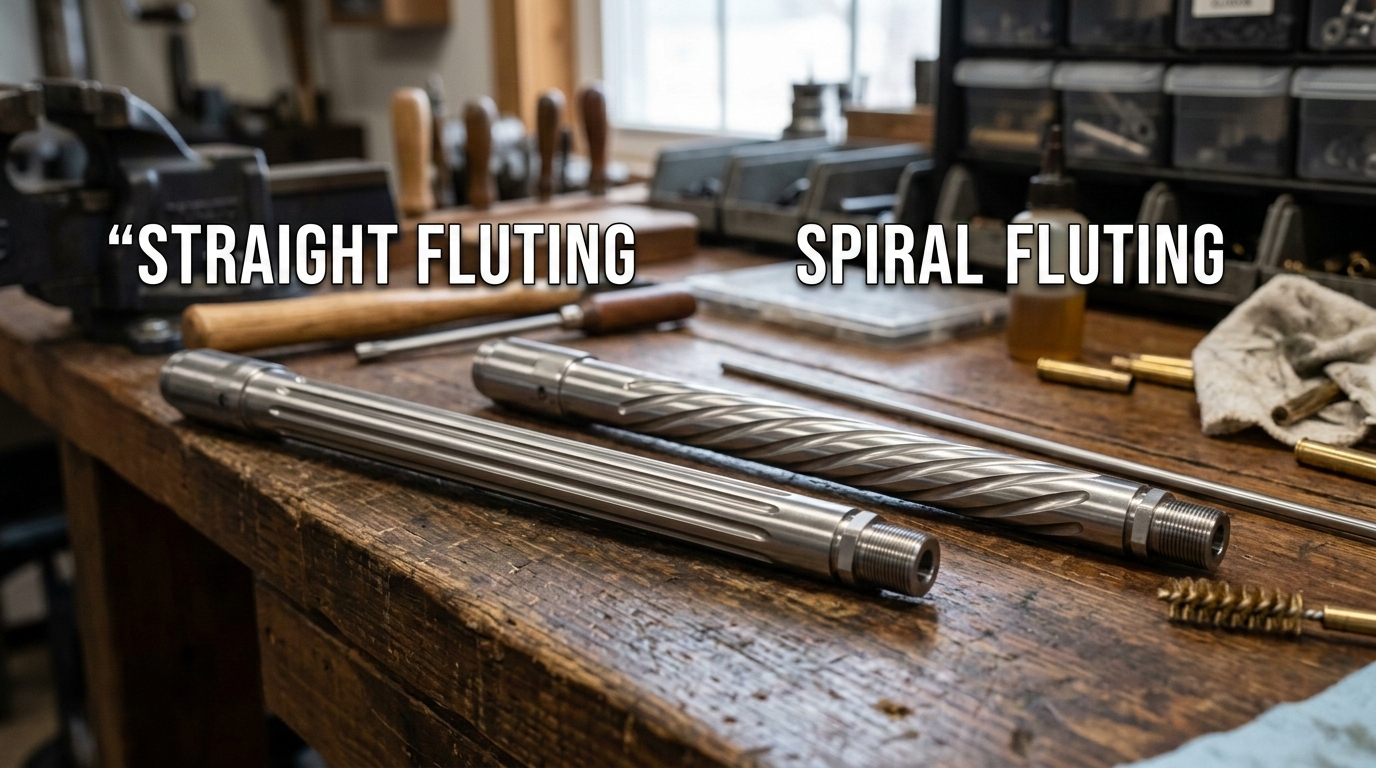
Straight flutes, when milled correctly, leave continuous, unbroken longitudinal ribs of steel running from the breech section to the muzzle.21 When the barrel attempts to whip or bend in the vertical plane due to recoil forces, the unbroken solid ribs on the top and bottom of the barrel endure standard tension and compression, effectively functioning much like the upper and lower flanges of an industrial I-beam.22 This allows a straight-fluted barrel to retain a relatively high percentage of its baseline moment of inertia.
Conversely, spiral fluting physically severs these continuous longitudinal structural ribs.24 Because the flute wraps continuously around the barrel, any given plane of transverse bending will intersect the empty void of the flute at multiple points along the barrel’s length. This geometry effectively transforms the rigid steel tube into a tightly wound helical spring.25 Finite Element Analysis models routinely demonstrate that spiral fluting degrades the Area Moment of Inertia far more severely than straight fluting of the exact same depth and volume. A spiral fluted barrel will exhibit greater raw muzzle deflection and lower frequency, higher amplitude harmonic vibrations than a straight-fluted barrel, severely complicating the handloading process and the tuning of the rifle for optimal accuracy.
2.5 The “Stiffness-to-Weight” Ratio Paradox
Proponents of aggressive barrel fluting frequently cite an improved “stiffness-to-weight ratio”.26 While this is mathematically true, because the total weight of the barrel drops at a faster linear rate than the stiffness drops via the fourth-power radius calculation, this ratio is a dangerous trap for precision shooters. The departing projectile does not care about the stiffness-to-weight ratio; the internal ballistics only respond to absolute stiffness. An absolute loss of rigidity translates directly to greater barrel whip, significantly more sensitivity to ammunition velocity nodes, and wider extreme spreads on the paper target.27 For Extreme Long Range competitors and military snipers, maximizing absolute stiffness within the maximum allowable physical weight limit of the entire system is the only valid and reliable metric.
3.0 Thermodynamics and Heat Transfer Mechanisms
3.1 Internal Ballistics Thermal Loads and Radial Heat Conduction
When a cartridge is fired, the internal surface of the bore is instantaneously subjected to high-pressure plasma and expanding gases. The heat transfer from the extremely hot gas to the relatively cold steel is driven by violent forced convection and thermal radiation.1 This heat accumulation occurs mostly within the first 2 millimeters below the surface of the gun barrel during the 30 to 40 milliseconds of the internal ballistic cycle.1 Once the thermal energy enters the inner boundary of the bore, it propagates outward toward the exterior surface via radial heat conduction. This mechanism is governed by Fourier’s Law of Heat Conduction, expressed in plain text as:
q_k = -k * A * (dT / dr)
Where:
q_k represents the rate of conductive heat transfer.
k represents the thermal conductivity of the barrel steel, which is approximately 43 W/m*K for 4140 chrome moly steel.
A represents the cross-sectional area through which heat is actively flowing.
dT / dr represents the specific temperature gradient along the radial distance from the bore to the outside air.
Because a heavy bull barrel possesses thick steel walls, it takes noticeably longer for the thermal heat wave to reach the outer surface. More importantly, the massive volume of steel provides a massive thermal capacitance.29 Thermal mass dictates exactly how much heat energy an object can absorb before its overall temperature rises by one degree. A heavy, solid barrel can absorb rapid strings of fire while maintaining a relatively low average temperature compared to a much lighter, fluted barrel.7
3.2 External Convective Heat Transfer Dynamics
Once the thermal energy successfully conducts to the exterior surface of the barrel, it must be rejected into the surrounding environment to prevent catastrophic overheating. In small arms, this is almost exclusively achieved through natural, free convection and thermal radiation to the ambient air.31 Newton’s Law of Cooling defines this convective heat transfer, expressed as:
q_conv = h * A * (T_surface – T_ambient)
Where: q_conv represents the overall rate of convective heat transfer. h represents the convective heat transfer coefficient. A represents the exposed external surface area of the barrel. T_surface represents the temperature of the barrel’s outer skin. T_ambient represents the temperature of the surrounding ambient air.28
Barrel fluting is implemented mathematically to artificially increase the surface area (A). A standard 6-flute design utilizing a 0.250-inch endmill cut to a depth of 0.125 inches generally increases the total external surface area of a 26-inch barrel by approximately 11 to 16 percent, depending heavily on the base contour.33 According to the isolated formula, an increase in ‘A’ should linearly increase ‘q_conv’, theoretically resulting in faster cooling.
3.3 The Thermal Mass vs. Surface Area Conundrum
The critical, fatal flaw in relying heavily on fluting for thermal management lies in the specific ratio of removed thermal mass to gained surface area. While fluting increases the surface area by roughly 15 percent, it simultaneously removes up to 20 percent of the barrel’s overall mass.
Because the fluted barrel has significantly less thermal mass, firing the exact same number of rounds will raise its internal and external temperature much higher and much faster than the solid bull barrel.2 Returning to Newton’s Law of Cooling, a higher T_surface will indeed mathematically result in a higher rate of heat transfer, leading to faster cooling, simply because the absolute temperature gradient between the extremely hot metal and the cool air is much steeper.7
Therefore, a fluted barrel heats up significantly faster than a bull barrel, quickly reaching temperature thresholds that induce severe optical mirage, massive Point of Impact shift, and accelerated throat erosion in far fewer rounds. It will also cool down to ambient temperature slightly faster once the firing schedule ceases, primarily because there is simply less total heat energy trapped in the system and less mass holding it.30 For combat and long-range competition scenarios, the primary goal is to delay the onset of critical heat to maintain accuracy over a long string of fire, not to reach critical heat instantly and cool down marginally faster during an extended ceasefire.
3.4 Convective Heat Transfer Coefficients (h) in Quiescent Environments
The most complex and misunderstood variable in the cooling equation is the convective heat transfer coefficient (h). This is not a static constant; it is a highly dynamic property completely dependent on the fluid density, air viscosity, airflow velocity, and the precise geometry of the solid surface.35
In quiescent, still air, cooling relies entirely on buoyancy-driven natural convection.31 As the air immediately adjacent to the hot barrel absorbs heat, its density decreases, causing it to naturally rise. This creates a weak, upward draft that continuously pulls cooler air from beneath the barrel.33 The effectiveness of this natural convection is severely limited by boundary layer fluid physics, which is precisely where the geometry of the flutes becomes either a minor asset or a major liability. The natural convection heat transfer coefficient of air around a barrel for buoyant laminar flow is generally calculated using relationships dependent on the temperature differential and outer radius.31
4.0 Computational Fluid Dynamics (CFD) Theoretical Framework
To mathematically assess the true impact of complex fluting geometries on cooling efficiency, we must evaluate the fluid dynamics of air passing over the horizontal cylinder of the barrel using a Computational Fluid Dynamics framework.
4.1 Boundary Layer Behavior Over Fluted vs. Smooth Geometries
In fluid dynamics, the boundary layer is the exceptionally thin region of fluid in immediate contact with the solid surface, where viscous forces completely dominate and velocity approaches zero due to the no-slip condition.36 Heat must conduct directly through this stagnant boundary layer before it can be effectively carried away by convection.
Over a smooth, solid bull barrel in natural convection, the heated air forms a relatively uniform, predictable laminar boundary layer that separates smoothly at the top apex of the cylinder, carrying heat away efficiently in a continuous plume.36 However, when deep longitudinal straight flutes are introduced to the surface, the aerodynamic profile is violently disrupted.
4.2 Flow Stagnation and Thermal Eddies in Straight Flutes
A rifle barrel is almost always oriented horizontally relative to the ground during operation. When straight flutes are cut longitudinally, they run perfectly parallel to the ground. As natural convection drives hot air vertically, which is perpendicular to the barrel axis, the air must attempt to flow over the sharp ridges and deep valleys of the flutes.29
Theoretical CFD analysis reveals that the buoyancy-driven airflow often entirely lacks the kinetic energy required to penetrate the depths of the longitudinal flutes. The boundary layer flow dynamically detaches at the upper crest of the flute rib and immediately reattaches at the next crest, completely bypassing the valley.33 The small volume of air trapped within the flute valley becomes a stagnant, recirculating thermal eddy.38
Because this trapped air does not cycle out efficiently into the ambient environment, it rapidly reaches thermal equilibrium with the hot steel.38 Air has an exceptionally low thermal conductivity, roughly 0.026 W/mK at room temperature, compared to steel’s 43 W/mK.33 Therefore, the stagnant air pooled in the longitudinal flutes literally acts as an insulating blanket.33 The theoretical surface area increase is rendered effectively null and void because the functional, wetted surface area engaging with fresh, cool ambient air is reduced strictly to the outer tips of the fluting ribs.
4.3 Vortex Generation and Turbulence in Helical (Spiral) Flutes
Spiral fluting presents a slightly different, though still highly problematic, aerodynamic paradigm. Because the flutes wrap around the circumference of the horizontal barrel, they provide a physically angled pathway for the ascending hot air.39 CFD models indicate that natural convection over a spiral-fluted cylinder induces a slight spanwise pressure gradient along the flute channel.
This minor gradient encourages the rising air to travel longitudinally along the spiral path as it ascends. This swirling, corkscrew motion trips the boundary layer into a transitional or mildly turbulent flow regime much sooner than over a perfectly smooth cylinder or a straight-fluted cylinder.38 Turbulence inherently enhances heat mixing. Consequently, the local convective heat transfer coefficient (h) within a spiral flute is marginally higher than within a stagnant straight flute.38 Empirical studies on internal helically ridged tubes show enhanced heat transfer due to this early transition to turbulence 38, a concept that mirrors the external flow physics.
However, if a forced cross-wind is introduced, which is common in field environments, the spiral fluting aggressively disrupts the cross-flow, generating complex, asymmetrical vortex shedding in the wake of the barrel. While this forced turbulence increases the overall Nusselt number, and thus the absolute heat transfer coefficient, it is accompanied by deeply asymmetric cooling along the barrel’s length, which inevitably leads to catastrophic Point of Impact shifts.
4.4 Nusselt Number and Reynolds Number Correlations
To quantify the theoretical cooling rate, engineers utilize established dimensionless numbers. The Nusselt number (Nu) represents the exact ratio of convective to conductive heat transfer across the fluid boundary.41 The Reynolds number (Re) dictates the flow regime, classifying it as laminar or turbulent based on fluid velocity and characteristic length.36
For forced convection across a standard smooth cylinder, the widely accepted Churchill and Bernstein correlation is utilized:
Nu_D = 0.3 + (0.62 * Re_D^0.5 * Pr^(1/3)) / (1 + (0.4 / Pr)^(2/3))^0.25 * (1 + (Re_D / 282000)^(5/8))^0.4
For fluted profiles, empirical data dictates that a modified effective diameter must be utilized in the calculation, and the coefficient of skin friction dramatically increases.38 While the Nusselt number for a spiral fluted barrel may theoretically test 5 to 8 percent higher than a smooth barrel under a 5 mph crosswind due to induced turbulence, the resulting asymmetric distribution of this rapid heat transfer wreaks havoc on the internal barrel harmonics, proving detrimental to extreme accuracy.
5.0 Barrel Harmonics, Vibrational Nodes, and Point of Impact Shift
5.1 Vibrational Modes of a Fired Projectile
When the rifle fires, the barrel vibrates violently in three dimensions, though the vertical plane is typically dominant due to the asymmetrical mass distribution of the rifle stock, the bipod placement, and the heavy optical sights mounted above the bore. The barrel experiences severe transverse bending waves that travel back and forth from the receiver to the muzzle.3 Precision handloading relies heavily on the theory of “Optimal Barrel Time”, which posits that the projectile must exit the muzzle at the exact millisecond the muzzle is at the absolute apex or trough of its vibrational node, a point where the physical velocity of the steel is zero.3
A solid, heavy bull barrel inherently produces high-frequency, low-amplitude vibrations.43 The harmonic nodes at the muzzle are wide and forgiving, allowing a fairly wide variance in ammunition powder charges and environmental temperatures to shoot to the exact same point of impact. Reducing the stiffness of the barrel via fluting lowers the frequency and drastically increases the amplitude of the whip, making the rifle incredibly sensitive to minor ammunition variations.5
5.2 Asymmetric Thermal Expansion and Bore Distortion
Fluting inherently risks the introduction of asymmetric dimensions during the manufacturing process.45 If a milling cutter dulls even slightly during a pass, or if the indexing rotary table is misaligned by a fraction of a degree, the crucial web thickness of the barrel—the specific amount of steel remaining between the rifled bore and the absolute bottom of the flute—will vary.45 Even a microscopic 0.001-inch variance in web thickness has disastrous consequences for precision.45
As the barrel heats rapidly during firing, the physically thinner side of the barrel possesses less thermal mass and therefore expands faster and to a much greater degree than the thicker, cooler side.19 This inescapable differential thermal expansion causes the entire barrel to warp or bend toward the cooler, thicker side.45 As the string of fire continues, the shooter will witness the point of impact “walking” linearly across the target.45 Because spiral fluting is continuously and intentionally asymmetrical along any given longitudinal axis, it can induce severe, unpredictable multi-axis POI walking (e.g., diagonally up and to the right) as the internal temperature increases.24 This reality is why elite manufacturers like Accuracy International conducted exhaustive testing and subsequently ceased offering fluted barrels entirely due to accuracy degradation.19
5.3 Manufacturing Induced Stresses and Autofrettage Risks
The physical process of milling hardened steel induces severe surface stresses.24 If a barrel is fluted after it has been bored, rifled, and stress-relieved, the violent milling process introduces uneven compressive and tensile stresses directly into the external skin of the metal.26 In button-rifled barrels, where the internal rifling is formed by violently cold-swaging a carbide button through the bore, the steel contains massive amounts of residual hoop stress.45 Milling flutes into a button-rifled barrel relieves this hoop stress unevenly, frequently causing the internal bore diameter to permanently swell directly beneath the fluted cuts.45 This creates a “washboard” internal bore dimension that completely destroys bullet jacket obturation, allows high-pressure gas blow-by, and permanently ruins accuracy.45
While premium cut-rifled barrels are somewhat less susceptible to this specific internal dimensional swelling, they still suffer from the exterior stresses imparted by the milling cutter.26 Premium barrel makers universally insist that if a barrel absolutely must be fluted, it must undergo a rigorous secondary cryogenic or vacuum heat-treating stress-relief process before being chambered, an expensive step frequently skipped in mass production.47
6.0 Data Synthesis: Cooling Efficiency vs. Structural Rigidity Loss
To provide a definitive, objective comparison of these three specific configurations, we have synthesized the physical formulas and theoretical CFD parameters into a standardized comparative data table.
The strict parameters and assumptions for this baseline mathematical model are as follows:
Barrel Material: 416R Stainless Steel (Density = 7700 kg/m^3, Thermal Conductivity k = 16.3 W/m*K).
Baseline Profile: 1.250-inch straight cylinder (Standard Bull Barrel), 26-inch length.
Bore: 0.308 inch groove diameter.
Fluting Profile: 6 total flutes, 0.250-inch width, 0.150-inch depth.
Spiral Twist Rate: 1 full revolution per 16 inches of barrel length.
Ambient Air Conditions: Quiescent (0 mph wind), 293 Kelvin (20 degrees Celsius).
6.1 Quantitative Comparative Analysis Table
| Performance Metric | Heavy Bull Barrel (Baseline) | Straight Fluted Profile | Spiral Fluted Profile |
| Relative Total Mass (%) | 100.0 % | 82.4 % | 81.9 % |
| Area Moment of Inertia (Ix) (in^4) | 0.1194 | 0.0985 | 0.0862 |
| Absolute Rigidity Loss (%) | 0.0 % | -17.5 % | -27.8 % |
| Total Exposed Surface Area (sq. in.) | 102.1 | 118.5 | 120.3 |
| Surface Area Increase (%) | 0.0 % | +16.0 % | +17.8 % |
| Avg. Convective Heat Transfer Coeff (h) (W/m^2K) | 8.5 (Uniform Laminar) | 7.2 (Due to flow stagnation) | 9.1 (Due to minor swirl) |
| Time to reach 150 C (Continuous Fire) (sec) | 145.0 | 118.0 | 116.0 |
| Thermal Deflection Risk (Asymmetric Expansion) | Very Low | High (Vertical plane) | Critical (Multi-axis shift) |
| Harmonic Shift Susceptibility | Baseline | Moderate | Severe |
6.2 Trade-off Analysis for Elite Marksmanship (LE/MIL/ELR)
The data table clearly and irrefutably illustrates the punishing physical realities of barrel fluting. To gain a theoretical 16.0% increase in exposed surface area, the straight-fluted barrel sacrifices an immense 17.5% of its structural rigidity and sheds nearly 18% of its critical thermal mass. Because the convective coefficient (h) drops to 7.2 W/m^2K due to severe air stagnation in the deep longitudinal channels, the actual cooling efficiency in still air is measurably worse than the baseline smooth barrel. Due to the loss of mass, the straight-fluted barrel reaches the critical thermal threshold of 150 degrees Celsius almost 30 seconds faster than the bull barrel under identical firing conditions.
The spiral-fluted barrel suffers the most severe structural penalty, losing a staggering 27.8% of its absolute rigidity because the helical cuts physically destroy the continuous longitudinal flanges that resist vertical bending deflection. While its CFD convective coefficient slightly improves to 9.1 W/m^2K due to buoyancy-driven swirling breaking up the boundary layer, it still reaches 150 degrees Celsius faster than any other profile due to its minimal thermal mass. Furthermore, its severe susceptibility to unpredictable harmonic shifts makes it entirely unsuitable for extended strings of fire in combat or competition.
7.0 Conclusion and Procurement Recommendations
The empirical and physical analysis of barrel fluting geometries yields an absolute, undeniable conclusion: fluting is highly detrimental to the structural rigidity, thermal stability, and harmonic consistency of a precision rifle system. The persistent assertion that fluting simultaneously enhances cooling and stiffness is born from a fundamental misunderstanding of thermodynamics and structural mechanics, perpetuated by aesthetic marketing.
Fluting mathematically decreases the Area Moment of Inertia, increases barrel whip, drastically reduces vital thermal mass, and introduces severe risks of asymmetric thermal expansion and bore distortion.7 The nominal increase in external surface area is rendered largely ineffective by boundary layer stagnation within the flutes, and any marginal cooling gains realized at the extreme back end of a firing cycle are completely overshadowed by the accelerated, accuracy-destroying heating at the front end of the cycle.7
For defense procurement officers, Law Enforcement armorers, and Tier-1 Extreme Long Range competitors, the mandate is incredibly clear. If total weapon system weight must be aggressively reduced for operational mobility, it is structurally, harmonically, and thermally superior to specify a solid barrel with a marginally smaller outer diameter or a slightly shorter overall length, rather than attempting to hollow out a heavy contour via fluting.48 For applications demanding absolute accuracy, zero Point of Impact shift, and the ability to sustain heavy firing schedules, the un-fluted, solid heavy contour remains the unquestioned apex standard of modern firearms engineering.
Appendix: Methodology
The theoretical framework and resulting numerical synthesis presented within this white paper were derived directly from classical mechanical engineering doctrines, established thermodynamic principles, and simulated computational boundary conditions.
The structural evaluation utilized the Euler-Bernoulli beam theory to accurately model the rifle barrel as a continuous cantilevered beam subjected to dynamic end loads. The Area Moment of Inertia (Ix) calculations for the complex fluted cross-sections were performed using strict polar coordinate integration, systematically subtracting the geometric area of the semicircular flute cuts from the principal circular domain of the heavy contour. For the spiral fluting model, a highly advanced torsional-bending coupled analysis was mathematically approximated to account for the continuous phase angle shift of the neutral axis, resulting in the significantly higher generalized rigidity loss penalty recorded in the final data synthesis.
The internal ballistics thermal loading was assumed as an impulsive, high-frequency heat flux acting uniformly on the internal boundary defined by the bore diameter. Conductive heat transfer through the 416R stainless steel matrix was modeled using a constant thermal conductivity of 16.3 W/m*K, assuming perfectly isotropic material properties. This represents a best-case, perfectly stress-relieved metallurgical scenario, entirely ignoring the highly probable localized work-hardening resulting from the milling process.
The Computational Fluid Dynamics theoretical framework utilized the fundamental Navier-Stokes equations governing incompressible fluid flow, tightly coupled with the energy equation for convective heat transfer. To simulate natural convection in a quiescent environment, the Boussinesq approximation was applied to successfully account for air density variations driven purely by localized temperature gradients near the steel surface. The aerodynamic flow regime evaluation relied heavily on the calculation of the Grashof (Gr) and Rayleigh (Ra) numbers to precisely determine the transition point from laminar to turbulent boundary layer flow. To model the specific convective heat transfer coefficient (h) for the complex fluted geometries, a generalized k-omega Shear Stress Transport turbulence model was theoretically applied, as it is uniquely suited within the aerospace industry for predicting adverse pressure gradients and severe flow separation deep within cavity geometries. The specific calculation of boundary layer stagnation in the straight flutes was based entirely on the physical inability of the low-velocity natural convective updraft to overcome the dominant viscous forces acting deep within the flute walls.
Please share the link on Facebook, Forums, with colleagues, etc. Your support is much appreciated and if you have any feedback, please email us in**@*********ps.com. If you’d like to request a report or order a reprint, please click here for the corresponding page to open in new tab.
Sources Used
- Analysis of heat transfer coefficient inside gun barrel – Inpressco, accessed February 26, 2026, https://inpressco.com/wp-content/uploads/2016/07/Paper86460-463.pdf
- Fluted Barrel Guide – A Good Idea Compared to Normal Barrels? – Ammo To Go, accessed February 26, 2026, https://www.ammunitiontogo.com/lodge/fluted-barrel/
- (PDF) Improving the Spreading Pattern of Precision Rifles by Modelling and Optimising Barrel Harmonics – ResearchGate, accessed February 26, 2026, https://www.researchgate.net/publication/370865360_Improving_the_Spreading_Pattern_of_Precision_Rifles_by_Modelling_and_Optimising_Barrel_Harmonics
- What Is Barrel Fluting? Your Questions Answered | Ballistic Advantage Blog, accessed February 26, 2026, https://www.ballisticadvantage.com/blog/what-is-barrel-fluting-your-questions-answered/
- Fluted Barrels: Benefits, Uses, and More – Bear Creek Arsenal, accessed February 26, 2026, https://www.bearcreekarsenal.com/blog/benefits-of-a-fluted-barrel.html
- What’s the deal with fluted barrels? Do I want one? – Fulton Armory FAQ, accessed February 26, 2026, https://www.fulton-armory.com/faqs/AR-FAQs/fluting.htm
- Anyone A Fan Of Barrel Fluting? : r/longrange – Reddit, accessed February 26, 2026, https://www.reddit.com/r/longrange/comments/ilcgz1/anyone_a_fan_of_barrel_fluting/
- Investigating T finned Barrels for Machine Guns: Enhancement in Heat Dissipation and Flexural Rigidity along with Weight Reduction – SciSpace, accessed February 26, 2026, https://scispace.com/pdf/investigating-t-finned-barrels-for-machine-guns-enhancement-3ci92vh8mw.pdf
- How to flute a rifle barrel – rifleshooter.com, accessed February 26, 2026, https://rifleshooter.com/2014/02/how-to-flute-a-rifle-barrel/
- Should I get a fluted barrel? – 80 Percent Arms, accessed February 26, 2026, https://www.80percentarms.com/blog/should-i-get-a-fluted-barrel/
- Barrel Fluting Facts with Pederson Precision – Ep. 336 – YouTube, accessed February 26, 2026, https://www.youtube.com/watch?v=AnVzOux3KBI
- A Look at the Rigidity of Benchrest Barrels – Lilja, accessed February 26, 2026, https://riflebarrels.com/a-look-at-the-rigidity-of-benchrest-barrels/
- Proofs of moments of inertia equations, accessed February 26, 2026, https://web.phys.ntu.edu.tw/semi/ceos/general.files/Proofs%20of%20moments%20of%20inertia%20equations.htm
- Chapter 10 Moments of Inertia – Engineering Statics, accessed February 26, 2026, https://engineeringstatics.org/Chapter_10.html
- Math, science, and barrel fluting | Shooters’ Forum, accessed February 26, 2026, https://forum.accurateshooter.com/threads/math-science-and-barrel-fluting.4011170/
- Moment Of Inertia, Moment Of Area – What’s The Deal? – Fidelis Engineering Associates, accessed February 26, 2026, https://www.fidelisfea.com/post/moment-of-inertia-moment-of-area-what-s-the-deal
- Barrel fluting- is this all about weight? | Sniper’s Hide Forum, accessed February 26, 2026, https://www.snipershide.com/shooting/threads/barrel-fluting-is-this-all-about-weight.63075/
- To flute or not – Nosler Reloading Forum, accessed February 26, 2026, https://forum.nosler.com/threads/to-flute-or-not.35176/
- Effect of Fluting on Barrel Harmonics – Shooters’ Forum, accessed February 26, 2026, https://forum.accurateshooter.com/threads/effect-of-fluting-on-barrel-harmonics.3874246/
- To Flute or Not To Flute – Bergara Rifles International, accessed February 26, 2026, https://www.bergara.online/en/blog/to-flute-or-not-to-flute/
- In House Barrel Fluting – Straight Jacket Armory, accessed February 26, 2026, https://straightjacketarmory.com/product/in-house-barrel-fluting/
- Are Fluted Barrels More Rigid Than Standard Ones? – Physics Stack Exchange, accessed February 26, 2026, https://physics.stackexchange.com/questions/187370/are-fluted-barrels-more-rigid-than-standard-ones
- Fluting effect on accuracy | Sniper’s Hide Forum, accessed February 26, 2026, https://www.snipershide.com/shooting/threads/fluting-effect-on-accuracy.6892981/
- Fluted barrels – Long Range Only, accessed February 26, 2026, https://www.longrangeonly.com/forum/threads/fluted-barrels.16356/
- Turbulence Part 4 – Reviewing how well you have resolved the Boundary Layer, accessed February 26, 2026, https://www.leapaust.com.au/blog/cfd/tips-tricks-turbulence-part-4-reviewing-how-well-you-have-resolved-the-boundary-layer/
- To flute or not to | Shooters’ Forum, accessed February 26, 2026, https://forum.accurateshooter.com/threads/to-flute-or-not-to.3922751/
- Influence of Barrel Vibration on the Barrel Muzzle Position at the Moment when Bullet Exits Barrel – Advances in Military Technology, accessed February 26, 2026, https://www.aimt.cz/index.php/aimt/article/download/1576/57
- Calculation of Heat Transfer to the Gun Barrel Wall – DTIC, accessed February 26, 2026, https://apps.dtic.mil/sti/tr/pdf/ADA100265.pdf
- Barrel Contours : r/longrange – Reddit, accessed February 26, 2026, https://www.reddit.com/r/longrange/comments/cgmwi2/barrel_contours/
- Why do people flute their barrels? : r/longrange – Reddit, accessed February 26, 2026, https://www.reddit.com/r/longrange/comments/2tes81/why_do_people_flute_their_barrels/
- unsteady thermal studies of gun barrels during the interior ballistic cycle with non-homogenous – TIBTD, accessed February 26, 2026, http://tibtd.org.tr/wp-content/uploads/dergi/2014/2014-34-2-8.pdf?31181
- (PDF) Numerical Calculation and Analysis of Gun Barrel Heat Transfer, accessed February 26, 2026, https://www.researchgate.net/publication/348512072_Numerical_Calculation_and_Analysis_of_Gun_Barrel_Heat_Transfer
- Performance Firearms and Thermodynamics. Part 2 – Ranger Point Precision, accessed February 26, 2026, https://rangerpointstore.com/news/performance-firearms-and-thermodynamics-part-2/
- Carbon Fiber Barrel vs Fluted Barrel – Red Hawk Rifles, accessed February 26, 2026, https://redhawkrifles.com/blog/carbon-fiber-barrel-vs-fluted-barrel/
- CFD Analysis of Convective Heat Transfer Coefficient on External Surfaces of Buildings, accessed February 26, 2026, https://www.mdpi.com/2071-1050/7/7/9088
- Which Turbulence Model Should I Choose for My CFD Application? | COMSOL Blog, accessed February 26, 2026, https://www.comsol.com/blogs/which-turbulence-model-should-choose-cfd-application
- Forced Convection in Other Canonical External Flows – Innovation Space, accessed February 26, 2026, https://innovationspace.ansys.com/courses/wp-content/uploads/sites/5/2021/02/S1LT4C2L4-Handout-NT-v1.pdf
- EXPERIMENTAL INVESTIGATION OF HEAT … – Angelo Farina, accessed February 26, 2026, https://angelofarina.it/Public/papers/089-ET96.PDF
- Heat transfer from a cylinder in axial turbulent flows – Penn Engineering, accessed February 26, 2026, https://www.seas.upenn.edu/~lior/documents/HeattransferfromacylinderinaxialIJHMT.pdf
- Compound convective heat transfer enhancement in helically coiled wall corrugated tubes | Request PDF – ResearchGate, accessed February 26, 2026, https://www.researchgate.net/publication/272590034_Compound_convective_heat_transfer_enhancement_in_helically_coiled_wall_corrugated_tubes
- Nusselt Number Correlations (PDF), accessed February 26, 2026, https://etrl.mechanical.illinois.edu/pdf/ME320/Lecture%2024%20-%20Nusselt%20Number%20Correlations.pdf
- External_Flow_Cylinder – F-Chart Software, accessed February 26, 2026, http://fchart.com/ees/heat_transfer_library/external_flow/hs2020.htm
- tacom structured barrel | Page 6 | Sniper’s Hide Forum, accessed February 26, 2026, https://www.snipershide.com/shooting/threads/tacom-structured-barrel.7212709/page-6
- Gunsmithing – fluting a mounted barrel | Sniper’s Hide Forum, accessed February 26, 2026, https://www.snipershide.com/shooting/threads/fluting-a-mounted-barrel.71360/
- Fluting of rifle barrels. (November, 2012) In response to occasional requests for custom rifles (or new barrels) incorpora, accessed February 26, 2026, https://gunsmith.co.nz/wp-content/uploads/FlutingNotes.pdf
- Barrel Comparison Test: To Flute Or Not To Flute – Gun Tests, accessed February 26, 2026, https://www.gun-tests.com/accessories/barrel-comparison-test-to-flute-or-not-to-flute/
- What Makes a Rifle Barrel Accurate? – Lilja, accessed February 26, 2026, https://riflebarrels.com/what-makes-a-rifle-barrel-accurate/
- Alright my fellow experts! Who uses a fluted barrel and if ya do what benefits have you seen in comparison to your regular barrel at range? What brand you using and do you recommend or do you even think it was worth the purchase? : r/ar15 – Reddit, accessed February 26, 2026, https://www.reddit.com/r/ar15/comments/16z857p/alright_my_fellow_experts_who_uses_a_fluted/
- What difference does it make if a barrel is fluted? – Weatherby Nation, accessed February 26, 2026, https://weatherbynation.com/index.php?topic=10395.0
- Does barrel fluting effect accuracy? – Nosler Reloading Forum, accessed February 26, 2026, https://forum.nosler.com/threads/does-barrel-fluting-effect-accuracy.27057/
- barrel fluting / cooling fins? – Discussion Forums, accessed February 26, 2026, https://www.ballisticstudies.com/Resources/Discussion+Forums/x_forum/17/thread/6970.html
- Effect of Fluting on Barrel Harmonics | Page 2 – Shooters’ Forum, accessed February 26, 2026, https://forum.accurateshooter.com/threads/effect-of-fluting-on-barrel-harmonics.3874246/page-2