1.0 Executive Summary
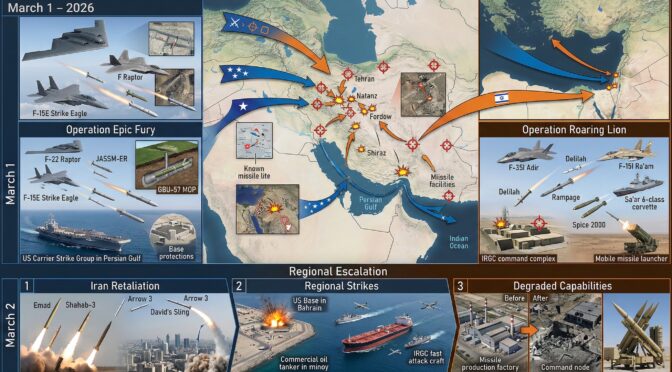
Over the past 36 hours, the geopolitical, military, and economic landscape of the Middle East has experienced a catastrophic rupture, transitioning rapidly from a shadow conflict into high-intensity, state-on-state warfare. The joint military campaign executed by the United States and Israel,designated “Operation Epic Fury” and “Operation Roaring Lion,” respectively,has achieved its initial tactical objectives of decapitating the upper echelon of the Iranian political and military establishment.1 Most notably, these coordinated strikes resulted in the death of Iran’s Supreme Leader, Ayatollah Ali Khamenei, effectively creating an unprecedented power vacuum within the Islamic Republic.3 The operations have severely degraded Iran’s integrated air defense systems (IADS), naval capabilities, and ballistic missile infrastructure across multiple provinces, altering the regional balance of power in a matter of hours.5
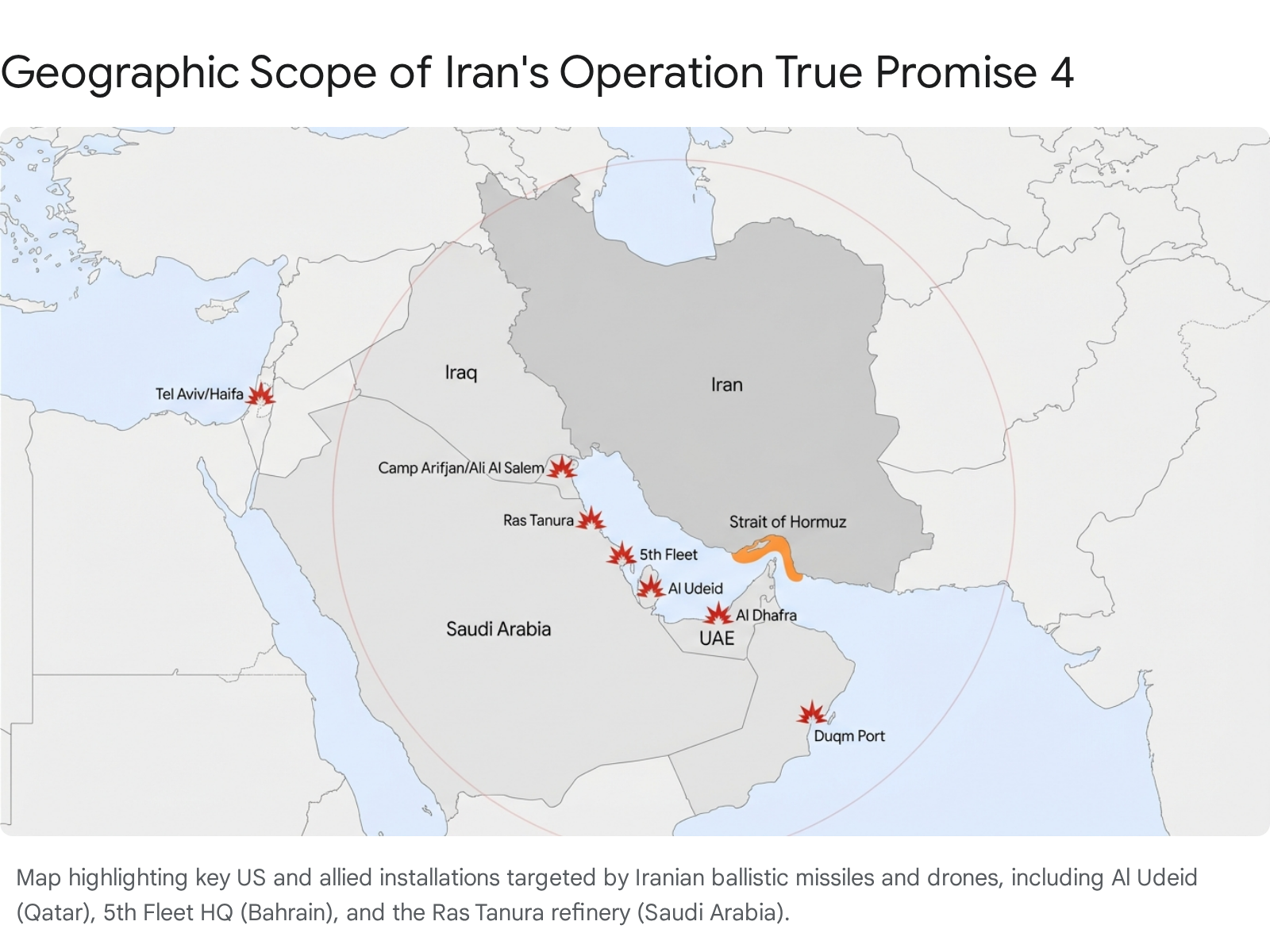
However, the second- and third-order effects of this decapitation campaign have triggered a massive and uncontrolled regional conflagration. In response to the US-Israeli strikes, Iran initiated a heavily layered, multi-vector retaliatory campaign termed “Operation True Promise 4”.6 This operation signals a fundamental shift in Iranian strategic doctrine. Abandoning previous norms that insulated neutral neighboring states, Tehran has explicitly targeted United States military logistics nodes and civilian infrastructure within the Gulf Cooperation Council (GCC) states.7 By launching ballistic missiles and loitering munitions at Saudi Arabia, the United Arab Emirates (UAE), Qatar, Bahrain, Kuwait, and previously neutral Oman, Iran has intentionally regionalized the conflict. The strategic calculus behind this escalation appears to be an attempt to force international pressure to halt the US-Israeli offensive by holding global energy markets, maritime shipping routes, and international aviation hubs hostage.9
The operational window of the last 36 hours has been characterized by three critical systemic shifts that will dictate the trajectory of the conflict in the coming weeks:
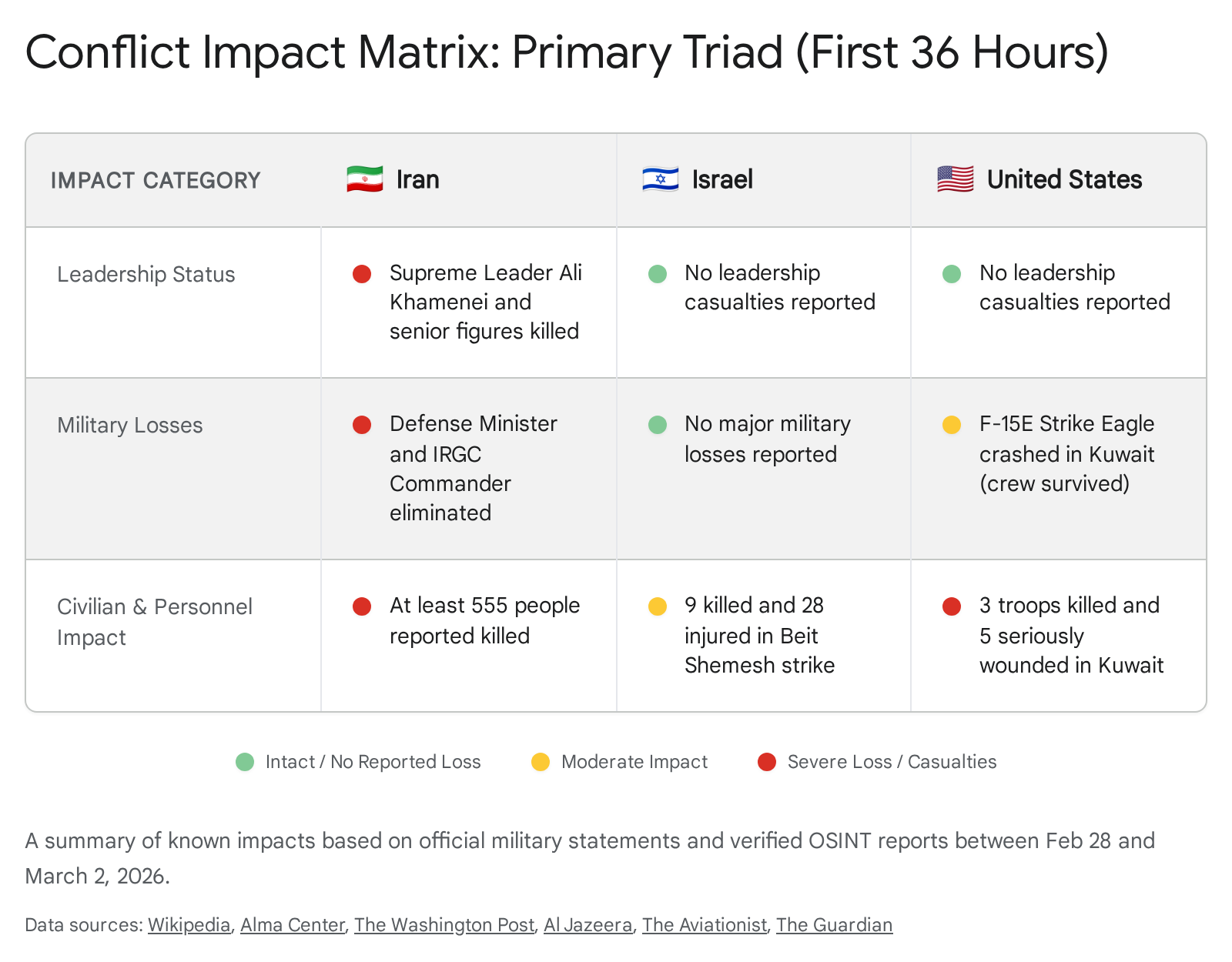
1. Direct US Casualties and Force Posture Attrition The conflict has crossed a fatal threshold for the United States, resulting in the first confirmed American military fatalities of the campaign. Three US servicemembers were killed and five seriously wounded in an Iranian drone and missile strike on logistics and housing facilities at Camp Arifjan in Kuwait.11 Concurrently, the United States suffered the loss of an Air Force F-15E Strike Eagle, which crashed in Kuwaiti airspace. While both the pilot and weapons systems officer (WSO) ejected safely and were recovered, initial military monitors and intelligence reports suggest the crash may have been a “friendly fire” incident involving a US Patriot surface-to-air missile battery, underscoring the chaotic and saturated nature of the Gulf’s contested airspace.13
2. Severe Global Economic Disruption and Maritime Blockade The economic reverberations of the conflict have been immediate and severe. On the morning of March 2, an Iranian drone evaded defenses to strike the Saudi Aramco Ras Tanura refinery in Saudi Arabia’s Eastern Province.15 The resulting fire forced the precautionary shutdown of the 550,000-barrel-per-day facility. This strike, combined with the Iranian Islamic Revolutionary Guard Corps (IRGC) Navy’s de facto blockade of the Strait of Hormuz,enforced via radio warnings and kinetic strikes on vessels such as the US-sanctioned, Palau-flagged oil tanker Skylight off the coast of Oman,has sent Brent crude prices surging by approximately 10%.17 The disruption threatens a sustained shock to global energy supply chains.
3. Horizontal Escalation and the Opening of the Northern Front The November 2024 ceasefire between Israel and Hezbollah has officially collapsed. In retaliation for the assassination of Khamenei, Hezbollah initiated direct drone and precision missile strikes against the Mishmar al-Karmel defense facility near Haifa.19 This triggered immediate, heavy Israeli retaliatory bombardments of Hezbollah strongholds in the Dahiyeh suburb of Beirut and across southern Lebanon, resulting in dozens of fatalities and mass civilian displacement.21 The Israel Defense Forces (IDF) have mobilized 100,000 reservists to the northern border, and while military leadership has downplayed an imminent ground invasion, they have explicitly stated that “all options are on the table,” indicating active preparations for cross-border maneuver warfare.22
The immediate outlook suggests a protracted war of attrition. While Iran’s central command-and-control has been deeply fractured by the decapitation strikes, its decentralized IRGC units, asymmetric naval assets, and regional proxies retain sufficient capabilities to sustain high-cost, asymmetric disruptions against US and allied interests across the Middle East.
2.0 Chronological Timeline of Key Events (Last 36 Hours)
Note: All times are rendered in Coordinated Universal Time (UTC) to ensure operational continuity across multiple theaters. The timeline covers the overlapping period from late February 28 to early March 2, 2026.
- February 28, 2026 | 17:00 UTC: The Islamic Revolutionary Guard Corps (IRGC) initiates the early waves of “Operation True Promise 4.” Ballistic missiles and Shahed loitering munitions are launched from western and central Iran toward US military installations in the Persian Gulf and Israeli population centers.24
- February 28, 2026 | 18:30 UTC: The Israel Defense Forces (IDF) officially declare the achievement of “air superiority” over the skies of Tehran. This follows the systematic suppression of Iranian air defense batteries (including S-300 and Bavar-373 systems) by a combined force of F-35I Adir and F-15 fighter aircraft.26
- February 28, 2026 | 20:00 UTC: UAE and Qatari integrated air defense systems, operating in tandem with US Patriot batteries, engage incoming Iranian projectiles. Debris from successful interceptions causes structural damage at Dubai International Airport and Zayed International Airport in Abu Dhabi. One civilian fatality (a Pakistani national) is recorded in Abu Dhabi.28
- February 28, 2026 | 23:30 UTC: Multiple news outlets confirm massive civilian aviation disruptions. Over 3,400 flights are canceled across the Middle East as the airspace over Iran, Iraq, Israel, Jordan, Kuwait, Bahrain, and Qatar is either completely closed or severely restricted via emergency NOTAMs.30
- March 1, 2026 | 02:00 UTC: US Central Command (CENTCOM) deploys B-2 stealth bombers from outside the immediate theater. The bombers, armed with 2,000-lb bunker-buster munitions, strike hardened, subterranean ballistic missile facilities in Tabriz and Esfahan, causing structural collapses at key subterranean complexes.32
- March 1, 2026 | 05:47 UTC: The Iranian Civil Aviation Organization issues an updated Notice to Airmen (NOTAM), officially extending the total closure of Iranian national airspace until at least 08:30 UTC on March 3, signaling expectations of prolonged aerial bombardment.30
- March 1, 2026 | 08:00 UTC: Oman’s maritime security center reports a sudden escalation in its territory. An Iranian drone strikes the commercial port of Duqm, injuring one expatriate worker. Shortly thereafter, the Palau-flagged oil tanker Skylight is struck five nautical miles off the coast of Musandam, injuring four crew members and forcing an evacuation.34
- March 1, 2026 | 09:30 UTC: The Pentagon officially confirms US casualties. Three US Army servicemembers belonging to a sustainment unit are killed, and five others are seriously wounded at Camp Arifjan in Kuwait. The casualties resulted from an Iranian strike that destroyed major portions of a housing and logistics unit.12
- March 1, 2026 | 13:00 UTC: An Iranian ballistic missile evades Israel’s layered defense network (Arrow/David’s Sling) and strikes a residential neighborhood in the central Israeli city of Beit Shemesh. Nine civilians are killed, and 28 are injured. The impact destroys a local synagogue and severely damages a subterranean public bomb shelter.37
- March 1, 2026 | 16:30 UTC: State media in Iran formally announces the formation of an Interim Leadership Council, activating Article 111 of the Iranian Constitution following the confirmed death of Ayatollah Ali Khamenei. The council consists of President Masoud Pezeshkian, Judiciary Chief Gholam-Hossein Mohseni Ejei, and hardline cleric Alireza Arafi.39
- March 1, 2026 | 23:49 UTC: The Gulf Cooperation Council (GCC) Ministerial Council concludes its 50th extraordinary session. The bloc issues a unified statement condemning Iranian aggression, declaring GCC security “indivisible,” and affirming the right to collective self-defense under the UN Charter.41
- March 2, 2026 | 01:10 UTC: Lebanese Hezbollah formally enters the kinetic conflict. The militant group fires a coordinated swarm of drones and precision missiles at the Mishmar al-Karmel missile defense facility near Haifa, explicitly stating the attack is retaliation for Khamenei’s assassination.19
- March 2, 2026 | 03:00 UTC: The IDF responds to Hezbollah’s escalation by launching heavy retaliatory airstrikes against Hezbollah strongholds in the Dahiyeh suburb of Beirut, the Bekaa Valley, and southern Lebanon. The Lebanese health ministry reports at least 31 fatalities and 149 injuries in the initial bombardment.21
- March 2, 2026 | 04:04 UTC (approx. 07:04 Local): An Iranian drone bypasses regional air defenses to strike the Saudi Aramco Ras Tanura refinery in Saudi Arabia’s Eastern Province. Interception debris causes a localized fire, forcing the precautionary operational shutdown of the massive 550,000 bpd energy facility.15
- March 2, 2026 | 05:30 UTC: The Kuwaiti Ministry of Defense confirms the crash of a US Air Force F-15E Strike Eagle west of Al Jahra. Both the pilot and the WSO eject safely and are recovered by Kuwaiti authorities. Unverified operational reports and military monitors suggest the crash is being investigated as a potential “friendly fire” incident involving a Patriot missile battery.13
3.0 Situation by Primary Country
3.1 Iran
3.1.1 Military Actions & Posture
The Iranian military apparatus has sustained catastrophic, systemic damage to its conventional and strategic capabilities, yet it retains a highly lethal asymmetric and ballistic posture. The combined US-Israeli offensive, operating with near-total air impunity, has effectively eliminated the centralized command structures of both the IRGC and the regular Armed Forces (Artesh).
Key military infrastructure systematically dismantled over the last 36 hours includes the IRGC Ground Forces Sarallah Headquarters in Tehran, which historically managed capital security, and the Khatam al-Anbiya Central Headquarters. The naval domain saw severe degradation, with US strikes sinking the IRIS Bayandor and IRIS Naghdi patrol frigates at the Artesh Navy 3rd Naval District base in Konarak, as well as the Moudge-class frigate IRIS Jamaran at the IRGC Imam Ali Base in Chabahar.5
Despite experiencing these severe decapitation strikes, decentralized Iranian units successfully executed the multi-phased “Operation True Promise 4.” While the aggregate volume of missile launches decreased from February 28 to March 1,indicating successful US-Israeli degradation efforts,the geographic spread and audacity of the strikes expanded dramatically. Iran utilized Emad and Ghadr medium-range ballistic missiles alongside Shahed-136/238 loitering munitions.46
In a profound doctrinal shift, the IRGC explicitly targeted US logistics and command nodes located in neighboring, sovereign states. Strikes were directed at Al Udeid Air Base in Qatar, Ali Al Salem Air Base in Kuwait, Al Dhafra Air Base in the UAE, and the US 5th Fleet Headquarters in Bahrain.25 This demonstrates a calculated willingness to violate the territorial integrity of GCC nations to impose direct costs on American forward deployments, viewing any host nation as a legitimate target. Furthermore, the IRGC Navy has moved to establish a de facto blockade of the Strait of Hormuz, issuing VHF radio warnings declaring the waterway closed to international shipping and executing kinetic strikes on commercial vessels, such as the Palau-flagged Skylight.18
3.1.2 Policy & Diplomacy
Iran is currently navigating an unprecedented constitutional and succession crisis following the targeted assassination of Supreme Leader Ayatollah Ali Khamenei and dozens of senior officials, including Defense Minister Aziz Nasirzadeh and Armed Forces Chief of Staff Abdolrahim Mousavi.40
In accordance with Article 111 of the Iranian Constitution, an Interim Leadership Council has been formed to execute the duties of the Supreme Leader until the Assembly of Experts can convene to select a permanent successor. This triumvirate consists of President Masoud Pezeshkian, Judiciary Chief Gholam-Hossein Mohseni Ejei, and newly appointed hardline cleric Alireza Arafi.39 Arafi, a member of the Expediency Discernment Council, was a highly trusted confidant of Khamenei, and his inclusion guarantees ideological continuity and IRGC alignment within the interim government.26
Diplomatically, the Iranian state has adopted a posture of uncompromising defiance, rejecting any immediate off-ramps. Ali Larijani, Secretary of the Supreme National Security Council, who is reportedly steering day-to-day security affairs, explicitly rejected back-channel diplomatic overtures from the United States mediated through Oman. Larijani stated on social media that Iran “will not negotiate” under military duress and accused the US of plunging the region into chaos.49 Foreign Minister Abbas Araghchi formally communicated to the United Nations that Iran’s actions represent a legitimate exercise of self-defense under international law, warning that the US and Israel’s pursuit of regime change is an “impossible mission” due to the regime’s entrenched roots.37
3.1.3 Civilian Impact
The domestic environment within Iran is highly volatile, characterized by mass casualties, infrastructural paralysis, and acute state repression. The Iranian Red Crescent Society reported that the US-Israeli strikes have resulted in at least 555 fatalities and over 700 injuries across 131 cities.50 The strikes heavily impacted the civilian populace, with Iran’s Ministry of Education reporting the deaths of dozens of students following collateral damage to schools in areas like Minab.52
To preempt coordinated civilian uprisings and suppress the flow of information regarding military losses, the state security apparatus has imposed a draconian, near-total internet blackout. Cybersecurity monitors report that national connectivity has been throttled to approximately 1%.26 The Law Enforcement Command (LEC) and Basij paramilitary units have established pervasive security checkpoints across Tehran and other major urban centers to prevent public gatherings.26 Despite these extreme measures, OSINT reports and satellite communications indicate polarized civilian reactions; state-mandated 40-day mourning periods overlap with isolated incidents of anti-regime celebrations and protests, underscoring deep internal societal fractures.44
3.2 Israel
3.2.1 Military Actions & Posture
The IDF, acting in close coordination with US forces, has executed “Operation Roaring Lion,” an unprecedented aerial campaign characterized by over 700 combat sorties striking upward of 2,000 targets deep inside Iranian territory.26 The initial phases of the operation utilized F-35I Adir stealth fighters to blind Iranian early warning radars and neutralize surface-to-air missile batteries. This suppression of enemy air defenses (SEAD) allowed conventional F-15 and F-16 fighters to follow up with precision strikes against ballistic missile production lines, drone storage facilities, and IRGC internal security headquarters in Tehran, ultimately enabling the IDF to claim total air superiority.5
As of March 2, however, the IDF’s operational focus was forced to abruptly expand following the entry of Lebanese Hezbollah into the conflict. After Hezbollah fired a swarm of drones and precision missiles at the Mishmar al-Karmel defense facility near Haifa, the IDF Northern Command immediately initiated a massive “offensive campaign” into Lebanon.21 Israeli aircraft struck dozens of Hezbollah infrastructure targets in the Bekaa Valley and the Dahiyeh suburb of Beirut, claiming the elimination of several senior Hezbollah commanders. The IDF has mobilized 100,000 reservists to the northern border. While military spokespersons initially downplayed an imminent ground invasion, they subsequently clarified that “all options are on the table,” indicating that robust logistical and tactical preparations are underway for cross-border maneuver warfare if aerial attrition fails to pacify the northern frontier.22
3.2.2 Policy & Diplomacy
Israeli policy remains firmly anchored in the maximalist strategic objective of permanently neutralizing the Iranian nuclear program and dismantling its regional proxy network. Prime Minister Benjamin Netanyahu and Defense Minister Israel Katz have framed the assassination of Khamenei and the ensuing campaign as a necessary historical imperative to destroy the “axis of evil” and remove an existential threat to the State of Israel.55
Israeli Foreign Minister Gideon Sa’ar confirmed that the joint operation has “no fixed end date,” communicating a high tolerance for a prolonged campaign of attrition against Iranian assets.56 Furthermore, the strategic decapitation policy utilized in Tehran is actively being applied to regional proxies. Following the rocket barrages from Lebanon, Defense Minister Katz publicly declared Hezbollah’s Secretary-General Naim Qassem a “marked target for elimination,” signaling that Israel will ruthlessly pursue proxy leadership.57
3.2.3 Civilian Impact
The civilian impact within Israel has escalated significantly, challenging the efficacy of the nation’s vaunted missile defense architecture. While the Arrow, David’s Sling, and Iron Dome systems successfully intercepted the vast majority of Iranian projectiles, critical failures occurred during saturated barrages.
The most severe incident occurred on March 1, when an Iranian ballistic missile directly impacted a residential neighborhood in the central Israeli city of Beit Shemesh. The strike resulted in nine fatalities and 28 injuries, destroying a local synagogue and causing severe structural damage to a public bomb shelter.37 Civilian anxiety has been heightened by reports that early warning sirens failed to activate in Beit Shemesh prior to the impact. Across Tel Aviv, Jerusalem, and Haifa, millions of citizens remain confined to shelters. Additionally, the escalation in the north has triggered mandatory evacuation orders for dozens of Lebanese villages, while simultaneously exacerbating the internal displacement crisis for northern Israeli communities bordering Lebanon.21
3.3 United States
3.3.1 Military Actions & Posture
Operating under the banner of “Operation Epic Fury,” US Central Command (CENTCOM) has leveraged the largest concentration of American air and naval power in the Middle East since the 2003 invasion of Iraq.59 The US military struck over 1,000 individual targets in the opening 24 hours. A critical component of this campaign involved the deployment of B-2 Spirit stealth bombers, operating from bases outside the immediate theater, to deliver 2,000-lb bunker-buster munitions against heavily fortified, deep-buried Iranian ballistic missile complexes, such as the Tabriz North facility.32 In the maritime domain, US naval assets effectively neutralized the Iranian surface fleet, reportedly sinking up to nine warships, including the IRIS Jamaran corvette.33
However, the US military is concurrently managing acute force-protection crises as its regional bases come under sustained fire. On March 1, an Iranian drone and missile strike penetrated the defenses of Camp Arifjan in Kuwait, directly impacting a housing and logistics unit. This resulted in the deaths of three US Army servicemembers and serious injuries to five others, marking the first American combat fatalities of the campaign.11
Furthermore, on March 2, a US Air Force F-15E Strike Eagle crashed west of Al Jahra in Kuwait. While both the pilot and the weapons systems officer (WSO) ejected safely and were recovered in stable condition by Kuwaiti authorities, the incident highlights the extreme hazards of the operational environment. Preliminary intelligence and military monitors suggest the crash is being investigated as a potential “friendly fire” incident involving a misidentified engagement by a Patriot surface-to-air missile battery, illustrating the chaotic reality of a highly congested and contested Gulf airspace.13
| Weapon System | Platform Role | Operational Deployment Notes |
| B-2 Spirit | Stealth Heavy Bomber | Deployed from outside theater; utilized 2,000-lb bunker busters on Tabriz North. |
| F-35I Adir (IDF) | Stealth Multirole | Spearheaded SEAD (Suppression of Enemy Air Defenses) over Tehran. |
| F-15E Strike Eagle | Multirole Strike | Conducted heavy ground attack; one unit lost over Kuwait (investigation pending). |
| Tomahawk (TLAM) | Cruise Missile | Launched from US Navy destroyers/subs targeting IRGC command centers. |
| Shahed-136/238 | Loitering Munition | Deployed extensively by Iran against GCC infrastructure and US bases. |
| Patriot / THAAD | Air & Missile Defense | US/GCC defense systems; heavily engaged in Kuwait, UAE, Qatar, and Bahrain. |
3.3.2 Policy & Diplomacy
The current US administration’s policy reflects a stark and aggressive departure from previous diplomatic containment strategies. President Trump authorized the sweeping strikes without seeking formal congressional approval, leading to intense domestic political friction regarding war powers.62 This friction was exacerbated following closed-door Pentagon briefings to congressional staff on March 1. During these briefings, defense officials reportedly acknowledged that US intelligence had no specific indicators of an imminent Iranian preemptive attack, directly contradicting the White House’s initial public justification for launching the war.63
Despite the aggressive kinetic posture aimed at regime change, the US is engaging in complex diplomatic signaling. While President Trump publicly stated the campaign could last “four to five weeks,” he simultaneously indicated a willingness to engage in diplomatic talks with the newly formed Iranian Interim Leadership Council, suggesting a desire to leverage the military devastation to force capitulation.49 Concurrently, the US State Department has actively mobilized allied support, securing permission to utilize British military bases in Cyprus (RAF Akrotiri) and Diego Garcia for “defensive measures” to intercept Iranian projectiles traversing the region.66
3.3.3 Civilian Impact
Beyond the tragic military casualties, the primary civilian impact for the United States involves the sudden stranding of tens of thousands of American citizens, expatriates, and global travelers across the Middle East due to the abrupt closure of national airspaces and major transit hubs.31
US embassies across the GCC,specifically in Kuwait, Bahrain, and the UAE,have issued urgent shelter-in-place orders for all diplomatic personnel and American citizens. These alerts cite the severe risk of falling interception debris, as well as the danger of direct strikes on civilian infrastructure co-located near military installations.66 The US government has currently declined to join other nations in organizing mass civilian evacuations, advising citizens to remain in secure locations until the airspace restrictions are lifted.69
4.0 Regional and Gulf State Impacts
The most profound strategic development of the last 36 hours is Iran’s deliberate targeting of GCC states that host US forces. By executing “Operation True Promise 4” against its neighbors, Tehran has abandoned decades of unwritten rules of engagement that previously insulated these nations from direct kinetic attacks. In response, the GCC convened an extraordinary ministerial meeting on March 1. The resulting joint statement declared GCC security to be “indivisible,” condemned the Iranian strikes as flagrant violations of international law, and affirmed the bloc’s collective right to self-defense and retaliation.41
4.1 Kingdom of Saudi Arabia
The conflict has directly threatened global macroeconomic stability via Saudi Arabia’s critical energy infrastructure. On the morning of March 2, an Iranian drone struck the Saudi Aramco Ras Tanura refinery,one of the largest processing facilities in the world with a 550,000 barrel-per-day capacity. While Saudi air defenses intercepted the incoming drone, the falling flaming debris ignited a fire within the complex, forcing Aramco to shut down the facility as a precautionary measure.15 This attack on physical infrastructure, combined with the suspension of maritime traffic in the Strait of Hormuz, triggered a nearly 10% surge in Brent crude prices, pushing it toward $80 per barrel.17 In response, Saudi Arabia has placed its military on high alert, heavily fortifying its Eastern Province and the Prince Sultan Air Base against further incursions.
4.2 United Arab Emirates (UAE)
The UAE has experienced severe disruptions to its critical commercial and aviation infrastructure, shattering its carefully cultivated reputation as a safe haven. Iranian projectiles targeting the US-utilized Al Dhafra Air Base resulted in interception debris falling densely populated civilian areas. Tragically, one civilian was killed in Abu Dhabi, and four individuals were injured following an impact near a luxury hotel on the Palm Jumeirah in Dubai.28 Dubai International Airport (DXB) suffered minor structural damage and localized flooding from fire suppression systems, leading to the suspension of all Emirates and FlyDubai operations and stranding thousands of international travelers.29 The UAE government has formally closed its embassy in Tehran, recalled its ambassador, and shifted all national schools to distance learning.72
4.3 State of Qatar
Despite acting as the primary diplomatic mediator between the US and Iran prior to the outbreak of war, Qatar was not spared from Iranian retaliation. Iran launched a reported 65 ballistic missiles and 12 drones at Qatari territory, primarily targeting the massive US Central Command forward headquarters at Al Udeid Air Base.73 While Qatari and US Patriot batteries successfully intercepted 63 of the missiles, two projectiles struck within the perimeter of Al Udeid, and a drone significantly damaged a US early-warning radar dome. Sixteen Qatari citizens were injured by falling shrapnel.73 Consequently, Qatar Airways has suspended all operations out of Doha, effectively crippling one of the globe’s primary transit hubs.75
4.4 State of Kuwait
Kuwait has suffered both direct military casualties and severe civilian infrastructure disruptions. The Iranian drone strike on Camp Arifjan resulted in the deaths of three US soldiers, dragging Kuwait geographically into the center of the conflict.12 Furthermore, debris from the downed US F-15E Strike Eagle fell into the Mina Al Ahmadi refinery complex, injuring two Kuwaiti petroleum workers and prompting emergency shutdowns.76 Kuwait’s Ali Al Salem Air Base sustained damage to its runway from ballistic missile impacts, and the government has completely closed its national airspace to all commercial traffic.47 The US Embassy in Kuwait City has repeatedly ordered personnel to shelter in place amid the ongoing threat of bombardment.66
4.5 Kingdom of Bahrain
Bahrain, home to the strategic US Navy’s 5th Fleet, was targeted by a swarm of Shahed-136 drones and ballistic missiles. While the primary fleet vessels (including valuable carrier strike groups) had been evacuated to deep water prior to the attack, the Naval Support Activity (NSA) base in the Juffair district sustained damage to its service centers and radar domes.77 Collateral damage from the strikes hit residential high-rises and the Crowne Plaza hotel in the capital of Manama, prompting Bahraini authorities to suspend all flights at Bahrain International Airport.78
4.6 Sultanate of Oman
Oman’s historic role as a neutral sanctuary and diplomatic back-channel was shattered on March 1. Two Iranian drones struck the commercial port of Duqm, injuring an expatriate worker and damaging mobile housing units.34 Concurrently, the Palau-flagged, US-sanctioned oil tanker Skylight was hit by an Iranian projectile five nautical miles off the Omani coast near the Musandam peninsula; four crew members were injured, and the ship was evacuated.35 While Omani Foreign Minister Badr Albusaidi issued statements urging a return to diplomacy, the kinetic strikes clearly indicate that Tehran no longer views Muscat as an off-limits sanctuary.80
4.7 Hashemite Kingdom of Jordan
Jordanian air defenses were heavily activated to intercept Iranian missiles traversing its airspace toward Israel and to defend the Muwaffaq al-Salti Air Base, which houses a massive deployment of US F-35 and F-15 fighter jets.59 Interception debris fell in civilian areas, including the city of Irbid, causing property damage.81 Amman has vehemently reiterated that it will not allow its airspace to be used as a theater of war by any party, though its heavy reliance on US security guarantees and its geographic location place it in a highly precarious diplomatic and military position.82
| Host Nation | Primary Target | Infrastructure / Civilian Impact |
| Saudi Arabia | Ras Tanura Refinery | Refinery shut down due to drone debris fire; global oil prices surged 10%. |
| UAE | Al Dhafra Air Base | 1 civilian killed in Abu Dhabi; DXB airport damaged; mass flight cancellations. |
| Qatar | Al Udeid Air Base | US radar dome damaged; 16 civilians injured by shrapnel; airspace closed. |
| Kuwait | Camp Arifjan / Ali Al Salem | 3 US troops KIA; F-15 crash debris injured 2 refinery workers; airspace closed. |
| Bahrain | NSA Bahrain (5th Fleet HQ) | Juffair base service center damaged; residential buildings struck in Manama. |
| Oman | Duqm Port / Strait of Hormuz | Port worker injured; oil tanker Skylight struck, 4 crew injured. |
| Jordan | Muwaffaq al-Salti Air Base | Interception debris fell in civilian areas (Irbid); airspace heavily contested. |
5.0 Appendices
Appendix A: Methodology
This Situation Report (SITREP) was synthesized using a comprehensive, real-time sweep of open-source intelligence (OSINT), official military press releases (e.g., CENTCOM, IDF), state-run media broadcasts (e.g., IRNA, Saudi Press Agency), and global financial/aviation monitors (e.g., Flightradar24, Bloomberg). The 36-hour operational window was calculated backwards from March 2, 2026, 05:38 UTC, capturing the critical overlap of the initial preemptive strikes through the subsequent retaliatory waves.
Deconfliction and Sourcing: Where OSINT and official reports conflicted, this report prioritized official defense ministry confirmations while noting credible alternative hypotheses. For example, regarding the F-15 crash in Kuwait, the report relies on the Kuwaiti Ministry of Defense’s confirmation of the crash and crew survival, while acknowledging widespread OSINT tracking and military analysis suggesting a Patriot “friendly-fire” incident, rather than adopting unverified Iranian claims of a shoot-down. Casualty figures and interception rates were cross-referenced between CENTCOM, IDF statements, the Iranian Red Crescent, and GCC interior ministries to ensure a strictly objective and factual analytical tone.
Appendix B: Glossary of Acronyms
| Acronym | Definition | Context |
| CENTCOM | United States Central Command | The geographic combatant command responsible for US military operations in the Middle East. |
| GCC | Gulf Cooperation Council | A political and economic union of Arab states bordering the Persian Gulf (Bahrain, Kuwait, Oman, Qatar, Saudi Arabia, UAE). |
| IADS | Integrated Air Defense System | The networked radar, command, and missile systems used by a nation (e.g., Iran) to defend its airspace. |
| IAEA | International Atomic Energy Agency | The UN nuclear watchdog monitoring the safety of regional nuclear facilities amid the conflict. |
| IDF | Israel Defense Forces | The national military of the State of Israel. |
| IRGC | Islamic Revolutionary Guard Corps | Iran’s premier paramilitary and security force, tasked with defending the Islamic Republic’s political system and operating its strategic missile forces. |
| LEC | Law Enforcement Command | The uniformed police force of Iran, heavily involved in internal security and protest suppression. |
| NOTAM | Notice to Airmen | An alert issued by an aviation authority to inform pilots of potential hazards along a flight route (used to enact airspace closures). |
| SEAD | Suppression of Enemy Air Defenses | Military operations aimed at neutralizing surface-to-air missile systems and early warning radars. |
| WSO | Weapons Systems Officer | The flight officer seated behind the pilot in dual-seat aircraft (like the F-15E) responsible for targeting and munitions. |
Appendix C: Glossary of Foreign Words
| Term | Origin | Definition |
| Ayatollah | Persian/Arabic | A high-ranking title given to major Shia clerics; literally “Sign of God.” Used in reference to Ali Khamenei. |
| Dahiyeh | Arabic | A predominantly Shia suburb south of Beirut, Lebanon; serves as the primary stronghold and command headquarters for Hezbollah. |
| Khamenei | Persian | Ali Khamenei, the second Supreme Leader of Iran, who held ultimate political, military, and religious authority until his assassination on Feb 28, 2026. |
| Majlis | Arabic/Persian | The Islamic Consultative Assembly; the national legislative body (parliament) of Iran. |
| Shahed | Persian | Meaning “Witness” or “Martyr.” The name of a family of Iranian loitering munitions (kamikaze drones, specifically the 136 and 238 variants) used extensively in the current strikes. |
| Velayat-e Faqih | Persian/Arabic | “Guardianship of the Islamic Jurist,” the foundational political and theological doctrine of the Iranian regime justifying the absolute rule of the Supreme Leader. |
Please share the link on Facebook, Forums, with colleagues, etc. Your support is much appreciated and if you have any feedback, please email us in**@*********ps.com. If you’d like to request a report or order a reprint, please click here for the corresponding page to open in new tab.
Sources Used
- 2026 Israeli–United States strikes on Iran – Wikipedia, accessed March 2, 2026, https://en.wikipedia.org/wiki/2026_Israeli%E2%80%93United_States_strikes_on_Iran
- Weapons of ‘Epic Fury’: Fighters, Missiles, and ‘Special Capabilities’, accessed March 2, 2026, https://www.airandspaceforces.com/weapons-of-epic-fury-fighters-missiles-and-special-capabilities/
- 2026 Iran–United States crisis – Wikipedia, accessed March 2, 2026, https://en.wikipedia.org/wiki/2026_Iran%E2%80%93United_States_crisis
- U.S. and Israel launch another round of strikes on Iran following Khamenei’s killing, accessed March 2, 2026, https://www.cbsnews.com/live-updates/israel-us-attack-iran-trump-says-major-combat-operations/
- US-Israeli campaign hits Iranian regime’s military and repression …, accessed March 2, 2026, https://www.longwarjournal.org/archives/2026/03/us-israeli-campaign-hits-iranian-regimes-military-and-repression-apparatus-regime-forms-leadership-council-march-1-updates.php
- Iran Strike Scenarios: Retaliation, Transition, and the Path Forward – Middle East Forum, accessed March 2, 2026, https://www.meforum.org/mef-reports/iran-strike-scenarios-retaliation-transition-and-the-path-forward
- Experts react: How the US war with Iran is playing out around the Middle East, accessed March 2, 2026, https://www.atlanticcouncil.org/dispatches/experts-react-how-the-us-war-with-iran-is-playing-out-around-the-middle-east/
- Gulf states condemn ‘heinous’ Iran attacks and affirm legal right to respond, accessed March 2, 2026, https://www.thenationalnews.com/news/gulf/2026/03/02/gcc-countries-condemn-heinous-iran-attacks-and-affirm-right-to-respond/
- Killing of Ali Khamenei and Kinetic Escalation in the Persian Gulf – SpecialEurasia, accessed March 2, 2026, https://www.specialeurasia.com/2026/03/01/khamenei-killing-middle-east/
- Iran strikes Gulf states, even mediator Oman – why its strategy could backfire, accessed March 2, 2026, https://timesofindia.indiatimes.com/defence/international/iran-strikes-gulf-states-even-mediator-oman-why-its-strategy-could-backfire-us-israel-strike-iran/articleshow/128912009.cms
- U.S. troops killed amid Iranian counterattack, fueling air defense fears, accessed March 2, 2026, https://www.washingtonpost.com/national-security/2026/03/01/us-troops-killed-iran/
- 3 US troops killed and 5 are seriously wounded during Iran attacks, military says, accessed March 2, 2026, https://apnews.com/article/iran-trump-us-military-troops-casualties-793c3ea29a399c9a405e70b14c548595
- F-15 Seen Crashing in Flames in the Middle East, Crew Ejected, accessed March 2, 2026, https://theaviationist.com/2026/03/02/f-15-crashing-in-flames-middle-east/
- US F-15 Crash: Pilot & WSO Captured in Kuwait After F-15E Crash in Suspected Friendly Fire Incident (Photo Inside) – The Sunday Guardian, accessed March 2, 2026, https://sundayguardianlive.com/world/us-f-15-crash-pilot-wso-weapons-systems-officer-captured-in-kuwait-after-f-15e-crash-in-suspected-friendly-fire-incident-photo-inside-173450/
- Ras Tanura refinery shut after drone strike: Update | Latest Market News – Argus Media, accessed March 2, 2026, https://www.argusmedia.com/news-and-insights/latest-market-news/2794759-ras-tanura-refinery-shut-after-drone-strike-update
- Iran war: Saudi Aramco shuts down Ras Tanura refinery after drone strike, accessed March 2, 2026, https://www.hindustantimes.com/business/iran-war-saudi-aramcos-ras-tanura-refinery-shut-down-after-drone-strike-101772436285642.html
- Saudi Arabia’s Aramco Ras Tanura refinery hit by drone strike, shuts down; Brent Crude rises 9%, accessed March 2, 2026, https://www.livemint.com/industry/energy/saudi-arabias-aramco-ras-tanura-refinery-hit-by-drone-strike-shuts-down-brent-crude-rises-9-11772436188885.html
- First oil tanker attacked in the Strait of Hormuz according to Oman, accessed March 2, 2026, https://www.nationthailand.com/news/world/40063171
- Timeline: U.S.-Israel strike on Iran escalates into regional conflict, accessed March 2, 2026, https://news.cgtn.com/news/2026-03-02/Timeline-U-S-Israel-strike-on-Iran-escalates-into-regional-conflict-1LbiVLwZMQM/p.html
- Israel kills more than 30 people in Lebanon after Hezbollah enters the fray, accessed March 2, 2026, https://english.elpais.com/international/2026-03-02/israel-kills-more-than-30-people-in-lebanon-after-hezbollah-enters-the-fray.html
- Israel strikes Lebanon after Iran ally Hezbollah fires missiles over border, accessed March 2, 2026, https://www.theguardian.com/world/2026/mar/02/israel-idf-strikes-hezbollah-beirut-lebanon-iran-war
- US-Israel war on Iran live: conflict spreads to Lebanon and wider region, as Kuwait reports ‘several’ US warplanes crashing – The Guardian, accessed March 2, 2026, https://www.theguardian.com/world/live/2026/mar/02/us-israel-war-iran-live-updates-attacks-strikes-tehran-lebanon-beirut-hezbollah-dubai-latest-news?page=with:block-69a538a58f0863f6a3eff92e
- Israeli military boosts presence near Lebanon border, downplays imminent ground invasion, accessed March 2, 2026, https://m.economictimes.com/news/international/world-news/israeli-military-boosts-presence-near-lebanon-border-downplays-imminent-ground-invasion/articleshow/128942799.cms
- From the Gulf to Europe: Iran Broadens Retaliation Under “Truthful Promise 4”, accessed March 2, 2026, https://www.israeldefense.co.il/en/node/67952
- Iran attacks US military bases across Middle East in operation ‘Truthful Promise 4’, accessed March 2, 2026, https://timesofindia.indiatimes.com/defence/international/iran-attacks-us-military-bases-across-middle-east-in-operation-truthful-promise-4/articleshow/128882765.cms
- Iran Update Evening Special Report, March 1, 2026 | ISW, accessed March 2, 2026, https://understandingwar.org/research/middle-east/iran-update-evening-special-report-march-1-2026/
- Timeline: U.S.-Israel strikes on Iran trigger escalation, Khamenei killed – Guangming Online, accessed March 2, 2026, https://en.gmw.cn/2026-03/02/content_38622180.htm
- Two dead as Iran launches waves of strikes on wealthy Gulf | International, accessed March 2, 2026, https://www.bssnews.net/international/364807
- Iran strikes Gulf again: More explosions in Dubai, Doha and Manama; airports targeted?, accessed March 2, 2026, https://timesofindia.indiatimes.com/world/middle-east/iran-strikes-gulf-again-more-explosions-in-dubai-doha-and-manama-airports-targeted/articleshow/128908100.cms
- Airspace closures following Israeli and US strikes on Iran, accessed March 2, 2026, https://www.flightradar24.com/blog/live/israel-launches-pre-emptive-strikes-on-iran-airspace-closures-going-into-place/
- Hundreds of thousands of travellers stranded or diverted by airspace closures in Middle East, accessed March 2, 2026, https://www.theguardian.com/us-news/2026/mar/01/hundreds-of-thousands-of-travellers-stranded-or-diverted-amid-air-space-closures-in-middle-east
- B-2 Spirit Stealth Bombers Take Part in Night Strikes on Iran – The Aviationist, accessed March 2, 2026, https://theaviationist.com/2026/03/01/b-2-spirit-night-strikes-on-iran/
- First 24 hours of Trump’s war on Iran, by the numbers, accessed March 2, 2026, https://www.defenseone.com/threats/2026/03/first-24-hours-trumps-war-iran-numbers/411789/
- Duqm Commercial Port in Oman Targeted by Two Drones – Qatar news agency, accessed March 2, 2026, https://qna.org.qa/en/News-Area/News/2026-3/1/duqm-commercial-port-in-oman-targeted-by-two-drones
- Oil tanker hit off Oman coast after drones strike Duqm port, ETInfra, accessed March 2, 2026, https://infra.economictimes.indiatimes.com/news/ports-shipping/oil-tanker-hit-off-oman-coast-after-drones-strike-duqm-port/128934569
- 3 U.S. Service Members Killed in Action as Iranian Regime Expands Regional Assault, accessed March 2, 2026, https://www.fdd.org/analysis/2026/03/01/3-u-s-service-members-killed-in-action-as-iranian-regime-expands-regional-assault/
- At least nine killed after Iranian strike on Israel’s Beit Shemesh …, accessed March 2, 2026, https://www.aljazeera.com/news/2026/3/1/at-least-nine-killed-after-iranian-strike-on-israels-beit-shemesh
- Iran’s Retaliatory Strikes Challenge Image of Gulf Stability, accessed March 2, 2026, https://time.com/7381884/iran-missiles-dubai-palm-gulf/
- Iran’s Power Structure Shifts as Temporary Council Assumes Authority, accessed March 2, 2026, https://iranwire.com/en/news/149673-irans-power-structure-shifts-as-temporary-council-assumes-authority/
- 2026 Iranian leadership crisis – Wikipedia, accessed March 2, 2026, https://en.wikipedia.org/wiki/2026_Iranian_leadership_crisis
- GCC declares its security indivisible, reserves right to respond to Iranian attacks – Region – World, accessed March 2, 2026, https://english.ahram.org.eg/NewsContent/2/8/563231/World/Region/GCC-declares-its-security-indivisible,-reserves-ri.aspx
- GCC Foreign Ministers affirm the right of its states to respond to any aggression – Arab News, accessed March 2, 2026, https://www.arabnews.com/node/2634921/middle-east
- (VIDEO) Iran Claims Downing of US F-15 Fighter Jet Over Kuwait, Shares Video of Spiraling Crash, accessed March 2, 2026, https://www.ibtimes.com.au/video-iran-claims-downing-us-f-15-fighter-jet-over-kuwait-shares-video-spiraling-crash-1862418
- Daily Report: The Second Iran War – March 1, 2026 (19:00), accessed March 2, 2026, https://israel-alma.org/daily-report-the-second-iran-war-march-1-2026-1900/
- Iran Update Morning Special Report: March 1, 2026 | ISW, accessed March 2, 2026, https://understandingwar.org/research/middle-east/iran-update-morning-special-report-march-1-2026/
- The making and unmaking of the note – National Herald, accessed March 2, 2026, https://www.nationalheraldindia.com/national/the-making-and-unmaking-of-the-note
- Iran Update Evening Special Report, February 28, 2026, accessed March 2, 2026, https://understandingwar.org/research/middle-east/iran-update-evening-special-report-february-28-2026/
- Iran News in Brief – March 1, 2026 – NCRI, accessed March 2, 2026, https://www.ncr-iran.org/en/news/iran-news-in-brief-news/iran-news-in-brief-march-1-2026/
- Iran’s Larijani says will not negotiate with US, accessed March 2, 2026, https://thenewregion.com/posts/4726
- US-Israel war on Iran live: conflict spreads to Lebanon and wider …, accessed March 2, 2026, https://www.theguardian.com/world/live/2026/mar/02/us-israel-war-iran-live-updates-attacks-strikes-tehran-lebanon-beirut-hezbollah-dubai-latest-news?page=with:block-69a54b518f08e575db5be336
- US-Israel war on Iran live: conflict spreads to Lebanon and wider region, as Kuwait reports ‘several’ US warplanes crashing, accessed March 2, 2026, https://www.theguardian.com/world/live/2026/mar/02/us-israel-war-iran-live-updates-attacks-strikes-tehran-lebanon-beirut-hezbollah-dubai-latest-news?page=with:block-69a560b88f0863f6a3effa10
- 201 Killed in US–Israeli Assault as Iran Expands ‘True Promise 4’ with 220 Missiles, accessed March 2, 2026, https://www.palestinechronicle.com/201-killed-in-us-israeli-assault-as-iran-expands-true-promise-4-with-220-missiles/
- Iran announces three-member leadership council, accessed March 2, 2026, https://www.iranintl.com/en/202603016621
- IDF strikes in Beirut after Hezbollah enters fray, fires rockets, drones at north, accessed March 2, 2026, https://www.timesofisrael.com/idf-strikes-targets-in-beirut-after-hezbollah-enters-fray-fires-at-northern-israel/
- Supreme Leader of Iran Khamenei dead following Israel’s strike on Iran, accessed March 2, 2026, https://www.foxnews.com/live-news/israel-us-launch-attack-on-iran-amid-escalating-protests
- Israel has no fixed end date for Iran operation, FM says, accessed March 2, 2026, https://www.iranintl.com/en/202603025758
- US-Israel Attacks Iran Live: Jordan announces partial, temporary closure of its airspace, accessed March 2, 2026, https://www.indiatoday.in/world/story/us-israel-attacks-iran-live-updates-middle-east-war-dubai-pakistan-tehran-khamenei-trump-gulf-2876296-2026-03-02
- March 1: Hezbollah fires rockets at northern Israel, in first since Nov. 2024 ceasefire, accessed March 2, 2026, https://www.timesofisrael.com/liveblog-march-01-2026/
- Dozens of US fighter jets moved to Muwaffaq Salti air base | The Jerusalem Post, accessed March 2, 2026, https://www.jpost.com/middle-east/article-887388
- 2026 United States military buildup in the Middle East – Wikipedia, accessed March 2, 2026, https://en.wikipedia.org/wiki/2026_United_States_military_buildup_in_the_Middle_East
- US Military Strikes IRGC Headquarters, Trump Says 9 Iranian Naval Ships Destroyed, accessed March 2, 2026, https://www.newsonair.gov.in/us-president-donald-trump-claims-destruction-of-9-iranian-naval-ships/
- US Strike On Iran Ignites War Powers Fight in Congress, Protests | Military.com, accessed March 2, 2026, https://www.military.com/daily-news/headlines/2026/03/01/us-strike-iran-ignites-war-powers-fight-congress-protests.html
- Pentagon tells Congress no sign that Iran was going to attack U.S. first – The Japan Times, accessed March 2, 2026, https://www.japantimes.co.jp/news/2026/03/02/world/us-pentagon-iran-war/
- Pentagon tells Congress no sign that Iran was going to attack U.S. first, sources say, accessed March 2, 2026, https://www.thehindu.com/news/international/pentagon-tells-congress-no-sign-that-iran-was-going-to-attack-us-first-sources-say/article70693907.ece
- Trump open to talks with Iran as conflict deepens in Middle East, accessed March 2, 2026, https://www.theguardian.com/world/2026/mar/01/trump-open-to-talks-with-iran-as-conflict-deepens-in-middle-east
- Live updates: Trump says Iran operation could take “four weeks or less,” 3 U.S. troops killed, accessed March 2, 2026, https://www.cbsnews.com/live-updates/us-iran-war-israel-supreme-leader-khamenei-funeral-day-2/
- Hundreds of thousands of travelers stranded following U.S.-Israel attacks on Iran – PBS, accessed March 2, 2026, https://www.pbs.org/newshour/world/hundreds-of-thousands-of-travelers-stranded-following-u-s-israel-attacks-on-iran
- U.S. and Israel Strike Iran, Triggering Gulf-Wide Missile Retaliation From Tehran, accessed March 2, 2026, https://www.hstoday.us/featured/u-s-and-israel-strike-iran-triggering-gulf-wide-missile-retaliation-from-tehran/
- Live updates: Deaths mount in U.S.-Israeli war on Iran as Trump says strikes could take a month, accessed March 2, 2026, https://www.cbsnews.com/live-updates/iran-us-war-day-3-american-deaths-israel-gulf-allies-hit-missile-strikes/
- Dubai, Abu Dhabi, Bahrain, Kuwait: Gulf countries targeted by Iran after US-Israel strikes, accessed March 2, 2026, https://timesofindia.indiatimes.com/world/middle-east/dubai-abu-dhabi-bahrain-kuwait-gulf-countries-targeted-by-iran-after-us-israel-strikes/articleshow/128905800.cms
- Middle East airspace closures cause widespread flight cancellations, reroutes, and delays, accessed March 2, 2026, https://www.airhelp.co.uk/flight-disruptions/middle-east-airspace-closures-flight-cancellations-reroutes-02032026/
- US–Israel war on Iran day 2: Dos, don’ts, missile alerts, school closures, other critical updates for UAE residents as emirates on high alert, accessed March 2, 2026, https://timesofindia.indiatimes.com/world/middle-east/usisrael-war-on-iran-day-2-dos-donts-missile-alerts-school-closures-other-critical-updates-for-uae-residents-as-emirates-on-high-alert/articleshow/128928208.cms
- Iranian attacks wound 16 Qatari citizens: Interior Ministry, accessed March 2, 2026, https://www.arabnews.jp/en/middle-east/article_165038/
- Qatar intercepts 63 missiles and 11 drones in large-scale Iranian attack, reports eight injuries, accessed March 2, 2026, https://gulfnews.com/world/gulf/qatar/qatar-intercepts-63-missiles-and-11-drones-in-large-scale-iranian-attack-reports-eight-injuries-1.500459262
- Middle East airspace closures trigger widespread flight suspensions, accessed March 2, 2026, https://traveltomorrow.com/middle-east-airspace-closures-trigger-widespread-flight-suspensions/
- US F-15 fighter jet downed over Kuwait; viral video shows aircraft free falling from the sky engulfed in flames, accessed March 2, 2026, https://www.livemint.com/news/world/us-f-15-fighter-jet-downed-over-kuwait-viral-video-shows-aircraft-free-falling-from-the-sky-engulfed-in-flames-11772429094417.html
- Lessons Learned: How Iran was able to bruise the US Navy’s 5th Fleet, accessed March 2, 2026, https://www.wearethemighty.com/military-news/iran-retaliation-5th-fleet-bahrain/
- Is Bahrain International Airport Closed? Bahrain International Airport Shut Down Amid Iran Conflict, accessed March 2, 2026, https://www.ibtimes.com.au/bahrain-international-airport-closed-bahrain-international-airport-shut-down-amid-iran-conflict-1862458
- Iranian drones damage US Navy base in Bahrain; Americans evacuate, accessed March 2, 2026, https://www.defenseone.com/threats/2026/02/americans-evacuate-after-iranian-drones-damage-us-navy-base-bahrain/411786/
- Mediator Oman says ‘door to diplomacy’ between US, Iran still open – DAWN.COM, accessed March 2, 2026, https://www.dawn.com/news/1977202
- Iran’s Multi‑Front Missile and UAV Offensive Across the Middle East (Feb 28–Mar 1, 2026), accessed March 2, 2026, https://israel-alma.org/irans-multi-front-missile-and-uav-offensive-across-the-middle-east-feb-28-mar-1-2026/
- Around Iran: Operation Lion’s Roar through the eyes of key international players, accessed March 2, 2026, https://www.inss.org.il/social_media/around-iran-operation-lions-roar-through-the-eyes-of-key-international-players/