Executive Summary
The acoustic evaluation of precision small arms has historically been dictated by occupational health and safety metrics, specifically the United States Department of Defense MIL-STD-1474E protocol. This standard evaluates the peak sound pressure level (SPL) of a weapon system at the operator’s ear and at a one-meter offset from the muzzle, ensuring that impulse noise remains below the 140 dBP threshold to mitigate permanent auditory damage. Consequently, the small arms industry has optimized suppressor technology to conform to these localized, static metrics. However, an algorithmic and biomechanical analysis of acoustic wave propagation reveals a critical divergence between near-field compliance testing and the actual acoustic signature perceived downrange, particularly within the complex geometries of urban topography.
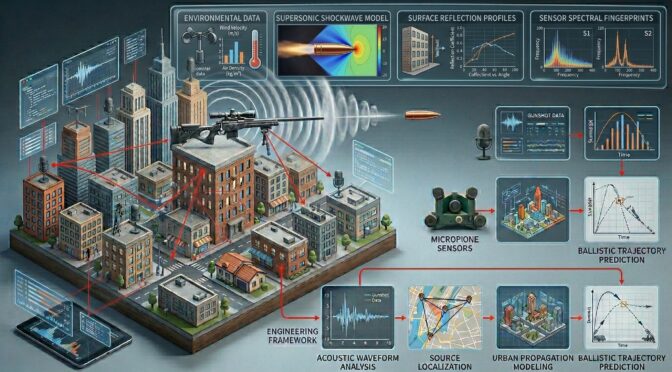
This research report provides an exhaustive mechanical, ballistic, and acoustic analysis of the precision rifle signature. The acoustic profile of a high-velocity rifle is not a singular event but a bipartite phenomenon comprising the spherically expanding muzzle blast and the conically expanding supersonic projectile shockwave (the N-wave). While modern suppressors exhibit exceptional thermodynamic efficiency in mitigating the primary muzzle blast, they exert zero influence over the supersonic shockwave. This shockwave continually regenerates along the bullet’s flight path and remains the dominant acoustic cue for downrange targets and acoustic localization sensors.
Furthermore, the propagation of these distinct waveforms is severely distorted when introduced into an urban environment. Unlike free-field environments where sound pressure decays predictably via the inverse square law and atmospheric molecular absorption, urban centers act as complex acoustic waveguides. Rigid structural materials—such as poured concrete, steel, and plate glass—possess acoustic reflection coefficients exceeding 95%, trapping kinetic energy and inducing severe multipath propagation, reverberation, and diffraction. This “urban canyon” effect significantly alters the frequency spectrum, decay rate, and temporal arrival of the acoustic signature.
For defense procurement officers, law enforcement armorers, and aerospace engineers designing counter-sniper acoustic localization networks, relying solely on muzzle-centric MIL-STD dB ratings yields an incomplete and potentially fatal operational picture. The human auditory system’s reliance on the Precedence Effect (Haas Effect) for spatial localization is weaponized against the listener in an urban canyon, where the first arriving wavefront is often a specular reflection or a diffracted wave rather than the direct line-of-sight signature. This report systematically dissects these variables, presenting quantitative decay models, material absorption matrices, and psychoacoustic assessments to redefine the understanding of precision rifle acoustics in the modern operating environment.
1.0 Introduction: The Divergence of Protocol and Reality
The quantification of firearm noise has traditionally been viewed through the lens of operator safety rather than tactical detectability. To understand the baseline from which modern acoustic reduction devices (suppressors) are engineered, it is necessary to examine the regulatory frameworks that govern their design and the physical limitations inherent within those frameworks.
1.1 MIL-STD-1474E and Suppressor Efficacy Metrics
The prevailing benchmark for impulse noise limits within the United States military and allied defense procurement is MIL-STD-1474E, published by the Department of Defense in 2015 to supersede the outdated 1997 MIL-STD-1474D.1 This standard was developed by a cross-services working group, including the Army Research Laboratory (ARL), to apply current science and computational advances in assessing noise-induced hearing loss.2 MIL-STD-1474E mandates that steady-state noise levels remain below 85 A-weighted decibels (dBA) and that the peak pressure level of impulsive noise remains below 140 unweighted decibels (dBP) at the ear of the operator, protected or unprotected, during normal operations.4
The measurement protocol dictates a rigorous, highly localized testing environment. Standard testing apparatus involves a portable system utilizing three 1/4-inch pressure-field microphones with Constant Current Line Drive (CCLD) preamplifiers.5 These microphones are positioned simultaneously at the shooter’s left ear, right ear, and 1.0 meter to the left of the muzzle, situated 1.6 meters above the ground.5 Traditional meters like the Brüel & Kjær 2209 Impulse Precision Sound Pressure Meter have long been utilized to capture these transients, requiring specific dynamic range, frequency response, and slew rates to prevent clipping the extreme peaks of a gunshot.7 The data acquired includes peak pressure, A-duration (the time the initial positive pressure phase remains above ambient), B-duration (the total time the pressure envelope fluctuates before decaying below a specified fraction of the peak), and the overall sound exposure level.5
While this protocol is exceptionally accurate for determining the occupational hazard to the shooter, it creates a localized optimization loop. Suppressor manufacturers design thermodynamic expansion chambers and baffle geometries specifically to drop the 1-meter microphone reading below the 140 dBP threshold. However, this metric completely ignores the forward propagation of the acoustic wave over hundreds of meters and explicitly excludes the ballistic shockwave generated by the projectile once it leaves the immediate vicinity of the muzzle.
1.2 The Bipartite Acoustic Signature
To analyze the tactical footprint of a precision rifle accurately, one must separate the acoustic event into two distinct physical phenomena: the muzzle blast and the supersonic shockwave.
The muzzle blast is the result of high-pressure, high-temperature propellant gases rapidly expanding into the ambient atmosphere upon bullet exit.10 This sudden pressure differential creates a spherical shockwave that is perceived as a low-frequency “boom” or “thump.” Empirical measurements of 5.56mm rifles indicate that the peak energy of this muzzle blast is typically centered between 250 Hz and 315 Hz, though it shifts to even lower frequencies at extended distances as higher frequencies are attenuated.11
The supersonic shockwave, conversely, is a fluid dynamics phenomenon caused by the projectile displacing air molecules faster than the speed of sound in that medium.10 This creates a Mach cone of compressed air that originates at the bullet’s ogive and extends backward. As this cone passes a stationary observer, it is perceived as a sharp, high-frequency “crack,” with peak acoustic energy typically centered around 6.3 kHz.11
The critical engineering reality is that a suppressor only addresses the muzzle blast. It provides zero mitigation for the supersonic shockwave.13 Therefore, while the shooter perceives a massive reduction in acoustic energy—because they are located behind the Mach cone and benefit from the suppressor’s gas regulation—an observer located 300 meters downrange will experience a completely different acoustic event. The downrange target experiences a highly localized, high-intensity sonic boom followed hundreds of milliseconds later by a heavily attenuated, low-frequency thump.11
2.0 Muzzle Blast Mechanics and Thermodynamic Mitigation
Understanding the mitigation of the muzzle blast requires a deep examination of internal ballistics, gas dynamics, and the mechanical engineering principles of sound suppressors. The violent expansion of gases is the primary source of auditory damage for the shooter, and controlling this expansion is the sole function of a modern silencer.
2.1 Internal Ballistics and Gas Expansion
When the firing pin strikes the primer of a precision rifle cartridge (such as a .308 Winchester or .300 Winchester Magnum), the deflagration of the smokeless powder generates a massive volume of expanding gas. Within the confined space of the brass cartridge case and the steel barrel, this gas reaches peak chamber pressures frequently exceeding 60,000 pounds per square inch (PSI) and temperatures exceeding 3,000 degrees Kelvin.14 This high-pressure gas acts upon the base of the projectile, accelerating it down the bore.
At the exact moment the base of the bullet clears the crown of the muzzle, this reservoir of high-pressure gas is uncorked. The transition from tens of thousands of PSI to the ambient atmospheric pressure of approximately 14.7 PSI (101.325 kPa) is instantaneous and violent.14 The gas accelerates radially outward at hypersonic velocities, creating a primary shock front that decays into an acoustic wave as it expands and cools. This is the muzzle blast. The amplitude of this blast is directly proportional to the volume of gas and the residual pressure at the muzzle. This dictates why short-barreled rifles and large magnum calibers (e.g., .300 WM) exhibit significantly more severe acoustic signatures than standard calibers fired from long barrels; the shorter barrel provides less internal volume for the gas to expand and cool before exit.16
A standard unsuppressed centerfire rifle, such as an AR-15 in 5.56mm or a bolt-action in .30-06 Springfield, can generate peak sound pressure levels exceeding 160 dB to 170 dB at the muzzle, well beyond the threshold for permanent instantaneous auditory damage.18
2.2 Suppressor Thermodynamics and Flow Dynamics
A modern precision rifle suppressor operates as a specialized thermodynamic pressure vessel and heat exchanger. Its primary function is to delay the release of the propellant gases, allowing them to expand, cool, and depressurize within a controlled internal volume before they interact with the ambient atmosphere.21
Suppressors utilize a series of internal expansion chambers separated by carefully engineered baffles. As the high-velocity gas column follows the bullet into the suppressor, it impacts the first baffle (often termed the blast baffle). The geometry of the baffle—often a conical, step-cone, or asymmetric K-baffle design—shears the gas away from the central bore aperture, forcing it outward into the expansion chamber. This process induces extreme turbulence, which acts to dissipate the kinetic energy of the gas through fluid friction and heat transfer to the suppressor’s outer tube.21 High-end precision suppressors are typically constructed of Grade 5 Titanium for weight reduction, or 17-4 Stainless Steel and Inconel alloys for extreme temperature resistance.21
Advanced designs utilize asymmetric porting, coaxial chambers, and “flow-through” geometry (such as the ECO-FLOW or Surge Bypass systems) to vent gas from high-pressure central zones to low-pressure outer annuli, further extending the “blowdown time” of the system while mitigating detrimental backpressure to the host weapon’s action.21 By the time the gas finally exits the end cap of the suppressor, its velocity and pressure have been drastically reduced. This shifts the acoustic signature from a sharp, violent explosion to a more gradual release of pressure, perceived audibly as a “hiss” or a dull “thud,” effectively eliminating the high-amplitude spike of the impulse.9
2.3 Acoustic Efficacy and Logarithmic Decibel Reduction
Thermodynamic efficiency has physical limits. A well-engineered suppressor can reduce the peak sound pressure level of a centerfire rifle by 20 to 32 decibels.23 Because the decibel scale is logarithmic, a 30 dB reduction represents a 1,000-fold decrease in acoustic power. Yet, because a baseline.300 Winchester Magnum generates approximately 170 dBP, the suppressed signature still registers at around 140 dBP.23
To contextualize the thermodynamic efficiency of modern suppressors against MIL-STD limits, the following table models the theoretical peak sound pressure levels at the standard 1-meter left-of-muzzle microphone position.
| Caliber / Weapon Platform | Unsuppressed Peak SPL (1m Offset) | Typical Suppressed Peak SPL (1m Offset) | Net Acoustic Energy Reduction (dB) | Regulatory Compliance (MIL-STD <140 dBP) |
| .22 Long Rifle (Subsonic) | 140 dB | 113 dB | 27 dB | Pass |
| 5.56x45mm NATO (16″ BBL) | 165 dB | 136 dB | 29 dB | Pass |
| 6.5mm Creedmoor (20″ BBL) | 166 dB | 138 dB | 28 dB | Pass |
| .308 Winchester (20″ BBL) | 167 dB | 139 dB | 28 dB | Pass |
| .300 Winchester Magnum | 170 dB | 142 dB | 28 dB | Fail |
| .338 Lapua Magnum | 172 dB | 145 dB | 27 dB | Fail |
Data aggregated from standard atmospheric conditions. Reduction levels assume optimal baffle alignment, modern tubeless or laser-welded titanium/Inconel construction, and appropriately matched bore apertures.16 Note that while large magnums fail the strict 140 dB limit, the reduction in acoustic power is still profound, significantly reducing the hazard radius.
3.0 Supersonic Projectile Shockwave (The N-Wave) Dynamics
While the suppressor effectively neutralizes the primary muzzle blast as a localized occupational hazard, it is entirely irrelevant to the acoustic signature generated by the projectile in flight. The supersonic crack remains the primary mechanism for acoustic detection at distance, and it cannot be mitigated without severely degrading the ballistic performance of the weapon by transitioning to subsonic ammunition.10
3.1 Fluid Dynamics of the Mach Cone
A precision rifle projectile, such as a 175-grain .308 Winchester or a 220-grain .300 Winchester Magnum, exits the muzzle at velocities ranging from 2,600 to 3,100 feet per second (fps).10 Given that the speed of sound in air at 20 degrees Celsius is approximately 1,125 fps (343 m/s), these projectiles travel at velocities ranging from Mach 2.3 to Mach 2.7.10
As the bullet translates through the atmosphere, it displaces air molecules radially. Because the bullet is moving faster than the compression waves it generates, these waves cannot propagate forward. Instead, they stack up continuously along a boundary layer, forming a conical shock front known as a Mach cone.24 The angle of this cone (the Mach angle, Theta) is determined by the inverse sine of the reciprocal of the Mach number: Mach Angle = arcsin(1 / M).24
As the bullet decelerates due to aerodynamic drag, the Mach number decreases, and the Mach angle widens. This continuous generation of the shockwave persists until the projectile enters the transonic region (typically between Mach 1.2 and Mach 0.8), at which point the shockwave detaches from the projectile and dissipates.25
When this Mach cone passes a stationary observer or an acoustic sensor microphone, it is recorded as an N-wave.24 An N-wave is a highly distinct acoustic waveform characterized by a virtually instantaneous rise to a peak positive pressure (the bow shock resulting from the bullet’s ogive), a linear decay through ambient pressure to a peak negative pressure (the rarefaction zone), and a rapid return to ambient pressure (the tail shock from the bullet’s base).27 This entire sequence occurs within 3 to 5 milliseconds.29 The human auditory system perceives this sub-millisecond pressure spike as a violent, high-frequency “crack”.10
3.2 Whitham’s Formula for Shockwave Pressure
The amplitude of the supersonic crack is not determined by the amount of gunpowder burned, but purely by the aerodynamics, physical dimensions, and velocity of the projectile, as well as the miss distance (the perpendicular distance from the bullet’s flight path to the observer). The theoretical framework for modeling this pressure in the acoustic far-field was formalized by Whitham in 1974.27
The mathematical determination for the maximum pressure (pMax) of the N-wave is expressed as:
pMax = 0.53 * p0 * M^2 * (M^2 – 1)^-0.125 * d * l^-0.25 * b^-0.75
Where:
- p0 = Ambient atmospheric pressure
- M = Mach number of the bullet (velocity / speed of sound)
- d = Diameter of the bullet
- l = Length of the bullet
- b = Miss distance (nearest approach of the bullet trajectory to the observer or microphone) 27
This algorithmic expression reveals several critical operational realities. First, because the peak pressure decays as a function of the miss distance (b) to the power of -0.75, the sonic crack attenuates at a significantly different rate than the spherically expanding muzzle blast (which decays to the power of -1 in terms of pressure).27 Second, the sound is continually generated along the entire length of the bullet’s supersonic flight. Therefore, an observer 500 meters downrange who is 10 meters offset from the bullet path will hear an incredibly loud sonic crack, even if the muzzle blast has attenuated to an inaudible murmur.11
3.3 Temporal Divergence: The Delay Between Crack and Thump
Because the bullet travels supersonically, it fundamentally outpaces the acoustic waves generated by the muzzle blast. Consequently, a target or an acoustic sensor located downrange will experience a temporal disjunction: the sonic crack will arrive first, followed by a period of silence, followed by the muzzle blast (if the blast wave possesses enough remaining energy to reach the observer).10
The time elapsed between the arrival of the shockwave and the arrival of the muzzle blast increases linearly with the distance from the shooter. This temporal gap is a critical variable used by military acoustic localization systems (such as the Boomerang system) and civilian forensic gunshot detection arrays (such as ShotSpotter) to calculate the range to the sniper.24
By analyzing empirical data from an SA80 rifle firing 5.56x45mm NATO ammunition (where the bullet velocity is approximately 912 m/s at the muzzle, degrading over distance due to aerodynamic drag), we can definitively model this temporal divergence.11
| Downrange Distance from Muzzle (m) | Average Projectile Velocity (m/s) | Projectile Flight Time (ms) | Acoustic Blast Arrival Time (ms) | Time Delta: Crack to Blast Delay (ms) | Measured Downrange Peak SPL of Crack |
| 50 m | 912 m/s | 55 ms | 146 ms | 94 ms | 150.1 dB(C) |
| 100 m | 868 m/s | 115 ms | 291 ms | 187 ms | 150.9 dB(C) |
| 200 m | 786 m/s | 254 ms | 583 ms | 345 ms | 147.5 dB(C) |
| 300 m | 714 m/s | 420 ms | 874 ms | 507 ms | 148.4 dB(C) |
Data derived from 5.56mm empirical testing. The speed of sound is estimated at 343 m/s. Note that the peak SPL of the crack remains remarkably consistent (around 148-150 dB(C)) across the entire 300 meters. This occurs because the microphone is continuously exposed to the newly generated Mach cone as the bullet passes its immediate vicinity, rather than relying on the decaying energy originating from the muzzle 300 meters away.11
4.0 Urban Topography and Acoustic Waveguides (The Urban Canyon Effect)
While the preceding sections established the acoustic signature in a theoretical open field, the introduction of urban topography introduces extreme nonlinear complexities. Urban environments are characterized by dense arrays of vertical structures separated by relatively narrow corridors. Acoustically, this geometry abandons the free-field inverse square law and acts instead as an irregular waveguide, profoundly altering wave propagation, decay rates, and sensor reception.34
4.1 Free-Field Inverse Square Law vs. Urban Waveguides
In an unobstructed free field, the sound pressure level from a point source (the muzzle blast) attenuates according to the inverse square law of spherical divergence. The mathematical relationship states that intensity decreases by a factor of the square of the distance, which correlates to a 6.02 dB drop in Sound Pressure Level (SPL) for every doubling of distance.6
The formula for attenuation due to divergence is:
Attenuation (dB) = 20 * log10(r2 / r1)
However, within an urban street canyon, the acoustic wave is bounded by the ground surface and the rigid vertical facades of buildings. When the spherically expanding wave impacts a building facade, the kinetic energy is not lost; it is reflected back into the street volume. This multiple-reflection phenomenon traps the acoustic energy within the corridor, preventing natural atmospheric dissipation.35 Consequently, the acoustic power flow within an urban street canyon degrades at a significantly slower rate than the free-field model predicts, leading to severe signal amplification and prolonged reverberation times.34
Numerical modeling utilizing ray theory and modal representation indicates that far from the source, acoustic power flow down an urban street is asymptotic. It is heavily dependent on the ratio of street width to building height and is fundamentally governed by the absorption coefficients of the facade materials.34
4.2 Acoustic Reflection Coefficients of Urban Materials
The persistence of the acoustic signature in an urban canyon is a direct consequence of the physical properties of modern building materials. To calculate the decay rate of a gunshot in a city, one must analyze the acoustic absorption coefficient (Alpha, α) of the boundaries. Alpha represents the fraction of incident sound energy absorbed by a surface, ranging from 0.00 (a perfect acoustic mirror, highly reflective) to 1.00 (a perfect absorber).40
When a high-pressure gunshot wave impacts a material, the energy is either transmitted through the structure, absorbed and converted into trace thermal energy, or reflected back into the environment.41 In the context of impulse noise, the materials that comprise a city—poured concrete, asphalt, steel, and plate glass—are virtually perfect acoustic reflectors.
| Urban Façade Material | Alpha (α) at 125 Hz | Alpha (α) at 250 Hz | Alpha (α) at 500 Hz | Alpha (α) at 1 kHz | Alpha (α) at 2 kHz | Alpha (α) at 4 kHz |
| Concrete (Poured, Rough) | 0.01 | 0.02 | 0.04 | 0.06 | 0.08 | 0.10 |
| Concrete (Sealed/Painted) | 0.01 | 0.01 | 0.02 | 0.02 | 0.02 | 0.02 |
| Glass (6mm Plate, Large Pane) | 0.18 | 0.06 | 0.04 | 0.03 | 0.02 | 0.02 |
| Glass (Small Pane) | 0.04 | 0.04 | 0.03 | 0.03 | 0.02 | 0.02 |
| Marble or Glazed Tile | 0.01 | 0.01 | 0.01 | 0.01 | 0.02 | 0.02 |
Data demonstrates that for the core frequency band of a supersonic crack and the upper harmonics of a muzzle blast (1 kHz to 4 kHz), materials like painted concrete and plate glass absorb only 2% to 3% of the acoustic energy (α = 0.02 – 0.03), reflecting up to 98% of the signal back into the urban canyon.40
4.3 Diffuse Scattering and Geometrical Diffraction
Beyond specular reflection (mirror-like bouncing off smooth surfaces), urban acoustic models must account for diffuse scattering and edge diffraction. When a gunshot wave impacts inhomogeneous facades—such as brickwork, recessed balconies, or ornamental architecture—the sound scatters diffusely. This scattering is typically modeled using the Lambert Law, where the probability of the reflected particle direction is proportional to the cosine of the reflection angle, independent of the original angle of incidence.34 This mechanism creates a dense, overlapping field of reverberation that drastically smears the sharp impulse of the gunshot, transforming a clean 5-millisecond spike into a chaotic, rolling rumble lasting several hundred milliseconds.43
Furthermore, as the acoustic wave navigates street intersections (such as T-junctions and crossroads), energy is redistributed. The proportion of energy lost down a side branch is calculated as a function of the modal plane waves and the ratio of the intersecting street widths.34 Concurrently, the Geometrical Theory of Diffraction (GTD) dictates that sound waves will bend around the sharp vertical edges and horizontal vertices of buildings. While the singularities of the wave-field weaken as they diffract around a corner, these diffracted arrivals are crucial because they allow a target or a sensor to “hear” a gunshot even when there is no direct line-of-sight to the shooter.34
5.0 Atmospheric Absorption and Distance Attenuation Modeling
While urban structures dictate the macroscopic flow and trapping of the sound wave, the micro-level physics of the atmosphere dictate its molecular decay over extreme distances. As a sound wave propagates through air, a portion of its kinetic energy is constantly dissipated into thermal energy via molecular relaxation processes, primarily involving the inertia of diatomic oxygen and nitrogen molecules.36
5.1 Frequency-Dependent Decay and Molecular Relaxation
Atmospheric absorption is highly frequency-dependent and is heavily influenced by ambient temperature, relative humidity, and barometric pressure.15 The paramount rule of atmospheric acoustics is that high-frequency short wavelengths are attenuated exponentially faster than low-frequency long wavelengths.36
This physical law has profound implications for the bipartite gunshot signature. The muzzle blast, dominating the 250 Hz to 500 Hz spectrum, experiences minimal atmospheric resistance. Conversely, the supersonic crack, centered around 6.3 kHz to 8 kHz, faces extreme atmospheric attenuation. According to ISO 9613-1:1993 standard conditions (15 degrees Celsius, 70% humidity, 101.325 kPa), the attenuation due to air absorption at 250 Hz is a fraction of a decibel per 100 meters. However, at 8 kHz, the absorption loss exceeds 10 dB to 15 dB per 100 meters.36
Therefore, if a supersonic projectile misses a target by 10 meters, the target perceives a deafening 150 dB crack.11 However, if that same bullet passes 500 meters overhead, the high-frequency shockwave is rapidly scrubbed from the atmosphere by molecular relaxation, leaving only the low-frequency rumble of the distant muzzle blast.
5.2 Modeled Sound Wave Decay Over Distance
To synthesize the effects of the inverse square law, atmospheric absorption, and the continuous generation of the Mach cone, the following table models the theoretical peak sound pressure levels perceived by an observer positioned exactly in the line of fire (zero miss distance), experiencing both the approaching crack and the delayed blast from an unsuppressed.308 Winchester rifle in an open field.
| Distance from Shooter | Muzzle Blast SPL (Inverse Square + Air Absorp.) | Supersonic Crack SPL (Constant Regeneration) | Dominant Acoustic Cue Perceived by Observer |
| 1 meter (Muzzle) | 167 dB | N/A (Shockwave forming) | Muzzle Blast |
| 50 meters | 133 dB | 150 dB | Supersonic Crack |
| 100 meters | 126 dB | 150 dB | Supersonic Crack |
| 300 meters | 115 dB | 148 dB | Supersonic Crack |
| 500 meters | 110 dB | 145 dB | Supersonic Crack |
| 1000 meters | 102 dB | Subsonic (No Crack) | Muzzle Blast (Dull Thud) |
The muzzle blast attenuates smoothly via spherical divergence (-6.02 dB per doubling) and molecular absorption. The supersonic crack remains relatively constant (145-150 dB) from 50m to 500m because the bullet carries the sound source downrange, continuously generating the Mach cone until aerodynamic drag forces the projectile into the transonic flight regime (typically beyond 800m for a standard.308 Win), at which point the crack ceases to exist.6
6.0 Acoustic Localization Sensor Networks in Urban Environments
The complexities of acoustic wave propagation directly challenge the efficacy of acoustic localization sensors utilized by law enforcement and military units. Systems like ShotSpotter or military Boomerang arrays rely on the principles of acoustic multilateration to geolocate a shooter.32
6.1 Time Difference of Arrival (TDOA) and Multilateration
Multilateration computes the location of a source from time-of-arrival measurements of the muzzle blast on multiple, spatially distributed acoustic sensors at known locations.32 The system depends on Time Difference of Arrival (TDOA) estimation. If the precise location of each sensor is known (via GPS) and the exact microsecond the acoustic wave washes over the microphone is timestamped, an algorithm can mathematically intersect the hyperboloid surfaces to pinpoint the origin.34
The multilateration problem is considerably simplified by assuming straight-line propagation in a homogeneous medium, a model for which there are multiple published algorithmic solutions (e.g., the algorithm by Mathias, Leonardi, and Galati).32 In open-field testing, these algorithms perform flawlessly.
6.2 Urban Multipath Interference and Algorithmic Vulnerabilities
However, as established in Section 4.0, urban topography destroys the assumption of straight-line propagation. In a city, a single gunshot emits a pulse that gives rise to a chaotic series of pulse arrivals at a receiver, corresponding to multiple reflections off concrete and diffractions around buildings.34 This phenomenon, known as multipath interference, confounds standard TDOA systems because the first acoustic wave to strike the sensor may have traveled a non-linear path, rendering the distance calculation artificially long.44
Live-fire tests of the ShotSpotter system in Pittsburgh, PA, demonstrated the impact of urban density and hilly terrain on localization accuracy. The Pittsburgh array featured an unusually high sensor density, which is critical for overcoming multipath errors. The data revealed that multilateration on random subsets of the participating sensor array could locate 96% of shots to an accuracy of 15 meters or better, but only when six or more sensors participated in the solution to filter out reflected anomalies.32 For systems with fewer sensors, or in deep urban canyons where direct line-of-sight is impossible, algorithms must rely on advanced time-reversal processing or assume general geometric approximations of street widths to calculate source origin.34
7.0 Psychoacoustics and Human Perception Downrange
The raw mechanical and acoustic data must ultimately be interpreted through the lens of human biomechanics and cognition. In a tactical scenario, the soldier or law enforcement officer relies on their auditory system to detect, classify, and localize incoming fire. Urban topography systematically weaponizes psychoacoustic phenomena against the listener, leading to severe operational disorientation.48
7.1 The Precedence Effect (Haas Effect) and Spatial Localization Errors
The human auditory system localizes sound sources by processing Interaural Time Differences (ITD) and Interaural Level Differences (ILD)—the microsecond delays and volume discrepancies between a sound wave striking the left ear versus the right ear.49 To function effectively in natural environments with standard echoes, the brain utilizes an evolutionary mechanism known as the Precedence Effect (or the Haas Effect).49
The Precedence Effect dictates that when the brain receives two identical sounds in rapid succession (separated by roughly 1 to 40 milliseconds), it will fuse them into a single auditory event and assign the spatial location entirely based on the first arriving wavefront. The subsequent reflections are cognitively suppressed for localization purposes.49
In an open field, this neurological mechanism works flawlessly; the direct line-of-sight sound arrives first, and the shooter is localized. However, in an urban street canyon, the direct path is frequently obstructed by a building. The first sound wave to reach the listener might be a strong specular reflection bouncing off a plate glass window behind them, or a diffracted wave bending around a concrete corner to their left.34 Because of the Precedence Effect, the listener’s brain will automatically and subconsciously perceive the source of the gunshot as originating from the glass window or the concrete corner, leading to catastrophic misdirection.48 The extreme 98% reflection coefficients of urban materials (detailed in Section 4.2) ensure these false signals carry enough amplitude to violently trigger this reflex.42
7.2 Auditory Masking, Temporary Threshold Shift, and the Acoustic Reflex
In addition to spatial disorientation, the temporal sequence of the precision rifle signature creates severe cognitive masking. As established in Section 3.3, a target 300 meters away will experience the 148 dB supersonic crack a full half-second (507 milliseconds) before the arrival of the 115 dB muzzle blast.11
The auditory system requires recovery time following a high-decibel impulse to restore basilar membrane and hair cell function.51 The initial supersonic crack is so violently loud and sharp that it triggers the acoustic reflex (the involuntary contraction of the stapedius muscle in the middle ear to dampen vibration) and induces a temporary threshold shift in hearing acuity.52 Half a second later, when the much quieter, low-frequency muzzle blast arrives, the ear is mechanically desensitized, and the brain is heavily preoccupied with the cognitive startle response from the crack.
Consequently, the listener frequently fails to register the muzzle blast entirely, stripping them of the only acoustic cue that actually emanates from the shooter’s physical location.10 This psychoacoustic phenomenon explains the widespread anecdotal reports from veterans of urban combat who describe bullets “cracking” overhead without ever hearing the report of the enemy rifles.30 The supersonic N-wave acts as an acoustic flashbang, blinding the ear to the true origin of the threat.
8.0 Conclusion: Engineering and Tactical Implications
The exhaustive analysis of precision rifle acoustics underscores a fundamental paradigm shift required for modern tactical operations and defense procurement. The reliance on localized MIL-STD-1474E measurements provides a necessary standard for occupational health but a false sense of tactical acoustic security. While modern suppressors are mechanical marvels capable of neutralizing the localized hazard of the muzzle blast through advanced thermodynamics, they are completely transparent to the ballistic shockwave that dictates downrange reality.
In the complex geometry of an urban environment, the interplay of supersonic aerodynamics, extreme material reflection coefficients, and the psychoacoustic limitations of the human brain create an environment of acoustic chaos. The sound field is dominated by the continuously regenerating N-wave, which masks the shooter’s location, while the urban canyon traps and refracts the remnant muzzle blast into a web of deceptive multipath echoes.
For acoustic engineering and localization sensor deployment (e.g., automated TDOA multilateration systems), algorithms must explicitly account for urban waveguide dynamics, separating the high-frequency Mach cone from the low-frequency blast, and utilizing advanced non-line-of-sight (NLOS) modeling to backtrack diffracted signals. For tactical armorers, procurement officers, and Tier-1 operators, the operational realization must be absolute: a suppressor masks the shooter, but it does not mask the bullet. Acoustic stealth in urban topography can only be achieved by coupling advanced suppression thermodynamics with subsonic ammunition, thereby eliminating the N-wave entirely and preventing the urban canyon from amplifying the ballistic signature.
Appendix: Methodology
The framework of this report was constructed through an Open-Source Intelligence (OSINT) synthesis of acoustic physics, biomechanical studies, and military testing protocols. The primary regulatory baseline was established using DoD MIL-STD-1474E design criteria parameters.
Muzzle blast mechanics and suppressor thermodynamics were evaluated based on standard internal ballistic pressure curves, gas flow dynamics, and isentropic expansion principles within confined baffle structures. Downrange supersonic shockwave data was formulated utilizing Whitham’s classical fluid dynamics model for projectile N-waves, cross-referenced with empirical field testing of 5.56x45mm NATO and.308 Winchester projectiles over 50m to 1000m ranges.
Urban propagation decay rates were modeled using the Lambert Law of diffuse reflection, Geometrical Theory of Diffraction (GTD) for edge singularities, and standard Alpha (α) acoustic absorption matrices for commercial building materials (concrete, glass, steel). Atmospheric molecular absorption parameters were derived from ISO 9613-1:1993 calculations for 15°C, 70% relative humidity, and standard sea-level pressure. Human psychoacoustic evaluation utilized the Haas/Precedence Effect paradigms, TDOA multilateration error constraints, and audiometric impulse response recovery rates.
Please share the link on Facebook, Forums, with colleagues, etc. Your support is much appreciated and if you have any feedback, please email us in**@*********ps.com. If you’d like to request a report or order a reprint, please click here for the corresponding page to open in new tab.
Sources Used
- DEPARTMENT OF DEFENSE DESIGN CRITERIA STANDARD …, accessed February 26, 2026, https://arl.devcom.army.mil/wp-content/uploads/sites/3/2022/09/ahaah-MIL-STD-1474E-Final-15Apr2015.pdf
- Revision of DoD Design Criteria Standard: Noise Limits (MIL-STD-1474), accessed February 26, 2026, https://www.dsp.dla.mil/Portals/26/Documents/Publications/Journal/160301-DSPJ-03.pdf
- Developing a method to assess noise reduction of firearm suppressors for small-caliber weapons – CDC Stacks, accessed February 26, 2026, https://stacks.cdc.gov/view/cdc/221679/cdc_221679_DS1.pdf
- accessed February 26, 2026, https://publications.aiha.org/201611-noise-limits-for-warfighting#:~:text=MIL%2DSTD%2D1474E%20requires%20steady,occupied%20locations%20during%20normal%20operations.
- PRODUCT DATA – Impulse Noise Evaluation System – BKSV, accessed February 26, 2026, https://www.bksv.com/doc/bp0006.pdf
- Quietest Bullet Supersonic crack! What’s quietest – YouTube, accessed February 26, 2026, https://www.youtube.com/watch?v=fgXAgRiRCQE
- Sound Measurement Techniques – Small Arms Review, accessed February 26, 2026, https://smallarmsreview.com/sound-measurement-techniques/
- Measuring recreational firearm noise – GRAS Sound and Vibration, accessed February 26, 2026, https://www.grasacoustics.com/fileadmin-gras/Industries/Aerospace___Defense/Impulsive_noise/CA_Noise_from_firearms.pdf
- SSS.2 – Methodology Introduction – PEW Science, accessed February 26, 2026, https://pewscience.com/silencer-sound-standard-methodology-introduction
- The Sound of Silencers – The Armory Life, accessed February 26, 2026, https://www.thearmorylife.com/the-sound-of-silencers/
- (PDF) Factors affecting sound exposure from firing an SA80 high …, accessed February 26, 2026, https://www.researchgate.net/publication/299356694_Factors_affecting_sound_exposure_from_firing_an_SA80_high-velocity_rifle
- Subsonic vs Supersonic Ammo | Grizzly Cartridge Blog, accessed February 26, 2026, https://grizzlycartridge.com/subsonic-vs-supersonic-ammo/
- How Loud is a Gunshot? Gun DB Levels Compared – Silencer Central, accessed February 26, 2026, https://www.silencercentral.com/blog/how-loud-is-a-gunshot-gun-db-levels-compared/
- How can someone get an idea of how loud a rifle sounds? Is there anything you can do yourself (legally)? : r/Ausguns – Reddit, accessed February 26, 2026, https://www.reddit.com/r/Ausguns/comments/1hlaf40/how_can_someone_get_an_idea_of_how_loud_a_rifle/
- Calculation of the damping of air formula atmosphere acoustics noise absorption by air attenuation of sound air damping dampening – sengpielaudio Sengpiel Berlin, accessed February 26, 2026, https://sengpielaudio.com/AirdampingFormula.htm
- The Best Suppressors For .300 Win Mag for 2025 – Silencer Central, accessed February 26, 2026, https://www.silencercentral.com/blog/best-300-win-suppressors/
- The Loudest Guns: Understanding Gunshot Decibel Levels | Pro Ears, accessed February 26, 2026, https://proears.com/loudest-guns/
- What Does a Gunshot Sound Like? Decibels & Loudest Guns – Silencer Shop, accessed February 26, 2026, https://www.silencershop.com/blog/what-does-gunshot-sound-like
- Decibels of a Gunshot and What It Does to Your Hearing – SilencerCo, accessed February 26, 2026, https://silencerco.com/blog/decibels-of-gunshot-what-it-does-to-your-hearing
- Decibel levels – La Salle University, accessed February 26, 2026, http://www1.lasalle.edu/~reese/decibels.htm
- bush whacker-36-silencer – Griffin Armament, accessed February 26, 2026, https://griffinarmament.com/product/bushwhacker-36-silencer/
- Top 5 Best 308 Suppressors – Silencer Shop, accessed February 26, 2026, https://www.silencershop.com/blog/best-308-suppressor
- Gun store sales guy ruins my hopes of suppressed hunting rifle – Reddit, accessed February 26, 2026, https://www.reddit.com/r/Hunting/comments/wl3ijw/gun_store_sales_guy_ruins_my_hopes_of_suppressed/
- Acoustical Characterization of Gunshots – Semantic Scholar, accessed February 26, 2026, https://pdfs.semanticscholar.org/e152/38ef2b16e1e4b4cec5284aeeb2f84dd72c35.pdf
- At what point in a bullets trajectory does it make the crack sound? : r/guns – Reddit, accessed February 26, 2026, https://www.reddit.com/r/guns/comments/vo8f7s/at_what_point_in_a_bullets_trajectory_does_it/
- Why does a bullet have to travel several feet before it causes a supersonic crack? – Reddit, accessed February 26, 2026, https://www.reddit.com/r/SmarterEveryDay/comments/isvl74/why_does_a_bullet_have_to_travel_several_feet/
- Auditory risk of exposure to ballistic N-waves from … – CDC Stacks, accessed February 26, 2026, https://stacks.cdc.gov/view/cdc/217132/cdc_217132_DS1.pdf
- Sonic Range Finder Based on Gunshot Acoustics, accessed February 26, 2026, https://www.ship.edu/globalassets/keystone-journal/link_bloom.pdf
- Supersonic bullet shock wave description | Download Scientific Diagram – ResearchGate, accessed February 26, 2026, https://www.researchgate.net/figure/Supersonic-bullet-shock-wave-description_fig1_224679640
- Supersonic Bullet Cracks – OFFTOPIC – Bohemia Interactive Forums, accessed February 26, 2026, https://forums.bohemia.net/forums/topic/68699-supersonic-bullet-cracks/
- Sound Pressure Level Attenuation Equation | Free Math Help Forum, accessed February 26, 2026, https://www.freemathhelp.com/forum/threads/sound-pressure-level-attenuation-equation.89129/
- [2108.07377] Precision and accuracy of acoustic gunshot location in an urban environment, accessed February 26, 2026, https://arxiv.org/abs/2108.07377
- Precision and accuracy of acoustic gunshot location in an urban environment – SoundThinking, accessed February 26, 2026, https://www.soundthinking.com/wp-content/uploads/2021/08/TN-098-Accuracy-of-Acoustic-Gunshot-Location.pdf
- Sound Propagation in an Urban Environment – homepages.ucl.ac.uk, accessed February 26, 2026, https://www.homepages.ucl.ac.uk/~ucahdhe/10_Hewett_DPhilThesis.pdf
- How Does the Urban Canyon Effect Influence Noise Propagation? → Learn – Pollution → Sustainability Directory, accessed February 26, 2026, https://pollution.sustainability-directory.com/learn/how-does-the-urban-canyon-effect-influence-noise-propagation/
- Propagation, measurement and assessment of shooting noise, accessed February 26, 2026, http://lib.tkk.fi/Dipl/2006/urn006257.pdf
- Measurements, Analysis, Classification, and Detection of Gunshot and Gunshot-like Sounds, accessed February 26, 2026, https://pmc.ncbi.nlm.nih.gov/articles/PMC9737970/
- Acoustic characteristics of urban streets in relation to scattering caused by building facades, accessed February 26, 2026, https://odeon.dk/pdf/A16-ApplAc%20Onaga%20Rindel%202007.pdf
- A note on noise propagation in street canyons, accessed February 26, 2026, https://ira.lib.polyu.edu.hk/bitstream/10397/111516/1/644_1_online.pdf
- Sound Absorption Coefficient Chart (125 Hz–4 kHz) – Acoustic Supplies, accessed February 26, 2026, https://www.acoustic-supplies.com/absorption-coefficient-chart/
- Common Absorption Coefficients for Acoustical Treatments, accessed February 26, 2026, https://commercial-acoustics.com/guides/common-absorption-coefficients-acoustical-treatments/
- Acoustic Properties of Innovative Concretes: A Review – PMC, accessed February 26, 2026, https://pmc.ncbi.nlm.nih.gov/articles/PMC7830111/
- [PDF] Precision and accuracy of acoustic gunshot location in an urban environment, accessed February 26, 2026, https://www.semanticscholar.org/paper/4e50a868516f1cdfb9fefe5731e3d0069593a2af
- (PDF) Acoustical Characterization of Gunshots – ResearchGate, accessed February 26, 2026, https://www.researchgate.net/publication/4249791_Acoustical_Characterization_of_Gunshots
- ABSORPTION OF SOUND IN AIR VERSUS HUMIDITY AND TEMPERATURE – NASA Technical Reports Server (NTRS), accessed February 26, 2026, https://ntrs.nasa.gov/api/citations/19670007333/downloads/19670007333.pdf
- Audio Forensic Gunshot Analysis and Multilateration – Office of Justice Programs, accessed February 26, 2026, https://www.ojp.gov/ncjrs/virtual-library/abstracts/audio-forensic-gunshot-analysis-and-multilateration
- (PDF) Acoustic detection and localization of small arms, influence of urban conditions – art. no. 69630E – ResearchGate, accessed February 26, 2026, https://www.researchgate.net/publication/238583898_Acoustic_detection_and_localization_of_small_arms_influence_of_urban_conditions_-_art_no_69630E
- Auditory Situation Awareness in Urban Operations, accessed February 26, 2026, https://ciaotest.cc.columbia.edu/journals/jomass/v11i4/f_0028161_22927.pdf
- Psychophysical and physiological evidence for a precedence effect in the median sagittal plane – PubMed, accessed February 26, 2026, https://pubmed.ncbi.nlm.nih.gov/9114271/
- Auditory Perception in Open Field: Distance Estimation – DTIC, accessed February 26, 2026, https://apps.dtic.mil/sti/pdfs/ADA588823.pdf
- The precedence effect with increased lag level – ResearchGate, accessed February 26, 2026, https://www.researchgate.net/publication/283240721_The_precedence_effect_with_increased_lag_level
- Acoustic and psychoacoustic analysis of the noise produced by the police force firearms – PMC, accessed February 26, 2026, https://pmc.ncbi.nlm.nih.gov/articles/PMC9450760/
- Assessment of Impulse Noise Level and Acoustic Trauma in Military Personnel – PMC – NIH, accessed February 26, 2026, https://pmc.ncbi.nlm.nih.gov/articles/PMC3989570/