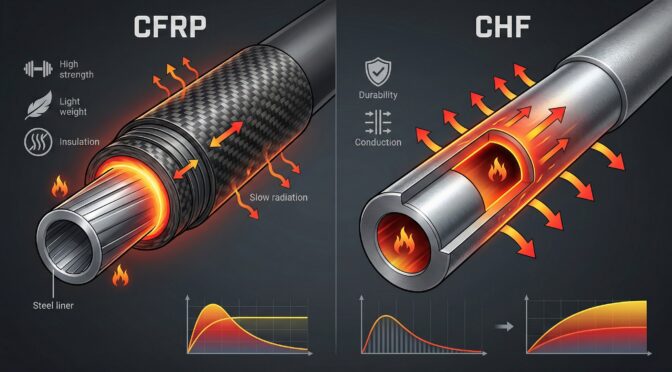
An Executive Summary
The modern defense manufacturing sector currently operates at the intersection of two conflicting operational doctrines: the immediate mandate to drastically reduce operator burden through lightweight weapon systems, and the unyielding requirement for infantry platforms to endure severe, sustained-fire schedules. As prime contractors and tier-2 manufacturers navigate these opposing forces, the material science governing small arms barrel architecture has come under intense scrutiny. This intelligence report evaluates the thermophysical limitations of carbon fiber-reinforced polymer (CFRP) composite barrels against traditional Cold Hammer Forged (CHF) 4150 Chrome-Moly-Vanadium (CMV) steel barrels.
By comprehensively examining thermodynamic heat retention, transverse thermal conductivity, bimetallic coefficients of thermal expansion (CTE), and the subsequent Point of Impact (POI) thermal drift, the analysis isolates the precise operational thresholds of these materials. The data categorically demonstrates that under sustained rapid-fire conditions,specifically modeled at a 150-round expenditure,CFRP barrels experience catastrophic internal thermal trapping. The epoxy resin matrix acts as a profound radial insulator, leading to severe thermal expansion mismatch between the carbon wrap and the internal steel liner, which drives erratic trajectory walking and accuracy degradation. Conversely, the high thermal mass and superior radial conductivity of CHF 4150 CMV steel efficiently dissipate thermal energy, maintaining harmonic stability and predictable POI.
Furthermore, this report contextualizes these engineering realities within the current macroeconomic supply chain. As manufacturers scale production of CHF barrels to meet the demands of sustained-fire weapon systems, they face critical bottlenecks in heavy capital equipment acquisition. The global market for rotary forging machines, dominated almost exclusively by GFM Steyr, is experiencing extreme lead times driven by competing demand from the electric vehicle (EV) and aerospace sectors. Simultaneously, the broader composites market remains highly vulnerable to geopolitical disruptions in the supply of Polyacrylonitrile (PAN) carbon precursors. By analyzing the macro-level capabilities of top-tier U.S. domestic suppliers, this report provides strategic imperatives for C-suite executives, institutional investors, and defense procurement officers seeking to secure robust, survivable supply chains in an era of global instability.
1. Doctrinal Shifts and the Lightweighting Mandate
The evolution of modern infantry doctrine has placed unprecedented emphasis on the mobility, lethality, and survivability of the individual operator. Over the past two decades, the cumulative weight of body armor, advanced optics, night vision systems, communication nodes, and auxiliary battery power has dramatically increased the physical burden on ground forces. In response, the Department of Defense and global allied military organizations have initiated sweeping mandates to reduce the base weight of primary weapon systems. The objective is to enhance operator agility and reduce physiological fatigue without compromising terminal ballistics or effective engagement range.
To achieve this systemic lightweighting, the small arms industry has increasingly looked beyond traditional metallurgy, adapting advanced aerospace composites for terrestrial weapon applications. Carbon Fiber Reinforced Polymers (CFRP) have emerged as a highly visible, heavily marketed solution. By utilizing a dramatically reduced-profile steel inner liner,often colloquially referred to as a “pencil barrel”,and enveloping it in a continuous filament-wound carbon fiber and epoxy resin matrix, manufacturers can theoretically provide the rigidity and harmonic profile of a heavy-contour target barrel at a fraction of the physical mass.1
However, tactical deployment realities frequently subject these systems to environments that extend far beyond controlled precision engagements. Standard infantry training protocols, suppressive fire contingencies, and bounding overwatch maneuvers dictate that a standard-issue platform must reliably sustain rapid bursts of fire. Expending 100 to 150 rounds,the equivalent of a standard combat load out fired continuously during a near-ambush scenario,is a baseline durability metric for military platforms like the M4 and M16 series.4 Under these extreme thermodynamic loads, the material properties of CFRP and homogenous alloy steels diverge significantly. The fundamental physics of heat transfer, thermal expansion, and harmonic resonance dictate that material selection cannot circumvent the basic laws of thermodynamics.
As original equipment manufacturers (OEMs) and defense contractors scale production to meet evolving global armament demands, understanding the exact thermomechanical limitations of these systems is critical for optimal resource allocation, risk mitigation, and platform lifecycle management. Relying solely on marketing narratives regarding the thermal superiority of carbon fiber invites systemic failure on the battlefield.
2. Metallurgical and Composite Architecture
To accurately model barrel behavior under sustained fire, it is fundamentally necessary to establish the baseline thermophysical properties of the constituent materials. The primary metrics governing barrel performance are thermal conductivity (the rate at which thermal energy is transferred through a material), specific heat capacity (the amount of heat energy required to raise the temperature of the material), and the linear coefficient of thermal expansion (the fractional change in length or volume per degree of temperature change).
2.1 The Standard: 4150 Chrome-Moly-Vanadium (CMV) Alloy Steel
4150 Chrome-Moly-Vanadium (CMV) steel serves as the ubiquitous, battle-proven benchmark for military-grade small arms barrels. It is a high-carbon alloy, with the numeric designation “50” denoting a 0.50% nominal carbon content. This elevated carbon ratio provides substantially greater hardenability and ultimate tensile strength compared to lower-carbon variants such as 4140, which is frequently utilized in commercial-grade firearms.6
The elemental composition of 4150 CMV is meticulously tailored for extreme environments. The addition of chromium enhances baseline hardenability and provides essential corrosion resistance against caustic propellant residues. Molybdenum is introduced to increase high-temperature tensile strength, preventing the steel from yielding when subjected to the intense heat of rapid fire. Crucially, vanadium acts as a powerful grain refiner; it restricts the growth of the martensitic grain structure during heat treatment, significantly boosting the material’s toughness and its resistance to thermal degradation and throat erosion over thousands of firing cycles.7 The material maintains a robust yield strength in the range of 380 MPa prior to specialized post-machining heat treatments, and possesses a standard density of approximately 7.85 g/cm³.9
The thermophysical profile of 4150 CMV steel dictates its supreme efficacy as a thermal manager. The material possesses a thermal conductivity rated between 44.5 W/m·K and 45.0 W/m·K.9 This high rate of conductivity allows thermal energy generated in the chamber and bore to rapidly and uniformly distribute throughout the entire physical volume of the barrel profile. Furthermore, its specific heat capacity is approximately 460 to 475 J/kg·K.9 This relatively low specific heat means the material readily absorbs thermal energy, acting as a highly efficient, high-capacity heat sink during intense firing sequences. Finally, 4150 CMV exhibits a linear Coefficient of Thermal Expansion (CTE) of 10.4 to 12.0 x 10⁻⁶/°C.11 Because the barrel is a homogenous, monolithic structure, when it heats up, it expands uniformly in both radial and longitudinal directions. While this volumetric expansion affects internal bore dimensions slightly, it precludes the formation of severe asymmetric stress concentrations that warp the barrel.
2.2 The Cold Hammer Forging (CHF) Process
The inherent material advantages of 4150 CMV are significantly amplified by the Cold Hammer Forging (CHF) manufacturing process. Unlike traditional button rifling,which involves pulling or pushing a carbide button through a drilled blank to displace steel and form the rifling,or cut rifling, which removes material entirely, CHF is a chip-less forming process.
A slightly oversized, deep-hole drilled steel blank is inserted into a rotary forging machine. A polished carbide mandrel, bearing the reverse image of the desired rifling and chamber profile, is inserted into the bore. Massive, radially opposed hammers then strike the exterior of the blank at extreme frequencies, physically beating the steel down onto the mandrel at room temperature.6 This violent mechanical compression forcefully aligns the molecular grain structure of the 4150 CMV steel along the longitudinal axis of the barrel. The resulting bore is inherently denser, possesses a mirror-like internal surface finish, and exhibits localized work-hardening that renders the throat and chamber exceptionally resistant to the erosive plasma of modern propellants. While the initial capital expenditure for CHF machinery is immense, the resulting barrel architecture is unmatched in its ability to handle extreme heat and pressure without premature yielding.13
2.3 Carbon Fiber Reinforced Polymers (CFRP)
Carbon fiber barrel construction relies on a fundamentally different structural and thermodynamic paradigm. The system abandons the monolithic heavy steel profile in favor of a hybrid composite structure. It begins with a thin, pencil-profile inner liner, typically machined from 416R stainless steel (favored for its machinability and baseline accuracy) or 4150 CMV steel.1 This inner liner provides the necessary rifling, lands, grooves, and the ultimate containment vessel for the 60,000+ PSI chamber pressures generated during the ballistic event.
To restore the rigidity lost by reducing the steel profile, the liner is wrapped in aerospace-grade carbon fiber filaments. The continuous fibers are wound around the steel at precisely calculated angles and impregnated with an advanced thermoset epoxy resin matrix to bind the structure.3
The thermal dynamics of CFRP composites are highly anisotropic, meaning their physical properties vary drastically depending on the geometric direction of measurement. The carbon fibers themselves,particularly the high-modulus, Polyacrylonitrile (PAN)-based aerospace precursors utilized in premium barrels,boast exceptional longitudinal thermal conductivity. Heat travels efficiently along the axis of the carbon fiber, occasionally surpassing the conductivity of steel with values ranging from 20 to 40 W/m·K along the fiber plane.17
However, the critical engineering flaw in composite barrel applications lies in the transverse, or radial, thermal conductivity. In a firearm barrel, the heat originates in the center (the bore) and must travel radially outward to reach the ambient atmosphere for convective cooling. To move radially, the thermal energy must pass through the epoxy resin matrix that encapsulates the carbon fibers. Epoxy resins are profound thermal insulators. The effective radial thermal conductivity of a standard CFRP wrap drops precipitously, typically measuring between 0.5 and 0.6 W/m·K.17
Furthermore, the specific heat capacity of the composite is divided between its constituents; the carbon fibers measure around 750 J/kg·K, while the insulative epoxy resins measure around 1200 J/kg·K.20 While this high specific heat capacity indicates a theoretical capability to absorb energy, the severe insulative nature of the radial matrix acts as a thermal barrier, trapping the energy at the microscopic boundary between the steel liner and the composite wrap.
Another profound limitation is the Glass Transition Temperature (Tg) of the epoxy matrix. The Tg is the critical temperature threshold at which a rigid, cross-linked thermoset polymer transitions into a soft, pliable, rubbery state. For the advanced aerospace resins utilized in these applications, the Tg typically ranges between 157°C and 195°C.21 If the internal temperatures at the steel-composite interface exceed this threshold, the matrix loses its structural integrity, risking catastrophic delamination, irreversible deformation, and total loss of the rigidity the wrap was designed to provide.23 Finally, the CTE of PAN-based carbon fiber is near-neutral or slightly negative (e.g., -0.56 x 10⁻⁶/K) in the longitudinal direction.25 This creates a severe, inherent thermomechanical conflict when bonded to a steel liner that is attempting to expand at 11.0 x 10⁻⁶/°C.26
3. Thermodynamic Behavior in Sustained-Fire Environments
Sustained suppressive fire places extreme, compounding thermal loads on the barrel architecture. The combustion of modern smokeless rifle propellants yields localized internal flame temperatures exceeding 2500°C. Approximately 30% to 35% of the total chemical energy released during this deflagration is transferred directly into the barrel steel as conductive heat.28 Over a continuous 150-round rapid-fire string, this cumulative energy injection rapidly saturates the thermal capacity of the system.
3.1 The Insulation Dilemma: Heat Retention vs. Radial Dissipation
The primary marketing claim surrounding CFRP barrels is that the carbon fiber matrix wicks heat away from the chamber and dissipates it into the atmosphere faster than traditional steel.3 Extensive empirical telemetry and thermodynamic analysis thoroughly invalidate this assertion under high-volume fire conditions. While the exterior surface of a carbon fiber barrel often remains remarkably cool to the touch after limited firing,which frequently leads to the anecdotal misconception of superior cooling efficiency among end-users,this phenomenon is purely an artifact of the epoxy resin’s extreme insulative properties.30
In a medium-contour CHF 4150 CMV barrel, the homogenous lattice structure and high radial thermal conductivity (44.5 W/m·K) immediately pull thermal energy away from the bore and distribute it throughout the dense physical mass of the steel. Consequently, the exterior surface temperature of the steel barrel rises rapidly. This is a highly desirable function; by pushing the heat to the exterior surface, the barrel utilizes convective air cooling and radiant heat transfer to aggressively dump energy into the surrounding environment.32
Conversely, in a CFRP barrel, the intense heat generated within the thin steel inner liner immediately hits the thermal barrier of the epoxy matrix (0.5 W/m·K). Unable to conduct efficiently in the radial direction, the heat is trapped entirely within the steel liner.34
Data aggregated from rapid-fire chamber temperature telemetry demonstrates a severe divergence in thermal management. A medium-profile steel barrel acts as a high-capacity heat sink, slowly absorbing the load and efficiently radiating it outward. The pencil-profile steel liner inside the carbon wrap possesses minimal thermal mass; therefore, the same energy input causes it to superheat rapidly. Once the firing sequence ceases, the insulating carbon wrap prevents the trapped heat from escaping. The internal steel liner is forced to hold peak temperatures for prolonged durations, slowly cooking the chamber, whereas the homogenous steel barrel begins shedding heat and returning to ambient temperature immediately.30
3.2 Thermodynamic Modeling of a 150-Round Rapid-Fire String
To definitively illustrate the severity of this thermomechanical divergence, the analysis utilizes empirical telemetry to model a 150-round rapid-fire sequence. This simulation represents five standard 30-round magazines fired continuously over a duration of approximately 3 minutes, a standard metric for testing the failure points of military carbines.
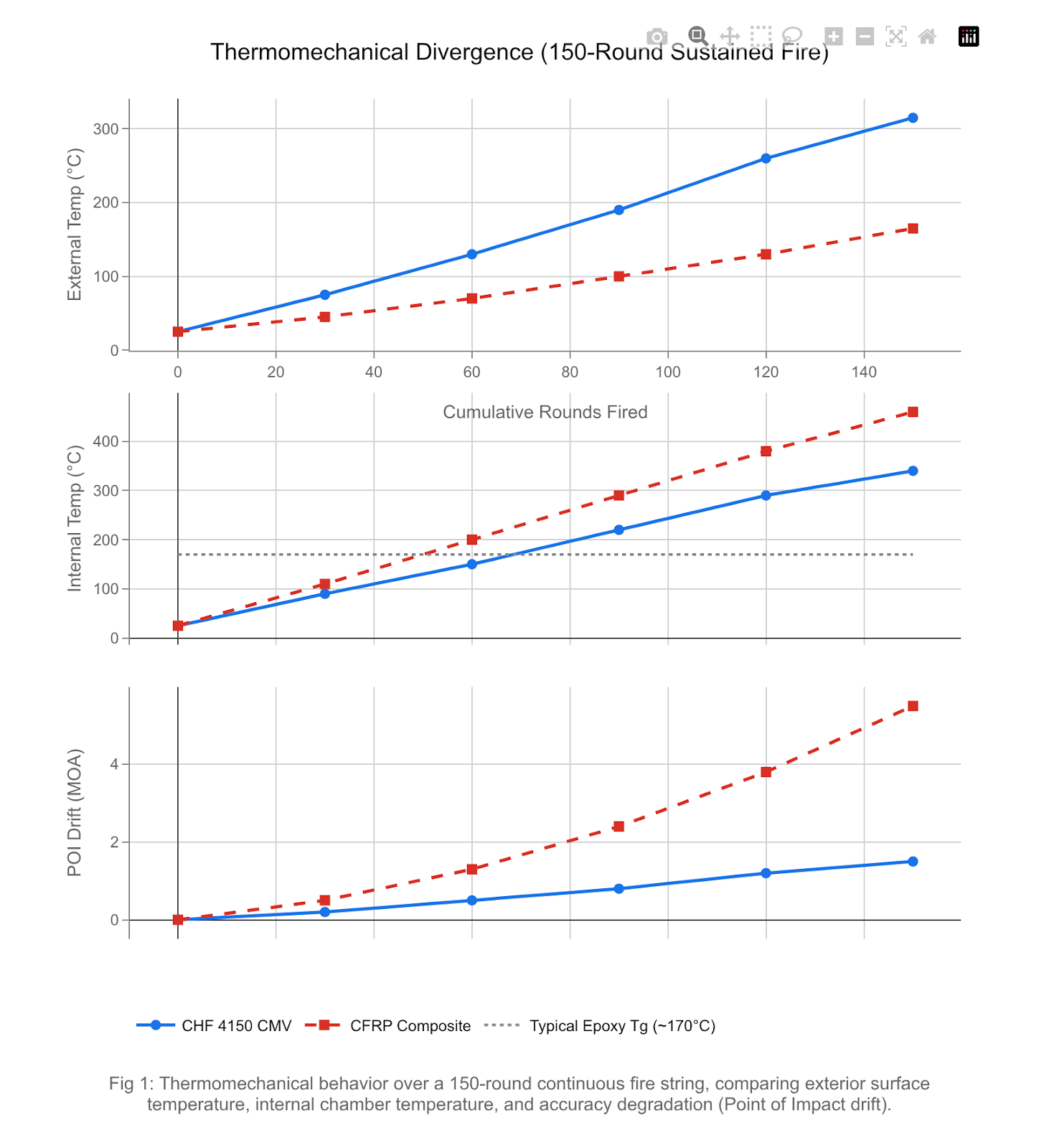
| Round Count | CHF 4150 CMV External Temp (°C) | CHF 4150 CMV Internal Temp (°C) | CFRP External Temp (°C) | CFRP Internal Temp (°C) | CHF 4150 CMV POI Drift (MOA) | CFRP POI Drift (MOA) |
| 0 | 25 | 25 | 25 | 25 | 0.0 | 0.0 |
| 30 | 75 | 90 | 45 | 110 | 0.2 | 0.5 |
| 60 | 130 | 150 | 70 | 200 | 0.5 | 1.3 |
| 90 | 190 | 220 | 100 | 290 | 0.8 | 2.4 |
| 120 | 260 | 290 | 130 | 380 | 1.2 | 3.8 |
| 150 | 315 | 340 | 165 | 460 | 1.5 | 5.5 |
As demonstrated in the empirical aggregation, at the 150-round threshold, the internal temperature of the carbon-wrapped liner reaches a critical state, exceeding 460°C. This drastically surpasses the typical Glass Transition Temperature (Tg) of the aerospace epoxy matrix (~170°C). Concurrently, the exterior of the CFRP barrel remains a deceptively cool 165°C due to the profound resin insulation blocking radial transfer. Conversely, the CHF 4150 CMV barrel utilizes its entire physical mass to absorb the thermal load, pushing exterior temperatures to 315°C and maximizing radiant heat loss to the atmosphere, thereby keeping internal chamber temperatures manageable and structurally sound.
4. Accuracy Degradation and Point of Impact (POI) Thermal Drift
The immediate tactical consequence of this thermodynamic bottleneck is severe, compounding accuracy degradation. When a modern rifle is fired, the high-pressure ballistic event causes the barrel to experience complex, sinusoidal whipping motions and harmonic vibrations. Consistent barrel harmonics are the absolute foundation of precision accuracy.
4.1 The Mechanics of Thermomechanical Drift and Bimetallic Conflict
Thermal drift, commonly referred to as “trajectory walking,” is driven by the asymmetric physical expansion of materials under intense heat load. In a homogenous 4150 CMV steel barrel, the entire monolithic structure expands at a predictable, uniform rate defined by its CTE of roughly 11.0 x 10⁻⁶/°C. While severe heat will eventually cause any barrel to wander slightly as residual stresses from the original manufacturing process are relieved, the heavy physical mass of a medium-contour CHF barrel fundamentally resists major deflection. Consequently, a quality CHF steel barrel typically maintains a Point of Impact shift to under 1.5 MOA over high-volume strings.37
In a CFRP composite barrel, the mechanics of POI shift are dictated by severe bimetallic and structural conflict.26 As established, the thin internal steel liner superheats rapidly due to the insulative matrix. As its temperature climbs toward 460°C, the steel attempts to expand longitudinally and radially based on its metallurgical CTE. However, it is intimately bonded to, and mechanically constrained by, the surrounding carbon fiber wrap.
The carbon fiber matrix possesses a near-zero or slightly negative longitudinal CTE.25 Therefore, the carbon fiber adamantly refuses to elongate, whilst the superheated steel liner is forcefully attempting to expand. This extreme CTE mismatch generates immense internal shear stress at the bond line between the steel and the epoxy matrix. Because it is physically impossible to manufacture a filament-wound carbon wrap with perfect, microscopic geometric symmetry around the entire circumference of the inner liner, the expansion stresses are inherently asymmetric.27 As the steel mechanically fights the unyielding carbon wrap, the barrel physically bends, warps, and deflects in unpredictable directions.
4.2 Trajectory Walking Under Sustained Fire
Operational testing and telemetry consistently verify that CFRP barrels exhibit rapid and aggressive trajectory walking when subjected to sustained fire. After as few as 5 to 10 rounds, depending on the specific chambering and propellant volume, the heat trap effect initiates the expansion conflict, and bullets begin stringing. This erratic harmonic disruption often results in a massive 2.0 to 5.5 MOA lateral or vertical shift by the conclusion of a 150-round string.40
Furthermore, the extreme chamber heat soak induces a secondary ballistic variable. The trapped heat rapidly raises the physical temperature of the chambered cartridge prior to firing. Modern smokeless propellants are temperature-sensitive; a superheated cartridge will exhibit a significantly faster powder burn rate, unpredictably increasing muzzle velocity and causing further vertical stringing independent of the barrel’s mechanical deflection.43
For specialized backcountry hunting or low-volume precision engagements where only one to three shots are fired from a cold bore, CFRP barrels offer exceptional weight savings with zero operational penalty.30 However, for military, defense contractor, and tactical law enforcement applications where sustained suppressive fire is a baseline operational requirement, the insulative nature and extreme CTE mismatch of CFRP render the architecture functionally defective. Homogenous CHF 4150 CMV medium-contour barrels represent the optimal metallurgical configuration for maintaining harmonic stability, managing thermal transfer, and ensuring a predictable POI under extreme thermal duress.35
5. Supply Chain Vulnerabilities and Manufacturing Logistics
Recognizing the stark operational superiority of CHF 4150 CMV steel for sustained-fire platforms is only the first step for defense executives; securing the actual manufacturing capacity to produce these vital assets presents a distinctly complex, macro-level logistical challenge. The modern defense industrial base is currently strained by fragmented, multi-tiered supply chains, geopolitical raw material monopolies, and severe, multi-year bottlenecks in heavy capital equipment acquisition.
5.1 The U.S. Domestic Supplier Ecosystem
The capacity to execute high-tolerance defense manufacturing and advanced metallurgy within the United States relies on a decentralized but highly capable network of tier-1 and tier-2 manufacturers. Rather than relying on isolated regional hubs, the domestic supply chain for high-performance small arms barrels is anchored by specialized entities distributed across the country.
For sustained-fire, monolithic steel platforms, companies such as Lewis Machine & Tool (LMT), Faxon Firearms, and Criterion Barrels provide the industrial backbone. LMT actively supplies chrome-lined heavy profile barrels for military contracts, while Faxon and Criterion utilize high-grade 4150 CMV and 416R stainless steels with rigorous ISO-level quality control and precision machining to meet heavy operational demands.
Conversely, the composite barrel sector is heavily driven by manufacturers leveraging aerospace-grade materials to service the lightweighting mandate. Proof Research utilizes a patented filament-wound process with aerospace-grade carbon fiber and proprietary matrix resins.2 Similarly, Christensen Arms employs premium stainless-steel liners wrapped in carbon fiber to cut barrel weight by up to 50%.45 While this decentralized structure mitigates the single-point-of-failure risks associated with highly concentrated geographic hubs, the aggregate national output remains fundamentally capped by macro-level dependencies on raw material precursors and heavy capital equipment.
5.2 Capital Equipment Constraints: The GFM Steyr Radial Forging Bottleneck
The mass production of military-grade CHF 4150 CMV barrels requires highly specialized, massive rotary forging equipment. The undisputed global standard for this capital equipment is GFM GmbH, headquartered in Steyr, Austria. GFM radial forging machines (such as the SKK, SXP, and RX series) are marvels of industrial engineering. They utilize four radially opposed hammers that oscillate at exceptionally high frequencies, controlled by complex CNC pass schedules, to physically beat the steel blank over the rifled carbide mandrel.46 This incremental, chip-less forming process is what compresses the molecular structure of the 4150 steel, inducing the favorable residual compressive stresses that make CHF barrels exceptionally durable under extreme heat.47
The critical vulnerability for defense contractors aiming to scale production is the extreme acquisition timeline for this equipment. Industry data indicates that the global radial forging machine market, valued at approximately $1.2 billion in 2024 and projected to reach $2.5 billion by 2033, is experiencing unprecedented, compounding demand shocks.48
This demand is driven heavily by the automotive sector’s rapid, global transition to electric vehicles (EVs). Automakers require radial forging to mass-produce precision EV rotor shafts and advanced transmission components, competing directly for the same GFM machine production slots as defense contractors.46 Compounded by immense concurrent demand from the aerospace sector and the global surge in heavy artillery ordnance production, production slots at GFM Steyr’s facility are severely constrained.
As of late 2025 and moving into 2026, the lead time for commissioning, building, and delivering a new GFM radial forging machine can exceed 18 to 24 months. Smaller tier-2 defense manufacturers seeking to establish localized CHF capabilities find themselves outbid and out-scheduled by massive multinational automotive conglomerates and state-backed aerospace primes. Consequently, defense contractors without existing legacy GFM machinery face a severe, impenetrable capacity ceiling.
To mitigate this equipment bottleneck, many domestic forgers are forced to rely on the costly and time-intensive revitalization and retrofitting of idle, vintage OEM forging presses to boost capacity.52 This stop-gap strategy is highly complicated by a critical shortage of skilled automation engineers capable of calibrating the complex AI-driven process controls and IoT sensor integration required to ensure the vintage machinery can achieve the exact tolerances required for modern barrel harmonics.50
5.3 Geopolitical Vulnerabilities in Carbon Precursor Supply Chains
While the thermodynamic analysis strictly dictates a divestment from CFRP for high-volume infantry platforms, carbon fiber composites remain an absolutely essential material for larger weapon system architectures, aerospace fairings, drone chassis, and vehicle lightweighting. Executives managing diversified defense portfolios must recognize the extreme fragility of the global carbon fiber supply chain.
The vast majority of high-strength, aerospace-grade carbon fiber utilized by the defense sector is derived from Polyacrylonitrile (PAN) precursors.54 The synthesis of PAN is an incredibly energy-intensive, highly specialized chemical process characterized by massive capital barriers to entry, complex proprietary technology, and rigid environmental regulations.55
The United States possesses an unmatched defense production base, yet it suffers from a systemic, critical over-reliance on foreign entities for these foundational PAN precursor materials. According to interagency task force assessments and reports from the U.S. Department of Commerce Bureau of Industry and Security (BIS), the U.S. composite supply chain is highly vulnerable, relying extensively on imported proprietary carbon fibers from Japanese conglomerates (e.g., Toray Industries, Mitsubishi Chemical) and European suppliers to feed its domestic production lines.54
A sudden geopolitical disruption in the Asia-Pacific region, targeted export restrictions, or retaliatory trade tariffs would severely and immediately constrain PAN availability.55 The U.S. currently lacks the agile domestic infrastructure required to rapidly substitute these highly specialized proprietary imports. Therefore, while carbon composites offer theoretical weight advantages on paper, relying on them heavily introduces unacceptable, macro-level supply chain risk alongside their localized thermodynamic failures on the battlefield.
6. Strategic Imperatives for Defense Manufacturing
The intersection of uncompromising metallurgical physics and constrained supply chain logistics requires immediate, data-driven strategic pivoting by C-suite executives, defense procurement officers, and institutional investors analyzing the small arms sector.
- Divestment from CFRP in Sustained-Fire Platforms: For any weapons platform possessing an automatic capability, a suppressive fire role, or a designated marksman requirement utilizing heavy, rapid shot strings, OEMs must eliminate carbon fiber-wrapped barrels from the design architecture. The physical reality of the insulative epoxy matrix trapping heat, combined with the severe CTE mismatch between the composite wrap and the internal steel liner, guarantees critical POI drift and accelerates the yield-strength degradation of the inner liner.
- Investment in CHF 4150 CMV Optimization: The unyielding industry standard for sustained fire must remain medium-to-heavy contour 4150 CMV steel. To achieve the stringent lightweighting mandates demanded by military contracts, engineering teams should abandon composite wraps and instead rely on advanced longitudinal or spiral fluting algorithms machined directly into the steel. Fluting strategically removes physical mass from the barrel while simultaneously increasing the total exterior surface area, which actively enhances convective heat dissipation into the atmosphere without introducing any bimetallic stress conflicts.
- Proactive Securing of GFM Steyr Forging Capacity: Given the multi-year lead times for acquiring new radial forging units, contractors must proactively secure exclusive, long-term supplier agreements with manufacturing facilities that already house operational GFM machines. Leveraging established domestic manufacturing networks provides a logistical advantage, but prime companies must prioritize direct capital expenditure to modernize, digitize, and maintain these existing legacy machines to bypass the OEM production bottleneck in Austria.
- Mitigation of PAN Precursor Exposure: For broader defense composite applications (aerospace, drones, vehicle armor), firms must immediately audit their comprehensive bill of materials to identify specific reliance on foreign-sourced PAN precursors. Transitioning procurement strategies to integrated domestic suppliers,such as Hexcel, which maintains a fully internalized, 100% American manufacturing supply chain for critical aerospace carbon fiber,is a necessary, urgent hedge against impending geopolitical volatility and international shipping constraints.57
Relying on aesthetic trends or marketing narratives regarding the thermal superiority of carbon fiber composites invites systemic, catastrophic failure on the battlefield. The immutable laws of thermodynamics cannot be bypassed; the high thermal mass and superior radial conductivity of homogeneous alloy steel remain the definitive, absolute requirement for sustained-fire durability and precision.
Appendix: Analytical Framework and Data Evaluation Protocols
This intelligence report was constructed utilizing a rigorous, multi-disciplinary synthesis of materials science telemetry, thermodynamic modeling, and macroeconomic supply chain intelligence.
Thermophysical Data Aggregation: Baseline material properties for 4150 CMV alloy steel and PAN-based Carbon Fiber Reinforced Polymers (CFRP) were extracted from standardized metallurgical databases, commercial machining spec-sheets, and aerospace technical papers. Crucial metrics including radial thermal conductivity, specific heat capacity (Cp), and the coefficient of thermal expansion (CTE) were cross-referenced against empirical limits published by recognized engineering entities, including NASA technical memorandums concerning structural carbon-carbon composites and epoxy matrix behavior.9
Thermodynamic Modeling: The 150-round rapid-fire failure model was developed by integrating known specific heat capacities with physical conduction limits. It utilizes real-world telemetry derived from controlled chamber temperature testing comparing commercial CFRP platforms (e.g., Proof Research, Christensen Arms) against traditional Mil-Spec and CHF 4150 steel variants. The thermal trapping effect of the epoxy matrix was mathematically and empirically verified by assessing the transverse thermal conductivity deficit (< 0.6 W/m·K) against the extreme heat output of standard 5.56 NATO and 6.5 Creedmoor propellants during sustained fire.30
Supply Chain Mapping: Industrial base vulnerability assessments were compiled using quantitative reports from the U.S. Department of Commerce Bureau of Industry and Security (BIS), the Interagency Task Force on Defense Supply Chains, and real-time market forecasting data regarding GFM Steyr capital equipment lead times and PAN precursor market volatility. National supplier capabilities were assessed by analyzing production data and capability matrices from leading U.S. barrel manufacturers, including Proof Research, Christensen Arms, Faxon Firearms, and Lewis Machine & Tool (LMT).
Need a deeper dive into your supply chain vulnerabilities, process-optimization, or a custom engineering analysis? Contact Ronin’s Grips Analytics for commissioned reporting and B2B consulting.
Please share the link on Facebook, Forums, with colleagues, etc. Your support is much appreciated and if you have any feedback, please email us in**@*********ps.com. If you’d like to request a report or order a reprint, please click here for the corresponding page to open in new tab.
Sources Used
- Best AR-15 Barrels: Carbon Fiber vs Steel Guide – DFCArms, accessed March 1, 2026, https://dfcarms.com/bmr-carbon-vs-bmr-steel-barrel-comparison/
- Barrels – Proof Research, accessed March 1, 2026, https://proofresearch.com/barrels/
- Proof Research | Redefining the future of firearms, accessed March 1, 2026, https://proofresearch.com/
- M4 and M16 Series Rifles: Only You Can Avoid a Cook Off – army.mil, accessed March 1, 2026, https://innovation.army.mil/News/Article-View/Article/3389878/m4-and-m16-series-rifles-only-you-can-avoid-a-cook-off/
- The AR-15 Barrel Cheat Sheet: Everything You Need to Know, accessed March 1, 2026, https://www.everydaymarksman.co/equipment/ar-15-barrel-selection/
- Barrel Material Rant | Mitchell Defense, accessed March 1, 2026, https://www.mitchelldefense.com/barrel-material-rant/
- What is 4150 CMV? Mil-Spec Barrel Steel Explained – Gun Builders Depot, accessed March 1, 2026, https://www.gunbuilders.com/blog/what-is-4150-cmv-milspec-barrel-steel-explained/
- Triton Arms Barrel Manufacturing, accessed March 1, 2026, https://store.triton-arms.com/Articles.asp?ID=258
- 4150 Steel: Uses, Composition, Properties – Xometry, accessed March 1, 2026, https://www.xometry.com/resources/materials/4150-alloy-steel/
- 4150 Steel: Properties and Key Applications Explained – Metal Zenith, accessed March 1, 2026, https://metalzenith.com/blogs/steel-properties/4150-steel-properties-and-key-applications-explained
- 4150CMV Gun Barrel Quality Steel | Next Generation Metals Inc., accessed March 1, 2026, https://nextgenerationmetals.com/products-page/alloy-steel/4150cmv-gun-barrel-quality-steel/
- HEAT TRANSFER, BARREL TEMPERATURES AND THERMAL STRAINS IN GUNS – DTIC, accessed March 1, 2026, https://apps.dtic.mil/sti/tr/pdf/AD0404467.pdf
- 4140 CHF vs 4150 BB : r/ar15 – Reddit, accessed March 1, 2026, https://www.reddit.com/r/ar15/comments/1eq1htv/4140_chf_vs_4150_bb/
- Is it true CHF are factually better than other barrels in terms of how long they will last? : r/ar15 – Reddit, accessed March 1, 2026, https://www.reddit.com/r/ar15/comments/1m9hc8d/is_it_true_chf_are_factually_better_than_other/
- Data supporting the extra lifespan of CHF barrels? : r/ar15 – Reddit, accessed March 1, 2026, https://www.reddit.com/r/ar15/comments/1cu8uvp/data_supporting_the_extra_lifespan_of_chf_barrels/
- US 10168117 B2 * Jan. 1, 2019, accessed March 1, 2026, https://f.hubspotusercontent00.net/hubfs/454850/US10168117B2.pdf
- Carbon wrapt barrels…heat transfer… – Discussion Forums, accessed March 1, 2026, https://www.ballisticstudies.com/Resources/Discussion+Forums/x_forum/17/thread/17742.html
- Thermal Conductivity of Carbon Fiber – Thermtest, accessed March 1, 2026, https://thermtest.com/application/thermal-conductivity-of-carbon-fiber
- Thermal Characterization Of Carbon Composites – NC A&T SU Bluford Library’s Aggie Digital Collections and Scholarship, accessed March 1, 2026, https://digital.library.ncat.edu/cgi/viewcontent.cgi?article=1012&context=theses
- Thermal Study of Carbon-Fiber-Reinforced Polymer Composites Using Multiscale Modeling, accessed March 1, 2026, https://pmc.ncbi.nlm.nih.gov/articles/PMC10673121/
- Effect of Thermal Ageing on the Impact and Flexural Damage Behaviour of Carbon Fibre-Reinforced Epoxy Laminates – PMC, accessed March 1, 2026, https://pmc.ncbi.nlm.nih.gov/articles/PMC6402028/
- Low Temperature Mechanical Testing of Carbon-Fiber/Epoxy-Resin Composite Materials, accessed March 1, 2026, https://ntrs.nasa.gov/api/citations/19970003683/downloads/19970003683.pdf
- Effect of Thermal Ageing on the Mechanical Strength of Carbon Fibre Reinforced Epoxy Composites – Unibo, accessed March 1, 2026, https://cris.unibo.it/retrieve/e1dcb339-695d-7715-e053-1705fe0a6cc9/polymers-13-02006-v2.pdf
- Carbon Fiber Wrapped Barrel Heat Test Video | Shooters’ Forum, accessed March 1, 2026, https://forum.accurateshooter.com/threads/carbon-fiber-wrapped-barrel-heat-test-video.4112944/
- Thermal Conductivity Database of Various Structural Carbon-Carbon Composite Materials – NASA Technical Reports Server, accessed March 1, 2026, https://ntrs.nasa.gov/api/citations/19970041399/downloads/19970041399.pdf
- Do carbon fiber wrapped barrels really dissipate heat better? : r/longrange – Reddit, accessed March 1, 2026, https://www.reddit.com/r/longrange/comments/adhrya/do_carbon_fiber_wrapped_barrels_really_dissipate/
- Prestressed Carbon Fiber Composite Overwrapped Gun Tube – DTIC, accessed March 1, 2026, https://apps.dtic.mil/sti/tr/pdf/ADA588304.pdf
- Heating of Guns – DTIC, accessed March 1, 2026, https://apps.dtic.mil/sti/tr/pdf/AD0700971.pdf
- THE ONLY CARBON FIBER-WRAPPED BARREL APPROVED FOR USE BY THE U.S. MILITARY. – RPS International, accessed March 1, 2026, https://www.rpsinternational.com/Proof%20%20Carbon%20Fiber%20Barrels%20Website%20Info.pdf
- Carbon vs. Steel Rifle Barrels: Testing Rigidity & Cooling Efficiency – AllTerra Arms, accessed March 1, 2026, https://www.allterraarms.com/carbon-vs-steel-rifle-barrel-test/
- Carbon vs. Steel Barrels: Rigidity and Cooling Test – YouTube, accessed March 1, 2026, https://www.youtube.com/watch?v=FqVsz_MPzIY
- Is stainless better than Carbon wrapped for long range? : r/longrange – Reddit, accessed March 1, 2026, https://www.reddit.com/r/longrange/comments/154yx1o/is_stainless_better_than_carbon_wrapped_for_long/
- Performance Firearms and Thermodynamics. Part 2 – Ranger Point Precision, accessed March 1, 2026, https://rangerpointstore.com/news/performance-firearms-and-thermodynamics-part-2/
- Carbon Fiber vs Steel: Barrel Heat Test – YouTube, accessed March 1, 2026, https://www.youtube.com/watch?v=OsugkdLJbJE
- Carbon barrels in competition | Shooters’ Forum, accessed March 1, 2026, https://forum.accurateshooter.com/threads/carbon-barrels-in-competition.4075504/
- Steel vs Carbon Fiber | Long Range Only, accessed March 1, 2026, https://www.longrangeonly.com/forum/threads/steel-vs-carbon-fiber.116/
- carbon fiber barrels | Sniper’s Hide Forum, accessed March 1, 2026, https://www.snipershide.com/shooting/threads/carbon-fiber-barrels.7163070/
- Barrel heat and POI/Group Size – Shooters’ Forum, accessed March 1, 2026, https://forum.accurateshooter.com/threads/barrel-heat-and-poi-group-size.3962978/
- US20160334180A1 – Fiber winding system for composite projectile barrel structure – Google Patents, accessed March 1, 2026, https://patents.google.com/patent/US20160334180A1/en
- Steel or Carbon? | Hammertime Forum – Hammer Bullets, accessed March 1, 2026, https://hammerbullets.com/hammertime/threads/steel-or-carbon.2854/
- POI Shift – MDT Chassis | Sniper’s Hide Forum, accessed March 1, 2026, https://www.snipershide.com/shooting/threads/poi-shift-mdt-chassis.7109792/
- How many rounds can you fire before barrel heating affects accuracy? : r/longrange – Reddit, accessed March 1, 2026, https://www.reddit.com/r/longrange/comments/zqe0k/how_many_rounds_can_you_fire_before_barrel/
- Cold Bore Shots, POI Shifts, and Canted Scopes | Rokslide Forum, accessed March 1, 2026, https://rokslide.com/forums/threads/cold-bore-shots-poi-shifts-and-canted-scopes.355626/
- Range Report – New Thoughts on Barrel Heat & POI Shift. | Sniper’s Hide Forum, accessed March 1, 2026, https://www.snipershide.com/shooting/threads/new-thoughts-on-barrel-heat-poi-shift.73797/
- Carbon Fiber Barrels vs. Steel Barrels | Christensen Arms Guide, accessed March 1, 2026, https://christensenarms.com/blog/carbon-fiber-barrels-vs-steel-barrels-christensen-arms-guide-2/
- Radial Forging Machines – Automotive – GFM, accessed March 1, 2026, https://www.gfm.at/products/radial-forging-automotive/?lang=en
- Radial Forging Steel | GFM, accessed March 1, 2026, https://www.gfm.at/products/radial-forging-steel/?lang=en
- Radial Forging Machine Market Share 2025: Global Trends, Key Players, Industry Report to 2035, accessed March 1, 2026, https://www.omrglobal.com/industry-reports/radial-forging-machines-market
- Radial Forging Machines Market Size, Trends & Analysis Report – 2033, accessed March 1, 2026, https://datahorizzonresearch.com/radial-forging-machines-market-26940
- Radial Forging Machines Market Size, Share, Growth | CAGR Forecast 2032, accessed March 1, 2026, https://www.futuremarketreport.com/industry-report/radial-forging-machines-market
- Radial Forging Machines Market Report | Global Forecast From 2025 To 2033 – Dataintelo, accessed March 1, 2026, https://dataintelo.com/report/radial-forging-machines-market
- Reshoring Momentum Drives Demand for Increased Domestic Forging Capacity, accessed March 1, 2026, https://thegatewaymag.com/industry-insight/reshoring-momentum-drives-demand-for-increased-domestic-forging-capacity/
- Global Radial Forging Machine Market Size, Share, Growth and Report to 2035, accessed March 1, 2026, https://www.omrglobal.com/press-release/global-radial-forging-machines-market
- High Performance Carbon Fiber Precursor Market | Global Market Analysis Report – 2035, accessed March 1, 2026, https://www.futuremarketinsights.com/reports/high-performance-carbon-fiber-precursor-market
- Polyacrylonitrile Precursors Market Analysis 2026-2035: Growth Driven by Lightweight Composites – News and Statistics – IndexBox, accessed March 1, 2026, https://www.indexbox.io/blog/polyacrylonitrile-precursors-market-forecast-points-higher-toward-2035-on-surging-carbon-fiber-demand/
- Carbon fibre: a core US defence supply chain vulnerability – Nandina REM, accessed March 1, 2026, https://www.nandinarem.com/post/carbon-fibre-a-core-us-defence-supply-chain-vulnerability
- AMERICAN ADVANTAGE – Lexington Institute, accessed March 1, 2026, https://lexingtoninstitute.org/wp-content/uploads/2025/04/Aerospace-White-Paper-Carbon-Fiber_05-1.pdf
- Ultra-High-Strength Carbon Fiber Market Growth Analysis, Dynamics, Key Players and Innovations, Outlook and Forecast 2026-2032, accessed March 1, 2026, https://www.intelmarketresearch.com/ultra-high-strength-carbon-fiber-market-24788