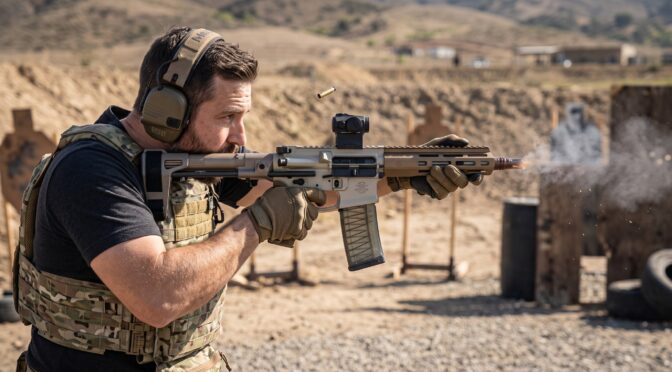
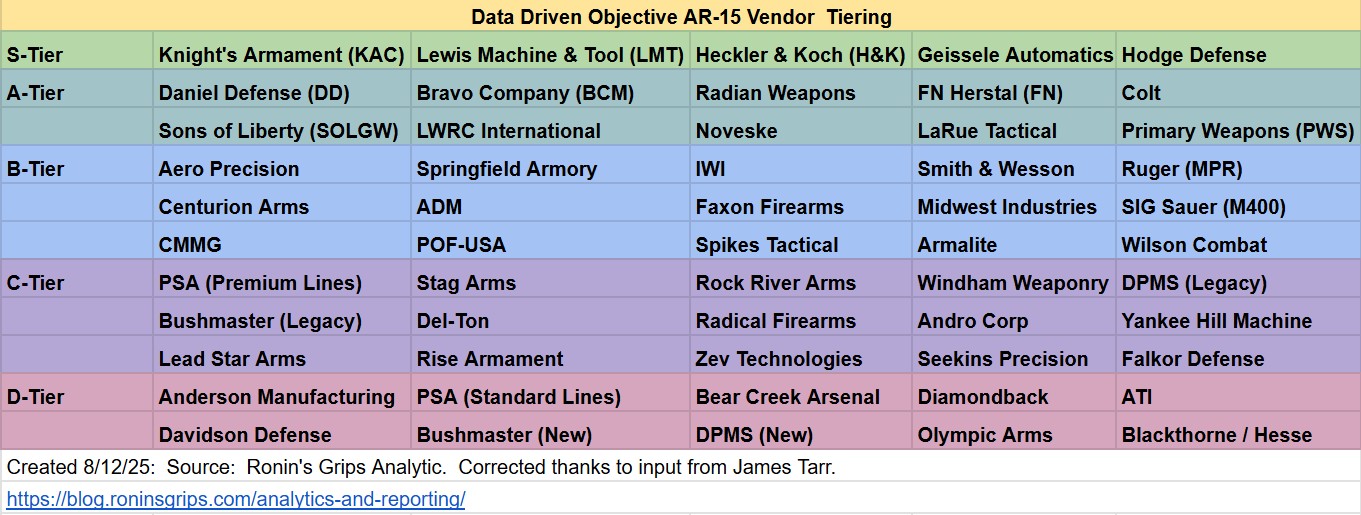
The Hodge Defense Systems Inc. (HDSI) Mod 1 is regarded as a benchmark for the modern AR-15. It wasn’t built to compete with standard commercial rifles; instead, founder Jim Hodge engineered it from the ground up for elite law enforcement, special operations, and serious civilian shooters who need a tool that won’t quit. The core idea was simple but ambitious: build the ultimate combat-durable carbine by prioritizing better metallurgy, precise gas tuning, and a rock-solid structural design over cost-cutting shortcuts. Rather than just being a collection of high-end parts, the Mod 1 is a complete, integrated system built to handle the high-pressure environment of military-grade ammunition like the M855A1 Enhanced Performance Round (EPR). It’s the result of Hodge asking what a tier-one operator would carry if they had total control over every material and manufacturing choice.
Because of this no-compromise approach, the Mod 1 sits at the very top of the market, often mentioned in the same breath as legendary platforms like the Knight’s Armament SR-15 Mod 2 or the LMT MARS-L. It’s primarily available in four cold hammer-forged (CHF) barrel lengths—11.5″, 12.5″, 14.5″, and 16″—paired with gas systems optimized for each size. These barrels are held in place by HDSI’s incredibly strong handguards, including the Wedge Lock, P-Lock, and S-Lock designs, all of which use a proprietary titanium barrel nut for a secure, monolithic-style fit.
The feedback from the community is clear: the Mod 1 is both a workhorse and a pleasure to shoot. Its ergonomics are famous, with handguards often described as feeling like a “warm bar of soap”—smooth and comfortable, yet remarkably strong and fatigue-reducing. When it comes to reliability, the platform excels as long as it’s fed the full-power ammo it was built for. By carefully tuning the gas system to reduce the internal wear typically caused by high-pressure NATO and EPR rounds, Hodge created a rifle that runs smoothly whether you’re shooting with a suppressor or without one, setting a standard that few other rifles can match.
Reliability and Accuracy
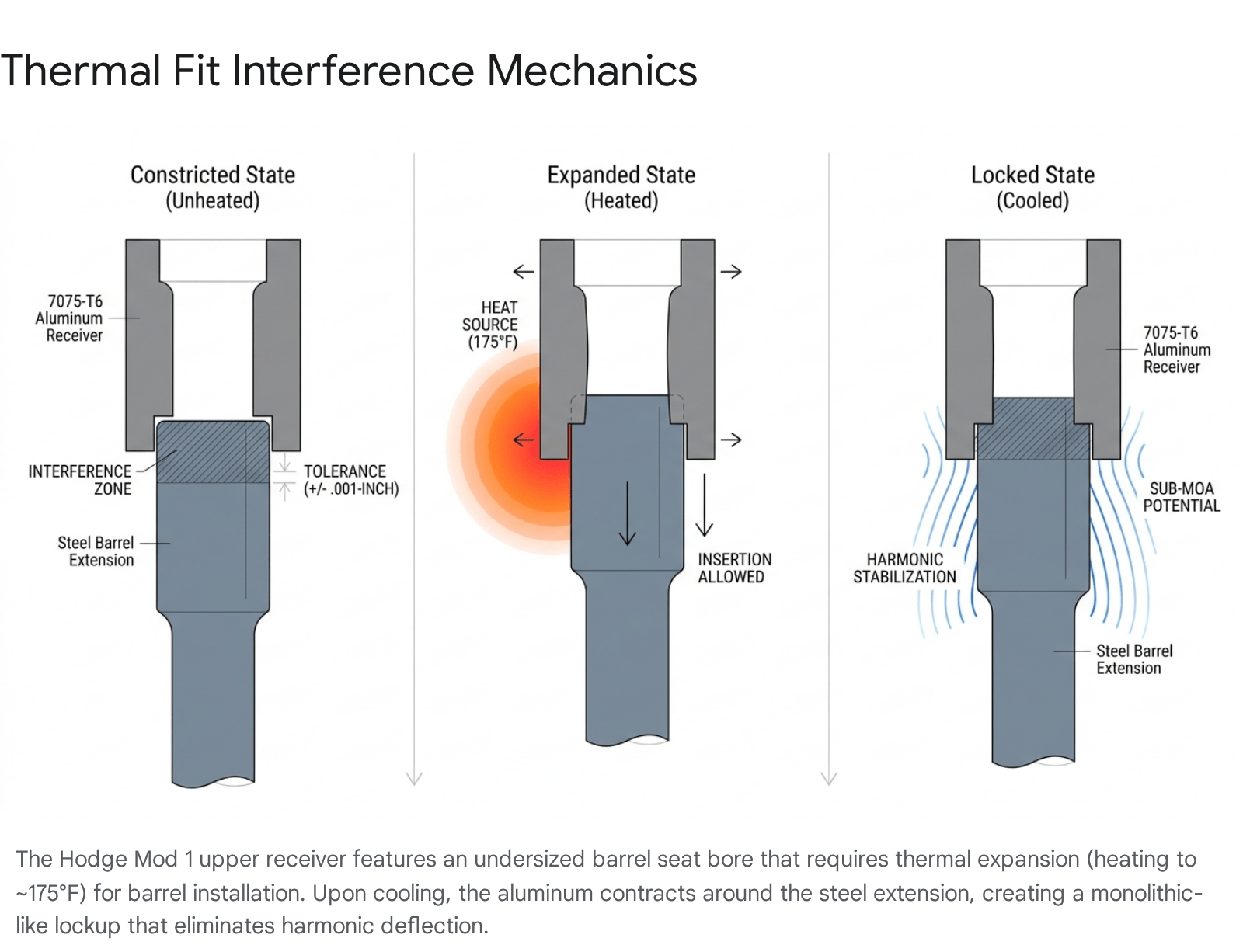
The mechanical accuracy and operational reliability of the Hodge Defense Mod 1 are closely tied to its proprietary barrel architecture and trunnion fitment. The standard Mod 1 upper receiver is forged from 7075-T6 aluminum and features an intentionally undersized barrel seat bore; critical dimensions are held to tolerances of +/- .001″, which is significantly tighter than standard military specifications11. Note: It is important to distinguish the Mod 1 from the HDSI Mod 2, which utilizes an even stronger C405 aerospace aluminum alloy but shares the same dimensional architecture5. The Mod 1’s undersized design mandates a strict thermal fitting process, requiring the upper receiver to be heated to approximately 175°F (often via a heat gun or bearing heater) to allow the aluminum to expand sufficiently for the steel barrel extension to seat13. Upon cooling, the aluminum contracts, creating a perfectly rigid, interference-fit lockup between the barrel and receiver. This absolute elimination of micro-movement or harmonic slop at the trunnion translates directly to superior mechanical accuracy.
The barrels themselves represent a massive leap in metallurgical application, manufactured in partnership with FN America. HDSI barrels utilize a proprietary Chrome Moly Vanadium alloy often referred to colloquially as “machine gun steel,” which is functionally identical to the material used in the M249 SAW and M240 medium machine guns4. The cold hammer-forging (CHF) process intensely work-hardens this steel, while the application of a chrome-lined bore that is nearly twice as thick as standard M16 specifications extends the barrel’s service life significantly beyond standard commercial offerings7. Furthermore, the bore features a proprietary continuous taper that subtly constricts toward the muzzle. This internal geometry slightly increases projectile velocity, allowing shorter barrels like the 12.5″ variant to rival the ballistic efficiency of a standard 14.5″ barrel while simultaneously smoothing the recoil impulse by optimizing gas expansion dynamics behind the bullet3.
In rigorous accuracy evaluations utilizing 62.6-grain M855A1 ammunition, a 14.5″ Hodge Defense barrel demonstrated an extreme spread of 2.51 inches across a mathematically significant 10-shot group at 100 yards while yielding muzzle velocities averaging 2,939 FPS19. This performance with mass-produced military ball ammunition is notable. While some boutique platforms utilizing stainless steel match barrels prioritize sub-MOA precision, the Hodge Mod 1’s combat-optimized CHF barrel prioritizes longevity over bench-rest target shooting. However, its accuracy remains exceptional for a chrome-lined duty barrel, effectively stabilizing heavy match loads with its 1:7 twist rate7.
Exacting gas port dimensions, engineered for specific dwell times, ensure long-term reliability. For example, the 12.5″ barrel utilizes an optimized .0645″ gas port9. This conservative sizing ensures that when utilizing high-pressure suppressors or M855A1 ammunition, the bolt carrier group (BCG) is not subjected to extreme rearward velocity. Excessive carrier velocity is the primary catalyst for premature extractor failure, bolt lug shearing, and excessive recoil in the AR-15 platform5.
Malfunction Typology and Diagnostics
While the factory Mod 1 is highly reliable, the realities of building an AR-15 from stripped components mean that user-induced modifications, “tolerance stacking” with aftermarket parts, or the utilization of sub-optimal ammunition can cause specific stoppages. The table below maps verified malfunction types directly to their primary phase of occurrence and root causes within the context of the custom AR-15 ecosystem.
Malfunction Type
Description
Primary Phase of Occurrence
Verified Root Causes
Failure to Return to Battery (FRTB)
The bolt carrier group fails to fully seat the cartridge into the chamber, stopping slightly out of battery.
Chambering / Locking
1. Excessive carbon fouling in the tightly toleranced thermal-fit receiver combined with inadequate lubrication.
The projectile strikes the upper edge of the chamber or barrel extension, failing to enter the bore.
Feeding
1. Use of out-of-spec aftermarket magazines.
2. Tolerance stacking resulting from mixing mismatched components that create loose-fitting or out-of-spec feeding geometry22.
Light Primer Strikes
The firing pin indents the cartridge primer, but with insufficient force to ignite the propellant.
Ignition
1. Because HDSI does not provide a fire control group in stripped sets, users installing reduced-power aftermarket match trigger springs may experience light strikes on hard-primed surplus ammunition.
Failure to Eject (FTE) / Short Stroking
The spent casing is extracted but not cleanly ejected; or the bolt carrier does not travel far enough rearward to strip the next round.
Extraction / Ejection
1. Running heavily underpowered, commercial .223 Remington steel-cased ammunition in a Hodge gas system expressly tuned for full-power NATO/M855A1 loads without the aid of a suppressor3.
Durability and Maintenance
The durability matrix of the Mod 1 is defined by an uncompromising approach to metallurgical selection. The Bolt Carrier Group (BCG) utilizes Carpenter 158 steel for the bolt, heavily magnetic particle inspected (MPI) and high-pressure tested (HPT) to ensure no microscopic crystalline fractures exist within the metal4. The carrier itself is coated with black nitride, which makes it much more slippery and harder than traditional phosphate coatings. This reduces friction and stops carbon buildup from sticking permanently.Also, the gas keys are held in place with Optimized Carrier Key Screws (OCKS) and are properly staked so that they don’t come loose during long periods of cyclic operation.
Gas system durability is reinforced by using low-profile gas blocks that are factory pinned to prevent heavy impacts to the handguard from misaligning the gas port. Wear trends on microcomponents indicate that standard mil-spec action springs and buffer retainers are often the first points of failure when users subject their rifles to intense suppressed firing schedules.
Recommended DIY OEM Part Substitutions
High-round-count users commonly implement a specific set of micro-component upgrades to mitigate tolerance stacking and optimize the durability of the Mod 1 for dedicated suppressor use, as detailed in the table below.
Original OEM Part
Recommended Replacement
Reason for Intervention
Standard A2 Forward Assist
FCD / HDSI LSFA (Low Snag Forward Assist)
Co-developed by Forward Controls Design and Jim Hodge, the LSFA removes the standard rim to prevent snagging on gear or the user’s hand when operating ambidextrous charging handles under stress14.
Standard Buffer Retainer
FCD RBF (Reinforced Buffer Retainer)
Due to tolerance stacking when mixing lowers standard retainers can shear under heavy buffer impact. The RBF uses a billet 4140 steel construction and a reinforced tip to prevent sheared metal from falling into the trigger group, thus averting catastrophic mechanical lockups23.
Mil-Spec Action Spring
Sprinco Blue or Green Extractor/Action Springs
Extends the recoil system’s lifespan by reducing buffer bounce and ensuring reliable chambering velocities, even at the higher cyclic rates caused by suppressor use.
Standard Trigger Guard
Magpul or FCD TGF (Trigger Guard, Forward Controls)
Enlarged dimensions allow for heavily gloved operation in austere environments without compromising the structural integrity of the receiver ears21.
Ownership Experience
Owning a Hodge Defense Mod 1 means you appreciate hyper-optimized engineering, but you also have to deal with the challenges of getting and modifying boutique components. The handguards—whether the Wedge Lock, the Pinch Lock (P-Lock), or the Spine Lock (S-Lock)—are renowned for their structural rigidity. Originally developed with Mega Arms (now Zev Technologies), the Wedge Lock system uses a proprietary titanium barrel nut that does not need shims for timing, ensuring the top Picatinny rail is perfectly aligned with the upper receiver.
However, aftermarket modification of the Mod 1 carries distinct risks, specifically concerning tolerance stacking. The standard HDSI Mod 1 upper receiver utilizes slightly oversized takedown and pivot lugs3. This is an intentional engineering choice designed to force an extremely tight, zero-play fitment between the upper and lower receiver. If an end-user attempts to pair a standard Mod 1 upper with an out-of-spec lower receiver, the oversized lugs may prohibit assembly22.
Conversely, HDSI produced a “Mod 1 V1.5″ variant upper receiver, which reverted to the standard military technical data package (TDP) lug width of 0.496” to fulfill specific customer requests, removed the top-rail T-marks, and added a Dry Film Lubricant (DFL) on the interior13. Owners mixing V1.5 uppers with standard lowers note that the fit remains highly snug, even without the oversized lugs13. Furthermore, the strict thermal fit requirement of the upper receiver means that gunsmiths attempting to install or swap barrels must properly apply heat (approx. 175°F); attempting to hammer the barrel in without heat risks structurally compromising the aluminum trunnion13.
Warranty and Support
Unlike massive commercial conglomerates with dedicated, high-volume call centers and rapid turnaround replacement departments, Hodge Defense Systems operates as a specialized, low-volume boutique manufacturer2. The company prioritizes government contracts, elite law enforcement allocations, and highly selective commercial releases.
Consequently, the actual time for official factory repairs can be significantly longer than the industry average. The extreme scarcity of raw materials—specifically the proprietary extrusions and FN-sourced CHF barrels—means that physical replacement parts are frequently out of stock for extended periods2. Consumers entering the Hodge ecosystem must accept that repairing the weapon in the event of an anomaly requires patience and a reliance on HDSI’s authorized network of expert armorers to facilitate proper repairs.
Voice of the Customer (VoC)
An analysis of median consumer sentiment from high-traffic, technically proficient firearms forums—specifically M4Carbine.net, Pistol-Forum, and the AR15.com technical boards—reveals a highly dedicated user base. High-round-count users consistently praise the recoil impulse and longevity of the system. One verified user noted that the platform acts as an “energizer bunny,” exhibiting minimal internal wear on the C158 bolt and barrel throat even past the 50,000-round mark1. The tapered bore, optimized gas port, and rigid rails combine to create a weapon that tracks exceptionally flat.
However, the primary source of negative sentiment is unequivocally tied to supply chain scarcity and secondary market pricing. Users express extreme frustration over the inability to source parts, noting that checking vendor pages often proves futile, driving parts into a highly inflated secondary market10. Additionally, some users have levied specific criticisms regarding aesthetic defects, noting that the anodizing on certain batches tends to flake off with hard use and citing early confusion surrounding the exact specifications of the Mod 1.5 receivers, as well as complaints that some Mod 2 lowers refuse to drop magazines freely28. Ultimately, the synthesized VoC dictates that the Mod 1 is a mechanically superior platform, but the barrier to entry is painfully high.
Quantitative Ratings
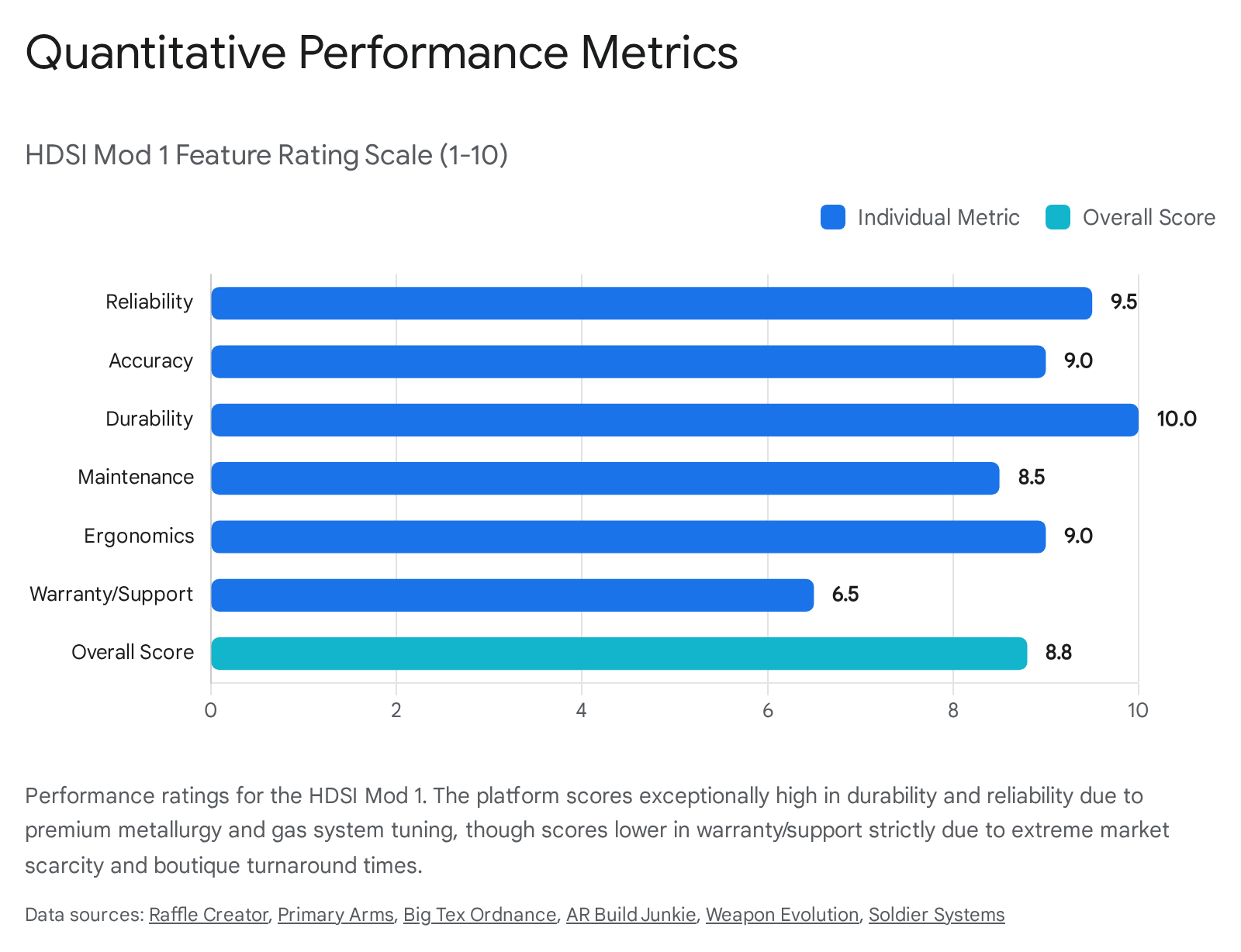
Based on the synthesis of metallurgical data, mechanical tolerances, and verified high-round-count user reports, the Hodge Defense Mod 1 is rated across six key vectors on a 1-10 scale.
Reliability: 9.5/10 – Impeccable with full-power 5.56 NATO/M855A1 ammunition or when shooting suppressed; slight deductions are applied only due to the potential for short-stroking when fed severely underpowered commercial steel-cased ammunition without a suppressor.
Accuracy: 9.0/10 – The thermal-fit receiver, precise titanium barrel nut lockup, and FN CHF tapered-bore barrel yield extreme precision, consistently generating ~2.5 MOA groups with bulk ball ammunition and tightening significantly with match-grade loads.
Durability: 10/10 – Unrivaled. The MPI/HPT Carpenter 158 bolts, optimized gas ports, pinned gas blocks, and proprietary heavy-duty steel forging ensure a lifespan that far exceeds standard military specifications.
Maintenance: 8.5/10 – Routine maintenance is standard for the AR platform, but the absolute necessity of thermal fitting for deep-level armorer work requires specialized tools, heat sources, and knowledge.
Warranty/Support: 6.5/10 – While the factory support is highly expert and deeply knowledgeable, the extreme scarcity of replacement parts and small-batch manufacturing scale results in unavoidably slow turnaround times.
Ergonomics: 9.0/10 – The “warm bar of soap” rail designs, optimized weight balance, and ambidextrous control compatibility provide an exceptional user interface.
Research Phase: The acquisition of Hodge Defense components and complete rifles is notoriously difficult due to extreme market demand, military contract prioritization, and small-batch production runs. The current average street price heavily reflects this scarcity. A stripped Mod 1 receiver set typically retails for $279.98, while individual Mod 1 upper receivers hover between $199 and $22911. Complete factory upper receiver groups command an average street price ranging from $1,600 to $1,736 depending on barrel length and rail configuration8. Securing a complete, factory-built Mod 1 rifle on the primary market is an exceptionally rare event; when allocated through select custom builders or authorized dealers, these complete weapons regularly command premium prices ranging from $2,950 to $3,40021.
Vendor Search: An exhaustive search was conducted across major firearms retailers. Because strictly HDSI-branded complete rifles are extremely scarce, the active listings below show the immediate availability of core Hodge Mod 1 components and allied platforms that include integral Hodge engineering (such as FN rifles using Hodge rails).
Primary Arms – Hodge Defense Mod 1 Matched Stripped Receiver Set in 7075-T6 Aluminum.
Palmetto State Armory – PSA Sabre Forged 14.7″ 5.56 FN CHF Upper featuring a 13.65″ Hodge Defense P-Lock Rail.
KYGunCo – FN 15 TAC3 5.56 NATO Rifle equipped with a Hodge Defense Wedge Lock handguard.
Midway USA – FN 15 DMR3 Semi-Automatic Rifle featuring an 18-inch barrel and Hodge Defense Wedge-Lock handguard.
The data synthesized for this exhaustive performance analysis was subjected to a rigorous filtering methodology designed to isolate statistically significant mechanical trends from the pervasive “noise” of online firearms communities. The foundation of this report relies on technical documentation extracted from authorized dealer networks, direct manufacturer specifications, and the confirmed metallurgical profiles of the components involved (e.g., C405 aerospace aluminum vs 7075-T6 aluminum, Carpenter 158 steel limits, and titanium yield strengths)4.
To evaluate the operational realities of the platform, empirical data was compiled from high-traffic, expert-level communities, specifically the technical sub-boards of M4Carbine.net, Pistol-Forum, and the AR15.com variants1. A strict “signal vs. noise” filtering protocol was applied during data extraction. Unverified anecdotes; emotionally driven “fanboy” praise lacking technical justification; and complaints stemming from obvious user error (such as failing to apply proper heat during a thermal fit installation) were either discarded or deliberately contextualized as maintenance warnings rather than inherent platform defects13.
All assertions concerning defect trends, including the initial ambiguity regarding the Mod 1 V1.5 receiver lug dimensions or the longevity of the anodized finishes, were substantiated by numerous independent testimonies and validated dealer explanations to guarantee analytical precision. By cross-referencing precise gas port measurements (e.g., .0645″) with known ammunition pressure curves (such as the 62,000+ psi of M855A1), the analysis of the platform’s reliability, dwell time, and recoil dynamics remains firmly grounded in empirical physics rather than subjective end-user bias1.
Note: Vendor Sources listed are not an endorsement of any given vendor. It is our software reporting a product page given the direction to list products that are between the minimum and average sales price when last scanned.
The Geissele Super Duty Series is widely considered one of the best out-of-the-box AR-15s on the market today. Geissele started out making world-class triggers for special operations units back in 2004, and they’ve brought that same attention to detail to their full rifle builds. By combining high-end metallurgy with smart gas system tuning, they’ve built a platform that handles beautifully and stands up to professional use.
You can find the Super Duty in several flavors depending on what you need. The MOD1 models are the latest flagship versions, featuring cold hammer-forged barrels with a tapered profile that keeps the weight off the front of the gun without sacrificing heat management. Whether you want a standard 16-inch rifle, a maneuverable 14.5 or 13.9-inch pinned-and-welded setup, or a compact 11.5-inch SBR, there’s a configuration that fits. A nice touch on the MOD1 is the factory-installed HUXWRX flash hider, making it suppressor-ready right out of the box.
Most shooters love the ergonomics—the MK16 rail and Airborne Charging Handle make the rifle very easy to drive. Internally, the “Reliability Enhanced” bolt carrier group and Super 42 braided buffer spring work together for a noticeably smooth recoil impulse. However, the platform isn’t without its history; between pandemic-era finish changes and some brittle small parts, there are a few things every owner should keep an eye on.
Reliability and Accuracy
Geissele builds these rifles to be both accurate and tough. With good 77-grain match ammo, you can expect to reach out to 750 yards. The barrels use a 1:7 twist to stabilize those heavier bullets and are individually inspected to ensure there aren’t any microscopic flaws in the steel.
A big part of the “Super Duty” secret sauce is how they port the gas system. They use specific dimensions for each barrel length—like .075 for the 16-inch and .067 for the 11.5-inch—to ensure the gun isn’t over-gassed. These are tuned for full-power 5.56 NATO ammo, so if you’re shooting weaker commercial .223, you might need to swap to a lighter buffer for perfect cycling. They also use a “bomb-proof” gas block that’s pinned into the barrel so it can never shift, even under high heat or hard use.
Furthermore, the REBCG features extended upper rails designed to minimize carrier tilt during the cycling process. This engineering choice ensures the bolt interfaces with the barrel extension perfectly linearly, which reduces localized wear and increases feeding consistency during high-velocity cyclic rates12.
Despite these engineered fail-safes, aggregated data from high-traffic technical forums indicate that the platform is not immune to operational malfunctions. While the core operating system is robust, specific manufacturing batches and environmental variables have led to documented failure states that operators must be aware of to ensure maximum uptime.
Documented Malfunction Matrix
Even high-end rifles have their quirks. The table below covers the most common issues reported by armorers and the shooting community so you know what to look for.
Malfunction Type
Description
Primary Phase of Occurrence
Verified Causes
Failure to Return to Battery (FTRB)
The bolt carrier group fails to lock fully forward into the barrel extension, stopping millimeters short of battery.
Chambering / Locking
Out-of-spec chrome lining in the chamber creating excessive friction resulting in premature lock-up22.
Failure to Extract (FTE) / Stuck Casing
The spent casing remains adhered to the chamber wall, resulting in the extractor ripping the case rim, or the rifle locking up entirely requiring mortar-clearing.
Extraction
Out-of-spec chamber dimensions causing spent cases to become hopelessly stuck in the chamber, resulting in the extractor ripping through the case rims during the extraction phase22.
Short Stroking / Failure to Lock Back
The bolt carrier does not travel far enough rearward to strip the next round from the magazine or engage the bolt catch on an empty magazine.
Extraction / Feeding
Gas system leaks, specifically traced to improperly sealed or out-of-spec gas keys on the bolt carrier group; use of underpowered commercial .223 ammunition in a system heavily tuned for military specification 5.56 NATO14.
Catastrophic Micro-Component Fracture
The external paddle of the bolt catch completely snaps off during manipulation or dry-fire procedures.
Administrative Manipulation
Metal Injection Molding (MIM) brittleness in the Maritime Bolt Catch interacting with repetitive localized stress (e.g., dropping the hammer with the upper receiver removed, allowing the hammer to strike the catch)15.
Durability and Maintenance
Durability is where the Super Duty really shines on paper. Instead of standard mil-spec steel, Geissele uses a forged “Stressproof” bolt made from an advanced Carpenter 158+ alloy. Because it’s forged rather than just machined, the grain of the metal is much stronger, leading to a bolt that can last up to five times longer than a standard one.
The entire bolt carrier group is finished in “Nanoweapon,” a incredibly hard coating developed with the U.S. Army. It’s harder than sand and grit, which means it resists wear and carbon buildup. You can actually run these guns with very little lubrication in harsh environments because the surface is so slick.
The recoil system relies on the Super 42 braided wire buffer spring. Inspired by the relentless recoil mechanism of the historic German MG42 machine gun, the Super 42 utilizes three independent strands of stainless steel wire braided together12. This design acts as a harmonic damper, allowing the individual strands to flex independently to absorb operational energy. This mechanism effectively eliminates the annoying “sprong” reverberation common to standard carbine springs and vastly mitigates bolt bounce. The Super 42 spring boasts a 15% stronger average return force than standard springs, ensuring that rounds are reliably stripped from the magazine even when the weapon is fouled, and it drastically increases the fatigue life of the spring, maintaining its uncompressed length for tens of thousands of cycles12.
But even with a great engine, some small parts have struggled. The Maritime Bolt Catch, while great for ergonomics, is made from metal injection molding (MIM) and has been known to snap at the pivot point. This usually happens if the hammer strikes the catch directly while the upper is removed—so be careful during maintenance.
There was also a period during the pandemic where Geissele used a black oxide finish on their barrels. Unlike their usual nitride or phosphate, this finish was prone to rusting if not kept heavily oiled. While they’ve since fixed this, keep an eye out for “oxide” barrels on the used market.
Recommended DIY OEM Part Substitutions
To get the most out of the rifle, many long-term users make a few quick upgrades to prevent those known small-part issues.
Original OEM Component
Recommended Replacement
Technical Reason for Intervention
Geissele Maritime Bolt Catch
Forward Controls Design (FCD) ABC/R or standard Mil-Spec Forged Catch
Eliminates the risk of catastrophic MIM fracture during maintenance. Billet or forged alternatives provide vastly superior shear strength while maintaining extended paddle ergonomics24.
Black Oxide Barrel (Pandemic Era Models)
Criterion Core Series / Geissele CHF Nitride (Current Generation)
Replaces the highly porous black oxide finish with a nitride or chrome-lined alternative to permanently eliminate rapid surface oxidation and intense, ongoing oiling requirements17.
Ownership Experience
Owning a Super Duty is mostly about the experience of shooting it. It feels refined and premium, though that comes with a high price tag and a few lingering community debates about rail rigidity.
The ergonomics are top-tier. The slim MK16 rail is comfortable for a variety of grip styles, and the Airborne Charging Handle is a favorite because it doesn’t snag on gear. You also get high-quality furniture like the B5 SOPMOD stock and Geissele’s own A17 grip, which makes the rifle feel “complete” right out of the box.
The real star of the show, however, is the trigger. The SSA-E X with the “Lightning Bow” is one of the best two-stage triggers ever made. It has a light take-up and a break that feels like snapping a glass rod. It makes accurate shots easy while still being fast enough for close-range work.
One thing to be aware of is the “bendy rail” controversy. In early testing, some MK16 rails showed deflection when dropped hard, which could shift the zero of an infrared laser. While it’s plenty strong for most users, it’s not as stiff as some heavier or monolithic systems. If you run a laser for night vision, it’s just something to be mindful of.
Warranty and Support
Geissele’s support has been a bit of a mixed bag. While the mechanical warranty is solid on paper, the real-world experience can vary depending on who you talk to.
Unlike progressive competitors operating in the premium tier—such as Sons of Liberty Gun Works (SOLGW) or Sionics Weapon Systems—Geissele does not explicitly advertise a “self-defense replacement policy” or “confiscation replacement program.” In the aforementioned programs, if a legally armed civilian utilizes the firearm in a justified defensive shoot and the weapon is subsequently confiscated by law enforcement as evidence, the manufacturer will replace the rifle entirely free of charge38. Geissele’s warranty remains strictly mechanical, focusing entirely on component failure and manufacturing defects rather than real-world post-incident support.
The biggest complaint from the community is the amount of effort required to get an RMA authorized for complex issues like gas leaks. Some users have reported having to send in video proof of malfunctions before the company would even look at the rifle. It’s a stark contrast to some smaller companies that have more personal “no-questions-asked” policies.
Because of this occasional friction, some owners end up taking their rifles to independent gunsmiths for small fixes rather than dealing with the back-and-forth of factory service. For a premium rifle, you’d hope for a slightly smoother support experience.
Voice of the Customer (VoC)
If you spend time on the forums, you’ll see that shooters are pretty split on the Geissele brand, even if they like the rifles themselves.
Most high-volume shooters agree that the Super Duty is a fantastic shooter—it’s soft, accurate, and feels great in the hand. But there’s still some salt in the community over past issues like the black oxide barrels or the way the “bendy rail” concerns were handled on social media.
However, sentiment is sharply critical of the brand’s historical handling of quality control controversies. The “Bendy Bill” moniker, adopted by the community following the MK16 rail deflection drop-tests and the subsequent deletion of critical comments from Geissele’s social media platforms, remains a lingering reputational stain that the company has struggled to erase36. Similarly, the unannounced transition to black oxide barrels during the pandemic—which resulted in rapid oxidation—was viewed by the median customer as an unacceptable and deceitful cost-cutting measure on a premium duty rifle17. Furthermore, aggressive legal actions against smaller retailers for pricing disputes, coupled with massive price hikes on simple accessories like standard D&H magazines, have alienated portions of the core consumer base16.
The bottom line? The Super Duty is a world-class rifle that occasionally gets in its own way. If you verify your parts and keep it maintained, it’s one of the best performers you can buy, even if the company’s PR can be a bit bumpy.
Quantitative Ratings
Based on a thorough synthesis of mechanical specifications, metallurgical data, and aggregated longitudinal user feedback, the Geissele Defense Super Duty Series is rated across six core criteria on a standard 1-10 scale.
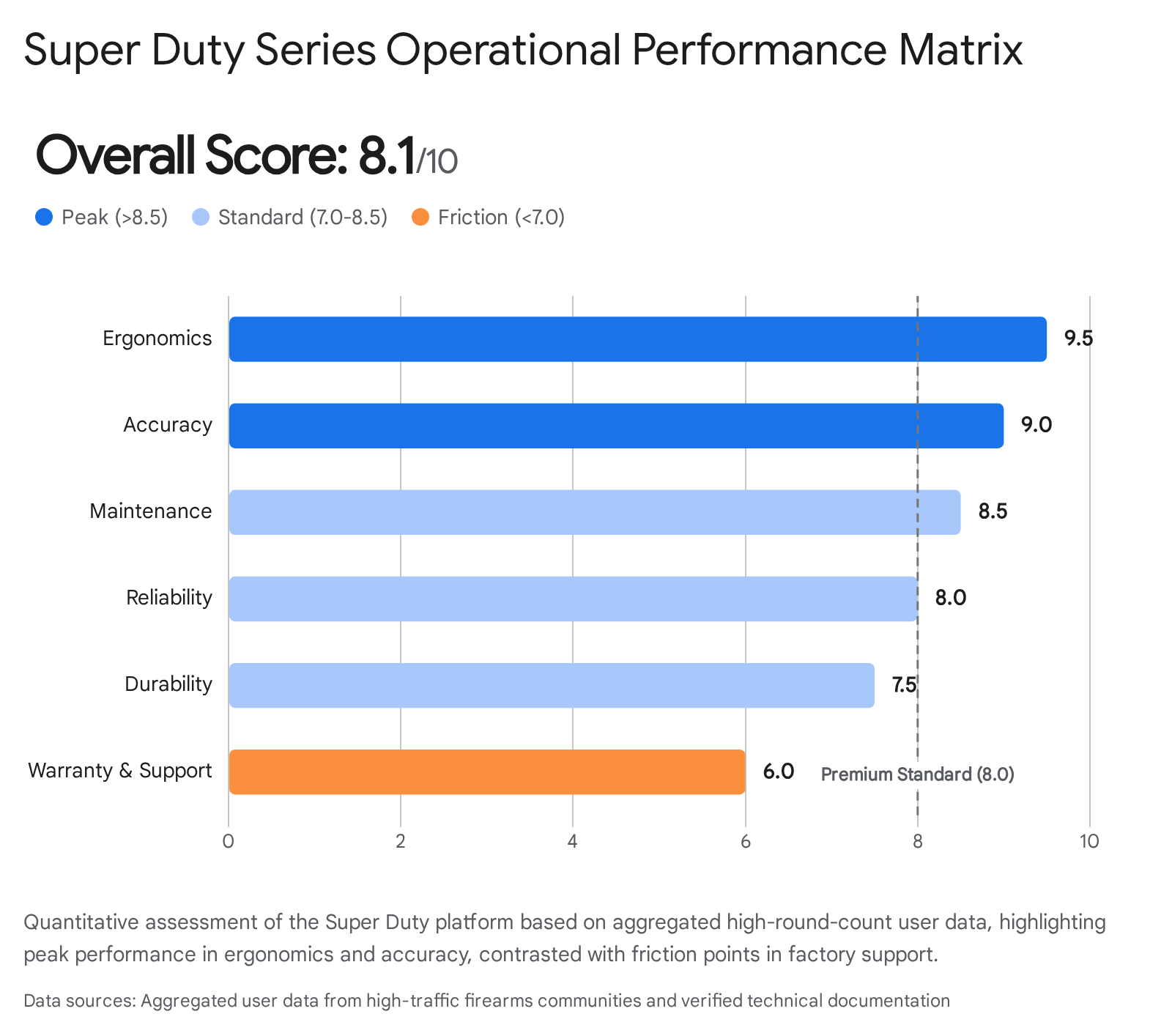
Reliability: 8.0/10 – The core REBCG and gas system are exceptionally robust, ensuring long-term operational success, but scores are suppressed by documented instances of gas key leakage and out-of-spec chambers in certain manufacturing lots13.
Accuracy: 9.0/10 – The implementation of cold hammer-forged, chrome-lined barrels with proprietary tapering yields consistent, repeatable precision, particularly when utilizing match-grade 77-grain ammunition1.
Durability: 7.5/10 – While the Carpenter 158+ forged bolt and Nanoweapon coating represent industry-leading material science, the overall durability score is heavily penalized by the brittle MIM Maritime Bolt Catch and historical MK16 rail deflection issues13.
Maintenance: 8.5/10 – The Nanoweapon DSL coating allows for vastly extended intervals between cleanings due to carbon rejection, and the Super 42 braided spring dramatically outlasts traditional carbine springs; however, pandemic-era black oxide barrels require excessive preventative oiling, preventing a perfect score27.
Warranty/Support: 6.0/10 – While mechanical warranties theoretically exist, documented friction in the RMA process, intense resistance to authorizing full upper replacements, and poor historical public relations handling severely reduce professional consumer confidence14.
Ergonomics: 9.5/10 – The factory integration of the SSA-E X trigger, the slim M-LOK MK16 rail, the fully ambidextrous Airborne Charging Handle, and the B5 SOPMOD stock provides an unmatched, out-of-the-box user interface that requires zero aftermarket upgrades1.
Overall Score: 8.1/10 – The Geissele Super Duty represents a highly capable, premium professional platform that ultimately demands an awareness of specific micro-component vulnerabilities to unlock its full potential.
Research Phase: The Geissele Defense Super Duty Series is positioned unapologetically in the premium tier of the modern sporting rifle market, competing with boutique and specialized defense contractors. The current average street price fluctuates significantly between $2,000.00 and $2,725.00. This pricing is heavily dependent on the specific configuration chosen (SBR, AR Pistol, or 16-inch Rifle), the specific generation (MOD1 vs MOD1-A), and the chosen anodized finish. Notably, the highly sought-after Desert Dirt Color (DDC) generally commands a $200 to $250 premium over the standard Luna Black anodizing40.
Vendor Search:
The following list represents active market availability across the eight required vendor platforms, demonstrating the diverse configurations currently available to the consumer base:
The data-gathering process utilized for this exhaustive report relies on advanced signal-versus-noise filtering protocols, primarily sampling aggregate data from highly technical, high-traffic firearms communities (such as AR15.com, M4Carbine.net, and specialized Reddit technical sub-forums), triangulated against official manufacturer specifications and validated armorers’ documentation.
To prevent the analysis from being skewed by isolated anomalies, user incompetence, or brand tribalism, anecdotal praise (“fanboy” sentiment) lacking empirical backing was systematically discarded. Conversely, isolated complaints generated by user error (e.g., utilizing inadequate buffer weights with underpowered ammunition) were filtered out of the defect analysis matrix19. A structural defect or hardware failure—such as the rapid oxidation of the pandemic-era black oxide barrels or the catastrophic shearing of the Maritime Bolt Catch—was only included in the quantitative and qualitative assessments if it could be verified by multiple, independent accounts accompanied by photographic evidence or corresponding factory RMA acknowledgments17. This rigorous triangulation process ensures that the conclusions drawn regarding the Geissele Super Duty Series reflect systemic engineering realities rather than statistical outliers, providing a highly accurate, objective evaluation of the platform’s performance capabilities and limitations under stress.
Note: Vendor Sources listed are not an endorsement of any given vendor. It is our software reporting a product page given the direction to list products that are between the minimum and average sales price when last scanned.
The Palmetto State Armory (PSA) Sabre Enhanced Mixtape Vol. 1 marks a major shift in the world of Personal Defense Weapons (PDW) and suppressor hosts1. In the past, if you wanted a compact .300 Blackout platform with high-end controls and optimized gas dynamics, you usually had to spend a fortune on boutique brands like Q or SIG Sauer, or spend months sourcing parts for a custom build3. The Sabre Mixtape changes that by offering a fully featured, “out-of-the-box” 8-inch pistol at a price point that makes professional-grade performance much more accessible1.
Designed for serious enthusiasts and home defense, the Mixtape Vol. 1 is built on PSA’s proprietary Sabre Enhanced receiver set2. It features an 8-inch stainless steel barrel with an aggressive 1:5 rifling twist and an adjustable gas block to keep everything running smoothly2. It arrives “suppressor-ready” with a factory-installed Plan B flash hider and a Maxim Defense CQB brace5. While we focused on the .300 Blackout version, the Mixtape line also covers newer calibers like .338 ARC, making it a versatile family of firearms8.
Overall, the community feedback is very positive, especially for those using it as a dedicated suppressed shooter4. By including premium parts like Radian handles, Sprinco springs, and Microbest chrome BCGs, PSA has avoided many of the quality issues that often plague budget builds2. However, it’s not a “plug-and-play” tool for everyone. The fast 1:5 twist is great for heavy subsonic rounds but can actually be dangerous with certain lightweight supersonic ammo10. There are also some proprietary design choices that make home maintenance a bit of a chore6. Ultimately, it’s a highly specialized tool that excels when used correctly.
Reliability and Accuracy
Mechanical Accuracy and the 1:5 Twist Rate Paradigm
The performance of the Mixtape Vol. 1 really comes down to its barrel: an 8-inch, bead-blasted stainless steel heart with a fast 1:5 twist rate7. Understanding how this twist rate affects your ammo is the key to getting the most out of this pistol.
The .300 Blackout is a “Jekyll and Hyde” caliber designed to shoot both light supersonic rounds and heavy subsonic rounds. Older barrels usually used a 1:7 or 1:8 twist to try and balance both11. But with very short barrels like this 8-inch version, bullets don’t have enough time to pick up speed. To make sure those heavy, slow subsonic rounds stabilize perfectly and expand on impact, manufacturers moved to the ultra-fast 1:5 twist10.
For subsonic shooters, this is a dream. The twist ensures the bullet spins fast enough to provide excellent accuracy and quick expansion at 50 to 100 yards6. Most users find they can consistently hit tight groups, making it a very reliable choice for suppressed hunting or defense6.
The Supersonic Limitation: Centrifugal Delamination
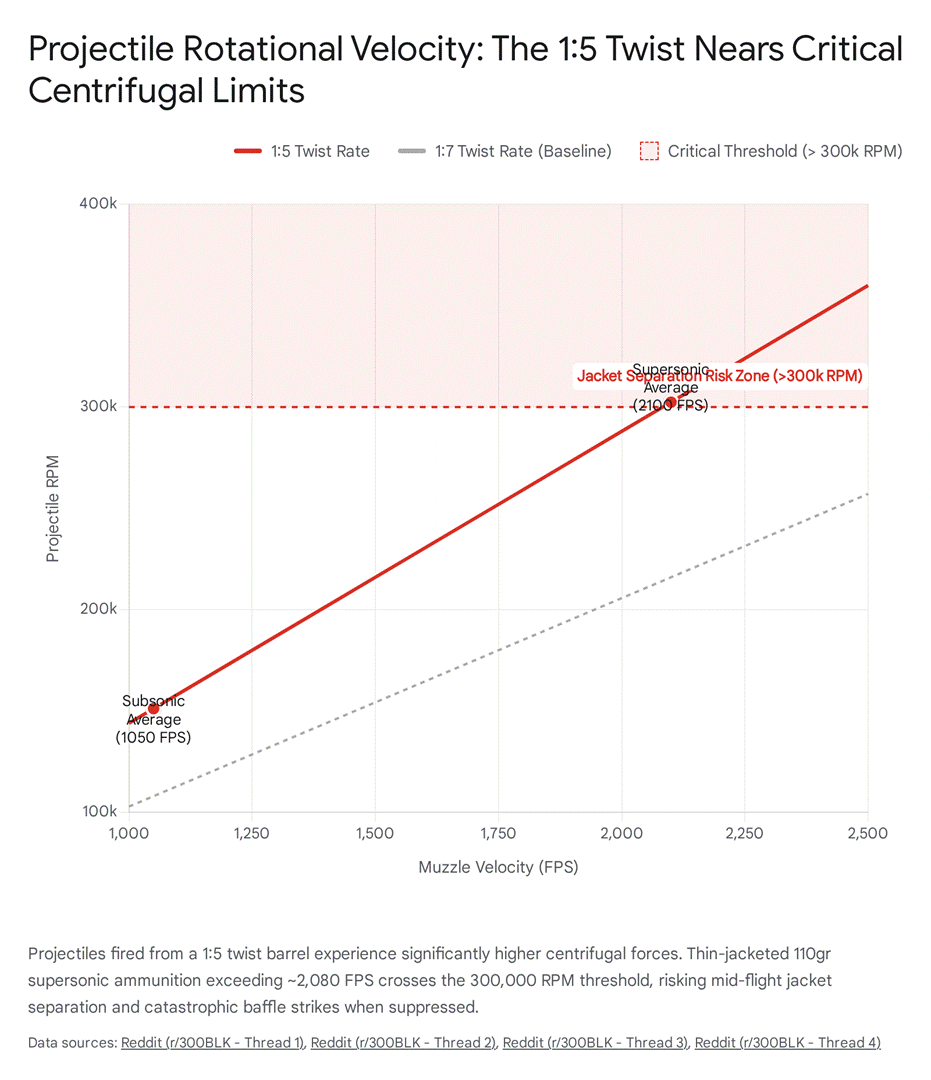
While the 1:5 twist is great for slow rounds, it creates a real safety risk with some fast ones. The physics are simple: if you spin a thin-jacketed bullet too fast, it can literally tear itself apart mid-air14.
Take the popular Hornady 110gr V-MAX, for example. Out of an 8-inch barrel, it can hit speeds over 2,100 FPS10. At those speeds, the 1:5 twist pushes the bullet to 300,000 RPM—the breaking point for many standard projectiles10. When this happens, the copper jacket strips off the lead core as soon as it leaves the muzzle10.
Since the Mixtape is built for suppressors5, this “jacket separation” can be a disaster. If pieces of copper fly off inside your suppressor, you’ll likely end up with a baffle strike that ruins your expensive gear and creates a shrapnel risk10. The takeaway: if you’re shooting supersonics, stick to solid copper or bonded rounds that can handle the spin, or just stick to subsonics entirely10.
Long-Term Reliability and Gas System Fluid Dynamics
The 8-inch barrel is actually the “sweet spot” for .300 Blackout, as the powder finishes burning just as the bullet leaves the muzzle11. PSA uses a pistol-length gas system to ensure there’s enough pressure to cycle the bolt every time2.
The tricky part is that subsonics and supersonics create very different pressure levels20. Adding a suppressor only complicates things. PSA solves this by including an adjustable gas block right from the factory, giving you the ability to fine-tune how much gas is used2.
While the Mixtape usually cycles subsonics perfectly out of the box6, you need to know how to adjust the gas. If you switch to suppressed supersonics without turning the gas down, the gun will kick too hard, wear out parts faster, and potentially cause malfunctions20.
The Maxim Defense brace also adds a unique variable. It uses a shorter buffer tube and a specialized H1 buffer system to keep the pistol compact5. Some users find that if they tune the gas for maximum silence, the lighter buffer might fail to lock the bolt back on the last round22. A little micro-adjusting or switching to a JP Silent Captured Spring usually fixes this right up22.
Malfunction Mapping and Verification
Malfunction Type
Description
Primary Phase of Occurrence
Verified Causes & Mechanisms
Jacket Separation / Baffle Strike
Projectile disintegrates mid-flight due to rotational stress, destroying suppressor baffles.
Firing / Mid-flight (Supersonic only)
Centrifugal delamination caused by spinning thin-jacketed projectiles (e.g., 110gr V-MAX) past the 300,000 RPM threshold in a 1:5 twist barrel10.
Failure to Lock Back (FTLB)
Bolt carrier fails to catch on the magazine follower after the final round in the magazine is fired.
Empty Magazine / Cyclic Phase
System under-gassing when firing low-pressure subsonics, exacerbated by the stiff, proprietary Maxim CQB H1 buffer spring preventing full rearward carrier travel20.
Unintentional Double Fire
The firearm discharges twice per single deliberate pull of the trigger mechanism.
Firing / Reset Phase
Tolerance stacking and user error associated with the extremely short mechanical reset of the Sabre 2-Stage DLC trigger, leading to unintentional bump-firing under recoil24.
Durability and Maintenance
Micro-Component Quality and Wear Trends
One of the best things about the Sabre Mixtape is that PSA didn’t cut corners on the small stuff. They used high-quality parts from top-tier brands, which really pays off in long-term durability1.
The Bolt Carrier Group (BCG) is the hardest-working part of the gun, and PSA chose a full-chrome version from Microbest5. Chrome is great because it’s naturally slick and much easier to clean—an absolute must when you’re shooting with a suppressor, which tends to make everything dirty fast26.
The bolt is made from tough C158 steel and thoroughly tested to make sure it can handle the pressure of suppressed fire without breaking2, 27. They even used specialized screws (OCKS) and Sprinco springs to make sure the key components stay together and keep extracting reliably for thousands of rounds9.
The upper receiver is “thermal fit,” meaning the barrel is tightly unified with the receiver for better accuracy and a longer life2. It’s the kind of precision engineering you usually only find on very expensive custom rifles2.
Maintenance Constraints and Proprietary Architectures
Even though the parts are top-notch, working on this gun can be a bit of a headache for the DIY enthusiast.
For starters, removing the muzzle device isn’t easy. It’s secured with Rocksett, a heat-resistant ceramic adhesive5. You can’t just torque it off without risking damage to the barrel or receiver. The only way to do it safely is to boil the muzzle in water for about 20 minutes to dissolve the adhesive first2.
Then there’s the handguard. It requires a specific PSA tool to remove6. To make matters worse, the handguard actually blocks the dust cover pin. If you want to swap out your dust cover, you have to take the whole handguard off first—which means you better have that proprietary tool on hand6.
Recommended DIY OEM Part Substitutions
Original OEM Part
Recommended Substitution
Reason for Intervention
Maxim Defense H1 Buffer Spring
JP Silent Captured Spring (SCS)(Maxim CQB Specific)
The standard coiled spring can induce cyclic inconsistencies and short-stroking with certain subsonic ammunition loads. The JP SCS eliminates acoustic spring “twang,” smooths the rearward recoil impulse, and allows for the precise micro-tuning of buffer weights to achieve consistent bolt lock-back22.
While the proprietary Sabre trigger is generally praised for its smooth take-up at its price point, tolerance stacking can result in a fragile feel. The reset is exceptionally short, leading to risks of unintentional double-fires under the stress of rapid engagement1. Substituting for a duty-proven Geissele or LaRue ensures drop-safe, duty-grade reliability.
Sabre Plan B Flash Hider
(User’s Suppressor Ecosystem Standard)
If the operator does not utilize a Q/Plan B compatible suppressor (e.g., the Q Thunder Chicken or Trash Panda), the factory muzzle device must be boiled off and replaced with a KeyMo, ASR, or Xeno mount to interface with their existing National Firearms Act (NFA) ecosystem3.
Ownership Experience
Owning a Mixtape Vol. 1 feels a lot like owning a custom-built gun. The ergonomics are smart, and it arrives ready to go right out of the box.
Ergonomics and Operator Interface
The lower receiver is a step up from standard models. It’s fully ambidextrous, meaning both lefties and righties can easily release the magazine or catch the bolt2. This makes reloading and clearing jams much faster. It also has a flared magazine well to help you guide new mags in quickly, even when you’re under pressure5.
The controls feel premium, too. The Radian Talon safety is crisp and fast, and the Raptor charging handle is easy to grab even with a big optic in the way5. The B5 Systems grip is more vertical than older styles, which is much more comfortable for your wrist when you’re holding a short PDW close to your body5.
The star of the show is the Maxim Defense CQB brace. It lets the pistol collapse down to just under 21 inches, making it perfect for a bag or a truck19. You can deploy it instantly just by pulling it back. The only downside is that it doesn’t offer much of a cheek weld, and the metal arms can be a bit uncomfortable during long days at the range29.
Trigger Feel and Tolerance Stacking Risks
The Sabre trigger is smooth and clean thanks to its DLC coating7. Most users like the feel, but there are some concerns about how “fragile” it might be under heavy use24.
Because the reset is so short, it’s great for fast shooting, but you need good discipline. If your finger is a bit lazy, the recoil could cause you to accidentally “double-tap” the trigger24. For a defense gun, it’s something you definitely want to practice with or consider swapping out if you prefer a more traditional feel.
Warranty and Support
PSA stands behind the Mixtape with a full lifetime warranty that is one of the best in the business31.
Official Policy and Self-Defense Programs
This warranty is exceptionally simple: if something breaks due to a defect, PSA will fix it, period32. It’s also fully transferable, meaning you’re covered even if you’re the second or tenth owner31. They even pay for two-way shipping on verified claims31.
Naturally, it doesn’t cover normal wear, abuse, or improper modifications. If you use a third-party suppressor incorrectly and it causes a baffle strike, that’s on you33.
PSA also offers a partnership with “Right to Bear,” a membership program that provides legal protection for those involved in self-defense incidents34. It’s a nice extra for anyone using the Mixtape for home protection.
Factory Repair Turn-Around Realities
While some PSA lines have seen slower support, the Sabre series is known for being very responsive36.
Sabre owners usually report very fast turnaround times for repairs36. Many people have had their issues resolved in just over a week, which shows that PSA is serious about keeping their premium customers happy38.
Voice of the Customer (VoC)
The following synthesized statements represent the median consumer sentiment, rigorously filtered for statistical noise, brand-loyal “fanboy” praise, and isolated individual grievances. These sentiments are drawn directly from high-round-count users across verified technical forums (specifically Reddit’s r/300BLK, r/ar15, and primary retailer performance reviews):
“The Mixtape offers an unparalleled value proposition for a dedicated, specialized suppressor host. Sourcing a thermal fit upper, a Microbest chrome BCG, Radian ambi-controls, a Riflespeed/adjustable gas block, and a Maxim CQB brace independently would cost hundreds more in individual parts and shipping. However, the proprietary handguard attachment is immensely frustrating for home armorers trying to perform basic maintenance, like a simple dust-cover swap, without having to buy PSA’s specific wrench.”6.
“Out of the box, it cycles heavy 220gr subsonics effortlessly and quietly due to the adjustable gas block tuning. But buyers must be explicitly warned: the 1:5 twist is a highly specialized tool designed for copper expansion. Firing cheap 110gr V-MAX supers through this setup with a suppressor attached is playing Russian roulette with baffle strikes due to extreme centrifugal jacket separation. Stick to monolithics for supers or build a 1:7 if you want a general-purpose gun.”4.
“It perfectly scratches the ‘Honey Badger’ and ‘Rattler’ itch without the exorbitant boutique price tag or the proprietary piston systems. The ergonomics are fantastic, the B5 grip angle is perfect for the short length of pull, and the C158 bolt gives me peace of mind for hard use. Just be prepared to potentially swap the Maxim buffer spring to a JP SCS if you encounter lock-back issues with your specific brand of subsonic ammunition.”3.
Quantitative Ratings
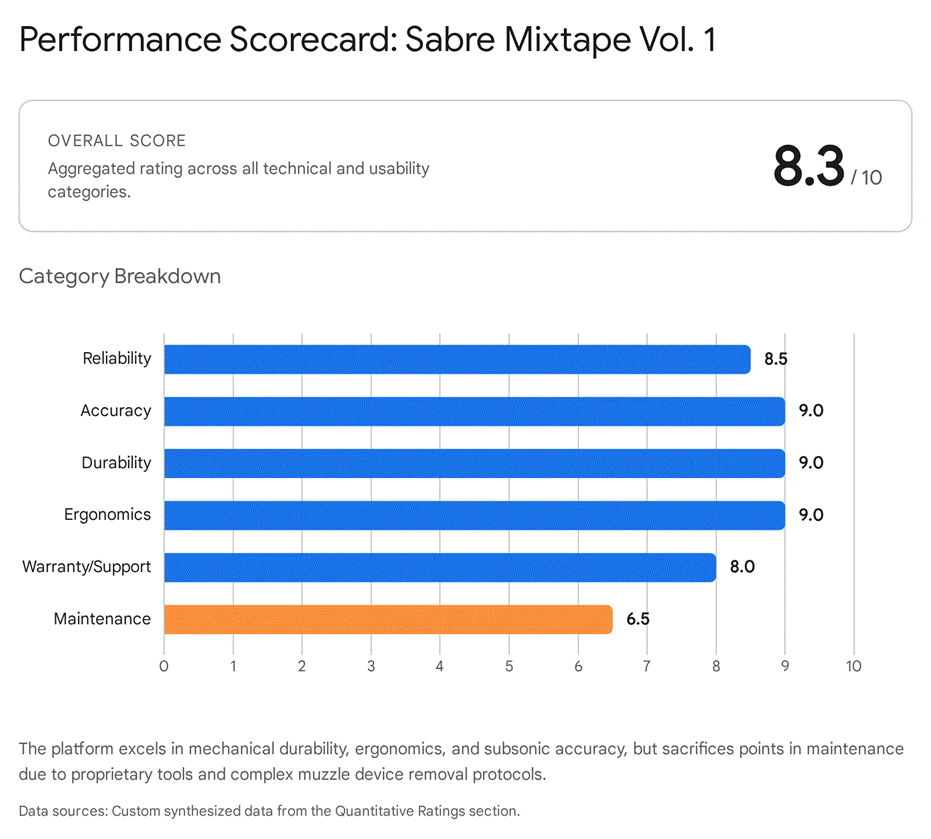
Based on the synthesis of metallurgical data, mechanical design architecture, empirical user reports, and comparative market analysis against peer platforms, the PSA Sabre Enhanced Mixtape Vol. 1 scores as follows (on a 1-10 scale):
Category
Score
Justification
Reliability
8.5
The integration of the Microbest BCG and adjustable gas block ensures excellent cyclic function, though the proprietary Maxim buffer occasionally requires tuning for specific subsonics, and the 1:5 twist severely restricts safe ammunition choices2.
Accuracy
9.0
The aggressive 1:5 twist rate and thermal-fit upper receiver provide exceptional stabilization and consistent sub-MOA potential for heavy subsonic projectiles2.
Durability
9.0
Premium materials (C158 bolt, Sprinco springs, OCKS fasteners, 416R barrel, DLC coatings) rival boutique platforms costing over twice as much26.
Maintenance
6.5
The platform is severely hampered by the proprietary barrel nut/handguard tool requirement, the blocked dust cover pin, and the tedious necessity of boiling the Rocksett muzzle device for removal6.
Warranty/Support
8.0
The 100% lifetime, fully transferable warranty is industry-leading on paper; while some PSA product lines experience service delays, Sabre-specific support is reported to be highly responsive31.
Ergonomics
9.0
The fully ambidextrous lower receiver, integrated Radian controls, steep B5 grip angle, and the highly compact Maxim CQB brace offer a top-tier operator interface5.
OVERALL SCORE
8.3
An exceptional, highly specialized PDW offering unmatched value, provided the operator respects its maintenance quirks and strict internal ballistic limitations.
Average Street Price: Based on current retail data, the determined average street price for the fully assembled PSA Sabre Enhanced Mixtape Vol. 1 8″ 300 Blackout is $1,224.991. (Prices typically fluctuate directly between $1,199.99 for the standard black anodized variant and $1,249.99 for the specialized Cerakote variants).
This exhaustive analysis was conducted utilizing a strict, multi-tiered data aggregation and filtering framework designed to ensure absolute objectivity and technical accuracy. The primary data-gathering process relied on aggregating raw technical data from manufacturer specifications, verifiable vendor pricing databases, and highly technical, high-traffic firearms communities—specifically Reddit’s r/300BLK and r/ar15, alongside dedicated platform-specific forums10. To analyze the complexities of internal ballistics and rotational forces, standard physics algorithms (RPM calculation formulas) were applied and subsequently cross-referenced with empirical failure reports published by major ammunition manufacturers (e.g., Hornady, Sierra)11.
The core of this methodology relies heavily on isolating verified, multi-platform defect trends from isolated anecdotal anomalies—a process known as signal versus noise filtering. For example, a single user reporting a failure to extract was discarded as noise; however, a patterned cluster of users utilizing subsonic ammunition, short-stroke PDW braces, and specific buffer weights reporting identical cyclic failures was elevated to a “verified trend.” Similarly, emotional “fanboy” praise regarding aesthetics or brand loyalty was entirely stripped from the analysis, focusing the report purely on quantifiable metrics such as material science (C158 steel vs. 9310), manufacturing tolerances (thermal fit upper geometry), and ergonomic biomechanics2.
Data Constraints
Source Integrity: The conclusions drawn in this report are strictly based on technical documentation and aggregated accounts from high-round-count users who possess demonstrable technical literacy regarding AR-15 gas system tuning and platform architecture.
Verification Protocols: Claims regarding defect trends—such as the proprietary tool constraints and the 1:5 twist jacket separation risk—are supported by multiple, independent accounts and verifiable mathematical physics6. Unverified, single-source anecdotes (e.g., isolated complaints of a specific blemished finish without corroborating photographic evidence or secondary reports) were excluded from the primary reliability analysis to maintain analytical rigor.
Note: Vendor Sources listed are not an endorsement of any given vendor. It is our software reporting a product page given the direction to list products that are between the minimum and average sales price when last scanned.
The modern small arms market is currently experiencing a profound structural and mechanical paradigm shift. For over six decades, the traditional AR-15 rifle has dominated both the civilian consumer market and the professional tactical sector. Originally designed by Eugene Stoner in the late 1950s, the AR-15 utilizes a direct impingement gas system that has long been revered for its inherent accuracy, extremely low reciprocating mass, and overall lightweight profile.1 However, as the demands of the modern consumer and the operational requirements of tactical professionals continue to evolve, a growing consensus is driving a transition away from this legacy architecture.1 End-users are increasingly demanding enhanced modularity, superior thermodynamic performance when equipped with sound suppressors, and the structural capability to utilize fully folding stocks for discreet transport and vehicular deployment.1
Because the internal mechanics of the AR-15 physically prohibit the integration of a true folding stock and inherently struggle with the increased backpressure generated by suppressors, alternative gas piston platforms have surged in popularity.1 This exhaustive research report provides a deep technical analysis of three leading 5.56mm gas piston platforms currently driving this market transition. The specific firearms evaluated in this report include the CZ Bren 2 Ms, the IWI X95 Tavor, and the SIG Sauer MCX Spear-LT.4
By rigorously examining the core engineering principles of direct impingement versus short-stroke and long-stroke gas piston operations, this report illustrates how internal fluid dynamics and mechanical linkages directly dictate external structural capabilities.1 Furthermore, the analysis evaluates the critical ergonomic differences and the necessary adjustments to the manual of arms required when an end-user transitions their training from a legacy AR-15 to these modern piston platforms.3 Finally, current market pricing data is tabulated for each specific platform to provide an objective, data-driven overview of the financial investment required to acquire these advanced systems from compliant retail vendors.
2. The Direct Impingement Baseline Architecture
To fully comprehend the structural and operational shift toward modern alternative platforms, it is absolutely essential to first dissect the physical and mechanical baseline established by the legacy AR-15. Both the traditional AR-15 and modern piston-driven alternatives utilize the expanding high-pressure gases generated by the ignition of the powder charge to cycle the action.1 However, these systems route, harness, and vent this thermodynamic kinetic energy in fundamentally different ways, leading to drastically different operational profiles.
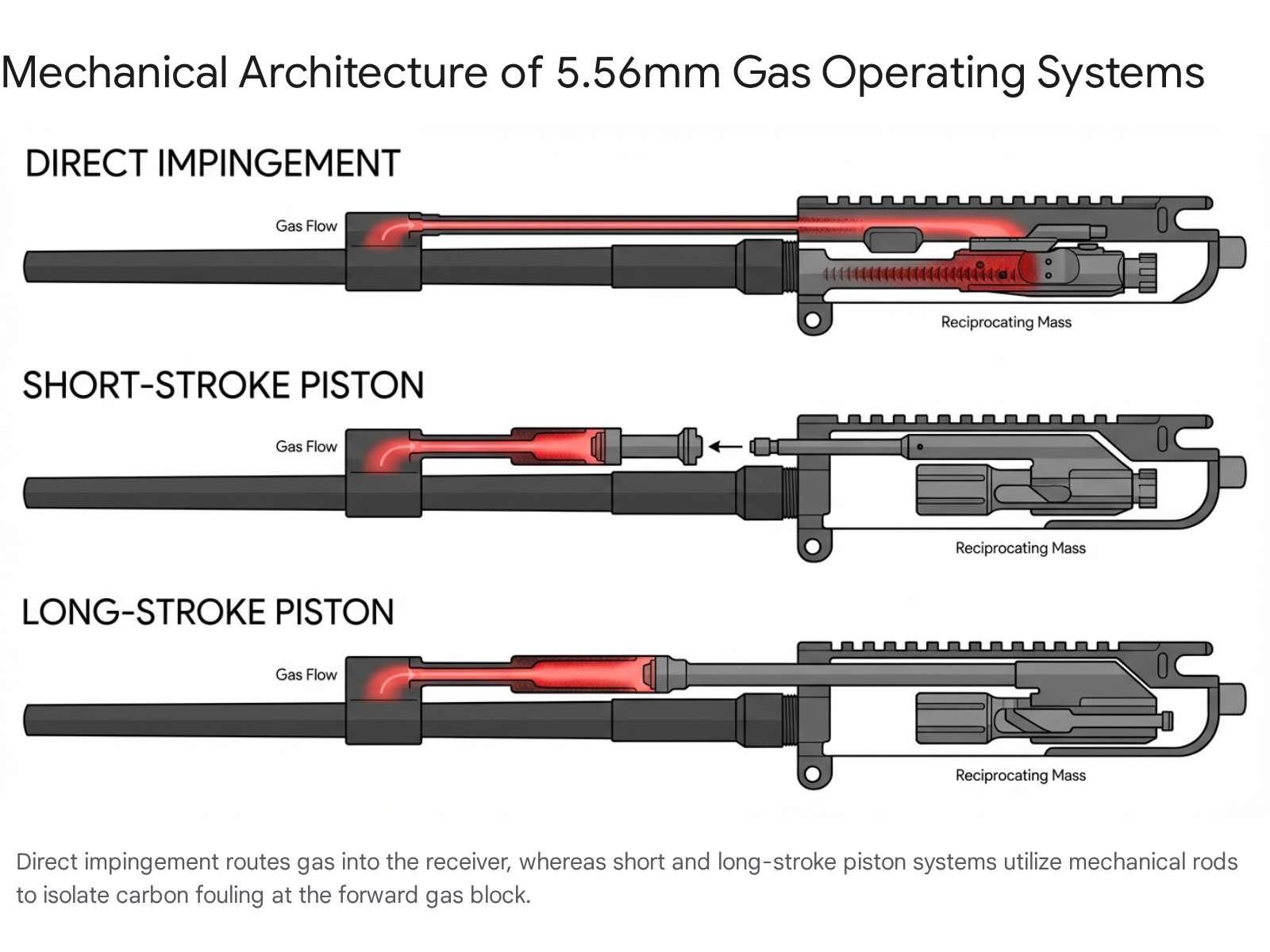
The traditional AR-15 operates on a mechanism widely referred to as a direct impingement system, although mechanical engineers often classify it more accurately as an internal piston design. As the bullet is propelled down the barrel by expanding gases, it passes a tiny port drilled precisely into the top of the bore.1 Once the projectile passes this port, a portion of the extremely high-pressure, superheated gas is bled upward from the barrel into a mounted gas block.1 From this forward gas block, the hot gas is forcefully directed backward toward the receiver through a very narrow, hollow stainless steel gas tube.1 This elongated tube extends completely into the upper receiver of the rifle and physically interfaces with the gas key, a component securely bolted to the top of the bolt carrier group.1
Once the gas enters the gas key, it flows directly into a meticulously machined expansion chamber located entirely inside the bolt carrier itself.1 As the gas rapidly expands within this internal chamber, the extreme pressure forces the carrier backward away from the bolt. This initial rearward movement of the carrier interacts with a cam pin, causing the bolt head to rotate and unlock from the barrel extension lugs.1 With the bolt unlocked, the residual pressure and the momentum of the carrier drive the entire assembly violently rearward to complete the extraction, ejection, and feeding cycle.1
The primary mechanical advantage of the direct impingement system is its sheer operational simplicity and its exceptionally low reciprocating mass.1 Because there is no heavy external piston rod or secondary linkage hardware traveling back and forth above the barrel, the rifle is generally much lighter.1 Furthermore, because the hollow gas tube merely hovers above the barrel and does not physically push against the action during the firing cycle, the barrel can be truly free-floated within the handguard.1 Free-floating a barrel completely isolates it from external mechanical pressures, which minimizes the disruption of the barrel harmonics during the exact moment the projectile is traveling down the bore.1 This harmonic isolation yields an extremely high inherent accuracy potential, establishing the direct impingement AR-15 as a standard for precision semi-automatic fire.1
Despite these notable advantages, the direct impingement design possesses inherent thermodynamic and mechanical drawbacks that have spurred the development of alternative platforms. By routing hot, high-pressure gas directly into the central action of the firearm, the direct impingement system inherently introduces massive amounts of unburnt carbon powder, abrasive particulate matter, and extreme heat directly into the bolt carrier group and the upper receiver.1 This rapid accumulation of carbon fouling acts as an abrasive paste when mixed with lubricants, accelerating component wear, drying out essential lubricating oils, and necessitating frequent, rigorous cleaning protocols to maintain basic reliability.1 Furthermore, the superheated gases can rapidly raise the temperature of the bolt carrier group to levels that are dangerous to touch, potentially leading to the premature failure of small parts like gas rings and extractor springs.9
3. Mechanics of Modern Gas Piston Operating Systems
In stark contrast to the direct impingement method, modern platforms like the CZ Bren 2, the IWI X95 Tavor, and the SIG Sauer MCX Spear-LT utilize mechanical piston systems to cycle their actions.4 These designs prioritize internal cleanliness and extreme reliability by keeping the destructive forces of the expanding gases far away from the delicate internal receiver components.2 Gas piston firearms generally fall into two distinct engineering categories known as short-stroke and long-stroke systems.2
3.1 Short-Stroke Gas Piston Dynamics
The short-stroke gas piston system is the most prevalent alternative mechanism found in modern 5.56mm platforms, heavily utilized by both the CZ Bren 2 Ms and the SIG Sauer MCX Spear-LT.4 In this specific architectural layout, the expanding gas is still bled from a port in the barrel into a forward gas block.1 However, instead of traveling completely down a hollow tube into the receiver, the high-pressure gas immediately strikes a solid, captive metal piston located directly inside the gas block itself.1
Under immense pressure from the tapped gas, this piston is driven violently rearward for a remarkably short distance, typically just a fraction of an inch.1 As the piston moves, it strikes a solid operating rod extending rearward toward the receiver.1 This rapid, violent movement delivers a sharp, purely mechanical kinetic tap to the top front of the bolt carrier group.1 The kinetic energy is instantly transferred, sending the unlocked bolt carrier flying rearward along its guide rails to complete the standard extraction and feeding cycle.1 The piston itself does not travel with the carrier, it is immediately halted by the gas block structure and returned to its forward resting position by a dedicated, specialized return spring located above the barrel.
The physical separation of the high-pressure gas expansion chamber from the main upper receiver is the defining engineering triumph of the short-stroke piston design.2 The superheated gases and unburnt carbon particulate are aggressively vented into the atmosphere at the gas block, located far forward on the barrel, rather than being dumped into the action.1 Consequently, the bolt carrier group and the interior of the upper receiver remain remarkably clean and cool to the touch even after sustained strings of rapid fire.1 This drastic reduction in internal fouling minimizes the need for heavy lubrication and significantly extends the intervals required between cleaning sessions, ensuring the firearm continues to operate reliably in austere, muddy, or sandy environments.2
3.2 Long-Stroke Gas Piston Dynamics
The IWI X95 Tavor utilizes a highly robust long-stroke gas piston system, a design philosophy that shares its fundamental mechanical lineage with the legendary Kalashnikov series of rifles.5 Similar to the short-stroke mechanism, high-pressure gas is tapped at the barrel port and routed into a gas block where it forcefully strikes the face of a piston.1 However, in a long-stroke configuration, the piston head, the lengthy operating rod, and the entire bolt carrier group are mechanically unified into a single, massive, solid assembly.1
When the expanding gas strikes the piston face, the entire unified assembly travels rearward together for the full length of the cycling stroke.1 Unlike the short-stroke system where the piston delivers a quick tap and stops, the long-stroke piston stays physically engaged with the carrier and rides all the way back into the receiver space before returning forward to chamber the next round.1
This specific engineering design introduces a significantly larger reciprocating mass during the firing cycle, which can theoretically alter the recoil impulse perceived by the shooter and slightly shift the harmonic whip of the barrel, potentially affecting absolute precision.1 However, the long-stroke system is globally renowned for its absolute, brutal reliability under the most adverse conditions imaginable.9 The unified mass carries immense kinetic energy as it cycles, allowing the action to literally power through heavy carbon fouling, environmental mud, or foreign debris with minimal resistance.9 Just like the short-stroke system, the long-stroke design successfully keeps the bulk of the intense heat and the carbon particulate isolated at the forward gas block, ensuring the actual bolt mechanism remains relatively clean.1
4. Structural Engineering Advantages of Piston Architecture
The intricate engineering choices regarding these internal gas systems are not merely academic differences in fluid dynamics or theoretical physics. The internal mechanics explicitly dictate the external physical capabilities of the firearm. The widespread migration away from the AR-15 is heavily influenced by the rigid structural limitations imposed by the direct impingement system, limitations that modern gas piston designs completely bypass.1
4.1 Eradication of the Buffer Tube and Implementation of Folding Stocks
The most visually apparent and tactically significant limitation of the traditional AR-15 is the receiver extension, a component commonly known in the industry as the buffer tube. Because the AR-15 bolt carrier is physically pushed rearward by expanding gas expanding within its own internal chamber, it requires a long, hollow physical space to recoil into in order to extract the spent casing and compress the return spring.3 This mandatory space is provided by a cylindrical aluminum tube that protrudes directly out the back of the lower receiver. The main recoil spring and a weighted buffer completely reside inside this tube.3
Consequently, an AR-15 can utilize a collapsible telescopic stock that slides forward and backward along the outside of the buffer tube, but it can never have a stock that truly folds flush against the side of the receiver while retaining the ability to fire.3 If a user modifies an AR-15 with an aftermarket folding adapter and attempts to fire the weapon while the stock is folded, the bolt carrier has absolutely nowhere to travel, resulting in a catastrophic malfunction and severe potential structural damage to the receiver housing.
Modern gas piston platforms entirely circumvent this strict geometric limitation. By utilizing alternative mechanical pathways to transfer kinetic energy, engineers have completely redesigned the recoil mechanisms. In advanced platforms like the CZ Bren 2 and the SIG Sauer MCX Spear-LT, the recoil springs are completely contained within the upper receiver itself, located entirely above or immediately around the bolt carrier group.3 Because the bolt carrier no longer needs to recoil outside the physical footprint of the upper receiver, the rear of the firearm effectively ends immediately behind the trigger group.7
This internal engineering triumph allows for the seamless integration of fully side-folding stocks.1 A folding stock drastically reduces the overall length of the firearm, turning a standard 16-inch carbine into an incredibly compact package when folded. This represents a massive logistical and tactical advantage for civilian consumers and professionals who require a firearm that can be discreetly transported in standard bags, securely stored in tight vehicle compartments, or maneuvered easily through extremely confined spaces during rapid deployment.12
4.2 Mitigation of Internal Fouling and Suppressor Optimization
The second major structural advantage of piston-driven platforms is their extreme resistance to internal carbon fouling, a trait which translates directly into heightened reliability under adverse conditions and specifically during suppressed fire.2
Over the last decade, the use of sound suppressors has surged in popularity among civilian shooters and tactical units alike. A suppressor works by physically trapping and delaying the expansion of high-pressure gases at the muzzle of the firearm. This physical obstruction inherently increases the backpressure within the barrel.13 On a standard direct impingement AR-15, this significantly increased backpressure forces a massive volume of highly toxic gas, unburnt powder, and thick carbon particulate back down the gas tube and straight into the upper receiver.2
This rapid accumulation of thick fouling acts as an abrasive paste, accelerating component wear, aggressively drying out lubricating oils, and dramatically increasing the risk of feeding and extraction malfunctions. Furthermore, the excess gas pressure frequently escapes through the small gaps around the rear charging handle, venting highly noxious fumes directly into the shooter’s face and eyes.13
Gas piston platforms excel remarkably when suppressed. Because the primary gas expansion chamber is located externally at the forward gas block, the substantially increased backpressure generated by the suppressor is vented forward into the atmosphere, safely away from the shooter and the delicate central action.1 The bolt carrier group remains shielded from the aggressive influx of carbon.
Additionally, modern piston rifles, including both the CZ Bren 2 and the SIG MCX, feature manually adjustable gas blocks.4 By simply rotating a valve located at the front of the gas block, the user can physically restrict the size of the gas port.4 When a suppressor is attached to the muzzle, the user selects the restricted gas setting, which perfectly tunes the kinetic energy transferred to the piston, preventing the action from being over-driven and violently battered by the excess pressure.15 This intelligent gas regulation ensures smooth, reliable extraction and drastically reduces internal parts wear over the lifespan of the firearm.
5. The CZ Bren 2 Ms Technical and Ergonomic Profile
The CZ Bren 2 Ms is a heavily refined evolution of the original Bren 805 carbine, representing a comprehensive clean-sheet design philosophy aimed at producing a highly modular, exceptionally lightweight, and robust combat rifle.7 It has quickly become a highly sought-after platform for users seeking a lightweight piston alternative to the standard AR-15.
5.1 Engineering and Materials
The manufacturer’s official specifications and technical data can be accessed directly at https://www.czfirearms.com/en-us/products/scorpion-bren/cz-bren-2-ms-carbine. The Bren 2 utilizes a refined short-stroke gas piston system paired with a manual, adjustable gas regulator built directly into the forward block.4
A core component of the Bren 2 design is its highly advanced material construction, which was carefully selected to reduce weight.18 To achieve rigorous weight reduction without sacrificing necessary structural integrity, CZ engineers explicitly split the receiver materials.7 The upper receiver, which contains the heavy reciprocating mass and bears the explosive pressure of the operating cycle, is precisely machined from a solid billet of aerospace-grade 7075 T6 aluminum alloy.18 The lower receiver, which houses the trigger control group and the magazine well, is manufactured from a highly durable, carbon fiber-reinforced polymer.7
The barrel of the Bren 2 is a masterpiece of modern metallurgy. Manufactured entirely in-house by CZ, the barrel is cold hammer-forged, a highly demanding manufacturing process utilizing 40 tons of pressure to precisely shape the internal bore around a mandrel.18 Furthermore, the bore of the barrel is heavily hard-chrome lined.4 Chrome lining provides an exceptionally hard, friction-reducing, and corrosion-resistant surface that dramatically increases the barrel’s service life to a guaranteed minimum of 20,000 rounds and practically eliminates the risk of rust in austere, humid environments.4
5.2 Manual of Arms Transition
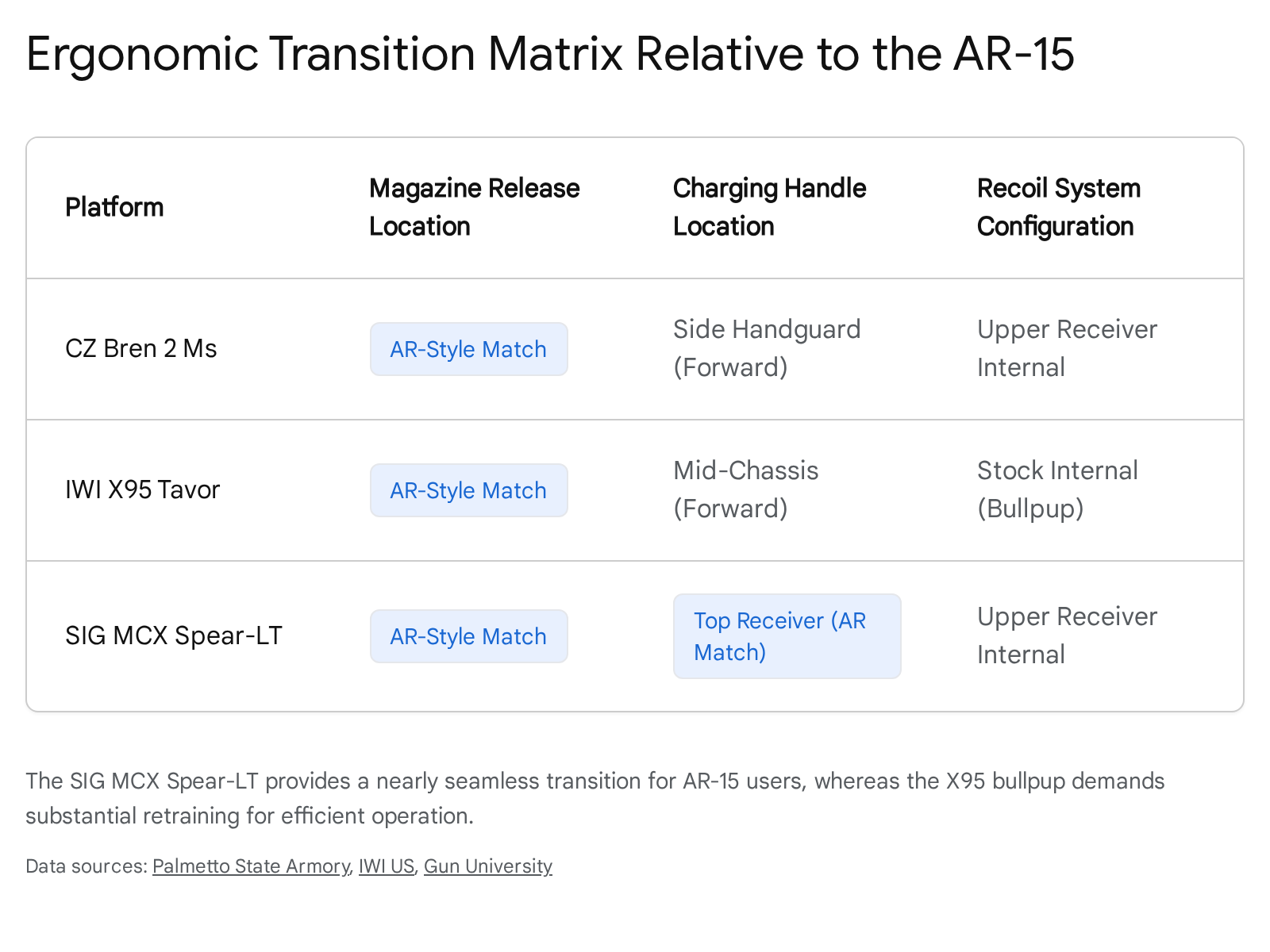
Transitioning from a standard AR-15 to the CZ Bren 2 Ms requires minimal neurological rewiring for the operator, as CZ explicitly designed the lower receiver controls to closely mimic the established AR-15 layout.4
The primary magazine release button and the manual safety selector switch are fully ambidextrous and located in the exact same geometric positions as those found on a traditional AR-15.7 A user accustomed to firmly pressing the magazine release with their right index finger will find the Bren 2 entirely intuitive and natural. Furthermore, the Bren 2 accepts standard AR-15 pattern STANAG magazines for its 5.56NATO variants, ensuring complete logistical cross-compatibility with the user’s existing ammunition inventory.7
The bolt catch and release system is also heavily inspired by the AR-15, featuring a standard paddle style release on the left side of the receiver, but it is intelligently mirrored on the right side for true ambidexterity.7 CZ engineers also integrated a highly innovative secondary bolt catch mechanism nestled securely inside the front of the trigger guard housing.7 This unique feature allows the user to lock the bolt to the rear or release it entirely using only their trigger finger, without ever breaking their strong firing grip on the weapon.
The most prominent manual of arms divergence from the AR-15 is the location and operation of the charging handle mechanism. The standard AR-15 utilizes a T-shaped charging handle located at the extreme top rear of the upper receiver, requiring the user to break their cheek weld and pull awkwardly from the rear to cycle the weapon.20 The Bren 2 eliminates this rearward design entirely. Instead, it features a forward-mounted, side-charging handle located directly on the handguard rail.4 This charging handle is non-reciprocating, meaning it stays locked securely forward during firing, entirely eliminating the risk of it violently striking the user’s hand or barricade.7 It can be quickly swapped to either the left or right side of the weapon without specialized tools, depending entirely on the operator’s preference.7 Furthermore, the handle acts as a highly functional forward assist, allowing the user to physically push the bolt carrier completely closed if a round fails to chamber properly due to heavy fouling.7
Because the entire recoil spring system is entirely self-contained inside the aluminum upper receiver, the Bren 2 is completely devoid of a buffer tube and is equipped directly from the factory with a side-folding, adjustable length-of-pull shoulder stock, maximizing its transportability.12
5.3 Market Pricing and Product Sourcing
When sourcing the CZ Bren 2 Ms 16.5-inch Carbine chambered in 5.56 NATO, market analytics reveal a consistent pricing structure across reputable online retailers. The absolute minimum observed price points rest around $1,949.99, with the standard average market price hovering near $2,200.00.12
The following table presents exactly five compliant preferred vendors currently offering the precise CZ Bren 2 Ms 16.5″ Carbine (5.56 NATO) within the acceptable price parameters.
6. The IWI X95 Tavor Technical and Ergonomic Profile
The Israeli Weapon Industries X95 Tavor represents an entirely different architectural philosophy compared to both the AR-15 and the CZ Bren 2. Engineered specifically to meet the extreme close-quarters combat requirements of the Israeli Defense Forces, the X95 discards the traditional rifle layout entirely in favor of an advanced bullpup configuration.23
6.1 Engineering and Bullpup Architecture
The manufacturer’s official technical specifications and detailed features can be accessed at https://iwi.us/firearms/tavor-x95/5-56-nato-16-5in-barrel/. A bullpup design achieves extreme compactness by physically relocating the entire firing action, including the bolt carrier, the chamber, and the magazine well, to a position completely behind the trigger group, nested deep within the shoulder stock.23
This radical engineering choice yields an incredibly short overall footprint without compromising the terminal ballistics generated by a full-length barrel. For instance, the standard retail X95 is equipped with a full 16.5-inch barrel, maximizing the velocity and fragmentation potential of the 5.56 NATO cartridge, yet the entire rifle measures a mere 26.125 inches in overall length.24 To contextualize this specific dimension, the X95 is shorter than a legally restricted AR-15 equipped with a drastically reduced 10.5-inch barrel and a fully collapsed stock.
Internally, the X95 relies on a highly robust, unified long-stroke gas piston system paired with a closed rotating bolt.5 The barrel is cold hammer-forged from high-grade Chrome Moly Vanadium steel and heavily chrome-lined for maximum durability under sustained automatic fire conditions.24 The exterior receiver housing is manufactured from high-impact reinforced polymer, providing excellent structural resilience against drops and impacts while keeping the overall weapon weight manageable at roughly 7.9 pounds.24
6.2 Manual of Arms Transition
The transition from a standard AR-15 to an IWI X95 represents the steepest learning curve and highest friction of the three platforms discussed.8 The geometric relocation of the critical components severely alters the biomechanics of reloading, malfunction clearance, and basic weapon manipulation.8
On a standard AR-15, the magazine well is located directly in front of the trigger, sitting securely within the operator’s forward peripheral vision. On the X95 bullpup, the magazine well is tucked deeply beneath the shooter’s armpit, near the rear of the stock.23 Executing a rapid reload requires the operator to bring their support hand completely rearward, physically sweeping past the pistol grip to blindly index the fresh magazine into the rearward well.8 While some tactical operators advocate for tucking the stock extremely high over the shoulder to facilitate a clear visual line to the magazine well during a reload, extensive training allows for seamless, rapid blind reloads utilizing ingrained muscle memory.25
IWI recognized the friction associated with transitioning from the globally dominant AR-15 and heavily modernized the X95 layout compared to their legacy Tavor SAR model to ease this training burden.8 Crucially, the ambidextrous magazine release button was physically repositioned to the exact geometric location of an AR-15 magazine release, sitting directly above and forward of the trigger guard.24 Pressing this forward button with the firing index finger drops the empty magazine located at the rear of the rifle via a long internal mechanical linkage system. Furthermore, the X95 features a significantly upgraded fire control pack, providing a crisp 5 to 6 pound trigger pull that closely rivals standard AR-15 triggers, overcoming a common complaint regarding heavy bullpup trigger linkages.8
The charging handle is strategically positioned forward on the chassis, allowing the shooter to forcefully manipulate the bolt without ever dismounting the rifle from the shoulder pocket.24 Furthermore, the entire weapon is fully modular and fully ambidextrous, allowing left-handed shooters to completely swap the ejection port, bolt assembly, and charging handle to the opposite side of the firearm.24 Because the heavy action is located in the rear, the balance of the rifle is severely shifted, creating a rear center of gravity that anchors the weapon firmly into the shoulder, allowing for surprisingly stable one-handed firing if the operator’s support arm is injured or occupied.23
6.3 Market Pricing and Product Sourcing
Market data indicates an incredibly stable pricing structure for the standard 16.5-inch 5.56 NATO IWI X95 Tavor across the entire retail industry. While the manufacturer’s suggested retail price is listed at $1,999.00, the heavily standardized online market price sits firmly at $1,749.99.26
The following table presents exactly five compliant preferred vendors currently offering the exact IWI X95 Tavor 16.5″ (5.56 NATO) at the industry standard price.
7. The SIG Sauer MCX Spear-LT Technical and Ergonomic Profile
The SIG Sauer MCX Spear-LT represents the absolute latest evolution in the highly successful MCX lineage, a premium platform specifically requested by and developed alongside top-tier global special operations groups.6 It aims to perfectly marry the unrivaled ergonomics and modularity of the AR-15 with the supreme reliability and cleanliness of a modern short-stroke gas piston.
7.1 Engineering and Internal Recoil Mechanisms
The official engineering specifications are hosted by the manufacturer directly at https://www.sigsauer.com/mcx-spear-lt-5-56-16-rifle.html. The MCX Spear-LT utilizes a highly refined short-stroke gas piston operating system coupled with a manually adjustable gas valve located at the block, allowing the operator to easily toggle between standard unsuppressed firing and heavy suppressed operations.3
The true engineering marvel of the MCX platform lies in its complete internalization of the buffer and recoil assembly. SIG Sauer engineers entirely eliminated the need for a rearward receiver extension tube by migrating the entire recoil system directly into the upper receiver housing.3 The MCX utilizes dual captive recoil springs that ride horizontally directly above the bolt carrier group.3 When the gas piston powerfully strikes the carrier, the carrier is driven rearward along internal steel guide rails, completely compressing the dual springs entirely inside the physical footprint of the upper receiver.3
This internal restructuring allows the MCX Spear-LT to be equipped with a low-profile, push-button folding minimalist stock, rendering the full 16-inch 5.56 NATO rifle exceptionally compact for transport or vehicular deployment.3 Furthermore, the platform is wildly modular. The cold hammer-forged steel barrels are explicitly designed to be easily swappable at the user level, allowing the operator to quickly change barrel lengths or even calibers by simply loosening two captive Torx screws located on the receiver.3 The entire aluminum handguard has been severely lightened compared to previous Virtus generations, utilizing new attachment screws to guarantee absolute rigidity for mounting sensitive laser aiming modules that require zero shift mitigation.30
7.2 Manual of Arms Transition
The SIG Sauer MCX Spear-LT was deliberately and painstakingly engineered to eliminate any transition friction for an operator previously trained on the legacy AR-15 system.3 From a strict biomechanical and ergonomic standpoint, the lower receiver of the MCX Spear-LT is functionally and visually identical to a highly upgraded AR-15 lower receiver.3
The manual safety selector, the primary magazine release button, and the bolt catch are located in the exact geometrical positions established by the original AR-15 design.3 Furthermore, SIG Sauer engineered these controls to be completely ambidextrous right out of the box, allowing full manipulation of all critical weapon functions with either the left or right hand.3 Unlike the CZ Bren 2 or the IWI X95 which utilize forward charging mechanisms, the MCX retains the traditional rear-mounted, T-shaped charging handle, which is also fully ambidextrous.6 Therefore, any malfunction clearance drill, charging procedure, or rapid reloading sequence mastered on an AR-15 translates instantly and perfectly to the MCX Spear-LT without a single modification in physical technique or muscle memory.3
Additionally, the MCX Spear-LT retains vast aftermarket compatibility with the broader AR-15 ecosystem. It accepts all standard AR-15 pattern STANAG magazines flawlessly, and crucially, the lower receiver is designed to be fully compatible with standard AR-15 style aftermarket trigger groups.10 However, the factory trigger provided with the Spear-LT is a premium SIG Flatblade Match Trigger, providing an exceptionally crisp two-stage break that requires no immediate upgrading.10
7.3 Market Pricing and Product Sourcing
The SIG Sauer MCX Spear-LT is deliberately positioned as a premium, tier-one tactical platform, and its pricing structure directly reflects its advanced engineering, premium coatings, and extensive military pedigree. The absolute minimum online market price for the 16-inch 5.56 NATO model typically sits at $2,579.99, with the overwhelming average standard market price being $2,599.99 across reputable dealers.32
The following table presents exactly five compliant preferred vendors currently offering the precise SIG Sauer MCX Spear-LT 16″ (5.56 NATO) within the optimal observed price bracket.
8. Conclusions on the Evolution of 5.56mm Weapon Systems
The gradual migration of consumers and tactical professionals away from the direct impingement AR-15 is clearly not a transient trend based on aesthetic preference, but rather a calculated, data-driven evolution driven by rigid modern operational requirements.1 The AR-15 remains an exceptionally light, highly modular, and inherently accurate weapon system, but its fundamental gas routing mechanics impose strict thermodynamic limits on extreme durability, optimal suppressor integration, and its minimal structural footprint.1
The alternative platforms exhaustively analyzed in this report elegantly solve these historical engineering bottlenecks through advanced mechanical piston systems. The CZ Bren 2 Ms proves definitively that high-end aerospace aluminum and carbon fiber polymer can be masterfully combined with a robust short-stroke piston to create a lightweight, fully folding combat rifle that runs impeccably clean under harsh conditions.7 The IWI X95 Tavor demonstrates the absolute terminal ballistic advantages of the compact bullpup configuration, maximizing the velocity of the 5.56 NATO cartridge while providing a massive reduction in physical length via a proven long-stroke piston designed for severe combat environments.23 Finally, the SIG Sauer MCX Spear-LT represents the ultimate engineering bridge between legacy ergonomics and next-generation internal mechanics, offering operators the clean-running, bufferless reliability of a piston system without requiring them to unlearn decades of deeply ingrained AR-15 muscle memory.3
Ultimately, the decision to invest in these highly advanced platforms requires the civilian consumer or agency procurement officer to carefully balance the markedly increased financial entry cost and the reliance on proprietary manufacturer part ecosystems against the substantial tactical advantages provided.1 The integration of fully folding stocks, the heavy reduction in catastrophic carbon fouling, and the seamless optimization with modern sound suppressors ensure that gas piston platforms will continue to aggressively capture market share from the traditional AR-15 in the years to come.
Note: Vendor Sources listed are not an endorsement of any given vendor. It is our software reporting a product page given the direction to list products that are between the minimum and average sales price when last scanned.
The landscape of American law enforcement patrol armament underwent a seismic shift in the late 20th century, driven by tactical realities that exposed the limitations of traditional sidearms and shotguns. The watershed moment, indelibly marked in law enforcement history, was the 1997 North Hollywood shootout. During this incident, two heavily armed and armored bank robbers engaged officers with superior firepower, rendering police pistols and shotguns largely ineffective.1 This event, among others, served as a powerful catalyst, accelerating the transition toward the widespread adoption of semi-automatic, magazine-fed patrol rifles as standard-issue equipment for front-line officers.
In the decades since, the AR-15 platform has emerged as the undisputed standard for law enforcement agencies at the federal, state, and local levels. Its dominance is not incidental but is rooted in a combination of superior ergonomics, inherent modularity, and proven reliability.2 The platform’s design allows for easy customization with mission-critical accessories such as optical sights, weapon lights, and laser aiming modules, enabling a single weapon system to be adapted for diverse operational environments. Furthermore, its ubiquity has created a vast and robust ecosystem of parts, training programs, and armorer support, making it a logistically sound and cost-effective choice for long-term institutional use.
This report provides a definitive, data-driven analysis of the top 10 rifles currently in service with U.S. law enforcement agencies. The rankings are based on a comprehensive evaluation of market penetration, procurement data, and frequency of use by officers and agencies. The analysis will delve into the key market dynamics driving procurement, followed by a detailed technical and operational examination of each rifle. Finally, the report will address the critical pairing of these weapon systems with appropriate duty and precision ammunition, concluding with a comparative summary and an outlook on future trends.
Section 1: Market Dynamics and Key Procurement Drivers
The law enforcement rifle market is a complex and highly competitive space, governed by a unique set of procurement drivers that extend beyond simple performance metrics. Agency decisions are influenced by budget constraints, logistical considerations, legacy systems, and the specific operational needs of their jurisdictions. This has resulted in a clearly tiered market structure.
The Tiered Market Structure
Analysis of agency adoptions reveals three primary tiers of rifle procurement:
Legacy/Mil-Spec Standard: This tier is dominated by manufacturers with long-standing military contracts and a deeply entrenched reputation for meeting rigorous government standards. These rifles are often considered the benchmark for reliability and serve as a safe, proven choice for agencies. Their primary adoption driver is institutional trust built over decades of military and federal service.
High-Volume/Value-Driven: This segment is characterized by rifles that offer a strong balance of proven reliability and cost-effectiveness. Manufacturers in this tier have successfully enabled the large-scale, department-wide issuance of patrol rifles to agencies with significant budget constraints. Their success is predicated on delivering a dependable, duty-capable rifle at a price point that facilitates mass procurement.
Premium/Duty-Grade: This tier consists of high-performance rifles featuring superior materials, advanced manufacturing processes, and enhanced quality control. These platforms are often selected by specialized units such as SWAT, well-funded departments, and federal tactical teams that prioritize absolute performance and durability over cost. These rifles typically incorporate modern design features like free-floating handguards, upgraded triggers, and superior components as standard.
Procurement Process and Criteria
The selection process for a duty rifle is a methodical and demanding undertaking. Procurement documents and contract awards reveal a consistent set of evaluation criteria. Reliability under adverse conditions is paramount. A prime example is the exhaustive trials process conducted by the Drug Enforcement Administration (DEA) and Federal Bureau of Investigation (FBI), which included extreme temperature tests, drop tests, corrosion tests, and a 5,000-round endurance test.4 Only rifles that could pass this brutal gauntlet were considered for the contract, which was ultimately awarded to Rock River Arms, cementing its reputation for durability.5
Beyond sheer reliability, agencies evaluate accuracy, long-term durability, manufacturer support, and the total cost of ownership. This latter point is critical; the initial purchase price is only one component of a weapon system’s lifecycle cost. The availability and cost of replacement parts, the need for specialized tools or training, and the ease of maintenance by department armorers are all significant factors. Recent procurement trends show a move toward shorter contract durations, allowing agencies greater flexibility, and a significant increase in spending on parts and system upgrades, indicating a focus on maintaining and modernizing existing rifle inventories rather than wholesale replacement.7
A crucial, though often overlooked, factor in an agency’s procurement decision is the strength of the manufacturer’s support ecosystem. The marginal performance difference between two high-quality rifles can be less decisive than the logistical and training infrastructure a manufacturer provides. Major manufacturers like Colt and Ruger offer dedicated, multi-day armorer’s courses, enabling agencies to become self-sufficient in maintaining their firearms fleet.9 This in-house capability reduces long-term costs and minimizes weapon downtime. Similarly, the long-term availability of authentic replacement parts is a critical logistical concern. Federal contracts, such as the FBI’s $9 million Indefinite Delivery/Indefinite Quantity (IDIQ) contract for Colt carbine parts, underscore the importance of a stable and guaranteed supply chain for the service life of a rifle.8 A manufacturer that provides robust training programs, guarantees parts availability for years to come, and adheres to the common AR-15 platform—ensuring interoperability and minimizing retraining needs—presents a lower long-term risk and a more attractive overall value proposition. This comprehensive ecosystem is a powerful and often decisive procurement driver.
Section 2: Ranked Analysis of Top 10 Law Enforcement Rifles
The following analysis details the top 10 rifles in U.S. law enforcement service, ranked in descending order of prevalence and market penetration. Each profile includes a technical breakdown, an analysis of its design philosophy, and examples of its use in the field.
2.1 Colt LE6920 / M4 Carbine (Rank #1)
Overview and Rationale: The Colt LE6920 and its M4 Carbine predecessors hold the premier position as the most prevalent and influential rifles in U.S. law enforcement. Its number one ranking is a direct result of its lineage as the civilian-legal counterpart to the U.S. military’s M4 Carbine. This decades-long military service has established an unparalleled level of trust and familiarity among law enforcement personnel, a significant portion of whom are military veterans. The term “mil-spec” is often used as a marketing buzzword, but for the Colt LE6920, it represents a tangible adherence to a proven manufacturing and quality control standard, which carries immense weight in law enforcement procurement.3 Its legacy is further cemented by its continued use and support within major federal agencies, which maintain large inventories and ongoing contracts for maintenance and parts, ensuring its status as the industry’s benchmark.8
Key Features: Forged 7075-T6 aluminum receivers, A2 front sight base with gas block, detachable carry handle with integrated rear sight, 4-position collapsible stock, double-shielded handguards. Many law enforcement trade-in models bear markings such as “RESTRICTED LAW ENFORCEMENT / GOVERNMENT USE ONLY” from the era of the 1994 Federal Assault Weapons Ban.11
Engineering and Design Analysis: The enduring value of the LE6920 lies in its strict adherence to the military’s Technical Data Package (TDP). This is not merely a set of dimensions but a comprehensive set of specifications covering materials, manufacturing processes, and quality control. Critical components, most notably the bolt and bolt carrier group, are manufactured from specified materials (Carpenter 158 steel for the bolt) and subjected to rigorous testing protocols, including High-Pressure Testing (HPT) and Magnetic Particle Inspection (MPI).11 This documented, systematic approach to quality control is the foundation of the rifle’s reputation for uncompromising reliability. While more modern designs have introduced advancements such as mid-length gas systems and free-floating handguards, the LE6920’s proven, battle-tested design remains its most compelling asset for agencies that prioritize absolute dependability over cutting-edge features.
Sample Agency Adoptions: The Colt M4/LE6920 platform is or has been in service with a vast number of U.S. agencies. Notable federal users include the U.S. Federal Bureau of Investigation (FBI), which maintains a significant inventory and logistical support contracts.8 Its widespread use at the state and local levels is evidenced by the consistent and high volume of law enforcement trade-in models that appear on the commercial market.15
Social Media/Officer Feedback: Across law enforcement forums and social media, the Colt LE6920 is consistently praised as a “workhorse” and the “gold standard”.11 Officers and armorers value its known-quantity performance and durability. Reviews of police trade-in models frequently note that despite significant external wear from years of being carried in patrol cars, the rifles remain mechanically sound and reliable, a testament to their robust build quality.16
2.2 Smith & Wesson M&P15 (Rank #2)
Overview and Rationale: The Smith & Wesson M&P15 (“Military & Police”) secures the second position by successfully capturing the high-volume, value-driven segment of the law enforcement market. Introduced in 2006, the M&P15 provided a reliable and affordable AR-15 alternative from a manufacturer with a long-standing and trusted relationship with the police community.17 This combination allowed budget-conscious departments to implement or expand their patrol rifle programs on a scale that would have been prohibitive with more expensive options. The M&P15’s market penetration is a direct result of Smith & Wesson’s strategic decision to deliver a dependable, duty-ready rifle at an exceptionally competitive price point.
Technical Specifications
Caliber: 5.56x45mm NATO 17
Operating System: Direct Impingement, Carbine-Length Gas System (later models, such as the M&P15 Sport III, feature a Mid-Length system) 17
Barrel: 16-inch, 4140 Steel with Armornite or Melonite finish, 1:9-inch Twist (common on earlier/Sport models) or 1:8-inch 5R rifling 18
Weight: Approximately 6.5 – 6.7 lbs 17
Key Features: Early “Sport” models omitted the forward assist and dust cover to reduce costs, but these were added back on the popular M&P15 Sport II model.17 Many configurations ship from the factory with popular Magpul MOE furniture.21
Engineering and Design Analysis: The M&P15 platform achieves its attractive price point through intelligent design choices and high-volume, efficient manufacturing. The use of 4140 steel barrels with a durable Armornite (ferritic nitrocarburizing) finish, for example, provides excellent corrosion resistance and service life at a lower cost than traditional chrome lining.20 While not built to the same strict military TDP as a Colt, Smith & Wesson’s manufacturing and quality control are highly respected in the industry, producing a rifle that is more than capable of meeting the demands of the vast majority of law enforcement patrol duties. The platform’s credibility was significantly bolstered by its adoption by major metropolitan agencies, which validated its performance and reliability for serious duty use.18
Sample Agency Adoptions: Las Vegas Metropolitan Police Department (LVMPD) 17, Maricopa County Sheriff’s Office, West Virginia State Police, and the U.S. Internal Revenue Service, Criminal Investigative Division.17
Social Media/Officer Feedback: The M&P15 Sport II is widely recommended online as one of the best “entry-level” AR-15s, offering exceptional value for both civilians and officers purchasing their own rifles.22 Police trade-in models are a popular item on the surplus market, viewed by knowledgeable buyers as a proven, reliable duty rifle at a very low cost. Forum discussions often highlight that while they may have cosmetic wear, they are mechanically sound and have significant service life remaining.23
2.3 Daniel Defense DDM4 V7 (Rank #3)
Overview and Rationale: Daniel Defense occupies the premium tier of the law enforcement market, and the DDM4 V7 is its flagship model. The rifle’s high ranking is attributable to its sterling reputation for superior build quality, precision accuracy, and uncompromising durability. It is a top choice for well-funded agencies and specialized units like SWAT that prioritize outright performance and reliability over budget considerations. The company’s commitment to in-house manufacturing of critical components, most notably its renowned cold hammer-forged (CHF) barrels, and its use of proprietary, high-quality furniture and rail systems justify its premium price point.3
Technical Specifications
Caliber: 5.56x45mm NATO 25
Operating System: Direct Impingement, Mid-Length Gas System 26
Key Features: Free-floating MFR (M-LOK Rail) handguard with a robust 6-bolt lockup system, proprietary buttstock and pistol grip with soft-touch overmolding, enhanced flared magazine well, ambidextrous GRIP-N-RIP charging handle.25
Engineering and Design Analysis: The DDM4 V7 is engineered from the ground up for enhanced performance. The mid-length gas system, compared to a traditional carbine-length system, results in a softer recoil impulse and reduced wear on internal components, increasing the weapon’s service life and reliability. The cold hammer-forging process creates an exceptionally dense and durable barrel, prized for its long-term accuracy and longevity under high round counts.24 The proprietary rail system’s attachment to the upper receiver is designed to be extremely rigid, preventing any shift in zero for mounted lasers or other aiming devices. These features are not superficial; they are tangible engineering decisions that directly address the needs of professional end-users and contribute to the rifle’s elite status.28
Sample Agency Adoptions: While Daniel Defense does not publicize all of its agency contracts, its rifles are known to be in service with a multitude of state and local SWAT teams and specialized federal units across the United States. Documented users include the Missouri State Police and the North Dakota Highway Patrol.29 The company also actively supports the professional community through its Military/Law Enforcement (MILE) discount program.30
Social Media/Officer Feedback: User reviews for the DDM4 V7 are almost universally positive, with owners consistently praising its “superior craftsmanship,” light weight, and exceptional out-of-the-box accuracy.31 It is frequently cited as being “worth the price” and is a perennial top pick in expert and user-driven “best AR-15” comparisons.3 The consensus is that it represents a complete, high-performance package that requires no immediate upgrades.
2.4 Bravo Company Manufacturing (BCM) RECCE-16 (Rank #4)
Overview and Rationale: Bravo Company Manufacturing (BCM) has established a formidable presence in the law enforcement market by adhering to a philosophy of building “professional grade weaponry” without compromise. The RECCE-16 is a cornerstone of its lineup and is highly ranked due to its adoption by agencies that demand mil-spec-or-better quality combined with modern features. BCM is often regarded as offering one of the best performance-to-price ratios within the premium rifle tier.26 Its popularity stems from a strict adherence to mil-spec standards for critical components, like the bolt carrier group, while integrating modern, lightweight features like the MCMR (M-LOK Compatible Modular Rail) handguard.
Technical Specifications
Caliber: 5.56x45mm NATO 32
Operating System: Direct Impingement, Mid-Length Gas System 33
Engineering and Design Analysis: BCM’s corporate mission is to build “life saving tools,” a principle that dictates its manufacturing and quality control processes.35 This is most evident in their fanatical attention to detail on components that directly impact reliability. Every BCM bolt is machined from mil-spec Carpenter No. 158 steel and is individually High-Pressure Tested and Magnetic Particle Inspected (HPT/MPI).33 Gas port dimensions are carefully calibrated to ensure reliable function across a wide range of ammunition and conditions, both suppressed and unsuppressed. This focus on “hard use” engineering has cultivated a fiercely loyal following among professionals who demand absolute, unfailing performance from their equipment.36
Sample Agency Adoptions: BCM rifles are used by a variety of agencies, from local police departments to federal units. A notable example is the Ennis Police Department in Texas, which issued a bid specifically for the BCM RECCE-14 model for its patrol officers.38 The company also states that its products serve US Military Special Operations Units and the Department of Homeland Security.35
Social Media/Officer Feedback: The brand is frequently recommended by active law enforcement and military personnel in online discussions as a top-tier duty rifle that offers exceptional reliability for its price.36 In a review for
Police Magazine, an officer evaluating a BCM MK12 rifle was so impressed with its quality and performance that he subsequently procured 15 BCM short-barreled rifles to equip his agency’s entire SWAT team, a powerful real-world endorsement.37
2.5 Rock River Arms LAR-15 (Rank #5)
Overview and Rationale: Rock River Arms (RRA) earned its prominent place in the law enforcement market primarily through a landmark contract win with the U.S. Drug Enforcement Administration. The DEA’s search for a new 5.56mm carbine in the early 2000s culminated in one of the most rigorous testing protocols ever devised for a law enforcement rifle. The RRA LAR-15 was one of the few platforms to survive the brutal abuse, endurance, and reliability tests, leading to a five-year contract to supply the agency.4 This victory served as a massive, independent validation of the rifle’s quality, leading to subsequent adoptions by the FBI and U.S. Marshals Service and making it a trusted and proven choice for numerous other agencies.6
Technical Specifications
Caliber: 5.56x45mm NATO 39
Operating System: Direct Impingement, Carbine or Mid-Length Gas System 40
Barrel: 16-inch, Chrome-Lined, 1:9-inch or 1:7-inch Twist 39
Weight: Approximately 7.5 lbs 39
Key Features: Forged A4 upper receiver, RRA two-stage trigger, RRA overmolded A2 pistol grip, 6-position tactical stock. Available in various configurations, including different handguards (CAR, M-LOK) and barrel lengths.39 The specific DEA contract rifle was outfitted with an EOTech holographic sight and a SureFire weapon light.4
Engineering and Design Analysis: While sometimes perceived as a “mid-tier” manufacturer that assembles parts, the DEA trials unequivocally demonstrated that RRA’s build quality and component selection are robust enough for elite federal law enforcement service. The company’s use of high-quality barrels from suppliers like Wilson Arms is known to contribute to the platform’s excellent accuracy.42 A standout feature of many RRA rifles is their proprietary two-stage trigger, which is widely regarded as a significant improvement over a standard mil-spec trigger, providing a cleaner break and enhancing the shooter’s ability to place accurate shots.42
Sample Agency Adoptions: U.S. Drug Enforcement Administration (DEA), Federal Bureau of Investigation (FBI), and U.S. Marshals Service.5 The success of these federal contracts led to widespread adoption by numerous state and local agencies.
Social Media/Officer Feedback: In online forums frequented by law enforcement and firearms enthusiasts, the DEA/FBI contracts are consistently cited as the ultimate proof of Rock River Arms’ quality and durability. Many users place RRA on par with Colt for reliability, viewing them as solid, dependable “workhorse” rifles that offer excellent performance, particularly given their competitive pricing.42
2.6 SIG Sauer M400 Series (Tread / Pro) (Rank #6)
Overview and Rationale:SIG Sauer, a dominant force in the law enforcement handgun market, has successfully leveraged its brand strength to make significant inroads into the patrol rifle space with its M400 series. The M400’s ranking is driven by its growing adoption across a diverse range of state and local agencies. Its popularity is fueled by a combination of modern, desirable features offered as standard—such as ambidextrous controls and free-float handguards—at a highly competitive price. The M400 TREAD model, in particular, was a market disruptor, bringing a feature-rich, optics-ready rifle to the sub-$1,000 price point, making it an extremely attractive option for both agency procurement and Individual Officer Purchase (IOP) programs.44
Technical Specifications
Caliber: 5.56x45mm NATO 46
Operating System: Direct Impingement, Mid-Length Gas System 47
Barrel: 16-inch Stainless Steel (Tread model) or Nitride-finished Carbon Steel (Pro model), 1:8-inch or 1:7-inch Twist 46
Engineering and Design Analysis: The M400 series is designed for the modern end-user, with ergonomics and functionality at the forefront. The inclusion of fully ambidextrous controls as a standard feature, rather than an aftermarket upgrade, is a significant advantage for both left-handed officers and for promoting versatile weapon handling for all users. The mid-length gas system provides a smoother recoil impulse than a carbine-length system, enhancing controllability during rapid fire. The 1:8-inch twist barrel is a versatile choice, capable of effectively stabilizing the most common bullet weights used by law enforcement, from 55-grain to 77-grain projectiles. SIG’s extensive manufacturing experience ensures a high level of fit and finish across the product line.48
Sample Agency Adoptions: California Highway Patrol, Indiana State Police, Vermont State Police, Virginia State Police, Philadelphia Police Department, Franklin County (OH) Police Department, and the Detroit Police Department SWAT team.49
Social Media/Officer Feedback: The SIG M400 series receives overwhelmingly positive reviews for its combination of features, reliability, and value. Reviewers frequently praise its out-of-the-box performance, noting that it feels and shoots like a much more expensive rifle.45 The accuracy and reliability are consistently highlighted as suitable for duty use. Some user reviews of the slim-profile TREAD model mention that the handguard can become uncomfortably hot during high-volume, rapid-fire strings of shooting.45
2.7 FN 15 Patrol Carbine (Rank #7)
Overview and Rationale: Fabrique Nationale (FN) possesses an unimpeachable legacy as a primary manufacturer of the U.S. military’s M16 and M4 rifles for decades. This experience provides the company with immense credibility in the professional arms market. The FN 15 Patrol Carbine is the company’s direct offering to the law enforcement community, leveraging this hard-won reputation for mil-spec quality, manufacturing consistency, and battlefield durability. It is positioned as a trusted, no-frills duty rifle built to the highest standards of quality control, making it a solid choice for agencies that value military-grade reliability.
Technical Specifications
Caliber: 5.56x45mm NATO 50
Operating System: Direct Impingement, Carbine-Length Gas System 51
Engineering and Design Analysis: The FN 15 Patrol Carbine is engineered for durability and a long service life under demanding conditions. The chrome-lined, button-broached barrel is designed to withstand high round counts and resist corrosion. While the base model utilizes a more traditional configuration with a carbine-length gas system and fixed A2 front sight base, all components are manufactured and assembled to FN’s exacting military production standards. The design philosophy prioritizes fundamental reliability and robustness over the latest trends, resulting in a weapon system that an agency can depend on without reservation.
Sample Agency Adoptions: The FN 15 is in service with various U.S. law enforcement agencies. For example, the South Carolina Department of Public Safety selected the FN 15 Patrol Carbine for its Highway Patrol officers.53 Other documented users include the Killeen Police Department in Texas and the Troy Police Department in Michigan.55 The Springfield, Oregon Police Department also put out a bid specifically for the FN15 Tactical Carbine.57 Additionally, the Federal Law Enforcement Training Center (FLETC) has procured FN carbines.58
Social Media/Officer Feedback: While there is less specific social media discussion on the FN 15 Patrol Carbine in the provided materials compared to other brands, FN’s overarching reputation for quality is universally acknowledged in the firearms community. It is widely considered a “professional’s” rifle, often placed in the same category as Colt for its adherence to military-grade manufacturing and quality control standards.
2.8 Geissele Automatics Super Duty (Rank #8)
Overview and Rationale:Geissele Automatics, a brand that built its legendary reputation on manufacturing world-class triggers and components, has successfully transitioned into a premier rifle manufacturer. The Super Duty rifle’s inclusion and high ranking on this list are propelled by recent, high-profile federal contract awards and its adoption by elite law enforcement units. Securing a major contract with U.S. Customs and Border Protection (CBP) to supply new rifles, and separately supplying complete rifles to the Federal Law Enforcement Training Centers (FLETC), represents a significant institutional endorsement of the Super Duty’s quality, reliability, and suitability for demanding duty use.26
Technical Specifications
Caliber: 5.56x45mm NATO 62
Operating System: Direct Impingement, Mid-Length Gas System 62
Key Features: Reliability Enhanced Bolt Carrier Group (REBCG) with Nanoweapon coating, Geissele Stressproof Bolt, SSA-E X with Lightning Bow trigger, 13.5-inch SMR MK16 M-LOK rail (as used by USASOC), Airborne Charging Handle, Super-42 braided wire buffer spring and H2 buffer.62
Engineering and Design Analysis: The Super Duty rifle is engineered from the ground up as a system of premium, purpose-built components. The REBCG is a centerpiece of the design; its Nanoweapon coating provides extreme lubricity and wear resistance, while the “Stressproof” bolt, forged from a proprietary Carpenter 158+ steel, is designed to have a service life five times that of a standard mil-spec bolt.62 The Super 42 braided wire buffer spring offers a more consistent spring pressure over its lifespan compared to standard springs, enhancing reliability, especially in dirty conditions or when loading from a full magazine.60 The gas block is secured with both set screws and a cross-pin, a “bomb-proof” installation method that ensures it cannot shift or fail. Every component represents a deliberate, high-end engineering choice aimed at maximizing reliability, durability, and performance.
Sample Agency Adoptions: U.S. Customs and Border Protection (CBP) 60, Federal Law enforcement Training Center (FLETC) 59, Drug Enforcement Administration (DEA), and FBI Headquarters.61
Social Media/Officer Feedback: A comprehensive review of the Super Duty LE model in Police1 was exceptionally positive. The rifle was lauded for its flawless reliability over 850 rounds of various ammunition types and its impressive sub-MOA accuracy. The reviewer called it “one of the best retail values police officers can get right now,” referencing the significant law enforcement discount program Geissele offers.64 It is widely regarded as a top-tier choice for a patrol or tactical rifle.66
2.9 Lewis Machine & Tool (LMT) MARS-L (Rank #9)
Overview and Rationale: Lewis Machine & Tool (LMT) is a high-end rifle manufacturer renowned for its innovative engineering and exceptionally durable weapon systems. While LMT has prominent contracts with elite U.S. and allied military units, the “battle-proven” reputation and advanced technology of its rifles make them a highly sought-after choice for U.S. specialized law enforcement units and SWAT teams that require maximum performance and can justify the premium cost.67 The MARS-L (Modular Ambidextrous Rifle System) represents one of the most advanced and robust AR-15 platforms available today.
Technical Specifications
Caliber: 5.56x45mm NATO 68
Operating System: Direct Impingement or Short-Stroke Piston options available 69
Barrel: Various lengths available (10.5-inch to 20-inch), typically 16-inch for patrol use, Chrome-Lined, 1:7-inch Twist, with a quick-change capability 68
Weight: Approximately 7.0 lbs (for 16-inch DI model) 71
Engineering and Design Analysis: The LMT MARS-L is defined by its groundbreaking MRP technology. The upper receiver and handguard are milled from a single, solid forging of aerospace-grade aluminum, creating a “true monolithic” platform.73 This design provides unparalleled rigidity and strength, ensuring that optics and laser aiming devices mounted on the handguard will not lose their zero, even under extreme use. The patented quick-change barrel system, which locks the barrel extension in place with two cross-bolts, allows an armorer to swap barrels of different lengths or calibers in minutes while maintaining a reliable return-to-zero.68 Combined with the fully ambidextrous lower receiver, the MARS-L is an exceptionally modular and ergonomically advanced system designed for the most demanding professional users.69
Sample Agency Adoptions: LMT is a known supplier to U.S. government and law enforcement customers and is a qualified GSA vendor, making its products available to federal agencies.67 At the local level, the Orange County Sheriff’s Department in California lists LMT Defender rifles in its inventory.74
Social Media/Officer Feedback: LMT products are held in extremely high regard within professional and expert circles. The systems are described as being “built for extreme abuse” and are a first choice for users who demand exceptional performance when failure is not an option.69 A photograph in a Small Arms Defense Journal review shows a Monroe County Sheriff’s Deputy testing an LMT rifle, indicating its use and evaluation at the local law enforcement level.73
2.10 Ruger AR-556 (Rank #10)
Overview and Rationale: Following a similar market strategy to Smith & Wesson, Sturm, Ruger & Co. entered the AR-15 market to provide a rugged, reliable, and American-made rifle at a highly accessible price point. The Ruger AR-556 earns its place on this list due to its popularity with smaller departments and its significant presence in Individual Officer Purchase (IOP) programs, where its affordability and Ruger’s long-standing reputation for building durable firearms make it an attractive choice.9 The AR-556 MPR (Multi-Purpose Rifle) variant, in particular, offers substantial upgrades like a free-float handguard and an excellent two-stage trigger while maintaining a very competitive price, representing one of the best values on the market.
Technical Specifications
Caliber: 5.56x45mm NATO 76
Operating System: Direct Impingement, Carbine-Length (base model) or Mid-Length (MPR model) Gas System 77
Key Features: Cold hammer-forged barrel. Base models feature a proprietary threaded delta ring for easy handguard removal. MPR models feature a free-float M-LOK handguard, the Ruger Elite 452 two-stage trigger, and Magpul or B5 Systems furniture.76
Engineering and Design Analysis: Ruger leverages its extensive and efficient in-house manufacturing capabilities to produce the vast majority of the AR-556’s components, which allows the company to control both quality and cost effectively.79 The inclusion of a cold hammer-forged barrel is a premium feature not commonly found on rifles at this price point, offering enhanced durability and barrel life. The Ruger Elite 452 trigger, standard in the MPR models, is a standout component. It is a true two-stage trigger with a smooth, crisp 4.5-pound pull, which significantly improves shooter accuracy compared to a standard, gritty mil-spec trigger.76
Sample Agency Adoptions: Ruger actively courts the U.S. law enforcement market, offering LE-only models and a formal Test and Evaluation (T&E) program for agencies.9 While large, department-wide adoptions are less publicized, its strong presence in the Individual Officer Purchase (IOP) market ensures it is carried by many officers. Documented users at the local level include the Orange County Sheriff’s Department in California, the Franklin County Sheriff’s Office in Maine, and the Danbury Police Department in Texas.74
Social Media/Officer Feedback: Reviews consistently praise the AR-556 for its robust reliability and exceptional value, often calling it an ideal entry-level rifle that does not compromise on essential features.79 The earlier piston-driven SR-556 model was reviewed by law enforcement publications as being extremely rugged and reliable, with excellent accuracy, though it was noted for being heavy.82 The current direct-impingement models are seen as a continuation of Ruger’s legacy of producing dependable firearms at a fair price.
The modern law enforcement rifle market has clearly matured beyond a one-size-fits-all approach. While a decade ago, a “patrol rifle” was largely synonymous with a basic M4-style carbine, today’s procurement documents reveal a far more sophisticated and mission-driven selection process. The bid from the Ennis Police Department, for example, specifies a high-end, compact BCM RECCE-14 with a 14.5-inch pinned barrel, a premium Cloud Defensive weapon light, and a Trijicon MRO red dot sight.38 This is a complete, ready-to-fight system specified down to the sling. In an even more specialized direction, the Tulsa Police Department’s bid calls for an 11.5-inch short-barreled rifle with highly specific internal components, including an NP3-coated bolt carrier group, high-performance Sprinco buffer springs, and a suppressor.83 These examples stand in stark contrast to the standard, budget-friendly offerings from Colt, Smith & Wesson, and Ruger, which serve the needs of agencies focused on mass issuance.12 This divergence shows that agencies are no longer just buying a brand; they are building a weapon system, specifying components down to the metallurgy and coatings to create rifles precisely tailored to their operational philosophies, environments, and budgets.
Section 3: Ammunition Selection for Patrol/Tactical Rifles
The effectiveness of any rifle is fundamentally dependent on the ammunition it fires. For law enforcement, ammunition selection is a critical decision governed by a complex set of factors, including terminal performance, accuracy, and the ability to defeat common barriers while minimizing the risk of over-penetration.
Patrol Rifle Ammunition (5.56x45mm NATO)
For general patrol use, the primary concern is “barrier-blind” performance. Law enforcement engagements frequently occur in and around vehicles, residential structures, and commercial buildings. Duty ammunition must be capable of penetrating these intermediate barriers—such as auto glass, drywall, and light sheet metal—and still delivering effective terminal performance on the target.
This requirement has led to the widespread adoption of bonded soft point (SP) and bonded hollow point (HP) projectiles. In a bonded bullet, the lead core is chemically fused to the copper jacket, which prevents the bullet from fragmenting or separating upon impact with a barrier, ensuring it retains most of its weight to penetrate and expand reliably in the target. Leading loads in this category include the Speer Gold Dot Duty series (available in 55-grain, 62-grain, and 75-grain), Federal’s Tactical Bonded line, and Hornady’s TAP (Tactical Application Police) series.84 The 75-grain Hornady TAP SBR load is specifically designed with optimized propellants to provide excellent performance and minimal flash out of the short-barreled rifles (10.5-11.5 inches) that are increasingly popular with tactical teams.87
The FBI’s ammunition testing protocol serves as the industry benchmark for evaluating these characteristics, testing performance through bare gelatin, steel, wallboard, plywood, and auto glass.87 Ammunition that performs consistently across these barriers is highly favored. Consequently, traditional military-style ammunition like M193 (55-grain FMJ) and M855 (62-grain “green tip” steel penetrator) is now largely relegated to training roles due to concerns about over-penetration and less predictable terminal effects.85
Role
Caliber
Ammunition (Brand/Model/Weight)
Bullet Type
Key Performance Driver
Patrol / General Duty
5.56x45mm NATO
Speer Gold Dot Duty 62gr
Bonded Soft Point (SP)
Excellent weight retention through barriers
Patrol / General Duty
5.56x45mm NATO
Federal Tactical Bonded 62gr
Bonded Soft Point (SP)
Consistent expansion after barrier penetration
Patrol / SBR Duty
5.56x45mm NATO
Hornady 75gr TAP SBR
Jacketed Hollow Point (JHP)
Optimized for short barrels; FBI protocol performance
Section 4: Summary and Comparative Analysis
The U.S. law enforcement rifle market is a mature, competitive, and highly segmented ecosystem dominated by the AR-15 platform. The analysis of the top 10 rifles reveals a clear hierarchy based on procurement drivers, from legacy, mil-spec workhorses and high-volume value options to premium, performance-focused systems for specialized applications. While all rifles on this list are proven, reliable platforms, their adoption patterns reflect the diverse needs and budgets of the thousands of agencies they serve.
Rank
Brand & Model
Primary Caliber
Operating System
Common Barrel Length(s)
Approx. Weight
Key Adoption Drivers
Example Agencies
1
Colt LE6920 / M4 Carbine
5.56x45mm NATO
Direct Impingement
16.1″
6.95 lbs
Mil-Spec Legacy, Federal Contracts, Unmatched Reliability Record
FBI 8
2
Smith & Wesson M&P15
5.56x45mm NATO
Direct Impingement
16″
6.5 lbs
High-Volume Value, Brand Trust, Enables Mass Issuance
LVMPD 17, Maricopa County SO, West Virginia State Police, IRS-CI 17
3
Daniel Defense DDM4 V7
5.56x45mm NATO
Direct Impingement
16″
6.2 lbs
Premium Performance, Superior Components (CHF Barrel), SWAT/Specialized Units
Missouri State Police, North Dakota Highway Patrol 29
4
BCM RECCE-16
5.56x45mm NATO
Direct Impingement
16″
6.1 lbs
Professional-Grade “Hard Use” Build, Mil-Spec Critical Parts, Excellent Value in Tier
Ennis PD (TX) 38, Dept. of Homeland Security 35
5
Rock River Arms LAR-15
5.56x45mm NATO
Direct Impingement
16″
7.5 lbs
Proven Durability in DEA/FBI Trials, Federal Contracts, Excellent Trigger
DEA, FBI, U.S. Marshals Service 5
6
SIG Sauer M400 Series
5.56x45mm NATO
Direct Impingement
16″
6.5-7.0 lbs
Modern Features (Ambi), Strong Brand, State/Local Agency Adoption
CA Highway Patrol, IN State Police, Philadelphia PD, Detroit PD SWAT 49
7
FN 15 Patrol Carbine
5.56x45mm NATO
Direct Impingement
16″
6.0-6.6 lbs
Military Manufacturing Heritage, “LE Only” Focus, High-Durability Build
SC Dept. of Public Safety 53, FLETC 58, Killeen PD (TX) 55
8
Geissele Super Duty
5.56x45mm NATO
Direct Impingement
14.5″, 16″
6.5-7.0 lbs
Elite Components (REBCG, Trigger), Major Federal Contracts (CBP, FLETC)
Orange County Sheriff’s Dept. (CA) 74, Franklin County SO (ME) 80, Danbury PD (TX) 81
Concluding Insights and Future Trends
The analysis reveals several key trends that will shape the future of law enforcement rifle procurement. First, the market segmentation is likely to become even more pronounced. While value-driven rifles will continue to dominate mass patrol issuance, the demand for premium, feature-rich rifles for tactical teams and specialized assignments will grow.
Second, the “out-of-the-box” standard is rising. Features once considered high-end upgrades—such as mid-length gas systems, free-floating M-LOK handguards, quality triggers, and ambidextrous controls—are becoming the expected standard on new duty rifles across all but the most budget-focused price points.
Finally, the increasing use of suppressors in law enforcement for hearing protection and improved communication during critical incidents is a significant trend.88 This will drive future procurement decisions toward rifles that are optimized for suppressor use. This includes features like adjustable gas blocks to tune the operating system, and barrels with profiles and gas port sizes designed to function reliably both with and without a suppressor attached. Manufacturers that can integrate these features effectively into their duty rifle offerings will be well-positioned for success in the coming years.
Appendix: Report Methodology
Data Sourcing
The findings and rankings in this report were compiled through a comprehensive analysis of a wide range of open-source materials. Sources included: publicly available federal, state, and local government procurement documents, such as Requests for Bids (RFBs) and contract award notices 38; manufacturer-published technical specifications and information on their law enforcement sales programs 9; detailed analysis and reviews from reputable, subject-matter expert publications within the law enforcement and firearms industries 37; and qualitative sentiment analysis derived from online forums and social media platforms frequented by verified law enforcement personnel, military veterans, and firearms experts.16
Ranking System
The ranking presented in this report is a qualitative assessment based on a holistic synthesis of the sourced data. It is not derived from a single, proprietary quantitative metric. The ranking reflects an analytical judgment of each rifle’s overall market penetration, the volume and significance of known government contracts, and the frequency with which it is cited as a standard-issue or widely adopted rifle across all tiers of U.S. law enforcement—federal, state, and local. The primary factors influencing a rifle’s position are the breadth of its adoption and its institutional significance within the law enforcement community.
The modern U.S. commercial market for AR-15-style rifles is saturated with a bewildering array of manufacturers, each vying for market share through a combination of performance claims, marketing, and brand identity. This has created a landscape where consumers, law enforcement agencies, and even industry professionals are often forced to rely on anecdotal evidence, brand tribalism, and influencer-driven narratives to make purchasing decisions. The result is a proliferation of subjective “tier lists” that lack empirical rigor and often reflect personal bias rather than objective quality. To navigate this confusion, a definitive, evidence-based framework is required—one that treats the AR-15 not as a cultural icon, but as an engineered weapons system whose quality can be measured, quantified, and ranked according to verifiable data.
1.2 Methodology: A Data-First Approach
This report departs from opinion-based analysis, grounding its tiered ranking model in the principles of materials science, manufacturing processes, quality control standards, and documented performance. The evaluation of each brand is based on five core criteria: Quality, Durability, Accuracy, Reliability, and Customer Satisfaction. These criteria are not assessed qualitatively but are instead measured against a matrix of specific, data-backed metrics.
The foundational benchmark for this analysis is the U.S. military’s Technical Data Package (TDP). The TDP is the official government-mandated set of specifications, dimensions, materials, and tolerances for every component of the M4/M16 rifle platform.1 While a civilian rifle is not technically “mil-spec” unless produced under a government contract, the TDP provides an essential, non-negotiable baseline for what constitutes a professional-grade firearm.2 A manufacturer’s adherence to, deviation from, or improvement upon this standard is the primary indicator of its engineering philosophy and its position within the market hierarchy.
1.3 Scope and Limitations
The scope of this analysis encompasses the top 50 AR-15 brands prominent in the U.S. market, considering their use across military, military, law enforcement, and civilian sectors. The focus is on the manufacturer’s consistent and documented production standards, material choices, and quality control protocols as the most reliable predictors of overall quality. While the performance of any individual rifle can vary due to tolerance stacking or isolated defects, this report evaluates the systemic quality that a consumer can reasonably expect from a given brand. The analysis is based on publicly available data, manufacturer specifications, government contract awards, and aggregated market sentiment.
This is the AR-15 Tiers Table. The balance of the report outlines the logic and scores for inclusion and placement. The author would like to thank James Tarr for calling to attention the misplacement of Geissele and Radian. The report has been revised as well. This is version 1.1 published on 8/12/2025.
Section 2: The Anatomy of AR-15 Quality: A Quantifiable Tiering Model
To objectively rank AR-15 manufacturers, a tiered model has been developed based on quantifiable engineering and performance benchmarks. This model deconstructs the AR-15 platform into its most critical components and processes, allowing for a direct, evidence-based comparison between brands.
2.1 Tier Definitions
The five-tier system categorizes brands based on their demonstrated commitment to quality, from no-compromise professional systems to budget-oriented recreational firearms.
Tier 1: S-Tier (Special Operations / Professional Grade): This tier is reserved for manufacturers producing no-compromise weapon systems. Brands in this tier demonstrate significant innovation beyond the mil-spec TDP, often holding military or Special Operations Command (SOCOM) contracts for complete rifles or critical components. They exhibit flawless quality control, have documented evidence of extreme-use durability, and frequently utilize proprietary, enhanced components designed to increase service life and performance under the harshest conditions.
Tier 2: A-Tier (Duty / Hard-Use Grade): This tier represents manufacturers that consistently exceed baseline mil-spec standards. Their rifles are robust, reliable, and suitable for professional use by law enforcement or for general military issue, as well as for the most demanding civilian applications. These brands consistently use top-tier materials and implement rigorous, verifiable quality control processes on all critical components.
Tier 3: B-Tier (High-Quality Enthusiast Grade): Brands in this tier reliably meet or exceed mil-spec standards on all critical components. They represent an excellent balance of performance and value, making them ideal for the knowledgeable enthusiast who demands high reliability and durability without the premium cost associated with proprietary systems or extensive government contracts.
Tier 4: C-Tier (Mil-Spec Standard / Entry-Level): This tier includes manufacturers that adhere to the basic mil-spec TDP for most critical components. These firearms are functional and generally reliable for civilian use but may feature cost-saving measures in materials, finishing, or quality control on non-critical parts. They serve as a solid foundation for a general-purpose rifle.
Tier 5: D-Tier (Hobbyist / Budget Grade): Manufacturers in this tier often deviate from the mil-spec TDP to achieve a lower price point. This can involve the use of lower-grade materials, less stringent or inconsistent quality control, and a focus on affordability over long-term durability. These rifles are best suited for recreational range use or as a base for significant user-driven upgrades.
2.2 Core Evaluation Metrics & Data Points
The placement of each brand is determined by its performance against the following technical metrics.
2.2.1 Materials Science & Manufacturing
The choice of materials and manufacturing methods for the rifle’s core components is a primary indicator of its intended use and durability.
Receivers (Upper/Lower): The mil-spec standard is forged 7075-T6 aluminum. The forging process aligns the metal’s grain structure to the shape of the receiver, resulting in the highest possible strength-to-weight ratio.4 In contrast, billet receivers are machined from a solid block of aluminum. While this allows for greater aesthetic customization and potentially tighter tolerances in some areas, a billet receiver is inherently weaker, pound-for-pound, than a forged one.5 Furthermore, some budget manufacturers use 6061-T6 aluminum, which has a yield strength nearly 50% lower than 7075-T6, representing a significant compromise in material durability. The use of forged 7075-T6 receivers is a key benchmark for Tiers 1 through 3.
Barrel: The barrel’s material directly impacts its accuracy, service life, and heat resistance. The military specification, MIL-B-11595E, calls for a Chrome-Moly-Vanadium alloy steel, commonly marketed as 4150 CMV. The addition of Vanadium refines the steel’s grain structure, increasing its strength and heat tolerance compared to standard 4150 or the lower-carbon 4140 steel often found in budget rifles. Barrel lining is also critical; chrome lining (the mil-spec standard) or a high-quality salt bath nitride finish provides essential corrosion resistance and extends barrel life.
Bolt Carrier Group (BCG): The BCG is the heart of the rifle’s operating system, and its quality is paramount to reliability.7 A manufacturer’s detailed specifications for its BCG are a clear proxy for its overall quality philosophy.
Bolt: The mil-spec TDP requires the bolt to be machined from Carpenter 158 (C158) steel, a case-hardened alloy specifically designed to withstand the high-pressure, high-cycle stresses placed on the locking lugs.2 While high-quality 9310 steel is a common and acceptable alternative, it is not the mil-spec standard and represents a slight step down in material properties.10 Use of C158 is a hallmark of higher-tier brands.
Carrier: The mil-spec carrier is machined from 8620 steel, a tough, carburized alloy.7
Gas Key: The gas key must be made from a durable steel like 4130, secured with Grade 8 fasteners torqued to specification, and properly staked to prevent the screws from backing out under recoil and heat—a non-negotiable indicator of quality assembly.2
2.2.2 Quality Control & Assembly
Meticulous assembly and verifiable quality control are what separate a reliable tool from a potential liability.
Testing Protocols: The consistent, individual testing of critical components is a primary differentiator between tiers. The gold standard, mandated by the TDP, is High-Pressure Testing (HPT), where a proof cartridge is fired to stress the component, followed by Magnetic Particle Inspection (MPI), a non-destructive test that uses magnetic fields and ferrous particles to detect microscopic cracks or flaws that could lead to catastrophic failure.2 Top-tier manufacturers HPT/MPI every single bolt and barrel, while lower-tier brands may only batch-test, or omit the process entirely to cut costs.
Assembly Standards: Beyond material selection, the quality of a rifle is determined by its assembly. Indicators of meticulous assembly include a properly torqued barrel nut (which affects accuracy), a pinned low-profile gas block (more secure than set screws), and a correctly staked receiver extension castle nut (which prevents the buffer tube from rotating loose). These details, while small, are indicative of a manufacturer’s commitment to building a rifle that will not fail under hard use.
2.2.3 Provenance & Performance Validation
Third-party validation provides objective proof of a brand’s quality and reliability.
Military & Law Enforcement Contracts: A government contract is the ultimate validation of a manufacturer’s ability to produce high-quality, reliable, and consistent firearms at scale. Brands that supply the U.S. military, allied nations, or major law enforcement agencies have had their products and processes rigorously vetted, a factor that is heavily weighted for S-Tier and A-Tier placement.13
Documented Durability: Publicly available torture tests and high-round-count evaluations provide empirical data on a rifle’s long-term durability. Brands whose products survive extreme tests—such as 20,000 rounds without cleaning or malfunctions—demonstrate a level of engineering and reliability that places them in the upper tiers.
Accuracy: While the military’s accuracy requirement is a relatively loose 4 MOA (a four-inch group at 100 yards), many commercial manufacturers hold themselves to a higher standard.1 A manufacturer that guarantees sub-MOA or 1 MOA accuracy with match-grade ammunition demonstrates a high of confidence in its barrel quality and assembly tolerances.18
2.2.4 Customer Sentiment & Market Consensus
While this analysis prioritizes objective data, aggregated customer sentiment from knowledgeable communities and consistent rankings from reputable publications provide valuable supporting evidence. This qualitative data helps identify trends in quality control, customer service, and long-term satisfaction that may not be apparent from a spec sheet alone.21
Section 3: Tier-by-Tier Brand Analysis
The following section applies the quantitative model to the top 50 AR-15 brands in the U.S. market. Each brand’s placement is justified with specific data points referencing the metrics established in Section 2.
3.1 Tier 1: S-Tier (Special Operations / Professional Grade)
Brands in this tier represent the apex of AR-15 development, often exceeding military specifications with proprietary enhancements and a proven track record in the hands of elite professionals.
Knight’s Armament Company (KAC): KAC is unequivocally an S-Tier manufacturer. The company holds extensive military contracts for systems like the M110 Semi-Automatic Sniper System (SASS) and has received over $492 million in government awards since 2002.15 Their rifles feature proprietary, performance-enhancing components, such as the E3 bolt with enlarged, radiused lugs for increased durability. Documented endurance tests have shown KAC rifles firing over 20,000 rounds with zero malfunctions and no cleaning, while maintaining 1 MOA accuracy. This level of proven reliability and innovation defines the S-Tier.
Lewis Machine & Tool (LMT): LMT’s placement in the S-Tier is secured by its military contracts and its patented Monolithic Rail Platform (MRP).13 The MRP is a true monolithic upper receiver milled from a single forging of aerospace aluminum, which allows for a true quick-change barrel system with a guaranteed return-to-zero. This is a significant engineering advancement over the standard AR platform, offering modularity and strength that is highly valued by military and professional users. While some users report variable accuracy from factory barrels, their system’s robustness and proven use by military units worldwide solidify their position.27
Heckler & Koch (H&K): H&K earns its S-Tier position through the development and fielding of the HK416. The HK416 is not merely an AR-15 clone; it is a significant re-engineering of the platform, utilizing a proprietary short-stroke gas piston system derived from the G36 rifle.28 This system runs cleaner and cooler than a standard direct impingement system, offering enhanced reliability in adverse conditions. The widespread adoption of the HK416 and its variants by U.S. SOCOM and other elite international military units serves as undeniable proof of its superior performance and reliability in the most demanding environments.29
Geissele Automatics: Originally known for world-class triggers, Geissele has ascended to the S-Tier by securing major USSOCOM contracts for complete weapon systems. Their selection for the Mid-Range Gas Gun – Sniper (MRGG-S) program provides a new designated marksman rifle to special operations forces.64 This, combined with their contract for the Upper Receiver Group-Improved (URG-I) for USASOC, serves as definitive validation of their manufacturing and engineering capabilities at the highest level.67 Their rifles demonstrated exceptional durability and sub-MOA accuracy after 6,400 rounds in military testing, cementing their status as a top-tier, professional-grade manufacturer.66
Hodge Defense Systems: Hodge is a unique S-Tier manufacturer whose reputation is built on a “less is more” philosophy, focusing on subtle but critical engineering improvements for professional users. While not a mass-market brand, their rifles are highly sought after in the professional community for their exceptionally well-balanced design, use of proprietary materials, and legendary build quality. Their placement is supported by strong sentiment within expert communities that recognize their dedication to building a pure fighting rifle without compromise.31
3.2 Tier 2: A-Tier (Duty / Hard-Use Grade)
A-Tier brands produce exceptionally high-quality rifles that consistently exceed mil-spec standards. These are the go-to choices for law enforcement, general military issue, and serious civilians who require a firearm they can bet their life on without needing proprietary systems.
Radian Weapons: Radian represents the pinnacle of commercial “boutique” manufacturing and sits at the top of the A-Tier. While not a large-scale military contractor, their Model 1 rifle is built with an uncompromising focus on precision and ergonomics. They utilize billet 7075-T6 aluminum for their fully ambidextrous A-DAC lower receivers and pair their rifles with premium components like Geissele triggers and Criterion barrels.22 Radian’s reputation for flawless machining, superior fit and finish, and a sub-MOA accuracy guarantee places them in the highest echelon of commercial quality, just shy of the military-contract-driven S-Tier.22
Daniel Defense (DD): Daniel Defense is a quintessential A-Tier manufacturer with a strong case for S-Tier consideration. They are a prime military contractor, most notably as the sole-source provider of the RIS II handguard for SOCOM’s SOPMOD II program.14 Their rifles are built entirely in-house using premium materials, including forged 7075-T6 receivers and their own cold hammer forged (CHF) barrels made from 4150 CMV steel, which are HPT/MPI tested.33 Documented torture tests, including being run over by vehicles and dropped from helicopters, confirm their extreme durability.34 They are consistently rated as a top-tier duty rifle and offer near 1 MOA accuracy.21
Bravo Company Manufacturing (BCM): BCM has built its reputation on producing “professional grade” firearms with an obsessive focus on quality control. They strictly adhere to mil-spec+ material standards, using independently certified MIL-SPEC 11595E barrel steel and Carpenter 158 bolts in every rifle.35 Critically, every BCM bolt is individually HPT and MPI tested, a QC step that many competitors batch-test or skip.35 This commitment to quality has made them a trusted choice for law enforcement and military personnel, and documented 10,000-round tests demonstrate their reliability.13 They deliver exceptional reliability without relying on proprietary parts.
FN Herstal (FN): As one of the two current prime contractors for the U.S. Military’s M4 and M16 rifles, FN’s manufacturing processes are held to the highest government standards.13 An FN 15 series rifle offers the civilian consumer a product built with the same materials, machinery, and quality control as those issued to the U.S. Armed Forces. This direct military provenance guarantees a true mil-spec, professional-grade firearm.37
Colt: Colt is the originator of the AR-15/M16 platform, and they continue to hold military contracts.13 While there have been periods where their commercial QC has been debated by consumers, their government-contract rifles are built to the full TDP. A modern Colt LE6920 or M4 Carbine remains a benchmark for a mil-spec duty rifle, securing their place in the A-Tier.31
Sons of Liberty Gun Works (SOLGW): SOLGW’s entire brand philosophy is built around producing “fighting rifles” with a lifetime warranty. Their meticulous attention to detail is evident in their BCG specifications, which call out the exact high-grade steel for every component, from the C158 bolt to the S7 tool steel extractor retaining pin.7 They emphasize rigorous QC and proper assembly techniques, such as the use of A5 buffer systems for smoother recoil impulse, making them a top choice for a hard-use rifle.31
LWRC International: LWRC is a leader in piston-driven ARs and has a strong following in military and law enforcement circles.13 They are known for high-end features like cold hammer forged, nitride-treated barrels and fully ambidextrous controls. Their commitment to quality and innovation in piston operating systems places them solidly in the A-Tier.
Noveske Rifleworks: Noveske built its reputation on the exceptional quality and accuracy of its stainless steel barrels. Their complete rifles are known for their premium build quality, excellent fit and finish, and high performance, placing them at the very top of the A-Tier, bordering on S-Tier for their precision and craftsmanship.22
LaRue Tactical: LaRue is legendary for precision. Known for producing some of the most accurate barrels and triggers in the industry, their complete rifles are highly sought after for their ability to deliver consistent sub-MOA groups. This focus on accuracy, combined with robust build quality, makes them a top A-Tier choice, especially for designated marksman roles.25
Primary Weapons Systems (PWS): PWS is highly regarded for perfecting the long-stroke piston operating system in the AR platform, similar to the action of the AK-47. This system is known for its extreme reliability and smooth recoil impulse. Their consistent quality and robust engineering make them a top choice for those seeking a piston-driven AR and a solid A-Tier manufacturer.39
B-Tier represents the sweet spot for many consumers, offering excellent performance and reliability that meets or exceeds mil-spec standards on critical parts, but at a more accessible price point than A-Tier brands.
Aero Precision: Aero Precision is arguably the king of the B-Tier, primarily because they are a major OEM manufacturer of high-quality, in-spec forged 7075-T6 receivers for many other brands.40 Their M4E1 line, with its enhanced features, offers one of the best value propositions on the market.21 While their complete rifles are generally well-regarded, some recent customer sentiment points to occasional QC inconsistencies on assembly, which keeps them from the A-Tier.31
Springfield Armory (SAINT line): The Springfield SAINT series, particularly the Victor models, provides a solid, feature-rich package. They use quality core components, including forged 7075-T6 receivers and M16-profile BCGs with Carpenter 158 bolts.43 Combined with quality furniture from partners like B5 Systems, the SAINT Victor is a reliable, well-equipped rifle for the price.21
IWI (Zion-15): The Israeli Weapons Industries Zion-15 has quickly gained a reputation as a top performer in its price range. It features a 16-inch barrel with a 1:8 twist capable of 1 MOA accuracy, a free-floated M-LOK handguard, and a robust build quality that punches well above its weight, making it a premier B-Tier option.18
Smith & Wesson (M&P15 line): The S&W M&P15 has been a mainstay of the AR-15 market for years and has earned a strong reputation for reliability and value. It is a go-to recommendation for a first AR-15 that is dependable and built by a major, reputable firearms manufacturer.21
Ruger (AR-556 MPR): While the base model Ruger AR-556 is a solid entry-level rifle, the MPR (Multi-Purpose Rifle) version elevates the platform into the B-Tier. The MPR includes significant upgrades like a cold hammer-forged barrel with a 1:8 twist, a rifle-length gas system for a softer recoil impulse, and an improved two-stage trigger, offering a high-performance package for a moderate price.21
Centurion Arms: Founded by a U.S. Navy SEAL, Centurion Arms focuses on producing professional-grade components, especially barrels and handguards. Their complete rifles are built with a focus on durability and performance, reflecting the founder’s operational experience. They are a highly respected, if less common, B-Tier choice.37
American Defense Manufacturing (ADM): ADM is known for their high-quality billet receivers which feature one of the best fully ambidextrous control setups on the market. By using premium components like Criterion barrels in their complete builds, they offer a high-end, feature-rich rifle that competes at the top of the B-Tier and borders on A-Tier.22
Faxon Firearms: Faxon is an innovative company known for its quality barrels and lightweight rifle designs. Their complete firearms, like the ION-X, demonstrate a commitment to performance and thoughtful engineering, making them a strong B-Tier manufacturer that provides excellent value and modern features.21
Midwest Industries: Long known for their excellent handguards and accessories, Midwest Industries has developed a strong reputation for their complete rifles. They offer well-built firearms with quality components and are consistently well-regarded by the user community for their performance and value.31
SIG Sauer (M400 Tread): The SIG M400 Tread is SIG’s entry into the more affordable AR-15 market segment. It provides a solid foundation with good features like a free-floated M-LOK handguard and quality manufacturing from a major defense contractor, making it a reliable B-Tier option.21
CMMG: CMMG is known for innovation, particularly with their Radial Delayed Blowback system and for chambering AR-platform rifles in a wide variety of calibers.29 Their standard 5.56 rifles are solid, reliable performers that offer good value, placing them in the B-Tier.
POF-USA (Patriot Ordnance Factory): POF is a well-known manufacturer of piston-driven ARs. Their rifles are robust and feature a number of proprietary enhancements. They offer a reliable and high-quality alternative to direct impingement systems, earning them a solid B-Tier ranking.37
Spikes Tactical: Spikes Tactical offers rifles with a distinct marketing style but builds them with solid, mil-spec compliant components. They are known for good quality control and reliable performance, making them a popular B-Tier choice for enthusiasts.2
Armalite: The original home of the AR-15, Armalite continues to produce quality rifles. While not always at the cutting edge of market trends, their firearms are known to be reliable and well-made, representing a solid B-Tier option with a historic name.45
Wilson Combat: Known for their world-class custom 1911s, Wilson Combat also applies their expertise to the AR platform. They produce extremely high-quality, accurate, and reliable rifles with a focus on premium components and meticulous craftsmanship, placing them at the very top of the B-Tier.
3.4 Tier 4: C-Tier (Mil-Spec Standard / Entry-Level)
C-Tier brands produce functional, reliable rifles that generally adhere to basic mil-spec material standards on key components. They represent a good starting point for new owners or a solid base for future upgrades.
Palmetto State Armory (PSA) – (Premium/CHF Lines): PSA’s business model is unique. Their premium rifle kits, which often feature cold hammer-forged barrels made by FN Herstal and Carpenter 158 bolts, offer an incredible value proposition. These specific lines elevate PSA into the C-Tier, providing near B-Tier performance at a budget price, though overall brand consistency keeps them from a higher placement.31
Stag Arms: Stag Arms has a long history of producing solid, mil-spec compliant rifles. They are particularly notable for being one of the first and most prominent manufacturers of true left-handed AR-15s. They offer a dependable, no-frills rifle that serves as a great entry point.25
Rock River Arms: Rock River Arms has a history of law enforcement contracts and a reputation for building accurate rifles, often featuring two-stage triggers and upgraded barrels. However, their use of some proprietary parts and designs that are now considered dated places them in the C-Tier in the modern market.42
Windham Weaponry: Founded by the original owner of Bushmaster after that company was sold, Windham Weaponry was created with a commitment to producing quality, American-made rifles. They produce solid, reliable, if basic, mil-spec firearms that are a dependable C-Tier choice.47
DPMS Panther Arms: DPMS has been a major player in the budget AR market for decades. While not known for premium features, their rifles have a reputation for being functional and reliable workhorses, making them a standard C-Tier option.37
Bushmaster: A well-known name in the industry, Bushmaster has produced a vast number of AR-15s over the years. Their standard models are considered functional, entry-level rifles that adhere to basic specifications, placing them in the C-Tier.29
Del-Ton: Del-Ton is another manufacturer focused on the budget-friendly end of the market. They offer basic, mil-spec compliant rifle kits and complete firearms that are functional for recreational use, fitting the C-Tier definition.31
Radical Firearms: While early production models had a poor reputation for quality control, user sentiment suggests that newer Radical Firearms rifles have improved significantly. They remain a budget-oriented brand but can offer a functional C-Tier rifle, albeit with some accepted risk of inconsistency.30
Andro Corp Industries: Andro Corp has gained a reputation for being one of the best budget-friendly options, offering solid rifles with good components for the price, such as Ballistic Advantage barrels. They are a strong contender in the C-Tier.39
Yankee Hill Machine (YHM): YHM is well-respected for their suppressors and a range of AR-15 parts and accessories. Their complete rifles are known to be well-made and reliable, offering a solid C-Tier value for a complete firearm.25
Lead Star Arms: A lesser-known brand that has received positive reviews for packing a lot of features and good performance into a sub-$1000 rifle, making them a notable C-Tier option.48
Rise Armament: Known primarily for their drop-in triggers, Rise Armament also produces complete rifles like the Watchman. These rifles are well-equipped for their price point and represent a solid C-Tier choice.25
Zev Technologies: While famous for their high-end Glock modifications, Zev has entered the AR market. Their rifles are well-machined and feature-rich, but their price point often places them against tougher competition, landing them in the C-Tier for overall value in the AR space.49
Seekins Precision: Seekins is known for high-quality, accurate billet receivers and rifles. Their focus on precision makes them an excellent choice, but in the highly competitive market, they land in the upper end of the C-Tier for general-purpose rifles.30
Falkor Defense: Known for their unique aesthetic and high-end billet rifles, Falkor produces very well-made firearms. Like other boutique billet manufacturers, their high price relative to performance against top-tier forged rifles places them in the C-Tier for duty-use consideration.45
3.5 Tier 5: D-Tier (Hobbyist / Budget Grade)
D-Tier manufacturers prioritize affordability above all else, which necessitates compromises in materials, quality control, and assembly. These rifles are suitable for casual range use but are not recommended for duty or defensive applications without significant inspection and potential upgrades.
Anderson Manufacturing: Anderson is famous for its “Poverty Pony” lower receivers, which are forged from 7075-T6 and are generally considered functional and in-spec.48 However, their complete rifles are built to an aggressive price point, using budget components like 4150 non-CMV barrels and 9310 steel bolts.50 The primary issue is inconsistent quality control, making them a quintessential D-Tier rifle: it might run perfectly, or it might have issues out of the box.
Palmetto State Armory (PSA) – (Standard/Freedom Line): To achieve their market-leading low prices, PSA’s base-level “Freedom” and “PTAC” lines make significant compromises. While they offer a gateway to the AR-15 platform, they are known for inconsistent QC, using budget materials, and occasional assembly errors.39 Their business model is based on high volume, and the end-user assumes the risk of receiving a rifle that may need tuning or service, a defining characteristic of the D-Tier.51
Bear Creek Arsenal (BCA): BCA is widely cited by the user community as having significant and recurring quality control issues, ranging from poor machining to incorrect assembly.31 While their extremely low prices are attractive to hobbyists, the high probability of receiving a product with functional issues places them firmly in the D-Tier.
Diamondback Firearms: Diamondback focuses on the entry-level market. To meet these low price points, they utilize budget components and processes. While many users have functional rifles, the brand has a reputation for inconsistent quality and is best suited for recreational shooting where absolute reliability is not a primary concern.48
ATI (American Tactical Imports): ATI is known for importing and manufacturing very low-cost firearms. Their AR-15 pattern rifles are frequently cited as having reliability and quality control problems, making them a clear D-Tier option suitable only for casual plinking.31
Davidson Defense: This brand is known for offering extremely low-priced parts kits and complete uppers. The business model relies on using the most inexpensive components available, leading to a high degree of variability in quality and reliability. They are a choice for builders on the tightest of budgets who are willing to diagnose and fix potential issues themselves.45
Bushmaster (New Production): It is important to distinguish between older, well-regarded Bushmaster rifles and the products released under new ownership. Recent iterations have not maintained the same reputation for quality, and are now considered a budget-level, D-Tier option.
DPMS (New Production): Similar to Bushmaster, the DPMS brand has changed hands, and new production rifles are not considered to be of the same quality as their predecessors. They now compete in the budget space and fall into the D-Tier.
Olympic Arms: An older brand in the AR market, Olympic Arms has a long-standing reputation for using proprietary parts and having inconsistent quality control. They are generally considered a lower-tier, hobbyist-grade manufacturer.
Blackthorne / Hesse / Vulcan: These brands, under various names, have a long and well-documented history of producing extremely low-quality and often unsafe firearms. They are universally regarded by the firearms community as a brand to avoid entirely and represent the absolute bottom of the D-Tier.
Section 4: Summary & Market Outlook
This analysis has established a data-driven framework to navigate the complex U.S. AR-15 market. By prioritizing engineering principles, material science, and verifiable performance data over marketing and anecdotal claims, a clear hierarchy of manufacturers emerges.
4.1 Definitive AR-15 Tier Summary Table
The following table consolidates the findings of this report, providing an at-a-glance reference for the top 50 AR-15 brands, categorized by their respective quality tiers.
The tiered model reveals several key dynamics within the AR-15 industry. The primary differentiators between tiers are not cosmetic features but quantifiable commitments to superior materials, meticulous assembly, and rigorous, verifiable quality control. S-Tier brands distinguish themselves through proprietary innovation and proven performance in military applications, while D-Tier brands make identifiable compromises in materials and QC to achieve their low price points.
A significant market trend is the “Race to the Middle.” Brands like Aero Precision and Palmetto State Armory (with its premium lines) are providing components and complete rifles with specifications that were once the exclusive domain of higher-priced manufacturers. PSA offering rifles with FN-made CHF barrels, for example, provides unprecedented value and blurs the traditional lines between “budget” and “duty-grade.” This forces consumers to be more discerning, looking past the brand name on the lower receiver to the actual specifications of the barrel and BCG.
Ultimately, this analysis confirms the engineering principle of diminishing returns. While S-Tier rifles are measurably superior in terms of material science and potential service life, a high-quality A-Tier or B-Tier rifle from a reputable manufacturer offers exceptional reliability and performance for the vast majority of professional and civilian users. The optimal choice is not about buying the “best” rifle in absolute terms, but about selecting the rifle from the appropriate tier that aligns with the user’s specific mission, budget, and performance requirements.
Section 5: Detailed Brand Data and Justification
This section provides the specific data points that informed each brand’s placement within the tiered model, referencing the core evaluation metrics of materials, quality control, performance, and market sentiment.
5.1 S-Tier Brands: Data Points
Knight’s Armament Company (KAC):
Provenance: Holds extensive military contracts, including for the M110 SASS, with over $492 million in government awards since 2002.13
Innovation & Materials: Utilizes proprietary components like the enhanced E3 bolt with rounded lugs for superior durability.22 Barrels are chrome-lined and hammer-forged.52
Performance: Documented endurance tests show KAC rifles firing 20,145 rounds with zero malfunctions and no cleaning, while maintaining 1.1 MOA accuracy. Consistently rated as a top-tier fighting rifle.22
Sentiment: Unmatched quality control and legendary status among professionals.39
Lewis Machine & Tool (LMT):
Provenance: Holds military contracts and is used by various elite units worldwide.13
Innovation & Materials: Patented Monolithic Rail Platform (MRP) is milled from a single forging of aerospace aluminum, providing a true quick-change barrel system with a guaranteed return-to-zero.53
Performance: The MRP system offers exceptional modularity and robustness valued by professional users.53
Sentiment: Regarded for exceptional fit and finish.31 While the system is top-tier, some users report variable accuracy from factory barrels.27
Heckler & Koch (H&K):
Provenance: The HK416 is widely adopted by U.S. SOCOM and other international elite military units.30
Innovation & Materials: Utilizes a proprietary short-stroke gas piston system for enhanced reliability, running cleaner and cooler than direct impingement systems.
Performance: Proven superior performance and reliability in the most demanding combat environments.30
Sentiment: Considered a top-tier manufacturer, though its high cost is a frequent topic of discussion.30
Geissele Automatics:
Provenance: Holds major USSOCOM contracts for complete rifle systems, including the Mid-Range Gas Gun – Sniper (MRGG-S) 64 and the Upper Receiver Group-Improved (URG-I).67
Materials & QC: Super Duty rifles feature in-house CHF, chrome-lined barrels and “Stressproof” bolts, both of which are HPT/MPI tested. BCGs feature advanced Nanoweapon coatings.54
Performance: Maintained sub-MOA accuracy after 6,400 rounds in military testing for the MRGG-S program.66
Sentiment: Stellar reputation for premium quality, accuracy, and extreme reliability.21
Hodge Defense Systems:
Innovation & Materials: Utilizes proprietary C405 forgings for receivers, which have a stronger strength-to-weight ratio than traditional 7075. Barrels are CHF from proprietary steel with optimized gas ports and a tapered bore for softer recoil and improved velocity.
Assembly: Employs enhanced mil-spec standards, including oversized takedown/pivot lugs for a tight upper-to-lower fit and thermal fitting of the barrel extension.
Sentiment: Legendary build quality; highly sought after by professionals for its focus on creating a pure, no-compromise fighting rifle.39
5.2 A-Tier Brands: Data Points
Radian Weapons:
Innovation & Materials: Utilizes billet machined 7075-T6 aluminum for its fully ambidextrous A-DAC lower receivers, which feature an integrated, enlarged trigger guard and flared magwell.22
Components: Integrates best-in-class aftermarket parts, including Geissele triggers and Criterion barrels.22
Performance: Guarantees Sub-MOA accuracy with match-grade ammunition.22
Sentiment: Regarded as the pinnacle of commercial quality, representing the highest level of fit, finish, and features available outside of a military-contracted brand.69
Provenance: While Radian offers a LE/Military discount program 70, it does not hold major government contracts for complete rifle systems, distinguishing it from S-Tier brands.
Daniel Defense (DD):
Provenance: Sole-source provider of the RIS II handguard for SOCOM’s SOPMOD II program.14 Popular among Special Operations forces.13
Materials & QC: Builds rifles with forged 7075-T6 receivers and in-house cold hammer forged (CHF) barrels from 4150 CMV steel. Barrels and M16-profile BCGs are individually HPT/MPI tested.19
Performance: Documented torture tests include being run over by vehicles and dropped from helicopters.34 Consistently achieves near 1 MOA accuracy with quality ammo.19
Sentiment: Widely regarded as a top-tier, “bombproof” duty rifle.22
Bravo Company Manufacturing (BCM):
Provenance: Favored by military and law enforcement agencies for combat-proven performance.
Materials & QC: Uses independently certified MIL-SPEC 11595E barrel steel and Carpenter 158 bolts. Every bolt and barrel is individually HPT/MPI tested. Gas keys are properly staked with Grade 8 fasteners. Receivers are forged 7075-T6 aluminum.35
Performance: Documented 10,000-round torture tests demonstrate high reliability.36
Sentiment: Brand is built on “professional grade” and “bombproof” reliability with obsessive QC.39
FN Herstal (FN):
Provenance: One of the two current prime contractors for the U.S. Military’s M4/M16 rifles.13
Materials & QC: Civilian FN 15 rifles are built to the same mil-spec standards as their military counterparts, using hard-anodized aluminum receivers and chrome-lined barrels.37
Performance: Proven durability and reliability from decades of military service.37
Sentiment: The brand to buy for a true, off-the-shelf mil-spec firearm.42
Colt:
Provenance: The original manufacturer of the AR-15/M16 for the military and a current contractor.13 The LE6920 is a mainstay for law enforcement.21
Materials & QC: Government-contract rifles are built to the full mil-spec TDP.21
Performance: The Colt M4 Carbine remains a benchmark for a duty-grade rifle.42
Sentiment: While still an A-Tier choice, some users have noted inconsistent QC on commercial models in recent years.31
Sons of Liberty Gun Works (SOLGW):
Provenance: Rapidly growing presence with law enforcement, with over 60 new agencies adopting their rifles in the first half of 2025.16
Materials & QC: Publishes exacting specifications for every component, including Carpenter 158 bolts, 4340 tool steel extractors, and S7 tool steel pins. Bolts are HPT/MPI tested.7 Barrels are also HPT/MPI tested.38
Assembly: Emphasizes quality assembly with features like the A5 buffer system for smoother recoil.
Sentiment: Brand is synonymous with building “fighting rifles” backed by a lifetime warranty.39
LWRC International:
Provenance: Rifles have gained favor among specific military units and law enforcement.13
Innovation & Materials: A leader in piston-driven ARs. Rifles feature cold hammer-forged, spiral-fluted, NiCorr-treated barrels and fully ambidextrous controls.13
Performance: Piston system offers high reliability and reduced recoil.13
Sentiment: Highly regarded for quality and innovation in piston systems.30
Noveske Rifleworks:
Materials & QC: Uses billet 7075-T6 receivers, 416R stainless steel barrels, and Carpenter 158 bolts that are MPI tested.29
Performance: Renowned for the exceptional accuracy of its hand-polished match chamber barrels.29
Sentiment: Considered comparable to KAC and LMT in performance and durability, with a reputation for premium build quality and excellent fit and finish.22
LaRue Tactical:
Performance: Guarantees sub-MOA accuracy with match-grade ammunition from every rifle sold.56
Components: Legendary for producing some of the most accurate barrels and triggers in the industry.37
Sentiment: A top choice for precision-focused roles due to its robust build quality and consistent accuracy.37
Primary Weapons Systems (PWS):
Innovation: Highly regarded for perfecting the long-stroke piston operating system in the AR platform.21
Materials: Barrels are made in-house from high-quality 41V50 steel.
Performance: Piston system is known for extreme reliability and a smooth recoil impulse.21
Sentiment: A top A-Tier manufacturer and the go-to choice for a long-stroke piston AR.21
5.3 B-Tier Brands: Data Points
Aero Precision:
Materials: A major OEM manufacturer of high-quality, in-spec forged 7075-T6 receivers used by many other brands.40 Their M4E1 line is built on this foundation.26
Sentiment: Offers one of the best value propositions on the market.21 However, recent customer sentiment points to occasional QC inconsistencies in the assembly of complete rifles, which keeps them from the A-Tier.31
Springfield Armory (SAINT line):
Materials: The SAINT Victor uses forged 7075-T6 aluminum receivers and an M16-profile BCG with a Carpenter 158 steel bolt.43
Performance: Capable of 1.5-2 MOA accuracy.32 The company’s documented 10,000-round torture test of their XD-M pistol suggests a robust manufacturing and QC capability.
Sentiment: A solid, feature-rich package that provides good value, often available for under $1,000.21
IWI (Zion-15):
Materials: Built with forged 7075-T6 aluminum receivers, comparable to higher-end rifles.22
Performance: IWI states the rifle is capable of 1 MOA accuracy or less and was tested for over 10,000 rounds with no significant degradation.18
Sentiment: Considered a top performer that is hard to beat for its price point; often described as “built like a tank”.22
Smith & Wesson (M&P15 line):
Performance: The M&P15 Sport is described as “comically reliable” for an entry-level rifle.42
Sentiment: Has a long-standing reputation for reliability and value, making it a go-to recommendation for a first AR-15.21 While generally reliable, occasional out-of-the-box QC issues are noted by users.59
Ruger (AR-556 MPR):
Materials: The MPR model features a cold hammer-forged 4140 chrome-moly steel barrel, forged 7075-T6 receivers, and a mil-spec 9310 steel bolt that is shot-peened and proof-tested.21
Components: Significant upgrades over the base model, including a rifle-length gas system for softer recoil and the Ruger Elite 452 two-stage trigger.21
Sentiment: A high-performance package for a moderate price that elevates it into the B-Tier.21
Centurion Arms:
Provenance: Founded by a U.S. Navy SEAL, with a focus on professional-grade components.37
Components: Known for high-quality barrels and handguards.
Sentiment: A highly respected, if less common, choice known for durability and performance reflecting real-world operational experience.37
American Defense Manufacturing (ADM):
Provenance: Used by multiple police agencies and military personnel.22
Materials & Components: Known for high-quality billet 7075-T6 receivers featuring one of the best fully ambidextrous control setups. Complete builds use premium components like Criterion barrels and Geissele triggers.22
Sentiment: Considered among the top five AR-15s, offering a high-end, feature-rich rifle that is duty-ready out of the box.22
Faxon Firearms:
Materials & Innovation: Known for quality barrels and lightweight designs, such as the ION-X rifle which uses forged 7075-T6 receivers and a carbon fiber handguard to weigh in at under 5 lbs.22
Performance: The ION-X withstood a 600+ round suppressed torture test while maintaining accuracy and running cool.22
Sentiment: An innovative company providing excellent value and modern features.21
Midwest Industries:
Materials: Uses 6061 aluminum for some components, such as their Combat Rifle Sights, to balance durability and cost.
Reputation: Long known for excellent handguards and accessories, they now have a strong reputation for their well-built complete rifles.31
Sentiment: Consistently well-regarded by the user community for good performance and value.31
SIG Sauer (M400 Tread):
Provenance: A budget-friendly entry from a major defense contractor that recently secured the multi-billion dollar Next Generation Squad Weapon contract.61
Materials & Components: Features a carbon steel barrel with a nitride finish and bilateral controls.48
Performance: Capable of sub-2-inch groups, though the trigger is a heavy 6.5 lbs and the system can be overgassed.48
Sentiment: A solid foundation with good features for its price point.21
CMMG:
Innovation: Known for their unique Radial Delayed Blowback system and for chambering ARs in a wide variety of calibers.29
Materials: Uses a mix of billet 6061 T6 and forged 7075 T6 aluminum receivers depending on the specific model.17
Sentiment: Standard 5.56 rifles are considered solid, reliable performers that offer good value.29
POF-USA (Patriot Ordnance Factory):
Innovation: A well-known manufacturer of piston-driven ARs with numerous proprietary enhancements.37
Materials: Uses billet receivers and 4150 CrMoV steel barrels with a nitride heat-treated finish.45
Sentiment: A reliable and high-quality alternative to direct impingement systems.37
Spikes Tactical:
Materials: Adheres to mil-spec standards for components.2
Sentiment: Despite a polarizing marketing style, their rifles are known for good quality control and reliable performance, making them a popular B-Tier choice.56
Armalite:
Provenance: The company where the AR-15 was originally designed.28
Materials: Modern M-15 rifles use forged 7075 T6 aluminum receivers and chrome molybdenum vanadium steel barrels.45
Sentiment: While not always at the cutting edge, their firearms are known to be reliable and well-made.46
Wilson Combat:
Provenance: A world-class custom firearms manufacturer, primarily known for 1911s.45
Reputation: Applies their expertise in meticulous craftsmanship and premium components to the AR platform, producing extremely high-quality, accurate, and reliable rifles.45
5.4 C-Tier Brands: Data Points
Palmetto State Armory (PSA) – (Premium/CHF Lines):
Components: Premium lines offer significant value by using components like cold hammer-forged barrels made by FN Herstal.21
Performance: These specific lines can provide near B-Tier performance at a budget price, with accuracy in the 2-3 MOA range.31
Sentiment: The value is undeniable, but the brand’s overall reputation for inconsistent QC on their high-volume standard lines prevents a higher placement.39
Stag Arms:
Innovation: One of the first and most prominent manufacturers of true left-handed AR-15s.21
Sentiment: A long history of producing solid, mil-spec compliant rifles that serve as a dependable, no-frills entry point into the AR platform.21
Rock River Arms:
Provenance: Has a history of holding law enforcement contracts.46
Performance: Known for building accurate rifles, often guaranteeing 1 MOA at 100 yards and featuring their two-stage match trigger as standard.46
Sentiment: While accurate, their use of some proprietary parts and designs that are now considered dated places them in the C-Tier in the modern market.21
Windham Weaponry:
Provenance: Founded by the original owner of Bushmaster with a commitment to quality.56
Sentiment: Produces solid, reliable, if basic, mil-spec firearms that are a dependable C-Tier choice.47
DPMS Panther Arms:
Materials: Legacy models used forged 7075-T6 lowers but sometimes used extruded 6066-T6 uppers, a slight step down in material strength.
Sentiment: A major player in the budget market for decades with a reputation for being functional and reliable workhorses.37 Note: This applies to legacy production.
Bushmaster:
Provenance: A well-known name that has produced a vast number of AR-15s over the years.29
Sentiment: Legacy models are considered functional, entry-level rifles that adhere to basic specifications.29 Note: This applies to legacy production.
Del-Ton:
Components: Offers basic, mil-spec compliant rifle kits and complete firearms with forged receivers and carbine-length gas systems.
Sentiment: Known to be functional for recreational use but not regarded for high-end reliability.39
Radical Firearms:
Materials: Uses 4140 Chrome Moly Vanadium barrels, a step down from the mil-spec 4150 CMV standard.
Sentiment: While early models had a poor reputation, user sentiment suggests newer production has improved. They remain a budget brand with an accepted risk of inconsistency.39
Andro Corp Industries:
Materials: Builds rifles with quality components for the price, including 4150 CMV Melonite barrels and forged 7075 receivers.
Sentiment: Has gained a reputation as one of the best budget-friendly options, making them a strong contender in the C-Tier.39
Yankee Hill Machine (YHM):
Reputation: Well-respected for their suppressors and a wide range of AR-15 parts and accessories.25
Sentiment: Their complete rifles are known to be well-made and reliable, offering a solid C-Tier value.25
Sentiment: A lesser-known brand that has received positive reviews for packing a lot of features and good performance into a sub-$1000 rifle.21
Rise Armament:
Components: Known primarily for their high-quality and affordable drop-in triggers.
Sentiment: Their complete rifles, like the Watchman, are well-equipped for their price point and represent a solid C-Tier choice.25
Zev Technologies:
Reputation: Famous for their high-end Glock modifications and well-machined components.49
Sentiment: Their ARs are feature-rich, but their price point often places them against tougher competition, landing them in the C-Tier for overall value in the AR market.49
Seekins Precision:
Reputation: Known for high-quality, accurate billet receivers and rifles with a strong presence in the competition circuit.30
Sentiment: An excellent choice for precision, but in the highly competitive general-purpose market, they land in the upper end of the C-Tier.30
Falkor Defense:
Materials & Innovation: Known for their unique aesthetic and high-end billet receivers with full ambidextrous controls.
Sentiment: Produces very well-made firearms, but like other boutique billet manufacturers, their high price relative to performance against top-tier forged rifles places them in the C-Tier for duty-use consideration.45
5.5 D-Tier Brands: Data Points
Anderson Manufacturing:
Materials: Uses forged 7075-T6 receivers, which are generally considered functional and in-spec. However, their complete rifles use budget components, including 9310 steel bolts (not C158) and 4150 non-CMV barrels.50
Performance: Accuracy is acceptable for plinking, but not precision.
Sentiment: The “Poverty Pony” is a quintessential D-Tier rifle. It might run perfectly, or it might have issues out of the box due to inconsistent quality control.39
Palmetto State Armory (PSA) – (Standard/Freedom Line):
Materials: To achieve market-leading low prices, their base-level “Freedom” line makes significant compromises on materials and may use 4150V steel barrels.62
Performance: Passed a mud torture test, but failed a sand test that an AK passed.63
Sentiment: Known for inconsistent QC, shipping issues, and occasional assembly errors.39 The business model is based on high volume, and the end-user assumes the risk of receiving a rifle that may need tuning or service.39
Bear Creek Arsenal (BCA):
Materials: Uses forged receivers and 9310 steel for bolts.22
Sentiment: Widely cited by the user community as having significant and recurring quality control issues, from poor machining to incorrect assembly, and poor customer service.39
Diamondback Firearms:
Materials & Components: Focuses on the entry-level market, which necessitates the use of budget components and processes.31 Their higher-end Diamond Series uses 4150CrMov barrels and includes a shot-peened, MPI bolt carrier group.48
Performance: The higher-end models can be surprisingly accurate, achieving sub-MOA groups.48
Sentiment: The brand has a broad reputation for inconsistent quality and is best suited for recreational shooting where absolute reliability is not a primary concern.48
ATI (American Tactical Imports):
Materials: Known for using fiberglass-composite polymer receivers with zinc metal inserts to reduce weight and cost, a significant deviation from the mil-spec aluminum standard.
Sentiment: Frequently cited by users as having reliability and quality control problems, placing them firmly in the “junk-tier”.39
Davidson Defense:
Business Model: Offers extremely low-priced parts kits and complete uppers by using the most inexpensive components available.45
Sentiment: This model leads to a high degree of variability in quality and reliability. A choice for builders on the tightest of budgets who are willing to diagnose and fix potential issues themselves.45
Bushmaster (New Production):
Sentiment: It is important to distinguish between older, well-regarded Bushmaster rifles and the products released under new ownership. Recent iterations have not maintained the same reputation for quality and are now considered a budget-level, D-Tier option.29
DPMS (New Production):
Sentiment: Similar to Bushmaster, the DPMS brand has changed hands, and new production rifles are not considered to be of the same quality as their predecessors. They now compete in the budget space and fall into the D-Tier.37
Olympic Arms:
Sentiment: An older brand in the AR market with a long-standing reputation for using proprietary parts and having inconsistent quality control. Generally considered a lower-tier, hobbyist-grade manufacturer.
Blackthorne / Hesse / Vulcan:
Sentiment: These brands, under various names, have a long and well-documented history of producing extremely low-quality and often unsafe firearms. They are universally regarded by the firearms community as a brand to avoid entirely and represent the absolute bottom of the D-Tier.
5.6 Quantitative Scoring Summary
To provide a more granular and defensible basis for each brand’s tier placement, the following table presents a quantitative scoring matrix. Each brand was scored on a scale of 1 to 10 (with 10 being the highest) across the five core evaluation criteria: Quality (Materials & Manufacturing), Durability (QC & Provenance), Accuracy, Reliability, and Customer Satisfaction (Market Sentiment & Value). The total score determines the final tier placement.
Brand
Quality
Durability
Accuracy
Reliability
Cust. Sat.
Total
Tier
S-Tier Brands
Knight’s Armament (KAC)
10
10
9
10
10
49
S
Heckler & Koch (H&K)
10
10
9
10
8
47
S
Geissele Automatics
9
10
9
9
9
46
S
Lewis Machine & Tool (LMT)
10
10
8
9
9
46
S
Hodge Defense Systems
10
9
9
9
9
46
S
A-Tier Brands
Radian Weapons
10
7
10
9
9
45
A
Daniel Defense (DD)
9
9
9
9
9
45
A
Bravo Company (BCM)
9
9
8
10
9
45
A
Sons of Liberty (SOLGW)
9
9
8
9
9
44
A
FN Herstal (FN)
9
10
7
9
8
43
A
Noveske Rifleworks
9
8
10
8
8
43
A
LWRC International
9
8
8
9
8
42
A
LaRue Tactical
8
8
10
8
8
42
A
Primary Weapons (PWS)
9
8
8
9
8
42
A
Colt
9
9
7
9
7
41
A
B-Tier Brands
IWI
8
7
9
8
8
40
B
American Defense (ADM)
8
7
9
8
8
40
B
Wilson Combat
8
8
9
8
7
40
B
Springfield Armory
8
8
7
8
8
39
B
Centurion Arms
8
8
8
8
7
39
B
Aero Precision
8
7
8
7
8
38
B
Ruger (MPR)
7
7
8
8
8
38
B
Faxon Firearms
8
7
8
7
8
38
B
Smith & Wesson
7
7
7
8
8
37
B
Midwest Industries
7
7
7
8
8
37
B
POF-USA
8
7
7
8
7
37
B
SIG Sauer (M400)
7
7
7
7
8
36
B
CMMG
7
7
7
7
7
35
B
Spikes Tactical
7
7
7
7
7
35
B
Armalite
7
7
7
7
7
35
B
C-Tier Brands
Rock River Arms
6
7
8
7
6
34
C
Seekins Precision
7
6
8
7
6
34
C
PSA (Premium Lines)
7
6
7
7
7
34
C
Andro Corp Industries
7
6
7
6
7
33
C
Yankee Hill Machine
6
6
7
7
7
33
C
Stag Arms
6
6
6
7
7
32
C
Windham Weaponry
6
6
6
7
7
32
C
DPMS (Legacy)
6
6
6
7
6
31
C
Bushmaster (Legacy)
6
6
6
7
6
31
C
Lead Star Arms
6
6
7
6
6
31
C
Rise Armament
6
6
7
6
6
31
C
Zev Technologies
7
6
7
6
5
31
C
Falkor Defense
7
6
7
6
5
31
C
Del-Ton
6
5
6
6
6
29
C
Radical Firearms
6
5
6
6
6
29
C
D-Tier Brands
Anderson Mfg.
5
5
5
5
6
26
D
PSA (Standard Lines)
5
4
6
5
6
26
D
Diamondback
4
4
5
5
5
23
D
Bushmaster (New)
4
4
5
5
4
22
D
DPMS (New)
4
4
5
5
4
22
D
Olympic Arms
4
4
5
4
4
21
D
Bear Creek Arsenal
3
3
4
3
3
16
D
ATI
3
3
4
3
3
16
D
Davidson Defense
3
3
4
3
3
16
D
Blackthorne / Hesse
1
1
1
1
1
5
D
Appendix: Data Collection and Scoring Methodology
Data Sources
The analysis in this report is a synthesis of data from a wide range of publicly available sources to ensure a comprehensive and balanced perspective. The primary sources include:
Industry Publications and Reviews: Over 50 articles and reviews from established online firearm publications such as Pew Pew Tactical, Gun Made, American Firearms, The Armory Life, and Minuteman Review were analyzed. These sources provided baseline rankings, feature comparisons, and hands-on performance reviews.
Manufacturer Specifications: Direct manufacturer websites and official product specification sheets for all 50 brands were consulted to gather objective data on materials (e.g., barrel steel, bolt composition, receiver type), manufacturing processes (e.g., cold hammer forging), and quality control claims (e.g., HPT/MPI testing).
Government & Agency Data: Public databases on government contracts were reviewed to verify claims of military and law enforcement supply, which serves as a key indicator of a brand’s ability to meet stringent quality and production standards.
Community Sentiment Analysis: A qualitative review of hundreds of user-generated discussions from high-traffic, knowledgeable online communities, primarily Reddit’s /r/ar15, was conducted. This analysis was used to gauge long-term customer satisfaction, identify recurring quality control trends (both positive and negative), and understand the market consensus on a brand’s value and reliability.
Scoring Rationale
The 1-to-10 scoring for each of the five criteria was assigned based on a consistent rubric derived from the collected data.
Quality (Materials & Manufacturing):
10: Use of proprietary, enhanced materials (e.g., Hodge C405 forgings), significant engineering innovation (e.g., LMT monolithic rail), and flawless machining.
6-7: Reliably meets mil-spec on all critical components (e.g., Forged 7075-T6 receivers, C158 or high-quality 9310 bolts).
4-5: Deviates from mil-spec on some components to reduce cost (e.g., 4140 steel barrels, inconsistent use of C158 bolts).
1-3: Significant deviations from established standards (e.g., polymer receivers, known use of lower-grade materials).
Durability (QC & Provenance):
10: Holds major SOCOM/military contracts for complete rifle systems and has documented, extreme-use torture tests (e.g., 20,000+ rounds without failure).
8-9: Holds major military/LE contracts for components or rifles; documented high-round-count tests (10,000+ rounds).
6-7: Reputable OEM manufacturer with some LE contracts and consistently positive long-term user reviews.
4-5: Reports of inconsistent quality control; relies on batch testing instead of individual component testing.
1-3: Widespread, documented reports of quality control failures and poor customer service.
8-9: Consistently capable of achieving ~1 MOA with match-grade ammunition.
6-7: Meets or exceeds the mil-spec standard, typically achieving 1.5-2 MOA.
4-5: Adheres to the basic mil-spec accuracy standard of 2-4 MOA.
1-3: Known for poor accuracy due to issues with barrels or assembly.
Reliability:
10: Flawless performance in documented high-round-count and torture tests; trusted by elite military units.
8-9: Extremely low failure rates reported; widely trusted for professional duty use.
6-7: Generally reliable for civilian applications; occasional issues are reported but are typically resolved by the manufacturer.
4-5: “Hit or miss” reliability; may require tuning or parts replacement out of the box.
1-3: Known for frequent malfunctions and a high rate of component failure.
Customer Satisfaction (Market Sentiment & Value):
10: Holds a legendary status within the community; high resale value and excellent warranty/customer service.
8-9: Overwhelmingly positive community feedback; considered an excellent value for its performance tier.
6-7: Generally positive reputation and a strong value proposition; some complaints exist but are outweighed by satisfied customers.
4-5: Mixed community reviews, often cited for QC issues but recognized for its low price point.
1-3: Overwhelmingly negative community feedback; “avoid at all costs” reputation.
Final Tier Assignment
The final tier for each brand was determined by the sum of its scores across the five categories, with score ranges corresponding to each tier: S-Tier (46-50), A-Tier (41-45), B-Tier (35-40), C-Tier (29-34), and D-Tier (5-28). This quantitative approach ensures that each placement is a direct reflection of the available data.
Anderson Manufacturing AR-15 Utility Rifle 16″ Barrel – M-Lok Rail .223/5.56 NATO (COMPLETE ASSEMBLY – UPPER AND LOWER COMBO) (Online Only – NOT VALID IN STORE) | The Castle Arms, accessed August 10, 2025, https://thecastlearms.com/product-details?id=299863451
In the landscape of the American firearms industry, few companies have ascended with the velocity and disruptive impact of Palmetto State Armory (PSA). Since its inception in 2008, PSA has evolved from a humble e-commerce venture operating out of a garage into one of the largest and most influential firearms manufacturers and retailers in the United States.1sora The company’s trajectory represents more than a simple success story; it is a compelling case study in strategic agility, radical vertical integration, and aggressive market saturation that has fundamentally reshaped the consumer firearms market.
This report will argue that Palmetto State Armory’s success is the product of a unique synthesis of its founder’s dual-identity as a cost-conscious Certified Public Accountant (CPA) and a mission-driven combat veteran, a ruthlessly efficient vertically integrated business model, and a provocative, community-building marketing strategy that legacy brands have been unable or unwilling to replicate. This combination has allowed PSA to not only compete with but also systematically outmaneuver established industry giants, turning the AR-15 platform into an accessible commodity and applying the same disruptive playbook to other market segments, including AK-pattern rifles and polymer handguns.
Today, Palmetto State Armory stands as a titan of the industry. Its production volume has continued to climb, manufacturing 551,448 firearms in 2022 and increasing to 581,769 in 2023, which ranked it as the fifth-largest producer in the nation by volume that year. Its dominance is particularly stark in its home state of South Carolina, a significant hub for firearms manufacturing, where PSA accounted for an astounding 71.7% of all firearms produced that year.2 This industrial might is paired with a sprawling e-commerce platform, often dubbed the “Amazon of the gun world,” and a growing network of large-format retail stores across the Southeast.1
This analysis will trace the company’s chronological evolution, beginning with its ideological and operational origins. It will then dissect the core strategies that form the foundation of its business model, followed by an examination of its product development as a tool for market conquest. The report will also explore the company’s controversial but effective branding and the strategic acquisitions that have fueled its expansion. Finally, it will assess PSA’s market impact and future outlook, providing a comprehensive understanding of how this South Carolina powerhouse has permanently altered the American firearms industry.
The Genesis of an Empire (2008-2012)
The story of Palmetto State Armory is inextricably linked to the biography and ideology of its founder, Jamin McCallum. The company’s DNA—its mission, its business model, and its cultural posture—is a direct reflection of McCallum’s unique background as both a combat veteran and a financial professional. This fusion of mission-driven purpose and fiscal discipline created the perfect conditions for a new kind of firearms company to emerge at a pivotal moment in the market.
Founder’s Profile & The “Why”
Jamin McCallum is not a typical firearms industry executive. Before founding PSA, he served in the U.S. Army and the South Carolina National Guard, including two tours as a small arms expert in Iraq.3 This military service, particularly his time on deployment, instilled in him a deep appreciation for the M16/AR-15 platform and a powerful ideological conviction.5 As he later articulated, “I’ve seen what a society looks like when it falls apart. It’s really, really bad”.5 This experience forged the core mission of his future company: to ensure the widespread availability of firearms for law-abiding citizens.
Upon returning to civilian life, McCallum pursued a career as a Certified Public Accountant (CPA).3 However, he found it difficult to concentrate in the corporate accounting world after his experiences in Iraq.3 This confluence of military passion and financial expertise would become the defining characteristic of Palmetto State Armory. The veteran side provided the “why”—a mission to “maximize freedom, not our profits” by putting as many AR-15 and AK-47 rifles as possible into “common use in America today”.5 The CPA side provided the “how”—the financial acumen and understanding of cost control necessary to make that mission economically viable on a massive scale. While Jamin McCallum is the primary founder and CEO, some records also list his brother, Josiah McCallum, as a co-founder, suggesting a family-run enterprise from its earliest days.7
From Garage E-Commerce to Accidental Opportunity
Palmetto State Armory was officially formed in 2008, starting as a modest online-only business run from Jamin McCallum’s garage in South Carolina.1 The initial business model was simple: selling ammunition and magazines online.1 The timing of the company’s launch was exceptionally fortuitous. The election of President Barack Obama in 2008 triggered a massive surge in demand for firearms and ammunition, a phenomenon often referred to as “panic buying,” driven by fears of potential new gun control legislation.3 PSA was perfectly positioned to capitalize on this high-demand environment.
The company’s strategic direction, however, was solidified by a moment of serendipity. An ammunition dealer accidentally sent McCallum a shipment of AR-15 parts, specifically buffer tubes, instead of the magazines he had ordered.3 When he tried to return the parts, the seller told him to keep them. McCallum listed the components on his website, and they sold out almost instantly.3 This accidental transaction illuminated a vast, underserved market for affordable, individual AR-15 components. It was the catalyst that pivoted PSA’s focus from simply reselling finished goods to becoming a key supplier, and eventually a manufacturer, of the parts needed for individuals to build their own rifles.
Rapid Initial Expansion
Fueled by soaring demand and its new focus on AR-15 components, the business exploded. McCallum, who initially kept his day job as a CPA, saw his side business take over his home. Inventory expanded from the garage to the kitchen, the living room, and a backyard shed.3 The rapid growth quickly necessitated a move to a 30,000-square-foot warehouse in a Columbia industrial park.3
This move marked another critical evolution in the business model. As word spread, customers began showing up at the warehouse, hoping to buy products directly. Recognizing this demand, McCallum opened the first Palmetto State Armory brick-and-mortar retail store in Columbia in 2010.3 This established the hybrid e-commerce and physical retail model that continues to define PSA’s sales channels. The company’s retail footprint expanded quickly, with additional stores opening in Beaufort, Greenville, and Mt. Pleasant over the next few years.3
By 2011, PSA was not only a rapidly growing retailer and manufacturer but was also beginning to cultivate its distinct brand identity. The company released a limited-edition AR-15 lower receiver engraved with the phrase “You Lie”—the words famously shouted by South Carolina Congressman Joe Wilson at President Obama during a 2009 address.3 This move was an early and clear signal of the company’s willingness to engage in provocative, politically charged marketing to connect with its target demographic. It was a strategy that would become a hallmark of the PSA brand.
The Strategic Framework – Vertical Integration and Volume
The engine driving Palmetto State Armory’s disruptive growth is a strategic framework built on two pillars: a quasi-ideological doctrine of market saturation and a ruthlessly efficient, vertically integrated manufacturing model. This framework allows the company to operate with a speed, scale, and cost structure that legacy competitors have struggled to counter.
The “Freedom Over Profits” Doctrine as Market Strategy
At the heart of PSA’s corporate identity is its mission statement, a mantra repeated by founder Jamin McCallum and echoed throughout its marketing: “Our mission is to maximize freedom, not our profits. We want to sell as many AR-15 and AK-47 rifles as we can and put them into common use in America today”.12 This doctrine serves a threefold strategic purpose.
First, it is an ideological driver that provides a powerful, non-financial motivation for the company’s leadership and employees. It frames their work not as mere commerce but as a crusade to uphold Second Amendment rights. Second, it functions as a potent marketing tool. This message fosters a deep sense of alignment and loyalty within its customer base, transforming buyers into brand evangelists who feel they are participating in a shared mission.13
Third, and most critically from a strategic perspective, it is a doctrine of market saturation. By prioritizing volume over high margins, PSA aims to make firearms like the AR-15 so ubiquitous that they become “in common use,” thereby creating a practical and political bulwark against potential future regulations. McCallum has been explicit about this goal, stating his hope that in the future, people will recognize that PSA’s mass production made restrictive laws less effective because “there’s so much of it out there already”.12 This strategy creates a self-perpetuating cycle: the fear of regulation drives sales, and the resulting high volume of sales makes regulation more difficult to implement.
Building the Machine: JJE Capital and Vertical Integration
The operational execution of this doctrine is made possible by PSA’s corporate structure. Palmetto State Armory is a key subsidiary of JJE Capital Holdings, a private equity firm headquartered in Columbia, South Carolina, with Jamin McCallum serving as Owner and CEO.1 JJE Capital is the vehicle through which PSA has achieved a remarkable level of vertical integration. The firm’s portfolio includes a collection of specialized companies that form a self-contained manufacturing ecosystem.15
Key entities within the JJE Capital portfolio include:
Spartan Forge: An aluminum forging facility in North Carolina, giving PSA control over the production of raw AR-15 lower and upper receiver forgings.15
DC Machine: A state-of-the-art, high-volume CNC machining facility responsible for turning raw forgings and bar stock into finished components like receivers and barrels.15
Ferrous Engineering and Tool: An integrated research and design center with prototyping and CNC capabilities, allowing for in-house product development and testing.15
This structure is the primary enabler of PSA’s low-cost model.19 By owning the means of production from raw material to finished product, PSA eliminates the markups and dependencies associated with external suppliers. While legacy manufacturers often rely on a complex network of third-party vendors for forgings, barrels, and small parts, PSA controls its own supply chain. This vertical integration provides more than just cost savings; it grants PSA unparalleled speed and control. New product ideas can be prototyped and iterated upon internally, and production can be scaled up or down rapidly in response to market demand without negotiating with external contractors.16
The “Good Enough” Quality Paradigm and Business Model
This manufacturing prowess is directed toward a specific market segment and business model. PSA consciously targets the budget-conscious buyer who prioritizes function and affordability over pristine cosmetic finishing or match-grade precision.4 The company’s products are frequently described as “good enough” for their intended purpose, catering to the vast majority of gun owners who may not put thousands of rounds through their firearms annually.4 This focus allows PSA to avoid the costs associated with the over-engineering and meticulous finishing of premium brands.
The business model relies on generating profit through massive sales volume on thin margins.13 PSA functions as both a manufacturer and a massive retailer, leveraging its website as the “Amazon of the gun world” to sell its own products alongside those of other brands, often taking a cut of transactions without holding inventory.4 The sheer scale of this operation created significant logistical challenges. The company’s initial reliance on disparate systems like SAP for accounting and Google Docs for inventory tracking became untenable with its rapid growth, leading to order backlogs and data discrepancies.22 To manage this complexity, PSA implemented NetSuite’s enterprise resource planning (ERP) software, creating a unified, cloud-based platform to provide real-time visibility into financials, inventory, and warehouse operations, enabling more accurate planning and decision-making.22
Product Line Development as a Market Conquest Tool
Palmetto State Armory’s product development strategy can be viewed as a series of calculated campaigns designed to enter, disrupt, and ultimately dominate specific segments of the firearms market. The company has repeatedly demonstrated a highly effective, repeatable playbook: identify a market-proven platform, clone it to minimize R&D risk, leverage vertical integration to produce it at a disruptive price point, and then iterate on the design based on direct community feedback to capture market share from established leaders.
The AR-15 Beachhead: Commoditizing America’s Rifle
The foundation of PSA’s empire was built on the AR-15.3 Rather than trying to invent a new rifle, the company focused on making the existing, popular AR-15 platform accessible to a broader audience than ever before. It achieved this by commoditizing the rifle, breaking it down into its constituent parts, and selling them at unprecedentedly low prices. Daily deals featuring items like $150 complete upper receivers or $99 stripped lower receivers became legendary among gun enthusiasts.13
This strategy effectively transformed the AR-15 from a rifle one buys into a rifle one builds. It empowered a generation of consumers to assemble their own firearms, offering near-infinite customization. PSA strategically tiered its offerings to cater to every budget and need. A customer could buy a basic, entry-level kit with a phosphate-coated barrel or upgrade to a “Premium” line featuring a cold-hammer-forged (CHF) barrel made by renowned Belgian manufacturer FN Herstal—the same company that supplies barrels for the U.S. military’s machine guns.1 This tiered approach allowed customers to precisely balance cost and performance, a level of choice that many legacy brands did not offer.
The American Kalashnikov: Building Credibility with the PSAK-47
Having established dominance in the AR-15 market, PSA turned its attention to the AK-47. The company identified a clear market opportunity created by tightening import restrictions on Russian firearms and the dwindling supply of surplus parts kits from former ComBloc nations.23 This created a vacuum for a reliable, domestically produced AK-pattern rifle.
PSA’s initial forays into the AK market were met with criticism regarding quality control and the durability of key components, issues that had plagued other American AK manufacturers. However, true to its model, PSA listened to the market feedback and engaged in a public, iterative development process. This led to the creation of the “GF” (Goon Forged) series, which systematically addressed the weaknesses of earlier models and built significant credibility for the brand.
The key iterations demonstrate this strategic improvement:
PSAK-47 GF3: This generation represented a major leap in quality. It introduced a hammer-forged bolt, carrier, and front trunnion—the critical, high-stress components of the AK action. This directly addressed the primary failure point of many previous US-made AKs, which often used inferior cast or billet parts.23
PSAK-47 GF4: This model further enhanced the rifle by upgrading the barrel to a PSA-made cold-hammer-forged, chrome-lined (CHF CL) version, offering improved durability and barrel life over the GF3’s nitride-treated barrel.25
PSAK-47 GF5: This is PSA’s premium AK offering, designed to compete with high-end imported rifles. The GF5 features a highly respected FN-made CHF CL barrel, often referred to as “machine gun steel,” and typically includes an upgraded ALG Defense trigger.25 With the GF5, PSA was no longer just making a budget AK; it was making a high-feature, American-made AK that could compete on quality while still undercutting competitors on price.
Cloning a Leader: The PSA Dagger and the Pistol Market
In January 2020, at the annual SHOT Show, PSA unveiled its most audacious move yet: the PS9 Dagger.28 The Dagger is an unabashed clone of the 3rd Generation Glock 19, one of the most popular and trusted handguns in the world.1 The strategy was transparent and brilliant: leverage Glock’s proven, reliable design and its massive aftermarket of compatible magazines, sights, and triggers, but offer the pistol at a fraction of the price. The target retail price was announced at or below $300, a figure that sent shockwaves through the industry.28
The launch was not without its challenges. The Dagger’s release was delayed, with the first pistols finally shipping to customers in May 2021.30 Early adopters reported some quality control and reliability issues, including feeding problems with full magazines and breakage of MIM (Metal Injection Molded) parts like the firing pin.29 However, PSA applied its iterative playbook. The company addressed the issues, and the Dagger line has since matured and expanded into a complete family of pistols. This now includes the original Dagger Compact (G19 size), a Dagger Full-Size (G17 size grip), and the highly anticipated
Micro Dagger, a clone of the popular Glock 43X for concealed carry, which began rolling out in 2023.29 The Dagger’s success proves that PSA’s “Clone, Iterate, Dominate” model is transferable beyond long guns.
Proprietary Platforms: The JAKL Initiative and a Move Toward Innovation
The JAKL is a hybrid design, built around a monolithic upper receiver and a long-stroke gas piston operating system.36 This system eliminates the need for an AR-15-style buffer tube, allowing for a true folding stock or brace, making it a compact platform. It consciously borrows elements from several successful designs:
AR-15: It is compatible with any standard mil-spec AR-15 lower receiver, triggers, and magazines.34
AK-47: It uses a robust and reliable long-stroke gas piston system.37
SCAR/ACR: Its monolithic upper and folding stock capability evoke the aesthetics and functionality of more expensive modern military rifles.37
The JAKL is marketed as a highly modular platform, available in multiple calibers like 5.56x45mm and.300 AAC Blackout, and in various configurations from short-barreled pistols to full-length rifles.34 Critically, PSA also sells the JAKL as a complete upper receiver assembly, allowing any of the millions of existing AR-15 owners to convert their standard rifle into a piston-driven, folding-stock platform simply by swapping uppers.34 The continued development of concepts like the lighter JAKL 2.0 and the Olcan bullpup conversion lower demonstrates a clear commitment to evolving the JAKL into a major, long-term product family.39
Branding, Controversy, and Community
Palmetto State Armory’s marketing and branding strategy is as unconventional and disruptive as its business model. The company has eschewed the traditional, conservative marketing of legacy firearms manufacturers in favor of a provocative, politically charged, and deeply community-oriented approach. This strategy, while generating significant controversy, has been instrumental in building a fiercely loyal customer base and a powerful brand identity.
Meme Marketing and Political Provocation
From its early days, PSA demonstrated a willingness to embed political commentary and internet culture directly into its products. This has served to both energize its base and antagonize its critics, generating enormous amounts of publicity in the process.
Key examples of this strategy include:
The “You Lie” Lower (2011): This AR-15 lower receiver, engraved with the words shouted by Rep. Joe Wilson at President Barack Obama, was a defining moment. It signaled that PSA was not a neutral corporate entity but an active participant in the political culture wars. The fact that Rep. Wilson’s son, Julian Wilson, is a co-owner of PSA’s parent company, JJE Capital, adds another layer to this politically-charged branding.3
“Meme” Lowers: PSA created an entire product category for AR-15 lower receivers featuring engravings drawn from right-leaning internet culture and political discourse. Slogans like “Let’s Go Brandon,” “Build the Wall,” and imagery like the Gadsden flag transformed the firearm itself into a medium for political expression.12 This tactic trivializes the seriousness of weapon ownership for critics, but for supporters, it is a powerful statement of shared values.
“Boogaloo” Association (2020): The company courted significant controversy in February 2020 by producing and selling a limited-edition AK-style pistol with a “Big Igloo Aloha” Hawaiian-print paint job. The Hawaiian shirt has been adopted as an unofficial uniform by adherents of the “boogaloo,” a loosely defined anti-government movement that anticipates or seeks to accelerate a second American civil war.11 PSA followed this with T-shirts featuring similar themes. This association drew intense scrutiny and criticism, positioning the company at the extreme edge of firearms marketing.
The Anti-Establishment Dichotomy
While PSA cultivates a hard-edged, anti-government, and grassroots image through its marketing, its parent company, JJE Capital, has demonstrated a pragmatic willingness to engage with the very political establishment its branding often rails against. This dichotomy reveals a sophisticated, multi-faceted approach to protecting its business interests.
In the final quarter of 2020, JJE Capital retained the services of Nelson Mullins Riley & Scarborough, a prominent Washington, D.C. lobbying firm.11 Filings show that the firm was paid $10,000 to lobby the U.S. Senate on behalf of PSA regarding the Bureau of Alcohol, Tobacco, Firearms and Explosives’ (ATF) classifications of firearm accessories.11 This move, coming shortly after the “boogaloo” marketing controversy, illustrates that while the company’s public face is one of defiance, its corporate strategy includes conventional, behind-the-scenes political engagement to influence policy and regulation.
Digital Grassroots and Community Building
A cornerstone of PSA’s branding is its direct and continuous engagement with its customer base. The company actively hosts and manages its own online forums, which serve as a vibrant hub for the PSA community.8 These forums are not merely a marketing channel; they are an integral part of the company’s operations.
This digital platform functions as:
A Direct Customer Service Channel: Customers can post issues and often receive responses directly from PSA representatives or knowledgeable community members.
A Real-Time Feedback Loop: PSA uses the forums to gauge customer sentiment on existing products and float ideas for new ones. The development of many of its products, including the iterative improvements to the AK and Dagger lines, has been heavily influenced by discussions on these forums.
A Community Hub: The forums foster a sense of belonging and shared identity among PSA owners. This direct line to the consumer allows PSA to build a level of brand loyalty and gather market intelligence that is difficult for competitors who rely on traditional, multi-step distribution and retail channels to achieve. Company executives, including CEO Chad Wylie, are known to monitor these online discussions to keep a pulse on the customer base.16
This strategy effectively transforms customers into an extension of the R&D department and a volunteer marketing army. The controversy generated by their provocative products is not a liability but a feature; it solidifies the in-group identity and mobilizes the community to defend the brand against outside criticism, creating a powerful “brand moat” that insulates PSA from mainstream competitive pressures.
Expansion by Acquisition – The JJE Capital Engine
The rapid growth and diversification of Palmetto State Armory have been significantly accelerated by a shrewd acquisition strategy, executed through its parent company, JJE Capital Holdings. JJE Capital acts as the financial engine and holding company, pursuing strategic investments that expand the group’s capabilities, intellectual property, and market reach.1 Its stated mission to “revive the American Dream” through investment provides the philosophical framework for acquiring and revitalizing distressed or legacy American brands.14
The Remington Bankruptcy Opportunity (September 2020)
A pivotal moment in this expansion strategy came in September 2020 with the bankruptcy auction of the historic Remington Outdoor Company. JJE Capital emerged as a key player in the dissolution of the firearms conglomerate, strategically bidding on a bundle of valuable but neglected brands.43 For a reported purchase price between $2.15 million and $2.5 million, JJE Capital successfully acquired the intellectual property and brand names for five distinct entities:
This was not a random shopping spree but a calculated acquisition of heritage, technology, and market position at a steep bankruptcy discount. Each brand offered a unique strategic value that could be integrated into the broader JJE/PSA ecosystem.
A pioneer in the consumer AR-10 market and a well-established, mid-tier AR-15 brand with significant name recognition.48
Acquire an established brand to target a different segment of the AR market, leveraging existing brand loyalty without diluting the core PSA brand.49
Relaunched with a full line of AR-15, AR-10, and AK (“Anvil”) rifles and parts, sold directly through PSA’s e-commerce platform.50
H&R 1871
A historic American firearms brand known for its single-shot rifles, shotguns, and revolvers; also a past manufacturer of M16 rifles for the military.46
Revive a heritage brand to specifically target the growing and passionate niche market for “retro” military clone firearms (e.g., M16A1, XM177).53
Relaunched with a focus on producing historically accurate M16 and CAR-15 style rifles and components, capturing a dedicated enthusiast market.53
Advanced Armament Corp. (AAC)
A pioneering and highly respected manufacturer of firearm suppressors (silencers) and the creator of the.300 AAC Blackout cartridge.55
Gain immediate, credible entry into the highly regulated but lucrative NFA (National Firearms Act) market with an established, premium brand.46
Relaunched with a renewed focus on customer service, a lifetime warranty on new products, and a full line of suppressors. Also launched a parallel AAC Ammunition brand.15
Stormlake Barrels
A manufacturer of aftermarket pistol barrels.46
Acquire additional barrel manufacturing capability and intellectual property to support existing and future handgun projects (like the Dagger).46
Assets and IP likely integrated into JJE’s existing manufacturing operations (e.g., DC Machine) to bolster in-house barrel production.
Parker Shotguns
A legendary American brand known for producing high-end, collectible side-by-side shotguns.46
Acquire a prestigious heritage brand name with potential for future high-end or commemorative product lines.
No significant public relaunch to date; likely holding the brand IP for future strategic use.
Reviving Heritage and Integrating Capabilities
The post-acquisition strategy has been to operate these brands as distinct entities under the JJE Capital umbrella, each targeting a specific market segment while leveraging PSA’s immense manufacturing, logistics, and e-commerce power.
DPMS/Panther Arms was resurrected to appeal to customers with an existing loyalty to the brand. The new DPMS offers a full suite of AR-platform rifles and even an AK variant, the “Anvil,” which appears to be based on the PSAK-47 GF3 platform.49 This allows JJE to capture a different customer demographic without altering the core PSA brand.
H&R (Harrington & Richardson) was masterfully revived to cater to the “clone” building community. Instead of producing modern sporting rifles, the new H&R focuses exclusively on historically accurate reproductions of Vietnam-era and Cold War-era military firearms like the M16A1, M16A2, and various CAR-15 “Commando” models.53 This surgical approach has been met with enthusiasm from this niche but dedicated market segment.
Advanced Armament Corporation (AAC) represented the most significant capability acquisition. It provided JJE with an immediate and credible foothold in the suppressor market. The brand was relaunched with a promise to service legacy products and offer a lifetime warranty on new suppressors, a clear move to rebuild trust after years of neglect under Remington.56 Simultaneously, JJE launched AAC Ammunition, leveraging the respected brand name to market a wide range of ammunition calibers.15 This move further deepens the company’s vertical integration, allowing them to sell not only the firearm and the suppressor but also the ammunition to feed it.
Market Impact, Competitive Position, and Future Outlook
The cumulative effect of Palmetto State Armory’s strategies has been a seismic shift in the American consumer firearms market. By quantifying its production and comparing its business model to that of legacy manufacturers, the scale of its disruption becomes clear. However, this aggressive growth model is not without its challenges and risks, which will shape the company’s future trajectory.
PSA by the Numbers: Quantifying the Disruption
Analyzing the production and financial data of a privately held company like PSA is challenging, with public data being limited and sometimes contradictory. However, available figures paint a clear picture of explosive growth and significant market presence.
Production Volume: According to ATF manufacturing data, PSA’s production of firearms (excluding miscellaneous parts like receivers) has shown explosive growth, rising from approximately 45,000 units in 2019 to nearly 380,000 in 2020, 551,448 in 2022, and 581,769 in 2023. (The company does not appear in the official 2021 manufacturing report).66 This performance in 2023 elevated PSA to the fifth-largest firearms manufacturer in the United States by total volume, placing it firmly in the same league as century-old, publicly-traded companies.
State-Level Dominance: The company’s impact is most visible in its home state. In 2022, PSA’s West Columbia plant produced 71.7% of all firearms manufactured in South Carolina, a state that ranks fifth nationally in total firearm production.2 This concentration of production underscores PSA’s scale and efficiency.
Revenue Estimates: Financial estimates for the private company vary widely. Growjo estimates annual revenue at $195.8 million, while LeadIQ places it as high as $750 million.60 While the exact figure is unknown, both estimates confirm that Palmetto State Armory is a major financial entity with hundreds of millions of dollars in annual sales.
Disruptor vs. Legacy: A New Business Model
Palmetto State Armory’s success can be understood as a classic case of market disruption. The company did not invent a new product but rather introduced a new business model that fundamentally changed the basis of competition. The following table contrasts PSA’s approach with that of a typical legacy manufacturer, such as Smith & Wesson or Sturm, Ruger & Co.
Table 2: Comparative Analysis of Business Models: PSA vs. Legacy Manufacturer
Business Model Component
Palmetto State Armory
Typical Legacy Manufacturer (e.g., Ruger/S&W)
Manufacturing Strategy
Highly vertically integrated; owns forging, machining, and R&D facilities through parent company JJE Capital.15
Primarily assembly-focused, with reliance on a network of external suppliers for key components like forgings, barrels, and small parts.62
Traditional two-step distribution: Sells to a limited number of large distributors, who then sell to thousands of independent firearm dealers (FFLs).63
Pricing Strategy
Low-margin, high-volume, value-focused. Aims to make products as affordable as possible to “maximize freedom” and saturate the market.5
Higher-margin, brand-prestige pricing. Prices must account for distributor and dealer markups.
Marketing Message
Ideological and provocative: “Maximize Freedom,” anti-establishment, culturally aligned with a specific political base through “meme” products.12
Traditional and conservative: Focuses on heritage, reliability, American manufacturing, and endorsements from law enforcement or military contracts.64
Product Development Cycle
Rapid, iterative, and public-facing. Uses direct customer feedback from online forums to quickly improve products and launch new variants.16
Longer, more secretive internal R&D cycle. New products are typically developed over years and launched with major marketing campaigns.
Challenges and Future Outlook
Despite its tremendous success, PSA faces significant challenges and risks that will define its future.
Risks & Challenges:
Long-Term Quality Control: The “good enough” quality paradigm is effective for capturing the budget market, but as the company scales and diversifies into more complex products, maintaining acceptable QC becomes a major challenge. Widespread issues could lead to brand erosion and warranty costs that undermine the low-margin model.4
Regulatory and Political Pressure: PSA’s high-profile, provocative branding and its explicit mission to achieve “common use” of AR-15 and AK-47 platforms make it a prime target for gun control advocates and regulators. Its retail locations have also appeared on ATF lists for selling firearms traced to crimes, increasing scrutiny.12
Market Saturation: The company’s entire model is predicated on high-volume sales. It is an open question whether this growth can be sustained indefinitely, or if the domestic market for affordable AR-15s will eventually become saturated.
Opportunities & Growth Vectors:
Continued Innovation: The successful launch of the JAKL platform shows a path forward beyond cloning. New concepts debuted at SHOT Show 2025, such as the modular 570 shotgun and the JAKL 2.0, indicate a continued investment in proprietary R&D.39
NFA Market Dominance: The acquisition and relaunch of AAC provides a powerful vehicle for deeper penetration into the suppressor market. This could expand to other NFA items, leveraging PSA’s manufacturing scale to potentially lower the cost of entry for consumers.
Ammunition Vertical: The expansion of the AAC ammunition line is a logical next step in vertical integration. Becoming a major ammunition manufacturer would make JJE Capital a self-sufficient ecosystem, from the forge to the finished cartridge.
Further Acquisitions: JJE Capital remains an active private equity firm. It is likely to continue seeking opportunities to acquire other distressed or niche brands that can be bolted onto its powerful manufacturing and e-commerce infrastructure.
Comprehensive Milestone Timeline
The following timeline provides a chronological summary of Palmetto State Armory’s key milestones, charting its course from a garage startup to an industry powerhouse.
Table 3: Palmetto State Armory Key Milestones (2008-Present)
Year/Date
Key Event / Product Launch / Acquisition
Strategic Significance
2008
Jamin McCallum, an Iraq War veteran and CPA, founds Palmetto State Armory. The company begins as an e-commerce website selling ammunition and magazines from his garage.1
Establishes the company’s e-commerce foundation and capitalizes on the 2008 post-election demand surge.
~2009
A “mis-shipment” of AR-15 parts that sell out instantly reveals a massive market for individual components, pivoting the company’s focus from reselling to manufacturing.3
The pivotal moment that defined PSA’s future as a leader in the AR-15 parts and build kit market.
2010
PSA opens its first brick-and-mortar retail store in Columbia, SC, after customers began showing up at its warehouse to buy products directly.3
Establishes the hybrid online/retail business model that allows PSA to serve customers through multiple channels.
2011
The company launches the “You Lie” limited-edition AR-15 lower receiver, capitalizing on a political controversy.3
A foundational event in PSA’s brand strategy, demonstrating its willingness to use provocative, politically charged marketing to connect with its base.
2016
PSA releases its first generation of American-made PSAK-47 rifles, entering the AK market.23
A strategic move to fill the market gap for US-made AKs as import options dwindled. Early models faced quality critiques.
~2019
The PSAK-47 GF3 (Gen 3) is launched, featuring a hammer-forged bolt, carrier, and front trunnion.23
Marks a significant improvement in the quality and durability of PSA’s AK line, building credibility and addressing market concerns.
Jan 2020
At SHOT Show, PSA unveils the PS9 Dagger pistol (a Glock 19 clone) and teases the proprietary JAKL platform for the first time.28
Signals a major expansion into the handgun market and a move toward proprietary platform innovation.
Feb 2020
PSA sells the “Big Igloo Aloha” AK-style pistol, linking the brand to imagery associated with the anti-government “Boogaloo” movement.11
Represents the peak of PSA’s controversial marketing, drawing significant media scrutiny and solidifying its anti-establishment image.
Sep 2020
Parent company JJE Capital Holdings acquires five brands—DPMS, H&R, Stormlake, AAC, and Parker—from the Remington Outdoor Company bankruptcy auction.1
A transformative acquisition that provides JJE/PSA with valuable brand IP, heritage, and immediate entry into new market segments like suppressors and retro rifles.
May 2021
After delays, the first PSA Dagger pistols begin shipping to customers.30
The official entry into the highly competitive polymer striker-fired pistol market, applying the “clone and undercut” strategy to a new category.
2022
The PSAK-47 GF5, featuring a premium FN-made cold-hammer-forged barrel, is launched.27
Solidifies PSA’s position as a serious AK manufacturer, offering a premium, high-feature rifle to compete with top-tier imports.
2022
The PSA JAKL platform is officially released to the public after years of development.34
Marks the successful launch of PSA’s first major proprietary firearm system, a significant step beyond cloning established designs.
2023
The PSA Micro Dagger line (a Glock 43X clone) is launched, expanding the Dagger family into the popular micro-compact concealed carry market.32
Demonstrates the successful application of the Dagger playbook to a new handgun sub-segment, further challenging market leaders.
2023
The relaunched H&R brand gains significant traction with its line of “retro” AR-15s, successfully capturing the niche but passionate clone-builder market.53
Validates the strategy of using acquired heritage brands to target specific enthusiast communities.
2025 (Projected)
PSA debuts new concepts at SHOT Show, including the JAKL 2.0, a modular 570 shotgun, and a.50 BMG rifle, signaling continued investment in R&D and platform expansion.39
Indicates a future focus on continued innovation and entry into new firearm categories beyond their core AR/AK/pistol offerings.
I’d bought an Aero M5 lower receiver on sale a while back and decided to build it. Over the years, I’ve assembled a couple of M4s and one M5 where I bought an assembled lower and upper but this was my first actual build. I’ve always found the quality of the Aero parts to be good and they definitely made some unique tweaks to their M5 vs. their M4.
Rather than “yet another post about how to build an AR”, I decided to comment on the differences I noticed about the M5 lower. In general, the AR10-series of weapons aren’t standardized and you have no guarantee that parts from different vendors can interchange so you need to do some research and plan your build.
It is a DPMS Gen 2 pattern lower with Aero’s own spin on it. With that said, even though it is patterned after the DPMS, verify any other brand parts before you try to use them. I can tell you that AR grips and stocks work plus triggers.
I opted for a 16″ Aero upper, bolt, charging handle, recoil spring, buffer and lower parts kit. However, I had a Trigger Tech Duty trigger pack I wanted to try out plus I wanted to use a Magpul grip and UBR stock. The UBR has been on my radar for years but hadn’t tried one before now.
It starts with a pile of parts.
The pile was getting more organized. Huh … I had two LPKs – one with a Magpul MOE grip and one without. Well, spare parts never hurt … especially when the detents launch into orbit…
A Closer Look At The Aero M5 Receiver
It is a forged receiver using 7075-T6 aluminum and that is just fine. Now, arguing forged vs. billet will start all kinds of arguments about which is stronger, lasts longer, can solve world peace, etc.
Ignore the marketing and people weighing in on forums who have no idea. From a purely practical perspective, buy a receiver that you like the looks of from a reputable firm and have read reviews about. Honestly, forget about forged vs. billet. End of story.
There are plenty of other things to worry about rather than theory vs. practical reality. A receiver is just part of the puzzle that includes the other parts of the firearm, the ammo, the optics, you (the shooter), the environment, the situation, and far, far more.
It’s a gracefully executed design. You can see the large flared mag well,the stylized “A” for Aero symbol, the integral oversized trigger guard, a shoulder screw is used instead of a roll pin for the bolt catch, pictogram around the selector, the rear takedown pin is oversized, and the buffer tube has a flat area on the side. Everything is nicely machined and the anodized surface has a nicely done uniform finish.
The bolt catch having a shoulder screw makes that part of the assembly very easy not to mention lowering the odds of scuffing the receiver if someone lacks the proper tools. The M5 just requires a 1.5mm hex head bit. In this case, I am using one from my Strebito precision screwdriver set.
Ok, did not expect this. The front detent spring and pin go in through the boss. It’s not exposed like an AR15/M4 so none of my regular tools would work.
I used a 1/4″ clevis pin to go through the bosses, I pushed the pin and spring down with a thin hex key while sliding the pin forward. The pin then captured/retained the detent and spring. I then carefully slid in the front takedown pin while keeping the clevis pin pushed against it. Once the channel in the pin was over the detent, it sprang forward and everything was set. I carefull rotated the pin to make sure the detent was in the channel and then pushed it into the open position to make sure the takdown pin was correctly captured.
There are two changes I want to point out in the grip screw area. Just to the right of the grip screw hole is the bottom of the nylon tipped tensioning screw. Before you install everything, install your upper and adjust this screw to get the tension you want so the upper doesn’t rattle. Too much tension and you will not be able to disassembe the rifle without a punch if at all. Note, I have the selector detent in there. I dumped it out before I flipped it over to install the upper. The hole to the right of the selector detent is the takedown detent hole. Because the M5 lower is longer, putting it here makes sense. Aero does have it tapped for a 4-40 set screw so you can elegantly capture the detent spring if you want to. Note, you do need to trim the detent spring level with the receiver using some nippers before you install the set screw if you go this route. Oddly enough, my lower parts kit either did not have the set screw or I lost the set screw so I did not go that route.
Here’s the hylon-tipped top of the tensioning set screw.
I set the tensioning screw just enough so the upper didn’t rattle but also such that I could push out the takedown pin by hand. Since I lacked the 4-40 set screw to capture it, I just juggled both detent springs as I installed the pistol grip. It wasn”t too hard actually but the set screw would definitely have made it easier.
Summary
First off, kudos to Aero for another fine set of parts. I found the small differences with the Aero M5 interesting. Aero Precision turns out quality – I’ve owned various ARs and even have a .308 Solus bolt rifle from them right now. I have no hesitation recommending their products.
I hope this helps you out.
Note, I have to buy all of my parts – nothing here was paid for by sponsors, etc. I do make a small amount if you click on an ad and buy something but that is it. You’re getting my real opinion on stuff.