1. Executive Summary
This report provides an analytical assessment of cognitive warfare as conceptualized by the North Atlantic Treaty Organization (NATO), focusing specifically on the structural framework known as the House Model, the operational execution of cognitive campaigns, and the required strategic countermeasures. The analysis integrates military doctrine, psychological behavioral science, and intelligence indicators to map the transition of conflict into the human perceptual domain.
Cognitive warfare is defined as a synchronized combination of military and non-military actions designed to influence, disrupt, corrupt, or usurp human cognition at scale. Unlike traditional information operations, which focus on the control and dissemination of data, cognitive warfare targets the neural and psychological processing of that data. The objective is to manipulate how a target audience—ranging from individual commanders to entire populations—perceives reality, engages in sensemaking, and executes decisions.
To structure the scientific understanding and operational defense against this threat, the NATO Science and Technology Organization (STO) Human Factors and Medicine (HFM) Exploratory Team 356 (ET-356) developed the House Model. This model functions as a taxonomic hierarchy, categorizing the requisite knowledge areas into a foundation of ethical, legal, social, and environmental parameters, three scientific pillars encompassing neuroscience and behavioral sciences, four operational floors representing technology and tactics, and a strategic roof signifying cognitive superiority.
The execution of cognitive warfare is evaluated through the bio-psycho-social spectrum and the UnCODE system, a neurocentric framework that categorizes adversarial operations into actions designed to unplug, corrupt, disorganize, diagnose, or enhance cognitive capacity. These operations target human trust and attention, utilizing technological multipliers such as artificial intelligence, deepfakes, and algorithmic amplification to induce cognitive overload or epistemic disruption.
Countering cognitive warfare requires an integrated defense posture based on three core functions: degrading adversarial capability, improving domestic cognition, and building systemic resilience. Defensive implementation relies on the development of quantitative Indicators and Warnings (I&W) architectures, such as those researched by NATO’s SAS-185 task group, the DISARM framework for tracking adversarial tactics, and the Holistic Bowtie Model, which maps the cybernetic feedback loops between human and technological systems.
2. The Evolution and Definition of the Cognitive Domain
The parameters of strategic competition are expanding. State and non-state actors increasingly utilize advanced technologies to achieve geopolitical objectives below the threshold of armed conflict, treating the human mind as a distinct domain of warfare that interacts with the physical and technical domains.
2.1 Historical Continuities and Doctrinal Shifts
The concept of targeting an adversary’s perception is documented throughout military history. Ancient military theorists, notably Sun Tzu, emphasized that victory is achieved by confusing the enemy and disrupting their strategic intent without direct physical confrontation1. Historical examples, such as the tactical deception of the Trojan Horse, demonstrate the manipulation of information to convince an opponent to lower their defenses2.
However, the scale, speed, and precision of cognitive warfare represent a doctrinal departure from historical psychological operations. Military doctrines from peer competitors reflect this shift. Analysts note that Russian strategic thought, often associated with the Gerasimov doctrine, explicitly conceptualizes the “battlespace of the mind,” focusing on non-kinetic methods to paralyze adversarial decision-making2. Concurrently, strategists within the Chinese People’s Liberation Army (PLA) assess that artificial intelligence, neuroscience, and digital applications can directly influence adversarial cognition, establishing a doctrine of perceptual dominance2.
2.2 Differentiating Cognitive Warfare from Associated Disciplines
A recurring vulnerability in defense planning is the conflation of cognitive warfare with adjacent operational concepts, such as information warfare, cyber warfare, psychological operations (PsyOps), and strategic communications5. While these disciplines intersect, they possess distinct objectives and mechanisms of action.
| Operational Discipline | Primary Target | Strategic Objective | Mechanism of Action |
| Cyber Warfare | Networks, hardware, and digital infrastructure. | Disruption, destruction, or exploitation of data and systems. | Malware, denial-of-service, network intrusion. |
| Information Warfare | The information environment. | Controlling friendly information space while denying the adversary’s access to theirs. | Data corruption, infrastructure targeting, mass communication. |
| Psychological Operations | Target audience attitudes and emotions. | Influencing behavior to favor the originator’s objectives. | Messaging, propaganda, targeted communications. |
| Cognitive Warfare | Neural and psychological processing mechanisms. | Disrupting, corrupting, or modifying the target’s sensemaking and decision-making capacity. | Algorithmic amplification, neuro-technological disruption, exploiting cognitive biases. |
Information warfare targets the content and the conduit; cognitive warfare targets the processor3. The operational metric shifts from analyzing the volume of messages distributed to analyzing the durable changes in the target’s cognitive patterns, risk perception, and decision quality7.
2.3 The OODA Loop and Decision Paralyzation
NATO integrates the theory of cognitive warfare directly into the Observe, Orient, Decide, and Act (OODA) loop, a foundational military decision-making framework1. The primary objective of a cognitive attack is to inject friction into the initial phases of this loop. By saturating the “Observe” phase with contradictory data and synthetic media, and exploiting cultural or psychological heuristics during the “Orient” phase, an adversary degrades the target’s capacity for sensemaking. This targeted disruption prevents the target from reaching the “Decide” and “Act” phases in a timely or rational manner, resulting in operational paralysis or strategic errors5.
3. The Architecture of the House Model
To operationalize defense strategies against cognitive threats, the NATO STO HFM-ET-356 developed the House Model. This framework provides an architectural taxonomy that categorizes the disparate fields of scientific knowledge and tactical operations required to acquire and preserve decision superiority7. The model organizes complex variables into a single hierarchy: a foundation, three pillars, four floors, and a roof.
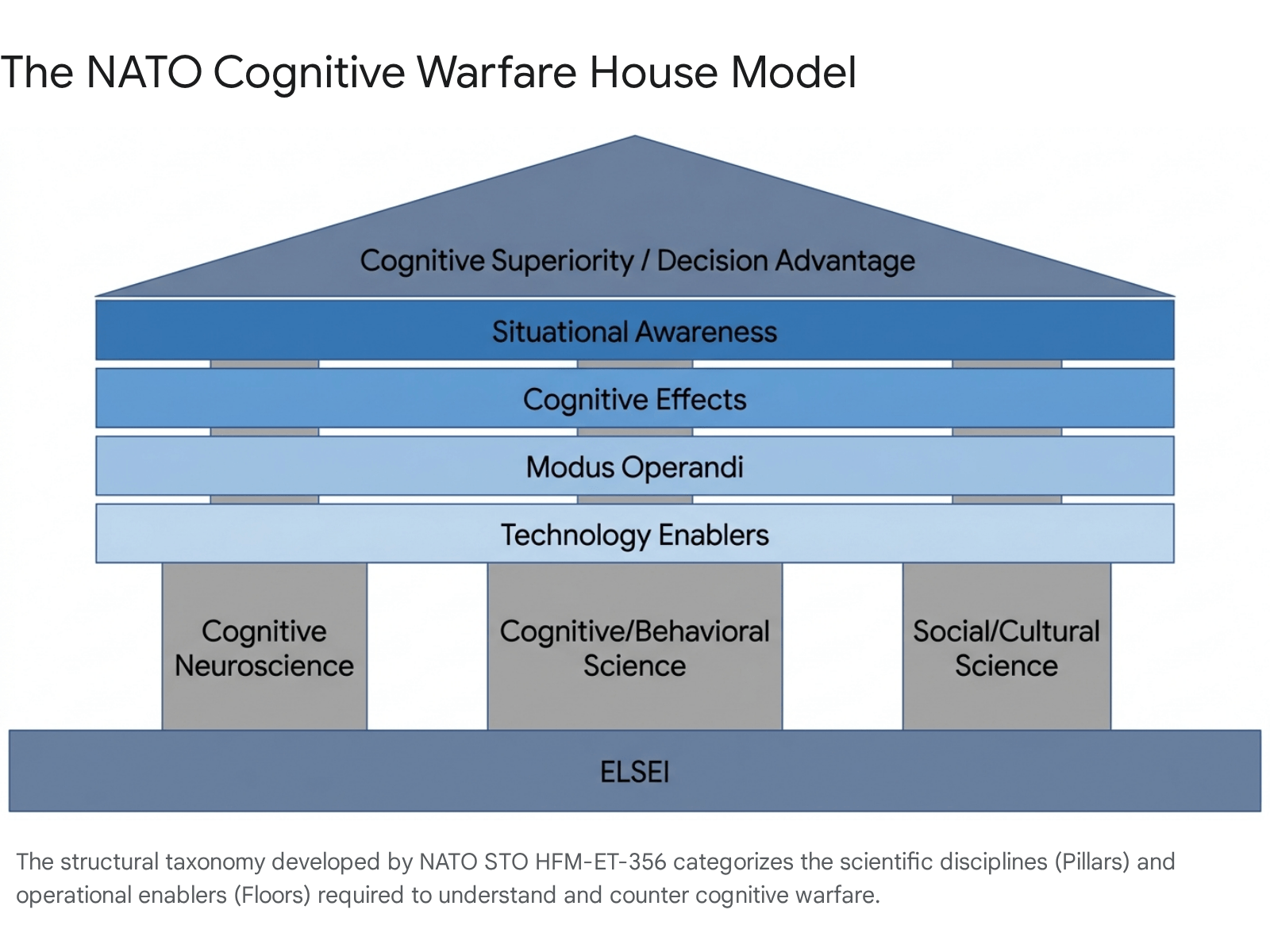
3.1 The Foundation: Ethical, Legal, Social, and Environmental Implications (ELSEI)
The structural integrity of the House Model rests on the ELSEI framework. Cognitive warfare operates in domains involving human perception, neural data, and societal cohesion. Democratic alliances must conduct defensive and counter-offensive operations within strict legal and ethical parameters1.
Adversarial actors operating under authoritarian systems maintain an asymmetric advantage, as they are largely unconstrained by domestic privacy laws, human rights frameworks, or ethical oversight regarding neuro-technological experimentation and mass surveillance13. The ELSEI foundation mandates that NATO’s technological integration and intelligence gathering respect international law, thereby protecting the societal trust that cognitive warfare specifically seeks to undermine.
3.2 The Pillars: The Scientific Knowledge Base
Supporting the operational levels are three vertical pillars that represent the foundational scientific disciplines necessary to map human cognitive vulnerabilities10.
The first pillar is Cognitive Neuroscience. This field investigates the biological processes and neural circuits that govern mental activity. It analyzes how environmental stimuli, stress, and fatigue affect neurotransmitter levels and neural processing3. Understanding neurobiology allows military planners to anticipate how warfighters perform under attentional saturation and how friction physiologically degrades executive control.
The second pillar is Cognitive and Behavioral Science. This discipline maps the psychological architecture of human information processing. It focuses on the exploitation of mental biases, heuristic shortcuts, and reflexive thinking13. Operations in this domain aim to bypass the analytical functions of the brain by triggering immediate, emotionally driven responses, altering an individual’s threat appraisal and behavioral disposition3.
The third pillar is Social and Cultural Science. This science examines relational interventions, societal cohesion, and shared narratives. Intelligence analysts utilize this discipline to identify a target population’s “Cognitive Centers of Gravity”—the core institutions, electoral processes, historical beliefs, and national values that command public trust7. Once identified, these centers of gravity become the primary targets for degradation.
3.3 The Floors: Operational Enablers
Resting across the scientific pillars are four horizontal floors, which represent the operational variables where scientific theory is translated into strategic action7.
| Operational Floor | Focus Area | Description and Application |
| Floor 1: Technology Enablers & Force Multipliers | Scale and Speed | The deployment of artificial intelligence, machine learning, algorithmic amplification, deepfakes, and virtual reality. These tools allow adversaries to execute manipulations at a scale and velocity that outpaces standard human analytical response times. |
| Floor 2: Modus Operandi | Tactics and Playbooks | The established methods utilized by hostile actors. This includes orchestrated sequences such as “distract and dismiss,” the weaponization of mass migration to induce societal stress, or the deployment of coordinated bot networks. |
| Floor 3: Cognitive Effects | Desired Psychological Impact | The specific cognitive outcomes targeted by an operation, including attentional tunneling, cognitive overload, engineered distrust, induced errors of judgment, and the amplification of polarization. |
| Floor 4: Situational Awareness & Sensemaking | Environmental Perception | The highest operational level, focusing on how a target perceives their reality. Adversaries aim to corrupt this layer to create epistemic disruption, while defenders utilize OSINT fusion and persistent monitoring to maintain an accurate operational picture. |
3.4 The Roof: Cognitive Superiority
The apex of the House Model defines the strategic objective: cognitive superiority, also referred to as decision advantage7. Offensively, this is achieved when an adversary successfully exploits facets of cognition to modify a target’s decision-making, compelling a leadership structure or population to accept political outcomes without kinetic resistance7. Defensively, cognitive superiority is the preservation of cognitive sovereignty—maintaining the integrity, tempo, and accuracy of domestic decision cycles under adversarial pressure18.
4. The Conduct of Cognitive Warfare
The operationalization of cognitive warfare relies on a closed-loop cycle of cognitive attrition. The methodology involves identifying vulnerabilities, perturbing the information environment, observing the societal or command reaction, and recalibrating the attack vector.
4.1 The Bio-Psycho-Social Spectrum
Cognitive engagement is executed across three intersecting levels of human vulnerability8:
The Biological Level involves manipulating physiological capacity. While this encompasses theoretical applications of advanced neuro-weapons—such as directed radiofrequency (RF) pulses or high-power microwaves (HPM) designed to alter neurotransmitter balances and disrupt executive control—it also includes non-kinetic methods8. Engineered attentional saturation via digital environments exhausts neurological resources, mimicking stress responses and degrading operational readiness without physical injury20.
The Psychological Level focuses on manipulating interpretation. AI-enabled influence operations tailor synthetic stimuli to specific demographic or psychometric profiles. By utilizing algorithms that reward emotionally charged and polarizing content, adversaries manipulate cognitive framing and emotional regulation, steering targets toward predictable conclusions8.
The Social Level targets group cohesion. The strategic goal is the destruction of shared narratives, institutional legitimacy, and public trust. Operations at this level weaponize identity politics and create localized epistemic disruption. The objective is to fracture the target society into polarized factions, rendering unified national action or policy responses difficult8.
4.2 The UnCODE System: Mapping Neurocentric Vectors
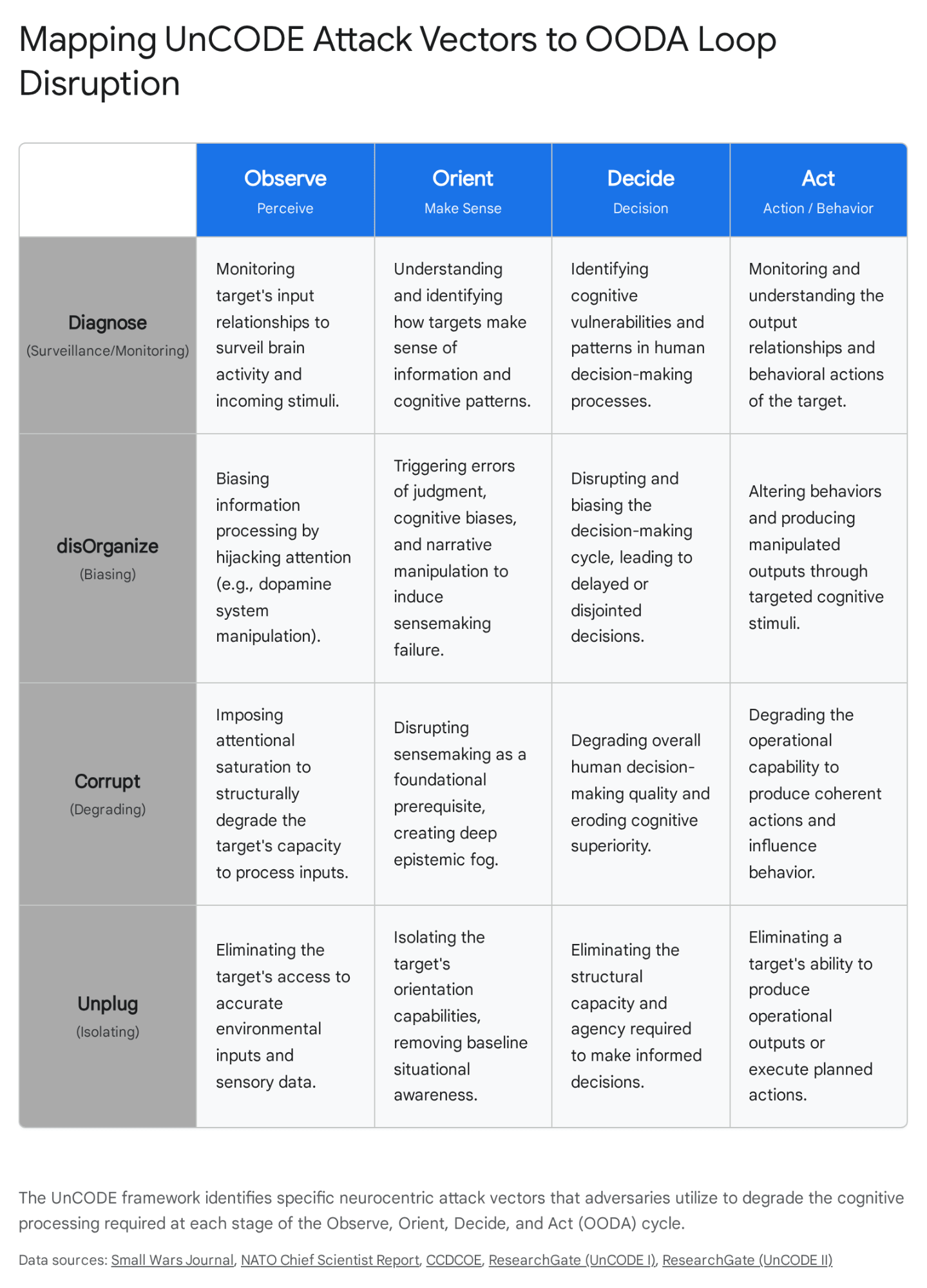
To classify the specific goals and methods of cognitive warfare, researchers introduced the UnCODE system, a domain-agnostic framework that evaluates how adversarial actions affect neural information processing within individuals, organizations, or algorithms21. The system identifies five distinct classes of cognitive attack vectors.
| UnCODE Vector | Definition | Operational Mechanism |
| Unplug | Neutralization of influence. | Eliminating a target’s ability to produce outputs. This involves severing an entity from the information ecosystem via algorithmic shadow-banning, digital censorship, or psychological isolation22. |
| Corrupt | Degradation of capacity. | Impairing a target’s ability to accurately process inputs. Mechanisms include overwhelming a target with contradictory data, inducing chronic cognitive fatigue, or utilizing deepfakes to degrade the integrity of the data stream22. |
| disOrganize | Biasing of processing activity. | Manipulating the environment so that even functioning neural systems produce flawed outputs. This relies on triggering heuristics and cognitive biases, ensuring the target draws incorrect conclusions from available data22. |
| Diagnose | Surveillance and profiling. | Monitoring and analyzing input-output relationships to map cognitive vulnerabilities. Hostile actors utilize digital footprints to construct precise psychometric profiles for future exploitation22. |
| Enhance | Augmentation of baseline capability. | The proactive improvement of domestic cognitive systems. This self-directed vector seeks to increase cognitive resilience and processing speed to maintain an asymmetrical advantage over adversaries22. |
4.3 Historical Parallels: Psychological Zersetzung
Analysts identify structural parallels between modern cognitive warfare and historical methods of authoritarian repression. Specifically, the tactics align with the East German Ministry for State Security (Stasi) methodology known as Zersetzung (decomposition or corrosion)19.
Zersetzung was designed to neutralize political targets through sustained psychological pressure, reputational sabotage, and the disruption of social relationships, rather than overt physical violence. The objective was to induce paranoia, erode self-efficacy, and force the target into a state of operational paralysis24. Modern cognitive warfare applies the principles of Zersetzung at a macro-societal level. By utilizing the “Diagnose” and “disOrganize” vectors of the UnCODE system, actors leverage social media algorithms and pervasive surveillance to isolate demographics, inject institutional doubt, and generate societal destabilization without triggering the thresholds of kinetic military response24.
5. Strategic Countermeasures and Mitigation
NATO doctrine recognizes that cognitive warfare is a persistent condition of the security environment. Defense strategies cannot rely solely on blocking information; they must focus on preserving sensemaking capacity, degrading adversarial influence infrastructure, and ensuring systemic recovery following cognitive attacks.
5.1 The Three Core Defensive Functions
The operational blueprint for countering cognitive warfare is predicated on three primary functions, mapped to military planning and budget allocations5:
First, the Alliance must degrade adversary capability to influence and alter behavior. This requires a shift from reactive debunking to proactive disruption. Intelligence agencies employ “prebuttal” strategies, declassifying and distributing validated intelligence regarding adversary intent and modus operandi before hostile narratives can establish cognitive strongholds5.
Second, defense relies on the mandate to improve human and technological cognition above baseline levels. This involves deploying secure AI and machine learning tools to assist in data processing, offloading lower-level analytical tasks to machines. This technological enhancement preserves human cognitive bandwidth for complex sensemaking, ethical judgment, and strategic orientation5.
Third, institutions must build resilience to withstand and recover from cognitive attacks. The measure of effectiveness in cognitive defense is the speed at which a command structure or society can identify a cognitive intrusion, isolate the compromised variables, and restore operational tempo and trust5.
5.2 Indicators and Warnings (I&W) Architecture
A vulnerability in cognitive warfare is the temporal asymmetry between the speed of an algorithmic attack and the speed of human recognition. To address this, NATO STO established research groups, such as the SAS-185 task group, focused on developing advanced Indicators and Warnings (I&W) for cognitive warfare in cyberspace26.
Effective I&W systems utilize quantitative data and Large Language Models (LLMs) to identify anomalous patterns in the information environment before they achieve widespread cognitive impact. This involves the application of Natural Language Processing (NLP) to detect rapid shifts in lexical diversity, sentiment polarity, and subjective phrasing within digital ecosystems26. Furthermore, Social Network Analysis (SNA) is deployed to map relationship dynamics, identifying coordinated inauthentic behavior, bot-network propagation, and the weaponization of distinct network nodes26.
To structure these warnings, analysts utilize morphological analysis and frameworks like DISARM (Disinformation Analysis and Response Framework). The DISARM framework structures adversary tactics across planning, execution, and evaluation phases, allowing defenders to map specific countermeasures against recognized behavioral patterns28.
5.3 The Holistic Bowtie Model
Mapping the interplay between defensive technologies, individual cognition, and societal resilience requires a systemic approach. NATO researchers introduced the Holistic Bowtie Model, a cybernetic system model derived from hazard and risk analysis protocols30.
The model visualizes cognitive warfare over time, placing the sharp end of conflict (weapon systems, human-machine teaming, individual warfighters) in the center, and mapping the connections outward to the blunt end (alliances, state institutions, societal structures)30. The Bowtie Model analyzes the dynamic feedback loops between technological sensors and human operators. By mapping these invariants, defense planners can identify where an adversary is attempting to sever trust between layers. For example, if an adversary successfully corrupts an AI-driven targeting algorithm, the subsequent military failure creates a feedback loop that degrades political and societal trust in the military apparatus30. Defensive protocols focus on securing these feedback loops and ensuring the accurate communication of the Recognized Cyber Picture (RCP) across organizational boundaries21.
6. Civil-Military Integration and Societal Resilience
Because cognitive warfare frequently bypasses military perimeters to directly target civilian populations and civil institutions, a purely military defense is inadequate. Establishing cognitive security requires an integrated methodology18.
Under NATO’s Article 3, member states are committed to maintaining and developing individual and collective capacity to resist armed attack. In the cognitive age, civil preparedness is reclassified as a core element of collective defense, directly underpinning military readiness27. If the civilian logistics networks, political bodies, and industrial bases supporting a military force are cognitively paralyzed, the military instrument of power is rendered ineffective.
Protecting the human domain necessitates the construction of Cognitive Sovereignty Infrastructure19. This entails the implementation of auditable OSINT fusion centers, robust digital literacy and psychological inoculation programs for the civilian populace, and the fortification of national trust centers, including electoral systems, judicial bodies, and public health networks. Strategic defense requires that civilian and commercial sectors achieve a level of resilience that matches military hardening, ensuring that the target society retains the capacity for unified action despite perceptual disruption.
7. Conclusion
Cognitive warfare represents a mature, persistent domain of strategic competition. By weaponizing the vulnerabilities inherent in human neurobiology and psychology, and scaling these attacks via artificial intelligence and global digital networks, adversaries seek to paralyze NATO and Allied decision-making processes. The goal is the acquisition of geopolitical objectives through the systematic degradation of institutional trust and cognitive capacity, bypassing the requirement for kinetic conflict.
The NATO House Model provides the necessary architectural taxonomy to combat this threat, aligning legal constraints, scientific research, and operational technologies into a unified doctrine. To preserve decision advantage, defense strategies must transition from reactive information management to proactive cognitive security. This requires the continuous refinement of early warning indicators, the hardening of cybernetic feedback loops between human and machine systems, and the establishment of integrated, whole-of-society resilience capable of absorbing and recovering from sustained cognitive attrition.
Master Summary Table: Cognitive Warfare Dynamics and Countermeasures
| Domain / Concept | Framework Application | Offensive Objective (Adversary) | Defensive Countermeasure (NATO/Allied) |
| Scientific Foundation | ELSEI & The Three Pillars | Exploit neurobiology, behavioral biases, and societal fractures without regulatory constraints. | Ground cognitive operations in strict ethical/legal frameworks; leverage scientific pillars to map human vulnerabilities. |
| Operational Enablers | House Model “Floors” | Deploy AI, deepfakes, and algorithmic amplification to saturate the information environment and apply TTPs. | Maintain persistent situational awareness; utilize auditable OSINT fusion and narrative intelligence to preserve sensemaking. |
| Decision Cycle | OODA Loop Integration | Inject cognitive disruption during “Observe/Orient” phases to force strategic paralysis in “Decide/Act” phases. | Utilize AI decision-support to reduce cognitive load; ensure rapid, accurate intelligence dissemination to commanders. |
| Neurocentric Vectors | UnCODE Framework | Unplug, Corrupt, disOrganize, Diagnose. Degrade target processing capacity and bias behavioral outputs. | Enhance. Improve domestic human-machine cognitive baselines; map adversary vectors to anticipate attack methodologies. |
| Systemic Risk | Holistic Bowtie Model | Exploit feedback loops between technology and society to erode trust across civil-military boundaries. | Map cybernetic feedback loops to isolate compromised nodes; ensure secure communication of the Recognized Cyber Picture (RCP). |
| Strategic Goal | Cognitive Superiority | Erode institutional trust, fracture civic cohesion, and impose political will without kinetic warfare. | Establish Cognitive Sovereignty Infrastructure; implement whole-of-society civil defense to build durable societal resilience. |
| Detection & Warning | Indicators & Warnings (I&W) | Utilize the speed and volume of cyberspace to outpace human analytical recognition. | Deploy quantitative AI tools, Natural Language Processing, and Social Network Analysis (e.g., SAS-185/DISARM) for early anomaly detection. |
Please share the link on Facebook, Forums, with colleagues, etc. Your support is much appreciated and if you have any feedback, please email us in**@*********ps.com. If you’d like to request a report or order a reprint, please click here for the corresponding page to open in new tab.
Sources Used
- Cognitive Warfare – NATO Science and Technology Organization, https://www.sto.nato.int/wp-content/uploads/chief-scientist-report-cognitive-warfare-final.pdf
- Conference Presentations – SPIE Digital Library, https://www.spiedigitallibrary.org/conference-presentations/12547/125470I/New-perspectives-on-cognitive-warfare/10.1117/12.2666777
- (PDF) New perspectives on cognitive warfare – ResearchGate, https://www.researchgate.net/publication/371570719_New_perspectives_on_cognitive_warfare
- New perspectives on cognitive warfare – Scilit, https://www.scilit.com/publications/11569eca77475406f86676f64c87a67b
- Cognitive Warfare: An Allied Blueprint and a Pentagon Opportunity – Small Wars Journal, https://smallwarsjournal.com/2026/01/16/cognitive-warfare/
- NATO-aligned Cognitive Warfare Defense: How Semantic Visions Supports Cognitive Superiority, Resilience, and Decision Advantage, https://www.semantic-visions.com/insights/nato-aligned-cognitive-warfare-defense
- How Is Cognitive War Waged? The Battle For The Mind | Ozean Media, https://ozeanmedia.com/research/how-is-cognitive-war-waged-the-battle-for-the-mind/
- Cognitive Warfare 2026: NATO’s Chief Scientist Report as Sentinel Call for Operational Readiness > Institute for National Strategic Studies > View Publications, https://inss.ndu.edu/Research-and-Commentary/View-Publications/Article/4371195/cognitive-warfare-2026-natos-chief-scientist-report-as-sentinel-call-for-operat/
- Ontological Foundations of Cognitive Warfare – NATO Cooperative Cyber Defence Centre of Excellence, https://ccdcoe.org/uploads/2026/04/ONTOLOGICAL_FOUNDATIONS_OF_COGNITIVE_WARFARE.pdf
- STO-TR-HFM-ET-356 Executive Summary and Synthèse, https://www.sto.nato.int/document/executive-summary-and-synthese-sto-tr-hfm-et-356/
- Mitigating and Responding to Cognitive Warfare | NATO Science and Technology Organization, https://www.sto.nato.int/document/mitigating-and-responding-to-cognitive-warfare-2/
- Warfighter Archives | NATO Science and Technology Organization, https://www.sto.nato.int/document-tag/warfighter/
- Cognitive warfare – Wikipedia, https://en.wikipedia.org/wiki/Cognitive_warfare
- Mitigating and Responding to Cognitive Warfare – TNO (Publications), https://publications.tno.nl/publication/34641000/0hB67K/korteling-2023-education.pdf
- Mitigating and Responding to Cognitive Warfare – DTIC, https://apps.dtic.mil/sti/trecms/pdf/AD1200226.pdf
- The NATO CogWar “House model”: Required knowledge to achieve Cognitive Warfare strategic goals. – ResearchGate, https://www.researchgate.net/figure/The-NATO-CogWar-House-model-Required-knowledge-to-achieve-Cognitive-Warfare-strategic_fig1_406976343
- Mitigating and Responding to Cognitive Warfare Executive Summary – NATO, https://publications.sto.nato.int/publications/STO%20Technical%20Reports/STO-TR-HFM-ET-356/$TR-HFM-ET-356-ES.pdf
- NATO’s Concept of Cognitive Warfare – Puolustusvoimat, https://puolustusvoimat.fi/documents/1951253/2815786/PVTUTKL_Tutkimuskatsaus_2026-2_Kaarkoski_en.pdf/d9b617e8-5e00-2fdf-84c9-730b1a9abd9e?t=1772545283130
- Cognitive-Cyber Warfare: Measures and Countermeasures – Bryant McGill, https://bryantmcgill.blogspot.com/2026/06/cognitive-cyber-warfare.html
- Cognitive Warfare – Grokipedia, https://grokipedia.com/page/cognitive-warfare
- Torvald Fossåen Ask – The Faculty of Health, Welfare and Organization – Høgskolen i Østfold, https://www.hiof.no/hvo/english/people/aca/torvalda/
- The UnCODE system: A neurocentric systems approach for classifying the goals and methods of Cognitive Warfare – ResearchGate, https://www.researchgate.net/publication/370865240_The_UnCODE_system_A_neurocentric_systems_approach_for_classifying_the_goals_and_methods_of_Cognitive_Warfare
- (PDF) The UnCODE System: A Neurocentric Systems Approach for Classifying the Goals and Methods of Cognitive Warfare – ResearchGate, https://www.researchgate.net/publication/383850591_The_UnCODE_System_A_Neurocentric_Systems_Approach_for_Classifying_the_Goals_and_Methods_of_Cognitive_Warfare
- Psychological Zersetzung, Cognitive Warfare, and the Risk of Scientific Misuse | by SIMKRA, https://osintteam.blog/psychological-zersetzung-cognitive-warfare-and-the-risk-of-scientific-misuse-be0024a3a09e
- STASI Methodologies, Psychological Effects, and Ethical Review of Torvald Ask and Modern Neuroscience | by SIMKRA | Medium, https://medium.com/@simone.kraus/stasi-methodologies-psychological-effects-and-ethical-review-of-torvald-ask-and-modern-776f4d341e09
- (PDF) Cognitive Warfare Problem for the Brain, Opportunity for the Machine – ResearchGate, https://www.researchgate.net/publication/399444901_Cognitive_Warfare_Problem_for_the_Brain_Opportunity_for_the_Machine
- Resilience in NATO – NATO’s ACT, https://www.act.nato.int/article/resilience-in-nato/
- (PDF) Cognitive Warfare Indicators and Warnings Identification Framework – ResearchGate, https://www.researchgate.net/publication/399445236_Cognitive_Warfare_Indicators_and_Warnings_Identification_Framework
- Cognitive Warfare Indicators and Warnings Identification Framework, https://www.sto.nato.int/document/cognitive-warfare-indicators-and-warnings-identification-framework/
- A Holistic bowtie model of Cognitive Warfare: An interplay of technology, humans, societies and environment – NATO, https://publications.sto.nato.int/publications/STO%20Meeting%20Proceedings/STO-MP-HFM-361/MP-HFM-361-P04.pdf
- Civil Defence in Europe: An Initial Assessment – The International Institute for Strategic Studies, https://www.iiss.org/globalassets/media-library—content–migration/files/research-papers/2026/civil-defence-in-europe-an-initial-assessment/iiss_civil-defence-in-europe_an-initial-assessment_-21042026.pdf